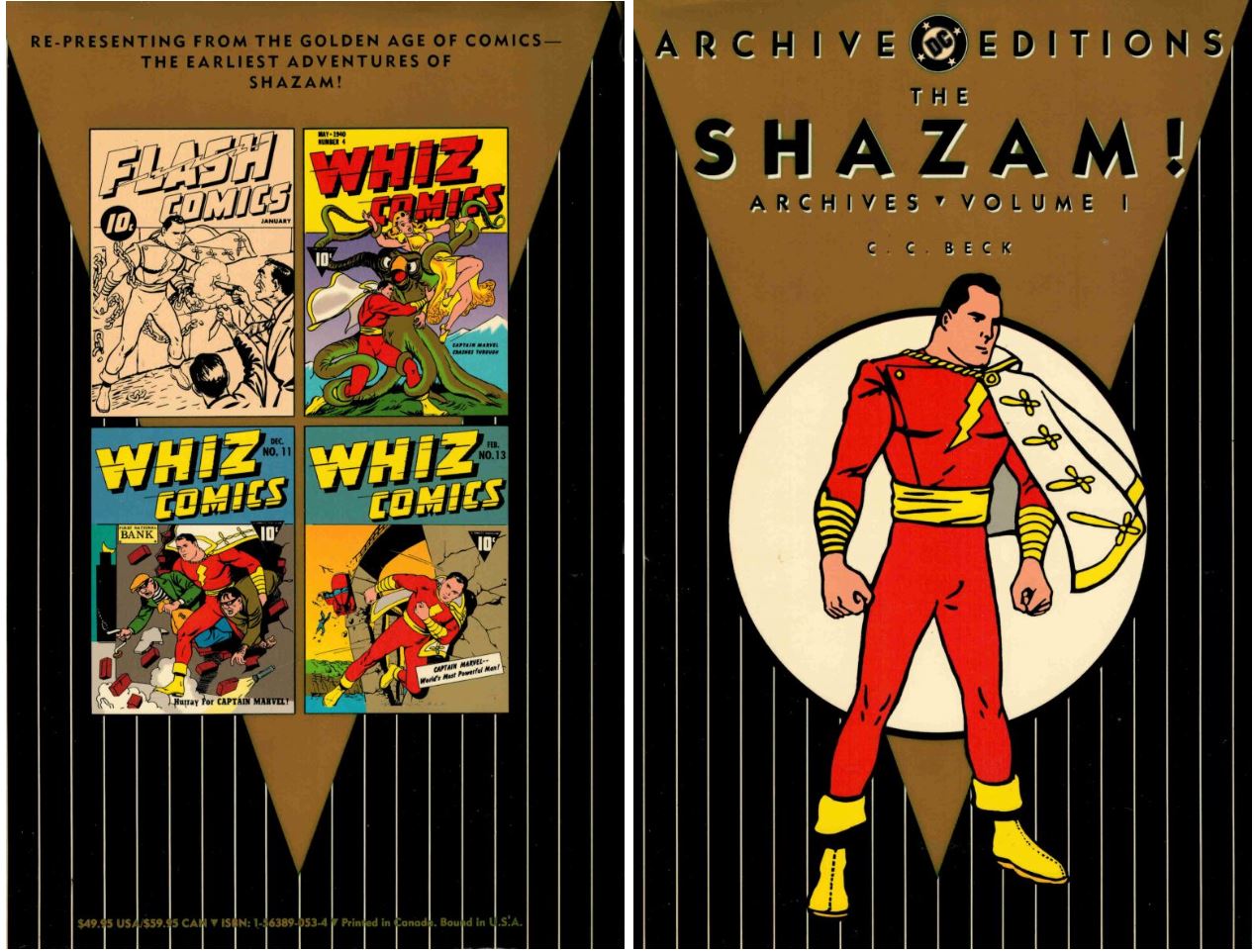
The Shazam! Archives volume 1


By Bill Parker, C. C. Beck & Pete Costanza with various (DC Comics)
ISBN: 978-1-56389-053-6 (HB)

This book includes Discriminatory Content produced in less enlightened times.

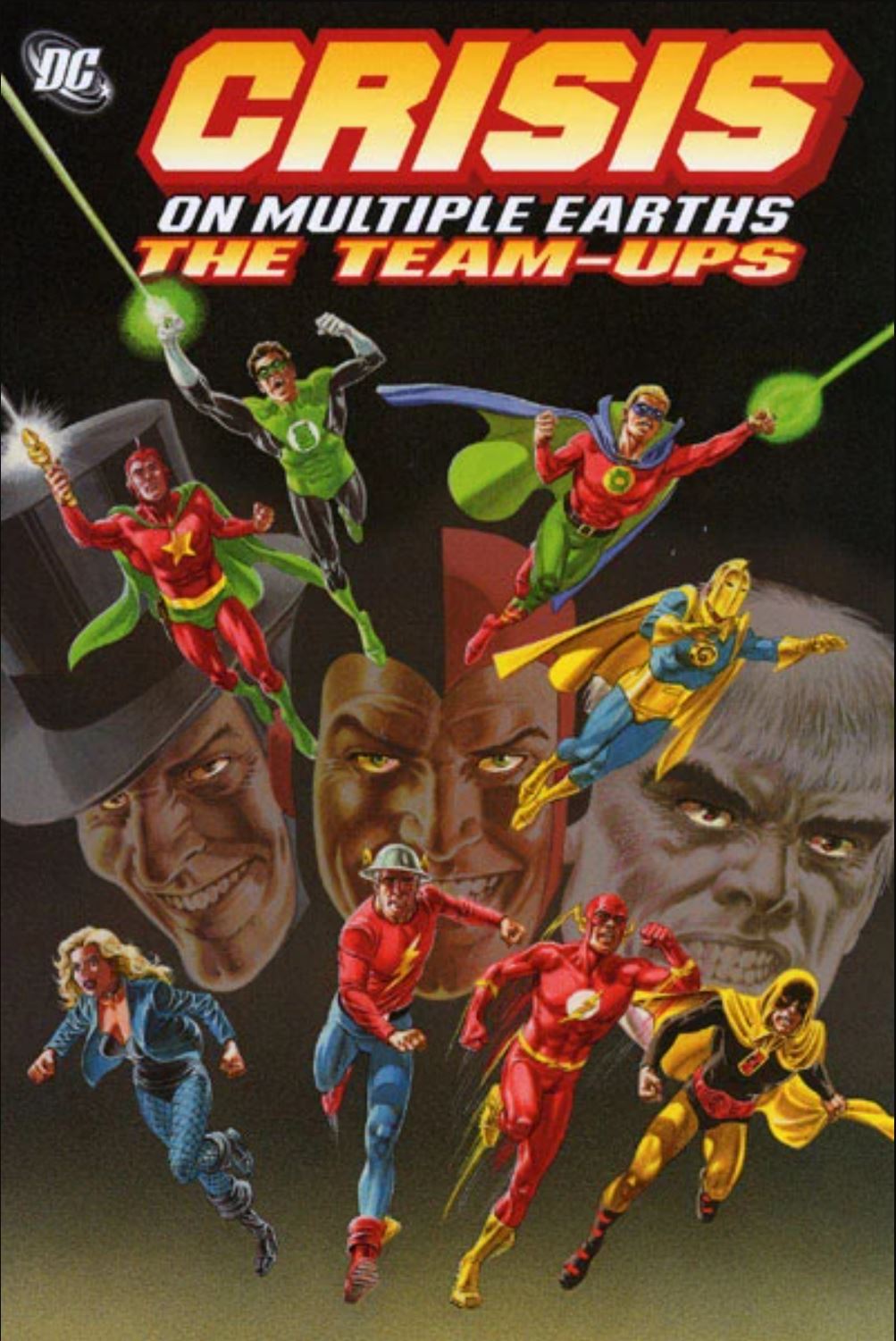
At their most impressive, superhero comics combine the gravitas of mythology with all the sheer fun and exuberance of a child’s first rollercoaster ride. The perfect example of this is the original happy-go-lucky hero we can’t call Captain Marvel anymore.

First seen in late December 1939, Whiz Comics (#2 – there was no #1) cashed in on the comic book sales phenomenon of Superman; the big red riot eventually won his name after narrowly missing being Captain Flash or Captain Thunder. He was the brainchild of Bill Parker & Charles Clarence Beck, initially dispensing the same kind of summary rough justice as his contemporaries. However, the character soon distanced himself from the pack – Man of Steel included – by employing and enjoying an increasingly light, surreal and comedic touch, which made him the bestselling comics character in America. Ultimately, he proved that he could beat everybody but copyright lawyers; during his years of enforced inactivity the trademarked name passed to a number of other publishers before settling at Marvel Comics and they are never, never, never letting go. You can check out and compare their cinematic blockbuster version with the DC Extended Universe’s Shazam! flick too…

Publishing house Fawcett had first gained prominence through an immensely well-received magazine for WWI veterans entitled Captain Billy’s Whiz-Bang, before branching out into books and general interest magazines. Their most successful publication – at least until the Good Captain hit his stride – was the ubiquitous boy’s building bible Mechanix Illustrated and, as the comic book decade unfolded, the scientific and engineering discipline and “can-do” demeanour underpinning MI suffused and informed both art and plots of the Marvel Family titles.

As previously stated, the big guy was created by writer/editor Bill Parker and brilliant young artist Charles Clarence Beck who, with his assistant Pete Costanza, handled most of the art on the series throughout its stellar run. Other writers included William Woolfolk, Rod Reed, Ed “France” Herron, Joe Simon, Jack Kirby, Joe Millard, Manley Wade Wellman and fabulously prolific Otto Binder.

Before eventually evolving his own amiable personality, the Captain was a serious, bluff and rather characterless powerhouse, whilst his juvenile alter ego was the true star: a Horatio Alger archetype of impoverished, boldly self-reliant, resourceful youth overcoming impossible odds through gumption, grit and sheer determination…

Homeless orphan and good kid Billy Batson is selected by an ancient wizard to be given the powers of six gods and heroes to battle injustice. He transforms from scrawny precocious kid to brawny (adult) hero Captain Marvel by speaking aloud the wizard’s name – an acronym for six legendary divine patrons: Solomon, Hercules, Atlas, Zeus, Achilles and Mercury.

This magnificent full-colour, deluxe hardback compendium re-presents Captain Marvel’s first 15 exploits from Whiz Comics #2 to 15 (February 1940 to March 1941). There was no #1, two issue #5’s and two editions in March (but I’ll try to explain all that as we go along), with joy, verve and invention paramount in this particular knock-off crusader; one of a countless number imitators and descendants to cash in on the sales phenomenon of Superman…

Author, journalist and fan Richard A. Lupoff covers in great detail the torturous beginnings of the feature in his Foreword before the magic proper starts with a priceless glimpse at the hero’s seemingly-accursed design stage. To establish copyright, publishers used to legally register truncated black-&-white facsimile editions – dubbed “Ash-can Editions” – in advance of their launch issues. For magazine publisher Fawcett, production of their first comic book proved an aggravating process as this registration twice uncovered costly snags which forced the editors to redesign both character and publication.

Contained herein are cover reproductions of Flash Comics #1 starring Captain Thunder (obliviously scheduled for release mere days after DC’s own Flash Comics title hit the stands), and Thrill Comics #1 which repeated the accident just as Standard’s Thrilling Comics launched. Also on view is monochrome art for the first half of the story of “Captain Thunder” which would eventually be re-lettered and released as the lead in anthology title Whiz Comics #2, finally safely released cover-dated February 1940. Like many Golden Age series, the stories collected here never had individual titles, and DC’s compilers have cleverly elected to use the original comics’ strap-lines or cover blurbs to differentiate the tales…
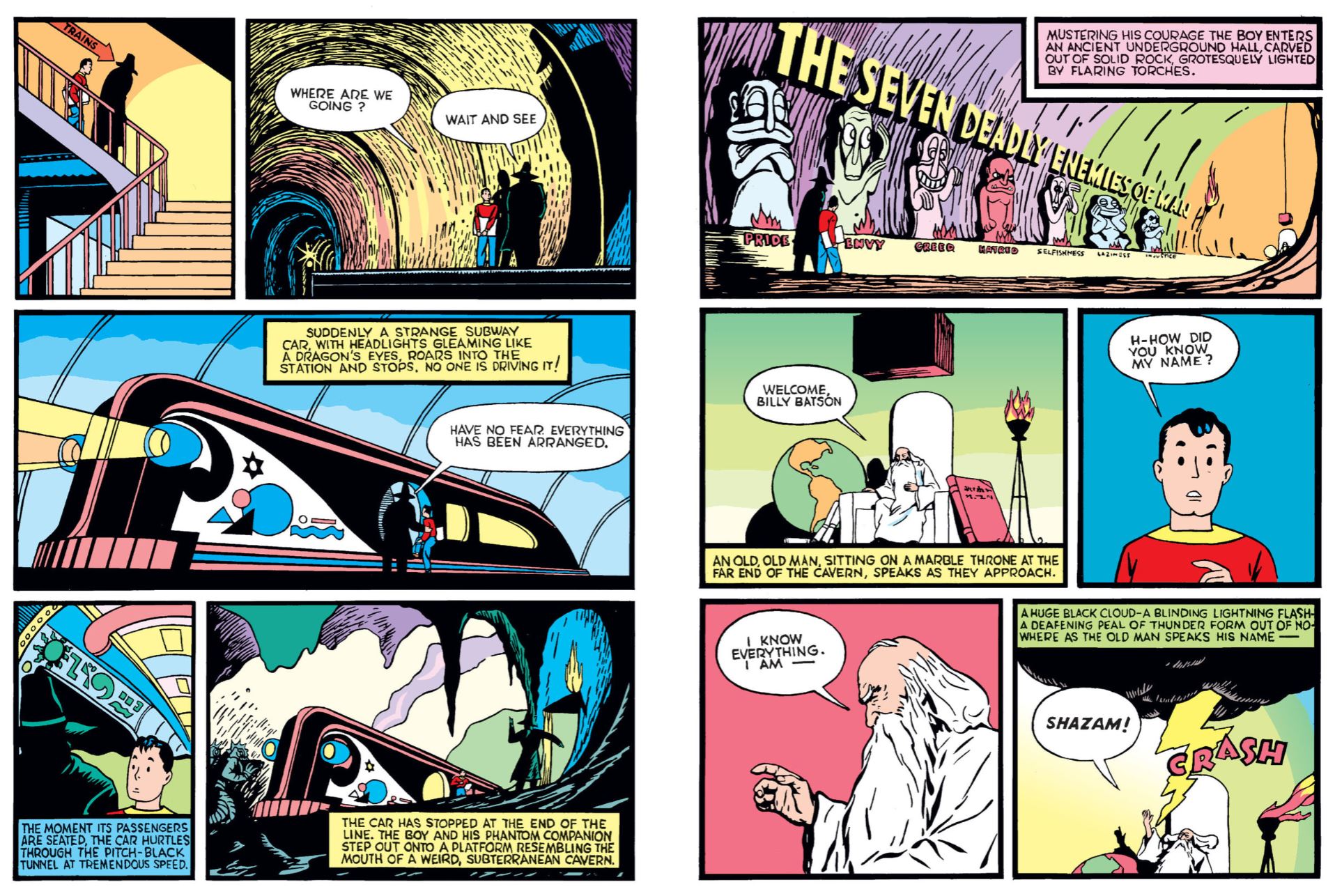
‘Gangway for Captain Marvel!’ – drawn in a style reminiscent of early Hergé – finds homeless orphan newsboy Billy Batson lured into an abandoned subway tunnel to a meeting with infinitely ancient wizard Shazam. At the end of a long life confronting evil, the white-bearded figure grants the lad the powers and signature gifts of six gods and heroes; bidding him to continue the good fight.

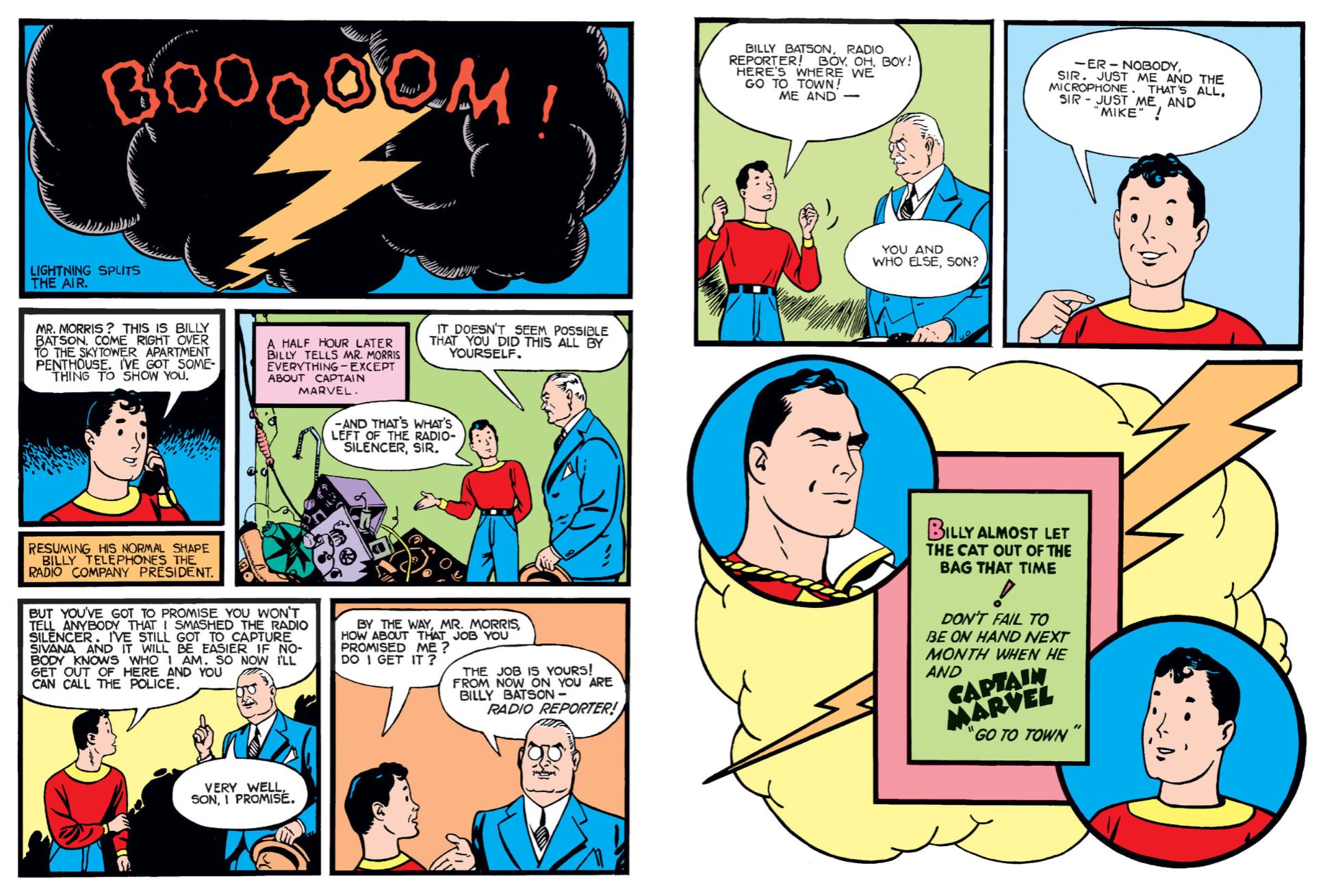
In 13 delightfully clean and simple pages Billy gets his powers, has his secret origin revealed (he’s actually heir to a fortune embezzled by his crooked uncle Ebenezer Batson), wins a job as a roaming radio reporter for Amalgamated Broadcasting and defeats the demonic schemes of criminal science maniac Doctor Thaddeus Bodog Sivana, who is holding the airwaves of America hostage. The mighty, taciturn and not yet invulnerable Marvel is only sparingly used to do the heavy lifting. It is sheer comic book poetry…
The March issue had no cover number but was listed as #3 in the indicia and featured ‘The Return of Sivana’ as the insane inventor unleashes a mercenary army equipped with his super-weapons upon the nation, attempting to become Emperor of America. His plan is duly thwarted by Billy acting as a war correspondent, and the mighty muscles of Marvel…

The third (April-dated) Whiz Comics had “Number 3” on the cover but was designated #4 inside and proudly proclaimed ‘Make Way for Captain Marvel!’ before boldly leaping into full science fiction mode as Billy is shanghaied to Venus in Sivana’s mighty rocketship. The boy is forced to reveal his amazing secret to the demented inventor whilst battling incredible monsters and giant frog-men dubbed “Glompers”, with the magnificently guileless and gallant Marvel seemingly helpless against the savant’s seductive new ally – Queen Beautia – as that deadly duo prepare to invade Earth.

Only seemingly though…

‘Captain Marvel Crashes Through’ (#4 on the cover, but #5 inside) details how bewitching Beautia, aided by Sivana’s technology, runs for President. However, the sinister siren has a soft heart, and when Billy is captured (and encounters the first of a multitude of diabolically clever gadgets designed to stop him saying his magic word), she frees him, thus falling foul of the gangsters who were backing her. Happily, Captain Marvel is there to save the day…

An inexplicable crime-wave shakes the country in ‘Captain Marvel Scores Again!’ (the wild numbers game finally ends here as there’s a #5 on the cover and the same inside) as a different sinister scientist uses a ray to turn children into thieves. Even Billy is not immune…

‘Captain Marvel and the Circus of Death’ (July 1940) sees Sivana return with fantastic Venusian dino-monsters which our Good Captain is hard-pressed to handle. Incidentally, this was the first issue where the Big Red Cheese is seen definitely flying as opposed to leaping – something Superman is not acknowledged as doing until late 1941. It means nothing, I’m just saying emulation goes both ways…

For ‘Captain Marvel and the Squadron of Doom’, young Billy travels to the North Pole for a radio story and discovers a secret organisation thawing out frozen cavemen to act as their army of conquest, after which he and his mature magical avatar foil a murderous spiritualist causing mass-drownings to bolster his reputation and fortune in ‘Saved by Captain Marvel!’

Whiz #9’s ‘Captain Marvel on the Job!’ finds man & boy foiling a revolution, recovering foreign crown jewels and flummoxing a madman with a shrinking ray, after which Sivana and Beautia return in ‘Captain Marvel Battles the Winged Death’: a blistering yarn involving espionage and America’s latest secret weapon. In this tale, the Empress of Venus finally reforms, becoming a solid American citizen…

‘Hurrah for Captain Marvel!’ finds Batson investigating college hazing and corrupt sporting events whilst in #12 (January 1941), the World War looms large as “Gnatzi” maritime outrages bring Billy to London where he uncovers the spy responsible for sinking refugee ships in ‘Captain Marvel Rides the Engine of Doom!’

‘Captain Marvel – World’s Most Powerful Man!’ then features Sivana’s latest atrocity as the madman disrupts hockey matches, blitzes banks and incapacitates the US army with a formula that turns men into babies. Even Billy isn’t immune, but at least Beautia is there to help him…

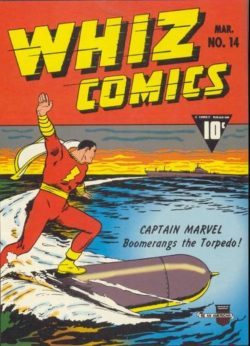
War was looking increasingly unavoidable and many superheroes jumped the gun to start fighting before the US officially entered the fray. ‘Captain Marvel Boomerangs the Torpedo!’ is a superb patriotic cover for Whiz #14 (March 1941) even though the actual story involves Sivana’s capture and subsequent discovery of a thought process which allows him to walk through walls – and cell bars. Luckily, the World’s Mightiest Mortal also possesses the Wisdom of Solomon and deduces a solution to the unstoppable menace…
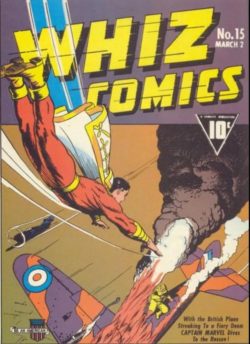
This superb collection concludes after another stirring cover ‘With the British Plane Streaking to a Fiery Doom, Captain Marvel Dives to the Rescue!’ (#15 and also cover-dated March), fronting an unrelated adventure which reveals the astounding and tragic origin of Dr. Sivana, his unbelievable connection to Beautia, and also introduces her brother Magnificus – almost as mighty a fighter as Marvel – after Billy is kidnapped and trapped once more on Venus…

DC/National Periodical Publications had filed suit against Fawcett for copyright infringement as soon as Whiz Comics #2 was released. The companies slugged it out in court until 1953, when, with the sales of superhero comics decimated by changing tastes, Captain Marvel’s publishers decided to capitulate. The name lay unclaimed until 1967 when M.F. Enterprises released six issues of an unrelated android hero before folding. Marvel Comics finally secured rights to the name in 1968.

DC eventually acquired Fawcett’s comic book properties and characters and in 1973 revived the Good Captain for a new generation, gambling that his unique charm would work another sales miracle during one of comics’ periodic downturns. Retitled Shazam! due to the incontestable power of lawyers and copyright legislation, the revived heroic ideal enjoyed mixed success before being subsumed into the company’s vast stable of characters…

Nevertheless, the first Captain Marvel is a true icon of American comic history and a brilliantly conceived superhero for all ages. This titanic tome only scratches the surface of the canon of delights produced over the near 90 years of his tumultuous existence, and is an ideal exemplar introduction to the world of adventure comics: one that will appeal to readers of any age and temperament.
© 1940, 1941, 1992 DC Comics. All Rights Reserved.

Today in 1867, French artist, cartoonist, creator and designer of Bibendum (the Michelin man) O’Galop AKA Marius Rossillon was born. He shares birthday with Charles ClarenceC.C.Beck (Captain Marvel/Billy Batson, Spy Smasher, Fatman, the Human Flying Saucer) in 1910; mega-letterer Ray Holloway in 1920; strip cartoonist/animator Paul Gringle (Rural Delivery, Out Our Way) in 1922, Charlton comics art mainstay Rocke Mastroserio in 1927 and Dutch creator Jan Kruis (Jan, Jans en de Kinderen) in 1933.

Events include Ken Reid’s final Jonah strip in The Beano this day in 1963 – although the strip was revived in The Dandy 30 years later – and last of Gus Edson & Irwin Hasen’s newspaper feature Dondi in 1986, with Tom Batiuk/Chuck Ayers’ strip Crankshaft debuting one year later.

Today in 1846 Swiss satirist and the world’s first true comics creator – Rodolphe Töpffer (Histoire de Mr. Vieux Bois/The Adventures of Obadiah Oldbuck) – died, as did Shoe and Pluggers cartoonist Jeff MacNelly in 2000, and the mighty, massively influential cartoonist, historian and publisher Jack Edward Jackson AKA Jaxon (Rip Off Press co-founder; crafter of God Nose, Los Tejanos, Comanche Moon, The Secret of San Saba, The Alamo: An Epic Told from Both Sides and dozens more) in 2006.
Sorry, no posting today. Instead why not read or re-read our coverage of Persepolis – The Story of a Childhood & Persepolis 2 – The Story of a Return and ponder what a huge loss the death of Marjane Satrapi (announced yesterday) is to us all.

Born today in 1905, Wayne Boring was inescapably typecast as the 1940s-1950s Superman artist, and shared his birthday with Vin Sullivan who limned and edited Action Comics #1. He arrived on his planet in 1911 whilst occasional Superman inker Frank Chiaremonte was born today in 1942. Today in 1970 artist Matthew Clark (Amazing Spider-Man, Wonder Woman, Doom Patrol) was born. He also has illustrated the Man of Tomorrow…

Pottsy, Bozo Blimp and Willie Doodle  cartoonist Jay Irving died on this date in 1970 and the date is remarkable for events such as the first episode of Warren Tufts’ magnificent Lance in 1955; the publication of Amazing Fantasy #15 in 1962; the last episode of Stan Lynde’s glorious strip Latigo in 1983 and, in 1987, the live performance/re-enactment of Peter Parker’s wedding to Mary Jane Watson at Shea Stadium, Queens.

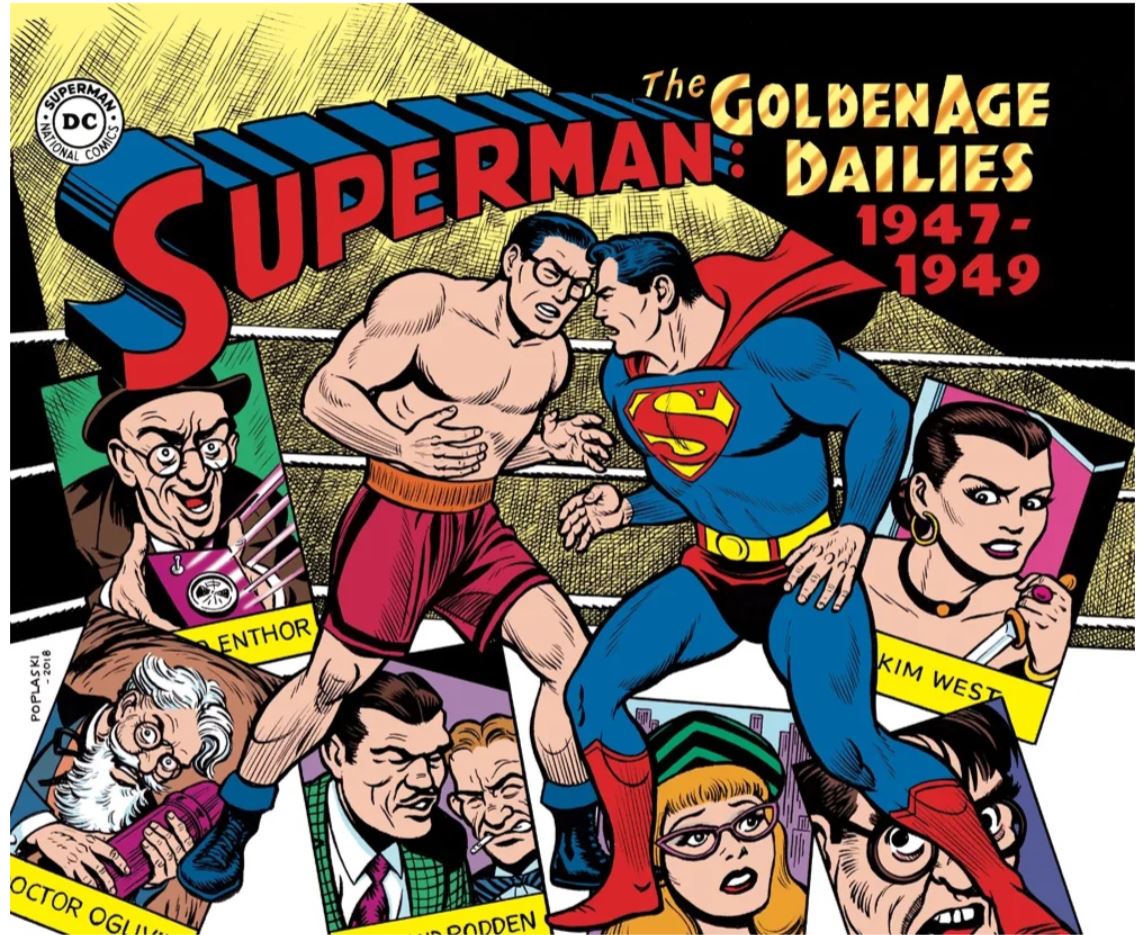
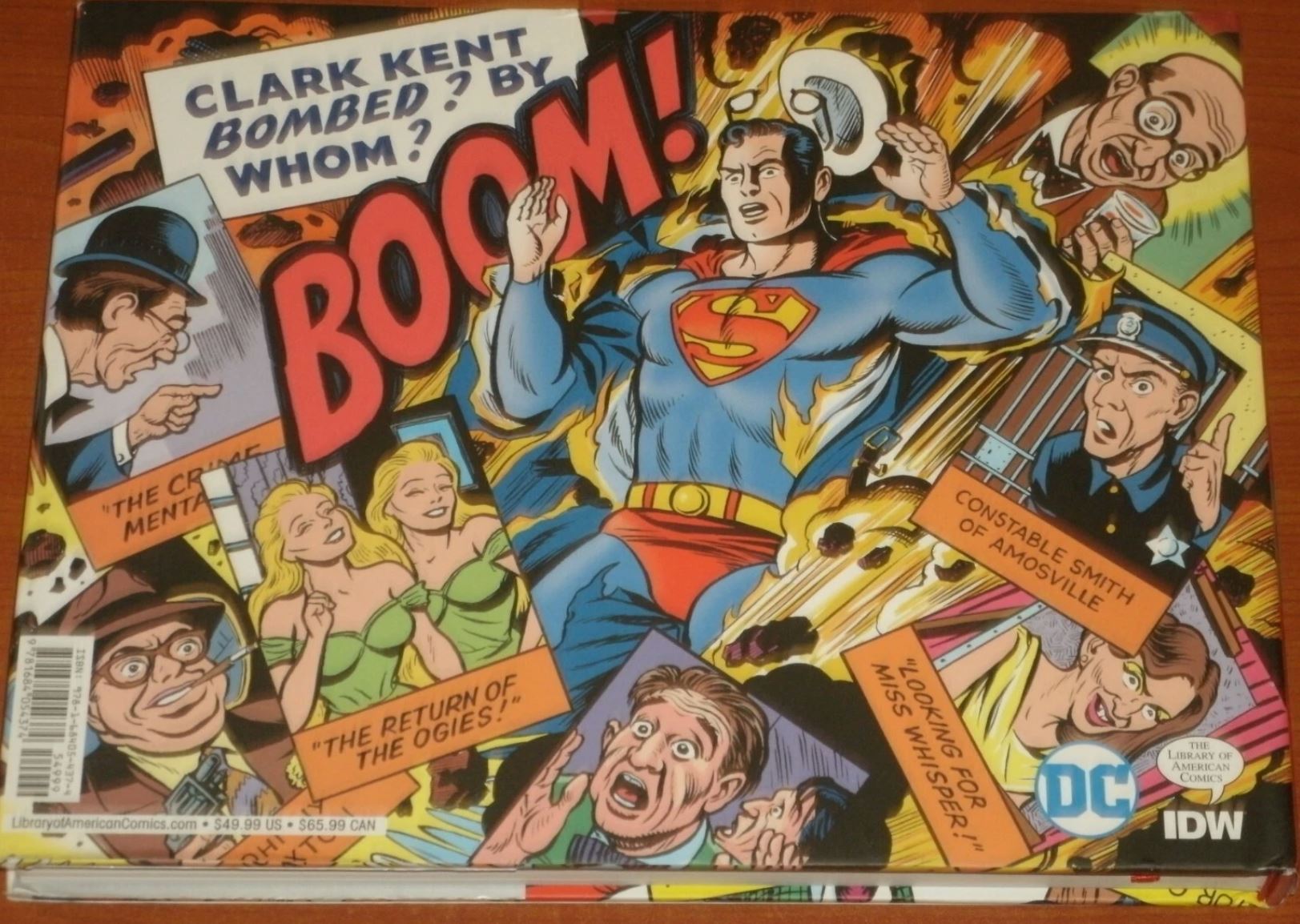
Superman: The Golden Age Dailies 1947 to 1949 (volume 3)


By Alvin Schwartz, Wayne Boring, Jack Schiff, Win Mortimer & various (IDW/Library of American Comics)
ISBN: 978-1-68405- (HB)

This book includes Discriminatory Content produced in less enlightened times.

The American comic book industry – if it still existed at all – would be utterly unrecognisable without Superman. Jerry Siegel & Joe Shuster’s unprecedented invention was first fervidly adopted by a desperate and joy-starved generation, and gave birth to a genre if not an actual art form. Spawning an army of imitators and variations within three years of his 1938 debut, the intoxicating blend of breakneck, breathtaking action and wish-fulfilment epitomising the early Man of Steel grew to encompass cops-&-robbers crimebusting, socially reforming dramas, sci fi fantasy, whimsical comedy and, once the war in Europe and the East sucked in America, patriotic relevance for a host of gods, heroes and monsters, all dedicated to profit through exuberant, eye-popping excess and vigorous, dashing derring-do.

From the outset, in comic book terms Superman was master of the world. Moreover, whilst transforming the shape of the fledgling funnybook biz, the Man of Tomorrow irresistibly expanded into all areas of the entertainment media. Although we all think of the Cleveland boys’ iconic invention as epitome and acme of comics creation, the truth is that very soon after his springtime debut in Action Comics #1 the Man of Steel was a fictional multimedia monolith in the same league as Popeye, Tarzan, Sherlock Holmes and Mickey Mouse. We parochial and possessive comics fans too often regard our purest and most powerful icons in purely graphic narrative terms, but the likes of Batman, Spider-Man, Avengers and their hyperkinetic kind long ago outgrew four-colour origins to become fully mythologized modern media creatures familiar in mass markets, across all platforms and age ranges…

In the last century and even more so in this one, far more people have seen and heard the Man of Steel than have ever read his comic books. These globally syndicated newspaper strips alone were enjoyed by countless millions, and by the time his 20th anniversary rolled around, at the very start of what we call the Silver Age of Comics, he had been a thrice-weekly radio serial star, headlined 17 astounding animated cartoons, become a novel attraction (written by George Lowther) and – by the time of the last stories in this tome – had helmed two feature films. He had then seamlessly segued into the next Big Thing: television. Soon his first (of 8) smash-hit live-action tv seasons would start his next great media conquest, making Superman a perennial sure-fire success for toys, games, food, and puzzle and apparel manufacturers all over the planet.

Although pretty much a spent force these days, for the majority of the last century the newspaper comic strip was the Holy Grail all American cartoonists and graphic narrative storytellers hungered for. Syndicated across the country (and frequently the world) a strip feature could be seen by millions if not billions of readers and was generally accepted as a more mature and sophisticated form of literature than comic books. It also – at the start! – paid better, and rightly so. Some of the most enduring, entertaining characters and concepts of all time were devised to lure readers from one particular paper to another and many of the best became cornerstones of a shared global culture. People across the Earth had a communal context thanks to thrilling to the same comics; and Mutt and Jeff, Buck Rogers, Dick Tracy, Flash Gordon, Charlie Brown and so many more escaped humble, tawdry newsprint origins to become meta-real: existing in the minds of earthlings from Albuquerque to Zanzibar. Most still do…

The daily Superman newspaper strip launched on 16th January 1939, swiftly augmented by a full-colour Sunday page from November 5th of that year. Originally crafted by Siegel & Shuster and their studio (Paul Cassidy, Leo Nowak, Dennis Neville, John Sikela, Ed Dobrotka, Paul J. Lauretta & crucially Wayne Boring), the mammoth task soon required additional talents like strip veteran Jack Burnley and writers including Whitney Ellsworth, Jack Schiff & Alvin Schwartz. The McClure Syndicate feature ran continuously until May 1966, appearing, at its peak, in over 300 daily and 90 Sunday newspapers: a combined average readership of more than 20 million. Eventually, Win Mortimer & Curt Swan joined the unflagging Boring & Stan Kaye, whilst Bill Finger and Siegel also provided stories, telling serial tales largely divorced from comic book continuity throughout years when superheroes were scarcely seen.

This third volume of the Library of American Comics collection continues the prodigious and formidable reprint program begun in the Sterling/Kitchen Sink softcover editions which ceased production in 1999. All of that material – and these books too – are long overdue for re-release and digital editions. Here, however, WWII is well and truly over and the decidedly different demands of peacetime and reconstruction have given way to an era of hectic prosperity, but still see our hero and his regular cast tested and beset by domestically endangering perils and conundrums only a Man of Steel could handle…

We open with another Introduction by Sidney Friefertig, discussing the changes from conflict to reconstruction and detailing why and how poet-turned-thriller writer Alvin Schwartz (1916-2011) became the key writer of the feature as well as sharing contextual, behind-the-scenes moments before our cosy but never-ending battle resumes.

These sequences came six days a week, comprising episodes #47-61, pages #2595 through 3338, and publication dates April 28 1947 to September 3rd 1949. With the material credited to Schwartz (Batman, Wonder Woman, Aquaman, Tomahawk, Newsboy Legion, Slam Bradley, House of Mystery, A Date With Judy, Buzzy, Bizarro) and the sole pictorial province of illustrator Wayne Boring, the compilation kicks off with and a bizarre “manhunt” to solve the dilemma of ‘Who is Miss Whisper?

Running in strips #2595-2654 as seen between April 28th to July 5th 1947, the story depicts mounting frenzy in Metropolis after lonely millionaire at sea Jonathan Dexter experiences a crossed radio line and catches a brief snippet of conversation with a distant voice. Instantly falling inescapably in love with a person he cannot and probably will never see, he is despondent until he remembers how rich he is…

Thus when, Cinderella-style, the heartsore plutocrat uses the Daily Planet to publicise his plight and swears to endow the mystery maid with all his worldly goods, the entire female population goes crazy. Everybody loves a doomed romance but some seek to con him, some attempt to bamboozle or even supplant his absent inamorata and some – gangsters led by cunning rogue Wishbone – seek to replace Miss Whisper with a voice impersonating ringer. Clark Kent and Lois Lane are drawn to the story and Superman promises to help after the rich guy promises to pay a million to deserving charities but even after finding her, the Man of Tomorrow can’t make the quiet quarry want to marry the spoiled rich, groom-to-be…

Nevertheless, because it’s a fairy tale writ large, love does find a way…

Crafted for daily doses, these Superman snippets are torturous, convoluted and often seemingly divert in tangents to indulge in seemingly pointless but epically spectacular super-feats (such as razing an entire forest to make a really, Really big billboard). These are to pad out increasingly formulaic plots and emphasise the “Super” in the hero but also counterpoint the ongoing social commentary and essentially domestic tribulations of familiar and warmly appreciated entertainment characters being constantly put through their paces. That’s clearly seen as greed and venality abound in the next arc as Superman reels under the manic idiocies generated by ordinary people in mounting frenzy once news leaks out that the Man of Steel has agreed to safeguard humanity’s greatest desire made manifest.

Running from July 7th to September 27th, the sorry tale of ‘The Youth Serum’ (strips #2665-2732) sees chemist Dr. Ogilvie unwisely entrust his age-defeating miracle mixture to shady promoter Willie Poster who triggers a literal stampede of the vain, vainglorious and outright villainous who will do anything to roll back a few years… including bribery, fraud, theft and kidnapping Daily Planet staff to compel the Man of Steel to hand over the rejuvenation juice…

With the multi-million daily readership reckoned to be at least 50% female, encroaching domesticity was a regular plot standby but Alvin Schwartz proved able to tweak the situation in unusual ways. For ‘The Marriage Gamble’ (#2733- 2768; September 29th to November 8th) he enfolds Lois & Clark in a criminal caper wherein crooked – and ultimately near-murderous – loan sharks seek vengeance on a professional gambler by rigging a bet that one of their on-the-hook client/victims can be made to marry the first women he sees. Thanks to poor timing and fate the intended marriage material is inadvertently delayed by Lois, and helpless desperate sap Joe Deems’ unsuspecting bride-to-be becomes a certain feisty journalist…

There’s no escaping his fate – it’s death or Lois – but the mobsters have utterly underestimated Lane’s instincts and the determination of Joe’s actual fiancée Dotty… as well as Superman’s covert intervention…

Who’s chasing who is the key to next serial saga ‘The Perfect Woman’ (#2769-2828, November 10th1947 – January 17th 1948) as super-rich, supremely smart, ultra-fit and staggeringly beautiful heiress Olivia Hill finally reaches marrying age and decrees that the Man of Tomorrow is the only one worthy of her. Of course, Lois has other ideas and also senses a huge scoop as the terrified Superman struggles to escape a girl prepared to risk her own life and reputation to get her way…

Backed by money and privilege, wilful scheming rich kid Olivia seems unstoppable. All our hero’s efforts to avoid her cunning matrimonial traps come to naught as she employs fair means and foul to land the most eligible bachelor on Earth, but events take truly dark turn when master of media manipulation Hill meets ruthless gangsters who don’t play games by her rules…

Evil and mystery dominate in next exploit ’The Crime Mentalist’ (#2829-2936, January 19th – March 20th) as a shy, lonely, mild mannered bank teller survives a street incident and develops the power to psychically tune in on thieves and killers about to commit heinous acts. The cops are instantly suspicious of poor Edgar Jenkins and Clark is concerned for his safety, as Edgar apparently can’t stop himself uncovering crimes. He even exposes the venality of the learned doctors examining him and eventually Superman is forced to act as permanent bodyguard. Events come to ahead when the nation’s top crime bosses engage ruthless femme fatale Dotty Storm to vamp, distract and eliminate the nervous ninny. It works too, despite Jenkins’ gifts. He knows she’s evil but she’s also so very pretty and attentive and perhaps he can convert her from her wicked ways…

Pure whimsy and trenchant social satire manifest with ‘The Return of the Ogies’ (#2883-2936, March 22nd – May 22nd 1948) as the invisible fairy pranksters again bedevil Clark and Superman. However their escalating campaign to annoy the Metropolis Marvel – such as seeking to tell everyone his secret identity – goes weirdly awry after they lose that invisibility and become extremely popular figures perpetually pestered by the public. It looks like even Superman cannot solve this problem, but then…

After being denied a journalism award because everybody knows that the Man of Steel does all the heavy lifting in her stories, the City’s top reporter swears off male interference and undertakes a canny campaign of crimebusting and scandal-exposing in ‘Lois Lane’s Solo Adventures’. Spanning May 24th to July 3rd, strips #2937-2972 reveal just how brave and competent Lois can be on her own, especially after one piece makes a furious enemy of spoiled debutante Kim West. The brat’s idea of redress involves having two mob bosses vying for her exclusive attentions taking out contracts on the “Lane Dame”, but she’s less sanguine about her own devoted butler also trying to murder the journalist. This time Superman does not come to her assistance as the drama expands into murder and both mobs of rank-&-file thugs rebel, seeking to kill West and Lois to avoid a gang war and return to business…

With Lane back at the top of her game and even notional friends with Kim, focus switches to her rival for ‘The Millionaire Ex-Reporter Clark Kent’ (July 5th – August 14th, strips #2973-3008).

After suddenly and unwelcomely winning a fortune, Kent must act like a normal guy and quit his job just to preserve his secret identity. Moreover, all efforts to lose the wealth by acting like a rich idiot only increase it and make him the target of enterprising heiress Kim who has blown through all her own money and needs a pliable husband with plenty…

She doesn’t see Lois as serious competition but still ends up unsatisfied and unwed, before Clark goes broke, gets back to the Planet and almost meets his doom from ‘Enthor’s Paralyzing Ray’ (August 16th – October 16th; strips #3009-3062). Long before Luthor, Metropolis was terrorised by a criminal scientist who immediately quit when Superman appeared. Now having served his time, doddery figure of fun Enthor renews his malevolent career after discovering a gadget that makes the Man of Tomorrow comatose. With a beguiling romantic subplot and conclusion channelling the movie White Heat the shorter action yarn segued into a straightforward mystery as the aftereffects of Enthor’s weapon triggered ‘Clark’s Memory Lapse’ (October 18th – December 25th; #3063-3122). With bizarre reports coming, Superman is forced to reconstruct a fugue moment when the reporter apparently assaulted, abducted and held hostage an innocent man. Diligent investigation and the odd super stunt soon prove bank official Fred Camper is anything but, and that Clark was just being a hero…

It’s back to more traditional fare when Clark’s old pal Ed invents ‘The Super Elixir’ (#3123-3176; December 27th 1948 – February 26th; 1949) and gets Kent to drink it. Now publicly and officially superpowered, Clark is pursued by wannabees and crooks alike as he seeks ways to keep his friend’s family safe amidst a storm of attention and stunts that somehow incredibly peak with the reporter seemingly wresting Superman for charity and begging for a solution that will allow him to return to his quiet anonymous life…

Running from February 28th to April 23rd ‘Superman, Jailbird’ (strips #3177 – 3224) saw Canadian James Winslow “Win” Mortimer take over the illustration ushering in an era of greater whimsy and accessible comedy underpinnings. The initial outing found Superman breaking speeding laws in rural Amosville and arrested by an overly officious police constable. His thirty day jail sentence turns into a unique form of community service when gamblers try to make the hamlet the next Las Vegas, after which ‘Lois ’s Secret Identity’ (April 25th – June 25th, #3225-3278) sees her lose her Planet position and become a radio personality. Unable to abandon print, she dons a disguise and replaces herself as new ace reporter Lily Loring, competing with Kent and both her selves even as she’s targeted by murderous mobster Johnny Braxton seeking to silence one and all of her…

After accidentally injuring a bystander, Clark Kent pinch-hits for the wounded man, taking on his (then) rather-rare job in ‘Superman, Male Escort’ (June 27th – August 13th; #3279-3320. With my own super power working full out to resist that straight line (sooo mmmany jokes!) but blandly state that this sequence finds the Man of Steel soon helping lonely ladies, provoking yet another Metropolis mob of matrons and maidens demanding their moment with the miracle man, unaware that an actual mobster’s moll has plans to secure his exclusive services. Thankfully, Lois is there to make sure that doesn’t happen…

The collection and – more or less – the Golden Age era ends here with short sequence ‘Reenacting Superman’s Greatest Feats’ from August 15th to September 3rd 1949 (#3321-3238) as the Action Ace reconstructs his last month of rescues and stunts in the hopes of jogging the addled memories of literal absent-minded Professor Flagg and enabling him to recover sections of a misremembered formula. Of course, word associations and recall don’t always work according to plan…

These yarns offer timeless wonders and mesmerising excitement for lovers of action and fantasy. The raw-boned early Superman is beyond compare and if you can handle the warts of the era or just crave simpler stories from less angst-wracked times, the adventures gathered here are ideal comics reading, and this a book you simply must see.

© 2019 DC Comics. All rights reserved. Superman and all related names, characters and elements are ™ DC Comics.

Today in 1872, English cartoonist and genteelly warped brainbox W. Heath Robinson was born, with Allen Bert Christman (The Sandman, Scorchy Smith) arriving in 1915 and Dutch comics master Cees van de Weert (Ben Busy, Marco Polo) turning up in 1917.

Underground commix legend Gilbert Shelton was born in 1940, and scripter, journalist , critic & historian David Anthony Kraft came along in 1952. Artist/playwright Dean Haspiel (Billy Dogma, The Quitter)was born in 1967 and graphic auteur Adrian Tomine (Optic Nerve, Sleepwalk and Other Stories, Killing and Dying).

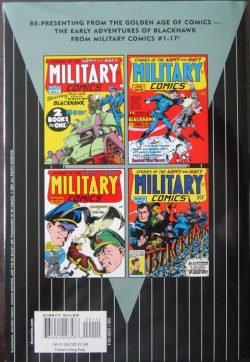
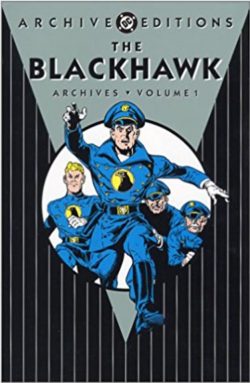
Blackhawk Archives volume 1


By Will Eisner, Dick French, William Woolfolk, Bob Powell, Chuck Cuidera, Reed Crandall & various (DC Comics)
ISBN: 978-1-56389-700-9 (HB)

This book includes Discriminatory Content produced in less enlightened times.

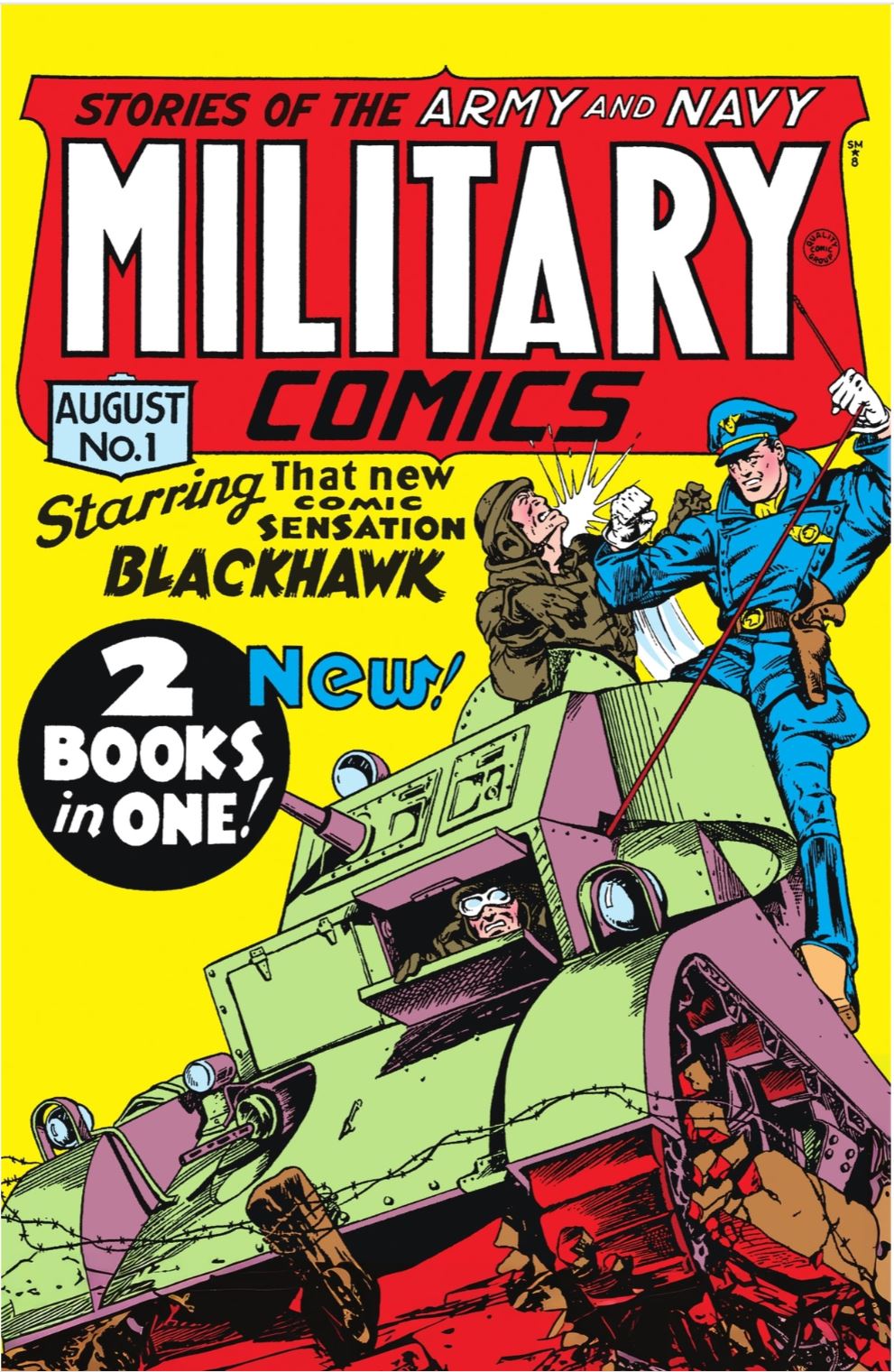
The early days of the US comic book industry were awash with both opportunity and talent, and these factors beneficially coincided with a vast population craving cheap entertainment. Comics had practically no fans or collectors; only a large marketplace open to all varied aspects of yarn-spinning and tale-telling. Thus, even though America loudly proclaimed its isolationism and remained more than six months away from active inclusion in World War II, creators like Will Eisner and publishers like Everett M. (known to all as “Busy”) Arnold felt Americans were ready for a themed anthology title such as Military Comics.

They were right; but Nobody was ready for Blackhawk.

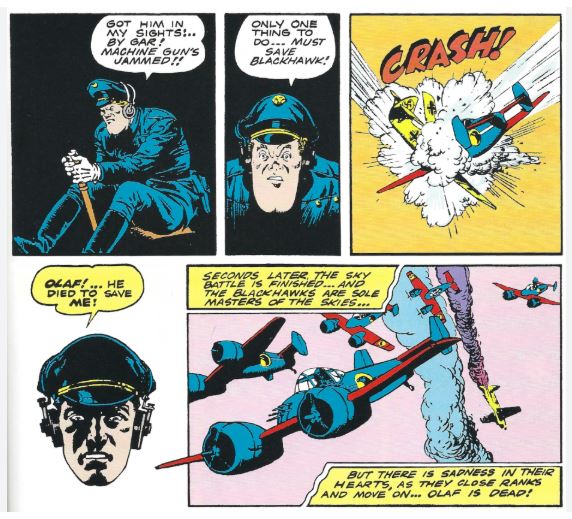
Military Comics #1 launched on May 30th 1941 (with an August off-sale/ cover-date) and included in its gritty, two-fisted line-up Death Patrol by Jack Cole; Elmer Wexler’s Miss America; Fred Guardineer’s Blue Tracer; X of the Underground; John Stewart & Bill Smith’s Yankee Eagle; Q-Boat; Klaus Nordling’s Shot and Shell; Archie Atkins and Loops and Banks by “Bud Ernest” (in actuality, aviation-nut and unsung comics genius Bob Powell), but none of the strips, not even Cole’s surreal and suicidal team of hell-bent fliers, had the instant cachet and sheer appeal of Chuck Cuidera, Eisner & Powell’s “Foreign Legion of the Air” led by a charismatic Dark Knight known only as Blackhawk.

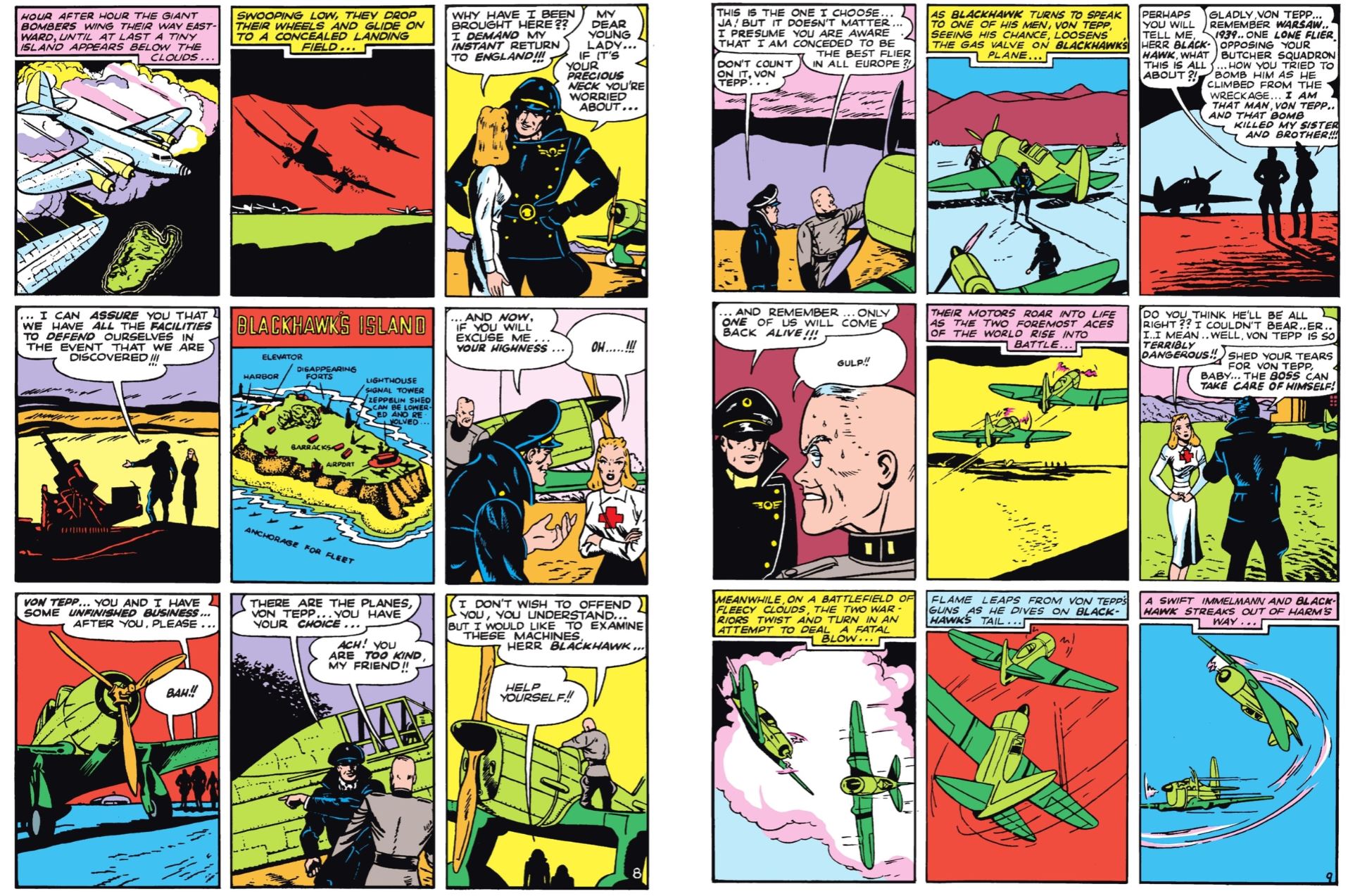
Cuidera – already famed for co-creating The Blue Beetle for Fox Publications – drew ‘The Origin of Blackhawk’ for the premiere issue, wherein a lone, magnificently skilled pilot fighting the Nazi invasion of Poland in 1939 is finally shot down by Nazi Ace Von Tepp. That sadistic killer then goes on to bomb a farmhouse sheltering the defeated pilot’s family. Rising from his plane’s wreckage, the distraught aviator vows vengeance…

Two years later, with the Nazis in control of most of Europe, Von Tepp’s unassailable position is threatened by a mysterious paramilitary squadron of unbeatable fliers, dedicated to crushing injustice and smashing the Axis war-machine…

Eisner wrote the first four Blackhawk episodes and Cuidera stayed aboard until issue #11 – although the artist would return in later years. Many of the stories were originally untitled but have been conveniently characterized with such stirring designations as issue #2’s ‘The Coward Dies Twice’, wherein the squadron – “the last free men of the conquered countries” – offer a deserter from a Spitfire Flight a chance to redeem himself. The easy mix of patriotism, adventure and slapstick was magnified by the inclusion of Chop-Chop in ‘The Doomed Squadron’: a comedy Chinaman extremely painful to see through modern eyes, but a stock type considered nearly as mandatory as a heroic leading man in those dark days… and sadly not just in comics, either…

Its scant comfort but at least this Asian man is a brave and formidable fighter both on the ground and in a plane… when not being used for cheap laughs…

‘Desert Death’ takes the team to Suez – for the first of many memorable Arabian adventures – as Nazi agitators attempt to foment revolution among the tribesmen in hopes that they will rise up and destroy the British. This tale is also notable for the introduction of a species of sexy siren beloved of Eisner and Quality Comics. She or similar seductresses of her ilk would populate the strip until DC bought the property in 1957. Also included here is also a secret map of Blackhawk Island, mysterious base of the ebon-clad freedom fighters.

With issue #5 Dick French assumed the writing role. ‘Scavengers of Doom’ is a biting tale of battlefield looters allied to a Nazi mastermind, united to set an inescapable trap for the heroic fliers. More importantly, French began providing distinct and discrete characters for the previously anonymous minor players. In MC #6 the rapidly gelling team joins a frantic hunt for a germ weapon the Gestapo are desperate to possess, resulting in spectacular alpine incident ‘The Vial of Death’, after which #7 (the first issue released after the US entered World War II although the stories had not yet caught up to reality) lands the lads on the Mongolian Steppe ranging on horseback to thwart ‘The Return of Genghis Khan’

The saga in #8 was a striking maritime romp wherein the warring powers battle to occupy an island freshly risen from the Atlantic depths. The newborn landmass is strategically equidistant between the USA, Britain and Festung Europa (that’s what the Nazis called the enslaved stronghold they had made of mainland Europe), and no opponent or even ally can be trusted with control of ‘The Sunken Island of Death’.

Although complete in itself, the yarn is also the first of an experimental, thematic 3-part saga that stretched the way comics stories were told. Things changed rapidly back then, and many marvellously melodramatic touches to make the Blackhawks so memorable in the eyes of a wide-eyed populace of thrill-hungry kids were trialled. There was the cool, black leather uniforms and creepy peaked caps. The unique – yet real – Grumman F5F-1 Skyrocket planes they flew from their secret island base and their eerie battle-cry “Hawkaaaaa!” but perhaps the oddest idiosyncrasy to modern readers was that they had their own song which André, Stanislaus, Olaf, Chuck, Hendrickson & Chop-Chop would sing as they plunged into battle. … And just to be informative and inclusive, the sheet-music and lyrics were published in this issue and are re-presented here. Just remember this is written for seven really tough guys to sing while dodging bullets and weaving between bursts of flak…

Military #9 led with ‘The Man in the Iron Mask’ as the unflappable team discover that a fallen comrade did not actually die in combat, but was hideously disfigured saving them, and is back and seeking redress, whilst the next issue’s tale – ‘Trapped in the Devil’s Oven’ – is another desert adventure focusing on the still primitive science of plastic surgery to restore said hero to full fighting trim.

MC #11 – Cuidera’s last on Blackhawk for some time – saw the squadron turn their attention to Japan, as reality at last caught up with publishing schedules. Intriguingly, ‘Fury in the Philippines’ starts quietly with the entire team calmly discussing carrying on against the Nazis or switching their attentions to the Pacific Theatre of Operations, until comedy relief Chop-Chop sways the debaters with an impassioned stand. Though inarguably an offensive stereotype visually, the Chinese warrior was often given the best lines and most memorable actions. A sneakily subversive attempt on the part of the creators (frequently from immigrant backgrounds and ethnic origins) to shake up those hide-bound societal prejudices, perhaps?

Notwithstanding, the resultant mission against the Japanese fleet is a cataclysmic Battle Royale, full of the kind of vicarious payback that demoralized Americans needed to see following Pearl Harbor…

‘The Curse of Xanukhara’ added fantasy elements to the gritty mix of blood & iron as the group’s hunt for a stolen codebook leads them to occupied Borneo and eventually the heart of Tokyo; a classy espionage thriller marking the start of a superlative run of thrillers illustrated by the incredible Reed Crandall. The artist’s realistic line and the graceful poise of his work, especially on exotic femmes fatale and trustworthy girls-next-door, made his pages absolute joys to behold. ‘Blackhawk vs. The Butcher’ (Military #13, November 1942) was written by new regular scripter Bill Woolfolk and returned the Blackhawks to Nazi territory as a fleeing Countess turns their attention to the most sadistic Gauleiter (Nazi regional leader in charge of a conquered territory) in the German Army.

What follows is a spectacular saga of justice and righteous vengeance, whilst ‘Tondeleyo’ reveals a different kind of thriller as an exotic siren uses her almost unholy allure to turn the entire team against each other. Such quasi-supernatural overtones held firm in the stirring ‘Men Who Never Came Back’ – when the team travel to India to foil a Japanese plot – in a portmanteau report narrated by three witches. Trouble, Terror and Mystery were eerily presaging the EC horror classics that would cement Crandall’s artistic reputation more than a decade later…

‘Blackhawk vs. the Fox’ pits the flight of heroes against a Nazi strategic wizard (a clear reference to the epic victories of Erwin Rommel) in the burning sands of Libya, and remains one of the most authentic battle yarns in the canon; and precedes this sublime hardback volume’s concluding sortie: a racy tale of vengeance and tragedy wherein Japanese traitor Yoshi uses her wiles to punish the military government of Nippon, with Blackhawk as her unwitting tool in ‘The Golden Bell of Soong-Toy!’

These stories were produced at a pivotal moment in both comics and world history, delivering the blend of weary sophistication and glorious, juvenile bravado that comprised the best movies of the time: Casablanca, Foreign Correspondent, Freedom Radio, Captain of the Clouds, The Day Will Dawn, The First of the Few, In Which We Serve and all the rest. That understated, overblown way of accepting duty and loss permeates these primal, rousing Blackhawks tales, confirming the miracles good men can do when needed; and are some of the Golden Age’s finest moments. In fact, these are some of the best comics stories of their time and I sincerely wish DC had proceeded with further collections, or will resume and complete their comics casebooks for the benefit of us all…

Hunt this down and so will you.
© 1941-1942, 2001 DC Comics. All Rights Reserved.

Today in 1916 unsung genius of line and mood Mort Meskin (Sheena, Queen of the Jungle, Vigilante, Wildcat, Starman, Johnny Quick, Black Terror, Boy’s Ranch, Captain 3-D, Golden Lad, Mark Merlin) was born, as was Italian artist Roberto Raviola AKA Magnus (Kriminal, Alan Ford) in 1939, US writers Mike W. Barr (Maze Agency, Batman, Camelot 3000, Star Trek) in 1952, Alan Brennert (Batman, Brave and the Bold, Batman: Holy Terror) in 1954 and Kevin Eastman (Teenage Mutant Ninja Turtles) in 1962.

On this date in 1993 we lost Little Lulu cartoonist “Marge” (Marjorie Henderson Buell) and in 1999, prolific comics scripter Paul S. Newman (Turok, Dr. Solar, Man of the Atom, Lone Ranger).

Today in 1985 Osamu Tezuka completed his landmark award-winning manga Adorufu ni Tsugu (Message to Adolf).

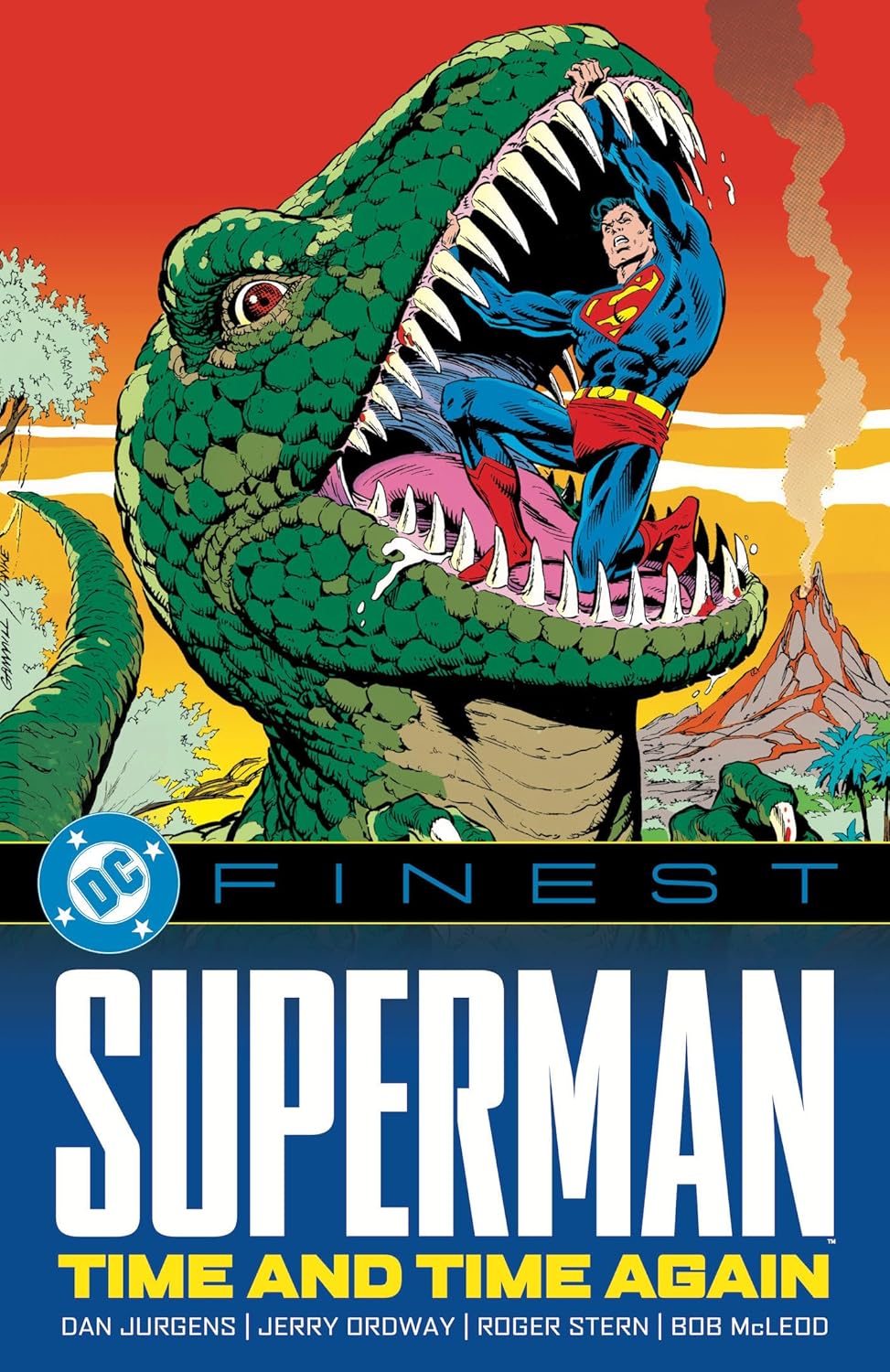
DC Finest: Superman – Time and Time Again


By Dan Jurgens, Jerry Ordway, Roger Stern, James D. Hudnall, Dave Hoover, Curt Swan, Bob McLeod, Kerry Gammill, Tom Grummett, Ed Hannigan, John Byrne, Brett Breeding, Dennis Janke, Art Thibert, Scott Hanna, José Marzan, Willie Blyberg & various (DC Comics)
ISBN: 978-1-79950-810-6 (TPB)

This book includes Discriminatory Content produced in less enlightened times.

In 1986, after almost 50 years, Superman was re-imagined after Crisis on Infinite Earths. Although controversial at the start, John Byrne’s reboot of the world’s first superhero was rapidly acknowledged as a solid hit and the collaborative teams who complemented and followed him maintained the high quality, ensuring continued success. Over following years a vast, interlocking saga unfolded across a spread of titles which has only sporadically – and far too infrequently – been collected into graphic compilations.

As part of the refit, many of his more miraculous abilities were discarded. Just like his earliest days, Superman was a far from omnipotent hero, more in touch with humanity because he wasn’t so very far above it. One thing that was abandoned was his casual ability to travel through time, and that was spectacularly addressed in a sequence of tales inside the greater unfolding story contained in this collection re-presenting the “Never-Ending Battle”. This time-twisting selection collectively transpires via cover-dates November 1990 through June 1991, gathering key intra-title storylines plus a couple of choice stand-alone solo stories from Action Comics #659-666, Adventures of Superman #472-479 and Superman #49-56, and a crossover component from Starman (volume 1 #28).

No sooner had the Byrne restart stripped away most of the accreted mythology and iconography that had grown around the Strange Visitor from Another World over five glorious decades, than successive teams employed a great deal of time and ingenuity putting much of it back, albeit in terms more accessible and agreeable to a cynical, well-informed audience far more sophisticated than their grandparents ever were.

One such was a notional tip of the hat to so many memorably madcap tales revolving around both an irritating 5th Dimensional Imp and the bizarrely mutagenic mineral from Krypton which peppered and perplexed the Silver Age Superman’s life. However, the story arc here also advanced two overarching plot threads that grew from the soap opera styled stories: the imminent demise of Lex Luthor due to self-inflicted Green K poisoning and a blossoming romance between Clark Kent and dynamic fellow journalist and friendly rival Lois Lane.

The compartmented saga opened in Superman volume 2, #49 with ‘Krisis of the Krimson Kryptonite: Part One’ by Jerry Ordway & Dennis Janke, wherein Luthor, following the death of his only “ blood heir” (Perry White Jr.), ponders mortality in a cemetery until a talking red rock bops him on the back of his big, bald head. The incensed billionaire quickly stifles his outrage as the scarlet stone resolves into cruelly devious trickster-sprite Mr. Mxyzptlk. Despite being currently preoccupied with another realm, the malign mischief-maker sees a chance to manufacture more mayhem in Metropolis with the “Red Kryptonite” he has magicked up, and promises Lex it will make Man of Steel and mortal multi-billionaire “physical equals”…

Lex activates the rock expecting to gain the powers of a god – and just possibly a new lease on his rapidly expiring life – and is furious to realise he is still just human. However, across town Superman, having defeated bionic bandit Barrage, is transporting the supervillain to metahuman penitentiary Stryker’s Island when his powers vanish and he plunges into vilely polluted Hobs Bay.

Luthor cries foul and is again visited by Mxyzptlk who pettishly teleports the drowning Action Ace to Lex’s penthouse office where the evil industrialist can see what the spell has actually wrought. After a brutal and strictly human-scaled tussle, a badly beaten, powerless Superman is ejected from Luthor’s HQ and staggers back to Kent’s home where he finds Lois waiting. The normally resolute reporter is badly shaken: Lois’ mother is dying from an apparently fatal illness and Luthor is somehow responsible…

In Adventures of Superman #472, Dan Jurgens & Art Thibert’s ‘Clark Kent… Man of Steel!’ picks up the pace with our simply human hero about to be slaughtered by lethal lummox Mammoth. Kal-El is undergoing tests into the cause of his malady conducted by scientific advisor/confidante Emil Hamilton, but when news of the giant thief’s robbery spree reaches him Superman dashes off to assist, equipped only with a hastily configured force field belt. It’s not nearly enough. In the end wits, raw nerve and a simple bluff save the day, but with no solution in sight the Metropolis Marvel must admit he needs superhuman assistance if he is to survive, but at least on the domestic front his new fragility brings him closer to Lois…

With Roger Stern, Dave Hoover & Scott Hanna in creative mode, the scene switches to Arizona where a recent acquaintance gets a phone call before ‘Krisis of the Krimson Kryptonite: Part Two/A: The End of a Legend?’ (Starman vol. 1 #28) sees Stellar Sentinel Will Payton flying to Metropolis for a top secret rendezvous. A sun in human form, Payton had re-energised the Kryptonian’s cells with solar power once before when Superman’s powers were drained, but this time the sun-bath has no effect and almost fries desperate Kal-El during the process. With crime spiking, Starman sticks around to keep the peace, using his shapeshifting powers to perfectly mimic the Man of Steel. He fools Luthor who, confronted by the somehow resurgent “Superman”, furiously throws the useless Red K at him…

With the mineral in Hamilton’s hands, stringent testing proves it is only red rock with no radioactive properties and Superman must think outside the box if he is to protect his city.

… And on Stryker’s Island, another old enemy is laying lethal plans to finally end the Man of Tomorrow…

Tension mounts in ‘Breakout!’ (Action Comics #659, Stern, Bob McLeod & Brett Breeding) as Superman resorts to high-tech battle armour when murderous science-maniac Thaddeus Killgrave frees the inmates and seizes control of Stryker’s, luring Starman-as-Superman into a deadly trap the neophyte hero cannot escape from. Meanwhile, in the highest corridors of financial power, Mxyzptlk personally briefs bewildered Luthor on what’s going on…

Brave but not stupid, Superman calls in back-up for his raid on the penitentiary. Whilst cloned champion Golden Guardian and street vigilante Crimebuster handle rank-&-file felons, the armoured Action Ace heads straight for Killgrave and a blistering confrontation which is only prelude to climactic concluding chapter ‘The Human Factor’.

Superman vol. 2, #50 was a giant special by Ordway & Janke with celebratory anniversary contributions from Byrne, Curt Swan, Kerry Gammill, Breeding & Jurgens, and opens with Clark unceremoniously ejected from Lexcorp Tower, only to stumble upon the billionaire’s personal physician Dr. Gretchen Kelly acting oddly…

Heading home, the powerless hero is saved from a mutant rat by Guardian and, after seeing Crimebuster thrashing street thugs, comes to a painful conclusion. Maybe Superman isn’t necessary any more. Maybe now he can have his own life and even ask Lois to marry him…

First though, there’s a unfinished business and a simple phone call to Luthor gets that ball rolling. Offering to trade the Red K for a story, Clark inadvertently causes Lex to break the terms of his pact with Mxyzptlk, thereby negating the whole power-sapping deal.

Ticked off, petulant and impatient to get back to mischief-making in another universe, the imp makes a personal appearance in monstrous form, but loads the battle in the fully restored Action Ace’s favour just to get out of his self-imposed arcane contract quickly… but not without an astounding amount of collateral damage to Metropolis…

With the crisis over, however, Superman has made a life changing decision. Following the red-tinged resumption of his super status, the Action Ace is joined by a brace of green guest stars in ‘Rings of Fire’ (Jurgens & Thibert in AoS #473). Even as Clark & Lois announce their engagement, Superman is fretting. Unable to tell his intended of his secret life, he is quickly distracted and drawn away when unconventional Green Lantern Guy Gardner hits town looking for missing mentor Hal Jordan. Earth’s “real GL” has been captured by a monolithic alien who has stolen his emerald energies to power a long-delayed return to the distant stars. Of course, implementing that departure will eradicate half of Wyoming…

Thwarting the scheme, freeing a mesmerised Army General and defeating the alien’s thralls Psi-phon & Dreadnaught, Superman and the GLs then craft a far less destructive solution for all parties involved…

In Action Comics #660, Stern, McLeod & Breeding detail the ‘Certain Death’ that ushers in the end of an era. For years Luthor has masqueraded as a billionaire philanthropist whilst dominating Metropolis, the world and the criminal Underworld. Few knew the unsavoury truth and the cunning villain kept Superman literally at arms-length by wearing a ring made from Green Kryptonite.

Previous and subsequent stories revealed Green K radiation had gradually poisoned Luthor, initially causing the loss of his hand and eventually fatally irradiating his entire body. Now as his power and vitality wane, Luthor – knowing that his pitiful condition must inevitably become public knowledge – puts a final desperate plan into operation. During a high profile publicity stunt attempting to set a new air-speed record, the manipulative mogul apparently commits suicide in a spectacular manner: an act of defiance which only marks the beginning of a stupendous 7-year long extended plotline to be seen and resolved elsewhere…

Here a measured preamble to the titular time-bending saga begins innocuously with Ordway & Dennis Janke’s introduction of ‘Mister Z!’ in Superman #51. When an apparent immortal arrives in town and dramatically adds the hero’s mind to his library of historical souls the magical marauder severely underestimates the champion’s strength of will. After dying in combat, he swears to return… Jurgens & Art Thibert then use Adventures of Superman #474 to reveal a life-changing moment in the life of highschooler Clark; an instant of irresponsibility once ended the life of a friend and saddled the hero-in-waiting with decades of crushing guilt. Now everything changes when he comes ‘Face to Face With Yesterday’

Laughs and thrills in equal measure follow the arrival of Plastic Man & Woozy Winks in Action #661, as Stern, McLeod & Breeding reveal how those valiant but nauseating nitwits enlist Jimmy Olsen, punch-drunk recent lottery millionaire Bibbo Bibbowski and even Superman to save the city from techno mobsters Intergang by ‘Stretching a Point!’

In Superman #52, Ordway, Kerry Gammill & Janke address mounting environmental concerns by reintroducing violent eco-maverick Toby Manning who assures us ‘The Name, Pardners, is Terra-Man…’ before ruthlessly and murderously exposing the true cause of mass toxic contamination and targeting the businesses attempting to whitewash it all…

Courtesy of Jurgens & Thibert, a big guest star bust up fills AoS #475 with ‘Sleaze Factor’ after Intergang’s “Ugly” Bruno Mannheim hires Dr Killgrave and toymaker Winslow Schott to restore and improve debauched theme park Happyland. Only after Superman investigates the increasing number of disappearing visitors does the truth of Apokolyptian terror haunting the park emerge…

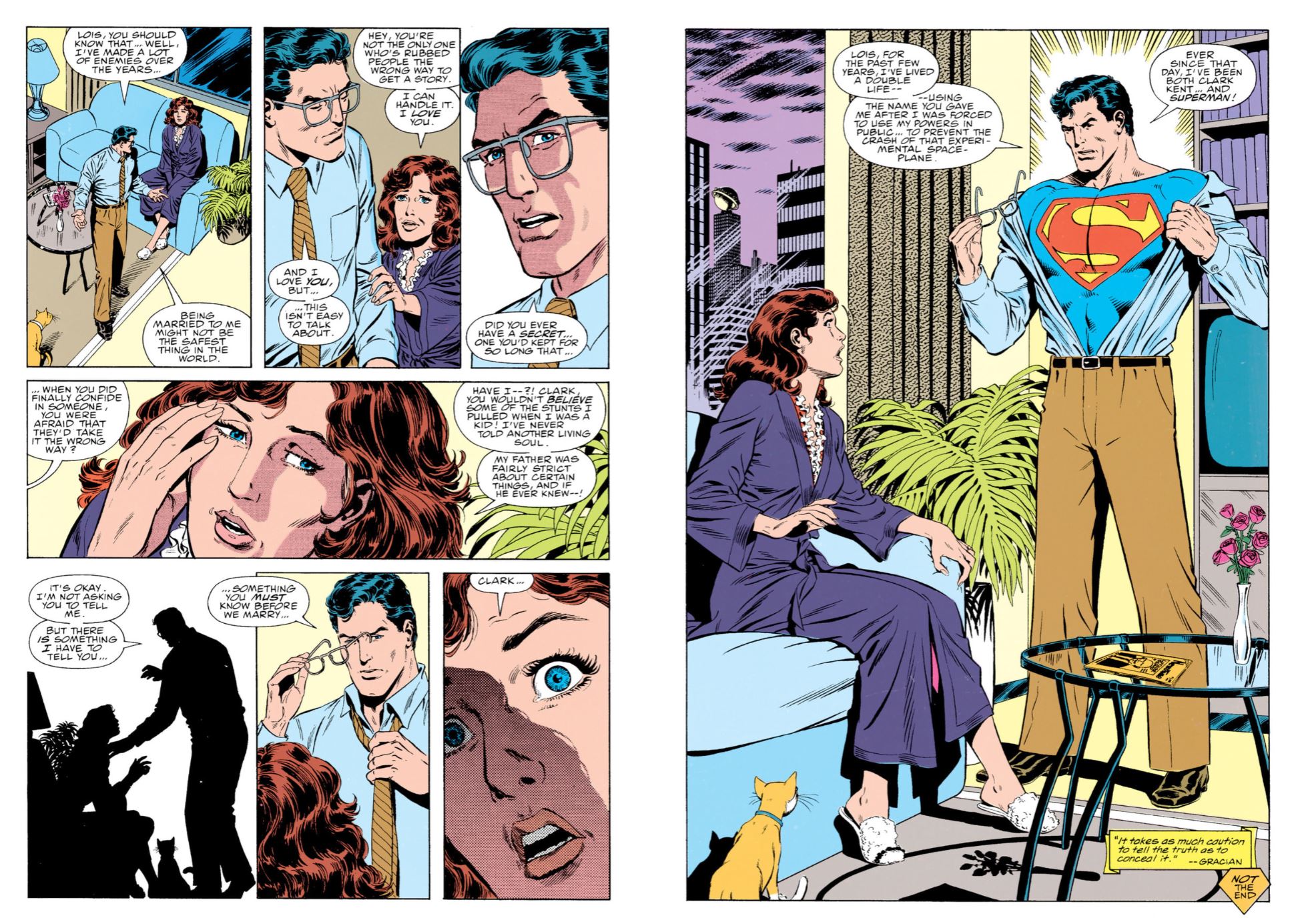
Over many years, Lois and Clark had grown beyond rivalry and distanced professionalism into true workplace romance, but always the hero kept his other identity from her. That all changed in Action Comics #662 (cover-dated February 1991 and by Stern & McLeod) as after the Man of Tomorrow narrowly defeated mystic predator Silver Banshee he decided that there would no more ‘Secrets in the Night’ ‘between him and his beloved…

With Lois still reeling from shock and sustained extended deception, Ordway & Janke used Superman #53 to question ‘Truth, Justice and the American Way’ as the Caped Kryptonian agrees to escort war criminal General Marlo of Qurac to his judicial come-uppance and consequently ferret out the US military traitors who supported him but now need him silenced…

Finally after months of preparation the main event opened with the modern hero lost to Earth just as Lois needed him most. Formerly he had been able to navigate the chronal corridors with ease, but this new Man of Tomorrow was trapped in a cataclysmic and volatile temporal warp, bounced around from era to era with his abilities constantly diminishing and utterly unable to regain his home and loved ones. The eponymous, epoch-rending epic launched in Adventures of Superman #476 as Jurgens & Breeding’s ‘The Linear Man’ saw a rogue (self-appointed) protector of the Time Stream seek to forcibly return temporal refugee-turned superhero Booster Gold to the 25th century he originated from. When Superman intervenes, the battle sparks a tremendous explosion, causing Kal-El to careen through time whenever he’s caught in another explosion. Initially that’s forward into a disaster-triggered team-up with the teenaged Legion of Super-Heroes

Each “landing” leaves him in a significant period of Earth’s history, and when a fuel storage centre detonates Superman is blasted backwards arriving in Stern & McLeod’s ‘Lost in the ‘40s Tonight’ (Action #663). Temporarily blinded but stuck in a past he read deeply about, Superman seeks out WWII icons the Justice Society of America, precipitating a meeting with that era’s first mystery men before almighty wraith The Spectre transports him not home but to ‘The Warsaw Ghetto!’ Here he becomes a temporary saviour in a soon to be mythic battle saga by Ordway & Janke in Superman #54. Perversely ending that issue is an unconnected Newsboy Legion short by Karl Kesel wherein the cloned kids, Guardian and Dubbilex seek to save top secret Project Cadmus from the ‘Attack of the D.N.Alien’ and imminent nuclear doom…

Elsewhere in time, only gigantic explosions can launch Superman back into the time stream, and one such occurs in ‘Death Rekindled’ (AoS #477, Jurgens & Breeding) when a trip to the future introduces him to another, later iteration of the Legion needing help to destroy a monstrous Sun Eater. The cataclysmic detonation of that deadly duel deposits him ‘Many Long Years Ago’ (Action #664, Stern & McLeod) to end up a Jurassic castaway until a clash with similarly-marooned time thief Chronos propels him via smallish jumps into the Pleistocene and a chronologically adrift encounter with primordial alien race the H’v’ler’ni (AKA the Host). That tussle tosses him forward to ‘Camelot’ as the Dark Ages begin, battling valiantly but in vain beside eventual All-Star Squadron paladin and Seventh Soldier of Victory Sir Justin The Shining Knight (all-Ordway in Superman #55). That issue contains more Newsboy Legion antics from Kesel as ‘Blaze of Glory!’ sees the lads and “Kirby Kritter” Angry Charlie frustrate the plans of rogue geneticist Dabney Donovan and defer atomic armageddon…

In AoS #478, Jurgens & Breeding deposit Superman with another, later Legion of Super-Heroes to confront deranged, savagely murderous Daxamite Dev-Em (another escapee from the 20th century) in brutal blockbusting finale ‘Moon Rocked’ which resets the time-shenanigans and leads to Clark’s ultimate resolution and reunion with Lois in Action #665’s ‘Wake the Dead!’ by Stern, Tom Grummett & José Marzan, wherein that crucial catching up and calming down is ruined by voodoo villain Baron Sunday unleashing dead felons on the city…

A third and final Kesel Newsboy short ends Superman #56 with a poignant peek at ‘Charlie & Company’ at home, before which James Hudnall, Ed Hannigan & Willie Blyberg had begun one last continued saga. In ‘Red Glass Part One: Breaking Up’ the Action Ace encountered an eerie crystal on the Moon before returning to an Earth endangered by his increasing berserker rages. The catalogue of atrocities mounted in Adventures of Superman #479’s ‘Red Glass Part Two: Falling Apart’ before answers and restoration of the status quo concluded the crises (for now) in Action #666’s visually stunning but conceptually weak wrap-up ‘Red Glass Part Three: Picking Up the Pieces’

With covers by Ordway, Jurgens, Thibert, Hoover, Gammill, Breeding, Janke, Grummett, Andy Kubert & Glenn Whitmore, this strictly print-only package comprises a hugely enjoyable saga that is highly readable and cheerfully accessible for both returning and first time fans. Thrilling, funny, action-packed and exquisitely entertaining: what more could dedicated Fights ‘n’ Tights followers want?
© 1990, 1991, 2026 DC Comics. All Rights Reserved.

Born today in 1911, Golden Age letterer and colourist Pat Gordon made her husband Dick look even better on the page as Lora Sprang. She shared her natal day with For Better of For Worse cartoonist Lynn Johnston who arrived in 1947.

UK mega weekly Buster began its 40-year run today in 1960, closing in 2000 at which moment today Bringing Up Father ended the run begun by George McManus in 1913.

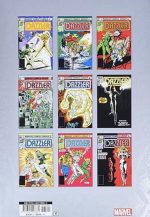
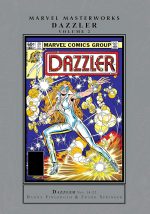
Dazzler Marvel Masterworks volume 2


By Danny Fingeroth, Steven Grant, Frank Springer, Mark D. Bright, Mike Vosburg, Vince Colletta, Danny Bulanadi, Jon D’Agostino & various (MARVEL)
ISBN: 978-1-3029-2867-4 (HB), 978-1-3029-3678-5 (Digital edition)

This book includes Discriminatory Content produced in less enlightened times.

Until relatively recently US comics had very little in the way of positive female role models and almost no viable solo stars. That seriously started changing in the 1980s and look at us now. As part of its late-but-dedicated effort to involve women readers with women characters Marvel began a program of female versions of top stars but also devised original titles to expand audiences – and none more so than Alison Blaire AKA Dazzler.

Attempts in the early 1970s had added to the canon and character roster but not publishing charts for any length of time. Nevertheless, the company kept on plugging and eventually found the right mix when Ms. Marvel launched in her own title (cover-dated January 1977). She was followed by equally copyright-shielding Spider-Woman (Marvel Spotlight #32, February 1977), who secured her own title 15 months later) and Savage She-Hulk (#1 February 1980). That last one was supplemented by music-biz inspired (and hopefully trend-exploiting) Dazzler, who sagely premiered in issue #130 of top-selling title Uncanny X-Men the same month. She followed up with a few guest shots in other big star books and inevitably graduated to her own book, but it was a little more convoluted than that…

Dazzler the character was born of another of those 1980-1990s doomed-from-the-start cross-media deals wherein comics companies attempted to break out of their “ghetto” into the real money world – like toys, movies and TV shows. In 1979 Disco specialists Casablanca Records began a development project with Marvel to create a television character who would release records like The Archies or The Monkees, but be set in an animated Marvel Universe. A giant-sized comics special was begun but when the deal was cancelled, the House of Ideas was left with a lot of talented people going “now what?”

In the interim Dazzler had already launched: guesting in the company’s other top titles (Fantastic Four #217 and Amazing-Spider-Man #203, both cover-dated April 1980). Failing to find other record companies willing to commit, big boss Jim Shooter decreed the comics special would be expanded and recycled as #1 & 2 of her own title. The singer went dark for a year before landing her own starring vehicle and her rocky road to stardom has risen and fallen ever since.

Having crushed and disappointed her austere father Judge Carter Blair by quitting law school to pursue a frivolous, worthless life on stage, Alison’s life continued to spiral crazily after meeting the X-Men. After subsequently facing petty, spiteful Asgardian Amora the Enchantress with the entire Marvel Universe in attendance, Alison steadfastly pursued her career dreams. That meant clashing in rapid order with Doctor Doom; dream demon Nightmare; evil mastermind Techmaster; The Enforcers (Ox, Montanna & Fancy Dan); Federal nemesis Mr. Meeker of energy thinktank Project Pegasus; supervillain Klaw; Galactus, his herald Terrax and – after being remanded to Riker’s Island for “murdering” Klaw – Titania and the Grapplers (Screaming Mimi, Letha & Poundcakes).

She did make some friends on the way, ranging from mob-fixated street-level masked vigilante Blue Sheild to major players like Bruce Banner and The Hulk as well as former S.H.I.E.L.D. agent/occasional Avenger Quasar (Wendell Vaughn), but the real gamechangers were her fraught associations with W.C. Fields-channelling agent/promoter Harry S. Osgood who began shaping her music career; obnoxious Lancelot Steele (sexist macho jerk/stage manager/field rep for Harry) and increasingly controlling boyfriend Dr Paul Jansen. At least Alison’s Grandma Bella still supports her, confident that one day Dazzler will be a star…

A mix of mainstream level superheroics, soap opera romances, telenovela melodrama and the hoary plot of A Star is Born, the complicated life of Alison Blaire now included an increasingly unstable father who despised her for daring to disobey him; a long-missing mother: a succession of creepily uptight and frankly dubious boyfriends; the countless moral and physical perils besetting lonely, pretty girls who would do (almost) anything to achieve their dreams of fame and assorted gods, monster, terrors and supervillains who couldn’t believe Dazzler didn’t care about them and Did Not Want To Fight.

The idea was still to address and remedy the lack of a significant female readership (after all, what normal girl would read X-Men, Spider-Man or the Hulk?) that had presumably dropped to insignificance once the company’s romance, nursing and humorous fashion titles were cancelled.

In an effort to be daring and different but still keep attracting readers the only way they knew, the editors and writers and artists did what they always did but honestly sought a different path. However, for Marvel at the time the medium was the message and somehow that meant a super fight every issue and lots of underwear, shower, and getting dressed/undressed moments in the quiet times…

Somehow Blaire never truly escaped traditional Marvel tropes and superhero schtick while forging her own path, as seen in this second collection of comic sagas taken from Dazzler #14-25, plus a bonus yarn from What If? #33, collectively covering April 1982 – March 1983. Following scripter Danny Fingeroth’s context-packed Introduction ‘This Was a Long Time Ago’, the drama resumes with #14 ‘…Without Getting Killed or Caught…!’ as Fingeroth Frank Springer & Vince Colletta reveal how after making waves as an opener for aging stadium-filler Bruce Harris, Alison and her band are caught in the crossfire when a top hitman targets Blue Shield. As the would-be killer ludicrously believes Lance is the crime-crusher, the snafu then leads Dazzler into an ambush where she must battle a deranged, mesmerised She-Hulk temporarily mind-controlled by the Mob…

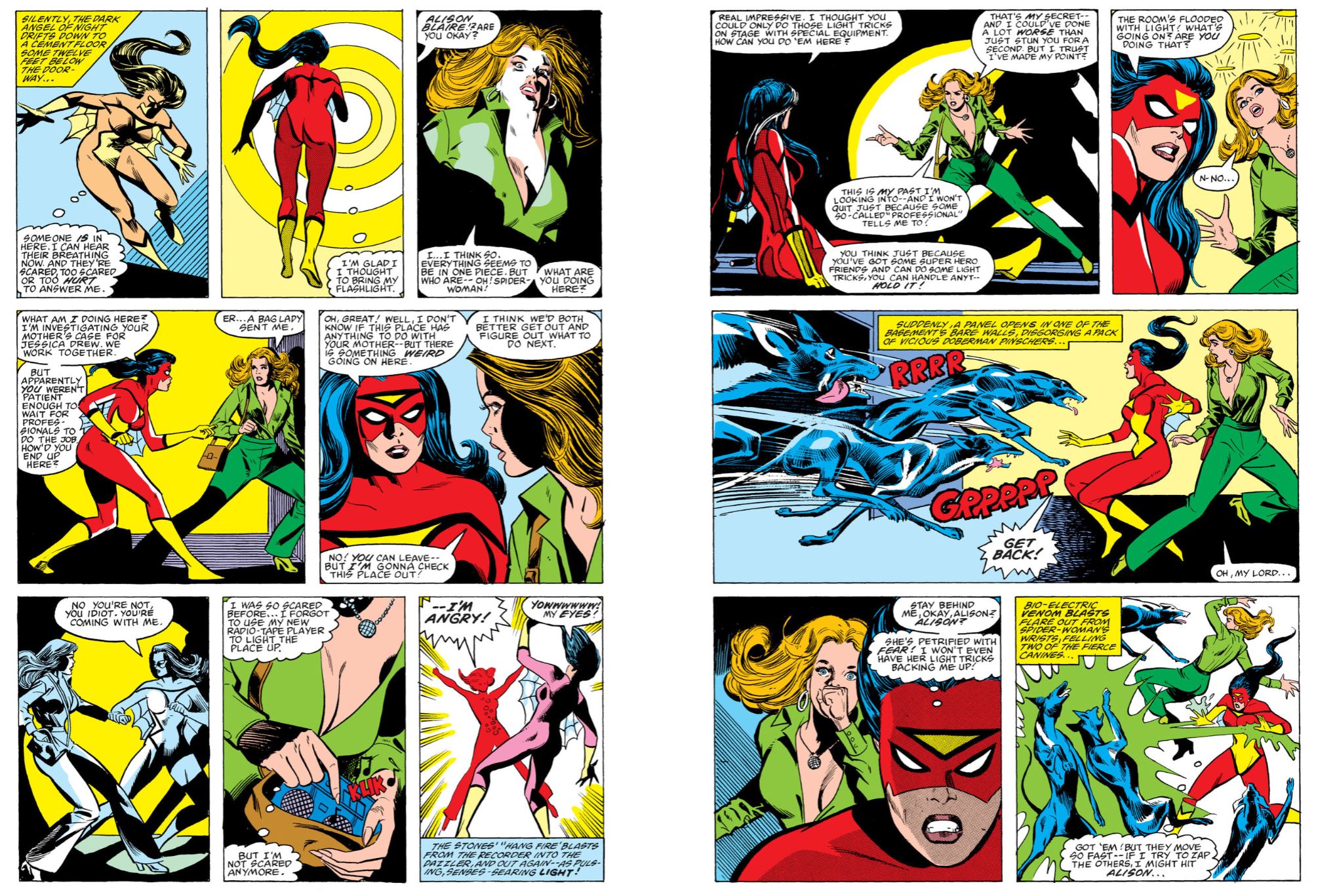
It’s still team-up time in #15 as ‘Private Eyes’ sees Harris’ tour hit San Francisco and Alison hiring investigator Jessica Drew (Spider-Woman) to track down her long-missing mom after her own amateur snooping provokes a misguided clash that brings the wrath of S.H.I.E.L.D. down on both of them…

Dazzler arrives in Seattle with #16, despondent that Harris wants her fired for making him look old and tired. Things get even worse in when The Enchantress returns and even the sudden appearance of current beau – straitlaced lawyer Ken Barnett – cannot deflect the terror of a singing contest in Asgard, judged by the gods and with the odds heavily stacked in favour of the cheating scheming ‘Black Magic Woman!’

Victorius and returned to the Big Apple, Alison’s head is turned in #17 as ‘The Angel and the Octopus!’ finds her the object of unwanted affection of multi-millionaire mutant Warren Worthington III just as Ken is becoming overly clingy. She really doesn’t need this grief right now as her producer Harry is auditioning younger, prettier potential rival songstress Vanessa Tooks and her father is on the edge of a mental breakdown…

It’s almost a relief when The Angel sweeps her off her feet for wining, dining and a furious fight against mech-augmented multi-armed madman Doctor Octopus

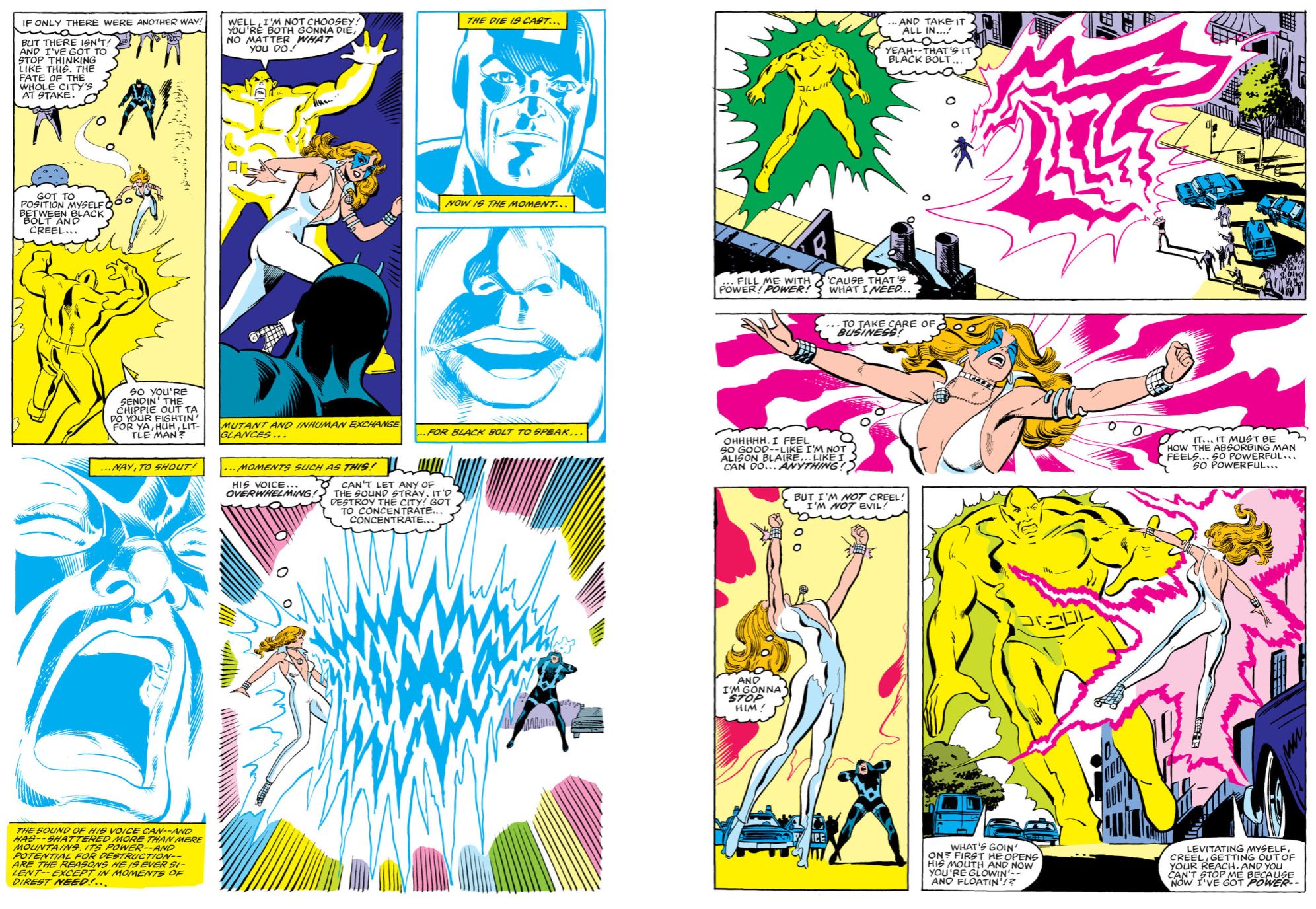
Her plans to be as normal as possible are further threatened when super-criminal Crusher Creel hunts her down to be his hostage in a planned ambush of the Avengers in ‘The Absorbing Man Wants You!’ Sadly, after the simple-minded thug overconsumes her energies and grows out of control, Dazzler endures ‘Creel… and Inhuman Treatment!’ until Inhuman king Black Bolt intervenes to avoid a escalating catastrophe. Meanwhile, as Judge Blaire deteriorates, Warren, Vanessa and Grandma Bella all take circuitous but convergent steps that will soon uncover the hiding place of Alison’s mother…

The roads meet in #20 as ‘Out of the Past!’ details the hows and whys of Barbara (Blaire) London’s absence and even fills in some hidden passages in the life of Alison…

The full story arrives behind a photo-cover by Eliot Brown, Bob Larkin and model June McDonald as double-sized Dazzler #21 declares ‘Alison Blaire, This is Your Life!’ with the singer headlining a major benefit gig that draws ALL of her family together for a major reconciliation and reset, with every superhero in town along for the show…

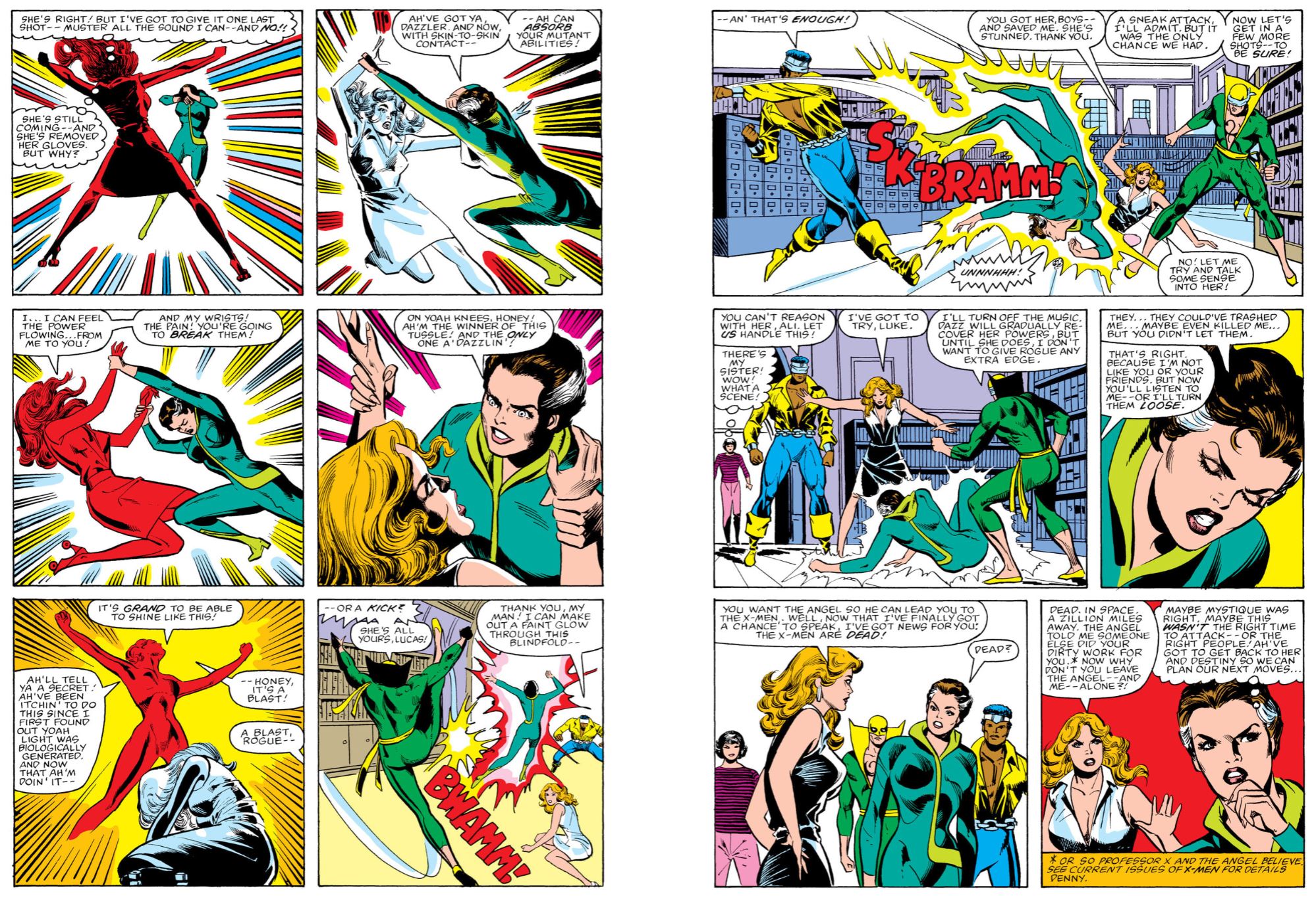
A new tone infects #22 as evil mutants ‘The Sisterhood’ maliciously target Angel. The larger goal of Mystique, Destiny and wild child Rogue is to destroy the entire X-Men team but after Alison humiliatingly defeats Rogue and her parents, the unbalanced teenager becomes obsessed with punishing Dazzler. However, before that ‘Fire in the Night!’ changes tack to find Alison and her newly-found half sister Lois London endangered by manic arsonist Flame and her own vile property speculating landlord. Meantime, believing the Sisterhood behind the attack Alison has contacted a certain Heroes for Hire team and soon Luke Cage and Iron Fist prove worth every discounted cent…

They continue earning their keep in ‘A Rogue in the House!’ (#24 and Fingeroth, Springer & Colletta’s last collaboration in this collection) as the uncontrollable young mutant mind & powers leech assaults Alison and Lois. Brave and bold the bodyguards are ultimately defeated by their own stolen abilities and, desperate and furious, Dazzler decides to settle the grudge her own way…

The main comics biography pauses here with Dazzler #25, wherein the living transducer experiences every performer’s greatest nightmare. Crafted by Steven Grant, Mark Bright & Danny Bulanadi, ‘The Jagged Edge’ exposes her response to an appreciative fan who slowly crosses the line from heartfelt appreciation to lethally psychotic stalker. Sweet, shyly attentive admirer Karl Fredericks rapidly devolves to possessive maniac after finally meeting his idol, thereafter attempting to own Alison by killing all her friends and relatives. This prompts an extreme reaction from the horrified mutant musician…

To Be Continued..

With covers by Springer, Bill Sienviewicz, John Romita Jr., Bob Wiacek, John Romita Sr., and Dave Simons fronting each enthralling episode, the brief posterior Bonus Section opens with a tale from What If? #33 (June 1982), crafted by Fingeroth, Mike Vosburg & Jon D’Agostino asking and answering the burning question ‘What If The Dazzler Had Become the Herald of Galactus?’, supplemented by Dazzler’s entry from 1983’s Official Handbook to the Marvel Universe as supplied by Mark Gruenwald, Springer & Josef Rubinstein and the original character design for ‘Vanessa’ as crafted by then-current Marvel intern Lance Tooks.

Although very much of its troubled times, this collection sees the transformative shift in attitudes that resulted in women becoming less decorative and unshakably ornamental, and increasingly authors of their own fates. Even if not to everyone’s taste there is enough of significance here to make Dazzler worthy of any modern readers attention.
© 20201 MARVEL.

Today in 1934 comics loving speculative fiction iconoclast Harlan Ellison was born, followed in 1951 by Canadian superstar George Freeman (Captain Canuck, Green Lantern, Wasteland) and Mark Wheatley (Mars, Blood of the Innocent, Breathtaker, Fables: 1001 Nights of Snowfall) in 1954)

On this date in 1949 we lost Robert Ripley (Ripley’s Believe It or Not!); Mark Trail creator Ed Dodd in 1991, ceiling shattering Japanese cartoonist Machiko Hasegawa (Sazae-san) in 1992 and Al Hartley (Archie Comics, Patsy Walker, Thor/Journey into Mystery) in 2003.

In 2006 Alex Toth died.

Little Paintings


By James Kochalka (Top Shelf Productions)
ISBN: 978-1-60309-017-9 (HB/Digital edition)

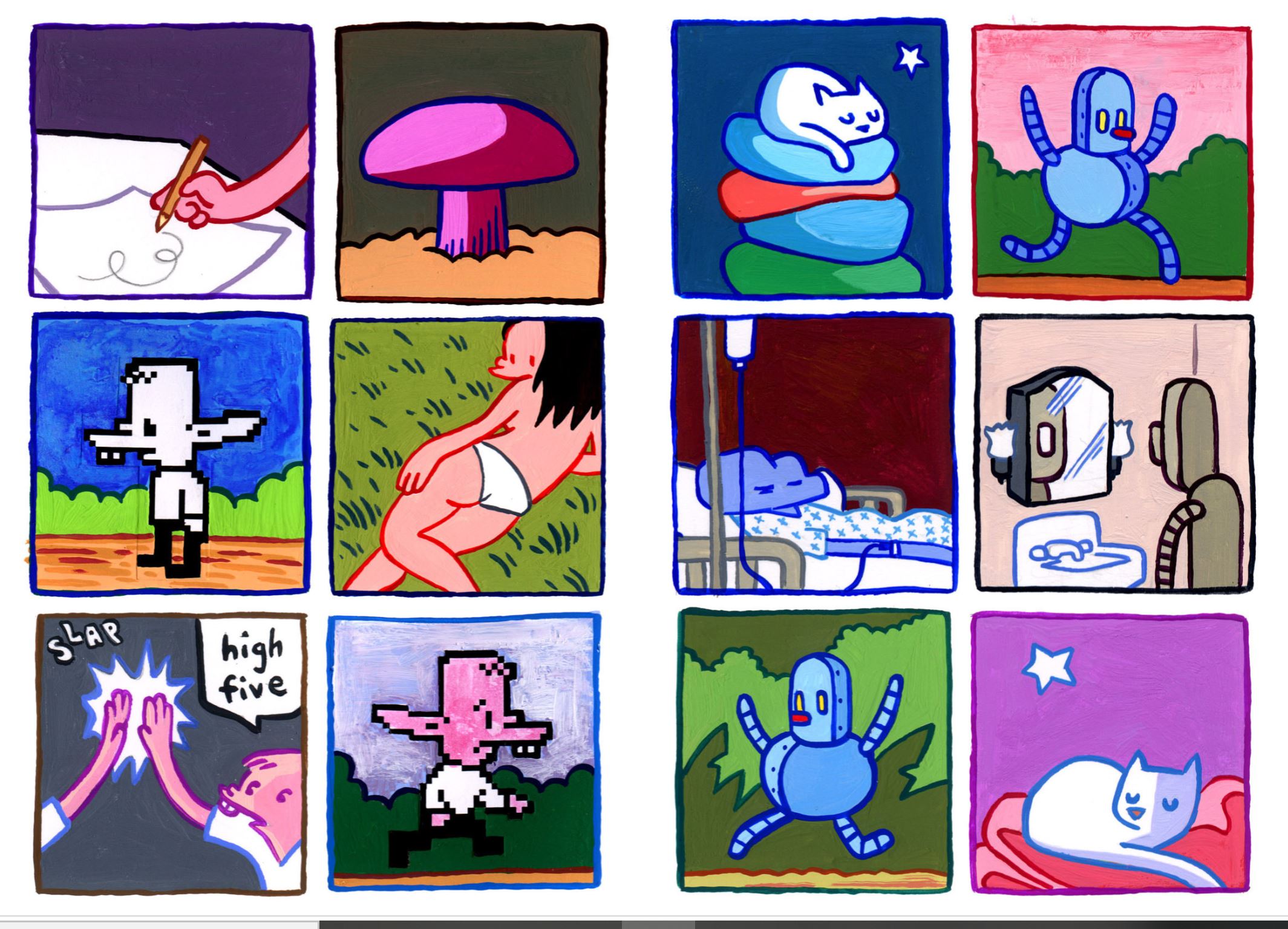
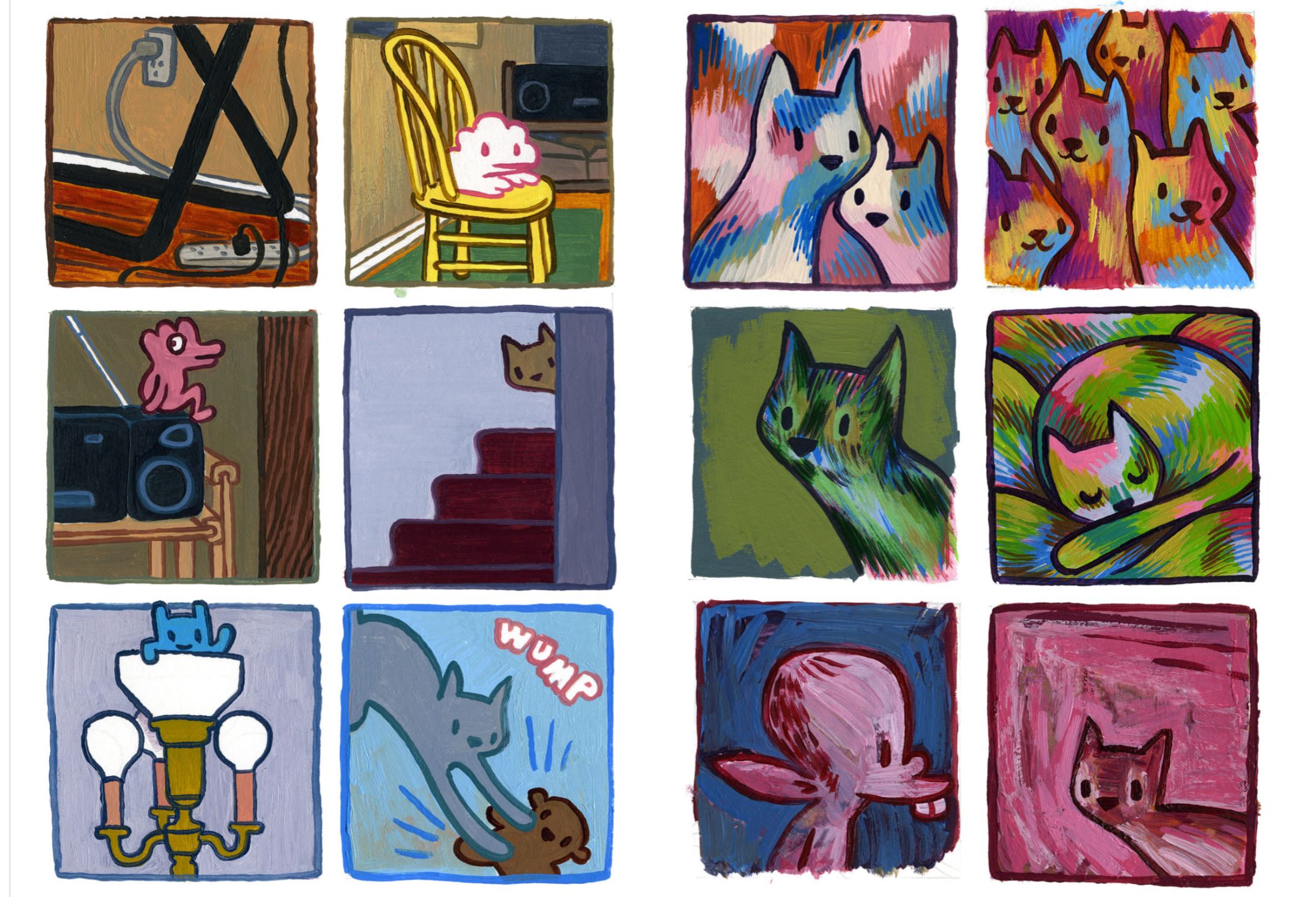
James Kochalka is a prolific and always entertaining giant of comics creation, whose vast, sublimely surreal, enticing works range from kid-friendly romps such as the Glorkian Warrior and Johnny Boo series, to excoriatingly honest self-examining daily journal strip American Elf and the indescribably fun SuperF**kers – and that’s my censorious edit there, not his…

The author, artist, animator. educator and rock musician is utterly wedded to the energies of creativity and this tantalizing tome gathers hundreds of mini-paintings he knocked up to sell at various conventions between 2001 and 2007. All his old familiar faces are there: cats, ghosts, robots, monsters, aliens, cats, bathrooms, birds, chicks and dudes, mushrooms, animals, landscapes and weather, cats, machines and random images, all apparently arranged in no particularly order and inviting your response. Did I mention, there are some cats?

There is a narrative here, but it’s completely generated by the viewer who can’t help but create a story around the hundreds of thumbnail paintings of gloriously hued things and folks and stuff, and a lot to read in if you’re willing to take some time. This is one of my absolute favourite go-to books whenever I need a little pictorial pick-me-up and you should share the joy.

Go on, you know you want to…
© James Kochalka 2011. All rights reserved.

Today in 1939 artist and storyteller Herb Trimpe was born (Hulk, Iron Man, Godzilla, GI Joe) as was Tom Mandrake (The Spectre, Grimjack, Martian Manhunter) in 1956. In 1967 VIP creator and future Cartoonist Laureate of Vermont James Kolchaka (American Elf, Sketchbook Diaries) joined the party.

On this date in 1872, Punch artist & illustrator Alfred Henry Forrester died, as did prolific and multi-pseudonymous French comics creator Robert Dansler/“Bob Dan” (Bill Tornade, Jack Sport, La Jonque en Flammes) in 1972, and Canadian strip cartoonist Jim Unger (Herman) in 2012.

Calling Dick Tracy! volume 1


By Mike Curtis, Joe Staton & various (Rabbit Hole)
ISBN: 978-0-930645-11-0 (digital edition)

Time for another anniversary celebration. Dick Tracy is 95 in five months’ time, so here’s a superb collection crying out for revival in either physical or digital forms. Another time to agitate against the publishing powers-that-be, I think…

All in all, comics have a pretty good track record for creating household names. We could play the game of picking the most well-known fictional characters on Earth – usually topped by Sherlock Holmes, Mickey Mouse, Superman Batman & Tarzan – and supplement the list with Popeye, Blondie, Charlie Brown, Tintin, Spider-Man, Garfield, and – not so much now, but once, most definitely – Dick Tracy

At the height of the Great Depression cartoonist Chester Gould sought fresh strip ideas. The story goes that as a decent guy incensed by the exploits of gangsters like Al Capone (who monopolised front pages of contemporary newspapers) the doughty doodler settled upon the only way a normal man could fight thugs: Passion and Public Opinion.

Raised in Oklahoma, Gould was a Chicago resident who hated seeing his home town in the grip of such wicked men, with far too many honest citizens beguiled by the gangsters’ charisma. He decided to pictorially get it off his chest with a procedural crime thriller that championed the ordinary cops who protected civilisation.

He took his proposal –“Plainclothes Tracy” – to Captain Joseph Patterson, the legendary newspaperman and strips Svengali whose golden touch had already blessed strips like The Gumps, Gasoline Alley, Little Orphan Annie, Winnie Winkle, Smilin’ Jack, Moon Mullins and Terry and the Pirates among others. Casting his experienced eye on the work, Patterson promptly renamed the hero Dick Tracy, whilst also revising his love interest into steady, steadfast girlfriend Tess Truehart. The daily series launched on October 4th 1931 through Patterson’s own Chicago Tribune Syndicate, growing quickly into a phenomenon and monumental hit, with all the attendant media and merchandising hoopla that follows. Bolstered by toys, games, movies, serials, animated features, TV shows et al, the strip soldiered on, influencing generations of creators and entertaining millions of fans. Gould unfailingly wrote and drew the strip for decades until retirement in 1977.

The legendary lawman was a landmark creation who influenced not simply comics but the entirety of American popular fiction. Its signature use of baroque villains, outrageous crimes and fiendish death-traps pollinated the work of numerous strips (most notably Batman), shows and movies since then, whilst the indomitable Tracy’s studied, measured use – and startlingly accurate predictions – of crimefighting technology and techniques gave the world a taste of cop thrillers, police procedurals and forensic mysteries such as CSI decades before the modern fascination took hold.

As with many creators in it for the long haul, the revolutionary 1960s were a harsh time for well-established cartoonists. Along with Milton Caniff’s Steve Canyon, Gould’s grizzled gangbuster especially foundered in a social climate of radical change where popular slogans included “Never trust anybody over 21” and “Smash the Establishment”. The strip’s momentum faltered, perhaps as much from a move towards trendy science fiction (Tracy went off-Earth into space and the character Moon Maid was introduced) as from those improbable, Bond-movie-style villains or perceived “old-fashioned” attitudes. Even the introduction of more minority and women characters – and hippie cop Groovy Groove – couldn’t stop the rot. However, the feature soldiered on regardless…

When Gould retired in 1977, 29-year old author Max Allen Collins (Road to Perdition, Nathan Heller, Mike Mist, Ms. Tree, Batman) won the prestigious role as scripter, promptly taking the series back to its crime-busting roots for a breathtaking run, ably assisted by Gould as consultant with his chief artistic assistant Rick Fletcher promoted to full illustrator. After 11 years, Collins was removed in 1992 and replaced by Mike Kilian – who apparently worked for half the up-&-coming novelist’s price – until his death in October 2005. Dick Locher took over story & art, with assistant Jim Brozman assuming drawing duties from March 2009. On January 19th 2011, Tribune Media Services announced Locher’s retirement and replacement by a new team. That’s where this digital-only book begins…

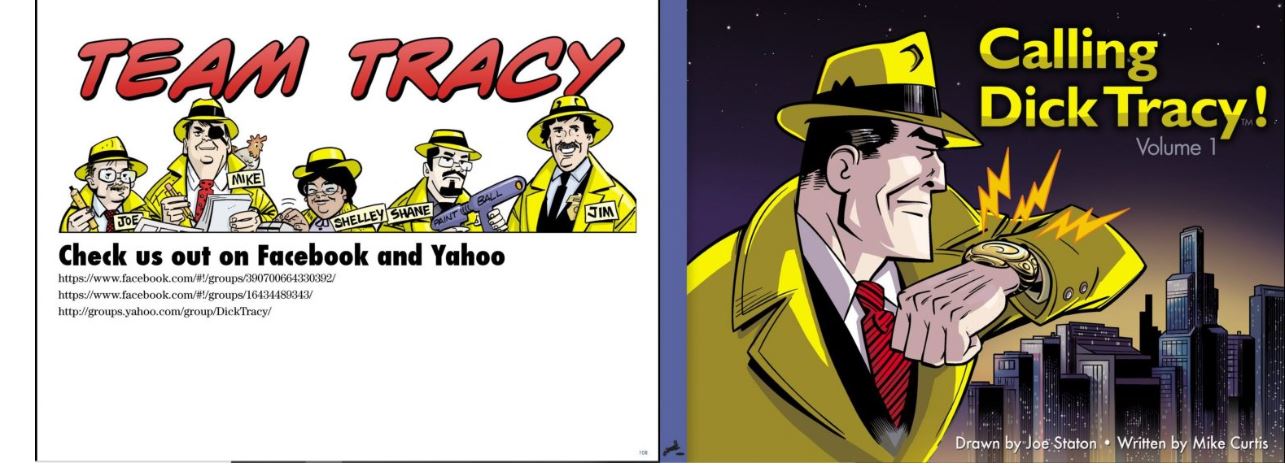
Atoudingly versatile and unbelievably prolific artist/inker Joe Staton (E-Man, Mike Mauser, The Avengers, Incredible Hulk, Green Lantern, Legion of Super-Heroes) has been an integral part of American comic books since the early 1970s and in later years made kids comics his metier. During a spectacular run on licensed classic Scooby Doo, he and series scripter Mike Curtis (Casper the Friendly Ghost, Richie Rich, Shanda the Panda) discovered a mutual love for Dick Tracy and – mostly for their own amusement – created a tribute strip entitled Major Crime Squad.

How that landed them the duty of continuing the ultimate cop’s official adventures is addressed in introductory text feature ‘Publisher’s Note – aka “The Dick Tracy vs. Major Crime Squad Caper”’ by Steve Tippie (VP of Licensing, TMS News & Features, LLC) before a stunning chronological re-presentation of all-new classics begins. Preceding those comic capers are more text-based insights and revelations: a Foreword by Mike Gold; former sheriff Curtis’ ‘How We Got the Job’ (supplemented by samples done in 2005 when they first tried to take on the strip) and Staton’s ‘Waiting For Dick Tracy’

Next up is a brief visual refresher course of ‘Tracy and His Allies’ and the most nefarious of the repeat offenders in a ‘Rogues Gallery’ before the unending war on crime resumes in ‘Flyface and The Fifth Return’.

The strip has sadly long passed its heady glory days of mass sales, but that’s more about the death of print periodicals than this material. It still appears in a number of papers and as a potent online presences which means every episode is in full colour, with half-page Sunday strips still offering extras such as the ‘Crimestoppers Textbook’. One welcome addition is full credits so we can thank Shelley Pleger and Shane Fisher for their inks, colours and lettering. When Staton retired in October 2021, Pleger drew the feature, which these days is limned by Charles Ettinger…

The plot here sees the long separated traditional squad fully reunited to combat right wing terrorism and gradually reintroduced to the fanciful gadgets and controversial space tech after Tracy’s inventor pal Diet Smith gets in touch. A disgruntled former employee has stolen plans for his energy-beam weapon “Thor’s Hammer”…

After selling it to old lags Flyface and The Fifth – who kidnap officer Lizz Worthington to set a trap for their old nemesis – events spiral out of control, but only the wicked pay the final price this time…

Longtime comedic characters B.O. Plenty and his wife Gravel Gertie then resurface, celebrating the birth of their second child – the ugliest boy on Earth! – before falling foul of a manipulative foodie TV celebrity who sees a chance to own the airwaves with the stomach-churning infant in ‘Flakey Biscuits Makes the Dough’. Sadly, her bribing gifts to the couple include a shipment of cocaine being secretly couriered by her assistant Hot Rize, and soon bodies start dropping as the city’s top drug lord seeks to recover his missing product. Once Tracy realises what’s what, it’s all over bar the shooting…

‘Doubleup and the Scarlet Sting’ features the making of a movie starring a fictional superhero and depicts how childhood fan and modern-day gangster Doubleup barges in: infiltrating the cast to shakedown the production. Soon he’s too involved and after murdering his girlfriend all that’s left is being caught facing real-world justice…

At this time alternate Sunday extra ‘Tracy’s Hall of Fame’ (celebrating police officers) began, days before an officially deceased and clearly incorrigible arch enemy reappeared in ‘B-B Eyes and Honeymoon’. When Tracy’s adopted son Junior goes undercover to investigate a video piracy ring, the case quickly drags in the old cop’s granddaughter too, after Honeymoon Tracy tries to help out and almost dies because of her enthusiasm and lack of training.

Even with the comics component concluded, there’s more informational extras to enjoy as Curtis offers ‘Dick Tracy vs. the Villains: A Comparison’ and we meet the current creators in ‘Joe Staton’s Bio’, ‘Mike Curtis’ Bio’ and ‘Team Tracy Bios’ to close this initial casebook – hopefully the first of many.

Dick Tracy has always been a fantastically readable feature and this potent return to first principles is a terrific way to ease yourself into his stark, no-nonsense, Tough Love, Hard Justice world. Comics just don’t get better than this.
© 2013 TMS News & Features, LLC. All rights reserved.

On this day in 2003, Jerry Bittle’s redneck-ribbing strip Geech appeared for the final time, but the date is shared by a host of birthday boys and girls including French illustrator Paul Léonnec in 1842; publisher Clay Geerdes in 1934; Argentinian Lucho Olivera (Nippur de Lagash, Gilgamesh the immortal) in 1942 and undying legend Barry Windsor-Smith in 1949. Stan (Usagi Jojimbo) Sakai arrived in 1953; both Mark (Breathtaker, Tug & Buster, Sandman) Hempel and Publisher Terry Nantier in 1957 and mangaka Tomoko Ninomiya (Nodame Cantabile) in 1969.

Crisis on Multiple Earths: The Team-Ups


By Gardner Fox, John Broome, Carmine Infantino, Murphy Anderson, Gil Kane, Dick Dillin, Joe Giella, Sid Greene & various (DC Comics)
ISBN: 978-1-4012-0470-9 (TPB)

This book includes Discriminatory Content produced in less enlightened times.

As I’ve interminably mentioned before, I was one of the “Baby Boomer” crowd that grew up with Gardner Fox & John Broome’s tantalisingly slow reintroduction of Golden Age superheroes during the halcyon, eternally summery days of the 1960s. To me those fascinating counterpart crusaders from Earth-Two were never vague and distant memories rubber-stamped by parents or older brothers – they were cool, fascinating and enigmatically new. And for some reason the “proper” heroes of Earth-One held them in high regard and treated them with obvious deference…

It all began, naturally enough, in The Flash, flagship title of the Silver Age Revolution. After ushering in the triumphant return of the costumed superhero concept the Scarlet Speedster, with Fox and Broome at the reins, set an unbelievably high standard for superhero adventure in sharp, witty tales of science and imagination, illustrated with captivating style and clean simplicity by Carmine Infantino.

Gardner Fox didn’t write many Flash scripts at this time, but those few he did were all dynamite. None more so than the full-length epic that literally changed the scope of American comics forever. ‘Flash of Two Worlds’ (The Flash #123, cover-dated September 1961, illustrated by Infantino & Joe Giella) introduced the concept of alternate Earths to a growing continuity and by extension resulted in the multiversal structure of the DCU, Crisis on Infinite Earths and all the succeeding cosmos-shaking crossover sagas that grew from it… And of course where DC led, others followed…

During a benefit gig Flash (police scientist Barry Allen) accidentally slips into another dimension where he finds the comic-book hero he based his own superhero identity upon actually exists. Every adventure he had absorbed as an eager child was grim reality to Jay Garrick and his mystery-men comrades on the controversially named Earth-2. Locating his idol, Barry convinces the elder to come out of retirement just as three Golden Age villains, the Shade, Thinker and Fiddler, make their own wicked comeback…

Thus is history made and above all else, ‘Flash of Two Worlds’ is still a great read that can electrify today’s reader.

Fox revisited Earth-2 nine months later in #129’s ‘Double Danger on Earth!’ (inked by Murphy Anderson) as Garrick ventures to Earth-1 to save his own world from a doom comet, only to fall foul of Captain Cold and The Trickster. Another cracking thriller, as well as double Flash action, this tale teasingly reintroduced Justice Society stalwarts Wonder Woman, Atom, Hawkman, Green Lantern, Dr. Mid-Nite & Black Canary. Clearly Editor Schwartz had something in mind…

‘Vengeance of the Immortal Villain!’ from Flash #137 (June 1963, inked by Giella) was the third incredible Earth-2 crossover, and saw the Flashes unite to defeat 50,000 year old Vandal Savage and save the Justice Society of America: a tale which directly led into the veteran team’s first meeting with the Justice League of America and start of those aforementioned “Crisis” epics.

That landmark epic can be found elsewhere whilst this collection continues with the less well-known ‘Invader from the Dark Dimension!’ (Flash #151, March 1964, by Fox, Infantino & Giella): a full-length shocker wherein the demonic Shade ambitiously attempts to plunder both worlds.

Public approval was decidedly vocal and Editor Julie Schwartz used DC’s try-out magazines to sound out the next step: stories set on Earth-2 with exclusively Golden Age characters. Showcase #55 saw the initial team-up of Doctor Fate and Hourman as the Justice Society stalwarts battled the monster of Slaughter Swamp after ‘Solomon Grundy Goes on a Rampage!’ Produced by Fox & Anderson, this bombastic yarn even had room for a cameo by Earth-2’s Green Lantern, and the original text page featuring the heroes’ origins is also reproduced here.

Showcase #56 also featured “the Super-Team Supreme” (and by the same creative team supreme) in ‘Perils of the Psycho-Pirate!’ wherein ex-con Roger Hayden (cell-mate of the original JSA villain) steals the magical Masks of Medusa to go on an emotion-controlling crime-spree. Fan-historians should note that this tale is a pivotal antecedent of landmark event Crisis on Infinite Earths as well as a superbly engaging adventure in its own right. A text feature on the original Psycho-Pirate accompanies the story.

Although getting in late to the Counterpart Collaborations game, the inevitable first teaming of the Hal Jordan and Alan Scott Green Lanterns is one of the best – and arguably the second-most important – story of the entire decade. ‘Secret Origin of the Guardians!’ (John Broome, Gil Kane & Sid Greene, Green Lantern #40, October 1965) introduced renegade Guardian Krona, revealed the origin of the multiverse, showed how evil entered our universe and described how the immortal Oans took up their self-appointed task of policing the cosmos. It also shows Kane’s paramount ability to stage a superhero fight like no other. This pure comic book perfection should be considered a prologue to the aforementioned Crisis on Infinite Earths.

Still looking for an Earth-2 concept that could support its own series Schwartz, Fox & Anderson debuted the team of Starman & Black Canary in The Brave and the Bold #61 (September/October 1965): pairing the heroes against eerily translucent villain The Mist in ‘Mastermind of Menaces!’ This compelling thriller is augmented here by a text bio of Black Canary.

Although not featured in this volume, Schwartz & Fox did finally achieve their ambition to launch a Golden Age hero into his own title. After three Showcase appearances and many guest-shots The Spectre won his own book at the end of 1967, just as the super-hero craze went into a steep decline. We conclude with a back-up tale from The Spectre #7 (November/ December 1968). Fox, Dick Dillin & Greene’s ‘The Hour Hourman Died!’ is a dark, clever attempted-murder mystery that packs a book’s worth of tension and action into 9 moody pages and serves as a solid thematic reminder that the golden Silver Age of the 1960s was a creative high point that simply ended too soon, because when you start at the top the only way is down…

Still irresistible and compellingly beautiful after all these years, the stories collected here highlight the immense talent and imagination of the creators: gifts which shaped the US comics industry forever after and are still influencing not only today’s funnybooks but also the movies, TV and animated shows and movies that grew from them. These are tales and this is a book you simply must have.
© 1961, 1962, 1963, 1964, 1965, 1968, 2005 DC Comics. All rights reserved.

Today in 1899, Golden Age comic book pioneer Everett M. Busy Arnold (Quality Comics) was born, followed in 1911 by novelist, shared continuity groundbreaker and unparalleled inspirational character creator Gardner F. Fox (Justice Society & League of America, Flash, Zatanna, Sandman, Dr, Fate, Johnny Thunder, Hawkman, Doc Savage, Red Wolf, Adam Strange, The Face, Crom the Barbarian, Skyman, Starman, Spymaster, Batman, Batgirl, and thousands of genre shorts for every company in the US, ad infinitum).

In 1936 Malfunction Junction cartoonist Malcolm Hancock was born.

Upside Dawn


By Jason (Fantagraphics Books)
ISBN: 978-1-68396-652-4 (HB/digital edition)

This book includes Discriminatory Content included for dramatic, comedic and ironic effect.

Born in 1965 in Molde, Norway, John Arne Sæterøy is known by enigmatic, utilitarian nom de plume Jason. The shy & retiring auteur first took the path to cartoon superstardom in 1995, once debut graphic novel Lomma full ay regn (Pocket Full of Rain) won Norway’s biggest comics prize: the Sproing Award. From 1987 he had contributed to alternate/indie magazine KonK while studying graphic design and illustration at Oslo’s Art Academy.

From there he took on Norway’s National School of Arts and, on graduating in 1994, founded his own comic book Mjau Mjau. Constantly refining his style into a potent form of meaning-mined anthropomorphic minimalism, Jason has cited Lewis Trondheim, Jim Woodring & Tex Avery as primary influences. He moved to Copenhagen, working at Studio Gimle alongside Ole Comoll Christensen (Excreta, Mar Mysteriet Surn/Mayday Mysteries, Den Anden Praesident, Det Tredje Ojet) and Peter Snejbjerg (Den skjulte protocol/The Hidden Protocol, World War X, Tarzan, Batman: Detective 27).

Jason’s efforts were internationally noticed, making waves in France, The Netherlands, Slovenia, Spain, Germany and other Scandinavian countries as well as the Americas and he won another Sproing in 2001 – for self-published series Mjau Mjau – before in 2002 turning nigh-exclusively to producing graphic novels. He won even more major awards.

Jason’s breadth of interest is wide & deep: comics, movies, animated cartoons, music, literature, art, history and pulp fiction all feature equally with no sense of rank or hierarchy. Jason’s puckish, egalitarian mixing & matching of inspirational sources always and inevitably produces picture-treatises well worth a reader’s time. Over a succession of tales he has built and re-employed a repertory company of stock characters to explore deceptively simplistic milieux based on classic archetypes distilled from movies, childhood yarns, historical and literary favourites. These all role-play in deliciously absurd and surreal sagas centred on his preferred themes of relationships and loneliness. Latterly, Jason returned to such “found” players as he built his own highly esoteric universe, and even has a whole bizarre bunch of them “team-up” or clash…

As always, visual/verbal bon mots unfold in beguiling, sparse-dialogued, or even as here silently pantomimic progressions, with compellingly formal page layouts rendered in a pared back stripped-down interpretation of Hergé’s Claire Ligne style: solid blacks, thick outlines dominating settings of seductive monochrome simplicity augmented by a beguiling palette of stark pastels and muted primary colours.

A master of short-form illustrated tales, many Jason yarns have been released as snappy little albums before later inclusion in longer anthology collections. The majority of tales brim with bleak isolation, swamped by a signature surreality even in the most comedic of moments. They are largely populated with cinematically-inspired, darkly comic, charmingly macabre animal people ruminating on inescapable concerns whilst re-enacting bizarrely cast, bestial movie tributes. That’s a style that has never been more apropos than right here, as the more modern Art Forms bow before the onslaught and tirade of organised anti-art philosophers, socially intellectual terrorists, wandering pop stars and a lost Vulcan…

Here the auteur returns to short individual pieces – or are they? – and fondly dabbles with words, terms and aural meanings whilst opening with an understandable failure to communicate over a meal in ‘Woman, Man, Bird’ before noted cerebral French auteur/filmmaker and playfully adrift word-&-meaning warper Georges Perec is repositioned as a hardboiled gumshoe searching for a missing woman in a yarn laced with omissions, mis-hearings and misapprehensions. Nevertheless, if you’re looking for a truth – any truth – ‘Perec PI’ is on the case…

A rapid pictorial transit to a peregrination through a typical life is recalled at full pelt in ‘I Remember’ after which ‘Vampyros Dyslexicoa’ dips deep into literary hinterlands in a pastiche/homage to Joseph Sheridan Le Fanu’s 1872 Gothic novella Carmilla. However the sordid obsessions of sapphic vampire Mircalla are only the entrée to wilder scriptorial regions and a nasty case of creative anachronism as ‘Seal VII’ takes us deep into modern “Scandi” folklore when a certain Knight and Death meet up for a game in Sweden in 1357 and don’t really cotton to the notion of chess for souls…

The scenes shifts to Prague in 1919 where a certain agent of the crown abruptly quits his job and is renditioned to a strange, picturesque high-tech surveillance Village where he has to wear a blazer as ‘The Prisoner in the Castle’ prior to popping back to St Peterburg in 1865 to gorily relive the trials and tribulations of Great Russian Literature at first hand via some eccentric ‘Crime and Punishment’

As much as Jason has played with visual meaning and manipulated derived imagery-context in his past forays, the later relater is here gripped by the confusing potentials of words and verbal meanings. Such facile surface fascinations are apparent during Leopold Bloom’s rather violent visit with the absolute master of “what did that mean” Dublin in June offers a walk with James Joyce, a leprechaun, Stephen Dedalus and Molly as we ponder stuff and not-nonsense in ‘Ulysses’. Then ‘Ionesco’ introduces random judgement to the final days of avant-garde playwright Eugène Ionesco, as a parade of bizarre celebrities and notables eulogise or defame him before he goes…

Slipping into a partial colour palette (yellow, if you care), ‘What Rhymes with Giallo?’ uses rhyming couplets to detail a sordid stabbing spree before resuming monochromatic mode as the tense future proves too much for one scientific stoic. Stress compels Mr Spock to desert the Enterprise and migrate to Montparnasse, Paris in ‘The City of Light, Forever’. It’s 1925 and he finds contentment as a minor Japanese painter (of cats) until Captain Kirk comes looking for him. If you follow Jason, this is where you start to realise that a lot of his work overlaps and intercepts itself in the strangest places…

Adding red and blue to black & white, ‘Who Will Kill the Spider?’ is a classic child’s nightmare of terror and confusion as Dad uses escalating tools and allies to deal with a bug in the bedroom who just won’t quit, after which words literally fail us in ‘One Million and One Years B.C.’: a silent science spoof of dinosaurs, cave-folk, time-travelling soldiers and stupid assumptions which leads into tribute diptych ‘EC Come…’ (a bloody tale of domestic ghouls and zombies) and ‘…EC Go’ (pointed satire of the comic company’s sublime Ray Bradbury adaptations of interplanetary First Contacts).

Then inevitably it devolves into a spoofing shot at the Sci Fi Fifties care of Curt Siodmak via Ed Wood in alien invasion ‘From Outer Space’ before ‘Etc.’ stages a celebrity-stacked movement-moment that begins in London circa 1972 as immortal musketeer Athos meets David Bowie meets a mummy meets Elvis meets Moses meets Sinatra meets Van Gogh meets Frank Zappa meets Death ad infinitum for a miasmic, abstractly construed big finish…

Visually mesmerising, this cunningly concocted Dadaist picture salad conceals underlying connections you really have to stay untuned for, referring relentlessly to modern icons and ancient shibboleths in equal measure, and perpetually sampling the feeling and furniture of war films, scary stories, true romances gone bad, Monty Python, Star Trek, a million movies, books, tunes and comics and even his own burgeoning “Jason-verse”. Upside Dawn absolutely should not be your first dip into his works, but don’t let that stop you from getting them all and getting all caught up…
All characters, stories, artwork and translation © 2022 Jason.
This edition of Upside Dawn © 2022 Fantagraphics Books, Inc. All rights reserved.

Today in 1892 Scots artist and future Charlie Chaplin comics illustrator Wally Roberson was born, followed in 1912 by John Liney (who limned the Henry strip), and in 1917, Hal Seeger who wrote & drew Betty Boop and later Leave it to Binky. In 1925 eventual East German cartoonist Hannes Hegen (Mosaik) arrived, with US letterer-to be Stan Starkman (Batman, Doom Patrol, Metamorpho) coming along in 1927. 3D comics guy Ray Zone was born in 1947, the same day and year that we lost the astounding Reg Perrott, artist on Roly and Poly the Two Bear Cubs, Land of the Lost People, Whirling Around the World, Wheels of Fortune, Red Ryder, The Young Explorers, The Golden Arrow, Golden Eagle, Sons of the Sword and more, as well as becoming producer/studio manager of UK mainstay Mickey Mouse Weekly.

In 1952 Hägar the Horrible artist Chris Browne was born, as was Chester Brown (Yummy Fur, Louis Riel) in 1960 and John Arne Sæterøy/Jason in 1965.

This date in 1964 Malcom Judge’s Billy Whizz first hurtled into the hearts of Beano readers, and in 2012 marked the passing of comic book workhorse Ernie Chan (Conan, Batman, Dracula Kull, The Hulk).