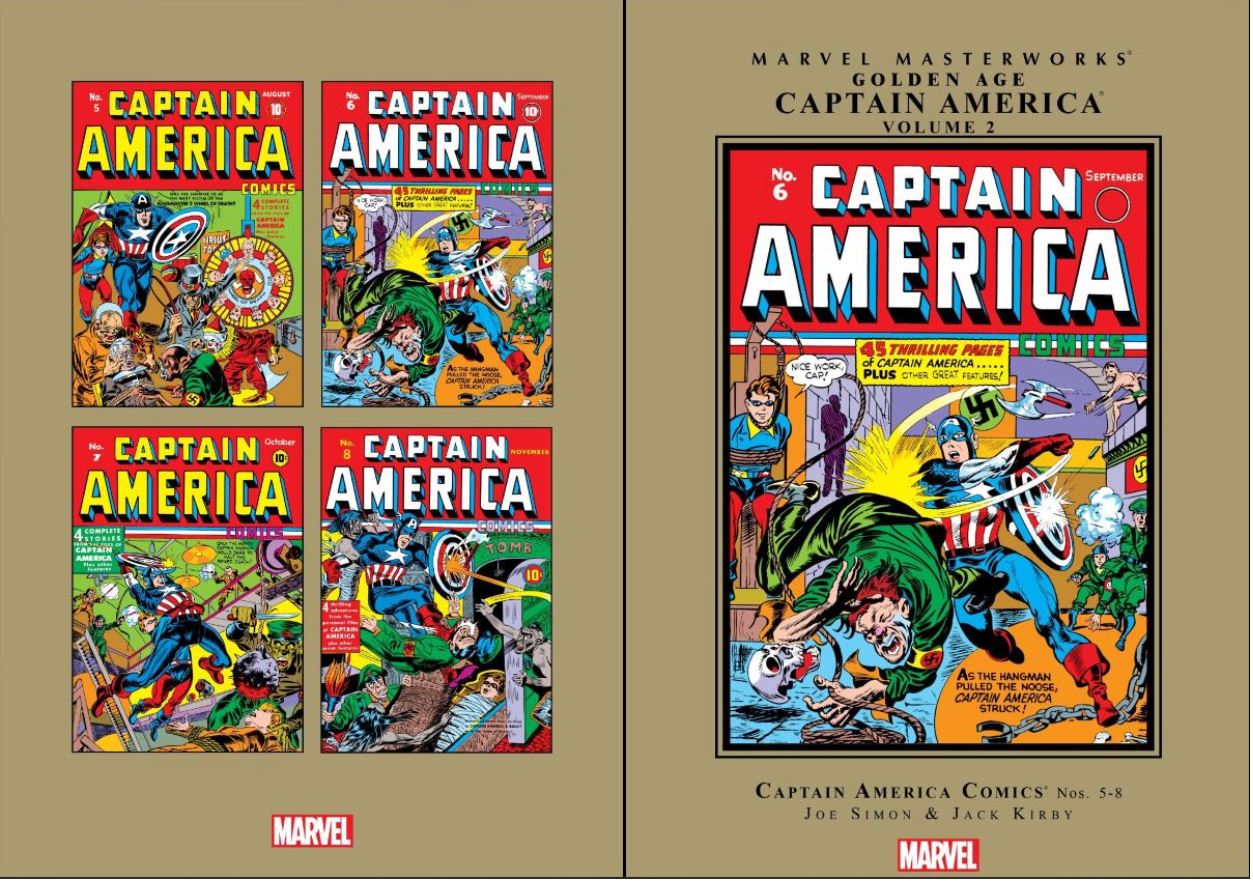
Golden Age Captain America Marvel Masterworks volume 2


By Joe Simon & Jack Kirby, Stan Lee, Charles Nicholas, Syd Shores, Al Avison, Al Gabriele, Harry Fisk, Ken Bald, Bill Ward and various (Marvel Comics)
ISBN: 978-0-7851-2228-9 (HB), 978-1-3025-0560-8 (Digital edition)

This book includes Discriminatory Content produced in less enlightened times.

Captain America was devised at the end of 1940 and boldly launched in his own monthly title from Timely – the company’s unofficial trading designation – with none of the customary cautious shilly-shallying. Owner Pulp publisher turned comic book empresario Martin Goodman always knew the value of striking while irons were hot…

The first issue was cover-dated March 1941 and became an instant monster, blockbuster smash-hit. Overnight Cap was the absolute and undisputed star of Timely’s “Big Three” – the other two being The Human Torch & Sub-Mariner. He was also one of the very first to plummet from popularity at the end of the Golden Age. These days – excluding, perhaps, some far-too-few Bill Everett-crafted Sub-Mariner yarns – the huge war-years popularity of the other two just doesn’t translate into a good read for modern consumers.

In comparison to their contemporary rivals and industry leaders at Quality, Fawcett, National/All American and Dell, or Will Eisner’s The Spirit newspaper insert, the standard of most Timely periodicals was woefully lacklustre in both story and, most tellingly, art. That they survived and prospered is a Marvel mystery, but a clue might lie in the sheer exuberant venom of their racial stereotypes and heady fervour of jingoism at a time when the USA was becoming involved in the greatest war in global history. Nevertheless, the first ten Captain America Comics are indisputably the most high-quality comics in the fledgling company’s history and I can’t help but wonder what might have been had National (neé DC) been wise enough to hire Simon & Kirby before they were famous, instead of after that pivotal first year?

Of course, we’ll never know and although the team supreme did jump to the majors after a year, their visual dynamic became the mandated aspirational style for super-hero comics at the company they left. Moreover, their patriotic creation became a flagship icon for them and the industry. Truth be told. however, the groundbreaking and exceptionally high-quality material from Joe Simon & Jack Kirby is not really the lure here – the real gold nuggets for us old sods and comics veterans are the rare back-up features overseen by the star duo and crafted by their small pool of talented up-&-comers.

Although unattributed assistants included at various times Reed Crandall, Syd Shores, Alex Schomburg, Mort Meskin, Chu Hing, Charles Nicholas, Gustav Schrotter, George Klein, C.A. Winter, Fred Bell and many more, working on main course and filler features such as Hurricane, the God of Speed and Tuk, Caveboy: strips barely remembered today yet still brimming with the first enthusiastic efforts of creative legends in waiting.

This lavish hardback volume (available in a digital edition) reprints original Star-Spangled blockbusters Captain America Comics #5-8 (spanning August to November 1941) and also provides a fascinating insight into the fly-by-night nature of publishing during those get-rich-quick days in an Introduction from Gerard Jones, after which the astounding action resumes…

After scrawny, enfeebled young patriot Steve Rogers is continually rejected by the US Army, he is recruited by the Secret Service. In an effort to counter a wave of Nazi-sympathizing espionage and sabotage, the passionate young man was tapped to join a clandestine experimental project to create physically perfect super-soldiers. However, when a Nazi agent infiltrated the labs and murdered its key scientist, Rogers became its only successful graduate and transitioned into America’s not-so-secret weapon and very public patriotic symbol.

Despatched undercover as a simple army private, he soon encountered headstrong, orphaned Army Brat James Buchanan Barnes who became his sidekick and costumed confidante “Bucky”. In the period when America was still officially non-combatant, Rogers and his sidekick were stationed at East Coast army base Camp Lehigh, but still manage to find plenty of crime to crush and evil to eradicate.

In Simon & Kirby’s ‘Captain America and the Ringmaster of Death’ the arrival of a circus leads to the deaths of General Blaine and Defense Commissioner Newsome in suspicious circumstances. Before long, both the masked heroes and government agent Betty Ross reach the same conclusion: all the acts and freaks are Nazi operatives sabotaging the nation’s security through murder… but not for much longer…

Japan was still neutral too, so although visually their forces – especially spies – were also unmistakeably ever-present, the eastern arm of the Axis alliance (the other two being Germany and Italy, history fans) were still being referred to as “sinister Orientals” and “Asiatic aggressor nations”. Even so, when Steve & Bucky accompany new commander General Haywood to the US Pacific base of Kunoa, readers knew who was really behind ‘The Gruesome Secret of the Dragon of Death!’ and revelled in seeing the heroes scupper the most spectacular secret weapon yet aimed at the forces of freedom…
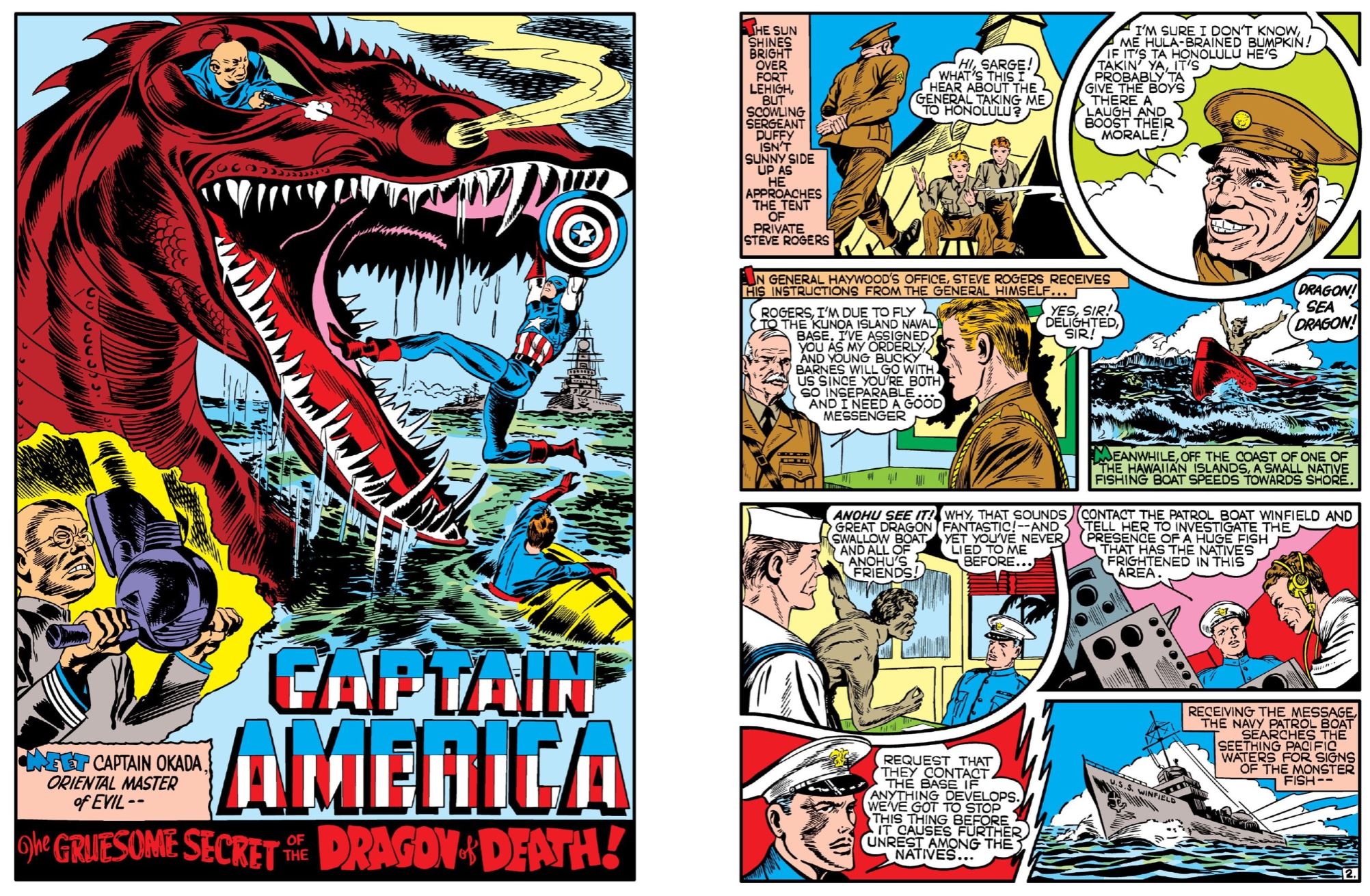
Back in the USA, the hard-hitting Star-Spangled Stalwarts then rescue decent, law-abiding German-Americans terrorised by the ‘Killers of the Bund’ who were determined to create a deadly Fifth Column inside America’s heartland. Following a rousing ad for a newly minted Captain America’s Sentinels of Liberty society, a glorified infomercial for the club comes in the form of prose adventure ‘Captain America and the Ruby Robbers’ scripted by Stan Lee with spot art by S&K, after which our Patriotic Pair save a downed volunteer American flyer held prisoner on a former French Island now administered by the collaborating Vichy government.

‘Captain America and… The Terror That Was Devil’s Island’ offers action-drenched melodrama plucked from the contemporaneous Hollywood movie mill and referencing films like 1937’s The Life of Emile Zola, 1939’s Devil’s Island and perhaps even 1941’s I Was a Prisoner on Devil’s Island and served to show that infamy and cruelty could not long subdue any valiant American heart…

Joining the list of supporting features, the equally relevant if improbable adventures of ‘Headline Hunter, Foreign Correspondent’ began with this issue. Credited to Stan Lee (Goodman’s nephew and major domo Stanley Lieber) & Harry Fisk, these shorts find US journalist Jerry Hunter sent to Blitz-blighted London to report on the European war, only to become the story after uncovering a traitor in the corridors of power…

Sporting only a title page by Simon & Kirby, primeval wonder ‘Tuk, Cave Boy’ bows out in a final example of “Weird Stories from the Dark Ages” as he saves his mentor Tanir from marauding beast-men and ends forever the depredations of brutal tyrant Bongo, before seasoned pro Charles Nicholas (nee Wojtkowski) assumes art chores on ‘Hurricane, Master of Speed’. Hurricane was the earthbound son of thunder god Thor (no relation to the 1960s version): a brisk reworking and sequel to Kirby’s ‘Mercury in the 20th Century’ from Red Raven Comics #1 (cover-dated August 1940), and here intercedes in a diabolical plot to destabilise the economy by flooding US banks with counterfeit currency.

CAC #6 carried a September 1941 cover-date and opens with a classic murder spree thriller as ‘Captain America Battles the Camera Fiend and his Darts of Doom’ in a frantic bid to prevent the theft of Britain’s Crown Jewels. Timely were never subtle in terms of jingoistic (we’d say appallingly racist) depictions, and even the normally reserved Simon & Kirby let themselves go in ‘Meet the Fang, the Arch Fiend of the Orient’ as Cap & Bucky challenge the full insidious might of the Tongs of San Francisco’s China Town to save kidnapped Chinese dignitaries from a master torturer…
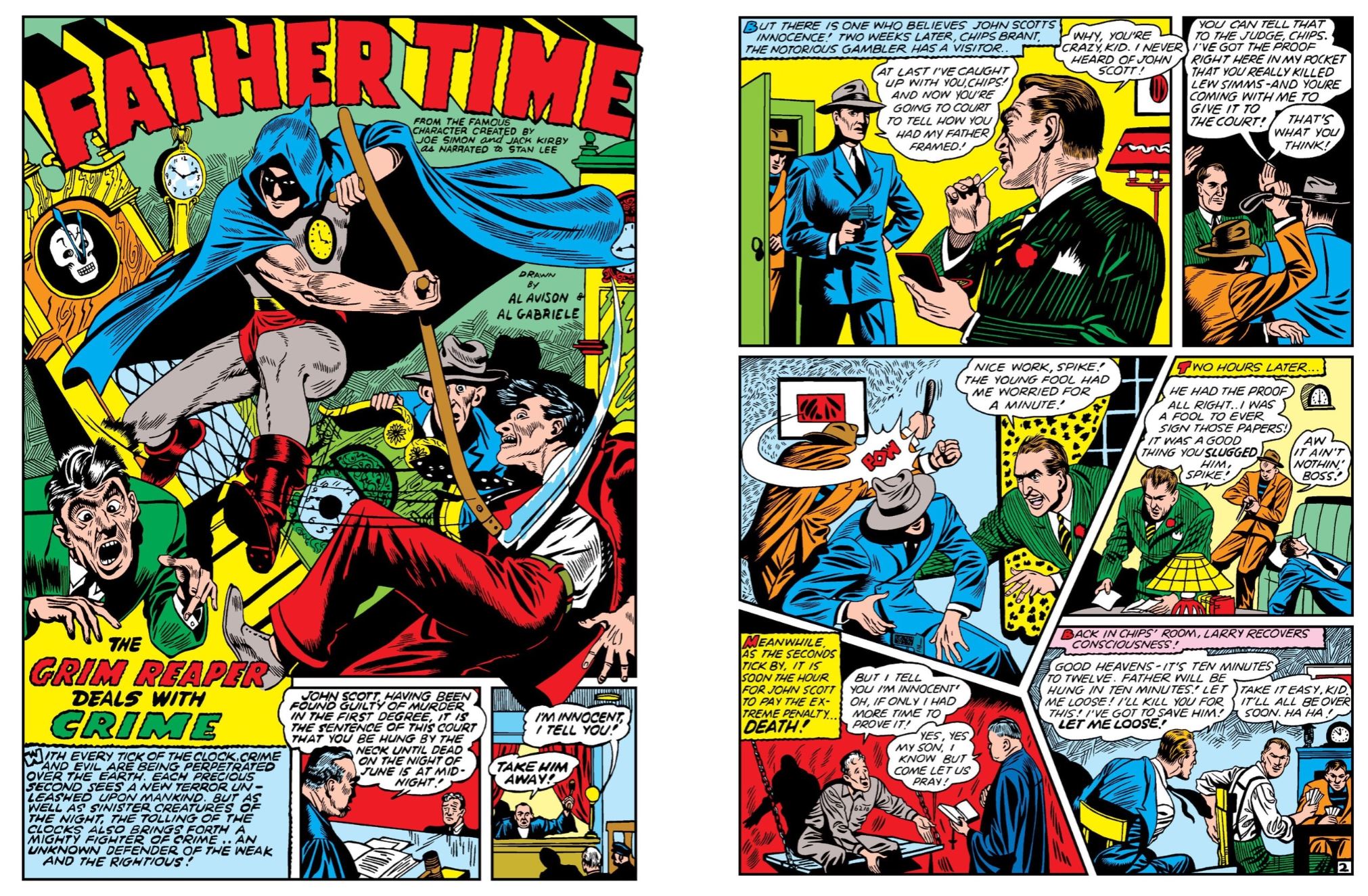
Another new feature followed: scripted by Lee and illustrated by Al Avison & Al Gabriele, ‘Father Time: The Grim Reaper Deals with Crime’ details how Larry Scott learned his father had been framed for murder and through heroic efforts exposed the true culprits… but was seconds too late to save his sire from the noose. Resolved that time should no longer be on the side of criminals and killers, Larry devised a ghastly outfit and – wielding a scythe – brought his dad’s persecutors to justice. They would be only the first in Father Time’s crusade…

Simon & Kirby’s art and stories were becoming increasingly bold and innovative. ‘The Strange Case of Captain America and the Hangman Who Killed Doctor Vardoff’ reveals a diabolical game of “Ten Little Indians” as suspects perish one by one whilst the superheroes attempt to catch a ruthless killer and retrieve a stolen experimental super-silk invention. Lee and an unknown artist then offer another thinly-veiled prose plug for the Sentinels of Liberty club as Cap and Bucky lay a ‘Trap for a Traitor’, after which Headline Hunter, Foreign Correspondent ‘Battles the Engine of Destruction’ (Lee & Fisk) and exposes an aristocratic English fascist building Nazi terror weapons in his British factories.

Following further Sentinels of Liberty club news and puzzle pages ‘Hurricane, Master of Speed’ closes the issue, crushing a murder plot in his own boarding house with art courtesy of Charles Nicholas.

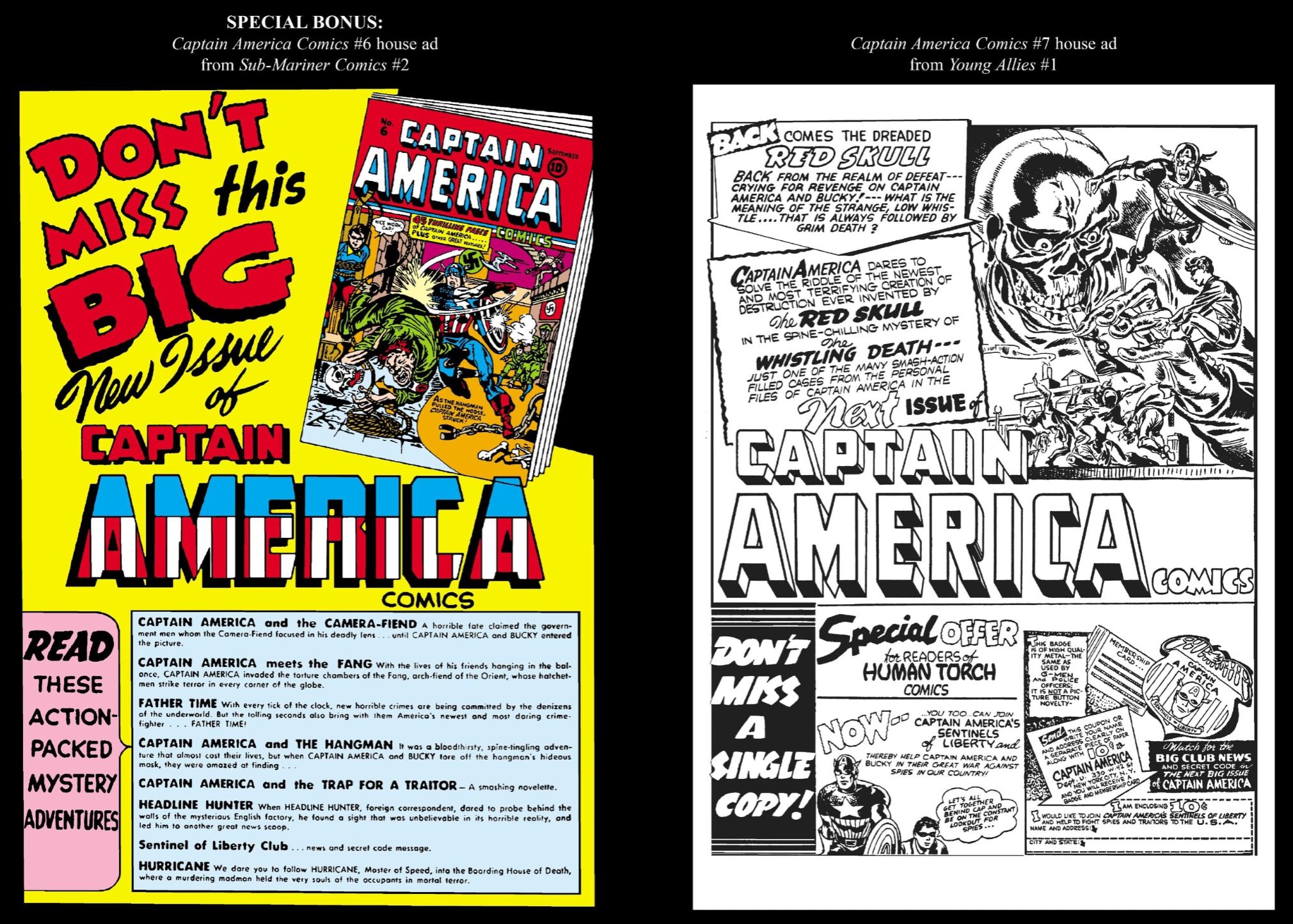
CAC #7 is a stunning comic milestone that leads with iconic clash ‘Captain America in the Case of the Red Skull and the Whistling Death’. With Steve & Bucky ordered to participate in a Vaudeville-themed troop show at Camp Lehigh, the Nazi super-assassin stalks the city, slaughtering his old cronies and US military experts with a mysterious sound weapon. The fiend’s big mistake is leaving the shadows and arrogantly turning his attention to Cap…

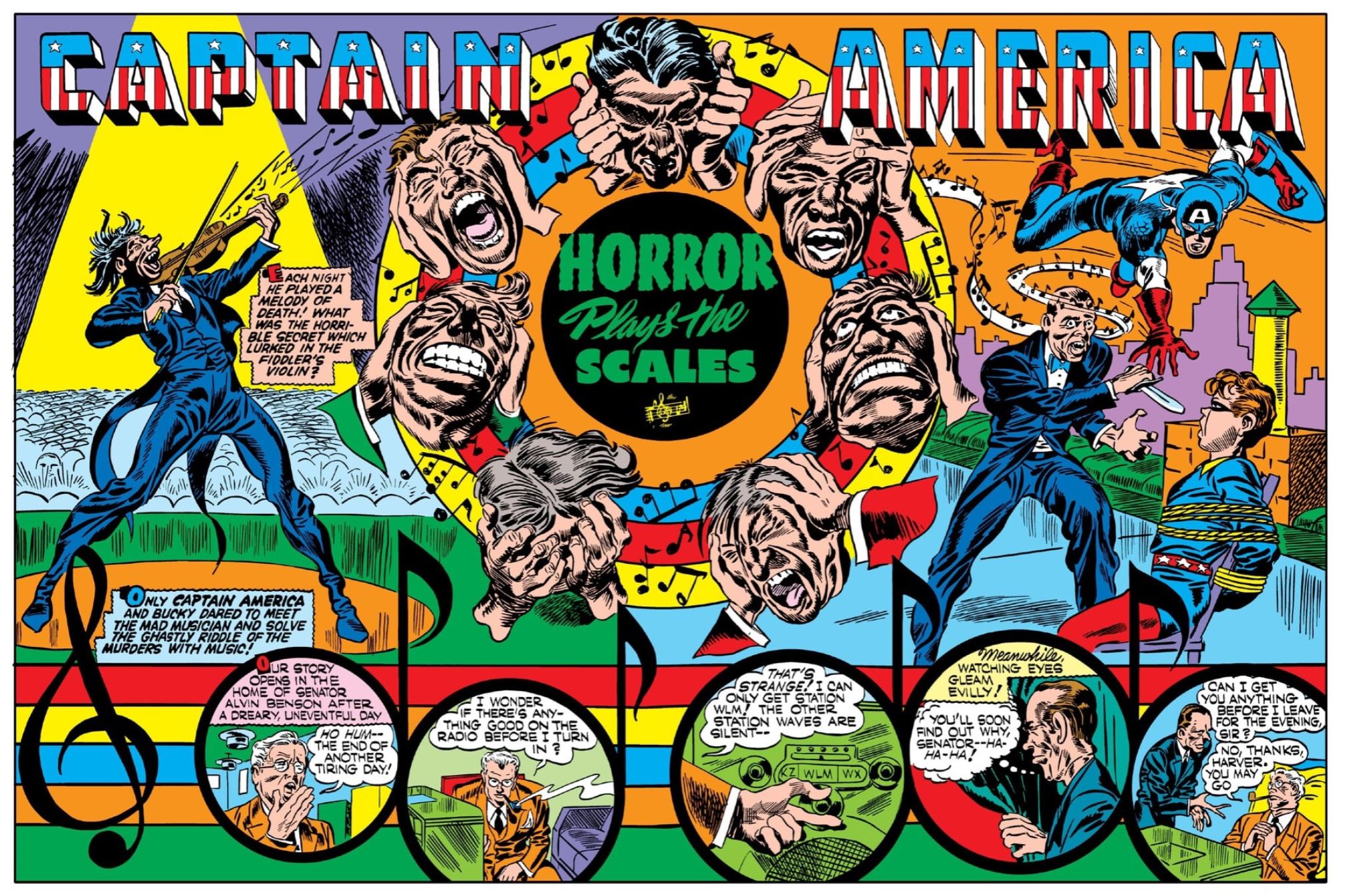
‘The Case of the Baseball Murders: Death Loads the Bases’ seemingly offers a change of pace but Steve’s sporting relaxation turns into more work when a masked maniac starts knocking off his team’s star players before Lee’s prose novelette provides ‘A Message from Captain America’ which introduces his fellow heroes Jerry Hunter, Hurricane and Father Time before S&K strip feature ‘Horror Plays the Scales’ pits the Red, White & Blue Bravos against a murdering musician knocking off anti-Nazi politicians.
Ken Bald & Bill Ward introduce a comedy foil for Hurricane as ‘Justice Laughs Last’ sees the speedster adopt portly shopkeeper Speedy Scriggles after protection racketeers target the feisty fool. Headline Hunter (Lee & Fisk) then clears an Englishman accused of murdering an American film star and reveals a Nazi plot to disrupt Anglo-US relations, as Father Time’s ‘Race Against Doom’ (Lee, Al Avison & Al Gabriele) saves another innocent patsy from taking the fall for a crooked DA and his mob-boss paymaster. The issue closes with more puzzles and patriotic pronouncements from Cap & Bucky to all their fee-paying Sentinels…

Cover-dated November 1941, Captain America Comics #8 was released months before the Pearl Harbor atrocity catapulted the USA into official war so contents might have compiled as early as June or July. Thus it opens with another gripping crime conundrum – ‘The Strange Mystery of the Ruby of the Nile and Its Heritage of Horror’ – which sees the heroes assisting Betty Ross in safeguarding a fabulous antique jewel, but seemingly helpless to prevents its archaeologist excavators being butchered by a marauding phantasm.

The impending conflagration does inform ‘Murder Stalks the Maneuvers’ when a Nazi infiltrator attends war games and uses the opportunity to trick the soldiers into destroying each other with live ammo, whilst Headline Hunter, Foreign Correspondent remains in the thick of it facing ‘The Strange Riddle of the Plague of Death’ (Lee & Fisk). This time he saves London (and the Home Counties) from a strange sickness spread by bread…

After more Sentinel propaganda and absorbing puzzles, Simon & Kirby’s ‘Case of the Black Witch’ has Cap & Bucky shielding a young woman’s inheritance before clashing with a sinister sorceress and the worst horrors hell could conceive of.
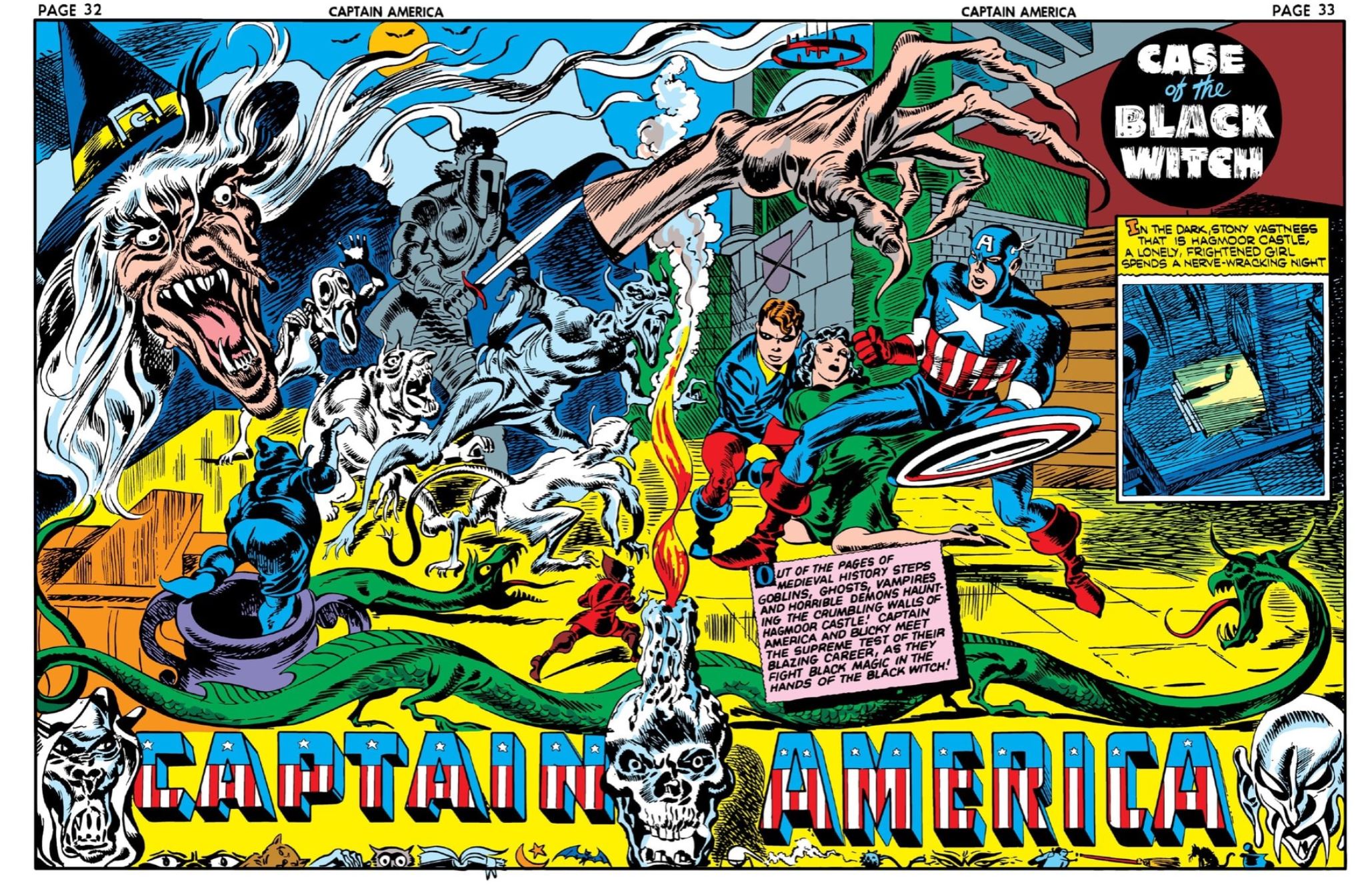
Nicholas returns to Hurricane as the Master of Speed and his new pal shut down a crooked ‘Carnival of Crime’, after which Lee & an unsung illustrator promote in prose a new Timely title as ‘The Young Allies Strike a Blow for Justice’. Please be warned: the treatment here of “Negro” character Whitewash – a full partner in the heroic team – is every bit as dated, contentious and potentially offensive as that era’s representations of other races, so kudos to the editors for bravely leaving the story untouched and unedited. Closing on a bombastic high, Father Time then deals harshly with robbers who use bank strongrooms to asphyxiate witnesses in ‘Vault of Doom!’

An added and very welcome bonus for fans is the inclusion of some absolutely beguiling house-ads for other titles, contents pages, Sentinels of Liberty club bulletins and assorted ephemera…
Although lagging far behind DC and despite, in many ways having a much shallower Golden Age well to draw from, it’s commendable that Marvel has overcome understandable initial reluctance about its earliest output in these masterworks – even if they’re only potentially of interest to the likes of sad old folk like me. However, with this particular tome at least, the House of Ideas has a book that will always stand shoulder to shoulder with the very best that the Golden Age of Comics could offer.
© 2018 Marvel Characters, Inc. All rights reserved.

Pioneering Italian comics creator Sandro Angiolini (Isabella) was born today in 1920, sharing the date with Belgian Maurice Maréchal (Prudence Petipas) in 1922 and American cartoonist Tom K. Ryan (Tumbleweeds) in 1926, and – one year later – Le Journal de Spirou stalwart creator Peter Spier (Sophie).

We lost Katzenjammer Kids artist Joe Musial in 1977; Timely/Atlas/Marvel Comics founder Martin Goodman in 1992; Golden and Silver Age comic book everyman Manny Stallman (Young Robin Hood, Big Town, Raven) in 1997, with this century this day marking the passings of Kate Worley (Omaha the Cat Dancer) in 2004 and French creator and co-founder of Pilote Jean-René Le Moing – AKA “Bulbul” – (Le Chevalier Emerik, Peter Pat) in 2012.

In 1932 Clifford McBride’s Napoleon and Uncle Elby premiered; and in 1959 The Beano debuted Leo Baxendale’s The Three Bears, UK whilst weekly Cor!! launched today in 1970 and Steve Gerber & Gene Colan’s newspaper strip version of Howard the Duck took flight in 1977.
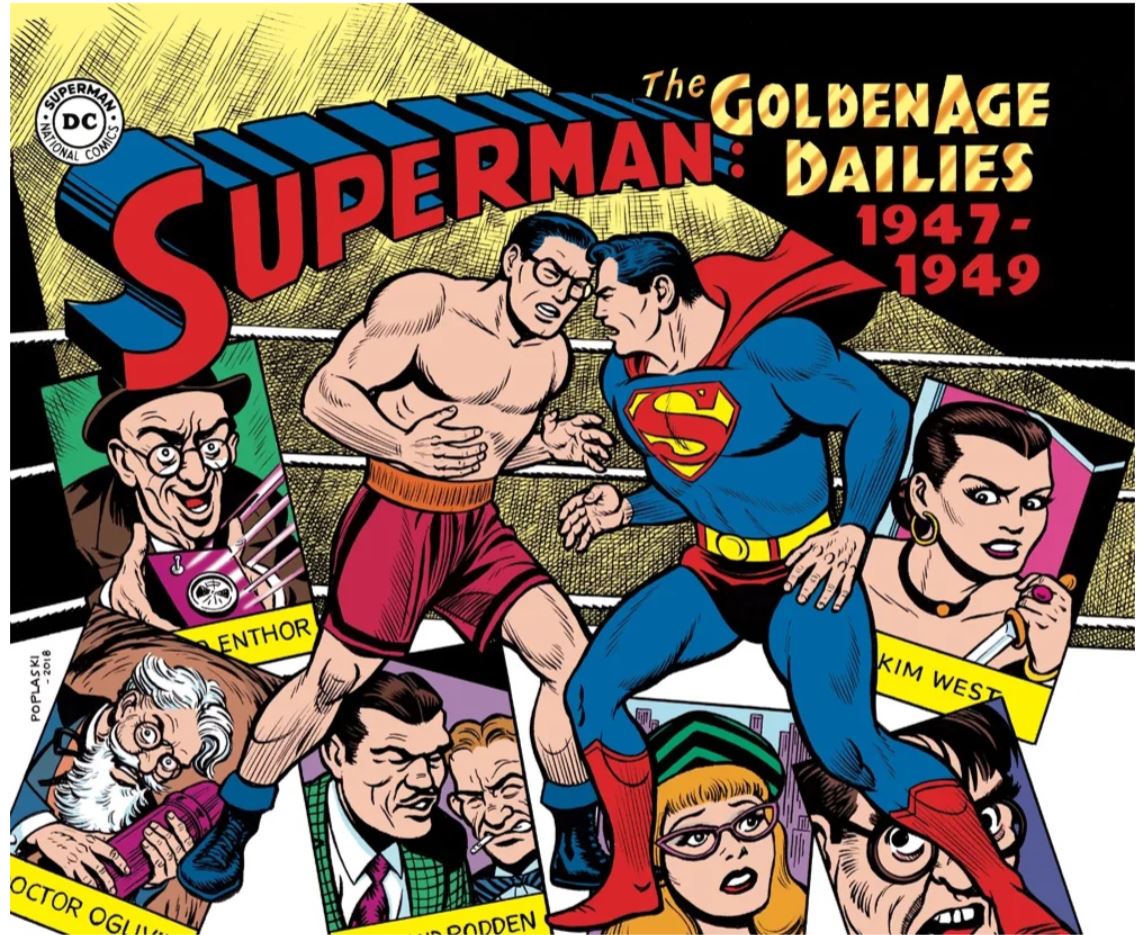
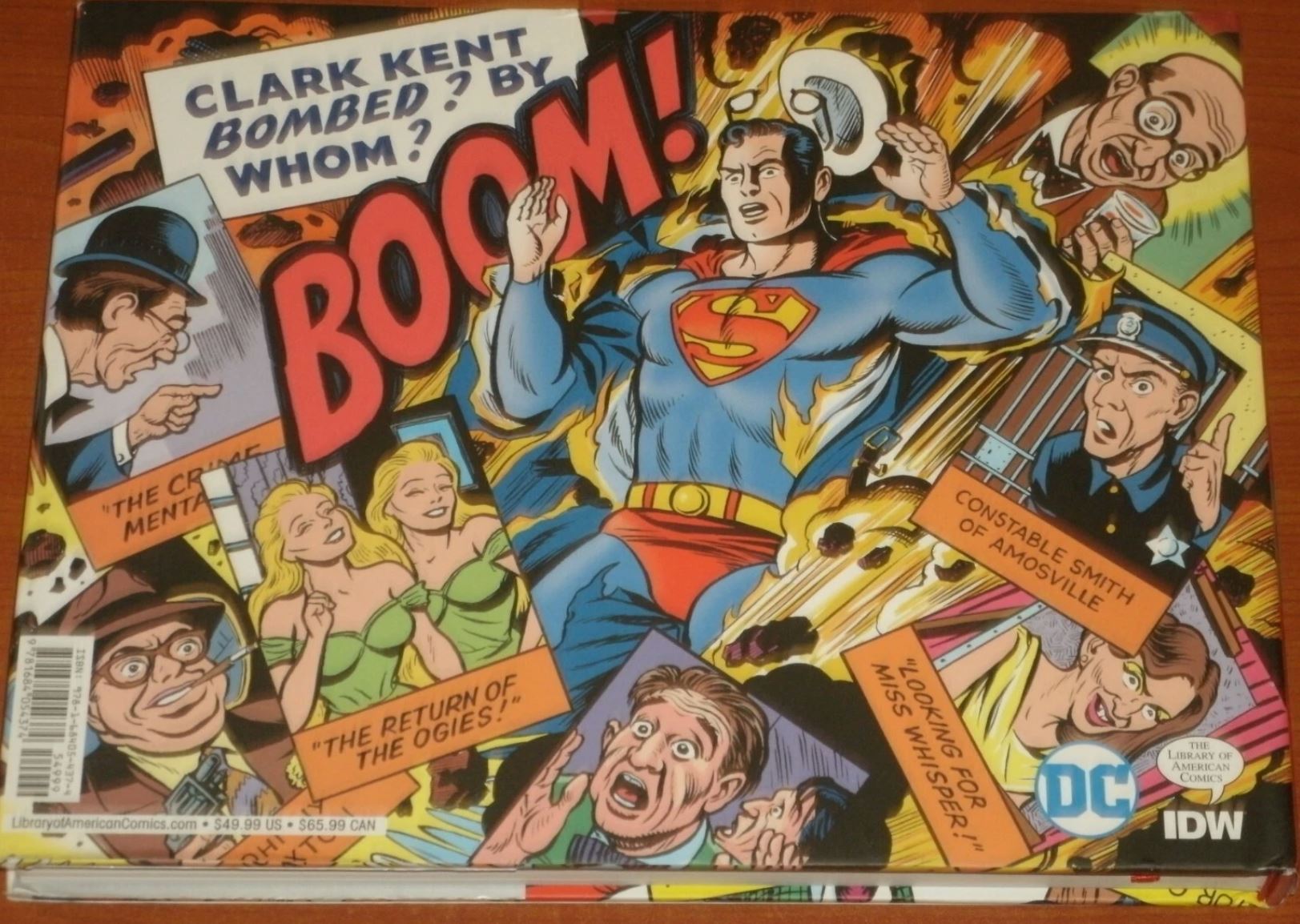
Superman: The Golden Age Dailies 1947 to 1949 (volume 3)


By Alvin Schwartz, Wayne Boring, Jack Schiff, Win Mortimer & various (IDW/Library of American Comics)
ISBN: 978-1-68405- (HB)

This book includes Discriminatory Content produced in less enlightened times.

The American comic book industry – if it still existed at all – would be utterly unrecognisable without Superman. Jerry Siegel & Joe Shuster’s unprecedented invention was first fervidly adopted by a desperate and joy-starved generation, and gave birth to a genre if not an actual art form. Spawning an army of imitators and variations within three years of his 1938 debut, the intoxicating blend of breakneck, breathtaking action and wish-fulfilment epitomising the early Man of Steel grew to encompass cops-&-robbers crimebusting, socially reforming dramas, sci fi fantasy, whimsical comedy and, once the war in Europe and the East sucked in America, patriotic relevance for a host of gods, heroes and monsters, all dedicated to profit through exuberant, eye-popping excess and vigorous, dashing derring-do.

From the outset, in comic book terms Superman was master of the world. Moreover, whilst transforming the shape of the fledgling funnybook biz, the Man of Tomorrow irresistibly expanded into all areas of the entertainment media. Although we all think of the Cleveland boys’ iconic invention as epitome and acme of comics creation, the truth is that very soon after his springtime debut in Action Comics #1 the Man of Steel was a fictional multimedia monolith in the same league as Popeye, Tarzan, Sherlock Holmes and Mickey Mouse. We parochial and possessive comics fans too often regard our purest and most powerful icons in purely graphic narrative terms, but the likes of Batman, Spider-Man, Avengers and their hyperkinetic kind long ago outgrew four-colour origins to become fully mythologized modern media creatures familiar in mass markets, across all platforms and age ranges…

In the last century and even more so in this one, far more people have seen and heard the Man of Steel than have ever read his comic books. These globally syndicated newspaper strips alone were enjoyed by countless millions, and by the time his 20th anniversary rolled around, at the very start of what we call the Silver Age of Comics, he had been a thrice-weekly radio serial star, headlined 17 astounding animated cartoons, become a novel attraction (written by George Lowther) and – by the time of the last stories in this tome – had helmed two feature films. He had then seamlessly segued into the next Big Thing: television. Soon his first (of 8) smash-hit live-action tv seasons would start his next great media conquest, making Superman a perennial sure-fire success for toys, games, food, and puzzle and apparel manufacturers all over the planet.

Although pretty much a spent force these days, for the majority of the last century the newspaper comic strip was the Holy Grail all American cartoonists and graphic narrative storytellers hungered for. Syndicated across the country (and frequently the world) a strip feature could be seen by millions if not billions of readers and was generally accepted as a more mature and sophisticated form of literature than comic books. It also – at the start! – paid better, and rightly so. Some of the most enduring, entertaining characters and concepts of all time were devised to lure readers from one particular paper to another and many of the best became cornerstones of a shared global culture. People across the Earth had a communal context thanks to thrilling to the same comics; and Mutt and Jeff, Buck Rogers, Dick Tracy, Flash Gordon, Charlie Brown and so many more escaped humble, tawdry newsprint origins to become meta-real: existing in the minds of earthlings from Albuquerque to Zanzibar. Most still do…

The daily Superman newspaper strip launched on 16th January 1939, swiftly augmented by a full-colour Sunday page from November 5th of that year. Originally crafted by Siegel & Shuster and their studio (Paul Cassidy, Leo Nowak, Dennis Neville, John Sikela, Ed Dobrotka, Paul J. Lauretta & crucially Wayne Boring), the mammoth task soon required additional talents like strip veteran Jack Burnley and writers including Whitney Ellsworth, Jack Schiff & Alvin Schwartz. The McClure Syndicate feature ran continuously until May 1966, appearing, at its peak, in over 300 daily and 90 Sunday newspapers: a combined average readership of more than 20 million. Eventually, Win Mortimer & Curt Swan joined the unflagging Boring & Stan Kaye, whilst Bill Finger and Siegel also provided stories, telling serial tales largely divorced from comic book continuity throughout years when superheroes were scarcely seen.

This third volume of the Library of American Comics collection continues the prodigious and formidable reprint program begun in the Sterling/Kitchen Sink softcover editions which ceased production in 1999. All of that material – and these books too – are long overdue for re-release and digital editions. Here, however, WWII is well and truly over and the decidedly different demands of peacetime and reconstruction have given way to an era of hectic prosperity, but still see our hero and his regular cast tested and beset by domestically endangering perils and conundrums only a Man of Steel could handle…

We open with another Introduction by Sidney Friefertig, discussing the changes from conflict to reconstruction and detailing why and how poet-turned-thriller writer Alvin Schwartz (1916-2011) became the key writer of the feature as well as sharing contextual, behind-the-scenes moments before our cosy but never-ending battle resumes.

These sequences came six days a week, comprising episodes #47-61, pages #2595 through 3338, and publication dates April 28 1947 to September 3rd 1949. With the material credited to Schwartz (Batman, Wonder Woman, Aquaman, Tomahawk, Newsboy Legion, Slam Bradley, House of Mystery, A Date With Judy, Buzzy, Bizarro) and the sole pictorial province of illustrator Wayne Boring, the compilation kicks off with and a bizarre “manhunt” to solve the dilemma of ‘Who is Miss Whisper?

Running in strips #2595-2654 as seen between April 28th to July 5th 1947, the story depicts mounting frenzy in Metropolis after lonely millionaire at sea Jonathan Dexter experiences a crossed radio line and catches a brief snippet of conversation with a distant voice. Instantly falling inescapably in love with a person he cannot and probably will never see, he is despondent until he remembers how rich he is…

Thus when, Cinderella-style, the heartsore plutocrat uses the Daily Planet to publicise his plight and swears to endow the mystery maid with all his worldly goods, the entire female population goes crazy. Everybody loves a doomed romance but some seek to con him, some attempt to bamboozle or even supplant his absent inamorata and some – gangsters led by cunning rogue Wishbone – seek to replace Miss Whisper with a voice impersonating ringer. Clark Kent and Lois Lane are drawn to the story and Superman promises to help after the rich guy promises to pay a million to deserving charities but even after finding her, the Man of Tomorrow can’t make the quiet quarry want to marry the spoiled rich, groom-to-be…

Nevertheless, because it’s a fairy tale writ large, love does find a way…

Crafted for daily doses, these Superman snippets are torturous, convoluted and often seemingly divert in tangents to indulge in seemingly pointless but epically spectacular super-feats (such as razing an entire forest to make a really, Really big billboard). These are to pad out increasingly formulaic plots and emphasise the “Super” in the hero but also counterpoint the ongoing social commentary and essentially domestic tribulations of familiar and warmly appreciated entertainment characters being constantly put through their paces. That’s clearly seen as greed and venality abound in the next arc as Superman reels under the manic idiocies generated by ordinary people in mounting frenzy once news leaks out that the Man of Steel has agreed to safeguard humanity’s greatest desire made manifest.

Running from July 7th to September 27th, the sorry tale of ‘The Youth Serum’ (strips #2665-2732) sees chemist Dr. Ogilvie unwisely entrust his age-defeating miracle mixture to shady promoter Willie Poster who triggers a literal stampede of the vain, vainglorious and outright villainous who will do anything to roll back a few years… including bribery, fraud, theft and kidnapping Daily Planet staff to compel the Man of Steel to hand over the rejuvenation juice…

With the multi-million daily readership reckoned to be at least 50% female, encroaching domesticity was a regular plot standby but Alvin Schwartz proved able to tweak the situation in unusual ways. For ‘The Marriage Gamble’ (#2733- 2768; September 29th to November 8th) he enfolds Lois & Clark in a criminal caper wherein crooked – and ultimately near-murderous – loan sharks seek vengeance on a professional gambler by rigging a bet that one of their on-the-hook client/victims can be made to marry the first women he sees. Thanks to poor timing and fate the intended marriage material is inadvertently delayed by Lois, and helpless desperate sap Joe Deems’ unsuspecting bride-to-be becomes a certain feisty journalist…

There’s no escaping his fate – it’s death or Lois – but the mobsters have utterly underestimated Lane’s instincts and the determination of Joe’s actual fiancée Dotty… as well as Superman’s covert intervention…

Who’s chasing who is the key to next serial saga ‘The Perfect Woman’ (#2769-2828, November 10th1947 – January 17th 1948) as super-rich, supremely smart, ultra-fit and staggeringly beautiful heiress Olivia Hill finally reaches marrying age and decrees that the Man of Tomorrow is the only one worthy of her. Of course, Lois has other ideas and also senses a huge scoop as the terrified Superman struggles to escape a girl prepared to risk her own life and reputation to get her way…

Backed by money and privilege, wilful scheming rich kid Olivia seems unstoppable. All our hero’s efforts to avoid her cunning matrimonial traps come to naught as she employs fair means and foul to land the most eligible bachelor on Earth, but events take truly dark turn when master of media manipulation Hill meets ruthless gangsters who don’t play games by her rules…

Evil and mystery dominate in next exploit ’The Crime Mentalist’ (#2829-2936, January 19th – March 20th) as a shy, lonely, mild mannered bank teller survives a street incident and develops the power to psychically tune in on thieves and killers about to commit heinous acts. The cops are instantly suspicious of poor Edgar Jenkins and Clark is concerned for his safety, as Edgar apparently can’t stop himself uncovering crimes. He even exposes the venality of the learned doctors examining him and eventually Superman is forced to act as permanent bodyguard. Events come to ahead when the nation’s top crime bosses engage ruthless femme fatale Dotty Storm to vamp, distract and eliminate the nervous ninny. It works too, despite Jenkins’ gifts. He knows she’s evil but she’s also so very pretty and attentive and perhaps he can convert her from her wicked ways…

Pure whimsy and trenchant social satire manifest with ‘The Return of the Ogies’ (#2883-2936, March 22nd – May 22nd 1948) as the invisible fairy pranksters again bedevil Clark and Superman. However their escalating campaign to annoy the Metropolis Marvel – such as seeking to tell everyone his secret identity – goes weirdly awry after they lose that invisibility and become extremely popular figures perpetually pestered by the public. It looks like even Superman cannot solve this problem, but then…

After being denied a journalism award because everybody knows that the Man of Steel does all the heavy lifting in her stories, the City’s top reporter swears off male interference and undertakes a canny campaign of crimebusting and scandal-exposing in ‘Lois Lane’s Solo Adventures’. Spanning May 24th to July 3rd, strips #2937-2972 reveal just how brave and competent Lois can be on her own, especially after one piece makes a furious enemy of spoiled debutante Kim West. The brat’s idea of redress involves having two mob bosses vying for her exclusive attentions taking out contracts on the “Lane Dame”, but she’s less sanguine about her own devoted butler also trying to murder the journalist. This time Superman does not come to her assistance as the drama expands into murder and both mobs of rank-&-file thugs rebel, seeking to kill West and Lois to avoid a gang war and return to business…

With Lane back at the top of her game and even notional friends with Kim, focus switches to her rival for ‘The Millionaire Ex-Reporter Clark Kent’ (July 5th – August 14th, strips #2973-3008).

After suddenly and unwelcomely winning a fortune, Kent must act like a normal guy and quit his job just to preserve his secret identity. Moreover, all efforts to lose the wealth by acting like a rich idiot only increase it and make him the target of enterprising heiress Kim who has blown through all her own money and needs a pliable husband with plenty…

She doesn’t see Lois as serious competition but still ends up unsatisfied and unwed, before Clark goes broke, gets back to the Planet and almost meets his doom from ‘Enthor’s Paralyzing Ray’ (August 16th – October 16th; strips #3009-3062). Long before Luthor, Metropolis was terrorised by a criminal scientist who immediately quit when Superman appeared. Now having served his time, doddery figure of fun Enthor renews his malevolent career after discovering a gadget that makes the Man of Tomorrow comatose. With a beguiling romantic subplot and conclusion channelling the movie White Heat the shorter action yarn segued into a straightforward mystery as the aftereffects of Enthor’s weapon triggered ‘Clark’s Memory Lapse’ (October 18th – December 25th; #3063-3122). With bizarre reports coming, Superman is forced to reconstruct a fugue moment when the reporter apparently assaulted, abducted and held hostage an innocent man. Diligent investigation and the odd super stunt soon prove bank official Fred Camper is anything but, and that Clark was just being a hero…

It’s back to more traditional fare when Clark’s old pal Ed invents ‘The Super Elixir’ (#3123-3176; December 27th 1948 – February 26th; 1949) and gets Kent to drink it. Now publicly and officially superpowered, Clark is pursued by wannabees and crooks alike as he seeks ways to keep his friend’s family safe amidst a storm of attention and stunts that somehow incredibly peak with the reporter seemingly wresting Superman for charity and begging for a solution that will allow him to return to his quiet anonymous life…

Running from February 28th to April 23rd ‘Superman, Jailbird’ (strips #3177 – 3224) saw Canadian James Winslow “Win” Mortimer take over the illustration ushering in an era of greater whimsy and accessible comedy underpinnings. The initial outing found Superman breaking speeding laws in rural Amosville and arrested by an overly officious police constable. His thirty day jail sentence turns into a unique form of community service when gamblers try to make the hamlet the next Las Vegas, after which ‘Lois ’s Secret Identity’ (April 25th – June 25th, #3225-3278) sees her lose her Planet position and become a radio personality. Unable to abandon print, she dons a disguise and replaces herself as new ace reporter Lily Loring, competing with Kent and both her selves even as she’s targeted by murderous mobster Johnny Braxton seeking to silence one and all of her…

After accidentally injuring a bystander, Clark Kent pinch-hits for the wounded man, taking on his (then) rather-rare job in ‘Superman, Male Escort’ (June 27th – August 13th; #3279-3320. With my own super power working full out to resist that straight line (sooo mmmany jokes!) but blandly state that this sequence finds the Man of Steel soon helping lonely ladies, provoking yet another Metropolis mob of matrons and maidens demanding their moment with the miracle man, unaware that an actual mobster’s moll has plans to secure his exclusive services. Thankfully, Lois is there to make sure that doesn’t happen…

The collection and – more or less – the Golden Age era ends here with short sequence ‘Reenacting Superman’s Greatest Feats’ from August 15th to September 3rd 1949 (#3321-3238) as the Action Ace reconstructs his last month of rescues and stunts in the hopes of jogging the addled memories of literal absent-minded Professor Flagg and enabling him to recover sections of a misremembered formula. Of course, word associations and recall don’t always work according to plan…

These yarns offer timeless wonders and mesmerising excitement for lovers of action and fantasy. The raw-boned early Superman is beyond compare and if you can handle the warts of the era or just crave simpler stories from less angst-wracked times, the adventures gathered here are ideal comics reading, and this a book you simply must see.

© 2019 DC Comics. All rights reserved. Superman and all related names, characters and elements are ™ DC Comics.

Today in 1872, English cartoonist and genteelly warped brainbox W. Heath Robinson was born, with Allen Bert Christman (The Sandman, Scorchy Smith) arriving in 1915 and Dutch comics master Cees van de Weert (Ben Busy, Marco Polo) turning up in 1917.
Underground commix legend Gilbert Shelton was born in 1940, and scripter, journalist , critic & historian David Anthony Kraft came along in 1952. Artist/playwright Dean Haspiel (Billy Dogma, The Quitter)was born in 1967 and graphic auteur Adrian Tomine (Optic Nerve, Sleepwalk and Other Stories, Killing and Dying).
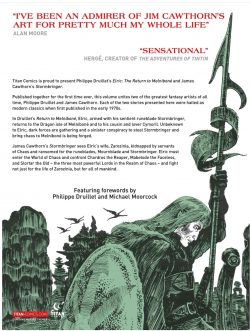
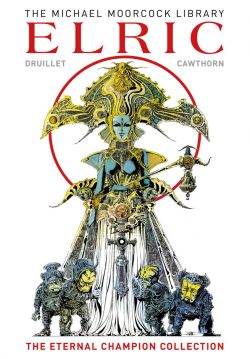
The Michael Moorcock Library – Elric: the Eternal Champion Collection


Adapted by James Cawthorn and Philippe Druillet, & various (Titan Comics)
ISBN: 978-1-78586-955-6 (HB/Digital edition)

This book includes Discriminatory Content produced in less enlightened times.

Michael Moorcock began his career at age 15; writing and editing classic British comic strips like Dogfight Dixon, Jet Ace Logan, Captain Condor, Olac the Gladiator, Tarzan and many, many other weekly favourites. As the swinging Sixties dawned he made the transition to prose fiction where he single-handedly revitalised a genre via the creation of Elric and the high-concept notion of an Eternal Champion.

Debuting in 1961, Elric is a landmark of fantasy and particularly its Sword & Sorcery subdivision: the foretold, fore-doomed last ruler of pre-human civilisation Melniboné, a race of cruel, nigh-demonic sorcerers. These arrogant, dissolute creatures are at the end of a slow, decadent decline after millennia of dominance over Earth. Albino Elric is physically weak, buoyed up by drugs, blood and dark magic, and of a brooding, philosophical temperament. He cares for little save his beautiful cousin Cymoril, who will die one day whilst he battles her loathsome usurping brother Prince Yyrkoon in service to a manipulative god of Chaos.

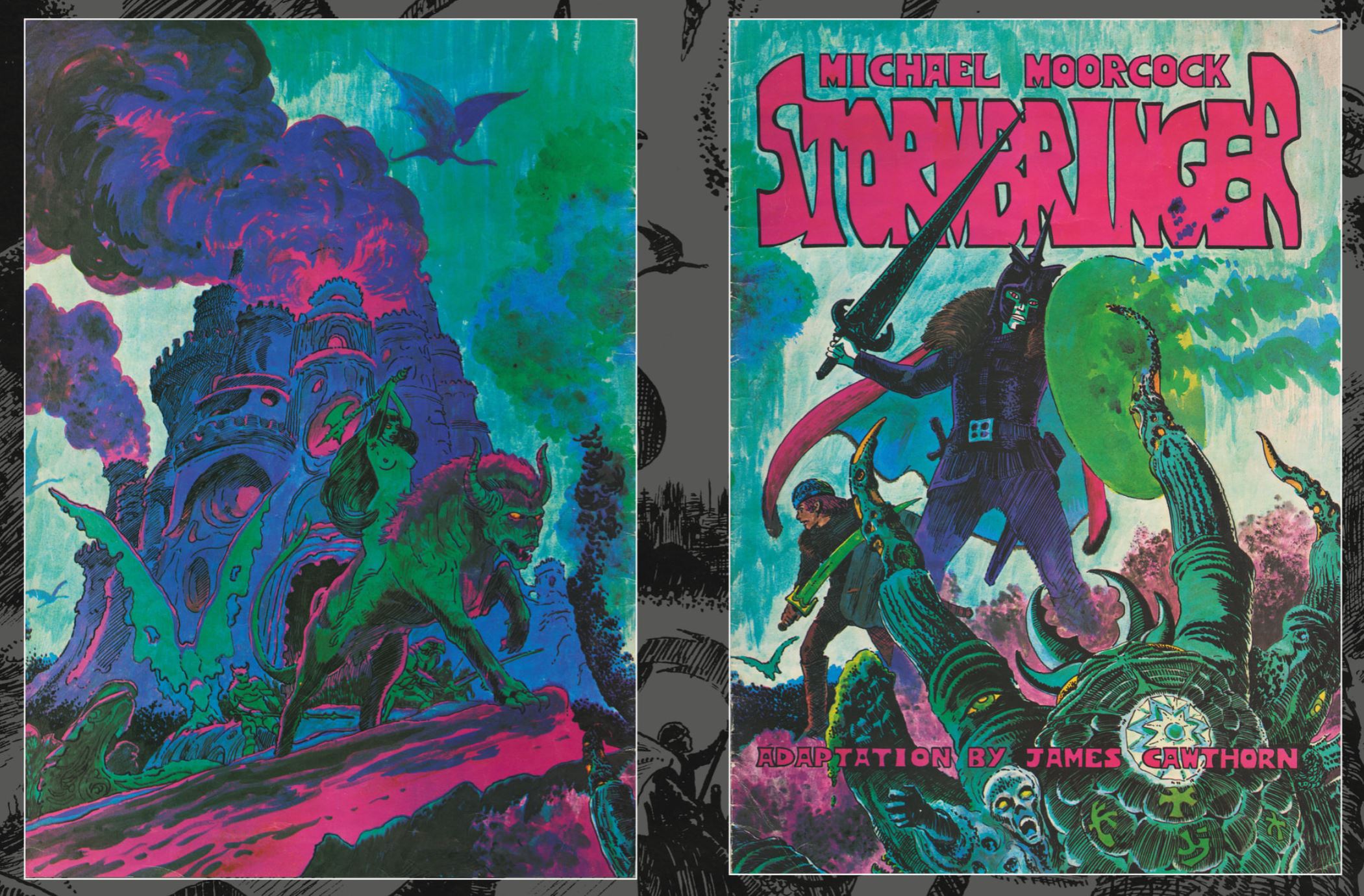
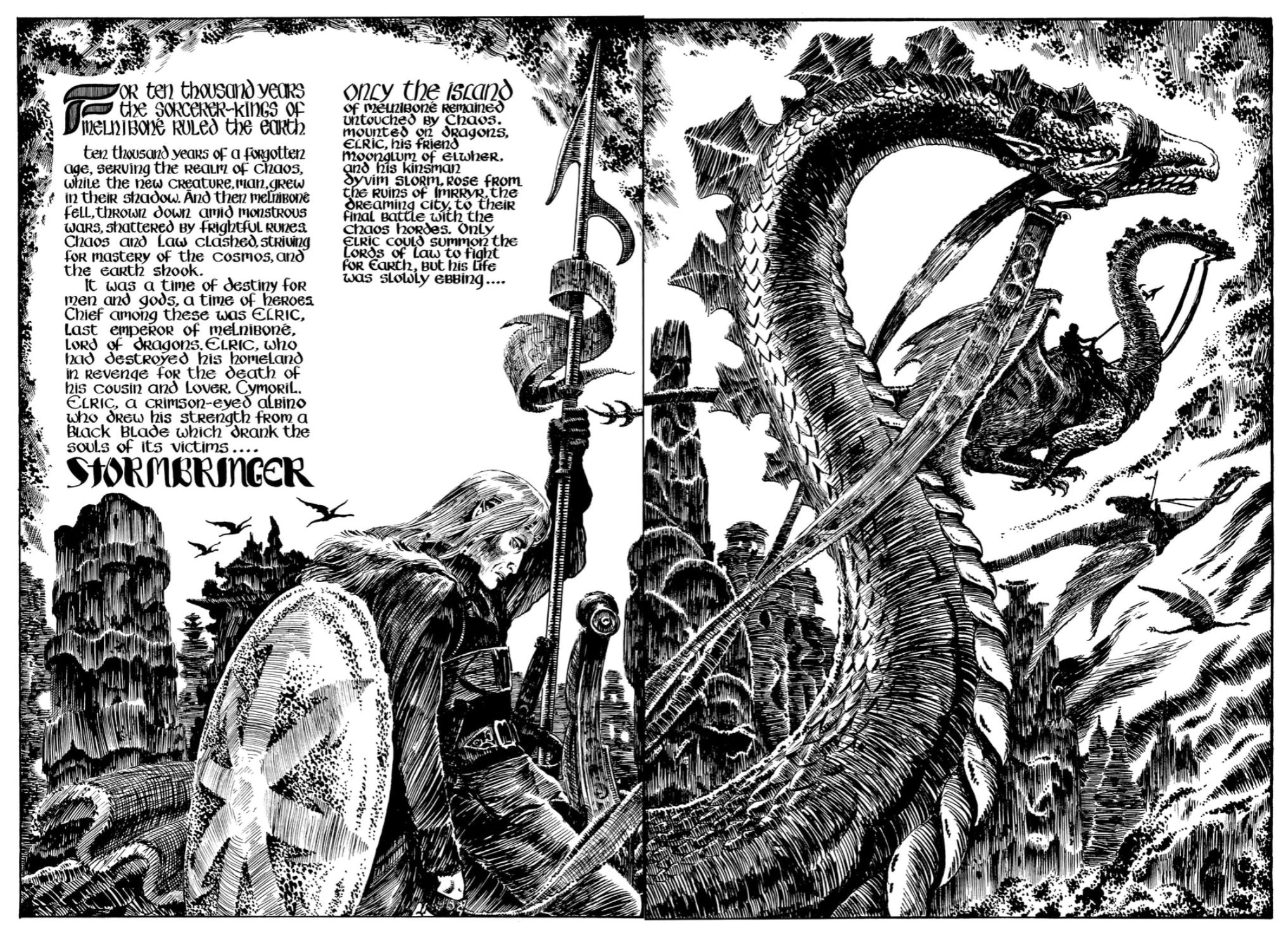
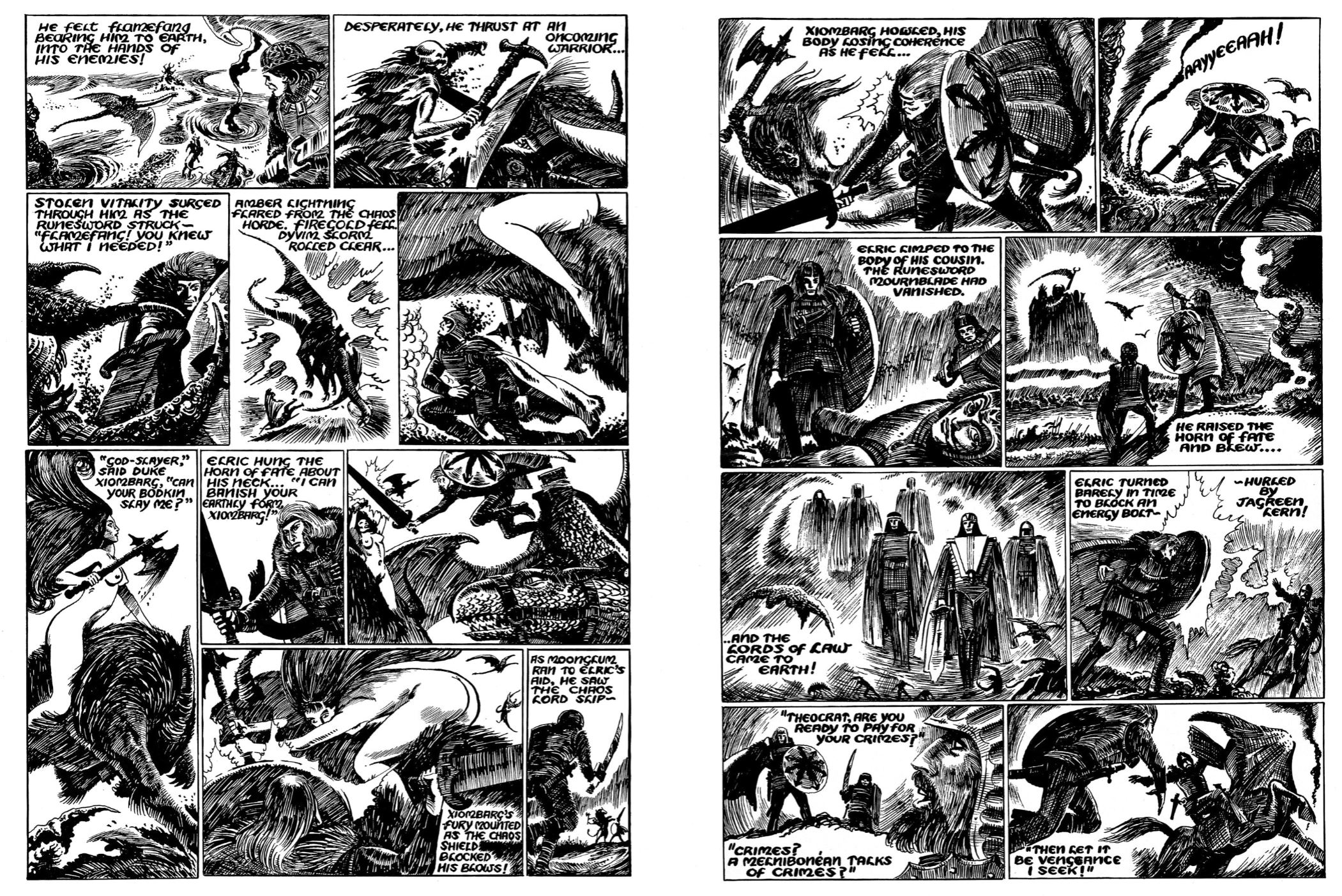
In this collection that day is right now as primary and premiere Elric artist Jim Cawthorne limns that final clash in a hugely personal adaptation from 1976, first and privately published by British concern Savoy Books in an edition that never really reached its natural audience…

“White Wolf” Elric doesn’t even want to rule, but it is his duty, and he is the only one of his debased race to see the (comparatively) freshly evolved race of Man as a threat to the Empire. He is owned if not actually possessed by terrible black sword Stormbringer: one of a matched pair of sorcerous weapons that steal the souls of their victims and feed that stolen life and vitality to the wielder…

Elric is a tragic incarnation of the restless Eternal Champion, reincarnated in every time, place and alternate dimension. His life is violence, blood and unending tragedy, exacerbated by dependence on that soul-drinking ebony blade and his sworn – if somewhat compelled and thus reluctant – allegiance to the chimerical Lords of Chaos.

Everybody knows all that, right?

The 13th volume in a proposed complete Michael Moorcock Library of comics adaptations (as well as reissue of the prose works), these yarns – chronologically at least – are the very first pictorial narratives of the doomed king; given an archival polish and pictorial upgrade by way of a brace of Introductions from Moorcock himself and Philippe Druillet. They are bolstered by a substantial contextual essay at the end. First, though, is time for a little history…

A migrated Tynesider lodged surreptitiously and contentedly in Ladbroke Grove at a time of great turmoil in the UK, James Cawthorn was an old friend, comics co-worker and always Moorcock’s preferred illustrator of the Last Emperor. Driven, solitary, universally respected and wedded to his craft, he wrote strips for Lion, Tiger and the UK weekly comics mill, painted murals and probably book covers; made backdrops for theatre productions; private art commissions; decorated apparel and/or instruments for musicians and bands like Hawkwind and Motörhead while toiling laboriously (and far too slowly and meticulously to be commercial) on beloved passion pieces like Stormbringer.

Cawthorne’s unique and potent adaptation of Moorcock’s epic book (a reworking of novellas Dead God’s Homecoming, Black Sword’s Brother, Sad Giant’s Shield and Doomed Lord’s Passing) was his masterpiece: released by admirers at Savoy because its owners Dave Britton & Michael Butterworth were prepared to pay in advance and wait for him to finish according to his own excoriatingly exaction standards. It was worth the wait when that epically huge cardstock album (600 x 430mm – 24 inches by 17!) finally blew away those lucky enough to get a copy. This reproduction gives readers everything they could want, but sadly cannot impart the wonderous sheer bloody size of it in your hands…

It was mostly missed here but hugely popular in German…

The complex convoluted story of that book’s creation holds even more revelations but are Moorcock’s to share, so let’s turn briefly to the tale itself.

Michael Moorcock’s irresistible blend of brooding Faustian tragedy and all-consuming action is (arguably) best enjoyed in his stories of Elric, but that restless imagination crafted many incarnations of his Eternal Champion able to stand on their own bloody merits and constantly shaped and reinterpreted by a vast and varied array of unique artistic visions. Elric is one doom-drenched, tragedy-attracting incarnation of the Eternal Champion, an aspect of a heroic force reincarnated in every time, place and alternate dimension. His specific life is bound to blood and self-torment, exacerbated by his dependence on a soul-drinking black sword and his sworn allegiance to callous and chimerical Lords of Chaos.

Here that angst-filled destiny come crashing around the hero’s head as brief moments of domestic contentment are washed away in blood when the eternal war between the Lords of Chaos and Order leads to the abduction of his human wife Zarozinia and Elric taking up the black blade for the final times. He reunites with old companion Moonglum and hunts down Jagreen Lern, Theocrat of Pan Tang as he attempts to conquer the world for his allies, the Dukes of Hell. The battles are long, savage, brutal and fantastical and result in the end of all that exists. However, it’s never been about when or where one dies but how and why…

Admit it, you should read more books, right?

Counterpointing that epic comics narrative is a contemporaneous appreciation from across the channel, where Europe also caught the cosmic zeitgeist of the era..

In the 1960s Elric’s oeuvre was translated by Moorcock & author Maxim Jakubowski introducing an up and coming illustrator to the world of Heroic Fantasy. Comics and fantasy storytelling took a huge leap forward in 1975 when Gallic comics collective Les Humanoides Associes began publishing groundbreaking magazine Métal Hurlant. However, one of their future visual mainstays had begun breaking borders and boundaries almost a decade earlier.

Photographer/artist Philippe Druillet started his comics career in 1966 with apocalyptic science fiction epic Le Mystère des abîmes (The Mystery of the Abyss) which introduced doom-tainted intergalactic freebooter and nomadic wanderer Lone Sloane in a tale of a far distant tomorrow thematically influenced in equal measure by H.P. Lovecraft, Clark Ashton Smith and A.E. Van Vogt. We will get to his other works in the courses of times…

Born in Toulouse in 1944, Druillet was raised in Spain, and his comics work was grandiose, panoramic, deeply baroque and overwhelmingly cosmic in scope. He also pretty much rejected standard formats and panels layouts in favour of boldly shocking graphics. Druillet began working for Pilote in 1969 and revived his star-rover in numerous shorter pieces, initially published together in 1972 as The Six Voyages. This collection, however, focuses on his brief but inspirational dealings with Moorcock’s primary ill-fated cosmic traveller…

After preliminary tentative spreads in Moi Aussi, in 1969, a 21-plate portfolio entitled La Saga d’Elric le Necromancien was published. In 1973 Moorcock’s reworking of Michel Demuth’s text for the portfolio became Elric: The Return to Melniboné as published by Unicorn Bookshop in 1973. Its influence was far-reaching: just ask American creators like Keith Giffen, who repatterned his entire drawing style on what he saw…

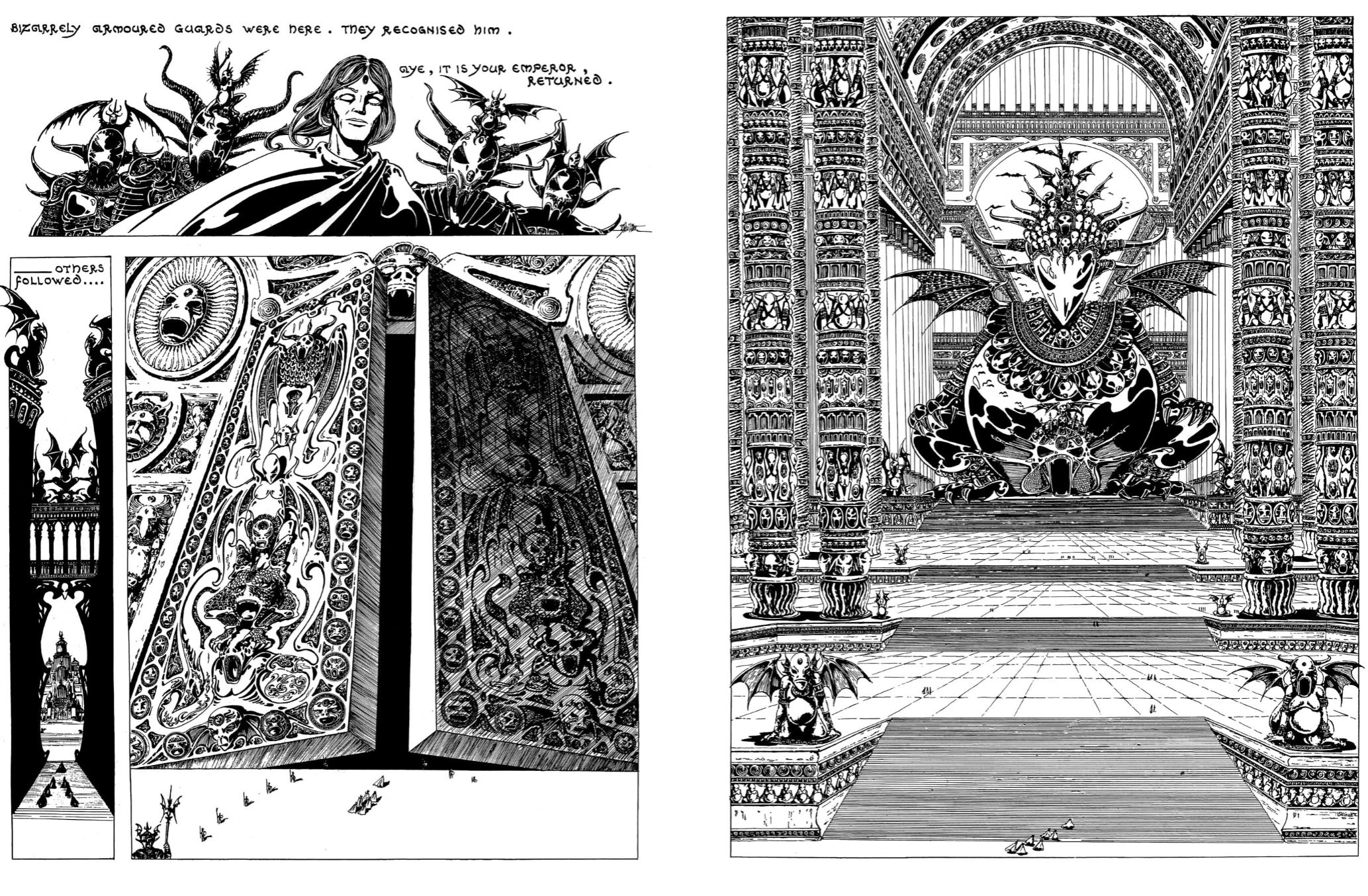
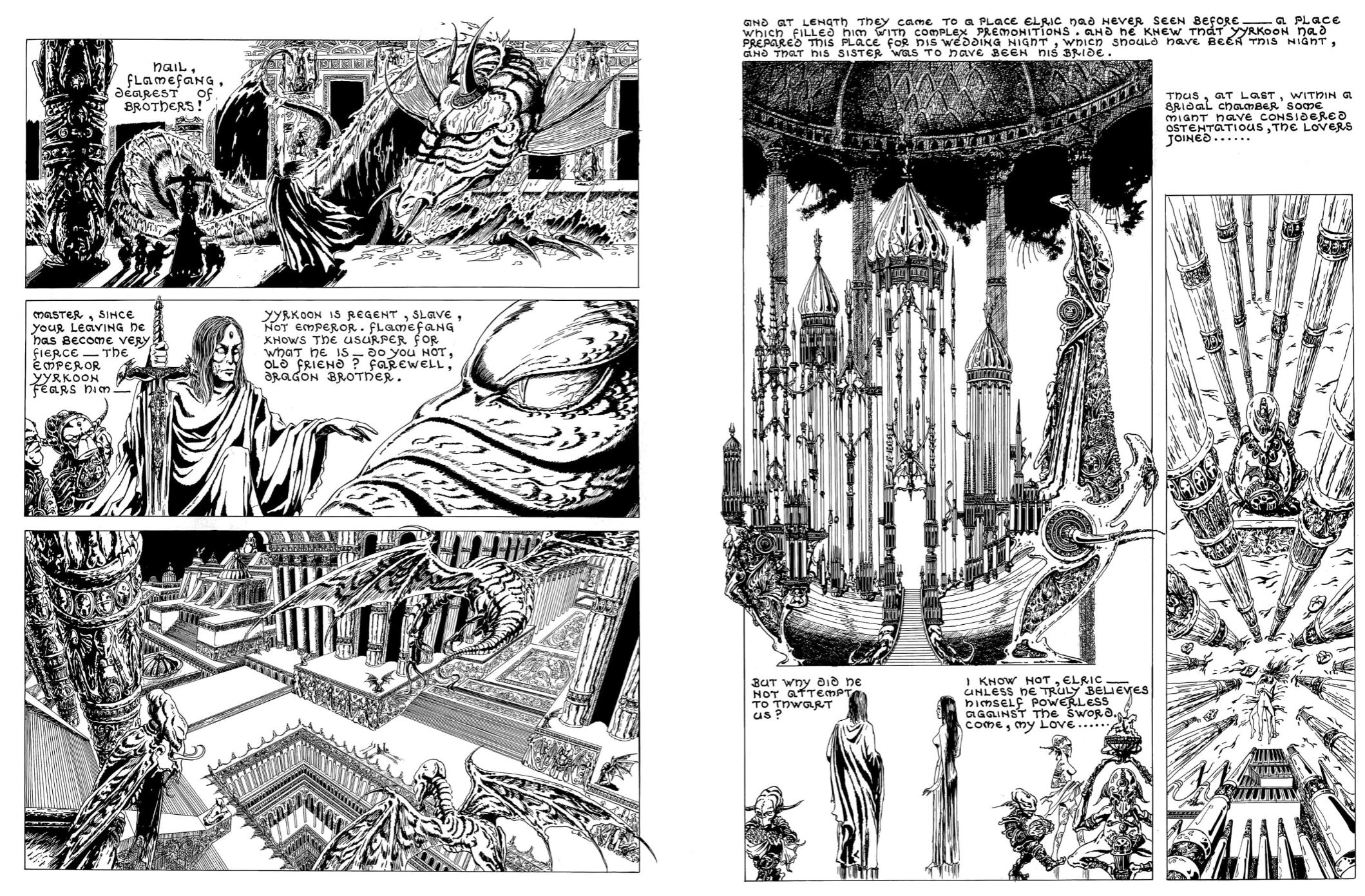
Reproduced in its original monochrome, the brief interlude spectacularly and mind-alteringly details how the former Emperor reclaims his throne and position from apparently-ascendant rival Prince Yyrkoon and reacquaints himself with his bride-to-be Cymoril. Elric has no conception that the Lords of Chaos are closely watching and laying their plans for his future…

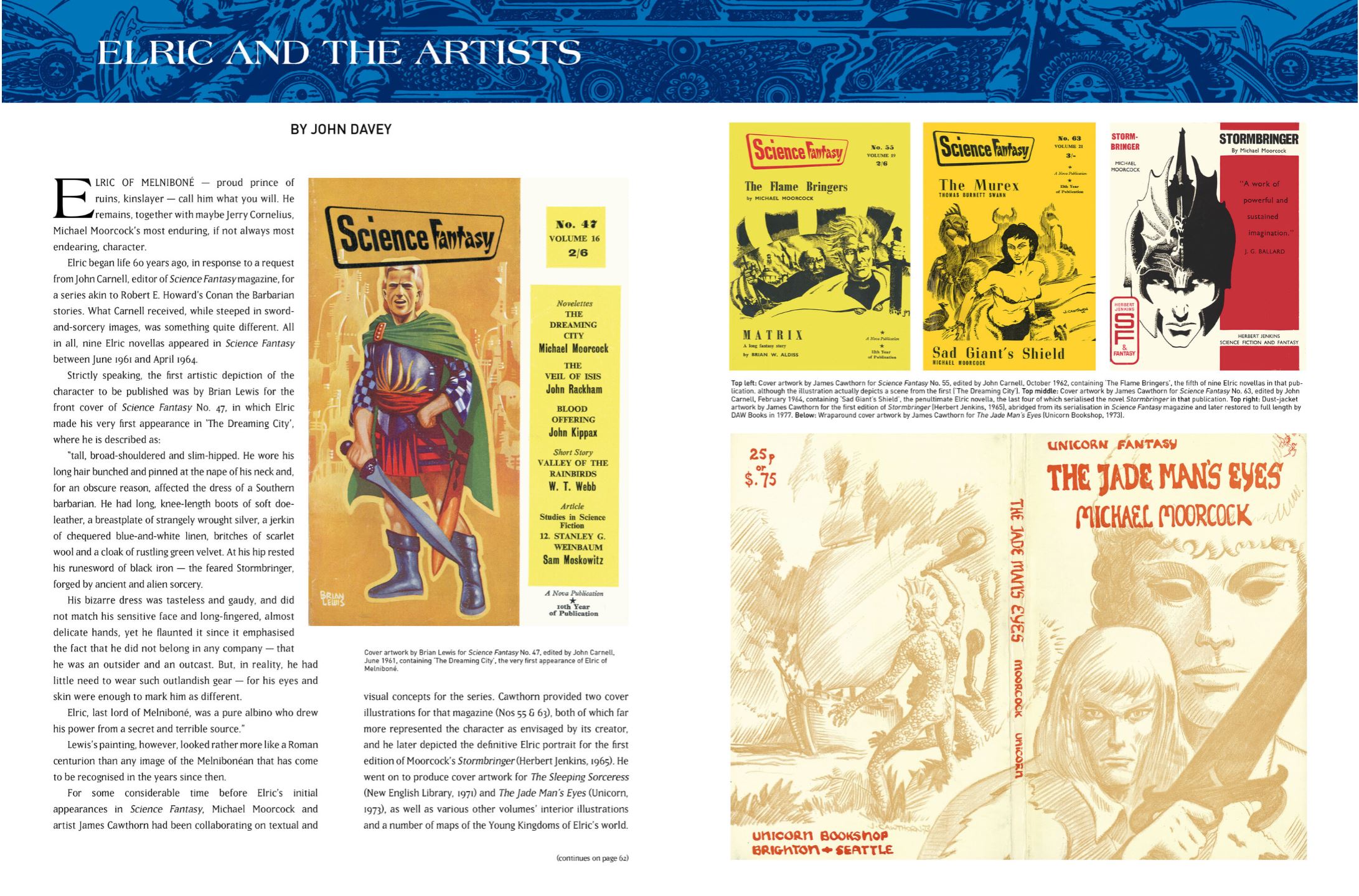
Closing the arcana and antiquities is ‘Elric and the Artists’ an incisively informative briefing by John Davey, detailing earlier efforts to visualise the Last Emperor, concentrating on his prose debuts, before going on to summarise and scrutinise the long history of graphic novel and comics interpretations.

Moorcock and his visual collaborators changed the comics world forever, This is how that all started…

Adapted from the works of Michael Moorcock related to the character of ELRIC © 2021, Michael & Linda Moorcock. All characters, the distinctive likenesses thereof, and all related indicia are TM & © Michael Moorcock and Multiverse Inc.
Elric the Return to Melniboné was first published by Unicorn Bookshop, 1973. Stormbringer was first published by Savoy Books in 1976.

EC horror and romance maestro Jack Kamen was born today in 1920, and shares the date with eco-activist cartoonist Larry Marder (Tales of the Beanworld) from 1951; editor and scripter Jim Salicrup in 1957; British comics veteran/educator Nigel Kitching (Sonic the Comic) in 1959 and The Boondocks creator Aaron McGruder in 1974.

Today in 1960 an era ended with the final page published of Warren TuftsLance.

Little Paintings


By James Kochalka (Top Shelf Productions)
ISBN: 978-1-60309-017-9 (HB/Digital edition)

James Kochalka is a prolific and always entertaining giant of comics creation, whose vast, sublimely surreal, enticing works range from kid-friendly romps such as the Glorkian Warrior and Johnny Boo series, to excoriatingly honest self-examining daily journal strip American Elf and the indescribably fun SuperF**kers – and that’s my censorious edit there, not his…

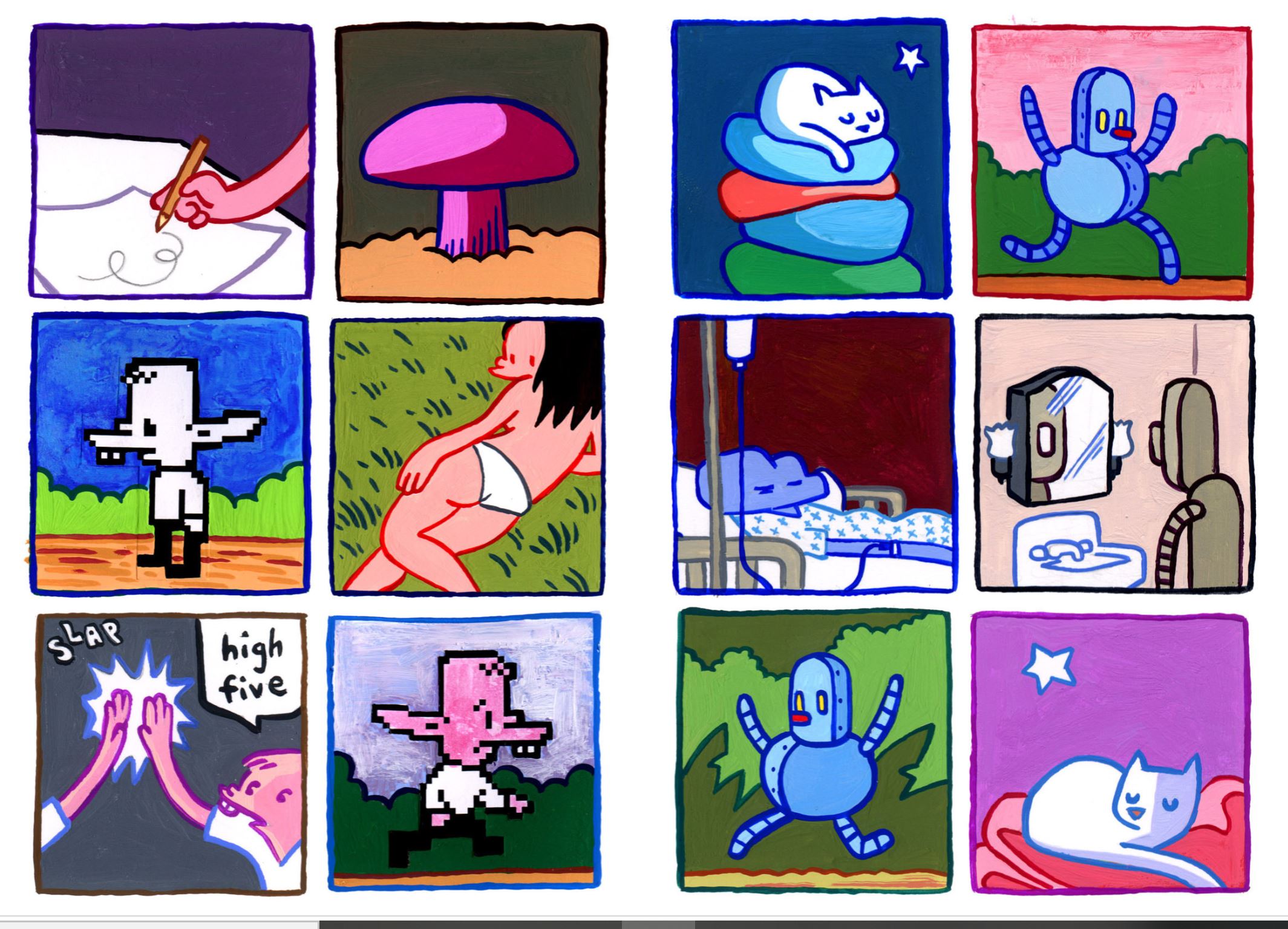
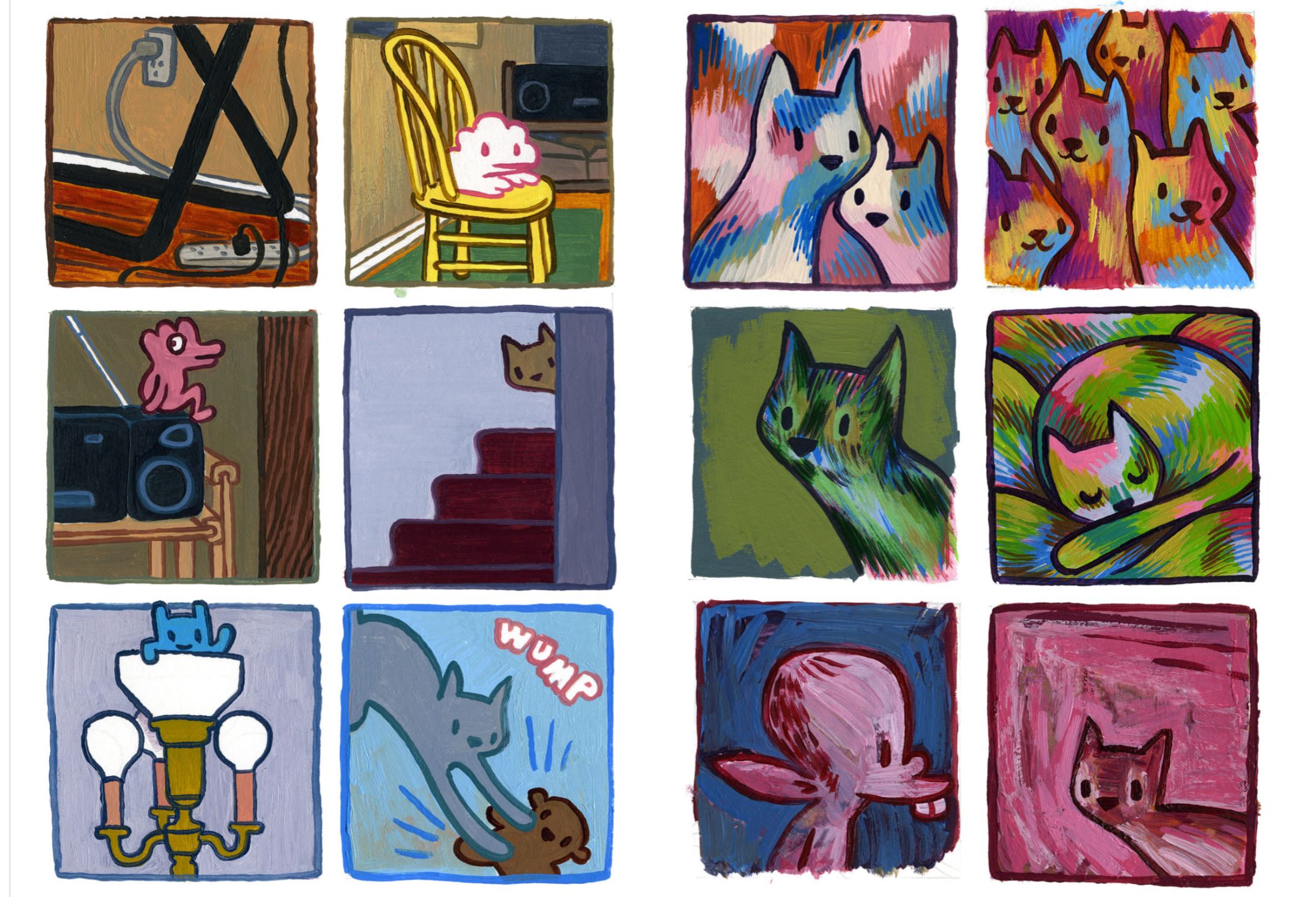
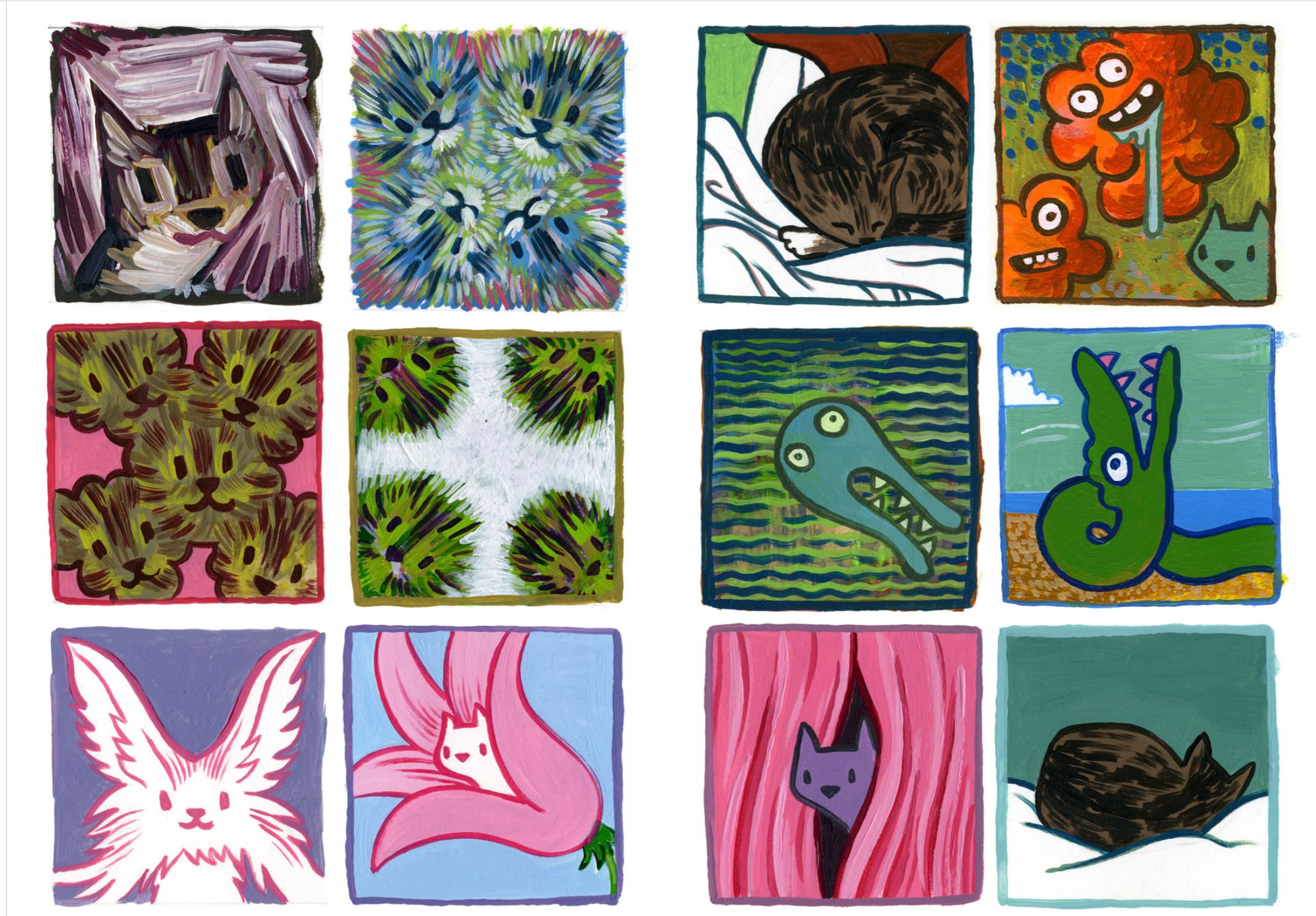
The author, artist, animator. educator and rock musician is utterly wedded to the energies of creativity and this tantalizing tome gathers hundreds of mini-paintings he knocked up to sell at various conventions between 2001 and 2007. All his old familiar faces are there: cats, ghosts, robots, monsters, aliens, cats, bathrooms, birds, chicks and dudes, mushrooms, animals, landscapes and weather, cats, machines and random images, all apparently arranged in no particularly order and inviting your response. Did I mention, there are some cats?

There is a narrative here, but it’s completely generated by the viewer who can’t help but create a story around the hundreds of thumbnail paintings of gloriously hued things and folks and stuff, and a lot to read in if you’re willing to take some time. This is one of my absolute favourite go-to books whenever I need a little pictorial pick-me-up and you should share the joy.

Go on, you know you want to…
© James Kochalka 2011. All rights reserved.

Today in 1939 artist and storyteller Herb Trimpe was born (Hulk, Iron Man, Godzilla, GI Joe) as was Tom Mandrake (The Spectre, Grimjack, Martian Manhunter) in 1956. In 1967 VIP creator and future Cartoonist Laureate of Vermont James Kolchaka (American Elf, Sketchbook Diaries) joined the party.

On this date in 1872, Punch artist & illustrator Alfred Henry Forrester died, as did prolific and multi-pseudonymous French comics creator Robert Dansler/“Bob Dan” (Bill Tornade, Jack Sport, La Jonque en Flammes) in 1972, and Canadian strip cartoonist Jim Unger (Herman) in 2012.

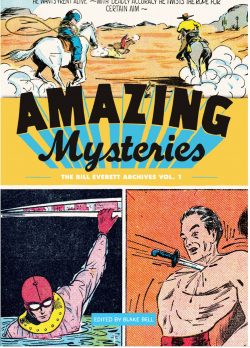
Amazing Mysteries: The Bill Everett Archives volume 1


By Bill Everett and others, edited and complied by Blake Bell (Fantagraphics Books)
ISBN: 978-1-60699-488-7 (HB/Digital edition)

This book includes Discriminatory Content produced in less enlightened times.

Thanks solely to modern technology and diligent research by dedicated fans, there is a sublime superabundance of collections featuring the works of too-long ignored founding fathers and lost masters of American comic books these days. A magnificent case in point is these curated chronicles (available in both print and digital formats) revisiting and yet barely touching upon the incredible gifts and achievements of one of the greatest draughtsmen and yarn-spinners our industry has ever seen.

You could save some time and trouble by simply buying them now rather than waste your valuable off-hours reading my preposterous blather and piffle, but since I’m keen to carp on anyway feel free to accompany me as I delineate just why these tomes need to join the books on your “Favourites” shelf.

The star under scrutiny here was a direct descendent and namesake of iconoclastic poet and artist William Blake. Bill was quite possibly the most technically accomplished artist in the US comic book industry and his tragic life and awe-inspiring body of work reveal how a man of privilege and astonishing pedigree was wracked by illness, addictive personality traits (especially alcoholism) and sheer bad luck, but nevertheless shaped an art-form. Bill Everett left twin legacies: an incredible body of superlative stories and art, and, more importantly, he redeemed many broken lives by becoming a dedicated mentor for Alcoholics Anonymous in his later years.

William Blake Everett was born in 1917 into a wealthy and prestigious New England family. Bright and precocious, he contracted tuberculosis at age twelve and was dispatched to arid Arizona to recuperate. This chain of events began a life-long affair with the cowboy lifestyle: a hard-drinking, chain-smoking, tall-tale-telling breed locked in a hard-to-win war against slow self-destruction.

All this and more is far better imparted in a scholarly, fact-filled, picture-packed Introduction by Blake Bell in Amazing Mysteries: The Bill Everett Archives volume 1. This covers the development of the medium in ‘The Golden Age of Comics’; the history of ‘Bill Everett the Man’ and how they came together in ‘Centaur + Funnies Inc. = Marvel Comics #1’. The essay also includes an astounding treasure trove of found images and original art, including samples from 1940s Sub-Mariner, 1960s Daredevil and 1970s Black Widow stories, amongst many others.

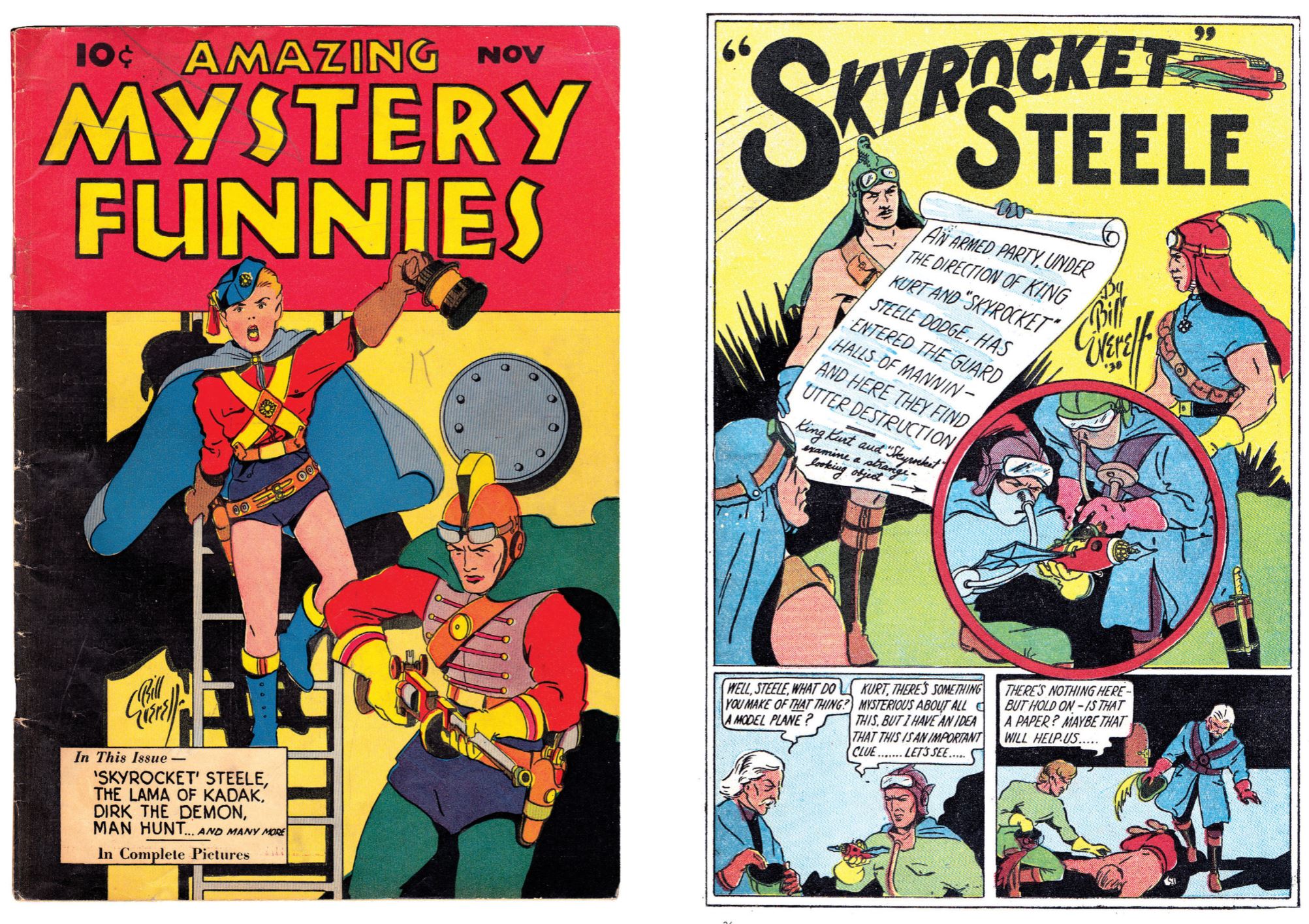
Accompanied by the covers (that’s the case for most of the titles that follow: Everett was fast and slick and knew just how to catch a punter’s eye) for Amazing Mystery Funnies vol. 1 #1, 2, 3a, 3b and vol. 2 #2 (August 1938 – February 1939, from Centaur) are a quartet of rousing but muddled interstellar exploits starring sci fi troubleshooter Skyrocket Steele. These are followed by a brace of anarchic outer space shenanigans starring futuristic wild boy Dirk the Demon culled from Amazing Mystery Funnies (vol. 1 #3a and vol. 2 #3; November 1938 & March 1939 respectively).

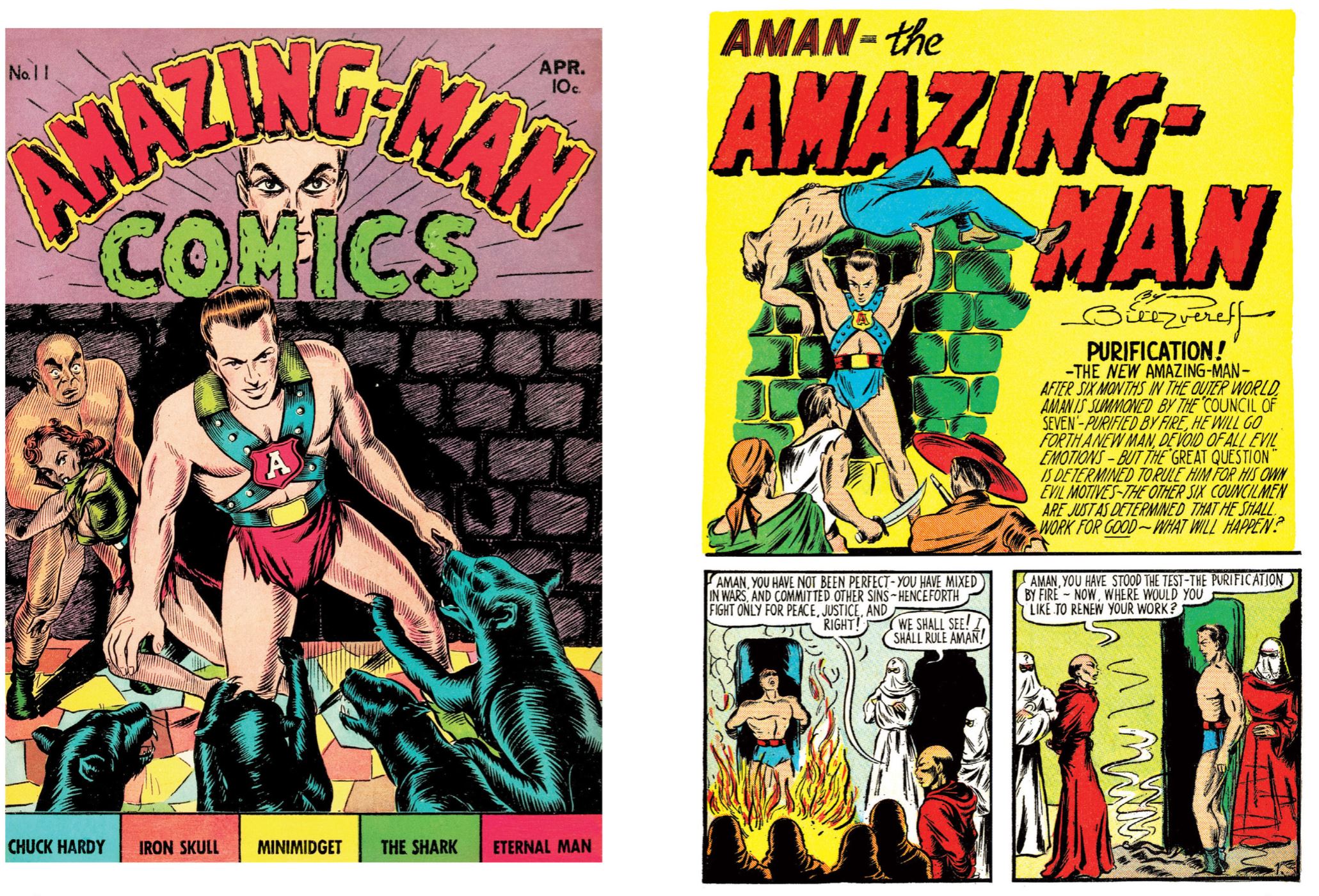
The undisputed star and big draw at Centaur was always Amazing-Man who was a Tibetan mystic-trained orphan, adventurer and do-gooder named John Aman. After many years of dangerous, painful study that young man was despatched back to civilisation to do good… for a relative given value of “good”…

Aman stole the show in monthly Amazing Mystery Comics (#5-8, spanning September -December 1939) as seen in the four breakneck thrillers re-presented here and opening with ‘Origin of Amazing-Man’ followed by an untitled sequel episode with the champion saving a lady rancher from sadistic criminals; ‘Amazing-Man Loose’ (after being framed for various crimes) and a concluding instalment wherein the nomadic hero abandons his quest to capture his evil arch rival ‘The Great Question’ and instead heads for recently invaded France to combat the scourge of Nazism…

As previously stated, Everett was passionately wedded to western themes and for Novelty Press’ Target Comics he devised an Arizona-set, rootin’ tootin’ cowboy crusader called Bull’s-Eye Bill. Taken from issues #1 & 2 (February & March 1940), ‘On the trail of Travis Trent’ and ‘The Escape of Travis Trent’ has our wholesome yet hard-bitten cowpoke battling the meanest, most determined owlhoot in the territory. Accompanying the strips is an Everett-illustrated prose piece attributed to “Gray Brown” entitled ‘Bullseye Bill Gets his Moniker’.

Thanks to his breakthrough Sub-Mariner sagas, Everett became inextricably linked to water-based action adventures and immensely popular, edgy heroes. That’s why Eastern Comics hired him to create human waterspout Bob Blake, Hydroman for their bimonthly anthology Reg’lar Fellers Heroic Comics.

Here – spanning issues #1-5 and August 1940 to March 1941- are five spectacular, eerily offbeat exploits, encompassing ‘The Origin of Hydroman’ and covering his patriotic mission to make America safe from subversion by “oriental invaders”, German saboteurs and assorted ne’er-do-wells, after which a Polar Paladin rears his frozen head. Sub-Zero Man debuted in Blue Bullet Comics vol. 1 #2 cover-dated July 1940. He was a Venusian scientist stranded on Earth who, through myriad bizarre circumstances, became a chilly champion of justice. Everett is only credited with the episode ‘The Power of Professor X’ (vol. 1 #5, October 1940) but also included here are the cover of vol. 1 #4 and spot illustrations for the prose stories ‘Sub-Zero’s Adventures on Earth’ and ‘Frozen Ice’ (from Blue Bullet Comics vol. 1 #2 and vol. 2 #3).

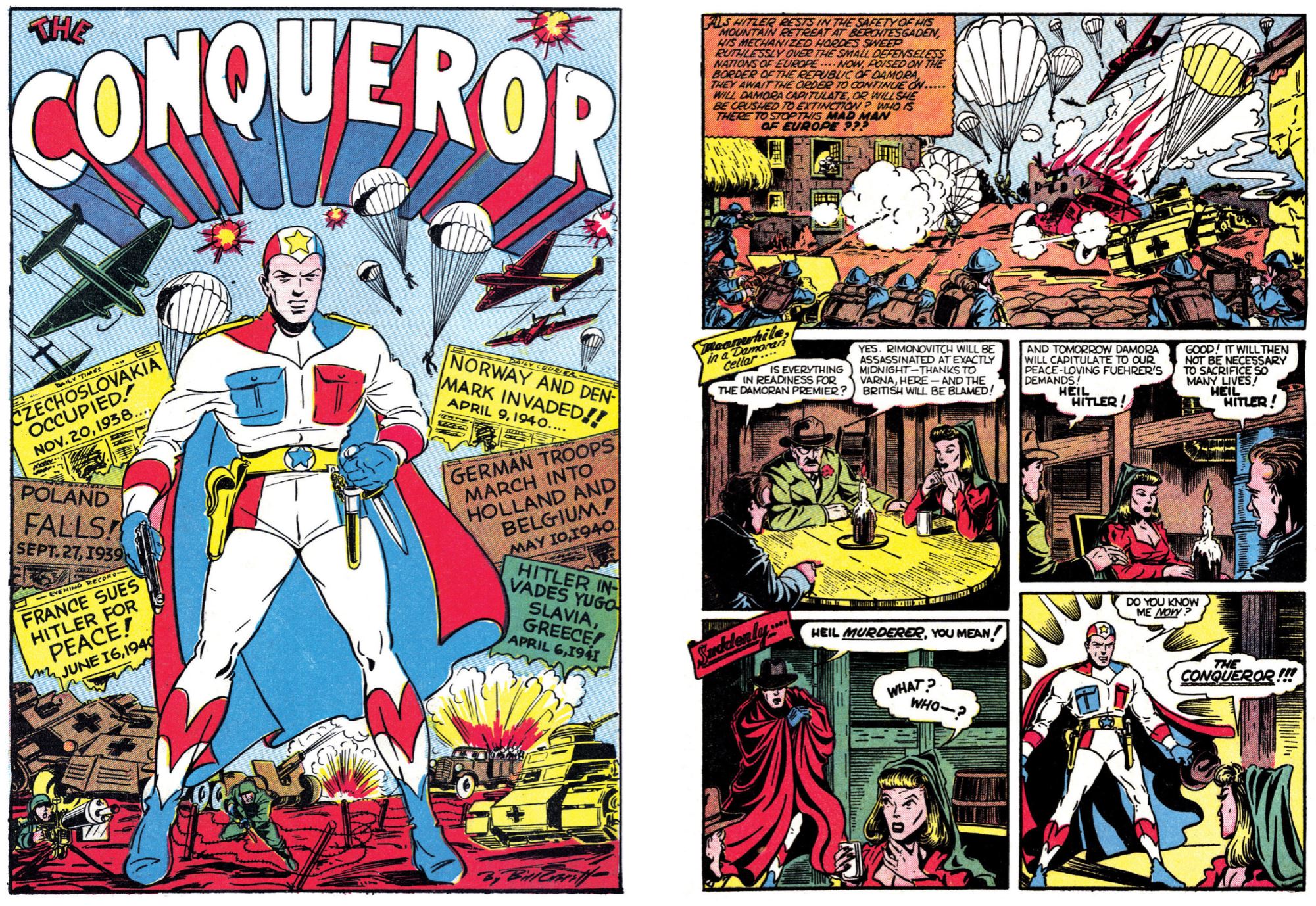
The Conqueror was another quickly forsaken Everett creation: a Red, White & Blue patriotic costumed champion debuting in August 1941’s Victory Comics #1. Daniel Lyons almost died in a plane crash but was saved by cosmic ray bombardment which granted him astounding mental and physical powers in ‘The Coming of the Conqueror’. He promptly moved to Europe to “rid the world of Adolf Hitler!” with Everett’s only other contribution being the cover of issue #2 (September 1941). Accompanied by a page of original artwork from Reg’lar Fellers Heroic Comics #12 (May 1941), The Music Master then details how dying violinist John Wallace was saved by mystic musical means and becomes a sonic-powered superman righting injustices and crushing evil…

Rounding out this initial cavalcade of forgotten wonders are a selection of covers, illustrations and yarns which can only be described as Miscellaneous (1938-1942). These comprise the cover to the 1938 Uncle Joe’s Funnies #1; procedural crime thriller ‘The C-20 Mystery’ (from Amazing Mystery Funnies vol. 2 #7, June 1939) and ‘The Story of the Red Cross’ from True Comics #2 (June 1938). The cover for 1941’s Dickie Dare #1 is followed by a range of potent images from text tales beginning with three pages for ‘Sheep’s Clothing’ (Funny Pages vol. 2 #11, November 1940); a potent pic for ‘Birth of a Robot Part 2’ (Target Comics vol. 1 #6, July 1940); two pages from ‘Death in a Box’ courtesy of Reg’lar Fellers Heroic Comics #5 (March 1941) and two from ‘Pirate’s Oil’ in RFHC #13 (July 1942), before the unpublished, unfinished 1940 covers for Challenge Comics #1 and Whirlwind Comics #1 bring the potent nostalgia to a close.
© 2011 Fantagraphics Books. Introduction © 2011 Blake Bell. All art © its respective owners and holders. All rights reserved.

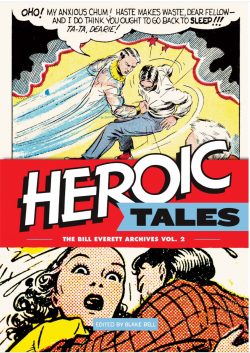
Heroic Tales: The Bill Everett Archives volume 2


By Bill Everett and others, edited and complied by Blake Bell (Fantagraphics Books)
ISBN: 978-1-60699-600-3 (HB/Digital edition)

This book includes Discriminatory Content produced in less enlightened times.

The second visit to the works of Bill Everett also opens with a fact-filled, picture-packed Introduction by Blake Bell which covers ‘The Early Years of Comics: 1938-1942’, ‘The Birth of Marvel Comics’ and ‘The Comic Book Production System’, before ‘The Heroes’ precedes a selection of astounding, astonishing prototypical adventure champions accompanied a brief essay on the set-up of Centaur Comics, Novelty Press, Eastern Color Printing, Hillman and Lev Gleason Publications.

Augmented by covers for Centaur’s Amazing Mystery Funnies vol. 2 #3, 5 & 6 (March, May & June 1939) are three outer space exploits of futuristic troubleshooter Skyrocket Steele, whilst Tibetan-trained superhero Amazing-Man offers a transformative triptych of titanic tales spanning war-torn Europe, augmented by covers to Amazing-Man Comics #9-11 (February-April 1940).

Everett’s deeply held sagebrush sentiments are served with another brace of barnstorming Bull’s-Eye Bill from Target Comics #3-4 (Novelty Press, April & May 1940) whilst from #7-9 (August-October 1940), the author smoothly switched to sophisticated suspense as master of disguise The Chameleon cunningly crushed contemporary criminals in scintillating escapades from Target Comics’ answer to The Saint, The Falcon and The Lone Wolf.

Everett’s other aquatic adventurer – Eastern Comics’ human waterspout Bob Blake, Hydroman returns next, as seen in Reg’lar Fellers Heroic Comics # 6-9 (May – November 1941, with Bill’s covers for #6 & 7): four spectacular, eerily, offbeat exploits, covering an extended battle against foreign spies and American Fifth Columnists, after which Red Reed in the Americas! (created by Bob Davis & Fitz) offers the first two chapters in a political thriller wherein a college student and his pals head South of the Border to fight Nazi-backed sedition and tyranny in a stunning tour de force first seen in Lev Gleason’s Silver Streak Comics #20 & 21 (April & May 1942).

A section of Miscellaneous and text illustrations follows, blending Western spot drawings with eye-catching covers from Amazing Mystery Funnies vol. 2 #18; Target Comics #5 & 6; Blue Bolt (vol. 1 #11, vol. 2 #1, 2 &~ 3) and Famous Funnies #85. The Humorous and More then details Everett’s forays into other markets: niche sectors such as licensed comics, comedy and romance, and even  a return to pulp and magazine illustration as he strove to stay one step ahead of a constantly shifting market and his own growing reputation for binges and unreliability.

‘What’s With the Crosbys?’ is a superbly rendered gossip strip from Famous Stars #2 (1950, Ziff-Davis) whilst a stunning monochrome girly-pin-up of ‘Snafu’s Lovely Ladies’ (from Marvel’s Snafu #3, March 1956), and the cover of Adventures of the Big Boy #1 (also Marvel, from the same month) lead into the back cover of Cracked #6 (December 1958, Major Magazines) and other visual features from that Mad magazine mimic, as well as the colour cover to less successful imitator Zany (#3, from March 1959). Everett’s staggering ability to draw beautiful women plays well in the complete romance strip ‘Love Knows No Rules’ (Personal Love #24, November 1953 Eastern Color), before this section concludes with a gritty monochrome title page piece from combat pulp War Stories #1, courtesy of Marvel’s parent company Magazine Management, and cover-dated September 1952.

The Horror concentrates on our post-superhero passion for scary stories: an arena where Bill Everett absolutely shone like a diamond. For more than a decade he brought a sheen of irresistible quality to the generally second-rate chillers Timely/Atlas/Marvel produced in competition with genre frontrunners EC Comics. It’s easy to see how they could compete and even outlive their gritty, gore-soaked competitor, with such lush and lurid examples of covers and chillingly beautiful interior pages…

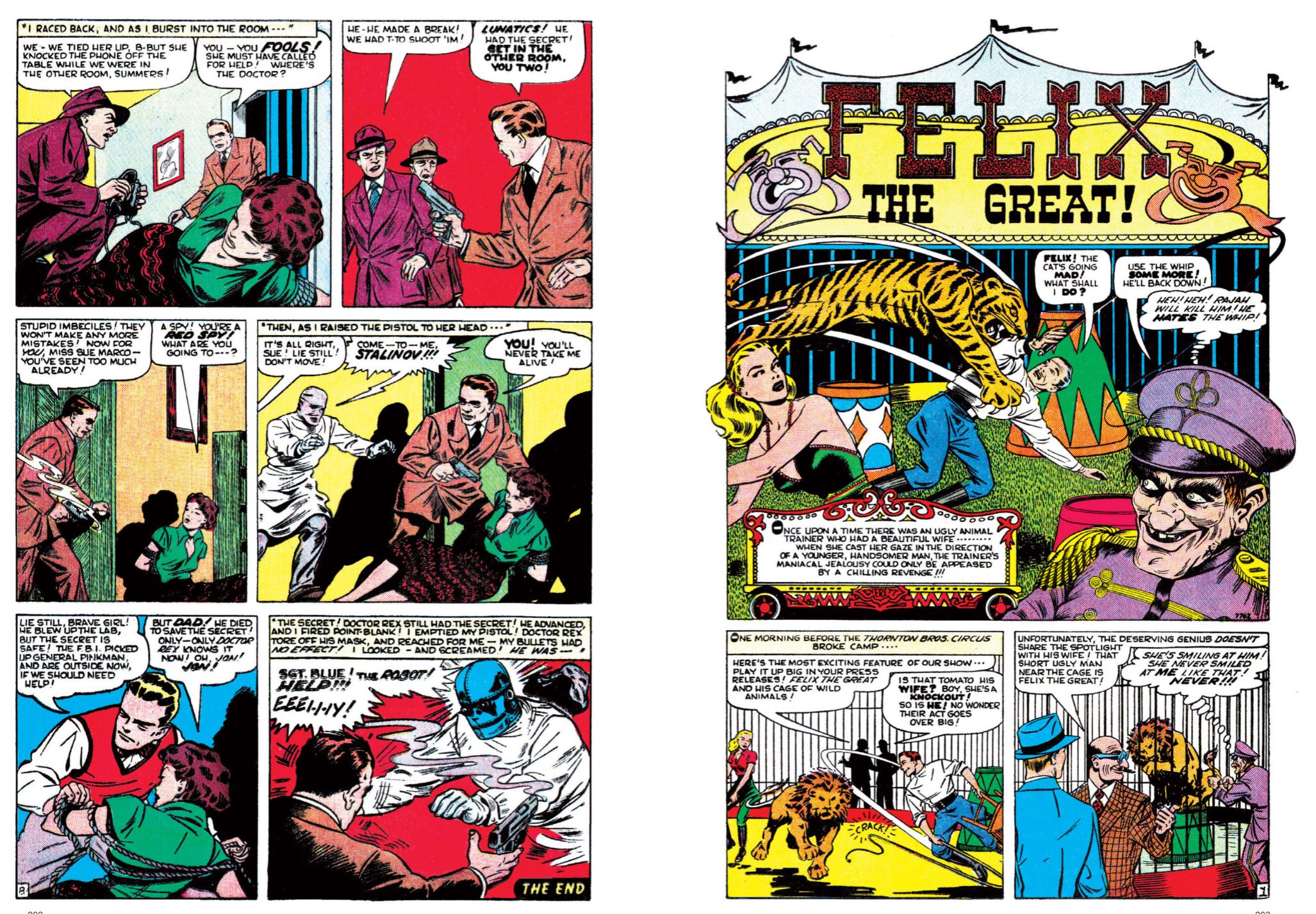
Following a third informative background essay detailing his life until its cruelly early end in 1973, a choice selection of his lesser known or celebrated efforts opens with tale of terror ‘Hangman’s House’ (Suspense #5, November, 1950),; a grim confrontation with Satanic evil, followed by futuristic Cold War shocker ‘I Deal With Murder!’ and a visit to a dark carnival of purely human wickedness in ‘Felix the Great’(both from Suspense #6, January 1951).

Adventures into Weird Worlds #4 (Spring 1952) offered a laconic, sardonic glimpse into ‘The Face of Death’, whilst from the following issue (April 1952) ‘Don’t Bury Me Deep’ tapped untold depths of tension in a moodily mordant exploration of fear and premature burial. Hard on the heels of the cover to Journey Into Unknown Worlds #14 (December 1952) comes one of its interior shockers as ‘The Scarecrow’ helps an aged couple solve their mortgage problems in a most unusual manner. The Marvel madness concludes with a cautionary tale of ‘That Crazy Car’ from Journey into Mystery #20, December 1954, concluding a far too brief sojourn amidst arguably Everest’s most accomplished works and most professionally adept period.

This magnificent collection ends with a gallery of pages and one complete tale from the end of his career; selected from an even more uninhibited publisher attempting to cash in on the adult horror market opened by Warren Publishing with Eerie, Creepy and Vampirella.

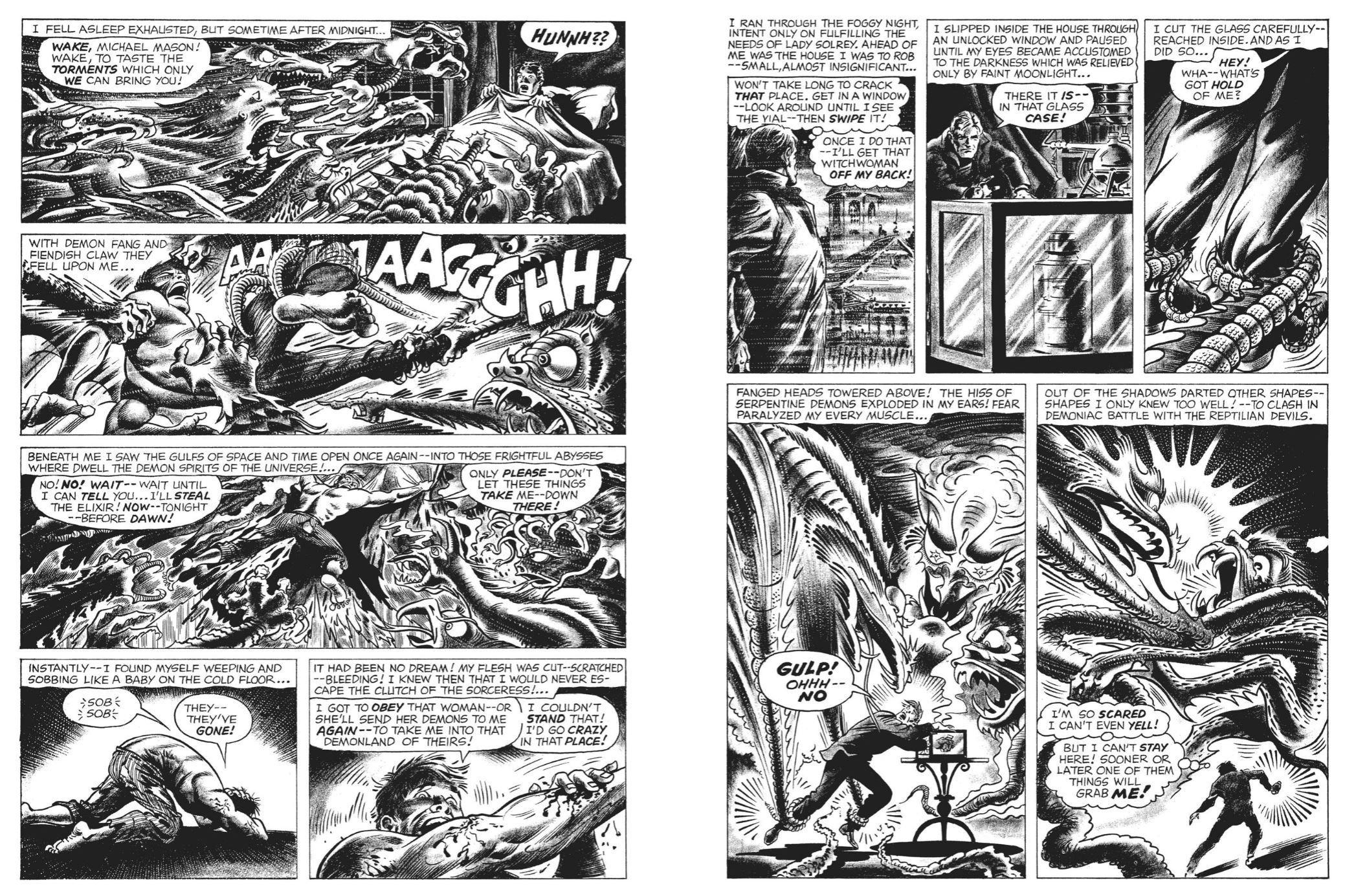
Skywald was formed by industry veteran Israel Waldman and Everett’s old friend Sol Brodsky, tapping into the burgeoning black-&-white, mature-reader market with supernatural flavoured magazines Hell-Rider, Crime Machine, Nightmare, Psycho and Scream. Offered an “in”, Everett produced incredible pin-ups (included here are three from Nightmare (#1, 2 & 4, December 1970-June 1971); ‘A Psycho Scene’ (Psycho #5, November, 1971); a stunning werewolf pinup from Psycho #6 and one of revived Golden Age monstrosity ‘The Heap’ from Psycho #4. Most welcome is a magnificent 10-page monochrome masterpiece of gothic mystery ‘The Man Who Stole Eternity’ from Psycho #3 (May, 1971).

Although telling, even revelatory and concluding in a happy ending of sorts, what these books truly celebrate is not the life but the astounding versatility of Bill Everett. A gifted, driven man, he was a born storyteller with the unparalleled ability to make all his imaginary worlds hyper-real; and for nearly five decades his incredible art and wondrous stories enthralled and enchanted everybody lucky enough to read them.
© 2013 Fantagraphics Books. Text © 2013 Blake Bell. All art © its respective owners and holders. All rights reserved.

Bill Everett was born today in 1917, as was Mad mainstay Don Martin in 1931, foundational Underground Commix publisher/empresario Don Donahue (AKA Apex Novelties) in 1942 and in 1953 both Alan Kupperberg (Blue Devil, Dragonlance) and Arthur Suydam (Cholly and Flytrap, Marvel Zombies).

Today in 2017, Oscar González Guerrero died. The Mexican comic artist, art director and educator had started taletelling in the 1950s and created Zor y Los Invencibles, Hermelinda Linda, Burrerías, Smog, Don Leocadio El Tío Porfirio, Las Aventures de Capulina and run ¡Ka-Boom! Estudio.

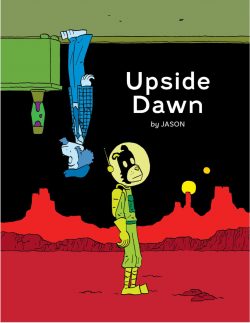
Upside Dawn


By Jason (Fantagraphics Books)
ISBN: 978-1-68396-652-4 (HB/digital edition)

This book includes Discriminatory Content included for dramatic, comedic and ironic effect.

Born in 1965 in Molde, Norway, John Arne Sæterøy is known by enigmatic, utilitarian nom de plume Jason. The shy & retiring auteur first took the path to cartoon superstardom in 1995, once debut graphic novel Lomma full ay regn (Pocket Full of Rain) won Norway’s biggest comics prize: the Sproing Award. From 1987 he had contributed to alternate/indie magazine KonK while studying graphic design and illustration at Oslo’s Art Academy.

From there he took on Norway’s National School of Arts and, on graduating in 1994, founded his own comic book Mjau Mjau. Constantly refining his style into a potent form of meaning-mined anthropomorphic minimalism, Jason has cited Lewis Trondheim, Jim Woodring & Tex Avery as primary influences. He moved to Copenhagen, working at Studio Gimle alongside Ole Comoll Christensen (Excreta, Mar Mysteriet Surn/Mayday Mysteries, Den Anden Praesident, Det Tredje Ojet) and Peter Snejbjerg (Den skjulte protocol/The Hidden Protocol, World War X, Tarzan, Batman: Detective 27).

Jason’s efforts were internationally noticed, making waves in France, The Netherlands, Slovenia, Spain, Germany and other Scandinavian countries as well as the Americas and he won another Sproing in 2001 – for self-published series Mjau Mjau – before in 2002 turning nigh-exclusively to producing graphic novels. He won even more major awards.

Jason’s breadth of interest is wide & deep: comics, movies, animated cartoons, music, literature, art, history and pulp fiction all feature equally with no sense of rank or hierarchy. Jason’s puckish, egalitarian mixing & matching of inspirational sources always and inevitably produces picture-treatises well worth a reader’s time. Over a succession of tales he has built and re-employed a repertory company of stock characters to explore deceptively simplistic milieux based on classic archetypes distilled from movies, childhood yarns, historical and literary favourites. These all role-play in deliciously absurd and surreal sagas centred on his preferred themes of relationships and loneliness. Latterly, Jason returned to such “found” players as he built his own highly esoteric universe, and even has a whole bizarre bunch of them “team-up” or clash…

As always, visual/verbal bon mots unfold in beguiling, sparse-dialogued, or even as here silently pantomimic progressions, with compellingly formal page layouts rendered in a pared back stripped-down interpretation of Hergé’s Claire Ligne style: solid blacks, thick outlines dominating settings of seductive monochrome simplicity augmented by a beguiling palette of stark pastels and muted primary colours.

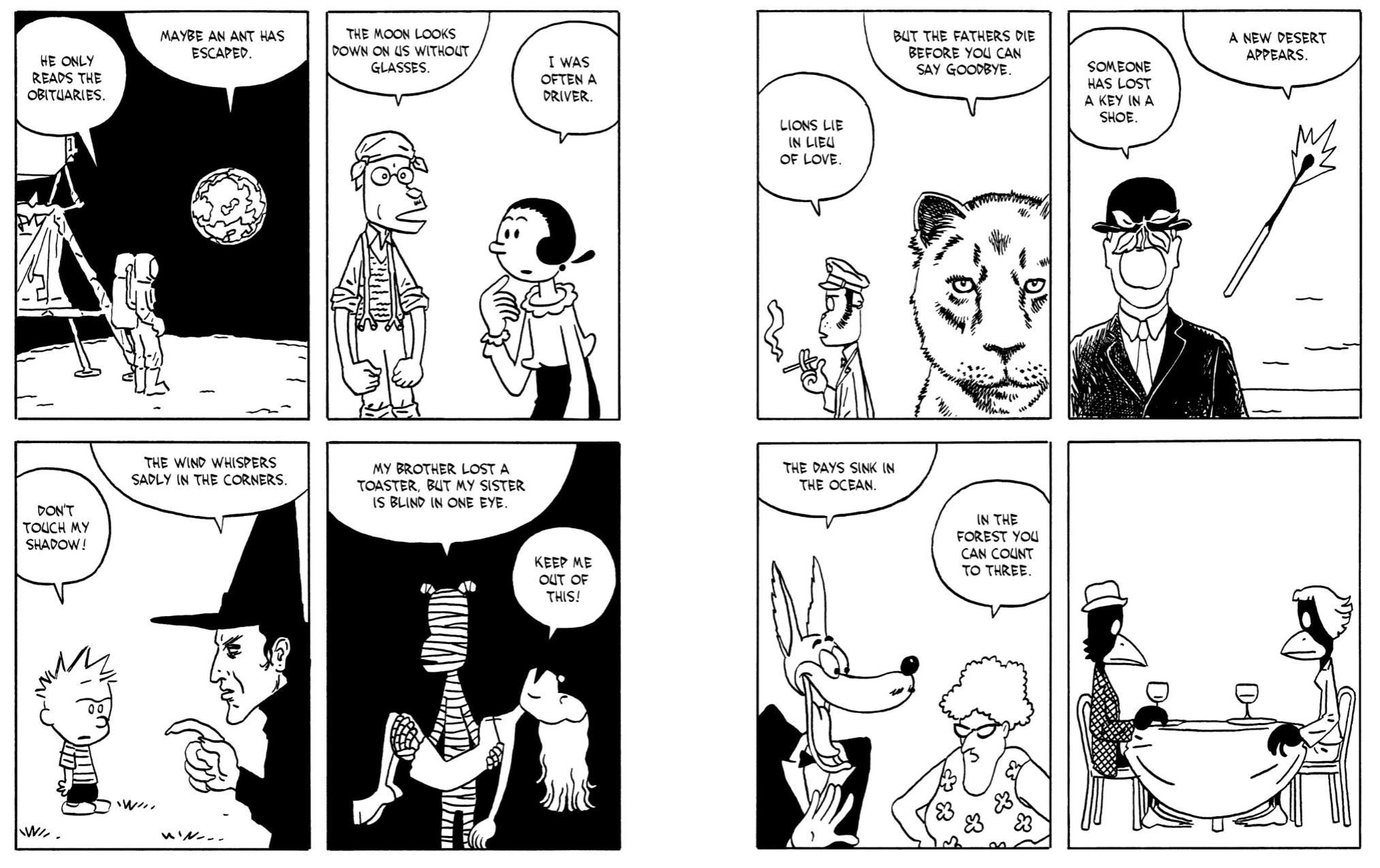
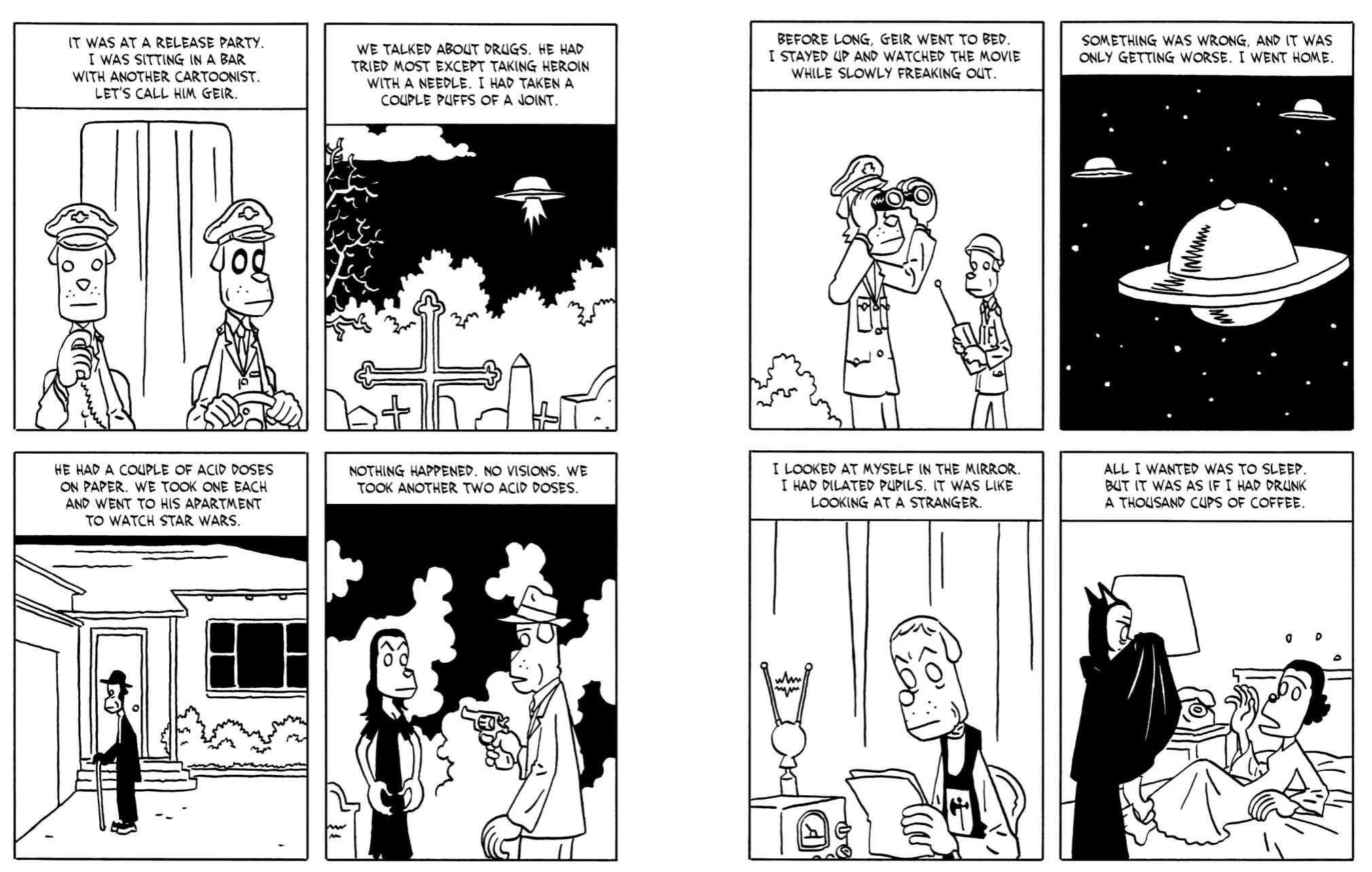
A master of short-form illustrated tales, many Jason yarns have been released as snappy little albums before later inclusion in longer anthology collections. The majority of tales brim with bleak isolation, swamped by a signature surreality even in the most comedic of moments. They are largely populated with cinematically-inspired, darkly comic, charmingly macabre animal people ruminating on inescapable concerns whilst re-enacting bizarrely cast, bestial movie tributes. That’s a style that has never been more apropos than right here, as the more modern Art Forms bow before the onslaught and tirade of organised anti-art philosophers, socially intellectual terrorists, wandering pop stars and a lost Vulcan…

Here the auteur returns to short individual pieces – or are they? – and fondly dabbles with words, terms and aural meanings whilst opening with an understandable failure to communicate over a meal in ‘Woman, Man, Bird’ before noted cerebral French auteur/filmmaker and playfully adrift word-&-meaning warper Georges Perec is repositioned as a hardboiled gumshoe searching for a missing woman in a yarn laced with omissions, mis-hearings and misapprehensions. Nevertheless, if you’re looking for a truth – any truth – ‘Perec PI’ is on the case…

A rapid pictorial transit to a peregrination through a typical life is recalled at full pelt in ‘I Remember’ after which ‘Vampyros Dyslexicoa’ dips deep into literary hinterlands in a pastiche/homage to Joseph Sheridan Le Fanu’s 1872 Gothic novella Carmilla. However the sordid obsessions of sapphic vampire Mircalla are only the entrée to wilder scriptorial regions and a nasty case of creative anachronism as ‘Seal VII’ takes us deep into modern “Scandi” folklore when a certain Knight and Death meet up for a game in Sweden in 1357 and don’t really cotton to the notion of chess for souls…

The scenes shifts to Prague in 1919 where a certain agent of the crown abruptly quits his job and is renditioned to a strange, picturesque high-tech surveillance Village where he has to wear a blazer as ‘The Prisoner in the Castle’ prior to popping back to St Peterburg in 1865 to gorily relive the trials and tribulations of Great Russian Literature at first hand via some eccentric ‘Crime and Punishment’

As much as Jason has played with visual meaning and manipulated derived imagery-context in his past forays, the later relater is here gripped by the confusing potentials of words and verbal meanings. Such facile surface fascinations are apparent during Leopold Bloom’s rather violent visit with the absolute master of “what did that mean” Dublin in June offers a walk with James Joyce, a leprechaun, Stephen Dedalus and Molly as we ponder stuff and not-nonsense in ‘Ulysses’. Then ‘Ionesco’ introduces random judgement to the final days of avant-garde playwright Eugène Ionesco, as a parade of bizarre celebrities and notables eulogise or defame him before he goes…

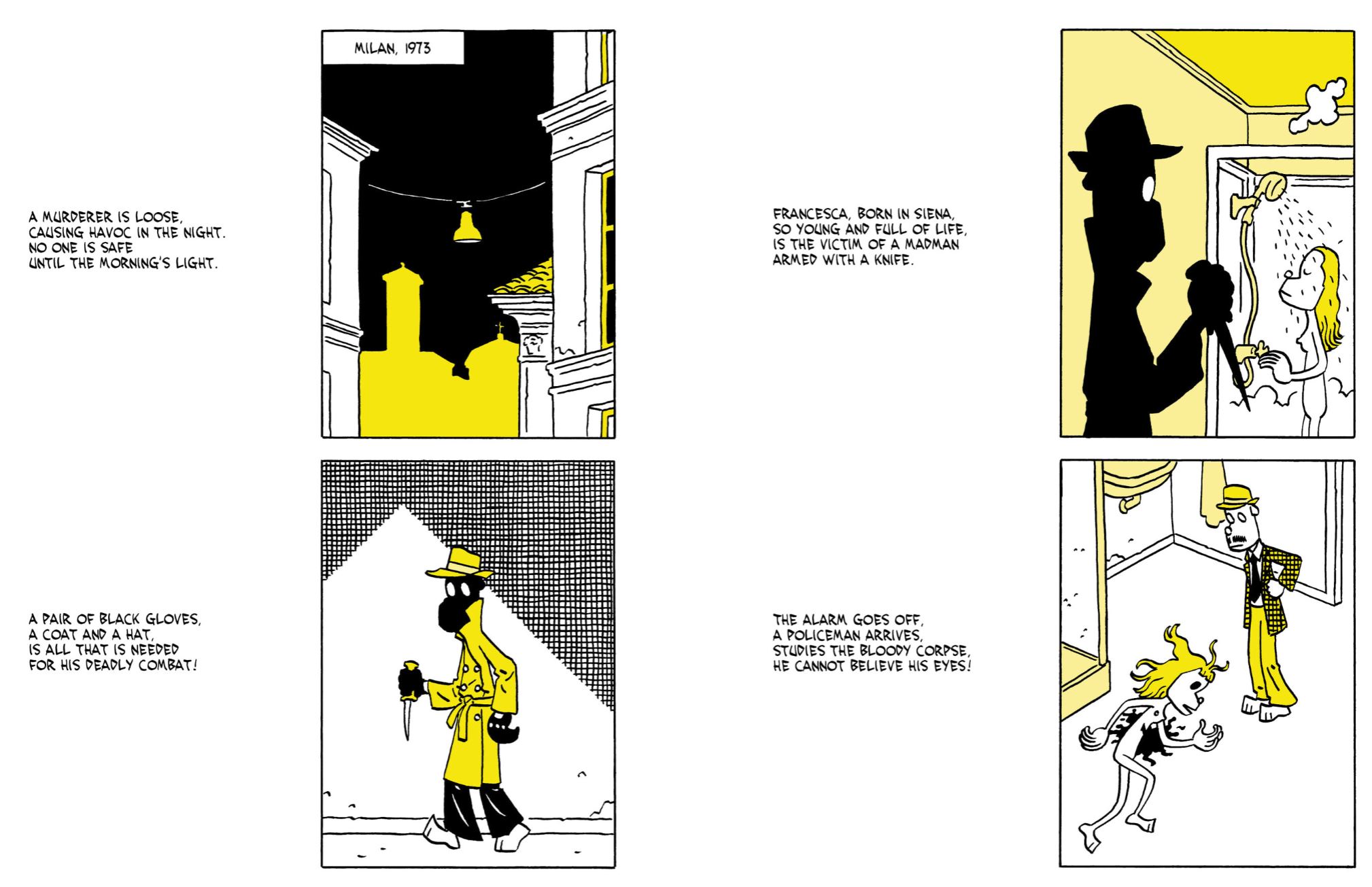
Slipping into a partial colour palette (yellow, if you care), ‘What Rhymes with Giallo?’ uses rhyming couplets to detail a sordid stabbing spree before resuming monochromatic mode as the tense future proves too much for one scientific stoic. Stress compels Mr Spock to desert the Enterprise and migrate to Montparnasse, Paris in ‘The City of Light, Forever’. It’s 1925 and he finds contentment as a minor Japanese painter (of cats) until Captain Kirk comes looking for him. If you follow Jason, this is where you start to realise that a lot of his work overlaps and intercepts itself in the strangest places…

Adding red and blue to black & white, ‘Who Will Kill the Spider?’ is a classic child’s nightmare of terror and confusion as Dad uses escalating tools and allies to deal with a bug in the bedroom who just won’t quit, after which words literally fail us in ‘One Million and One Years B.C.’: a silent science spoof of dinosaurs, cave-folk, time-travelling soldiers and stupid assumptions which leads into tribute diptych ‘EC Come…’ (a bloody tale of domestic ghouls and zombies) and ‘…EC Go’ (pointed satire of the comic company’s sublime Ray Bradbury adaptations of interplanetary First Contacts).

Then inevitably it devolves into a spoofing shot at the Sci Fi Fifties care of Curt Siodmak via Ed Wood in alien invasion ‘From Outer Space’ before ‘Etc.’ stages a celebrity-stacked movement-moment that begins in London circa 1972 as immortal musketeer Athos meets David Bowie meets a mummy meets Elvis meets Moses meets Sinatra meets Van Gogh meets Frank Zappa meets Death ad infinitum for a miasmic, abstractly construed big finish…

Visually mesmerising, this cunningly concocted Dadaist picture salad conceals underlying connections you really have to stay untuned for, referring relentlessly to modern icons and ancient shibboleths in equal measure, and perpetually sampling the feeling and furniture of war films, scary stories, true romances gone bad, Monty Python, Star Trek, a million movies, books, tunes and comics and even his own burgeoning “Jason-verse”. Upside Dawn absolutely should not be your first dip into his works, but don’t let that stop you from getting them all and getting all caught up…
All characters, stories, artwork and translation © 2022 Jason.
This edition of Upside Dawn © 2022 Fantagraphics Books, Inc. All rights reserved.

Today in 1892 Scots artist and future Charlie Chaplin comics illustrator Wally Roberson was born, followed in 1912 by John Liney (who limned the Henry strip), and in 1917, Hal Seeger who wrote & drew Betty Boop and later Leave it to Binky. In 1925 eventual East German cartoonist Hannes Hegen (Mosaik) arrived, with US letterer-to be Stan Starkman (Batman, Doom Patrol, Metamorpho) coming along in 1927. 3D comics guy Ray Zone was born in 1947, the same day and year that we lost the astounding Reg Perrott, artist on Roly and Poly the Two Bear Cubs, Land of the Lost People, Whirling Around the World, Wheels of Fortune, Red Ryder, The Young Explorers, The Golden Arrow, Golden Eagle, Sons of the Sword and more, as well as becoming producer/studio manager of UK mainstay Mickey Mouse Weekly.

In 1952 Hägar the Horrible artist Chris Browne was born, as was Chester Brown (Yummy Fur, Louis Riel) in 1960 and John Arne Sæterøy/Jason in 1965.

This date in 1964 Malcom Judge’s Billy Whizz first hurtled into the hearts of Beano readers, and in 2012 marked the passing of comic book workhorse Ernie Chan (Conan, Batman, Dracula Kull, The Hulk).

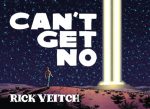
Can’t Get No


By Rick Veitch (Sun Comics/Vertigo)
ISBN: 978-1-4012-1059-5 (TPB Vertigo),
ISBN: 978-1-7241-3814-9 (TPB/Digital edition Sun Comics remastered second edition)

Born on May 7th 1951, Rick Veitch is a criminally undervalued creator who has lived through post-war(s) America’s many chimeric social revolutions. He has a poet’s sensibilities and a disaffected Flower-Child’s perspectives informing a powerful creative consciousness – and conscience. Can’t Get No is a landmark experiment in both form and content which deserves careful and repeated examination.

The shockwaves from the terrorist atrocity of September 11th 2001 changed the world and in our own small insulated corner, generated a number of graphic narrative responses of varying quality, not to mention deep emotional honesty. Rick Veitch’s 2006 Can’t Get No was as powerful and heartfelt as any, and benefited greatly from the little time and distance that bestowed perspective on raw emotional reactions.

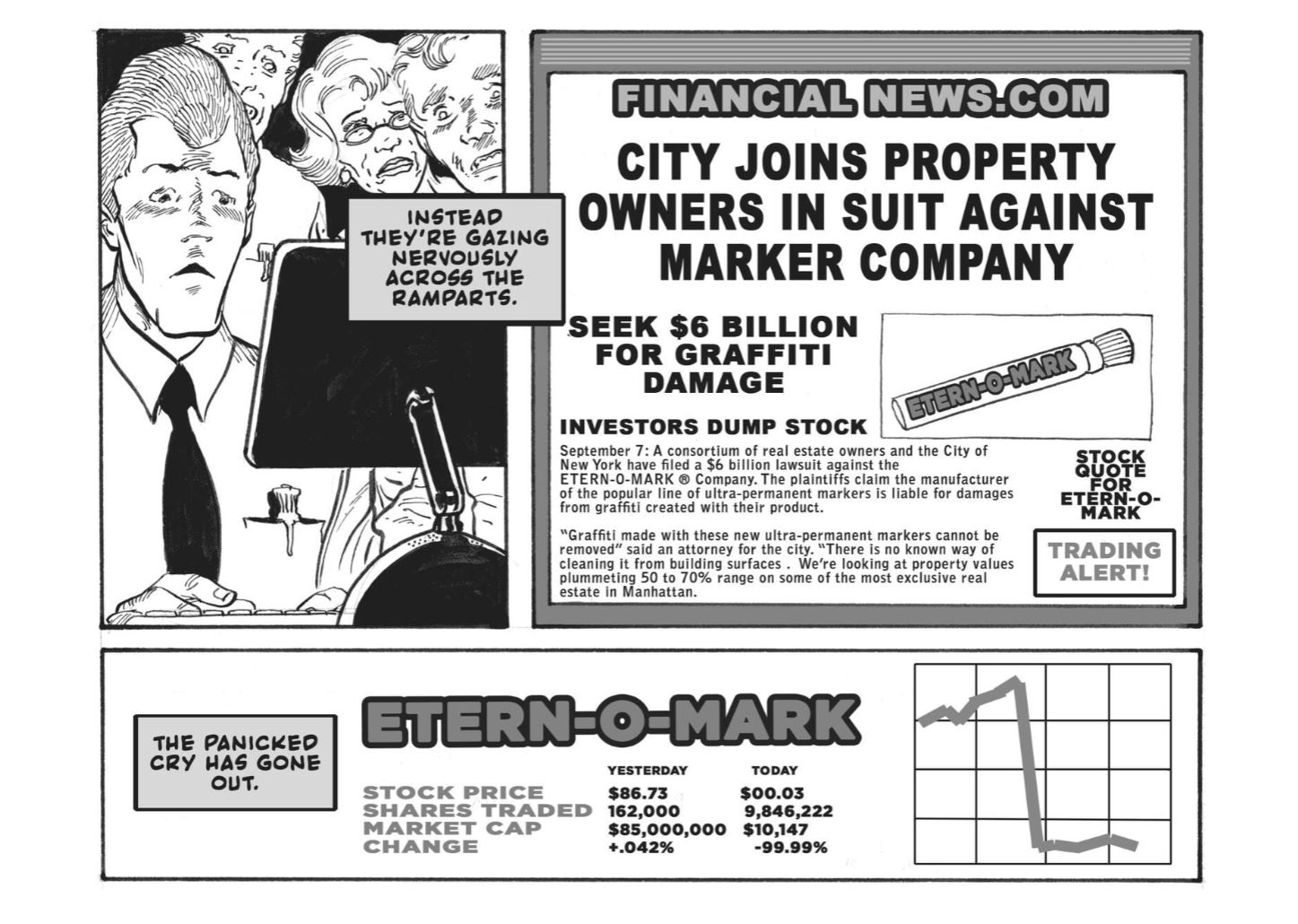
Chad Roe‘s company sold the world’s most permanent and indelible marker pen, the Eter-No-Mark. Everyone involved in selling them was flying high, but then the lawsuits hit all at once. A cheap, utterly irremovable felt-pen is a godsend to street-artists and becomes the most virulent of vandalistic weapons to property owners with nice clean tempting walls…

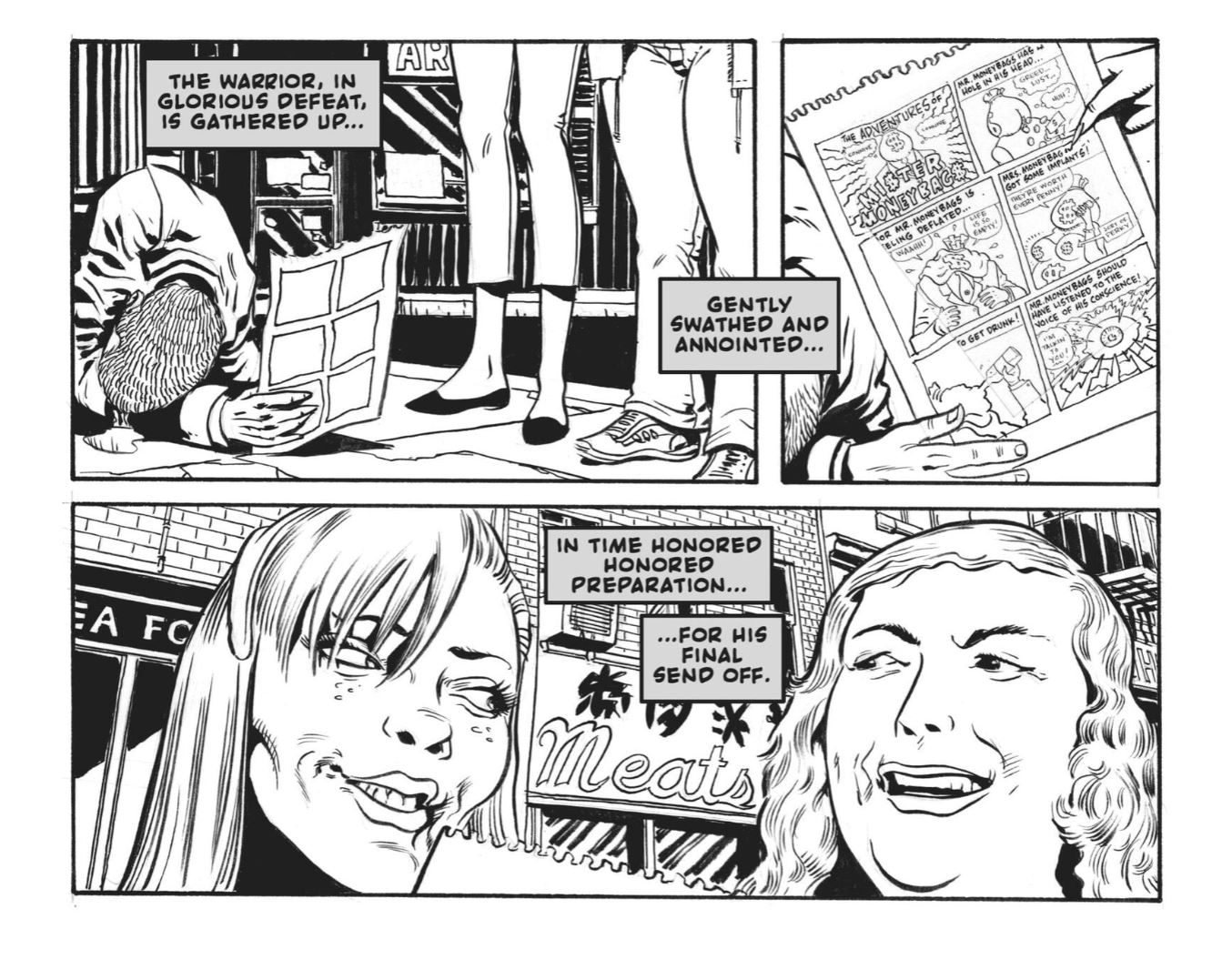
As his universe collapsed on him, Chad went on a bender, picked up two hippie-artist-chicks in a bar and woke up a human scribble-board, covered literally from head to toe in swirling, organic, totally permanent designs.

Even then he tried so very hard to bounce back. A walking abstract artwork, he was ostracized by mockery, and unable to conceal his obvious “otherness”, and neither self-help philosophies, drugs, or alcohol could make him feel normal anymore. Defeated, reviled and eventually crushed in spirit, he was trapped in a downward spiral. Then Chad met the pen-wielding girls again and found solace and uncomplicated joy in the artist’s world of sex, booze and dope.

Lost to “normal” society, Chad took a road-trip with the women, but they hadn’t even left the city before they were all arrested. This was morning on September 11th and as the girls violently resisted the cops, an airplane flew overhead, straight towards the centre of Manhattan…

With no-one looking at him, just another part of the shocked crowd, Chad watched for an eternity, and then – no longer anything but another stunned mortal – drove away with an Arab family in their mobile home…

And thus began a psychedelic, introspective argosy through US philosophy, symbolism and meta-physicality. With this one act of terrorism forever changing the nation, Chad is forced on a journey of discovery to find an America that is newborn both inside and out. His travels take him through vistas of predictable cruelty and unexpected tolerance, through places both eerily symbolic and terrifyingly plebeian, but by the end of this post-modern Pilgrim’s Progress, both he and the world have adapted, accommodated and accepted.

Black & white in landscape format, and eschewing dialogue and personal monologues for ambient text (no word balloons or descriptive captions, just the words that the characters encounter such as signs, newspapers, faxes etc.) this graphic narrative screams out its great differences to usual comic strip fare, but the truly magical innovation is the “text-track”: a continual fluid, peroration of poetic statements that supply an evocative counterpoint to the visual component.

Satirical, cynical and strident with lyricism deployed for examination and introspection, and perhaps occasionally over-florid, but nonetheless moving and heartfelt free verse and epigrams do not make this an easy read or a simple entertainment. They do make it a piece of work every serious consumer of graphic narrative should experience… before it’s too late for all of us.
© 2006, 2019 Rick Veitch. All Rights Reserved.

Today in 1900, Alley Oop originator V.T. Hamlin was born, followed in 1905 Puerta Rico by Golden Age cover maestro Alex Schomburg, whilst in 1957, Classics Illustrated mainstay Henry C. Kiefer died. Franz Frazetta hung on until today in 2010 at which time he was 82 years old.

This date in 1943, Jack Sparling began his newspaper strip Clare Voyant, and in 2004 Jeff Smith apparently drew the final page of Bone.

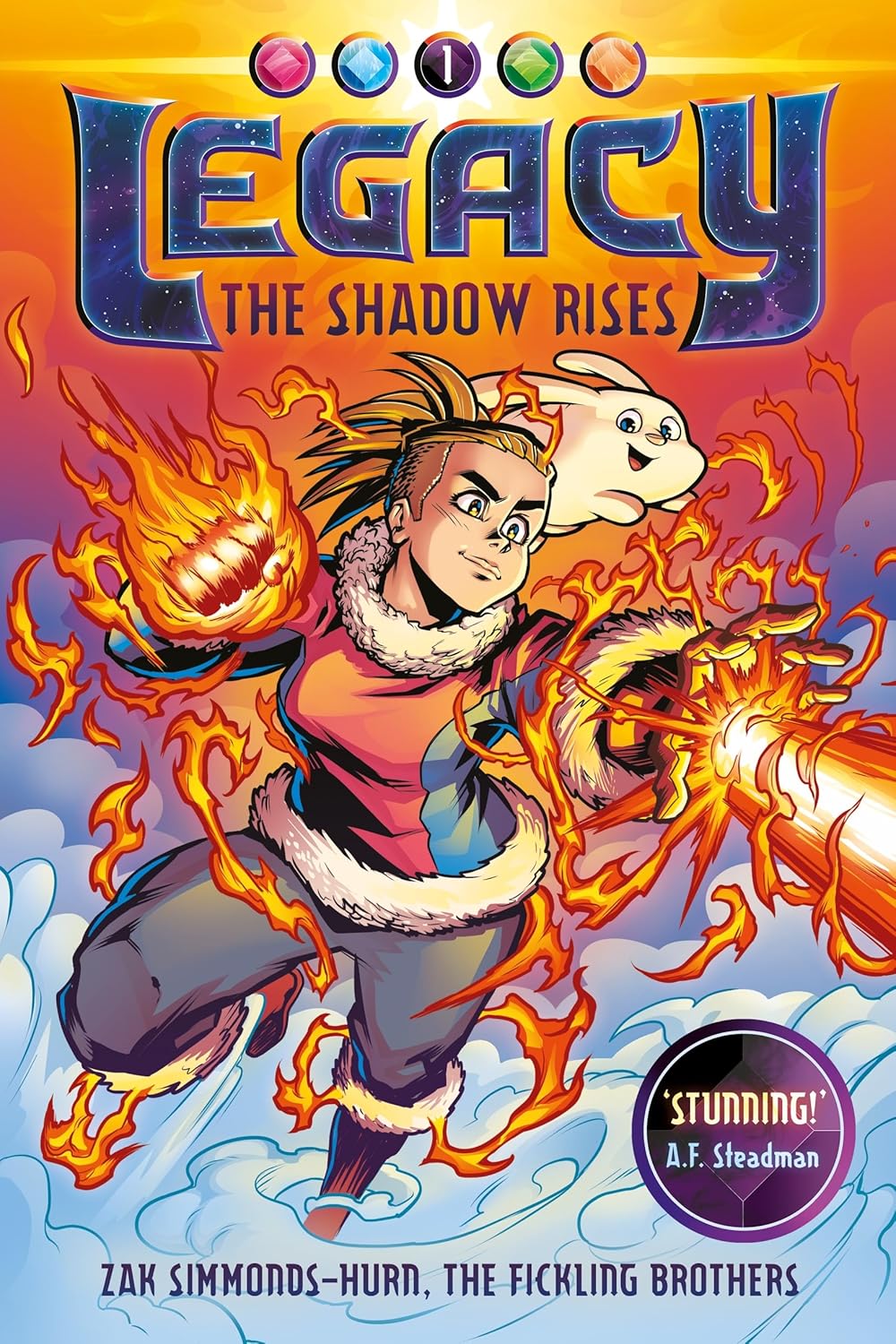
Legacy: The Shadow Rises (volume 1 of 3)


By The Fickling Brothers & Zak Simmonds-Hurn, with additional colours by Lou Ashworth, Alice Leclert & Ellie Wright (DFB/Phoenix)
ISBN: 978-1-78845-198-7 (TPB)

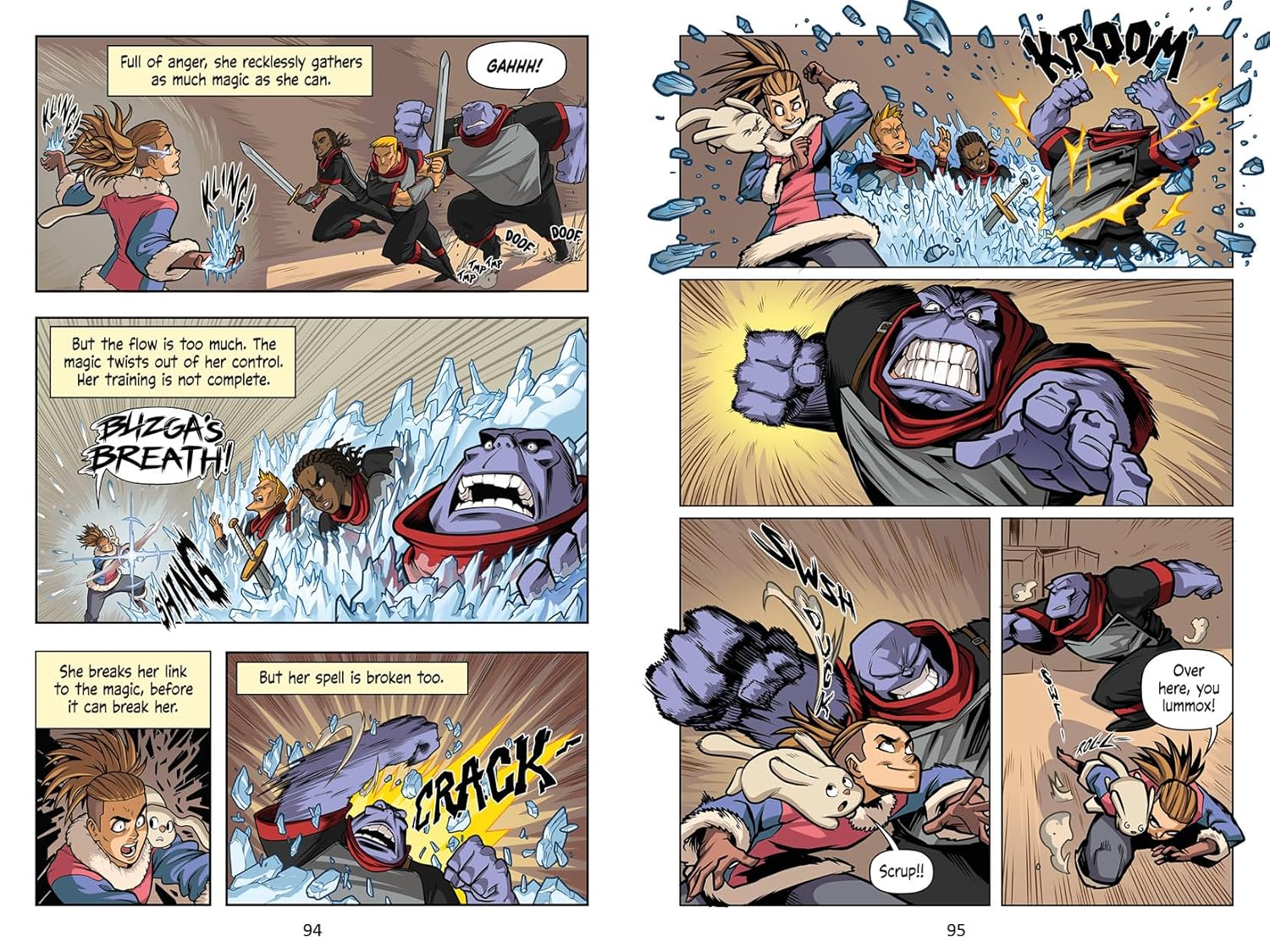
The Phoenix has been the shining saving grace of British kids’ comics since 2012, regaling rabid readers with anthology comics for girls, boys and all points between, offering humour, adventure, quizzes, puzzles and educational material in a joyous parade of cartoon fun and fantasy. Although probably best known for its award-winning comedy stylings, the comic has always been pretty strong in its action and mystery yarns too, and this latest offering – by writers “The Fickling Brothers” (Tom & Will) and illustrator Zak Simmonds-Hurn (Dragon Guard, Know Your Monsters) – delivers the first full-on, all-action fantasy tome in a prospective trilogy aimed at the growing market for juniors-based magical adventure.

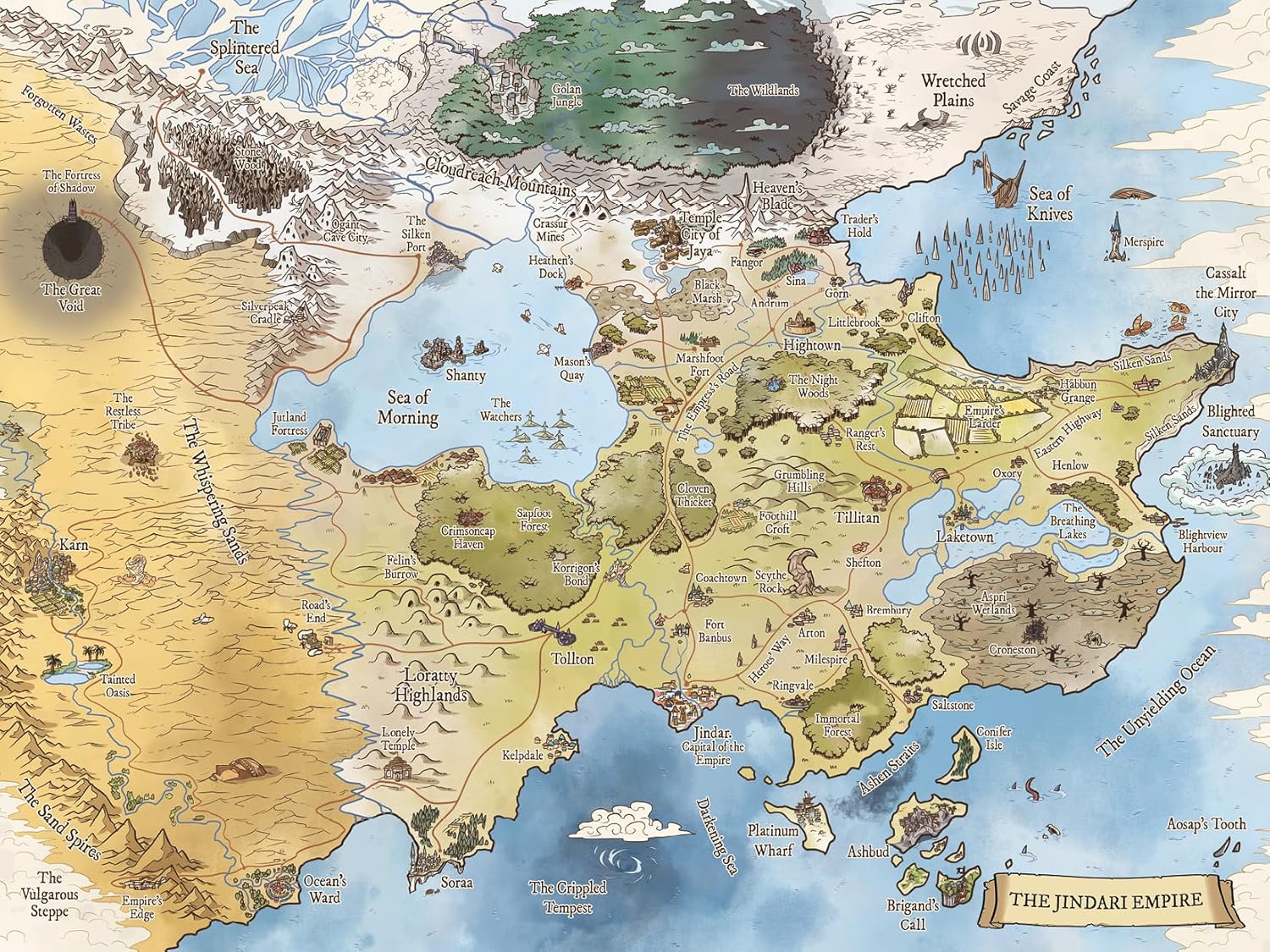
Flavoured with hints and notes of Star Wars and The Lord of the Rings franchises and the glorious classic movie Willow, this cunningly contrived confection takes us to the embattled lands of the Jindari Empire, laying ground rules for a war of conquest by malign forces lurking beyond the Edge of the Great Void and craving control of all that lives free. The cruelly avaricious observer is Obaga, Queen of Shadows and as her minions constantly confirm, “the Shadow rises”…

With ebon emissaries sowing terror and discord, the crisis begins when blithely unaware ruler of Hightown Lord Edar of House Thawn, his sons Tarik and Lorban and faithful warrior mage Kal Jotan are ambushed by marauding dark raiders. Thankfully, before his defeat, Kal sends a magical message to Heaven’s Blade, the fortress-citadel that is home to all arcane knowledge and the current boarding school of Edar’s mystically-gifted daughter Scarlett Thawn.

When her studies are interrupted by tidings that she is now last surviving Thawn and ruler of Hightown, she accepts that she must leave. Her potent but daunting tutor Lord Igon soon despatches Scarlett (and her beastly familiar Rumpus) on the long journey home, and offers sage advice and an ancient scroll that is far from what it seems…

The scholar has long anticipated trouble and knows the world’s governing Council of Flowers is not up to confronting the forces of evil; The Shadow has contingency plans of her own. Most critical of these is having an impostor already in place governing Hightown by the time Scarlett arrives to take up the onerous responsibilities of command…

Thus begins a rousing quest saga as Scarlett treks across a weird, wild world to find bizarre animal allies, face incomprehensible threats and forsake her dreams of magical study for the duties of rulership, and discovers that friends and foes are impossible to distinguish and that “her” problems affect far more than just her subjects…

Also drafted and crafted by Zak and the Fickling lads is a fulsome supplementary section detailing background lore under the aegis and escutcheon of ‘A Compendium of the Creatures, Customs and Culture of Jindar and Other Curious Miscellany by Penadot Shrewd’. These context-compliant complimentary case histories include all you need to know now regarding ‘The Ancients’, ‘The Shadow’, ‘The Council of Flowers’, and all you might want about ‘Magic’ including ‘A Brief Lesson in Magic for Novices’ concentrating on ‘Fire, Ice and Acid Magic’.

If epic adventure and growing pains in the depths of the dark are your taste, this is an epic you’ll want to follow from the first step to the last gasp…
Text  and Illustrations © The Phoenix Comic  2026.

Legacy: The Shadow Rises will be published on May 7th 2026 and is available for pre-order now.

Today in 1912 groundbreaking Dutch comics god Marten Toonder (Tom Puss, Panda, Oliver B. Bumble) was born, followed in 1922 by legendary raconteur Dog Wildey (Tarzan, Outlaw Kid, Jonny Quest, Rio); Howard Cruse (Wendel, Stuck Rubber Baby, Barefootz) in1944; multi-syndicated strip cartoonist Jerry Scott (Zits, Baby Blues) in 1955 and modern comic book mavens Liam Sharp (Deaths Head II, Wonder Woman, Testament) in 1968 and Simon Spurrier (Harry Kipling, X-Men, Ghost Rider) in 1981.

Today in 1912, US political cartoonist Homer Davenport died, with later losses including Wonder Woman co-creator William Moulton Marston in 1947; John Forte (Legion of Super-Heroes, Tales of the Bizarro World) in 1966 and anthological comics horror-meister Jay Disbrow (Captain Electron, Valgar Gunnar of Gyro, Aroc of Zenith) in 2017.

Primal landmark Dutch newspaper strip Bulletje en Boonestaak debuted today in 1922.

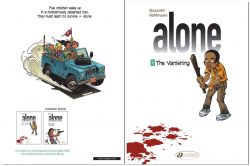
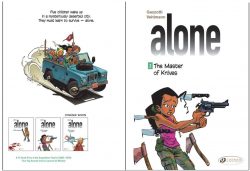
Alone volumes 1 and 2: The Vanishing and The Master of Knives


By Gazzotti & Vehlmann, translated by Jerome Saincantin (Cinebook)
ISBNs: 978-1-849181-96-9 (PB Album/Digital edition vol 1) 978-1-84918-206-5 (PB Album/Digital edition vol 2)

These books include potentially Discriminatory Content produced for dramatic effect.

Fabien Vehlmann was born in 1972 yet his prodigious canon of work (from 1998 to the present) has earned him the soubriquet of “the Goscinny of the 21st Century”. He entered the world in Mont-de-Marsan and grew up in Savoie, growing up to study business management before taking a job with a theatre group. In 1996, after entering a writing contest in Le Journal de Spirou, he caught the comics bug. Two years later with illustrative collaborator Denis Bodart he published a mordantly quirky, sophisticated portmanteau period crime comedy entitled Green Manor. From there on his triumphs grew to include – amongst many others – Célestin Speculoos for Circus, Nicotine Goudron for L’Écho des Savanes, The Marquis of Anaon and major-league property Spirou and Fantasio

Bruno Gazzotti is Belgian, born in 1970 and was a student of Institut Saint Luc in Liège. Another artist addicted to comics from his earliest years, he started being paid to draw them in 1988, after being hired by Le Journal de Spirou editor Patrick Pinchart on the strength of his portfolio alone. Before long he was illustrating Le Petit Spirou with Tome & Janry. In 1989, he and Tome created New York Cop Soda, which kept Gazzotti busy until 2005, when he resigned to co-create award-winning feature Seuls

Alone volume 1: The Vanishing

Released in January 2006, Seuls – La disparition is a superb example of a kids’ thriller suitable for all ages: evoking the eerie atmosphere of TV series Lost, with notes of modern phenomenon Stranger Things and the most disturbing elements of Philip Wylie’s novel The Disappearance and William Golding’s Lord of the Flies.

Translated as The Vanishing, the first chapter show glimpses of an ordinary bustling town, with simple folk going about their business. Our swift peeping settles on a cross section of kids: Ivan, an imaginative child of wealth who wants for nothing but never sees his dad anymore and Leila, a born engineer, inventor and tinkerer. Her poor but honest dad always has time to play and favourably critique her latest gadget…

Camille is studious and over-focussed on exams and achievement and Terry is pretty much still a baby. He certainly acts like one, trying to stay up late, binge watching TV and throwing tantrums if he doesn’t get his way. Sadly, not all the children in town have such typical lives. Dodzi has just been taken into the social care system. His early life has made him tough and resilient but won’t stop other young inmates handing him a beating on this ominous, odd-feeling portentous night…

Morning dawns overcast and forbidding. The city is quiet. Roaming empty streets, Dodzi calls out to anyone who can hear and is met – actually run over – by Leila and Terry on her bike. They are all pretty scared and have seen nobody else at all…

No one else is around. All the adults are gone, and every kid they know. The internet is down, television and radio only roar out static. Above, fearsome ponderous storm clouds gather. Within minutes fear turns to panic and violence before, eventually, Dodzi brutally enforces calm and leads them away, only to stumble into Camille being attacked by a dog. As the tough guy tries to fight it off, the rabid beast senses something in the shadows of an alley and bolts away…

As the youngsters wander, someone watches the shocked, scared waifs, and after they joyously blow off steam in a fountain, they meet final lost boy Ivan. He invites them back to his mansion at the edge of town where they find food while being subjected to his theories on what’s happened… everything from a shared dream to an extinction event to the possibility that they’re dead and in hell…

Needing more information, Dodzi and Leila try to drive one of many cars on the estate while the smaller kids sort out a proper meal. Neither task goes well. The cooking is a disaster while the near-lethal reconnaissance only reveals more empty streets, wrecked shop fronts and wild animals roaming the avenues and alleys. While the motoring minors seek to evade two rhinos, Terry and Camille are nearly eaten by a white tiger that’s got through the estate gates! When Dodzi and Leila return – and following a burst of viciously released tensions – the kids modify and weaponize a 4-by-4 and head back into town. Ivan’s dad owns the tallest building in the city: somewhere stuffed with crucial resources and a place easily fortified and defended…

As the first day alone ends, the kids are bloated with vending machine snacks and playing in the vast office block’s upper reaches, but de facto leader Dodzi is still uneasy. When Leila reports tiny Terry is missing, the notional “man-in-charge” heads out to search, finding to his horror where all those animals came from: a scene of destruction that distracts Dodzi enough that a hidden stalker almost takes him. Naturally, the others have completely ignored his orders and followed, so it isn’t Dodzi who dies…

Thus begins a spooky, powerful and often shocking tale of mystery and imagination with bereft children facing increasingly daunting physical hazards and an escalating series of events which can have no logical or rational explanation…

To Be Continued…

Alone volume 2: The Master of Knives

Debut volume The Vanishing showed an ordinary bustling town rendered an empty mausoleum overnight, with a small cross-section of kids left to survive or die. When it happened, the mystified minors wandered a terrifyingly quiet, suddenly unfamiliar environment until finding each other and the relief of “bad kid” Dodzi who reluctantly took responsibility for their staying alive. Adults were gone, all outside contact severed and wild beasts stalked them so Dodzi brutally enforced calm and lead them away to find a succession of temporary – albeit palatial – refuges to regroup and think. Encounters with escaped circus animals resulted in the little band settling in the towering Majestic Hotel to await whatever came next…

Originally released as Seuls: Le Maître des couteaux in 2007, The Master of Knives opens with Dodzi scouting the vacant metropolis and helping Leila consolidate supplies for a long stay in the lap of luxury. His nervousness remains high as close calls with the liberated beasts in the streets come continually, but the younger children seem to be adapting well. It certainly helps that they are hoarding every toy and treat they find in abandoned shops and houses. Ivan has a plan to occupy him too: systematically calling every telephone number in the phone book. No luck yet, though…

Things start to go south swiftly after he finds his father’s pistol and tempts Leila into a spot of rooftop target practice. When Dodzi furiously confiscates the lethal plaything, he has no idea that he has now become the preferred prey of a mystery stalker. As this masked pursuer enacts a chilling campaign of terror, stressed-out Dodzi agonisingly learns that he is not the only obsession of the terrifying, nebulous cloaked figure draped in blades and daggers…

While the others obliviously fritter away the day, pressure-laden Dodzi is remorselessly hunted over rooftops by the manic killer. When he briefly eludes the hunter, the Master simply doubles back to menace the children in the hotel. Ultimately a shocking confrontation ensues, with the tables turned… but only at the cost of Dodzi’s closely withheld shameful secrets being exposed to all…

In the painful aftermath, the days of innocence are discarded and the orphan family prepares to hit the open road to see if other cities have been emptied too…

To Be Continued…

This spooky, powerful, frequently shocking tale of mystery and imagination sees bereft children facing increasingly daunting physical hazards and an escalating series of events which apparently have no logical or rational explanation. Tension and terror inexorably amplifies with every instalment – just like the real world at the moment.

Alone – running to 12 translated volumes thus far of a projected 14 – was one of the biggest critical and commercial comics hits of the last decade (more than 2 million copies sold!). Seuls even made it to the big screen in 2017, so if you love eerie enigmas and powerful tale-telling, you’ll soon be buying this, you’ll buy these and successive releases to know why…
© Dupuis 2006 and 2007 by Gazzotti & Vehlmann. All rights reserved. English translation © 2014 Cinebook Ltd.

Today in 1912, Terry and the Pirates crafter George Wunder (officially in charge from December 30, 1946 to 1973) was born, followed in 1930 by filmmaker and occasional Superman comics scripter Richard Donner. That same year cartoonist/children’s book illustrator Howie (Eek & Meek) Schneider arrived. In Canada in 1957, small press maven John McLeod (Dishman, Space Kid) joined the party, as did superhero/cover star J.G. Jones in 1962.

This date in 1981 we lost the great Howard Purcell (Sargon the Sorcerer, Green Lantern, Gay Ghost, Mister District Attorney, Enchantress, Sea Devils, Nick Fury, Black Knight, DC mystery and Sci Fi anthologies) and in 2004 comics author and scripter Nat Gertler initiated the first 24-hour comics day.