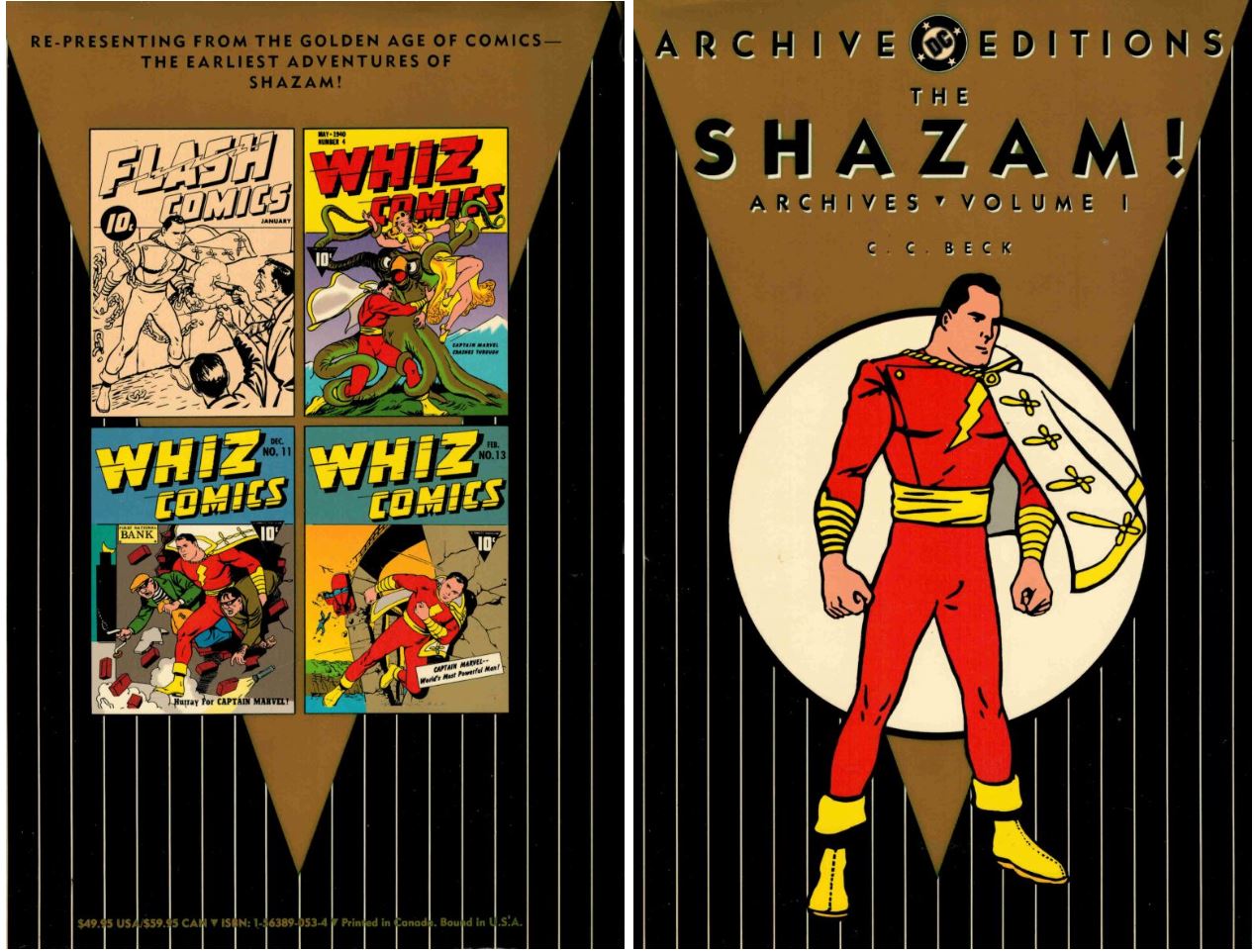
The Shazam! Archives volume 1


By Bill Parker, C. C. Beck & Pete Costanza with various (DC Comics)
ISBN: 978-1-56389-053-6 (HB)

This book includes Discriminatory Content produced in less enlightened times.

At their most impressive, superhero comics combine the gravitas of mythology with all the sheer fun and exuberance of a child’s first rollercoaster ride. The perfect example of this is the original happy-go-lucky hero we can’t call Captain Marvel anymore.

First seen in late December 1939, Whiz Comics (#2 – there was no #1) cashed in on the comic book sales phenomenon of Superman; the big red riot eventually won his name after narrowly missing being Captain Flash or Captain Thunder. He was the brainchild of Bill Parker & Charles Clarence Beck, initially dispensing the same kind of summary rough justice as his contemporaries. However, the character soon distanced himself from the pack – Man of Steel included – by employing and enjoying an increasingly light, surreal and comedic touch, which made him the bestselling comics character in America. Ultimately, he proved that he could beat everybody but copyright lawyers; during his years of enforced inactivity the trademarked name passed to a number of other publishers before settling at Marvel Comics and they are never, never, never letting go. You can check out and compare their cinematic blockbuster version with the DC Extended Universe’s Shazam! flick too…

Publishing house Fawcett had first gained prominence through an immensely well-received magazine for WWI veterans entitled Captain Billy’s Whiz-Bang, before branching out into books and general interest magazines. Their most successful publication – at least until the Good Captain hit his stride – was the ubiquitous boy’s building bible Mechanix Illustrated and, as the comic book decade unfolded, the scientific and engineering discipline and “can-do” demeanour underpinning MI suffused and informed both art and plots of the Marvel Family titles.

As previously stated, the big guy was created by writer/editor Bill Parker and brilliant young artist Charles Clarence Beck who, with his assistant Pete Costanza, handled most of the art on the series throughout its stellar run. Other writers included William Woolfolk, Rod Reed, Ed “France” Herron, Joe Simon, Jack Kirby, Joe Millard, Manley Wade Wellman and fabulously prolific Otto Binder.

Before eventually evolving his own amiable personality, the Captain was a serious, bluff and rather characterless powerhouse, whilst his juvenile alter ego was the true star: a Horatio Alger archetype of impoverished, boldly self-reliant, resourceful youth overcoming impossible odds through gumption, grit and sheer determination…

Homeless orphan and good kid Billy Batson is selected by an ancient wizard to be given the powers of six gods and heroes to battle injustice. He transforms from scrawny precocious kid to brawny (adult) hero Captain Marvel by speaking aloud the wizard’s name – an acronym for six legendary divine patrons: Solomon, Hercules, Atlas, Zeus, Achilles and Mercury.

This magnificent full-colour, deluxe hardback compendium re-presents Captain Marvel’s first 15 exploits from Whiz Comics #2 to 15 (February 1940 to March 1941). There was no #1, two issue #5’s and two editions in March (but I’ll try to explain all that as we go along), with joy, verve and invention paramount in this particular knock-off crusader; one of a countless number imitators and descendants to cash in on the sales phenomenon of Superman…

Author, journalist and fan Richard A. Lupoff covers in great detail the torturous beginnings of the feature in his Foreword before the magic proper starts with a priceless glimpse at the hero’s seemingly-accursed design stage. To establish copyright, publishers used to legally register truncated black-&-white facsimile editions – dubbed “Ash-can Editions” – in advance of their launch issues. For magazine publisher Fawcett, production of their first comic book proved an aggravating process as this registration twice uncovered costly snags which forced the editors to redesign both character and publication.

Contained herein are cover reproductions of Flash Comics #1 starring Captain Thunder (obliviously scheduled for release mere days after DC’s own Flash Comics title hit the stands), and Thrill Comics #1 which repeated the accident just as Standard’s Thrilling Comics launched. Also on view is monochrome art for the first half of the story of “Captain Thunder” which would eventually be re-lettered and released as the lead in anthology title Whiz Comics #2, finally safely released cover-dated February 1940. Like many Golden Age series, the stories collected here never had individual titles, and DC’s compilers have cleverly elected to use the original comics’ strap-lines or cover blurbs to differentiate the tales…
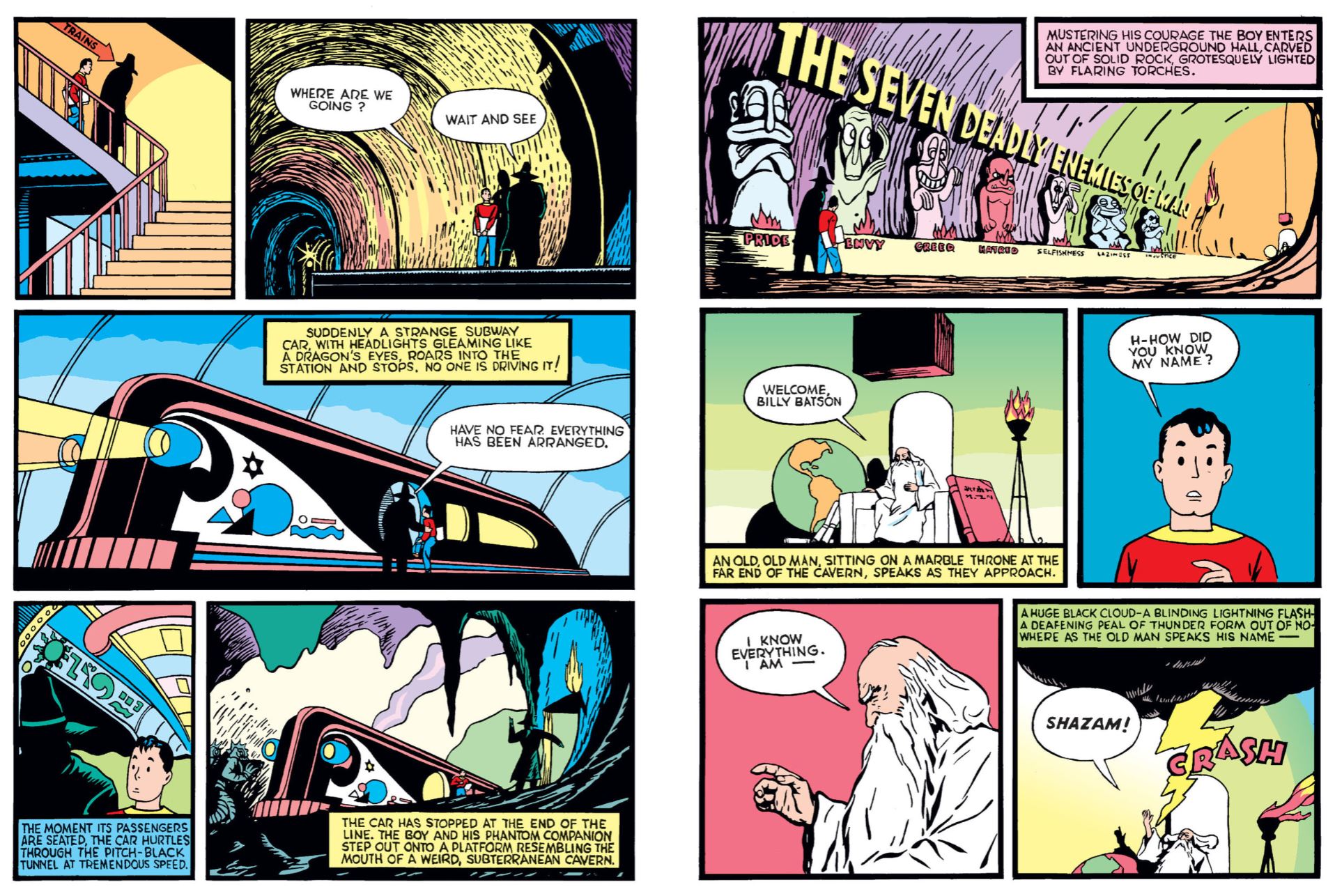
‘Gangway for Captain Marvel!’ – drawn in a style reminiscent of early Hergé – finds homeless orphan newsboy Billy Batson lured into an abandoned subway tunnel to a meeting with infinitely ancient wizard Shazam. At the end of a long life confronting evil, the white-bearded figure grants the lad the powers and signature gifts of six gods and heroes; bidding him to continue the good fight.

In 13 delightfully clean and simple pages Billy gets his powers, has his secret origin revealed (he’s actually heir to a fortune embezzled by his crooked uncle Ebenezer Batson), wins a job as a roaming radio reporter for Amalgamated Broadcasting and defeats the demonic schemes of criminal science maniac Doctor Thaddeus Bodog Sivana, who is holding the airwaves of America hostage. The mighty, taciturn and not yet invulnerable Marvel is only sparingly used to do the heavy lifting. It is sheer comic book poetry…
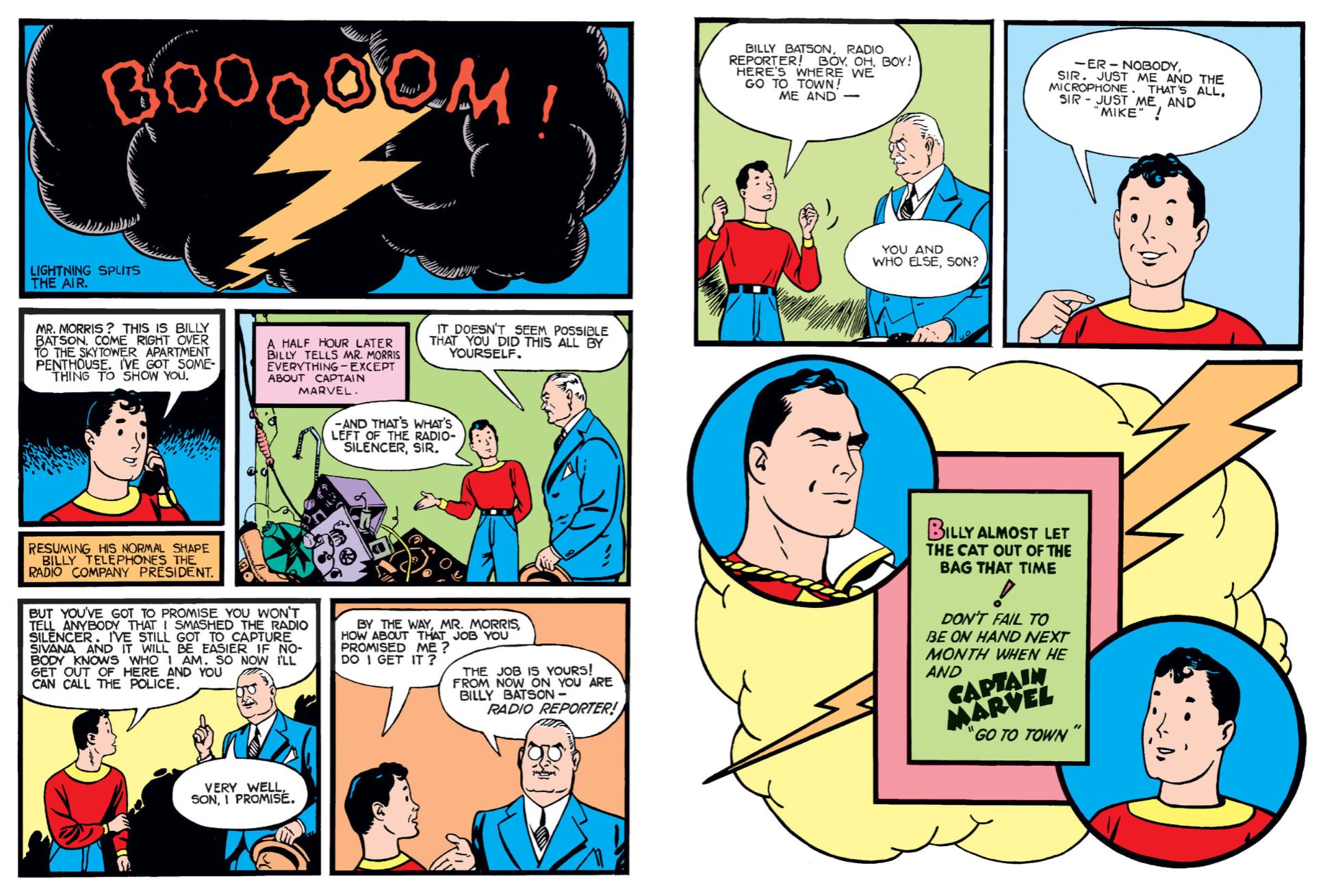
The March issue had no cover number but was listed as #3 in the indicia and featured ‘The Return of Sivana’ as the insane inventor unleashes a mercenary army equipped with his super-weapons upon the nation, attempting to become Emperor of America. His plan is duly thwarted by Billy acting as a war correspondent, and the mighty muscles of Marvel…

The third (April-dated) Whiz Comics had “Number 3” on the cover but was designated #4 inside and proudly proclaimed ‘Make Way for Captain Marvel!’ before boldly leaping into full science fiction mode as Billy is shanghaied to Venus in Sivana’s mighty rocketship. The boy is forced to reveal his amazing secret to the demented inventor whilst battling incredible monsters and giant frog-men dubbed “Glompers”, with the magnificently guileless and gallant Marvel seemingly helpless against the savant’s seductive new ally – Queen Beautia – as that deadly duo prepare to invade Earth.

Only seemingly though…

‘Captain Marvel Crashes Through’ (#4 on the cover, but #5 inside) details how bewitching Beautia, aided by Sivana’s technology, runs for President. However, the sinister siren has a soft heart, and when Billy is captured (and encounters the first of a multitude of diabolically clever gadgets designed to stop him saying his magic word), she frees him, thus falling foul of the gangsters who were backing her. Happily, Captain Marvel is there to save the day…

An inexplicable crime-wave shakes the country in ‘Captain Marvel Scores Again!’ (the wild numbers game finally ends here as there’s a #5 on the cover and the same inside) as a different sinister scientist uses a ray to turn children into thieves. Even Billy is not immune…

‘Captain Marvel and the Circus of Death’ (July 1940) sees Sivana return with fantastic Venusian dino-monsters which our Good Captain is hard-pressed to handle. Incidentally, this was the first issue where the Big Red Cheese is seen definitely flying as opposed to leaping – something Superman is not acknowledged as doing until late 1941. It means nothing, I’m just saying emulation goes both ways…

For ‘Captain Marvel and the Squadron of Doom’, young Billy travels to the North Pole for a radio story and discovers a secret organisation thawing out frozen cavemen to act as their army of conquest, after which he and his mature magical avatar foil a murderous spiritualist causing mass-drownings to bolster his reputation and fortune in ‘Saved by Captain Marvel!’

Whiz #9’s ‘Captain Marvel on the Job!’ finds man & boy foiling a revolution, recovering foreign crown jewels and flummoxing a madman with a shrinking ray, after which Sivana and Beautia return in ‘Captain Marvel Battles the Winged Death’: a blistering yarn involving espionage and America’s latest secret weapon. In this tale, the Empress of Venus finally reforms, becoming a solid American citizen…

‘Hurrah for Captain Marvel!’ finds Batson investigating college hazing and corrupt sporting events whilst in #12 (January 1941), the World War looms large as “Gnatzi” maritime outrages bring Billy to London where he uncovers the spy responsible for sinking refugee ships in ‘Captain Marvel Rides the Engine of Doom!’

‘Captain Marvel – World’s Most Powerful Man!’ then features Sivana’s latest atrocity as the madman disrupts hockey matches, blitzes banks and incapacitates the US army with a formula that turns men into babies. Even Billy isn’t immune, but at least Beautia is there to help him…

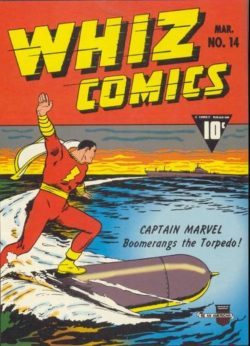
War was looking increasingly unavoidable and many superheroes jumped the gun to start fighting before the US officially entered the fray. ‘Captain Marvel Boomerangs the Torpedo!’ is a superb patriotic cover for Whiz #14 (March 1941) even though the actual story involves Sivana’s capture and subsequent discovery of a thought process which allows him to walk through walls – and cell bars. Luckily, the World’s Mightiest Mortal also possesses the Wisdom of Solomon and deduces a solution to the unstoppable menace…
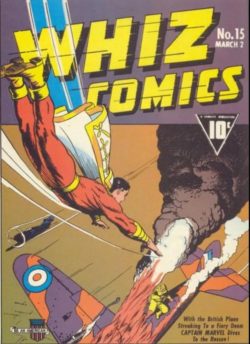
This superb collection concludes after another stirring cover ‘With the British Plane Streaking to a Fiery Doom, Captain Marvel Dives to the Rescue!’ (#15 and also cover-dated March), fronting an unrelated adventure which reveals the astounding and tragic origin of Dr. Sivana, his unbelievable connection to Beautia, and also introduces her brother Magnificus – almost as mighty a fighter as Marvel – after Billy is kidnapped and trapped once more on Venus…

DC/National Periodical Publications had filed suit against Fawcett for copyright infringement as soon as Whiz Comics #2 was released. The companies slugged it out in court until 1953, when, with the sales of superhero comics decimated by changing tastes, Captain Marvel’s publishers decided to capitulate. The name lay unclaimed until 1967 when M.F. Enterprises released six issues of an unrelated android hero before folding. Marvel Comics finally secured rights to the name in 1968.

DC eventually acquired Fawcett’s comic book properties and characters and in 1973 revived the Good Captain for a new generation, gambling that his unique charm would work another sales miracle during one of comics’ periodic downturns. Retitled Shazam! due to the incontestable power of lawyers and copyright legislation, the revived heroic ideal enjoyed mixed success before being subsumed into the company’s vast stable of characters…

Nevertheless, the first Captain Marvel is a true icon of American comic history and a brilliantly conceived superhero for all ages. This titanic tome only scratches the surface of the canon of delights produced over the near 90 years of his tumultuous existence, and is an ideal exemplar introduction to the world of adventure comics: one that will appeal to readers of any age and temperament.
© 1940, 1941, 1992 DC Comics. All Rights Reserved.

Today in 1867, French artist, cartoonist, creator and designer of Bibendum (the Michelin man) O’Galop AKA Marius Rossillon was born. He shares birthday with Charles ClarenceC.C.Beck (Captain Marvel/Billy Batson, Spy Smasher, Fatman, the Human Flying Saucer) in 1910; mega-letterer Ray Holloway in 1920; strip cartoonist/animator Paul Gringle (Rural Delivery, Out Our Way) in 1922, Charlton comics art mainstay Rocke Mastroserio in 1927 and Dutch creator Jan Kruis (Jan, Jans en de Kinderen) in 1933.

Events include Ken Reid’s final Jonah strip in The Beano this day in 1963 – although the strip was revived in The Dandy 30 years later – and last of Gus Edson & Irwin Hasen’s newspaper feature Dondi in 1986, with Tom Batiuk/Chuck Ayers’ strip Crankshaft debuting one year later.

Today in 1846 Swiss satirist and the world’s first true comics creator – Rodolphe Töpffer (Histoire de Mr. Vieux Bois/The Adventures of Obadiah Oldbuck) – died, as did Shoe and Pluggers cartoonist Jeff MacNelly in 2000, and the mighty, massively influential cartoonist, historian and publisher Jack Edward Jackson AKA Jaxon (Rip Off Press co-founder; crafter of God Nose, Los Tejanos, Comanche Moon, The Secret of San Saba, The Alamo: An Epic Told from Both Sides and dozens more) in 2006.
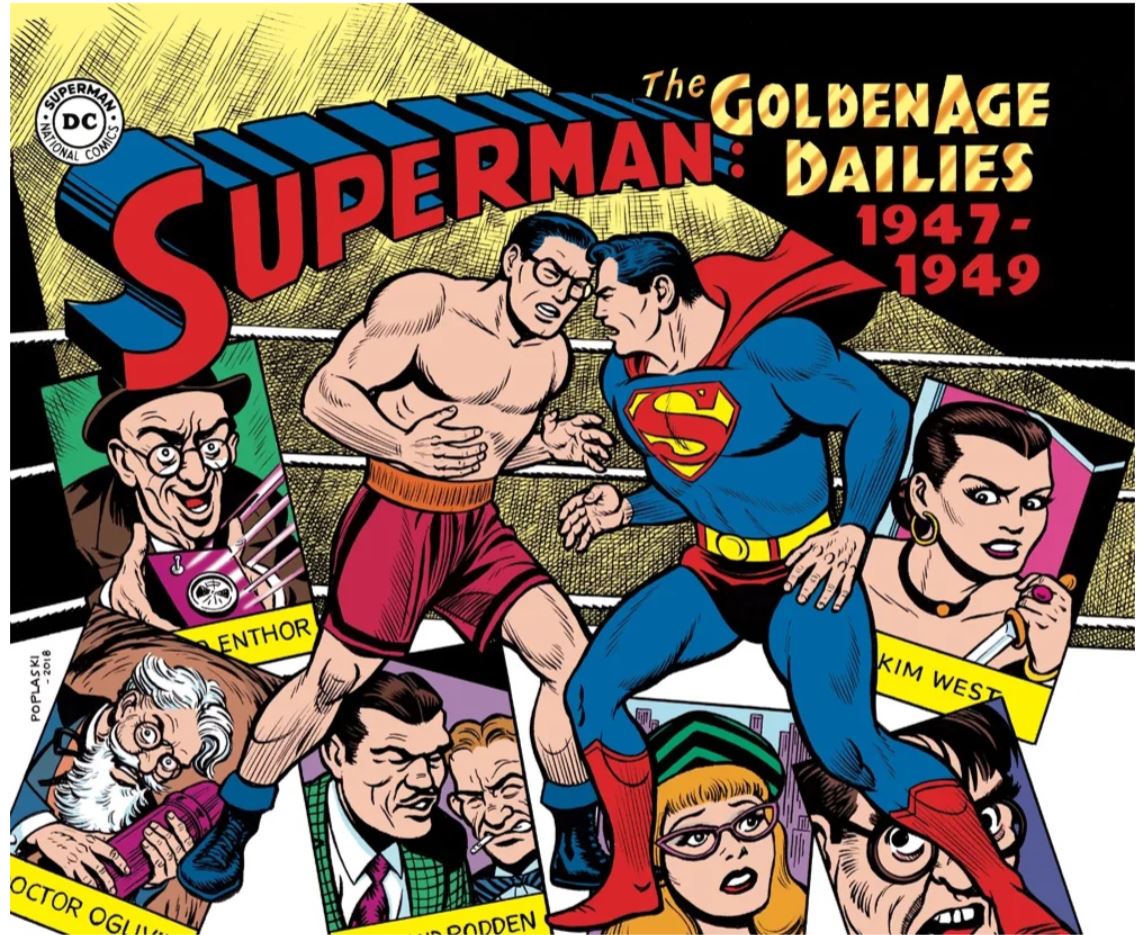
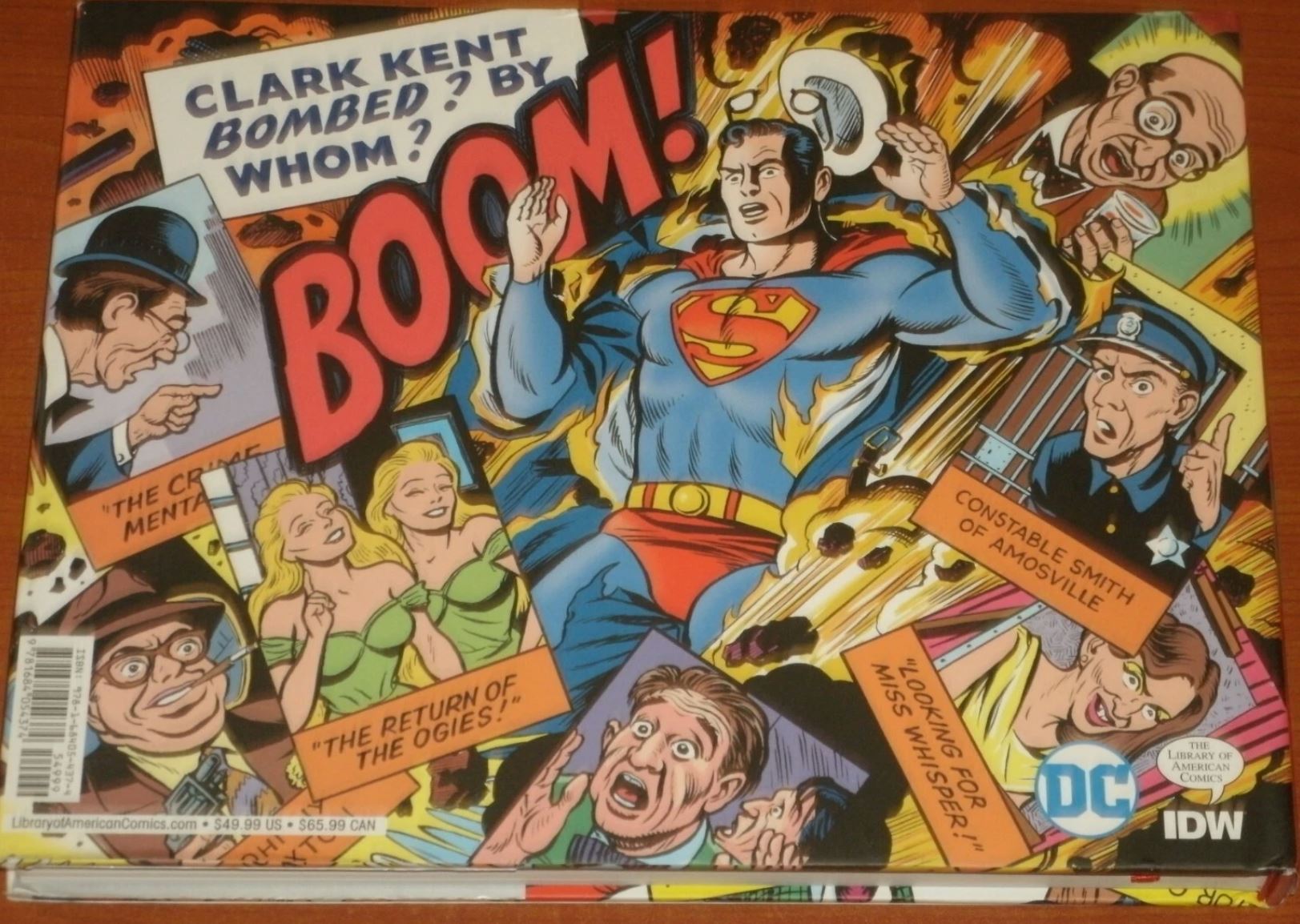
Superman: The Golden Age Dailies 1947 to 1949 (volume 3)


By Alvin Schwartz, Wayne Boring, Jack Schiff, Win Mortimer & various (IDW/Library of American Comics)
ISBN: 978-1-68405- (HB)

This book includes Discriminatory Content produced in less enlightened times.

The American comic book industry – if it still existed at all – would be utterly unrecognisable without Superman. Jerry Siegel & Joe Shuster’s unprecedented invention was first fervidly adopted by a desperate and joy-starved generation, and gave birth to a genre if not an actual art form. Spawning an army of imitators and variations within three years of his 1938 debut, the intoxicating blend of breakneck, breathtaking action and wish-fulfilment epitomising the early Man of Steel grew to encompass cops-&-robbers crimebusting, socially reforming dramas, sci fi fantasy, whimsical comedy and, once the war in Europe and the East sucked in America, patriotic relevance for a host of gods, heroes and monsters, all dedicated to profit through exuberant, eye-popping excess and vigorous, dashing derring-do.

From the outset, in comic book terms Superman was master of the world. Moreover, whilst transforming the shape of the fledgling funnybook biz, the Man of Tomorrow irresistibly expanded into all areas of the entertainment media. Although we all think of the Cleveland boys’ iconic invention as epitome and acme of comics creation, the truth is that very soon after his springtime debut in Action Comics #1 the Man of Steel was a fictional multimedia monolith in the same league as Popeye, Tarzan, Sherlock Holmes and Mickey Mouse. We parochial and possessive comics fans too often regard our purest and most powerful icons in purely graphic narrative terms, but the likes of Batman, Spider-Man, Avengers and their hyperkinetic kind long ago outgrew four-colour origins to become fully mythologized modern media creatures familiar in mass markets, across all platforms and age ranges…

In the last century and even more so in this one, far more people have seen and heard the Man of Steel than have ever read his comic books. These globally syndicated newspaper strips alone were enjoyed by countless millions, and by the time his 20th anniversary rolled around, at the very start of what we call the Silver Age of Comics, he had been a thrice-weekly radio serial star, headlined 17 astounding animated cartoons, become a novel attraction (written by George Lowther) and – by the time of the last stories in this tome – had helmed two feature films. He had then seamlessly segued into the next Big Thing: television. Soon his first (of 8) smash-hit live-action tv seasons would start his next great media conquest, making Superman a perennial sure-fire success for toys, games, food, and puzzle and apparel manufacturers all over the planet.

Although pretty much a spent force these days, for the majority of the last century the newspaper comic strip was the Holy Grail all American cartoonists and graphic narrative storytellers hungered for. Syndicated across the country (and frequently the world) a strip feature could be seen by millions if not billions of readers and was generally accepted as a more mature and sophisticated form of literature than comic books. It also – at the start! – paid better, and rightly so. Some of the most enduring, entertaining characters and concepts of all time were devised to lure readers from one particular paper to another and many of the best became cornerstones of a shared global culture. People across the Earth had a communal context thanks to thrilling to the same comics; and Mutt and Jeff, Buck Rogers, Dick Tracy, Flash Gordon, Charlie Brown and so many more escaped humble, tawdry newsprint origins to become meta-real: existing in the minds of earthlings from Albuquerque to Zanzibar. Most still do…

The daily Superman newspaper strip launched on 16th January 1939, swiftly augmented by a full-colour Sunday page from November 5th of that year. Originally crafted by Siegel & Shuster and their studio (Paul Cassidy, Leo Nowak, Dennis Neville, John Sikela, Ed Dobrotka, Paul J. Lauretta & crucially Wayne Boring), the mammoth task soon required additional talents like strip veteran Jack Burnley and writers including Whitney Ellsworth, Jack Schiff & Alvin Schwartz. The McClure Syndicate feature ran continuously until May 1966, appearing, at its peak, in over 300 daily and 90 Sunday newspapers: a combined average readership of more than 20 million. Eventually, Win Mortimer & Curt Swan joined the unflagging Boring & Stan Kaye, whilst Bill Finger and Siegel also provided stories, telling serial tales largely divorced from comic book continuity throughout years when superheroes were scarcely seen.

This third volume of the Library of American Comics collection continues the prodigious and formidable reprint program begun in the Sterling/Kitchen Sink softcover editions which ceased production in 1999. All of that material – and these books too – are long overdue for re-release and digital editions. Here, however, WWII is well and truly over and the decidedly different demands of peacetime and reconstruction have given way to an era of hectic prosperity, but still see our hero and his regular cast tested and beset by domestically endangering perils and conundrums only a Man of Steel could handle…

We open with another Introduction by Sidney Friefertig, discussing the changes from conflict to reconstruction and detailing why and how poet-turned-thriller writer Alvin Schwartz (1916-2011) became the key writer of the feature as well as sharing contextual, behind-the-scenes moments before our cosy but never-ending battle resumes.

These sequences came six days a week, comprising episodes #47-61, pages #2595 through 3338, and publication dates April 28 1947 to September 3rd 1949. With the material credited to Schwartz (Batman, Wonder Woman, Aquaman, Tomahawk, Newsboy Legion, Slam Bradley, House of Mystery, A Date With Judy, Buzzy, Bizarro) and the sole pictorial province of illustrator Wayne Boring, the compilation kicks off with and a bizarre “manhunt” to solve the dilemma of ‘Who is Miss Whisper?

Running in strips #2595-2654 as seen between April 28th to July 5th 1947, the story depicts mounting frenzy in Metropolis after lonely millionaire at sea Jonathan Dexter experiences a crossed radio line and catches a brief snippet of conversation with a distant voice. Instantly falling inescapably in love with a person he cannot and probably will never see, he is despondent until he remembers how rich he is…

Thus when, Cinderella-style, the heartsore plutocrat uses the Daily Planet to publicise his plight and swears to endow the mystery maid with all his worldly goods, the entire female population goes crazy. Everybody loves a doomed romance but some seek to con him, some attempt to bamboozle or even supplant his absent inamorata and some – gangsters led by cunning rogue Wishbone – seek to replace Miss Whisper with a voice impersonating ringer. Clark Kent and Lois Lane are drawn to the story and Superman promises to help after the rich guy promises to pay a million to deserving charities but even after finding her, the Man of Tomorrow can’t make the quiet quarry want to marry the spoiled rich, groom-to-be…

Nevertheless, because it’s a fairy tale writ large, love does find a way…

Crafted for daily doses, these Superman snippets are torturous, convoluted and often seemingly divert in tangents to indulge in seemingly pointless but epically spectacular super-feats (such as razing an entire forest to make a really, Really big billboard). These are to pad out increasingly formulaic plots and emphasise the “Super” in the hero but also counterpoint the ongoing social commentary and essentially domestic tribulations of familiar and warmly appreciated entertainment characters being constantly put through their paces. That’s clearly seen as greed and venality abound in the next arc as Superman reels under the manic idiocies generated by ordinary people in mounting frenzy once news leaks out that the Man of Steel has agreed to safeguard humanity’s greatest desire made manifest.

Running from July 7th to September 27th, the sorry tale of ‘The Youth Serum’ (strips #2665-2732) sees chemist Dr. Ogilvie unwisely entrust his age-defeating miracle mixture to shady promoter Willie Poster who triggers a literal stampede of the vain, vainglorious and outright villainous who will do anything to roll back a few years… including bribery, fraud, theft and kidnapping Daily Planet staff to compel the Man of Steel to hand over the rejuvenation juice…

With the multi-million daily readership reckoned to be at least 50% female, encroaching domesticity was a regular plot standby but Alvin Schwartz proved able to tweak the situation in unusual ways. For ‘The Marriage Gamble’ (#2733- 2768; September 29th to November 8th) he enfolds Lois & Clark in a criminal caper wherein crooked – and ultimately near-murderous – loan sharks seek vengeance on a professional gambler by rigging a bet that one of their on-the-hook client/victims can be made to marry the first women he sees. Thanks to poor timing and fate the intended marriage material is inadvertently delayed by Lois, and helpless desperate sap Joe Deems’ unsuspecting bride-to-be becomes a certain feisty journalist…

There’s no escaping his fate – it’s death or Lois – but the mobsters have utterly underestimated Lane’s instincts and the determination of Joe’s actual fiancée Dotty… as well as Superman’s covert intervention…

Who’s chasing who is the key to next serial saga ‘The Perfect Woman’ (#2769-2828, November 10th1947 – January 17th 1948) as super-rich, supremely smart, ultra-fit and staggeringly beautiful heiress Olivia Hill finally reaches marrying age and decrees that the Man of Tomorrow is the only one worthy of her. Of course, Lois has other ideas and also senses a huge scoop as the terrified Superman struggles to escape a girl prepared to risk her own life and reputation to get her way…

Backed by money and privilege, wilful scheming rich kid Olivia seems unstoppable. All our hero’s efforts to avoid her cunning matrimonial traps come to naught as she employs fair means and foul to land the most eligible bachelor on Earth, but events take truly dark turn when master of media manipulation Hill meets ruthless gangsters who don’t play games by her rules…

Evil and mystery dominate in next exploit ’The Crime Mentalist’ (#2829-2936, January 19th – March 20th) as a shy, lonely, mild mannered bank teller survives a street incident and develops the power to psychically tune in on thieves and killers about to commit heinous acts. The cops are instantly suspicious of poor Edgar Jenkins and Clark is concerned for his safety, as Edgar apparently can’t stop himself uncovering crimes. He even exposes the venality of the learned doctors examining him and eventually Superman is forced to act as permanent bodyguard. Events come to ahead when the nation’s top crime bosses engage ruthless femme fatale Dotty Storm to vamp, distract and eliminate the nervous ninny. It works too, despite Jenkins’ gifts. He knows she’s evil but she’s also so very pretty and attentive and perhaps he can convert her from her wicked ways…

Pure whimsy and trenchant social satire manifest with ‘The Return of the Ogies’ (#2883-2936, March 22nd – May 22nd 1948) as the invisible fairy pranksters again bedevil Clark and Superman. However their escalating campaign to annoy the Metropolis Marvel – such as seeking to tell everyone his secret identity – goes weirdly awry after they lose that invisibility and become extremely popular figures perpetually pestered by the public. It looks like even Superman cannot solve this problem, but then…

After being denied a journalism award because everybody knows that the Man of Steel does all the heavy lifting in her stories, the City’s top reporter swears off male interference and undertakes a canny campaign of crimebusting and scandal-exposing in ‘Lois Lane’s Solo Adventures’. Spanning May 24th to July 3rd, strips #2937-2972 reveal just how brave and competent Lois can be on her own, especially after one piece makes a furious enemy of spoiled debutante Kim West. The brat’s idea of redress involves having two mob bosses vying for her exclusive attentions taking out contracts on the “Lane Dame”, but she’s less sanguine about her own devoted butler also trying to murder the journalist. This time Superman does not come to her assistance as the drama expands into murder and both mobs of rank-&-file thugs rebel, seeking to kill West and Lois to avoid a gang war and return to business…

With Lane back at the top of her game and even notional friends with Kim, focus switches to her rival for ‘The Millionaire Ex-Reporter Clark Kent’ (July 5th – August 14th, strips #2973-3008).

After suddenly and unwelcomely winning a fortune, Kent must act like a normal guy and quit his job just to preserve his secret identity. Moreover, all efforts to lose the wealth by acting like a rich idiot only increase it and make him the target of enterprising heiress Kim who has blown through all her own money and needs a pliable husband with plenty…

She doesn’t see Lois as serious competition but still ends up unsatisfied and unwed, before Clark goes broke, gets back to the Planet and almost meets his doom from ‘Enthor’s Paralyzing Ray’ (August 16th – October 16th; strips #3009-3062). Long before Luthor, Metropolis was terrorised by a criminal scientist who immediately quit when Superman appeared. Now having served his time, doddery figure of fun Enthor renews his malevolent career after discovering a gadget that makes the Man of Tomorrow comatose. With a beguiling romantic subplot and conclusion channelling the movie White Heat the shorter action yarn segued into a straightforward mystery as the aftereffects of Enthor’s weapon triggered ‘Clark’s Memory Lapse’ (October 18th – December 25th; #3063-3122). With bizarre reports coming, Superman is forced to reconstruct a fugue moment when the reporter apparently assaulted, abducted and held hostage an innocent man. Diligent investigation and the odd super stunt soon prove bank official Fred Camper is anything but, and that Clark was just being a hero…

It’s back to more traditional fare when Clark’s old pal Ed invents ‘The Super Elixir’ (#3123-3176; December 27th 1948 – February 26th; 1949) and gets Kent to drink it. Now publicly and officially superpowered, Clark is pursued by wannabees and crooks alike as he seeks ways to keep his friend’s family safe amidst a storm of attention and stunts that somehow incredibly peak with the reporter seemingly wresting Superman for charity and begging for a solution that will allow him to return to his quiet anonymous life…

Running from February 28th to April 23rd ‘Superman, Jailbird’ (strips #3177 – 3224) saw Canadian James Winslow “Win” Mortimer take over the illustration ushering in an era of greater whimsy and accessible comedy underpinnings. The initial outing found Superman breaking speeding laws in rural Amosville and arrested by an overly officious police constable. His thirty day jail sentence turns into a unique form of community service when gamblers try to make the hamlet the next Las Vegas, after which ‘Lois ’s Secret Identity’ (April 25th – June 25th, #3225-3278) sees her lose her Planet position and become a radio personality. Unable to abandon print, she dons a disguise and replaces herself as new ace reporter Lily Loring, competing with Kent and both her selves even as she’s targeted by murderous mobster Johnny Braxton seeking to silence one and all of her…

After accidentally injuring a bystander, Clark Kent pinch-hits for the wounded man, taking on his (then) rather-rare job in ‘Superman, Male Escort’ (June 27th – August 13th; #3279-3320. With my own super power working full out to resist that straight line (sooo mmmany jokes!) but blandly state that this sequence finds the Man of Steel soon helping lonely ladies, provoking yet another Metropolis mob of matrons and maidens demanding their moment with the miracle man, unaware that an actual mobster’s moll has plans to secure his exclusive services. Thankfully, Lois is there to make sure that doesn’t happen…

The collection and – more or less – the Golden Age era ends here with short sequence ‘Reenacting Superman’s Greatest Feats’ from August 15th to September 3rd 1949 (#3321-3238) as the Action Ace reconstructs his last month of rescues and stunts in the hopes of jogging the addled memories of literal absent-minded Professor Flagg and enabling him to recover sections of a misremembered formula. Of course, word associations and recall don’t always work according to plan…

These yarns offer timeless wonders and mesmerising excitement for lovers of action and fantasy. The raw-boned early Superman is beyond compare and if you can handle the warts of the era or just crave simpler stories from less angst-wracked times, the adventures gathered here are ideal comics reading, and this a book you simply must see.

© 2019 DC Comics. All rights reserved. Superman and all related names, characters and elements are ™ DC Comics.

Today in 1872, English cartoonist and genteelly warped brainbox W. Heath Robinson was born, with Allen Bert Christman (The Sandman, Scorchy Smith) arriving in 1915 and Dutch comics master Cees van de Weert (Ben Busy, Marco Polo) turning up in 1917.

Underground commix legend Gilbert Shelton was born in 1940, and scripter, journalist , critic & historian David Anthony Kraft came along in 1952. Artist/playwright Dean Haspiel (Billy Dogma, The Quitter)was born in 1967 and graphic auteur Adrian Tomine (Optic Nerve, Sleepwalk and Other Stories, Killing and Dying).

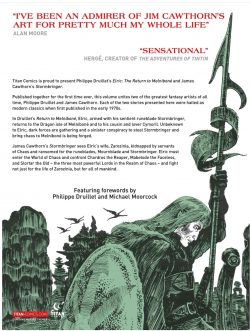
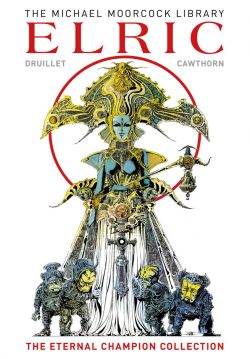
The Michael Moorcock Library – Elric: the Eternal Champion Collection


Adapted by James Cawthorn and Philippe Druillet, & various (Titan Comics)
ISBN: 978-1-78586-955-6 (HB/Digital edition)

This book includes Discriminatory Content produced in less enlightened times.

Michael Moorcock began his career at age 15; writing and editing classic British comic strips like Dogfight Dixon, Jet Ace Logan, Captain Condor, Olac the Gladiator, Tarzan and many, many other weekly favourites. As the swinging Sixties dawned he made the transition to prose fiction where he single-handedly revitalised a genre via the creation of Elric and the high-concept notion of an Eternal Champion.

Debuting in 1961, Elric is a landmark of fantasy and particularly its Sword & Sorcery subdivision: the foretold, fore-doomed last ruler of pre-human civilisation Melniboné, a race of cruel, nigh-demonic sorcerers. These arrogant, dissolute creatures are at the end of a slow, decadent decline after millennia of dominance over Earth. Albino Elric is physically weak, buoyed up by drugs, blood and dark magic, and of a brooding, philosophical temperament. He cares for little save his beautiful cousin Cymoril, who will die one day whilst he battles her loathsome usurping brother Prince Yyrkoon in service to a manipulative god of Chaos.

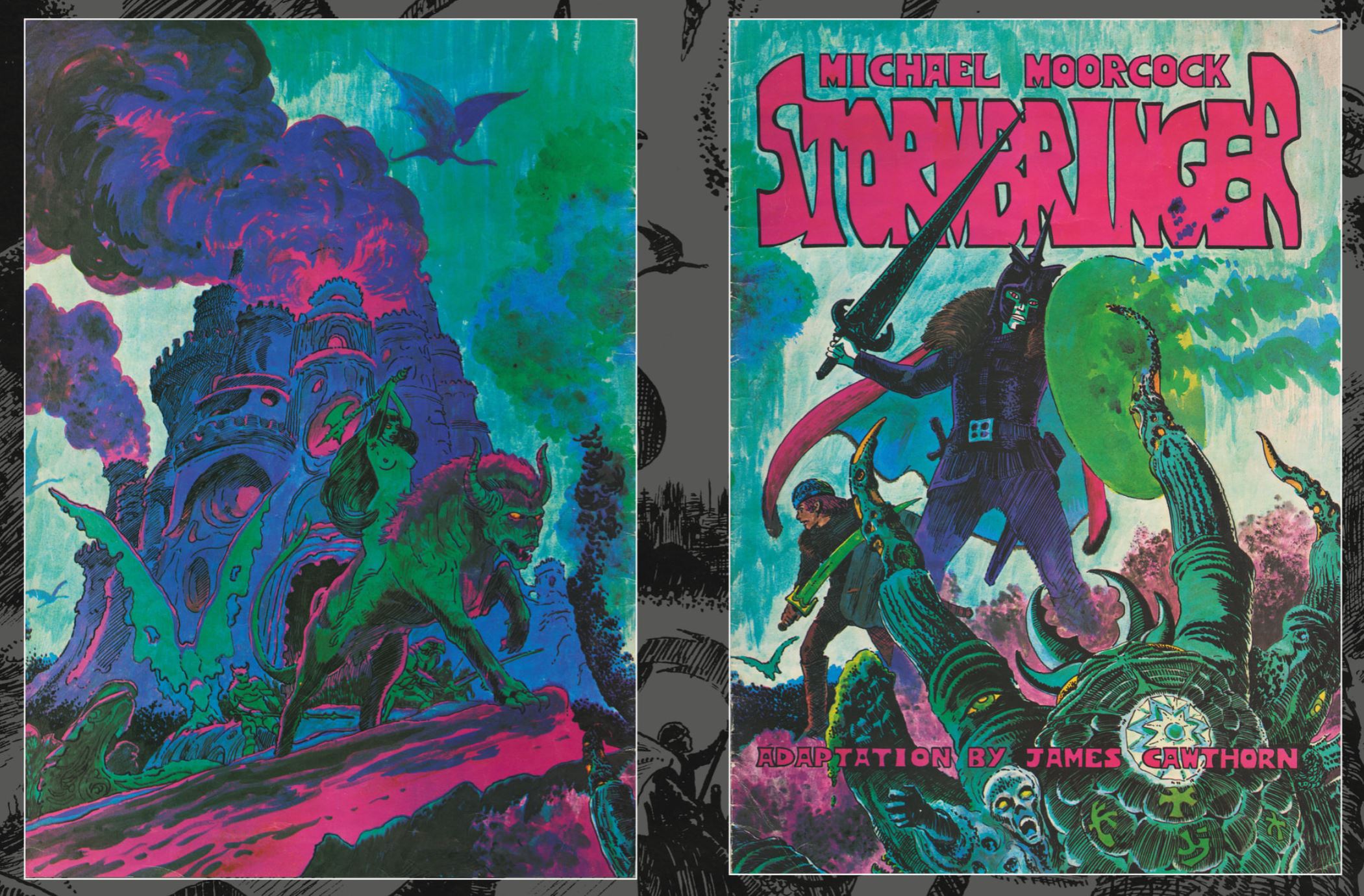
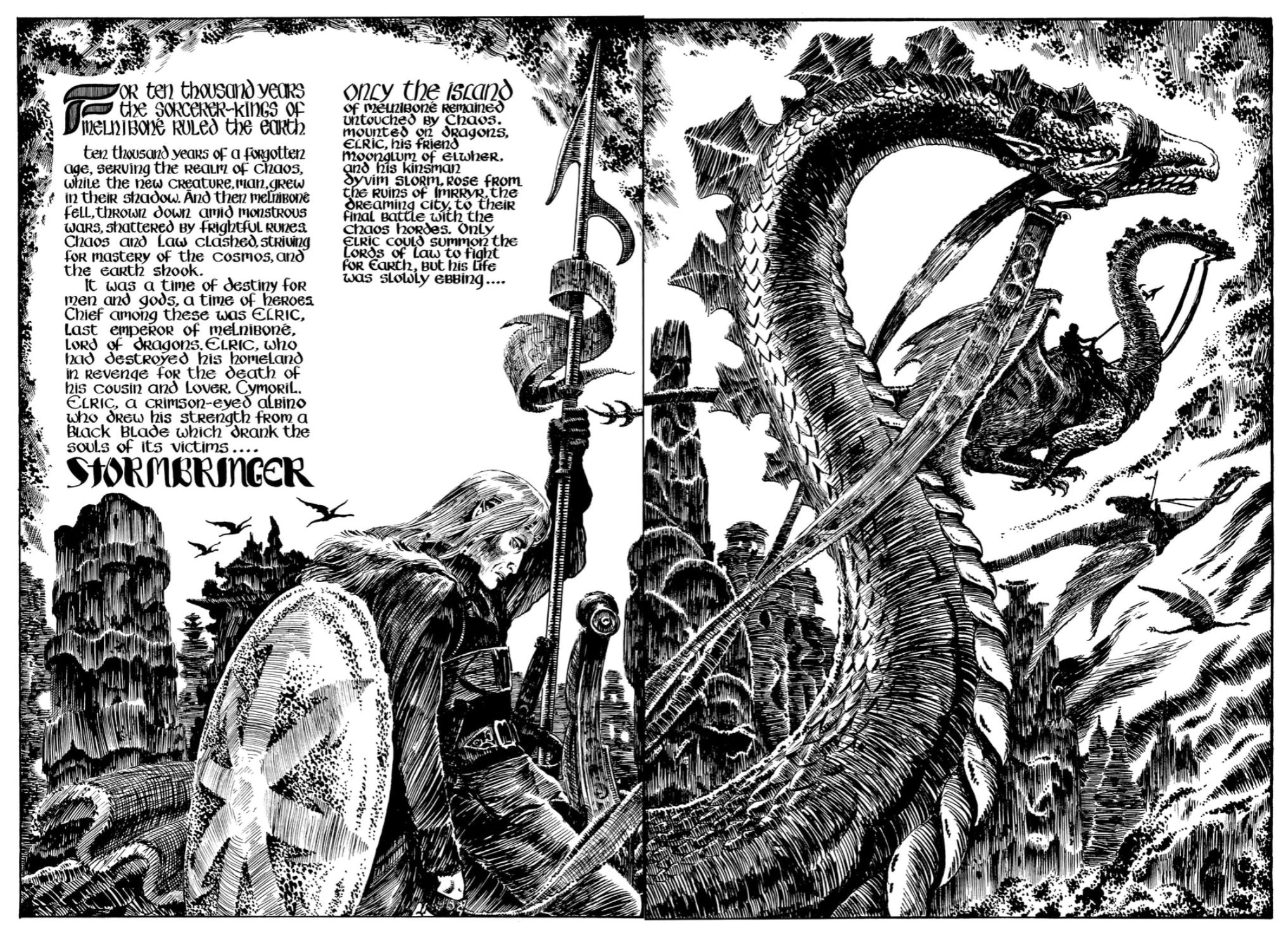
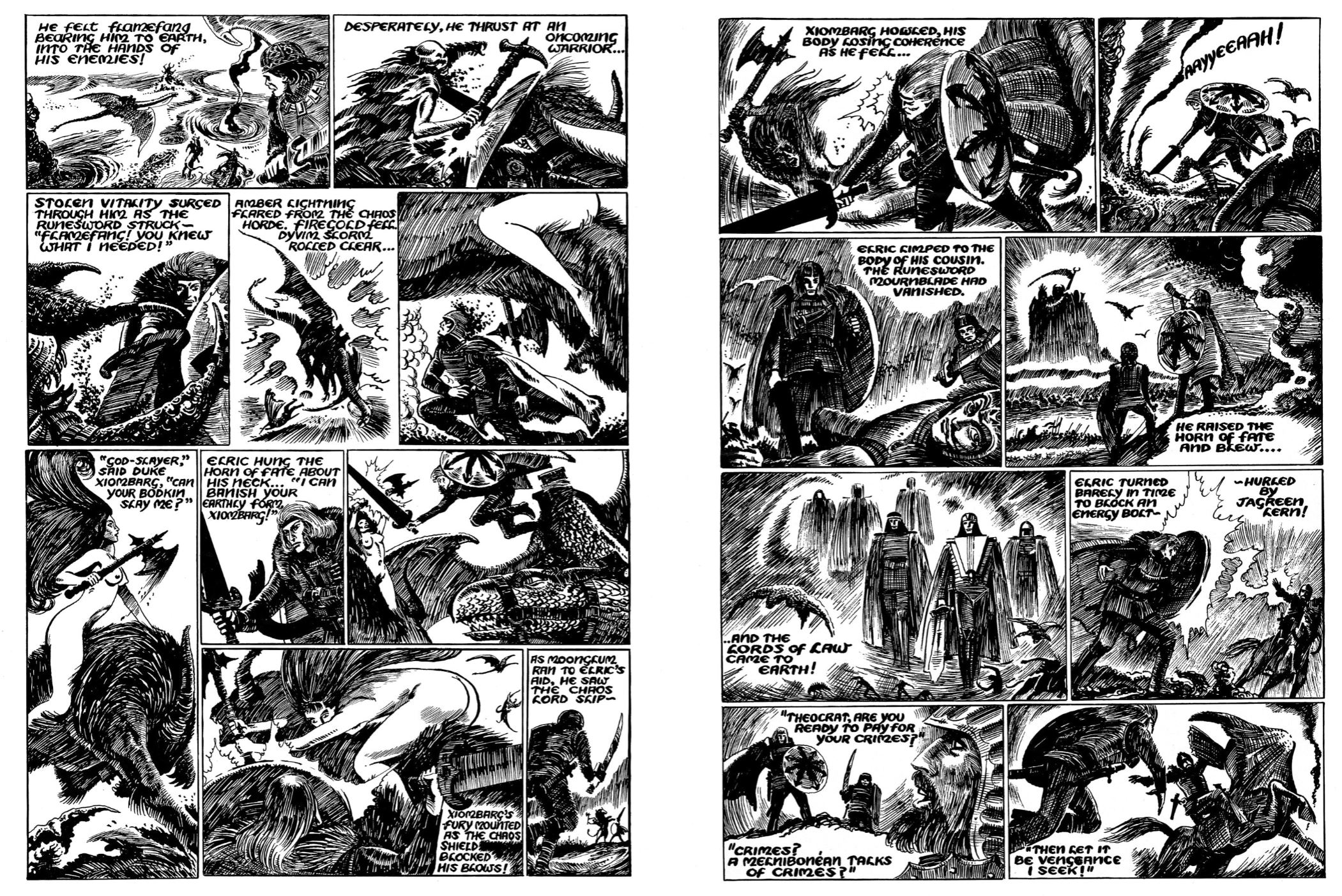
In this collection that day is right now as primary and premiere Elric artist Jim Cawthorne limns that final clash in a hugely personal adaptation from 1976, first and privately published by British concern Savoy Books in an edition that never really reached its natural audience…

“White Wolf” Elric doesn’t even want to rule, but it is his duty, and he is the only one of his debased race to see the (comparatively) freshly evolved race of Man as a threat to the Empire. He is owned if not actually possessed by terrible black sword Stormbringer: one of a matched pair of sorcerous weapons that steal the souls of their victims and feed that stolen life and vitality to the wielder…

Elric is a tragic incarnation of the restless Eternal Champion, reincarnated in every time, place and alternate dimension. His life is violence, blood and unending tragedy, exacerbated by dependence on that soul-drinking ebony blade and his sworn – if somewhat compelled and thus reluctant – allegiance to the chimerical Lords of Chaos.

Everybody knows all that, right?

The 13th volume in a proposed complete Michael Moorcock Library of comics adaptations (as well as reissue of the prose works), these yarns – chronologically at least – are the very first pictorial narratives of the doomed king; given an archival polish and pictorial upgrade by way of a brace of Introductions from Moorcock himself and Philippe Druillet. They are bolstered by a substantial contextual essay at the end. First, though, is time for a little history…

A migrated Tynesider lodged surreptitiously and contentedly in Ladbroke Grove at a time of great turmoil in the UK, James Cawthorn was an old friend, comics co-worker and always Moorcock’s preferred illustrator of the Last Emperor. Driven, solitary, universally respected and wedded to his craft, he wrote strips for Lion, Tiger and the UK weekly comics mill, painted murals and probably book covers; made backdrops for theatre productions; private art commissions; decorated apparel and/or instruments for musicians and bands like Hawkwind and Motörhead while toiling laboriously (and far too slowly and meticulously to be commercial) on beloved passion pieces like Stormbringer.

Cawthorne’s unique and potent adaptation of Moorcock’s epic book (a reworking of novellas Dead God’s Homecoming, Black Sword’s Brother, Sad Giant’s Shield and Doomed Lord’s Passing) was his masterpiece: released by admirers at Savoy because its owners Dave Britton & Michael Butterworth were prepared to pay in advance and wait for him to finish according to his own excoriatingly exaction standards. It was worth the wait when that epically huge cardstock album (600 x 430mm – 24 inches by 17!) finally blew away those lucky enough to get a copy. This reproduction gives readers everything they could want, but sadly cannot impart the wonderous sheer bloody size of it in your hands…

It was mostly missed here but hugely popular in German…

The complex convoluted story of that book’s creation holds even more revelations but are Moorcock’s to share, so let’s turn briefly to the tale itself.

Michael Moorcock’s irresistible blend of brooding Faustian tragedy and all-consuming action is (arguably) best enjoyed in his stories of Elric, but that restless imagination crafted many incarnations of his Eternal Champion able to stand on their own bloody merits and constantly shaped and reinterpreted by a vast and varied array of unique artistic visions. Elric is one doom-drenched, tragedy-attracting incarnation of the Eternal Champion, an aspect of a heroic force reincarnated in every time, place and alternate dimension. His specific life is bound to blood and self-torment, exacerbated by his dependence on a soul-drinking black sword and his sworn allegiance to callous and chimerical Lords of Chaos.

Here that angst-filled destiny come crashing around the hero’s head as brief moments of domestic contentment are washed away in blood when the eternal war between the Lords of Chaos and Order leads to the abduction of his human wife Zarozinia and Elric taking up the black blade for the final times. He reunites with old companion Moonglum and hunts down Jagreen Lern, Theocrat of Pan Tang as he attempts to conquer the world for his allies, the Dukes of Hell. The battles are long, savage, brutal and fantastical and result in the end of all that exists. However, it’s never been about when or where one dies but how and why…

Admit it, you should read more books, right?

Counterpointing that epic comics narrative is a contemporaneous appreciation from across the channel, where Europe also caught the cosmic zeitgeist of the era..

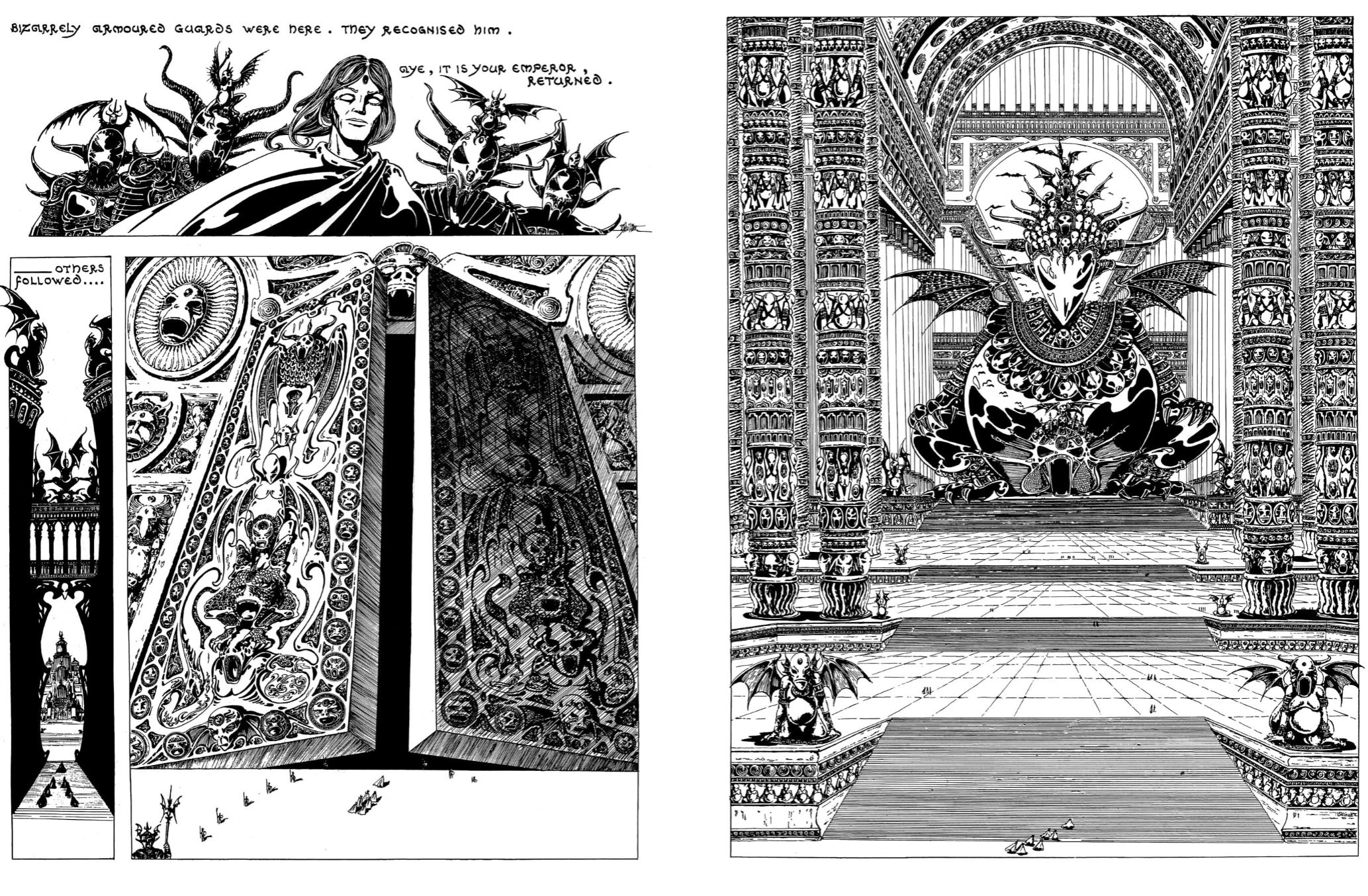
In the 1960s Elric’s oeuvre was translated by Moorcock & author Maxim Jakubowski introducing an up and coming illustrator to the world of Heroic Fantasy. Comics and fantasy storytelling took a huge leap forward in 1975 when Gallic comics collective Les Humanoides Associes began publishing groundbreaking magazine Métal Hurlant. However, one of their future visual mainstays had begun breaking borders and boundaries almost a decade earlier.

Photographer/artist Philippe Druillet started his comics career in 1966 with apocalyptic science fiction epic Le Mystère des abîmes (The Mystery of the Abyss) which introduced doom-tainted intergalactic freebooter and nomadic wanderer Lone Sloane in a tale of a far distant tomorrow thematically influenced in equal measure by H.P. Lovecraft, Clark Ashton Smith and A.E. Van Vogt. We will get to his other works in the courses of times…

Born in Toulouse in 1944, Druillet was raised in Spain, and his comics work was grandiose, panoramic, deeply baroque and overwhelmingly cosmic in scope. He also pretty much rejected standard formats and panels layouts in favour of boldly shocking graphics. Druillet began working for Pilote in 1969 and revived his star-rover in numerous shorter pieces, initially published together in 1972 as The Six Voyages. This collection, however, focuses on his brief but inspirational dealings with Moorcock’s primary ill-fated cosmic traveller…

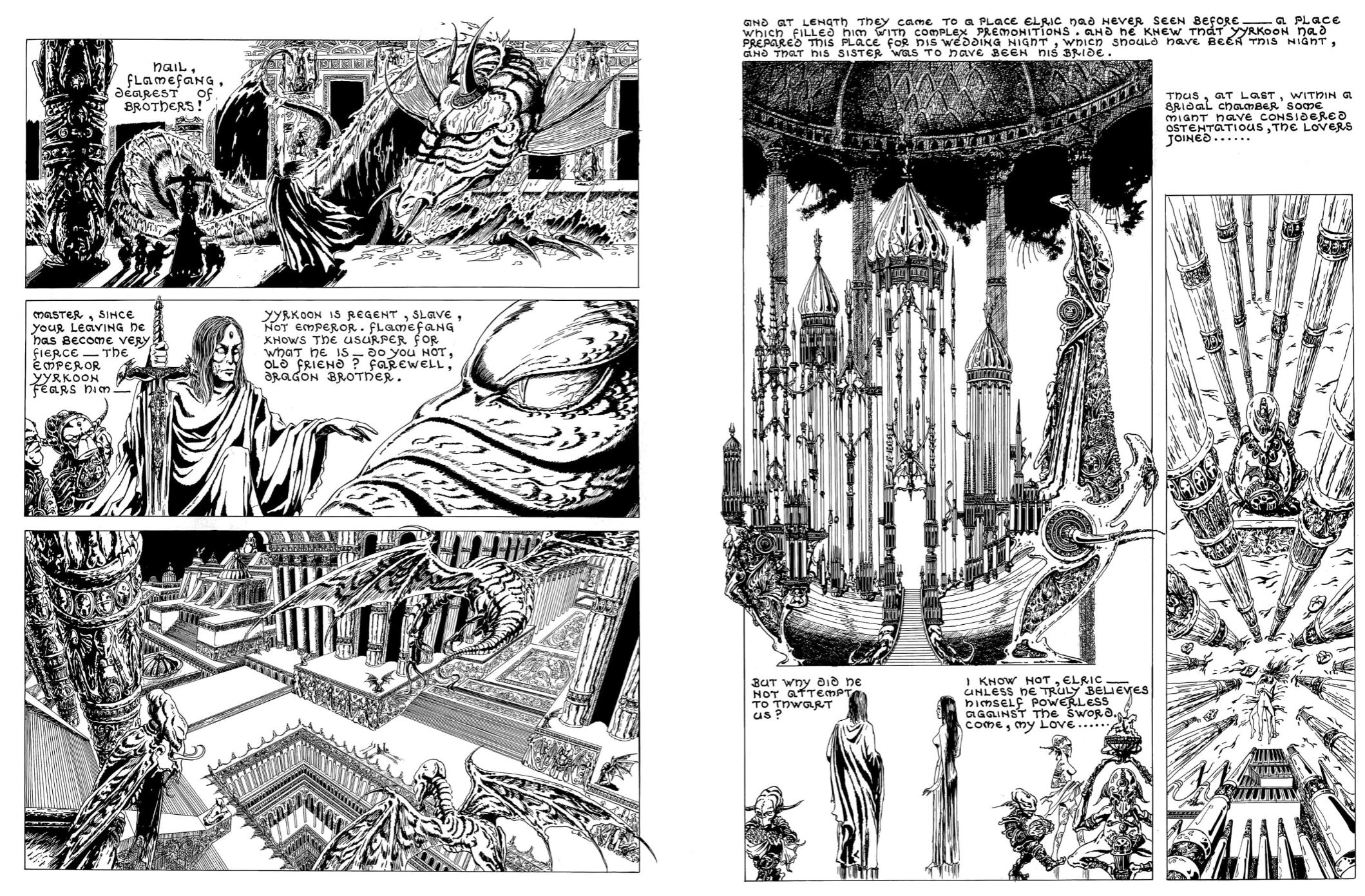
After preliminary tentative spreads in Moi Aussi, in 1969, a 21-plate portfolio entitled La Saga d’Elric le Necromancien was published. In 1973 Moorcock’s reworking of Michel Demuth’s text for the portfolio became Elric: The Return to Melniboné as published by Unicorn Bookshop in 1973. Its influence was far-reaching: just ask American creators like Keith Giffen, who repatterned his entire drawing style on what he saw…

Reproduced in its original monochrome, the brief interlude spectacularly and mind-alteringly details how the former Emperor reclaims his throne and position from apparently-ascendant rival Prince Yyrkoon and reacquaints himself with his bride-to-be Cymoril. Elric has no conception that the Lords of Chaos are closely watching and laying their plans for his future…

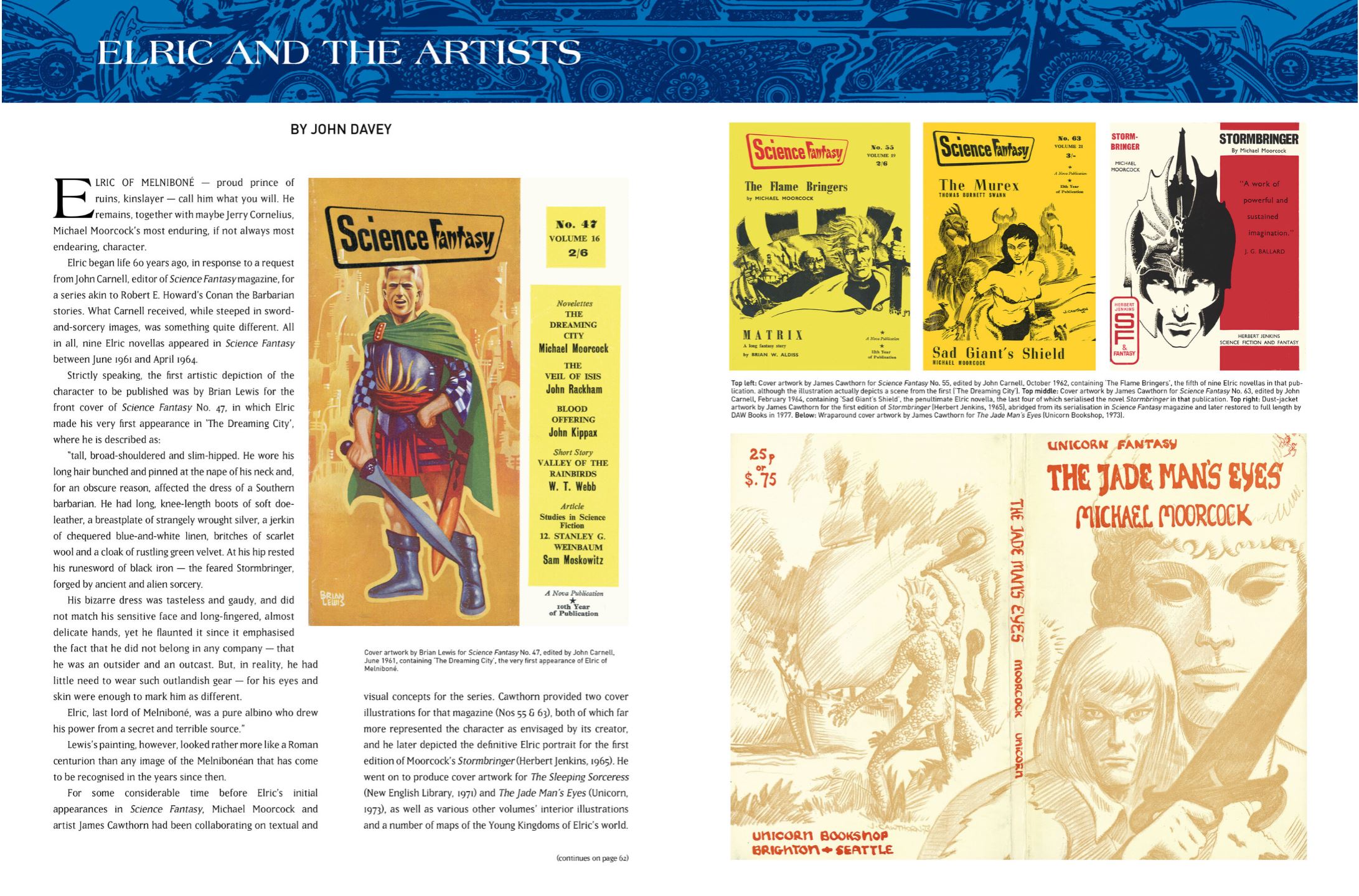
Closing the arcana and antiquities is ‘Elric and the Artists’ an incisively informative briefing by John Davey, detailing earlier efforts to visualise the Last Emperor, concentrating on his prose debuts, before going on to summarise and scrutinise the long history of graphic novel and comics interpretations.

Moorcock and his visual collaborators changed the comics world forever, This is how that all started…

Adapted from the works of Michael Moorcock related to the character of ELRIC © 2021, Michael & Linda Moorcock. All characters, the distinctive likenesses thereof, and all related indicia are TM & © Michael Moorcock and Multiverse Inc.
Elric the Return to Melniboné was first published by Unicorn Bookshop, 1973. Stormbringer was first published by Savoy Books in 1976.
EC horror and romance maestro Jack Kamen was born today in 1920, and shares the date with eco-activist cartoonist Larry Marder (Tales of the Beanworld) from 1951; editor and scripter Jim Salicrup in 1957; British comics veteran/educator Nigel Kitching (Sonic the Comic) in 1959 and The Boondocks creator Aaron McGruder in 1974.
Today in 1960 an era ended with the final page published of Warren TuftsLance.

Calling Dick Tracy! volume 1


By Mike Curtis, Joe Staton & various (Rabbit Hole)
ISBN: 978-0-930645-11-0 (digital edition)

Time for another anniversary celebration. Dick Tracy is 95 in five months’ time, so here’s a superb collection crying out for revival in either physical or digital forms. Another time to agitate against the publishing powers-that-be, I think…

All in all, comics have a pretty good track record for creating household names. We could play the game of picking the most well-known fictional characters on Earth – usually topped by Sherlock Holmes, Mickey Mouse, Superman Batman & Tarzan – and supplement the list with Popeye, Blondie, Charlie Brown, Tintin, Spider-Man, Garfield, and – not so much now, but once, most definitely – Dick Tracy

At the height of the Great Depression cartoonist Chester Gould sought fresh strip ideas. The story goes that as a decent guy incensed by the exploits of gangsters like Al Capone (who monopolised front pages of contemporary newspapers) the doughty doodler settled upon the only way a normal man could fight thugs: Passion and Public Opinion.

Raised in Oklahoma, Gould was a Chicago resident who hated seeing his home town in the grip of such wicked men, with far too many honest citizens beguiled by the gangsters’ charisma. He decided to pictorially get it off his chest with a procedural crime thriller that championed the ordinary cops who protected civilisation.

He took his proposal –“Plainclothes Tracy” – to Captain Joseph Patterson, the legendary newspaperman and strips Svengali whose golden touch had already blessed strips like The Gumps, Gasoline Alley, Little Orphan Annie, Winnie Winkle, Smilin’ Jack, Moon Mullins and Terry and the Pirates among others. Casting his experienced eye on the work, Patterson promptly renamed the hero Dick Tracy, whilst also revising his love interest into steady, steadfast girlfriend Tess Truehart. The daily series launched on October 4th 1931 through Patterson’s own Chicago Tribune Syndicate, growing quickly into a phenomenon and monumental hit, with all the attendant media and merchandising hoopla that follows. Bolstered by toys, games, movies, serials, animated features, TV shows et al, the strip soldiered on, influencing generations of creators and entertaining millions of fans. Gould unfailingly wrote and drew the strip for decades until retirement in 1977.

The legendary lawman was a landmark creation who influenced not simply comics but the entirety of American popular fiction. Its signature use of baroque villains, outrageous crimes and fiendish death-traps pollinated the work of numerous strips (most notably Batman), shows and movies since then, whilst the indomitable Tracy’s studied, measured use – and startlingly accurate predictions – of crimefighting technology and techniques gave the world a taste of cop thrillers, police procedurals and forensic mysteries such as CSI decades before the modern fascination took hold.

As with many creators in it for the long haul, the revolutionary 1960s were a harsh time for well-established cartoonists. Along with Milton Caniff’s Steve Canyon, Gould’s grizzled gangbuster especially foundered in a social climate of radical change where popular slogans included “Never trust anybody over 21” and “Smash the Establishment”. The strip’s momentum faltered, perhaps as much from a move towards trendy science fiction (Tracy went off-Earth into space and the character Moon Maid was introduced) as from those improbable, Bond-movie-style villains or perceived “old-fashioned” attitudes. Even the introduction of more minority and women characters – and hippie cop Groovy Groove – couldn’t stop the rot. However, the feature soldiered on regardless…

When Gould retired in 1977, 29-year old author Max Allen Collins (Road to Perdition, Nathan Heller, Mike Mist, Ms. Tree, Batman) won the prestigious role as scripter, promptly taking the series back to its crime-busting roots for a breathtaking run, ably assisted by Gould as consultant with his chief artistic assistant Rick Fletcher promoted to full illustrator. After 11 years, Collins was removed in 1992 and replaced by Mike Kilian – who apparently worked for half the up-&-coming novelist’s price – until his death in October 2005. Dick Locher took over story & art, with assistant Jim Brozman assuming drawing duties from March 2009. On January 19th 2011, Tribune Media Services announced Locher’s retirement and replacement by a new team. That’s where this digital-only book begins…

Atoudingly versatile and unbelievably prolific artist/inker Joe Staton (E-Man, Mike Mauser, The Avengers, Incredible Hulk, Green Lantern, Legion of Super-Heroes) has been an integral part of American comic books since the early 1970s and in later years made kids comics his metier. During a spectacular run on licensed classic Scooby Doo, he and series scripter Mike Curtis (Casper the Friendly Ghost, Richie Rich, Shanda the Panda) discovered a mutual love for Dick Tracy and – mostly for their own amusement – created a tribute strip entitled Major Crime Squad.

How that landed them the duty of continuing the ultimate cop’s official adventures is addressed in introductory text feature ‘Publisher’s Note – aka “The Dick Tracy vs. Major Crime Squad Caper”’ by Steve Tippie (VP of Licensing, TMS News & Features, LLC) before a stunning chronological re-presentation of all-new classics begins. Preceding those comic capers are more text-based insights and revelations: a Foreword by Mike Gold; former sheriff Curtis’ ‘How We Got the Job’ (supplemented by samples done in 2005 when they first tried to take on the strip) and Staton’s ‘Waiting For Dick Tracy’

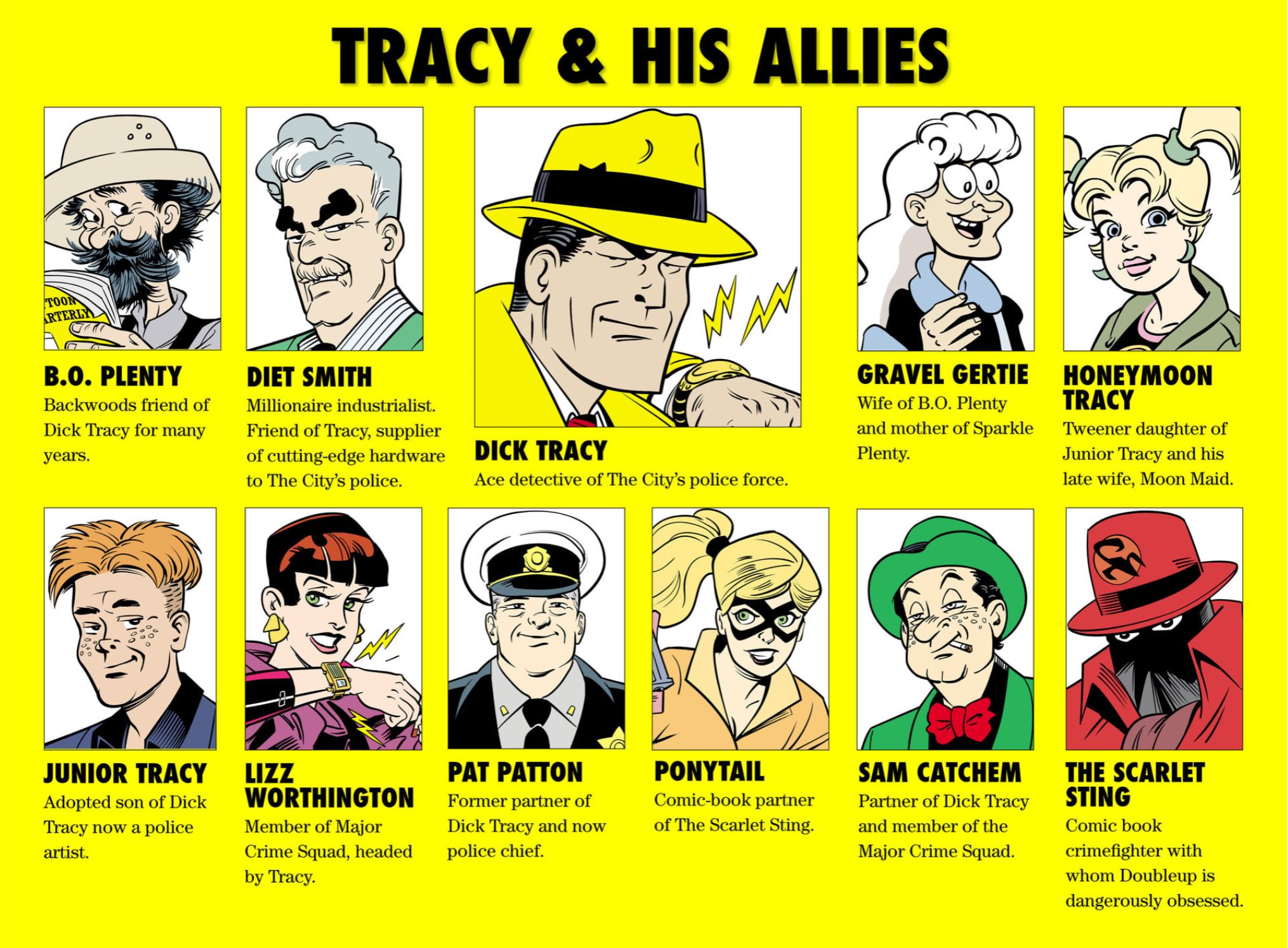
Next up is a brief visual refresher course of ‘Tracy and His Allies’ and the most nefarious of the repeat offenders in a ‘Rogues Gallery’ before the unending war on crime resumes in ‘Flyface and The Fifth Return’.

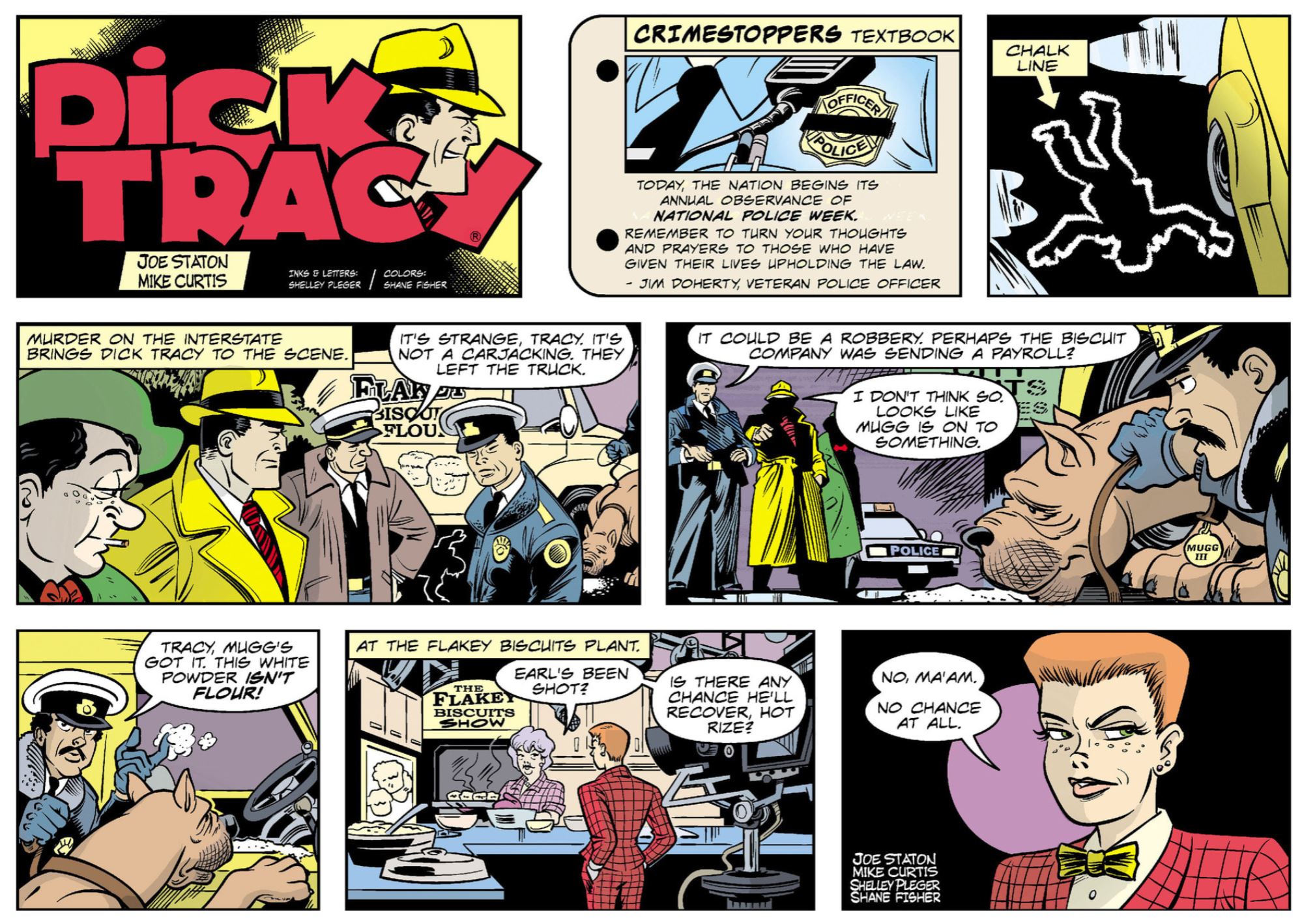
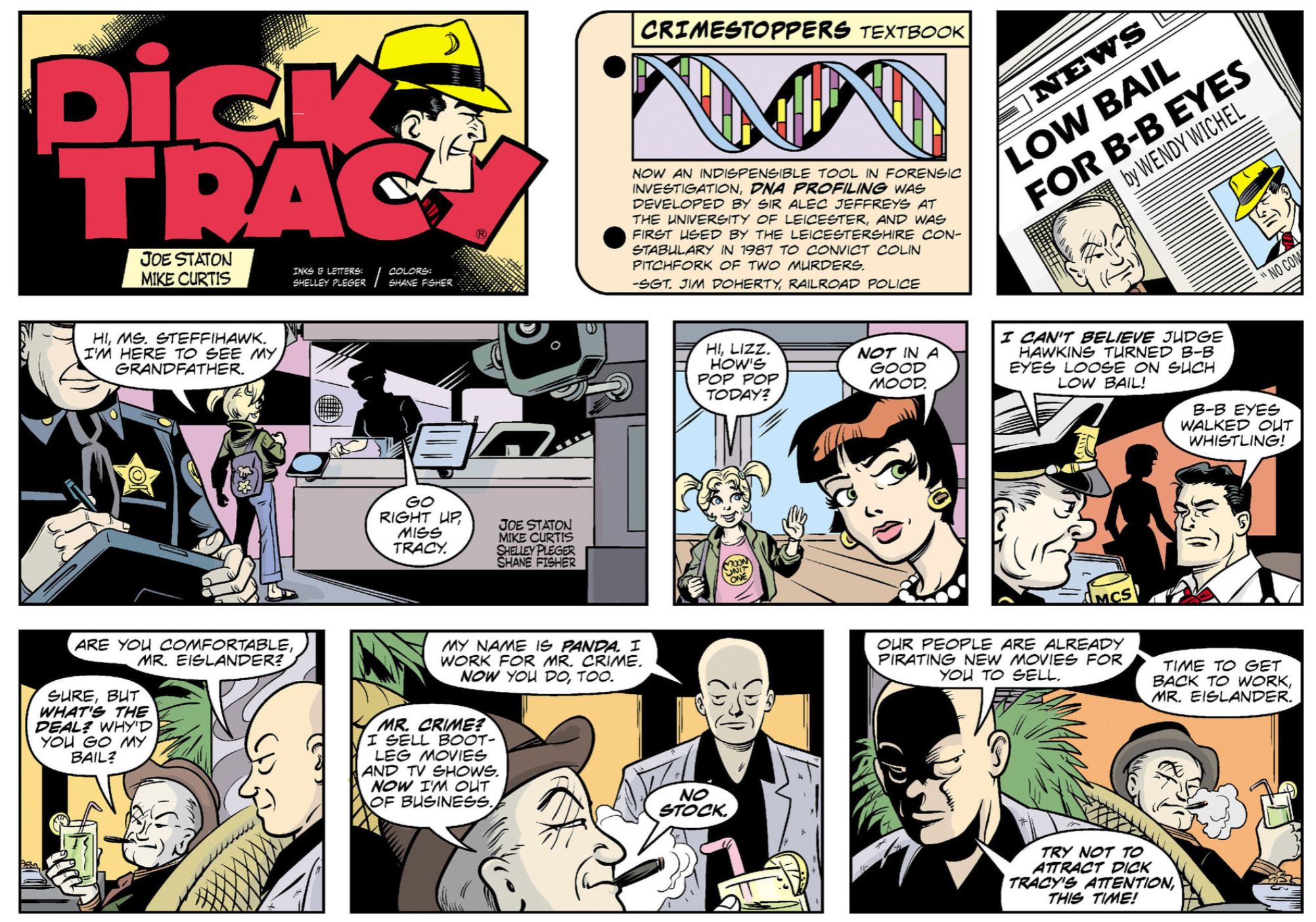
The strip has sadly long passed its heady glory days of mass sales, but that’s more about the death of print periodicals than this material. It still appears in a number of papers and as a potent online presences which means every episode is in full colour, with half-page Sunday strips still offering extras such as the ‘Crimestoppers Textbook’. One welcome addition is full credits so we can thank Shelley Pleger and Shane Fisher for their inks, colours and lettering. When Staton retired in October 2021, Pleger drew the feature, which these days is limned by Charles Ettinger…

The plot here sees the long separated traditional squad fully reunited to combat right wing terrorism and gradually reintroduced to the fanciful gadgets and controversial space tech after Tracy’s inventor pal Diet Smith gets in touch. A disgruntled former employee has stolen plans for his energy-beam weapon “Thor’s Hammer”…

After selling it to old lags Flyface and The Fifth – who kidnap officer Lizz Worthington to set a trap for their old nemesis – events spiral out of control, but only the wicked pay the final price this time…

Longtime comedic characters B.O. Plenty and his wife Gravel Gertie then resurface, celebrating the birth of their second child – the ugliest boy on Earth! – before falling foul of a manipulative foodie TV celebrity who sees a chance to own the airwaves with the stomach-churning infant in ‘Flakey Biscuits Makes the Dough’. Sadly, her bribing gifts to the couple include a shipment of cocaine being secretly couriered by her assistant Hot Rize, and soon bodies start dropping as the city’s top drug lord seeks to recover his missing product. Once Tracy realises what’s what, it’s all over bar the shooting…

‘Doubleup and the Scarlet Sting’ features the making of a movie starring a fictional superhero and depicts how childhood fan and modern-day gangster Doubleup barges in: infiltrating the cast to shakedown the production. Soon he’s too involved and after murdering his girlfriend all that’s left is being caught facing real-world justice…

At this time alternate Sunday extra ‘Tracy’s Hall of Fame’ (celebrating police officers) began, days before an officially deceased and clearly incorrigible arch enemy reappeared in ‘B-B Eyes and Honeymoon’. When Tracy’s adopted son Junior goes undercover to investigate a video piracy ring, the case quickly drags in the old cop’s granddaughter too, after Honeymoon Tracy tries to help out and almost dies because of her enthusiasm and lack of training.

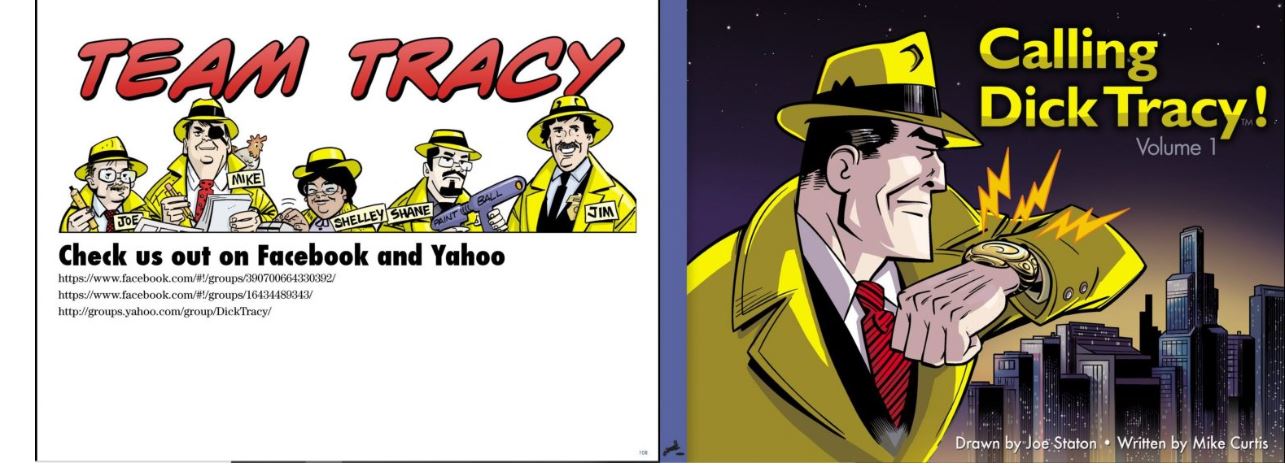
Even with the comics component concluded, there’s more informational extras to enjoy as Curtis offers ‘Dick Tracy vs. the Villains: A Comparison’ and we meet the current creators in ‘Joe Staton’s Bio’, ‘Mike Curtis’ Bio’ and ‘Team Tracy Bios’ to close this initial casebook – hopefully the first of many.

Dick Tracy has always been a fantastically readable feature and this potent return to first principles is a terrific way to ease yourself into his stark, no-nonsense, Tough Love, Hard Justice world. Comics just don’t get better than this.
© 2013 TMS News & Features, LLC. All rights reserved.

On this day in 2003, Jerry Bittle’s redneck-ribbing strip Geech appeared for the final time, but the date is shared by a host of birthday boys and girls including French illustrator Paul Léonnec in 1842; publisher Clay Geerdes in 1934; Argentinian Lucho Olivera (Nippur de Lagash, Gilgamesh the immortal) in 1942 and undying legend Barry Windsor-Smith in 1949. Stan (Usagi Jojimbo) Sakai arrived in 1953; both Mark (Breathtaker, Tug & Buster, Sandman) Hempel and Publisher Terry Nantier in 1957 and mangaka Tomoko Ninomiya (Nodame Cantabile) in 1969.

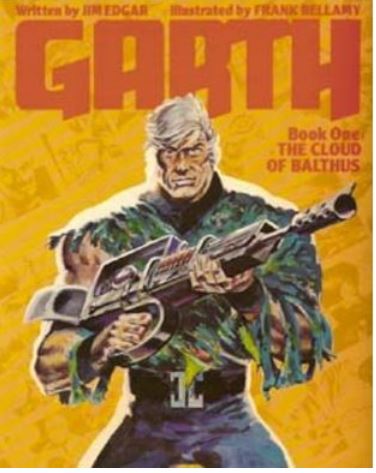
Garth: The Cloud of Balthus (volume 1)


By Frank Bellamy & Jim Edgar, with John Allard (Titan Books)
ISBN: 978-0-90761-034-2 (Album TPB)

This book includes Discriminatory Content produced in less enlightened times.

Frank Alfred Bellamy (21st May 1917 – 5th July 1976) is one of British Comics’ greatest comics artists. In the all-too-brief years of his career he produced magnificent, unforgettable visuals for Eagle, TV21, Radio Times (Doctor Who) before taking over The Daily Mirror newspaper strip Garth in 1971. He turned that long-running yet meandering and occasionally lacklustre strip into a magnificent masterpiece of unmissable adventure fantasy, with eye-popping, mind-blowing monochrome art other artists were proud to boast they swiped from. However, after only 17 stories, Bellamy died suddenly in 1976; and it’s absolutely criminal that his work isn’t in galleries, let alone in permanent collected book editions.

Bellamy was born in 1917 but didn’t begin comic strip work until 1953: the Monty Carstairs strip for Mickey Mouse Weekly. From there he moved on to Hulton Press and drew features starring Swiss Family Robinson, Robin Hood and King Arthur for Swift, the “junior companion” to Eagle. In 1957, he moved on to the star title, producing standout, innovative work on a variety of strips, beginning with a biography/hagiography of Winston Churchill. ‘The Happy Warrior’ was followed by ‘Montgomery of Alamein’, ‘The Shepherd King – the story of David’ and ‘The Travels of Marco Polo’, from which Bellamy was promptly pulled only a few months in. As Peter Jackson took over the back page historical adventure, Bellamy was on his way to the front cover and The Near Future.

When Hulton were bought by Odhams Press there soon manifested irreconcilable differences between Frank Hampson and the new management. Dan Dare’s creator left his superstar baby and Bellamy was tapped as replacement – although both Don Harley & Keith Watson were retained as Frank’s assistants. For a year Bellamy produced “The Pilot of the Future”: redesigning the entire look of the strip at management’s request, before joyfully stepping down to fulfil a lifetime’s ambition.

For his entire life Frank Bellamy had been fascinated – almost obsessed – with Africa. When asked if he would like to draw a big game hunter strip he didn’t think twice and Fraser of Africa debuted in August 1960, a single page per week in the prestigious full-colour centre section. Fraser of Africa was an artistic landmark and Bellamy’s techniques of line and hatching, in conjunction with sensitive, atmospheric colours, and even his staging and layout of pages, led to majestic Heros the Spartan and eventually the bravura creativity displayed in Thunderbirds and Captain Scarlet strips for TV21, before he opted for the strictures of monochrome and a single tier of 3-4 panels a day…

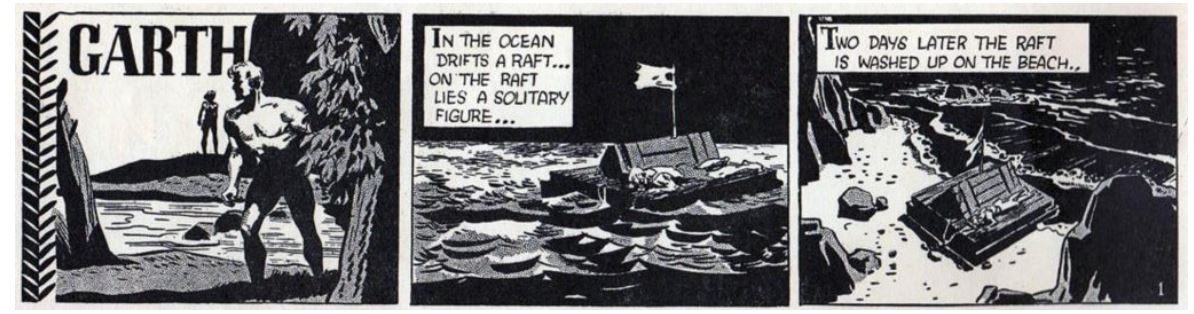
British Superman Garth first appeared in The Daily Mirror on Saturday, July 24th 1943, the creation of professional cartoonist Steve Dowling and BBC radio producer Gordon Boshell, at the behest of the editor who wanted an adventure strip to complement their other comic strip features: Buck Ryan, Belinda Blue Eyes, Just Jake and immortal, demi-immoral, morale-boosting Jane.

A blond giant and physical marvel with no memory of who he was, Garth washed up on an island shore and into the arms of a pretty girl… Gala. Nonetheless, he saved the entire populace from a brutal tyrant and a legend began. Boshell never had time to write the series, so Dowling – already producing successful family strip The Ruggles – scripted Garth until a new writer could be found. Don Freeman dumped the amnesia plot in ‘The Seven Ages of Garth’ (which ran from September 18th 1944 until January 20th 1946) by introducing imposing jack-of-all-sciences Professor Lumiere, whose subsequent psychological experiments regressed the burly hero back through some past lives.

In the next tale ‘The Saga of Garth’ (January 22nd 1946 – July 20th 1946) the origin was revealed. As an infant, “Garth” had been found floating in a coracle off the Shetlands and adopted by a kindly old couple. When full grown he became a Navy Captain until he was torpedoed off Tibet in 1943…

Freeman continued as writer until 1952 (‘Flight into the Future’ was his last tale), and was briefly replaced by script editor Hugh McClelland (who only wrote ‘Invasion From Space’) until Peter O’Donnell took over in February 1953 with ‘Warriors of Krull’. O’Donnell penned 28 adventures until resigning in 1966 to devote more time to his own strip: a little something called Modesty Blaise. His place was taken by Jim Edgar; a short-story writer who also scripted such prestigious newspaper strips as Matt Marriott, Wes Slade and Gun Law.

Dowling retired in 1968 and his long-time assistant John Allard took over the strip until a suitable permanent artist could be found. Allard completed ten complete tales until Frank Bellamy began a legendary run with the 13th instalment of ‘Sundance’ (which ran from 28th June to 1 October 11th 1971). Allard remained as background artist and assistant until Bellamy took full control during ‘The Orb of Trimandias’.

One thing Professor Lumiere had discovered and which gave this strip its distinctive appeal even before the fantastic artwork of Bellamy elevated it to dizzying heights of graphic brilliance, was Garth’s involuntary ability to travel through time and re-experience past and future lives. This simple concept lent the strip an unfailing potential for exotic storylines and fantastic exploits, pushing it beyond its humble beginning as a British response to Siegel & Shuster’s American phenomenon Superman.

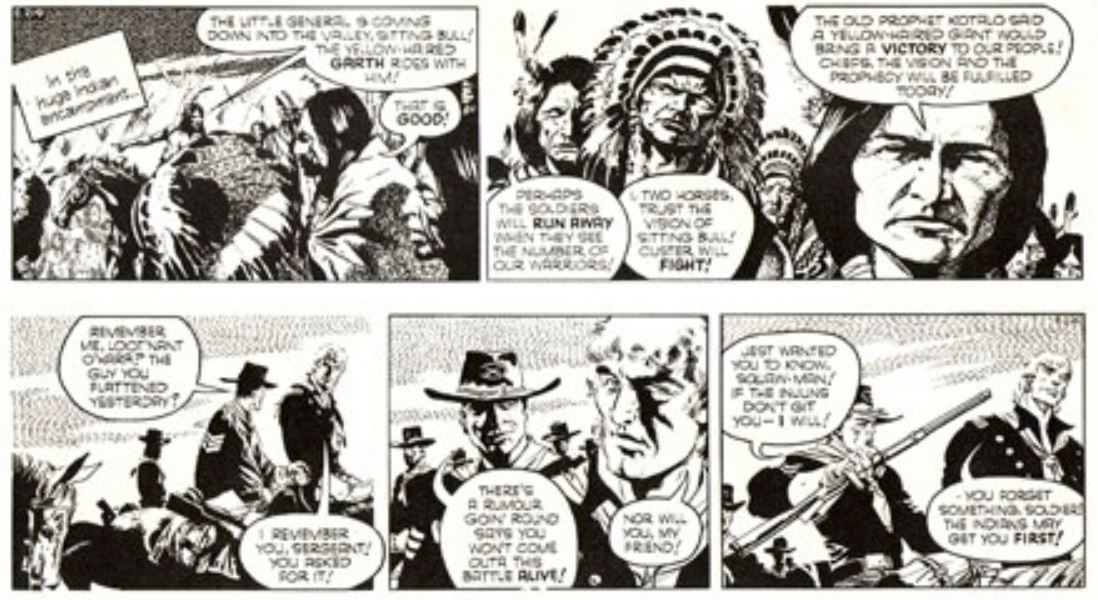
The tales in this criminally out of print monochrome tome begin with the aforementioned ‘Sundance’ as mighty Garth is drawn back to 1876 to relive his life as an officer of George Custer’s 7th Cavalry on the eve of the Battle of the Little Big Horn.

The time-tossed titan has a brief but passionate love affair with Indian maiden Falling Leaf before dying valiantly for his beliefs and their love. It is an evocative, powerful tale that totally captures the bigotry, arrogance and futility of the White Man and the tragic demise of the Indian way of life…

Then eponymous epic ‘The Cloud of Balthus’ shows the potent but simple elegance of the narrative concept sustaining Garth. Whilst vacationing in the Caribbean our hero becomes embroiled in an espionage plot involving freelance super-spies and a US space station, but even that is mere prelude to fantastic adventure and deadly terrors when he and delectable, double-dealing companion Lee Wan are abruptly abducted by nebulous energy beings in a taut, tension-fraught thriller.

‘The Orb of Trimandias’ plunges Garth back in time to Venice of the Borgias, when/where he becomes again English Soldier-of-Fortune Lord Carthewan: a decent man battling an insane and all-powerful madman for the secret of a supernaturally potent holy relic. This gripping, exotic yarn is replete with flamboyant action, historical celebrities, sexy men and women and magnificently stirring locales. It’s a timeless treasure of adventure that has the added fillip of briefly reuniting Garth with his star-crossed true love, ethereal Space Goddess Astra.

This lovely volume (long overdue for re-issue – at least in digital form if no other way is possible) concludes with a high-octane gothic horror story.

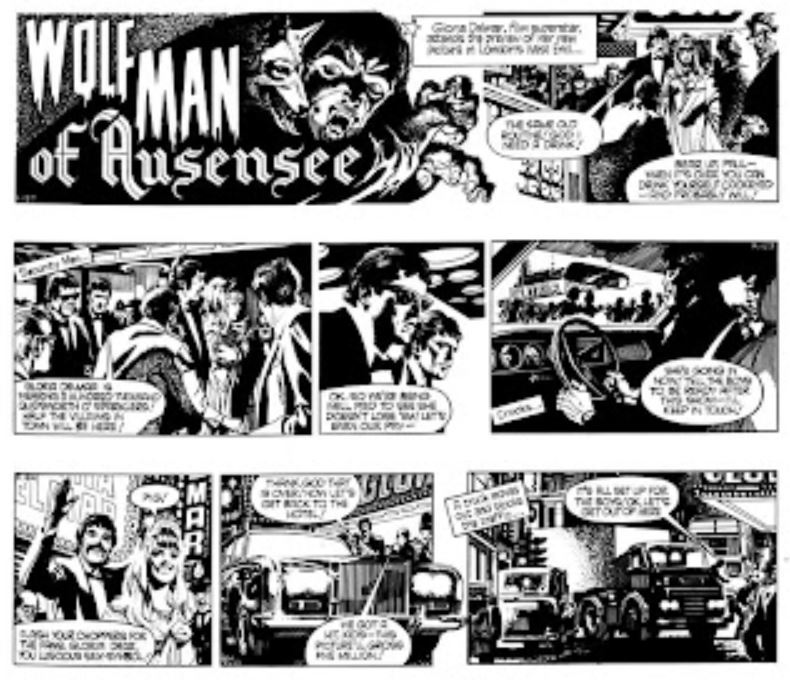
‘The Wolfman of Ausensee’ sees Garth as a rather reluctant companion of movie starlet Gloria Delmar on a shoot at the forbidding Austrian schloss (that’s a big ugly castle to you) of a playboy whose family was once cursed by witches. Despite the title giving some of the game away, this is still a sharp and savvy spook-fest comparing well to the best Hammer Horror films that no doubt inspired it, and just gets better with each rereading.

Garth is the quintessential British Action Hero: strong, smart, fast and good-looking with a big heart and nose for trouble. His back-story granted him all of eternity and every genre to play in, and the magnificent art of Frank Bellamy also made his too-brief tenure a stellar one.

Comic-strips seldom get this good, and even though this book and its sequel are still relatively easy (if not cheap) to come by, it is still a crime and an utter mystery that all these wonderful tales have been out of print for so long.
© 1984 Mirror Group Newspapers. All rights reserved.

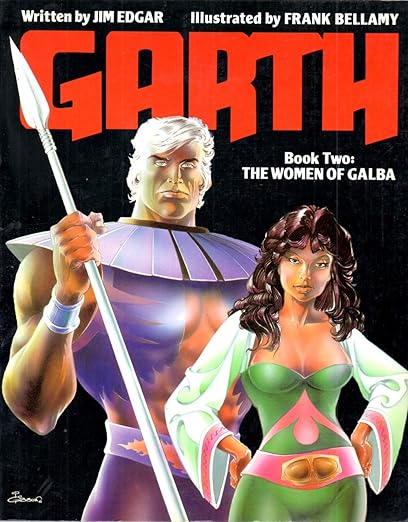
Garth: The Women of Galba (volume 2)


By Frank Bellamy & Jim Edgar (Titan Books)
ISBN: 978-0-90761-049-6 (Album TPB)

This book includes Discriminatory Content produced in less enlightened times.

A bold and daring blond giant and physical marvel, Garth was Britain’s answer to the blockbusting sensations of Superman, with the added advantage that the feature was officially aimed at adults rather than kids of all ages.

Originally released in 1985, this second Titan Books collection of Garth’s Frank Bellamy era spans 7th September 1972 to 25th October 1973 with the artist shown at the absolute peak of his powers, and opens with eerie chiller ‘The People of the Abyss’ wherein Garth and subsea explorer Ed Neilson are taken prisoner by staggeringly beautiful (what other kind are there?) naked women who drag their bathyscaphe to a city at the bottom of the Pacific. The undersea houris are at war with horrendous aquatic monstrosities and urgently need outside assistance, but even that incredible situation is merely prelude to a tragic love affair with Cold War implications…

Next up is eponymous space-opera romp ‘The Women of Galba’, wherein an alien tyrant learns to rue the day he abducted a giant Earthman to fight and die as a gladiator. Exotic locations, spectacular action and oodles more astonishingly beautiful females make this an unforgettable adventure for what the editors of the era still believed was a strip only grown men read…

‘Ghost Town’ is another western tale, and a very special one. When Garth, vacationing in Colorado, rides into abandoned mining outpost “Gopherville”, he is irresistibly drawn back to a past life as Marshal Tom Barratt who lived, loved and died when the town was a hotspot of vice and easily-purloined money. When Bellamy died suddenly in 1976 this tale – long acknowledged as his personal favourite – was rerun until Martin Asbury (who painted both Titan Book album covers here) was ready to take over the strip.

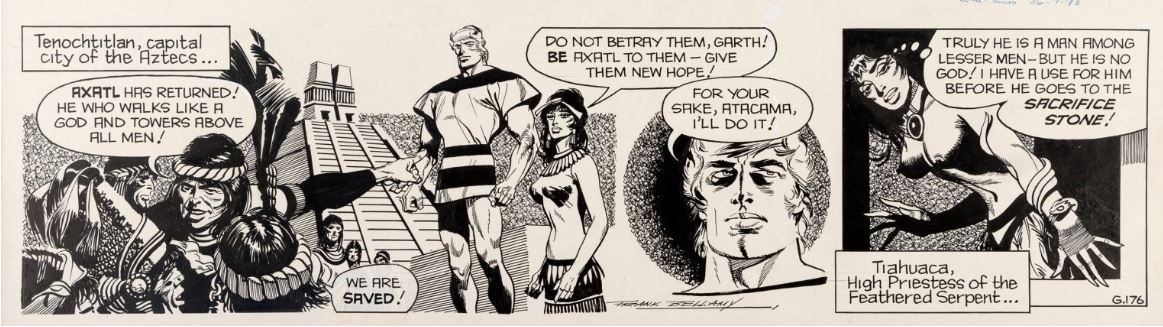
The final adventure re-presented here – ‘The Mask of Atacama’ – sees Garth & Lumiere in Mexico City. Whilst sleeping, the blonde colossus is visited by the spirit of Princess Atacama (also beautiful, of course) who escorts him through time to vanished Aztec city Tenochtitlan where, as the Sun God Axatl, Garth attempts to save their civilisation from the voraciously marauding Conquistadores of Hernán Cortés de Monroy y Pizarro Altamirano (as shortened for these brief 3-panel strip episodes to far more manageable Hernan Cortés)…

Tragically, neither Garth nor the Princess have reckoned on the jealousy of the Sun Priests and their High Priestess Tiahuaca

Adding extra value to this volume are a draft synopsis and actual scripts for ‘The Women of Galba’, all liberally illustrated.. There has never been a better comic adventure strip than Garth as drawn by Bellamy: a daily rip-roaring romp combining action, suspense, glamour, mystery and the uncanny in a seamless blend of graphic wonderment. In recent years, the comic strip colossus has fallen from memory as well as favour, but I’m still fervently praying that one day, Garth (and while I’m dreaming, Jeff Hawke too) will make the jump to curated complete archive editions. Go on, make on old man happy why don’t you? There’s certainly a grateful, appreciative and vast audience waiting…
© 1985 Mirror Group Newspapers/Syndication International. All Rights Reserved.

This day in 1915 Henry Sunday page illustrator Don Trachte was born, followed two years later by British legend Frank Bellamy (Fraser of Africa, Dan Dare, Garth, Heros the Spartan, Thunderbirds) and Mancunian émigré Lee Elias (Beyond Mars, Black Cat, Flash, Green Arrow, Eclipso, Luke Cage, Human Fly, Goblin, Rook) in 1920.

In 1943 French writer-artist Jean-Claude Fournier (Spirou and Fantasio, Bizu) was born as was writer/publisher Gary Reed (Sherlock Holmes, Deadworld, Saint Germaine, Baker Street, Caliber Comics) in 1956.

We lost pioneering Canadian cartoonist and animator Vital Achille Raoul Barré in 1932 and in 1977 gained a UK animal icon when Gnasher’s Tale (by David Sutherland) began, launching the manky mutt into his own Beano series detailing his life as a puppy before being adopted by Dennis the Menace

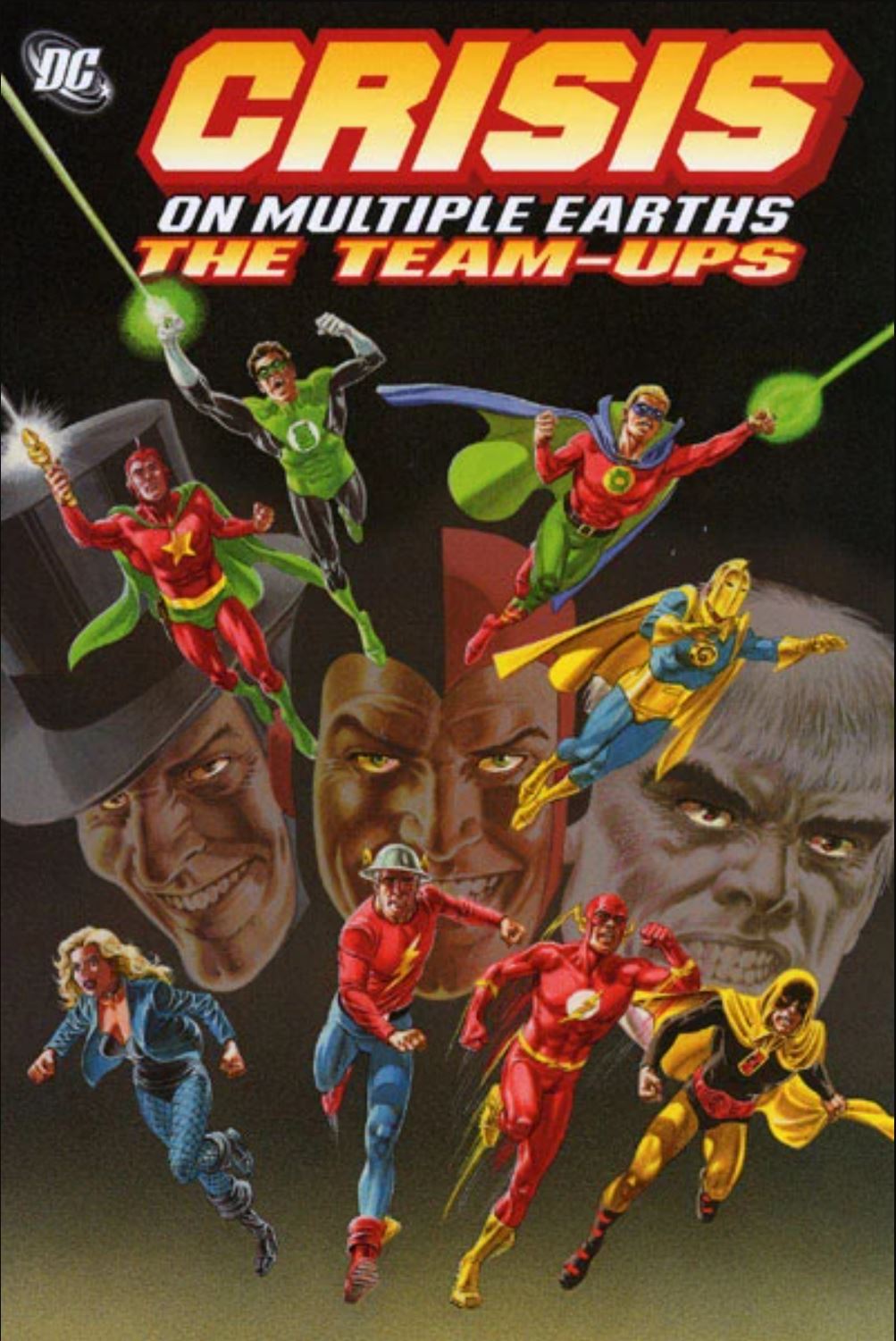
Crisis on Multiple Earths: The Team-Ups


By Gardner Fox, John Broome, Carmine Infantino, Murphy Anderson, Gil Kane, Dick Dillin, Joe Giella, Sid Greene & various (DC Comics)
ISBN: 978-1-4012-0470-9 (TPB)

This book includes Discriminatory Content produced in less enlightened times.

As I’ve interminably mentioned before, I was one of the “Baby Boomer” crowd that grew up with Gardner Fox & John Broome’s tantalisingly slow reintroduction of Golden Age superheroes during the halcyon, eternally summery days of the 1960s. To me those fascinating counterpart crusaders from Earth-Two were never vague and distant memories rubber-stamped by parents or older brothers – they were cool, fascinating and enigmatically new. And for some reason the “proper” heroes of Earth-One held them in high regard and treated them with obvious deference…

It all began, naturally enough, in The Flash, flagship title of the Silver Age Revolution. After ushering in the triumphant return of the costumed superhero concept the Scarlet Speedster, with Fox and Broome at the reins, set an unbelievably high standard for superhero adventure in sharp, witty tales of science and imagination, illustrated with captivating style and clean simplicity by Carmine Infantino.

Gardner Fox didn’t write many Flash scripts at this time, but those few he did were all dynamite. None more so than the full-length epic that literally changed the scope of American comics forever. ‘Flash of Two Worlds’ (The Flash #123, cover-dated September 1961, illustrated by Infantino & Joe Giella) introduced the concept of alternate Earths to a growing continuity and by extension resulted in the multiversal structure of the DCU, Crisis on Infinite Earths and all the succeeding cosmos-shaking crossover sagas that grew from it… And of course where DC led, others followed…

During a benefit gig Flash (police scientist Barry Allen) accidentally slips into another dimension where he finds the comic-book hero he based his own superhero identity upon actually exists. Every adventure he had absorbed as an eager child was grim reality to Jay Garrick and his mystery-men comrades on the controversially named Earth-2. Locating his idol, Barry convinces the elder to come out of retirement just as three Golden Age villains, the Shade, Thinker and Fiddler, make their own wicked comeback…

Thus is history made and above all else, ‘Flash of Two Worlds’ is still a great read that can electrify today’s reader.

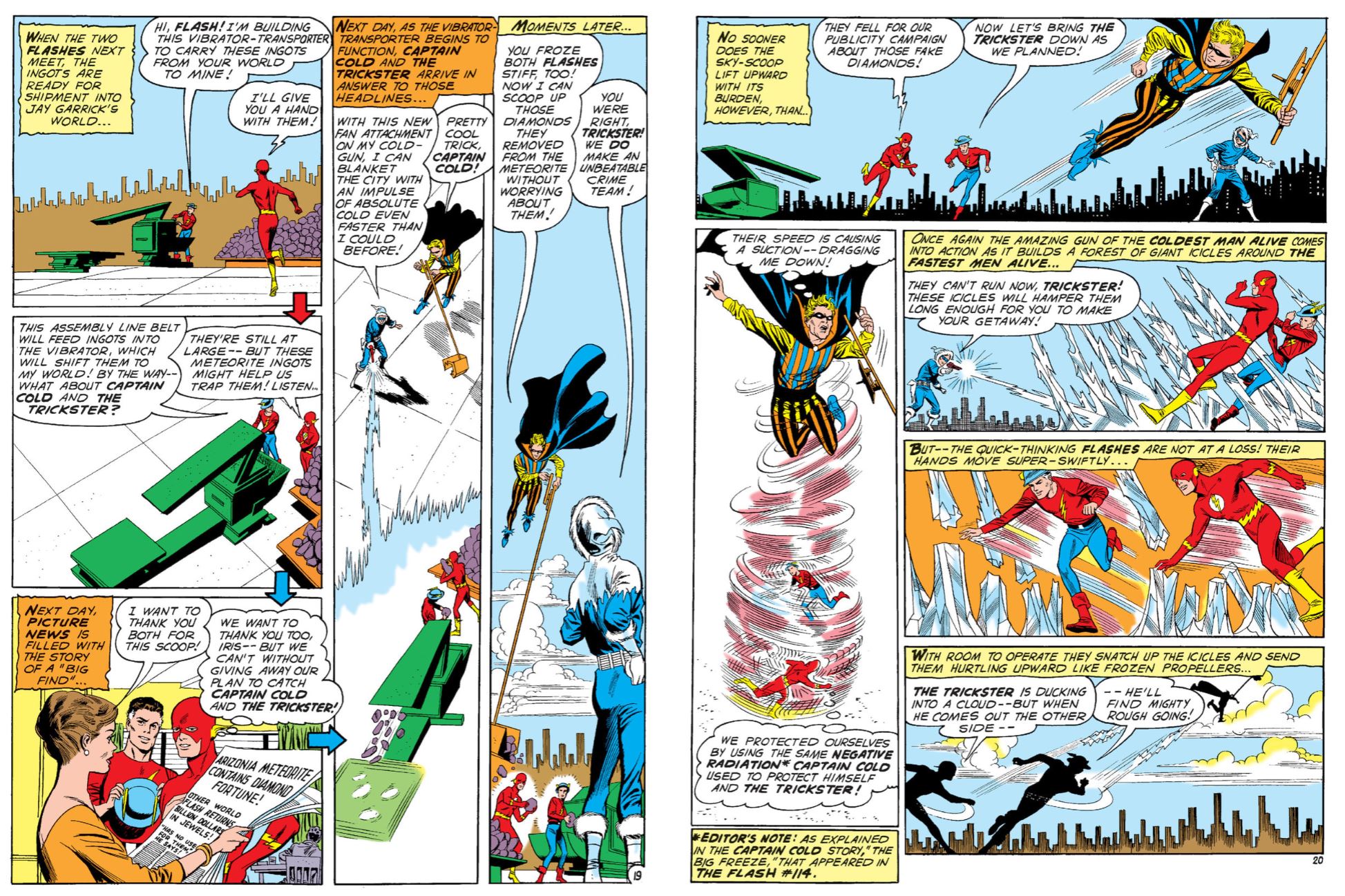
Fox revisited Earth-2 nine months later in #129’s ‘Double Danger on Earth!’ (inked by Murphy Anderson) as Garrick ventures to Earth-1 to save his own world from a doom comet, only to fall foul of Captain Cold and The Trickster. Another cracking thriller, as well as double Flash action, this tale teasingly reintroduced Justice Society stalwarts Wonder Woman, Atom, Hawkman, Green Lantern, Dr. Mid-Nite & Black Canary. Clearly Editor Schwartz had something in mind…

‘Vengeance of the Immortal Villain!’ from Flash #137 (June 1963, inked by Giella) was the third incredible Earth-2 crossover, and saw the Flashes unite to defeat 50,000 year old Vandal Savage and save the Justice Society of America: a tale which directly led into the veteran team’s first meeting with the Justice League of America and start of those aforementioned “Crisis” epics.

That landmark epic can be found elsewhere whilst this collection continues with the less well-known ‘Invader from the Dark Dimension!’ (Flash #151, March 1964, by Fox, Infantino & Giella): a full-length shocker wherein the demonic Shade ambitiously attempts to plunder both worlds.

Public approval was decidedly vocal and Editor Julie Schwartz used DC’s try-out magazines to sound out the next step: stories set on Earth-2 with exclusively Golden Age characters. Showcase #55 saw the initial team-up of Doctor Fate and Hourman as the Justice Society stalwarts battled the monster of Slaughter Swamp after ‘Solomon Grundy Goes on a Rampage!’ Produced by Fox & Anderson, this bombastic yarn even had room for a cameo by Earth-2’s Green Lantern, and the original text page featuring the heroes’ origins is also reproduced here.

Showcase #56 also featured “the Super-Team Supreme” (and by the same creative team supreme) in ‘Perils of the Psycho-Pirate!’ wherein ex-con Roger Hayden (cell-mate of the original JSA villain) steals the magical Masks of Medusa to go on an emotion-controlling crime-spree. Fan-historians should note that this tale is a pivotal antecedent of landmark event Crisis on Infinite Earths as well as a superbly engaging adventure in its own right. A text feature on the original Psycho-Pirate accompanies the story.

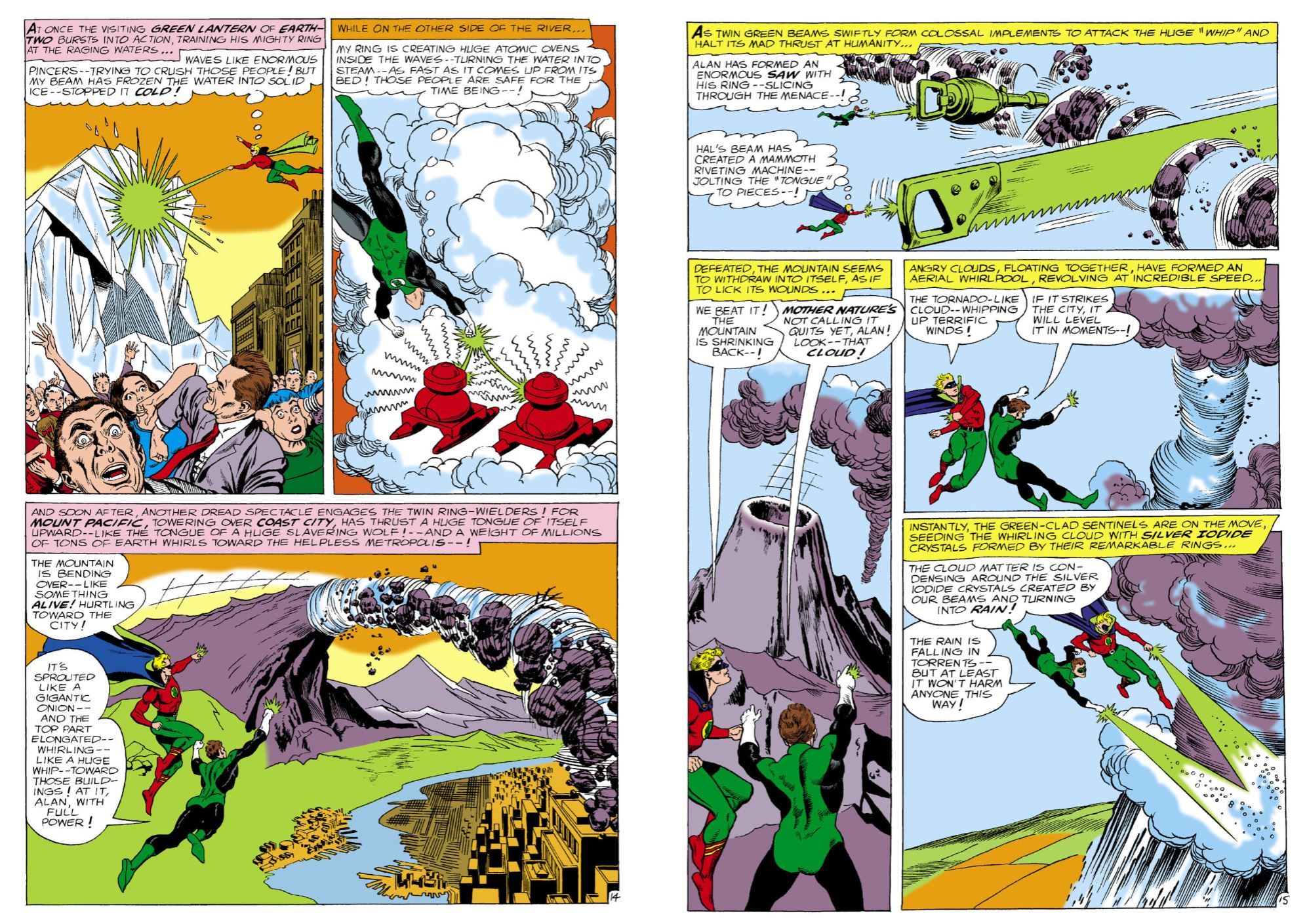
Although getting in late to the Counterpart Collaborations game, the inevitable first teaming of the Hal Jordan and Alan Scott Green Lanterns is one of the best – and arguably the second-most important – story of the entire decade. ‘Secret Origin of the Guardians!’ (John Broome, Gil Kane & Sid Greene, Green Lantern #40, October 1965) introduced renegade Guardian Krona, revealed the origin of the multiverse, showed how evil entered our universe and described how the immortal Oans took up their self-appointed task of policing the cosmos. It also shows Kane’s paramount ability to stage a superhero fight like no other. This pure comic book perfection should be considered a prologue to the aforementioned Crisis on Infinite Earths.

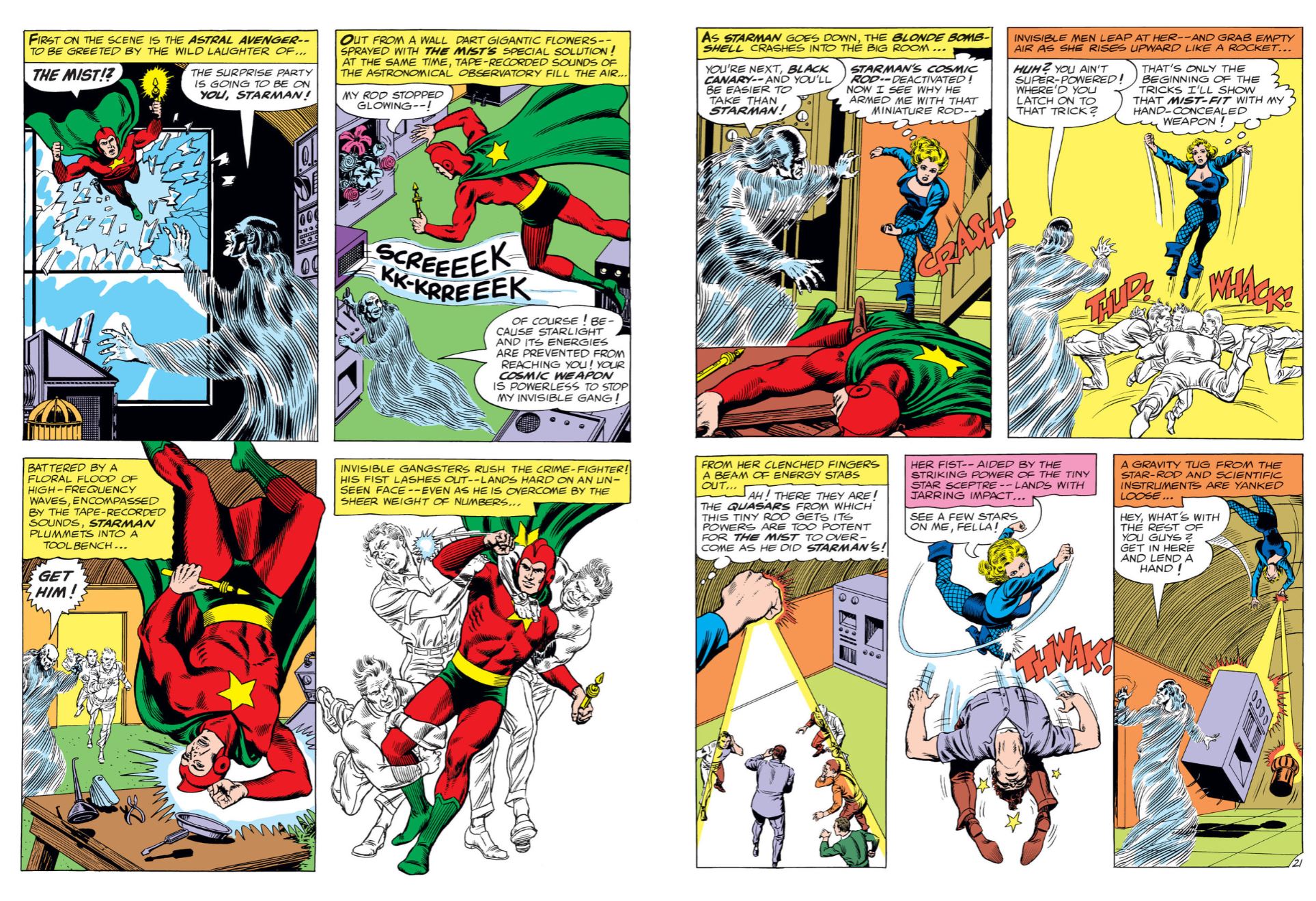
Still looking for an Earth-2 concept that could support its own series Schwartz, Fox & Anderson debuted the team of Starman & Black Canary in The Brave and the Bold #61 (September/October 1965): pairing the heroes against eerily translucent villain The Mist in ‘Mastermind of Menaces!’ This compelling thriller is augmented here by a text bio of Black Canary.

Although not featured in this volume, Schwartz & Fox did finally achieve their ambition to launch a Golden Age hero into his own title. After three Showcase appearances and many guest-shots The Spectre won his own book at the end of 1967, just as the super-hero craze went into a steep decline. We conclude with a back-up tale from The Spectre #7 (November/ December 1968). Fox, Dick Dillin & Greene’s ‘The Hour Hourman Died!’ is a dark, clever attempted-murder mystery that packs a book’s worth of tension and action into 9 moody pages and serves as a solid thematic reminder that the golden Silver Age of the 1960s was a creative high point that simply ended too soon, because when you start at the top the only way is down…

Still irresistible and compellingly beautiful after all these years, the stories collected here highlight the immense talent and imagination of the creators: gifts which shaped the US comics industry forever after and are still influencing not only today’s funnybooks but also the movies, TV and animated shows and movies that grew from them. These are tales and this is a book you simply must have.
© 1961, 1962, 1963, 1964, 1965, 1968, 2005 DC Comics. All rights reserved.

Today in 1899, Golden Age comic book pioneer Everett M. Busy Arnold (Quality Comics) was born, followed in 1911 by novelist, shared continuity groundbreaker and unparalleled inspirational character creator Gardner F. Fox (Justice Society & League of America, Flash, Zatanna, Sandman, Dr, Fate, Johnny Thunder, Hawkman, Doc Savage, Red Wolf, Adam Strange, The Face, Crom the Barbarian, Skyman, Starman, Spymaster, Batman, Batgirl, and thousands of genre shorts for every company in the US, ad infinitum).

In 1936 Malfunction Junction cartoonist Malcolm Hancock was born.

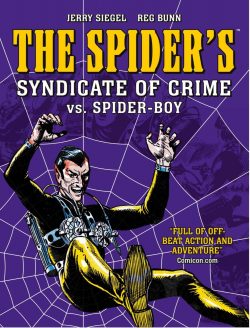
The Spider’s Syndicate of Crime vs Spider-Boy (volume 4)


By Jerry Siegel & Reg Bunn with John Burns, Geoff Campion and various (Rebellion)
ISBN: 978-1-83786-560-4 (Album TPB/Digital edition), 978-1-83786-685-4 (Webshop Exclusive edition)

This book includes Discriminatory Content produced in less enlightened times.

Another triumph of Rebellion’s Treasury of British Comics line, The Spider’s Syndicate of Crime vs. Spider-Boy is the latest offering in what I pray will be a complete revival of the UK’s most marvellous vintage comics fantasies (bring on Thunderbolt the Avenger, Smoke Man, Tri-Man, Gadget Man & Gimmick Kid and even the Phantom Viking… we can take it!).

Gathering material from peerless weekly anthology Lion, originally spanning May 27th to October 7th 1967 and including material from a later reprinting (Lion December 8th 1973), this collection also includes a prose done-in-one yarn from Lion Annual 1970 to complete another wildly whacky superhero romp as only the cocreator of Superman could envision it…

Mystery criminal genius and eventual superhero The Spider debuted on June 26th 1965 and reigned supreme until April 26th 1969. He has periodically returned in reprints and occasional new stories ever since. As first introduced by Ted Cowan (Paddy Payne, Adam Eterno, Robot Archie) & William Reginald Bunn.

“Reg” was an absolute master of his field and much beloved. His other work in comics (like Robin Hood, Buck Jones, Black Hood, Captain Kid and Clip McCord) spanned 1949 to his death in 1971 as, once the industry found him, he was never without work. Reg died on the job and is still much missed. For The Spider there was the ultimate accolade as, after opening on 2 pages per episode, the feature kept winning a bigger page count. Even so, lots had to happen in short order and Bunn never stinted or short-changed his audience. Played out for months at breakneck rollercoaster pace, each monochrome episode positively bulged with imaginative ingenuity, manic combats and crazy inventions peppering wide-eyed British kids with a bizarre conception of the USA…

Originally The Spider was man of unbelievably colossal vanity: a moody malcontent super-scientist whose goal was to be acclaimed the greatest criminal of all time. A flamboyantly wicked narcissist, he began his public career by recruiting crime specialists – scurvy, skeevy safecracker Roy Ordini and genteelly timid evil genius inventor Professor Pelham – prior to a massive gem-theft from America’s greatest city. He was foiled by cruel luck and resolute cops Gilmore &Trask: crack detectives cursed with the job of catching the arachnid archfiend. Cowan scripted the first two serialised sagas before handing over to comics royalty: Jerry Siegel (Superman, Superboy, The Spectre, Doctor Occult, Slam Bradley, Funnyman, The Mighty Crusaders, Starling), who had been forced to look elsewhere for work after an infamous dispute with DC Comics over the rights to the Man of Steel. His supervision of UK arachnid amazement began just as Britain and the entire, but somehow less fab & groovy, world succumbed to “Batmania”…

In case you’re not old, that term covers a period of global hysteria sparked by the 1966 Batman TV show, when the planet went crazy for superheroes and an era dubbed “camp” saw humour, satire, and fantastic psychedelic whimsy infect all categories of entertainment. It was a time of peace, love, wild music and radical change, and I believe there were lots of drugs being experimented with at the time…

British comics were always especially vulnerable to any passing trend or zeitgeist, and a host of more conventional costumed crusaders sprang up in our traditionally unconventional pages. Scripted by the godfather of the genre – and an inveterate humourist – The Spider remained an utterly arrogant sod even as he skilfully shifted gears without a squeak to become a superhero. Battling in rapid succession The Exterminator, Crime Incorporated, The Silhouette, Dr. Mysterioso, The Android Emperor, The Infernal Gadgeteer, The Crook From Outer Space, an evil Genie, transdimensional monstrogs and immortal Queen Lana of Valley of the Doomed he starts here as global figure of approbation and acceptance, only to see all his glittering glories plucked away…

As previously stated, the strip had grown ever more popular, and by the time of this epic encounter demanded a full 5 pages per episode, in a periodical where 1 or 2 pages a week was the norm. Another masterclass of illustrative wonderment displaying Bunn’s incredible gift for visualisation, the lengthy campaign finds The Spider, Pelham & Ordini targeted by honest greed, dastardly ambition and cruel misunderstanding as the tale in this tome reconnects with normal(ish) Good, Evil and Vengeance. Here The Spider duels a deadly criminal scientist only to find himself distracted and diverted by a young and ferocious deadly doppelganger…
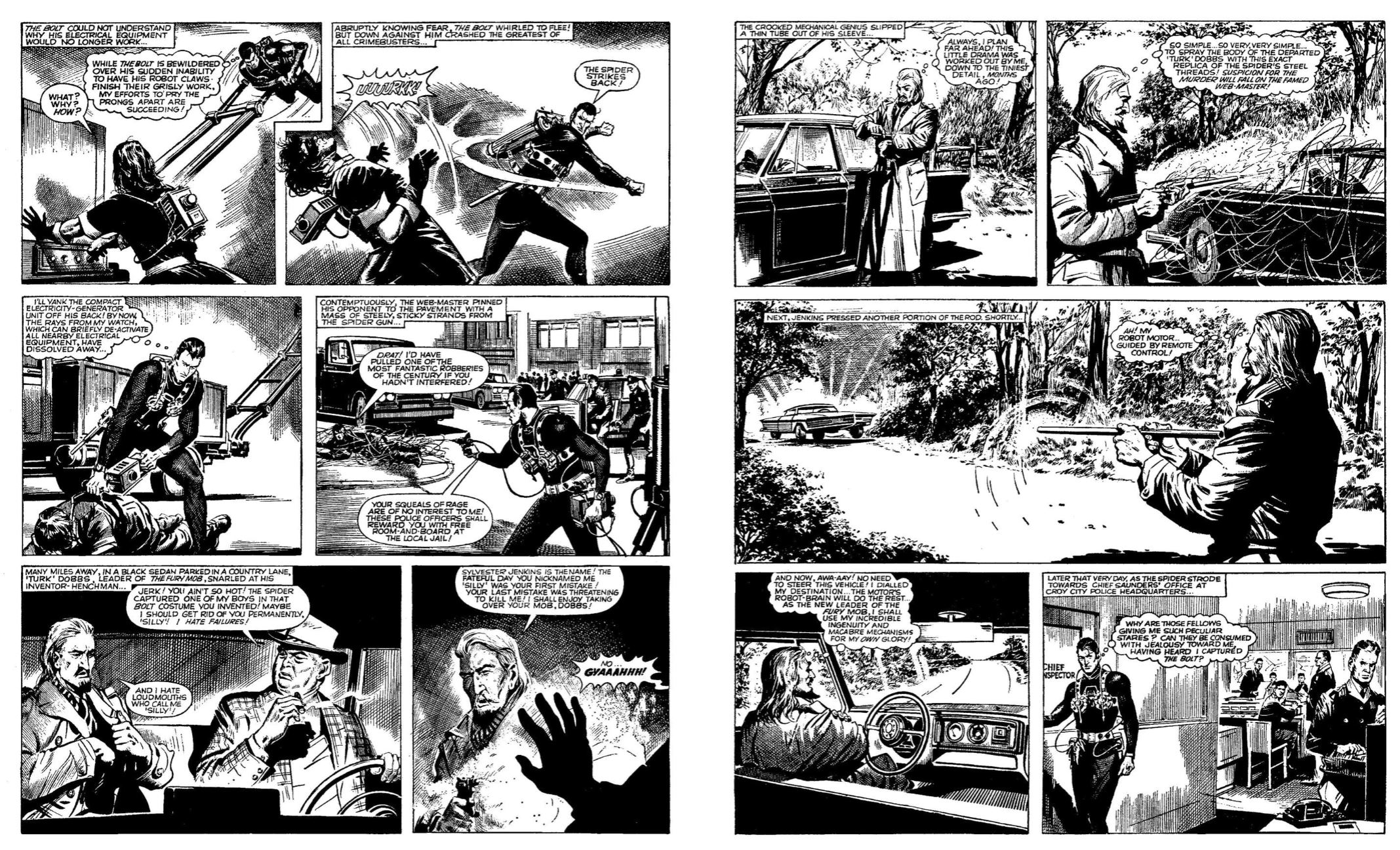
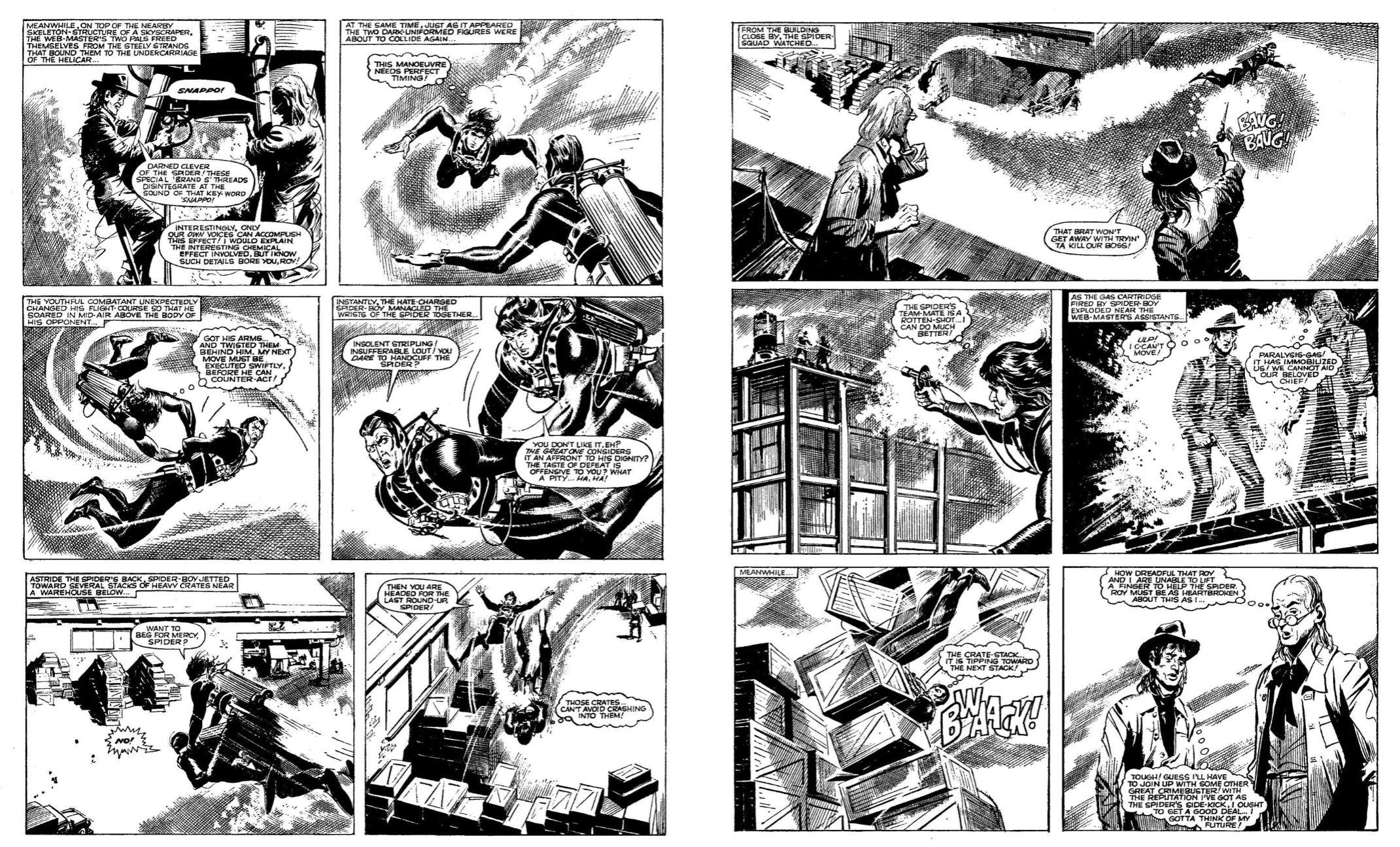
When criminal inventor Sylvester Jenkins (DO NOT call him “Silly”) teams up with Fury Gang boss “Turk” Dobbs, the first results are a wave of super-powered bandits such as The Bolt and insulting defeat by The Spider and his crew. In response Jenkins murders Dobbs (who coined the “Silly” moniker) and frames the hero for it. With the Spider on the run and unable to clear his name, let alone face a rush of mutated mobster/monsters, the situation grows truly complicated as a brilliant but vicious teenager wearing stolen Spider gear hunts and humiliates the great hero time and again.

Outfought, outmanoeuvred and on the run, the prospects are dire after Jenkins recruits Spider-Boy and orchestrates his following forays against the despised fallen hero, until the kid learns a bitter truth and shares a tragic secret that changes everything…

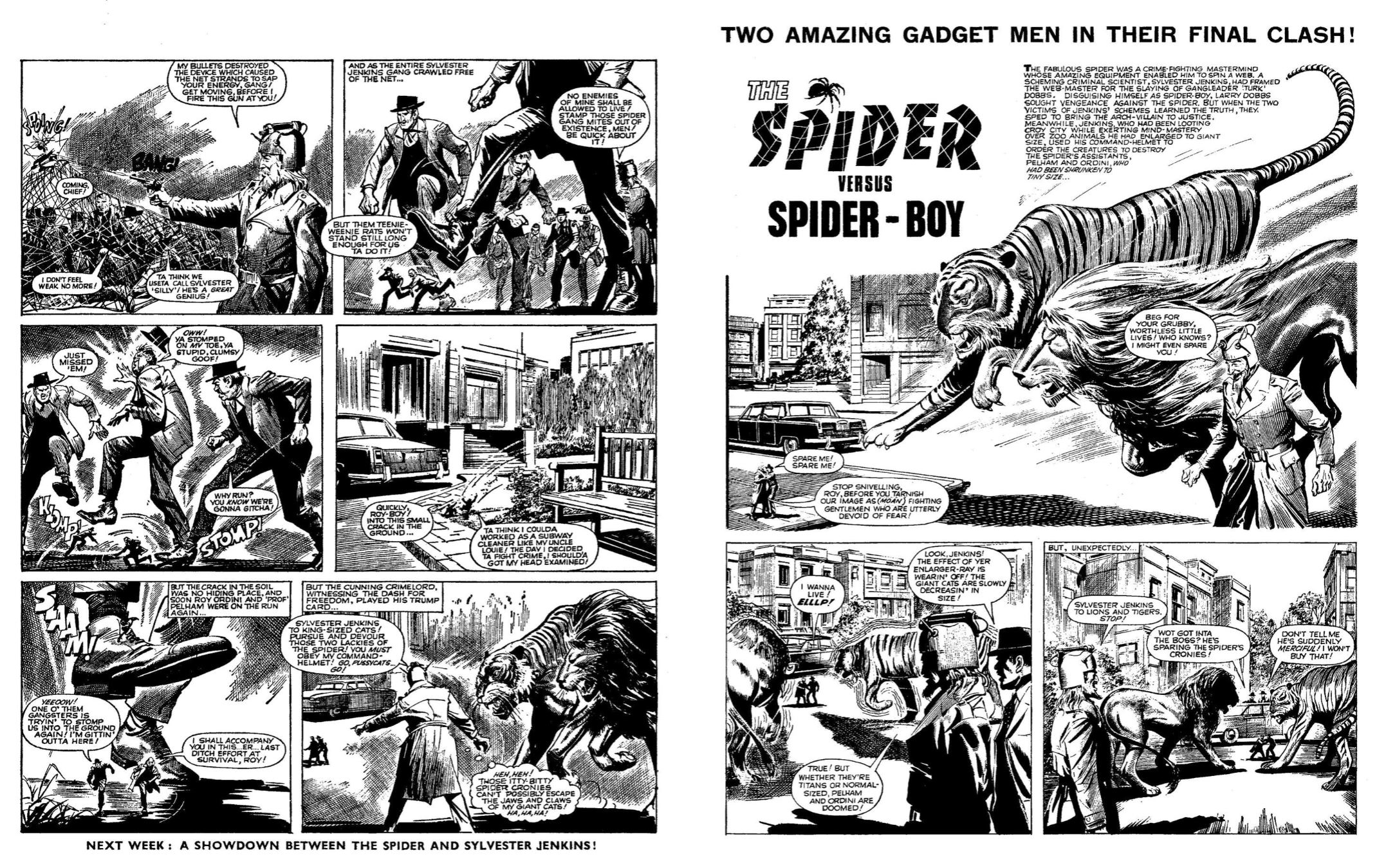
A far darker and more traditionally motivated tale, the delivery still rockets along with wild invention as incidental dangers pile up: horrors such as trigger-happy cops, Jenkins’ relentless monster experiments, naturally-occurring rival bio-terrors, rampaging bug-bots, flying castles, mutated circus and zoo animals and a climactic showdown in a lost city of super technologies, before all the truths come out and justice is served…

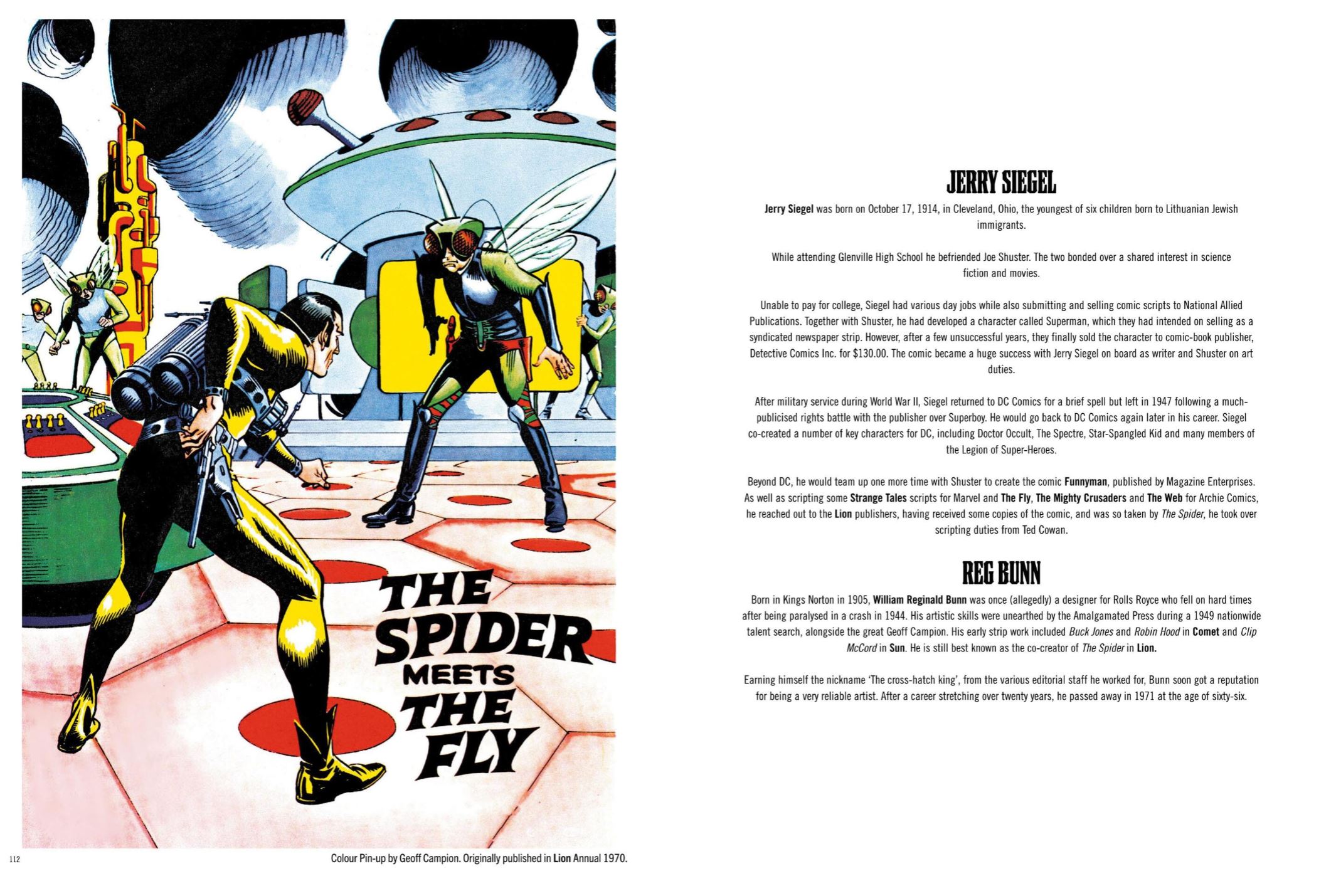
The Extras section then offers a rare treat from a later era, as – when the serial was truncated and re-run in 1973 – the editors opted to commission a new final episode and alternate conclusion; scripted by an unknown writer but illustrated by John Burns as seen in Lion December 8th 1973. It’s followed by text thriller ‘The Spider Meets the Fly’. Illustrated and written by hands unknown for Lion Annual 1968 this yarn pits the Spider and Co. against a world-conquering science villain and his volcano-dwelling army of high-tech assassins… with the usual results, and is accompanied by the book’s original full-colour frontispiece highlighting the clash as painted by Geoff (Battler Britton, Captain Condor, Typhoon Tracy, The Spellbinder, D-Day Dawson) Campion.

This titanic tome confirms that the King of crime crushes is still top of the heap and should find a home in every kid’s heart and mind, no matter how young they might be, or threaten to remain. Batty, baroque and often simply bonkers, The Spider proves that although crime does not pay, it can offer a huge amount of white-knuckle fun…
© 1967, 1969, 1973 & 2025 Rebellion Publishing IP Ltd. All Rights Reserved.

Today in 1777 English caricaturist and illustrator Richard Newton was born, followed in 1903 by Jimmy Olsen, Captain Marvel artist Pete Costanza; Ralph Reese (Solomon Kane, Witzend, One Year Affair) in 1949, and Argentine cartoonist Maitena Burundarena (Mujeres Alteradas) in 1962.

In 2017, comic book chameleon Rich Buckler (Deathlok, Fantastic Four, All-Star Squadron, Batman, Superman vs Shazam, Red Circle Comics) died.

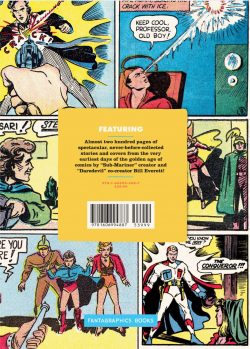
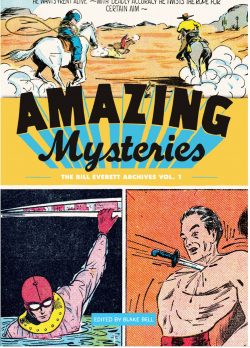
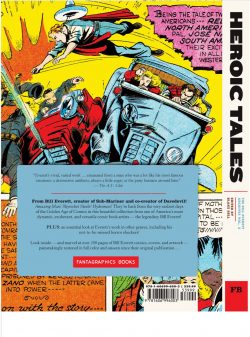
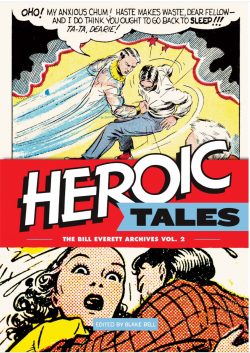
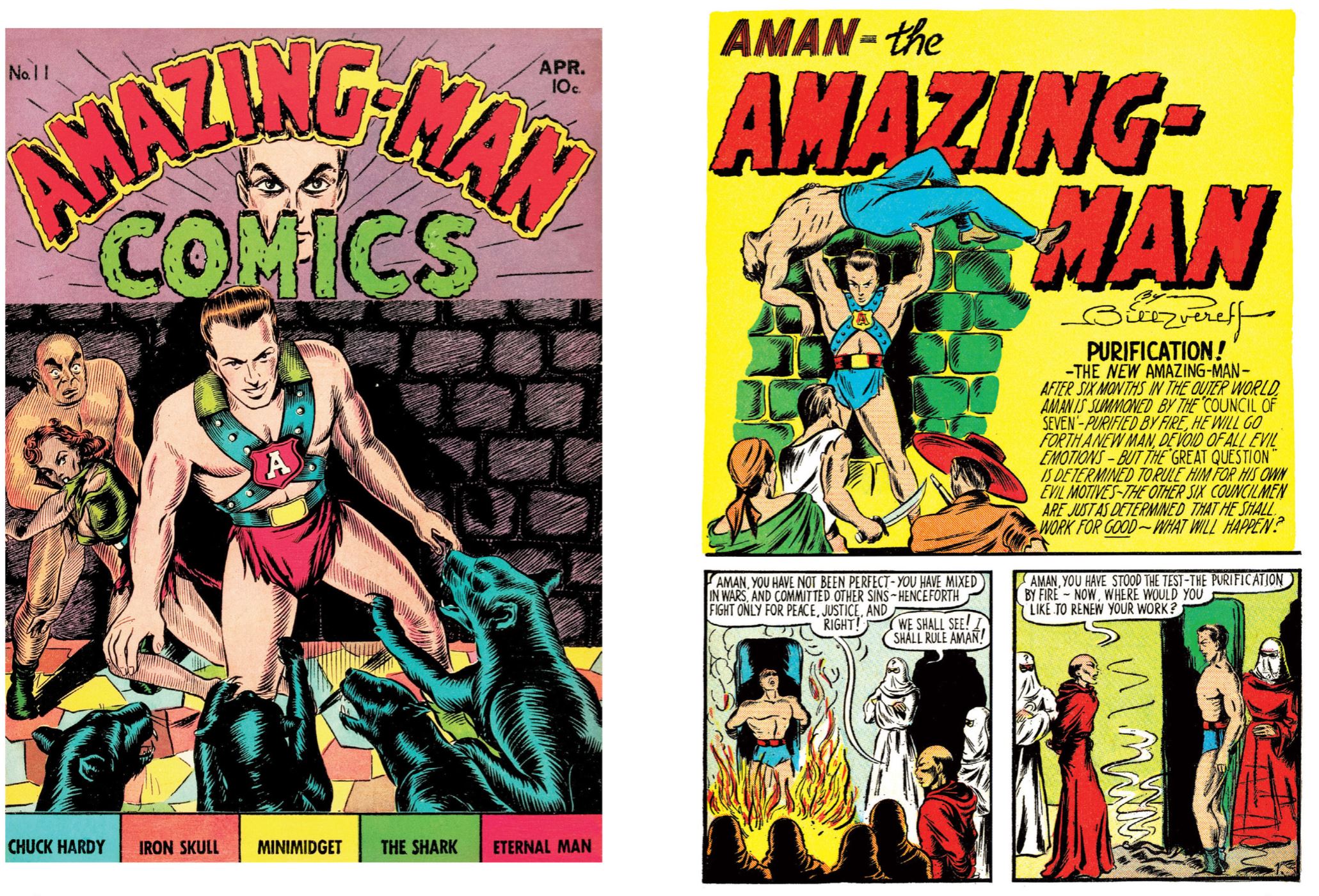
Amazing Mysteries: The Bill Everett Archives volume 1


By Bill Everett and others, edited and complied by Blake Bell (Fantagraphics Books)
ISBN: 978-1-60699-488-7 (HB/Digital edition)

This book includes Discriminatory Content produced in less enlightened times.

Thanks solely to modern technology and diligent research by dedicated fans, there is a sublime superabundance of collections featuring the works of too-long ignored founding fathers and lost masters of American comic books these days. A magnificent case in point is these curated chronicles (available in both print and digital formats) revisiting and yet barely touching upon the incredible gifts and achievements of one of the greatest draughtsmen and yarn-spinners our industry has ever seen.

You could save some time and trouble by simply buying them now rather than waste your valuable off-hours reading my preposterous blather and piffle, but since I’m keen to carp on anyway feel free to accompany me as I delineate just why these tomes need to join the books on your “Favourites” shelf.

The star under scrutiny here was a direct descendent and namesake of iconoclastic poet and artist William Blake. Bill was quite possibly the most technically accomplished artist in the US comic book industry and his tragic life and awe-inspiring body of work reveal how a man of privilege and astonishing pedigree was wracked by illness, addictive personality traits (especially alcoholism) and sheer bad luck, but nevertheless shaped an art-form. Bill Everett left twin legacies: an incredible body of superlative stories and art, and, more importantly, he redeemed many broken lives by becoming a dedicated mentor for Alcoholics Anonymous in his later years.

William Blake Everett was born in 1917 into a wealthy and prestigious New England family. Bright and precocious, he contracted tuberculosis at age twelve and was dispatched to arid Arizona to recuperate. This chain of events began a life-long affair with the cowboy lifestyle: a hard-drinking, chain-smoking, tall-tale-telling breed locked in a hard-to-win war against slow self-destruction.

All this and more is far better imparted in a scholarly, fact-filled, picture-packed Introduction by Blake Bell in Amazing Mysteries: The Bill Everett Archives volume 1. This covers the development of the medium in ‘The Golden Age of Comics’; the history of ‘Bill Everett the Man’ and how they came together in ‘Centaur + Funnies Inc. = Marvel Comics #1’. The essay also includes an astounding treasure trove of found images and original art, including samples from 1940s Sub-Mariner, 1960s Daredevil and 1970s Black Widow stories, amongst many others.

Accompanied by the covers (that’s the case for most of the titles that follow: Everett was fast and slick and knew just how to catch a punter’s eye) for Amazing Mystery Funnies vol. 1 #1, 2, 3a, 3b and vol. 2 #2 (August 1938 – February 1939, from Centaur) are a quartet of rousing but muddled interstellar exploits starring sci fi troubleshooter Skyrocket Steele. These are followed by a brace of anarchic outer space shenanigans starring futuristic wild boy Dirk the Demon culled from Amazing Mystery Funnies (vol. 1 #3a and vol. 2 #3; November 1938 & March 1939 respectively).

The undisputed star and big draw at Centaur was always Amazing-Man who was a Tibetan mystic-trained orphan, adventurer and do-gooder named John Aman. After many years of dangerous, painful study that young man was despatched back to civilisation to do good… for a relative given value of “good”…

Aman stole the show in monthly Amazing Mystery Comics (#5-8, spanning September -December 1939) as seen in the four breakneck thrillers re-presented here and opening with ‘Origin of Amazing-Man’ followed by an untitled sequel episode with the champion saving a lady rancher from sadistic criminals; ‘Amazing-Man Loose’ (after being framed for various crimes) and a concluding instalment wherein the nomadic hero abandons his quest to capture his evil arch rival ‘The Great Question’ and instead heads for recently invaded France to combat the scourge of Nazism…

As previously stated, Everett was passionately wedded to western themes and for Novelty Press’ Target Comics he devised an Arizona-set, rootin’ tootin’ cowboy crusader called Bull’s-Eye Bill. Taken from issues #1 & 2 (February & March 1940), ‘On the trail of Travis Trent’ and ‘The Escape of Travis Trent’ has our wholesome yet hard-bitten cowpoke battling the meanest, most determined owlhoot in the territory. Accompanying the strips is an Everett-illustrated prose piece attributed to “Gray Brown” entitled ‘Bullseye Bill Gets his Moniker’.

Thanks to his breakthrough Sub-Mariner sagas, Everett became inextricably linked to water-based action adventures and immensely popular, edgy heroes. That’s why Eastern Comics hired him to create human waterspout Bob Blake, Hydroman for their bimonthly anthology Reg’lar Fellers Heroic Comics.

Here – spanning issues #1-5 and August 1940 to March 1941- are five spectacular, eerily offbeat exploits, encompassing ‘The Origin of Hydroman’ and covering his patriotic mission to make America safe from subversion by “oriental invaders”, German saboteurs and assorted ne’er-do-wells, after which a Polar Paladin rears his frozen head. Sub-Zero Man debuted in Blue Bullet Comics vol. 1 #2 cover-dated July 1940. He was a Venusian scientist stranded on Earth who, through myriad bizarre circumstances, became a chilly champion of justice. Everett is only credited with the episode ‘The Power of Professor X’ (vol. 1 #5, October 1940) but also included here are the cover of vol. 1 #4 and spot illustrations for the prose stories ‘Sub-Zero’s Adventures on Earth’ and ‘Frozen Ice’ (from Blue Bullet Comics vol. 1 #2 and vol. 2 #3).

The Conqueror was another quickly forsaken Everett creation: a Red, White & Blue patriotic costumed champion debuting in August 1941’s Victory Comics #1. Daniel Lyons almost died in a plane crash but was saved by cosmic ray bombardment which granted him astounding mental and physical powers in ‘The Coming of the Conqueror’. He promptly moved to Europe to “rid the world of Adolf Hitler!” with Everett’s only other contribution being the cover of issue #2 (September 1941). Accompanied by a page of original artwork from Reg’lar Fellers Heroic Comics #12 (May 1941), The Music Master then details how dying violinist John Wallace was saved by mystic musical means and becomes a sonic-powered superman righting injustices and crushing evil…

Rounding out this initial cavalcade of forgotten wonders are a selection of covers, illustrations and yarns which can only be described as Miscellaneous (1938-1942). These comprise the cover to the 1938 Uncle Joe’s Funnies #1; procedural crime thriller ‘The C-20 Mystery’ (from Amazing Mystery Funnies vol. 2 #7, June 1939) and ‘The Story of the Red Cross’ from True Comics #2 (June 1938). The cover for 1941’s Dickie Dare #1 is followed by a range of potent images from text tales beginning with three pages for ‘Sheep’s Clothing’ (Funny Pages vol. 2 #11, November 1940); a potent pic for ‘Birth of a Robot Part 2’ (Target Comics vol. 1 #6, July 1940); two pages from ‘Death in a Box’ courtesy of Reg’lar Fellers Heroic Comics #5 (March 1941) and two from ‘Pirate’s Oil’ in RFHC #13 (July 1942), before the unpublished, unfinished 1940 covers for Challenge Comics #1 and Whirlwind Comics #1 bring the potent nostalgia to a close.
© 2011 Fantagraphics Books. Introduction © 2011 Blake Bell. All art © its respective owners and holders. All rights reserved.

Heroic Tales: The Bill Everett Archives volume 2


By Bill Everett and others, edited and complied by Blake Bell (Fantagraphics Books)
ISBN: 978-1-60699-600-3 (HB/Digital edition)

This book includes Discriminatory Content produced in less enlightened times.

The second visit to the works of Bill Everett also opens with a fact-filled, picture-packed Introduction by Blake Bell which covers ‘The Early Years of Comics: 1938-1942’, ‘The Birth of Marvel Comics’ and ‘The Comic Book Production System’, before ‘The Heroes’ precedes a selection of astounding, astonishing prototypical adventure champions accompanied a brief essay on the set-up of Centaur Comics, Novelty Press, Eastern Color Printing, Hillman and Lev Gleason Publications.

Augmented by covers for Centaur’s Amazing Mystery Funnies vol. 2 #3, 5 & 6 (March, May & June 1939) are three outer space exploits of futuristic troubleshooter Skyrocket Steele, whilst Tibetan-trained superhero Amazing-Man offers a transformative triptych of titanic tales spanning war-torn Europe, augmented by covers to Amazing-Man Comics #9-11 (February-April 1940).

Everett’s deeply held sagebrush sentiments are served with another brace of barnstorming Bull’s-Eye Bill from Target Comics #3-4 (Novelty Press, April & May 1940) whilst from #7-9 (August-October 1940), the author smoothly switched to sophisticated suspense as master of disguise The Chameleon cunningly crushed contemporary criminals in scintillating escapades from Target Comics’ answer to The Saint, The Falcon and The Lone Wolf.

Everett’s other aquatic adventurer – Eastern Comics’ human waterspout Bob Blake, Hydroman returns next, as seen in Reg’lar Fellers Heroic Comics # 6-9 (May – November 1941, with Bill’s covers for #6 & 7): four spectacular, eerily, offbeat exploits, covering an extended battle against foreign spies and American Fifth Columnists, after which Red Reed in the Americas! (created by Bob Davis & Fitz) offers the first two chapters in a political thriller wherein a college student and his pals head South of the Border to fight Nazi-backed sedition and tyranny in a stunning tour de force first seen in Lev Gleason’s Silver Streak Comics #20 & 21 (April & May 1942).

A section of Miscellaneous and text illustrations follows, blending Western spot drawings with eye-catching covers from Amazing Mystery Funnies vol. 2 #18; Target Comics #5 & 6; Blue Bolt (vol. 1 #11, vol. 2 #1, 2 &~ 3) and Famous Funnies #85. The Humorous and More then details Everett’s forays into other markets: niche sectors such as licensed comics, comedy and romance, and even  a return to pulp and magazine illustration as he strove to stay one step ahead of a constantly shifting market and his own growing reputation for binges and unreliability.

‘What’s With the Crosbys?’ is a superbly rendered gossip strip from Famous Stars #2 (1950, Ziff-Davis) whilst a stunning monochrome girly-pin-up of ‘Snafu’s Lovely Ladies’ (from Marvel’s Snafu #3, March 1956), and the cover of Adventures of the Big Boy #1 (also Marvel, from the same month) lead into the back cover of Cracked #6 (December 1958, Major Magazines) and other visual features from that Mad magazine mimic, as well as the colour cover to less successful imitator Zany (#3, from March 1959). Everett’s staggering ability to draw beautiful women plays well in the complete romance strip ‘Love Knows No Rules’ (Personal Love #24, November 1953 Eastern Color), before this section concludes with a gritty monochrome title page piece from combat pulp War Stories #1, courtesy of Marvel’s parent company Magazine Management, and cover-dated September 1952.

The Horror concentrates on our post-superhero passion for scary stories: an arena where Bill Everett absolutely shone like a diamond. For more than a decade he brought a sheen of irresistible quality to the generally second-rate chillers Timely/Atlas/Marvel produced in competition with genre frontrunners EC Comics. It’s easy to see how they could compete and even outlive their gritty, gore-soaked competitor, with such lush and lurid examples of covers and chillingly beautiful interior pages…

Following a third informative background essay detailing his life until its cruelly early end in 1973, a choice selection of his lesser known or celebrated efforts opens with tale of terror ‘Hangman’s House’ (Suspense #5, November, 1950),; a grim confrontation with Satanic evil, followed by futuristic Cold War shocker ‘I Deal With Murder!’ and a visit to a dark carnival of purely human wickedness in ‘Felix the Great’(both from Suspense #6, January 1951).

Adventures into Weird Worlds #4 (Spring 1952) offered a laconic, sardonic glimpse into ‘The Face of Death’, whilst from the following issue (April 1952) ‘Don’t Bury Me Deep’ tapped untold depths of tension in a moodily mordant exploration of fear and premature burial. Hard on the heels of the cover to Journey Into Unknown Worlds #14 (December 1952) comes one of its interior shockers as ‘The Scarecrow’ helps an aged couple solve their mortgage problems in a most unusual manner. The Marvel madness concludes with a cautionary tale of ‘That Crazy Car’ from Journey into Mystery #20, December 1954, concluding a far too brief sojourn amidst arguably Everest’s most accomplished works and most professionally adept period.

This magnificent collection ends with a gallery of pages and one complete tale from the end of his career; selected from an even more uninhibited publisher attempting to cash in on the adult horror market opened by Warren Publishing with Eerie, Creepy and Vampirella.

Skywald was formed by industry veteran Israel Waldman and Everett’s old friend Sol Brodsky, tapping into the burgeoning black-&-white, mature-reader market with supernatural flavoured magazines Hell-Rider, Crime Machine, Nightmare, Psycho and Scream. Offered an “in”, Everett produced incredible pin-ups (included here are three from Nightmare (#1, 2 & 4, December 1970-June 1971); ‘A Psycho Scene’ (Psycho #5, November, 1971); a stunning werewolf pinup from Psycho #6 and one of revived Golden Age monstrosity ‘The Heap’ from Psycho #4. Most welcome is a magnificent 10-page monochrome masterpiece of gothic mystery ‘The Man Who Stole Eternity’ from Psycho #3 (May, 1971).

Although telling, even revelatory and concluding in a happy ending of sorts, what these books truly celebrate is not the life but the astounding versatility of Bill Everett. A gifted, driven man, he was a born storyteller with the unparalleled ability to make all his imaginary worlds hyper-real; and for nearly five decades his incredible art and wondrous stories enthralled and enchanted everybody lucky enough to read them.
© 2013 Fantagraphics Books. Text © 2013 Blake Bell. All art © its respective owners and holders. All rights reserved.

Bill Everett was born today in 1917, as was Mad mainstay Don Martin in 1931, foundational Underground Commix publisher/empresario Don Donahue (AKA Apex Novelties) in 1942 and in 1953 both Alan Kupperberg (Blue Devil, Dragonlance) and Arthur Suydam (Cholly and Flytrap, Marvel Zombies).

Today in 2017, Oscar González Guerrero died. The Mexican comic artist, art director and educator had started taletelling in the 1950s and created Zor y Los Invencibles, Hermelinda Linda, Burrerías, Smog, Don Leocadio El Tío Porfirio, Las Aventures de Capulina and run ¡Ka-Boom! Estudio.