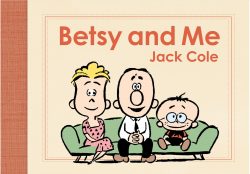
Betsy and Me


By Jack Cole & Dwight Parks, with R.C. Harvey (Fantagraphics Books)
ISBN: 978-156097-878-7 (TPB/Digital edition)

This book includes Discriminatory Content produced in less enlightened times. This book also includes Discriminatory Content added for comedic effect.

Jack Cole was one of the most uniquely gifted talents of American comics’ Golden Age. Before moving into mature magazine and gag markets he originated landmark tales in horror, true crime, war, adventure and especially superhero comic books, where his incredible humour-hero Plastic Man remains an unsurpassed benchmark of screwball costumed hi-jinks: frequently copied but never equalled. It was a glittering career of distinction which Cole was clearly embarrassed by and unhappy with.

Without doubt – and despite his other triumphal comics innovations such as The Comet, Silver Streak, Daredevil, The Claw, Death Patrol, Midnight, Quicksilver, The Barker, and a uniquely twisted and phenomenally popular take on the crime and horror genres – Cole’s greatest contribution and lasting creation was the zany Malleable Marvel who (with indispensable sidekick/gadfly Woozy Winks) quickly grew from a minor back-up character into one of the most memorable and popular heroes of the era.

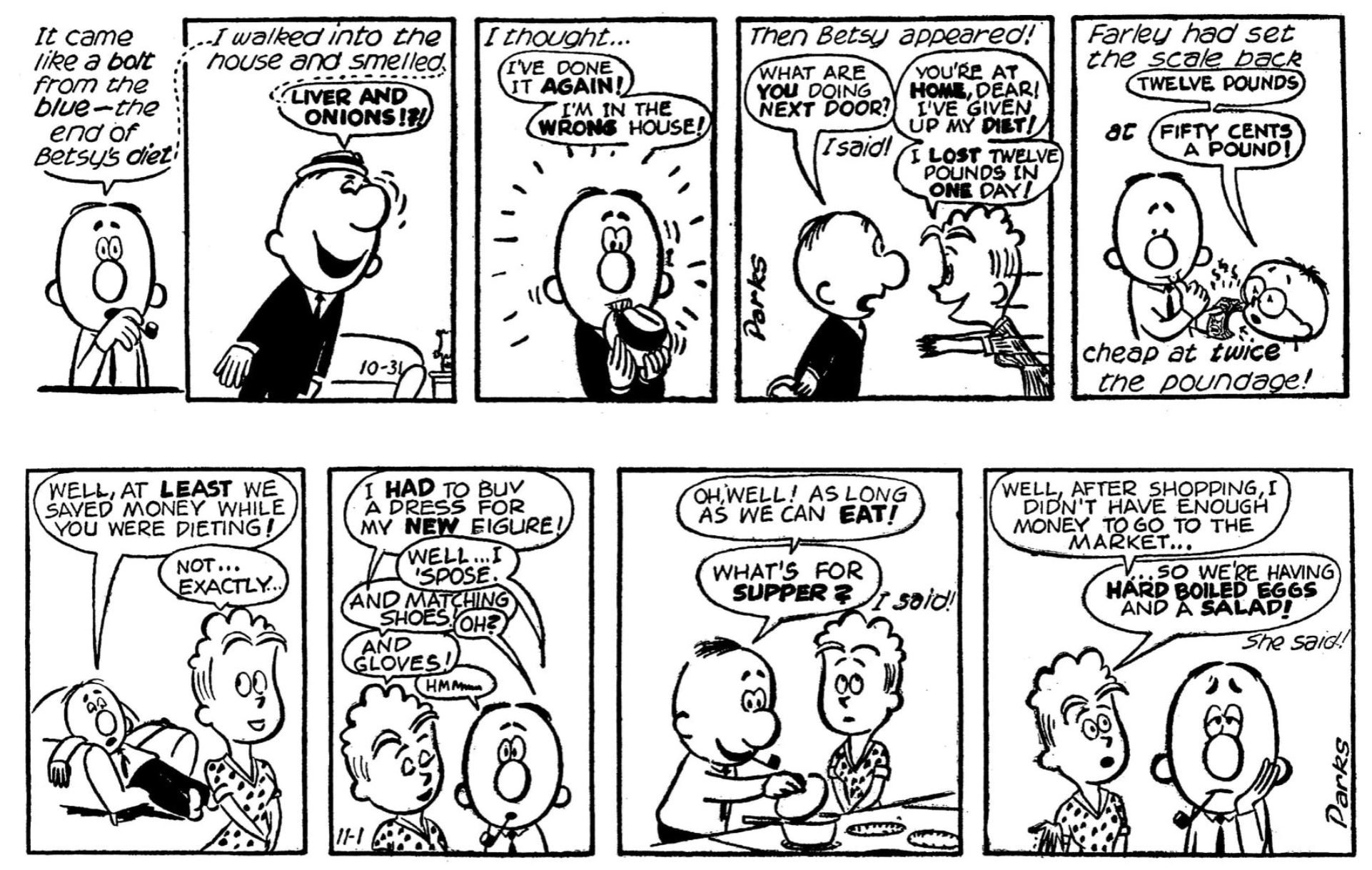
In 1954 Cole quit comics for the lucrative and prestigious field of magazine cartooning, and swiftly became a household name when his brilliant watercolour gags and stunningly saucy pictures began regularly running in Playboy from its fifth issue. Cole eventually moved into the lofty realms of newspaper strips and, in 1958, achieved a life-long ambition by launching a syndicated newspaper strip, the domestic comedy Betsy and Me, which began publication on Monday May 26th.

Something about reaching the cartoonist’s Promised Land clearly did not meet with the infamously private Cole’s expectations and, on August 13th 1958, at the peak of his prowess and success, he took his own life. The reasons – although much speculated upon ever since – remain unknown.

The strip was handed to commercial cartoonist Dwight Parks who continued it until an editorial decision was made to end it. The last daily was published on Saturday, December 27th. That great loss to the future of the industry and artform has for years clouded a greater truth: whatever his demons, Cole was a master of comedy and narrative art in all its forms and Betsy and Me was, in its own niche, every bit as great as his glamour illustration and comic book endeavours.

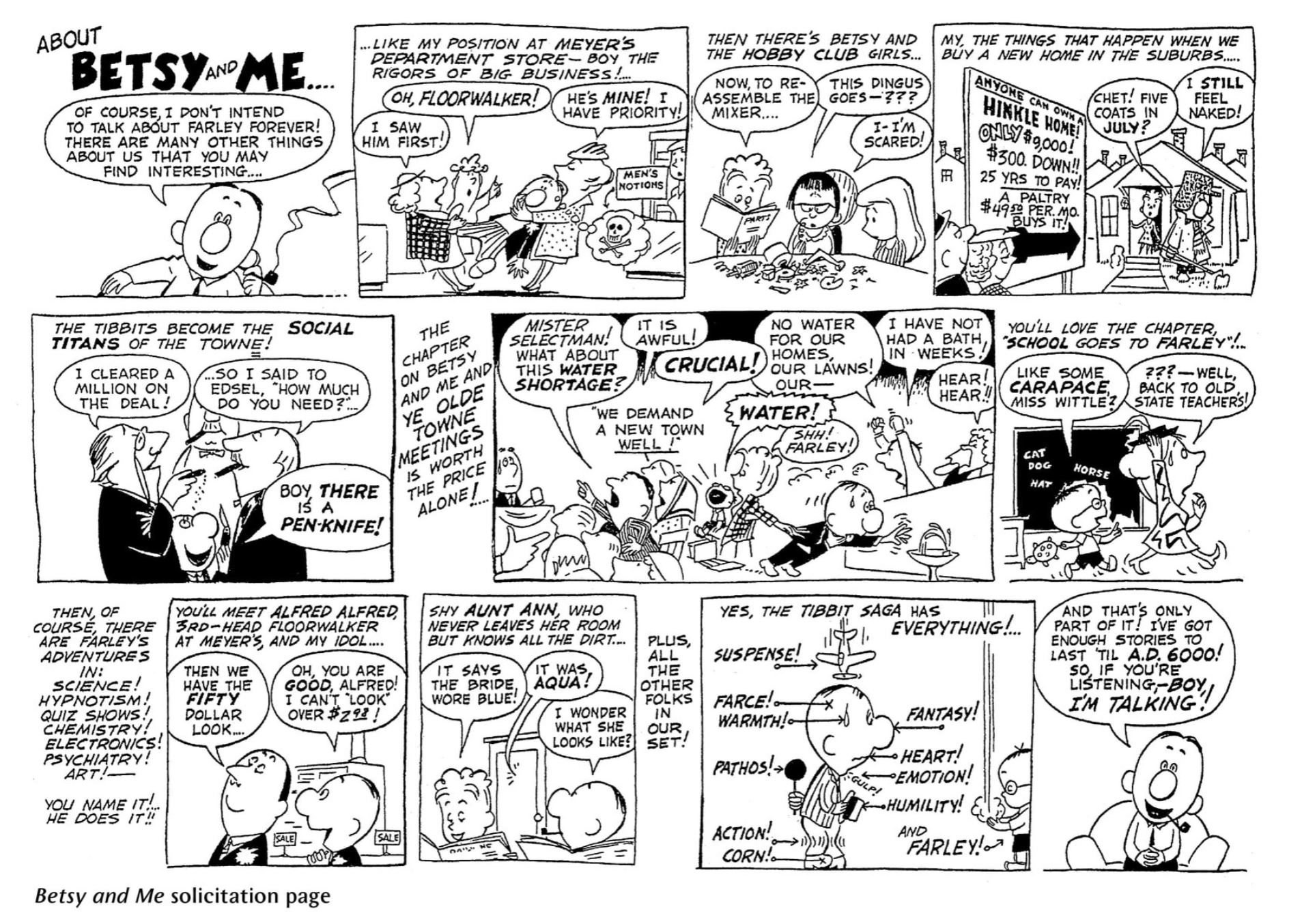
This mostly monochrome tome collects those long-lost newspaper sorties in a welcoming package which begins with the captivating solicitation page designed to entice new papers to buy the strip. Then biography, history, context and analysis come courtesy of historian R. C. Harvey’s introductory essay ‘The Last of Jack Cole: His Life and Art and Why They Both Ended with Betsy and Me. The heavily illustrated article also offers possible insights into Cole’s motivations, state of mind and possible reasons for suicide, before this superb collection of what should have been Cole’s greatest legacy opens…

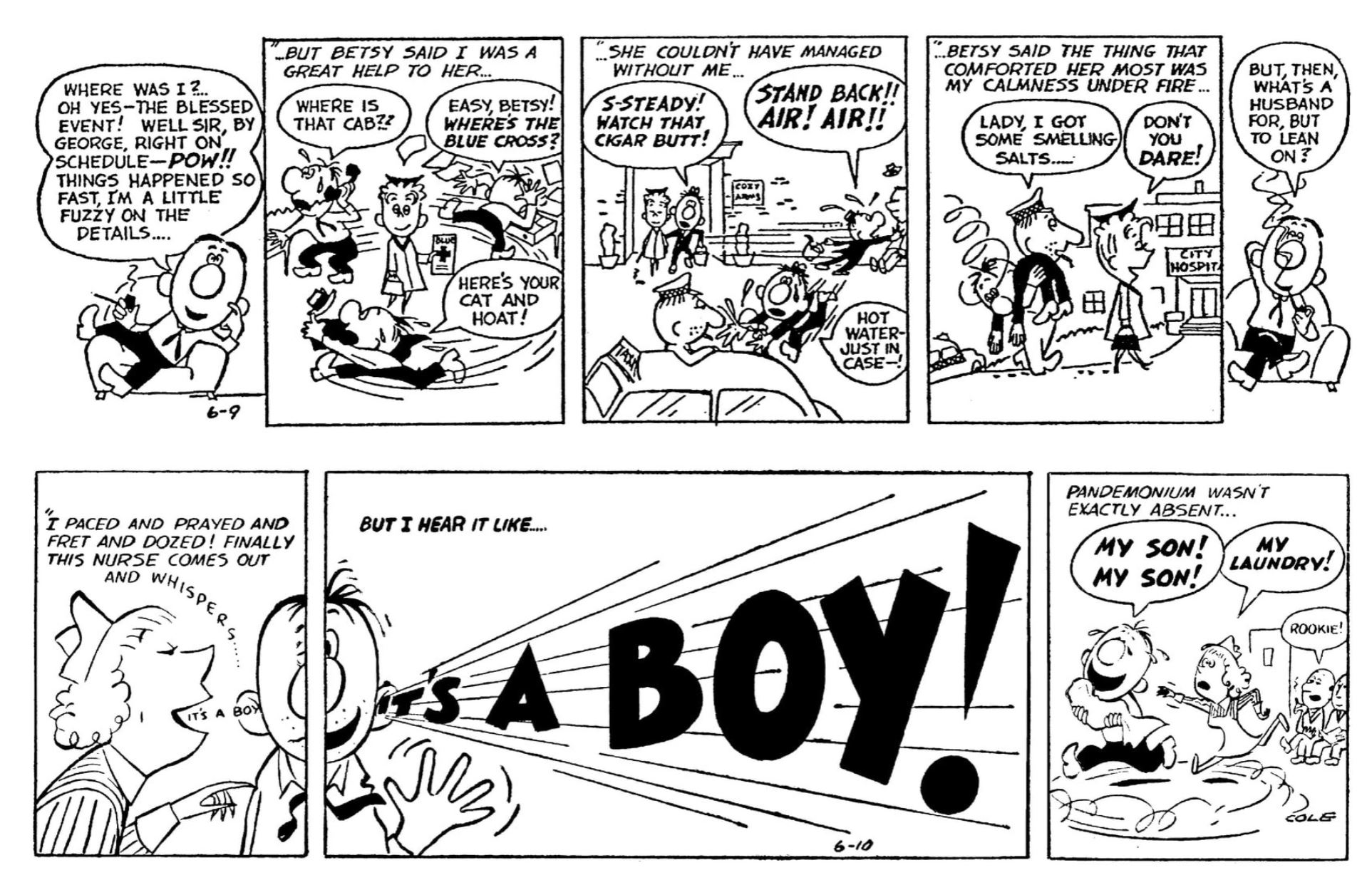
Utilising a stripped-down minimalist style that was the astute acme of its time, this domestic comedy is recounted as a fireside tale by homely working stiff Chester B. Tibbit. He recalls and reminisces with unseen readers who daily learn of his romancing of and marriage to Betsy; his downtrodden life as a floorwalker at the Meyers department store and plodding climb up the ladder of middle class aspiration.

The move from apartment to house, the trepidatious purchase of consumer benchmarks such as white goods and even an automobile (in the most generous sense of the term), and the inevitable addition of a child are all gradually covered in a manner most wry and deliciously sardonic. All the laughs stem from an old cartoonist’s trick: the rose-tinted self-deluding narrative says one thing whilst the pictures tell the grim, sordid truth, even when Chester can’t see it himself…

His admired and adored bosses are bullying martinets, his friends are shallow, fair-weather self-servers, Betsy isn’t a quiet, obedient little woman and his son is…

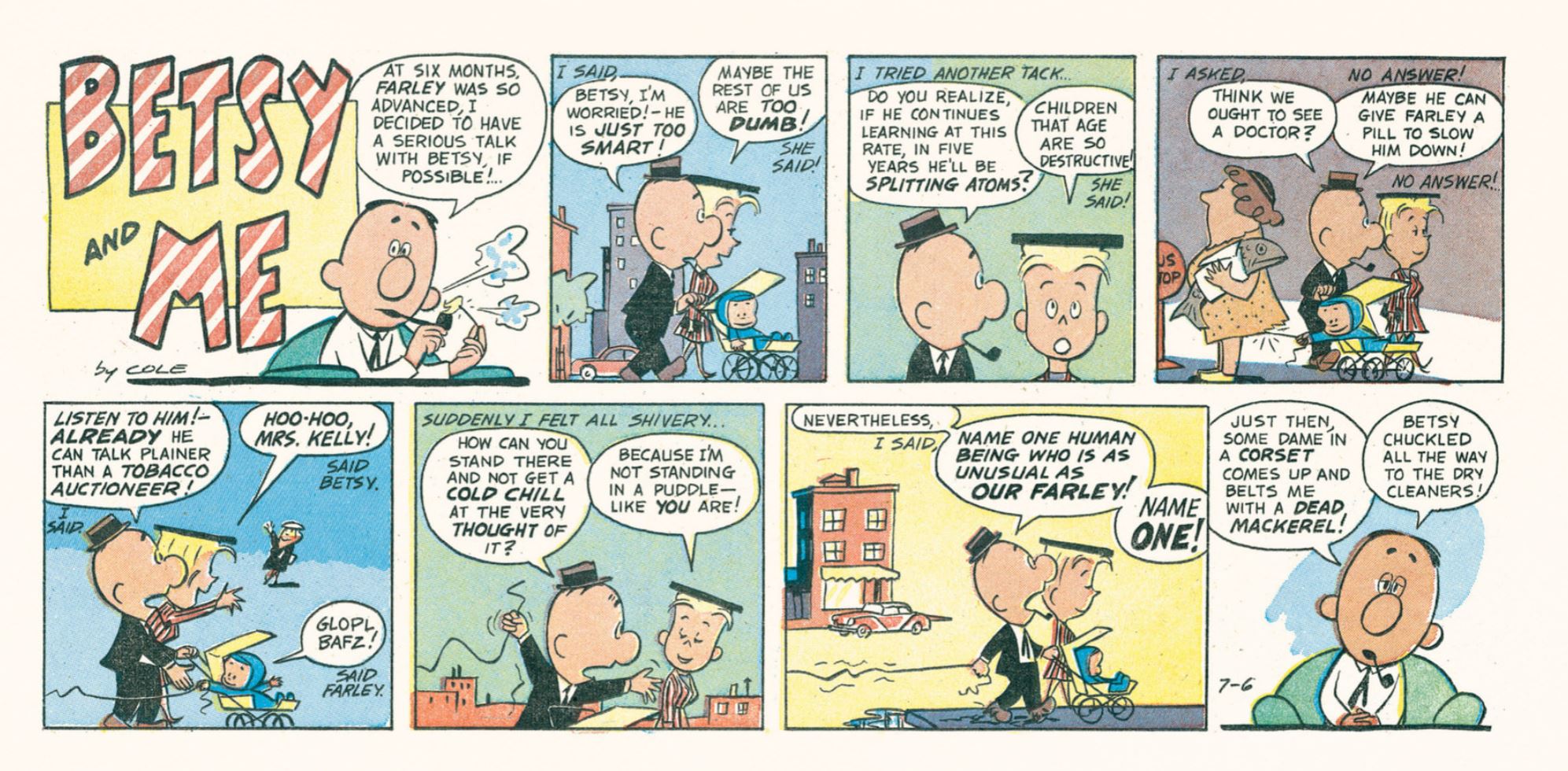
Well, the truth is that infant Farley actually is a genius: rude, brusque, impatient and utterly beyond the intellectual capabilities of his terrified, long-suffering parents. Even from his earliest moments in the crib the kid is the smartest one in the house – and that includes financially and emotionally…

The strips follow the traditional developmental path of courtship, marriage, home-making and child-rearing but always Cole’s needle-sharp social observations and uncontrollable whimsy are seditiously at work. At Meyers’ the infant blackmails his father’s superiors so they stop picking on the little nebbish and when Farley starts school he organises a student revolt…

The toddler even masters judo to protect his bewildered guardians from marauding criminals and spars continually with mooching, predatory Gus, a confirmed bachelor always hanging around Betsy with attentions that are clear to everyone but Chester…

Over the summer of 1958 Betsy and Me steadily grew in quality, scope and popularity. When Cole died on August 13th he had submitted strips for a full month ahead. His last daily ran on September 7th and the final Sunday on September 21st.

Dwight Parks took over and whereas the pared-down artistic style remained, the uneasy edgy satire was lost in favour of more domestic comfortable themes – such as the new house being a broken-down money pit, interfering neighbours, kindergarten woes, dieting and “keeping up with the Joneses”- the stuff of contemporary TV sitcoms like I Love Lucy

Critics have debated ever since Cole’s passing about whether, given time, Betsy and Me (or even a successor strip) would have cemented the brilliant raconteur as a master of all forms of graphic narrative, or whether he had finally overreached himself. We’ll never know, but at least you can read what remains and judge for yourself.

… And you really should.
© 2007 Fantagraphics Books. Text © 2007 R. C. Harvey.

Today in 1915, EC all-star “GhastlyGraham Ingels was born, as was Polish comics star Henryk Chmielewski AKA “Papcio Chmiel” (Tytus, Romek i A’Tomek); cartoonist/editor/educator Barb Rausch (Barbie, The Desert Peach, Omaha the Cat Dancer, Disney Studios, Neil the Horse) in 1941; writer/editor/artist Larry Hama (Wolverine, G.I. Joe, Bucky O’Hare, Nth Man) in 1949: artist/animator Rick Hoberg (Tarzan, Star Wars, Eternity Smith, Green Arrow) in 1952 and Mark Schultz (Superman, Xenozoic Tales) in 1955.

In 1958 today we lost astounding illustrator Joe Maneely (Ghost Breakers, Super Magician Comics, Black Knight, Yellow Claw, Atlas genres shorts) and in 2003 French artist Georges Pichard (Blanche Épiphanie, Ténébrax, Submerman, Ceux–là).

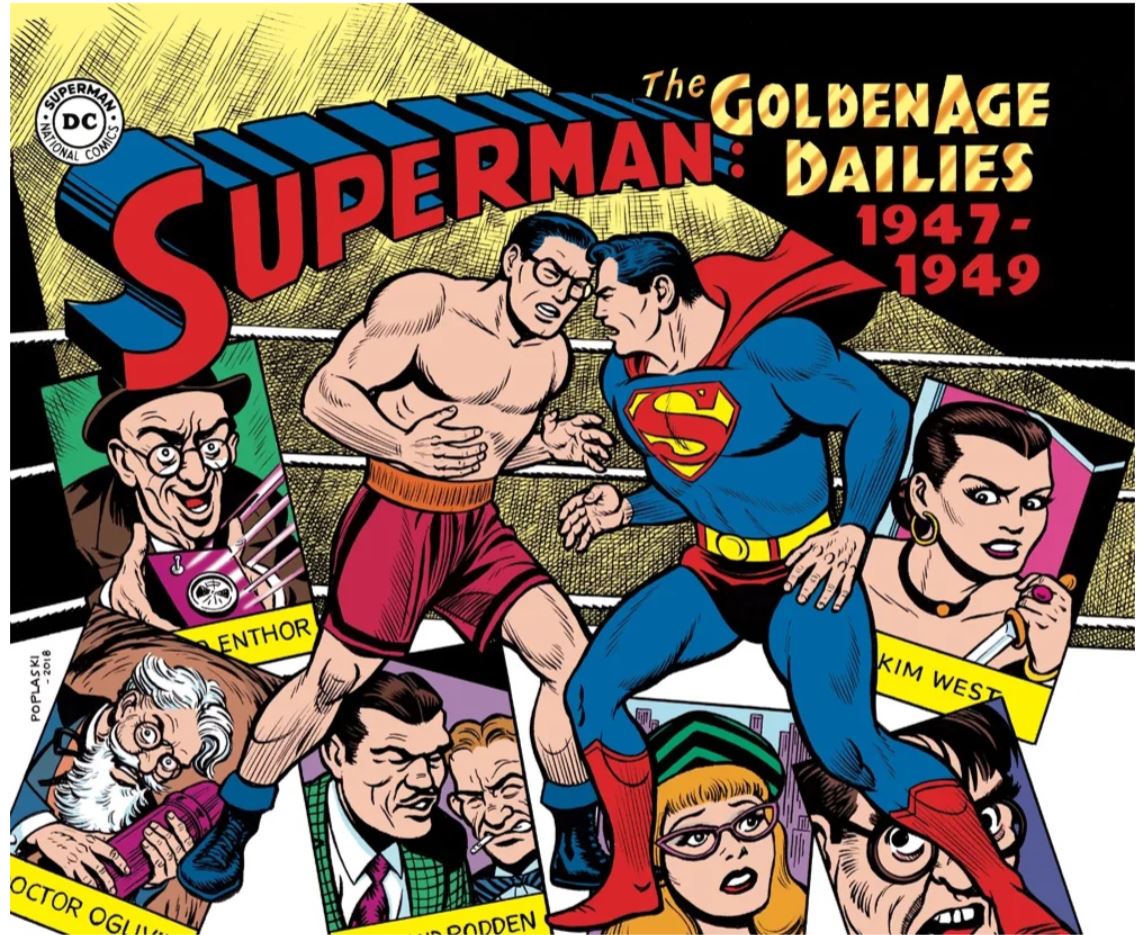
Superman: The Golden Age Dailies 1947 to 1949 (volume 3)


By Alvin Schwartz, Wayne Boring, Jack Schiff, Win Mortimer & various (IDW/Library of American Comics)
ISBN: 978-1-68405- (HB)

This book includes Discriminatory Content produced in less enlightened times.

The American comic book industry – if it still existed at all – would be utterly unrecognisable without Superman. Jerry Siegel & Joe Shuster’s unprecedented invention was first fervidly adopted by a desperate and joy-starved generation, and gave birth to a genre if not an actual art form. Spawning an army of imitators and variations within three years of his 1938 debut, the intoxicating blend of breakneck, breathtaking action and wish-fulfilment epitomising the early Man of Steel grew to encompass cops-&-robbers crimebusting, socially reforming dramas, sci fi fantasy, whimsical comedy and, once the war in Europe and the East sucked in America, patriotic relevance for a host of gods, heroes and monsters, all dedicated to profit through exuberant, eye-popping excess and vigorous, dashing derring-do.

From the outset, in comic book terms Superman was master of the world. Moreover, whilst transforming the shape of the fledgling funnybook biz, the Man of Tomorrow irresistibly expanded into all areas of the entertainment media. Although we all think of the Cleveland boys’ iconic invention as epitome and acme of comics creation, the truth is that very soon after his springtime debut in Action Comics #1 the Man of Steel was a fictional multimedia monolith in the same league as Popeye, Tarzan, Sherlock Holmes and Mickey Mouse. We parochial and possessive comics fans too often regard our purest and most powerful icons in purely graphic narrative terms, but the likes of Batman, Spider-Man, Avengers and their hyperkinetic kind long ago outgrew four-colour origins to become fully mythologized modern media creatures familiar in mass markets, across all platforms and age ranges…

In the last century and even more so in this one, far more people have seen and heard the Man of Steel than have ever read his comic books. These globally syndicated newspaper strips alone were enjoyed by countless millions, and by the time his 20th anniversary rolled around, at the very start of what we call the Silver Age of Comics, he had been a thrice-weekly radio serial star, headlined 17 astounding animated cartoons, become a novel attraction (written by George Lowther) and – by the time of the last stories in this tome – had helmed two feature films. He had then seamlessly segued into the next Big Thing: television. Soon his first (of 8) smash-hit live-action tv seasons would start his next great media conquest, making Superman a perennial sure-fire success for toys, games, food, and puzzle and apparel manufacturers all over the planet.

Although pretty much a spent force these days, for the majority of the last century the newspaper comic strip was the Holy Grail all American cartoonists and graphic narrative storytellers hungered for. Syndicated across the country (and frequently the world) a strip feature could be seen by millions if not billions of readers and was generally accepted as a more mature and sophisticated form of literature than comic books. It also – at the start! – paid better, and rightly so. Some of the most enduring, entertaining characters and concepts of all time were devised to lure readers from one particular paper to another and many of the best became cornerstones of a shared global culture. People across the Earth had a communal context thanks to thrilling to the same comics; and Mutt and Jeff, Buck Rogers, Dick Tracy, Flash Gordon, Charlie Brown and so many more escaped humble, tawdry newsprint origins to become meta-real: existing in the minds of earthlings from Albuquerque to Zanzibar. Most still do…

The daily Superman newspaper strip launched on 16th January 1939, swiftly augmented by a full-colour Sunday page from November 5th of that year. Originally crafted by Siegel & Shuster and their studio (Paul Cassidy, Leo Nowak, Dennis Neville, John Sikela, Ed Dobrotka, Paul J. Lauretta & crucially Wayne Boring), the mammoth task soon required additional talents like strip veteran Jack Burnley and writers including Whitney Ellsworth, Jack Schiff & Alvin Schwartz. The McClure Syndicate feature ran continuously until May 1966, appearing, at its peak, in over 300 daily and 90 Sunday newspapers: a combined average readership of more than 20 million. Eventually, Win Mortimer & Curt Swan joined the unflagging Boring & Stan Kaye, whilst Bill Finger and Siegel also provided stories, telling serial tales largely divorced from comic book continuity throughout years when superheroes were scarcely seen.

This third volume of the Library of American Comics collection continues the prodigious and formidable reprint program begun in the Sterling/Kitchen Sink softcover editions which ceased production in 1999. All of that material – and these books too – are long overdue for re-release and digital editions. Here, however, WWII is well and truly over and the decidedly different demands of peacetime and reconstruction have given way to an era of hectic prosperity, but still see our hero and his regular cast tested and beset by domestically endangering perils and conundrums only a Man of Steel could handle…

We open with another Introduction by Sidney Friefertig, discussing the changes from conflict to reconstruction and detailing why and how poet-turned-thriller writer Alvin Schwartz (1916-2011) became the key writer of the feature as well as sharing contextual, behind-the-scenes moments before our cosy but never-ending battle resumes.

These sequences came six days a week, comprising episodes #47-61, pages #2595 through 3338, and publication dates April 28 1947 to September 3rd 1949. With the material credited to Schwartz (Batman, Wonder Woman, Aquaman, Tomahawk, Newsboy Legion, Slam Bradley, House of Mystery, A Date With Judy, Buzzy, Bizarro) and the sole pictorial province of illustrator Wayne Boring, the compilation kicks off with and a bizarre “manhunt” to solve the dilemma of ‘Who is Miss Whisper?

Running in strips #2595-2654 as seen between April 28th to July 5th 1947, the story depicts mounting frenzy in Metropolis after lonely millionaire at sea Jonathan Dexter experiences a crossed radio line and catches a brief snippet of conversation with a distant voice. Instantly falling inescapably in love with a person he cannot and probably will never see, he is despondent until he remembers how rich he is…

Thus when, Cinderella-style, the heartsore plutocrat uses the Daily Planet to publicise his plight and swears to endow the mystery maid with all his worldly goods, the entire female population goes crazy. Everybody loves a doomed romance but some seek to con him, some attempt to bamboozle or even supplant his absent inamorata and some – gangsters led by cunning rogue Wishbone – seek to replace Miss Whisper with a voice impersonating ringer. Clark Kent and Lois Lane are drawn to the story and Superman promises to help after the rich guy promises to pay a million to deserving charities but even after finding her, the Man of Tomorrow can’t make the quiet quarry want to marry the spoiled rich, groom-to-be…

Nevertheless, because it’s a fairy tale writ large, love does find a way…

Crafted for daily doses, these Superman snippets are torturous, convoluted and often seemingly divert in tangents to indulge in seemingly pointless but epically spectacular super-feats (such as razing an entire forest to make a really, Really big billboard). These are to pad out increasingly formulaic plots and emphasise the “Super” in the hero but also counterpoint the ongoing social commentary and essentially domestic tribulations of familiar and warmly appreciated entertainment characters being constantly put through their paces. That’s clearly seen as greed and venality abound in the next arc as Superman reels under the manic idiocies generated by ordinary people in mounting frenzy once news leaks out that the Man of Steel has agreed to safeguard humanity’s greatest desire made manifest.

Running from July 7th to September 27th, the sorry tale of ‘The Youth Serum’ (strips #2665-2732) sees chemist Dr. Ogilvie unwisely entrust his age-defeating miracle mixture to shady promoter Willie Poster who triggers a literal stampede of the vain, vainglorious and outright villainous who will do anything to roll back a few years… including bribery, fraud, theft and kidnapping Daily Planet staff to compel the Man of Steel to hand over the rejuvenation juice…

With the multi-million daily readership reckoned to be at least 50% female, encroaching domesticity was a regular plot standby but Alvin Schwartz proved able to tweak the situation in unusual ways. For ‘The Marriage Gamble’ (#2733- 2768; September 29th to November 8th) he enfolds Lois & Clark in a criminal caper wherein crooked – and ultimately near-murderous – loan sharks seek vengeance on a professional gambler by rigging a bet that one of their on-the-hook client/victims can be made to marry the first women he sees. Thanks to poor timing and fate the intended marriage material is inadvertently delayed by Lois, and helpless desperate sap Joe Deems’ unsuspecting bride-to-be becomes a certain feisty journalist…

There’s no escaping his fate – it’s death or Lois – but the mobsters have utterly underestimated Lane’s instincts and the determination of Joe’s actual fiancée Dotty… as well as Superman’s covert intervention…

Who’s chasing who is the key to next serial saga ‘The Perfect Woman’ (#2769-2828, November 10th1947 – January 17th 1948) as super-rich, supremely smart, ultra-fit and staggeringly beautiful heiress Olivia Hill finally reaches marrying age and decrees that the Man of Tomorrow is the only one worthy of her. Of course, Lois has other ideas and also senses a huge scoop as the terrified Superman struggles to escape a girl prepared to risk her own life and reputation to get her way…

Backed by money and privilege, wilful scheming rich kid Olivia seems unstoppable. All our hero’s efforts to avoid her cunning matrimonial traps come to naught as she employs fair means and foul to land the most eligible bachelor on Earth, but events take truly dark turn when master of media manipulation Hill meets ruthless gangsters who don’t play games by her rules…

Evil and mystery dominate in next exploit ’The Crime Mentalist’ (#2829-2936, January 19th – March 20th) as a shy, lonely, mild mannered bank teller survives a street incident and develops the power to psychically tune in on thieves and killers about to commit heinous acts. The cops are instantly suspicious of poor Edgar Jenkins and Clark is concerned for his safety, as Edgar apparently can’t stop himself uncovering crimes. He even exposes the venality of the learned doctors examining him and eventually Superman is forced to act as permanent bodyguard. Events come to ahead when the nation’s top crime bosses engage ruthless femme fatale Dotty Storm to vamp, distract and eliminate the nervous ninny. It works too, despite Jenkins’ gifts. He knows she’s evil but she’s also so very pretty and attentive and perhaps he can convert her from her wicked ways…

Pure whimsy and trenchant social satire manifest with ‘The Return of the Ogies’ (#2883-2936, March 22nd – May 22nd 1948) as the invisible fairy pranksters again bedevil Clark and Superman. However their escalating campaign to annoy the Metropolis Marvel – such as seeking to tell everyone his secret identity – goes weirdly awry after they lose that invisibility and become extremely popular figures perpetually pestered by the public. It looks like even Superman cannot solve this problem, but then…

After being denied a journalism award because everybody knows that the Man of Steel does all the heavy lifting in her stories, the City’s top reporter swears off male interference and undertakes a canny campaign of crimebusting and scandal-exposing in ‘Lois Lane’s Solo Adventures’. Spanning May 24th to July 3rd, strips #2937-2972 reveal just how brave and competent Lois can be on her own, especially after one piece makes a furious enemy of spoiled debutante Kim West. The brat’s idea of redress involves having two mob bosses vying for her exclusive attentions taking out contracts on the “Lane Dame”, but she’s less sanguine about her own devoted butler also trying to murder the journalist. This time Superman does not come to her assistance as the drama expands into murder and both mobs of rank-&-file thugs rebel, seeking to kill West and Lois to avoid a gang war and return to business…

With Lane back at the top of her game and even notional friends with Kim, focus switches to her rival for ‘The Millionaire Ex-Reporter Clark Kent’ (July 5th – August 14th, strips #2973-3008).

After suddenly and unwelcomely winning a fortune, Kent must act like a normal guy and quit his job just to preserve his secret identity. Moreover, all efforts to lose the wealth by acting like a rich idiot only increase it and make him the target of enterprising heiress Kim who has blown through all her own money and needs a pliable husband with plenty…

She doesn’t see Lois as serious competition but still ends up unsatisfied and unwed, before Clark goes broke, gets back to the Planet and almost meets his doom from ‘Enthor’s Paralyzing Ray’ (August 16th – October 16th; strips #3009-3062). Long before Luthor, Metropolis was terrorised by a criminal scientist who immediately quit when Superman appeared. Now having served his time, doddery figure of fun Enthor renews his malevolent career after discovering a gadget that makes the Man of Tomorrow comatose. With a beguiling romantic subplot and conclusion channelling the movie White Heat the shorter action yarn segued into a straightforward mystery as the aftereffects of Enthor’s weapon triggered ‘Clark’s Memory Lapse’ (October 18th – December 25th; #3063-3122). With bizarre reports coming, Superman is forced to reconstruct a fugue moment when the reporter apparently assaulted, abducted and held hostage an innocent man. Diligent investigation and the odd super stunt soon prove bank official Fred Camper is anything but, and that Clark was just being a hero…

It’s back to more traditional fare when Clark’s old pal Ed invents ‘The Super Elixir’ (#3123-3176; December 27th 1948 – February 26th; 1949) and gets Kent to drink it. Now publicly and officially superpowered, Clark is pursued by wannabees and crooks alike as he seeks ways to keep his friend’s family safe amidst a storm of attention and stunts that somehow incredibly peak with the reporter seemingly wresting Superman for charity and begging for a solution that will allow him to return to his quiet anonymous life…

Running from February 28th to April 23rd ‘Superman, Jailbird’ (strips #3177 – 3224) saw Canadian James Winslow “Win” Mortimer take over the illustration ushering in an era of greater whimsy and accessible comedy underpinnings. The initial outing found Superman breaking speeding laws in rural Amosville and arrested by an overly officious police constable. His thirty day jail sentence turns into a unique form of community service when gamblers try to make the hamlet the next Las Vegas, after which ‘Lois ’s Secret Identity’ (April 25th – June 25th, #3225-3278) sees her lose her Planet position and become a radio personality. Unable to abandon print, she dons a disguise and replaces herself as new ace reporter Lily Loring, competing with Kent and both her selves even as she’s targeted by murderous mobster Johnny Braxton seeking to silence one and all of her…

After accidentally injuring a bystander, Clark Kent pinch-hits for the wounded man, taking on his (then) rather-rare job in ‘Superman, Male Escort’ (June 27th – August 13th; #3279-3320. With my own super power working full out to resist that straight line (sooo mmmany jokes!) but blandly state that this sequence finds the Man of Steel soon helping lonely ladies, provoking yet another Metropolis mob of matrons and maidens demanding their moment with the miracle man, unaware that an actual mobster’s moll has plans to secure his exclusive services. Thankfully, Lois is there to make sure that doesn’t happen…

The collection and – more or less – the Golden Age era ends here with short sequence ‘Reenacting Superman’s Greatest Feats’ from August 15th to September 3rd 1949 (#3321-3238) as the Action Ace reconstructs his last month of rescues and stunts in the hopes of jogging the addled memories of literal absent-minded Professor Flagg and enabling him to recover sections of a misremembered formula. Of course, word associations and recall don’t always work according to plan…

These yarns offer timeless wonders and mesmerising excitement for lovers of action and fantasy. The raw-boned early Superman is beyond compare and if you can handle the warts of the era or just crave simpler stories from less angst-wracked times, the adventures gathered here are ideal comics reading, and this a book you simply must see.
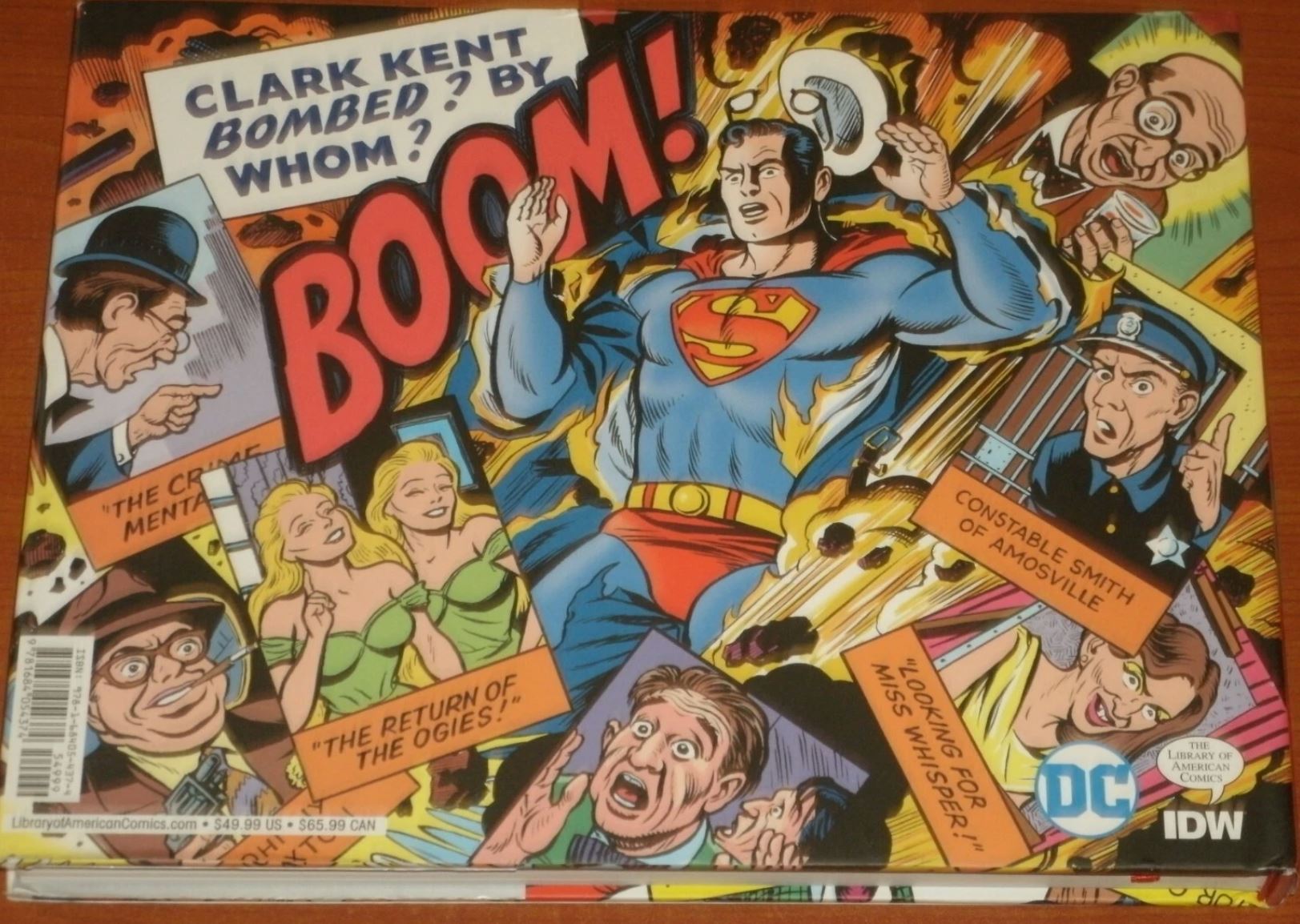
© 2019 DC Comics. All rights reserved. Superman and all related names, characters and elements are ™ DC Comics.

Today in 1872, English cartoonist and genteelly warped brainbox W. Heath Robinson was born, with Allen Bert Christman (The Sandman, Scorchy Smith) arriving in 1915 and Dutch comics master Cees van de Weert (Ben Busy, Marco Polo) turning up in 1917.

Underground commix legend Gilbert Shelton was born in 1940, and scripter, journalist , critic & historian David Anthony Kraft came along in 1952. Artist/playwright Dean Haspiel (Billy Dogma, The Quitter)was born in 1967 and graphic auteur Adrian Tomine (Optic Nerve, Sleepwalk and Other Stories, Killing and Dying).

Upside Dawn


By Jason (Fantagraphics Books)
ISBN: 978-1-68396-652-4 (HB/digital edition)

This book includes Discriminatory Content included for dramatic, comedic and ironic effect.

Born in 1965 in Molde, Norway, John Arne Sæterøy is known by enigmatic, utilitarian nom de plume Jason. The shy & retiring auteur first took the path to cartoon superstardom in 1995, once debut graphic novel Lomma full ay regn (Pocket Full of Rain) won Norway’s biggest comics prize: the Sproing Award. From 1987 he had contributed to alternate/indie magazine KonK while studying graphic design and illustration at Oslo’s Art Academy.

From there he took on Norway’s National School of Arts and, on graduating in 1994, founded his own comic book Mjau Mjau. Constantly refining his style into a potent form of meaning-mined anthropomorphic minimalism, Jason has cited Lewis Trondheim, Jim Woodring & Tex Avery as primary influences. He moved to Copenhagen, working at Studio Gimle alongside Ole Comoll Christensen (Excreta, Mar Mysteriet Surn/Mayday Mysteries, Den Anden Praesident, Det Tredje Ojet) and Peter Snejbjerg (Den skjulte protocol/The Hidden Protocol, World War X, Tarzan, Batman: Detective 27).

Jason’s efforts were internationally noticed, making waves in France, The Netherlands, Slovenia, Spain, Germany and other Scandinavian countries as well as the Americas and he won another Sproing in 2001 – for self-published series Mjau Mjau – before in 2002 turning nigh-exclusively to producing graphic novels. He won even more major awards.

Jason’s breadth of interest is wide & deep: comics, movies, animated cartoons, music, literature, art, history and pulp fiction all feature equally with no sense of rank or hierarchy. Jason’s puckish, egalitarian mixing & matching of inspirational sources always and inevitably produces picture-treatises well worth a reader’s time. Over a succession of tales he has built and re-employed a repertory company of stock characters to explore deceptively simplistic milieux based on classic archetypes distilled from movies, childhood yarns, historical and literary favourites. These all role-play in deliciously absurd and surreal sagas centred on his preferred themes of relationships and loneliness. Latterly, Jason returned to such “found” players as he built his own highly esoteric universe, and even has a whole bizarre bunch of them “team-up” or clash…

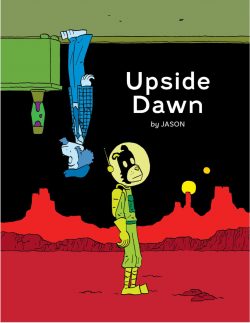
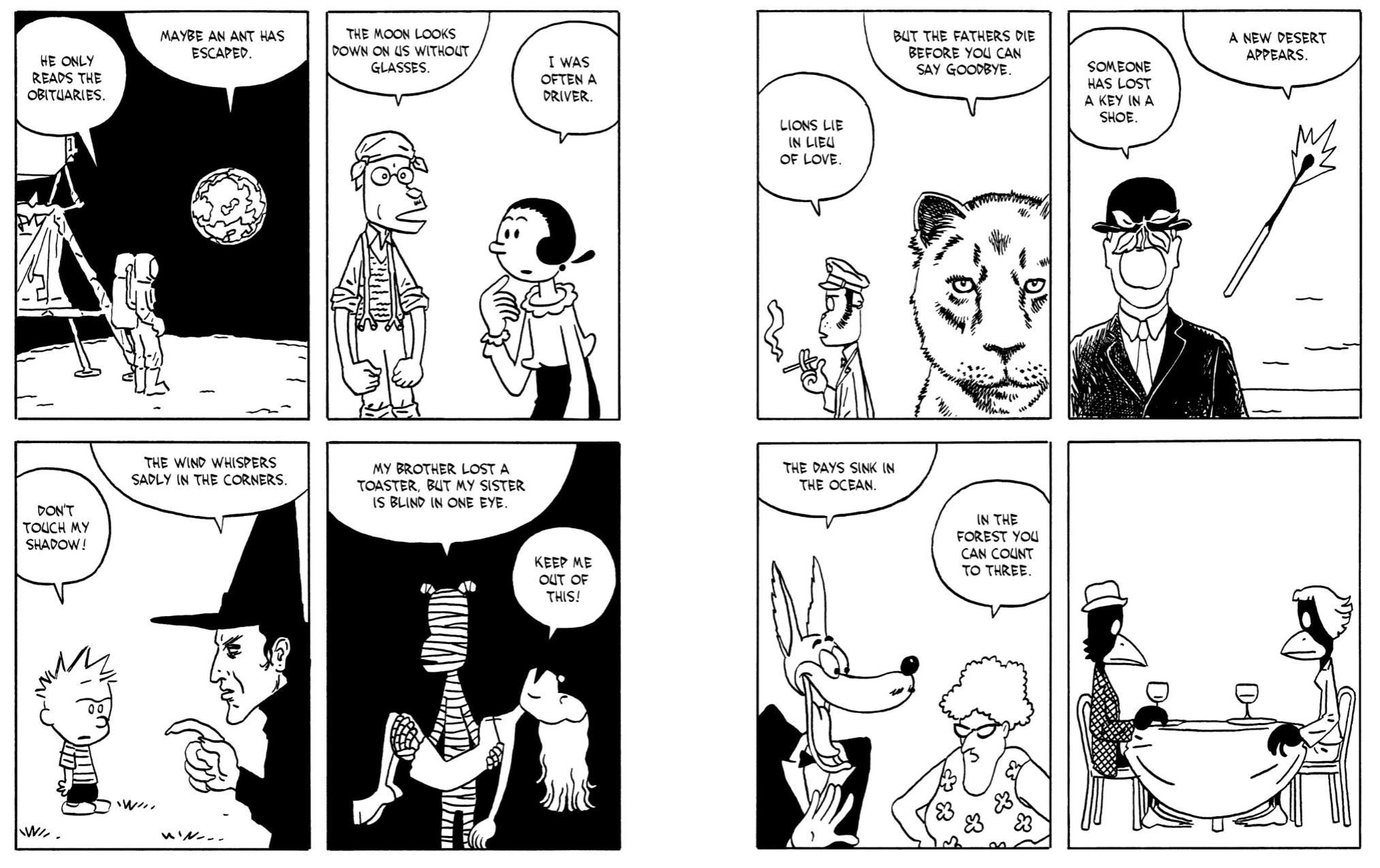
As always, visual/verbal bon mots unfold in beguiling, sparse-dialogued, or even as here silently pantomimic progressions, with compellingly formal page layouts rendered in a pared back stripped-down interpretation of Hergé’s Claire Ligne style: solid blacks, thick outlines dominating settings of seductive monochrome simplicity augmented by a beguiling palette of stark pastels and muted primary colours.

A master of short-form illustrated tales, many Jason yarns have been released as snappy little albums before later inclusion in longer anthology collections. The majority of tales brim with bleak isolation, swamped by a signature surreality even in the most comedic of moments. They are largely populated with cinematically-inspired, darkly comic, charmingly macabre animal people ruminating on inescapable concerns whilst re-enacting bizarrely cast, bestial movie tributes. That’s a style that has never been more apropos than right here, as the more modern Art Forms bow before the onslaught and tirade of organised anti-art philosophers, socially intellectual terrorists, wandering pop stars and a lost Vulcan…

Here the auteur returns to short individual pieces – or are they? – and fondly dabbles with words, terms and aural meanings whilst opening with an understandable failure to communicate over a meal in ‘Woman, Man, Bird’ before noted cerebral French auteur/filmmaker and playfully adrift word-&-meaning warper Georges Perec is repositioned as a hardboiled gumshoe searching for a missing woman in a yarn laced with omissions, mis-hearings and misapprehensions. Nevertheless, if you’re looking for a truth – any truth – ‘Perec PI’ is on the case…

A rapid pictorial transit to a peregrination through a typical life is recalled at full pelt in ‘I Remember’ after which ‘Vampyros Dyslexicoa’ dips deep into literary hinterlands in a pastiche/homage to Joseph Sheridan Le Fanu’s 1872 Gothic novella Carmilla. However the sordid obsessions of sapphic vampire Mircalla are only the entrée to wilder scriptorial regions and a nasty case of creative anachronism as ‘Seal VII’ takes us deep into modern “Scandi” folklore when a certain Knight and Death meet up for a game in Sweden in 1357 and don’t really cotton to the notion of chess for souls…

The scenes shifts to Prague in 1919 where a certain agent of the crown abruptly quits his job and is renditioned to a strange, picturesque high-tech surveillance Village where he has to wear a blazer as ‘The Prisoner in the Castle’ prior to popping back to St Peterburg in 1865 to gorily relive the trials and tribulations of Great Russian Literature at first hand via some eccentric ‘Crime and Punishment’

As much as Jason has played with visual meaning and manipulated derived imagery-context in his past forays, the later relater is here gripped by the confusing potentials of words and verbal meanings. Such facile surface fascinations are apparent during Leopold Bloom’s rather violent visit with the absolute master of “what did that mean” Dublin in June offers a walk with James Joyce, a leprechaun, Stephen Dedalus and Molly as we ponder stuff and not-nonsense in ‘Ulysses’. Then ‘Ionesco’ introduces random judgement to the final days of avant-garde playwright Eugène Ionesco, as a parade of bizarre celebrities and notables eulogise or defame him before he goes…

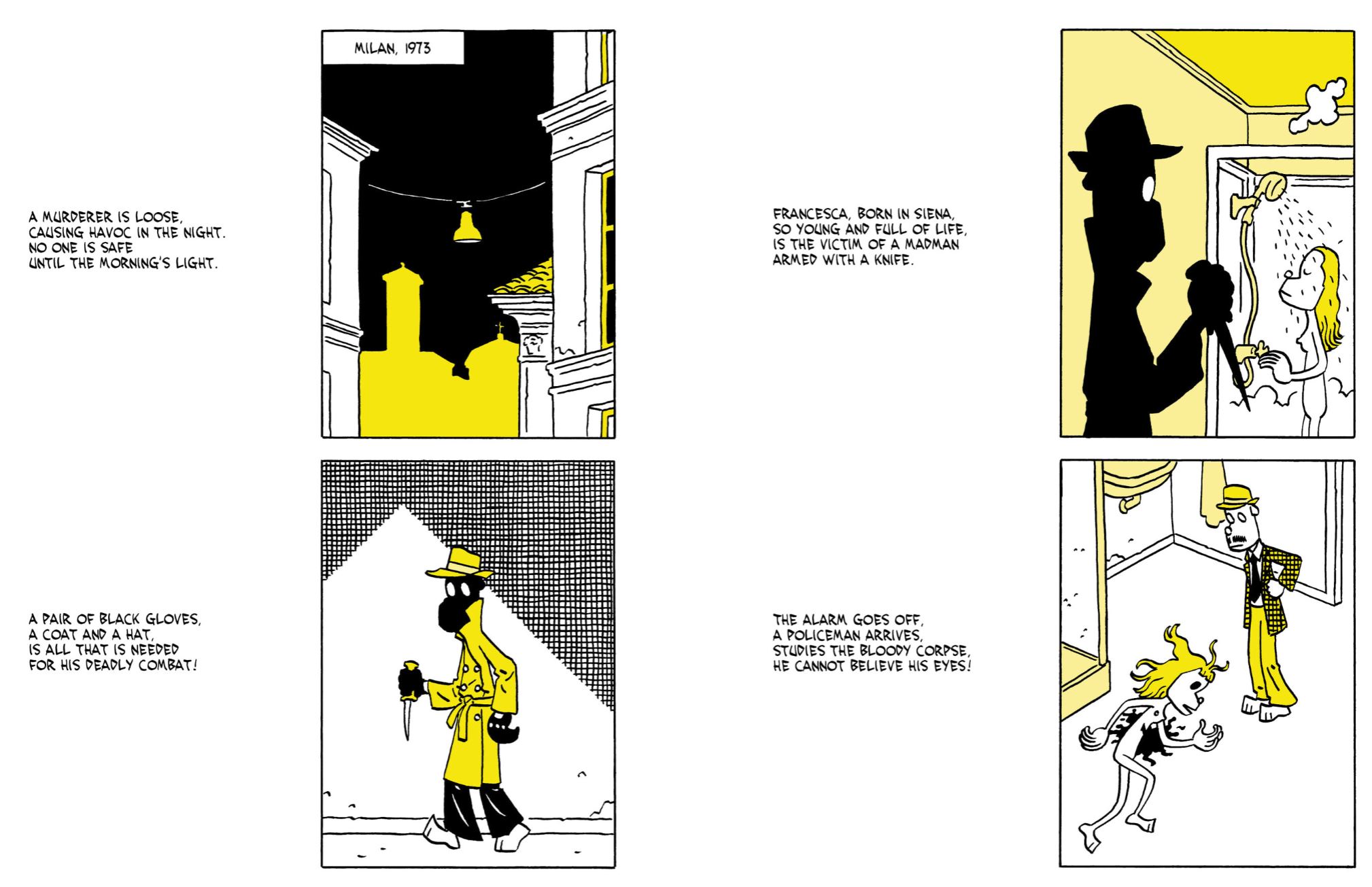
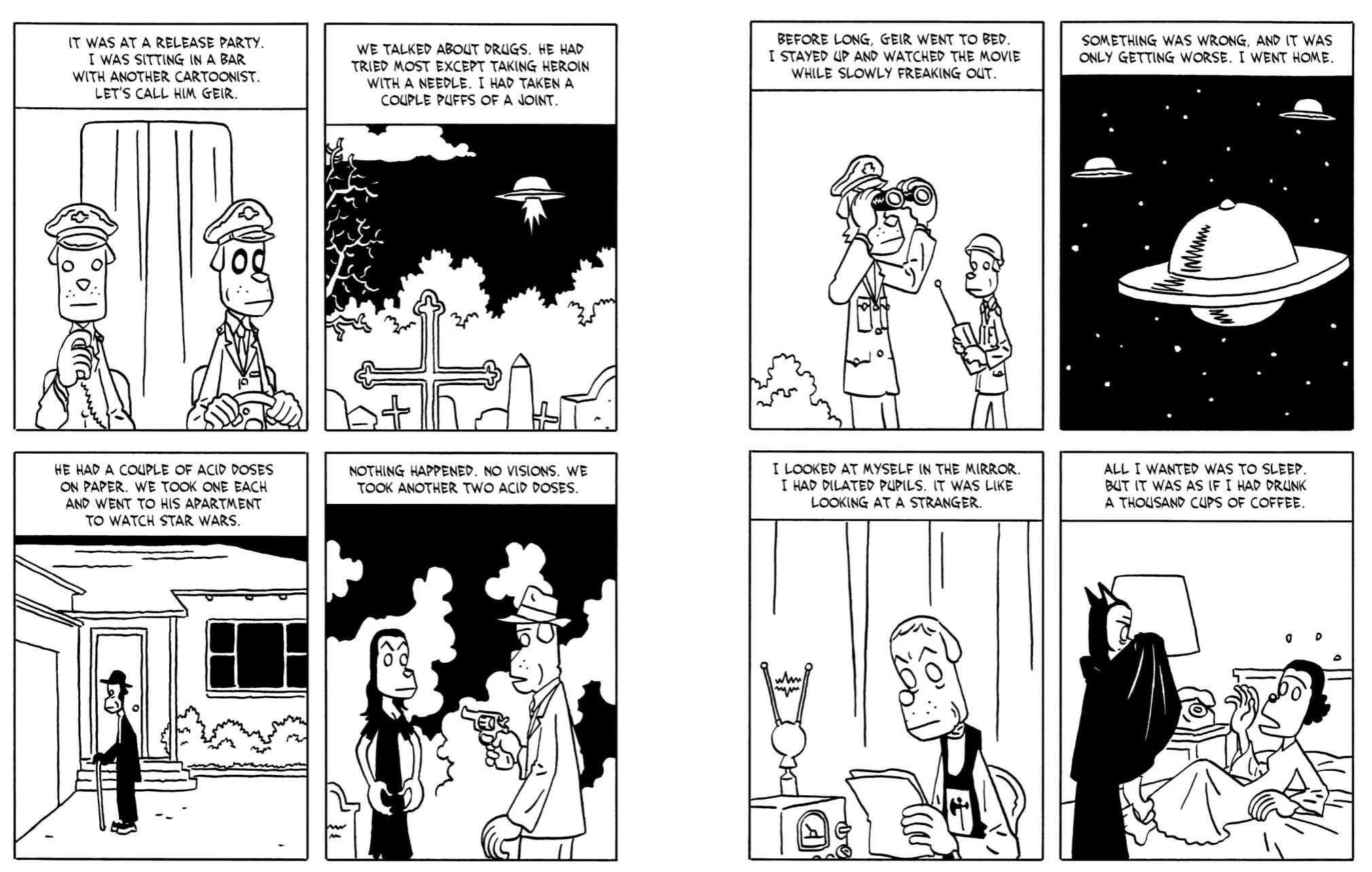
Slipping into a partial colour palette (yellow, if you care), ‘What Rhymes with Giallo?’ uses rhyming couplets to detail a sordid stabbing spree before resuming monochromatic mode as the tense future proves too much for one scientific stoic. Stress compels Mr Spock to desert the Enterprise and migrate to Montparnasse, Paris in ‘The City of Light, Forever’. It’s 1925 and he finds contentment as a minor Japanese painter (of cats) until Captain Kirk comes looking for him. If you follow Jason, this is where you start to realise that a lot of his work overlaps and intercepts itself in the strangest places…

Adding red and blue to black & white, ‘Who Will Kill the Spider?’ is a classic child’s nightmare of terror and confusion as Dad uses escalating tools and allies to deal with a bug in the bedroom who just won’t quit, after which words literally fail us in ‘One Million and One Years B.C.’: a silent science spoof of dinosaurs, cave-folk, time-travelling soldiers and stupid assumptions which leads into tribute diptych ‘EC Come…’ (a bloody tale of domestic ghouls and zombies) and ‘…EC Go’ (pointed satire of the comic company’s sublime Ray Bradbury adaptations of interplanetary First Contacts).

Then inevitably it devolves into a spoofing shot at the Sci Fi Fifties care of Curt Siodmak via Ed Wood in alien invasion ‘From Outer Space’ before ‘Etc.’ stages a celebrity-stacked movement-moment that begins in London circa 1972 as immortal musketeer Athos meets David Bowie meets a mummy meets Elvis meets Moses meets Sinatra meets Van Gogh meets Frank Zappa meets Death ad infinitum for a miasmic, abstractly construed big finish…

Visually mesmerising, this cunningly concocted Dadaist picture salad conceals underlying connections you really have to stay untuned for, referring relentlessly to modern icons and ancient shibboleths in equal measure, and perpetually sampling the feeling and furniture of war films, scary stories, true romances gone bad, Monty Python, Star Trek, a million movies, books, tunes and comics and even his own burgeoning “Jason-verse”. Upside Dawn absolutely should not be your first dip into his works, but don’t let that stop you from getting them all and getting all caught up…
All characters, stories, artwork and translation © 2022 Jason.
This edition of Upside Dawn © 2022 Fantagraphics Books, Inc. All rights reserved.

Today in 1892 Scots artist and future Charlie Chaplin comics illustrator Wally Roberson was born, followed in 1912 by John Liney (who limned the Henry strip), and in 1917, Hal Seeger who wrote & drew Betty Boop and later Leave it to Binky. In 1925 eventual East German cartoonist Hannes Hegen (Mosaik) arrived, with US letterer-to be Stan Starkman (Batman, Doom Patrol, Metamorpho) coming along in 1927. 3D comics guy Ray Zone was born in 1947, the same day and year that we lost the astounding Reg Perrott, artist on Roly and Poly the Two Bear Cubs, Land of the Lost People, Whirling Around the World, Wheels of Fortune, Red Ryder, The Young Explorers, The Golden Arrow, Golden Eagle, Sons of the Sword and more, as well as becoming producer/studio manager of UK mainstay Mickey Mouse Weekly.

In 1952 Hägar the Horrible artist Chris Browne was born, as was Chester Brown (Yummy Fur, Louis Riel) in 1960 and John Arne Sæterøy/Jason in 1965.

This date in 1964 Malcom Judge’s Billy Whizz first hurtled into the hearts of Beano readers, and in 2012 marked the passing of comic book workhorse Ernie Chan (Conan, Batman, Dracula Kull, The Hulk).

The Detection Club parts 1 & 2


By Jean Harambat, coloured by Jean-Jacques Rouger translated by Allison M. Charette (Europe Comics)
eISBN: 979-1-032809-95-2 (part 1), 979-1-032809-96-9 (part 2)

This book includes Discriminatory Content included for dramatic and literary effect.

Apparently, everybody loves mystery to chew on. With that in mind, here’s a brace of superb cartoon conundrums from the continent, based on an unlikely but actual historical convocation.

As seen on Wikipedia, – The Detection Club was a literary society of British crime writers, founded in 1930, with the likes of G.K. Chesterton, Dorothy L. Sayers and Agatha Christie as early Presidents. In 1936, American émigré John Dickson Carr became the first non-Brit elected to the august body; and probably pretty snarky elitist gathering.

They did stuff, wrote stories, held events and upheld (Ronald) Knox’s Commandments which detailed the proper rules of mystery writing. The group is the basis of later media McGuffin’s such as Batman’s Mystery Analysts of Gotham City and every bunch of screen authors matched against evil geniuses everywhere…

I’m pretty sure the story here collected in two volumes by award-winning cartoonist, screenwriter, graphic novelist, historian, philosopher and journalist Jean Harambat (Les Invisibles, Ulysses, the Songs of Return, Operation Copperhead) is apocryphal, but you never know…

Originally released in 2019, our case du jour opens in a prologue, with the reciting of those Knox commandments and the confirmation of Mr. Dixon Carr at a slap-up feed at London hostelry Ye Olde Cheshire Cheese – a pub that doesn’t seem to mind the odd celebratory gunshot…

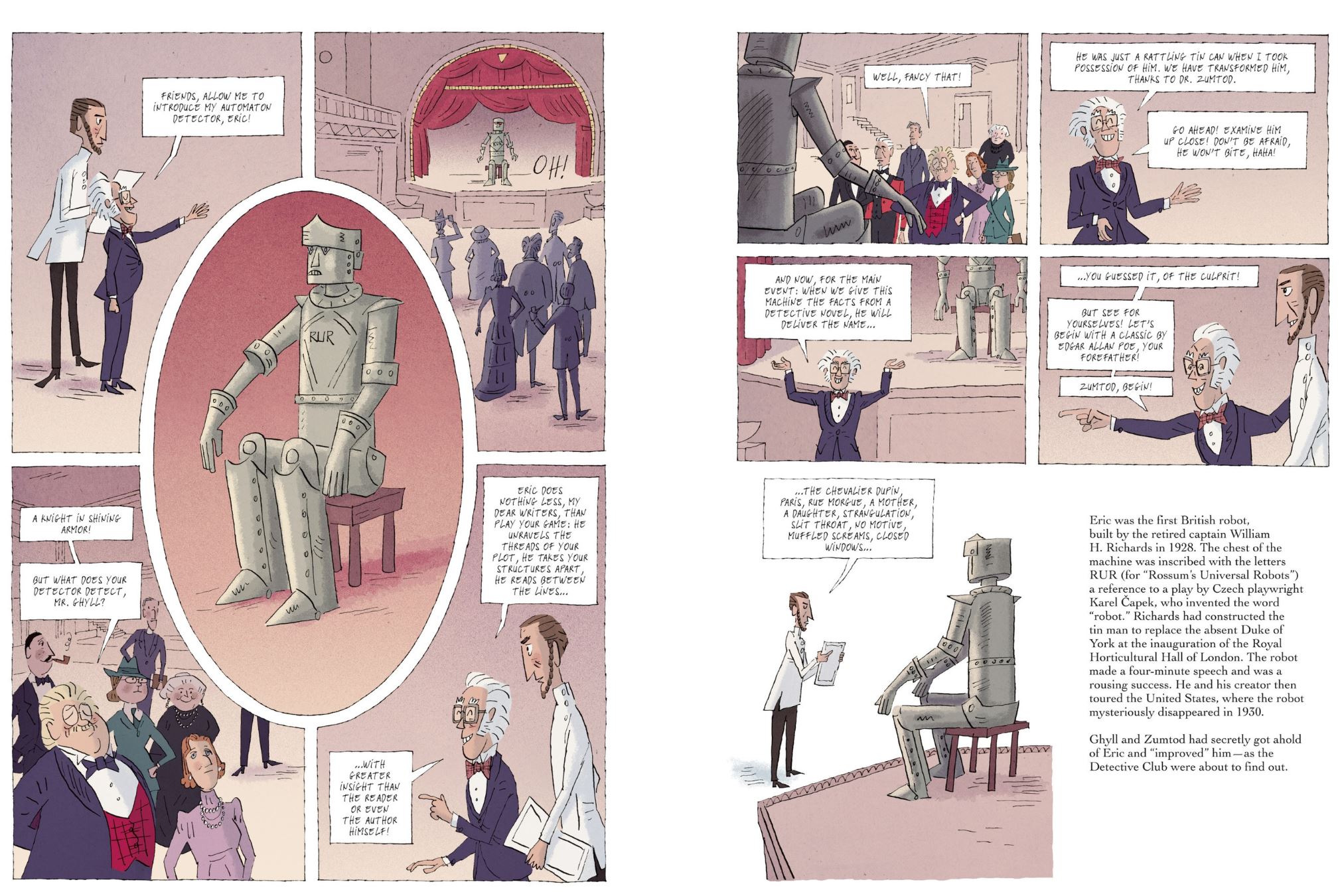
Present are President Chesterton, Dixon Carr, Christie, Sayers, Baroness Emma Orczy, Major A.E.W. Mason and Monsignor Ronald Knox himself, and – as the posh repast winds down – proceedings are somewhat disturbed by the arrival of a flying, talking robotic bird bearing a strange invitation…

Eccentric man of means Mr. Roderick Ghyll wishes the company of the sagacious society at his extraordinary domicile on April 1st. Briarcliff House is situated on a private island where Ghyll wishes to celebrate the future through his latest contrivance, therefore promising “challenges”, “enchantments” and “the renaissance of crime fiction”…

Chapter I opens with the scribes and scribblers approaching ‘An Island in Cornwall’ and still heatedly debating the motives of the mystery man. Ghyll greets them effusively before zooming off in a bizarre electric unicycle leaving them to make their way to his palatial manse: a gleaming tribute to sleek, tripped down modernism – if not actual futurism…

Apart from the domestic staff chef Alphonse, maid Madeline, implacable (not to say positively “inscrutable”) Asian manservant Fu, and stepdaughter Millicent, the only other human present is technical assistant Dr. Zumtod and Ghyll’s haughty beautiful wife Honoria. A future generation would call her a “trophy”…

The old plutocrat is a deeply unpleasant and smugly overbearing host who boasts of one more personage that the sharp-minded, brain-testing authors must meet. With smugness and great ceremony he introduces Eric: a mechanical man with more than human insight who can outwit any mortal and easily determine the culprit in any tale they might concoct…

Although challenged with the details of a string of classic novels – which Eric easily and correctly concludes with the name of the perpetrators – the writers remain insulted and unconvinced. Dixon Carr even oversteps the bounds of polite decency by probing the automaton in search of a pre-prepped dwarf or amputee and the display is halted for dinner where Ghyll continues to advocate a world filled with his “metal friends”…

The evening wears on with the usual social distractions balanced by heated argument on many topics sparked by Eric’s existence and the magnate’s pronunciations that art and literature must make way for a machine-run world. At last, the affair breaks up with the guests retiring to their assigned rooms in a state of high dudgeon…

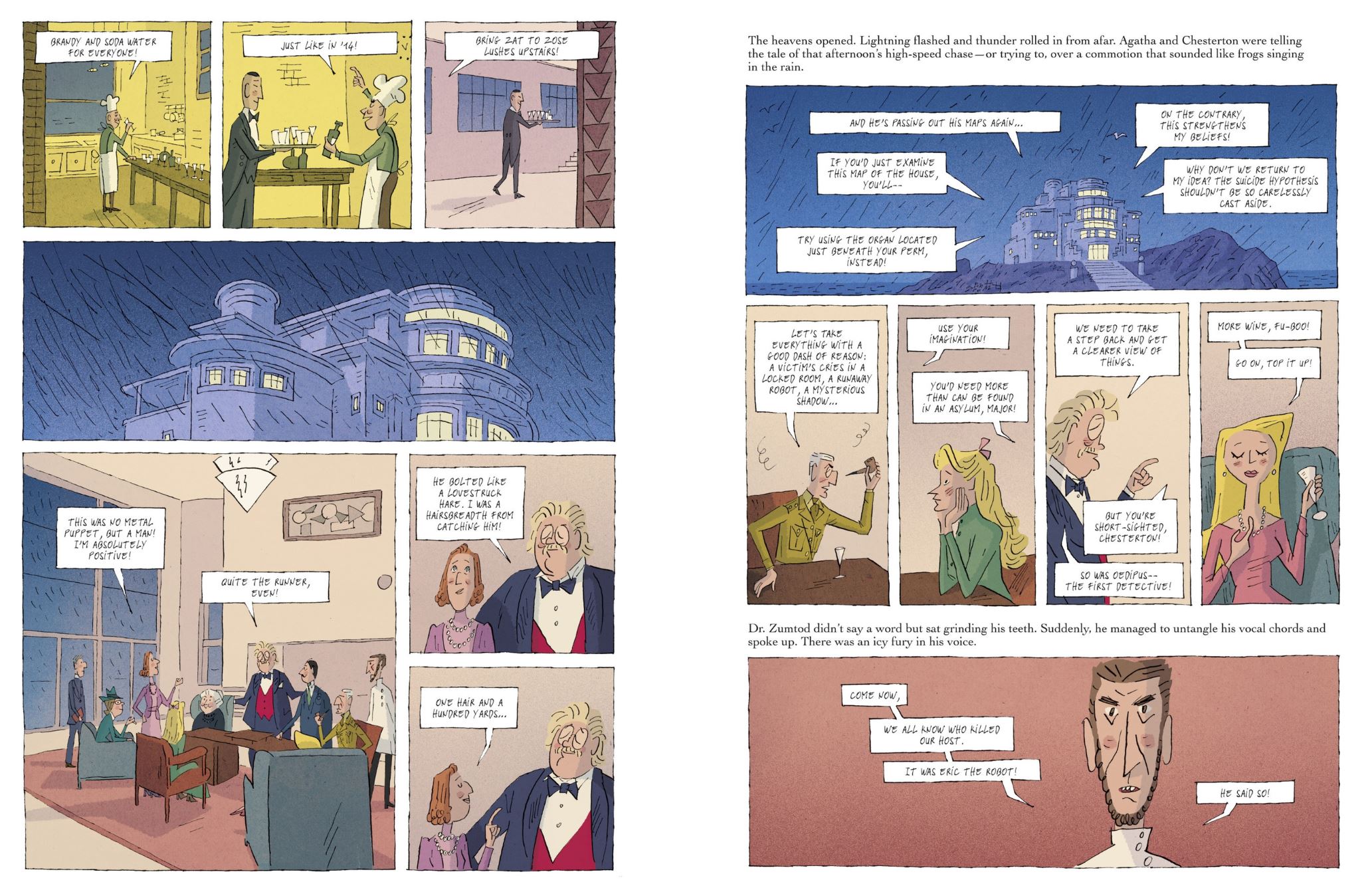
That all ends in esteemed literary tradition, with screams and the writers breaking into Ghyll’s savagely disarrayed bedroom to discover electronic Eric inert in a chair and clear evidence of ‘The Billionaire Out the Window’. Far below, a dressing gown sinks beneath choppy waves and subsequent frantic searches result in no sign of their host…

Well-versed if not actually experienced in investigation, the writers set about interviewing the staff and then the residents. Zumtod then suggests the painfully obvious: turning Eric loose on the problem. The response is as rapid as the answer is shocking…

While waiting for the outer world to re-establish contact with the isolated isle, “Queen of Crime” Christie bonds with the presumed widow and probes the step-daughter, whilst Chesterton continues to scour the entire vicinity. He’s suspicious of everything – including whether there has been any crime at all – and rapidly unearths many unsuspected secrets even as each writer cleaves to their particular speciality, makes their own assessment and forms a personal hypothesis.

…And then a body washes ashore…

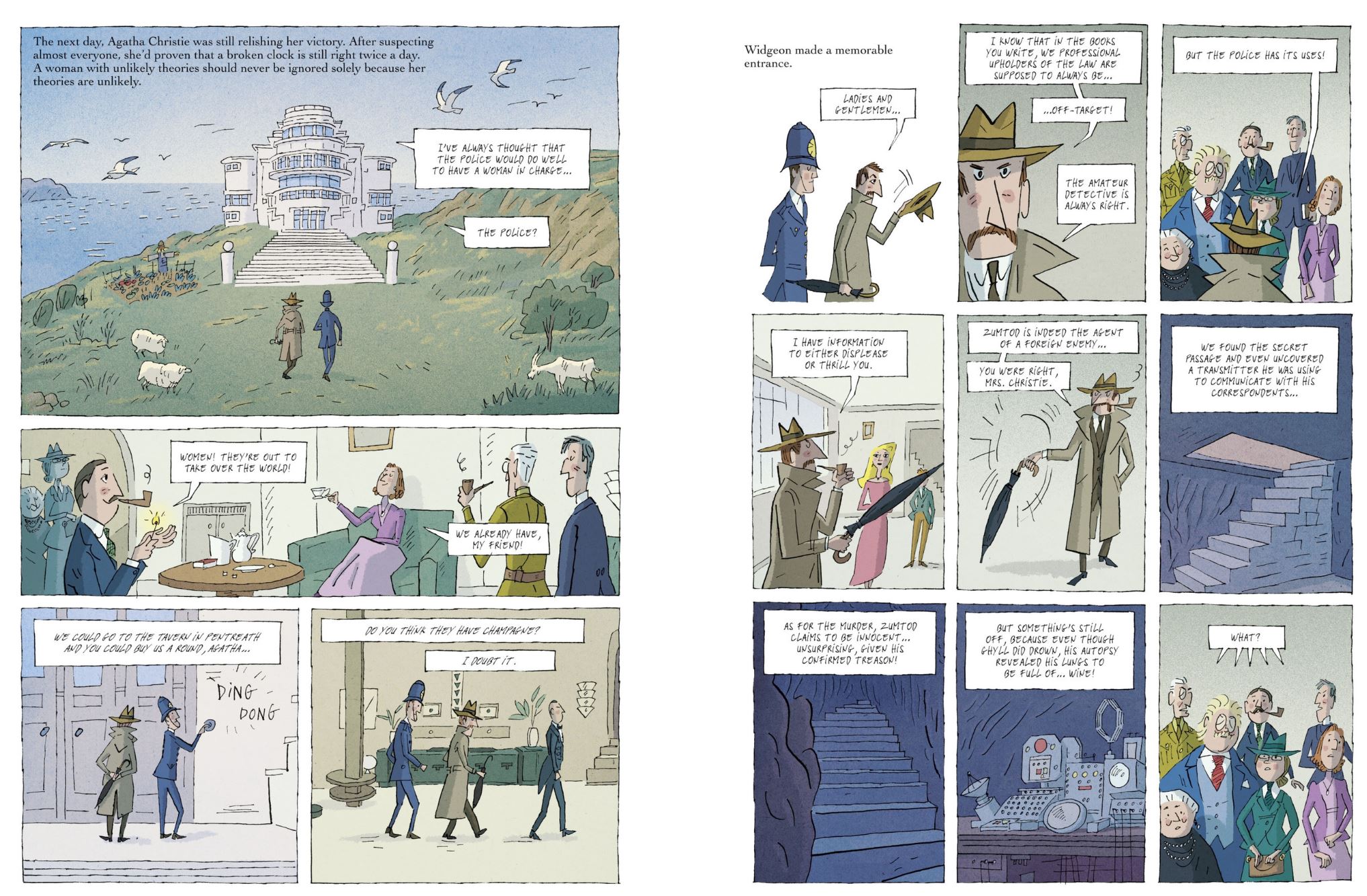
The Detection Club’s second volume begins with third chapter ‘Seven Amateur Detectives’ and an armada of late-arriving constabulary. Led by Inspector Widgeon they proceed to interview the drawing room sleuths. Mounting tensions, contrary theories and wounded pride quickly drive all concerned into fractious conflict, even as potential heir Millicent’s banished and outcast twin Watkyn re-emerges. Has he only returned because of his despised step-father’s demise or was he actually back just before it happened?

Events seemingly come to a head when Christie expounds her latest theory and provokes a minor hostage crisis until the villain is apprehended through unlikely team work. As the constabulary step in with the handcuffs however, new evidence emerges that sets the cogitators back on the murder-trail… until straightforward ratiocination leads one author to the only possible solution…

Wry, witty, and decidedly well-plotted, with smart characterisations and devastatingly sharp, catty dialogue (kudos to translator Allison M. Charette), this lively, lovely lark is also charmingly limned: a grand and glorious tribute to days gone by and superb stylists who tested our wits and expanded our entertainment horizons. This is a tale no whimsy-inclined crime fan can afford to miss.
© 2020 – DARGUAD – HARAMBAT. All rights reserved.

Today in 1911, Canuck-by-migration Ed Furness (Freelance, Commander Steel, “Canadian Whites publications” era) was born, followed by Dick Tracy collaborator Mike Curtis in 1953; Matt Feazell (Amazing Cynicalman) in 1955 and original Men in Black artist Sandy Carruthers arrived in 1962.

On this date we lost Chester Gould (Dick Tracy) in 1985 and Italian megastar artist Ferdinando Tacconi (Journey into Space and Jeff Hawke in Junior Express, Sciuscià, Susanna, Gli Aristocratici, Uomini senza gloria, L’uomo di Rangoon, Nick Raider, Dylan Dog) in 2006. Pioneering Filipino artist Tony DeZuñiga (Black Orchid, Outlaw, Jonah Hex, practically every character at DC & Marvel) died in 2012.

After 1269 weekly issues UK girls comic Mandy folded today in 1991. It had debuted on 21st January 1967.

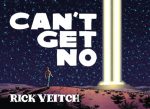
Can’t Get No


By Rick Veitch (Sun Comics/Vertigo)
ISBN: 978-1-4012-1059-5 (TPB Vertigo),
ISBN: 978-1-7241-3814-9 (TPB/Digital edition Sun Comics remastered second edition)

Born on May 7th 1951, Rick Veitch is a criminally undervalued creator who has lived through post-war(s) America’s many chimeric social revolutions. He has a poet’s sensibilities and a disaffected Flower-Child’s perspectives informing a powerful creative consciousness – and conscience. Can’t Get No is a landmark experiment in both form and content which deserves careful and repeated examination.

The shockwaves from the terrorist atrocity of September 11th 2001 changed the world and in our own small insulated corner, generated a number of graphic narrative responses of varying quality, not to mention deep emotional honesty. Rick Veitch’s 2006 Can’t Get No was as powerful and heartfelt as any, and benefited greatly from the little time and distance that bestowed perspective on raw emotional reactions.

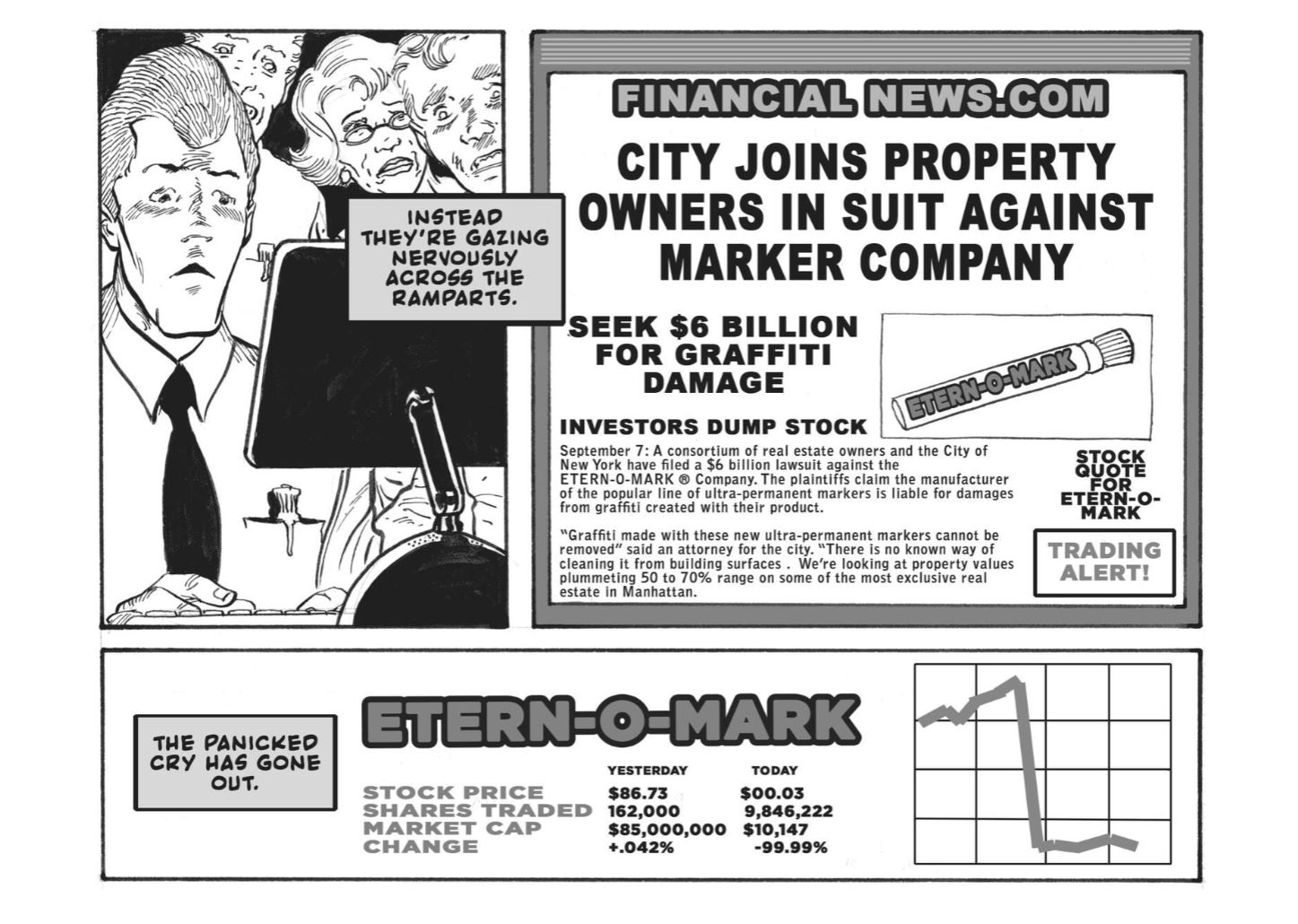
Chad Roe‘s company sold the world’s most permanent and indelible marker pen, the Eter-No-Mark. Everyone involved in selling them was flying high, but then the lawsuits hit all at once. A cheap, utterly irremovable felt-pen is a godsend to street-artists and becomes the most virulent of vandalistic weapons to property owners with nice clean tempting walls…

As his universe collapsed on him, Chad went on a bender, picked up two hippie-artist-chicks in a bar and woke up a human scribble-board, covered literally from head to toe in swirling, organic, totally permanent designs.

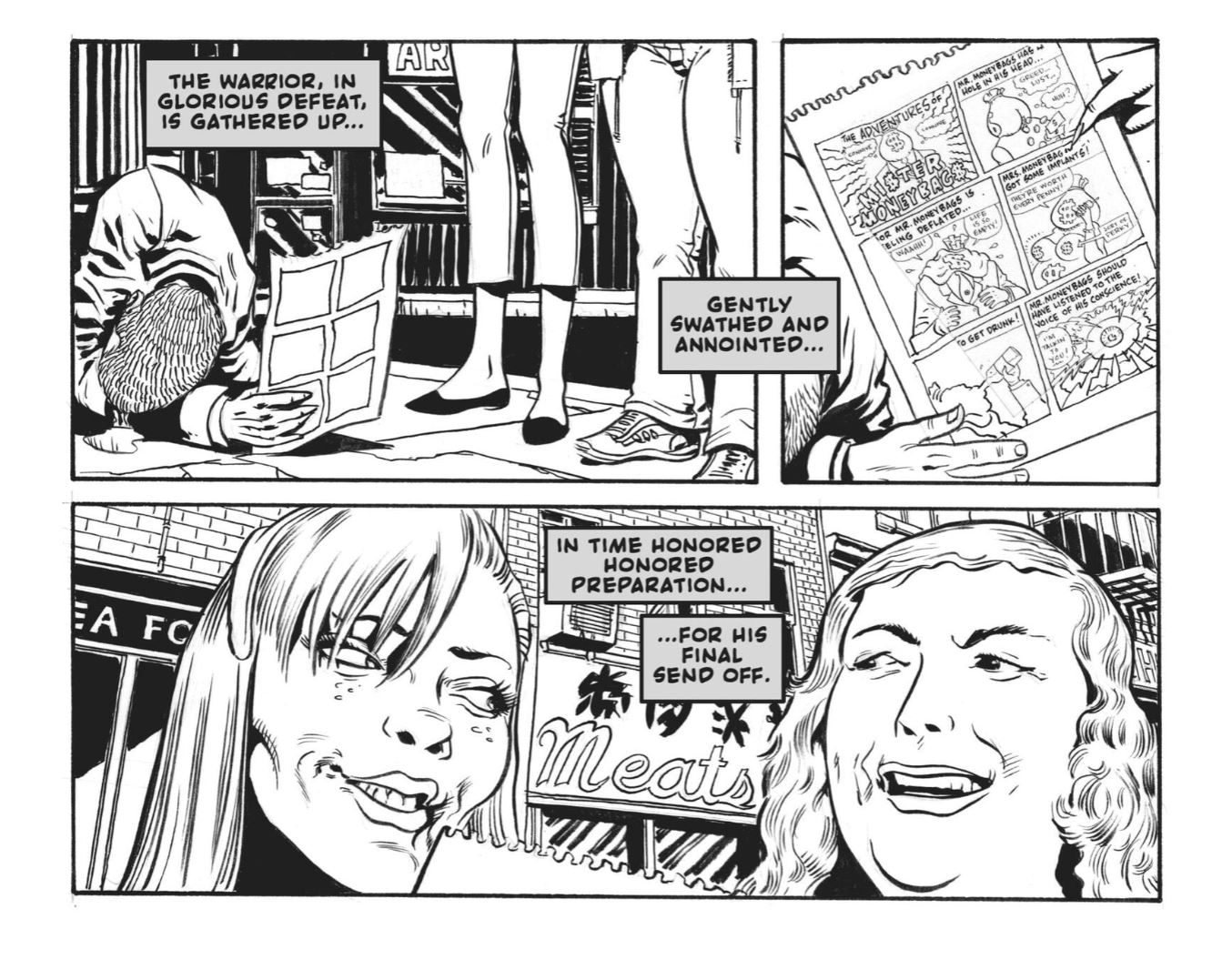
Even then he tried so very hard to bounce back. A walking abstract artwork, he was ostracized by mockery, and unable to conceal his obvious “otherness”, and neither self-help philosophies, drugs, or alcohol could make him feel normal anymore. Defeated, reviled and eventually crushed in spirit, he was trapped in a downward spiral. Then Chad met the pen-wielding girls again and found solace and uncomplicated joy in the artist’s world of sex, booze and dope.

Lost to “normal” society, Chad took a road-trip with the women, but they hadn’t even left the city before they were all arrested. This was morning on September 11th and as the girls violently resisted the cops, an airplane flew overhead, straight towards the centre of Manhattan…

With no-one looking at him, just another part of the shocked crowd, Chad watched for an eternity, and then – no longer anything but another stunned mortal – drove away with an Arab family in their mobile home…

And thus began a psychedelic, introspective argosy through US philosophy, symbolism and meta-physicality. With this one act of terrorism forever changing the nation, Chad is forced on a journey of discovery to find an America that is newborn both inside and out. His travels take him through vistas of predictable cruelty and unexpected tolerance, through places both eerily symbolic and terrifyingly plebeian, but by the end of this post-modern Pilgrim’s Progress, both he and the world have adapted, accommodated and accepted.

Black & white in landscape format, and eschewing dialogue and personal monologues for ambient text (no word balloons or descriptive captions, just the words that the characters encounter such as signs, newspapers, faxes etc.) this graphic narrative screams out its great differences to usual comic strip fare, but the truly magical innovation is the “text-track”: a continual fluid, peroration of poetic statements that supply an evocative counterpoint to the visual component.

Satirical, cynical and strident with lyricism deployed for examination and introspection, and perhaps occasionally over-florid, but nonetheless moving and heartfelt free verse and epigrams do not make this an easy read or a simple entertainment. They do make it a piece of work every serious consumer of graphic narrative should experience… before it’s too late for all of us.
© 2006, 2019 Rick Veitch. All Rights Reserved.

Today in 1900, Alley Oop originator V.T. Hamlin was born, followed in 1905 Puerta Rico by Golden Age cover maestro Alex Schomburg, whilst in 1957, Classics Illustrated mainstay Henry C. Kiefer died. Franz Frazetta hung on until today in 2010 at which time he was 82 years old.

This date in 1943, Jack Sparling began his newspaper strip Clare Voyant, and in 2004 Jeff Smith apparently drew the final page of Bone.

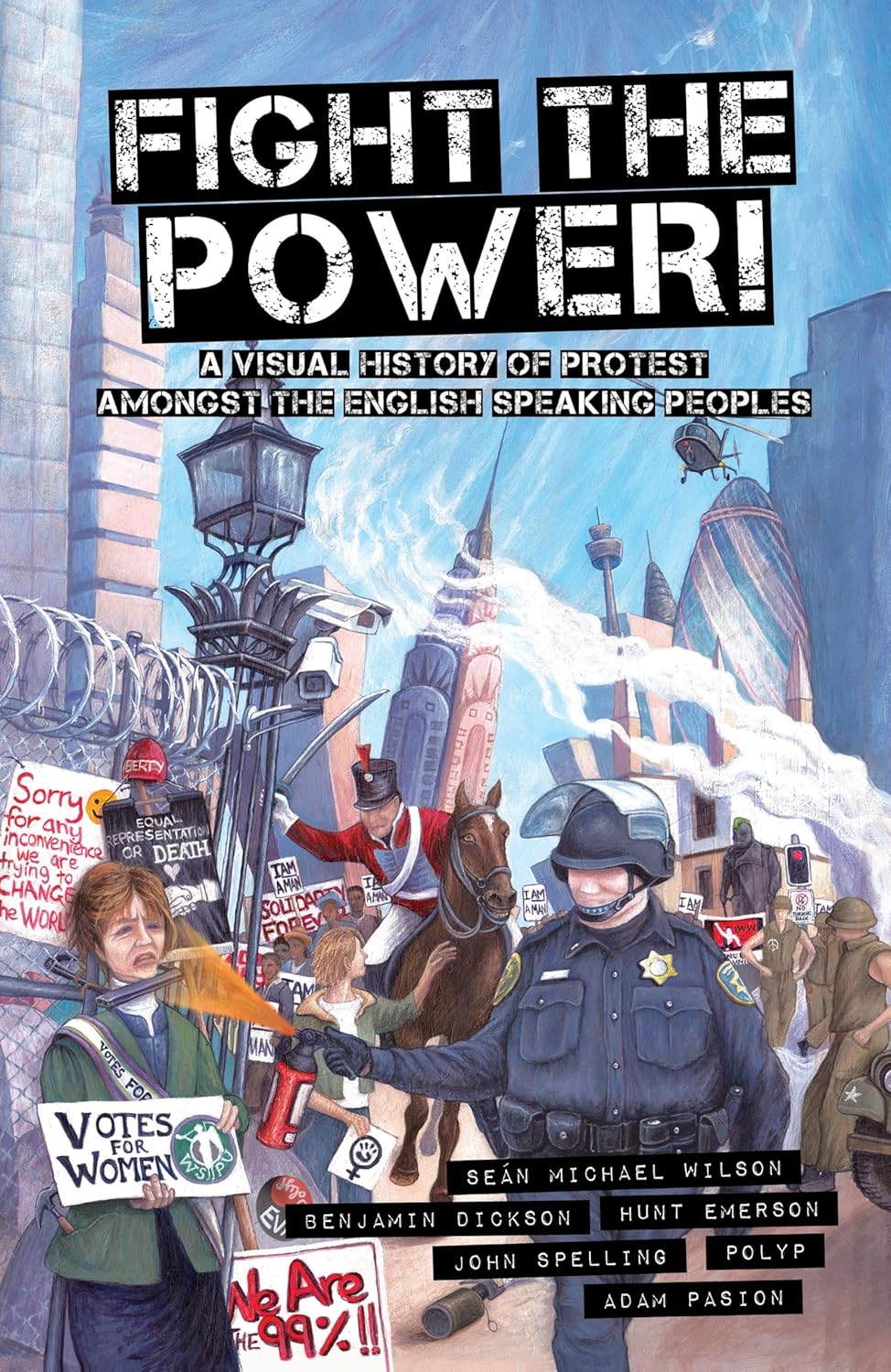
Fight the Power – A Visual History of Protest Among the English-Speaking Peoples


By Sean Michael Wilson, Benjamin Dickson, Hunt Emerson, John Spelling, Adam Pasion with additional cartoons by Polyp (New Internationalist)
ISBN: 978-1-78026-122-5 (PB)

Politics is composed of and utilised equally by firebrands and coldly calculating grandees, and that’s probably the only guiding maxim you can trust. Most normal people don’t give a toss about all that until it affects them in the pocket or impacts their kids and, no matter to what end of the political spectrum one belongs, the greatest enemy of the impassioned ideologue is apathy. This simple fact forces activists and visionaries to ever-more devious and imaginative stunts and tactics…

However, all entrenched Powers-That-Be are ultimately hopeless before one thing: collective unified resistance by the very masses they’re holding down through force of arms, artificial boundaries of class or race, capitalist dogmas, various forms of mind control like bread, circuses and religion, divisive propagandas or just the insurmountable ennui of grudging acceptance to a status quo and orchestrated fear that unknown change might make things worse.

Perhaps you can see how such musings might be of relevance in these current unforgettable days?

From its earliest inception, cartooning has been used to sell: initially ideas or values but eventually actual products too. In newspapers, magazines and especially comic books the sheer power of narrative – with its ability to create emotional affinities – has been linked to the creation of unforgettable images and characters. When those stories affect the lives of generations of readers, the force that they can apply in a commercial, social or especially political arena is almost irresistible…

The compelling power of graphic narrative to efficiently, potently, evocatively disseminate vast amounts of information and seductively advocate complex issues with great conviction through layered levels has always been most effectively used in works with a political or social component. That’s never been more evident than in this stunning and scholarly graphic anthology detailing infamous and effective instances of popular protest.

In Britain the cartoonist has always occupied a perilously precarious position of power: with deftly designed bombastic broadsides or savagely surgical satirical slices ridiculing, exposing and always deflating the powerfully elevated and apparently untouchable with a simple shaped charge of scandalous wit and crushingly clear, universally comprehensible visual metaphor… or sometimes just the plain and simple facts of the matter.

For this universal and welcomingly basic method of concept transmission, levels of literacy or lack of education are no barrier. As the Catholic Church proved millennia ago with the Stations of the Cross, stained glass windows and a pantheon of idealised, sanitised saints, a picture is absolutely worth a thousand words, and as William the Conqueror saw with the triumphalist Bayeux Tapestry, picture narratives are worth a few million more…

Following a fabulously thought-provoking Introduction by author, journalist and filmmaker Tariq Ali, this march through the history of dissent as compiled and scripted by Sean Michael Wilson & Benjamin Dickson begins with an agenda-setting ‘Prologue’ illustrated by Adam Pasion, best described (without giving the game away) as Uncle Sam, John Bull and the Statue of Liberty (AKA ‘Liberty Enlightening the World’) walk into a bar…

Their heated discussion on the value and need of people using their right to dissent is then captivatingly illustrated through a series of erudite, fascinating, shocking and deliciously funny tutorial episodes, beginning with a compelling account of ‘The Luddites and the Swing Riots, 1811-1832’ written by Wilson and rendered both palatable and mesmerising by comics legend Hunt Emerson.

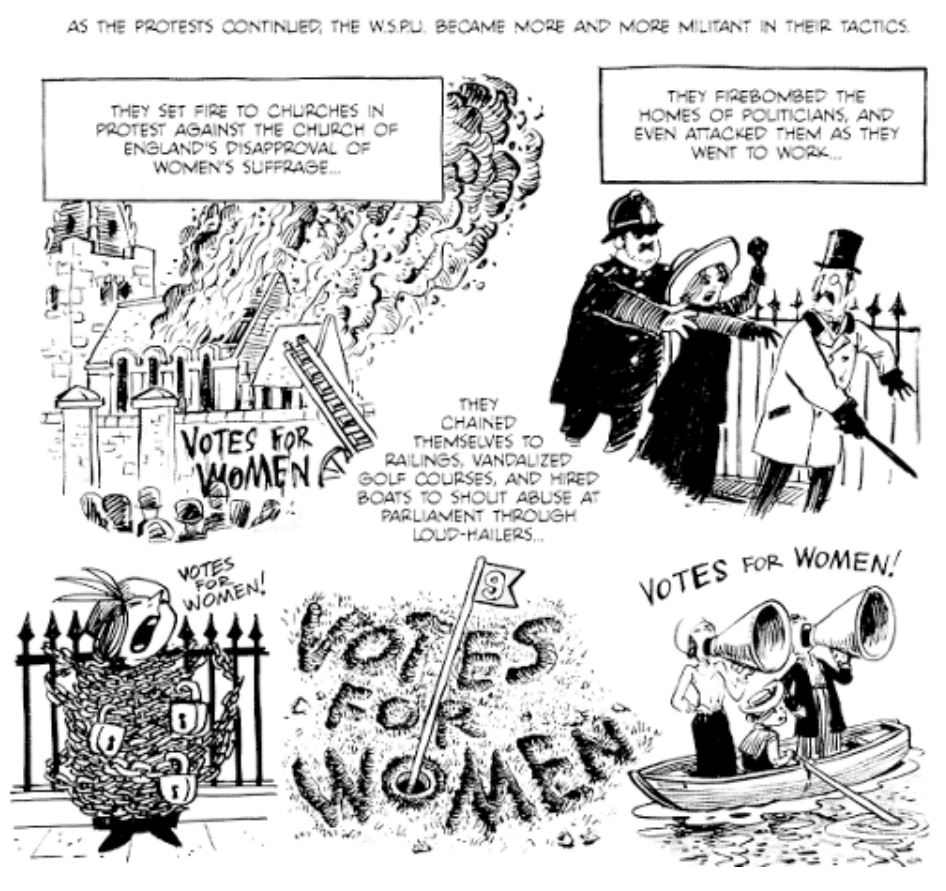
The artist then turns to recreating the horrific events and aftermath of ‘The Battle of Peterloo, 1819’ via Dickson’s script before, with Wilson, cataloguing a wave of ‘Colonial Rebellions, 1836-1865’ which the British Empire dealt with in its traditional even-handed, temperate manner (and in case you were wondering, that’s me doing sarcasm). Wilson & Pasion then detail the global impact of the ‘Irish Rebellions, 1791-1922’ whilst Dickson & Emerson’s account of ‘The Suffragettes, 1903-1918’ follows the story of Votes for Women right up to the present. Practically forgotten and brutally savage, ‘The Australian General Strike, 1917’ (by Wilson & Pasion) and the equally appalling landmark events of ‘The Boston Police Strike, 1919’ – as told by Dickson & John Spelling – reveal a pattern to modern labour conflicts, with working folk ranged against intransigent and greedy commercial interests.

The age-old struggle escalated during the ‘UK General Strike and the Battle of George Square, 1918-1926’ (Wilson & Spelling) and reached an intolerable strike-busting peak in Ohio during ‘The Battle of Toledo, 1934’ (Wilson & Spelling): a struggle which cemented management and labour into the intractable ideologically opposed positions they still inhabit today in the aforementioned English-speaking world…

Championing of Human Rights is commemorated by Dickson & Pasion in ‘Rosa Parks and the Bus Boycott, 1955-1956’ followed by a deeply moving account of ‘The Trial of Nelson Mandela, 1964’, whilst the modern American soldier’s method of combating unwelcome or insane orders is reviewed in brilliantly trenchant Wilson & Emerson’s ‘Fragging’

Back home and still etched in so many peoples’ memories, Dickson & Spelling’s ‘The Poll Tax Riots, 1989-1991’ offers a surprisingly even-handed rundown of Margaret Thatcher’s greatest political blunder, before hitting more recent headlines with the origins and outcomes of ‘Occupy, 2011’

Returning to that bar and Lady Liberty, Dickson, Wilson & Pasion draw some telling Conclusions to close our cartoon course in mass resistance, after which the writers discuss their process in Authors Notes: Why This Book? before then listing the truly phenomenal rewards of all those campaigns and protests with a long list of Rights Won. These range from Women’s Suffrage to the universal formal acknowledgement of the Human Right to Protest that our current global leaders and assorted billionaires are so keen on taking away again…

Understanding the value of a strategically targeted chuckle, this fabulous monochrome chronicle concludes with one last strip as Dickson & Emerson hilariously reveal ‘The Four Stages of Protest’ courtesy of Mohandas “Mahatma” Gandhi…

More so than work, sport, religion, fighting or even sex, politics has always been the very grist that feeds the pictorial gadfly’s mill. Of course, cartooning can only accomplish so much, and whilst Fight the Power! recounts a number of instances where physical and intellectual action were necessary to achieve or maintain justice, at least comics can still galvanise the unconvinced into action and help in the useful dissemination of knowledge about protest: the Who, Where, When, and How.

If you don’t understand What or Why then you’re probably already on the other side of the barricades – and complaining about who gets what vaccine or can be allowed to shout in the streets at all…
© 2013 Sean Michael Wilson and Benjamin Dickson. Illustrations © 2013 Hunt Emerson, John Spelling and Adam Pasion. Cartoons © 2013 Polyp. All rights reserved.

Today in 1909, Golden Age legend Howard Sherman (Dr. Fate, Tommy Tomorrow, Congorilla) was born, as was David Micheline (Iron Man, Spider-Man, Venom, Swamp Thing, Aquaman, Magnus – Robot Fighter) in1948, inkers Dennis Jensen in 1952, John Beatty in 1961 and John Lucas in 1968. France greeted Emmanuel Larcenet (Dungeon, Le combat ordinaire) in 1969, with the US response being Nunzio DeFilippis (Three Strikes, Dragon Age) in 1970, and Bryan Edward Hill (American Carnage, Blade) in 1977.

This date in 2002, Robert Kanigher died.

Elephant Man


By Greg Houston (NBM)
ISBN: 978-1-56163-588-7 (TPB)

This book includes Discriminatory Content produced for comedic effect.

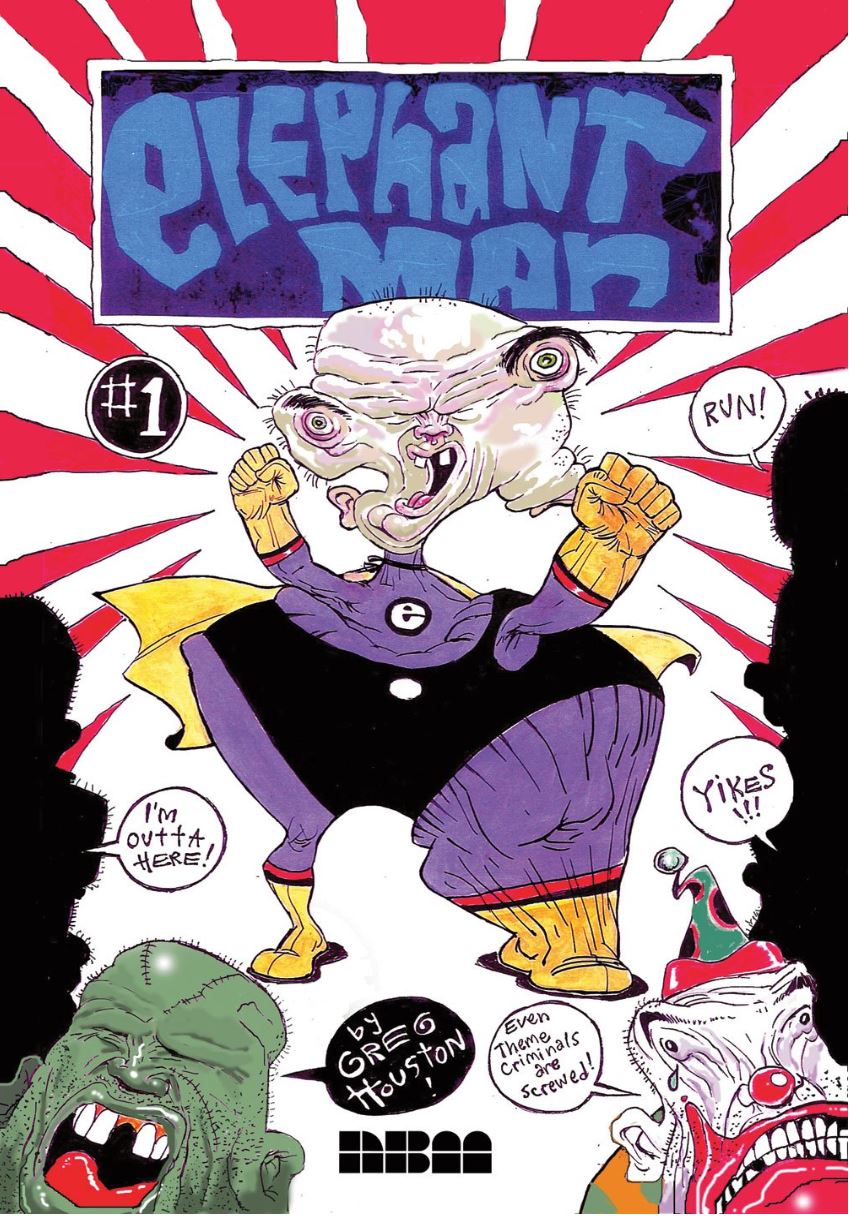
Cartoonist, caricaturist, designer, educator, actor and major fan of old movies, Greg Houston delights in the baroque and comically grotesque; positively revelling in taking taste-free pot-shots at societal and popular culture icons (see Vatican Hustle for more of his measured, manic musings) and this marvellous and madcap monochrome missal has a go at the very bedrock of our medium by parodying and pastiching the classic superhero scenario.

Baltimore has its own Costumed Crusader and he is the perfect symbol of a city with so little to recommend it. This crusading costumed boy scout doesn’t have any proper powers, but the people love him and on the fifth anniversary of his first appearance the minor metropolis is holding a week of commemorative events…

Local paper The Daily Crab is following events, particularly feisty journo Tracie Bombasso, cub reporter Dud Cawley and mild-mannered, colonically-challenged reporter Jon Merrick (yes, that kind of Elephant Man), despite the rantings of unpopular on-air TV presenter Handsome Dick Denton – but he’s just jealous, right?

Also determined to spoil everything is sinisterly macabre conjoined villain The Priest, the Rabbi and the Duck: twisted victim(s?) of an old joke and a tragic accident involving alcohol and Science…

Can Merrick keep his identity secret from his fellow reporters, foil the machinations of Denton and stop the three-headed Hydra of Pique? Of course he can, but along the way there are bizarre characters old and new (keep your eyes peeled for cameos from Boss Karate Black Guy Jones and other uber-odd Vatican Hustle alumni), cripplingly painful embarrassing moments and enough ugly hilarity to have a very good time indeed.

And lest you think we’re being unkind to the place let me reveal that Houston is Baltimore born-and-bred, and gets a pass on being nigh-litigiously critical…

Beneath the outrageous parody and extreme mock-heroics is a witty and genuinely funny adult romp poking edgy fun at everything from politicians to donuts, and weathermen to beauticians, gleefully making some telling observations about Heroes and how to treat them, all rendered in a busy, buzzy, black-&-white line that appeals and appals in equal amounts.

Warning: this book contains six-foot talking flies and shaved, car-racing monkeys.
© 2010 Greg Houston. All rights reserved.

Today in 1952 scriptwriter Hilary Bader (Batman, Superman, Star Trek) was born, followed by Brazilian Rafael Grampá in 1978; Christina Strain in 1981 and Zeb Wells in 1983.

1902 today saw the start of Ed Payne’s strip Professor O. Howe Wise and Professor I.B. Schmart with Stan Lynde’s outrageous comedy western feature Rick O’Shay launching this date in 1958. However in 1991, Spirou’s creator Rob-Vel (François Robert Velter) passed away.

Ant Wars


By Gerry Finley-Day, José Luis Ferrer, Alfonso Azpiri, Luis Bermejo, Lozano, Peña, Simon Spurrier & Cam Kennedy & various (Rebellion/REBCA)
ISBN: 978-1-78108-622-3 (HB/Digital edition)

This book includes Discriminatory Content produced in less enlightened times.

The sun’s out and the sarnies are packed so let’s shamble down memory lane with a bug-beguiling packed lunch for all us oldsters which might, perhaps, offer a fresh, untrodden path for younger fans of the fantastic in search of a typically quirky British comics experience.

This stunning paperback/eBook package provides another knockout nostalgia-punch from Rebellion Studios’ scintillating 2000 A.D. treasure-trove, gathering the 15 weekly episodes of seminal shocker Ant Wars as first seen in Progs #71-85 (July 1st – 7th October 1978). There’s also a later resurgence of creepy creatures, which initially infested The Judge Dredd Megazine (#231-233, May to July 2005).

The strip debuted with ferociously prolific writer Scots Gerry Finley-Day (Ella on Easy Street, The Camp on Candy Island, Rat Pack, The Bootneck Boy, D-Day Dawson, The Sarge, One-Eyed Jack, Hellman of Hammer Force, Sgt. Streetwise, Dredger, Dan Dare, Invasion, Judge Dredd, Harry 20 on the High Rock, The V.C.s, Rogue Trooper, Fiends of the Eastern Front and dozens more) establishing a contemporary scenario to explore human greed and venality against a setting of increased pollution and eco-barbarism in the heart of the Amazon basin. The creepily compelling visuals came via an international tag team of illustrators – beginning with co-creator José Luis Ferrer, and followed by Alfonso Azpiri, Luis Bermejo, Lozano and Peña -who skilfully combined local knowledge of Central/South American locales with old fashioned monster movie riffs to deliver a wicked and wild cautionary tale.

In an era of burgeoning eco-politics, increasing environmental awareness and growing advocacy for Indigenous rights, the saga confronted entrenched corporate greed, Military-Industrial Complex arrogance and political complacency in a rip-roaring, grossly anarchic Doomwatch scenario that revelled in an innate love of irony married to macabre and bloody carnage. It was also pretty cool to see an utter absence of Yanks or Brits casually saving the day…

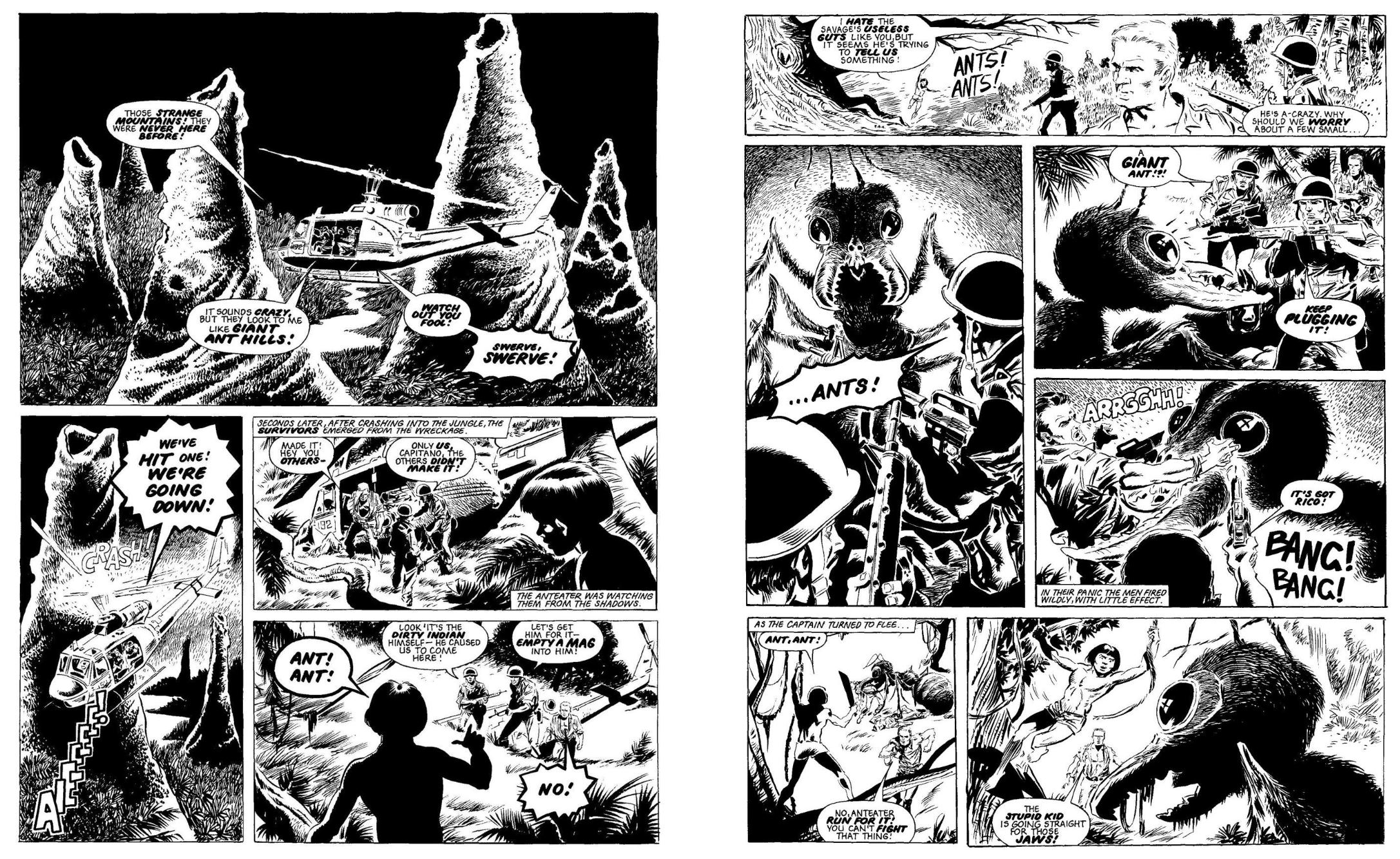
It begins in the depths of the Brazilian rain forest as helicopter-borne soldiers descend on “wild Indians” they find eating ants. After despatching the disgustingly primitive indigenes, the troops complete their mission, expediting a test of GGS: a new super-insecticide created by a multinational corporation which needs testing without too much oversight…

Some months later captive natives are being forcibly “civilised” by those soldiers in a Reservation Camp. The captives (grudgingly) wear clothes and can speak to their “benefactors” now, but recidivism remains stubbornly high. When one youngster is caught eating ants again, he endures another punishment beating before escaping. Delighted to have something to do, the soldiers board their copters and track him into the verdant hell all around them. That’s when they discover skyscraper-sized anthills and are ambushed by hungry Formicidae the size of buses and far smarter than they are or, indeed, most humans…

The squad are wiped out, but Captain Villa survives, aided by the Indian boy they had disparagingly dubbed “Anteater”. His speed, agility and dexterity with a machete are the only counter to the big bugs – which readily dismember troops and destroy aircraft – so the enemies form a reluctant partnership to escape the ant-controlled jungles and alert humanity to the imminent peril they all face. The boy understands bugs implicitly and his knowledge saves them over and again as they struggle through green hells barely ahead of an endless army of colossal soldier ants apparently intent on eradicating humankind.

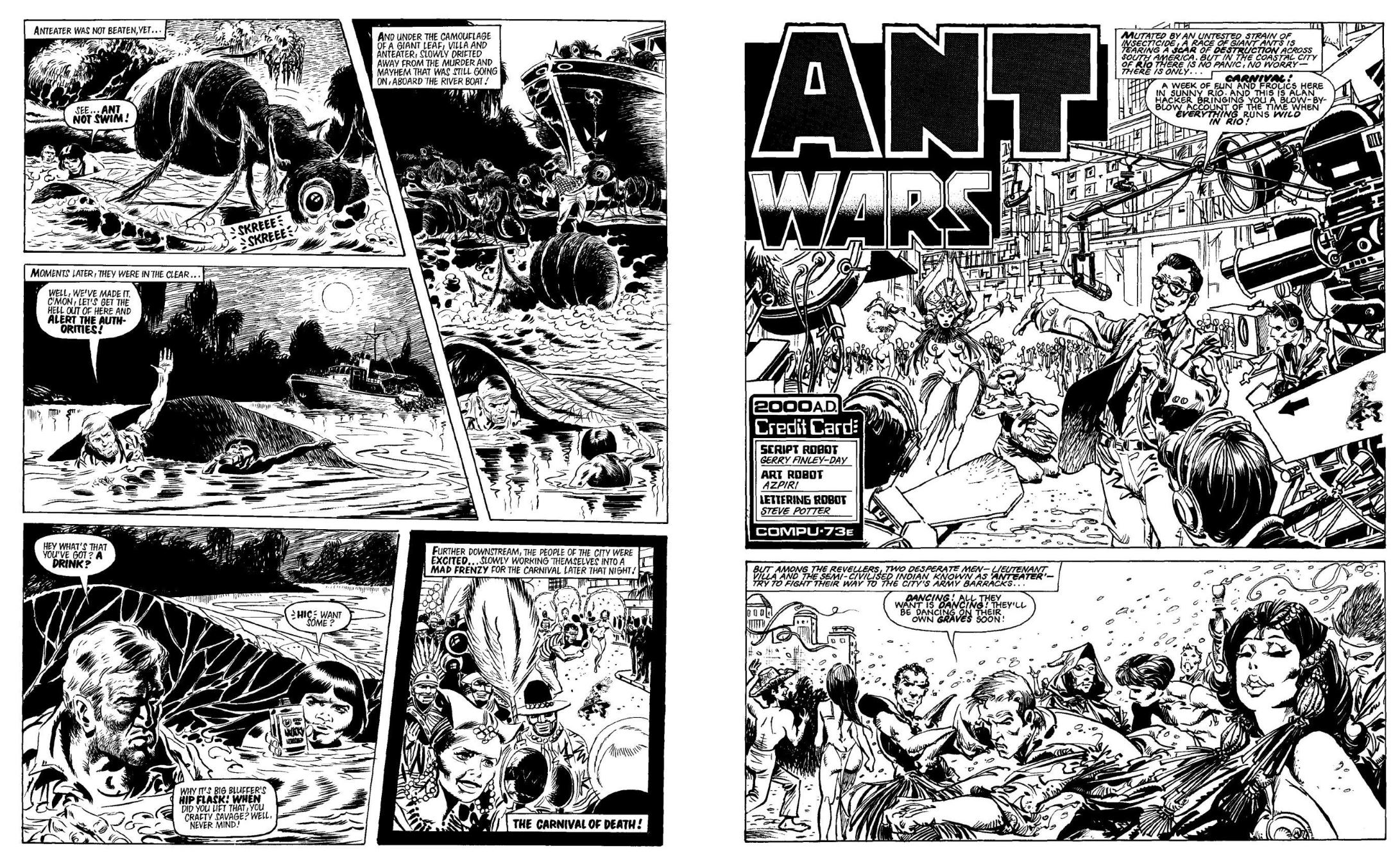
After many close calls and stomach-churning hairsbreadth escapes – avoiding the plantation-consuming, outpost-conquering, riverboat-confiscating bugs, Villa and Anteater reach Rio de Janeiro, and at last convince people with actual power and authority of the existential threat, but it is far too late. Ant queens have already established forward bases there and as the humans waste time and resources partying at Carnival, a horrific battle for control of the continent and ultimately the planet begins.

Soon ant colonies are found in Argentina, Bolivia and beyond and the struggle must be decided by humanity’s most unforgivable armaments…

And in the aftermath, there are many profitable opportunities to test even better bug sprays and formulations…

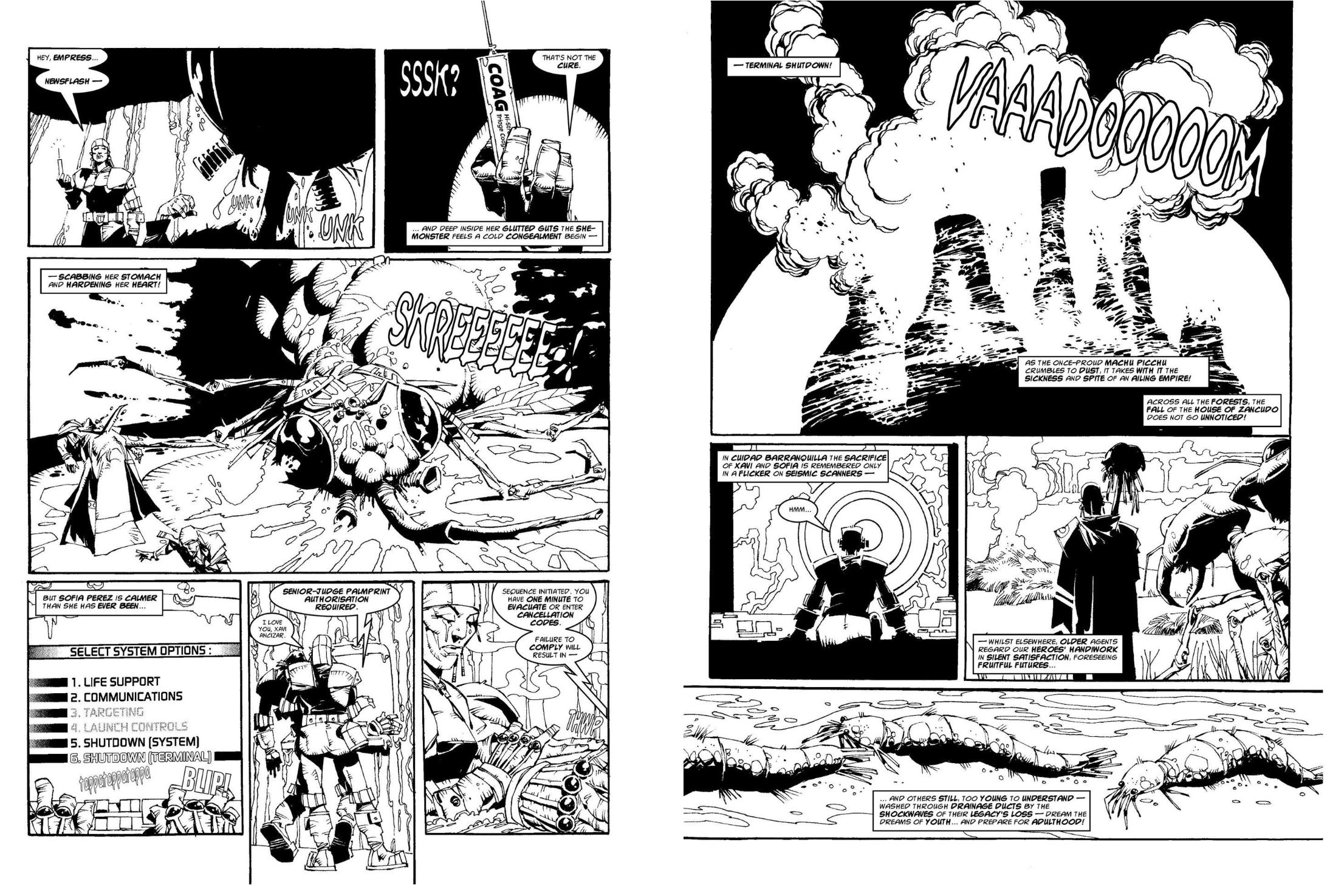
In 2005 the concept was retooled, crafted in tribute to the original by Simon Spurrier & Cam Kennedy. A notional sequel set in the future world of Mega-cities and mass madness where Judges like Joe Dredd were sworn to curtail and control Zancudo was a short serial running across 2000 A.D. spin-off title The Judge Dredd Megazine (issues #231-233). It focused on less-than-upstanding Judges Xavi Ancizar and Sofia Perez as they escort sociopathic “mutie” telepath Fendito “El Bandito” in a medical-supply flyer bound for the penal facility in La Paz. It’s 2171 and they have left sprawling metropolis Cuidad Barranquilla to risk the perils of the Peruvian rainforest, but don’t get far. When the ship is brought down, and even after surviving the crash, their chances diminish every second as they are attacked by giant intelligent mosquitos. They are also blithely unaware that the device neutralising El Bandito’s psionic powers has malfunctioned…

Although Judges are trained to resist, smart giant bugs are easier to handle, and it might have all worked out differently for the mind-thief if they hadn’t stopped to save a little girl and stumbled into Los Zancudo Pichu. This bizarre embattled colony is home to human natives enslaved to Mosquito queens and where all inhabitants – even the big bugs – are slowly expiring of a malarial infection they call The Blight…

Those downed Judge medical supplies promise a cure for the dying city and all its inhabitants, and Fendito is delighted to betray his own (more or less) kind to save his skin, but even corrupted, debased Judges have standards, so their discovery of the original purpose of Zancudo prior to the insects’ triumphal takeover offers a slim chance of atonement if not personal survival…

A grand, old fashioned Mankind vs Monsters yarn dripping with wit and edgy social commentary, Ant Wars is an unreconstructed romp to while away a little time with and a splendid way to prepare for the long hot and possibly few days ahead.
© 1978, 2005 & 2018 Rebellion A/S. All Rights Reserved.

Today in 1828 trailblazing cartoonist, caricaturist and author Frank Bellew was born, with Marvel bulwark Carl (Human Torch) Burgos coming along in 1916 and – in 1986 – mainly-Marvel comic book illustrator Paulo Siqueira.

Ken Reid’s Roger the Dodger debuted in The Beano this date in 1953, but we lost British underground star and newspaper cartoonist Edward Barker (International Times, The Largactilites, The Galactilites) in 1997 and Steve Canyon artist Dick Rockwell in 2006.

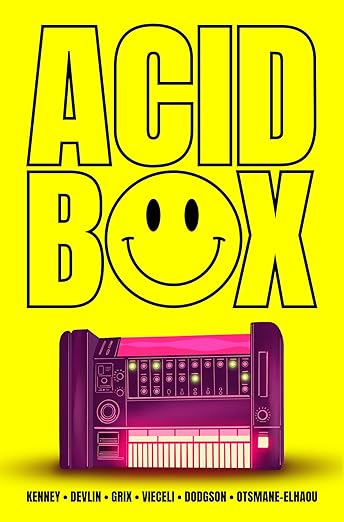
Acid Box


By Sarah Kenney, James Devlin, Emma Vieceli, Ria Grix, Sophie Dodgson, Hassan Otsmane-Elhaou & various (Avery Hill Publishing)
ISBN: 978-1-917355-05-6 (HB/Digital edition)

The entirety of all worlds and each and every time is readily available to any open-minded comics connoisseur. Here’s a fun extrapolation on an old plot, with plenty of twisty raucous fun fully baked in for anyone with an open mind. A working knowledge of recent history (yes, I know that’s a relative term!) and breadth of musical tastes won’t be wasted if you can lay your hands on that too…

Most importantly, if you can remember the Nineties, you might well have been there, but probably a bit too far from the speaker-stacks…

In that context, the term Acid (noun: PRO: “Ass-SEeeeed”) denotes a popular youth culture movement concerned with music, recreational drugs, dancing and wandering about trying to find where the action was happening. It also had lots to do with a specific bit of clever kit called a Roland TB-303 Bass Line (AKA the “303”) that became instrumental in electronic music movements such as “techno”, “Chicago-house” and “acid house”…

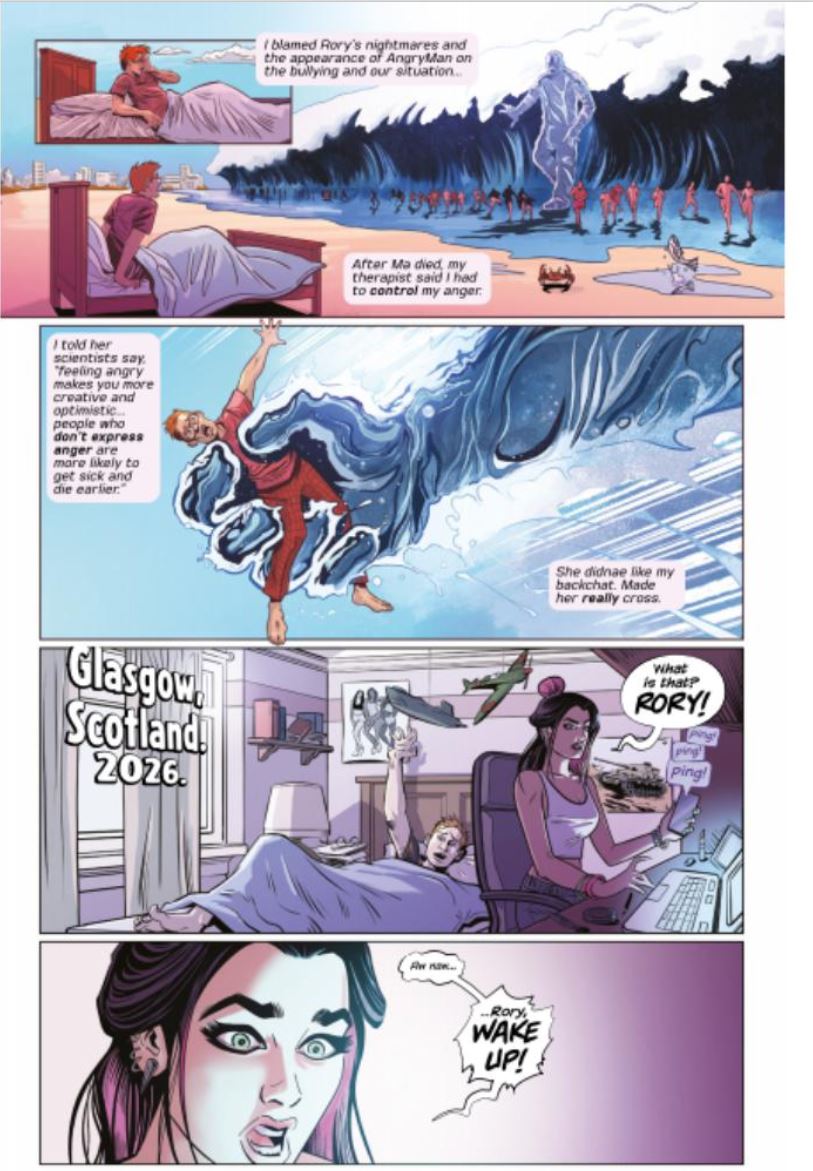
At this moment of now in opening chapter ‘Fully Munted’, it’s 2026 in Glasgow and cleaner/presumed orphan Jade Nyo is hoping to forget the shitty world, crap prospects of survival and especially younger brother Rory’s persistent tortured nightmares of tsunamis and global collapse, as personified in recurring images of a big angry sod he calls “AngryMan” leading the inundations.

There’s not a lot she can use to get out and away – and so much to get away from – but her abiding fascination with dance music history tops the list, so soon she’s necked an “E” at local club Tempus and is living in the beats and sweat and non-stop motion. Rory’s there too but his crutches and callipers aren’t really rave-conducive…

Life gets worse and better all at once when three really weird skanky women drag her and Rory into a rather tacky corner that didn’t used to be there, and make an outrageous request/demand. Apparently, Yemaya, Angie and Tracey are “Liminals” commanding the forces of time, space, matter and energy and they have an urgent job that needs doing: restoring order to the geological continuum… or else…

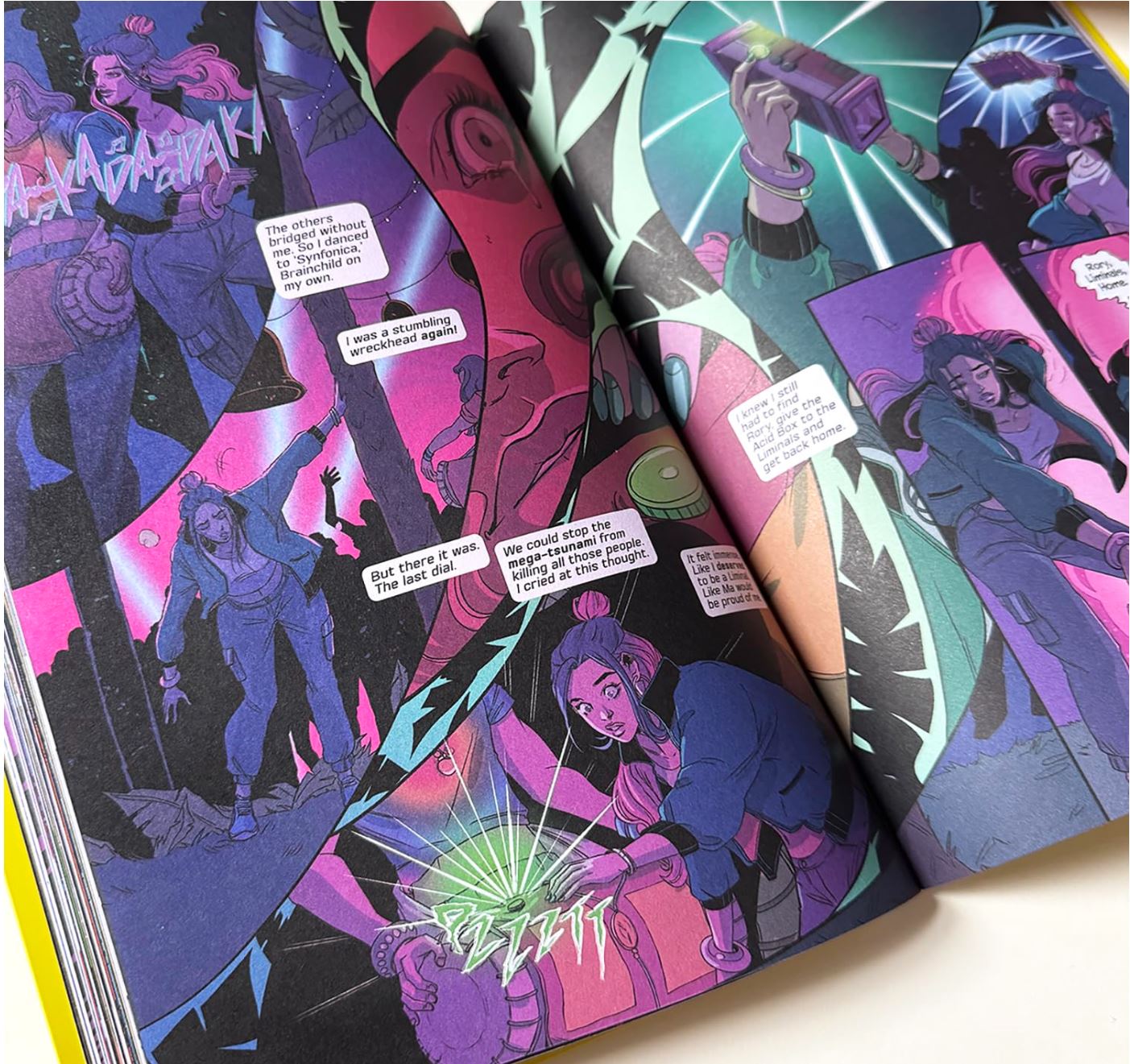
Soon – while disbelieving every minute of it – Jade is jaunting all over infinity, drawn to key and crucial rave moments and beat history milestones chasing vibrations and saving the universe with the aid of a handy little widget dubbed (sorry! Sorry!!) an Acid Box. This one is missing three dials that Jade just must restore to it… or Earth will shake itself to dust within three days. Moreover, AngryMan is very real and resolved to make that big finish happen…

First stop, once all the “yeah, but”-ing is done with, is Berlin in 1994 (devotees of musical culture will soon comprehend what these key moments in time travel mean, and the rest of us can just revel in the pacy action and extremely effective character-play from here on…) as Jade musters some allies – such as tough local-time operators Fizzy & Rhonda – and faces increasing grief and terror in successive, potentially self-explanatory escalating episodes ‘Make Techno Not Friends’, ‘The Fear’ and ‘Go Hard or Go Home’.

The chase exposes family skeletons, loads of closets and repeatedly lands her in 1994 – somehow simultaneously in Detroit, Bradford, Berlin again, Johannesburg, Mysore and Hyde Park, London – gathering allies for an environmental showdown in at La Palma volcano in 2026, supplanted by ten-yearly confrontations in 2034, 2044 and 2054 all round the imperilled world until the big is done… one way or another…

Packed with and augmented by utterly absorbing sidebar bonus material, this is a sublimely absorbing romp embroidered with true love of the period and source music material that will no doubt make a fabulous and funny film one day. The primary creators are led by Sarah Kenney (Surgeon X, She Could Fly, Planet Divoc-91) who writes socially informed speculative fiction (the other, accurate, term for Science Fiction) and works as a scripter, producer and director for the Games industry and television. Her visual collaborator on  Surgeon X and Planet Divoc-91 is Glasgow-based James Devlin (Tomorrow, LaGuardia) who here joins multidisciplinary performance artist Emma Vieceli (Life is Strange, BREAKS) and illustrator Ria Grix (The Anomalous Adventures of Viola Holm and Kotiin).

This macroscopic, musically-inclined peregrination includes further input and compelling comics fare culled from an international workshop group about comics, music, science culture and planet Earth run by Kenney & Kirsten Murray. That resulted in compelling essays and graphic sorties all packed in here too, all stage-set by an accommodatingly informative ‘Afterword’ by Kenney.

The textual thoughts comprise ‘Happy Place by Sarah Zad’; ‘Fund, Marry, Chill: The Ultimate Guide to Guaranteed Creative Success by Adrian Saredia-Brayley’; ‘Research and Discussion of the potential benefits of MDMA on PTSD sufferers by Bobby Gunasekara’; ‘Reviving Rave Roots Resurgence of Clean Rave Culture by Sevitha ’Vadlamudi’; ‘Fact and Fiction by Sarah Zad’ and ‘The Lens of Life… Storytelling and facilitating change through art by Whitney Love’. These are followed by a selection of ‘Youth Workshop Comics’ beginning with eco-chiller ‘We Can’t Stay Here Any Longer’ by Adrian Saredia-Brayley and followed by Ben Avey-Edwards cyber-thriller ‘Vibe’ (lettered by Rob Jones).

ShyWhy shares the joys of ‘Mind Travel’ and Lara Sloane depicts ‘A Housewives Revolution’ before ‘Dancing On My Own’ – scripted by Nyla Ahmad with art by Adrian Saredia-Brayley – carries us to Lucy Porte’s ‘Bad Trip’ after which Paula Karanja brings ‘A Gift to Share’. Rounding out the jam session, Saredia-Brayley limns Phelisa Sikwata’s ‘Sinking HomeS’ and Hannah Maclennan closes the show with ‘Hurry Up! Our Song is Playing!’
© Wowbagger Productions 2025. All rights reserved.

Today in 1929 US Golden Age artist Joe Gallagher was born, as was James Vance (Kings in Disguise, Omaha the Cat Dancer, Aliens, Predator) in 1953, and Todd Nauck (Young Justice, Spider-Man) in 1971.

In1867 Britain and the world lost pioneering cartoonist/caricaturist/political commentator Charles H. Bennett, and in 2002 Stan Pitt (officially the first Australian artist with original material published US  comic books – The Witching Hour #14 & Boris Karloff – Tales of Mystery # 33!) who ghosted Al Williamson’s Secret Agent Corrigan in 1969 and 1972. Also, in 2009 we lost the great unsung Frank Springer (Secret Six, Nick Fury, Agent of SHIELD, Phoebe Zeit-Geist, The Dazzler, Friday Foster, Rex Morgan M.D., Mary Perkins on Stage, The Incredible Hulk newspaper strip).

In 1958 Goscinny & Uderzo’s Oumpah-pah debuted in Le Journal de Tintin.

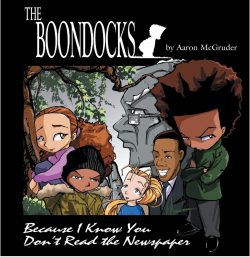
The Boondocks: Because I Know You Don’t Read the Newspapers (volume 1)


By Aaron McGruder (Andrews McMeel)
ISBN: 978-0-7407-0609-7 (TPB/Digital edition)

This book includes Discriminatory Content produced in less enlightened times. This book also includes Discriminatory Content included for satirical and comedic effect.

Unlike editorial cartooning, newspaper comic strips generally prospered by avoiding controversy. Other than a few notable exceptions – such as the mighty Doonesbury – daily and Sunday gag continuities aimed at keeping their readers amused and complacent.

Such was not the case with Aaron McGruder’s brilliant and so-much missed The Boondocks.

The strip ran from February 8th 1996 and officially ended – despite promises of a swift return – with the February 28th 2006 instalment. Episodes apparently popped up on social media for a month or so after that. You might have seen the adapted animated version on Cartoon Network’s Adult Swim some years ago…

The feature was created for pioneer online music website Hitlist.com and quickly began a print incarnation in Hip-Hop magazine The Source. On December 3rd, it started appearing in national periodical The Diamondback but, after an editorial bust-up, McGruder pulled the strip in March 1997. Nevertheless, it thrived as it was picked up by Universal Press Syndicate. Launched nationally, The Boondocks had over 300 client subscribers, reaching – and so often offending – millions of readers every day. Such was the content and set-up that the strip was regularly dropped by editors, and complaints from readers were pretty much constant.

What could possibly make a cartoon continuity such a lightning rod yet still have publishers so eager to keep it amongst their ever-dwindling stable of strip stars?

The Boondocks was always fast, funny, thought-provoking, funny, ferociously socially aware and created for a modern black readership. And Funny.

The series never sugar-coated anything – except obviously the utterly unacceptable curse of immodest language – whilst bringing contemporary issues of race to the table every day. This was a strip Afro-American readers wanted to peruse… even if they didn’t necessarily agree with what was being said and seen.

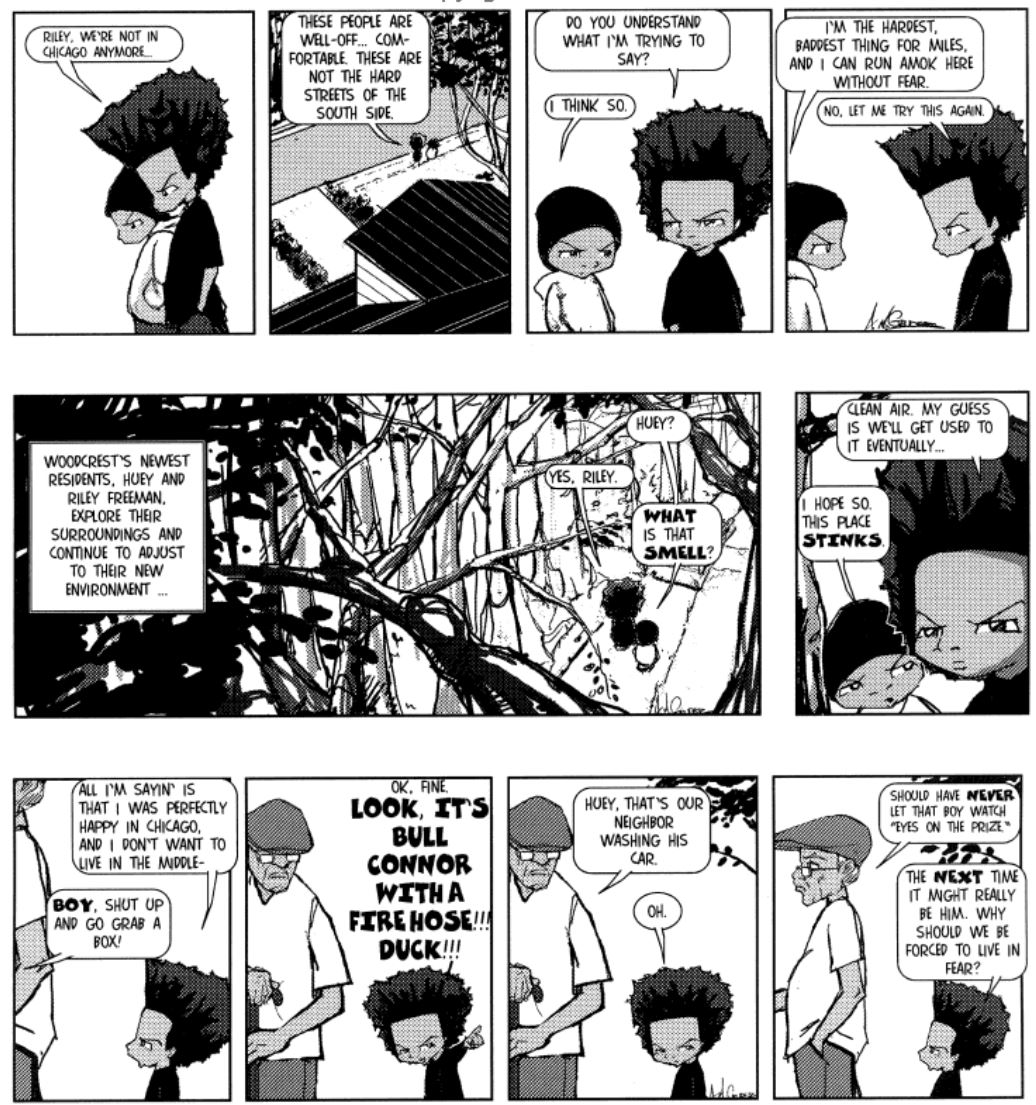
The narrative premise was deceptively sitcom-simple, but hid a potent surprise in its delivery. Huey Freeman is an incredibly smart, savvy and well-informed African American youngster. He spent his formative years on Chicago’s South Side, immersed in black history; philosophy of power; radical and alternative politics and “The Streets”. His little brother Riley is mired in Hip-Hop and the trappings of Gangsta Rap. Yet suddenly one day they are both whisked out of their comfort zone as their grandfather Robert assumes custody of them, and moves the whole family to whiter-than-white suburb Woodcrest in semi-rural Maryland.

It’s mutual culture shock of epic proportions all both sides…

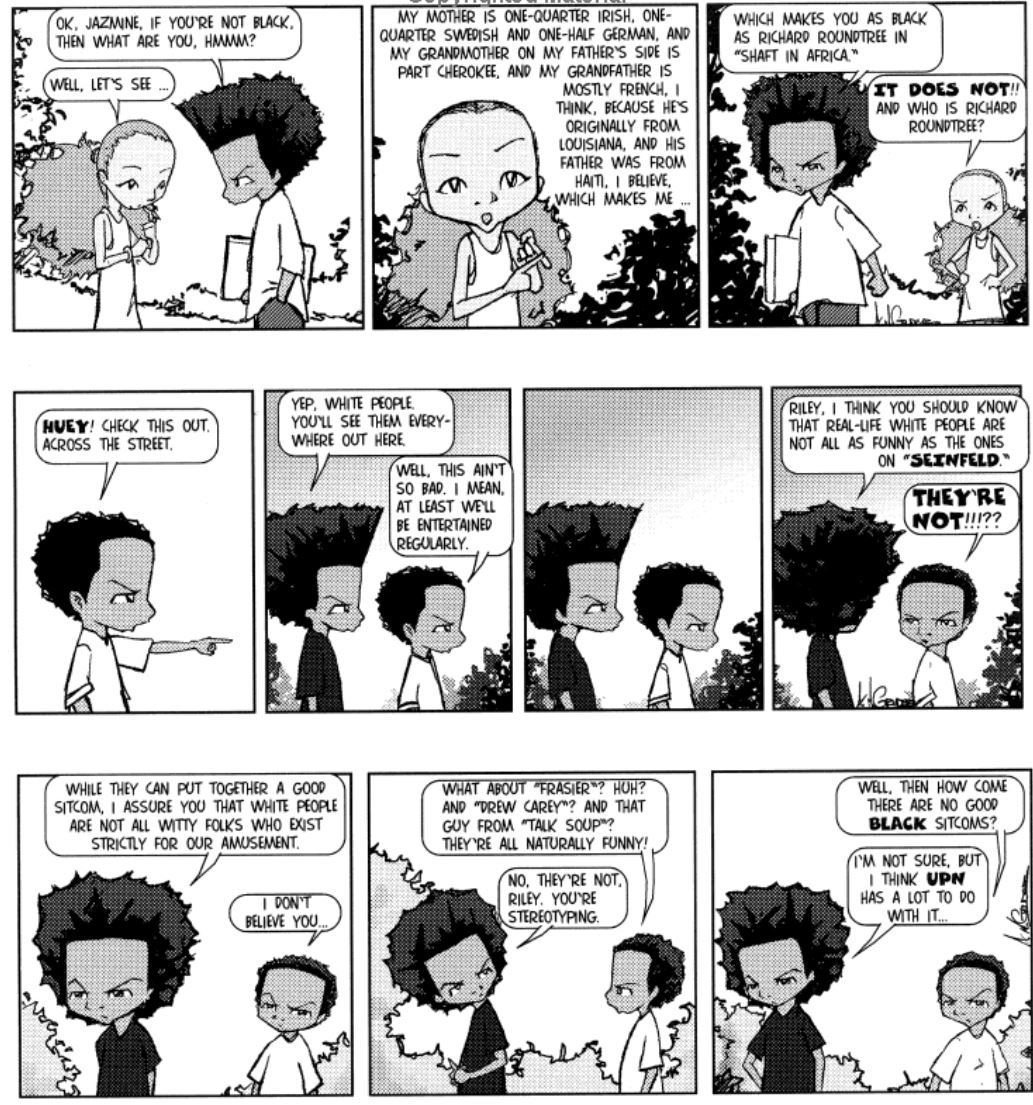
Huey (proudly boasting that he’s named for Black Panther co-founder Dr Huey Percy Newton) perpetually expounds radical rhetoric and points out hypocrisy of the well-meaning but inherently patronising all-Caucasian township, but saves equal amounts of hilarious disgust and venom for those overbearing, overhyped aspects of modern Black Culture he regards as stupid, demeaning or self-serving…

Riley mostly likes scaring them oh-so-polite white folks…

In this initial paperback monochrome collection (there’s also a Treasury edition with Sundays in full colour) we see material from April 19th 1999 to January 29th 2000, which includes a potent Foreword from Hip-Hop Activist and Media Assassin Harry Allen. He points out the way we’ve all managed to stop actual progress on issues of race by politely agreeing to not talk about them…

Property values start to wobble just a bit when Huey and Riley arrive in Woodcrest but at least disquiet is mutual. The place really freaks them out: the air is clean, there are no tagged walls or take-out stores, and old white people keep coming up to say hello. The first semblance of normality occurs when another new family moves in next door. Thomas and Sarah Dubois are woolly liberals: yuppy lawyers and Woodcrest’s first interracial couple, and – although she doesn’t understand any of the stuff Huey taunts her with – their daughter Jazmine is the suburb’s third black child… ever. She never thought of herself as any colour, but Huey is determined to raise her consciousness – when he’s not taking her establishment-conditioned dad to task on what colour he actually is…

Huey’s far less keen on the attentions of Cindy McPhearson, the little girl from school who has fully embraced TV’s version of Black Culture. She wants to meet – and be – Snoop Doggy Dogg. She hasn’t heard the term “Wigga” yet and Huey ain’t doing nothing but avoiding her: a tricky proposition as she sits behind him in class asking dumb questions.

The boys enrolling at Edgar J. Hoover Elementary School caused a few sleepless nights for Principal Williams but he cleverly borrowed a some videos (use google if you must, but it’s just an old way of having movies in your room) – Menace II Society, Shaft’s Big Score – to get him up to speed on the special needs of “inner city ghetto youth” and is confident his terrified teachers can handle any possible hurdles a variance in backgrounds might cause…

Don’t go away under the misapprehension that The Boondocks is a strident polemical diatribe, drowning in its own message. First and foremost, this is a strip about kids growing up, just like Bloom County, The Perishers, Peanuts or Calvin and Hobbes. Some of the most memorable riffs come from the boys’ reactions to the release of the Star Wars: Episode I (although admittedly, Jar Jar Binks gets a fully-deserved roasting for that alien/ethnic Minstrel performance), the worthlessness of high-priced merchandise and the insipid, anodyne street names. At least here, Riley and his paint spray cans can help out…

As the year progresses we also see outrageous takes on Halloween, Thanksgiving and Christmas as well as the boys’ investigation of the Santa Clause and Kwanza scenarios and their own hysterical Inner City, Keepin’ It Real alternative to all those manufactured holidays and causes…

Smart, addictive and still with a vast amount to say The Boondocks is a strip you need to see if you cherish speaking Wit as well as Truth to Power…
The Boondocks © 2000 by Aaron McGruder. All rights reserved.

Today in 1948 Spanish maestro José Luis García-López was born, as was equally polished superstar Brian Bolland in 1951. 1988 saw the passing of Swedish cartoonist, Journalist and strip maker Jan-Erik Garland.

In 1972 Tom Batiuk’s Funky Winkerbean began, whilst 1995 saw the end of Berkeley Breathed’s Outland after six gloriously bizarre years and, by most accounts, the last ever The Boondocks strip by Aaron McGruder in 2006.