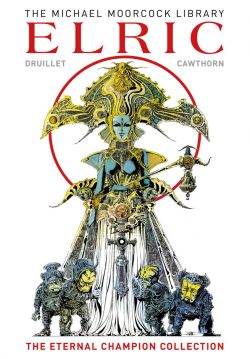
The Michael Moorcock Library – Elric: the Eternal Champion Collection


Adapted by James Cawthorn and Philippe Druillet, & various (Titan Comics)
ISBN: 978-1-78586-955-6 (HB/Digital edition)

This book includes Discriminatory Content produced in less enlightened times.

Michael Moorcock began his career at age 15; writing and editing classic British comic strips like Dogfight Dixon, Jet Ace Logan, Captain Condor, Olac the Gladiator, Tarzan and many, many other weekly favourites. As the swinging Sixties dawned he made the transition to prose fiction where he single-handedly revitalised a genre via the creation of Elric and the high-concept notion of an Eternal Champion.

Debuting in 1961, Elric is a landmark of fantasy and particularly its Sword & Sorcery subdivision: the foretold, fore-doomed last ruler of pre-human civilisation Melniboné, a race of cruel, nigh-demonic sorcerers. These arrogant, dissolute creatures are at the end of a slow, decadent decline after millennia of dominance over Earth. Albino Elric is physically weak, buoyed up by drugs, blood and dark magic, and of a brooding, philosophical temperament. He cares for little save his beautiful cousin Cymoril, who will die one day whilst he battles her loathsome usurping brother Prince Yyrkoon in service to a manipulative god of Chaos.

In this collection that day is right now as primary and premiere Elric artist Jim Cawthorne limns that final clash in a hugely personal adaptation from 1976, first and privately published by British concern Savoy Books in an edition that never really reached its natural audience…

“White Wolf” Elric doesn’t even want to rule, but it is his duty, and he is the only one of his debased race to see the (comparatively) freshly evolved race of Man as a threat to the Empire. He is owned if not actually possessed by terrible black sword Stormbringer: one of a matched pair of sorcerous weapons that steal the souls of their victims and feed that stolen life and vitality to the wielder…

Elric is a tragic incarnation of the restless Eternal Champion, reincarnated in every time, place and alternate dimension. His life is violence, blood and unending tragedy, exacerbated by dependence on that soul-drinking ebony blade and his sworn – if somewhat compelled and thus reluctant – allegiance to the chimerical Lords of Chaos.

Everybody knows all that, right?

The 13th volume in a proposed complete Michael Moorcock Library of comics adaptations (as well as reissue of the prose works), these yarns – chronologically at least – are the very first pictorial narratives of the doomed king; given an archival polish and pictorial upgrade by way of a brace of Introductions from Moorcock himself and Philippe Druillet. They are bolstered by a substantial contextual essay at the end. First, though, is time for a little history…
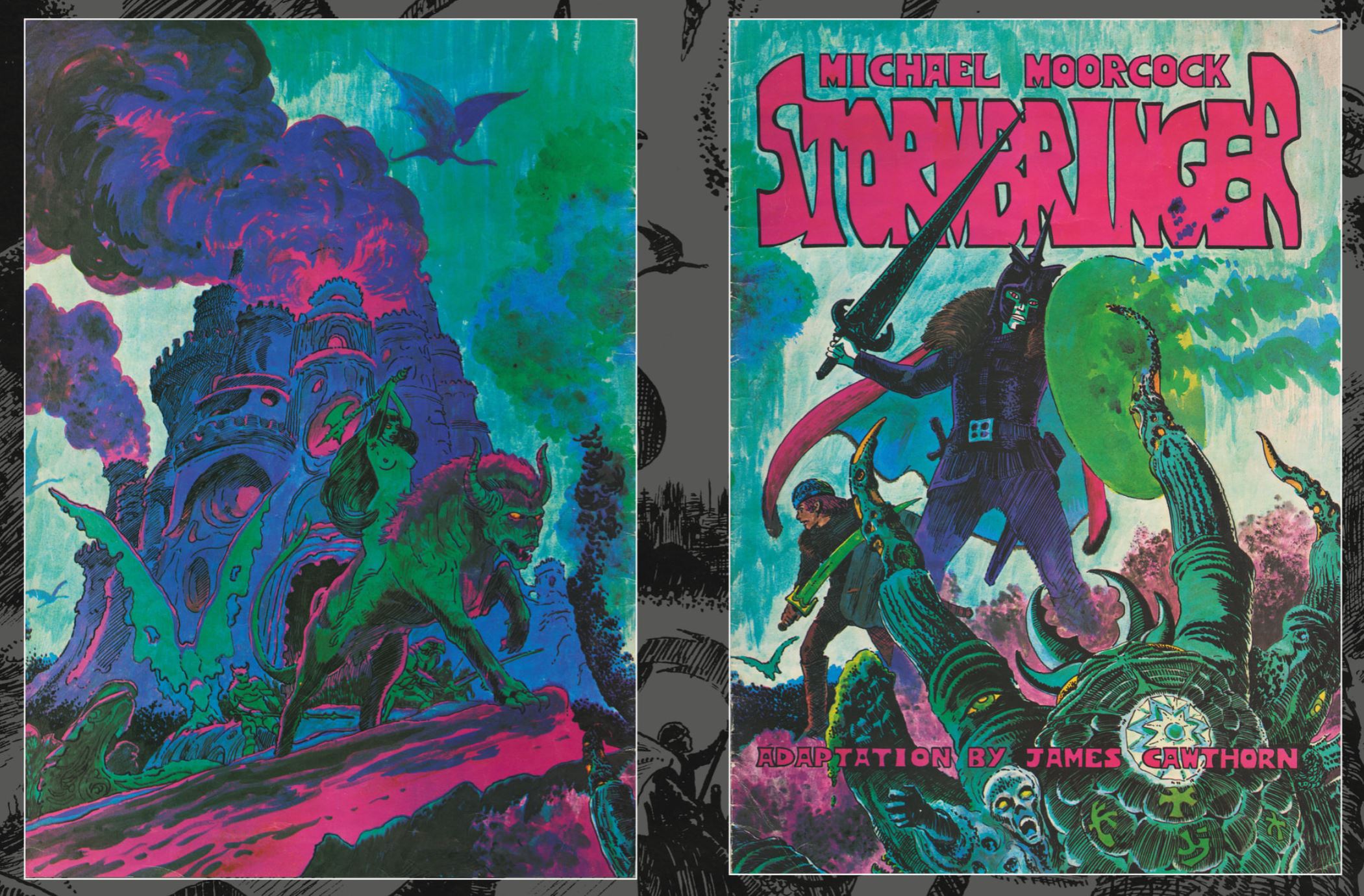
A migrated Tynesider lodged surreptitiously and contentedly in Ladbroke Grove at a time of great turmoil in the UK, James Cawthorn was an old friend, comics co-worker and always Moorcock’s preferred illustrator of the Last Emperor. Driven, solitary, universally respected and wedded to his craft, he wrote strips for Lion, Tiger and the UK weekly comics mill, painted murals and probably book covers; made backdrops for theatre productions; private art commissions; decorated apparel and/or instruments for musicians and bands like Hawkwind and Motörhead while toiling laboriously (and far too slowly and meticulously to be commercial) on beloved passion pieces like Stormbringer.

Cawthorne’s unique and potent adaptation of Moorcock’s epic book (a reworking of novellas Dead God’s Homecoming, Black Sword’s Brother, Sad Giant’s Shield and Doomed Lord’s Passing) was his masterpiece: released by admirers at Savoy because its owners Dave Britton & Michael Butterworth were prepared to pay in advance and wait for him to finish according to his own excoriatingly exaction standards. It was worth the wait when that epically huge cardstock album (600 x 430mm – 24 inches by 17!) finally blew away those lucky enough to get a copy. This reproduction gives readers everything they could want, but sadly cannot impart the wonderous sheer bloody size of it in your hands…

It was mostly missed here but hugely popular in German…

The complex convoluted story of that book’s creation holds even more revelations but are Moorcock’s to share, so let’s turn briefly to the tale itself.
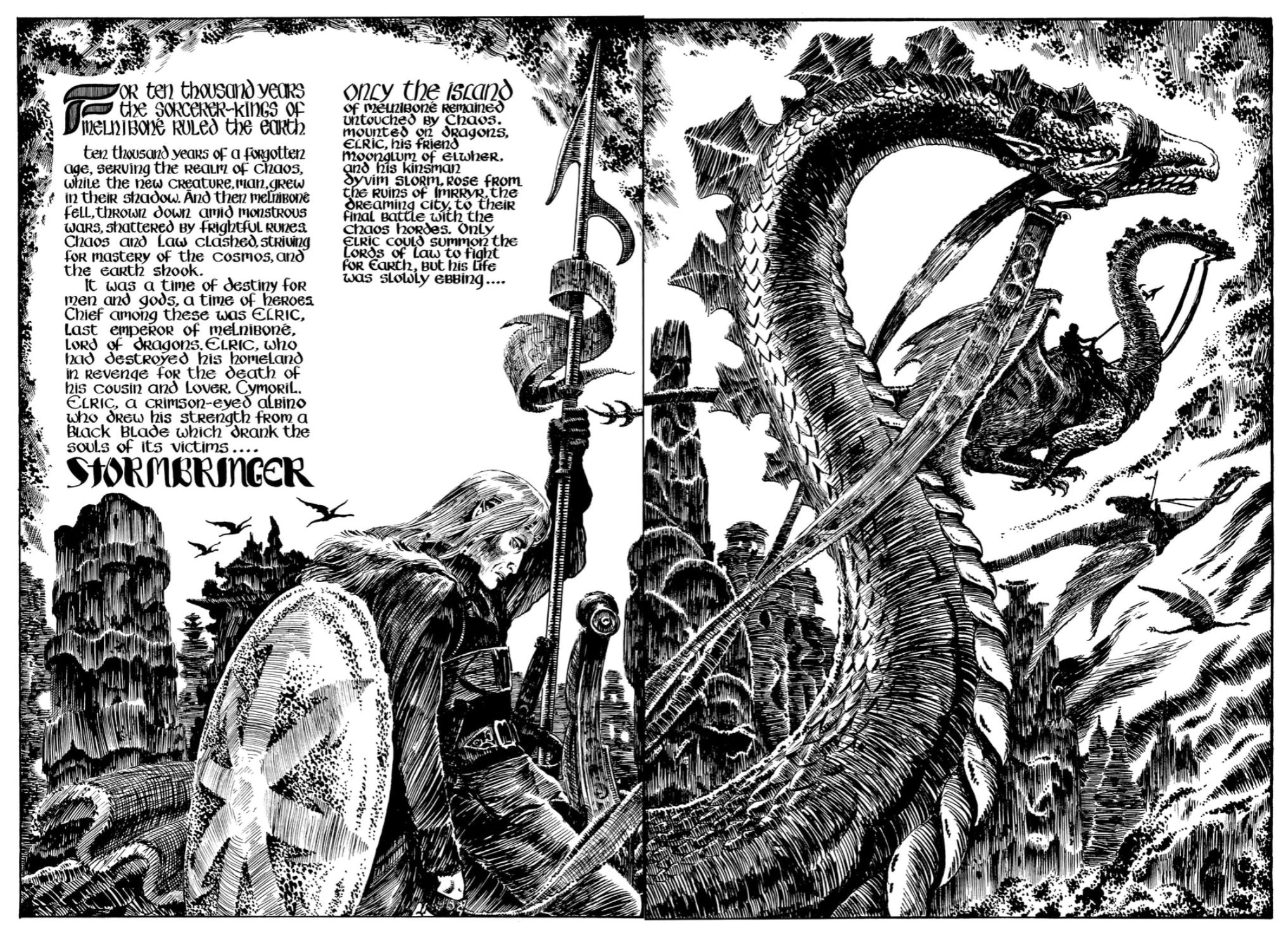
Michael Moorcock’s irresistible blend of brooding Faustian tragedy and all-consuming action is (arguably) best enjoyed in his stories of Elric, but that restless imagination crafted many incarnations of his Eternal Champion able to stand on their own bloody merits and constantly shaped and reinterpreted by a vast and varied array of unique artistic visions. Elric is one doom-drenched, tragedy-attracting incarnation of the Eternal Champion, an aspect of a heroic force reincarnated in every time, place and alternate dimension. His specific life is bound to blood and self-torment, exacerbated by his dependence on a soul-drinking black sword and his sworn allegiance to callous and chimerical Lords of Chaos.
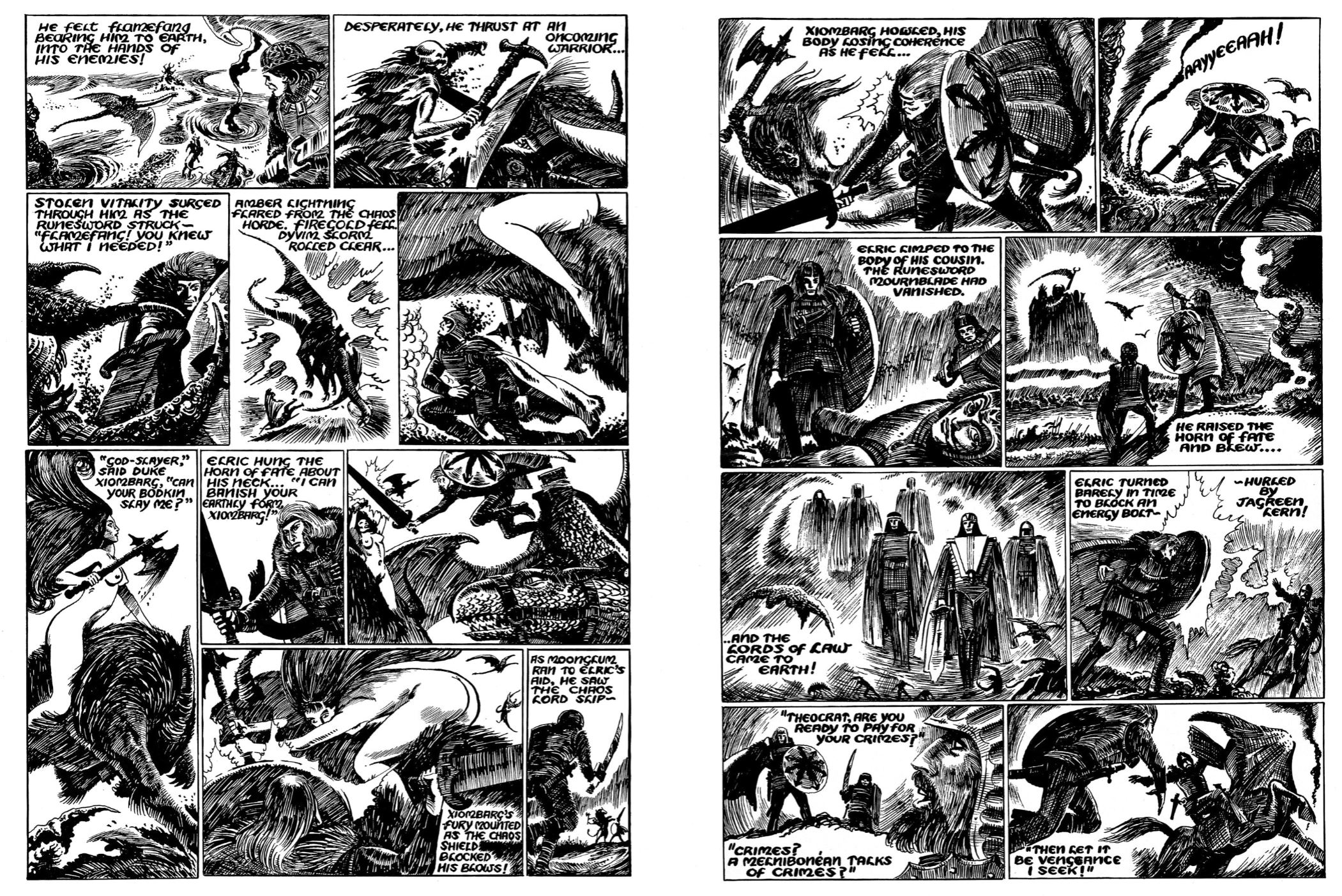
Here that angst-filled destiny come crashing around the hero’s head as brief moments of domestic contentment are washed away in blood when the eternal war between the Lords of Chaos and Order leads to the abduction of his human wife Zarozinia and Elric taking up the black blade for the final times. He reunites with old companion Moonglum and hunts down Jagreen Lern, Theocrat of Pan Tang as he attempts to conquer the world for his allies, the Dukes of Hell. The battles are long, savage, brutal and fantastical and result in the end of all that exists. However, it’s never been about when or where one dies but how and why…

Admit it, you should read more books, right?

Counterpointing that epic comics narrative is a contemporaneous appreciation from across the channel, where Europe also caught the cosmic zeitgeist of the era..

In the 1960s Elric’s oeuvre was translated by Moorcock & author Maxim Jakubowski introducing an up and coming illustrator to the world of Heroic Fantasy. Comics and fantasy storytelling took a huge leap forward in 1975 when Gallic comics collective Les Humanoides Associes began publishing groundbreaking magazine Métal Hurlant. However, one of their future visual mainstays had begun breaking borders and boundaries almost a decade earlier.

Photographer/artist Philippe Druillet started his comics career in 1966 with apocalyptic science fiction epic Le Mystère des abîmes (The Mystery of the Abyss) which introduced doom-tainted intergalactic freebooter and nomadic wanderer Lone Sloane in a tale of a far distant tomorrow thematically influenced in equal measure by H.P. Lovecraft, Clark Ashton Smith and A.E. Van Vogt. We will get to his other works in the courses of times…

Born in Toulouse in 1944, Druillet was raised in Spain, and his comics work was grandiose, panoramic, deeply baroque and overwhelmingly cosmic in scope. He also pretty much rejected standard formats and panels layouts in favour of boldly shocking graphics. Druillet began working for Pilote in 1969 and revived his star-rover in numerous shorter pieces, initially published together in 1972 as The Six Voyages. This collection, however, focuses on his brief but inspirational dealings with Moorcock’s primary ill-fated cosmic traveller…
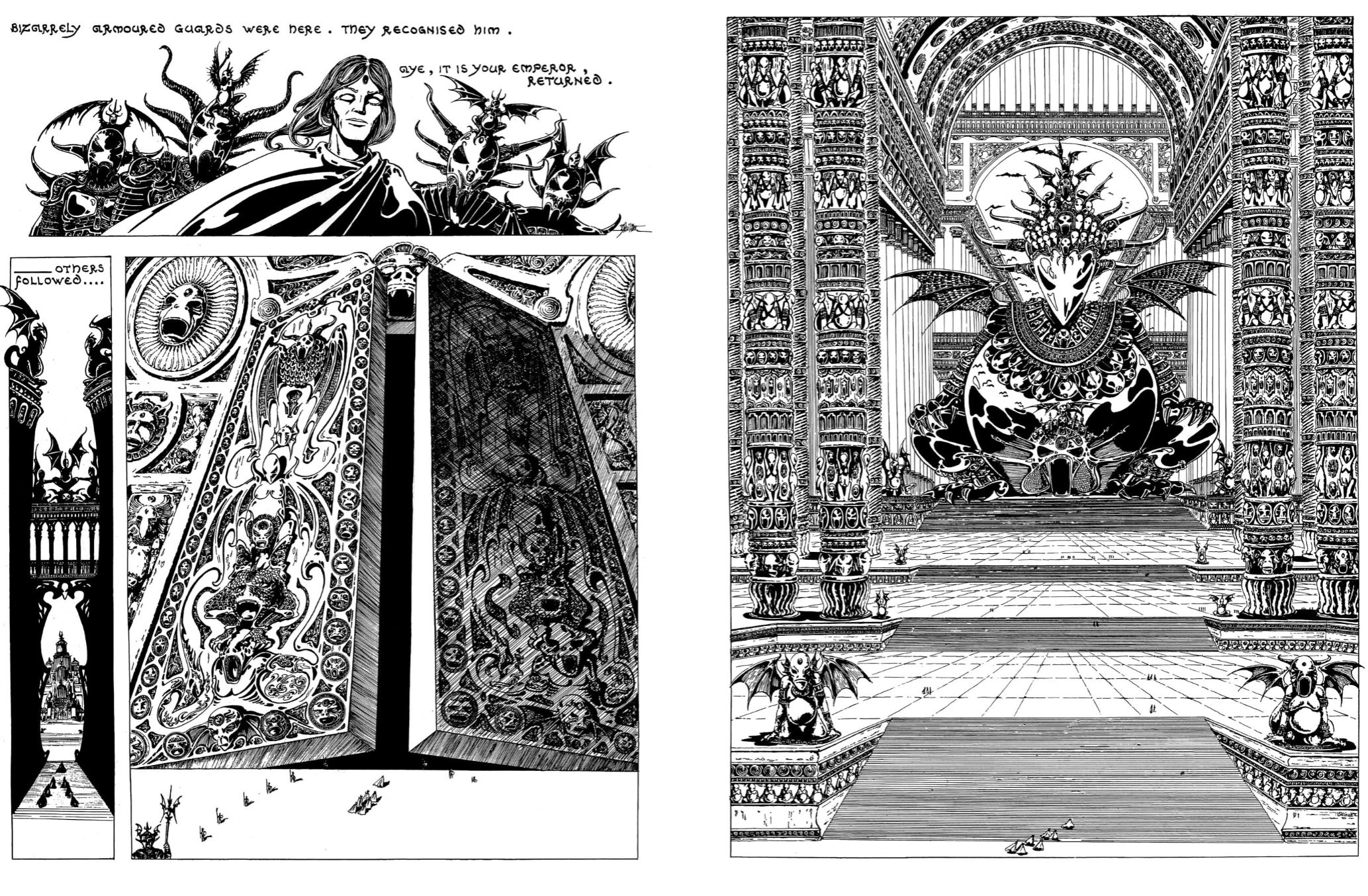
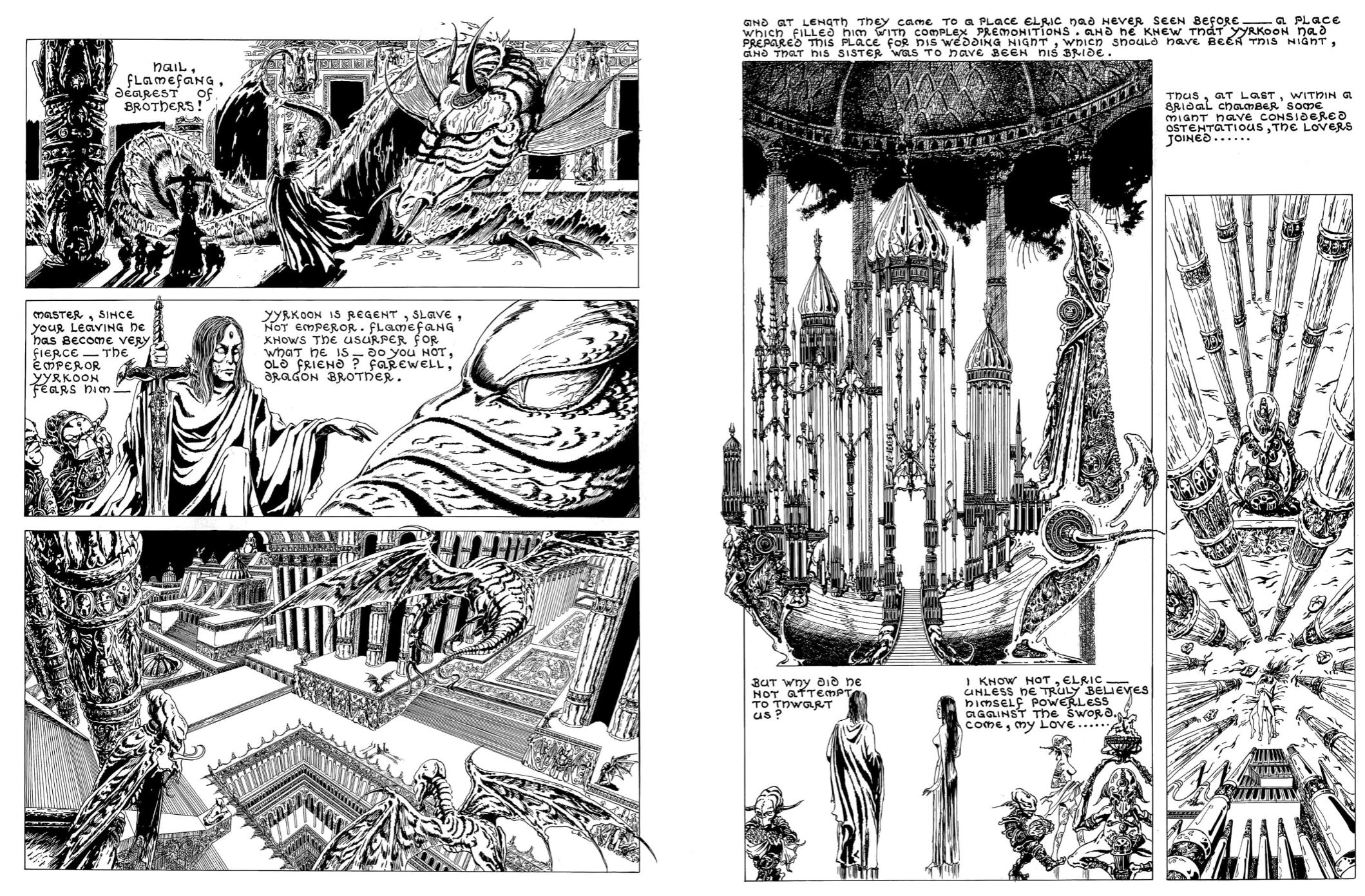
After preliminary tentative spreads in Moi Aussi, in 1969, a 21-plate portfolio entitled La Saga d’Elric le Necromancien was published. In 1973 Moorcock’s reworking of Michel Demuth’s text for the portfolio became Elric: The Return to Melniboné as published by Unicorn Bookshop in 1973. Its influence was far-reaching: just ask American creators like Keith Giffen, who repatterned his entire drawing style on what he saw…

Reproduced in its original monochrome, the brief interlude spectacularly and mind-alteringly details how the former Emperor reclaims his throne and position from apparently-ascendant rival Prince Yyrkoon and reacquaints himself with his bride-to-be Cymoril. Elric has no conception that the Lords of Chaos are closely watching and laying their plans for his future…
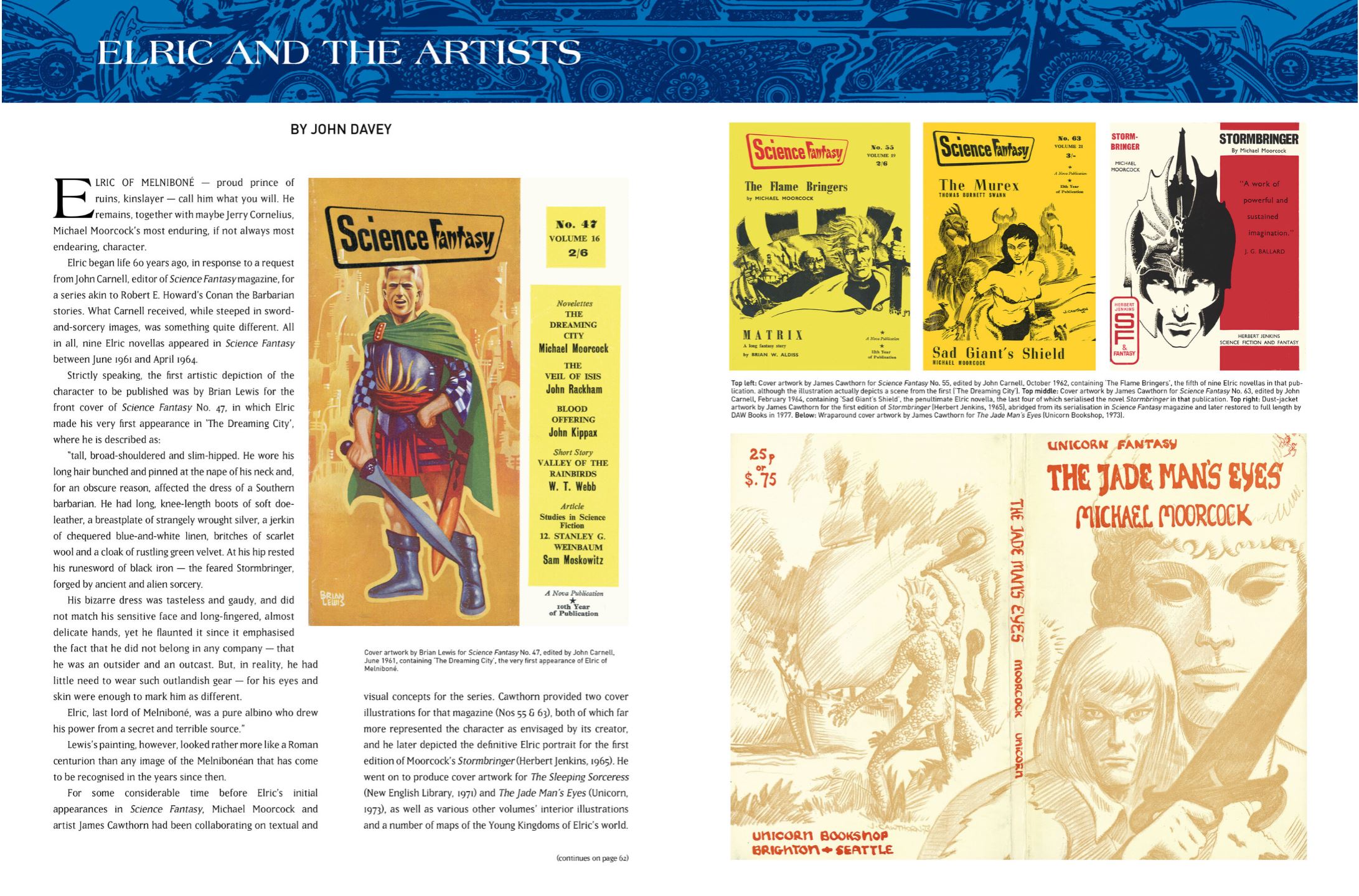
Closing the arcana and antiquities is ‘Elric and the Artists’ an incisively informative briefing by John Davey, detailing earlier efforts to visualise the Last Emperor, concentrating on his prose debuts, before going on to summarise and scrutinise the long history of graphic novel and comics interpretations.
Moorcock and his visual collaborators changed the comics world forever, This is how that all started…

Adapted from the works of Michael Moorcock related to the character of ELRIC © 2021, Michael & Linda Moorcock. All characters, the distinctive likenesses thereof, and all related indicia are TM & © Michael Moorcock and Multiverse Inc.
Elric the Return to Melniboné was first published by Unicorn Bookshop, 1973. Stormbringer was first published by Savoy Books in 1976.

EC horror and romance maestro Jack Kamen was born today in 1920, and shares the date with eco-activist cartoonist Larry Marder (Tales of the Beanworld) from 1951; editor and scripter Jim Salicrup in 1957; British comics veteran/educator Nigel Kitching (Sonic the Comic) in 1959 and The Boondocks creator Aaron McGruder in 1974.

Today in 1960 an era ended with the final page published of Warren TuftsLance.

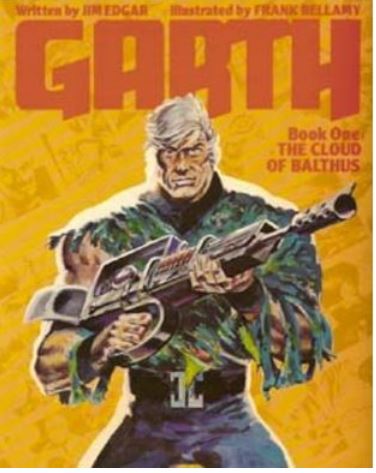
Garth: The Cloud of Balthus (volume 1)


By Frank Bellamy & Jim Edgar, with John Allard (Titan Books)
ISBN: 978-0-90761-034-2 (Album TPB)

This book includes Discriminatory Content produced in less enlightened times.

Frank Alfred Bellamy (21st May 1917 – 5th July 1976) is one of British Comics’ greatest comics artists. In the all-too-brief years of his career he produced magnificent, unforgettable visuals for Eagle, TV21, Radio Times (Doctor Who) before taking over The Daily Mirror newspaper strip Garth in 1971. He turned that long-running yet meandering and occasionally lacklustre strip into a magnificent masterpiece of unmissable adventure fantasy, with eye-popping, mind-blowing monochrome art other artists were proud to boast they swiped from. However, after only 17 stories, Bellamy died suddenly in 1976; and it’s absolutely criminal that his work isn’t in galleries, let alone in permanent collected book editions.

Bellamy was born in 1917 but didn’t begin comic strip work until 1953: the Monty Carstairs strip for Mickey Mouse Weekly. From there he moved on to Hulton Press and drew features starring Swiss Family Robinson, Robin Hood and King Arthur for Swift, the “junior companion” to Eagle. In 1957, he moved on to the star title, producing standout, innovative work on a variety of strips, beginning with a biography/hagiography of Winston Churchill. ‘The Happy Warrior’ was followed by ‘Montgomery of Alamein’, ‘The Shepherd King – the story of David’ and ‘The Travels of Marco Polo’, from which Bellamy was promptly pulled only a few months in. As Peter Jackson took over the back page historical adventure, Bellamy was on his way to the front cover and The Near Future.

When Hulton were bought by Odhams Press there soon manifested irreconcilable differences between Frank Hampson and the new management. Dan Dare’s creator left his superstar baby and Bellamy was tapped as replacement – although both Don Harley & Keith Watson were retained as Frank’s assistants. For a year Bellamy produced “The Pilot of the Future”: redesigning the entire look of the strip at management’s request, before joyfully stepping down to fulfil a lifetime’s ambition.

For his entire life Frank Bellamy had been fascinated – almost obsessed – with Africa. When asked if he would like to draw a big game hunter strip he didn’t think twice and Fraser of Africa debuted in August 1960, a single page per week in the prestigious full-colour centre section. Fraser of Africa was an artistic landmark and Bellamy’s techniques of line and hatching, in conjunction with sensitive, atmospheric colours, and even his staging and layout of pages, led to majestic Heros the Spartan and eventually the bravura creativity displayed in Thunderbirds and Captain Scarlet strips for TV21, before he opted for the strictures of monochrome and a single tier of 3-4 panels a day…

British Superman Garth first appeared in The Daily Mirror on Saturday, July 24th 1943, the creation of professional cartoonist Steve Dowling and BBC radio producer Gordon Boshell, at the behest of the editor who wanted an adventure strip to complement their other comic strip features: Buck Ryan, Belinda Blue Eyes, Just Jake and immortal, demi-immoral, morale-boosting Jane.

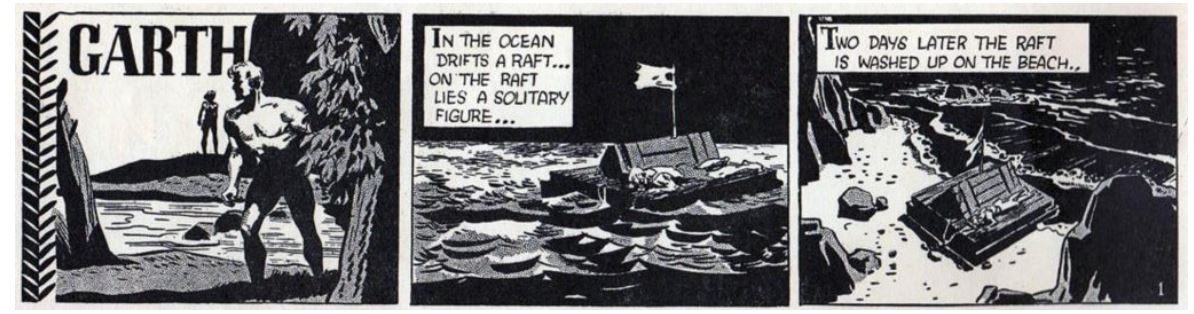
A blond giant and physical marvel with no memory of who he was, Garth washed up on an island shore and into the arms of a pretty girl… Gala. Nonetheless, he saved the entire populace from a brutal tyrant and a legend began. Boshell never had time to write the series, so Dowling – already producing successful family strip The Ruggles – scripted Garth until a new writer could be found. Don Freeman dumped the amnesia plot in ‘The Seven Ages of Garth’ (which ran from September 18th 1944 until January 20th 1946) by introducing imposing jack-of-all-sciences Professor Lumiere, whose subsequent psychological experiments regressed the burly hero back through some past lives.

In the next tale ‘The Saga of Garth’ (January 22nd 1946 – July 20th 1946) the origin was revealed. As an infant, “Garth” had been found floating in a coracle off the Shetlands and adopted by a kindly old couple. When full grown he became a Navy Captain until he was torpedoed off Tibet in 1943…

Freeman continued as writer until 1952 (‘Flight into the Future’ was his last tale), and was briefly replaced by script editor Hugh McClelland (who only wrote ‘Invasion From Space’) until Peter O’Donnell took over in February 1953 with ‘Warriors of Krull’. O’Donnell penned 28 adventures until resigning in 1966 to devote more time to his own strip: a little something called Modesty Blaise. His place was taken by Jim Edgar; a short-story writer who also scripted such prestigious newspaper strips as Matt Marriott, Wes Slade and Gun Law.

Dowling retired in 1968 and his long-time assistant John Allard took over the strip until a suitable permanent artist could be found. Allard completed ten complete tales until Frank Bellamy began a legendary run with the 13th instalment of ‘Sundance’ (which ran from 28th June to 1 October 11th 1971). Allard remained as background artist and assistant until Bellamy took full control during ‘The Orb of Trimandias’.

One thing Professor Lumiere had discovered and which gave this strip its distinctive appeal even before the fantastic artwork of Bellamy elevated it to dizzying heights of graphic brilliance, was Garth’s involuntary ability to travel through time and re-experience past and future lives. This simple concept lent the strip an unfailing potential for exotic storylines and fantastic exploits, pushing it beyond its humble beginning as a British response to Siegel & Shuster’s American phenomenon Superman.

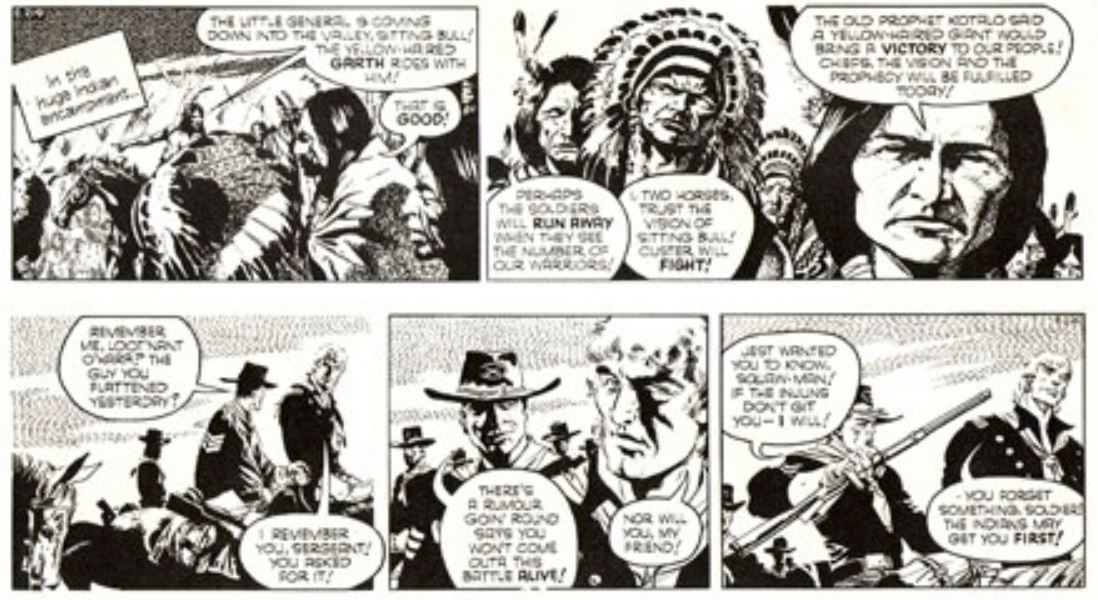
The tales in this criminally out of print monochrome tome begin with the aforementioned ‘Sundance’ as mighty Garth is drawn back to 1876 to relive his life as an officer of George Custer’s 7th Cavalry on the eve of the Battle of the Little Big Horn.

The time-tossed titan has a brief but passionate love affair with Indian maiden Falling Leaf before dying valiantly for his beliefs and their love. It is an evocative, powerful tale that totally captures the bigotry, arrogance and futility of the White Man and the tragic demise of the Indian way of life…

Then eponymous epic ‘The Cloud of Balthus’ shows the potent but simple elegance of the narrative concept sustaining Garth. Whilst vacationing in the Caribbean our hero becomes embroiled in an espionage plot involving freelance super-spies and a US space station, but even that is mere prelude to fantastic adventure and deadly terrors when he and delectable, double-dealing companion Lee Wan are abruptly abducted by nebulous energy beings in a taut, tension-fraught thriller.

‘The Orb of Trimandias’ plunges Garth back in time to Venice of the Borgias, when/where he becomes again English Soldier-of-Fortune Lord Carthewan: a decent man battling an insane and all-powerful madman for the secret of a supernaturally potent holy relic. This gripping, exotic yarn is replete with flamboyant action, historical celebrities, sexy men and women and magnificently stirring locales. It’s a timeless treasure of adventure that has the added fillip of briefly reuniting Garth with his star-crossed true love, ethereal Space Goddess Astra.

This lovely volume (long overdue for re-issue – at least in digital form if no other way is possible) concludes with a high-octane gothic horror story.

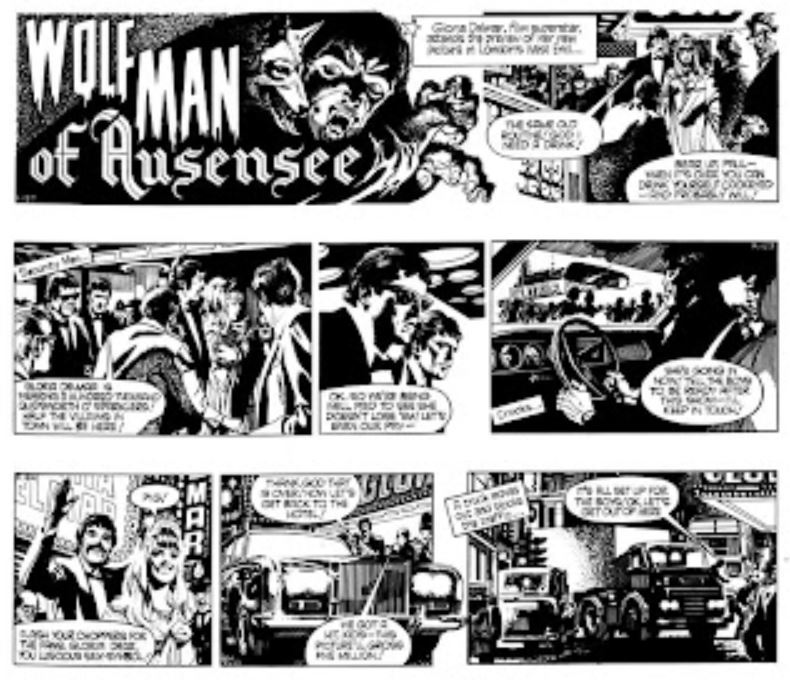
‘The Wolfman of Ausensee’ sees Garth as a rather reluctant companion of movie starlet Gloria Delmar on a shoot at the forbidding Austrian schloss (that’s a big ugly castle to you) of a playboy whose family was once cursed by witches. Despite the title giving some of the game away, this is still a sharp and savvy spook-fest comparing well to the best Hammer Horror films that no doubt inspired it, and just gets better with each rereading.

Garth is the quintessential British Action Hero: strong, smart, fast and good-looking with a big heart and nose for trouble. His back-story granted him all of eternity and every genre to play in, and the magnificent art of Frank Bellamy also made his too-brief tenure a stellar one.

Comic-strips seldom get this good, and even though this book and its sequel are still relatively easy (if not cheap) to come by, it is still a crime and an utter mystery that all these wonderful tales have been out of print for so long.
© 1984 Mirror Group Newspapers. All rights reserved.

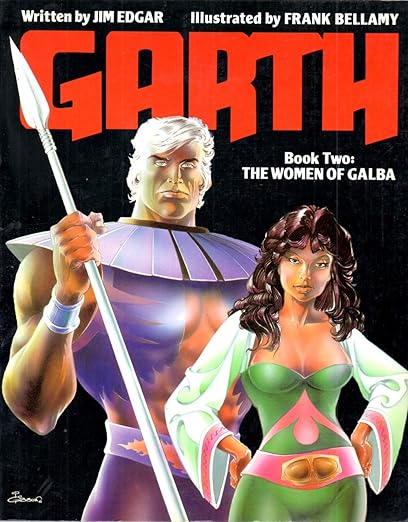
Garth: The Women of Galba (volume 2)


By Frank Bellamy & Jim Edgar (Titan Books)
ISBN: 978-0-90761-049-6 (Album TPB)

This book includes Discriminatory Content produced in less enlightened times.

A bold and daring blond giant and physical marvel, Garth was Britain’s answer to the blockbusting sensations of Superman, with the added advantage that the feature was officially aimed at adults rather than kids of all ages.

Originally released in 1985, this second Titan Books collection of Garth’s Frank Bellamy era spans 7th September 1972 to 25th October 1973 with the artist shown at the absolute peak of his powers, and opens with eerie chiller ‘The People of the Abyss’ wherein Garth and subsea explorer Ed Neilson are taken prisoner by staggeringly beautiful (what other kind are there?) naked women who drag their bathyscaphe to a city at the bottom of the Pacific. The undersea houris are at war with horrendous aquatic monstrosities and urgently need outside assistance, but even that incredible situation is merely prelude to a tragic love affair with Cold War implications…

Next up is eponymous space-opera romp ‘The Women of Galba’, wherein an alien tyrant learns to rue the day he abducted a giant Earthman to fight and die as a gladiator. Exotic locations, spectacular action and oodles more astonishingly beautiful females make this an unforgettable adventure for what the editors of the era still believed was a strip only grown men read…

‘Ghost Town’ is another western tale, and a very special one. When Garth, vacationing in Colorado, rides into abandoned mining outpost “Gopherville”, he is irresistibly drawn back to a past life as Marshal Tom Barratt who lived, loved and died when the town was a hotspot of vice and easily-purloined money. When Bellamy died suddenly in 1976 this tale – long acknowledged as his personal favourite – was rerun until Martin Asbury (who painted both Titan Book album covers here) was ready to take over the strip.

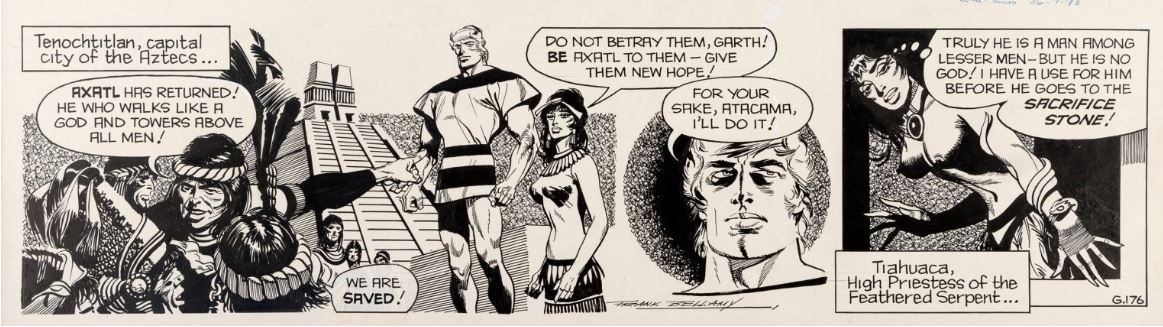
The final adventure re-presented here – ‘The Mask of Atacama’ – sees Garth & Lumiere in Mexico City. Whilst sleeping, the blonde colossus is visited by the spirit of Princess Atacama (also beautiful, of course) who escorts him through time to vanished Aztec city Tenochtitlan where, as the Sun God Axatl, Garth attempts to save their civilisation from the voraciously marauding Conquistadores of Hernán Cortés de Monroy y Pizarro Altamirano (as shortened for these brief 3-panel strip episodes to far more manageable Hernan Cortés)…

Tragically, neither Garth nor the Princess have reckoned on the jealousy of the Sun Priests and their High Priestess Tiahuaca

Adding extra value to this volume are a draft synopsis and actual scripts for ‘The Women of Galba’, all liberally illustrated.. There has never been a better comic adventure strip than Garth as drawn by Bellamy: a daily rip-roaring romp combining action, suspense, glamour, mystery and the uncanny in a seamless blend of graphic wonderment. In recent years, the comic strip colossus has fallen from memory as well as favour, but I’m still fervently praying that one day, Garth (and while I’m dreaming, Jeff Hawke too) will make the jump to curated complete archive editions. Go on, make on old man happy why don’t you? There’s certainly a grateful, appreciative and vast audience waiting…
© 1985 Mirror Group Newspapers/Syndication International. All Rights Reserved.

This day in 1915 Henry Sunday page illustrator Don Trachte was born, followed two years later by British legend Frank Bellamy (Fraser of Africa, Dan Dare, Garth, Heros the Spartan, Thunderbirds) and Mancunian émigré Lee Elias (Beyond Mars, Black Cat, Flash, Green Arrow, Eclipso, Luke Cage, Human Fly, Goblin, Rook) in 1920.

In 1943 French writer-artist Jean-Claude Fournier (Spirou and Fantasio, Bizu) was born as was writer/publisher Gary Reed (Sherlock Holmes, Deadworld, Saint Germaine, Baker Street, Caliber Comics) in 1956.

We lost pioneering Canadian cartoonist and animator Vital Achille Raoul Barré in 1932 and in 1977 gained a UK animal icon when Gnasher’s Tale (by David Sutherland) began, launching the manky mutt into his own Beano series detailing his life as a puppy before being adopted by Dennis the Menace

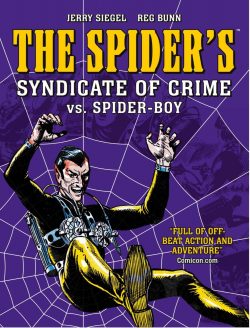
The Spider’s Syndicate of Crime vs Spider-Boy (volume 4)


By Jerry Siegel & Reg Bunn with John Burns, Geoff Campion and various (Rebellion)
ISBN: 978-1-83786-560-4 (Album TPB/Digital edition), 978-1-83786-685-4 (Webshop Exclusive edition)

This book includes Discriminatory Content produced in less enlightened times.

Another triumph of Rebellion’s Treasury of British Comics line, The Spider’s Syndicate of Crime vs. Spider-Boy is the latest offering in what I pray will be a complete revival of the UK’s most marvellous vintage comics fantasies (bring on Thunderbolt the Avenger, Smoke Man, Tri-Man, Gadget Man & Gimmick Kid and even the Phantom Viking… we can take it!).

Gathering material from peerless weekly anthology Lion, originally spanning May 27th to October 7th 1967 and including material from a later reprinting (Lion December 8th 1973), this collection also includes a prose done-in-one yarn from Lion Annual 1970 to complete another wildly whacky superhero romp as only the cocreator of Superman could envision it…

Mystery criminal genius and eventual superhero The Spider debuted on June 26th 1965 and reigned supreme until April 26th 1969. He has periodically returned in reprints and occasional new stories ever since. As first introduced by Ted Cowan (Paddy Payne, Adam Eterno, Robot Archie) & William Reginald Bunn.

“Reg” was an absolute master of his field and much beloved. His other work in comics (like Robin Hood, Buck Jones, Black Hood, Captain Kid and Clip McCord) spanned 1949 to his death in 1971 as, once the industry found him, he was never without work. Reg died on the job and is still much missed. For The Spider there was the ultimate accolade as, after opening on 2 pages per episode, the feature kept winning a bigger page count. Even so, lots had to happen in short order and Bunn never stinted or short-changed his audience. Played out for months at breakneck rollercoaster pace, each monochrome episode positively bulged with imaginative ingenuity, manic combats and crazy inventions peppering wide-eyed British kids with a bizarre conception of the USA…

Originally The Spider was man of unbelievably colossal vanity: a moody malcontent super-scientist whose goal was to be acclaimed the greatest criminal of all time. A flamboyantly wicked narcissist, he began his public career by recruiting crime specialists – scurvy, skeevy safecracker Roy Ordini and genteelly timid evil genius inventor Professor Pelham – prior to a massive gem-theft from America’s greatest city. He was foiled by cruel luck and resolute cops Gilmore &Trask: crack detectives cursed with the job of catching the arachnid archfiend. Cowan scripted the first two serialised sagas before handing over to comics royalty: Jerry Siegel (Superman, Superboy, The Spectre, Doctor Occult, Slam Bradley, Funnyman, The Mighty Crusaders, Starling), who had been forced to look elsewhere for work after an infamous dispute with DC Comics over the rights to the Man of Steel. His supervision of UK arachnid amazement began just as Britain and the entire, but somehow less fab & groovy, world succumbed to “Batmania”…

In case you’re not old, that term covers a period of global hysteria sparked by the 1966 Batman TV show, when the planet went crazy for superheroes and an era dubbed “camp” saw humour, satire, and fantastic psychedelic whimsy infect all categories of entertainment. It was a time of peace, love, wild music and radical change, and I believe there were lots of drugs being experimented with at the time…

British comics were always especially vulnerable to any passing trend or zeitgeist, and a host of more conventional costumed crusaders sprang up in our traditionally unconventional pages. Scripted by the godfather of the genre – and an inveterate humourist – The Spider remained an utterly arrogant sod even as he skilfully shifted gears without a squeak to become a superhero. Battling in rapid succession The Exterminator, Crime Incorporated, The Silhouette, Dr. Mysterioso, The Android Emperor, The Infernal Gadgeteer, The Crook From Outer Space, an evil Genie, transdimensional monstrogs and immortal Queen Lana of Valley of the Doomed he starts here as global figure of approbation and acceptance, only to see all his glittering glories plucked away…

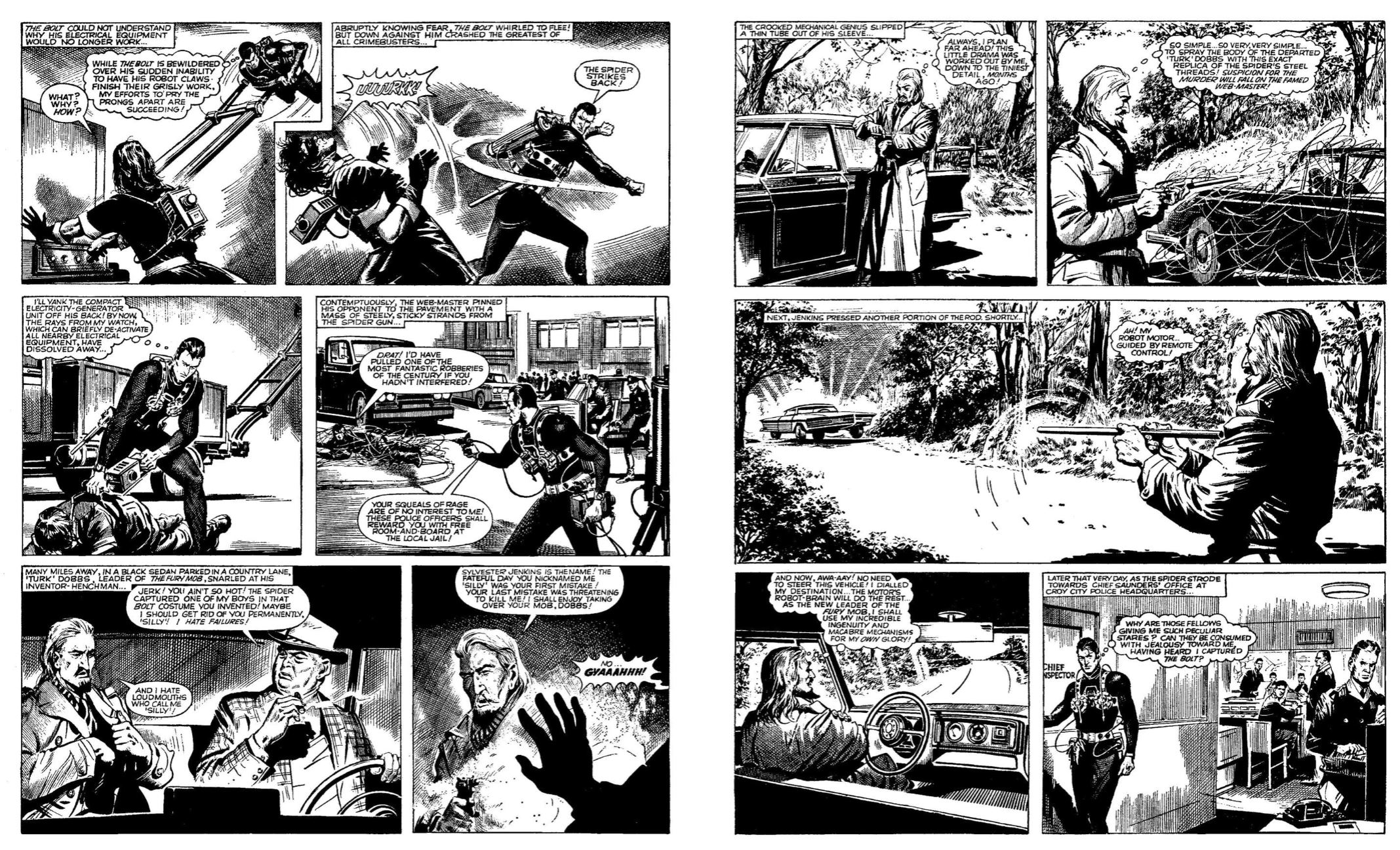
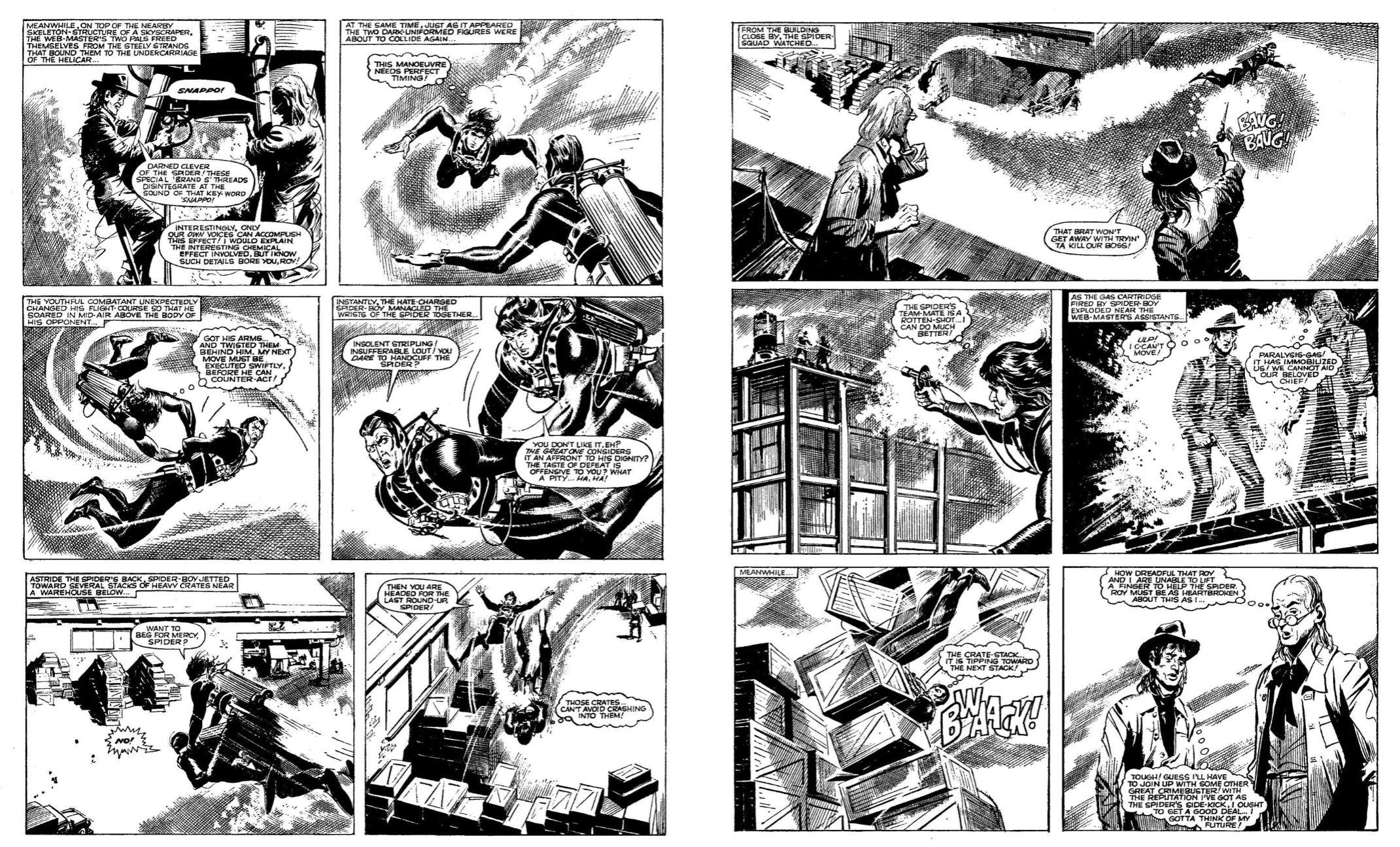
As previously stated, the strip had grown ever more popular, and by the time of this epic encounter demanded a full 5 pages per episode, in a periodical where 1 or 2 pages a week was the norm. Another masterclass of illustrative wonderment displaying Bunn’s incredible gift for visualisation, the lengthy campaign finds The Spider, Pelham & Ordini targeted by honest greed, dastardly ambition and cruel misunderstanding as the tale in this tome reconnects with normal(ish) Good, Evil and Vengeance. Here The Spider duels a deadly criminal scientist only to find himself distracted and diverted by a young and ferocious deadly doppelganger…
When criminal inventor Sylvester Jenkins (DO NOT call him “Silly”) teams up with Fury Gang boss “Turk” Dobbs, the first results are a wave of super-powered bandits such as The Bolt and insulting defeat by The Spider and his crew. In response Jenkins murders Dobbs (who coined the “Silly” moniker) and frames the hero for it. With the Spider on the run and unable to clear his name, let alone face a rush of mutated mobster/monsters, the situation grows truly complicated as a brilliant but vicious teenager wearing stolen Spider gear hunts and humiliates the great hero time and again.

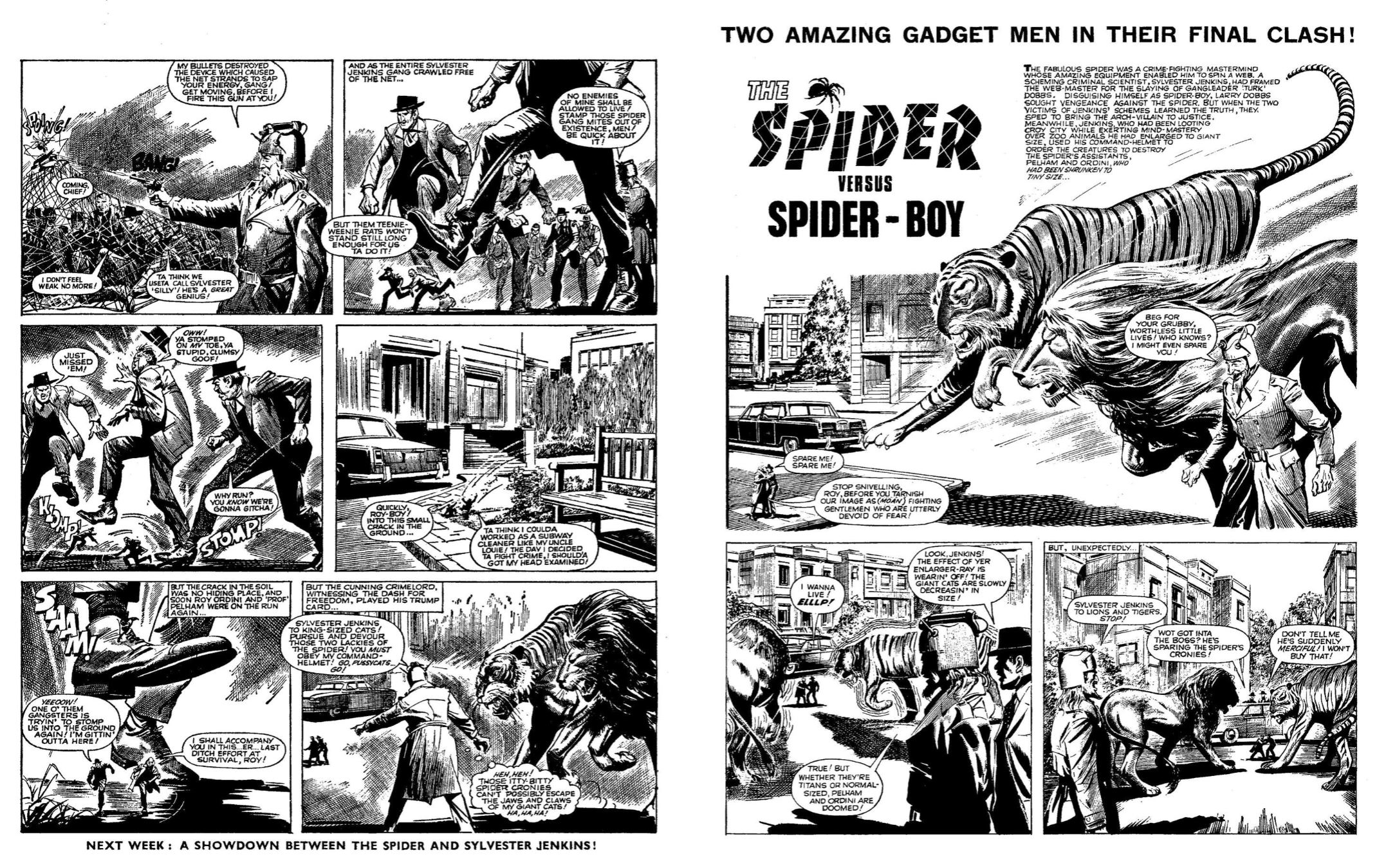
Outfought, outmanoeuvred and on the run, the prospects are dire after Jenkins recruits Spider-Boy and orchestrates his following forays against the despised fallen hero, until the kid learns a bitter truth and shares a tragic secret that changes everything…

A far darker and more traditionally motivated tale, the delivery still rockets along with wild invention as incidental dangers pile up: horrors such as trigger-happy cops, Jenkins’ relentless monster experiments, naturally-occurring rival bio-terrors, rampaging bug-bots, flying castles, mutated circus and zoo animals and a climactic showdown in a lost city of super technologies, before all the truths come out and justice is served…

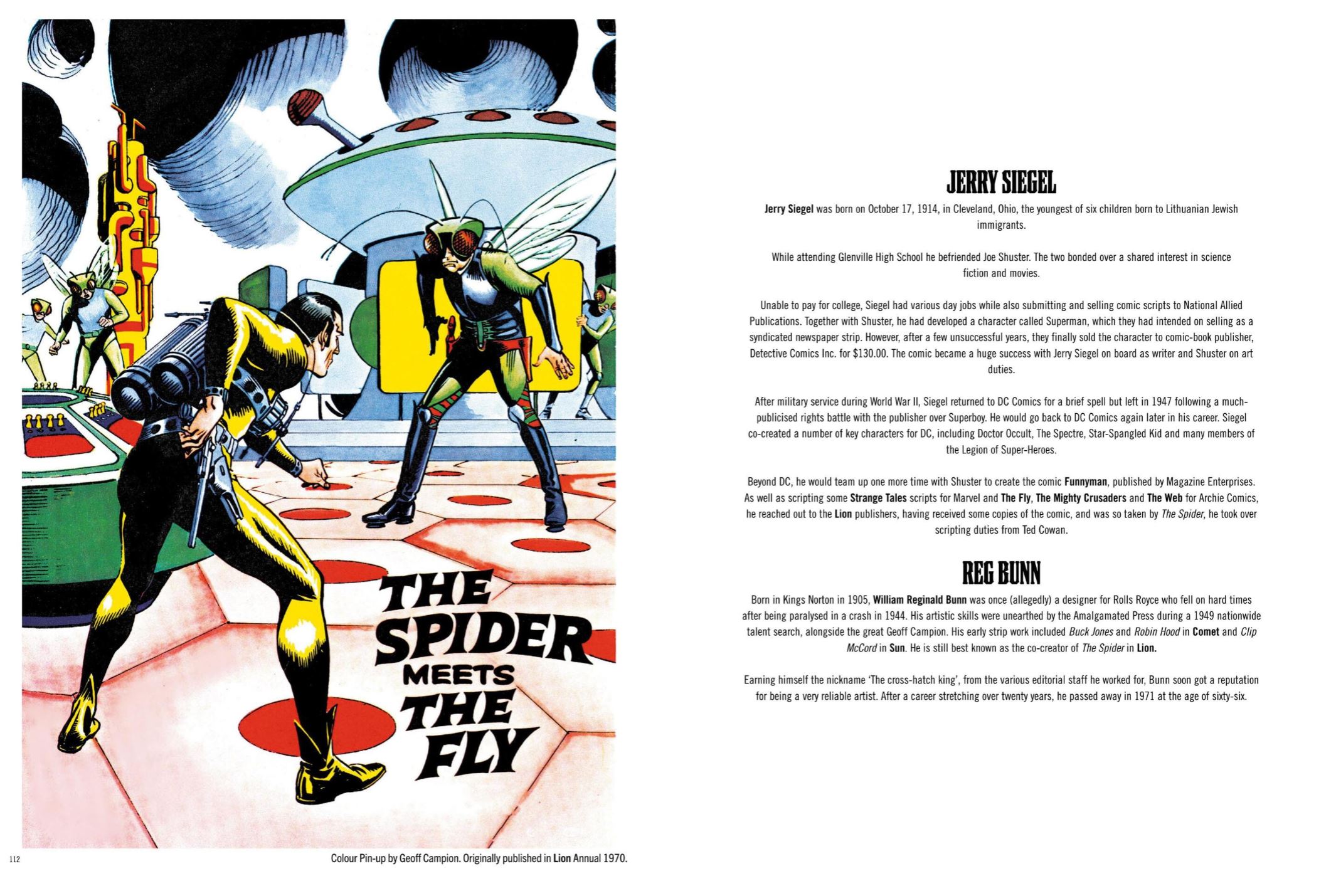
The Extras section then offers a rare treat from a later era, as – when the serial was truncated and re-run in 1973 – the editors opted to commission a new final episode and alternate conclusion; scripted by an unknown writer but illustrated by John Burns as seen in Lion December 8th 1973. It’s followed by text thriller ‘The Spider Meets the Fly’. Illustrated and written by hands unknown for Lion Annual 1968 this yarn pits the Spider and Co. against a world-conquering science villain and his volcano-dwelling army of high-tech assassins… with the usual results, and is accompanied by the book’s original full-colour frontispiece highlighting the clash as painted by Geoff (Battler Britton, Captain Condor, Typhoon Tracy, The Spellbinder, D-Day Dawson) Campion.

This titanic tome confirms that the King of crime crushes is still top of the heap and should find a home in every kid’s heart and mind, no matter how young they might be, or threaten to remain. Batty, baroque and often simply bonkers, The Spider proves that although crime does not pay, it can offer a huge amount of white-knuckle fun…
© 1967, 1969, 1973 & 2025 Rebellion Publishing IP Ltd. All Rights Reserved.

Today in 1777 English caricaturist and illustrator Richard Newton was born, followed in 1903 by Jimmy Olsen, Captain Marvel artist Pete Costanza; Ralph Reese (Solomon Kane, Witzend, One Year Affair) in 1949, and Argentine cartoonist Maitena Burundarena (Mujeres Alteradas) in 1962.

In 2017, comic book chameleon Rich Buckler (Deathlok, Fantastic Four, All-Star Squadron, Batman, Superman vs Shazam, Red Circle Comics) died.

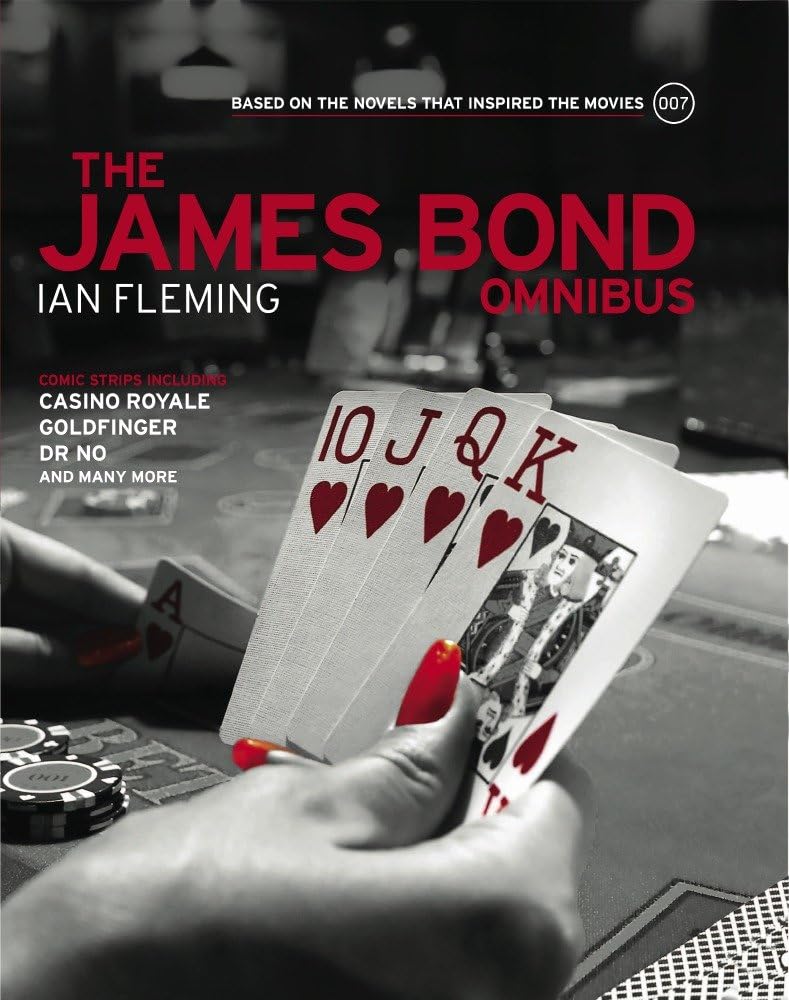
The James Bond Omnibus volume 001


By Ian Fleming; adapted by Anthony Hern, Peter O’Donnell, Henry Gammidge & John McLusky (Titan Books)
ISBN: 987-1-84856-364-3 (TPB)

This book includes Discriminatory Content produced in less enlightened times.

It’s sad to admit but there are very few British newspaper strips to challenge the influence and impact of classic daily and Sunday “funnies” from America, especially in the febrile but slowly expiring the field of adventure picture-fiction.

The 1930’s and 1940’s were rich in popular, not to say iconic, creations. You would be hard-pressed to come up with homegrown household names to rival Popeye, Dick Tracy, Buck Rogers or Flash Gordon, let alone Terry and the Pirates, Steve Canyon, or the likes of Little Lulu, Blondie, Li’l Abner, Little Orphan Annie or Popeye and yes, I know I said him twice, but Elzie Segars’s Thimble Theatre was funny as well as thrilling, constantly innovative, and really, really good.

What strips can you recall to equal simple popularity let alone longevity or quality in Britain? Rupert Bear? Absolutely. Giles? Technically, yes. Nipper? Jane? The Perishers? Garth? Judge Dredd? Scorer?

I’d like to hope so, but I doubt it. The Empire didn’t quite get it until it wasn’t an empire any more. There were certainly very many wonderful strips being produced: well-written and beautifully drawn, but that stubborn British reserve plus a completely different editorial view of the marketplace (which just didn’t consider strips infallible, readership-attracting magnets, as American did) never seemed to be in the business of creating household names – until the 1950’s. Something happened in ‘50s Britain, but I’m not going to waste any space here discussing it. It just did.

In a new egalitarian spirit that seemingly craved excitement and accepted previously disregarded, comics (as well as all tawdry “entertainment” media from radio serials to paperback novels) got carried along on the wave. Just like television, periodicals such as Eagle, the regenerated Dandy and Beano and girls’ comics in general all shifted into creative high gear… and so at last did newspapers.

And that means that I can properly extol the virtues of a graphic collection with proven crossover appeal for once. Debut 007 novel Casino Royale was published in 1953 and was subsequently serialised – after much dithering and nervousness on behalf of author Fleming – as a strip in The Daily Express from 1958. It was the start of a beguiling run of novel and short story adaptations scripted by Anthony Hern, Henry Gammidge, Peter O’Donnell and Kingsley Amis, before Jim Lawrence, a jobbing writer of US features (and who’d previously scripted the aforementioned Buck Rogers) came aboard for The Man With the Golden Gun, completing the transfer of the Fleming canon to strip format. Thereafter Lawrence was invited to create new adventures, which he did until the strip’s demise in 1983.

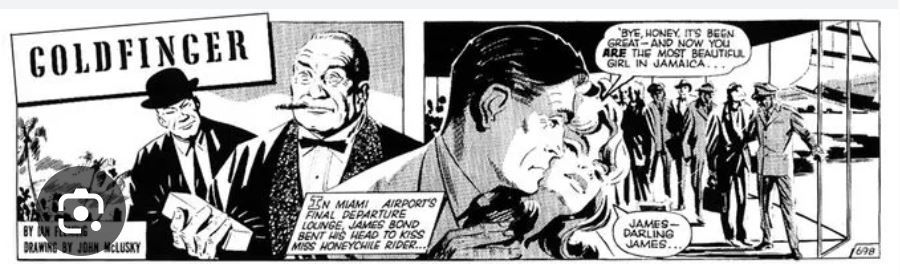
The art on the feature was always of the highest standard. Initially John McLusky handled the illustration until 1966’s conclusion of You Only Live Twice and, although perhaps lacking in flash or verve, the workmanlike clarity of his drawing easily coped with a daunting array of locales, technical set-ups and sheer immensity of cast members, whilst satisfying the then-novel directive of advancing a plot daily whilst ending each episode on a cliff-hanging hook every time.

McLusky was succeeded by Yaroslav Horak, who debuted on Man with the Golden Gun, offering a looser, edgier style, at once more cinematic and with a closer attention to camera angle and frenzied action that seemed to typify the high-octane 1960’s. Horak limned 26 complete adventures until 1977 when The Daily Express axed the Bond feature with a still-running adventure suddenly switching to The Sunday Express from January 30th until conclusion on May 22nd. Later adventures had no UK presence at all, and only appeared in syndication in European papers. This state of affairs continued until 1981 when British paper The Daily Star restored the feature to Britons with ‘Doomcrack’.

Titan Books re-assembled those scarce-seen tales – a heady brew of adventure, sex, intrigue and death – into addictively accessible monochrome Omnibus Editions, (sadly not available digitally at present) with a dedicated band of creators on top form proving how the world’s greatest agent never rests in his mission to keep us all free, safe, shaken (if not stirred) and thoroughly entertained…

This premier no-nonsense paperback gem adapting 11 of Fleming’s best, frantic derring-do and dark, deadly diplomacy commences with ‘Casino Royale’ as British operative Bond is ordered to gamble with and bankrupt Le Chiffre: a communist agent who has insanely embezzled away his Soviet masters’ operating capital.

The moodily compelling tale of tension that results depicts torture and violent death as well as oppressively suspenseful scenes of graphic gambling, heady stuff for newspaper readers of 1958, when it first ran.

Without pausing for breath or a fresh martini, the Bond briefing segues straight into ‘Live and Let Die’ which sees 007 and US agent Felix Leiter tackle Mr. Big, another scurrilous commie agent/devious genius who rules the Harlem underworld through superstition, voodoo and brutal force. Then, ‘Moonraker’ details the attempt by ex-Nazi officer Hugo Drax to drop a guided missile on London, a task made far simpler since the maniac has infiltrated the British aristocracy…

These newspaper strips come from a period when dependable John McLusky was developing a less formal approach, before going on to produce some of his best work. ‘Casino Royale’ was the opening strip in a near 25-year run, and the somewhat muted artwork shows an artist still not completely comfortable with his task. It was adapted and scripted by Anthony Hern, who had won the author’s approval after writing condensed prose versions of the novels for the Daily Express. Live and Let Die and Moonraker were both adapted by Henry Gammidge.

As McLusky settled in for the long haul, he warmed to the potentialities of the job with cracking tales of Cold-War intrigue and fast, dangerous living set in a multitude of exotic locales, and provides here a welcome return to public gaze of some of the most influential – and exciting – comic strips in British history.

The adaptation of ‘Diamonds are Forever’ pits Bond against an insidious diamond smuggling criminals, in an explosive if uncomplicated all-action romp before shifting into terse, low-key thriller ‘From Russia With Love’ (both courtesy of Gammidge & McLusky). The artist hit a creative peak with ‘Dr No’ – perhaps because of the sparkling script from Peter O’Donnell before he sloped off to create the amazing Modesty Blaise. As Bond returns to Jamaica and investigates the disappearance of two operatives he stumbles upon a plot to sabotage the US rocketry program. These stories come from an age at once less jaded but more worldly; a place and time where readers lived daily with the very real threat of instant annihilation. As such, the easy approachability of the material is a credit to the creators.

‘Goldfinger’ faithfully adapts Fleming’s novel of the world’s most ambitious bullion robbery, so if you’re only familiar with the film version there will be some things you’ve not seen before. The action fairly rockets along and tense suspense is maintained throughout this signature tale. Following that is ‘Risico’ as 007 is tasked with stopping heroin smugglers whose motive is not profit but social destabilisation. Next is ‘From a View to a Kill’: a traditional, low-key Cold War thriller with Bond trailing gangsters stealing state secrets by ambushing military dispatch riders…

In the Roger Moore film incarnation Risico was folded into ‘For Your Eyes Only’ but here you get the real deal with a faithful adaptation of Fleming’s short story, wherein Bond is given a mission of revenge and assassination. Set in Jamaica with Nazi war-criminal Von Hammerstein as culprit and target for the man licenced to kill, it’s a solid piece of dramatic fiction that again bears little similarity to the celluloid adventure.

The volume concludes with the then-controversial ‘Thunderball’ adaptation. That particular tale was savagely censored and curtailed at the behest of Daily Express owner Lord Beaverbrook. Five days of continuity were excised but what remains is still pretty engrossing comic fare and at least some effort was made to wrap up the storyline before the strip ended. In case you don’t recall: When Bond is sent on enforced medical leave, he stumbles into a deadly plot to steal nuclear weapons by a subversive organisation calling itself Spectre

These grand stories are a must for not only aficionados of Bond but for all thriller fans, as an example of truly gripping adventure uncluttered by superficial razzamatazz. Get back to basics, and remember that classic style is never out of fashion.
All strips are © Ian Fleming Publications Ltd/Express Newspapers Ltd 1987. James Bond and 007 are ™ & © Danjaq LLC used under license from Ian Fleming Publications Ltd. All rights reserved.

In 1915 prolific scripter Hank Chapman was born, with artistic maestro John Cullen Murphy (Prince Valiant) coming along four years later. Miss Pearl and Momma creator Mel Lazarus popped up in 1927, and Belgian Sammy draughtsman Berck (Arthur Berckmans) in 1928. Comic book legend Denny O’Neil was born in 1939 and Bill Sienkiewicz in 1958. German cartoonist Jan-Michael Richter – of Jamiri fame – came along in 1966 as did Nina Paley in 1968, and Mexican Gerardo Sandoval (Tomb Raider, Venom), and the date saw the first appearance of Zig et Puce (by Alain Saint-Ogan) in 1925; the premiere of Donald Duck (a bit player in Silly Symphony: The Wise Little Hen) in 1934; the launch of Dutch silent comic Fred’nand in 1937and the debut of Tiger by Bud Blake in 1965.

Milton Caniff died today in 1988.

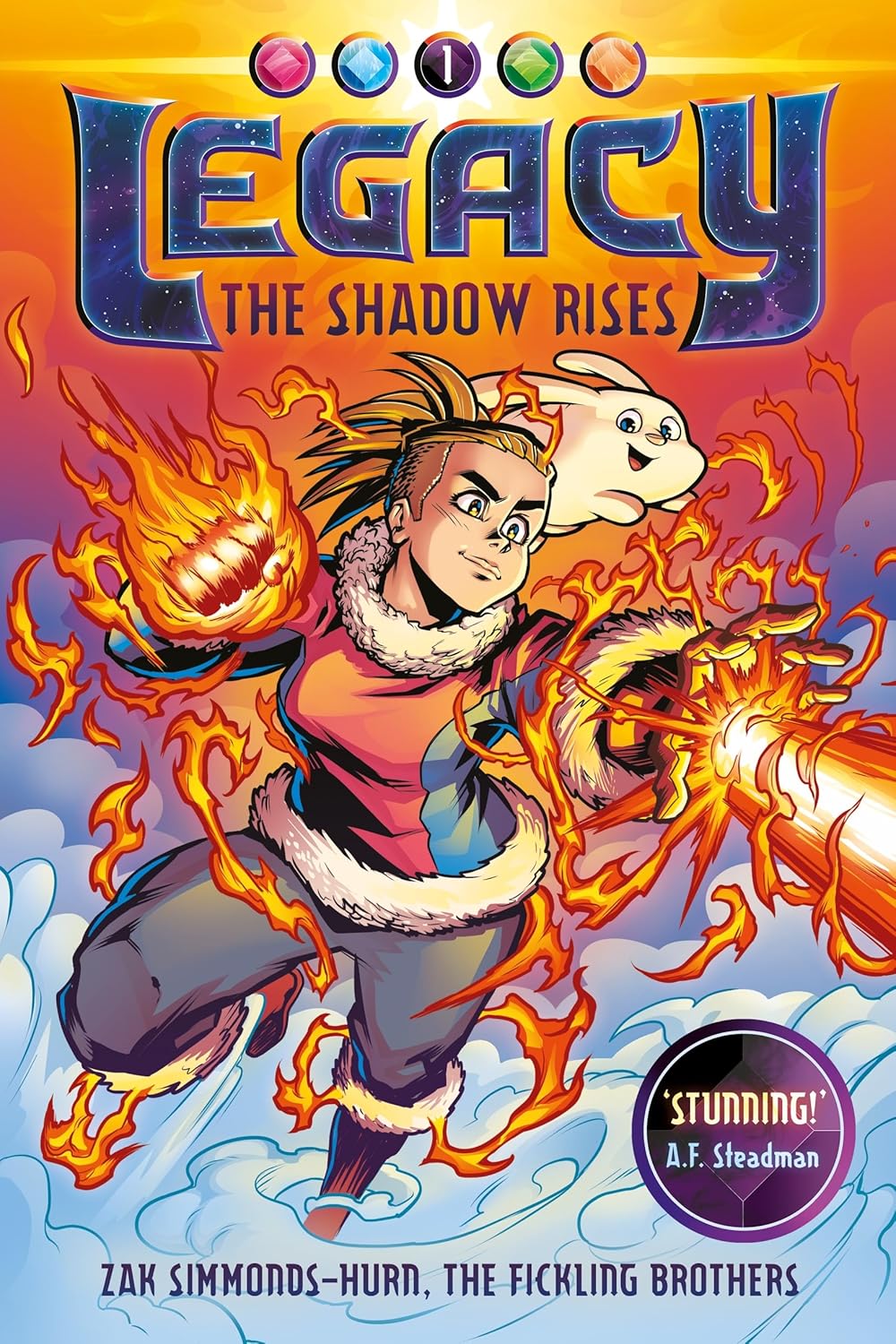
Legacy: The Shadow Rises (volume 1 of 3)


By The Fickling Brothers & Zak Simmonds-Hurn, with additional colours by Lou Ashworth, Alice Leclert & Ellie Wright (DFB/Phoenix)
ISBN: 978-1-78845-198-7 (TPB)

The Phoenix has been the shining saving grace of British kids’ comics since 2012, regaling rabid readers with anthology comics for girls, boys and all points between, offering humour, adventure, quizzes, puzzles and educational material in a joyous parade of cartoon fun and fantasy. Although probably best known for its award-winning comedy stylings, the comic has always been pretty strong in its action and mystery yarns too, and this latest offering – by writers “The Fickling Brothers” (Tom & Will) and illustrator Zak Simmonds-Hurn (Dragon Guard, Know Your Monsters) – delivers the first full-on, all-action fantasy tome in a prospective trilogy aimed at the growing market for juniors-based magical adventure.

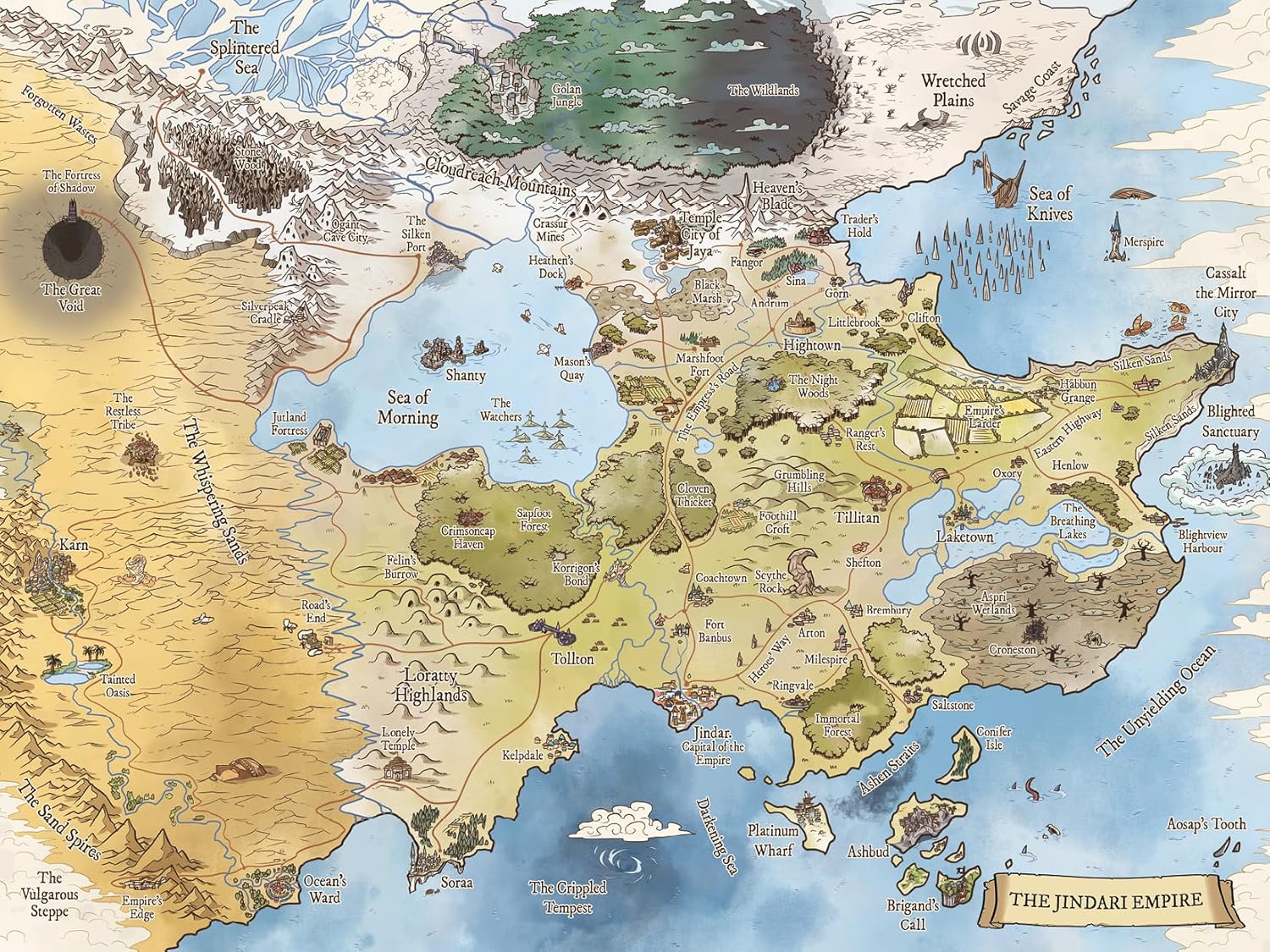
Flavoured with hints and notes of Star Wars and The Lord of the Rings franchises and the glorious classic movie Willow, this cunningly contrived confection takes us to the embattled lands of the Jindari Empire, laying ground rules for a war of conquest by malign forces lurking beyond the Edge of the Great Void and craving control of all that lives free. The cruelly avaricious observer is Obaga, Queen of Shadows and as her minions constantly confirm, “the Shadow rises”…

With ebon emissaries sowing terror and discord, the crisis begins when blithely unaware ruler of Hightown Lord Edar of House Thawn, his sons Tarik and Lorban and faithful warrior mage Kal Jotan are ambushed by marauding dark raiders. Thankfully, before his defeat, Kal sends a magical message to Heaven’s Blade, the fortress-citadel that is home to all arcane knowledge and the current boarding school of Edar’s mystically-gifted daughter Scarlett Thawn.

When her studies are interrupted by tidings that she is now last surviving Thawn and ruler of Hightown, she accepts that she must leave. Her potent but daunting tutor Lord Igon soon despatches Scarlett (and her beastly familiar Rumpus) on the long journey home, and offers sage advice and an ancient scroll that is far from what it seems…

The scholar has long anticipated trouble and knows the world’s governing Council of Flowers is not up to confronting the forces of evil; The Shadow has contingency plans of her own. Most critical of these is having an impostor already in place governing Hightown by the time Scarlett arrives to take up the onerous responsibilities of command…

Thus begins a rousing quest saga as Scarlett treks across a weird, wild world to find bizarre animal allies, face incomprehensible threats and forsake her dreams of magical study for the duties of rulership, and discovers that friends and foes are impossible to distinguish and that “her” problems affect far more than just her subjects…

Also drafted and crafted by Zak and the Fickling lads is a fulsome supplementary section detailing background lore under the aegis and escutcheon of ‘A Compendium of the Creatures, Customs and Culture of Jindar and Other Curious Miscellany by Penadot Shrewd’. These context-compliant complimentary case histories include all you need to know now regarding ‘The Ancients’, ‘The Shadow’, ‘The Council of Flowers’, and all you might want about ‘Magic’ including ‘A Brief Lesson in Magic for Novices’ concentrating on ‘Fire, Ice and Acid Magic’.

If epic adventure and growing pains in the depths of the dark are your taste, this is an epic you’ll want to follow from the first step to the last gasp…
Text  and Illustrations © The Phoenix Comic  2026.

Legacy: The Shadow Rises will be published on May 7th 2026 and is available for pre-order now.

Today in 1912 groundbreaking Dutch comics god Marten Toonder (Tom Puss, Panda, Oliver B. Bumble) was born, followed in 1922 by legendary raconteur Dog Wildey (Tarzan, Outlaw Kid, Jonny Quest, Rio); Howard Cruse (Wendel, Stuck Rubber Baby, Barefootz) in1944; multi-syndicated strip cartoonist Jerry Scott (Zits, Baby Blues) in 1955 and modern comic book mavens Liam Sharp (Deaths Head II, Wonder Woman, Testament) in 1968 and Simon Spurrier (Harry Kipling, X-Men, Ghost Rider) in 1981.

Today in 1912, US political cartoonist Homer Davenport died, with later losses including Wonder Woman co-creator William Moulton Marston in 1947; John Forte (Legion of Super-Heroes, Tales of the Bizarro World) in 1966 and anthological comics horror-meister Jay Disbrow (Captain Electron, Valgar Gunnar of Gyro, Aroc of Zenith) in 2017.

Primal landmark Dutch newspaper strip Bulletje en Boonestaak debuted today in 1922.

Marney the Fox


By Scott M. Goodall & John Stokes (Rebellion Studios)
ISBN: 978-1-78108-598-1 (HB/Digital edition)

This book includes Discriminatory Content produced in less enlightened times. This book also contains Discriminatory Content included for dramatic effect.

At first glance British comics prior to the advent of 2000 A.D., Action and Misty seemingly fell into fairly ironclad categories. Back then, you had genial and fantastic preschool fantasy; a prodigious selection of adapted TV and media properties; action; adventure; war and comedy strands. A closer look, though, would confirm that there was always a subversive undertone, especially in such antihero series as Dennis the Menace, The Spider or the early Steel Claw.

…And then there was Marney the Fox.

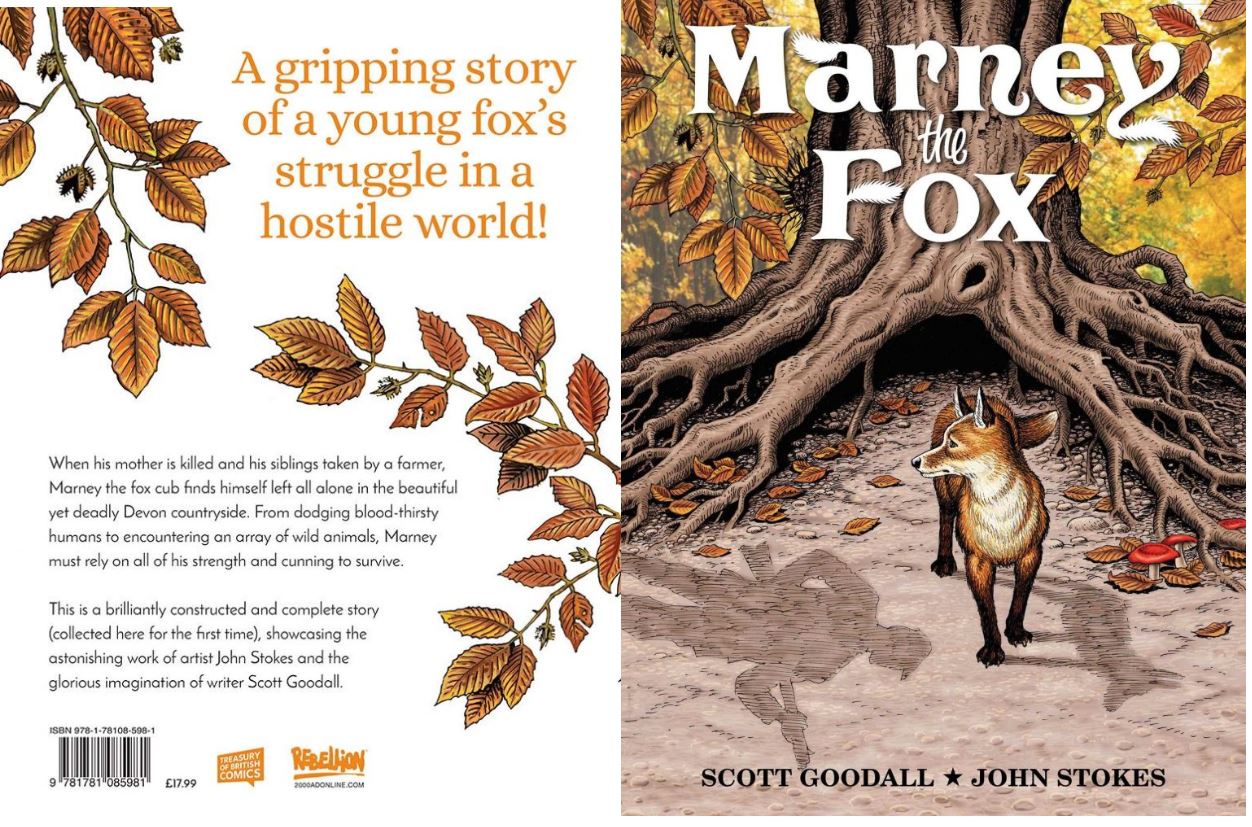
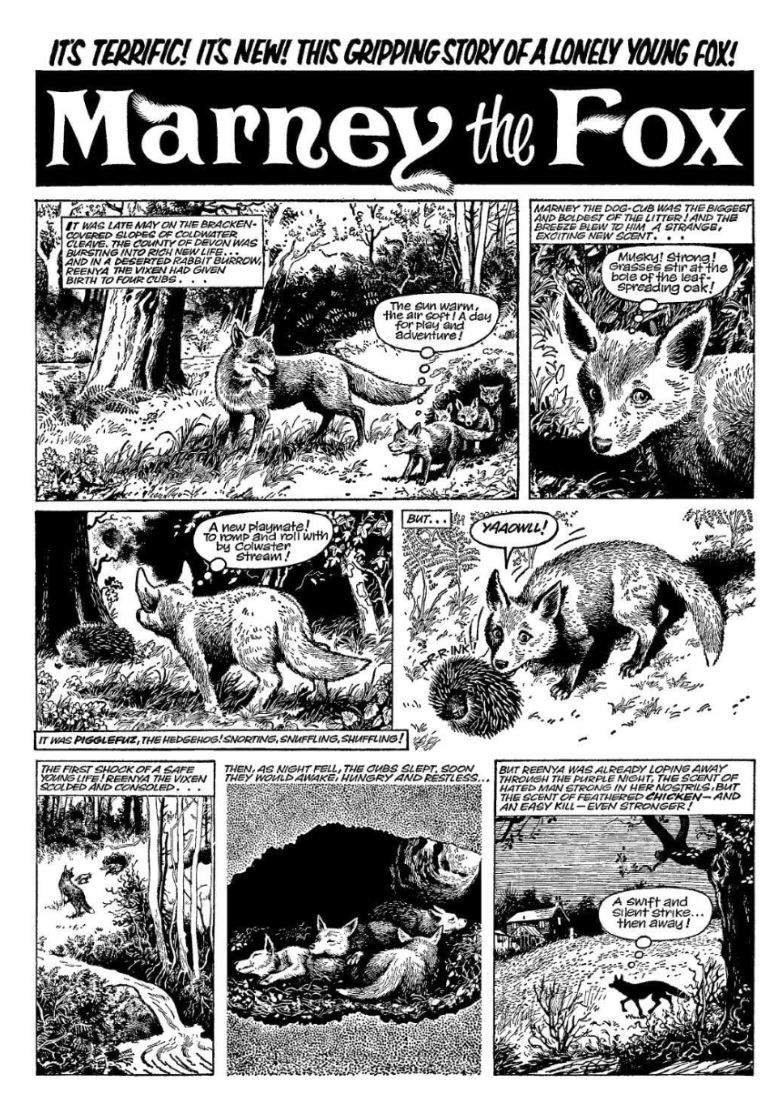
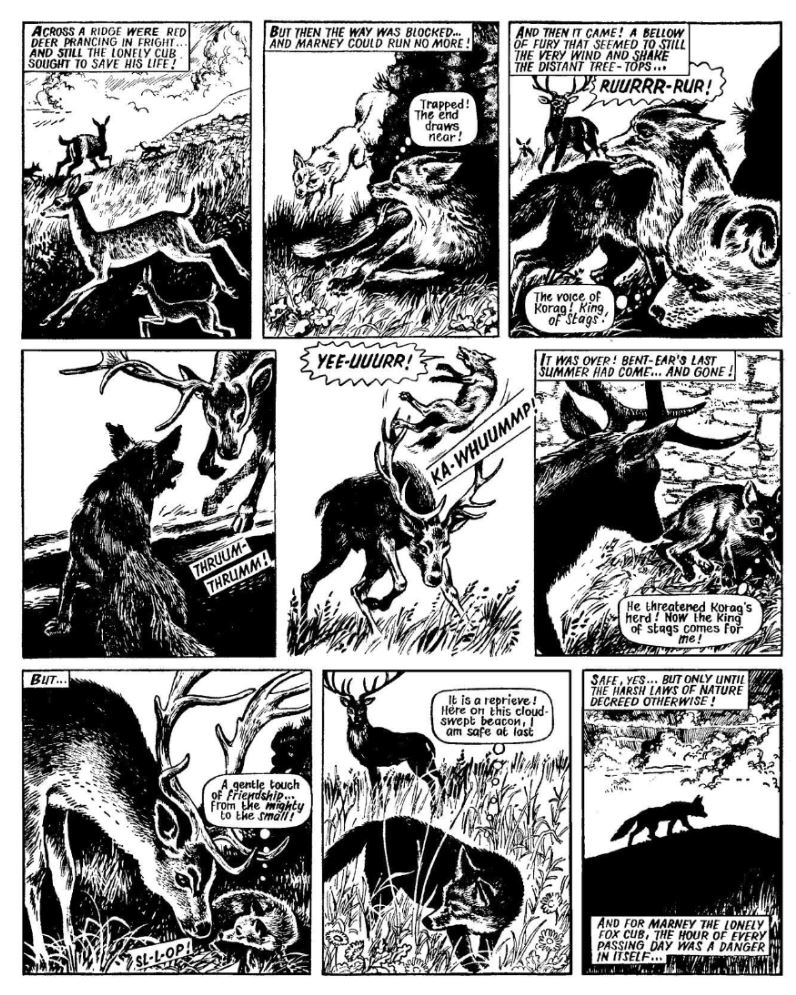
Created and scripted by prolific Scott Goodall (Captain Hurricane, Kelly’s Eye, Cursitor Doom, Captain Scarlet and dozens more), the series ran in all-purpose anthology Buster from June 22nd 1974 to September 4th 1976 and – even in a weekly periodical notorious for its broad and seemingly mismatched mix of themes and features – stuck out like a sore thumb.

Not for any lack of quality, of course.

Compellingly scripted by Goodall and set in his beloved Devonshire country, the serial was lavishly, almost hauntingly illustrated by frequent collaborator John Stokes (Black Knight, Father Shandor, Maxwell Hawke, L.E.G.I.O.N., Aliens, Star Wars, The Invisibles), with whom the writer had already crafted for Buster seminal classics Fishboy and The War Children.

Marney the Fox was very much a passion project and a creature of its times. If you look at the ordering descriptions online or even revel in the gorgeous and serene cover embellishing this luxurious hardback/digital compilation, you might conclude it’s a natural history strip or animal adventure along the lines of Lassie or Black Beauty.

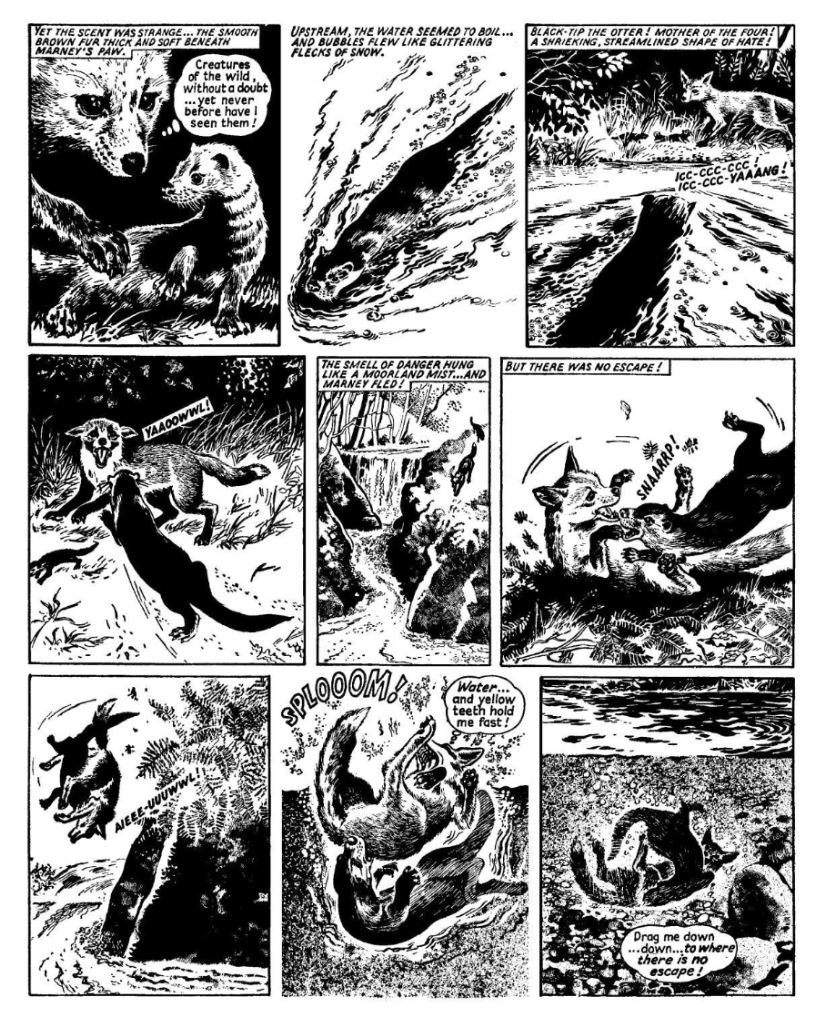
Don’t be deceived. The books you should be thinking of here are Ring of Bright Water, Tarka the Otter and A Kestrel for a Knave (or Kes, if you don’t read As Much As You Should, but do watch movies). The deftly-constructed atrocities beautifully limned in every 2-page monochrome instalment were – and remain – brilliant nature propaganda and should be mandatory reading for every person who lives in, near or with the natural environment…

For two years the weekly trials and tribulations of barely-weaned orphaned fox cub Marney the Wandering One were a painfully beautiful, frequently harrowing account of the horrors rural folk – from poachers to soldiers on manoeuvres to roadbuilders to landed gentry and their bloody hounds – all casually inflicted on unwelcome wildlife: ones that must have traumatised and successfully indoctrinated a generation of kids.

From his first encounter with and narrow escape from despicable mankind, young Marney endures a ghastly litany of close shaves, bolstered by far too few happy, peaceful moments as he flees from crisis to crisis until mercifully finding refuge and contentment. I had to put that last bit in because this is a sublime piece of comics wonderment that everybody should read, but the seven-day-cliffhanger cycle and sheer mental and physical abuse the little guy barely survives every week would have Batman, Daredevil and Judge Dredd rushing for Valium and comfort blankies in an instant…

So take it from me: the fox lives happily ever after, okay?

Augmented by an Introduction from John Stokes, this is magical and unique comics entertainment, suitably acid-coating the hard, harsh life of British wildlife and the ignorance and cruelty of many – but not all – people. It’s also a story you must see and will never forget…
™ & © 1974, 1975, 1976, & 2017 Rebellion Publishing Ltd. All Rights Reserved.

Today in 1923 Marvel’s man behind the curtain Sol Brodsky was born, as was writer Steve Englehart in 1947; editorial whirlwind Marie Javins in 1966; British boys Ian Churchill in 1969 and Bryan Hitch one year later.

Today long ago, Machiko Hasegawa’s yonkoma manga Sazae-san began its epic 68-volume run (April 22nd 1946 – February 21st 1974) and in 1990, Scott Stantis began the still-running family strip The Buckets. In 2002 we lost British journeyman illustrator Denis (The Shark, Commando, Buffalo Bill, Wizard) McLoughlin.

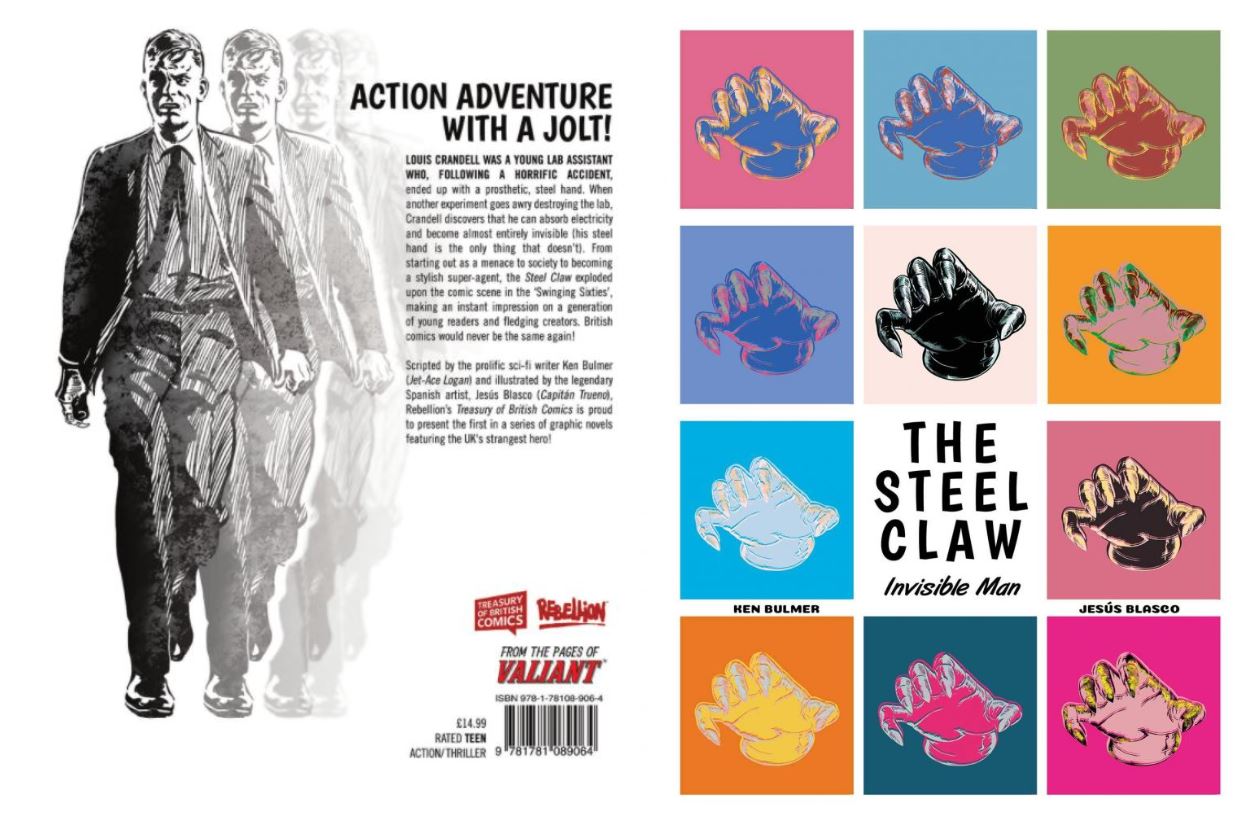
The Steel Claw: Invisible Man


By Ken Bulmer & Jesús Blasco & various (Rebellion)
ISBN: 978-1-78108-906-4 (TPB/Digital edition)

This book includes Discriminatory Content produced in less enlightened times.

One of the most fondly-remembered British strips of all time is the startlingly beautiful Steel Claw. From 1962 to 1973 the stunningly gifted Jesús Blasco and his small studio of family members thrilled the nation’s children, illustrating the angst-filled adventures of scientist, adventurer, secret agent and even – occasionally – costumed superhero Louis Crandell.

The majority of the character’s career was scripted by comic veteran Tom Tully, but initially follows the premise of HG Wells’ original unseen adversary with prolific science fiction novelist Ken Bulmer devising a modern spin and contemporary twist on The Invisible Man.

Another superb salvo of baby boomer nostalgia from Rebellion’s Treasury of British Comics strand, initial collection The Steel Claw: Invisible Man gathers material from beloved and enduring weekly anthology Valiant, spanning 6th October 1962 to 21st September 1963 and also includes stories from the Valiant Annuals for 1965 and 1966.

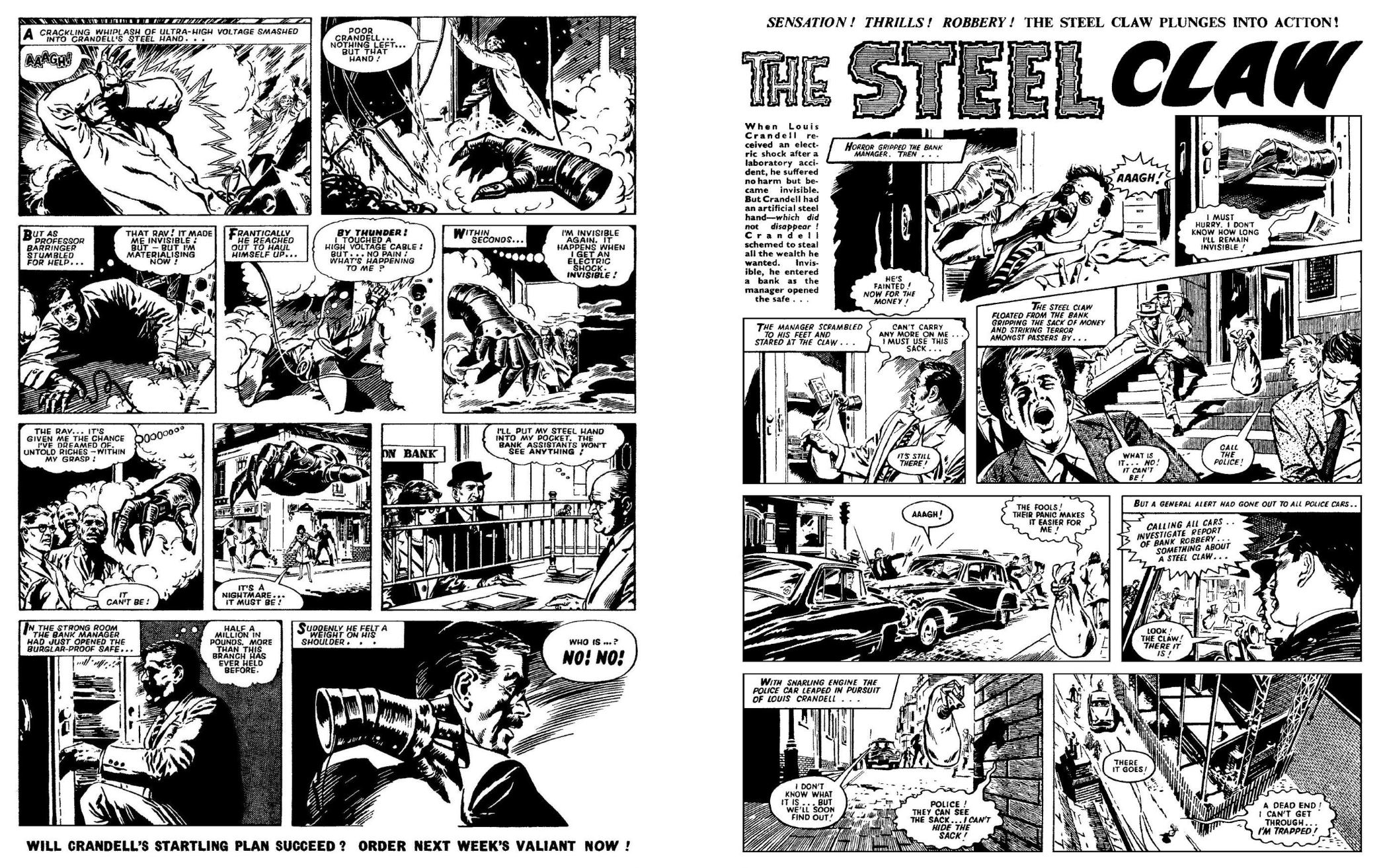
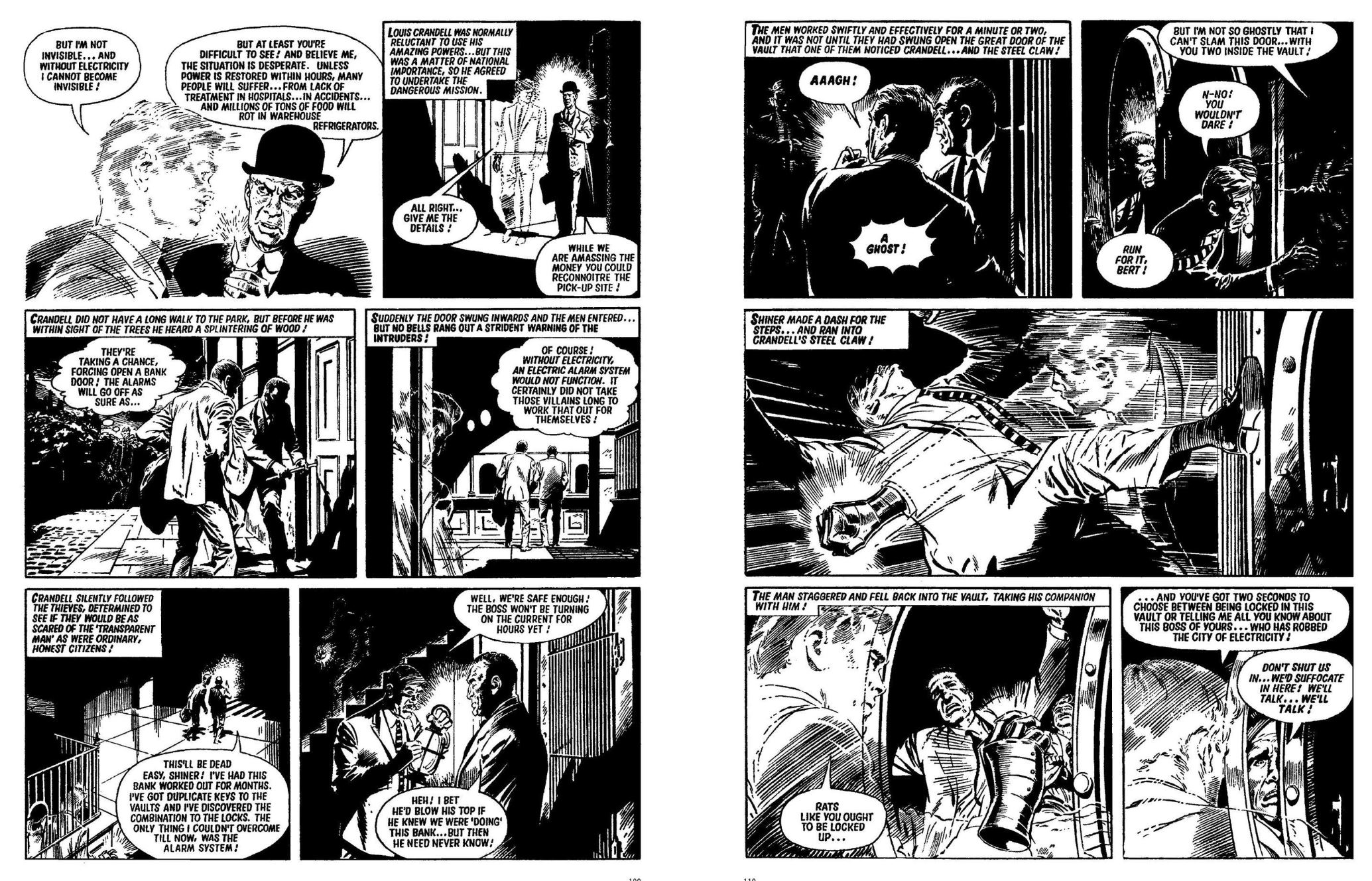
Following an Introduction from Paul Grist, the tense drama begins with our (eventual) hero debuting as a rather surly assistant to the venerable Professor Barringer, working to create a germ-destroying ray. Crandell is an embittered man, possibly due to having lost his right hand in a lab accident. After its replacement with a steel prosthetic and his notional recovery, he is back at work when the prof’s new device explodes. Crandell receives a monumental electric shock and is bathed in radiation from the ray-device which, rather than killing him, renders him totally transparent. Although he doesn’t stay unseen forever, this bodily mutation is permanent. Electric shocks cause all but his metal hand to disappear.

Kids of all ages, do not try this at home!

Whether venal at heart or temporarily deranged, Crandell goes on a rampage of terror against society and destruction of property culminating in an attempt to blow up New York City before finally coming to his senses. Throughout Crandell’s outrages, Barringer is in guilt-fuelled pursuit, determined to save or stop his former friend…

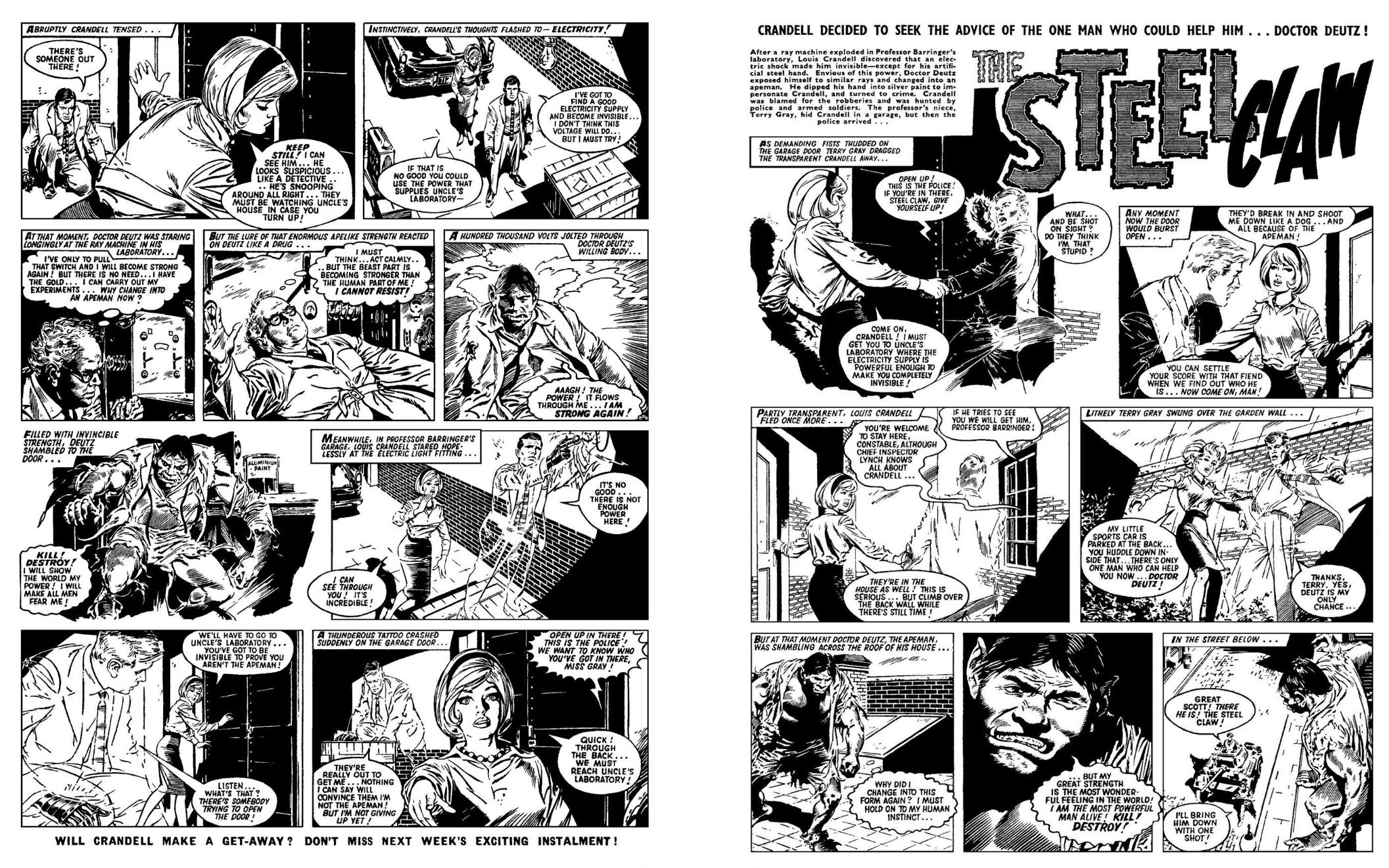
The second adventure channels another classic (The Strange Case of Dr Jekyll and Mr Hyde), intriguingly pitting the Claw against his therapist, who – in an attempt to treat him – is also traumatically and life-changingly exposed to Barringer’s ray. Instead of permanent invisibility, Dr. Deutz develops the ability to transform himself into a bestial ape-man who malevolently turns to crime and frames Crandell for a series of spectacular robberies and outrages.

On the run and innocent for once, Crandell is saved by the intervention of Barringer’s niece Terry Gray. After weeks of beast-triggered catastrophe and panic in the streets, the Steel Claw is vindicated and proved a hero …of sorts…

Bulmer’s next tale changes location to the Bahamas as our star shifts from outlaw to hero. While recuperating on an inventor-friend’s yacht, Crandell is accidentally embroiled in a modern-day pirate’s attempt to hijack an undersea super-weapon system. After would-be bullion bandit Sharkey and his nefarious gang steal the device and use it to capture a submarine, their convoluted scheme to rob an ocean liner finally falters when a steel-fisted ghost starts picking them off one by one…

More than any other comics character, the Steel Claw was a barometer for reading fashions. Starting out as a Quatermass-style cautionary sci fi tale, the strip mimicked fresh trends of the greater world, becoming a James Bond-style superspy strip with Crandall eventually tricked out with outrageous gadgets, and latterly, a masked-&-costumed super-doer when TV-show-sparked “Batmania” gripped the nation and the world.

When that bubble burst, he resorted to becoming a freelance adventurer, combating eerie menaces and vicious criminals. However, before we head too far down that path, his potent contributions to Valiant Annuals 1965 and 1966 – respectively released in Autumn 1964 and 1965 – afford rather more constrained thrills and chills as Crandell defeats a gang using an electricity-supressing gadget to rob a blacked-out London and (one year later) assists the Metropolitan Police force in corralling a bunch of apparently invisible bandits dubbed the Phantom Raiders

The thrills of the writing are engrossing enough, but the real star of this feature is the artwork. Blasco’s captivating classicist drawing, his moody staging and the sheer beauty of his subjects make this an absolute pleasure to look at. Buy it for the kids and read it too; this is a glorious book, and brace yourself for even better yet to come…
© 1962, 1963, 1965, 1966 & 2021 Rebellion Publishing IP Ltd. All Rights Reserved.

Today in 1949 actor turned comics writer John Ostrander (Oracle, The Spectre, Grimjack, Firestorm, Suicide Squad, Star Wars, Magnus Robot Fighter) was born, as was Norwegian creator Christopher Nielson (To Trøtte Typer) in 1963 and funny, funny guy Evan Dorkin (Milk and Cheese, Welcome to Eltingville, Dork, Beasts of Burden) in 1965.

In 1968 comedy master and Katzenjammer Kids creator Rudolph Dirks died. And while we remember laughing, let’s celebrate that Crockett Johnson’s astounding 10-year wonder Barnaby debuted on this date in 1942.

Ant Wars


By Gerry Finley-Day, José Luis Ferrer, Alfonso Azpiri, Luis Bermejo, Lozano, Peña, Simon Spurrier & Cam Kennedy & various (Rebellion/REBCA)
ISBN: 978-1-78108-622-3 (HB/Digital edition)

This book includes Discriminatory Content produced in less enlightened times.

The sun’s out and the sarnies are packed so let’s shamble down memory lane with a bug-beguiling packed lunch for all us oldsters which might, perhaps, offer a fresh, untrodden path for younger fans of the fantastic in search of a typically quirky British comics experience.

This stunning paperback/eBook package provides another knockout nostalgia-punch from Rebellion Studios’ scintillating 2000 A.D. treasure-trove, gathering the 15 weekly episodes of seminal shocker Ant Wars as first seen in Progs #71-85 (July 1st – 7th October 1978). There’s also a later resurgence of creepy creatures, which initially infested The Judge Dredd Megazine (#231-233, May to July 2005).

The strip debuted with ferociously prolific writer Scots Gerry Finley-Day (Ella on Easy Street, The Camp on Candy Island, Rat Pack, The Bootneck Boy, D-Day Dawson, The Sarge, One-Eyed Jack, Hellman of Hammer Force, Sgt. Streetwise, Dredger, Dan Dare, Invasion, Judge Dredd, Harry 20 on the High Rock, The V.C.s, Rogue Trooper, Fiends of the Eastern Front and dozens more) establishing a contemporary scenario to explore human greed and venality against a setting of increased pollution and eco-barbarism in the heart of the Amazon basin. The creepily compelling visuals came via an international tag team of illustrators – beginning with co-creator José Luis Ferrer, and followed by Alfonso Azpiri, Luis Bermejo, Lozano and Peña -who skilfully combined local knowledge of Central/South American locales with old fashioned monster movie riffs to deliver a wicked and wild cautionary tale.

In an era of burgeoning eco-politics, increasing environmental awareness and growing advocacy for Indigenous rights, the saga confronted entrenched corporate greed, Military-Industrial Complex arrogance and political complacency in a rip-roaring, grossly anarchic Doomwatch scenario that revelled in an innate love of irony married to macabre and bloody carnage. It was also pretty cool to see an utter absence of Yanks or Brits casually saving the day…

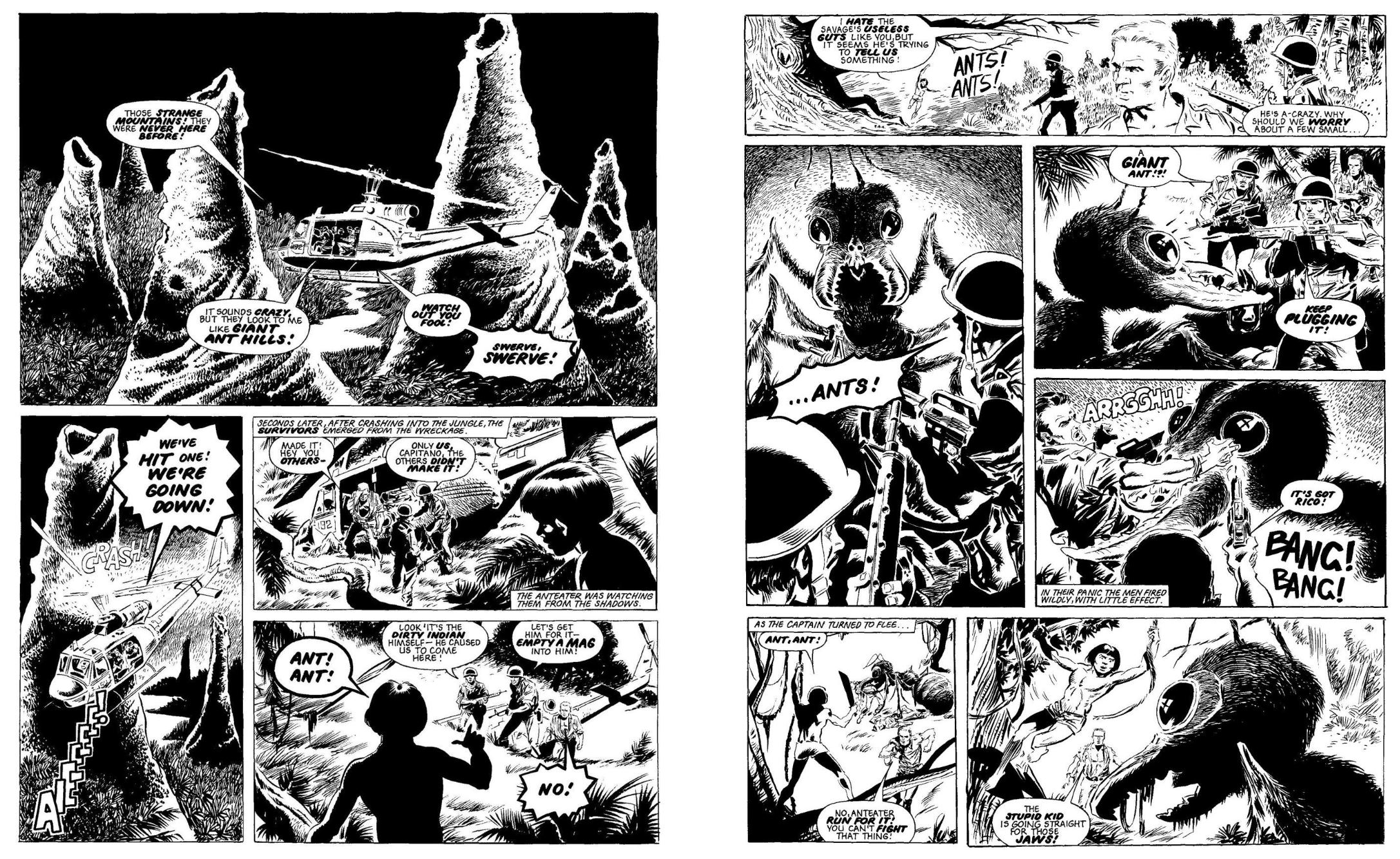
It begins in the depths of the Brazilian rain forest as helicopter-borne soldiers descend on “wild Indians” they find eating ants. After despatching the disgustingly primitive indigenes, the troops complete their mission, expediting a test of GGS: a new super-insecticide created by a multinational corporation which needs testing without too much oversight…

Some months later captive natives are being forcibly “civilised” by those soldiers in a Reservation Camp. The captives (grudgingly) wear clothes and can speak to their “benefactors” now, but recidivism remains stubbornly high. When one youngster is caught eating ants again, he endures another punishment beating before escaping. Delighted to have something to do, the soldiers board their copters and track him into the verdant hell all around them. That’s when they discover skyscraper-sized anthills and are ambushed by hungry Formicidae the size of buses and far smarter than they are or, indeed, most humans…

The squad are wiped out, but Captain Villa survives, aided by the Indian boy they had disparagingly dubbed “Anteater”. His speed, agility and dexterity with a machete are the only counter to the big bugs – which readily dismember troops and destroy aircraft – so the enemies form a reluctant partnership to escape the ant-controlled jungles and alert humanity to the imminent peril they all face. The boy understands bugs implicitly and his knowledge saves them over and again as they struggle through green hells barely ahead of an endless army of colossal soldier ants apparently intent on eradicating humankind.

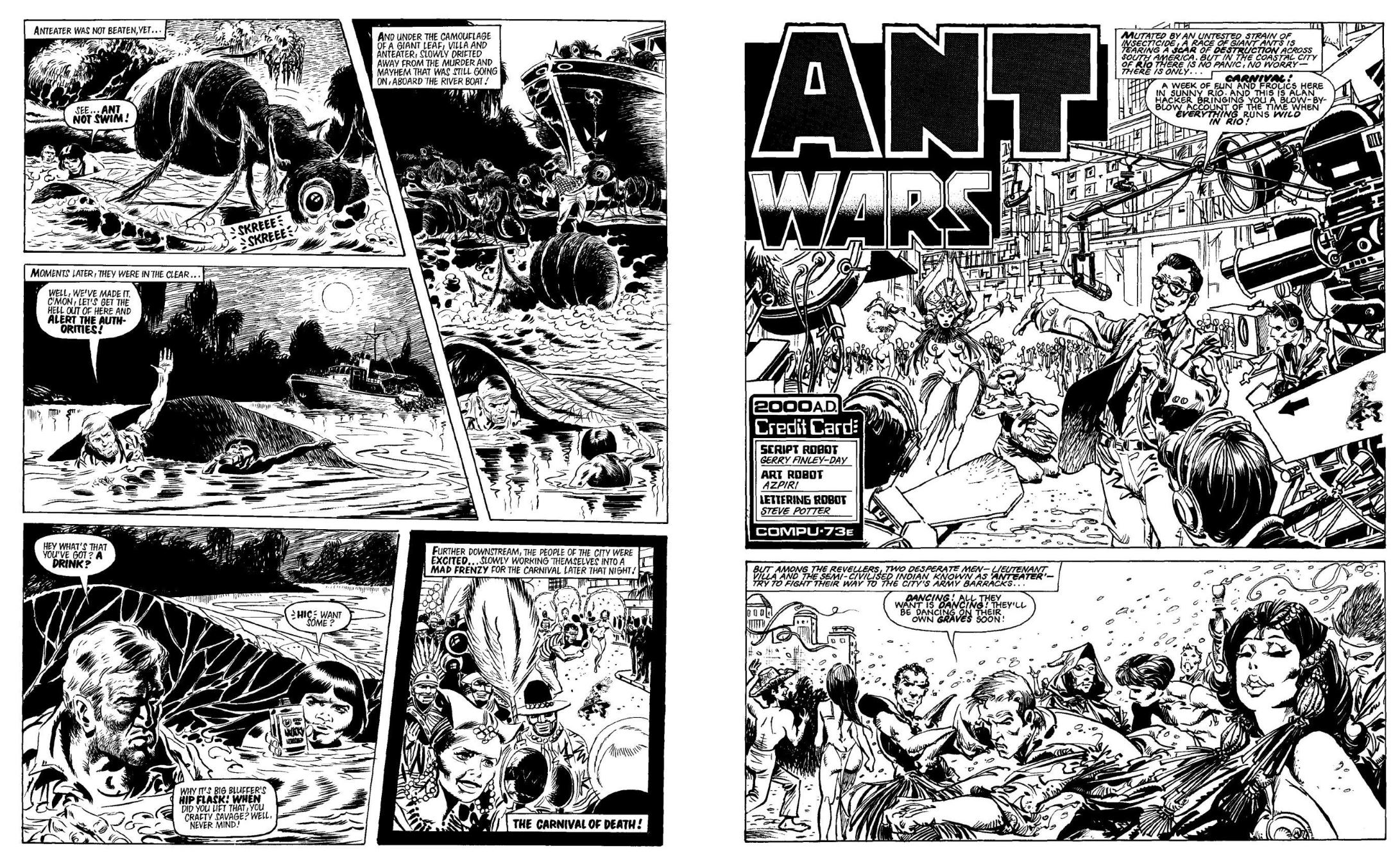
After many close calls and stomach-churning hairsbreadth escapes – avoiding the plantation-consuming, outpost-conquering, riverboat-confiscating bugs, Villa and Anteater reach Rio de Janeiro, and at last convince people with actual power and authority of the existential threat, but it is far too late. Ant queens have already established forward bases there and as the humans waste time and resources partying at Carnival, a horrific battle for control of the continent and ultimately the planet begins.

Soon ant colonies are found in Argentina, Bolivia and beyond and the struggle must be decided by humanity’s most unforgivable armaments…

And in the aftermath, there are many profitable opportunities to test even better bug sprays and formulations…

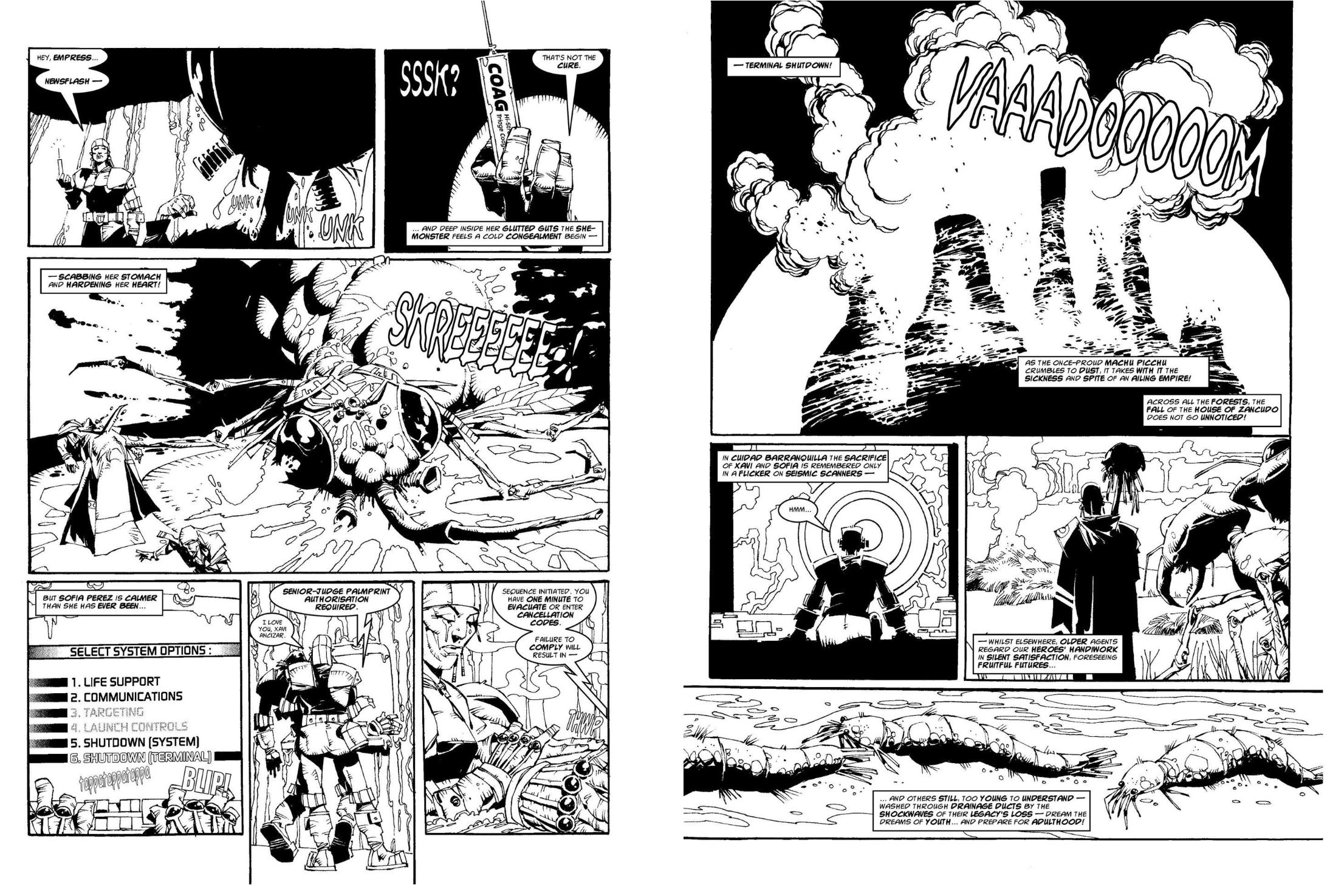
In 2005 the concept was retooled, crafted in tribute to the original by Simon Spurrier & Cam Kennedy. A notional sequel set in the future world of Mega-cities and mass madness where Judges like Joe Dredd were sworn to curtail and control Zancudo was a short serial running across 2000 A.D. spin-off title The Judge Dredd Megazine (issues #231-233). It focused on less-than-upstanding Judges Xavi Ancizar and Sofia Perez as they escort sociopathic “mutie” telepath Fendito “El Bandito” in a medical-supply flyer bound for the penal facility in La Paz. It’s 2171 and they have left sprawling metropolis Cuidad Barranquilla to risk the perils of the Peruvian rainforest, but don’t get far. When the ship is brought down, and even after surviving the crash, their chances diminish every second as they are attacked by giant intelligent mosquitos. They are also blithely unaware that the device neutralising El Bandito’s psionic powers has malfunctioned…

Although Judges are trained to resist, smart giant bugs are easier to handle, and it might have all worked out differently for the mind-thief if they hadn’t stopped to save a little girl and stumbled into Los Zancudo Pichu. This bizarre embattled colony is home to human natives enslaved to Mosquito queens and where all inhabitants – even the big bugs – are slowly expiring of a malarial infection they call The Blight…

Those downed Judge medical supplies promise a cure for the dying city and all its inhabitants, and Fendito is delighted to betray his own (more or less) kind to save his skin, but even corrupted, debased Judges have standards, so their discovery of the original purpose of Zancudo prior to the insects’ triumphal takeover offers a slim chance of atonement if not personal survival…

A grand, old fashioned Mankind vs Monsters yarn dripping with wit and edgy social commentary, Ant Wars is an unreconstructed romp to while away a little time with and a splendid way to prepare for the long hot and possibly few days ahead.
© 1978, 2005 & 2018 Rebellion A/S. All Rights Reserved.

Today in 1828 trailblazing cartoonist, caricaturist and author Frank Bellew was born, with Marvel bulwark Carl (Human Torch) Burgos coming along in 1916 and – in 1986 – mainly-Marvel comic book illustrator Paulo Siqueira.

Ken Reid’s Roger the Dodger debuted in The Beano this date in 1953, but we lost British underground star and newspaper cartoonist Edward Barker (International Times, The Largactilites, The Galactilites) in 1997 and Steve Canyon artist Dick Rockwell in 2006.

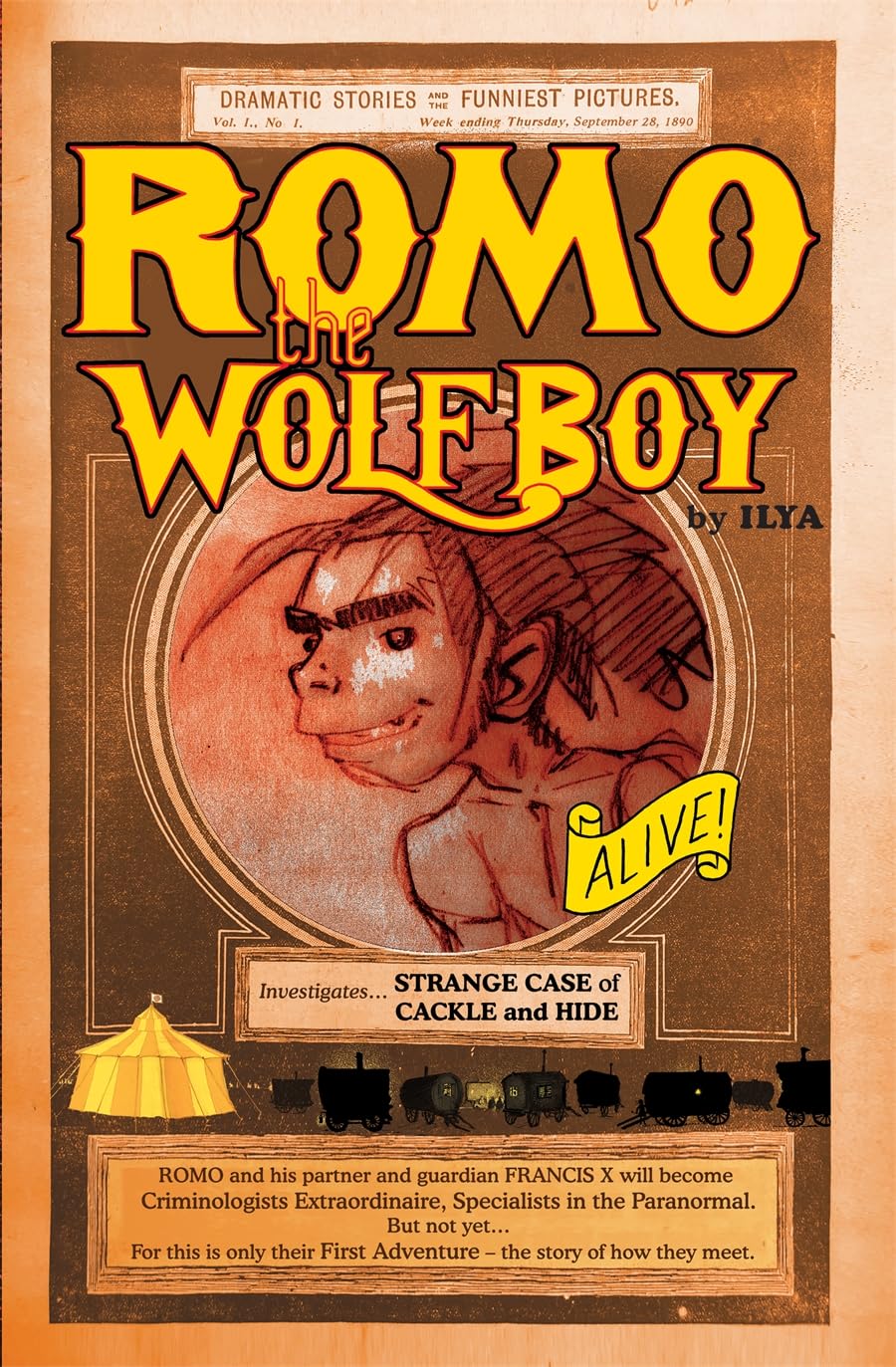
Romo the WolfBoy by ILYA


By ILYA (SelfMadeHero)
ISBN: 978-1-914224-44-7 (HB)

This book includes Discriminatory Content included for comedic and dramatic effect.

ILYA is a multi-award winning comic book writer and artist whose work has been published by Marvel, DC, Dark Horse, Kodansha and independent companies all over the world. Previous prose and/or pictorial accomplishments include the Manga Drawing Kit; Time Warp: The Future’s Now …and it’s a Riot; BIC; The End of the Century Club sequence; Room for Love; The Clay Dreaming and modern drama Skidmarks. Commercial clients comprise the BBC, Royal Academy of Arts, newspapers The Times, Guardian, East End Life and legendary stripzine Deadline. ILYA has worked with Eddie Campbell on Deadface and Bacchus, edits the Mammoth Book of Best New Manga series, and like all comics creators has a secret identity, sometimes answering to the soubriquet Ed Hillyer…

This latest venture combines his obvious love of British mythologies, whimsies and historical micro-cultures, all cunningly interwoven with cheeky comics lore from across the world. A genre-mixing mystery saga of the strange and (potentially) paranormal, the potent pastiche debut yarn introduces a brace of old-fashioned odd fellows evolving into emergent crime-solving associates…

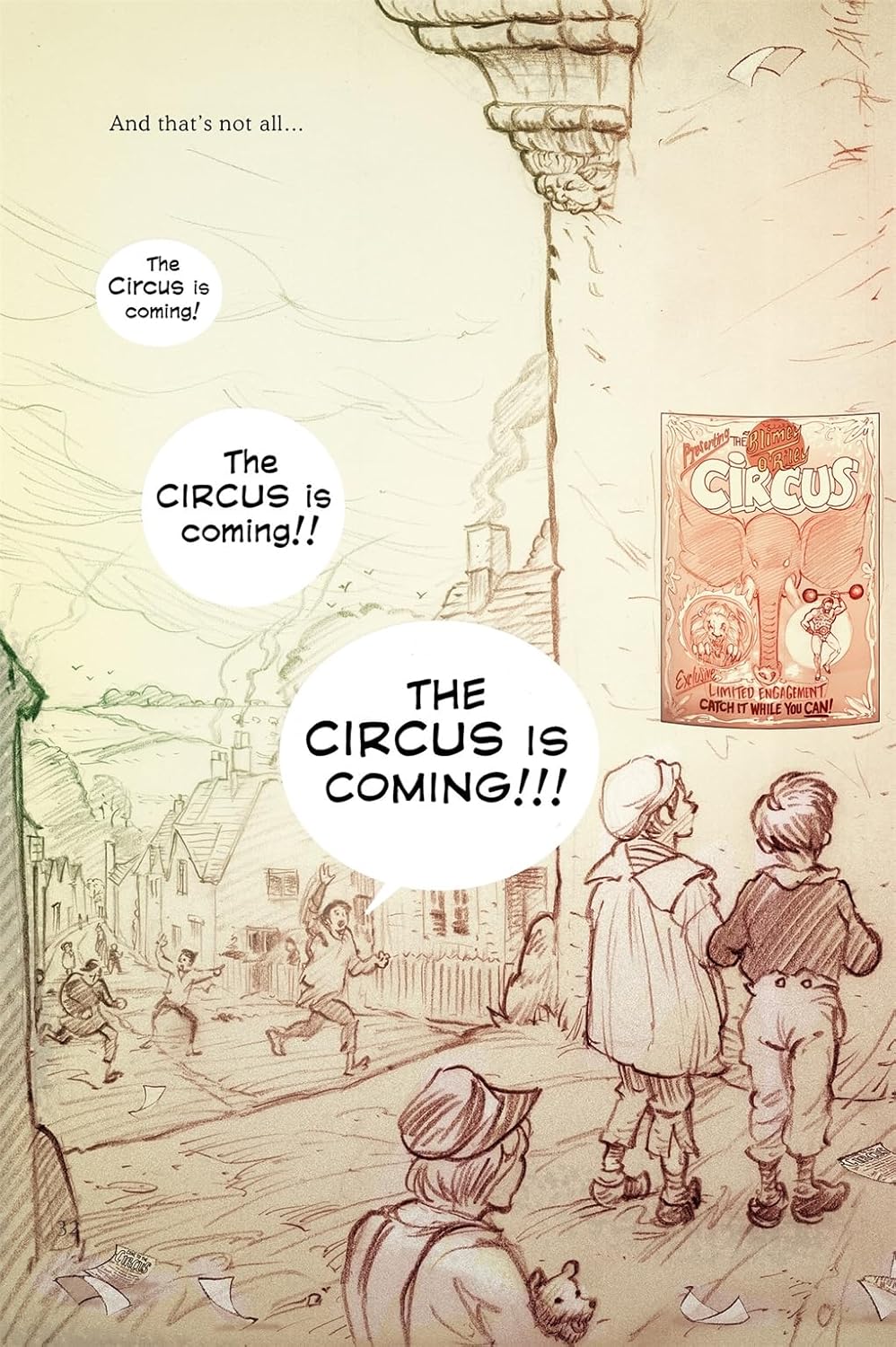
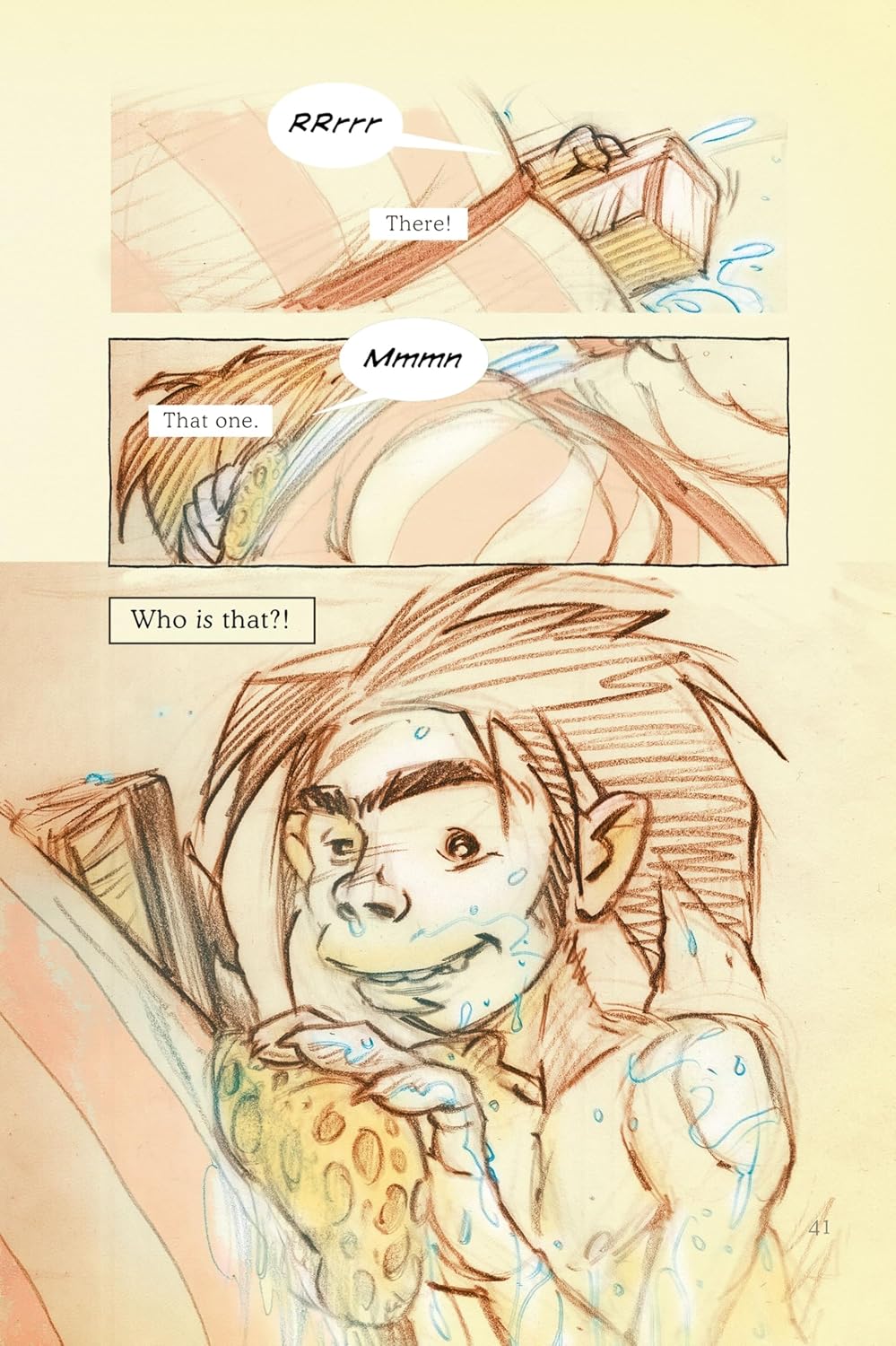
The unfolding imbroglio is delivered primarily in welcoming pencil hues and traditional block-text & image format with the occasional modern graphic narrative tweak, all premiering a fresh pantheon of eclectic wonders, as we peep into the closeted lives of a troupe of travelling entertainers in Victorian England. Revelations are seen through the learning experiences and rapid advancement of a secretive neophyte recently enrolled as a stage hand, and the bizarrely enigmatic living attraction who befriends and adopts the secretive newcomer…

Romo the Wolfboy (…in Strange Case of Cackle and Hide) heaps tragedy upon mystery as tight-lipped “Francis X” – who ran away to the circus for reasons of their own – develops transformative friendships (and some foe-making) after being accepted into the closed family circuit of Blimey O’Riley’s Travelling Circus. The serried hierarchical ranks of outsiders have their own ways, cherished observances and even unique language – and also hard-held misconceptions and prejudices – but Francis is smiled upon by Ringmaster O’Riley himself. It’s an attraction and fascination shared by the weird, non-verbal freak attraction who is said to have been raised by wild animals…

As Francis and Romo spar and bond, they come to grips with this odd enclosed world in miniature that encompasses love and hate, fear and acceptance and all the broad panoply of human life in between. However, everything takes an unpleasant and even uncanny turn after the big top is set up in the next village. Here, despite the gob-smacked anticipation of the locals, sabotage, unwarranted assaults and ultimately murder-attempts start chipping away at the wandering clan’s solidarity, Soon a monstrous uncannily giggling villain is recognised if not actually identified, and Romo and Francis X are catapulted into the role of guardians and problem-solvers. The hunt for the obsessed village elite determined to destroy them all… or at least banish the players from the region… is hard, baffling work, and most disturbingly, many incidents defy logic or reason while somehow connecting past sins to future threats. …And what role do the chickens play in all this?

Bracketed by context-creating preludes ‘The Carny Code’ and ‘Introducing…’ the hilarious, uproarious and outrageous events are balanced by further extras at the end. Enhancing enjoyment with education and elucidation we ‘Roll up Roll up’ to explain historical carny argot “Ciazarn” – readily deployed through the tale to enhance the experience – in a fascinating briefing that seamlessly segues into teasing tweaks of meta-reality moments as the author offers a list of devious ‘Easter Eggs’ buried within the sawdust saga before ending the entertainment with extracts from his ‘Romo the WolfBoy Production Blog’

Wry, anachronistically bold, and breezily beguiling, Romo the WolfBoy began as online episodes on ILYA’s Substack, playing out over a year, Thus this unmissable day out delight and jolly jaunt concludes with an acknowledgement of the Kickstarter contributors who helped its transition to the thick comforting pages here with big thank you ‘Made Possible by Public Funds’

All the fun of the fair plus every additional chill and thrill you could possibly stand besides, the wonderment here is but a teaser of more and greater marvels to come, so read this now and writhe in anticipation for forthcoming encore Romo the WolfBoy and Francis X (Investigators of the Paranormal) in The Fall and Rise of Springheeled Tom
© & ™ Ed Hillyer / ILYA. All rights reserved.

Today in 1924, Roy Crane’s epic, trailblazing strip Wash Tubbs began a run that would carry the little wonder all the way to 1988 and spawn tough guy prototype Captain Easy. In 1950 Eagle launched, bringing thrills glamour and Dan Dare to the benighted comics-deprived children of Britain.

Prior to all that, in 1920 Golden Age Great Sheldon Moldoff (Hawkman, Black Pirate, Kid Eternity, Batman, Gangbusters) was born, followed in 1949 by Dave Gibbons (Dan Dare, Rogue Trooper, Watchmen, Give Me Liberty, The Originals); Chuck Dixon (Batman, Robin, Nightwing, Punisher) and Katsuhiro Otomo (Akira) in 1954; Daniel Clowes (Eightball, Ghost World, Like a Velvet Glove Cast in Iron) in 1961 and Korean manhwa star Hyung Min-woo (Priest) in 1974.

On this date in 1957 we lost British veteran cartoonist and poster-maker Will Owen (Lux, Bovril, The Bisto Kids) and New Zealand satirist John (Varoomshka) Kent in 2003.