Archive for the ‘Marvel Essentials’ Category

Essential Nova volume 1

Saturday, August 14th, 2010


By Marv Wolfman, John and Sal Buscema, Carmine Infantino & various (Marvel)
ISBN: 978-0-7851-2093-9

By 1975 the first wave of fans-turned-writers were well ensconced at all the major American comic-book companies. Two fanzine graduates, Len Wein and Marv Wolfman had achieved stellar successes early on, and then risen to the ranks of writer/editors at Marvel, a company in trouble both creatively and in terms of sales. After a meteoric rise and a virtual root and branch overhaul of the industry in the 1960s the House of Ideas – and every other comics publisher except Archie – were suffering from a mass desertion of fans who had simply found other uses for their mad-money.

Whereas Charlton and Gold Key dwindled and eventually died and DC vigorously explored new genres to bolster their flagging sales, Marvel chose to exploit their record with superheroes and foster new titles within a universe it was increasingly impossible to buy only a portion of…

The Man Called Nova was in fact a boy named Richard Rider, a working class nebbish in the tradition of Peter Parker – except he was good at sports and bad at learning – who attended Harry S. Truman High School, where his strict dad was the principal. His mom worked as a police dispatcher and he had a younger brother, Robert, who was a bit of a genius. Other superficial differences to the Spider-Man canon included girlfriend Ginger and best friends Bernie and Caps, but he did have his own school bully, Mike Burley…

An earlier version, “Black Nova” had apparently appeared in the Wolfman/Wein fan mag Super Adventures in 1966, but with a few revisions and an artistic make-over by the legendary John Romita (Senior) the Human Rocket was launched into the Marvel Universe in his own title, beginning in September 1976, ably supported by the illustration A-Team of John Buscema and Joe Sinnott.

‘Nova’, which borrowed as heavily from Green Lantern as well as Spider-Man’s origin, was structured like a classic four-chapter Lee/Kirby early Fantastic Four tale, and rapidly introduced its large cast before quickly zipping to the life-changing moment in Rider’s life when an star-ship with a dying alien aboard transfers to the lad all the mighty powers of an extraterrestrial peacekeeper and warrior.

Centurion Rhomann Dey had tracked a deadly marauder to Earth. Zorr had already destroyed the idyllic world of Xandar, but the severely wounded vengeance seeking Nova Prime was too near death and could not avenge the genocide. Trusting to fate, Dey beamed his powers and abilities towards the planet below where Richard Rider was struck by the energy bolt and plunged into a coma. On awakening Rich realised he had gained awesome powers and the responsibilities of the last Nova Centurion.

The tale is standard origin fare, beautifully rendered by Buscema and Sinnott, but the story really begins with #2’s ‘The First Night of… The Condor!’ as Wolfman, playing to his own strengths, introduced an extended storyline featuring a host of new villains whilst concentrating on filling out the lives of the supporting cast. There was still plenty of action as the neophyte hero learned to use his new powers (one thing the energy transfer didn’t provide was an instruction manual) but battles against winged criminal mastermind Condor and his enigmatic, reluctant pawn Powerhouse plus #3’s brutal super-thug (‘…The Deadly Diamondhead is Ready to Strike!’ illustrated by new art-team Sal Buscema & Tom Palmer) were clearly not as important as laying plot-threads for a big event to come.

Nova #4 saw the first of many guest-star appearances (and the first of three covers by the inimitable Jack Kirby). ‘Nova Against the Mighty Thor’ introduced The Corruptor, a bestial being who turned the Thunder God into a raging berserker whom only the new kid on the block could stop, whilst ‘Evil is the Earth-Shaker!’ pitted the lad against subterranean despot Tyranus and his latest engine of destruction, although a slick sub-plot concerning the Human Rocket’s attempt to become a comic book star still delivers some tongue-in-cheek chuckles to this day…

Issue #6 saw those long-laid plans begin to mature as Condor, Diamondhead and Powerhouse returned to capture Nova, whilst their hidden foe was revealed in ‘And So… The Sphinx!’ (inked by Frank Giacoia), another world-class, immortal super-villain patiently waiting his turn to conquer the world. Meanwhile young Caps had been abducted by another new bad-guy who would eventually make big waves for the Human Rocket.

‘War in Space!’ found Nova a brainwashed ally of his former foes in an invasion of Rhomann Dey’s still orbiting star-ship – an invaluable weapon in the encroaching war with the Sphinx, only to be marooned in deep space once his mind cleared. On narrowly escaping he found himself outmatched by Caps’ kidnapper in ‘When Megaman Comes Calling… Don’t Answer!’ – a tumultuous, time-bending epic that concluded in #9’s ‘Fear in the Funhouse!’

Nova #10 began the final (yeah, right) battle in ‘Four Against the Sphinx!’ with Condor, Diamondhead and Powerhouse in all-out battle against the immortal mage with the hapless Human Rocket caught in the crossfire, whilst ‘Nova No More’ had the hero’s memories removed to take him out of the game; a tactic that only partially worked since he was back for the next issue’s classy crossover with the Spectacular Spider-Man.

‘Who is the Man Called Photon?’ by Wolfman, Sal Buscema & Giacoia, teamed the young heroes in a fair-play murder mystery when Rich Rider’s uncle was killed by a costumed thief. However there were ploys within ploys occurring and after the mandatory hero head-butting the kids joined forces and the mystery was resolved in Amazing Spider-Man #171’s ‘Photon is Another Name For…?’ courtesy of Wein, Ross Andru & Mike Esposito.

Joe Sinnott returned in Nova #13, as another lengthy tale began with the introduction of new hero Crime-Buster in ‘Watch Out World, the Sandman is Back!’, wherein the once formidable villain took a beating and fell under the influence of a far more sinister menace. Meanwhile Rich’s dad was going through some bad times and had fallen into the clutches of a dangerous organisation…

The story continued in the Dick Giordano inked ‘Massacre at Truman High!’ as Sandman attacked Nova’s school and the mystery mastermind was revealed for in-the-know older fans before the guest-star stuffed action-riot ‘The Fury Before the Storm!’ saw Carmine Infantino take over the pencilling and Tom Palmer return to the brushstrokes.

When a bunch of established heroes attack the newbie all at once it’s even money they’re fakes, but Nick Fury of super-spy agency S.H.I.E.L.D. was real enough and deputised the fledgling fighter for #16’s ‘Death is the Yellow Claw!’ and #17’s spectacular confrontation ‘Tidal Wave!’ As the kid came good and saved the city of New York from a soggy demise the long awaited conclusion occurred in ‘The Final Showdown!’, inked, as was ‘Beginnings’ a short side-bar story dealing with the fate of the elder Rider, by the agglomeration of last-minute-deadline busters dubbed “the Tribe.”

A new foe debuted in #19: ‘Blackout Means Business and his Business is Murder!’ opened the final large story-arc of the series as a ebon-energy wielding maniac attacked Nova, but before that epic completely engaged, the Human Rocket guest-starred with the Thing in Marvel Two-in-One Annual #3 (1978) in a simple yet entertaining tussle with god-like cosmic marauders entitled ‘When Strike the Monitors!’ an interlude crafted by Wolfman, Sal Buscema, Giacoia & Dave Hunt.

Hunt stayed on as inker for Nova #20 as the steadily improving young hero went after the cabal that had nearly destroyed his dad in ‘At Last… The Inner Circle!’ leading to a breakthrough in comics conventions as the Human Rocket revealed his alter ego to his family in ‘Is the World Ready for the Shocking Secret of Nova?’ (with art by John Buscema, Bob McLeod & Joe Rubinstein), whilst a long-forgotten crusader and some familiar villains resurfaced in ‘The Coming of the Comet!’ (#22, Infantino & Steve Leialoha) and long-hidden cyborg mastermind Dr. Sun (an old Dracula foe, of all things) revealed himself in ‘From the Dregs of Defeat!’ executing his scheme to seize control of the lost Nova Prime star-ship and its super-computers.

A huge epic was impressively unfolding but the Human Rocket’s days were numbered. Penultimate issue #24 (inked by Esposito) introduced ‘The New Champions!’ as Dr. Sun battled the Sphinx for the star-ship, with Crime-Buster, the Comet, Powerhouse and Diamondhead dragged along on a one-way voyage to the ruins of Xandar, lost home of the Nova Centurions.

This volume ends with #25, a hastily restructured yarn as the cancellation axe hit the series before it could properly conclude. ‘Invasion of the Body Changers!’ by Wolfman, Infantino & Klaus Janson saw the unhappy crew lost in space and attacked by shape-shifting alien Skrulls, all somehow implicated in the destruction of Xandar, but the answers to the multitude of questions raised were to be eventually resolved in a couple of issues of the Fantastic Four and latterly Rom: Spaceknight: episodes not included here, thus rendering this collection aggravatingly incomplete.

There’s a lot of good, solid entertainment and beautiful superhero art in this book, and Nova has proved his intrinsic value by returning again and again, but by leaving this edition on such a frustrating open end, the editors have reduced what could have been a fine fights ‘n’ tights collection into nothing more than a historical oddity. Stories need conclusions and mine is that we readers deserve so much better than this.

© 1976, 1977, 1978, 1979, 2006 Marvel Characters, Inc.  All Rights Reserved.

Essential Thor volume 2

Wednesday, July 21st, 2010


By Stan Lee, Jack Kirby, & various (Marvel)
ISBN: 978-0-7851-3381-0

Even more than the Fantastic Four The Mighty Thor was the arena in which Jack Kirby’s creative brilliance blended with his questing exploration of an Infinite Imaginative Cosmos: dreaming, extrapolating and honing a dazzling new kind of storytelling graphics with soul-searching, mind-boggling concepts of Man’s place in the universe.

His unforgettable string of pantheons began in a modest little fantasy title called Journey into Mystery where, in the summer of 1962 a tried-and-true comicbook concept (feeble mortal transformed into God-like hero) was employed by the fledgling Marvel Comics to add a Superman analogue to their growing roster of costumed adventurers. This gloriously economical monochrome tome re-presents the end of that catch-all title as the Asgardian’s increasingly popular exploits saw the title become The Mighty Thor.

Gathered here are Journey into Mystery issues #113-125 plus the Annual for 1965, and without breaking stride, Thor #126-136 and the 1966 Annual, all in clean, crisp black and white for your delectation.

Lonely, crippled American doctor Donald Blake took a vacation in Norway only to encounter the vanguard of an alien invasion. Trapped in a cave, Blake found a gnarled old walking stick, which when struck against the ground turned him into the Norse God of Thunder!

Within moments he was defending the weak and smiting the wicked. As the months swiftly passed the rapacious extraterrestrials, Commie dictators, costumed crazies and cheap thugs gradually gave way to a vast panoply of fantastic worlds and incredible, mythic menaces. By issue #113, the magnificent warrior’s world of Asgard was a regular milieu for the hero’s adventures, and in ‘A World Gone Mad!’ by Stan Lee, Kirby and Chic Stone, the Thunderer, after saving the Shining Realm from invasion, once more defied his father Odin to romantically pursue the mortal nurse Jane Foster – a task made rather hazardous by the return of the petrifying villain Grey Gargoyle.

A long-running plot strand – almost interminably so – was the soap-opera tangle caused by Don Blake’s love for his nurse – a passion his alter ego shared. Sadly the Overlord of Asgard refused to allow his son to love a mortal, which acrimonious triangle provided many attempts to humanise and de-power Thor, already a hero few villains could cope with.

These issues also carried a spectacular back-up series. Tales of Asgard – Home of the mighty Norse Gods gave Kirby space to indulge his fascination with legends and allowed both complete vignettes and longer epics (in every sense of the word). Initially adapted myths, these little yarns grew into sagas unique to the Marvel universe where Kirby built his own cosmos and mythology, underpinning the company’s entire continuity. Here he revealed ‘The Boyhood of Loki!’, scripted as ever by Lee and inked by Vince Colletta, a pensive, brooding taste of the villain to be.

JiM # 114, began a two-part tale that introduced a new villain of the sort Kirby excelled at, a vicious thug who suddenly lucked into overwhelming power. ‘The Stronger I Am, The Sooner I Die!’(Lee, Kirby & Stone) saw Loki imbue hardened felon Crusher Creel with the power to duplicate the strength and attributes of anything he touched, but before he was treated to ‘The Vengeance of the Thunder God’ (inked by Frank Giacoia as the pseudonymous Frankie Ray) we’re indulged with another Tale of Asgard‘The Golden Apples.’ Issue #115’s mini-myth was ‘A Viper in our Midst!’ with young Loki clandestinely cementing relations with the sinister Storm Giants – sworn enemies of the Gods.

A longer saga began in #116, as Colletta settled in as the regular inker for both lead and second feature. ‘The Trial of the Gods’ revealed more of fabled Asgard as Thor and Loki underwent a Trial by Combat, with the god of mischief cheating at every step, whilst ‘Into the Blaze of Battle!’ found Balder the Brave protecting Jane Foster whilst her godly paramour travelled to war-torn Vietnam seeking proof of his step-brother’s infamy. These tales were supplemented by the stellar novellas ‘The Challenge!’ and ‘The Sword in the Scabbard!’ which saw Asgardian cabin-fever develop into a quest to destroy a threat to the mystic Odinsword, which unsheathing would destroy the universe…

Journey into Mystery #118’s ‘To Kill a Thunder God!’ ramped up the otherworldly drama as Loki, attempting to cover his tracks, unleashed an ancient Asgardian WMD – the Destroyer. When it damaged the mystic hammer of Thor and nearly killed the hero in ‘The Day of the Destroyer!’, the God of Mischief was forced to save his step-brother or bear the brunt of Odin’s anger. Meanwhile in Tales of Asgard the Quest further unfolded in ‘The Crimson Hand!’ and ‘Gather, Warriors!’ as a band of hand-picked Argonauts joined Thor’s flying longship in a bold attempt to forestall Ragnarok.

With the Destroyer defeated and Loki temporarily thwarted Thor returned to America ‘With My Hammer in Hand…!’ only to clash once more with the awesome Absorbing Man. However before that bombastic battle there’s not only the next instalment of the Asgardian Argonauts who boldly ‘Set Sail!’ but also the admittedly superb digression of Journey into Mystery Annual #1, wherein the God of Thunder fell into the realm of the Greek Gods for the landmark heroic hullabaloo ‘When Titan’s Clash! Thor vs. Hercules!’ This incredible action-epic is augmented here by a beautiful double-page pin-up of downtown Asgard a truly staggering piece of Kirby magic.

The attack of the Absorbing Man resumed with ‘The Power! The Passion! The Pride!’ and seemed set to see the end of Thor: a cliffhanger somewhat assuaged by ‘Maelstrom!’ wherein the Argonauts of Asgard epically encountered an uncanny storm… In JiM #122 ‘Where Mortals Fear to Tread!’ the triumphant Crusher Creel was shanghaied by Loki to attack Asgard and Odin himself, an incredible clash that led to a cataclysmic conclusion ‘While a Universe Trembles!’ Meanwhile ‘The Grim Specter of Mutiny!’ invoked by seditious Loki was quashed in time for valiant Balder to save the Argonauts from ‘The Jaws of the Dragon!’ in the increasingly spectacular Ragnarok Quest.

With the threat to ended Thor returned to Earth to defeat the Demon, a witchdoctor empowered by a magical Asgardian Norn Stone left behind after the Thunder God’s Vietnamese venture. Whilst he was away Hercules was dispatched to Earth on a reconnaissance mission for Zeus. ‘The Grandeur and the Glory!’ began another extended story-arc and all-out action extravaganza, which bounced the Thunderer from bruising battle to brutal defeat to ascendant triumph.

Issue #125 ‘When Meet the Immortals!’ was the last Journey into Mystery: with ‘Whom the Gods Would Destroy!’ the comic was re-titled The Mighty Thor and the drama escalated unabated, culminating with ‘The Hammer and the Holocaust!’ In short order Thor crushed the Demon, seemingly lost his beloved Jane to Hercules, was deprived of his powers and subsequently thrashed by the Grecian Prince of Power but still managed to save Asgard from an unscrupulous traitor who had usurped Odin’s mystic might.

Meanwhile in the Tales of Asgard instalments the Questers homed in on the cause of all their woes. ‘Closer Comes the Swarm’ pitted them against the flying trolls of Thryheim, and ‘The Queen Commands’ saw Loki captured until Thor answered ‘The Summons!’, promptly returning the Argonauts to Asgard to be shown ‘The Meaning of Ragnarok!’

In all honestly these mini-eddas were, although still magnificent in visual excitement, becoming rather rambling in plot, so the narrative reset was neither unexpected nor unwelcome…

Instead of ending, the grandiose saga actually grew in scope with Thor #128 as ‘The Power of Pluto!’ introduced another major foe. The Greek God of the Underworld had tricked Hercules into replacing him in his dread, dead domain, just as the recuperated Thunder God was looking for a rematch, whilst in Tales of Asgard Kirby pulled out all the creative stops to depict the ‘Aftermath!’ of Ragnarok: for many fans the first indication of what was to come in the King’s landmark Fourth World tales half a decade later…

‘The Verdict of Zeus!’ condemned Hercules to the underworld unless he could find a proxy to fight for him, whilst at the back of the comic the assembled Asgardians faced ‘The Hordes of Harokin’ as another multi-chaptered classic began, but for once the cosmic scope of the lead feature eclipsed the little odysseys as ‘Thunder in the Netherworld!’ saw Thor and Hercules carve a swathe of destruction through an unbelievably alien landscape – the beginning of a gradual side-lining of Earthly matters and mere crime-fighting. Thor and Kirby were increasingly expending their efforts in greater realms than ours…

‘The Fateful Change!’ saw the younger Thunder God trade places with the Geghiz Khan-like Harrokin, whilst in issue #136, Thor defeated the invasion plans of Rigellian Colonizer Tana Nile in ‘They Strike from Space!’, but it was merely prologue for a fantastic voyage to the depths of space and a unique universal threat, whilst “Harokin” faced a dire dilemma in ‘The Warlock’s Eye!’.

Thor #132 found the Thunderer laying down the law on ‘Rigel: Where Gods May Fear to Tread!’ whilst ‘The Dark Horse of Death!’ arrived in the Tales of Asgard segment looking for its next doomed rider… The following issue is a Kirby Classic, as ‘Behold… the Living Planet!’ introduced the malevolent Ego, sentient world and master of the living Bio-verse, a stunning visual tour de force that threw one High Concept after another at Thor, his new artificial pal Recorder and the reeling readership, whilst Harokin’s saga ended in one last ride to ‘Valhalla!’

The threat of invasion over, Thor returned to Earth to search for Jane, finding her with ‘The People Breeders!’ – a hidden enclave where the geneticist High Evolutionary was instantly evolving animals into men. His latest experiment had created a lupine future-nightmare ‘The Maddening Menace of the Super-Beast!’ so it’s just as well the Thunder God was on hand. ‘When Speaks the Dragon!’ and ‘The Fiery Breath of Fafnir!’ pitted Thor and his Warriors Three comrades Fandral, Hogun and Volstagg against a staggering reptilian monstrosity: a threat finally quashed in #136’s ‘There Shall Come a Miracle!’

The lead story in that issue is a turning point in the history of Thor. ‘To Become an Immortal!’ saw Odin transform Jane Foster into a Goddess and emigrate to Asgard, but her frail human mind could not cope with the wonders and perils of the Realm Eternal and she was mercifully restored to mortality and all but written out of the series. Lucky for the despondent Thunder God the beauteous Warrior-Maiden Sif was on hand…

With this story Thor’s closest link to Earth was neatly severed: from now on his many adventures on Midgard were as a tourist or beneficent guest, not a resident. Asgard and infinity were now his true home, a situation quickly proved by the bombastic clash that closes this volume. ‘If Asgard Falls…’ is set in the Gleaming City during the annual Tourney of Heroes (and comes from The Mighty Thor Annual #2, 1966): a martial spectacular of outlandish armours and exotic weaponry that turned decidedly serious when the deadly Destroyer was unleashed amidst the wildly warring warriors…

These transitional Thor tales show the development not only of one of Marvel’s fundamental continuity concepts but more importantly the creative evolution of the greatest imagination in comics. Set your commonsense on pause and simply wallow in the glorious imagery and power of these classic adventures for the true secret of what makes graphic narrative a unique experience.

© 1965, 1966, 1967, 2008 Marvel Characters, Inc. All Rights Reserved.

Essential Spider-Man volume 4

Monday, June 14th, 2010


By Stan Lee, John Romita, John Buscema, Jim Mooney and various (Marvel)
ISBN: 978-0-7851-1865-7

This fourth exceptionally economical monochrome volume of chronological Spider-Man adventures sees the World’s Most Misunderstood Hero through another rocky period of transformation as the great second era of Amazing Arachnid artists comes to a close. Although the elder John Romita would remain closely connected to the Wall-Crawler’s adventures for some time to come it would be – apart from a brief return after the book had passed its first centenary – his last time as lead illustrator on the series.

Stan Lee’s scripts were completely in tune with the times – as seen by a lot of kid’s parents at least – and the increasing use of pure soap opera plots kept older readers glued to the series even if the bombastic battle sequences didn’t. The Amazing Spider-Man was a comic-book that matured with or perhaps just slightly ahead of its fan-base.

Thematically, there’s still a large percentage of old-fashioned crime and gangsterism and an increasing use of mystery plots. The dependence on costumed super-foes as antagonists was finely balanced with thugs, hoods and mob-bosses, but these were not the individual gangs of the Ditko days. Now Organised Crime and the Mafia analogue The Maggia were the big criminal-cultural touchstone as comics caught up with modern movies and the headlines.

This volume (reprinting Amazing Spider-Man #66-89 and Amazing Spider-Man Annual #5) kicks off with a sinister two-part tale featuring one of Steve Ditko’s most visually arresting villains. ‘The Madness of Mysterio’ and ‘To Squash a Spider’ (issues #66-67, by Lee, Romita, Don Heck, Mike “DeMeo” Esposito, and Jim Mooney) saw the master of FX illusion engineer his most outlandish stunt on our hero, whilst in the background the amnesiac Norman Osborn slowly began to regain his memory.

This plot thread would culminate in the first return of the Green Goblin, but frustratingly, even though there’s plenty of brooding build-up here you won’t find the actual culminating story (which appeared in the abortive magazine venture Spectacular Spider-Man #2) in this volume. Perhaps more interestingly, this yarn introduced Randy Robertson, college student son of the Daily Bugle’s city editor and one of the first young black regular roles in Silver Age comics. Lee was increasingly making a stand on Civil Rights issues at this time of unrest and Marvel would blaze a trail for African American characters in their titles. There would also be a growth of student and college issues during a period when American campuses were coming under intense media scrutiny…

However before that another mystery in the Webspinner’s life was cleared up. Amazing Spider-Man Annual #5 by Lee and his brother Larry Lieber (with inking from Esposito – still in his clandestine “Mickey DeMeo” guise) revealed the secret behind the deaths of ‘The Parents of Peter Parker’, an exotic spy-thriller which took Spider-Man to the Algerian Casbah and a confrontation with the Red Skull. Nit-pickers and continuity-mavens will no doubt be relieved to hear that the villain was in fact the second Soviet master-villain who featured in Captain America revival of 1953-1954, and not the Nazi original that Lee and Co had clearly forgotten was in “suspended animation” throughout that decade when writing this otherwise perfect action romp and heartstring-tugging melodrama…

That annual also provided a nifty Daily Bugle cast pin-up, a speculative sports feature displaying the advantages of Spider powers, a NYC street-map of the various locations where the Spidey saga unfolded and a spoof section displaying how the Wallcrawler would look if published by Disney/Gold Key, DC or Archie Comics, or drawn by Al “Li’l Abner” Capp, Chester “Dick Tracy” Gould and Charles “Peanuts” Schulz. ‘Here We Go A-Plotting!’ a comedic glimpse at work in the Marvel Bullpen, uncredited but unmistakably drawn by the wonderful Marie Severin concludes the joyous Annual extras included here.

Issue #68 (by Lee Romita & Mooney) began a long-running saga featuring the pursuit of an ancient stone tablet by various nefarious forces, beginning with The Kingpin who exploited a ‘Crisis on the Campus!’ to steal the artifact. Meanwhile Peter Parker, already struggling with debt, a perpetually at-Death’s-Door Aunt May, relationship grief with girlfriend Gwen Stacy and no time to study was accused of not being involved enough by his fellow students…

‘Mission: Crush the Kingpin!’ further tightened the screws as the student unrest exploded into violence and the corpulent crime czar framed the hero for the tablet’s theft. Hounded and harried in ‘Spider-Man Wanted!’ he nevertheless managed to defeat the Kingpin only to (briefly) believe himself a killer when he attacked J. Jonah Jameson in a fit of rage causing an apparent heart attack in the obsessive, hero-hating publisher.

At his lowest ebb, and still possessing the tablet, he was attacked by the sometime Avenger Quicksilver in ‘The Speedster and the Spider!’ in issue #71, before John Buscema came aboard as layout-man in ‘Rocked by: the Shocker!’

No sooner did Spider-Man leave the stone tablet with Gwen’s dad – Police Chief Stacy – than the vibrating villain attacked, stealing the petrified artifact and precipitating a frantic underworld Civil War as the Maggia dispatched brutal enforcer Man-Mountain Marko to retrieve it at all costs in ‘The Web Closes!’ (by Lee, Buscema, Romita & Mooney).

Upstart lawyer Caesar Cicero was making his move to depose aged Don of Dons Silvermane, but the ancient boss knew the secret if not the methodology of the tablet and had abducted biologist Curt Connors and his family to reconstruct the formula on the stone and bring him ultimate victory.

Unfortunately nobody but Spider-Man knew that Connors was also the lethal Lizard and that the slightest stress could free the reptilian monster to once more threaten all humanity. ‘If this be Bedlam!’ (illustrated by Romita & Mooney) led directly into ‘Death Without Warning!’ as the unleashed power of the tablet caused a cataclysmic battle that seemingly destroyed one warring faction forever, decimated the mobs, but also freed a far more deadly monster threat…

Amazing Spider-Man #76 saw John Buscema become full penciller because ‘The Lizard Lives!’ and the concluding ‘In the Blaze of Battle!’ found the Webspinner trying to defeat, cure and keep the tragic secret of his friend Connors all whilst preventing the guest-starring Human Torch from destroying the marauding rogue reptile forever, whilst #78’s ‘The Night of the Prowler!’ featured (probably) John Romita Junior’s first ever creator credit for “suggesting” the tragic young black man Hobie Brown, who turned his frustrations and inventive genius to criminal purposes until set straight by Spider-Man in the concluding ‘To Prowl No More!’

With #80 a policy of single-issue adventures was instituted: short snappy thrillers that delivered maximum thrills and instant satisfaction. First off was a return for the Wallcrawler’s first super-foe in ‘On the Trail of the Chameleon!’ followed by the action-packed if somewhat ridiculous ‘The Coming of The Kangaroo!’ (a clear contender for daftest origin of all time) and Romita senior returned as penciller for ‘And Then Came Electro!’

There were big revelations about the Kingpin in the three part saga that featured in issues #83-85 with the introduction of ‘The Schemer’ (Lee, Romita & “DeMeo”), a mysterious outsider determined to destroy and usurp the power of the sumo-like crime-lord. ‘The Kingpin Strikes Back!’ (art by Romita, Buscema & Mooney) and ‘The Secret of the Schemer!’ changed the Marvel Universe radically, not just by disclosing some of the family history of one of the company’s greatest villains, but also by sending Peter Parker’s eternal gadfly Flash Thompson to a dubious fate in Vietnam…

‘Beware… the Black Widow!’ saw Romita and Mooney redesign and relaunch the Soviet super-spy and sometime Avenger in an enjoyable if highly formulaic misunderstanding clash-of-heroes yarn with an ailing Spider-Man never really endangered, whilst the next issue ‘Unmasked at Last!’ found Parker, convinced that his powers were forever gone, expose his secret identity to all the guests at his girlfriend’s party…

Using the kind of logic and subterfuge that only works in comics and sitcoms Parker and Hobie Brown convinced everybody that it was only a flu-induced aberration in time for the fateful return of the Webslinger’s greatest foe in #88 as the Romita & Mooney art team bow out on a high in ‘The Arms of Doctor Octopus!’

The deranged scientist had gained telepathic control of his incredible mechanical tentacles and sent them on a rampage of destruction through New York. Freeing himself from prison the villain then seized a jet full of Chinese dignitaries and demanded a multi-million dollar ransom until once more defeated and apparently destroyed by Spider-Man.

This volume ends in the most annoying manner possible with Amazing Spider-Man #89, a turning point in the series as the undisputed master of super-heroic anatomy Gil Kane assumed the penciling role (inked by Romita) for ‘Doc Ock Lives!’ wherein the villain attacked once more and hurled the overwhelmed hero to his doom… the result of which you’ll need volume 5 to see.

Moreover that selfsame climatic conclusion signalled the tragic demise of a major character and a genuine turning point in the history of the Amazing Arachnid.

Seriously guys: you couldn’t afford 21 more pages to give this book a proper narrative resolution? What kind of editors or publishers do that to valued fans and especially any new readers you might be cultivating?

Despite that major qualification this is still a fantastic book about an increasingly important teen icon and symbol. Spider-Man at this time became a permanent, unmissable part of many youngsters’ lives and did so by living a life as close to theirs as social mores and the Comics Code would allow. Blending cultural authenticity with spectacular art, and making a dramatic virtue of the awkwardness, confusion and sense of powerlessness that most of the readership experienced daily resulted in an irresistibly intoxicating read, delivered in addictive soap-opera instalments, but none of that would be relevant if the stories weren’t so compellingly entertaining. This book is Stan Lee’s Marvel and Spider-Man at their peak.

© 1968, 1969, 1970, 2005 Marvel Entertainment Group, Inc. All rights reserved.

Essential X-Men volume 2

Thursday, February 4th, 2010


By Roy Thomas, Werner Roth, Don Heck, Steranko & various (Marvel)
ISBN: 978-0-7851-2116-9

X-Men was never one of young Marvel’s top titles but it did secure a devout and dedicated following, with the freakish energy of Jack Kirby’s heroic dynamism comfortably translating into the sheer, sleek prettiness of Werner Roth as the blunt tension of hunted outsider kids settled into a pastiche of the college and school scenarios so familiar to the students who were the series’ main audience.

The core team still consisted of tragic Cyclops, ebullient Iceman, wealthy golden boy Angel and erudite brutish geek Beast in training with Professor Charles Xavier, a wheelchair-bound telepath dedicated to brokering peace and integration between the masses of humanity and the gradually emerging race of mutant Homo Superior. But by the time of this massive black and white tome (collecting issued #25-53 and the crossover Avengers #53) change was definitely in the air.

Jean Grey, Marvel Girl had recently left the team to attend university – although she still managed to turn up in every issue – and since Roy Thomas had replaced Stan Lee as writer a much younger atmosphere permeated the stories. ‘The Power and the Pendant’ (X-Men #25, October 1966, with inking by Dick Ayers) found the boys tracking a new menace, El Tigre; a South American hunter visiting New York to steal an amulet which granted him god-like powers, before returning to the Amazonian San Rico with the mutant heroes in hot pursuit for a cataclysmic showdown in ‘Holocaust!’

Issue #27 saw the return of some old foes in ‘Re-enter: The Mimic!’ as the mesmerising Puppet Master pitted the power-duplicating Calvin Rankin against a team already split by dissention, whilst in ‘The Wail of the Banshee!’ Rankin joined the X-Men in a tale which also introduced the sonic-powered mutant (eventually to become a valued team-mate and team-leader) as a deadly threat in the opening instalment of an ambitious extended epic which featured the global menace of the sinister organisation Factor Three.

John Tartaglione inked the bright and breezy thriller ‘When Titans Clash!’ as a power duplicating Super-Adaptoid nearly absorbed the entire team before ending the Mimic’s career, whilst Jack Sparling and Tartaglione illustrated ‘The Warlock Wakes’ wherein Merlin (an old Thor foe) got a stylish upgrade to malevolent mutant menace, and #31 (Roth and Tartaglione) had Marvel Girl and the boys tackle an Iron Man clone who was also an accidental time bomb in ‘We Must Destroy… the Cobalt Man!’

A somewhat watered down version of the counter-culture had been slowly creeping into these tales of teenaged triumph and tragedy, mostly for comedic balance, but they were – along with Peter Parker in Amazing Spider-Man – some of the earliest indications of the changing face of America. ‘Beware the Juggernaut, My Son!’ and its conclusion ‘Into the Crimson Cosmos!’ (guest-starring Doctor Strange and his mentor the Ancient One) extended that experience when the Professor was abducted by Factor Three and the kids were forced to stand alone against an unstoppable mystic monster.

Dan Adkins in full Wally Wood appreciation mode memorably illustrated #34’s ‘War… In a World of Darkness!’ as the team’s search for Xavier took them into the middle of a subterranean civil war between Tyrannus and the Mole Man, and he also inked Werner Roth on ‘Along Came A Spider…’ as everybody’s favourite wall-crawler was mistaken for a Factor Three flunky by the increasingly desperate X-Men. ‘Mekano Lives’ (with art from Ross Andru and George Roussos, nee Bell) found the team delayed in their attempts to follow a lead to Europe by a troubled rich kid with a stolen exo-skeleton super-suit…

Don Heck stepped in as inker over Andru’s pencils with #37, ‘We, the Jury…’ when the mutants finally found Factor Three – allied to a host of their old mutant foes – and ready to trigger an atomic war. Heck assumed the penciller’s role for ‘The Sinister Shadow of… Doomsday!’ (inked by “Bell”), before concluding the saga with the Vince Colletta embellished ‘The Fateful Finale!’

Werner Roth had not departed the mutant melee: with issue #38 a classy back-up feature had commenced, and his slick illustration was perfect for the fascinating Origins of the X-Men series. Inked by John Verpoorten ‘A Man Called… X’ began the hidden history of Cyclops, also revealing how Xavier began his relationship with FBI agent Fred Duncan… The second instalment ‘Lonely are the Hunted!’ displayed humanity in mob mode as terrified citizens rioted and stalked the newly “outed” mutant Scott Summers: scenes reminiscent of contemporary race-riots that would fuel the racial outcast metaphor of the later Chris Claremont team.

Thomas, Heck and George Tuska ushered in a new era for the team with #40’s ‘The Mask of the Monster!’ as, now clad in individual costumes rather than superhero school uniforms, they tackled what seemed to be Frankenstein’s unholy creation whilst in the second feature Scott Summers met ‘The First Evil Mutant!’

‘Now Strikes… the Sub-Human!’ and the sequel ‘If I Should Die…’ introduced the tragic Grotesk, whose only dream was to destroy the entire planet, and who introduced the greatest change yet. I’m spoiling nothing now but when this story first ran the shock couldn’t be described when the last page showed the death of Charles Xavier. I’m convinced that at the time this was an honest plot development – removing an “old” figurehead and living deus ex machina from a “young” series, and I’m just as certain that his subsequent “return” a few years later was an inadvisable reaction to dwindling sales…

From the rear of those climactic issues ‘The Living Diamond!’ and ‘The End… or the Beginning?’ (this last inked by neophyte Herb Trimpe) signalled the beginning of The Xavier School for Gifted Children as the Professor took the fugitive Scott Summers under his wing and began his Project: X-Men. Issue #43 began the reinvention of the mutant team with ‘The Torch is Passed!’ (Thomas, Tuska & Tartaglione) as arch-nemesis Magneto returned with reluctant confederates Toad, Quicksilver and Scarlet Witch to ensnare the bereaved heroes.

This was supported by a back-up tale ‘Call Him… Cyclops’ which revealed the secrets of his awesome eye-blasts, whilst the next issue ‘Red Raven, Red Raven…’ saw the Angel escape and encounter a revived Golden Age Timely Comics hero in a stirring yarn from Thomas, Gary Friedrich, Heck, Roth and Tartaglione. This was accompanied by the opening of the next Origins chapter-play when ‘The Iceman Cometh!’ courtesy of Friedrich, Tuska and Verpoorten.

X-Men #45 led with ‘When Mutants Clash!’ as Cyclops also escaped only to encounter the highly conflicted Quicksilver; a battle that concluded with Magneto’s defeat in Avengers #53 ‘In Battle Joined’ by Thomas, John Buscema and Tuska, whilst back in #45 Iceman’s story continued in ‘And the Mob Cried… Vengeance!’

‘The End of the X-Men!’ occurred in issue #46, with the reading of Charles Xavier’s will. Agent Duncan reappeared and ordered the team to split-up, to monitor different parts of the country for mutant activity just as the unstoppable Juggernaut turned up once more, and Iceman’s origin concluded with ‘…And Then There were Two!’

Friedrich was joined by Arnold Drake to script Beast and Iceman’s adventure ‘The Warlock Wears Three Faces!’ as the ancient mutant Merlin once more re-branded himself: this time as the psychedelic guru Maha Yogi, and Drake, Roth and Verpoorten explained the cool kid’s powers in the info feature ‘I, the Iceman.’ As full scripter Drake penned The Cyclops and Marvel Girl tale, ‘Beware Computo, Commander of the Robot Hive’, a pacy thriller with a surprise guest villain, whilst ‘Your’s Truly the Beast’ wrong-footed everybody by explaining his powers before actually telling his origin epic.

X-Men #49 gave a tantalising taste of things to come with a startling and stylish Jim Steranko cover, behind which Drake, Heck, Roth and Tartaglione revealed ‘Who Dares Defy… the Demi-Men?’: nominally an Angel story but one which reunited the team to confront the assembled mutant hordes of Mesmero and Iceman’s new girlfriend – the daughter of Magneto! This shocker was supplemented by ‘A Beast is Born.’

Drake, Steranko and Tartaglione reached incredible heights with the magnificent ‘City of Mutants’ in #50; a visual tour de force that remains as spectacular now it did in 1968, but which was actually surpassed by Magneto’s return as ‘The Devil had a Daughter’ in #51 before the saga concluded in the disappointing ‘Twilight of the Mutants!’

Don’t misunderstand me, however: This isn’t a bad story, but after two issues of Steranko in his creative prime, nobody could satisfactorily end this tale, and I pity Heck and Roth for having to try.

The Beast origin chapters in those issues were ‘This Boy, This Bombshell’, ‘The Lure of the Beast-Nappers!’ and ‘The Crimes of the Conquistador!’, and that particular epic of child exploitation and the isolation of being different ended in #53’s ‘Welcome to the Club, Beast!’ but that issue’s main claim to notoriety was the lead feature which was drawn by another superstar in the making.

Hard to believe now, but in the 1960s X-Men was a series in perpetual sales crises, and a lot of great talent was thrown at it back then. ‘The Rage of Blastaar!’ was illustrated by a young Barry Smith – still in his Kirby appreciation phase – and his unique interpretation of this off-beat battle-blockbuster from Arnold Drake, inked by the enigmatic Michael Dee, is memorable but regrettably brisk.

These tales perfectly display Marvel’s evolution from quirky action tales to the more fraught, breastbeating, convoluted melodramas that inexorably led to the monolithic X-brand of today. Well drawn, highly readable stories are never unwelcome or out of favour though, and it should be remembered that everything here informs so very much of today’s mutant mythology. These are stories for the dedicated fan and newest convert, and never better packaged than in this economical tome. Everyone should own this book.

© 1966, 1967, 1968, 1969, 2006 Marvel Characters, Inc. All Rights Reserved.

Essential Sub-Mariner vol.1

Tuesday, January 12th, 2010


By Stan Lee, Gene Colan, Bill Everett & various (Marvel)
ISBN: 978-0-7851-3075-8

Prince Namor, the Sub-Mariner is the hybrid offspring of a sub-sea Atlantean princess and an American polar explorer; a man of immense strength, highly resistant to physical harm, able to fly and exist above and below the waves. Created by young, talented Bill Everett, Namor technically predates Marvel/Atlas/Timely Comics. He first caught the public’s attention as part of the fire vs. water headlining team in Marvel Comics #1 (October 1939 and soon to become Marvel Mystery Comics) alongside The Human Torch, but had originally been seen in a truncated version in the black and white Motion Picture Funnies, a weekly promotional giveaway handed out to moviegoers earlier in the year.

Quickly becoming one of the company’s biggest draws Namor gained his own title at the end of 1940 (cover-dated Spring 1941) and was one of the last super-characters to go at the end of the first heroic age. In 1954, when Atlas (as the company then was) briefly revived its “Big Three” (the Torch and Captain America being the other two) costumed characters, Everett returned for an extended run of superb fantasy tales, but even so the time wasn’t right and the title sunk again.

When Stan Lee and Jack Kirby began reinventing comic-books in 1961 with Fantastic Four, they revived the all-but forgotten amphibian as a troubled, semi-amnesiac, but decidedly more regal and grandiose anti-hero embittered at the loss of his sub-sea kingdom (seemingly destroyed by American atomic testing) whilst simultaneously besotted with the FF’s Sue Storm (as seen in Essential Fantastic Four volume 1). He knocked around the budding Marvel universe for a few years, squabbling with other assorted heroes such as the Hulk, Avengers and X-Men, before securing his own series as part of “split-book” Tales to Astonish. This volume collects that entire run, issues #70-101, Daredevil #7, Tales of Suspense #80, Iron Man and the Sub-Mariner one-shot and the first issue of Sub-Mariner’s second solo title.

As a prequel to the Tales to Astonish serial he had one last guest shot as a misunderstood bad-guy in Daredevil #7, (April 1965). The issue is a perfect comicbook and a true landmark: to my mind one of the Top Ten Marvel Tales of all Time. Lee and creative legend Wally Wood concocted a true masterpiece with ‘In Mortal Combat with… Sub-Mariner!’ as Prince Namor of Atlantis, recently reunited with the survivors of Atlantis, travelled to the surface world to sue mankind for their crimes against his people. He engages the services of Matt Murdock; little suspecting the blind lawyer is also the acrobatic Man without Fear.

Whilst awaiting a hearing at the UN Namor is informed by his love interest Lady Dorma that his warlord, Krang, has usurped the throne in his absence. The tempestuous monarch cannot languish in a cell when the kingdom is threatened so he fights his way to freedom through the streets of New York, smashing National Guard and the dauntless Daredevil with supreme ease. The hopelessly one-sided battle with one of the strongest beings on the planet shows the dauntless courage of DD and the innate nobility of a “villain” far more complex than most of the industry’s usual fare at the time.

A few months later Tales to Astonish #70 heralded ‘The Start of the Quest!’ as Lee, Gene Colan (in the pseudonymous guise of Adam Austin) and Vince Colletta saw the Sub-Mariner returned to an Atlantis under martial law, and rejected by his own people. Imprisoned, the troubled Prince was freed by the oft-neglected and ignored Lady Dorma. As the pompous hero began a mystical journey to find the lost Trident of King Neptune, which only the rightful ruler of Atlantis could hold, he was unaware that the treacherous Krang allowed him to escape the better to destroy him with no witnesses.

The search took Namor through a series of fantastic adventures and pitted him against a spectacular array of sub-sea horrors: a giant octopus in ‘Escape… to Nowhere’, a colossal seaweed man in ‘A Prince There Was’, a wizard and energy-sapping diamonds in ‘By Force of Arms!’ but as the end approached in ‘When Fails the Quest!’, with revolution in Atlantis, Namor sacrificed his kingdom to save Dorma from troglodytic Faceless Ones.

Issue #75 ‘The End of the Quest’, found the Prince battling his way back to Atlantis with a gravely injured Dorma, and the saga concluded in ‘Uneasy Hangs the Head…!’ as the status quo was restored and Namor finally assumed his throne. Back in charge the Prince once more turned his thoughts to peace with the surface world and undertook ‘To Walk Amongst Men’ but his mission was derailed when he encountered a deep-sea drilling platform and promptly found himself battling the US military and retired Avengers Henry Pym and Janet Van Dyne. That fracas was abruptly curtailed in #78’s ‘The Prince and the Puppet’ as an old adversary once again seized control of the amphibian’s fragile mind.

‘When Rises the Behemoth’ found Namor battling the Puppet Master’s control and the US Army in the streets of New York, before returning to confront a cataclysmic doomsday monster in Atlantis, (inked by the brilliant Bill Everett), and Dick Ayers stepped in to ink the tense conclusion in #80’s ‘To the Death!’, wherein Warlord Krang returned and blackmailed Dorma into betraying her beloved Prince.

Heartbroken and furious, Namor followed them to New York in ‘When a Monarch Goes Mad!’ (TTA#81) in a violent melodrama that crossed over into the Iron Man feature in sister title Tales of Suspense #80. ‘When Fall the Mighty!’ (Lee, Colan and Jack Abel, using the pen-name Gary Michaels) was a spectacular combat classic which only got more incredible as it continued in Tales to Astonish #82. Colan was a spectacular illustrator, but no one could ever match Jack Kirby for bombastic battle scenes, and when the former contracted flu after delivering two pages The King stepped in to produce some of the finest art of his entire Marvel career, fully displaying ‘The Power of Iron Man’

Kirby stayed on for #83 ‘The Sub-Mariner Strikes!’ wherein the enraged prince finally confronted Krang and Dorma, only to once again lose his memory and become the pawn of would-be conqueror Number 1 of the Secret Empire in ‘Like a Beast at Bay’ (Colan & Ayers), regaining his senses just in time to terrorise a New York already reeling from the Incredible Hulk’s mindless depredations in ‘…And One Shall Die!’ (inked again by Everett) before ‘The Wrath of Warlord Krang!’ (Lee, Jerry Grandenetti and Everett) resulted in the metropolis being inundated in an artificial tsunami. Naturally blamed for the catastrophe Namor faced a ‘Moment of Truth’ as he finally dealt with Krang and reconciled with Dorma, a conclusion made doubly delightful as Wild Bill Everett at last took full artistic charge of his greatest creation.

Tales to Astonish #88 saw the sub-sea barbarian Attuma attack once more when ‘A Stranger Strikes From Space!’, a tale concluded in ‘The Prince and the Power!’, and Namor’s greatest Golden Age rival returned in ‘To Be Beaten by Byrrah!’ as the Prince’s ruthless cousin used gutter politics to oust the Sub-Mariner, only to receive his comeuppance in ‘Outside the Gates Waits Death!’ : this latter seeing the inking debut of Dan Adkins.

Illustrating in a style that owed everything to Wally Wood, Adkins took over the pencilling too in #92’s ‘It Walks Like a Man!’ This tale of atomic pollution is a terse foretaste of the Sub-Mariner’s later role as eco-warrior, and the concluding part features Roy Thomas’ first script for the aquatic antihero in ‘The Monarch and the Monster!’

Namor was dragged into a surface tyrant’s war in ‘Helpless, at the Hands of Dragorr!’ (Thomas and Everett), and veteran scripter Raymond Marais joined Thomas, Everett & Colletta on ‘The Power of the Plunderer!’, before assuming sole scripting for the ‘Somewhere Stands Skull Island. This troubled tale of the antediluvian Savage Land continued in #97’s ‘The Sovereign and the Savages’ courtesy of Thomas and unsung star Werner Roth – who had actually taken over the art halfway through the previous episode. Inked by Adkins, the Plunderer’s assault on Atlantis was finally foiled in ‘…To Destroy the Realm Eternal!’, but had precipitated a similar attack on Namor’s homeland by a US atomic submarine in ‘When Falls the Holocaust!’ (by Archie Goodwin and Dan Adkins) in issue #99.

Marvel’s “split-books” had been devised as away to promote their burgeoning stable of stars whilst labouring under a highly restrictive distribution deal which limited the number of titles they could release each month. In 1968 the company ended this commitment and expanded exponentially. In the months leading up to that virtual relaunch a number of bold experiments occurred: the most impressive of which was the first actual meeting of the monstrous stars of Marvel’s antihero title since they had won their own series.

Tales to Astonish #100, by Lee, Marie Severin and Adkins had Namor’s plan to recruit the Hulk as an ally go spectacularly awry when the Puppet Master fomented a near-disaster that almost levelled Miami in ‘Let There Be Battle!’, a tale that took 22 pages to unfold. The final issue of Astonish introduced a villain who would alter forever the perception of the Sub-Mariner. ‘…And Evil Shall Beckon’ by Goodwin, Colan & Adkins saw the antihero plagued by visions of a bestial foe who threatened his throne and people, drawing Namor to a confrontation in the Polar regions where the first Atlantis had been built…

For reasons never disclosed (and I shall charitably keep my assumptions private) the Golden Avenger and Prince of Atlantis both had to wait a month before getting their own first issues, necessitating one last split-book. Iron Man and Sub-Mariner #1 (April 1968) carried the middle parts of two epics that each concluded in memorable debut issues, but the amphibian’s contribution ‘Call Him Destiny …or Call Him Death!’ by Thomas, Colan and Frank Giacoia, did no more than whet the appetite by revealing half an origin and seemingly killing the lead character.

Sub-Mariner #1 (May1968, by Thomas, John Buscema & Giacoia), however more than made up for the confusion as Namor’s true origin and the reason for his bouts of amnesia were explained by the super-telepath Destiny, as ‘Years of Glory… Day of Doom!’ recapped Sub-Mariner’s gloriously checkered past whilst setting up another epic quest that would prove amongst this venerable character’s very best. That however is the subject of another volume.

These tales feature some of Marvel’s very best artists at their visual peak, and although a few of the stories no longer bear a critical scrutiny, the verve and enthusiasm still shine through. A vicarious thrill and fan’s delight, this volume also includes a half-dozen pages of original art and covers, a map of Atlantis and two text pages recounting the history of Namor and his most prominent Atlantean co-stars. Many early Marvel Comics are more exuberant than qualitative, but this volume, especially from an art-lover’s point of view, is a wonderful exception: a historical treasure that fans will find delightful.

©1965, 1966, 1967, 1968, 2009 Marvel Characters, Inc. All Rights Reserved.

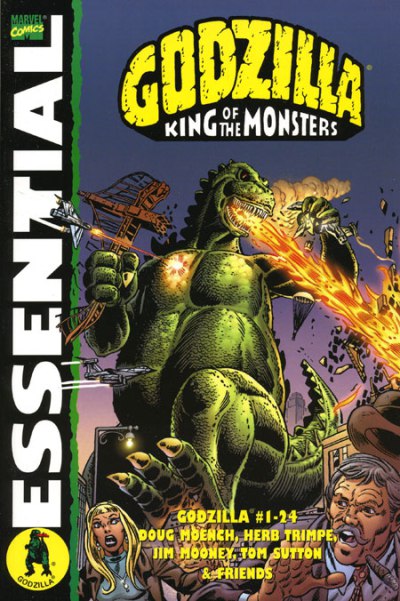
Essential Godzilla

Thursday, December 17th, 2009


By Doug Moench, Herb Trimpe & various (Marvel)
ISBN: 978-0-7851-2153-4

What’s big and green and leaves your front room a complete mess? No, not a Christmas tree, but (arguably) the world’s most famous monster. In 1976 manga and anime were only starting to creep into global consciousness and the most well known popular culture Japanese export was a colossal radioactive dinosaur that regularly rampaged through the East destroying cities and fighting monsters even more bizarre and scary than it was.

At this time Marvel was well on the way to becoming the multi-media corporate giant of today and was looking to increase its international profile. Comic companies have always sought licensed properties to bolster their market share and in 1977 Marvel truly landed the big one with a two year run of one of the world’s most recognisable characters. They boldly broke with tradition by dropping him solidly into real-time contemporary company continuity.

Gojira first appeared in the eponymous 1954 anti-war, anti-nuke parable directed by Ishiro Honda for Toho Films; a symbol of ancient forces roused to violent reaction by mankind’s incessant meddling. The film was re-cut and dubbed into English with a young Raymond Burr inserted for US audience appeal, and the brobdignagian beast renamed Godzilla. He has smashed his way through 27 further Japanese movies, records, books games, many, many comics and is the originator of the manga sub-genre Daikaijû (giant strange beasts).

The Marvel interpretation began with ‘The Coming!’ by Doug Moench, Herb Trimpe & Jim Mooney (#1 August 1977) as the monstrous aquatic lizard with radioactive fire breath erupted out of the Pacific Ocean and rampaged through Alaska.

Superspy organisation S.H.I.E.L.D. is quickly dispatched to stop the monster, and Nick Fury calls in Japanese experts Dr. Yuriko Takiguchi, his grandson Robert and their eye-candy assistant Tamara Hashioka. After an inconclusive battle of ancient strength against modern tech Godzilla returns to the sea, but the seeds have been sown and everybody knows he will return.

In Japan many believe that Godzilla is a benevolent force destined to oppose true evil, young Robert among them, and he gets the chance to expound his views in #2’s ‘Thunder in the Darkness!’ (inked by Frank Giacoia and George Tuska) as the monolithic saurian resurfaces in Seattle, and nearly razes the place before being lured away by S.H.I.E.L.D. ingenuity.

Veteran agents Dum-Dum Dugan, Gabe Jones and Jimmy Woo are seconded to a permanent anti-lizard force until the beast is finally vanquished, but there are lots of free-lance do-gooders in the Marvel universe and when the Green Goliath takes offence at San Francisco’s Golden Gate Bridge, the Champions – a short-lived team consisting of Angel, Iceman, Ghost Rider, Black Widow and Hercules – in ‘A Tale of Two Saviours’ (with the solids inks of Tony DeZuniga adding a welcome depth to the art) the humans spend more time fighting each other than the monster.

There’re only so many cities even the angriest dinosaur can trash before tedium sets in so writer Moench begins his first continued story in #4 with ‘Godzilla Versus Batragon!’ (guest-pencilled by the superb Tom Sutton, inked by DeZuniga), wherein deranged scientist Dr. Demonicus enslaves Aleutian Islanders to grow his own world-wrecking giant horrors – until the real thing shows up…

The story concludes in ‘The Isle of Lost Monsters’ (inked by a fresh-faced Klaus Janson) and #6, ‘A Monster Enslaved!’ begins another extended epic as Herb Trimpe returns and Godzilla as well as the general American public were introduced to another now common Japanese innovation.

Giant, piloted battle-suits (Mecha) first appeared in Go Nagai’s 1972 manga classic Mazinger Z, (and Marvel would do much to popularise the sub-genre in their follow-up licensed comic Shogun Warriors, based on an import toy rather than movie or comic characters but by the same creative team as Godzilla), and here young Rob Takiguchi steals S.H.I.E.L.D.’s latest weapon, a giant robot codenamed Red Ronin, to aid the Big Guy when he is finally captured.

Fred Kida stirringly inked the first of a long line of saurian sagas with #7’s ‘Birth of a Warrior!’ and the uneasy giant’s alliance ends in another huge fight in the final chapter ‘Titan Time Two!’ ‘The Fate of Las Vegas’ (Trimpe and Kida) in Godzilla #9 is a lighter morality tale as the monster destroys Boulder Dam and floods the modern Sodom and Gomorrah, but it’s soon back to big beastie bashing in ‘Godzilla vs Yetrigar’, another multi-part mash-up that concludes in ‘Arena for Three!’ as Red Ronin returns to tackle both large lizard and stupendous Sasquatch.

The first year ends with #12’s ‘The Beta-Beast!’, the first chapter in an invasion epic. Shanghaied to the Moon, Godzilla is co-opted as a soldier in a war between alien races who breed giant monsters as weapons, and when the battle transfers to Earth in ‘The Mega-Monsters from Beyond!’, Red Ronin joins the fray for the blockbusting conclusion ‘The Super-Beasts’ (this last inked by Dan Green). Afterwards, loose in cowboy country, Godzilla stomps into a rustling mystery and modern showdown in ‘Roam on the Range’ and ‘The Great Godzilla Roundup!’ before the final story arc begins.

‘Of Lizards, Great and Small’ in #17 begins with a logical solution to the beast’s rampages as superhero Ant-Man’s shrinking gas is used to reduce Godzilla to a more manageable size, but when the diminished devastator escapes from his cage and becomes a ‘Fugitive in Manhattan!’ it’s all hands on deck whilst the city waits for the gas’ effects to wear off. ‘With Dugan on the Docks!’ sees the secret agent battle the saurian on more or less equal terms before the Fantastic Four step in for ‘A Night at the Museum.’

The FF have another humane solution and dispatch Godzilla to an age of dinosaurs in #21’s ‘The Doom Trip!’, which allows every big beast fan’s dream to come true as the King of the Monsters teams up with Jack “King” Kirby’s uniquely splendid Devil Dinosaur - and Moon Boy – in ‘The Devil and the Dinosaur!’ (inked by Jack Abel) before returning to the 20th century and his full size for a spectacular battle against the Mighty Avengers in ‘The King Once More’.

The story and series concluded in #24 (July 1979) with the remarkably satisfying ‘And Lo, a Child Shall Lead Them’ as all New York’s superheroes prove less effective than an impassioned plea, and Godzilla departs for new conquests and other licensed outlets.

By no means award-winners or critical masterpieces these stories are nonetheless a perfect example of what comics should be: enticing, exciting, accessible and brimming with “bang for your buck.” Moench’s oft-times florid prose and dialogue meld perfectly here with Trimpe’s stylised interpretation, which often surpasses the artist’s excellent work on that other big, green galoot.

These are great tales to bring the young and disaffected back to the comics fold and are well worth their space on any fan’s bookshelf.

© 1977, 1978, 1979, 2006 Toho Co., Inc. All Rights Reserved. Godzilla, King of the Monsters ® Toho Co., Inc.

Essential Avengers volume 3

Sunday, October 25th, 2009


By Roy Thomas, John Buscema, Gene Colan, Barry Smith & various (Marvel)
ISBN: 978-0-7851-0787-3

Slightly slimmer than the usual phonebook sized tome, this third collection of the Mighty Avengers’ world-saving exploits (here reproducing in crisp, stylish black and white the contents of issues #47-68 of their monthly comic book and their second summer Annual) established Roy Thomas as a major creative force in comics and propelled John Buscema to the forefront of fan-favourite artists. These compelling yarns certainly enhanced the reputations of fellow art veteran Don Heck and Gene Colan and made the wider comics world critically aware of the potential of John’s brother Sal Buscema and original British Invader Barry Smith…

With the Avengers the unbeatable and venerable concept of putting all your star eggs in one basket always scored big dividends for Marvel even after the all-stars such as Thor and Iron Man were replaced and supplemented by lesser luminaries and Jack Kirby moved on to other Marvel assignments and other companies. With this third volume many of the founding stars regularly began showing up as a rotating, open door policy meant that almost every issue could feature somebody’s fave-rave, and the amazingly good stories and artwork were certainly no hindrance either.

Opening this fun-fest is ‘Magneto Walks the Earth!’ from Avengers #47 by writer Roy Thomas (who wrote all the stories contained here), illustrated by John Buscema and George Tuska wherein the master of magnetism returns from enforced exile in space to put his old gang together by recruiting mutant Avengers Quicksilver and the Scarlet Witch… whether they’re willing or otherwise…

Tuska assumes full art chores for the second chapter in this saga, ‘The Black Knight Lives Again!’ which introduced a brand new Marvel Superhero, whilst furthering a sub-plot featuring Hercules’ return to an abandoned Olympus and #49, (pencilled and inked by Buscema) concluded the Mutant trilogy with ‘Mine is the Power!’ clearing the decks for the 50th issue tussle as the team rejoins Hercules to restore Olympus by defeating the mythological menace of Typhon in ‘To Tame a Titan!’

Reduced to just Hawkeye, the Wasp and a powerless Goliath the Avengers found themselves ‘In the Clutches of the Collector!’ in #51 (illustrated by Buscema and Tuska), but the brief return of Iron Man and Thor swiftly saw the Master of Many Sizes regain his abilities in time to welcome new member Black Panther in the Vince Colletta inked ‘Death Calls for the Arch-Heroes’ which premiered obsessive super-psycho the Grim Reaper.

Next follows the slightly disconcerting cross-over/conclusion to an epic X-Men clash with Magneto from (issues #43-45) that dovetailed neatly into a grand Avengers/mutant face-off in the Buscema-Tuska limned ‘In Battle Joined!’ whilst issue #54 kicked off a mini-renaissance in quality and creativity with ‘…And Deliver Us from the Masters of Evil!’, which re-introduced the Black Knight and finally gave Avengers Butler a character and starring role, but this was simply a prelude to the second instalment which debuted the supremely Oedipal threat of the Robotic Ultron-5 in ‘Mayhem Over Manhattan!’ (inked by the superbly slick George Klein).

Captain America’s introduction to the 1960s got a spectacular reworking in Avengers #56 as ‘Death be not Proud!’ accidentally returned him and his comrades to the fateful night when Bucky died, which segued neatly into 1968’s Avengers Annual #2 (illustrated by Don Heck, Werner Roth and Vince Colletta). ‘…And Time, the Rushing River…’ found Cap, Black Panther, Goliath, Wasp and Hawkeye returned to a divergent present and compelled to battle the founding team of Iron Man, Thor, Hulk, Giant-Man and the Wasp to correct reality itself.

Buscema and Klein were back for the two-part introduction of possibly the most intriguing of all the team’s roster. ‘Behold… the Vision!’ and the concluding ‘Even an Android Can Cry’ retrofitted an old Simon and Kirby hero from the Golden Age – an extra-dimensional mystery-man – into a high-tech, eerie, amnesiac, artificial man with complete control of his mass and density, and played him as the ultimate outsider, lost and utterly alone in a world that could never, never understand him.

As the adventure and enigma unfolded it was revealed that the nameless Vision had been built by the relentless, remorseless robotic Ultron-5 to destroy the Avengers and especially his/its own creator Henry Pym. Furthermore the mechanical mastermind had used the brain pattern of deceased hero-Wonder Man (see Essential Avengers) as a cerebral template, which may have been a mistake since the synthetic man overruled his programming to help defeat his maniac maker.

Avengers #59 and 60, ‘The Name is Yellowjacket’ and ‘…Till Death do us Part!’ (the latter inked by Mike Esposito moonlighting as Mickey DeMeo) saw Goliath and the Wasp finally marry after the heroic Doctor Pym was seemingly replaced by a new insect-themed hero, with a horde of heroic guest-stars and the deadly Circus of Evil in attendance, followed in swift succession by yet another crossover conclusion.

‘Some Say the World Will End in Fire… Some Say in Ice!’ wrapped up a storyline from Doctor Strange #178 wherein a satanic cult unleashed Norse demons Surtur and Ymir to destroy the planet, and the guest-starring Black Knight hung around for ‘The Monarch and the Man-Ape!’ in Avengers #63; a brief and brutal exploration of African Avenger the Black Panther’s history and rivals.

The next issue began a three-part tale illustrated by Gene Colan whose lavish humanism was intriguingly at odds with the team’s usual art style. ‘And in this Corner… Goliath!’, ‘Like a Death Ray from the Sky!’ and ‘Mightier than the Sword?’ (the final chapter inked by Sam Grainger) was part of a broader tale; an early crossover experiment that intersected with both Sub-Mariner and Captain Marvel issues #14, as a coterie of cerebral second-string villains combined to conquer the world by stealth.

Within the Avengers portion of proceedings Hawkeye revealed his civilian identity and origins before forsaking his bow and trick-arrows, becoming a size-changing hero, and subsequently adopting the vacant name Goliath.

The last three issues reprinted here also form one story-arc, and gave new kid Barry Smith a chance to show just how good he was going to become.

In ‘Betrayal!’ (#66, inked by the legendary Syd Shores) the development of a new super metal, Adamantium, triggers a back-up program in the Vision who is compelled to reconstruct his destroyed creator, whilst in ‘We Stand at… Armageddon!’ (inked by Klein) Adamantium-reinforced Ultron-6 is moments away from world domination and the nuking of New York when a now truly independent Vision intercedes before the dramatic conclusion ‘…And We Battle for the Earth’ (with art from young Sal Buscema and Sam Grainger) sees the team, augmented by Thor and Iron Man, prove that the only answer to an unstoppable force is an unparalleled mind…

To compliment these staggeringly impressive adventures this book also includes ‘Avenjerks Assemble!’ by Thomas, John Buscema and Frank Giacoia: a short spoof from company humour mag Not Brand Echh, the five page full-team entry from the Official Handbook of the Marvel Universe and a beautiful terrific team pin-up.

As the halcyon creative days of Lee and Kirby drew to a close, Roy Thomas and John Buscema led the second wave of creators who built on and consolidated that burst of incredible imagineering into a logical, fully functioning story machine that so many others could add to. These terrific transitional tales are exciting and rewarding in their own right but also a pivotal step of the little company into the corporate colossus.

© 1967, 1968, 2001 Marvel Characters, Inc. All Rights Reserved.

Essential Spider-Man volume 3

Monday, August 17th, 2009


By Stan Lee, John Romita & various (Marvel)
ISBN 0-7851-0658-8

The rise and rise of the wondrous web-spinner continued and even increased pace as the 1960s progressed, and by the time of the tales in this third spectacular volume of black and white reprints (collecting the contents of Amazing Spider-Man #44-68) Peter Parker and friends were on the way to being household names as well as the darlings of college campuses and the media intelligentsia.

The Marvel merriment begins with the return of a tragedy-drenched old foe as Stan Lee and John Romita reintroduced biologist Curt Conners in #44′s (Jan 1967) ‘Where Crawls the Lizard!’ The deadly reptilian marauder threatened Humanity itself and it took all of the wall-crawler’s resourcefulness to stop him in the concluding ‘Spidey Smashes Out!’

Issue #46 introduced an all-new menace in the form of seismic super-thief ‘The Sinister Shocker!’ whilst ‘In the Hands of the Hunter!’ brought back a fighting mad Kraven to menace the family of Peter Parker’s friend Harry Osborn. Apparently the obsessive big-game hunter had entered into a contract with Harry’s father (the super-villain Green Goblin until a psychotic break turned him into a traumatised amnesiac) and now he wanted paying off…

Luckily Spider-Man was on hand to dissuade him, but it’s interesting to note that at this time the student life and soap-opera sub-plots became increasingly important to the mix, with glamour girls Mary Jane Watson and Gwen Stacy (superbly delineated by the masterful Romita) as well as former bully Flash Thompson and the Osborns getting as much or more “page-time” as Aunt May or the Daily Bugle staff, who had previously monopolised the non-costumed portions of the ongoing saga.

Amazing Spider-Man #48 introduced Blackie Drago a ruthless thug who shared a prison cell with one of the wall-crawler’s oldest foes. At death’s door the ailing super-villain revealed his technological secrets, enabling Drago to escape and master ‘The Wings of the Vulture!’ Younger, faster, tougher the new Vulture defeated Spider-Man and in #49′s ‘From the Depths of Defeat!’ battled Kraven the Hunter until a reinvigorated arachnid stepped in the thrash them both.

Issue #50 introduced one of Marvel’s greatest villains in the first of a three part yarn that saw the beginnings of romance between Parker and Gwen Stacy and the death of a cast member, re-established Spidey’s war on cheap thugs and common criminals (a key component of the hero’s appeal was that no criminal was too small for him to bother with) and saw a crisis of conscience force him to quit in ‘Spider-Man No More!’ only to return and be trapped ‘In the Clutches of… the Kingpin!’ before tragically triumphing in ‘To Die a Hero!’ This gang-busting triptych saw Romita relinquish the inking of his art to Mike Esposito (moonlighting from DC as Mickey DeMeo).

Another multi-part saga began in #53 with ‘Enter: Dr. Octopus’ as the many-tentacled madman tried to steal a devastating new piece of technology, but after being soundly defeated the madman went into hiding as a lodger at Aunt May’s house in ‘The Tentacles and the Trap!’, regrouped and succeeded in ‘Doc Ock Wins!’ and even convinced a mind-wiped Spider-Man to join him before the astonishing conclusion in ‘Disaster!’

Shell-shocked and amnesiac, Spider-Man was lost in New York in #57 (with lay-outs by Romita, pencils from the reassuring reliable Don Heck and inking by DeMeo) until he clashed with Marvel’s own Tarzan clone in ‘The Coming of Ka-Zar!’ whilst in the follow-up ‘To Kill a Spider-Man!’ vengeance-crazed roboticist Professor Smythe convinced J. Jonah Jameson to finance another mechanical Spider-Slayer…

In Amazing Spider-Man #59 the hero returned his attention to sinister street-crime in ‘The Brand of the Brainwasher!’ as a new mob-mastermind began to take control of the city by mind-controlling city leaders and prominent cops – including Gwen Stacy’s dad. The drama continued as the mastermind was revealed to be one of Spidey’s old foes in ‘O, Bitter Victory!’ before the concluding part ‘What a Tangled Web We Weave…!’ saw our hero save the day but still stagger away more victim than victor…

‘Make Way for …Medusa!’ in #62 is a fresh change-of-pace yarn as the wall-crawler stumbled into combat with the formidable Inhuman due to the machinations of a Madison Avenue ad man, whilst ‘Wings in the Night!’ in #63 saw the old Vulture return to crush his usurper Blackie Drago, and then take on Spidey for dessert. The awesome aerial angst concluded with ‘The Vultures Prey’ which led to another art-change (from Heck and DeMeo to the sumptuous heavy lines of Jim Mooney) in #65 as Spider-Man was arrested and had to engineer ‘The Impossible Escape!’ from a Manhattan prison, foiling as mass jailbreak along the way.

The psychotic special-effects mastermind returned seeking loot and vengeance in #66′s ‘The Madness of Mysterio!’ (by Romita, Heck and DeMeo) which ended in an all-out action-packed brawl (rendered by Romita and Mooney) entitled ‘To Squash a Spider!’ This volume closes with a small tale that acts as a prologue for a greater epic to come. In ‘Crisis on the Campus!’ scripter Lee tapped into the student unrest of the times in a clever tale of fantastic skulduggery. One of Peter Parker’s tutors was deciphering an ancient tablet, unaware that the Kingpin wanted it for the world-shaking secrets it held. And such a ruthless manipulator would have no qualms in fomenting a bloody riot to mask his theft of the artefact…

Spider-Man became a permanent unmissable part of many teenagers’ lives at this time and did so by living a life as close to theirs as social mores and the Comics Code would allow. Blending cultural authenticity with beautiful art, and making a dramatic virtue of the awkwardness, confusion and sense of powerlessness that most of the readership experienced daily, resulted in an irresistibly intoxicating read, delivered in addictive soap-opera instalments, but none of that would be relevant if the stories weren’t so compellingly entertaining. This book is Stan Lee’s Marvel and Spider-Man at their peak.

© 1967, 1968, 1969, 1998, 2009 Marvel Characters, Inc. All Rights Reserved.

Essential Fantastic Four volume 3

Monday, June 15th, 2009


By Stan Lee, Jack Kirby, Joe Sinnott & various (Marvel)
ISBN: 978-0-7851-2625-6

This third collected black-and-white volume of the “World’s Greatest Comic Magazine!” certainly lives up to its own hype as it re-presents those tales wherein Jack Kirby finally unleashed his vast imagination and Stan Lee scripted some of the most passionate superhero sagas that Marvel – or any publisher, for that matter – has ever produced. Both were at the height of their creative powers, and full of the confidence that only success brings, with Kirby in particular eager to see how far the genre and the medium could be pushed.

The wonderment begins with the first part of a tense and traumatic trilogy (inked by Vince Colletta) in which the Frightful Four – Wizard, Sandman, Trapster and the enigmatic Madame Medusa – brainwash The Thing and turn him against his former team-mates. It started in Fantastic Four # 41 (August 1965) with ‘The Brutal Betrayal of Ben Grimm!’, continued in rip-roaring fashion with ‘To Save You, Why must I Kill You?’ and concluded in bombastic glory with #44′s ‘Lo! There Shall be an Ending!’

After that Colletta signed off by inking one of the most crowded Marvel stories ever. Fantastic Four Annual #3 featured every hero, most of the villains and lots of ancillary characters (such as teen-romance stars Patsy Walker & Hedy Wolf and even Stan and Jack themselves) in the company pantheon. In ‘Bedlam at the Baxter Building!’ Reed Richards and Sue Storm finally wed, despite being attacked by an army of baddies mesmerised by the diabolical Doctor Doom. In its classical simplicity it signalled the end of one era and the start of another…

FF #44 was a landmark in many ways. Firstly it saw the arrival of Joe Sinnott as regular inker, a skilled brush-man with a deft line and a superb grasp of anatomy and facial expression, and moreover an artist prepared to match Kirby’s greatest efforts with his own. Some inkers had problems with just how much detail the King would pencil in; Sinnott relished it and the effort showed. What was wonderful now became incomparable.

‘The Gentleman’s Name is Gorgon!’ introduced a mysterious powerhouse with metal hooves instead of feet, a hunter implacably stalking Madame Medusa, who embroiled the Human Torch and thus the whole team in her frantic bid to escape, and that’s before the monstrous android Dragon Man showed up to complicate matters. All this was merely a prelude: with the next issue we were introduced to a hidden race of super-beings that had secretly shared the Earth with us for millennia. ‘Among us Hide… the Inhumans’ revealed that Medusa was part of the Royal Family of Attilan, a race of paranormal beings on the run ever since a coup deposed the true king.

Black Bolt, Triton, Karnak and the rest would quickly become mainstays of the Marvel Universe, but their bewitching young cousin Crystal and her giant teleporting dog Lockjaw were the real stars here. For young Johnny Storm it was love at first sight, and Crystal’s eventual fate would greatly change his character, giving him a hint of angst-ridden tragedy that resonated greatly with the generation of young readers who were growing up with the comic…

‘Those Who Would Destroy Us!’ and ‘Beware the Hidden Land!’ (FF #46 and 47) saw the team join the Inhumans as Black Bolt regained his throne from his brother Maximus the Mad, only to stumble into the usurper’s plan to wipe humanity from the Earth.

Ideas just seem to explode from Kirby at this time. Despite being halfway through one storyline, FF #48 trumpeted ‘The Coming of Galactus!’ and the first Inhumans saga was swiftly wrapped up by page 6, with the entire race sealed behind an impenetrable dome called the Negative Zone (later retitled the Negative Barrier to avoid confusion with the gateway to sub-space that Reed worked on for years).

Meanwhile a cosmic entity approached Earth, preceded by a gleaming herald on a surfboard of pure cosmic energy. I suspect this experimental – and vaguely uncomfortable – approach to narrative mechanics was calculated and deliberate, mirroring the way that TV soap operas were increasingly delivering their interwoven storylines, and a way to keep the readers glued to the series.

They needn’t have bothered. The stories and concepts were enough…

‘If this be Doomsday!’ saw the planet-eating Galactus set up shop above the Baxter Building despite the team’s best efforts, whilst his cold and shining herald had his humanity rekindled by simply conversing with the Thing’s blind girlfriend Alicia. Issue #50′s ‘The Startling Saga of the Silver Surfer!’ concluded the epic in grand style as the reawakened humanity of the Surfer and heroism of the FF bought enough time for Richards to literally save the World. Once again the tale ended in the middle of the issue, and the remaining half concentrated on the team getting back to “normal”. To that extent Johnny Storm enrolled at Metro College, desperate to forget his lost love Crystal and his unnerving jaunts to the ends of the universe. On his first day, the lad met the imposing and enigmatic Native American Wyatt Wingfoot, destined to become his greatest friend…’

Fantastic Four #51 is considered by many the greatest single FF story ever. ‘This Man… This Monster!’ found the Thing’s body usurped by a vengeful and petty scientist who subsequently discovered the true measure of a man, whilst another innovation and great character debuted in the next issue.

‘The Black Panther!’ was an African monarch whose secretive kingdom was the only source of a vibration-absorbing alien metal. These mineral riches had enabled him to turn his country into a technological wonderland. He attacked the FF as part of an extended plan to gain vengeance on the murderer of his father. He was also the first Negro superhero in American comics (Fantastic Four #52, cover-dated July 1966). His origin was revealed in ‘The Way it Began..!’, which also introduced sonic super-villain Klaw. Johnny and Wyatt then embarked on a quest to find Crystal but discovered instead the lost tomb of Prester John in #54′s ‘Whosoever Finds the Evil Eye…!’

Imprisoned on Earth the brooding ex-herald of Galactus had become an instant fan-favourite, and his regular appearances were always a guarantee of something special. ‘When Strikes the Silver Surfer!’ found him in uncomprehending, brutal battle with the Thing, whose insecurities about Alicia had turned into searing jealousy, whereas it was business as unusual when ‘Klaw the Murderous Master of Sound!’ attacked again in # 56.

Throughout all the issues since their imprisonment a running sub-plot with the Inhumans had been slowly building, whilst the on the other side of the Great Barrier, Johnny and Wyatt wandered the wilds also seeking a method of liberating the Hidden City. Their quest led directly into the landmark tale ‘The Torch that Was!’: lead feature in the fourth FF Annual (1966), in which The Mad Thinker resurrected the original Human Torch (actually the World’s first android) to battle destroy the flaming teenager…

Fantastic Four #57-60 displayed Lee and Kirby at their very best; with incredible drama and action on a number of fronts as the most dangerous man on Earth stole the Silver Surfer’s power, the Inhumans finally won their freedom and we discovered the tragic secret of Black Bolt in all its awesome fury. It all began with a jailbreak by the Sandman in #57′s ‘Enter… Dr. Doom!’, continued in ‘The Dismal Dregs of Defeat!’ and ‘Doomsday’ culminating in brains saving the day and humanity in magnificent manner with ‘The Peril and the Power!’

But there was never a dull moment: no sooner had they relaxed than a new and improved foe resumed his aborted attack in #61′s ‘Where Stalks the Sandman?’, another explosive multi-part tale wherein Johnny and Crystal were reunited, the Surfer regained his stolen power and Reed was lost to the anti-matter hell of the Negative Zone’s sub-space corridor.

‘…And One Shall Save Him!’ guest-starred Triton and the newly liberated Inhuman Royal Family, and saw the introduction of another unique enemy, who followed Reed back from the anti-matter universe and straight into partnership with the Sandman. The battle against ‘Blastaar, the Living Bomb-Burst!’ (FF #63, June 1967), concludes the incredible run of superb stories in this volume, but there was still room to include some fascinating freebies in the form of pages of original art, the initial designs for Coal Tiger (who became Black Panther) and an unused cover for #52.

These are the stories that cemented Marvel’s reputation and enabled the company to overtake all its competitors. They’re also still some of the best stories ever produced and as exciting and captivating now as they ever were. This is a must-have book for all fans of graphic narrative.

© 1965, 1966, 1967, 2007 Marvel Characters, Inc. All Rights Reserved.

Essential Hulk volume 3

Wednesday, May 20th, 2009


By Stan Lee, Roy Thomas, Harlan Ellison, Herb Trimpe, & various (Marvel)
ISBN: 978-0-7851-1689-9

By the close of the 1960s the Incredible Hulk had settled into a comfortable niche and enjoyable formula as the tragic Bruce Banner sought cures for his gamma-transformative curse, alternately aided or hunted by prospective father-in-law US General “Thunderbolt” Ross and a variety of guest-star heroes and villains.

Herb Trimpe made the character his own, the “house” Jack Kirby based art-style quickly evolving into startlingly abstract mannerism, augmented by an unmatched facility for drawing technology and especially honking great ordnance and vehicles – all of which looks especially great in the crisp black and white of these magically affordable Essentials volumes. And of course no one can deny the cathartic reader-release of a mighty big “Hulk Smash” moment…

This chronologically accurate treat contains issues #118-142, as well as the corresponding parts of a couple of cross-overs, Captain Marvel #20-21 and Avengers #88, but the action begins with Incredible Hulk #118 (August 1969) wherein a duplicitous courtier at the Sub-Mariner’s sunken  citadel orchestrated ‘A Clash of Titans’, (as related by Stan Lee and Trimpe) before the Jade Giant stumbled into a South American country conquered by and ‘At the Mercy of… Maximus the Mad’, a two-part-tale which concluded with the Roy Thomas scripted ‘On the Side of… the Evil Inhumans!’

This all-out Armageddon with the Hulk also fighting the Costa Salvador army, the ubiquitous rebels, General Ross’ specialist forces and even a giant robot gave way to a moodier menace as Ol’ Greenskin returned to the USA – Florida to be precise – to find ‘Within the Swamp, There Stirs… a Glob!’, a muck-encrusted monstrosity that predated both DC’s Swamp Thing and Marvel’s own Man-Thing; designed as tribute in equal parts to Theodore Sturgeon’s “It” and the Hillman Comics Character The Heap, who slopped his way through the back of Airboy Comics in the early 1950s.

Incredible Hulk #122 promised ‘The Hulk’s Last Fight!’ when the Fantastic Four thought they’d found a cure for Banner’s condition, but as the concluding episode ‘No More the Monster!’ showed, you don’t always get what you want – specially when gamma-super-genius the Leader has involved himself in the plan.

Seemingly cured of the curse of the Hulk Bruce Banner was set to marry his troubled sweetheart Betty Ross, but ‘The Rhino Says No!’ and the subsequent set-to (rather heavily inked by Sal Buscema) re-set the tragic status quo of hunted, haunted hero on the run…

Trimpe again took up the inker’s brush for the bludgeoning battle in #125 ‘And Now, the Absorbing Man!’ whilst Doctor Strange guest-starred in an other-dimensional duel with the malign Undying Ones: ‘…Where Stalks the Night-Crawler!’ (a tidying up exercise closing a saga from the good Doctor’s own cancelled title – and one which directly led to the formation of the anti-hero super-group The Defenders).

In ‘Mogol!’ (#127) the child-like, lonely Hulk was transported to the Mole Man’s subterranean realm where he thought he’d finally found a friend, only to face bitter disappointment once more, and his pain-filled rampage threatened to destroy California (#127) when he tore his way surface-ward via the San Andreas Fault. ‘And in this Corner… The Avengers!’ found a solution to the problem, even if they couldn’t hold the Green Goliath, leading him to more trouble when ‘Again, The Glob!’ attacked.

Next up is a two-part tale from Captain Marvel #20-21 (June and August 1970) where erstwhile partner Rick Jones sought Banner’s aid to free him from a twilight existence bonded to the Kree hero – and intermittent exile to the Negative Zone. Astoundingly illustrated by Gil Kane and Dan Adkins ‘The Hunter and the Holocaust’ and ‘Here Comes the Hulk!’ compounded the mismatched battle with topical student unrest, in a brilliant story that presaged a move towards more “relevant” comics fare throughout the industry.

Incredible Hulk #130 saw Banner separate himself from the Hulk in ‘If I Kill You… I Die’, but the separation had potentially disastrous consequences for Los Angeles, if not the world and only Iron Man could help when ‘A Titan Stalks the Tenements!’ This powerful tale introduced black ghetto kid Jim Wilson, and is made doubly enjoyable by the inking wizardry of the legendary John Severin who signed on for a three-issue stint.

In #132, the Hulk was ‘In the Hands of Hydra!’ – although not for long and to their eternal regret. His desperate escape left him stranded in the Mediterranean dictatorship of Morvania, an unwilling freedom fighter against the despicable Draxon on the ‘Day of Thunder… Night of Death!’ Sal Buscema returned as inker for the conclusion ‘Among us Walks… the Golem!’ in Incredible Hulk #134, and one of the strangest Marvel team-ups then occurred in ‘Descent into the Time-Storm!’ when Kang the Conqueror dispatched the Hulk to the dog-days of World War I to prevent the Avengers’ ancestors from being born, only to fall foul of the masked aviator known as the Phantom Eagle.

Moby Dick (among other cross media classics) was homaged in ‘Klattu! The Behemoth From Beyond Space’ and ‘The Stars, Mine Enemy!’ (this last inked by Mike Esposito) as a vengeance crazed star-ship captain pursued the alien beast that had maimed him, press-ganging the Hulk in the process and pitting him against old foe the Abomination.

It was back to Earth and another old enemy in ‘…Sincerely, the Sandman!’ (inked by Sam Grainger) as the vicious villain turned Betty Ross to brittle glass, whilst #139′s ‘Many Foes Has the Hulk!’ saw the Leader attempt to kill his brutish nemesis by exhaustion as seemingly hundreds of old villains attacked at once…

Another cross-over next, and a very impressive one as Harlan Ellison, Thomas, Sal Buscema and Jim Mooney produced ‘The Summons of Psyklop!’ for Avengers #88 where an insectoid servant of the Elder Gods abducted the Hulk to fuel their resurrection, which led directly into Incredible Hulk #140 and the landmark ‘The Brute that Shouted Love at the Heart of the Atom’ (drawn by Grainger over Trimpe’s layouts). Trapped on a sub-atomic world, Banner’s intellect and the Hulk’s body were reconciled, and he became a barbarian hero to an appreciative populace, and the lover of the perfect princess Jarella…

only to be snatched away by Psyklop at the moment of his greatest happiness.

The sudden return to full-sized savagery was the insectoid’s undoing and the Hulk resumed his ghastly existence… at least until #141 when a psychologist proved a way to drain the Hulk’s gamma-energy to restore the crystalline Betty – and even turn himself into a superhero in ‘His Name is … Samson!’ (with Severin returned as inker).

This volume closes with a satirical poke at “Radical Chic” and the return of the “feminist” villain Valkyrie when the Hulk was made a media cause celebre by Manhattan’s effete elite in the oddly charming ‘They Shoot Hulks, Don’t They?’ But don’t fret, there’s plenty of monumental mayhem as well…

The Hulk is one of the most well-known comic characters on Earth, and these stories, as much as the movies, TV shows and action figures, are the reason why. For an uncomplicated, honestly vicarious experience of Might actually being Right, you can’t do better than these yarns so why not Go Green (even if its only in monochrome and your own head)?

© 1969, 1970, 1971, 2005 Marvel Characters, Inc. All Rights Reserved.