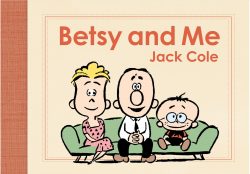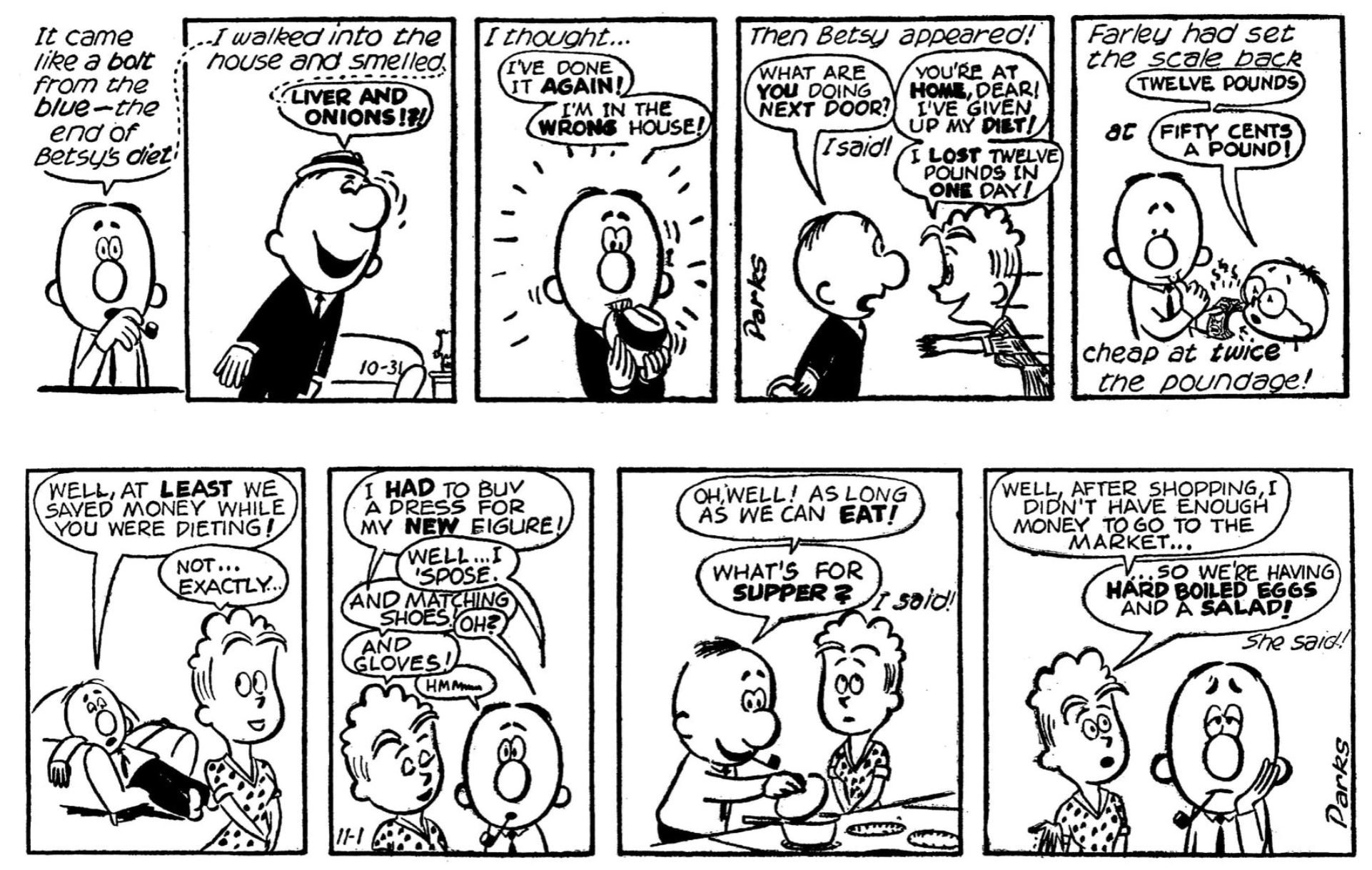
Betsy and Me


By Jack Cole & Dwight Parks, with R.C. Harvey (Fantagraphics Books)
ISBN: 978-156097-878-7 (TPB/Digital edition)

This book includes Discriminatory Content produced in less enlightened times. This book also includes Discriminatory Content added for comedic effect.

Jack Cole was one of the most uniquely gifted talents of American comics’ Golden Age. Before moving into mature magazine and gag markets he originated landmark tales in horror, true crime, war, adventure and especially superhero comic books, where his incredible humour-hero Plastic Man remains an unsurpassed benchmark of screwball costumed hi-jinks: frequently copied but never equalled. It was a glittering career of distinction which Cole was clearly embarrassed by and unhappy with.

Without doubt – and despite his other triumphal comics innovations such as The Comet, Silver Streak, Daredevil, The Claw, Death Patrol, Midnight, Quicksilver, The Barker, and a uniquely twisted and phenomenally popular take on the crime and horror genres – Cole’s greatest contribution and lasting creation was the zany Malleable Marvel who (with indispensable sidekick/gadfly Woozy Winks) quickly grew from a minor back-up character into one of the most memorable and popular heroes of the era.

In 1954 Cole quit comics for the lucrative and prestigious field of magazine cartooning, and swiftly became a household name when his brilliant watercolour gags and stunningly saucy pictures began regularly running in Playboy from its fifth issue. Cole eventually moved into the lofty realms of newspaper strips and, in 1958, achieved a life-long ambition by launching a syndicated newspaper strip, the domestic comedy Betsy and Me, which began publication on Monday May 26th.

Something about reaching the cartoonist’s Promised Land clearly did not meet with the infamously private Cole’s expectations and, on August 13th 1958, at the peak of his prowess and success, he took his own life. The reasons – although much speculated upon ever since – remain unknown.

The strip was handed to commercial cartoonist Dwight Parks who continued it until an editorial decision was made to end it. The last daily was published on Saturday, December 27th. That great loss to the future of the industry and artform has for years clouded a greater truth: whatever his demons, Cole was a master of comedy and narrative art in all its forms and Betsy and Me was, in its own niche, every bit as great as his glamour illustration and comic book endeavours.

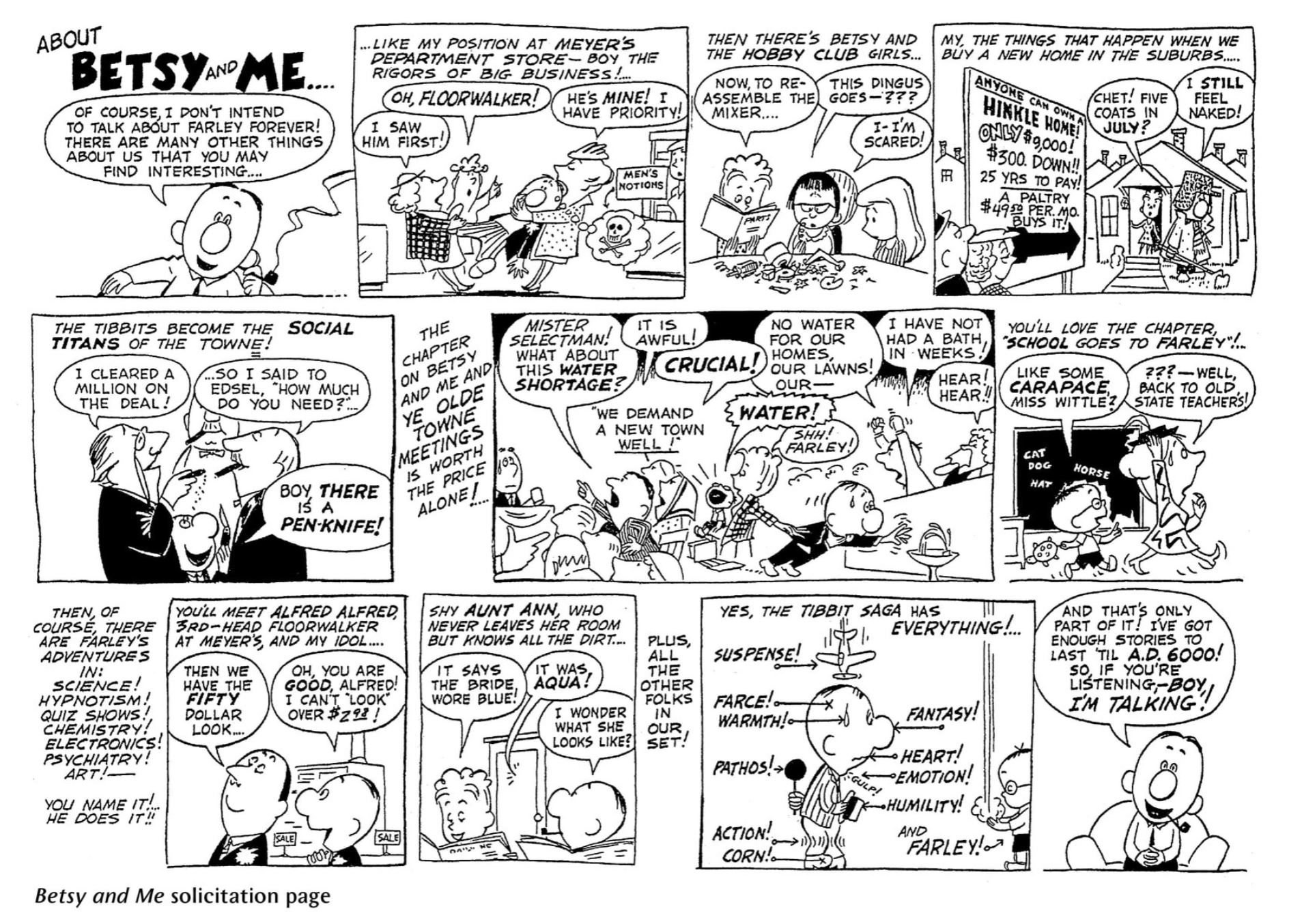
This mostly monochrome tome collects those long-lost newspaper sorties in a welcoming package which begins with the captivating solicitation page designed to entice new papers to buy the strip. Then biography, history, context and analysis come courtesy of historian R. C. Harvey’s introductory essay ‘The Last of Jack Cole: His Life and Art and Why They Both Ended with Betsy and Me. The heavily illustrated article also offers possible insights into Cole’s motivations, state of mind and possible reasons for suicide, before this superb collection of what should have been Cole’s greatest legacy opens…

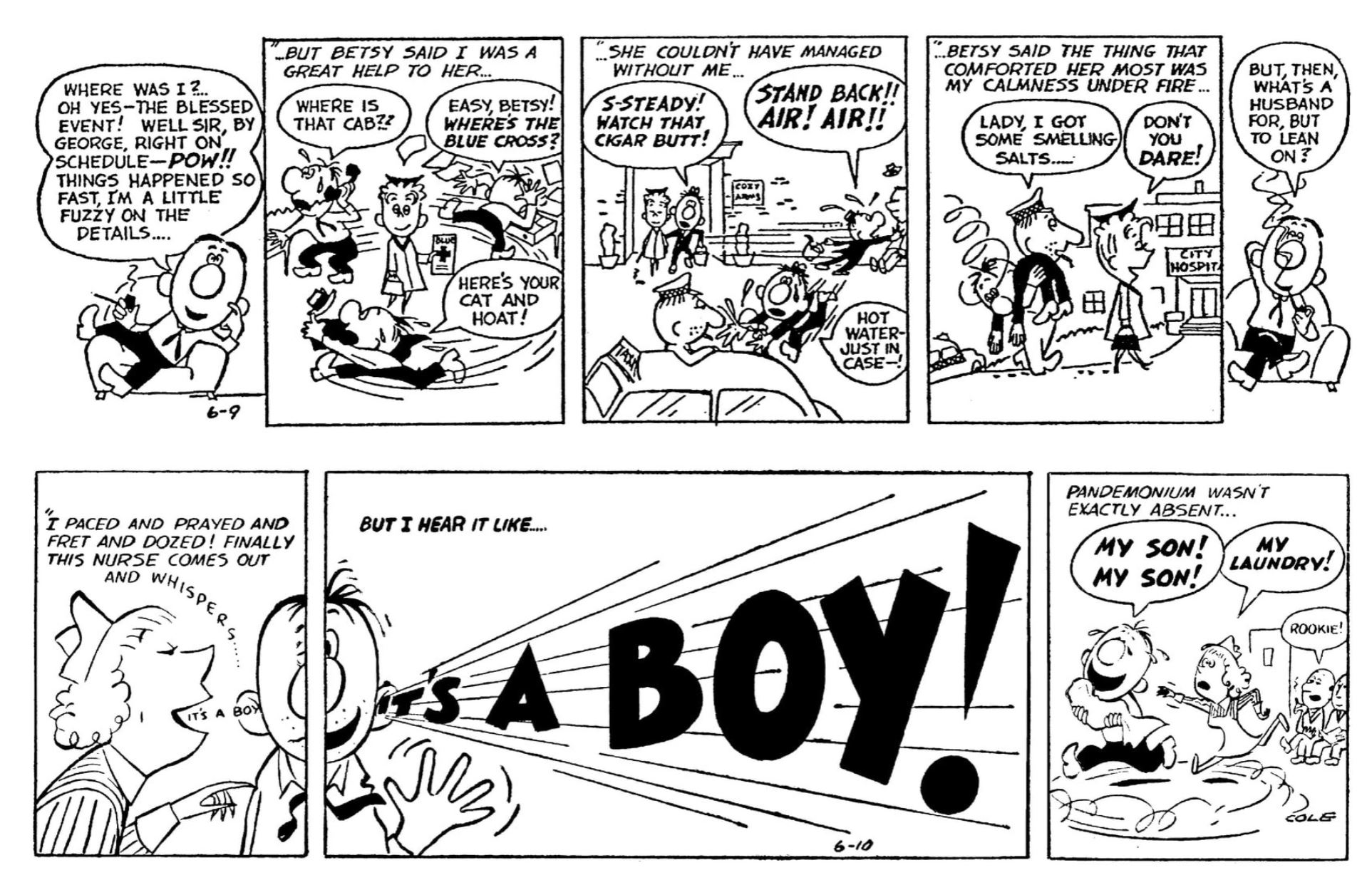
Utilising a stripped-down minimalist style that was the astute acme of its time, this domestic comedy is recounted as a fireside tale by homely working stiff Chester B. Tibbit. He recalls and reminisces with unseen readers who daily learn of his romancing of and marriage to Betsy; his downtrodden life as a floorwalker at the Meyers department store and plodding climb up the ladder of middle class aspiration.

The move from apartment to house, the trepidatious purchase of consumer benchmarks such as white goods and even an automobile (in the most generous sense of the term), and the inevitable addition of a child are all gradually covered in a manner most wry and deliciously sardonic. All the laughs stem from an old cartoonist’s trick: the rose-tinted self-deluding narrative says one thing whilst the pictures tell the grim, sordid truth, even when Chester can’t see it himself…

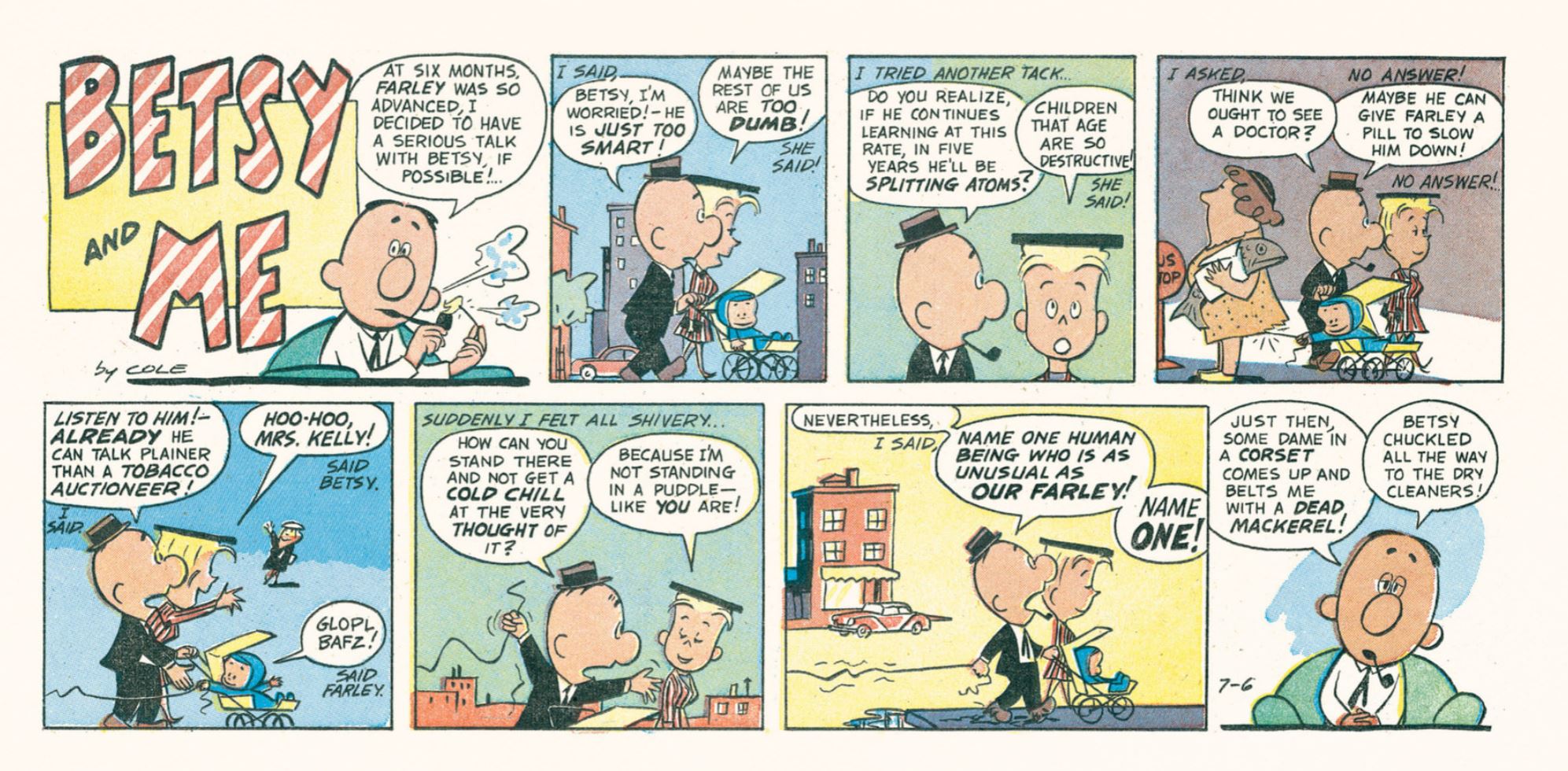
His admired and adored bosses are bullying martinets, his friends are shallow, fair-weather self-servers, Betsy isn’t a quiet, obedient little woman and his son is…

Well, the truth is that infant Farley actually is a genius: rude, brusque, impatient and utterly beyond the intellectual capabilities of his terrified, long-suffering parents. Even from his earliest moments in the crib the kid is the smartest one in the house – and that includes financially and emotionally…

The strips follow the traditional developmental path of courtship, marriage, home-making and child-rearing but always Cole’s needle-sharp social observations and uncontrollable whimsy are seditiously at work. At Meyers’ the infant blackmails his father’s superiors so they stop picking on the little nebbish and when Farley starts school he organises a student revolt…

The toddler even masters judo to protect his bewildered guardians from marauding criminals and spars continually with mooching, predatory Gus, a confirmed bachelor always hanging around Betsy with attentions that are clear to everyone but Chester…

Over the summer of 1958 Betsy and Me steadily grew in quality, scope and popularity. When Cole died on August 13th he had submitted strips for a full month ahead. His last daily ran on September 7th and the final Sunday on September 21st.

Dwight Parks took over and whereas the pared-down artistic style remained, the uneasy edgy satire was lost in favour of more domestic comfortable themes – such as the new house being a broken-down money pit, interfering neighbours, kindergarten woes, dieting and “keeping up with the Joneses”- the stuff of contemporary TV sitcoms like I Love Lucy

Critics have debated ever since Cole’s passing about whether, given time, Betsy and Me (or even a successor strip) would have cemented the brilliant raconteur as a master of all forms of graphic narrative, or whether he had finally overreached himself. We’ll never know, but at least you can read what remains and judge for yourself.

… And you really should.
© 2007 Fantagraphics Books. Text © 2007 R. C. Harvey.

Today in 1915, EC all-star “GhastlyGraham Ingels was born, as was Polish comics star Henryk Chmielewski AKA “Papcio Chmiel” (Tytus, Romek i A’Tomek); cartoonist/editor/educator Barb Rausch (Barbie, The Desert Peach, Omaha the Cat Dancer, Disney Studios, Neil the Horse) in 1941; writer/editor/artist Larry Hama (Wolverine, G.I. Joe, Bucky O’Hare, Nth Man) in 1949: artist/animator Rick Hoberg (Tarzan, Star Wars, Eternity Smith, Green Arrow) in 1952 and Mark Schultz (Superman, Xenozoic Tales) in 1955.

In 1958 today we lost astounding illustrator Joe Maneely (Ghost Breakers, Super Magician Comics, Black Knight, Yellow Claw, Atlas genres shorts) and in 2003 French artist Georges Pichard (Blanche Épiphanie, Ténébrax, Submerman, Ceux–là).

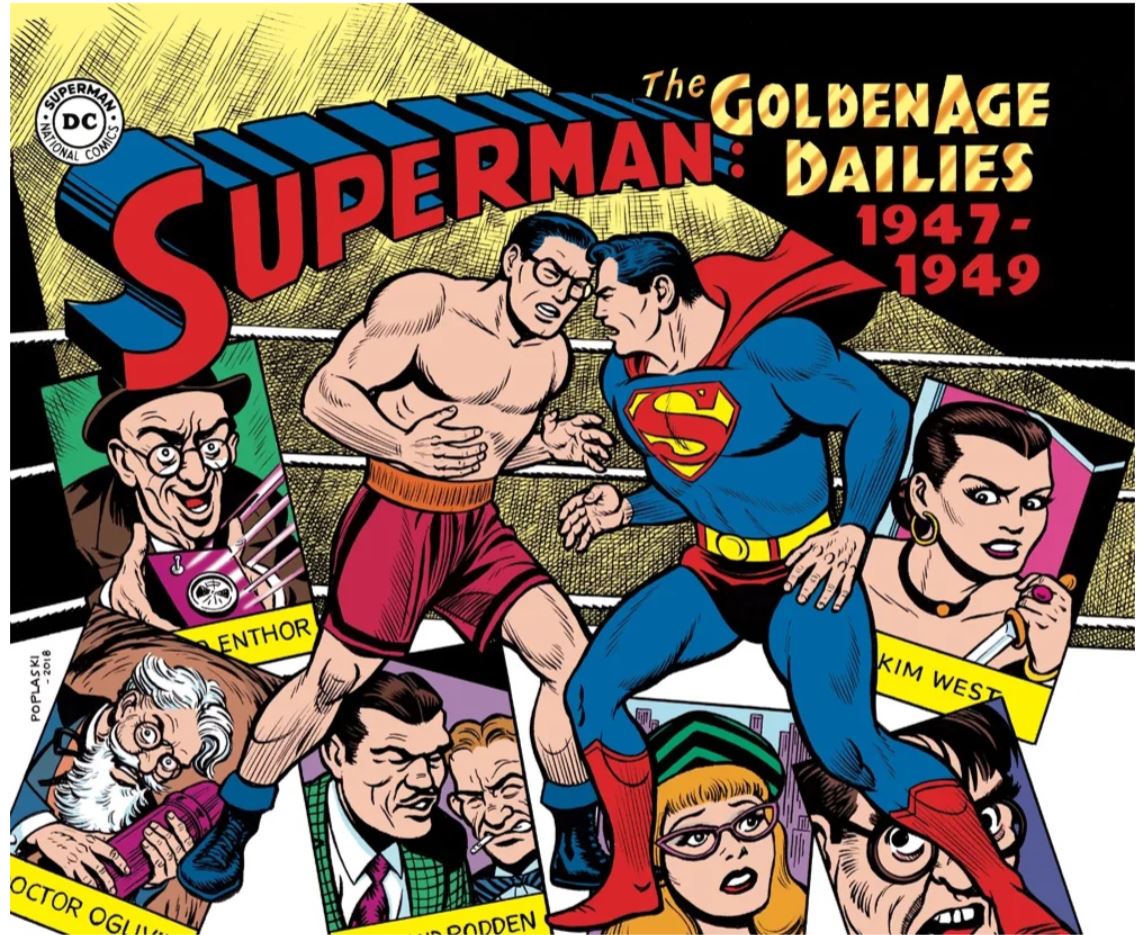
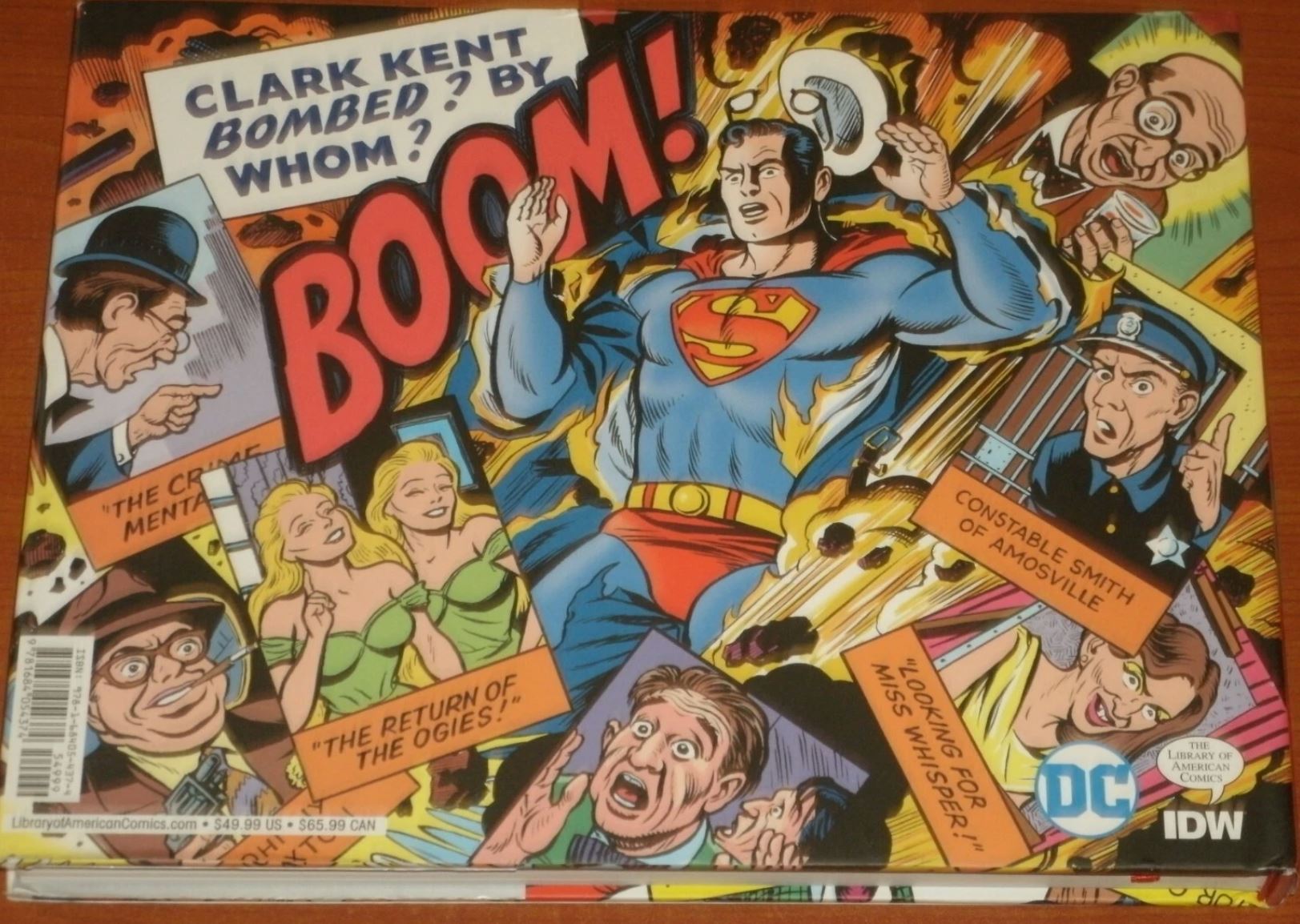
Superman: The Golden Age Dailies 1947 to 1949 (volume 3)


By Alvin Schwartz, Wayne Boring, Jack Schiff, Win Mortimer & various (IDW/Library of American Comics)
ISBN: 978-1-68405- (HB)

This book includes Discriminatory Content produced in less enlightened times.

The American comic book industry – if it still existed at all – would be utterly unrecognisable without Superman. Jerry Siegel & Joe Shuster’s unprecedented invention was first fervidly adopted by a desperate and joy-starved generation, and gave birth to a genre if not an actual art form. Spawning an army of imitators and variations within three years of his 1938 debut, the intoxicating blend of breakneck, breathtaking action and wish-fulfilment epitomising the early Man of Steel grew to encompass cops-&-robbers crimebusting, socially reforming dramas, sci fi fantasy, whimsical comedy and, once the war in Europe and the East sucked in America, patriotic relevance for a host of gods, heroes and monsters, all dedicated to profit through exuberant, eye-popping excess and vigorous, dashing derring-do.

From the outset, in comic book terms Superman was master of the world. Moreover, whilst transforming the shape of the fledgling funnybook biz, the Man of Tomorrow irresistibly expanded into all areas of the entertainment media. Although we all think of the Cleveland boys’ iconic invention as epitome and acme of comics creation, the truth is that very soon after his springtime debut in Action Comics #1 the Man of Steel was a fictional multimedia monolith in the same league as Popeye, Tarzan, Sherlock Holmes and Mickey Mouse. We parochial and possessive comics fans too often regard our purest and most powerful icons in purely graphic narrative terms, but the likes of Batman, Spider-Man, Avengers and their hyperkinetic kind long ago outgrew four-colour origins to become fully mythologized modern media creatures familiar in mass markets, across all platforms and age ranges…

In the last century and even more so in this one, far more people have seen and heard the Man of Steel than have ever read his comic books. These globally syndicated newspaper strips alone were enjoyed by countless millions, and by the time his 20th anniversary rolled around, at the very start of what we call the Silver Age of Comics, he had been a thrice-weekly radio serial star, headlined 17 astounding animated cartoons, become a novel attraction (written by George Lowther) and – by the time of the last stories in this tome – had helmed two feature films. He had then seamlessly segued into the next Big Thing: television. Soon his first (of 8) smash-hit live-action tv seasons would start his next great media conquest, making Superman a perennial sure-fire success for toys, games, food, and puzzle and apparel manufacturers all over the planet.

Although pretty much a spent force these days, for the majority of the last century the newspaper comic strip was the Holy Grail all American cartoonists and graphic narrative storytellers hungered for. Syndicated across the country (and frequently the world) a strip feature could be seen by millions if not billions of readers and was generally accepted as a more mature and sophisticated form of literature than comic books. It also – at the start! – paid better, and rightly so. Some of the most enduring, entertaining characters and concepts of all time were devised to lure readers from one particular paper to another and many of the best became cornerstones of a shared global culture. People across the Earth had a communal context thanks to thrilling to the same comics; and Mutt and Jeff, Buck Rogers, Dick Tracy, Flash Gordon, Charlie Brown and so many more escaped humble, tawdry newsprint origins to become meta-real: existing in the minds of earthlings from Albuquerque to Zanzibar. Most still do…

The daily Superman newspaper strip launched on 16th January 1939, swiftly augmented by a full-colour Sunday page from November 5th of that year. Originally crafted by Siegel & Shuster and their studio (Paul Cassidy, Leo Nowak, Dennis Neville, John Sikela, Ed Dobrotka, Paul J. Lauretta & crucially Wayne Boring), the mammoth task soon required additional talents like strip veteran Jack Burnley and writers including Whitney Ellsworth, Jack Schiff & Alvin Schwartz. The McClure Syndicate feature ran continuously until May 1966, appearing, at its peak, in over 300 daily and 90 Sunday newspapers: a combined average readership of more than 20 million. Eventually, Win Mortimer & Curt Swan joined the unflagging Boring & Stan Kaye, whilst Bill Finger and Siegel also provided stories, telling serial tales largely divorced from comic book continuity throughout years when superheroes were scarcely seen.

This third volume of the Library of American Comics collection continues the prodigious and formidable reprint program begun in the Sterling/Kitchen Sink softcover editions which ceased production in 1999. All of that material – and these books too – are long overdue for re-release and digital editions. Here, however, WWII is well and truly over and the decidedly different demands of peacetime and reconstruction have given way to an era of hectic prosperity, but still see our hero and his regular cast tested and beset by domestically endangering perils and conundrums only a Man of Steel could handle…

We open with another Introduction by Sidney Friefertig, discussing the changes from conflict to reconstruction and detailing why and how poet-turned-thriller writer Alvin Schwartz (1916-2011) became the key writer of the feature as well as sharing contextual, behind-the-scenes moments before our cosy but never-ending battle resumes.

These sequences came six days a week, comprising episodes #47-61, pages #2595 through 3338, and publication dates April 28 1947 to September 3rd 1949. With the material credited to Schwartz (Batman, Wonder Woman, Aquaman, Tomahawk, Newsboy Legion, Slam Bradley, House of Mystery, A Date With Judy, Buzzy, Bizarro) and the sole pictorial province of illustrator Wayne Boring, the compilation kicks off with and a bizarre “manhunt” to solve the dilemma of ‘Who is Miss Whisper?

Running in strips #2595-2654 as seen between April 28th to July 5th 1947, the story depicts mounting frenzy in Metropolis after lonely millionaire at sea Jonathan Dexter experiences a crossed radio line and catches a brief snippet of conversation with a distant voice. Instantly falling inescapably in love with a person he cannot and probably will never see, he is despondent until he remembers how rich he is…

Thus when, Cinderella-style, the heartsore plutocrat uses the Daily Planet to publicise his plight and swears to endow the mystery maid with all his worldly goods, the entire female population goes crazy. Everybody loves a doomed romance but some seek to con him, some attempt to bamboozle or even supplant his absent inamorata and some – gangsters led by cunning rogue Wishbone – seek to replace Miss Whisper with a voice impersonating ringer. Clark Kent and Lois Lane are drawn to the story and Superman promises to help after the rich guy promises to pay a million to deserving charities but even after finding her, the Man of Tomorrow can’t make the quiet quarry want to marry the spoiled rich, groom-to-be…

Nevertheless, because it’s a fairy tale writ large, love does find a way…

Crafted for daily doses, these Superman snippets are torturous, convoluted and often seemingly divert in tangents to indulge in seemingly pointless but epically spectacular super-feats (such as razing an entire forest to make a really, Really big billboard). These are to pad out increasingly formulaic plots and emphasise the “Super” in the hero but also counterpoint the ongoing social commentary and essentially domestic tribulations of familiar and warmly appreciated entertainment characters being constantly put through their paces. That’s clearly seen as greed and venality abound in the next arc as Superman reels under the manic idiocies generated by ordinary people in mounting frenzy once news leaks out that the Man of Steel has agreed to safeguard humanity’s greatest desire made manifest.

Running from July 7th to September 27th, the sorry tale of ‘The Youth Serum’ (strips #2665-2732) sees chemist Dr. Ogilvie unwisely entrust his age-defeating miracle mixture to shady promoter Willie Poster who triggers a literal stampede of the vain, vainglorious and outright villainous who will do anything to roll back a few years… including bribery, fraud, theft and kidnapping Daily Planet staff to compel the Man of Steel to hand over the rejuvenation juice…

With the multi-million daily readership reckoned to be at least 50% female, encroaching domesticity was a regular plot standby but Alvin Schwartz proved able to tweak the situation in unusual ways. For ‘The Marriage Gamble’ (#2733- 2768; September 29th to November 8th) he enfolds Lois & Clark in a criminal caper wherein crooked – and ultimately near-murderous – loan sharks seek vengeance on a professional gambler by rigging a bet that one of their on-the-hook client/victims can be made to marry the first women he sees. Thanks to poor timing and fate the intended marriage material is inadvertently delayed by Lois, and helpless desperate sap Joe Deems’ unsuspecting bride-to-be becomes a certain feisty journalist…

There’s no escaping his fate – it’s death or Lois – but the mobsters have utterly underestimated Lane’s instincts and the determination of Joe’s actual fiancée Dotty… as well as Superman’s covert intervention…

Who’s chasing who is the key to next serial saga ‘The Perfect Woman’ (#2769-2828, November 10th1947 – January 17th 1948) as super-rich, supremely smart, ultra-fit and staggeringly beautiful heiress Olivia Hill finally reaches marrying age and decrees that the Man of Tomorrow is the only one worthy of her. Of course, Lois has other ideas and also senses a huge scoop as the terrified Superman struggles to escape a girl prepared to risk her own life and reputation to get her way…

Backed by money and privilege, wilful scheming rich kid Olivia seems unstoppable. All our hero’s efforts to avoid her cunning matrimonial traps come to naught as she employs fair means and foul to land the most eligible bachelor on Earth, but events take truly dark turn when master of media manipulation Hill meets ruthless gangsters who don’t play games by her rules…

Evil and mystery dominate in next exploit ’The Crime Mentalist’ (#2829-2936, January 19th – March 20th) as a shy, lonely, mild mannered bank teller survives a street incident and develops the power to psychically tune in on thieves and killers about to commit heinous acts. The cops are instantly suspicious of poor Edgar Jenkins and Clark is concerned for his safety, as Edgar apparently can’t stop himself uncovering crimes. He even exposes the venality of the learned doctors examining him and eventually Superman is forced to act as permanent bodyguard. Events come to ahead when the nation’s top crime bosses engage ruthless femme fatale Dotty Storm to vamp, distract and eliminate the nervous ninny. It works too, despite Jenkins’ gifts. He knows she’s evil but she’s also so very pretty and attentive and perhaps he can convert her from her wicked ways…

Pure whimsy and trenchant social satire manifest with ‘The Return of the Ogies’ (#2883-2936, March 22nd – May 22nd 1948) as the invisible fairy pranksters again bedevil Clark and Superman. However their escalating campaign to annoy the Metropolis Marvel – such as seeking to tell everyone his secret identity – goes weirdly awry after they lose that invisibility and become extremely popular figures perpetually pestered by the public. It looks like even Superman cannot solve this problem, but then…

After being denied a journalism award because everybody knows that the Man of Steel does all the heavy lifting in her stories, the City’s top reporter swears off male interference and undertakes a canny campaign of crimebusting and scandal-exposing in ‘Lois Lane’s Solo Adventures’. Spanning May 24th to July 3rd, strips #2937-2972 reveal just how brave and competent Lois can be on her own, especially after one piece makes a furious enemy of spoiled debutante Kim West. The brat’s idea of redress involves having two mob bosses vying for her exclusive attentions taking out contracts on the “Lane Dame”, but she’s less sanguine about her own devoted butler also trying to murder the journalist. This time Superman does not come to her assistance as the drama expands into murder and both mobs of rank-&-file thugs rebel, seeking to kill West and Lois to avoid a gang war and return to business…

With Lane back at the top of her game and even notional friends with Kim, focus switches to her rival for ‘The Millionaire Ex-Reporter Clark Kent’ (July 5th – August 14th, strips #2973-3008).

After suddenly and unwelcomely winning a fortune, Kent must act like a normal guy and quit his job just to preserve his secret identity. Moreover, all efforts to lose the wealth by acting like a rich idiot only increase it and make him the target of enterprising heiress Kim who has blown through all her own money and needs a pliable husband with plenty…

She doesn’t see Lois as serious competition but still ends up unsatisfied and unwed, before Clark goes broke, gets back to the Planet and almost meets his doom from ‘Enthor’s Paralyzing Ray’ (August 16th – October 16th; strips #3009-3062). Long before Luthor, Metropolis was terrorised by a criminal scientist who immediately quit when Superman appeared. Now having served his time, doddery figure of fun Enthor renews his malevolent career after discovering a gadget that makes the Man of Tomorrow comatose. With a beguiling romantic subplot and conclusion channelling the movie White Heat the shorter action yarn segued into a straightforward mystery as the aftereffects of Enthor’s weapon triggered ‘Clark’s Memory Lapse’ (October 18th – December 25th; #3063-3122). With bizarre reports coming, Superman is forced to reconstruct a fugue moment when the reporter apparently assaulted, abducted and held hostage an innocent man. Diligent investigation and the odd super stunt soon prove bank official Fred Camper is anything but, and that Clark was just being a hero…

It’s back to more traditional fare when Clark’s old pal Ed invents ‘The Super Elixir’ (#3123-3176; December 27th 1948 – February 26th; 1949) and gets Kent to drink it. Now publicly and officially superpowered, Clark is pursued by wannabees and crooks alike as he seeks ways to keep his friend’s family safe amidst a storm of attention and stunts that somehow incredibly peak with the reporter seemingly wresting Superman for charity and begging for a solution that will allow him to return to his quiet anonymous life…

Running from February 28th to April 23rd ‘Superman, Jailbird’ (strips #3177 – 3224) saw Canadian James Winslow “Win” Mortimer take over the illustration ushering in an era of greater whimsy and accessible comedy underpinnings. The initial outing found Superman breaking speeding laws in rural Amosville and arrested by an overly officious police constable. His thirty day jail sentence turns into a unique form of community service when gamblers try to make the hamlet the next Las Vegas, after which ‘Lois ’s Secret Identity’ (April 25th – June 25th, #3225-3278) sees her lose her Planet position and become a radio personality. Unable to abandon print, she dons a disguise and replaces herself as new ace reporter Lily Loring, competing with Kent and both her selves even as she’s targeted by murderous mobster Johnny Braxton seeking to silence one and all of her…

After accidentally injuring a bystander, Clark Kent pinch-hits for the wounded man, taking on his (then) rather-rare job in ‘Superman, Male Escort’ (June 27th – August 13th; #3279-3320. With my own super power working full out to resist that straight line (sooo mmmany jokes!) but blandly state that this sequence finds the Man of Steel soon helping lonely ladies, provoking yet another Metropolis mob of matrons and maidens demanding their moment with the miracle man, unaware that an actual mobster’s moll has plans to secure his exclusive services. Thankfully, Lois is there to make sure that doesn’t happen…

The collection and – more or less – the Golden Age era ends here with short sequence ‘Reenacting Superman’s Greatest Feats’ from August 15th to September 3rd 1949 (#3321-3238) as the Action Ace reconstructs his last month of rescues and stunts in the hopes of jogging the addled memories of literal absent-minded Professor Flagg and enabling him to recover sections of a misremembered formula. Of course, word associations and recall don’t always work according to plan…

These yarns offer timeless wonders and mesmerising excitement for lovers of action and fantasy. The raw-boned early Superman is beyond compare and if you can handle the warts of the era or just crave simpler stories from less angst-wracked times, the adventures gathered here are ideal comics reading, and this a book you simply must see.

© 2019 DC Comics. All rights reserved. Superman and all related names, characters and elements are ™ DC Comics.

Today in 1872, English cartoonist and genteelly warped brainbox W. Heath Robinson was born, with Allen Bert Christman (The Sandman, Scorchy Smith) arriving in 1915 and Dutch comics master Cees van de Weert (Ben Busy, Marco Polo) turning up in 1917.

Underground commix legend Gilbert Shelton was born in 1940, and scripter, journalist , critic & historian David Anthony Kraft came along in 1952. Artist/playwright Dean Haspiel (Billy Dogma, The Quitter)was born in 1967 and graphic auteur Adrian Tomine (Optic Nerve, Sleepwalk and Other Stories, Killing and Dying).

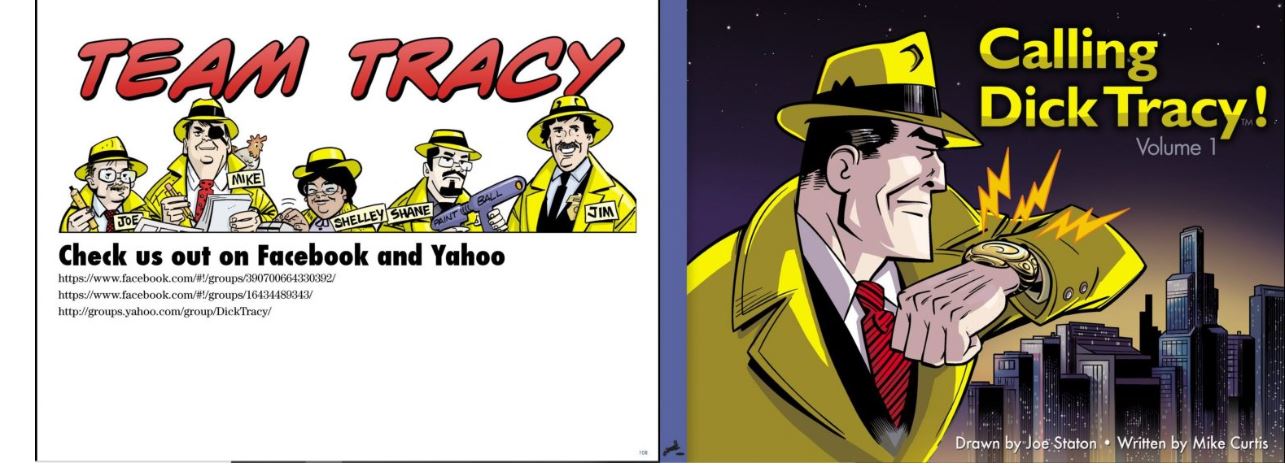
Calling Dick Tracy! volume 1


By Mike Curtis, Joe Staton & various (Rabbit Hole)
ISBN: 978-0-930645-11-0 (digital edition)

Time for another anniversary celebration. Dick Tracy is 95 in five months’ time, so here’s a superb collection crying out for revival in either physical or digital forms. Another time to agitate against the publishing powers-that-be, I think…

All in all, comics have a pretty good track record for creating household names. We could play the game of picking the most well-known fictional characters on Earth – usually topped by Sherlock Holmes, Mickey Mouse, Superman Batman & Tarzan – and supplement the list with Popeye, Blondie, Charlie Brown, Tintin, Spider-Man, Garfield, and – not so much now, but once, most definitely – Dick Tracy

At the height of the Great Depression cartoonist Chester Gould sought fresh strip ideas. The story goes that as a decent guy incensed by the exploits of gangsters like Al Capone (who monopolised front pages of contemporary newspapers) the doughty doodler settled upon the only way a normal man could fight thugs: Passion and Public Opinion.

Raised in Oklahoma, Gould was a Chicago resident who hated seeing his home town in the grip of such wicked men, with far too many honest citizens beguiled by the gangsters’ charisma. He decided to pictorially get it off his chest with a procedural crime thriller that championed the ordinary cops who protected civilisation.

He took his proposal –“Plainclothes Tracy” – to Captain Joseph Patterson, the legendary newspaperman and strips Svengali whose golden touch had already blessed strips like The Gumps, Gasoline Alley, Little Orphan Annie, Winnie Winkle, Smilin’ Jack, Moon Mullins and Terry and the Pirates among others. Casting his experienced eye on the work, Patterson promptly renamed the hero Dick Tracy, whilst also revising his love interest into steady, steadfast girlfriend Tess Truehart. The daily series launched on October 4th 1931 through Patterson’s own Chicago Tribune Syndicate, growing quickly into a phenomenon and monumental hit, with all the attendant media and merchandising hoopla that follows. Bolstered by toys, games, movies, serials, animated features, TV shows et al, the strip soldiered on, influencing generations of creators and entertaining millions of fans. Gould unfailingly wrote and drew the strip for decades until retirement in 1977.

The legendary lawman was a landmark creation who influenced not simply comics but the entirety of American popular fiction. Its signature use of baroque villains, outrageous crimes and fiendish death-traps pollinated the work of numerous strips (most notably Batman), shows and movies since then, whilst the indomitable Tracy’s studied, measured use – and startlingly accurate predictions – of crimefighting technology and techniques gave the world a taste of cop thrillers, police procedurals and forensic mysteries such as CSI decades before the modern fascination took hold.

As with many creators in it for the long haul, the revolutionary 1960s were a harsh time for well-established cartoonists. Along with Milton Caniff’s Steve Canyon, Gould’s grizzled gangbuster especially foundered in a social climate of radical change where popular slogans included “Never trust anybody over 21” and “Smash the Establishment”. The strip’s momentum faltered, perhaps as much from a move towards trendy science fiction (Tracy went off-Earth into space and the character Moon Maid was introduced) as from those improbable, Bond-movie-style villains or perceived “old-fashioned” attitudes. Even the introduction of more minority and women characters – and hippie cop Groovy Groove – couldn’t stop the rot. However, the feature soldiered on regardless…

When Gould retired in 1977, 29-year old author Max Allen Collins (Road to Perdition, Nathan Heller, Mike Mist, Ms. Tree, Batman) won the prestigious role as scripter, promptly taking the series back to its crime-busting roots for a breathtaking run, ably assisted by Gould as consultant with his chief artistic assistant Rick Fletcher promoted to full illustrator. After 11 years, Collins was removed in 1992 and replaced by Mike Kilian – who apparently worked for half the up-&-coming novelist’s price – until his death in October 2005. Dick Locher took over story & art, with assistant Jim Brozman assuming drawing duties from March 2009. On January 19th 2011, Tribune Media Services announced Locher’s retirement and replacement by a new team. That’s where this digital-only book begins…

Atoudingly versatile and unbelievably prolific artist/inker Joe Staton (E-Man, Mike Mauser, The Avengers, Incredible Hulk, Green Lantern, Legion of Super-Heroes) has been an integral part of American comic books since the early 1970s and in later years made kids comics his metier. During a spectacular run on licensed classic Scooby Doo, he and series scripter Mike Curtis (Casper the Friendly Ghost, Richie Rich, Shanda the Panda) discovered a mutual love for Dick Tracy and – mostly for their own amusement – created a tribute strip entitled Major Crime Squad.

How that landed them the duty of continuing the ultimate cop’s official adventures is addressed in introductory text feature ‘Publisher’s Note – aka “The Dick Tracy vs. Major Crime Squad Caper”’ by Steve Tippie (VP of Licensing, TMS News & Features, LLC) before a stunning chronological re-presentation of all-new classics begins. Preceding those comic capers are more text-based insights and revelations: a Foreword by Mike Gold; former sheriff Curtis’ ‘How We Got the Job’ (supplemented by samples done in 2005 when they first tried to take on the strip) and Staton’s ‘Waiting For Dick Tracy’

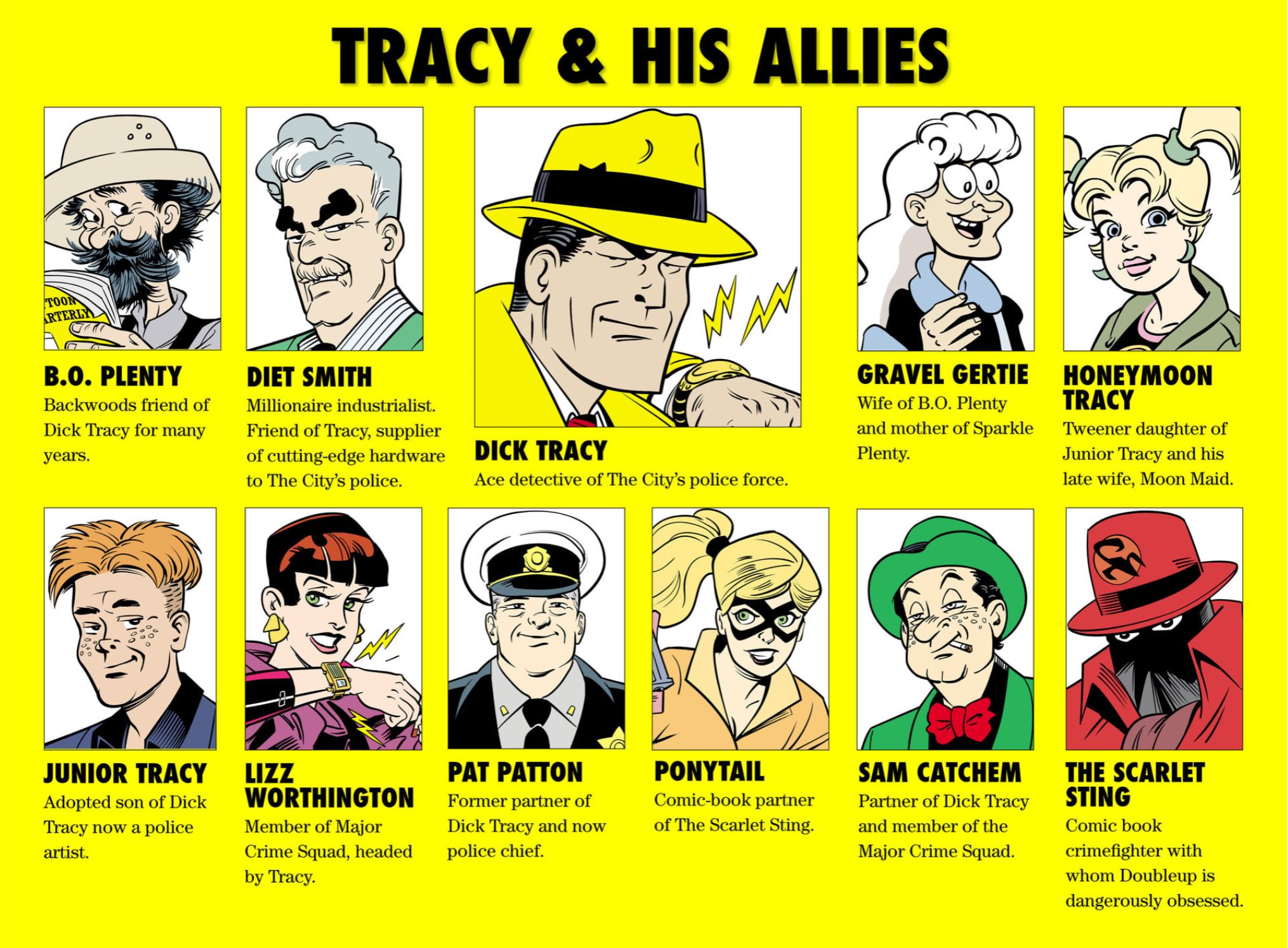
Next up is a brief visual refresher course of ‘Tracy and His Allies’ and the most nefarious of the repeat offenders in a ‘Rogues Gallery’ before the unending war on crime resumes in ‘Flyface and The Fifth Return’.

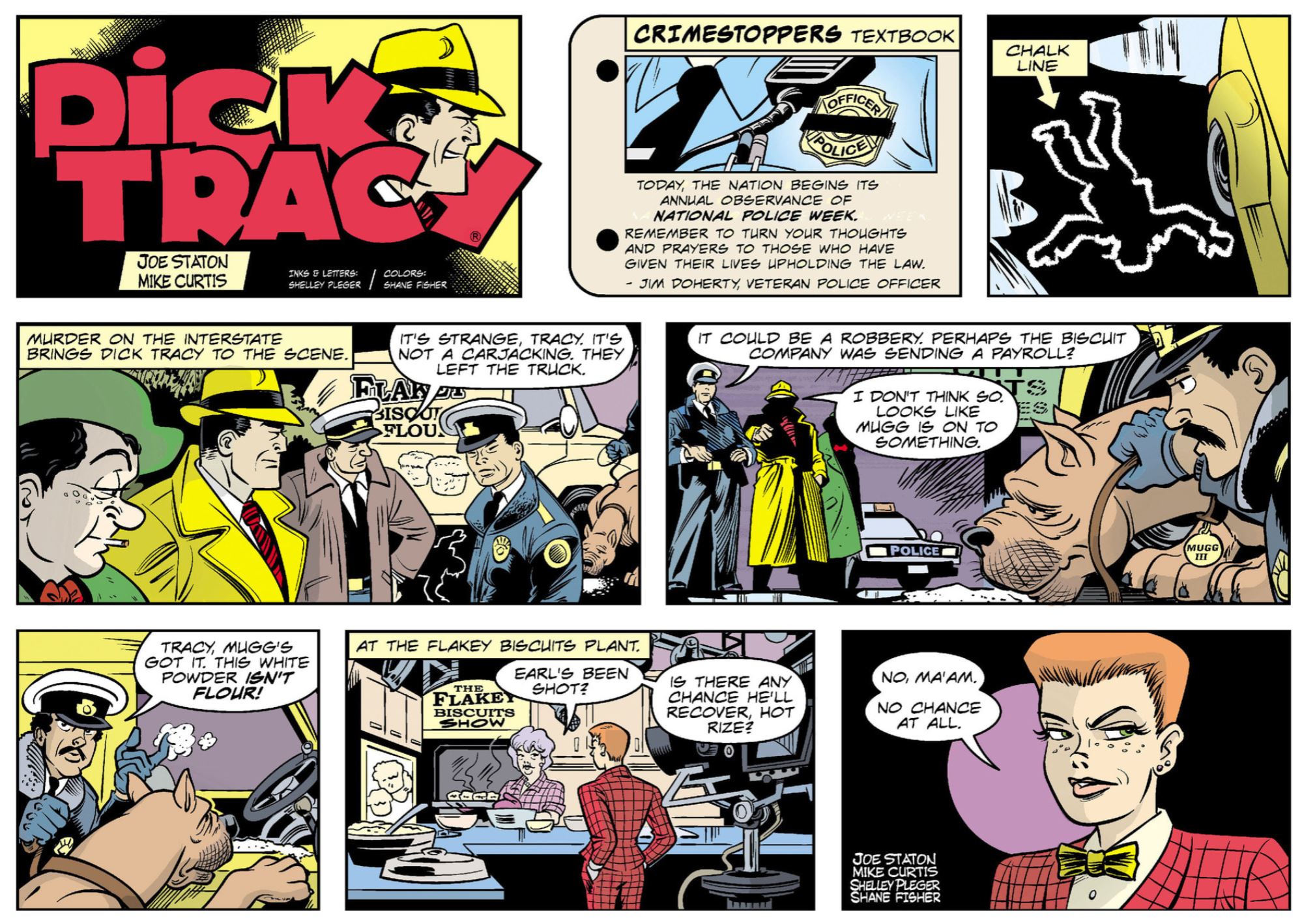
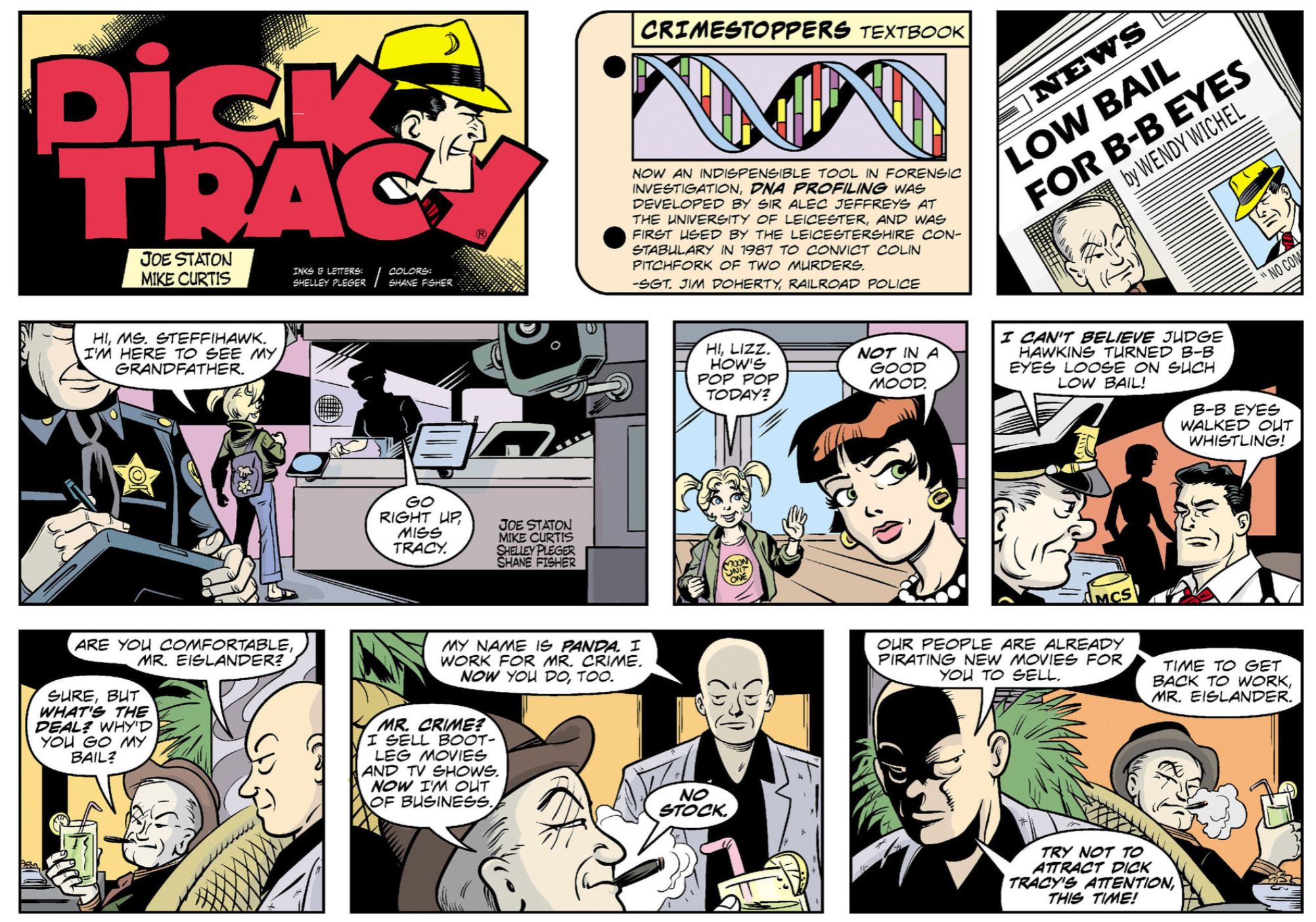
The strip has sadly long passed its heady glory days of mass sales, but that’s more about the death of print periodicals than this material. It still appears in a number of papers and as a potent online presences which means every episode is in full colour, with half-page Sunday strips still offering extras such as the ‘Crimestoppers Textbook’. One welcome addition is full credits so we can thank Shelley Pleger and Shane Fisher for their inks, colours and lettering. When Staton retired in October 2021, Pleger drew the feature, which these days is limned by Charles Ettinger…

The plot here sees the long separated traditional squad fully reunited to combat right wing terrorism and gradually reintroduced to the fanciful gadgets and controversial space tech after Tracy’s inventor pal Diet Smith gets in touch. A disgruntled former employee has stolen plans for his energy-beam weapon “Thor’s Hammer”…

After selling it to old lags Flyface and The Fifth – who kidnap officer Lizz Worthington to set a trap for their old nemesis – events spiral out of control, but only the wicked pay the final price this time…

Longtime comedic characters B.O. Plenty and his wife Gravel Gertie then resurface, celebrating the birth of their second child – the ugliest boy on Earth! – before falling foul of a manipulative foodie TV celebrity who sees a chance to own the airwaves with the stomach-churning infant in ‘Flakey Biscuits Makes the Dough’. Sadly, her bribing gifts to the couple include a shipment of cocaine being secretly couriered by her assistant Hot Rize, and soon bodies start dropping as the city’s top drug lord seeks to recover his missing product. Once Tracy realises what’s what, it’s all over bar the shooting…

‘Doubleup and the Scarlet Sting’ features the making of a movie starring a fictional superhero and depicts how childhood fan and modern-day gangster Doubleup barges in: infiltrating the cast to shakedown the production. Soon he’s too involved and after murdering his girlfriend all that’s left is being caught facing real-world justice…

At this time alternate Sunday extra ‘Tracy’s Hall of Fame’ (celebrating police officers) began, days before an officially deceased and clearly incorrigible arch enemy reappeared in ‘B-B Eyes and Honeymoon’. When Tracy’s adopted son Junior goes undercover to investigate a video piracy ring, the case quickly drags in the old cop’s granddaughter too, after Honeymoon Tracy tries to help out and almost dies because of her enthusiasm and lack of training.

Even with the comics component concluded, there’s more informational extras to enjoy as Curtis offers ‘Dick Tracy vs. the Villains: A Comparison’ and we meet the current creators in ‘Joe Staton’s Bio’, ‘Mike Curtis’ Bio’ and ‘Team Tracy Bios’ to close this initial casebook – hopefully the first of many.

Dick Tracy has always been a fantastically readable feature and this potent return to first principles is a terrific way to ease yourself into his stark, no-nonsense, Tough Love, Hard Justice world. Comics just don’t get better than this.
© 2013 TMS News & Features, LLC. All rights reserved.

On this day in 2003, Jerry Bittle’s redneck-ribbing strip Geech appeared for the final time, but the date is shared by a host of birthday boys and girls including French illustrator Paul Léonnec in 1842; publisher Clay Geerdes in 1934; Argentinian Lucho Olivera (Nippur de Lagash, Gilgamesh the immortal) in 1942 and undying legend Barry Windsor-Smith in 1949. Stan (Usagi Jojimbo) Sakai arrived in 1953; both Mark (Breathtaker, Tug & Buster, Sandman) Hempel and Publisher Terry Nantier in 1957 and mangaka Tomoko Ninomiya (Nodame Cantabile) in 1969.

Casey Ruggles – A Saga of the West: King of the Horsemen/the Prophet Julius/Juan Soto (Daily Strips 1951)


By Warren Tufts & various (Western Winds Productions)
No ISBN

This book includes Discriminatory Content produced in less enlightened times.

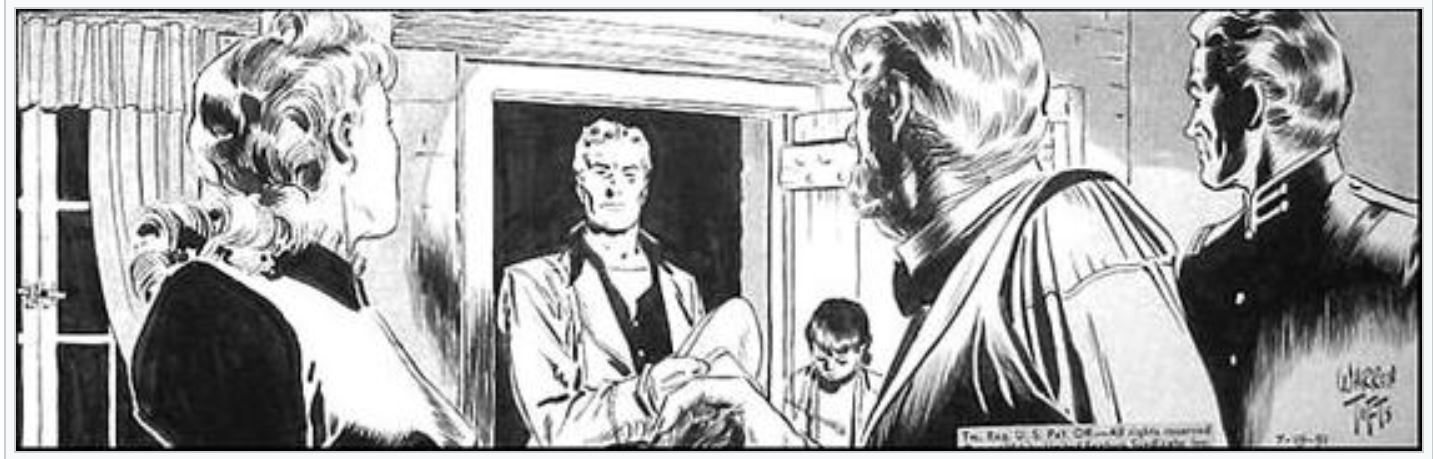
The newspaper strip Casey Ruggles – A Saga of the West used that genre’s motifs and scenarios to tell a broad range of stories stretching from shoot-’em-up dramas to comedy yarns and even the occasional horror story. The titular hero was a dynamic ex-cavalry sergeant and sometime US Marshal as he made his way to California. He’d been doing that since 1849, hoping to find his fortune, but was frequently distracted and diverted by meeting historical personages like Millard Fillmore, William Fargo, Jean Lafitte and Kit Carson in gripping two-fisted action-adventures. This was the narrative engine of both features until 1950 whereupon daily and Sunday strips divided into separate tales.

Warren Tufts was a phenomenally talented illustrator and storyteller born too late. He is best remembered now – if at all and probably not in English-speaking countries – for creating two of the most beautiful western comics strips of all time: Ruggles and elegiac, iconic Lance.

Sadly, Tufts began his career at a time when the glory days of syndicated newspaper strips were gradually giving way to the television age of ostensibly free family home entertainment. Had he been working scant years earlier in adventure’s Golden Age he would undoubtedly be a household name – at least in comics fans’ homes.

Born on Christmas Day, 1925. Tufts was a superbly meticulous draughtsman with an uncanny grasp of character and a great ear for dialogue. His art was effective and grandiose in the representational manner, favourably compared to both Hal Foster’s Prince Valiant and Alex Raymond. On May 22nd 1949 he began Ruggles as a full-colour Sunday page, and added to it with a black and white daily strip which began on September 19th of that year.

Tufts worked for United Features Syndicate, owners of such popular strips as Fritzi Ritz and L’il Abner, and his lavish, expansive tales were crisply told and highly engaging, but he was a compulsive perfectionist and regularly worked 80-hour weeks at the drawing board… and consequently often missed deadlines. This led him to use many assistants like Al Plastino, Rueben Moreira and Edmund Good. Established veterans Nick Cardy and Alex Toth also spent time working as “ghosts” on the series, with Cardy’s stint reproduced in this volume.

Due to a falling-out with his syndicate, Tufts left this wonderful western creation in 1954 and Al Carreño continued Ruggles until its demise in October 1955. The departure came when TV producers wanted to turn the strip into a weekly television show. Apparently UF baulked, suggesting the show would harm the popularity of the strip!?

Tufts formed his own syndicate for his next and greatest project, Lance (probably the last great full page Sunday strip and another series crying out for a high-quality collection) before moving peripherally into comic-books, working extensively for West Coast outfit Dell/Gold Key, drawing various westerns and TV show tie-ins like Wagon Train, Korak son of Tarzan, The Amazing Chan and the Chan Clan and a long run on the Pink Panther comic book. Eventually, he quit drawing completely, working as an actor, voice-actor and eventually in animation on such shows as Challenge of the Super Friends.

Tufts had a lifelong passion for flying, even building his own planes. In 1982 whilst piloting one he crashed and was killed.

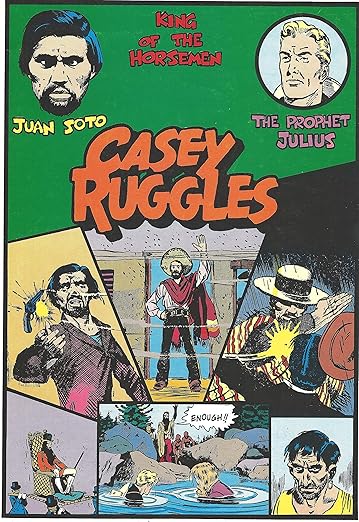
Pacific Comics Club collected many “lost strip classics” at the start of the 1980s, including six volumes (to my knowledge) of Casey Ruggles adventures. This was the fourth stupendous monochrome volume (approximately 15 inches x 10 inches) and contains stories that highlight Tufts’ love of Western history, facility for comedy and innovative willingness to take chances in three tales from the strip’s third year.

The first is a traditional cowboy story featuring the clandestine return of an old foe. ‘King of the Horsemen’ originally ran 14th May to 23rd June 1951, and saw a mysterious “Sonoran” (in actuality Mexican bandit Joaquin Murietta) challenge all the miners in a gold town to test their riding skills against his own.

Bored and cash rich but not stupid, the gambling fools call in Marshal Ruggles to do the rough riding…

This is an engrossing, informative little gem, softly sardonic and luxuriating in the minutiae of the historical west and cowboy mythology. Art lovers will also have the joy of comparing two master realists as Tufts, ever-strapped to meet his punishing deadlines, surrendered the greater part of the tale (all the racing, chasing and action-stunting) to Cardy, keeping only the first and last weeks’ episodes for himself. This was probably to give himself a little leeway on the next adventure ‘The Prophet Julius’; a dark, clever yarn about a greedy flim-flam man and the eerie power he exerted on an isolated outpost.

Running from June 25th to August 11th 1951, the action begins with a shooting star crashing to earth, closely followed by a mesmerising soothsayer terrifying, coercing and ultimately hypnotising miners into handing over their wealth. With even Ruggles helpless, the township pull together to craft a solution no Hollywood hack has ever considered…

The six-gun thrills conclude here with another unsung innovation wherein Tufts adapted the documentary/Film Noir style prevalent in the B-Movie gangster films of the time to create a prototype graphic-novel police procedural that would do Rick Geary proud.

The predominantly Mexican Vasquez Gang terrorized the simple folk of rural California for nearly 15 years, with outlaws captured or killed only to be replaced by ever more bloodthirsty villains. ‘Juan Soto’ was one such and the pursuit of him was perfectly incorporated into a clever tale of organised man-hunting by Tufts. Soto was actually killed in a gunfight with Alameda County Sheriff Harry Morse. Here though the bandit’s increasingly obnoxious depredations draw Ruggles into a posse with five other lawmen who undertake a legendary trek through rugged country, ending in a fearsomely authentic, grimly chilling siege and showdown.

Human intrigue and fallibility, bombastic action and a taste for the bizarre reminiscent of the best John Ford or Raoul Walsh movies make Casey Ruggles the ideal western strip for the discerning modern audience. Westerns are a uniquely perfect vehicle for drama and comedy, and Casey Ruggles is one of the very best produced in America: easily a match for the usually superior European material like Tex Willer or Lieutenant Blueberry.

Surely the beautiful clean-cut lines, chiaroscuric flourishes and sheer artistic imagination and veracity of Warren Tufts can never be truly out of vogue? These great tales are desperately deserving of a wider following, and I’m still praying some canny publisher knows a good thing when he sees it…
© 1950, 1951 United Features Syndicate, Inc. Collection © Western Winds Productions. All Rights Reserved.

Yesterday in 1919 comic book scribe Robert Bernstein (Crime Does Not Pay, Superman, Superboy, Aquaman, Superman’s Girl Friend, Lois Lane, Superman’s Pal Jimmy Olsen, Psychoanalysis, Thor, Iron Man) was born, as was British illustrator and horrorist John Bolton (Marada, X-Men, Shame) in 1951; Brazilian Mike Deodato Jr. (Spider-Man, Dark Avengers, Wonder Woman) in 1963 and Great Briton Mark Buckingham (Fables, Spider-Man, Marvelman) in 1966.

On that date in 1994 we lost pioneering fan/journalist/historian and publisher Don Thompson, and master illustrator John Prentice (Young Romance, Fireman Farrell, Rip Kirby) in 1999.

Today in 1912, strip cartoonist Alfred Andriola (Kerry Drake) was born, followed in 1919 by both Harvey Comics artist Sid Couchey (Ritchie Rich, Little Lotta, Little Dot) and Saturday Evening Post cartoonist Irwin Caplan (Famous Last Words). In 1925 Carmine Infantino was born. Latterly, in 1957 a different world greeted German creator Walter Moers (Das kleine Arschloch) and in 1963 Michael Chabon (Amazing Adventures of Kavalier & Clay)

In 1959 on this date Frank Giacoia’s Johnny Reb and Billy Yank strip ended, whilst in 1992 Japanese collective CLAMP launched groundbreaking manga X. In 1962 US comics illustrator Victor Forsythe (Joe Jinx) died as did Spirou’s veteran art mainstay Pierre Seron (Les Petits hommes, Les Centaures, Les Petites Femmes) in 2017.

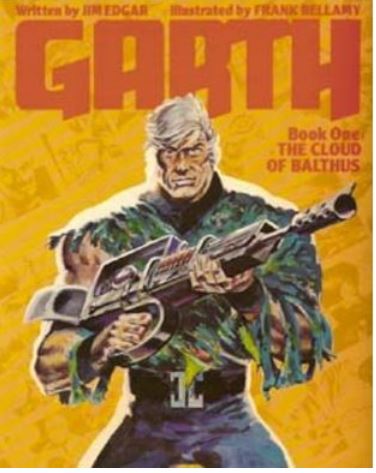
Garth: The Cloud of Balthus (volume 1)


By Frank Bellamy & Jim Edgar, with John Allard (Titan Books)
ISBN: 978-0-90761-034-2 (Album TPB)

This book includes Discriminatory Content produced in less enlightened times.

Frank Alfred Bellamy (21st May 1917 – 5th July 1976) is one of British Comics’ greatest comics artists. In the all-too-brief years of his career he produced magnificent, unforgettable visuals for Eagle, TV21, Radio Times (Doctor Who) before taking over The Daily Mirror newspaper strip Garth in 1971. He turned that long-running yet meandering and occasionally lacklustre strip into a magnificent masterpiece of unmissable adventure fantasy, with eye-popping, mind-blowing monochrome art other artists were proud to boast they swiped from. However, after only 17 stories, Bellamy died suddenly in 1976; and it’s absolutely criminal that his work isn’t in galleries, let alone in permanent collected book editions.

Bellamy was born in 1917 but didn’t begin comic strip work until 1953: the Monty Carstairs strip for Mickey Mouse Weekly. From there he moved on to Hulton Press and drew features starring Swiss Family Robinson, Robin Hood and King Arthur for Swift, the “junior companion” to Eagle. In 1957, he moved on to the star title, producing standout, innovative work on a variety of strips, beginning with a biography/hagiography of Winston Churchill. ‘The Happy Warrior’ was followed by ‘Montgomery of Alamein’, ‘The Shepherd King – the story of David’ and ‘The Travels of Marco Polo’, from which Bellamy was promptly pulled only a few months in. As Peter Jackson took over the back page historical adventure, Bellamy was on his way to the front cover and The Near Future.

When Hulton were bought by Odhams Press there soon manifested irreconcilable differences between Frank Hampson and the new management. Dan Dare’s creator left his superstar baby and Bellamy was tapped as replacement – although both Don Harley & Keith Watson were retained as Frank’s assistants. For a year Bellamy produced “The Pilot of the Future”: redesigning the entire look of the strip at management’s request, before joyfully stepping down to fulfil a lifetime’s ambition.

For his entire life Frank Bellamy had been fascinated – almost obsessed – with Africa. When asked if he would like to draw a big game hunter strip he didn’t think twice and Fraser of Africa debuted in August 1960, a single page per week in the prestigious full-colour centre section. Fraser of Africa was an artistic landmark and Bellamy’s techniques of line and hatching, in conjunction with sensitive, atmospheric colours, and even his staging and layout of pages, led to majestic Heros the Spartan and eventually the bravura creativity displayed in Thunderbirds and Captain Scarlet strips for TV21, before he opted for the strictures of monochrome and a single tier of 3-4 panels a day…

British Superman Garth first appeared in The Daily Mirror on Saturday, July 24th 1943, the creation of professional cartoonist Steve Dowling and BBC radio producer Gordon Boshell, at the behest of the editor who wanted an adventure strip to complement their other comic strip features: Buck Ryan, Belinda Blue Eyes, Just Jake and immortal, demi-immoral, morale-boosting Jane.

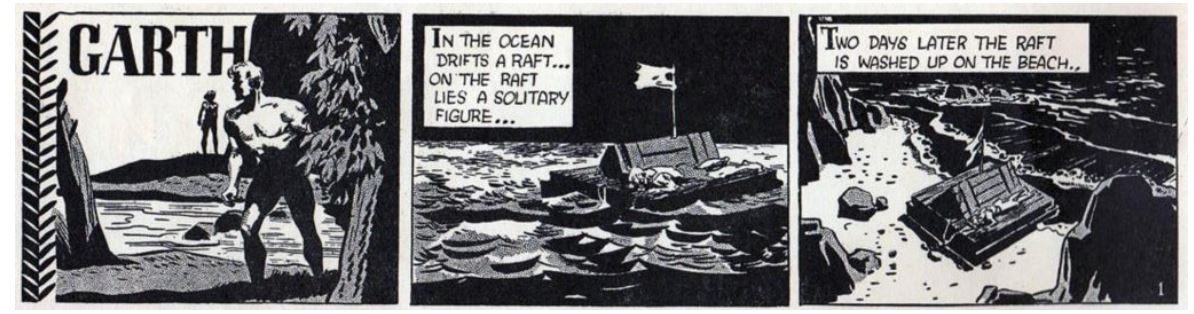
A blond giant and physical marvel with no memory of who he was, Garth washed up on an island shore and into the arms of a pretty girl… Gala. Nonetheless, he saved the entire populace from a brutal tyrant and a legend began. Boshell never had time to write the series, so Dowling – already producing successful family strip The Ruggles – scripted Garth until a new writer could be found. Don Freeman dumped the amnesia plot in ‘The Seven Ages of Garth’ (which ran from September 18th 1944 until January 20th 1946) by introducing imposing jack-of-all-sciences Professor Lumiere, whose subsequent psychological experiments regressed the burly hero back through some past lives.

In the next tale ‘The Saga of Garth’ (January 22nd 1946 – July 20th 1946) the origin was revealed. As an infant, “Garth” had been found floating in a coracle off the Shetlands and adopted by a kindly old couple. When full grown he became a Navy Captain until he was torpedoed off Tibet in 1943…

Freeman continued as writer until 1952 (‘Flight into the Future’ was his last tale), and was briefly replaced by script editor Hugh McClelland (who only wrote ‘Invasion From Space’) until Peter O’Donnell took over in February 1953 with ‘Warriors of Krull’. O’Donnell penned 28 adventures until resigning in 1966 to devote more time to his own strip: a little something called Modesty Blaise. His place was taken by Jim Edgar; a short-story writer who also scripted such prestigious newspaper strips as Matt Marriott, Wes Slade and Gun Law.

Dowling retired in 1968 and his long-time assistant John Allard took over the strip until a suitable permanent artist could be found. Allard completed ten complete tales until Frank Bellamy began a legendary run with the 13th instalment of ‘Sundance’ (which ran from 28th June to 1 October 11th 1971). Allard remained as background artist and assistant until Bellamy took full control during ‘The Orb of Trimandias’.

One thing Professor Lumiere had discovered and which gave this strip its distinctive appeal even before the fantastic artwork of Bellamy elevated it to dizzying heights of graphic brilliance, was Garth’s involuntary ability to travel through time and re-experience past and future lives. This simple concept lent the strip an unfailing potential for exotic storylines and fantastic exploits, pushing it beyond its humble beginning as a British response to Siegel & Shuster’s American phenomenon Superman.

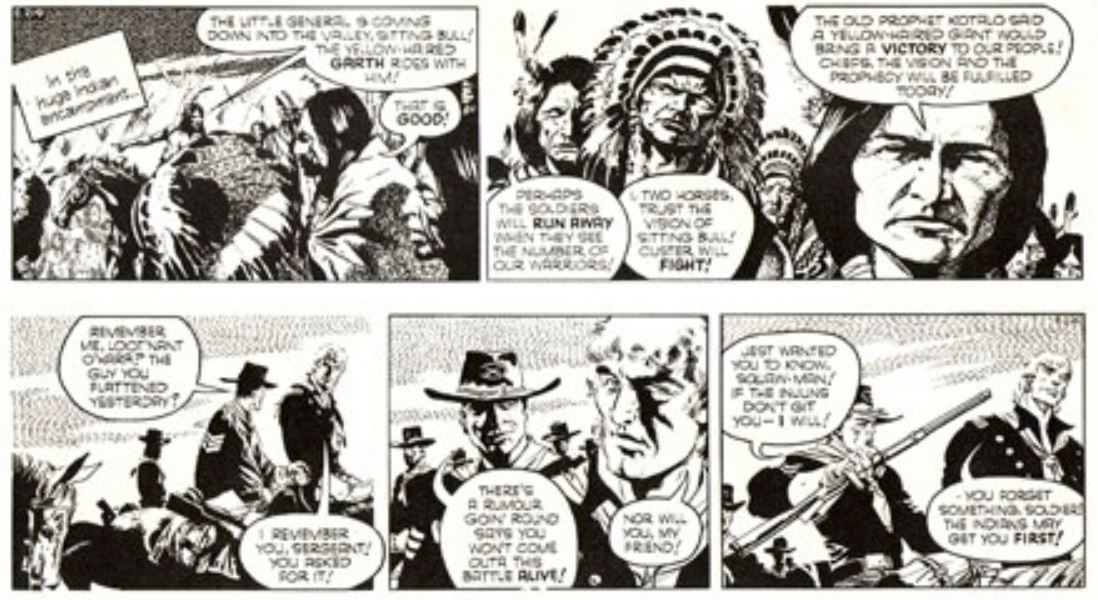
The tales in this criminally out of print monochrome tome begin with the aforementioned ‘Sundance’ as mighty Garth is drawn back to 1876 to relive his life as an officer of George Custer’s 7th Cavalry on the eve of the Battle of the Little Big Horn.

The time-tossed titan has a brief but passionate love affair with Indian maiden Falling Leaf before dying valiantly for his beliefs and their love. It is an evocative, powerful tale that totally captures the bigotry, arrogance and futility of the White Man and the tragic demise of the Indian way of life…

Then eponymous epic ‘The Cloud of Balthus’ shows the potent but simple elegance of the narrative concept sustaining Garth. Whilst vacationing in the Caribbean our hero becomes embroiled in an espionage plot involving freelance super-spies and a US space station, but even that is mere prelude to fantastic adventure and deadly terrors when he and delectable, double-dealing companion Lee Wan are abruptly abducted by nebulous energy beings in a taut, tension-fraught thriller.

‘The Orb of Trimandias’ plunges Garth back in time to Venice of the Borgias, when/where he becomes again English Soldier-of-Fortune Lord Carthewan: a decent man battling an insane and all-powerful madman for the secret of a supernaturally potent holy relic. This gripping, exotic yarn is replete with flamboyant action, historical celebrities, sexy men and women and magnificently stirring locales. It’s a timeless treasure of adventure that has the added fillip of briefly reuniting Garth with his star-crossed true love, ethereal Space Goddess Astra.

This lovely volume (long overdue for re-issue – at least in digital form if no other way is possible) concludes with a high-octane gothic horror story.

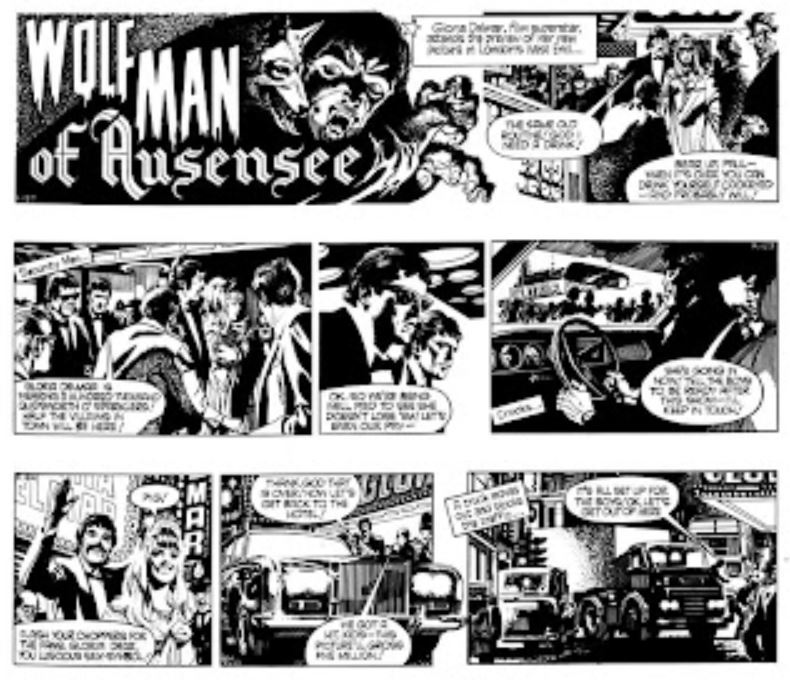
‘The Wolfman of Ausensee’ sees Garth as a rather reluctant companion of movie starlet Gloria Delmar on a shoot at the forbidding Austrian schloss (that’s a big ugly castle to you) of a playboy whose family was once cursed by witches. Despite the title giving some of the game away, this is still a sharp and savvy spook-fest comparing well to the best Hammer Horror films that no doubt inspired it, and just gets better with each rereading.

Garth is the quintessential British Action Hero: strong, smart, fast and good-looking with a big heart and nose for trouble. His back-story granted him all of eternity and every genre to play in, and the magnificent art of Frank Bellamy also made his too-brief tenure a stellar one.

Comic-strips seldom get this good, and even though this book and its sequel are still relatively easy (if not cheap) to come by, it is still a crime and an utter mystery that all these wonderful tales have been out of print for so long.
© 1984 Mirror Group Newspapers. All rights reserved.

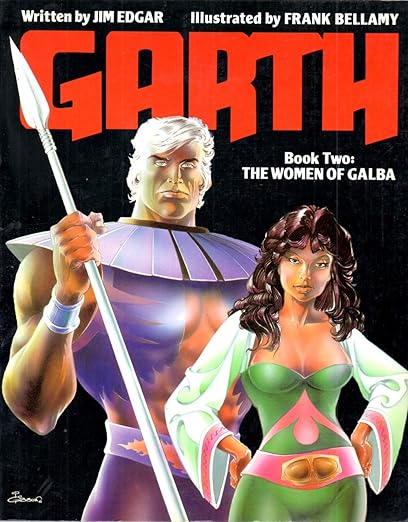
Garth: The Women of Galba (volume 2)


By Frank Bellamy & Jim Edgar (Titan Books)
ISBN: 978-0-90761-049-6 (Album TPB)

This book includes Discriminatory Content produced in less enlightened times.

A bold and daring blond giant and physical marvel, Garth was Britain’s answer to the blockbusting sensations of Superman, with the added advantage that the feature was officially aimed at adults rather than kids of all ages.

Originally released in 1985, this second Titan Books collection of Garth’s Frank Bellamy era spans 7th September 1972 to 25th October 1973 with the artist shown at the absolute peak of his powers, and opens with eerie chiller ‘The People of the Abyss’ wherein Garth and subsea explorer Ed Neilson are taken prisoner by staggeringly beautiful (what other kind are there?) naked women who drag their bathyscaphe to a city at the bottom of the Pacific. The undersea houris are at war with horrendous aquatic monstrosities and urgently need outside assistance, but even that incredible situation is merely prelude to a tragic love affair with Cold War implications…

Next up is eponymous space-opera romp ‘The Women of Galba’, wherein an alien tyrant learns to rue the day he abducted a giant Earthman to fight and die as a gladiator. Exotic locations, spectacular action and oodles more astonishingly beautiful females make this an unforgettable adventure for what the editors of the era still believed was a strip only grown men read…

‘Ghost Town’ is another western tale, and a very special one. When Garth, vacationing in Colorado, rides into abandoned mining outpost “Gopherville”, he is irresistibly drawn back to a past life as Marshal Tom Barratt who lived, loved and died when the town was a hotspot of vice and easily-purloined money. When Bellamy died suddenly in 1976 this tale – long acknowledged as his personal favourite – was rerun until Martin Asbury (who painted both Titan Book album covers here) was ready to take over the strip.

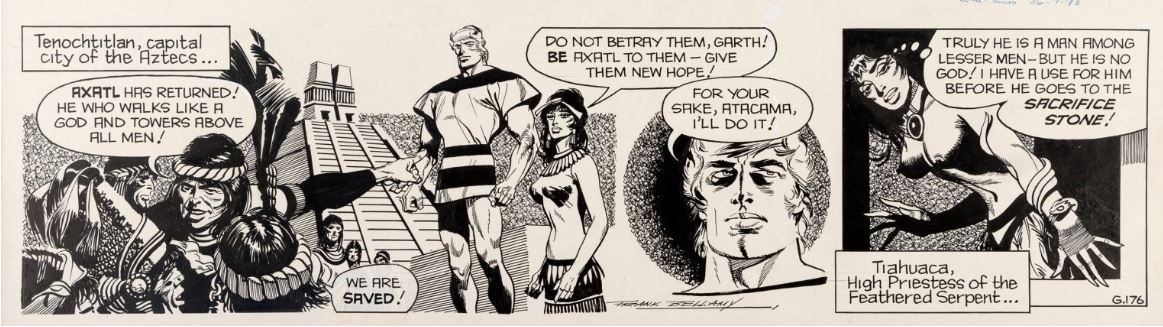
The final adventure re-presented here – ‘The Mask of Atacama’ – sees Garth & Lumiere in Mexico City. Whilst sleeping, the blonde colossus is visited by the spirit of Princess Atacama (also beautiful, of course) who escorts him through time to vanished Aztec city Tenochtitlan where, as the Sun God Axatl, Garth attempts to save their civilisation from the voraciously marauding Conquistadores of Hernán Cortés de Monroy y Pizarro Altamirano (as shortened for these brief 3-panel strip episodes to far more manageable Hernan Cortés)…

Tragically, neither Garth nor the Princess have reckoned on the jealousy of the Sun Priests and their High Priestess Tiahuaca

Adding extra value to this volume are a draft synopsis and actual scripts for ‘The Women of Galba’, all liberally illustrated.. There has never been a better comic adventure strip than Garth as drawn by Bellamy: a daily rip-roaring romp combining action, suspense, glamour, mystery and the uncanny in a seamless blend of graphic wonderment. In recent years, the comic strip colossus has fallen from memory as well as favour, but I’m still fervently praying that one day, Garth (and while I’m dreaming, Jeff Hawke too) will make the jump to curated complete archive editions. Go on, make on old man happy why don’t you? There’s certainly a grateful, appreciative and vast audience waiting…
© 1985 Mirror Group Newspapers/Syndication International. All Rights Reserved.

This day in 1915 Henry Sunday page illustrator Don Trachte was born, followed two years later by British legend Frank Bellamy (Fraser of Africa, Dan Dare, Garth, Heros the Spartan, Thunderbirds) and Mancunian émigré Lee Elias (Beyond Mars, Black Cat, Flash, Green Arrow, Eclipso, Luke Cage, Human Fly, Goblin, Rook) in 1920.

In 1943 French writer-artist Jean-Claude Fournier (Spirou and Fantasio, Bizu) was born as was writer/publisher Gary Reed (Sherlock Holmes, Deadworld, Saint Germaine, Baker Street, Caliber Comics) in 1956.

We lost pioneering Canadian cartoonist and animator Vital Achille Raoul Barré in 1932 and in 1977 gained a UK animal icon when Gnasher’s Tale (by David Sutherland) began, launching the manky mutt into his own Beano series detailing his life as a puppy before being adopted by Dennis the Menace

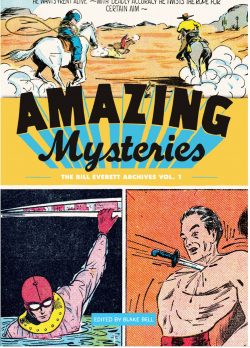
Amazing Mysteries: The Bill Everett Archives volume 1


By Bill Everett and others, edited and complied by Blake Bell (Fantagraphics Books)
ISBN: 978-1-60699-488-7 (HB/Digital edition)

This book includes Discriminatory Content produced in less enlightened times.

Thanks solely to modern technology and diligent research by dedicated fans, there is a sublime superabundance of collections featuring the works of too-long ignored founding fathers and lost masters of American comic books these days. A magnificent case in point is these curated chronicles (available in both print and digital formats) revisiting and yet barely touching upon the incredible gifts and achievements of one of the greatest draughtsmen and yarn-spinners our industry has ever seen.

You could save some time and trouble by simply buying them now rather than waste your valuable off-hours reading my preposterous blather and piffle, but since I’m keen to carp on anyway feel free to accompany me as I delineate just why these tomes need to join the books on your “Favourites” shelf.

The star under scrutiny here was a direct descendent and namesake of iconoclastic poet and artist William Blake. Bill was quite possibly the most technically accomplished artist in the US comic book industry and his tragic life and awe-inspiring body of work reveal how a man of privilege and astonishing pedigree was wracked by illness, addictive personality traits (especially alcoholism) and sheer bad luck, but nevertheless shaped an art-form. Bill Everett left twin legacies: an incredible body of superlative stories and art, and, more importantly, he redeemed many broken lives by becoming a dedicated mentor for Alcoholics Anonymous in his later years.

William Blake Everett was born in 1917 into a wealthy and prestigious New England family. Bright and precocious, he contracted tuberculosis at age twelve and was dispatched to arid Arizona to recuperate. This chain of events began a life-long affair with the cowboy lifestyle: a hard-drinking, chain-smoking, tall-tale-telling breed locked in a hard-to-win war against slow self-destruction.

All this and more is far better imparted in a scholarly, fact-filled, picture-packed Introduction by Blake Bell in Amazing Mysteries: The Bill Everett Archives volume 1. This covers the development of the medium in ‘The Golden Age of Comics’; the history of ‘Bill Everett the Man’ and how they came together in ‘Centaur + Funnies Inc. = Marvel Comics #1’. The essay also includes an astounding treasure trove of found images and original art, including samples from 1940s Sub-Mariner, 1960s Daredevil and 1970s Black Widow stories, amongst many others.

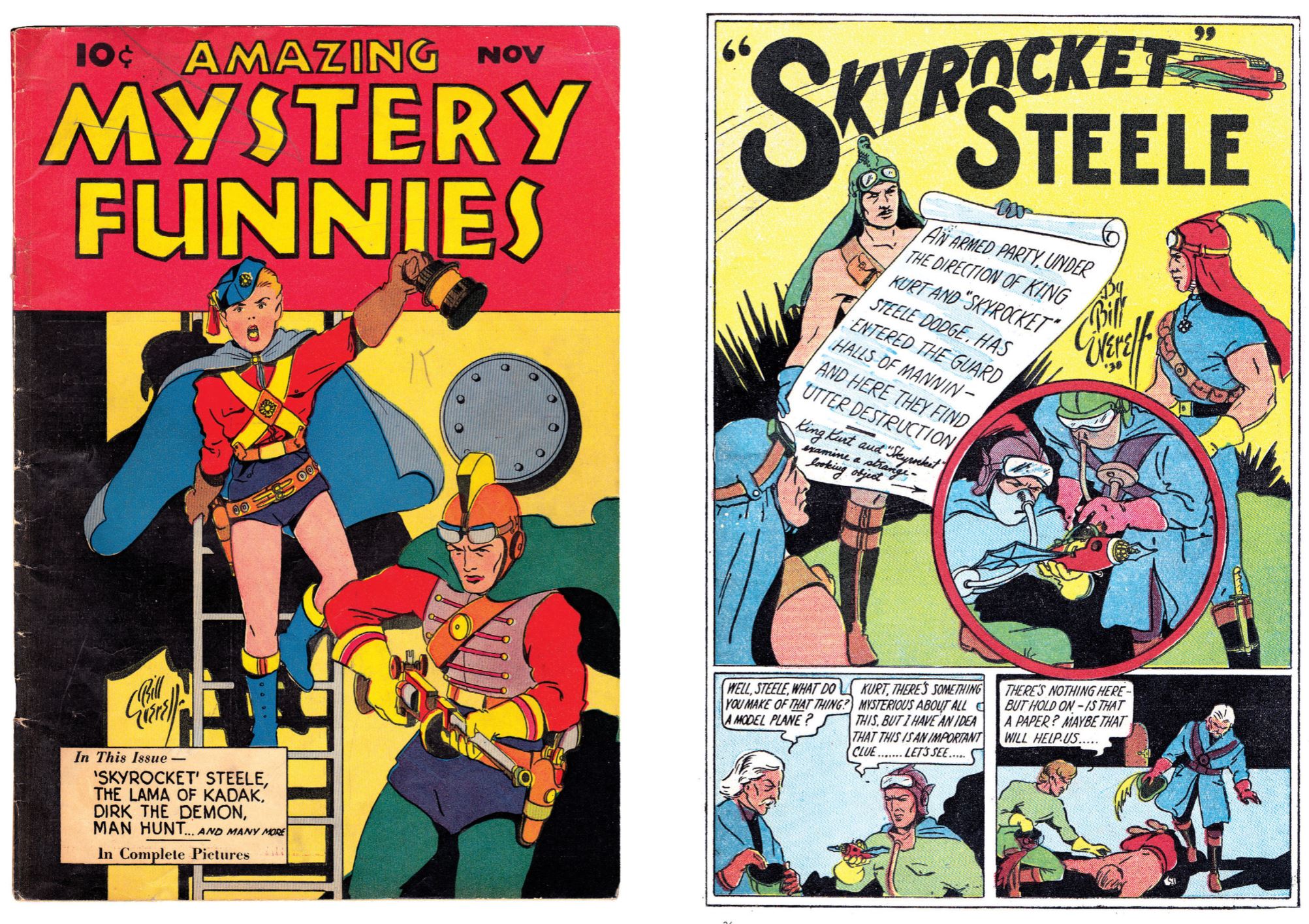
Accompanied by the covers (that’s the case for most of the titles that follow: Everett was fast and slick and knew just how to catch a punter’s eye) for Amazing Mystery Funnies vol. 1 #1, 2, 3a, 3b and vol. 2 #2 (August 1938 – February 1939, from Centaur) are a quartet of rousing but muddled interstellar exploits starring sci fi troubleshooter Skyrocket Steele. These are followed by a brace of anarchic outer space shenanigans starring futuristic wild boy Dirk the Demon culled from Amazing Mystery Funnies (vol. 1 #3a and vol. 2 #3; November 1938 & March 1939 respectively).

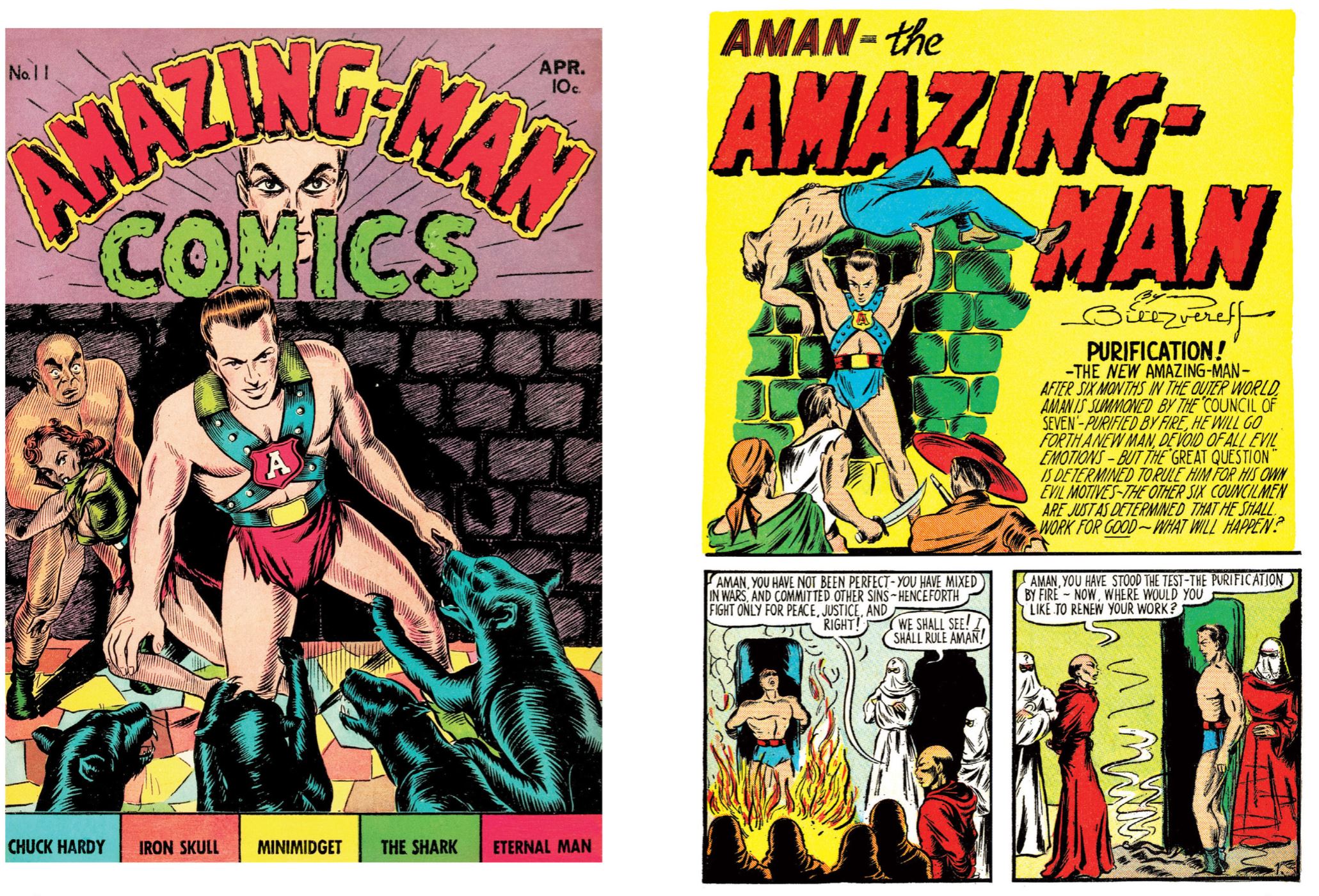
The undisputed star and big draw at Centaur was always Amazing-Man who was a Tibetan mystic-trained orphan, adventurer and do-gooder named John Aman. After many years of dangerous, painful study that young man was despatched back to civilisation to do good… for a relative given value of “good”…

Aman stole the show in monthly Amazing Mystery Comics (#5-8, spanning September -December 1939) as seen in the four breakneck thrillers re-presented here and opening with ‘Origin of Amazing-Man’ followed by an untitled sequel episode with the champion saving a lady rancher from sadistic criminals; ‘Amazing-Man Loose’ (after being framed for various crimes) and a concluding instalment wherein the nomadic hero abandons his quest to capture his evil arch rival ‘The Great Question’ and instead heads for recently invaded France to combat the scourge of Nazism…

As previously stated, Everett was passionately wedded to western themes and for Novelty Press’ Target Comics he devised an Arizona-set, rootin’ tootin’ cowboy crusader called Bull’s-Eye Bill. Taken from issues #1 & 2 (February & March 1940), ‘On the trail of Travis Trent’ and ‘The Escape of Travis Trent’ has our wholesome yet hard-bitten cowpoke battling the meanest, most determined owlhoot in the territory. Accompanying the strips is an Everett-illustrated prose piece attributed to “Gray Brown” entitled ‘Bullseye Bill Gets his Moniker’.

Thanks to his breakthrough Sub-Mariner sagas, Everett became inextricably linked to water-based action adventures and immensely popular, edgy heroes. That’s why Eastern Comics hired him to create human waterspout Bob Blake, Hydroman for their bimonthly anthology Reg’lar Fellers Heroic Comics.

Here – spanning issues #1-5 and August 1940 to March 1941- are five spectacular, eerily offbeat exploits, encompassing ‘The Origin of Hydroman’ and covering his patriotic mission to make America safe from subversion by “oriental invaders”, German saboteurs and assorted ne’er-do-wells, after which a Polar Paladin rears his frozen head. Sub-Zero Man debuted in Blue Bullet Comics vol. 1 #2 cover-dated July 1940. He was a Venusian scientist stranded on Earth who, through myriad bizarre circumstances, became a chilly champion of justice. Everett is only credited with the episode ‘The Power of Professor X’ (vol. 1 #5, October 1940) but also included here are the cover of vol. 1 #4 and spot illustrations for the prose stories ‘Sub-Zero’s Adventures on Earth’ and ‘Frozen Ice’ (from Blue Bullet Comics vol. 1 #2 and vol. 2 #3).

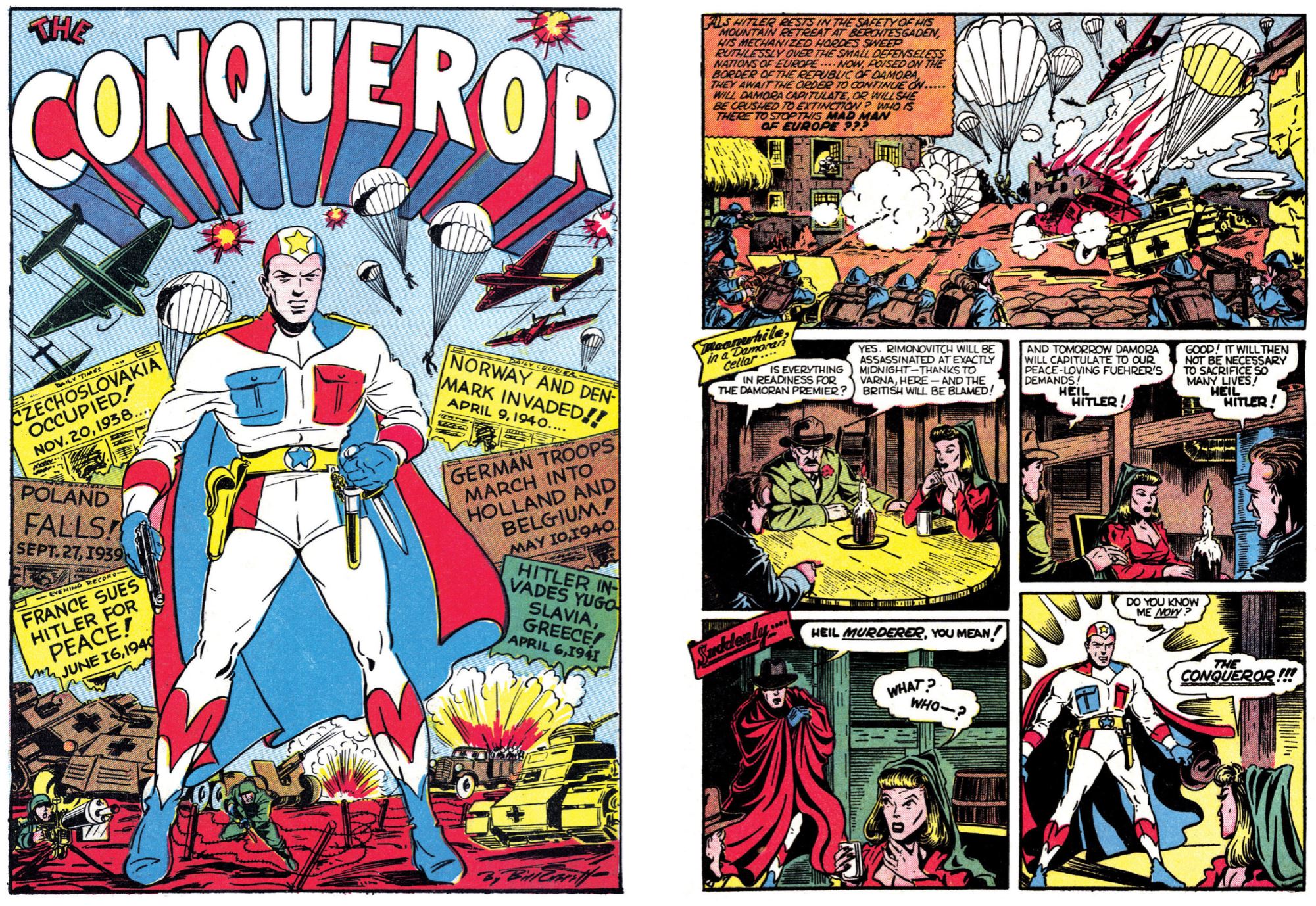
The Conqueror was another quickly forsaken Everett creation: a Red, White & Blue patriotic costumed champion debuting in August 1941’s Victory Comics #1. Daniel Lyons almost died in a plane crash but was saved by cosmic ray bombardment which granted him astounding mental and physical powers in ‘The Coming of the Conqueror’. He promptly moved to Europe to “rid the world of Adolf Hitler!” with Everett’s only other contribution being the cover of issue #2 (September 1941). Accompanied by a page of original artwork from Reg’lar Fellers Heroic Comics #12 (May 1941), The Music Master then details how dying violinist John Wallace was saved by mystic musical means and becomes a sonic-powered superman righting injustices and crushing evil…

Rounding out this initial cavalcade of forgotten wonders are a selection of covers, illustrations and yarns which can only be described as Miscellaneous (1938-1942). These comprise the cover to the 1938 Uncle Joe’s Funnies #1; procedural crime thriller ‘The C-20 Mystery’ (from Amazing Mystery Funnies vol. 2 #7, June 1939) and ‘The Story of the Red Cross’ from True Comics #2 (June 1938). The cover for 1941’s Dickie Dare #1 is followed by a range of potent images from text tales beginning with three pages for ‘Sheep’s Clothing’ (Funny Pages vol. 2 #11, November 1940); a potent pic for ‘Birth of a Robot Part 2’ (Target Comics vol. 1 #6, July 1940); two pages from ‘Death in a Box’ courtesy of Reg’lar Fellers Heroic Comics #5 (March 1941) and two from ‘Pirate’s Oil’ in RFHC #13 (July 1942), before the unpublished, unfinished 1940 covers for Challenge Comics #1 and Whirlwind Comics #1 bring the potent nostalgia to a close.
© 2011 Fantagraphics Books. Introduction © 2011 Blake Bell. All art © its respective owners and holders. All rights reserved.

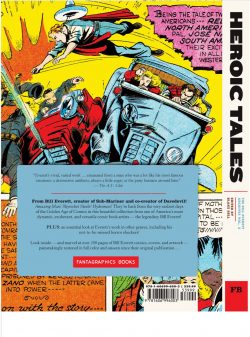
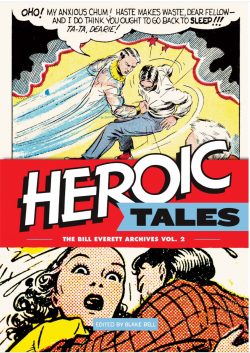
Heroic Tales: The Bill Everett Archives volume 2


By Bill Everett and others, edited and complied by Blake Bell (Fantagraphics Books)
ISBN: 978-1-60699-600-3 (HB/Digital edition)

This book includes Discriminatory Content produced in less enlightened times.

The second visit to the works of Bill Everett also opens with a fact-filled, picture-packed Introduction by Blake Bell which covers ‘The Early Years of Comics: 1938-1942’, ‘The Birth of Marvel Comics’ and ‘The Comic Book Production System’, before ‘The Heroes’ precedes a selection of astounding, astonishing prototypical adventure champions accompanied a brief essay on the set-up of Centaur Comics, Novelty Press, Eastern Color Printing, Hillman and Lev Gleason Publications.

Augmented by covers for Centaur’s Amazing Mystery Funnies vol. 2 #3, 5 & 6 (March, May & June 1939) are three outer space exploits of futuristic troubleshooter Skyrocket Steele, whilst Tibetan-trained superhero Amazing-Man offers a transformative triptych of titanic tales spanning war-torn Europe, augmented by covers to Amazing-Man Comics #9-11 (February-April 1940).

Everett’s deeply held sagebrush sentiments are served with another brace of barnstorming Bull’s-Eye Bill from Target Comics #3-4 (Novelty Press, April & May 1940) whilst from #7-9 (August-October 1940), the author smoothly switched to sophisticated suspense as master of disguise The Chameleon cunningly crushed contemporary criminals in scintillating escapades from Target Comics’ answer to The Saint, The Falcon and The Lone Wolf.

Everett’s other aquatic adventurer – Eastern Comics’ human waterspout Bob Blake, Hydroman returns next, as seen in Reg’lar Fellers Heroic Comics # 6-9 (May – November 1941, with Bill’s covers for #6 & 7): four spectacular, eerily, offbeat exploits, covering an extended battle against foreign spies and American Fifth Columnists, after which Red Reed in the Americas! (created by Bob Davis & Fitz) offers the first two chapters in a political thriller wherein a college student and his pals head South of the Border to fight Nazi-backed sedition and tyranny in a stunning tour de force first seen in Lev Gleason’s Silver Streak Comics #20 & 21 (April & May 1942).

A section of Miscellaneous and text illustrations follows, blending Western spot drawings with eye-catching covers from Amazing Mystery Funnies vol. 2 #18; Target Comics #5 & 6; Blue Bolt (vol. 1 #11, vol. 2 #1, 2 &~ 3) and Famous Funnies #85. The Humorous and More then details Everett’s forays into other markets: niche sectors such as licensed comics, comedy and romance, and even  a return to pulp and magazine illustration as he strove to stay one step ahead of a constantly shifting market and his own growing reputation for binges and unreliability.

‘What’s With the Crosbys?’ is a superbly rendered gossip strip from Famous Stars #2 (1950, Ziff-Davis) whilst a stunning monochrome girly-pin-up of ‘Snafu’s Lovely Ladies’ (from Marvel’s Snafu #3, March 1956), and the cover of Adventures of the Big Boy #1 (also Marvel, from the same month) lead into the back cover of Cracked #6 (December 1958, Major Magazines) and other visual features from that Mad magazine mimic, as well as the colour cover to less successful imitator Zany (#3, from March 1959). Everett’s staggering ability to draw beautiful women plays well in the complete romance strip ‘Love Knows No Rules’ (Personal Love #24, November 1953 Eastern Color), before this section concludes with a gritty monochrome title page piece from combat pulp War Stories #1, courtesy of Marvel’s parent company Magazine Management, and cover-dated September 1952.

The Horror concentrates on our post-superhero passion for scary stories: an arena where Bill Everett absolutely shone like a diamond. For more than a decade he brought a sheen of irresistible quality to the generally second-rate chillers Timely/Atlas/Marvel produced in competition with genre frontrunners EC Comics. It’s easy to see how they could compete and even outlive their gritty, gore-soaked competitor, with such lush and lurid examples of covers and chillingly beautiful interior pages…

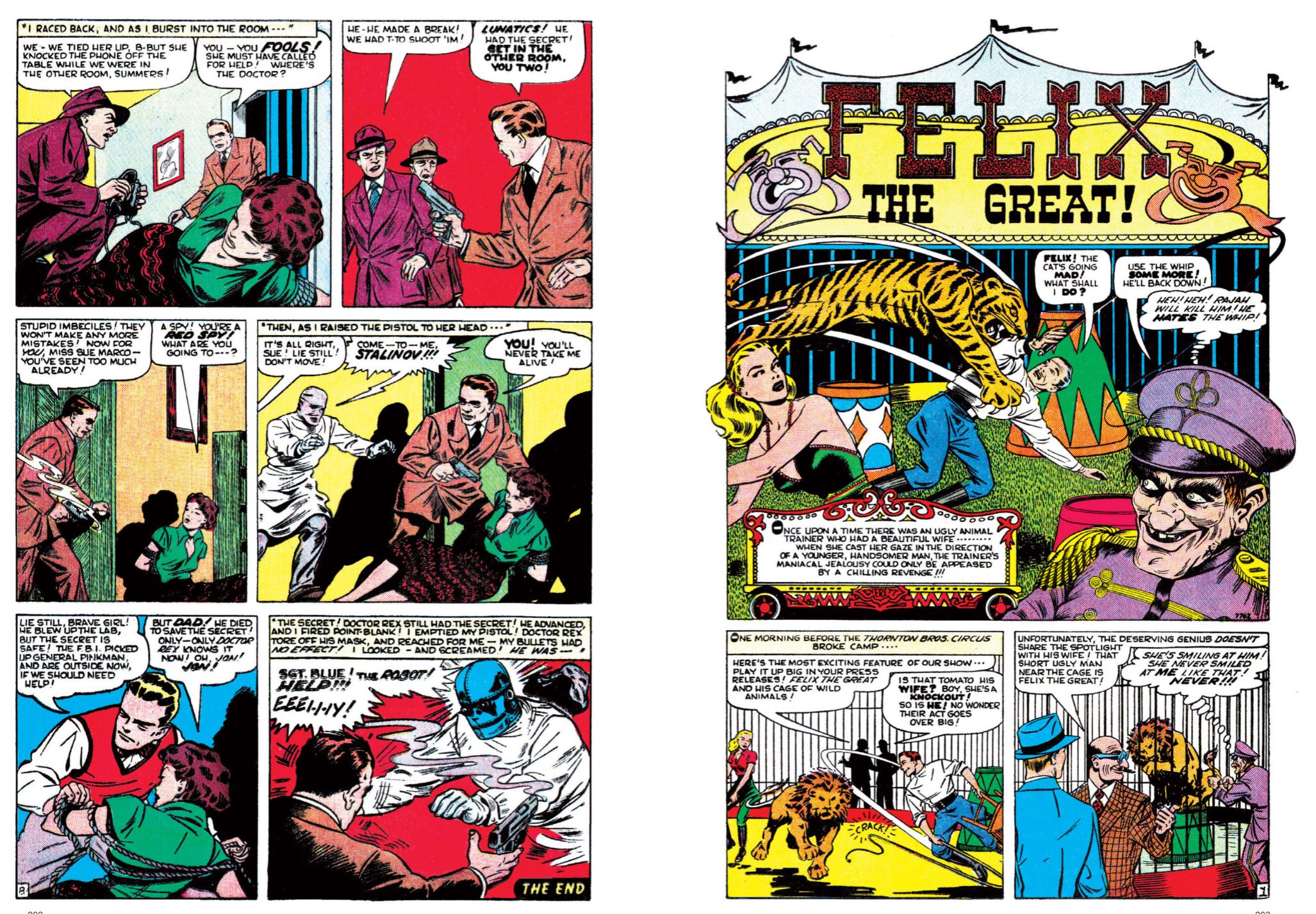
Following a third informative background essay detailing his life until its cruelly early end in 1973, a choice selection of his lesser known or celebrated efforts opens with tale of terror ‘Hangman’s House’ (Suspense #5, November, 1950),; a grim confrontation with Satanic evil, followed by futuristic Cold War shocker ‘I Deal With Murder!’ and a visit to a dark carnival of purely human wickedness in ‘Felix the Great’(both from Suspense #6, January 1951).

Adventures into Weird Worlds #4 (Spring 1952) offered a laconic, sardonic glimpse into ‘The Face of Death’, whilst from the following issue (April 1952) ‘Don’t Bury Me Deep’ tapped untold depths of tension in a moodily mordant exploration of fear and premature burial. Hard on the heels of the cover to Journey Into Unknown Worlds #14 (December 1952) comes one of its interior shockers as ‘The Scarecrow’ helps an aged couple solve their mortgage problems in a most unusual manner. The Marvel madness concludes with a cautionary tale of ‘That Crazy Car’ from Journey into Mystery #20, December 1954, concluding a far too brief sojourn amidst arguably Everest’s most accomplished works and most professionally adept period.

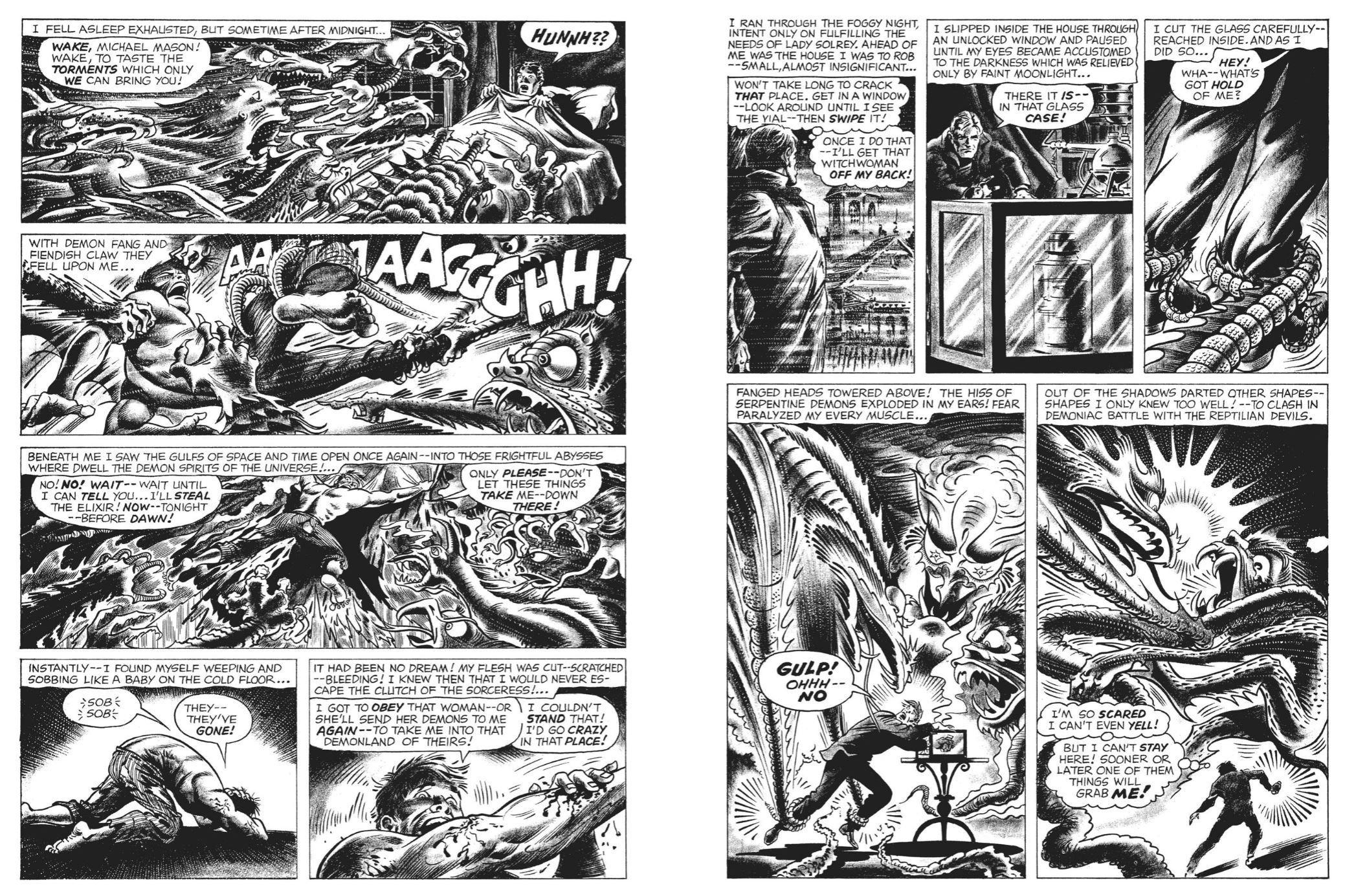
This magnificent collection ends with a gallery of pages and one complete tale from the end of his career; selected from an even more uninhibited publisher attempting to cash in on the adult horror market opened by Warren Publishing with Eerie, Creepy and Vampirella.

Skywald was formed by industry veteran Israel Waldman and Everett’s old friend Sol Brodsky, tapping into the burgeoning black-&-white, mature-reader market with supernatural flavoured magazines Hell-Rider, Crime Machine, Nightmare, Psycho and Scream. Offered an “in”, Everett produced incredible pin-ups (included here are three from Nightmare (#1, 2 & 4, December 1970-June 1971); ‘A Psycho Scene’ (Psycho #5, November, 1971); a stunning werewolf pinup from Psycho #6 and one of revived Golden Age monstrosity ‘The Heap’ from Psycho #4. Most welcome is a magnificent 10-page monochrome masterpiece of gothic mystery ‘The Man Who Stole Eternity’ from Psycho #3 (May, 1971).

Although telling, even revelatory and concluding in a happy ending of sorts, what these books truly celebrate is not the life but the astounding versatility of Bill Everett. A gifted, driven man, he was a born storyteller with the unparalleled ability to make all his imaginary worlds hyper-real; and for nearly five decades his incredible art and wondrous stories enthralled and enchanted everybody lucky enough to read them.
© 2013 Fantagraphics Books. Text © 2013 Blake Bell. All art © its respective owners and holders. All rights reserved.

Bill Everett was born today in 1917, as was Mad mainstay Don Martin in 1931, foundational Underground Commix publisher/empresario Don Donahue (AKA Apex Novelties) in 1942 and in 1953 both Alan Kupperberg (Blue Devil, Dragonlance) and Arthur Suydam (Cholly and Flytrap, Marvel Zombies).

Today in 2017, Oscar González Guerrero died. The Mexican comic artist, art director and educator had started taletelling in the 1950s and created Zor y Los Invencibles, Hermelinda Linda, Burrerías, Smog, Don Leocadio El Tío Porfirio, Las Aventures de Capulina and run ¡Ka-Boom! Estudio.

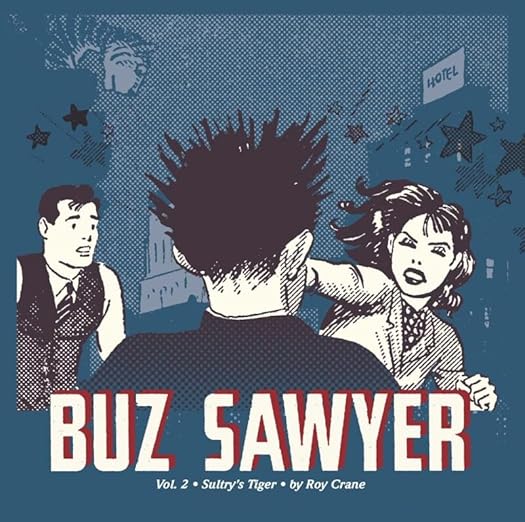
Buz Sawyer volume 2: Sultry’s Tiger


By Roy Crane  & various (Fantagraphics Books)
ISBN: 978-1-60699-499-3 (HB)

This book includes Discriminatory Content produced in less enlightened times.

Modern comics evolved from newspaper comic strips, and these pictorial features were, until relatively recently, utterly ubiquitous. Immensely information-efficient, hugely popular with the public and highly valued by publishers who used them as irresistible weapons to guarantee sales and increase circulation, the strips seemed to find their only opposition in the short-sighted local paper editors who often resented the low brow art form, which cut into advertising and frequently drew complaint letters from cranks…

It’s virtually impossible for us today to understand the overwhelming allure and power of the comic strip in America (and the wider world) from the Great Depression to the end of World War II. With no television, broadcast radio far from universal and movie shows at best a weekly treat for most folk, household entertainment was mostly derived from the comics sections of daily – and especially Sunday – newspapers. “The Funnies” were the most universally enjoyed recreation for millions who were well served by a fantastic variety and incredible quality of graphic sagas and humorous episodes over the years.

From the very start comedy was paramount; hence our terms Funnies and Comics, and from these gag-&-stunt beginnings, a blend of silent movie slapstick, outrageous fantasy and the vaudeville shows, came a thoroughly entertaining mutant hybrid: Roy Crane’s Wash Tubbs.

Debuting on April 21st 1924, Washington Tubbs II was a comedic, gag-a-day strip which evolved into a globe-girdling adventure serial. Crane produced pages of stunning, addictive and influential high-quality yarn-spinning for years, until his eventual introduction of moody swashbuckler Captain Easy ushered in the age of adventure strips with the landmark episode for 6th May, 1929. This in turn led to a Sunday colour page for the good captain that was possibly the most compelling and visually imaginative of the entire era (see Roy Crane’s Captain Easy, Soldier of Fortune: The Complete Sunday Newspaper Strips vol 1 ).

Practically improving minute by minute, the Sunday strip benefited from Crane’s relentless quest for perfection his imaginative, fabulous compositional masterpieces achieving a timeless immediacy that made each page a unified piece of sequential art. The influence of those pages can be seen in the works of near-contemporaries such as Hergé, giants-in-waiting like Charles Schulz and comic book masters like Alex Toth and John Severin ever since.

The material was obviously as much fun to create as to read. In fact, the cited reason for Crane surrendering the Sunday strip to his assistant Les Turner in 1937 was NEA/United Features Syndicate’s abrupt and arbitrary demand that all its strips must henceforward be produced in a rigid panel-structure to facilitate their being cut up and re-pasted as local editors dictated.

They just didn’t lift the artist any more, so Crane stopped making them.

At the height of his powers Crane just walked away from the astounding Captain Easy Sunday page to concentrate on the daily feature, and when his contract expired in 1943 he left United Features, lured away by that grandee of strip poachers William Randolph Hearst. The result was a contemporary aviation strip set in still-unfolding World War II: Buz Sawyer.

Where Wash Tubbs was a brave but largely comedic Lothario and his pal Easy a surly, tight-lipped he-man, John Singer “Buz” Sawyer was a joyous and sharp amalgam of the two: a good-looking, popular country-boy who went to war because his country needed him..

Buz was a fun-loving, skirt-chasing, musically-inclined naval aviator daily risking his life with his devoted gunner Rosco Sweeney: a bluff, brave and simply ordinary Joe – and one of the most effective comedy foils ever created. The wartime strip was – and remains – a marvel of authenticity: depicting not just the action and drama of the locale and situation but, more importantly, capturing the quiet, dull hours of training, routine and desperate larks between the serious business of killing and staying alive. However – and crucially – when the war ended the action-loving duo – plus fellow pilot and girl-chasing rival Chili Harrison – all went looking for work that satisfied their penchant for adventure and romance wherever they could find it…

Crane was a master of popular entertainment, blending action and adventure with smart drama and compellingly sophisticated soap opera, all leavened with raucous comedy in a seamless procession of unmissable daily episodes. He and his team of creative assistants – which over the decades comprised co-writer Ed “Doc” Granberry and artists Hank Schlensker, Clark Haas, Al Wenzel, Joel King, Ralph Lane, Dan Heilman, Hi Mankin & Bill Wright – soldiered on under relentless deadline pressure, producing an authentic and exotic funny romantic thriller rendered in the signature monochrome textures of line-art and craftint (a mechanical monochrome patterning effect used to add greys and halftones to the superb drawing for miraculous depths and moods) as well as the prerequisite full-colour Sunday page.

This primarily black-&-white tome contains an impressive but far too meagre selection of those colour strips – although Crane quickly came to regard them only as a necessary evil which plagued him for most of his career…

The eternal dichotomy and narrative/continuity problems of producing Sunday Pages (many client papers would only buy either Dailies or Sunday strips, but not both) meant that most creators had to produce different story-lines for each feature – Milt Caniff’s Steve Canyon being one of the few notable exceptions. Whereas Dailies needed about three weeks lead-in time, hand-separated colour plates for the sabbath sections meant finished artwork and colour guides had be at the engravers and printers a minimum of six weeks before publication. Crane handled the problem with typical aplomb; using Sundays to tell completely unrelated stories.

For Wash Tubbs he created the aforementioned prequel series starring Captain Easy in sagas set before the mismatched pair had met, whilst in Buz Sawyer he turned the slot over to Roscoe Sweeney for lavish gag-a-day exploits, packed with slapstick laughs and situation comedy. During the war years it was set among the common “swabbies” aboard ship: a far more family-oriented feature and probably better suiting the weekend crowd of parents and children than the often chilling or disturbing realistically saucy/sexy sagas that unfolded Mondays to Saturdays. A year before Steve Canyon began, Crane tried telling a seven-days-a-week yarn in Buz Sawyer (with resounding success, to my mind, and you can judge for yourself here) but found the process a logistical nightmare. At the conclusion he returned to weekday continuity whilst Sundays were restored to Roscoe with only occasional guest-shots by the named star.
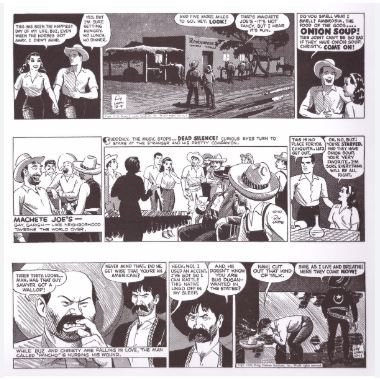
This second lush, sturdily archival hardback re-presents the tense and turbulent period from October 6th 1945 to July 23rd 1947 wherein de-mobilised adrenaline addict Buz tries to adjust to peacetime life whilst looking for a job and career – just like millions of his fellow former servicemen…

Before getting out, though, he had returned home on leave and ended up accidentally engaged. Buz was the son of the town’s doctor: plain, simple and good-hearted. In that ostensibly egalitarian environment the school sporting star became the sweetheart of ice-cool and stand-offish Tot Winter, the richest girl in town. Now when her upstart nouveau riche parents heard of the decorated hero’s return they hijacked the homecoming and turned it into a publicity carnival. Moreover, the ghastly, snobbish Mrs. Winter conspired with her daughter to trap the lad into a quick and newsworthy marriage.

Class, prejudice, financial greed and social climbing were enemies Buz and Sweeney were ill-equipped to fight, but luckily, annoying tomboy-brat/girl-next-door Christy Jameson had blossomed into a sensible, down-to-earth, practical and clever young woman. She’d scrubbed up real pretty too and showed Buz that his future was rife with possibility. Mercifully soon, the leave ended and he & Sweeney returned to the war. The Sawyer/Winter engagement fizzled and died. When their discharge papers finally arrived (in the episode for September 9th 1945), the period of desperate struggle was over. However, that only meant that the era of globe-girdling adventure was about to begin…

Before the comics wonderment resumes, Jeet Heer and Rick Norwood discuss ‘The Perfectionist and his Team’. Concentrating initially on ‘After the War’, the fascinating explorations also delve deep into detail of the auteur’s troubled and tempestuous relationship with ‘Crane’s Team’ before offering ‘A Word on Comic Strip Formats’ and the censorious iniquities local newspaper editors regularly inflicted upon Crane’s work.

With all the insightful stuff over, cartoon adventure begins anew as civilian Mr. Sawyer returns home to a life of indolence before his own restless nature starts him fretting again. The old town isn’t the same. Tot has inherited her father’s millions and moved to New York and even Christy is gone; she’s away attending his old alma mater…

After a brief interlude wherein he visits the cheery Co-Ed and debates the merits of returning to college on the G.I. Bill, Buz instead opts for fulltime employment and heads to the Big Apple where Chili Harrison has a new job offer and an old flame waiting. As he turns East, Buz chooses to ignore his instincts and the huge mysterious guy who seems to turn up everywhere he goes…

In NYC, aloof, alluring Tot Winter is the cream of polite “arty” society, but her wealth and clingy new fiancé – opera singer Count Franco Confetti – are all but forgotten when “the one who got away” appears again and she finds her interest in her High School beau rekindled. Buz has moved in with Chili, blithely unaware that the strangely ubiquitous giant has inveigled himself into the apartment next door and is now actively spying on him…

Sawyer wants a job flying, but is frankly only one of hundreds of war-hero pilots looking for a position at International Airways. Moreover, his reputation as a hot-shot risk-taker makes him the last person a commercial carrier might consider. Happily, after implausibly well-connected Chili intercedes with a major player in the company, something does come up…

The truth about Buz’s hulking stalker comes out when the Maharani of Batu’s yacht docks in New York. The exotic Asian princess is one of the wealthiest women on Earth and cuts a stunning figure with her tiger on a leash. Yet when Buz first met her she was simply “Sultry”, a ferocious, remorseless resistance fighter helping him kill the occupying Japanese on her Pacific island.

She never forgotten him and will ensure no other woman can have him…

Sultry moves into the penthouse adjoining Tot’s and is witness to the ploys of the Winter woman as she sidelines sleazy sneaky Confetti and makes her play for Buz. She is also a key figure in the tragic heiress’ sudden death…

Just prior to Tot’s gruesome demise, Buz had finally met the unconventional Mr. Wright of International Airways. That doughty executive had no need for pilots but wanted a quick-thinking, capable fighter who could solve problems in the world’s most troubled conflict zones. He even has a spot open for good old Roscoe Sweeney. Buz is all set for his first overseas assignment when the cops decide he’s the other prime suspect in Tot’s murder and, with Sawyer and Count Confetti in jail, Sultry tries to flee America before the truth comes out. Sweeney and the freshly exonerated Buz soon track her down, but Sultry turns the tables on them and shanghaies her erstwhile lover, imprisoning him on her yacht, determined to make him her permanent boytoy, far, far away from American …

Never short of an idea and blessed with the luck of the damned, Buz’s escape results in a terrifying conflagration and the seeming death of his obsessed inamorata… but Sultry’s body isn’t recovered…

It takes a lot of pleading to get Mr. Wright to give him another chance but, soon after, Buz & Sweeney are winging north to Greenland to stop a crazed sniper taking pot-shots at aircraft passing over the “Roof of the World”. This savage, visceral extended saga soon reveals the shooter to be a deranged leftover Nazi and his hapless attendants, but the heroes’ astonishing hunt for and capture of the Teutonic trio is as nothing compared to the harrowing trek to get them back to civilisation, especially since poor Roscoe is putty in the hands of lovely Frieda, devil-daughter of the utterly mad Baron von Schlingle.

Before Buz get the survivors home safely, he loses his plane, must forcibly trek across melting floes, get them all stranded on a iceberg and even has his pretty-boy face marred forever. Worst of all, by the time he gets back to civilisation, his job no longer exists. Mr. Wright has quit and moved on to another company…

It’s not all bad news. Wright has euphemistically become “Personnel Director” for Frontier Oil: a truly colossal conglomerate active all over Earth and now wants Buz to carry on his unique problem-solving career for his new employers.

Despite a large bump in salary, the weary war hero is undecided until he hears Christy is helping her dad in Central American nation Salvaduras in his role as a geologist for Frontier Oil. This happily ties in with an outstanding missing persons case; said vanished victim being Bill Daniels, playboy son of a prominent company executive. It takes very little to convince Wright to despatch Buz & Roscoe south of the border to investigate, opening floodgates to a spectacular epic of light-hearted romantic adventure a world apart from his previous harrowing cases. The story also saw Crane and Co. merging the Daily and Sunday strips into a single storyline (with the Sundays primarily illustrated by Schlensker) as the action boys tried to trace the missing American in a country that seems locked in fear and poverty…

After initially hitting a wattle-and-daub wall, Buz takes time off for a picnic with Christy and, after a close call with a faux Mexican bandit (in actuality a Yankee fugitive from justice with an atrocious fake accent), declares his undying love for her.

He is not rebuffed and there’s the hint of wedding bells in the air…

First, though, he and Sweeney need to finish the mission, and help comes from a brave peon who breaks the regional code of silence to put them on the trail of the mysterious Ranch of the Caves and its American émigré who rules the isolated canton with blood and terror. After romancing the daughter of vicious Don Jaime, Buz and Roscoe infiltrate the desolate fiefdom and the gang boss’ international band of thugs, discovering not only the very much alive missing playboy but an incredible lost Mayan treasure trove!

Mission accomplished, Buz returns to New York to marry Christy, only to find he’s already needed elsewhere. Christy too is having doubts, worried that she will always play second fiddle to her man’s addiction to action, whereas in truth the real problem is that trouble usually comes looking for Buz. Boarding a Frontier plane for the Yukon, Sawyer is merely a collateral casualty when the ship’s other passenger is kidnapped. The mysterious menabducting plastic surgeon Dr. Wing take their helpless hostages all the way to deepest Africa where they expect the medic to change the face of an infamous madman everybody in the world believes died in a Berlin Bunker. Tragically, the fanatics are not prepared for the physician’s dauntless sense of duty and sacrifice nor Buz’s sheer determination to survive…

The latter part of this tale describes Buz’s epic river trek with mercenary turncoat honey-trap Kitty as they flee from vengeful Nazis. However, even after reaching the coast and relative safety, the insidious reach of the war-criminals is not exhausted and one final attack looms…

Eventually, Buz returns to New York alone and wins enough time from slave driving Mr. Wright to settle things with Christy. He follows her to Nantucket Sound, but even their romantic sailboat ride turns into a life-changing adventure…

To be Continued for decades to come…
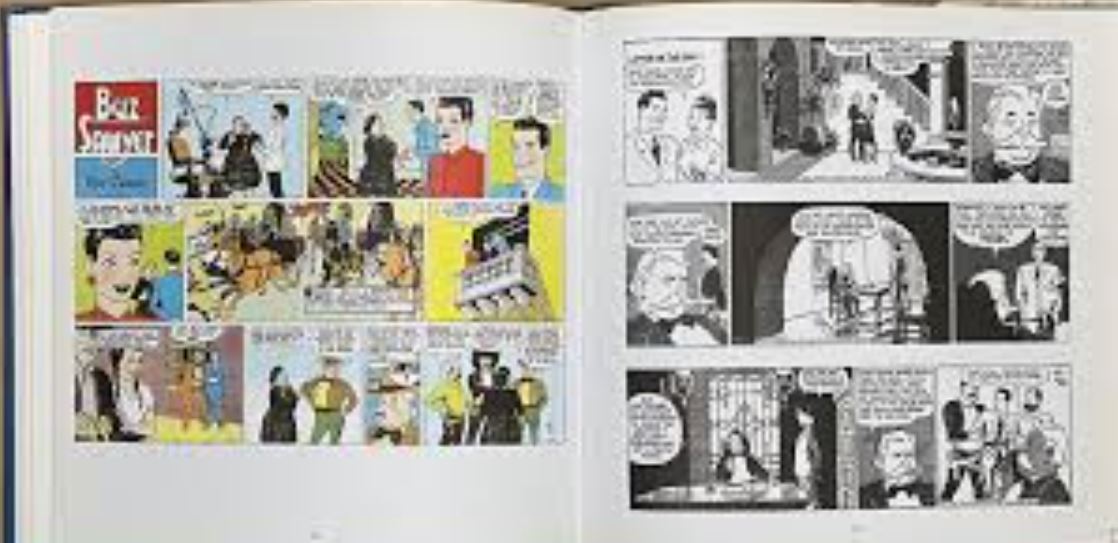
This splendid collection is the perfect means of discovering – or reconnecting with – Crane’s second magnum opus: spectacular, enthralling, exotically immediate romps that influenced generations of modern cartoonists, illustrators, comics creators and storytellers. Buz Sawyer ranks amongst the very greatest strip cartoon features ever created: rousing, enthralling, thrilling, outrageously funny and deeply moving tale-telling that is irresistible and utterly unforgettable.
Buz Sawyer: Sultry’s Tiger © 2012 Fantagraphics Books, all other material © 2012 the respective copyright holders. All Strips © 2010 King Features Syndicate, Inc All rights reserved.

Today in 1890, landmark British magazine Comic Cuts began publication. See what we started?

This date in 1928 scripter/screen writer George Kashdan (Tomahawk, Congo Bill, Tommy Tomorrow, Mysto, Magician Detective, hundreds of DC genre anthology tales, Superman/ Aquaman Hour of Adventure) as born, with Dutch creator Piet Wijn (Aram, Douwe Dabbert) coming a year later. Dave (Cerebus) Sim popped up in 1956 and Linda Medley (Castle Waiting, Justice League America, Doom Patrol, Galactic Girl Guides) in 1964.

Today saw the loss of Mutt and Jeff ghostwriter Aurthus “Bugs” Baer in 1969, ULTIMATE Batman artist Dick Sprang in 2000 and Mad’s The Lighter Side cartoonist Dave Berg in 2002.

Frank Robbins’ Johnny Hazard volume Two – the Newspaper Dailies 1945-1947


By Frank Robbins with an introduction by Daniel Herman (Hermes Press)
ISBN: 978-1-61345-017-8 (HB/Digital edition)

This book includes Discriminatory Content produced in less enlightened times.

Johnny Hazard was a newspaper strip created in the style and manner of Terry and the Pirates, but in many ways this steely-eyed hero most accurately resembles – and in fact predates – Milton Caniff’s second masterwork Steve Canyon.

Unbelievably, until 2011 this influential, impressively enthralling adventure strip had never been comprehensively collected in archival volumes – at least not in English or even America’s version of it – although selected highlights had appeared in magazines like Pioneer Comics, Dragon Lady Press Presents and the Pacific Comic Club.

Boston born, Franklin Robbins (9th September 1917 – 28th November 1994) was an artistic prodigy who shone from early on. At age nine he was awarded a scholarship to the Boston Museum of Fine Arts and at 15 moved to New York City to attend the National Academy of Design on a Rockefeller grant. Skilled, inventive and prolific as both painter and graphic artist, Robbins freelanced continually, even working with Edward Trumbull on the legendary murals for the NBC building and Radio City Music Hall. He created graphics for RKO Pictures, worked in advertising and magazine illustrations but never stopped painting, with work shown at the Whitney Museum of American Art, Metropolitan Museum of Art, The Corcoran Gallery of Art and Walker Art Gallery, although he found his perfect medium of expression when invited to take over a top comic strip…

Even whilst relentlessly creating a full seven days of newspaper strips, he exhibited work at the Whitney’s Annual show and, after ceasing his comics career, retired to Mexico to end his days with a brush in his hand.

The plain truth is that comics changed Robbins’ life. He was a brilliant natural cartoonist whose unique artistic and lettering styles lent themselves equally to adventure, comedy and superheroic tales, whilst his expansive raconteur’s nature made him one of the industry’s best writers over three generations.

He first found popular fame in 1939 after taking over aviation strip Scorchy Smith from Bert (The Sandman) Christman, when he quit isolationist America to fight with the Flying Tigers in China. Robbins thrived in the role, and created a Sunday page for the strip in 1940. This groundbreaking feature had been originated by John Terry before the astounding Noel Sickles replaced him: revolutionising Scorchy Smith and – with Milton Caniff – inventing a new impressionistic style of narrative art to reshape the way all comics were drawn and perceived.

Robbins remained until 1944 and was then offered high-profile Secret Agent X-9. Instead, he devised his own lantern-jawed, steely-eyed man of action. A tireless and prolific worker, even whilst producing the daily and Sunday Hazard (crafting separate but congruent storylines for each), Robbins continued freelancing as an illustrator for The Saturday Evening Post, Look, Life and other mainstream magazines. He also tried comic books for the first time when Johnny Hazard won his own title in 1948-1949, just as costumed superheroes began losing ground to ordinary he-men, mobsters and monsters…

Robbins returned to funnybooks in 1968, quickly becoming a key contributor as both artist and writer on Superboy, The Flash and The Atom, as well as a regular contributor to humour mag Plop! and DC’s mystery, horror and war anthologies. He particularly shone on Batman, Batgirl and in Detective Comics where, with Neal Adams, he pulled the Caped Crusader out of the TV show-inspired silliness. They created Man-Bat together and Robbins followed Michael Kaluta as artist on The Shadow. Moving to Marvel in the 1970s, Robbins concentrated on drawing a variety of titles including Captain America, Daredevil, Ghost Rider, Morbius, The Man from Atlantis, Human Fly, Power Man and The Invaders – which he co-created with Roy Thomas.

When Johnny Hazard launched on Monday June 5th 1944, he was an aviator in the US Army Air Corps. When hostilities ceased, he briefly became a freelance charter pilot and spy before settling into the life of a globe-girdling, troubleshooting mystery-solver: a modern day Knight Errant. The strip folded in 1977: one more victim of diminishing panel-sizes and the move towards simplified, thrill-free, family-friendly gag-a-day graphic fodder to frame small-ads. In its time it was syndicated in nine different languages in thousands of newspapers across the world, and even scored a residency in 1950s British weekly Rocket.

This fabulous hardcover/digital series – reproduced from original King Features proofs – re-presents the definitive magnum opus in fitting form: a monochrome, landscape format archival collection. This second shot covers serialised daily thrills (spanning November 19th 1945 to August 16th 1947), to resurrect the Amazing Aviator in fans’ hearts and remind them of what we’ve all missed whilst hopefully finding a few new fervent followers.

Fully embracing noir sensibilities of the era but keeping things light, frothy, sexy and funny the globetrotting glee is preceded by Daniel Herman’s Introduction ‘A Look Back at Johnny Hazard before the preflight fun begins…

Previously we met coolly capable flyer Lt. Johnny Hazard who escaped from a German POW camp, broke into a Nazi airfield, stole a bomber and flew home. Liberated and ready-for-duty he met feisty, headstrong, utterly dedicated war photographer Brandy during an air raid and all kinds of sparks flew. A series of spectacular events constantly pushed them together and ultimately impassioned fury and disgust on both sides turned to something else amidst all the deadly missions and exploding ordnance.

The strip could not keep up with the fast-moving events after D-Day (the real world Allies invaded “Fortress Europa” the day after Johnny Hazard debuted) and third story arc ‘Sun Tan and General Mariwana’ – opening on September 11th 1944 – saw the hero’s squadron transferred to the Pacific Theatre of Operations to reinforce the battle against Japan. Brandy inveigled herself into the picture as newly promoted Captain Hazard and his crew undertook a top-secret mission couriering a Chinese resistance leader back to her people. Enigmatic, exotic, staggeringly beautiful and lethally dangerous Sun Tan was a magnet for trouble…

Foiling Japanese assassination plots while dodging Brandy’s jealous displeasure, Hazard faced baroque opponents like disfigured pilot Colonel Mariwana, Colonel Kiri, General Ishigaki and his glamorous French “assistant” Mademoiselle Touché but also found a stalwart new ally and wingman in Captain “The Admiral” Slocum: last in an unbroken line of valiant patriotic mariners, but reduced to defending his country in the skies since his debilitating sea sickness prevents him from serving afloat like a true warrior…

Across Iran, Japan, China, and the Himalayas, Hazard, Slocum and Brandy ducked death over and again and when official hostilities ended, encountered charismatic US underworld émigré, pool-addict and deal-maker Side-Pocket Sam. Debonair, charming and utterly amoral, he led Chinese bandits and vied with our heroes for possession of Japan’s failsafe game plan for World War III…

Now, in ‘Fancy Fluff’ (running from November 19th 1945 to June 15th 1946) finally and officially released from their country’s service, Hazard and Slocum barely have time to adjust to civilian life before desperate Fluff Randall recruits them to help find her missing brother. A former comrade of Hazard, “Bounce” Randall was wounded in action and shipped home, but soon disappeared. The last Fluff heard, despite a head injury that prevented him being a pilot, he was in French Guiana, flying private planes for mystery man “Dr. Fox”

Soon the brothers in arms are on the trail, securing passports, papers and a reconditioned army surplus plane which they cheerfully dub Fancy Fluff in honour of their sponsor and despite the suspicions of suddenly-arriving Brandy. Her latest assignment is investigating a wave of jailbreaks in the penal colonies of that very country and a lift would be nice…

Soon the quartet are far south and negotiating with clearly corrupt cops and customs officers, dodging murder attempts and investigating local saint/Good Samaritan Docteur Reynard. A dramatically delivered letter from brother Bounce begging them to leave does nothing to deter them and before long they have uncovered not only an underground railroad using air transport to spring savage escapees but also murderous drug dealers using terror, mesmerism and narcotics to enslave Fluff’s brother among so many other victims…

It’s as much luck as competence that saves the valiant Americans from death and disaster a dozen times over, but in the end Reynard, his leg breakers Elf and Beeg Ox and all those bribe-taking officials pay for their crimes. Bounce is wounded again but at last healed of his enslavement and debilitating head injuries. However the overall cost is high. Admiral is lost to the world of action after falling for Fluff and that sappily contagious condition almost ensnares Johnny and Brandy too. Thankfully, common sense and sheer bile on both sides brings them to their senses before it’s too late…

Each serial storyline is garnished and bookended by Robbins’ original art designs for advertising the strip and after a comforting close up of Hazard second saga ‘The Flying Freight Mystery’ (June 17th – November 2nd) sees “just friends” Johnny and Brandy heading back to the USA but stalled on take-off when Johnny is conned by deviously mysterious entrepreneur M. Côte’-Poche into delivering to neighbouring nation Estantio a cargo of “typewriters”…

In flight, when Brandy discovers diminutive stowaway Wild Bill Hiccup and that the load is automatic weapons, an aerial ambush by “sky rustlers” leads to a less-than-longed-for reunion with Side-Pocket Sam. He is embroiled in ongoing war with ruthless river pirate Captain Gore who wants the emeralds Sam regularly ships from a mine to the coast. The baroque blubbery buccaneer is obsessed with piratical mythology and alongside fellow plunderers Mistuh Dirk and voluptuous siren Lady Mist opened a bizarre rogues gallery of foes who bedevilled Hazard over the next thirty years.

With Hazard as his air force, Sam has the upper hand until Mist infiltrates his freighter as an shipwrecked innocent: a daunting (and hilarious) job of acting that fools everyone but Brandy and leads to a spectacular display of air versus sea power, a brutal final mano-a-mano duel in the jungle and a surprise twist ending…

Another Canyon pinup segues into a yarn spanning November 4th 1946 to January 18th 1947. Hazard and Brandy arrive in tropical dump Querrero to find her journalistic colleague and Bureau Chief “Timely” Malcolm awaiting the outcome of a clash between government troops and bandit-turned-rebel ‘Major Risk’. Brandy opts to go to the story and with Johnny reluctantly flying her in, arrives at the frontline to find rival reporter “Blitz” (AKA “Loose-Lip”) Martin actively making the story happen.

With natural advantages and no scruples Brandy vamps the Government general for intel before tricking Johnny into delivering her right into the rebels’ hands. Her sharp scheme goes terribly awry and before long she is a hostage and bargaining chip between the sides and needs actual rescuing for a change. Thankfully, Hazard and Martin are willing to try it even if the shiny soldiers are not…

Back in Querrero and hired by Timely Martin as a ferry pilot for his reporters, Hazard faces unlikely danger in penultimate yarn ‘The Stout Man’ (January 20th to March 29th 1947). Repairs and search for spare parts sees the ex-airman as a passenger on a flight to San Tomayo, but the departure is interrupted by rude, rowdy and very bulky Brit Mr. Am and late-arriving Blitz Martin.

Away at last, Johnny befriends fellow traveller and prestigious nuclear boffin Noble Caldwell until Am hijacks the plane and sends it into a death-spin and crash. However, as Am escapes with Caldwell using parachutes hidden under his coat, Hazard manages to crash land the plane. Lost, starving and dying of thirst, the survivors are accidentally saved when Am returns in a helicopter to clear up loose ends and stupidly lets Johnny get the drop on him…

A deadly impasse ensues with both sides holding out against attrition and deprivation, but the balance of power shifts after indigenous tribesmen arrive, pointing their deadly blowpipes indiscriminately at all the unwelcome intruders…

A Vava Lavoum pinup segues into closing yarn ‘Danger À La Carte’ (March 29th – August 16th 1947) as freshly-fired Hazard is stranded in San Ruiz, catching the attention of jewel thieves Gloves Diamond and Mellow as well as their criminal competitors Side-Pocket Sam and Lady Mist. Before long Hazard and Blitz are bemused, befuddled and bamboozled, buffeted between opposing nefarious forces and unable to understand how a gourmet café delivering meals by jet plane can possible be profitable…

Not knowing all the facts doesn’t stop Johnny hiring on as a pilot and becoming an unwittingly accomplice, transporting human contraband to the heart of Casablanca’s wicked underworld. When he seeks to rectify his mistake, the fur, fists, knives and bullets start to fly but in the end justice wins again…

Ending with more advertising pinups – Kitty Hawkes, Sabina Eden, Baroness Flame and Sequinthis is another fast-paced, sharp-tongued and utterly gung-ho roster of romps starring a charming, happy-go-lucky lout, insouciantly ruthless and ever ready to risk his own life and limb to help the little guy and distressed damsels.

Sharp, snappy and devilishly funny repartee in the style of movies like Howard Hawks’ His Girl Friday and Frank Capra’s It Happened One Night are a hallmark of these rapid fire yarns, some of the greatest comic strips in history, but that can present a few problems for modern readers. Contemporary attitudes to sexuality, gender and particularly race are far from what we find acceptable – or should even tolerate – today. We know better now – at least most of us do – but must accept and understand that hurtful and unjust as such terms are, they did exist and we’re doing history and our society a hugely dangerous disservice by ignoring, downplaying or worst of all self-censoring those terms and the attitudes that fed them.

In truth, Johnny Hazard was far less egregious than most: Robbins may have used visual shortcuts and slang but all characters were portrayed fairly and did not unnecessarily suffer from the worst propagandist nonsense used by the Allies to bolster a united war spirit and vilely resurrected by modern populists today.

All ethnicities are treated with the full dignity of different but equal cultures and depicted as competent comrades in arms, not ignorant primitives needing white men’s saving graces. However, arch comedian Robbins clearly couldn’t resist playing mischievous games with accents, names and speech patterns that would do Benny Hill, Hogan’s Heroes or Charlie Chan (the opposite of) proud, so if you don’t think you’re capable of remaining historically detached, best to forgo those delights that have transcended time…

To be continued…

These exotic all-action intrigues and romances perfectly capture the mood and magic of a distant yet incredibly familiar time; with cool heroes, hot dames and exceedingly intemperate baddies encountering exotic locales and stunning scenarios, all peppered with blistering tension, slyly mature humour and vivid, visceral excitement.

Johnny Hazard is a brilliant two-fisted thriller-strip too long forgotten, and this is your chance to remedy that.
© 2013 King Features Syndicate, Inc. ® Hearst Holdings Inc. All rights reserved.

Today in 1914 Aquaman creator Paul Norris was born, followed two years alter by George Tuska (Iron Man, Crime Does Not Pay), Belgian national treasure Victor Hubinon (Buck Danny, Redbeard) in 1924 and Marty Greim in 1942. In 1954 Kerry Gammill joined the party as did Brad W. Foster one year later and François Schuiten (Les Cités Obscures) in 1956, with John Paul Leon checking in in 1972.

Today in 1969 the last issue of the first iteration of Eagle was published.