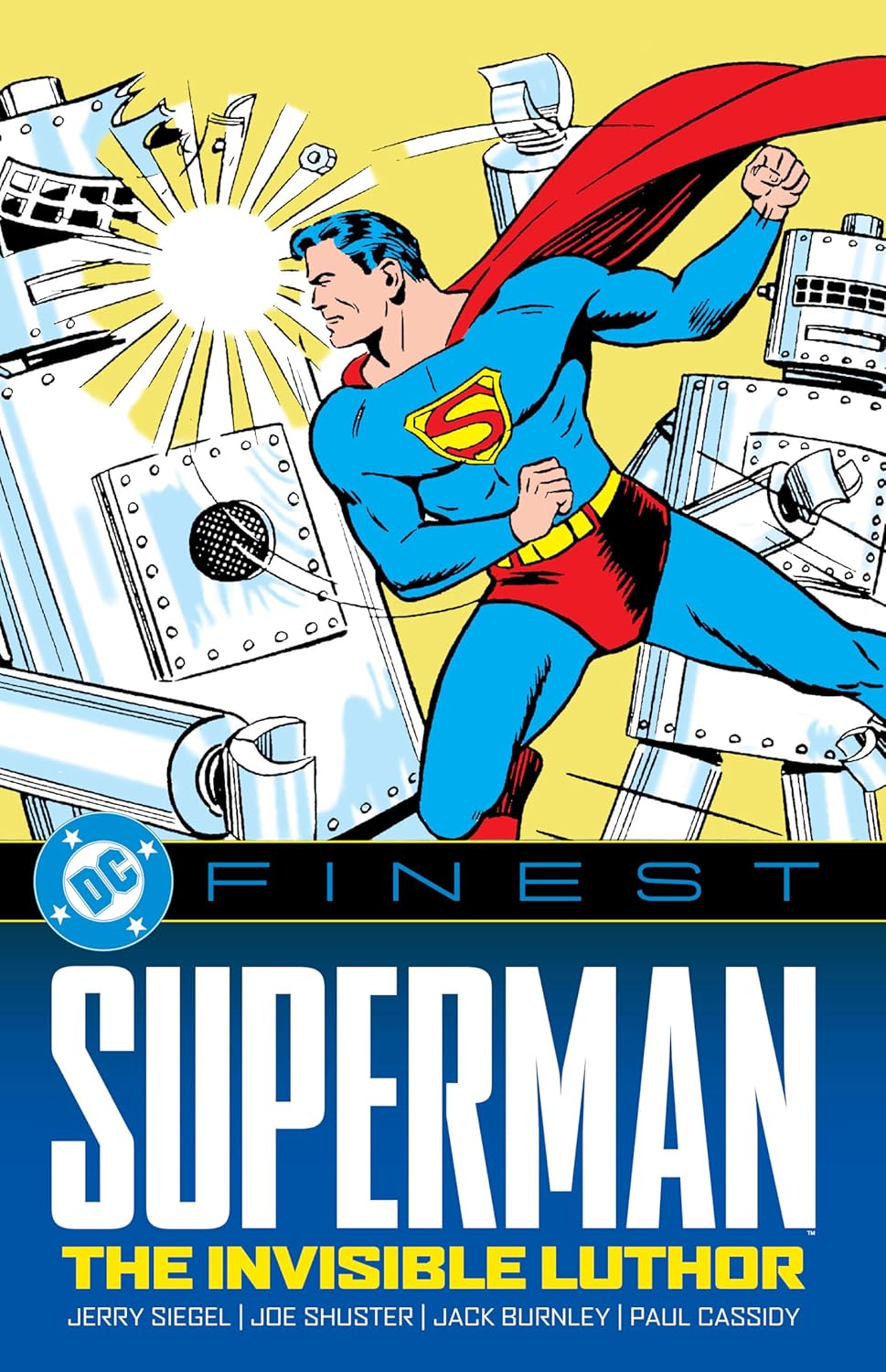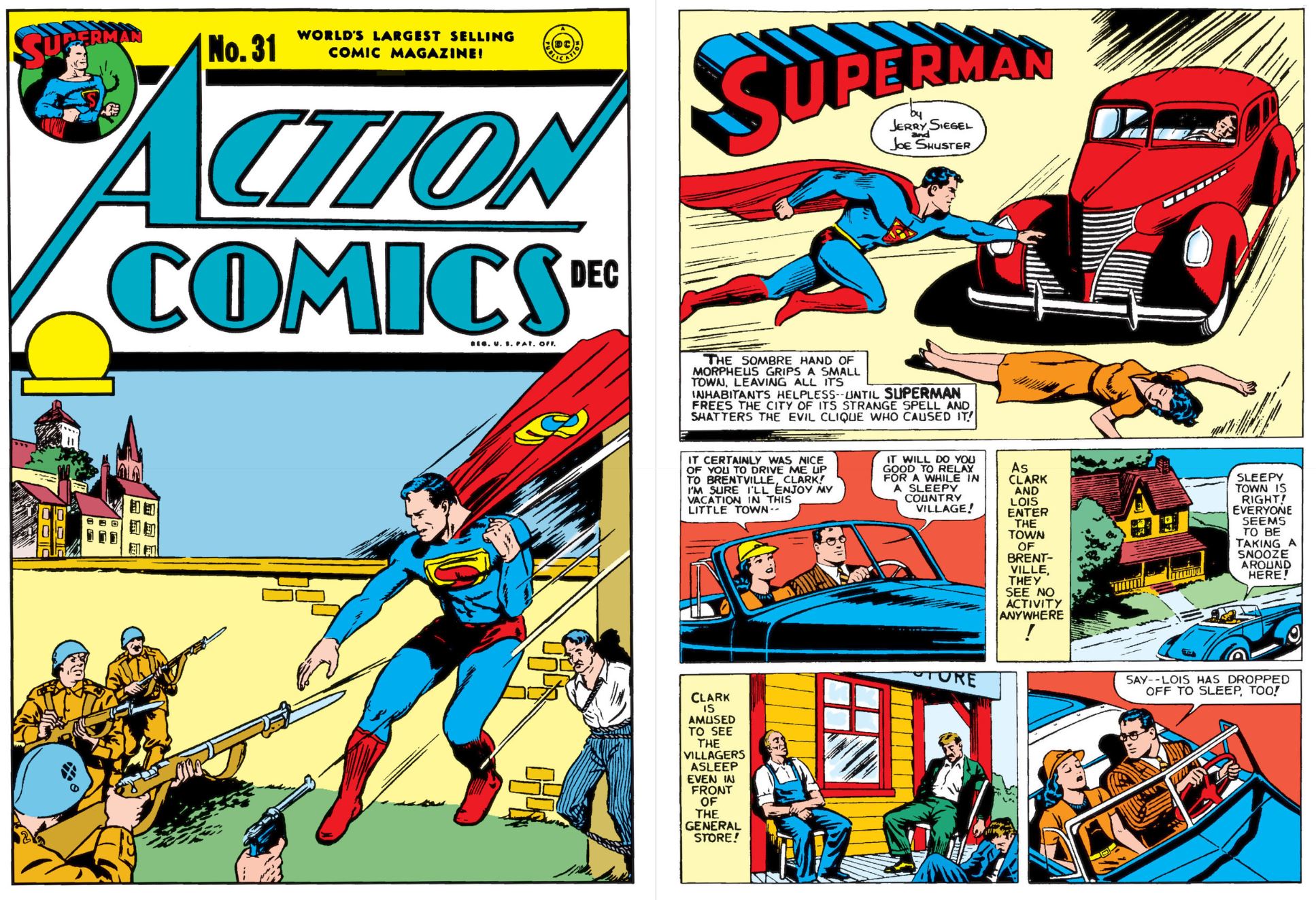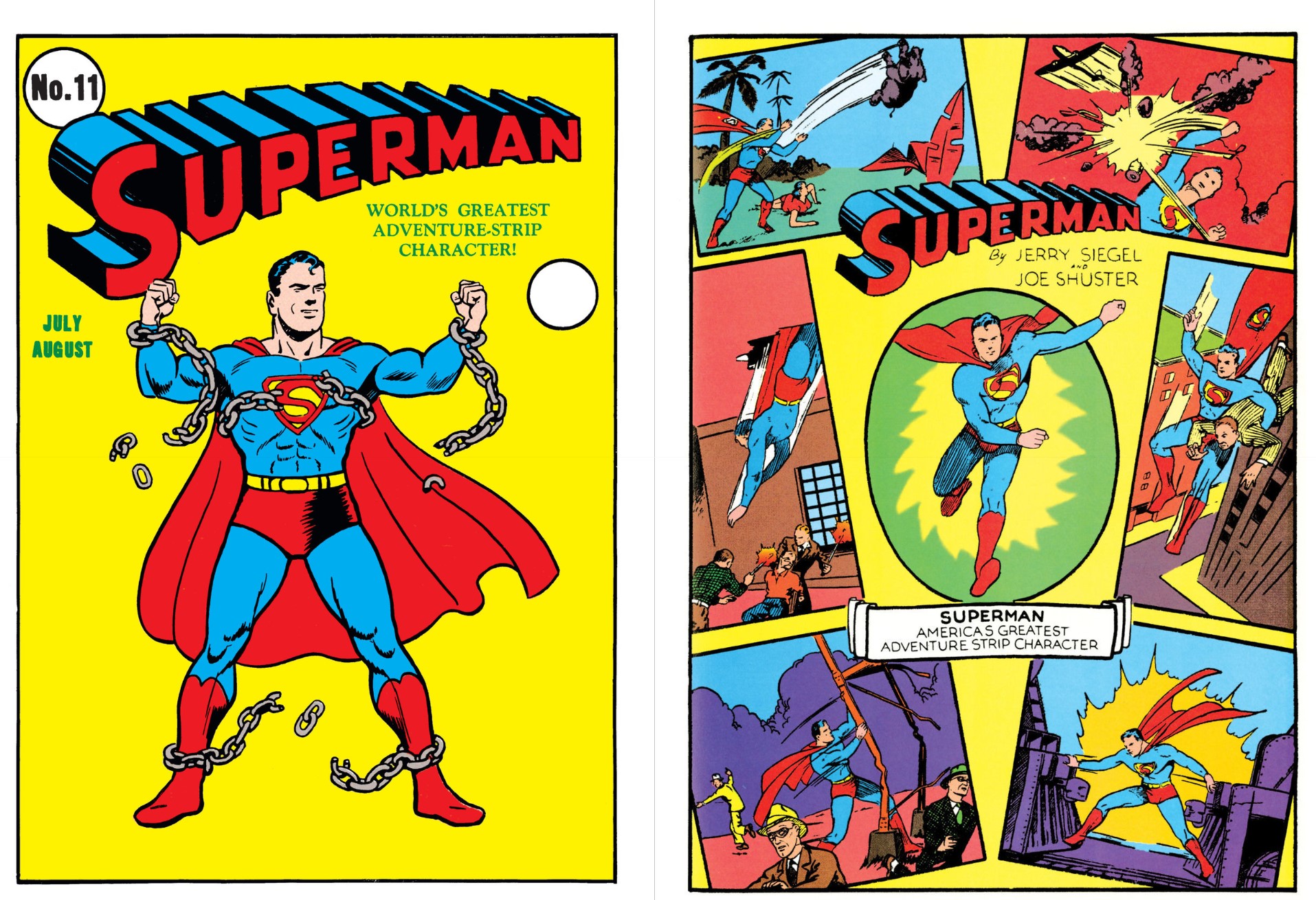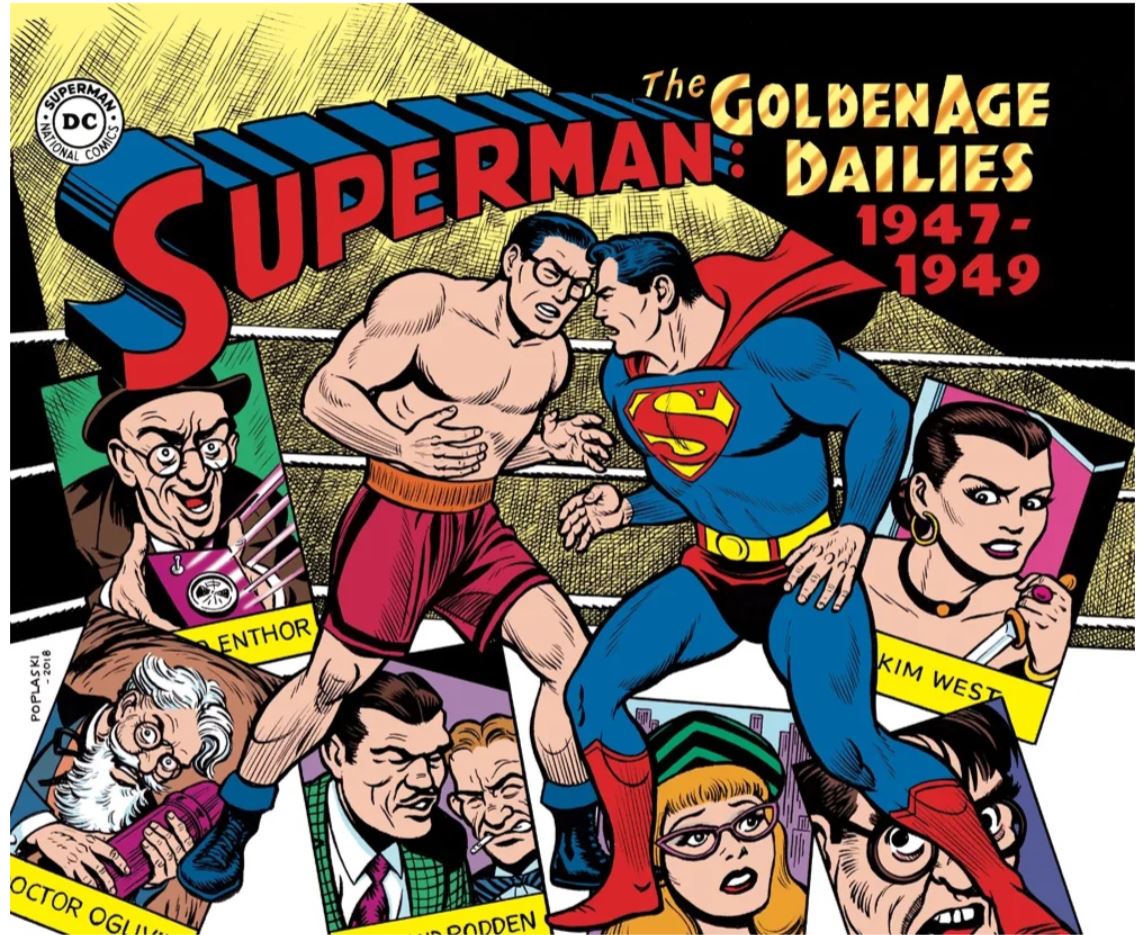
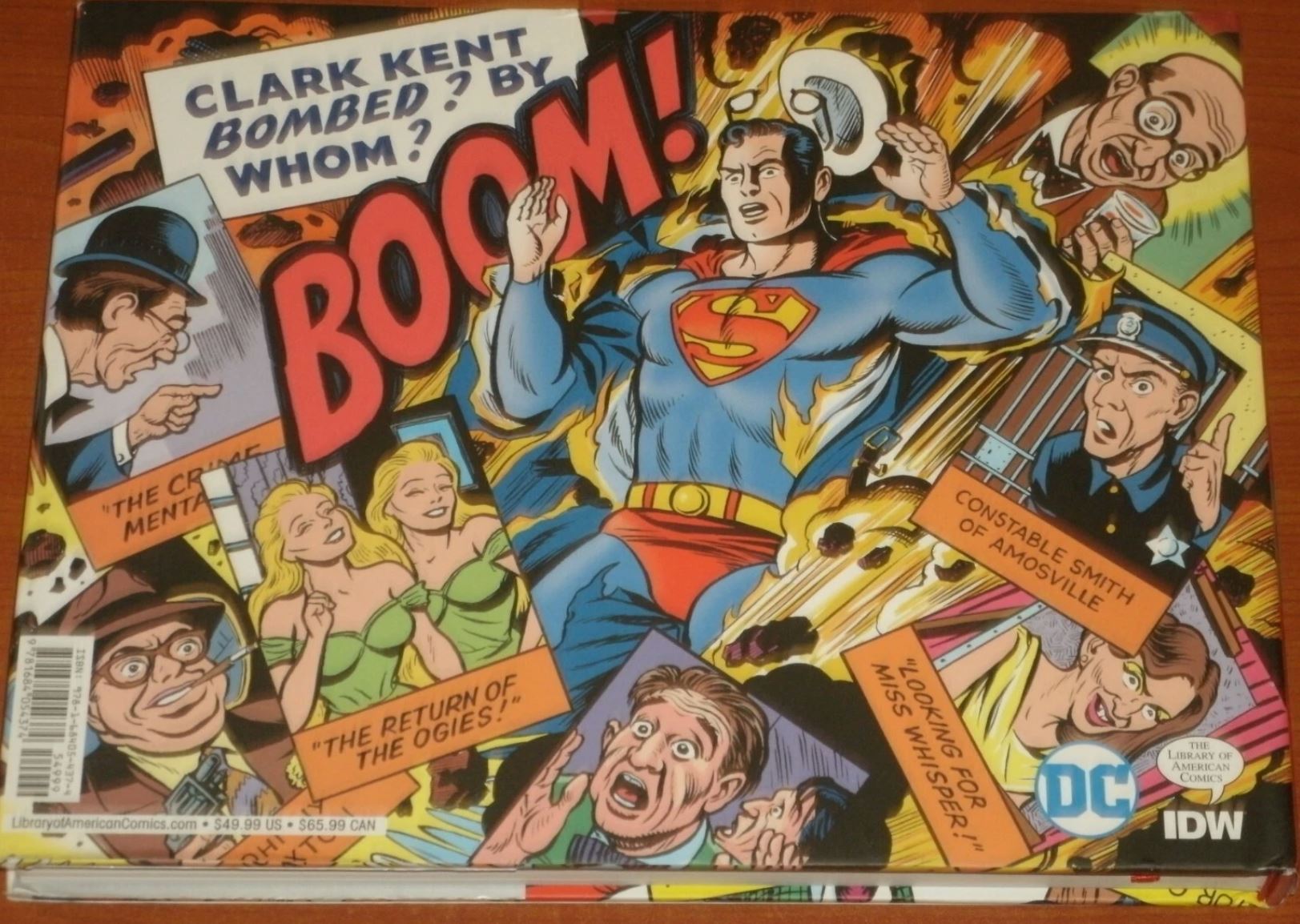
Superman: The Golden Age Dailies 1947 to 1949 (volume 3)


By Alvin Schwartz, Wayne Boring, Jack Schiff, Win Mortimer & various (IDW/Library of American Comics)
ISBN: 978-1-68405- (HB)

This book includes Discriminatory Content produced in less enlightened times.

The American comic book industry – if it still existed at all – would be utterly unrecognisable without Superman. Jerry Siegel & Joe Shuster’s unprecedented invention was first fervidly adopted by a desperate and joy-starved generation, and gave birth to a genre if not an actual art form. Spawning an army of imitators and variations within three years of his 1938 debut, the intoxicating blend of breakneck, breathtaking action and wish-fulfilment epitomising the early Man of Steel grew to encompass cops-&-robbers crimebusting, socially reforming dramas, sci fi fantasy, whimsical comedy and, once the war in Europe and the East sucked in America, patriotic relevance for a host of gods, heroes and monsters, all dedicated to profit through exuberant, eye-popping excess and vigorous, dashing derring-do.

From the outset, in comic book terms Superman was master of the world. Moreover, whilst transforming the shape of the fledgling funnybook biz, the Man of Tomorrow irresistibly expanded into all areas of the entertainment media. Although we all think of the Cleveland boys’ iconic invention as epitome and acme of comics creation, the truth is that very soon after his springtime debut in Action Comics #1 the Man of Steel was a fictional multimedia monolith in the same league as Popeye, Tarzan, Sherlock Holmes and Mickey Mouse. We parochial and possessive comics fans too often regard our purest and most powerful icons in purely graphic narrative terms, but the likes of Batman, Spider-Man, Avengers and their hyperkinetic kind long ago outgrew four-colour origins to become fully mythologized modern media creatures familiar in mass markets, across all platforms and age ranges…

In the last century and even more so in this one, far more people have seen and heard the Man of Steel than have ever read his comic books. These globally syndicated newspaper strips alone were enjoyed by countless millions, and by the time his 20th anniversary rolled around, at the very start of what we call the Silver Age of Comics, he had been a thrice-weekly radio serial star, headlined 17 astounding animated cartoons, become a novel attraction (written by George Lowther) and – by the time of the last stories in this tome – had helmed two feature films. He had then seamlessly segued into the next Big Thing: television. Soon his first (of 8) smash-hit live-action tv seasons would start his next great media conquest, making Superman a perennial sure-fire success for toys, games, food, and puzzle and apparel manufacturers all over the planet.

Although pretty much a spent force these days, for the majority of the last century the newspaper comic strip was the Holy Grail all American cartoonists and graphic narrative storytellers hungered for. Syndicated across the country (and frequently the world) a strip feature could be seen by millions if not billions of readers and was generally accepted as a more mature and sophisticated form of literature than comic books. It also – at the start! – paid better, and rightly so. Some of the most enduring, entertaining characters and concepts of all time were devised to lure readers from one particular paper to another and many of the best became cornerstones of a shared global culture. People across the Earth had a communal context thanks to thrilling to the same comics; and Mutt and Jeff, Buck Rogers, Dick Tracy, Flash Gordon, Charlie Brown and so many more escaped humble, tawdry newsprint origins to become meta-real: existing in the minds of earthlings from Albuquerque to Zanzibar. Most still do…

The daily Superman newspaper strip launched on 16th January 1939, swiftly augmented by a full-colour Sunday page from November 5th of that year. Originally crafted by Siegel & Shuster and their studio (Paul Cassidy, Leo Nowak, Dennis Neville, John Sikela, Ed Dobrotka, Paul J. Lauretta & crucially Wayne Boring), the mammoth task soon required additional talents like strip veteran Jack Burnley and writers including Whitney Ellsworth, Jack Schiff & Alvin Schwartz. The McClure Syndicate feature ran continuously until May 1966, appearing, at its peak, in over 300 daily and 90 Sunday newspapers: a combined average readership of more than 20 million. Eventually, Win Mortimer & Curt Swan joined the unflagging Boring & Stan Kaye, whilst Bill Finger and Siegel also provided stories, telling serial tales largely divorced from comic book continuity throughout years when superheroes were scarcely seen.

This third volume of the Library of American Comics collection continues the prodigious and formidable reprint program begun in the Sterling/Kitchen Sink softcover editions which ceased production in 1999. All of that material – and these books too – are long overdue for re-release and digital editions. Here, however, WWII is well and truly over and the decidedly different demands of peacetime and reconstruction have given way to an era of hectic prosperity, but still see our hero and his regular cast tested and beset by domestically endangering perils and conundrums only a Man of Steel could handle…

We open with another Introduction by Sidney Friefertig, discussing the changes from conflict to reconstruction and detailing why and how poet-turned-thriller writer Alvin Schwartz (1916-2011) became the key writer of the feature as well as sharing contextual, behind-the-scenes moments before our cosy but never-ending battle resumes.

These sequences came six days a week, comprising episodes #47-61, pages #2595 through 3338, and publication dates April 28 1947 to September 3rd 1949. With the material credited to Schwartz (Batman, Wonder Woman, Aquaman, Tomahawk, Newsboy Legion, Slam Bradley, House of Mystery, A Date With Judy, Buzzy, Bizarro) and the sole pictorial province of illustrator Wayne Boring, the compilation kicks off with and a bizarre “manhunt” to solve the dilemma of ‘Who is Miss Whisper?

Running in strips #2595-2654 as seen between April 28th to July 5th 1947, the story depicts mounting frenzy in Metropolis after lonely millionaire at sea Jonathan Dexter experiences a crossed radio line and catches a brief snippet of conversation with a distant voice. Instantly falling inescapably in love with a person he cannot and probably will never see, he is despondent until he remembers how rich he is…

Thus when, Cinderella-style, the heartsore plutocrat uses the Daily Planet to publicise his plight and swears to endow the mystery maid with all his worldly goods, the entire female population goes crazy. Everybody loves a doomed romance but some seek to con him, some attempt to bamboozle or even supplant his absent inamorata and some – gangsters led by cunning rogue Wishbone – seek to replace Miss Whisper with a voice impersonating ringer. Clark Kent and Lois Lane are drawn to the story and Superman promises to help after the rich guy promises to pay a million to deserving charities but even after finding her, the Man of Tomorrow can’t make the quiet quarry want to marry the spoiled rich, groom-to-be…

Nevertheless, because it’s a fairy tale writ large, love does find a way…

Crafted for daily doses, these Superman snippets are torturous, convoluted and often seemingly divert in tangents to indulge in seemingly pointless but epically spectacular super-feats (such as razing an entire forest to make a really, Really big billboard). These are to pad out increasingly formulaic plots and emphasise the “Super” in the hero but also counterpoint the ongoing social commentary and essentially domestic tribulations of familiar and warmly appreciated entertainment characters being constantly put through their paces. That’s clearly seen as greed and venality abound in the next arc as Superman reels under the manic idiocies generated by ordinary people in mounting frenzy once news leaks out that the Man of Steel has agreed to safeguard humanity’s greatest desire made manifest.

Running from July 7th to September 27th, the sorry tale of ‘The Youth Serum’ (strips #2665-2732) sees chemist Dr. Ogilvie unwisely entrust his age-defeating miracle mixture to shady promoter Willie Poster who triggers a literal stampede of the vain, vainglorious and outright villainous who will do anything to roll back a few years… including bribery, fraud, theft and kidnapping Daily Planet staff to compel the Man of Steel to hand over the rejuvenation juice…

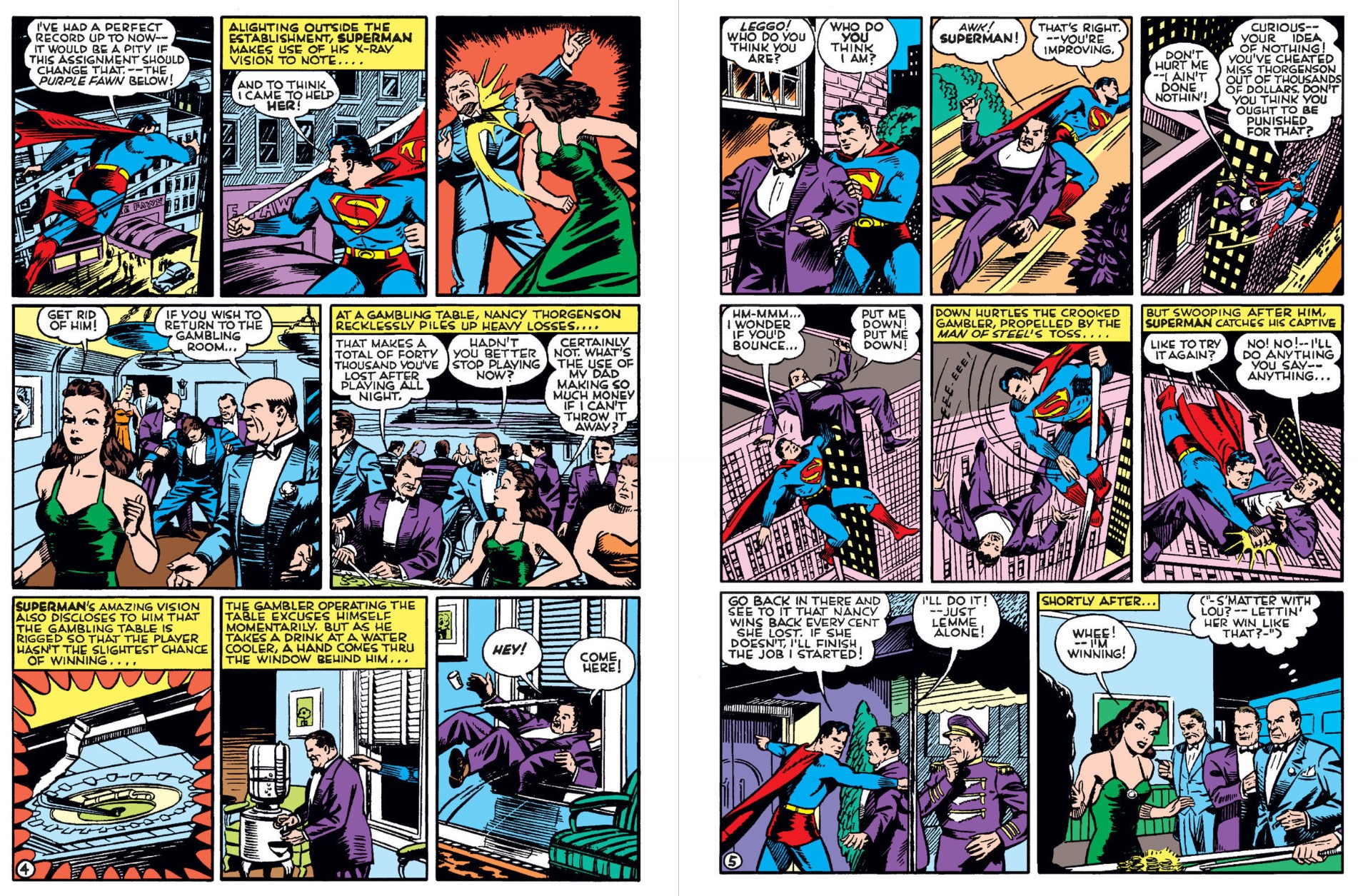
With the multi-million daily readership reckoned to be at least 50% female, encroaching domesticity was a regular plot standby but Alvin Schwartz proved able to tweak the situation in unusual ways. For ‘The Marriage Gamble’ (#2733- 2768; September 29th to November 8th) he enfolds Lois & Clark in a criminal caper wherein crooked – and ultimately near-murderous – loan sharks seek vengeance on a professional gambler by rigging a bet that one of their on-the-hook client/victims can be made to marry the first women he sees. Thanks to poor timing and fate the intended marriage material is inadvertently delayed by Lois, and helpless desperate sap Joe Deems’ unsuspecting bride-to-be becomes a certain feisty journalist…

There’s no escaping his fate – it’s death or Lois – but the mobsters have utterly underestimated Lane’s instincts and the determination of Joe’s actual fiancée Dotty… as well as Superman’s covert intervention…

Who’s chasing who is the key to next serial saga ‘The Perfect Woman’ (#2769-2828, November 10th1947 – January 17th 1948) as super-rich, supremely smart, ultra-fit and staggeringly beautiful heiress Olivia Hill finally reaches marrying age and decrees that the Man of Tomorrow is the only one worthy of her. Of course, Lois has other ideas and also senses a huge scoop as the terrified Superman struggles to escape a girl prepared to risk her own life and reputation to get her way…

Backed by money and privilege, wilful scheming rich kid Olivia seems unstoppable. All our hero’s efforts to avoid her cunning matrimonial traps come to naught as she employs fair means and foul to land the most eligible bachelor on Earth, but events take truly dark turn when master of media manipulation Hill meets ruthless gangsters who don’t play games by her rules…

Evil and mystery dominate in next exploit ’The Crime Mentalist’ (#2829-2936, January 19th – March 20th) as a shy, lonely, mild mannered bank teller survives a street incident and develops the power to psychically tune in on thieves and killers about to commit heinous acts. The cops are instantly suspicious of poor Edgar Jenkins and Clark is concerned for his safety, as Edgar apparently can’t stop himself uncovering crimes. He even exposes the venality of the learned doctors examining him and eventually Superman is forced to act as permanent bodyguard. Events come to ahead when the nation’s top crime bosses engage ruthless femme fatale Dotty Storm to vamp, distract and eliminate the nervous ninny. It works too, despite Jenkins’ gifts. He knows she’s evil but she’s also so very pretty and attentive and perhaps he can convert her from her wicked ways…

Pure whimsy and trenchant social satire manifest with ‘The Return of the Ogies’ (#2883-2936, March 22nd – May 22nd 1948) as the invisible fairy pranksters again bedevil Clark and Superman. However their escalating campaign to annoy the Metropolis Marvel – such as seeking to tell everyone his secret identity – goes weirdly awry after they lose that invisibility and become extremely popular figures perpetually pestered by the public. It looks like even Superman cannot solve this problem, but then…

After being denied a journalism award because everybody knows that the Man of Steel does all the heavy lifting in her stories, the City’s top reporter swears off male interference and undertakes a canny campaign of crimebusting and scandal-exposing in ‘Lois Lane’s Solo Adventures’. Spanning May 24th to July 3rd, strips #2937-2972 reveal just how brave and competent Lois can be on her own, especially after one piece makes a furious enemy of spoiled debutante Kim West. The brat’s idea of redress involves having two mob bosses vying for her exclusive attentions taking out contracts on the “Lane Dame”, but she’s less sanguine about her own devoted butler also trying to murder the journalist. This time Superman does not come to her assistance as the drama expands into murder and both mobs of rank-&-file thugs rebel, seeking to kill West and Lois to avoid a gang war and return to business…

With Lane back at the top of her game and even notional friends with Kim, focus switches to her rival for ‘The Millionaire Ex-Reporter Clark Kent’ (July 5th – August 14th, strips #2973-3008).

After suddenly and unwelcomely winning a fortune, Kent must act like a normal guy and quit his job just to preserve his secret identity. Moreover, all efforts to lose the wealth by acting like a rich idiot only increase it and make him the target of enterprising heiress Kim who has blown through all her own money and needs a pliable husband with plenty…

She doesn’t see Lois as serious competition but still ends up unsatisfied and unwed, before Clark goes broke, gets back to the Planet and almost meets his doom from ‘Enthor’s Paralyzing Ray’ (August 16th – October 16th; strips #3009-3062). Long before Luthor, Metropolis was terrorised by a criminal scientist who immediately quit when Superman appeared. Now having served his time, doddery figure of fun Enthor renews his malevolent career after discovering a gadget that makes the Man of Tomorrow comatose. With a beguiling romantic subplot and conclusion channelling the movie White Heat the shorter action yarn segued into a straightforward mystery as the aftereffects of Enthor’s weapon triggered ‘Clark’s Memory Lapse’ (October 18th – December 25th; #3063-3122). With bizarre reports coming, Superman is forced to reconstruct a fugue moment when the reporter apparently assaulted, abducted and held hostage an innocent man. Diligent investigation and the odd super stunt soon prove bank official Fred Camper is anything but, and that Clark was just being a hero…

It’s back to more traditional fare when Clark’s old pal Ed invents ‘The Super Elixir’ (#3123-3176; December 27th 1948 – February 26th; 1949) and gets Kent to drink it. Now publicly and officially superpowered, Clark is pursued by wannabees and crooks alike as he seeks ways to keep his friend’s family safe amidst a storm of attention and stunts that somehow incredibly peak with the reporter seemingly wresting Superman for charity and begging for a solution that will allow him to return to his quiet anonymous life…

Running from February 28th to April 23rd ‘Superman, Jailbird’ (strips #3177 – 3224) saw Canadian James Winslow “Win” Mortimer take over the illustration ushering in an era of greater whimsy and accessible comedy underpinnings. The initial outing found Superman breaking speeding laws in rural Amosville and arrested by an overly officious police constable. His thirty day jail sentence turns into a unique form of community service when gamblers try to make the hamlet the next Las Vegas, after which ‘Lois ’s Secret Identity’ (April 25th – June 25th, #3225-3278) sees her lose her Planet position and become a radio personality. Unable to abandon print, she dons a disguise and replaces herself as new ace reporter Lily Loring, competing with Kent and both her selves even as she’s targeted by murderous mobster Johnny Braxton seeking to silence one and all of her…

After accidentally injuring a bystander, Clark Kent pinch-hits for the wounded man, taking on his (then) rather-rare job in ‘Superman, Male Escort’ (June 27th – August 13th; #3279-3320. With my own super power working full out to resist that straight line (sooo mmmany jokes!) but blandly state that this sequence finds the Man of Steel soon helping lonely ladies, provoking yet another Metropolis mob of matrons and maidens demanding their moment with the miracle man, unaware that an actual mobster’s moll has plans to secure his exclusive services. Thankfully, Lois is there to make sure that doesn’t happen…

The collection and – more or less – the Golden Age era ends here with short sequence ‘Reenacting Superman’s Greatest Feats’ from August 15th to September 3rd 1949 (#3321-3238) as the Action Ace reconstructs his last month of rescues and stunts in the hopes of jogging the addled memories of literal absent-minded Professor Flagg and enabling him to recover sections of a misremembered formula. Of course, word associations and recall don’t always work according to plan…

These yarns offer timeless wonders and mesmerising excitement for lovers of action and fantasy. The raw-boned early Superman is beyond compare and if you can handle the warts of the era or just crave simpler stories from less angst-wracked times, the adventures gathered here are ideal comics reading, and this a book you simply must see.
© 2019 DC Comics. All rights reserved. Superman and all related names, characters and elements are ™ DC Comics.

Today in 1872, English cartoonist and genteelly warped brainbox W. Heath Robinson was born, with Allen Bert Christman (The Sandman, Scorchy Smith) arriving in 1915 and Dutch comics master Cees van de Weert (Ben Busy, Marco Polo) turning up in 1917.

Underground commix legend Gilbert Shelton was born in 1940, and scripter, journalist , critic & historian David Anthony Kraft came along in 1952. Artist/playwright Dean Haspiel (Billy Dogma, The Quitter)was born in 1967 and graphic auteur Adrian Tomine (Optic Nerve, Sleepwalk and Other Stories, Killing and Dying).
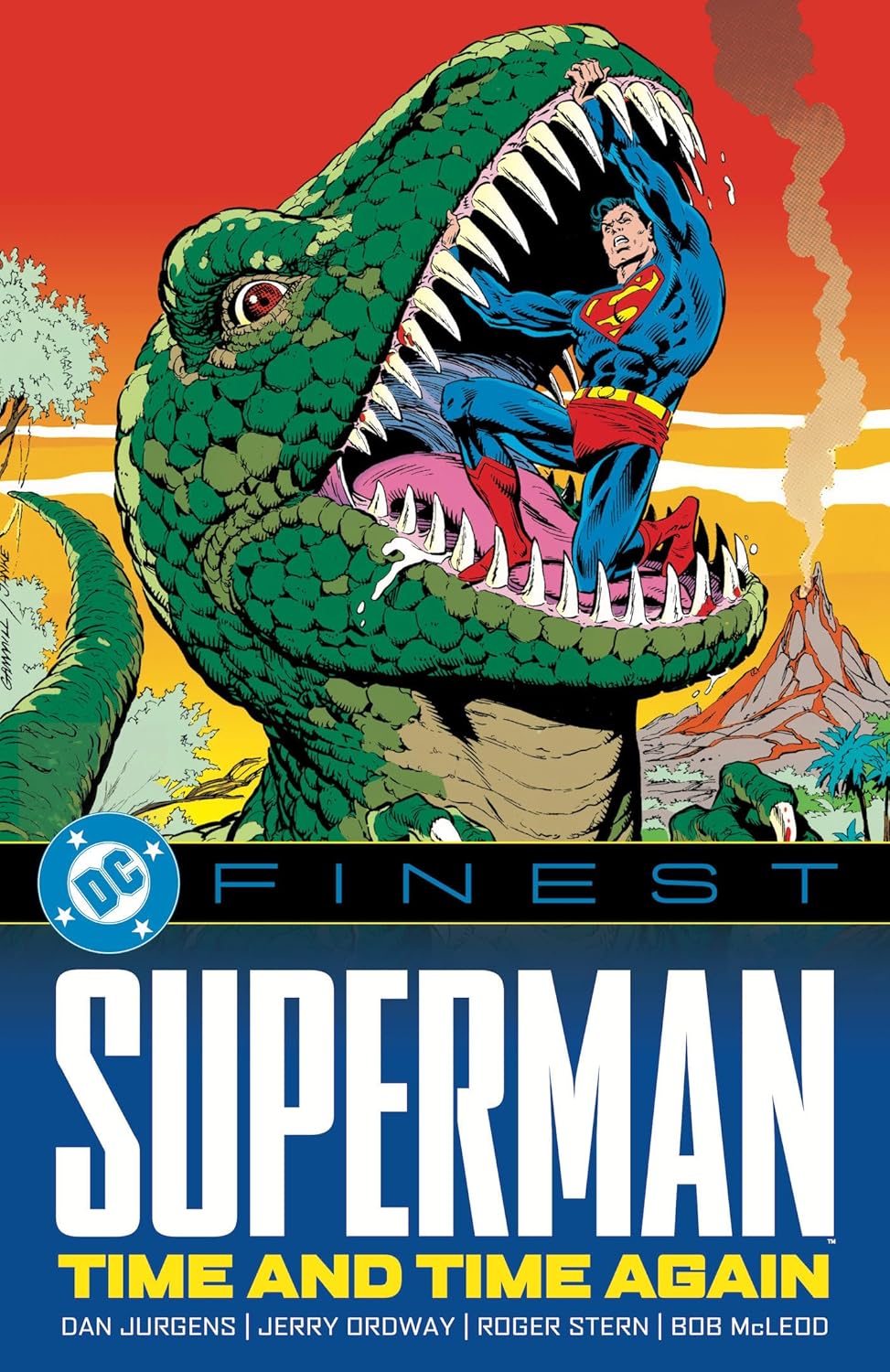
DC Finest: Superman – Time and Time Again


By Dan Jurgens, Jerry Ordway, Roger Stern, James D. Hudnall, Dave Hoover, Curt Swan, Bob McLeod, Kerry Gammill, Tom Grummett, Ed Hannigan, John Byrne, Brett Breeding, Dennis Janke, Art Thibert, Scott Hanna, José Marzan, Willie Blyberg & various (DC Comics)
ISBN: 978-1-79950-810-6 (TPB)

This book includes Discriminatory Content produced in less enlightened times.

In 1986, after almost 50 years, Superman was re-imagined after Crisis on Infinite Earths. Although controversial at the start, John Byrne’s reboot of the world’s first superhero was rapidly acknowledged as a solid hit and the collaborative teams who complemented and followed him maintained the high quality, ensuring continued success. Over following years a vast, interlocking saga unfolded across a spread of titles which has only sporadically – and far too infrequently – been collected into graphic compilations.

As part of the refit, many of his more miraculous abilities were discarded. Just like his earliest days, Superman was a far from omnipotent hero, more in touch with humanity because he wasn’t so very far above it. One thing that was abandoned was his casual ability to travel through time, and that was spectacularly addressed in a sequence of tales inside the greater unfolding story contained in this collection re-presenting the “Never-Ending Battle”. This time-twisting selection collectively transpires via cover-dates November 1990 through June 1991, gathering key intra-title storylines plus a couple of choice stand-alone solo stories from Action Comics #659-666, Adventures of Superman #472-479 and Superman #49-56, and a crossover component from Starman (volume 1 #28).

No sooner had the Byrne restart stripped away most of the accreted mythology and iconography that had grown around the Strange Visitor from Another World over five glorious decades, than successive teams employed a great deal of time and ingenuity putting much of it back, albeit in terms more accessible and agreeable to a cynical, well-informed audience far more sophisticated than their grandparents ever were.

One such was a notional tip of the hat to so many memorably madcap tales revolving around both an irritating 5th Dimensional Imp and the bizarrely mutagenic mineral from Krypton which peppered and perplexed the Silver Age Superman’s life. However, the story arc here also advanced two overarching plot threads that grew from the soap opera styled stories: the imminent demise of Lex Luthor due to self-inflicted Green K poisoning and a blossoming romance between Clark Kent and dynamic fellow journalist and friendly rival Lois Lane.

The compartmented saga opened in Superman volume 2, #49 with ‘Krisis of the Krimson Kryptonite: Part One’ by Jerry Ordway & Dennis Janke, wherein Luthor, following the death of his only “ blood heir” (Perry White Jr.), ponders mortality in a cemetery until a talking red rock bops him on the back of his big, bald head. The incensed billionaire quickly stifles his outrage as the scarlet stone resolves into cruelly devious trickster-sprite Mr. Mxyzptlk. Despite being currently preoccupied with another realm, the malign mischief-maker sees a chance to manufacture more mayhem in Metropolis with the “Red Kryptonite” he has magicked up, and promises Lex it will make Man of Steel and mortal multi-billionaire “physical equals”…

Lex activates the rock expecting to gain the powers of a god – and just possibly a new lease on his rapidly expiring life – and is furious to realise he is still just human. However, across town Superman, having defeated bionic bandit Barrage, is transporting the supervillain to metahuman penitentiary Stryker’s Island when his powers vanish and he plunges into vilely polluted Hobs Bay.

Luthor cries foul and is again visited by Mxyzptlk who pettishly teleports the drowning Action Ace to Lex’s penthouse office where the evil industrialist can see what the spell has actually wrought. After a brutal and strictly human-scaled tussle, a badly beaten, powerless Superman is ejected from Luthor’s HQ and staggers back to Kent’s home where he finds Lois waiting. The normally resolute reporter is badly shaken: Lois’ mother is dying from an apparently fatal illness and Luthor is somehow responsible…

In Adventures of Superman #472, Dan Jurgens & Art Thibert’s ‘Clark Kent… Man of Steel!’ picks up the pace with our simply human hero about to be slaughtered by lethal lummox Mammoth. Kal-El is undergoing tests into the cause of his malady conducted by scientific advisor/confidante Emil Hamilton, but when news of the giant thief’s robbery spree reaches him Superman dashes off to assist, equipped only with a hastily configured force field belt. It’s not nearly enough. In the end wits, raw nerve and a simple bluff save the day, but with no solution in sight the Metropolis Marvel must admit he needs superhuman assistance if he is to survive, but at least on the domestic front his new fragility brings him closer to Lois…

With Roger Stern, Dave Hoover & Scott Hanna in creative mode, the scene switches to Arizona where a recent acquaintance gets a phone call before ‘Krisis of the Krimson Kryptonite: Part Two/A: The End of a Legend?’ (Starman vol. 1 #28) sees Stellar Sentinel Will Payton flying to Metropolis for a top secret rendezvous. A sun in human form, Payton had re-energised the Kryptonian’s cells with solar power once before when Superman’s powers were drained, but this time the sun-bath has no effect and almost fries desperate Kal-El during the process. With crime spiking, Starman sticks around to keep the peace, using his shapeshifting powers to perfectly mimic the Man of Steel. He fools Luthor who, confronted by the somehow resurgent “Superman”, furiously throws the useless Red K at him…

With the mineral in Hamilton’s hands, stringent testing proves it is only red rock with no radioactive properties and Superman must think outside the box if he is to protect his city.

… And on Stryker’s Island, another old enemy is laying lethal plans to finally end the Man of Tomorrow…

Tension mounts in ‘Breakout!’ (Action Comics #659, Stern, Bob McLeod & Brett Breeding) as Superman resorts to high-tech battle armour when murderous science-maniac Thaddeus Killgrave frees the inmates and seizes control of Stryker’s, luring Starman-as-Superman into a deadly trap the neophyte hero cannot escape from. Meanwhile, in the highest corridors of financial power, Mxyzptlk personally briefs bewildered Luthor on what’s going on…

Brave but not stupid, Superman calls in back-up for his raid on the penitentiary. Whilst cloned champion Golden Guardian and street vigilante Crimebuster handle rank-&-file felons, the armoured Action Ace heads straight for Killgrave and a blistering confrontation which is only prelude to climactic concluding chapter ‘The Human Factor’.

Superman vol. 2, #50 was a giant special by Ordway & Janke with celebratory anniversary contributions from Byrne, Curt Swan, Kerry Gammill, Breeding & Jurgens, and opens with Clark unceremoniously ejected from Lexcorp Tower, only to stumble upon the billionaire’s personal physician Dr. Gretchen Kelly acting oddly…

Heading home, the powerless hero is saved from a mutant rat by Guardian and, after seeing Crimebuster thrashing street thugs, comes to a painful conclusion. Maybe Superman isn’t necessary any more. Maybe now he can have his own life and even ask Lois to marry him…

First though, there’s a unfinished business and a simple phone call to Luthor gets that ball rolling. Offering to trade the Red K for a story, Clark inadvertently causes Lex to break the terms of his pact with Mxyzptlk, thereby negating the whole power-sapping deal.

Ticked off, petulant and impatient to get back to mischief-making in another universe, the imp makes a personal appearance in monstrous form, but loads the battle in the fully restored Action Ace’s favour just to get out of his self-imposed arcane contract quickly… but not without an astounding amount of collateral damage to Metropolis…

With the crisis over, however, Superman has made a life changing decision. Following the red-tinged resumption of his super status, the Action Ace is joined by a brace of green guest stars in ‘Rings of Fire’ (Jurgens & Thibert in AoS #473). Even as Clark & Lois announce their engagement, Superman is fretting. Unable to tell his intended of his secret life, he is quickly distracted and drawn away when unconventional Green Lantern Guy Gardner hits town looking for missing mentor Hal Jordan. Earth’s “real GL” has been captured by a monolithic alien who has stolen his emerald energies to power a long-delayed return to the distant stars. Of course, implementing that departure will eradicate half of Wyoming…

Thwarting the scheme, freeing a mesmerised Army General and defeating the alien’s thralls Psi-phon & Dreadnaught, Superman and the GLs then craft a far less destructive solution for all parties involved…

In Action Comics #660, Stern, McLeod & Breeding detail the ‘Certain Death’ that ushers in the end of an era. For years Luthor has masqueraded as a billionaire philanthropist whilst dominating Metropolis, the world and the criminal Underworld. Few knew the unsavoury truth and the cunning villain kept Superman literally at arms-length by wearing a ring made from Green Kryptonite.

Previous and subsequent stories revealed Green K radiation had gradually poisoned Luthor, initially causing the loss of his hand and eventually fatally irradiating his entire body. Now as his power and vitality wane, Luthor – knowing that his pitiful condition must inevitably become public knowledge – puts a final desperate plan into operation. During a high profile publicity stunt attempting to set a new air-speed record, the manipulative mogul apparently commits suicide in a spectacular manner: an act of defiance which only marks the beginning of a stupendous 7-year long extended plotline to be seen and resolved elsewhere…

Here a measured preamble to the titular time-bending saga begins innocuously with Ordway & Dennis Janke’s introduction of ‘Mister Z!’ in Superman #51. When an apparent immortal arrives in town and dramatically adds the hero’s mind to his library of historical souls the magical marauder severely underestimates the champion’s strength of will. After dying in combat, he swears to return… Jurgens & Art Thibert then use Adventures of Superman #474 to reveal a life-changing moment in the life of highschooler Clark; an instant of irresponsibility once ended the life of a friend and saddled the hero-in-waiting with decades of crushing guilt. Now everything changes when he comes ‘Face to Face With Yesterday’

Laughs and thrills in equal measure follow the arrival of Plastic Man & Woozy Winks in Action #661, as Stern, McLeod & Breeding reveal how those valiant but nauseating nitwits enlist Jimmy Olsen, punch-drunk recent lottery millionaire Bibbo Bibbowski and even Superman to save the city from techno mobsters Intergang by ‘Stretching a Point!’

In Superman #52, Ordway, Kerry Gammill & Janke address mounting environmental concerns by reintroducing violent eco-maverick Toby Manning who assures us ‘The Name, Pardners, is Terra-Man…’ before ruthlessly and murderously exposing the true cause of mass toxic contamination and targeting the businesses attempting to whitewash it all…

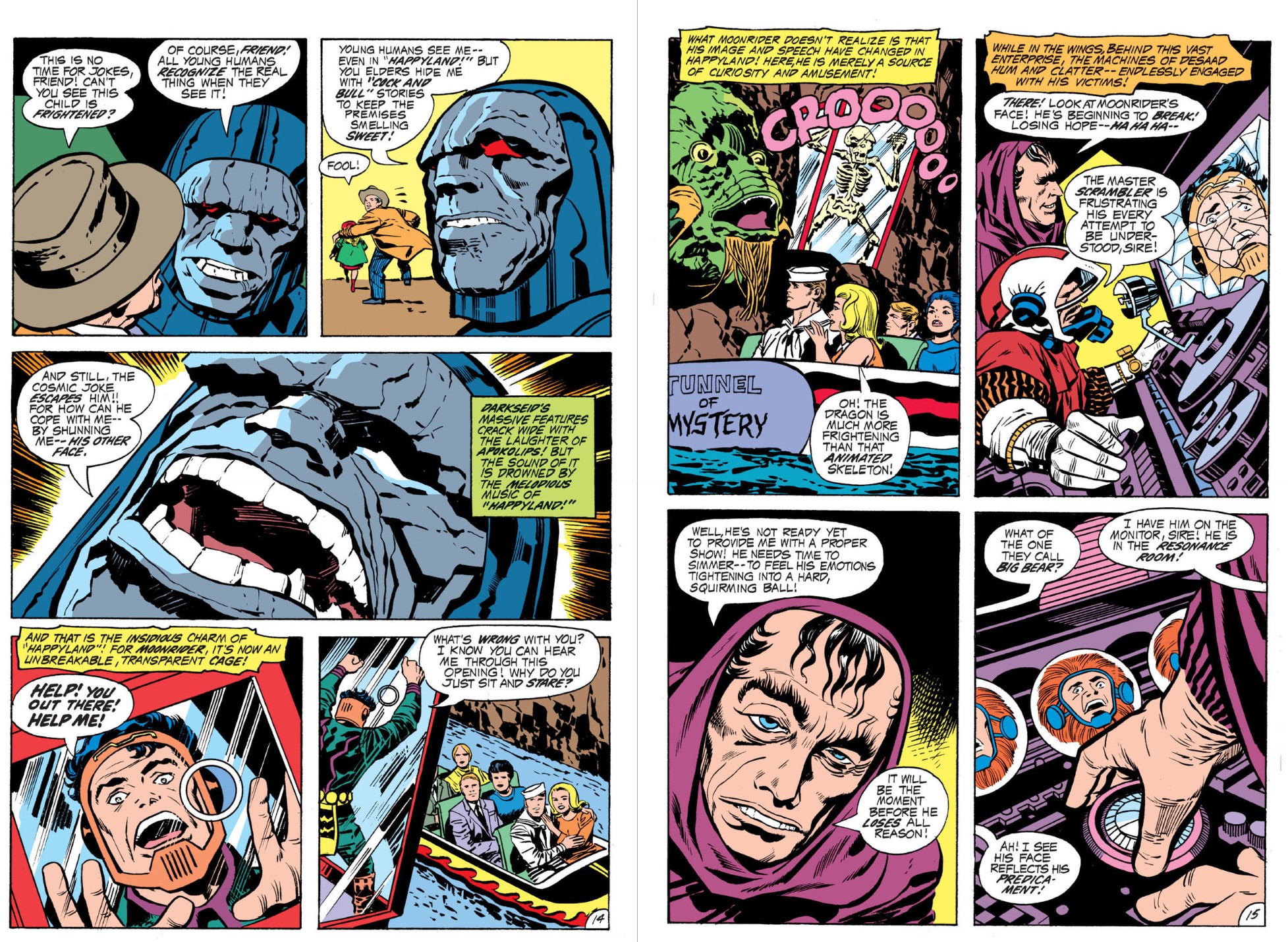
Courtesy of Jurgens & Thibert, a big guest star bust up fills AoS #475 with ‘Sleaze Factor’ after Intergang’s “Ugly” Bruno Mannheim hires Dr Killgrave and toymaker Winslow Schott to restore and improve debauched theme park Happyland. Only after Superman investigates the increasing number of disappearing visitors does the truth of Apokolyptian terror haunting the park emerge…

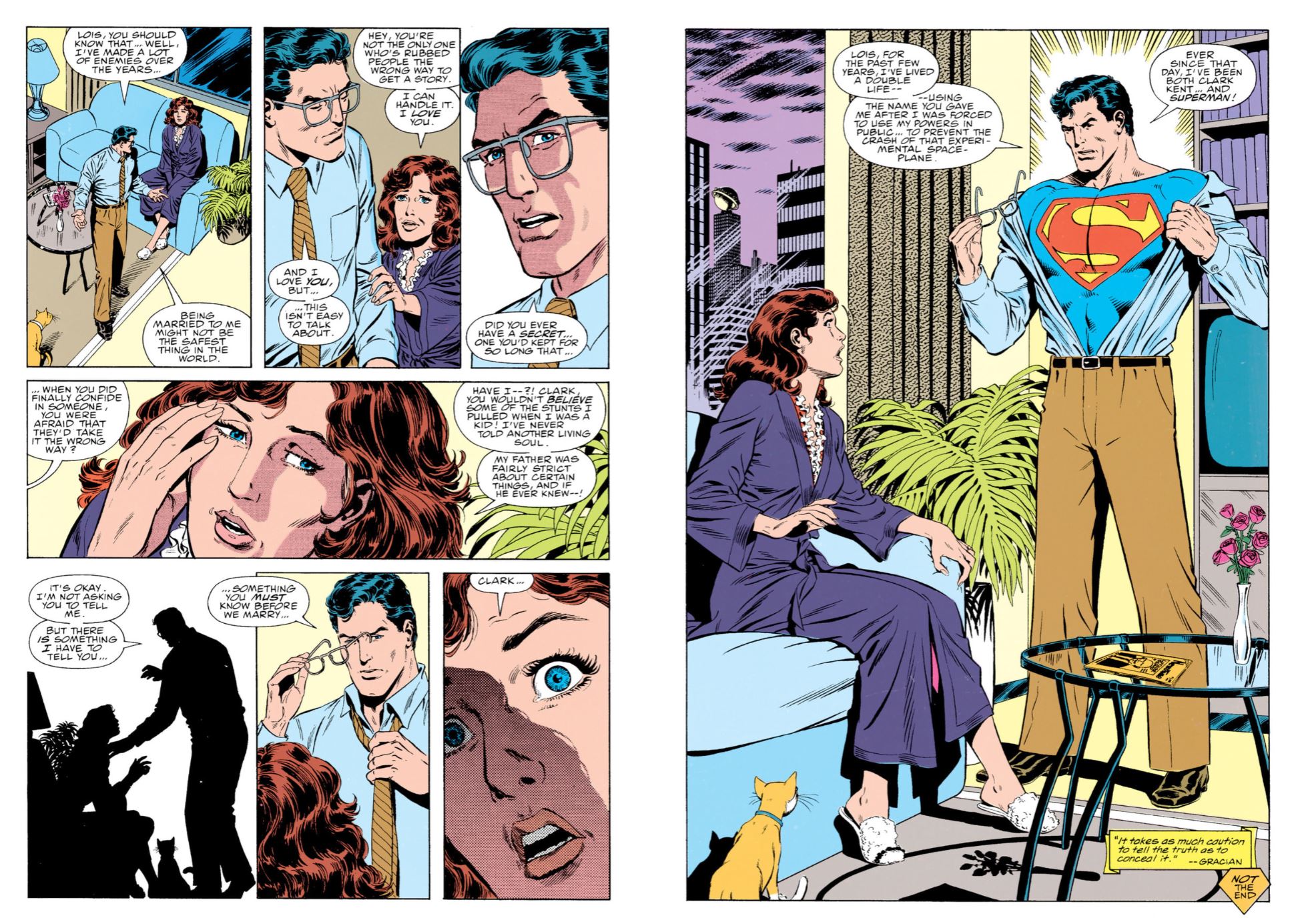
Over many years, Lois and Clark had grown beyond rivalry and distanced professionalism into true workplace romance, but always the hero kept his other identity from her. That all changed in Action Comics #662 (cover-dated February 1991 and by Stern & McLeod) as after the Man of Tomorrow narrowly defeated mystic predator Silver Banshee he decided that there would no more ‘Secrets in the Night’ ‘between him and his beloved…

With Lois still reeling from shock and sustained extended deception, Ordway & Janke used Superman #53 to question ‘Truth, Justice and the American Way’ as the Caped Kryptonian agrees to escort war criminal General Marlo of Qurac to his judicial come-uppance and consequently ferret out the US military traitors who supported him but now need him silenced…

Finally after months of preparation the main event opened with the modern hero lost to Earth just as Lois needed him most. Formerly he had been able to navigate the chronal corridors with ease, but this new Man of Tomorrow was trapped in a cataclysmic and volatile temporal warp, bounced around from era to era with his abilities constantly diminishing and utterly unable to regain his home and loved ones. The eponymous, epoch-rending epic launched in Adventures of Superman #476 as Jurgens & Breeding’s ‘The Linear Man’ saw a rogue (self-appointed) protector of the Time Stream seek to forcibly return temporal refugee-turned superhero Booster Gold to the 25th century he originated from. When Superman intervenes, the battle sparks a tremendous explosion, causing Kal-El to careen through time whenever he’s caught in another explosion. Initially that’s forward into a disaster-triggered team-up with the teenaged Legion of Super-Heroes

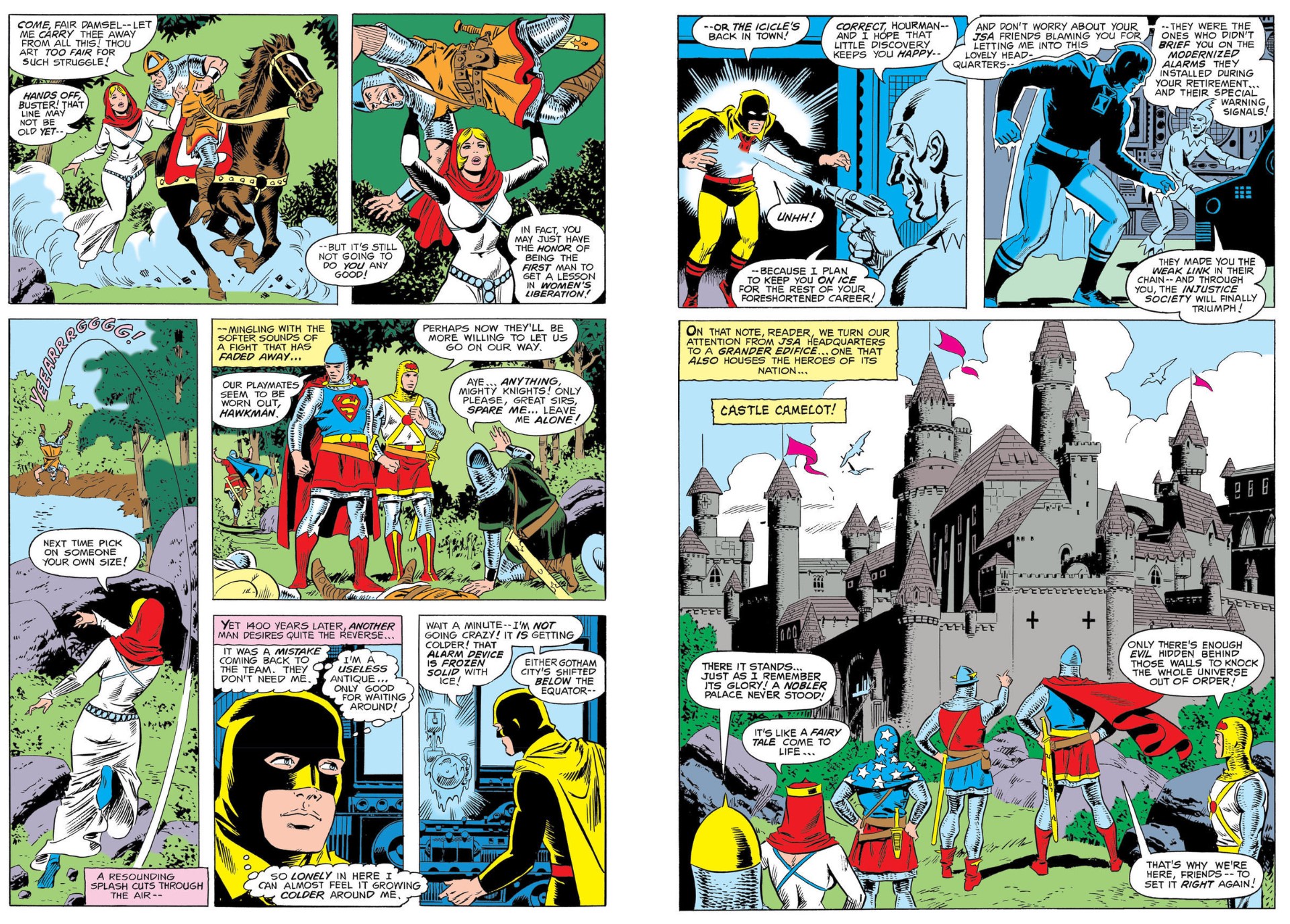
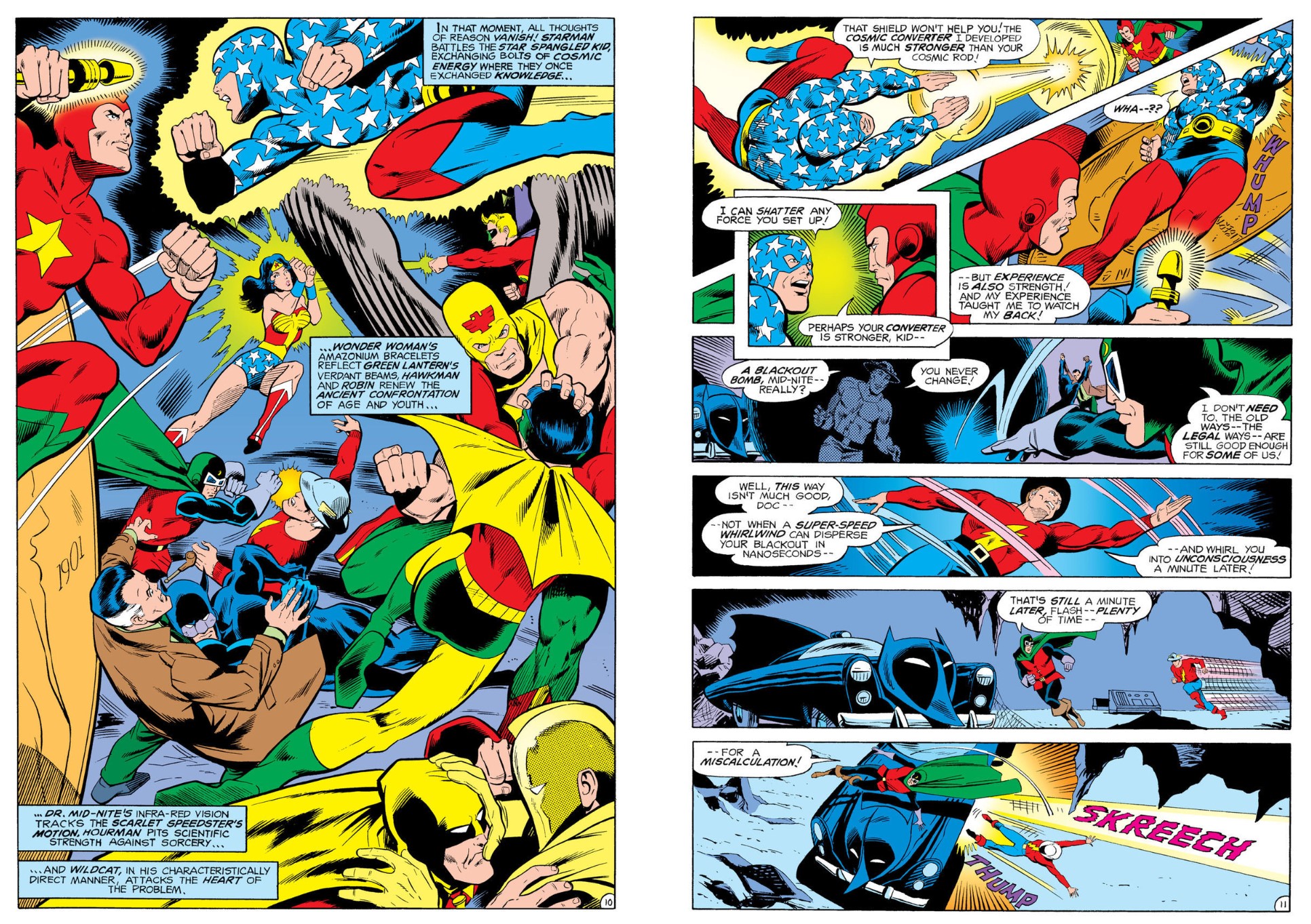
Each “landing” leaves him in a significant period of Earth’s history, and when a fuel storage centre detonates Superman is blasted backwards arriving in Stern & McLeod’s ‘Lost in the ‘40s Tonight’ (Action #663). Temporarily blinded but stuck in a past he read deeply about, Superman seeks out WWII icons the Justice Society of America, precipitating a meeting with that era’s first mystery men before almighty wraith The Spectre transports him not home but to ‘The Warsaw Ghetto!’ Here he becomes a temporary saviour in a soon to be mythic battle saga by Ordway & Janke in Superman #54. Perversely ending that issue is an unconnected Newsboy Legion short by Karl Kesel wherein the cloned kids, Guardian and Dubbilex seek to save top secret Project Cadmus from the ‘Attack of the D.N.Alien’ and imminent nuclear doom…

Elsewhere in time, only gigantic explosions can launch Superman back into the time stream, and one such occurs in ‘Death Rekindled’ (AoS #477, Jurgens & Breeding) when a trip to the future introduces him to another, later iteration of the Legion needing help to destroy a monstrous Sun Eater. The cataclysmic detonation of that deadly duel deposits him ‘Many Long Years Ago’ (Action #664, Stern & McLeod) to end up a Jurassic castaway until a clash with similarly-marooned time thief Chronos propels him via smallish jumps into the Pleistocene and a chronologically adrift encounter with primordial alien race the H’v’ler’ni (AKA the Host). That tussle tosses him forward to ‘Camelot’ as the Dark Ages begin, battling valiantly but in vain beside eventual All-Star Squadron paladin and Seventh Soldier of Victory Sir Justin The Shining Knight (all-Ordway in Superman #55). That issue contains more Newsboy Legion antics from Kesel as ‘Blaze of Glory!’ sees the lads and “Kirby Kritter” Angry Charlie frustrate the plans of rogue geneticist Dabney Donovan and defer atomic armageddon…

In AoS #478, Jurgens & Breeding deposit Superman with another, later Legion of Super-Heroes to confront deranged, savagely murderous Daxamite Dev-Em (another escapee from the 20th century) in brutal blockbusting finale ‘Moon Rocked’ which resets the time-shenanigans and leads to Clark’s ultimate resolution and reunion with Lois in Action #665’s ‘Wake the Dead!’ by Stern, Tom Grummett & José Marzan, wherein that crucial catching up and calming down is ruined by voodoo villain Baron Sunday unleashing dead felons on the city…

A third and final Kesel Newsboy short ends Superman #56 with a poignant peek at ‘Charlie & Company’ at home, before which James Hudnall, Ed Hannigan & Willie Blyberg had begun one last continued saga. In ‘Red Glass Part One: Breaking Up’ the Action Ace encountered an eerie crystal on the Moon before returning to an Earth endangered by his increasing berserker rages. The catalogue of atrocities mounted in Adventures of Superman #479’s ‘Red Glass Part Two: Falling Apart’ before answers and restoration of the status quo concluded the crises (for now) in Action #666’s visually stunning but conceptually weak wrap-up ‘Red Glass Part Three: Picking Up the Pieces’

With covers by Ordway, Jurgens, Thibert, Hoover, Gammill, Breeding, Janke, Grummett, Andy Kubert & Glenn Whitmore, this strictly print-only package comprises a hugely enjoyable saga that is highly readable and cheerfully accessible for both returning and first time fans. Thrilling, funny, action-packed and exquisitely entertaining: what more could dedicated Fights ‘n’ Tights followers want?
© 1990, 1991, 2026 DC Comics. All Rights Reserved.

Born today in 1911, Golden Age letterer and colourist Pat Gordon made her husband Dick look even better on the page as Lora Sprang. She shared her natal day with For Better of For Worse cartoonist Lynn Johnston who arrived in 1947.

UK mega weekly Buster began its 40-year run today in 1960, closing in 2000 at which moment today Bringing Up Father ended the run begun by George McManus in 1913.

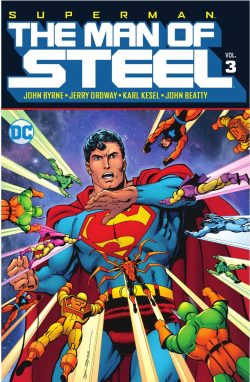
Superman: The Man of Steel volume 3


By John Byrne, Jerry Ordway, Ron Frenz, Dan Jurgens, Jim Starlin, Arthur Adams, , Curt Swan, Karl Kesel, John Beatty, Brett Breeding, Dick Giordano, Steve Montano, Roy Richardson, Leonard Starr, Keith Williams & various (DC Comics)
ISBN: 978-1-7795-0966-6 (HB), 978-1-7795-1378-6 (Digital edition)

This book includes Discriminatory Content produced in less enlightened times.

In 1985 when DC Comics rationalised, reconstructed and reinvigorated their continuity with Crisis on Infinite Earths they used the event to simultaneously regenerate key properties. The biggest gun they had was Superman and it’s hard to argue that change was not before time. The big guy was in a bit of a slump, but he’d weathered those before. So how could a root & branch retooling be anything but a pathetic marketing ploy that would alienate “real” fans for a few fly-by-night Johnny-come-latelies who would jump ship as soon as the next fad surfaced? The new Superman was going to suck…

They couldn’t have been more wrong.

It began with all Superman titles being “cancelled” (actually suspended) for three months, and yes, for the first time in decades, that did make real-world media sit-up and take notice of the character everybody thought they knew. However, there was method in this seeming corporate madness. The missing mainstays were replaced by a 6-part miniseries running from October to December 1986. Entitled Man of Steel, it was written and drawn by Marvel’s mainstream superstar John Byrne; fresh off a spectacular, groundbreaking run on Fantastic Four and inked by venerated veteran Dick Giordano. The bold manoeuvre was a huge and instant success. So much so that when first collected-as-a-stand-alone compilation album in 1991, it became one of comics’ premiere “break-out” hits in the new format that would eventually become the industry standard for reaching mass readerships. Nowadays few people buy the periodical pamphlets but almost everybody has read a Graphic Novel…

From that overwhelming relaunch the Action Ace seamlessly returned to his suspended comic book homes, enjoying the addition of a third monthly title that premiered that same month. Superman, Adventures of Superman, and Action Comics (which became a fan-pleasing team-up title guest-starring other favourites of the DC Universe, in the manner of the cancelled DC Comics Presents) were instant best-sellers. The back-to-basics approach lured many readers to – and, crucially back to – the Superman franchise, and the sheer quality of the stories and art convinced them to stay. Such cracking, clear-cut superhero exploits are a high point in the Man of Tomorrow’s near- nine decade career, and these collections are certainly the easiest way to enjoy one of the most impressive reinventions of a comic book icon.

So successful was the new look that by the early 1990’s Superman was carrying four monthly titles as well as numerous Specials, Annuals, guest shots and regular appearances in titles like Justice League – quite a turnaround from the earlier heydays of the Man of Steel when editors were frantic about never overexposing their meal-ticket. In Superman’s 85th year of more-or-less consecutive and continuous publication, a new sequence of collections brought Byrne & Co.’s tales to a new generation of fans, and at long last we’re getting around to plugging the third one…

This monumental compilation traces the Never-Ending Battle in unfolding, overlapping story order, not chronological release dates, spanning cover-dates October 1987 to May 1988, re-presenting Superman #12-15; Action #594-597; Adventures of Superman #436-438 and each title’s first Annual. Also included are crossover issue Booster Gold #23 and one-shot Superman: The Earth Stealers with relevant informative bio-pages from Who’s Who Update ‘87 #5 and Who’s Who Update ‘88 #2. Covers throughout are by Arthur Adams, Giordano, Ron Frenz, Brett Breeding, Dan Jurgens, Jim Starlin, Byrne and Jerry Ordway.

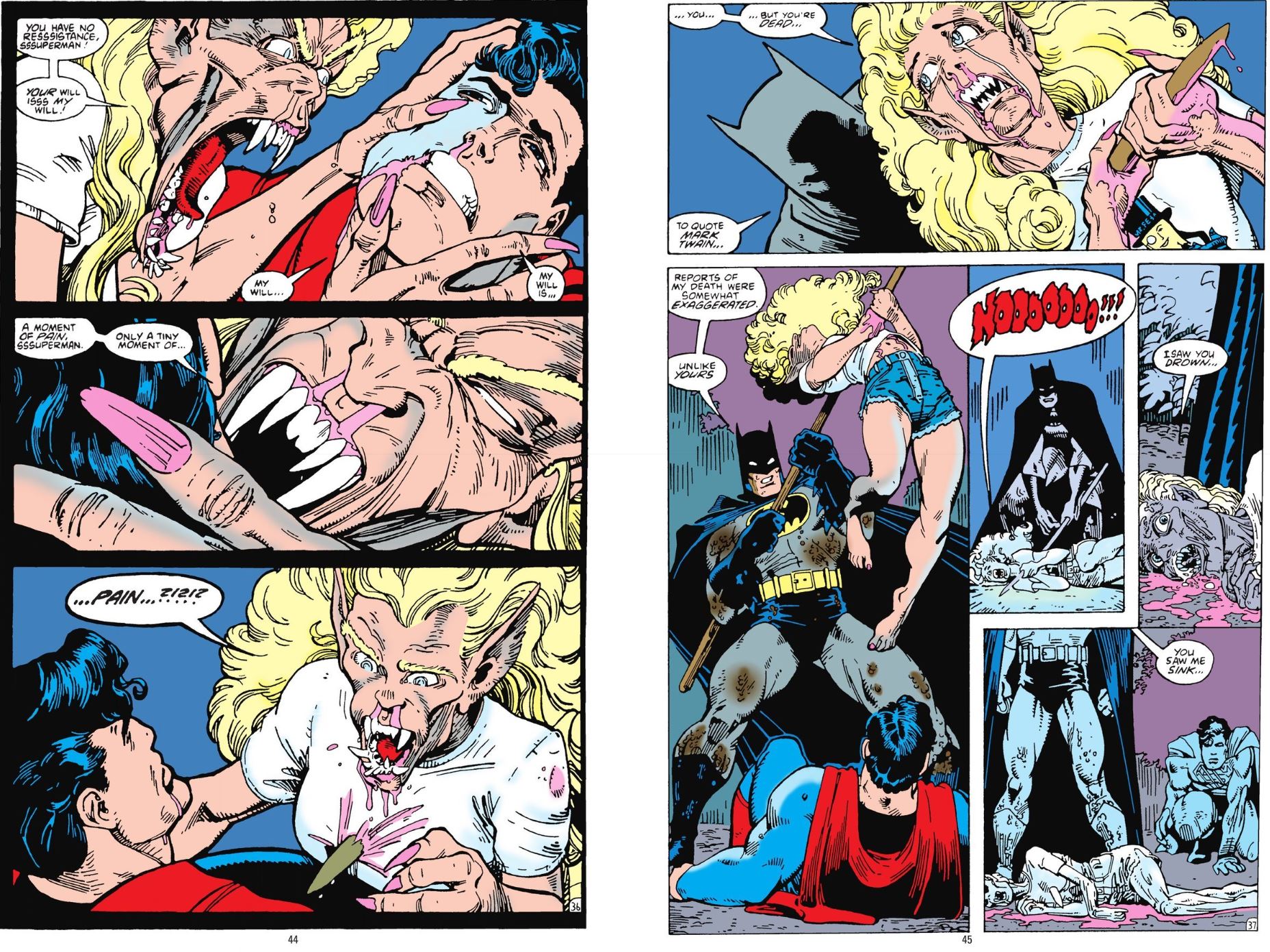
The magic kicks off with ‘Skeeter’, originally published in Action Comics Annual #1. A vampire shocker written by Byrne and illustrated by Art Adams & Dick Giordano, it plays out in the swamplands of Fayerville, South Carolina, with guest star Batman hunting a deceptively deadly bloodsucker before being forced to call in the biggest Big Gun he knows.

The brutal ending serves to underscore the big differences between the Post-Crisis Dark Knight and Man of Steel…

Next is a poignant updating of a Silver Age classic. ‘Tears for Titano’ (Byrne, Frenz & Breeding) first saw print in Superman Annual #1 cover-dated August 1987 and puts a modern spin on the sorry saga of a giant ape that menaced Metropolis. It all starts when Lois Lane objects to the treatment of a lab chimp by her old nemesis Dr. Thomas Moyers. The heartless, ambitious energy research scientist’s callous disregard for procedure, or even simple humanity, results in the anthropoid mutating into a colossal out-of-control rampaging menace only Superman can stop… even if he doesn’t want to…

The Adventures of Superman Annual #1 spawned ‘The Union’ by Jim Starlin, Jurgens & Steve Montano, wherein Superman is asked by President Ronald Reagan and über-Fed Sarge Steel to ferret out what happened to the people formerly living in the instant ghost-town of Trudeau, South Dakota. This edgy, chilling by-the-numbers sci-fi shocker showed audiences that the new Man of Steel wasn’t the guaranteed winner he used to be, and set the scene for a momentous future confrontation with the monstrous alien life-consumer Hfuhruhurr the Word-bringer., as well as showing the limits of a pledge to never take life…

In the monthly periodicals ‘All that Glisters’ (Byrne & Keith Williams) comes from November 1987’s Action Comics #594: a big battle team-up with fugitive from the future Booster Gold sneakily and accidentally orchestrated by Lex Luthor employing his robot duplicates. The acrimonious clash carried over and concluded in Booster Gold #23, with ‘Blind Obsession’ (art/story by Jurgens, inked by Roy Richardson) seeing the bad guy billionaire (is there any other kind?) thwarted and frustrated again…

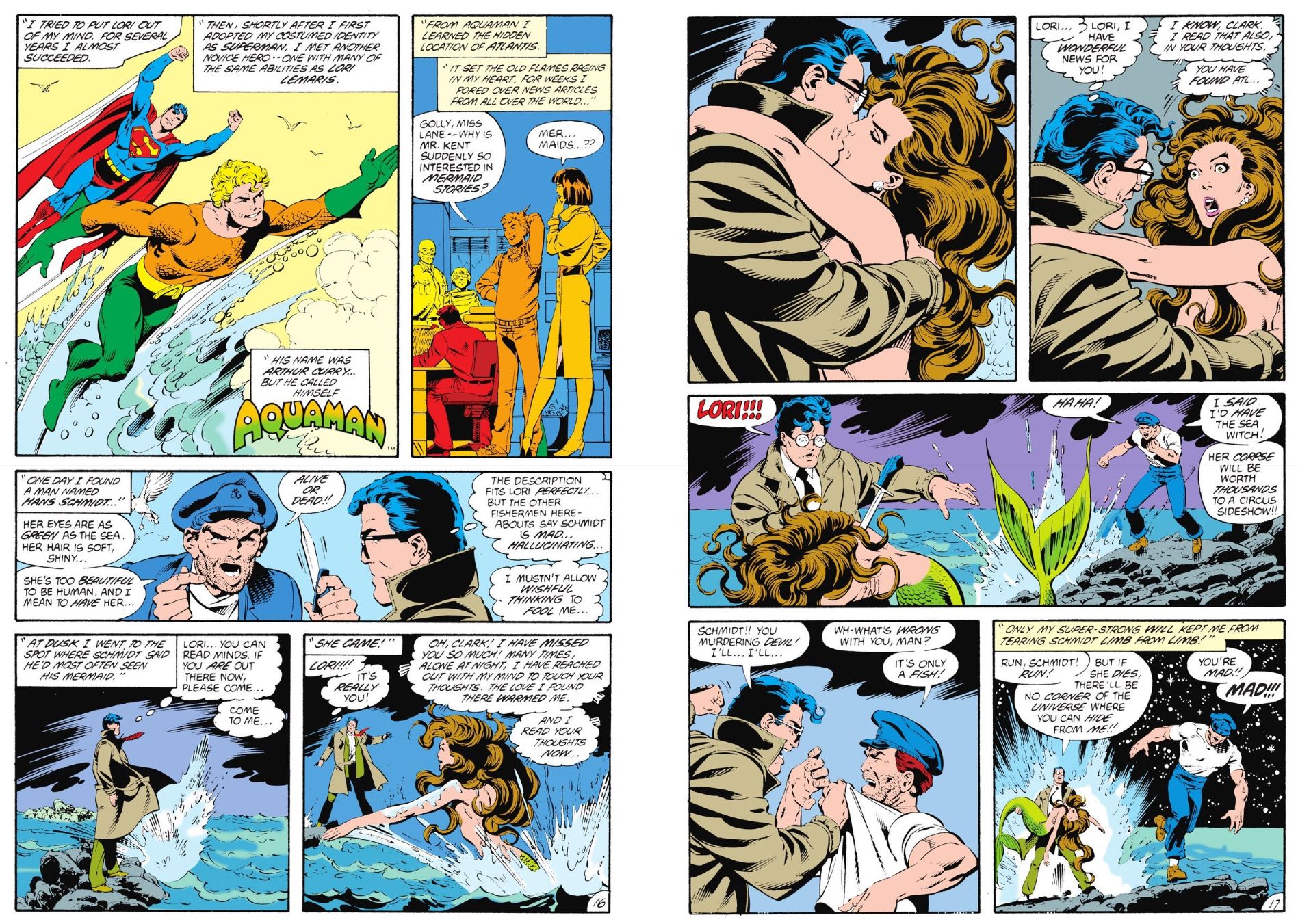
Next up is the magical retelling of another classic Wayne Boring Superman tale. ‘Lost Love’ (Superman #12, by Byrne & Karl Kesel) recounts the tragic tale of college boy Clark Kent’s brief affair with mysterious Lori Lemaris, a unique girl he twice loved and lost. Then, Action Comics #595 brings us back to the present with a bump in the night. Courtesy of Byrne & Williams ‘The Ghost of Superman’ introduces eerie, life-stealing Silver Banshee in a mystery team-up with a sneaky superstar who saves Metropolis from terror and dread and whose Big Identity Reveal I’m not going to spoil for you…

Next come the Kryptonian corners of DC’s third inter-company mega-crossover event. After Crisis on Infinite Earths and Legends there was Millennium, which saw writer Steve Englehart expand on an iconic tale from his Justice League of America run (#140-141) as well as his tenure on the Green Lantern Corps title. But first, a little background…

Billions of years ago robotic peacekeepers known as Manhunters rebelled against their creators. The Guardians of the Universe were immortal and desired a rational, orderly, emotionless cosmos – a view not shared by their own women. The Zamarons abandoned the Guardians on planet Oa at the inception of their grand scheme but, after billions of years, the two factions had reconciled and left our Reality together. Now they had returned with a plan to midwife a new race of immortals on Earth, but the Manhunters – who had since infiltrated all aspects of every society throughout the universe – were determined to thwart the plan, whether by seduction, connivance or just plain brute force. Earth’s heroes were summoned by the reunited immortals and subsequently gathered to see the project to completion but were continually confronted by Manhunters in their own private lives… and their own comics.

DC Comics third braided mega-series was a bold effort intended to touch all corners of their universe, introduce new characters, tie-in titles and do so on a weekly, not monthly, schedule. In addition to the 8 weekly issues of the miniseries itself, Millennium spread across 21 titles for two months – another 37 issues – for a grand total of 44 comic books, with the Superman-related crossover craziness opening here with ‘Toys in the Attic!’ (Superman #13, by Byrne & Kesel) .

In Metropolis, elderly British craftsman Winslow Percival Schott opens a campaign of murder and wanton destruction targeting Lex Luthor, the ruddy Yank who ruined his little company and forced him to become the murderous Toyman. No sooner has the Man of Tomorrow intervened in that fracas than he’s drawn back to sleepy hometown Smallville in ‘Junk’ (Adventures of Superman #436, script by Byrne, art by Ordway & John Beatty) to discover trusted confidant Lana Lang has for years been an agent of the Manhunters.

In truth the insidious mechanoids have been watching the Last Son of Krypton since before that world died, but had botched capturing the space infant when he first arrived on Earth. As a back-up plan, Manhunters replaced local medical practitioner Doc Whitney and he subsequently turned every child born since into a mind-controlled sleeper agent. With Clark a key factor in the Millennium, Whitney rallies his forces to capture Superman, but utterly underestimates the power and resourcefulness of the Man of Steel. Although victorious, Superman’s triumph is tainted by tragedy. In defeat, all Whitney’s unwitting agents – two generations of Smallville’s young folk – keel over dead…

Then, in Action Comics #596, ‘Hell is Where the Heart Is…’ (Byrne & Williams) as Ghostly Guardian The Spectre is drawn to the catastrophe and facilitates Superman’s odyssey to the Spiritual Realms to rescue all the recently and unjustly departed deceased…

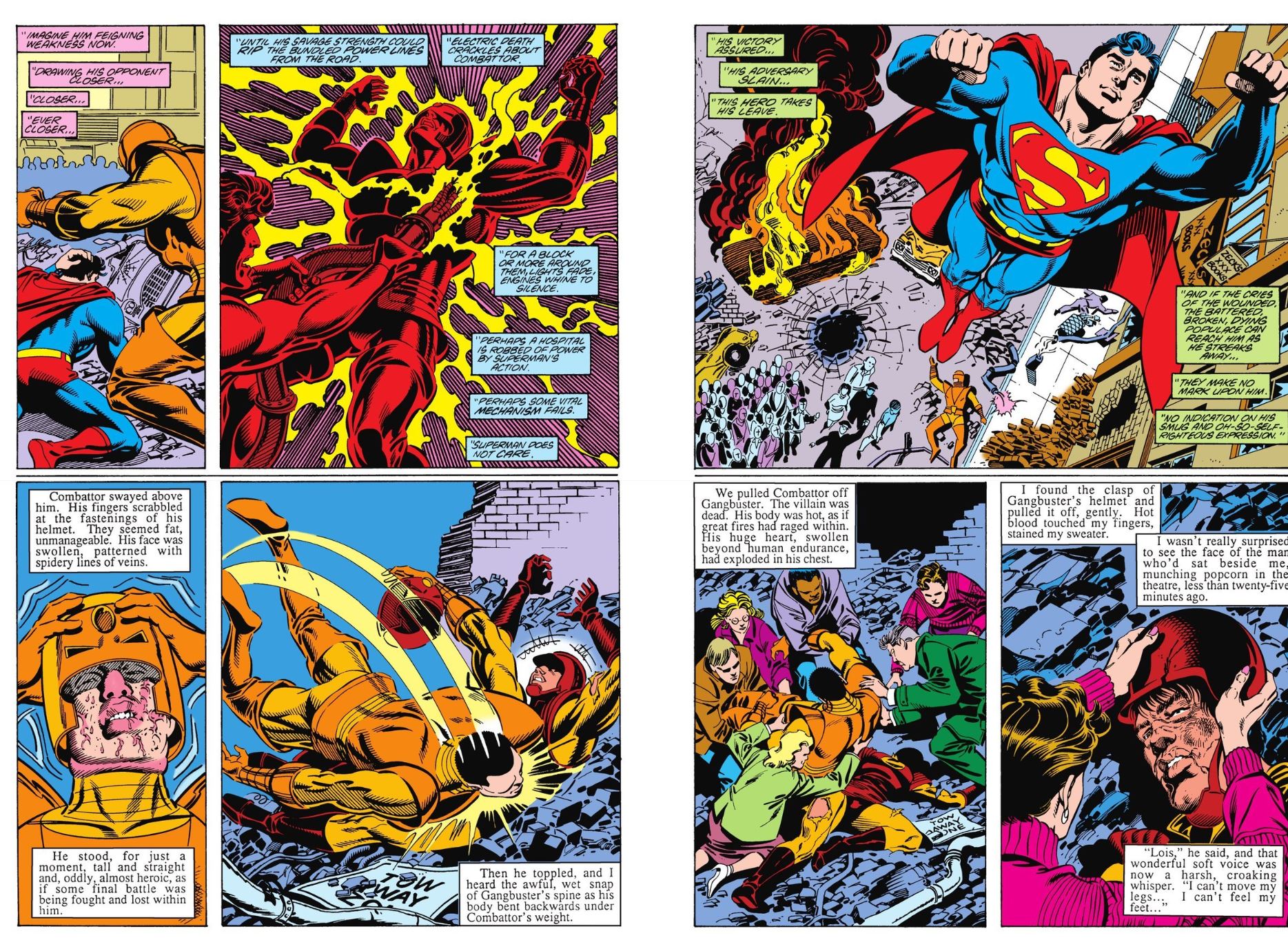
Byrne & Kesel’s Superman #14 offered a bombastic team-up with Green Lantern Hal Jordan wherein Emerald Gladiator and Action Ace chase colossal super-Manhunter Highmaster through uncanny dimensions as that mechanical maniac seeks to attack the sequestered, enervated Guardians and Zamarons in ‘Last Stand!’, after which events take a far more moody turn in Adventures of Superman #437. A twinned tale by Byrne, Ordway & Beatty, ‘Point of View’ simultaneously reveals how Luthor attempts to seduce one of the Millennium candidates to his evil side even as Lois Lane helplessly watches the brutally crippling struggle of merely mortal vigilante JoseGangbuster” Delgado against Lex’s hyper-augmented cyborg warrior Combattor

The repercussions of that clash are examined in ‘Visitor’ (Action Comics #597) wherein Byrne, Leonard Starr & Williams impishly referenced Silver Age catfights between Lois Lane and Lana Lang, whilst the story itself establishes the false premise that Superman was raised as Clark’s adopted brother to throw off Lois’ growing suspicions…

With the Millennium complete, Superman #15 returned to regular wonderment as Superman is asked to find Metropolis Police Captain Maggie Sawyer’s missing daughter Jamie, just as the city is hit with a rash of flying bandit children. ‘Wings’ (Byrne & Kesel) debuts repulsive monster Skyhook: a horrific bat-winged Fagin who beguiles and mutates runaways whilst concealing even greater ghastly secrets…

The Fights ‘n’ Tights fun intensifies with Adventures of Superman #438 (March 1988, by Byrne, Ordway & Beatty) and another modern-day re-imagination of a past icon. ‘…The Amazing Brainiac’ sees a trip to the circus disastrously coincide with drunken mentalist Milton Fine developing uncanny psionic abilities and going wild. Despite his mental assaults being particularly effective against the Man of Steel, Superman eventually overcomes the furiously frantic performer, but is the defeated man simply deranged by his own latent abilities, or are his ravings of being possessed by an alien named Vril Dox of Colu somehow impossibly true?

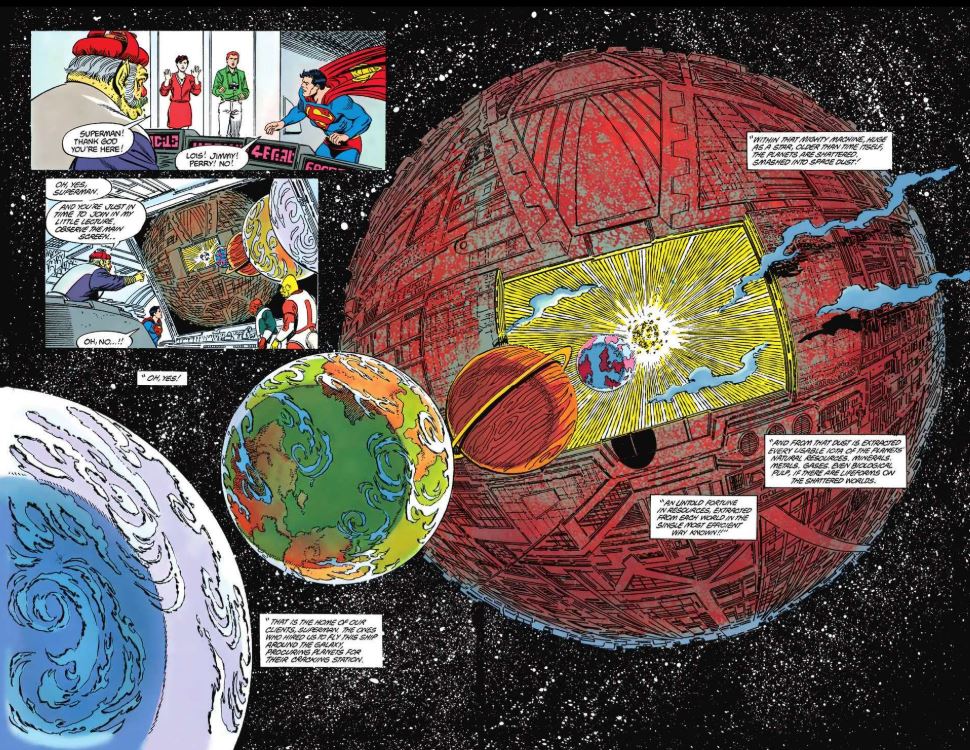
This collection concludes with one-shot “Prestige Format” special Superman: The Earth Stealers by writer Byrne, inker Ordway and colourist Bill Wray who augment a post-Crisis return to the Action Ace for lifelong Super-Artist Curt Swan. Here the whole world is confiscated by a plundering alien seeking to sell it for scrap and resources, but the fiend and his brutal gladiator/legbreaker Gunge have not reckoned on this latest easy score being home to the last of the fabled and feared Kryptonians…

The bonus bit at the back consists of a ‘Cover gallery’ of previous MoS collections by Ordway, Byrne & Kesel, with excerpts from Who’s Who Update ‘87 #-5 and Who’s Who Update ‘88 #2, featuring illustrated fact-snacks concerning Booster Gold ( by Jurgens & Mike DeCarlo); Titano (Frenz & Byrne); Lori Lemaris (Byrne); Silver Banshee (Mike Mignola & P. Craig Russell) before a big bold pin-up of the Man of Steel finalises the fun for now.

Against all contemporary expectation the refitted Man of Tomorrow was a huge critical and commercial success. As one of the penitent curmudgeons who was proved wrong at the time, I can earnestly urge you not to make the same mistake. These are magically gripping and memorable comic gems to be enjoyed over and over again. So the sooner you get these books the sooner you can start the thrill ride reinvention of the ultimate comic book icon.
© 1987, 1988, 1989, 2021 DC Comics. All Rights Reserved.

Today in 1844 Spanish painter/illustrator/cartoonist Josep Lluis Pellicer was born, followed by Disney comics maestro Tony Strobl in 1915, and comics editor, publisher and historian catherineCatyronwoode in 1947. The post-war Fifties greeted cartoonist Tom Armstrong (Marvin) in 1950; artist/publisher Neil D. Vokes (Robotech, Fright Night, Eagle) in 1954 and Elizabeth Smith (Action Comics, Lex Luthor) in 1958.

Deaths this date include legendary British licensed properties artist British artist/illustrator George William Wakefield (Laurel & Hardy, Ben Turpin, Jackie Coogan, George Formby, The Funniosities of Fatty Arbuckle, The Screen Screams of Ford Sterling, Jolly Rover, Freddie Flip and Uncle Bunkle, Abbott & Costello) in 1942; US cartoonist/writer Dick Calkins (Uncle Bob’s Story Book, Buck Rogers, Skyroads) in 1962; children’s book illustrator/cartoonist Syd Hoff (Danny the Dinosaur, I Can Read…, Tuffy, Laugh It Off) in 2004 and legendary Belgian all star Eddy Paape (Valhardi, Buck Danny, Mark Dacier, Luc Orient, Surcouf, Johnny Congo) in 2012.

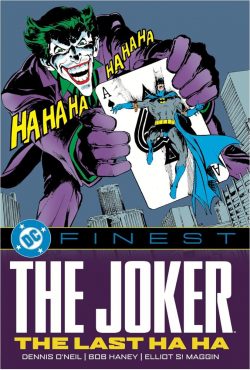
DC Finest: The Joker – The Last Ha-Ha


By Dennis O’Neil, Elliot S! Maggin, Bob Haney, Martin Pasko, David V. Reed, Steve Englehart, Len Wein, Paul Levitz, Dick Dillin, Neal Adams, Irv Novick, Jim Aparo, Ernie Chan, José Luis García-López, John Calnan, Marshall Rogers, Walter Simonson, Don Newton, Joe Staton, Joe Giella, Dick Giordano, Vince Colletta, Tex Blaisdell, Frank McLaughlin, Bob Wiacek, Terry Austin, Steve Mitchell & various (DC Comics)
ISBN: 978-1-79951-025-3 (TPB)

This book includes Discriminatory Content produced in less enlightened times.

HEY! WHO LET THAT CLOWN IN? IS THERE A PARTY SOMEWHERE?

An old adage says that you can judge someone by the calibre of their enemies, and that’s never been more ably demonstrated than with Batman. For most of his near century of existence, but most especially ever since the 1970s, the position of paramount antagonist has been indisputably filled by Clown Prince of Crime The Joker! He first hit newsstands in Batman #1 (cover-dated Spring and officially on sale from April 25th 1940). That’s 86 exploding candles and poisoned cakes and he’s still totally, lethally crazy after all these years…

Spanning cover-dates December 1969 to September 1981, this compilation collects stories from Justice League of America #77; Batman # 251, 260, 286, 291-294 & 321; Detective Comics #475-476 & 504; eccentric team-ups from The Brave and the Bold #111, 118, 129-130 & 141: The Joker volume 1 #1-10 and Earth-Two appearances from Wonder Woman volume 1 #280-283, a comprehensive but by no means complete carry on of one of the most conflicted and confusing characters in comics.

In the late 1960s superheroes experienced a rapid decline in popularity – presumably reaction to global media’s crass and crushing overexposure. When that bubble burst, Batman’s comic franchise sought to escape the zany, “camp” image by methodically re-branding the hero and returning to the original 1930s concept of a grim, driven Dark Avenger. Although hugely popular, TV’s sappy buffoon/thieving villain version of The Joker was almost fatal to the character on the printed page. However, a deftly calculated return to his Golden Age, eerie cheery killer persona began almost immediately. Thus this collection which kicks off with the Mountebank of Mirth manically upping his game and expanding his pool of enemies…

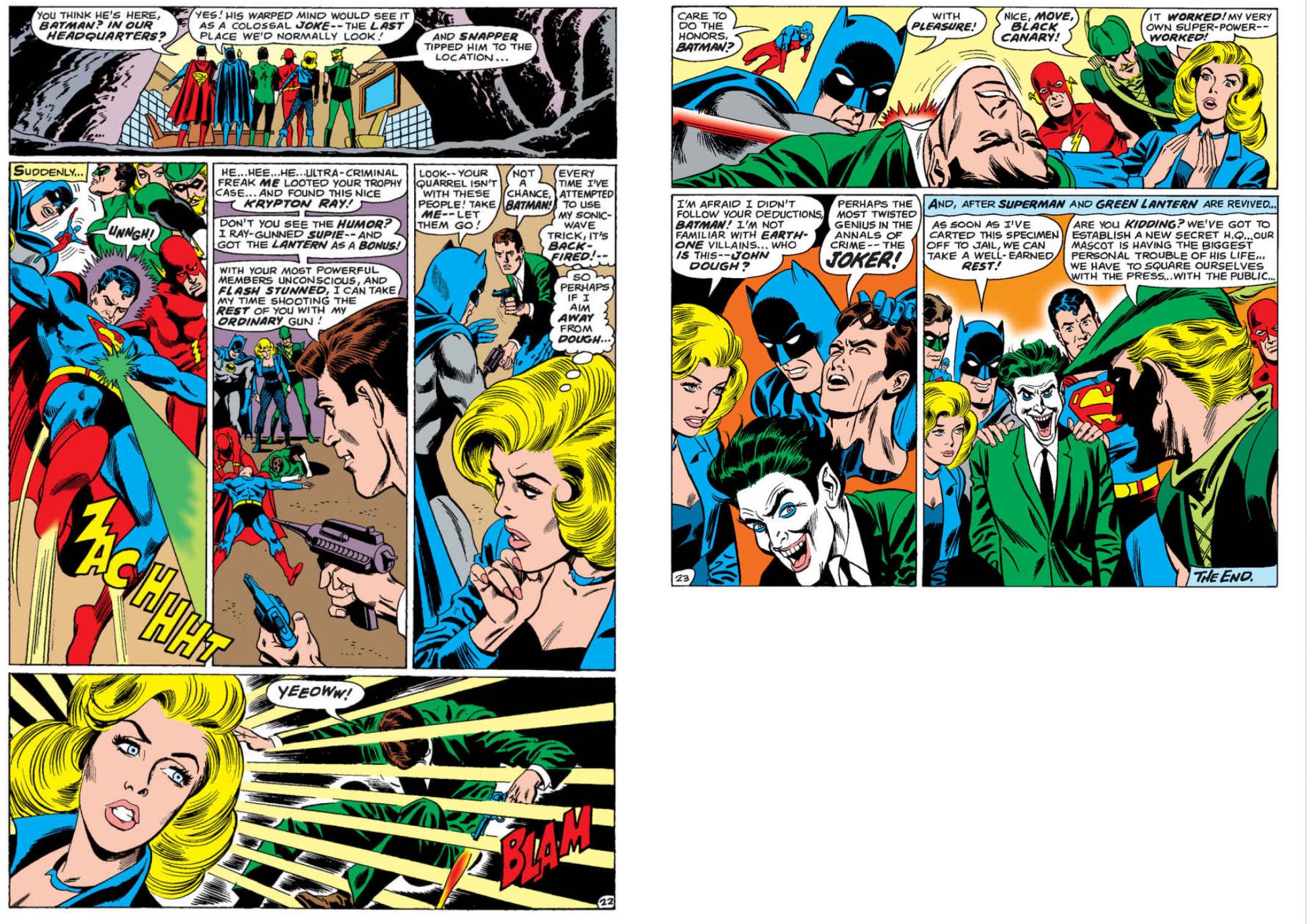
In Justice League of America #77 (cover-dated December 1969), the smugly complacent confidence and cheery worldview of the World’s Greatest Superheroes is shattered after enigmatic political populist Joe Dough suborns and compromises their beloved teen mascot in ‘Snapper Carr… Super-Traitor!’ This revelatory rite of passage comes from Denny O’Neil, Dick Dillin & Joe Giella: a coming-of-age yarn that saw the team lose public support and even their secret HQ, as the comfy, cosy superhero game changes forever… and no guesses for who Joe Dough really is!

The dark transformation of the Crime Clown was fully accomplished in Batman #251 (September 1973 by O’Neil & Neal Adams). ‘The Joker’s Five-Way Revenge!’ reinstated the psychotic, diabolically unpredictable Killer Clown who scared the short pants off readers of the 1940s. A true milestone utterly redefining the hero’s nemesis for the modern age, the frantic moody yarn sees the Mirthful Maniac stalking his old gang, seeking to eradicate them all, with a hard-pressed Gotham Guardian desperately playing catch-up. As crooks die in all manner of byzantine and bizarre ways, Batman realises his archfoe has gone irrevocably off the deep end. Terrifying and beautiful, for many fans this is the definitive Batman/Joker story.

Cover-dated February/March 1974, The Brave and the Bold #111 boasted “the strangest team-up in history” as writer Bob Haney & artist on fire Jim Aparo had the Gotham Guardian join forces with the Harlequin of Hate for a brilliantly twisty tale of cross-&-double-cross in ‘Death has the Last Laugh!’ Complex and compelling, this murder-spree yarn possibly led to the Crime Clown’s own short-run series a year later.

Meanwhile, from Batman #260 (January/February 1975 by O’Neil, Irv Novick & Dick Giordano), ‘This One’ll Kill You Batman!’ finds the grim, po-faced Darknight Detective racing to save his own life after being poisoned by Joker Toxin that acts like irresistibly lethal laughing gas, after which B&B #118 (April) sees Wildcat and Batman forced to brutally battle each other in ‘May the Best Man Die!’ after being sucked into Joker’s scheme to poison boxers (and anyone else in range) with a deadly, blood-borne virus…

Within 18 months of the breakthrough revision in Batman #251, The Joker won his own series. Titles starring villains were exceedingly rare back then and provided quite a few problems for writers and editors still labouring under the edicts of the Comics Code Authority. The outré experiment ended after 9 issues – spanning May 1975 to October 1976, (plus one formerly unpublished digital issue in 2019) – and had utilised some of the most talented creators in DC’s employ. It remained a peculiar historical oddity for decades. Now, in these less doctrinaire times those strange tales of the Smirking Slaughterman have an appreciative audience…

The murderous merriment commences with ‘The Joker’s Double Jeopardy!’ Here fellow Arkham Asylum inmate Two-Face arrogantly escapes, pinking the Felonious Funnyman’s pride and compelling the giggling ghoul to similarly break out to prove he’s the greater criminal maniac. Their extended duel of wits and body-counts only lands them both back inside. That “revolving door” security at Arkham eventually leads to the firing of much-harassed guards Marvin Fargo & Benny Khiss in #2’s ‘The Sad Saga of Willie the Weeper!’ However, as the again-at-liberty Lethal Loon attempts to boost the confidence of a lachrymose minor-league larcenist for his own purposes, those defrocked jailers determine to restore their honour and fortunes and astoundingly, they succeed.

Written by O’Neil with art by Ernie Chan (nee Chua) & José Luis García-López, ‘The Last Ha Ha’ in #3 details a burglary and kidnapping of superstar cartoonist Sandy Saturn by a green-haired, cackling crazy. Witness accounts lead the cops to the ludicrous conclusion that The Creeper is the culprit. Cue lots and lots of eerie chortling, mistaken identity shenanigans and murderously manic explosive action…

The ethical dilemma of a star who’s arguably the world’s worst villain is further explored in ‘A Gold Star for the Joker!’ (Elliot S! Maggin, García-López & Vince Colletta) wherein our Perfidious Pagliacci inexplicably develops a crush on Black Canary’s alter-ego Dinah Lance and resolves to possess her or kill her. Typically, even though she’s perfectly capable of saving herself, Dinah’s beau Green Arrow (see what I did there?) is also the possessive aggressive kind of consort…

‘The Joker Goes Wilde!’ (Martin Pasko, Irv Novick & Tex Blaisdell) finds the Clown Prince in bombastic competition with similarly playing-card themed super-bandits The Royal Flush Gang. Everyone wants to secure a lost masterpiece, but even as he’s winning that weird war, the Mountebank of Menace is already after a hidden prize.

More force of nature than mortal miscreant, the Pallid Punchinello meets his match after assaulting actor Clive Sigerson in #6. Famed for stage portrayals of a certain literary detective, Sigerson sustains a nasty blow to the bonce which befuddles his wits and soon ‘Sherlock Stalks the Joker!’ (O’Neil, Novick & Blaisdell), foiling a flood of crazy schemes and apprehending the maniac before his concussion is cured…

We learn surprising facts about the Clown Prince of Carnage when he steals the calm, logical intellect of Earth’s most brilliant evil scientist. Naturally, psychic transference in ‘Luthor… You’re Driving Me Sane!’ (Maggin, Novick & Frank McLaughlin) is two-way and, whilst the newly cognizant Clown becomes ineffably intelligent, Lex Luthor is reduced to a risk-taking maniac unphased by potential consequences and determined to have fun no matter who dies. The Joker’s eighth outing covered a clash with Gotham’s self-acclaimed Master of Terror as ‘The Scarecrow’s Fearsome Face-Off!’ (Maggin, Novick & Blaisdell) saw the top contenders for scariest guy in town (not counting Batman!) steal each other’s thunder whilst vying for that macabre top spot, before the villainous vignettes conclude with a claws-out clash as ‘The Cat and the Clown!’ (Maggin, Novick & Blaisdell) sees an aged comedian and his million-dollar kitty targeted by rival rogues Catwoman and Joker. Unhappily for the crooks they had both underestimated the grizzled guile of their octogenarian victim…

In Fall of 2019 the unpublished tenth issue was released digitally and appeared in monolithic, print-only, rather inaccessibly expensive The Joker: The Bronze Age Omnibus (Collected). There – and here – Pasko & Novick’s tale ‘99 and 99/100% Dead!’ involves a deal with the Devil (AKA “Lou Cipher”) and scheme to murder Earth’s greatest heroes – The JLA – that doesn’t quite come about and ends on a cliffhanger…

Here, however, we resume with a rare two-parter from The Brave and the Bold #129 & 130: a jam-packed action-romp with ‘Claws of the Emperor Eagle’ pitting Batman, Green Arrow and The Atom against Joker, Two-Face and hordes of bandits in a manic race to possess a statue that had doomed every great conqueror in history. The epic, globe-trotting saga concluded with an ironic bang in ‘Death at Rainbow’s End’

In Batman #286,‘The Joker’s Playground of Peril!’ (April 1977 by O’Neil, Novick & Bob Wiacek) sees The Clown escape Arkham Asylum prompting panic in the lawyer who failed get him off and the fence who cheated the loon when selling his ill-gotten gains. The fugitives make it easy for the manic by hiding in the same Amusement park but the Dynamoc Duo are clued in and waiting…

Next is an extended saga from Batman #291-294 (cover dates September through December 1977) written by author David V. Reed and illustrated by John Calnan & Tex Blaisdell. Over four deviously clever issues ‘Where Were You the Night Batman Was Killed?’ sees hordes of costumed foes the Caped Crimebuster has crushed assemble to verify the stories of various felons claiming to have done the deed. This thematic partial inspiration for Neil Gaiman’s “Last Batman Story” kicks off with ‘The Testimony of the Catwoman’ followed by ‘The testimony of…’ The Riddler, Lex Luthor and The Joker before satisfactorily concluding with a twist in a spectacular grand manner.

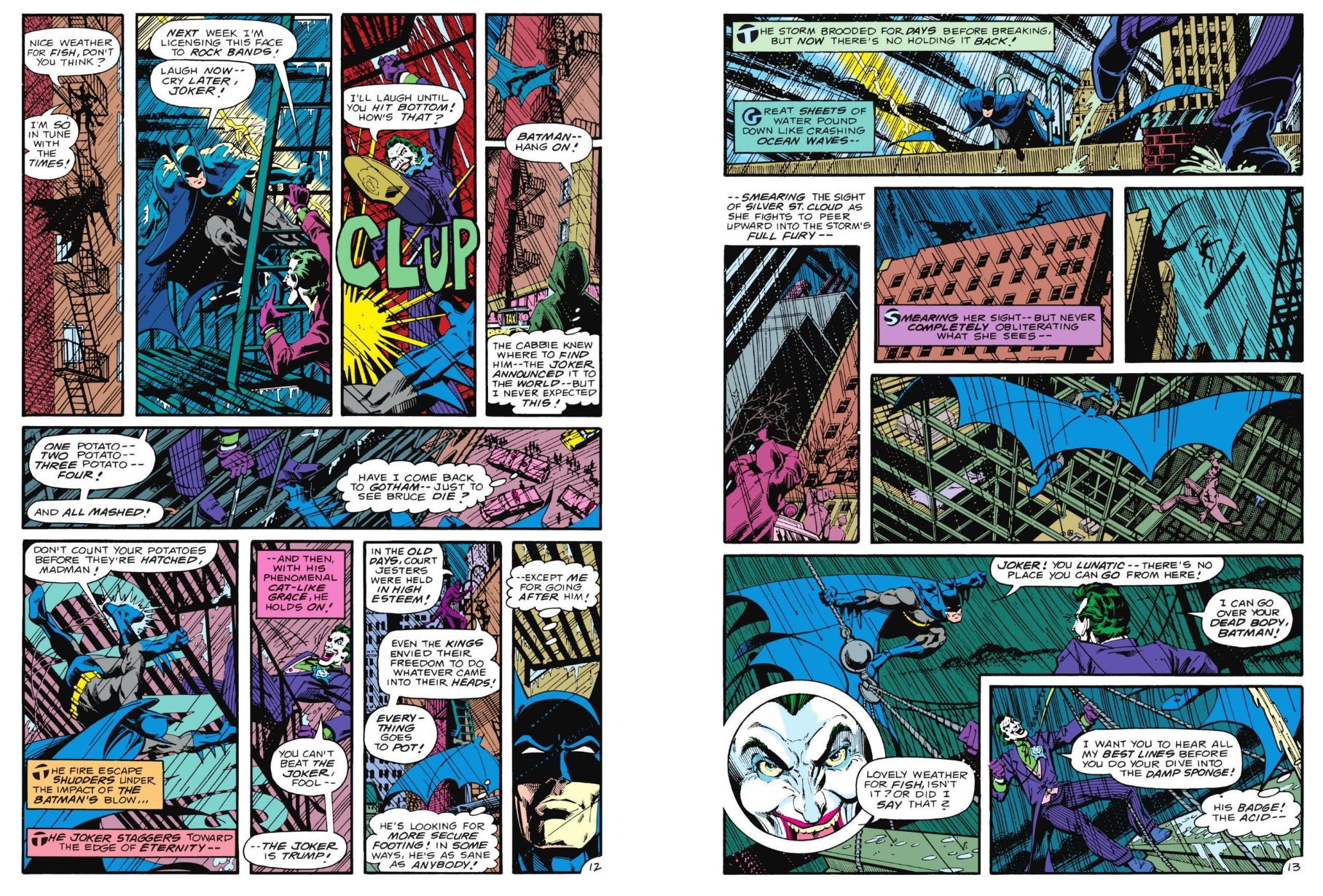
The only real contenders for the plaudits of being the best Joker yarn ever follows: a two-part saga from Detective Comics #475-476 (February & April 1978) concluding a breathtaking, signature run of retro tales by Steve Englehart, Marshall Rogers & Terry Austin. The absolute zenith in a short but stellar sequence resurrecting old foes naturally peaked with the Dark Knight’s nemesis at his most chaotic, and began with ‘The Laughing Fish!’ and culminating in ‘The Sign of the Joker!’, comprising one of the most reprinted Bat-tales ever concocted. It was even adapted as an episode of the award-winning Batman: The Animated Adventures TV show in the 1990s. In fact, you’ve probably already read it. But if you haven’t… what a treat awaits you!

As seafood sporting the Joker’s horrific smile began turning up in sea-catches all over the Eastern Seaboard, the Clown Prince attempts to trademark them. When patent officials foolishly tell him it can’t be done, they start dying – publicly, impossibly and incredibly painfully…

The story concluded in a spectacular apocalyptic clash which shaped, informed and redefined the Batman mythos for decades to come…

The best was saved for last, with continuity altering sub-plots concerning Bruce Wayne’s current inamorata Silver St. Cloud, crooked politico “Boss” Rupert Thorne and the Gotham City Council who had outlawed the hero, and even the recurring ghost of Hugo Strange culminating in THE classic confrontation with The Joker.

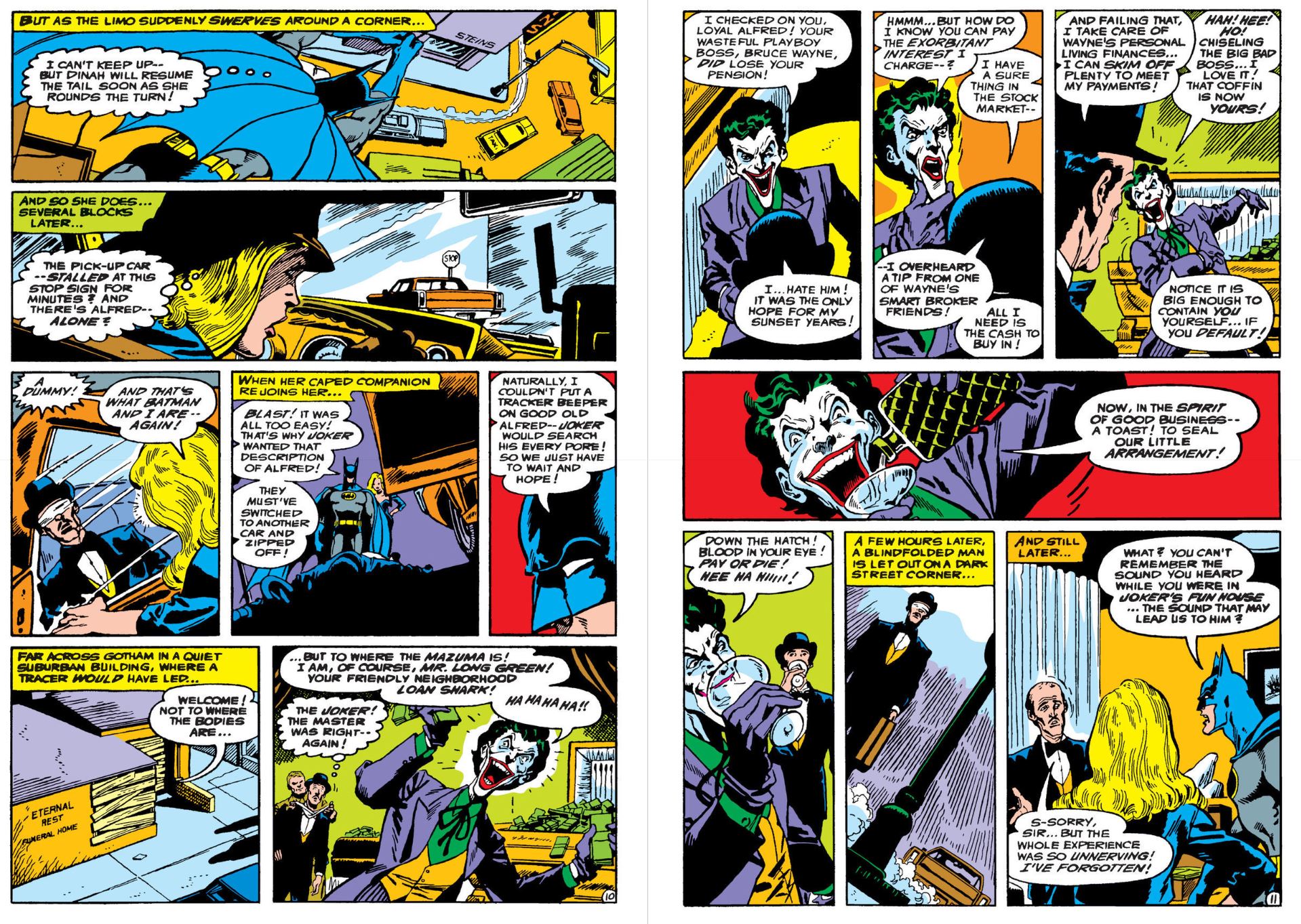
B&B #141 (May/June 1978) offers another Batman team-up with Black Canary as ‘Pay – or Die!’ (by Haney & Aparo) finds Dinah Lance looking at a modelling career but pausing to help Batman and Alfred quash the Joker’s bizarrely byzantine extortion/loan sharking/crooked mortician scheme in ‘Pay – Or Die!’

The gleeful terror continues with ‘Dreadful Birthday, Dear Joker…!’ by Len Wein, Walt Simonson & Giordano (from Batman #321 March 1980), wherein the Malevolent Mummer planned to celebrate his anniversary in grand style: kidnapping a bunch of old chums like Robin, Jim Gordon, Alfred Pennyworth, Catwoman and others to be the exploding candles on his giant birthday cake…

The Joker has the rare distinction of being perhaps the most iconic villain in comics and can claim that title in whatever era you choose to concentrate on; Noir-ish Golden Age, sanitised Silver Age or malignant modern and Post-Modern milieus. This book captures just a fraction of all those superb stories and with the benefit of another two and a half decades of material since the release of this compendium, just think of what a couple of equally well-considered sequels might offer…

Cover-dated July 1981, Detective #504 – by Gerry Conway, Don Newton & Dan Adkins – details ‘The Joker’s Rumpus Room Revenge!’ Closing the Batman related portion of the book, here the Murderous Mummer again slips out of Arkham and murders an old puppet-maker to lure the Dark Knight into a killzone packed with killer toys and robots…

During the late Seventies and early Eighties Helena Wayne was the daughter of the deceased Earth-2 Batman and Catwoman Selina Kyle. As The Huntress, the immensely popular character sprang from a then-current Justice Society of America series in All Star Comics into her own relatively long-running back-up feature initially in Batman family and then in Wonder Woman (#271 September 1980 through #321, November 1984). She died in but notionally survived the Crisis on Infinite Earths by being retooled as mob-orphan Helena Bertinelli to become a post-Crisis Dark Knight adjunct.

From Wonder Woman #280 – 283 (vol. 1, June to September 1981) and crafted by Paul Levitz, Joe Staton & Steve Michell ‘Lion at Bay’ sees Huntress crush her mother’s old nemesis Lionmane, but not before his mass jailbreak allows a declining but still demented and deadly Harlequin of Hate to escape Gull’s island prison. Refusing to believe Batman is dead, elderly Joker proceeds to poison old foes like Commissioner O’Hara to draw out his enemy. Stalked by Huntress in ‘Always Leave ‘em Laughing’ before recruiting another old Crazy Clown combatant to help trick and trap the madman, the end comes in ‘First Laugh…’ and final encore ‘…Last Laugh!’

With covers by Murphy Anderson, Adams, Tatjana Wood, Nick Cardy, Aparo, Giordano, Ross Andru, Chan, García-López, Drew Moore, Rogers & Austin, Simonson, Jim Starlin, Rich Buckler, and George Pérez, this quirky oddment offers slick plotting and startling visuals as madcap misdemeanours are soundly upstaged and shoved aside by lunatic larks, malign malice and a more mounting degree of murderous mayhem than most classical fans might be comfortable with, but always sustained and supported by strong storytelling and stunning art to delight fans of traditional Fights ‘n’ Tights sagas.
© 1969, 1973, 1974, 1975, 1976, 1977, 1978, 1980, 1981, 2026 DC Comics. All Rights Reserved.

Today in 1913 author and groundbreaking comics scripter John Broome (aka John Osgood & Edgar Ray Meritt) was born, followed in 1928 by Filipino art maestro Nestor Rendondo (Darna, Rima the Jungle Girl, The Bible, Swamp Thing); Belgian cartoonist Joseph Loeckx/“Jo-El Azara” (Taka Takata, Clifton) in1937, and our own astounding John Ridgway (Commando Picture Library, Famous Five, Young Marvelman, Judge Dredd, Bozz Chronicles, Hellblazer) in 1940.

This date in 1953 welcomed US cartoonist/book illustrator Doug Cushman (Aunt Eater, Holiday Mice!); Canadian Underground artist Patrick Henley AKA Henriette Valium in 1959; Mad magazine illustrator Tom Richmond in 1966; Scott Kolins in 1968 and Ale Garza in 1977.

We lost today editor Lou Stathis in 1997, and Henry Sunday page artist Don Trachte in 2005 but the day did give us Richard F. Outcaul’s Buster Brown which launched in 1902, Ivy the Terrible’s debut in The Beano, courtesy of Roy Nixon in 1985 and the very first Free Comic Book Day today in 2002.

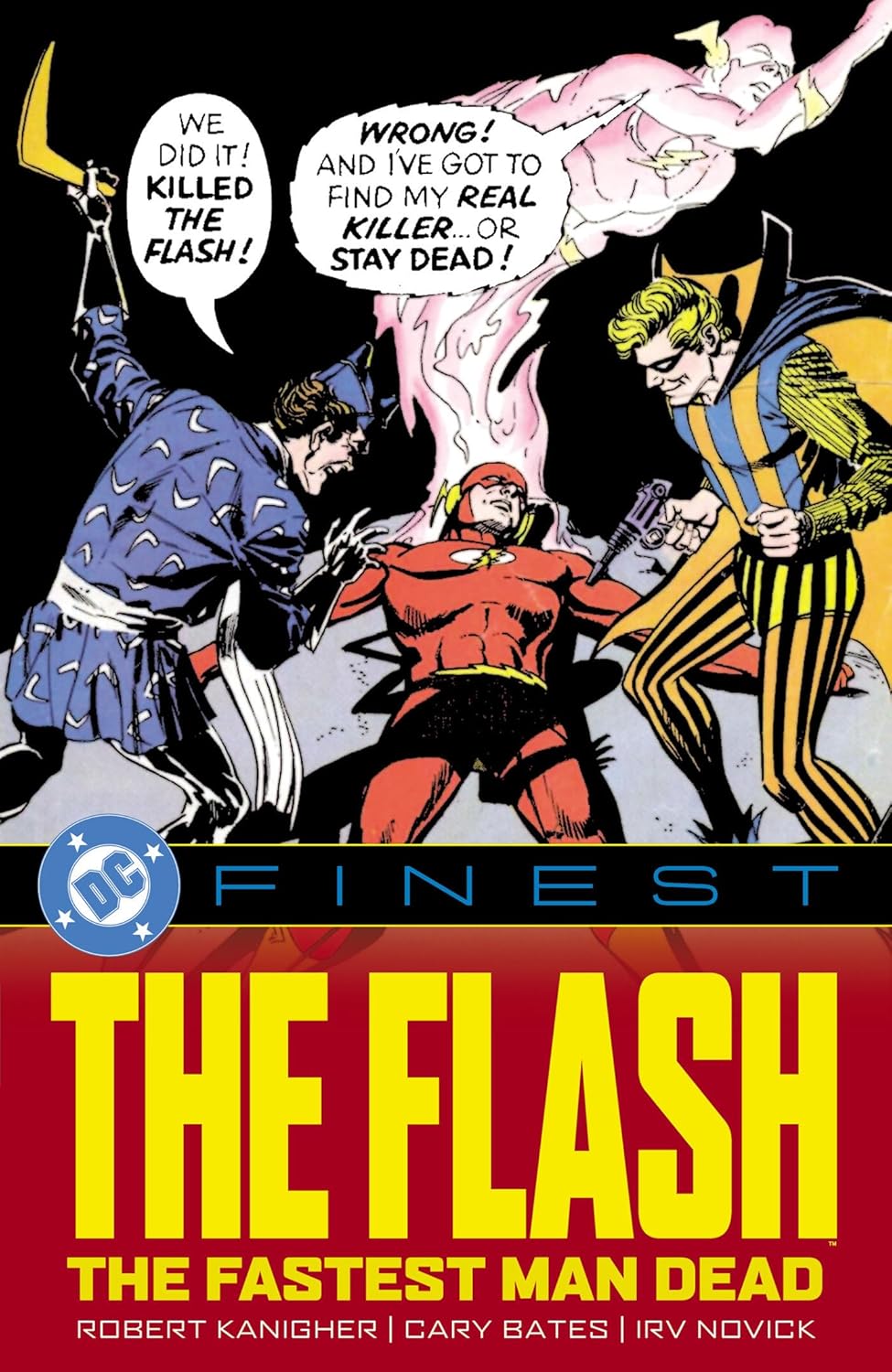
DC Finest: The Flash – The Fastest Man Dead


By Robert Kanigher, Mike Friedrich, Steve Skeates, Dennis O’Neill, Bob Haney, Len Wein, Cary Bates, Gil Kane, Irv Novick, Don Heck, Dick Dillin, Bob Brown, Murphy Anderson, Dick Giordano, Joe Giella, Nick Cardy, Frank McLaughlin, Tex Blaisdell, Carmine Infantino, Neal Adams, Jack Adler, Tatjana Wood, John Costanza & various (DC Comics)

ISBN: 978-1-77952-836-0 (TPB)

This book includes Discriminatory Content produced in less enlightened times.

Here’s another compelling DC Finest edition: chronologically curated paperback archives (generally around 600 pages) highlighting past glories. Whilst primarily concentrating on the superhero pantheon, there are genre selections including horror, sci fi, western and war books, but sadly none yet available digitally. However, we live in hope…

The Silver Age of US comics is formally and forever tied to Showcase #4 and the rebirth of The Flash. That epochal issue was released in the late summer of 1956 and from it stems all today’s print, animation, games, collector cards, cosplay and TV/movie wonderment. No matter which way you look at it, the renaissance began with The Flash, but it’s an unjust yet true fact that being first is not enough: it also helps to be best and people have to notice. MLJ’s The Shield beat Captain America to the news-stands by over a year yet the former is all but forgotten today. I mention that here as it pertains to this collection, which sees the advent of original Shield co-creator Irv Novick (Bob Phantom; Hangman; Steel Sterling; Silent Knight; Robin Hood, all DC war books, Captain Storm; Sea Devils; Batman, The Joker; Lois Lane; Tomahawk and more) as the Scarlet Speedster’s regular illustrator; a run (oh. Ha-Ha.) spanning Flash #200-270 and close to a full 10-year stretch with him only absent for #205, 213-214 & 264…

For the early trendsetting sagas and situations you should catch DC Finest: The Flash – The Human Thunderbolt and take as read that here the (second) Flash is Barry Allen, a police forensic scientist simultaneously struck by lightning and bathed in exploding chemicals from his lab. Supercharged by the accident, Barry (a lifelong fan of comic books) took his superhero identity from his favourite childhood reading – and eventually his acknowledged alternately Earth predecessor. Once upon a time there was a “fictional” scientist named Jay Garrick who was exposed to the mutagenic fumes of Hard Water and promptly became the “fastest man alive”…

Wearing a sleek, streamlined, tricked-out bodysuit (courtesy of  Carmine Infantino – a major talent approaching his artistic and creative peak), Barry was point man for the spectacular revival of a genre and an entire industry. He also became a renowned intergalactic champion, wholesome family man and paternalistic elder statesman of the superhero set after marrying his longtime fiancée Iris West

With Infantino safely elevated to DC’s current publisher, this splendidly tempting full colour paperback of Seventies hits displays the glorious work of the last replacement illustrators before the Flash landed in Novick’s hands, just as changing tastes rejected the previously paramount, rationalistic science fiction worlds touched by the Vizier of Velocity. Now high speed action involved issues of social relevance and themes of supernatural horror and makes for some weird moments as this copious compendium covers The Flash #197-229 (May 1970 – October 1974) plus guest shots in World’s Finest Comics #198-199 (November & December 1970) and The Brave and the Bold #99 (December 1971/January 1972).

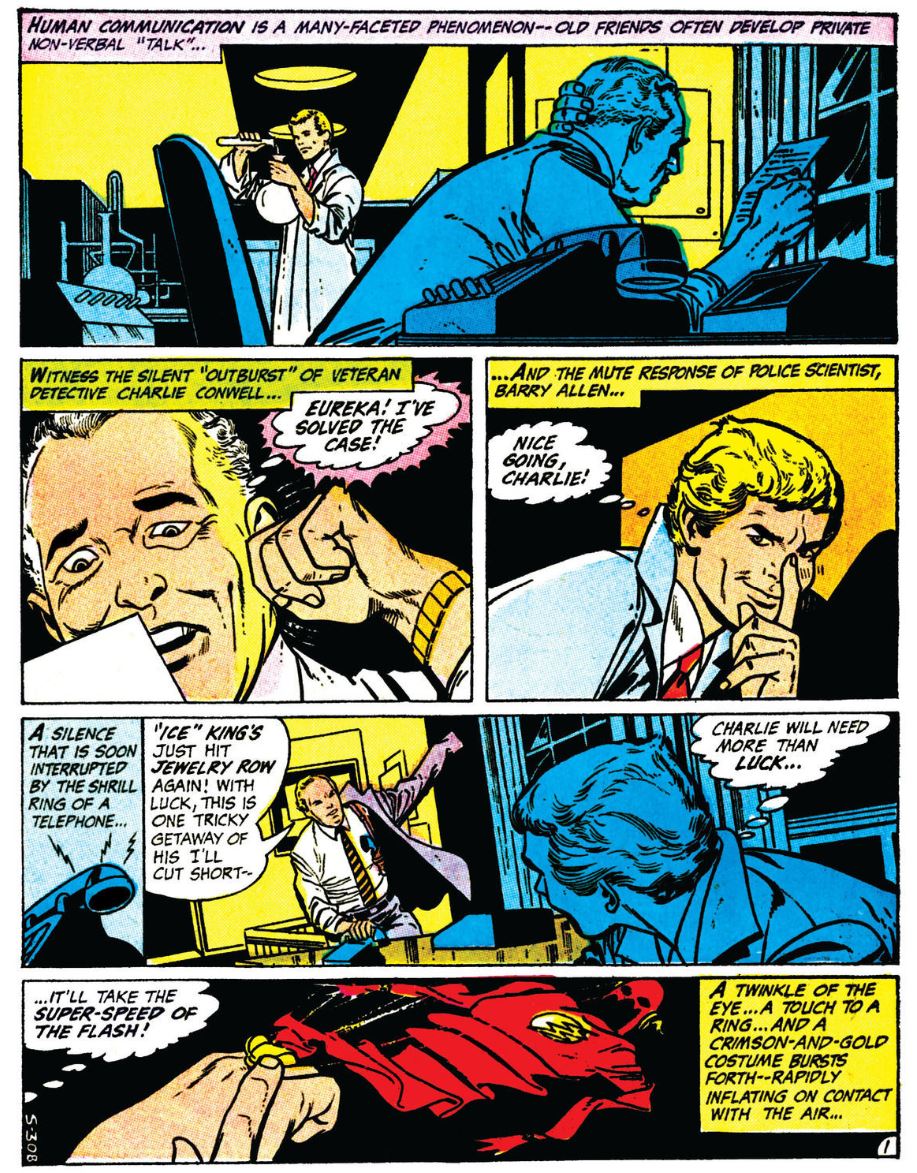
Gil Kane & Vince Colletta capture all the fun and thrills of Mike Friedrich’s ‘Four-Star Super-Hero’ in the opening yarn of Flash #197 as a sharp cop spots a private communication tic only shared with his lab partner Barry Allen. Attempts to save a secret identity and convince Charlie Conwell otherwise are further hampered by blizzard conditions in Central City, canny crooks with jetpacks and skis, a flu epidemic and Barry’s dedication to Amateur Dramatics, which see him take time out to play every part in the local presentation of Hamlet. All’s well that ends well and after that show goes on, it’s back to cosmic basics with Robert Kanigher’s ‘To the Nth Degree’ showing the Crimson Comet catapulted across the universe to save fire-beings on an exploding planet, courtesy of another wild invention of his father-in-law Professor Ira West

Kanigher, Kane & Colletta open #198 where ‘No Sad Songs for a Scarlet Speedster!’ has three orphan kids aid a gun-shot and temporarily brain-damaged Flash regain his lost mojo before neophyte superhero Zatanna guests in ‘Call it …Magic’ (by Friedrich, Don Heck & Colletta) and requires swift rescue after being abducted across arcane dimensions by macabre body-snatcher Xarkon

Kanigher, Kane & Colletta’s ‘Flash? Death Calling!’ in #199 focuses on the ordeals of scientist Dr Hollister who dons the scarlet skin-tights to punish himself after apparently accidentally killing the hero. However that guilt also saves the day and resurrect the speedster – just in time for Flash to meet superspy Colonel K (of US-IN-T Agency) and stop a Chinese energy missile smashing into ‘The Explosive Heart of America!’ (Kanigher, Kane & Colletta)

Novick and inker Murphy Anderson join Kanigher for anniversary celebration ‘Count 200 – and Die!’ as the Monarch of Motion succumbs to mind manipulation and is manoeuvred by sinister siren Dr. Lu into  assassinating the US President. Thankfully our hero (Flash of course, not PotUS!) is faster than his own fired gunshot and is back in all-American action for #201, enduring Kanigher, Novick & Anderson’s ‘Million-Dollar Dream!’ and applying tough love to wheelchair bound sports star Pablo Hernandez. The treatment restores the player but that’s only fair as the hero was responsible for initially crippling the kid…

Many issues offered second stories at this time, and the policy of guest shots for other Flash-family favourites was solidly in place. Here Kanigher, Novick & Anderson take us to Earth Two and swift encore for an old villain as Jay Garrick produces – eventually – the ‘Finale for a Fiddler!’

Although costumed hero capers were waning in general appeal, Flash was still hugely popular. Thus when World’s Finest Comics began a run of Superman team-ups with #198, the Red Runner was the clear first choice and allowed editors to return to a thorny topic which had bedevilled fans for years.

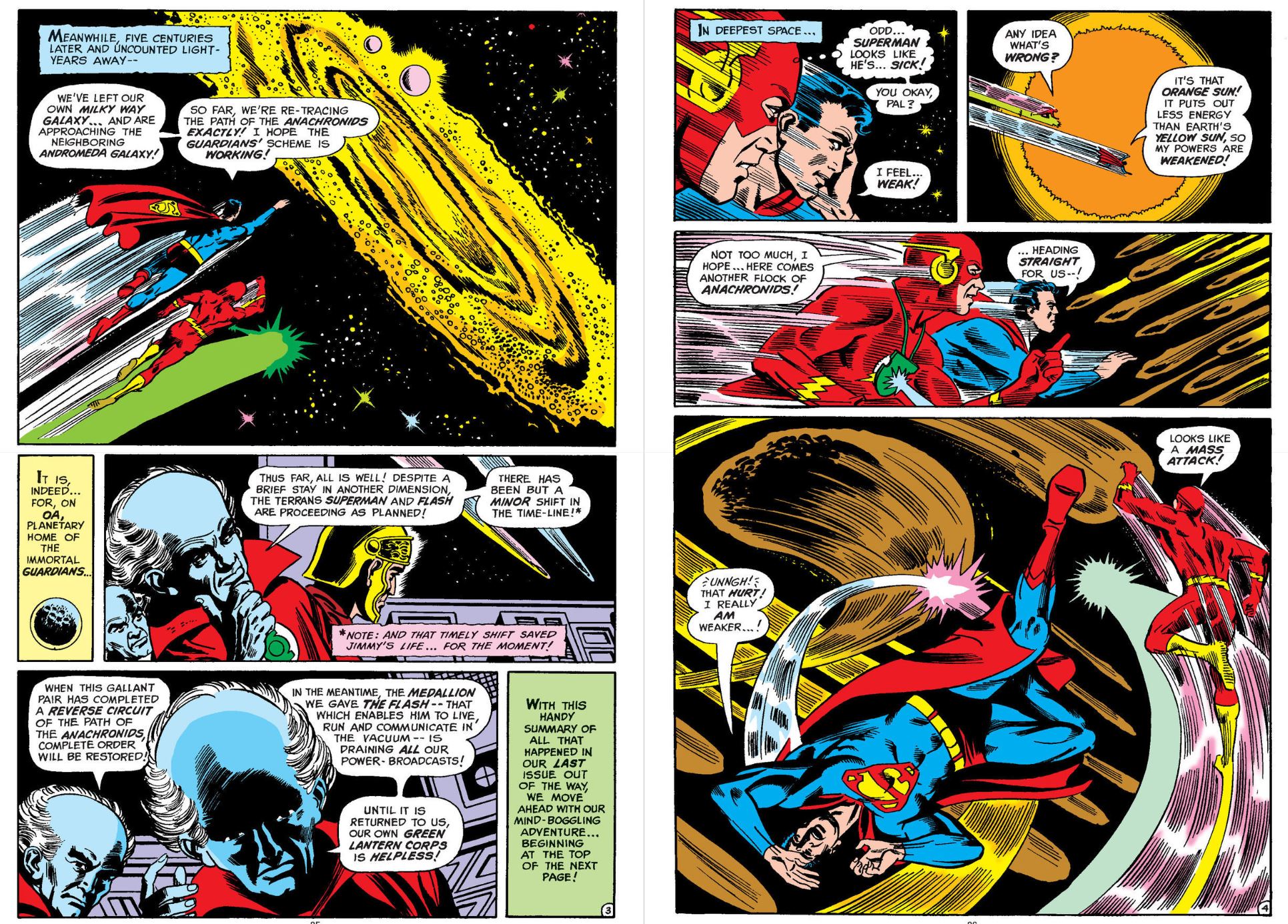
The comic book experience is littered with eternal, unanswerable questions. The most common and most passionately asked always begin “who would win if” or “who’s strongest/smartest/fastest…” Here, crafted by Denny O’Neil, Dick Dillin & Joe Giella, ‘Race to Save the Universe!’ and concluding instalment ‘Race to Save Time’ (WFC #198-199) upped the stakes on two previous competitions as our high-speed heroes are conscripted by the Guardians of the Universe to circumnavigate the entire cosmos at their greatest velocities to reverse the rampage of the mysterious Anachronids: faster-than-light creatures whose pell-mell course throughout galaxies is actually unwinding time itself and unravelling the fabric of creation. Little does anybody suspect that Superman’s oldest enemies were behind the entire appalling scheme, but the battle was swiftly won and reality saved in the end…

It was a far more grounded but no less chilling situation in Flash #202 where Kanigher, Novick & Anderson despatch reporter Iris Allen to Hollywood where she is kidnapped by murderous cultist creeps ‘The Satan Circle’ and her frantic husband confronts the unknown and the worst aspects of human nature to save her. Kid Flash then endures his own eldritch overload as ‘The Accusation!’ (by Steve Skeates, Dillin & Anderson) finds college-age comet Wally West tormented by visons of impending death that come appallingly true…

With Kanigher, Novick & Anderson at the helm #203 augured a huge change in the cosy domestic set-up as ‘The Flash’s Wife is a Two-Timer!’ reveals that Iris is actually a foundling sent through time to escape atomic armageddon and only the adopted child of scatterbrained super-genius Ira West. When the process reverses itself and she is dragged back to the future – Central City 2970 AD – The Flash follows and is caught up in a war that has been all but won by oppressive East-bloc tyrant Sirik the Supreme. Of course his intervention is enough to reset the scales before he returns baffled bride Iris Russell (née West)-Allen to her immigrant time period.

Once there though, repercussions of the revelation continue as a recovered 30th century keepsake turns her into an uncontrollable, secret-exposing blabbermouth in #204’s ‘The Great Secret Identity Exposé!’ with the Justice League understandably irate that Flash talks in his sleep and his wife knows all their civilian identities…

Back up tale ‘The Mind-Trap’ (Skeates, Dillin & Anderson) then sees Kid Flash chasing a body-stealing Egyptian pharaoh’s ghost to end the issue on a lighter note…

The Flash #205 was another hugely popular reprint collection of the era, sporting a cover by Dick Giordano (and included here) before it was back to spooky business in #206 for Kanigher, Novick & Anderson’s ‘24 Hours of Immortality!’ as haughty alien superbeings resurrect a recently killed surgeon and young mother to attend to unfinished business, but for the most mean-spirited motives – until Flash intervenes with a lesson all could benefit from.

With the supernatural now fully unleashed at DC, Flash #207 led with Friedrich, Novick & Anderson’s ‘The Evil Sound of Music!’, as former mystic hero Sargon the Sorcerer exploits his own family and rock ‘n’ roll-loving kids to restore his lost powers, before confronting the Scarlet Speedster, his own inner demons and rapacious external devils on the path back to the light. Grounding that journey to hell, Kid Flash then faces ‘The Phantom of the Cafeteria!’ ending the depredations of a superfast, hyper-hungry alien in a quick but satisfying yarn from Skeates, Dillin & Giordano.

In #208, Kanigher, Novick & Anderson exposed ‘A Kind of Miracle in Central City’ as wayward kids exploited by drug pushers are saved by prayer, the timely intervention of nuns and invisible superspeed before Flash #209 debuted new regular writer Cary Bates. He would run with the Vizier of Velocity for the rest of the series, only missing #213-214, 217, 293, 306 and 313 between 1970 through 1985.

Fresh from the starting blocks, Bates, Novick & Giordano took the speedster into higher, weirder realms ‘Beyond the Speed of Life!’ where Flash and reality shielding Sentinel stopped existence from being devoured. Meanwhile, on mundane Earth old Rogues Trickster, Captain Boomerang and Gorilla Grodd squabbled over bragging rights for who had finally killed the hero. At the back, Kid Flash saved a student troubled by gangsters in ‘Coincidence Can Kill!’ courtesy of Skeates, Dillin, Giordano.

A visit to 2971 came with #210 as Bates, Novick & Giordano expanded the Earth East-Earth West “warm” war in ‘An Earth Divided!’ with Flash seeking to save man-made President Abraham Lincoln (II) from belligerent occidental tyrant Bekor. Science fiction surrendered to spooky tales next as Flash teamed up with Batman in Brave and the Bold #99. Here Bob Haney, Bob Brown, & Nick Cardy revealed how an attempt to resurrect Bruce Wayne’s parents opened the door to the Dark Knight’s possession by an unquiet spirit. ‘The Man Who Murdered the Past!’ almost ensured an invasion of angry ghosts until superspeed and smart thinking saved the day…

Comics were always about popular trends, and in Flash #211 Bates, Novick & Giordano contrived alien invaders who used the fad of rolling derby to fuel the destruction of Earth via constantly ‘Flashing Wheels!’ However, Kid Flash was on far more stable ground as he exposed corrupt officials covering up toxic dumping in ‘Is This Poison Legal?’ by Skeates, Dillin & Giordano. Equally bold and topical the next issue saw ‘The Flash in Cartoon Land!’ with Novick & Giordano depicting how manic 64th century magician Abra Kadabra trapped the hero and a little lad Barry Allen was babysitting in a graphic madhouse where scientific rules did not apply.

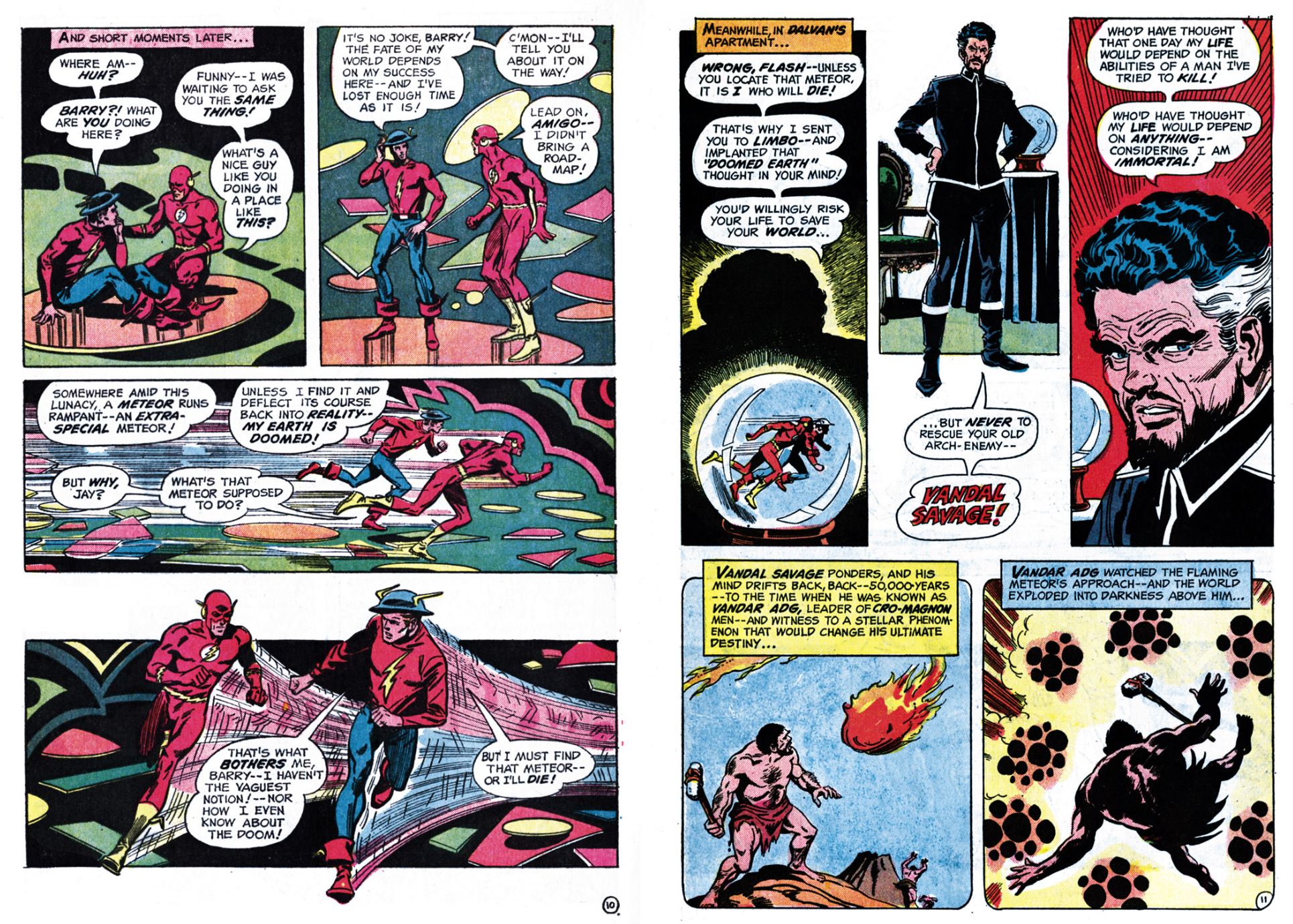
The next two issues – #213 & 214 – were reprint specials represented here with the original covers by Neal Adams & Cardy before #215 saw Bates, Novick, Frank McLoughlin & Giordano detail the ‘Death of an Immortal!’ The eons are catching up with undying villain Vandal Savage who attempts to trick Barry Allen and Jay Garrick into remedying the crisis for him. However their mission is intercepted by chronal cop Tempus and the end is not what Savage anticipated…

For Bates at least, Flash was all about his signature Rogues Gallery and in #216 the writer revealed the shocking truth about multiple personality villain Al Desmond/Dr. Alchemy/Mr. Element. Seemingly cured and reformed, Desmond was afflicted by ‘The Curse of the Dragon’s Eye!’ (Novick, Frank McLoughlin & Giordano), astrally connected to an unstable star in the constellation Draco and vacillating between manic and passive, and Good and Evil as it built to cataclysmic detonation. Now that time had come and Flash had to save his friend and hopefully prevent him destroying Earth when his patron star died. Its counterbalanced by Skeates & Dillin’s Kid Flash fable ‘2D?’ as Kid Flash goes after extradimensional slavers abducting workers who stare at certain paintings for too long…

Hard times for superheroes saw Green Lantern take up residence in the anterior pages of The Flash from #217 and shorter tales began with a fill-in from Len Wein for Novick & McLoughlin. ‘The Flash Times Five is Fatal!’ saw the hero attacked by a rogue AI built by Ira West. It preferred sabotage, reality warping and murder to rescinding its categoric statement that no one as fast as the Scarlet Speedster could possibly exist…

Bates and the Pied Piper returned in #218 as a cunning sonic ambush was foiled by speed vibrations generating ‘The Flash of 1,000 Faces!’ whilst in #219 (with Joe Giella inking) ‘The Million Dollar Deathtrap’ saw the hero targeted by wagering rivals Mirror Master and The Top and only triumphing after applying the proven principle of “divide and conquer”…

Flash literally and grotesquely joined protégé Kid Flash in #220 as The Turtle (Barry’s very first super-foe) returned to alter Earth’s internal vibrations and cure ‘The Slowest Man on Earth’ of his unique condition no matter the cost to everyone else. Thankfully two heads proved better than one in this instance and the shaking shakedown was averted.

Co-scripter John Warner joined Bates, Novick & McLoughlin for #221’s ‘Time-Schedule For Disaster!’ as techno-bandit Cipher attempts – and ultimately fails – to harvest Flash’s speed vibrations to power his weapons before #222’s ‘The Heart That Attacked the World!’ (Novick, McLoughlin & Giordano) offers a full-length team up with Green Lantern as Weather Wizard and Sinestro join forces to end their enemies. Sadly, born betrayer Sinestro secretly linked the Speedster’s racing heartbeat to the continued existence of Earth…

In #223, Bates, Novick & Giordano ‘Make Way for the Speed-Demons!’ as another old enemy rigs races between Flash and three mechanical racers of land sea and air, with the expressed intention of humiliating the speedster whilst hiding his true intentions, before #224 introduces ‘The Fastest Man Dead!’ after Barry’s friend and mentor Charlie Conwell is murdered. That doesn’t stop the veteran helping Flash close the last case on his docket and save his pal Barry one last time…

Another Scarlet-Emerald team-up sees Flash again battle Professor Zoom, the Reverse-Flash before discovering  ‘Green Lantern, Master Criminal of the 25th Century!’ (#225, Bates, Novick & Giordano) is the villain’s unwilling slave. Of course, it all plays out successfully in time, after which Captain Cold and Heatwave embroil Barry Allen in their psycho-drama rivalry, thereby inadvertently subjecting Flash to ‘The Hot-Cold War in Central City!’ (inked by Giordano & McLoughlin). Immediately afterwards (with McLoughlin inking) #227 reveals ‘Flash – This is Your Death!’ as Captain Boomerang ( and his dad!) rerun past fast & furious clashes whilst seeking to end the hero’s career and existence forever, before Tex Blaisdell inks #228’s ‘The Day I saved the Life of the Flash!’ Here Bates injects himself into the story as a comic book writer from Earth-Prime accidentally slips across dimensional divides; arriving on Earth-One in time to aid the “fictional” speedster he scripts in a deadly duel with the Trickster…

This compendium closes with the pertinent original material from 100-Page Spectacular Flash #229 which led with a Golden Age Flash team up as ‘The Rag Doll Runs Wild!’ Here Bates, Novick, Giordano & McLoughlin detail how a seeming resurgent rampage by a 1940s thieving contortionist is merely a mask for a far more sinister scheme perpetrated by a hidden vengeful mastermind. Closing proceedings are two teaser treats from that giant compendium: specifically a ‘Flash Puzzle’ by Bob Rozakis, Infantino & Anderson and an unattributed ‘Flash Trivia Quiz and Answers’

With covers by Kane, Infantino, Anderson, Neal Adams, Colletta Giordano, Jack Adler, Cardy and Tatjana Wood, this splendid selection is a must-read item for anybody in love with the world of words-in-pictures and fast-paced fantasy fables. Ready. Steady, Go get it!
© 1970, 1971, 1972, 1973, 1974, 2026 DC Comics. All Rights Reserved.

Today in 1906 was the birth date of cartoonist Dale Messick (Brenda Starr, Reporter) followed ten years later by comic book/ad exec Irv Novick, and author Peter O’Donnell (Modesty Blaise, James Bond, Romeo Jones) in 1920. In 1954 Jamie Delano (Captain Britain, Doctor Who, Hellblazer, Animal Man) joined the party as did Matt Kindt (Poppy and the Lost Lagoon, Dept. H, MIND MGMT, BRZRKR) in 1973.

DC Finest: The Doom Patrol – The Death of the Doom Patrol


By Arnold Drake, Bob Haney, Paul Kupperberg, Gerry Conway & Scott Edelman, Bruno Premiani, Bob Brown, Joe Staton, Arvell Jones, Frank Chiaramonte, Bruce Patterson, Romeo Tanghal, Carmine Infantino, Jack Sparling, Joe Orlando, Jim Aparo, Rich Buckler, Vince Colletta, Ross Andru, Dick Giordano & various (DC Comics)
ISBN: 978-1-79950-669-0 (TPB)

This book includes Discriminatory Content produced in less enlightened times.

In 1963 traditionally cautious comic book publishers at last realised superheroes were back in a big way and began reviving and/or creating a host of costumed characters to battle with and against outrageous menaces and dastardly villains. Thus, the powers-that-be at National Comics decided venerable adventure-mystery anthology title My Greatest Adventure would dip its toe in the waters with a radical take on the fad. Still, infamous for cautious publishing, they introduced a startling squad of champions with thematic roots firmly planted in those B-movie monster films of the era that had informed the parent comic.

No traditional team of masked adventurers, this cast comprised a robot, a mummy and an occasional 50-foot woman, joining forces with and guided by a vivid, brusque, domineering, crippled mad scientist. They would fight injustice in a whole new way…

Covering May 1966 to May 1965, this stunning compilation collects the remainder of the earliest exploits of the “Fabulous Freaks”, gathered from Doom Patrol #104-121. For good measure this comprehensive collection also contains the editorial material from reprint revival Doom Patrol #122-124 (February to July 1973); the enticing reboot that eventually returned the team to action from Showcase #94-96 (August 1977-January 1978), and the first official outing in a team-up trilogy from Superman Family #191-193 (October 1978 – January/February 1979).

The dramas were particularly enhanced by the drawing skills of Italian cartoonist and classicist artist Bruno Premiani, whose highly detailed, subtly humanistic illustration made even the strangest situation dauntingly authentic and grittily believable. He was also the ideal hand to squeeze every nuance of comedy and pathos from the captivatingly involved, grimly light-hearted scripts by Arnold Drake who always proffered a tantalising believably world for the outcast heroes to strive in. Premier tale ‘The Doom Patrol’ was co-scripted by Drake & Bob Haney, detailing how a mysterious wheelchair-bound scientist summoned three outcasts to his home through the promise of changing their miserable lives forever.

Competitive car racer Cliff Steele had legally died in a horrific pile up, but his undamaged brain was transplanted into a fantastic mechanical body. Test pilot Larry Trainor should have died. He had been trapped in an experimental stratospheric plane and become permanently radioactive, with the dubious benefit of gaining a semi-sentient energy avatar which could escape his body to perform incredible stunts for up to a minute at a time. To pass safely amongst men Trainor had to constantly wrap himself in special radiation-proof bandages.

Former movie star Rita Farr was exposed to mysterious swamp gases which gave her the terrifying, unpredictable – initially uncontrolled – ability to shrink or grow to incredible sizes.

The outcasts were brought together by brilliant, enigmatic Renaissance Man The Chief, who sought to mould solitary misfits into a force for good. He quickly proved his point when a bomber attempted to blow up the docks. The surly savant directed the trio in defusing it and no sooner had the misfits realised their true worth than they were on their first mission…

Now, years later with the team world-renowned, Doom Patrol #103 opens with the first of two tales: a tragedy ensuing after Professor Randolph Ormsby seeks the team’s aid for a space shot. When the doddery savant mutates into flaming monster ‘The Meteor Man’ it takes the entire patrol plus Beast Boy and Mento to save the day.

For those who haven’t seen the first volume yet: super-rich genius Steve Dayton (think ABSOLUTELY NOTHING like that Tesla guy) created a psycho-kinetic helmet and superhero persona Mento solely to woo and wed Rita, whilst outrageous, obnoxious Gar Logan was a tourist toddler in Africa, who contracted a rare disease. Although his scientist parents’ experimental cure beat the contagion before they died, it left him the colour of cabbage and able to change shape at will. A protracted storyline had commenced in #100 wherein the secretive, chameleonic kid revealed how he was now an abused orphan being swindled out of his inheritance by unscrupulous guardian Nicholas Galtry. The greedy, conniving accountant had even leased his emerald-hued charge to rogue scientists…

Rita especially had empathised with Gar’s plight and resolved to free him from Galtry whatever the cost…

DP #103 also continued unpacking the Mechanical Man’s early days following Caulder’s implantation of Cliff’s brain into an artificial body. In ‘No Home for a Robot’, the shock had seemingly driven the patient crazy as Steele went on a city-wide rampage, hunted and hounded by the police, but here, the ferrous fugitive finds brief respite with his brother Randy, before realising that trouble would trail him anywhere…

In an era devoid of promotional material or media platforms, Doom Patrol #104 astounded everyone as Rita abruptly stopped refusing loathsome billionaire/self-promoting supergenius smart guy Steve Dayton (think Musk with shinier hats) to become ‘The Bride of the Doom Patrol!’ However, her star-stuffed wedding day is almost ruined when alien arch-foe Garguax and The Brotherhood of Evil crash the party to murder the groom. So unhappy are Cliff and Larry with Rita’s “betrayal” that they almost let them…

Even whilst indulging her new bride status in #105, Rita can’t abandon the team and joins them in tackling old elemental enemy Mr. 103 during a ‘Honeymoon of Terror!’ before back-up yarn ‘The Robot-Maker Must Die’ concludes Cliff Steele’s origin as the renegade attempts to kill the mystery surgeon who had imprisoned him in a metal hell… finally giving Caulder a chance to fix a long-term malfunction in Steele’s systems…

‘Blood Brothers!’ in #106 introduces domestic disharmony as Rita steadfastly refuses to be a good trophy wife: resuming the hunt for Mr. 103 with the rest of the DP. Her separate lives continue to intersect, however, when Galtry hires that elemental assassin to wipe Gar and his freakish allies off the books…

The back-up section shifts focus onto ‘The Private World of Negative Man’, recapitulating Larry Trainor’s doomed flight and the radioactive close encounter that turned him into a walking mummy. However, even after being allowed to walk amongst men again, the gregarious pilot finds himself utterly isolated and alone…

Doom Patrol #107 opens epic story-arc ‘The War over Beast Boy’ as Rita & Steve (think Elon but funny and human) start begin proceedings to get Gar and his money away from Galtry, and the embezzler responds by opening a criminal campaign to beggar Dayton, inadvertently aligning himself with the Patrol’s greatest foes. Already distracted by the depredations of marauding mechanoid Ultimax, the hard-pressed heroes swiftly fall to the awesome automaton and Rita is exiled to a barbaric sub-atomic universe…

The secret history of Negative Man continues and concludes on a cliffhanger with ‘The Race Against Dr. Death’. When fellow self-imposed outcast Dr. Drew tries to draw the pilot into a scheme to destroy the human species which had cruelly excluded them both, the ebony energy being demonstrates its incredible power to save the world from fiery doom. In #108, ‘Kid Disaster!’ sees Mento diminished and despatched to rescue Rita whilst Galtry’s allies reveal their true nature before ambushing and killing the entire team…

…Almost.

Despite only Caulder and Beast Boy remaining, our exceedingly odd couple nevertheless pull off a major medical miracle: reviving the heroes in time to endure the incredible attack of alien colossus ‘Mandred the Executioner!’ before Larry’s ‘Flight into Fear’ at the comic’s rear proves Drew hasn’t finished with the itinerant Negative Man yet…

DP #110 wonderfully and wittily wraps up the Beast Boy saga as Galtry, Mandred and the Brotherhood marshal one last futile attack before a ‘Trial by Terror!’ finally finds Logan legally adopted by newlyweds Mrs. & Mr. Dayton. Sadly, it’s just a prelude to expansive extraterrestrial invasion in #111, heralding the arrival of ‘Zarox-13, Emperor of the Cosmos!’

The awesome overlord and his vanguard Garguax make short work of the Fabulous Freaks and – with all Earth imperilled – an unbelievable alliance forms, but not before ‘Neg Man’s Last Road!’ ends Trainor’s tale as the alienated aviator again battles Dr. Death, before joining a band of fellow outcasts in a bold new team venture…

Unbelievably, in #112, the uneasy alliance of DP with The Brain, Monsieur Mallah & Madame Rouge as ‘Brothers in Blood!’ results in no betrayals and the last-minute defeat of the invincible aliens. Moreover, although no rivalries were reconciled, a hint of romance does develop between two of the sworn foes, whilst at the back, untold tales of Beast Boy begin as ‘Waif of the Wilderness’ introduces millionaire doctors Mark & Marie Logan, whose passion for charity took them to deepest Africa and into the sights of “witchman” Mobu who saw his powerbase crumbling as SCIENCE! fixed his subjects’ problems…

When toddler Gar contracts dread disease Sakutia, the Logan’s radical treatment saves their child and grants him metamorphic abilities, but as they subsequently lose their lives in a river accident, the baby boy cannot understand their plight and blithely watches them die. Orphaned and lonely, he inadvertently saves the life of a local chief with his animal antics and is adopted… making of Mobu an implacable, impatient enemy…

DP #113 pits the team against a malevolent one-man mechanoid army in ‘Who Dares to Challenge the Arsenal?’ but the true drama manifests in a subplot showing Caulder seeking to seduce schizophrenic Madame Rouge away from the allure of wickedness and malign influence of the Brotherhood of Evil. The issue includes another Beast Boy short as ‘The Diamonds of Destiny!’ finds thieves kidnapping the amazing boy, just as concerned executor Nicholas Galtry takes ship for Africa to find the heir to his deceased employer’s millions…

Issue #114 opens with the Doom Patrol aiding Soviet asylum seeker Anton Koravyk and subsequently embroiled in a time-twisting fight against incredible caveman ‘Kor – the Conqueror!’ before Beast Boy briefing ‘The Kid Who Was King of Crooks!’ finds the toddler turned into a thief in Johannesburg… until his Fagin-ish abductors have a fatal falling out…

The next issue debuts ‘The Mutant Master!’: pitting the heroes against a trio of hideous, incomprehensibly powerful atomic atrocities resolved to eradicate the world which had so cruelly treated them. Things might have fared better had not the Chief neglected his comrades in his obsessive – and at last successful – pursuit of Madame Rouge…

Also included is ‘General Beast Boy – of the Ape Brigade!’, wherein a Nazi war criminal is accidentally foiled by lost wanderer Gar. The madman’s loss is Galtry’s gain, however, as the crooked money-man’s search ends with him “rescuing” Logan and taking him back to safe, secure America…

The mutant maelstrom concludes in #116 as ‘Two to Get Ready… and Three to Die!’ sees Caulder saving Earth from obliteration and reaping his unexpected reward in a passionate fling with “cured-but-still-fragile” Rouge. The wheelchair wonder seizes centre stage in #117 as his neglect drives his team away, leaving Caulder vulnerable to attack from a mystery man with a big grudge in ‘The Black Vulture!’ Happily, a reunited squad deals with grotesque madman ‘Videx, Monarch of Light!’ even as The Brain challenges Caulder to return his stolen chattel Rouge. Nobody thought to ask her what she wanted, though, and that’s a fatal oversight for all concerned…

Tastes were changing in the turbulent late 1960s and the series was in trouble. Superheroes were about to plunge into mass decline, and the creators addressed the problem head-on in #119: embracing psychedelic counter culture in a clever tale of supernal power, brainwashing and behaviour modification leaving the DP cowering ‘In the Shadow of the Great Guru!’

An issue later they faced a furious Luddite’s ‘Rage of the Wrecker!’ when a crazed scientist declares war on technology… including the assorted bodies keeping Cliff alive and active. The then-unthinkable occurred next and the series spectacularly, abruptly ended with what we all believed at the time to be ‘The Death of the Doom Patrol!’…

Faced with cancellation, Editor Murray Boltinoff and creators Drake & Premiani wrapped up all the long-running plot threads as spurned Madame Rouge went well off the deep end and declared war on both The Brain’s boys and Caulder’s “children”…

Pitilessly blowing up the Brotherhood, she then attacks the city until the Doom Patrol remove themselves to an isolated island fortress. Even there they are not safe and her forces ambush them. Captured and facing death, Rouge offers mercy if they abandon their principles and allow her to destroy a village of 14 complete strangers in their stead…

At a time when comics came and went with no fanfare and cancelled titles seldom provided any closure, the sacrifice and death of the Doom Patrol was a shocking event for us readers. We wouldn’t see anything like it again for decades – and never again with such style and impact. With the edge of time and experience on my side, it’s obvious just how incredibly mature Drake & Premiani’s take on superheroes was, and these superbly engaging, frenetically fun and breathtakingly beautiful stories rightfully rank amongst the very best Fights ‘n’ Tights tales ever told. Even the mercilessly exploitative many returns of the team since can’t diminish that incredible impact, and no fan of the genre or comic dramas in general should consider their superhero education complete until they’ve seen these classics.

However comics means business and eventually attention drifted back to the “World’s Strangest Heroes”. In 1973 as part of a strand of reprint titles, The Doom Patrol title resurfaced for three issues. From them a trio of editorial features – ‘Meet… The Doom Patrol’, ‘The Men Behind… the Doom Patrol’ and ‘The Doom Patrol’s Professional Fans’ – act as round-up and prelude for the final section of this fabulous compendium.

Itself an early cancellation in the superhero downturn, venerable try-out title Showcase was revived with #94 (cover-dated August/September 1977) and offered a new Doom Patrol courtesy of Paul Kupperberg & Joe Staton. It began with ‘The Doom Patrol Lives Forever!’ as Cliffe Steele’s shell is rescued and retooled by Metal Men inventor Will Magnus. Eventually independent again the traumatized survivor visits the only home he knows and discovers a new gang living/hiding in their old HQ.

Energy-caster Joshua “Tempest” Clay is a Vietnam deserter and Valentina “Negative Woman” Vostok absconded from the Soviet air force after she was possessed by a radioactive energy being very much like the one Larry Trainor was afflicted with. They are led by an Indian woman named Arani, whose temperature-shifting powers prompted her code name Celsius. Cliff is outraged and suspicious, but all becomes a bit clearer when arch enemy General Immortus attacks…

Inked by Francisco Chiaramonte, ‘The Origin of Celsius!’ reveals how the icy flamethrower is in fact Niles Caulder’s secret wife, and possesses those secrets of unending life the geriatric general craves above all else. The battle to stop him and save her creates a bond between the team that carries them straight into even deadlier dangers as Vostok is targeted by US federal agent Matt Cable (last seen palling around with the Swamp Thing) and far-less-tractable KGB operative The Cossack, seeking her recovery for the state. With Bruce Patterson inking, ‘Defection!’ sees the quartet begin a life as fugitive heroes in the grand tradition…

Mere months later Superman Family #191 through 193 saw them join Supergirl, confronting ‘A Matter of Gravity’ (by Gerry Conway with Sott Edelman, Arvell Jones & Romeo Tanghal) as rival villains – and distant cousins with a historic grudge – Gravitron Man and Gravity Lord tear up the world in search of validation and vengeance: cruelly proving ‘What Goes Up… Can’t Come Down’ before ‘The Gravity War’ is forcefully and forcible ended by the united champions…

Although as kids we all happily suspended disbelief and bought into the fanciful antics of the myriad masked heroes available, somehow the exploits of Doom Patrol – and their strangely synchronistic Marvel counterparts The X-Men (freaks and outcasts, wheelchair geniuses, both debuting in the summer of 1963) – always seemed just a bit more authentic than the usual cape-&-costume crowd. With the edge of time and experience on my side it’s obvious just how incredibly mature and hardcore Drake, Haney & Premiani’s take on superheroes actually was. These superbly engaging, frantically fun and breathtakingly beautiful tales should be rightfully ranked amongst the finest Fights ‘n’ Tights tales ever told.

With covers by Bob Brown, Premiani, Carmine Infantino, Jack Sparling, Joe Orlando, Jim Aparo, Rich Buckler Vince Colletta, Ross Andru & Dick Giordano this is a grande superhero sampler any fan of comics or the TV series will adore. Hopefully we’ll see it in digital format soon…
© 1966, 1967, 1968, 1973, 1977, 1978, 1979, 2025 DC Comics. All Rights Reserved.

Today in 1929 the astoundingly smart Jules Feiffer was born. Go see Explainers to see why that’s a cause for celebration before wishing super spidery avenging defending art star Sal Buscema Many Happy Returns since his natal arrival in 1936. If there are gods of any sort anywhere PLEASE DON’T JINX THAT!

In 1948 Frank Godwin’s Rusty Riley strip launched, as did UK weekly Boy’s World in 1963.

If you’re a travelling fan say hooray that Richard Alf was born today in 1952. Even if you haven’t visited his comics stores, you’ve probably enjoyed the San Diego Comic Con he co-founded…

DC Finest: Superman – The Invisible Luthor


By Jerry Siegel & Joe Shuster, Jack Burnley, Paul Lauretta, Wayne Boring, Jack Burnley, Paul Cassidy, Ed Dobrotka, Leo Nowak, Fred Ray, John Sikela, Dennis Neville, Don Komisarow, lettered by Frank Shuster, Betty Burnley Bentley, the Superman Studio & various (DC Comics)
ISBN: 978-1-77950-332-3 (TPB)

This book includes Discriminatory Content produced in less enlightened times

Nearly 90 years ago, Superman rebooted planetary mythology and kickstarted the entire genre of modern fantasy heroes. Outlandish, flamboyant, indomitable, infallible and unconquerable, he also saved a foundering industry by birthing an entirely new genre of storytelling: the Super Hero. Since April 18th 1938 (the generally agreed day copies of Action Comics #1 first went on sale) he has grown into a mighty presence in all aspects of art, culture and commerce, even as his natal comic book universe organically grew and expanded. Within three years of that debut, the intoxicating blend of eye-popping action and social wish-fulfilment that had hallmarked the early exploits of the Man of Tomorrow had grown: encompassing crime-busting, reforming dramas, science fiction, fantasy and even whimsical comedy. However, once the war in Europe and the East captured America’s communal consciousness, combat themes and patriotic imagery dominated most comic book covers, if not interiors.

In comic book terms alone Superman was soon a true master of the world, utterly changing the shape of the fledgling industry as easily as he could a mighty river. There was a popular newspaper strip, a thrice-weekly radio serial, games, toys, foreign and overseas syndication and as the decade turned, the Fleischer studio’s astounding animated cartoons.

Moreover, the quality of the source material was increasing with every four-colour release as the energy and enthusiasm of originators Jerry Siegel & Joe Shuster went on to inform and infect the burgeoning studio which grew around them to cope with the relentless demand.

These tales have been reprinted many times, but this latest compilation might arguably be the best yet, offering the original stories in reading – if not strictly chronological publishing – order and spanning cover-dates July 1940 to September 1941. It features landmark sagas from Action Comics #26-40 and Superman #6-11, plus pivotal appearances in New York’s World Fair No. 2, World’s Best Comics #1 and World’s Finest Comics #2 & 3 (all with eye-catching groundbreaking covers by Jack Burnley). Although most early tales were untitled, here, for everyone’s convenience, they have been given descriptive appellations by the editors, and I should also advise that as far as we know it’s written entirely by Seigel, with the majority of covers by Fred Ray (unless I say otherwise!).

This incredible panorama of torrid tales opens with gangsters attempting to plunder jewels from exhibits at the biggest show on earth. Taken from premium package New York World’s Fair #2, ‘Superman at the 1940 World’s Fair’ is credited to Siegel & Schuster, but actually illustrated by Burnley who also provided the first ever pairing of the Man of Tomorrow with Dynamic Duo Batman and Robin on the cover to drag readers in…

Siegel & Shuster had created a true phenomenon and were struggling to cope with it. As well as monthly and bimonthly comics a new quarterly publication, initially World’s Best and ultimately World’s Finest Comics – springing from the success of the publisher’s New York World’s Fair comic-book tie-ins – would soon debut with their indefatigable hero featuring prominently in it. Superman’s daily newspaper strip began on 16th January 1939 (Yes! Today but back then!), with a separate Sunday strip following from November 5th: garnering millions of new devotees. The need for new material and creators was constant and oppressive, so expansion was the watchword at the Superman and Shuster studios.

On the primary pages though, Action Comics#26 (July 1940) introduced ‘Professor Cobalt’s Clinic’ (limned by Pauls Lauretta & Cassidy with Siegel inking and Frank Shuster lettering) wherein Clark Kent & Lois Lane expose a murderous sham Health Facility with a little Kryptonian help, whilst the following month dealt a similar blow to corrupt orphanage the ‘Brentwood Home for Wayward Youth’. September’s issue found Superman at the circus, solving the mystery of ‘The Strongarm Assaults’, a fast-paced thriller beautifully illustrated by the astonishingly talented and versatile Burnley. Whilst thrilling to all that, kids of the time could also have picked up the sixth issue of Superman (cover-dated September/October 1940). Produced by Siegel and the Superman Studio, with Shuster increasingly overseeing and only drawing key figures and faces, this contained four more lengthy adventures. Behind its Shuster & Cassidy cover, ‘Lois Lane, Murderer’, and ‘Racketeer Terror in Gateston’ by Cassidy had the Man of Action saving his plucky co-worker from a dastardly frame up and rescuing a small town from a mob invasion. An infomercial for the Supermen of America club and the secrets of attaining ‘Super Strength’ as shared by Burnley, Shuster & Cassidy follows. These lead to more adventure and action from Lauretta & Cassidy as ‘Terror Stalks San Caluma’ and ‘The Construction Scam’ sees the Man of Tomorrow foil a blackmailer who’s discovered his secret identity before spectacularly fixing a corrupt company’s shoddy, death-trap buildings.

Action Comics #29 (October 1940) again features Burnley art in a gripping tale of murder for profit. Human drama in ‘The Life Insurance Con’ was followed by deadly super-science as the mastermind Zolar created ‘The Midsummer Snowstorm’, allowing Burnley a rare opportunity to display his fantastic imagination as well as his representational acumen and dexterity. Then Superman #7 (November/December1940) marked a creative sea-change as occasional cover artist Wayne Boring became Schuster’s regular inker, whilst seeing the Man of Steel embroiled in local politics when he confronts ‘Metropolis’ Most Savage Racketeers’; quells manmade disasters in ‘The Exploding Citizens’; stamps out City Hall corruption in ‘Superman’s Clean-Up Campaign’ (illustrated fully by Boring) and puts villainous high society bandits ‘The Black Gang’ where they belong… behind iron bars.

For Action # 31 Burnley draws another high-tech crime caper as crooks put an entire city to sleep and only Clark Kent isn’t ‘In the Grip of Morpheus’ after which ‘The Gambling Rackets of Metropolis’ (AC #32) finds Lois almost institutionalised until the Big Guy steps up to crush an illicit High Society operation that has wormed its nefarious way into the loftiest echelons of Government, a typical Siegel social drama magnificently illustrated.

Cover-dated January/February 1941, Superman #8 was another spectacular and wildly varied compendium containing four big adventures ranging from fantastic fantasy in ‘The Giants of Professor Zee’ (Cassidy & Boring); topical suspense in spotlighting ‘The Fifth Column’ (Boring & Komisarow) and common criminality in ‘The Carnival Crooks’ (Cassidy) before concluding with cover-featured ‘Parrone and the Drug Gang’ (Boring), wherein the Metropolis Marvel duels doped-up thugs and corrupt lawyers controlling them.

Action Comics #33 & 34 are both Burnley extravaganzas wherein Superman goes north to discover ‘Something Amiss at the Lumber Camp’, before heading to coal country to save ‘The Beautiful Young Heiress’; both superbly enticing character-plays with plenty of scope for super-stunts to thrill the gasping fans.

Superman #9 (March/April 1941) was another four-star thriller with all art credited to Cassidy. ‘The Phony Pacifists’ is an espionage thriller capitalising on increasing US tensions over “the European War” whilst ‘Joe Gatson, Racketeer’ recounts the sorry end of a hot-shot blackmailer and kidnapper. ‘Mystery in Swasey Swamp’ combines eerie rural events with ruthless spies whilst the self-explanatory ‘Jackson’s Murder Ring’ pits the Caped Kryptonian against an ingenious gang of commercial assassins. The issue also improves health and well-being with another Shuster & Cassidy ‘Supermen of America’ update and exercise feature ‘Super-Strength’ by Shuster.

The success of the annual World’s Fair premium comic books had convinced editors that an over-sized anthology of their characters, with Superman and Batman prominently featured, would be a worthwhile proposition even at the exorbitant price of 15¢ (most 64-page titles retailed for 10¢ and would do so until the 1960s). At 96 pages, World’s Best Comics #1 debuted with a Spring 1941 cover-date and Fred Ray frontage, before transforming into the soon-to-be-venerable World’s Finest Comics from issue #2 onwards. From that landmark one-&-only edition comes gripping disaster thriller ‘Superman vs. the Rainmaker’, illustrated by Boring & Komisarow, after which Action Comics #35 headlines a human-interest tale with startling repercussions in Boring & Leo Nowak’s ‘The Guybart Gold Mine’, before even Superman is mightily stretched to cope with the awesome threat of ‘The Enemy Invasion’ rendered by Boring & Shuster: a canny, foreboding taste of things to come if – or rather, when – America entered World War II.

Superman #10 (May/June 1941) opens with eponymous mystery ‘The Invisible Luthor’ (Nowak), follows with ‘The Talent Agency Fraud’ (Cassidy, Nowak, Siegel & the Studio), steps on the gas in ‘The Spy Ring of Righab Bey’ and closes with ‘The Dukalia Spy Ring’ (both by Boring, Siegel & the Studio): topical and exotic themes of suspense as America was still at this time still officially neutral in the “European War”. Conversely, Action Comics #37 (June 1941) returned to tales of graft, crime and social injustice in ‘Commissioner Kent’ (Cassidy) as the Man of Steel’s timid alter-ego is forced to run for the job of Metropolis’ top cop, before World’s Finest Comics #2 (Summer 1941) unleashes Cassidy & Nowak’s ‘The Unknown X’ – a fast-paced mystery of sinister murder-masterminds, before AC #38 (and Nowak & Ed Dobrotka) provide a spectacular battle bout against a sinister hypnotist committing crimes through ‘Radio Control’

Other than a Cassidy pinup, Superman #11 (July/August 1941) was an all Nowak affair, beginning with ‘Zimba’s Gold Badge Terrorists’ wherein thinly disguised Nazis “Blitzkrieg” America, after which “giant animals” go on a rampage in ‘The Corinthville Caper’. Seeking a cure for ‘The Yellow Plague’ then takes Superman to the ends of the Earth whilst ‘The Plot of Count Bergac’ brings him back home to crush High Society gangsters. All by Nowak but accompanied by a Cassidy pinup.

Horrific mad science creates ‘The Radioactive Man’ in Action #39 (Nowak & Shuster Studios), whilst #40 featured ‘The Billionaire’s Daughter’ (by John Sikela) wherein the mighty Man of Tomorrow needs all his wits to set straight a spoiled debutante before we closing with ‘The Case of the Death Express’: a tense thriller about train-wreckers illustrated by Nowak from the Fall issue of World’s Finest (#3).

Stories of corruption and social injustice were gradually moving aside for more spectacular fare, and with war in the news and clearly on the horizon, the tone and content of Superman’s adventures changed too: the scale and scope of the stunts became more important than the motive. The raw passion and sly wit still shone through in Siegel’s stories but as the world grew more dangerous the Man of Tomorrow simply had to become stronger and more flamboyant to deal with it all, with Shuster and his team consequently stretching and expanding the iconography for all imitators and successors to follow.

These Golden Age tales are priceless enjoyment at an absurdly affordable price. My admiration for the stripped-down purity and power of these stories is boundless. Nothing has ever come near them for joyous, child-like perfection. You really should make them part of your life. In fact, how can you possibly resist them?
© 1940, 1941, 2025 DC Comics. All Rights Reserved.

Today in 1939 Jean Van Hamme (XIII, Thorgal, Largo Winch) was born, which you now know was the same moment – allowing for time zone differentials – that the Superman newspaper strip launched. It ended in 1966 but Van Hamme’s still going…

In 1960 UK comic Judy debuted, and ten years later so did Garth Ennis.

Showcase Presents Robin The Boy Wonder


By E. Nelson Bridwell, Ed Hamilton, John Broome, Leo Dorfman, Gardner F. Fox, Cary Bates, Mike Friedrich, Frank Robbins, Denny O’Neil, Bob Haney, Elliot Maggin, Bob Rozakis, Ross Andru, Curt Swan, Sheldon Moldoff, Pete Costanza, Chic Stone, Gil Kane, Irv Novick, Murphy Anderson, Dick Dillin, Rich Buckler, Bob Brown, Mike Grell, A. Martinez Al Milgrom & various (DC Comics)
ISBN: 978-1-4012-1676-4 (TPB)

This book includes Discriminatory Content produced in less enlightened times.

As previously mentioned, there are a lot of comics anniversaries occurring in this otherwise dreadful year. The ultimate and original sidekick is probably the most significant of DC’s representatives, and indeed there have been a few intriguing collections released to celebrate the occasion. This one, however, is probably the best but remains criminally out of print, if not utterly unavailable…

Robin the Boy Wonder debuted in Detective Comics #38 (cover dated April 1940 and on sale from March 6th). Co-created by Bob Kane, Bill Finger & Jerry Robinson, he was a juvenile circus acrobat whose parents were murdered by a mob boss. The story of how Batman took the orphaned Dick Grayson under his scalloped wing and trained him to fight crime has been told, retold and revised many times over the decades and still regularly undergoes tweaking to this day.

Grayson fought beside Batman until 1970 when, as an indicator of those turbulent times, he flew the nest, becoming a Teen Wonder college student. His creation as a junior hero for younger readers to identify with has inspired an incomprehensible number of costumed sidekicks and kid crusaders, and Grayson continued in similar innovative vein for the older, more worldly-wise readership of America’s increasingly rebellious youth culture.

The first Robin even had his own solo series in Star Spangled Comics from 1947 to 1952, a solo spot in the back of Detective Comics from the end of the 1960s – a position he alternated and shared with Batgirl – and a starring feature in anthology comic Batman Family. During the 1980s he led the New Teen Titans, initially in his original costumed identity but eventually in the reinvented guise of Nightwing, all while re-establishing a (somewhat turbulent) working relationship with his masked mentor.

This broad ranging easy on the eye monochrome compilation covers the period from Julie Schwartz’s captivating reinvigoration of the Dynamic Duo in 1964 until 1975 with Robin-related stories and material from Batman #184, 192, 202, 213, 227, 229-231, 234-236, 239-242, 244-246, 248-250, 252, 254 and portions of 217; Detective Comics #342, 386, 390-391, 394-395, 398-403, 445, 447, 450-251; World’s Finest Comics #141, 147, 195, 200; Superman’s Pal Jimmy Olsen #91, 111, 130 and Justice League of America #91-92.

The wonderment begins with the lead story from Batman #213 (July-August 1969) – a 30th Anniversary reprint Giant – which featured an all-new retelling of ‘The Origin of Robin’ courtesy of E. Nelson Bridwell, Ross Andru & Mike Esposito, perfectly reinterpreting that epochal event for the Vietnam generation. After that, the tales proceed in (more or less) chronological order, covering episodes where Robin took centre-stage.

First up is ‘The Olsen-Robin Team versus… the Superman-Batman Team!’ (from World’s Finest #141, May 1964, by Edmond Hamilton, Curt Swan & George Klein). In a stirring blend of science fiction thriller and crime caper, the underappreciated sidekicks fake their own deaths to undertake a secret mission even their adult partners must remain unaware of – for the very best of reasons of course. A sequel from WF #147 (February 1965) delivers an engaging drama of youth-in-revolt as ‘The New Terrific Team!’ quit their assistant roles to strike out on their disgruntled own. Naturally there’s a perfectly reasonable – if incredible – reason here, too…

Detective Comics #342 (August 1965) featured ‘The Midnight Raid of the Robin Gang!’ by John Broome, Sheldon Moldoff & Joe Giella, wherein the Boy Wonder joins a youthful gang of costumed criminals, after which Superman’s Pal Jimmy Olsen #91 (March 1966) delivers ‘The Dragon Delinquent!’ (Leo Dorfman & Pete Costanza) as Robin and the cub reporter, unknown to each other, both infiltrate the same biker gang with potentially fatal consequences.

‘The Boy Wonder’s Boo-Boo Patrol!’ – originally a back-up in Batman #184 (September 1966, Gardner Fox, Chic Stone & Sid Greene), shows the daring lad’s star-potential in a clever tale of thespian skulduggery and classic conundrum solving, before ‘Dick Grayson’s Secret Guardian!’ (Batman #192, June 1967, Fox, Moldoff & Giella) depicts his physical prowess in one of comic books’ first instances of the exo-skeletal augmentation gimmick.

‘Jimmy Olsen, Boy Wonder!’ (SPJO #111, June 1968, by Cary Bates & Costanza) finds the reporter trying to prove his covert skills by convincing the Gotham Guardian that he was actually Robin, whilst that same month in Batman #203 the genuine article tackles the ‘Menace of the Motorcycle Marauders!’ (Mike Friedrich, Stone & Giella) consequently learning a salutary lesson in the price of responsibility…

Cover-dated April 1969, Detective Comics #386 featured the Boy Wonder’s first solo back-up in what was to become his semi-regular spot for years. ‘The Teen-Age Gap!’ (as described by Friedrich, Andru & Esposito) depicts a High School Barn Dance which only narrowly escapes becoming a riot thanks to his diligent intervention, after which Gil Kane & Murphy Anderson assume the art-chores with #390’s ‘Countdown to Chaos!’ (August 1969), bringing the series stunningly alive. Friedrich concocted a canny tale of corruption and kidnapping leading to a paralysing city ‘Strike!’ for the Caped kid to spectacularly expose and foil in the following issue.

Batman #217 (December 1969) was a landmark in the character’s long history as Dick leaves home to attend Hudson University. Only the pertinent portion from ‘One Bullet Too Many!’ by Frank Robbins, Irv Novick & Dick Giordano is included here, closely followed by ‘Strike… Whilst the Campus is Hot’ (Detective #394 from the same month, by Robbins, Kane & Anderson) as the callow freshman stumbles into a campus riot organised by criminals and radical activists, forcing the now Teen Wonder to ‘Drop Out… or Drop Dead!‘ to stop the seditious scheme…

Detective #398-399 (April & May 1970) ran a 2-part spy-thriller with Vince Colletta replacing Anderson as inker. ‘Moon-Struck’ has lunar rock samples borrowed from NASA apparently causing a plague among Hudson’s students until Robin exposes a Soviet scheme to sabotage the Space Program in ‘Panic by Moonglow’. The 400th anniversary issue (June 1970) finally teamed the Teen Wonder with his alternating back-up star in ‘A Burial For Batgirl!’ (Denny O’Neil, Kane & Colletta): a college-based murder mystery which again heavily references the political and social unrest then plaguing US campuses, but which still finds space to be smart and action-packed as well as topical, before chilling conclusion ‘Midnight is the Dying Hour!’ wraps up the saga.

Never afraid to repeat a good idea, Superman’s Pal Jimmy Olsen #130 (July 1970) sees Bob Haney & Murphy Anderson detail the exploits of ‘Olsen the Teen Wonder!’ as the boy reporter again apes Batman’s buddy – this time to infiltrate an underworld newspaper – whilst World’s Finest #195 (August 1970) finds Jimmy & Robin targeted for murder by the Mafia in ‘Dig Now, Die Later!’ by Haney, Andru & Esposito. Simultaneously in DC #402 ‘My Place in the Sun’ (Friedrich, Kane & Colletta), embroils Grayson and fellow Teen Titan Roy Speedy Harper in a crisis of social conscience, before our scarce-bearded hero wraps up his Detective run with corking crime-busting caper ‘Break-Out’ in the September issue.

Robin’s romps transferred to the back of Batman, beginning with #227 (December 1970) and ‘Help Me – I Think I’m Dead!’ (Friedrich, Novick & Esposito) as ecological awareness and penny-pinching Big Business catastrophically collide on the campus, beginning an extended epic seeing the Teen Thunderbolt explore communes, alternative cultures and the burgeoning spiritual New Age fads of the day. Inked by Frank Giacoia ‘Temperature Boiling… and Rising!’ (#229, February 1971) continues the politically-charged drama, albeit uncomfortably interrupted by a trenchant fantasy team-up with Superman sparked when the Man of Steel attempts to halt a violent campus clash between students and National Guard.

Crafted by Friedrich, Dick Dillin & Giella, ‘Prisoners of the Immortal World!’ (WFC #200, February 1971), has brothers on opposite sides of the teen scene abducted with Robin & Superman to a distant planet where undying vampiric aliens wage eternal war on each other. A return to more pedestrian perils in Batman #230 (March 1971) sees ‘Danger Comes A-Looking!’ for our young hero in the form of a gang of right-wing, anti-protester jocks and a deluded friend who prefers bombs to brotherhood, courtesy of Friedrich, Novick & Dick Giordano. ‘Wiped Out!’ (#231, May 1971) then offers an eye-popping end to the jock gang whilst #234 sees a clever road-trip tale in ‘Vengeance for a Cop!’, when a campus guard is gunned down forcing Robin to track the only suspect to a commune. ‘The Outcast Society’ has its own unique system of justice, but eventually the shooter is apprehended in the cataclysmic ‘Rain Fire!’ (#235 & 236 respectively).

The Collective experience blooms into psychedelic and psionic strangeness in #239 as ‘Soul-Pit’ (illustrated by new penciller Rich Buckler) finds Grayson’s would-be girlfriend, “Jesus-freaks” and runaway kids all sucked into a telepathic duel between a father and son, played out in the ‘Theatre of the Mind!’ before exposing the ‘Secret of the Psychic Siren!’ and culminating in a lethal clash with a clandestine cult in ‘Death-Point!’ (Batman#242, June 1972). After that eerie epic we slip back a year to peruse the Teen Wonder’s participation in one of the hallowed JLA/JSA summer team-ups, beginning in Justice League of America #91 (August 1971) and ‘Earth… the Monster-Maker!’, as Supermen, Flashes, Green Lanterns, Atoms and a brace of Hawkmen from two separate Realities simultaneously and ineffectually battle an alien boy and his symbiotically-linked dog (sort of) on almost identical planets a universe apart. There’s still time to painfully patronise the Robins of both until ‘Solomon Grundy… the One and Only!’ gives everyone a brutal but ultimately life-saving lesson on acceptance, togetherness, youthful optimism and lateral thinking…

Elliot Maggin, Novick & Giordano then set ‘The Teen-Age Trap!’ (Batman#244, September 1972), with Grayson mentoring troubled kids – and finding plenty of troublemakers his own age – whilst ‘Who Stole the Gift from Nowhere!’ is a delightful old-fashioned change-of-pace mystery yarn. However, ‘How Many Ways Can a Robin Die?’ by Robbins, Novick, Dillin & Giordano (Batman #246, December 1972) is actually a Dark Knight story with Teen Wonder helpless hostage throughout, whereas #248 opens another run of solo stories with ‘The Immortals of Usen Castle’ (Maggin, Novick & Frank McLaughlin) wherein another deprived-kids day trip turns into an episode of Scooby-Doo, Where are You? The ‘Case of the Kidnapped Crusader!’ (pencilled by Bob Brown) then puts the Student Centurion on the trail of an abducted consumer advocate and ‘Return of the Flying Grayson!’ (Maggin, Novick & McLaughlin from #250) painfully reminds the hero of his Circus past after tracking down pop-art thieves.

Batman #252 (October 1973) sees Maggin, Dillin & Giordano’s light-hearted pairing of Robin with a Danny Kaye pastiche for charming romp ‘The King from Canarsie!’, before ‘The Phenomenal Memory of Luke Graham!’ (#254 January/February 1974 and inked by Anderson) causes nothing but trouble for the hero, his college professors and a gang of robbers…

It was a year before the Teen Wonder’s solo sallies resumed with ‘The Touchdown Trap’ in Detective Comics #445 as new scripter Bob Rozakis and artist Mike Grell catapulted our hero into a 50-year-old college football feud that refused to die, whilst ‘The Puzzle of the Pyramids’ (#447 and illustrated by A. Martinez & Mazzaroli) offers another clever crime conundrum. This eccentrically eclectic monochrome compendium concludes with an action-packed, chase-heavy human drama by Al Milgrom & Terry Austin as ‘The Parking Lot Bandit!’ & ‘The Parking Lot Bandit Strikes Again!’ (DC #450-451, August & September 1975), giving the titanic teen one last chance to strike a bit of terror into the hearts of evil-doers…

These stories span a turbulent and chaotic period for comic books: perfectly encapsulating and describing the vicissitudes of the superhero genre’s premier juvenile lead: complex yet uncomplicated adventures drenched in charm and wit, moody tales of rebellion and self-discovery, and rollercoaster, all-fun romps. Action is always paramount, and angst-free satisfaction is pretty much guaranteed. These cracking yarns are something no fan of old-fashioned Fights ‘n’ Tights fiction should miss.
© 1964-1975, 2008 DC Comics. All Rights Reserved.

Today in 1922, Belgian auteur Marc Sleen was born. We still haven’t seen English versions of his Nero yet, but have slavishly and repeatedly begged you all to tune in to the oeuvre of Ronald Searle, who left us all far less today in 2011.

All-Star Comics: Only Legends Live Forever


By Gerry Conway, Paul Levitz, Ric Estrada, Wally Wood, Keith Giffen, Joe Staton, Bob Layton, Joe Giella, Dave Hunt, Dick Giordano, Brian Bolland, Jim Aparo & various (DC Comics)
ISBN: 978-1-7795-0071-7 (HB/Digital edition)

This book includes Discriminatory Content produced in less enlightened times.

Win’s Christmas Gift Recommendation: Ageless Evergreen Super-Sensationalism… 8/10

In the torrid and turbulent 1970s many of the comics industry’s oldest publishing ideas were finally laid to rest. The belief that characters could be “over-exposed” was one of the most long-lasting (after all, it never hurt Superman, Batman or the original Captain Marvel), garnered from years of experience in an industry which lived or died on that fractional portion of pennies derived each month from pocket-money and allowances of kids that wasn’t spent on candy, toys or movies.

By the end of the 1960s, comic book costs and retail prices were inexorably rising and a proportion of titles – especially newly resurrected horror stories – were consciously being produced for older readerships. Nearly a decade of organised fan publications and letter writing crusades had finally convinced publishing bean-counters what editors already knew: grown-ups avidly read comics too. Avidly. Passionately. Obsessively. They would happily spend more than kids and, most importantly, wanted more, more, more of what they particularly loved.

Explicitly: If one appearance per month was popular, extras, specials and second series would be more so. By the time Marvel Wunderkind Gerry Conway was preparing to leave The House of Ideas, DC was willing and ready to expand its variegated line-up with some oft-requested/demanded fan-favourite characters…

Paramount among these was the Justice Society of America, the first comic book super-team and a perennial gem whose annual guest-appearances in the Justice League of America had become an inescapable and beloved summer tradition. Thus in 1976 Writer/Editor Conway marked his second DC tenure (he had first broken into the game writing horror shorts for Joe Orlando) by reviving All Star Comics with number #58. In 1951, as the first Heroic Age ended, the key title had transformed overnight into All Star Western, with that numbering running for a further decade as home cowboy crusaders like Strong Bow, Trigger Twins, Johnny Thunder (a new “masked” do-gooder, not the Golden Age costumed idiot with a genie) and Super-Chief.

If you’re interested, among the other revivals/introductions in “Conway’s Corner” were perennial star Plastic Man, Blackhawk, The Secret Society of Super-Villains, Freedom Fighters, Kobra, Blitzkrieg – and many more.

In case you need reminding in their anniversary year: All Star Comics #3 (cover-dated Winter 1940-1941 and released in November 1940) is the officially cited kick-off for all Superteam tales, even if the assembled mystery men merely had dinner and recounted recent cases. They didn’t actually go on a mission together until ASC #4, which had an April 1941 cover-date and hit newsstands on February 7th.

Set on the parallel world of Earth-2, and in keeping with the editorial sense of ensuring the series be relevant to young readers too, Conway reintroduced a veteran team, leavened with a smattering of teen heroes, combined into a contentious, generation-gap fuelled Super Squad. These young whippersnappers included Robin (already a JSA-er since the mid-1960s and Justice League of America #55); Sylvester Pemberton AKA The Star-Spangled Kid (in actuality a boy-hero from the 1940s lost in time for decades) and – it must shamefully be said – a busty young thing who quickly became the feisty favourite of a generation of growing boys.

Kara Zor-L was attention grabbing in all the right and wrong ways and would soon become infamous as the “take-charge” pushy feminist dynamo Power Girl.

This titanic hardback and digital collection volume gathers that 4-year run of the JSA from the late 1970s into a sublime showcase of so-different, ever-changing times via All-Star Comics #58-74, plus the series’ continuation and conclusion from epic anthology title Adventure Comics (#461-466), and includes the seminal saga from DC Special #29 which, after almost four decades, finally provided the team with an origin…

Without preamble, the action begins with ‘Prologue’: a 3-page introduction/recap/summation of the Society’s history as well as the celestial mechanics of Alternate Earths, as crafted by Paul Levitz, Joe Staton & Bob Layton and first seen in Adventure #461, January/February 1979. This outlines the history and workings of DC’s parallel continuities, after which the first half of the 2-part debut tale from All-Star Comics #58 (January/February 1976 by Conway, Ric Estrada &Wally Wood) finds newly-inducted Pemberton chafing at his time-lost plight and revelling in new powers after being given a cosmic-energy device by retired JSA veteran Starman.

When a crisis propels him and elder heroes Flash, Dr. Mid-Nite, Wildcat, Green Lantern, Hawkman and Dr. Fate into a 3-pronged calamity devastating Seattle, Cape Town and Peking (which you youngsters now known as Beijing). With man-made natural disasters, everywhere the elder statesmen split up but are overwhelmed, giving the new kids a chance to shine in ‘All Star Super-Squad’. With abrasive, impatient Power Girl in the vanguard, the entire team is soon on the trail of old foe Degaton and his mind-bending ally in #59’s conclusion ‘Brainwave Blows Up!’
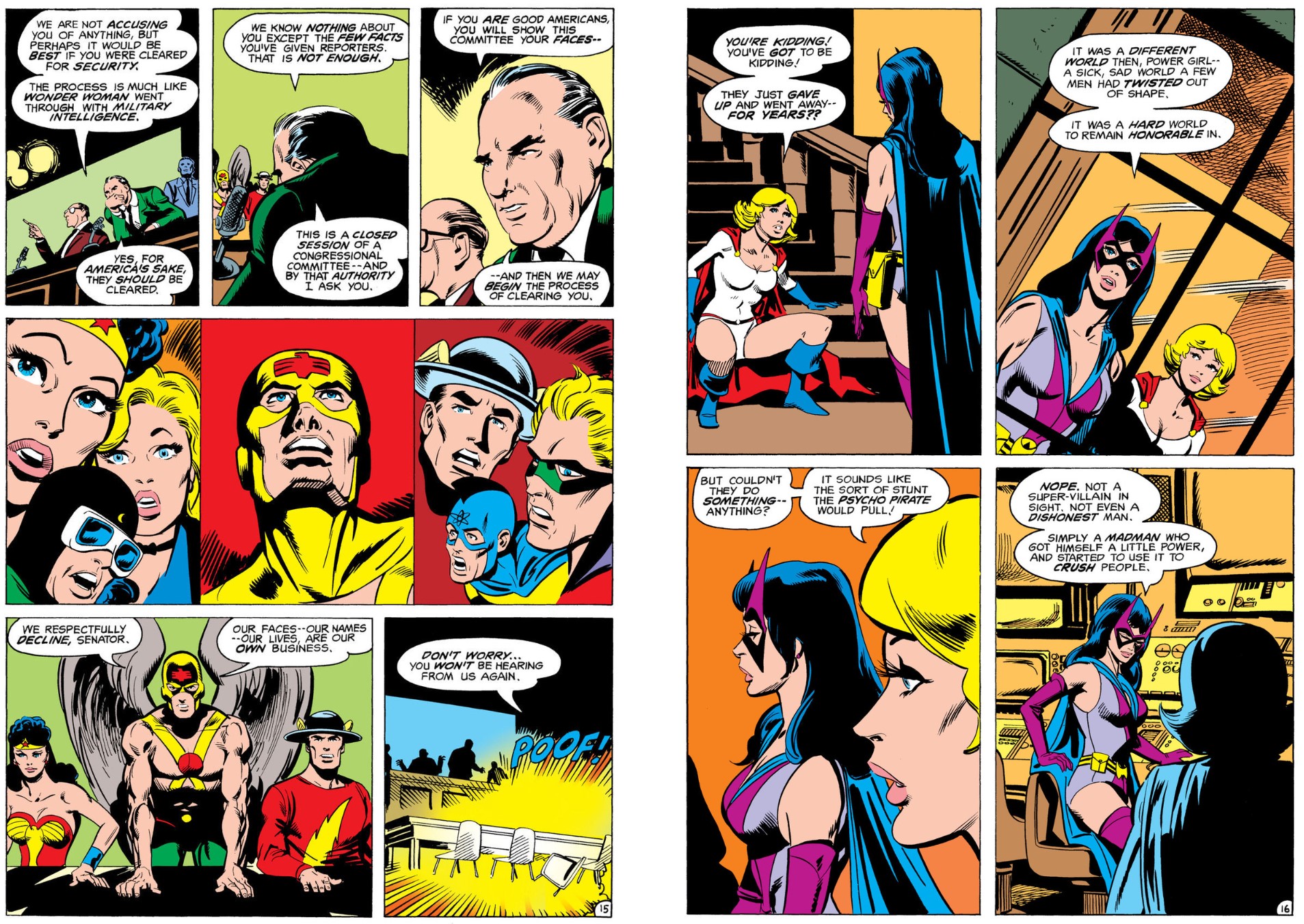
Keith Giffen replaced Estrada in #60 whilst introducing a psychotic super-arsonist who attacks the Squad just as the age-divide starts grating and PG begins ticking off (or “re-educating”) the stuffy, paternalistic JSA-ers in ‘Vulcan: Son of Fire!’. Closing instalment ‘Hellfire and Holocaust’ finds the flaming fury fatally wounding Fate before his own defeat, just as a new mystic menace is stirring…

Conway’s last issue as scripter was #62. ‘When Fall the Mighty’ highlights antediluvian sorcerer Zanadu who devastatingly attacks, even as the criminal Injustice Gang open their latest vengeful assault using mind-control to turn friend against friend. The cast subsequently expands with the return of Hourman and Power Girl’s Kryptonian mentor, but even they prove insufficient to prevent ‘The Death of Doctor Fate’ as written by Paul Levitz. Assaulted on all sides, the team splinters. Wildcat, Hawkman and the Kryptonian cousins tackle the rampant super-villains whilst Flash & Green Lantern search Egypt for a cure to Fate’s condition, and Hourman, Mid-Nite & Star-Spangled Kid desperately attempt to keep their fallen comrade alive.

When they fail Zanadu renews his assault, almost adding the moribund Fate’s death-watch defenders to his tally… until the archaic alien’s very presence calls Kent Nelson back from beyond the grave…

With that crisis averted, Superman makes ready to leave but is embroiled in a last-minute, manic time-travel assassination plot (Levitz script, and fully illustrated by inimitable Wally Wood) which drags the team and guest-star The Shining Knight from an embattled Camelot in ‘Yesterday Begins Today!’ to the far-flung future and ‘The Master Plan of Vandal Savage’: a breathtaking spectacle of drama and excitement that signalled Woody’s departure from the series.

Joe Staton & Bob Layton took the unenviable task of filling his artistic shoes, beginning with #66 as ‘Injustice Strikes Twice!’ wherein the reunited team – sans Superman – fall prey to ambush by arch-enemies, whilst emotion-warping Psycho-Pirate starts twisting GL Alan Scott into an out-of-control menace determined to crush Corporate America beneath his emerald heel. This subsequently leads to the return of Earth-2’s Bruce Wayne, who had previously retired his masked persona to become Gotham’s Police Commissioner. In ‘Attack of the Underlord!’ (All-Star Comics #67, July/August 1977), the Injustice Society’s monstrous allies are revealed as subterranean conquerors who nearly end the team forever. Meanwhile, Wayne’s plans near fruition. He wants to shut down the JSA before their increasingly destructive exploits demolish his beloved city…

Contemporary continuity pauses here as the aforementioned case from DC Special #29 (September 1977) discloses ‘The Untold Origin of the Justice Society’ in an extra-length epic set in 1940. Here Levitz, Staton & Layton reveal previously classified events which saw Adolf Hitler acquire the mystical Spear of Destiny and immediately summon mythical Teutonic Valkyries to aid in the invasion of Britain. Alerted to the threat, US President Franklin Delano Roosevelt – hampered by his country’s neutrality – unofficially asks a select band of masked mystery-men to lend their aid as non-political, private citizens.

In a cataclysmic escalation, the struggle ranges from the heart of Europe throughout the British Isles and even to the White House Oval Office before ten bold costumed champions finally – albeit temporarily – stymy the Nazis’ plans…

Back in All Star #68 (October 1977) the Kryptonian Kid was clearly becoming top star of the show. ‘Divided We Stand!’ (Levitz, Staton & Layton) concludes the Psycho-Pirate’s scheme to discredit and destroy the JSA, and sets the scene for her first solo outing in Showcase #97-99 (which is not included here). Meanwhile GL resumes a maniacal rampage through Gotham and Police Commissioner Wayne takes extreme measures to bring the seemingly out-of-control JSA to book. With ASC #69’s ‘United We Fall!’, he reunites in his own team of retired JSA stars to arrest the rogue squad, resulting in a classic fanboy dream duel as Dr. Fate, Wildcat, Hawkman, Flash, GL & Star-Spangled Kid battled the original Batman, Robin, Hourman, Starman, Dr. Mid-Nite and Wonder Woman. It’s a colourful catastrophe in waiting until PG & Superman intervene to reveal the true cause of all that unleashed madness.
… And in the background, a new character was about to make a landmark debut…

With order restored ‘A Parting of the Ways!’ spotlights Wildcat and Star-Spangled Kid as the off-duty heroes stumble upon high-tech super-thieves Strike Force. These bandits initially prove too much for the pair – and even new star The Huntress – but with a pair of startling revelations in ‘The Deadliest Game in Town!’ the trio finally triumph. In the aftermath, the Kid resigns and the daughter of Batman & Catwoman replaces him…

All-Star Comics #72 reintroduces a brace of classic Golden Age villainesses in ‘A Thorn by Any Other Name’ – wherein the psychopathic floral fury returns to poison Wildcat, leaving Helena Wayne to battle the original 1940’s Huntress for an antidote and rights to the name. With Joe Giella taking over the inker’s role, concluding chapter ‘Be it Ever So Deadly’ sees the whole team deployed as Huntress battled Huntress whilst Thorn and The Sportsmaster do their deadly best to destroy the heroes and their loved ones. Meanwhile in Egypt, Hawkman & Dr. Fate stumble upon a deadly ancient menace to all of reality…

The late 1970s was a perilous period for comics, with exponentially rising costs inevitably resulting in drastically dwindling sales. Many titles were abruptly cancelled in a “DC Implosion” and All-Star Comics was one of the casualties. Issue #74 was the last, pitting the reunited Society against a mystic Armageddon perpetrated by a nigh-omnipotent Master Summoner who orchestrated a ‘World on the Edge of Ending’ before the JSA triumphantly dragged victory from the jaws of defeat…

Although the book was gone, the series continued in 68-page anthology title Adventure Comics, beginning in #461 (January/February 1979) with the first half of a blockbuster tale originally intended for the anniversary 75th issue. Drawn & inked by Staton, ‘Only Legends Live Forever’ details the Batman’s last case as the Dark Knight comes out of retirement to battle a seeming nonentity who has mysteriously acquired god-like power. Adventure #462 delivered the heartbreaking conclusion in ‘The Legend Lives Again!’ before AC #462’s ‘The Night of the Soul Thief!’ sees Huntress, Robin and assembled Society members deliver righteous justice to the mysterious mastermind who actually orchestrated the death of the World’s Greatest Detective…

For #464, an intriguing insight into aging warrior Wildcat reveals ‘To Everything There is a Season…’ as Ted Grant embraces his own mortality and begins a new career as a teacher of heroes, before ‘Countdown to Disaster!’ (inked by Dave Hunt) finds Flash, Green Lantern, Hawkman, Power Girl, Huntress & Dr. Fate hunting a doomsday device lost amidst Gotham’s teeming masses. It would be the last modern outing of the team for years to come…

But not the last in this volume: that honour falls to another Levitz & Staton landmark: a little history lesson wherein they expose the reason why the team vanished at the beginning of the 1950s. From Adventure #466, ‘The Defeat of the Justice Society!’ shows how the US Government had cravenly betrayed their greatest champions during the McCarthy witch-hunts: provoking the mystery-men into voluntarily withdrawing from public, heroic life for over a decade… until the costumed stalwarts of Earth-1 started the whole Fights ‘n’ Tights scene all over again…

Upping the gaudy glory quotient, a team pin-up by Staton & Dick Giordano and two earlier collection covers from Brian Bolland cap off the costumed dramas.

Although perhaps a tad dated now, these exuberant, rapid-paced, imaginative yarns perfectly blend the naive charm of Golden Age derring-do with cynical modern sensibilities. Here you will be reassured that no matter what, in the end our heroes will always find a way to save the day. Such classic spectacles from simpler times are a glorious example of traditional superhero storytelling at its finest: fun, furious, ferociously engaging, excitingly written and beguilingly illustrated. No Fights ‘n’ Tights fan should miss these marvellous sagas.
© 1976, 1977, 1978, 1979, 2019 DC Comics. All Rights Reserved.

Today in 1912 Cliff Sterrett’s astounding strip Polly and Her Pals ran in US papers for the first time, and in 1921 artist Art Saaf was born – someone else you’ve probably enjoyed without even knowing it, so go learn about him too.

The Forever People by Jack Kirby


By Jack Kirby, Vince Colletta, Don Heck, Mike Royer, Murphy Anderson, Al Plastino & various (DC Comics)
ISBN: 978-1-77950-230-8 (TPB/Digital edition)

This book includes Discriminatory Content produced in less enlightened times.

Win’s Christmas Gift Recommendation: Monumental Masterpieces… 9/10

Today in 1970 American comic books changed forever. On December 1st newsstands saw Superman meet the counterculture head on courtesy of Jack Kirby in a title like no other ever before. Moreover it was only one crucial component part of a bold experiment that quite honestly failed, but still undid and remade everything. It was Forever People #1…

When Jack Kirby returned to the home of Superman in 1970 he brought with him one of the most powerful concepts in comic book history. The epic grandeur of his Fourth World saga grafted a complete new mythology onto and over the existing DC universe and blew the developing minds of a generation of readers. If only there had been a few more of them…

Starting in Superman’s Pal Jimmy Olsen, where he revived his 1940s kid-team The Newsboy Legion, introduced large-scale cloning in the form of The Project and hinted that the city’s gangsters had extraterrestrial connections, Kirby moved on to a main course beginning with The Forever People, intersecting where appropriate with New Gods and Mister Miracle to form an interlinked triptych of finite-length titles that together presented an epic mosaic. Those three groundbreaking titles collectively introduced rival races of gods, dark and light, risen from the ashes of a previous Armageddon to battle forever… and then their conflict spreads to Earth…

Kirby’s concepts, as always, fired and inspired contemporaries and successors. Gods of Apokolips & New Genesis became a crucial keystone of DC continuity and integral foundation of that entire fictional universe, surviving the numerous revisions and retcons which periodically bedevil long-lived comics fans. Many major talents dabbled with the concept over decades and a host of titles have come and gone starring Kirby’s creations. That’s happening now even as I type this…

As previously stated, the herald of all this innovation had been Superman’s Pal Jimmy Olsen, which Kirby had used to lay groundwork since taking it over with #133. There readers first met Darkseid, Intergang, The Evil Project and so much more, but it was also used as an emotional setup for a fascinating notion that had seldom if ever previously troubled the mighty, generally satisfied and well situated Man of Tomorrow…

The Forever People #1’s ‘In Search of a Dream!’ saw Kirby & contractually assigned inker Vince Colletta open with a spectacular and contemporarily astute UFO sighting.

Despite a promise of complete autonomy, the King had surrendered much to get his dream rolling. Crushing deadlines and ridiculous expected monthly page counts were one thing, but his choice of inkers was vetoed, and he had to compromise and accept insulting art edits drawn by regular Superman artists perennially pasted onto Superman’s trademarked face to present something DC demanded. Nevertheless, the work was everything and wonders unfolded when friends of Jimmy Olsen witnessed the arrival of a quartet of weird wild kids on the strangest bike on – or off – Earth. Because they took pictures, Clark Kent’s life changed forever.

He had just completed a bruising interview that made him question his role and purpose on Earth when Jimmsys snapshots of those weird kids offered Superman a glimpse of a place where he could be one guy among equals…

Curiosity and a painful need to find those newcomers drove the Man of Steel to find them, and brought him into first known contact with the absolute embodiment of intellectual and philosophical totalitarianism…

Darkseid was infiltrating our world, quietly seeking a unique mind concealing a metaphysical ultimate weapon. The “Anti-Life Equation” was the instant, irresistible negation of choice and free will and with it the right despot would command all that lives. Darkseid’s obsessive search for it had led him to Earth and now he had kidnapped a psychic youngster from a world called New Genesis. Her name was Beautiful Dreamer

All this Superman learned later, after being ambushed by Intergang and saved by her friends Big Bear, Vykin the Black, Serifan and Mark Moonrider. They were all from that promised land Superman had glimpsed but had abandoned Eden to “get involved” helping their friend and Earth. They called themselves Forever People…

Apparently benevolent, curious kids open to new experiences and welcoming the myriad choices the future holds, they were also trained to handle trouble. When Darkseid’s forces counterattacked and took out Superman they revealed one final trick, combining into an unbeatable enigmatic being called Infinity Man

When Darkseid ceded the day, he left a booby trap only Superman could tackle and in return the kids let him travel to Supertown on their fabled paradise planet New Genesis. However, they stressed that any decent right-thinking person’s place was here, fighting evil by facing Darkseid. For the briefest moment, need overwhelmed duty before, inevitably, the Man of Tomorrow turned back and took up the new never-ending battle…

Exuberantly enjoying their dalliance with a primitive culture, the reunited quintet joyously interact with toiling humanity, finding shelter in a mostly deserted slum with disabled kid Donnie and his aging Uncle Willie. The odd youngster’s urge to learn is sadly curtailed when Darkseid steps up his hunt for the equation. His reasoning says abject terror might shake loose the formula from whoever is afflicted with it, and to that effect he orders bug-like behemoth Mantis to declare shattering ‘Super War!’ on humanity.

Arguably marginally less powerful than the Master of Apokolips, Mantis can only be countered by Infinity Man, and the Forever People happily ask mystic computer Mother Box to perform the ritual that will call him and subtract them from existence…

After exploring isolation versus community, introducing outside negation of free will and the concept of terror as addictive sustenance (vile deputy DeSaad feasts on fear and torture), FP #3 tackle’s head-on the series’ core concepts.

‘Life vs. Anti-Life!’ explores conformity, personal freedoms, informed choices, organised bigotry and the tyranny of psychological and physical fascism as the wonder kids are tracked down by Justifiers: human zealots who have willingly surrendered individual autonomy to what appears to be a televangelist telling them what they want to hear. Defeat doubt by surrendering to Anti-Life. It is Good to kill those who are better or weaker than you…

Equipped with terrifying Apokolips weapons, Justifiers burn libraries, attack minorities and even drive the kids out of their tatty home and onto the attack, infiltrating Apokoliptian infiltrator/demagogue Glorious Godfrey’s appalling recruitment rally. Shockingly, when Infinity Man faces Darkseid, the devil defeats the mysterious angel and the traumatised kids are captured…

Forever People #4, horrifically subverts the American dream as fun theme park Happyland is revealed as ‘The Kingdom of the Damned’: a sprawling factory built to mass-produce terror by exploiting whimsy and fantasy. Here DeSaad torments countless human victims while others innocently observe nothing but toys and robots dancing and playing for their pleasure. To this set-up the captured waifs of New Genesis are added and DeSaad feeds, but they have all underestimated the power of Mother Box who seeks aid and finds it in the form of zen wrestler ‘Sonny Sumo’

With the living computer boosting his remarkable gifts, the pacifist warrior executes a one-man rescue that demonstrates the true horror of the Anti-Life Equation: a battle so fast and furious that even Darkseid is panicked and overreacts…

At this juncture DC comic books expanded to 52 pages and as well as reprints, Kirby’s Korner ran short background vignettes. The lost history of the previous war of pantheons was filled in as here when ‘The Young Gods of Supertown Introducing Lonar’ finds a wandering historian picking through cosmic rubble on New Genesis and uncovering a living, breathing remnant of that cataclysmic conflict

Cover-dated January 1971 FP #6 was inked by Mike Royer and revealed how the Master of Apokolips resorts to his personal ultimate weapon ‘The Omega Effect!!’: scattering Sumo and the triumphant New Genesisians throughout key moments of Earth’s history. All but sensitive Serifan who retreats bereft and shellshocked to their sentient Super-Cycle and a final brutal battle with Godfrey’s Justifiers…

Inked by Colletta, back-up The Young Gods of Supertown’ also focuses on the kid with cosmic cartridges as a sneaky ‘Raid from Apokolips’ ruins his and Big Bear’s meditation moment and makes them unpardonably rude in response…

Time travel travails are sorted in concluding episode ‘I’ll Find You in Yesterday!!’ as on New Genesis, Supreme Leader Highfather puts everyone back where they belong by use of almighty Alpha Bullets, and the kids find out how destiny dealt with their saviour Sonny Sumo. That’s bookended by ‘Lonar of New Genesis and his Battle-Horse Thunderer!!!’ as the survivor of the first fall meets current war god Orion

Everything Darkseid ransacks humanity’s subconscious for is found in #8 as manipulative human parasite Billion-Dollar Bates reveals he has ‘The Power!’ of the Anti-Life Equation. Every vice readily embraced, he thinks he’s evil incarnate until the Apokolips crowd show up, but Darkseid’s joy turns to ashes as the Forever People rush in and fate takes a hand that even gods cannot turn aside…

The Fourth World was a huge risk and massive gamble for an industry and company that was a watchword for conservatism. It was probably incredibly tough for editors and publishers to stop themselves interfering, and they often didn’t. With numbers low, spooky stories proliferating everywhere and popular wisdom saying character crossovers boosted sales, Kirby eventually caved to pressure and agreed to host another creator’s star in his epic. Thus Forever People #9 hosted (failed) horror hero Boston Brand, AKA Deadman who was made marginally manifest by a seance and another Cosmic Cartridge. The vengeance hunter accepted an artificial body to pursue the man who killed him in an intriguing, action-packed but ultimately ridiculous aside that began by introducing a ‘Monster in the Morgue!’ It rampaged through town before tech bandits ‘The Scavengers’ sought to steal Brand’s new “mobile home”, and drew the wrath of ghost and teen godlings. The yarn actually ended with a plug for Kirby’s forthcoming series The Demon

After that peculiar and extremely wearisome divertissement the war came for the interstellar innocents with ‘Devilance the Pursuer’. It was the last issue and at least the King had time enough to prepare a narrative pause if not proper conclusion. Simply put, Darkseid’s top killer is despatched to end the pesky brats and is unstoppable. Chased across Earth they appear doomed until the long missing Infinity Man is contacted, returning for one last hurrah that sees the Forever People vanished from the world and human ken…

And that was that. This title and New Gods were axed although Mister Miracle continued on with a definite change of emphasis until time and tastes brought sequels and, at long last, Kirby’s return to craft a proper ending… of sorts.

But that’s a tale for another day…

This handy compendium also offers bonus material including ‘Mother Box Files’ re-presenting dozens of pertinent Kirby characters as revisited by himself and others in various editions of the DC Who’s Who fact files. Here a group treatment of The Forever People augments solo entries for Beautiful Dreamer, Big Bear, DeSaad, Infinity Man, Mantis, Mark Moonrider and The Pursuer by Kirby & Greg Theakston; with Glorious Godfrey inked by Bob Smith, Serifan inked by Gary Martin and Vykin the Black inked by Karl Kesel. Augmenting them are Kirby pin-ups from the original run: the four guys in ‘The Forever People’, ‘Beautiful Dreamer versus Darkseid’ and ‘The Infinity Man’ plus a self-portrait of the King, all from FP #4 and inked by Colletta.

We close with a selection of stunning pencilled pages in ‘The Art of Jack Kirby’, what more do you need to know?
© 1970, 1971, 1972, 2020 DC Comics. All Rights Reserved.

Lucky Luke creator Morris was born today in 1923, and in 1945 Shazam/Captain Marvel spinoff Hoppy the Marvel Bunny debuted in Funny Animals Comics #1. Five years later cartoonist Gary Panter was born. I’m sure there’s no connection but just in case why not see Jimbo in Paradise.