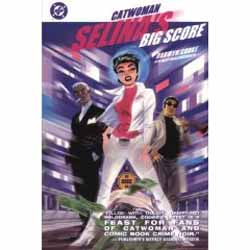
By Darwyn Cooke & various (DC Comics)
ISBN: 1-84023-773-3
I suspect this started life as a miniseries and for best effect it should be read in conjunction with Catwoman: The Dark End of the Street (ISBN13: 978-1-84023-567-8), but still this wonderful homage to the caper-tales of Elmore Leonard, set firmly on the other side of the tracks, is a sheer delight all on its own as Selina Kyle, basking in the comfortable anonymity that comes when the World thinks you’re dead, gets lured into a robbery from the Mob that’s just too big and too exciting to ignore.
Reuniting with the crime-legend who taught her all the tricks – and whom she subsequently betrayed – a team is assembled to steal the cash. But in this murky world of cross, double cross and treble cross anything that can go wrong probably will…
And how does grizzled PI Slam Bradley fit into the mix?
Set between the Slam Bradley back-up feature in Detective Comics #759-762 and the beginning of Catwoman’s current comic series, this is a slick, absorbing and unique exploit from one of the industries most talented creators: a superhero story for readers who hate fights ‘n’ tights stories.
This splendid stylish, ever-so-retro yarn is augmented by a pin-up gallery from some of comics’ most individual artists: to wit Mike Mignola, Michael Allred, Shane Glines, Kevin Nowlan, Adam Hughes, Daniel Torres, Jaime Hernandez and the inimitable Steranko. Even if you hate all that super-stuff, take a chance and track down this book. It really is something very special…
By Charles Peattie & Russell Taylor (Headline)
ISBN: 0-7472-7796-6
As we’re all heading for Heck in an economic hand-basket I thought I’d take the opportunity to cover a small British cartoon success story. Alex was created by Charles Peattie and Russell Taylor in 1987 for Robert Maxwell’s short-lived LondonDaily News (February 24th – July 23rd) which flourished briefly before succumbing in a cut-throat price-war: A portentous start for a strip about the world of business.
Alex promptly resurfaced at The Independent before being poached – or perhaps “head-hunted†to use a popular theme of the series – by The Daily Telegraph in 1992, where it has lurked ever since.
Alex Masterly is – or perhaps I should say was, as the strip occurs in “real-timeâ€, and the characters live at the same speed as the audience – an obnoxious, status-hungry, right-wing yuppie oik. He is older, more successful but no wiser now. His young son Christopher is now a ghastly teen-aged oikling in the throes of higher education and his long-suffering trophy wife Penny is still with him despite his obsessions and constant philandering.
The humour in Alex derives from the daily confirmation that business types and fat-cats are as ghastly, shallow and irredeemably venal as we’ve always suspected. Despite their excesses and blunders the slickest rats always seem to float to the top where the cream is and the British psyche seems to favour this sort of chancer (everything from Alan B’Stard/Rick Mayall in The New Statesman all the way back to Dickens’ rogues and monsters like Fagin, Uriah Heap or Wackford Squeers): following them religiously, waiting for the hammer to finally fall.
There have been very few modern strip successes, but this subtle, informative and scrupulously researched creation has gone from strength to strength, with 17 collected volumes (released annually) two omnibus editions covering 1987-1998 and 1998-2001 plus a stage play which incorporates animated strip drawings with human actors. This technique will apparently be extended to a full motion picture in 2009.
Despite a close and solidly sustained continuity, Alex remains a strip that can be picked up at any point – the featured volume which contains, drink, sex, sport, betrayal, one-upmanship and naked greed is from 1995 – but the themes will never date. If you want a sustained laugh at a world you don’t want to be a part of this is the best way to go about it.
By Yu Kinutani, translated by Gerard Jones and Satoru Fujii (Viz Spectrum Editions)
ISBN: 0-929279-38-7 ISBN-13: 978-0-92927-938-1
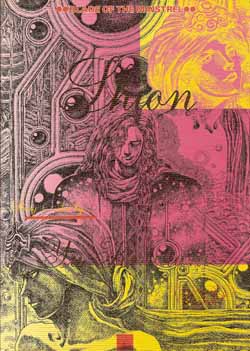
Manga is so ubiquitous in our shops and libraries now it’s hard to remember when the works of Japanese graphic narrators were presented in all sorts of formats and genres to break through Western reluctance and snobbery. From the far ago late-1980s and the early days of the prolific Viz Communications comes this odd little fantasy package that impressed all the right people but seemingly has left little mark now.
Approximately the same dimensions as a US trade paperback, Viz Spectrum products displayed all the advantages of high quality black-and-white printing – crisp white paper, inserted tissue-paper fly-leaves, gold and silver metal inks and even clear plastic dust-jackets – as inducements for their product but eventually all these fell by the wayside as fans opted with their wallets for the basic digest-sized repro format that dominates today.
And the contents? Shion reprinted the earliest works of Yu Kinutani (who went on to produce Angel Arm, Layla & Rei and White Dragon) and features the first two appearances of a wandering minstrel and demon fighter.
The first story is ‘The Minstrel’ which finds a one-eyed musical vagabond strolling into a strange and Byzantine city reminiscent of Jack Vance’s Dying Earth tales where he finds witches and devils, drinks anti-gravity wine and rescues a damsel from a demon. This demon proves to be his own father who had taken his eye as part of a Faustian Pact. By killing the monster Shion restores his sire and his own eye.
At 16 pages The Minstrel was clearly intended as a one-off, but the character returned in a much longer epic (54 pages) entitled ‘Mirrors’ wherein the troubadour falls foul of depraved, decadent and incestuous sorcerers Toy and Doll; brother and sister in magic, imprisoned in a lost city by Nazuru god of swords for their crimes against humanity.
Freed after millennia the spiteful twins of evil once more play their foul, mutagenic games with human playthings until the Minstrel aided by the Sword of Nazuru finally ends them, only to continue his lonely aimless wandering…
Born in Ehime, Japan in 1962, Yu Kinutani cites Katsuhiro Otomo, Hayao Miyazaki (Princess Mononoke, Spirited Away, among a bunch of Studio Gibli classic films) and Jean Giraud AKA Moebius as his strongest influences, although a close look at the astoundingly striking, intricate artwork seems to indicate more than a little Jim Cawthorne and a lot of Philippe (Lone Sloan – Delirious & Yragael Urm) Druillet in the creative mix.
Whilst the storytelling is primal and concentrates on fantasy archetypes the unique blend of manga sensibility with European narrative design (like a somewhat harsher version of Naausica of the Valley of the Wind) makes this an inviting treat for older fantasy and comics fans, but don’t let the superficial similarities to Hideyuki Kikuchi’s Vampire Hunter D distract you; this is a dark fairy tale, not an all-action monster-mash.
By J. F. Charles (Michel Deligne Co)
ISBN: 2-87135-021-3
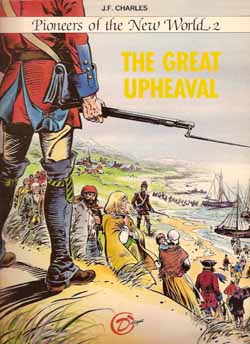
A little while ago I reviewed a European classic by J. F. Charles set in America and Canada which outlined How the West Was Lost by the French in the 1750s. I mentioned that there were six albums in the series and that as far as I knew only the first – Pioneers of the New World: The Pillory (ISBN: 2-87135-020-5) – had been translated into English.
Obviously I underestimated the knowledge – and generosity – of the readership I’m preaching to, as a few days ago this glorious little gem swished through my letterbox and plunked on my mat. So whoever you are (you didn’t sign the attached note) thank you very much indeed, and if I can ever reciprocate…?
At the close of The Pillory Graindall and other French survivors of a massacre are being held prisoners at Fort Niagara by the British when French forces attack to rescue Louise, Benjamin’s lover and daughter of a French General. In the carnage following the assault she and the experienced trapper Billy the Nantese are rescued, but Graindall appears to have been killed by cannon-fire.
The liberated French settlers are evacuated to Montreal and Louise, pregnant with the wastrel’s child, is taken by Billy to her aunt in Greenbay on the St Lawrence River. But the war is unrelenting and by 1756 the pair are overtaken by British forces. Until this time the joint Anglo-French Nova Scotia trading company controlled the resources of the New World region of Acadia, but the British advance allowed the English to dispossess the French and keep everything for themselves.
Like the Highland Clearances in Scotland (from 1725 until well into the 19th century) French settlers were forced from their lands between 1755 and 1762, literally driven into the sea. Most of the Acadians made their way down the coast, eventually settling in Louisiana. Forced together by hardship and circumstance Louisa and Billy grow closer and closer when their ship is forced into safe-harbour in Boston Bay…
Benjamin survived the attack on Fort Niagara. Wounded in the first attack he was dragged to safety by the wayward firebrand Mary Shirley. Braving the horrors of New England winters, and aided by friendly Indians they make their torturous way to New York and ultimately Albany where Benjamin is astounded to discover that the lascivious wild-child is actually the daughter of a wealthy and extremely powerful family.
He grudgingly becomes Mary’s stud and boy-toy but chafes under the witless pomp and snobbery of the English gentry. At a ball he accidentally maims the malignant Mr. Crimbel, manager of the Hudson Bay Company in a drunken brawl and flees. Frustrated Mary swears vengeance but Benjamin is already in Boston just as a refugee ship carrying Acadians beaches to avoid a winter storm. On the sands the three companions are finally reunited but Louise is torn as her first love and the father of her child greets her current lover… and his best friend
This powerful adventure saga of classic adventure is an historical drama in the inimitable Franco-Belgian manner, full of detail and yet entrancingly readable. Charles is a master of incredible wilderness scenes and breathtaking battle sequences, and here natural beauty is augmented by the veracity of historical grandeur he imparts into renditions of genteel English society.
Written with wife Maryse, Pioneers of the New World is a minor masterpiece and I fervently pray some publisher will adapt and release the series for English-reading public…
LITTLE MISS STUBBORN AND THE UNICORN
ISBN: 978-1-4052-3791-8
MR. STRONG AND THE OGRE
ISBN: 978-1-4052-3792-5
By Roger Hargreaves, written and illustrated by Adam Hargreaves (Egmont)
Just because things look simple doesn’t mean they are. The superbly pared down stories and art of the Mister Men as crafted by Charles Roger Hargreaves (1935-1988) from 1971 whilst working as an advertising Creative Director are a prime example of how much effort is needed to make things seem easy.
Colourful and simplified to the point of abstraction, the first book Mr. Tickle told a solid, if basic story that instantly captured young minds, and spawned a global franchise. Within three years the series had been turned into a BBC television series (narrated by the wonderful Arthur Lowe) starring one character of the burgeoning cast per episode. The books had sold over a million copies at this juncture.
By 1976 Hargreaves had left his job and turned to full-time cartooning. In 1981 he launched the ancillary Little Miss (adapted for television in 1983) series, which continued the tried-and-tested formula of a simple picture-story starring a character whose name perfectly described them. As well as the 46 Mr. Men and 39 Little Miss books he also produced 25 Timbuctoo books, the adventures of John Mouse and the Roundy and Squary series. With more than 100,000,000 books sold he is Britain’s third best-selling author. The books have been translated into many languages: some are not available in English at all.
When Hargreaves died of a sudden stroke in 1988 his son Adam took over the franchise, creating new characters until 2004 when the family sold the rights to an entertainment company.
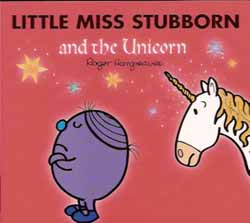
The two examples included here, Little Miss Stubborn and the Unicorn and Mr. Strong and the Ogre are both products of the second generation with glitter-enhanced covers designed to further captivate the young reader. In the former our heroine lives up to her name by disregarding all the evidence and refusing to believe in Unicorns, whilst trusty Mr. Strong has to be rather firm when a trio of boisterous ogres start rough-housing and annoying people…
Thirty-two pages with sparkly covers, divided equally into easy-to-read pages and colourful illustrations, designed for small hands, these addictively collectable books are a great reading experience and a marvellous stepping stone to a life-long love-affair with books and comics. Every child should start here…
By Sheldon Mayer & Nestor Redondo, designed/edited by Joe Kubert (DC Comics/National Periodical Publications)
No ISBN:
This isn’t exactly a book or graphic novel but as the artist I want to highlight isn’t a fan-favourite in America or England (a fact I find utterly inexplicable) collections featuring his incredible artwork are few and far between.
Nestor Redondo was born in 1928 at Candon, Ilocas Sur in the American Territory of the Philippines. Like so many others he was influenced by the US comic-strips such as Tarzan, Superman, Buck Rogers and Flash Gordon which were immensely popular in the entertainment-starved Pacific Achipelago. Drawing from an early age Nestor emulated his brother Virgilio who already worked as a comics artist for the cheap magazines of the young country. The Philippines became a commonwealth in 1935, and achieved full-independence from the USA in 1946, but maintained close cultural links to America.
His parents pushed him into architecture but within a year he had returned to comics. A superb artist, he far outshone Virgilio – and everybody else – in the cottage industry. His brother switched to writing and the brothers teamed up to produce some of the best strips the Islands had ever seen, the most notable and best regarded being Mars Ravelo’s ‘Darna’.
Capable of astounding quality at an incredible rate, by the early 1950s Nestor was drawing for many comics simultaneously. Titles such as Pilipino Komiks, Tagalog Klasiks, Hiwaga Komiks and Espesial Komiks were fortnightly and he usually worked on two or three series at a time, pencils and inks. He also produced many of the covers.
In 1953 he produced an adaptation of the MGM film Quo Vadis for Ace Publications’ Tagalong Klasiks #91-92. Written by Clodualdo Del Mundo, it was serialized to promote the movie in the country, but MGM were so impressed by the art-job that they offered 24 year old Nestor a US job and residency, but he declined, thinking himself too young to leave home yet. If you’re interested, you can see the surviving artwork by Googling “Nestor Redondo’s Quo Vadis”, and you should because it’s frankly incredible.
Ace was the country’s biggest comics publisher, but by the early 1960s they were in dire financial straits. In 1963 Nestor, Tony Caravana, Alfredo Alcala, Jim Fernandez, Amado Castrillo and brother Virgilio set up their own company CRAF Publications, Inc., but the times were against them (and publishers everywhere).
About this time America came calling again, but in the form of DC and Marvel Comics. By 1972 US based Tony DeZuniga had introduced a wave of Philippino artists to US editors, and Nestor produced short horror tales for House of Mystery, House of Secrets, The Phantom Stranger, Secrets of Sinister House, Witching Hour, The Unexpected, Weird War Tales, fill-ins for Marvel’s Man-Thing, an astonishingly beautiful run on Rima the Jungle Girl #1-7 (an loose adaptation of W H Hudson’s seminal 1904 novel Green Mansions) and replaced Berni Wrightson as the artist on Swamp Thing. He also worked on Lois Lane and Tarzan.
In 1973 he produced adaptations including Dracula and Dr. Jekyll and Mr. Hyde for Vincent Fago’s Pendulum Press Illustrated Classics. These were later reprinted as Marvel Classics Comics. In later years he would move to Marvel where he inked and eventually fully illustrated Savage Sword of Conan.
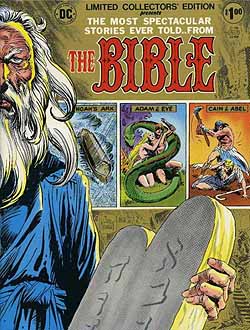
During that DC period he was tapped to draw an adaptation of King Arthur which DC killed before it was completed (once again some pages survive and the internet is your friend if you want to see them). He also illustrated issue C-36 of the tabloid sized Limited Collectors Edition.
Another ambitious project that was never completed, The Bible was written by Sheldon Mayer and designed/edited by Joe Kubert. A deeply religious man, Redondo had already produced the serial Mga Kasaysayang Buhat sa Bibliya (Tales from the Bible) for the Philippine’s Superyor Komiks between 1969-1970 as well as creating an on-the-job training scheme for young creators there. Over the years he contributed to various Christian comics, including Marx, Lenin, Mao and Christ, published in 1977 by Open Doors, Aida-Zee and Behold 3-D, produced in the 1990s by Nate Butler Studio. He was also a panelist for the first Christian comics panel discussion of Comic-Con International, in 1992.
Stories from the Bible have been a part of US comics since the earliest days of the industry, but they have never been so beautifully illustrated as in this book. Included here are The Creation, The Garden of Eden, Cain and Abel, The Generations of Adam, Noah and the Flood, The Tower of Babel, The Story of Abraham and Sodom and Gomorrah.
Also included are single page information features Digging into the Past, School Days in Bible Times, The Ziggurat and Soldiers in the Time of Abraham all illustrated by Kubert, but the true star is the passionate beauty of Redondo’s, lush, glorious art.
Redondo worked as an animation designer for Marvel Studios in the 1990s. He wrote On Realistic Illustration – a teaching session for the 1st International Christian Comics Training Conference in Tagaytay, the Philippines, in January 1996, but sadly, died before he was able to deliver it.
Whatever your beliefs – and to be honest I don’t really care – you wouldn’t be reading this unless comics meant something to you. On that basis alone, this is work that you simply cannot be unmoved by and truly should be aware of. Even if there isn’t a comprehensive collection of his work – yet – this single work will stand as a lasting tribute to the unparalleled talent of Nestor Redondo.