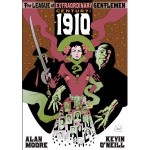
League of Extraordinary Gentlemen – Century part 1: 1910


By Alan Moore & Kevin O’Neill (Top Shelf/Knockabout)
ISBN: 978-0-86166-160-2

The Victorian era saw the birth of mass publishing, particularly in imaginative, entertaining escapist popular literature. The modern genres of fantasy, science fiction, horror and adventure all grew out of the latter half of the 19th century. Writers of varying skill and unshackled imagination recounted personal concepts of honour and heroism, wedded unflinchingly to an unshakable belief in English Superiority. In all worlds and even beyond them the British gentleman took on all comers for Right and Decency, regarding danger as a game and showing “Johnny Foreigner” just how that game should be played.

For all the problems such material might raise with modern sensibilities, most of these stories remain uncontested as classics of literature, generating all the archetypes for modern fictional heroes. Open as they are to charges of Racism, Sexism (even misogyny), Class Bias and Cultural Imperialism the best of them remain the greatest of all ripping yarns.

An august selection of some of these prototypical champions were seconded by Alan Moore and Kevin O’Neill at the end of the last century, resulting in two more great books about great heroes.

In Century: 1910 the first of a tryptich delineating the hundred years following the previous shared exploits of vampire-tainted Wilhelmina Murray, Great White Hunter Allan Quatermain, Invisible Man Hawley Griffin, charismatic “Hindoo” savant Captain Nemo and Dr. Henry Jekyll and Mister Hyde, the repercussions of both League of Extraordinary Gentleman volumes I and II are being felt through a shaky Empire still recovering from a Martian Invasion.

It is twelve years later and Nemo lies dying. His daughter Janni escapes his deathbed wishes and proclamations, fleeing to England on a ship which also carries the returning Jack the Ripper. Once “Mack the Knife” resumes his old occupation, psychic ghost-breaker Carnacki begins receiving troubling visions which might impact upon the upcoming coronation of the new King.

As ever spymaster Mycroft Holmes is on top of the situation and assigns Miss Harker, Quartermain, gender-optional immortal Orlando, gentleman thief Raffles and time traveller Andrew Norton to deal with the colliding events, but opposition from a circle of magicians led by “the most wicked man that ever lived” threaten to undo everybody’s plans. Meanwhile Janni’s fortunes have been ill-starred and she resignedly takes charge of the super-vessel Nautilus to exact a terrible vengeance…

Moore’s astounding imagination and vast cultural reservoir have provided the detail-fiends with another elite selection of literary and popular culture touchstones to enhance the proceedings, and this darkly sardonic tale is illustrated with the usual brilliance of the graphic-compulsive Kevin O’Neill.

This certainly bodes well for the future of a concept far too good to abandon. Just be glad there are no more films to tarnish the glister of this superb series…

This book is another fascinating blend of scholarship, imagination and artistry recast into a fabulous pastiche of an entire literary movement. It’s also a brilliant piece of comics magic of a sort no other art form can touch, and just as with the previous volumes there is a text feature at the back, which some might find a little wordy.

Read it anyway: it’s there for a reason and is more than worth the effort as it further outlines the antecedents of the League in an absorbing and stylish manner. It might also induce you to read some other very interesting books…
© & â„¢2009 Alan Moore & Kevin O’Neill. All Rights Reserved.
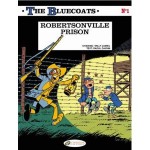
Bluecoats volume 1: Robertsonville Prison


By Lambil & Raoul Cauvin, translated by Erica Jeffrey (Cinebook)
ISBN: 978-905460-71-7

The mythology of the American West has never been better loved or more honourably treated than by Europeans. Hergé (see Tintin in America among so many other early works) was a passionate devotee, and the range of incredible comics material from Tex Willer to Blueberry to Lucky Luke displays over and over again our fascination with all aspects of that legendary time and place.

‘Les Tuniques Bleues’ or Bluecoats began at the end of the 1960s, visually created by Louis “Salvé” Salvérius and scripted by Raoul Colvin – who has also written the succeeding 52 volumes of this much-loved Belgian comedy western series. The strip was created on the fly to replace Lucky Luke when he defected from prominent weekly anthology Spirou to rival comic Pilote, and is one of the most popular series on the Continent. After its initial run Bluecoats graduated to the collected album format (published by French publishing powerhouse Dupuis) that we’re all so familiar with in Un chariot dans l’Ouest (‘A Wagon in the West‘ 1972).

Salvé was an artist proficient in the Gallic style of big-foot/big-nose humour cartooning, and when he died suddenly in 1972 his replacement Willy “Lambil” Lambillotte gradually leavened the previous broad style with a more realistic – but still comedic – illustrative manner. Lambil is Belgian, born in 1936, and after studying Fine Art, joined Dupuis as a letterer in 1952. In 1959 he created Sandy about an Australian teen and a kangaroo, and self parodied it and himself with Hobby and Koala and the later Panty et son kangaroo and the comics industry satire ‘Pauvre Lampil’.

Belgian writer Raoul Cauvin was born in 1938 and after studying Lithography joined Dupuis’ animation department in 1960 before beginning his glittering and prolific writing career. Almost exclusively a humorist and always for Spirou, as well as Bluecoats he has written at least 22 other long-running and award winning series – more than 240 separate albums. Bluecoats alone has sold more than 15 million copies.

The protagonists are Sergeant Cornelius Chesterfied and Corporal Blutch, a hopeless double act of buffoons in the manner of Laurel and Hardy, or perhaps Abbot & Costello or our own Morecambe & Wise: two hapless and ill-starred cavalrymen posted to the wilds of the arid frontier.

The first strips were single-page gags based around an Indian-plagued Wild West fort but with the second volume Du Nord au Sud (‘North and South‘) the sorry soldiers went back East to fight in the American Civil War (this scenario was retconned in the 18th album ‘Blue rétro’ which described how the everyman chumps were first drafted into the military). All subsequent adventures, although ranging all over the planet and taking in a lot of genuine and thoroughly researched history, are set within that tragic conflict.

Blutch is your average little man in the street: work-shy, reluctant and ever-critical of the army – especially his inept commanders. Ducking, diving, deserting when he can, he’s you or me – except sometimes he’s quite smart and heroic if no other easier option is available. Chesterfield is a big man, a career soldier, who has bought into all the patriotism and eprit-de-corp. He is brave, never shirks his duty and wants to be a hero. He also loves his cynical little pal. They quarrel like a married couple, fight like brothers and simply cannot agree on the point and purpose of the horrendous war they are trapped in…

Robertsonville Prison, the first release in the series from that wonderful purveyor of translated European gems Cinebooks, is actually the sixth French volume, and is loosely based on the actual Confederate-run Andersonville Prison compound in Georgia. It finds the irascible, inseparable pair captured after a calamitous battle and interned with many other Union soldiers. However these two aren’t prepared to stay put – albeit for vastly differing reasons – and a series of increasingly bold and bonkers escape ploys eventually result in a crazy if appropriate reversal of fortunes…

The secret to the unbelievable success of ‘Les Tuniques Bleues’ is that it is an anti-war comedy like M.A.S.H. or Catch 22 cleverly pitched at a young and less cynical audience. Historically authentic, uncompromising in terms of portrayed violence but always in good taste, the attitudes expressed by our oafish, down-to-earth anti-heroes never make glorious war anything but arrant folly and like the hilarious yet insanely tragic war-memoirs of Spike Milligan these are comedic tales whose very humour makes the occasional moments of shocking verity doubly powerful and hard-hitting.

Fun, informative, beautifully realised and tellingly worthy, Bluecoats is the kind of battle book that any parent would be happy to let their children read – if they can bear to let go of it themselves…

© Dupuis 1975 by Lambil & Cauvin. English edition © 2008 Cinebook Ltd. All Rights Reserved.

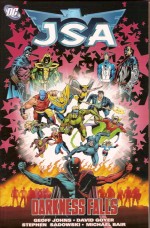
JSA volume 2: Darkness Falls


By Geoff Johns, David S. Goyer, Stephen Sadowski, Michael Bair & various (DC Comics)
ISBN: 978-1-56389-739-9

Following hard on the heels of their successful revival of the industry’s first super-team, the assorted creators hit the ground running and began expanding the roster and finding bigger and bolder cataclysms for the multi-generational army to combat.

The Justice Society of America was created in the third issue of All-Star Comics (Winter 1940/1941), an anthology title featuring established characters from various All-American Comics publications, by the simple expedient of having the heroes gather around a table and tell each other their latest adventure. From this low key collaboration it wasn’t long before the heroes joined forces to defeat the greatest villains and social ills of their generation.

Gathering issues #6-15 of the monthly JSA comicbook in one mighty tome, this volume begins with the official relaunch of the team in ‘Justice. Like Lightning…’ (illustrated by Marcos Martin & Keith Champagne) as the veteran members Flash, Sentinel and Wildcat assume the role of mentors for both current and future champions only to be attacked by a demented super-human named Black Adam. The bombastic battle serves to introduce some very far-reaching plot threads as the new incarnations of Doctor Fate, Hourman and Hawkgirl journey to ancient Egypt to solve the mystery of the Black Marvel’s madness, before the second major story-arc of the series begins.

In ‘Darkness Falls’ (art by Stephen Sadowski & Michael Bair) Sentinel’s troubled son Obsidian, haunted by his own powers, seemingly goes mad and attempts to drag the world into a supernatural realm of dark despondence. Naturally there’s more to the mess that might first appear, and when the new Doctor Mid-Nite appears it’s not long before the black tide begins to turn…

The epic concludes in a savage battle for the ‘Black Planet’ and Wildcat then takes centre-stage for a magnificent solo stint against the entire Injustice Society in ‘Wild Hunt’ – the best “Die Hard” tribute ever seen in comics.

Beginning with ‘Split’ (by Bair & Buzz) the next extended saga pits the team simultaneously against serpentine super-terrorist Kobra and the time-bending villain Extant (who killed many of the original team in Zero Hour) forcing the still largely untested JSA to divide its forces between a world in peril and a continuum in crisis.

‘The Blood-Dimmed Tide’ concentrates on the anti-Kobra contingent but their swift victory is spoiled when the sole survivor of the other team appears to bring them into battle against Extant in ‘Time’s Assassin’, ‘Chaos Theory’ and the spectacular ‘Crime and Punishment’ wherein reality is stretched beyond its limits, the gates of the afterlife are propped open and more than a few dead heroes return…

Complex and enthralling, these super shenanigans are the very best of their genre, filled with wicked villains and shining, triumphant heroes, cosmic disaster and human tragedies, always leavened by optimism and humour.

As such they’re simply not for every graphic novel reader, but if you can put yourself into the head and heart of a thrill-starved ten year old and handle the burden of seven decades of history, these tales will supercharge your imagination and restore your faith in justice…

© 2000, 2002 DC Comics. All Rights Reserved.

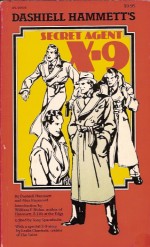
Dashiell Hammett’s Secret Agent X-9


By Dashiell Hammett, Leslie Charteris and Alex Raymond (iPL)
ISBN: 0-930330-5-6-995

If you’re a fan of crime and adventure fiction or in any way familiar with the 1930’s the names Dashiell Hammett, Leslie Charteris and Alex Raymond will be ones you know. What you might not be so aware of is their brief shared endeavour on one of the most respected and beloved of American newspaper strips.

In the 1930’s the power of newspaper strips to capture and hold vast audiences was unsurpassed (see The Adventurous Decade for further details). When the revolutionary Dick Tracy launched in 1931 for the Chicago Tribune-News Syndicate, it caused a sensation, and gritty, two-fisted crime-busting heroes became the order of the day. Publishers Syndicate released Dan Dunn, Secret Operative 48 as a response in 1933, and the usually quick-acting William Randolph Hearst was forced to respond from the back foot.

He ordered Joe Connelly, head of King Features, to produce their own He-Man G-Man, and to spare no expense. That meant pursuing America’s most popular mystery writer, who luckily for them spent money like water.

Despite having just released his fifth novel The Thin Man (following The Red Harvest, The Dain Curse, The Maltese Falcon and The Glass Key), being a regular and popular contributor to Pulps such as Black Mask and having recently established himself as a major Hollywood screenwriter, the ex-Pinkerton detective was a hard-living firebrand who lived “a life on the edge” and could always use more money.

The artist was to be, after a casting call that included Will (Red Barry) Gould and major illustrator Russell Patterson, a young man named Alexander Raymond, who since working as an assistant on such popular strips as Tillie the Toiler, Blondie and Tim Tyler’s Luck, had just been signed by Hearst to produce a new Sunday strip to challenge the science fiction blockbuster Buck Rogers. As well as his own Flash Gordon and Jungle Jim, Raymond would illustrate one of the most high-profile crime strips of the decade.

Secret Agent X-9 launched as a daily strip on January 22nd 1934 and ran until 10th February 1996 having been handled by some of the biggest and most talented names in comics (including a succession of writers using the King Features house nom de plume Robert Storm), artists Charles Flanders, Mel Graff – who renamed him “Secret Agent Corrigan”, Bob Lubbers, Archie Goodwin, Al Williamson and George Evans.

The hero himself was based in large part on Hammett’s first creation “The Continental Op”, who debuted in 1923 and starred in both Red Harvest and The Dain Curse, but there are also powerful touches of Sam Spade and Nick Charles (hero of but not ever ‘The Thin Man’) in the first year of continuities which introduce the ruthless, relentless detective/quasi-official agent of a nameless Federal organisation dedicated and driven to crushing America’s foes and protecting the innocent.

This collection of the first few tumultuous years begins with ‘You’re the Top’: an introductory tale of a criminal mastermind who uses murder and extortion to undermine society – a fairly common plot elevated to near genius by the sharp plotting and dialogue of Hammett, who was allowed to build the tale and unleash narrative twists at his preferred pace. This first saga took seven breathtaking months to unfold, with Raymond’s clean beautiful lines depicting victims and vamps, the highest of society and lowest of dregs and a frankly startling bodycount…

This was followed by ‘The Mystery of the Silent Guns’ wherein the anonymous X-9 comes to the rescue of a kidnapped millionaire industrialist, a breakneck thriller that ranges from the big city to the wild wide-open prairies and features a spectacular mid-air duel of guns and parachutes.

Although his work was impressive, Hammett’s lifestyle and attitude were a continuing problem for Connelly. Deadlines were missed and it was clear that the writer was bored and losing all interest in the strip. At some unspecified stage of ‘The Martyn Case’ Hammett left King Features with Raymond and unnamed writers concluded the tale of young Jill Martyn, a pawn in a custody battle between rich aunt and dissolute, destitute mother. Of course it’s not just a legal struggle once beatings, abduction and machine guns enter the equation…

Hammett plotted ‘The Torch Case Case’ but again other diverse hands brought the tale to fruition, in a smooth a sexy drama that found X-9 joining the FBI to crack a counterfeiting case. It was April 20th 1935. The next two cases, ‘The Iron Claw Case’ and ‘The Egyptian Jewel Case’ were both written by in-house scripters and for at least part of the first tale the art was “ghosted” (probably by Austin Briggs), whilst a major relaunch of the strip, which never really caught on with the general public, was undertaken.

Casting around for another major name the syndicate decided on British writer Leslie Charteris whose roguish 1928 creation Simon Templar: The Saint (in Meet – the Tiger!) had been followed by 14 immensely popular sequels by the time King Features invited him to assume control of X-9 (he wrote another 36 saint sagas between 1936 and 1978) and was poised to take America by storm thanks to a series of B-Movies starring his affable anti-hero.

Charteris added a kind of suave, capable malice to the character that any fan of James Bond will instantly recognise, but he also produced all but a handful of stories before moving on. This book concludes with his first, and the only one which Alex Raymond drew before he too left – to concentrate of the increasingly successful Flash Gordon.

‘The Fixer’ began on November 25th 1935, and saw the anonymous operative hunting down a criminal quartermaster who provided hardware and supplies for the underworld; a fast-paced whodunit stuffed with sleazy thugs and hot dames that literally rockets to an explosive conclusion.

These early tales of crime-busting and gangsters may not have satisfied Citizen Hearst’s ambitions but they were strong enough to fuel more than five decades of captivating action-packed adventure. This little known collection, produced by an academic publisher, proves (to me at least, and you if you can track down a copy) that the time has never been better for a new and complete chronological collection of this legendary strip.
Story and art © 1983 King Features Syndicate, Ltd. All other material © 1983 International Polygonics, Ltd. All rights reserved.

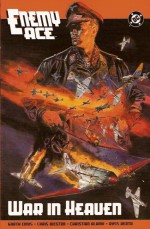
Enemy Ace: War in Heaven


By Garth Ennis, Chris Weston, Christian Alamy & Russ Heath (DC Comics)
ISBN: 1-56389-982-5

Enemy Ace first appeared as a back-up in issue #151 of DC’s flagship war comic Our Army at War: home of the already legendary Sergeant Rock (cover-dated February 1965). Produced by the dream team of Robert Kanigher and Joe Kubert during a period when the ongoing Vietnam conflict was beginning to tear American society apart the series told bitter tales of valour and honour from the point of view of German WWI fighter pilot Hans Von Hammer: a noble warrior fighting for his country in a conflict that was swiftly excising all trace of such outmoded concepts from the business of mass-killing.

The tales, loosely based on Red Baron Manfred von Richthofen, were a magnificent tribute to soldiering whilst condemning the madness of war, produced during the turbulent days of the Vietnam War. They are still moving and powerful beyond belief, as is George Pratt’s seminal 1989 sequel, Enemy Ace: War Idyll.

In 2001, Garth Ennis – no stranger to combat fiction – took another look at the flyer on the other side in a two part miniseries that transplanted him to World War II, and a far less defensible position…

Bavaria, 1942 and forty-six years old Baron Hans von Hammer is visited by an old flying comrade urging him to come out of retirement and serve his country. No lover of Nazism, the old ace has kept himself isolated until now but Germany’s attack on Russia has proven a disastrous blunder, and this last plea is a much warning as request.

The neophyte pilots on the Eastern Front need his experience and leadership whereas Hitler’s goons don’t need much excuse to remove a dissident thorn…

Based loosely on the lives of such German pilots as Adolf Galland, book I of War in Heaven (illustrated by Chris Weston) finds von Hammer as indomitable as ever in the killer skies but unable to come to terms with the increasing horror and stupidity of the conflict and its instigators. The phrase “My Country, Right or Wrong” leaves an increasingly sour taste in his mouth as the last of his nation’s young men die above Soviet fields…

Book II is set in 1945 and sees Germany on the brink of defeat with von Hammer flying an experimental early jet fighter (a Messerschmitt 262, if you’re interested) shooting down not nearly enough Allied bombers to make a difference and still annoying the wrong people at Nazi High Command. He knows the war is over but his sense of duty and personal honour won’t let him quit. He is resigned to die in the bloody skies that had been his second home, but then he is shot down and parachutes into a concentration camp named Dachau…

With art from comics legend Russ Heath, this stirring tale ends with a triumph of integrity over patriotism: a perfect end to the war record of a true soldier.

This slim volume is supplemented by a classic anti-war tale of WWI by Kanigher and Kubert from Star-Spangled War Stories #139. ‘Death Whispers… Death Screams!’ explores the Enemy Ace’s childhood and noble lineage as he endures the daily atrocities of being one of the world’s last warrior knights in a mechanised, conveyor-belt conflict.

Here is another gripping, compelling, deeply incisive exploration of war, its repercussions, both good and bad, and the effects that combat has on singular men. This should be mandatory reading for every child who wants to be a soldier…

© 2001, 2002 DC Comics. All Rights Reserved.

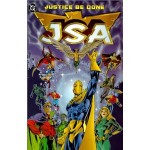
JSA volume 1: Justice Be Done


By James Robinson, David S. Goyer & various (DC Comics)
ISBN: 978-1-56389-620-0

After the actual invention of the comicbook superhero – for which read the launch of Superman in 1938 – the most significant event in the genre, and indeed industry’s progress was the combination of individual sales-points into a group. Thus what seems blindingly obvious to us with the benefit of four-colour hindsight was proven – a number of popular characters could multiply readership by combining forces and readerships. Plus of course, a whole bunch of superheroes is a lot cooler than just one – or even one and a sidekick.

The Justice Society of America was created in the third issue of All-Star Comics (Winter 1940/1941), an anthology title featuring established characters from various All-American Comics publications, by the simple expedient of having the heroes gather around a table and tell each other their latest adventure. From this low key collaboration it wasn’t long before the guys – and they were all guys (except Red Tornado who pretended to be one – don’t ask!) until Wonder Woman premiered in the eighth issue regularly joined forces to defeat the greatest villains – and social ills of their generation.

Within months the concept had spread far and wide…

And so the Justice Society of America is rightly revered as a true landmark in the development of comic books, and, when Julius Schwartz revived the superhero genre in the late 1950s, the key moment would come with the inevitable teaming of the reconfigured mystery men into a Justice League of America. From there it wasn’t long until the original and genuine returned. Since then there have been many attempts to formally revive the team’s fortunes but it wasn’t until 1999 on the back of both the highly successful revamping of the JLA by Grant Morrison and Howard Porter and the seminal but critically favoured new Starman by Golden Age devotee James Robinson, that the multi-generational team found a concept and fan-base big enough to support them.

This first volume collects the prequel tale from JSA: Secret Files #1 and the first complete story-arc from JSA #1-5, detailing with great style and remarkable facility (considering the incredibly convoluted continuity of the feature) how the last active survivors of the original team, Wildcat, Flash and Green Lantern/Sentinel, unite with the inheritors of the veteran team’s legacy to continue the tradition, train the next generation of heroes and battle one of the oldest evils in the universe.

It all begins with the death of the Sandman, octogenarian Wesley Dodds, who beats the odds one last time to thwart an unstoppable ancient foe and warn his surviving comrades of the peril to come…

At Dodds’ funeral a horde of death-demons attack the mourners after the hero known as Fate is murdered, and the assembled mourners – legacy heroes Sand, Stargirl, Hourman, Atom Smasher, Starman and Obsidian, plus Black Canary, Wonder Woman (actually her mother Hippolyta) and the aforementioned trio above are sent on a tripartite mission to rescue three babies; one of which is the new incarnation of the magical hero Doctor Fate.

Meanwhile, unbeknownst to all, a wild card has been introduced with the unexpected return of another departed comrade in the guise of a new and deeply troubled Hawkgirl…

Although deeply fixed in the vast backstory of the DC universe, ‘Gathering Storm’, ‘The Wheel of Life’, ‘Old Souls’ and ‘Ouroboros’, illustrated by Scott, Benefiel, Stephen Sadowski, Mark Propst and Michael Bair, is a accessible superhero-rebirth saga, wonderfully compelling with a frenetic pace that keeps the reader barrelling along. The struggle against the mystery villain is pitched perfectly, with plenty of clues for the old-timers and enough character illustration to educate and satisfy those who have never heard of “the Dark Lord…”

With the revival and reintroduction of Hawkgirl and Doctor Fate achieved, the volume concludes with ‘Grounded’ (illustrated by Derec Aucoin and Bair) focusing on the history and new powers of the latest Sandman and introducing a new Mister Terrific to the team, whilst foreshadowing horrors yet to come…

Complex, thrilling, breathtaking; this is the very best modern superhero comics can aspire to: adding to rather than subtracting from the shared mythology whilst not afraid to dump the utterly unsalvageable bits of stuff that just won’t play today – never once forgetting that it’s all about entertainment…

Although this will never be a universally acclaimed graphic novel like Maus or Watchmen, for dyed-in-the-wool tights and fights fans JSA: Justice Be Done is just what the Doctor ordered and what Fate decrees…
© 1999 DC Comics. All Rights Reserved.

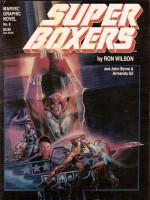
Super Boxers – A Marvel Graphic Novel


By Ron Wilson, with John Byrne & Armando Gil (Marvel)
ISBN: 0- 939766-77-9

It’s been a long while since Marvel published an all-original graphic novel as opposed to a reprint collection, but not too long ago they were the market leader in the field with an entire range of “big stories” told on larger than normal pages (285 x 220mm rather than the now customary 258 x 168mm) featuring not only proprietary characters but also licensed assets like Conan and even creator-owned properties.

They also took chances on unusual and cross-genre tales such as this little oddity which falls squarely into the category of a “guilty pleasure”.

In the near future Corporations have assumed control of Earth, with the result that the rich have gotten richer – and more bored – whilst an underclass excluded from all rights and privileges scuttles to survive in the dirt beneath their lavish skyscrapers. As the poor daily trade their freedoms and dignity for another meal, in the world of the mega-rich and their wholly-owned contributing citizens, survival is just as harsh and all-pervasive.

Businesses survive and grow by consuming each other and everything is produced to facilitate that overweening drive: product, entertainment, people.  The Corporations are in a perpetual state of Cold War, ostensibly working together but always looking for an edge and a hostile takeover. Delcos is one such business: CEO Marilyn Hart has never been one of the boys, and now her one-time colleagues, sensing weakness, are closing in for the kill…

In the world below Max Turner is a star. A scrapper to his core, he works as a prize-fighter: an old fashioned palooka using his fists (augmented by cybernetic gloves, boots and body armour) to get by in a brutal arena of social Darwinism, providing dangerous entertainment for his daily bread. The Corporations also have Super Boxers: pampered, gussied up, genetic thoroughbreds with their entire lives geared to those explosive moments when they unleash their pedigreed savagery in high-tech arenas for the pleasure and profit of their owners. The greatest of these sporting warriors is the godlike Roman Alexis.

But every society has its malcontents and gadflies: when a slumming talent scout for Marilyn Hart “discovers” Max, the dumb but honest gladiator becomes a pawn in a power play that threatens to tear the corporate world to tatters – but would that really be such a bad thing…?

None of that matters to Max or Roman. For them it’s about personal honour. Tech doesn’t matter, rewards don’t matter, freedom doesn’t matter. Only being the best…

Ron Wilson is probably nobody’s favourite artist, but he is a workmanlike illustrator with a good line in brooding brutes, and Armando Gil’s fluid inks do a lot to sharpen the static, lumpen scenarios, as do the varied tones of colourists Bob Sharen, Steve Oliff, John Tartaglione, Joe D’Esposito and Mark Bright. The letters are provided by Mike Higgens.

Scripted by John Byrne from Wilson’s plot, this is a harsh, nasty, working-class tale reminiscent of such boxing movies as Michael Curtiz’s epic 1937 classic Kid Galahad by way of the Rocky movies, with socio-political undertones that would have been far more comfortable in a European comic like Metal Hurlant or 2000AD.

Ugly, uncompromising, brutal, this is the kind of book to show anybody who thinks that comics are for sissy-boys…
© 1983 Ronald Wilson. All Rights Reserved.

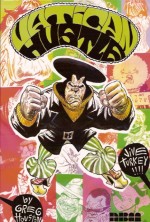
Vatican Hustle


By Greg Houston (NBM)
ISBN: 978-1-56163-571-9

The zeitgeist of the moment seems to be nostalgia, and especially a post-modern re-examination of some of our most unfortunate cultural milestones, but at least the graphic novels that are coming out of these historic plunderings are varied and readable if not universally palatable…

Another sparkling example of the phenomenon is the potentially controversial little gem under review here from cartoonist, caricaturist, designer, educator, actor and big fan of old movies Greg Houston.

This baroque, grotesque and immensely appealing pastiche of Blaxploitation movies and the no-nonsense, in your face attitudes of the early 1970s introduces Baltimore’s coolest private eye Boss Karate Black Guy Jones, who is reluctantly commissioned by Lumpy Fargo, the city’s biggest crime boss, to rescue his wayward, dim daughter from the sticky clutches of Geech Bradford, the White Pimp…

The sordid trail leads inevitably to Rome, porn capital of the world, and, after a brief brush with the legitimate, inclusive end of skin-flicks, directly to the Vatican, long perceived among industry insiders as the source of all the really nasty freaky stuff…

Meanwhile the Pope is getting horny and anxious. Chickee Falzbar his official drug dealer and wingman is late, and the brutish, two-fisted, leather-jacketed Pontiff is looking to score some tail, kick some butt and raise a little Hell. There’s a ba-aad hassle coming and Jones is gonna need all his skills to rescue Brandi Fargo from the callous hands of God’s chosen representative on Earth…

Beneath the outrageous parody and shockingly impious (nigh slanderous) treatment of Catholic tenets and icons is a witty mystery and genuinely funny adult romp which pokes bad-tasting fun at everything from Lepers to Clowns to Hobos, college girls, the sex trade and even rock ‘n’ roll, all rendered in a busy, buzzy, black and white line that appeals and appals in equal amounts.

If you’re of a religious mien and likely to take offence at religion mocked don’t buy this book.

If you are a fan of frantic fisticuffs of fury and martial arts mayhem this ain’t the book for you neither as there practically isn’t none, but if you’re eligible to vote, open (and broad) minded, can whistle the theme to Shaft and love to laugh, this might just be your favourite book of the year…

© 2009 Greg Houston. All rights reserved.

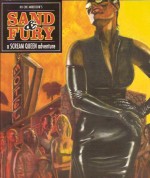
Sand & Fury – a Scream Queen Adventure


By Ho Che Anderson (Fantagraphics Books)
ISBN: 978-1-60699-321-7

After the groundbreaking graphic journalism of his examination of Martin Luther King (see King – a Comic Biography: the Special Edition) Ho Che Anderson has turned his talents to pure fiction in a startling and visceral re-interpretation of the legend of the banshee (or Bien Sidhe) transplanted to the cold nights and inhospitable deserts of the American west.

Against a backdrop of a serial killer stalking the area a stranded young woman is picked up by a striking woman in a fancy car. Despite her misgivings the girl soon warms to her rescuer, sharing her life and dreams. She has no idea that her life will soon end.

Whilst seeking answers to her own obscured past the driver instinctively knows she is an Angel of Death drawn to the side of people soon to die. Is she a cursed witness or somehow the facilitator? As she discovers some truths in rapid, slashes of flashbacks and jumps forward she zeroes in on the killer: someone she knew intimately.

However, when she meets another of her kind the secrets revealed only lead to a greater mystery; one infinite in scope and terrifyingly ancient in execution…

Citing Dario Argento, David Lynch, Richard Sala and Charles Burns as inspiration and with hints and overtones of Trashy Road Movies, Celtic mythology, the cosmology of H.P. Lovecraft and the modern bogeyman of Serial Killers this is a scary, sexy, gory story that heeds your full attention but delivers a devastating punch. Anderson is as much designer as illustrator and both his art and his stories are stark, powerfully arresting, even challenging concoctions.

The art, jagged black and white with judicious doses of red, isn’t prettied up and the narrative isn’t spoon fed. The reader will have to work to glean the meaning here, but the end result is more than worth the effort.

Sand & Fury © 2010 Fantagraphics Books. All content © 2010 Ho Che Anderson. All rights reserved.

Unlovable volume 2


By Esther Pearl Watson (Fantagraphics Books)
ISBN: 978-1-60699-314-9

This arrived cold: I had never heard of the strip nor the magazine Bust where it has run for years, but as I’m always up for something new I sat down and lost myself in the world of Tammy Pierce, Texas Teen…

Ostensibly based on an actual diary the artist found in a gas-station restroom in 1995, this concluding volume resumes with the innermost thoughts, dreams and experiences of a dumpy, utterly ordinary girl surgically displayed for our examination in a catchy, breathless, effusive warts ‘n’ all style as she endures her Sophomore year of High School, from Christmas Eve 1988 to the Summer of 1989.

When you’re a teenager some things are truly timeless and universal: parents are unreasonable and embarrassing, siblings are scum and embarrassing and your body is embarrassingly finding new and horrifying ways to betray you almost daily… Your friends can’t be trusted, you’re attracted to all the wrong people and sometimes you just know that no one will ever love you…

Drawn in a two colour, faux-grotesque manner (you can call it intentionally primitive and ugly if you want) the page by page snapshots of a social hurricane building to disaster is absolutely captivating. Although this is a retro-comedy experience, behind her fatuous obsession with fashion, boys, music (equal parts Debbie Gibson and The Smiths!), social acceptance and traitorous bodily functions, Tammy is a lonely bewildered child that it’s hard not to feel sorry for. Actually it’s equally hard to like her (hell, its difficult to curb the urge to slap her at times) but that’s the point after all…

If you live long enough you’ll experience the pop culture keystones of every definitive era of your life at least twice more. The base, tasteless and utterly superficial aspects of the 1980s are currently in vogue for the current generation, which is too young to remember them – but you and I can get all nostalgic for the good bits and blithely ignore all the bad stuff: this big little hardback (408 pages, and about 15x15cm) is a delightful and genuinely moving exploration of something eternal given extra punch with the trappings of that era of tasteless self-absorption.

Like those other imaginary diarists Nigel Molesworth, Bridget Jones and Adrian Mole Tammy Pierce’s ruminations and recordings have something concrete to contribute to the Wisdom of the Ages and this book is humorous delight tinged with gentle tragedy – although that’s more in the readers apprehension of how her life eventually turned out…

Modern and Post-Ironic, Unlovable is unmissable.  Now please excuse me, I’ve got to put on my legs warmers and chunky sweater and hunt down a copy of volume 1…

© 2010 Esther Pearl Watson. All rights reserved.