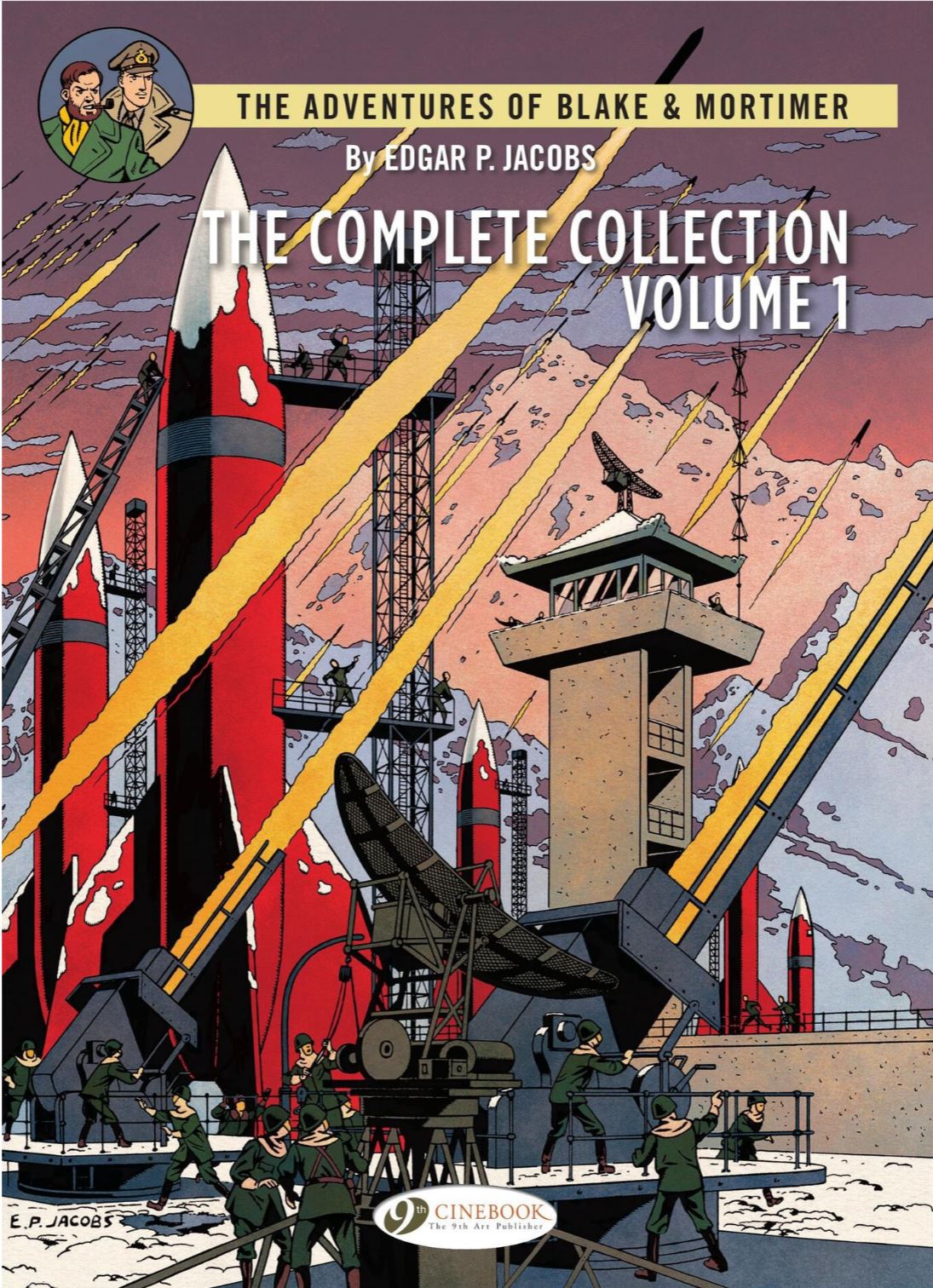
The Phantom – The Complete Series: The Gold Key Years volume 2


By Bill Harris & Bill Lignante, with Joe Certa, Sparky Moore, George Wilson & various (Hermes Press)
ISBN: 978-1-61345-023-9 (HB?/Digital edition)

This book includes Discriminatory Content produced in less enlightened times.

In the 17th century a British sailor survived an attack by pirates, and, washing ashore in Africa, swore on the skull of his murdered father to dedicate his life and that of all his descendants to destroying all pirates and criminals. The Phantom fights crime and injustice from a fabulous lair deep in the jungles of Bengali, and is known throughout Africa as “the Ghost Who Walks”. His unchanging appearance and unswerving quest for justice have led to him being regarded as an immortal avenger by the credulous and the wicked. Down the decades one hero after another has fought and died in an unbroken line, and the latest wearer of the mask, indistinguishable from the first, continues the never-ending battle…

Lee Falk created the Jungle Avenger at the request of his syndicate employers who were already making history, public headway and loads of money with his first strip sensation Mandrake the Magician

Although technically not the first ever costumed hero in comics, The Phantom was the prototype paladin to wear a skintight bodystocking, and the first to have a mask with opaque eye-slits. He debuted on February 17th 1936 in an extended sequence pitting him against a global confederation of pirates called the Singh Brotherhood. Falk wrote and drew the daily strip for the first two weeks before handing over the illustration side to artist Ray Moore. The Sunday feature began in May 1939.

For such a successful, long-lived and influential series, in terms of compendia or graphic novel collections, The Phantom has been poorly served by the English language market. Various small companies have tried to collect the strips – one of the longest continually running adventure serials in publishing history – but in no systematic or chronological order and never with any sustained success. But, even if it were only of historical value (or just printed for Australians, who have long been manic devotees of the implacable champion) surely “Kit Walker” is worthy of a definitive chronological compendium series?

Happily, his comic book adventures have fared slightly better – especially in recent times.

In the 1960’s King Features Syndicate dabbled with a comic book line of their biggest stars – Flash Gordon, Popeye, Blondie, Mandrake and The Phantom – but immediately prior to that, the Ghost Who Walks helmed a solo-starring vehicle under the broad and effective aegis of veteran licensed properties publisher Gold Key Comics. Each issue was fronted by a stunning painted cover by George Wilson. The Phantom was no stranger to funnybooks, having been featured since the Golden Age in titles such as Feature Book and Harvey Hits, but only as straight strip reprints. These Gold Key exploits were tailored to a big page and a younger readership.

This second superb full-colour hardcover – with equivalent eBook editions for the modern minded – gathers The Phantom #9-17 (originally released between November 1964 and July 1966) and opens with fan and scholar Pete Klaus’ Introduction ‘The Gold Key Phantom’ offering original art panels (many by Sy Barry) and a welcoming overview of the immortal strip star.

Scripted by Bill Harris and drawn in comic book format by Bill Lignante, the illustrated adventures resume with full-length epic ‘The Sixth Man’ from #9 as the Ghost Who Walks takes a rare trip into modern civilisation only to be shanghaied by crooks. All too soon the miscreants realise that they have made the biggest mistake of their shady lives. Determined to discover what’s behind the nefarious scheme, Kit Walker allows himself to be taken to a remote island ruled by bored, cruel queen Sansamor who thrives on making powerful men duel to the death.

Once the hero sees the kind of creature she is, her downfall is assured…

The issue is concluded by a single-page historical recap of the legend of ‘The Phantom’ and equally brief monochrome rundown of the mystery man’s intended bride ‘Diana’ (Palmer).

Cover-dated February 1965, #10 opens with devious action thriller ‘The Sleeping Giant’ wherein the long-peaceful tribe of Itongo headhunters take up the old ways after ancestral idol Tuamotu comes to life.
Thankfully, the Phantom is on hand to stem potential carnage and expose crooked diamond prospector Joe Gagnon (and his oversized circus performer pal) inciting the tribesmen to war and conquest. All he has to do is defeat the giant warrior in unarmed combat…

Assisting the masked peacekeeper in policing tribes and criminals of the region is ‘The Patrol’. These worthy soldiers have no idea who their mysterious “Commander” actually is, so when the latest raw recruit tries to find out, he receives a startling shock in this wry vignette.

Issue #11 (April 1965) features ‘Blind Man’s Bluff’ with two brutal convicts breaking out of the Bengal Penal Colony to terrorise native communities by masquerading as demonic spirits. When the Phantom apprehends them as they link up with pirates, he is struck sightless by a flare gun, but not even blindness can stop the resourceful champion from dispensing justice…

Closing the issue is a one-page tour of ‘The Skull Cave’ by Joe Certa, after which #12 (June, with art by Sparky Moore & Lignante) introduces ‘The Beast of Bengali’. Here a golden giant capable of seeming miracles subjugates the locality until the masked marvel exposes his magical feats for the tricks they really are. Then, following a mouth-watering period ad for the Phantom Revell model kit, #13 (August) opens ‘The Phantom Chronicles’ as the Jungle Sentinel consults his ancestor’s meticulous records for tips on defeating seemingly immortal bandit Rachamond

October cover-dated, The Phantom #14 opens with ‘The Historian’ as scholar Dr. Heg consults with the Jungle Patrol on a book chronicling their achievements. His ulterior motive is to destroy the only law for hundreds of miles, but he has not reckoned on the true identity of their enigmatic leader…

‘Grandpa’ switches locales to America where Diana Palmer’s doting ancestor is playing unwelcome matchmaker. Eventually, after violent incidents involving bears and robbers, the old man warms to African mystery man Kit Walker…

Closing 1966, TP #15 (December) details the downfall of ‘The River Pirates’ who ravage the mighty waterways of the region. Their modern weapons prove little use against the cunning and bravery of the Deep Woods Guardian. ‘The Tournament’ then focuses on an unlucky prison escapee who finds the Phantom’s clothes and is stuck fighting a native gladiator in a centuries-old grudge match. Sadly, if he loses, the prestige lost means chaos will return to the tribes benefitting from The Phantom’s Peace…

‘The Chain’ opens #16 (April 1966) as a world-weary Phantom considers quitting after an interminable period negotiating peace between warring tribes. Even Diana cannot change his mind, but then ancient wise man Wuru appears, relating a story of the hero’s father, who endured hardship, mockery and even slavery in a quest to rescue a woman from vile bondage. Her name was Maude, and she was to be the Phantom’s mother…

A brace of single-pagers follow, revealing Kit Walker’s unrecorded boxing bout against ‘The Champ’ and a battle in a bar won by ‘The Milk Drinker’ before ‘The Crescent Cult’ sees the Jungle Ghost crushing an assassination gang determined to murder their country’s new Maharani. The comic concludes with another 1-page yarn as ‘The Diggers’ examine old ruins and discover proof that the Phantom has lived and fought evil for centuries!

This second volume closes on a truly supernatural note as The Phantom #17 (July 1966) discloses how undying witch ‘Samaris’ has preyed on male suitors for centuries, and believes she has last found another cursed to live forever…

Following one-pager ‘The Waterfall’, detailing the secrets of the entrance to the fabled Skull Cave, ‘Samaris Part II’ finds the Ghost Who Walks captive of the Queen but resisting her every wile until justice, fate and an avalanche of deferred years catch up to her at last…

Wrapping up is a monochrome vignette detailing the secrets of The Phantom’s devout helpers ‘The Bandar’ Poison Pygmy People and a sumptuous cover gallery by painter George Wilson.

Straightforward, captivating rollicking action-adventure has always been the staple diet of The Phantom. If that sounds like a good time to you, this is a traditional nostalgia-fest you won’t want to miss…
The Phantom® © 1964-1966 and 2012 King Features Syndicate, Inc. ® Hearst Holdings, Inc. Reprinted with permission. All rights reserved.

Today in 1828 genre-founding author Jules Verne was born, so maybe go read a book soon? In comics, unsung wonder Bill Finger was born in 1914, as was Filipino inking legend Danny Bulanadi in 1946. On the debit side we lost the iconic Julius Schwartz today in 2004 and Li’l Jinx originator and Archie stalwart Joe Edwards in 2007.

Dc Finest: Batman – The Case of the Chemical Syndicate


By Bob Kane, Bill Finger, Gardner F. Fox, Whitney Ellsworth, Sheldon Moldoff, Jerry Robinson, George Roussos & various (DC Comics)
ISBN: 978-1-79950-670-6 (TPB/Digital edition)

This book includes Discriminatory Content produced in less enlightened times.

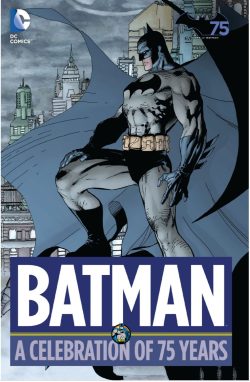
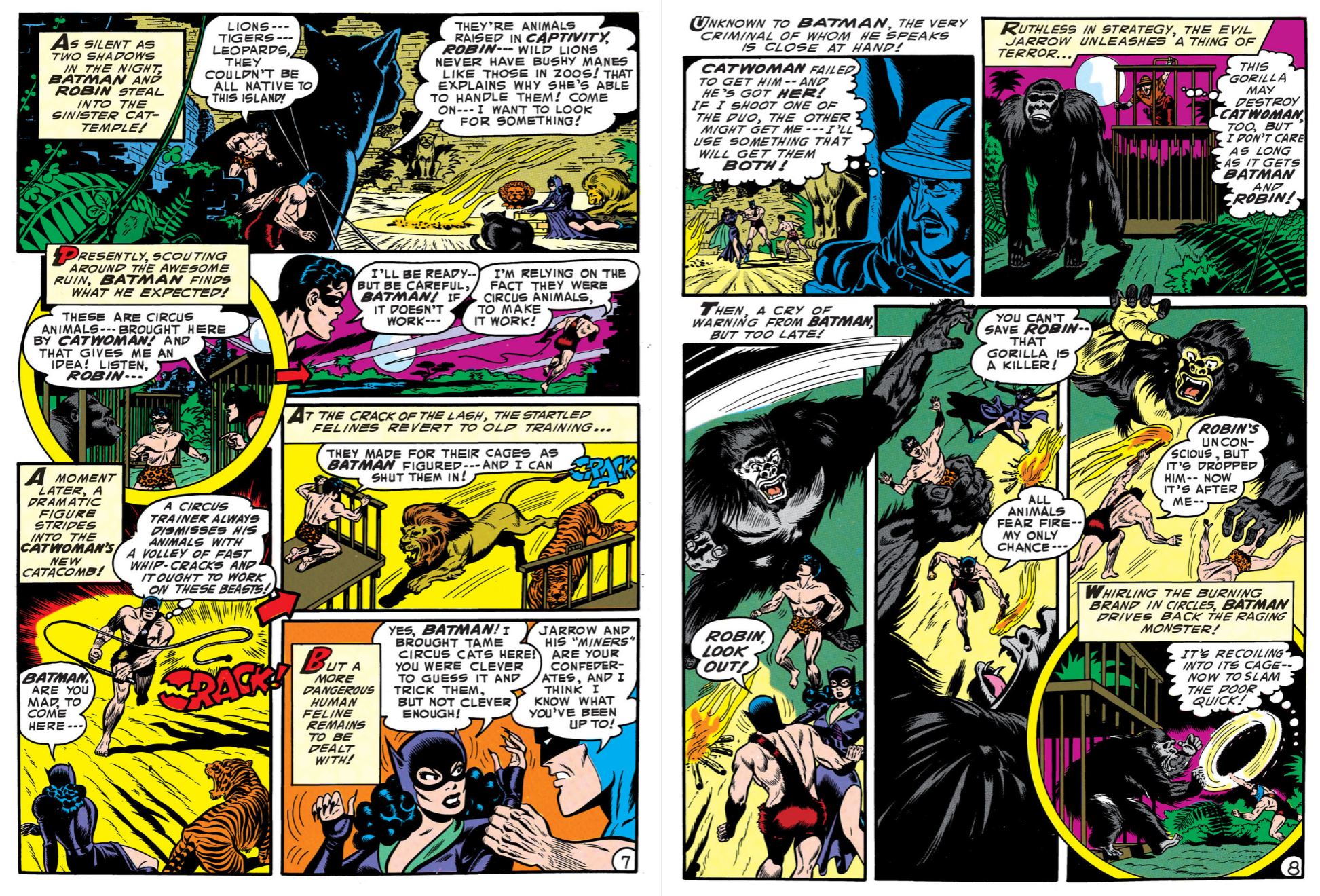
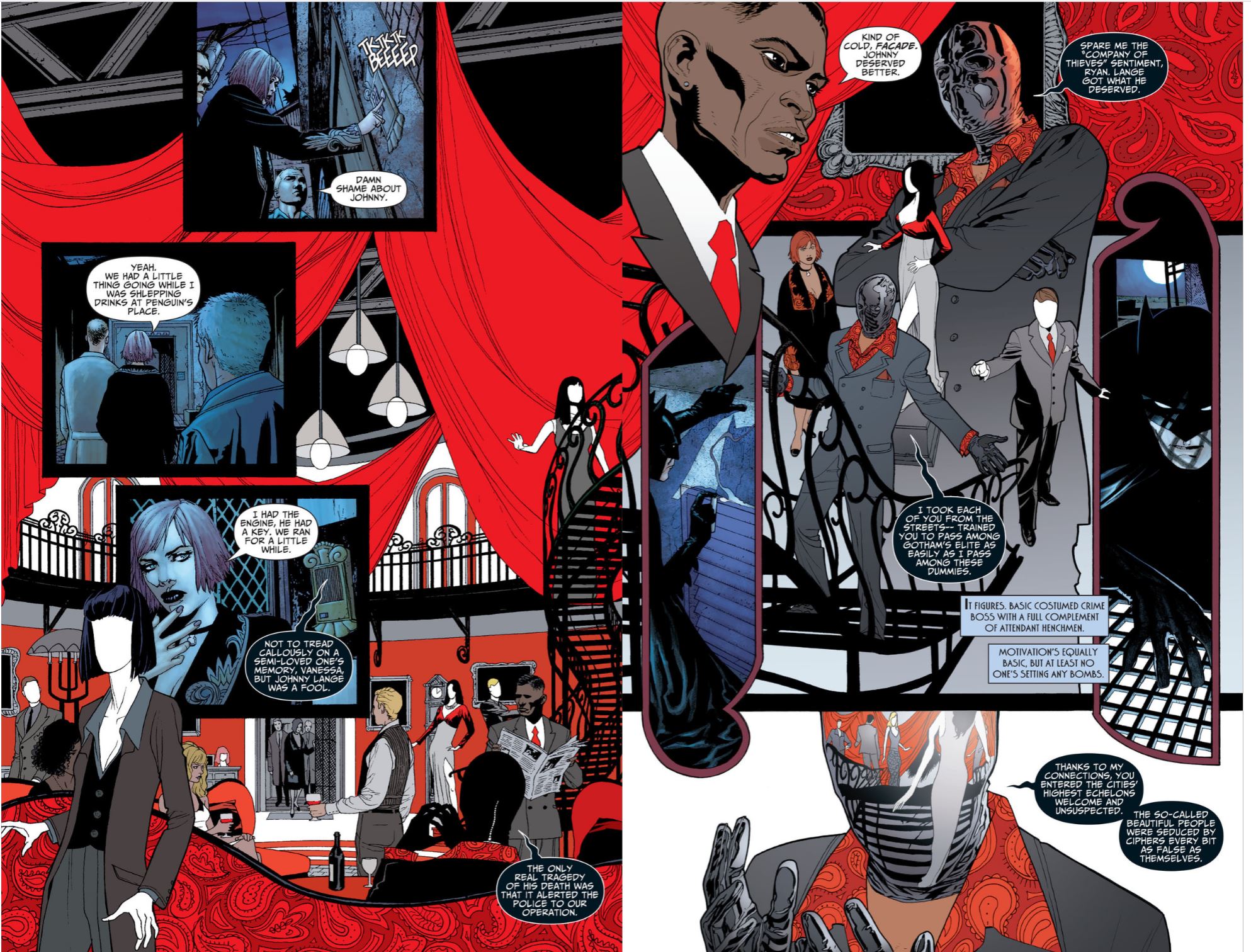
Although already much reprinted, archived and curated, here’s another sound and stunning collection of the Gotham Guardian’s earliest exploits in original chronological order, forgoing glossy, high-definition paper and reproduction techniques in favour of a newsprint-adjacent feel and the same flat, bright-yet-muted colour palette which graced the originals. There’s no fuss, fiddle or Foreword, and the book steams straight into the meat of the matter with the accumulated first two years of material featuring the masked mystery-man, as well as all those stunning covers (by Kane, Robinson, Roussos, Fred Gurdineer, Creig Flessel, Jack Burnley, Fred Ray and The Strauss Engraving Company). These span Detective Comics #27-51; Batman #1-5; the Dynamic Duo’s endeavours in New York World’s Fair Comics 1940 and World’s Best Comics #1, cumulatively encompassing every groundbreaking escapade from May 1939 to May 1941.
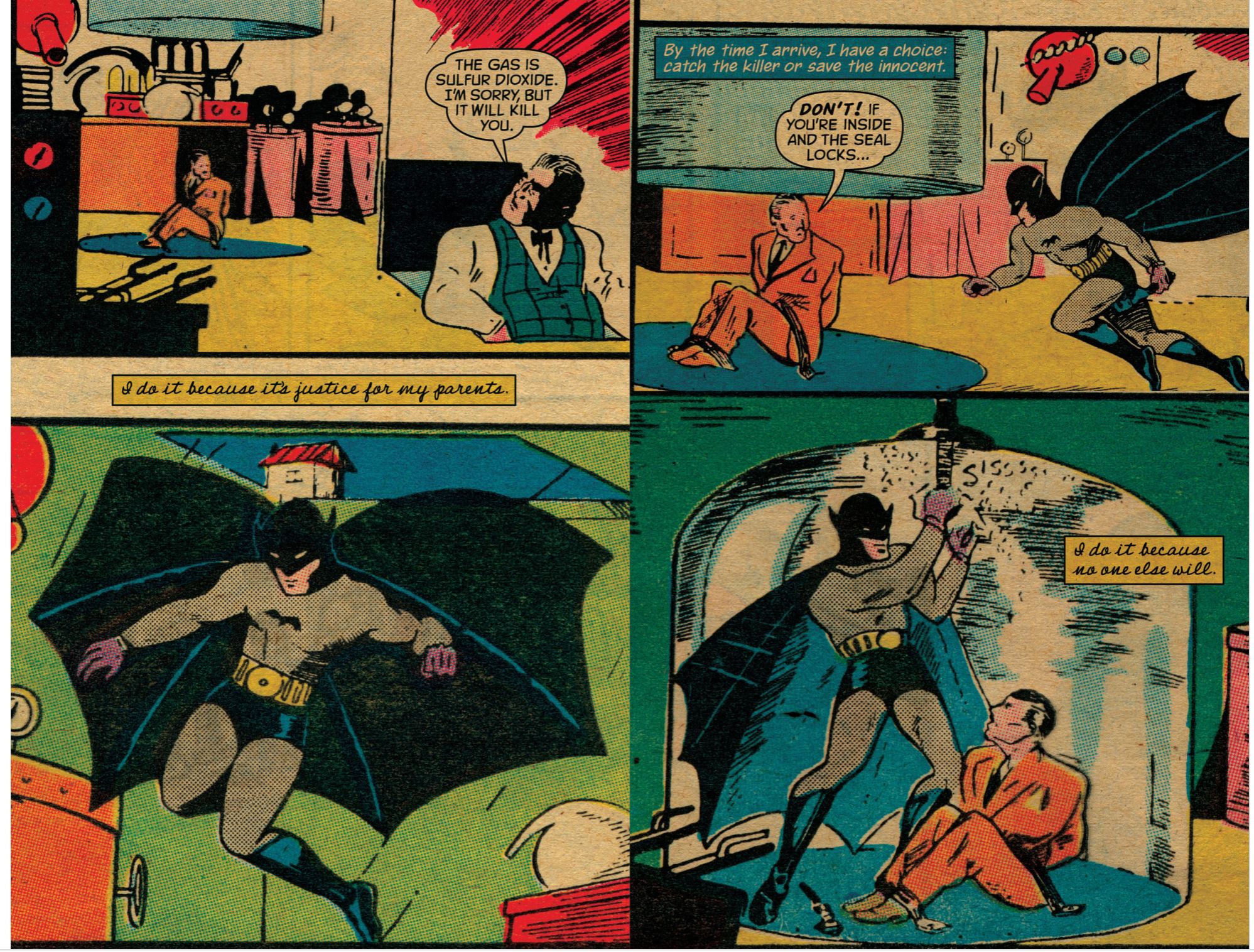
As Evri Fule Kno, Detective Comics #27 featured the Darknight Detective’s debut in the ‘Case of the Chemical Syndicate!’ by Bob Kane and as yet still anonymous close collaborator/co-originator Bill Finger. A spartan, understated yarn introduced dilettante playboy criminologist Bruce Wayne, drawn into a straightforward crime-caper as a cabal of industrialists were successively murdered. The killings stop when an eerie figure dubbed “The Bat-Man” intrudes on Police Commissioner Gordon’s stalled investigation to ruthlessly expose and deal with the hidden killer.

The following issue saw our fugitive vigilante return to crush ‘Frenchy Blake’s Jewel Gang’ before encountering his very first psychopathic killer/returning villain in Detective #29. Gardner Fox scripted these next few adventures beginning with ‘The Batman Meets Doctor Death’, in a deadly duel of wits with deranged, greedy general practitioner Karl Hellfern and his assorted instruments of murder: the most destructive and diabolical of which was sinister “Asiatic” manservant Jabah…

This is my cue to again remind all interested parties that these stories were created in far less tolerant times with numerous narrative shortcuts and institutionalised social certainties expressed in all media that most today will find offensive. If that’s a deal-breaker, please pass on this book… and most literature, pop songs and films created before the 1960s…

Confident of their new villain’s potential, Kane, Fox and inker Sheldon Mayer encored the mad medic for the next instalment and ‘The Return of Doctor Death’, before Fox & Finger co-scripted a 2-part shocker debuting the very first bat-plane, Bruce’s girlfriend Julie Madison and undead horror The Monk in expansive, globe-girdling spooky saga ‘Batman Versus the Vampire (part one)’. It all concluded in part two with an epic chase across Eastern Europe and spectacular climax in a monster-filled castle in #32.

DC #33 featured Fox & Kane’s ‘The Batman Wars Against the Dirigible of Doom’: a blockbusting disaster thriller which just casually slips in the secret origin of the grim avenger, as mere prelude to intoxicating air-pirate action, before Euro-trash dastard Duc D’Orterre finds his uncanny SCIENCE! and unsavoury appetites no match for the mighty Batman in ‘Peril in Paris’. Bill Finger returned as lead scripter in #35, pitting the Cowled Crusader against crazed cultists murdering everyone who had seen their sacred jewel in ‘The Case of the Ruby Idol’ … although the many deaths were actually caused by a far more prosaic villain. Inked by new kid Jerry Robinson, grotesque crime genius ‘Professor Hugo Strange’ debuted with his murderous manmade fog and lightning machine in #36, after which all-pervasive enemy agents lodged in ‘The Screaming House’ prove no match for a vengeful Masked Manhunter in #37.

Detective Comics #38 (April 1940) changed the landscape of comic books forever with the introduction of ‘Robin, The Boy Wonder’ as child trapeze artist Dick Grayson – whose parents are murdered before his eyes – thereafter joins Batman in a lifelong quest after bringing to justice mobster mad dog Boss Zucco

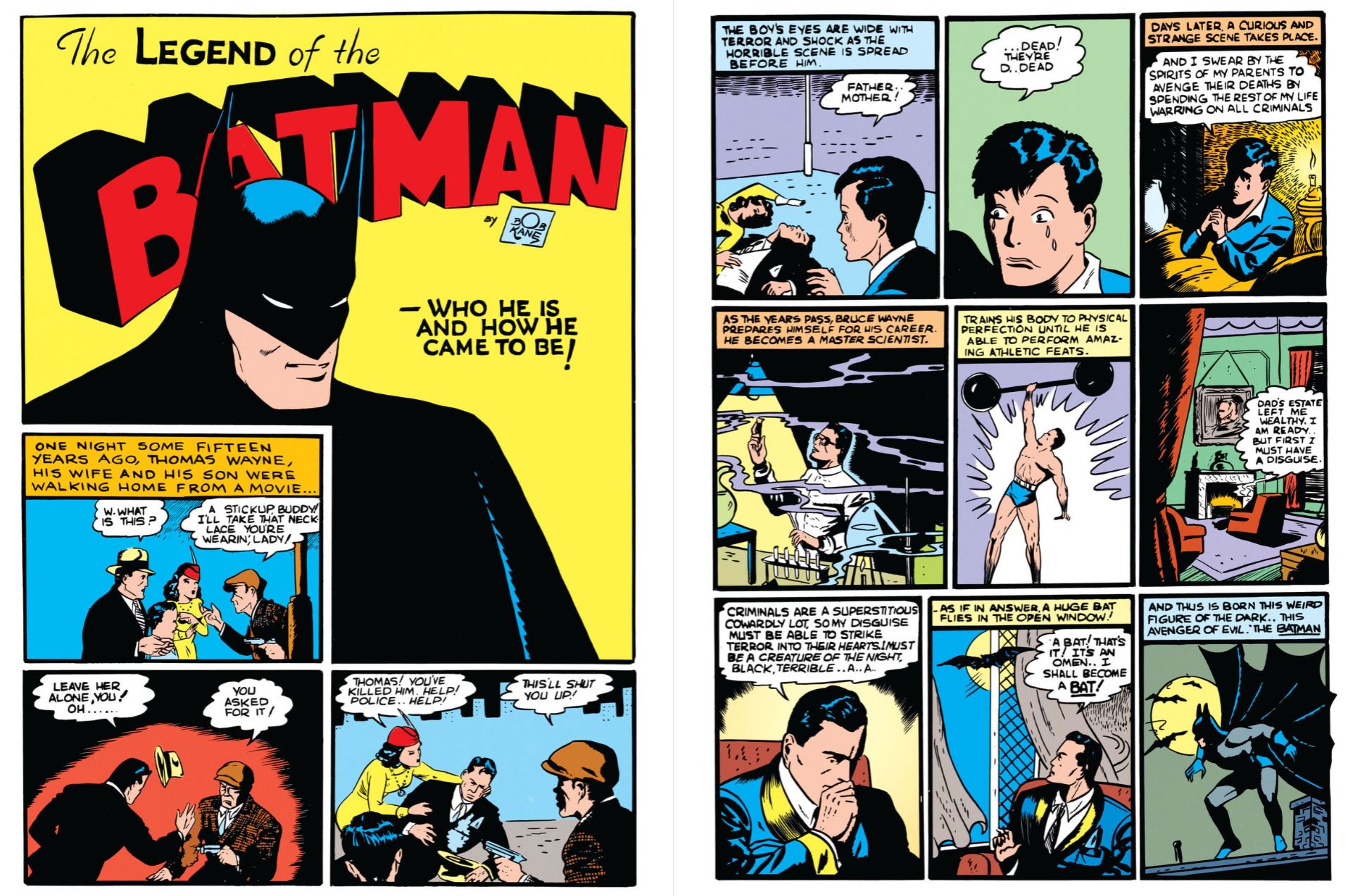
With the Flying Graysons’ killers captured, all-out action continued in #39 with Finger, Kane & Robinson’s ‘The Horde of the Green Dragon’ – “oriental” Tong killers in Chinatown – Batman #1 (Spring 1940) opened proceedings with a recycled origin culled from portions of Detective #33 & 34. ‘The Legend of the Batman – Who He Is and How He Came to Be!’ by Fox, Kane & Moldoff delivers in two perfect pages what is still the best ever origin of the character. ‘The Joker’ (Finger, Kane & Robinson – who also produced all the remaining tales in this astonishing premiere issue) then launches the greatest villain in DC’s pantheon via a macabre tale of extortion and wilful wanton murder.

‘Professor Hugo Strange and the Monsters’ follows as an old adversary returns, unleashing laboratory-grown hyperthyroid horrors to rampage through the terrified city, before ‘The Cat’ – who later added the suffix “Woman” to her name to avoid any possible doubt or confusion – plies her felonious trade of jewel theft aboard the wrong cruise-liner, thereby falling foul for the first time of the dashing Dynamic Duo. Then comics end with the ‘The Joker Returns’ as the sinister clown breaks jail to resume his terrifying campaign of murder for fun and profit before “dying” in mortal combat with the Gotham Guardians. pulse pounding premier package fun folds with Whitney Elsworth’s text piece ‘Meet the Artist’ and a superb Kane pin-up (originally the back cover of that premier issue) of the Dynamic Duo.

Tense suspense and eerie evil is also on show in DC #40 as ‘The Murders of Clayface’ sees the Dynamic Duo solving a string of murders on a film set which almost sees Julie Madison the latest victim of a monstrous movie maniac…

Batman & Robin solve the baffling mystery of a kidnapped pupil in Detective #41’s ‘The Masked Menace of the Boys’ School’ before enjoying a busman’s holiday in ‘Batman and Robin Visit the 1940 New York World’s Fair’ as seen in the second New York World’s Fair Comics. Here Finger, Kane & Roussos follow the vacationing troubleshooters as they track down a maniac mastermind with a metal-dissolving ray, before Detective Comics #42 again finds our heroes ending another murderous maniac’s rampage in ‘The Case of the Prophetic Pictures!’

The heroes’ second solo outing produced another quartet of comics classics in Batman #2 (Summer 1940). It begins with ‘Joker Meets Cat-Woman’ (Finger, Kane, Robinson & new find George Roussos) wherein svelte thief, homicidal jester and a crime syndicate all tussle for the same treasure, with our Caped Crusaders caught in the middle. ‘Wolf, the Crime Master’ then offers a fascinating take on the classic tragedy of Jekyll & Hyde prior to an insidious and ingenious mystery in ‘The Case of the Clubfoot Murderers’. Ultimately Batman & Robin confront uncanny savages and ruthless showbiz promoters in poignant monster yarn ‘The Case of the Missing Link’.

By now an unparalleled hit, Batman stories never rested on their laurels. The creators always sought to expand their parameters, as Detective #43 saw our heroes clash with a corrupt mayor in #43’s ‘The Case of the City of Terror!’ before rather jumping the shark with #44’s nightmarish fantasy of giants and goblins ‘The Land Behind the Light!’, in advance of returning to bizarre baroque basics in #45’s horrific Joker jape ‘The Case of the Laughing Death!’ wherein the Harlequin of Hate undertakes a campaign of macabre murder against everyone who has ever defied or offended him…

Batman #3 (Fall 1940) has Finger, Kane, Robinson & Roussos rise to even greater heights, beginning with ‘The Strange Case of the Diabolical Puppet Master’: an eerie episode of uncanny mesmerism and infamous espionage…

A grisly scheme unfolds next as innocent citizens are mysteriously transformed into specimens of horror, and artworks destroyed by the spiteful commands of ‘The Ugliest Man in the World’ before ‘The Crime School for Boys!’ registers Robin, allowing infiltration of a gang who have a cruel and cunning recruitment plan for dead-end kids, whilst ‘The Batman vs. the Cat-Woman’ lastly reveals the larcenous lady in well over her head when she steals for – and from – the wrong people…

The issue also offered a worthy Special Feature from Ellsworth & Burnley as ‘The Batman Says’ presents an illustrated prose Law & Order pep-talk…

Plunging right into perilous procedures, Detective #46 (Kane, Robinson & Roussos) features the return of Batman’s most formidable fringe scientific adversary as our heroes must counteract the awesome effects of ‘Professor Strange’s Fear Dust’, after which #47 delivers drama on a more human scale by proving ‘Money Can’t Buy Happiness’. This action-packed homily of parental expectation and the folly of greed leads into Detective Comics #48, finding the lads defending America’s bullion reserves in ‘The Secret Cavern’, and is followed by Batman #4 (Winter 1941) which opens with a spiffy catch-all visual resume.

Then its all-out razzle-dazzle as the Gotham Guardians visit and vanquish ‘The Joker’s Crime Circus’, prior to pulling the plug on the piratical plundering of ‘Blackbeard’s Crew and the Yacht Society!’. Immediately after, ‘Public Enemy No.1’ tells a gangster fable in the manner of Jimmy Cagney’s Angels With Dirty Faces, before ‘Victory For the Dynamic Duo!’ involves the pair in the treacherous world of sports gambling.

Detective Comics #49 (March 1941), finds them confronting another old foe when ‘Clayface Walks Again!’ with the deranged actor resuming his passion for murder by re-attempting to kill Bruce Wayne’s old girlfriend Julie before World’s Best Comics #1 (Spring 1941 and destined to become World’s Finest Comics with its second issue) offers an eerie murder mystery concerning ‘The Witch and the Manuscript of Doom!’.

DC #50 pits Batman & Robin against acrobatic burglars in ‘The Case of the Three Devils’, whilst sordid human scaled wickedness informs #51’s ‘The Case of the Mystery Carnival!’: a mood-soaked crimebusting set-piece featuring fairly run-of-the mill thugs, but serving as a perfect palate-cleansers for big bold Batman #5 (Spring 1941). Once again, The Joker plays lead villain in ‘The Riddle of the Missing Card!’, before the heroes prove their versatility by solving a quixotic crime in Fairy Land via ‘Book of Enchantment’.

‘The Case of the Honest Crook!’ follows: one of the key stories of Batman’s early canon. When a mugger steals only $6 from a victim, leaving much more behind, his trail leads to a vicious gang who almost beat Robin to death. The vengeance-crazed Dark Knight goes on a rampage of terrible violence that still resonates in the character to this day. The last story from Batman #5 – ‘Crime does Not Pay’ – once again deals with kids going bad and their potential for redemption, and surely that’s what heroic mythmaking is all about?

Kane, Robinson and their compatriots created a visual iconography which carried Batman well beyond his allotted lifespan until later creators could re-invigorate the concept. They added a new dimension to children’s reading… and their work is still captivatingly accessible. Moreover, these early stories laced with Fingers’ mood-soaked macabre madness set the standard for comic superheroes. Whatever you like now, you owe it to these stories. Superman gave us the idea, but inspired and inspirational writers like Finger & Fox refined and defined the meta-structure of the costumed crime-fighter. Where the Man of Steel was as much Social Force and juvenile wish-fulfilment as hero, Batman and Robin did what we ordinary mortals wanted to do most: teach bad people the lessons they richly deserved…

These are tales of elemental power and joyful exuberance, brimming with deep mood and addictive action. Comic book heroics simply don’t come any better.
© 1939, 1940, 1941, 2025 DC Comics. All Rights Reserved.

Today in 1914 All American editor Ted Udall was born, but we had to wait until 1953 for Richard Bruning, 1956 for animator, director and funnybook renaissance man Bob Camp and 1958 for astounding letterer and sublime illustrator Kevin Nowlan as well as Archie Comics writer/editor Paul Castiglia in 1966.

In the meantime, UK weekly mainstay The Topper began its 37-year run today in 1953, thereby launching Davey Law’s Beryl the Peril unto an unsuspecting world.

Marvel Team-Up Omnibus volume 1


By Roy Thomas, Gerry Conway, Len Wein, Steve Gerber, Ross Andru, Gil Kane, Jim Mooney, Sal Buscema, Don Heck, Mike Esposito, Frank Giacoia, Steve Mitchell, Frank Bolle, Don Perlin, Sal Trapani, Wayne Howard, Dave Hunt, Vince Colletta & various (MARVEL)
ISBN: 978-1-3029-6699-7 (HB/Digital edition)

This book includes Discriminatory Content produced in less enlightened times.

Inspiration isn’t everything. In fact, as Marvel slowly grew to a position of market dominance in the wake of losing their two most innovative and inspirational creators, they did so less by experimentation and more by expanding proven concepts and properties. The only real exception to this was the assembly line creation of horror and horror-hero titles in response to the industry down-turn in super-hero sales – a move expedited by a rapid revision in the wordings of the increasingly ineffectual Comics Code Authority rules.

The concept of team-up books – an established star pairing or battling (usually both) with less well-selling company characters – was not new when Marvel decided to award their most popular hero the lion’s share of this new title, but they wisely left their options open by allocating an occasional substitute lead in the Human Torch. In those long-lost days editors were acutely conscious of potential over-exposure – and since superheroes were actually in a decline they may well have been right.

Marvel Team-Up was the second regular Spider-Man title (abortive companion title Spectacular Spider-Man was created for the magazine market in 1968 but died after two issues). MTU launched at the end of 1971 and went from strength to strength, proving the time had finally come for expansion and a concentration on uncomplicated action over sub-plots…

This engaging hardback and/or eBook compilation gathers the first 30 issues of Marvel Team-Up (spanning cover-dates March 1972 to February 1975) and includes crossover fun from Daredevil (and the Black Widow) #103, plus double length larks from Giant-Size Super Heroes #1 and Giant-Size Spider-Man #1-3. As well as a monolithic assortment of nostalgic visual treats at the back, this mammoth tome is dotted throughout with editorial and letters pages (from ‘Team-Up’ to ‘Mail it to Team-Up’) and also includes recycled Introductions from previous Marvel Masterworks editions (namely Gerry Conway’s ‘Behold: An Introduction’ and Roy Thomas’ ‘A Long, Loose Leash’ and ‘Full Credit – or Blame’) plus other contemporary editorial announcements as seen in each original issue, just to enhance overall historical experience…

Marvel Team-Up #1was crafted by Roy Thomas, Ross Andru & Mike Esposito as a mutual old enemy reared his gritty head in charming seasonal saga ‘Have Yourself a Sandman Little Christmas!’. A light-heated romp full of Christmas cheer, rambunctious action and seasonal sentiment, the story set the tone for all epics to follow. Merry Marvelite Maximii can award themselves a point for remembering which martial arts/TV hero debuted in this issue, but folk with lives can simply take my word that it was Iron Fist’s sometimes-squeeze Misty Knight

Gerry Conway assumed the writer’s role and Jim Mooney the inks for ‘And Spidey Makes Four!’ in the succeeding issue as our hot and sticky heroes then take on and trounce the Frightful Four and Negative Zone bogeyman Annihilus before without pause going after Morbius the Living Vampire in #3’s ‘The Power to Purge!’ (as inked by Frank Giacoia). The new horror-star was still acting the villain in MTU #4 as the Torch was replaced by most of Marvel’s sole mutant team (The Beast having gone all hairy – and solo) in ‘And Then… the X-Men!’

Inked by Steve Mitchell, this boldly enthralling thriller was illustrated by magnificent Gil Kane at the top of his form. Kane became a semi-regular penciller, and his dynamic style and extreme-action anatomy lifted many pedestrian tales such as #5’s ‘A Passion of the Mind!’ (Conway script & Esposito inks), pitting Spidey and The Vision against manipulative mesmeric Puppet Master and robotic assassin the Monstroid. The bad guy again carried over to the next issue and joined by the Mad Thinker in ‘…As Those Who Will Not See!’ pitted the wallcrawler and The Thing against cerebral scoundrels in a cataclysmic battle no Fights ‘n’ Tights fan could be unmoved by…

MTU #7’s ‘A Hitch in Time!’ was produced by Conway, Andru & Mooney: guest-starring Thor with otherworldly Trolls freezing Earth’s time-line as a prerequisite step to conquering Asgard, after which #8 provides a perfect example of the team-up comic’s other function – to promote and popularise new characters. ‘Man-Killer Moves at Midnight!’ was most fans’ first exposure to The Cat (later retooled as Tigra the Were-Woman) in a painfully worthy if ham-fisted attempt to address feminist issues from Conway & Mooney. The hard-pressed heroes joined forces here to stop a male-hunting murderer paying back abusive men. These days we’d probably be rooting for her…

Iron Man collaborated in the opening foray of 3-part tale ‘The Tomorrow War!’ (Conway, Andru & Frank Bolle) as he & Spidey are kidnapped by Zarkko the Tomorrow Man to battle Kang the Conqueror. The Torch returned to help deal with the intermediate threat of a ‘Time Bomb!’ (with art by Mooney & Giacoia) before the entire race of Black Bolt’s Inhumans pile in to help Spidey stop history unravelling in culminatory clash ‘The Doomsday Gambit!’ – this last chapter scripted by Len Wein over Conway’s plot for Mooney & Esposito to illustrate.

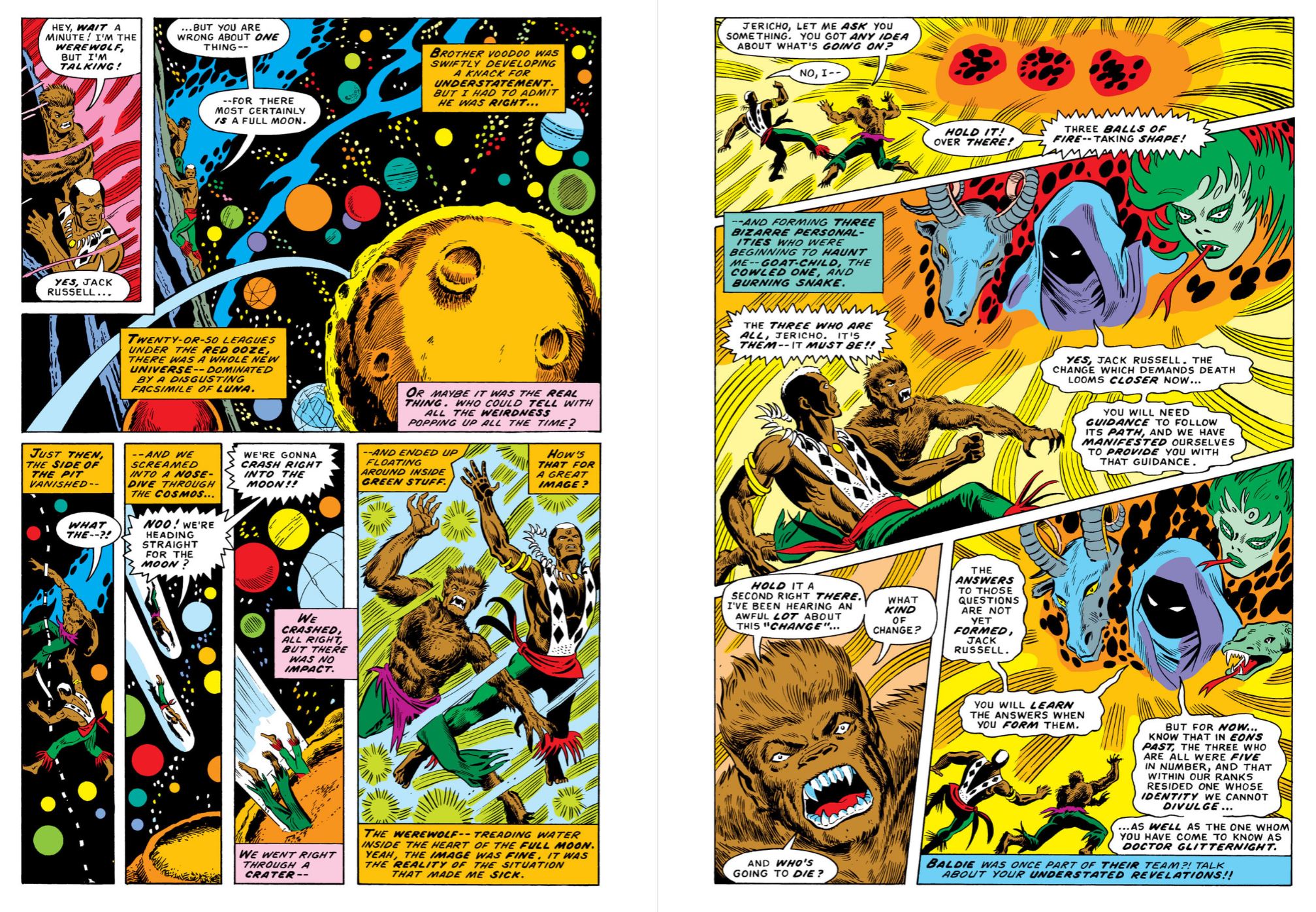
Deftly delineated by Andru & Don Perlin, Wein scripted a Conway plot for ‘Wolf at Bay!’ in MTU #12 wherein wallcrawler meets Werewolf By Night Jack Russell to maul malevolent mage Moondark in foggy San Francisco, after which we divert to the Man Without Fear’s own title. Here they share some left coast limelight as Daredevil and the Black Widow #103 (Steve Gerber, Don Heck & Sal Trapani). This sees them join the still-California-bound wallcrawler as a merciless cyborg attacks the odd couple while they pose for roving photojournalist Peter Parker in ‘…Then Came Ramrod!’

Kane & Giacoia limned ‘The Granite Sky!’ wherein Wein pits Spidey & Captain America against Hydra and Grey Gargoyle in a simple clash of ideologies, after which ‘Mayhem is… the Men-Fish!’ (inked by Wayne Howard – and, yes bad grammar, but great action-art!) matches the webslinger with the savage Sub-Mariner against vile villains Tiger Shark and Doctor Dorcas as well as an army (navy?) of mutant sea-beasts.

Wein, Andru & Perlin created The Orb to bedevil Spidey and Ghost Rider in ‘If an Eye Offend Thee!’ in #15 before Kane & Mooney limn ‘Beware the Basilisk my Son!’: a gripping romp featuring (the original Kree) Captain Marvel, concluding with ‘Chaos at the Earth’s Core!’ (inked by “everybody”!), as Mister Fantastic joins the fracas to stop Mole Man inadvertently blowing up the world. Human Torch Johnny Storm teams with The Hulk in MTU #18 to stop antimatter malcontent Blastaar in ‘Where Bursts the Bomb!’ (Giacoia & Esposito inks), but Spidey blazes back a month later with Ka-Zar in situ to witness ‘The Coming of… Stegron, the Dinosaur Man!’ (Wein, Kane & Giacoia). His plans to flatten New York by releasing ‘Dinosaurs on Broadway!’ is foiled with Black Panther’s help… as well as the artistic gifts of Sal Buscema, Giacoia & Esposito.

Dave Hunt replaced Esposito inking ‘The Spider and the Sorcerer!’ in #21 as Spidey and Doctor Strange once more battled Xandu, a wily wizard first seen in Spider-Man Annual #2, before we pause for a brief lecture.

Giant-Size titles were quarterly double-length publications added to the schedule of Marvel’s top tier heroes, and the wallcrawler’s were used to highlight outré or potentially controversial pairings such as Dracula and Doc Savage. Here they are represented by try-out Giant-Size Super Heroes #1 which pitted the wallcrawler against Living Vampire Morbius as well as hirsute and manic Man-Wolf. In a classic clash by Conway, Kane & Esposito. Within months a quarterly double-length Spider-Man team vehicle was added to Marvel’s schedule….

Back in MTU #22, Wein, Sal B & Giacoia’s ‘The Messiah Machine!’ brings the monthly story glories to a brief pause after depicting Hawkeye and the Amazing Arachnid frustrating deranged computer Quasimodo‘s ambitious if absurd mechanoid invasion. Then – cover-dated July 1974 and courtesy of Conway, Andru & Heck – Giant-Size Spider-Man #1 saw the webspinner in frantic pursuit of an experimental flu vaccine, improbably carried on an ocean liner in ‘Ship of Fiends!’ The quest brought him into chilling contact with newly-revived vampire lord Dracula and a scheming Maggia Capo at ‘The Masque of the Black Death!’

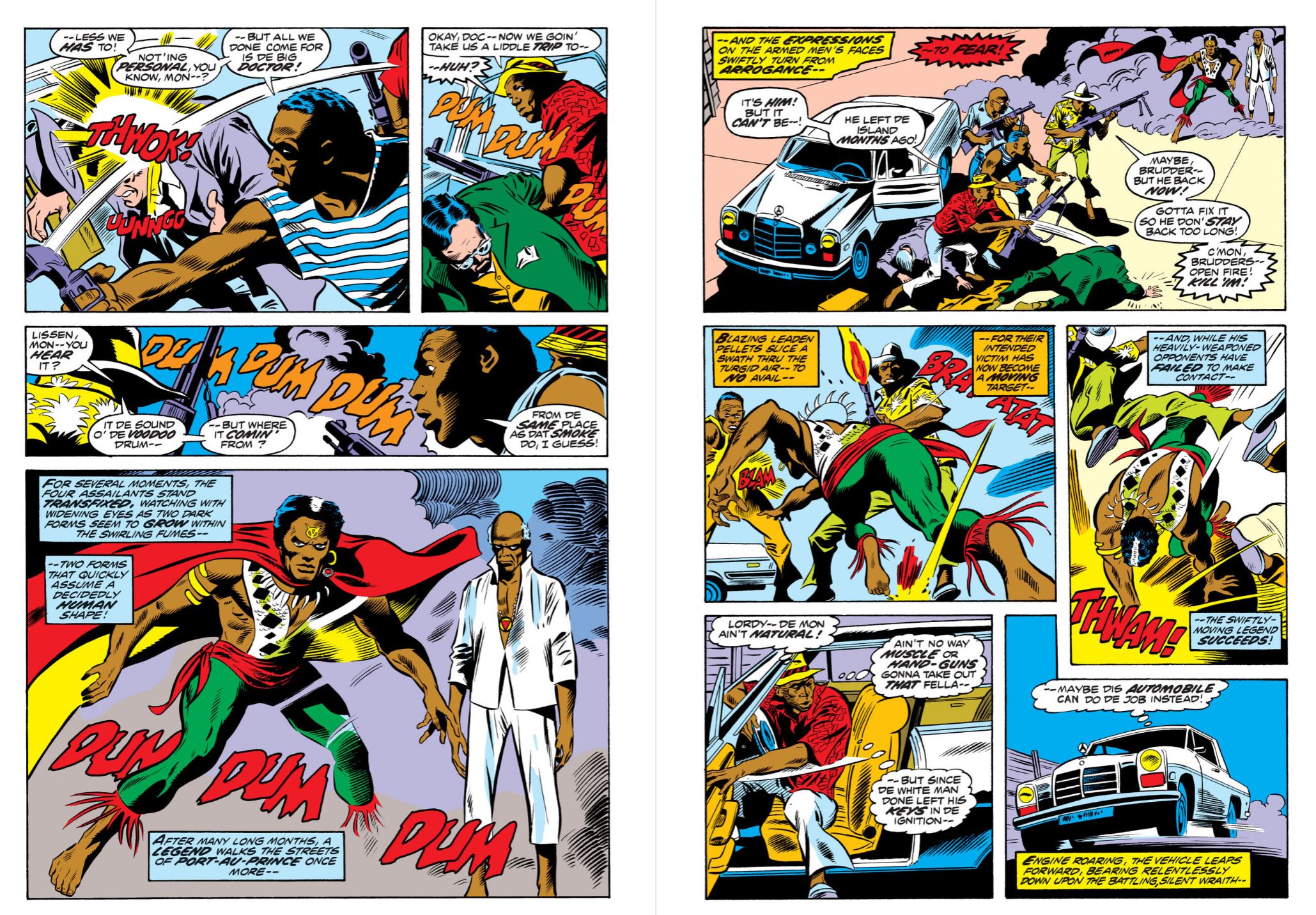
Here that bizarre battle is accompanied by its original editorial text feature ‘An Illuminating Introduction to Giant Size Spider-Man’ before we move on to monthly MTU wherein the Torch & Iceman fractiously unite to stop Equinox, the Thermo-Dynamic Man on ‘The Night of the Frozen Inferno!’ (Wein, Kane & Esposito). Still embracing supernatural themes and trends, the webslinger learns ‘Moondog is another Name for Murder!’ in a defiantly quirky yarn illustrated by Mooney & Trapani which brings the decidedly offbeat Brother Voodoo to the Big Apple to quash a Manhattan murder cult…

Wein, Mooney & Frank Giacoia then determine that ‘Three into Two Won’t Go!’ as Daredevil joins Spider-Man in thrashing inept kidnappers Cat-Man, Bird-Man and Ape-Man, after which Giant-Size Spider-Man #2 sees the amazing arachnid drawn into battle with Shang-Chi, Master of Kung Fu as sinister immortal Fu Manchu frames Spider-Man in ‘Masterstroke!’ The duped heroes clear the air in ‘Cross… and Double-Cross!’ before uniting to foil the cunning Celestial’s scheme to mindwipe America from the ‘Pinnacle of Doom!’

MTU #26 finds the Torch and Thor battling to save the world from Lava Men in The Fire This Time…’ by Wein, Mooney, Giacoia & Hunt. At this time, in a desperate effort to build some internal continuity into the perforce brutally brief encounters, the scripters introduced a shadowy trio of sinister observers with an undisclosed agenda who would monitor superhero episodes and eventually be revealed as providers of outrageous technologies for many of the one-shot villains who came and went so quickly and ignominiously…

They weren’t involved when the Chameleon frames Spider-Man (again) and tricks the Hulk into freeing a man – for the most unexpected reason of all – from the New York Men’s Detention Center in #27’s ‘A Friend in Need!’ (Wein, Mooney & Giacoia). They did, however, have a cloaked hand in ‘The City Stealers!’ (#28 by new regular creative team Conway, Mooney & Vince Colletta) when strange mechanoids swipe the island of Manhattan, necessitating Spidey and Hercules (mostly Hercules) having to drag it back to its original position…

After that implausible minor miracle Spider-Man experiences time-displaced disaster as Giant-Size Spider-Man #3 (Conway, Andru & Esposito) explores ‘The Yesterday Connection!’ Now lovely alien Desinna seeks the aid of Spidey in 1974 and – in ‘The Secret Out of Time’ – the hands-on help of legendary 1930s adventurer Doc Savage. Across a gulf of four decades the heroes individually discover something is not right in ‘Other People in Other Times!’ With the escape of a savage rampaging monster, two eras seem doomed to destruction, at least until wiser, more suspicious heads and powers prevail in ‘Tomorrow is Too Late’ ensuring that ‘The Future is Now!’

Marvel Team-Up #29 displays a far less constrained – or even amicable – pairing as flaming kid Johnny Storm and patronising know-it-all Iron Man butt heads whilst tracking a seeming super-saboteur in ‘Beware the Coming of Infinitus! or How Can You Stop the Reincarnated Man?’ before in #30 Spider-Man and The Falcon find ‘All That Glitters is not Gold!’ whilst tracking a mind-control drug back to its crazy concoctor Midas, the Golden Man.

However, adding extra lustre are visual treats aplenty in the form of contemporaneous house ads; covers and frontispieces from seasonal tabloid treasury Giant Superhero Holiday Grab-Bag (with art from John Buscema & John Romita Sr.) and original art pages and covers from Andru, Kane, Esposito, Perlin, Mooney, & Giacoia plus Kane pencil layouts. Also on view are covers from Marvel Tales #234, 249, 254, by Todd McFarlane, Marshall Rogers, Brian Stelfreeze, complete with new bridging pages by Jae Lee. Jan Harpes & Renee Witterstatter, and another gallery of Spider-Man Megazine covers (#1-6) by James Fry, Hector Collazo, Stelfreeze, Jung Choi, Ron Frenz, Al Milgrom, Stuart Immonen, Kirk Jarvinen, Jason Moore and Mark Buckingham, plus the unpublished cover of #7 as crafted by John Romita Sr & Jr.. Closing the book is a truly unique unused cover for #8 by Brian Bolland.

These stories are of variable quality but nonetheless all exhibit an honest drive to entertain and please. Artistically the work is superb, and most fans of the genre would find little to complain about so, although not really a book for casual or more maturely-oriented readers, there’s bunches of fun on hand and young readers will have a blast, so there’s no real reason not to add this tome to your library…
© 2025 MARVEL.

Today in 1892 Korky the Cat creator James Crighton was born as was Golden Age great Creig Flessel in 1912 and Al McWilliams in 1916. Writer/editor/publisher Bob Shreck joined the party in 1955, three years after Crocket Johnson released the final episode of Barnaby.

Back in 1938, the very first Donald Duck newspaper strip was syndicated and in 1987 the astounding Ken Reid drew his last breath – as did Dutch comics maestro Lo Hartog van Banda in 2006. As always, look in the blog for more or just buy anything with these guys’ names on it…

Add Toner – a Cometbus Collection


By Aaron Cometbus (Last Gasp)
ISBN: 978-0-86719-753-2 (TPB)

This book includes Discriminatory Content produced in less enlightened times.

Before the advent of computers and the internet gave everybody with a keyboard and an ounce of determination the ability to become writers and publishers (an eternity before AI made all that a complete joke and waste of time), only those truly dedicated, driven or Full-On Compulsive individualists self-published.

…Or those with something to say.

Aaron Cometbus (not his real name: use your search engine if you absolutely must find out about the man, but the best route would be to read his wonderful work) has been a drummer, roadie, author, designer, traveller, author, raconteur, social historian, bookseller and cultural anthropologist of the American Punk movement from long before he began his hugely acclaimed and long-running ‘Zine Cometbus in 1981.

In the decades over which his hand-crafted publication has been released (as photocopy pamphlet, offset magazine and even audio-mag) his writing and art have covered every aspect of the life of the contemporary outsider from self-exploratory introspection, reportage, criticism, oral history, music journalism, philosophical discourse and even unalloyed fiction – from epigram to novella, news bulletin to chatty remembrance – usually in a distinctive hand-lettered style all his own, augmented by cartoons, photo-collage, comics and a dozen other monochrome techniques beloved of today’s art-house cognoscenti.

Cometbus (go read Downtown Local, The Voyeurs and A Punkhouse in the Deep South: The Oral History of 309) tells stories and has been doing so since the first death of the Punk Rock movement at the end of the 1970s, but the material is – and always has been – about real, involved people, not trendy, commercialised bastardisations.

In 2002 Last Gasp released Despite Everything: a 600+ page Omnibus distillation of the best bits from the first 43 issues with this second compilation released in 2011… and this one’s still available.

Add Toner, which samples issues #44-46, 46½, and 47-48, is a far more comprehensive collection with stories, reminiscences, interviews, artworks and added features such as the novella ‘Lanky’ plus a selection of previously withheld and self-censored pieces which simply captivate and enthral.

Particularly informative and moving are the collected illustrated interviews with the “staff” and patrons of punk watering hole and communal meeting space Dead End Café from #46 (gloriously redolent and evocative of my own art-school punk band hang-out The Horn of Plenty in St. Albans) and a fabulous three-chapter oral history examination of the post-hippie “Back to nature” movement divided into interviews with ‘The Kids’, ‘The Adults’ and an appreciation of ‘Back to the Land’: a fascinating period in American history neglected by just about everybody, probably since most of those flower-power Arcadians and disenchanted just-plain-folks grew more pot than potatoes…

With graphic contributions and supplementary interviews from Phil Lollar, Nate Powell, Katie Glicksberg, Idon, Lawrence Livermore & Michael Silverberg, this is a gloriously honest and seditiously entertaining view of life from the trenches: happy, sad, funny and shocking…

Eccentric, eclectic and essentially, magically picayune, Add Toner is a fabulous cultural doctorate from the Kerouac of my g-g-generation…
© Aaron Cometbus. All rights reserved.

Today in 1878 Mary Tourtel was born, originator of UK strip star Rupert Bear

In 1983 Cuban inker Frank Chiaremonte died and in 1996 we lost two true legends, Jerry Siegel and Burne Hogarth. You don’t need me to tell you how they changed everything.

DC Finest: The Doom Patrol – The Death of the Doom Patrol


By Arnold Drake, Bob Haney, Paul Kupperberg, Gerry Conway & Scott Edelman, Bruno Premiani, Bob Brown, Joe Staton, Arvell Jones, Frank Chiaramonte, Bruce Patterson, Romeo Tanghal, Carmine Infantino, Jack Sparling, Joe Orlando, Jim Aparo, Rich Buckler, Vince Colletta, Ross Andru, Dick Giordano & various (DC Comics)
ISBN: 978-1-79950-669-0 (TPB)

This book includes Discriminatory Content produced in less enlightened times.

In 1963 traditionally cautious comic book publishers at last realised superheroes were back in a big way and began reviving and/or creating a host of costumed characters to battle with and against outrageous menaces and dastardly villains. Thus, the powers-that-be at National Comics decided venerable adventure-mystery anthology title My Greatest Adventure would dip its toe in the waters with a radical take on the fad. Still, infamous for cautious publishing, they introduced a startling squad of champions with thematic roots firmly planted in those B-movie monster films of the era that had informed the parent comic.

No traditional team of masked adventurers, this cast comprised a robot, a mummy and an occasional 50-foot woman, joining forces with and guided by a vivid, brusque, domineering, crippled mad scientist. They would fight injustice in a whole new way…

Covering May 1966 to May 1965, this stunning compilation collects the remainder of the earliest exploits of the “Fabulous Freaks”, gathered from Doom Patrol #104-121. For good measure this comprehensive collection also contains the editorial material from reprint revival Doom Patrol #122-124 (February to July 1973); the enticing reboot that eventually returned the team to action from Showcase #94-96 (August 1977-January 1978), and the first official outing in a team-up trilogy from Superman Family #191-193 (October 1978 – January/February 1979).

The dramas were particularly enhanced by the drawing skills of Italian cartoonist and classicist artist Bruno Premiani, whose highly detailed, subtly humanistic illustration made even the strangest situation dauntingly authentic and grittily believable. He was also the ideal hand to squeeze every nuance of comedy and pathos from the captivatingly involved, grimly light-hearted scripts by Arnold Drake who always proffered a tantalising believably world for the outcast heroes to strive in. Premier tale ‘The Doom Patrol’ was co-scripted by Drake & Bob Haney, detailing how a mysterious wheelchair-bound scientist summoned three outcasts to his home through the promise of changing their miserable lives forever.

Competitive car racer Cliff Steele had legally died in a horrific pile up, but his undamaged brain was transplanted into a fantastic mechanical body. Test pilot Larry Trainor should have died. He had been trapped in an experimental stratospheric plane and become permanently radioactive, with the dubious benefit of gaining a semi-sentient energy avatar which could escape his body to perform incredible stunts for up to a minute at a time. To pass safely amongst men Trainor had to constantly wrap himself in special radiation-proof bandages.

Former movie star Rita Farr was exposed to mysterious swamp gases which gave her the terrifying, unpredictable – initially uncontrolled – ability to shrink or grow to incredible sizes.

The outcasts were brought together by brilliant, enigmatic Renaissance Man The Chief, who sought to mould solitary misfits into a force for good. He quickly proved his point when a bomber attempted to blow up the docks. The surly savant directed the trio in defusing it and no sooner had the misfits realised their true worth than they were on their first mission…

Now, years later with the team world-renowned, Doom Patrol #103 opens with the first of two tales: a tragedy ensuing after Professor Randolph Ormsby seeks the team’s aid for a space shot. When the doddery savant mutates into flaming monster ‘The Meteor Man’ it takes the entire patrol plus Beast Boy and Mento to save the day.

For those who haven’t seen the first volume yet: super-rich genius Steve Dayton (think ABSOLUTELY NOTHING like that Tesla guy) created a psycho-kinetic helmet and superhero persona Mento solely to woo and wed Rita, whilst outrageous, obnoxious Gar Logan was a tourist toddler in Africa, who contracted a rare disease. Although his scientist parents’ experimental cure beat the contagion before they died, it left him the colour of cabbage and able to change shape at will. A protracted storyline had commenced in #100 wherein the secretive, chameleonic kid revealed how he was now an abused orphan being swindled out of his inheritance by unscrupulous guardian Nicholas Galtry. The greedy, conniving accountant had even leased his emerald-hued charge to rogue scientists…

Rita especially had empathised with Gar’s plight and resolved to free him from Galtry whatever the cost…

DP #103 also continued unpacking the Mechanical Man’s early days following Caulder’s implantation of Cliff’s brain into an artificial body. In ‘No Home for a Robot’, the shock had seemingly driven the patient crazy as Steele went on a city-wide rampage, hunted and hounded by the police, but here, the ferrous fugitive finds brief respite with his brother Randy, before realising that trouble would trail him anywhere…

In an era devoid of promotional material or media platforms, Doom Patrol #104 astounded everyone as Rita abruptly stopped refusing loathsome billionaire/self-promoting supergenius smart guy Steve Dayton (think Musk with shinier hats) to become ‘The Bride of the Doom Patrol!’ However, her star-stuffed wedding day is almost ruined when alien arch-foe Garguax and The Brotherhood of Evil crash the party to murder the groom. So unhappy are Cliff and Larry with Rita’s “betrayal” that they almost let them…

Even whilst indulging her new bride status in #105, Rita can’t abandon the team and joins them in tackling old elemental enemy Mr. 103 during a ‘Honeymoon of Terror!’ before back-up yarn ‘The Robot-Maker Must Die’ concludes Cliff Steele’s origin as the renegade attempts to kill the mystery surgeon who had imprisoned him in a metal hell… finally giving Caulder a chance to fix a long-term malfunction in Steele’s systems…

‘Blood Brothers!’ in #106 introduces domestic disharmony as Rita steadfastly refuses to be a good trophy wife: resuming the hunt for Mr. 103 with the rest of the DP. Her separate lives continue to intersect, however, when Galtry hires that elemental assassin to wipe Gar and his freakish allies off the books…

The back-up section shifts focus onto ‘The Private World of Negative Man’, recapitulating Larry Trainor’s doomed flight and the radioactive close encounter that turned him into a walking mummy. However, even after being allowed to walk amongst men again, the gregarious pilot finds himself utterly isolated and alone…

Doom Patrol #107 opens epic story-arc ‘The War over Beast Boy’ as Rita & Steve (think Elon but funny and human) start begin proceedings to get Gar and his money away from Galtry, and the embezzler responds by opening a criminal campaign to beggar Dayton, inadvertently aligning himself with the Patrol’s greatest foes. Already distracted by the depredations of marauding mechanoid Ultimax, the hard-pressed heroes swiftly fall to the awesome automaton and Rita is exiled to a barbaric sub-atomic universe…

The secret history of Negative Man continues and concludes on a cliffhanger with ‘The Race Against Dr. Death’. When fellow self-imposed outcast Dr. Drew tries to draw the pilot into a scheme to destroy the human species which had cruelly excluded them both, the ebony energy being demonstrates its incredible power to save the world from fiery doom. In #108, ‘Kid Disaster!’ sees Mento diminished and despatched to rescue Rita whilst Galtry’s allies reveal their true nature before ambushing and killing the entire team…

…Almost.

Despite only Caulder and Beast Boy remaining, our exceedingly odd couple nevertheless pull off a major medical miracle: reviving the heroes in time to endure the incredible attack of alien colossus ‘Mandred the Executioner!’ before Larry’s ‘Flight into Fear’ at the comic’s rear proves Drew hasn’t finished with the itinerant Negative Man yet…

DP #110 wonderfully and wittily wraps up the Beast Boy saga as Galtry, Mandred and the Brotherhood marshal one last futile attack before a ‘Trial by Terror!’ finally finds Logan legally adopted by newlyweds Mrs. & Mr. Dayton. Sadly, it’s just a prelude to expansive extraterrestrial invasion in #111, heralding the arrival of ‘Zarox-13, Emperor of the Cosmos!’

The awesome overlord and his vanguard Garguax make short work of the Fabulous Freaks and – with all Earth imperilled – an unbelievable alliance forms, but not before ‘Neg Man’s Last Road!’ ends Trainor’s tale as the alienated aviator again battles Dr. Death, before joining a band of fellow outcasts in a bold new team venture…

Unbelievably, in #112, the uneasy alliance of DP with The Brain, Monsieur Mallah & Madame Rouge as ‘Brothers in Blood!’ results in no betrayals and the last-minute defeat of the invincible aliens. Moreover, although no rivalries were reconciled, a hint of romance does develop between two of the sworn foes, whilst at the back, untold tales of Beast Boy begin as ‘Waif of the Wilderness’ introduces millionaire doctors Mark & Marie Logan, whose passion for charity took them to deepest Africa and into the sights of “witchman” Mobu who saw his powerbase crumbling as SCIENCE! fixed his subjects’ problems…

When toddler Gar contracts dread disease Sakutia, the Logan’s radical treatment saves their child and grants him metamorphic abilities, but as they subsequently lose their lives in a river accident, the baby boy cannot understand their plight and blithely watches them die. Orphaned and lonely, he inadvertently saves the life of a local chief with his animal antics and is adopted… making of Mobu an implacable, impatient enemy…

DP #113 pits the team against a malevolent one-man mechanoid army in ‘Who Dares to Challenge the Arsenal?’ but the true drama manifests in a subplot showing Caulder seeking to seduce schizophrenic Madame Rouge away from the allure of wickedness and malign influence of the Brotherhood of Evil. The issue includes another Beast Boy short as ‘The Diamonds of Destiny!’ finds thieves kidnapping the amazing boy, just as concerned executor Nicholas Galtry takes ship for Africa to find the heir to his deceased employer’s millions…

Issue #114 opens with the Doom Patrol aiding Soviet asylum seeker Anton Koravyk and subsequently embroiled in a time-twisting fight against incredible caveman ‘Kor – the Conqueror!’ before Beast Boy briefing ‘The Kid Who Was King of Crooks!’ finds the toddler turned into a thief in Johannesburg… until his Fagin-ish abductors have a fatal falling out…

The next issue debuts ‘The Mutant Master!’: pitting the heroes against a trio of hideous, incomprehensibly powerful atomic atrocities resolved to eradicate the world which had so cruelly treated them. Things might have fared better had not the Chief neglected his comrades in his obsessive – and at last successful – pursuit of Madame Rouge…

Also included is ‘General Beast Boy – of the Ape Brigade!’, wherein a Nazi war criminal is accidentally foiled by lost wanderer Gar. The madman’s loss is Galtry’s gain, however, as the crooked money-man’s search ends with him “rescuing” Logan and taking him back to safe, secure America…

The mutant maelstrom concludes in #116 as ‘Two to Get Ready… and Three to Die!’ sees Caulder saving Earth from obliteration and reaping his unexpected reward in a passionate fling with “cured-but-still-fragile” Rouge. The wheelchair wonder seizes centre stage in #117 as his neglect drives his team away, leaving Caulder vulnerable to attack from a mystery man with a big grudge in ‘The Black Vulture!’ Happily, a reunited squad deals with grotesque madman ‘Videx, Monarch of Light!’ even as The Brain challenges Caulder to return his stolen chattel Rouge. Nobody thought to ask her what she wanted, though, and that’s a fatal oversight for all concerned…

Tastes were changing in the turbulent late 1960s and the series was in trouble. Superheroes were about to plunge into mass decline, and the creators addressed the problem head-on in #119: embracing psychedelic counter culture in a clever tale of supernal power, brainwashing and behaviour modification leaving the DP cowering ‘In the Shadow of the Great Guru!’

An issue later they faced a furious Luddite’s ‘Rage of the Wrecker!’ when a crazed scientist declares war on technology… including the assorted bodies keeping Cliff alive and active. The then-unthinkable occurred next and the series spectacularly, abruptly ended with what we all believed at the time to be ‘The Death of the Doom Patrol!’…

Faced with cancellation, Editor Murray Boltinoff and creators Drake & Premiani wrapped up all the long-running plot threads as spurned Madame Rouge went well off the deep end and declared war on both The Brain’s boys and Caulder’s “children”…

Pitilessly blowing up the Brotherhood, she then attacks the city until the Doom Patrol remove themselves to an isolated island fortress. Even there they are not safe and her forces ambush them. Captured and facing death, Rouge offers mercy if they abandon their principles and allow her to destroy a village of 14 complete strangers in their stead…

At a time when comics came and went with no fanfare and cancelled titles seldom provided any closure, the sacrifice and death of the Doom Patrol was a shocking event for us readers. We wouldn’t see anything like it again for decades – and never again with such style and impact. With the edge of time and experience on my side, it’s obvious just how incredibly mature Drake & Premiani’s take on superheroes was, and these superbly engaging, frenetically fun and breathtakingly beautiful stories rightfully rank amongst the very best Fights ‘n’ Tights tales ever told. Even the mercilessly exploitative many returns of the team since can’t diminish that incredible impact, and no fan of the genre or comic dramas in general should consider their superhero education complete until they’ve seen these classics.

However comics means business and eventually attention drifted back to the “World’s Strangest Heroes”. In 1973 as part of a strand of reprint titles, The Doom Patrol title resurfaced for three issues. From them a trio of editorial features – ‘Meet… The Doom Patrol’, ‘The Men Behind… the Doom Patrol’ and ‘The Doom Patrol’s Professional Fans’ – act as round-up and prelude for the final section of this fabulous compendium.

Itself an early cancellation in the superhero downturn, venerable try-out title Showcase was revived with #94 (cover-dated August/September 1977) and offered a new Doom Patrol courtesy of Paul Kupperberg & Joe Staton. It began with ‘The Doom Patrol Lives Forever!’ as Cliffe Steele’s shell is rescued and retooled by Metal Men inventor Will Magnus. Eventually independent again the traumatized survivor visits the only home he knows and discovers a new gang living/hiding in their old HQ.

Energy-caster Joshua “Tempest” Clay is a Vietnam deserter and Valentina “Negative Woman” Vostok absconded from the Soviet air force after she was possessed by a radioactive energy being very much like the one Larry Trainor was afflicted with. They are led by an Indian woman named Arani, whose temperature-shifting powers prompted her code name Celsius. Cliff is outraged and suspicious, but all becomes a bit clearer when arch enemy General Immortus attacks…

Inked by Francisco Chiaramonte, ‘The Origin of Celsius!’ reveals how the icy flamethrower is in fact Niles Caulder’s secret wife, and possesses those secrets of unending life the geriatric general craves above all else. The battle to stop him and save her creates a bond between the team that carries them straight into even deadlier dangers as Vostok is targeted by US federal agent Matt Cable (last seen palling around with the Swamp Thing) and far-less-tractable KGB operative The Cossack, seeking her recovery for the state. With Bruce Patterson inking, ‘Defection!’ sees the quartet begin a life as fugitive heroes in the grand tradition…

Mere months later Superman Family #191 through 193 saw them join Supergirl, confronting ‘A Matter of Gravity’ (by Gerry Conway with Sott Edelman, Arvell Jones & Romeo Tanghal) as rival villains – and distant cousins with a historic grudge – Gravitron Man and Gravity Lord tear up the world in search of validation and vengeance: cruelly proving ‘What Goes Up… Can’t Come Down’ before ‘The Gravity War’ is forcefully and forcible ended by the united champions…

Although as kids we all happily suspended disbelief and bought into the fanciful antics of the myriad masked heroes available, somehow the exploits of Doom Patrol – and their strangely synchronistic Marvel counterparts The X-Men (freaks and outcasts, wheelchair geniuses, both debuting in the summer of 1963) – always seemed just a bit more authentic than the usual cape-&-costume crowd. With the edge of time and experience on my side it’s obvious just how incredibly mature and hardcore Drake, Haney & Premiani’s take on superheroes actually was. These superbly engaging, frantically fun and breathtakingly beautiful tales should be rightfully ranked amongst the finest Fights ‘n’ Tights tales ever told.

With covers by Bob Brown, Premiani, Carmine Infantino, Jack Sparling, Joe Orlando, Jim Aparo, Rich Buckler Vince Colletta, Ross Andru & Dick Giordano this is a grande superhero sampler any fan of comics or the TV series will adore. Hopefully we’ll see it in digital format soon…
© 1966, 1967, 1968, 1973, 1977, 1978, 1979, 2025 DC Comics. All Rights Reserved.

Today in 1929 the astoundingly smart Jules Feiffer was born. Go see Explainers to see why that’s a cause for celebration before wishing super spidery avenging defending art star Sal Buscema Many Happy Returns since his natal arrival in 1936. If there are gods of any sort anywhere PLEASE DON’T JINX THAT!

In 1948 Frank Godwin’s Rusty Riley strip launched, as did UK weekly Boy’s World in 1963.

If you’re a travelling fan say hooray that Richard Alf was born today in 1952. Even if you haven’t visited his comics stores, you’ve probably enjoyed the San Diego Comic Con he co-founded…

The Phantom – The Complete Series: The Gold Key Years volume 1


By Bill Harris & Bill Lignante with George Wilson (Hermes Press)
ISBN: 978-1-61345-005-5 (HB/Digital edition)

This book includes Discriminatory Content produced in less enlightened times.

In the 17th century a British sailor survived an attack by pirates, and, washing ashore in Africa, swore on the skull of his murdered father to dedicate his life and that of all his descendants to destroying all pirates and criminals. The Phantom fights crime and injustice from a base deep in the jungles of Bengali, and throughout Africa is known as the “Ghost Who Walks…

His unchanging appearance ad unswerving quest for justice have led to him being considered an immortal avenger by the credulous and the wicked. Down the decades one hero after another has fought and died in an unbroken line, and the latest wearer of the mask, indistinguishable from the first, continues the never-ending battle.

Lee Falk created the Jungle Avenger at the request of his syndicate employers who were already making history, public headway and loads of money with his first strip sensation Mandrake the Magician. Although technically not the first ever costumed hero in comics, The Phantom was the prototype paladin to wear a skintight bodystocking, and the first to have a mask with opaque eye-slits.

He debuted on February 17th 1936 in an extended sequence pitting him against a global confederation of pirates – the Singh Brotherhood. Falk wrote and drew the daily strip for the first two weeks before handing artist Ray Moore the illustration side. The Sunday feature began in May 1939. For such a successful, long-lived and influential series, in terms of compendia or graphic novel collections The Phantom has been very poorly served by the English language market. Various small companies have tried to collect the strips – one of the longest continually running adventure serials in publishing history – but in no systematic or chronological order and never with any sustained success.

However, even if it were only of historical value (or just printed for Australians, who have long been manic devotees of the implacable champion) surely “Kit Walker” is worthy of a definitive chronological compendium series?

Happily, his comic book adventures have fared slightly better – at least in recent times.

In the 1960’s King Features Syndicate dabbled with a newsstand line of their biggest stars – Flash Gordon, Mandrake, Popeye and The Phantom – but immediately prior to that, the Ghost Who Walks held a solo starring vehicle under the broad and effective aegis of veteran licensed properties publisher Gold Key Comics.

This superb chronological compendium gathers the first eight issues – cover-dates November 1962 through August 1964 – and, as explained in fan/scholar Ed Rhoades’ Introduction ‘The Phantom and the Silver Age’, offers newspaper strip tales originally illustrated by Wilson McCoy that were adapted by original scripter Bill Harris and redrawn in comic book format by Bill Lignante. The Phantom was no stranger to funnybooks, having appeared since the Golden Age in titles such as Feature Book and Harvey Hits, but only in straight strip reprints. His Gold Key exploits were tailored to a big page and a young readership. The fascinating history lesson is also augmented by pages of original artwork and ends much too soon for my elevated tastes, but if you’re a fan of pictorial adventure there’s plenty more to enjoy.

Each issue was fronted by a stunning painted cover by George Wilson and the excitement kicks off here with ‘The Game’ (The Phantom #1, November 1962) as the international man of mystery encounters Prince Ragon Gil, whose idea of fun is to pit abducted, bought or bribed strangers against ferocious beasts. When an interfering masked man closes down his warped games, the eastern potentate swears vengeance and kidnaps the hero’s fiancée Diana Palmer. His plan is to force the interloper to play his savage game, but it’s his last mistake…

That premiere issue concludes with a single-page recap of the legend of The Phantom before #2 (February 1963) resumes the wildwood wonderment with ‘The Rattle’ as an exploit from The Phantom’s ancestral past flares up again after tiny bird-riding barbarians start stealing from the local tribes. The current ghost must crack the casebooks of his forefathers and penetrate a most inhospitable region to get to the bottom of the mystery and bring peace back to the jungle…

A second story taps into contemporary Flying Saucer interest as our hero encounters aliens intent on conquest. Thankfully, the purple-clad subject of ‘The Test’ proves sufficient to change their inquiring extraterrestrial minds…

History’s greatest treasures are stored in ghost’s fabulous Skull Cave, and the first tale in #3 (May 1963) relates how a rescued white man glimpses ‘The Diamond Cup’ of Alexander the Great and accidentally triggers a greed-fuelled crusade by eager criminals and ambitious chancers before the Ghost Who Walks finally restores peace and order. Rounding out the issue, ‘The Crybaby’ finds frail village boy Cecil given a crash course in confidence and exercise by the enigmatic masked man. The experience is literally life-changing…

For #4 (August) disgraced, fraud-perpetrating witchmen strike back against The Phantom through their manufactured deity ‘Oogooru’, only to be shown what real sleight-of-hand and prestidigitation can achieve, after which ocean voyager Kit Walker solves the enigma of vile vanishing villains the ‘Goggle-Eye Pirates’

Two centuries previously, The Phantom established a police force dubbed The Jungle Patrol with himself as its titular but anonymous head. In #5 (October) those worthy stalwarts are almost outfoxed by a devious gang of bandits known as ‘The Swamp Rats’ – until the unseen Commander takes personal charge.

The big innovation of the issue is the premiere of a new episodic feature detailing ‘The Phantom’s Boyhood’, as a baby is born in the Skull Cave. Tracing the formative experiences of the current Phantom, the initial yarn follows little Kit from toddler to dawn of adolescence, when his parents regretfully decide it’s time to pack him off to private school in America…

The Phantom #6 (February 1964) leads with ‘The Lady from Nowhere’ as heiress Lydia Land is thrown from a plane and rescued by the masked manhunter. Soon he’s dogging her steps to track down which trusted associate was trying to silence her and steal her fortune…

A life-changing meeting shapes the destiny of the hero-to-be in ‘The Phantom’s Boyhood Part II – Diana’ as Kit falls for the girl next door and makes his mark amongst the cads and bullies of the civilised world.

The peaceful villages of the jungle are thrown into turmoil by the thieving depredations of ‘The Super Apes’ (#7, May) until the Jungle Patrol and The Phantom expose their shocking secret whilst ‘The Phantom’s Boyhood Part III – School’ finds the African émigré making his mark in the classroom, on the playing fields and in the newspapers…

The Phantom #8 (August) closes this initial outing with an epic extra-length tale of vengeance as the current Ghost Who Walks finally tracks down ‘The Belt’ and dispenses the Phantom’s justice to the villain who killed his father and stole it…

Straightforward, captivating rollicking action-adventure has always been the staple of The Phantom. If that sounds like a good time to you, this is a traditional nostalgia-fest you won’t want to miss…

The Phantom® © 1962-1964 and 2011 King Features Syndicate, Inc. ® Hearst Holdings, Inc. Reprinted with permission. All rights reserved.

Today in 1908 publishing Svengali and Marvel Comics godfather Martin Goodman was born. Graphic philosopher and storyteller supreme Raymond Briggs arrived today in 1934, as did artistic Mon o’ Mystery “Frank Quitely” in 1968. Sadly he was far too young to ever collaborate with the amazing Bill (Batman, Green Lantern, Wildcat, Robin, Joker, Catwoman, Batgirl, Bat-Mite, Ace, the Bat-Hound, Lana Lang, All Winners Squad) Finger, who passed away today in 1974.

Popeye Classics volume 1


By Bud Sagendorf, edited and designed by Craig Yoe (Yoe Books/IDW)
ISBN: 978-1-61377-557-8 (HB) eISBN: 978-1-62302-264-8

This book includes Discriminatory Content produced in less enlightened times.

There are few comic characters that have entered communal world consciousness, but a grizzled, bluff, uneducated, visually impaired old sailor with a speech impediment is possibly the most well-known of that select bunch.

Elzie Segar had been producing Thimble Theatre since December 19th 1919, but when he introduced a coarse, brusque “sailor man” into the saga of Ham Gravy and Castor Oyl on January 17th 1929, nobody suspected the giddy heights that walk-on would reach…

Happy birthday, Sailor Man!

In 1924 Segar created a second daily strip The 5:15: a surreal domestic comedy featuring weedy commuter and would-be inventor John Sappo and his formidable wife Myrtle which endured – in one form or another – as a topper/footer-feature accompanying the main Sunday page throughout the author’s career. It survived his untimely death, eventually becoming the trainee-playground of Popeye’s second great stylist Bud Sagendorf.

After Segar’s tragic, far too premature death in 1938, Doc Winner, Tom Sims, Ralph Stein and Bela Zambouly all worked on the strip even as animated features brought Popeye to the entire world. Sadly, none of them had the eccentric flair and raw inventiveness that had put Thimble Theatre at the forefront of cartoon entertainments. Nonetheless, the strip continues to this day, with new Sunday episodes written and drawn by R. K. Milholland, whilst daily episodes are reprints by that man Sagendorf.

Born in 1915, Forrest “Bud” Sagendorf was barely 17 when his sister – who worked in the Santa Monica art store where Segar bought his supplies – introduced the kid to the master. Segar became his teacher and employer as well as a father-figure and, in 1958, Sagendorf took over the strip and all merchandise design duties, becoming Popeye’s prime originator…

When Sagendorf took over, his loose, rangy style and breezy inspired scripts brought the strip back to the forefront of popularity. Bud made reading it cool and fun all over again. He wrote and drew Popeye in every graphic arena for 24 years. Sagendorf died in 1994 after which Underground cartoonist Bobby London took over.

Bud had been Segar’s assistant and apprentice, and from 1948 onwards he wrote and drew Popeye’s comic book adventures in a regular monthly title published by America’s king of licensed periodicals, Dell Comics. When Popeye first appeared, he was a rude, crude brawler: a gambling, cheating, uncivilised ne’er-do-well. He was soon exposed as the ultimate working class hero: raw and rough-hewn, practical, but with an innate, unshakable sense of what’s fair and what’s not, a joker who wanted kids to be themselves – but not necessarily Good – and someone who took no guff from anyone. Naturally, as his popularity grew, Popeye mellowed somewhat. He was still ready to defend the weak and had absolutely no pretensions or aspirations to rise above his fellows, but time and popularity eroded that power.

Such was not the case in Sagendorf’s comic book yarns…

Collected in their entirety in this beguiling full-colour hardback or digital edition are the first four 52-page quarterly funnybooks produced by the Young Master, spanning February/April 1948 to November 1948/January 1949.

These stunning, seemingly stream-of-consciousness stories are preceded by an effusively appreciative Introduction‘Society of Sagendorks’ – by inspired aficionado, historian and publisher Craig Yoe accompanied by a fabulous collation of candid photos and letters, plus strip proofs, original comicbook art and commissioned paintings, an Activity Book cover and greetings card designs contained in ‘A Bud Sagendorf Scrapbook’.

Popeye‘s fantastic first issue launched in February 1948 with no ads and duo-coloured (black & red) single page strips on the inside front and back covers. The initial instant episode finds mighty muscled, irrepressible “infink” Swee’ Pea enquiring ‘Were There Ever Any Pirates Around Here?’ before doing a bit of digging, after which full-coloured extended fun begins with ‘Shame on You! or Gentlemen Do Not Fight! or You’re a Ruffian, Sir!’

As everyone knows, the salty swab earns a lucrative living as an occasional prizefighter and here upcoming contender Kid Kabagge and his cunning manager Mr. Tillbox use a barrage of psychological tricks to put Popeye off his game. The key component is electing Olive Oyl President of the deeply bogus Anti-Fisticuff Society to convince her man to stop being a beastly ruffian and abandon violence. That only works until the fiery frail learns she’s been gulled…

Swee’ Pea then stars in ‘Map Back! Or Back Map!’ as sinister unprincipled villain Sam Snagg tattoos an invisible secret diagram onto the baby’s body(!) before falling foul of the boy’s garrulous guardian when trying to reclaim the kid and divine the location of Spinachovia’s hidden treasures. Wrapping up the full-length action is ‘Spinach Revolt’ as Popeye’s perfidious pater Poopdeck Pappy kicks up a fuss about constantly having to eat healthy food…

As the first Superman of comics, Popeye was not a comfortable hero to idolise. A brute who thought with his fists and had no respect for authority, he was uneducated, short-tempered, fickle (when hot tomatoes batted their eyelashes – or thereabouts – at him); an aggressive troublemaker, who wasn’t welcome in polite society… and wouldn’t want to be. Time changed Popeye and made him tamer but the shocking sense of unpredictability, danger and anarchy he initially provided was sorely missed… so in 1936 Segar brought it back again…

A memorable and riotous sequence of Dailies introduced ancient, antisocial crusty reprobate Poopdeck Pappy. The elder mariner was a hard-bitten, grumpy lout quite prepared – even happy – to cheat, steal or smack a woman around if she stepped out of line. He was Popeye’s prodigal dad and once the old goat was firmly established, Segar set Olive and her Sailor Man the Herculean task of “Civilizing Poppa”. Even at the time of this tale that’s still very much a work in progress…

Fed up with eating spinach, Pappy hides his meals and steals the wherewithal to secretly subsist on a diet of candy, cakes and sodas. He even inveigles the lad next door into being the mule in his scurrilous scheme, but cannot evade the digestive consequences of his actions…

The premiere outing ends with a brace of single pagers detailing how Swee’ Pea deals with persistent salesmen and a day’s fishing before issue #2 commences…

Master moocher Wellington J. Wimpy again has cause to declare ‘Sir! You are a cheapskate!’ before Swee’ Pea & Popeye are swept up in a controversial debate. In ‘That’s What I Yam! or ‘I Yam! I Yam’, the sailor believes his baby boy tough enough to wander around town unsupervised but has reasons to revise his opinion after the kid vanishes. Moreover, when he does resurface, the titanic tyke is subject to strange transformations and behaviours. It’s as if a class of trainee hypnotists have all been using the kid as a practise subject but forgot to bring him out of his trance afterward…

Pappy stars in ‘Easy Money’, with the greedy reprobate realising how much cash his sterling son earns for each boxing bout. Determined to get on the gravy train too, the oldster shaves off his beard and impersonates Popeye. By the time his boy catches wise, Pappy has conned Olive and Wimpy into his scheme and set up a punishing bout with a huge purse, so somebody is going to have to fight…

The issue ends with a two-tone short showing the hazards of bathing Swee’Pea and another full colour back cover gag as a bullying neighbour realises the folly of trying to spank Popeye’s boy…

Popeye #3 leads with an epic 32-page spooky maritime epic as the superstitious sailor reluctantly agrees to transport 250 “ghosk” traps to ghastly, radish – and phantom – infested ‘Ghost Island’: a cunning yarn of mystery and over-zealous imagination starring many cast regulars and preceded by a hilarious map of the route replacing the inside-front-cover gag…

Following up is an implausible account of Popeye apparently becoming a violent bully, beating up ordinary citizens in ‘Smash! or You Can Tell She’s My Girl, Because She’s Wearing Two Black Eyes!’ Happily, a doctor at the sailor’s trial is able to diagnose the incredible truth before things go too far, after which Swee’Pea indulges in too much sugar in the red & black bit and learns the manly way to play with dolls on the colour back cover…

The fourth and final inclusion in this outrageous, timelessly wonderful compilation begins with Wimpy up to his old tricks whilst Popeye hunts ducks, before another extended odyssey finds the Sailor Man and hangers-on Swee’Pea, Olive & Wimpy heading West on safari to capture a rare Ipomoea from sagebrush hellhole ‘Dead Valley’

It’s a grim wilderness Popeye has endured before: an arid inferno no sane man would want to revisit unless a scientist hired him to. Sadly, that’s not the opinion of local bandit boss Dead Valley Joe who assigns all his scurvy gang the task of dissuading or despatching the uppity easterners before they uncover the region’s incredible secret…

Back home again, Olive Oyl receives a surprise ‘Gift from Uncle Ben!’ Sadly, the strange flying beast called a Zoop prefers Swee’Pea’s company, and her warm generosity in donating the beast takes a hard knock when a stranger offers a million bucks for it…

One final brace of Swee’ Pea shorts then sees the wily kid orchestrate free baseball views for his pals before indulging in food politics to win over a stray cat and wrap up in amiable style these jolly, captivating cartoon capers.

There is more than one Popeye. If your first thought on hearing the name is an unintelligible, indomitable white-clad sailor always fighting a great big beardy bloke and mainlining tinned spinach, that’s okay: the animated features have a brilliance and energy of their own (even the later, watered-down anodyne TV versions have some merit) and they are indeed based on the grizzled, crusty, foul-mouthed, bulletproof, golden-hearted old swab who shambled his way into Thimble Theatre and wouldn’t leave. But they are really only the tip of an incredible iceberg of satire, slapstick, virtue, vice and mind-boggling adventure…

There is more than one Popeye. Most of them are pretty good, and some are truly excellent. This book is definitely one of the latter and if you love lunacy, laughter and rollicking adventure you must now read this.
Popeye Classics volume 1 © 2013 Gussoni-Yoe Studio, Inc. All Rights Reserved. Popeye © 2013 King Features Syndicate. ™ & © Heart Holdings Inc.

Today in 1851 pioneering US illustrator A/B. Frost (Br’er Rabbit) was born, and in 1877 Australian artist Cecilia May Gibbs (Gumnut Babies/Bush Babies/Bush Fairies, Bib and Bub, Snugglepot and Cuddlepie, Tiggy Touchwood).

In 1920 epic UK weekly comic Film Fun began with the first of its 2225 issues. Never appearing therein was erotic cartoonist Georges (Blanche Épiphanie) Pichard who was born in the same year.

One year later Cuban Spy vs Spy/Mad magazine mastermind Antonio Prohias was born. As was Spanish artist Alfonso Azpiri (Black Hawk [UK Tornado], Bethlehem Steele, Lorna) in 1947 and Ann Nocenti in 1957 and the astonishing Genndy Tartakovsky in 1970.

Sadly we lost Belgian Pascal Garray in 2017, a quiet star who worked for years largely unheralded on The Smurfs, and Benoît Brisefer/Steven Sterk/Benny Breakiron.

DC Finest: Superman – The Invisible Luthor


By Jerry Siegel & Joe Shuster, Jack Burnley, Paul Lauretta, Wayne Boring, Jack Burnley, Paul Cassidy, Ed Dobrotka, Leo Nowak, Fred Ray, John Sikela, Dennis Neville, Don Komisarow, lettered by Frank Shuster, Betty Burnley Bentley, the Superman Studio & various (DC Comics)
ISBN: 978-1-77950-332-3 (TPB)

This book includes Discriminatory Content produced in less enlightened times

Nearly 90 years ago, Superman rebooted planetary mythology and kickstarted the entire genre of modern fantasy heroes. Outlandish, flamboyant, indomitable, infallible and unconquerable, he also saved a foundering industry by birthing an entirely new genre of storytelling: the Super Hero. Since April 18th 1938 (the generally agreed day copies of Action Comics #1 first went on sale) he has grown into a mighty presence in all aspects of art, culture and commerce, even as his natal comic book universe organically grew and expanded. Within three years of that debut, the intoxicating blend of eye-popping action and social wish-fulfilment that had hallmarked the early exploits of the Man of Tomorrow had grown: encompassing crime-busting, reforming dramas, science fiction, fantasy and even whimsical comedy. However, once the war in Europe and the East captured America’s communal consciousness, combat themes and patriotic imagery dominated most comic book covers, if not interiors.

In comic book terms alone Superman was soon a true master of the world, utterly changing the shape of the fledgling industry as easily as he could a mighty river. There was a popular newspaper strip, a thrice-weekly radio serial, games, toys, foreign and overseas syndication and as the decade turned, the Fleischer studio’s astounding animated cartoons.

Moreover, the quality of the source material was increasing with every four-colour release as the energy and enthusiasm of originators Jerry Siegel & Joe Shuster went on to inform and infect the burgeoning studio which grew around them to cope with the relentless demand.

These tales have been reprinted many times, but this latest compilation might arguably be the best yet, offering the original stories in reading – if not strictly chronological publishing – order and spanning cover-dates July 1940 to September 1941. It features landmark sagas from Action Comics #26-40 and Superman #6-11, plus pivotal appearances in New York’s World Fair No. 2, World’s Best Comics #1 and World’s Finest Comics #2 & 3 (all with eye-catching groundbreaking covers by Jack Burnley). Although most early tales were untitled, here, for everyone’s convenience, they have been given descriptive appellations by the editors, and I should also advise that as far as we know it’s written entirely by Seigel, with the majority of covers by Fred Ray (unless I say otherwise!).

This incredible panorama of torrid tales opens with gangsters attempting to plunder jewels from exhibits at the biggest show on earth. Taken from premium package New York World’s Fair #2, ‘Superman at the 1940 World’s Fair’ is credited to Siegel & Schuster, but actually illustrated by Burnley who also provided the first ever pairing of the Man of Tomorrow with Dynamic Duo Batman and Robin on the cover to drag readers in…

Siegel & Shuster had created a true phenomenon and were struggling to cope with it. As well as monthly and bimonthly comics a new quarterly publication, initially World’s Best and ultimately World’s Finest Comics – springing from the success of the publisher’s New York World’s Fair comic-book tie-ins – would soon debut with their indefatigable hero featuring prominently in it. Superman’s daily newspaper strip began on 16th January 1939 (Yes! Today but back then!), with a separate Sunday strip following from November 5th: garnering millions of new devotees. The need for new material and creators was constant and oppressive, so expansion was the watchword at the Superman and Shuster studios.

On the primary pages though, Action Comics#26 (July 1940) introduced ‘Professor Cobalt’s Clinic’ (limned by Pauls Lauretta & Cassidy with Siegel inking and Frank Shuster lettering) wherein Clark Kent & Lois Lane expose a murderous sham Health Facility with a little Kryptonian help, whilst the following month dealt a similar blow to corrupt orphanage the ‘Brentwood Home for Wayward Youth’. September’s issue found Superman at the circus, solving the mystery of ‘The Strongarm Assaults’, a fast-paced thriller beautifully illustrated by the astonishingly talented and versatile Burnley. Whilst thrilling to all that, kids of the time could also have picked up the sixth issue of Superman (cover-dated September/October 1940). Produced by Siegel and the Superman Studio, with Shuster increasingly overseeing and only drawing key figures and faces, this contained four more lengthy adventures. Behind its Shuster & Cassidy cover, ‘Lois Lane, Murderer’, and ‘Racketeer Terror in Gateston’ by Cassidy had the Man of Action saving his plucky co-worker from a dastardly frame up and rescuing a small town from a mob invasion. An infomercial for the Supermen of America club and the secrets of attaining ‘Super Strength’ as shared by Burnley, Shuster & Cassidy follows. These lead to more adventure and action from Lauretta & Cassidy as ‘Terror Stalks San Caluma’ and ‘The Construction Scam’ sees the Man of Tomorrow foil a blackmailer who’s discovered his secret identity before spectacularly fixing a corrupt company’s shoddy, death-trap buildings.

Action Comics #29 (October 1940) again features Burnley art in a gripping tale of murder for profit. Human drama in ‘The Life Insurance Con’ was followed by deadly super-science as the mastermind Zolar created ‘The Midsummer Snowstorm’, allowing Burnley a rare opportunity to display his fantastic imagination as well as his representational acumen and dexterity. Then Superman #7 (November/December1940) marked a creative sea-change as occasional cover artist Wayne Boring became Schuster’s regular inker, whilst seeing the Man of Steel embroiled in local politics when he confronts ‘Metropolis’ Most Savage Racketeers’; quells manmade disasters in ‘The Exploding Citizens’; stamps out City Hall corruption in ‘Superman’s Clean-Up Campaign’ (illustrated fully by Boring) and puts villainous high society bandits ‘The Black Gang’ where they belong… behind iron bars.

For Action # 31 Burnley draws another high-tech crime caper as crooks put an entire city to sleep and only Clark Kent isn’t ‘In the Grip of Morpheus’ after which ‘The Gambling Rackets of Metropolis’ (AC #32) finds Lois almost institutionalised until the Big Guy steps up to crush an illicit High Society operation that has wormed its nefarious way into the loftiest echelons of Government, a typical Siegel social drama magnificently illustrated.

Cover-dated January/February 1941, Superman #8 was another spectacular and wildly varied compendium containing four big adventures ranging from fantastic fantasy in ‘The Giants of Professor Zee’ (Cassidy & Boring); topical suspense in spotlighting ‘The Fifth Column’ (Boring & Komisarow) and common criminality in ‘The Carnival Crooks’ (Cassidy) before concluding with cover-featured ‘Parrone and the Drug Gang’ (Boring), wherein the Metropolis Marvel duels doped-up thugs and corrupt lawyers controlling them.

Action Comics #33 & 34 are both Burnley extravaganzas wherein Superman goes north to discover ‘Something Amiss at the Lumber Camp’, before heading to coal country to save ‘The Beautiful Young Heiress’; both superbly enticing character-plays with plenty of scope for super-stunts to thrill the gasping fans.

Superman #9 (March/April 1941) was another four-star thriller with all art credited to Cassidy. ‘The Phony Pacifists’ is an espionage thriller capitalising on increasing US tensions over “the European War” whilst ‘Joe Gatson, Racketeer’ recounts the sorry end of a hot-shot blackmailer and kidnapper. ‘Mystery in Swasey Swamp’ combines eerie rural events with ruthless spies whilst the self-explanatory ‘Jackson’s Murder Ring’ pits the Caped Kryptonian against an ingenious gang of commercial assassins. The issue also improves health and well-being with another Shuster & Cassidy ‘Supermen of America’ update and exercise feature ‘Super-Strength’ by Shuster.

The success of the annual World’s Fair premium comic books had convinced editors that an over-sized anthology of their characters, with Superman and Batman prominently featured, would be a worthwhile proposition even at the exorbitant price of 15¢ (most 64-page titles retailed for 10¢ and would do so until the 1960s). At 96 pages, World’s Best Comics #1 debuted with a Spring 1941 cover-date and Fred Ray frontage, before transforming into the soon-to-be-venerable World’s Finest Comics from issue #2 onwards. From that landmark one-&-only edition comes gripping disaster thriller ‘Superman vs. the Rainmaker’, illustrated by Boring & Komisarow, after which Action Comics #35 headlines a human-interest tale with startling repercussions in Boring & Leo Nowak’s ‘The Guybart Gold Mine’, before even Superman is mightily stretched to cope with the awesome threat of ‘The Enemy Invasion’ rendered by Boring & Shuster: a canny, foreboding taste of things to come if – or rather, when – America entered World War II.

Superman #10 (May/June 1941) opens with eponymous mystery ‘The Invisible Luthor’ (Nowak), follows with ‘The Talent Agency Fraud’ (Cassidy, Nowak, Siegel & the Studio), steps on the gas in ‘The Spy Ring of Righab Bey’ and closes with ‘The Dukalia Spy Ring’ (both by Boring, Siegel & the Studio): topical and exotic themes of suspense as America was still at this time still officially neutral in the “European War”. Conversely, Action Comics #37 (June 1941) returned to tales of graft, crime and social injustice in ‘Commissioner Kent’ (Cassidy) as the Man of Steel’s timid alter-ego is forced to run for the job of Metropolis’ top cop, before World’s Finest Comics #2 (Summer 1941) unleashes Cassidy & Nowak’s ‘The Unknown X’ – a fast-paced mystery of sinister murder-masterminds, before AC #38 (and Nowak & Ed Dobrotka) provide a spectacular battle bout against a sinister hypnotist committing crimes through ‘Radio Control’

Other than a Cassidy pinup, Superman #11 (July/August 1941) was an all Nowak affair, beginning with ‘Zimba’s Gold Badge Terrorists’ wherein thinly disguised Nazis “Blitzkrieg” America, after which “giant animals” go on a rampage in ‘The Corinthville Caper’. Seeking a cure for ‘The Yellow Plague’ then takes Superman to the ends of the Earth whilst ‘The Plot of Count Bergac’ brings him back home to crush High Society gangsters. All by Nowak but accompanied by a Cassidy pinup.

Horrific mad science creates ‘The Radioactive Man’ in Action #39 (Nowak & Shuster Studios), whilst #40 featured ‘The Billionaire’s Daughter’ (by John Sikela) wherein the mighty Man of Tomorrow needs all his wits to set straight a spoiled debutante before we closing with ‘The Case of the Death Express’: a tense thriller about train-wreckers illustrated by Nowak from the Fall issue of World’s Finest (#3).

Stories of corruption and social injustice were gradually moving aside for more spectacular fare, and with war in the news and clearly on the horizon, the tone and content of Superman’s adventures changed too: the scale and scope of the stunts became more important than the motive. The raw passion and sly wit still shone through in Siegel’s stories but as the world grew more dangerous the Man of Tomorrow simply had to become stronger and more flamboyant to deal with it all, with Shuster and his team consequently stretching and expanding the iconography for all imitators and successors to follow.

These Golden Age tales are priceless enjoyment at an absurdly affordable price. My admiration for the stripped-down purity and power of these stories is boundless. Nothing has ever come near them for joyous, child-like perfection. You really should make them part of your life. In fact, how can you possibly resist them?
© 1940, 1941, 2025 DC Comics. All Rights Reserved.

Today in 1939 Jean Van Hamme (XIII, Thorgal, Largo Winch) was born, which you now know was the same moment – allowing for time zone differentials – that the Superman newspaper strip launched. It ended in 1966 but Van Hamme’s still going…

In 1960 UK comic Judy debuted, and ten years later so did Garth Ennis.

Mister Miracle by Jack Kirby


By Jack Kirby, Mike Royer, Vince Colletta, Don Heck, D. Bruce Berry, Greg Theakston, Mike Thibodeaux, Dick Giordano, Mike Machlan, Bill Wray, Steve Rude & various (DC Comics)
ISBN: 978-1-4012-7717-8 (TPB/Digital edition)

This book includes Discriminatory Content produced in less enlightened times.

Today in 1971 American comic books again changed forever with the third component of a graphic masterpiece. On December 1st 1970 newsstands saw Superman meet counterculture head-on courtesy of Jack Kirby in a title like no other ever before. It was only one strand of a bold experiment that quite honestly failed, but still undid and remade everything. That was Forever People #1 and it was followed on December 22nd with New Gods #1. Then on January 14th 1971 comic books delivered a NEW new world that just kept on changing…

When Jack Kirby returned to the home of Superman in 1970 he was working on one of the most powerful concepts in comic book history. The expansive grandeur of his Fourth World saga grafted a complete new mythology onto and over the existing DC universe and blew the developing minds of a generation of readers. If only there had been a few more of them…

Superman’s Pal Jimmy Olsen, where Kirby revived his 1940s kid-team The Newsboy Legion, introduced large-scale cloning in the form of The Project and hinted that the city’s gangsters had extraterrestrial connections. He then moved on to a main course beginning with The Forever People, intersecting where appropriate with New Gods and Mister Miracle to form an interlinked triptych of finite-length titles that together presented an epic mosaic. Those three groundbreaking titles collectively introduced rival races of gods, dark and light, risen from the ashes of a previous Armageddon to battle forever… and then their conflict spreads to Earth…

Kirby’s concepts, as always, fired and inspired contemporaries and successors. Gods of Apokolips & New Genesis became a crucial keystone of DC continuity and integral foundation of that entire fictional universe, surviving the numerous revisions and retcons which periodically bedevil long-lived comics fans. Many major talents dabbled with the concept over decades and a host of titles have come and gone starring Kirby’s creations. That’s happening now even as I type this…

As previously stated, the herald of all this innovation had been Superman’s Pal Jimmy Olsen, which Kirby had used to lay groundwork since taking it over with #133. There readers first met Darkseid, The Evil Project, Intergang and so much more, but it was also used as an emotional setup for a fascinating notion that had seldom if ever previously troubled the mighty, generally satisfied and well situated Man of Tomorrow…

After The Forever People #1, crossovers with DC mainstays were largely sidelined in favour of a tense and relatively isolated new normal. Those kids were Kirby’s way of depicting how conflict affected peripheral players and dragged them in and down, and the next (and most important) component was seeing seasoned soldiers do their work. New Gods would focus on the war itself…

With that all going on, next came something utterly unexpected: a non-hero who reflected a changing world and sought to capture the turbulent era’s zeitgeist by also looking out for himself and breaking loose of expectations and societal shackles…

Cover-dated February/March 1971 and on sale 55 years ago today, the premiere issue of Mister Miracle – Super Escape Artist sprang the last piece of the puzzle on readers by opening with a sedate set of mysteries balanced with emotional tension and explosive action. The star – notoriously based on Jack & Roz Kirby’s friend (comics genius, magician and escapologist) Jim Steranko – was a fugitive and runaway avoiding (perhaps dodging?) his responsibilities and searching for deeper truths. No matter how wild things got, that set-up was pure reportage…

Inked by Vince Colletta with Kirby doing most of the rest, ‘Murder Missile Trap!’ introduces aging entertainer Thaddeus Brown, an old war horse trying to get back in the saddle, and practicing his old escapology act to win an unwise wager with Metropolis’ Intergang boss Steel Hand. A terrifying test run is interrupted by a young stranger who observes with shock Brown’s apparent suicide and the panic of equally aged assistant Oberon before rushing in to help them.

That act of getting involved leads to orphan Scott Free inheriting the identity and stage persona of Mister Miracle after Steel Hand cheats and has Thaddeus shot and killed. Angry, intrigued and ready to settle down at last (or for a while at least), the wanderer – who has an astounding carpet bag of high tech tricks – wins justice for his predecessor by beating a spectacular rocket trap and decides to try something strange but substantial, for a change.

However, the coils of his past prepare to ensnare him…

The prosaic life of a showman was a beguiling setting as Scott and Oberon planned a comeback and the beloved old stagehand learned just how different the new kid really was. His suspicions of a wider, wilder side were confirmed as the orphanage Scott fled came looking for him and vicious Apokolyptian virago Granny Goodness unleashed the techno-terrors of matter-warping monster Overlord before trapping the targets in the insidious, infernal ‘X-Pit!’

Because comics fans were always abstruse, Mister Miracle regularly outsold its companion titles, but Kirby felt no compunction to explain his expanding pantheon and universe – or indeed space to do so. Here, though, please allow me to lay out some groundwork…

Soon after creation began, gods were born, thrived and perished – primarily by warring with each other. When the Old Gods died in a cosmos-shaking conflagration their perfect primal world was split into two. Eventually cooling fragments congealed into two new yet lesser worlds: the dark vicious globe of Apokolips and gleaming noble orb New Genesis. Over millennia, generations of superior beings of might and majesty populated the spinning spheres. Sadly, a tragic trait New Gods shared with their progenitors was the capacity for destruction and taste for conflict. Denizens of both planets always and inevitably found fresh ways to end each other’s immortal lives.

The tale proper began on joyous, spiritual New Genesis years after the latest all-out war with Apokolips ended. Mighty Orion arrived in paradisical Supertown where deific patriarch Highfather communes with cosmic mystery The Source. The metaphysical conduit despatched the turbulent wolf in their fold to its antithetical hell-world, only to find despot Darkseid gone. Against all treaties, captive humans from Earth had been abducted and probed for signs of the tyrant’s dream.

The lord of Apokolips wanted to do away with free will and rule personally over all that lived, employing an irresistible, intangible ultimate weapon. The “Anti-Life Equation” is a cheat code for totalitarianism: instant negation of choice, and command of all thought. Darkseid’s obsessive search for it led him to Earth where finding it would guarantee total triumph and dispense with his need for Parademons, Dog Cavalry, assorted terror weapons, and his elite inner circle of monstrous minions. Powerful and technologically advanced, for both races the basic tool is Mother Box: sentient circuitry connected to The Source and a lifelong cyber-symbiotic companion, able to communicate, advise and manipulate the physical world…

Mister Miracle #3 opens a bravura double-issue imbroglio as Scott agrees to an honourable duel with dishonourable disembodied robot-wearing intelligence Doctor Bedlam. Darkseid’s war code is strict and binding and finds the escape artist challenged to make his way out of a packed 50-storey skyscraper. The problems comes because the edifice is sealed tight and every person inside it is a raving homicidal maniac thanks to mental murderer Bedlam’s administering of ‘The Paranoid Pill!’

As Oberon frets back at the Brown mansion, he is visited by an old friend of Scott’s, but master warrior Big Barda is not out to assassinate the runaway. She seems more interested in his wellbeing and fate and teleports to the trap site in time to watch Mister Miracle avoid ‘The Closing Jaws of Death!’  Barda is another abstention from the Apokolips method and a rowdy runaway like no other…

With Mike Royer taking over inking, Kirby’s twin loves – history and movies – are happily exercised and expressed in the next yarn as a manic military martinet (based on James Mason’s Rupert of Hentzau in The Prisoner of Zenda) attempts to humiliate and destroy the rebel in MM #5. Another stiff-necked clash of Codes of Honour, it sees elite Apokolips soldiers rendition and reclaim Barda, making her freedom contingent on Scott surviving the Wile E. Coyote-like inventions of ‘Doctor Vundabar and his Murder Machine!’ Of course he does just that, and the issue continues with the first episode in an occasional backstory featurette. Inked by Colletta, ‘Young Scott Free!!’ shares boyhood exploits of Granny’s appalling orphanage/war college where cadet Free just doesn’t fit in. He complains, he has ideas and, when no one’s looking, has extra lessons from New Genesis in the form of emotionless even-handed God of Scientific Curiosity Metron

Humour and a heaping pile of unleashed agita underpin the wry tale of a sharp-talking conman seeking to profit off a creative star’s efforts when obnoxious, dissolute ‘Funky Flashman!’ (MM #6) seeks to monetise Scott’s act, only to run full on into “debt-collectors” from Apokolips. Happily settled in with Scott, Barda is targeted by old squadmates Stompa, Lashina, Bernadeth and Mad Harriet who have come to take her home to the Female Furies battalion she used to lead. They don’t like Flashman either and really resent missing her and taking him thanks to some sneaky sleight-of-hand…

Another brief Royer-inked ‘Young Scott Free!!’ episode finds the daily drugged & programmed dissident becoming more brazen and noticeable in his rebellions, prior to #7 opening an ‘Apokolips Trap!!’ Done with constant ambushes Scott resolves to return to the hell planet and win his right to permanent life-long liberty from Granny’s reprisals, but it all goes awry when battle-hungry Barda comes along, forcing the duo to fight the length of the evil kingdom against “Lowlies”, soldiers, war-machines and even Darkseid’s chief assassin Kanto before this duel of honour can even begin…

‘Young Scott Free!!’ adds nuance with the tale of that time the boot camp pariah somehow trashed deadly Parademons in a training exercise, after which the main event concludes in MM#8 as Scott surrenders to his nemeses and becomes a showpiece execution event against an unbeatable psychic horror during ‘The Battle of the Id!’ Unwilling to let her lover languish or die, Big Barda organises a Female Fury foray that rocks the joint, but as always, she needn’t have bothered…

In New Gods #7 Kirby revealed the origins of the current war and how Darkseid’s son Orion was traded for Highfather’s infant to become tokens of intent and hostage princes to assure a ceasefire. Now Mister Miracle #9 concludes the history lesson with the tragic how and why young man Scott Free breaks the truce, escapes the chains of expectation and chooses his own path after meeting outlaw philosopher ‘Himon!’ Cover-dated July 1972, the tale uses the last exploit ‘Young Scott Free!’ to show how, with rising-star soldier/covert rebel Lieutenant Barda, Scott challenged and dodged the system, no matter the cost…

Kirby’s intention for his Fourth World trilogy was three 12-chapter finite series working in tandem, but fate and sale demanded otherwise. Forever People and New Gods both ceased abruptly and without those intended conclusions, but something else happened for the Super Escape Artist…

The entire notion was a huge risk and massive gamble for an industry and company that was a watchword for conservatism. It was probably incredibly tough for editors and publishers to stop themselves interfering, and they often didn’t. With numbers low, and spooky stories proliferating everywhere, Kirby was pressured to drop the weird stuff and concentrate on old standards. Despite promises of support and complete autonomy, the King had already surrendered much to get his dream rolling. Crushing deadlines and ridiculous expected monthly page counts were one thing, but management had no understanding of what he was planning and promotion was non-existent. Thus, inevitably these series failed to find sufficient sales to keep on until that planned and promised conclusion. Nobody in comics argued with numbers so Forever People and New Gods #11 were the last, cancelled before Kirby could complete his grand experiment.

… Except Mister Miracle carried on. Its sales warranted continuation so with a sharp change of emphasis anticipated and accommodated by Kirby and Co, #10 saw Scott, Barda and AWOL ringleader Stompa, Lashina, Bernadeth & Mad Harriet move to Earth in a tense pause and apparent détente. With time on their hands the squad became an entertainment troupe as ‘The Mister Miracle to Be!’ finally explored showbiz and touring. Sadly, they regularly encountered outlandish human-scaled foes, such as high-tech racketeers the World Protective League and their deranged boss The Head, who mistook the wild wonders for international agents sent to derail a bio-weapon blackmail plot…

With Thaddeus’ son Ted and Oberon filling out the roster, #11 promised ‘The Greatest Show Off Earth!’ and delivered once Doctor Bedlam momentarily trapped Scott aboard an exploding spaceship before the extended run carried on with the death-cheaters challenged by an ancient artefact that stacked the odds during a deadly wager. The truth behind ‘Mystevac!’ was cruel, shocking and transient…

Next the hardworking stiffs were hijacked by a deranged fascist sect and dumped in ‘The Dictator’s Dungeon!’ (obviously not for long!) after which the growing horror trend saw them stumble over Satanists with an even more sinister secret in #14’s ‘The Quick and the Dead!

The tone of those troubled turbulent times was then acknowledged by the introduction of a smart, capable black kid. ‘The Secret Gun!’ found Mister Miracle and friends fostering a witness to murder and eventually hiring him as the next big thing in escapology as seen in follow-up yarn ‘Shilo Norman, Super Trouble!’ as the team clash with invasive “insecto-sapiens” created by Professor Egg – a shrinking savant set on conquest and consumption. Then crime-busting returns with Scott, Barda and Shilo mistaken for hitmen when they inadvertently book in at ‘Murder Lodge!’ and are extravagantly earmarked for execution…

Eventually the encore came to a conclusion as – cover dated March 1974 – Mister Miracle #18 saw all the New God players become ‘Wild, Wild Wedding Guests!’ as Scott and Barda tied the one knot they couldn’t defy before moving in with his dad on New Genesis.

That followed one last all-out assault by Darkseid’s minions which went some way to finally looping readers back to the overarching spectacle as lovers from warring worlds decided to wed in the face of impending doom.

With that the saga was paused but time and changing tastes soon brought sequels and, at long last, Kirby’s return to craft a proper ending… of sorts. We’ll get to those in the fullness of time-space…

Mister Miracle remained a uniquely reusable concept for decades with Scott, Barda and the crew regularly getting guest gigs and new shots at the limelight in Fourth World revivals, DC titles ranging from Action Comics to Brave and the Bold to Justice League, and in solo comeback series.

This cosmic compendium offers bonus ‘Mother Box Files’ material comprising pertinent Kirby characters as revisited by himself, and select inkers from assorted DC Who’s Who fact files. Here a tremendous group treatment of The Female Furies, inked by Greg Theakston, backs up a clutch of solo entries for ‘Mister Miracle’ (Giordano), ‘Big Barda’ and ‘Granny Goodness’ (Theakston), ‘Doctor Bedlam’ (Mike Machlan), ‘Funky Flashman’ (Bill Wray) & ‘Virman Vundabar’ embellished by Steve Rude. Closing the wonderment are more delights in ‘The Art of Jack Kirby’, including an unused cover for MM #7 plus a selection of stunning pencilled pages from the original run.

That metaphor for freedom and a hero who chooses to stop running, to turn and to fight is a fundamental aspect of fiction, and one that will always deliver the goods. You know what to do so what’s holding you back?
© 1971, 1972, 1973, 1974, 2017 DC Comics. All Rights Reserved.

Today in 1863 Richard F. Outcault was born as were Golden Age artists Vince Alascia in 1914 and John Tartaglione in 1921. Filipino artist Rudy Nebres joined the crowd in 1937.

Fictionally, Elzie Segar’s Thimble Theatre debuted Castor Oyl today in 1920 and British standby Comet launched in our smoggy foggy newsagents today in 1950.

On a sad note, the deeply underappreciated Pat Boyette (Flash Gordon, The Phantom, Peacemaker, Blackhawk) passed on today in 2000.

Tintin and the Picaros


By Hergé and Studios Hergé, translated by Leslie Lonsdale-Cooper & Michael Turner (Egmont)
ISBN: 978-1-40520-823-9 (album HB) 978-1-405206-35-8 (Album PB)

This book includes Discriminatory Content produced in less enlightened times.

Georges Prosper Remi, AKA Hergé created an undying masterpiece of graphic literature with his serialised tales of a plucky boy reporter and entourage of iconically odd associates. Singly, and later with assistants including Edgar P. Jacobs, Bob de Moor, Roger Leloup and other supreme stylists comprising the Hergé Studio, he created 23 timeless yarns (initially episodic instalments for a variety of newspaper periodicals) which have since grown beyond their mass-entertainment roots to attain the status of High Art and international cultural icons.

On leaving school in 1925, Remi began working for conservative Catholic newspaper Le Vingtiéme Siècle where he fell under the influence of its Svengali-esque editor Abbot Norbert Wallez. A devoted Boy Scout, one year later the young artist was producing his first strip series – The Adventures of Totor – for monthly Boy Scouts of Belgium magazine. By 1928 Remi was also in charge of producing the contents of the LVS’s weekly children’s supplement Le Petit Vingtiéme.

While Remi was illustrating The Adventures of Flup, Nénesse, Poussette and Cochonette – written by the staff sports reporter – Wallez required his compliant creative cash-cow to concoct a new and contemporary adventure series. Perhaps a young reporter who roamed the world, doing good whilst displaying solid Catholic values and virtues?

The rest is history…

Some of that history is quite dark: During the Nazi Occupation of Belgium, Le Vingtiéme Siècle was closed down and Hergé was compelled to move his supremely popular strip to daily newspaper Le Soir (Brussels’ most prominent French-language periodical, and thus appropriated and controlled by the Nazis). He diligently toiled on for the duration, and, following Belgium’s liberation, was accused of collaboration and even of being a Nazi sympathiser. It took the intervention of Belgian Resistance war hero Raymond Leblanc to dispel the cloud over Hergé, which he did by simply vouching for the cartoonist through words and deeds.

Leblanc provided cash to create a new magazine – Le Journal de Tintin – which he published and managed. The anthology comic swiftly achieved a huge weekly circulation, allowing Remi and his studio team to remaster past tales: excising material dictated by the Fascist invaders to ideologically shade the wartime adventures. Post-war modernising exercises also improved and updated the great tales, just in time for Tintin to become a global phenomenon, both in books and as an early star of animated TV adventure.

With the war over and his reputation restored, Hergé entered the most successful period of his artistic career. He had mastered his storytelling craft, possessed a dedicated audience eager for his every effort and was finally able to say exactly what he wanted in his work, free from fear or censure, if not his personal demons and declining health…

The greatest sign of this was not substantially in the comics tales – although Hergé continued to tinker with the form of his efforts – but rather in how long the gaps were between new exploits. The previous (22nd) romp had completed serialisation in 1967 and was duly collected as an album in 1968. It was then eight years before Tintin et les Picaros was simultaneously serialised in Belgium and France in Tintin-l’Hebdoptmiste magazine (from 16th September 1975 to April 13th 1976) but at least the inevitable book collection came out almost immediately upon completion.

Tintin and the Picaros is in all ways the concluding adventure, as many old characters and locales from previous tales make one final appearance. A partial sequel to The Broken Ear (please link to September 15, 2018) it finds operatic phenomenon Bianca Castafiore implausibly arrested for spying in Central American republic San Theodoros, with Tintin, Captain Haddock and Professor Calculus eventually lured to her rescue.

Insidious Colonel Sponsz – last seen in The Calculus Affair (please link to June 13, 2019) – is Bordurian Military Advisor to the Government of usurper General Tapioca, and has used his position to exact revenge on the intrepid band who humiliated him in his own land. When Tintin & company escape into the jungles during a murder attempt they soon link up with old comrade Alcazar, now leading a band of Picaro guerrillas dedicated to restoring him to power.

Central and South American revolutions were all the rage in the 1970s and Hergé’s cast had been involved with this one on and off since 1935. With the welcome return of anthropologist Doctor Ridgewell and the hysterical Arumbayas, and even an improbable action role (kind of) for obnoxious insurance salesman and comedy foil Jolyon Wagg, the doughty band bring about the final downfall of Tapioca in a thrilling yet bloodless coup during Carnival time, thanks to a hilarious comedy maguffin (initially targeting dipsomaniac Haddock) that turns out to be a brilliant piece of narrative misdirection by the author.

Sly, subtle, thrilling and warmly comforting, this tale was generally slated when first released but with the perspective of intervening decades can be seen as a most fitting place to end The Adventures of Tintin… but only until you pick up another volume and read them again – as you indubitably will.
Tintin and the Picaros: artwork © 1976 by Editions Casterman, Paris & Tournai. Text © 1976 Egmont UK Limited. All rights reserved.

Today in 1887 Betty Boop creator Bud Counihan was born, as was Dixie Dugan creator J.P. McEvoy in 1894. In 1909 DC stalwart Jack Miller (Rip Hunter, Aquaman, Deadman) was born, and as you’ve just seen Tintin debuted today in 1929 in the first episode of Tintin in the Land of the Soviets.

In 1932 the first Sunday Mickey Mouse page appeared as did UK footie mag Scorcher in 1970. Most momentously, Marvel mainstay John Buscema died today in 2002.