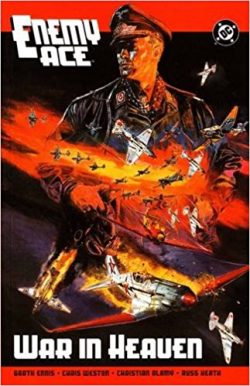
Enemy Ace: War Idyll


By George Pratt (DC Comics)
ISBN: 0-930289-78-1 (HB)                978-0930289782 (TPB)

During the 1960s Marvel gave industry leader National (now DC) Comics an artistic and sales drubbing, overhauling their 20-year position as industry leader – but only in the resurgent genre of super-heroes. In such areas as young kids’ comics, teen-comedies and romance, the House of Ideas still lagged behind, and in the venerable and gritty war-comics market they rated lower even than Charlton.

Admittedly they weren’t really trying, with only the highly inconsistent Sgt. Fury and his Howling Commandos and latterly Captain Savage and his Leatherneck Raiders as publications of any longevity, but that didn’t stop National’s editors and creators from forging ahead: creating a phenomenal number of memorable series and characters to thrill and inform a generation very much concerned with all aspects of military life.

Enemy Ace first appeared as a back-up in issue #151 of flagship war comic Our Army at War (cover-dated February 1965): home of the already legendary Sergeant Rock.

Crafted by the dream-team of Robert Kanigher & Joe Kubert the series told bitter tales of valour and honour from the point of view of German WWI fighter pilot Hans Von Hammer: a pure and noble warrior fighting for his country in a conflict that was swiftly excising all trace of such outmoded concepts from the business of mass-killing.

The tales – loosely based on “Red Baron” Manfred von Richthofen – were a magnificent tribute to the discipline of soldiering whilst wholeheartedly condemning the utter madness of war, produced during the turbulent days of the Vietnam War. They are still moving and powerful beyond belief.

As is this seminal sequel, Enemy Ace: War Idyll. Delineated in moody, misty, strikingly sombre images by painter George Pratt, the story follows the quest of troubled veteran Edward Mannock, a recently returned Vietnam grunt turned photo-journalist. He is a man desperately seeking answers to imponderable questions and great truths to cure the damage his own combat experiences have caused.

1969, and Mannock’s search takes a pivotal turn when, on a routine assignment, he discovers elderly, infirm Von Hammer. The mythic “Hammer of Hell” is dying in a German nursing home but instantly sees that he and the distraught young man share a deep and common bond…

Inexplicably allowed to drop out of print in both hardback and softcover editions and still unavailable in digital formats, this is an astounding, deeply incisive exploration of war, its repercussions, both good and bad, and the effects that combat has on singular men. War Idyll is visceral, poetic, emotive, evocative and terrifyingly instructive: with as much impact as All Quiet on the Western Front or Charley’s War. Every child who wants to be a soldier should be made to read this book.

You don’t want me to talk about it, but you do need to experience it, and once you have you’ll want to share that experience with others…
© 1990, 1998 DC Comics. All Rights Reserved.

The Garden of Desire


By Will & Desberg, translated by Michael Koch (Eurotica/NBM)
ISBN: 978-1-56163-009-7

If you’re old enough to remember the 1960s you might recall the twin popular fascinations of Victoriana (a plethora of books, films and TV shows set in those heady days of Empire) and Sex.

Actually, there had always been Sex, but in England no-one had seen or encountered or indulged in any since before the War. What occurred during the Civil and Social Rights liberalisation of the Swinging Sixties and especially the fabled “Summer of Love” was that heaping helpings of sauciness and skin started to creep into the media. Eventually we’d even sink so low that photographs of naked young ladies would replace cartoons and comic strips as the best way to sell newspapers.

It didn’t take long before period fiction – especially films – added swathes of salacious, cheerful nudity and entrendres (double and single) to their product.

In the manner of that innocently rude time (and such classics as The Best House in London and Henry Fielding’s epic Tom Jones) is this lovely slice of Euro-whimsy from Will and Desberg.

Willy Maltaite, one of the original Gang of Four (with André Franquin, Morris and Jijé) and one of the Continent’s greatest and most prolific artists, worked for Le Journal de Spirou on the fairytale fantasy Isabelle, Tif et Tondu among so many others. In the 1980s he collaborated with comics writer Stephen Desberg (The Scorpion; IR$) on a series of light-hearted albums for adults (European adults, so the sex is tasteful, beautifully illustrated and sardonically funny) that our chuckle-parched, po-faced Brexit-be-buggered world could well use now. As far as I know The Garden of Desire is the only one of their works to make the arguably distasteful lapse into English.

It follows the amorous antics and career of Michael Loverose, whose well-to-do English mother was seduced by a mysterious stranger. The resulting embarrassment was packed off to boarding school as soon as possible and from there he roamed the wide world in search of love and adventure – but mostly love…

Encompassing the turn of the 20th century to the heady, carefree yet worldly-wise days between the World Wars, this sly and gentle tale luxuriously blends comedy, self-exploration and magnanimously innocent lust with a tiny dose of real magic in a way only those sophisticates across the Channel can.

Great fun perfectly executed and a style of story we should be revisiting in these pell-mell, oh-so-serious modern days.
© 1988 Will-Desberg/Ed. Dupuis Charleroi Belgium. © 1991 NBM for the English Translation. All rights reserved.

The Adventures of Superman


By George Lowther, illustrated by Joe Shuster (Applewood Books)
ISBN: 978-1-55709-228-1

Without doubt the creation of Superman and his unprecedented reception by a desperate and joy-starved generation quite literally gave birth to a genre if not an actual art form. Within months of his June 1938 launch in Action Comics #1, the Man of Tomorrow had his won his own supplementary solo comicbook and a newspaper strip; secured overseas licensing deals, became a star of radio show and animated movie series, and generated loads and loads of merchandising deals.

In 1942 he even made the dynamic leap into “proper” prose fiction, resulting in still more historic “firsts”…

George F. Lowther (1913-1975) was a Renaissance man of radio in the days when sound not vision dominated home entertainment. He scripted episodes of such airwave strip adaptations as Dick Tracy and Terry and the Pirates as well as the Mutual Radio Network’s legendary Adventures of Superman show.

Lowther also wrote episodes for Roy Rogers, Tom Mix and a host of other series and serials. In 1945 he moved into television with equal success as writer, producer, director and even performer, adding a string of novels for kids to his CV along the way.

With the stunning success of the Superman radio broadcasts, a spin-off book was a sure-fire seller and in 1942 Random House released a glorious, rocket-paced rollercoaster ride: a tome outlining the Man of Steel’s still undisclosed history, fleshing out the character’s background (almost a decade before such detail became part of the comics canon).

The novel described the hero’s rise to fame and even found room for a thrilling pulp-fuelled contemporary adventure in a handsome hardback lavishly illustrated by co-creator Joe Shuster. The novel was the first Superman tale not scripted by Jerry Siegel and the world’s first novelisation of a comicbook character.

That first edition book will set you back silly sums today but in 1995, Applewood Press (a firm specialising in high-quality reproductions of important and historic American books) recreated all the early magic in its stunning entirety with a terrific hardback facsimile tome which included a copious and informative introduction from contemporary Superman writer Roger Stern as well as the original 1940s Foreword by National/DC’s then-Staff Advisor for Children’s literacy, Josette Frank.

The art inserts and panels are Joe Shuster at the peak of his creative powers: including the dust-jacket and 4 full-colour painted plates (all reproduced from the original artwork); a half-dozen full-page black-&-white illustrations and 34 vibrant and vital pen-and-ink spot sketches of the Caped Kryptonian in spectacular non-stop action, gracing a fast and furious yarn that opens with the destruction of Krypton and decision of scientist Jor-El in ‘Warning of Doom’ and ‘The Space Ship’.

The saga continues with the discovery of an incredible baby in a rocket-ship by farmer Eben Kent and his wife Sarah in ‘Young Clark Kent’ and encompasses the unique foundling’s early days and first meeting with Perry White in ‘The Contest’.

Following ‘The Death of Eben’ the young alien refugee moves to the big city and assumes the role of ‘Clark Kent, Reporter’ after which we switch to then present-day for the main event.

Now investigative reporter and blockbusting champion of justice combine to crush a sinister plot involving spies, saboteurs, submarines and supernatural shenanigans in the classy conundrum of ‘The Skeleton Ship’ and ‘The Vanishing Captain’ before being resolved in the epic ‘Fire at Sea’, ‘Mystery of the Old Man’, ‘Attempted Murder’, ‘Enter Lois Lane’ and ‘Return of the Skeleton Ship’…

This culminates in ‘The Unmasking’, the revelation of a ‘Special Investigator’ and an enthralling ‘Underwater Battle’ before at last the wonderment ends with ‘The Mystery Solved’.

This magical book perfectly recaptures all the frantic fervour and breathless mind-boggling excitement of the early days of action adventure storytelling and is a pulp fiction treasure as well capturing a pivotal moment in the creation of the world’s premier superhero.

No serious fan of the medium or art-form should miss it and hopefully with another landmark Superman anniversary on the horizon another facsimile edition is on the cards. If not, at least this volume is still readily available…
© 1942 DC Comics. Introduction © 1995 DC Comics. All Rights Reserved.

Growing Old with B.C. – A 50 Year Celebration


By Johnny Hart (Checker BPG)
ISBN: 978-1-905239-63-4 (HB)                    978-1-933160-68-9 (PB)

John Lewis Hart was born in Endicott, New York in 1931, and his first published cartoons appeared in military newspaper Stars and Stripes while he served with the US Air Force during the Korean War. On returning to Civvy Street in 1953, he sold a few gags to The Saturday Evening Post, Colliers Weekly and elsewhere, but had to earn a living as a general designer.

In 1958, for some inexplicable reason, caveman jokes were everywhere in magazines and comics (even latterly creeping onto TV and into movies). Despite all the dawn-age foofaraw, General Electric draughtsman and still-wannabe cartoonist Johnny Hart hadn’t sold a single one. He also desperately wanted to create a syndicated newspaper strip but couldn’t think of an idea.

And then one of his co-workers said why not do a strip feature one about Cavemen? Just like Alley Oop, but different…

Hart took a good look at the state of the world, and especially the people around him and the wryly outrageous social commentarians supporting and harassing hapless nebbish lead B.C. quickly took shape…

The concept sold instantly to the New York Herald-Tribune Syndicate and the strip rapidly became a global hit, with the first of 41 collected editions (Hey! B.C.) released in 1959.

In 1964 Hart started collaborating with fellow cartoonist Brant Parker on a new strip. The Wizard of Id also became a monster hit. The features won Hart an astounding host of awards over the years: making him one of only 4 American cartoonists to produce two strips appearing contiguously in more than 1000 newspapers.

Hart died of a stroke on April 7th 2007. He was working at his drawing board. Brant Parker passed away eight days later.

Hart became a devout Christian during the mid-1980s – something which increasingly and controversially manifested in later strips – but his urgent need to preach and share took a long time to impact the trenchant, whimsically surreal wit and primal by-play of his primordial playpen…

B.C. is a modern everyday kind of guy: a general slob just getting by, but he has some odd and interesting friends breaking up the monotony of the pre-civilised world. These include self-proclaimed genius Peter, superstitious misogynist Wiley, proto-prime nerd Clumsy Carp, pre-human missing-link Grog, uber-sarcastic Curls and rakish lady-killer Thor.

Apparently, all of them are based on actual people – life-long friends of Hart’s – and their candid reminiscences provide a charming and poignant insight into the life of one of the most revered and successful cartoonists of modern times.

Other materialised regulars include a variety of talking beasts and inanimate objects: chatty, snappy dinosaurs, ants and ant-eaters, clams, snakes, turtles, birds and an apteryx – but I’m guessing they never had analogues with day-jobs in Eisenhower’s America…

This magnificent tome – available in hardcover, paperback and digital editions – offers a decade-by-decade selection of the best and most memorable B.C. strips, supplemented by a listing of its many awards, and comes stuffed with photographs and observations. This is a delightful commemoration of a truly great and very funny strip.

Hart died during the finishing stages of this book’s creation, making this the best way to celebrate his achievements. His legacy of brain-tickling, absurdist lunacy will never date, and creative anachronism has never been better used to raise a smile or an eyebrow in this lush collection of timely and timeless fun.
B.C. © 2007 Creators Syndicate Inc. B.C.© 1958-2006 John L. Hart Family Limited Partnership.

Fantastic Four Marvel Masterworks volume 9


By Stan Lee, Jack Kirby, Joe Sinnott, Frank Giacoia & various (Marvel)
ISBN: 978-0-7851-1846-6 (HB)                    : 978-0-7851-6760-0 (PB)

Cautiously bi-monthly and cover-dated November 1961, Fantastic Four #1 (by Stan Lee, Jack Kirby, George Klein & Christopher Rule) was crude: rough, passionate and uncontrolled excitement. Thrill-hungry kids pounced on it and the raw storytelling caught a wave of change starting to build in America. It and succeeding issues changed comicbooks forever.

In eight short years FF became the indisputable central title and most consistently groundbreaking series of Marvel’s ever-unfolding web of cosmic creation: bombarding readers with a ceaseless salvo of new concepts and characters at a time when Kirby was in his conceptual prime and continually unleashing his vast imagination on plot after spectacular plot. Clearly inspired, Stan Lee scripted some of the most passionate superhero sagas that Marvel – or any publisher, for that matter – had or has ever seen.

Both were on an unstoppable roll, at the height of their creative powers, and full of the confidence that only success brings, with The King particularly eager to see how far the genre and the medium could be pushed.

This full-colour compendium – available in hardcover, trade paperback and digital editions – gathers Fantastic Four #82-93: a rollercoaster ride of incredible imagination and passion spanning January to December 1969 with Stan & Jack riding a wave that no fan realised was imminently ending…

As seen in that unforgettable premier issue, maverick scientist Reed Richards, his fiancé Sue Storm, their close friend Ben Grimm – with Sue’s tag-along teenaged brother Johnny – survived an ill-starred private space-shot after Cosmic Rays penetrated their ship’s inadequate shielding and mutated them all.

Richards’ body became elastic, Sue gained the power to turn invisible and the kid could turn into living flame, but poor, tragic Ben horrifically devolved into a shambling, rocky freak…

Following another frothy Lee Introduction, the magic resumes with Fantastic Four #82 as Susan Richards takes time off to tend her newborn son and Johnny’s Inhuman girlfriend Crystal steps in as her replacement. Before long, however, the substitute’s violent past reasserts itself as her mad cousin Maximus again attempts to conquer mortal humanity.

‘The Mark of… the Madman!’ (by Lee, Kirby & Joe Sinnott sees the quirky quartet invade hidden Inhuman enclave Attilan to aid of the imprisoned Royal Family and overcoming an entire race of subjugated super-beings before uniting to trounce the insane despot in ‘Shall Man Survive?’

All-out action then gives way – at least initially – to tense suspense for the start of a 4-part epic starring the team’s greatest foe. ‘His Name is Doom!’ finds Mr. Fantastic, the Human Torch, the Thing and Crystal making their home after failing to capture Maximus, only to be intercepted by Nick Fury and the super-spies of S.H.I.E.L.D. looking for a favour…

Steel-Shod Dictator Victor Von Doom has apparently devised unstoppable super-robots and Fury needs the FF to infiltrate the sovereign state of Latveria to ferret them out. However, it’s impossible to sneak up on the most paranoid man in the world and the heroes are easily intercepted and captured by the totalitarian tyrant’s security team.

‘Within This Tortured Land’ opens with them “guests” in Doom’s picturebook Ruritanian paradise, but even with their powers hypnotically cancelled out the valiant heroes soon discover the cruel iron within their velvet prison once the Monarch of Latveria begins testing his deadly “Doombots” on his own subjects.

When the automatons go berserk the entire postage-stamp kingdom is imperilled in ‘The Victims!’ and only the last-minute arrival of Invisible Girl Sue Richards allows the FF and the villagers to survive Doom’s cataclysmic failsafe plan.

The shocking final confrontation and conclusion manifest in ‘The Power and the Pride!’, wrapping up the saga in a bombastic blend of super-science, soap opera and mesmerising melodrama seldom seen in comicbooks before or since.

Fantastic Four #88 focuses on the five champions back in the USA and looking at an unconventional new house found by the determinedly domesticated Sue in her perpetual quest to carve out a relatively normal life for her new – and still unnamed – son.

Regrettably the trendy, extremely isolated detached dwelling in ‘A House There Was!’ has been designed by the team’s oldest enemy and no sooner do they all move in than ‘The Madness of the Mole Man!’ turns the deadly domicile against them even as the maniac’s goal of turning the entire world blind and wiping out the extended heroic family entirely comes within inches of succeeding…

The Thing takes centre-stage in the extended epic which completes this potent tome, as he is targeted and kidnapped to another world when ‘The Skrull Takes a Slave!’ in #90. Abducted to fight in gladiatorial games on a colony world patterned after Earth’s 1920s gangster era, ‘The Thing… Enslaved!’ introduces rival Skrull mobs vying for planetary supremacy and a noble slave destined to slaughter our shanghaied champion.

‘Ben Grimm, Killer!’ then ramps up the tension as Ben Grimm and mechanoid marvel Torgo discover that their home-worlds are hostage to their fortune and ferocity in the arena…

Meanwhile Reed, Johnny and Crystal have not been idle. While Ben is at ‘The Mercy of Torgo!’ (inked by Frank Giacoia) his Earthly brothers-in-arms are enacting a desperate plan to swoop in, save him and destroy the Skrulls planetary doom-weapon… a task undertaken and accomplished with great speed and in stunning style…

Added attractions here include the cover to the all-reprint Fantastic Four Annual #7, a contemporary photo-feature revealing each and every member of the burgeoning Marvel Bullpen, eight un-inked pencil pages from issues #89 and 90 plus the original cover art for FF #90 inked by Sinnott, a graphic bonanza no fan could resist.

These are the stories that confirmed Kirby as the absolute master of superhero storytelling and gave Marvel the push needed to overtake the decades-dominant DC. They’re also some of the very best comics ever produced and as addictively thrilling now as they ever were. This is a must-have book for all fans of Fights ‘n’ Tights graphic narrative.
© 1968, 1969, 2017 Marvel Characters, Inc. All rights reserved.
The Wyf of Bath (The Wife of Bath)


By Geoffrey Chaucer, illustrated by Greg Irons (Bellerophon Books)
ISBN: 978-0-88388-023-4

Perhaps I’m just showing off now, but this lost treasure, published in conjunction with a colouring book (The Chaucer Coloring Book, which collected the original woodcut illustrations from Caxton’s 1484 edition of The Canterbury Tales) is a terrific and logical blending of High Art and Our Art and one so very worthy of being republished.

Chaucer’s Canterbury Tales, as well as being a venerable and lauded landmark of English literature, was a ribald, earthy, popular and much-loved concatenation of short story character sketches, full of humanity’s every foible and peccadillo. It was rude, crude, action-packed, jammed with incredible situations and even had talking animals…

Thematically, how much closer can you get to the general opinion and popular conception of the comicbook?

Marry that with the art of the irreverent, subversive aesthetic and attitude of the San Francisco underground movement of the early 1970’s and you have a brilliant slice of pop-art history that actually possesses lasting social relevance and educational value.

The text of the Wife of Bath is typeset and in the original continental accentual-syllabic metre which Chaucer used to champion the London-dialect dominance of Middle English.

That means this will make a lot more sense if read aloud phonetically (the book, not my review, and perhaps in a northern English/Manchester accent). Or you could simply look at the stonkingly brilliant and funny, ribald pictures drawn by the astounding Greg Irons.

Although the original softcover is still available through some online retailers, surely some college or publishing house simply has the wherewithal to get this magical book back into print?
Artwork © 1973 Greg Irons. All rights reserved.

The Files of Ms. Tree volume 1: I, For an Eye and Death Do Us Part


By Max Collins & Terry Beatty (Aardvark-Vanaheim)
ISBN: 0-919359-05-1             ASIN: B00072LQCW

Despite being one of the most popular genres in modern literature and the fact that most fiction books are bought and read by women, hard-boiled Private Eye crime stories are desperately short of female protagonists.

Marry that with the observation that in the 1980s “gum-shoe” comics were also as rare as hen’s teeth and it’s a wonder that a series such as Ms. Tree ever got off the drawing board.

The secret – as always – is quality.

The black widow of detective fiction first appeared in 1981 as a part-work serial in the groundbreaking black-and-white anthology comic Eclipse Magazine, rubbing padded shoulders with a number of other quirky alternatives to the East Coast superheroes that had a stranglehold on American comics at that time980s.

Associating with such gems as Sax Rohmer’s Dope (fabulously adapted by Trina Robbins and only recently collected and released in a wonderful pulp thriller edition); Steve Englehart & Marshal Rogers’ I Am Coyote; Don McGregor & Gene Colan’s Ragamuffins; B.C. Boyer’s masterful Masked Man and a host of other gems from the industry’s finest, Max Allan Collins and young humour cartoonist Terry Beatty introduced a cold, calculating and genuinely fierce avenger who put new gloss on the hallowed imagery and plot of the hard-bitten, tough-guy shamus avenging a murdered partner…

As conceived by the successful crime novelist (and scripter of the venerable Dick Tracy newspaper strip), the gun-toting dame was one of the first features to win a solo title: Ms. Tree’s Thrilling Detective Stories or simply Ms. Tree from the fourth issue. Although the marketplace was not friendly to such a radical concept, the series ran for 50 issues, and 2 specials, from three publishers (Eclipse, Aardvark-Vanaheim and Renegade Press) before finally dying in 1989.

Gone but not quickly forgotten, she was promptly revived as a DC comic in 1990 for another 10 giant-sized issues as Ms. Tree Quarterly/ Ms. Tree Special; three more blood-soaked, mayhem-packed, morally challenging years of pure magic.

Astonishingly, and as far as I know, there are no contemporary collections of her exploits – despite Collins’ status as a prolific and best-selling author of both graphic novels (Road to Perdition, CSI) and prose sequences featuring his crime-creations Nathan Heller, Quarry, Nolan, Mallory and a veritable pantheon of others.

In 2007 Collins released a classy prose novel, “Deadly Beloved” starring his troubled troubleshooter, but thus far The Files of Ms. Tree volumes are the only place to find the collected exploits of this superb crime-stopper.

The first volume, I, For an Eye and Death Do Us Part gathers the introductory escapade from Eclipse Magazine #1-6 (May 1981-July 1982) and the follow-up initial story-arc from Ms. Tree’s Thrilling Detective Stories #1-3 (August-December 1982): two chilling tales of regret and revenge, perfectly delivered as fair-play mystery tales.

You might not be able to extract your own retribution, but if you’re smart enough you can solve the clues as fast as our heroine does…

In ‘I, For an Eye’ we – so very briefly – meet Mike Tree, a true bastion of the detective profession. Hard, tough, sharp and fair he’s an ex-cop who set up in business for himself and did well. At the peak of his career he meets Mike Friday, a feisty, clever, pistol-packing, two-fisted modern woman who quickly moves from secretary to full partner. They fell in love…

On their wedding night her husband is gunned down by an unknown assailant and the new Mrs. Tree sets out to find the killer who made her a honeymoon widow. Assuming control over their detective agency she employs part of the staff to keep the business going but places her husband’s… her… best people onto finding out why her man died. With her tight, dedicated team she uncovers a web of corruption and lies which includes the fact that she was not the first Mrs. Tree.

Mike had a previous wife and a son who’s painfully like his departed dad…

Gritty, witty and darkly relentless, this tale of corruption and twisted friendship sets the pace for all the ensuing adventures; a brilliant odyssey which peels like an onion, always showing that there’s still more to uncover…

Even after finding Mike’s killer and delivering the traditional, mandatory vengeance in grand style, the investigation reveals a higher mastermind behind it all, in the scurrilous shape of mob boss Dominic Muerta, after which second tale ‘Death Do Us Part’ deals with the repercussions of Ms. Tree’s crusade against that psychotic grandee’s operations.

The unrelenting death and misery takes its toll on the traumatised widow: she turns to therapy but when that doesn’t work she takes a long-needed holiday to a distant honeymoon resort.

She even finds a new lover but when the newlyweds in the next cabin are murdered by a hit-man Tree realises that she is trapped on a path that can only lead to more death…

Adult, astute, and enchantingly challenging, this second drama is full of plot twists and clever set-pieces that will charm and beguile crime fans of every persuasion whilst the art by Beatty is a sheer revelation.

Presented as static, informative and understated, the visuals are remorselessly matter-of-fact and deadly in their cold efficiency. It’s a quality which might be off-putting to some but which so perfectly matches the persona of its pitiless star that I can’t imagine any other style working at all.

This volume, released in 1984, is stuffed with behind-the-scenes extras and commentary from both creators, including a colour cover gallery, and – as an added bonus – original illustrated prose short-story ‘Red Light’: a terse thriller that perfectly augments the grim mood of the book.

Despite the tragic scenarios, ruthless characterisations and high body-count, this is a clever, funny affair steeped in the lore of detective fiction, stuffed with in-jokes for the cognoscenti (such as the unspoken conceit that heroine Mike Friday is the daughter of legendary TV cop Joe “Dragnet” Friday) and dripping in the truly magical gratification factor that shows complete scum finally get what’s coming to them…

Ms. Tree is the closest thing the American market has ever produced to challenge our own Queen of Adventure Modesty Blaise: how they can let her languish in graphic obscurity is a greater crime than any described in this compelling classic collection. Hunt it down for your pleasure and pray somebody somewhere has the great good sense to bring back Ms. Tree.
© 1980, 1981, 1982, 1983, 1984 Max Collins and Terry Beatty. All Rights Reserved.

Corpse on the Imjin! and Other Stories by Harvey Kurtzman


By Harvey Kurtzman with Alex Toth, John Severin, Joe Kubert, Russ Heath, Dave Berg, Ric Estrada, Gene Colan, Johnny Craig others (Fantagraphics Books)
ISBN: 978-1-60699-545-7

The legendary EC Comics began in 1944 when comicbook pioneer Max Gaines sold the superhero properties of his All-American Comics company to half-sister National/DC, retaining only Pictures Stories from the Bible.

His plan was to produce a line of Educational Comics with schools and church groups as the major target market and he augmented his core title with Picture Stories from American History, Picture Stories from Science and Picture Stories from World History. Sadly, the worthy project was already struggling badly when he died in a boating accident in 1947.

As detailed in the final comprehensive essay in this superb graphic collection – available as a sturdily spiffy hardcover or in various eBook formats – his son William was dragged into the family business and, with much support and encouragement from unsung hero Sol Cohen (who held the company together until the initially unwilling Bill Gaines abandoned his dreams of a career in chemistry) transformed the ailing enterprise into Entertaining Comics…

After a few tentative false starts and abortive experiments, Gaines and his multi-talented associate Al Feldstein settled into a bold and impressive publishing strategy, utilising the most gifted illustrators in the field to tell a “New Trend” of stories aimed at an older and more discerning readership.

From 1950-1954 EC was the most innovative and influential publisher in America, dominating the genres of crime, horror, war and science fiction and, under the auspices of writer, artist and editor Harvey Kurtzman, the inventor of an entirely new beast: the satirical comicbook…

Kurtzman was hired to supplement the workforce on the horror titles but wasn’t keen on the genre and instead suggested a new action-adventure title. The result was Two-Fisted Tales which began with issue #18 at the end of 1959 as an anthology of rip-snorting, he-man suspense dramas. However, with America embroiled in a military “police action” in Korea, the title soon became primarily a war comic and was rapidly augmented by another.

Frontline Combat was also written and edited by Kurtzman, who assiduously laid-out and meticulously designed every story. It made for great entertainment and a unifying authorial voice but was frequently a cause of friction with many artists…

In keeping with the New Trend spirit, these war stories were not bombastic, jingoistic fantasies for glory-hungry little boys, but rather subtly subversive examinations of the cost of conflict which highlighted the madness, futility and senseless, pointless waste of it all…

Kurtzman was a cartoon genius and probably the most important cartoonist of the last half of the 20th century. His early triumphs in the fledgling field of comicbooks (especially the groundbreaking Mad magazine) would be enough for most creators to lean back on but Kurtzman was a force in newspaper strips (See Flash Gordon Complete Daily Strips 1951-1953) and restless innovator. As a commentator and social explorer, he just kept on looking at folk and their doings: a man with exacting standards who just couldn’t stop creating.

Kurtzman invented a whole new format and gave America Popular Satire by converting his highly successful full-colour baby Mad into a monochrome magazine, safely distancing the outrageously brilliant comedic publication from the fall-out caused by the 1950s socio-political witch-hunt which eventually killed all EC’s other titles.

He pursued his unique brand of thoughtfully outré comedy and social satire further with the magazines Trump, Humbug and Help!, all the while still conceiving challenging and powerfully effective funny strips such as Little Annie Fannie (for Playboy), The Jungle Book, Nutz, Goodman Beaver, Betsy and her Buddies and many more. He died far too young in 1993.

This first volume of the Fantagraphics EC Library gathers a stunning selection of Kurtzman stories in a lavish monochrome hardcover edition, packed with supplementary interviews, features and dissertations, and opens with ‘The Truth’ by cartoonist and historian R.C. Harvey, describing in stark detail the history of Kurtzman’s EC days.

Then follows a raft of stirring sagas solely from the master’s hand, beginning with ‘Conquest’ from Two-Fisted Tales #18, which with acerbic aplomb relates the rise and fall of Spanish conquistador Juan Alvorado whose rapacious hunger for Aztec gold led inexorably to the downfall and doom of his entire expedition.

‘Jivaro Death’ (#19) deals with modern-day greed as two duplicitous Yankees search for diamonds in the heart of the Amazon jungle whilst T-FT #20 detailed the fate of an amnesiac buccaneer who returned from certain death to obsessively reclaim his ‘Pirate Gold’ from the men who betrayed him…

From issue #21 comes ‘Search!’ which ironically combines an Italian-American’s search for family with the devastating US assault on Anzio in 1943, after which the first selection from Frontline Combat provides an uncharacteristically patriotic clash with the North Korean aggressors in ‘Contact!’ (#2, September 1951).

‘Kill’ from T-FT #23 also takes place in Korea, relating a squalid encounter between a blood-thirsty knife-wielding G.I. psycho and his soulless Commie antithesis, whilst ‘Prisoner of War!’ (FC #3) highlights the numbing, inhuman brutality of combat when American POWs attempt an escape…

‘Rubble!’ (T-FT #24) boldly steps into “enemy” shoes by highlighting the war’s casual cost to simple Korean civilians whilst ‘Air Burst!’ in FC #4 goes even further by voicing the Communist soldiers’ side of the conflict.

The eponymous ‘Corpse on the Imjin!’ (T-FT #25) is one of the most memorable, moving and respected tales of the genre: a genuine anti-war story which elegiacally traces a floating body’s motion down the river to expose the ruminations of the doomed observers who see it.

The sentiment is further explored in ‘Big ‘If’!’ (FC #5) as G.I. Paul Maynard sits in a shell hole and ponders what might have been…

Kurtzman’s unique display of cartooning and craftsmanship is followed by the essay ‘Combat Duty’ wherein Jared Gardner discusses the background and usage of the other artists who worked on the author’s Two-Fisted Tales and Frontline Combat scripts, before ‘Marines Retreat!’ – drawn by John Severin and inked by Kurtzman from FC #1 (July/August 1951) – describes in microcosm the shocking American forced withdrawal from the Changjin Reservoir in December 1950. The event stunned and terrified the folks at home and shook forever the cherished belief in the US Marines’ invincibility, and this is all told through the eyes of a soldier who understands too late the values he was supposed to be fighting for…

Kurtzman’s relationship with his artists could be fraught. Alex Toth, a tempestuous individualist who only drew three tales from his editor’s incredibly detailed lay-outs, famously produced some of his very best work at EC under such creative duress. The first and least was ‘Dying City!’ (T-FT #22) which found an aged Korean grandfather berating his dying descendent for the death and destruction he had brought upon his family and nation,

‘O.P.!’ was drawn by hyper-realist Russ Heath (FC #1) and once more ladled on the bleak, black irony during an annihilating trench encounter during WWI, after which Toth’s astounding aerial imagination produced in ‘Thunderjet!’ (FC #8) one of the most thrilling and evocative dogfight dramas in comics history.

This tale alone is worth the price of admission and was an alarm-call to complacent America as a US pilot is forced to concede that his winged weapon is technologically inferior to the ever-present Communist MIGs…

‘Fire Mission!’ (T-FT #29) was drawn by Dave Berg – an artist far better regarded for his comedy work – who lent his facility with expressions to a rather standard tale of courage discovered under fire in Korea, after which Gene Colan delineated the rift between military and civilians in the hours before the attack on Pearl Harbor in ‘Wake!’ from T-FT #30.

From the same issue ‘Bunker!’ was the first strip illustrated by Ric Estrada, describing rivalry and tension between American units during a Korean offensive. Oddly enough for the times, the fact that one faction was comprised of Negro soldiers was not mentioned at all…

The Cuban artist then drew a chillingly macabre tale of Teddy Roosevelt and the Spanish American war of 1898 in ‘Rough Riders!’ (FC #11) before master of comics noir Johnny Craig detailed the fate of a ‘Lost Battalion!’ in WWI (T-FT #32, March/April 1953).

From the same issue, ‘Tide!’ was an EC debut tale for the already-legendary Joe Kubert depicting a D-Day debacle and its insignificance in the grand scheme of things, whilst Toth’s magnificent Kurtzman-scripted swansong ‘F-86 Sabre Jet!’ (FC #12) revisited and even surpassed his Thunderjet job with a potent and beguiling reductionist minimalism that perfectly captured the disorienting hell of war in the air.

Due to illness and the increasing workload caused by Mad, Kurtzman’s involvement with war titles gradually dwindled. Frontline Combat #14, (October 1953) provided his last collaboration with Kubert in ‘Bonhomme Richard!’: a shocking, personalised account of American nautical legend John Paul Jones’ devastating duel with the British warship Serapis – as told by one of the hundreds of ordinary sailors who didn’t survive…

This masterclass in sequential excellence concludes with a salutary tale from the Civil War Special, Two-Fisted Tales #35 (October 1953). Illustrated by Reed Crandall, ‘Memphis!’ blends the destructive horror of the Union’s River Fleet of Ironclads as they inexorably take control of the Mississippi with the irrepressible excitement of Southern kids who simply could not understand what was happening to their parents and families…

Even with the comics extravaganza ended, there’s still more to enjoy as underground cartooning legend Frank Stack discusses the techniques and impact of Kurtzman’s astonishing covers for Two-Fisted Tales and Frontline Combat in ‘Respect for Simplicity – the War Covers of Harvey Kurtzman’; superbly supplemented by a full-colour section representing all of them, even the seldom-seen Two-Fisted Annual 1952.

Also adding to the value is ‘A Conversation with Harvey Kurtzman’ by John Benson, E.B. Boatner & Jay Kinney, which transcribes two interviews from 1979 and 1982, as well as a full appreciation of the great man’s career in ‘Harvey Kurtzman’ by S.C. Ringgenberg.

Rounding everything off is ‘Behind the Panels: Creator Biographies’ a comprehensive run-down of all involved by Bill Mason and others, plus a general heads-up on the entire EC phenomenon in ‘The Ups and Downs of EC Comics: A Short History’ by author, editor, critic and comics fan Ted White.

The short, sweet but severely limited output of EC has been reprinted ad infinitum in the decades since the company died. These astounding stories and art have changed not just comics but also infected the larger world through film and television and via the millions of dedicated devotees still addicted to New Trend tales.

However, as far as I can recall nobody has produced collections faithfully focussing on the contributions of individual creators, and even though fuddy-duddies like me know these timeless classics intimately, this simple innovation has somehow added a new dimension to the readers’ enjoyment.

I strongly suggest that whether you are an aged EC Fan-Addict or nervous newbie, this is a book no comics aficionado can afford to miss…
This edition © 2012 Fantagraphics Books, Inc. All comics stories © 2012 William M. Gaines Agent, Inc., reprinted with permission. All other material © 2012 the respective creators and owners.

Captain Marvel: Marvel Masterworks volume 2


By Roy Thomas, Arnold Drake, Gary Friedrich, Archie Goodwin, Gil Kane, Don Heck, Dick Ayers, Frank Springer, Tom Sutton, John Buscema, Gene Colan & various (Marvel)
ISBN: 978-0-7851-2430-6 (HB)

After more than a decade as an also-ran and occasional up-and-comer, by 1968 Marvel Comics was in the ascendant. Their sales were rapidly catching up with industry leaders National/DC Comics and Gold Key, and the House of Ideas had finally secured a new distribution deal allowing them to expand their list of titles exponentially.

Once the stars of “twin-books” Tales of Suspense, Tales to Astonish and Strange Tales all won their own titles, the new concepts just kept coming.

One dead-cert idea was a hero named for the company – and one with some popular cachet and nostalgic pedigree as well. After the DC/Fawcett court case of the 1940s-1950s, the name Captain Marvel had disappeared from the newsstands.

In 1967, during a superhero boom/camp craze generated by the Batman TV show, publisher MLF secured rights to the name and produced a number of giant-sized comics featuring an intelligent robot who (which?) could divide his body into segments and shoot lasers from his eyes.

Quirkily charming and devised by the legendary Carl (Human Torch) Burgos, the feature nevertheless did not attract a large following. On its demise, the name was quickly snapped up by the ever-expanding Marvel Comics Group.

Marvel Super-Heroes was a brand-new title: it had been the giant-sized reprint vehicle Fantasy Masterpieces, combining reprint monster and mystery tales with Golden Age Timely Comics mystery men classics, but with #12 it added an experimental section for characters without homes such as Medusa, Ka-Zar, Black Knight and Doctor Doom.

The title also debuted new concepts like Guardians of the Galaxy, Phantom Eagle and, to start the ball rolling, a troubled alien spy sent to Earth from the Kree Galaxy. He held a Captain’s rank and his name was Mar-Vell.

All that and even more candid, behind-the-scenes historical revelations are contained in series-author Roy Thomas’ effusive Introduction before this cosmically conceived tome – available in hardcover and digital editions – kicks off. On offer are the contents of Captain Marvel #10-21 collectively spanning cover-dates February 1969 to August 1970 plus a little comedy treat from Not Brand Echh # 9 (August 1968)…

Following the destruction of a long-dormant, mechanoid Kree Sentry and the subsequent defeat by the Fantastic Four of Ronan the Accuser – mighty high official of those long-lost extraterrestrials – the millennia-old empire was once again interested in Earth.

They despatched a surveillance mission to learn everything about us but unfortunately for them, the agent they chose was a man of conscience. However, his commanding officer Colonel Yon-Rogg was merciless taskmaster and secretly a ruthless rival for the love of the ship’s medical officer Una.

No sooner did the good captain make a tentative planet-fall than he clashed with the US army from the local missile base (often hinted at as being Cape Kennedy). Soon though he began fighting for the humans and was mistaken by many – including Security officer Carol Danvers – for a crusading costumed superhero…

To further his mission, Mar-Vell also assumed the identity of deceased military consultant Dr. Walter Lawson: but was quickly discovering that the dearly departed scientist concealed a chequered and probably nefarious past which created a whole raft of new problems for the undercover alien infiltrator…

The war of nerves with Yon-Rogg had intensified to the point that the colonel was openly planning murder and the romantic bond to Una was fractured when Carol Danvers began making her own overtures to the heroic Marvel.

Thus, when Ronan orders Mar-Vell to make allies of Lawson’s super-scientific criminal syndicate – at the cost of Carol’s life – the hero ignores his orders and pays the penalty as he is arrested by his own crew and faces a firing squad in #10’s ‘Die Traitor!’ (scripted by Arnold Drake and illustrated by Don Heck & Vince Colletta).

He is only saved by an ambush perpetrated by the survivors of an Aakon ship Yon-Rogg had previously targeted in #11’s ‘Rebirth!’ (illustrated by new penciller Dick Ayers). In the aftermath, however, the Kree colonel traps his despised rival on a missile hurtling into infinity and assumes his problems are over.

During the battle author Drake took the opportunity to kill off – as nobly as possible – the insipid Medic Una, giving staunch Mar-Vell justifiable reason to openly rebel against his entire race and be reborn under the tutelage of a cosmic entity known only as Zo! who saved the trapped hero from death in the void…

Moribund for months, this new beginning with the honourable, dutiful soldier remade as a vengeful vigilante was a real shot in the arm, but it was still quite clear that Captain Marvel the comic was struggling to find an audience. ‘The Moment of… the Man-Slayer!‘ (Drake, Ayers and the great Syd Shores) sees the newly super-powered hero gifted with a whole new power set by Zo! and return to Earth.

He is hunting Yon-Rogg but soon distracted by a marauding synthetic assassin at The Cape, in a taut spy-thriller with The Black Widow in deadly guest-star mode.

‘Traitors or Heroes?’ concludes the Man-Slayer storyline with Gary Friedrich, Frank Springer & Vince Colletta as creative team, with the Captain finally confronting Yon-Rogg. The villain escapes by threatening Carol…

In #14’s ‘When a Galaxy Beckons…’ the Captain clashes with an entranced Puppet Master-controlled Iron Man as part of an early experiment in multi-part cross-overs (Sub-Mariner #14 and Avengers #64 being the other parts of the triptych) before leaving Earth… forever, he believes…

The going gets all cosmic in #15 (magnificently illustrated by Tom Sutton & Dan Adkins in a boldly experimental manner) as ‘That Zo Might Live… A Galaxy Must Die!’ sees Mar-Vell return to his home world on a mission of total destruction that wraps up the first career of Captain Marvel in spectacular style.

Beguiled and grateful, the hero revisits his homeworld determined to obliterate it for his almighty sponsor only to uncover an incredible conspiracy before the awesome truth is exposed in #16’s ‘Behind the Mask of Zo!’ by Archie Goodwin, Heck & Shores.

This yarn is the first great “everything you know is wrong” story in Marvel history and captivatingly makes sense of all the previous issues, supplying a grand resolution and providing a solid context for the total revamp of the character to come. That’s how good a writer Archie Goodwin was. And if you read Roy Thomas’s aforementioned Introduction, a clandestine creative secret is finally revealed…

Captain Marvel #16 is a magical issue and I’m being deliberately vague in case you have yet to read it, but I will tell you the ending. After saving the entire Kree Empire Mar-Vell is flying back to Earth in his new red-&-blue costume, when he is suddenly sucked into the anti-matter hell of the Negative Zone…

It’s probably best to think of everything previously discussed as prelude, since Captain Marvel as we know him really begins with #17 as Thomas, Gil Kane & Dan Adkins totally retool and upgrade the character.

‘And a Child Shall Lead You!’ sees the imperilled Kree warrior inextricably bonded to voice-of-a-generation and professional side-kick Rick Jones who – just like Billy Batson (the boy who turned into the original Fawcett hero by shouting “Shazam!”) – switched places with a mighty adult hero when danger loomed.

As thrilling, and as revolutionary as the idea of a comic written from the viewpoint of teenager was, the real magic comes from the phenomenally kinetic artwork of Kane – whose mesmeric staging of the perfect human form in motion rewrote the book on superhero illustration with this series.

Issue #18 at last categorically ended the Yon-Rogg saga and started Carol Danvers on her own super-hero career as the Mar-Vell swore ‘Vengeance is Mine!’ – with a last minute pinch-hit pencilling from John Buscema for the concluding nine pages – before the next issue moved firmly into the “Relevancy Era” (where realism and themes of social injustice replaced aliens and super-villains as comics fodder) with a crazed sociologist and too-benevolent landlord revealed as ‘The Mad Master of the Murder Maze!’.

And that’s when the series was cancelled.

As happened so often during that tempestuous period, cutting edge, landmark, classic comic-books just didn’t sell. Silver Surfer, Green Lantern/Green Arrow and a host of other series we today consider high points of the form were axed because they couldn’t find enough of the right audience, but Captain Mar-Vell refused to die. Six months later issue #20 was released, and the quality was still improving with every page.

‘The Hunter and the Holocaust’ has Rick attempt to free his trapped body-and-soulmate by consulting old mentor Bruce Banner. But en route, a tornado destroys a town and Mar-Vell first renders assistance and then fights off resource-looters the Rat Pack. With the next issue Cap and Rick’s mentor finally meet, in ‘Here Comes the Hulk!’ but that’s just a garnish on this tale of student unrest and manipulative intolerance. The book was cancelled again after that… only to return some more!

Although those tales are saved for another time, there are still a few goodies to enjoy. First of these is a spoof strip from Marvel’s own parody comic Not Brand Echh # 9. ‘Captain Marvin: Where Stomps the Scent-ry! or Out of the Holocaust… Hoo-Boy!!’ is by Thomas, Gene Colan & Frank Giacoia : funny or painful depending on your attitude, but also included are some pencilled pages and sketches that are the answer to every wannabe artist’s dreams.

These include a Marie Severin cover rough for #10, Kane’s layout for #17, page 19 and three pin-ups by Kane & Adkins. Glorious!

This is not Marvel’s best character, and much of the material collected here is rather poor. However, the good stuff is some of the very best the company has produced in its entire history. If you want to see how good superhero comics can be you’ll just have to take the rough with the smooth… and who knows? Maybe you’ll learn to lower your standard a bit and enjoy yourself despite it all…

I often do…
© 1968, 1969, 2017 Marvel Characters, Inc. All rights reserved.