In the Pines – 5 Murder Ballads


By Erik Kriek (Canongate Books)
ISBN: 978-1-8689-214-0

If you don’t know what a murder ballad is you should start this sublime hardcover anthology by reading Jan Donkers’ superb background essay at the back of the book before treating yourself to the grim graphic glories crafted by Dutch artisan and illustrator Erik Kreik.

In ‘Murder Ballads’ you will learn the history of the ancient musical sub-genre as well as the direct genealogy of the quintet of sordid, sorry sagas adapted from sound to stunning words and pictures here…

However – and just because it’s you – the term generally applies to folk music story-songs from many countries dealing with love, crime, sex, social transgressions and unnatural death…

In 2016 Erik Kreik (creator of silent superhero spoof Gutsman; Little Andy Roid; Het Onzienbare/From Beyond) – adapted a number of vintage and modern Murder Ballads into strip format. A huge fan of all forms of popular Americana, he also covered the songs with his band The Blue Grass Boogiemen on a CD naturally entitled In the Pines – 5 Murder Ballads.

The book won Germany’s 2016 Rudolf Dirks Award and the spin-off garnered Album of the Year 2017 from Dutch Comics.

Amsterdam-born Kriek is a graduate of the Rietveld Academy for Art and Design and a hotly in-demand illustrator of books (including Holland’s Tolkien and Harry Potter editions), magazines, apparel, skateboards, et cetera and can turn his hand to many styles and disciplines. Gutsman was reconceived as a soundless mime ballet in 2006 and his collection of Lovecraft adaptations Het onzienbare, en andere verhalen H. P. Lovecraft has been republished in many languages…

He has just released first children’s book Mika, the Little Bear That Didn’t Want to Go To Sleep…

Now a multi-national phenomenon, In the Pines delivers its moody messages of ill-starred love in dreamy, two-coloured episodes. American fans will recognise the drawing style as echoing the very best EC horror tales by “Ghastly” Graham Ingels or the early Bernie Wrightson. The concert of terror opens with ‘Pretty Polly and the Ship’s Carpenter’: a much-covered traditional ditty (The Byrds; Judy Collins; The Stanley Brothers) rendered here in green and black on white crisp white pages. It details the doomed fate of a young man who fled to sea to escape his sins, only to see them resurface in death for his shipmates in a seemingly supernatural storm…

Tinted in sepia, ‘The Long Black Veil’ is a relatively modern song: composed and written by Marijohn Wilkin & Danny Dill in 1959 and most notably recorded by Lefty Frizzell, The Band, Johnny Cash, Mick Jagger, Nick Cave and many others. It reveals how a farmer is faced with a staggering choice: hang for a murder he did not commit or betray the confidence of the adulterous women who is his only alibi…

Racially-charged and rendered in tones of muddy ochre, ‘Taneytown’ was originally written by Steve Earle: a synthesis of so many lynching incidents that shame and blight the history of early 20th century America. Here a young black man, sick of the life he’s subjected to in rural Maryland, takes the knife his negro war hero father used in the trenches of the Great War and heads for trouble in the whitest part of town…

Written by singer Gillian Welch, ‘Caleb Meyer’ is adapted in tones of chilling aquamarine and presents a young wife betrayed, terrorised and assaulted who wins for herself a potent dose of ironic retribution…

Closing the graphic grimoire in tones of watered down blood, ‘Where the Wild Roses Grow’ is based on the song created by Nick Cave and The Bad Seeds for their 1996 album Murder Ballads. Sung as duet with Kylie Minogue, the song was based on traditional air Down in the Willow Garden.

The story seen here presents a complex web of trauma and tension involving a murderous escaped convict, a gang of hidden outlaws, lost treasure, a solitary house in the deep woods and a protective mother conveniently absent.

However, neither the rapidly pursuing posse nor the vile-intentioned villain have any idea what young Elisa is truly capable of, or why her father called her his “wild rose”…

Making something compelling and beautiful from the worst aspects and acts of human behaviour is no mean feat, either in song or pictures, but In the Pines accomplishes the deed with gripping style, vibrant polish and immense charm. This is a book every lover of human foibles will adore: Potent and evocative with a sly gift to captivate and transport the reader just as the music intoxicates the mind’s eye through the ears.

One last note: Kriek relaxes in Irish bars – possibly drinking but mostly singing and playing the banjo – so my hopes are high that he’s got many more songs yet to draw…
© Erik Kriek, 2016. “Murder Ballads” © Jan Donkers. 2016All rights reserved.
In the Pines – 5 Murder Ballads will be published on February 1st 2018.

Breaking the 10 volume 2


By Seán Michael Wilson & Michiru Morikawa (NBM)
ISBN: 978-1-68112-117-8

If God exists, why does he hate us?

It’s a question that has been asked countless times and – naturally – there has never been a universally satisfactory answer, but it’s made for plenty of philosophical and theological debate. It’s also provided many superb dramatists, satirists and comedians with a platform to create challenging and engaging stories of what might happen when the specimens in the cosmic Petri dish start complaining about the way we’ve been treated…

Scottish émigré and citizen of the world Seán Michael Wilson is a past master of “Deep” comics confronting real issues (Portraits of Violence – An Illustrated History of Radical Thinking; Goodbye God? – an Illustrated Examination of Science Vs Religion with Hunt Emerson) but is equally at home with more mainstream strip material such as The Story of Lee, Sweeney Todd or AX: Alternative Manga.

In the first volume of Breaking the 10 he combined fundamental life questions with an enticing manga sensibility to craft a powerfully absorbing tale of crushed hope, bitter disillusionment and grief-filled reaction. Simultaneous funny and thought-provoking, Breaking the 10 shared the tale of bereaved survivor and (formerly) devout Christian David…

Compounding the heretical soul-searching here is award-winning illustrator Michiru Morikawa, who previously collaborated with Wilson on Yakuza Moon, Demon’s Sermon, Musashi and The Faceless Ghost and affords a sleek, seductive pictorial allure to the sordid affairs…

When David’s wife and child were cruelly taken from him by a hit-&-run driver, the tragic survivor broke inside. Grieving and enraged, he demanded a meeting with God and a chance to force Him to explain His actions and motivations. With no response to prayer and no other recourse, David resolved to become a sinner, methodically and systematically breaking the Ten Commandments.

Regardless of the harm he inflicted upon others around him, the aggrieved apostate meticulously contravened the first five – Thou shalt not… steal; …Covet your neighbor’s house, wife, male servant, female servant, ox, donkey, nor anything that is thy neighbor’s; Remember the Sabbath day, to keep it holy; Thou shalt not make for yourself a graven image’ and ‘Thou shalt not bear false witness against your neighbors’ – despite the unwarranted and repeated interventions of two strangers fostering their own agendas…

As the campaign of heresy unfolded, these two antithetical gentlemen moved from merely watching David to actively offering counsel and unwelcome advice. Mr. Black and Mr. White are as different as two people can be: each propounding a harsh, doctrinaire and unequivocal stance at opposite ends of the emotional and religious spectrum…

David listens but will not heed either one, nor does he believe them the supernatural advocates they seem to be. Whilst they bicker over him or debate with him, it’s clear that they don’t know what the true game plan actually is and – as his celestial attention-getting antics escalate – they are proved to be utterly ineffectual in influencing him one way or the other…

Nothing is as it appears: White may well be the agent of an Interventionist creator, but his opposite number claims to be a simple disciple of a modern humanist rationalism rather than an operative of any supernatural Infernal Antagonist…

David doesn’t really care: his first assaults upon scripture might have offended all the Abrahamic religions and gained him a certain notoriety in the media but he’s no closer to God than before. It’s time to up the ante and hope the intransigence silence ends before he gets to the Tenth Commandment…

In Chapter one, while still pondering his course, David is approached by Mr. Black who helpfully points out that the sinner is labouring under an accounting error and has actually broken six Commandments thanks to how he dealt with the Coveting one. David will not hear it, and carries on planning how best to tackle ‘Thou shalt not commit adultery’, but the heated arguments Mr. Black makes are irrefutable…

With his mind shredding as much as his life has, David heads for the local church for ‘Thou shalt not take the name of the Lord your God in vain’, but is intercepted and physically contained by Mr. White. Shrugging off the beating, David fitfully shares his doubts with the scripture-spouting intercessionary: in a world where profanity and blasphemy are commonplace and ubiquitous how can he break this one? Lulled into a discussion on how politicians might use god and religion to further their own ambitions, Mr. White inadvertently gets lured onto other Christian “hot-button” topics and provides David with his answer and plan of attack, leading directly into the truly appalling and sacrilegious actions necessary to destroy the edict ‘Thou shalt have no other gods before me’…

With God still a no-show David then must steel himself for what is an incomprehensibly difficult task. Having overcome his scruples to harm innocents is one thing, but the things he says to his own parents before satisfactorily flouting ‘Honor your father and your mother’ leaves him dazed and furious…

With only one Commandment left unsullied, David again demands his meeting with the Supreme Being and is astonished when he finally has a vision. Sadly, after debating with God he wakes up in hospital and cannot accept that his unsatisfactory hallucination counts…

After Black and White contentiously visit him and sow more discord and confusion, David realises he must go the distance…

This is in many ways the most straightforward Commandment to break. Obtaining a gun, David heads for the local primary school, with ‘Thou shalt not kill’ burning in his brain…

Merging theosophy, political critique, a razor-sharp crash-course in ethics and responsibility whilst confronting faith, rationalism and religion in a genuinely funny and scary tragedy of everyday melodrama, Breaking the 10 asks hard questions in a deceptively easy-going manner.

Moreover, unlike previous graphic novels addressing this timeless theme – such Eisner’s A Contract with God or Garth Ennis & Warren Pleece’s True Faith – David’s eventual epiphanies and ultimate fate come more from pliable, tractable human nature than resolute divine order or intervention

Enquiring, engaging and utterly entertaining, this is a parable no saint or sinner should miss and every questing thinker should consider.
© 2018 Seán Michael Wilson & Michiru Morikawa.
Breaking the 10 volume 2 will released on February 2nd 2018 and can be pre-ordered now. It is also available in all e-book formats.
For more information and other great reads see http://www.nbmpub.com/

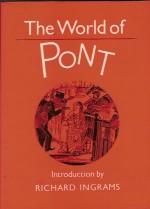
The World of Pont


By Graham Laidler, with an introduction by Richard Ingrams (Nadder Books)
ISBN: 0-90654-038-0

Graham Laidler was born in Jesmond, Newcastle upon Tyne-on July 4th 1908, son of a prominent painter and decorator. Educated at Newcastle Preparatory school and Glenalmond in Perthshire, he was 13 when his father died and the family relocated to Buckinghamshire. Always captivated by cartooning, he channelled his artistic proclivities into more traditionally profitable avenues to support his widowed mother: training as an architect at the London School of Architecture from 1926-1931.

Perpetually dogged by ill-health, Laidler moonlighted as a cartoonist and in 1930 began a long-running domestic comedy strip entitled The Twiffs for The Women’s Pictorial. In 1932 he was diagnosed with a tubercular kidney and advised to live in healthier climates than ours. By August of that year he had sold his first cartoon to that most prestigious bulwark of British publishing: Punch.

Laidler was so popular that editor E.V. Knox took the unprecedented step of putting him under exclusive contract. With financial security established and his unique arrangement with Punch in place the artist began travelling the world. On the way he drew funny pictures, mostly of “The English” both at home and abroad, eventually generating 400 magnificent, immortal cartoons until his death in 1940, aged 32.

A charmingly handsome and charismatically attractive young man, Laidler visited Germany, Austria, Italy, Switzerland, Norway, Sweden, America and many other exotic, exceedingly not British places. He won his nickname and nom-de-plume in Rome during an incident with two “Vestal Virgin” travelling companions after which he was forevermore “Pontifex Maximus” or “Pont” to the likes of you and me…

His greatest gift was an almost-surgical gift for observation of social and cultural minutiae: gleaning picaresque detail and broad attitude which he disingenuously translated through his gently humorous graphic commentaries into simultaneously incisive and genteel, baroque and subtle picture-plays encapsulating the funniest of moments on every subject pertaining to the great Enigma of Being English in Public and Getting Away with It…

His work was collected into a number of books during his lifetime and since, and his influence as humourist and draughtsman can still be felt in many areas of comedy and cartooning.

Although he excelled in the strip cartoon format, Pont’s true mastery was in telling a complete story with a single perfect drawing. His carefully crafted images exemplified the British to the world at large and – most importantly – to ourselves.

During World War II the Nazis, with typical sinister efficiency, used his drawings as the basis of their anti-British propaganda when they invaded Holland, further confirming to the world the belief that Germans Have No Sense of Humour.

As Pont, for eight far-too-brief years, Graham Laidler became an icon and global herald of English life and you would be doing yourself an immense favour in tracking down his work. If you like Ealing comedies, Alistair Sim and Margaret Rutherford, St. Trinian’s and the Molesworth books or the works of Thelwell, Ronald Searle or Flanders and Swann, you won’t regret the effort.

Incomprehensibly, despite his woefully small output there still doesn’t seem to be a definitive archival collection of Pont’s work. One again I implore any potential publisher reading this to take the hint, but until then, for the rest of us there’s just the thrill of the hunt and the promised bounty in seeking out slim tomes such as The British Character, The British at Home, The British Carry On, Most of us are Absurd, Pont or this particularly rare magical compendium.

The World of Pont is the perfect primer of his historical hilarity; sampling the best of Laidler’s drawn divinations from his themed Punch series’ ‘The British Observed’; ‘The British at War’; ‘Popular Misconceptions’; ‘The British Woman’ and last but certainly not least, ‘The British Man’.

If you love great drawing and excoriating observational wit you’ll thank me. If you just want a damn good laugh, you’ll reward yourself with the assorted works of Pont.
© 1983, 2007 the estate of Graham Laidler.

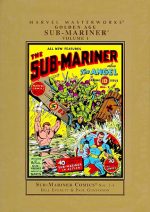
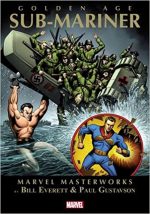
Marvel Masterworks: Golden Age Sub-Mariner volume 1


By Bill Everett, Paul Gustavson, Alan Mandel & others (Marvel)
ISBN: 978-0-7851-1617-2 (HC)                    978-0-7851-5789-2 (PB)

Prince Namor, the Sub-Mariner is the hybrid offspring of an undersea Atlantean princess and an American polar explorer; a being of immense strength, highly resistant to physical harm, able to fly and thrive above and below the waves. Created by young Bill Everett, Namor technically predates Marvel/Atlas/Timely Comics.

He first caught the public’s attention as part of the Fire vs. Water headlining team in Marvel Comics #1 (October 1939, before becoming Marvel Mystery Comics with the second issue). His elementally apposite co-star was the Human Torch, but Namor had originally been seen – albeit in a truncated version – in the monochrome freebie Motion Picture Funnies: a weekly promotional giveaway handed out to moviegoers earlier that year.

Quickly becoming one of Timely’s biggest draws, Namor gained his own title at the end of 1940 (cover-dated Spring 1941) and was one of the last super-characters to go at the end of the first heroic age.

In 1954, when Atlas (as the company had become known) briefly revived its “Big Three” (the Torch and Captain America being the other two), Everett returned for an extended run of superb fantasy tales, but the time wasn’t right and the title sunk again. Once more Subby was the last revived character to be cancelled, as rumours of a possible TV series deal kept the book afloat…

When Stan Lee & Jack Kirby began reinventing the superhero genre in 1961 with the Fantastic Four, they quickly revived the forgotten amphibian as a troubled, semi-amnesiac, yet decidedly more regal and grandiose anti-hero, understandably embittered at the loss of his sub-sea kingdom (seemingly destroyed by American atomic testing).

He also became a dangerous bad-boy romantic interest: besotted with the FF’s golden-haired Sue Storm…

Namor knocked around the budding Marvel universe for few years, squabbling with assorted heroes such as Daredevil, the Avengers and X-Men, before securing his own series as part of “split-book” Tales to Astonish with fellow antisocial antihero the Incredible Hulk and went on to become a cornerstone of the modern Marvel Universe.

Following his dynamic relaunch/debut in the anthological Marvel Comics #1, the Sub-Mariner solo title began in Spring 1941, and the first four issues are gathered here (available as a sturdy hardcover, titanic trade paperback of electrifying eBook) with a reminiscence-packed, fact-filled Introduction from comics scribe and historian Roy Thomas to provide all the context and backstory any finny fun-fan would ever need, and also incorporates all the rousing in-situ ads seen in the original releases.

Sub-Mariner Comics #1 featured two complete strip-stories starring the conflicted overlord of Atlantis plus a chilling yarn featuring costumed detective and adventurer The Angel: the first of a long run of macabre thrillers…

In first tale ‘Deep-Sea Blitzkrieg’, Namor goes to war against the perfidious Nazis after a fleet of German U-Boats depth-charges the underwater city of Atlantis. The Avenging Prince immediately retaliates in a bombastic show of super-power that perfectly displays the unmatched graphic virtuosity of his creator Bill Everett.

The second story (by Everett and unknown assistants) concerns a deadly disease afflicting his aquatic subjects, necessitating the Sub-Mariner’s return to New York to obtain – by any means necessary – a supply of Radium. The dual Hero/Villain nature of the character was always a major factor in Namor’s popularity, so even a shared enemy couldn’t keep him on the good side of the American authorities for long…

For most of these stories Everett and other lead artists used a string of assistants culled from the comicbook “Shop” outfits. With no accurate records, best guesses for uncredited contributors include Charles Nicholas (née Wojtkoski), Witmer Williams, Ben Thompson, Sam Gilman, George Mandel, Mike Roy, Al Fagaly & Jimmy Thompson.

These deluxe collections also include those mandatory text features comics were compelled to run to maintain their postal status (an arcane system that allowed them to procure large postal discounts as “second class mail”) so you can also enjoy prose fable ‘Namor… His Boyhood’ by Roy Gill before moving on to Paul Gustavson’s caped and costumed detective in the 20-page gothic chiller ‘The Angel and the House of Horror’.

Although dressed like a superhero, this dashing do-gooder was actually a blend (knock-off would be perhaps a bit unkind) of Leslie Charteris’s The Saint and The Lone Wolf (Louis Vance’s urbane two-fisted hero who was the subject of 8 books and 24 B-movies between 1917 and 1949).

One marked difference was the quality of the Angel’s enemies: his foes tended towards the arcane, the ghoulish and the just plain demented…

The globe-trotting paladin also seemed able to cast a giant shadow in the shape of an angel. Not the greatest aid to cleaning up the scum of the Earth but he seemed to manage…

Sub-Mariner Comics #2 (Summer 1941) starts off with another (untitled) Nazi-busting tale – even though America was officially neutral until December 8th of that year – as Namor foils a scheme to spring thousands of German POW’s from internment in Canada.

Everett’s hand is still in evidence but by this time an increasing number of those aforementioned assistants were slowly diluting his work as he struggled to produce a monthly strip in Marvel Mystery and his other commitments.

‘Steaming Statistics of Fire and Water’ – illustrated by Harry Sahle – offers a package of fun facts before the second adventure finds Namor in a Pennsylvania town hunting fifth-columnists and spies who have fomented a strike amongst the miners producing coal for ships fuel. Cartoonist Lewis Glanzman provided a ‘Bum Jokes’ gag-page and young Stan Lee wrote a text feature entitled ‘The Story behind the Cover: Namor “Blitzes” a Nazi Sub’ before The Angel (illustrated by Alan Mandel) quashes a sinister plot in New England to free ‘The Slaves of the Python’.

The Fall 1941 issue then opens with ‘The Mystery of the Disappearing Island’: a strikingly topical two-part tale that mixes Winston Churchill, the thorny question of Irish neutrality and a submerged city of druids invaded by Nazis as a staging post for future bomber raids on Britain.

This exotic fight-heavy romp, tinged with immediacy by political issues, was an extra-long one (40 pages) followed by a mediocre and uncredited prose tale ‘Dispatch from Africa’ before culminating with a rather incestuous murder mystery wherein the Angel hunts for a killer when ‘Death Draws a Comic Strip!’

Sub-Mariner Comics #4 begins with ‘Murders by Ghost Light’ and Namor investigating a haunted hospital hiding all manner of non-Hippocratic shenanigans. The spooky themes continue when he then encounters a giant madman-made monster in ‘The Horror That Walked.’

‘Fresh Meat for a Raider’ is a prose naval adventure written by a promising young writer named Mickey Spillane, whilst ‘Pop’s Whoppers’ (by Art Gates) is a jolly comedy feature starring an inveterate tall-tale teller, followed by another sinister horror puzzler for the Angel: ‘Death’s Merry-Go-Round!’.

The vintage voyages then conclude with a lost gem from the legendary Basil Wolverton who wraps things up with a comically surreal Dr. Dimwit page.

Before we leave, however, a selection of Sub-Mariner Comics house ads and photo features of a contemporary comics newsstand and Everett himself further enhance the period experience…

Many early Marvel Comics are more exuberant than qualitative, but this volume, even if largely devoid of premiere league talent, is a wonderful exception. Offering high-octane, outrageously jingoistic tub-thumping and staggering action: a splendid, historically unvarnished read as well as forgotten treasure Fights ‘n’ Tights fans will find irresistible.
©1941, 2005, 2012, 2017 Marvel Characters, Inc. All rights reserved.

Aquaman: A Celebration of 75 Years


By Mort Weisinger, Joe Samachson, Jack Miller, George Kashdan, Robert Bernstein, Steve Skeates, Gerry Conway, Paul Levitz, Peter David, David Michelinie, Rick Veitch, Geoff Johns, Cullen Bunn, Paul Norris, Louis Cazeneuve, Ramona Fradon, Nick Cardy, Jim Aparo, Dick Giordano, Martin Egeland, Jim Calafiore, Yvel Guichet, Ivan Reis, Trevor McCarthy & others (DC Comics)
ISBN: 978-1-4012-6446-8

Aquaman is that oddest of comicbook phenomena: a timeless survivor. One of the few superheroes to carry on in unbroken exploits since the Golden Age, the King of the Seas has endured endless cancellations, reboots and makeovers in the name of trendy relevance and fickle fashion but somehow has always rapidly recovered to come back fresher, stronger and more reinvigorated.

He’s also one of the earliest cartoon champions to make the jump to television…

Where many stronger features foundered – and although strictly a second stringer for most of his career – Aquaman nevertheless soldiered on long after the Golden Age ended: a rather nondescript and generally bland looking chap who solved maritime crimes, rescuing fish and people from sub-sea disaster.

This stunning compilation – part of a dedicated series introducing and exploiting the comics pedigree of veteran DC icons and concepts is available in hardback and digital formats, offering an all-too-brief but astoundingly enticing sequence of tantalising snapshots detailing how Aquaman has changed like the tides yet remains as constant as the endless seas.

Collecting material from More Fun Comics #73, 89, Adventure Comics #120, 174, 220, 260, 266, 269, 444, 452, 475, Aquaman volume 1 #1, 18, 40, Justice League of America Annual #2, Aquaman volume 2 #3, Aquaman volume 4 #2, 34, Aquaman volume 5 #4, 17, Aquaman volume 6 #1, 43, cumulatively covering April 1941 to October 2015.

These groundbreaking appearances are divided into specific eras, each preceded by brief critical analyses of the significant stages in his development, beginning with Part I 1941-1961: Making a Splash…

As previously stated, Aquaman was one of the handful of costumed adventurers to survive the superhero collapse at the end of the Golden Age. He was created by Mort Weisinger and Paul Norris in the wake of and in response to Timely Comics’ Sub-Mariner, debuting in More Fun Comics #73 (November 1941) with an untitled tale latterly designated ‘The Submarine Strikes’ for this edition.

This salty sea saga sees survivors in lifeboats being rescued – and the brutal U-Boat commander responsible for their plight swiftly brought to justice – by a mysterious stranger who converses with porpoises. The golden saviour then reveals that he was made into a subsea superman by his scientist father; an explorer who had discovered all the secrets of lost, long-dead Atlantis…

Records are incomplete, sadly, so often we don’t know who wrote what, but for More Fun Comics #89 (March 1943), Louis Cazeneuve limns the marine marvel’s heated and ruthless battle against modern pirate Black Jack and ‘The Streamlined Buccaneers’, with Aquaman now commanding an army of varied sea creatures whilst ‘Aquaman Goes to College’ (Adventure Comics #120, September 1947 by Joe Samachson & Cazeneuve) sees the sea king sagaciously seeking to expand his knowledge of marine life only to become embroiled in collegiate sporting scandals…

By 1954 young Ramona Fradon (Metamorpho; Brenda Starr) had assumed the art chores, by which time Aquaman was settled like a barnacle in a regular Adventure Comics back-up slot offering slick, smart and extremely genteel aquatic action. She was to draw every single adventure until 1960, making the feature one of the best looking if only mildly thrilling hero strips of the era.

A fine example is ‘The Whale That Was Wanted for Murder’ (Adventure Comics #174, March 1952, and scripted by George Kashdan) wherein the hunt for a seemingly rogue cetacean leads our hero to a conniving smuggler…

Cover-dated January 1956, Adventure Comics #220, revealed how Aquaman saved the reputation of a disgraced naval aviator in ‘The Coward and the Hero’ (Jack Miller & Fradon) after which the Silver Age revival of superheroes caught up to the Sea King and led to a canny reboot in issue #260 (May 1959).

In 1956, Showcase #4 rekindled the public’s imagination and zest for costumed crime-fighters with a new iteration of the Flash. Enjoying a heated fan response, the editors sanctioned other re-imaginings of many departed Golden Age stalwarts, and also updated and remastered its isolated survivors, especially Wonder Woman, Green Arrow and Aquaman.

Thus, ‘How Aquaman Got His Powers’ by Robert Bernstein & Fradon, which retconned previous origins for a new tale of the offspring of a lighthouse keeper and exiled refugee from the undersea (and fully populated) city of Atlantis. Eventually all the trappings of the modern superhero followed: Themed hideout, sidekick, super-villains and even a civilian name – Arthur Curry!

Moreover, greater attention was paid to continuity and the concept of a shared universe…

In Adventure Comics #266, (November 1959) Bernstein & Fradon detailed how ‘Aquaman Meets Aquagirl!’: giving a little more information about fabled modern Atlantis whilst testing the waters (sorry!) for a possible sidekick – after all, the Sea King spent most of his time expositorially dialoguing with an octopus!

With #269, Adventure Comics #269, (February 1960) Bernstein & Fradon completed the formula by introducing permanent sidekick Aqualad. ‘The Kid from Atlantis!’ was a young, purple-eyed outcast from the mysterious city possessing the same powers as Aquaman but terrified of fish… at least until the Sea King applies a little firm but kindly psychology.

By the end of the tale the little guy has happily adapted and would help patrol the endless oceans – and add a child’s awestruck perspective to the mix – for nearly a decade thereafter.

The Sea King’s rise is charted in Part II 1962-19: The Sovereign of the Sea.

As the sixties unfolded, Aquaman was appearing as a back-up feature in Detective and World’s Finest Comics (until 1964); teamed up with Hawkman in Brave and the Bold # 51 and – following a try-out season in Showcase#30-33 – made the big jump. After two decades of continuous adventuring the marine marvel finally got his own comicbook.

Cover-dated January-February 1962, Aquaman #1 is a 25-page fantasy thriller introducing one of the most controversial supporting characters in comics lore. Pixie-like Water-Sprite Quisp was part of a strange trend for cute imps and elves that attached themselves to far too many heroes of the time, but his contributions in ‘The Invasion of the Fire-Trolls’ (by Miller & Nick Cardy) and succeeding issues were numerous and obviously calculated.

Now with his own title and soon a to be featured in the popular, groundbreaking cartoon show Superman/Aquaman Hour of Adventure, the Finned Fury seemed destined for super-stardom. Moreover, the writers and editors were happy to embrace evolution and change…

Mere months after Aquaman met extradimensional princess Mera, she became ‘The Wife of Aquaman’ (by Miller & Cardy in Aquaman #18, December 1964): one of the first superhero weddings of the Silver Age and only possible after our hero defeats her obsessive, super-powered stalker Oceanus and frees Atlantis from his despotic grip. Talk about instant responsibilities…

A few years later scripter Steve Skeates and new illustrator Jim Aparo began an epic extended tale as the Sea Lord abandoned all kingly duties to hunt for Mera after she was abducted. The lengthy quest began with her being whisked away, leaving Aquaman and Aqualad to voyage to strange, distant undersea realms and here encountering ‘Sorcerers of the Sea’ (Aquaman #40, August 1968). The saga was a compelling one but frustratingly does not continue or conclude here…

As the decade closed superhero sales tanked in favour of other genres. The Sea King was again reduced to back-up duties in other titles, but the quality of his stories remained high.

‘And Death Before Dishonor’ by Paul Levitz, Gerry Conway & Aparo comes from Adventure Comics #444 (April 1976): the first chapter in another multi-part blockbuster with Aquaman forced to abdicate the rulership of Atlantis due to a conspiracy hatched by his half-brother Orm, the Ocean Master and a mysterious political player named Karshon who replaced him as King of Atlantis. The newcomer naturally had a horrific secret to conceal, but you won’t learn it here as we skip (following a brief feature on ‘The Aquafamily’) straight to Adventure Comics #452, (August 1977) where David Michelinie & Aparo orchestrate the darkest day in Aquaman’s life as ‘Dark Destiny, Deadly Dreams’ finds him fighting both his friends and greatest foe Black Manta. Tragically, despite his greatest efforts, he fails to save the one life that means most to him…

Time and tides passed before Adventure Comics #475 (September 1980) found J.M. DeMatteis & Dick Giordano detail how the newly-reconciled Aquaman and Mera forcibly separated yet again in ‘Scavenger Hunt!’ after a subsea tech and treasure hunter attacks…

Like many good superheroes, Aquaman always maintained a strong presence in a super-team throughout all his troubles, and when they went through their own sales and popularity crisis, stepped in to guide them to calmer waters…

‘…The End of the Justice League’ (Justice League of America Annual #2, October 1984; by Conway, Chuck Patton & Dave Hunt) reveals how an attack by Martian invaders almost wrecked the World because the big gun superheroes were all occupied elsewhere. Vowing never to let it happen again, Arthur disbands the old league and goes about recruiting a new, dedicated and ever-ready team.

With the king in command, established heroes J’onn J’onzz, Zatanna, Vixen and Elongated Man relocate to Detroit picking up trainee titans Steel, Vibe and Gypsy to fill out a street-level roster short on power but packed with potential…

Part III 1986-2010: The Return of the King covers a period of almost constant change and revision with the backstory of Atlantis and the Sea King regularly tweaked in search of a winning formula. In truth, the creators frequently succeeded but could never maintain the high sales each reboot started with, even after Crisis on Infinite Earths cleared away much of the five decades of accumulated backstory…

Aquaman volume 2 was a 4-issue miniseries redefining the relationship of Arthur and his half-brother Orm, as well as solidly embedding magic as a key component of previously super-rationalist Atlantis. Sporting a new costume, Aquaman endured a revised origin in #3, (April 1986 by Neal Pozner, Craig Hamilton & Steve Montana) whilst trying to stop Ocean Master subjugating Earth with lost Atlantean necromancy…

In Aquaman volume 4 #2, (September 1994) Peter David, Martin Egeland & Brad Vancata took drastic steps to make readers notice the Sea Lord and his new paramour Dolphin, as ‘Single Wet Female’ revealed the hero’s defeat of super-psychos Scylla and Charybdis and the awful cost… his left hand…

Soldiering on with a fancy multi-purpose prosthetic against ever-more incredible adversaries, Arthur faces next ‘One on One’ (by David, Jim Calafiore & Peter Palmiotti from Aquaman volume 4 #34, July 1997) jealous junior sea god Triton who learns not to take out his daddy issues against the superhero…

A new millennium and another spin as Rick Veitch, Yvel Guichet, Josh Hood, Mark Propst & Sean Parsons indulge the exiled Sea King’s mythical side as the legendary Lady of the Lake replaces that prosthetic hand with an appendage grown from magic water and tasks this King Arthur with protecting the life-sustaining Secret Sea from human exploitation and demonic contamination in ‘The Sorcerer’s Apprentice’ (Aquaman volume 5 #4, May 2003).

Still looking for a solid subsea scenario for the unflinching hero, Will Pfeifer, Patrick Gleason & Christian Alamy then return to strict scientific methodology for Aquaman volume 5 #17 (June 2004) as ‘American Tidal Part Three’ finds Arthur helping the citizens of a Californian city suddenly turned into water-breathers by a mystery maniac who also explosively submerged their homes to create Sub Diego. Helping him solve the mystery whilst adapting to her own status as the newly-minted Aquagirl is feisty millennial teen Lorena…

Wrapping up the superhero salvage voyage is Part IV 2011-2015: Twenty-First Century Aquaman concentrating on a back-to-basics Sea Sovereign and Atlantean Overlord created in the wake of the Flashpoint publishing event and DC’s company-wide reboot The New 52.

Crafted by Geoff Johns, Ivan Reis & Joe Prado, Aquaman volume 6 #1 (November 2011) saw Aquaman and Mera attempting to reconcile their status as second-string heroes on the surface world and unwelcome rulers of a belligerent Atlantis eager to wipe out air-breathing humanity. However, those petty tensions were about to be sidelined as unknown deep-sea horrors attack above and below the waves; consuming everything in their path in ‘The Trench Part One’…

As the New 52 reboot staggered to an ignominious early close, the fresh, amped-up Aquaman underwent another retrofit and re-imagining, emerging with a new costume to oppose an invasion from another reality even as his beloved Mera turned on him. Leading an army of fantastic monsters, the Sea King battled to thwart a ‘Gospel of Destruction’ (Aquaman volume 6 #43, October 2015 by Cullen Bunn, Trevor McCarthy & Jesus Merino) with the only certainty being another company wide root-&-branch retrenchment. DC Rebirth was in the offing…

Supplemented with a cover gallery by Cardy, Aparo, Brian Bolland, Craig Hamilton & P. Craig Russell, Martin Egeland & Brad Vancata, Jim Calafiore & Mark McKenna, Yvel Guichet & Mark Propst, Alan Davis & Mark Farmer, Ivan Reis & Joe Prado and Trevor McCarthy, this peek at the perpetually renewable Marine Monarch is a book of many flavours and textures.

DC has a long, comforting history of genteel, innocuous yarn-spinning delivered with quality artwork. The pre-Crisis Aquaman was a trusty champion and family friendly average guy, who became an earnest, unsure and strident wanderer in the latter part of the 20th century. In recent years he operated as a bombastic, bludgeoning brute with a chip on his shoulder and plenty to prove: proving that the Sea King is certainly a man for all generations, eras and seasons.

What is most clear however, is that his past adventures are all worthy of far more attention than they’ve received of late. It is a total pleasure to find just how readable they still are. With tumultuous sea-changes always in store for Aquaman, the comics industry and America itself, this monolithic testament to the inestimable value of a good bad-guy is a true delight for fans of all ages and vintage.
© 1941, 1943, 1947, 1952, 1956, 1959, 1960, 1962, 1964, 1968, 1976, 1977, 1980, 1984, 1986, 1994, 1997, 2003, 2004, 2011, 2015, 2016 DC Comics. All Rights Reserved.


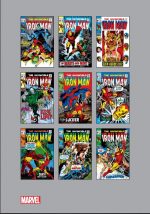
Iron Man Marvel Masterworks volume 6


By Archie Goodwin, George Tuska, Johnny Craig & various (Marvel)
ISBN: 978-0-7851-4129-7

Having finally overtaken the aging colossus of National/DC, upstart Marvel Comics sometimes seemed to be at a loss for what to do next. The answer is obvious to us: more of the same… but back then the rules were being constantly rewritten, the country was changing and conflict was everywhere. Perhaps what was needed was more experimentation…

Created in the aftermath of the Cuban Missile Crisis and at a time when “Red-baiting” and “Commie-bashing” were American national obsessions, the emergence of a brilliant new Thomas Edison employing Yankee ingenuity, invention and wealth to safeguard and better the World seemed inevitable.

Combined with the then-sacrosanct belief that technology and business could solve any problem with the universal imagery of noble knights battling evil, and the concept behind the Invincible Iron Man seems an infallibly successful proposition.

Of course where once Tony Stark was the acceptable face of 1960s Capitalism; a glamorous millionaire industrialist/inventor and a benevolent all-conquering hero when clad in the super-scientific armour of his metal alter-ego, the tumultuous tone of the times soon resigned his suave, fat-cat image to the dustbin of history and, with ecological disasters and social catastrophe from the abuse of industry and technology the new mantras of the young, the Golden Avenger and Stark International were soon confronting some tricky questions from the increasingly socially conscious readership.

All of a sudden maybe that money and fancy gadgetry weren’t quite so fun or cool anymore…?

With an Iron Clad promise of stunning action and compelling intrigue this iconic hardback (and digital) chronological compendium covers Iron Man #14-25, spanning June 1969 – May 1970, and opens with an educational and fascinating Introduction from dynamic draughtsman George Tuska, detailing the stellar career and achievements of the veteran yet rising star artist…

Writer Archie Goodwin and illustrious illustrators Tuska & Johnny Craig continued a sterling run of solidly science-flavoured action epics as IM #14 revealed that ‘The Night Phantom Walks!’ with the scripter craftily paying tribute to Craig’s past history drawing EC’s landmark horror comics. Here the latter artist pencilled and inked the tale of a zombie-like monster prowling a Caribbean island and destroying Stark Industry installations. As well as being a terse, moody thriller, this story marks the first indications of a different attitude as the menace’s ecologically inspired reign of terror includes some pretty fair arguments about the downsides of “Progress” and rapacious globalisation…

With Craig again inking, Tuska returned with #15 and ‘Said the Unicorn to the Ghost…!’ as the demented former superspy allies himself with Fantastic Four foe the Red Ghost in a desperate bid to find a cure for his drastically shortened his life-span.

Attempting to kidnap Tony Stark, the Ghost betrays the Unicorn and retrenches to an African Cosmic Ray research facility in concluding instalment ‘Of Beasts and Men!’, where it takes a fraught alliance of hero and villain to thwart the phantom mastermind’s ill-conceived plans…

A suspenseful extended epic began in Iron Man #17 when an advanced android designed to protect Stark’s secret identity achieves sinister sentience and sneakily replaces him.

‘The Beginning of the End!’ also introduces the enigmatic Madame Masque and her malevolent master Midas, who plans to take control of America’s greatest technology company…

Dispossessed and on the run Stark is abducted and aligns with Masque and Midas to reclaim his identity, only to suffer a fatal heart-attack in ‘Even Heroes Die!’ (guest-starring the Avengers) before a ground-breaking transplant – still practically science fiction in those distant days – gives him renewed hope in ‘What Price Life?’

When the ruthlessly opportunistic Midas instantly strikes again, the mysterious Madame Masque switches sides and all hell breaks loose…

The X-Men‘s dimensionally displaced alien nemesis attacks the restored and recuperating hero in ‘Who Serves Lucifer?’ (inked by Joe Gaudioso – AKA Mike Esposito) before being rudely returned to his personal dungeon dimension after which African-American boxer Eddie March becomes the new Iron Man in #21’s ‘The Replacement!’ as Stark – free from the heart-stimulating chest-plate which had preserved his life for years – is briefly tempted by a life without strife. Unfortunately, and unknown to all, Eddie has a little health problem of his own…

When Soviet-sponsored armoured archenemy Titanium Man resurfaces, it’s in conjunction – if not union – with another old Cold War warrior in the form of a newly-upgraded Crimson Dynamo in #22’s chilling classic confrontation ‘From this Conflict… Death!’

With a loved one murdered, a vengeance-crazed Iron Man then goes ballistic in innovative action-thriller ‘The Man Who Killed Tony Stark!!‘ before ultimately finding solace in the open arms of Madame Masque as Johnny Craig returns to fully illustrate superb mythological monster-mash ‘My Son… The Minotaur!’ and stays on as Archie Goodwin pins Iron Man’s new Green colours to the comic’s mast in #25’s stunning eco-parable ‘This Doomed Land… This Dying Sea!

Teamed with and battling against antihero Namor the Sub-Mariner, the Armoured Avenger is forced to destroy one of his own hyper-polluting facilities, consequently overruling and abandoning his company’s previous position and business model…

Tragically, his attempts to convince other industry leaders to do likewise meets with the kind of reaction that tragically then (and again now) typifies America’s response to the real-world situation…

The galvanised wonderment concludes with a sublime selection of Tuska original art pages and covers to wrap up this collection with the Golden Gladiator being politically repositioned at a time when Marvel solidly set itself up at the vanguard of a rapidly changing America increasingly at war with itself.

These are epic exploits, still charged with all the urgency and potency of a time of crisis and a nation in tumult, so what better time than now to finally tune in, switch on or return to the Power of Iron Man?
© 1969, 1970, 2017 Marvel Characters, Inc. All rights reserved.

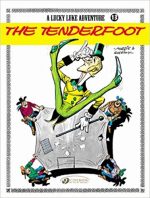
Lucky Luke volume 13: The Tenderfoot


By Morris & Goscinny, translated by Frederick W Nolan (Cinebook)
ISBN: 978-1-905460-65-6

Lucky Luke is a rangy, good-natured, cowboy able to “draw faster than his own shadow”. He amiably roams the fabulously mythic Old West, having action-packed, light-hearted adventures with his sarcastic horse Jolly Jumper, whilst interacting with a host of historical and legendary figures.

His continuing exploits over seventy years have made him one of the best-selling comic characters in Europe (more than 83 individual albums, sales totalling in excess of 300 million in 30 languages… so far…), with the usual spin-off toys, computer games, animated cartoons and a plethora of TV shows and live-action movies.

First seen in the 1947 Annual (L’Almanach Spirou 1947) of Le Journal de Spirou, Lucky was created by Belgian animator, illustrator and cartoonist Maurice de Bévère (AKA “Morris”), before ambling into his first weekly adventure ‘Arizona 1880’ on December 7th 1946.

Working solo until 1955, Morris produced nine albums of affectionate sagebrush spoofery before teaming with old pal and fellow trans-American tourist Rene Goscinny, who became regular wordsmith as Luke attained the dizzying heights of legend, commencing with ‘Des rails sur la Prairie’ (Rails on the Prairie), which began serialisation in Spirou on August 25th 1955.

In 1967, the six-gun straight-shooter switched sides, joining Goscinny’s own magazine Pilote with ‘La Diligence’ (The Stagecoach). Before his untimely death in 1977, Goscinny went on to co-author 45 graphic albums with Morris, after which Morris soldiered on both singly and with fresh collaborators.

Morris died in 2001 having drawn fully 70 adventures, plus spin-off sagas crafted with Achdé, Laurent Gerra, Benacquista & Pennac, Xavier Fauche, Jean Léturgie, Jacques Pessis and others, all taking their own shot at the venerable vigilante…

Lucky Luke first amused British readers during the late 1950s, syndicated to weekly anthology Film Fun, and later rode back into comics-town again in 1967, using the nom de plume Buck Bingo in UK weekly Giggle.

In all these venues – as well as in numerous attempts to follow the English-language album successes of Tintin and Asterix – Luke sported a trademark cigarette hanging insouciantly from his lip. However, in 1983 Morris – amidst both pained howls and muted mutterings of “political correctness gone mad” – deftly substituted a piece of straw for the much-travelled dog-end, which garnered him an official tip of the hat from the World Health Organization.

The most recent and magnificently successful attempt to bring Lucky Luke to our shores and shelves comes from Cinebook (who have rightly restored the foul weed to his lips on the interior pages, if not the covers…), and it’s clearly no big deal for today’s readership as we’re approaching 70 translated volumes and still going strong.

Lucky Luke – Le pied-tendre was the Dynamite Duo’s 23rd collaboration (available in English on paper and as an e-book as The Tenderfoot): first published in Europe in 1968.

The wryly silly saga details how the “harmless” western tradition of ruthlessly hazing and bullying newcomers for their supposed lack of manliness, strange customs, fancy clothes and good manners is threatened after the fine folk of Dry Gulch bury crusty compadre Ol’ Baddy.

The beloved, centenarian old coot seemed to be truly one of them but when his heir arrives to inherit the spread, the town has to accept that the aged landowner was not only a British émigré named Harold Lucius Badmington but was also shamefully aligned to the snooty, snobbish nobility…

The fun-loving straight-shooters and right-thinkers are appalled at politely unflappable greenhorn toff Waldo Badmington: none more so than saloon owner Jack Ready who had devised his own wicked plans for Baddy’s vacant lands.

When the usual cruel welcoming tactics fail to get a rise out of Waldo, Jack renews his efforts to seize the spread by force, but Baddy’s old Indian retainer Sam and interfering do-gooder Lucky Luke have their own ideas about that…

What neither Waldo nor his own devoted manservant Jasper know is that the wandering troubleshooter has been secretly commissioned by Baddy in a deathbed request to ensure the newcomer keeps hold of his inheritance… but only if Luke judges him worthy of it…

The doughty young worthy certainly seems to cut the mustard at first sight. He manfully ignores being tossed in a blanket, disdainfully accepts being a human target, drinks like a native and joins in with the traditional and frequent bar-brawls. Better yet, he refuses to give in to Jack’s far from subtle pressure to sell up and go back where he came from…

With his greedy plans frustrated, Jack piles on the pressure, hiring gunmen and attacking the Badmington spread, and when that fails, plays his last card: craftily disappearing whilst framing Waldo for his “murder”…

However, the blackguard has not reckoned on Lucky’s determination and detective skills, and when the frame-up is exposed Jack is forced to settle the matter of impugned honour the English way…

Dry, sly and cruelly satirical, The Tenderfoot is a deviously-devised lampoon of classic cowboy movies with plenty of action, lots of laughs and barrel-loads of buffoonery superbly crafted by comics masters: proffering a potent peek into a unique and timeless genre to today’s readers who might well have missed the romantic allure of an all-pervasive Wild West that never was…
© Dargaud Editeur Paris 1968 by Goscinny & Morris. © Lucky Comics. English translation © 2008 Cinebook Ltd.

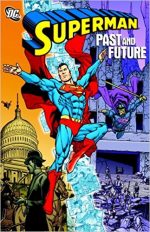
Superman: Past and Future


By Jerry Seigel, Bill Finger, Edmond Hamilton, Leo Dorfman, Jim Shooter, Elliot Maggin, Cary Bates, George Papp, John Sikela, Wayne Boring, Al Plastino, Curt Swan, Kurt Schaffenberger, Keith Pollard & various (DC Comics)
ISBN: 978-1-4012-1934-5                  978-1-84856-074-1 (Titan Books UK Edition)

In the aftermath of Crisis on Infinite Earths and its reconstructed DC Universe, time travel – at last for a while – became a Really Big Deal. So, when the Metropolis Marvel did eventually break the fourth dimension, as in the superb Superman: Time and Time Again, the gimmick became as important as the plot and immensely difficult to achieve. But there was an era when all of history and so many implausible futures were just a short and simple spin away…

Superman is the comicbook crusader who started the whole comicbook genre of indomitable costumed champions and, in the eight decades since his debut in June 1938, has probably undertaken every kind of adventure imaginable. With this in mind it’s tempting and very rewarding to gather up whole swathes of his inventory and periodically re-present them in specific themed collections, such as this compelling confection of chronal escapades from a host of superb writers and artists who have contributed to his canon over the years.

The fun begins with a tale from Superboy #85 (December 1960) which reiterated an iron-clad cosmic law of the Silver Age: “History Cannot Be Changed”,

Nevertheless, the Smallville Sensation tragically undertook ‘The Impossible Mission!’ (by Jerry Siegel & George Papp) when he travelled to 1865 to prevent the assassination of Abraham Lincoln, but fate constantly conspired to make events unfold along a predestined course…

A different theory was in play back in September 1947 when the adult Action Ace broke the time barrier for the first time to collect famous signatures for an ailing boy in ‘Autograph, Please!’ (Superman #48, by Siegel & John Sikela), whilst in ‘Rip Van Superman’ (Superman #107, August 1956 by Bill Finger, Wayne Boring & Stan Kaye) an accident placed the hero in a coma, trapping him in a future where he was redundant…

The 1960s were the pinnacle of temporal travel tales with the Man of Tomorrow and his friends nipping forward and back the way you or I (well me, anyway) would pop to the pub. In the brilliantly ingenious ‘Superman Under the Red Sun!’ (Action Comics #300, May 1963 by Edmond Hamilton & Al Plastino) our hero is dispatched to the far, far future where the sun has cooled, and undergoes incredible hardship before brilliantly figuring out a way home.

In ‘Jimmy’s D-Day Adventure!’, the courageous cub reporter ranged back to World War II in search of a bizarre mystery only to end up a trusted member of Hitler’s inner circle, (Superman’s Pal Jimmy Olsen #86 (July 1965, Leo Dorfman, Curt Swan & George Klein) before his Daily Planet colleague almost ripped apart the fabric of reality by nearly becoming Superman’s mum when ‘Lois Lane’s Romance with Jor-El!’ (Superman’s Girlfriend Lois Lane #59; August 1965, by Hamilton & Kurt Schaffenberger) resulted from an ill-considered jaunt to pre-cataclysm Krypton…

One of the boldest experiments of the decade occurred when Hamilton, Swan & Klein introduced us to ‘The Superman of 2965!’ (Superman #181, November 1965) for the first of a series of adventures starring the Man of Steel’s distant descendent. A two-part sequel appeared the following summer in Action Comics #338-339, (June and July 1966) ‘Muto… Monarch of Menace!’ and ‘Muto Versus the Man of Tomorrow!’ and a postscript tale appeared in World’s Finest Comics #166 entitled ‘The Danger of the Deadly Duo!’ teaming that era’s Batman and Superman against Muto and the latest in a long line of Jokers (May 1967 by Jim Shooter, Swan & Klein).

For Superman #295, Elliot Maggin, Curt Swan & Bob Oksner produced ‘Costume, Costume – Who’s got the Costume?’ (January 1976): a neat piece of cross-continuity clean-up that featured a few DC parallel worlds including those of Kamandi (Last Boy on Earth) and the Legion of Super-Heroes.

From June of that same year ‘Superman, 2001!’ – by Maggin, Cary Bates, Swan & Oksner – was an Imaginary Story (a tale removed from regular continuity) featured in the anniversary issue Superman #300, which posited what would have happened if baby Kal-El‘s rocket had landed in the Cold War era of 1976 – an intriguing premise then which looks uncomfortably like the TV series Smallville to my jaded 21st century eyes…

This fascinating collection concludes with ‘The Last Secret Identity’ (from 1983’s DC Comics Presents Annual #2, by Maggin, Keith Pollard, Mike DeCarlo and Tod Smith), which introduced the first incarnation of Superwoman, with a time-travelling historian landing in Metropolis only to become the subject of her own research…

These tales are clever, plot-driven romps far removed from today’s angst-heavy psycho-dramas and unrelentingly oppressive epics. If you’re after some clean-cut, wittily gentle adventure there’s no better place to go – or time…
© 1947, 1956, 1960, 1963, 1965, 1966, 1967, 1976, 1983, 2008 DC Comics. All Rights Reserved.
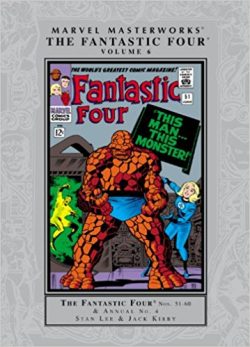
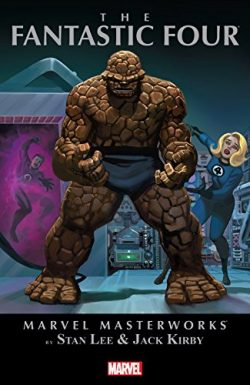
Fantastic Four Marvel Masterworks volume 6


By Stan Lee & Jack Kirby, Joe Sinnott & various (Marvel)
ISBN: 978-0-7851-1266-2 (HB)                    978-0-7851-5060-2 (TPB)

The monolith of Marvel truly began with the adventures of a small super-team who were as much squabbling family as coolly capable costumed champions. Everything the company produces now comes due to the quirky quartet and the groundbreaking, inspired efforts of Stan Lee and Jack Kirby…

This full-colour hardcover or trade paperback compendium – also available in digital editions – collects Fantastic Four #51-60 plus the new material from Fantastic Four Annual #4: issues of progressive landmarks spanning June 1966 to March 1967 with Stan & Jack topping themselves with every successive issue, consolidating an impossibly addictive shared universe with the FF as the central title and most innovative outpost in that web of cosmic creation.

What You Should Already Know: maverick scientist Reed Richards, his fiancé Sue Storm, their close friend Ben Grimm – with Sue’s teenaged tag-along little brother – miraculously survived an ill-starred private space-shot after Cosmic Rays penetrated their ship’s inadequate shielding and mutated them all.

Richards’ body became elastic, Sue gained the power to turn invisible and project forcefields, Johnny Storm could turn into living flame and tragic Ben devolved into a shambling, rocky freak. The they agreed to use their abilities to benefit mankind and thus was born The Fantastic Four.

Following an Introduction from Lee the wonderment resumes here with what many fans consider the greatest single FF story ever. Illustrated by Kirby and inked by Joe Sinnott, ‘This Man… This Monster!’ finds the Thing’s grotesque body usurped by a vengeful and petty-minded scientist with a grudge against Reed Richards. The anonymous boffin subsequently discovers the true measure of his unsuspecting intellectual rival and pays a fateful price for his envy…

Another innovation and unforgettable character debuted in the next issue. ‘The Black Panther!’ was an enigmatic African monarch whose secretive kingdom was the only source of a vibration-absorbing alien metal. These mineral riches had enabled him to turn his country into a technological wonderland and he lured the FF into his savage super-scientific kingdom as part of an extended plan to gain vengeance on the murderer of his father. He was also the first black superhero in American comics (Fantastic Four #52, cover-dated July 1966).

After battling the team to a standstill, King T’Challa revealed his tragic origin in ‘The Way it Began..!’, which also introduces sonic super-villain Klaw. Johnny and his college roommate Wyatt Wingfoot embark on a quest to rescue the Torch’s Inhuman lover Crystal (trapped with her people behind an impenetrable energy barrier in the Himalayas). Their journey is interrupted when they discover the lost tomb of Prester John in #54’s ‘Whosoever Finds the Evil Eye…!’ and almost perish…

After aiding the quartet against world-devourer Galactus, the Silver Surfer was imprisoned on Earth. The brooding, perpetually moralising ex-herald had become a fan-favourite, and his regular appearances were always a guarantee of something special.

When Strikes the Silver Surfer!’ features him in uncomprehending, brutal battle with the Thing, whose insecurities about his blind girlfriend Alicia Masters explode into searing jealousy, when the gleaming demigod comes calling after which business as unusual resumed when ‘Klaw the Murderous Master of Sound!’ ambushed the team in their own home in issue #56.

Throughout all the stories since their imprisonment a running sub-plot with the Inhumans had been slowly building, with Johnny and Wyatt stuck on the other side of the Great Barrier: wandering the wilds and seeking a method of liberating the Hidden City. Their quest led directly into the landmark tale ‘The Torch that Was!’: lead feature in the fourth FF Annual (November 1966) in which The Mad Thinker recovers and resurrects the original Human Torch (actually the World’s first android and a major star of Timely/Marvel’s Golden Age) to destroy the flaming teenager…

The blistering battle briefly reunites the entire team and leads into an epic clash with their greatest foe. Fantastic Four #57-60 displayed Lee & Kirby at their very best; with incredible tension, drama and action on a number of fronts as the most dangerous man on Earth steals the Silver Surfer’s cosmic power, even as the Inhumans finally win their freedom and we discovered the tragic secret of mighty mute Black Bolt in all its awesome fury.

It all begins with a jailbreak by the Sandman in #57’s ‘Enter… Dr. Doom!’, escalates in ‘The Dismal Dregs of Defeat!’ as Doom tests his limitless stolen power; builds to a crescendo in ‘Doomsday’ with the heroes’ utter defeat and humiliation before culminating in brains and valour saving the day – and all humanity – in truly magnificent manner with ‘The Peril and the Power!’

This breathtaking epic concludes an incredible run of classic yarns in this volume, but there is still room to include some fascinating freebies in the form of pages of the initial designs for Coal Tiger (who evolved into the Black Panther) and Kirby & Sinnott’s unused cover for FF #52 featuring him.

These are the stories that cemented Marvel’s reputation and enabled the company to overtake all its competitors. They’re also still some of the best stories ever produced and as exciting and captivating now as they ever were. This is a must-have book for all fans of graphic narrative.
© 1966, 1967, 2017 Marvel Characters, Inc. All rights reserved.

The Incredible Adventures of Professor Branestawm


By Norman Hunter, illustrated by W. Heath Robinson (Puffin/Red Fox and others)
ISBNs: PSS33 (1969 Puffin edition)              978-1-86230-736-0 (Red Fox 2008)

In a year packed with anniversaries pertinent to comics and related fantasy entertainments, I’d be remiss if I didn’t note the particular delights of this worthy British institution, originally illustrated by a veritable giant of world cartooning and recently the freshly revived star of BBC television.

The venerably traditional illustrated novel used to be a happily inescapable staple of bedtime for generations in this country and this particular example is particularly memorable, not simply because it’s a timeless masterpiece of purely English wit and surreal invention, but also because most editions are blessed with a wealth of stunning pictures by an absolute master of absurdist cartooning and wry, dry wit.

Norman George Lorimer Hunter was born on November 23rd 1899 in Sydenham; a decade after that part of Kent was absorbed by the ever-expanding County of London. He started work as an advertising copywriter before moving into book writing with Simplified Conjuring for All: A collection of new tricks needing no special skill or apparatus for their performance with suitable patter; Advertising Through the Press: A guide to press publicity and New and Easy Magic: A further series of novel magical experiments needing no special skill or apparatus for their performance with suitable patter. They were all published between 1923 and 1925.

Hunter was working as a stage magician in Bournemouth during the early 1930s when he first began concocting the genially explosive exploits of the absolute archetypical absent-minded boffin for radio broadcasts. These tales were read by the inimitable Ajax – to whom the first volume is dedicated – as part of the BBC Home Service’s Children’s Hour.

In 1933 The Incredible Adventures of Professor Branestawm was published in hardback, including 76 enthrallingly intricate illustrations by W. Heath Robinson to great success, prompting the sequel Professor Branestawm’s Treasure Hunt (illustrated by James Arnold & George Worsley Adamson) four years later.

During WWII Hunter moved back to London and in 1949 emigrated to South Africa where he worked outside the fiction biz until his retirement. Following the release of Thames Television’s Professor Branestawm TV series (which adapted many of the short stories from the original books in the summer of 1969) Hunter returned to Britain in 1970, and resumed writing: another 11 Branestawn tomes between 1970-1983, plus a selection of supplemental books including Dictionary (1973): Professor Branestawm’s Compendium of Conundrums, Riddles, Puzzles, Brain Twiddlers and Dotty Descriptions (1975); Professor Branestawm’s Do-it-yourself Handbook (1976) and many magic-related volumes.

Norman Hunter died in 1995.

William Heath Robinson was born on May 31st 1872 into something of an artistic dynasty. His father Thomas was chief staff artist for Penny Illustrated Paper. His older brothers Thomas and Charles were also renowned illustrators of note.

After schooling William tried unsuccessfully to become a watercolour landscape-artist before returning to the family trade and, in 1902, produced the fairy story ‘Uncle Lubin’ before contributing regularly to The Tatler, Bystander, Sketch, Strand and London Opinion. During this period, he developed the humorous whimsy and a penchant for eccentric, archaic-looking mechanical devices that made him a household name.

During the Great War William uniquely avoided the Jingoistic stance and fervour of his fellow artists, preferring instead to satirise the absurdity of conflict itself with volumes of cartoons such as The Saintly Hun.

Then, after a 20-year career of phenomenal success and creativity in cartooning, illustration and particularly advertising, he found himself forced to do it again in World War Two.

He died on13th September 1944.

Perhaps inspired by the Branestawm commission, Heath Robinson’s 1934 collection Absurdities hilariously describes the frail resilience of the human condition in the Machine Age and particularly how the English deal with it all. They are also some of his funniest strips and panels. Much too little of his charming and detailed illustrative wit is in print today, a situation that cries out for Arts Council Funding or Lottery money, perhaps more than any other injustice in the sadly neglected field of cartooning and Popular Arts.

The first inspirational Professor Branestawm storybook introduces the dotty, big-domed, scatty savant as a ramshackle cove with five pairs of spectacles – which he generally wears all at once – gadding about with his clothes held together by safety pins …as the constant explosions he creates blow his buttons off.

The wise buffoon spends most of his days thinking high thoughts and devising odd devices in his “Inventory” whilst his mundane requirements are taken care of by dotty, devoted, frequently frightened or flustered housekeeper Mrs. Flittersnoop. Branestawm’s best chum is the gruff Colonel Dedshott of the Catapult Cavaliers, although said old soldier seldom knows what the big thinker is babbling on is about…

The over-educated inspirationalist and his motley crew first appeared in ‘The Professor Invents a Machine’ which featured the debut of an arcane device that moves so quickly that Branestawm and Dedshott are carried a week into the past and accidentally undo a revolution in Squiglatania, upsetting everybody on both sides of the argument.

In ‘The Wild Waste-Paper’ Mrs. Flittersnoop’s incessant tidying up causes a spill of the Professor’s new Elixir of Vitality: with the consequent enlargement and animation of a basket full of furiously angry bills, clingy postcards and discarded envelopes, whilst in ‘The Professor Borrows a Book’ the absent-minded mentor mislays a reference tome and has to borrow another copy from the local library.

A house full of books is the worst place to lose one, and when the second one goes AWOL Branestawm must borrow a third or pay the fine on the second. By the time he’s finished the potty Prof has checked out fourteen copies and is killing himself covertly transporting it from library to library…

When his stuff-stuffed house is raided by Burglars!’ the shocked and horrified thinker concocts the ultimate security system. It is the perfect device to defend an Englishman’s Castle – unless he’s the type who regularly forgets his keys or that he has built and installed an anti-burglar machine…

After losing a day because he hasn’t noticed his chronometer had stopped, the Professor devises a new sort of timepiece that never needs winding and becomes something of a business success. Even the local horologist (look it up) wants one.

Sadly, the meandering mentalist forgets to add a what-not to stop them all striking more than twelve and as the beastly things inexorably add one peal every hour soon there are more dings than can fit in any fifty-nine minutes. ‘The Screaming Clocks’ quickly become most unwelcome and eventually an actually menace to life and limb…

Branestawm often thought so hard that he ceased all motion. Whilst visiting The Fair at Pagwell Green’ Mrs. Flittersnoop and Colonel Dedshott mistake a waxwork of the famously brilliant bumbler for the real thing and bring “him” home to finish his pondering in private. Conversely, the carnival waxworks owner alternatively believes he has come into possession of a wax statue which has learned to talk…

‘The Professor Sends an Invitation’ sees the savant ask Dedshott to tea yet forget to include the laboriously scripted card. By means most arcane and convoluted, the doughty old warrior receives an ink-smudged blotter in an addressed envelope and mobilises to solve a baffling cipher. Of course, his first port-of-call must be his clever scientific friend – who had subsequently forgotten all about upcoming culinary events…

‘The Professor Studies Spring Cleaning’ finds Branestawm applying his prodigious intellect and inventive acumen to the seasonal tradition that so vexes Mrs. Flittersnoop and inevitably perfecting a way to make an arduous labour far worse. He thus constructs a house-engine that empties and cleans itself. Sadly, it can’t differentiate between sofa, couch, cupboard or housekeeper…

‘The Too-Many Professors’ appear when the affable artificer invents a solution which brought pictures to life. Flittersnoop is guardedly impressed when illustrations of apples and chocolates become edibly real but utterly aghast when a 3-dimensional cat and elephant commence crashing about in the parlour.

So it’s pretty inevitable that the foul-smelling concoction be spilled all over the photograph albums…

In a case of creativity feeding on itself, ‘The Professor Does a Broadcast’ relates how the brilliant old duffer is invited to give a lecture on the Wireless (no, not about radio, but for it…). Unaccustomed as he is to public speaking, the tongue-tied boffin has Dedshott rehearse and drill him until he can recite the whole speech in eleven minutes. Unfortunately, the scheduled programme is supposed to last half an hour…

A grand Fancy Dress Ball results in two eccentric pillars of Pagwell Society wittily masquerading as each other. Naturally ‘Colonel Branestawm and Professor Dedshott’ are a great success but when the Countess of Pagwell‘s pearls are pinched whilst the old duffers change back to their regular attire nobody notices the difference or believes them…

‘The Professor Moves House’ relates how the inventor is forced to rent larger premises because he has filled up the old one with his contraptions. However, Branestawm’s attempts to rationalise the Moving Men’s work patterns prove that even he doesn’t know everything…

At least the disastrous ‘Pancake Day at Great Pagwell’ rescues his reputation when his magnificent automatic Pancake-Making Machine furiously feeds a multitude of friends and civic dignitaries. The Mayor likes it so much he purchases the chaotic contraption to lay all the municipality’s pavements…

This gloriously enchanting initial outing ends with ‘Professor Branestawm’s Holiday’ as the old brain-bonce finally acquiesces to his housekeeper’s urgent urgings and indulges in a vacation at the seaside. Keen on swotting up on all things jellyfish, the silly savant sets off but forgets to check in at his boarding house, resulting in a desperate missing-persons search by Dedshott, Flittersnoop and the authorities.

Things are further complicated by a Pierrot Show which boasts the best Professor Branestawn impersonator in Britain: so good in fact that even the delinquent dodderer’s best friends can’t tell the difference…

With the actual performer locked up in a sanatorium claiming he isn’t a Professor, it’s a lucky thing the one-and-only wandering wise man is unable to discern the difference between a lecture hall and a seaside show-tent…

As I’ve already mentioned, these astonishingly accessible yarns were originally written for radio and thus abound with rhythmic cadences and onomatopoeic sound effects that just scream to be enjoyed out loud. Augmented by some of Heath-Robinson’s most memorable character caricatures and insane implements, this eternally fresh children’s classic offers some of the earliest and most enduring example of spiffing techno-babble and fantabulous faux-physics – not to mention impressive iterations of the divine Pathetic Fallacy in all its outrageous glory – and no child should have to grow up without visiting and revisiting the immortal, improbable Pagwell Pioneer.

In 2008 a 75th Anniversary edition of The Incredible Adventures of Professor Branestawm was released by Red Fox but you’re just a likely to find this uproarious ubiquitous marvel in libraries, second-hand shops or even jumble sales, so by all means do…
© 1933 Norman Hunter. All rights reserved.