Lightrunner


By Lamar Waldron & Rod Whigham with Susan Barrows (Donning/Starblaze)
ISBN: 0-89865-315-0

During the 1980s a burgeoning science fiction and fantasy book market, bolstered by cinematic and even television blockbusters, fed into the new creative boom in the comicbook market, giving “graphic novels” their first tentative push into the real, bigger world outside established fandom as part of a greater zeitgeist. There was also a very real entrepreneurial creative buzz which led to many European and Japanese works finally breaking into the US market, and most importantly, a lot of attention was paid to new, homegrown material…

Among the important early players was The Donning Company Publishers, a Virginia-based outfit established in the 1970s who briefly blazed a pioneering trail with their Starblaze Graphics imprint.

Probably inspired by the innovative breakthrough work of Byron Preiss (Starfawn, Empire, The Swords of Heaven, The Flowers of Hell) Donning invested in lavish, visually impressive volumes targeting a broad crossover market. The began with a volume collecting the first chapters of Wendy and Richard Pini’s independent comics sensation Elfquest, and produced strip adaptations of popular prose properties such as Robert Asprin’s MythAdventures and the co-operative shared-universe fantasy series Thieves’ World. Along the way they also brought Colleen Doran’s first of A Distant Soil and Phil Foglio’s Buck Godot to a relatively small but crucially mainstream public.

The company’s output was small but highly effective and although the venture ended badly – in court, as many creators sued to regain control of their works – the beautiful, high quality works such as the graphic novel under review here showed that big, bold, expensive high-quality material was the future in an industry and art form that had always cut every corner, paid poorly and worked on miniscule margins…

Lightrunner is very much a product of its time, a riotous intergalactic rollercoaster rocket-ride which began life as a serial in the semi-pro fanzine Visions, and still packs a punch for any fan of brash, flashy space opera.

In the future, capitalism runs the universe in the form of planetary Corprostates held together by a web of trade undertaken by tachyon-driven solar sailing ships plying the perilous routes of the “Star Stream”. The Empyrean Alliance is a tenuous association of Free States, restive, politically insecure and greatly dependent on the trustworthy valour of the apolitical Empyrforce – a Navy-style peacekeeping/police militia.

The tale begins with young Burne Garrett, son of a legendary Empyrforce hero, who failed to make the grade and scrubbed out of his military training. Garrett is a pathetic disappointment to himself and everybody else. Now a lowly PR hack he is filming the initial tests of a radical new type of faster than light starship – The Stream Breaker – when calamity comes calling.

The new super-vessel suddenly comes to eerie life and takes off with him aboard, vanishing into the unknown, and the unwitting fool is suddenly Public Enemy #1! Framed, lost and desperate Garrett is soon plunged deep into the seedy underbelly of civilisation, a pawn of pirates and raiders until he is adopted by the spoiled, rich wild-child Lanie of Abul Sara (think Paris Hilton in lace-up high heel thigh-boots with a ray-gun… and now stop thinking of that because that’s not how she looks but what she’s like…).

The fugitive Garrett joins the tense and tentative crew of her beloved star-craft “Lightrunner.” Along the way he also picks up a pet monkey that might be the mightiest telepath in the galaxy…

As Garrett tries to clear his name, hunted by his own deeply disillusioned galactic-hero father and the true culprits who still want the Stream Breaker prototype he has so providentially hidden, the lad uncovers a clandestine plot of cosmic proportions that might just mean the end of the entire Alliance…

Although there have since been better variations of this plot and set-up, especially in films, this breezy, spectacular romp still reads incredibly well and looks great. Fans of this particular form of chase-based science fiction will be well rewarded for seeking out Lightrunner, and as the book is readily available and quite inexpensive all that fun can even be considered a bargain.
© 1983 Lamar Waldron and Rod Whigham.  All Rights Reserved.

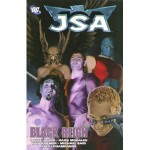
JSA volume 7: Princes of Darkness

New Extended Review

By Geoff Johns, David Goyer & various (DC Comics)
ISBN 1-84576-035-2

As a kid in the 1960s I used to love any appearance of the Justice Society of America, DC’s pioneering and popular crime-busting characters from the 1940s. They seemed full of a resonance that was equal parts Mystery and History. They belonged to the mythical land of “Before I Was Born” and their rare guest-shots always filled me with wonder and joy.

A few years ago they were permanently revived and I found very little to complain of. As superhero sagas go the stories and art were entertaining enough, often even outstanding, but with this compilation (collecting issues #46–55), I finally found myself agreeing with those wise editorial heads of my well-spent youth who felt that less was more and that over-exposure was a real and ever-present danger.

That’s not to say that these tales are in any way less than they need to be nor that the full-on, goodies-vs.-baddies extravaganzas are boring or tired. The problem is much more insidious and, I regret, more to do with me than the material. It finally became clear with this extended, spectacular struggle of valiant heroes against Darkness-wielding villains who black out the entire Earth and let evil reign free that the JSA were back for good.

But they were no longer quite so “special”.

Following on from the cliffhanger revelations of JSA: Savage Times the shadowy saga, written as ever, by David Goyer and Geoff Johns, with art from Sal Velluto, Leonard Kirk, Don Kramer, Bob Almond, Keith Champagne, & Wade von Grawbadger, opens with ‘Into the Valley’ and a blistering attack by the Chaos Lord Mordru, acting in concert with the conflicted ex-JSA-er Obsidian and the demonic spirit of rage, Eclipso.

Apparently dead, the sprit of Hector Hall, the latest Doctor Fate, travels to a distant realm for some sage advice in ‘Eclipse’ whilst on Earth, utter soul-drinking blackness has blanketed the globe unleashing the worst aspects of human nature. ‘Enlightenment’ and ‘Army of Darkness’ see Fate delve deeper into a potential solution whilst on the physical plane all of the World’s heroes – and some villains – are slowly being destroyed by the irresistible wave of Night.

A turning point comes in ‘The Last Light’ as a valiant sacrifice turns one of the dark masters from foe to friend, resulting in stupendous battles and an earth-shattering climax as the heroes save the day in ‘Princes of Darkness Coda: Justice Eternity’ – with which scripter Goyer moves on to fresh pastures.

After all that angsty spectacle and shiny triumph, the team catches a collective breath in ‘Brand New Day’ with a few new members and general recuperation, unaware the Atom Smasher and Black Adam have covertly crossed a moral line which will come back to haunt them all whilst the new heroic Eclipso feels himself drawn to do likewise. The main action of the piece comes in the form of a return for haunted huntress Crimson Avenger; a woman driven by possessed handguns to execute murderers who have escaped justice. To everyone’s astonishment her latest target is veteran hero Wildcat and nothing in the universe can stop or sway her…

The tale concludes in ‘Blinded’ as the relentless Avenger and Wildcat find a unique way to satisfy the curse of her relentless pistols, whilst Black Adam continues to recruit disenchanted heroes for a new kind of super-team, and the book ends on a satisfyingly welcome lighter note with a brace of seasonal tales, beginning with a lovely, lighthearted Thanksgiving bash starring both Justice League and Society.

‘Virtue, Vice & Pumpkin Pie’ is a splendid and jolly change of pace after all the high-octane testosterone which readily displays Geoff John’s comedic flair whilst ‘Be Good for Goodness’ Sake’ finds the surviving WWII heroes (Green Lantern, Wildcat, Hawkman and the Flash) bringing a lump to the throat and a tear to the eye (comic fans being the most soft and sentimental creatures in the universe) with a Christmas present for a long-lost member, not seen since the early days of the Golden Age…

These are characters that everyone in the industry seems to venerate, and I would be churlish to deny new readers and fans a chance to discover them too, but anticipation, delayed gratification and keen imagination once made every appearance of the JSA a source of raging joy to me and a million other kids. It’s such a shame today’s readers can’t experience that unbeatable buzz too. At least the stories are high quality. It would be utterly unbearable if the team were over-exposed and sucked too…

© 2003, 2004 DC Comics. All Rights Reserved.
Almost Silent


By Jason, translated by Kim Thompson (Fantagraphics Books)

ISBN: 978-1-606-99315-6

John Arne Saeterrøy, who works under the pen-name Jason, was born in Molde, Norway in 1965, and appeared on the international cartoonists’ scene at age 30 with his first graphic novel Lomma full ay regn (Pocket Full of Rain) which won that year’s Sproing Award (Norway’s biggest comics prize).

He followed with the series Mjau Mjau (winning another Sproing in 2001) and in 2002 turned almost exclusively to producing graphic novels. Now an international star of comics, he has won seven major awards from such disparate regions as France, Slovakia and the USA.

Thankfully the fine folks at Fantagraphics have collected four of his earliest graphic novels in a superb hardback companion to the 2009 classic [Low Moon] which provides more of Jason’s surreal and cinematic, darkly hilarious anthropomorphic ruminations on his favourite themes of relationships and loneliness, viewed as ever through a charmingly macabre cast of silent movie archetypes, cinematic monsters and sad sack chumps.

Told in pantomimic progressions rather than full stories – and often as classical chase scenes reminiscent of Benny Hill – the wonderment begins with breakthrough album ‘Meow, Baby’ wherein a mummy goes walkabout from his museum sarcophagus encountering bums and gamins, vampires, aliens, angels, devils, skeletons and cops – always so many cops – in hot pursuit…

This primarily monochrome collection is called Almost Silent because it mostly is: and what dialogue appears is never informative or instructive, merely colour or window dressing. The artwork is displayed in formalised page layouts rendered in a minimalist evolution of Hergé’s Claire Ligne style, solid blacks, thick lines and settings of seductive simplicity unwinding like an unending, infinite zoetrope show. These early works are collections of gags and situations best experienced rather than read.

A second untitled tale follows the perceived social inadequacies of males hungry for love: a werewolf, caveman – complete with courting cudgel, a Martian, Frankenstein’s monster and even Elvis. All try and die in the modern dating whirl.

The next sequence introduces cannibal ghouls and a movie-buff Travis Bickle/Arnold Schwarzenegger wannabe also starving for acceptance, and continues with the bleakly comedic ‘Return of the Mummy’ and a delightfully tongue in cheek pastiche of Tintin and Blake and Mortimer entitled ‘The Mummy’s Secret’, featuring the entire ghastly cast, before ending with a fascinating selection of three panel gag strips.

The next featured volume is ‘Tell Me Something’ a more ambitiously visual outing that acknowledges its antecedents and influences by using silent movie dialogue cards instead of word balloons and follows a plucky heroine as she searches for affection in all the wrong places with her Harold-Lloyd-like would-be beau. Also in attendance are the usual cast of filmic phenomenons…

‘You Can’t Get There from Here’ concentrates mainly on the Frankenstein cast: the monsters, their equally artificial wives, their lovelorn and covetous creators and even the Igors, misshapen wizened assistants also all seeking that one special person – or thing. Here the art is supplanted by the startling and highly effective addition of bronze inks for a compelling duo-tone effect that sits oddly well with the beast’s bittersweet search for his stolen, bespoke bride.

The collection concludes with a rather riotous adventure romp ‘The Living and the Dead’ wherein the perfect first date is interrupted by the rising of the unquiet dead and the end of civilisation in the rotting teeth of carnivorous zombies on their final march – possibly the funniest and most romantic yarn in the whole book

Jason’s work always jumps directly into the reader’s brain and heart, using the beastly and unnatural to ask gentle questions about basic human needs in a wicked quest for answers. That you don’t ever notice the deep stuff because of the clever gags and safe, familiar “funny-animal” characters should indicate just how good a cartoonist he is.

His comic tales are strictly for adults but allow us all to look at the world through wide-open childish eyes. He is a taste instantly acquired and a creator any fan should move to the top of the “Must-Have” list, so consider this superb hardback your guaranteed entry into his fabulous fun world…

© 2009 Jason. All rights reserved.

The World of Ginger Fox


By Mike Baron and Mitch O’Connell (Comico)
ISBN: 0-938965-02-6

Let’s all pop back to the ever-so-now 1980s with this stylish and radically different kind of graphic novel that pretty much typified and encapsulated the dichotomies of the age of Big Hair and Brash Money.

Peppertree Studios used to be one of the biggest players in Hollywood, until the somber 1970s saw ill-conceived, big, worthy movies almost bankrupt the company. Now the dissolute boys-club of greedy old men who own the company are so desperate that they hire a woman to save or kill the studio. After all, they have nothing to lose…

Amidst a welter of rumour, innuendo and open hostility, Ginger Fox blows into town and into a storm of trouble as she drags the company kicking and screaming back towards profits and safety. Along the way she encounters psychotic, crazed art-house directors, rowdy martial-arts prima donnas, drugs and thugs and sabotage from within by two-faced back-stabbers who don’t like taking orders from a pretty young woman and especially not a single-mom, Hollywood outsider…

The tale takes a swift side-step into the weird – and lavishly violent – when a Martial Arts secret society threatens to kill anybody connected with the new movie that inadvertently reveals their sacred Negative Kung Fu technique to anybody and everybody with the price of a movie ticket.

Despite warnings from cops and Hong Kong action-star Jason Wu, Ginger refuses to worry – at least until the “accidents” start to happen and the bodies start to pile up. Meanwhile, one of her own directors is trying to oust her and Peppertree’s biggest remaining star is spiraling out of control on addictive binges…

This mélange of glamour, fashion, excess and sheer over-the-top style is an unbelievably heady and enticing brew, especially thanks to the sleek, beautiful, high-end art and design of O’Connell; a canny cultural scavenger whose slick blend of caricature, pop iconography and surreal whimsy elevate this tale to unprecedented heights of verve and dash.

Sexy, cinematically violent and wickedly tongue-in-cheek, this adult comics caper is markedly different from almost anything you’ve ever seen and thoroughly deserves another bite of the graphic novel cherry. If they’re bringing back the ’80s, you’re going to need this to remind you that it wasn’t all dreadful…
Story © 1986 Mike Baron. Artwork © 1986 Mitch O’Connell. All rights reserved.

The Witching Hour


By Jeph Loeb, Chris Bachalo & Art Thibert (Vertigo)
ISBN: 978-1-84023-251-6

I gather a new edition of this dark little treat is imminent so here’s a quick graphic novel review to whet your appetites and prime your bank accounts…

The original title the Witching Hour was a quirky, highly readable anthology comic from DC’s 1970s horror/mystery stable, with the early issues particularly memorable due to some extremely tasty contributions from arch-stylist Alex Toth. The pithy, spooky, mordantly ironic yarns were recounted by three iconic hosts representing the Wiccan concept of maiden, mother and crone and nominally based on the Weird sisters from Macbeth: namely Cynthia, Mildred and Mordred. The series ran from 1969 to 1978.

In 1999, with the company’s Vertigo imprint successfully reinventing the horror comic month by month, a number of old properties were given the proverbial fresh spin and Jeph Loeb and Chris Bachalo produced a delightfully dark, character-driven mystery yarn as a three issue prestige-format miniseries, promptly collected in a volume that unjustly vanished with nary a ripple of comment. Hopefully this time out it will garner some better press and attention…

In Manhattan, vivacious, exotic Amanda Collins visits a disparate, desperate selection of characters, daring them to trade-in their pasts and seize new futures. Dispensing blank business-cards and new realities to the lost, lonely and dangerous with but a wish, she seems the epitome of wild chance and missed opportunities, but Amanda too is a prisoner of the past, with a sorcerous heritage reaching back to 1660 and a romantic clash between Christian propriety and pagan license.

As other mysterious mystics also enfold fate-touched mortals in some enigmatic grand scheme – are they Amanda’s coven comrades or opponents in some grand game? – a centuries old debt is assessed… and perhaps repaid…

Vague as that sounds, it is all you need for this complex, intriguing, savage, seductive, sexy and addictively arcane experiment in sequential story-telling. The connections linking Amanda to her own past, her witchly companions and all the apparent innocents who accept her highly suspicious offer are deliberately obscure; thus the tale unfolds on a multitude of levels and the reader actually has to engage the brain to divine the hidden secrets of the Witching Hour.

Bachalo’s art is magic of the purely pictorial kind: as light and airy as clouds and deeply, densely, information-packed like a favourite grimoire. The section collecting his design sketches are sleek and pretty, everything an art-lover could want to see.

This is a book that washes over you like a wave, all mood and moment, and will offer a rare challenge for adult readers tired of being spoon-fed their fiction-fix.

© 1999, 2000 Jeph Loeb and Chris Bachalo. All rights reserved.

The Punisher: Intruder


By Mike Baron, Bill Reinhold & Linda Lessman (Marvel)
ISBN: 0-87135-544-2

Frank Castle saw his family gunned down in Central Park after witnessing a mob hit, and thereafter dedicated his life to destroying criminals. His methods are violent and permanent.

Debuting as a villain in Amazing Spider-Man #129 (February 1974), the Punisher was created by Gerry Conway, John Romita Sr. and Ross Andru, in response to increasingly popular prose anti-heroes like as Don Pendleton’s Mack Bolan: the Executioner and other returning Viet Nam vets who all turned their training and talents to wiping out organised crime. It’s worth noting that unlike most heroes who debuted as villains (such as Wolverine) the Punisher actually became more anti-social and murderous, not less as the buying public shifted its communal perspective: Castle never toned down or cleaned up his act…

After stalking the Marvel universe for years a 1986 miniseries by Steven Grant and Mike Zeck swiftly led to overnight stardom and a plethora of “shoot-’em-all and let God sort it out” antics that quickly boiled over into tedious overkill, but along the way a few pure gems were cranked out, such as this joyously gratuitous graphic novel.

Intruder also takes another sneaky peak into Castle’s life prior to that fateful walk in the Park, and begins when his stake-out of a Medellin cartel boss goes horribly wrong. Whilst watching the drug-lord’s home he sees a team of armed raiders burst into the house next door. Realising the assassins have attacked the wrong home, he moves in but is far too late. The only survivor is seven year old Maggie Pulowski…

Knowing that whoever the raiders were, they’ll return once they realise there is a witness left, Castle takes her under his wing, eventually leaving her in the seminary where he once trained to be a priest.

Meanwhile partner and Intel man Micro has found the mystery raiders. An ex-Navy  colonel with dubious links to both the American and Korean CIA, and backed by ultra-right wing, anti-communist religious leaders, Ross Whittaker now runs his own private army and air force from a rocky desert citadel in Utah. Tasked with assassinating drug-runners, left-wingers and anybody his money-men don’t like, nobody realises that Whittaker has plans of his own and is covertly carving out a private narcotics empire.

With Whittaker’s ruthless forces now closing in on Maggie, the rogue Colonel instantly advances to the top of the Punisher’s “to do list”…

This intriguing hardback in the so-satisfying oversized European format (284m x 215m) is not as readily available as many other Punisher tales but is still a spectacular, all-action, blockbuster romp stuffed with the usual cathartic gun-play, loads of martial arts mayhem in the best Mike Baron tradition with the added zest of seeing our one-man-army take on an actual military force. Whilst the climactic duel in flashing jet-fighters is utterly breathtaking, and a credit to the vastly underrated Bill Reinhold, some of the most interesting moments are the trenchant flashbacks to Frank Castle; cleric-in-training – particularly funny and painfully insightful…

Hard, fast and enticingly brutal, this non-stop, top-gun rocket-ride has everything that made the series so popular, stripped down and converted to a form of cinema blockbuster that is absolutely irresistible. This is another unrepentant guilty pleasure and you know you want it…
© 1989 Marvel Entertainment Group, Inc. All Rights Reserved.

The Question volume 5: Riddles


By Dennis O’Neil, Denys Cowan, Bill Wray & various (DC Comics)
ISBN: 978-1-84856-513-5

This is a saga about dysfunction and a search for answers: Social, societal, political, emotional, familial and even methodological. The normal masked avenger tactics don’t work in a “real”-er world, and some solutions require better Questions…

Challenging Western dystopia with Eastern thought and martial arts action is not a new concept but O’Neil’s focus on cultural and social problems rather than histrionic super-heroics make this series a truly philosophical work, and Cowan’s raw, edgy art imbues this darkly adult, powerfully sophisticated thriller with a maturity that is simply breathtaking.

This fifth collection (reprinting issues #25-30) picks up from the shock ending of The Question: Welcome to Oz with ‘Skells’ illustrated by Cowan & Malcolm Jones III. New Mayor Myra Fermin-Connelly has been gunned down by her drunken, brain-addled husband and lies in a coma. Due to a quirk of Hub City law, with both current candidates unable to take office, the incumbent – despite being wanted for attempted murder – is technically next-in-line, and therefore de facto Mayor…

The tornado that struck the city on Election Day has finished the job begun by years of corruption and the gang warfare of the campaign. Hub City is a billion-dollar disaster zone. All essential services have ceased, the surviving populace are either rioting, looting or hiding. Food and water are running out.

State authorities are unwilling to step in and the urban hell-hole is poised to become a purely Darwinian jungle (this storyline probably inspired Batman’s ‘No Man’s Land’ publishing event) but all the Question wants to do is hunt down Myra’s addled husband/killer…

‘Riddles’ is a strange and melancholy Christmas divertissement, from fill-in penciller Bill Wray and Jones III which sees the Riddler, fresh out of jail and in a slump, catch a bus to Hub City and a new start. Sadly he picks the wrong girl to chat up and the result is the bloodiest and most senseless night of his life. It’s a genuine Christmas miracle that Vic Sage and Professor Rodor are on the same road that night…

With the city in turmoil, Myra in a coma, and no foe he can hit, The Question is helpless, but when the Prof reveals that his long-lost brother was a comic book artist in the 1940s it leads them all on a quasi-mystic quest which just might provide the mauled metropolis with its first glimmer of hope and recovery. ‘Captain Stars & Sergeant Stripes’ is illustrated by Cowan and Jones III, with Golden Age pastiche pages from Rick Stasi & Terry Beatty.

The last three tales here, also limned by Cowan and Jones, form an extended epic as the lethal Lady Shiva (see The Question: Zen and Violence) returns. Myra has emerged from her coma and taken charge, but with no resources and open warfare on the streets she is forced to take some extraordinary measures to restore order. In ‘A Place for the Arts’ Shiva, drawn to the chaos and ever-hungry to test her martial arts skills, offers her murderous services to one of the gangs trying to take over what’s left of Hub City, only to have her potential employers snatched from her as the new Lady Mayor convinces the warring thugs to become her new police force…

Incredibly disaster seems to have been averted until in ‘The Slaying’ one of the rival gang-lords is stabbed at a peace-conference and the Faceless Inquisitor has a murder to solve before the last remnants of hope are swallowed by renewed bloodshed. ‘Whodunit’ reveals all, but as is always the case in this superb series the answers are far from neat, tidy or satisfactory, and as always a moral and philosophical pall clouds the issues. And like a ghost Shiva stalks the city, ambivalent, ambiguous, unfathomable in her private purposes…

Like life, The Question never produces easy answers…

Bleak, brutal, confrontational and mordantly action-packed these tales come from one of DC’s very best series, and they form a perfect snapshot in comics history of a hugely creative and historically significant time. These graphic novels demonstrate just how evocative sequential narrative can be and no fan of serious fun literature or mature, sensitive escapism can afford to miss them.

© 1989, 2009 DC Comics. All Rights Reserved.
Walt Kelly’s Our Gang volume 4 1946-1947


By Walt Kelly (Fantagraphics Books)
ISBN: 978-1-60699-322-4

The Our Gang (later to be known as the Li’l Rascals) movie shorts were one of the most popular series in American Film history. Beginning in 1922 they featured the fun and folksy humour of a bunch of “typical kids” (atypically though, there was full racial equality and mingling – but the little girls were still always smarter than the boys) having idealised adventures in a time both safer and more simple. The rotating cast of characters and slapstick shenanigans were the brainchild of film genius Hal Roach (he directed and worked with Harold Lloyd, Charley Chase and Laurel and Hardy amongst many others) and these brief cinematic paeans to a mythic childhood entered the “household name” category of popular Americana in amazingly swift order.

As times and tastes changed Roach was forced to sell up to the celluloid butcher’s shop of MGM in 1938, and the features suffered the same interference and loss of control that marred the later careers of the Marx Brothers, Laurel and Hardy and Buster Keaton.

In 1942 Dell released an Our Gang comic-book written and drawn by Walt Kelly who, consummate craftsman that he was, restored the wit, verve and charm of the cinematic glory days with a progression of short tales that elevated the lower-class American childhood to the mythic peaks of Dorothy in Oz or Huckleberry Finn.

Over the course of the first eight issues (see Walt Kelly’s Our Gang volume 1) the master raconteur moved beyond the films – good and otherwise – to build an idyllic story-scape of games and dares, excursions, adventures, get-rich-quick-schemes, battles with rival gangs and especially plucky victories over adults: mean, condescending, criminal or psychotic. Given more leeway, Kelly eventually in-filled with his own characters, but for this book aficionados and purists can still thrill to the classic cast.

This long-awaited fourth collection gathers the adventures from issues #24 to #30 (July 1946l -January 1947), and finds Kelly inserting more of himself into the mix. Here the light-hearted yarns often evolved into full-blooded dramas, with murderous returning villains and bold excursions far beyond what modern parents would allow their cosseted darlings to experience, all based on Kelly’s great fondness for the wholesome adventures of daring youth written by Horatio Alger and Oliver (the Rover Boys, Bobbsey Twins, Tom Swift) Optic.

The entrancing full colour fun leads off with riotous rumbles as Buckeye and Red Macdougal build a fake teleportation machine to prank Froggy, only to have two burglars steal the cardboard contraption thinking it the real deal, and thereafter the entire gang gets into serious danger when The Barrel returns.

The Hispanic master-criminal wants revenge for the way the kids foiled his counterfeiting ring, but luckily the old circus entertainer Professor Gravy is around – with his lion and tiger…

A rare (for the era) continued storyline begins with #26 as Froggy, Macdougal and Julip the goat join the Professor on his showboat for a summer of entertaining the river towns. Unfortunately the fugitive Barrel is also on board, incognito and desperate to skip town…

By the next issue the kids have taken care of their arch-enemy (for the meantime) and Julip takes centre-stage – or deck – when he swallows a talking toy parrot and the Professor thinks he’s found the showbiz sensation of the century: a hilarious tale that introduces as memorable new cast member, blustery lady-wrestler Guinevere.

As the kids continue their parent-free working vacation the showboat takes on two new passengers; a thoroughbred race horse and his owner trying to avoid thieves keen on stealing the elite hayburner. If I just mention that this is the same week that the boys are trying to perfect their pantomime-horse act I suspect you can guess where this tale is heading…

The two-fisted dénouement of that escapade left the riverboat high and dry on a reef, and in #29 the stranded cast decides that they will trap the horse-thieves who escaped capture during the battle that led to the crash. This is a dark tale indeed as Macdougal is kidnapped and shot, but the bonny lucky lad soon turns the tables on the villains thanks to some ghastly green flares and a handy graveyard…

This volume ends as the boys return to school and plunge straight into Baseball woes as old rival Feeny of the Gashouse gang frames the bespectacled Froggy. Banned by his teacher from playing in a vital match, the little wise guy needs somebody to pretend to be his mother and get him out of an unjust punishment. It’s a measure of his tenacity if not faith, when three separate versions of his mom turn up at the game…

Today’s comics have nothing like these magical masterpieces to offer to contemporary audiences. Many readers might not even be able to appreciate the sheer beauty, narrative charm and lost innocence of this style of children’s story: sumptuous confections from a true legend of our art-form with truly universal appeal.

If so I genuinely pity them, because this is work with heart and soul, drawn by one of the greatest exponents of graphic narrative America has ever produced. Be assured however, that their loss need not be yours…

© 2010 Fantagraphics Books. All Rights Reserved.

Abandoned Cars


By Tim Lane (Fantagraphics Books)
ISBN: 978-1-60699-341-5

Tim Lane is a post-war American. His inner landscape is populated with B-Movies, Rock and Roll, junk-memorabilia, big cars with fins, old television shows, Jack Kerouac, the seven ages of Marlon Brando, pulp fictions, young Elvis, distilled Depression-era experiences (all of them from “The Great” to the latest), black and white images on TV, a loss of faith in old values, Mad Avenue propaganda, compromised ideals and frustrated dreams. He calls that oh, so plunderable societal gestalt and psychic landscape “The Great American Mythological Drama”, and in this first collection of his stark, intriguing comic strips he dips deep and concocts his own striking contributions to the Great Double Martini of Life…

Many modern Americans are using that shared popular culture to create new paintings and sculptures (see any of the numerous “lowbrow” or “pop surrealist” tomes by Schorr, Ryden, Ledbetter et al that we’ve reviewed here over the last few months) but Lane has eschewed the gallery art arena for his explorations, opting instead for the only true American medium of expression, the story, and toils bombastically in its ugly bastard offspring – Comics.

He draws in stunning black and white: hard-edged, uncompromising and enticingly moody, and these short stories, vignettes, observations and sequential investigations are far from the usual stock of funnies.

The contents here are culled from a number of sources such as Legal Action Comics, Hotwire, Typhon, Riverfront Times and his self-published magazine Happy Hour in America from 2003 to 2008, and range from tales of dark, eccentric whimsy (‘American Cut-Out Collectibles’, ‘The Manic-Depressive from Another Planet’ and ‘The Aries Cow’) to philosophically charged musings (‘Ghost Road’, ‘To Be Happy’ and ‘The Drive Home’), Pop cultural pastiches (‘Outing’ and ‘Doo-Wop and Planet Earth’ ) fascinating autobiography and reportage (‘Spirit’ parts 1-3, ‘In My Dream’ and ‘You Are Here: the Story of Stagger Lee’) to just plain old-fashioned noir-tinted thrillers like ‘Cleveland’ and  ‘Sanctuary’.

The book also contains numerous untitled, enigmatic and addictive short pieces, and for my money the most evocative and powerful piece herein is an all but wordless, two-page rumination on age and loss: ‘Those Were Good Years’. You’d have to be made of stone to be unmoved…

Crafting comics is clearly not a job or hobby for Lane. Serious artists have always struggled to discover greater truths through their creative response to the world, and he has obviously found his instrument in black line on white and his muse in the shabby, avuncular, boisterous, scary detritus of our everyday, blue-collar communal past. The result is stunning and highly intoxicating.

Questing, introspective, insightful and as desperately inquiring as the young Bob Dylan, with as many questions, even fewer answers and just as much lasting, life-altering entertainment to be derived…

Why haven’t you got this book yet?

© 2003 – 2008, 2010 Tim Lane. All rights reserved.

The Question volume 4: Welcome to Oz


By Dennis O’Neil, Denys Cowan, Rick Magyar & various III (DC Comics)

ISBN: 978-1-84856-328-5

The Question, created by Steve Ditko, was Vic Sage, a driven, obsessed reporter who sought out crime and corruption irrespective of the consequences. This Charlton ‘Action-Hero’ was purchased by DC when Charlton folded in 1983 and was the template for the compulsive Rorschach when Alan Moore and Dave Gibbons first drafted the miniseries that would become the groundbreaking Watchmen.

An ordinary man pushed to the edge by his obsessions, Sage used his fists and a mask that made him look utterly faceless to get answers (and justice) whenever normal journalistic methods failed. After a few minor successes around the DC universe Sage got a job in the town where he grew up.

Hub City (purportedly based on East St Louis) was a hell-hole, the most corrupt and morally bankrupt municipality in America. Mayor Wesley Fermin was a degenerate drunken sot and the real power was insane cleric Reverend Jeremiah Hatch. When Sage started cleaning house as The Question he was “killed”, rescued and resurrected by the inscrutable Shiva – the World’s deadliest assassin.

Crippled, he journeyed into the wilderness to be healed and trained by O’Neil’s other legendary martial arts creation, Richard Dragon.

It’s a new type of hero who returned to Hub City, philosophical rather than angry, but still cursed with a drive to understand how things universally go bad. The city has degenerated even further. Sage’s girlfriend is now Mayor Fermin’s wife, and crime and chaos are everywhere…

This fourth collection (reprinting issues #19-24 of the seminal 1980s series) brings to a head many of the dark plot threads that have been with the series since its inception. With Fermin permanently drunk and oblivious Sage has renewed his affair with Myra, even whilst she is running for her husband’s job.

Closet racist Royal Dinsmore has better ways of winning the race than smearing his opponent, but thanks to an extremely disturbed good citizen those plans are exposed in ‘The Plastic Dilemma’ (illustrated by Denys Cowan & Rick Magyar) and Myra refuses the financial support of a particularly unwholesome millionaire backer, whilst the emotional impact of her affair with Sage is revealed in ‘Send in the Clowns’ (an all-Magyar art job) a brutal tale of freaks, greed and prejudice.

Dick Giordano inks Cowan in ‘Rejects’ as psychopathic Junior Musto, returns (see The Question: Zen and Violence) to take a hospital hostage, demanding a heart transplant for the father who abused and tried to destroy him. That Greek tragedy leads into the main event…

‘Election Day (by Cowan & Malcolm Jones III): The Fix’ begins an agonising comedy of political errors as Dinsmore’s plan to steal the election is thwarted and he resorts to hiring a gang of Bikers to prevent the populace from voting – a t least those who can be bothered to turn out.

All the while Myra is having heartrending second thoughts. She doesn’t want to win but can’t afford to let a monster like Dinsmore gain control of her city. In the background her sot husband lurks; drunk deranged, bitter: clutching a bottle and a gun…

Some disquieting historical facts about Hub City are revealed in ‘Election Day: Welcome to Oz’ as the situation worsens. Open warfare in the streets is compounded by the arrival of a tornado that smashes most of the city to rubble, and the terrible conclusion ‘Election Day: The Dark’ sees Dinsmore defeated by a last-minute Machiavellian masterstroke from Vic Sage.

Mrya becomes the new Mayor of the biggest, most corrupt pile of rubble in America. A shot rings out…

Even ending on such a painful cliffhanger is grudgingly acceptable when the work is of such sterling quality and these eccentric epics are as readable now as they ever were. Complex characters, a very mature depiction of the struggle between Good and Evil using Eastern philosophy and very human prowess to challenge crime, corruption, abuse, neglect and complacency would seem to be a recipe for heady but dull reading yet these stories by one of the American industry’s greatest wordsmiths, and especially the mythic martial arts action delineated by Denys Cowan are gripping beyond belief and constantly challenge any and all preconceptions. So grab this book; absorb, enjoy and then move briskly on to the next volume.

I’m going to…

© 1988, 1989, 2008 DC Comics. All Rights Reserved.