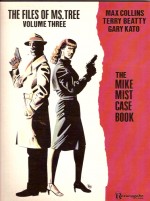
The Files of Ms. Tree volume 2: The Cold Dish


By Max Collins & Terry Beatty with Gary Kato (Renegade Press)
No ISBN: 0-919359-05-1

Despite being one of the most popular genres in literature and the fact that most fiction books are bought and read by women, Private Eye crime stories are desperately short of female protagonists. Marry that with the observation that “gum-shoe” comics are also as rare as hen’s teeth and it’s a wonder that a series such as Ms. Tree ever got off the drawing board.

The secret – as always – is quality.

The black widow of detective fiction first appeared in 1981 as a serial in the groundbreaking black-and-white anthology comic Eclipse Magazine, produced by crime novelist and new writer of the Dick Tracy, Max Allan Collins with young humour cartoonist Terry Beatty.

She soon won a solo title, Ms. Tree’s Thrilling Detective Stories (later simply Ms. Tree), and although the marketplace was not friendly to such a radical concept the series ran for 50 issues, and 2 specials, from three publishers (Eclipse, Aardvark-Vanaheim and Renegade Press, before finally dying in 1989. She was promptly revived as a DC comic in 1990 for another 10 giant-sized issues as Ms. Tree Quarterly/ Ms. Tree Special; three more blood-soaked, mayhem-packed, morally challenging years of pure magic.

Astonishingly, there are no contemporary collections of her exploits – despite Collins’ status as a prolific and best-selling author of both graphic novels (Road to Perdition, CSI and prose sequences featuring his crime-creations Nathan Heller, Quarry, Nolan, Mallory and a veritable pantheon of others).

In 2007 Collins released a classy prose novel, “Deadly Beloved” about his troubled troubleshooter, but thus far the Files of Ms. Tree volumes are the only place to find the collected exploits of this superb crime-stopper.

In the first volume I, For an Eye and Death Do Us Part we briefly met Mike Tree, a legendary private detective who married his secretary and partner Mike Friday, only to be murdered on their wedding night.

The new Mrs. Tree hunted down his killer, setting herself on a path of vengeance and blood. On the way she uncovered a vast web of corruption and made an eternal enemy of Mob boss Dominic Muerta, becoming locked in a bloody vendetta. She also discovered her dead husband’s previous wife and a son who was painfully like his departed dad…

This second volume, released in 1985 and reprinting her adventures from issues #4-8, has fewer behind-the-scenes extras and commentary but does include another colour cover gallery and an all-new and nasty illustrated prose short story, ‘The Little Woman’ to supplement the darkly engaging title tale.

Gary Kato joined the team as letterer and art assistant Beatty’s drawing took on a seductively Steve Ditko-like appearance whilst the drama became increasingly terse in ‘The Right to Remain Silent…’ and ‘No Use Crying’ as Mike Tree’s other wife briefly returns, begging Ms Tree to take her son into protective custody. She is murdered days later and as the detective spirits Mike Jr. away his grandparents violently disapprove, and Dominic Muerta sends an unmistakable message …

‘Paying Respects’ and ‘Forgive Her Trespasses’ introduces a new cast member, ex-SAS child protection expert Mr. Hand, to baby-sit the resentful boy whilst Ms Tree delivers a message of her own to Muerta, and the mystery deepens in ‘To the Slaughter’ as another viable suspect to Anne Tree’s murder appears – and bloodily expires, whilst in ‘Urbane Renewal’ the body count and suspect list rises again.

The action intensifies when Ms. Tree’s closest ally is blown up in ‘Visiting Hours’ and a vigil by his bedside leads to another grisly attempt on her life. ‘Knee-Deep in Death’ and ‘Accounts Payable’ finally provides the missing motive for the ongoing bloodbath, but with Mr. Hand attacked and Mike Jr. missing it might be all too late…

After all the Hitchcockian suspense the carnage and conundrums brilliantly culminate in ‘Murder-Go-Round’, a spectacular showdown that would do Sam Peckinpah proud…

Despite the tragic scenarios, ruthless characterisations and high body-count, this is another clever, funny affair steeped in the lore of detective fiction, stuffed with in-jokes for the cognoscenti (such as the unspoken conceit that the heroine Mike Friday is the daughter of legendary TV cop Joe “Dragnet” Friday or that in fiction absolutely no one can be trusted) and dripping in the truly magical gratification factor that shows complete scum finally get what’s coming to them…

Ms. Tree is the closest thing the American market has ever produced to challenge our own Empress of Adventure Modesty Blaise: how she can be left to languish in graphic obscurity is a greater mystery than any described in this compelling collection. Track down these superb thrillers and pray someone has the street smarts to bring her back for good…
© 1983, 1984, 1985 Max Allan Collins and Terry Beatty. All Rights Reserved.

Penny Century (Las Locas volume 4)


By Jaime Hernandez (Fantagraphics Books)
ISBN: 978-1-60699-342-2

Please pay attention: this book contains stories and images of an extremely adult nature, specifically designed for adult consumption and the kind of coarse and vulgar language that most kids are fluent in by the age of ten. If reading about such things is likely to offend you, please stop now and go away. I’ll be back with far more wholesome, family friendly and acceptable violence and explosions tomorrow. So come back then.

Love and Rockets is an anthology comics publication that originally featured slick, intriguing, sci-fi-ish larks, heart-warming, terrifying, gut-wrenching soap-opera fantasies and bold experimental comic narratives that pretty much defied classification, all wrapped up in the ephemera of the LA Hispanic and punk music scene. The synthesistic Hernandez Bros joyously plundered their own relatively idyllic childhoods to captivate with incredible stories that sampled a thousand influences conceptual and actual – everything from comics and TV through alternative music to German Expressionism and masked wrestlers.

Jaime Hernandez was always the most visible part of the graphic and literary revolution that is Love and Rockets, his slick, seductive, clean black line and beautiful composition, not to mention impeccably rendered heroes and villains and the comfortingly recognisable comic book iconography, being particularly welcomed by readers weaned on traditional Marvel and DC superheroes.

However his love of that material, as well as the best of Archie Comics cartoonists (I often see shades of the great Sam Schwartz and Harry Lucey in his drawing and staging), accomplished and enticing as it is, often distracted from the power of his writing, especially in his extended saga of Maggie Chascarillo and Hopey Glass – Las Locas.

Palomar was the conceptual and cultural playground of brother Gilberto, whilst Jaime initially began with a fantasy-tinged adventure serial (as seen in volume #1 ‘Maggie the Mechanic’) which eventually evolved into a prolonged examination of love and friendship as Maggie and Hopey, chums since childhood and occasional lovers, drifted into and away from each other over the years. The later stories also yielded focus to an increasing number of truly unique friends and acquaintances…

This volume ostensibly stars Hopey’s lifelong friend and wild child Beatriz Garcia who meticulously reinvented herself as the cosmic starlet and ambiguous super-heroine Penny Century, but the whole utterly magnetic cast are on board for a series of revelatory tales, casting light on both the shadowy histories and portentous futures as Maggie and Hopey approach middle age – still beautiful, still feisty but not really that much wiser…

Collected from the spin-offs and miniseries ‘Whoa Nellie!’, ‘Maggie and Hopey Color Fun’ and ‘Penny Century’ produced between 1996 and 2002, the pageant of wonders begins with a disturbingly compelling side-trip into the world of women’s wrestling, following the lives and glory-days of two women as they strive to become tag-team champions: a visually mesmeric and touchingly poignant dissection of an extraordinary friendship.

The spotlight lands squarely on Hopey in the second extended tale as the older but no wiser wildcat revisits her good old days with Maggie, before the main event, told through a succession of short stories, commences. Beginning with two instalments of ‘Locas’, and three of ‘Penny Century’ the narrative is interspersed with nineteen fascinating complementary vignettes and sidebars such as ‘La Pantera Negra’, ‘Hopey Hop Sacks’, ‘Look Out’, ‘Chiller!’, ‘C’Mon Mom!’, and ‘Loser Leave Oxnard’ – the secret origins of most of the extended cast are laid bare in progressively more funny and tragic tales of missed opportunities and lost last chances…

Every bit as surreal and meta-fictional as brother Beto’s incredible tales of Luba and Palomar, Jaime’s continuing development as a writer both stirring and meaningful is a delight to experience, whilst his starkly beautiful drawing – even when he affectionately dabbles with other styles – is an utter joy. It’s an amazing trick to tell such wistful, insightful and even outright sad stories with so much genuine warmth and slapstick humour but this book easily pulls it all off.

You’ll laugh, you’ll cry, and you’ll own one hell of a good book when you buy Penny Century… and you may regret it forever if you don’t.
© 2010 Gilbert Hernandez. All Rights Reserved.

Ironwolf: The Fires of the Revolution


By Howard Chaykin, John Francis Moore, Michaela Mignola & P. Craig Russell (DC Comics)
ISBN: 1-56389-065-8

In the early 1970s, when Howard Chaykin and other luminaries-in-waiting such as Bernie Wrightson, Walt Simonson, Al Weiss, Mike Kaluta and others were just starting out in the US comics industry, it was on the back of a global fantasy boom. DC had the comic-book rights to Fritz Lieber’s Fafhrd and the Grey Mouser tales (beautifully realised in five issues of Swords and Sorcery by Denny O’Neil and many of the above-mentioned gentlemen) as well as the more well-known works of Edgar Rice Burroughs – Tarzan, Korak, John Carter of Mars, Carson of Venus, Pellucidar and even Beyond the Farthest Star.

Those beautiful fantasy strips began as back-up strips in the jungle books but soon graduated to their own title Edgar Rice Burroughs’ Weird Worlds, where they enthralled for just seven magnificent issues before returning to back-up status in Tarzan and Korak. Dropping the ERB strap line the comic itself ran for three more issues before folding in 1974, featuring an all new space opera scenario by O’Neil and Chaykin – ‘The saga of Ironwolf’.

Predating Star Wars by years it only just began the story of a star-spanning empire fallen into dissolution and decadence and the rebellion of one honest aristocrat who threw off the seductive chains of privilege to fight for freedom and justice. Artificial vampires, monsters, vast alien armies and his own kin were some of the horrors he tackled with his loyal band of privateers from his gravity defying wooden star-galleon the Limerick Rake.

With impressive élan Ironwolf mixed post-Vietnam, post-Watergate cynicism with youthful rebellion flavoured by Celtic mythology, Greek tragedy, the legend of Robin Hood and pulp science fiction trappings to create a rollicking, barnstorming romp unforgettable. It was cancelled after three issues.

In 1986 those episodes were collected as a special one shot which obviously had some editorial impact as a few years later this slim but classy all-star conclusion was released in both hardcover and paperback.

In the Empire Galaktika no resource was more prized than the miraculous anti-gravity trees of Illium – ancestral home of the lords Ironwolf. These incredible plants took a thousand years to mature, would grow on no other world, and were the basis of all star ships and travel in the Empire.

After untold years of comfortable co-existence the latest Empress, Erika Morelle D’Klein Hernandez, steeped in her own debaucheries, declared that she was giving the latest crop of mature trees to the monstrous aliens she had welcomed into her realm. Disgusted at this betrayal, nauseated by D’Kein’s blood-sucking allies and afraid for the Empire’s survival, Lord Brian of Illium destroyed the much-coveted trees and joined the revolution.

With a burgeoning republican movement he almost overthrew the corrupt regime in a series of spectacular battles, but was betrayed by one of his closest allies. Ambushed, the Limerick Rake died in a ball of flame…

Ironwolf awakes confused and crippled in a shabby hovel. Horrified he learns he has been unconscious for eight years, and although the Empire has been replaced with a Commonwealth things have actually grown worse for humanity. The Empress still holds power and men are no more than playthings and sustenance not only for the vampiric Blood Legion but also the increasingly debased Aristocrats he once called his fellows.

Clearly he has a job to finish…

After decades away much of the raw fire of the young creators who originated Ironwolf has mellowed with age, but Chaykin has always been a savvy, cynical and politically worldly-wise story-teller and still had enough indignant venom remaining to make this tale of betrayal and righteous revenge a gloriously fulfilling read, especially with the superbly enticing artwork of Mike Mignola and P. Craig Russell illustrating his final campaign to liberate the masses.

Although this tale (which links into Chaykin and Jose Luis Garcia-Lopez’s DC future-verse Twilight epic – and no, that one has nothing to do with fey vampires in love) is still readily available, I think the time is right for reissuing the entire vast panoramic saga in one complete graphic novel.

Let’s all hope that somebody at DC is reading this review…
© 1992 DC Comics. All Rights Reserved.
Shadowman


By Steve Ditko, Steve Englehart, Jim Shooter, Bob Hall, David Lapham & various (Valiant)
No ISBN

The 1990s were a slow period in terms of comics creativity: the industry had become infested with collector/investors and was increasingly market-led, with spin-offs, fad-chasing, shiny gimmicks and multiple-covers events replacing imagination and good story-telling in far too many places. One notable exception was a little outfit with some big names that clearly prized the merits of well-told stories illustrated by artists immune to the latest mis-proportioned, scratchy poseur styles, but one with enough business sense to play the industry at its own game.

Eschewing most of the more crass profiteering stunts Valiant revived some old characters and proved once more that the basics never go out of fashion. As Editor-in-Chief, Jim Shooter had made Marvel the most profitable and high-profile they had ever been, and after his departure he used that writing skill and business acumen to transform some almost forgotten Silver-Age characters into contemporary gold.

Western Publishing had been a major player since comics’ earliest days, blending a huge tranche of licensed titles with a few home-grown heroes like Brain Boy, Turok, Son of Stone and M.A.R.S. Patrol Total War (created by Wally Wood). The company’s most notable stars were Dr. Solar, Man of the Atom and Russ Manning’s magnificent science fiction cautionary tale Magnus, Robot Fighter. When the parent company closed its original comic division in 1984 these masterful sagas soon faded from comic fans’ memory.

As the 1990s opened and with an agreement to revive some, any or all of these four-colour veterans, Shooter and co-conspirator Bob Layton came to a bold decision and made those earlier adventures part-and-parcel of their refit: acutely aware that old fans don’t like having their childhood favourites bastardized, and that revivals need all the support they can get. Thus the old days were canonical: they “happened” and the new company was off and running with an interested, older fan-base already in place.

But the upstarts were not content to simply revive and retrofit past glories: a growing legion of new characters was gradually added to the pantheon. One such was a Voodoo-tainted, New Orleans based wild man daredevil named Jack Boniface – Shadowman.

After a truly seminal cameo in X-O Manowar #4 musician Boniface was properly introduced in 1992 his own title. Shadowman premiered with ‘Jazz’, written by Shooter and Steve Englehart, illustrated by David Lapham and Joe Rubinstein.

The credits are a lot more complex that they might appear. Shooter famously used a communal brainstorming system to create characters and stories. The full credits for the graphic novel under review – gathering issues #1-3 and 6 (the un-included chapters being part of the company’s first braided cross-over event Unity) of the first Shadowman run read Plotters: Steve Ditko, Mark Moretti Don Perlin & Shooter, Writers: Englehart, Bob Hall, Faye Perozich, Shooter, Pencillers: Ditko, Lapham, Moretti and Inkers Charles Barnett III, Gonzalo Mayo, Rubinstein & Tom Ryder.

In that eerie introduction Boniface was a struggling session saxophonist trying to strike it rich in the Big Easy when he was seduced by Lydia, a mysterious woman he picked up in a club. Her sinister, trysting assault left him unconscious, amnesiac and forever altered by a bite to his neck. Unknown to Jack, Lydia was an agent of the Spider Aliens who form a covert keystone of the Valiant Universe, preying on humanity for millennia and responsible for creating many of the paranormal humans who secretly inhabit the world.

Alone in the morning light Boniface discovered that Lydia’s home was filled with half-digested corpses. Clearly he was to be her next meal – but now has no idea how he survived or where she went. He cannot conceive of how her bite has altered him…

He flees but later as darkness falls he feels agitated, restless, aggressive: he roams the streets and finds himself drawn back to Lydia’s home and stumbles upon a voodoo sacrifice. Attacked by the priest the once docile musician dons a Mardi Gras mask found at his feet and fights back with brutal abandon. Lydia’s has somehow turned him into a violent driven maniac, hungry for conflict – but only when the sun goes down…

In ‘Spirits Within’ (Perozich, Shooter, Lapham & Ryder) Jack’s own hunger for answers takes him to both experts in medicine and Obeah magic before his Shadowman self drags him into a confrontation with a Bayou axe murderer, whilst ‘The Beast and the Children’ (Perozich, Moretti & Barnett III) finds the increasingly off the rails music-man tackling mobsters and hit-men before destroying a well-connected super-powered child abuser.

There’s a big change in the character seen in the fourth and final tale here. It begins with Shadowman’s return from the far future and a distant dimension where the combined Valiant heroes experienced “Unity”. Whilst there Boniface fell in love and learned exactly when he would die…

Written by Shooter, Ditko, Don Perlin and Moretti with art by Ditko, Moretti and Gonzalo Mayo ‘The Family That Slays Together’ pitted the Shadowman against a murderous clan of degenerate swamp-dwellers stealing women and children from local communities. Bitter, merciless and now completely reckless since he believes he cannot die – yet – Shadowman had become a relentless, remorseless, punishing force of nature. What a pity Jack Boniface was a helpless witness to everything his night-self did…

Combining the best elements of conflicted lone vigilantes and dark avengers such as Batman and Daredevil with an exotic locale and traditional horror elements, Shadowman offers a tense, dark underbelly to the super-science and shining heroism of Valiant’s other titles, and despite the committee-like nature of its creation still delivers heaping helpings of moody mystery and arcane excitement. Well worth reviving and definitely a different action hero you will love to read…
© 1994 Voyager Communications Inc. All rights reserved.

The Incredible Hulk


By Stan Lee, Jack Kirby, Steve Ditko & various (Lancer US/Four Square UK)
“ISBNs” 72-124 (Lancer) and 1808 (Four Square)

This is one solely for chronic nostalgics, consumed collectors and historical nit-pickers, and is all about memories and the purity of the line – and possibly nasty, mean profiteering publishers…

One thing you could never accuse entrepreneurial maestro Stan Lee of was reticence, especially in promoting his burgeoning line of superstars. In the 1960s most adults, including the people who worked in the field, considered comic-books a ghetto. Some disguised their identities whilst others were “just there until they caught a break.” Stan, Jack and Steve had another idea – change the perception.

Whilst Kirby and Ditko pursued his imagination waiting for the quality of the work to be noticed, Stan pursued every opportunity to break down the ghetto walls; college lecture tours, animated shows (of frankly dubious quality at the start, but always improving), foreign franchising and of course getting their product onto “real” bookshelves in real book shops.

There had been a revolution in popular fiction during the 1950s with a huge expansion of cheap paperback books: companies developed extensive genre niche-markets, such as war, western, romance, science-fiction and fantasy. Hungry for product for their cheap ubiquitous lines, many old novels and short stories collections were republished, introducing a new generation to such authors as Robert E. Howard, Otis Adelbert Kline, H.P. Lovecraft, August Derleth and many others.

The paperback itself was not new: pioneered by German company Albatross Books in 1931 – not too long before the birth of the comic book itself – their abortive efforts were picked up and successfully adapted by publisher Allen Lane in England. In 1935 they launched Penguin Books, which in one go combined conspicuous, memorable design, genre-coding, brand awareness and product collectability in ten distinctive reprinted titles. The revolution had begun…

They were cheap, throwaway books – one could even buy them at Woolworth’s of all places, my dear! – and after some  initial resistance the market grew hugely. The hoi-polloi could now afford to read anything they pleased. In America Robert de Graf linked up with Simon & Shuster in 1939 to create the remarkably similar Pocket Books line.

The war slowed everything down by rationing paper, but also increased the acceptance of these easily portable diversions, and by the end of the affair a number of powerful reprint publishers were dominating the cheap end of the US market: Ace, Avon, Bantam, Dell – and yes, most of those companies dabbled in comic-books too…

That market changed forever in 1950 when comics and magazine publisher Fawcett established Gold Medal Books and began publishing original works in softcover.

They were so successful that they severely wounded the entire magazine market and actually killed “the Pulps”.

The hunger for escapist fiction was insatiable. Bantam Books had specialised in superhero fiction since 1964 when they began reprinting the earliest pulp adventures of Doc Savage, and they seemed the ideal partner when Marvel on the back of the “Batmania” craze, began a short-lived attempt to “novelise” their comic book stable with The Avengers Battle the Earth-Wrecker and Captain America in the Great Gold Steal.

Far more successful were various publisher’s repackaging of their actual comics stories in cheap and cheerful softcovers: Archie produced the memorable High Camp Superheroes, Tower collected the adventures of their big two Dynamo and No-Man, DC (then National Periodical Publications) released a number of Batman books and an impressive compendium of Superman stories and Marvel, punching far above their weight, unleashed a storm of paperbacks featuring a huge number of their new stars, Fantastic Four, Spider-Man, Daredevil, Thor and of course the Incredible Hulk.

Now during the heady, turbulent Sixties pulp heroics seemingly returned: imaginative “Thud and Blunder” fantasy tales that were the epitome of “cool”, and Marvel’s canny pursuit of foreign markets instantly paid big dividends.

Their characters, creators and stories were very familiar to British readers, appearing both in Odhams‘ weekly comics Wham!, Pow!, Smash!, Fantastic and Terrific, but also – since 1959 – in the black and white monthly anthologies published by Alan Class…

So when Lancer began releasing Marvel’s Mightiest early adventures in potent and portable little collections it was simple to negotiate British editions for those editions.

A word about artwork here: modern comics are almost universally full-coloured in Britain and America, but for over a century black and white was the only real choice for most mass market publishers – additional (colour) plates being just too expensive for shoe-string operations to indulge in. Even the colour of 1960s comics was cheap and primitive, and solid black line, expertly applied by master artists, was the very life-force of sequential narrative.

These days computer enhanced art can hide a multitude of weaknesses – if not actual pictorial sins – but back then companies lived or died on the draughting skills of their artists: so even in basic black and white – and the printing of paperbacks was as basic as the accountants and bean-counters could get it – the Kirby’s and Ditko’s and Wally Wood’s of the industry exploded out of those little pages and electrified the readership. I can’t see that happening with many modern artists deprived of their slick paper and 16 million colour palettes…

One word of warning to potential readers and collectors of these books: the US and UK editions can vary significantly – which is why I’ve selected the Incredible Hulk for this review. The American Lancer edition with the Kirby cover, published in 1966, represents in truncated, resized form two stories from The Incredible Hulk #3 (September 1962)‘Banished to Outer Space’ which radically altered the relationship the monster and his teen sidekick Rick Jones, and the first appearance of the Circus of Crime in ‘The Ringmaster’, by Lee Kirby and Dick Ayers, and then jumps via a brief bridging sequence from The Incredible Hulk #6 (March 1963) to the Steve Ditko run from Tales to Astonish.

These are ‘The Incredible Hulk’ (Tales to Astonish #60, October 1964) by Lee, Steve Ditko and comics veteran George Roussos – under the pseudonym George Bell – which found Bruce Banner still working for General “Thunderbolt” Ross, and still afflicted with uncontrollable transformations into a rampaging, if well-intentioned, engine of destruction. The episodes were set in the Arizona/New Mexico deserts, with Cold War espionage and military themes as the narrative backdrop…

This is followed by ‘Captured at Last’ the concluding part of a battle with a spy in an indestructible battle suit, and then the Hulk’s greatest foe is introduced in ‘Enter… the Chameleon’ (not him but his boss and taken from TtA #62): stuffed with action and suspense but the real stinger is the final panel that hints at the mastermind behind all the spying and skulduggery – the enigmatic Leader – who would become the Hulk’s ultimate and antithetical nemesis.

Thus far this book and the UK Four Square paperback released in 1967 are all but identical – covers excluded of course – and apart from a Kirby pin-up page and ads for the Thor, Spider-Man and Fantastic Four companion volumes, that’s where Britain’s Hulk stops dead, whereas the Lancer volume has another full episode to go.

‘A Titan Rides the Train!’ provides an origin for the super-intellectual Leader as well as setting up a plotline where new cast member Major Glen Talbot begins to suspect Banner of being a traitor. Both editions end on frustrating cliffhangers but at least you get one more astonishing tale in the Lancer book.

Nowadays all these adventures are readily available (in colour in the Marvel Masterworks: Incredible Hulk 1962-1964 or as dynamic monochrome treasures in Essential Hulk) but for we surviving baby-boomers the sheer thrill of experiencing these books again is a buzz you can’t beat. Moreover there’s still something vaguely subversive about seeing comics in proper book form, as opposed to the widely available, larger and more socially acceptable graphic novels. Strip art might finally be winning the war for mainstream public recognition, but we’ve all lost some indefinable unifying camaraderie of outsider-hood along the way…

These paperbacks and all the others are still there to be found by those who want to own the artifact as well as the material: I suspect that whether you revere the message or the medium that carries it pretty much defines who you are and how you view comics and the world.

Wanna try and guess where I stand, True Believer…?
© 1966 and 1967 the Marvel Comics Group. All Rights Reserved.

The All-New Atom: The Hunt for Ray Palmer


By Gail Simone, Mike Norton, Dan Green & Trevor Scott (DC Comics)
ISBN: 978-1-4012-1782-2

After the events of Identity Crisis and 52, size-changing physicist Professor Ray Palmer disappeared, leaving his world behind him. But life goes on, and his teaching chair at Ivy University was offered to a young prodigy from Hong Kong who just happened to be Palmer’s pen-friend and confidante: privy to his predecessor’s secrets ever since he was a child.

This neophyte, Ryan Choi, soon inherited his predecessor’s super-hero career as well – under some rather suspicious circumstances – battling super-villains, monsters and seemingly random chronal catastrophes that are making Ivy Town a viper’s nest of bizarre occurrences.

With this third volume (collecting issues #12-16 of the much missed All-New Atom comic-book) the so-likable legacy hero joins an eccentric team of heroes to track down his missing mentor in a story-arc that coincides with the events of the mega-crossover ‘Countdown to Final Crisis.’

Written by the always enjoyable Gail Simone and illustrated by Mike Norton, Dan Green and Trevor Scott, the saga begins with ‘Never Too Small to Hit the Big Time’ as shrinking homicidal maniac Dwarfstar returns, swiftly followed by a gallery of Palmer’s oddly unique Rogue’s Gallery. Temporal anomalies are devastating the city and Choi’s only chance to sort it all is the creepily coincidental alliance offered by the legendary time-thief Chronos…

‘Second Genesis’ finds Choi and that Tempus Fugitive lost in the South American jungles encountering the tiny alien barbarians Palmer once lived with (see Sword of the Atom) before the new Tiny Titan links up with Donna Troy, Jason Todd and the Monitor (protagonists of the aforementioned Countdown to Final Crisis) joining forces in a search of the entire multiverse. First stop in ‘Heavens to Bitsy’ takes them from the super-scientific civilisation located on the bottom of Choi’s pet dog (no not his underside, the bit by the tail…) and from there to the paradise where all dead superheroes go – featuring cameos from a host of departed DC stars…

Nothing is as it seems though, and by the time they reach neutral ground and a rendezvous with Green Lantern Kyle Rayner it’s clear that something is sabotaging them. ‘Loss Leader’ sees Choi impossibly yanked from his quest and returned to Earth to save Ivy Town from the effects of the accelerating time-storm one: of the funniest and grossest hero exploits ever recorded – or as Choi puts it “Ewwww…”

The book ends on a hilarious action-packed high note with ‘Forward! Into the Past!’ as more hints on the mastermind behind all the Atom’s troubles are revealed when Ivy Town takes a reality-warping, mind-bending trip back into the Summer of Love. Ghosts, aliens, monsters, naff villains and Hippies, plus a guest-shot for the clearly inadequate guardians of the Time Stream, the Linear Men: this fun-filled frantic frolic is a joyous return to clever, light-hearted adventure.

These tales are everything a jaded superhero fan needs to clear the palate and revive flagging interests. Get them all!

© 2007, 2008 DC Comics. All Rights Reserved.
JSA volume 5: Stealing Thunder


By Geoff Johns, David Goyer & various (DC Comics)
ISBN: 978-1-84023-667-5

The groundbreaking reinvention of the World’s first super-team continued apace with these compelling thrillers which originally appeared in JSA #32-38, beginning with a chilling peek into the life of the new Crimson Avenger: a haunted woman compelled to hunt down murderers by her own magic guns. Her irresistible compulsion has brought her to her next target – one of the Society’s greatest heroes…

‘Death Duty’ is illustrated by Peter Snejbjerg who also provided the pictures for the ‘Stealing Thunder Prologue’ wherein octogenarian hero Johnny Thunder, miraculously cured of senile dementia, reclaimed his magical Thunderbolt genie from his successor Jakeem. Unfortunately it’s all a macabre plot constructed by the body-hopping Ultra-Humanite…

The epic begins in ‘Wish Fulfillment’ (with art by Keith Giffen & Al Milgrom, Leonard Kirk & Keith Champagne), as, an unspecified time later, silicon superhero Sand awakens to discover that the Ultra-Humanite has usurped the power of the Thunderbolt and taken control of Earth. Those superbeings not directly mind-controlled and used as storm troopers are all stored in a giant body-bank.

Escaping with homicidal foe the Icicle in tow, Sand accidentally makes contact with the last free minds on the planet: Jakeem, Crimson Avenger, Power Girl, Hourman and Captain Marvel…

Kirk and Champagne continue in ‘Troublestruck’, ‘Lightning Storm’ and ‘Time-Bound’ as the desperate rebels risk everything to liberate the enslaved electric genie whilst being pursued by an murderous armada of their oldest friends before the tragic, spectacular finale returns the World to its original state in ‘Crossing Over’.

This volume ends with one of those touching “after the Apocalypse” tales: quiet, reflective and focusing on the heirs of lost heroes as Jakeem and the second Hourman contemplate their legacies and new responsibilities on ‘Father’s Day’, movingly illustrated by Stephen Sadowski and Andrew Pepoy.

By this time a fully realised superhero soap opera, Geoff Johns and the soon to depart David Goyer had made the Justice Society of America a stunning mix of old and new by blending cosmic action and human scaled drama with a memorable cast of characters. These tales are among the very best “fights and tights” adventures in contemporary comics, and should be on every old fan and potential convert’s “must-have” list.

© 2002, 2003 DC Comics. All Rights Reserved.

High Soft Lisp


By Gilbert Hernandez (Fantagraphics Books)
ISBN: 978-1-60699-318-7

Please pay attention: this book contains stories and images of an extremely adult nature, specifically designed for adult consumption and the kind of coarse and vulgar language that most kids are fluent in by the age of ten. If reading about such things is likely to offend you, please stop now and go away. Tomorrow I’ll write about something with violence and explosions, so come back then.

In addition to being part of the graphic and literary revolution that is Love and Rockets (where his astonishingly compulsive tales of Palomar and the later stories of those characters collected as Luba gained such critical acclaim) Gilbert Hernandez has produced stand-alone tales such as Sloth, Grip and Girl Crazy, all marked by his bold, instinctive, simplified line artwork and a mature, sensitive use of the literary techniques of Magical Realist writers Carlos Fuentes and Gabriel García Márquez: techniques which he has added to and made his own.

Love and Rockets is an anthology comics publication that features slick, intriguing, sci-fi-ish larks, heart-warming, terrifying, gut-wrenching soap-opera fantasy and bold experimental comic narratives that pretty much defy classification. The synthesistic Hernandez Bros still captivate with incredible stories that sample a thousand influences conceptual and actual – everything from Archie Comics and alternative music to German Expressionism and masked wrestlers.

Palomar was the conceptual and cultural playground of Gilberto, created for the extended serial Heartbreak Soup: a poor Latin-American village with a vibrant, funny and fantastically quotidian cast. Everything from life death, adultery, magic, serial killing and especially gossip could happen in the meta-fictional environs of Palomar, and did, as the artist explored his own post-punk influences, comics, music, drugs, comics, strong women, gangs, sex, family and comics, in a style that seemed informed by everything from Tarzan comics to Saturday morning cartoons and the Lucy Show.

Beto, as he signs himself, returns to Palomar constantly, usually with tales involving the formidable matriarch Luba, who ran the village’s bath house, acted as Mayor and sometimes police chief – as well as adding regularly and copiously to the general population. Her children, brought up with no acknowledged fathers in sight, are Maricela, Guadalupe, Doralis, Casimira, Socorro, Joselito and Concepcion.

Luba eventually migrated to the USA and reunited with her half-sisters Petra and the star of this volume, Rosalba “Fritz” Martinez. This collection was compiled from assorted material that first appeared in Love and Rockets volume II and Luba’s Comics and Stories, with some new pages and many others redrawn and rewritten.

Fritz is a terrifyingly complex creature, a psychiatrist, therapist, B-Movie actress, belly dancer, drunk, gun-fetishist, sexually aggressive and a manipulative serial spouse. Beautiful, enticingly damaged, with a possibly intentional speech impediment she sashays from crisis to triumph and back again, and this moving, shocking, funny chronicle uses the rambling recollections of one of her husbands, motivational speaker Mark Herrera, to follow her life from punkette outsider at High-School through her various career and family ups and downs.

Under the umbrella title of ‘Dumb Solitaire’ what purports to be the memoir of Senor Herrera reveals in scathing depth the troubled life of the woman he cannot stay away from, in an uncompromising and sexually explicit “documentary” which pulls no punches, makes no judgements and yet still manages to come off as a feel-good tale.

High Soft Lisp is the most intriguing depiction of feminine power and behaviour since Flaubert’s Madame Bovary – and probably just as controversial – with the added advantage of Beto’s intoxicating drawing adding shades of meaning that mere text just cannot impart.

Very funny, very moving, remarkable and unmissable: no mature fan of the medium can afford to miss this treat.

© 2010 Gilbert Hernandez. All Rights Reserved.

Little Nothings volume 3: Uneasy Happiness


By Lewis Trondheim, translated by Joe Johnson (NBM/ComicsLit)
ISBN: 978-1-56163-576-4

With over 35 books in just about ten years, Lewis Trondheim is one of Europe’s most prolific comics creators, a writer for many of the continent’s most popular artists – such as Fabrice Parme (‘Le Roi Catastrophe’, Vénézia’), Manu Larcenet (‘Les Cosmonautes du futur’), José Parrondo (‘Allez Raconte’ and ‘Papa Raconte’) and Thierry Robin (‘Petit Père Noël’), the originator of such global hits as the Les Formidables Aventures de Lapinot sequence and, with Joann Sfar, the ‘Donjon’ (Dungeon) series of nested fantasy epics (see the translated Dungeon: Parade, Dungeon: Monstres and Dungeon: The Early Years) and also a cartoonist of uncanny wit, piercing, gentle perspicacity, comforting affability and self-deprecating empathy.

This third collected volume of his anthropomorphic cartoon blog sees him amicably nit-picking and musing his way through the life of an old comic creator: travelling to conventions, making stories and dealing with the distressingly peculiar modern world.

Evocatively recoloured for book publication these one and two page ruminations and anti-dramas range from his inability to de-clutter (every comic maven’s weakness!), public toilet etiquette, gadgets, marriage, parenthood, mice in the bookshelves, how mad cats are, brilliant ideas that come when you’re asleep, computers and getting old, interspersed with reactions to the many wonderful places he has visited on the comics convention circuit (Venice, Portugal, Fiji, Australia and others in this volume).

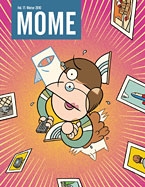
I first became aware of Trondheim’s subtly enchanting vignettes in Fantagraphics’ Mome comics anthologies, and it’s a sheer delight to see his cartoon philosophy gathered into such handy tomes for constant re-reading. This is probably the most pleasing graphic novel I’ve reviewed this year, and I’m off now to get the previous two volumes.

I strongly suggest that if you need a little non-theological, un-theosophical spiritual refreshment you do the same…

© 2010 Trondheim. English translation © 2010 NBM. All Rights Reserved.

Captain Britain: the Siege of Camelot


By various (Marvel/Panini UK)
ISBN: 978-1-84653-433-1

This fourth wonderful volume collecting the complete adventures of Marvel’s Greatest British super-hero gathers together the remaining black and white episodes of The Black Knight strip from Hulk Comic (# 42-55 and 57-63, 1979) in which Captain Britain co-starred, before going on to his peripatetic wanderings through a number of UK titles beginning with Marvel Super Heroes #377-389 and continuing in The Daredevils #1-11. Eventually he got his own second short-lived title, but that’s a bunch of tales for another time and hopefully a future graphic novel review…

The Lion of Albion was in character limbo until March 1979, when a new British weekly, Hulk Comic, launched with an eclectic, if not eccentric, mix of Marvel reprints the editors felt better suited the British market. There were some all-new strips featuring Marvel characters tailored, like the reprints, to appeal to UK kids.

The Hulk was there because of his TV show, Nick Fury (drawn by the incredibly young Steve Dillon) – because Brits love their spies, and the all-original period pulp thriller Night Raven by David Lloyd, John Bolton and Steve Parkhouse. Hidden deep within and almost trying not to be noticed was The Black Knight.

The Knight was a sometime member of the super-team The Mighty Avengers but in this engrossing epic, costumed shenanigans were replaced by a classical fantasy quest which began in modern Britain but soon evolved into a desperate search through the Tolkien-esque (or perhaps Alan Garner derived) myth-scape of legendary England in a last ditch attempt to save the soul of the land by locating the spirit of our Arthurian/Celtic roots. At that time the addled wits and broken soul of Captain Britain would also be restored…

This comprehensive volume continues and concludes the quest with the discovery of Camelot, the rebirth of the legendary King (originally seen in issues #42-55 and #57 through 63 at which time Hulk Comic folded) and a cataclysmic last battle with the forces of evil. These two and three page episodes are a truly classy act executed with great panache by writer Steve Parkhouse and John Stokes (with occasional penciling from the multi-talented Paul Neary) which captured the imagination of the readership, becoming the longest-running original strip in the comic (even The Hulk itself reverted to reprints by #28) and often stole the cover spot from the lead feature.

After a brief informative afterword and some impressive colour covers – including a pin-up of Captains Britain and America by Jack Kirby – the drama resumes with the return of Captain Britain, revamped and redesigned by Editor/plotter Neary and a new creative team; neophytes writer Dave Thorpe and artist Alan Davis for the monthly reprint anthology Marvel Super-Heroes (#377, September 1981).

Lost in the gaps between alternate worlds the hero and his elf sidekick Jackdaw are drawn back to Earth but upon arrival they discover it is a hideous parody of Britain, bleak, distressed, hopeless and depressed – a potent analogue of the country Margaret Thatcher was then dismantling. Thorpe’s desire to inject some subversive social realism into the feature – and the resistance he endured – is documented in his commentary in this volume but suffice to say that although the analogies and allegories are there to be seen, pressure was exerted to keep the strip as escapist as possible, and avoid any controversy…

That’s not to say that the awkward-but-improving-with-every-page tales weren’t a dynamic, entertaining breath of fresh air, with striking superhero art delivering a far more British flavour of adventure. In short order the confused Captain met anarchic bandits The Crazy Gang, reality-warping mutant Mad Jim Jaspers, British Nazis and a truly distressed population in ‘Outcasts’ (MSH #378), an animated rubbish monster (‘The Junkheap that Walked Like a Man’ (#379), and was introduced to the pan-Reality colossus The Dimensional Development Court and its sultry, ruthless operative Opal Luna Saturnyne, who intended to compulsorily evolve the whole dimension, beginning with ‘In Support of Darwin!’, ‘Re-Birth!’, ‘Against the Realm’ and ‘Faces of Britain!’ #380-383).

‘Friends and Neighbours’ is a pretty-looking and thoroughly de-clawed examination of sectarianism and racism (see Thorpe’s commentary for clarification) which was followed in #385 by an “untold tale” by Neary and Davis. To get the saga back on track this diversion related an event that occurred in Limbo – the ‘Attack of the Binary Beings!’

Now deeply involved in Saturnyne’s plan to make humanity evolve (just like forcing Rhubarb) Captain Britain was trapped in a clash between the underclasses and the government in Thorpe’s last story ‘If the Push Should Fail?’ which heralded the beginning of Alan Moore’s landmark tenure on the character.

Marvel Super-Heroes #387 is the first of the full-colour tales in this volume (presumably thanks to the frequent reprinting of these stories in America), and instantly kicks the series into high gear with ‘A Crooked World’ as the dying dimension unleashes its greatest weapon: a relentless, unstoppable artificial killer called the Fury.

Killing Jackdaw, reintroducing Jim Jaspers and setting the scene for a monolithic epic in ‘Graveyard Shift’ by vaporising Captain Britain, the series then folded.

After a brief text interlude from Mr. Moore (from Marvel Super-Heroes #389) the saga started again in a new home, as the lead feature in The Daredevils #1, with a revelatory new origin ‘A Rag, a Bone, a Hank of Hair…’ and a rebuilt hero returned to his own Earth just in time to see that world assaulted by another reality-warping Jim Jaspers intent on destroying all superbeings in ‘An Englishman’s Home…’

In issue #3 Brian Braddock’s sister Betsy reappeared in ‘Thicker than Water’ a purple-haired telepath being hunted by an assassin destroying all the old esper-agents recruited by British covert agency S.T.R.I.K.E – and yes she is the girl who became Psylocke of the X-Men. The battle against the killer Slaymaster concluded in a spectacular in-joke clash among the shelves of the Denmark Street Forbidden Planet – in 1982 arguably the country’s best fantasy store – so any old fans might want to try identifying the real staff members who “guest-star” – in ‘Killing Ground.’

Keen on creating a cohesive Marvel UK universe the Alan’s brought back another creation for their next tale. The Special Executive was a team of time-travelling mercenaries introduced in Dr. Who Monthly #51 (April, 1981), and in ‘Target: Captain Britain – Recommendation: Executive Action’ saw the legion of super-weirdoes dispatched to Braddock Manor to forcibly bring the hero as a witness in the trial of Saturnyne by the Supreme Omniversal Tribune in ‘Judgement Day’.

Meeting a number of alternate selves such as Captains Albion and England was disturbing enough but the trial was a sham, merely rubber-stamping the accession of Saturnyne’s successor Mandragon. His first act was to destroy the tainted universe that failed to evolve in The Push. Unfortunately for everybody the Fury survived, falling into another universe where it began again to eradicate all heroes…

Issue #7 ‘Rough Justice’ found Britain and the Special Executive in the middle of a pan-dimensional brawl to save Saturnyne whilst back on (his own) Earth, a woman was plagued by dreams of the Fury and Jaspers. In ‘Rivals’ the defenders finally escape back home to find the woman – Captain UK of the recently destroyed alternate universe – waiting with a warning and a prediction…

The Daredevils #9, ‘Waiting for the End of the World’ begins the final story-arc in this volume (and starts a plot picked-up by Chris Claremont for about ten years worth of X-Men and Excalibur storylines), a fascinating compelling war against an invincible, implacable foe, which was truly shocking at the time and still carries a potent emotional punch now, as cast-members and fan-favourites were slaughtered in the Fury’s unstoppable onslaught.

‘The Sound and the Fury’ continues the murderous mayhem before a surprise hero saves the day in the epic ‘But They Never Really Die’ to perfectly wrap up the story just in time for the Captain and his surviving crew to return in his own comic.

With the inclusion of some insightful and elucidating text pieces and plenty of cover reproductions this fourth volume of the chronicles of Captain Britain sees the character finally reach the heights of his potential. Here is not only a wonderful nostalgic collection for old-timers and dedicated fans but also a book full of the best that comics can offer in terms of artistry, imagination and gripping creative energy.

Some of the very best material produced by Marvel, this is a book every reader must have…

© 1979, 1980, 1981, 1982, 1983, 2009 Marvel Entertainment, Inc. and its subsidiaries, licensed by Marvel Characters, Inc. All Rights Reserved. (A British edition from PANINI UK LTD)