
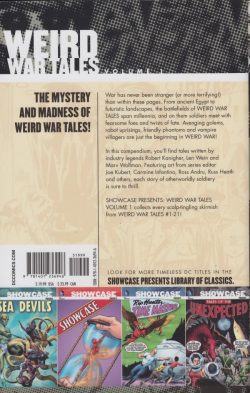
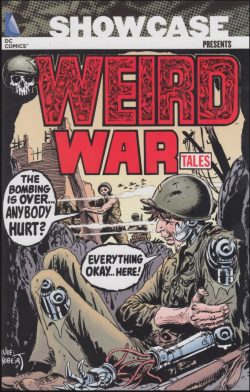
Showcase Presents Weird War Tales volume 1


By Robert Kanigher, Bob Haney, Bill Finger, Sheldon Mayer, Jack Oleck, Len Wein, Marv Wolfman, Joe Kubert, Carmine Infantino, Dennis O’Neil, Russ Heath, Mort Drucker, Frank Thorne, Alex Toth, Reed Crandall, Sam Glanzman, John Severin, Howard Chaykin, Ed Davis, Frank Robbins, Nestor Redondo, George Evans, Alex Niño, Russ Heath, Neal Adams & various (DC Comics)
ISBN: 978-1-4012-3694-6 (TPB)

This book includes Discriminatory Content produced in less enlightened times.

American comics just idled along rather slowly until the invention of Superman provided a flamboyant new genre for heroes and subsequently unleashed a torrent of creative imitation and imaginative generation for a suddenly thriving, voracious new entertainment model.

Implacably vested in World War II, these gaudily-attired mystery men swept all before them until the troops came home, but as the decade closed more traditional themes and heroes began to resurface and eventually supplant the Fights ‘n’ Tights crowd.

As a new generation of kids started buying and collecting, many of the first fans who retained their four-colour habit increasingly sought more mature themes in their pictorial reading matter. The war years and post-war paranoia had irrevocably altered the psychological landscape of the readership and as a more world-weary, cynical young public came to see that all the fighting and dying hadn’t really changed anything. Their chosen forms of entertainment (film, theatre and prose as well as comics) increasingly reflected this.

To balance the return of Western, War, Crime and imminent Atomic Armageddon-fuelled Science Fiction, comics created new genres. Celebrity tie-ins, madcap escapist or teen-oriented comedy and anthropomorphic funny animal features sprang up, but gradually another of the cyclical revivals of spiritualism and a public fascination with the arcane led to a wave of impressive, evocative and shockingly addictive horror comics. There had been grisly, gory and supernatural stars before, including a pantheon of ghosts, monsters and wizards draped in superhero trappings but these had usually been victims of circumstance: The Unknown as a power source for super-heroics. Now focus shifted to ordinary mortals thrown into a world beyond their ken with the intention of unsettling, not vicariously empowering the reader.

If we’re keeping score this was also the period in which Joe Simon & Jack Kirby identified another “mature market” gap and filled it by inventing romance comics (Young Romance #1, September 1947) and they too saw the sales potential for spooky material, resulting in the seminal Black Magic (1950) and boldly obscure psychological drama anthology Strange World of Your Dreams (1952). The company which would become DC Comics bowed to the inevitable and launched a comparatively strait-laced anthology that nevertheless became one of their longest-running and most influential titles with The House of Mystery (cover-dated December 1951/January 1952).

After the hysterical censorship debate which led to witch-hunting Senate hearings in the early 1950s was curtailed by the industry adopting a castrating straitjacket of self-regulation, titles produced under the aegis of the Comics Code Authority were sanitised, anodyne affairs in terms of Shock and Gore, but the audience’s appetite for suspense was still high and in 1956 National introduced sister titles Tales of the Unexpected and House of Secrets. Stories were dialled back from uncanny spooky yarns to marvellously illustrated, rationalistic fantasy-adventure vehicles and – eventually – straight monster-busting Sci Fi tales which dominated the market into the 1960s. That’s when superheroes – which had gradually enjoyed their own visionary revival after Julius Schwartz reintroduced The Flash in Showcase #4 – finally overtook them.

Green Lantern, Hawkman, The Atom and a rapidly-expanding coterie of costumed cavorters generated a gaudy global bubble of masked mavens which forced previously staunchly uncompromising anthology suspense titles to become super-character books. When caped crusader craziness peaked and popped, superheroes began dropping like Kryptonite-gassed flies. However, nothing combats censorship better than falling profits and, at the end of the 1960s with the cape-and-cowl boom over and some of the industry’s most prestigious series circling the drain, the surviving publishers of the field agreed to revise the Comics Code, loosening their self-imposed restraints against crime and horror comics.

Nobody much cared about gangster titles but, as the liberalisation coincided with yet another bump in public interest concerning supernatural themes, the resurrection of scary stories was a foregone conclusion and obvious no-brainer.

Thus, with absolutely no fanfare at all, horror comics came back and quickly dominated the US market for more than half a decade. DC led the pack: converting House of Mystery and Tales of the Unexpected into supernatural suspense anthologies in 1968 and resurrecting House of Secrets a year later.

Such was not the case with war comics. Tales of ordinary guys in combat began with the industry itself and although mostly sidelined during the capes-&-cowls war years, quickly re-asserted themselves once the actual fighting stopped. National/DC were one of the last publishers to get in on the combat act, converting superhero/fantasy adventure anthology Star Spangled Comics into Star Spangled War Stories the same month it launched Our Army at War (both cover-dated August 1952). They repurposed All-American Comics into All-American Men of War a month later as a “police action” in Korea escalated.

DC grew the division slowly but steadily, launching Our Fighting Forces (#1, November 1954) – just as EC’s groundbreaking combat comics were vanishing – and in 1957 added GI Combat to their portfolio when Quality Comics got out of the funnybook business.

As the 1950s closed however, the two-fisted anthologies all began incorporating recurring characters such as Gunner and Sarge – and latterly Pooch – from Our Fighting Forces #45 on, (May 1959); Sgt Rock (Our Army at War #83 (June 1959) and The Haunted Tank (G.I. Combat #87, April/May 1961). Soon all DC war titles had a lead star or feature to hold the fickle readers’ attention. The drive to produce superior material never wavered however, hugely aided by the diligent and meticulous ministrations of writer/editor Robert Kanigher.

In America after the demise of EC Comics in the mid-1950’s and prior to the game-changing Blazing Combat, the only certain place to find controversial, challenging and entertaining American war comics was DC. In fact, even whilst Archie Goodwin’s stunning but tragically mis-marketed quartet of classics were waking up a new generation of readers in the 1960s, the home of Superman, Batman and Wonder Woman was a veritable cornucopia of gritty, intriguing, beautifully limned battle tales presenting armed combat on a variety of fronts and from many differing points of view.

Whilst the Vietnam War escalated, 1960s America increasingly endured a Homefront death-struggle pitting deeply-ingrained Establishment social attitudes against a youth-oriented generation with a radical new sensibility. In response, military-themed comic books from National Periodical Publishing, as it then was, became even more bold and innovative.

However, the sudden downturn in superheroes led to some serious rethinking, and although the war titles maintained and even built sales, they also beefed up the anthological elements.

Thus in 1971 a title combining supernatural horror stories with bombastic battle yarns in an anthological setting seemed a forgone conclusion and sure thing to both publishers and readers alike…

This epic monochrome tome collects the contents of Weird War Stories #1-21 (cover-dates September/October 1971 to January 1974), offering a broad blend of genre mash-ups for readers with a taste for the dark and uncanny to relish. The series launched in a 52-page format combining new material with modified reprints featuring a veritable Who’s Who of top flight creative talent – both seasoned veterans and stars in waiting.

WWS #1 saw Editor Joe Kubert writing and illustrating an eerie linking strand entitled ‘Let Me Tell You of the Things I’ve Seen’, wherein a lost GI meets the personification of Death (the title’s long-term narrator in various blood-stained uniforms) who has a few foxhole stories to share…

The Reaper begins with ‘Fort Which Did Not Return!’ (by Kanigher & Russ Heath, as first seen in GI Combat #86), detailing how a bomber continues its mission even after the crew bail out, following up with all-new ‘The Story behind the Cover’ wherein Kubert reveals how a shunned German soldier carried on his duties after death…

From Star Spangled War Stories #71 (July 1958) Bob Haney & Kubert disclosed ‘The End of the Sea Wolf!’, as a sadistic U-Boat captain is sunk by one of his own earlier victims, whilst SSWS #116 (August/September 1964) originally debuted France Herron & Irv Novick’s ‘Baker’s Dozen’, with a fresh-faced replacement to a super-superstitious platoon battling to prove he’s not their unlucky thirteenth man…

The issue ends with that lost GI realising just who has been telling tales in Kubert’s ‘You Must Go!’

The reprints in these early issues were all taken from a time when supernatural themes were proscribed by the Comics Code Authority, but even so they all held fast to an eerie aura of sinister uncertainty… the merest hint of the strange and uncanny to leaven the usual blood and thunder of battle books. In Weird War Tales #2, Kubert reprised his bridging vehicle as ‘Look… and Listen…’ sees a crashed Stuka pilot meeting a ghastly stranger at a battle-torn desert oasis before ‘Reef of No Return’ (Haney & Mort Drucker from Our Fighting Forces #43, March 1959) details a determined frogman’s most dangerous mission in advance of Kanigher & Frank Thorne’s new WWI silent saga ‘The Moon is the Murderer’ proving that overwhelming firepower isn’t everything…

Kubert’s ‘Behind the Cover’ features a prophetic dream and terrifying telegram, and ‘A Promise to Joe!’ (Kanigher & Novick, G.I. Combat #97 (December 1962-January 1963) sees a dead gunner seemingly save his friend from beyond the grave, after which the superb ‘Monsieur Gravedigger’ – by Jerry DeFuccio & legendary Reed Crandall – follows the follies of a sadistic Foreign Legionnaire who pushes his comrades too far. Cartoonist John Costanza delivers gag-packed ‘Military Madness’ and Kubert & Sam Glanzman offer a fact-packed ‘Sgt. Rock’s Battle Stations’ about ‘The Grenadier’ before Bill Finger, Ross Andru & Mike Esposito examine a young recruit’s rite of passage and development of ‘The Face of a Fighter’ (Our Fighting Forces #25, September 1957) before ‘Oasis’ concludes the sorry saga of that downed Aryan airman.

American Naval Aviators ditching at sea were the unwilling audience for Death’s stories as WWT #3 opens with Kubert’s ‘Listen…’ The roster starts with ‘Been Here Before!’ (Finger, Andru & Esposito, G.I. Combat #44 January 1957) as a soldier under fire turns his mind back to boyhood games to save the day, after which we see an aerial battle and parachute drop from the perspective of ‘The Cloud That Went to War!’ (Our Fighting Forces #17, January 1957) courtesy of Dave Wood, Andru & Esposito.

More Costanza comedy from ‘The Kreepy Korps!’ precedes an early tale by Len Wein & Marv Wolfman, ably illustrated by Heath as both cave tribes and modern soldiers battle to possess ‘The Pool’, before the artist’s earlier collaboration with Bob Haney reveals how ‘Combat Size!’ is all a matter of mental attitude in a tale from Our Army at War #66 (January 1958). After Glanzman’s ‘Battle Album’ explains ‘Flying Guns’, a finny friend helps a US submarine sink an aircraft carrier in Finger & Drucker’s ‘Pilot for a Sub!’ (OAaW #68, March 1958) and the issue ends as Kubert sends a ‘Lifeboat’ for those tragic aviators…

The fourth issue opens with Kubert’s final linking tale as a ‘Gypsy Girl’ and her family find wounded soldier Tony after his buddy runs off to get a medic. They kindly offer to pass the time with him, sharing stories like ‘Ghost Ship of Two Wars’ (Kanigher & Novick, All-American Men of War #81, September 1960) wherein an obsessed WWI pilot seemingly slips into 1944 while pursuing his unbeatable archenemy the Black Ace.

Kanigher & Gene Colan’s ‘Time Warp’ originally appeared as ‘The Dinosaur Who Ate Torpedoes!’ in SSWS #123 (October/November 1965 and part of the uniquely bizarre War That Time Forgot series), pitting US frogmen against colossal sea-going saurians, after which ‘The Unknown Sentinel’ (by author unknown & Mort Meskin from House of Mystery #55, October 1956) saves the lives of two soldiers lost on manoeuvres on America’s most famous battlefield.

Glanzman then offers one of his magnificently engaging autobiographical USS Stevens vignettes with all-new, elegiac ‘Prelude’ before Kubert wraps up his chilling drama as ‘I Know Them to be True’ sees medics arriving to find Tony a much-changed man, leaving Costanza to close things down with a laugh and some ‘Military Madness’.

Weird War Tales #5 opens with Haney & Alex Toth providing a book-end tale of ‘The Prisoner’ held by Nazis in Italy. Seeking a way out, he recalls tales of escape such as ‘The Toy Jet!’ (Haney & Heath, All-American Men of War#78, March/April 1960): a chilling psychological thriller about an interned pilot in North Korea. It’s followed by ‘Human Trigger’ (Herron, Andru & Esposito, Star Spangled War Stories #18, February 1954) which shows how a soldier lying on a mine deftly saves his own life…

Herron & Carmine Infantino then reveal how an US spy is forced to ‘Face a Firing Squad!’ (SSWS #14, November 1953) and Norman Maurer instructs with the history of ‘Medal of Honour: Corporal Gerry Kisters’ before Willi Franz & Heath detail the victory of a ‘Slave’ in Roman times and Haney & Toth offer final release in ‘This Is It!’

Issue #6 saw Weird War cut to a standard 36-page package and take a step into tomorrow with Haney & Toth’s battlefield test of ‘Robots’. Wolfman & Frank Thorne expanded the theme in ‘Pawns’ as humans and mechanoids finally decide who works for whom whilst ‘Goliath of the Western Front!’ (Herron, Andru & Esposito, SSWS #93 – October/November 1960) features a giant mechanical Nazi and American David who finally does for him, before Haney & Toth settle all debate with the conclusive ‘Robot Fightin’ Men’

Wolfman & Kubert provide thematic bookends for #7, beginning with ‘Out of Action’ and wounded GIs awaiting the worst by trading tales like William Woolfolk, Jerry Grandenetti & Joe Giella’s ‘Flying Blind’ (OAaW #12, July 1953) wherein a wounded pilot must trust someone else for the first time in his life if he wants to land his burning jet. Kanigher & Kubert’s ‘The 50-50 War!’ (A-AMW #41, January 1957) finds sporting rivals forced to help each other after both suffer injuries on an alpine mission, with Costanza adding more welcome levity through his ‘Military Hall of Fame’. ‘The Three GIs’ (Finger & Heath, SSWS #62, October 1957) riffs smartly on those monkeys who respectively can’t see, hear and speak and the Purple Heart yarns end with Wolfman & Kubert’s chilling ‘I Can’t See’

From WWT #8, editorial control switched to the Mystery division under Joe Orlando and with that reprints were shelved in favour of original material as publication frequency graduated from six times a year to monthly. This all-German-focused issue begins with a gruesome ‘Guide to No-Man’s Land’ (probably written by assistant editor E. Nelson Bridwell and illustrated by Tony DeZuñiga) before moving on to ‘The Avenging Grave’ (Kanigher & DeZuñiga) with SS officers learning too late the folly of desecrating the dead of WWI. Anonymously scripted ‘Thou Shalt Not Kill!’– with art by Steve Harper & Neal Adams – sees more gloating Nazis facing a vengeful golem. Kanigher & DeZuñiga return to reveal the fate of an arrogant 1916 air ace in the skies over No-Man’s Land in ‘Duel of the Dead’ before the artist’s ‘Epilogue’ wraps things up, whilst Weird War Tales #9 invites us to ‘Enter the Portals of War’ in an introduction drawn by Howard Chaykin, swiftly followed by a trio of Kanigher yarns illustrated by the cream of DC’s Filipino artists.

‘The Promise’ was limned by Alfredo P. Alcala, telling a tale in two eras as both Teutonic knights in 1242 and German tankers seven centuries later fail to cross frozen Lake Chud, whilst Gerry Talaoc renders the disastrous end of deathly, determined ‘Blood Brothers!’ during the American Civil War, and incomparable Alex Niño details ‘The Last Battle’ between East and West before Chaykin pops back to declare ‘Death, the Ultimate Winner’.

Sheldon Mayer & Toth open WWT #10 with a deliciously whimsical ghostly love story in ‘Who is Haunting the Haunted Chateau?’ before Raymond Marais & Quico Redondo change the tone as a Death-Camp commandant returns after the war to salvage ill-gotten gains from ‘The Room that Remembered’, whilst Wein & Walter Simonson – in the artist’s pro comics debut – reveal why invading Nazis shouldn’t abuse the town idiot, incurring the wrath of ‘Cyrano’s Army’

Always experimental, the creative team of Mayer, DeZuñiga, Alcala, Talaoc & Niño tried their hand at a time-twisting complete adventure for #11. Occurring on ‘October 30? over 99 years beginning in 1918, the tale compares the progress of an ambitious German General granted a wish for glory by a treacherous spirit of war, with three ghostly Americans determined to fix a long-standing mistake whatever the cost…

DeZuñiga draws the introduction to #12, featuring tales of ‘Egypt’ starting with Kanigher & Talaoc’s tale of an ancient warlord who learned to regret spitting on the ‘God of Vengeance’, whilst ‘Hand of Hell’ (Kanigher & DeZuñiga) sees Anubis similarly deal with one of Rommel’s least reputable, most sadistic deputies. Arnold Drake & Don Perlin then switch locales to Roman Britain where a centurion takes an accidental time-trip and ultimately overthrows the Druids in ‘The Warrior and the Witch-Doctors!’

Weird War Tales #13 opens with Oleck & Nestor Redondo’s ‘The Die-Hards’, with Nazis realising there are even worse killers than they haunting their latest conquered village, before Drake & Niño determine that ‘Old Samurai Never Die’ when a would-be shogun offends the patron spirit of Bushido. ‘Loser’s Luck’ – by Michael J. Pellowski, George Kashdan & DeZuñiga – details harsh choices facing the unfortunate winners of the next, last war…

Mayer, DeZuñiga & Alcala reunite in #14 to tell an eerie tale of doomed love and military injustice from the days before Pearl Harbor which begins with a ‘Dream of Disaster’, incorporates a deadly flight with a ‘Phantom for a Co-Pilot’ and marines who arrive ‘Too Late for the Death March!’ before finally meeting ‘The Ghost of McBride’s Woman’ and vindicating an unsung hero…

A little lad enamoured of war’s glory learns a lesson in WWT #15 when his dead grandfather takes him back to WWI to see how ‘…Ace King Just Flew in from Hell’ (Drake & Perlin) before Oleck & Talaoc reveal the doom of ‘The Survivor’ of a Viking raid which offends a sorceress, and Oleck & Alcala detail the shocking fate of a fanatical crusader who succumbs to ‘The Ultimate Weapon’ of a Saracen wise man. Drake & Alcala describe transplant science gone mad in #16’s ‘More Dead than Alive!’, whilst the first of a Niño double bill sees him delineate Oleck’s ‘The Conquerors’ who eradicate humanity – but not the things that predate on them – whilst Drake’s ‘Evil Eye’ sees a little boy inflict hell’s wrath on both Allies and Axis alike…

In #17, Kanigher & George Evans disclose how a dishonourable French Air Ace is punished by ‘Dead Man’s Hands’ before Pellowski, E. Nelson Bridwell & Ernie Chan reveal how a murdered soldier is avenged by ‘A Gun Named Marie!’ WWT #18 has Drake & DeZuñiga sketch the brief career of ‘Captain Dracula!’ as he marauds through (mostly) German forces in Sicily before Mayer & Talaoc return for the cautionary tale of a greedy German sergeant in France whose avarice makes him easy prey for the ‘Whim of a Phantom!’

Drake & Talaoc start #19 with the full-length story of an agent who infiltrates the Nazi terror weapon known as ‘The Platoon That Wouldn’t Die!’, and #20 reverts to short stories with Oleck & Perlin’s ‘Death Watch’ of a doomed coward who should have waited one more day before deserting, before Drake & Alcala’s period saga of a witchcraft vendetta ‘Operation: Voodoo!’ and their Battle of Britain chiller wherein a burned-out fighter pilot learns ‘Death is a Green Man’.

This blockbusting blend of military mayhem, magical melee and martial madness concludes with Weird War Tales #21 and ‘One Hour to Kill!’ by Drake & Frank Robbins, wherein an American soldier is ordered to go back in time to assassinate Leonardo Da Vinci and prevent the invention of automatic weapons. Mayer & Bernard Baily then detail just how a foul-up GI becomes an unstoppable hero ‘When Death Took a Hand’

Classily chilling, emotionally intense, superbly illustrated, insanely addictive and Just Plain Fun, this is a deliciously guilty pleasure that will astound and delight any lover of fantasy fiction and comics that work on plot invention rather than character compulsion.
© 1971, 1972, 1973, 2012 DC Comics. All Rights Reserved.

Today in 1937 Herman creator Jim Unger was born, whilst in 1967, pioneering Golden Age artist Homer Fleming (Craig Kennedy, The Whip, Chuck Dawson, Captain Jim of the Texas Rangers, Classics Illustrated) died.

Also in 1967, British weeklies Pow! and Mandy both launched, as did tabloid treasure The Beezer way back in 1956 today.

New Crusaders Legacy


By Rich Buckler, Ian Flynn, Robert Kanigher, Marty Griem, Lou Manna, Rex Lindsey, Stan Timmons, Bill DuBay, Jr., Rich Margopoulos, David M. Singer, Alex Toth, Carmine Infantino, Steve Ditko, Dick Ayers, Gray Morrow, Alec Niño, Tony DeZuñiga, Louis Barreto, Adrian Gonzales, Ricardo Villagran, Frank Giacoia, Alan Kupperberg, Jerry Gaylord, Ben Bates, Alitha Martinez & many more (Red Circle/Archie Comics)
ISBN: 978-1-936975-22-8 (TPB/Digital edition)

This book includes Discriminatory Content produced in less enlightened times.

In the dawning days of the comic book business, just after Superman and Batman pioneered a new genre of storytelling, many publishers jumped onto the bandwagon and made their own bids for cash and glory. Many thrived and many more didn’t; now relished only as trivia by sad old blokes like me. Some few made it to an amorphous middle-ground: not forgotten, but certainly not household names either.

MLJ were one of the quickest publishers to jump on the Mystery-Man bandwagon, following the spectacular successes of the Man of Tomorrow with their own small yet inspirational pantheon of gaudily clad costumed crusaders, beginning in November 1939 with Blue Ribbon Comics. Soon followed by Top-Notch and Pep Comics, their content was the standard blend of two-fisted adventure strips, prose pieces and gag panels and, from #2 on, superheroes. However, after only a few years Maurice Coyne, Louis Silberkleit and John Goldwater spotted a gap in the blossoming market and in December 1941 nudged aside their masked heroes and action strips to make room for a far less imposing hero; an “average teen” who would have ordinary adventures like the readers, but with triumphs, romance and slapstick emphasised. The teen phenomenon was pure gold and by 1946 the kids had taken over, so MLJ renamed itself Archie Comics; retiring its heroic characters years before the end of the Golden Age and becoming, to all intents and purposes, a publisher of family comedies. Its success, like Superman’s, changed the content of every other publisher’s titles, and led to a multi-media industry including TV shows, movies, a chain of restaurants and even a global pop hit Sugar, Sugar (a tune from their animated show).

By this stage the company had blazed through an impressive pantheon of mystery-men who would form the backbone of numerous future superhero revivals, most notably in the High-Camp/Marvel Explosion/Batman TV show-frenzied mid-60’s era. The heroes impressively resurfaced under the company’s Red Circle imprint during the early days of the Direct Sales revolution of the 1980s, but after a strong initial showing, again failed to sustain the public’s attention.

Archie let them lie fallow (except for occasional revivals and intermittent guest-shots in Archie titles) until 1991, when the company licensed its heroes to superhero specialists DC for a magically fun, all-ages iteration (and where’s that star-studded trade paperback collection, huh?!). Impact Comics was a vibrant, engaging and fun all-ages rethink that really should have been a huge hit but was again cruelly unsuccessful. When the line folded in 1993 the characters returned to limbo. DC had one more crack at them in 2008, incorporating The Mighty Crusaders & Co into their own maturely angst-ridden and stridently dark continuity – with the usual overwhelming lack of success.

Over the last decade the wanderers returned home to Archie in superbly simplistic and winningly straightforward revivals aimed squarely at old nostalgics and young kids reared on action/adventure TV cartoons: brimming with all the exuberant verve and wide-eyed honest ingenuity you’d expect from an outfit which has been pleasing kids for over 80 years.

Released initially online in May 2012 – followed by a traditional monthly print version that September – the first story-arc made it to full legitimacy with a thrill-packed trade paperback collection, equally welcoming to inveterate fanboys and eager newcomers alike. The series introduced a new generation of legacy heroes rising from the ashes of their parents/guardians’ murders to become a team of teenaged gladiators carrying on the fight as New Crusaders.

This collection supplements and follows on from that magical makeover: with mentor The Shield training the potential-filled juniors with the records of their predecessors. The stories included here come from those aforementioned 1980s Red Circle episodes; culled from the

Mighty Crusaders #1, 8, 9; The Fly #2, 4, 6; Blue Ribbon (vol 2) #3, 8, 14; The Comet #1 and Black Hood #2, collectively spanning 1983-1985.

Following an engaging reintroduction and recap, contemporary creative team Ian Flynn, Jerry Gaylord, Ben Bates & Alitha Martinez reveal how the grizzled, flag-draped veteran has trouble reaching his teenaged students until he begins treating them as individuals, and sharing past Crusaders’ cases. Starting with personal recollections of his own early days as America’s first Patriotic superhero in ‘The Shield’ (Mighty Crusaders #8, by Marty Greim, Dick Ayers & Rich Buckler), Joe Higgins explains his active presence in the 21st century, leading into a recapitulation of the first Red Circle yarn.

‘Atlantis Rising’ is from Mighty Crusaders #1, by Buckler & Frank Giacoia, which saw psionic plunderer Brain Emperor and immortal antediluvian Eterno the Conqueror launching a multi-pronged attack on the world. They are countered by an army of costumed champions including the Golden Age Shield, Lancelot Strongthe (other) Shield – and for a while there were three different ones active at once – Fly and Fly-Girl, The Jaguar, The Web, Black Hood and The Comet, who communally countered a global crimewave and clobbered the villains’ giant killer robots…

This is followed by a modern interlude plus pin-up and data pages on Ralph Hardy AKA ‘The Jaguar’ before a potent vignette by Chas Ward & Carlos Vicat. ‘The Web’ offers the same data-page update for masked detective/criminologist John Raymond before ‘The Killing Hour’ (Blue Ribbon #14, by Stan Timmons, Lou Manna, Rex Lindsey & Chic Stone) sees the merely mortal manhunter join his brother-in-law The Jaguar in foiling nuclear terrorism.

Modern pin-ups and data-pages reintroduce ‘The Comet’ before Bill DuBay, Jr., Carmine Infantino & Alec Niño reworked the original 1940’s origin tale by Jack Cole from Pep Comics #1 in (1940). Reproduced from 1984’s The Comet #1, this chilling yarn detailed how an idealistic scientist became the most bloodthirsty hero of the Golden Age, with a body-count which made The Punisher look like a social worker.

The infomercial for ‘Steel Sterling’ precedes a wild and whimsical origin-retelling of the star-struck, super-strong “Man of Steel” by his 1940s scripter Robert Kanigher, illustrated with superb style by Louis Barreto & Tony DeZuñiga from Blue Ribbon #3, after which ‘Fly Girl’ gets star treatment in a brace of tales, augmented as always by the ubiquitous fact-folio.

Buckler, Timmons, Adrian Gonzales & Ricardo Villagran’s ‘A Woman’s Place’ (The Fly #2) clears up an exceedingly sexist old-school extortion ring whilst ‘Faithfully Yours’ (Fly #6) sees her movie-star alter ego Kim Brand subjected to a chilling campaign of terror from a fan. Timmons, Buckler, Steve Ditko & Alan Kupperberg take just the right tone in what might be the first incidence of stalking in US comics…

‘Black Hood’ has no modern iteration in the New Crusaders. Still active in contemporary times, he encountered the kids during their debut exploit and is phenomenally cool, so he gets a place here. Following the customary introductory lesson he appears in a gritty, Dirty Harry styled caper (from Blue Ribbon #8 by Gray Morrow) as undercover cop – and latest convert – Kip Burland, who sidesteps Due Process to save a kidnapped girl and ensure the conviction of crooks hiding behind the law. The gripping yarn also discloses the centuries-long justice-seeking tradition of “The Man of Mystery”…

That’s followed by a snippet from Rich Margopoulos, Kupperberg & Giacoia’s ‘A Hero’s Rage’ wherein Kip discovers his uncle Matt (the Golden Age Black Hood) has been murdered. Ditching his leather jacket and ski-mask in favour of the traditional costume, the bereaved hero suits up and joins the Mighty Crusaders…

Without doubt the most engaging reprint in this collection and by itself well worth the price of admission is ‘The Fox’ from Black Hood #2. Written and drawn by the inimitable Alex Toth, this scintillating light-hearted period comedy-drama finds the devilish do-gooder in Morocco in 1948 and embroiled with wealthy expatriate ex-boxer Cosmo Gilly, who has no idea he’s become the target for assassination…

The recondite recollections surge to a climax with ‘Old Legends Never Die’ (MC#9, by David M. Singer, Buckler & Ayers) as the first Shield is accused of excessive force and manslaughter when his 1940’s crime-fighting style seemingly results in the death of a thief he apprehended. With Joe Higgins’ costumed friends in support but out of their depth in a courtroom, the convoluted history of the three heroes bearing his codename is unpicked during ‘The Trial of the Shield’ before the uncannily sinister truth is exposed…

Supplemented by a plentiful cover gallery and packed with the kind of ephemera that sends old Fights ‘n’ Tights fans into paroxysms of delight, I fear this is probably a book only the wide-eyed young and dedicated still ambulatory old fart nostalgists could handle, but it is such a perfect artefact of the superhero genre I strongly urge anyone with a hankering for masked adventure and craving Costumed Dramas to give it a long look.
NEW CRUSADERS and RED CIRCLE COMICS ® ACP, Inc. © 2013 Archie Comics Publications. All rights reserved.

Setting the Standard: Comics by Alex Toth 1952-1954


By Alex Toth, Mike Peppe & various, edited by Greg Sadowski (Fantagraphics Books)
ISBN: 978-1-60699-408-5 (TPB/Digital edition)

This book includes Discriminatory Content produced in less enlightened times.

Alex Toth was a master of graphic communication who shaped two different art-forms and is largely unknown in both of them. He died on this day in 2006.

Born in New York in 1928, the son of Hungarian immigrants with a dynamic interest in the arts, Toth was something of a prodigy. After enrolling in the High School of Industrial Arts he doggedly went about improving his skills as a cartoonist. His earliest dreams were of a strip like Milton Caniff’s Terry and the Pirates, but his uncompromising devotion to the highest standards soon soured him on newspaper strip work when he discovered how hidebound and innovation-resistant the family-values based industry had become whilst he was growing up.

Aged 15 he sold his first funnybook works to Heroic Comics and, after graduating in 1947, worked for All American/National Periodical Publications who would amalgamate and evolve into DC Comics. He pursued his craft on Dr. Mid-Nite, All Star Comics, The Atom, Green Lantern, Johnny Thunder, Sierra Smith, Johnny Peril, Danger Trail and a host of other features and on the way dabbled with newspaper strips (see Casey Ruggles: the Hard Times of Pancho and Pecos)… and found that nothing had changed…

Ceaselessly seeking to improve his own work, he never had time for fools or formula-hungry editors who wouldn’t take artistic risks. In 1952 Toth quit DC to work for Thrilling Pulps publisher Ned Pines who was retooling his prolific Better/Nedor/Pines nested comics companies (Thrilling Comics, Fighting Yank, Doc Strange, Black Terror and dozens more) into Standard Comics: a comics house targeting older readers looking for sophisticated, genre-based titles.

Beside fellow graphic masters Nick Cardy, Mike Sekowsky, Art Saaf, John Celardo, George Tuska, Ross Andru & Mike Esposito and particularly favourite inker Mike Peppe, Toth set the bar high for a new kind of story-telling: wry, restrained and thoroughly mature. This quiet revolution took place in a wave of short-lived titles dedicated to War, Crime, Horror, Science Fiction and especially Romance…

After Simon &Kirby invented love comics, Standard – through artists like Cardy and Toth and writers like the amazing and unsung Kim Aamodt – polished and honed the ubiquitous fare of the nascent comics category, delivering clever, witty, evocative and yet tasteful melodramas: heart-tuggers both men and women could enjoy.

Before going into the military, where he still found time to create a strip (Jon Fury for the US army’s Tokyo Quartermaster newspaper The Depot’s Diary), Toth illustrated 60 glorious tales for Standard; as well as a few rare pieces for EC and others. On his return – to a very different industry on the defensive against public antagonism, and one he didn’t much like – Toth split his time between Western/Dell/Gold Key (Zorro and many movie/TV adaptations) and National/DC (assorted short pieces, Hot Wheels and Eclipso): illustrating scripts he increasingly found uninspired, moribund and creatively cowardly. Soon, after drawing X-Men #12 (cover-dated May 1965) over Jack Kirby’s layouts, Toth moved primarily into TV animation. At Hanna-Barbera from 1964 on he designed and storyboarded for shows such as Jonny Quest, Space Ghost, Herculoids, Birdman, Shazzan!, Scooby-Doo, Where Are You?, Sealab 2020, Fantastic Four and Super Friends amongst many others.

He returned sporadically to comics, setting the style and tone for DC’s late 1960’s horror line in House of Mystery, House of Secrets and especially The Witching Hour, as well as illustrating more adult fare for Warren’s Creepy, Eerie and The Rook. In the early 1980s Toth redesigned The Fox for Red Circle/Archie, produced stunning one-offs for Archie Goodwin’s Batman and war comics (whenever they offered him a “good script”) and contributed to landmark or anniversary projects like Batman: Black and White.

His later, personal works included Torpedo (look for a fully updated review of the series here soon!) and the magnificently audacious Bravo for Adventure!

Alex Toth died of a heart attack at his drawing board on May 27th 2006.

After reprinting an extensive informative and almost exhaustive interview with the artist from Graphic Story Magazine – conducted by Vincent Davis, Richard Kyle and Bill Spicer in 1968 – this fabulous full colour chronicle then reprints every scrap of Toth’s superb Standard fare beginning with impressive melodrama in ‘My Stolen Kisses’ from Best Romance #5 (February 1952), after which light-hearted combat star Joe Yank nearly lost everything to ‘Black Market Mary’ in the debut issue of his own title (#5 March 1952).

Perhaps a word of explanation is warranted here: due to truly Byzantine commercial and promotional considerations, all Standard Comics premiered with issue #5, although the incredibly successful Romance comics were carried over from their earlier Better Comics incarnations such as New Romances #10 (March 1952) for which Toth illustrated the touching ‘Be Mine Alone’ and the parable of empty jealousy ‘My Empty Promise’ from #11.

The hilarious ‘Bacon and Bullets’ offered a different kind of love in Joe Yank #6 (May) – a very pretty pig named Clementine – after which witty 3-pager ‘Appointment with Love’ (Today’s Romance #6 May) provides a charming palate cleanser before the hard-bitten ‘Terror of the Tank Men’ from Battlefront #5 (June 1952) offers a more traditional view of the then-raging Korean War.

‘Shattered Dream!’ (My Real Love #5 June) is an ordinary romance well told whilst ‘The Blood Money of Galloping Chad Burgess’ (The Unseen #5 June 1952) reveals the sheer quality and maturity of Standard’s horror stories, with ‘The Shoremouth Horror’ (Out of the Shadows #5) from that same month proving Toth to be an absolute master of terror and genius at the pacing and staging needed to scare the pants off you in pictorial form…

‘Show Them How to Die’ (This is War #5 July) is a superbly gung-ho combat classic whilst the eerie ‘Murder Mansion’ and ‘The Phantom Hounds of Castle Eyne’ – both from the August cover-dated Adventures into Darkness #5 – again demonstrate the artist’s uncanny flair for building suspense. The single pager ‘Peg Powler’ (The Unseen #6 September) is reprinted beside the original artwork – which makes me wish the entire collection was available in black & white – after which the highly experimental ‘Five State Police Alarm’ (Crime Files #5) displays the artist’s amazing facility with duo-tone and craft-tint techniques before salutary saga ‘I Married in Haste’ (Intimate Love #19, September) offers a remarkably modern view of relationships.

Science Fiction was the metier of Fantastic Worlds #5 which provided both contemporary ‘Triumph over Terror’ and futuristic fable ‘The Invaders’ to finish off Toth’s September commissions after which ‘Routine Patrol’ and ‘Too Many Cooks’ offer two-fisted thrills from This is War #6 (October). ‘The Phantom Ship’ is a much reprinted classic chiller from Out of the Shadows #6, with October also releasing the extremely unsettling ‘Alice in Terrorland’ from Lost Worlds #5.

Toth only produced four covers for Standard, and the first two, Joe Yank #8 and Fantastic Worlds #6, precede ‘The Boy Who Saved the World’ from the latter (November 1952) after which service rivalry informed ‘The Egg-Beater’ from Jet Fighters #5. The cover of Lost Worlds #6 (December) perfectly introduces the featured ‘Outlaws of Space’, after which the single-page ‘Smart Talk’ (New Romance #14) perfectly closes the first year and sets up 1953 to open strongly with ‘Blinded by Love’ from Popular Romance #22 January) in which the classic love triangle has never looked better…

This was clearly Toth’s ideal year as ‘The Crushed Gardenia’ from Who is Next? #5 shows his incredible skills to their utmost in one of the best crime stories of all time. ‘Undecided Heart’ (Intimate Love #21 February) is a delightful comedy of errors whilst both ‘The House That Jackdaw Built’ and ‘The Twisted Hands’ from Adventures into Darkness #8 perfectly reveal the artist’s uncanny facility for building tension and anxiety. The cover to Joe Yank #10 is followed by splendid aviation yarn ‘Seeley’s Saucer’ from March’s Jet Fighters #7, whilst the clever and racy ‘Free My Heart’ (Popular Romance #23, April) adds new depth to the term “sophisticated” and ‘The Hands of Don José’ (Adventures into Darkness #9) is just plain nasty in the manner horror fans adore. ‘No Retreat’ (This is War #9 May) offers more patriotic combat, but ‘I Want Him Back’ (Intimate Love #22) depicts a far softer, more personal duel whilst ‘Geronimo Joe’ (Exciting War #8 May) proves that in combat there’s no room for rivalry…

Toth was rapidly reaching the acme of his design genius as ‘Man of My Heart’ (New Romances #16 June), ‘I Fooled My Heart’ (Popular Romance #24 July – and reprinted in full as original art in the notes section) and both ‘Stars in my Eyes’ and ‘Uncertain Heart’ from New Romances #17 (August) saw him develop a visual vocabulary to cleanly impart plot and characterisation simultaneously. He often stated he preferred these mature, well-written romance stories for the room they gave him to experiment and expand his craft, and these later efforts prove him right: especially in the moving ‘Heart Divided’ (Thrilling Romances #22) and compelling ‘I Need You’ (September’s Popular Romances #25).

‘The Corpse That Lived’ (Out of the Shadows #10) is a historically based tale of grave-robbing, whilst deeply moving ‘Chance for Happiness’ (Thrilling Romances #23 October) is as powerful today as it ever was. ‘My Dream is You!’ (New Romances #18) turned fresh eyes on the old dilemma of career vs husband and far darker love is depicted in ‘Grip on Life’ (The Unseen #12 November), before true love actually triumphs in ‘Guilty Heart’ (Popular Romance #26). Another ‘Smart Talk’ advice page ends 1953 (New Romances #19) and neatly precedes an edgy affair in ‘Ring on Her Finger’ (Thrilling Romances #24 January 1954), after which ‘Frankly Speaking’ from the same issue leads to terrifying period horror in ‘The Mask of Graffenwehr’ (Out of the Shadows #11).

February saw a fine crop of Toth tales, beginning with charming medical drama ‘Heartbreak Moon’ (Popular Romance #27), spooky mining mystery ‘The Hole of Hell’ (The Unseen #13), 1-page amorous advisory ‘Long on Love’ (Popular Romance #27), lesson in obsession ‘Lonesome for Kisses’ and two more advice pages – ‘If You’re New in Town’ and ‘Those Drug Store Romeos’ – from Intimate Love #26. These last stories were eked out in the months after Toth had left, having been drafted and posted to Japan. However, even though he had (presumably) rushed them out whilst preparing for the biggest change in his young life, there was no loss but a further jump in artistic quality.

One final relationship ‘Smart Talk’ page (New Romances #20 March 1954) precedes a brace of classic mystery masterpieces from Out of the Shadows #12: ‘The Man Who Was Always on Time’ (also reproduced in original art form in the copious ‘Notes’ section at the back of this monumental book) before the graphic wonderment regrettably concludes with the cynically spooky ‘Images of Sand’ – a sinister cautionary tale of tomb-robbing…

After all that, the last 28 pages of this compendium comprise a thorough and informative section of story annotations, illustrations and a wealth of original art reproductions to top off this sublime collection in ideal style.

Alex Toth was a tale-teller and a master of erudite refinement, his avowed mission to pare away every unnecessary line and element in life and in work. His dream was to make perfect graphic stories. He was eternally searching for how to best tell a story, to the exclusion of all else. This long-ignored but still utterly compelling collection shows how talent, imagination and dedication to that ideal can elevate even the most genre-bound vignette into a paragon of form and a mere comic into high art. Get this book, absorb it all and learn through wonder and delight.
All stories in this book are in the public domain but the specific restored images and design are © 2011 Fantagraphics Books. Notes are © 2011 Greg Sadowski and the Graphic Story Magazine interview is © 2011 Bill Spicer. All rights reserved.

Showcase Presents The House of Secrets volume 1


By Mike Friedrich, Gerry Conway, Marv Wolfman, Len Wein, Steve Skeates, Robert Kanigher, Raymond Marais, Sam Glanzman, Jack Kirby, Mark Evanier, Jack Oleck, Mary Skrenes (as Virgil North), Jerry Grandenetti, Bill Draut, Werner Roth, Jack Sparling, Dick Giordano, Dick Dillin, Neal Adams, Sid Greene, Alex Toth, Mike Royer, Mike Peppe, Don Heck, Wally Wood, Ralph Reese, John Costanza, Gil Kane, George Tuska, Gray Morrow, Ross Andru & Mike Esposito, Michael Wm. Kaluta, Rich Buckler, Bernie Wrightson, Al Weiss, Tony DeZuñiga, Jim Aparo, Sergio Aragonés, Nestor Redondo, José Delbo, Adolfo Buylla & various (DC Comics)
ISBN: 978-1-4012-1818-8 (TPB)

Win’s Christmas Gift Recommendation: A Splendid Slice of Spectral Shock & Awe… 9/10

This book includes Discriminatory Content produced in less enlightened times.

It’s the time for sweet indulgence, shocking over-eating and spooky stories, so let’s pay a visit to a much-neglected old favourite…

American comic books started slowly until the creation of superheroes unleashed a torrent of creative imitation and invented a new genre. Implacably vested in the Second World War, the Overman swept all before him (and very occasionally her or it) until the troops came home and the more traditional genres resurfaced and eventually supplanted the Fights ‘n’ Tights crowd. Although new kids kept on buying, much of the previous generation of consumers also retained their four-colour habit but increasingly sought older themes in the reading matter. The war years altered the psychological landscape of the world and as a more world-weary, cynical young public came to see that all the fighting and dying hadn’t really changed anything, their chosen forms of entertainment (film and prose as well as comics) reflected this.

As well as Westerns, War and Crime comics, celebrity tie-ins, madcap escapist comedy and anthropomorphic funny animal features were immediately resurgent, but gradually another of the cyclical revivals of spiritualism and public fascination with all things occult, eldritch and arcane led to them being outshone and outsold by a wave of increasingly impressive, evocative and shocking horror comics.

There had been grisly, gory and supernatural stars before, including a pantheon of ghosts, monsters and wizards draped in mystery-man garb and trappings (The Spectre, Mr. Justice, Sgt. Spook, Frankenstein, The Heap, Sargon the Sorcerer, Zatara, Monako, Zambini the Miracle Man, Kardak the Mystic, Dr. Fate and dozens more), but these had been victims of circumstance: The Unknown as a “narrativium” power source for super-heroics.

Now the focus shifted to ordinary mortals thrown into a world beyond their ken with the intention of unsettling, not vicariously empowering, the reader. Almost every publisher jumped on the increasingly popular bandwagon, with B & I (which became magical one-man-band Richard E. Hughes’ American Comics Group) launching the first regularly published horror comic in the Autumn of 1948. Technically though, Adventures Into the Unknown was actually pipped by Avon who had released an impressive single issue entitled Eerie in January 1947 before finally committing to a regular series in 1951.

By this time, and following the filmic horror heyday of Universal Pictures’ fright films franchises, worthy comic book monolith Classics Illustrated had already long milked the literary end of the medium with adaptations of The Headless Horseman, Dr. Jekyll and Mr. Hyde (both 1943), The Hunchback of Notre Dame (1944) and Frankenstein (1945) among others.

If we’re keeping score this was also the period in which Joe Simon & Jack Kirby identified another “mature market” gap by inventing the Romance comic (Young Romance #1, cover-dated September 1947) but they too saw the sales potential for macabre mood material, resulting in seminal anthologies Black Magic (launched in 1950) and boldly obscure psychological drama vehicle Strange World of Your Dreams (1952).

Around that time the staid cautious company that would become DC Comics bowed to the commercial inevitable and launched a comparatively straightlaced anthology that became one of their longest-running and most influential titles with the December 1951/January 1952 opening of The House of Mystery. When the hysterical censorship scandal which led to witch-hunting hearings was at its height, the mobs with pitchforks furore was adroitly curtailed by the industry adopting a castrating straitjacket of self-regulatory rules.

Horror titles produced under the aegis of the Comics Code Authority were sanitised, anodyne affairs in terms of Shock and Gore. However, since the appetite for suspenseful short stories was still high, in 1956 National introduced sister title House of Secrets which debuted with a November/December cover-date. Plots were dialled back into superbly illustrated, rationalistic, fantasy-adventure vehicles which would dominate the market until the 1960s when superheroes (which had begun sneaking back in 1956 after Julius Schwartz began the Silver Age of comics by reintroducing The Flash in Showcase #4), finally overtook them.

Green Lantern, Hawkman, The Atom and a slew of other costumed cavorters generated a gaudy global bubble of masked mavens which even forced the dedicated anthology suspense titles to transform into super-character split-books, with Martian Manhunter and Dial H for Hero monopolising House of Mystery whilst Mark Merlin – later Prince Ra-Man – sharing space with Eclipso in House of Secrets. When caped crusader craziness peaked and popped, Secrets was one of the first casualties, folding with #80, the September/October 1966 issue.

However, nothing combats censorship better than falling profits and by the end of the 1960s the Silver Age superhero boom was over, with many titles gone and some of the industry’s most prestigious series circling the drain…

This real-world Crisis prompted surviving publishers to loosen the self-imposed restraints against crime and horror comics. Nobody much cared about gangster titles at that juncture, but as the liberalisation coincided with another bump in public interest in all aspects of the Worlds Beyond, the resurrection of scary stories was a foregone conclusion and obvious no-brainer…

Even ultra-wholesome Archie Comics re-entered the field with a rather tasty line of Red Circle Chillers: a minor substrate they regularly return to with style and potency to this day.

Thus, with absolutely no fanfare at all, House of Secrets returned with issue #81 (August/ September 1969) just as big sister The House of Mystery had done a year previously. Under a bold banner declaiming “There’s No Escape From… The House of Secrets”, writer Mike Friedrich, Jerry Grandenetti & George Roussos introduced a ramshackle, sentient old pile in ‘Don’t Move It!’, after which Bill Draut limned the introduction of bumbling caretaker Abel (with a guest-shot by his murderous older brother Cain from HoM) in eponymous intro set-up fable ‘House of Secrets’. The portly porter then kicked off his storytelling career with Gerry Conway & Jack Sparling yarn ‘Aaron Philip’s Photo Finish!’ before the inaugural issue was put to bed with a Draut limned ‘Epilogue’

HoS #82 was a largely Conway scripted affair as Draut drew both Welcome to the House of Secrets’ and ‘Epilogue’, whilst cinema shocker ‘Realer Than Real’ was illustrated by Werner Roth & Vince Colletta. Written by Marv Wolfman, ‘Sudden Madness’ delivered a short sci fi saga via the brush of Dick Giordano, ere Conway regaled us with ‘The Little Old Winemaker’ (Sparling art): a salutary tale of murder and revenge. Wolfman – realised by Dick Dillin & Neal Adams – wowed again with ‘The One and Only, Fully-Guaranteed, Super-Permanent, 100%’: a darkly comedic tale of domestic bliss and how to get it…

After Draut & Giordano’s Welcome to the House of Secrets‘ piece, superstar Alex Toth made his modern HoS debut with Wolfman-written fantasy ‘The Stuff That Dreams are Made Of’, and Mikes Royer & Peppe visualised sinister love-story ‘Bigger Than a Breadbox’ before Conway & Draut revived gothic menace for a chilling fable ‘The House of Endless Years’.

Conway & Draut maintained the light-hearted bracketing of the stories prior to #84, properly beginning with ‘If I Had but World Enough and Time’ (Len Wein, Dillin & Peppe), a cautionary tale about too much TV. Tensions grow with Wolfman & Sid Greene’s warning against wagering in ‘Double or Nothing!’ and Steve Skeates, Sparling & Jack Abel’s utterly manic parable of greed ‘The Unbelievable! The Unexplained!’, before Wein & Sparling mess with our dreams in ‘If I Should Die before I Wake…’

Cain & Abel acrimoniously open HoS #85, after which Wein & Don Heck disclose what happens to some ‘People Who Live in Glass Houses…’ whilst art-legend Ralph Reese limns Wein’s daftly ironic ‘Reggie Rabbit, Heathcliffe Hog, Archibald Aardvark, J. Benson Baboon and Bertram the Dancing Frog’

John Costanza contributed a comedy page entitled ‘House of Wacks’ and Conway, Gil Kane & Adams herald the upcoming age of slick and seductive barbarian fantasy with gloriously vivid and vital ‘Second Chance’. Issue #86 featured the eerily seductive ‘Strain’ with art by George Tuska, powerful prose puzzler ‘The Golden Tower of the Sun’ – written by Conway with illustrations from Gray Morrow – after which the writer and Draut tug heartstrings and stun senses in the moving, moody madness of ‘The Ballad of Little Joe’. The issue ends with another episode of peripatetic, post-apocalyptic, ironic occasional series ‘The Day after Doomsday’, courtesy of Wein & Sparling.

Chatty introductions and interludes with Abel were gradually diminishing to make way for longer stories and experimental episodes like #87’s ‘And in the Darkness… Light’; subdivided into ‘Death Has Marble Lips!’, a sculptural shocker by Robert Kanigher, Dillin & Giordano; sinister sci fi scenario ‘The Man’ by Wolfman, Ross Andru & Mike Esposito, and excellent weird pulps pastiche ‘The Coming of Ghaglan’ by Raymond Marais & talented newcomer Michael William Kaluta. Much the same was #88’s dread duo ‘The Morning Ghost’ (Wolfman, Dillin & Frank Giacoia) and ‘Eyesore!’ by Conway & Draut.

The majority of covers were the magnificent work of Neal Adams but HoS #89 sports a rare and surprisingly effective tonal image by Irv Novick (albeit attributed here to Gray Morrow): a gothic romance special with period thrillers ‘Where Dead Men Walk!’ – drawn by Morrow – and ‘A Taste of Dark Fire!’ from Conway & Heck. This latter tale debuted Victorian devil-busting duo Father John Christian & Rabbi Samuel Shulman, who appeared far too infrequently in succeeding years (see also Showcase Presents the Phantom Stranger).

Tuska illustrated Skeates’ futuristic thriller ‘The Distant Dome’ in #90, whilst Wolfman, Rich Buckler & Adams described the short, sharp lives of ‘The Symbionts’, after which Mike Friedrich & Morrow end the SF extravaganza with the perplexing tale of ‘Jedediah!’ HoS #91 was almost entirely Conway scripted, leading with a South American revolutionary rollercoaster ‘The Eagle’s Talon!’, illustrated by Grandenetti & Wally Wood. Sparling limned faux-factual feature ‘Realm of the Mystics’, prior to writer/artist Sam Glanzman producing a potent parable of alienation in ‘Please, Don’t Cry Johnny!’ before Murphy Anderson wrapped up the wonderment with Conway’s deadly doppelganger drama ‘There are Two of Me… and One Must Die!’

Issue #92 was one of those rare moments in comics when all factors are in perfect alignment for a major breakthrough. Cover-dated June/July 1971, the 12th anthological issue of House of Secrets cemented the genre into place as industry leader as Len Wein & artist Bernie Wrightson produced a throwaway thriller set at the turn of the 19th century. Here, gentleman scientist Alex Olsen is murdered by his best friend and his body dumped in a swamp. Years later, his beloved bride – now the unsuspecting wife of the murderer – is stalked by a shambling, disgusting beast seemingly composed of mud and muck…

‘Swamp Thing’ was cover-featured – also eerily illustrated by Wrightson – striking an instant and sustained chord with the buying public. It was the bestselling DC comic of that month and reader response was fervent and persistent. By all accounts, the only reason there wasn’t an immediate sequel or spin-off was that the creative team didn’t want to produce one.

Eventually, however, bowing to interminable pressure, and with the sensible notion of transplanting the concept to contemporary America, the first issue of Swamp Thing appeared on newsstands in the spring of 1972. It was an instant hit and immortal classic.

The remaining pages in that groundbreaking HoS issue weren’t bad either, with Jack Kirby & Mark Evanier scripting psychodrama ‘After I Die’ for old Prize/Crestwood Comics stablemate Draut to illustrate, whilst ‘It’s Better to Give…’ – by Virgil North (AKA Mary Skrenes) provided an early chance for Al Weiss & Tony DeZuñiga to strut their superbly engaging artistic stuff. The issue ends with Conway & Dillin’s sudden shocker ‘Trick or Treat’

House of Secrets #93 (August/September 1971) saw the title expand from 32 to 52 pages – as did all DC’s titles for the next couple of years – opening access to a magnificent hoard of new material wedded to the best of their prodigious archives for an appreciative, impressionable audience. Jim Aparo made his HoS debut in Skeates-scripted spook-fest ‘Lonely in Death’, and so did macabre cartoonist Sergio Aragonés in ‘Abel’s Fables’, after which the reprint bonanza began with ‘The Curse of the Cat’s Cradle’ (originally seen in My Greatest Adventure #85) stupendously depicted by Alex Toth.

Jack Abel’s ‘Nightmare’ was followed by golden oldie ‘The Beast from the Box’ – courtesy of Nick Cardy and House of Mystery #24 – after which Lore (Shoberg) contributed a page of ‘Abel’s Fables’ before the entertainment ended with John Albano & DeZuñiga’s chilling ‘Never Kill a Witch’s Son!’ rounding out the fearsome fun in period style. HoS #94 began by exposing ‘The Man with My Face’ (Sparling art) and Wein & DeZuñiga’s ‘Hyde… and Go Seek!’, whilst ‘The Day Nobody Died’ (George Roussos; Tales of the Unexpected #9) and ‘Track of the Invisible Beast!’ (Toth from HoM #109) provided vintage voltage before another Aragonés ‘Abel’s Fables’ and ‘A Bottle of Incense… a Whiff of the Past!’ by Francis (Gerry Conway) Bushmaster, Weiss & Wrightson closed proceedings in devilishly high style.

Albano & Heck showed domesticity wasn’t pretty in ‘Creature…’ before everybody got a nasty case of chills in ‘And Thing That Go Bump in the Night!’ (credited here to Sparling but probably Tuska & Win Mortimer) before ‘The Last Sorcerer’ (Bernard Baily from HoM #69) and ‘The Phantom of the Flames!’ – a rare DC illustration job for magnificent Marvel Mainstay Joe Maneely from HoM #71. The dark dramas close with Jack Oleck & Nestor Redondo’s ‘The Bride of Death’. HoS #95 also included a couple of Lore’s ‘Abel’s Fables’, a Sparling ‘Realm of the Mystics’ and a Wein/Sparling ‘Day after Doomsday’ vignette.

Oleck & Draut’s ‘World for a Witch’ opened the next peril-packed issue, followed by a high-tension, high-tech Toth reprint ‘The Great Dimensional Brain Swap’ (HoS #48) and Wein, Dillin & Jack Abel’s ‘Be it Ever So Humble… whilst Oleck & Wood’s ‘The Monster’ describes a different kind of horror. ‘The Indestructible Man’ (by master-draughtsman Bill Ely, originally in Tales of the Unexpected #12) closes the show. Also lurking within this issue is another agonisingly funny Aragonés ‘Abel’s Fables’ fun frolic…

The penultimate issue in this sparkling collection – incomprehensibly still the only way to affordably access these chilling classics – leads with Sparling’s classical creep-show ‘The Curse of Morby Castle’ after which Skeates & Aparo return to ‘Divide and Murder’ before Aragonés strikes again in ‘Abel’s Fables’. Blasts from the past ‘The Tomb of Ramfis’ (HoM #59, by the fabulous John Prentice) and ‘Dead Man’s Diary’ (drawn by Ralph Mayo for HoM #46) are demarcated by another trenchant Wein/Sparling ‘Day after Doomsday’, whilst José Delbo delineates manic monster-fest ‘Domain of the Damned’.

The last issue in this magnificent monochrome compendium opens with a glorious intro page from Mark Hanerfeld & Kaluta, after which the artist entrancingly illustrates Albano’s tough-as-nails-thriller ‘Born Losers’ and Toth illuminates ‘Secret Hero of Center City’ (originally seen in HoM #120). After one last Aragonés ‘Abel’s Fables’, Wein and Mikes Royer & Peppe reveal why ‘The Night Train Doesn’t Stop Here Anymore!’, and another John Prentice treat is served up in ‘The Fatal Superstition’ (HoM #35) before the legendary Adolfo Buylla celebrates the end of the affair in grisly fashion with ‘Happy Birthday, Herman!’

These terror-tales captivated the reading public and critics alike when they first appeared and it’s no stretch to posit that they probably saved DC during one of the toughest downturns in comics publishing history. Now their blend of sinister mirth, classic horror scenarios and suspense set-pieces can most familiarly be seen in such children’s series as Goosebumps, Horrible Histories and so many latterday imitators. If you crave beautifully realised, tastefully gore-light and splatter-free sagas of mystery and imagination, not to mention a huge supply of bad-taste, kid-friendly cartoon chills, book your stay at the House of Secrets as soon as you possibly can…

Terms and conditions Do Not Necessarily apply…
© 1969, 1970, 1971, 1972, 2008 DC Comics. All Rights Reserved.