The Treasury of British Comics Annual 2026


By Stephen Brotherstone, Dave Lawrence, Scott Goodall, David Roach, Chris Lowder, Keith Richardson, Suyi Davies Okungbowa, James Tomlinson, Ned Hartley, Peter Milligan, Willie Paterson, Martin Baxendale, Edison Neo, Ken Reid, Horatio Altuna, Steve White, Jesús Redondo, Henrik Salhström, Solano Lopez, Eric Bradbury, Carlos Cruz, Francisco Fuentes Man, Juan Arancio, Mervyn Johnston, Frank Langford, Ian Kennedy, Vanyo, Bret Parson, Josep Gual, Staz Johnson, James Harren & various (Rebellion Studios)
Digital only eISBN: 978-1-83786-721-9; 978-1-83786-727-1 (Webshop Exclusive)

This book includes Discriminatory Content produced in less enlightened times.

Win’s Christmas Gift Recommendation: True Brit Comics Class… 9/10

Ooh, look! One more!

Just like the bumper seasonal hardbacks they celebrate, Treasury of British Comics Annuals blend old classics with all-new material, and although this year’s selection probably won’t last you all through 2026, it is packed with wonderful yarns that you will certainly read over and again. Combining original modern material with strips from Jag Annual 1971; Smash! November 16th 1968; Monster Fun July 5th 1975; Boy’s World February 19th – October 3rd 1964; The Birthday Book For Boys 1972; Misty February 24th 1979; Whizzer & Chips December 20th 1980; Action May 1st 1976; Wildcat Holiday Special 1989; Battle Action Force November 1st 1986; Valiant Annual 1969; Action Annual 1977; Buster December 28th 1991; Wham! Annual 1972 and Monster Fun October 2024, and kicks off with a strange team up tale fresh off the drawing/key boards of Stephen Brotherstone, Dave Lawrence & Henrik Salhström. It was lettered – like all the new material here – by Jonathan Stevenson.

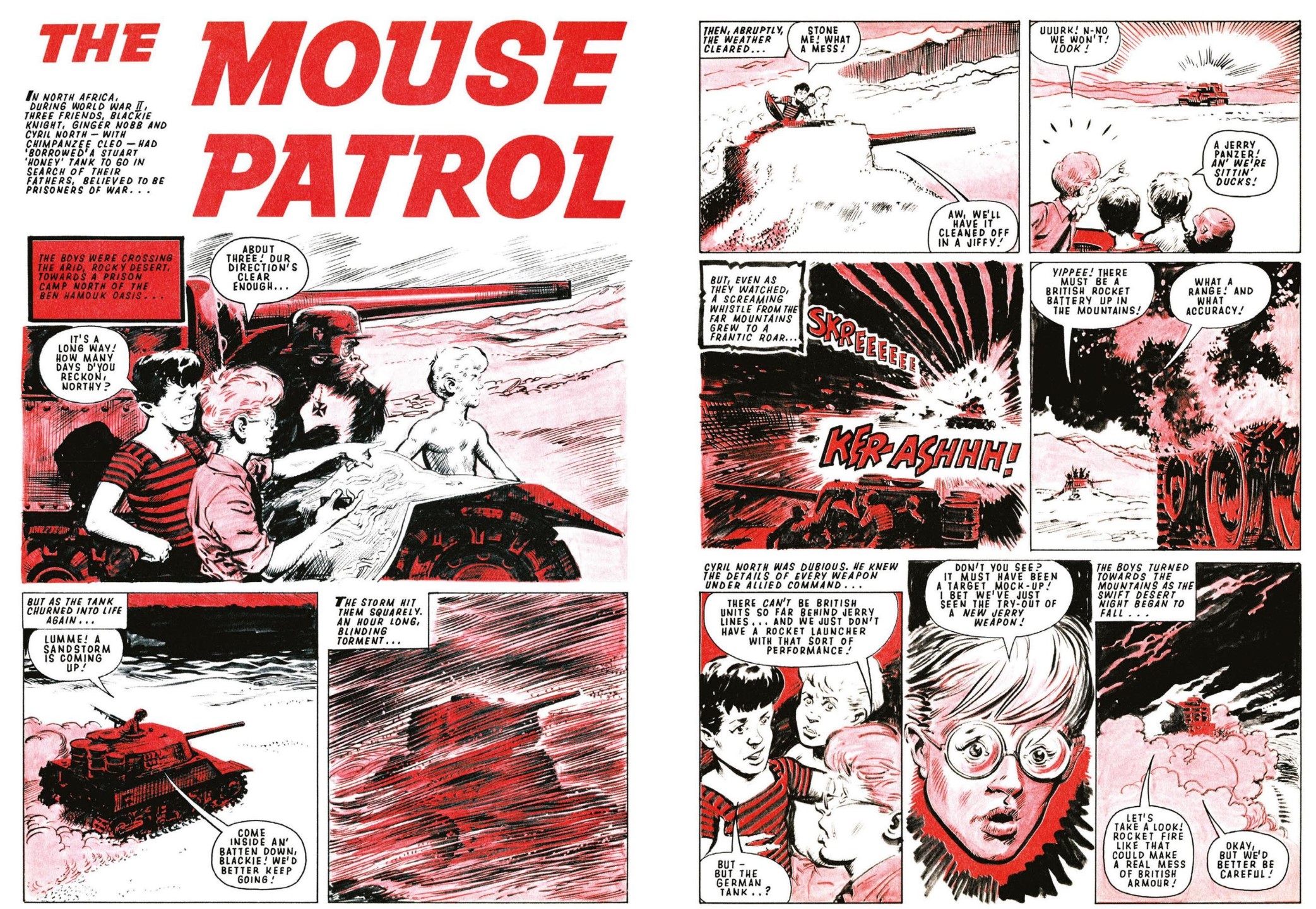
‘Helmet Head & El Mestizo: “On the First day of Christmas…” ’ pairs the aging mercenary with the robot sheriff to save a frontier town – and that aforementioned ROBOT SHERIFF! – from ruthless scavengers, after which a classic tale of murderous child soldiers sees the ‘Mouse Patrol’ (by an unidentified writer and the incredible Eric Bradbury from Jag Annual 1971) still looking for their POW dads on the battlefields of North Africa in 1942. This time the three lads (Blackie Knight, Ginger Nobb & Cyril North) and their chimp chum Cleo ride their stolen tank into a Nazi super weapon test and gleefully turn it on the astounded Afrika Corps!
Presented as Original Art Archive Scans published in Smash! November 16th 1968, ‘A Short Cut Home!’ is limned by Francisco Fuentes Man and details how a nasty Earthman outsmarts himself after blackmailing gentle – but clever – aliens, after which Monster Fun July 5th 1975 supplies a Ken Reid comedy classic scripted by a mystery gagster. ‘Martha’s Monster Make-Up’ allows her to mould faces like putty and, here, get rid of a really obnoxious family guest…

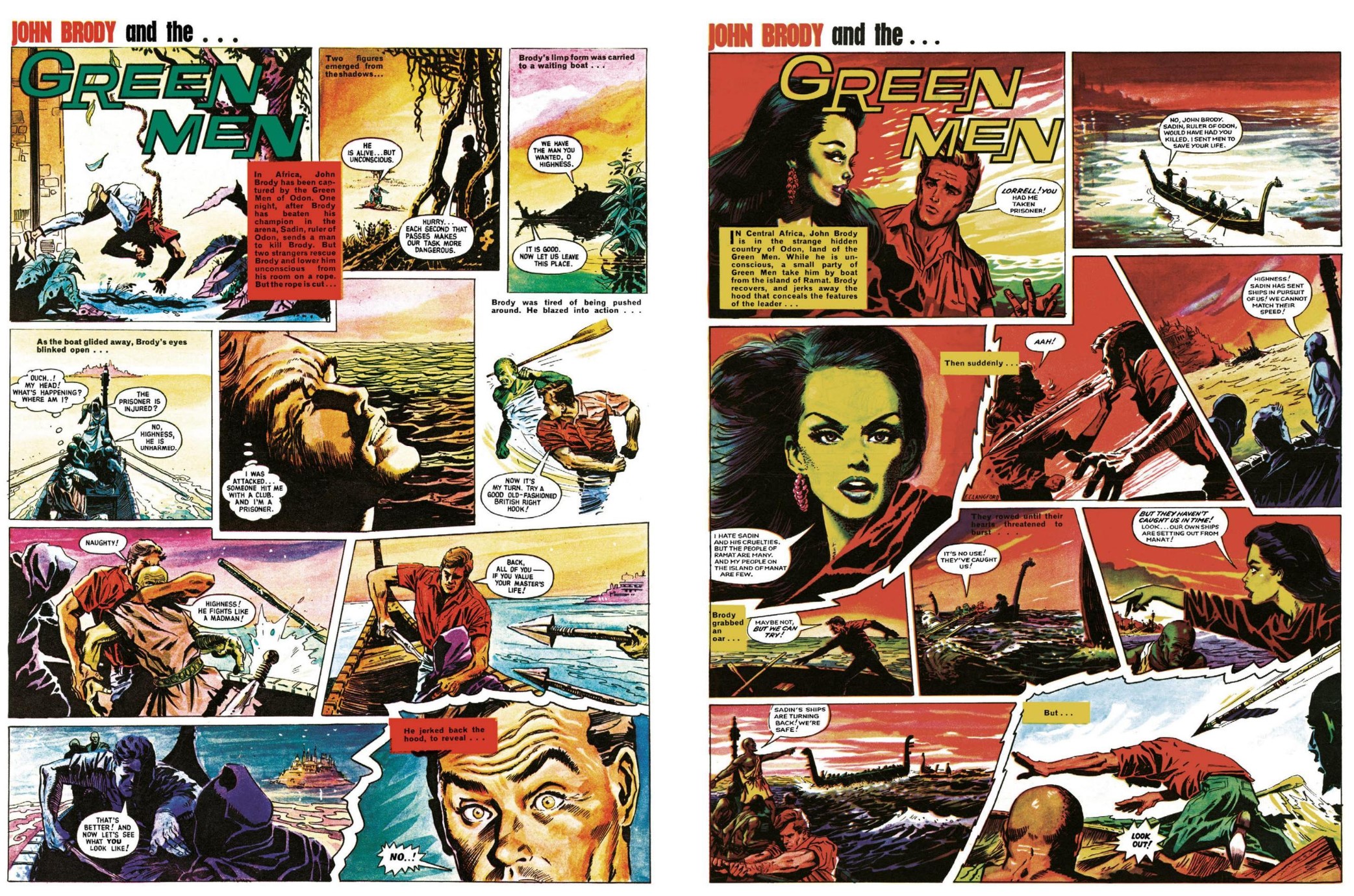
Very much a main attraction, full-colour painted serial ‘John Brody and the Green Men’ ran in Boy’s World from February 19th to October 3rd 1964. Crafted by Willie Paterson & Frank Langford this is an epic African adventure in the manner of She and other fantasy movies, following the eponymous troubleshooter into a fantastic submerged kingdom and civil war against devilish priests, bloodyhanded tyrants a and a lot of undersea beasties…
It’s followed by Ned Hartley, Steve White & Stevenson’s new parody yarn ‘Imagine if Gums Was Published in Action…’ which speaks for itself – albeit rather messily – prior to Tom Tully & Ian Kennedy revealing how colour-changing ‘Kid Chameleon’ (The Birthday Book For Boys 1972) continues searching for his parents’ assassin. If not for those reptiles who had raised him in the Kalahari desert, he would have no chance…

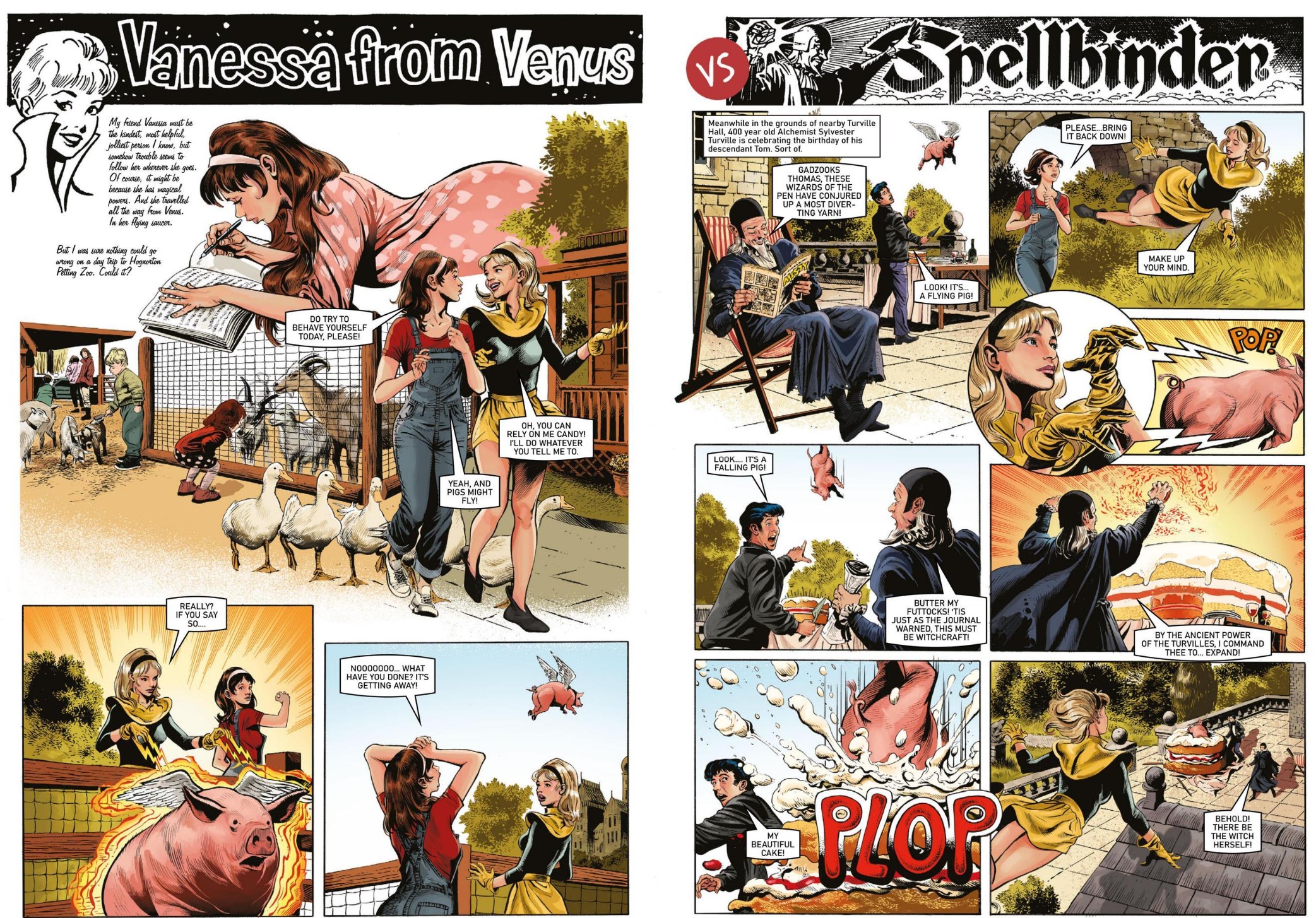
Author unknown & Josep Gual reveal the monster-hunting surprise two girls unleash on ‘The Island’ (from Misty February 24th 1979) after which school spoof ‘Strange Hill’ (by another unknown & Martin Baxendale from Whizzer & Chips December 20th 1980) neatly shuffles us into an all-new yarn from David & Emily Roach pitting stellar sorcery savants in ‘Vanessa From Venus vs. Spellbinder’.
Thanks to another Original Art Archive Scan we get to see superspy ‘Dredger’ (by Chris Lowder & Horatio Altuna from Action May 1st 1976) settle with a KGB hit squad in all his mean, messy glory prior to James Tomlinson & Jesús Redondo Román detail why the undead don’t like space travel. ‘The Wildcat Complete: Vampire!’ was originally seen in Wildcat Holiday Special 1989, and our seasonal session adopts a rather bleak note for ‘The Fighting MaGees’ (Peter Milligan & Solano Lopez from Battle Action Force November 1st 1986) as brothers Jack and Micky endure the hell of the Gallipoli landings and are forever changed…

From Valiant Annual 1969 Carlos Cruz González and that unknown writer provide a vivid adventure for a certain inventor and his robot assistants as ‘The House of Dolmann’ face plundering pop sensations The Spectrums whilst Juan Arancio’s Original Art Archive Scans for Action Annual 1977 pit white explorers against a jungle packed with ‘The Wild Ones’

Mervyn Johnston’s ‘Captain Crucial’ clashes with a very busy Kris Kringle courtesy of Buster December 28th 1991, whilst anonymous & Vanyo detail how ordinary folk finished off ‘The Loch Tregar Terror’ (Wham! Annual 1972). One last new yarn by Suyi Davies Okungbowa, Edison Neo & Barbara Nosenzo reintroduces hairy giant robot ‘Mytek the Mighty’ in a show of brute strength and authorial foreboding before we close the fun & games with a vegan bloodbath triggered by Keith Richardson & Brett Parson’s ‘Count Carrot’ – as previously predigested in Monster Fun October 2024…

That’s all you get here, but remember this is a book you still can buy and receive instantly. The internet probably has others. You should check that out in a bit…
© 1964, 1967, 1968, 1970, 1971, 1975, 1976, 1979, 1980, 1986, 1989, 1991, 2024, 2025 Rebellion Publishing IP Ltd. All Rights Reserved.

The Beano Book 1971


By David Sutherland, Malcolm Judge, Paddy Brennan, Ronald Spencer, Bob McGrath, Robert Nixon, Gordon Bell, Jim Petrie, many & various (DC Thomson & Co., Ltd.)
ISBN: 978-0-8511-6031-3 (HB)

This book includes Discriminatory Content produced in less enlightened times.

For many British fans Christmas means The Beano Book (although Scots worldwide have a pretty fair claim that the season belongs to them with collections of The Broons and Oor Wullie making every December 25th magical) and I’m highlighting this particular edition as another epitome of my personal holiday memories. As usual my knowledge of the creators involved is woefully inadequate but I’m going to hazard a few guesses in the hope that someone with better knowledge will correct me when I err.

In this little cracker are a number of David Sutherland’s Biffo the Bear strips as well as his Bash Street Kids and even a smashing action-adventure of boy super-hero Billy the Cat (I wonder if the editors distributed strips to artists in alphabetical order?). There are whirlwind tales of “fastest boy on Earth” Billy Whizz drawn by Malcolm Judge. Paddy Brennan worked as a dramatic artist for decades on General Jumbo (the heroic boy who radio-controlled an army of robot toys) and the Q-Bikes: a team of young adventurers with technologically advanced push-bikes. In this tome they trade in two wheels for four, to become the Q-Karts for an Australian adventure, whilst the aforementioned General captures a team of safecrackers in his home town.

These annuals were traditionally produced in the wonderful “half-colour” that many British publishers employed to keep costs down while adding a bit of pizazz. This was done by printing sections of the books with only two plates, such as blue/Cyan and red/Magenta. The versatility and palette range this provided was astounding. Even now this technique screams “Holidays” to me and my rapidly dwindling contemporaries.

Some Dennis the Menace strips are possibly drawn by original creator Davy Law, but are most likely the work of his style-chameleon replacement David Sutherland. They all feature his charismatic then-new co-star ‘Gnasher’ too. Woefully dated, culturally suspect but astoundingly funny, the Little Plum strips are by Ronald Spencer, I think, as are The Nibblers: an anarchic gang – and weren’t they all in The Beano? – of mice.

The 3 Bears segments are by Bob McGrath whilst Lord Snooty (one of the longest running strips in the comic’s history – a record only recently overtaken by Dennis) is the work of Robert Nixon, as is the Roger the Dodger Family Album section. There are short romps with Pups Parade (AKA the Bash Street Pups – the unlovely pets of those unlovely kids) by Gordon Bell, and exemplar of Girl Power Minnie the Minx gets her own 16-page mini-book in this annual – and who could stop her? – courtesy of the wonderful Jim Petrie, but I’ll admit to being totally stumped by Swinging Jungle Jim: a frantic boy-Tarzan strip that has sunk without trace since those faraway times.

Topped off with activity and gag-pages, this is a tremendously fun book, and even in the absence of legendary creators such as Dudley Watkins, Leo Baxendale or Ken Reid, and with a small but noticeable decline in the mayhem and anarchy quotas, there’s still so much merriment on offer I can’t believe this book is 55 years old. If ever anything needed to be issued as commemorative collections, it’s DC Thomson annuals. Perhaps as the company pursues digital reprints volumes we could anticipate entire Annual re-releases?…

Divorcing the sheer quality of this brilliant book from nostalgia is a healthy exercise, but I’m perfectly happy to simply wallow – even today – in the magical emotions this ‘almost-colourful’ annual still stirs. It’s a good solid laugh-&-thrill-packed read from a magical time (I was in my final year of primary school and a beloved, spoiled and precocious little snot with not a care in the world), and turning those stiffened two-colour pages remains an unmatchable Christmas experience.
© 1970 DC Thomson & Co., Ltd.

The Treasury of British Comics Annual 2024


By Simon Furman, Tom Tully, Alec Worley, Alf Wallace, Leo Baxendale, Pat Mills, Mike Brown, Kek-W, Walter Thorburn, E. George Cowan, Derek Cribbling, Leo Baxendale, Ken Armstrong, Mike Collins, David Roach, Enric Badia Romero, Dave Gibbons, Garry Leach, Ken Reid, Brian Bolland, Joe Colquhoun, Steve Dillon, DaNi, Cam Kennedy, Brian Lewis, Mike Western, Staz Johnson, Tom Paterson, Carlos Guirado, Juan Arancio, Henry Flint & various (Rebellion Studios)
Digital only eISBN: 978-1-83786-025-8 (Kindle); 978-183786-133-0 (Webshop Exclusive)

This book includes Discriminatory Content produced in less enlightened times.

Win’s Christmas Gift Recommendation: True Brit Comics Class… 8/10

As I’ve repeated ad infinitum, British comics always enjoyed an extended love affair with unconventional (for which feel free to substitute “weird” or “creepy”) heroes. Many stars and notional role models in our strips might have been outrageous or just plain “off”, but we also handled traditional stuff in a more appropriate manner… one less likely to have outraged parents and censorious moral stickybeaks gunning for editors and publishers

Until the 1980s, UK periodicals employed an anthological model, offering a large variety of genre, theme and characters. Humour comics like The Beano were leavened by action-adventures like The Q-Bikes or General Jumbo whilst dramatic fare papers like Lion, Eagle, Hotspur or Valiant always offered palate-cleansing gagsters… and there was no reason to rock that boat in end-of-year bumper annuals

Prior to game-changers Action, Misty and 2000AD, British comics fell into fairly ironclad categories. Back then, you had genial and/or fantastic preschool fantasy; a large selection of licensed entertainment properties; action; adventure; war; school dramas, sports and conventional comedy strands. Closer examination would confirm there was always a subversive merging, mixing undertone, especially in such antihero series as Dennis the Menace or our rather strained interpretation of superheroes. Just check out The Spider, Kelly’s Eye or early Steel Claw stories…

The glory days of Christmas Annuals have ended but thanks to Rebellion and their superb Treasury of British Comics project, a touch of that grand legacy has been delighting old and new readers with modern versions of the good old days for a few years now. A little slice of the future of nostalgia comes with a limited Hardback edition and general-release digital compilations of seasonal comics fun and thrills. Moreover – just like the bonanza hardbacks they celebrate – these Annuals are a blend of all-new material and old classics.

In this first release from November 2023 the recovered, remastered delights stem from Smash! April 2nd – May 14th 1966; Wham! Annual 1966: Wham! November 25th 1967 and January 15th 1968; Lion & Valiant Holiday Extra 1969; Pow! Annual 1971; Buster Book of Scary Stories 1975; Action Summer Special 1976; Valiant Book of Mystery & Magic 1976; Action Annual 1979; Battle Holiday Special 1979; Misty Annual 1980; Starlord Annual 1982; Scream! May 12th 1984 and Monster Fun Halloween Spooktacular 2021 and opens with a modern-day team up clash by Simon Furman, Mike Collins & David Roach, coloured by Gary Caldwell and lettered by Annie Parkhouse.

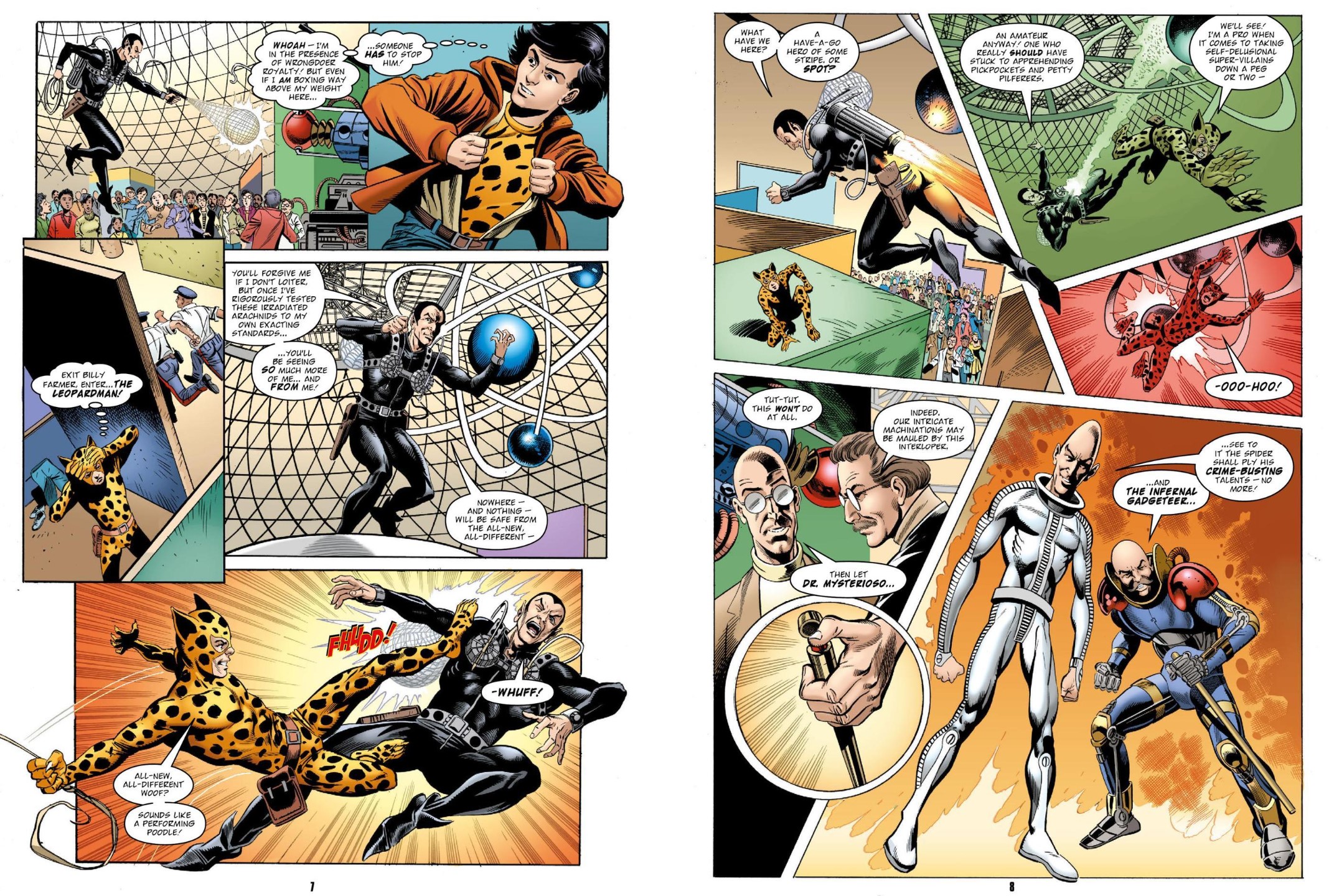
‘The Spider Vs The Leopard from Lime Street’ pits the wild and wary misunderstood heroes against each other until time-bending true malign manipulators The Infernal Gadgeteer and Dr Mysterioso are exposed and expelled, after which true evil genius Leo Baxendale depicts in full colour how ‘Grimly Feendish’ staged his own Great Train Robbery in Wham! November 25th 1967.

Reproduced from actual artboards as “Original Art Archive Scans – with erasings, white out and all…” and as seen in weekly Smash! from April 2nd – May 14th 1966, ‘Moon Madness’ was written by Alf Wallace and illustrated by Brian Lewis, and revealed how a Russian lunar mission resulted in a bizarre jigsaw monster terrorising Britain…

Another multi-hued Baxendale ‘Grimly Feendish’ (from Wham! January 15th 1968) depicting another banditry bungle segues into a sci fi classic from an unknown author and Garry Leach as seen in Starlord Annual 1982 wherein an all-consuming bio-terror on a cargo freighter demands the expert attention of ‘The Exterminator’, after which an equally anonymous yarn from The Buster Book of Scary Stories 1975 limned by Dave Gibbons sees a keen trainee aviator used by ‘The Ghost Pilot’ to save a person on peril and pay off a debt…

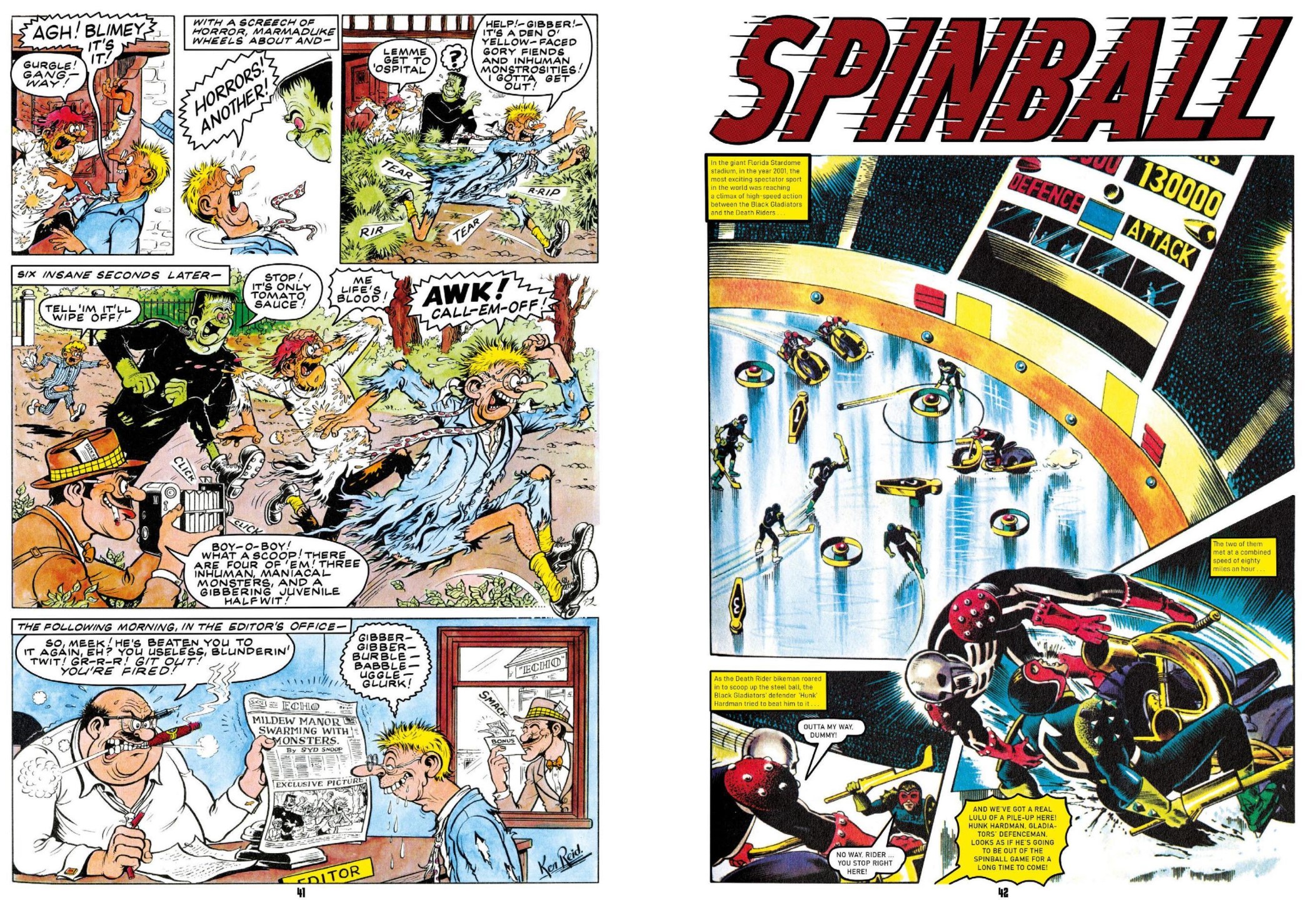
Wham! Annual 1966 provided a wry extended ‘Frankie Stein’ tale by Walter Thorburn & Ken Reid regarding the excesses of the tabloid press before Tom Tully & Brian Bolland detail the terrors and rewards of modern sport sensation ‘Spinball’ as originally covered in Action Annual 1979, prior to another new tale as ‘Black Beth’ faces arcane peril from tarot terrors courtesy of Alec Worley, DaNi & Oz Osbourne. Pat Mills, Derek Cribbling & Joe Colquhoun keep up the mystic menace with a craven cartoonist’s cautionary tale and fate as ‘The Final Victim’ as seen in the Valiant Book of Mystery & Magic 1976 prior to Misty Annual 1980, an unknown author and Carlos Guirado exposing a young heiress to ancient heirloom ‘The Hand of Vengeance!’

Supernatural mystery continues with Furman, Steve Dillon & Jay Cobb’s ‘Beware the Werewolf!’ from Scream! May 12th 1984 before the scene shifts to true horror as Cam Kennedy and the Unknown Scripter deliver a lost episode of ‘Charleys’ War’ first found in Battle Holiday Special 1979, prior to time-travelling ‘Robot Archie’ and pals facing pirates in the Caribbean thanks to E. George Cowan & Mike Western and Lion & Valiant Holiday Extra 1969

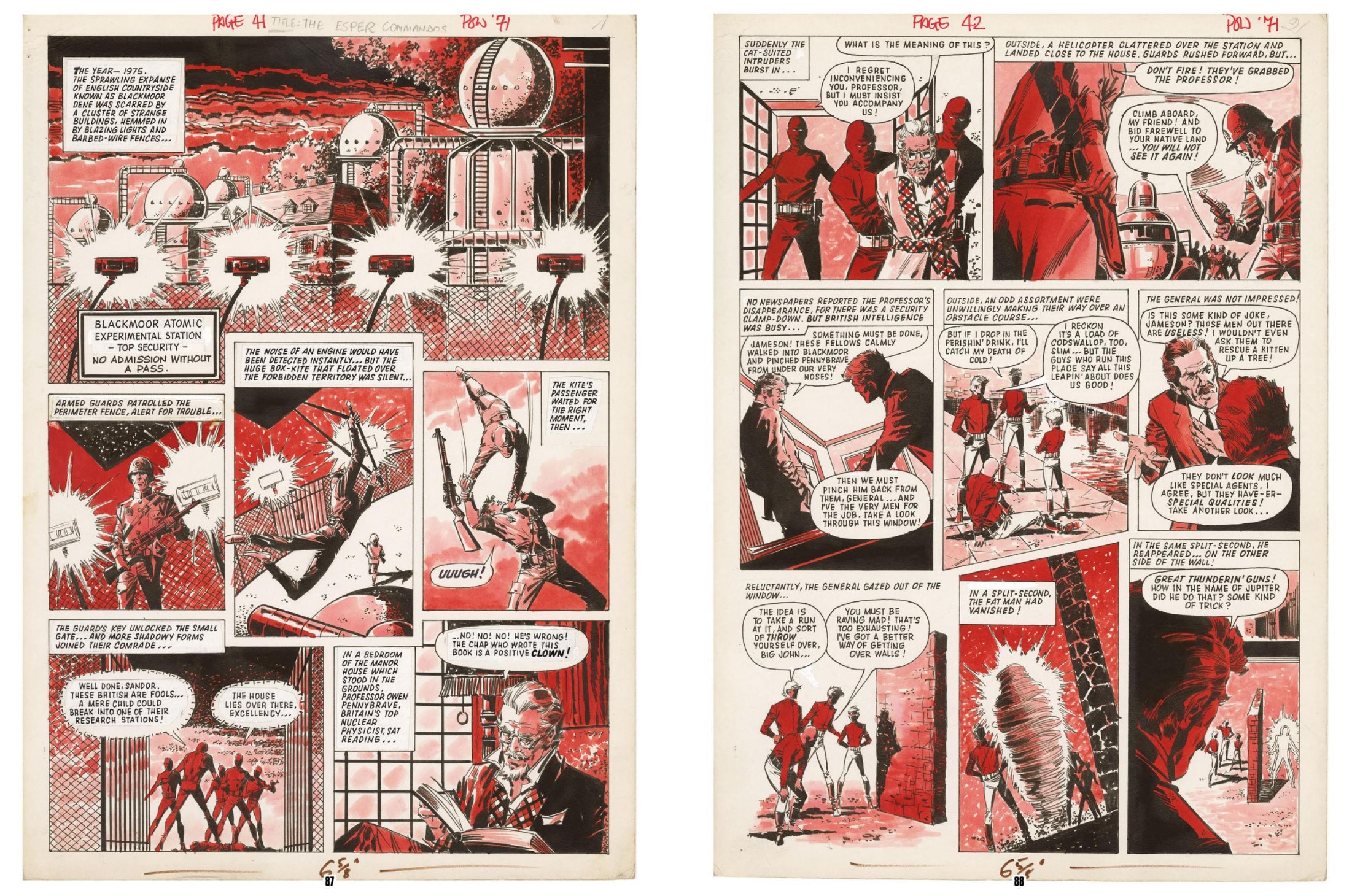
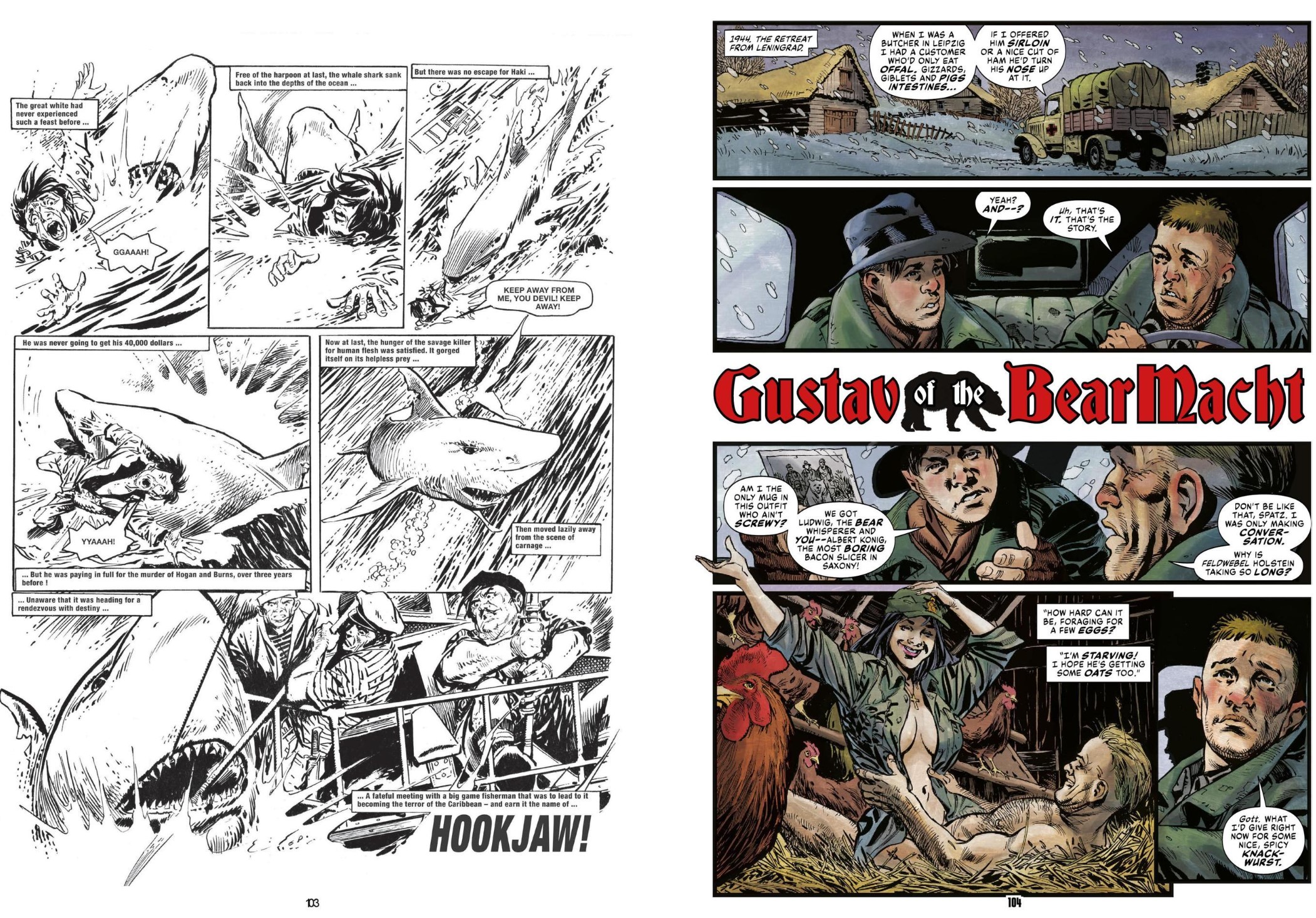
‘Esper Commandos’ was published in Pow! Annual 1971, limned by future Modesty Blaise and Axa illustrator Enric Badia Romero and reappears here as another smudges ‘n’ all “Original Art Archive Scan”. It features a future and fascinating psionic super-squad as they infiltrate and eliminate the Britain’s future enemies, and precedes a full colour origin for one of UK comics’ strangest stars. Thanks to Ken Armstrong & Juan Arancio in Action Summer Special 1976,‘Great White Death’ revealed how Shark superstar Hookjaw got his bloody start…

One last original yarn – by Kek-W, Staz Johnson, Barbara Nosnzo & Simon Bowland – maintains the tone but transfers time and place to Leningrad in 1944 for saucy savage combat fable ‘Gustav of the Bearmacht’ before Monster Fun Halloween Spooktacular 2021 revives ‘Gah! The Gobblin’ Goblin’ and his astounding appetite thanks to Keith Richardson, Tom Paterson & Bowland.

Daft, thrilling, beautifully rendered, devastatingly nostalgic and truly fun, these are all you need to complete your Crimbo celebrations and since we’re all messing about with electrons and what-nots, if you want YOU CAN GET IT IMMEDIATELY THANKS TO DIGITAL RUDOLF THE RED BUTTON REINDEER AND THEM INTERWEB TUBES!!

The same applies to the follow up tome…
© 1966, 1967, 1968, 1969, 1971, 1975, 1976, 1979, 1980, 1982, 1984, 2021 & 2023 Rebellion Publishing IP Ltd. All Rights Reserved.
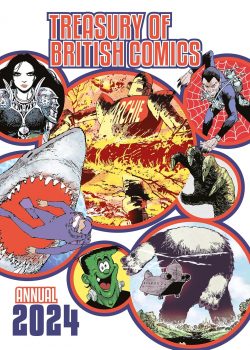
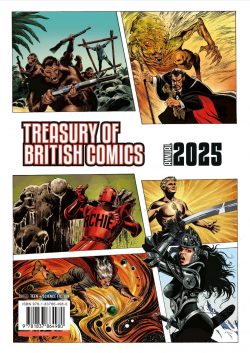
The Treasury of British Comics Annual 2025


By Paul Grist, Simon Furman, Leo Baxendale, Ian Rimmer, Donne Avenell, Tom Tully, Alec Worley, Steve Moore, John Smith, Simon Williams, John M. Burns, Mike Collins, Carlos Ezquerra, Mick McMahon, Mike Western, Frank Langford, Massimo Belardinelli, Anna Morozova, Ian Kennedy, Eric Bradbury, David Roach, Emily Roach, Andreas Butzbach & various (Rebellion Studios)
eISBN: 978-1-83786-498-0 (general edition); 978-183786-501-7 (Webshop Exclusive)

This book includes Discriminatory Content produced in less enlightened times.

Win’s Christmas Gift Recommendation: More True Brit Comics Class… 8/10

What you read up above is just as true for this second Annual Endeavour which emerged at the end of 2024. This time around, the new contributions are augmented by material from Tiger February 13th – May 8th 1965; Wham! February 27th 1965; Lion Annual 1972; The Buster Book of Scary Stories 1975; Valiant 21st August -16th October 1976; Valiant Annual 1976; Battle Annual 1979; Dan Dare Annual 1980; Action Annual 1982; Scream! Holiday Special 1985 and 2000 AD Presents Action!

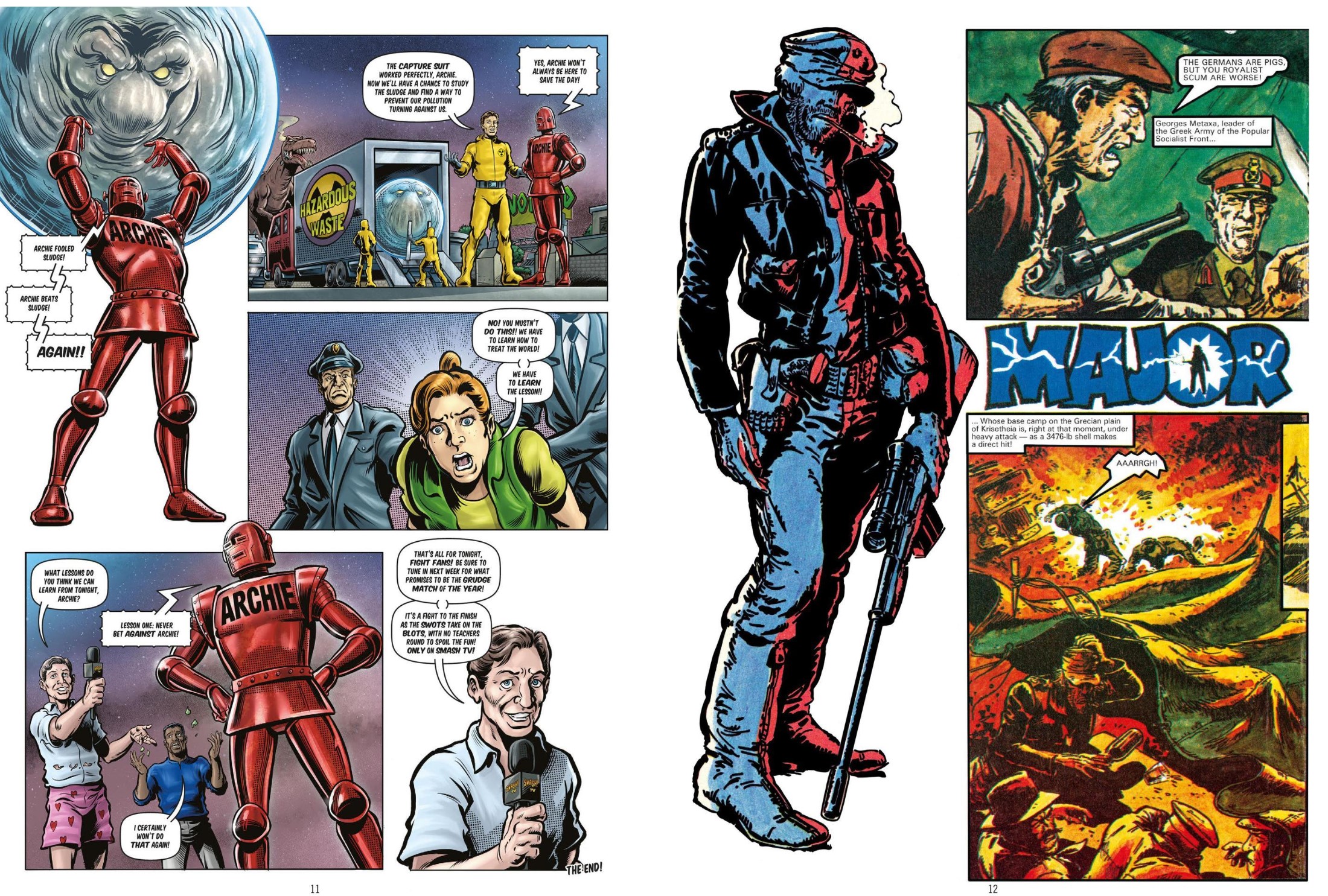
Kicking things off is a full-colour, all new rematch /grudge match as Paul Grist, Simon Willams, colourist Jason Cardy & letterer Leila Jess detail one more mighty mess up in ‘Robot Archie Vs The Sludge’ prior to that uncredited writer and Carlos Ezquerra revealing how battle-savvy rebel ‘Major Easy’ ferrets out traitors in Nazi-occupied Greec as seen in Battle Annual 1979.

Long ago Scream! Holiday Special 1985 pointed out the problems with ‘New Neighbours’ courtesy of Ian Rimmer & Mike Western whilst anonymous & Mick McMahon expose the domestic stresses of ‘3000 AD The Traveller’, as first debated in Dan Dare Annual 1980 (which is apparently still a 2000 AD Production)…

Leo Baxendale’s anarchic spoof ‘Eagle Eye, Junior Spy – Doomsday School’ (Wham! February 27th 1965) segues into dark and dangerous (no really) football strip ‘Stryker’ (by Tom Tully & Ian Kennedy and running in Valiant 21st August to 16th October 1976) as really good player joins a naff team to discover how his brother died following an ugly on-pitch incident…

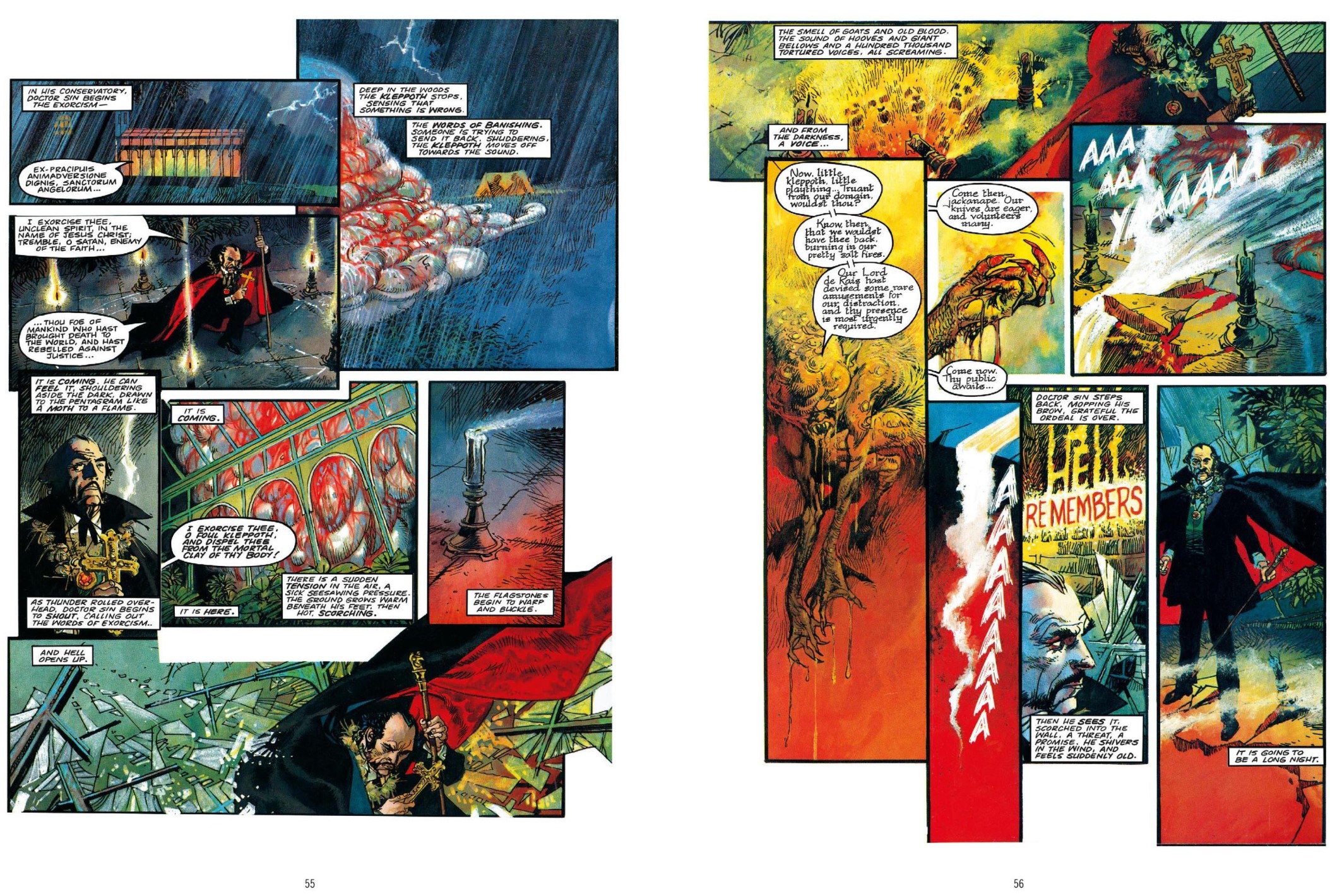
John Smith & John M. Burns were on fine form in 2000 AD Presents Action! as ‘Doctor Sin: The Strange Case of the Wyndham Demon’ sees the mystic troubleshooter drawn to a dark and deadly case of diabolical incursions after which Simon Furman, Mike Collins & letterer SquakeZz deliver an all-original adventure as ‘Kelly’s Eye Vs The White Eyes’ sees mystic ghost-breaker Cursitor Doom call in the invulnerable hero to end a threat to the entire multiverse caused by environmental mucking about…

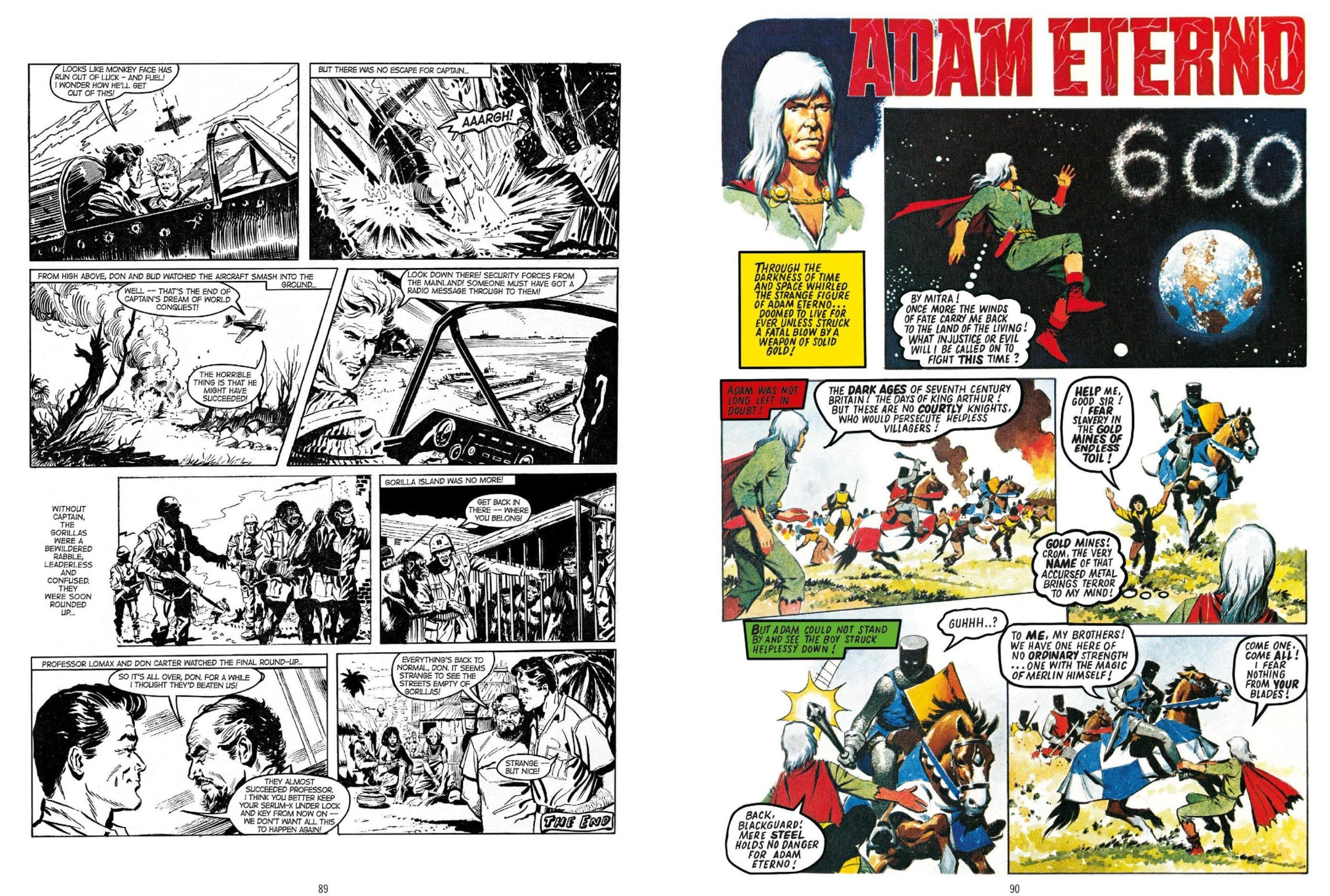
There’s more of the same, if a little earlier set, as anonymous & Frank Langford detail how animal experiments turn a lab chimp into a threat to all humanity after taking over ‘Gorilla Island’ as seen in Tiger from February 13th to May 8th 1965 – predating Planet of the Apes by three years! – after which possibly the same scripter (who can tell?) & Ian Kennedy cover how immortal time traveller ‘Adam Eterno’ exposes a slave-taker at Camelot’s Round Table, as seen in Valiant Annual 1976.

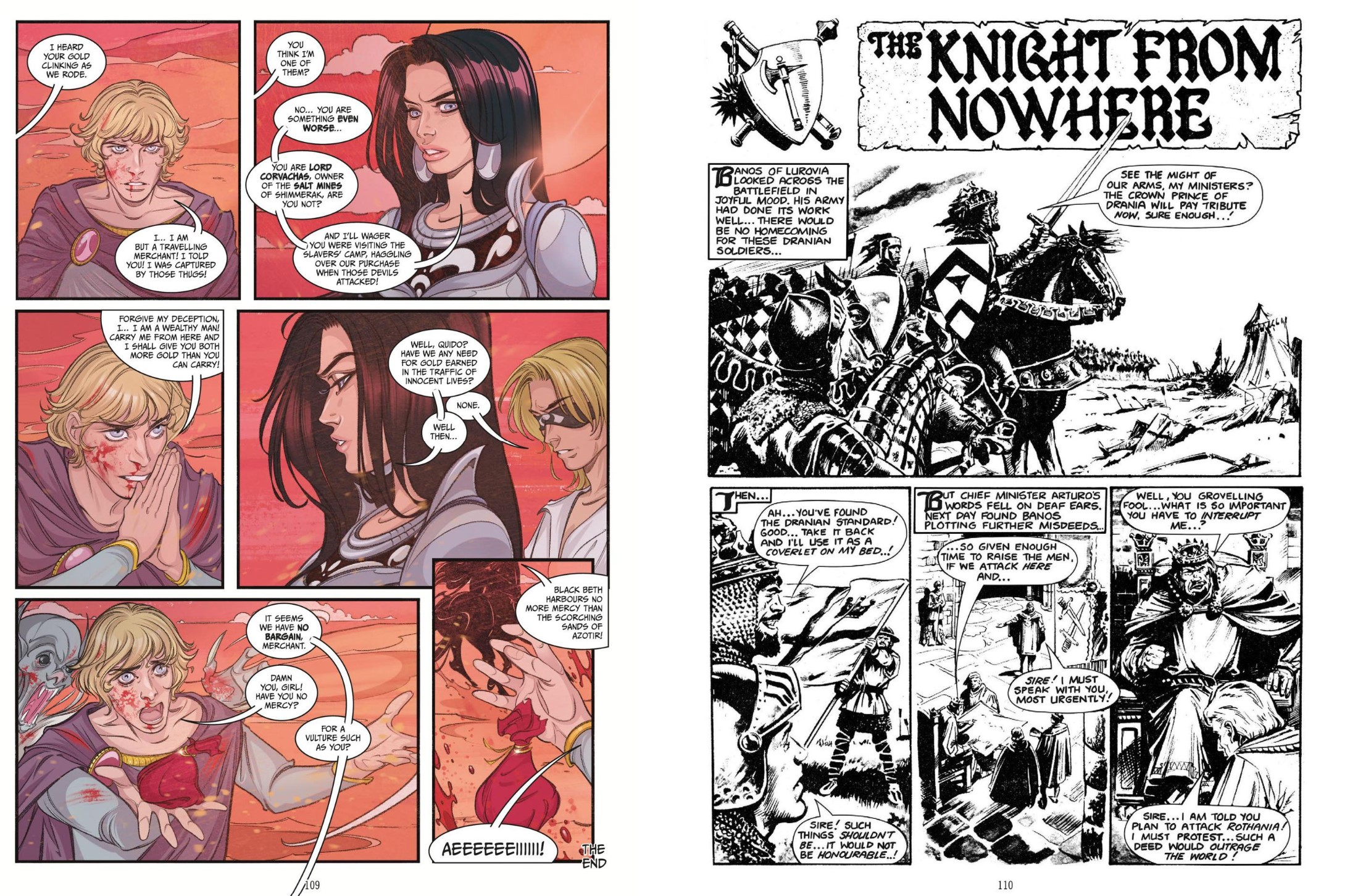
Donne Avenell & Massimo Belardinelli tell a tale of feudal Caped Crusader/Dark (green) Knight) ‘Flame O’ the Forest’ wherein the masked Saxon battles Norman injustice and oppression in a short romp from Lion Annual 1972 before final new addition ‘Black Beth: Vultures of Azotir’ sees Alec Worley, Anna Morozova, & Ozwald reaffirm the Warrior Sorceress’ undying battle against evil magic and wicked people, before Steve Moore & Eric Bradbury close the Christmas curtain with The Knight From Nowhere’: one last bout of sword-waving sagas and supernatural vengeance as originally seen The Buster Book of Scary Stories 1975

And that’s another pretty package of festive future-of-nostalgia fun done. Crucially, all these digital delights could be all yours right now, if not sooner…

Admit it. You’re tempted, right? And don’t YOU deserve some seasonal fun and thrills too?
© 1965, 1972, 1975, 1976, 1979, 1980, 1982, 1985, 1992 & 2024 Rebellion Publishing IP Ltd. All Rights Reserved.
Today in 1946 Vittorio Giardino was born. We just did his Max Fridman stuff so no help from here, just go scrolling. In 1947 Dutch wonder boy Joost Swarte was born and in 1959 Jean Roba’s Boule et Bill began in Le Journal de Spirou, and 10 years later Scottish writer Mark Millar was born.

On the downside, though, in 1986 today was Gardner F. Fox’s last day on Earth-1 and in 1992 Smurf-meister Peyo passed away leaving all far less blue…

The Dan Dare Dossier


By Norman Wright, Mike Higgs, Frank Hampson, William Patterson & Don Harley, Keith Watson & various (Hawk Books)
ISBN: 978-0-94824-812-2 (tabloid HB)

This book includes Discriminatory Content produced in less enlightened times.

Launching on April 14th 1950 and running until 26th April 1969, Eagle was the most influential comic of post-war Britain, and possibly in our nation’s history. It was the brainchild of a Southport vicar, the Reverend Marcus Morris, who was increasingly concerned about the detrimental effects of American comic-books on British children and wanted a good, solid, middle-class Christian antidote.

Seeking out like-minded creators he peddled a dummy edition around British publishers for over a year with little success until he found an unlikely home at Hulton Press, a company that produced general interest magazines such as Lilliput and Picture Post. The result was a huge hit which soon spawned age and gender-specific clones Swift, Robin and Girl which targeted the other key demographic sectors of the children’s market.

A huge number of soon-to-be prominent creative figures worked on the weekly, and although Dan Dare is deservedly revered as the star, many other strips were as popular at the time, with many even rivalling the lead in quality and entertainment value. Eagle’s mighty pantheon included radio and film star attraction P.C. 49, soon to be TV sensation Captain Pugwash, (BBC) radio cowboy Jeff Arnold/Riders of the Range and the inimitable Harris Tweed – who swiftly became stars of other media and promotional tie-in like books, puzzles, toys, games, apparel and comestibles as well as and all other sorts of ancillary merchandising.

At its peak Eagle sold close to a million copies a week, but inevitably, changing tastes and a game of “musical owners” killed the title. In 1960, Hulton sold out to Odhams, who became Longacre Press. A year later they were bought by The Daily Mirror Group who evolved into IPC. In cost-cutting exercises many later issues carried cheap(er) Marvel Comics reprints rather than British-originated material. It took time but those Yankee Cultural Invaders won out in the end. With the April 26th 1969 issue Eagle was subsumed into cheap ‘n’ cheerful iron clad anthology Lion, eventually disappearing altogether. Successive generations have revived the title, but never the success.

There is precious little that I can say about Dan Dare that hasn’t been said before and better. What I will say is that everything you’ve heard is true. Vintage Dan Dare strips by Frank Hampson and his hand-picked team of dedicated artists are a high point in world, let alone British comics, ranking beside Tintin, Asterix, Tetsuwan Atomu, Lone Wolf & Cub and the best of Kirby, Adams, Toth, Noel Sickles, Milt Caniff, Roy Crane, Carl Barks and Elzie Segar.

If you don’t like this stuff, there’s probably nothing any of us can do to change your mind, and all we can do is hope you never breed.

Accepting that there is a part of national culture which is Forever Dare, here’s a long overdue second peek at an item which will delight all boys (and many girls, even though they had their own comics back then!) of a certain age which – despite its own vintage – is happily still readily available through internet vendors. In fact there’s a true abundance of books to read out there, all economically priced, so why not go hog-wild in this 75th anniversary year?

The boldly colourful, magnificently oversized (333 x 242 mm), resolutely hardbacked Dan Dare Dossier was published in 1990 and offers everything any devotee could wish to know and see. It is completely packed with mouthwatering artwork and photos, tantalising examples of memorabilia, classic strips and even unseen/unpublished material by a phalanx of the original creators.

Heavily illustrated throughout, it all begins with ‘The Rise of Dan Dare’, detailing the history of science fiction, development of comics – especially Eagle – and by offering a potted biography of Hampson, his team and Dan’s serried exploits. Simultaneously, those great big pages present unseen monochrome strip adventure ‘Dan & Donanza’ by the master himself, wherein our doughty heroes go haring across the solar system in pursuit of a fallen dictator who has turned the moon into a giant bomb…

Following is an expansive itinerary of the major characters involved over the years in ‘Actors against a Solar Backdrop’ before ‘The Hardware File’ offers an eye-popping selection of plans, designs and extracted strip illustrations displaying the vast wealth of ships, kit and tech invented over the decades by the assembled strip-creators, paying especial attention to Space Transports and Dan & Digby’s venerable runabout Anastasia.

More bravura virtuosity is celebrated in ‘Aliens & Their Worlds’ as pertinent and beautiful clips and snippets highlight the amazing variety of extraterrestrial races and species.

Sharing a few pages with new black-&-white comedic strip ‘Digby – the Guinea Pig’ is a rundown of some of ‘The Artists’ who toiled collaboratively to produce the stunningly painted 2-pages-per-week (Hampson, Harold Johns, Eric Eden, Don Harley, Bruce Cornwell, Desmond Walduck, Frank Bellamy, Keith Watson and more); followed in turn by a fascinating trivia- and memorabilia-stuffed appreciation of the dauntless chaps’ five years on radio in ‘Dan Dare, Pilot of the Airwaves’

Wisely taking a break from all that factual stuff, ‘Full Colour Adventure: Dan Dare in The Planulid’ reprints a rousing tale of a monstrous invasion of Earth (first seen in The Dan Dare Space Annual 1963) before the rousing envy/glee-fest resumes with a grand examination of the breathtaking wealth of ‘Merchandise & Ephemera’ the strip generated. On view is a procession of numerous ray guns and rocket pistols (none of which ever paralysed or disintegrated any of MY enemies worth a damn!); games; puzzles; buttons; badges; stencil-kits; clothing; models; action-figures; home picture-film strips and projectors; walkie-talkies; all manner of books and print novelties and so much more…

Adjacent and in parallel with a full ‘Dan Dare Chronology’ is the immensely rare and sadly unappreciated newspaper strip ‘Mission to the Stars’ by William Patterson & Don Harley, which ran every Sunday in The People from April to October 1964, all capped off by the demise of the dream thanks to changing tastes and commercial mismanagement, as detailed in ‘Changes – the Long Decline’

Downhearted spirits are properly revived by another ‘Full Colour Adventure’ from The Dan Dare Space Annual 1963, specifically ‘The Planet of Shadows’ wherein our gallant lads uncover a lost civilisation on a new world, after which ‘Dan Dare – to Date’ describes our hero’s 1977 resurrection in the pages of apocalyptic, sardonically dystopian 2000 AD. The article tracks Dan’s reboot as a bombastic rebel, slow rehabilitation and transition to the newly revived 1982 Eagle, before neatly segueing into a delightful reprint of one of those 80’s retro-exploits as ‘Dan Dare by Keith Watson’ depicts a hazardous mission by the Space Fleet stars to transport Earth’s radioactive waste stockpiles to the depths of the void. It’s hard enough as is, but things get particularly dicey when arch-nemesis The Mekon raises his great big green head…

Big, bold, beautiful and ruthlessly nostalgia-driven, this epic tome will utterly enchant survivors and veterans of the baby-boomer years and sci fi fanatics in general, but it’s also packed with enough top-flight comics material to beguile any kid or newcomer to our medium in search of a little simple, awestruck wonder…
This edition © 1990 Hawk Books Ltd. Dan Dare © 1990 Fleetway Publications.

Batman Story Book Annual 1967 (with Robin the Boy Wonder)


By various and Mick Anglo studios (World Distributors)
No ISBN ASIN: ?B000V5MSY0

This book includes Discriminatory Content produced in less enlightened times.

Before American publishers began exporting directly into the UK in 1959 our exposure to their unique brand of fantasy came from licensed reprints. British publishers/printers like Len Miller, Alan Class and others bought material from the USA – and occasionally Canada – to fill 68-page monochrome anthologies – many of which recycled those same stories for decades. Less common were the flimsy, strangely coloured pamphlets reprinting the same stuff, produced by Australian outfit K. G. Murray and exported and distributed here in a rather sporadic manner. They also produced sturdily substantial Christmas Annuals which had a huge impact on my earliest years (I strongly suspect my adoration of black-&-white artwork stems from seeing supreme stylists like Curt Swan, Carmine Infantino, Gil Kane and Murphy Anderson uncluttered by cheap, flat colour).

The first Batman Annual (comic strips and features) came out in 1960, but in the heyday of “Batmania” two separate publishers were releasing competing (or maybe complementary?) hardback Holiday editions here. Today’s first delightful oddment comes from just after Batman began ruling the Earth, thanks to the power of the Adam West/Burt Ward Batman TV show. Another publisher had the rights to reprint the current crop of DC comic strips – which bore only superficial resemblance to the TV iteration anyway – but World Distributors secured a license to publish prose-based books directly based on the screen escapades. British comics have always fed heavily on other media and as the popularity of television burgeoned during the 1960s – especially children’s shows and cartoons – those shows increasingly became a staple source for the Seasonal Annual market. There would be a profusion of stories and strips targeting not simply readers but young viewers and more and more often the stars would be American not British…

After three seasons (perhaps two and a half would be closer) the overwhelmingly successful Batman TV show ended in March, 1968. It had clocked up 120 episodes and a movie since the US premiere on January 12th, 1966 and triggered a global furore for all things zany and mystery-mannish. At this time DC, Dell/Gold Key, Marvel and Charlton all had limited overseas licenses – usually in dedicated black-&-white anthologies. Another factor to consider was the tradition nature of the UK market. US comics had been primarily picture-strip based since the 1930s, but British weeklies had been providing Boy’s & Girl’s “papers” that were prose-based for all that time and longer. DC Thompson persevered with illustrated text periodicals until well into the 1960s and every British company continued to shave costs by padding comics and annuals with text stories and features well into the 1970s.

Seasonal annuals provided a vital promotional peak in the publishing year and guaranteed sales push (see Alan Clark’s superb The Children’s Annual for more details). Any comic worth its salt needed a glossy hardback on the shelves over the Christmas period, but they didn’t have to be picture-packed…

Not yet, at least. In future years various outfits would publish DC and Marvel Annuals: mostly full colour reprint strip extravaganzas with a little UK-originated material, but in the 1960s the prose tradition was still worth pursuing – especially if another company had the licences to publish strips but had neglected to secure rights to storybooks and text tales…

Thus this peculiar and delightful novelty: a comfortingly sturdy 96 page parcel of bold illustrations, games, puzzles and prose stories featuring the Dauntless Dynamic Duo in exceedingly British, goggle-box inspired tales of skulduggery and derring-do, flavoured with the OTT wackiness of the TV show at its madcap height.

This was the first of four, released in 1966 by Manchester-based World Distributors. The company was formed by Sidney, John and Alfred Pemberton after WWII and their main business was licensed Annuals; usually released in Autumn for the Christmas trade and ranging over the decades from Doctor Who to Star Trek to Tarzan, as well as choice selections of comics properties like Fantastic Four, Superman and The Phantom. They became World International Ltd in 1981, but changing market conditions put them out of business by the end of the decade.

This entire package – like most of their 1960s offerings – was produced in the cheap & cheerful, quirky mix of monochrome, dual-hued and weirdly full-coloured pages which made the Christmas books such a bizarrely beloved treat. As for the writers and artists of the material your guess is, sadly, as good as or better than mine, but it was all generated by Mick (Marvel Man) Anglo’s publishing/packaging company Gower Studios. They delivered a delightfully eclectic mix of material far more in keeping with the traditionally perceived interests of British boys than the suited-&-booted masked madness which usually followed in the Caped Crusader’s scalloped wake. Lengthy prose exploits are augmented by full-colour illustrations – of an uncomfortable standard – as the overnight sensations are retrofitted to a standard UK seasonal format, complete with supplementary puzzles, games and feature pages.

Here, the madcap all-ages mayhem opens with ‘Slaves of Terror Syndicate’ as a grimly efficient Dynamic Duo (smacking greatly of Sexton Blake & Tinker, Raffles & Bunny or any other British crime or spy-busting sleuth partnership) tackle a cabal of would-be atomic blackmailers kidnapping teen geniuses – including Dick Grayson – and threatening to melt the polar ice caps… as if any of that could possibly happen…

The humour and satire of the show are entirely absent from these tales (whether that’s good or bad is up to you), with generic child-appropriate action plots, themes and motifs adapted to what was clearly an insufficient amount of research and reference material. The eccentrically charming yarns resume with sci fi drama ‘The Night of the Crab-Men’ as Gotham Gangbuster and Boy Wonder foil a plot by foreign agent/evil scientist/master of disguise Carl Zaptan to take over a radio telescope and invite alien conquerors to attack Earth. Following a ‘Batcave’ pin-up, ‘The Wings of Nemesis’ pits the power-packed pair against nefarious aviators who steal a super-jet carrying $25,000,000 in gold bullion (back when that was quite a lot), before Robin is lost at sea and Batman stumbles into a mass mind-control experiment in ‘Captain Midnight’s Last Crime’.

Activity pages were big back then and Ludo-style board game ‘To the Batcave’ (still got those counters and dice from last year?) offers a change of pace and sharing moment, prior to drama roaring back with ‘Copperhead’ as a passenger plane mishap exposes the world’s most deadly spy and poisons experts, setting the Caped Crusaders to foiling his sinister scheme to sabotage America’s defences, after which we learn all about bat-gadgets and crime-crushing gimmicks in ‘Batman’s Equipment’ in advance of a moment of true terror as Batman is abducted to ‘The House of Horrors’ run by a vengeful convicted felon torturing the judge, jury, cops and superheroes who dared to jail him. The prose fun-fest concludes with ‘Snakes Alive’ as a hunt for a kidnapped banker leads the Dynamic Duo into a swamp plagued by robot serpents and a second case of kidnapped US scientists and traitorous unpatriotic gangsters…

In deft deference to the growing trend, this book ends with a double-page spread inviting enthralled readers to join the Official Batman Fan Club (“Zowie!! Powie!! Voomp!!”). I wonder if they’re still holding meetings up there in Heanor, Derbyshire?

Oddly eccentric when not truly daft, this titanic tome is probably only of interest to comics completists and incurable Bat-nostalgics, but I’ll bet there are more of us than anybody suspects out there and what’s wrong with a little sentiment-soaked reminiscing today of all days, anyway?
© MCMLXVI by National Periodical Publications Inc. All rights reserved throughout the world.

Buster Book 1974


By many and various (IPC)
No ISBN: ASIN: 85037-054X

This book includes Discriminatory Content produced in less enlightened times.

The 1950s ushered in a revolution in British comics. With wartime restrictions on printing and paper lifted, a steady stream of new titles emerged from many companies, and when Hulton Press launched The Eagle in April 1950, the very idea of what weeklies could be altered forever. Fleetway was an adjunct of IPC (at that time the world’s largest publishing company) and had, by the early 1970s, swallowed or out-competed all other English companies producing mass-market comics except the exclusively television-themed Polystyle Publications. As it always had been, the megalith was locked in a death-struggle with Dundee’s DC Thomson for the hearts and minds of their assorted juvenile markets – a battle the publishers of The Beano and The Dandy would finally win when Fleetway sold off its diminishing comics line to Egmont publishing and Rebellion Studios in 2002.

At first glance, British comics prior to Action and 2000 AD seem to fall into fairly ironclad categories. Back then, you had genial and/or fantastic preschool fantasy; a large selection of licensed entertainment properties; action; adventure; war; school dramas, sports and straight comedy strands. Closer looks would confirm that there was always a subversive merging, mixing undertone, especially in such antihero series as Dennis the Menace or our rather strained interpretation of superheroes. Until the 1980s, UK periodicals employed a traditional anthological model, offering variety of genre, theme and character on a weekly – sometimes fortnightly – basis. Primarily humorous comics like The Beano were leavened by action-heroes like The Q-Bikes or General Jumbo whilst adventure papers like Smash, Lion or Valiant always carried palate-cleansing gagsters like The Cloak, Grimly Feendish, Mowser and other laugh treats. Buster offered the best of all worlds.

Accomplishing 1902 issues from May 28th 1960 to 4th January 2000,(plus specials, spin-offs and annuals), Buster juggled drama, mystery, action and comedy, with its earliest days – thanks to absorbing Radio Fun and Film Fun – heavily spiced with celebrity-licensed material starring popular media mavens like Charlie Drake, Bruce Forsyth and Benny Hill backing up the eponymous cover star who was billed as “the son of Andy Capp” – cartoonist Reg Smyth’s drunken, cheating, skiving, wife-beating global newspaper strip star. The comic became the final resting place of many, many companion papers in its lifetime, including The Big One, Giggle, Jet, Cor!, Monster Fun, Jackpot, School Fun, Nipper, Oink! and Whizzer and Chips, so its cumulative strip content was always wide, wild and usually pretty wacky…

From 1973 (all UK annuals are forward-dated to next year), just as Marvel UK was making inroads with its own brand of comics madness, comes this experimental collation. Fleetway’s hidebound, autocratic bureaucracy still ruled the roost, even though sales had been steadily declining in all sectors of the industry – Pre-school, Juvenile, Boys and Girls, Educational – since the 1960s closed, and increasingly the company were sanctioning niche products to shore up sales rather than expand or experimental endeavours like the Buster Book of Scary Stories and others.

That’s all reflected here in the oversized, soft-card covered Buster Book 1974 which opens with a sporty fishy visit to Buster’s Dream-World (probably scripted by editor Nobby Clark and illustrated by Spanish mainstay Ángel Nadal Quirch) wherein our lad conflates rugby with angling, before dipping into drama with a tale of Fishboy – Denizen of the Deep: a kind of undersea teen Tarzan mostly produced by Scott Goodall & John Stokes but is here limned by possibly Fred Holmes or an overseas artist unknown to me. Here the briny boy hero scuppers the schemes of sinister, polluting, illegal uranium prospectors, before we segue to spooky nonsense in Rent-A-Ghost Ltd., courtesy of Reg Parlett, as the haunts for hire discourage someone’s noisy neighbour, whilst domestic sitcom clones The Happy Family endure a nosy noisome aunt’s visit and The Kids of Stalag 41 (by Jimmy Hansen or Mike Lacey?) face another cold Christmas outwitting Colonel Schtink and his oafish Nazi guards whilst Clever Dick – by Leo Baxendale – builds another labour-intensifying manic invention.

Drifter Long – The Football Wanderer finds his superstitious nature works to his advantage in a short tale by someone doing a passing impression of Tony Harding, as a selection of cartoon gags offer Fun Time! apre Parlett’s Dim Dan the Film Stunt Man and idiot pet shop pooch Bonehead leading into a dentist dodging caper for Face Ache (possibly by Ken Reid but more likely unsung substitute hero Ian Mennell), before fish out of water drama ‘The Laird of Lazy Q’ sees kilt-wearing Scottish highlander Duncan MacGregor inherit a ranch in Kansas and face hostility, gunfighters, fake “injuns” and murderous gold-stealing owlhoots before making the place his home. The tale was a reformatted serial from companion comic Knockout in 1967 which originally ran as ‘McTavish of Red Rock’.

Well-travelled veteran strip kid Smiler (by Eric Roberts, as also seen in Whoopee and Knockout) loses a pin next, whilst Sam Sunn – the Strongest Boy in the World finds circus life profitable, after which classic monster yarn Galaxus – The Thing from Outer Space finds the size-shifting alien ape and his human pals Jim & Danny Jones still hunted by humanity but finding time to save an explorer from lost Inca tribesmen in a cracking tale from the Solano Lopez studio.

More Clever Dick by Baxendale precedes car crash yarn Buster Tells a Tale before Eric Bradbury shines in a short tale of evil hypnotist Zarga – Man of Mystery and Face Ache visits a haunted house whilst Hobby Hoss – He knows it all!– sees the smug mansplainer prove his lack of equestrian expertise in advance of more gags in Linger for a laugh and fresh jungle hijinks for old Valiant expat/lion lag Tatty-Mane – King of the Jungle (Nadal again?)

Baxendale cowboy spoof Pest of the West segues into more mirthful magical mystery with Rent-A-Ghost Ltd., and Dim Dan the Film Stunt Man prior to clueless cub scout Bob-A-Job wrecking a jumble sale before western drama The Laird of Lazy Q (drawn by Mike Western?) concludes and Baxendale’s anarchic pachyderm Nellyphant debuts, just as The Happy Family go treasure hunting even as Another Tale from Buster reveals bath night woes with a guest appearance by Andy Capp’s long suffering “missus” – AKA Buster’s mum – Flo

Willpower Willy – The Coward who Turned Tough details how a bullied schoolboy turns the tables after becoming a boffin’s human guinea pig, and model plane enthusiasts fail to benefit from their lecture by Hobby Hoss (who still knows it all!) before more Bonehead antics, Sam Sunn exertions and Smiler capers bring us to time travelling thievery courtesy of Jack Pamby whose rendition of The Astounding Adventures of Charley Peace find the old rogue on the right side of the law for once…

Animal fun and frolics then wrap up festivities with Tatty-Mane – King of the Jungle facing imminent usurpation and Nellyphant learning to fly…

Eclectic, eccentric, egalitarian  and always packed with surprises, Buster offered variety in all forms for any palate, and could well be a still-accessible treat you should seek out and share.
© IPC Magazines Ltd., 1973 All rights reserved throughout the world.

The Dandy Book 1978


By Eric Roberts, Bill Holroyd, Hugh Morren, Jimmy Hughes, George Martin, Jack Prout, Charles Grigg, Ron Spencer, Ken H. Harrison, & many & various (DC Thomson & Co, Ltd.)

ISBN: 978-0-85116-043-6 (HB) ASIN ? : ?B004WY70VW

This book includes Discriminatory Content produced in less enlightened times.

For generations of British (and – Tharg help us! – former colonial) fans, Christmas means The Beano Book, The Broons, Oor Wullie and making every December 25th magical. There used to be many more DC Thomson titles, but the years have gradually winnowed them away. Thankfully, time means nothing here, so this year I’m concentrating on another Thomson Christmas cracker that made me the man wot I am. As usual my knowledge of the creators involved is woefully inadequate but I’m going to hazard a few guesses anyway, in the hope that someone with better knowledge will correct me whenever I err.

The Dandy comic predated The Beano by eight months, utterly revolutionising the way children’s publications looked and – most importantly – how they were read. Over decades it produced a bevy of household names that delighted millions, with end of year celebrations being bumper bonanzas of the weekly stars in magnificent hardback annuals.

Premiering on December 4th December 1937, The Dandy broke the mould of its hidebound British predecessors by utilising word balloons and captions rather than narrative blocks of text under sequential picture frames. A colossal success, it was followed on July 30th 1938 by The Beano. Together they revolutionised children’s publications. Dandy was the third longest running comic in the world (behind Italy’s Il Giornalino – launched in 1924 – and Detective Comics in March 1937). Over decades the “terrible twins” spawned countless cartoon stars of unforgettable and beloved household names who delighted generations of avid and devoted readers…

The Christmas Annuals were traditionally produced in the wonderful “half-colour” British publishers used to keep costs down whilst bringing a little spark into our drab and gloomy young lives. The process involved printing sections with only two (of potentially 4) plates, such as blue/Cyan and red/Magenta as seen in this majority of this tome. The versatility and palette range provided was astounding. Even now the technique screams “Holidays” to me and my contemporaries, and this volume uses the technique to stunning effect.

As you can see, the fun-filled action begins on the covers and continues on the reverse, with front-&-back covers occupied by superstar Korky the Cat (Charlie Grigg) setting the tone with a sequence of splendid seasonal sight gags that begins with a suitably destructive Desperate Dan frontispiece spread – which concludes on the inner back pages at the end, all limned by Grigg.

Framed in blue and red, Korky’s playing foosball on the Introduction pages as D.C. Thomson confirm again how adept they were at combining anarchic, clownish comedy with solid fantasy/adventure tales. Peter’s Pocket Grandpa (Ron Spencer) sees the pint-sized pensioner creating chaos after using a roller skate and unwilling mutt as his chariot after which Jimmy Hughes’ feuding fools The Jocks and the Geordies renew their small nationalistic war in a duel of soap box carts.

In a quick switch to blue & black and all the tones between, cowboy superman Desperate Dan’s Christmas morning is spent trying to free his nephew Danny and niece Katey’s football from arboreal bondage. It should have been quick work but they told him it was a lost cat not mislaid toy and he applied due caution if not reason…

The daftness drifts into sublimely entertaining drama as Black Bob the Dandy Wonder Dog – presumably by veteran Jack Prout – sees shepherd Andrew Glenn and his canine companion solve the mystery of a persistent – and violent – hole excavator over four thrilling chapters prior to Korky renewing his decades-old conflict with gamekeepers and fishing wardens before Bill Holroyd switches us to blue and red while detailing how alien schoolboy Jack Silver – still visiting Earth from fantastic planet Marsuvia – joins human pal Curley Perkins in battling an apelike giant thieving bazzoon employed by supervillain Captain Zapp.

From there we revert to the cheeky comfort of simpler times as Dirty Dick – by the incredibly engaging Eric Roberts (no, not the actor) – finds our perennially besmudged and befouled boy profiting from turning a tip into a sports ground whilst George Martin’s mighty pooch/sheriff Desperate Dawg benefits from a brief diet and Holroyd’s young DIY enthusiast disastrously modify grandad’ pipe in The Tricks of Screwy Driver

Back in blue, it all goes typically wrong in Bully Beef and Chips (Hughes) when the bullied boy builds a yeti before the second Black Bob instalment carries us away into the big bad dirty city before The Smasher enters the picture. A brawny lad hewn from the same mould as Dennis the Menace, in the first of his vignettes (drawn by Hugh Morren or perhaps David Gudgeon?) he attempts to score boxing match tickets go awfully awry, just as Desperate Dan resurfaces in a bad odour over poor quality eggs and Martin’s Izzy Skint – He Always Is! finds the youthful entrepreneur failing spectacularly to secure an archery kit of his own…

Korky the Cat clashes with old enemies the house mice whilst the snack-deprived students of Martin’s arch nosh-stealer Greedy Pigg (ever-attempting to confiscate and scoff his pupils’ treats) score a singular triumph.

Prolific Eric Roberts always played a huge part in making these annuals work and next up his signature star – schoolboy grifter Winker Watson – scores for the Third Form lads of Greytowers School not only a forbidden trampoline but also an illicit pet dog, despite the worst efforts of form master Mr. Creep. As usual Winker’s a cunning scheme – worthy of Mission Impossible or Leverage – makes the teacher the butt of a joke and star of the show but does so with spectacular slapstick panache…

Desperate Dawg goes camping and spars with assorted wildlife in advance of the third Black Bob chapter (where the wonder dog is captured by crooks) before Holroyd – or perhaps Steve Bright – conjures up confusion and excitement for schoolboy Charley Brand and robotic pal Brassneck when the pals mistakenly bring home an escaped convict rather than the visiting uncle they had never met…

Another spate between The Jocks and the Geordies at a camping site leads to civic minded good Samaritan Desperate Dan turning vigilante to capture gunslinging bank bandits after which Ken H. Harrison’s Rah-Rah Randall plays hooky in stolen boots and Peter’s Pocket Grandpa discovers the disadvantage of his height when beekeeping…

In a non-existent (if not wholly imagined on my part) homage to the rise of Punk, there’s a concatenation if not concentration of violent young offenders next as The Smasher indulges in indoor/domestic mountain climbing and Bully Beef and Chips clash over water, whilst scuff supreme Dirty Dick goes dousing – for trash – before Black Bob part 4 brings the mystery to a solid conclusion.

Desperate Dawg effectively but accidentally captures renegades and The Tricks of Screwy Driver bring poachers to justice even as Greedy Pigg settles his own nefarious hash, although an incensed teacher intervenes in the final mismatched battle between Bully Beef and Chips, before The Smasher’s attempts to share his violent skillset leads to injury all around…

One last Korky yarn, involving cannon and football training, bring us to an ad for more Dandy delights to close this year’s treasury of wonders (via that aforementioned Desperate Dan frontispiece… back-ispiece? spread). Stuffed with glorious gag-pages and bursting with classic all ages’ adventure, this remains a tremendously fun read and even in the absence of the legendary creators such as Dudley Watkins, Leo Baxendale and Ken Reid, there’s still so much merriment on offer I can’t believe this book is over 45 years old. If ever anything needs to be reissued as commemorative collections it’s D.C. Thomson annuals such as this one.

The only thing better would be curated archive reissues and digital editions…
© D.C. Thomson & Co., Ltd, 1977.

Batman Annual 1967


By Bill Finger, Jack Miller, Sheldon Moldoff, Joe Certa, Dick Sprang, Henry Boltinoff & various (Atlas Publishing & Distributing Co. Ltd/K. G. Murray Publishing)
No ISBN: ASIN: B000SBX0N0

This book includes Discriminatory Content produced in less enlightened times.

As stated below, before DC Comics and other US publishers exported directly into Britain, our exposure to their unique brand of fantasy fun came from licensed reprints. As well as monochrome anthologies from UK publishers and/or printers like Miller, Class & Co, Australian outfit K. G. Murray there were  many sturdy Annual compilations.

Britain saw hardcover Atlas Batman Annuals from 1960 but, due to vagaries of licensing, once the 1966 TV series started were soon inundated with a wealth of choices as World Distributors’ released their own collections Batman Story Book Annuals – between 1967 and 1970. Since then a variety of publishers have carried on the tradition but only one at a time…

This particular tome – Batman Annual 1967 – was the eighth UK-targeted US comics compilation, released the same year as the other Bat-book seen here today and possibly offering grandparents and other elders a moment of agonised total recall as they flash back to the moment at the start of that Batman phenomenon when they stood arguing with equally harassed and panicked shopkeepers over which was the right book “from the telly”…

Printed in the cheap and quirky mix of alternatively monochrome, dual-hued and full-colour pages which made Christmas books such bizarrely beloved treats, and re-presenting material from before all Earth went Camp-Crazed and Bat-Manic, this book delivers a delightfully eclectic mix of material crafted just before Julie Schwartz’s 1964 stripped-down relaunch of the character. Here crimebusting mixes with alien fighting and idle daydreaming, as the world’s greatest crime-fighters indulge in a comfortably strange, masked madness that was the norm in the Caped Crusader’s world.

The sublime suspense and joyous adventuring begins with ‘The Return of the Second Batman and Robin Team’ (by Bill Finger & Sheldon Moldoff from Batman #135, October 1960): a sequel to a tale within a tale wherein faithful butler Alfred postulated a time when Bruce Wayne married Batwoman Kathy Kane and retired to let their son join grown-up Dick Grayson as a second-generation Dynamic Duo. Here the originals are forced to don the bat mantles one last time when an old enemy captures the new kids on the block…

British books always preferred to alternate action with short gag strips and the Murray export publications depended heavily on the amazing output of DC cartoonist Henry Boltinoff. Delivery man ‘Homer’ then suffers a canine interruption before Batman invades ‘The Lair of the Sea Fox’ (Batman #132; June 1960, by Finger, Moldoff & Charles Paris). The nefarious underwater brigand’s scheme to use Gotham City’s watery substructure to facilitate his plundering soon founders when the Caped Crusaders break out the Bat-Sub…

Boltinoff’s crystal-gazing ‘Moolah the Mystic’ clears up the ether his way as a prelude to the introduction of this Annual’s engaging co-star. John Jones, Manhunter from Mars debuted at the height of American Flying Saucer fever in Detective Comics #225. He was created by Joe Samachson, and is now generally accepted as the first superhero of the Silver Age, beating by a year the new Flash (in Showcase #4. cover-dated October 1956). The eccentric, often formulaic but never disappointing B-feature strip depicted the clandestine adventures of stranded alien J’onn J’onzz. Hardly evolving at all – except for finally going public as a superhero in issue #273 (November 1959) – the police-centred strip ran in Detective until #326 (1955- 1964 and almost exclusively written by Jack Miller from issue #229 and illustrated from inception by Joe Certa), before shifting over to The House of Mystery (#143 where he continued until #173) and a whole new modus vivendi. J’onzz temporarily faded away during the Great Superhero Cull of 1968-70 but is back in full fettle these days.

His origins were simple: reclusive genius scientist Dr. Erdel built a robot-brain which could access Time, Space and the Fourth Dimension, accidentally plucking an alien scientist from his home on Mars. After a brief conversation with his unfortunate guest, Erdel died of a heart attack whilst attempting to return J’onzz to his point of origin. Marooned on Earth, the Martian discovered that his new home was riddled with the ancient and primitive cancer of Crime and – being decent and right-thinking – determined to use his natural abilities (telepathy, psychokinesis, super-strength, speed, flight, vision, super-breath, shape-shifting, invisibility, intangibility, invulnerability and more) to eradicate evil, working clandestinely disguised as a human policeman. His only concern was the commonplace chemical reaction of fire which sapped Martians of all their mighty powers…

With his name Americanised to John Jones he enlisted as a Middletown Police Detective: working tirelessly to improve his new home; fighting evil secretly using inherent powers and advanced knowledge with no human even aware of his existence. Here in a thriller from Detective #299 (January 1962) Miller & Certa’s ‘Bodyguard for a Spy’ sees the mighty Manhunter almost fail in his mission, because his human assistant Diane Meade is jealous of the beautiful Princess in his charge…

The magnificent Dick Sprang – with Paris inking – astoundingly illustrated Finger’s script for ‘Crimes of the Kite Man’ (Batman #133, August 1960): a full-colour extravaganza with the Caped Crusader hunting an audacious thief plundering the skyscrapers of Gotham whilst ‘The Deadly Dummy’ (Finger, Moldoff & Paris; Batman #134, September 1960) pitted the heroes against a diminutive showman-turned-bandit fed up with being laughed at.

Reverting to monochrome, ‘The Martian Show-Off’ (Detective #295, September 1961) poses a confusing conundrum as the eerie extraterrestrial connives to inexplicably deprive a fellow cop of his prestigious 1000th arrest after which ‘Batman’s Interplanetary Rival’ (Detective Comics #282, August 1960) by Finger, Moldoff & Paris finds the human heroes constantly upstaged by an alien lawman hungry for fame and concealing a hidden agenda before the interplanetary intrigue – and the Annual action – ends with ‘The Mystery of the Martian Marauders’ (Detective Comics #301, March 1962) as deranged scientist Alvin Reeves fixes Erdel’s robot brain and accidentally brings Martian criminal invaders to Earth. After battling impossible odds, the Manhunter triumphs and wins the ability to return at any time to his birthworld…

Cheap, cheerful and deliriously engaging, this is a fantasy masterwork and nostalgic treat no baby-boomer could possibly resist.
© National Periodicals Publications Inc., New York 1967. Published by arrangement with the K. G. Murray Publishing Company, Pty. Ltd., Sydney.

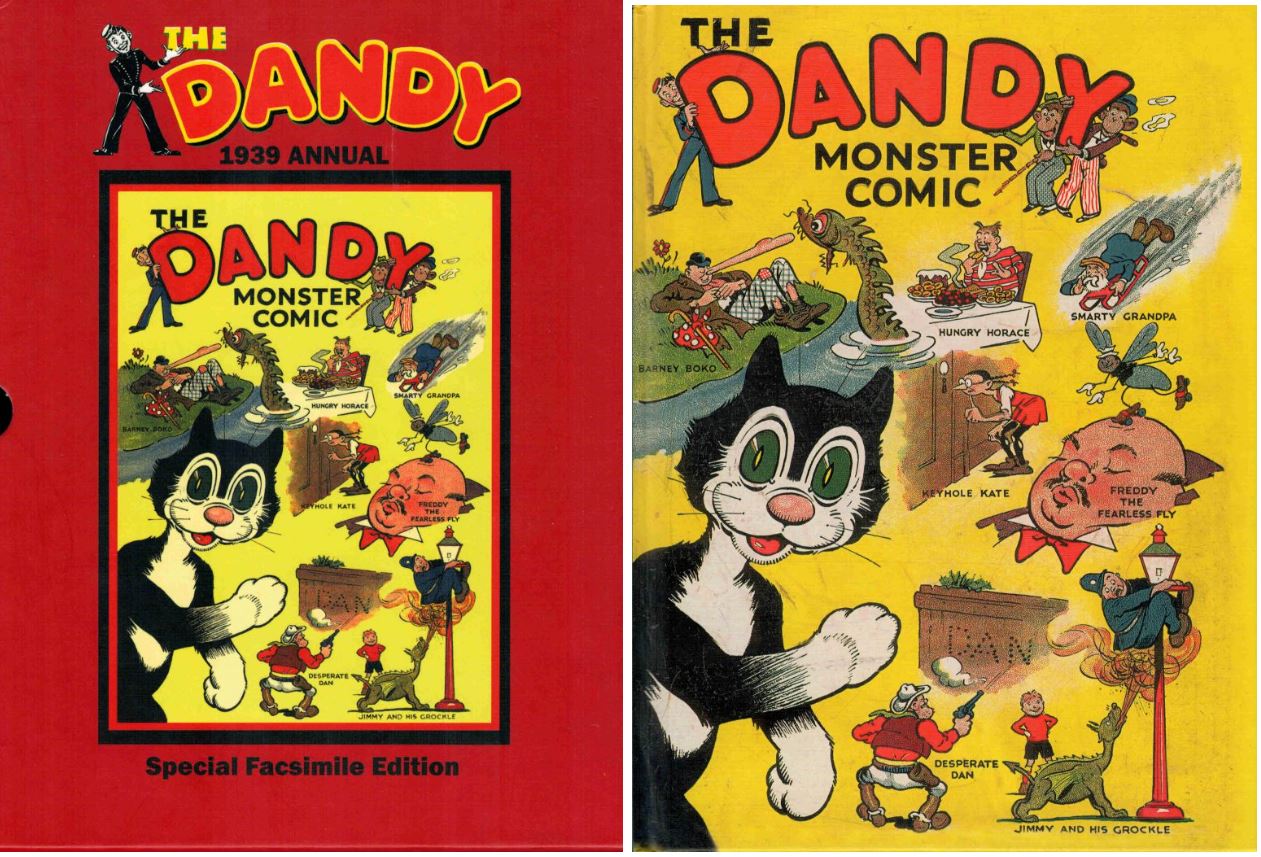
The Dandy Monster Comic (Dandy Annual 1939 Special Facsimile Edition)


By Many and various (DC Thomson & Co/Aurum Press)
ISBN: 978-1- 84513-217-0 (Boxed slipcase HB)

This one’s actually older than me – at least in its original incarnation – and a true anniversary wonder.

Until it folded and was reborn as a digital publication on 4th December 2012, The Dandy was the third longest running comic in the world (behind Italy’s Il Giornalino – launched in 1924 – and America’s Detective Comics in March 1937).

Premiering on December 4th 1937, The Dandy broke the mould of British predecessors by using word balloons and captions rather than narrative blocks of text under sequential picture frames. A colossal success, it was followed eight months later (on July 30th 1938) by The Beano, and together they revolutionised the way children’s publications looked and, most importantly, how they were read.

Over the decades the “terrible twins” spawned a bevy of unforgettable, beloved household names who delighted generations of avidly devoted readers, and end of year celebrations were graced with bumper bonanzas of the weekly stars in extended stories in magnificent hardback annuals. As WWII progressed, rationed paper and ink forced the “children’s papers” into an alternating fortnightly schedule: on September 6th 1941 only The Dandy was published. A week later just The Beano appeared. They only returned to normal weekly editions on 30th July 1949…

However, as of this grand festive feast that’s all in the future. Here, masterfully restored, is a treasure trove of joyous pranks and all-ages adventure to delight and enthral. It should be noted however, that all this buffoonery and jolly japery was crafted at a time socially far-removed from ours, and there are terms and racial depictions that wouldn’t be given houseroom in today’s world. That was then, this is now, and that’s another thing you can be grateful for…

It opens in classis DCT manner with the entire cast chowing down to a monumental feast – a staple reward of those leaner, impoverished times – before James Crichton’s ‘Korky the Cat’ kicks things off with spot of calamitous dockside fishing, after which ‘Jimmy and his Grockle’ – a kind of Doberman dragon – foil a dognapping ring. Illustrated by James Clark, the strip was recycled from prose “Boys Paper” The Rover where it was “Jimmy Johnson’s Grockle” (1932).

Most pages come with riddles, jokes or single panel gags and many of the strips are delivered in the signature two colour process that typifies British Annuals and as usual no writers are named and precious few of the artists are credited. As always, I’ve offered a best guess as to whom we should thank, and of course I would be so very happy if anybody could confirm or deny my suppositions…

Prolific Allan Morley details how ‘Keyhole Kate’ falls foul of a burglar and cowboy superman, ‘Desperate Dan’ – by key man Dudley D. Watkins – braves harsh winter climes, before Morley’s ‘Freddy the Fearless Fly’ thwarts a human bully and thrashes a predatory spider.

These colossal tomes were all about variety and value for money and next up is a heavily-illustrated prose story detailing the feudal adventure of young shepherd-boy Gingan’s dragon-slaying quest with magical weapon ‘The Sword of Crad’ before wandering tramp ‘Barney Boko’ comes a-cropper after defacing public property in a wordless strip from John R. Mason.

As depicted by the superb Eric Roberts, ‘Podge’s Frame-Up’ sees the junior entrepreneur confusing art galleries with glaziers whilst nattily-dressed ‘Archie the Ape’ deals with a hungry lion and ‘Smarty Grandpa’ (by Watkins and a double for strip veteran Pa Broon) has a racially-charged moment at a minstrel show before anthropomorphic tortoise ‘Dan the Night-watchman’ confronts a gang of thieving rats…

‘The Boy that Beat the Band’ is another prose drama (illustrated by Fred Sturrock?) with a young orphan acrobat saving a disabled boy and thereafter rewarded with his heart’s desire – a job – after which Jack Glass’ text-block & pic strip ‘The Daring Deeds of Buck Wilson’ sees the singing cowboy battling kidnappers before the animal antics in ‘Bamboo Town’ find daring duo Bongo and Pongo organising a therapeutic gymnasium in a typically busy romp limned by Charlie Gordon.

Sam Fair’s ‘Wig and Wam the Skookum Kids’ were prank-playing “Red Indian” lads who here trick the Big Chief into baiting a bear before ‘Flippy the Sea Serpent’ – by Frank Minnitt – settles the hash of a snooty octopus whilst Smarty Grandpa fails to steal a pie…

Boneless Bill was a long-running but sadly anonymous strip starring an affable contortionist. Here he astounds an army recruiting officer before ‘Marmaduke Mean the Miser’ pays painfully for stealing a little lad’s Dandy comic. Then ‘Hungry Horace’ (Morley) finds his appetite briefly diminished after illicitly tapping the wrong barrel and a cunning old codger prevents a mugging in ‘Old Beaver’s Brainwaves’.

‘Wee Tusky’ was a long-running prose feature and here the baby elephant’s propensity for trouble leads to deadly danger but secures him a human friend in the end, after which Roberts’ ‘Helpful Henry’ adjusts seating arrangements despite a history of calamitous consequences, just as pompous (idiot) detective ‘Trackem Down’ botches another “case”…

Korky the Cat masters the fundamentals of golf whilst Jimmy and his Grockle find fun – and bananas – at the docks, after which Keyhole Kate’s snooping drenches a helpful bystander and Desperate Dan proves building sites can be dangerous places… for other people…

After another get-rich-quick scheme from Podge, sausage-snaffling ‘Dipper the Dodger’ falls foul of the law. Probably drawn by James Jewell, Dipper is a dead ringer for Beano and The People’s Journal cartoon stalwart Wee Peem (“He’s a Proper Scream”), so there might have been some cross-pollination back then.

Freddy the Fearless Fly turns arsonist to escape a spider’s trap before Helpful Henry learns the perils of electricity, and Jimmy Denton tries rodeo riding to save the ranch with the invaluable assistance of ‘White Star’s Star Turn’, in a prose thriller that seamlessly segues to Podge setting up his own postal service whilst ‘Bobby, the Boy Scout’ goes too far in his scheme to help a hobo…

Boneless Bill artfully apprehends a thief and Archie the Ape find busking hazardous to health, whilst Hungry Horace loses his lunch to a quick-witted sprinter, but savvy navies ‘Nick & Nack’ find a smart way to keep the cops from confiscating their grub.

Interfering busybodies Bobby, the Boy Scout and Helpful Henry both get it wrong again, after which we head west to see Wig and Wam the Skookum Kids prank their dad yet again even as Desperate Dan falls asleep in the park but still causes chaos…

‘Willing Willie and his Pa’ experience decorating woes before we revisit the days of the Raj in prose thriller ‘Pam the Peace-Maker’ wherein a little girl prevents an outbreak of war after which Helpful Henry confuses radio and electric irons and Korky triumphs over a tiger when he goes on safari.

Jimmy and his Grockle clash violently with shopkeepers and Old Beaver’s Brainwaves sees the gamey geezer getting back at the thug who pinched his job as itinerant Barney Boko pays through the nose for watching football without a ticket.

Dipper the Dodger meets a theatrical strongman and the Bamboo-Town boys convene a swimming class that would certainly have benefitted ‘Sandy Starfish, the Shipwrecked Sailor’ before Fred Sturrock illustrates a prose battle of wits between stubborn old men in ‘The House that Jack the Joker Built’.

More musical mayhem from Archie the Ape precedes Hungry Horace outwitting municipal bylaws in search of a big scoff, even as Podge dupes another crowd of sensation hungry oafs and Helpful Henry wrecks a house before it’s even built: a trick even Desperate Dan can’t match, even if he wasn’t so thirsty…

Mini vignettes for Podge, Barney Boko and Boneless Bill presage a riotous schoolboy romp in prose – probably illustrated by George Ramsbottom – that I need you to be grown up about. ‘Invisible Dick Spoofs the Spoofer’ is a smart tale from a venerable feature that ran in The Rover for years and when he turns the tables on a cruel stage magician humiliating his school chums you should be proud and not titter or snigger…

A rapid-fire tranche of cartoon antics, starring Bobby the Boy Scout, Podge, Marmaduke Mean the Miser, Flippy the Sea Serpent, Boneless Bill and Willing Willie and his Pa, lead to another text tale as animal-raised orphan ‘Buffalo Boy’ discovers toffee and begins his slow march back to civilisation…

From here it’s cartoon strip all the way with Korky, Keyhole Kate, Freddy the Fearless Fly, Helpful Henry, Wig and Wam the Skookum Kids, Smarty Grandpa and Dipper the Dodger all doing what they do best before Bamboo-Town brings down the curtain when Bongo and Pongo build an all-animal skating rink…

A marvel of nostalgia and timeless comics wonder, the true magic of this facsimile edition is the brilliant art and stories by a host of talents that have literally made Britons who they are today, and bravo to DC Thomson for letting them out for a half-day to run amok once again.
The DANDY is a trademark of and © D. C. Thomson & Co. Ltd. 2006. Associated characters, text and artwork © D. C. Thomson & Co. Ltd. 2006. All rights reserved.