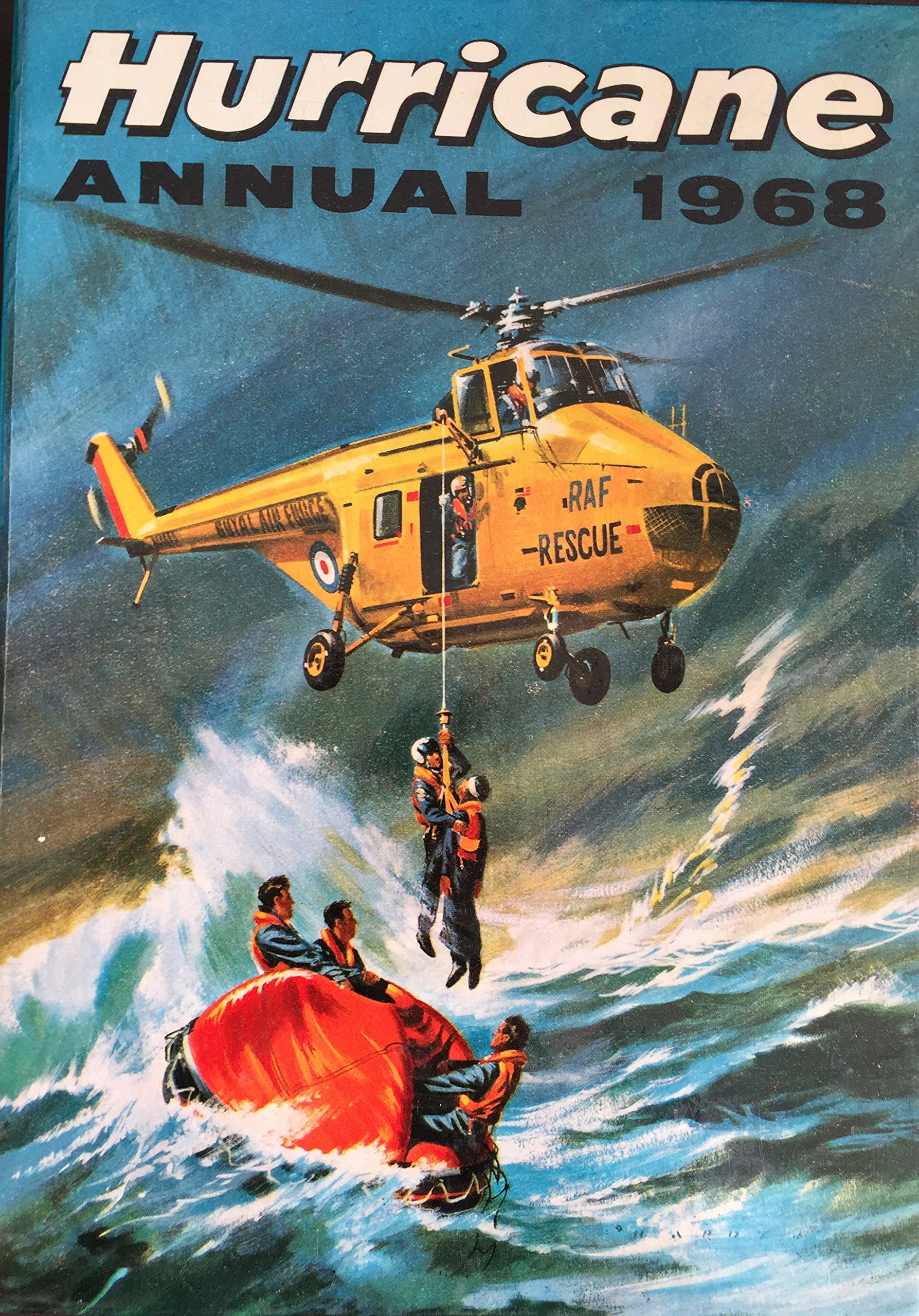
Hurricane Annual 1968


By Many & various (Fleetway)
No ISBN:

From the late 1950s and increasingly through the 1960s, Scotland’s DC Thomson steadily overtook their London-based competition – primarily monolithic comics publishing giant Amalgamated Press. Founded by Alfred Harmsworth at the beginning of the twentieth century, AP sought to regain lost ground, and the sheer variety of material the southerners unleashed as countermeasures offered incredible vistas in adventure and – thanks to the defection of Leo Baxendale and Ken Reid to the enemy – eventually found a wealth of anarchic comedy material to challenge the likes of the Bash Street Kids, Dennis the Menace, Minnie the Minx and their unruly kin.

During the latter end of that period the Batman TV show sent the entire world superhero-crazy. Amalgamated had almost finished absorbing all its local rivals – such as The Eagle‘s Hulton Press – to form Fleetway/Odhams/IPC and were about to incorporate American-styled superheroes into their heady brew of weekly thrills.

Once the biggest player in children’s comics, Amalgamated had stayed at the forefront of sales by latching onto every fad: keeping their material contemporary, if not strictly fresh. The all-consuming company began reprinting early Marvel Comics successes for a few years: feeding on the growing fashion for US style adventure which had largely supplanted the rather tired True-Blue Brit style of Dan Dare or DC Thompson’s Wolf of Kabul.

Even though sales of all British comics were generally – and in some cases, drastically -declining, the 1960s were a period of intense and impressive innovation with publishers embracing new sensibilities; constantly trying new types of character and tales. At this time Valiant and its stable-mate Lion were the Boys’ Adventure big guns (although nothing could touch DC Thomson’s Beano and Dandy in the comedy arena).

Hurricane was an impressive-looking upgrade that began during that period of expansion and counterattack, apparently conceived in response to DCT’s action weekly Hornet. It launched the week of February 29th 1964 and ran for 63 issues, but was revamped three times during that period before ultimately being merged into companion paper Tiger.

It carried a superbly varied roster of features in that time, including two (and a half) stars who survived its extinction. Racing driver Skid Solo and comedy superman Typhoon Tracy as well as Sgt Rock – Paratrooper… but not for so long for him…

There was heavy dependence on European and South American artists initially, among them Mario Capaldi, Nevio Zeccara, Georgio Trevisan, Renato Polese and Lino Landolfi, some of whom lasted into the Annuals. As with so many titles, although the comics might quickly fade, Christmas Annuals maintained a presence for years after and Hurricane seasonal specials were produced for every year from 1965 to 1974…

Following a tried-&-true formula, this book – published in 1967 – offers comics adventures, prose stories, fact-features, funnies and puzzles and kicks off with stunning full-colour fact feature strip ‘Lawmen and Badmen of the Wild West’.

Looking  like they’re painted by Reg Bunn or Tony Weare, these comics outline the lives and times of Wyatt Earp, Tom Smith, Black Bart, Sam Bass, Billy the Kid and Bat Masterson, before fully fictional western star Drago teaches a headstrong young cavalry officer the meaning of command in monochrome thriller ‘He Rides Alone’ – possibly illustrated by Polese.

Regular prose feature ‘The Worst Boy in the School’ (illustrated by Geoffrey Whittam?) follows a page of medical gags entitled ‘Take a dose of Chuckles!’ The long-running boarding school saga was enlivened by its star Duffy coming from Circus stock. Here the comedy, chaos and espionage excitement stems from a New Boy who’s convinced enemies of his father – a South American president – are trying to kidnap him. He’s not wrong…

Returning to monochrome strips, ‘Sgt. Rock – Special Air Service’ ferrets out Nazi infiltrators masquerading as American GIs before we switch back to fact for a photo-feature offering capacious coverage of modern British military might in ‘The Army Marches on its Wheels!’ whilst the comedy capers of ‘Rod the Odd Mod and ‘is old pal Percy Vere’ literally bring the house down when he gets the Hi Fi bug.

‘Casey and the Champ’ stars a veteran railroad man and his steam engine who here reveal in strip form the unlikely salvation of a played-out mining town as prelude to photo feature ‘Why Not Go by Balloon?’ before heading to 1804 where Regency prize-fighter Jim Trim stumbles upon a Napoleonic plot to conquer England in ‘Two Fists Against the World!’ (perhaps illustrated by Carlos Roume)…

Prose yarn ‘Carlos of the Wild Horses’ details the story of conquistadores imperilled by rebellious Aztecs and saved by the bond between the governor’s young son and a herd of mustangs and is followed by text fact-features ‘War Dogs’ – commemorating canines in combat – and ‘Atlantic Greyhounds’ explaining why the glory days of cruise liners had passed and why they could be built no bigger. Ah, the joys of schadenfreude and hindsight in action…

Next is a prose-&-photo precis current of movie release ‘The Train’(starring Burt Lancaster, but I’d never heard of it): a tale of Nazi collaboration and pursuit of transport of stolen art, followed by photo feature ‘When Nature Turns Nasty!’ before the incontestable star of Hurricane thunders in on a wave of colour illustration. ‘The Juggernaut from Planet Z’ is again despatched to aid his Earth chum Dr. Dan Morgan only to be overridden – and temporarily enslaved – by crazed would-be dictator General Zeb.

Sport next as ‘Hurry of the Hammers’ finds the football star in black-&-white and almost deprived of club and grounds by an unscrupulous new owner more interested in profit than the beautiful game. Historical factual strip ‘They Climbed… the Matterhorn’ then leads to a prose outing for the worst ship in the WWII navy. One again confounding the British Admiralty and escaping being broken up for parts in ‘HMS Outcast – Pride of the Fleet’ sees Geoff Campion’s unruly mob save the Pacific flotilla from destruction by the Japanese using ping pong balls and tomato sauce…

‘Typhoon Tracy’s Lucky Strike!’ finds the mighty moron in Alaska, battling bears, triggering a gold rush and helping an old friend stave off poverty, after which Giovanni Ticci employs duo-colour to limn a superbly light-hearted ‘Sword for Hire’ romp starring Cavalier soldier-of-fortune Hugo Dinwiddie who saves a fugitive king’s agent from capture even while acting as an unwilling substitute for a duellist.

Reverting to prose, ‘The Terrible Revenge of Dr. Parvo’ stars atomic accident survivors Ace Sutton and Flash Casey who use their journalistic skills and ability to walk through walls to stop a madman weaponizing weather, after which strip ‘Danger at Manakee Deep’ details a futuristic undersea habitat and resource factory endangered by greed and treachery.

‘Rodeo!’ traces the history of the sport with photos front the Calgary Stampede whilst monochrome strip ‘The Ragged Racer’ offers early environmental activism from its Wildman hero as he thwarts a circus’ scheme to destroy his mountainous animal preserve and gag page ‘It’s a Dog’s Laugh!’ brings us the text cover feature ‘R.A.F. to the Rescue’ outlining the history and activities of the coastal guardians.

The prose perseveres with adventure yarn ‘The Fiery Furnaces’ as two roving sportsmen accidentally dethrone a South American tyrant with delusions of grandeur (with illustrations by either Nevio Zaccara or Alfredo Giolitti) before ‘Rod the Odd Mod and ‘is old pal Percy Vere’ endure a calamitous bath night…

Sport was a major fascination of publishers at this time and ‘Soccer Special by The Ref’ opens an extended section of pictorial mini-features comprising ‘Famous Captains before they were Famous’, ‘Soccer Trophies Worth Winning’ and ‘Strange Things Happen in Soccer’ before we all ride off into the sunset, ending with comic strip masked cowboy ‘The Black Avenger’ who chases and then saves a “white magician” stirring up Indian tribes.

Eclectic, wide-ranging and always of majestically high quality, this blend of fact, fiction, fun and thrills is a splendid evocation of lost days of joy and wonder. We may not be making books like this anymore but at least they’re still relatively easy to track down. Of course, what’s really needed is for some sagacious publisher to start re-issuing them…
© Fleetway Publications Ltd., 1967

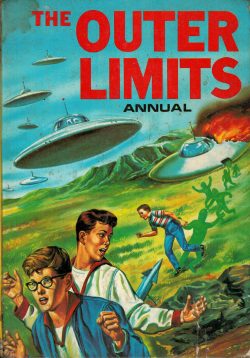
The Outer Limits Annual 1966


By Paul S. Newman(?) & Jack Sparling, & various (World Distributors {Manchester} Limited)
No ISBN. ASIN: B0042Q9PAE (HB)

British Comics have always fed heavily on other media and as television grew during the 1960s – especially the area of children’s shows and cartoons – those programmes increasingly became a staple source for the Seasonal Annual market. There would be a profusion of stories and strips targeting not readers but young viewers and more and more often the stars would be American not British.

Much of this stuff wouldn’t even be as popular in the USA as here, so whatever comic licenses existed usually didn’t provide enough material to fill a hardback volume ranging anywhere from 64 to 160 pages. Thus, many Annuals such as Daktari, Champion the Wonder Horse, Lone Ranger and a host of others required original material or, as a last resort, similarly-themed or related strips. That’s not the case here…

The Outer Limits launched in the USA on September 16th 1963, running until January 16th 1965: two seasons comprising 49 self-contained episodes of an anthological science fiction series with no returning stars where drama, suspense and uncanny situations beguiled paranoid, culturally shell-shocked audiences seeking a brief release from real-world threats like the Cold War and Cost of Living. Like contemporary rival show The Twilight Zone, it was sold all over the world and developed a fanatically devoted fanbase, thereby achieving a kind of immortality, with modern reboots and merchandising.

Comic book franchising specialist Gold Key produced a series of 18 issues spanning March 1964 to October 1969, running almost half a decade beyond the show’s cancellation (but presumably sustained by regional TV syndication). They were part of print monolith western Publishing whose Dell Comics, Gold Key, Big Little, Little Golden and Golden Press books for children were a staple of kids’ lives in America for decades.

Western Publishing was a major player since comics’ earliest days, blending a huge tranche of licensed material including newspaper strips, TV and Disney titles, (such as Nancy and Sluggo, Tarzan, or The Lone Ranger) with home-grown hits like Turok, Son of Stone and Magnus, Robot Fighter.

Their output was an ideal perfect source of material for British publishers whose regular audiences were profoundly addicted to TV and movie properties. For decades, Western’s comics from The Impossibles and Bugs Bunny to Voyage to the Bottom of the Sea and Star Trek filled our Christmas treats and also slipped in some original character concepts.

“All Killer and No Filler”, this book – the second of two Outer Limits editions – was produced in a non-standard UK format, with full-colour for three American reprints and nothing else: no prose pieces, puzzles, games or fact-features on related themes. It looks and feels like it’s one from the wonderful Mick Anglo’s packaging company Gower Studios, however and I’m fairly certain the originals were scripted by prolific wonder Paul S. Newman (Dr. Solar, Man of the Atom, Space Family Robinson, Turok, The Lone Ranger)

There’s no doubt the illustrator was the uniquely stylish and equally prolific John Edmond “Jack” Sparling (Hap Hopper, Washington Correspondent, Claire Voyant, Doc Savage, Challengers of the Unknown, Unknown Soldier, Captain America) who in sterling fashion produced this trio of terrors…

‘The Dread Discovery’ debuted in quarterly issue #5 (April 1965) and is set in a NASA base where Peter Norton, with his pals Andy and Fred, accidentally shoot down a flying saucer with their model rocket. The kids’ parents all work on-base and are – eventually – delighted to meet the vessel’s occupant. FR-2 is a defector from his own people, arriving in advance of their invasion fleet and willing to give his life to save humanity…

The Outer Limits #6 (July 1965) recounted the saga of ‘The Mystery Moon’ wherein little Jim Burke is abducted by aliens when he exposes their seeming mission of mercy as a devious scheme to fling earth out of orbit. Luckily for humanity, the lad’s a lot smarter and more cunning than his kidnappers…

The brooding mystery and omnipresent menace conclude with ‘The Message from Space’ (#8, July 1966) as radio-astronomer Arthur Godderd decodes a communication from distant star 102 Beta and has his chemist chum Charles Dilling mix up the resulting formula. When sunlight hits the goo, it super-expands and attacks civilisation on multiple fronts. Seemingly unstoppable, the glob is only countered when all the previously warring nations on Earth act in unison in accordance with a crazy theory put forward by desperate Dr. Dilling…

Quirky but chilling, and always applying sound scientific principles to the most outlandish plot circumstances, this is a superb scare package for kids in the manner of Goosebumps and well worth a latter-day revisit.
© MCMLVX, MCMLVXI by Daystar-Villa Di Stefano-United Artists Television. All rights reserved throughout the world.

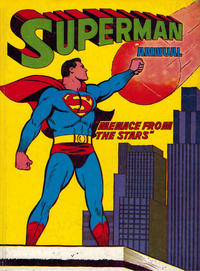
Superman Annual 1963-1964


By Jerry Siegel, Edmund Hamilton, Bill Woolfolk, Ed Herron, Alvin Schwartz, Dave Wood, Henry Boltinoff, George Papp, Curt Swan, Wayne Boring, Al Plastino, Jack Kirby, Lee Elias & various (Atlas Publishing and distributing Co./K.G. Murray)
No ISBN:

Before DC and other American publishers began exporting comic books directly into the UK in 1959, our exposure to their unique brand of fantasy fun came from licensed reprints. Seemingly ubiquitous British publishers/printers like Len Miller, Alan Class and Top Sellers bought US material – and occasionally Canadian – to fill 68-page monochrome anthologies, many of which recycled the same stories for decades.

Less commonplace were strangely coloured pamphlets produced by Australian outfit K. G. Murray: exported to the UK in a rather sporadic manner. The company also produced sturdy Annuals which had a huge impact on my earliest years (I suspect my abiding adulation of monochrome artwork stems from seeing supreme stylists like Curt Swan, Carmine Infantino, Gil Kane and Murphy Anderson strut their stuff uncluttered by flat colour…).

In Britain we began seeing hardcover Superman Annuals in 1950, Superboy Annuals in 1953, Super AdventureAnnuals in 1959 and Batman books in 1960. Since then many publishers have carried on the tradition. This particular tome comes from 1963 as the super-hero craze was barely beginning, allowing us to see a range of transitional material that fell between the Golden and Silver Ages …

This particular tome predates the Batman TV show that turned the entire planet Camp-Crazed and Bat-Manic, and therefore provides a delightfully eclectic mix of material far more in keeping with traditionally perceived interests of British boys than the suited-&-booted masked madness that was soon to follow in the Caped Crusader’s scalloped wake.

It’s also produced in the cheap and quirky mix of monochrome, dual-hued and weirdly full-coloured pages which made Christmas books such a bizarrely beloved treat.

The sublime suspense and joyous adventuring begins with a rare treat as in black, blue and red on white, we meet ‘The Menace from the Stars!’ by Bill Woolfolk, Wayne Boring & Stan Kaye, coming from World’s Finest Comics #68 (January/February 1954) in which a brush with a Green Kryptonite-infused asteroid gives the Man of Steel amnesia.

Happily, before he can inadvertently expose his secret identity, another sudden impact sets things aright, just as Green Arrow clashes with a devious criminal, necessitating the inexplicable side-lining of Boy Bowman Speedy and recruitment of ‘The Legion of 100 Archers!’: an anonymously-authored yarn drawn by George Papp and originating in Adventure Comics #189 (June 1953).

British books always preferred to alternate action with short gag strips, and Murray Line perfectly exploited the phenomenal DC output of cartoonist Henry Boltinoff, whose various gag-strip stars acted as palate-cleansing chapter breaks between dramas. Here a convict conundrum for ‘Warden Willis’ and bedtime woes for ‘Moolah the Mystic’ presage another archery adventure as the Battling Bowmen meet ‘The Amazing Miss Arrowette’.

Taken from WFC #113 (November 1960), the painfully parochial and patronising tone of the times seeped into the saga (scripted by Dave Wood and limned by Lee Elias) as a hopeful, ambitious Ladies’ Archery competitor tries her very best to become Green Arrow’s main helpmeet. Moreover, in a series notorious for absurd gimmick shafts, nothing ever came close to surpassing the Hair-Pin, Needle-and-Thread, Powder-Puff or Lotion Arrows stashed in Bonnie King‘s fetching and stylish little quiver…

Quirky colour returns with gag strips ‘Pop’ and ‘Jail Jests’ before the Man of Tomorrow recalls ‘The Girls in Superman’s Life’ in a slightly reformatted by Edmond Hamilton & Al Plastino from Superman #78 (September/October 1952) bring an adult Lana Lang into the full-grown hero’s life as a rival for Lois Lane and suspicious stalker of Clark Kent…

‘Moolah the Mystic’ and ‘Warden Willis’ japes precede a return to monochrome and a spectacular Jack Kirby GA extravaganza from WFC #97 (October 1958). ‘The Menace of the Mechanical Octopus!’ is a grand old-school high-tech crime-caper scripted by Ed Herron and inked by Roz Kirby.

Superman #137 (May 1960) then delivers an epic sci fi shocker in The Super-Brat from Krypton!’ (Jerry Siegel, Curt Swan & John Forte), revealing how an energy duplicate of baby Kal-El was raised in secret by Earth criminals to become ‘The Young Super-Bully’ before finally confronting his noble counterpart in ‘Superman vs. Super-Menace!’

Slapstick colour interludes from ‘Hy Wire’ and ‘Fireman Pete’ segue neatly into doomsday drama as an unknown writer, Boring & Kaye unearth ‘Jor-El’s Last Will!’ (WFC #69 March/April 1954) and sees the Man of Tomorrow strive to save his adopted home from his father’s deadliest inventions.

Fact fillers were also popular and a ‘Quick Quiz’ and one more ‘Hy Wire’ gag brings us back to black-&-white as Green Arrow tackles the lethally informative threat of alternative fact distributor ‘Crime’s TV Station’ in a canny teaser from Adventure Comics #197 (February 1954) before killer fillers ‘Science Says You’re Wrong’, ‘Scientific Word Origins’ and ‘Jerry the Jitterbug’ herald ‘The Return of Miss Arrowette’ by Wood & Elias from WFC#118 (June 1961) which proves far less cringeworthy than her debut but still manages to make the Bow Babe both competent and imbecilic at the same time.

One last stab at colour sees ‘Science Says You’re Wrong’ and ‘Jerry the Jitterbug’ lay the groundwork for ‘Batman – Double for Superman’ by Alvin Schwartz,  Swan & Kaye from World’s Finest Comics #71, July/August 1954. A landmark piece made in response to economic circumstances, it details the first official team-up of Superman and Batman…

With dwindling page counts, rising costs but a proven readership and years of co-starring but never mingling, it saw the Man of Tomorrow and the Gotham Gangbuster in the first of their shared cases as the merely mortal hero traded identities to save his Kryptonian comrade’s alter ego and, latterly, life…

Simple, straightforward action-adventure never goes out of style and these tales could as easily beguile today’s young scamps as they did my lot. Worth a shot, right?
© National Periodical Publications, Inc., New York.  Published by arrangement with the K.G. Murray Publishing Company, Pty. Ltd., Sydney.

Merry Christmas Every One!

In keeping with my self-imposed Holiday tradition here’s another pick of British Annuals selected not just for nostalgia’s sake but because it’s my house and my rules…

After decades when only American comics and memorabilia were considered collectable or worthy, a resurgence of interest in home-grown material means there’s lots more of this stuff available and if you’re lucky enough to stumble across a vintage volume or modern facsimile, I hope my words convince you to expand your comfort zone and try something old…

Still topping my Xmas wish-list are more collections from fans and publishers who have begun to rescue this magical material from print limbo in (affordable) new collections…

Great writing and art is rotting in boxes and attics or the archives of publishing houses, when it needs to be back in the hands of readers once again. As the tastes of the reading public have never been broader and since a selective sampling of our popular heritage will always appeal to some part of the mass consumer base, let’s all continue rewarding publishers for their efforts and prove that there’s money to be made from these glorious examples of our communal childhood.

Genre Annuals

The comic has been with us a long time now and debate still continues about where, when and exactly what constitutes the first of these artefacts to truly earn the title. There’s a lot less debate about the Children’s Annual: a particularly British institution and one that continues – albeit in a severely limited manner – to this day.

It’s a rare and tragic individual who never received a colourful card-covered compendium on Christmas morning; full of stories and comic-strips and usually featuring the seasonal antics of their favourite characters, whether from comics such as The Beano, The Dandy, Lion, Eagle and their ilk, or TV, film or radio franchises/personalities such as Dr Who, Star Wars, Thunderbirds, Radio Fun or Arthur Askey. There were even sports and hobby annuals and beautifully illustrated commemorative editions of the fact and general knowledge comics such as Look and Learn, and special events such as the always glorious Rupert Bear or Giles Annuals.

Here then is a brief celebration of the kinds of genre celebrations which delighted kids and their parents…

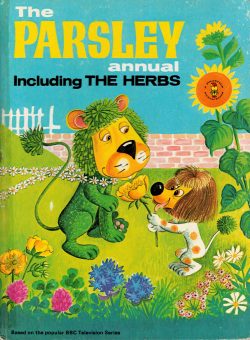
The Parsley Annual – including The Herbs – 1973
By Liz Tosker, T. Manwood & Jenny Reyn (Polystyle Publications)
SBN: 85096-027-4

The British comics marketplace has always benefitted from television shows for the very young, probably because most of those enterprises (until very recently at least), were particularly brilliant and well made. There’s no one from my generation or younger whose eyes do not mist over when thinking of Camberwick Green, Mr. Ben, Mary, Mungo and Midge, Trumpton, Paddington, Crystal Tips and Alastair or anything even remotely connected to the names Postgate & Firmin. The shows are always infinitely rewatchable, ceaselessly smart yet whimsical, and saturated with the easy charm that makes viewers into fanatical acolytes.

The Herbs were a product of production company FilmFair (Graham Clutterbuck’s UK division, anyway), with 13 stop-motion episodes debuting from 12th February 1968. Those quarter hour larks were followed in 1970 by 32 5-minute segments of The Adventures of Parsley that ran Monday to Friday before the Six O’Clock News on BBC 1 from April 6th. As was always the case with the “Watch With Mother” shows, episodes were repeated for years after production ceased.

The stories were written with devious sophistication by Paddington Bear author Michael Bond, ensuring adults were as enthralled as the intended audience, and all revolved around a magical and so-very-English Garden beyond a tantalising wall. Access was briefly granted by the utterance of a magic word and inside, people and animals lived together on an idealised Manorial estate, each an avatar of a particular herb.

Parsley was an affable lion, there was an owl named Sage and a dog called Dill, as well as so many, many others. It was instantly addictive and remains popular today through collections and on YouTube.

The show generated seven Annuals between 1969 and 1975: a beguiling mix of stories, strips, and interactive games, puzzles and activities, produced by BBC Books and media adaptation comics specialists Polystyle Publications. This one was released at the end of 1972, crafted by writers Liz Tosker and T. Manwood and illustrated by Jenny Reyn, opening and closing with double-page frontispiece and endpapers depicting the cast indulging in resolutely British sporting relaxations.

The entertainment proper opens with prose mystery ‘Parsley is Brought to his Senses’ wherein the rather nervous and timid lion worries that his tail has gone missing and is curtly told by Bayleaf the Gardener that what he’s lost is his senses…

A semantic miscommunication then prompts an hilarious investigation of his sensorium, embellished by a pictorial Smell, Taste, Touch, Hearing and Sight game, after which ‘Parsley’s Swop Shop’ opens the comic strip chapters, as the Herbs all trade unwanted items to no overall conclusion whilst ‘Parsley – Detective’ sees the hero in action after Dill’s buried bones go missing…

Lady Rosemary‘s wash day goes awry when Dill gets involved in the ‘Bubble Trouble’, before another prose tale sees the Lion again reading his Magic Book, and misconstruing what “the King of Beasts” means in ‘King Parsley’, after which Constable Knapweed takes action on the Lion’s dubious driving skills in strip delight ‘Parsley’s Anchor’…

A mystery picture puzzle to colour-in precedes a prose rite of passage and test of resolve for ‘Parsley the Hero’, duly followed by a game of ‘Dingo’ devised by that dog and the Chives, and a prose vignette detailing Parsley’s ‘Nice Idea’ to make skating on the frozen pond less traumatic…

An identify and colour-in Fruit Game and an age-appropriate Crossword is followed by a cautionary comic strip warning about ‘Green Apples’ and prose tale concerning Parsley’s reluctant return to school in ‘A long time ago’ leads expeditiously to one final story, with ‘Magic Word’ detailing the perils of overusing the potent exclamation “Herbidacious”…

Rendered primarily in full vivid colour with occasional bursts of traditional two-hued pages, this book remains remarkably readable to modern eyes and would happily stand as an easy-reading starter for beginners of all ages. It’s also still wonderfully fun and funny. Don’t take my word for it though: just trying saying that magic word…
© Polystyle Publications 1972. © FilmFair 1972.

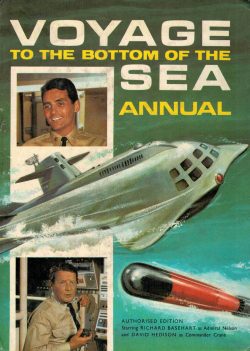
Voyage to the Bottom of the Sea Annual 1968
By Mick Anglo, Dick Wood, Marshall McClintock, Tuska George, Alfredo Giolitti and many & various (World Distributors {Manchester} Ltd.)
No ISBN

British comics have always fed heavily on other media. As television grew during the 1960s – especially the area of children’s shows and cartoons – those programmes increasingly became a staple source for the Seasonal Annual market. There would be a profusion of stories and strips targeting not readers but young viewers and more and more often the stars would be American not British.

Much of this stuff wouldn’t even be as popular in the USA as here, so whatever comic licenses existed usually didn’t provide enough material to fill a hardback volume ranging anywhere from 64 to 160 pages. Thus, many Annuals such as Daktari, Champion the Wonder Horse, Lone Ranger and a host of others required original material – generally in illustrated prose form – or, as a last resort, similarly themed or related strips.

Voyage to the Bottom of the Sea debuted in America on September 14th 1964, the first of producer Irwin Allen’s incredibly successful string of TV fantasy series which also included Lost in Space, Land of the Giants and The Time Tunnel. It ran until the end of March 1968 before going to the Valhalla of permanent syndication. The set-up involved super-advanced submarine Seaview encountering aliens, monsters, villains and disasters – natural or otherwise – guided by senior savant Admiral Harriman Nelson and Commander Lee Crane and a doughty crew of expendables…

The action begins with terse, tense drama ‘Ten Thousand Feet of Ice’ as Seaview is trapped beneath the North Pole and faces a nuclear catastrophe before ingenuity and luck save them all, after which a selection of illustrated fact features begins with a look at some bizarre ‘Creatures of the Deeps’ and a reviews of whale species in ‘“Thar She Blows!”’

‘Rock of Terror’ then finds the super-sub investigating a spate of strange shipping losses and crashing into a sinister submerged citadel of evil, after which the comic strip section opens with a reprint from the Dell/Gold Key US series.

‘The Great Undersea Safari’ originated in Voyage to the Bottom of the Sea #5 (August 1966 and possibly written by Dick Wood and/or Marshall McClintock and drawn by Tuska George, Alfredo Giolitti & Giovanni Ticci), revealing how the Seaview and Nelson are stalked by a deranged White hunter who turns the oceans into his private game ranch before meeting his fate on dry land…

Back to UK-originated prose stuff again and ‘Prehistoric Venture’ finds Seaview investigating melting icecaps and battling defrosted dinosaurs, accompanied by a feature on actual ‘Sea Beasts of the Past’, after which an inevitable yarn discloses how the ultra-modern submariners encounter and barely escape ‘The Lost Atlantis’, leading into all you need to know about subsea exploration in ‘Divers All!’: themed boardgame ‘Seaview Treasure Hunt Game’ and a history of submersibles in ‘Dive! Dive! Dive!’ before everything ends on a note of frantic fantasy as our heroes apparently encounter ‘King Neptune’…

These yearly slices of screen-to-page magic were an intrinsic part of growing up in Britain for generations and still occur every year with only the stars/celebrity/shows changing, not the package. The show itself has joined the vast hinterland of fantasy fan-favourites and, if you want to see more, in 2010 Hermes Press has collected the US material – which I’ll get around to reviewing one day (so many books, so little time or budget)…
© MCMLXVI, MCMLXVII, by Cambridge Productions Inc. All rights reserved throughout the world. By arrangement with Western Publishing Company, Inc, Racine, Wisconsin, USA

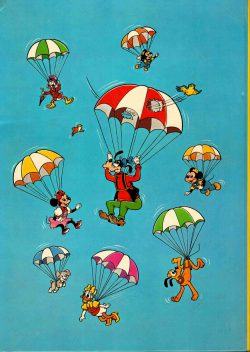
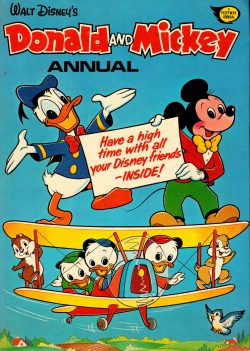
Donald and Mickey Annual 1976
By Many & various (IPC Magazines)
SBN: 85037-202-X

The works of the Walt Disney Studio have been part of global culture since 1928 with their comics spin-offs similarly dominant since the 1930 Mickey Mouse newspaper. These days the publishing empire of Disney properties spans continents, but they have always been a mighty force in comics.

In 1935, Mickey Mouse Magazine launched in the USA, and was supplemented in Britain a year later by an astoundingly beautiful and high-quality photo gravure tabloid counterpart. Mickey Mouse Weekly ran from 1936 to 1957. Although still a presence after that, the franchise only really revived after Disney TV shows became commonplace in the UK. In 1972 Fleetway released Donald and Mickey which ran from March 4th until August 1974, by which time it had morphed into Mickey and Donald and absorbed companion title Goofy.

There were four annuals, of which this is the last…

Following ‘What’s Inside’ and a welcoming message from “the Editor”’, the blend of strips (culled from all over Europe and the USA) and home-generated puzzles and games open with crime spoof ‘The Hound of Basketville’: a product of the Walt Disney Theatre wherein Sherlock Mouse and Doctor Goofy riff effectively on the Conan Doyle classic…

Donald and Daisy Duck go disastrously shopping for gifts in ‘Slappy Birthday’ and ‘Uncle Scrooge McDuck’ pays a high price for his innate parsimony before a prototype photo-infomercial reveals the wonders of new Disneyland attraction ‘The Haunted Mansion’, but it’s comics fun as usual in ‘Super Hungry Hero’ when peanut-powered Super-Goof battles the dastardly Beagle Boys…

Enthusiasm trumps common sense when ‘Mickey Mouse’ employs a pelican to deliver fish before ‘Scamp (Son of Lady and the Tramp)’ learns the painful pros and cons of staying up late, leading to a puzzle section comprising ‘Robin Hood’s Spot the Difference’, a photo packed ‘Disquiz’ and ‘Famous Disney TV Faces’.

Prose vignette ‘Top Trail Marker starring Big Bad Wolf’ segues into a ‘B-Wildering Puzzle’ after which ‘The Mouseketeers’ details the development of the company’s television treats. Activity page ‘Draw Fethry Duck’ leads to single gags courtesy of ‘Goofy’s Jest for Fun’, 8 Colour-It-Yourself images, ‘Peter Pan’s Shadow’ join-the-dots page, ‘Moby’s All-at-Sea Crossword’ and a spot the difference poser in ‘Puzzled Pluto’…

Frenetic and fractious team-up ‘Search for Luck’ unites Chip ‘n’ Dale and the Seven Dwarfs whilst ‘Goofy’s Laughter Lesson’ painfully shares ‘How to be A Gentleman’ before the brainteasing resumes with a vengeance in ‘O’Malley’s Fun & Mystery’, after which inventive Gyro Gearloose causes chaos as ‘The Weatherman’.

A round of short gags follows – ‘It’s Goofy!’, ‘Donald Duck’ and ‘It’s Uncle Scrooge again!’ before final puzzle ‘Wanted- Help for Goofy’, leads into a comedy of errors as the pals squabble over tickets for ‘The Wrestling Match’, ‘Pluto’ is sucked into chase-sparked calamity, leaving Donald and Daisy to wrap things up in style when the daft drake adopts strident libertarian leanings in ‘Free and Easy’…

Straightforward all-ages whimsy and a high recognition factor always made these items a popular parental standby, but the quality of the material is what us kids always remembered.

Check out yourself, why don’t you?
© Walt Disney Productions, 1975

Merry Christmas, One and All

In keeping with my self-imposed Holiday tradition here’s another pick of British Annuals selected not just for nostalgia’s sake but because it’s my house and my rules…

After decades when only American comics and memorabilia were considered collectable or worthy, the resurgence of interest in home-grown material means there’s lots more of this stuff available and if you’re lucky enough to stumble across a vintage volume or modern facsimile, I hope my words convince you to expand your comfort zone and try something old yet new…

Still topping my Xmas wish-list is further collections from fans and publishers who have begun to rescue this magical material from print limbo in (affordable) new collections…

Great writing and art is rotting in boxes and attics or the archives of publishing houses, when it needs to be back in the hands of readers once again. As the tastes of the reading public have never been broader and since a selective sampling of our popular heritage will always appeal to some part of the mass consumer base, let’s all continue rewarding publishers for their efforts and prove that there’s money to be made from these glorious examples of our communal childhood.

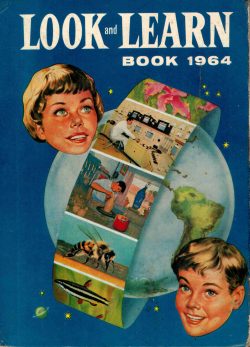
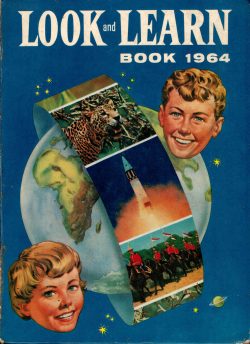
Look and Learn Book 1964
By various (Fleetway)
No ISBN
One of the most missed of publishing traditions in this country is the educational comic. From the features in legendary icon The Eagle to the small explosion of factual and socially responsible boys’ and girls’ papers in the late 1950s, to the heady go-getting heydays of the 1960s and 1970s, Britain had a healthy sub-culture of kids’ periodicals that informed, instructed and revealed – and don’t even get me started on sports comics!

Amongst many others, Speed & Power, World of Wonder, Tell Me Why and the greatest of them all, Look and Learn, spent weeks over decades making things clear and bringing the marvels of the world to our childish but avid attentions. Moreover, when we had no screens of our own, it was all accomplished with wit, style and – thanks to the quality of the illustrators involved – astonishing beauty and clarity.

Look and Learn launched on 20th January 1962, the brainchild of Fleetway Publications Director of Juvenile Publications Leonard Matthews, and executed by Editor David Stone (almost instantly replaced by John Sanders), Sub-Editor Freddie Lidstone and Art Director Jack Parker.

For twenty years and 1049 issues. the comic delighted children by bringing the marvels of the universe to their doors, and became one of the county’s most popular children’s weeklies. Naturally, there were many spin-off tomes such as The Look and Learn Book of 1001 Questions and Answers, Look and Learn Book of Wonders of Nature, Look and Learn Book of Pets and Look and Learn Young Scientist, as well as the totally engrossing Christmas treat The Look and Learn Book.

Selected simply because it has a lovely and inclusive painted cover, this volume – released for Christmas 1963 (as with almost all UK Annuals they were forward-dated) is a prime example of a lost form. Within this168-heavy-stock-paged hardback are 49 fascinating features on all aspects of human endeavour and natural wonder from And in the beginning there was FIRE, Let’s Look at Canada, How this Book was Printed, It’s On the Map!, The Muscle Menders, When Man Goes to Mars, Every Carpet Tells a Story, The Charm of Canterbury, Puzzle Pix, Art Gallery in an Album, Photo Know-How, The Queen’s Bodyguard, Why Do Camels Have Humps? and dozens more articles, all cannily designed to beguile, enthral and above all else, inspire young minds.

Lavishly illustrated with photographs, diagrams, infographics, and paintings and drawings by some of the world’s greatest commercial artists including such luminaries as Ron and Gerry Embleton, Don Lawrence, Helen Haywood, Ron Turner, Ken Evans, Angus McBride, Severino Baraldi, Graham Coton, Ralph Bruce, Cecil Langley Doughty and many others, these books were an utter delight for hungry minds to devour whilst the turkey and Christmas pudding were slowly digested…

Earlier editions such as this one also valued literary entertainment and hands-on activity: providing illustrated extracts from classic books (as here with ‘Midshipman Easy Goes to Sea’ by Captain Frederick Marryat and illuminated poems ‘The Fall of Ratisbon’ by Robert Browning and William Wordsworth’s ‘An Evening Walk’) and hobby crafts as seen in a vast and detailed section on ‘How to build Model Boats’ – complete with plans and blueprints.

With the internet and TV, I suppose their like is unnecessary and irrelevant, but nostalgia aside, the glorious pictures in these volumes alone make them worth the effort of acquisition, and I defy any child of any age to not be sucked into the magic of learning stuff in such lively, lovely style…
© Fleetway Publications Ltd 1963. All Rights Reserved.

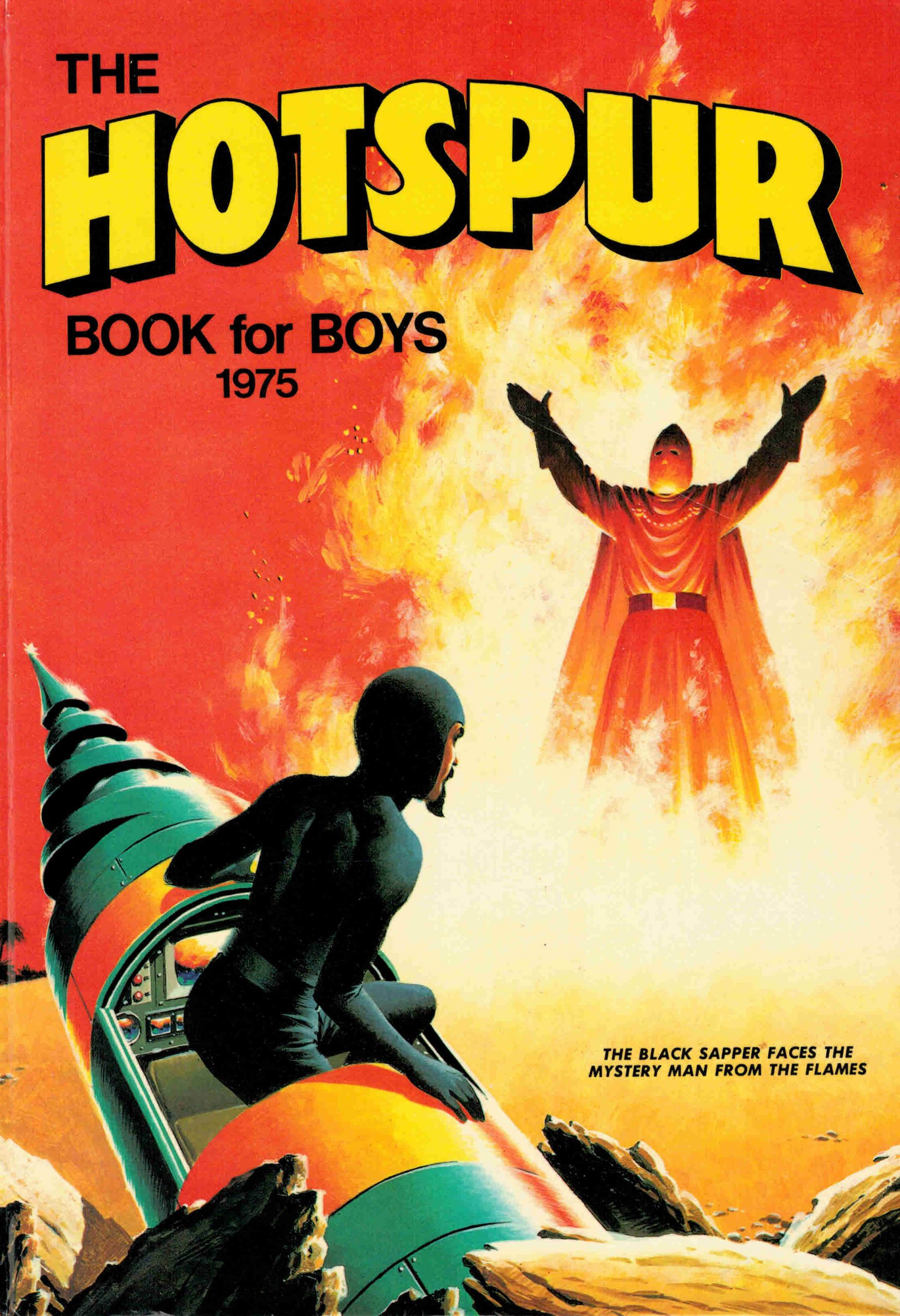
Hotspur Book for Boys 1975
By Many & various (DC Thomson)
Retroactively awarded ISBN: 978-0-85116-077-1
If you grew up British any time after 1960 and read comics, you probably cast your eye occasionally – if not indeed fanatically – over DC Thompson’s venerable standby The Victor.
The Dundee based publisher has long been a mainstay of British popular reading and arguably the most influential force in our comics industry. Its strong editorial stance and savvy creativity is responsible for a huge number of household names over many decades, through newspapers, magazines, books and especially its comics and prose-heavy “story-papers” for Girls and Boys.

That last category – comprising Adventure, Rover, Wizard, Skipper and Hotspur – pretty much-faded out at the end of the 1950s when the readership voted overwhelming with their pocket money in favour of primarily strip-based entertainments…

The last of those venerable all-prose story-papers wasn’t dormant for long. Cover-dated 24th October 1959, Hotspur the comic seamlessly replaced the prose stalwart (which had run from 2nd September 1933 to October 17th 1959) as a (mostly) pictorial serial package, running for 1110 weekly issues until finally folding into Victor with the January 24th1981 edition. It was very much the company’s weird and wonderful repository, like a general interest magazine for kids but with strange and exotic leanings. It was always heavy on bizarre situations and splendidly esoteric superheroes. Hostspur Annuals ran from 1966 to 1992 and were an unmissable fact of many a boy’s Yule loot…

This particular example hit the shops in September 1974, and behind that Ian Kennedy (?) cover opened with a two-coloured fact frontispiece exploring ‘Oil from under the Sea – the Finders’. The feature is mirrored at the end with ‘Oil from under the Sea – the Keepers’.

‘The Black Sapper’ was reformed criminal turned globetrotting troubleshooter: a brilliant engineer who built a mighty mechanical Worm-ship ship to travel beneath the Earth. He transferred to Hotspur from The Beezer, and was illustrated by Jack Glass, Keith Shone and Terry Patrick, who here details how the adventurer extinguishes an Arabian oil fire and scotches a sinister plot to usurp the king, after which we’re clued in on industrial ‘Deep Sea Fishing’.

Combining football and nautical adventure, comedy yarn ‘The Rust Bucket Rovers’ (John Richardson art?) sees soccer-crazed Pacific islanders contending with a multinational crew to clear a cargo, after which hearty spoof ‘Grizzly Grant’(Mike Dorey, or perhaps CD Bagnall) finds a junior Mountie and his ursine assistant battle frontier crime.

Tank commander ‘Blake of the Ironfists’ (Peter Sutherland?) then wins a major engagement in WWII Africa, leading to Dorey’s ‘Willie the Winner’ entering yet more contests with hilarious outcomes, before a 1941 naval blockade is overcome by doughty British mariners in ‘HMS Dent – the Deadly Decoy’.

The secrets of ‘Coastal Fishing’ segue into more mirth as motor racing pioneers ‘Spick and Spanner’ compete on a snowbound course in the Italian Alps after which veteran star ‘Iron Teacher’ and his handler Special Agent Jake Toddtackle an evil hypnotist with designs on a circus.

The history of ballooning in ‘Up, Up and Away!’ neatly proceeds into Great War saga ‘Hasket’s Battle Basket’, after which ‘Last of the Warriors’ sees a Cheyenne cavalry scout solving a murder mystery before slapstick oaf ‘Ossie the Outlaw’ proves again that for him crime does not pay…

After aviation pioneer ‘Skyscraper Kidd’ crashes his flying machine on a desert island and thinks his way home, time-displaced highwayman ‘Nick Jolly’ (and his robot flying horse) do their best to make Christmas unforgettable at a ski resort and mega department store in a rousing romp from Ron Smith whilst ‘Parker’s Barkers’ sees the rundown pooches of a local kennel humiliate the elite racers of the local dog track

Fact feature ‘The King of the Tankers’ leads into Z-Cars spoof ‘The Voice of the Panda’ before serious drama returns as football star ‘Cracker Jackson’ takes some sage advice to get over his psychological barriers. After learning all about ‘The World’s Biggest Shovel’, it’s back to desert islands where castaway WWII survivors ‘Thudd and Blunder’ deal with a native uprising in a manner simply not acceptable to today’s audiences.

Stealing the show is Ron Smith’s captivatingly odd teen hero ‘Red Star Robinson’ who – with the invaluable assistance of his android butler Mr. Syrius Thrice – thwarts The Spider‘s plan to steal England’s crown jewels, after which ‘Heavyweights’ details a selection of massive transport options before the fun wraps up in anarchic hilarity as clod-footed ‘Dim Dan the Boobyguard’ (Dorey?) tries escorting his own boss to a crucial meeting and everybody else pays the price for his eager ineptitude…

Divorcing the sheer variety of content and entertainment quality of this book from simple nostalgia may be a healthy exercise but it’s almost impossible. I’m perfectly happy to luxuriously wallow in the potent emotions this annual still stirs. It’s a fabulous read from a magical time and turning those stiffened two-colour pages is always an unmatchable Christmas experience… happily one still relatively easy to find these days.

You should try it…
© DC Thomson & Co., Ltd., 1974.

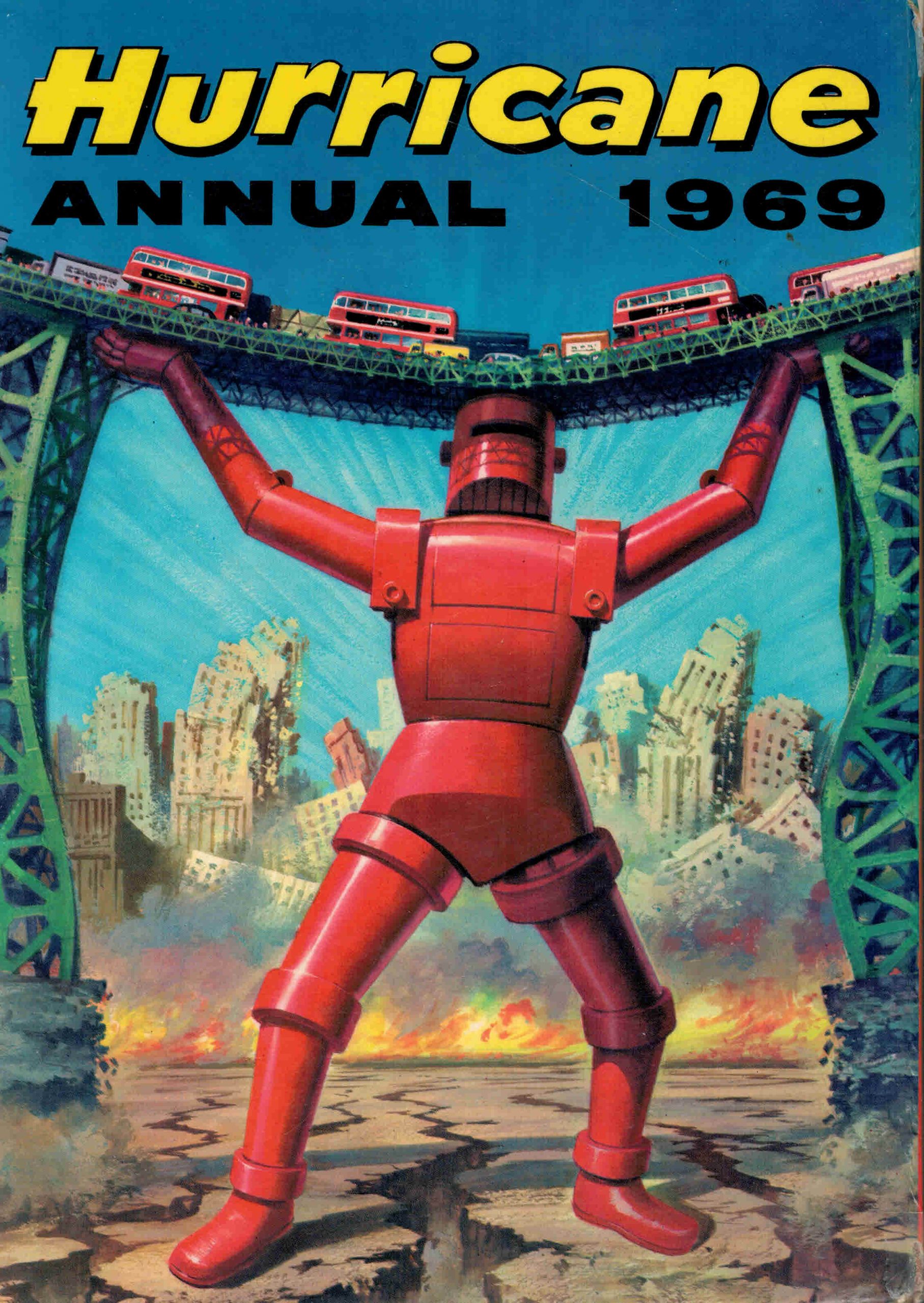
Hurricane Annual 1969
By Many & various (Fleetway)
SBN: 900376-04-X
From the late 1950s and increasingly through the 1960s, Scotland’s DC Thomson steadily overtook their London-based competitors – monolithic comics publishing giant Amalgamated Press.

Created by Alfred Harmsworth at the beginning of the twentieth century, AP perpetually sought to regain lost ground, and the sheer variety of material the southerners unleashed as commercial countermeasures offered incredible vistas in adventure and – thanks to the defection of Leo Baxendale and Ken Reid to the enemy – eventually found a wealth of anarchic comedy material to challenge the likes of the Bash Street Kids, Dennis the Menace, Minnie the Minx and their unruly ilk.

During the latter end of that period the Batman TV show sent the entire world superhero-crazy. Amalgamated had almost finished absorbing all its other rivals such as The Eagle‘s Hulton Press to form Fleetway/Odhams/IPC and were about to incorporate American superheroes into their heady brew of weekly thrills.

Once the biggest player in children’s comics, Amalgamated had stayed at the forefront of sales by latching onto every fad: keeping their material contemporary, if not strictly fresh. The all-consuming company began reprinting the early successes of Marvel comics for a few years; feeding on the growing fashion for US style adventure which had largely supplanted the rather tired True-Blue Brit style of Dan Dare or DC Thompson’s Wolf of Kabul.

Even though sales of all British comics were generally – and in some cases, drastically -declining, the 1960s were a period of intense and impressive innovation with publishers embracing new sensibilities; constantly trying new types of character and tales. At this time Valiant and its stable-mate Lion were the Boys’ Adventure big guns (although nothing could touch DC Thomson’s Beano and Dandy in the comedy arena).

Hurricane was an impressive-looking upgrade that began during that period of expansion and counterattack, apparently conceived in response to DCT’s action weekly Hornet. It launched the week of February 29th 1964 and ran for 63 issues, but was revamped three times during that period before ultimately being merged into companion paper Tiger.

It carried a superbly varied roster of features in that that time, including two (and a half) stars who survived its extinction. Racing driver Skid Solo and comedy superman Typhoon Tracy as well as Sgt Rock – Paratrooper… but not for so long for him…

There was heavy dependence on European and South American artists initially, among them Mario Capaldi, Nevio Zeccara, Georgio Trevisan, Renato Polese and Lino Landolfi, some of whom lasted into the Annuals. As with so many titles, although the comics might quickly fade, Christmas Annuals sustained their presence for years after Hurricane seasonal specials were produced for every year from 1965 to 1974…

Following a tried-&-true formula, this book – published in 1968 – offers comics adventures, prose stories, fact-features, and funnies and puzzles, kicking off with visual vexations in ‘Fantastic – but True!’ before western star Drago joins an embattled cavalry troop in staving off an invasion from Mexico (no, really!) in duo-hued thriller ‘The Gun that Saved the West’ – possibly illustrated by Renato Polese.

‘The Worst Boy in the School’ – as illustrated by Geoffrey Whittam? – was a long-running boarding school saga enlivened by its star Duffy coming from Circus stock. Here the comedy chaos and espionage excitement stems from the boys trying to keep an escaped chimp and parrot secret from the Masters…

‘Two Fists Against the World!’ was a Regency-set strip featuring prize-fighter Jim Trim. Illustrated by Carlos Roume, this origin reprint sees how, in 1804, the husky orphan first sets out on his pugnacious path…

‘Casey and the Champ’ then details in strip form the last hurrah of a broken-down steam engine as prelude to a text feature of weird facts corralled here as ‘It Was the Way Out West’ feature. Truly gripping prose yarn ‘The Vanished Wreck’then recounts how a clever insurance scam is foiled by an inventive salvage crew, before Typhoon Tracy – Extra Special Agent stars in ‘Mad, Mad Mission’: baffling spies and American agents in equal measure with his blundering rescue of a kidnapped boffin. Switching back to prose, Rex Barton, Investigator of the Weird and Unknown foils a cunning robbery in ‘The Phantom Monks of Milborough’.

Following the comedy capers of ‘Rod the Odd Mod and ‘is old pal Pervy Vere’, pictorial history lesson ‘Into Battle with King-Sized Catapults!’ and ‘Safari Quiz’ segue into a thrilling prose sci-fi short illustrated by immaculate stylist Reg Bunn. ‘Hunt for the Human Time-Bomb!’ stars atomic accident survivors Ace Sutton and Flash Casey who use their abilities to walk through walls to avert imminent catastrophe, after which The Robot Builders (drawn by what looks like early Massimo Bellardinelli?) attend a New World symposium and experience ‘All the Fear of the Fair!’ when a giant mechanical brain goes haywire…

Masked cowboy ‘The Black Avenger’ then exposes a fake sheriff before we jump to luscious full-colour as the worst ship in the WWII navy again confounds the British Admiralty and escapes being broken up for parts in ‘HMS Outcast in the Big Scrap’. Geoff Campion’s unruly mob here stave off doom and dispersal by implausibly capturing an Italian super dreadnaught in the Mediterranean…

‘Defeat for the ‘Boy General’ – the True Story of Custer’s Last Stand’ gives a fairly jaundiced review of the cavalryman’s career (backed up by visuals from contemporary movie Custer of the West) whilst ‘War Under the Sea’ offers technical speculation on the development of the Oceans, ending the colour section and leading into monochrome soccer star Harry of the Hammers who wins his cup-tie after first foiling a robbery in prose piece ‘Mystery Marksman’…

After gag magician ‘Marvo Brings the House Down’, Giovanni Ticci limns a sublime light-hearted ‘Sword for Hire’ romp starring Cavalier soldier-of-fortune Hugo Dinwiddie who pawns his blade but still manages to save the day against burglars and bandits, and racer Geoff Hart wins a war of wills and wheels in ‘Stock-Car Duel!’

Sport was a major fascination of publishers at this time and ‘Soccer Special by The Ref’ opens an extended section of pictorial mini-features comprised of ‘Cap-and-Cup Winners’, ‘Before they were Famous’, ‘Odd Things Happen in Soccer’ and ‘They Made Soccer History’, before full-on fantasy returns with cover-star ‘The Juggernaut from Planet Z’, who revisits his Earth chum Dr. Dan Morgan and foils alien invaders employing tectonic terror tactics.

Another outing for Rod the Odd Mod and ‘is old pal Pervy Vere brings us to prose fable ‘The Impostor Knight’, revealing how an affable blacksmith’s assistant wins a joust, augmented by fact-filled sidebar ‘Warriors in Armour’ before ‘Sgt. Rock – Special Air Service’ is assigned to destroy a Nazi fuel dump and ‘Typhoon Tracy Trouble-Shooter’ riotously ends a revolution far, far South of the Border in his own inimitable incompetent manner…

Mischievous moppet ‘Terrible Tich’ literally brings the house down and ‘Wild West Funmen’ offers a magazine of owlhoot hoots before the nostalgia-fest closes in spectacular style as Hugo Dinwiddie stalks a flamboyant highwayman and ends up as a ‘Courier for the King!’

Eclectic, wide-ranging and always of majestically high quality, this blend of fact, fiction, fun and thrills is a splendid evocation of lost days of joy and wonder. We may not be making books like this anymore but at least they’re still relatively easy to track down. Of course, what’s really needed is for some sagacious publisher to start re-issuing them…
© Fleetway Publications Ltd., 1968

Countdown Annual 1972


By Many & various, edited by Dennis Hooper (Polystyle Publications)
SBN: 85096-018-5

As the 1960s ended, comics editors realised their readership was becoming increasingly sophisticated and sought to keep their attention with upscale rebrandings and style changes. Venerable old TV Comic and even TV21 were no longer dynamic enough and one answer to the situation – from licensing specialist Polystyle – was Countdown.

Running for a mere 58 weeks (beginning 20th February 1971) as a glossy, high end periodical, before its first dramatic makeover – which saw it relaunched on April 1st 1972 as TV Action + Countdown and ultimately TV Action – it subsisted until August 1973 when it was rolled up into TV Comic.

The magazine boasted a rich creative throughput, but the majority of the television-fuelled drama strips were written by editor Dennis Hooper, with additional material from Robin Hillborn, Allan Fennell and possible Angus Allen. However, as the company had access to TV 21‘s archive and used reprint material, I could just be misremembering…

This is the only official Annual. The following year it became Countdown Annual… for TV Action, but don’t let that put you off: whether you’re a telly addict or comics fanboy, this book is stuffed with superb entertainment.

The action opens with a full-colour UFO thriller ‘The Circus’ illustrated by Jon Davis. The saga of a predatory alien body-snatcher used as a cash-cow by a failing Irish carnival show is interrupted (like an advert break?) by photo/fact feature ‘The Defenders’, wherein the secrets of Gerry Anderson’s covert anti-extraterrestrial force SHADO (Supreme Headquarters, Alien Defences Organisation) are outlined, but the story finale remains explosive and satisfying.

Rendered in black-&-red on white paper, 2-page gag strip ‘Dastardly and Muttley’ (by Peter Ford?) sees the cartoon clowns still hunting that infernal pigeon, after which a ‘Countdown Quiz’ tests your knowledge of the Space Race.

Staying in the Wild Black Yonder, Don Harley limns tense Thunderbirds thriller ‘Terror at Torreba’ with a crashed meteor bringing madness and destruction to Africa…

Arnold Kingston was the chief writer of extremely contemporary science fact features for the Countdown comic so it’s safe to assume he’s responsible for the ‘Think Tank! News from the Frontiers of Science’ photo noticeboard here, and another ‘Countdown Quiz’ as well as later features in the book.

Dastardly and Muttley then return, afflicted with dreams of cinematic stardom, after which Martin Asbury paints a full-colour ‘Captain Scarlet’ tale as the Mysterons suborn a giant killer robot and let it run amok…

Board game ‘Countdown Rescue Mission’ dovetails into dystopian prose sci fi short story ‘Countdown: Dangerous Friend’ – magnificently illustrated by John M. Burns – whilst ‘Rockets’ provides a potted photo-history of the real march into space.

Abortive Gerry Anderson Property ‘The Secret Service’ (Peter Ford again) finds priest and part-time secret agent Father Unwin leading the charge back into restricted colour as he and his partner Matthew use their Minimiser shrinking ray to steal back microdots from a hostile embassy

Photo feature ‘A Day with Dr. Who’ visits the locations used whilst filming The Daemons, before ‘U.F.O.s in history’offers a more evidential lesson on extraterrestrial encounters, whilst a colour ‘Jon Pertwee pinup’ brings us to a cracking Time Lord tale as Dr. Who battles floral doom in ‘The Plant Master’, brilliantly illustrated by Jim Baikie.

Slim but potent, this box of delight then ends with prose yarn ‘Joe 90 Resigns’ as the 9-year-old breaks the rules to rescue his father from an alpine emergency.

Closing with the ‘Answers’ to all those quiz questions and a stunning UFO photo section, this is a powerful and evocative treat you’d be crazy to miss…
© Polystyle Publications 1971.

Supercar Annual


By Alan Fennel, G. Wood and H.J. Cauldwell (Wm. Collins and Sons)
No ISBN:

For its entire existence British Comics have tapped into and exploited other entertainment icons such as stage, film and radio stars. As television became commonplace in the 1950s and exploded during the late 1960s – especially in the range and variety of children’s shows and cartoons – those programmes increasingly became a staple source for cheap weeklies but especially the Seasonal Annual market, not just for celebrities such as Arthur Askey or Abbott & Costello but increasingly the shows themselves: adding extra episodes to little aficionados’ finite canon.

Moreover, in an era before home recordings of any sort, these were exploits that could be enjoyed over and over again…

During that critical developmental period, Gerry Anderson’s innovative and increasingly high-tech puppet-show dramas revolutionised kids’ TV, and their comics tie-ins did exactly the same for our pictorial reading habits.

TV Century 21 (the unwieldy “Century” was eventually dropped) was patterned on a newspaper – albeit from 100 years into the future – and this shared conceit carried the avid readers into a multimedia wonderland as television and reading matter fed off each other. The incredible graphic adventures were supplemented with stills taken from the TV shows (and later, films), and a plenitude of photos also graced the text features and fillers which added to the unity of one of the industry’s first “Shared Universe” products,

Number #1 launched on January 23rd 1965, instantly capturing the hearts and minds of millions of children, and further proving to our comics editors the unfailingly profitable relationship between television shows and healthy sales.

Filled with high quality art and features, printed in gleaming photogravure, TV21 featured previous shows in strips such as Fireball XL5, Supercar and Stingray to supplement currently airing big draw Thunderbirds. In a bizarre attempt to be topical, the allegorically Soviet state of Bereznik constantly plotted against the World Government (for which read “The West”) in a futuristic Cold War to augment the aliens, aquatic civilisations and common crooks and disasters that threatened the general well-being of the populace. Even the BBC’s TV “tomorrows” were represented by a full-colour strip starring The Daleks.

Before all that, however, there were far simpler and more inclusive epics for kids at Christmas from the Anderson stable: such as this charming tome, credited to future Anderson staff writer Alan Fennel with cartoon art, strips, puzzles and illustrations by G. Wood and H. J. Cauldwell.

Supercar was Anderson’s (in conjunction with designer Reg Hill and scriptwriters Hugh and Martin Woodhouse) second marionette series, following on from comedy western Four-Feather Falls. Soundly science fictional, it was the first to be internationally syndicated and detailed the exploits of a futuristic flying car, as piloted by dashing test pilot Mike Mercury. His adventure prone entourage included batty boffins Professor Rudolph Popkiss and Dr. Horatio Beaker – who invented and built the mechanical beast – as well as boy sidekick Jimmy Gibson and his mischievous pet Mitch who was a monkey…

Located in a desert base at Black Rock, Nevada, the team had daring adventures all over the world (seen in the 39 episodes recorded between 1961-1962), and frequently faced wicked enemy agent Masterspy and his henchman Zarrin.

Broadcasts began in January 1962 and were eagerly awaited by millions of fans who found solace when the show closed by buying TV Comic for further exploits.

There were three annuals released, of which this is the last, offering an unconventional experience since all the strips and prose adventures comprise one large complete saga.

Following an enthralling painted double-page frontispiece of the wonder vehicle at the bottom of the sea, the action opens with Cauldwell’s full-colour strip ‘Killer Whale’ as the action-ready team save ocean-going scientist Doctor Bombay from one of his own maddened experiments. In the aftermath, they learn the savant has been recently been restored to his previous role as Maharajah of Subahn and agree to escort him home to take up the reins of power…

Before they can set off, however, a fresh emergency occurs, and Supercar is needed to fix a sabotaged trestle in Wood’s 2-colour strip ‘Bridge of Danger’ and their base is plundered of secrets in prose mystery yarn ‘The Workshop Robbery’. Thankfully, Mike is as adept at crimefighting and counterespionage as he is at flying…

Following puzzle page ‘World Flight’, monochrome strip ‘Close-Up on Danger’ finally sees the journey to Subahn begin, but during a stopover in London deposed former dictator Randah Singh deploys a hired assassin to kill Bombay in front of a live studio audience…

Plot foiled, the voyagers resume their flight, leaving us to enjoy a puzzle-maze in ‘S-O-S’ before a flashback prose tale details how Beaker and Popkiss discovered ‘The Treasure of Mesa Verde’ despite the larcenous efforts of Masterspy and Zarrin…

Another full-colour section begins with activity pages ‘What is Wrong with this Picture?’ and ‘Memory Game: Exploring Space’, before ‘Sahara Inferno’ finds Supercar diverted again to help extinguish a blazing natural gas well. General knowledge teaser ‘Nevada Quiz’ then segues into a new restricted colour section foe Wood’s ‘Kidnapped’ wherein Randah Singh hires Masterspy and Zarrin to ensure Maharajah Bombay never takes up his throne…

Rebus page ‘The Lost Diplomatic Plane’ leads to another prose flashback for ‘Mission to Destroy’; revealing how Supercar was instrumental in eradicating an illegal weapons cache in Malaya, after which a return to the present sees Bombay’s triumphal accession procession interrupted by the ‘Eruption!’ of the local volcano…

Memories evoked, a prose tale follows of a time in Switzerland when a souped-up mechanical doll triggered ‘The Avalanche’ before the extended saga concludes in full-colour with ‘The Triumphant Procession’ as Randah Singh plays his last murderous ace…

Blending charm with action and exoticism with big laughs, this is a splendid example of simpler times and all-ages storytelling that no nostalgia-afflicted baby boomer could possibly resist.
© 1963, A.P. FILMS and A.T.V. Ltd. All rights reserved.

Genre Annuals

The comic has been with us a long time now and debate still continues about where, when and exactly what constitutes the first of these artefacts to truly earn the title. There’s a lot less debate about the Children’s Annual: a particularly British institution and one that continues – albeit in a severely limited manner – to this day.

It’s a rare and tragic individual who never received a colourful card-covered compendium on Christmas morning; full of stories and comic-strips and usually featuring the seasonal antics of their favourite characters, whether from comics such as The Beano, The Dandy, Lion, Eagle and their ilk, or TV, film or radio franchises/personalities such as Dr Who, Star Wars, Thunderbirds, Radio Fun or Arthur Askey. There were even sports and hobby annuals and beautifully illustrated commemorative editions of the fact and general knowledge comics such as Look and Learn, and special events such as the always glorious Rupert Bear or Giles Annuals.

Here then is a brief celebration of the kinds of genre celebrations which delighted kids and their parents…

Larry Harmon’s Laurel & Hardy Annual #1


By various anonymous (Brown & Watson)
No ISBN:

Stan Laurel and Oliver Hardy comprise the funniest comedy duo of all time. Your opinion may differ, but mine’s correct.

Known all over the world, they became famous for their appearance and filmic characters, which made it pretty easy to establish an intellectual properties license for them after their passing.

Larry Harmon was the stage name of Laurence Weiss (1925-2008), one of a select group of American actors to be legendary icon Bozo the Clown. He was – also albeit unwillingly and to prove a point – a Presidential candidate in 1984. Make of that what you will.

In 1956, Harmon purchased the rights to Bozo, instituting a ferocious marketing strategy for advertising, merchandise and the growing television field. By the 1960s he had made Bozo a star in every US home (using local franchise performers) and generated an animated avatar on those live-action shows.

Harmon’s animation studio then took over the screen rights to Popeye in 1960, releasing a new series of TV cartoons, and in 1961 bought the merchandising rights to Laurel and Hardy. In the subsequent series that resulted, hands-on Harmon voiced Stan, just as he had voiced Bozo in those animated segments of the live action shows. There were 156 episodes which first aired in the US from September 10th 1966 to March 25th 1967.

Although not to my taste, those Laurel and Hardy cartoons were hugely popular, spawning a Gold Key comic book and a 1972 DC Digest Special in the US, and a new comics series in the UK (and presumably, the Commonwealth that British distributor Thorpe & Porter and its affiliated imprints such as Williams exported to) as well as being syndicated to European countries such as Germany where they were Dick und Dorf…

From 1969 to 1974 T&P generated their own licensed comic book iteration: at least 136 full-colour issues, 8 double-sized softcover albums (including at least one Christmas Special) and 2 proper hardback annuals – of which this is the first – via licensed properties specialists Brown Watson, who eventually evolved into Grandreams.

Stan and Ollie were certainly no strangers to British comics readers. The Odd Couple were a front-page staple of Film Fun from the 1930s to 1957 (rendered by the astounding George William Wakefield and inherited by his artist son Terry). The starred in Film Picture Stories (1934) and through the 1960s were a big draw in TV Comic.

After their solo comic folded, the puckish pair continued as a supporting feature and occasional headliner well into the 1980s.

In this first official Annual from 1972, an anonymous band of artisans begin the procession of slapstick tomfoolery with prose vignette ‘Mugs of the Legion’ wherein the dopey duo return to the theme of their movie The Flying Deuces, sticking out like sore thumbs in the desert until they accidentally capture the villainous scourge Abdul el Ratta…

A brace of pages full of one-off cartoons, ‘Stan & Olly’s Gag-Bag!’ leads to a second prose story wherein ‘Laurel & Hardy Go Camping’ with typically calamitous results, before the strips begin – in full colour – with ‘Rocketship Rumpus’. Here, the best window washers in the Space Program are accidentally sent to another world only to upset aliens and save space dragons…

Once back on Earth, Olly’s biggest mistake is letting Stan have ‘The Puppy’, and when the full-grown beast is stolen by a burglar, he’s not the only happy chappie, after which short strip ‘The Aerial’ proves why some household jobs should never be “do-it-yourself”…

Extended epic ‘The Treasure House’ sees the hapless loyal oafs as destitute beggars, but everything changes when Olly inherits ramshackle estate Fool Hardy Manor and learns there’s a valuable hoard hidden somewhere in its dilapidated walls…

Leaving Stan ‘Washing the Car’ proves a recipe for disaster and their time as ‘Private Detectives’ even more so, but nothing is as crazy as assuming Stan’s lesson’s in ‘Self-Defence’ can ever be successful, before the duo-chrome prose material takes an encore.

‘The Specialists’ see Stan and Olly revive the window washing gig, only to end up on the wrong side (that is INside) of a top-secret super jet, after which two more pages of ‘Stan & Olly’s Gag-Bag!’ and three of assorted puzzles, activities and games take us to the big finish as the eternal idiots agree to clean scary domicile ‘The House of Secrets’ and stumble into terror and criminality in equal measure…

Gentle, unassuming and – admittedly – a touch dated, these old-fashioned efforts are still effective and engaging examples of comedy cartooning and all-ages humorous storytelling that will appeal to the kid in all and most little kids of your acquaintance. Why not seek them out and give them a go again?
© 1972, Larry Harmon Pictures Corporation.