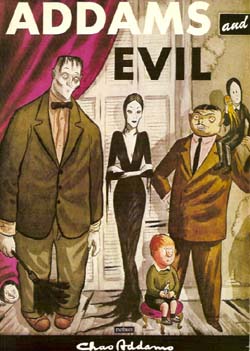
Addams and Evil


By Charles Addams Methuen)
ISBN: 978-0-413-55370-1

Charles Samuel Addams (1912 – 1988) was a cartoonist and distant descendant of two American Presidents (John Adams and John Quincy Adams) who made his real life as extraordinary as his dark, mordantly funny drawings.

Born into a successful family in Westfield, New Jersey, the precocious, prankish, constantly drawing child was educated at the town High School, Colgate University, the University of Pennsylvania, and New York City’s Grand Central School of Art, producing cartoons and illustrations for a raft of institutional publications.

In 1932 he became a designer for True Detective magazine – retouching photos of corpses – and soon after began selling drawings to The New Yorker. In 1937 he began creating the macabre ghoulish family portraits that become his signature creation. During WWII he served with Signal Corps Photographic Center, devising animated training films for the military.

Whether he artfully manufactured his biography to enhance his value to feature writers or was genuinely a warped and wickedly wacky individual is irrelevant (although it makes for great reading:- especially the stuff about his second wife – and, as always, the internet awaits the siren call of your search engine…).

What is important is that in all the years he drew and painted those creepily sardonic, gruesome gags and illustrations for The New Yorker, Colliers, TV Guide and others, he managed to enthral his audience with a devilish mind and a soft, gentle approach that made him a household name long before television turned his characters into a hit and generated a juvenile craze for monsters and grotesques that lasts to this day. That eminence was only magnified once the big screen iterations debuted…

This stunningly enticing volume is a reissue of his second collection of cartoons, first published in 1947, and semi-occasionally since then. It’s still readily available if you’ve a big bank book, but the time is ripe for a definitive collected edition, or better yet a reissue of his entire canon (eleven volumes of drawings and a biography) either in print or digitally.

Should you not be as familiar with his actual cartoons as with their big and small screen descendants you really owe it to yourself to see the uncensored brilliance of one of America’s greatest humourists. It’s dead funny…
© 1940-1947 the New Yorker Magazine, Inc. In Canada © 1947 Charles Addams.

The Complete Peanuts volume 4: 1957-1958


By Charles Schulz (Canongate Books/Fantagraphics Books)
ISBN: 978-1-84767-076-2 (Canongate) 978-1-56097-670-7 (Fantagraphics)

Peanuts is unequivocally the most important comics strip in the history of graphic narrative. It is also the most deeply personal.

Cartoonist Charles M Schulz crafted his moodily hilarious, hysterically introspective, shockingly philosophical epic for half a century. He published 17,897 strips from October 2nd 1950 to February 13th 2000 and died from the complications of cancer the day before his last strip was published…

At its height, the strip ran in 2,600 newspapers in 75 countries, translated into 21 languages. Many of those venues are still running perpetual reprints, as they have ever since his departure. Attendant book collections, a merchandising mountain and television spin-offs made the publicity-shy artist a billionaire.

None of that is really the point. Peanuts – a title Schulz loathed, and one the syndicate forced upon him – changed the way comics strips were received and perceived by showing that cartoon comedy could have edges and nuance as well as pratfalls and punchlines.

Following an incisive and analytical Foreword by Jonathan Franzen, exploring which characters most reflected the true “Sparky” Schulz and exploring the importance of the material in this hugely enticing tome, the endless days of play, peril and adroit psychoanalysis resume in unprepossessing monochrome…

Our focus (we just can’t call him “star” or “hero”) is everyman loser Charlie Brown who with increasingly high-maintenance, fanciful mutt Snoopy is increasingly at odds with a bombastic and mercurial supporting cast who are hanging out doing kid things and becoming unique comedic archetypes of their own.

The daily gags, as always, centre on playing, playing pranks, playing sports (such as archery, tennis, football, golf, baseball, swimming and croquet), playing musical instruments, teasing each other, making baffled observations and occasionally acting a bit too much like grown-ups. The ferocious unpredictability and wilfulness of seasonal weather begins taking on a malicious life of its own in these years…

Mean girl Violet, infant prodigy Schroeder, “world’s greatest fussbudget” Lucy, her strange baby brother Linus and dirt-magnet “Pig-Pen” all add signature twists to the mirth: each sufficiently fleshed out and personified to generate jokes and sequences around their own foibles.

Charlie Brown has settled into his existential angst and is resigned to his role as eternal loser: singled out by fate and the relentless diabolical wilfulness of Lucy who now sharpens her spiteful verve on everyone around her. Her preferred target is always the round-headed kid though: mocking his attempts to fly a kite, kicking away his football and perpetually reminding him face-to-face how rubbish he is…

The Sunday page debuted on January 6th 1952; a standard half-page slot offering more measured fare than the daily. Both thwarted ambition and explosive frustration became part of the strip’s signature denouements and these weekend wonders gave Sparky room to be at his most visually imaginative, whimsical and weird…

By this time, rapid-fire raucous slapstick gags were riding side-by-side with surreal, edgy, psychologically barbed introspection, crushing judgements and deep ruminations in a world where kids – and certain animals – were the only actors. The relationships are becoming increasingly deep, complex and absorbing…

Sheer exuberance and a spontaneous tendency to dance at any provocation also became a solid standby with the strips re-presented here. Particular moments to relish this time include Linus and Snoopy’s extended Cold War duel for possession of the cherished comfort blanket; the terrible burden of winter clothing; the overwhelming influence of television; Schroeder’s eternal love affair with Beethoven and cold disdain of Lucy’s far-from-apparent blandishments. A general trend sees all the kids evermore often beguiled by stargazing and waxing philosophical at the heavens’ splendour…

Surely coincidentally is some of the series’ signature expletives and epithets also premiering in these pages… you Blockhead!…

To wrap it all up, Gary Groth celebrates and deconstructs the man and his work in ‘Charles M. Schulz: 1922 to 2000’ whilst a copious ‘Index’ offers instant access to favourite scenes you’d like to see again….

Readily available in hardcover, paperback and digital editions, this volume offers a rare example of a masterpiece in motion: comedy gold and social glue metamorphosing into an epic of spellbinding graphic mastery that remains part of the fabric of billions of lives, and which continues to make new fans and devotees long after its maker’s passing.
The Complete Peanuts: 1957-1958 (volume 4) © 2005 Peanuts Worldwide, LLC. The Foreword is © 2005 Jonathan Franzen. “Charles M. Schulz: 1922 to 2000” © 2005 Gary Groth. All rights reserved.

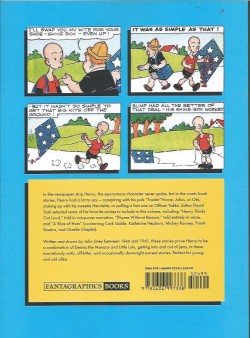
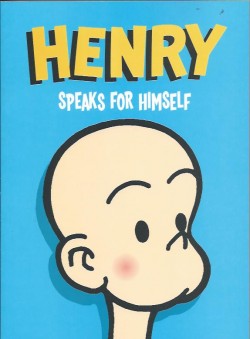
Henry Speaks for Himself


By John Liney, edited by David Tosh (Fantagraphics Books)
ISBN: 978-1-60699-733-8 (TPB)

Created by veteran cartoonist Carl Anderson as a silent, pantomimic gag-panel first seen on March 19th 1932, Henry was one of the most venerated and long-lived of American newspaper comics strips.  It was developed for The Saturday Evening Post before being picked up by legendary strip advocate and propounder William Randolph Hearst.  He brought it and the then-69 year old Anderson to his King Features Syndicate in 1934. The first comic strip appeared on December 17th with a full colour Sunday half-page following on March 10th 1935.

The Saturday Evening Post had to content itself with a new feature entitled Little Lulu by Marjorie Henderson Buell. I wonder how that worked out…?

Being a man of advanced years, Anderson employed Don Trachte to assist with the Sundays whilst John J. Liney performed the same role for the Monday to Saturday black and white iteration. This continued until 1942 when arthritis forced Anderson to retire. Trachte and Liney became de facto creators of the feature – although the originator’s name remained on the masthead for the next two decades.

Liney (1912-1982) had started as a staff cartoonist on the Philadelphia Evening Ledger and began selling gag ideas to Anderson in 1936 before landing the full-time assistant’s job. After assuming the illustrator’s role in 1942 he took over sole writing responsibilities for the daily in 1945, continuing Henry until 1979 when he finally retired.

His own name had been adorning the strip since 1970.

Liney was also a passionate teacher and educator on comics and cartooning, with a position at Temple University. Nevertheless, he still found time to write and draw a comicbook iteration of the mute and merry masterpiece from 1946 to 1961.

Major licensing monolith Western Publishing/Dell Comics had been successfully producing comicbooks starring animation characters, film icons and strip heroes since the mid 1930s, and when they launched Henry – first in Four Color Comics #122 and #155 (October 1946 and July 1947) and then in his own 65 issue title from January 1948 – they successfully argued for a radical change in the boy’s make-up.

The newspaper strip had always been a timeless, nostalgia-fuelled, happily humour-heavy panoply of gags and slapstick situations wherein the frankly weird-looking little bald kid romped and pranked in complete silence, with superb cartooning delivering all the communication nuance the vast international audience needed.

Now however, with children seen as the sole consumers, the powers-that-be felt that the little mutant should be able to speak and make himself understood. Liney easily rose to the challenge and produced a sublime run of jolly, wild, weird and often utterly surreal endlessly inventive adventures – some approaching “Stream-of-Consciousness” progressions that perfectly captured the ephemeral nature of kids’ concentration. He also introduced a captivating supporting cast to augment the boy, and his appealingly unattractive, forthright and two-fisted inamorata Henrietta.

This splendid softcover (and ebook) collection gathers some of the very best longer tales from the comicbook run in the resplendent flat primary colours that are so evocative of simpler – if not better – days and begins after a heartfelt reminiscence in the Foreword by Kim Deitch, after which Editor, compiler and devotee David Tosh outlines the history of the character and his creators in ‘Henry – the Funniest Living American’.

He then goes on to explain ‘The Dell Years’ before offering some informative ‘Notes on the Stories’.

The magical story portion of this collection is liberally interspersed with stunning cover reproductions; all impressively returning to the quiet lad’s silent comedy gag roots, a brace of which precede a beautiful double-page spread detailing the vast and varied cast Liney added to mix.

Then from issue #7 (June, 1949) we find ‘Henry is Thinking Out Loud!’ as the boy keeps his non-existent mouth shut and explores the medium of first person narrative, inner monologues and thought-balloons whilst getting into mischief looking for odd jobs to do…

October’s edition, Henry #9, introduced the good-natured, cool but increasingly put-upon Officer Yako in ‘You Can’t Beat the Man on the Beat!’ in an escalating succession of brushes with the law, bullies, prospective clients and darling Henrietta.

That bald boy still hadn’t actually uttered a sound, but by #14 (August 1950) he had found his voice, much to the amusement of his layabout Uncle (he never had a name) who eavesdropped on the assorted kids comparing their ‘Funny Dreams’.

After a quartet of covers Henry #16 (December 1950) found Liney playing with words as ‘Rhyme Without Reason’ found all the characters afflicted with doggerel, meter, couplets and all forms poetic with Liney even drawing himself into the madcap procession of japes and jests, whilst ‘A Slice of Ham’ from issue #22 (December 1951) cleverly riffed on Henry’s ambitions to impress Henrietta by becoming an actor. This yarn includes a wealth of Liney caricatures of screen immortals such as Chaplin, Gable, Sinatra and more, whilst introducing a potential rival for Henry’s affections in cousin Gilda…

In #24 (April 1952) Henry ‘Peeks into the Future’ by outrageously pondering on his possible careers as an adult, before plunging into Flintstone or Alley Oop territory – complete with cave city and dinosaurs – as a result of studying too hard for a history test in ‘The Stone Age Story’ from issues #29, February 1953.

After four more clever funny covers, growing up again featured heavily with ‘Choosing Your Career’ (#45, March 1956) as the little fool road-tested a job as a home-made cab driver and accidentally slipped into law enforcement by capturing a bandit.

In #48 (December 1956) Henry attended a fancy dress party and became ‘The Boy in the Iron Mask’, and this completely charming compilation closes by reprising that sojourn in the Stone Age with #49 (March 1957)’s ‘Rock and Roll’…

Concluding the comedy capers is fond personal reminiscence ‘Henry and Me’ by David Tosh; a man justifiably delighted to be able to share his passion with us and hopefully proud that this book gloriously recaptures some of the simple straightforward sheer joy that could be found in comicbooks of yore.

Henry Speaks for Himself is fun, frolicsome and fabulously captivating all-ages cartooning that will enthral anyone with kids or who has the soul of one.
Henry Speaks for Himself © 2014 Fantagraphics Books Inc. All comics and drawings © 2014 King Features, Inc. All other material © its respective creators. This book was produced in cooperation with Heritage Auctions.

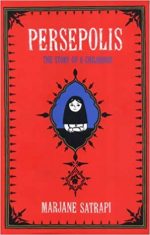
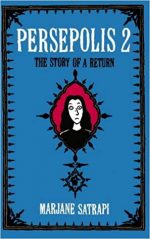
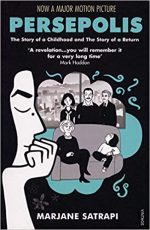
Persepolis – The Story of a Childhood and Persepolis 2 – the Story of a Return


By Marjane Satrapi translated by Anjali Singh (Jonathan Cape/Vintage)
ISBN: 978-0-22406-440-8 (volume 1 HB); 978-0-22407-440-7 (volume 2 HB); 978-0-0-9952-399-4 (TPB)

No comics celebration of non-fictional women could be complete without acknowledging Marjane Satrapi’s astounding breakout memoirs, so let’s revisit her Persepolis books (also available in a complete paperback edition released to coincide with an animated movie of the tale)…

The imagery of a child, their unrefined stylings and shaded remembrances all possess captivating power to enthral adults. Marjane Satrapi grew up during the Fundamentalist revolution that toppled the Shah of Iran and replaced him with an Islamic theocracy.

For cartoon reminiscence Persepolis – The Story of a Childhood, she opted to relate key incidents from her life with the stark direct drawings and sharp, unleavened voice and perceptions of the young girl she was. This simple, direct reportage owes as much to Anne Frank as Art Spiegleman whilst she relates the incidents that shaped her life and her identity as a free-thinking female in a society that increasing frowned on that sort of thing…

Persepolis is the kind of graphic novel that casual and intellectual readers love, focusing on the content of the message and decrying or at best ignoring the technical skill and craft of the medium that conveys it. Yet graphic narrative is as much an art form of craft and thought as it is the dustbin of sophomoric genre stereotypes that many critics relegate it to. Satrapi created a work that is powerful and engaging, but in a sorry twist of reality, it is one that comics fans, and not the general public, still have to be convinced to read.

In the sequel Persepolis – The Story of a Return, the primitivist reminiscences of a girl whose childhood spanned the fall of the Shah and the rise of Iran’s Fundamentalist theocracy, Satrapi continues sharing her personal history, but now concentrates more fully on the little girl growing into a woman.

This idiosyncratic maturation unfortunately acts to somewhat diminish the power of simple, unvarnished observation that was such a devastating lens into the political iniquities that shaped her life, but does transform the author into a fully concrete person, as many of her experiences more closely mirror those of an audience which hasn’t grown up under a cloud of physical, political, spiritual and sexual oppression.

The story recommences in 1984 where 15-year old Marjane is sent to Vienna to (ostensibly) pursue an education. In distressingly short order, the all-but-asylum-seeker is rapidly bounced from home to home: billeted with Nuns; distanced acquaintances of her family; a bed-sit in the house of an apparent madwoman and eventually is reduced to living on the streets, in a catastrophic spiral of decline before returning to Iran in four years later. It is now 1988.

Her observations on the admittedly outré counter-culture European students, and her own actions as she grows to full womanhood seem to indicate that even the most excessive and extreme past experience can still offer a dangerously seductive nostalgia when faced with the bizarre concept of too much freedom too soon.

When she returns to her homeland, her adult life under the regime of the Ayatollah is still a surprisingly less-than-total condemnation than we westerners and our agenda-slanted news media would probably expect. The book concludes with her decision to move permanently to Europe in 1994…

The burgeoning field of autobiographical graphic novels is a valuable outreach resource for an industry desperately seeking to entice new audiences to convert to our product. As long as subject matter doesn’t overpower content and style, and we can offer examples such as Persepolis to the seekers, we should be making real headway.
© Marjane Satrapi 2004. Translation © 2004 Anjali Singh.

Cancer Vixen


By Marisa Acocella Marchetto (Knopf Publishing/Pantheon)
ISBN: 978-0-30726-357-5 (US HB) 978-0-37571-474-0 (UK PB)

The comics medium is incredibly powerful and versatile: easily able to convey different levels of information and shades of meaning in a variety of highly individualistic and personal manners and styles and on any subject imaginable.

Although primarily used as a medium of entertainment, the sequential image is also a devastating tool for instruction and revelation as in this superb encapsulation of one woman’s knock-down drag-out tussle with the “Big C”…

Born in1962, Marisa Acocella studied painting at the Pratt Institute and the School of Visual Arts in New York City before becoming an Art Director for a major Madison Avenue ad agency. After a meteoric career in the field, in 1993 she turned to cartooning.

Acocella concocted the quasi-autobiographical fashion cartoon She which debuted in Mirabella Magazine before transferring to Elle in 1996. The feature was collected as Just Who the Hell Is She, Anyway? The Autobiography of She and the character was optioned for a show by HBO television.

The frenetic scribbler was subsequently head-hunted by Robert Mankoff – Cartoon Editor for iconic periodical The New Yorker – and soon after, with her work regularly appearing in Glamour (where she crafted the series Glamour Girls), Advertising Age, Talk, Modern Bride and ESPN magazine, she created ‘The Strip’ for the New York Times Sunday Styles section. It was that prestigious paper’s first ever continuing comics feature.

In 2004, at the top of her game and three weeks before her marriage to a dashing and highly successful restaurateur, seemingly with the world at her stylishly shod feet (there’s a great deal of attention paid to women’s shoes here, but at least it’s an apparently hereditary fetish: Marisa’s simply overwhelming mother Violetta Acocella was a designer for the Delman Shoe Company), the artist noticed a lump in her breast…

How the sometimes flighty, occasionally self-absorbed but ultimately tough and determinedly resolute Style-Zombie Fashionista cartoonist took control of her life and her situation to beat cancer makes for an utterly engrossing and ferociously vital read…

Told in overlapping flashbacks Cancer Vixen – because the artist loathed the term “Cancer Victim” – documents her emotional pilgrimage through denial, oppressive terror, turbulent anticipations, financial heebie-jeebies, desperate metaphysical bargaining, exploration of outrageous alternative therapies, grudging acceptance and onerous fight-back through her interactions with friends and family – especially that formidably overbearing ‘(S)Mother’ and man-in-a-billion husband-to-be Silvano Marchetto…

As Marisa reveals the day-by-day, moment-to-moment journey from suspicion to diagnosis, through surgery and the horrifying post-op chemo-therapy with profound passion, daunting honesty and beguiling self-deprecating humour, what strikes the reader most is the cruelly unnecessary extra anguish caused by a silly mistake which might have cost the artist her life…

Even though thoroughly in-touch, on the go and in command of her life, this modern Ms. had accidentally let her Health Insurance lapse…

Coming from a country where – despite the best efforts of our current government to gut and sell off the National Health Service and neuter the social support and benefits net – nobody has to die from insufficient funds or endure ill-health because of their bank balance, the most gob-smacking strand of this graphic reportage is the cost-counting exercise which periodically tots up the dollars spent at crucial stages of treatment and the realisation that many of her potential care-givers are actually bidding against each other rather than working together to treat their patients customers…

Thankfully Glamour magazine nobly commissioned Marisa to turn her regular strip into a cartoon account of her illness and recovery (with the strip Cancer Vixen launching as a 6-page strip in the April 2005 issue), whilst bravely marrying Silvano – in defiance of her very real dread that he might be a widower before their first anniversary – at least got Marisa belatedly onto his insurance policy…

As a result of her experiences, Marisa Acocella-Marchetto apportioned a percentage of the book’s profits to The Breast Cancer Research Foundation and to underprivileged women at the St. Vincent’s Hospital Comprehensive Cancer Center in Manhattan, where she also established The Cancer Vixen Fund, dedicated to help uninsured women get the best breast care available.

Delivered in a chatty, snazzy blend of styles and bright, bold colours, this relentlessly factual book – and thus truly scary because of it – combines a gripping true report of terror and resilience with a glorious love story and inspiring celebration of family and friendship under the worst of all circumstances.

Whilst not the escapist fantasy fiction which is our medium’s speciality, this human drama and faithfully impassioned but funny memoir – with a happy ending to boot – is the kind of comic to enthral and elate real-world fans and devotees of the medium; and indeed, everyone who reads it.
© 2006 Marisa Acocella Marchetto. All rights reserved.

Der Struwwelmaakies


By Tony Millionaire and guests (Fantagraphics Books)
ISBN: 978-1560976547 (HB)

As a career and lifestyle, cartooning has far more than its share of individuals with a unique view of and response to the world. Ronald Searle, Charles Addams, George Herriman, Gerald Scarfe, Rick Geary, Berke Breathed, Ralph Steadman, Bill Watterson, Matt Groening, Gary Larson, Steve Bell, Richard Thompson – the list is potentially endless. Perhaps it’s the power to create entire sculptured worlds, coupled with the constant catharsis of vented spleen that so colours their work – whether they paint or draw – or maybe it’s simply the crucible of constant deadlines that makes their efforts so addictive and effective.

Der Struwwelmaakies is the fourth collection (featuring material from 2003-2004 and available in both landscape hardback and digital formats) of the magnificent Tony Millionaire’s impossibly addictive and distressingly wonderful weekly newspaper strip which ran in America and selected international venues from February 1994 to December 2016. Client papers included The New York Press, and the feature was widely syndicated in US alternative newspapers such as LA Weekly and The Stranger, and comics magazines such as Linus and Rocky. There was even an animated series on Time-Warner’s Adult Swim strand.

It’s clear that Time never withered his infinitely grotesque variety and perspectives one little bit. It seems he was always Like That…

The man loves to draw and does it very, very well; referencing classical art, timeless children’s book illustration, Moby Dick and nautical adventure novels as well as an eclectic mix of pioneering comics draughtsmen like George McManus, Rudolph Dirks, Cliff Sterrett, Frank Willard, Harold Gray, Elzie Segar and George Herriman. The result of seamlessly blending their styles and sensibilities with European engravings masters from the “legitimate” side of the storytelling picture racket is a uniquely bracing cartoon experience…

Born Scott Richardson, he especially cites Johnny (Raggedy Ann and Andy) Gruelle and English illustrator Ernest H. Shepard (The Wind in the Willows, Winnie the Pooh) as definitive formative influences.

With a variety of graphical strings to his bow – such as his own coterie of books for children (including the superbly stirring Billy Hazelnuts series) – animations and his legendary Sock Monkey stories – Mr. Millionaire folded his strip when he felt that there were no longer enough newspaper and magazines to support it, but in its heyday Maakies was a deliciously deeply disturbing weekly treat detailing the riotously vulgar, violent, scatalogical and absurdly surreal adventures of an Irish monkey called Uncle Gabby and his fellow macro-alcoholic and nautical mis-adventurer Drinky Crow.

They are abetted but never aided by a peculiarly twisted, off-kilter cast of reprobates, antagonists and confrontational well-wishers, such as Drunken Cop, old Wachtel, The Captain’s Daughter and avian Aunt Phoebe whilst constantly opposed by a nefarious French crocodile dubbed The Frenchman. Or not. It depends…

Also on hand and all at sea are a legion of monsters, devils and horrible hangers-on…

In the grand tradition of the earliest US newspaper cartoon features, each episode comes with a linked mini-feature running across the foot of the strip – although often that link is quite hard to ascertain.

Notionally based in a nautical setting of rip-roaring 19th century sea-faring situations, replete with maritime perils and stunning vistas, the dark-and-bitter comical instalments vary from staggeringly rude and crude through absolutely hysterical to conceptually impenetrable, with content and gags utterly unfettered by the bounds of taste or any acquiescence to wholesome fun-squelching decency.

Millionaire cheekily promoted his other creative endeavours in his Maakies pages, digressed into autobiography and personal rants, brought in selected guest creators to mess with his toys and invited the readership to contribute ideas, pictures and objects of communal interest to the mix – especially any tattoos his dedicated readership could be bothered to despatch…

This penetratingly incisive, witty and often poignant cartoon arena was his personal playground and if you didn’t like it, you should leave… but quietly please, ’cause there’s a hangover going on here most days…

Continuity plays second fiddle to an avalanche of inventive ideas and outré action, so the strips can be read in almost any order, and the debauched drunkenness, manic ultra-violence (in the manner of the best Tom & Jerry or Itchy & Scratchy cartoons), acerbic view of sexuality and deep core of existentialist angst still finds a welcome with Slackers, Laggards, the un-Christian and all those scurrilous, lost Generations after X, as well as everyone addicted to bad taste tomfoolery.

This sizzling sampler provides – in indisputable monochrome – still more of the wonderful same with such spit-take, eye-watering, drink-coming-out-of-your-nose moments as how to sabotage and scupper circumcisions with Faux-Skinâ„¢, Zen Master’s Secret to Life, the danger of widdling in rivers during thunderstorms, Maakies Foto Funnies, The Amazing Spider-Fly, Albert Einstone, the Neanderthal Genius and numerous other reasons to welcome the inescapable alcoholocaust to come…

Guest artists this time around include Rick Detorie, Phoebe, Jim Campbell and Kaz and all the timeless themes Millionaire specialises in are on show: mandatory variations of sordid sexual encounters, ghastly interspecies progeny, assorted single entendres, bodily function lectures and misfires and gory death-scenes share space with some of literature’s greatest poets and sots – who never knew what hit them. There’s even room for a wealth of anti-war commentary from the early days of America’s 21st century Middle East misadventures…

If you’re not easily upset this is a spectacularly funny and rewarding strip, one of the most consistently creative and entertaining in existence, so if you can thrive on gorge-rousing gags and mind-bending rumination this is an experience you simply cannot deny yourself.
© Tony Millionaire. All rights reserved. This edition © 2005 Fantagraphics Books.

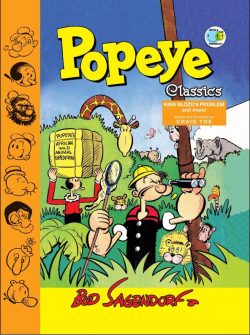
E.C. Segar’s Popeye volume 6: “Me Li’l Swee’ Pea”


By Elzie Crisler Segar, with Doc Winner (Fantagraphics Books)
ISBN: 978-1-60699-483-2 (HB)

Elzie Crisler Segar was born in Chester, Illinois on 8th December 1894. His father was a general handyman, and the boy’s early life was filled with the kinds of solid, dependable blue-collar jobs that typified his generation of cartoonists. The lad worked as a decorator and house-painter and also played drums; accompanying vaudeville acts at the local theatre.

When the town got a movie-house, he played for the silent films, absorbing all the staging, timing and narrative tricks from keen observation of the screen. Those lessons would become his greatest assets as a cartoonist. It was while working as the film projectionist, at age 18, that he decided to become a cartoonist and tell his own stories.

Like so many others in those hard times, he studied art via mail, in this case W.L. Evans’ cartooning correspondence course out of Cleveland, Ohio, before gravitating to Chicago where he was “discovered” by Richard F. Outcault – regarded by most in the know today as the inventor of modern newspaper comic strips with The Yellow Kid and, later, Buster Brown.

The celebrated cartoonist introduced Segar around at the prestigious Chicago Herald. Still wet behind the ears, the kid’s first strip, Charley Chaplin’s Comedy Capers, debuted on 12th March 1916.

In 1918 he married Myrtle Johnson and moved to William Randolph Hearst’s Chicago Evening American to create Looping the Loop, but Managing Editor William Curley saw a big future for Segar and packed the newlyweds off to New York, HQ of the mighty King Features Syndicate.

Within a year Segar was producing Thimble Theatre, which launched December 19th 1919 in the New York Journal. It was a pastiche of movie-inspired features like Hairbreadth Harry and Midget Movies, with a repertory of stock players to act out comedies, melodramas, comedies, crime-stories, chases and especially comedies for vast daily audiences.

The core cartoon cast included parental pillars Nana and Cole Oyl; their lanky, highly-strung daughter Olive, diminutive-but-pushy son Castor and Olive’s plain and simple occasional boyfriend Horace Hamgravy (later known as just Ham Gravy).

In 1924, Segar created a second daily strip. The 5:15 was a surreal domestic comedy featuring weedy commuter and would-be inventor John Sappo and his formidable wife Myrtle (surely, no relation?) which endured – in one form or another – as a topper/footer-feature accompanying the main Sunday page throughout the author’s entire career and even surviving his untimely death, to eventually become the trainee-playground of Popeye’s second great stylist Bud Sagendorf.

A born storyteller, Segar had, from the start, an advantage even his beloved cinema couldn’t match: a brilliant ear for dialogue and accent which boomed out from his admittedly average adventure plots, adding lustre and sheer sparkle to stories and gags he always felt he hadn’t drawn well enough. After a decade or so – and just as cinema caught up with the invention of “talkies” – he finally discovered a character whose unique sound and individual vocalisations blended with a fantastic, enthralling nature to create a literal superstar.

Popeye the sailor, brusque, incoherent, plug-ugly and stingingly sarcastic, lurched on stage midway through the protracted continuity ‘Dice Island’, (on January 17th 1929: see E.C. Segar’s Popeye volume 1: “I Yam What I Yam!” and many happy returns sailor!). Once his part was played out, he simply refused to leave…

Within a year he was a regular and, as the strip’s circulation skyrocketed, gradually took his place as the star. The strip title was changed to reflect the fact and most of the tired old gang – except Olive – were consigned to oblivion …

The Old Salt clearly inspired his creator. The near-decade of thrilling mystery-comedies he crafted and the madcap and/or macabre new characters with which he furiously littered the strips revolutionised the industry, laid the groundwork for the entire superhero genre (sadly, usually without the leavening underpinnings of his wryly self-aware humour) and utterly captivated the whole wide world.

These superb oversized (375 x 268 mm) hardback collections are the ideal way of discovering or rediscovering Segar’s magical tales, and this sixth and final mammoth compendium augments the fun with another insightful introductory essay from Richard Marschall exploring ‘The Continuity Style of E. C. Segar: Between “Meanwhile” & “To Be Continued” and closes with an absorbing end-piece essay describing the globalisation of the character in ‘Licensing and Merchandising Move to Center Stage of the Thimble Theatre: Popeye Fisks his way into American Culture plus a 1930 magazine feature graphically revealing the Sailor Man’s natal origins and boyhood in ‘Blow Me Down! Popeye Born at Age of 2, But Orphink from Start’ scripted by unknown King Features writers but gloriously and copiously illustrated by Segar himself.

As always, the black-&-white Daily continuities are presented separately to the full-colour Sundays, and the monochrome mirth and mayhem – covering December 14th 1936 to August 29th 1938 12th – begins with all-new adventure ‘Mystery Melody’, wherein Popeye’s shamefully disreputable dad Poopdeck Pappy is haunted and hunted by the sinister Sea Hag. Her ghastly Magic Flute is employed to irresistibly lure the old goat back into the clutches of the woman he loved and abandoned years ago…

The tension and drama mounts in second chapter ‘Tea and Hamburgers’, when the Hag approaches another old flame – J. Wellington Wimpy – and uses the reprobate’s insatiable lust (for food) to help capture Poopdeck. The plan works, but not quite as the sinister sorceress intended…

In ‘Bolo vs Everyone!’ events escalate completely beyond control as the Hag’s primordial man-monster attacks the crew and our grizzled mariner ends the fight in his own inimitable manner, whilst mystic marvel Eugene the Jeep (a fantastic 4th dimensional beast with incredible powers) uses his uncanny gifts to – temporarily at least – settle the Sea Hag’s hash…

A decided change of pace began with the next storyline. ‘A Sock for Susan’s Sake’ showcases Popeye’s big heart and sentimental nature as he takes a destitute and starving waif under his wing: buying her clothes, breaking her out of jail and going on the run with her. However, his kind-hearted deeds arouse deep suspicions about his motives from friends and strangers alike…

It’s a tribute to Segar’s skills that the storyline perfectly balances social commentary and pathos with plenty of action (that sock in question is not footwear) and non-stop slapstick comedy. Their peregrinations again land Susan and the Old Salt in jail for vagrancy, but the wonderfully sympathetic and easily amused Judge Penny really makes the prosecution work hilariously hard for a conviction in ‘Order in the Court!’…

Naturally, jealous Olive gets completely the wrong idea and uses the Jeep to track down her straying beau in ‘Who is That Girl?’, leading to the discovery of the ingénue’s origins and the restoration of her stolen fortune – a case calling for the return of ace detective and former strip star Castor Oyl…

The grateful child and her father burden Popeye with a huge reward, but as he has his own adequate savings at home he gives it all – with some unexpected difficulty – away to “Widdies and Orphinks”…

In the next sequence, the Sailor Man has reason to regret that generosity as, on returning to his house, he finds his hard-earned “Ten Thousing dollars” savings have been stolen…

Most annoyingly, he knows Poopdeck has taken it but the old goat won’t admit it, even though he has a new diamond engagement ring which he uses to bribe various loose young (and not so young) women into going out gallivanting with him and sowing ‘Wild Oats’…

When Popeye first appeared, he was a rough, rude, crude and shocking anti-hero. The first Superman of comics was not a comfortable paragon to idolise but a barely human brute who thought with his fists and didn’t respect authority. Uneducated, opinionated, short-tempered, fickle (whenever hot tomatoes batted their eyelashes – or other movable bits thereabouts – at him), a gambler and troublemaker, he wasn’t welcome in polite society…and he wouldn’t want to be.

He was soon exposed as the ultimate working-class hero: raw and rough-hewn, practical, but with an innate and unshakable sense of what’s fair and what’s not, a joker who wanted kids to be themselves – but not necessarily “good” – and somebody who took no guff from anyone.

As his popularity grew, he mellowed somewhat. He was still always ready to defend the weak and had absolutely no pretensions or aspirations to rise above his fellows. He was and will always be “the best of us”… but the shocking sense of unpredictability, danger and comedic anarchy he initially provided was sorely missed. So, in 1936 Segar brought it all back again in the form of Popeye’s 99-year old unrepentantly reprobate dad…

The elder mariner was a rough, hard-bitten, grumpy brute quite prepared and even happy to cheat, steal or smack a woman around if she stepped out of line, and once the old billy goat (whose shady past possibly concealed an occasional bit of piracy) was firmly established, Segar set Popeye and Olive the Herculean and unfailingly funny task of civilising the geriatric sod…

They return to their odious chore here as Pappy’s wild carousing, fighting and womanising grow ever more embarrassing and lead to the cops trying – and repeatedly failing – to jail the senior seaman.

Poopdeck finally goes too far and pushes one of his fancy woman fiancées into the river. At last brought to trial, he pleads ‘Extenuvatin’ Circumsnances’…

The final full Segar saga began on 15th November 1937 as ‘The Valley of the Goons (An Adventure)’ sees Popeye and Wimpy drugged and shanghaied. Even though he could fight his way back home, Popeye agrees to stay on for the voyage since he needs money to pay lawyers appealing Pappy’s prison sentence. He quickly changes tack, however, when he discovers the valuable cargo they’re hunting is Goon skins!

The Cap’n and his scurvy crew are planning to slaughter the hapless hulking exotic primitives for a few measly dollars…

After brutally driving off the murderous thugs, Popeye – and the shirking Wimpy – are marooned on the Goons’ isolated island…

The barbaric land holds a few surprises: most notably the fact that the natives are ruled over by Popeye’s dour old pal King Blozo (formerly of Nazilia) who, with his imbecilic retainer Oscar, is calling all the shots. It’s a happy coincidence, as Wimpy’s eternal hunger and relentless mooching have won him a death sentence and he’s in imminent danger of being hanged…

All this time Olive, guided by the mystical tracking gifts of the Jeep, has been sailing the seven seas in search of her man and she beaches her boat just as Popeye begins to get the situation under control. In doing so he unfairly earns the chagrin of the island’s unseen but highly voluble sea monster George…

Shock follows shock as the eerie-voiced unseen creature is revealed as the horrendous Sea Hag who re-exerts her uncanny hold (some illusions but mostly the promise of unlimited hamburgers) upon Wimpy and tries to make him the ‘Bride of George’…

In the middle of this tale Segar fell seriously ill with Leukaemia and his assistant Doc Winner assumed responsibility for completing the story: probably from Segar’s notes if not at his actual direction.

Although Winner’s illustrations carry ‘Valley of the Goons’ to conclusion, this tome excludes the all-Winner adventure ‘Hamburger Sharks and Sea Spinach’ before resuming with the May 23rd instalment by the apparently recovered Segar.

‘King Swee’Pea’ saw the feisty baby – who had been left with Popeye – become the focus of political drama and family tension when he was revealed to be heir to the Kingdom of Demonia…

After a protracted tussle with that nation’s secret service and bombastic kingmaker F.G. Frogfuzz Esquire, the Sailor Man has himself appointed regent and chief advisor before taking most of the cast with him and relocating to the harsh land where only Ka-babages grow.

Popeye soon finds that his mischievous little charge has started to speak: increasingly crossing and contradicting his gruff guardian and others, much to the annoyance of blustering bully King Cabooso of neighbouring (rival) nation Cuspidonia…

Before long, another unique crisis manifests in ‘Rise of the De-Mings’ as smugly sassy subterranean critters begin devastating the Ka-babage crop even as Swee’Pea and Caboosa escalate their war of insults…

Sadly, although coming back strongly, within three months Segar had relapsed. The adventures end here with his last strip and a précis of Winner’s eventual conclusion…

Segar passed away six weeks after his final Daily strip was published.

The full-colour Sunday pages in this volume run from 20th September 1936 to October 2nd 1938, a combination of star turn and intriguing footers.

After an interlude with a new wry and charming feature – Pete and Patsy: For Kids Only – the artist settled once again upon an old favourite to back up Popeye.

The bizarrely entertaining Sappo (accompanied by scene-and show-stealing Professor O.G. Wotasnozzle) supplemental strip returned in a blaze of imaginative wonder, as Segar also benched the cartooning tricks section which allowed him to play graphic games with his readership and again pushed the boundaries of Weird Science as the Odd Couple – and long-suffering spouse Myrtle – spent months exploring other worlds.

The assorted Saps also dabbled with robot dogs, brain-switching machines and fell embarrassingly foul of such inventions as long-distance spy-rays, anti-gravity devices, limb extending “Stretcholene”, “Speak-no-Evil” pills, Atom-Counters and the deeply disturbing trouble magnet dubbed “Dream Solidifier”, whilst Sappo’s less scientific but far more profitable gimmicks kept the cash rolling in and the arrogant Professor steaming with outrage…

Above these arcane antics Sunday’s star attraction remained fixedly exploring the comedy gold of Popeye’s interactions with Wimpy, Olive Oyl and the rest of Segar’s cast of thousands (of idiots).

The humorous antics – in sequences of one-off gag strips alternating with the occasional extended saga – saw the Sailor-Man fighting for every iota of attention whilst his mournful mooching co-star became increasingly more ingenious – not to say surreal – in his quest for free meals…

An engaging Micawber-like coward, cad and conman, the insatiable J. Wellington Wimpy debuted on May 3rd 1931 as an unnamed and decidedly partisan referee in one of Popeye’s frequent boxing matches. The scurrilous but polite oaf obviously struck a chord and Segar gradually made him a fixture. Always hungry, keen to take bribes and a cunning coiner of many immortal catchphrases – such as “I would gladly pay you Tuesday for a hamburger today” and ‘Let’s you and him fight’ – he was the perfect foil for a simple action hero and increasingly stole the entire show, just like anything else unless it was firmly nailed down…

There was also a long-suffering returning rival for Olive’s dubious and flighty affections: local charmer Curly…

When not beating the stuffing out of his opponents or kissing pretty girls, Popeye pursued his flighty, vacillating and irresolute Olive with exceptional verve, if little success, but his life was always made more complicated whenever the unflappable, so-corruptible and adorably contemptible Wimpy made an appearance.

Infinitely varying riffs on Olive’s peculiar romantic notions or Wimpy’s attempts to cadge food or money (for food) were irresistible to the adoring readership, but Segar wisely peppered the Sundays with longer episodic tales, such as the saga of ‘The Terrible Kid Mustard’ (which ran from December 27th 1936 to February 28th 1937) and pitted the prize-fighting Sea Salt against another boxer who was as ferociously fuelled by the incredible nourishing power of Spinach…

Another extended endeavour starred the smallest addition to the cast (and eponymous star of this volume). The rambunctious tyke Swee’ Pea was never an angel and when he began stealing jam and framing Eugene the Jeep (March 7th through 28th) the search for a culprit proved he was also precociously smart too.

The impossible task of civilising Poopdeck Pappy also covered many months – with no appreciable or lasting effect – and incorporated an outrageous sequence wherein the dastardly dotard become scandalously, catastrophically entangled in Popeye’s mechanical diaper-changing machine…

On June 27th Wimpy found the closest thing to true love when he met Olive’s friend Waneeta: a meek, retiring soul whose father owned 50,000 cows. His devoted and ardent pursuit filled many pages over the following months, as did the latest scheme of his arch-nemesis George W. Geezil, who bought a café/diner with the sole intention of poisoning the constantly cadging conman…

Although starring the same characters, the Sunday and Daily strips ran separate storylines, offering Segar opportunities to utilise the same good idea in different ways.

On September 19th 1937 he began a sequence wherein Swee’ Pea’s mother returned, seeking to regain custody of the boy she had given away. The resultant tug-of-love tale ran until December 5th and displayed genuine warmth and angst amidst the wealth of hilarious antics by both parties to convince the feisty “infink” to pick his preferred parent…

On January 16th 1938 Popeye was approached by scientists who had stumbled upon an incipient Martian invasion. The invaders planned to pit their monster against a typical Earthman before committing to the assault so the Boffins believed the grizzly old pug was the planet’s best bet…

Readers had no idea that the feature’s glory days were ending. Segar’s advancing illness was affecting his output – there are no pages reproduced here between February 6th and June 26th – and although when he resumed drawing the gags were funnier than ever (especially a short sequence where Pappy shaves his beard and dyes his hair so he could impersonate Popeye and woo Olive), the long lead-in time necessary to create Sundays only left him time to finish 15 more pages.

The last Segar signed strip was published on October 2nd 1938. He died eleven days later.

There is more than one Popeye. If your first thought on hearing the name is an unintelligible, indomitable white-clad sailor always fighting a great big beardy-bloke and mainlining spinach, that’s okay: the animated features have a brilliance and energy of their own (even the later, watered-down anodyne TV versions have some merit) and they are indeed based on the grizzled, crusty, foul-mouthed, bulletproof, golden-hearted old swab who shambled his way into Thimble Theatre and wouldn’t go away But they are really only the tip of an incredible iceberg of satire, slapstick, virtue, vice and mind-boggling adventure…

Popeye and the bizarre, surreally quotidian cast that welcomed and grew up around him are true icons of international popular culture who have grown far beyond their newspaper strip origins. Nevertheless, in one very true sense, with this marvellous yet painfully tragic final volume, the most creative period in the saga of the true and only Sailor Man closes.

His last strips were often augmented or even fully ghosted by Doc Winner, but the intent is generally untrammelled, leaving an unparalleled testament to Segar’s incontestable timeless, manic brilliance for us all to enjoy over and over again.

There is more than one Popeye. Most of them are pretty good and some are truly excellent. There was only ever one by Elzie Segar – and don’t you think it’s time you sampled the original and very best?
© 2012 Fantagraphics Books Inc. All comics and drawings © 2011 King Features Inc. All rights reserved.

Willie and Joe: The WWII Years


By Bill Mauldin, edited by Todd DePastino (Fantagraphics Books)
ISBN: 978-1-60699-439-9 (PB)

During World War II a talented, ambitious young man named William Henry “Bill” Mauldin (29/10/1921 – 22/01/2003) fought “Over There” with the 45th Division of the United States Infantry as well as many other fine units of the army. He learned to hate war and love his brother soldiers – and the American fighting man loved him back. During his time in the service he produced civilian cartoons for the Oklahoma City Times and The Oklahoman, and devastatingly, intimately effective and authentic material for his Company periodical, 45th Division News. He also produced work for Yank and Stars and Stripes; the US Armed Forces newspapers. Soon after, his cartoons were being reproduced in newspapers across Europe and America.

They mostly featured two slovenly “dogfaces” – a term he popularised – offering their trenchant and laconic view of the war from the muddied tip of the sharpest of Sharp Ends…

Willie and Joe, much to the dismay of the brassbound, spit-and-polish military martinets and diplomatic doctrinaires, became the unshakable, everlasting image of the American soldier: continually exposing in all ways and manners the stuff upper echelons of the army would prefer remained top secret. Not war secrets, but how the men at arms lived, felt and died.

Willie and Joe even became the subject of two films (Up Front -1951 and Back at the Front – 1952) whilst Willie made the cover of Time magazine in 1945, when 23-year old Mauldin won his first Pulitzer Prize.

In 1945, a collection of his drawings, accompanied by a powerfully understated and heartfelt documentary essay, was published by Henry Holt and Co. Up Front was a sensation, telling the American public about the experiences of their sons, brothers, fathers and husbands in a way no historian would or did. A biography, Back Home, followed in 1947.

Mauldin’s anti-war, anti-Idiots-in-Charge-of-War views became increasingly unpopular during the Cold War and, despite being a certified War Hero, Mauldin’s increasingly political cartoon work fell out of favour (those efforts are the subject companion volume Willie & Joe: Back Home). Mauldin left the increasing hostile and oversight-ridden business to become a journalist and illustrator.

He was a film actor for a while (appearing, amongst other movies, in Red Badge of Courage with veteran war hero Audie Murphy); a war correspondent during the Korean War and – after an unsuccessful campaign for Congress in 1956 – finally returned to newspaper cartooning in 1958.

He retired in 1991 after a long, glittering and award-studded career. He only drew Willie and Joe four times in that entire period (for an article on the “New Army” in Life magazine; for the funerals of “Soldier’s Generals” Omar Bradley and George C. Marshall; and to eulogize Milton Caniff). His fondest wish had been to kill the iconic dogfaces off on the final day of World War II, but Stars and Stripes vetoed it.

The Willie and Joe cartoons and characters are some of the most enduring and honest symbols of all military history. Every Veterans Day in Peanuts from 1969 to 1999, fellow veteran Charles Schulz had Snoopy turn up at Mauldin’s house to drink root beers and tell war stories with an old pal. When you read Sgt. Rock you’re looking at Mauldin’s legacy, and Archie Goodwin drafted the shabby professionals for a couple of classy guest-shots in Star-Spangled War Stories (see Showcase Presents the Unknown Soldier).

This immense, mostly monochrome (with some very rare colour and sepia items) softcover compendium comes in at 704 pages, (229 x 178mm for the physical copy or any size you want if you get the digital edition): assembling all his known wartime cartoons – as originally released in two hardback editions in 2008. It features not only the iconic dog-face duo, but also the drawings, illustrations, sketches and gags that led, over 8 years of army life, to their creation.

Mauldin produced most of his work for Regimental and Company newspapers whilst under fire: perfectly capturing the life and context of fellow soldiers – also under battlefield conditions – and shared a glimpse of that unique and bizarre existence to their families and civilians at large, despite constant military censorship and even face-to-face confrontations with Generals. George Patton was perennially incensed at the image the cartoonist presented to the world, but fortunately Supreme Commander Dwight D. Eisenhower, if not a fan, knew the strategic and morale value of Mauldin’s Star Spangled Banter and Up Front features with those indomitable everymen Willie and Joe…

This far removed in time, many of the pieces here might need historical context for modern readers and such is comprehensively provided by the notes section to the rear of the volume. Also included are unpublished pieces and pages, early cartoon works, and rare notes, drafts and sketches.

Most strips, composites and full-page gags, however, are sublimely transparent in their message and meaning: lampooning entrenched stupidity and cupidity, administrative inefficiency and sheer military bloody-mindedness. They highlight equally the miraculous perseverance and unquenchable determination of ordinary guys to get the job done while defending their only inalienable right – to gripe and goof off whenever the brass weren’t around…

Most importantly, Mauldin never patronised civilians or demonised the enemy: the German and Italians are usually in the same dismal boat as “Our Boys” and only the war and its brass-bound conductors are worthy of his inky ire…

Alternating crushing cynicism, moral outrage, gallows humour, absurdist observation, shared miseries, staggering sentimentality and the total shock and awe of still being alive every morning, this cartoon catalogue of the Last Just War is a truly breathtaking collection that no fan, art-lover, historian or humanitarian can afford to miss.

…And it will make you cry and laugh out loud too.

With a fascinating biography of Mauldin that is as compelling as his art, the mordant wit and desperate camaraderie of his work is more important than ever in an age where increasingly cold and distant brass-hats and politicians send ever-more innocent lambs to further foreign fields for slaughter. With this volume and the aforementioned Willie & Joe: Back Home, we should finally be able to restore the man and his works to the forefront of graphic consciousness, because tragically, it looks like his message is never going to be outdated… or learned from by the idiots in charge who most need to hear it…
© 2011 the Estate of William Mauldin. All right reserved.

E.C. Segar’s Popeye volume 5: Wha’s a Jeep?


By Elzie Crisler Segar (Fantagraphics Books)
ISBN: 978-1-60699-404-7 (HB)

Elzie Crisler Segar was born in Chester, Illinois on 8th December 1894. His father was a handyman and Elzie’s early life was filled with the types of solid, earnest blue-collar jobs that typified his generation of cartoonists. The younger Segar worked as a decorator and house-painter and played drums, accompanying vaudeville acts at the local theatre. When the town got a movie house, he played for the silent films, absorbing the staging, timing and narrative tricks from the close observation of the screen that would become his greatest assets as a cartoonist. It was while working as the film projectionist, aged 18, he decided to become a cartoonist and tell his own stories.

Like so many others of that “can-do” era, Segar studied art via mail, in this case W.L. Evans’ cartooning correspondence course out of Cleveland, Ohio (from where Jerry Siegel & Joe Shuster would launch Superman upon the world), before gravitating to Chicago where he was “discovered” by Richard F. Outcault – arguably the inventor of newspaper comic strips with The Yellow Kid and Buster Brown.

The senior artist introduced him around at the prestigious Chicago Herald. Still wet behind the ears, Segar’s first strip, Charley Chaplin’s Comedy Capers, debuted on 12th March 1916. In 1918 he married Myrtle Johnson and moved to William Randolph Hearst’s Chicago Evening American to create Looping the Loop. Managing Editor William Curley saw a big future for Segar and promptly packed the newlyweds off to the Manhattan headquarters of the mighty King Features Syndicate.

Within a year Segar was producing Thimble Theatre, which launched December 19th 1919 in the New York Journal. In its earliest incarnation the strip was a pastiche/knock off of Movie features like Hairbreadth Harry and Midget Movies, with a repertory cast to act out comedies, melodramas, comedies, crime-stories, chases and especially comedies for huge daily audiences. The core cast included parental pillars Nana and Cole Oyl, lanky daughter Olive, diminutive-but-pushy son Castor and Olive’s plain and simple occasional boyfriend Horace Hamgravy (later just Ham Gravy).

In 1924, Segar created a second daily strip. The 5:15 was a surreal domestic comedy featuring weedy commuter and would-be inventor John Sappo and his formidable wife Myrtle (surely, no relation?).

A born storyteller, Segar had from the start an advantage even his beloved cinema couldn’t match. His brilliant ear for dialogue and accent shone out from his admittedly average melodrama adventure plots, adding lustre to stories and gags he always felt he hadn’t drawn well enough. After a decade or so – and just as cinema caught up with the introduction of “talkies” – he finally discovered a character whose unique sound and individual vocalisations blended with a fantastic, enthralling nature to create a literal superstar.

Popeye the sailor, brusque, incoherent, plug-ugly and stingingly sarcastic, shambled on stage midway through nautical adventure ‘Dice Island’, (on January 17th 1929: see E.C. Segar’s Popeye volume 1: “I Yam What I Yam!”) and once his very minor part was played out, simply refused to leave. Within a year he was a regular and as the strip’s circulation skyrocketed, he became the star. Eventually, the strip title was changed to Popeye and all of the old gang except Olive were consigned to near-oblivion…

Popeye inspired Segar. The near decade of thrilling mystery-comedies which followed revolutionised the industry, laid the groundwork for the entire superhero genre (sadly, usually without the leavening underpinnings of his self-aware humour) and utterly captivated the whole wide world.

These superb oversized (almost 260 mm by 372mm) hardback collections are the ideal way of discovering or rediscovering Segar’s magical tales. Over and above the increasingly incredible tales from the daily and Sunday strips, this vibrantly enticing fifth volume also contains an insightful introductory essay from Richard Marschall – ‘Character and Personality in Thimble Theatre’ – a captivating article of the period (‘Segar’s Hobbies Put Punch in Popeye Comics’) reprinted from Modern Mechanix and Inventions, plus a fascinating end-piece covering assorted original art teasers editors used to promote upcoming tales in the magical days before television or viral ad campaigns.

The monochrome Monday to Saturday section opens this volume, (covering July 25th 1935-December 12th 1936), encompassing one-and-a-half major storylines, and begins with the eagerly-anticipated conclusion of ‘Popeye’s Ark’, wherein our bold sailor-man carries out an ambitious plan to set up his own country of Spinichovia. The incredible scheme is funded by misogynist millionaire Mr. Sphink who insists that the new country be absolutely without women, and Popeye goes along with it, recruiting a host of disaffected guys looking for a fresh start…

Soon however, the thousands of able-bodied men populating the country are starving for any kind of female companionship: – even Olive Oyl, currently exiled on an island of her own. Things get very strange when the lonely Spinichovians discover a tribe of mermaids frolicking off the coast, but romance is soon forgotten when Brutian despot King Zlobbo decides the new nation must be his in ‘War Clouds’.

To scout out potential opposition, Zlobbo dispatches enticing spy Miss Zexa Peal, but as the most beautiful woman in the country – and comprising 50% of Spinichova’s female population – she isn’t exactly inconspicuous…

When war breaks out, it results in Popeye’s greatest victory – with just a little excessively violent help from feisty “infink” baby Swee’ Pea…

By the conclusion of that epic tale all the players have returned to America, just in time for the introduction of the star of this tome.

‘Eugene the Jeep’ debuted on March 20th 1936: a fantastic 4th dimensional beast with incredible powers that Olive and Wimpy use to get very rich, very quickly, only to lose it all betting on the wrong guy in another of Segar’s classic and hilarious set-piece boxing matches between Popeye and yet another barely-human pugilist…

These tales come from an astonishingly fertile period for the strip’s long history. On August 4th, Eugene was instrumental in kicking off another groundbreaking and memorable sequence as the entire ensemble cast took off on as haunted ship to undertake ‘The Search for Popeye’s Papa’.

When Popeye first appeared, he was a shocking anti-hero. The first Superman of comics was not a comfortable icon to idolise. A brute who thinks with his fists and doesn’t respect authority; uneducated, short-tempered, fickle (when hot tomatoes batted their eyelashes – or thereabouts – at him), a gambler and troublemaker, he wasn’t welcome in polite society… and he wouldn’t want to be.

Popeye was the ultimate working-class hero: raw and rough-hewn, practical, but with an innate and unshakable sense of what’s fair and what’s not. He was a joker who wants kids to be themselves, but not necessarily “good”, and a man who takes no guff from anyone.

Of course, as his popularity grew, he somewhat mellowed. He was always ready to defend the weak and had absolutely no pretensions or aspirations to rise above his fellows. He was and will always be “the best of us”… but the shocking sense of unpredictability, danger and anarchy he initially provided was sorely missed by 1936 – so Segar brought it back again…

This memorably riotous tale introduced ancient, antisocial crusty reprobate Poopdeck Pappy and his diminutive hairy sidekick Pooky Jones during another fabulous voyage of discovery. The elder mariner was a rough, hard-bitten, grumpy brute quite prepared and even happy to cheat, steal or smack a woman around if she stepped out of line…

Once that old goat was firmly established, Segar set Popeye and Olive the Herculean task of ‘Civilizing Poppa’ which is where the monochrome adventures here conclude…

The full-colour Sunday pages in this volume span April 4th 1935 to September 13th 1936, and see the bizarrely entertaining Sappo (and mad scientist lodger Professor O.G. Wotasnozzle) supplemental strip gradually diminish to allow the Popeye feature even more room to excel and amaze.

Eventually Sappo became a cartooning tricks section allowing Segar to play graphic games with his readership. Popeye’s Cartoon Club also disappeared, as the focus inexorably shifted to Popeye and Co. in alternating one-off gag strips and extended sagas. However, the Sailor-Man had to fight for space with his mooching co-star J. Wellington Wimpy…

When not beating the stuffing out of his opponents or kissing pretty girls, Popeye pursued his flighty, vacillating and irresolute Olive Oyl with exceptional verve, if little success, but his life was always made more complicated whenever the unflappable, so-corruptible and adorably contemptible Wimpy made an appearance.

The engaging Micawber-like coward, moocher and conman was first seen on 3rd May 1931 as an unnamed and decidedly partisan referee in one of Popeye’s regular boxing matches. The scurrilous but ever-so-polite oaf obviously struck a chord and Segar gradually made him a fixture. Eternally hungry, always eager to take a bribe and a cunning coiner of many immortal catchphrases such as “I would gladly pay you Tuesday for a hamburger today” and “let’s you and him fight”, Wimpy was the perfect foil for a simple action hero and often stole the entire show.

Infinitely varying riffs on Olive’s peculiar romantic notions or Wimpy’s attempts to cadge food or money for food were irresistible to the adoring readership, but Segar wisely peppered the Sundays with longer episodic tales, such as the cast’s gold-prospecting venture to the inhospitable western desert of ‘Slither Creek’ (April 14th – August 25th 1935) and a sequel sequence wherein the temporarily wealthy but eternally starving Wimpy buys his own diner – the ultimate expression of blind optimism and sheer folly…

The uniquely sentimental monster Alice the Goon returned to the strip on February 23rd 1936, permanently switching allegiance and becoming nanny to rambunctious tyke Swee’ Pea. She was a cast regular by the end of April.

August 9th saw Eugene the Jeep make his Sunday debut, and a few demonstrations of the fanciful beast’s incredible powers to make money and cause chaos fill out this fifth fantastic tome…

There is more than one Popeye. If your first thought on hearing the name is an unintelligible, indomitable white-clad sailor always fighting a great big beardy-bloke and mainlining tinned spinach, that’s okay: the animated features have a brilliance and energy of their own (even the later, watered-down anodyne TV versions have some merit) and they are indeed based on the grizzled, crusty, foul-mouthed, bulletproof, golden-hearted old swab who shambled his way into Thimble Theatre and wouldn’t leave. But they are really only the tip of an incredible iceberg of satire, slapstick, virtue, vice and mind-boggling adventure…

There is more than one Popeye. Most of them are pretty good and some are truly excellent. Don’t you think it’s about time you sampled the original and very best?
© 2011 Fantagraphics Books Inc. All comics and drawings © 2011 King Features Inc. All rights reserved.

I Am Going to Be Small


By Jeffrey Brown (Top Shelf Productions)
ISBN: 978-1-891830-86-0 (PB)

If you’re a fan of Jeffrey Brown’s cartoon exploits you might understandably admit to a small degree of confusion. In 2012 he scored his first global best-seller with a hilarious spin on the nurturing side of the Jedi experience in Darth Vader and Son, following up with equally charming and hilarious sequels such as Vader’s Little Princess, Star Wars: Jedi Academy and others. He added contributions to the expanded Star Wars franchise’s dramatic comics canon and has directed music videos, created film posters, worked for public radio and co-written the feature film Save the Date.

Before that another Jeffrey Brown was the sharply sparkling wit who had crafted slyly satirical all-ages funny stuff for The Simpson’s Treehouse of Horror, Marvel’s Strange Tales, Incredible Change-Bots and similar visual venues. His current big thing is the Lucy & Andy Neanderthal series of books.

There is yet another Jeffrey Brown: instigator and frequent star and stooge of such quirkily irresistible autobiographical Indy comics classics as Bighead, Little Things, Funny, Misshapen Body, Undeleted Scenes and the 4-volume “Girlfriend Trilogy” comprising Clumsy, Unlikely, AEIOU and Every Girl is the End of the World for Me…

Whichever Brown’s your preferred choice, he’s a cartoonist of rare insight and unflinching integrity who still makes you laugh out loud when not prompting you to offer a big consoling hug. That’s what this landscape landmark (available in paperback and eBook editions) is about – “a collection of gag and humour cartoons 1997-2006”…

Brown was raised in Michigan; relocating to Chicago in 2000 to attend the School of the Arts Institute and study painting. Before graduating he had switched to drawing comics and in 2002 Clumsy was released. A poignant and uncompromising dissection of a long-distance relationship, it quickly became a surprise hit with fans and critics alike. A little later – and in the same vein – he produced Unlikely (or How I Lost My Virginity) a True Love Story: “250+ pages of young love, sex, drugs, heartbreak & comedy” involving the long and agonisingly extended process of “becoming a Man”….

Here, those evergreen themes are constantly revisited and expanded upon: a succession of painful torments, frustrations and moments of unparalleled joy, but rubbing pimply shoulders with straight-up whimsy, surreal and gross-out gags, observational comedy and anything the swiftly-developing cartoonist deemed worthy of his brief attention. The result is painfully funny…

Here you will find uplifting homilies gone awry, college days captured in all their bleakness, sports – and sportsmen – dissected, movies reviewed and trashed, faux ads and products, the magic of boxes, religion, excess and guilt, god and Jesus, animal crackers, food, dining, unicorns, atrocious puns, the wonder of toys, war and the military, ex-girlfriends, babies, torture and mutilation and lots of observations on the dating arena.

There, at the rear end of the book, is a selection of anthropomorphic yet sophisticated mishaps featuring of a bunch of animals – Bunny, Bear, Bird and Cat – enduring the torment of interspecies attraction (and repulsion), all gathered together under the umbrella title ‘Cuticle’…

The material is both delicious and agonising in its forthright simplicity: brimming with shameful glee and subversive wit, this a fabulous voyage of graphic and comedic self-indulgence for everybody who has passed the raging hormones stage of existence and is happy to enjoy the plight of others still suffering…

It is to laugh…
© 2006 Jeffrey Brown.