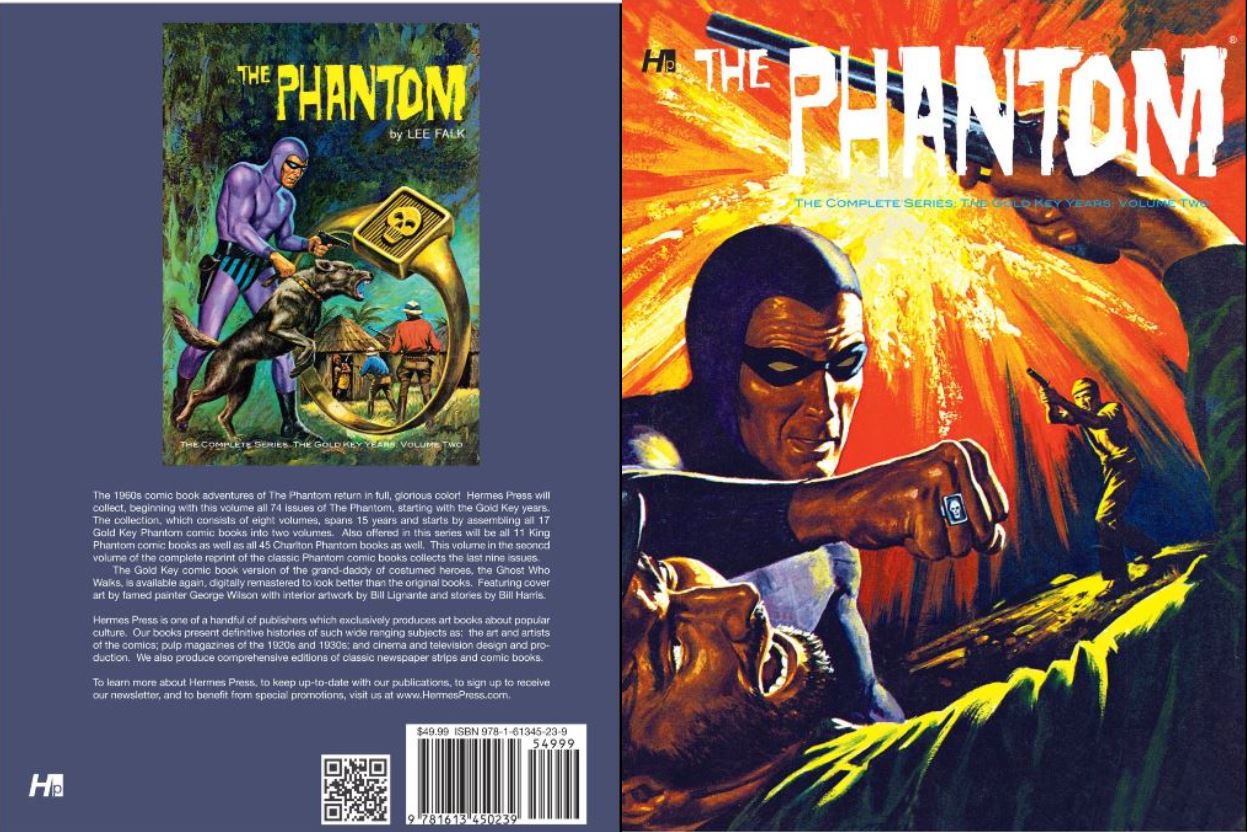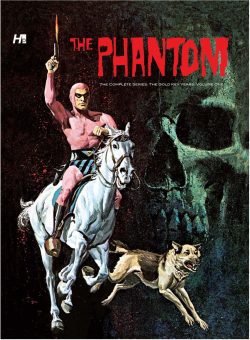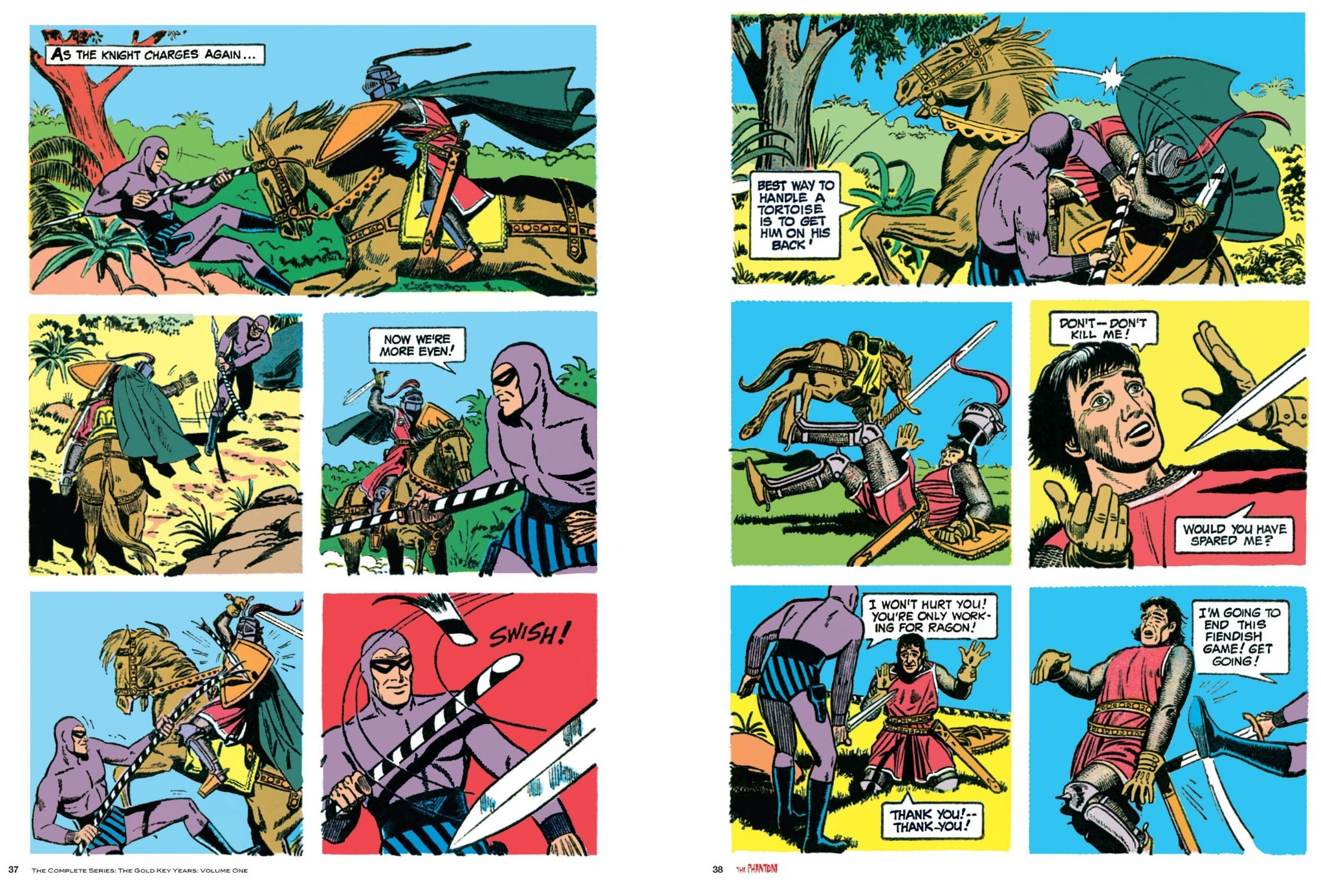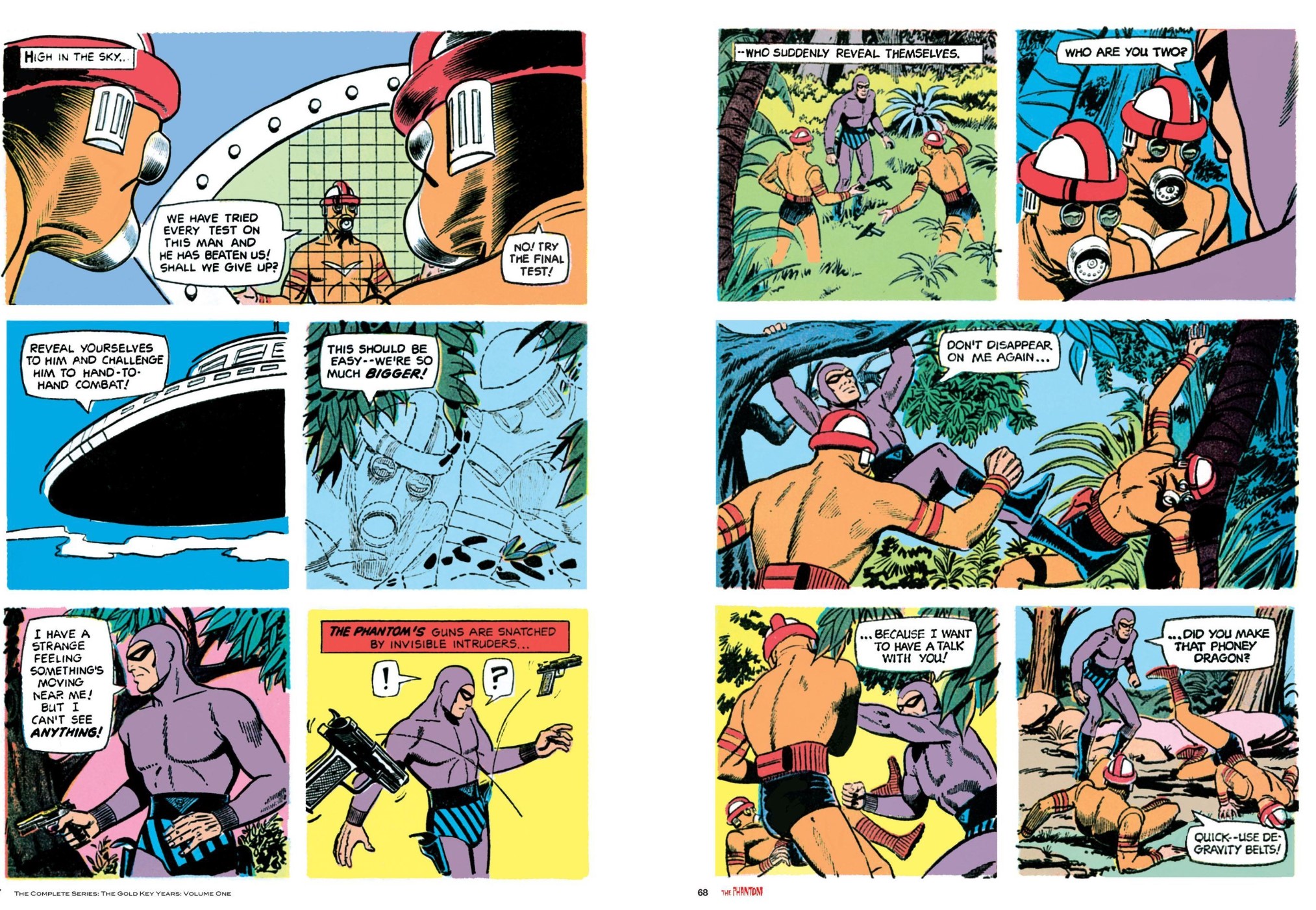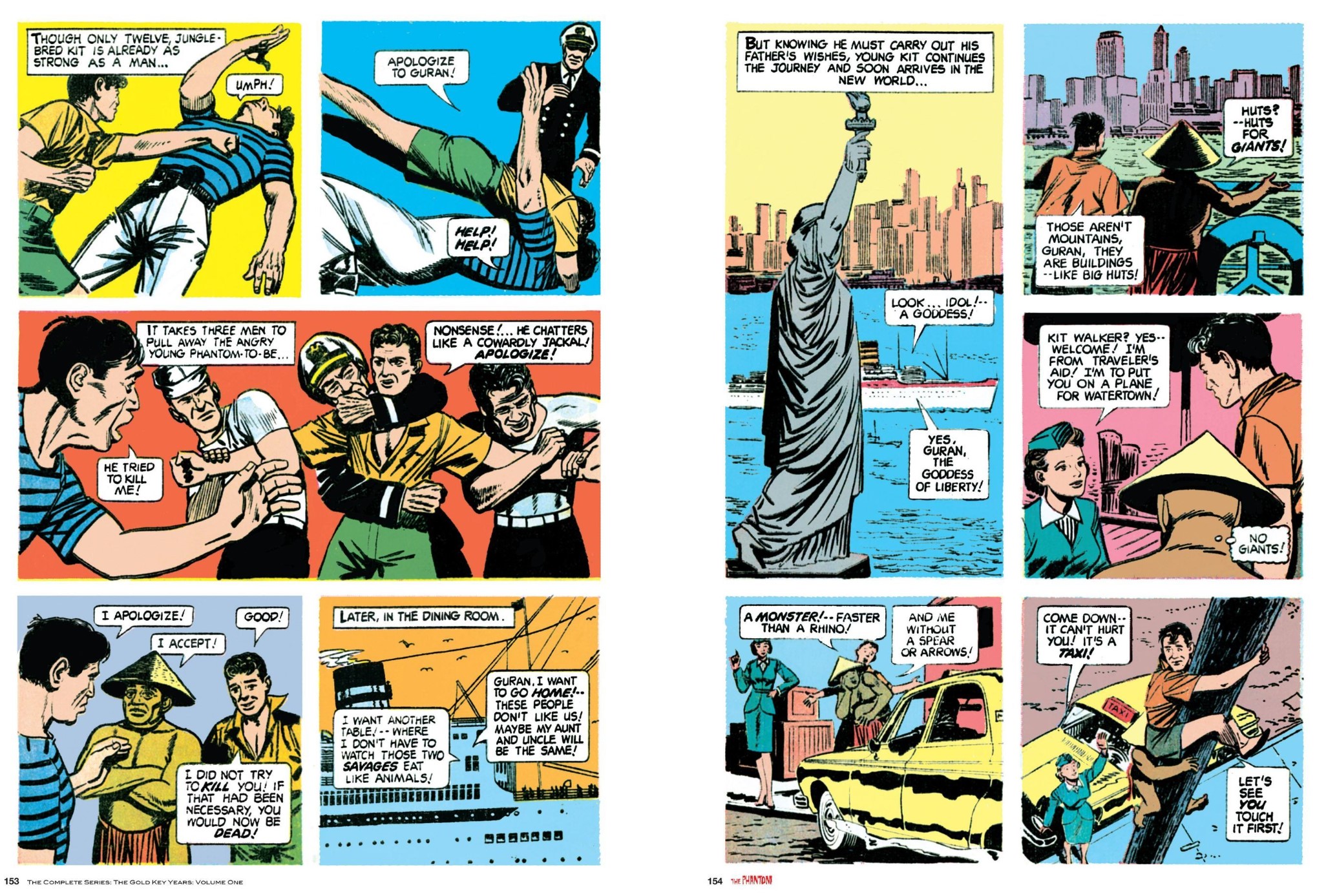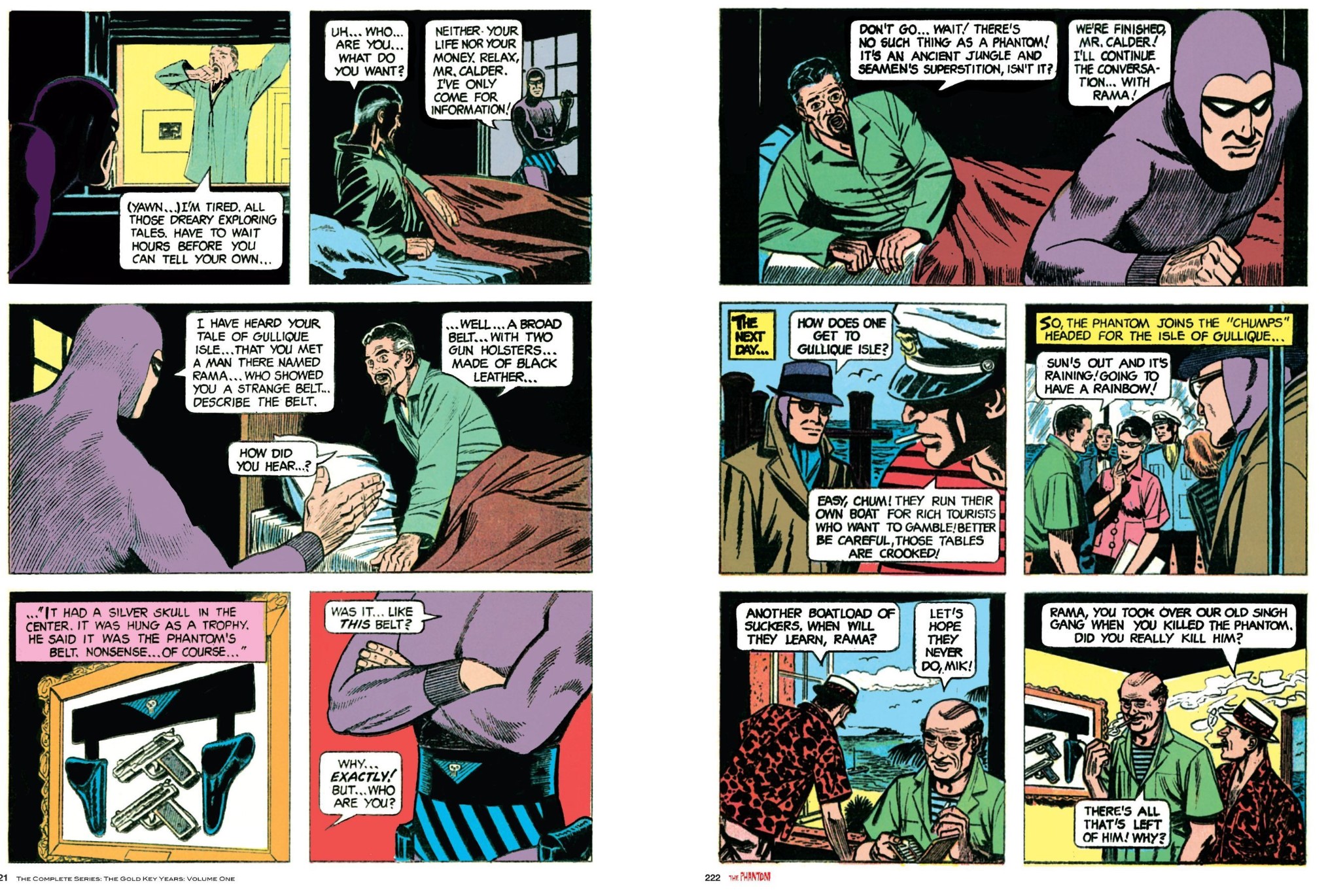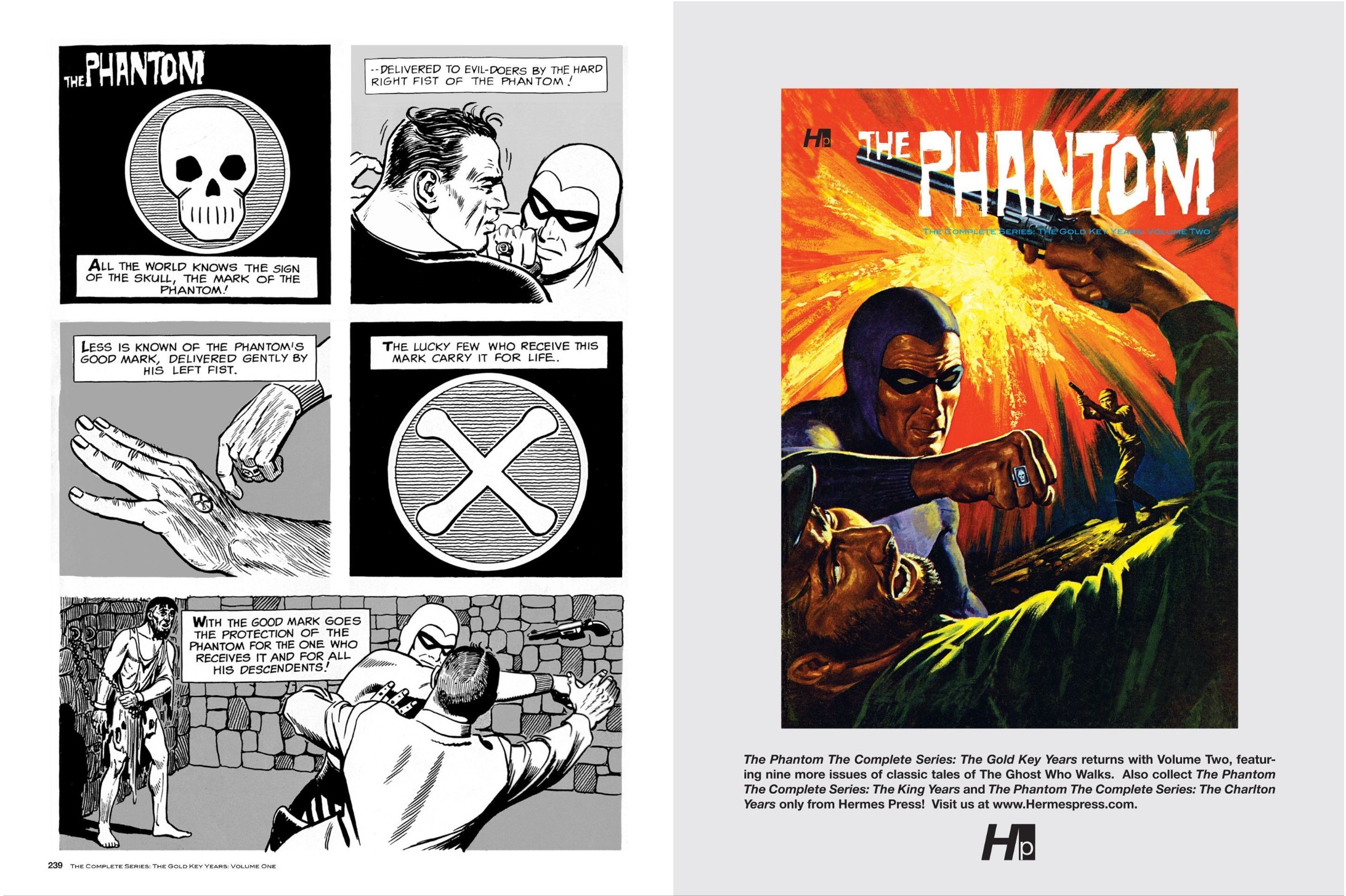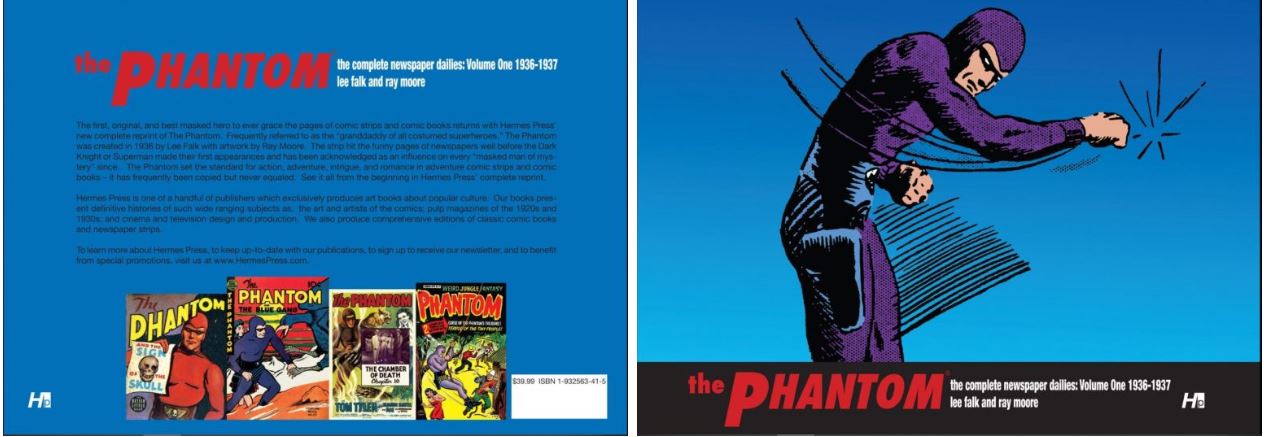
The Phantom: The Complete Newspaper Dailies volume 1 1936-1937


By Lee Falk & Ray Moore: introduction by Ron Goulart (Hermes Press)
ISBN: 978-1-932563-41-5 (HB/Digital edition)

This book includes Discriminatory Content produced in less enlightened times.

There are plenty of comics-significant anniversaries this year, and this guy is probably right at the top of the birthday cake. As next month sees his 90th anniversary here’s tasty reminder of why he is considered one of our industry’s landmark figures.

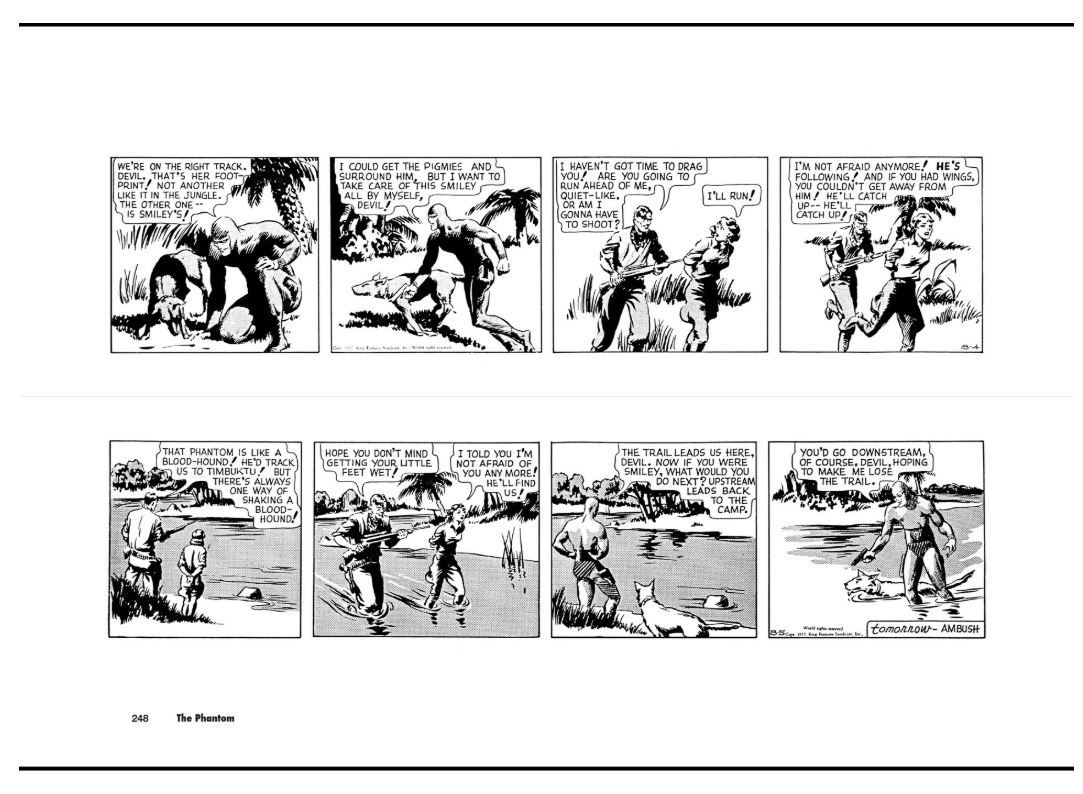
For such a long-lived, influential series, in terms of compendia or graphic novel collections, The Phantom has been very poorly served by the English language market (except in Australia where he has always been accorded the status of a pop culture god). Numerous companies have sought to collect the strips – one of the longest continually running adventure serials in publishing history – but in no systematic or chronological order and never with any sustained success. At least the former issue began to be rectified with this initial curated collection from Archival specialists Hermes Press. This particular edition is a lovely large hardback (albeit also available in digital formats), printed in landscape format, displaying two days strip per page in black & white with ancillary features and articles in dazzling colour where required.

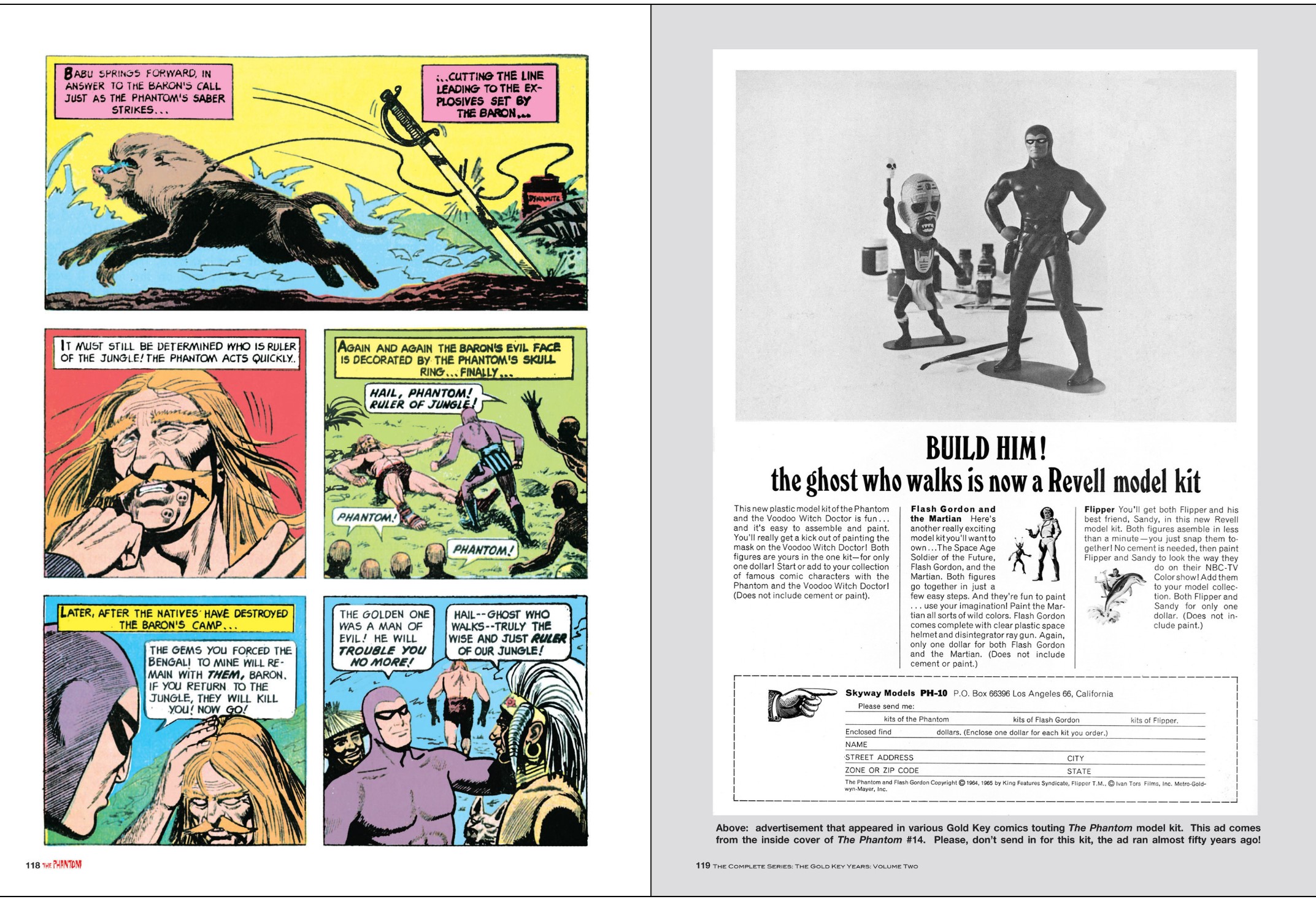
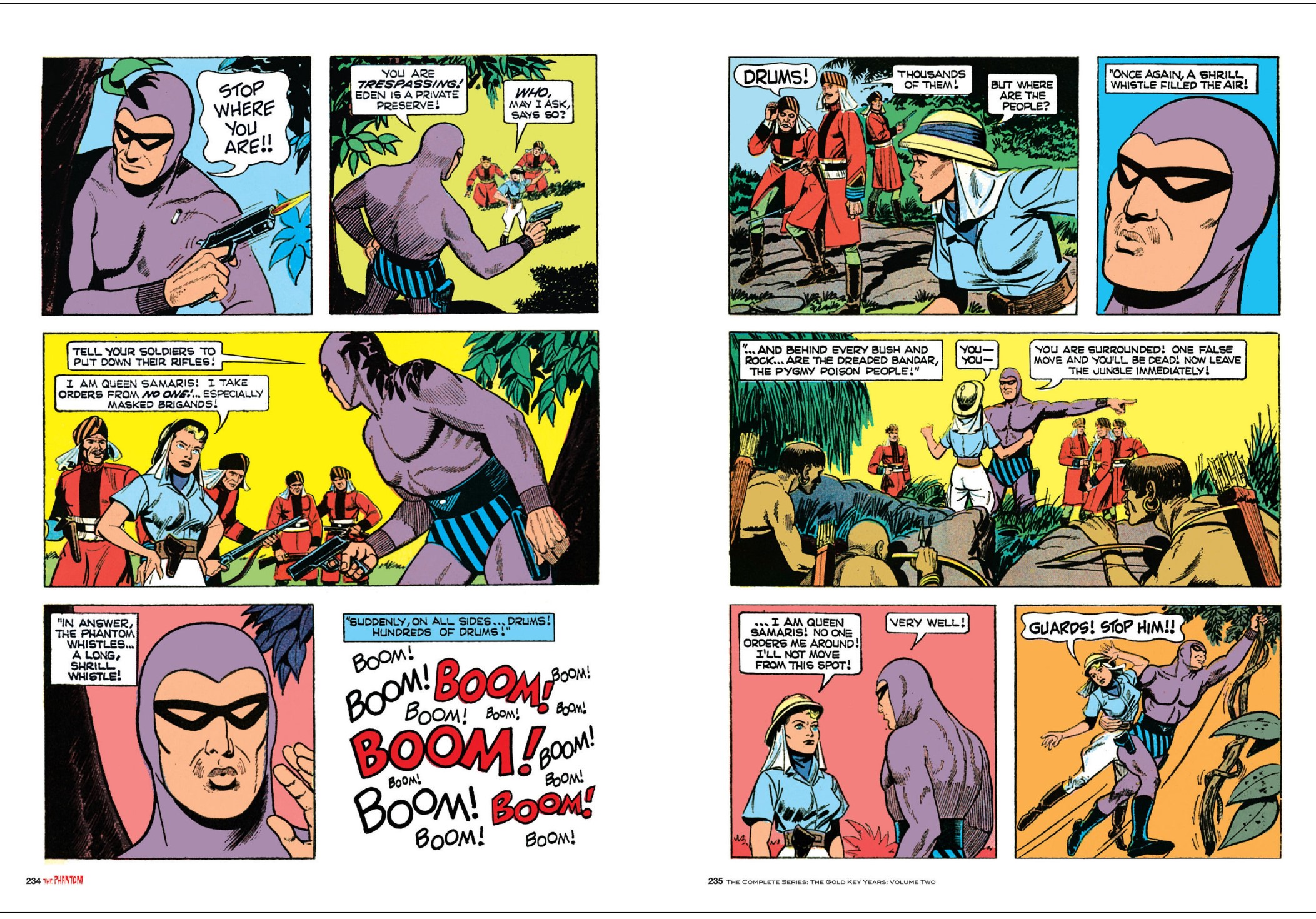
Born Leon Harrison Gross, Lee Falk created the Jungle Avenger at the request of his King Features Syndicate employers who were already making history, public headway and loads of money with his first strip sensation Mandrake the Magician. Although technically not the first ever costumed champion in comics, The Phantom’s instant popularity made him the prototype paladin as he was the first to wear a skin-tight body-stocking and have a mask with opaque eye-slits…

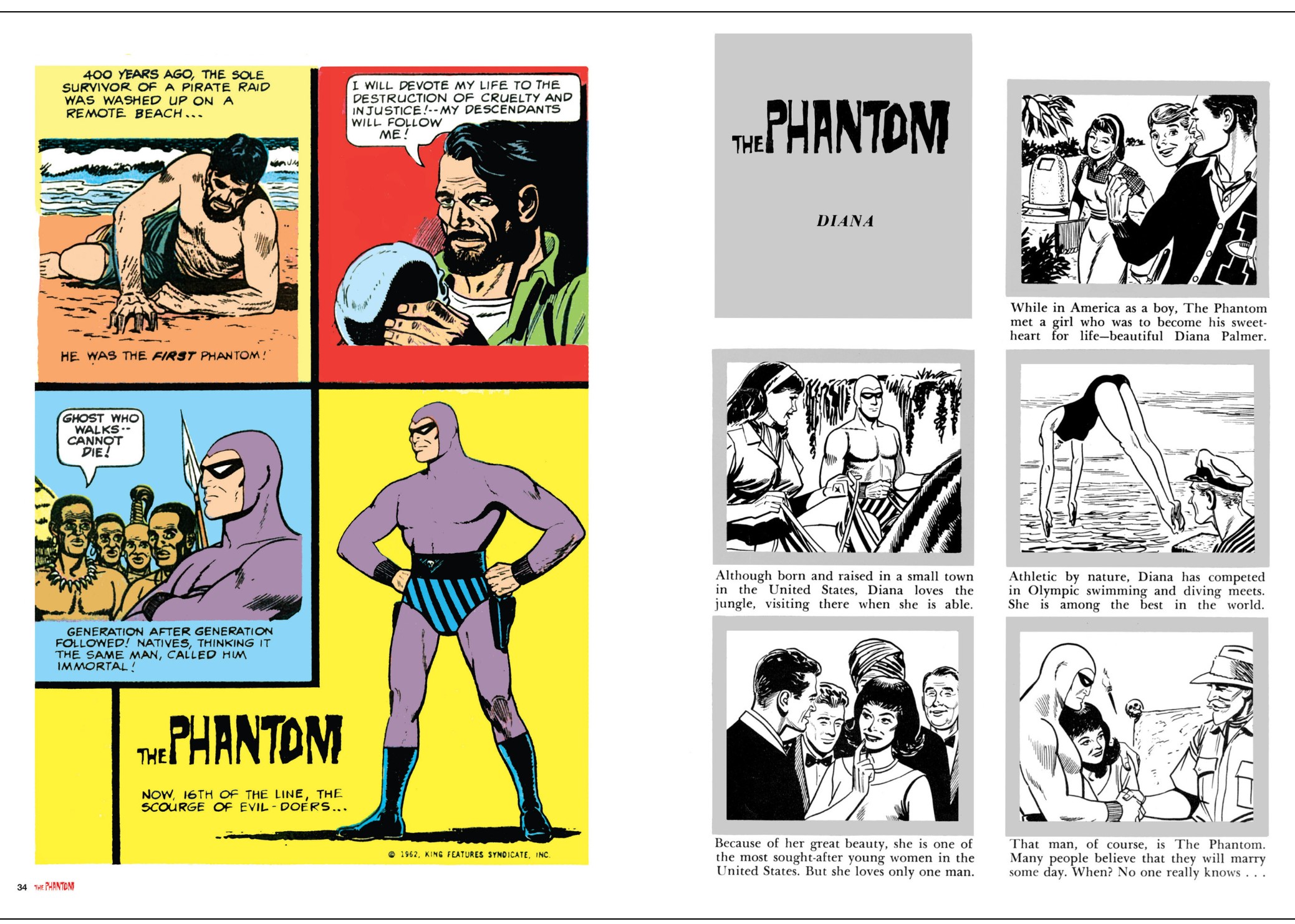
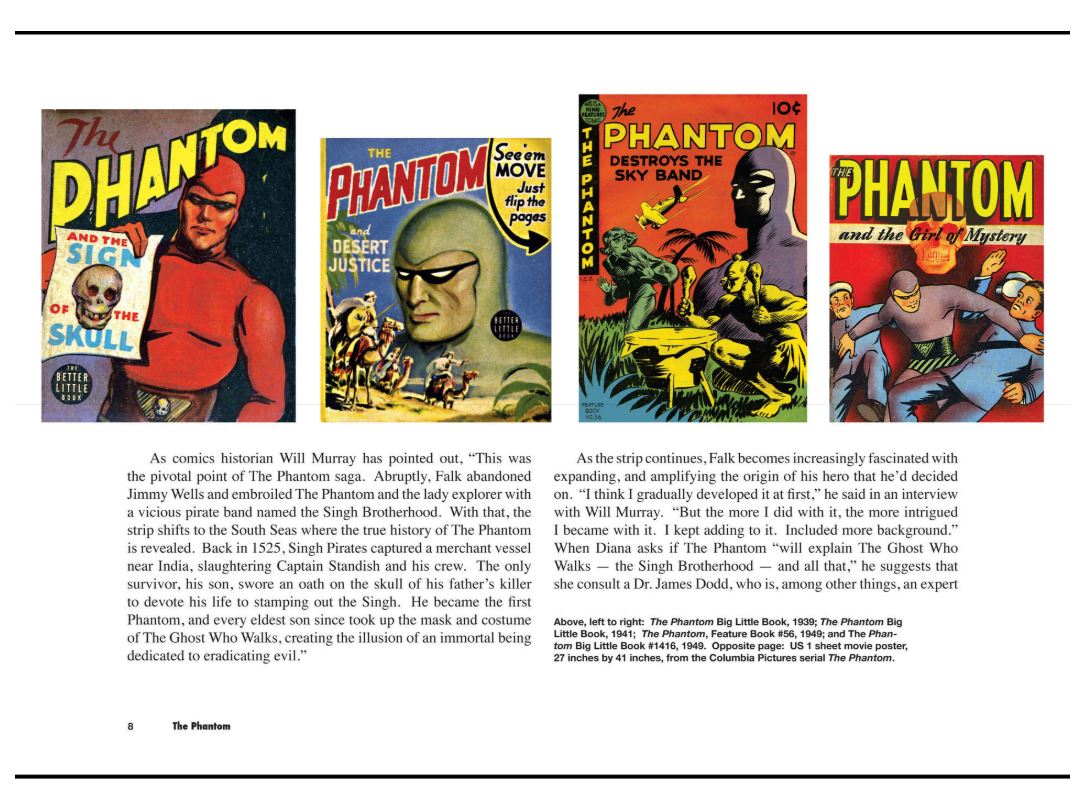
“The Ghost Who Walks” debuted on February 17th 1936 in an extended sequence pitting him against an ancient global confederation of pirates. Falk wrote and drew the daily strip for the first two weeks before handing over illustration to artist Ray Moore. A spectacular and hugely influential Sunday feature began in May 1939. In a text feature stuffed with sumptuous visual goodies like movie posters; covers for comics, Feature and Little Big Books plus many kinds of merchandise, Ron Goulart’s eruditely enticing ‘Introduction: Enter the Ghost Who Walks’ tells all you need to know about the character’s creation before the vintage magic begins with ‘Chapter 1: The Singh Brotherhood’.

American adventurer Diane Palmer returns to the USA by sea, carrying a most valuable secret making her the target of mobsters, sleazy society ne’er-do-wells and exotic cultists. Thankfully, she seems to have also attracted an enigmatic guardian angel who calls himself the Phantom

Successive attacks and assaults endanger the dashing debutante, and she learns an ancient brotherhood of ruthless piratical thieves wants her secret, but that they have been opposed for centuries by one man. Kidnapped and held hostage at the bottom of the sea, Diana is saved by the mystery man who naturally falls in love and eventually shares an incredible history with her…

In the 17th century a British sailor survived an attack by pirates, and – washing ashore on the African coast – swore on the skull of his murdered father to dedicate his life and that of his descendants to destroying all pirates and criminals. The Phantom fights crime and injustice from a base deep in the jungles of Bengali, and throughout Africa is known as the Ghost Who Walks. His unchanging appearance and unswerving war against injustice have led to him being considered an immortal avenger by the credulous and the wicked. Down the decades, one hero after another has fought and died in an unbroken family line, and the latest wearer of the mask, indistinguishable from the first, continues the never-ending battle. And he’s looking to extend the line and the legend…

In the meantime, however, there’s the slight problem of Emperor of Evil Kabai Singh and his superstitious armies to deal with…

‘Chapter 2: The Sky Band’ (originally published from 9th November 1936 to April 10th 1937) finds the mystery avenger caught in love’s old game as a potential rival for Diana’s affections materialises in the rather stuffy form of career soldier Captain Meville Horton: a decent, honourable man who sadly knows when he’s outmatched, unwanted and in the way. Mistakenly determined to do the right thing too, our masked mystery man concentrates on destroying a squadron of thieving aviators targeting the burgeoning sky clipper trade: airborne bandits raiding passenger planes and airships throughout the orient. Initial efforts infuriatingly lead to the Phantom’s arrest: implicated in the sky pirates’ crimes, before escaping from police custody with the aid of his devoted “pygmy witch doctor” Guran and faithful Bandar tribe allies, he’s soon hot on the trail of the real mastermind…

Upon infiltrating their base, he discovers the airborne brigands are all women, and that his manly charms have driven a lethal wedge between the deadly commander and her ambitious second in command Sala

A patient plaything of the manic Baroness, The Phantom eventually turns the tide not by force but by batting his invisible eyes and exerting his masculine wiles upon the hot-blooded – if certifiably psychopathic – harridan, unaware until too late that his own beloved, true-blue Diana is watching. When she then sets a trap for the Sky Band, it triggers civil war in the gang, a brutal clash with the British army and the seeming end of our hero, triggering Diana’s despondent decision to return alone to America…

‘Chapter 3: The Diamond Hunters’ opened on April 12th 1936 and revealed how the best laid plans can go awry. In Llongo territory, white prospectors Smiley and Hill unearth rich diamond fields but cannot convince or induce local tribes to grant them mineral rights to the gems they consider worthless. Like most indigenous Africans, they’re content to live comfortably under the “Phantom’s Peace” and it takes all the miners’ guile – including kidnapping a neighbouring chief’s daughter and framing the Llongo; gunrunning and claiming the Ghost Who Walks has died – to set the contented residents at each other’s throats. Recovering from wounds, the Phantom is slow to act, but when he does his actions are decisive and unforgettable…

With the plot foiled and peace restored, Smiley flees, only to encounter a returned Diana who has acted on news that her man still lives. Seeing a chance for revenge and profit, Smiley kidnaps “the Phantom’s girl”, provoking his being shunned by all who live in the region, a deadly pursuit and spectacular last-minute rescue. Smiley’s biggest and last mistake is reaching the coast and joining up with a band of seagoing pirates…

At least he is the catalyst for Diana and The Ghost finally addressing their romantic issues…

To Be Continued…

‘Afterword: For Those Who Came in Late…’ then sees editor Ed Rhoades offer his own thoughts on the strip’s achievements and accomplishments.

Stuffed with chases, assorted fights, torture, blood & thunder antics, daredevil stunts and many a misapprehension and coincidence – police and government authorities clearly having a hard time believing a pistol-packing masked man with a pet wolf might not be a bad egg – this a pure enthralling excitement that still packs a punch and plenty of sly laughs.
© 2010 King Features Syndicate, Inc.: ® Hearst Holdings, Inc.; reprinted with permission. All rights reserved.

Today in 1907, astounding illustrator Bruno (Doom Patrol, Teen Titans) Premiani was born, as was artist and inker Chic (Nemesis, Batman, all the best 1960s Thor, X-Men and FF stories) Stone in 1923.

In 1975 Archie co-creator Bob Montana died; and the day is infamous in the UK as the last day Buster was published. Kidding. Nobody noticed because we’d all stopped buying it. We are really sorry now though…

Abbie an’ Slats volumes 1 & 2


By Raeburn Van Buren, with Al Capp, Elliot Caplin & various (Ken Pierce Inc. 1983
ISBN: 978-0-912277-14-1 (vol. 1 TPB); 978-0-912277-24-6 (vol. 2 TPB)

This book includes Discriminatory Content produced in less enlightened times.

Win’s Christmas Gift Recommendation: The Literal Good Old Days… 9/10

It’s practically impossible for us today to understand the power and popularity of the comic strip in America from the Great Depression to the end of the Second World War. With no television, far from universal usage of radio, and movie shows at best a weekly treat for most people, household entertainment was mostly derived from the comic sections of daily and especially Sunday Newspapers. To consider that situation as a parallel to the modern comic scene would be like expecting those generations-distant readers to only read one out of a dozen of the numerous offerings in each and every paper or only on streaming channels.

Our treasured standard themes of adventure and horror, superheroes and merchandising tie-ins targeting kids would seem laughably limited in comparison to the sheer variety of story and genre available then.

If we tenuously compare those papers with internet providers today you might glimpse a more accurate flavour of the industry, stars and brands that blossomed at that time locally, regionally, nationally and globally. One entry from that era, created by stars, which began as what we’d probably call a soap opera, evolved into an American Classic to become one of the most fondly remembered comedy strips of all time.
Abbie an’ Slats was created by Li’l Abner creator Al Capp. He scripted it until 1945, after which he handed it over to his brother Elliot (Caplin) who wrote it until its end in 1971. It began as the story of dead-end kid Aubrey Eustace (understandably self-dubbed “Slats”), who was sent to live with spinster relative Abbie Scrapple, and became in turns a seminal prototype for soap comedy dramas; the pattern for the whole Archie Andrews phenomenon; a heart-warming melodrama, slice-of-life pot-boiler, romance strip, and – with the priceless introduction of drunken reprobate J. Pierpont “Bathless” Groggins (father of Slat’s one true love Beckie) – a timeless comedy classic.

By 1941, Groggins senior had appropriated the full colour Sunday page for his own comedic fantasist shenanigans in the grand manner of Baron Munchausen.

That’s all well and good, but what makes this strip even more special is the art.

Raeburn Van Buren (January 12th, 1891 – December 29th 1987) was a Great War veteran turned highly successful commercial illustrator. He was much in demand by such prestigious publications as The Saturday Evening Post, New Yorker, Esquire and Life as well as purely humour magazines such as Puck and Judge. When Al Capp approached him to draw the proposed strip, Van Buren initially declined, and it took all of the writer’s legendary wiles and perseverance to lure him away from his profitable freelance ways.

Eventually Van Buren capitulated and the strip debuted on July 6th 1937, with a Sunday page beginning January 15th 1939. At its height Abbie an’ Slats was syndicated in 400 papers, with the last episode was published on January 30th 1971. Van Buren, who was credited with every single page and episode, retired to Great Neck, New York.

Over the decades his spectacularly underplayed scenarios and wonderfully rendered, evocative detail – just enough for clarity, never too much to digest – and his warmly funny, human, loving characters became part of the psyche of a nation far more kind and understanding than today’s, and the fictitious town of Crabtree Corners became a pictorial synonym of small town America.

Sadly, very little of this wonderful strip has been collected as yet, but the books cited herein are still available if you look hard and so-long overdue for reprinting. Perhaps with the latest wave of strip reprints and burgeoning graphic novel market having burnt its way through all the obvious stuff to reprint, we can only hope some publisher opts for quality over brand names and brings this much neglected gem back to public gaze.

© 1937-1964 United Features Syndicate. All Rights Reserved.

In 1905, Superman, Batman, Alfred, and Liberty Belle scribe Donald Clough “Don” Cameron was born. Ten years later so was Ben Oda, who probably lettered most of them as well as half of what you’ve read since, if US comics are your thing.

In 1918 Frank Hampson was born. You don’t need me to tell why that’s commemorated here.

Heathcliff cartoonist George Gately was born in 1928, and Belgian comics wizard Jean De Mesmaeker AKA Jidéhem, popped in in 1935. None of that really makes up for losing pioneering comic book genius Sheldon Mayer in 1991. I think I’ll go re-re-re-read Sugar and Spike Archives volume 1.

The Complete Peanuts volume 10: 1969-1970


By Charles M. Schulz (Fantagraphics Books/Canongate Books UK)
ISBN: 978-1-68396-126-0 (US TPB) 978-0857862143 (Cannongate HB)

This book includes Discriminatory Content produced in less enlightened times.

Win’s Christmas Gift Recommendation: Towering Monumental Tradition Writ (and Drew) Large… 10/10

Peanuts is unequivocally the most important comic strip in the history of graphic narrative. It is also the most deeply personal. Cartoonist Charles M Schulz crafted his moodily hilarious, hysterically introspective, shockingly surreal philosophical epic for half a century: 17,897 strips spanning October 2nd 1950 to February 13th 2000. He died – from complications of cancer – the day before his last strip was printed.

At its height, Peanuts ran in 2,600 newspapers, in 21 languages and75 countries. Many of those venues still run it as perpetual reprints, and have done ever since “Sparky” passed. During his lifetime, book collections, a merchandising mountain and television spin-offs had made the publicity-shy doodler an actual billionaire at a time when that really meant something…

None of that matters. Peanuts – a title Schulz loathed, but one the syndicate forced upon him – changed the way comics strips were received and perceived: proving cartoon comedy could have edges and nuance and meaning as well as too-soon-forgotten pratfalls and punchlines.

We begin with an effusive and enthusiastic foreword from author/animator/illustrator Mo Willems (Don’t Let the Pigeon Drive the Bus!, Knuffle Bunny, Sheep in the Big City) expressing his debt to the strip.

On the pages, this period heralds a true renaissance probably triggered by headlines in an era of swiftly shifting changes in social attitudes and rampant cultural exploration. Notionally, our focus and point of contact remains quintessentially inspirational loser Charlie Brown who, despite slowly taking a few steps behind fanciful, high-maintenance mutt Snoopy, remains squarely at odds with the mercurial supporting cast. They are still hanging out doing what at first sight seems to be Kids Stuff in an increasingly hostile and intrusive universe of perverse happenstance. Except perhaps that Lucy Van Pelt kid. She’s not like the others…

Neatly interspersed with daily doses of gloom, the Peanuts Sunday page first debuted on January 6th 1952: a standard half-page slot offering more measured fare than 4-panel dailies. Thwarted ambition, sporting failures, crushing frustration abound, alternating with Snoopy’s inner life of aviation and war stories, star gazing, shooting the breeze with bird buddies, weather woes and food fiascos. These and other signature sorties across the sabbath indulgences afforded Schulz room to be his most imaginative, whimsical and provocative…

Regular tentpole moments to relish include more Snoopy v Lucy deathmatches/ambush snogs/dance offs; Charlie Brown’s food feud with the beagle, an assortment of night terrors; Lucy’s emphatically simple solutions to complex questions; doggy dreams; the power of television; sporting endeavours and the sharply-cornered romantic triangle involving Lucy, Schroeder & Beethoven – albeit wedded to “sophisticated” fallout when pushy Frieda decides she also wants to play…

Always, gags centre on play, varying degrees of musicality, pranks, interpersonal alignments, the mounting pressures of ever-harder education, mass media lensed through young eyes and a selection of sports in their season. All are leavened by agonising teasing, naked contempt, kindled and crushed hopes, the making of baffled observations and occasionally acting a bit too much like grown-ups. However, in this tome, themes and tropes that define the entire series (especially in the wake of many animated TV specials) become mantra-like yet endlessly variable, but focus less on Charlie and more on those around him. Also, the outside grown-up world considerably encroaches, as when Lucy declares herself a “ New Feminist” although no one looking can see any difference to any presumably previously un-enlightened Miss van Pelt…

Human interactions still find the boy a pitiable outlier. Mean girl Violet, musical prodigy Schroeder, self-taught psychoanalyst/dictator-in-waiting Lucy, her brilliantly off-kilter little brother Linus and dirt-magnet “Pig-Pen” are fixtures honed and primed to generate joke-routines and gag-sequences around their signature foibles, but some early characters have faded away in favour of fresh attention-attracting players. Newcomers sidle in and shuffle off without much flurry or fanfare but in our real world the use of “Minority” characters José Peron of New Mexico and African American Franklin drew much attention and controversy – because, I guess, there will always be gits and arseholes – especially if the oblivious readers elected them…

The most significant expansion is that weird upside bird bugging the beagle gets a name – Woodstock (as revealed on June 22, 1970) – and a job as his dogsbody – secretary, actually – whilst shock near-cripples the round-headed kid when he discovers that the “little red-haired girl” he almost plucked up the nerve to talk to moves to a new city. It’s a blow he’s still reeling from when this book ends two years later, and one only Linus really understands. After all, his teacher Miss Othmar is gone after the teacher’s strike…

There is much more madcap politically-tinged material, including repeated riffs on a recently inaugurated new real-world president (Richard Milhous Nixon on January 20, 1969) as seen when Snoopy briefly becomes the most powerful mutt in the Free world after being chosen as the new Grand Beagle…

At least the Brown boy’s existential crisis/responsibility vector/little sister Sally has grown enough to become just another trigger for relentless self-excoriation. As she grows, pesters librarians, forms opinions and propounds steadfastly authoritarian views, Charlie is relegated to being her dumber, but eternally protective, big brother especially as her biggest bugbear is starting school and Charlie is such an expert on all things scholastic…

Resigned to – but far from uncomplaining about – life as a loser in the gunsight of cruel and capricious fate, the boy Brown is helpless meat in the clutches of openly sadistic Lucy. When not sabotaging his efforts to kick a football, she monetises her spiteful verve via a 5¢ walk-in psychoanalysis booth (although supply and demand economics also affects this unshakeable standard), ensuring that whether at play, in sports, kite-flying or just brooding, the round-headed kid truly endures the character-building trials of the damned.

One deliciously powerful constant that grows more abundant is the boy’s utter inability to fly that kite. Here war with wind, gravity and landscape reaches absurdist proportions, as the tree haunts Charlie Brown’s adored pastime with vicious, violent and malign venom. Moreover, other kids are aware of its growing power. After one terse musical interlude with Schroeder, Lucy lobs our reluctant lover-boy’s beloved piano into the voracious carnivorous conifer…

By now, the beagle is the true star of the show, with his primary quest for more and better playing out against an increasingly baroque inner life, wild encounters with birds, sports, dance marathons and skating trysts (especially the close-order combat called ice hockey!), philosophical ruminations, and ever-more-popular catchphrases. Here, burgeoning whimsy leads to more glimpses of the interior world: his WWI other life, peppered with dogfights against the accursed Red Baron, but also careers as an astronaut, a sports coach, a prairie dog and a detective seeking his lost mother. That tragic obscured past as an alumni of the Daisy Hill Puppy Farm leads to constant introspection… and dancing… lots and lots of dancing…

Naturally, Snoopy soon subverts all that misery and curiosity to fuel his creative side and begins the Great American Novel that will change literature forever… but that’s before the Browns go on vacation and leave the dog with the Van Pelts. Naturally, Lucy has an idea about finally fixing the pooch. It doesn’t end well…

As always, timeless episodes of play, peril, peewee psychoanalysis and personal excoriation are beards for some heavy topics. Rendered in marvellous monochrome, there are crucial character introductions, plot developments and creation of more traditions we all revere to this day. Of particular note is the growing role of Patricia Reichardt – AKA tomboy Peppermint Patty – who heartbreakingly deals with the so-early discovery that she will never be pretty or beautiful. Even Snoopy’s most concerted efforts can’t quite salve that sting…

Another trenchant continued gag-series resumes Lucy obsessive attempts to “cure” Linus of his blanket dependency by again playing him off against Grandma who will give donations to charities if the boy grows up…

Snoopy is the only force capable of challenging if not actually countering Lucy. Over these two years, her campaign to curb that weird beagle, cure her brother of blanket addiction and generally reorder reality to her preferences reaches astounding heights and appalling depths, but the dog keeps trying and scores many minor victories. As always the book opens and closes with many strips riffing on snow, food, movie-going and television – or the gang’s responses to it – becoming ever more pervasive. And as always, Lucy constantly, consistently sucks all the joy out of the white wonder stuff and the astounding variety offered by the goggle-box. Perpetually sabotaged, and facing abuse from every female in their life, Brown and Snoopy endure more casual grief from smug, attention-seeking Frieda, who champions shallow good looks over substance. At least Linus is growing: hardened inside by what happened to teacher Miss Othmar, but Lucy’s amatory ambitions for Schroeder grow ever more chilling and substantive. She will never move on…

Schulz established way points in his year: formally celebrating certain calendar occasions – real or invented – as perennial shared events: Mothers and Fathers’ Days, Fourth of July, National Dog Week strips accompanied in their turn yearly milestones like Christmas, St. Valentine’s Day, Easter, Halloween/Great Pumpkin Day and Beethoven’s Birthday were joined this year by a return to another American ritual as many of the cast return to summer camp. At least there is unbridled joy when Brown’s baseball team hits a winning streak and Charlie meets his all-time sporting idol – except of course they’re not quite the boons they first appear…

Sports loom large and terrifying as ever, but star athlete Snoopy is more interested in new passions than boring old baseball or hockey. Even Lucy finds far more absorbing pastimes but still enjoys crushing the spirits of her teammates in whatever endeavour they are failing at. Anxiety-wracked Brown even steps down from the baseball team to ease his life, but that only intensifies his woes, and does nothing to help his kite wielding or football kicking…

Linus endures more disappointment in two Great Pumpkin seasons and before you know it, there’s the traditional countdown to Christmas and another year filled with weird, wild and wonderful moments…

Wrapping it all up, Gary Groth celebrates and deconstructs the man and his work in ‘Charles M. Schulz: 1922 to 2000’, preceded by a copious ‘Index’ offering instant access to favourite scenes you’d like to see again…

Available in multiple formats, this volume guarantees total enjoyment: comedy gold and social glue metamorphosing into an epic of spellbinding graphic mastery that still adds joy to billions of lives, and continues to make new fans and devotees long after its maker’s passing.
The Complete Peanuts: 1969-1970 (Volume Ten) © 2008 Peanuts Worldwide, LLC. The Foreword is © 2008, John Waters. “Charles M. Schulz: 1922 to 2000” © 2008 Gary Groth. All rights reserved.

Today in 1946 Lucky Luke “debuted” in the Spirou Alamanch Annual – except if you read Lucky Luke: The Complete Collection Volume One you’ll know that ain’t necessarily so…

And in 1970 the incredible Rube Goldberg shuffled off this mortal coil. It was probably one he had designed in his masterful cartoons. Go google Rueben Awards

Steve Ditko Archives volume 2: Unexplored Worlds


By Steve Ditko, Joe Gill & various, edited by Blake Bell (Fantagraphics Books)
ISBN: 978-1-60699-289-0 (HB/Digital edition)

Win’s Christmas Gift Recommendation: Immaculate Yarn-Spinning… 9/10

This book includes Discriminatory Content produced in less enlightened times. It also has Discriminatory Content included for comedic and satirical effect.

Once upon a time the anthological title of short stand-alone stories was the sole staple of the comicbook profession, where the plan was to deliver as much variety as possible to the reader. Sadly, that particular vehicle of expression seems all but lost to us today…

Despite his death Steve Ditko remains one of our industry’s greatest talents and one of America’s least lauded. His fervent desire to just get on with his job and to tell stories the best way he can – whilst the noblest of aspirations – had always been a minor consideration or even stumbling block for the commercial interests which for so long controlled all comics production and still exert an overwhelming influence upon the mainstream bulk of comic book output. Before his time at Marvel, young Ditko perfected his craft creating short sharp yarns for a variety of companies and it’s an undeniable joy today to be able to look at this work from such an innocent time when he was just breaking into the industry: tirelessly honing his craft with genre tales for whichever publisher would have him, utterly free from the interference of intrusive editors.

A superb full-colour series of hardback collections reprinted those early efforts (all of them here are from 1956-1957) with material produced after the draconian, self-inflicted Comics Code Authority sanitised the industry following Senate Hearings and a public witch-hunt.

Most are wonderfully baroque bizarre supernatural or science fantasy stories, but there are also examples of Westerns, Crime and Humour: cunningly presented in the order he completed and sold them rather than the more logical but far-less-revealing chronological release dates. Moreover, they’re all helpfully annotated with a purchase number to indicate approximately when they were actually drawn – even the brace of tales done for Stan Lee’s pre-Marvel Atlas company.

Sadly, there’s no indication of how many (if any) were actually written by the moody master…

This second sublime selection reprints more heaping helpings of his increasingly impressive works: most courtesy of the surprisingly liberal (at least in its trust of its employees’ creative instincts) sweat-shop publisher Charlton Comics.

And whilst we’re being technically accurate, it’s also important to reiterate that those cited publication dates have very little to do with when Ditko crafted them: as Charlton paid so little, the cheap, anthologically astute outfit had no problem in buying material it could leave on a shelf for months – occasionally years! – until the right moment arrived to print. The work is assembled and runs here in the order Ditko submitted it, rather than when it reached our grubby sweaty paws…

Following an historically informative Introduction and passionate advocacy by Blake Bell, concentrating on Ditko’s near-death experience in 1954 (when the artist contracted tuberculosis) and subsequent recovery, the evocatively eccentric excursions open with a monochrome meander into the realms of satire with the faux fable – now we’d call it a mockumentary – ‘Starlight Starbright’ as first seen in From Here to Insanity (volume 3 #1 April 1956) before “normal” service resumes with financial fable ‘They’ll Be Some Changes Made’ (scripted by Carl Wessler from Atlas’ Journey Into Mystery #33, April 1956).

Here a petty-minded pauper builds a time machine to steal the fortune his ancestors squandered, after which a crook seeking to exploit a mystic pool finds himself the victim of fate’s justice in ‘Those Who Vanish’ (Journey Into Mystery #38, September 1956) again scripted by Wessler.

Almost – if not all – the Charlton material was scripted by astoundingly prolific Joe Gill at this time, and records are spotty at best, so let’s assume his collaboration on all the material here begins with ‘The Man Who Could Never Be Killed’ (Strange Suspense Stories #31, published in February 1957). This yarn of a circus performer with an incredible ethereal secret segues into ‘Adrift in Space’ (Mysteries of Unexplored Worlds #8 June 1958) as a veteran starship captain pushes his weary crew over the edge, whereas ‘The King of Planetoid X’ from the previous MoUW (February) details a crisis of conscience for a benevolent and ultimately wise potentate…

The cover of Strange Suspense Stories #31 (February 1957) leads into ‘The Gloomy One’ as a misery-loving alien intruder is destroyed by simple human joy, before the cover to Out of This World #5 (September 1957) heralds that issue’s ‘The Man Who Stepped Out of a Cloud’ and an alien whose abduction plans only seem sinister in intent. MoUW #5 (October 1957) tells the story of a young ‘Stowaway’ who finds fulfilment aboard a harshly-run space ship after which Out of This World #3’s cover (March 1957) ushers us to an apparent alien paradise for weary star-men in ‘What Happened?’

Next up is a tale from one of Charlton’s earliest star characters. The title came from a radio show that Charlton licensed the rights to, with the lead/host/narrator acting more as voyeur than active participant. The Mysterious Traveler spoke directly to camera, asking readers for opinion and judgement as he shared a selection of funny, sad, scary and miraculous human-interest yarns, all tinged with a hint of the weird or supernatural. Whenever rendered by Ditko, whose storytelling mastery, page design and full, lavish brushwork were just beginning to come into its mature full range, the contents of Tales of the Mysterious Traveler were always exotic and esoteric and utterly beguiling.

From issue #2 (February 1957), ‘What Wilbur Saw’ reveals the reward bestowed on a poverty-stricken country bumpkin who witnessed a modern-day miracle, after which Out of This World #3 covers a cautionary tale of atomic mutation in ‘The Supermen’ before the eerie cover to OoTW #4 (June 1957) signals a chilling encounter for two stranded sailors who briefly board the ‘Flying Dutchman’ whilst SSS #32’s cover (May 1957) dabbles in magic art when a collector is victimised by a thief who foolishly stumbles into ‘A World of His Own’.

From the same issue comes a salutary parable concerning a rich practical joker who goes too far before succumbing to ‘The Last Laugh’, after which ‘Mystery Planet’ (SSS #36, March 1958) offers a dash of interplanetary derring-do as valiant agent Bryan Bodine and comely associate Nedra confound intergalactic pirates piloting a planet-eating weapon against Earth!

A similarly bold defender liberates ‘The Conquered Earth’ from alien subjugation (OoTW #4, June 1957) whilst in ‘Assignment Treason’ (Outer Space #18. August 1958) the clean-cut hero goes undercover to save Earth from the predatory Master of Space as OoTW #8 (May 1958) and ‘The Secret of Capt. X’ reveals the inimical alien tyrant threatening humanity is not what he seems…

The cover to Mysteries of Unexplored Worlds #3 (April 1957) makes way for three fantastic thrillers, beginning with ‘The Strange Guests of Tsaurus’ as an alien paradise proves to be anything but, then ‘A World Where I Was King’ sees a clumsy janitor catapulted into a wondrous realm to win a kingdom he doesn’t want. Diverting slightly, Fightin’ Army #20 (May 1957) provides a comedic interlude as a civil war soldier finds himself constantly indebted to ‘Gavin’s Stupid Mule’ before ‘A Forgotten World’ wraps up MoUW #3’s contributions with a scary tale of invasion from the Earth’s core. ‘The Cheapest Steak in Nome’ turns out to be defrosted from something that died millions of years ago in a light-hearted yarn from MoUW #7 (February 1958)…

The cover to MoUW #4 (July 1957) precedes more icy antediluvian preservations found in the ‘Valley in the Mist’ whilst the one for Strange Suspense Stories #33 (August 1957) leads into a bizarre corporate outreach project as the ‘Director of the Board’ attempts to go where no other exploitative capitalist has gone before. Next, it’s back to MoUW #3 for a brush with the mythological in ‘They Didn’t Believe Him’ after which ‘Forever and Ever’ (SSS #33) reveals an unforeseen downside to immortality and Out of This World #3 sees a stranger share ‘My Secret’ with ordinary folk despite – or because of – a scurrilous blackmailer…

‘A Dreamer’s World’ from Mysteries of Unexplored Worlds #5 (October 1957) follows the chilling cover thereof as a test pilot hits his aerial limit and discovers a whole new existence, whilst Unusual Tales #7 (May 1957) traces the tragic path of ‘The Man Who Could See Tomorrow’ before the cover of Tales of the Mysterious Traveler #4 (August 1957) opens a mini-feast of voyeur’s voyages beginning with that issue’s ‘The Desert’: a saga of polar privation and survival.

TotMT #3 (May 1957) shows the appropriate cover and a ‘Secret Mission’ for a spy parachuted into Prague, whilst #4 offers ‘Escape’ for an unemployed pilot dragged into a gun-running scam in a south American lost world; ‘Test of a Man’ sees a cruel animal trainer receive his just deserts and ‘Operation Blacksnake’ grittily exposes American venality in the ever-expanding Arabian oil trade. Returning to Mysteries of Unexplored Worlds #5, ‘The Mirage’ torments an escaped convict who thinks he’s escaped his fate, whilst Texas Rangers in Action #8 (July 1957) sees a ruthless rancher crushed by the weight of his own wicked actions as ‘The Only One’, after which stunning covers to Unusual Tales #6 and 7 (February and May 1957) lead into our final vignette – ‘The Man Who Painted on Air’: exposing and thwarting a unique talent to preserve humanity and make a few bucks on the side…

This sturdily capacious volume has episodes that terrify, amaze, amuse and enthral: utter delights of fantasy fiction with lean, plots and stripped-down dialogue that let the art set the tone, push the emotions and tell the tale, from times when a story could end sadly as well as happily and only wonderment was on the agenda, hidden or otherwise.

These stories display the sharp wit and contained comedic energy which made so many Spider-Man/J. Jonah Jameson confrontations an unforgettable treat half a decade later, and this is another cracking collection not only superb in its own right but as a telling tribute to the genius of one of the art-form’s greatest stylists. This is something every serious comics fan would happily kill or die or be lost in time for…
Unexplored Worlds: The Steve Ditko Archive Vol. 2. This edition © 2010 Fantagraphics Books. Introduction © 2010 Blake Bell. All rights reserved.

Today in 1914, Jerry Siegel was born. Don’t make me have to finish this heads-up…

In 1937 Huey, Dewey & Louie Duck debuted. Ditto.

In 1959 The last issue of UK icon Comet was published and a decade later across the Pond Sidney Smith’s The Gumps ended. It had begun in 1917 as you’d know if read Sidney Smith’s The Gumps.

The Complete Peanuts volume 1: 1950-1952


By Charles Schulz (Canongate Books/Fantagraphics Books)
ISBN: 978-1-56097-589-2 (Fantagraphics HB) 978-1-60699-763-5 (Fantagraphics TPB) 978-1-84767-031-1 (Canongate)

This book includes Discriminatory Content produced in less enlightened times.

Win’s Christmas Gift Recommendation: All that’s great about cartoon strips… 10/10

Peanuts is unequivocally the most important comics strip in the history of graphic narrative. It is also the most deeply personal. Today in 1950 it all began, and cartoonist Charles M Schulz went on crafting his moodily hilarious, hysterically introspective, shockingly surreal philosophical epic for half a century: 17,897 strips spanning October 2nd 1950 to February 13th 2000.

He died from complications of cancer the day before his last strip was printed.

At its height, Peanuts ran in 2,600 newspapers, in 21 languages and in 75 countries. Many of those venues still run it as perpetual reprints, and have ever since his death. During Schulz’s lifetime, book collections, a merchandising mountain and television spin-offs had made the publicity-shy doodler an actual billionaire at a time when that really meant something…

None of that matters. Peanuts – a title Schulz loathed, but one the syndicate forced upon him – changed the way comics strips were received and perceived: proving cartoon comedy could have edges and nuance and meaning as well as soon-forgotten pratfalls and punchlines.

Following a typically garrulous, charming and informative Introduction from fellow Minnesotan Garrison Keillor, this mammoth (218 x 33x 172 mm) landscape compendium offers the first two and a bit years. Here a prototypical, rather outgoing and jolly Charlie Brown and high-maintenance mutt Snoopy joined with bombastic Shermy and mercurial Patty in hanging out doing kid things.

These include playing, playing pranks, playing sports such as tennis, golf and baseball, playing musical instruments, teasing each other, making baffled observations and occasionally acting a bit too much like grown-ups. Fans of Bill Watterson’s Calvin and Hobbes will feel eerie familiarity with much of the hijinks and larks of these episodes.

As new characters Violet, infant prodigy Schroeder, and Lucy and her strange baby brother Linus were added to the mix, the boisterous rush of the series began to imperceptibly settle into a more contemplative pace. Charlie Brown began to adopt and embrace his eternal loser, singled-out-by-fate persona and the sheer diabolical wilfulness of Lucy began to sharpen itself on everyone around her…

The first Sunday page debuted on January 6th 1952; a standard half-page slot offering more measured fare than the daily. Both thwarted ambition and explosive frustration became part of the strip’s signature denouements…

By the end of 1952, all those the rapid-fire gags had evolved from raucous slapstick to surreal, edgy, psychologically barbed introspection, garnished by crushing judgements and deep rumination in a world where kids – and certain animals – were the only actors. The relationships, however, were increasingly deep, complex and absorbing even though “Sparky” Schulz never deviated from his core message: entertain…

David Michaelis then celebrates and deconstructs ‘The Life and Times of Charles M. Schulz’ after which Gary Groth & Rick Marschall conduct ‘An Interview with Charles M. Schulz’, rounding out our glimpse of the dolorous graphic genius with intimate revelations and reminiscences whilst a copious ‘Index’ offers instant access to favourite scenes you’d like to see again.

Readily available in hardcover, paperback and digital editions, this initial volume offers a rare example of a masterpiece in motion: comedy gold and social glue gradually metamorphosing in an epic of spellbinding graphic mastery which became part of the fabric of billions of lives, and which continues to do so long after its maker’s passing.

Happy ever afters, kids.
The Complete Peanuts: 1950-1952 (volume 1) © 2004 Peanuts Worldwide, LLC. Introduction © 2004 Garrison Keillor. “The Life and Times of Charles M. Schulz” © 2000 David Michaelis. “Interview with Charles M. Schulz” © 2004 Gary Groth and Richard Marschall. All other material copyright its respective owners. All rights reserved.

Today in 1909 Alex Raymond was born. You’ll know him best for stuff like Flash Gordon on the Planet Mongo volume 1: Sundays 1934-1937 (The Complete Flash Gordon Library. In 1916 Bob Powell, was born. He went on to do things like Bob Powell’s Complete Jet Powers.

Ramona Fradon was born in 1926, and Spirou stalwart Janry arrived in Belgium in 1957, whilst Maltese docu-comics journalist Joe Sacco was born in 1960. You can find dozens of books by the first two just by using a search box here, and I’ve almost summoned enough nerve to review Sacco’s Palestine despite – or because of – these febrile times…

Blondie: The Bumstead Family History/Blondie: The Complete Bumstead Family History


By Dean Young, and Melina Ryzik (Thomas Nelson/Rutledge Hill Press, U.S.)
ISBN: 978-1-4016-0322-9 (HB/Digital edition)

This book includes Discriminatory Content produced in less enlightened times

Normally I leave newspaper strip reviews for a weekend, but this is one birthday we just can’t miss. Please remember, just because you don’t read something don’t mean it ain’t popular…

Like Dagwood’s legendary sarnies, Bumstead family functions go on forever. Yesterday we learned how Chic Young’s strip Blondie began on September 8th 1930 and just kept going. The feature was inherited and carried on in 1973 by his family, chiefly son Dean with a select group of collaborators. Dean considers himself the guardian of a legacy as much as continuer of a phenomenon. In 2007, after the 75th anniversary, commemorative curated celebration Blondie: the Bumstead Family History was released to mark the occasion, and with the feature still going strong this remastered (even enjoying fancy-schmancy External hyperlinks, no less!) “Complete” edition invites a look at what he’s done to keep things fresh as much as safeguard generations of readers’ fond memories.

Combining short lavishly illustrated articles with a wealth of published strips – each attached to general topics – the raucous revery begins with ‘Chapter One: The Bumstead Family Album’, incorporating historical overviews and the traced evolutions of ‘Blondie’ and eternal, often inanimate inamorata ‘Dagwood’; firstborn son/current teen icon ‘Alexander’ (who first appeared on April 15th 1934) and his sister ‘Cookie’ who Dagwood feels is far too popular with boys). Faithful, longsuffering house mutt ‘Daisy’ gets her own section, as does abusive Boss/archnemesis ‘Mr. Dithers’, next-door-neighbours ‘The Woodleys’ (AKA Herb & Tootsie), long-suffering mailman ‘Mr. Beasley’ and cheeky, always underfoot kid/voice of a fresh generation ‘Elmo Tuttle’

The early days of the unshakable relationship are scrutinised in ‘Chapter Two: Getting Married’, tracing love’s rocky road through turbulent fast-changing times and a hugely successful publicity gimmick of young Dagwood going on extended hunger strike to force his adamant parents to allow him to wed! A massive publicity coup, the convoluted month-long storyline led to rowdy nuptials in February 1933 and is swiftly and sensibly followed by chapters on ‘Family Life’, as the couple become a nuclear unit, demographic and breadwinning paean to domesticity as ‘Dagwood at Work’ reveals what a decent man endures to bring home the bacon – and pickles and bratwurst and olives and pastrami and turkey and chicken, and salmon and lettuce and pumpernickel and lox and…

Courting middle American controversy, not to say media attention and a little homemaker wrath, ‘Blondie Goes to Work’ saw the tireless and capable stay-at-home mom and neighbour Tootsie ultimately turn those life skills into joyously fulfilling independence by starting their own catering business. This was only in 1991 and this pic-packed chapter also deals with the ridiculous amounts of outrage the world-shaking leap into the 20th century seemed to trigger in the heartland. Naturally, Dagwood was completely supportive: who else could test the new dishes and delights the girls kept inventing…

‘Chapter Six: Favourite Strips’ reviews some of the countless gags to have riffed on the series’ core themes – eating, sleeping, making and living and eating – whilst focussing on Dean Young’s constant efforts to keep the strips relevant and contemporary whilst the major industry event that evolved out of ‘The 75th Anniversary’ is described in detail. To celebrate the milestone in 2005, Dean and King Features organised a massive crossover that included VIPs like President Bush and other real-world notables as well as most of the nation’s major strips and creators wishing the happy couple all the best.

If you read Beetle Baily, Hagar the Horrible, Garfield, Rose is Rose, Wizard of Id, Dick Tracy, B.C., Mother Goose & Grimm, Family Circus, Shoe, Hi & Lois, Gasoline Alley, Sally Forth, Snuffy Smith, Buckles, Baby Blues, Zits, Mutts, Curtis, Marvin, For Better or Worse, Born Loser, Dennis the Menace (theirs not ours), Cathy, Thick Thin or Bizarro you were invited and there on the day. Disney alumni and single panel editorial cartoonists got in on it and for one moment all of America enjoyed a taste of Dagwood. Most of those strips are here as well as plenty from the months-long build up and aftermath in the actual Blondie feature.

This super memoriam concludes with a look beyond the panels as ‘Forever Young’ explores the life and achievements of Murat Bernard Young, his wife and model/inspiration Athel Lindorff née Young, Dean and sister Jeanne and the many notables who pitched in and/or assisted on Blondie’s production: Alex and Jim Raymond, Stan Drake, Mike Gersher, Ray McGill, Denis LeBrun, and John Marhall & Frank Cummings

Also included in this inescapably family function are original art and sketches, dozens of candid family portraits and photos, commentary and so, so many cartoons to wallow in. If you want a simple satisfying Good Read, this is for you your kids and your grannie, but don’t forget to bring the sandwiches… and not small ones neither…
© King Features Syndicate, Inc. 2007.

Today in 1958, Jack Kirby’s Sky Masters of the Space Force newspaper strip launched.

Blondie and Dagwood’s America or Blondie and Dagwood


By Dean Young & Rick Marschall (Harper & Row/Arthur Barker Limited)
ISBN: 978-0-21316-830-8 (Arthur Barker UK TPB) 978-0-06090-908-6 (Harper & Row US)

This book includes Discriminatory Content produced in less enlightened times.

Tomorrow marks the anniversary of one of the most popular comic strips of all time …and probably one you thought had long ended, if indeed you thought of it at all.

For decades Blondie was the most popular – for which read most commercially successful – newspaper strip in the world. Way back in 2005, the former Blondie Boopadoop and her hapless husband Dagwood Bumstead celebrated 75 years of publication are still going strong today, both in print and online.

For such a remarkable comics mainstay, there are precious few celebratory collections and commemorations, so we went even way-er back (to 1981) to focus on this fabulously inclusive authoritative anniversary compilation. Here, I’m starting early in my campaign to commemorate their 95th anniversary – that’s tomorrow, right? – by agitating for its revision and re-release.

The Blondie strip was created by Murat Bernard “Chic” Young and promoted/distributed by King Features Syndicate. It launched on September 8th 1930, as the result of a startling game of one-upmanship between feisty cartoonist Young and King’s general manager Joe Connolly. Already a roaring success and up-&-comer due to his “Flapper” strip Beautiful Bab, Young had followed up with even bigger smash hit Dumb Dora in 1924.

He was on a fast track to stardom when the stock market crash wiped out his savings in 1929. Broke and with a new bride, he wanted a new contract for a new feature that he owned and controlled. Understandably, Management had other ideas…

However, when the artist packed up and took ship for Paris, Connelly caved and Blondie was born. She was an instant print sensation, and soon spawned 28 movies starring Penny Singleton & Arthur Lake between 1938 and 1950. They also voiced a popular radio show version (1939 – 1950) and three TV series… in 1954, 1958 and 1968-69. The Bumstead couple’s comic book adventures – reprint and new stuff – have come courtesy of a variety of publishers including Ace, Big Little Books, Harvey, King & Charlton Comics, running in place from 1936 to 1976. There was all the other usual merchandising stuff too…

In the earliest days tension was high and gag ideas limitless as rich but socially inept Dagwood Bumstead’s wealthy family tried to stop their idiot scion from marrying a low, common blonde, but in 1933, with the voracious lovestruck swain disinherited but happy, the lovers finally wed and the true magic of this everyday domestic comedy began.

Chic Young drew Blondie until his death in 1973, when his son Dean took over. The inheritor worked with many artists on the strip, including Alex Raymond and his brother Jim, Mike Gersher, Stan Drake, Denis Lebrun and John Marshall. Through it all, Blondie remained uncannily popular, appearing in more than 2,300 newspapers across 55 countries and translated into 35 languages: an audience of 290 million. In 1948 Chic Young won the Reuben Award for the strip and in 1995 the feature was honoured as one of 20 selected as part of the Comic Strip Classics series of commemorative US Postage Stamps.

This still-available UK paperback edition reprints hundreds of the best strips, backed up by wonderfully chatty, informative text-pieces from the junior Young and historian Rick Marschall: offering an enchanting treat for all the family. I don’t know how easy this book is to find and of course other collections are available (most notably 2007’s Blondie: the Complete Family History, published by Thomas Nelson- ISBN-13: 978-1-40160-322-9) but I’ve never found one that featured as broad a spread of strips from this comic landmark’s incredibly long history. Good hunting, and don’t forget to bring a sandwich… and not a small one neither…

The book was initially published in the US as Blondie & Dagwood’s America, which is also still easy to get if you want…
© 1981 King Features Syndicate Inc. World Rights Reserved.

Forever Nuts: The Early Years of Mutt & Jeff (Classic Screwball Strips)


By Bud Fisher, edited by Jeffrey Lindenblatt (NBM)
ISBN 13: 978-1-56163-502-3 (HB)

This book includes Discriminatory Content produced in less enlightened times.

Today in 1954, Bud Fisher died. His landmark strip shaped the way cartoon humour worked for decades. Eerily, on the same day in 1955, Joe Palooka creator Ham Fisher (no relation), also died. There are even fewer collections of his work in print but one day we’ll get to what there is…

Here’s another wonderful historical treat that’s tragically lost to public gaze, once a welcome addition to a growing pool of classic strips that seemed to finally gain fan traction and be collected into accessible forms for posterity and enjoyment. Bud Fisher’s Mutt & Jeff is arguably the first comic strip to employ day to day carried-over continuity rather than individual escapades on a per diem basis.

Harry Conway “Bud” Fisher began the strip A. Mutt in 1907 as a topical topper added to the racing pages of the San Francisco Chronicle. The gimmick was to have his cartoon wastrel bet on the runners and riders of that day’s paper, with the results – good or bad – forming the bones of the next day’s strip.

When Fisher’s wittily funny side hustle took off – first at the more cosmopolitan San Francisco Examiner and then into national syndication – such a limited, local maguffin was impossible for a strip now seen all across the continent. Thus a vaudeville style comedy partner and more general topics were added to become the norm. The premise of two ordinary, average – if dumb – Joes remained the strip’s basis until it ultimately folded in 1983.

Although of undoubted historical value, the slapstick roots of these everyman characters meant that gags were its currency, and the sensibilities employed – and appealed to – were often harsh, sexist, and very often quite racist by today’s standards.

Or were they?

Undoubtedly the physical depiction of Negro, Mexican, British, French, Turkish and so many other non-W.A.S.P. Americans never deviated from the graphically stereotypical. Certainly young women were always sexy and older women were grim battle axes, whilst rich people were always fat. But I suspect that that more comedic social shorthand as wilful malice aforethought.

Certainly for every gag that portrayed stupid, slow or cowardly black people there was another when the stereotype outwitted the protagonist. For every dim blonde or dumb Hausfrau there was a female sharpie who made the boys into the goats. Could it be Fisher was just a child of his time, knew his audience and was just going for the laugh wherever it was with no thought of political or social relevance?

Perhaps Fisher or his innumerable and often anonymous ‘ghosts’ (among whom Ed Mack and latterly Al Smith were most prominent) weren’t as evolved as us?

Fisher was a notoriously “absentee” creator who regularly missed deadlines and had a string of substitutes to produce the strip for him once he became comics’ first millionaire. Occasionally he would even suspend the strip entirely. Yet the feature was never discarded by client newspapers who felt it mirrored their readerships. It was just that popular.

This volume assembles strips from 1909-1913 and is certainly not without flaws. Often the heroes are pretty unlikable when they aren’t being winningly daft or actually funny. There are moments of pure racism and sexism, but also uncharacteristic challenges to that woeful status quo of acceptable stereotypes.

One minor technical moan: there’s some unfortunate editing and some strips are repeated, and it’s not that some gags are so old you can’t tell them apart…

I know that last charge isn’t true. Despite the implications of the somewhat apologist introduction from historian Allen Holtz, Mutt & Jeff was a huge multimedia hit for nearly 80 years and they are still household names today. Moreover, read in context and on their own terms, they are still brilliantly hilarious slapstick gag strips. If you’re prepared to read with an open mind you might be pleasantly surprised.
No © invoked. Any helpful suggestions?

Superman’s Pal Jimmy Olsen by Jack Kirby


By Jack Kirby, Vince Colletta & Mike Royer, with Murphy Anderson, Neal Adams, Al Plastino & various (DC Comics)
ISBN: 978-1-84576-746-4 (TPB/Digital edition)

This book includes Discriminatory Content produced in less enlightened times.

For nearly nine decades, Superman has provided excitement, imagination and fun in more or less equal amounts. Although unnamed, since Action Comics #6 (November 1938), a red-headed, be-freckled plucky kid worked alongside Clark Kent & Lois Lane and enjoyed a unique and special relationship with the Metropolis Marvel.

We saw him called by his first name in Superman #13 (November/ December 1941). Jimmy Olsen became a major player on The Adventures of Superman radio show from its debut on April 15th 1940: someone for the hero to explain stuff to for the listener’s benefit and the closest thing to a sidekick the Man of Tomorrow ever needed. That partnership transferred to the comics. Following a string of hit movie chapter plays, when the similarly titled television show launched in the autumn of 1952, it was a monolithic hit and co-star Jimmy was in constant attendance. Thus, National Periodicals began cautiously expanding their precious franchise with new characters and titles. First up was the gloriously charming, light-hearted escapades of an impetuous, naïve but capable Daily Planet cub reporter/photographer forever onward saddled with the cognomen Superman’s Pal. Jimmy Olsen, which launched in 1954 carrying a September/October cover date. For 20 years the comic blended action, adventure, wacky comedy, fantasy and science fiction in the gentle, wry, exceedingly popular manner scripter Otto Binder had perfected in the 1940s at Fawcett Comics on the magnificent Captain Marvel.

Over those years, one of its most popular plot-themes (and most fondly revered and referenced today by Baby-Boomer fans) was the unlucky lad’s appalling talent for being warped, mutated and physically manipulated by fate, aliens and even his supposed friends. Latterly, however, Leo Dorfman had begun the process of remaking Jimmy as a more competent action hero and serious investigative journalist in tune with the rebellious era when the worlds of DC forever altered on the pages of what was then considered one of their least appreciated and poorest-selling titles.

According to fan myth & legend, none of it apparently mattered when Jack Kirby – hot from making Marvel the top company in the business – took over. By all popular accounts, he had asked for DC’s worst performing title to prove what he could do, and used it to spearhead a wave of changes whilst adapting grand schemes his old employers were too timid to countenance on their pages…

Jack’s first issue was #133, cover-dated October and on sale from August 25, 1970.

Jack Kirby (28th August 1917 – 6th February 1994) was – and, more than three decades after his death, remains – the most important single influence in the history of American comics. There are innumerable accounts of and testaments to what the man has done and meant, and you should read all of those if you are at all interested in the bones and breath of our medium. Kirby was a man of vast imagination who translated big concepts into astoundingly potent, instantly accessible symbols, thereby creating an iconography for generations of fantasy fans. If you were exposed to Kirby as an impressionable child, you were his for life. To be honest, that probably applies at whatever age you jump aboard the “Kirby Express”…

Synonymous with larger-than-life characters and vast cosmic imaginings, he was an astute, spiritual man who lived through poverty, prejudice, gangsterism, The Great Depression and World War II. He experienced Pre-War privation, Post-War optimism, Cold War paranoia, political cynicism and the birth and death of peace-seeking counter-cultures, but always looked to the future while understanding human nature intimately. Beginning his career in the late 1930s, it took a remarkably short time for Jack and creative collaborator Joe Simon to become the wonder-kid dream-team of the newborn comic book industry. Together they produced a year’s worth of influential monthly magazine Blue Bolt, dashed off Captain Marvel Adventures #1 for overstretched Fawcett, and – after Martin Goodman appointed Simon editor at Timely Comics – launched a host of pivotal characters including Red Raven, Marvel Boy, Mercury/Hurricane, The Vision, Young Allies and million-selling mega-hit Captain America. When Goodman failed to honour his financial obligations, Simon & Kirby were snapped up by National/DC, who welcomed them with open arms and a fat chequebook.

Bursting with ideas these staid industry leaders were never really comfortable with, the pair were initially an uneasy fit. Awarded two moribund strips to play with until they found their creative feet, they turned around both Sandman and Manhunter virtually overnight and, once safely established and left to their own devices, switched to the “Kid Gang” genre they had pioneered at Timely. Joe & Jack created wartime sales sensation Boy Commandos and Homefront iteration The Newsboy Legion before being called up to serve in the war they had been fighting on comic pages since 1940. Once demobbed, they returned to a very different funnybook business, and soon after left National to create their own empire…

S&K ushered in the first age of mature American comics – not just by inventing the Romance genre, but with all manner of challenging modern material about real people in extraordinary situations, only to see it all disappear again in less than eight years. Simon & Kirby had established their own publishing house, creating comics for far more sophisticated readerships, but found themselves in a sales downturn and awash in public hysteria generated by an anti-comic book pogrom. Their small stable of magazines – generated for an association of companies known as Prize, Crestwood, Pines, Essenkay and Mainline Comics – blossomed and as quickly wilted when the industry contracted throughout the 1950s, but had left future generations fascinating ventures such as Boys’ Ranch, Bullseye, Crime Does Not Pay, Black Magic, Boy Explorers, Fighting American and the entire genre of Romance Comics…

Hysterical censorship fever spearheaded by US Senator Estes Kefauver and opportunistic pop psychologist Dr. Frederic Wertham led to witch-hunt Senate hearings. Most publishers caved, adopting a castrating self-regulatory straitjacket of draconian rules and guidelines. Crime & Horror titles produced under the aegis and emblem of the Comics Code Authority were sanitised, anodyne affairs in terms of mature themes, political commentary, shock and gore even though the market’s appetite for suspense and the uncanny was still high. Crime comics vanished as adult sensibilities challenging an increasingly stratified and oppressive society were suppressed. Salaciousness, suspense and horror were dialled back to the level of technological fairy tales and whimsical parables…

Simon left the business for advertising, but Jack soldiered on, taking his skills and ideas to safer, more conventional, less experimental companies. As the panic abated, he returned to DC Comics, working on bread-&-butter anthological mystery tales and revamping Green Arrow (at that time a back-up feature in Adventure Comics and World’s Finest Comics) whilst concentrating on a passion project: newspaper strip Sky Masters of the Space Force.

During this period Kirby also re-packaged a superteam concept that had kicked around in his head since he and Joe closed their innovative, ill-timed ventures. At the end of 1956, Showcase #6 premiered Challengers of the Unknown and following three further test issues they won their own title with Kirby crafting the first eight. Then a dispute with Editor Jack Schiff exploded and the King was gone…

He found fresh fields and an equally hungry new partner in Stan Lee at the ailing Atlas Comics outfit (AKA once mighty Timely Comics), launching and spearheading a revolution in comics storytelling. However, after just over a decade of a continual innovation and wonderment, Kirby felt increasingly stifled. His efforts had transformed a dying publisher into industry-leader Marvel, but success had left him trapped in a profitable rut. Thus, he moved back to DC to generate another tidal wave of sheer imagination and pure invention. The result was experimental adult magazines Spirit World & In the Days of the Mob followed by a stunning reworking of Superman’s Pal Jimmy Olsen – and by the time he had finished, all DC continuity. The latter was a prelude to his landmark Fourth World Saga comprising interlinked and contemporaneous titles Forever People, New Gods & Mister Miracle: the very definition of something game-changing and too far ahead of its time…

Incidentally, on many levels Jimmy was an ideal match for the King and not an incongruous display of breast-beating or do-or-die audition. Olsen was an idealistic, heroic young man in the thick of the incredible at all times, and Kirby had a long history with such boy heroes. He and Joe Simon had invented the comic book “kid gang” subgenre and for the next two years Kirby revived it with a new take on The Newsboy Legion… albeit interlaced with a future-embracing backstory, and aspirational wonder, rather than the poverty, privation and ongoing war of survival embodied by the Forties iteration…

In last non-Jack issue, Jimmy had been abducted by gangsters convinced he knew Superman’s secret identity, before battling a soviet champion for sovereignty of a floating island (as you do…) but everything abruptly changed with Superman’s Pal Jimmy Olsen #133. Suddenly readers were thrown into a bravely strange new world where, out of nowhere, extremely shady incoming Daily Planet owner Morgan Edge gifts Jimmy with a fantastic supercar – the “Whiz Wagon” – and demands that he and his previously unseen pals ‘The Newsboy Legion!’ (actually the “New Newsboy Legion” comprising the sons of Tommy, Big-Words, Gabby & Scrapper, with the addition of African-American, scuba diving addict Flipper Dipper) deliver an exclusive scoop on a strange counterculture movement living in the wilds outside Metropolis. The mysterious subjects are all weird hippie-types and don’t trust anyone over age 25, so he needs youth and experience…

However, the one who can’t be trusted is Edge himself. He has undisclosed connections to crime combine Intergang and a chilling stone-faced alien called Darkseid

After very publicly surviving an assassination attempt, Clark Kent goes into hiding allowing Superman to take off after Jimmy and the boys as they probe a fantastic unsuspected region dubbed the Wild Area. Here Olsen survives trial by combat to become leader of futuristic biker gang The Outsiders, and is sucked into their quest for meaning by hunting a moving mountain inhabited by techno-pacifists “The Hairies”

Linking up with the Man of Steel as tremors rock the organically grown refuge city of Habitat, Jimmy and the Newsboys chase the ultimate test of existence alongside all the other motor nomads, unaware that pal Superman already knows the secret they’re all seeking. What Jimmy isn’t aware of is that Edge has boobytrapped the Whiz Wagon to satisfy his master’s desire to destroy what might the next step in human evolution and a threat to his own schemes…

Although Kirby and Inker Vince Colletta put their hearts and souls into the job, and despite Publisher Carmine Infantino’s promise of strict non-intervention, meddling with the concept began early with regular Superman art staff redrawing Superman and Jimmy’s faces. We’ll never know what they tried to do to the overall story arc…

Without pause for breath, exposition or recap Superman’s Pal Jimmy Olsen #134 saw Jimmy and his biker wild bunch catch up to monstrous mechanised white whale ‘The Mountain of Judgement!’ after astoundingly taking out Superman with weapons casually discarded by inveterate tinkerers the Hairies. Thankfully, Edge’s bomb is easily defused by the techno-hippies who all share an incredible secret – one Superman is fully aware of. In short order Jim and the lads are briefed on “The Project”: the US government’s cracking of the human genome and extensive duplication and experimentation of life forms. This has already resulted in cloning the deceased, mass-producing soldiers and staff and, most incredibly, meddling with/reconfiguring chromosomal structure to create new life forms: “D.N.A.liens” like the pacifist techno-wizards called Hairies…

Moreover, the Project is run by none other than slum-kids made good the original Newsboy Legion!

Although commonplace now, the notion of cloning was practically unknown in 1970 and Kirby took the idea and ran with it: blending eternal questions about Life itself with Spy Fi tropes, gansterism and Bond movie settings, all packed with freaks and monsters and underpinned by a constant threat posed by a mysterious mastermind and his own experimental devils. The inspired auteur was also pulling out all the stops visually and his experimental concepts were backed up by equally innovative art and photo collages.

In SPJO #135 we meet Simyan & Mokkari, whose raid on the Project’s genetic storehouse provides raw material to constantly reproduce wilder and wilder versions of our heroes in their own hidden ‘Evil Factory!’ Being utterly without restraint or ethical scruple, their goal of destroying the Project for Darkseid is well-advanced, and – as previously stated – Jimmy’s genes are a particularly promising medium for random transformations…

Their control of what they make is less impressive however, and a superstrong, giant Jimmy infused with Kryptonite is teleported without a plan into the Project simply to save Simyan & Mokkari being killed by their own experiment. Although it almost kills Superman and his pal, the day is saved by the Senior Newsboys’ passion project – a new iteration of their murdered WWII superhero patron Jim Harperthe (Golden) Guardian – in concluding, action-packed background-filling expository chapter ‘The Saga of the D.N.A.liens!’ (cover-dated March 1971 and leading into the launch of Kirby’s opening Fourth World titles Forever People and New Gods #1. We’ll be covering those and final plank Mister Miracle later in the year).

With the scene set, Jimmy’s further exploits are generally Fourth World adjacent: a forge and funnel for concepts linking Superman to the ongoing narrative of Gods and Armageddons whilst exploring Mankind’s dangerous tendencies and corruptible natures. In Superman’s Pal Jimmy Olsen #137, as the Newsboys and Jimmy learn more about their own (utterly non-consensual) contributions to the Project (without their knowledge Scrapper has been mass-produced as soldiers and guards in different sizes from six feet to six inches, and innumerable Gabbys man switchboards and communications consoles!) the Evil Factory strike again.

As Jimmy meets The Project’s emergent telepath/resident D.N.A.lien Dubbilex, elsewhere Darkseid demands results and Simyan & Mokkari unleash another Olsen variant on the hidden science citadel. Gifted with astounding strength and uncanny energy powers ‘The Four-Armed Terror!’ has been bred to feed on nuclear radiation and carves a wave of destruction that extends into the Wild Area on its path to the Project’s atomic power plant. Superman and the boys are easily disposed of and discarded, with the crisis escalating even further after Simyan & Mokkari lose control of all the other quadra-killers and beam the entire rampaging herd into the subterranean Project’s tunnels, forcing Superman to pull out all the stops to get free and save everything in cataclysmic closing chapter ‘The Big Boom!’

Despite those promises of non-interference, DC editors and promotional staff perpetually sought to “goose up” the Kirby flagship title. Always a team player, the King acquiesced to a guest-appearance by currently-hot comedian Don Rickles and oddly – in the manner of Marmite – it either worked uproariously or appalled readers. I thought it was a genuine hilarious hoot. Further undercutting the narrative, the saga was bifurcated by a reprint 80-Page Giant of pre-Kirby Olsen escapades in SPJO #140 and not included here.

Nevertheless #139 and 141 ( July’s ‘The Guardian Fights Again!!!’ and September’s ‘Will the Real Don Rickles Panic?’) is a compelling tale of Edge’s unfolding evil, Intergang’s growing influence and the creeping menace of Darkseid, who allows his tech to be used to send Clark Kent into hyperspace destined for Apokolips whilst Jimmy and the Golden Guardian are poisoned by slow-acting incendiary poison Pyro-Granulate: a slow death that will turn them into human torches unless they find an antidote. Slowing them down is equally doomed Galaxy Broadcasting staffer Goody Rickles whom Edge wants gone because he looks like the star Edge wants to sign up… and is really, really annoying…

With Kent saved from a modern hell by New God Lightray, Kirby next addressed the rise in horror and supernatural tales via another two-parter that began in #142 with ‘The Man from Transilvane!’ Here, apparent vampire Count Dragorin and his wolfman assistant Lupek target and “turn” Edge’s PA Laura Conway in their desperate hunt for long-missing mad scientist Dabney Donovan: a planetologist who apparently built worlds in his laboratory and shaped civilisations by screening movies in their skies. Like all sensible scientists, Donovan planned to end his research project on a certain day and set up programmed measures involving his ‘Genocide Spray!’ with no consideration of the beings he had made and discarded… but Jimmy and Superman certainly did…

Elsewhere, the Newsboy Legion had their own case, one that again led to Intergang but also the thug who murdered the original Jim Harper/Guardian…

In SPJO #142, Kirby began adding short background-enhancing vignettes and here 2-pager ‘Strange Stories of the D.N.A. Project!! “Hairie” Secrets Revealed!!!’ offered a glimpse of the techno-hippies and their Mountain of Judgment, whilst the next issue added drama to fact-finding as ‘Strange Stories of the D.N.A. Project!! The Alien Thing!!!’ details the terrifying results of creating the first non-human clone…

More much-needed laughs underpin a return to and imminent ending of Olsen’s involvement with the Evil Factory and Apokolips after Edge sends the lads to Britain on a snipe hunt to find and film ‘A Big Thing in a Deep Scottish Lake!’ in Superman’s Pal Jimmy Olsen #144 (cover-dated December 1971). Sadly, it’s just another baroque attempt to kill the pesky, interfering kids, but Edge’s delightfully outré assassins are not up to the task and actually facilitate the Whiz Wagon wonders finally finding the long-sought Evil Factory…

Back in Metropolis, as Superman, the Guardian and Dubbilex visit a discotheque and accidentally uncover a connection to the Project and the New Gods, the back of the book discloses ‘Strange Stories of the D.N.A. Project! – The Torn Photograph!’, hinting that not all the mysteries of the top secret base were created by modern scientists…

Jimmy at last gets transformed himself as the Newsboys encounter a menagerie of uncanny creatures in ‘Brigadoom!’ (#145, January 1972) before falling victim to Simyan & Mokkari’s tender ministrations. Unfortunately for them, reverting Olsen to primal revenant ‘Homo Disastrous!’ opens the door to chaos and their own destruction, even if it does add a (semi-) friendly monster to the team in affable escapee “Angry Charlie”

Issue #146 also added a little lore to Superman’s personal canon after ‘Tales of the DNA Project! Arin the Armored Man!!!’ reveals how the geneticists found a way to safeguard the man of Steel’s precious and potential deadly cell cultures and decoded genetic structure from potential abuse…

An issue later, heavily-edited down from his original idea, and inked by Mike Royer rather than Colletta, SPJO #147 saw ‘A Superman in Supertown!’, completing a plot thread begun in Forever People #1, wherein the one-&-only Man of Tomorrow accidentally ends up amongst his “own kind” on paradise planet New Genesis, only to realise he cannot rest until his work is done. An example of that carries over into Kirby’s final issue as Jim, the Newsboys and Angry Charlie head across the Atlantic for a confrontation with Morgan Edge and are abducted in mid-air by purely earthborn menace Professor Victor Volcanum.

Incongruously backed up by one last revelatory episode of ‘Tales of the DNA Project – Genetic Criminal’ with cloned killer Floyd “Bullets” Barstow apparently answering the question of whether evil is an inherited trait, the tale of a Victorian-era supergenius who made himself immortal by distilling the essence of volcanoes wrapped up Jimmy’s Kirby-Era. Volcanum had ended a lengthy period of solitude and isolation by attacking the modern world with robots, death-rays and an advanced flying gondola in his efforts to become ‘Monarch of All He Subdues!’ (SPJO #148, April 1972). His first mistake was capturing the Whiz Wagon riders, but when Highfather of New Genesis graciously dropped Superman into his ongoing campaign, the writing was on the wall.

Of course it had been for Jack for some while. Happy to be deprived of the poison chalice of the committee-mindset governing every aspect of all Superman titles, the King soldiered on with his original intention of creating a timeless saga of celestial drama, passion and mind-bending scope – but there too he would be ultimately thwarted and frustrated. Basically and as was always the case, management wanted New and Different, but didn’t like or understand it when they got it…

Almost overnight and in one broad flourish, Kirby had created one of the most powerful concepts in comic book history. His Fourth World inserted a whole new mythology into the existing DC Universe and blew the developing minds of a generation of readers and especially those who would become the next generation of creators. Who know what could have happened if the publishers had had a little more courage, patience and vision?

Kirby instinctively grasped the fundamentals of pleasing his audience and always diligently struggled against the appalling prejudice regarding the comics medium – especially from industry insiders and professionals who despised the “kiddies world” they felt trapped in. After his grandiose, controversial editorially unappreciated Fourth World was cancelled immediately prior to his long-planned grand finale, Kirby explored other projects that would stimulate his own vast creativity yet still appeal to a market growing ever more fickle. These included supernatural stalwart The Demon, traditional war stories starring established DC team The Losers, OMAC: One Man Army Corps and even a new metaphysically mighty Sandman – co-created with old pal Joe Simon and his biggest hit since science fictional survival saga Kamandi. However, although ideas kept coming (Atlas, Kobra, a new Manhunter and Dingbats of Danger Street), once again editorial disputes took up too much of his time. Reluctantly, he left again, choosing to believe in promises of more creative freedom elsewhere…

As early as 1974, worn down by a lack of editorial support and with his newest creations inexplicably tanking, Kirby considered returning to Marvel, but – ever the consummate professional – scrupulously rode out his contract and carried out every detail of an increasingly onerous, emotionally unrewarding DC contract. The Demon was cancelled after 16 issues and he needed another title to maintain his Herculean commitments (legally obliged to deliver 15 completed pages of art and story per week!): Kamandi – The Last Boy on Earth had found a solid and faithful audience. It also provided further scope to explore big concepts as seen in thematic companion OMAC. Both series granted Kirby’s darkest assumptions and prognostications free rein, and his “World That’s Coming” has proved far too close to the World we’re frantically trying to fix or escape from today…

It’s hard to see these stories – supplemented in this edition by ‘Mother Box Files’ culled from 1986’s Who’s Who: The Definitive Directory of the DC Universe #16 and glorious pages of pencils featuring ‘The Art of Jack Kirby’ – isolated from the original Fourth World titles, and to be honest Jimmy plays a back seat role in most of the tales here. When not driving, being chased by or turned into assorted monsters, he’s Superman’s sounding board and supervising adult for the new Newsboy Legion, but at least he’s treated as a clever and competent active player rather than charming directionless idiot…

Once Kirby left the book things changed slowly. The Newsboys and Angry Charlie stuck around for a while and characters like The Guardian, Morgan Edge and the Project became fundamentals of the Superman universe and continuity. The ongoing continuity repercussions of Kirby’s passing were mostly addressed in, of all places, Superman’s Girlfriend Lois Lane, so much as I’d like otherwise, there’s little chance of seeing collected curated editions of those…

Here though is Kirby at his finest and most iconoclastic, doing what he always did: telling stories of wonder, verve and unparalleled imagination. What more could you possibly want?
© 1970, 1971, 1972, 1986, 2019 DC Comics. All Rights Reserved.

Carl Barks died today in 2000. If you want to learn about him, our most recent review of his magic can be found here.

Walt Disney’s Mickey Mouse Color Sundays “Robin Hood Rides Again” (volume 2)


By Floyd Gottfredson, Ted Osborne, Ted Thwaites, Manual Gonzales, Al Taliaferro, Julius Svensden, Merrill De Maris, Bill Walsh, Roy Williams, Del Connell, Tony Strobl, Bill Wright & Chuck Fuson, Bob Grant & various: edited by David Gerstein & Gary Groth (Fantagraphics Books)
ISBN: 978-1-60699-686-7 (HB/Digital edition)

This book includes some Discriminatory Content produced during less enlightened times.

As collaboratively co-created by Walt Disney & Ub Iwerks, Mickey Mouse was first seen – if not heard – in silent cartoon Plane Crazy. The animated short fared poorly in a May 1928 test screening and was promptly shelved. That’s why most people who care cite Steamboat Willie – the fourth Mickey feature to be completed – as the debut of both the mascot mouse and co-star/paramour Minnie Mouse, since it was the first to be nationally distributed, as well as the first animated feature with synchronised sound. The astounding success of the short led to a subsequent and rapid release of fully completed predecessors Plane Crazy, The Gallopin’ Gaucho and The Barn Dance, once they too had been given soundtracks. From those timid beginnings grew an immense fantasy empire, but film was not the only way Disney conquered hearts and minds. With Mickey a certified solid gold sensation, the mighty mouse was considered a hot property and was soon inducted into America’s most powerful and pervasive entertainment medium – comic strips…

Floyd Gottfredson was a cartooning pathfinder who started out as just another warm body in the Disney Studio animation factory. Happily, he slipped sideways into graphic narrative and evolved into a pioneer of pictorial narratives as influential as George Herriman, Winsor McCay and Elzie Segar. Gottfredson’s Mickey Mouse entertained millions – if not billions – of eagerly enthralled readers and helped shape the very way comics worked. Via some of the earliest adventure continuities in comics history he took a wildly anarchic animated rodent from slap-stick beginnings and transformed a feisty everyman underdog into a crimebuster, detective, explorer, lover, aviator and cowboy. Mickey was the quintessential two-fisted hero as necessity and locale demanded. In later years, as tastes – and syndicate policy – changed, Gottfredson steered that self-same wandering warrior towards a sedate, gently suburbanised lifestyle, employing crafty and clever sitcom gags suited to a newly middle-class and financially comfortable America: comprising a 50-year career generating some of the most engrossing continuities the comics industry has ever enjoyed.

Arthur Floyd Gottfredson was born in 1905 in Kaysville, Utah, one of eight siblings in a Mormon family of Danish extraction. Injured in a youthful hunting accident, Floyd whiled away a long recuperation drawing and studying cartoon correspondence courses. By the 1920s he had turned professional, selling cartoons and commercial art to local trade magazines and Big City newspaper the Salt Lake City Telegram. In 1928, he and wife Mattie moved to California where, after a shaky start, the compulsive doodler found work as an in-betweener with the burgeoning Walt Disney Studios. That was in April 1929, just before the Great Depression hit. Not long after that Gottfredson was personally asked by Walt to take over the newborn but already ailing Mickey Mouse newspaper strip. He would plot, draw and frequently script the strip across the next five decades: an incredible accomplishment by of one of comics’ most gifted exponents.

Veteran animator Ub Iwerks had initiated the print feature with Disney himself contributing, before artist Win Smith was brought in. The nascent strip was plagued with problems and young Gottfredson was only supposed to pitch in until a qualified regular creator could be found. His first effort saw print on May 5th 1930 (his 25th birthday) and Floyd just kept going for 50 years. On January 17th 1932, Gottfredson crafted the first colour Sunday page, which he also oversaw and often produced until retirement. At first he did everything, but in 1934 Gottfredson relinquished scripting, preferring plotting and illustrating the adventures to playing about with dialogue. Thereafter, collaborating wordsmiths included Ted Osborne, Merrill De Maris, Dick Shaw, Bill Walsh, Roy Williams & Del Connell. At the start and in the manner of a filmic studio system, Floyd briefly used inkers such as Ted Thwaites, Earl Duvall & Al Taliaferro, but by 1943 had taken on full art chores.

This superb archival compendium – part of a magnificently ambitious series collecting the creator’s entire canon – continues with his efforts from his thirties heyday to retirement in 1976. Initially – just like the daily feature – the Sunday strip was treated like an animated feature (and frequently promoted screen stories by adapting or continuing movies on the page) with diverse hands working under a “director” and each episode seen as a full gag with set-up, delivery and a punchline, usually all in service to an umbrella story or theme. Such was the format Gottfredson inherited from Walt Disney, and by the time of the material re-presented here it had evolved into a highly efficient system for delivering fun and adventure thanks to the tireless efforts of master storyteller, who knew how to spin out and embellish a yarn…

Following David Gerstein’s Introduction and a truly massive table of Contents, the show opens with preliminary features Setting the Stage. Unbridled fun and incisive revelations begin with J.B. Kaufman’s model-sheet stuffed Foreword ‘Mickey’s Sunday Best: Moving On’ introducing us to the pressures of this unique graphic world before Tom Neely’s equally image-packed Appreciation Of Blots and Stressed-Out Bodies’ tells us more about Gottfredson himself, prior to the glories of the spoken picture as the comics delights begin with The Sundays: Mickey’s Rival and Helpless Helpers and Gag Strips: subdivided into ‘The Sundays, (Floyd Gottfredson’s Mickey Mouse Stories)’ and each proudly preceded by Joe Torcivia’s Introductory Notes, starting with ‘Balancing Acts – And When Helpfulness Lacks’.

Then, spanning January 5th – 26th 1936, ‘Mickey’s Rival’ introduces our hero’s dark mirror antithesis in a sequence written by Ted Osborne, pencilled by Gottfredson and inked Ted Thwaites. Here a most manly, not to say thuggish and vulgar, fellow rodent named Mortimer makes major inroads courting Minnie and a month of escalating escapades – and even stern advice from Goofy – are ineffective. Ultimately, low cunning and unsportsmanlike tricks clear the path of true love and Mortimer is sent packing…

Done-in-one Gag Strips’ run from February 2nd to 23rd with Al Taliaferro joining the creative trio mid-month: with Mickey and faithful hound Pluto dodging dog catchers, failing to open cans and bottles, falling foul of ice and snow and even street racing old cars with Donald Duck. Mickey then helps Goofy & Donald catastrophically “fix-up” Minnie’s house in themed sequence ‘Helpless Helpers’ (March 1st to 22nd) in advance of more ‘Gag Strips’ spanning March 29th to April 19th with the Mouse meeting burglars, bandits and floods whilst avoiding the dentist he really needs to see…

Stefano Priarone’s introductory text ‘Postmodern Times’ then ushers readers into compelling extended fantasy romp ‘The Robin Hood Adventure’ (April 19th to October 4th, with plot & pencils by Gottfredson, an Osborne script and Taliaferro inking): a story-within-a-story as ardent gardener Mickey is transported via beanstalk and magic book back to Sherwood Forest to for dashing derring-do, comical capers, swashbuckling swipes and satirical jibes.

Essay ‘Growing Up, Growing Down’ leads to a sequence demonstrating Mickey’s gifts as ‘The Ventriloquist’ (11th October – 8th November) with Gottfredson & Taliaferro limning another Osborne extended script with the rascally rodent exhibiting his voice throwing gifts – and puckish sense of prankery – to Pluto, Goofy, Horace Horsecollar and Clarabelle Cow before inevitably suffering a major reversal of fortune…

Many, many more Gag Strips’ follow (November 15th 1936 to May 9th 1937) as Osborne, Gottfredson, Thwaites & Taliaferro carry readers into a new year and beyond with slapstick hijinks about injury, infirmity, house, garden and motorcar maintenance, domestic spats, pets, circuses, playing practical jokes, and inescapable retaliation, pickpockets, panhandling, and snow. Bad weather, hunting and jail figure heavily too, as does love, with charmed simpleton Goofy’s unique point of view increasingly making Mickey the straight man in an enduring new relationship.

Halting momentarily to enjoy a Gottfredson private commission of the Mouse in cowboy mode from the 1980s, this compilation then heads west, only pausing to absorb more background and context via Francisco Stajano & Leonardo Gori’s essay ‘The Good, the Bad, and the Sunday’ Then Osborne scripts another gem for sagebrush devotee Gottfredson and inker Taliaferro in ‘Sheriff of Nugget Gulch’, running from May 16th to October27th. Here over-enthusiastic tenderfeet (tenderfoots?) Mickey & Goofy take a holiday of sorts after Minnie informs them of a gold strike near her uncle’s ranch. Sadly en route to Nugget Gulch, their rowdy excitement convinces everyone that they are deadly gunslingers: the toughest desperadoes since the Dalton Gang and both faster on the trigger than Bill Hickock…

The comedy of errors fully unfolds as the utterly unproven reputations of “Big Poison” & “Little Poison” continues to mount, with bandits pre-emptively heading for the hills and a terrified populace making them the new lawmen. Sadly that doesn’t count for much with genuine bad seed Pauncho Malarky, but eventually justice, goodness and blind luck carry the day and the railroad carries our heroes home…

Palate cleansing Gag Strips’ from Osborne, Gottfredson, Thwaites & Taliaferro sustained readers between October 31st 1937 and 27th February 1938, with favoured themes like car trouble, house repairs, fancy dress, fashion, crop harvesting, bug infestation, family illness (Minnie’s nephew Manfred), construction crises and plain old surreal slapstick situations. Thanks to time of year, snow ice and inclement weather proved to timeless and reliable standbys, as were street crime, obnoxious cops and neighbours and household chores, with Minnie’s other rapscallion nephews (Mortimer and Ferdinand – AKA Morty & FerdieFieldmouse) increasingly becoming the voice and faces of wayward youth in sneaky revolt…

Preceded by Gori & Stajano’s lecture ‘With Friends Like These’ continued sequence ‘Service with a Smile’ spans March 6th to April 10th with Merrill De Maris scripting for Gottfredson, Taliaferro, Manuel Gonzales & Thwaites. Her Mickey briefly manages his uncle’s gas service station, and between dealing with the public decides to go after delinquent clients and outstanding bills – with disastrous consequences. That chaos neatly transits to another tranche of stand-alone Gag Strips’ (April 17th – August 21st 1938) by De Maris, Gottfredson, Taliaferro, Gonzales & Thwaites encompassing, bed-making, house cleaning, museum visits with Morty & Ferdie, fence-building with Goofy, hat-hunting with Minnie, more neighbour nonsense, car buying, chore-dodging, aviation antics, pet shenanigans and picnicking. As always many of these result in jail time – especially for Goofy and Mickey…

Another momentary diversion offers a Gottfredson inspired Goofy pinup/poem by Bob Grant from Mickey Mouse Magazine #59 (1940) comes in advance of movie inspired madness and mayhem again preceded by an essay. Thad Komorowski’s ‘Tailoring a Better Mouse’ explores Mickey’s declining film fanbase in lieu of rising stars Donald, Pluto & Goofy and how the Disney Studio remedied that with a new movie epic, suitably tied in and promoted to Gottfredson’s still hale and hearty newspaper strip. Albeit now a feature primarily supervised by Floyd and handled by Manual Gonzales, the strip actually saw print before the cinematic release of Brave Little Tailor.

Running from August 28th to November 27th 1938, ‘The Brave Little Tailor’ began and ended with original framing episodes written by De Maris, who also adapted the film’s script which was realised by Gottfredson & Gonzales & inked by Thwaites. Here actor Mickey Mouse joins an epic in production and the fairy tales immediately becomes utterly real, as out unassuming hero is swept along in a rush to kill a giant, marry a princess and save an embattled kingdom…

De Maris, Gottfredson, Gonzales & Thwaites stuck around to produce more Gag Strips’ spanning December 4th to 25th 1938, involving the film’s premier and Goofy’s growing prominence after which Gottfredson’s involvement was curtailed by his promotion to manager of the prodigious Comic Strip Department, addressed here in Later Years: Gottfredson Fill-Ins (June 17th 1956- September 19th 1976), through essay ‘Mouse Soup’. From the end of 1938, Gottfredson oversaw Gonzales on the Sunday feature until the mid-1940s when he gifted Frank Reilly with his managerial duties and took on “Special Projects”.

The period lasted until his retirement in 1976 and is represented here with a selection of delightful oddments beginning with more Gag Strips’ starring a far more sedate and suburban Mouse and traversing June 17th 1956 to September 19th 1976, with stories by Bill Walsh, Roy Williams, & Del Connell, and pencilled and/or inked by Floyd with Tony Strobl. The content is lovely but no longer in any way subversive: detailing swimming pool and gardening woes, ice cream parlor perils, entertaining bored kids, sports, decorating, fashion, camping, pets… and snow…

The remainder of the comics content concerns other Disney stalwarts graced by the master storyteller’s touch. ‘Gottfredson Guest Stars: Donald Duck and Treasury of Classic Tales’ shows stories of other Disney strip features and comes with its own briefing in context confirming ‘Calling All Characters!’ From there it’s a small hop to ‘Donald Duck Gag Strips’ by Osborne, Taliaferro & Gottfredson as seen in the Silly Symphonies feature for October 3rd & 10th 1937. Here the mad as heck mallard goes hunting with Pluto as his gun dog and deeply regrets pranking Goofy with a peashooter…

Walt Disney’s Treasury of Classic Tales extended and adapted other studio screen gems and Gottfredson lustrated many of them, beginning here with Frank Reilly’s interpretation of ‘Lambert the Sheepish Lion’ which ran from August 5th to September 30th 1956. It’s followed by ‘The Seven Dwarfs and the Witch Queen’ (March 2nd – April 27th, 1958) with Gottfredson writing and lettering a saga illustrated by Julius Svensden. The team reunited for the film adaptation of ‘Sleeping Beauty’ from August 3rd to December 28th 1958, and Gottfredson’s last hurrah here was laying out Reilly’s adaptation of ‘101 Dalmatians’ (January 1st to March 26th 1961) for pencillers Bill Wright & Chuck Fuson. The eclectic but buzzy result was inked by Wright & Gonzales.

The joyous cartoon fun is complimented by another mini-moment: this one discussing the rarely seen pre-US Mickey Mouse Sunday strips published in Britain’s Sunday Pictorial from July 13th 1930, and how they never should have been released at all…

Although the comics conclude here there’s still plenty to see and learn as The Gottfredson Archives: Essays and Special Features section follows with a plethora of picture packed articles. Kicking off is ‘Gallery Feature – Gottfredson’s World: Mickey’s Rival and Helpless Helpers’ with overseas edition depicting ratty rogue Mortimer as seen in Italy’s Topolino and Germany’s Mickey Maus Mini-Comic Klassiker, with ‘The Cast: Mortimer’ by Gerstein giving a full assessment of the love-rat before segueing into the expert’s review of Otto Englander’s film storyboards of a most influential unfinished epic in ‘Behind the Scenes: Interior Decorators (Again!)’.

A Gottfredson painting offers visual refreshment in ‘Mickey Mouse Adventures with Robin Hood Adventure’ prior to ‘Gallery Feature – Gottfredson’s World: The Robin Hood Adventure’ sharing international interpretations of the tale from Yugoslavia, Italy and Brazil. Then Gerstein appraises recycled Earl Hurd storyboards in ‘Behind the Scenes: Mickey’s Garden’, whilst ‘Gallery Feature – Gottfredson’s World: Gags of 1936-1938’ depicts international collections of the auteur’s single page strips published in the US and Italy, before Gerstein deconstructs ‘The Inventive Goof’ and Alberto Becattini & Gerstein share the story of a late arriving collaborator in ‘Sharing the Spotlight: Julius Svensden’.

Fully focused on cowboy fun ‘Gallery Feature – Gottfredson’s World: Sheriff of Nugget Gulch’ depicts some of the numerous compilations of the western classic from America and France, whilst six versions from Italy, the US and Yugoslavia illuminate a follow up ‘Gallery Feature – Gottfredson’s World: ‘The Brave Little Tailor’. Then Timo Ronkainen & Gerstein again highlight a Mickey mainstay in ‘The Heirs of Gottfredson: Manuel Gonzales’ before a last dose of strip silliness comes via Gag Strips (A Mickey Supplement): selections from August 25th 1940 to 18th February 1951 by De Maris, Walsh, Gonzales, and Wright.

The glee finally stops with a lovely sketch from Floyd entitled ‘Al [Taliaferro] came into the studio…’, a pertinent cover from California Magazine and biographies of the hard-working editors involved on this splendid tome…

Floyd Gottfredson’s influence on not just Disney’s canon but sequential graphic narrative itself is inestimable: he was among the very first to produce long continuities and “straight” adventures, pioneered team-ups and invented some of the art form’s first “super-villains”.

When Disney killed their continuities in 1955, dictating henceforth strips would only contain one-off gags, Floyd adapted seamlessly, working until retirement in 1975. His last daily appeared on November 15th with the final Sunday included here published on September 19th 1976.

Like all Disney’s creators, Gottfredson worked in utter anonymity, until, in the 1960s, his identity was revealed and the roaring appreciation of previously unsuspected hordes of devotees led to interviews, overviews and public appearances, leading to subsequent his reprinting in books, comics and albums which now all carried a credit for the quiet, reserved master. Floyd Gottfredson died in July 1986.

Thankfully we have these Archives to enjoy, inspiring us and hopefully a whole new generation of inveterate tale-tellers.…

Still, isn’t there more we could find for a third book?
Walt Disney’s Mickey Mouse Color Sundays volume 2 “Robin Hood Rides Again” © 2013 Disney Enterprises, Inc. Text of “Mickey’s Sunday Best: Moving On” by J.B. Kaufman is © 2013 by J.B. Kaufman. Text of “Of Blots and Stressed-Out Bodies” by Tom Neely is © 2013 by Tom Neely. All contents © 2013 Disney Enterprises unless otherwise noted. All rights reserved.