Creepy Presents Alex Toth


By Alex Toth, with Archie Goodwin, Gerry Boudreau, Rich Margopoulos, Roger McKenzie, Doug Moench, Nicola Cuti, Bill DuBay & Steve Skeates and Leopoldo Durañona, Leo Summers, Romeo Tanghal, Carmine Infantino & various (Dark Horse Comics)
ISBN: 978-1-61655-692-1 (HB)                    eISBN: 978-1-63008-194-2

Win’s Christmas Gift Recommendation: A Festive Flurry of Fearsome Fun… 9/10

Once upon a time the short complete tale was the sole staple of the comicbook profession, where the intent was to deliver as much variety and entertainment fulfilment as possible to the reader. Sadly, that particular discipline is all but lost to us today…

Alex Toth was a master of graphic communication who shaped two different art-forms and is largely unknown in both of them.

Born in New York in 1928, the son of Hungarian immigrants with a dynamic interest in the arts, Toth was something of a prodigy and after enrolling in the High School of Industrial Arts, doggedly went about improving his skills as a cartoonist.

His earliest dreams were of a strip like Milton Caniff’s Terry and the Pirates, but his uncompromising devotion to the highest standards soon soured him on newspaper strip work when he discovered how hidebound and innovation-resistant the family-values based industry had become whilst he was growing up.

At age 15 he sold his first comicbook works to Heroic Comics and, after graduating in 1947, worked for All American/National Periodical Publications (who would amalgamate and evolve into DC Comics) on Dr. Mid-Nite, All Star Comics, The Atom, Green Lantern, Johnny Thunder, Sierra Smith, Johnny Peril, Danger Trail and a host of other two-fisted fighting features.

On the way he dabbled with newspaper strips (see Casey Ruggles: the Hard Times of Pancho and Pecos) and confirmed that nothing had changed…

Constantly aiming to improve his own work, he never had time for fools or formula-hungry editors who wouldn’t take artistic risks. In 1952 Toth quit DC to work for “Thrilling” Pulps publisher Ned Pines who was retooling his prolific Better/Nedor/Pines comics companies (Thrilling Comics, Fighting Yank, Doc Strange, Black Terror and others) into Standard Comics: a comics house targeting older readers with sophisticated, genre-based titles.

Beside his particularly favourite inker Mike Peppe and fellow graphic artisans Nick Cardy, Mike Sekowsky, Art Saaf, John Celardo, George Tuska, Ross Andru & Mike Esposito, Toth set the bar incredibly high for a new kind of story-telling. In a cavalcade of short-lived titles dedicated to War, Crime, Horror, Science Fiction and especially Romance, the material produced was wry, restrained and thoroughly mature.

After Simon & Kirby invented love comics, Standard, through artists like Cardy and Toth and writers like the amazing and unsung Kim Aamodt, polished and honed the genre, regularly turning out clever, witty, evocative and yet tasteful melodramas and heart-tuggers both men and women could enjoy.

Before going into the military, where he still found time to create a strip (Jon Fury for the US army’s Tokyo Quartermaster newspaper The Depot’s Diary) Toth illustrated 60 glorious tales for Standard; as well as a few pieces for EC and others.

On his return to a different industry – and one he didn’t much like – Toth split his time between Western/Dell/Gold Key (Zorro and many movie/TV adaptations) and National (assorted short pieces, Hot Wheels and Eclipso): doing work he increasingly found uninspired, moribund and creatively cowardly.

Soon he moved primarily into TV animation: character and locale designing for shows such as Space Ghost, Herculoids, Birdman, Shazzan!, Scooby-Doo, Where Are You? and Super Friends among many others.

He returned sporadically to comics, setting the style and tone for DC’s late 1960’s horror line in House of Mystery, House of Secrets and especially The Witching Hour and illustrating more adult fare for Warren’s Creepy, Eerie and The Rook.

In the early 1980s he redesigned The Fox for Red Circle/Archie, produced stunning one-offs for Archie Goodwin’s Batman or war comics (whenever they offered him a “good script”) and latterly contributed to landmark or anniversary projects such as Batman: Black and White.

His later, personal works included European star-feature Torpedo and the magnificently audacious Bravo for Adventure!: both debuting at the independent magazine publishing company owned by Jim Warren.

Alex Toth died of a heart attack at his drawing board on May 27th 2006.

The details are fully recounted in Douglas Wolk’s biographically informative Foreword, as are hints of the artist’s later spells of creative brilliance at DC Comics, the growing underground movement and nascent independent comics scene…

The erudite and economical Mr. Evanier even finds room to describe and critique the differing art techniques Ditko experimented with during his brief tenure…

Whilst working for Warren (only intermittently and between 1965 and 1982) Toth enjoyed a great deal of editorial freedom and cooperation. He produced 21 starkly stunning monochrome masterpieces – many self-penned or written by fellow legend Archie Goodwin – and all crafted without interference from the Comics Code Authority’s draconian and nonsensical rules.

They ranged from wonderfully baroque and bizarre fantasy, to spooky suspense and science fiction yarns, limited only by the bounds of good taste… or at least as far as horror tales can be…

The uncanny yarns appeared in black-&-white magazine anthologies Creepy (# 5-7, 9, 75-80, 114, 122-125, 139) and Eerie (2, 3, 64, 65 and 67), affording the master of minimalism time and room to experiment with not only a larger page, differing styles and media, but also dabble in then-unknown comics genres…

Those lost Warren stories were gathered into this spectacular oversized (284 x 218 mm) hardback compendium (or assorted eBook formats): part of a series of all-star artist compilations – which also include Rich Corben, Bernie Wrightson, Steve Ditko amongst others – and begins here – after an appreciative Foreword from critic and historian Douglas Wolk – with the short shockers from Creepy.

Moodily rendered in grey wash-tones ‘Grave Undertaking’ comes from Creepy #5 (October 1965). Scripted by Goodwin the period piece relates the shocking comeuppance of a funeral director who branches out into providing fresh corpses for the local medical school, after which December issue #6 provides insight into ‘The Stalkers’ as a troubled soul seeks psychoanalytic help for the hallucinations of aliens plaguing him…

Prophetic visions play a part in ‘Rude Awakening!’ (#7, February 1966) as man flees omens of being gutted by a madman before Toth reverts to his minimalist line style for ‘Out of Time’ (#9 June). Here a murderous mugger seeks sanctuary for his latest crime and ends up making a devil’s bargain…

A long absence ended in November 1975 as Creepy #75 heralded a wealth of new stories from Toth, beginning with the Gerry Boudreau written crime-thriller ‘Phantom of Pleasure Island’ wherein a mob-owned San Diego funfair is plagued by a sinister sniper. Private Eye Hubb Chapin is on the case, but his dogged determination to find the killer opens a lot of festering sores his client should have left well alone…

Spectacularly experimental and powerfully stark, ‘Ensnared!’ scripted by Rich Margopoulos; #76, January 1976) is another paranoiac psychodrama with science fictional underpinnings before Toth begins writing his own stories in Creepy #77 (February) with a wash and tone tour de force depicting the strange fate of missing air mail pilot ‘Tibor Miko’ in 1928.

March’s issue #78 continued the tonal terrors with another 1920s tale exposing the stunning secret of a celluloid icon in ‘Unreeal!’ before we storm into Indiana Jones territory with ‘Kui’ (#79, May) as a couple of anthropologists make the holiday find of a lifetime on a deserted tropical island…

This tranche of Toth treats ends with ‘Proof Positive’ from June’s issue #80 wherein a gang of fraudulent patent lawyers and their ruthless honeytrap pay the ultimate price for gulling the wrong inventor…

When Toth returned in January 1980 his first story was another chilling collaboration with old comrade Archie Goodwin. Creepy #114’s ‘The Reaper’ was rendered in overpowering scratchy line and solid blacks, detailing how a virologist with six months to live decides he’s not dying alone and leaving a world of idiots behind him…

Issue #122 (October 1980) found Toth inking veteran illustrator Leo Duranona for the Roger McKenzie-scripted civil war yarn ‘The Killing!’ Here a Northern party occupying a mansion enduring conflicting passions of lust and vengeance before death inevitably settles all scores.

Doug Moench writes, Leo Summers draws and Toth inks & tones ‘Kiss of the Plague!’ (#123, November) as a welter of grisly murders slowly subtracts the inhabitant of a seemingly accursed house after which ‘Malphisto’s Illusion’ (#124, January 1981) finds Nichola Cuti, Alexis Romero (AKA Romeo Tanghal) & Toth explaining in grisly detail just how a stage magician pulls off his greatest trick and #125’s ‘Jacque Cocteau’s Circus of the Bizarre’ (McKenzie, Carmine Infantino & Toth) maintains the entertainment motif with a short shocker about a freak show like no other…

Toth’s last Creepy appearance was another collaboration with Goodwin. Issue #139 (July 1982) again featured the master’s moodily macabre tone painting in a grim post-apocalyptic rumination on ‘Survival!’

Toth’s tenure on companion anthology Eerie #2 was relatively brief and began with the second issue (March 1966). ‘Vision of Evil’ was the first of two Goodwin tales limned in tone and bold line, revealing the fate of an overly-arrogant art collector who couldn’t take no for an answer, whilst #3’s ‘The Monument’ (May 1966) saw an equally obnoxious architect accidentally engineer his own doom by stealing ideas from an old idol…

Eerie #64 offered intolerance, fear and sentiment in equal measure in ‘Daddy and the Pie’ (written by Bill DuBay). In Depression era America a very alien stranger is made welcome by one hard-up family despite the barely repressed hostility of his neighbours…

A very modern monster’s exploits comprise the end of this stupendous collection as Steve Skeates pens a wry tale of serial killers and doughty detectives in old London town. ‘The Hacker is Back’ (#65 April) depicts a maniac’s return to slaughter after a decade’s hiatus and leads to an inconclusive resolution before ‘The Hacker’s Last Stand!’ (#67 August) find forces of law and order overwhelmed by a killing spree unlike any other…

This voluminous volume has episodes which terrify, amaze, amuse and enthral: utter delights of fantasy fiction with lean, stripped-down plots and a mordant tone which lets the art set the tone, push the emotions and tell the tale, from times when a story could end sadly as well as happily and only wonderment was on the agenda, hidden or otherwise.

These stories display the sharp wit and dark comedic energy which epitomised both Goodwin and Warren, channelled through Ditko’s astounding versatility and storytelling acumen: another cracking collection of his works not only superb in its own right but also a telling affirmation of the gifts of one of the art-form’s greatest stylists.

This is a book serious comics fans would happily kill, die or be lost in a devil-dimension for…
Creepy, the Creepy logo and all contents © 1965, 1966, 1975, 1976, 1980. 1981, 1982, 2015 by New Comic Company. All rights reserved.

Adventures of Tintin: The Black Island


By Hergé & various; translated by Leslie Lonsdale-Cooper & Michael Turner (Egmont)
ISBN: 978-1-40520-806-2 (HB)                    : 978-1-40520-61-1 (PB)

Georges Prosper Remi – AKA Hergé – created a true masterpiece of graphic literature with his many tales of a plucky boy reporter and his entourage of iconic associates. Singly, and later with assistants including Edgar P. Jacobs, Bob de Moor and the Hergé Studio, Remi accomplished 23 splendid volumes (originally produced in brief instalments for a variety of periodicals) that have grown beyond their popular culture roots and attained the status of High Art.

Like Charles Dickens with The Mystery of Edwin Drood, Hergé died in the throes of creation, and final outing Tintin and Alph-Art remains a volume without a conclusion, but still a fascinating examination and a pictorial memorial of how the artist worked.

It’s only fair though, to ascribe a substantial proportion of credit to the many translators whose diligent contributions have enabled the series to be understood and beloved in 38 languages. The subtle, canny, witty and slyly funny English versions are the work of Leslie Lonsdale-Cooper & Michael Turner.

On leaving school in 1925, Remi worked for Catholic newspaper Le XXe Siécle where he fell under the influence of its Svengali-like editor Abbot Norbert Wallez. The following year, the young artist – a passionate and dedicated boy scout – produced his first strip series: The Adventures of Totor for the monthly Boy Scouts of Belgium magazine.

By 1928 he was in charge of producing the contents of Le XXe Siécles children’s weekly supplement Le Petit Vingtiéme and unhappily illustrating The Adventures of Flup, Nénesse, Poussette and Cochonette when Abbot Wallez urged Remi to create a new adventure series. Perhaps a young reporter who would travel the world, doing good whilst displaying solid Catholic values and virtues?

And also, perhaps, highlight and expose some the Faith’s greatest enemies and threats…?

Having recently discovered the word balloon in imported newspaper strips, Remi decided to incorporate this simple yet effective innovation into his own work.

He would produce a strip that was modern and action-packed. Beginning January 10th 1929, Tintin in the Land of the Soviets appeared in weekly instalments, running until May 8th 1930.

Accompanied by his dog Milou (Snowy to us Brits), the clean-cut, no-nonsense boy-hero – a combination of Ideal Good Scout and Remi’s own brother Paul (a soldier in the Belgian Army) – would report back all the inequities from the “Godless Russias”.

The strip’s prime conceit was that Tintin was an actual foreign correspondent for Le Petit Vingtiéme…

The odyssey was a huge success, assuring further – albeit less politically charged and controversial – exploits to follow. At least that was the plan…

Originally published as monochrome strip Le Mystère De L’Avion Gris (The Mystery of the Grey Plane) from April 15th to November 16th 1937, the stirring saga was rerun in French Catholic newspaper Coeurs Vallaint from April 17th 1938. Its doom-laden atmosphere of espionage, criminality and darkly gathering storms settling upon the Continent clearly caught the public imagination…

Later that year Éditions Casterman released the entire epic as L’ÃŽle noire in a hardback volume that Hergé hated. It was eventually re-released in 1943, reformatted, extensively redrawn and in full colour and was greeted with rapturous success and acclaim.

Further revisions came after Tintin crossed the channel into British bookstores. The Black Island required a number of alterations to suit British publisher Methuen, leading to Herge’s assistant Bob De Moor travelling to England in 1961 for an extensive and extremely productive fact-finding mission which resulted in a new revised and updated edition that appeared not only here but was again serialised in Europe.

One evening as Tintin and Snowy are enjoying a walk in the country, a small plane experiences engine trouble and ditches in a field. When the helpful reporter offers assistance, he is shot…

Visited in hospital by bumbling detectives Thompson and Thomson, the patient discovers they’re off to England to investigate the crash of an unregistered plane. Putting the meagre facts together Tintin discharges himself, and with Snowy in tow, catches the boat-train to Dover.

The young gallant is utterly unaware that he’s been targeted by sinister figures. Before journey’s end they have framed him for an assault and had him arrested. All too soon the wonder boy has escaped and is hounded across the countryside as a fugitive.

Despite the frantic pursuit, he makes it safely to England, having temporarily eluded the authorities, but is still being pursued by the murderous thugs who set him up…

He is eventually captured by the gangsters – actually German spies – and uncovers a forgery plot that circuitously leads him to the wilds of Scotland and a (visually stunning) “haunted” castle on an island in a Loch.

Undaunted, the bonny boy reporter goes undercover to investigate and discovers the gang’s base. He also finds out to his peril that the old place is guarded by a monstrous ape…

And that’s when the action really takes off…

This superb adventure, powerfully reminiscent of John Buchan’s The Thirty-Nine Steps, guarantees the cherished notion that, as always, virtue, daring and a huge helping of comedic good luck inevitably leads to a spectacular and thrilling denouement…

It’s hard to imagine that comics as marvellous as these still haven’t found their way onto everybody’s bookshelf, but if you are one of this underprivileged underclass, now is the time series to rectify that sorry situation.

The Black Island: artwork © 1956, 1984 Editions Casterman, Paris & Tournai.
Text © 1966 Egmont UK Limited. All Rights Reserved.

The Phantom – The Complete Series: The King Years


By Bill Harris, Dick Wood & Bill Lignante, Giovanni Fiorentini & Senio Pratesi & various (Hermes Press)
ISBN: 978-1-61345-009-3

In the 17th century a British sailor survived an attack by pirates, and, washing ashore in Africa, swore on the skull of his murdered father to dedicate his life and that of all his descendants to destroying all pirates and criminals. The Phantom fights crime and injustice from a base deep in the jungles of Bengali, and throughout Africa is known as the “Ghost Who Walks”.

His unchanging appearance and unswerving quest for justice have led to him being considered an immortal avenger by the credulous and the wicked. Down the decades one hero after another has fought and died in an unbroken family line, and the latest wearer of the mask, indistinguishable from the first, continues the never-ending battle…

Lee Falk created the Jungle Avenger at the request of his syndicate employers who were already making history, public headway and loads of money with his first strip sensation Mandrake the Magician…

Although technically not the first ever costumed hero in comics, The Phantom was the prototype paladin to wear a skin-tight body-stocking and the first to have a mask with opaque eye-slits.

He debuted on February 17th 1936 in an extended sequence that pitted him against a global confederation of pirates called the Singh Brotherhood. Falk wrote and drew the daily strip for the first two weeks before handing over the illustration side to artist Ray Moore. The Sunday feature began in May 1939.

For such a successful, long-lived and influential series, in terms of compendia or graphic novel collections, The Phantom has been very poorly served by the English language market.

Various small companies have tried to collect the strips – one of the longest continually running adventure serials in publishing history – but in no systematic or chronological order and never with any sustained success.

But, even if it were only of historical value (or just printed for Australians, who have long been manic devotees of the implacable champion) surely “Kit Walker” is worthy of a definitive chronological compendium series?

Happily, his comic book adventures have fared slightly better – at least in recent times…

Between 1966 and 1967 King Features Syndicate dabbled with a comicbook line of their biggest stars – Flash Gordon, Mandrake and The Phantom – developed after the Ghost Who Walks had enjoyed a solo-starring vehicle under the broad and effective aegis of veteran licensed properties publisher Gold Key Comics.

The Phantom was no stranger to funnybooks, having been featured since the Golden Age in titles such as Feature Book and Harvey Hits, but only as straight reformatted strip reprints. The Gold Key exploits were tailored to a big page and a young readership, a model King maintained for their own run.

This splendid full-cover hardcover – or eBook for the modern minded – gathers the contents of The Phantom #19-28 (originally released between November 1966 and December 1967) as well as four back-up vignettes from Mandrake #1-4, spanning September 1966 to January 1967.

Following fascinating Introduction ‘The Phantom, the King Years’ from fans and scholars Pete Klaus and Howard S. Gesbeck (which includes some splendid unseen art and candid photos) the procession of classic wonders resumes.

As with the Gold Key issues, the majority of the stories are scripted by Bill Harris or Dick Wood and drawn in comicbook format by Bill Lignante, with cover by or based on images from the daily strip as limned by Sy Barry.

Opening the King archive is a fabulously wry romp as a coterie of crooks inveigles their way into the Phantom’s jungle home, intent on stealing ‘The Treasure of the Skull Cave’. Over the centuries the Ghost Who Walks has amassed the most fantastic hoard of legendary loot and astounding artefacts, but the trio of crooks can’t agree on what is or isn’t valuable and soon pay the price for their folly and genocidal intent…

Issue #19 tapped into the global excitement as America neared its first manned moonshots with ‘The Astronaut and the Pirates’ finding the Phantom hunting the seagoing brigands who abduct and ransom an American spaceman after his off-course splashdown lands him in very hot water…

The second tale in the issue relies on more traditional themes as ‘The Masked Emissary’ intervenes in a civil war; protecting an ousted democratic leader from a tyrannical despot, until liberty can be restored to the people.

The Phantom #20 – cover dated January 1967 – led with a bold departure from tradition. Scripted by Pat Fortunato ‘The Adventures of the Girl Phantom’ delved into the meticulous family chronicles to reveal how, a few generations previously, the feisty twin sister of a former Ghost Who Walked took her brother’s place to police the jungles of Bengali after he was laid low.

Counterpointing that radical drama is a moody mad science thriller as the current masked marvel battles old enemy Dr. Krazz and aliens from the Earth’s interior in ‘The Invisible Demon’…

In #21 ‘The Treasure of Bengali Bay’ finds the Phantom battling bandits using their own fake ghost to secure sunken loot after grudge-bearing Indian Prince Taran lures our hero to the sub-continent as fodder for specially trained animal assassin ‘The Terror Tiger’.

Full-length drama ‘The Secret of Magic Mountain’ pits The Immortal Avenger against sly witch doctor Tuluck who mixes misconceived ancient history and a freshly-active volcano to turn the local tribes against The Phantom, whilst in #23 merciless pirate ‘Delilah’ takes the place of a Peace Corps worker to get lethally close to the guardian of the jungle.

However, her devious wiles, brainwashing techniques and super-submarine prove of little use against the dauntless and implacable Ghost Who Walks…

Girl Phantom Julie steals the show again in #24 as she and faithful friend Maru challenge the forces of darkness to defeat a vicious manipulator in ‘The Riddle of the Witch’…

Writer Giovanni Fiorentini and illustrator Senio Pratesi tackle #25 as the modern hero and famous athlete and sportswoman (and prospective wife) Diana Palmer frustrate slave-taking diamond smugglers intent on subjugating ‘The Cold Fire Worshippers’ before issue #26 marks a return to double story instalments.

Lignante’s ‘The Lost City of Yiango’ sees the Phantom compelled to solve a 50-year old mystery and prevent a resurgence of tribal warfare, after which he answers a desperate plea to safeguard an irreplaceable treasure and goes undercover to thwart ‘The Pearl Raiders’…

The Phantom #27 reveals the origins of the African Avenger’s wonder-horse as ‘The Story of Hero’ discloses how he once rescued kidnapped Princess Melonie of Kabora and how – following ‘The Long Trip Home’ – he was thanked with a most marvellous equine gift…

The Phantom’s King chronicles concluded in #28 ‘Diana’s Deadly Tour’ as the celebrity embarks on a global exhibition jaunt and is targeted by ruthless spies. Not only must her enigmatic paramour keep her safe but also solve the bewildering mystery of why they keep trying to kill her…

Wrapping up the issue is an ultra-short yarn as a frustrated world champion boxer hunts the Ghost Who Walks determined to prove who’s the toughest guy in ‘The Big Fight’…

As mentioned above the Phantom guested in vignettes in Mandrake #1-4. Those ‘Back-Up Stories’ round out the comics cavalcade here beginning with ‘SOS Phantom’ as the Guardian Ghost responds to secret drum signals to quell an outbreak of fever, whilst ‘SOS Phantom: The Pirate Raiders’ finds him answering similar “threat tomtoms” to tackle and terrify superstitious coastal raiders…

Those self-same drums are crucial in thwarting a murderous criminal mastermind intent on penning the Phantom in ‘The Magic Ivory Cage’ and the flurry of little epics ends with another outing for ‘The Girl Phantom’ who here outwits a brutal strongman whose brawn and belligerence are no match for cool head…

Sprinkled liberally with original art, unused cover designs for the never-printed issues #29 and 30, examples from foreign editions and a wealth of original art pages by Jim Aparo (from forthcoming volume The Phantom: The Complete Series: The Charlton Years: volume 1) this another nostalgia drenched triumph: straightforward, captivating rollicking action-adventure that has always been the staple of comics fiction.

If that sounds like a good time to you, this is a traditional action-fest you can’t afford to miss…
The Phantom® © 1966-1967 and 2012 King Features Syndicate, Inc. ® Hearst Holdings, Inc. Reprinted with permission. All rights reserved.

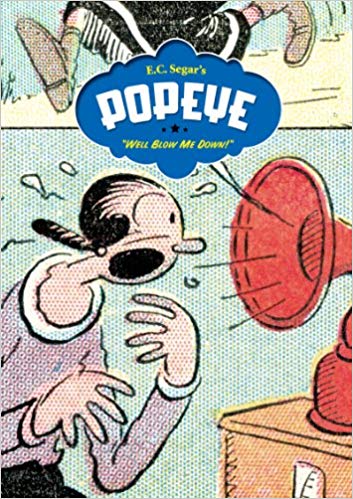
E.C. Segar’s Popeye volume 1: “I Yam What I Yam!”


By Elzie Crisler Segar (Fantagraphics Books)
ISBN: 978-1-56097-779-7

HAPPY 90th BIRTHDAY POPEYE!

Call me an idiot (you know you want to) but for years I laboured under the misapprehension that comics’ first superhuman hero debuted on January 29th 1929. Eventually. thanks to a superb collection of archival albums from the wonderful folk at Fantagraphics, I was disabused of that erroneous notion. Those mammoth oversized compendia are still the best books about the old Swabbie ever published…

Thimble Theatre was an unassuming comic strip which began on 19th December 1919; one of many newspaper features that parodied/burlesqued/mimicked the silent movies of the era. Its more successful forebears included C.W. Kahles’ Hairbreadth Harry and Ed Wheelan’s Midget Movies (later and more famously renamed Minute Movies).

These all used a repertory company of characters to play out generic adventures firmly based on the cinema antics of the silent era. Thimble Theatre‘s cast included Nana and Cole Oyl, their gawky daughter Olive, diminutive-but-pushy son Castor, and Horace Hamgravy, Olive’s sappy, would-be beau.

The series ticked along for a decade, competent and unassuming, with Castor and Ham Gravy, as he became, tumbling through get-rich-quick schemes, gentle adventures and simple gag situations until September 10th 1928 (the first strip reprinted in this astonishingly lavish and beautiful collection), when explorer uncle Lubry Kent Oyl gave Castor a present from his latest exploration of Africa: a hand-reared Whiffle Hen – most fabulous of all birds. It was the start of something groundbreaking.

As eny fule kno Whiffle Hens are troublesome, incredibly rare and possessed of fantastic powers, but after months of inspired hokum and slapsick shenanigans, Castor was resigned to Bernice – for that was the hen’s name – when a series of increasingly peculiar circumstances brought him into contention with the ruthless Mr. Fadewell, world’s greatest gambler and king of the gaming resort of ‘Dice Island’.

Bernice clearly affected writer/artist E.C. Segar, because his strip increasingly became a playground of frantic, compelling action and comedy during this period.

When Castor and Ham discovered that everybody wanted the Whiffle Hen because she could bestow infallible good luck, they decided to sail for Dice Island to win every penny from its lavish casinos. Sister Olive wanted to come along but the boys planned to leave her behind once their vessel was ready to sail. It was 16th January 1929…

The next day and in the 108th instalment of the saga, a bluff, irascible, ignorant, itinerant and exceeding ugly one-eyed old sailor was hired by the pair to man the boat they had rented, and the world was introduced to one of the most iconic and memorable characters ever conceived. By sheer, surly willpower, Popeye won the hearts and minds of every reader: his no-nonsense, grumbling simplicity and dubious appeal enchanting the public until by the end of the tale his walk-on had taken up full residency. He would eventually make the strip his own…

The journey to Dice Island was a terrible one: Olive had stowed away, and Popeye, already doing the work of twelve men, did not like her. After many travails the power of Bernice succeeded and Castor bankrupted Dice Island, but as they sailed for home with their millions Fadewell and his murderous associate Snork hunted them across the oceans. Before long, Popeye settled their hash too, almost at the cost of his life…

Once home their newfound wealth quickly led Castor, Ham and Olive into more trouble, with carpetbaggers, conmen and ne’er-do-wells constantly circling, and before long they lost all their money (a common occurrence for them), but one they thing they couldn’t lose was their sea-dog tag-along. The public – and Segar himself – were besotted with the unlovable, belligerent old goat. After an absence of 32 episodes Popeye shambled back on stage, and he stayed for good.

Although not yet the paramour of Olive, Popeye increasingly took Ham’s place as a foil for the sharp-talking, pompous Castor Oyl, and before long they were all having adventures together. When they escaped jail at the start of ‘The Black Barnacle’ (December 11th 1929) they found themselves aboard an empty ship and at the start of a golden age of comic strip magic…

Segar famously considered himself an inferior draughtsman – most of the world disagreed and still does – but his ability to weave a yarn was unquestioned and it grew to astounding and epic proportions in these strips.

Day by day he was creating the syllabary and graphic lexicon of a brand-new art-form, inventing narrative tricks and beats that a generation of artists and writers would use in their own works, and he did it while being scary, thrilling and funny all at once.

‘The Black Barnacle’ introduced the dire menace of the hideous Sea-Hag – one of the greatest villains in fiction – and the scenes of her advancing in misty darkness upon our sleeping heroes are still the most effective I’ve seen in all my years…

This incredible tale leads seamlessly into diamond-stealing, kidnappings, spurned loves, an African excursion and the introduction of wealthy Mr. Kilph, whose do-gooding propensities would lead Castor and Popeye into plenty of trouble, beginning with the eerie science fiction thriller ‘The Mystery of Brownstone Hill’ and the return of the nefarious Snork, who almost murders the salty old seadog a second time…

The black and white dailies section ends with ‘The Wilson Mystery’ as Castor and Popeye set up their own detective agency: something that would become a common strip convention and the perfect maguffin to keep the adventures tumbling along – even Mickey Mouse would don metaphoric deerstalker and magnifying glass (see Mickey and Donald and The Lair of Wolf Barker among many others).

These superb and colossal hardcover albums (200 pages and 368 mm by 268 mm) are augmented with fascinating articles and essays; including testimonial remembrances from famous cartoonists – Jules Feiffer in this first volume – and accompanied by the relevant full colour Sunday pages from the same period.

Here then are the more gag-oriented complete tales from 2nd March 1930 through February 22nd 1931, including the “topper” Sappo.

A topper was a small mini-strip that was run above the main feature on a Sunday page. Some were connected to the main strip but many were just filler. They were used so that individual editors could remove them if their particular periodical had non-standard page requirements. Originally entitled The 5:15, Sappo was a surreal domestic comedy gag strip created by Segar in 1924 which became peculiarly entwined with the Sunday Thimble Theatre as the 1930s unfolded – and it’s a strip long overdue for consideration on its own unique merits….

Since many papers only carried dailies or Sundays, not necessarily both, a system of differentiated storylines developed early in American publishing, and when Popeye finally made his belated appearance, he was already a fairly well-developed character.

Thus, Segar concentrated on more family-friendly gags – and eventually continued mini-sagas – and it was here that the Popeye/Olive Oyl modern romance began: a series of encounters full of bile, intransigence, repressed hostility, jealousy and passion which usually ended in raised voices and scintillating cartoon violence – and they are still as riotously funny now as then.

We saw softer sides of the sailor-man and, when Castor and Mr. Kilph realised how good Popeye was at boxing, an extended, trenchant and scathingly funny sequence about the sport of prize-fighting began. Again, cartoon violence was at a premium – family values were different then – but Segar’s worldly, probing satire and Popeye’s beguiling (but relative) innocence and lack of experience kept the entire affair in hilarious perspective whilst making him an unlikely and lovable waif.

Popeye is fast approaching his centenary and still deserves his place as a world icon. These magnificent volumes are the perfect way to celebrate the genius and mastery of EC Segar and his brilliantly imperfect superman. These are books that every home should have.
© 2006 Fantagraphics Books Inc. All comics and drawings © 2006 King Features Inc. All rights reserved.

The Complete Peanuts volume 3: 1955-1956


By Charles Schulz (Canongate Books/Fantagraphics Books)
ISBN: 978-1-84767-075-5 (Canongate HB):             978-1-56097-647-9 (Fantagraphics HB)

Peanuts is unequivocally the most important comics strip in the history of graphic narrative. It is also the most deeply personal. At its height, the strip ran in 2,600 newspapers in 75 countries, translated into 21 languages. Many of those venues are still running perpetual reprints, as they have ever since Schulz’ departure. Book collections, a merchandising mountain and television spin-offs made the publicity-shy artist a billionaire.

Cartoonist Charles M Schulz crafted his moodily hilarious, hysterically introspective, shockingly philosophical epic for half a century. During that time he published 17,897 strips from October 2nd 1950 to February 13th 2000, and died – from the complications of cancer – the day before his last strip was printed…

None of that is really the point. Peanuts – a title Schulz loathed, but one the syndicate imposed upon him – changed the way newspaper strips were received and perceived, and proved that cartoon comedy could have edges and nuance as well as pratfalls and punch lines.

Following a heartfelt and clearly awestruck Foreword from contemporary cartoon genius Matt Groening, this third gargantuan landscape hardback compendium (218 by 33 by 172 mm in the solid world and infinitely variable in its digital iterations) offers in potent monochrome the fifth and sixth years in the life of Charlie Brown and Co: an ever-evolving bombardment of cruel insight and bitingly barbed hilarity.

Here our increasing browbeaten but resolutely optimistic little round head and his high-maintenance mutt Snoopy respond with increasing bewilderment to the rapidly changing world of TV, sports, games and especially peers who seem designed only to vex, belittle or embarrass the introspective everyboy.

Gaining far greater prominence is obnoxious “fussbudget” Lucy who, with her infant sibling Linus – an actual architectural idiot savant – are getting more and more of the best lines and set-ups. Another up and comer settling in (amidst a cloud of dust and detritus) is hapless toxic innocent ‘Pig-Pen’: a sad clown in the grand manner, buffeted by a cruel condition but manfully persevering throughout…

Bombastic Shermy and mercurial Patty are slowly being eased out, and brusque Violet is slowly losing ground to gags starring Beethoven-obsessed, long-suffering musical prodigy Schroeder. Linus’ mystic tranquiliser the Security Blanket also gains greater prominence, but his anxiety peaks exponentially whenever raucous, strident newcomer Charlotte Braun ambles by…

The daily diet of rapid-fire gags had now successfully evolved from raucous slapstick to surreal, edgy, psychologically honed introspection, crushing peer-judgements and deep rumination in a world where kids – and certain animals – were the only actors, although even inanimate objects occasionally got into the action with malice aforethought…

The relationships, however, were ever-evolving: deep, complex and absorbing even though “Sparky” Schulz never deviated from his core message to entertain…

The first Sunday page had debuted on January 6th 1952: a standard half-page slot offering more measured fare than the daily. Both thwarted ambition and explosive frustration became part of the strip’s signature denouements and continue to develop here. There are some pure gem examples of running gag mastery in here too, regarding Lucy’s ongoing relationship to certain snowmen of her own macabre devising and mounting jealousy that her predestined inamorata would rather look at plaster busts of Beethoven than upon her living form…

Perennial touchstones on display herein include playing, playing pranks, playing sports, playing golf, playing baseball, playing in mud, playing in snow, playing musical instruments, playing marbles, the rules of croquet, learning to read, coping with increasingly intransigent if not actually malevolent kites, teasing each other, making baffled observations and occasionally acting a bit too much like grown-ups.

New themes include America’s fascination with flying saucers, ditto for TV sensation Davy Crockett, art appreciation and Snoopy’s growing desire to be anything but a maligned and put-upon little dog. Especially one starved of tasty treats and bonbons…

The soft-soap ostracization of Charlie Brown and his expressions of alienation are well explored but in truth Lucy is the real star here, with episodes seeing her seeking to become Mayor of the United States, duelling Snoopy with skipping ropes and investigating the mystery of why the planet is getting smaller…

More exploration of Snoopy’s incredible inner mindscape can be seen here and there are plenty of season-appropriate gags about summer sun, winter snow and the Fall of leaves as well as riffs on festive events such as Halloween, Easter and Christmas. During this time Good Ol’ Charlie starts getting those stress-induced head and stomach aches…

And best of all, auteur Schulz is in brilliant imaginative form crafting a myriad of purely graphic visual gags any surrealist would give their nose-teeth to have come up with…

Now and forevermore Charlie Brown – although still a benign dreamer with his eyes affably affixed on the stars – is solidly locked on the path to his eternal loser, singled-out-by-fate persona and the sheer diabolical wilfulness of Lucy starts sharpening itself on everyone around her…

Adding to the enjoyment and elucidation, a copious ‘Index’ offers instant access to favourite scenes you’d like to see again, after which Gary Groth reviews the life of ‘Charles M. Schulz: 1922-2000’, rounding out our glimpse of the dolorous graphic genius with intimate revelations and reminiscences…

Still readily available, this volume offers the perfect example of a masterpiece in motion: comedy gold and social glue gradually metamorphosing in an epic of spellbinding graphic mastery which became part of the fabric of billions of lives, and which continues to do so long after its maker’s passing.

How can you possibly resist?
The Complete Peanuts: 1955-1956 (Volume Three) © 2004 Peanuts Worldwide, LLC. Foreword © 2005 Matt Groening. “Charles M. Schulz: 1922 to 2000” © 2004 Gary Groth. All rights reserved.

Adventures of Tintin: Tintin and the Broken Ear


By Hergé & various; translated by Leslie Lonsdale-Cooper & Michael Turner (Egmont)
ISBN: 978-1-40520-617-4 (HB)                    : 978-0-416-57030-5 (PB)

Georges Prosper Remi – AKA Hergé – created a true masterpiece of graphic literature with his many tales of a plucky boy reporter and his entourage of iconic associates. Singly, and later with assistants including Edgar P. Jacobs, Bob de Moor and the Hergé Studio, Remi completed 23 splendid volumes (originally produced in brief instalments for a variety of periodicals) that have grown beyond their popular culture roots and attained the status of High Art.

Like Charles Dickens with The Mystery of Edwin Drood, Hergé died in the throes of creation, and final outing Tintin and Alph-Art remains a volume without a conclusion, but still a fascinating examination and a pictorial memorial of how the artist worked.

It’s only fair though, to ascribe a substantial proportion of credit to the many translators whose diligent contributions have enabled the series to be understood and beloved in 38 languages. The subtle, canny, witty and slyly funny English versions are the work of Leslie Lonsdale-Cooper & Michael Turner.

On leaving school in 1925, Remi worked for Catholic newspaper Le XXe Siécle where he fell under the influence of its Svengali-like editor Abbot Norbert Wallez. The following year, the young artist – a passionate and dedicated boy scout – produced his first strip series: The Adventures of Totor for the monthly Boy Scouts of Belgium magazine.

By 1928 he was in charge of producing the contents of Le XXe Siécles children’s weekly supplement Le Petit Vingtiéme and unhappily illustrating The Adventures of Flup, Nénesse, Poussette and Cochonette when Abbot Wallez urged Remi to create a new adventure series. Perhaps a young reporter who would travel the world, doing good whilst displaying solid Catholic values and virtues?

And also, perhaps, highlight and expose some the Faith’s greatest enemies and threats…?

Having recently discovered the word balloon in imported newspaper strips, Remi decided to incorporate this simple yet effective innovation into his own work.

He would produce a strip that was modern and action-packed. Beginning January 10th 1929, Tintin in the Land of the Soviets appeared in weekly instalments, running until May 8th 1930.

Accompanied by his dog Milou (Snowy to us Brits), the clean-cut, no-nonsense boy-hero – a combination of Ideal Good Scout and Remi’s own brother Paul (a soldier in the Belgian Army) – would report back all the inequities from the “Godless Russias”.

The strip’s prime conceit was that Tintin was an actual foreign correspondent for Le Petit Vingtiéme…

The odyssey was a huge success, assuring further – albeit less politically charged and controversial – exploits to follow. At least that was the plan…

After six years of continuous week-by-week improvement, Hergé was approaching his mastery when he began The Broken Ear. His characterisations were firm in his mind, and the storyteller was creating a memorable not to say iconic supporting cast, whilst balancing between crafting satisfactory single instalments and building a cohesive longer narrative.

The version reprinted here (in either hardback or softcover as you prefer) was repackaged in colour by the artist and his studio in 1945, although the original ran as monochrome 2-page weekly instalments from 1935-1937, but there are still evident signs of his stylistic transition in this hearty, exotic mystery tale that makes Indiana Jones look like a boorish, po-faced amateur.

Back from China, Tintin hears of an odd robbery at the Museum of Ethnography and, rushing over, finds the detectives Thompson and Thomson already on the case in their own unique manner.

A relatively valueless carved wooden Fetish Figure made by the Arumbaya Indians has been taken from the South American exhibit. Bafflingly, it was returned the next morning, but the intrepid boy reporter is the first to realise that it’s a fake, since the original statue had a broken right ear.

Perhaps coincidentally, a minor sculptor has been found dead in his flat…

Thus begins a frenetic and enthralling chase to find not just who has the real statue but also why a succession of rogues attempt to secure the dead sculptor’s irreverent and troublesome parrot, with the atmospheric action encompassing the modern urban metropolis, an ocean-going liner and the steamy, turbulent Republic of San Theodoros.

Hhere the valiant lad becomes embroiled in an on-again, off-again Revolution. Eventually, though, our focus moves to the deep jungle where Tintin finally meets the Arumbayas and a long-lost explorer, finally getting one step closer to solving the pan-national mystery.

Whilst unrelenting in my admiration for Hergé I must interject a necessary note of praise for translators Leslie Lonsdale-Cooper & Michael Turner here. Their light touch has been integral to the English-language success of Tintin, and their skill and whimsy is never better seen than in their dialoguing of the Arumbayas.

Just read aloud and think Eastenders…

The slapstick and mayhem incrementally build to a wonderfully farcical conclusion with justice soundly served all around, all whilst solid establishing a perfect template for many future yarns: especially those that would perforce be crafted without a political or satirical component during Belgium’s grim occupation by the Nazis.

Here, however, Hergé’s developing social conscience and satirical proclivities are fully exercised in a telling sub-plot about rival armaments manufacturers using an early form of shuttle diplomacy to gull the leaders of both San Theodoros and its neighbour Nuevo-Rico into a war simply to increase company profits, and once again oil speculators would have felt the sting of his pen – if indeed they were capable of any feeling…

It’s hard to imagine that comics as marvellous as these still haven’t found their way onto everybody’s bookshelf, but if you are one of this underprivileged underclass, there’s no better time to rectify that sorry situation.

The Broken Ear: artwork © 1945, 1984 Editions Casterman, Paris & Tournai.
Text © 1975 Egmont UK Limited. All Rights Reserved.

Krazy & Ignatz 1937-1938: “Shifting Sands Dusts its Cheeks in Powdered Beauty”


By George Herriman, edited by Bill Blackbeard & Derya Ataker (Fantagraphics Books)
ISBN: 978-1-56097-734-6

In a field positively brimming with magnificent and eternally evergreen achievements, the cartoon strip starring Krazy Kat is arguably the pinnacle of graphic narrative innovation; a singular and hugely influential body of work which shaped the early days of the comics industry and became an undisputed treasure of world literature.

Krazy and Ignatz, as it is dubbed in these gloriously addictive commemorative tomes from Fantagraphics, is a creation which must be appreciated on its own terms. Over the decades the strip developed a unique language – at once both visual and verbal – whilst exploring the immeasurable variety of human experience, foibles and peccadilloes with unfaltering warmth and understanding and without ever offending anybody.

Sadly, however, it did go over the heads and around the hearts of far more than a few…

Krazy Kat was never a strip for dull, slow or unimaginative people who simply won’t or can’t appreciate the complex multi-layered verbal and pictorial whimsy, absurdist philosophy or seamless blending of sardonic slapstick with arcane joshing. It is still the closest thing to pure poesy that narrative art has ever produced.

Herriman was already a successful cartoonist and journalist in 1913 when a cat and mouse who had been noodling about at the edges of his outrageous domestic comedy strip The Dingbat Family/The Family Upstairs graduated to their own feature. Mildly intoxicating and gently scene-stealing, Krazy Kat subsequently debuted in William Randolph Hearst’s New York Evening Journal on Oct 28th 1913 and – largely by dint of the publishing magnate’s enrapt adoration and overpowering direct influence and interference – gradually spread throughout his vast stable of papers.

Although Hearst and a host of the period’s artistic and literary intelligentsia (notably – but not exclusively – Frank Capra, e.e. Cummings, John Alden Carpenter, Gilbert Seldes, Willem de Kooning, H.L. Mencken and latterly Jack Kerouac) all adored the strip, many local and regional editors did not; taking every potentially career-ending opportunity to drop it from the populace-beguiling comics section.

Eventually the feature found a true home and safe haven in the Arts and Drama section of Hearst’s papers. Protected there by the publisher’s doctrinaire patronage and enhanced with the cachet of fulsome colour, the Kat flourished unharmed by editorial interference or fleeting fashion, running generally unmolested until Herriman’s death in April 1944.

The saga’s basic premise is simple: Krazy is an effeminate, dreamy, sensitive and romantic feline of indeterminate gender, hopelessly in love with Ignatz Mouse; a venal everyman, rude, crude, brutal, mendacious and thoroughly scurrilous.

Ignatz is a true unreconstructed male; drinking, stealing, fighting, conniving, constantly neglecting his wife and innumerable children and always responding to Krazy’s genteel advances by clobbering the Kat with a well-aimed brick. These he obtains singly or in bulk from noted local brick-maker Kolin Kelly.

Smitten kitten Krazy always misidentifies these missiles as tokens of equally recondite affection showered upon him/her in the manner of Cupid’s fabled arrows…

The final crucial element completing an anthropomorphic eternal triangle is lawman Offissa Bull Pupp, who is completely besotted with Krazy, professionally aware of the Mouse’s true nature, yet hamstrung by his own amorous timidity and sense of honour from permanently removing his devilish rival for the foolish feline’s affections.

Krazy is, of course, blithely oblivious to the perennially “Friend-Zoned” Pupp’s dilemma…

Secondarily populating the ever-mutable stage are a stunning supporting cast of inspired bit players such as terrifying deliverer of unplanned babies Joe Stork; hobo Bum Bill Bee, unsavoury conman and trickster Don Kiyoti, social climbing busybody Pauline Parrot, self-aggrandizing Walter Cephus Austridge, inscrutable, barely intelligible Chinese mallard Mock Duck, dozy Joe Turtil and a host of other audacious animal crackers all equally capable of stealing the limelight and even supporting their own features.

The exotic, quixotic episodes occur in and around the Painted Desert environs of Coconino (patterned on the artist’s vacation retreat in Coconino County, Arizona) where surreal playfulness and the fluid ambiguity of the flora and landscape are perhaps the most important member of the cast.

The strips themselves are a masterful mélange of unique experimental art, cunningly designed, wildly expressionistic and strongly referencing Navajo art forms whilst graphically utilising sheer unbridled imagination and delightfully evocative lettering and language: alliterative, phonetically and even onomatopoeically joyous with a compelling musical force (“why dollin is you in pritzin?”, “l’il dahlink” or “I are illone”).

Yet for all that, the adventures are poetic, satirical, timely, timeless, bittersweet, self-referential, fourth-wall bending, eerily idiosyncratic, astonishingly hilarious escapades encompassing every aspect of humour from painfully punning shaggy dog stories to riotous, violent slapstick.

Sometimes Herriman even eschewed his mystical mumblings and arcane argots for the simply sublime grace of a supremely entertaining silent gag in the manner of his beloved Keystone Cops…

There’s been a wealth of Krazy Kat collections since the late 1970s when the strip was first rediscovered by a better-educated, open-minded and far more accepting generation. This delirious tome covers all the strips from 1937-1938 in a comfortably hefty (231 x 15 x 305 mm) softcover edition – and is also available as a madly mystical digital edition.

Preceded by candid photos, examples of contemporary merchandise, memorabilia and some of Herriman’s personalised gifts and commissions featuring the cast and settings, the splendid madness resumes with January 3rd 1937 – with the hues provided by professional separators rather than Herriman – we can now set off on another odyssey into the heartlands of imagination.

Within this compelling compendium of incessant passions thwarted, the torrid triangular drama plays out as winningly as ever, with even more new faces popping up to contribute to the insular insanity and well-cloaked social satire.

Newcomers include a family of kangaroos who provide a unique form of locomotion for the traditional cops and boppers chases, a pale equatorial bear of mixed origins (Mama from the south Pole and Papa from the North), a tightrope walker of surly demeanour and unlikely antecedents, a gang of morally ambiguous pelicans and the much-travelled odd cove calling himself D.B. Platypus…

Of especial note can be observed a marked increase in the (temporary) triumphs of Offissa Pupp who now regularly locks up the brick-bunging little brigand. Oddly, that in turn leads to a spike in jail breaks…

As well as frequent incarceration, Ignatz endures numerous forms of exile and social confinement, but with Krazy aiding and abetting, these sanctions seldom result in a reduction of cerebral contusions… a minor plague of travelling conjurors and unemployed magician also make life hard for the hard-pressed constabulary…

Never long daunted, Bull Pupp indulges in a raft of home-away-from home improvements, including a formidable moat around the county jail as well as art installations and an early example of conjugal visitations

As always, the mouse’s continual search for his ammunition of choice leads to many brick-based gags and his occasional fleecing by Coconino’s (occasionally “Kokonino”) copious coterie of confidence tricksters – a scurrilous sub-population which seems to grow by the week. Of course, the mouse is a man who enjoys revenge served hot, cold or late…

Amongst the notable innovations this time is an increase in road traffic as America’s love affair with the internal combustion engine takes hold of the cast (after a bevy of wandering car salesmen arrive in town). Alternatively the entire cast spend a lot of time in one spot stargazing and attempting various form of flight – usually before coming back to earth with a bump.

Topics of civic conversation and favoured pastimes include a serious lack of good gossip, the proposed smashing of the atom by audacious “sign tisks”, insomnia, radio talk shows and movie-making, a seasonal but wholly unexpected cold snap, astronomy and misunderstood planetary phenomena, fishing and water sports and the parlous and participatory state of the burgeoning local theatre scene…

One tireless constant is the growing instability and trustworthiness of supreme comedy maguffin Joe Stork, whose increasingly hooch-affected delivery of (generally unwanted) babies still brings dread responsibility and smug schadenfreude in equal amounts to denizens of the county.

And, welcomingly as ever, there is still a solid dependence on the strange landscapes and eccentric flora for humorous inspiration and all manner of weather and terrain play a large part in inducing anxiety, bewilderment and hilarity.

Following another personalised birthday card, the cartoon gold is topped off by another erudite and instructional ‘Ignatz Mouse Debaffler Page’, providing pertinent facts, snippets of contextual history and necessary notes for the young and potentially perplexed.

Herriman’s epochal classic is a stupendous and gleeful monument to whimsy: in all the arenas of Art and Literature there has never been anything like these comic strips which have shaped our industry and creators, inspired auteurs in fields as disparate as prose fiction, film, dance, animation and music, and engendered delight and delectation in generations of wonder-starved fans.

If, however, you are one of Them and not Us, or if you actually haven’t experienced the gleeful graphic assault on the sensorium, mental equilibrium and emotional lexicon carefully thrown together by George Herriman from the dawn of the 20th century until the dog days of World War II, this astounding compendium is a most accessible way to do so.
© 2006, 2015 Fantagraphics Books. All rights reserved.

Mighty Alice Goes Round and Round


By Richard Thompson (Andrews McMeel)
ISBN: 978-1-4494-7387-7 (HB)                    978-1-4494-3721-3 (PB)

Cul-de-Sac translates as “bottom of the bag” so don’t say you never learned anything from comics.

Richard Thompson took the term in its urban planning derivation – a street/passage closed at one end or a route/course leading nowhere – to describe a convoluted, barricaded oasis of suburban life on the outskirts of Washington DC where a mercurial cross-section of modern humanity lives.

As such it became the setting for one of the best cartoon strips about kids ever created, and one I very much miss.

Richard Church Thompson was born on October 8th 1957 and grew up to become an award-winning illustrator and editorial cartoonist who worked for The Washington Post. He was best known for his acerbic weekly feature Poor Richard’s Almanac (from which came the crushing political prognostication “Build the Pie Higher” – so go google that while you’re at it).

His other mostly light-hearted illustrative efforts appeared in locales ranging from U.S. News & World Report, The New Yorker, Air & Space/Smithsonian, National Geographic and The Atlantic Monthly as well as in numerous book commissions.

In February 2004 Cul de Sac began as a beautifully painted Sunday strip in The Post and quickly evolved into a firm family favourite. In September 2007, the strip was rebooted as a standard black-&-white daily feature with a process-colour Sunday strip and began global syndication with the Universal Press Syndicate and digitally distribution by Uclick GoComics.

It rightly gathered a host of fans, especially other cartoonists such as Bill Watterson and authors like Mo Willems.

The series was collected in four volumes between 2008 and 2012, with other iterations and recombinations (such as this colour & monochrome tome; 152 x 229 mm; released in 2013 and again in 2016) keeping the series popular even after it ended. This particular volume comes in hard, soft and digital formats.

There is precious little of Cul de Sac but what there is all pure gold. In July 2009 the artist publicly announced that he was suffering from Parkinson’s disease, but carried on anyway.

In 2012 a number of fellow artists and devoted admirers – Michael Jantze, Corey Pandolph, Lincoln Peirce, Stephen Pastis, Ruben Bolling and Mo Willems – pitched in to produce the strip while Thompson underwent treatment. When he came back at the end of March, illustrator had Stacy Curtis signed on as inker, but by August Thompson announced he was retiring Cul de Sac.

The last strip appeared on September 23rd 2012.

Richard Thompson died on July 27 2016. He was 58 years old.

Happily, the brilliance of his wit, the warmth of his observation and the sheer uniqueness of his charmingly askew mentality will continue to mesmerise generations of kids and their parents.

So, What’s Going On Here…?

Mighty Alice Goes Round and Round offers an unforgettable introduction to the indivisible exterior and interior world of hyperactive four-year old Alice Otterloop as experienced by her family and a definitely quirky circle of friends.

Alice likes to dance, deploy glitter, get excited and be in charge of everything. Her forceful, declaratively propounded opinions make her respected – and most often feared – by the other kids in Miss Bliss’ class at Blisshaven Academy Pre-School.

Not that the other tykes, such as just-plain-weird peeping tom Dill Wedekind or hammer-wielding Beni, are traditional tots either. All these littluns are smart but untutored, and much of the humour derives from their responses to new facts and situations as interpreted through the haze of the meagre experience they’ve previously accumulated – whether taught or overheard…

The result is a winning blend of surreal whimsy and keenly observational gags, punctuated with input from Alice’s dolorous, graphic-novel-obsessed, sports-fearing older brother Petey and their permanently bewildered and embattled parents.

Other regulars include classmate Marcus who thinks he’s being stalked by his own mother; school guinea pig Mr. Danders (a boorish, self-important and pretentious literary snob in love with the sound of his own voice); Peter Otterpoop Senior‘s impossibly small car; the family’s bellicose and feral Grandma and her appalling dog Big Shirley; the enigmatic, doom-portending Uh-Oh Baby and Alice’s deranged collection of terrifying spring-loaded toys…

Taking family humour to abstract extremes, Cul de Sac blends inspirational imagination with wry consideration to produce moments side-splitting, baffling and heart-warming in rapid succession.

It’s never too late to appreciate quality material and make lifelong friends, so track down Mighty Alice and Co as soon as you can…
© 2013 Richard Thompson. All rights reserved.

Adventures of Tintin: The Blue Lotus


By Hergé & various; translated by Leslie Lonsdale-Cooper & Michael Turner (Egmont)
ISBN: 978-1-40520-804-8 (HB)                    : 978-1-40520-616-7 (PB)

Georges Prosper Remi – AKA Hergé – created a true masterpiece of graphic literature with his many tales of a plucky boy reporter and his entourage of iconic associates. Singly, and later with assistants including Edgar P. Jacobs, Bob de Moor and the Hergé Studio, Remi completed 23 splendid volumes (originally produced in brief instalments for a variety of periodicals) that have grown beyond their popular culture roots and attained the status of High Art.

Like Charles Dickens with The Mystery of Edwin Drood, Hergé died in the throes of creation, and final outing Tintin and Alph-Art remains a volume without a conclusion, but still a fascinating examination and a pictorial memorial of how the artist worked.

It’s only fair though, to ascribe a substantial proportion of credit to the many translators whose diligent contributions have enabled the series to be understood and beloved in 38 languages. The subtle, canny, witty and slyly funny English versions are the work of Leslie Lonsdale-Cooper & Michael Turner.

On leaving school in 1925, Remi worked for Catholic newspaper Le XXe Siécle where he fell under the influence of its Svengali-like editor Abbot Norbert Wallez. The following year, the young artist – a dedicated boy scout – produced his first strip series: The Adventures of Totor for the monthly Boy Scouts of Belgium magazine.

By 1928 he was in charge of producing the contents of Le XXe Siécle’s children’s weekly supplement Le Petit Vingtiéme; unhappily illustrating The Adventures of Flup, Nénesse, Poussette and Cochonette when Abbot Wallez urged Remi to create a new adventure series. Perhaps a young reporter who would travel the world, doing good whilst displaying solid Catholic values and virtues?

And also, perhaps, highlight and expose some the Faith’s greatest enemies and threats…?

Having recently discovered the word balloon in imported newspaper strips, Remi decided to incorporate this simple yet effective innovation into his own work. He would produce a strip that was modern and action-packed. Beginning January 10th 1929, Tintin in the Land of the Soviets appeared in weekly instalments, running until May 8th 1930.

The clean-cut, no-nonsense boy-hero – a combination of Ideal Good Scout and Remi’s own brother Paul (a soldier in the Belgian Army) would be accompanied by his dog Milou (Snowy to us Brits) and report back all the inequities from the “Godless Russias”.

The strip’s prime conceit was that Tintin was an actual foreign correspondent for Le Petit Vingtiéme…

The odyssey was a huge success, assuring further – albeit less politically charged and controversial – exploits to follow. At least that was the plan…

The Blue Lotus was serialised weekly from August 1934 to October 1935 before being published in a collected volume by Casterman in 1936: a tale of immense power as well as exuberance, and a marked advance on what has gone before.

This adventure took place in a China that was currently under sustained assault by Imperial Japan: imbued with deep emotion and informed by the honest sentiment of a creator unable to divorce his personal feeling from his work.

Set amidst ongoing incursions into China by the Japanese during the period of colonial adventurism that led to the Pacific component of World War II, readers would see Tintin embroiled in a deep, dark plot that was directly informed by the headlines of the self-same newspapers that carried the adventures of the intrepid boy reporter…

Following the drug-busting exploits seen in Cigars of the Pharaoh, and whilst staying with the Maharajah of Gaipajama, Tintin intercepts a mysterious radio message just before a visit by a secretive oriental from Shanghai. This gentleman is attacked with madness-inducing narcotic Rajaijah, before he can introduce himself or explain his mission, so the lad sets off for China to solve the mystery.

At the conclusion of Cigars, Remi advertised that Tintin would go to China next, and the author was promptly approached by Father Gosset of the University of Leuven, who begged him to avoid the obvious stereotyping when dealing with the East.

The scholar introduced him to a Chinese art-student named Chang Chong-chen (or Chong-jen or possibly Chongren). They became great friends and Chang taught Hergé much of the history and culture of one of the greatest civilisations in history.

This friendship also changed the shape and direction of all Hergé’s later work. The unthinking innate superiority of the Colonial white man was no longer a casual given, and the artist would devote much of his life to correcting those unthinking stereotypes that populated his earlier work.

Chang advised Hergé on Chinese art and infamously lettered the signs and slogans on the walls, shops and backgrounds in the artwork of this story. He also impressed the artist so much that he was written into the tale as the plucky, heroic street urchin Chang, and would eventually return in Tintin in Tibet…

As Tintin delves into the enigma he uncovers a web of deception and criminality that includes gangsters, military bullies, Japanese agent provocateurs, and corrupt British policemen. Hergé also took an artistic swing at the posturing, smugly superior Westerners that contributed to the war simply by turning a blind eye, even when they weren’t actively profiting from the conflict…

As Tintin foils plot after plot to destroy him and crush any Chinese resistance to the invaders, he finds himself getting closer to the criminal mastermind in league with the Japanese. The reader regularly views a valiant, indomitable nation fighting oppression in a way that would typify the Resistance Movements of Nazi-occupied Europe a decade later, with individual acts of heroism and sacrifice tellingly mixed with the high-speed action and deft comedy strokes.

The Blue Lotus is an altogether darker and oppressive tale of high stakes: the villains in this epic of drug-running and insidious oppression are truly fearsome and despicable, and the tradition of Chinese wisdom is honestly honoured. After all, it is the kidnapped Professor Fang Hsi-ying who finally finds a cure for Rajaijah – once rescued by Tintin, Snowy and Chang. But despite the overwhelmingly powerful subtext that elevates this story, it must be remembered that this is also a brilliant, frantic rollercoaster of fun.

It’s hard to imagine that comics as marvellous as these still haven’t found their way onto everybody’s bookshelf, but if you are one of this underprivileged underclass, this lush series – in both hardcover or paperback – is a hugely satisfying way of rectifying that sorry situation. So why haven’t you..?
The Blue Lotus: artwork © 1946, 1974 Editions Casterman, Paris & Tournai. Text © 1983 Egmont UK Limited. All Rights Reserved.

Amazing Mysteries: The Bill Everett Archives volume 1


By Bill Everett and others, edited and complied by Blake Bell (Fantagraphics Books)
ISBN: 978-1-60699-488-7

Thanks to modern technology and diligent research by dedicated fans, there is a sublime superabundance of collections featuring the works of too-long ignored founding fathers and lost masters of American comic books. A magnificent case in point is this initial chronicle (available in both print and digital formats) revisiting the incredible gifts and achievements of one of the greatest draughtsmen and yarn-spinners the industry has ever seen.

You could save some time and trouble by simply buying the book now rather than waste your valuable off-hours reading my blather, but since I’m keen to carp on anyway feel free to accompany me as I delineate just why this tome needs to join the books on your “favourites” shelf.

The star of this collection was a direct descendent and namesake of iconoclastic poet and artist William Blake. His tragic life and awe-inspiring body of work – Bill was quite possibly the most technically accomplished artist in US comicbook industry – reveals how a man of privilege and astonishing pedigree was wracked by illness, an addictive personality (especially alcoholism) and sheer bad luck, but nevertheless shaped an art-form and left twin legacies: an incredible body of superlative stories and art, and, more importantly, saved many broken lives by becoming a dedicated mentor for Alcoholics Anonymous in his later years.

William Blake Everett was born in 1917 into a wealthy and prestigious New England family. Bright and precocious, he contracted tuberculosis when he was twelve and was dispatched to arid Arizona to recuperate.

This chain of events began a life-long affair with the cowboy lifestyle: a hard-drinking, chain-smoking, tall-tale-telling breed locked in a hard-to-win war against slow self-destruction. All this and more is far better imparted in the fact-filled, picture-packed Introduction by Blake Bell. It covers the development of the medium in ‘The Golden Age of Comics’, the history of ‘Bill Everett the Man’ and how they came together in ‘Centaur + Funnies Inc. = Marvel Comics #1’.

Th essay also includes an astounding treasure trove of found images and original art including samples from 1940s Sub-Mariner, 1960s Daredevil and 1970s Black Widow amongst many others.

Accompanied by the covers – that’s the case for most of the titles that follow: Everett was fast and slick and knew how to catch a punter’s eye – for Amazing Mystery Funnies volume 1 #1, 2, 3a, 3b and volume 2 #2 (August 1938 – February 1939, Centaur) are a quartet of rousing but muddled interstellar exploits starring sci fi troubleshooter Skyrocket Steele.

These are followed by a brace of anarchic outer space shenanigans starring futuristic wild boy Dirk the Demon from Amazing Mystery Funnies vol. 1 #3a and vol. 2 #3 (November 1938 and March 1939 respectively).

The undisputed star and big draw at Centaur was always Amazing-Man: a Tibetan mystic-trained orphan, adventurer and do-gooder named John Aman. After years of dangerous, painful study the young man was despatched back to civilisation to do good (for a relative given value of “good”)…

Aman stole the show in the monthly Amazing Mystery Comics #5-8 (spanning September to December 1939) as seen in the four breakneck thrillers reprinted here: ‘Origin of Amazing-Man’; an untitled sequel episode with the champion saving a lady rancher from sadistic criminals; ‘Amazing-Man Loose’ (after being framed for various crimes) and a concluding instalment wherein the nomadic hero abandons his quest to capture his evil arch rival ‘The Great Question’ and instead heads for recently invaded France to battle the scourge of Nazism…

As previously stated, Everett was passionately wedded to western themes and for Novelty Press’ Target Comics devised an Arizona-set rootin’ tootin’ cowboy crusader dubbed Bull’s-Eye Bill. Taken from issues #1 and 2 (February and March 1940), ‘On the trail of Travis Trent’ and ‘The Escape of Travis Trent’ find our wholesome but hard-bitten cowpoke battling the meanest and most determined owlhoot in the territory.

Accompanying the strips is an Everett-illustrated prose piece attributed to “Gray Brown” entitled ‘Bullseye Bill Gets his Moniker’.

Thanks to his breakthrough Sub-Mariner sagas, Everett was inextricably linked to water-based action and immensely popular, edgy heroes. That’s why Eastern Comics commissioned him to create human waterspout Bob Blake, Hydroman for their new bimonthly anthology Reg’lar Fellers Heroic Comics.

Here then (spanning issues #1-5; August 1940 to March 1941), are five spectacular, eerily offbeat exploits, encompassing ‘The Origin of Hydroman’ and covering his patriotic mission to make America safe from subversion from “oriental invaders”, German saboteurs and assorted ne’er-do-wells. after which a Polar Paladin rears his frozen head.

Sub-Zero Man debuted in Blue Bullet Comics vol. 1 #2 (July 1940): a Venusian scientist stranded on Earth who, through myriad bizarre circumstances, becomes a chilly champion of justice. Everett is only credited with the episode ‘The Power of Professor X’ (from vol. 1 #5, October 1940) but also included here are the cover of vol. 1 #4 and spot illos for the prose stories ‘Sub-Zero’s Adventures on Earth’ and ‘Frozen Ice’ (from Blue Bullet Comics vol. 1 #2 and vol. 2 #3).

The Conqueror was another quickly forsaken Everett creation: a Red, White & Blue patriotic costumed champion debuting in Victory Comics #1 August 1941. Daniel Lyons almost died in a plane crash but was saved by cosmic ray bombardment which granted him astounding mental and physical powers in ‘The Coming of the Conqueror’.

He promptly moved to Europe to “rid the world of Adolf Hitler!” and Everett’s only other contribution was the cover of issue #2 (September 1941).

Accompanied by a page of the original artwork from Reg’lar Fellers Heroic Comics #12 (May 1941), The Music Master details how dying violinist John Wallace is saved by mystic musical means and becomes a sonic-powered superman righting injustices and crushing evil…

Rounding out this cavalcade of forgotten wonders are a selection of covers, spot illustrations and yarns which can only be described as Miscellaneous (1938-1942). These consist of the cover to the 1938 Uncle Joe’s Funnies #1; procedural crime thriller ‘The C-20 Mystery’ from Amazing Mystery Funnies vol. 2 #7 (June 1939) and ‘The Story of the Red Cross’ from True Comics #2 (June 1938).

The cover for Dickie Dare #1 (1941) is followed by a range of potent illustrative images from text tales beginning with three pages for ‘Sheep’s Clothing’ (Funny Pages vol. 2 #11; November 1940), a potent pic for ‘Birth of a Robot Part 2’ from Target Comics vol. 1 #6 (July 1940), two pages from ‘Death in a Box’ courtesy of Reg’lar Fellers Heroic Comics #5 (March 1941) and two from ‘Pirate’s Oil’ in Reg’lar Fellers Heroic Comics #13 (July 1942), before the unpublished, unfinished 1940 covers for Challenge Comics #1 and Whirlwind Comics #1 bring the nostalgia to a close.

Although telling, even revelatory and hinting at a happy ending of sorts, what this book really celebrates is not the life but the astounding versatility of Bill Everett. A gifted, driven man, he was a born storyteller with the unparalleled ability to make all his imaginary worlds hyper-real; and for nearly five decades his incredible art and wondrous stories enthralled and enchanted everybody lucky enough to read them. You should really invite yourself onto that list…
© 2011 Fantagraphics Books. Introduction © 2011 Blake Bell. All art © its respective owners and holders. All rights reserved.