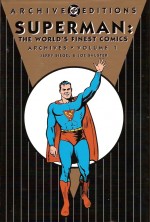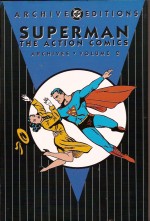
Superman Archives volume 1


By Jerry Siegel & Joe Shuster (DC Comics)
ISBN: 0-30289-47-1
Without doubt the creation of Superman and his unprecedented acceptance and adoption by a desperate and joy-starved generation quite literally gave birth to a genre if not an actual art form.

This stunning, lavish collection was also a significant first: the lovingly restored pages on glossy paper between gleaming hardback covers began DC’s superb Archive Editions series which, since 1989, has brought long forgotten and expensive classic tales to an appreciative wider audience.

Moreover the format has inestimably advanced the prestige and social standing of the medium itself as well as preserving a vital part of American popular culture.

Within this initial collection, following an effusive appreciation from legendary creator and comics historian Jim Steranko, are the complete contents of the first four issues of Superman, from Summer 1939 to Spring 1940. Here is the crude, rough, uncontrollable wish-fulfilling exuberance of a righteous and superior man dealing out summary justice to wife-beaters, reckless drivers and exploitative capitalists, as well as thugs and ne’er-do-wells, who captured the imagination of a nation and the world.

The character had debuted a year previously in Action Comics #1 in truncated, reformatted episodes by young, exuberant creators Jerry Siegel and Joe Shuster, cobbled together from a rejected newspaper strip proposal. An instant stand-out hit in the otherwise average comics anthology, the Man of Steel was given his own solo title – another first – and also starred in the tourist tie-in New York’s World Fair Comics #1 (June 1939).

Superman #1 began with an expanded partial reprint of the premier Action Comics tale, describing the alien foundling’s escape from exploding Planet Krypton before a costumed crusader masquerading by day as reporter Clark Kent averted a tragedy by saving an innocent woman from the Electric Chair, pounded a wife beater and busted racketeer Butch Matson, consequently saving feisty colleague Lois Lane from abduction and worse.

He also averted a European war fomented by greedy munitions dealers.

Superman’s first issue also re-presented the material from Action #2-4, with the mystery-man travelling to San Monte to spectacularly quiet down the hostilities already in progress and after a ‘Scientific Explanation of Superman’s Amazing Strength!’ the Man of Steel responded to a coal mine cave-in and exposed corrupt corporate practises before cleaning up gamblers who fixed football games. The first issue concluded with a two-page prose adventure of the Caped Crime-crusher and a biographical feature on Siegel & Shuster.

Superman #2 opened with a human drama as the Action Ace cleared the name of broken heavyweight boxer Larry Trent, coincidentally cleaning the scum out of the fight game and, after ‘Superman’s Tips for Super-Health’ and a captivating add for New York’s World Fair Comics, proceeded with ‘Superman Champions Universal Peace!’ wherein the hero crushed a gang who had stolen the world’s deadliest poison gas weapon, once more going up against unscrupulous munitions manufacturers.

‘Superman and the Skyscrapers’ found Kent investigating suspicious deaths in the construction industry, leading his alter ego into confrontation with ruthless thugs and their fat-cat corporate boss, after which another Superman text tale ended the issue.

The Winter Superman edition opened with a rip-roaring and shockingly uncompromising expose of corrupt orphanages, after which Lois stole Clark Kent’s assignment and became hopelessly embroiled in a deadly construction scam: imperilled by a colossal collapsing dam in a stirring yarn first published in Action #5.

Future Superboy star artist George Papp contributed science filler ‘Fantastic Facts’ and “Bert Lexington” penned prose crime thriller ‘Death by the Stars’ after which ‘Superman’s Manager’ turned up to scam Metropolis until he finally met his supposed client and ended up behind bars (reprinted from Action #6).

The exigencies of providing so much material was clearly beginning to tell: this issue is filled with fillers such as ‘Acquiring Super-Strength’, ‘Attaining Super-Health!’, prose prison yarn ‘Good Luck Charm’ by Hugh Langley and funny animal antics with dashing Dachshund ‘Shorty’ before the Man of Steel made his last appearance in another sterling gang-busting exploit, rescuing Lois from murderous smugglers.

Superman #4, cover-dated Spring 1940, concludes this inaugural compendium, with another four adventures; beginning with the landmark saga ‘The Challenge of Luthor’, wherein the red-headed rogue scientist used earthquakes to threaten civilisation. Following more ‘Attaining Super-Strength’, animal antics with ‘This Doggone World’ and facts ‘From the 4 Corners’ by Sheldon Moldoff, the mad scientist returned in ‘Luthor’s Undersea City’, a terrific tale of dinosaurs and super-science. Langley’s text vignette ‘Changer of Destiny’ preceded Superman’s battle against ‘The Economic Enemy,’ a spy-story about commercial sabotage instigated by an unspecified foreign power. Another Papp ‘Fantastic Facts’, some immensely enticing house ads and Lexington’s science fiction prose poser ‘Pioneer into the Unknown’ all act as palate-cleansers for the final fantastic thriller wherein the Man of Tomorrow clashed with gangsters and Teamsters in ‘Terror in the Trucker’s Union’.

Steranko then closed the show with an ‘Afterword’ detailing the contents of the adventures from Action Comics #1-14 (which were eventually collected in 1987 as Superman in Action Comics Archive volume 1).

As well as economical price and no-nonsense design and presentation, and notwithstanding the historical significance of the material presented within, there is a magnificent bonus for any one who hasn’t read these tales before. They are astonishingly well-told and engrossing mini-epics that can still grip and excite the reader.

In a world where Angels With Dirty Faces, Bringing Up Baby and The Front Page are as familiar to our shared cultural consciousness as the latest episode of Dr Who or the next Bond movie, the dress, manner and idiom in these seventy-plus-year-old stories can’t jar or confuse. They are simply timeless, enthralling, and great.

Read these yarns and you’ll understand why today’s creators keep returning to this material every time they need to revamp the big guy. They are simply timeless, enthralling, and great.
© 1939-1940, 1989 Dc Comics. All Rights Reserved.
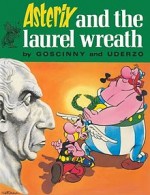
Asterix and the Cauldron, Asterix in Spain & Asterix and the Roman Agent


By Goscinny & Uderzo, translated by Anthea Bell & Derek Hockridge (Orion Books)
ISBNs: 978-075286-628-4, 978-0-75286-630-7 and 978-0-75286-632-1

One of the most-read comics series in the world, the collected chronicles of Asterix the Gaul have been translated into more than 100 languages since his debut in 1959, with animated and live-action movies, TV series, assorted games, toys and even a theme park outside Paris (Parc Astérix, if you’re planning a trip…) spinning off from his hilarious exploits.

More than 325 million copies of 34 Asterix books have sold worldwide, making his joint creators France’s bestselling international authors.

The diminutive, doughty potion-powered champion of Gallic Pride was created by two of the art-form’s greatest proponents, writer René Goscinny & illustrator Albert Uderzo and although their inspirational collaborations ended in 1977 with the death of the prolific scripter, the creative wonderment still continued until relatively recently from Uderzo and assistants – albeit at a slightly reduced rate.

The wonderment works on multiple levels: ostensibly, younger readers revel in the action-packed, lavishly illustrated comedic romps where sneaky, bullying baddies get their just deserts whilst we more worldly readers enthuse over the dry, pun-filled, sly satire, especially as enhanced for English speakers by the brilliantly light touch of translators Anthea Bell & Derek Hockridge, who played no small part in making the indomitable Gaul and his gallant companions so palatable to the Anglo-Saxon world. (Me, I still admire a divinely delivered “Paff!” as much as any painfully potent pun or dry cutting jibe…)

The stories were set on Uderzo’s beloved Brittany coast, where a small village of warriors and their families resisted every effort of the Roman Empire to complete the conquest of Gaul, or alternately, anywhere in the Ancient World, circa 50BC, as the Gallic Gentlemen wandered the fantastic lands of the Empire and beyond…

When the heroes were playing at home, the Romans, unable to defeat this last bastion of Gallic insouciance, resorted to a policy of containment. Thus the little seaside hamlet is permanently hemmed in by the heavily fortified garrisons of Totorum, Aquarium, Laudanum and Compendium.

The Gauls don’t care: they daily defy the world’s greatest military machine simply by going about their everyday affairs, protected by the magic potion of resident druid Getafix and the shrewd wits of the rather diminutive dynamo and his simplistic, supercharged best friend…

Firmly established as a global brand and premium French export by the mid-1960s, Asterix the Gaul continued to grow in quality as Goscinny & Uderzo toiled ever onward, crafting further fabulous sagas; building a stunning legacy of graphic excellence and storytelling gold.

Asterix and the Cauldron was the thirteenth saga, originally running in Pilote #469-491, throughout 1968 and first translated into English in 1976.

The tale is one of treachery, felony and dishonour as fellow Gaulish chieftain Whosemoralsarelastix – a cunning and conniving Roman collaborator – convinces the reluctant but big-hearted Vitalstatistix to guard the occupied cliff-top community’s treasury from Imperial tax collectors.

Despite knowing how untrustworthy the scoundrel is, Gaul must help Gaul and the rogue’s huge onion-soup cauldron, stuffed with his people’s golden Sestertii, is placed under the stewardship of the village’s greatest hero and most trustworthy warrior: Asterix.

However, that night, as a great inter-village feast is consumed, somebody cuts their way into the guard hut and steals the glittering contents of that mighty tureen. Naturally Whosemoralsarelastix wants his money back and the noble Vitalstatistix is honour bound to replace the stolen horde, Disgraced, Asterix is banished until he can refill the empty cauldron with gold…

Trusty Obelix refuses to turn away from his friend and joins the quest, which first takes them to the garrison of Compendium, where the wily warrior intends to refill the empty churn with some of the gold the occupiers have been regularly collecting from Gauls.

Unfortunately, Caesar has been experiencing some cash-flow problems and not only has he been rushing the takings to Rome, he hasn’t even paid his soldiers for months.

With disharmony, mutiny and strike action imminent among the legions Asterix and Obelix realise they must look elsewhere for their loot.

Even their old acquaintances the pirates are cash-strapped – and soon traditionally thrashed – so the doughty duo must seek their fortune at the grand market in Condatum, briefly and disastrously becoming Boar merchants, paid street boxers, actors and charioteers, before turning to crime and planning a bank robbery…

Even here our two just men fare badly. In desperation, they decide to rob Caesar’s tax collector, but Asterix discovers a strange thing. Not only has the destitute Whosemoralsarelastix somehow paid his taxes, but the coins smell of onion soup…

With realisation dawning Asterix visits the cliff-dwelling villagers for a little chat and a mighty reckoning…

Rich with slapstick action and cutting commercial satire (for example the tax collector was a caricature of France’s then Finance Minister Valéry Giscard d’Estaing), this hilarious crime caper is a glorious example of dry yet riotous adventure comedy.


Asterix in Spain promptly followed during 1969 (Pilote #498-519) in France and Astérix en Hispanie was translated into English two years later, recounting how a valiant group of Iberian warriors were similarly holding-out against Caesar’s total conquest of that proud nation.

Chief Huevos Y Bacon was the noble warrior leading the resistance but when his haughty son Pepe was captured all seemed lost. Fearing reprisal or rescue the Romans hastily despatched the hostage lad to the garrison at Totorum, under the command of brutish Spurius Brontosaurus, who has no idea what the “pacified” Gauls of the area are like and has his hands more than full contending with the appallingly behaved and inspirationally vicious young prince.

When his guards encounter Gauls in the great forest they are easily overwhelmed by playful Obelix. Asterix takes Pepe back to the village where, after an ill-advised and painful attempt by Brontosaurus and the legion to reclaim him, the heroes decide to return him to his father. Most pertinent in this decision is the spoiled brat’s obnoxious behaviour…

Brontosaurus has pragmatically decided the kid is perfectly safe with the Gauls and unaware of their planned jaunt to Hispania, smugly returns to his post. Meanwhile, after their mandatory encounter with pirates, Asterix, Obelix and faithful mutt Dogmatix make their leisurely way through the scenic countryside (offering many trenchant asides regarding the modern French passion for Spanish touring holidays) until a chance encounter in an inn reveals to the General how close they are to undoing all his plans.

Venal but no coward the Roman joins their excursion party, captures Asterix and steals the Gaul’s magic potion and plans to destroy Huevos Y Bacon’s resistance forever. However Obelix, Pepe – and Dogmatix – have a plan to spectacularly save the day…

Full of good-natured nationalistic pokes and trans-national teasing, liberally served up with raucous hi-jinks and fast-paced action, this is another magical titbit of all-ages entertainment.


Asterix and the Roman Agent was first seen 1970 in Pilote #531-552, making the jump to English in 1972, and once more featured homeland insecurity as Caesar, under attack by the Roman Senate over the indomitable, unconquerable Gauls, deploys his greatest weapon: a double-edged sword named Tortuous Convolvulus, whose every word and gesture seems to stir ill-feeling and conflict in all who meet him.

Where Force of Arms has failed perhaps this living agent of dissent might forever fracture the Gauls’ unshakable comradeship and solidarity with dose of Roman entente dis-cordiale…

On the crossing, just two minutes with the conniving Convolvulus has the brotherhood of pirates at each other’s throats, and even while discussing the plan with Aquarium’s commander Felix Platypus, the agent’s unique gift sows discord and violence, so when he finally enters the village it’s not long before the high-spirited and fractious Gauls are at war with each other…

The women are cattily sniping at each other, the traders are trading blows and even Asterix and Obelix are on the outs. But that’s not the worst of it: somehow the idea has gotten around that their sharp little champion has sold out to the Romans…

With discord rife the Romans soon have the secret of the magic potion too – or do they? -but the ingenious Convolvulus hasn’t reckoned on two things: the sheer dimness of Imperial troops and the invaluable power of true friendship, leaving Asterix and Obelix a way to overcome their differences, turn the tables and once more save the day.

At last, the agent provocateur is forced to realise that sometimes one can be too smart for one’s own good…

Brittle, barbed and devilishly sharp, this yarn was reputedly based on lingering ill-feeling following an internal power-struggle at Pilote which almost cost editor Goscinny his job. The original title for the tale was La Zizanie – “The Ill-feeling” or “The Dissension”. Seen through the lens of forty years of distance, however, all that can be seen now is stinging, clever, witty observational comedy and magnificently engaging adventure, and surely that’s what matters most?

Asterix sagas are always stuffed with captivating historical titbits, soupcons of healthy cynicism, singularly surreal situations and amazingly addictive action, illustrated in a magically enticing manner. These are perfect comics that everyone should read over and over again.

© 1968-1970 Goscinny/Uderzo. Revised English translation © 2004 Hachette. All rights reserved.

Hal Foster’s Prince Valiant volume 4: 1943-1944


By Hal Foster (Fantagraphics Books)
ISBN: 978-1-60699-455-9

Win’s Christmas Gift Recommendation: Ideal for anybody who ever strived or dreamed or wished… 9/10

Almost certainly the most successful comic strip fantasy ever conceived, the Sunday page Prince Valiant in the Days of King Arthur launched on February 13th 1937, a luscious full-colour weekly window onto a perfect realm of perfect adventure and romance. The strip followed the life and exploits of a refugee boy driven by invaders from his ancestral homeland in Scandinavian Thule who grew up to roam the world and rose to a paramount position amongst the mightiest heroes of fabled Camelot.

Written and drawn by sublime master draftsman Harold “Hal” Foster, the little princeling matured to clean-limbed manhood in a heady sea of wonderment, visiting far-flung lands and siring a dynasty of equally puissant heroes whilst captivating and influencing generations of readers and thousands of creative types in all the arts.

There have been films, animated series and all manner of toys, games and collections based on the strip – one of the few to have lasted from the thunderous 1930s to the present day (over 3800 episodes and counting) – and even in these declining days of the newspaper narrative strip as a viable medium it still claims over 300 American papers as its home. It has even made it into the very ether with an online edition.

Foster produced the strip, one spectacular page a week until 1971, when, after auditioning such notables as Wally Wood and Gray Morrow, Big Ben Bolt artist John Cullen Murphy was selected to draw the feature. Foster carried on as writer and designer until 1980, after which he fully retired and Murphy’s son assumed the writer’s role.

In 2004 the senior Cullen Murphy also retired (he died a month later on July 2nd) and the strip has soldiered on under the extremely talented auspices of artist Gary Gianni and writer Mark Schultz.

This fourth luxurious oversized full-colour hardback volume reprints – spectacularly restored from Foster’s original Printer’s Proofs – the strips from January 3rd 1943 to 31st December 1944 and sees the beginning of his celebrated but rarely seen “Footer strip” The Mediaeval Castle.

As comprehensively explained in Brian M. Kaine’s introductory essay ‘Hal Foster’s The Mediaeval Castle in the Days of President Roosevelt’ wartime paper rationing forced newspapers to dictate format-changes to their syndicated strip purchases and properties like Prince Valiant began to appear with an unrelated (and therefore optional) second feature, which individual client papers could choose to omit according to their local space considerations.

Apparently the three-panel-per week saga starring the 11th century family of Lord and Lady Harwood, their young sons Arn and Guy and teenaged daughter Alice – a feudal pot-boiler so popular that it spawned a couple of book collections – wasn’t dropped by a single paper throughout its 18-month run from April 23, 1944 to the dog-days of 1945, but Foster was happy to return to one epic per full page once the newsprint restrictions were lifted. This volume also includes a candid glimpse of a painting by the artist lost since his death and only recently discovered at auction.

This comic chronicle opens with Valiant leading King Arthur’s forces in a cunning war of attrition against united Scottish Picts and invading Vikings – but only until the wily young paladin starts sowing deadly discord amongst their assembled ranks, breaking the invasion force by turning it upon itself.

After the clash of arms subsides, restless Val is haunted by visions of Queen Aleta of The Misty Isles, whom he believes has bewitched him, utterly unaware that she saved his life not once but twice.

Determined to lose his dolorous mood, he revisits the fenland swamps of his youth and spends a tempestuous time with the wizard Merlin, before moving on to Camelot and a joyous reunion with his dashing and outrageous comrade Gawain. Even in such company Val’s mood is poor and he determines to visit his father King Aguar in distant Thule, stopping only to eradicate two bands of bandits and cut-purses lurking in the great forest, ably assisted by his devoted squire Beric.

Taking passage to Scandia, the heroes stumble into a turbulent shipboard romance and extended drama which ends tragically as the great vessel Poseidon, carrying them all to Uppsala, founders in a mighty storm.

Enemies become comrades and even friends as they all struggle for survival, with Val, Beric and a few others, including Jewish merchant Ahab and a rowdy Saxon yclept Eric, finally continuing their voyage in small skiff, encountering Viking raiders and deep sea monsters before safely beaching in Trondheim.

Eric joins Val and Beric for the final leg of the journey to Thule, but as they near King Aguar’s palace they become fortuitously embroiled in a plot to oust the aged monarch, leading to insidious intrigue and a spectacular confrontation. As the heroes of the day bask in deserved glory, the boastful and flirtatious Eric is easily and permanently tamed by the delightfully capable maid Ingrid, but the idyllic days don’t last long as the other elements of the proposed coup become known.

For a change, Val uses diplomacy to end the crisis but danger still cloaks him like a shroud. When a hunting accident almost kills him, he accidentally plays Cupid for a crippled artist and a Viking’s daughter and, barely recovered, repulses an invasion by barbarian Finns.

After a collapsing glacier nearly ends his life he is captured by rebellious nobles determined to be rid of his sire. Tortured and used as bait, Valiant escapes, turns the tables on his captors and presides over a grim and merciless siege which sees them all destroyed like vermin.

Midway through that action The Mediaeval Castle debuted, beginning with details of daily life for the noble Harwoods before launching into an epic feud between rival lords that lasted until the end of this collection whilst depriving the lead feature of fully a third of its usual story-space each Sunday.

Undeterred Foster then launched his longest yarn to date: a twenty-month extravaganza which saw Prince Valiant set out for the Misty Isles to free himself of the “spell” of grey-eyed siren Aleta. Returning to Camelot the tormented Prince enlists the aid of Gawain and they promptly set off across the kingdoms of Europe. In Germany they are attacked by barbaric Goths, before taking ship in Rome and being shipwrecked. Beric and the now amnesiac Val are marooned whilst Gawain, who is held hostage by an ambitious Sicilian noble, takes the spotlight for a few weeks.

The sheer bravura of Foster’s storytelling ability comes to the fore now: in modern times an author of a periodical tale would blanch at the spending of a great and well-established character, but as Valiant finally recovers and lands on the extremely hostile Misty Isles one of the most loved players dies nobly to save the Prince’s life…

Aleta, the spellbinder of Val’s nightmares, has been ill-used by fate and is not the monster the bold voyager believes. She is however, in dire straits with a flock of suitors and her own courtiers pressing her to marry immediately and produce an heir. So it’s with mixed emotions that she sees the boy she once rescued burst in, snatch her up and flee the Isles with her as his uncomplaining prisoner.

As for the exhausted but exultant Val, he now has the cause of all his woes chained and at his mercy…

To Be Continued…

Rendered in a simply stunning panorama of glowing visual passion and precision, Prince Valiant is a non-stop rollercoaster of stirring action, exotic adventure and grand romance; blending human-scaled fantasy with dry wit and broad humour with shatteringly dark violence. Beautiful, captivating and utterly awe-inspiring the strip is a World Classic of fiction and something no fan can afford to miss. If you have never experienced the intoxicating grandeur of Foster’s magnum opus these magnificent, lavishly substantial deluxe editions are the best way possible to do so and will be your gateway to an eye-opening world of wonder and imagination…

Prince Valiant © 2011 King Features Syndicate. All other content and properties © 2011 their respective creators or holders. All rights reserved.

Axa Books 7 & 8


By Donne Avenell & Enrique Badia Romero (Ken Pierce Books)
Vol. 7 ISBN: 0-912277-29-7   Vol. 8 no ISBN: 0-912277-35-1

Tough ‘n’ sexy take-charge chicks were a comic strip standard by the time the Star Wars phenomenon reinvigorated interest in science fiction and the old standby of scantily-clad, curvy amazons in post-apocalyptic wonderlands never had greater sales-appeal than when Britain’s best-selling tabloid The Sun hired Enrique Badia Romero and Donne Avenell to produce a new fantasy strip for their already well-stacked cartoon section.

Romero’s career began in his native Spain in 1953, where he produced everything from westerns, sports, war stories and trading cards, mostly in conjunction with his brother Jorge Badía Romero, eventually forming his own publishing house. “Enric” began working for the higher-paying UK market in the 1960s on strips such as ‘Cathy and Wendy’, ‘Isometrics’ and ‘Cassius Clay’ before successfully assuming the drawing duties on the high-profile Modesty Blaise adventure-serial in 1970 (see Modesty Blaise: The Hell Makers and Modesty Blaise: The Green Eyed Monster), only leaving when this enticing new prospect appeared.

Axa ran in The Sun Monday to Saturday from 1978 to her abrupt cancellation in 1986 – a victim of political and editorial intrigue which saw the strip cancelled in the middle of a story – and other than the First American Edition series from strip historian Ken Pierce and a single colour album, has never been graced with a definitive collection. It should be noted also that at the time of these books she was still being published with great success and to popular acclaim.

In those days it often appeared that only place where truly affirmative female role-models appeared to be taken seriously were those aforementioned cartoon sections, but even there the likes of Modesty Blaise, Danielle, Scarth, Amanda and all the other capable ladies who walked all over the oppressor gender, both humorously and in straight adventure scenarios, lost clothes and shed undies repeatedly, continuously, frivolously and in the manner they always had…

Nobody complained (no one important or who was ever taken seriously): it was just tradition and the idiom of the medium… and besides, artists have always liked to draw bare-naked ladies as much as blokes liked to see them and it was even “educational” for the kiddies – who could buy any newspaper in any shop without interference even if they couldn’t get into cinemas to view Staying Alive, Octopussy or Return of the Jedi without an accompanying adult…

The eponymous heroine was raised in a stultifying, antiseptic and emotionless domed city: a bastion of technological advancement in a world destroyed by war, pollution and far worse. Chafing at the constricting life of the living dead, Axa broke free and, ancient sword in hand, chose to roam the shattered Earth in search of something real and rue and free…

The seventh superb chronicle opens with ‘Axa the Mobile’ as the restless explorer dragged her footsore lover Matt and devoted robot assistant Mark 10 (obtained in Axa volume 3) through yet another trackless wasteland created in the aftermath of the Great Contamination that decimated human civilisation a century before.

When her sharp hearing discerns the sound of a petrol engine Axa stumbles into an ongoing cold war between rival sects both determined to bring back the ultimate icon of lost modernity – the motor car.

After rescuing a beautiful girl from a crashed dune buggy the trio is drawn into a tense situation where the debased descendents of assembly line workers dubbed “The Mechanics” dream of creating their own vehicles, despite the scorn and outright oppression of the autocratic “Automators” who trace their own lineage and technical superiority to the engineers who once designed the cars…

Siding with the downtrodden Mechanics Axa attempts to help them steal blueprints and secrets from the Automators, leading inexorably to a death-duel in reconstructed Formula One race-cars against the technocrats’ greatest driver…

As reward for her assistance in uniting the warring tribes Axa is given a car of her own…

Fast-paced and action-packed, this yarn from 1983 gave writer Don Avenell a happy opportunity to exercise his satire muscles with some telling side-swipes at manufacturing and industrial relations issues then surfacing in Britain.

‘Axa the Unmasked’ returned to more usual business and a startling fresh departure as the new vehicle takes them to a maintain range where a hidden enclave of apparently pristine perfection housing isolated ideal human survivors have just been visited by beings from another world.

The beauty-worshipping men and women call themselves Morphos and their leader Viktor is extremely taken with the wandering warrior-woman; inviting the stranded party to stay as they await some sign of life from the downed and still star-craft.

Free-spirit Axa is too much for any one man and despite’s Matt’s presence and crushed silence presence responds to Viktor’s overtures. However the Morphos are concealing a ghastly secret only hinted at when mutant underclass “the Grots” attack the saucer-ship and steal the deadly power-pack which fuels the vehicle and keeping the only survivor alive…

With a catastrophic countdown ticking away and a sublime being expiring by degrees Axa must expose all lies and find some way to repair the situation and reconcile Grots and Morphos before the entire Earth suffers the cataclysmic consequences…

Axa 8 once again dispenses with text introductions and dashes straight into the graphic action of ‘Axa the Castaway’ as the glorious gladiatrix and faithful Matt are marooned on an island following a colossal storm, after their car finally dies due to lack of fuel and maintenance. With Mark 10 lost at sea, the unhappy couple soon discover they are in constant peril from the wildly mutated flora and fauna of the deceptively Eden-like islet, but when Axa is abducted by a feral human raised by the deadly paradise’s rock apes the boiling sexual undercurrent violently erupts. And then, so does the dormant volcano the entire island sits upon…

This spectacular and light-hearted pastiche of Tarzan, The Blue Lagoon and dozens of other back to nature fantasy classics neatly segues into the revelatory ‘Axa the Seeker’ wherein the adventurous couple, reunited with mechanical Mark on the mainland, discover a jungle factory producing pharmaceutical drugs and recreational narcotics that are being shipped all over the devastated planet.

When Axa is captured by the technologically advanced “Dispensers” she is dragged into a political struggle in a hidden super-city and learns that she has a shattering personal connection to the unscrupulous monsters who run the enterprise, consequently learning her own true history… where she actually came from and why her life and personality are so at odds with the all the worlds around her…

Once Axa ended Romero returned to the barnstorming Modesty Blaise strip (from September 1986) staying on until it ended with creator Peter O’Donnell’s retirement in 2001. Since then the artist has produced Modesty material for Scandinavia and a number of projects such as Durham Red for 2000AD.

These stirring tales of an unbreakable free spirit are superb examples of the uniquely British newspaper strip style: lavishly drawn, subversively written, expansive in scope and utterly enchanting in their basic simplicity – with lots of flashed flesh, emphatic action and sly, knowing humour. Eminently readable and re-readable (and there’s still that dwindling promise of a major motion picture) Axa is long overdue for a definitive collection. Here’s hoping there’s a bold publisher out there looking for the next big thing…
©1985-1986 Express Newspapers, Ltd.

The Perishers Omnibus book 1


By Maurice Dodd & Dennis Collins (Daily Mirror Books)
ISBN: 0-85939-031-4

Although written almost entirely by Maurice Dodd throughout its 48 year history, the National Treasure that is (Are? Am?) The Perishers was actually created in 1957 by artist Dennis Collins, writer Bill Witham (who went on to huge success with the innocent everyman Useless Eustace) and cartoon editor Bill Herbert. The daily exploits of a bunch of typical kids was first published in the Manchester edition of the Daily Mirror in February 1958 but after only a couple of frankly mediocre months the wacky adventures of Maisie and Marlon were withdrawn and retooled.

Jack-of-all-trades, budding artist and advertising whiz-kid Dodd was approached by ex-paratroop service comrade and drinking buddy Herbert and promptly jumped at the chance to reinvent the characters in what was a meandering but beautifully illustrated all-ages feature simply stuffed with untapped potential.

Drawing on his own life (he would describe it as shamelessly pilfering) Dodd created a plethora of new characters, animal and human – although with this strip the distinctions are loose and hard to defend – and rescued an early 1958 casualty in the unkempt and ill-maintained person of laconic orphan and philosophical dilettante Wellington: a street urchin who lived on his wits but still attended school and endured all the daily trials and indignities of British youth.

Relaunched in October 1959 in the London and national editions, the revamped strip quickly caught on and became a morning mainstay for generations of Britons, blending slapstick and surreal comedy with naive charm, miniaturised modern romantic melodramas (Maisie loves Marlon, Marlon loves fashion and “inventing” and Wellington loves sausages), liberally laced with sardonic cultural commentary – especially a wonderfully twisted faux misperception of contemporary politics and the burgeoning advertising and commercial media.

Even in its earliest days the strip was superbly illustrated, conjuring up in a few judicious lines and cannily applied tones a communal urban wonderland we all knew as kids: a familiar post-war wonderland of shops and streets, building sites and overpasses, alleys and parks and fields where we could get on with our adventures and no adults could interfere or spoil the fun.

The major protagonists of the series are Wellington and Boot, his old English Sheepdog (sort of: the wily, hairy chancer and raconteur considers himself a Manorial Milord sufferin’ under the curse of a Gypsy wench). They are ably unsupported by the formidable Maisie, a thoroughly modern miss torn between her passion for the boy of her dreams, sweets, and unrelenting violence and the aforementioned Marlon himself. Cool, suave and debonair are just three of the words he doesn’t know the meaning of, but lots of the girls at school fancy him anyway. If he grows up he wants to be a brain surgeon or a bloke wot goes down sewers in great big gumboots…

Being on his own Wellington takes every opportunity to support himself with sordid scavenging and shoddy schemes –usually involving selling poorly constructed carts and buggies to Marlon who far more money than sense: to be honest Marlon has more noses than sense… Maisie is a shy beautiful maiden waiting for true beloved to sweep her off her feet – and if he doesn’t she gives him a thorough bashing up and nicks his sweets…

Other unreasonable regulars introduced here include Baby Grumplin’ – Maisie’s toddler brother and a diabolical force of nature, Plain Jane – a girl who asks too many questions and the dapper Fiscal Yere, smugly complacent go-getting son of a millionaire and another occasional sucker for Wellington’s automotive inexpertise.

On the anthropomorphic animal front the extremely erudite Boot regularly encounters stroppy ducks, militant squirrels, socialist revolutionary Fred the Beetle and his long-suffering wife Ethel, Asiatic bloodhound journalist B.H. Calcutta (Failed) and latterly, a nicotine-addicted caterpillar who stunted his growth and became Fred’s inseparable comrade in the struggle against canine oppression but implacable rival for any food or dog-ends the Bolshevistic bugs might find…

Every day notable events in this madcap melange include Wellington gentrifying out of the large concrete pipe that he used to live in to take up residence in an old railway station abandoned after the Beeching Cuts decimated the train infrastructure and the first couple of kids-only, unaccompanied camping holidays to the seaside (such innocent times) to encounter sun, surf and the rock-pool crabs who worshipped the uncannily canine “Eyeballs in the Sky” which annually manifest in their isolated “Pooliverse”…

Utterly English, fabulously fantastical and resoundingly working-class, the strip generated 30 collections between 1963 -1990, 4 Big Little Books, 5 novels and 2 annuals as well as an audio record and an immensely successful animated TV series.

The tome under review here was released in 1974; the first of a series of extra-sized recapitulations, and containing most of the contents of the first four Perishers collections (covering 1959-1965) and superbly sets the scene for newcomers with a glorious extravaganza of enchanting fun and frolics, liberally annotated by Dodd himself.

Dennis Collins magnificently and hilariously illustrated the feature until his retirement in 1983, after which Dodd himself took up the pens and brushes. Eventually artist Bill Melvin took over the art chores whilst Dodd scripted until his until death in 2006. Once the backlog of material was exhausted The Perishers finished on June 10th 2006.

Last year The Mirror began reprinting classic sequences of the strip to the general approval of everyone, so perhaps it’s not too much to hope that eventually all the classic collections will once more be freshly available to one and all…
© 1974 IPC Newspapers Limited.

Modesty Blaise: Million Dollar Game


By Peter O’Donnell & Enric Badia Romero (Titan Books)
ISBN: 978-1-84856-675-0

Titan Books’ marvellous serial re-presentation of the classic British newspaper heroine continues as Enric Badia Romero returned to the strip after his years away drawing the controversial and racy science fiction serial Axa for The Sun, replacing permanently the subtly effective Neville Colvin…

Modesty and devoted platonic partner Willie Garvin are ex-criminals who retired young, rich and healthy from a career where they made far too many enemies. They were slowly dying of boredom in England when British Spymaster Sir Gerald Tarrant offered them a chance to have fun, get back into harness and do a bit of good in the world. Accepting, they have never looked back…

This volume begins with a classy modern western and mystery pastiche as Modesty and Willie vacation in cowboy country, intending to visit an old ghost town only to find Cordite City has been renovated into a top tourist trap. Getting ready to mosey on the pair spot that the tea-time re-enactment gunfight is actually lethally authentic…

Saving the life of one of the actors draws them into a crafty criminal scheme wherein a pretty young thing is menaced by the ghosts of infamous dead outlaws, an ancient Shoshone warrior holds the secret to a vast fortune and sneaky owlhoots are ruthlessly  attempting to pull off a very contemporary land grab in ‘Butch Cassidy Rides Again…’

The eponymous ‘Million Dollar Game’ (which originally ran in the London Evening Standard from 13th February-8th July 1987) delves into a long-hidden secret vice of World’s Greatest Adventure Heroine before coming bang up-to-date when an old friend asks for Modesty’s assistance in documenting the extent of ivory poaching in East Africa for the World Wildlife Fund.

However the vast profits generated by the vile trade tempts even the most trustworthy men and when Modesty and companion are shot down in the Bush Willies must rush to find them before the heavily-armed poachers do…

The volume concludes with another devilishly tongue-in-cheek taste of the not-so-supernatural in ‘The Vampire of Malvescu’ (July 9th – December 3rd 1987) as one of Willie and Modesty’s periodic extreme challenges leads the dynamic duo into a sinister plot and terrifying danger in the darkest heart of Transylvania, Women may be turning up naked and drained of blood but can it be Nosferatu?

Moreover, what possible part can Modesty’s old technical armourer and his pregnant young bride play in the unfolding nightmare?

Originally the heroine of a newspaper strip created by Peter O’Donnell and drawn by the brilliant Jim Holdaway, Modesty Blaise – and her ubiquitous, charismatic partner in crime and crime-busting Willie Garvin – has also starred in 13 prose novels and short-story collections, several films, a TV pilot, a radio play and nearly one hundred comic strip adventures between 1963 and the strip’s conclusion in 2002. She has been syndicated world-wide, and Holdaway’s version has been cited as an artistic influence by many major comic artists.

As always this volume contains detailed story introductions (here from Blaise historian Lawrence Blackmore) and a complete checklist of adventures and creator credits.

These are unforgettable stories from a brilliant writer at the peak of his powers revelling in the majesty of his greatest creation; timeless action romps and tales of sexy dry wit, more enthralling now than ever, which never fail to deliver maximum impact and total enjoyment. It’s never too late to find your Modesty…

© 2011 Associated Newspapers/Solo Syndication.

The Giant Holiday Fantasy Comic Album


By various, edited by Mike Higgs (Hawk Books)
ISBN 0-948248-06-8

Being almost universally anthology weeklies, British comics over the decades have generated a simply incomprehensible number of strips and characters in a variety of genres ranging from the astounding to the appalling. Every so often dedicated souls have attempted to celebrate this cartoon cornucopia by reprinting intriguing selections and in 1990 the splendid Hawk Books released this delightfully cheap and cheerful compendium that is still readily available for connoisseurs of the wild and wonderful British oeuvre…

As is so often the case creator credits are nonexistent and although I’ll hazard the odd guess now and then, a lot of these marvellous concoctions will have to remain annoyingly anonymous until someone more knowledgeable than me pipes up…

With little ado the monochrome madness began with a magically whacky superhero tale featuring supernatural warrior Thunderbolt Jaxon who promptly mopped up a gang of saboteurs in ‘The Flying Wreckers’.

Plucky lad Jack Jaxon could transform into the invincible mini-skirted muscleman because he wore the magic belt of Thor, and as comprehensively revealed in Steve Holland’s superb Bear Alley articles, the character was originally designed in 1949 by Britain’s publishing powerhouse Amalgamated Press as an export feature for Australian publisher Kenneth G. Murray after WWII. The strips were commissioned by Editor Edward Holmes and realised by writers TCH Pendower, Leonard Matthews, plus Holmes, with prolific artist Hugh McNeill the original illustrator. The export-only hero soon began appearing in UK comics Comet and Knockout with later stories limned by Geoff Campion, Robert Roger & Ian Kennedy.

Next here is a charming tale of ‘The Space Family Rollinson’ by Graham Coton: a series which ran in Knockout from 1953-1958 and was successfully syndicated in France. Your average Mum, Dad and four kids on a trek across the universe, here stopping to save the natives of Skandok from a hideous space spider and its interplanetary jelly-webs, after which a moodily engrossing adventure of outlandish Victorian escapologist Janus Stark finds the man with rubber bones thwarting a gang of kidnappers in a stirring extravaganza by Tom Tully & Francisco Solano López .

A stunning strip The Jungle Robot debuted in the first issue of Lion in 1952, created by E. George Cowan & Alan Philpott, before vanishing until 1957. On his return he became one of the most popular heroes of the British scene. Reprinted here from the early days after his comeback is ‘Robot Archie and the Mole Men’ illustrated, I suspect, by Ted Kearnon, pitting the amazing automaton and his hapless handlers Ted Ritchie and Ken Dale against a bunch of subterranean bandits plundering Paris in an incredible burrowing machine – a complete 14 week adventure delivered two pages at a time.

Next up is ‘The Men from the Stars’ a complete 60 page sci fi epic originally presented in AP’s digest Super Detective Library #14. In this grand old invasion romp, test pilot and “Special Agent in Space” Rod Collins endured the World’s first contact with a marauding and incomprehensible race of flying saucer people before spearheading Earth’s inevitable resistance and narrow victory, after which paranormal detective ‘Maxwell Hawke’ and plucky girl Friday Jill Adair investigated ‘The Ghost of Gallows Hill Manor’ – a creepy, condensed shocker probably drawn by a young Eric Bradbury.

Knocker White and Jinx Jenkins were ‘The Trouble-Seekers’; two-fisted construction workers who had to add giant monsters to the list of obstacles threatening to delay the completion of South American super city Futuria, after which action-man cover star of Smash! Simon Test narrowly survived ‘The Island of Peril’ in another moody masterpiece of all-ages action-adventure illustrated by Bradbury.

One of the most fondly remembered British strips of all time is the strikingly beautiful Steel Claw. From 1962 to 1973 Jesús Blasco and his small family studio thrilled the nation’s children, illustrating the breakneck adventures of scientist, adventurer, spy and even costumed superhero Louis Crandell. Created by novelist Ken Bulmer, the majority of the character’s exploits were scripted by Tom Tully.

Crandell was a bitter man, missing his right hand, which was replaced with a gadget-packed prosthetic. Moreover, whenever he received an electric shock he became invisible.

After going on a deranged rampage Crandell’s personality shifted and by the time of ‘The Return of the Claw’ (which first saw print in Valiant from 5th June 1971-22nd April 1972) the super-agent was a tired and broken emotional burn-out dragged out of retirement to foil an alien invasion wherein disembodied invaders the Lektrons possessed the bodies of children, turning them into demonic, energy-blasting monsters.

More than any other strip the Steel Claw was a barometer for British comics reading fashions. Starting out as a Quatermass style sci-fi cautionary tale the series mimicked the trends of the outer world, becoming in turn a Bond-like super-spy saga complete with outrageous gadgets, a masked mystery-man romp when Bat-mania gripped the nation, and eventually a Doomwatch era adventure drama combating eerie menaces and vicious criminals.

The thrills of the writing are engrossing enough, but the real star of this feature is the artwork. Blasco’s classicist drawing, his moody staging and the sheer beauty of his subjects make this an absolute pleasure to look at.

Over 90 pages long ‘The Return of the Claw’ alone is worth the price of admission – even with the terribly poor quality printing of this volume. Just imagine the impact when somebody finally completes the deluxe reprinting of this classic series begun in The Steel Claw: the Vanishing Man…

After the main course there’s a few short dessert items to end this feast of nostalgic fun, beginning with an engaging vintage alien invasion chiller ‘The Marching Trees’ after which the light-hearted ‘Toby’s Timepiece’ propels errant schoolboy Toby Todd into a mediaeval nightmare and an epic adventure with an extraterrestrial chrononaut before ‘Thunderbolt Jackson and the Golden Princess’ closes the memorable montage of comics wonderment in a simply splendid tale of Amazonian lost cities and rampaging dinosaurs.

This is a glorious lost treasure-trove for fans of British comics and lovers of all-ages fantasy, filled with danger, drama and delight illustrated by some of the most talented artists in the history of the medium. Track it down, buy it for the kids and then read it too. Most of all pray that somebody somewhere is actively working to preserve and collect these sparkling and resplendent slices of our fabulous graphic tradition in more robust and worthy editions.

Maybe we need a Project Gutenberg for comics…
© 1989 Fleetway Publications. All Rights Reserved.

Signal From Space


By Will Eisner with Andre LeBlanc (Kitchen Sink Press)
ISBN: 0-87816-014-0

Here’s another classy contemporary cartooning classic which although readily available in a number of formats is still seen best in first release. Ambitious and deliberately targeting an adult book-reading rather than comics audience, this initial collection of Will Eisner’s trenchant political thriller-cum-social commentary proves once more that sometimes the medium really is the message…

It is pretty much accepted today that Eisner was one of the pivotal creators who shaped the American comicbook industry, with most of his works more or less permanently in print – as they should be.

From 1936 to 1938 William Erwin Eisner worked as a jobbing cartoonist in the comics production hothouse known as the Eisner-Eiger Shop, creating strips for both domestic US and foreign markets. Using the pen-name Willis B. Rensie he created and drew opening instalments for a huge variety of characters ranging from funny animal to historical sagas,

Westerns, Detectives, aviation action thrillers… and superheroes – lots of superheroes …

In 1940 Everett “Busy” Arnold, head honcho of the superbly impressive Quality Comics outfit, invited Eisner to take on a new challenge. The Register-Tribune newspaper syndicate wanted a 16-page weekly comicbook insert for the Sunday editions and Eisner jumped at the opportunity, creating three series which would initially be handled by him before two of them were delegated to supremely talented assistants. Bob Powell inherited Mr. Mystic and distaff detective Lady Luck fell into the capable hands of Nick Cardy (then still Nicholas Viscardi) and later the inimitable Klaus Nordling.

Eisner kept the lead feature for his own and over the next twelve years The Spirit became the most impressive, innovative, imitated and talked-about strip in the business. However, by 1952 he had more or less abandoned it for more challenging and certainly more profitable commercial, instructional and educational strips, working extensively for the US military in manuals and magazines like P*S, the Preventative Maintenance Monthly and generally leaving comics books behind.

After too long away from his natural story-telling arena Eisner creatively returned to the ghettos of Brooklyn where he was born on March 6th 1906. After years spent inventing much of the visual semantics, semiotics and syllabary of the medium he dubbed “Sequential Art” in strips, comicbooks, newspaper premiums and instructional comics he capped that glittering career by inventing the mainstream graphic novel, bringing maturity, acceptability and public recognition to English language comics.

In 1978 a collection of four original short stories in strip form were released as a single book, A Contract With God and Other Tenement Stories. All the tales centred around 55 Dropsie Avenue, a 1930’s Bronx tenement, housing poor Jewish and immigrant families. It changed the American perception of cartoon strips forever. Eisner wrote and drew a further 20 further masterpieces opening the door for all other comics creators to escape the funnybook and anodyne strip ghettos of superheroes, funny animals, juvenilia and “family-friendly” entertainment. At one stroke comics grew up.

Eisner was constantly pushing the boundaries of his craft, honing his skills not just on the Spirit but with years of educational and promotional material. In A Contract With God he moved into unexplored territory with truly sophisticated, mature themes worthy of Steinbeck and F. Scott Fitzgerald, using pictorial fiction as documentary exploration of social experience.

One of the few genres where Eisner never really excelled was science fiction – and arguably he doesn’t in this tale either as, in Signal From Space, the big discovery is just a plot maguffin to explore politics, social interactions and greed – all premium Eisner meat…

The material in this collection was originally serialised in as eight 16 page episodes in Will Eisner’s Spirit Magazine as ‘Life On Another Planet’ from October 1978 to December 1980, rendered in toned black and white (a format adhered to and title revived in subsequent Kitchen Sink, DC and W.W. Norton collections). However for this luscious hardback the artist and long-time confederate Andre LeBlanc fully-painted the entire saga using evocative tones and hues to subtly enhanced the sinister, cynical proceedings.

One night lonely radio astronomer Mark Argano, based at a New Mexico observatory, picks up ‘The Signal’ a mathematical formula which originated from Barnard’s Star – proof positive of extraterrestrial intelligence…

One of his colleagues wants to inform the public immediately but Argano is adamant that they go slowly as he harbours schemes to somehow “cash in”. Unfortunately the other scientist he shares the secret with is a Soviet sleeper agent…

Almost immediately the first murder in a long and bloody succession is committed as various parties seek to use the incredible revelation to their own advantage. World-weary science advisor and maverick astrophysicist James Bludd is dispatched by the CIA to verify and control the situation, but he walks straight into a KGB ambush and narrowly escapes with his life…

There’s now a deadly Cold War race to control contact with the mysterious signallers and ‘The 1st Empire’ follows recovering addict Marco as he turns his life around and uses the now public sensation to create a personality cult dedicated to leaving Earth and joining the aliens. Whilst Marco’s Star People grab all the headlines ruthless plutocrat Mr. MacRedy uses his monolithic Multinational Corporation to manipulate Russia and America, intending to be the only one to ultimately capitalise on any mission to Barnard’s Star.

Since travel to far space is still impossible for humans MacRedy sanctions the unethical and illegal creation of a human/plant hybrid and starts looking for volunteers to experiment on in ‘A New Form of Life’ whilst Bludd accepts another undercover assignment – now more reluctant spy than dedicated scientist. Casualties moral, ethical and corporeal mount in ‘Pre-Launch’ whilst in distressed African nation Sidiami, a desperate despot declares his nation a colony of Barnard’s Star to avoid UN sanctions and having to pay back his national debt to Earthly banks…

Soon he’s offering a base to Multinational for their own launch site and sanctuary to those Star People anxious to emigrate…

In ‘Bludd’ the scientist and his sultry KGB counterpart find themselves odd-bedfellows and the Mafia get involved in the crisis – for both personal and pecuniary reasons – whilst in America MacRedy prepares to install his own President…

Now determined to take matters into his own hands and screw all governments and interests, Bludd is caught up in an unstoppable, uncontrollable maelstrom of events in ‘Abort’ and after the American President has a fatal accident in ‘The Big Hit’ MacRedy thinks he’s finally won, but is utterly unprepared for Bludd’s unpredictable masterstroke in ‘The Last Chapter’…

A Signal From Space is a dark and nasty espionage drama as well as a powerfully intriguing ethical parable: a Petrie dish for ethical dilemmas where Eisner masterfully manipulates his vast cast to display human foible and eventually a glimmer of aspirational virtue. This is a hugely underrated tale from a master of mature comics guaranteed to become an instant favourite. And it’s even better in this sumptuous oversized edition which is well worth every effort to hunt it down.

After all, Per Ardua ad Astra…
© 1978, 1979, 1980, 1983 Will Eisner.All rights reserved.

Asterix the Legionary, Asterix and The Chieftain’s Shield & Asterix at The Olympic Games


By Goscinny and Uderzo, translated by Anthea Bell & Derek Hockridge (Orion Books)
ISBNs: 978-0-7528-6621-5, 978-0-7528-6625-3 and 978-0-7528-6626-0

One of the most-read comics in the world, the chronicles of Asterix the Gaul have been translated into more than 100 languages; with animated and  live-action movies, TV series, assorted games and even a theme park (Parc Astérix, near Paris). More than 325 million copies of 34 Asterix books have sold worldwide, making Goscinny & Uderzo France’s bestselling international authors.

The diminutive, doughty hero was created in 1959 by two of the art-form’s greatest proponents, René Goscinny & Albert Uderzo; masters of the form at the peak of their creative powers. Although their perfect partnership ended in 1977 with the death of prolific scripter Goscinny, the creative wonderment still continues – albeit at a slightly reduced rate of rapidity as Uderzo continues to produce new works.

Like everything good, the premise works on multiple levels: ostensibly, younger readers enjoy the action-packed, lavishly illustrated comedic romps where sneaky, bullying baddies get their just deserts whilst more worldly readers enthuse over the dry, pun-filled, sly, witty satire, enhanced for English speakers by the brilliantly light touch of translators Anthea Bell & Derek Hockridge who played no small part in making the indomitable Gaul so palatable to the Anglo-Saxon world. (Personally I still thrill to a perfectly delivered punch in the bracket as much as a painfully swingeing string of bad puns and dry cutting jibes…)

Asterix the Gaul is a cunning underdog who resists the iniquities, experiences the absurdities and observes the myriad wonders of Julius Caesar’s Roman Empire with brains, bravery and a magic potion.

The stories were alternately set on the tip of Uderzo’s beloved Brittany coast, where a small village of redoubtable warriors and their families resisted every effort of the Roman Empire to complete their conquest of Gau,l and throughout the expansive Ancient World circa 50BC.

Unable to defeat this last bastion of Gallic insouciance the mostly victorious invaders resorted to a policy of containment. Thus the little seaside hamlet is permanently hemmed in by the heavily fortified garrisons of Totorum, Aquarium, Laudanum and Compendium.

The Gauls don’t care: they daily defy the world’s greatest military machine by just going about their everyday affairs, protected by the magic potion of resident druid Getafix and the shrewd wits of a rather diminutive dynamo and his simplistic best friend…

Firmly established as a global brand and premium French comics export by the mid-1960s, Asterix the Gaul continued to grow in quality as Goscinny & Uderzo toiled ever onward, crafting further fabulous sagas; building a stunning legacy of graphic excellence and storytelling gold.

In late 1966 they began Asterix the Legionary (running in Pilote #368-389), which was later adapted as half of the plot for the movie Asterix Vs Caesar (the other album incorporated into the animated epic being Asterix the Gladiator).

This clever romp introduced the destabilising concept of true romance to the doughty hero and his prodigious pal Obelix as, whilst boar hunting in the great forest around their still-unconquered village, they encountered the fabulously beautiful Panacea picking mushrooms.

The little darling had freshly returned to the village after years away in Condatum and the sheltered Obelix was instantly smitten. Dazed and confused by the only force that could ever affect him, the gentle giant was teased by Asterix and Getafix, but undaunted, Obelix began bringing the oblivious lass a succession of inappropriate presents.

However, when the befuddled buffoon found Panacea crying he dashingly volunteered to mend her woes. Tragically for him the problem was a boyfriend named Tragicomix, who had been pressed into military service with the Roman Army…

Where other men would take advantage of the hopeless situation, Obelix, afflicted with a True Crush, determined to make Panacea happy and rushed off to rescue her lost love. Ever faithful, Asterix and little Dogmatix accompany him to keep him out of trouble.

In Condatum they discovered that Tragicomic had already been shipped out to Africa where Caesar was battling fellow Roman Scipio in a clandestine Civil War and Asterix realised the only way to find Tragicomix was to enlist in the Roman Army…

In Basic Training they met a motley assortment of fellow recruits – all national stereotypes – allowing for a broad bombardment of gentle ethnic comedy and graphic accent humour. There was Neveratalos the Greek, Goths Allegoric and Hemispheric, Gastronomix from Belgium, Selectivemploymentax the Briton and poor Ptenisnet the Egyptian, who didn’t know the language and thought he was on a holiday package tour…

After lashings of their unique brand of anarchy disrupting regulation army life, Asterix, Obelix and crew shipped out to Africa. When they arrived the war was going badly for Caesar, but more importantly, Tragicomix was missing and believed captured by Scipio’s forces…

With magic potion in hand Asterix, Obelix and Dogmatix decided to take matters in hand…

A hilariously engaging yarn with delicious overtones of the iconic British comedy Carry On Sergeant, this is an action-packed farce big on laughs but with a bittersweet core that will tug at the heartstrings of young and old alike…

Asterix and the Chieftain’s Shield (originally entitled Le bouclier arverne) was the eleventh epic outing for the Greatest French Hero of Them All; debuting in Pilote #399 and running until #421 in 1967. it acted as a kind of tongue in cheek patriotic history lesson and began years before the usual setting of Asterix tales when Gaulish over-chief Vercingetorix surrendered to Caesar at the Battle of Alesia by throwing down his weapons and armour at the Conqueror’s feet.

Such was the shame of the defeated Gauls that the location of the clash was deliberately excised from their memories. Now, nobody remembers where Alesia was…

After the battle the accoutrements lay where they fell until a greedy Legionary stole the Great Shield, subsequently losing it in a game of dice. From there the legendary buckler passed through many scurrilous hands before fading into legend…

Jumping to “modern” times, in the village of indomitable Gauls Chief Vitalstatistix is terribly ill: a sedentary life of over-indulgence has ruined his liver and since Getafix’s druidic potions can’t help him, he has to go to the spa town of Aqua Calidae (Arverne) for a rest-cure and diet.

It isn’t all bad though since his forthright wife Impedimenta has to stay behind….

As a chief he needs an honour guard and Asterix, Obelix and Dogmatix are happy to accompany him, especially as the chief uses the journey to test all the inns and taverns en route. Once there though, the warriors’ robust consumption – and boisterous high jinks – appals all the dieting dignitaries and impatient patients so Asterix and Obelix are summarily kicked out of the Health Resort.

Footloose and fancy-free the boys tour the local countryside of Gergovia idly trying to find the lost site of Alesia until they encounter Roman envoy Noxius Vapus and his cohort. After indulging in their favourite sport of Roman-bashing the lads befriend local merchant Winesandspirix – a veteran of Alesia – while Noxius hightails it to Rome and tells Caesar the Gauls are revolting…

({      } this space provided for you to fill in your own joke)

Set on putting the Gauls in their place and reminding them who’s boss, Caesar determines to hold a Roman Triumph with the shield of Vercingetorix as the centrepiece.

He’s none to happy when he discovers it’s been missing for years…

And thus begins the second stage of this hilariously thrilling detective mystery as the Romans frantically hunt for the missing artefact and Asterix and Obelix set out to thwart them at every turn…

No prizes for guessing which faction succeeds and who scurries home in defeat and disgust in this marvellously slapstick saga with a delightfully daft twist ending…

Asterix at the Olympic Games first appeared weekly in Pilote #434-455, serialised in 1968 to coincide with and capitalise upon the Mexico City Games. The translated British album was released four years later, just before the 1972 Munich Olympiad.

The Romans of Aquarium garrison are in an ebullient mood. Their comrade Gluteus Maximus has been selected to represent Rome at the Greeks’ Great Games in Olympia. Centurion Gaius Veriambitius is happy too, because he knows if Gluteus wins they can both write their ticket in Rome…

It all starts to go horribly wrong when the Roman superman is bested and humiliated by Asterix and Obelix whilst training in the Great Forest. His confidence shattered, Gluteus returns to Aquarium and only regains a modicum of his old form when Veriambitius reminds him that the potion-fuelled Gauls won’t be at the Games…

Meanwhile the men of the village have decided to go to Olympia en masses and have a go themselves…

There follows a uproarious and nigh-scandalous sequence of events as the unbeatable Greeks try to placate their Roman overlords; the Latin competitors undergo the tortures of the arrogant damned to cheat, wheedle and somehow exclude the all-conquering Gauls whilst the basically honest and honourable Asterix devises a cunning yet fair way to beat the politically motivated, greed-inspired “sportsmen” and uphold the best traditions and ideals of the Olympic Games.

Guess who wins…

Spoofing package tours, obnoxious tourists, self-serving sports authorities and doping scandals in equal proportion, this sparkling escapade features some of Uderzo’s most inspired art as he recreates the grandeur and glory of the Ancient World whilst simultaneously graphically lampooning the haughty elites of the Sporting World, the Military and Politics. A genuine classic which should be given to every competitor at London 2012 and especially the organising committees…

Asterix volumes are always stuffed with captivating historical titbits, soupcons of healthy cynicism, singularly surreal action and splendidly addictive adventure, illustrated in a magically enticing manner. These are perfect comics that every one should read over and over again.
© 1967-1969 Goscinny/Uderzo. Revised English translation © 2004 Hachette. All rights reserved.

The Fabulous Furry Freak Brothers in “Grass Roots”

– a Knockabout Deluxe Edition

By Gilbert Shelton & Dave Sheridan (Knockabout Comics)
ISBN: 0-86166-015-3

Because you’re all decent, deity-fearing, upstanding citizens you’re probably utterly unaware of the extensive sub-culture which has grown up around the recreational abuse of narcotic pharmaceuticals – and so, of course, am I – but it must be said: those counter-culture chaps certainly know how to craft a comic tale.

The Fabulous Furry Freak Brothers shambled out of the Underground Commix counter-culture wave in 1968; initially appearing in Berkeley Print Mint’s Feds ‘n’ Heads, before creator Gilbert Shelton and a few friends founded their own San Francisco based Rip Off Press in 1969. This effective collective continued to maximise the madness as the hilarious antics of the “Freaks” (a contemporary term for lazy, dirty, drug-taking hippy folks) captured the imagination of the open-minded portions of America and the world.

In 1971 they published the first compilation: The Collected Adventures of the Fabulous Furry Freak Brothers – which has been in print all around the planet ever since – and soon assorted underground magazines and college papers were joined by the heady likes of Rip Off Comix, High Times and Playboy (and numerous foreign periodicals) in featuring the addictive adventures of Freewheelin’ Franklin, Phineas T. Freakears and Fat Freddy Freekowtski (and his cat): siblings in sybaritic self-indulgence.

Always written by Shelton and, from 1974 illustrated by Dave Sheridan (until his death in 1982) and Paul Mavrides; the disjointed strips (sorry; just could not resist) combined canny satirical cynicism, surreal situations, scatological sauciness and an astounding grasp of human nature in brilliantly comedic episodes that cannot fail to amuse anyone with a mature sense of humour.

All the strips have been collected in various formats (in Britain by the fabulous folks of Knockabout Comics) and have been happily absorbed by vast generations of fans – most of whom wouldn’t read any other comic.

Despite the hippy-dippy antecedents and stoner presentiments, Shelton is irrefutably a consummate professional. His ideas are always enchantingly fresh, the dialogue is permanently spot-on and his pacing perfect. The stories, whether half-page fillers, short vignettes or full blown sagas, start strong and relentlessly build to spectacular – and often wildly outrageous, hallucinogenic yet narrative-appropriate – climaxes.

And they’re so very, very funny.

Without Shelton and the Freaks the whole sub-genre of slacker/stoner movies, from Cheech and Chong‘s assorted escapades to Dude, Where’s My Car? and all the rest – good, bad or indifferent – wouldn’t exist. Whether or not that’s a good thing is up to you…

Freewheelin’ Franklin is the tough, street-savvy one who can pull the chicks best, Phineas T. Freakears is a wildly romantic, educated and dangerous (to himself) intellectual whilst Fat Freddy Freekowtski is us; weak-willed, greedy, not so smart, vastly put upon by an uncaring universe but oddly charming (you wish…)

One last point: despite the vast panoply of drugs imbibed, both real and invented, the Freaks don’t ever do heroin – which should tell you something…

‘Grass Roots’ has slowly been adapted into a “claymation” movie for as long as I can remember – and still not completed yet – but the tale it is based on has been a favourite for even longer (since first produced serially in 1976) and this luxurious full-colour hardback edition from 1984 is the very best way in which to enjoy it…

After a cartoon introduction from Shelton the intoxicating entertainment begins with a series of shorts strips ‘The Mellow Cab Man’, ‘Violence on the Bus’, an untitled culinary escapade, ‘Fat Freddy Demonstrates How to Use Rolling Papers’ and ‘Phineas and the Organic Mechanic’ after which the main event commences.

After being evicted again for not paying rent, the Freaks luck into a caretaking gig at a palatial “haunted” mansion where the hapless fools find a huge stash of cocaine. After selling most of it to legendary independent vendor Dealer McDope they have enough cash to buy a forty acre farm, pick up a bevy of hitchhiker babes and set up in the agricultural narcotics game. They also have an entire year’s supply of cocaine for personal use…

Their rural idyll suddenly turns painfully real when they blow all that coke (sorry: I’m just incorrigible, me) in two days and, stranded miles from the city, have no choice but to make the far-fetched farm pipe-dream work…

It’s hard, unrewarding labour, the friendly locals aren’t and without drugs the girls are finding the boys less and less appealing. As the joys of getting back to nature pall things temporarily turn around when they “discover gold” on the property and the farm turns into the lawless boomtown of Rush City overnight.

As picturesque Boondock County slowly succumbs to the imported blandishments of Sex and Drugs and Rock ‘n’ Roll, things seem to going great for the furry ones, but then the rains begin to fall on the desiccated, over-excavated soils of mining town.

It rains and rains and rains…

Anarchically sardonic and splendidly ludicrous, the madcap slapstick of the Freak Brothers is always an irresistible and joyously innocent tonic for the blues and these tales should be a compulsory experience for any fan of the comics medium. However, if you’re still worried about the content, which is definitely habit-forming, simply read but don’t inhale…
© 1984 Gilbert Shelton. All rights reserved.