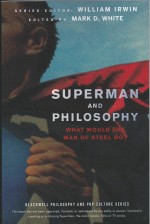
Superman and Philosophy – What Would the Man of Steel Do?


Essays by various, Edited by Mark D. White (Wiley-Blackwell)
ISBN: 978-1-118-01809-5

With the latest Superman movie set for a summer release there’s going to be a lot of ancillary material around, so here’s a comics-adjacent item that celebrates 75 years of the Man of Tomorrow whilst offering an interesting view askew of the merely expected…

Like organised religion, the discipline of Philosophy has had a hard time relating to modern people in the last half century and, just like innumerable vicars in pulpits everywhere, the greatest and most all-consuming preoccupation of the mind of Man has sought fresh ways to make its eternal questions and subjective verities understandable and palatable to us hoi-polloi and thickoes…

Publishers Wiley-Blackwell have certainly succeeded in making their message relevant by repackaging key and core concepts of the never-ending debate. Their intriguing and imaginatively far-ranging Philosophy and Pop Culture Series includes more than 40 enticing titles such as Batman and Philosophy: the Dark Knight of the Soul, Downton Abbey: the Truth is Neither Here Nor There, The Avengers and Philosophy: Earth’s Mightiest Thinkers and Terminator: I’ll Be Back, Therefore I Am amongst others. These engaging tracts marry the product of millennia of deep thought to easily accessible and seductively shared contexts you and I know like the backs of our hairy hands.

That’s applied phenomenology, that is…

It doesn’t hurt either that all the essays, produced by a legion of very smart people possessing a vast degree of familiarity with both their academic subject and the impossibly convoluted minutiae of the Superman mythology in all its multifarious multimedia formats, keep their arguments and verbal illustrations short, sharp, sweet and joyously funny.

And, by the way, this is a grown-up book so don’t expect any pictures inside…

The immensely engaging and successfully thought-provoking journey begins with

Following ‘Introduction: It’s a Bird, It’s a Plane… It’s Philosophy!’ our rocket-ship ride to reason opens with a crash course in Utilitarianism, Deontology and Virtue Ethics.  Part One – The Big Blue Boy Scout: Ethics, Judgment, and Reason investigates the underpinnings and outcomes of doing good by scrutinised the powder-keg of “moral philosophy” (concerned primarily with questioning the best way to live) through the super-vision lenses of ‘Moral Judgment: The Power that Makes Superman Human’ by Mark D. White, ‘Action Comics! Superman and Practical Reason’ by Brian Feltham, ‘Can the Man of Tomorrow be the Journalist of Today?’  by Jason Southworth & Ruth Tallman and ‘Could Superman Have Joined the Third Reich? The Importance and Shortcomings of Moral Upbringing’ by Robert Sharp.

The conundrums continue in Part Two – Truth, Justice and the American Way: What Do They Mean? as Daniel P. Malloy posits ‘Clark Kent is Superman! The Ethics of Secrecy’ after which Christopher Robichaud investigates the true meaning of ‘Superman and Justice’ and Andrew Terjesen asks ‘Is Superman an American Icon?’

Part Three – The Will to Superpower: Nietzsche, the Übermensch, and Existentialism goes a long way to cleaning up the cruelly tarnished reputation of the author of Thus Spake Zarathustra (inexplicably and unnecessarily retitled these days as Thus Spoke…) with ‘Rediscovering Nietzsche’s Übermensch in Superman as a Heroic Ideal’ by Arno Bogaerts, ‘Superman or Last Man: the Ethics of Superpower’ by David Gordon, ‘Superman: From Anti-Christ to Christ-Type’ by Adam Barkman and the tantalising argument ‘Superman Must be Destroyed! Lex Luthor as Existentialist Anti-Hero’ by Sarah K. Donovan & Nicholas Richardson…

We get to the heart of the matter – for comicbook geeks like me anyway – with Part Four – The Ultimate Hero: What Do We Expect from Superman? Using some very specific canonical examples, we sift through ‘Superman’s Revelation: The Problem of Violence in Kingdom Come by David Hatfield, ‘A World Without a Clark Kent?’ by Randall M. Jensen and close the case with ‘The Weight of the World: How Much is Superman Morally Responsible For?’ by Audrey L. Anton.

The review of the Big Picture continues with Part Five – Superman and Humanity: A Match Made on Krypton?, as Leonard Finkelman guesstimates ‘Superman and Man: What a Kryptonian Can Teach Us About Humanity’ whilst Terjesen returns to ask ‘Can the Man of Steel Feel Our Pain? Sympathy and Superman’ and Carsten Fogh Nielsen deliberates on ‘World’s Finest Philosophers: Superman and Batman on Human Nature’ before it all wraps up for now in Part Six – Of Superman and Superminds: Who Is Superman, Anyway? with the deepest levels of Persona examination in ‘“It’s a Bird, It’s a Plane… It’s Clark Kent” Superman and the Problem of Identity‘ by Nicholas Michaud, ‘Superman Family Resemblance’ from Dennis Knepp and ‘Why Superman Should Not Be Able to Read Minds’ by Mahesh Ananth.

In proper, rigorous academic manner there are also biographies in Contributors: Trapped in the Philosophy Zone, plenty of notes and attributions and a full Index: From Brainiac’s Files to aid you if your interests are piqued and your enquiring mind wants to know more…

Philosophy doesn’t exist in a vacuum: its primary purpose, whatever substrate espoused (Aesthetics, Epistemology, Ethics, Logic, Metaphysics, Social theory, Politics or any other field concerned with understanding reality, existence, knowledge, values, reason, mind or language), is to promote discourse and debate. The whole point is to get you thinking too…

And this delightfully appealing tome does exactly that…

© 2013 John Wiley & Sons Inc.

Superman and Philosophy – What Would the Man of Steel Do? is set for publication on May 16th 2013.

Signal: 02 – A Journal of International Political Graphics


Edited by Alec Dunne & Josh MacPhee (PM Press)
ISBN: 978-1-60486-298-0

“A week is a long time in Politics” – Harold Wilson

I’m going to go all traditional here and offer a few on-line dictionary definitions before I head off on one of my own oblique and off-kilter diatribes.

Politics can be reduced to:

  • The art or science of governing – especially of a political entity such as a nation – and the administration and control of its affairs.
  • The activities or affairs engaged in by a government, politician, or political party.
  • The methods or tactics involved in managing a state or government.
  • Intrigue or manoeuvring within a political unit or group in order to gain control or power.
  • The often internally conflicting interrelationships among people in a society

I’d like to add my own codicil which translates as

  • “Getting large groups of people to do what you want by making them believe it’s their own idea; as perpetually practiced by advertisers, teachers in classrooms, rich folk, commercial organisations and special interest groups, trades unions, and organised religions”.

The early years of the 21st century were plagued with horrors and disasters exacerbated by a hideous global proliferation of lying, greedy, venal, demented and just plain stupid bosses and governments. These paragons finally succeeded in elevating politicians of every stripe to that phylum of generally useless tools and pimples on the butt of humanity once only occupied by lawyers and management consultants.

Since then so many apparently entitled and greedy types like bankers, astrologers, wedding planners, doorstep evangelists, CEOs, celebrity gossip columnists, newspaper editors, the shamelessly privileged and all types of psychics have joined their rarefied ranks, and I’m thinking I probably need to either cut down on coffee or refine my critical parameters…

The century before that wasn’t much better either, but it did spawn a global awareness of the sheer symbolic power of pictures to promote debate, action and change. The political image was used over and over again by the underdogs – and to be honest, the more savvy oppressors – in countless intellectual wars as an irresistible Weapon of Mass Deliberation…

When creative passions are aroused there is no more powerful medium of expression or tool of social change than graphic narrative working in seamless conjunction with a trenchant, targeted image. Whether it’s the swingeing satire of reformers such as Hogarth, the prose of Dickens illustrated by Hablot Knight Browne AKA “Phiz”, the publications of Mark Lemon and Henry Mayhew (founders of Punch), the questing explorations of Will Eisner, Joe Sacco, Art Spiegelman and Marjane Satrapi or even the devastatingly deployed propaganda art of every nation on Earth, the incisive, excoriating or simply biting illustration wedded to the well-loaded word is an overwhelming force and Mass Communication’s only renewable resource: cheap, universally accessible and capable of extrapolating terrifying conclusions from the scarcest of supplied data.

Although not strictly a graphic novel, Signal: 02 was selected to begin this Week in Politics season because it embodies and celebrates the earliest and still most effective forms of mass communication; circumventing reason and language – often even literacy itself – by reaching through the eyes right into the heart and the gut of the viewer.

Signal is produced by illustrator, historian and printmaker Alec Dunn and designer/artist Josh MacPhee, co-founder of the Interference Archive and organizer of Celebrate People’s History Poster Series. Their occasional periodical is dedicated to documenting and sharing political graphics, creative projects and cultural artefacts of international resistance and liberation struggles.

Utilising typography and design in the same bold exuberant manner as the British Vorticist Movement‘s manifesto Blast (which declared war on traditional art in its landmark edition of 1914) to disseminate and keep alive historic moments of global mass-movements, this edition opens with Judy Seidman’s ‘Malangatana’s Fire’: a comprehensive review of the life and achievements of legendary revolutionary painter and UNESCO Artist for Peace Malangatana Valente Nguenha.

The liberally-illustrated piece celebrates the Mozambiquan painter, poet, musician and intellectual whose life and haunting works spanned his rural upbringing under Portuguese colonial rule through revolution and years of civil war to the current national renaissance and his role as Mozambique’s Cultural Ambassador to the World.

The artist’s stunning, moodily symbolic works carried his people through the liberation, civil war, decades of political turmoil and savage brutality into the peaceful present by exalting the people’s age old roots and symbols…

This is followed by ‘Street Murals in the Portuguese Revolution’ wherein Phil Mailer details the guerrilla art and its factional creators who plastered the walls of the nation in a massive explosion of anonymous popular creativity during and after a military coup toppled the Fascist government which ruled Portugal in April 1974, after which Editors Dunn & MacPhee offer a fascinating typographical treat in ‘Selling Freedom’.

This glorious visual reminiscence reveals a riot of ‘Early Twentieth-Century Anarchist Broadsides’ – letterpress printed, broadsheet advertisements for the venerable (established in 1886 and still going) publication Freedom: A Journal of Anarchist Communism. This entrancing example of the polemical power of the printed word is followed by ‘Cranking It Out Old School Style’ as Lincoln Cushing describes the age of Gestetner printers which first brought the process of mass communication into the hands of the people, long before photocopiers, faxes, computer printers, instant messaging and e-pages of every sort. In the hands of imaginative and determined artists visual miracles were made, from campaigns seeking to end violence against women to populist movements fighting prejudice and social injustice …

The ‘Art of Rebellion’ by Deborah Caplow then explores Oaxacan street art in context, recounting decades of internecine strife in Mexico, after which The Center for International Research on Anarchism: Japan describes the life of seminal printer, propagandist, anti-fascist, anti-militarist Esperanto advocate Taiji Yamaga who published radical periodical The People’s Newspaper and opposed the repressive militarist regime of the expansionist Warlords who were de facto rulers of Japan until the end of WWII. At the end of a turbulent life, the great thinker recreate key moments of his life in an autobiographical comic, and ‘Sketches from Memory’ is undoubtedly the star of this show, focussing a surmising light on ‘The Yamaga Manga and Japanese Anarchism’…

By captivatingly relating days and years of domestic intimacy, personal imprisonment, triumph, tragedy and turmoil under appalling political duress, Yamaga turns a spotlight on an aspect of Japanese history carefully glossed over and almost redacted from conventional histories…

‘A Heart of Concrete through Fire and Water’ by Kasper Opstrup Frederiksen explores the history and achievements of the Danish Røde Mor art collective 1968-78 which adopted showbiz techniques and public stunts to change the cultural landscape and mindset. After years of challenging, surreal events, the core of dedicated New Left surrealists in the “Red Mother” art collective gradually became subsumed into the national psyche, as a graphic workshop, a band, a circus and finally a fund to finance political art projects.

So was that a victory or a defeat?

Scholarly, challenging, utterly engrossing and intoxicating, this is a superb treat for everyone whose mind works in pictures and causes…

© 2012 PM Press. Individual copyright retained by respective contributors.

Philosophy – A Discovery in Comics


By Margreet de Heer with Yiri T. Kohl (NBM)
ISBN: 978-1-56163-698-3

There’s no use denying it: Annual Gift-Giving Season isn’t far off and it’s never too early to think of the ideal item for that troublesome family/friend unit. So here’s something that might fit the bill for any argumentative soul fed up with socks, pants and pen-sets…  

It has long been a truism of the creative arts that the most effective, efficient and economical method of instruction and informational training has been the comic strip.

Advertising mavens have for over a century exploited the easy impact of words wedded to evocative pictures, and public information materials frequently use sequential narrative to get hard messages over quickly and simply. Additionally, since World War II, carefully crafted strips have been constantly used as training materials in every aspect of adult life from school careers advice to various branches of military service – utilising the talents of comics giants as varied as Milton Caniff, Will Eisner (who spent decades producing reams of comic manuals for the US army and other government departments), Kurt Schaffenberger and Neil Adams.

These days the educational value and merit of comics is a given. Larry Gonick in particular has been using the strip medium to stuff learning and entertainment in equal amounts into the weary brains of jaded students with such tomes as The Cartoon History of the Universe, The Cartoon History of the United States and The Cartoon Guide to… series (Genetics, Sex, Computers, Non-Communication, Physics, Statistics, the Environment and more).

Japan uses a huge number of manga text books in its schools and universities and has even released government reports and business prospectuses as comic books to get around the public’s apathy towards reading large dreary volumes of public information.

So do we, and so do the Americans.

I’ve even produced one or two myself.

Now the medium has been used to sublimely and elegantly tackle the greatest and most all-consuming preoccupation and creation of the mind of Man…

Margreet de Heer was born in 1972 into a family of theologians and despite some rebellious teen forays to the wild side of life – fascinatingly covered in the ‘Know My Self’ section of this fabulous graphic primer – studied Theology for 9 years at the University of Amsterdam. After graduating in 1999 she decided to become a cartoonist – and did – but also worked at the wonderful comics and cool stuff emporium/cultural icon Lambiek in Amsterdam.

Whilst there she collaborated with industry expert Kees Kousemaker on a history of Dutch comics before becoming a full-time professional in 2005, with commissions in publications as varied as Yes, Zij aan Zij, Viva Mama, Flo’, Jippo, Farfelu and NRC.Next.

In 2007 she began a series of cartoon philosophical reports for the newspaper Trouw, which prompted a perspicacious publisher to commission a complete book on this most ancient of topics. Filosofie in Beeld was released in 2010 and translated into English by NBM this year as Philosophy – a Discovery in Comics.

This gloriously accessible tome, crafted by a gifted writer with a master’s grasp of her subject, opens with the core concept ‘What is Thinking?’ examining the processes of mind through a number of elegantly crafted examples before moving onto ‘Who Do We Think We Are?’

Those paradigms of ‘Self-Awareness’, ‘Logical Thinking’, ‘Language’, ‘Symbols’, ‘Abstract Thinking’ and ‘Humor’ are captivatingly covered before the history and cognitive high points of civilisation are disclosed with ‘The Foundation of Western Philosophy’.

This potted history of ‘Dualism’ relates the life stories, conceptual legacies and achievements of ‘Socrates’ and the ‘Socratic Discourse’, his star pupil ‘Plato’ and the universal man ‘Aristotle’, all winningly balanced with a balancing sidebar autobiography in ‘Know My Self’ plus some cogent observations and a few comparisons with the Eastern philosophy of ‘Unity’…

‘Medieval Philosophy’ deals with the influence of the Christian Church on ‘Augustine’ and ‘Thomas Aquinas’, the “Great Thinkers” of early Europe, examining the warring concepts of ‘Free Will’ and ‘Predestination’ and exploring the lives of ‘Erasmus’ and ‘Humanism’, ‘Descartes’ and his maxim ‘Cogito Ergo Sum’ and ‘Spinoza’ whose consummate faith-based dictum was ‘Know Thyself’…

The charming, beguiling foundation course continues with ‘What is Reality?‘ bringing us up to the modern age with ‘And Now’ with another brilliantly clever diversion as de Heer includes the ‘Personal Philosophies’ of families and friends.

Her husband – and this book’s colourist – Yiri bases his outlook on the incredible life of outrageous comedian ‘George Carlin’, her aged friend Gerrit looks to ‘Nietzsche’, mother-in-law Yolanda modelled herself on Cambridge lecturer and intellectual ‘George Steiner’ whilst De Heer’s little brother Maarten prefers to shop around picking up what he needs from thinkers as varied as ‘Aldous Huxley’ to cartoonist ‘Marten Toonder’ as well as bravely putting her money where her mouth is and revealing her own thoughts on Life, the Universe and Everything and asking again ‘What Do You Think?’…

This is a truly sharp and witty book – and the first of a trilogy that will also deal with Religion and Science – which splendidly reduces centuries of contentious pondering, violent discussion and high-altitude academic acrimony to an enthralling, utterly accessible experience any smart kid or keen elder would be happy to experience. Clear, concise, appropriately challenging and informatively funny Philosophy – A Discovery in Comics is a wonder of unpretentious, exuberant graphic craft and a timeless book we can all enjoy.

© @2010 Uitgeverij Meinema, Zoetermeer, TheNetherlands. English translation © 2012 Margreet de Heer & Yiri T. Kohl.

Win’s Christmas Gift Recommendation: Perfect for anybody with a brain or heart… 9/10

The Co-operative Revolution – A Graphic Novel


By Polyp, with Paul Monaghan, Rachel Vorburg-Rugh, Gillian Lonergan, Ed May and Ian Nixon (New Internationalist on behalf of the Co-operative Group)
ISBN: 978-1-906523-19-0

You might not be aware of it but 2012 is the United Nations International Year of Co-operatives – which I’ll define here as people working in community rather than competition, and applying that fundamental principle to the world of business.

Today Co-operative societies and groups have spread to every corner of the globe and proved a successful and frequently innovation-friendly alternative model to straight consume-expand-or-die Capitalism in commercial arenas as varied as wholesale and retail, agriculture, journalism, banking, car-making, textiles, construction, hotel management, all sorts of service industries and even Healthcare provision.

The potential of the simple notion of working together for mutual benefit seems to terrify some people – let’s call them greedy and selfish – but since the successful experiment of the Rochdale Pioneers in 1844 the philosophy has grown and blossomed and provided decent livelihoods for generations of workers and enabled them to provide increasingly better lives for their children.

Co-operation isn’t a tactic or model but rather a philosophy that encourages people to take full responsibility and reward for the fruits of their labours, which necessarily makes all their endeavours operate on a human scale and with a face anonymous corporate production finds impossible to match or emulate. The modern, thriving international movement grew from an impassioned but measured response to the worst excesses of the Commercial Age and is deftly recounted in the first section of this compelling and informative graphic history.

During the early years of the Industrial Revolution it was standard practice for the owners of British factories and industrial works to pay appalling wages to their workforces and simultaneously run the only shops where those meagre remunerations could be spent. Usually the bosses also owned the houses where workers lived: another method of ensuring the monies they paid out coming back into their own coffers.

As you’d expect such a closed system was easily prone to abuse: sales to the labourers – food, candles, clothes and every other household need – were rife with shoddy, cheap workmanship, with debased and adulterated food frequently sold in short measures and priced in such a way as to keep workers alive but with no hope of improving themselves or escaping the system. Credit was always extended – with no real intention of ever collecting on it – and workers were trapped forever in an inescapable spiral of debt to the company. It was pure economic feudalism and little better than slavery.

Many times before, workers had attempted to address the problem by uniting to buy goods in bulk and distribute them communally, but always the enterprises had failed. However on December 21st 1844 in Rochdale, a small band of working men – weavers, colliers, woolsorters and cloggers – pooled their small cash reserves and opened a rough-and-ready general store selling flour, sugar, butter and candles, promising “unadulterated wares in honest weights and measures”.

Instead of mutually ruinous credit, The Rochdale Society of Equitable Pioneers offered all members of their collective enterprise a dividend – a fair and regular redistribution of profit after working costs were covered.

As the chapter ‘Yesterday’ details, despite fierce and unscrupulous opposition from established businessmen and authorities terrified of revolution by the lower class, the Co-operative movement endured and grew. When farmers and companies were squeezed to stop them providing produce to the Pioneers, the Society simply went further afield and even began sourcing or making their own items – a process and solution repeated over and again through nearly 170 years of continued existence and growth.

The burgeoning movement was a constant force for social mobility and improvement: in their first rented premises in Toad Lane, the upper floor swiftly became meeting rooms and a free Library, with not just books but microscopes, globes and all modern scientific instruments where the poor could educate themselves to eventually escape the trap of ignorance and poverty the wealthy created for them…

The slow but solid growth and geographical expansion of the radical movement is charted against the changing social and cultural climate in a beguiling and elegiac potted history after which ‘Today’ recounts many examples of successful Co-operative practice currently improving lives better all over the world.

One of the movement’s greatest successes was the establishment of Fair-Trade farms, plantations and other businesses around the globe, from Canada where more than a third of the World’s Maple Sugar is produced by Co-ops, to the USA where 900 rural Co-ops produce 42% of the nation’s electricity distribution, covering 75% of the landmass.

In India – where 239 million people belong to a Co-operative society – a tribe of hereditary snake-catchers even transformed their unique, traditional but dying trade into a thriving repurposed business.

Closer to home, when I first started freelancing as an artist/graphic designer, I belonged to a loose association of specialists who shared or traded jobs according to our specialities and particular strengths…

Almost as soon as they were published, Darwin’s discoveries regarding the fundamental evolutionary principle described as “Survival of the Fittest” were co-opted by Capitalists, hungry to justify their appalling excesses. Here ‘Always’ focuses on the plenitude of scientific discoveries which counter those spurious commercial notions and act as a happy rebuttal to the spurious commercial mantra of an utterly unchecked free market which continuously permits greedy and cavalier bankers to bankrupt economies and nations, whilst rapacious rampant tycoons and corporations create Crash after Recession after Depression, over and over again and with no thought of redress or reparations to the billions of people they impoverish…

‘Tomorrow’ takes a speculative look at how Co-operation could take us to even greater communal achievements by following a really good day in 2044 when the happy partners of the Rochdale Aerotech Co-op celebrate their contribution to the mission which is landing men on Mars…

This alluring and pleasingly education chronicle concludes with an absorbing ‘Timeline’ following the progress of “Co-operation Through History” by tracking changes in politics and culture promoted, prompted and provoked by the movement from the very first recorded 1769 bulk purchase scheme of the Fenwick Weavers to the 2012 UN declaration of the International Year of Co-operatives…

Since its creation, the Co-operative movement has promoted education for the poor, social equality, universal health, and equanimity in farming, banking, manufacturing and production. By making simple retail fair it has freed society’s least advantaged from de facto slavery, shaped political and social reform across the world and offered true opportunity for improvement and a better life for all people.

This wonderful book – hopefully destined for every school library and history syllabus – using all the force and power which only comics narrative can provide, is a sterling example of what people can do when working together and in unity and one no fair minded individual should miss.

© The Co-operative Group. All rights reserved.
Radical cartoonist and activist Polyp has worked with campaigning organizations around the world for over fifteen years. He lives and works in a co-operative housing complex inManchester,England.

Japan Inc. – an introduction to Japanese Economics


By Shōtarō Ishinomori, translated by Betsey Scheiner (University of California Press)
ISBN: 978-0-52006-289-4

It’s often been said, but bears repeating here: “Comics are an integral part of Japanese life”. There’s no appreciable difference to Eastern eyes between sequential pictures and prose, so it makes sense that such a medium should be used to educate and elucidate as well as entertain. After all the US military reached the same conclusion after WWII when they commissioned comics legend Will Eisner to design instruction manuals in strip form, and produce similar instructive material for Services magazines like P*S, the Preventative Maintenance Monthly, which even the least schooled G.I. could understand…

In late 1986 Nihon Keizai Shimbun, Japan’s analogue of the Wall Street Journal, commissioned manga star Shōtarō Ishinomori to adapt a serious economic text – Zeminaru Nihon keizai nyÅ«mon published by the newspaper – into a mass market comicbook. Manga Nihon keizai nyÅ«mon sold more than half a million copies in its first year…

Soon after, Securities and Investment companies were using strip brochures to explain the complexities of their latest stock market products and by the mid 1980s benkyō and jitsumu manga (“study comic” and “practical comic”) were an integral part of school and college libraries. Naturally, there were sequels to Manga Nihon keizai nyūmon…

Shōtarō Ishinomori (nee Onodera and Ishimori; January 25th 1938 – January 28th 1998) is officially the World’s most prolific comics artist. After his death the Guinness Book of Records posthumously recorded his 128,000+ pages – often generated at the rate of 200-300 pages a month! – the most ever produced by a single creator.

In 1955, when the boy was simply keen fan of Manga pioneer Osamu Tezuka, the God of Comics took the lad on as his assistant and apprentice, beginning with the iconic Tetsuwan Atomu – or Astro Boy to you and me…

Thereafter, until his death Ishinomori worked ceaselessly in Manga, Anime, Games and Tokusatsu (live action superhero shows such as Kamen Rider – a genre he practically invented) developing groundbreaking series such as Super Sentai, Cyborg 009, Sabu to Ichi Torimono Hikae, Ganbare!! Robokon and countless others.

There is a museum dedicated to his career in Ishinomaki, Miyagi and trains to and from the site are decorated throughout with his myriad cartoon creations.

Following a comprehensive and informative account on the development and growth of comics in Japan by Stanford University’s Peter Duus, this oddly engaging English-language edition reveals the way the Japanese perceived their own economy’s function and global position through the fictionalised lives of a small group of workers at the mythic conglomerate Toyosan Automobile Corporation and its affiliate the Mitsutomo Company.

The cast are idealised concepts of the nation’s business life: Kudo is a good and kind-hearted executive, always seeking to put profit in a social framework that benefits everybody, whilst his colleague and rival Tsugawa is a ruthless, go-getter to whom people are expendable and only the Bottom Line matters. Above them is wise manager Akiyama, with the women’s role exemplified by shy yet passionate Miss Amamiya, whilst young office junior Ueda portrays the verve, exuberance and inexperience of the next generation of Japan’s workers…

The elucidating episodes begin with ‘Trade Friction’ as in 1980 American car workers begin attacking imported Japanese cars. Ever hungry for a fast buck, the US motor industry lays off staff and attempts to force Washington into curtailing Japanese imports…

If the exporting nation is to maintain its growth, it may have to shift production to the USA and leave its own workers and subcontractors out in the cold. Soon there’s panic at Toyosan’s factory and the union is up in arms, but whilst Tsugawa has no problem with that, the ingenious Kudo is working on a plan to diversify and provide new jobs for the ordinary Japanese suffering under the outrageous US tactics…

‘Countering the Rise of the Yen’ sees the disparity in international exchange rates threaten Imahama City as their crucial export trade crumbles. When Tsugawa seizes the opportunity to buy the place cheap and turn it into a Mitsutomo amusement park, once more Kudo interferes, seeking a way to keep all the citizens of the district fully employed whilst delivering a sound lesson on the way to balance family life and duty to the company…

Geo-political affiliations and the ever-shifting balance of power in rogue states comes under scrutiny in ‘Industrial Structure’ when a Middle-Eastern country seeks to revive a secret industrial process and past alliance with Mitsutomo. The shady deals that were struck in the pursuit of guaranteed resources offer huge potential profit but a concomitant risk of disastrous political and financial fall-out if the scheme is exposed. Of course Tsugawa and Kudo and their respective mentors Toda and Akiyama are in the thick of things in a chapter dramatically illustrating how changes in international political climate reshape Japan’s industrial structure…

The nation’s welfare system is tested in ‘Deficit Finance’ as Ueda’s aged grandmother comes to visit and Japan’s social services are scrutinised by Tsugawa and Kudo, who learn the advantages and drawbacks of government-led initiatives whilst both learning some hard-hitting historical lessons about the last (in their case 1965) Recession…

‘A Monetary Revolution’ describes the inexorable global banking de-regulation of the 1970s and 1980s as Tsugawa visits London following the “suicide” of an Italian banker and falls into a hornet’s nest of trouble by involving Mitsutomo in a “Fi-Tech” scheme (covert financial speculation between banks, usually achieved by mutually monkeying with the proposed profit margin) that involves the Vatican’s Mafia-run Financial House… Anybody else positively dizzy with déjà vu…?

When it all comes bubbling to a head it’s only Kudo’s swift thinking and sharp dealing that turns an unmitigated catastrophe into a business triumph, after which the ‘Epilogue’ neatly sums up the subtly effective lessons learned throughout the book and depicts our cast as the look forward to what might lie ahead

Using a stylish soap-opera and captivatingly effective scenario to put a personal face on history – or indeed Global Finance in this case – is a technique the modern film industry has used for decades, with fictionalised accounts of historical figures and events as far-ranging as The King’s Speech to Flight 93 to Shakespeare in Love leading a vital veracity to even the most fanciful proceeding, and it works magnificently here whilst the subplots (sex, political intrigue, bribery, espionage, blackmail, sacrificing family life for the job and, of course, the war between prosperity and personal honour) all work perfectly to put a human frame to what might seem dry and dusty lecturing

Whilst not to everyone’s taste, this book certainly shows how emphatic and powerful a tool comics can be, whilst to my mind it has a far more lasting dramatic appeal than many of its contemporary money-worshipping entertainments such as Dallas, Dynasty or Wall Street…

One interesting point about this book is the perceptible subtext and open undercurrent describing a general mistrust of all politicians – shadings that most British scholarly texts are keen and careful to disguise at all costs. US President Ronald Reagan is constantly depicted as either a buffoon or a conniving demon but he gets off lightly compared to Japanese officialdom, from the lowliest local administrator or union rep all the way to the highest statesmen in the land…

Here the words and pictures don’t prevaricate: Business Good, Politicians Bad…

And on that I couldn’t possibly comment…

© 1988 the Regents of the University of California. © 1986 Shōtarō Ishinimori, reprinted by permission of Nihon Keizai Shimbun, Inc.

The Comics Journal #301


By various, Edited by Gary Groth & Kristy Valenti (Fantagraphics Books)
ISBN: 978-1-60699-291-3

After far too long a hiatus the new incarnation of The Comics Journal is available and as inspired as ever.

The Journal is the paramount English-language publication dedicated to the Art of graphic narrative, covering comics, cartooning and related fields domestic and global; interviewing creators, disseminating the facts and even advertising the best and most challenging product. They’ve done it competently, passionately and proudly for decades. You won’t always agree with the opinions expressed – editorial or from the many and various insiders and cognoscenti who have been featured – but you’d be an idiot to ignore or dismiss them if you care at all about the industry or the medium.

This latest offering, a truly monolithic square-bound book; 624 mostly monochrome pages but with lots of colour where necessary, devotes most of its mass to possibly the most important comics work of this new century whilst still finding ample room to examine one of its few rivals for primacy from the entire 20th century, an appreciation of a lost classic, an examination of the latest blockbuster from the founder and master of comics-reportage and much, much more.

In 2009 W. W. Norton and Co. released The Book of Genesis Illustrated by R. Crumb. The 200 page comics adaptation of the Robert Alter version of the old testament was the stunning result of four years of intense research, creative thought and non-stop drawing… and for most of us it’s a big contender for the artist’s absolute magnum opus.

R. Crumb: The Genesis Interview sees the always intriguing and painfully forthcoming master draughtsman talking to Gary Groth about every aspect of the project after which Roundtable: the Book of Genesis Illustrated by R. Crumb is thrown to a pack of critics and cognoscenti for analysis, rebuttal, refutation and literary transubstantiation. Rick Marschall contributes ‘Pilgrim’s Process’, Donald Phelps describes ‘An Epic Visualized’, Robert Stanley Martin declares ‘Crumb Finally Finds his Limits’, Jeet Heer dispassionately examines ‘Genesis Revisited’ and Tim Hodler follows the ‘Straight Lines’, whilst Alexander Theroux considers why and how ‘Crumb Goes to Church’ and Kenneth R. Smith caps off the initial set of theses with ‘A Book For Man Recounted in a Book By/For/Of Man’.

This is followed by an utterly absorbing Roundtable Responses feature in which the assembled contributors react to what each other propounded…

After that compelling 190-odd page lead section the first Sketchbook instalment delves into the mind and portfolio of Jim Woodring, in a compelling interview liberally spiced with the cartoonist’s working drawings, doodles and photos from Weathercraft and a host of other superbly eclectic classics

Al Jaffee & Michael Kupperman in Conversation is another magical dose of back and forth banter between an industry legend and rising star, moderated by Groth and liberally illustrated with work from both parties in case you’re unfamiliar with their oeuvre. In this case the stellar career and newest work of the Mad Magazine veteran and inventor of “Fold-ins” is counterbalanced with the surreal enticements of the unique talent behind Tales Designed to Thrizzle.

Warren Bernard (co-author of Drawing Power: A Compendium of Cartoon Advertising 1870-1940) outlines the career of one of the early industry’s greatest stars in John T. McCutcheon: A Cartoonist and His Dog before Sketchbook: Tim Hensley highlights the work of the relative newcomer behind the wonderful Ticket Stub.

Tim Kreider is the brilliantly acerbic and effective cartoonist/essayist/political gadfly behind Twilight of the Assholes and here he examines a series I’ve always loved but been too timid and lazy to review in Irredeemable: Dave Sim’s Cerebus.

Joe Sacco on Footnotes in Gaza is another illuminating interview by Groth, wherein indomitable champion of truth Sacco discusses his latest graphic novel, whilst Sketchbook: Stephen Dixon reveals the stunning an nigh-obsessive graphic facility of the prolific novelist and short-story writer behind Tisch, I, Time to Go, Meyer and so many others…

The ‘Reviews’ section further covers Sacco’s Footnotes in Gaza with a comprehensive dissertation from Kent Worcester, Ryan Holmberg dissects Yoshiro Tatsumi’s Gekiga manga masterwork Black Blizzard and Robert Stanley Martin delves into the collected wonderment of Eddie Cambell’s semi-autobiographical gem Alec: the Years Have Pants.

Marc Sobel’s ‘The Decade in Comics’ examines what might be the milestones of the last ten years – you decide – R. Fiore has “another Go-round with Racial Caricature” in the challenging ‘Affectionate, Sympathetic and Completely Racist’ and ‘Cartoonists Leading Cartoonists’ by Rob Clough reports on a unique industry mentoring program at the Center for Cartoon Studies.

In ‘Gus Arriola and the Comic Strip that Never Was – Until Now’ R. C. Harvey explores another strip which might have added to the late ‘Gordo‘ creator’s lustre: the adumbrated adventures of Persian delight Pussy Willow – a cat of means and many sharp ends…

‘Maggots and Time’ by Chris Lanier examines Brian Chippendale’s expressive and experimental Maggots comic in the context of art capturing motion and progression and a huge full colour comics section reprints Dell’s comicbook adaptation and licensed continuation of UPA’s cartoon classic ‘Gerald McBoing Boing’ – itself an animation of a superb Dr. Seuss tale – introduced here by animation legend Gene Deitch, after which the whole colossal chronicle circles back to point zero by revealing ‘Three Questions Answered about Robert Crumb’: a retrospective disquisition by Tom Crippin which closes this fabulous treasure trove of intellectual comics discourse.

Although it feels like it has always been part of our lives, TCJ only began business in 1976, interviewing creators, reporting on trends and events and generally assuming the critical role of critique-ing: a self-aware gadfly within and without our industry: celebrating the history and innovation of all aspects of cartooning and graphic narrative, keeping the balance between sales and artistic integrity firmly tipped on the side of the latter. It has for decades been the only place Americans hear of what the rest of the world of comics is doing.

This is a superb uber-magazine for comics lovers: it won’t ever tell you where and when to buy but it will certainly make you wonder why you do or don’t…
© 2011 Fantagraphics Books, Inc. All images/photos/text © their respective copyright holders. All rights reserved.

Blabworld #1


By various, edited by Monte Beauchamp (Last Gasp)
ISBN: 978-0-86719-746-4

For decades Monte Beauchamp’s iconic and innovative narrative and graphic arts magazine Blab! has highlighted the best and most groundbreaking trends and trendsetters in cartooning and other popular creative fields. Initially published through the auspices of the much missed Dennis Kitchen’s Kitchen Sink Press it moved over to Fantagraphics and now it has resurfaced, reformed in a snazzy hardback annual format from Last Gasp.

As ever there is an eclectic and eye-popping mix of strips, articles and features on show and Blabworld #1 opens with a gloriously enchanting sequence of paintings describing everything you wanted to know about ‘Slime Moulds’ crafted by Geoffrey Grahn, after which Kari Laine McCluskey enchants and disturbs with a series of toy and doll photomontages entitled ‘Colloidion’.

Greg Clarke delivers a droll and dry assault on the obsessive ownership mentality with ‘The Neurotic Art Collector’, Bill North examines youth’s most popular graphic symbol in ‘Skull!’ – an article tracing the use of the memento mori in popular publishing with loads of cool covers to ogle and covet – and Nora Krug relates in unique cartoon manner ‘Quicksand: The Tumultuous Life of Isabelle Eberhardt’, before cover artist Shag delivers another magically hip gag on the consumer society.

The major central portion of this volume is devoted to magnificent artworks in a variety of media from a stellar collection of artists grouped together under the umbrella theme of ‘Artpocalypse’:

Ron English contributed ‘The Creation of Evolution’, Ryan Heshka depicted ‘The Rapture’, Owen Smith showed ‘Fin’ and Jean-Pierre Roy revealed ‘No Secrets Left From Us.’ ‘Beyond the Fence’ came via Martin Wittfooth, Kathleen Lolly showed ‘Knowledge Dies Too’ and Andy Kehoe painted ‘When the Last Leaf Falls’. Andrea Dezso contributed ‘Strangely Normal’, Natalia Fabia ‘Hooker in the Apocalypse’, Karen Barbour ‘Lamentations Over the Merciless Void’, Edel Rodriguez ‘Farewell to Grace’ and Fred Stonehouse ‘Dream of St. John’.

‘Well-Matched Lovers’ by Marc Burckhardt is followed by Femke Hiemstra’s ‘Hayano & Koheu’, Calef Brown’s ‘Endtime Tigerbird’, Larry Day’s ‘Rapture in Birdville’ and underground commix legend Spain Rodriguez delivers a glimpse of ‘2012’.

Lowbrow art virtuoso Mark Ryden displays his ‘End of the World’, Yoko D’Holbachie contributes ‘Final Farewell’, Gary Basemen ‘Another Average Day’, Alex Gross ‘Jozaikai (Purgatory)’, Sue Coe ‘Revenge of the Swine’, Sofia Arnold ‘Smoke Cave’ and Gary Taxali illuminates both ‘End World’ and ‘Rapture’.

‘Armageddon Flub’ by Travis Lampe, John Pound predicts ‘All Things Must Fall’, Kris Kuksi conducts ‘An Opera for the Apocalypse’ and Ryan Heshka returns to deliver a ‘Flaming End’ (as well as the mesmerising back cover).

Michael Noland reveals the ‘Revelation Roaches’, Teresa James collects ‘Weapons of Divine Power’, and Tom Huck a ‘Pile O’ Poon’ before Joe Sorren wraps it all up with ‘The Secret Collapse of Miss Lorraine’.

After the art show Sergio Ruzzier takes up the comic strip baton with a mercurial watercolour saga entitled ‘The Life of an Artist’, designer Steven Heller explores the hypnotic cover art of R. Crumb in ‘Covering Weirdo’ whilst James Lowe relates the astounding history of ‘Propaganda Caricature Art of World War II’ in ‘Axe the Axis!’ before Mark Landman amuses and offends with the story of ‘Fetal Elvis’ Art Empire’.

Steven Guarnaccia adapts Julia Moores poem ‘Lament on the Death of Willie’, Mark Todd details the sordid horror of ‘The Dreaded Mothman of West Virginia’ and ‘Ballpoint Bravura: Drawings by CJ Pyle’ spotlights the incredible dexterity and imagination of the rock drummer turned graphic craftsman with superstar Peter Kuper dramatically closing out this first fantastic happening with his appropriately apocalyptic strip ‘Four Horsemen’

There has never been a more vibrant and exciting time for lavish imaginative art and cutting edge graphic narrative and this superb catalogue of marvels is sure to become a watchword for what to watch out for.

© 2010 by the respective creators and contributors. All rights reserved.

Great British Comics


By Paul Gravett & Peter Stanbury (Aurum)
ISBN: 978-1-84513-170-3

We’re far too reluctant in this country to celebrate the quality and history of our own comic strip tradition; preferring simply to remark on the attention grabbers or impressive longevity of one or two classic and venerable holdovers when the actual truth is that for an incredibly long time the British comics and periodicals industry was vast, varied and fantastically influential.

After my now Customary Disclaimer where I admit that I know and have worked with an author or creator before, (in this case editor/designer/curator/writer/journalist/historian and genuinely brilliant dedicated devotee of all things panel-related, Paul Gravett) and admit to a possibly conflict of interest, I’d like to turn your attention fully to this truly marvellous pictorial dissertation, chronicle, memoir and celebration of the uniquely different world of comforting whimsy, raging tomfoolery, outrageous derring-do, jingoism, anarchy and class warfare that is British comics.

First released in 2006 this confabulation “celebrating 100 years of Ripping Yarns and wizard wheezes” traces the history and social impact of the medium from its earliest popular origins in such illustrated literary pamphlets as the Glasgow Looking Glass and Punch through the separation into adult and juvenile publications, prose story-papers, newspaper strip features and eventually the frenetic blend of words and drawings that we think of today as sequential art.

The book is liberally, bounteously stuffed with not just reams of illustrations but also loads of evocative photographs of the creators (for so long rendered invisible and uncredited by corporate dictat) and most importantly the generations of eager end-users who devoured these imagination-sparking treasures.

‘Lost Worlds of Topsy-Turvy’ tracks the progress of the medium and its lasting effects through an examination of nostalgia and fascination, providing an impressive overview of how and why we love these things and even including a chart marking the chronological timeline of British comics and how long they ran for. Got a favourite publication? Check it out here…

‘For Richer, For Poorer’ features the classic family and national set-up under the British class system, with examples from Alley Sloper’s Half-Holiday, The Broons, Weary Willie and Tired Tim and Posy Simmonds’ The Silent Three through to the terrifying modern icons The Fat Slags from Viz, also visiting with such varied neighbours as Giles’ immortal family, Donald McGill’s saucy postcards, Raymond Williams and the drawing room humour of Bateman, Fougasse, Heath Robinson and Reg Smythe’s Andy Capp.

The vast pictorial end-section includes further graphic examples including strips from Funny Wonder, The Joker, The Jester, John Millar Watt’s Pop, The Ruggles, The Gambols, and even such lost minor modern classics as Phil Elliott’s The Suttons makes a worthy appearance alongside more well-known strips as Alex, Bristow, The Fosdyke Saga and Colonel Pewter.

‘Spitting Images’ covers the British public’s love affair with entertainment and celebrities; spotlighting such publications as Dan Leno’s Comic Journal, Film Fun, Radio Fun, Look-In and others, with strips starring Charlie Chaplin, Arthur Askey, Laurel and Hardy, Terry-Thomas, Tommy Cooper, Norman Wisdom and The Beatles, proper heroes such as Horatio Nelson, Churchill, Isombard Kingdom Brunel, Dylan Thomas, James Joyce and Andy Murray, plus notionally lesser lights such as Troy Donahue, Adam Ant, Big Daddy, Margaret Thatcher, Tony Blair, Hitler and McFly plus so many others all rendered with tremendous skill, wit and not a little Anglo-Saxon charm and sarcasm…

‘Down on Jollity Farm’ explores our vast wealth of anthropomorphic modern fairy-tales from George Studdy’s Bonzo, Teddy Tail, Tiger Tim and the Bruin Boys, Muffin the Mule, Rupert Bear, Pip, Squeak and Wilfred, Count Duckula, Danger Mouse and Wallace and Gromit; even finding room for less savoury kiddies’ fare as the government sponsored adaptation of Animal Farm, Fungus the Bogeyman, Firkin the Cat and Savage Pencil’s punk poesy Rock ‘n’ Roll Zoo.

The anarchic animal stars of DC Thomson, Fleetway and Odhams Press are represented by such wild and woolly class acts as Kid Kong, The Crows, Sid’s Snake, The Three Bears, Mickey the Monkey, Mighty Moth and my own personal bete noir-et blanc, Reg Parlett’s fabulous Mowser the Priceless Puss…

Our preoccupation and virtual obsession with school days is made manifest in ‘Wheezes in the Tuck Shop’ examining the range of educational experience from Billy Bunter and Just William to The Bash Street Kids and the Swots and the Blots, and includes little gems such as Oor Wullie, Lord Snooty and his Pals, Nipper, Dennis the Menace, Roger the Dodger, Winker Watson, Baby Crockett, Sweeney Toddler, and Johnny Fartpants yet still finds room for such unconventional problem children as Ken Reid’s The Nervs, Dare-a-Day Davy and Faceache, Lew Stringer’s Tom Thug and Stephen White’s Dreadlock Holmes.

British kids of all ages have always been captivated by weird worlds and fantastic futures and ‘Things to Come’ traces the development of the science fiction and fantasy strips in the children’s papers from Tom Wilkinson’s fantastical Professor Radium, through such adventure stalwarts as Swift Morgan, Captain Conquest, Jet-Ace Logan, General Jumbo, Robot Archie, Rick Random and all the rest, with all appropriate attention paid to the iconic Dan Dare and Judge Dredd whilst still finding time and space for the likes of Jeff Hawke, the Trigan Empire, and such TV titans as Dr. Who, Thunderbirds, Stingray, Fireball XL5 and such truly groundbreaking strips as V for Vendetta and The Amazing Mr. Pleebus.

If you’d been paying attention instead of staring out the window you might have noticed that all the above cited specimens in ‘Wheezes in the Tuck Shop’ were boys, but don’t think we’ve forgotten the weaker sex (I just checked and there still isn’t an emoticon for trenchant, bitter irony); they just get a section all to themselves in ‘Jolly Hockey Sticks to Sheroes’.

Ladies and girls in comics haven’t always been well-treated. That’s more because the material was mostly created by men not women rather than for any male militant or subversive agenda. However the wealth of strips produced over the decades usually makes up in sheer visual quality what it might lack in relevance or political correctness.

This chapter delves into the female experience through full-on action stars such as Modesty Blaise, Lady Penelope, Judge Anderson and Tank Girl, thoroughly Modern Misses like Three Girls in a Flat, Carol Day, Tiffany Jones, Beryl the Bitch and Tamara Drew and the best from a century of unrepentant glamour pusses from Jane to the inimitable Arthur Ferrier’s assorted dazzling “Dizzy Dames”.

Those all important school days are covered with outings ranging from the little darlings of St. Trinians, to Bunty, Misty, an assortment of ballerinas, gymnasts and orphans and such daring vengeance-taking teams as the Silent Three and The Four Marys. Not-so-Good-Girls include Beryl the Peril, Pansy Potter (…the Strong Man’s Daughter), Keyhole Kate, Minnie the Minx and the formidable Bad Penny.

This compelling compendium concludes with a chapter on the broad spectrum of fantastic adventure heroes and the anti heroes we Brits have always seemed more comfortable with. Exemplars include The Spider, Marvelman, Chang the Yellow Pirate, P.C. 49, Captain Pugwash, Morgyn the Mighty, Desperate Dan, historical bravos like Robin Hood, Dick Turpin, Captain Blood, detectives including Sexton Blake, Blackshirt, Tug Transom, Buck Ryan and Romeo Brown, and a sporting pantheon which includes the Tough of the Track, Wilson – the immortal Man in Black, His Sporting Lordship, race car ace Skid Solo and of course the legendary Roy of the Rovers.

The British love of combat is represented by Biggles, Battler Britton, V for Vengeance, Charley’s War, Darkie’s Mob, the fearsome Captain Hurricane and a selection from the long running Commando Picture Library among others, western strips by Tony Weare, Denis McCloughlin, Robert Forest and Frank Humphris, and our frankly skewed take on superheroes is displayed in and counter-pointed by examples including House of Dollman, Frankie Stein, Jonah, Grimly Feendish, The Cloak, Charley Peace, Yellowknife of the Yard, Kelly’s Eye, Janus Stark, the Steel Claw, Billy the Cat and Captain Britain.

If you’re a lover of epics there are also stirring reminders of the spectacular grandeur of Michael Moorcock and Ron Embletons’s Wrath of the Gods, Wulf the Briton (Mike Butterworth and Embleton) and Tom Tully and Frank Bellamy’s Heros the Spartan…

Whilst not too detailed this splendid tome contains a magical abundance of images and information and presents them in a welcoming torrent of bite-sized facts and gloriously moving pictures pages that no old fan could resist and which cannot help but beguile and intrigue the unconverted. This is a perfect introduction to the medium and could almost act as a shopping list for any publisher looking to find the next big thing to bring back.

Just imagine: brand new collections of any or all of these immaculate confections…

© 2006 Paul Gravett and Peter Stanbury. All Rights Reserved. All artwork © its respective owners and holders.

Wanted: Undead or Alive: Vampire Hunters and other Kick-Ass Enemies of Evil


By Jonathan Maberry & Janice Gable Bashman (Citadel Press)
ISBN: 978-0-8065-2821-2

Although out of my usual comfort zone and possibly beyond my usual purview, when this fascinating item thunked onto my doormat I confess I was intrigued enough to stretch a point and review it here – especially with Halloween looming large on the horizon.

Written in a wonderfully accessible style this series of essays, liberally illustrated with both colour and monochrome images, examines the concept of evil monsters and how to fight them in fact and fiction; real life and all the myriad media forms that comprise our global entertainment landscape: books, films, television and comics.

Jonathan Maberry is an award-winning factual and fiction writer with a few comicbook credits to his name and Janice Gable Bashman is a successful thriller author, and together they examine the nature of Darkness as a theoretical and philosophical concept in their introduction ‘That Whole “Good and Evil” Thing’ before moving on to recount ‘The Roots of Good vs. Evil’ and listing the prerequisites for survival in ‘Heroes and Villains’.

Vampires, how they’re interwoven into all the world’s cultures and, of course, how to combat them comes to the fore in ‘It Didn’t Start With Van Helsing’ whilst ‘Hunting the Fang Gang’ provides a comprehensive list of traditional and fictional Nosferatu-killers ranging from Bataks and Dhampyrs to Bram Stoker’s seminal crew and Buffy’s far-ranging friends and descendents…

‘Fangs vs. Fangs’ delineates the monsters who fight for Good – or at least against Greater Evils – and ‘Legendary Heroes’ recounts the brave and the bold of myth, history and fiction who have battled demons, devils and beasts, as well as far more intangible horrors. Gilgamesh, Beowulf, Rocky Balboa, Jack (“24”) Bauer, Emmeline Pankhurst and Mother Theresa are among the many examples that define this pinnacle of human-ness and the chapter also lists the worst monsters ever recorded.

‘Did You Use Protection?’ covers weapons, charms, talismans and practices that assist and arm the devil-slayers, ‘A Priest and a Rabbi Walk into a Crypt’ examines the role of various religions and belief systems and ‘Who You Gonna Call?’ takes a peek at the role of ghosts in history and entertainment.

‘Pulp Friction’ relates the growth of popular entertainment forms and how they have handled heroes and monsters(human, supernatural and even super-scientific) and the comicbook superhero phenomenon gets the same treatment in ‘Spandex to the Rescue’.

The effects of these concepts on discrete sections of the public goes under the microscope in ‘Children Shouldn’t Play with Dead Things’; examining conventions, fan groups, games, tattoos and skin art, Role Playing (both RPGs and LARPs) and Cosplay before the really scary section tackles ‘Real Evil’ with a comprehensive listing of Serial Killers which makes all the preceding fictional Psychos and Mass Murderers look tame and insipid by comparison…

Topped off with the Online Film Critics Society Top 100 Villains of All Time, a list of Spirit Superstitions and the Top 10 Vampire, Werewolf, Demon and Ghost Movies of all time, this superb compendium is a sublime delight for fans and thrill-seekers to dip into over and again.

Stuffed with interviews and commentary from across the spectrum of popular media including Stan Lee, John Carpenter and a host of artists, creators and designers this is a delight no fantasy fan should dare to miss.

© 2004, Jonathan Maberry and Janice Gable Bashman. All rights reserved. An extended edition of this volume is also available as an ebook.

Spicy Tales Collection


By various, compiled and edited by Tom Mason (Malibu Graphics)
ISBN: 0-944735-32-0

Before the birth of the American comic-book industry the most popular mass-market home-entertainment was reading and a vast market of cheap, readily accessible pulp magazines provided escapist literature on every subject for every genre imaginable.

There’s no real artistic or literary justification for today’s featured item, and I’m not even particularly inclined to defend some of material within on historical grounds either.  Not that there isn’t an undeniable and direct link between these enchantingly tawdry vignettes and today’s comic book market of age-and-maturity-sensitive cartoons, and when taken on their own terms the stories do have a certain naively beguiling quality. Moreover the rather seedy little strips gathered here are an early turning point for the American branch of our industry for the plain and simple reason that they singled out and were aimed at grown-up readers of picture strips at a key moment before comic book even existed.

The story of how Max Gaines turned freebie pamphlets containing reprinted newspaper strips into a discrete and saleable commodity thereby launching an entire industry, if not art-form, has been told far better elsewhere, but I suspect that without a ready public acceptance of serialised sequential narrative via occasional book collections of the most lauded strips and these saucy little interludes in the all-pervasive but predominantly prose pulps, the fledgling comic-book companies might never have found their rabid customer-base quite so readily.

There were pulps for every possible genre and topic including racier “men’s adventures”; two-fisted exotic action-thrillers heavy on mildly fetishistic sadism and bondage themes, with rugged American men coming to the rescue of white women in peril from thugs and foreigners and especially saving them (the white women, of course) from “fates worse than death”, but only just in time and never before they had lost most of their clothes (the girls – well actually the Rugged American too, in many cases…). How much better than words then would a pictorial adventure seem?

One publisher in particular specialised in this niche market, producing a range of saucy genre thrillers all graced with a defining appellative: Spicy Detective, Spicy Western, Spicy Mystery and Spicy Adventure Stories. This was printer-turned-publisher Harry Donenfeld, who assumed control of some companies who couldn’t pay their print bills in 1934 and knowing pretty well what readers liked, created a Men’s Mag mini Empire under the twin banners of Culture and Trojan Publications. Of course, that’s also how he assumed control of the companies that became DC Comics less than a decade later, but the flak that eventually accrued to Trojan and Culture dictated a diametrically opposing editorial policy in 1940…

In 1943 the pressure exerted by various censorious elements in America became too much and the Trojan/Culture company changed tack and “Spicy” overnight evolved into “Speed Detective”, “Speed Western” and so forth…

This cheap and cheerful black and white compilation, neatly packaged behind a delightful Bruce Timm cover, features a couple of fascinating and informative assays from Tom Mason and John Wooley who provides background for each of the star turns revived here. The art for all of these strips was supervised if not provided by Adolphe Barreaux, through his own Majestic Studios Art “Shop” and these strips were first re-surfaced in Malibu’s Eternity Comics imprint Spicy Tales in 1989.

The major portion of this book features 24 tales of Sally the Sleuth, feisty special agent who debuted in the torrid two page yarn ‘A Narrow Escape’ wherein she lost all her clothes, but not her dignity, and with vagabond boy wonder sidekick Peanuts saved the day against vile gangsters.

Format firmly established they went on to tackle burlesque-murderers, white-slavers, fashion-poisoners, trial-tamperers, mad scientists, foreign devils and assorted criminal scum in such startling visual vignettes as ‘The Dart of Death’, ‘Crimson Menace’, ‘The Torso Murder’, ‘Maid to Order’, ‘The Spider’ and ‘Toy of Fate’. The stories are slick and minimalist, playing heavily on prevalent racial and sexual stereotypes of the era but well constructed and devilishly moreish, spanning November 1934 to October 1940.

Sally even graduated to proper comic-books for a while in the 1950s anthology Crime Smashers, drawn as ever by Barreaux.

The adroit and prolific artist also illustrated Dan Turner – Hollywood Detective, who began life as a prose gumshoe in Spicy Detective, becoming so popular that he graduated to his own title, winning himself a comic strip feature into the bargain. He even became the star of his own Tinseltown movie “Blackmail” in 1947.

The novellas and strip were written by the stunningly prolific pulp-writer Robert Leslie Bellem and the decadent glamour of Turner’s profession and location afforded the movie-land mystery-solver a longevity denied to his generally underdressed co-stars here. I don’t recall him ever having to get his kit off either…

Turner also got substantially more room to solve his pictorial puzzles – usually 6-8 pages per episode  – and is represented here 5 early cases: ‘The Murdered Mummy’, ‘Murder With Music’, ‘Zoot Suit Killers’, ‘Killer’s Foil’ and ‘Sinister Santa Claus’ all culled from Spicy Detective between January 1943 and October 1944.

One of the most intriguing and disturbing strips came from Spicy Western Stories, and launched relatively late – November 1936. Polly of the Plains was a decent girl called from the civilised East into the Wildest of Wests to manage a homestead in trouble. Once there she undergoes kidnap by Mexican bandit Pancho, is whipped, chained, tortured and generally abused for a year by all the bad things cowboy fiction contains, until the feature was abruptly dropped mid-cliffhanger in December 1937.

The first two strips were drawn by the ever-so-young Bill Everett (who would find immortality creating Amazing Man and Sub-Mariner) a few years later, then taken over by Joseph Sokoli who eschewed Everett’s mild but pretty innuendo for a far more raw, racy and graphic (mis)treatment of the harassed heroine. The strips reprinted here cover the first half of the run.

The final distressed damsel on show is Diana Daw whose fantastic exploits debuted in Spicy Adventure Stories in November 1934; the tale of a far less innocent, more competent African explorer who stumbled into a lost world of barbarian natives, hidden kingdoms, knock-off Tarzans and a forgotten colony of Crusaders. Diana gets stripped and tied up an awful lot but is by no means a frail female – she revels in her naked savagery and kills as many attackers – be they Ape, Arab or Aborigine – as any of her brawny he-men admirers…

The seven 2-page serial instalments reproduced here show a woman far more in keeping with post-millennium attitudes, most probably crafted by writer Robert Maxwell (who wrote for the Superman Radio and TV shows as well as scripting the 1951 movie Superman and the Mole Men) and illustrator Max Plaisted, collaborating under the pen-name Clayton Maxwell. The episodes here run from the introductory chapter until June of 1935.

Hard to find, difficult to justify but inarguably a vital stepping stone to our modern industry there is a rough, guilty gratification to be found in these undeniably effective little tales. This book and the era it came from are worthy of far greater coverage than has been previously experienced and no true devotee can readily ignore this stuff.
© 1989 Malibu Graphics, Inc. All Rights Reserved.