
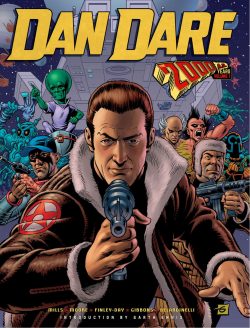
By Pat Mills, Gerry Finley-Day, Steve Moore, Ken Armstrong, Kelvin Gosnell, Garry Leach, Dave Gibbons, Brian Bolland, Massimo Belardinelli, Ian Kennedy, Bill Nuttall, Jack Potter, Peter Knight, John Aldrich, J. Swain, Tony Jacobs, Tom Frame & various (Rebellion)
ISBN: 978-1-78108 349-9 (Album HB/Digital edition)
This book includes Discriminatory Content produced in less enlightened times.
Win’s Christmas Gift Recommendation: Pure & Superhero Sensationalism… 9/10
If you’ll permit a personal question: How old are you?
The answer will pretty much determine your reaction to this book…
Launching on April 14th 1950 and running until April 26th 1969, Eagle was the most influential comic of post-war Britain, and possibly in our nation’s history. It was the brainchild of a Southport vicar, the Reverend Marcus Morris, who was increasingly concerned about the detrimental effects of American comic books on British children and wanted a good, solid, middle-class Christian antidote.
A huge number of soon-to-be prominent creative figures worked on the weekly, and although “Pilot of the Future” Dan Dare is rightly revered as the star, the other strips were almost as popular at the time, with many rivalling the lead in quality and entertainment value according to the mores and developing tastes of that hope-filled, luxury-rationed, fresh-faced generation.
At its peak, the original Eagle sold close to a million copies a week, but inevitably, changing tastes and a game of “musical owners” killed the title. In 1960, Hulton sold out to Odhams, who became Longacre Press. A year later they were bought by The Daily Mirror Group who evolved into IPC. In cost cutting exercises many later issues carried cheap(er) Marvel Comics reprints rather than British-originated material. It took time, but those Yankee Cultural Incursionists won out in the end. In 1969, with the April 26th issue Eagle was subsumed into cheap ‘n’ cheerful iron clad anthology Lion, eventually disappearing altogether. Successive generations have revived the title, but not the success. Never as popular, a revived second iteration ran from 27th March 1982 to January 1994 (having switched from weekly to monthly release in May 1991). Naturally when Eagle enjoyed its Second Coming the Pilot of the Future returned to his true home…
So as we celebrate 75 years of post-empire adventuresome wonderment, let’s just be clear on one thing. It’s Dan & Digby we all recall most fondly but we’ll take what we can get…
There’s precious little that I can say about Dan Dare that hasn’t been said before and better. What I will say is that everything you’ve heard is true. Vintage strips by Frank Hampson and his team of dedicated artists are a high point in world, let alone British comics, ranking beside Tintin, Asterix, Tetsuwan Atomu, Lone Wolf & Cub and the best of Kirby, Adams, Toth, Noel Sickles, Milt Caniff, Roy Crane, Carl Barks and Elzie Segar. If you don’t like this stuff, there’s probably nothing any of us can do to change your mind, and all we can do is hope you never breed…
Breakneck pace, truly astonishing high concepts underpinned by hard science balanced with nonstop action leavened with wholesome music hall larks and some of the most beautiful and powerful art ever to grace a comic page makes Hampson’s hero immortal and as much a magical experience now as it was in 1950. Many companies have kept the legend alive in curated collections over the decades, so go read this 2018 Titan edition combining material from three of their 2004-2009 hardback collections.
Now, though, we’re not taking about that guy, but seeing how he was regenerated and modified for a far different Britian under a different kind of cosh…
A wellspring of unleashed and unruly creativity, Britain’s last great comic sensation could be described as a combination of the other two, combining the futuristic milieu and thrills of Dan Dare and Eagle with the terrifying anarchy and irreverent absurdity of Dennis the Menace and his rowdy pals in Beano. In February 1977, with Britain not feeling so great a science-fiction weekly anthology was launched. The creative and editorial staff had high hopes and aspirations for 2000 A.D. but the guys paying them were simply content to ride out the movie-inspired boom and ready to cancel after the first six months to a year. They were ready for decades, but sales never dipped enough for that axe to fall, no matter what those art and story boys perpetrated…
The trendy ultra-dystopian atmosphere that had led to the creation of Mega-City One’s finest was also used to flavour the revival of the comic’s intended big gun and prime property. And his constant evolution as seen here in the weekly material from 2000 A.D. #1-23 and 28-51, plus additional action from 2000 A.D. Summer Special 1977, 2000 A.D. Sci-Fi Special 1978, 2000 A.D. Annual 1978 & Dan Dare Annual 1979.
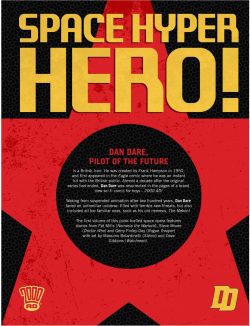
‘Introduction – This was our Dan Dare’ by Garth Ennis recounts the Hows and some Whys of the resurrection and radicalization from steadfast pilot to “Space Hyper-Hero”. The serial episodes #1-11 (scripted by Ken Armstrong, Pat Mills & Kelvin Gosnell, with Massimo Belardinelli illustrating and letterers Bill Nuttall, Jack Potter & Peter Knight) opened in 2177 AD as freighter Sirius is ferried to a space museum. When it is suddenly destroyed by an inimical alien force emerging from Jupiter’s Red Spot, the sole survivor is its career-spacer captain Dan Dare…
The disaster brings the hardworking, diligent officer into conflict with SASA (Solar, Astronautical and Space Administration) penpusher the Solar Fleet Controller based in Lunaciti who charges Dare with negligence and tries to court martial him. After all, everyone knows there’s no life on Jupiter…
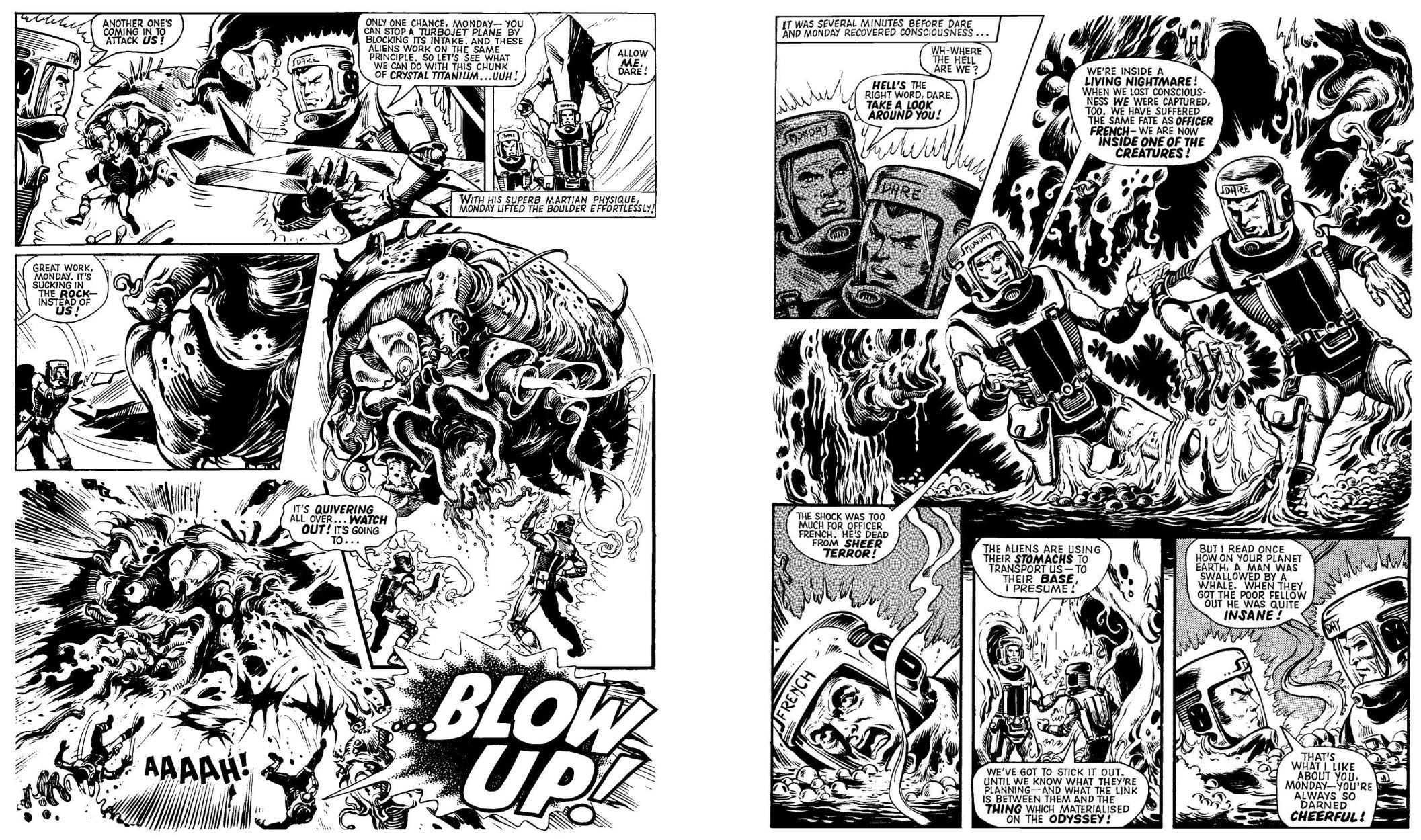
Refusing to back down, Dare explosively escapes and goes on the run, stowing away on Jupiter-bound cruiser Odyssey…
Each episode began on the prized centre spread, offering artists intriguing layout options and full colour in the otherwise monochrome periodical and here every instalment is reinforced with text feature ‘Dan Dare – My Part in his Revival’ (parts 1-9 as provided by Pat Mills to fanzine Spaceship Away).
Unfolding at breakneck pace, the tale sees him gradually win over sceptical Martian martinet and ship Captain Mr. Monday just as the hostile force attacks again, hurling appalling biological units against the aghast crew. A total convert now, Monday puts all his resources into discovering who and what is behind the attacks, leading to a brain-busting away mission into the red spot and surface of supermassive world where vile invaders The Biogs are set to test the resistance of solar system races and if their potential worthiness to become fuel for them…
The result is staggering stellar warfare with the bio-beasts eventually repelled by Dare’s resistance and an astounding sacrifice by Monday…
Scene set and scenario established, the serial kicked into even higher gear when Steve Moore assumed scripting chores for ‘Hollow World’ (#12-23, illustrated by Belardinelli and lettered by Peter Knight, John Aldrich, Nuttall, J. Swain, Tony Jacob & Tom Frame). This time working spacer Dare ships out on freighter Titan 1 C., only to have the vessel captured as they escape the Milky Way galaxy and end up inside a planet inside a red sun inside the Magellanic cloud…
The culprits are the barbaric Skath and their monstrous piratical mutant ruler The Two of Verath. However the biggest shock is that they are grudgingly served by Dare’s ancient enemy The Mekon, now reduced to toiling for his own survival. The little goblin is astounded to discover how his supposedly long-dead enemy is still around and so different looking (and so will you be!) but happily sets to torturing Dare and the crew for answers.
Inevitably Dare escapes and the old enemies renew their personal war, but it’s an unequal contest as the Mekon betrays The Two, seizes control of the Skath and unleashes hell and banditry against humanity and its allies…
Although Dan and his surviving crew escape back home, they are disbelieved by SASA officialdom. The war that follows is catastrophic and results in further betrayal and death across the universe…
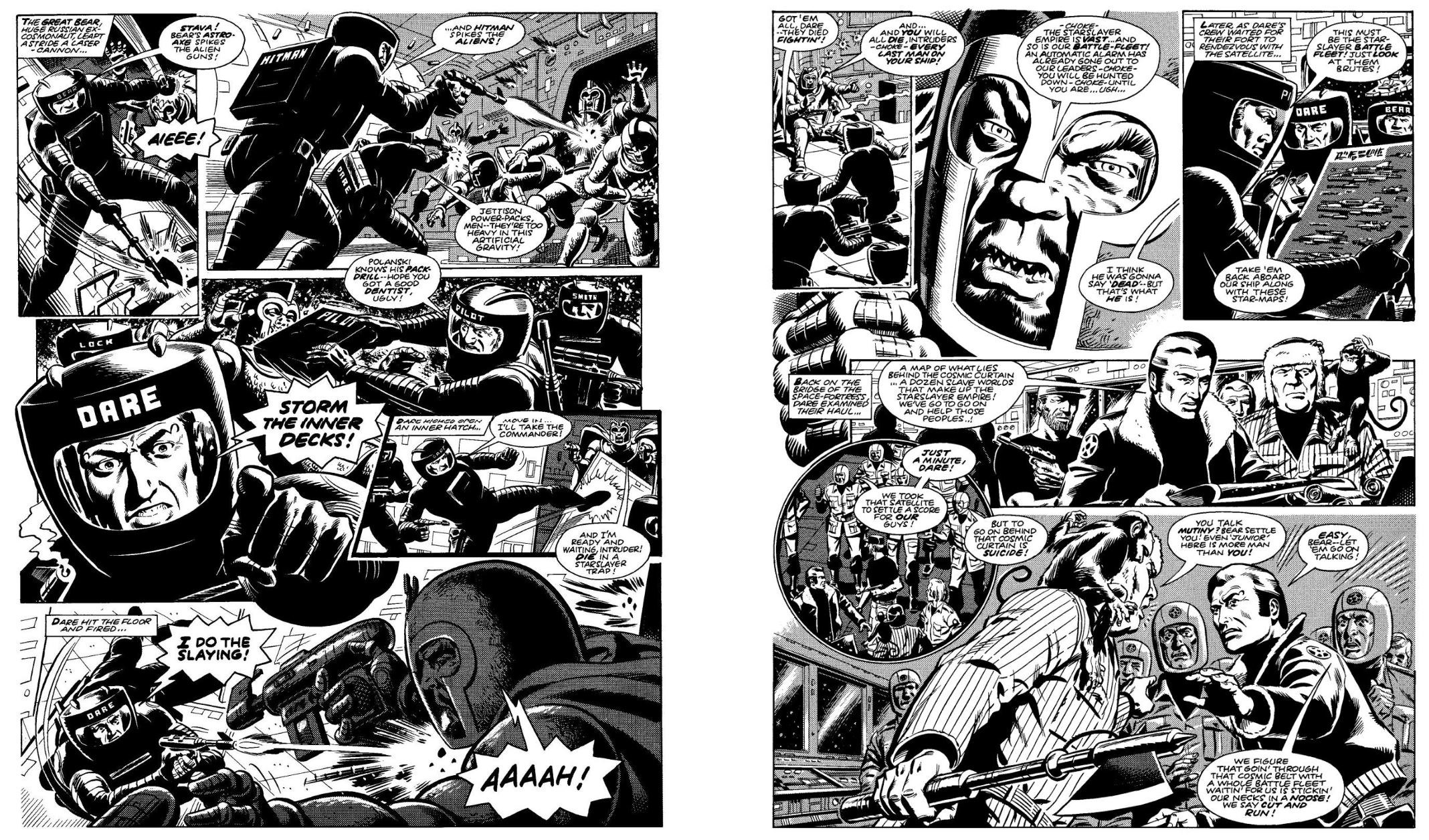
Gerry-Finley-Day took over with 2000 AD #28 as Dave Gibbons & Brian Bolland introduced a new supporting cast in ‘Legion’ (#283). Now an acknowledged troubleshooter and problem solver, Dare is asked by SASA to find out why so many colonists have vanished in the region dubbed “the Lost Worlds”. Accepting the commission, Dare’s first stop is rag-tag satellite Topsoil to brutally and cunningly “recruit” the most violent scum in space: fight-crazed bruisers like Great Bear, hired killers like Hit-Man and lethal survivors like cashiered pilot Polanski…
Packed aboard a deadly flying space fortress, the appalling unappealing argonauts dive into danger, pitting the crew against space bugs, malignant dust devils, seductive space sirens, vampires and cosmic slavers as they methodically catalogue what killed all those colonists across a region of the void that simply does not love mankind…
Casualties were high and the sentient terrors of ‘Greenworld’ (#34-35) cost them plenty, but did provide one new volunteer – a “monkey” dubbed Haley Junior – in advance of lengthy epic ‘Star Slayer’ (#36-51). This found the searchers clashing with an intergalactic empire of savage marauders, liberating slaves on a dozen worlds and ultimately overthrowing the terrifying Dark Lord. In the course of that cosmic quest Dan Dare scored the front cover spot every week – just like he had in the old days of the readers’ dads…
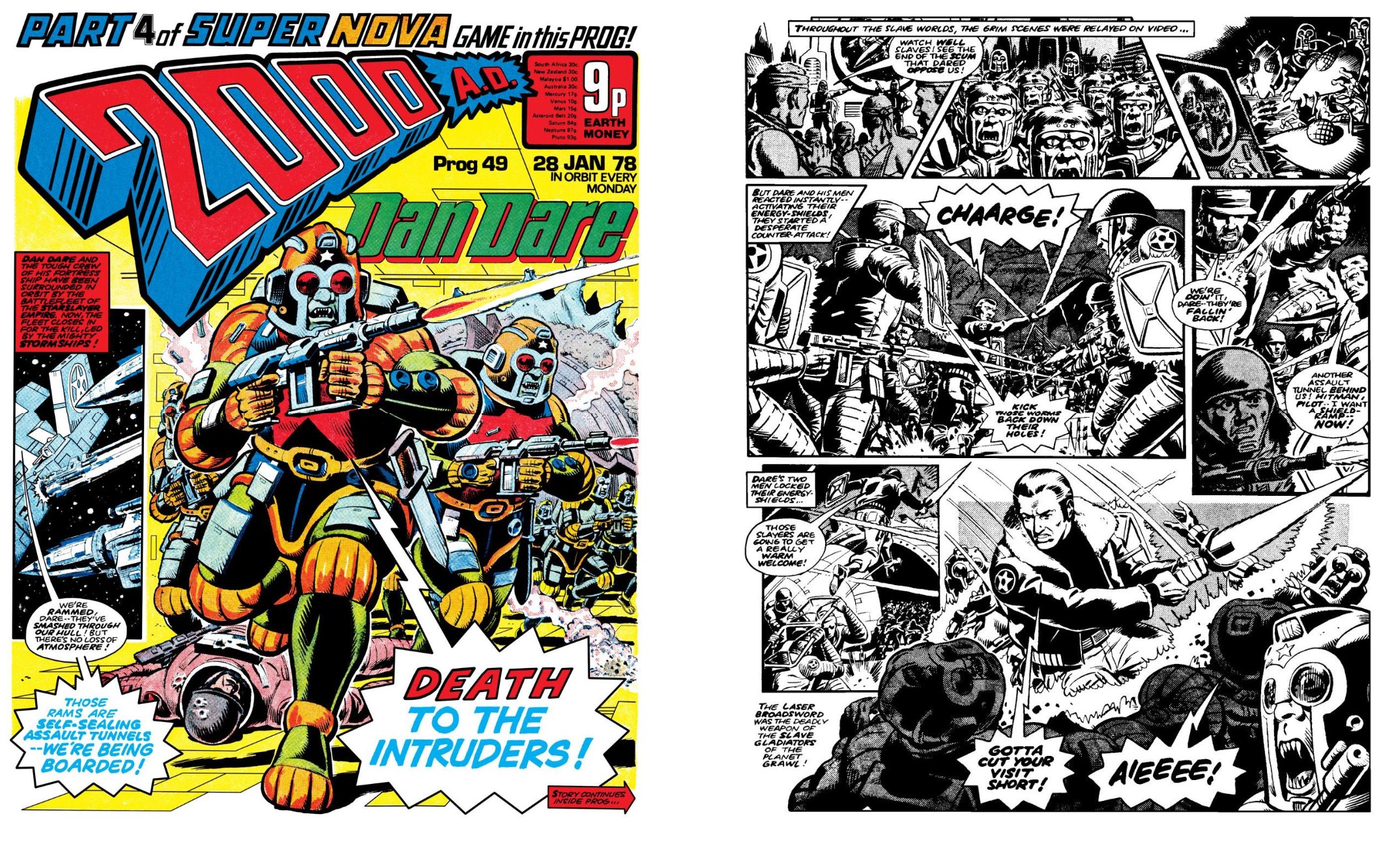
Although the mission pauses here, a section of Bonus Strips follows, supported throughout the book by numerous classic cutaway diagrams of Dare’s vehicles by Gibbons. Sadly a lot of credits have been lost, as with the untitled first tale, taken from 2000 AD Summer Special 1977 wherein Dare and his crew are hurled into an antimatter dimension by invaders seeking to make Earth fuel for a journey home, after which Belardinelli limns anonymous full colour clash with the devil ‘Dan Dare and the Curse of Mytax’ (2000 AD Annual 1978) as the spaceman outwits a meddling vicious godling who can warp reality.
From 2000 AD Sci-Fi Special 1978, ‘Visco’ – written and painted in grey-tones by Garry Leach (& lettered by John Aldrich) – finds Dare traversing Mars’ icy Uchronian wastes and stumbling across a lethal science project that bends minds and breaks existence… until he demonstrates what old-fashioned willpower can do…
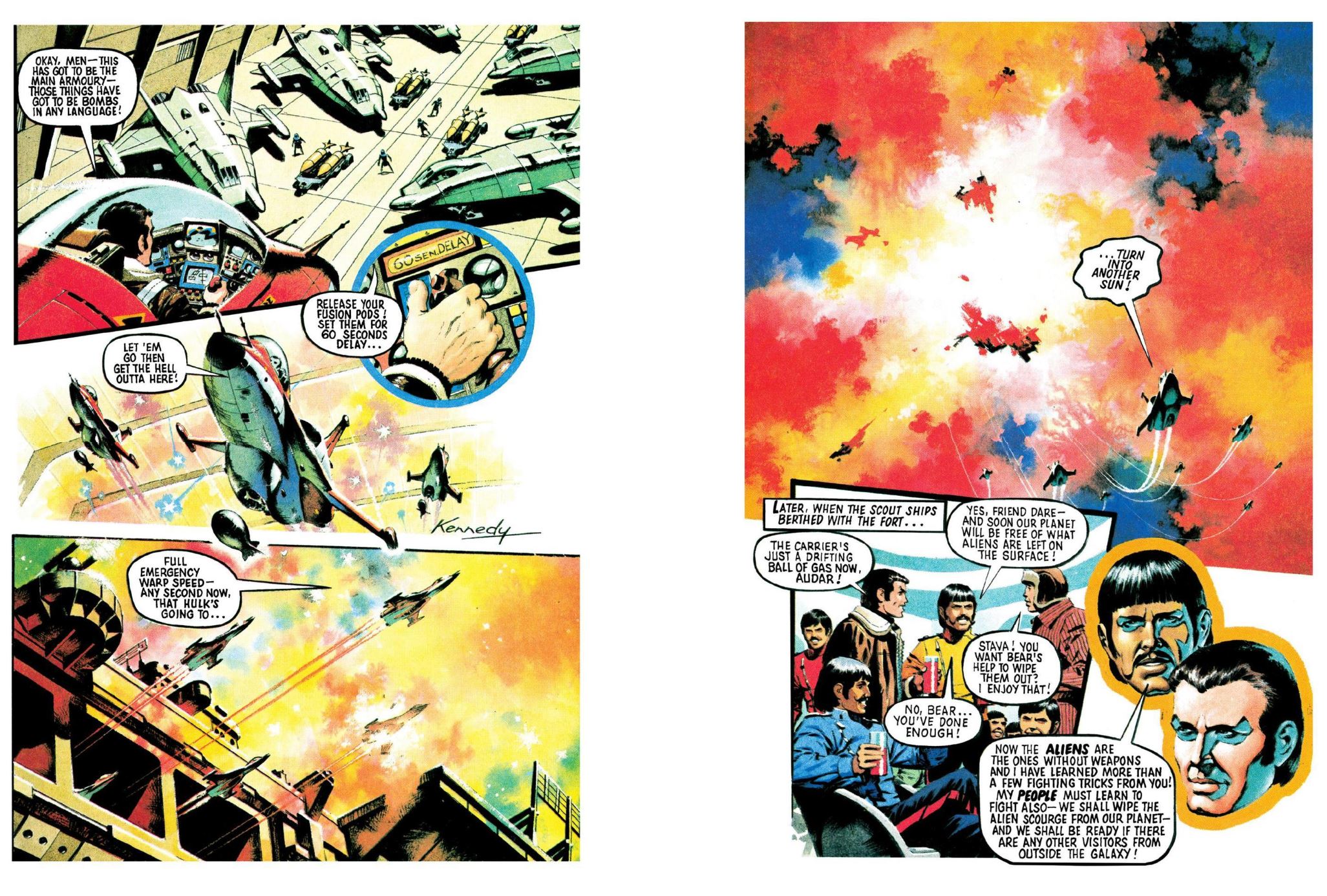
The last two tales come from The Dan Dare Annual 1979 and begin with an untitled proper romp by writer unknown, fabulously painted by legendary illustrator Ian Kennedy.
Set on the Fortress exploring The Lost Worlds, here Dare and crew come to the aid of a planet invaded by evil invaders in the biggest starship ever encountered, and prove yet again that it’s not about size, but what you do with it…
The strip wonders close with a monochrome and anonymous treat revealing just what happened to the Pilot of the Future in his last original era clash with the Mekon. ‘Dan Dare: The 2000 A.D. Origin’ traces that final battle through to the aftermath as Earth sought to preserve something of its greatest hero, and what happened next… or at least eventually…
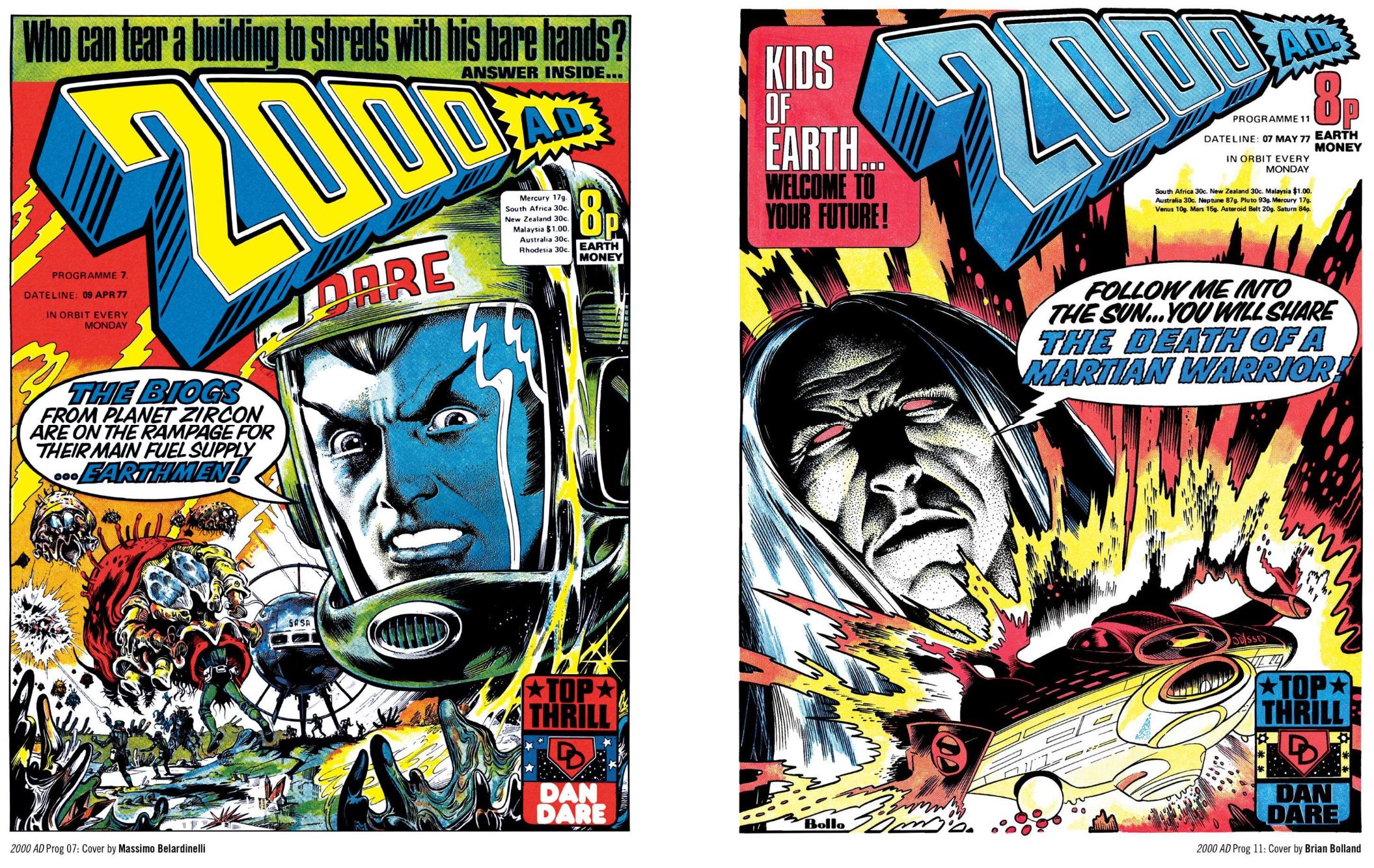
This initial collection then concludes with a stunning cover gallery and biographies.
Epic, bombastic and eternally gratifying, this a treat three generations (at least) can get stuck into, highlighting what made Britain Great in the least obnoxious way anyone could imagine. Come get some!
© 1977, 1978, 1979, 2015, Rebellion/AS. All Rights Reserved.
Believe it or don’t, today in 1918 cartoonist Robert Ripley debuted his fact-panel Ripley’s Believe or Not. One year later Elzie Segar launched Thimble Theatre. Boy, dem wuz the days, huh?
Here in 1952 Leo Baxendale debuted Minnie the Minx in The Beano.
Less celebratory though, in 2001 we lost arch teen cartoonist Dan DeCarlo and in 2006 Golden Age Superman, Batman and Starman illustrator Jack Burnley.