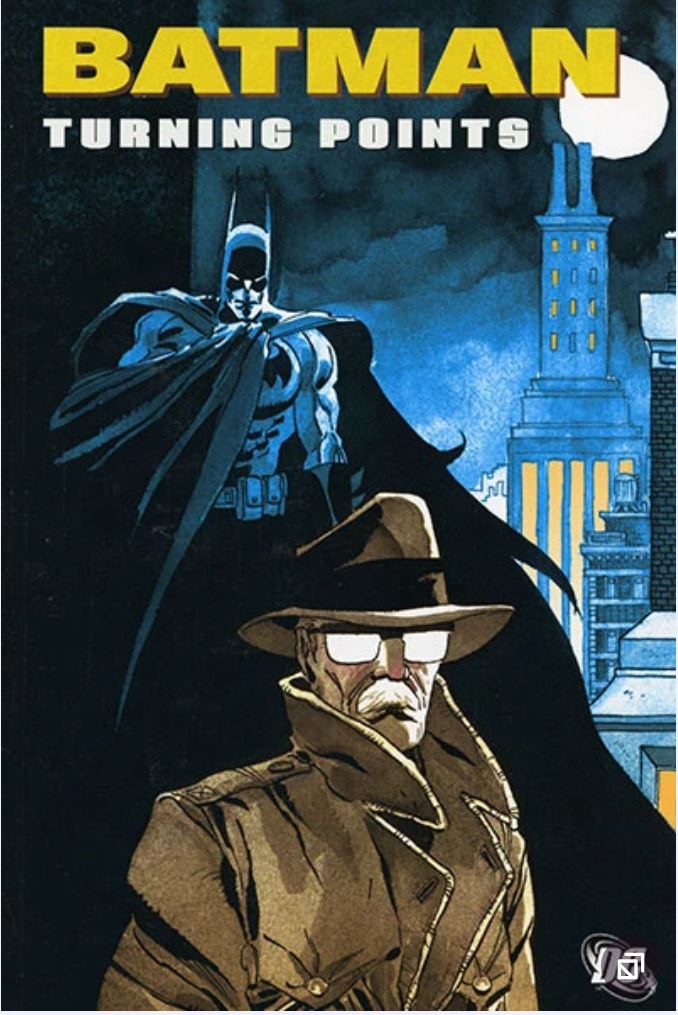
Batman: Turning Points


By Greg Rucka, Ed Brubaker, Chuck Dixon, Steve Lieber, Joe Giella, Dick Giordano, Bob Smith, Brent Anderson, Paul Pope, Claude St. Aubin & various (DC Comics)
ISBN: 978-1-4012-1360-2 (TPB)

When Superman debuted in Action Comics #1, the only still-the-same-today supporting character was Lois Lane. When “The Bat-Man” premiered a year later in Detective Comics #27 (cover-date May 1939 but on sale from March 30th), the only other person you might recognise was Police Commissioner Gordon. Make of this what you will…

Over the 85 years of Batman’s existence, almost as important as the partnership between the Dark Knight and assorted Boy Wonders has been a bizarrely offbeat symbiotic relationship between those costumed vigilantes and Gotham City’s top cop James Gordon.

This collection – inexplicably one of very few Batman books unavailable in digital formats – compiles five individual pastiches released as 2001 miniseries Turning Points. Here, readers see significant moments in the development of that shadowy alliance produced primarily for long-term aficionados in tribute to key eras in Batman’s career by veteran artists and (then) new wave creators.

It all begins with Greg Rucka & Steve Lieber’s ‘Uneasy Allies’, set in the days – and visual style – of the mysterious vigilante’s stormy debut in Frank Miller & Dave Mazzuchelli’s exemplary Batman: Year One. Police Captain Gordon is still the only honest cop on a corrupt and brutally gung-ho force, reeling from the shock of his wife divorcing him. When bereaved, heartsick and crazed college professor Hale Corbett takes an entire wedding hostage, Gotham’s SWAT team commander is champing at the bit to storm in and rack up the body-count, whereas wanted felon The Batman offers Gordon a slim hope of ending the siege without loss of life.

All the masked nut-case wants in return is a sympathetic ear at the GCPD…

A clandestine working relationship established, …And Then There Were… Three?’ (by Ed Brubaker & Joe Giella – who drew many of 1960s stories and Batman’s newspaper strip) celebrate the era of TV’s “Batmania”. About a year after their first meeting, reports of a garishly garbed boy assistant to Batman begin filtering in. As deadly psychopath Mr. Freeze rampages through the city, Gordon demands to why the now-tolerated Caped Crusader is recklessly endangering a child.

In a rowdy romp packed with past icons like giant props and gaudy villains, a decidedly deadly outcome forces the cop to see and realise the true nature of Batman and Robin’s relationship…

Brubaker, Dick Giordano & Bob Smith set ‘Casualties of War’ in the bleak aftermath following the death of second Robin Jason Todd, the crippling of Barbara (Batgirl) Gordon and the torture of her father, at the bone-white hands of The Joker. A solitary, driven Dark Knight haunts streets and allies, ceaselessly crushing criminals with brutal callousness, whilst sinister serial killer The Garbage Man prowls unchallenged…

When wheelchair-bound Barbara fails in her attempted intervention to calm a Batman pushing himself to breaking-point, it takes a rooftop heart-to-heart with recently promoted Commissioner Gordon to finally crack the manhunter’s shell and begin the healing process…

Chuck Dixon & Brent Anderson step in years later when, as a result of a strategically systematic attack by would-be crime-lord Bane, an exhausted and broken Batman is replaced by another, darker champion. Set during the Knightfall publishing event, ‘The Ultimate Betrayal’ describes the moment Gordon realises his enigmatic ally has become a remorseless machine/exterminating angel hunting criminals with no regard to life anymore. If only third Robin Tim Drake could have told him that the man behind the cowl – and claws and razor-armour – is actually Azrael: hereditary and murderously programmed living weapon of an ancient Christian warrior-cult…

Rucka, Paul Pope & Claude St. Aubin bring the journey full circle in ‘Comrades in Arms’ wherein a mysterious stranger and his family hit Gotham on a mission to find Gordon and Batman, just as the Commissioner introduces his destined successor Michael Akins to the Major Crimes Unit. Word on the street is the Russian mob are planning a huge retaliatory strike and every cop is waiting for the hammer to fall when Hale Corbett walks back into GCPD HQ, demanding to see Gordon and the masked manhunter who changed his life many years ago…

Filtered through gritty modern sensibilities but still able to revere past glories and Batman’s softer sides, this thoroughly readable collection includes a cover gallery by artistic all-stars Javier Pulido, Ty Templeton, Joe Kubert, Howard Chaykin, Pope & Tim Sale, and offers a gripping thrill ride for newcomers and veterans alike.
© 2001, 2007 DC Comics. All Rights Reserved.

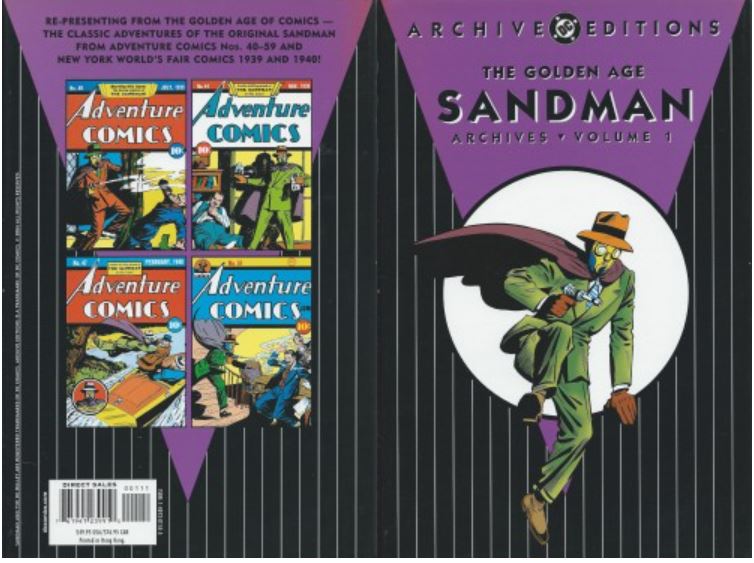
The Golden Age Sandman Archives volume 1


By Bert Christman, Gardner F. Fox, Creig Flessel, Chad Grothkopf, Ogden Whitney & various (DC Comics)
ISBN: 978-1-4012-0155-5 (HB)

Probably illustrated, scripted and created by multi-talented all-rounder Bert Christman (with the assistance of young scripting star Gardner F. Fox), The Sandman premiered in either Adventure Comics #40 July 1939 (two months after Batman’s debut in Detective Comics #27) or two weeks earlier in New York World’s Fair Comics 1939 – depending on whose distribution records you choose to believe. Intriguingly, the Dark Knight didn’t make the cut for the legendary commemorative comic book and only appeared in New York World’s Fair Comics #2 in Summer 1940…

Head obscured by a gas-mask and slouch hat; caped, business-suited millionaire adventurer Wesley Dodds was cut from the radio drama/pulp fiction mystery-man mould that had made The Shadow, Green Hornet, Lone Ranger, Phantom Detective, Black Bat, Spider, Avenger and so many more into household names of early mass-entertainment and periodical publication. Wielding a sleeping-gas gun and haunting the night to hunt a host of killers, crooks and spies, he was eventually joined and accompanied by plucky paramour Dian Belmont, before gradually losing readers’ interest and slipping from cover-spot to last feature in Adventure Comics, just as the shadowy, morally ambiguous avengers he emulated slipped from popularity in favour of more flamboyant, true-blue fictional fare.

This splendidly sturdy, moodily atmospheric Archive edition gathers those landmark early appearances from New York World’s Fair Comics 1939 & 1940 and the rip-roaring exploits from Adventure Comics #40-59, spanning July 1939 to February 1941: a period when Detective Comics Incorporated frantically sought to follow up Superman and Batman with the “Next Big Thing in comic books”…

Following an erudite appreciation from historian and comics all-star Jim Amash, the dramas begin with the fast-paced thriller from the groundbreaking, pioneering comics premium New York World’s Fair Comics #1 as Christman & Fox introduced ‘Sandman at the World’s Fair’. In those long-lost days, origins and back story were not as important as action and spectacle so we quickly plunge into a fast-paced yarn as wealthy, rugged playboy scientist Dodds visits the global festival with plans for a new ray-gun. En route he encounters spies and a traitor within his own company. Already active as The Sandman – and sought by the cops for it – the vigilante tracks down and deals with the pre-war enemies of America…

Over in Adventure Comics #40, at about the same time, the cover-featured crusader saves kidnapped actress Vivian Dale when ‘The Tarantula Strikes’ (Christman & Fox) in a rousing romp reminiscent of the High Society hi-jinks of movie marvels The Saint, Falcon or Lone Wolf: prowling allies and moonlit rooftops, breaking into criminals’ lairs, rifling safes and dealing as much death as dream gas. He also utilised a unique calling card, sprinkling sand to proclaim and terrify wherever he has silently been and gone…

Christman wrote and drew many of the early thrillers such as #41’s ‘On the Waterfront’, wherein plucky reporter Janice Blue inadvertently stumbles into a dockside narcotics ring just as murderous seadog Captain Wing makes a fateful takeover bid. Luckily for Janice, the stealthy Sandman is already on the case…

Adventure #42 highlighted Christman’s love of aviation in ‘The Three Sandmen’, as Dodds met up with former Navy Flying Corps buddies to solve a string of murders. Somebody was rubbing out all the members of the old squadron…

Allen Bert Christman first came to public attention by following near-mythic Noel Sickles on seminal newspaper strip Scorchy Smith. A dedicated patriot and flyer, Christman entered the Naval Air School in 1940 and joined Claire Lee Chennault’s 1st American Volunteer Group, known as the legendary fighter squadron The Flying Tigers. These volunteers began fighting the Japanese in China long before America officially entered WWII on December 8th 1941, and Christman – officially designated a Colonel in the Chinese Air Force – used his artistic talents to personalise and decorate many of the planes in his Flight. He was shot down and died in horrific circumstances on January 23rd 1942.

Issue #43 saw his last official story as Dodds went on a South Seas flying vacation and was embroiled in an ‘Island Uprising’: spectacularly saving embattled white pearl hunters from natives enraged to fury by latter-day pirate Red Hatch

In Adventure #44 (November 1939), Fox & Creig Flessel stepped into the breach left by Christman when ‘The Sandman Meets the Face’. Here the playboy was back in civilisation and aiding a down-&-out friend against a mercurial disguise artist and mob boss terrorising the city. This splendid blood-&-thunder caper also saw the page count rise from 6 to 10 as The Sandman finally found his lurking, moody metier…

‘The Golden Gusher’ (#45 by Fox & Flessel) was nightclub singer Gloria Gordon, threatened with kidnap or worse until the Master of Sleep intervened, whilst #46’s ‘The Sandman Meets with Murder’ saw rising talent Ogden Whitney step into the artistic hot seat when the slaying of another old Dodds chum led into a deliciously convoluted murder-mystery involving beautiful twins, counterfeiting and a macabre cross-dressing killer…

A huge step in continuity occurred in #47 as District Attorney Belmont agreed to an unofficial truce with The Sandman following the assassination of a prominent banker. Simultaneously, Wesley caught a wily thief trying to crack his safe and became unwilling partner to the ‘Lady in Evening Clothes’ (Fox & Whitney) after she uncovered his secret identity. A celebrated cat-burglar, the sophisticated she-devil was plagued by not knowing who her parents were, but happily went straight(ish) in return for Dodd’s pledge to help her…

Eventually revealed as long-lost Dian Belmont, she became a regular cast addition in #48 as ‘Death to the D.A.’ found her newly-found father under threat from gangsters and far less obvious killers on a palatial island retreat, after which ‘Common Cold – Uncommon Crime’ (#49 by Fox, Flessel & perhaps Chad Grothkopf on inks) sees the mystery-man tracking killers who were eradicating scientists who refused to hand over their cure for one of our most unforgiving ailments.

With a year gone by and global war looming, the “World of Tomorrow” exhibition was slowly closing, but there was still time for New York World’s Fair Comics #2, where this time ‘Sandman Goes to the World’s Fair’ (by Fox & Grothkopf) delivered a blistering crime caper as Wesley and Dian are stuck babysitting her maiden Aunt Agatha around the Fair and targeted by ambitious but exceedingly unwise kidnapper Slugger Slade

In Adventure Comics #50 ‘Tuffy and Limpy’s Revenge Plot’ – by Fox & Flessel – covered similar ground as a murderous campaign of apparently unrelated deaths points to another scheme to remove the dauntless DA, drawing Sandman and Dian into a blockbusting battle against ruthless rogues, whilst #51’s (June 1940, by Fox & Flessel and previously reprinted elsewhere as ‘The Pawn Broker’) ‘The Van Leew Emeralds’ provided a fascinating mystery romp for the romantically inclined crimebusters to solve in fine style and double-quick time.

A burglary at the Belmont residence only netted a pair of gloves in #52’s ‘Wanted! Dead or Alive’, but inexorably led to a perplexing scavenger hunt with sinister overtones and a deadly pay-off when scandalous Claudia Norgan framed her best gal-pal Dian for the Amber Apple Gang‘s crimes, after which in #53, ‘The Loan Sharks’ unwisely aroused the dynamic dream-maker’s ire after graduating from simple leg-breaking to murder to enforce their demands. They almost ended the Sandman too before he finally got the better of them…

Adventure #54’s ‘The Case of the Kidnapped Heiress’ saw Wes and Dian witness a bold snatch-&-grab, but their frenzied pursuit only resulted in both the DA’s daughter and millionairess Nana Martin being abducted together. Fury-filled and frantic, Sandman tracked down the ransoming rogues only to find himself in the unexpected role of Cupid.

When the legendary jewel ‘The Star of Singapore’ was stolen in #55, the trail led to an ever increasing spiral of death and destruction until the Man of Dreams finally recovered it, whilst next issue, ‘The Crook Who Knew the Sandman’s Identity’ (Fox, Flessel & Grothkopf) learned to his regret it just wasn’t so, thanks to Dian’s imaginative improvisation…

Mystery and general skulduggery gave way to world-threatening science fiction in #57 when The Sandman battled a mad scientist who had devised a deadly atom-smasher for blackmail and ‘To Hammer the Earth’, after which more macabre murders point the dream-team to spies and killers profiting from ‘Orchids of Doom’. This stylish selection of outré crime-thrillers concludes with Adventure #59’s ‘The Story of the Flaming Ruby’ as a cursed gem enables a hypnotic horror to turn honest men into thieves and Dian into a mindless assassin…

Possessing an indefinable style and charm but definitely dwindling pizzazz, the feature was on the verge of cancellation when The Sandman abruptly switched to a skin-tight yellow-&-purple bodysuit – complete with billowing cape for two issues – and gained boy-sidekick, Sandy the Golden Boy (in Adventure Comics #69, December 1941, courtesy of Mort Weisinger & Paul Norris), presumably to emulate the overwhelmingly successful Batman and Captain America models then reaping such big dividends. It didn’t help much at first but when Joe Simon & Jack Kirby came aboard with #72 it all spectacularly changed.

A semi-supernatural element and fascination with the world of dreams (revisited by S&K a decade later in their short-lived experimental suspense series The Strange World of Your Dreams) added a moody conceptual punch to equal the kinetic fury of their art, as Sandman and Sandy became literally the stuff of nightmares to the bizarre bandits and murderous mugs they stalked. Those spectacular but decidedly different adventures can be found in The Sandman by Joe Simon & Jack Kirby… if you dare…

With covers by Sheldon Mayer, Jack Burnley and Flessel, these raw, wild and excessively engaging early comics capers are some of the best but most neglected thrillers of the Golden Age. Modern tastes have moved on and these yarns are far more in tune with contemporary mores, making this a truly unmissable treat for fans of mystery, murder and stylish intrigue…
© 1939, 1940, 1941, 2004 DC Comics. All Rights Reserved.

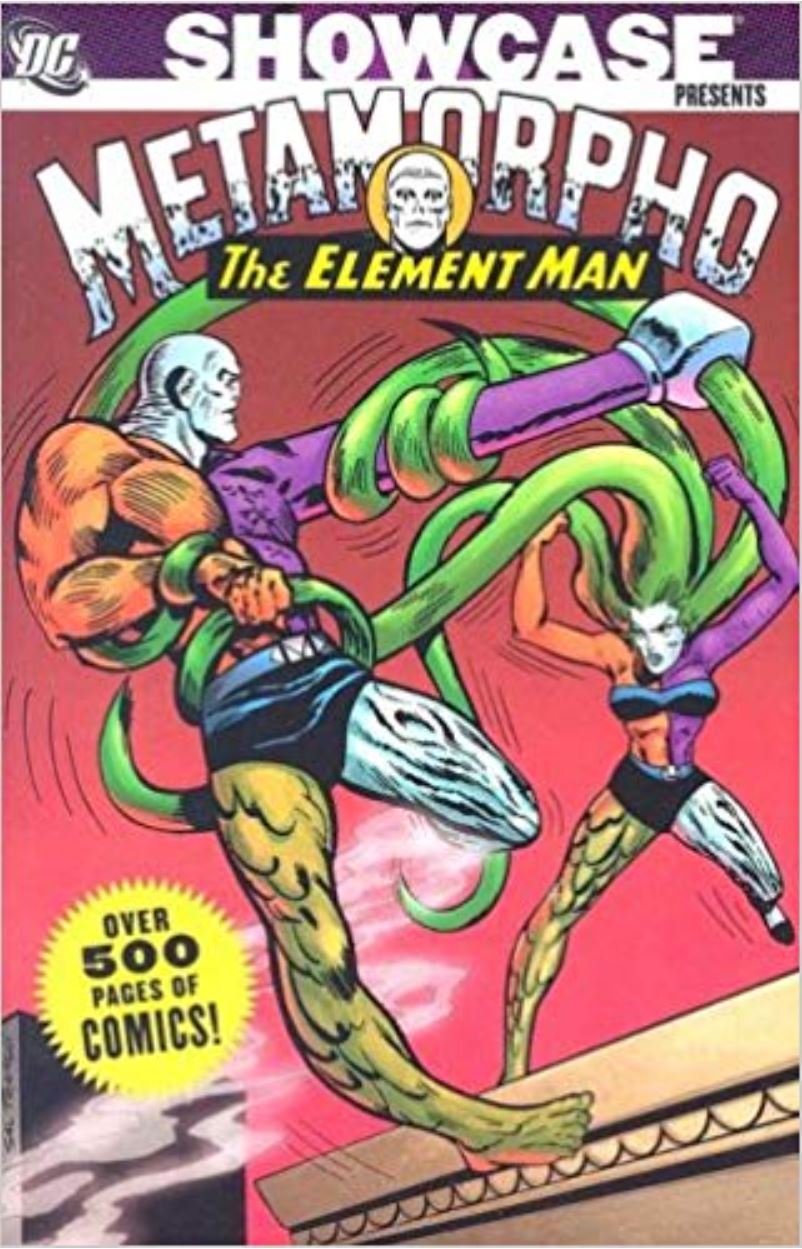
Showcase Presents Metamorpho, The Element Man


By Bob Haney, Gardner Fox, Ramona Fradon, Joe Orlando, Sal Trapani, Jack Sparling, Charles Paris, Mike Sekowsky, Mike Esposito, Bernard Sachs & various (DC Comics)
ISBN: 978-1-4012-0762-5 (TPB)

By the time Metamorpho, The Element Man was introduced to a superhero-obsessed world the first vestiges of a certifiable boom were just becoming apparent. As such, the light-hearted, nigh-absurdist take struck a Right-Time, Right-Place chord, blending far out adventure with tongue-in-cheek comedy.

Celebrating 60 years of weird happenings, the bold, brash “Man of a Thousand Elements” debuted in The Brave and the Bold #57, cover-dated January 1965 and on sale from October 29th 1964 – just in time for Halloween. After a second try-out tale in the next issue, he and his crackers cast catapulted right into a solo title for an eclectic and oddly engaging 17-issue run. Sadly, this canny monochrome compendium – collecting those eccentric debut adventures from B&B #57 & 58, Metamorpho, The Element Man #1-17 and team-up tales from The Brave and the Bold #66 and 68 and Justice League of America #42 – is at present STILL the only archival collection available. Until someone rectifies that situation, at least here you can revel in some truly enchanting monochrome illustration and madcap myth-making. Unlike most Showcase editions, the team-up stories here are not chronologically re-presented in original publication order but are closeted together at the back, so if stringent continuity is important to you, the always informative old-school credit-pages will enable you to navigate the wonderment in the correct sequence.

Sans dreary preamble, the action commences immediately with ‘The Origin of Metamorpho’, written by Bob Haney (who created the concept and character and wrote everything here except the Justice League story). The captivating art is by Ramona Fradon & Charles Paris and introduces glamorous he-man Soldier of Fortune Rex Mason: currently working as a globetrotting artefact-procurer and agent for ruthlessly acquisitive scientific genius and business tycoon Simon Stagg. Mason is obnoxious and insolent but his biggest fault as far as the boss is concerned is that the mercenary dares to love – and be loved – by the plutocrat’s only daughter Sapphire

Determined to rid himself of the impudent “fortune-hunter”, Stagg sends his potential son-in-law to Egypt tasked with retrieving a fantastic artefact dubbed the Orb of Ra from the lost pyramid of Ahk-Ton. The tomb raider is accompanied only by Java, a previously fossilised Neanderthal corpse Rex had extracted from a swamp and which (whom?) Stagg had subsequently restored to life. Mason plans to take his final fabulous fee and whisk Sapphire away from her controlling father forever, but fate and his companion have other plans…

Utterly faithful to the scientific wizard who was his saviour, Java sabotages the mission and leaves Mason to die in the tomb, victim of an ancient, glowing meteor. The man-brute rushes back to his master, carrying the Orb and fully expecting Stagg to honour his promise and give him Sapphire in marriage. Meanwhile, trapped and painfully aware his time has come, Mason swallows a suicide pill as the scorching rays of the star-stone burn through him…

Instead of death relieving his torment, Rex mutates into a ghastly chemical freak capable of shapeshifting and transforming into any of the elements or compounds that comprise his human body: carbon, hydrogen, oxygen, calcium, iron, cobalt and so many others…

Hungry for vengeance, Mason returns and confronts his betrayers only to be overcome by the alien energies of the Orb of Ra. An uneasy détente is declared as Mason accepts Stagg’s desperate offer to cure him – if possible…

The senior Stagg is further horrified when Rex reveals his condition to Sapphire and finds she still loves him. Totally unaware of his employer’s depths of duplicity, Mason starts working for the tycoon as metahuman problem-solver Metamorpho, the Element Man.

Brave and the Bold #58 (February-March 1965) reveals more of Stagg’s closeted skeletons when old partner Maxwell Tremayne kidnaps the Element Man and later abducts Sapphire to ‘The Junkyard of Doom!’ Apparently, the deranged armaments manufacturer was once intimately acquainted with the girl’s mother and never quite got over it…

The test comics were an unqualified success and Metamorpho promptly started in his own title, cover-dated July-August 1965, just as the wildly tongue-in-cheek “High Camp” craze was catching on in all areas of popular culture: mixing ironic vaudevillian kitsch with ancient movie premises as theatrical mad scientists and scurrilous spies began appearing everywhere.

‘Attack of the Atomic Avenger’ sees nuclear nut-job Kurt Vornak seeking to crush Stagg Industries, only to be turned into a deadly, planet-busting radioactive super-atom, after which ‘Terror from the Telstar’ pits our charismatic characters against Nicholas Balkan, a ruthless criminal boss set on sabotaging America’s Space Program. Manic multi-millionaire T.T. Trumbull uses his own daughter Zelda to get to Simon Stagg through his heart, accidentally proving to all who know him that the old goat actually has one. This was part of TT’s attempt to seize control of America in ‘Who Stole the U.S.A.?’, with the ambitious would-be despot backing up the scheme with an incredible robot specifically designed to murder Metamorpho.

Happily, Rex Mason’s guts and ingenuity prove more effective than the Element Man’s astonishing powers…

America saved, the dysfunctional family head South of the Border, becoming embroiled in ‘The Awesome Escapades of the Abominable Playboy’ as Stagg schemes to marry Sapphire off to Latino Lothario Cha Cha Chavez. The spoiled wilful girl is simply trying to make Mason jealous and had no idea of her dad’s true plans; Stagg senior has no conception of Chavez’s real intentions or connections to the local tin-pot dictator…

With this issue the gloriously stylish innovator Ramona Fradon left the series, to be replaced by two artists who strove to emulate her unique, gently madcap manner of drawing with varying degrees of success. Luckily, veteran inker Charles Paris stayed on to smooth out the rough edges. First was E.C. veteran Joe Orlando whose 2-issue tenure began with outrageous doppelganger drama ‘Will the Real Metamorpho Please Stand Up?’ wherein eccentric architect Edifice K. Bulwark tries to convince Mason to lend his abilities to his chemical skyscraper project. When Metamorpho declines, Bulwark and Stagg attempt to create their own Element Man with predictably disastrous consequences. ‘Never Bet Against an Element Man!’ (#6 May-June 1966) took the team to the French Riviera as gambling grandee Achille Le Heele snookers Stagg and wins “ownership” of Metamorpho. The Gallic toad’s ultimate goal was stealing the world’s seven greatest wonders (including the Taj Mahal and Eiffel Tower) and, somehow, only the Element Man can make that happen…

Sal Trapani began drawing with #7’s ‘Terror from Fahrenheit 5,000!’ as the acronymic superspy fad hit hard. Here Metamorpho is enlisted by the C.I.A. to stop suicidal maniac Otto Von Stuttgart destroying the entire planet by dropping a nuke into the Earth’s core, before costumed villain Doc Dread is countered by an undercover Metamorpho becoming ‘Element Man, Public Enemy!’ in a diabolical caper of doom and double-cross. Metamorpho #9 shifted into classic fantasy when suave and sinister despot El Mantanzas maroons the cast in ‘The Valley That Time Forgot!’: battling cavemen and antediluvian alien automatons, after which a new catalysing element is added in ‘The Sinister Snares of Stingaree!’ This yarn introduces Urania Blackwell – a secret agent somehow transformed into an Element Girl and sharing all Metamorpho’s incredible abilities. Not only is she dedicated to eradicating evil such as criminal cabal Cyclops, but Urania is also the perfect paramour for Rex Mason, who even cancels his wedding to Sapphire to go gang-busting with her…

With a new frisson of sexual chemistry sizzling barely beneath the surface, ‘They Came from Beyond?’ finds a conflicted Element Man confronting an apparent alien invasion whilst ‘The Trap of the Test-Tube Terrors!’ sees another attempt to cure Rex of his unwanted powers. This allows mad scientist Franz Zorb access to Stagg Industry labs long enough to build an army of chemical horrors. The plot thickens with Zorb’s theft of a Nucleonic Moleculizer, prompting a continuation in #14 wherein Urania is abducted only to triumphantly experience ‘The Return from Limbo’

Events and stories grew increasingly outlandish and outrageous as TV’s superhero craze intensified and ‘Enter the Thunderer!’ (#14, September/October 1967) depicted Rex pulled between Sapphire and Urania whilst marauding extraterrestrial Neutrog terrorises Earth in preparation for the arrival of his mighty mutant master. The next instalment augured an ‘Hour of Armageddon!’ as the uniquely menacing Thunderer takes control of Earth until boy genius Billy Barton aids the Elemental defenders in defeating the alien horrors.

Trapani inked himself for Metamorpho #16: an homage to H. Rider Haggard’s She novels (and 1965 movie blockbuster) wherein ‘Jezeba, Queen of Fury!’ changes the Element Man’s life forever. When Sapphire marries playboy Wally Bannister, the heartbroken Element Man undertakes a mission to find the lost city of Ma-Phoor and encounters an undying beauty who wants to conquer the world… and just happens to be Sapphire’s exact double. Moreover, the immortal empress of a lost civilisation once loved an Element Man of her own: a Roman soldier named Algon who became a chemical warrior two thousand years previously.

Believing herself reunited with her lost love, Jezeba finally launches her long-delayed attack on the outside world with disastrous, tragic consequences…

The oddly appetising series came to a shuddering unsatisfactory halt with the next issue as the superhero bubble burst and costumed comic characters suffered their second recession in 15 years. Metamorpho was one of the first casualties, cancelled just as (or perhaps because) the series was emerging from its quirky comedic shell with the March/April 1968 issue.

Illustrated by Jack Sparling, ‘Last Mile for an Element Man!’ sees Mason tried – and executed! – for the murder of Bannister, resurrected by Urania Blackwell and set on the trail of true killer Algon. Consequently, Mason and Element Girl uncover a vast conspiracy and rededicate themselves to defending humanity at all costs. The tale ends on a never-resolved cliffhanger: when Metamorpho was revived a few years later no mention was ever made of these last game-changing issues…

Our elemental entertainment doesn’t end here though, as this tome somewhat expiates the frustrating denouement with three terrific team-up tales, beginning with The Brave and the Bold #66 (June/July 1966) and ‘Wreck the Renegade Robots’ wherein a mad scientist usurps control of the Metal Men just as their creator Will Magnus is preoccupied with a cure turning Metamorpho back into an ordinary mortal…

Two issues later (B& B #68 October/November 1966), the still chemically active crimebuster battles popular TV Bat-Baddies The Penguin, Joker and Riddler as well as a fearsomely mutated Caped Crusader in thoroughly bizarre tale ‘Alias the Bat-Hulk!’ with both yarns courtesy of Haney, Mike Sekowsky & Mike Esposito. Sekowsky also drew the final exploit in this volume as Justice League of America #42 (February 1966) sees the hero joyfully join the World’s Greatest Superheroes to defeat cosmic menace The Unimaginable. The grateful champions instantly offer him membership but are astounded when – and why – ‘Metamorpho Says… No!’: a classic romp written by Gardner Fox and inked by Bernard Sachs.

The wonderment concludes with a sterling pin-up of Element Man and core cast by Fradon & Paris. Individually enticing, always exciting but oddly frustrating in total, this book will delight readers who aren’t too wedded to cloying continuity but simply seek a few moments of casual, fantastic escapism.
© 1965-1967, 2005 DC Comics. All Rights Reserved.

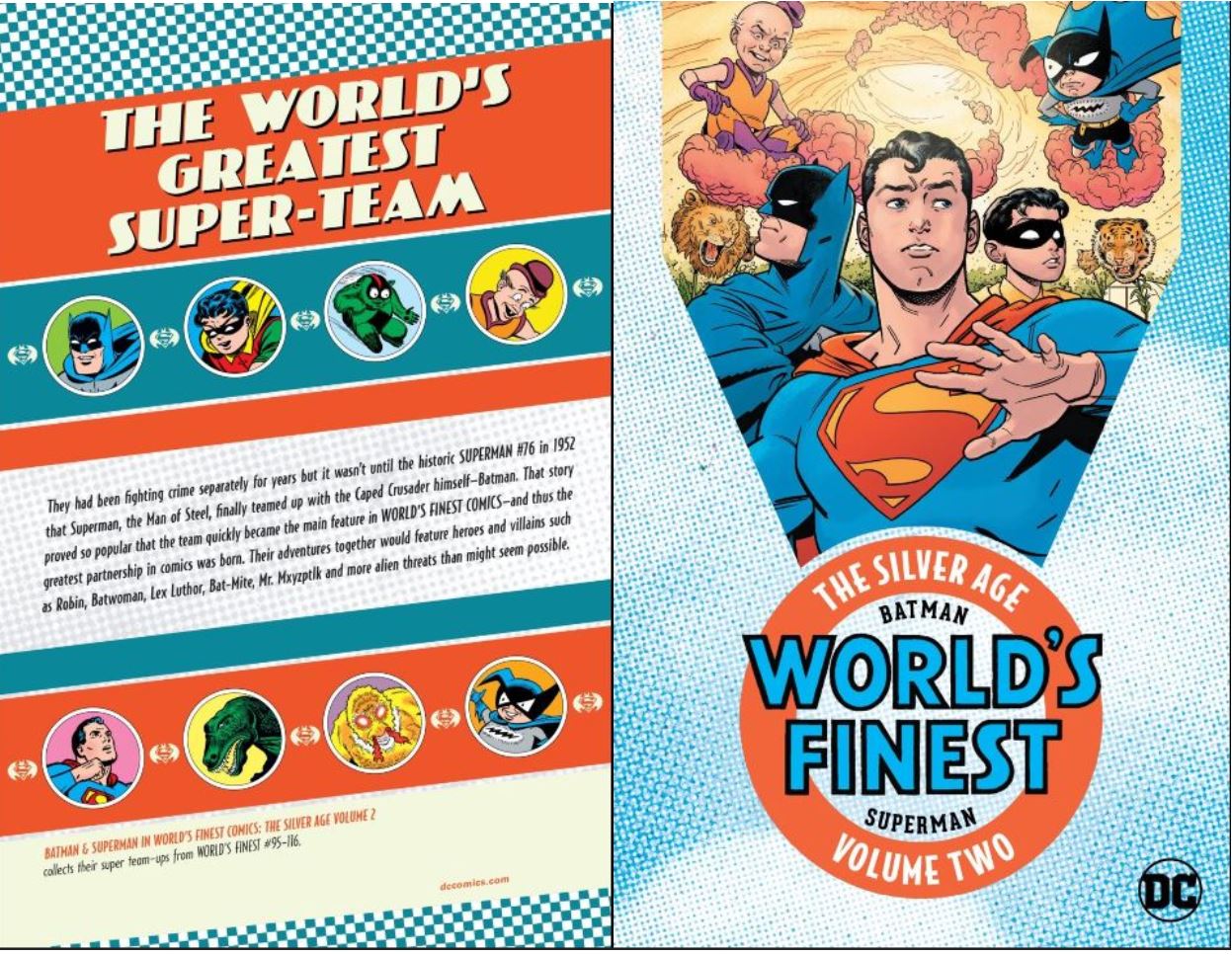
Batman and Superman in World’s Finest Comics: The Silver Age volume 1


By Edmond Hamilton, Bill Finger, Jerry Coleman, Curt Swan, Dick Sprang, Stan Kaye, Sheldon Moldoff, Charles Paris, Ray Burnley & various (DC Comics)
ISBN: 978-1-4012-7780-2 (TPB/Digital edition)

This year marks Batman’s 85th Anniversary and we’ll be covering many old and new books about the Dark Knight over the year. However, the Gotham Guardian’s impact has been far ranging and sustained, so let’s also take a look at his part in reshaping Superman and other heroes too…

Some things were just meant to be: bacon & eggs, rhubarb & custard, chalk & cheese…

Both initially debuting as driven loners, after settling into their respective pioneering superhero niches, Superman and Batman ultimately worked together as the “World’s Finest” team for decades. They were friends as well as colleagues and their pairing made sound financial sense since DC’s top heroes (in effect, the company’s only costumed stars) could cross-pollinate and, more importantly, cross-sell their combined readerships.

This most inevitable of Paladin Pairings first occurred on the Superman radio show in 1945, and in comics the pair only briefly met whilst on a Justice Society of America adventure in All-Star Comics #36 (August/September 1947) – and even there they missed each other in the general gaudy hubbub…

Of course, they had shared the covers of World’s Finest Comics from the outset, but never crossed paths inside; sticking firmly to their specified solo adventures. For us pictorial continuity buffs, the climactic real first time was in the pages of Superman’s own bi-monthly comic (issue #76, May/June 1952), but the real birth of their partnership came in World’s Finest Comics #71 cover-dated July/August 1954 and making 2024 their official 70th Anniversary. (Yay, Teams!)

In 1952, pulp science fiction author Edmond Hamilton had been tasked with revealing how Man of Steel and Caped Crusader first met and accidentally uncovered each other’s costumed identities – whilst sharing a cabin on an overbooked cruise liner. Although an average crime-stopper yarn, it was the start of a phenomenon. Of course you’ll need to revisit the previous volume for that and other early team up tales…

With dwindling page counts, rising costs but a proven readership and after years of co-starring but never mingling, World’s Finest Comics #71 had presented Superman and Batman in the first of their official shared cases. A huge hit, the innovative partnership was one of the few superhero success stories of the 1950s and this second stunning compendium of Silver Age solid gold spans July/August 1958 to March 1961: re-presenting the lead stories from World’s Finest Comics #95-116. The astounding archive of adventure opens with a Hamilton, Dick Sprang & Ray Burnley yarn pitting the temporarily equally multi-powered and alien-entranced champions against each other in ‘The Battle of the Super-Heroes’.

A magical succession of magnificent and light-heartedly whacky classics began in WFC #96 with Hamilton’s ‘The Super-Foes from Planet X’, wherein indolent and effete aliens dispatch fantastic monsters to battle the titanic trio for the best possible reasons…

Bill Finger took over scripting with #97, incomprehensibly turning the Man of Steel on his greatest friends in ‘The Day Superman Betrayed Batman’, after which ‘The Menace of the Moonman!’ pits the heroes against a deranged hyper-powered astronaut. Then, ‘Batman’s Super-Spending Spree!’ baffles his close friends before Lex Luthor devilishly traps Superman in the newly-recovered “Bottle City of Kandor” to become ‘The Dictator of Krypton City’ – all breathtaking epics beautifully limned by Sprang & Kaye.

Sprang inked himself in rocket-paced super-crime thriller ‘The Menace of the Atom-Master’ whereas it took Curt Swan, Burnley, Sprang & Sheldon Moldoff to properly unveil the titanic tragedy of ‘The Caveman from Krypton’ in #102. Sprang & Moldoff then unveiled ‘The Secret of the Sorcerer’s Treasure’, depicting a couple of treasure hunters driven mad by the tempting power of freshly unearthed magical artefacts, after which Luthor came to regret using a hostage Batwoman to facilitate ‘The Plot to Destroy Superman!’

After a metamorphosis which turned Clark Kent into ‘The Alien Superman’ proved not at all what it seemed to be, ‘The Duplicate Man’ in WF #106 sees the ultimate downfall of a villain who develops an almost unbeatable crime tool. He’s followed by ‘The Secret of the Time-Creature’ who encompassed centuries and resulted in one of Finger’s very best detective thrillers to baffle but never stump the Cape & Cowl Crusaders…

Jerry Coleman assumed the writer’s role with ‘The Star Creatures’ (art by Sprang & Stan Kaye); the tale of an extraterrestrial moviemaker whose deadly props were stolen by Earth crooks. Stellar cover artist Curt Swan (with Stan Kaye inking) finally made the move to interior illustrator for ‘The Bewitched Batman’, detailing a tense race against time to save the Gotham Guardian from an ancient curse, before ‘The Alien who Doomed Robin’ (Sprang & Moldoff) sees a symbiotic link between monster marauder and Boy Wonder leave the senior heroes apparently helpless – at least for a little while…

Finger, Sprang & Moldoff toured ‘Superman’s Secret Kingdom’ (#111, August 1960) in a compelling lost world yarn wherein a cataclysmic holocaust deprives the Man of Steel of his memory, necessitating Batman and Robin seeking to cure him at all costs…

The next issue – by Coleman, Sprang & Moldoff – delivered a unique and tragic warning in ‘The Menace of Superman’s Pet’ as a phenomenally cute teddy bear from space proves to be an unbelievably dangerous menace and unforgettable true friend. Bring tissues, you big babies…

In an era when disturbing or terrifying menaces were frowned upon, many tales featured intellectual dilemmas and unavoidably irritating pests to torment our heroes. Both Gotham Guardian and Man of Steel had their own magical 5th dimensional gadflies and it was therefore only a matter of time until ‘Bat-Mite Meets Mr. Mxyzptlk’: a madcap duel to determine whose hero was best with America caught in the metamorphic middle.

WF #114 saw Superman, Batman & Robin shanghaied to distant world Zoron with their abilities are reversed as ‘Captives of the Space Globes’. Nevertheless, justice is still served in the end, after which ‘The Curse that Doomed Superman’ sees the Action Ace consistently outfoxed by a scurrilous Swami with the Darknight Detective helpless to assist him…

Swan & Kaye return for #116’s thrilling monster mash ‘The Creature from Beyond’ to wrap up this volume with a criminal alien out-powering Superman whilst concealing an incredible secret…

Here are gloriously clever yet uncomplicated tales whose dazzling style still inform if not dictate the manner of DC’s modern TV animations – like the fabulous Batman: The Brave and the Bold – and the contents of this titanic tome are a veritable feast of witty, charming thrillers packing as much punch and wonder now as they always have.
© 1958, 1959, 1960, 1961 2018 DC Comics. All Rights Reserved.

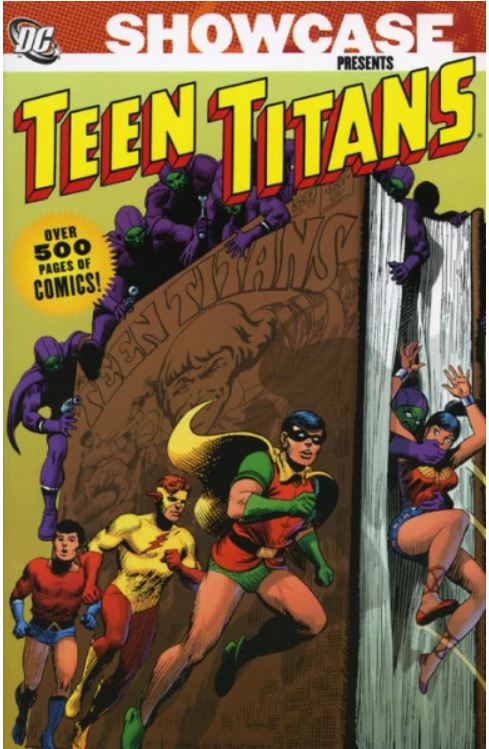
Showcase Presents: The Teen Titans volume 1


By Bob Haney, Len Wein, Marv Wolfman, Bruno Premiani, Nick Cardy, Irv Novick, Bill Molno, Lee Elias, Bill Draut, Jack Abel, Sal Trapani & various (DC Comics)
ISBN: 978-1-84576-677-1 (TPB)

The concept of kid hero teams was not a new one when DC finally opted to entrust their big heroes’ assorted sidekicks with their own comic. The result was a fab, hip and groovy ensemble as dedicated to helping kids as it was to stamping out insidious evil; ready to capitalise on the growing independence of modern kids.

The greatest difference between underage wartime groups like The Young Allies, Newsboy Legion and Boy Commandos or 1950s holdovers like The Little Wise Guys and Boy Explorers and the birth of the Teen Titans was quite simply a burgeoning social phenomenon popularly dubbed “Teenagers”: a whole new thing regarded as a discrete cultural and commercial force. These were kids who could – and should – be permitted to do things themselves free from constant adult “help” or supervision. This quirkily eclectic compilation re-presents landmark try-out appearances from The Brave and the Bold #54 and 60 and Showcase #59 – collectively debuting in 1964 and1965 – plus the first 18 issues of a Teen Titans solo title, running January/February 1966 to November/December 1968.

As early as the June/July 1964 cover-dated issue of The Brave and the Bold (#54), DC’s Powers-That-Be tested choppy unknown waters in a gripping tale by writer Bob Haney superbly illustrated by unsung genius Bruno Premiani. At that juncture B&B was exploring a succession of superhero combinations and ‘The Thousand-and-One Dooms of Mr. Twister’ united Kid Flash, Aqualad and Robin the Boy Wonder in a bizarre battle against a modern wizard/Pied Piper who had stolen the teens of provincial Hatton Corners. The young heroes had met in the town by chance when students there invited them to mediate a long-running dispute with the adults in charge. Hey Kids! Happy 60th Anniversary!

This element of a teen “court-of-appeal” was the motivating factor in many of the later group’s cases. One year later the lads met again for a second adventure (The Brave and the Bold #60, by the same creative team) but introduced two new elements.

‘The Astounding Separated Man’ featured more misunderstood kids – this time in coastal hamlet Midville – threatened by an outlandish monster whose giant body parts could move independently. They added Wonder Girl (not actually a sidekick, or even a person, at that time but rather a magical/digital artificial avatar of Wonder Woman as a child, but a fact writers and editors seemed blissfully unaware of) and finally earned a name: Teen Titans.

Their final test appearance came in Showcase (issue #59, cover-dated November/December 1965): birthplace of so many hit comic concepts. It was the first drawn by the brilliant Nick Cardy – who became synonymous with the 1960s series. ‘The Return of the Teen Titans’ pitted them against teen pop trio The Flips who were apparently also a gang of super-crooks… but as was so often the case, the grown-ups had got it all wrong…

One month later their own comic launched. Dated January/February 1966, TT #1 was released mere weeks before the first Batman TV show aired on January 12th. Robin was point of focus on the cover – and most succeeding ones – as Haney & Cardy produced exotic thriller ‘The Beast-God of Xochatan!’ with the youngsters acting as Peace Corps representatives in a South America-set drama of sabotage, giant robots and magical monsters.

The next issue held a fantastic mystery of revenge and young love involving ‘The Million-Year-Old Teen-Ager’ who was entombed and revived in the 20th century. He might have survived modern intolerance, bullying and culture shock on his own, but when his ancient blood enemy turned up, the Titans were ready to lend a hand…

TT #3’s ‘The Revolt at Harrison High’ capitalised on the craze for drag-racing in a tale of crazy criminality. Produced during a historically iconic era, many readers now can’t help but cringe when reminded of such daft dastardly foes as Ding-Dong Daddy and his evil bikers, and of course the hip, trendy dialogue (it wasn’t that accurate then, let alone now) is pitifully dated, but the plot is strong and the art magnificent.

‘The Secret Olympic Heroes’ guest-starred Green Arrow’s teen partner Speedy in a very human tale of parental pressure at the peak end of sporting endeavour, although there’s also skulduggery aplenty from a terrorist organisation intent on disrupting the games. In #5’s ‘The Perilous Capers of the Terrible Teen’ the Titans faced dual tasks: helping a troubled young man and capturing a super-villain called The Ant, despite all evidence indicating that they were the same person, before another DC sidekick made his Titans debut in ‘The Fifth Titan’. Here obnoxious juvenile know-it-all Beast Boy from the Doom Patrol falls under the spell of a wicked circus owner and the kids must set things right. Painfully illustrated by Bill Molno & Sal Trapani, it’s the absolute low-point of a stylish run.

Many fans would disagree, however, citing #7’s ‘The Mad Mod, Merchant of Menace’ as the biggest stinker, but beneath painfully dated dialogue there’s a witty, tongue-in-cheek tale of swinging London and novel criminality, plus the return of the magnificent Nick Cardy to the art chores. It was back to America for ‘A Killer called Honey Bun’ (illustrated by Irv Novick & Jack Abel): another tale of adult intolerance and misunderstood youth, set against a backdrop of espionage in Middle America featuring a deadly prototype robotic super-weapon in the title role, whereas #9’s ‘Big Beach Rumble’ saw the Titans refereeing a vendetta between rival colleges before modern day pirates crashed the scene. Novick pencilled and Cardy’s inking made it all very palatable.

The editor obviously agreed as the artists remained for the next few issues. ‘Scramble at Wildcat’ was a crime caper featuring dirt-bikes and desert ghost-towns with skeevy biker The Scorcher profiting from a pernicious robbery spree whilst Speedy returned in #11’s spy-thriller ‘Monster Bait’ with the young heroes undercover to save a boy being blackmailed into betraying his father and his country. Twin hot-topics the Space-Race and Disc Jockeys informed whacky sci fi thriller ‘Large Trouble in Space-ville!’ with #13 a true classic as Haney & Cardy produced a seasonal comics masterpiece ‘The TT’s Swingin’ Christmas Carol!’: a stylish retelling that has become one of the most reprinted Titans tales ever. At this time Cardy’s art opened up as he grasped the experimental flavour of the times. The cover of TT #14, as well as the interior illustration for grim psycho-thriller ‘Requiem for a Titan’ are unforgettable. The case introduced the team’s first serious returning villain (Mad Mod does not count!): The Gargoyle is mesmerising and memorable. Although Cardy only inked Lee Elias’s pencils for #15’s eccentric tryst with Hippie counter-culture, ‘Captain Rumble Blasts the Scene!’ is a genuinely compelling crime thriller from a time when nobody over age 25 understood what the youth of the world was doing…

Teen Titans #16 returned to more fanciful ground in ‘The Dimensional Caper!’ when aliens infiltrate a rural high school (and how many times has that plot resurfaced since this 1968 epic?). Cardy’s art reached dizzying heights of innovation both here and in the next issue’s waggish jaunt to London in ‘Holy Thimbles, It’s the Mad Mod!’: a cunning criminal chase through Cool Britannia including a command performance from Her Majesty, the Queen!

This initial volume ends with a little landmark as novice writers Len Wein & Marv Wolfman got their big break introducing Russian superhero Starfire and setting themselves firmly on a path of teen super-team writing. ‘Eye of the Beholder’ is a cool cat burglar caper set in trendy Stockholm, drawn with superb understatement by Bill Draut, acting as the perfect indicator of changes in style and attitude that would infuse the Titans and the comics industry itself.

Although perhaps dated in delivery, these tales were a liberating experience for kids when first released. They betokened fresh empathy with independent youth and tried to address problems more relevant to and generated by that specific audience. That they are captivating in execution is a wonderful bonus. This is absolute escapism and absolutely delightful.
© 1964-1968, 2006 DC Comics. All Rights Reserved.

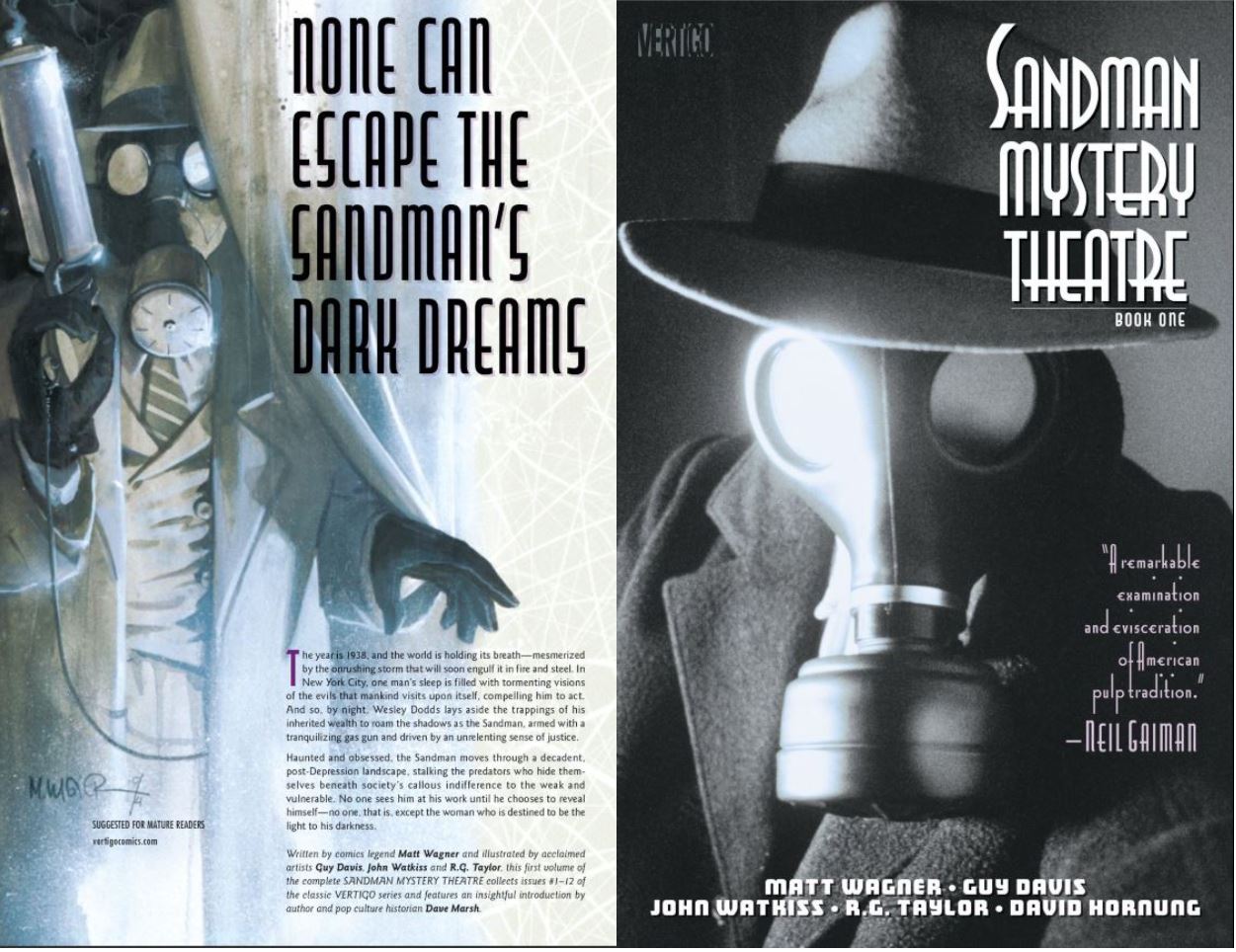
Sandman Mystery Theatre Book One


By Matt Wagner, Guy Davis, John Watkiss, R.G. Taylor, David Hornung & John Costanza & various (Vertigo)
ISBN: 978-1-4012-6327-0 (TPB/Digital edition)

Created by Bert Christman & Gardner F. Fox, The Sandman premiered in either Adventure Comics #40 July 1939 (two months after Batman debuted in Detective Comics #27) or two weeks earlier in New York World’s Fair Comics 1939, depending on which rather spotty distribution records can be believed.

Head and face utterly obscured by a gasmask and slouch hat; caped, business-suited millionaire adventurer Wesley Dodds was cut from the iconic masked mystery-man mould that had made pulp fictioneers The Lone Ranger, Green Hornet, The Shadow, The Spider and many more household names. Those dark red-handed heroes were also astonishing commercial successes in the early days of mass periodical publication…

Wielding a sleep-gas gun and haunting the night to battle a string of killers, crooks and spies, he was accompanied in the earliest comicbooks by his plucky paramour Dian Belmont, before gradually losing the readers’ interest and slipping from cover-spot to last feature in Adventure Comics, just as the cloaked pulp-hero avengers he emulated slipped from popularity in favour of more flamboyant fictional fare.

Possessing a certain indefinable style and charm but definitely no especial pizzazz, the feature was on the verge of being dropped when the Sandman abruptly switched to skin-tight yellow-&-purple and gained boy-sidekick Sandy the Golden Boy (Adventure Comics #69, December 1941, courtesy of Mort Weisinger & Paul Norris). All this, presumably to emulate the overwhelmingly successful Batman and Captain America models then reaping big dividends on newsstands.

It didn’t help much, but when Joe Simon & Jack Kirby came aboard with #72 it all changed. A semi-supernatural element and fascination with the world of dreams (revisited by S&K a decade later in their short-lived experimental suspense series The Strange World of Your Dreams) added moody conceptual punch to balance the kinetic fury of their art, as Sandman and Sandy became literally the stuff of nightmares to bizarre bandits and murderous mugs…

For what happened next you can check out the superb Simon & Kirby Sandman collection.

Time passed and in the late 1980s Neil Gaiman, Sam Keith & Mike Dringenberg took the property in a revolutionary new direction, eventually linking all the previous reboot elements into an overarching connective continuity under DC’s new “sophisticated suspense” imprint Vertigo. Within a few years the astounding success of the new Sandman prompted editorial powers-that-be to revisit the stylishly retro original character and look at him through more mature eyes. Iconoclastic creator Matt Wagner (Mage, Grendel, The Demon, Batman) teamed with artistic adept Guy Davis (Baker Street, B.P.R.D.) and colourist David Hornung to channel a grittier, grimier, far more viscerally authentic 1930s, where the haunted mystery man could pursue his lonely crusade with chilling verisimilitude.

The tone was darkly modernistic, with crime-busting played out in the dissolute dog-days of the Jazz Age and addressing controversial themes such as abuse, sexual depravity, corruption and racism; all presented against the rising tide of fascism sweeping the world then.

Consider this a warning: Sandman Mystery Theatre is not for kids.

This compendium collects the first three redefining story-arcs from issues #1-12 (April 1993 to March 1994) and commences after an absorbing introduction from veteran journalist, critic and pop culture historian Dave Marsh.

Each chapter preceded by its original evocative faux pulp photo cover created by Gavin Wilson and Hornung, the dark drama opens with The Tarantula, taking us to New York in 1938 where District Attorney Larry Belmont is having the Devil’s own time keeping his wild-child daughter out of trouble and out of the newspapers. Dian is gallivanting all over town every night with her spoiled rich friends: drinking, partying and associating with all the wrong people, but the prominent public servant has far larger problems too. One is a mysterious gas-masked figure he finds rifling his safe soon after Dian departs…

The intruder easily overpowers the DA with some kind of sleeping gas – which also makes you want to blurt every inconvenient truth – before disappearing, leaving Belmont to awaken with a headache and wondering if it was all a dream…

After a rowdy night carousing with scandalous BFF Catherine Van Der Meer and her latest (gangster) lover, Dian gets up with a similar hangover, but still agrees to attend one of father’s dreary public functions that evening. The elder Belmont is particularly keen that she meet a studious young man named Wesley Dodds, recently returned from years in the Orient to take over his deceased dad’s many business interests. Dodds seems genteel and effete, yet Dian finds there’s something oddly compelling about him. Moreover, he too seems to feel a connection…

The Gala breaks up early when the DA is informed of a sensational crime. Catherine Van Der Meer has been kidnapped by someone calling himself as The Tarantula

Across town, mob boss Albert Goldman meets with fellow gangsters from the West Coast and, as usual, his useless son Roger and drunken wife Miriam embarrass him. Daughter Celia is the only one he can depend on these days, but even her unwavering devotion seems increasingly divided. After another stormy scene, the conference ends early, and the visiting crimelords are appalled to find their usually diligent bodyguards soundly asleep in their limousines…

Even with Catherine kidnapped, Dian is determined to go out that night, but when Wesley arrives unexpectedly changes her mind, much to her father’s relief. The feeling doesn’t last long, however, after the police inform him the Tarantula has taken another woman…

When a hideously mutilated body is found, Dian inveigles herself into accompanying dear old Dad to Headquarters but is promptly excluded from the grisly “Man’s Business”. Left alone, she starts snooping in the offices and encounters a bizarre gas-masked figure poring through files. Before she can react, he dashes past her and escapes, leaving her to explain to the assorted useless lawmen cluttering up the place.

Furious and humiliated, Dian then insists that she officially identify Catherine and nobody can dissuade her. Shockingly, the savagely ruined body is not her best friend but yet another victim. Somewhere dark and hidden, Van Der Meer is being tortured, but the perpetrator has far more than macabre gratification in mind…

In the Goldman house, Celia is daily extending her control over darling devoted Daddy. They still share a very special secret, but these days she’s the one dictating where and when they indulge themselves…

With all the trauma in her life, Dian increasingly finds Wesley a comforting rock, but perhaps that view would change if she knew how he spends his nights. Dodds is tormented, plagued by bad dreams. Not his own nightmares, but rather somnolent screams of nameless victims and their cruel oppressors haunt his troubled slumbers. Worst of all, these dreams are unrelenting and somehow prophetic. What else can a decent man do then, but act to end such suffering?

In a seedy dive, uncompromising Police Lieutenant Burke comes off worst when he discovers the gas-mask lunatic grilling a suspect in “his” kidnapping case and again later when this “Sandman” is found at a factory where the vehicle used to transport victims is hidden.

Even so, the net is inexorably tightening on both Tarantula and the vigilante interfering in the investigation, but Burke doesn’t know who he most wants in his nice, dark interrogation room…

As the labyrinthine web of mystery and monstrosity unravels, tension mounts and the death toll climbs, but can The Sandman stop the torrent of depraved terror before the determined Dian finds herself swept up in all the blood and death?

Of course, he does but not without appalling consequences…

Scene and scenario suitably set, John Watkiss steps in to illuminate second saga The Face (issues #5-8). Attention switches to Chinatown in February of 1938, where Dian and her gal-pals scandalously dine and dish dirt… until Miss Belmont meets again an old lover.

Jimmy Shan once worked in her father’s office but now serves as lawyer and fixer for his own people amongst the teeming restaurants, gambling dens and bordellos of the oriental district. Dian would be horrified to see Jimmy – or Zhang Chai Lao as his Tong masters know him – consorting with unsavoury criminals, and would certainly not be considering reviving her scandalous out-of-hours relationship with him. All such frivolous thoughts vanish, however, when the diners vacate the restaurant and stumble upon a severed head: a warning that the ruling factions are about to go to war again in Chinatown. As usual, white police are utterly ineffectual against the closed ranks of the enclave…

Later at a swanky charity soiree to raise money for a school, Dian meets Jimmy again and agrees to a meeting. At the same shindig she later sees Wesley, and in the course of their small talk, Dodds reveals that he recognises Shan from somewhere.

…And in Chinatown, another beheading leads to greater tension between the Lee Feng and Hou Yibai Societies. When an enigmatic gas-masked stranger starts asking unavoidable questions, he finds both Tongs denying all knowledge of the killings…

As the grisly murder-toll mounts, The Sandman’s investigations lead to one inescapable conclusion: a third party is responsible. But who, and why? Before this drama closes, Dian will learn more hard truths about the world and the money-men who secretly run it…

Issues #9-12 (December 1993-March 1994) are illustrated by R.G. Taylor, plumbing the darkest depths of human depravity in the tale of ‘The Brute’. The friendship of Dian and Wesley slowly deepens and life seems less fraught in the city, but that ends as a hulking degenerate stalks the back-alleys, killing and brutalising prostitutes and their clients…

Dodds is also on the mind of boxing promoter and businessman Arthur Reisling who’s looking for a fresh financial partner in his global exploitations. The effete-seeming scholar is hard to convince, though, unlike Eddie Ramsey. He’s a poverty-stricken pugilist and single parent desperate to make enough money to pay for his daughter Emily’s TB medicine. Riesling’s offer to him is just as scurrilous but the broken-down pug doesn’t have the luxury of saying “no”…

Eventually, with Dian in tow, Wesley accepts a party invitation from the speculator and meets his dynasty of worthless, over-privileged children. None of them seem right or well-adjusted. Later, when Eddie tries to come clean by informing the authorities of Riesling’s illegal fight events, he’s attacked by the promoter’s thugs and saved by The Sandman – at least until the colossal mystery killer attacks them both and they’re forced to flee for their lives…

As Dodds returns home to recuperate, the punishing dreams escalate to mind-rending intensity. Eddie, meanwhile, is left with no safe option and takes to the streets with Emily. His decision will lead to revolting horror, total tragedy and utter heartbreak.

The Sandman returns to his covert surveillance, silently unearthing the depths of Reisling’s underworld activities and coincidentally exposing a turbulent, dysfunctional atmosphere in the magnate’s home life to match his criminal activities. In this house, corruption of every kind runs deep and wide, and the masked avenger decides it’s time to bring his findings to Dian’s father. This time, District Attorney Belmont is prepared to listen and to act…

As murders mount and Dodds’ dreams escalate in intensity, the strands of a bloody tapestry knot together and the appalling secret of the bestial killer’s connection to Reisling is exposed; only a detonation of expiating violence can restore order…

Stark, compelling and ferociously absorbing, these bleak thrillers depict a cruel but incisive assessment of good and evil no devotee of dark drama should miss, with the period perils accompanied by a gallery of the series’ original, groundbreaking comic book photo-covers and posters by Gavin Wilson, plus later collection covers and related art from Matt Wagner, Alex Toth and Kent Wilson.
© 1993, 1994, 1995, 2016 DC Comics. All Rights Reserved.

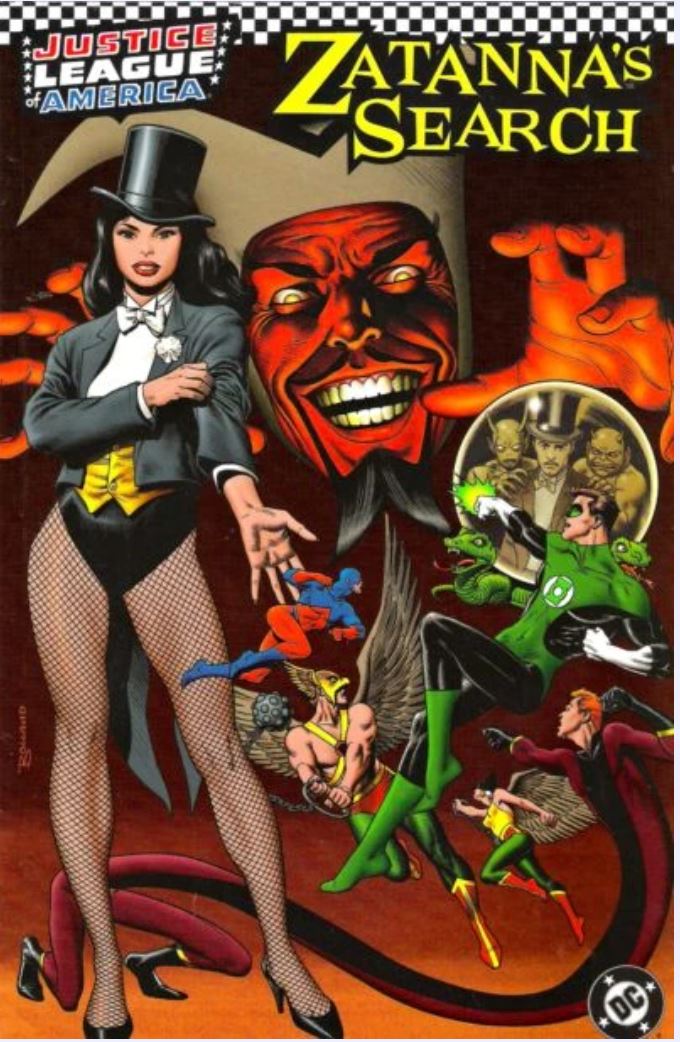
Justice League of America: Zatanna’s Search


By Gardner F. Fox, Murphy Anderson, Bob Kane, Joe Giella, Gil Kane, Sid Greene, Carmine Infantino, Mike Sekowsky & various, with Gerry Conway, Romeo Tanghal & Vince Colletta (DC Comics)
ISBN: 978-1-4012-0188-3 (TPB)

The Silver Age of Comic Books changed many things, but its longest lasting revolution was in how it introduced more women and to the pantheon of costumed characters. Here in one long-neglected package is the story of a character who has never looked back, and this year celebrates sixty years of magic…

With Julius Schwartz and John Broome, writer extraordinaire Gardner F. Fox laid the foundations of all comic book continuities. He was a lifelong creator and champion of strong female characters (like Dian Belmont, Hawkgirl/Hawkwoman, Inza Nelson, BarbaraBatgirl/OracleGordon and Sue Dibny), a canny innovator and one of the earliest proponents of extended storylines which have since become so familiar to us as “braided crossovers”.

A lawyer by trade, Fox began his comics career in the Golden Age toiling on major and minor features, working in every genre and for most companies. One of the second-string strips he scripted was Zatara; a magician-hero in the Mandrake mould who fought evil and astounded audiences in the pages of Action and World’s Finest Comics for over a decade, beginning with the very first issue. To be completely accurate, the latter’s premiere performance was in the one-shot World’s Best Comics #1, but whatever the book’s name, the top-hatted, suavely tailed and tailored trickster was there. Zatara fell from favour as the decade closed, fading from memory like so many other outlandish crime-crushers…

In 1956 Editor Schwartz reinvented the superhero genre, reintroducing costumed characters based on the company’s defunct costumed cohort. Flash, Green Lantern, Hawkman and The Atom were refitted for a sleek, scientific atomic age, with their legendary predecessors latterly reincarnated and returned as denizens of an alternate Earth. As experiments became a trend and then inexorable publishing policy, surviving heroes like Superman, Batman, Green Arrow, Aquaman and Wonder Woman were retrofitted to match the new world order.

The Superhero was resurgent and public appetite seemed inexhaustible. For their next trick Fox & Schwartz turned to the magician of yore and presumably found him wanting. Rather than condemn the mage to Earth-Two, they instead created the first “legacy hero” by having Zatara vanish from sight as precursor to debuting an unsuspected daughter, before setting her on a far-reaching quest to find him.

Zatanna premiered in 1964 in Hawkman #4 (cover-dated October/November), illustrated by the magnificent Murphy Anderson in a beguiling thriller entitled ‘The Girl who Split in Two’. Following a mystical trail and wearing a variation of Zatara’s stage garb, the plucky, impatient lass had mystically divided her body in two and travelled simultaneously to Ireland and China, but lapsed into paralysis until Hawkman and Hawkgirl answered her ethereal distress call.

Although nobody knew it at the time, the “winsome witch” appeared next as the villain in Detective Comics #336 (February 1965). ‘Batman’s Bewitched Nightmare’ saw a broom-riding old crone attacking the Dynamic Duo at the command of mutant super-threat The Outsider in a stirring yarn limned by Bob Kane & Joe Giella. Current opinion posits this wasn’t originally intended as part of the quest epic, but when the search storyline was resolved at the height of TV-inspired “Batmania” in Justice League of America #51, some slick back-writing was necessary to bring the high-profile Caped Crusader into the resolution.

Gil Kane & Sid Greene illustrated the next two chapters of the saga: firstly in ‘World of the Magic Atom’ (Atom #19, June/July 1965), wherein Mystic Maid and Tiny Titan battled Zatara’s old nemesis The Druid on microcosmic world Catamoore, and then with the Emerald Gladiator in an extra-dimensional realm on ‘The Other Side of the World!’ (Green Lantern #42, January 1966). Here the malevolently marauding, potentially Earth-dominating Warlock of Ys is overcome after a mighty struggle and compelled to reveal further clues in the trail.

The Elongated Man starred in a long-running back-up feature in Detective Comics, and in #355 (September 1966, pencilled & inked by Carmine Infantino) ‘The Tantalizing Trouble of the Tripod Thieves!’ revealed how the search for a pilfered eldritch artefact brought the sorceress closer to her goal, before the search concluded in spectacular and fabulously satisfying fashion with aforementioned JLA tale ‘Z – As in Zatanna – and Zero Hour!’ (#51, February 1967).

With art by incomparable team Mike Sekowsky & Sid Greene, all heroes who previously aided her were transported to another mystical plane to conduct a classic battle of good against evil, with plenty of cunning surprises and a happy ending for all concerned.

Here is a triumphant early experiment in continuity that remains one of the best adventures of the Silver Age, featuring some of the era’s greatest creators at the peak of their powers. This slim volume also carries an enticing encore: following the mandatory cover gallery is a rare 10-page tale. ‘The Secret Spell!’ – by Gerry Conway, Romeo Tanghal & Vince Colletta – was only originally seen in DC Blue Ribbon Digest #5 (November-December 1980): revealing ‘Secret Origins of Super-Heroes’ and exploring the hidden history of both father and daughter in a snappily informative manner. Although a little hard to find now – and a still a prime candidate for arcane transmogrification into digital formats – this is a superlative volume for fans of costumed heroes and would make a wonderful tome to bring newcomers to the genre.
© 1964, 1965, 1966, 1967, 1980, 2004 DC Comics. All Rights Reserved.
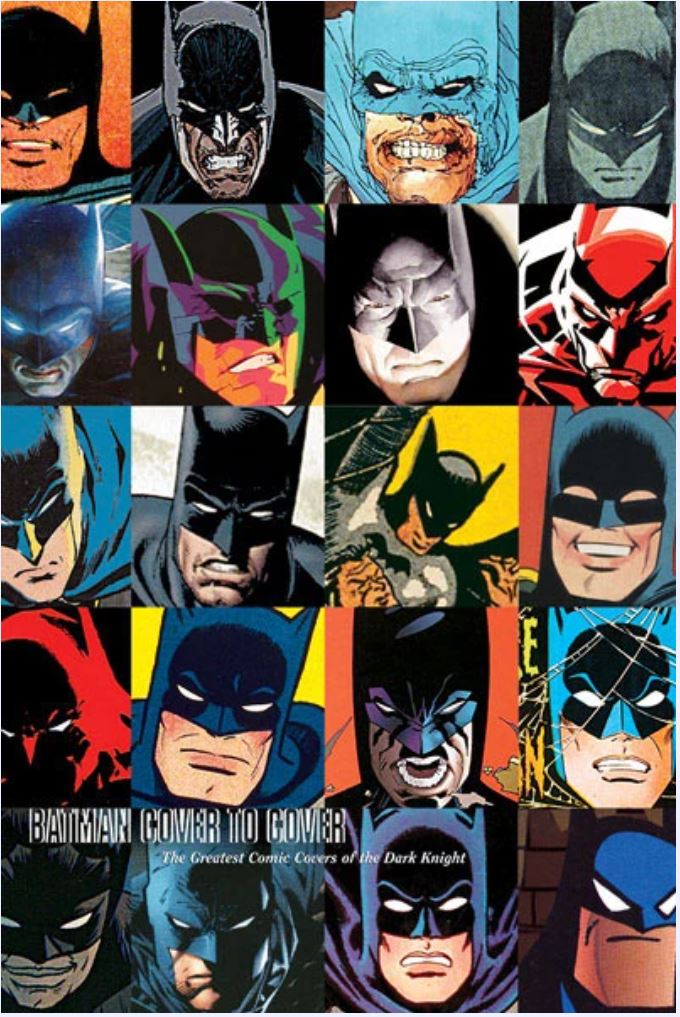
Batman: Cover to Cover


By Neal Adams, Chip Kidd, Rian Hughes and more, with art by Bob Kane, Sheldon Moldoff, Jerry Robinson, George Roussos, Charles Paris, Stan Kaye, Fred Ray, Jack Burnley, Dick Sprang, Lew Sayre Schwartz, Win Mortimer, Jim Mooney, Curt Swan, Carmine Infantino, Joe Giella, Murphy Anderson, Nick Cardy, Joe Kubert, Gil Kane, Ross Andru, Mike Esposito, Irv Novick, Jack Abel, Bernie Wrightson, Alex Toth, Ernie Chan, Dick Giordano, Marshall Rogers, Terry Austin, Walter Simonson, Michael Golden, José Luis García-López, Frank Miller, David Mazzucchelli, Brian Bolland, Alan Davis, Paul Neary, Eduardo Barreto, George Pérez, Bill Sienkiewicz, Edward Hannigan, Paul Gulacy, Gene Colan, Graham Nolan, Brian Stelfreeze, Kelley Jones, Dexter Vines, Drew Geraci, Bruce Timm, Bret Blevins, Kevin Nowlan, Lee Weeks, Adam Hughes, Jon Bogdanove, Denis Janke, John Beatty, Michael T. Gilbert, Mike Mignola, P. Craig Russell, Mike Zeck, Norm Breyfogle, James Hodgkins, Matt Wagner, Jim Lee, Scott Williams, Tony Salmons, Damion Scott, Tom Palmer, Ty Templeton, Terry Beatty, Carl Critchlow, Jason Pearson, Daniel Brereton, John Van Fleet, John Wells, Karl Story, Hugh Fleming, Kelsey Shannon, Paul Pope, Jae Lee, Cully Hamner, John McCrea, Robert Smith, Scott McDaniel, Howard Porter, Joe Quesada, Jimmy Palmiotti, Alex Maleev, Sean Phillips, Doug Mahnke, Phil Winslade, Quique Alcatena, Tom Nguyen, Scott Hampton, Ed McGuiness, Michael Lark, Paul Johnson, Tim Sale, Darwyn Cooke, Lee Bermejo, Dave Johnson, J. G. Jones, Robert John Cassaday, Campanella, The Iguana & various (DC Comics)
ISBN: 978-1-4012-0659-8 (HB)

This year marks Batman’s 85th Anniversary and we’ll be covering many old and new books about the Dark Knight over the year. Let’s start gently with a pictorial treat long overdue for revision and rerelease but also one readily available through the usual digital vendors…

Although not strictly a graphic novel, Batman: Cover to Cover is a giant collection of the best comic covers featuring the Caped Crusader since his first appearance in Detective Comics #27 (May 1939). This is a nostalgic delight for old timers, newcomers and casually passersby alike, concocted and compiled by many of the countless people who worked on Batman over the past decades.

Each was were polled on their own favourite cover and what seems like an impossible task at first glance was smartly subdivided into easy to digest, themed subject-headings including Fearsome Foes, Welcome to Fun City, The Dynamic Duo, Batman by Design, Death Traps, Guilty!, The Batman Family, Bizarre Batman, Secrets of the Batcave, Covers from Around the World, A Death in the Family, Milestones and World’s Finest (pairing the Gotham Guardian with other heroes from the DCU).

Additional features include a thorough examination and critique of the globally recognised logo by designer extraordinaire Rian Hughes; discussions on cover construction by Jerry Robinson, Neal Adams and Bob Schreck and a poll on the greatest cover ever with contributions from the likes of Alex Ross, Chip Kidd, Neil Gaiman, Brad Meltzer, Mark Waid, Jeph Loeb, Brian Bolland, Paul Levitz and movie mavens like Christopher Nolan and Mark Hamill.

This coffee table book is exciting, emphatically lovely to look at and will provide hours of debate as we all dip in, reminisce and ultimately disagree on what should and shouldn’t be included. Enjoy, Art-lovers and Bat-Fans!
© 2005 DC Comics. All Rights Reserved.
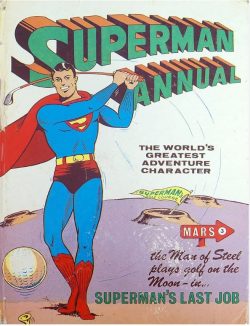
Superman Annual 1965-1966


By Jerry Siegel, Otto Binder, Jerry Coleman, Robert Bernstein, Wayne Boring, Curt Swan, Dick Sprang, Al Plastino & various (Atlas Publishing/K.G. Murray)
No ISBN: B008IIHI92

Before 1959, when DC Comics and other American publishers began exporting directly into the UK, our exposure to their unique brand of fantasy fun came from licensed reprints. British publisher/printers like Len Miller and Alan Class bought material from the USA – and occasionally, Canada – to fill 68-page monochrome anthologies, many of which recycled the same stories for decades.

Less common were (strangely) coloured pamphlets from Australian outfit K.G. Murray, exported here in a rather sporadic manner. The company also produced sturdy and substantial Christmas Annuals which had a huge impact on my earliest years (I strongly suspect my adoration of black-&-white artwork stems from seeing supreme stylists like Curt Swan, Carmine Infantino, Al Plastino, Wayne Boring, Gil Kane or Murphy Anderson uncluttered by flat, limited colour palettes). This particular tome comes from the period when those US imports were steadily proliferating, prompting some rash, rushed experiments with full colour – but not as we knew it…

Also generally unknown was who did what, but I’m here to tell you Otto Binder, Boring & Stan Kaye produced the spectacular 2-chapter clash opening this Annual as ‘Hercules in the 20th Century!’ and ‘Superman’s Battle with Hercules!’ (taken from Action Comics #267-268, August and September 1960) sees Luthor bring the Hellenic demi-god to Metropolis to battle “evil king” Superman. Events turn even more serious when the legendary warrior “goes native” and in human guise woos Lois Lane. When spurned, he marshals the mighty magical powers of his fellow Olympians to destroy his unwitting rival!

Pausing to refresh with a fact-feature look at ‘Giants of the Telescope – Nicholas-Louise de Lacaille (1713-1762)’, the eternal cat-&-mouse game of Lois trying to unmask Superman next prompts a clever bout of identity-saving when she tricks Clark Kent into standing before ‘The Truth Mirror!’ (by Jerry Siegel, Swan & George Klein from Action #269).

For decades Superman and Batman were quintessential superhero partners: the “World’s Finest” team. They were friends as well as colleagues and their pairing made sound financial sense since DC’s top heroes could cross-pollinate and cross-sell their combined readerships. Here World’s Finest Comics #112 (September 1960) sees Jerry Coleman, Dick Sprang & Sheldon Moldoff’s unique and tragic saga of ‘The Menace of Superman’s Pet’ as a phenomenally cute teddy bear from space proves to be an unbelievably dangerous menace and unforgettable true friend. The ending is killer so bring tissues you big babies…

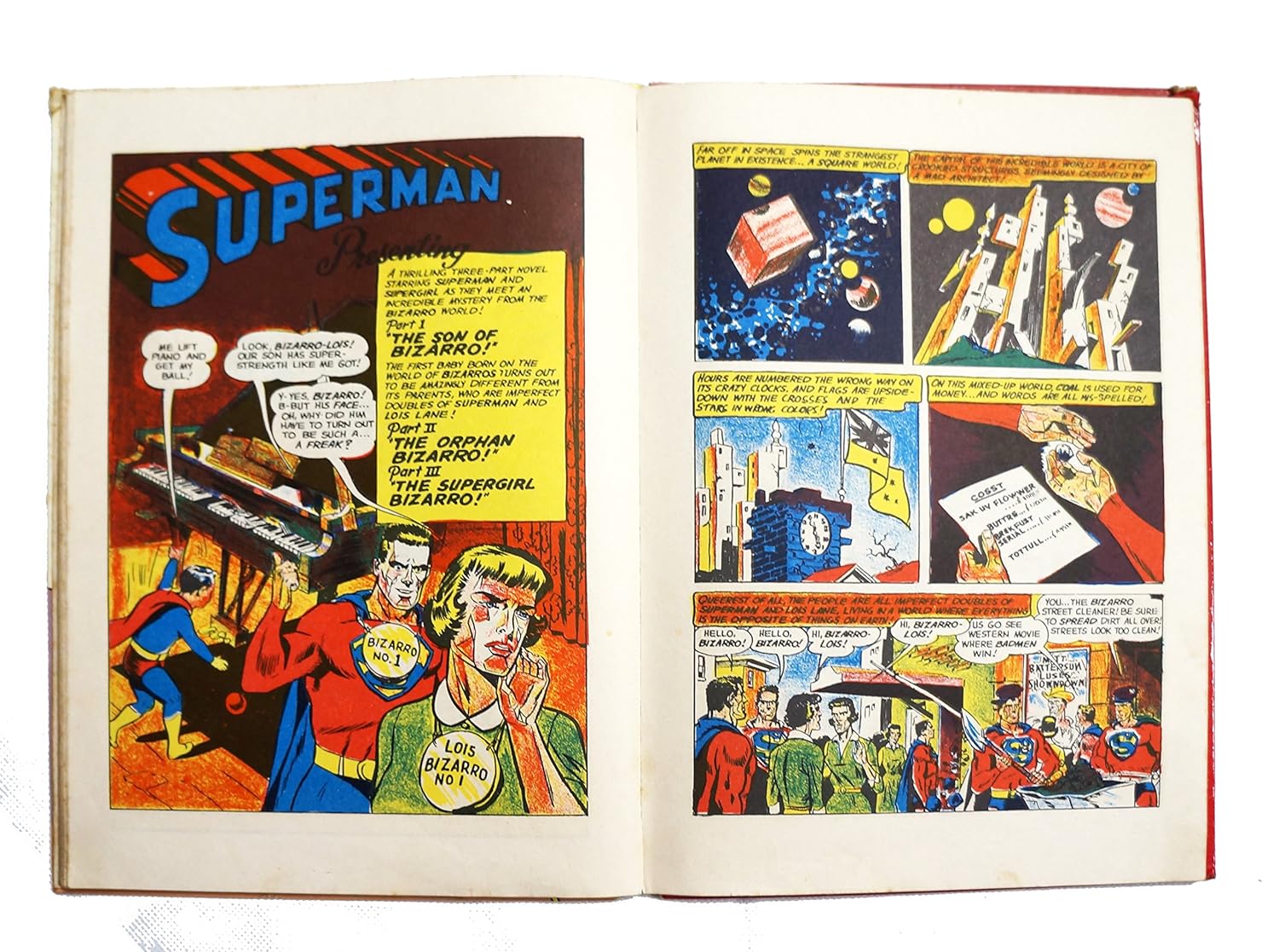
Although later played for laughs, most of the earlier appearances of The Man of Steel’s warped double were generally moving comic-tragedies. That’s absolutely the case in ‘The Son of Bizarro!’ (Superman #140, Binder, Boring & Kaye) as the fractured facsimile and wife Bizarro-Lois have a human baby. The fast growing but physically perfect tyke is super-powered but utterly shamed and shunned by the populace of the world of monsters.

His simple-minded, heartbroken father has no choice but to exile his son to space, where chance (and narrativium) bring the lad crashing to Earth as ‘The Orphan Bizarro!’. Housed in the same institution where Supergirl resides, “Baby Buster” is soon a permanent headache for the Girl of Steel until a tragic accident apparently mutates him. Eventually, his distraught father comes looking for the kid leading an angry army of enraged imperfect Superman duplicates. A devastating battle is narrowly avoided and a happy ending only materialises due to the creation of ‘The Bizarro Supergirl!’

More knowledge is pictorially shared in ‘Amazing Ratios!’ before we head to the end with a devious story of the Action Ace’s shock retirement, as first seen in Superman #90 (July 1954) wherein Coleman & Plastino deliver ‘Superman’s Last Job!’ Naturally, there’s a hidden agenda and crime to be crushed behind all his twilight years hobby sampling…

Superman has proven to be all things to all fans over his decades of existence, and these timeless tales of joyous charm and wholesome wit are more necessary than ever: not just as a reminder of great times past but as an all-ages primer of wonders still to come…
Published by arrangement with the K.G. Murray Publishing Company, Pty. Ltd., Sydney. © National Periodical Publications, Inc. New York.

Superman: the Atomic Age Sundays volume 2: 1953-1956


By Alvin Schwartz, Wayne Boring & Stan Kaye (IDW/DC Comics)
ISBN: 978-1-63140-537-2 (HB)

It’s indisputable that today’s comic book industry – if it existed at all – would have been an utterly unrecognisable thing without Superman. Jerry Siegel & Joe Shuster’s bold and unprecedented invention was fervidly adopted by a desperate and joy-starved generation and quite literally gave birth to a genre… if not an actual art form.

He was shamelessly copied and adapted by many inspired writers and artists for numerous publishers, spawning an incomprehensible army of imitators and variations within three years of his summer 1938 debut. 85 YEARS… and counting!

An intoxicating blend of breakneck, breathtaking action and triumphal wish-fulfilment which epitomised the early Man of Steel soon grew to encompass cops-and-robbers crime-busting, socially reforming dramas, science fiction, fantasy, whimsical comedy and, once the war in Europe and the East also engulfed America, patriotic relevance for a host of gods, heroes and monsters, all dedicated to profit through exuberant, eye-popping excess and vigorous dashing derring-do.

Superman was master of the world and whilst transforming and dictating the shape of the fledgling funnybook industry, the Man of Tomorrow relentlessly expanded into all areas of the entertainment media. Although we all think of the Cleveland boys’ iconic invention as the epitome and acme of cartoon creation, the truth is that very soon after his debut in Action Comics #1 the Man of Steel became a fictional multimedia monolith in the same league as Popeye, Tarzan, Sherlock Holmes and Mickey Mouse. Diehard comics fans regard our purest and most enduring icons in primarily graphic narrative terms, but the likes of Batman, Spider-Man, Black Panther, The Avengers and their hyperkinetic ilk long ago outgrew four-colour origins to become fully mythologized modern media creatures, instantly recognised in mass markets across all platforms and age ranges…

Far more people have viewed or heard the Man of Steel than have ever read his comics. His globally syndicated newspaper strips alone reached untold millions, and by the time his 20th anniversary rolled around at the very start of what we know as the Silver Age of Comics, he had been a thrice-weekly radio serial regular and starred in a series of astounding animated cartoons, as well as two films and a novel by George Lowther.

Superman was a perennial sure-fire success for toy, game, puzzle and apparel manufacturers and had just ended his first smash live-action television serial. In his future were many more shows (Superboy, Lois & Clark, Smallville, Superman & Lois and even spin-offs like Supergirl), a stage musical, a franchise of blockbuster movies and an almost seamless succession of games, bubble gum cards and TV cartoons beginning with The New Adventures of Superman in 1966 and continuing ever since. Even his superdog Krypto got in on the small-screen act…

However, during his formative years the small screen was simply an expensive novelty so the Action Ace achieved true mass market fame through a different medium: one not that far removed from his print origins.

Although pretty much a spent force these days, for the majority of the last century the newspaper comic strip was the Holy Grail that all American cartoonists and graphic narrative storytellers hungered for. Syndicated across the country – and frequently the planet – it was seen by millions, if not billions, of readers and generally accepted as a more mature and sophisticated form of literature than comic-books. It also paid far better.

And rightly so: some of the most enduring and entertaining characters and concepts of all time were created to lure readers from one particular paper to another and many of them grew to be part of a global culture. Flash Gordon, Dick Tracy, Buck Rogers, Charlie Brown and so many more escaped humble and tawdry newsprint origins to become meta-real: existing in the minds of earthlings from Albuquerque to Zanzibar.

Some still do…

Superman was the first original comic book character to make that leap – about 6 months after he exploded out of Action Comics – but precious few ever successfully followed. Wonder Woman, Batman (eventually) and trailblazing teen icon Archie Andrews made the jump in the 1940s with only a handful such as Spider-Man, Howard the Duck and Conan the Barbarian having done so since.

The daily Superman newspaper comic strip launched on 16th January 1939, supplemented by a full-colour Sunday page from November 5th of that year. Originally crafted by such luminaries as Siegel & Shuster and their studio (Paul Cassidy, Leo Nowak, Dennis Neville, John Sikela, Ed Dobrotka, Paul J. Lauretta & Wayne Boring), the mammoth task soon required the additional talents of Jack Burnley and writers Whitney Ellsworth, Jack Schiff & Alvin Schwartz.

The McClure Syndicate Superman feature ran continuously from 1939 until May 1966, appearing at its peak in more than 300 daily and 90 Sunday newspapers; boasting a combined readership of more than 20 million. For most of the post war years Boring & Stan Kaye illustrated these spectacular Sundays (eventually supplemented by artists Win Mortimer and Curt Swan). The majority of the strips – from 1944 to 1958 – were written by Alvin Schwartz.

Born in 1916, he was an early maestro of comic books, writing for Batman, Superman, Captain Marvel and many other titles and companies. Whilst handling the Superman strip he also freelanced on Wonder Woman and the dwindling superhero pantheon as well as genre titles like Tomahawk, Buzzy, A Date with Judy and House of Mystery. After numerous clashes with new Superman Editor Mort Weisinger, Schwartz quit comics for commercial writing, selling novels and essays, and latterly documentaries and docudramas for the National Film Board of Canada.

He also worked miracles in advertising and market research, developing selling techniques such as psychographics and typological identification. He was a member of the advisory committee to the American Association of Advertising Agencies. He died in 2011.

After years wallowing in obscurity most of Superman’s newspaper strip exploits are at last available to aficionados and the curious newcomer in tomes such as this one, compiled under the auspices of the Library of American Comics. Showcasing Schwartz and artist Wayne Boring in their purest prime, these Sundays (numbered as pages #699 to #869 and collectively spanning March 22nd 1953 to June 24th 1956) feature a nigh-omnipotent Man of Steel in domestically-framed and curated tales of emotional dilemmas and pedestrian criminality rather than muscle-flexing bombast, utilising mystery, fashion, wit and satire as substitutes for bludgeoning action.

Following an affable appreciation of the creators and overview of the era in ‘An Introduction’ by Mark Waid, ‘A Wayne Boring Gallery’ provides a tantalising selection of Superman and Action Comics covers from the period before weekly wonderment commences in all its vibrant glory. Sadly, individual serial stories are untitled, so you’ll just have to manage with my meagre synopses of the individual yarns…

It begins with another prime example of Superman gaslighting his girlfriend – one of the sharpest journalists on Earth – in what I keep telling myself is just an example of how different attitudes were back then…

When Lois Lane catches Superman mid-change from Clark Kent, he manages to obscure his face long enough to claim her “victory” was through luck not skill or ingenuity, and challenge her to actually deduce his alter ego in a test through time. Angry, prideful and apparently a real sucker, she agrees and – relocated to ancient Troy, on the pilgrim ship Mayflower and Massechusetts colony and in 1907 San Francisco – promptly fails to spot the new identities the Man of Steel establishes. Apart from the appalling patriarchal premise and treatment it’s a beautiful tale with Lois meeting and/or replacing Helen of Troy, Priscilla Mullins (look her up or read The Courtship of Miles Standish by Henry Wadsworth Longfellow) and celebrity performer Lillian Russell with Trojan battles, pioneering dangers and the Great San Francisco Earthquake giving Superman plenty to do before she concedes defeat…

Dated July 5th 1953 (strip #714), the next exploit is far less upsetting as a dying millionaire convinces the Man of Tomorrow to find a decent purpose and inheritor for his vast riches. Operating clandestinely at first Superman vets artists, inventors, simple scammers, country doctors (thereby diverging long enough to become embroiled in a decades-long hillbilly feud) and battles crooks before finally completing his mission…

Strip #725 opened a thrilling new chapter on September 20th as the Action Ace intercepts an alien vehicle crashing to Earth and finds it carries two convicts from his long-dead homeworld. At first Arno and Tolas are content to use their new superpowers to scam, steal and swindle the puny humans before eventually realising they’re strong enough to take anything want. Superman’s attempts to restrain their crimes are never enough and he only saves his adopted homeworld by adopting his enemies’ preferred tactics…

December 13th (strip #737) saw a new yarn begin as an extremely determined young woman threw herself off a building to get Superman’s attention. Alice Talbot was a lawyer working as process server for her sexist uncle. He believed Law was man’s work and had his associates give her impossible jobs to discourage her: a situation that needed all the Man of Steel’s discretion as Alice took on ever-more difficult serving jobs and succeeded – even if with some secret assistance…

Few Superman foes transferred from funnybooks to the Funnies section, but murderously ridiculous criminal The Prankster was perfect for whimsy-minded readers. Strip #747 (February 21st 1954) began an extend campaign of confusion and carnage as the diabolically devious bandit began attacking modern art, plundering vaults and raiding stores after finding a way to exploit one of Superman’s powers and use it against him…

Clark took centre stage in a clever quandary running from April 25th to July 4th (#756-766) as a publicity stunt gone awry leaves him handcuffed to a starlet and accompanied everywhere by her wily manager, requiring many clever tricks over a very busy weekend to go into action as the Man of Tomorrow before he can legitimately shuck the shackles…

The “Atomic Age” title gets full milage in the next story (#767-777, July 11th – September 19th) as a purse-snatcher fleeing Superman is dosed with radiation and acquires the unwelcome and uncontrollable power to become intangible. Happily he’s not smart enough to capitalise on the scary gift… but his even shadier pal Al is…

When a strange man starts following Superman, it leads to crazy contests and another shifty conman mystic who has convinced wrestler Mop-up Moby that he can beat the Man of Steel in the ring. Incredibly that proves true in the comedy romp running from September 26th – November 7th (#778-784), after which a science experiment gives Superman amnesia and leaves him lost and confused on a desert island (#785-793, November 14th 1954 to January 9th 1955). At least “Roger” has lazy drop-out beach-bums Horace and Mike to guide him and manage his strange abilities: they even help the simple islanders appreciate the mod-cons of 20th century living Roger provides – whether they want him to or not…

Restored and returned to Metropolis for strip #794 (November 14th), Superman is swamped with petty requests from the authorities, unaware they are keeping him distracted from preparations for a major television event. The “Your Story” episode detailing his life is a great honour, but a huge risk too as he’s supposed to appear live with all his friends: Lois, Perry White, Jimmy Olsen and… Clark Kent…

Another secret identity dilemma follows (#801-805, March 6th – April 3rd) as Clark exhibits superstrength and allows observers to believe it comes from a mutant apple he ate. It might have been the end of it, but two other apples were eaten and he has to spend all his time faking the same powers for their eaters or risk exposure of his alter ego…

When Lois and Clark investigate a mystery millionaire (#806-813, April 10th – May 29th) they go undercover as domestics and encounter the most appalling children ever reared. Soon though a heartbreaking story emerges and the hardboiled reporters become matchmaking homemakers, after which epic action and humour return as an amazing archaeological discovery sends Superman back to ancient Greece to dispel many myths around Hercules before helping the rather hapless legend-in-waiting accomplish his labours (#814-824, June 5th – August 14th)…

Atom Age fantasy follows as a genuine flying horse baffles and bamboozles Metropolitans from scientists to thieves to circus showmen (#825-833, August 21st – October 16th). When Superman discovers the facts, his greatest concern is to reunite the modern Pegasus with the boy who loves him, before heading to the Himalayas (#834-844, October 23rd 1955 – January 1st 1956) and foiling a devilish plotter seeking to seize control of a lost colony of French musketeers and cavaliers!

The new year opened with science fiction in the driving seat as downtrodden despondent travelling salesman/inventor Edgar Weems makes contact with a scientist on a dying world. Benevolent Bel Neth Ka of Kadath is happy to share his secrets – like antigravity ointment and superstrength serum – but when innocent Edgar starts selling them his instant success naturally causes chaos. That was a big and very funny job for Superman running from January 8th to March 25th over Strips #845-856, and leads to the concluding tale in this second Atomic Age collection, as Lois goes on quiz show “The $88,000 Jackpot”. Her specialist subject is Superman and her answers are astonishingly accurate. As the days pass (April 1st to June 24th 1953 and strips#857-869), audience attention makes life hell for the Action Ace, reminding viewers of his weaknesses and who he might be in civilian life…

The Atomic Age Superman: – Sunday Pages 1953-1956 is the second of three huge (312 x 245mm), lavish, high-end hardback collections starring the Man of Tomorrow. It’s an inexpressible joy to see these “lost” stories again, offering a far more measured, domesticated and comforting side of America’s most unique contribution to world culture. It’s also a pure delight to see some of the hero’s most engaging yesterdays. Join me and see for yourself…
© 2016 DC Comics. All rights reserved. SUPERMAN and all related characters and elements are trademarks of DC Comics.