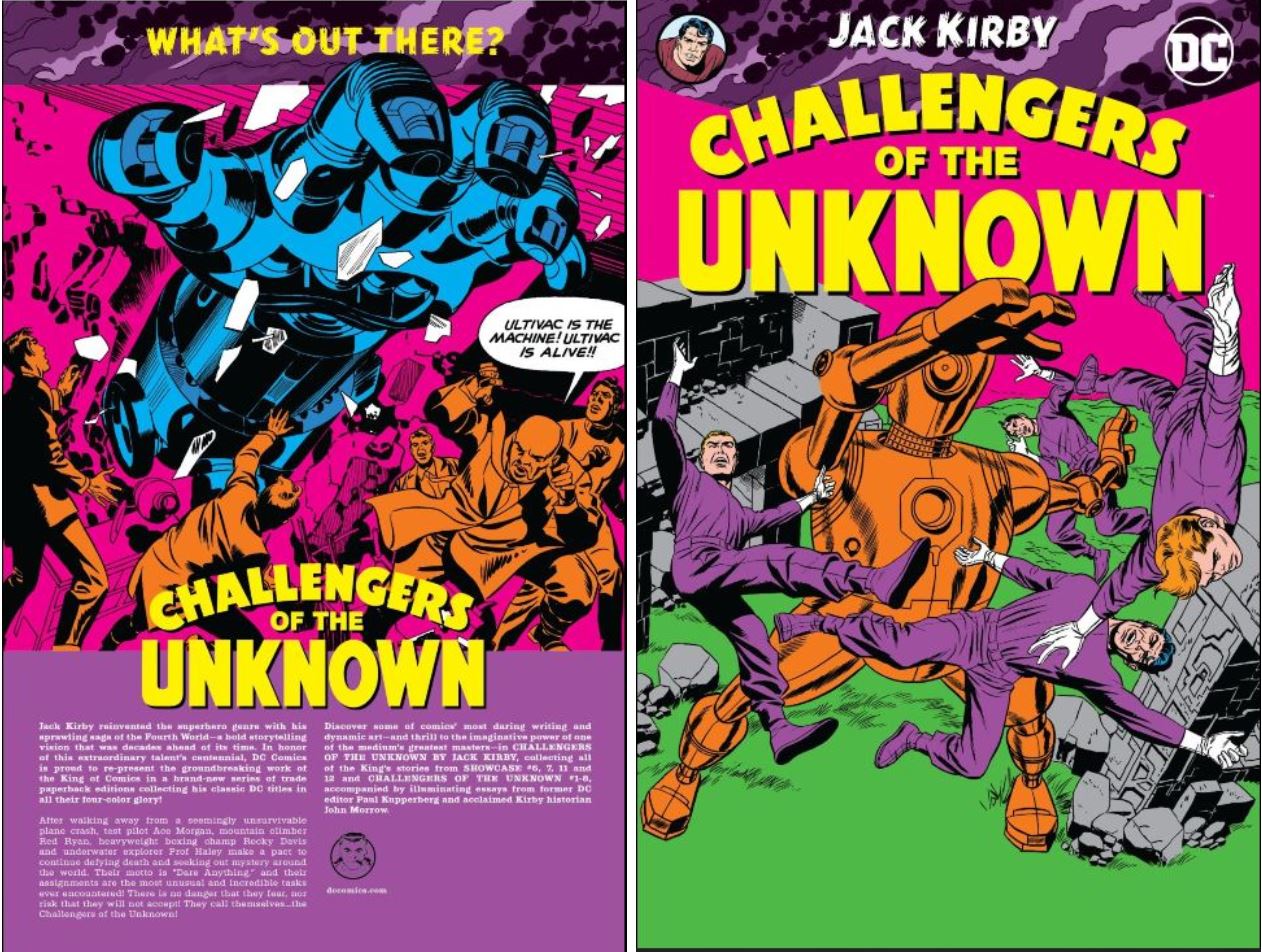
Challengers of the Unknown by Jack Kirby


By Jack Kirby, France “Ed” Herron, Dave Wood, Roz Kirby, George Klein, Bruno Premiani, Marvin Stein, Wally Wood & various (DC Comics)
ISBN: 978-1-4012-7719-2 (TPB/Digital edition)

The Challengers of the Unknown were a bridging concept between the fashionably All-American, verifiably human trouble-shooters who monopolised comic books for the majority of the 1950s and the reimagined costumed mystery men who would soon return to take over the industry.

As superheroes began popping up mid-decade, in 1956 came a super-team – the first of the Silver Age – with no powers, the most basic and utilitarian of uniforms and the most dubious of motives… Suicide by Mystery. Nevertheless their launch was arguably the second most important event of the Silver Age

Crucially, they were a huge hit from the get-go, striking a chord that lasted for over a decade before they finally died… only to rise again and yet again. The very idea of them was stirring enough, but their initial execution made their success inevitable.

Jack Kirby was – and remains – the most important single influence in the history of American comics. There are quite rightly millions of words written about what the man has done and meant (such as Paul Kupperberg’s enthusiastic Introduction and John Morrow’s pithy Afterword in this superb compilation), and you should read those if you are at all interested in our medium.

I’m still going to add a few words to that superabundance here: one of his best and most influential projects which, like so many others, he perfectly constructed before moving on, leaving highly competent but never quite as inspired talents to build upon.

When the comics industry suffered a paranoia-induced, witch-hunt-caused collapse in the mid-50’s, Kirby returned briefly to DC Comics to produce tales of suspense and science fiction for the company’s line of mystery anthologies. In a few episodes, he also revitalised Green Arrow (then simply a back-up strip in Adventure Comics) whilst creating the newspaper strip Sky Masters of the Space Force.

At the same time he also re-packaged for Showcase (the try-out title that launched many Silver Age DC mainstays) an off-kilter team concept that had been kicking around in his head since he and long-time collaborator Joe Simon had closed their innovative but ill-timed Prize/Essankay/Mainline Comics ventures.

After years of working for others, Simon & Kirby finally established their own publishing company: producing comics with a much more sophisticated audience in mind. That happened mere months before an industry-wide sales downturn amidst a changing society awash with public hysteria generated by the anti-comic book pogrom spearheaded by US Senator Estes Kefauver and pop psychologist Dr. Frederic Wertham.

Simon quit the business for advertising, but Kirby soldiered on, taking his skills and ideas to a number of safer, more conservative and less experimental companies.

The Challengers were four ordinary mortals; explorers and adventurers who walked away unscathed from a terrible plane crash. Already obviously what we’d now call “adrenaline junkies”, pilot Ace Morgan, diver Prof Haley, acrobat and mountaineer Red Ryan and wrestler Rocky Davis summarily decided that since they were all living on borrowed time anyway, they would dedicate what remained of their lives to testing themselves and fate. They would risk their lives for Knowledge and, naturally, Justice.

The series launched with ‘The Secrets of the Sorcerer’s Box!’ in Showcase #6 (cover-dated January/February 1957 – so it was on spinner-racks and news-stands in time for Christmas 1956). Kirby and scripter Dave Wood, plus inkers Marvin Stein and Jack’s wife Roz, crafted a spectacularly creepy epic wherein the freshly introduced doom-chasers were commissioned by duplicitous magician Morelian to open an ancient container holding otherworldly secrets and powers.

The story roars along with all the tension and wonder of the B-movie thrillers it emulates and Jack’s awesome drawing resonates with power and dynamism, which grew even greater for the sequel: a science fiction drama instigated after an alliance of leftover Nazi technologists and contemporary American criminals unleashes a terrible robotic threat. ‘Ultivac is Loose!’ (Showcase #7, March/April 1957) introduced a necessary standard appendage of the times and the B-movie genre in the form of brave, capable, brilliant and beautiful-when-she-took-her-labcoat-off boffin Dr. June Robbins, who became the no-nonsense, ultra-capable (if unofficial) fifth Challenger at a time when most funnybook females had returned to a subsidiary status in that so-conventional, repressive era.

The uncanny exploits paused for a sales audit and the team didn’t reappear until Showcase #11 (November/December 1957) allowing The Flash and Lois Lane their respective second shots at the big time. When the Challengers returned, it was in alien invasion epic ‘The Day the Earth Blew Up’.

Uniquely engaging comics realist Bruno Premiani (a former associate and employee from Kirby’s Prize Comics days) came aboard to ink a taut doomsday chiller keeping readers on the edge of their seats even today, and in their final Showcase outing (#12, January/February 1958) the Questing Quartet were preparing a move into their own title.

‘The Menace of the Ancient Vials’ was defused by the usual blend of daredevil heroics and inspired ingenuity. The wonderful inking of George Klein adding subtle clarity to a tale of an international criminal who steals ancient weapons that threaten the entire world if misused), but the biggest buzz would come two months later with the first issue of their own magazine.

Written and drawn by Kirby with Stein on inks, Challengers of the Unknown #1 (May 1958) presented two complete stories plus an iconic introductory page that would become almost a signature logo for the team.

‘The Man Who Tampered with Infinity’ pits the heroes against a renegade scientist whose cavalier dabbling unleashes dreadful monsters from the beyond onto our defenceless planet, before the team are actually abducted by aliens in ‘The Human Pets’: forced to win their freedom and a rapid rocket-ship (sphere actually) ride home…

The same team were responsible for both tales in issue #2. ‘The Traitorous Challenger’ is a disturbing monster mystery, with June returning to sabotage a mission in the Australian Outback for the very best of reasons. Then, ‘The Monster Maker’ finds the team seemingly helpless against super-criminal Roc who can conjure and animate solid objects out of his thoughts.

Issue #3 features ‘Secret of the Sorcerer’s Mirror’ with Roz Kirby & Marvin Stein again inking The King’s mesmerising pencils as the fantastic foursome pursue a band of criminals whose magic looking-glass can locate deadly ancient weapons. Undoubtedly, though, the most intriguing tale for fans and historians of the medium is ‘The Menace of the Invincible Challenger’, wherein team strongman Rocky is rocketed into space, only to crash back to Earth with strange, uncanny powers.

For years the obvious similarities of this group – especially this yarn – to the origin of Marvel’s Fantastic Four (#1 cover-dated November 1961) have fuelled fan speculation. In all honesty I simply don’t care. They’re similar but different enough, and equally enjoyable so read both. In fact, read them all.

With #4, the series became visually immaculate as the sheer brilliance of Wally Wood’s inking elevated illustration to unparalleled heights. The scintillant sheen and limpid depth of Woody’s brushwork fostered an abiding authenticity in even the most outrageous of Kirby’s designs and the result is – even now – simply breathtaking.

‘The Wizard of Time’ is a full-length masterpiece that opens with a series of bizarre robberies leading the team to a scientist with a time-machine. By visiting historical oracles, rogue researcher Darius Tiko has divined a path to the far future. When he gets there, he intends to rob it blind, but the Challengers find a way to follow and foil him…

‘The Riddle of the Star-Stone’ (#5) is a full-length contemporary thriller, wherein an archaeologist’s assistant uncovers an alien tablet bestowing various super-powers when different gems are inserted into it. The exotic locales and non-stop action are intoxicating, but Kirby’s solid characterisation and ingenious writing are what make this such a compelling read.

Scripter Dave Wood returned for #6’s first story. ‘Captives of the Space Circus’ sees the team shanghaied from Earth to perform in an interplanetary travelling carnival, before the evil ringmaster is promptly outfoxed and they return for France “Ed” Herron’s mystic saga ‘The Sorceress of Forbidden Valley’. Here, June becomes an amnesiac puppet in a power struggle between a fugitive gangster and a ruthless feudal potentate.

Issue #7 offers another daring double-feature: both scripted by Herron. First comes relatively straightforward alien-safari saga ‘The Beasts from Planet 9’, but it’s followed by a much more intriguing yarn. On the ‘Isle of No Return’, the “Challs” face a super-scientific bandit whose shrinking ray leaves them all mouse-sized….

Concluding Kirby-crafted issue #8 (July 1959) delivers a magnificent finale to a superb run as The King & Wally Wood go out in stunning style with a brace of gripping thrillers – both of which introduce menaces who would return to bedevil the team in future exploits.

Dave Wood, Kirby and the unrelated Wally Wood reveal ‘The Man Who Stole the Future’: introducing evil mastermind Drabny who steals mystic artefacts and conquers a small nation before the team dethrone him. However, although this is a tale of spectacular battles and uncharacteristic, if welcome, comedy, the real gem here is space opera tour-de-force ‘Prisoners of the Robot Planet!’ Written by Kirby (probably with Herron), it sees the human troubleshooters petitioned by a desperate alien, travelling to his distant world to liberate the organic population from bondage to their own robotic servants These have risen in revolt under the command of the fearsome autonomous automaton, Kra in a clear example of fiction foreshadowing fact. Do you know what your AIs do while you’re reading old comics…?

These are classic adventures, told in a classical manner. Kirby developed a brilliantly feasible concept with which to work and heroically archetypical characters. He then tapped into an astounding blend of genres to display their talents and courage in unforgettable exploits that informed and affected every team comic that followed – and absolutely informed his successive landmarks with Stan Lee.

But then Jack was gone…

The Challengers followed the Kirby model until cancellation in 1970, but due to a dispute with Editor Jack Schiff the writer/artist resigned at the height of his powers. The Kirby magic was impossible to match, but as with all The King’s creations, every element was in place for the successors to run with. Challengers of the Unknown #9 (September 1959) saw an increase in those fantasy elements favoured by Schiff, and perhaps an easing of the interpersonal tensions that marked previous issues (Comics Historians take another note: the Challs were bitching, bickering and barking at each other years before Marvel’s Cosmic Quartet ever boarded their fateful rocket-ship).

But that’s meat for another book and review…

Challengers of the Unknown is groundbreaking, wonderful and utterly timeless: sheer escapist thrills no fan of the medium should miss and perfect adventurers in the ideal setting of not-so-long-ago in a simpler, better galaxy than ours.
© 1957, 1958, 1959, 2003, 2017 DC Comics. All Rights Reserved

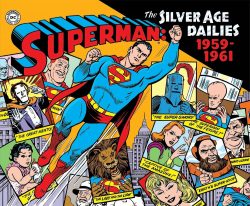
Superman: The Silver Age Dailies volume 1 – 1959-1961


By Jerry Siegel, Curt Swan, Wayne Boring & Stan Kaye, with Otto Binder, Robert Bernstein & Jerry Coleman (IDW Publishing Library of American Comics)
ISBN: 978-1-6137-7666-7 (HB)

It’s indisputable that America’s comic book industry – if it existed at all – would be an utterly unrecognisable thing without Jerry Siegel & Joe Shuster’s Superman. Their unprecedented invention was fervidly adopted by a desperate and joy-starved generation and quite literally gave birth to a genre if not an actual art form.

Spawning an impossible army of imitators and variations within three years of his 1938 debut, the intoxicating blend of eye-popping action and wish-fulfilment which epitomised the early Man of Steel grew to encompass cops-&-robbers crime-busting, socially reforming dramas, science fiction, fantasy, whimsical comedy and, once the war in Europe and the East dragged in America, patriotic relevance for a host of gods, heroes and monsters, all dedicated to profit through exuberant, eye-popping excess and vigorous dashing derring-do.

In comic book terms Superman was master of the world. Moreover, whilst transforming the shape of the fledgling funnybook industry, the Man of Tomorrow relentlessly expanded into all areas of the entertainment media.

Although we all think of the Cleveland boys’ iconic creation as epitome and acme of comic book creation, the truth is that very soon after his debut in Action Comics #1 Superman pretty much left mere funnybooks behind to become a fictional multimedia monolith in the same league as Sherlock Holmes, Tarzan, and Mickey Mouse.

We parochial and possessive comics fans too often regard our purest and most powerful icons in purely graphic narrative terms, but the likes of Batman, Spider-Man, Wonder Woman, X-Men, Avengers and Superman long ago outgrew their four-colour origins and are now fully mythologized modern media creatures instantly familiar in mass markets, platforms and age ranges.

Far more people have seen or heard the Man of Tomorrow than have ever read his comic books. The globally syndicated newspaper strips alone reached untold millions. By the time his 20th anniversary rolled around at the very start of what we know as the Silver Age of Comics, he had been a thrice-weekly radio serial regular, starred in a series of astounding animated cartoons, two chapter play serials, a movie and a novel by George Lowther.

He was a perennial success for toy, game, puzzle and apparel manufacturers and had just ended his first smash live-action television serial. In his immediate future even more shows, a stage musical, a franchise of blockbuster movies and an almost seamless succession of games, bubble gum cards and TV cartoons beginning with The New Adventures of Superman in 1966 and continuing ever since.

Even superdog Krypto got in on the small-screen act…

Although pretty much a spent force these days, for the majority of the last century the newspaper comic strip was the Holy Grail that all American cartoonists and graphic narrative storytellers hungered for. Syndicated across the country – and planet – with millions of avid readers and generally accepted as a more mature and sophisticated form of literature than comic books. It also paid better.

Rightly so: some of the most enduring and entertaining characters and concepts of all time were created to lure readers from one particular paper to another and many of them grew to be part of a global culture. Mutt and Jeff, Flash Gordon, Dick Tracy, Buck Rogers, Charlie Brown and so many more escaped humble newsprint origins to become meta-real: existing in the minds of earthlings from Albuquerque to Zanzibar.

Most still do…

So it was always something of a risky double-edged sword when a comic book character became so popular that they swam against the tide (after all, weren’t the funnybooks invented just to reprint the strips in cheap accessible form?) to become a genuinely mass-entertainment syndicated serial strip.

Superman was the first original comic book character to make that leap – almost as soon as he was created – but only a few have ever successfully followed. Wonder Woman (briefly), Batman (eventually), DC’s aviator Hop Harrigan and groundbreaking teen icon Archie made the jump in the 1940s and only a handful like Spider-Man and Conan the Barbarian have done so since.

The daily Superman newspaper comic strip launched on 16th January 1939 and was supplemented by a full-colour Sunday page from November 5th of that year. Originally crafted by such luminaries as Siegel & Shuster and their studio (Paul Cassidy, Leo Nowak, Dennis Neville, John Sikela, Ed Dobrotka, Paul J. Lauretta & Wayne Boring), the mammoth task soon required the additional talents of Jack Burnley and writers Whitney Ellsworth, Jack Schiff & Alvin Schwartz.

The McClure Syndicate feature ran continuously until May 1966, appearing at its peak in more than 300 daily and 90 Sunday newspapers, boasting a combined readership of more than 20 million. Eventually, artists Win Mortimer and Curt Swan joined unfailing Wayne Boring & Stan Kaye, whilst Bill Finger and Seigel provided stories: serial tales largely separate and divorced from comic book continuity throughout years when superheroes were scarcely seen.

In 1956, Julie Schwartz opened the Silver Age with a new Flash in Showcase #4. Soon costumed crusaders were returning en masse to thrill a new generation. As the trend grew, many companies experimented with the mystery man tradition and the Superman newspaper strip began to slowly adapt: drawing closer to the revolution on the comic book pages.

As the Jet and Atomic Ages gave way to the Space-Age, the Last Son of Krypton was a vibrant yet comfortably familiar icon of domestic modern America: particularly in the constantly evolving, ever-more dramatic and imaginative comic book stories which had received such a terrific creative boost as super heroes began to proliferate once more. Since 1954, and thanks to television, the franchise had been cautiously expanding. In 1959, the Caped Kryptonian could be seen not only in Golden Age survivors Action Comics, Superman, Adventure Comics, World’s Finest Comics and Superboy, but now also in Superman’s Pal Jimmy Olsen, Superman’s Girlfriend Lois Lane and soon Justice League of America. Such increased attention naturally filtered through to the more widely seen newspaper strip and resulted in a rather strange and commercially sound evolution…

After author/educator Tom De Haven’s impassioned Foreword, Sidney Friedfertig’s Introduction explains how and why Jerry Siegel was tasked with turning recently published comic book tales into daily continuities for an apparently more sophisticated and discerning newspaper readership. This meant major rewrites, frequently plot and tone changes and, in some cases, merging two stories into one.

If you’re a comic book fan, don’t be fooled: these stories are not mere rehashes, but variations on an idea for an audience perceived as completely separate from kids’ funnybooks. Even if you are familiar with the source material, the adventures gathered here will read as brand new, especially as they are gloriously illustrated by Curt Swan – and latterly Wayne Boring – at the very peak of their artistic powers.

As an added bonus the covers of the issues those adapted stories came from have been added as a full nostalgia-inducing full-colour gallery…

The astounding everyday entertainment commences with Episode #107 from April 6th to July 11th 1959. ‘Earth’s Super-Idiot!’ by Siegel, Swan & Stan Kaye is a mostly original story that borrows heavily from the author’s own ‘The Trio of Steel’ (Superman #135, February 1960, where it was drawn by Al Plastino). It details the tricks of an unscrupulous super-scientific telepathic alien producer of “Realies” who blackmails the Action Ace into making a fool and villain of himself for extraterrestrial viewers. If the hero doesn’t comply – acting the goat, performing spectacular stunts and torturing his friends – Earth will suffer the consequences…

After eventually getting the better of the UFO sleaze-bag, our hero returns to Earth with a bump and encounters ‘The Ugly Superman’ (July 13th – September 5th). First seen in Lois Lane #8 April 1959, where it was written by Robert Bernstein and illustrated by Kurt Schaffenberger, here eternal spinster Lois agrees to marry a brutish wrestler, and the Man of Tomorrow, for the most spurious of reasons, acts to foil her plans…

Episode #109 ran from September 7th to October 28th 1959, with Superman reluctantly agreeing to make a dying billionaire laugh in return for the miserable misanthrope signing over his entire fortune to charity.

Some of the apparently odd timing discrepancies in publication dates can be explained by the fact that submitted comic book stories often appeared months after they were completed, so their version of Siegel’s ‘The Super-Clown of Metropolis’ didn’t get published until Superman #136 (April 1960) where Plastino took the art in completely different directions…

‘Captive of the Amazons’ – October 29th 1959 to February 6th 1960 – merges two funnybook adventures both originally limned by Boring & Kaye. The eponymous equivalent from Action #266 (Jul 1960) was augmented by Bernstein’s ‘When Superman Lost His Powers’ (Action Comics #262) detailing how super-powered alien queen Jena came to Earth intent on making Superman her husband. On his refused she removed his Kryptonian abilities, subsequently trapping now merely mortal Clark Kent with other Daily Planet staff in a lost valley of monsters where Lois’ suspicions are again aroused…

Episode #111 ran from 8th February to 6th April. ‘The Superman of the Future’ originated in Action #256 (September 1959, by Otto Binder, Swan & Kaye). Both versions seemingly see Superman swap places with a hyper-evolved descendent intent on preventing four catastrophic historical disasters, but the incredible events are actually part of a devious hoax…

Superman’s Girlfriend Lois Lane #10 (July 1959 by Siegel & Schaffenberger) offered up a comedy interlude as ‘The Cry-Baby of Metropolis’ (April 7th – May 28th) sees Lois terrified of losing her looks and exposing herself to a youth ray. Rapidly regenerating into an infant, she provokes much amusement in arch-rival Lana Lang… and that cad Superman…

Episode #113 May 30th – July 2nd features ‘The Super-Servant of Crime’ (Bernstein, from Superman #130, July 1959) as our hero outsmarts a petty crook who has bamboozled the Action Ace into granting him five wishes. Thereafter, ‘The Super-Sword’ (4th July to August 13th and originally by Jerry Coleman & Plastino for Superman #124, September 1958) pits the Kryptonian Crimebuster against an ancient knight with a magic blade that can penetrate his invulnerable skin. Once more, however, all is not as it seems

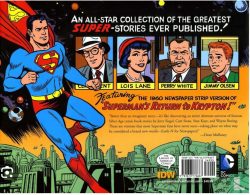
Siegel, Boring & Kaye’s comic book classic ‘Superman’s Return to Krypton’ (in Superman #141, November 1960) was first seen in daily instalments from August 15th to November 12th 1960. There it told a subtly different tale of epic love lost as an accident marooned the adoptive Earth hero in the past on his doomed home-world. Reconciled to dying there with his people, Kal-El befriended his own parents and found love with his ideal soul-mate Lyla Lerrol, only to be torn from her side and returned to Earth against his will in a cruel twist of fate.

The strip version here is one of Swan’s most beautiful art jobs ever and, although the comic book saga was a fan favourite for decades thereafter, the restoration of this more mature interpretation might have some rethinking their opinion…

Wayne Boring once more became the premiere Superman strip illustrator with Episode #116 (November 14th – December 31st), reprising his & Siegel’s work on ‘The Lady and the Lion’ from Action #243 (August 1958), wherein the Metropolis Marvel is transformed into an inhuman beast by a Kryptonian exile the ancients called Circe

Siegel then adapted Bernstein’s ‘The Great Superman Hoax’ and Boring & Kaye redrew their artwork for the episode (January 2nd – February 4th, 1961) from Superman #143 (February 1961). Here, a cunning criminal tries to convince Lois and Clark that he’s actually the Man of Might, blissfully unaware of who he’s failing to fool.

February 6th to March 4th has Superman using brains as well as brawn to thwart an alien invasion in ‘The Duel for Earth’ – originally appearing as a Superboy story in Adventure Comics #277 (October 1960) by Siegel & George Papp.

Superman #114 (July 1957) and scripter Otto Binder provided Siegel with the raw material for a deliciously wry and topical tax-time tale ‘Superman’s Billion-Dollar Debt’ – March 6th to April 8th – wherein an ambitious IRS agent presents the Man of Steel with a bill for unpaid back-taxes, whilst Episode #120 (April 10th – May 13th) introduces ‘The Great Mento’ (from Bernstein & Plastino’s yarn in Superman #147, August 1961): a tawdry showbiz masked mind-reader who blackmails the hero by threatening to expose his precious secret identity…

The final two stories in this premiere collection both come from Superman’s Girlfriend Lois Lane – issues #24, April and #26, July respectively – both originally crafted by Bernstein & Schaffenberger.

In ‘The Perfect Husband’ (15th May to July 1st) – begun and ended by Boring but with Swan pinch-hitting for 2 weeks in the middle – Lois’ sister Lucy tricks the journalist into going on a TV dating show. Here she meets her ideal man: a millionaire sportsman and war hero who looks just like Clark Kent…

Then ‘The Mad Woman of Metropolis’ sees Lois driven to the edge of sanity by a vengeance-hungry killer: a rare chance to see the reporter and butt of so many shameless male gags show her true mettle by solving a case without the Man of Tomorrow’s avuncular, so-often patronising assistance…

Superman: – The Silver Age Dailies 1959-1961 was the first in a series of huge (305 x 236mm) lavish, high-end hardback collections (frustratingly still not available in digital editions!) starring the Man of Steel and a welcome addition to the superb commemorative series of Library of American Comics which has preserved and re-presented in luxurious splendour such landmark strips as Li’l Abner, Tarzan, Little Orphan Annie, Terry and the Pirates, Bringing Up Father, Rip Kirby, Polly and her Pals and many of the abovementioned cartoon icons.

If you love the era, these stories are great comics reading, and this is a book you simply must have.
Superman ™ & © 2013 DC Comics. All Rights Reserved.
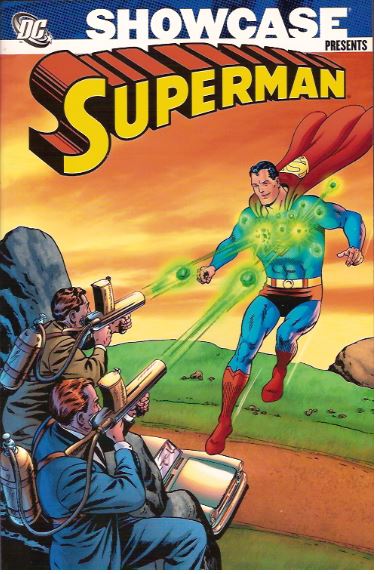
Showcase Presents Superman volume 3


By Otto Binder, Jerry Siegel, Robert Bernstein, Bill Finger, Jerry Coleman, Edmond Hamilton, Leo Dorfman, Jack Schiff, Wayne Boring, Al Plastino, Curt Swan, Kurt Schaffenberger, Jim Mooney, George Papp, Sheldon Moldoff & various (DC Comics)
ISBN: 978-1-4012-1271-1 (TPB)

Superman has proven to be all things to all fans over his decades of existence, and with the character currently undergoing another radical overhaul, these timeless tales of charm, joy and wholesome wit are more necessary than ever: not just as a reminder of great tales of the past but as an all-ages primer of the wonders still to come…

At the time these tales were published The Metropolis Marvel was enjoying revived interest. Television cartoons, a rampant merchandising wave thanks to the Batman-led boom in “camp” Superheroes generally, highly efficient global licensing and even a Broadway musical: all worked to keep the Last Son of Krypton a vibrant icon of Space-Age America.

Although we think of Jerry Siegel & Joe Shuster’s iconic invention as the epitome of comic book creation, in truth soon after his launch in Action Comics #1 he became a multimedia star and far more people have enjoyed the Man of Steel than have ever read him. By the time his 20th anniversary rolled around, Superman was a regular on radio, astounding animated cartoons, two movie chapter-plays and a feature film, and had just ended his first smash-hit live-action television serial. In his future were many more; a stage musical; a franchise of cinematic blockbusters and a seamless succession of TV cartoons, starting with The New Adventures of Superman in 1966. Even Krypto got in on the small-screen act…

It’s no wonder then that tales from this Silver Age period should be so draped in wholesome trappings of “Tinseltown” – even more so than most of celebrity-obsessed America. It didn’t hurt that editor Whitney Ellsworth was a part-time screenwriter, script editor and producer as well as National/DC’s Hollywood point man. His publishing assistant Mort Weisinger – a key factor in the vast expansion of the Kryptonian mythos – also had strong ties to the cinema and television industries, beginning in 1955 when he became story-editor for the blockbusting Adventures of Superman TV show.

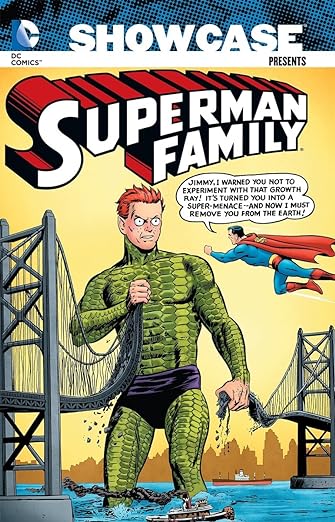
This third magnificent monochrome chronicle collects the contents of Action Comics #276-292, Superman #146-156 and excerpts from Superman Annuals #3-5, spanning May 1961 to October 1962; taking its content from the early 1960’s canon (when the book’s target audience would have been actual little kids) yet showcasing a rather more sophisticated set of tales than you might expect…

Wide-eyed wonderment commences with Action Comics #276’s ‘The War Between Supergirl and the Superman Emergency Squad’ by Robert Bernstein, Wayne Boring & Stan Kaye. Here, Superman is conned into revealing his secret identity and resorts to incredible measures to make a swindler disbelieve his eyes, after which #277 presented ‘The Conquest of Superman!’ (Bill Finger, Curt Swan & John Forte): another brilliantly brutal duel against super-scientist Lex Luthor.

Superman #146 (July 1961) offered ‘The Story of Superman’s Life’ relating more secrets by recapitulating Clark Kent’s early days in a captivating resumé. Covering all the basics, Otto Binder & Al Plastino share the death of Krypton, rocket-ride to Earth, early life as Superboy, death of the Kents and moving to Metropolis. Closing, ‘Superman’s Greatest Feats’ (Jerry Siegel & Plastino) sees the Man of Tomorrow travel into Earth’s past and seemingly succeed in preventing such tragedies as the sinking of Atlantis, slaughter of Christians in Imperial Rome, deaths of Nathan Hale, Abraham Lincoln and Custer and even the death of Krypton’s population. Of course it is too good to be true…

Action #278 featured ‘The Super Powers of Perry White!’ (Jerry Coleman, Swan & Kaye) with the senescent editor suddenly gaining superpowers and an inexplicable urge to conquer the world. In Superman #147 ‘The Great Mento!’ – Bernstein & Plastino – a mystery mind-reader threatens to expose the hero’s secret identity. ‘Krypto Battles Titano’ (Siegel & Plastino) finds the wandering Dog of Steel voyaging back to the Age of Dinosaurs to play before inadvertently saving humanity from alien invasion alongside the Kryptonite-mutated giant ape. The issue closed with ‘The Legion of Super Villains’ (Siegel, Swan & Sheldon Moldoff): a landmark adventure and stand-out thriller featuring Lex Luthor and the adult Legion of Super-Heroes overcoming certain death with valour and ingenuity.

This was followed by Swan’s iconic cover for Superman Annual #3 (August 1961); the uncredited picture-feature Secrets of the Fortress of Solitude and a superb back-cover pin-up.

The author of Action #279’s Imaginary Story ‘The Super Rivals’ is regrettably unknown but John Forte’s sleekly comfortable art happily limns the wild occurrence of legendary heroes Samson and Hercules brought to the 20th century by Superman to marry Lois Lane and Lana Lang, to keep them out of his hair! In #280 Brainiac’s Super Revenge’ (Siegel, Swan & Kaye) returns that time-lost villain to our era and attacking the Man of Steel’s friends, only to be foiled by guest-star Congorilla (veteran Action Comics hero Congo Bill, who traded consciousness with a giant Golden Gorilla). Imaginary Stories were conceived as a way of exploring non-continuity plots and scenarios devised at a time when editors believed that entertainment trumped consistency and knew that every comic read was somebody’s first…

When Editor Weisinger was expanding Superman continuity and building a legend, he knew each new tale was an event adding to a nigh-sacred canon: that what was written and drawn mattered to readers. However, the ideas man wasn’t going to let aggregated “history” stifle a good plot situation, nor would he allow his eager yet sophisticated audience to endure clichéd deus ex machina cop-outs to mar the sheer enjoyment of captivating concepts. The mantra known to every fan was “Not a Dream! Not a Hoax! Not a Robot!”: emblazoned on covers depicting scenes that couldn’t possibly be true – even if it was only a comic book.

Superman #148 opened with Edmond Hamilton, Swan & Moldoff’s  ‘The 20th Century Achilles’, wherein a cunning crook makes himself immune to harm, after which ‘Mr. Mxyzptlk’s Super Mischief’ (Siegel, Swan & Moldoff) again finds the 5th dimensional pest using magic to cause irritation after legally changing his name to something even easier to pronounce, whilst the delightfully devilish ‘Superman Owes a Billion Dollars!’ written by Bernstein – depicts the Caped Kryptonian’s greatest foe: a Revenue agent who diligently discovers that the hero has never paid a penny of tax in his life…

Action Comics #281 features ‘The Man Who Saved Kal-El’s Life!’ (Bernstein & Plastino), relating how a humble Earth scientist visited Krypton and cured baby Superman, all wrapped up in a gripping duel with a modern crook able to avoid Superman’s every effort to hold him, whilst in Superman #149, ‘Lex Luthor, Hero!’, ‘Luthor’s Super-Bodyguard’ and ‘The Death of Superman’ (Siegel, Swan & Moldoff) form a brilliant extended Imaginary saga describing the insidious inventor’s ultimate victory over the Man of Steel.

In “real” continuity, Action #282 shares ‘Superman’s Toughest Day’ (Finger & Plastino) as Clark Kent’s vacation only reveals how his alter ego never really takes it easy, before #283’s ‘The Red Kryptonite Menace’ (Bernstein, Swan & Kaye) follows Chameleon Men from the 30th century afflicting the Action Ace with incredible new powers and disabilities after exposing him to a variety of Crimson K chunks.

Superman #150 opened with ‘The One Minute of Doom’ – Siegel & Plastino – disclosing how all survivors of Krypton – even Superdog – commemorate the planet’s destruction, before Bernstein & Kurt Schaffenberger’s ‘The Duel over Superman’ finally sees Lois and Lana Lang teach the patronising Man of Tomorrow a deserved lesson about his smug masculine complacency.

Siegel, Swan & Kaye then baffle readers and Action Ace alike ‘When the World Forgot Superman’, in a clever and beguiling mystery yarn, followed here by extracts from Superman Annual #4 (January 1962): the stunning cover and featurette The Origin and Powers of the Legion of Super-Heroes by Swan & George Klein.

Action #284 featured ‘The Babe of Steel’ (Bernstein, Swan & Klein) wherein Superman endures humiliation and frustration after deliberately turning himself into a toddler – but there’s a deadly serious purpose to the temporary transformation…

Superman #151 opens with Siegel & Plastino’s salutary story ‘The Three Tough Teen-Agers!’ wherein the hero sets a trio of delinquents back on the right path, after which Bernstein, Swan & Klein’s ‘The Man Who Trained Supermen’ sees Clark expose a crooked sports trainer. ‘Superman’s Greatest Secret!’ is almost revealed after battling a fire-breathing dragon which survived Krypton’s doom in a stirring tale by Siegel, Swan & Klein: probably one of the best secret-identity-saving stories of the period…

Since landing on Earth, Supergirl’s existence had been a closely guarded secret, allowing her time to master her formidable abilities. These tales were presented to the readership monthly as a back-up feature in Action Comics. However with #285, ‘The World’s Greatest Heroine!’ finally goes public in the Superman lead spot, after which the Girl of Steel defeats ‘The Infinite Monster’ in her own strip. Supergirl became the darling of the universe: openly saving the planet and finally getting credit for it in stirring tales by Siegel & Jim Mooney.

Action #286 offered mini-epic ‘The Jury of Super-Enemies’ (Bernstein, Swan & Klein) as the Superman Revenge Squad inflicts Red K hallucinations on the Man of Steel: tormenting him with visions of Luthor, Brainiac, the Legion of Super-Villains and other evil adversaries. The saga continued in the next issue, but before that Superman #152 appeared, with a surprising battle against ‘The Robot Master’ (Siegel, Swan & Klein), charmingly outrageous romp ‘Superbaby Captures the Pumpkin Gang!’ (Leo Dorfman & George Papp) and ‘The TV Trap for Superman!’, a devious crime caper by Finger & Plastino with the hero unwittingly wired for sound and vision by a sneaky conman…

The Revenge Squad thriller concluded in #287’s ‘Perry White’s Manhunt for Superman!’ (Bernstein, Swan & Klein) as an increasingly deluded Man of Tomorrow battles his worst nightmares and struggles to save Earth from a genuine alien invasion.

Finger & Plastino’s ‘The Day Superman Broke the Law!’ opened Superman #153, as a wily embezzler entangles the Metropolis Marvel in small-town red tape before ‘The Secret of the Superman Stamp’ (Edmond Hamilton, Swan & Klein) sees a proposed honour for good works turned into a serious threat to the hero’s secret identity…

‘The Town of Supermen’ by Siegel & Forte, then finds the Man of Tomorrow in a western ghost town in a deadly showdown against ten Kryptonian criminals freshly escaped from the Phantom Zone…

The growing power of the silver screen informed ‘The Man Who Exposed Superman’ (Action #288 by writer unknown and Swan & Klein) as a vengeful convict originally imprisoned by Superboy attempts to expose the hero’s identity by blackmailing him on live television. The Super-Practical Joker!’ (#289 by Dorfman & Plastino) sees Perry White forced to hire obnoxious trust-fund brat Dexter Willis: a spoiled kid whose obsessive stunts almost expose Superman’s day job.

Opening Superman #154, Hamilton, Swan & Klein’s ‘The Underwater Pranks of Mr. Mxyzptlk’ see the insane sprite return, resolved to cause grief and stay for good by only working his jests whilst submerged, after which ‘Krypton’s First Superman’ (Siegel, Swan & Klein) tells a lost tale of baby Kal-El on there that has unsuspected psychological effects on the full-grown hero. Next comes an example of the many public service announcements running in all DC’s 1960’s titles. ‘Superman Says be a Good Citizen’ was probably written by Jack Schiff and definitely illustrated by Sheldon Moldoff.

Exposure to a Red Kryptonite comet in Action #290 sees him become ‘Half a Superman!’ in another sadly uncredited story illustrated by Swan & Klein, after which Superman Annual #5 (July 1962) offers another stunning cover and displays the planetary Flag of Krypton, whilst Superman #155 featured  2-chapter ‘Superman Under the Green Sun’ and ‘The Blind Superman’ by Finger, Wayne Boring & Kaye, as the Man of Steel is trapped on a totalitarian world where his powers don’t work. Blinded as part of the dictator’s policy to keep the populace helpless, even sightless, nothing stops the hero from leading the people to victory. As if that wasn’t enough Siegel, Swan & Klein then debut showbiz thriller ‘The Downfall of Superman!’ with a famous wrestler seemingly able to defeat the Action Ace – albeit with a little help from some astounding guest-stars…

‘The New Superman!’ (Bernstein & Plastino, Action #291) sees the Metropolis Marvel lose his deadly susceptibility to Kryptonite, only to have it replaced by aversions to far more commonplace minerals, whilst #292 reveals ‘When Superman Defended his Arch Enemy!’ – an anonymous thriller illustrated by Plastino – which has the hero save Luthor from his just deserts after “murdering” alien robots…

The grand excursion into comics nostalgia ends with one of the greatest Superman stories of the decade. Issue #156, October 1962, featured Hamilton, Swan & Klein’s novel-length saga ‘The Last Days of Superman’ which began with ‘Superman’s Death Sentence’ as the hero contracts deadly Kryptonian Virus X and goes into a swift and painful decline. Confined to an isolation booth, he’s visited by ‘The Super-Comrades of All Times!’ who attempt cures and swear to carry on his works… until a last-minute solution is disclosed on ‘Superman’s Last Day of Life!’ This tense and terrifying thriller employed the entire vast and extended supporting cast that had evolved around the most popular comic book character in the world and still enthrals and excites in a way few stories ever have…

As well as containing some of the most delightful episodes of pre angst-drenched, cosmically catastrophic DC, these fun, thrilling, mind-boggling and yes, occasionally deeply moving all-ages stories also perfectly depict the changing mores and tastes which reshaped comics between the safely anodyne 1950s to the seditious, rebellious 1970s, all the while keeping to the prime directive of the industry: “keep them entertained and keep them wanting more”.

I know I certainly do.
© 1961, 1962, 2007 DC Comics. All Rights Reserved.
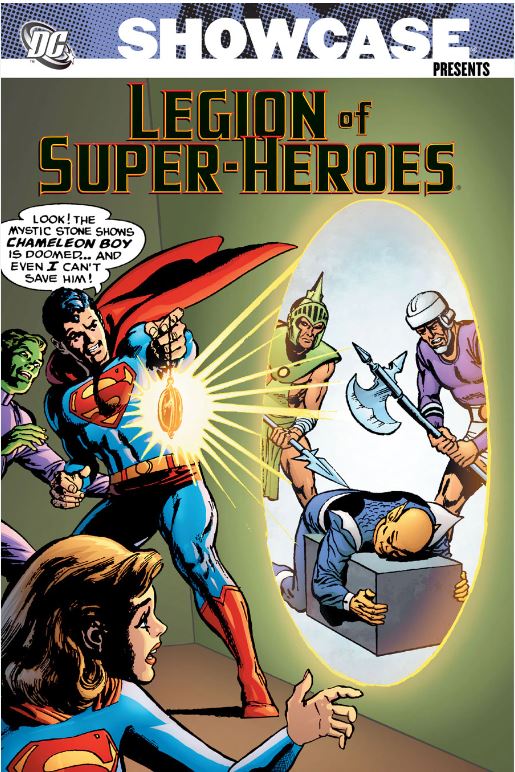
Showcase Presents Legion of Super-Heroes volume 4


By James Shooter, E. Nelson Bridwell, Cary Bates, Curt Swan, George Papp, J. Winslow Mortimer, George Tuska, Dave Cockrum, Murphy Anderson, Mike Esposito, Vince Colletta & various (DC Comics)
ISBN: 978-1-4012-2185-0 (TPB)

Once upon a time, a thousand years from now, a band of super-powered kids from a multitude of worlds took inspiration from the greatest legend of all time and formed a club of heroes. One day those Children of Tomorrow came back in time and invited their inspiration to join them…

Thus began the vast and epic saga of the Legion of Super-Heroes, as initially envisioned by writer Otto Binder & artist Al Plastino when the many-handed mob of juvenile universe-savers debuted in Adventure Comics #247 (April 1958) just as the revived superhero genre was gathering an inexorable head of steam in America. Since that time the fortunes and popularity of the Legion have perpetually waxed and waned, with their future history tweaked and rebooted, retconned and overwritten over and over again to comply with editorial diktat and popular fashion.

This drama-drenched fourth monochrome compendium gathers a chronological parade of futuristic delights from June 1968 to September 1970, originally seen in Adventure Comics #369-380 and the reprint issue #403, plus back-up tales from Action Comics #378-392 – a time when the superhero genre again dipped in popularity. Also included in this enchanting tome are the tentative first forays of the team’s slow revival as an alternating back-up feature in Superboy, via game-changing exploits from #172-173, 176, 183-184, 188 190 and 191, collectively covering March 1971 to October 1972.

During this period the youthful, generally fun-loving and carefree Club of Champions peaked; having only just evolved into a dedicated and driven dramatic action series starring a grittily realistic combat force in constant, galaxy-threatening peril. Although now an overwhelming force of valiant warriors ready and willing to pay the ultimate price for their courage and dedication, science itself, science fiction and costumed crusaders all increasingly struggled against a global resurgence in spiritual questioning and supernatural fiction…

The main architect of the transformation was teenaged sensation Jim Shooter, whose scripts and layouts (generally finished and pencilled by the astoundingly talented and understated Curt Swan) made the series accessible to a generation of fans growing up with their heads in the Future but as the fashions shifted, the series was unceremoniously ousted from its ancestral home and full-length adventures to become a truncated back-up feature in Action Comics. Typically, that shift occurred just as the stories were getting really, really good and truly mature…

Crafted by Shooter, Swan & Jack Abel, tense suspense blooms with ‘Mordru the Merciless!’ (Adventure Comics #369) when the Legion is attacked by their most powerful enemy: a nigh-omnipotent sorcerer the entire assemblage had only narrowly defeated once before.

A sneak attack shatters the whole team and only four escape, using a time-bubble to flee to the remote, archaic era where Superboy lived. With him come Mon-El, Shadow Lass and Duo Damsel, last remnants of a once-unbeatable force.

Mordru’s magic is stronger though and even the time-barrier cannot daunt him. Disguised as mere mortals, the fugitive Legionnaires’ courage shines through in exile as petty gangsters take over Smallville. The teens quashed the parochial plunderers and then opt to return to the 30th century and confront Mordru, only to discover he’s found them first…

The saga concluded in #370’s The Devil’s Jury!’ wherein the band again break free to hide in plain sight by temporarily wiping their own memories to thwart the Dark Lord’s probes. Against appalling odds and with only Clark Kent’s best friend Pete Ross and Insect Queen Lana Lang to aid them, the heroes’ doomed last stand implausibly succeeds when Mordru’s overbearing arrogance causes his own downfall.

Then when the exhausted fugitives get back to the future they joyously discover that Dream Girl and benign sorceress White Witch had undone the deluded Dark Lord’s worst…

Extortion and espionage were the order of the day in #371’s ‘The Colossal Failure!’ as a Legionnaire’s parents are abducted and the hero is forced to botch missions. Ordered to retrain at the high security Legion Academy, Colossal Boy is subsequently caught selling the team’s training secrets and cashiered from the organisation…

This issue also offered the George Papp illustrated ‘When Superboy Walked Out on the Legion!’, wherein hyper-advanced super snobbish aliens threaten Smallville unless Superboy leaves Earth to join their band of press-ganged heroes. It requires ingenuity, a faux civil war and massive destruction to finally convince the alien autocrats to let the assembled champions return to their own home-worlds…

Colossal Boy’s tale of woe concluded in Adventure #372 when his concerned former comrades uncover the cause of the expelled giant’s dilemma, tracking him to a ‘School for Super-Villains!’ (Shooter, Swan & Abel), where the fallen hero is compelled to teach meta-powered man rogues all the LSH’s secrets.

Luckily – and thanks to the expedited induction of apprentice and ergo unknown heroes Timber Wolf and Chemical King – the good guys infiltrate and shut down this first incarnation of the Legion of Super-Villains.

From #373 onwards Golden Age veteran J. Winslow Mortimer replaced Swan as penciller and ‘The Tornado Twins!’ Don and Dawn Allen run rings around and generally humiliate the assembled heroes… but all for a very good cause, before ‘Mission: Diabolical!’ in #374 focusses on the future equivalent of organised crime after most Legionnaires are ambushed and held hostage by the insidious Scorpius gang.

Hard-pressed by rival outfit Taurus, the mobsters decided to “recruit” a team of heroes to equal their enemies’ squad of hyper-powered goons; Rogarth, Mystelor, Shagrek, Quanto and Black Mace. Of course, after infiltrating and defeating their foes, the compromised kids – Supergirl, Element Lad, Dream Girl, Ultra Boy and Matter-Eater Lad – are double-crossed by Scorpius and might have died if not for fortuitous intervention by the Legion of Substitute Heroes

Next (#375-376) comes a powerful and devious 2-part thriller introducing galaxy-roving heroes The Wanderers, with that temporarily-insane-and-evil group battling the United Planets’ champions. They are far more concerned with determining who will be crowned ‘The King of the Legion!’

The matter is only relevant because a trans-dimensional challenger has demanded a duel with the “mightiest Legionnaire”, but when the dust settles the only hero left standing is chubby comic relief Bouncing Boy. When the triumphant winner is spirited away to another cosmos he lands in a feudal wonderland – complete with beautiful princess – menaced by a terrifying invader.

Sadly the hero is soon exposed as shape-shifting Durlan Legionnaire Reep Daggle and not the at-least-human Chuck Taine, but manfully overcomes his abductors’ initial prejudice and defeats usurper threat Kodar. He wins the heart and hand of Princess Elwinda, but is tragically rescued and whisked back across a permanently sealed dimensional barrier by his legion buddies who mistake a Royal Wedding for ‘The Execution of Chameleon Boy!’

A welcome edge of dark and bitter cynicism was creeping into Shooter’s stories, and ‘Heroes for Hire!’ (pencilled by Mortimer & inked by Jack Abel) sees the team charging for their unique services, but it’s only a brilliant ploy to derail the criminal career of Modulus: avatar of sentient living planet Modo who has turned his world into an unassailable haven for the worst villains of the galaxy…

Adventure #378 opens another tense and moving 2-parter as Superboy, Duo Damsel, Karate Kid, Princess Projectra and Brainiac 5 are poisoned and face only ‘Twelve Hours to Live!’

With no cure possible, the quintet separate to spend their last day in the most personally satisfying ways they can – from sharing precious moments with soon-to-be bereaved family to K-Kid’s one-man assault on the Fatal Five – only to reunite for their final moments and die together…

The incredible conclusion sees hyper-advanced being Seeron freeze time and offer to cure the practically dead victims if late arrivals Ultra Boy, Phantom Girl, Chameleon Boy, Timber Wolf, Star Boy, Lightning Lad and Chemical King return to his universe and defeat an invasion by brutes invulnerable to the mighty mental powers of the intellectual overlords…

However, even as the abducted Legionnaires triumph and return, their comrades – having been had been found again – are afforded the honour of ‘Burial in Space!’

Happily, a brilliant last-minute solution enables the dead to rise just in time to lose their long-held position in Adventure Comics as changing tastes and shrinking sales prompted an abrupt change of venue.

‘The Legion’s Space Odyssey!’ (# 380 cover-dated May 1969, by Shooter, Mortimer & Abel) sees a select band of Legionnaires teleported to the barren ends of the universe and forced to laboriously battle their way home against impossible odds. This argosy includes the “death” of Superboy and persistent sabotage by the Legion of Super-Pets. There’s a perfectly rational and reasonable excuse for the devious scheme of course, with the tale best remembered by fans as the mission on which Duo Damsel and Bouncing Boy first got together…

From #381 onwards Adventure Comics was filled with the 20th century exploits of Supergirl and the LSH took over her back-up spot in Action Comics, beginning with a reprint in #377 which is not included here.

Original, shorter Tales of the Legion of Super-Heroes began in #378 (July 1969) with ‘The Forbidden Fruit!’ by Shooter, Mortimer & Mike Esposito with Timber Wolf deliberately addicted by criminals to a hyper-narcotic lotus in a bold scheme to turn the entire team into pliable junkies. Fortunately, the hero’s love for Light Lass allows him to overcome his awful burden, before #379’s ‘One of us is an Impostor’ (E. Nelson Bridwell, Mortimer & Murphy Anderson) offers a clever mystery to baffle Mon-El, Dream Girl, Element Lad, Shadow Lass and Lightning Lad as thermal thug Sunburst and a clever infiltrator threaten to tear the team apart from within.

Duo Damsel declares war on herself in #380 when one body falls under the sway of an alien Superboy. As half of her turns to crime, only Bouncing Boy can clean up the psychological mess of ‘Half a Legionnaire?’ (Shooter, Mortimer & Abel), after which Matter-Eater Lad reveals lowly origins and a dysfunctional family to lonely Shrinking Violet in #381: ending up ‘The Hapless Hero!’ battling her absurdly jealous absentee boyfriend Duplicate Boy -mightiest hero in the universe…

In #382 a covert team comprising Ultra Boy, Karate Kid, Light Lass, Violet and Timber Wolf attempt to end a potential super-robot arms-race and find that to succeed they have to ‘Kill a Friend to Save a World!’, before still-heartbroken Durlan Reep discovers an Earthly double of lost love Elwinda. However, on morphing into her ideal man he quickly sees the folly of ‘Chameleon Boy’s Secret Identity!’ – a tear-jerker with a hint of happy ending from Bridwell, Mortimer & Abel.

Shooter left his perfect job with #384, but signed off in style with his landmark ‘Lament for a Legionnaire!’ With art misattributed to Mortimer but in fact a welcome fill-in by Curt Swan & Abel, it tells how Dream Girl’s infallible prophecy of Mon-El’s demise comes true whilst his shocking resurrection introduces a whole new thrilling strand to the Lore of the Legion.

Bridwell, Mortimer & Abel show how a vengeance-crazed killer’s quest for retribution fails in ‘The Fallen Starboy!’ before crafting ‘Zap Goes the Legion!’ (Action #386) wherein female foe Uli Algor believes she has outthought and outfought the juvenile agents of justice. She forgot one crucial detail, however…

Then in #387 the creators delightfully added a touch of wry social commentary when the organisation had to downsize and lay off a Legionnaire for tax purposes after the government declares the team has ‘One Hero Too Many!’

Action #388 was an all-reprint Supergirl giant, but the now revenue-compliant Club of Heroes returned in #389 with ‘The Mystery Legionnaire!’ (by Cary Bates, Mortimer & Abel), explaining how robot dictator Klim is defeated by a hero who doesn’t exist, and Bridwell’s ‘The Tyrant and the Traitor’ (#390) reflects political turmoil of the 1970’s in a tale of guerrilla atrocity, destabilising civil war and covert regime change. The Legion Espionage Squad is tasked with doing dirty work, but even Chameleon Boy, Timber Wolf, Karate Kid, Brainiac 5 and Saturn Girl are out of their depth and only ‘The Ordeal of Element Lad!’ in the next issue saves the undercover unit from ignominious failure and certain death.

Action #392 (September 1970) temporarily ended the feature’s unbroken run with a low-key but gripping yarn from Bates, Mortimer & Abel including alternate dimensions and preposterous testing of ‘The Legionnaires that Never Were!’

The Frantic Futurists weren’t gone too long. In 1971 a concerted push to revive them began with March-dated Superboy # 172 and ‘Brotherly Hate!’ by Bridwell & George Tuska. The sharp, smart yarn details the convoluted origins of twins Garth and Ayla Ranzz AKA Lightning Lad & Light Lass and their troubled relationship with older brother Mekt – the deadly outlaw Lightning Lord.

At the same time Adventure Comics #403 (April 1971) was released: an all-Legion reprint special which included new ‘Fashions from Fans’ by Bridwell, Ross Andru & Esposito as well as a comprehensive ‘Diagram of Legion Headquarters Complex’, included here for your delight and delectation…

Some of those fan-costumes – generally the skimpier ones designed by boys for the girl heroes – were adopted for ongoing backups appearing in Superboy. They continued the comeback with ‘Trust Me or Kill Me!’ (#173 by Bates & Tuska). Here, Superboy must devise a way to determine which Cosmic Boy is his true friend and which a magical duplicate made by malefic Mordru.

The origin of Invisible Kid and secrets of his powers are examined in #176 when a crook duplicates the boy genius’ fadeaway gifts in ‘Invisible Invader!’, whilst Bates, Tuska & Vince Colletta report on the ‘War of the Wraith-Mates!’ (#183) with energy entities renewing an eons-old war of the sexes after possessing Mon-El, Shadow Lass, Karate Kid and Princess Projectra.

In a tale by Bates. Superboy #184 hinted at days of greatness to come with ‘One Legionnaire Must Go!’ Here Matter-Eater Lad is framed and replaced by his own little brother, but the big advance was the inking of LSH fanatic Dave Cockrum over Murphy Anderson’s pencils. The neophyte artist would gradually transform the look, feel and fortunes of the Legion before moving to Marvel and doing exactly the same with an almost forgotten series entitled X-Men

With Superboy #188’s Bates-scripted ‘Curse of the Blood-Crystals!’ (July 1972), Anderson began inking Cockrum, in the sixth stunning back-up tale of a now unstoppable Legion revival that would eventually lead to them taking over the entire comic book. This clever yarn of cross-&-double-cross finds a Legionnaire possessed by a magical booby-trap and forced to murder Superboy… but which of the two dozen heroes is actually the prospective killer?

Superboy #190 featured ‘Murder the Leader!’ as the Fatal Five attack during the election of a new Legion Commander. Rival candidates Saturn Girl and Mon-El must work together if either is to take the top job, after which this volume concludes with stunning thriller ‘Attack of the Sun-Scavenger!’ (Bates & Cockrum from #191). In a staggering burst of comics brilliance, manic solar scoundrel Dr. Regulus again attacks Sun Boy and his Legion comrades, using his own apparent death as key to ultimate victory…

The Legion of Super-Heroes is unquestionably one of the most beloved and bewildering creations in funnybook history and largely responsible for the growth of groundswell movements that became American Comics Fandom. Moreover, these scintillating and seductively addictive stories – as much as Julie Schwartz’s Justice League or Marvel’s Fantastic Four – fired the interest and imaginations of generations of and underpinned the industry we all know today.

If you love comics and haven’t read this stuff, you are the poorer for it and need to enrich your future days as soon as possible.
© 1968-1972, 2010 DC Comics. All Rights Reserved.
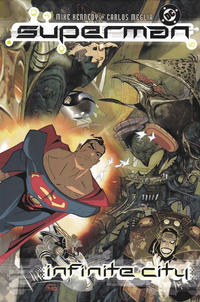
Superman: Infinite City


By Mike Kennedy & Carlos Meglia (DC Comics)
ISBN: 978-1401200664 (DC US TPB) 978-1845760731 (Titan Books UK HB)

This original graphic novel is a lightweight but lovely piece of fluff that sees investigative reporters Mr and Mrs Kent-Lane tracking down the source of a devastating super-gun, only to be sucked into a strange time-warped dimension. There they are embroiled in a civil war between greedy, slimy, power hungry industrialist Jesden Tyme and the robotic Mayor, who turns out to be a download of the consciousness of Superman’s long dead biological father Jor-El

Lavishly illustrated in the manner of an animated feature film, the European-flavoured stylizations of Argentinean Carlos Meglia (December 11 1957-August 15 2008: Irish Coffee, Bet Your Life, Star Wars) may not be to everyone’s taste but maybe you should just persist and be open to the new…

The plot from Mike Kennedy (Lone Wolf 2100, Star Wars: Underworld and the deeply under-appreciated Ghost/Batgirl, among others) lacks any real punch or originality of its own, relying on clichéd and oft-rehashed tropes, but there’s still bunches of wit and wonder to find over this particular rainbow. Moreover, the dialogue is sharp and effective, and some of the interplay between Lois and Clark is simply delightful. If you want a “done-in-one” delight starring comic books’ oldest power couple, this could be what you’re looking for.

There’s also a hardback British edition available should you want your reading unbending as well as pretty…
© 2005 DC Comics. All Rights Reserved.
Superman: The Third Kryptonian


By Kurt Busiek, Dwayne McDuffie, Fabian Nicieza, Rick Leonardi, Renato Guedes, José Wilson Magalhaés, Dan Green & various (DC Comics)
ISBN: 978-1-4012-1987-1 (TPB)

After interminable page counts and the preponderant never-ending angst of hyper-mega-ultra-braided multi-part cross-overs, it’s quite nice to pick up an – admittedly slim – endeavour of more modest means and intent: to wit, a book with a couple of stories that actually begin, occur and end.

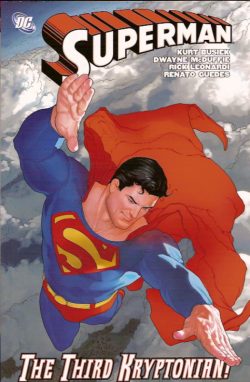
Collecting Action Comics #847, Superman #668-670 and Superman Annual #13, this tome actually has three yarns to delight, beginning with Kurt Busiek, Rick Leonardi and Dan Green’s mini-epic wherein every survivor of lost Krypton on Earth, including Power Girl, Clark and Lois’ adopted son Chris (don’t fret, it’s all explained in the story) and even Krypto are targeted for destruction by brutal space pirate Amalak, hungry to take vengeance for the misdeeds of the long dead “Kryptonian Empire”.

Imagine how the irate rogue reacts upon discovering that – unbeknownst to all – an actual survivor of that long-dead galactic aggressor-state has been living secretly on Earth for years…

Good old-fashioned romp though it is, the real meat of this tale was an adjustment and rewriting of Kryptonian history for the post-Smallville/Superman Returns generation. As the disparate continuities of TV, Cinema and comic books were massaged closer to overarching homogeneity, the best of the old was retrofitted to the new. This is an uncomplicated adventure thriller with nostalgic overtones that has a lot to recommend it.

‘The Best Day’ (Busiek, Fabian Nicieza, Guedes & José Wilson Magalhaés) offers sheer delight, and beautiful execution. In a quiet moment, Superman and Supergirl take the Kent clan on a picnic to the stars where we get a chance to see beloved characters interact in joy and relaxation, as the skies of a million universes aren’t collapsing around their invulnerable ears. It’s a brave, rewarding return to old ways and I still want to see more of it.

So go no further than ‘Intermezzo’ (McDuffie and Guedes), another introspective segment sliced from a longer epic, short on punching but big on emotional wallop as Jonathan and Martha Kent share secrets and reveal close-held fears as their adopted son struggles off-camera with another “Never-Ending Battle.”

It’s such gentle moments and the emotional beats that give the best adventure fiction its edge, and this book has them in delightful quantities. This is the stuff that made Superman a legend, and in this anniversary year this collection is an ideal argument for stuff like this to stage a comeback.
© 2007, 2008 DC Comics. All Rights Reserved.
Showcase Presents Legion of Super-Heroes volume 3


By Jim Shooter, E. Nelson Bridwell, Otto Binder, Curt Swan, George Klein, Pete Costanza, Jim Mooney & George Papp (DC Comics)
ISBN: 978-1-4012-2185-0 (TPB)

Once upon a time, in the far future, a band of super-powered kids from a multitude of worlds took inspiration from the greatest legend of all time and formed a club of heroes. One day those Children of Tomorrow came back in time and invited their inspiration to join them…

And thus began the vast and epic saga of the Legion of Super-Heroes, as first envisioned by writer Otto Binder and artist Al Plastino in early 1958, just as the revived comicbook genre of superheroes was gathering an inexorable head of steam. Since that time the fortunes and popularity of the Legion have perpetually waxed and waned, with their future history tweaked and rebooted, retconned and overwritten over and over again to comply with editorial diktat and popular whim.

This third sturdy, action-packed monochrome compendium gathers a chronological parade of futuristic delights from October 1966 to May 1968, as originally seen in Adventure Comics #349-368, and includes a Legion story from Superman’s Pal Jimmy Olsen #106 (October 1967).

During this period the Club of Champions finally shed the last vestiges of wholesome, imaginative, humorous and generally safe science fiction strips to become a full-on dramatic action feature starring a grittily realistic combat force in constant, galaxy-threatening peril: a compelling force of valiant warriors ready and willing to pay the ultimate price for their courage and dedication…

The main architect of the transformation was teenaged sensation Jim Shooter, whose scripts and layouts (usually finished and inked by veterans Curt Swan & George Klein) made the series accessible to a generation of fans growing up in the Future…

The tense suspense begins with Adventure #349’s ‘The Rogue Legionnaire!’ (Shooter, Swan & Klein) wherein Saturn Girl, Colossal Boy, Shrinking Violet, Chameleon Boy and Brainiac 5 hunt hypnotic villain Universo through five periods of Earth’s history, aided by boy-genius Rond Vidar, a brilliant scientist with a tragic secret…

This is followed by a stellar 2-parter from #350-351 scripted by E. Nelson Bridwell which restores a number of invalided or expelled members to the team. In ‘The Outcast Super-Heroes’, a cloud of Green Kryptonite particles envelope Earth and force Superboy and Supergirl to retire from the Legion just as demonic alien Evillo unleashes his squad of deadly metahuman minions on the universe.

The Kryptonian Cousins are mind-wiped and replaced by armoured and masked paladins Sir Prize and Miss Terious in ‘The Forgotten Legion!’ but quickly return when a solution to the K Cloud is found. With Evillo’s eventual defeat, the team discover the wicked overlord has healed one-armed Lightning Lad and restored Bouncing Boy’s power for his own nefarious purposes, and together with the reformed White Witch and rehabilitated Star Boy and Dream Girl, the Legion’s ranks grow and might swell to bursting point.

That’s a very good thing as in the next issue Shooter, Swan & Klein produce one of their most stunning epics. When a colossal cosmic entity known as the Sun Eater menaces the United Planets, the Legion are hopelessly outmatched and forced to recruit the galaxy’s most dangerous criminals to help them save civilisation.

However, The Persuader, Emerald Empress, Mano, Tharok and Validus are untrustworthy allies at best and form an alliance as ‘The Fatal Five!’, intending to save the galaxy only so that they can rule it…

Adventure #353 reveals how the Five seemingly seal their own fate through arrogance and treachery with the true cost of heroism paid when ‘The Doomed Legionnaire!’ sacrifices his life to destroy the solar parasite…

Issue #354 introduced ‘The Adult Legion!’ when Superman travelled into the future to visit his grown-up comrades – discovering tantalising hints of events that would torment and beguile LSH fans for decades to come – before the yarn concluded with #355’s ‘The War of the Legions!’ as Brainiac 5, Cosmic Man, Element Man, Polar Man, Saturn Woman and Timber Wolf, accompanied by the most unexpected allies of all, battled the Legion of Super-Villains.

The issue also included an extra tale in ‘The Six-Legged Legionnaire!’ (by Otto Binder, Swan & Klein) wherein Superboy brings his High School sweetie Lana Lang to the 30th century, where she joins in a mission against a science-tyrant as bug-based shape-shifting Insect Queen. Disaster soon strikes though when the alien ring which facilitates her changes is lost, trapping her in a hideous insectoid incarnation.

Issue #356 sees Dream Girl, Mon-El, Element Lad, Brainiac 5 and Superboy transformed into babies to become ‘The Five Legion Orphans!’: a cheeky, cunning Bridwell-scripted mystery leading into darker matters as repercussions and guilt of the Sun-Eater episode are explored and survivors of that mission are apparently haunted by ‘The Ghost of Ferro Lad!’ (#357, by Shooter, Swan & Klein), after which ‘The Hunter!’ (Shooter & George Papp) sees the LSH stalked by a murderously insane sportsman with a unique honour code.

Adventure #359 depicts the once-beloved champions disbanded and on the run as ‘The Outlawed Legionnaires!’ (Shooter, Swan & Klein) thanks to manipulations of a devious old foe, only to rousingly regroup, counter-attack and triumph in #360’s ‘The Legion Chain Gang!’.

Illustrated by Jim Mooney, and with the superhero squad once more a key component of United Planets Security, the Legion are assigned as secret service to protect alien ambassadors The Dominators from political agitators, assassins and a hidden traitor in tense thriller ‘The Unkillables!’, before ‘The Lone Wolf Legion Reporter!’ (from Superman’s Pal Jimmy Olsen #106, October 1967, by Shooter & Pete Costanza) finds the young newsman seconded to the 30th century to help with the club newspaper. Sadly, he’s far better at making news than publishing it…

The team is scattered across three worlds in Adventure Comics #362 as mad scientist Mantis Morlo refuses to let environmental safety interfere with his experiments in ‘The Chemoids are Coming!’, culminating in a lethally ‘Black Day for the Legion!’

Shooter & Costanza then top that gripping 2-parter by uncovering ‘The Revolt of the Super-Pets!’ in #364, when the crafty rulers of planet Thanl seek to seduce the animal adventurers from their rightful – subordinate – positions with sweet words and palatial new homes.

When the isolated world of Talok 8 goes dark and becomes a militaristic threat to the UP, their planetary champion Shadow Lass leads Superboy, Brainiac 5, Cosmic Boy and Karate Kid on a reconnaissance mission which results in the cataclysmic ‘Escape of the Fatal Five!’ (illustrated by Swan & Klein). The vicious quintet then nearly conquer the UP itself: only frustrated by the defiant, last-ditch efforts of the battered heroes in blistering conclusion ‘The Fight for the Championship of the Universe!’

In grateful thanks, the Legion are gifted a vast new HQ but before the paint is even dry, a vast paramilitary force attempts to invade, slowly reconstructing planet Earth in #367’s ‘No Escape from the Circle of Death!’ (Shooter, Swan, Klein & Sheldon Moldoff), before this volume ends on a note of political and social tension as a glamorous alien envoy attempts to suborn the diminished and downtrodden female Legionnaires in #368’s ‘The Mutiny of the Super-Heroines!’

The Legion of Super-Heroes is unquestionably one of the most beloved and bewildering creations in comic book history and largely responsible for the growth of the groundswell movement that became American Comics Fandom. These scintillating, seductively addictive stories, as much as Julie Schwartz’s Justice League, fired up the interest and imaginations of a generation of readers to underpin the industry we all know today.

If you love comics and haven’t read this stuff, you are the poorer for it and need to enrich your future life as soon as possible.
© 1966, 1967, 1968, 2009 DC Comics. All Rights Reserved.
Superman – The Atomic Age Sundays volume 1: 1945-1953


By Alvin Schwartz, Wayne Boring & Stan Kaye (IDW/DC Comics)
ISBN: 978-1-63140-262-3 (HB)

It’s indisputable that the American comic book industry – if it existed at all – would be an utterly unrecognisable thing without Superman. Jerry Siegel & Joe Shuster’s bold and unprecedented invention was fervidly adopted by a desperate and joy-starved generation and quite literally gave birth to a genre if not an actual art form. He was also shamelessly copied and adapted by many inspired writers and artists for numerous publishers, spawning an incomprehensible army of imitators and variations within three years of his summer 1938 debut.

The intoxicating blend of breakneck, breathtaking action and triumphal wish-fulfilment which epitomised the early Man of Steel soon grew to encompass cops-and-robbers crime-busting, socially reforming dramas, science fiction, fantasy, whimsical comedy and, once the war in Europe and the East also engulfed America, patriotic relevance for a host of gods, heroes and monsters, all dedicated to profit through exuberant, eye-popping excess and vigorous dashing derring-do.

In comic book terms Superman was master of the world. Moreover, whilst transforming and dictating the shape of the fledgling funnybook industry, the Man of Tomorrow relentlessly expanded into all areas of the entertainment media. Although we all think of the Cleveland boys’ iconic invention as the epitome and acme of comics creation, the truth is that very soon after his debut in Action Comics #1 the Man of Steel became a fictional multimedia monolith in the same league as Popeye, Tarzan, Sherlock Holmes and Mickey Mouse.

Diehard comics fans regard our purest and most powerful icons in primarily graphic narrative terms, but the likes of Batman, Spider-Man, Black Panther, The Avengers and all their hyperkinetic kind long ago outgrew four-colour origins and are now also fully mythologized modern mass media creatures, instantly familiar across all platforms and age ranges…

Far more people have viewed or heard the Man of Steel than have ever read his comic books. His globally syndicated newspaper strips alone reached untold millions, and by the time his 20th anniversary rolled around at the very start of what we know as the Silver Age of Comics, he had been a thrice-weekly radio serial regular and starred in a series of astounding animated cartoons, as well as two films and a novel by George Lowther.

Superman was a perennial sure-fire success for toy, game, puzzle and apparel manufacturers and had just ended his first smash live-action television serial. In his future were three more shows (Superboy, Lois & Clark and Smallville), a stage musical, a franchise of blockbuster movies and an almost seamless succession of games, bubblegum cards and TV cartoons beginning with The New Adventures of Superman in 1966 and continuing ever since. Even superdog Krypto got in on the small-screen act…

However, during his formative years the small screen was simply an expensive novelty so the Action Ace achieved true mass market fame through a different medium: one not that far removed from his print origins.

Although pretty much a spent force these days, for most of the last century the newspaper comic strip was the Holy Grail all American cartoonists and graphic narrative storytellers aimed for. Syndicated across country – and frequently the planet – they were seen by millions of readers and generally accepted as a more mature and sophisticated form of literature than comic-books. Strips also paid far better and rightly so: some of the most enduring and entertaining characters and concepts of all time were made to lure readers from one particular paper to another and many of them consequently grew to be part of global culture. Flash Gordon, Dick Tracy, Buck Rogers, Charlie Brown and so many more evolved beyond humble, tawdry newsprint to become meta-real: existing in the minds of earthlings from Albuquerque to Zanzibar.

Some still do…

Even so, it was always something of a risky double-edged sword when comic book characters become so popular that they swim against the tide (after all weren’t the funny-books invented just to reprint strips in cheap accessible form?) to became actual mass-entertainment – and often global – syndicated serial strips.

Superman was the first comic book character to make that leap – about six months after he exploded out of Action Comics – but only a few have ever successfully followed. Wonder Woman, Batman (eventually) and groundbreaking teen icon Archie Andrews made the jump in the 1940s with only a handful such as Spider-Man, Howard the Duck and Conan the Barbarian having done so since.

The daily Superman newspaper comic strip launched on 16th January 1939, augmented by a full-colour Sunday page from November 5th of that year. Originally crafted by Siegel & Shuster and their studio (Paul Cassidy, Leo Nowak, Dennis Neville, John Sikela, Ed Dobrotka, Paul J. Lauretta & Wayne Boring), the mammoth task soon required the additional artistic gifts of Jack Burnley and ancillary writers Whitney Ellsworth, Jack Schiff & Alvin Schwartz. The McClure Syndicate feature ran from 1939 until May 1966 and at its peak appeared in over 300 daily and 90 Sunday newspapers: a combined readership surpassing 20 million.

For most of the post-war years, Boring & Stan Kaye illustrated the spectacular Sundays (latterly supplemented by Win Mortimer and Curt Swan). The majority of strips – from 1944 to 1958 – were written by still largely unsung scribe Alvin Schwartz. Born in 1916, Schwartz was an early maestro of comic books, writing Batman, Superman, Captain Marvel and for many other titles and companies. Whilst handling the Superman strip he also freelanced on Wonder Woman and other superheroes as well as DC genre titles such as Tomahawk, Buzzy, A Date with Judy and House of Mystery.

After numerous clashes with new superman Editor Mort Weisinger, Schwartz quit comics for commercial writing: selling novels, essays, documentaries and docudramas for the National Film Board of Canada. He worked miracles in advertising and market research, developing selling techniques like psychographics and typological identification. A member of the advisory committee to the American Association of Advertising Agencies, he died in 2011.

After too many years wallowing in obscurity most of Superman’s newspaper strip exploits are at last available to aficionados and the curious newcomer in tomes such as this compiled under the auspices of the Library of American Comics.

Showcasing Schwartz & artist Wayne Boring in their purest prime, these Sundays (numbered as pages #521 to #698 collectively spanning October 23rd 1949 to March 15th 1953) star a nigh-omnipotent Man of Steel in domestically-framed tales of emotional dilemma and pedestrian criminality rather than a parade of muscle-flexing bombast. Here humour, wit and satire comfortably replace angst and bludgeoning action.

Following an affable appreciation of the creators and the times in Mark Waid’s ‘An Introduction’, ‘A Wayne Boring Gallery’ offers a tantalising selection of contemporaneous Superman and Action Comics covers before weekly wonderment commences in all its vibrant glory. Sadly, the serials are untitled, so you’ll just have to manage with my meagre synopses of individual yarns…

Kicking off is a charming fantasy as the Metropolis Marvel is temporarily stranded in Arthurian Britain after a US government time travel experiment goes awry. Whilst living in the past he befriends and assists court magician Merlin: an old duffer whose conjuring tricks aren’t fooling anyone anymore…

The first new tale of 1950 begins on February 12th, detailing how swindler Joseph Porter cons the Man of Steel into taking his place and clearing up his problems with cops and numerous gulled victims. This includes a hilarious spoofing sequence as the hero plays un-matchmaker to a scandalously-affianced hillbilly ingenue that will delight fans of Li’l Abner

The extended saga opening on May 28th offers another human-interest drama given a super-powered spin: two aging robber barons recalling their regulation-free heydays before embarking on a ruthless wager to see who will get “anything they wish for” first. The only limitations imposed are their imaginations and financial resources. Before long Superman is hard-pressed to keep collateral casualties to a minimum…

One of the few antagonists to transfer from funnybooks to the Funny pages was fifth dimensional prankster Mr. Mxyztplk who popped back to our third dimension and took instant umbrage to an arrogant Earth educator. Dr. Flipendale had the temerity to declare the imp a mass delusion and refused to believe or even acknowledge the escalating chaos his stark pronouncements triggered…

Strip #573 (October 22nd) offers a different take on the classic secret identity crisis as Clark is exposed as an invulnerable man to all of Metropolis. Although gangsters are convinced, Lois Lane is not, claiming the underworld is perpetrating a frame-up…

That yarn takes us to years’ end and 1951 opens on January 7th with a tale of suspicion and injustice as Clark heads back to childhood hometown Smallville to celebrate Superboy Week and encounters a young man nursing an ancient grudge. When the poison pen/rumour campaign looks set to spoil festivities, the hero’s investigations uncover a betrayed child, a framed, murdered father and nefarious clandestine misdeeds carried out by corporate rogues in the Boy of Steel’s name…

Another identity crisis bedevils Clark beginning on April 1st. A killer’s case of mistaken identity seemingly exposes the reporter as super-strong and bulletproof. Surely, he must be the indomitable Man of Steel in disguise? Not according to Professor Pinberry who believes our hapless scribe has been accidentally exposed to his new superpower ray machine, Clark is happy to grasp at the fortuitous alibi but trouble mounts after the public demands to see the machine in action again and the city’s biggest mobster goes after the gadget to make himself Superman’s equal.

Strip #609 commenced on July 1st as aged duffer Salem Cooley comes to Metropolis and enjoys the most miraculous winning streak in history. Even Superman’s astounding powers can’t keep up with the string of happy circumstances, fortuitously profitable accidents and close shaves. Everybody wants to be the old coot’s pal, so who then is behind the constant assassination attempts on superstitious Salem… and what reward could possibly tempt anyone to challenge the luckiest man alive?

September 9th saw Superman agree to write Daily Planet articles about some of his previous exploits to benefit crime prevention charities. However, when capers he cites are restaged by mysterious malefactors, the city soon turns against the Man of Tomorrow and it takes all his super-wits to uncover the mastermind behind it all and quash one of the boldest crimes in the city’s history…

To lure a crime boss out, the Action Ace agrees to be absent Metropolis for a few weeks in the next adventure (running November 18th 1951 – January 13th 1952). However, when a poverty-struck boy succumbs to disease and depression, the Man of Might opts to return undercover, inspiring the kid’s recovery by granting wishes made on a “magic wand”. The task becomes increasingly difficult after crooks get hold of the stick and the invisible hero has to play along to sustain little Teddy’s recuperation…

From January 20th, Superman plays guardian angel to former wastrel and drunken playboy Reggie de Peyster who swears he’s a reformed character. Nobody but Superman realises the trust fund brat is sincere and all the appalling, shameful scandals he’s currently implicated in are being manufactured to cut him out of a vast inheritance…

Lois Lane takes centre stage from April 6th as, after months of being sidelined, the daring reporter quits her job to find a career offering some real excitement. She’s soon assistant to private detective Mike Crain: catching crooks and bodyguarding glamourous stars, but the work seems dull and pedestrian. Of course, Lois is utterly oblivious to the fact Superman is secretly intervening: patriarchal efforts to get her back where she belongs. Ah, different times, eh?

When maverick Hollywood producer/director Hans Bower arrives in Metropolis, (from June 29th he promptly declares Clark to be his latest mega-sensational super-star. A force of nature unable to take no for an answer, Hans soon has the bewildered reporter helming his next box office blockbuster. As shooting progresses, however, Superman uncovers a covert agenda and shocking secret behind the mogul’s extraordinary actions.

Uncanny crime is the order of the day from September 21st when bizarre illusions plague Metropolis and scientist Dr. Wagonrod accuses Superman of perpetrating hoaxes and staging crises due to an undiagnosed split personality. The truth is far more devious than that…

Concluding this first Atomic Age collection, November 30th 1952 to March 15th 1953 found readers avidly watching the skies when an alien capsule fell to Earth and disgorged a succession of alien bio-weapons to test humanity. Superman was hard-pressed to defeat the army of bizarre beasts but did have one immeasurable advantage: the sage advice and input of life-long science fiction fan Sedgwick Ripple…

The Atomic Age Superman: – Sunday Pages 1949-1953! was the first of three huge (312 x 245 mm), lavish, high-end hardback collections starring the Man of Steel and a welcome addition to the superb commemorative series of Library of American Comics which has preserved and re-presented in luxurious splendour such landmark strips as Lil Abner, Tarzan, Rip Kirby, Polly and her Pals and many of the abovementioned cartoon icons.

It’s an unimaginable joy to see these neglected Superman stories again, offering a far more measured, domesticated and comforting side of one of America’s most unique contributions to world culture. It’s also a pure delight to see some of the most engaging yesterdays of the Man of Tomorrow. Join me and see for yourself and agitate for the entire library to find time to release digital editions…
© 2015 DC Comics. All rights reserved. SUPERMAN and all related characters and elements are trademarks of DC Comics.

Tiny Titans volume 1: Welcome to the Clubhouse


By Art Baltazar & Franco (DC Comics)
ISBN: 978-1-4012-2207-5 (TPB/Digital edition)

The links between animated features and comic books are long established and, for young consumers, indistinguishable. After all, it’s just entertainment in the end…

For quite some time at the beginning of this century, DC’s Cartoon Network imprint was arguably the last bastion of children’s comics in America and worked to consolidate that link between TV and 2D fun and thrills with stunning interpretations of such television landmarks as Ben 10, Scooby Doo, Powerpuff Girls, Dexter’s Laboratory and so many other screen gems.

The kids’ comics line also produced some truly exceptional material based on TV iterations of the publisher’s proprietary characters such as Legion of Super Heroes, Batman: Brave and the Bold and Krypto the Super Dog as well as material like Billy Batson and the Magic of Shazam! which was merely similar in tone and content. Perhaps the line’s finest release was a series ostensibly aimed at early-readers but which quickly became a firm favourite of older fans and a multi-award winner too.

Superbly mirroring the magical wonderland inside a child’s head where everything is happily all smooshed up together, Tiny Titans became a sublime antidote to continuity cops and slavish fan-boy quibbling (all together now: “… erm, uh… I think you’ll find that in…”) by reducing the vast cast of the Teen Titans Go! animated series, the far greater boutique of the mainstream comics – and eventually the entire DC Universe continuity – to little kids and their parents/guardians in a wholesome kindergarten environment.

It’s a scenario spring-loaded with multi-layered in-jokes, sight-gags and the beloved yet gently mocked trappings and paraphernalia generations of strip readers and screen-watchers can never forget…

Collecting issues #1-6 (cover-dated April to September 2008) of a magically madcap, infinitely addictive all-ages mini-masterpiece, this debut volume begins after an as-standard identifying roll-call page at ‘Sidekick City Elementary’ where new Principal Mr. Slade is revealed to be not only Deathstroke the Terminator but also poor little Rose’s dad! How embarrassing…

Art Baltazar and co-creator Franco (Aureliani) pioneered and mastered a witty, bemusingly gentle manner of storytelling that just happily rolls along, with the assorted characters getting by, trying to make sense of the great big world while having “Adventures in Awesomeness”. A primal example is Beast Boy getting a new pet and becoming Man’s Dog’s Best Friend’

The method generally involves stringing together smaller incidents and moments into an overarching themed portmanteau tale… and it works astoundingly well.

Back in class Robin and Kid Flash tease a fellow student in ‘Speedy Quiz’ whilst ‘Meanwhile in Titans Tower’ (the treehouse of the title) finds Wonder Girl, Bumblebee, Raven and Starfire discussing whether to let Batgirl Barbara Gordon join their circle…

Later everyone meets up and helps scary blob Plasmus cope with an ice cream crisis but shocks still abound at school. Raven’s dad is an antlered crimson devil from another universe, but his most upsetting aspect is as the new substitute teacher!

Happily, however, at the treehouse the kids can forget their worries, as Wonder Girl Cassie’s new casual look – after initial resistance – wins many admirers among the boys…

The original comics were filled with activity pages, puzzles and pin-ups, so ‘Help Best Boy Find his Puppy Friend!’ and awesome group-shot ‘Awwwww Yeah Titans!!!’ offers an arty interlude before shenanigans resume with ‘Ow’ as new girl Terra persists in throwing rocks at the boys yet knows just how to make friends with the girls…

Not so much for the little lads though: they’ve got into another confrontation with mean kids Fearsome Five. Apparently the only way to determine who wins is to keep ‘Just a-Swingin’ – and ignore those bullies…

After teeny-weeny Little Teen Titan Kid Devil finds a delicious new way to use his heat power, Beast Boy becomes besotted by Terra in ‘Shadows of Love’, even though his obvious affection makes him act like an animal. While ‘Easy Bake Cyborg’ saves the day at snack time, the lovesick green kid follows some foolish advice and transforms into a ‘Beast Boy of Steel’…

At least Kid Devil is making friends, providing ‘Charbroiled Goodness’ for a local food vendor, just as the Fearsome Five show up again…

Following a pin-up of the bad kids and a brainteaser to ‘Match the Tiny Titans to their Action Accessories!’, a new school day finds science teacher Doctor Light losing control in ‘Zoology 101’ thanks to Beast Boy’s quick changes, after which ‘Sidekick’s Superheroes’ debate status and origins whilst Rose’s ‘Li’l Bro Jericho’ causes chaos and closes the school for the day.

When Robin brings some pals home, Alfred the Butler is reluctant to let them check out the ‘Batcave Action Playset’. He should have listened to his misgivings: that way there wouldn’t be so much mess or so many penguins…

After Aqualad’s suggestion ‘Let’s Play: Find Fluffy!’ the Boy Wonder has the strangest day, starting with ‘Robin and the Robins’ and culminating in a new costume. Before that though, you can see ‘Beast Boy at the Dentist’, Wonder Girl enduring a ‘Babysittin’ Baby Makeover’, meet ‘Beast Boy’s Prize’ and experience hair gone wild in ‘Do the “Do”’. Eventually, however, ‘It’s a Nightwing Thing’: revisiting the exotic yesteryears of disco mania as new outfits debut to mixed reviews and reactions…

Once done testing your skill with the ‘Tiny Titans Match Game!’ and admiring a ‘Little Tiny Titans Bonus Pin-up’ there are big thrills in store when ‘Playground Invaders’ introduces annoying Titans from the East side of the communal games…

Sadly, Fearsome Five are still around to tease the former Robin in ‘Nightwing on Rye’ even whilst ongoing epic ‘Enigma and Speedy’ sees the Boy Bowman trapped in a very one-sided battle of wits with the Riddler’s daughter…

Robin’s costume crises continue to confuse in ‘May We Take a Bat-Message?’, resulting in a kid capitulation and ‘Back to Basics’ approach to the old look, after which ‘Tiny Titans Joke Time!’ and a ‘Tiny Titans East Bonus Pin-up’ segues neatly into ‘Meet Ya, Greet Ya’ with newcomers Supergirl and Blue Beetle turning up just ahead of a host of wannabee Titans (Power Boy, Zatara, Vulcan Jr., Hawk & Dove, Li’l Barda and Lagoon Boy)…

With the riotous regulars away camping, Raven opens her eyes to a potential daybreak disaster as ‘Home with the Trigons’ finds her dressed by her dad for a change. Meanwhile, ‘Let’s Do Lunch’ finds Blue Beetle losing a very public argument with his backpack, and after the kids bring their super-animal pals in, everything goes horribly wrong. At least they decide that the “First Rule of Pet Club is: We Don’t Talk About Pet Club”…

This insanely addictive initial collection wraps up with visual and word puzzles ‘How Many Beast Boy Alpacas Can You Count?’ and ‘Blue Beetle Backpack Language Translation!’, a huge and inclusive Pin-up of ‘The Tiny Titans of Sidekick City Elementary’ and a hilarious ‘Tiny Titans “Growth Chart”

Despite ostensibly being aimed at super-juniors and TV kids, these wonderful, wacky yarns – which marvellously marry the heart and spirit of such classic strips as The Perishers or Peanuts with something uniquely mired and marinated in pure American comic-bookery – are outrageously unforgettable yarns and gags no self-respecting fun-fan should miss: accessible, entertaining, and wickedly intoxicating.
© 2008, 2009 DC Comics. All Rights Reserved.
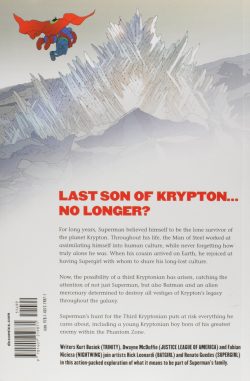
Blue Beetle Graduation Day


By Josh Trujillo & Adrián Gutiérrez, with Wil Quintana, Lucas Gattoni & various (DC Comics)
ISBN: 978-1-7795-2324-2 (TPB/Digital edition)

As the most recent incarnation of the vintage and venerable Blue Beetle brand at last makes the jump from comic book limbo and kids’ animation into live action movie madness, the event sparked a new comics miniseries bridging the teen hero’s old life and new comic book series. Here that is…

The Blue Beetle first appeared in Mystery Men Comics #1, published by Fox Comics and cover-dated August 1939. The eponymous lead character was created by Charles Nicholas (AKA Charles Wojtkowski) as a pulp-styled mystery man and born nomad. Over years and crafted by a Who’s Who of extremely talented creators, the Beetle was also inexplicably popular and hard to kill: surviving the collapse of numerous publishers before ending up as a Charlton Comics property in the mid-1950s.

After a few issues sporadically published, the company shelved him until the superhero revival of the early 1960s when Joe Gill, Roy Thomas, Bill Fraccio & Tony Tallarico revised and revived the character in a 10-issue run (June 1964, February 1966). Cop-turned-adventurer Dan Garrett was reinvented an archaeologist, educator and scientist who gained super-powers whenever he activated a magic scarab with the trigger phrase “Khaji Da!”

Some months later, Steve Ditko (with scripter Gary Friedrich) utterly reimagined the Blue Beetle. Ted Kord was an earnest and brilliant young researcher who had been a student and friend of Professor Garrett and when his mentor seemingly died in action, Kord trained himself to replace him: a purely human inventor/combat acrobat, bolstered by ingenious technology. This latter version joined DC’s pantheon during Crisis on Infinite Earths, earning a solo series and quirky immortality partnered with Booster Gold in Justice League International and beyond…

When Kord was murdered in the run up to Infinite Crisis, it led to all-out war across realities and at the height of the linked catastrophes El Paso high-schooler Jaime Reyes found a weird blue jewel shaped like a bug. That night, as he slept, it invaded him and turned him into a bizarre insectoid warrior. suddenly gifted with great powers, and revealed how some heroes are remade, not born – especially when a sentient scarab jewel affixes itself to your spine and transforms you into an armoured bio-weapon. Almost instantly, he was swept up in the chaos, joining Batman and other heroes in a climactic space battle.

Inexplicably returned home, Jaime revealed his secret to his family and tried to do some good in his hometown but had to rapidly adjust to huge changes. Best bud Paco had joined a gang of super-powered freaks, he learned the local crime mastermind was the foster-mom of his other best bud Brenda, and scary military dude named Christopher Smith (The Peacemaker) started hanging around. He claimed the thing in Jaime was malfunctioning alien tech, not life-affirming Egyptian magic that he also had an unwelcome and involuntary connection to…

That led to a secret war against an alien collective of conquerors called the Reach whose shady dealings and defeat have been covered in Blue Beetle: Jaime Reyes volumes One & Two. You should get those also.

Gathering Blue Beetle: Graduation Day #1-6 (cover-dated January to June 2022), and including an excerpt from the new Blue Beetle series it leads into, this collection is also quite rightly available in a Spanish language edition.

In an effort to maximise your fun and save time let’s briefly hit the high notes here.

Crafted by scripter Josh Trujillo (Adventure Time, Captain America, Rick & Morty), illustrator Adrián Gutiérrez (Batman, The Flash), colourist Wil Quintana and letterer Lucas Gattoni, ‘Graduation Day’ is set following recent DC megaevent Dark Crisis on Infinite Earths with our neophyte champion at long last getting a handle on his other life. He’s even become pals with his sentient passenger bug Khaji Da, allowing them to seamlessly work together.

With school days practically done, as the story opens Jaime is currently wrecking downtown El Paso battling magical thief Fadeaway and worrying about his non-superhero future. After almost missing his own graduation ceremony, Reyes suddenly finds it all going wrong again when he receives a terrifying vision of The Reach and loses control, uncontrollably shifting to his blue battle form…

His family share his secret, but aren’t happy about it and when he returns to his own party hours later, the festivities are long over and his furious mother wants to know what he’s doing with his life. So does Superman, who “just” popped by to see if the alien conquerors had regained control of their greatest weapon…

Intel confirms that The Reach are coming back and the (adult) superhero community feels it might be prudent if Jaime doesn’t use his powers for the foreseeable future…

Benched, grounded, jobless and not destined for college any time soon, the frustrated lad is summarily packed off to toil in his aunts’ diner in Palmera City, but fate has other plans. Repeatedly targeted by extremely Reach-like and savage Beetle-morphs Dynastes and Nitida, BB is forced to fight back until the Justice League shut him down again…

Some salvation comes when mentor Ted and his terrifying older smarter sister Victoria Kord offer him an (unpaid!) internship at Kord Industries. Ted is laid back and cool but Jaime can’t stop thinking how Victoria has the largest collection of alien tech on Earth and keeps looking at him funny…

As Beetle catastrophes keep coming, Reyes and still-on-the-fritz Khaji Da encounter a splinter faction of The Reach. Unable to trust The Horizon, they instead put themselves in the hands of Teen Titans Starfire, Cyborg and their allies. At least they can keep Batman and his private superhero goon squad off their collective shiny blue buggy back. Or Not…

And that’s when Paco and Brenda show up, begging Jaime to help their new best buddy Fadeaway. That does not go well…

With imminent doom encroaching and everybody telling him what” they” should do, Jaime and Khaji Da finally unlock the root problem that’s been jamming them up, consequently evolving into whole new Blue Beetle able and ready to fix their own problems…

And that’s when the aliens all come screaming into Earth’s atmosphere…

An enticing extra offers an extract and sneak peek from the new Blue Beetle #1 (‘Scarab War!’) due for release in September 2023, before a gallery of covers and variants by Cully Hamner, Rafael Albuquerque, David Marquez & Alejandro Sánchez, Ramon Villalobos, Gutiérrez & Quintana, Joe Quinones, Chokoo!, Danny Miki & Ivan Plascencia, Serg Acuña, Ricardo López Ortiz, Baldemar Rivas, Daniel Sampere & Alejandro Sánchez, Bruno Redondo, Jorge Corona & Sarah Stern segue into an extensive and expansive sketch gallery from Gutiérrez.

Here’s another smart, fast and joyous fun ride to delight fans of comics and other, lesser, media forms. So few series combine action and adventure with all-out fun and genuine wit, or can evoke shattering tragedy and poignant loss on command. Now read this even before you wallow in film fun…
© 2022, 2023 DC Comics. All Rights Reserved.