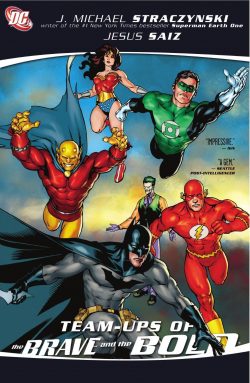
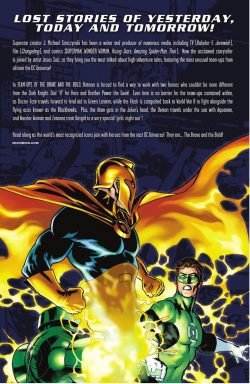
Team-Ups of the Brave and the Bold


By J. Michael Straczynski, Jesus Saiz, Chad Hardin, Justiniano, Cliff Chiang & various (DC Comics)
ISBN: 978-1-4012-2793-7 (HB) 978-1-4012-2809-5 (TPB/Digital edition)

The Brave and the Bold premiered in 1955; an anthology adventure comic featuring short complete tales starring a variety of period heroes and a format mirroring and cashing in on that era’s filmic fascination with historical dramas.

Devised and written by Robert Kanigher, issue #1 led with Roman epic Golden Gladiator, medieval mystery-man The Silent Knight and Joe Kubert’s now legendary Viking Prince. The Gladiator was soon replaced by National Periodicals/DC Comics’ iteration of Robin Hood, and the high adventure theme carried the title until the end of the decade when a burgeoning superhero revival saw B&B remodelled as a try-out vehicle like the astounding successful Showcase.

Deployed to launch enterprising concepts and characters such as Task Force X: The Suicide Squad, Cave Carson, Strange Sports Stories, Hawkman and the epochal Justice League of America, the title then evolved to create a whole sub-genre – although barely anybody noticed at the time…

That innovation was Superhero Team-Ups.

For almost a decade DC had enjoyed great success pairing Superman with Batman and Robin in World’s Finest Comics, and in 1963 sought to create another top-selling combo from their growing pantheon of masked mystery men. It didn’t hurt that the timing also allowed extra exposure for characters imminently graduating to their own starring vehicles after years as back-up features…

This was during a period when almost no costumed heroes acknowledged the jurisdiction or (usually) existence of other costumed champions. When B&B offered this succession of power pairings, they were unknowingly laying foundations for DC’s future close-knit comics continuity. Nowadays, there’s something wrong with any superstar who doesn’t regularly join every other cape or mask on-planet every five minutes or so…

The short-lived experiment eventually calcified as “Batman and…” but, for a while, readers were treated to some truly inspired pairings such as Flash and the Doom Patrol, Metal Men and Metamorpho, Flash and The Spectre or Supergirl and Wonder Woman.

The editors even achieved their aim after Robin, Kid Flash and Aqualad remained together after their initial foray and expanded into the ever-popular Teen Titans

That theme of heroes united together for a specific time and purpose was revived in 2007 for the third volume of The Brave and the Bold, resulting in many exceedingly fine modern Fights ‘n’ Tights classics, and this compilation collects issues #27-33 (November 2009 – June 2010): the first seven issues scripted by TV/comics star scribe J. Michael Straczynski.

The run of easily accessible, stand-alone tales delved into some of the strangest nooks and crannies of the DCU and opens here with ‘Death of a Hero’, illustrated by Jesús Saíz, wherein teenager Robby Reed visits Gotham City and decides to help out a Batman sorely pressed by the machinations of The Joker

The child prodigy had his own series in the 1960s as a kid who found a strange rotary device dotted with alien hieroglyphics that could temporarily transform him into a veritable army of super-beings when he dialled the English equivalents of H, E, R and O…

Here, however, after the lad dials up futuristic clairvoyant Mental Man, the visions he experiences force him to quit immediately and take to his bed…

He even forgets the Dial when he leaves, and it is soon picked up by down-&-out Travers Milton who also falls under its influence and is soon saving lives and battling beside the Dark Knight as The Star. What follows is a meteoric and tragic tale of a rise and fall…

Again limned by Saíz, B&B #28 takes us a wild trip to the ‘Firing Line’ as the Flash (Barry Allen) falls foul of a scientific experiment and winds up stranded in the middle of World War II. Injured and unable to properly use his powers, the diminished speedster is taken under the wing of legendary paramilitary aviator squadron The Blackhawks, but finds himself torn when his scruples against taking life crash into the hellish cauldron of the Battle of Bastogne and his manly, martial love of his new brothers in arms…

Brother Power, The Geek was a short-lived experimental title developed by legendary figure Joe Simon at the height of the hippy-dippy 1960s (or just last week if you’re a baby booming duffer like me).

He/it was a tailor’s mannequin mysteriously brought to life through extraordinary circumstances, just seeking his place in the world: a bizarre commentator and ultimate outsider philosophising on a world he could not understand.

That cerebral angst is tapped in ‘Lost Stories of Yesterday, Today, and Tomorrow’ when the elemental outcast crawls out of wreckage in Gotham City and clashes with Batman as they both strive to save homeless people from authoritarian brutality and greedy arsonists.

Like the times it references, this story is one you have to experience rather than read about…

Straczynski & Saíz play fast and loose with time travel in ‘The Green and the Gold’ as mystic Lord of Order Doctor Fate is helped through an emotional rough patch by Green Lantern Hal Jordan. As a result of that unnecessary kindness, the mage gets to return the favour long after his own demise at the moment the Emerald Warrior most needs a helping hand…

Illustrated by Chad Hardin & Walden Wong and Justiniano, The Brave and the Bold #31 describes ‘Small Problems’ encountered by The Atom after Ray Palmer is asked to shrink into the synapse-disrupted brain of The Joker to perform life-saving surgery. Despite his better judgement, the physicist eventually agrees but nobody could have predicted that he would be assimilated into the maniac’s memories and forcibly relive the Killer Clown’s life…

Straczynski & Saíz reunite as sea king Aquaman and hellish warrior Etrigan the Demon combine forces in a long-standing pact to thwart a revolting Cthonic invasion of ‘Night Gods’ from a hole in the bottom of the ocean before this mesmerising tome concludes with a bittersweet ‘Ladies Night’ from times recently passed, illustrated by Cliff Chiang.

When sorceress Zatanna experiences a shocking dream, she contacts Wonder Woman and Batgirl Barbara Gordon, insisting that they should join her on an evening of hedonistic excess and sisterly sharing. Only Babs is left out of one moment of revelation: what Zatanna foresaw would inescapably occur to her the next day at the hands of the Joker…

Smart, moving and potently engaging, these heroic alliances are a true treat for fans of more sophisticated costumed capers, and skilfully prepared in such a way that no great knowledge of backstory is required. Team-ups are all about finding new readers and this terrific tome is a splendid example of the trick done right…
© 2009, 2010 DC Comics. All Rights Reserved.

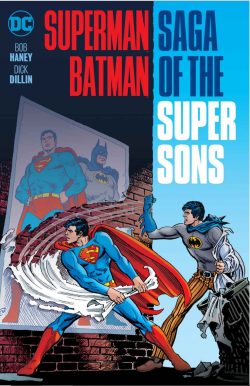
Superman/Batman: Saga of the Super Sons


By Bob Haney & Dick Dillin, with Dennis O’Neil, John Calnan, Ernie Chan, Rich Buckler, Kieron Dwyer & various (DC Comics)
ISBN: 978-1-4012-6968-5 (TPB/Digital edition)

Are you now old enough to yearn for simpler times?

The brilliant expediency of the Parallel Earths concept – and especially its contemporary incarnation Infinite Frontier – lends the daftest tale from DC’s vast back catalogue credibility and contemporary resonance, providing a chance that even the hippest and most happening of the modern pantheon can interact with the most utterly outrageous world concept in the company’s nigh-90-year history. It especially doesn’t hurt here, since – following the Rebirth reboot – the actual sons of the Dark Knight and Man of Tomorrow are now part of an established – and therefore “real” – DC Universe.

Thus, this collection of well-told but initially “imaginary” tales from 1972 to 1976, supplemented by some episodes from more self-conscious times, results from another earnest opportunity to make the fundamental allure of stuffy adult characters relevant to kids and teens.

Written by Bob Haney and drawn by Dick Dillin, The Super-Sons appeared without prior preamble or fanfare in World’s Finest Comics #215, (cover-dated January 1973, and hitting newsstands mid-October 1972). It was a tough time for superhero comics, but a great era for teen rebels. Those free-wheeling, easy-rider, end of the flower-power days generated a huge (and lasting) societal refocussing on “teen consciousness”, and the “Generation Gap” was a phrase on almost every lip.

It didn’t hurt that the concept was already tried and tested. Both Man of Steel and Caped Crusader had already been seen as younger versions of themselves many times over the years, and the evergreen dream of characters who would more closely resonate with youngsters never died in editors’ minds. After all, hadn’t original Boy Wonder Robin been created to give readers someone to closely identify with?

The editors – Murray Boltinoff and E. Nelson Bridwell – clearly saw a way to make their perilously old-school so-very establishment characters instantly pertinent and relevant. Being mercifully oblivious to the more onerous constraints of continuity – some would say logic – they simply and immediately generated tales of the maverick sons of the World’s Finest heroes out of whole cloth.

…And smartly-constructed, well told tales they are. Debut outing ‘Saga of the Super Sons!’ (inked by Henry Scarpelli) sees the young warriors as fully realised young rebels running away from home – on the inevitable motorcycle – and encountering a scurrilous gang-lord.

But worry not, their paternalistic parents are keeping a wary eye on the lads! Speaking as one of the original target market for this experiment, I can admit the parental overview grated then and still does, but as there were so many sequels, enough reader must have liked it…

‘Little Town with a Big Secret!’ appeared in the very next issue: another low key human interest tale, but with a science-fiction twist and the superb inking of Murphy Anderson complimenting Haney & Dillin’s tight murder-mystery yarn.

Crafted by the same team, WF # 221 (January-February 1974) featured ‘Cry Not for My Forsaken Son!’ depicting a troubled runaway boy discovering the difference between merit and worth, and the value of a father as opposed to a biological parent, after which #222’s ‘Evil in Paradise’(inked by Vince Colletta) saw young heroes voyage to an undiscovered Eden to resolve the ancient question of whether Man is intrinsically Good or Evil.

‘The Shocking Switch of the Super-Sons’ (WF #224, cover dated July-August and also inked by Colletta) took teen rebellion to its logical conclusion when a psychologist convinces the boys to trade fathers, whereas ‘Crown for a New Batman!’ provides a radical change of pace as Bruce Wayne Jr. inherits the Mantle and the Mission when dad is murdered!

Never fear, all is not as it seems, fans! This thriller – guest starring Robin – appeared in WFC #228, and was inked by Tex Blaisdell, who inked Curt Swan, on more traditional Lost Civilisation yarn ‘The Girl Whom Time Forgot’ in WF#230…

The Relevancy Era was well over by the time Haney, Dillin & Blaisdell crafted ‘Hero is a Dirty Name’ (#231, July 1975), wherein the Sons are forced to question the motivation for heroism in a thriller guest-starring Green Arrow and The Flash.

In #233’s ‘World Without Men’ (inked by John Calnan) the ever-rambling, soul-searching Super-Sons confront sexual equality issues and unravel a crazy plot to supplant human males, after which ‘The Angel with a Dirty Name’ (by the same team in June 1976’s WFC #238) offers a supervillains and monsters slug-fest indistinguishable from any other Fights ‘n’ Tights tale, before the original series fades out with December’s #242’s in ‘Town of the Timeless Killers’. Illustrated by Ernie Chua (nee Chan) & Calnan, it sees the kids trapped in a haunted ghost town and stalked by immortal gunslingers offering a rather low-key and ignominious close to a bold experiment.

Four years later in mid-March 1980, the boys surprisingly showed up in a momentary revival. Cover-dated June-July and courtesy of Denny O’Neil, Rich Buckler & Dick Giordano in WFC #263, ‘Final Secret of the Super-Sons’ shockingly revealed that the boys were no more than a simulation running on the Man of Steel’s futuristic Super Computer.

In a grim indication of how much of a chokehold shared continuity had grown into, they then escaped into “reality” anyway, accidentally wreaking havoc in a manner The Matrix movies would be proud of…

The collection concludes in a short tale by Haney & Kieron Dwyer from Elseworlds 80-Page Giant in 1999. ‘Superman Jr. is No More!’ is a charming, fitting conclusion to this odd, charming and idiosyncratic mini-saga, embracing the original conceit as it posits what would happen if Superman died and his boy was forced to take over too soon…

Supplemented with a full cover gallery by Nick Cardy, Chan, Calnan, Giordano, Ross Andru & Ty Templeton, these classic yarns are packed with potency and wit. If you’ve an open mind and refined sense of adventure, why not take a look at a few gems (and one or two clunkers) from an era where everybody read comics and nobody took them too seriously?
© 1972, 1973, 1974, 1975, 1976, 1980, 1999, 2017 DC Comics. All Rights Reserved.

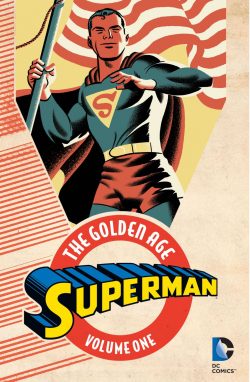
Superman – The Golden Age volume one


By Jerry Siegel & Joe Shuster & various (DC Comics)
ISBN: 978-1-4012-9109-2 (TPB/Digital edition)

Almost exactly 85 years ago, Superman started the whole modern era of fantasy heroes: outlandish, flamboyant indomitable, infallible, unconquerable. He also saved a foundering industry by birthing an entirely new genre of storytelling – the Super Hero.

Since April 18th 1938 (the generally agreed day copies of Action Comics #1 first went on sale) he has grown into a mighty presence in all aspects of art, culture and commerce, even as his natal comic book universe organically grew and expanded.

Within three years of that debut, the intoxicating blend of eye-popping action and social wish-fulfilment that had hallmarked the early exploits of the Man of Tomorrow had grown: encompassing crime-busting, reforming dramas, science fiction, fantasy and even whimsical comedy. However, once the war in Europe and the East seized America’s communal consciousness, combat themes and patriotic imagery dominated most comic book covers, if not interiors.

In comic book terms at least, Superman was soon a true master of the world, utterly changing the shape of the fledgling industry. There was a popular newspaper strip, a thrice-weekly radio serial, games, toys, foreign and overseas syndication and as the decade turned, the Fleischer studio’s astounding animated cartoons.

Moreover, the quality of the source material was increasing with every four-colour release as the energy and enthusiasm of originators Jerry Siegel & Joe Shuster went on to inform and infect the burgeoning studio which grew around them to cope with the relentless demand.

These tales have been reprinted many times, but this superb compilation series is arguably the best, offering the original stories in chronological publishing order and spanning cover-dates June 1938 to December 1939. It features the groundbreaking sagas from Action Comics #1-19 and Superman #1-3, plus his pivotal appearance in New York’s World Fair No. 1. Although most of the early tales were untitled, here, for everyone’s convenience, they have been given descriptive appellations by the editors.

Thus – after describing the foundling’s escape from exploding planet Krypton and offering a scientific rationale for his incredible abilities and astonishing powers in 9 panels – with absolutely no preamble the wonderment begins with Action #1’s primal thriller ‘Superman: Champion of the Oppressed!’ Here, an enigmatic costumed crusader – who secretly masquerades by day as mild-mannered reporter Clark Kent – begins averting numerous tragedies…

As well as saving an innocent woman from the Electric Chair and roughing up an abusive “wife beater”, the tireless crusader works over racketeer Butch Matson and consequently saves feisty colleague Lois Lane from abduction and worse before outing a lobbyist for the armaments industry bribing Senators on behalf of the greedy munitions interests fomenting the war in Europe…

One month later came Action #2 and the next breathtaking instalment as the mercurial mystery-man travels to that war-zone to spectacularly dampen down hostilities already in progress in ‘Revolution in San Monte Part 2’ before ‘The Blakely Mine Disaster’ finds the Man of Steel responding to a coal-mine cave-in and exposing corrupt corporate practises before cleaning up gamblers ruthlessly fixing games and players in #4’s ‘Superman Plays Football’.

The Action Ace’s untapped physical potential is highlighted in the next issue as ‘Superman and the Dam’ pits the human dynamo against the power of a devastating natural disaster, after which issue #6 sees canny chiseller Nick Williams attempting to monetise the hero – without asking first. ‘Superman’s Phony Manager’ even attempts to replace the real thing with a cheap knock-off, but quickly learns a most painful and memorable lesson in ethics…

Although Superman starred on the first cover, National’s cautious editors were initially dubious about the alien strongman’s lasting appeal and fell back upon more traditional genre scenes for the following issues (all by Leo E. O’Mealia and all included here).

Superman – and Joe Shuster’s – second cover graced Action Comics #7 (on sale from October 25th but cover-dated December 1938) prompting a big jump in sales, even as the riotous romp inside revealed why ‘Superman Joins the Circus’ – with the mystery man crushing racketeers taking over the Big Top.

Fred Guardineer produced genre covers for #8 and 9 whilst their interiors saw ‘Superman in the Slums’ working to save young delinquents from a future life of crime and depravity before latterly detailing how the city’s cop disastrous decision to stop the costumed vigilante’s unsanctioned interference plays out in ‘Wanted: Superman’. That manhunt ended in an uncomfortable stalemate that endured for years…

Action Comics #7 had been one of the company’s highest-selling issues ever, so #10 again sported a stunning Shuster shot, whilst Siegel’s smart story ‘Superman Goes to Prison’ struck another telling blow against institutionalised injustice, as the Man of Tomorrow infiltrated a penitentiary to expose the brutal horrors of State Chain Gangs.

Action #11 offered a maritime cover by Guardineer whilst inside heartless conmen driving investors to penury and suicide soon regret the Metropolis Marvel intercession in ‘Superman and the “Black Gold” Swindle’.

Guardineer’s cover of magician hero Zatara for issue #12 was a shared affair, incorporating another landmark as the Man of Steel was given a cameo badge declaring his presence inside each and every issue. Between those covers, ‘Superman Declares War on Reckless Drivers’ is a hard-hitting tale of casual joy-riders, cost-cutting automobile manufacturers, corrupt lawmakers and dodgy car salesmen who all feel the wrath of the hero after a friend of Clark Kent dies in a hit-&-run incident.

By now, the editors had realised that Superman had propelled National Comics to the forefront of the new industry, and in 1939 the company was licensed to create a comic book commemorative edition celebrating the opening of the New York World’s Fair. The Man of Tomorrow naturally topped the bill on the appropriately titled New York World’s Fair Comics at the forefront of such early DC four-colour stars as Zatara, Butch the Pup, Gingersnap and gas-masked vigilante The Sandman.

Following an inspirational cover by Sheldon Mayer, Siegel & Shuster’s ‘Superman at the World’s Fair’ describes how Lois and Clark are dispatched to cover the event, giving our hero an opportunity to contribute his own exhibit and bag a bunch of brutal bandits to boot…

Back in Action Comics #13 (June 1939 and another Shuster cover) the road-rage theme of the previous issue continued with ‘Superman vs. the Cab Protective League’ as the tireless foe of felons faces a murderous gang trying to take over the city’s taxi companies. The tale also introduces – in almost invisibly low key – The Man of Steel’s first recurring nemesis – The Ultra-Humanite

Next follows a truncated version of Superman #1. This is because the industry’s first solo-starring comic book simply reprinted the earliest tales from Action, albeit supplemented with new and recovered material – which is all that’s featured at this point.

Behind the truly iconic and much recycled Shuster cover, the first episode was at last printed in full as ‘Origin of Superman’, describing the alien foundling’s escape from doomed planet Krypton, his childhood with unnamed Earthling foster parents and eventual journey to the big city…

Also included in those 6 pages (cut from Action #1, and restored to the solo vehicle entitled ‘Prelude to ‘Superman, Champion of the Oppressed’”) is the Man of Steel’s routing of a lynch mob and capture of the real killer which preceded his spectacular saving of the accused murderess that started the legend. Rounding off the unseen treasures is the solo page ‘A Scientific Explanation of Superman’s Amazing Strength!’, a 2-page prose adventure of the Caped Crime-crusher, a biographical feature on Siegel & Shuster and a glorious Shuster pin-up from the premier issue’s back cover.

Sporting another Guardineer Zatara cover, Action #14 saw the return of the manic money-mad deranged scientist in ‘Superman Meets the Ultra-Humanite’, wherein the mercenary malcontent switches his incredible intellect from incessant graft, corruption and murder to an obsessive campaign to destroy the Man of Steel.

Whilst Shuster concentrated on the interior epic ‘Superman on the High Seas’ – wherein the heroic hurricane tackles sub-sea pirates and dry land gangsters – Guardineer then made some history as illustrator of an aquatic Superman cover for #15. He also produced the Foreign Legion cover on #16, wherein ‘Superman and the Numbers Racket’ sees the hero save an embezzler from suicide before wrecking another wicked gambling cabal.

Superman’s rise was meteoric and inexorable. He was the indisputable star of Action, plus his own dedicated title and a daily newspaper strip had begun on 16th January 1939, with a separate Sunday strip following from November 5th of that year. The fictive Man of Tomorrow was the actual Man of the Hour and was swiftly garnering millions of new fans.

A thrice-weekly radio serial was in the offing, and would launch on February 12th 1940. With games, toys, and a growing international media presence, Superman was swiftly becoming everybody’s favourite hero…

The second issue of Superman’s own title opened with ‘The Comeback of Larry Trent’ – a stirring human drama wherein the Action Ace clears the name of the broken heavyweight boxer, coincidentally cleaning the scum out of the fight game, and is followed by ‘Superman’s Tips for Super-Health’ before ‘Superman Champions Universal Peace!’ depicts the hero once more tackling unscrupulous munitions manufacturers by crushing a gang who had stolen the world’s deadliest poison gas.

‘Superman and the Skyscrapers’ finds newshound Kent investigating suspicious deaths in the construction industry, drawing his alter ego into conflict with mindless thugs and their fat-cat corporate boss, after which a contemporary ad and a Superman text tale bring the issue to a close.

Action Comics #17 declared ‘The Return of the Ultra-Humanite’ in a vicious and bloody caper involving extortion and the wanton sinking of US ships. and featured a classic Shuster Super-cover as the Man of Steel was awarded all the odd-numbered issues for his attention-grabbing playground.

That didn’t last long: after Guardineer’s final adventure cover – a bi-plane dog fight on #18 – and which led into ‘Superman’s Super-Campaign’ with both Kent and the Caped Kryptonian determinedly crushing a merciless blackmailer, Superman simply monopolised every cover from #19 onwards. That issue disclosed the peril of ‘Superman and the Purple Plague’ as the city reeled in the grip of a deadly epidemic created by Ultra-Humanite.

Closing this frenetic fun and thrill-filled compendium is the truncated contents of Superman #3, offering only the first and last strips originally contained therein, as the other two were reprints of Action Comics #5 and 6.

‘Superman and the Runaway’, however, is a gripping, shockingly uncompromising exposé of corrupt orphanages, after which – following a brief lesson on ‘Attaining Super-Health: a Few Hints from Superman!’ – Lois finally goes out on a date with hapless Clark – but only because she needs to get closer to a gang of murderous smugglers. Happily, Kent’s hidden alter ego is on hand to rescue her in the bombastic gang-busting style in ‘Superman and the Jewel Smugglers’

Although the gaudy burlesque of monsters and super-villains lay years ahead of our hero, these primitive and raw, captivating tales of corruption, disaster and social injustice are just as engrossing and speak powerfully of the tenor of the times then and now! The perilous parade of rip-roaring action, hoods, masterminds, plagues, disasters, lost kids and distressed damsels are all dealt with in direct, enthralling and captivatingly cathartic manner by our relentlessly entertaining champion’s summarily swift and decisive fashion.

As fresh and compelling now as they ever were, these endlessly re-readable epics perfectly display the savage intensity and sly wit of Siegel’s stories – which literally defined what being a Super Hero means – whilst Shuster created the basic iconography for all others to follow.

Golden Age tales are priceless enjoyment. What comics fan could possibly resist them?
© 1938, 1939, 2016 DC Comics. All Rights Reserved.

Superman vs. the Revenge Squad!


By Karl Kesel, David Michelinie, Jerry Ordway, Louise Simonson, Roger Stern, Jon Bogdanove, Sal Buscema, Tom Grummett, Stuart Immonen, Ron Lim, Tom Morgan, Paul Ryan, Brett Breeding, Klaus Janson, Dennis Janke, Jose Marzan Jr., Denis Rodier& various (DC Comics)
ISBN: 978-1-56389-487-9 (TPB)

The Man of Steel celebrates 85 years of continuous publication this year. His existence dictated and defined the entire US Comic book industry, but in this anniversary year, what’s most remarkable is how little of the truly vast variety of his exploits and achievements DC Comics currently consider worthy of us seeing…

Here’s another thrilling snapshot exemplifying an era of superb creativity following Superman’s 1987 reboot in the wake of Crisis on Infinite Earths. If you’re counting, the tale first appeared – in whole or in part – in Adventures of Superman #539, 542, 543, Action Comics #726, 730, Superman: Man of Steel #61 & 65 and Superman: Man of Tomorrow #7, cumulatively spanning October 1996 to February 1997.

By extracting pertinent episodes from a selection of sub-plots as well as entire episodes, a tag team of creators – writers Karl Kesel, David Michelinie, Jerry Ordway, Louise Simonson and Roger Stern in close conjunction with artists Jon Bogdanove, Sal Buscema, Tom Grummett, Stuart Immonen, Ron Lim, Tom Morgan, Paul Ryan, Brett Breeding, Klaus Janson, Dennis Janke, Jose Marzan Jr. & Denis Rodier – constructed a crafty and exciting romp pitting the Metropolis Marvel against a peculiar array of particularly irate enemies, all unknowingly working for a mysterious mastermind who was far from what he appeared…

The action commences with ‘Dopplegangster’ wherein a clone from the top-secret Cadmus Project intercepts a high-tech intruder and is infected with a hideous condition which brings all the long-suppressed and submerged evil of conventionally bred progenitor to the surface.

The invader is Misa, a spoiled, fun-loving, metahuman brat with incredible futuristic devices who had previously plagued Superman and the Project. Here, however, her skirmish with the re-grown Floyd “Bullets” Barstow has profound and lasting effects: accidentally transforming him into a troubled paranoid soul who might suddenly transform at any moment into a brutal Anomaly: armed with elemental shape-changing powers and unhindered any shred of conscience at all.

Meanwhile in Metropolis, Superman has his hands full defending the city and shuffling his new job as Editor of The Daily Planet, whilst venerable boss Perry White recovers from lung cancer and subsequent chemotherapy. Clark’s burden gets no easier when living weapons-platform Barrage returns in ‘Arms’, determined to kill Police Chief Maggie Sawyer whom he blames for the loss of his right limb. Moreover, anarchic troublemaker Riot – a raving loon who generates living duplicates every time he is struck – also pops up to make mischief and mayhem in ‘Losin’ It’.

‘Hero or Villain?’ concentrates on the history of Lex Luthor, providing insight and oversight to the multi-billionaire inventor who is currently under arrest and awaiting trial, even as alien superwoman Maxima frets and festers in her futile quest to find a suitable mate.

The Man of Steel was her first choice and he refused her (often violently) many times. Once again she tries to have her way with him and the forceful rejection sends her straight into the influence of someone who is gathering a team to destroy the Caped Kryptonian forever…

A unified assault begins in ‘The Honeymoon’s Over’ as Riot, Misa, Anomaly and Barrage meet Maxima and take their communal shot at the mutual enemy in ‘President of the United Hates’.

There is something not quite right about their enigmatic, shadowy leader and besides, what strategic genius would put five incompatible, uncontrollable egomaniacs in the same team and expect them to have a ghost of a chance against Superman?

The final, spectacular battle inevitably goes awry for the rogues in ‘Losers’, and as the dust settles all the evidence points to only one possible culprit for the Revenge Squad’s campaign of terror. But is it really that clear-cut?

Although a little disconnected in places – the storyline ran simultaneously and concurrently with another extended saga (collected in Superman Transformed!) and the excision of irrelevant pages doesn’t lend itself to a seamless and smooth read – this tale perfectly exemplifies the brilliant blend of cosmic adventure, fights ‘n’ tights action, soap opera drama and sheer enthusiastic excitement that typified the Superman franchise of this era.

This kind of close-plotted continuity was a hallmark of the 1980s-1990s Superman, and that such a strong tale could be constituted from snippets around the main story is a lasting tribute to the efficacy and power of the technique. Superman vs. the Revenge Squad! is a delightfully old-fashioned fun-fest that will delight fans of The Legend and followers of the genre alike. It should really be a part of everyone’s Krypton Chronicles, and DC are missing a trick not making it so…
© 1996, 1997, 1999 DC Comics. All Rights Reserved.

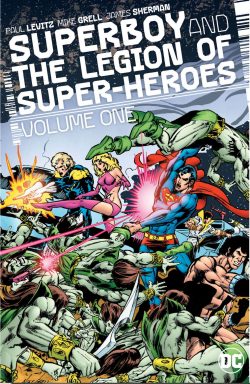
Superboy and the Legion of Super-Heroes volume 1


By Paul Levitz, Gerry Conway, Paul Kupperberg, Jack C. Harris, Mike Grell, James Sherman, Jim Starlin, Ric Estrada, Howard Chaykin, George Tuska, Walt Simonson, Mike Nasser, Juan Ortiz & various (DC Comics)
ISBN: 978-1-4012-7291-3 (HB/Digital edition)

Once upon a time, 1000 years from now, super-powered kids from a multitude of worlds took inspiration from the greatest legend of all time and formed a club of heroes. One day those Children of Tomorrow came back in time and invited their inspiration to join them…

Thus, began the vast and epic saga of the Legion of Super-Heroes, as first envisioned by writer Otto Binder & artist Al Plastino when the many-handed mob of juvenile universe-savers debuted in Adventure Comics #247 (April 1958), just as a revived superhero genre was gathering an inexorable head of steam. Happy 65th Anniversary, Junior Futurians!

Since that time, the fortunes and popularity of the Legion have perpetually waxed and waned, with their future history continually tweaked and overwritten, retconned and rebooted time and time again to comply with editorial diktat and popular fashion. This cosmically-captivating compendium gathers a chronological parade of futuristic delights from Superboy and The Legion of Super-Heroes #234-240 (spanning December 1977- June 1978) and includes an untold tale of their earliest exploits from DC Super-Stars #17, as well as a major event from tabloid colossus All-New Collector’s Edition C-55.

This was a period when the recently impoverished superhero genre had once again flared into vibrant new life to gain its current, seemingly unassailable ascendancy. That prior plunge in costumed character popularity had seen the team lose their long-held lead spot in Adventure Comics, get relegated to a back-up slot in Action Comics and even vanish completely for a time. However, Legion fans are the most passionate of an already fanatical breed…

No sooner had the LSH faded than fan agitation to revive them began. After a few tentative forays as an occasional back-up feature in Superboy, the game-changing artwork of Dave Cockrum inspired a fresh influx of fans. The back-up soon took over the book – exactly as they had done in the 1960s, when the Tomorrow Teens took Adventure Comics from the Boy of Steel and made it uniquely their own…

Without warning or preamble, the adventure continues with Jack C. Harris, Juan Ortiz & Bob Smith exploring ‘The Secret of the Quintile Crystal’ (DC Super-Stars #17, cover-dated December 1977) as founders Saturn Girl, Lightning Lad and Cosmic Boy relate to Superboy how a theft by diplomats beyond the reach of the law catapulted the kids – and their unique problem-solving gifts – to the forefront of United Planets Security Planning…

Superboy and The Legion of Super-Heroes #234 then offers a contemporary cosmic catastrophe, as a clash with a space dragon mutates a squad of teen heroes into a marauding amalgamated menace. When the call goes out ‘Wanted Dead or Alive: The Composite Legionnaire’ (by Gerry Conway, Ric Estrada & Jack Abel), ultimate mercenary Bounty goes after the victim and he won’t let sentiment or the remaining heroes interfere with ‘The Final Hunt!’. Happily, Superboy and energy-being Wildfire have enough power to stop the hunter and cure their companions…

Issue #235 featured the kind of story uber-dedicated fans adore. ‘The Legion’s Super-Secret’ – by Paul Levitz, Mike Grell & Vince Colletta) gives a glimpse into the covert cognitive conditioning Superboy endures every time he returns to his own era. When the process is abruptly interrupted because of a raid by resource hungry Sklarians, the Legionnaires fear the greatest hero of all time may expose the Future’s most dangerous biological deception.

Although a tense and rousing escapade, the sad truth is that this tale was conceived to placate sections of the audience who kept carping over why clearly fully mature characters were still being designated “Boy”, “Girl”, “Kid”, “Lass” and “Lad”. As if comics never had serious social problems and issues to address, right?

The lead story is far-surpassed by potent back-up ‘Trial of the Legion Five’ (Conway, George Tuska & Colletta), wherein some of the heroes are accused of causing the death of a citizen caught in the rampage of the now-defunct Composite Legionnaire. Their accuser is an old political adversary bearing a grudge and as ever, things are not what they seem…

S&LSH #236 was a power-packed portmanteau offering and brimming with vibrant new artistic talent. It begins with ‘A World Born Anew’ (written by Levitz & Paul Kupperberg with stunning art from then-neophytes James Sherman & Bob McLeod). When fantastically powerful alien property speculator Worldsmith arbitrarily terraforms the planet Braal, even a full Legion team is unable to stop him… until Princess Projectra deduces a better way to send the crazed capitalist packing.

Levitz, Mike Nasser/Netzer, Joe Rubinstein & Rick Bryant then provide an all-action prologue to greater sagas in the making as ‘Mon-El’s One-Man War’ finds the formidable Daxamite exerting all his energies to save an experimental star mine during a bloody incursion by war-crazed Khunds before the moment Legion fans had impatiently awaited for decades finally came…

‘Words Never Spoken’ by Levitz, Sherman & Rubinstein at long last saw Lightning Lad and Saturn Girl set the day…

No longer bound by responsibility, they had agreed to quit the team – because teammates (like cousins) weren’t allowed to marry – resulting in a huge tabloid-sized milestone released as All-New Collector’s Edition C-55 (March 1978).

Comic book weddings never start well and ‘The Millennium Massacre’ (Levitz, Grell & Colletta) coincided with a dastardly plot by their greatest foe to rewrite history. As the young marrieds stumble into a honeymoon ‘Murder by Moonlight’, Superboy and a select team voyage to 1988. They’re hoping to prevent the destruction of the United Nations and solve ‘The Twisted History Mystery’ before their comrades and the newlyweds perish in an interplanetary war, but the real showdown only occurs after a ‘Showdown at the End of Eternity’…

Augmented by a potted visual history of ‘Superboy and the Legion of Super-Heroes’ by Grell & Colletta, fact-features ‘The Origins and Powers of the Legionnaires’ and ‘Secrets of the Legion’ – by Levitz, Sherman & Abel- this epic event laid the groundwork for a darker, more compelling tone…

That began with #237’s ‘No Price Too High’ (Levitz, Walt Simonson & Abel) wherein the team’s financial backer R. J. Brande is abducted by maniac Arma Getten. He demands the team bring him ‘The Heart of a Star’, ‘The Stolen Trophy’ and life-sustaining artefact ‘The Crown of the Graxls’ in return for their patron’s life. Painfully aware that these objects hold the power ‘To Shake the Stars’, the team comply… Apparently…

Due to deadline problems #238 was a hasty reprint of Adventure Comics #359 & 360 and is represented here by its spiffy new Jim Starlin wraparound cover, but the intended tale when it finally emerged was an instant classic worth the wait.

Plotted and laid out by Starlin, with Levitz script and Rubinstein finishes, #239’s ‘Murder Most Foul’ saw rowdy, rebellious Ultra Boy framed for murdering a prostitute and a fugitive on the run from his former comrades. Only LSH Espionage Squad leader Chameleon Boy saw something behind the seemingly open-&-shut case, and his off-the-books investigation indicated there was indeed a Legion traitor: potentially the most dangerous opponent of all…

The final inclusion in this mammoth compilation is #240, delivering a brace of thrillers. Levitz, Harris, Howard Chaykin & Bob Wiacek opened with ‘The Man Who Manacled the Legion’ as old foe Grimbor the Chainsman kidnapped the UP President in a bizarre scheme to kill the heroes he held responsible for the death of his true love. The book does close on a tantalising high however, as Levitz, Kupperberg, Sherman & McLeod take us into the Legion Training Academy and introduce a bevy of new heroes eager to join the big guns.

Super dense (yes, I know, just go with it) Jed Rikane, invulnerable Laurel Kent and Shadow Lad (Shadow Lass’ younger brother) all show potential and flaws in equal amounts, but the mutant tracker mercenary is who really troubles Wildfire. ‘Dawnstar Rising’ shows not only her immense ability but a disregard for her comrades that might have lethal consequences in the days to come, unless the Legion somehow works its inclusive magic on her…

Rounding out the future fun, ‘Notes from Behind the Scenes’ provides glimpses at Levitz’s original presentation for tabloid edition, plots for a Queen Projectra tale and data cheat sheets for Saturn Girl and others.

The Legion is unquestionably one of the most beloved and bewildering creations in comics history, and largely responsible for the explosive growth of a groundswell movement that became American Comics Fandom. Moreover, these scintillating and seductively addictive stories – as much as Julie Schwartz’s Justice League of America or Jack Kirby’s Fantastic Four – fuelled the interest and imaginations of generations of readers to create the industry we all know today.

If you love comics and haven’t read this stuff, you are the poorer for it and need to feed your dreams of a better tomorrow as soon as possible.
© 1977, 1978, 2017 DC Comics. All Rights Reserved.

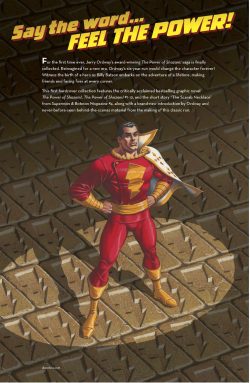
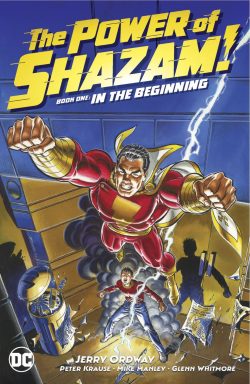
The Power of Shazam! Book One: In the Beginning


By Jerry Ordway, Peter Krause, Mike Manley, Curt Swan, Mike Parobeck, Rick Burchett, Kurt Schaffenberger, Glenn Whitmore& various (DC Comics)
ISBN: 978-1-4012-9941-5 (HB/Digital edition)

Superman debuted in Action Comics #1 in the summer of 1938. Created by Jerry Siegel & Joe Shuster, the character proved extremely popular across many disparate media, sparking a new kind of hero and story form. You’re here right now because of him…

Another of the most venerated and loved characters in American comics was created by Bill Parker & Charles Clarence Beck for Fawcett Publications as part of a wave of opportunistic creativity that followed that successful launch of Superman. However, although there were many similarities in the early years, the “Big Red Cheese” moved swiftly and solidly into the arena of light entertainment and even broad comedy, whilst – as the 1940s progressed – the Man of Tomorrow increasingly left whimsy behind in favour of action and drama.

At the height of his popularity, Captain Marvel hugely outsold Superman but, as the decade progressed and tastes changed, sales slowed. When an infamous copyright infringement suit filed in 1941 by National Comics was settled the Captain and his crew – like so many other superheroes – disappeared to become fond memories for older fans.

A syndication success, he was missed all over the world. In Britain, where a reprint line had run for many years, creator/publisher Mick Anglo had an avid audience and no product, so transformed Captain Marvel into atomic agent Marvelman, continuing to thrill readers into the 1960s.

Decades later, American comics experienced another superhero boom-&-bust, and the 1970s dawned with a shrinking industry and wide variety of comics genres servicing a base that was increasingly dependent on collectors and fans rather than casual or impulse buyers. National Periodicals/DC Comics needed sales and were prepared to look for them in unusual places.

Since the court settlement with Fawcett in 1953, they had pursued the rights to Captain Marvel and his spin-offs. Now, though the name itself had been claimed by Marvel Comics (via a quirky robot character published by Carl Burgos and M.F. Publications in 1967), the publishing monolith opted to tap into that discriminating if aging fanbase.

In 1973, riding a wave of national nostalgia on TV and movies, DC brought back the entire beloved cast of the Original Captain Marvel crew in their own kinder, weirder universe. To circumvent the intellectual property clash, they named the new title Shazam! (…With One Magic Word…) referencing the memorable trigger phrase used by myriad Formerly Fawcett-Marvels to transform to and from mortal form… a word that had entered the idiom and language due to the success of the franchise the first time around.

He’s been a star in DC’s firmament ever since, but one who’s endured much rejigging, refurbishment and narrative refinement, even if the fundamentals have never varied…

Homeless orphan and thoroughly good kid Billy Batson was selected by an ancient wizard to battle injustice with the powers of six gods/legendary heroes. By speaking aloud the wizard’s name – itself an acronym for the six patrons Solomon, Hercules, Atlas, Zeus, Achilles and Mercury – Billy would transform from scrawny boy to brawny (adult) warrior Captain Marvel: dispensing justice and mercy with the forgiving grace of an innocent child…

There have been many enjoyable, effective and fittingly contemporary treatments, but perhaps the very best was one fully embracing the original  tone: successfully recapturing the exuberance and charm – albeit layered with a potent veneer of modern menace.

It began with Jerry Ordway’s 1994 re-imagining in an Original Graphic Novel: based as much on the 1941 movie serial as the forceful yet fun comics of Bill Parker, Otto Binder, C.C. Beck, Joe Simon, Jack Kirby, Pete Costanza and their cohort of creative colleagues…

That groundbreaking yarn and the series it spawned became a thriving, vibrant cornerstone of DC Continuity. This reprint edition combines the OGN and first dozen issues (cover-dated March 1995-February 1996) of that series, each with a lovely painted Ordway cover. Adding to the appeal is a short but sweet contemporary treat from young readers title Superman & Batman Magazine #4, a new Introduction from Ordway and a swathe of extras at the end…

With Ordway doing everything but the lettering (that’s courtesy of John Costanza) the epic reboot opens in Egypt, where archaeologists Charles “CC” Batson and his wife Marilyn lead the prestigious Sivana Expedition in a search for knowledge and antiquities.

That doesn’t precisely fit with orders given to the sponsor’s ruthless representative Theo Adam, who has his own instructions regarding certain treasures. When the Batsons uncover the lost tomb of unknown dignitary “Shazam”, tensions boil over and murder occurs.

The historians had left their son in America with Charles’ brother, but taken their toddler Mary with them. After the bloodshed ends, both she and Adam have vanished without trace.

Some years later Billy Batson is a little boy living on the streets of ultra-modern art deco Fawcett City. His parents had left him with CC’s brother Ebenezer when they went away. When they never returned, the boy was thrown out as his uncle stole his inheritance. No one knows where Billy’s little sister is…

Sleeping in a storm drain, selling newspapers for cash, the indomitable kid is pretty street-savvy, but when a mysterious shadowy stranger who seems comfortingly familiar bids him follow into an eerie subway, Billy just somehow knows it’s okay to comply.

When he meets the wizard Shazam and gains the powers of the ancient Gods and Heroes he knows he has the opportunity to make things right at last. However, he has no conception of the depths evil corporate vulture Thaddeus Sivana can sink to, nor the role mystical exile Black Adam played in the fate of his parents…

Newly empowered by the wizard, Billy turns his life around, adapts to life as an underage superhero and spectacularly brings both murdering Theo Adam and his maniacal boss Sivana to justice whilst defeating his own wicked predecessor, before setting out to confront even greater challenges like finding his lost sister…

This superb and mesmerising retelling led to the most successful comic book revival Captain Marvel has yet experienced. Characters refitted there are potently realistic but the stories offer a young voice and sensibility. Moreover, the pulp adventure atmosphere conjured up by Ordway in conjunction with his sumptuous painted art and spectacular design make for a captivating experience, and his writing has never been more approachable and beguiling.

The author – with penciller Peter Krause & inker Mike Manley – would build on the tale in the series that followed: employing a cunning long-term scheme to adapt classic Golden Age tales to modern tastes under a slick veneer of retro fashion.

Before that though, Ordway, artists Parobeck & Rick Burchett, colourist Glenn Whitmore & Constanza delivered a smart vignette in Superman & Batman Magazine #4. Aimed at introducing the DCU to early readers, the comic saw Billy stumble into a museum robbery by an old enemy before saving ‘The Scarab Necklace’

Ordway, Krause & Manley then began the long haul – in its own rather staid and timeless corner of the DCU – with The Power of Shazam! #1 as ‘Things Change’. Billy now has a job as an announcer/roving reporter for WHIZ radio and an apartment. He lives there alone, using his alter ego as his live-in “responsible adult” Uncle Eben. Billy has been sporadically mentored by the wizard who has also been fruitlessly seeking Billy’s vanished sister…

Captain Marvel has established himself as the champion of Fawcett City: defeating countless crooks, monsters and even the occasional supervillain.

A new chapter begins when one of them – IBAC – literally crashes the launch of a new Wayne-Tech facility sponsored by property speculator Sinclair Batson. The shallow sleazeball is apparently the son and heir of the real Ebeneezer Batson, but neither Billy or anyone else has ever heard of him…

Late for school again, the cousins unknowingly “meet” when the Big Red Cheese pulls Sinclair out of the skyscraper’s razed rubble. Always ready to schmooze, the speculator “rewards” the hero with an invitation to his next high society soiree…

Elsewhere, concerned school custodian Dudley H. Dudley has deduced Billy lives alone. He tries to help the scrappy little guy, interceding whenever head teacher Miss Wormwood targets the lad for “special attention”. Billy is baffled but grateful, yet has bigger problems, like IBAC and a scheming female racketeer with a hidden agenda and unknown powers…

Never one to miss a free meal, Billy attends the party as his older self: taking the opportunity to assess just what he’s missing in the mansion he grew up in and which should by rights be his. It’s an uncomfortable experience. When not fending off distant relatives who all recognise him somehow (Marvel is the spitting image of dead CC Batson) he’s being not-so-subtly hit on by ultraglamorous vamp Beautia Sivana. Thus it’s actually a relief when the wizard summons him to the Rock of Eternity to chastise him for misusing his abilities…

The confrontation is acrimonious and ends with Billy being stripped of his gifts and sent back to Earth… just as the Batson mansion goes up in flames, trapping everyone inside!

A vision of Hell ruled by demon queen Lady Blaze briefly paralyses the boy before Billy finds a way to get all the rich folk out, but in the aftermath the juvenile journalist pokes around and discovers a connection between embezzling Ebeneezer and mystic pyromaniac ‘The Arson Fiend’. Thankfully, Shazam is monitoring, and returns Billy’s powers when the flaming fury goes after the boy…

IBAC returns in TPoS! #3 as the Captain saves undercover cop Muscles McGinnis, before ‘Lost and Found!’ sees the lost sister subplot advanced by the introduction of rich Mary Bromfield. She’s a competitor in a Spelling Bee compered by Billy for WHIZ – as is perfect jock Freddy Freeman: another kid who will have a momentous impact on Batson’s life…

When adopted Mary and her devoted nanny Sarah Primm are kidnapped, super-thug IBAC again battles our hero, and the wizard realises the child he’s been searching for was under his nose all along. Moreover, if he couldn’t see her, who or what has been frustrating his efforts?

In ‘Family Values’ a staged fight between Cap and McGinnis magnifies the secret cop’s underworld standing whilst covertly providing proof of Mary’s identity. Billy then has a chat with her favourite doll as stuffed toy Mr. Tawky Tawny comes to life and joins the cast. By now, the boy takes weird happenings in his stride, but is still rattled enough to inadvertently reveal his secret identity to “Uncle Dudley”. Billy assumes the tiger’s animation was Shazam’s doing, but he couldn’t be more wrong…

When Tawky Tawny manifests to Mary, his urgings result in her saying “Shazam!” and transforming into an adult superhero in time to thrash the returned kidnappers. Tragically it’s not enough to save Nanny Primm, whose deathbed confession reveals her as Theo Adam’s sister, as well as her part in getting baby Mary back to the USA after the Batsons died…

Enraged and vengeful “Mary Marvel” goes after Adam – struck dumb by the wizard ever since he was briefly possessed by Black Adam – before regaining her composure. She then stumbles into a riot sparked by a mind-bending neo-Nazi as ‘Madame Libertine Strikes!’

In Hell, guilt-wracked Sarah Primm is being tortured by upstart Lady Blaze as part of a byzantine plot to rule all, which also includes Libertine. Escaping the justifiably angry superwoman, the racist killer returns to her grandfather’s laboratory just as he cracks open a suspended animation capsule that has kept a WWII terror alive for half a century…

As Billy and Mary are summoned to the Rock of Eternity to learn that the gifts of the gods are finite and when both use them at once their power halves, Fawcett City trembles at ‘The Return of Captain Nazi!’ As McGinnis meets the racket boss and accidentally gleans her horrific secret, the Aryan atrocity goes on a rampage. Clashing with Captain Marvel whilst robbing a bank, Nazi grievously injures Freddy Freeman and his grandfather, prompting Mary (who has a far more instinctive and effective grasp of the magic) to suggest that she and Billy further share it…

Freddy regains a modicum of health in ‘The Balance of Power’ as he also becomes a superhero: tapping into the Shazam force as Captain Marvel Junior, but his desire for revenge and rebellious nature make his a volatile ally at best…

Insight into the oddly timeless nature of Fawcett City comes in ‘After the Fall…’ (with additional art by Curt Swan) as Golden Age greats Bullet-Man, Minute-Man and Spy Smasher appear in a telling flashback detailing their last battle with Captain Nazi, and hinting at the Übermensch’s unfinished business today. The veteran heroes are still robust and spry in modern times and offer useful hints to reporter Billy, whose investigations mean he’s not around to stop the Aryan busting Theo Adam out of custody, or vengeance-mad Freddy going after them both. Worst of all with Mary powered up and soon joined by Captain Marvel, none of them are strong enough to stop the villains. With Blaze moving all her pawns into place, Captain Nazi finally completes his 50-year delayed mission, but learns that time is ruthless and unforgiving…

As the Marvels converge on the despondent fanatic and combine ‘…The Power of Shazam!’, Blaze strikes the Rock of Eternity, using a restored Black Adam to capture the wizard and drag him to Hell. For good measure, she also liberates humankind’s most pernicious spiritual predators and unleashes them to Earth…

Adam joins them there and – with the wizard gone – neither Mary nor Freddy can change back and surrender their portion of the power to Billy. The twisted nemesis savagely beats Captain Marvel: breaking limbs and leaving him near-death. As the Underworld Unleashed event impinges on these stories, Lady Blaze reveals her shocking connection to Shazam as ‘In the Beginning…’ (with additional art by Ordway) explores the origins of the wizard and all superheroes on Earth…

With the Demon Queen’s plans revealed and ultimate universal horror The Three Faces of Evil almost liberated, Tawny’s true nature is exposed, Earthbound Mary gathers allies for the final battle and the greatest sorcerer of all time is revived to join the fray…

With additional pencilling by Swan, ‘The Seven Deadly Enemies of Man’ pits a valiant team of veteran Fawcett champions against the infernal antagonists before charging off to face Blaze, with Black Adam’s pivotal power vacillating between destroying despised heroes and saving his sister Sarah from Hell…

With writer Ordway again joining Krause & Manley on illumination, it all thunders to a cataclysmic climax in ‘End Game’, as the heroes plunge into Hell, the truth about CC Batson and Fawcett City come to light and Shazam details the true extent of his manipulations of the city and its most valiant citizens. With order restored, the Marvels return just in time to expose the truth about Sinclair Batson and presage the appearance of possibly their greatest and most bizarre adversary…

A breathtaking joy from beginning to end, this superhero saga closes with those promised extras: a bevy of bonuses for everyone interested in how magic is made. These include author commentary, preliminary pencils and finished cover art for The Power of Shazam! OGN and trade paperback collection, the art deco-inspired retail poster and Ordway’s original story notes and preliminary pencils for TPoS! #8.

Much like the modern movie iteration, these comic classics triumph by remembering that fun is as important as thrills or action, and everything works best when three become one…
© 1994, 1995, 1996, 2020 DC Comics. All Rights Reserved.

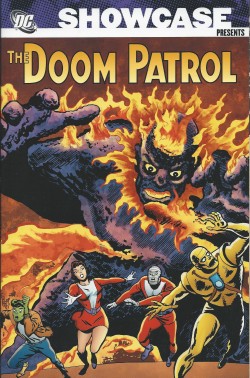
Showcase Presents Doom Patrol volume 2


By Arnold Drake, Bruno Premiani, Bob Brown & various (DC Comics)
ISBN: 978-1-85768-077-8 (TPB)

In 1963 DC/National Comics converted a venerable anthology-mystery title – My Greatest Adventure into a fringe superhero team-book with #80, introducing a startling squad of champions with their thematic roots still firmly planted in the B-movie monster films of the era which had for so long informed the tone and timbre of the parent title.

That aesthetic subtly shaped the progression of the strip – which took control of the title within months, prompting a title change to The Doom Patrol with #86 – and throughout a 6-year run made the series one of the most eerily innovative and incessantly hip reads of that generation. Happy 60th Anniversary, you “Fabulous Freaks”!

No traditional team of masked adventurers, the cast comprised a robot, a mummy and a 50-foot woman in a mini-skirt, united with and guided by a brusque, domineering, crippled mad scientist, all equally determined to prove themselves by fighting injustice their way…

Two relatively recent compilations are still awaiting a third and final edition to complete the reprint run, and this monochrome tome from 2010 might have to do for some time yet.

Should you be afflicted with the curse of a completist nature, Doom Patrol: The Silver Age volume 1 spans June 1963 to May 1965, re-presenting in full colour My Greatest Adventure #80-85 and Doom Patrol #86-95, whilst Doom Patrol: The Silver Age volume 2 covers June 1965-November 1966 via Doom Patrol #96-107, The Brave and the Bold #65 and Challengers of the Unknown #48. They’re both available digitally, but should you want a comprehensive read-through, that’s going to take a little more effort than we spoiled 21st Centurians are used to…

Spanning March 1966 to their radically bold demise in the September/October 1968 final issue, this quirky monochrome compilation collects their last exploits as seen in Doom Patrol #102 to 121: a landmark run that truly deserves better dissemination…

These creepy Costumed Dramas were especially enhanced by the superb skills of Italian artist Giordano Bruno Premiani, whose comfortably detailed, subtly representational illustration style made even the strangest situation frighteningly authentic and grimly believable.

As such, he was the perfect vehicle to squeeze every nuance of comedy and pathos from the captivatingly involved and grimly light-hearted scripts by Arnold Drake who always proffered a tantalising believably world for the outcast heroes to strive in.

Those damaged champions comprised competitive car racer Cliff Steele, but only after he’d had “died” in a horrific crash, with his undamaged brain transplanted into a fantastic mechanical body – without his knowledge or permission…

Test pilot Larry Trainor was trapped in an experimental stratospheric plane and become permanently radioactive, with the dubious benefit of gaining a semi-sentient energy avatar which could escape his body to perform incredible stunts …for up to a minute at a time. To pass safely amongst men, Trainor had to be perpetually wrapped in radiation-proof bandages.

Former movie star Rita Farr was exposed to mysterious gases on location. These gave her the unpredictable, initially uncontrolled ability to shrink or grow – in part or wholly – to incredible sizes.

The outcasts were brought together by brilliant, enigmatic Renaissance Man Niles Caulder who, as The Chief, sought to mould the solitary misfits into a force for good. The wheelchair-bound savant directed the trio of solitary strangers in many terrifying missions as they slowly grew into a uniquely bonded family…

Here – now firmly established in the heroic pantheon – The Doom Patrol join fellow outsiders The Challengers of the Unknown in #102’s ‘8 Against Eternity!’: battling murderous shape-shifter Multi-Man and his robotic allies as they seek to unleash a horde of zombies from a lost world upon modern humanity

Meanwhile, super-rich Steve Dayton – who had created a psycho-kinetic superhero persona Mento solely to woo and wed Rita, met outrageous, obnoxious Gar Logan. It was disgust at first sight, but neither the ruthless, driven billionaire authority figure nor wildly rebellious Beast Boy realised how their lives would soon entwine…

Whilst a toddler in Africa, Logan had contracted a rare disease. Although his scientist parents’ experimental cure beat the contagion before they died, it left him the colour of cabbage and able to change shape at will. A protracted storyline commenced in #100 wherein the secretive, chameleonic kid revealed how he was now an abused orphan being swindled out of his inheritance by his unscrupulous guardian Nicholas Galtry. The greedy, conniving accountant had even leased his emerald-hued charge to rogue scientists…

Rita especially had empathised with Gar’s plight and resolved to free him from Galtry whatever the cost…

DP #103 held two tales, beginning with a tragedy ensuing after Professor Randolph Ormsby sought the team’s aid for a space shot. When the doddery savant mutates into flaming monster ‘The Meteor Man’ it takes the entire patrol plus Beast Boy and Mento to save the day.

‘No Home for a Robot’, continues unpacking the Mechanical Man’s early days following Caulder’s implantation of Cliff’s brain into an artificial body. The shock had seemingly driven the patient crazy as Steele went on a city-wide rampage, hunted and hounded by the police. Here, the ferrous fugitive finds brief respite with his brother Randy, before realising that trouble would trail him anywhere…

DP #104 astounded everyone as Rita abruptly stopped refusing loathsome Steve to become ‘The Bride of the Doom Patrol!’ However, her star-stuffed wedding day is almost ruined when alien arch-foe Garguax and The Brotherhood of Evil crash the party to murder the groom. So unhappy are Cliff and Larry with Rita’s “betrayal” that they almost let them…

Even whilst indulging her new bride status in #105, Rita can’t abandon the team and joins them in tackling old elemental enemy Mr. 103 during a ‘Honeymoon of Terror!’ before back-up yarn ‘The Robot-Maker Must Die’ concludes Cliff Steele’s origin as the renegade attempts to kill the mystery surgeon who had imprisoned him in a metal hell… finally giving Caulder a chance to fix a long-term malfunction in Steele’s systems…

‘Blood Brothers!’ in #106 introduces domestic disharmony as Rita steadfastly refuses to be a good trophy wife: resuming the hunt for Mr. 103 with the rest of the DP. Her separate lives continue to intersect, however, when Galtry hires that elemental assassin to wipe Gar and his freakish allies off the books…

The back-up section shifts focus onto ‘The Private World of Negative Man’: recapitulating Larry Trainor’s doomed flight and the radioactive close encounter that turned him into a walking mummy. However, even after being allowed to walk amongst men again, the gregarious pilot finds himself utterly isolated and alone…

Doom Patrol #107 began an epic story-arc concerning ‘The War over Beast Boy!’ as Rita and Steve open legal proceedings to get Gar and his money away from Galtry. The embezzler responds by commencing a criminal campaign to beggar Dayton which inadvertently aligns him with the team’s greatest foes. Already distracted by the depredations of marauding automaton Ultimax, the hard-pressed heroes swiftly fall to the murderous mechanoid as Rita is banished to a barbaric sub-atomic universe…

The secret history of Negative Man resumes with ‘The Race Against Dr. Death!’ when fellow self-imposed outcast Dr. Drew draws the pilot into a scheme to destroy the human species which had cruelly excluded them both, before Larry’s ebony energy being demonstrates the incredible power it possesses by saving the world from fiery doom.

In #108, ‘Kid Disaster!’ sees Mento diminished and despatched to rescue Rita whilst Galtry’s allies reveal their true nature before ambushing and killing the entire team…

…Almost.

Despite only Caulder and Beast Boy remaining, our exceedingly odd couple nevertheless pull off a major medical miracle: reviving the heroes in time to endure the incredible attack of alien colossus ‘Mandred the Executioner!’ whilst Larry’s ‘Flight into Fear’ at the comic’s rear proves that Drew hasn’t finished with the itinerant Negative Man yet…

DP #110 wonderfully wraps up the Beast Boy saga as Galtry, Mandred and the Brotherhood marshal one last futile attack before the ‘Trial by Terror!’ finally finds Logan legally adopted by newlyweds Mr. and Mrs. Dayton. Sadly, it’s a prelude to a titanic extraterrestrial invasion in #111, which heralds the arrival of ‘Zarox-13, Emperor of the Cosmos!’

The awesome overlord and his vanguard Garguax make short work of the Fabulous Freaks and, with all Earth imperilled, an unbelievable alliance forms, but not before ‘Neg Man’s Last Road!’ ends Trainor’s tale as the alienated aviator again battles Dr. Death, before joining a band of fellow outcasts in a bold new team venture…

Unbelievably, the uneasy alliance of the DP with The Brain, Monsieur Mallah and Madame Rouge as ‘Brothers in Blood!’ in #112 results in no betrayals and the last-minute defeat of the invincible aliens.

Moreover, although no rivalries were reconciled, a hint of romance does develop between two of the sworn foes, whilst at the back, untold tales of Beast Boy begin as ‘Waif of the Wilderness’ introduces millionaire doctors Mark and Marie Logan whose passion for charity took them to deepest Africa and into the sights of native witch-man Mobu who saw his powerbase crumbling…

When their toddler Gar contracts dread disease Sakutia, the parents’ radical treatment saves their child and grants him metamorphic abilities, but as they subsequently lose their lives in a river accident, the baby boy cannot understand their plight and blithely watches them die.

Orphaned and lonely, he inadvertently saves the life of a local chief with his animal antics and is adopted, …making of Mobu an implacable, impatient enemy…

Doom Patrol #113 pits the team against a malevolent mechanoid one-man army in ‘Who Dares to Challenge the Arsenal?’ but the real drama manifests in a subplot showing Caulder seeking to seduce schizophrenic Rouge away from the lure of wickedness and malign influence of the Brotherhood of Evil.

The issue includes another Beast Boy short as ‘The Diamonds of Destiny!’ finds two thieves kidnapping the amazing boy, just as concerned executor Nicholas Galtry takes ship for the Dark Continent to find the heir to his deceased employer’s millions…

DP #114 opens with the team aiding Soviet asylum seeker Anton Koravyk and becoming embroiled in a time-twisting fight against incredible caveman ‘Kor – the Conqueror!’ whilst Beast Boy segment ‘The Kid who was King of Crooks!’ sees toddler Gar turned into a thief in Johannesburg… until his Fagin-ish abductors have a fatal falling out…

The next issue debuts ‘The Mutant Master!’: pitting the team against three hideous, incomprehensibly powerful atomic atrocities resolved to eradicate the world which had cruelly treated them. Things might have fared better had not the Chief neglected his comrades in his obsessive – and at last successful – pursuit of Madame Rouge…

Also included is ‘General Beast Boy – of the Ape Brigade!’, wherein a Nazi war criminal is accidentally foiled by lost wanderer Gar. The madman’s loss is Galtry’s gain, however, as his search ends with the crook “rescuing” Logan and taking him back to safe, secure America…

The mutant maelstrom concludes in #116 as ‘Two to Get Ready… and Three to Die!’ features Caulder saving Earth from mutant-triggered obliteration to reap his reward in a passionate fling with the cured – but still fragile – Rouge.

The wheelchair wonder seizes centre stage in #117 as his neglect drives the team away, leaving him vulnerable to attack from a mystery man with a big grudge in ‘The Black Vulture!’, before a reunited squad deals with grotesque madman ‘Videx, Monarch of Light!’ even as the Brain challenges Caulder to return his stolen chattel Rouge. Nobody thought to ask her what she wanted, though, and that’s a fatal oversight…

Tastes were changing in the turbulent late 1960s and the series was in trouble. Superheroes were about to plunge into mass decline, and the creators addressed the problem head-on in #119: embracing psychedelic counter culture in a clever tale of supernal power, brainwashing and behaviour modification leaving the DP cowering ‘In the Shadow of the Great Guru!

An issue later they faced a furious Luddite’s ‘Rage of the Wrecker!’ when a crazed scientist declares war on technology – including the assorted bodies keeping Cliff alive…

The then-unthinkable occurred next and the series spectacularly, abruptly ended with what we all believed at the time to be ‘The Death of the Doom Patrol!’

Faced with cancellation, Editor Murray Boltinoff and creators Drake & Premiani wrapped up all the long-running plot threads as spurned Madame Rouge goes off the deep end and declares war on both the Brain and Caulder’s “children”…

Blowing up the Brotherhood, she attacks the city until the DP remove themselves to an isolated island fortress. Even there they are not safe and her forces ambush them…

Captured and facing death, Rouge offers mercy if they abandon their principles and allow her to destroy a village of 14 complete strangers in their stead…

At a time when comics came and went with no fanfare and cancelled titles seldom provided any closure, the sacrifice and death of the Doom Patrol was a shocking event for us youngsters. We wouldn’t see anything like it again for decades – and never again with such style and impact…

With the edge of time and experience on my side, it’s obvious just how incredibly mature Drake & Premiani’s take on superheroes was, and these superbly engaging, frenetically fun and breathtakingly beautiful stories rightfully rank amongst the very best Fights ‘n’ Tights tales ever told.

Even the mercilessly exploitative many returns of the team since can’t diminish that incredible impact, and no fan of the genre or comic dramas in general should consider their superhero education complete until they’ve seen these classics. Let’s hope DC wise up quickly and release that final volume soon…
© 1966, 1967, 1968, 2010 DC Comics, Inc. All Rights Reserved.

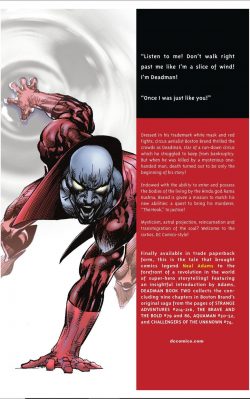
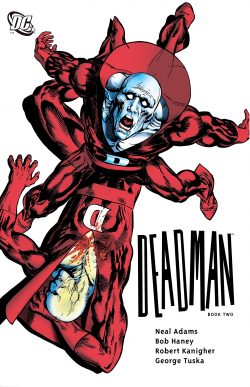
Deadman: Book Two


By Arnold Drake, Jack Miller, Bob Haney, Dennis O’Neil, Carmine Infantino, Neal Adams, George Tuska, George Roussos & various (DC Comics)
ISBN: 978-1-4012-3388-4 (TPB/Digital edition)

As the 1960s ended, a massive superhero boom became a slow but certain bust, with formerly major successes no longer able to find enough readers to keep them alive. The appetite for superheroes was paling in favour of resurgent traditional genres. One rational editorial response was to reshape costumed characters to fit evolving contemporary tastes.

Publishers swiftly changed gears with even staid, cautious DC reacting rapidly: making over masked adventurers to fit a new landscape. Newly revised, revived features included roving mystic troubleshooter The Phantom Stranger and Golden Age colossus The Spectre, whilst established genres spawned atrocity-faced WWII spy Unknown Soldier and bounty hunter Jonah Hex, western avenger El Diablo and game-changing monster hero Swamp Thing, the vanguard of a torrent of new formats, anthologies and concepts.

Moreover, supernatural themes were shoehorned into superhero titles weathering the trend-storm. Arguably, the moment of surrender and change had arrived with the creation of Boston Brand in the autumn of “The Summer of Love”, when venerable science fiction anthology Strange Adventures was abruptly retooled as the haunted home of an angry ghost…

Without fanfare or warning, Deadman debuted in #205 (cover-dated October 1967), with this second collection (of five) proving that changing times and tastes demanded different defenders. This was one champion who was infinitely adaptable…

The previous volume revealed how the ghostly grouch was born by assassination and how his picaresque journey was primary steered by youthful, idealistic iconoclast Neal Adams. He was born on June 15th 1941 at Governors Island, New York City. The family were career military and Neal grew up on bases across the world. In the late 1950s, he studied at the High School of Industrial Art in Manhattan, graduating in 1959.

As the turbulent, Sixties began, he was a budding illustrator working in advertising, ghosting newspaper strips and seeking to break into comics. Whilst pursuing a career in “real” and “commercial” art, he did pages for Joe Simon at Archie Comics (The Fly and that red-headed kid, too) before becoming one of the youngest artists to co-create/illustrate a major licensed newspaper strip (Ben Casey – based on a popular TV medical drama). The neophyte’s attempts to break in at DC were not so successful…

Comic book fascination never faded, and as the decade progressed, Adams drifted back to National/DC: creating covers as inker or penciller. His chance came via anthological war comics:,he eventually found himself at the vanguard of a revolution in pictorial storytelling…

He made such a mark that decades later, DC celebrated his contributions by reprinting every piece of work Adams ever did for them in commemorative collections. Sadly, we’re still awaiting a definitive book of his horror comics and covers, and will probably never see his sterling efforts on licensed titles like Hot Wheels, The Adventures of Bob Hope and The Adventures of Jerry Lewis. That’s a real shame: they all display his wry facility for gag staging and personal drama…

Moreover, Adams was a tireless campaigner for creators’ rights, whose efforts finally secured some long-ignored liberties and rewards for the formerly invisible stars of comic books…

Preceded by Adams’ introduction ‘Why I Chose Deadman as My Project on my Summer Vacation’ – detailing the transition from Carmine Infantino to Adams on the series and its abrupt cancellation – the afterlife of a reluctant and selfish spectral stalwart resumes with Brave & Bold #79 (August/September 1968): heralding Adams’ assumption of interior art duties on that title and launching a groundbreaking run rewriting the rulebook for strip illustration.

Written by Bob Haney, ‘The Track of the Hook’ paired the Gotham Guardian with a justice-obsessed ghost. Former trapeze artist Brand was hunting his own killer, and his earthy human tragedy elevated Batman’s costume theatrics into deeper, more mature realms of drama and action. It was probably mainstream superhero fandom’s first glimpse of the ghost…

During this period, Adams was writing and illustrating Brand’s solo stories in Strange Adventures and although his consultation of the World’s Greatest Detective bore little useful progress it had provided the lonely ghost with a true point of human contact…

As a living “Deadman”, Brand had been star attraction of Hills Circus: lover of its reluctant owner Lorna Carling, and a secret guardian for the misfits it employed. That makeshift “family” included simple-minded strongman Tiny and Asian mystic Vashnu, but also had a few bad eggs too…

One fateful night, as soon as he started his act – 40 feet up and without a net – someone put a rifle slug into Brand’s heart…

Despite being dead before he hit the ground, Brand was scared and furious. Nobody could see or hear him screaming, and Vashnu babbled on that he was the chosen of Rama Kushna – the spirit of the universe. The unbelievable hokum proved horribly true as the entity contacted him, telling Brand he would walk among men until he found his killer…

The sentence came with some advantages: he was invisible, untouchable, immune to the laws of physics and able to possess living bodies and drive them like a car. His only clue was that witnesses claimed that a man with a hook had shot him…

Outraged, still disbelieving and seemingly stuck forever in the ghastly make-up and outfit of his performing persona, Boston began a random investigation of everyone he could think of who might want him gone. Gradually, small petty miscreants and human-scaled sins gave way to a fantastic global conspiracy…

Early stories focused on people worn by Brand in episodic encounters mimicking the protagonist of contemporary TV series The Fugitive – and by extension, Victor Hugo’s Les Misérables. That search for personal justice took him all across America to the benefit of many people in crisis but, as pieces fitted together, Brand learned he had been singled out for a dark destiny…

Back in Strange Adventures # 214 (cover-dated September/October 1968). Robert Kanigher scripted To Haunt a Killer’ as Brand is seduced by loneliness into sharing the romantic experiences of Phil and his lovely girlfriend Ruth. That salacious intrusion sours once Brand discovers his new meat suit is a hitman and his overreaction almost cost innocent Ruth everything…

When Adams returns to full control in #215, the narrative arc takes a huge leap forward as ‘A New Lease on Death’ accidentally drops his killer in his lap. Witnessing a murder, Deadman trails the shooter all the way to Hong Kong where he exposes an ancient, super-advanced League of Assassins and discovers the truly trivial reason for his own extinction…

Furiously questioning ‘Can Vengeance Be So Hollow?’, Brand meets for the first time killer mystic The Sensei – a master murderer who has dealt with ghosts before and experiences the end of the Hook…

When the sinister sage executes Boston’s death-long quarry, Rama Kushna asks if a balance has been struck before capitalising on Brand’s furious negative response. Boston demands true justice for everyone and inadvertently elects himself the agent of its enactment in ‘But I Still Exist’

The drama opens Strange Adventures #216 (January/February 1969), as the grim ghost seeks to disrupt the Sensei’s next scheme: the violent erasure of a fanciful Tibetan Shangri La. Nanda Parbat is a sanctuary for the wicked where his murderous recruits and other fallen folk live in inexplicable peace, harmony and safety. Such a paradise is bad for the business of murder…

Deadman’s efforts to save the city from invasion initially falter when he flies in and suddenly becomes a living, breathing person again…

And that’s where the story ended as his Strange Adventures run ended without warning. The next issue began reprints of Adam Strange and The Atomic Knights as the title reverted to is sci fi roots…

Although his own series had stalled, Deadman stuck around as a perennial walk-on (float-on?) star in many titles, beginning with a return engagement with Batman as the year ended. The Brave & the Bold #86 (October/November 1969) found Boston Brand back in Gotham City, where a string of civilian strangers inexplicably targeted the Caped Crimebuster. The “World’s Greatest Detective” soon deduced that they were possessed by his former ally and that You Can’t Hide from a Deadman!’

Scripted by Haney, the captivating epic of death, redemption and resurrection pulled together all the floating strands from Deadman’s anticlimactic last issue in a classic clash that became a cornerstone of Bat-mythology forever after. Here, Adams’ concepts and art revealed how Nanda Parbat was under attack by the Sensei’s forces, and how Brand had been briefly brainwashed to attack the Gotham Guardian, in advance of a last-ditch defence of the holy city by the Dark Knight and Deadman’s possessed twin brother Cleveland Brand

Deadman rematerialized mere months later in a triptych of back-up tales interwoven into a larger but no-less-revolutionary Aquaman storyline (for the full story see Aquaman: Deadly Waters link please) wherein the Sea King is despatched to a Microverse by aliens working with super villain Ocean Master: a plot accidentally uncovered by Brand, when guilt drags him from a life of solid recuperation back to the intangible quest for cosmic justice…

Here, from Aquaman #50-52 (spanning March/April – July/August 1970), ‘Deadman Rides Again!’ in supplemental tales written and illustrated by Adams: a complex braided crossover as Aquaman endures bizarre threats and incomprehensible rituals in his exile realm, whilst Brand acts invisibly and intangibly to save the hero and prevent an alien invasion.

‘The World Cannot Wait for a Deadman’ sees the spirit flitting between dimensions with shapeshifting enigma Tatsinda, before parallel plots converge and complete when ‘Never Underestimate a Deadman’ sees the extraterrestrials beaten by the ghost and his new pal…

Deadman’s harrowing haunting dramas pause – for now – with another non-team-up from Challengers of the Unknown #74 (cover-dated June/July 1970). A far eerier affair tailored to the rise in supernatural terror tales, ‘To Call a Deadman’ is written by Dennis O’Neil, with George Tuska limning scenes featuring the still-breathing “Death-Cheaters”, whilst Adams illustrated those portions focussed on Brand as he imperceptibly aids them in thwarting an ethereal psychic kidnapper seeking to steal a little girl’s spirit. The chilling thriller also guest-stars hardboiled private eye Jonny Double and everyone is needed to defeat the ghastly menace…

With groundbreaking covers by Adams and Biographies of key ‘Contributors’ Adams, Haney, Kanigher, O’Neil and Tuska, this graphic grimoire perfectly captures the tone of an era in transition through a delirious run of comics masterpieces that no ardent art lover or fanatical fear aficionado can do without.
© 1968, 1969, 1970, 2012 DC Comics. All Rights Reserved.
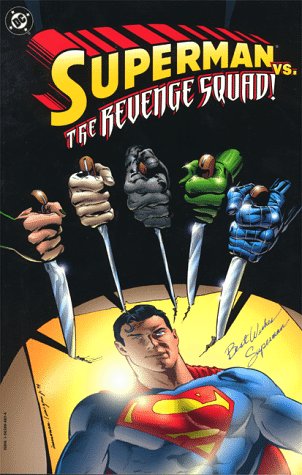
The Question: Pipeline


By Greg Rucka, Cully Hamner, Laura Martin, Dave McCaig & various (DC Comics)
ISBN: 978-1-4012-3041-8 (TPB)

As created by Steve Ditko, The Question was Vic Sage: a driven, obsessed journalist who sought out crime and corruption irrespective of the consequences. The Charlton Comics “Action-Hero” line was acquired by DC – along with a host of other cool and quirky outsiders – when the B-List company folded in 1983, and the ultimate loner became the template for the compulsive vigilante Rorschach when Alan Moore & Dave Gibbons first drafted the miniseries which would become Watchmen.

An ordinary man pushed to the edge by his upbringing and obsessions, Sage used his fists and a mask that made him look faceless to get answers (and, consequently, justice) whenever normal journalistic methods failed.

After a few minor successes around the DC universe Sage got a job in the town where he grew up. Hub City (purportedly based on East St. Louis) was a true urban hell-hole: the most corrupt and morally bankrupt municipality in America. When Sage started cleaning house as his faceless alter ego, he was promptly killed, rescued and resurrected by the inscrutable Shiva – “World’s Deadliest Assassin”.

Crippled, Sage journeyed into the wilderness to be healed and trained by Denny O’Neil’s other legendary martial arts creation, Richard Dragon.

Eventually, a new kind of hero resurfaced in Hub City, philosophically inquisitive rather than merely angry and frustrated, but still cursed with a drive to understand how and why things universally go bad. Aligning himself with his old intellectual mentor and ethical sounding board Professor Aristotle Rodor, Sage set about cleaning up “The Hub” and finally getting a few answers…

Spinning out of DC’s 52 (2006-2007) and Countdown to Final Crisis (2007-2008) mega-events, disgraced Gotham City cop Renee Montoya was selected and trained to take up the faceless mask and obsessions of the shadowy hero when Sage slowly succumbed to cancer.

First as his disciple and then as his heir (and after being masterfully schooled in martial arts by Dragon) she took up Sage’s quest. Montoya was soon drawn into a secret war with the passionate adherents of a malign “gospel of All Things Evil” alternatively known as the Books of Blood or the Crime Bible.

This legendary antithetical tract was said to counter all that is good in the world: justifying and codifying all that is wrong. Driven by a need to understand the evils she fights and stop the spread of this monstrous belief, the new Question hunted down the remaining copies of the book and the distinct factions which protected them and promoted the terrible teachings.

Her path eventually pitted her against the secret master of the “Dark Faith”: immortal Vandal Savage, who was believed by many to be the human species’ first murderer…

Collecting a stunning back-up series originally from Detective Comics #854-865 (August 2009 to July 2010), this globe-girdling saga of corruption and depravity is by writer Greg Rucka, illustrator Cully Hamner and colourists Laura Martin & Dave McCaig opens in the aftermath of that apocalyptic confrontation.

Montoya and inherited ally “Tot” Rodor are ensconced in their desolate lighthouse on the Outer Banks of North Carolina, looking for a new case: sorting through emails from a “help-offered” website they’d set up…

Eventually, a particular message catches Renee’s eye. Hector Soliz is an illegal immigrant who has searched for his sister ever since she went missing. He foolishly trusted the “coyote” who originally smuggled him into America to do the same for Louisa, but never took into account that, for men like Varga, pretty young girls have a value far beyond simple cargo to be smuggled across a closed border…

Taking the case, Renee is soon breaking into the flesh peddler’s home and dealing harshly with Varga’s brutal thugs. There she finds a bed with chains and a camera set-up…

After undergoing some especially intense enquiries, the coyote gives up the name of the man he eventually sold Louisa to: millionaire shipping exporter Gordon Chandless.

Gettng into the businessman’s palatial HQ isn’t much harder, but overconfidence costs The Question dearly when she is surprised and overpowered by hulking bodyguard Mr. Bolt and his handy tasers…

Unable to pry any answers from his faceless captive, Chandless opts for her quiet removal, and by the time The Question escapes a watery death-trap and returns in a very bad mood, the wily trafficker is already gone…

Painfully aware that she’s tracking an evil enterprise of vast proportions, Renee uses Tot’s data-mining skills to track the mogul of misery to a luxury Hollywood lair: going in blazing, and utterly disdainful of his army of heavies. They might be unable to stop the implacable Question, but two of them are capable enough to kill their own boss at the clandestine command of his master…

Despite being back at square one in regard to the criminal hierarchy, Renee now has a location on a certain container vessel ready to ship out with a new cargo of slaves. Righteous indignation, cold fury and lucky intervention by the FBI soon sees all the victims safe and free – including little Louisa Soliz…

‘Pipeline: Chapter Two’ moves the story on as The Question continues her crusade to destroy the trafficking empire: slowly and violently working her way up a chain of scum and crushing individual enterprises whilst inexorably zeroing in on the major player behind the network of sin and misery…

Such costly interventions prompt the mystery leader to fight back hard, and during her raid on a top-of-the-range hot car franchise, bad guys retaliate with a devious and deadly ambush of their own. That’s when Montoya’s secret weapon makes her presence known and the crooks all end up maimed or worse at the hand of the relentless unforgiving Huntress

Helena Bertinelli was mob royalty but, following the type of massacre considered an occupational hazard for “The Family”, she disappeared. The only survivor of a major hit, she trained: becoming a masked avenger mercilessly punishing all gangsters, whilst defending ordinary folk. She especially despises those who prey on children…

Huntress and The Question continue busting rackets across the world, methodically dismantling the network whilst climbing the ladder to the big boss. They finally provoke an overwhelming response in the form of super-assassin Zeiss.

It’s all part of a deeper plan conceived by the vengeful vigilantes, who promptly co-opt the mercenary killer to give up his unassailable paymaster. However, their tactics revolt Tot and the elderly scholar resigns.

Undeterred, but now deprived of crucial technical support, the determined duo head for Gotham City where Helena introduces The Question to the top-secret leader of the all-female super-team known as the Birds of Prey. Former GCPD detective Montoya cannot believe that Commissioner Gordon’s mousey dweeb daughter Barbara was once Batgirl and is now covert anti-crime mastermind Oracle…

Her irresistible cyber-probing soon has the duo invading an underworld server-farm in Odessa which – after a studied application of maximum force – provides a money trail to the Pipeline overlord. Sadly, when they sneak onto Oolong Island, they walk straight into a trap…

The rogue state is the ultimate expression of Capitalism. Populated by criminals and mad scientists of many nations, it maintains its precarious independence by selling proscribed technologies to anyone with money, proudly free from the annoying oversight of law or hindrance of morality…

President-for-Life Veronica Cale starts by torturing her captive heroes, but after debating with The Question, soon sees that the most profit doesn’t necessarily stem from staying bought…

Soon, Montoya and Bertinelli are on the final stretch: sneaking into Syria and invading the stronghold of the man who has turned humans into commodities and exported sin and horror on a global scale. Unfortunately, the wickedest man alive is ready and waiting for them…

The cataclysmic ultimate confrontation is as much theosophical debate as brutal beat-down, and in the final reckoning the allies must become enemies for the best possible reasons before finding anything approaching an acceptable answer to their dilemmas…

Moody, fast-paced, challenging and astoundingly action-packed, this stylish book also offers a hugely engaging ‘Sketchbook’ section from Cully Hamner, offering developmental glimpses into his evolution of the characters; a fascinating 8 pages of layouts and roughs and amazing set designs for story-locations which will delight and amaze all lovers of comic art.

Compelling and breathtaking, Pipeline exposes the dark underbelly of mainstream Fights ‘n’ Tights comics, proving that you don’t need graphic excess to tell hard-hitting tales.

© 2009, 2010, 2011 DC Comics. All Rights Reserved.
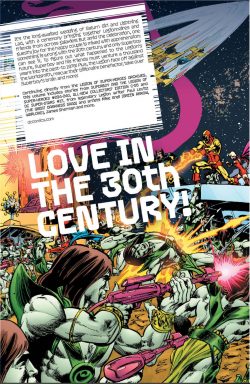
Batman & Superman in World’s Finest Comics: The Silver Age volume 1


By Edmond Hamilton, Bill Finger, Alvin Schwartz, Curt Swan, Dick Sprang, Stan Kaye, John Fischetti, Charles Paris, Ray Burnley & various (DC Comics)
ISBN: 978-1-4012-6833-6 (TPB/Digital edition)

Some things were just meant to be: Bacon & Eggs, Rhubarb & Custard, Chalk & Cheese…

For many years Superman and Batman worked together as the “World’s Finest team”. They were friends as well as colleagues and the pairing made sound financial sense since DC’s top heroes (in effect, the company’s only costumed superstars) could cross-pollinate and, more importantly, cross-sell their combined readerships.

This most inevitable of Paladin Pairings first occurred on the Superman radio show in the early 1940s, whereas in comics the pair had only briefly met whilst on a Justice Society of America adventure in All-Star Comics #36 (August-September 1947) – and perhaps even there, they missed each other in the gaudy hubbub…

Of course, they had shared the covers of World’s Finest Comics from the outset, despite never crossing paths inside: sticking firmly to their specified solo adventures within. For us pictorial continuity buffs, the climactic real first time was in the pages of Superman’s own bi-monthly comic (#76, May/June 1952).

That yarn kicks off this stunning compendium of Silver Age solid gold, accompanied here by the lead story from World’s Finest Comics #71 through 94; spanning July/August 1954 to May/June 1958.

Science fiction author Edmond Hamilton was tasked with revealing how Man of Steel and Caped Crusader first met – and accidentally uncovered each other’s identities – whilst sharing a cabin on an over-booked cruise liner. Although an average crime-stopper yarn, it was the start of a phenomenon. The art for ‘The Mightiest Team in the World’ was by the brilliant Curt Swan and inkers John Fischetti & Stan Kaye.

With dwindling page counts, rising costs but a proven readership and years of co-starring but never mingling, World’s Finest Comics #71 presented the Man of Tomorrow and Gotham Gangbuster in the first of their official shared cases wherein the Caped Crusader became ‘Batman – Double for Superman!’ (by Alvin Schwartz, with Swan & Kaye providing pictures) as the merely mortal hero trades identities to preserve his comrade’s alter ego and – latterly – his life…

‘Fort Crime!’ (Schwartz, Swan & Kaye) has them unite to crush a highly-organised mob with a seemingly impregnable hideout, after which Hamilton returned for ‘Superman and Batman, Swamis Inc.’, a sharp sting-operation that almost goes tragically awry. Next, an alien invader prompts insane rivalry resulting in ‘The Contest of Heroes’ (Bill Finger, Swan & Kaye, in WFC #74.

The same creative team produced ‘Superman and Robin!’ wherein a disabled Batman can only fret and fume as his erstwhile assistant seemingly dumps him for a better man, whilst ‘When Gotham City Challenged Metropolis’ (by Hamilton, Swan & Charles Paris) catches the champions at odds as their hometowns over-aggressively vie for a multi-million-dollar electronics convention.

A landmark tale by Hamilton, Swan & Kaye invented a new sub-genre when a mad scientist’s accident temporarily removes the Caped Kryptonian’s powers and creates ‘The Super Bat-Man!’ in #77. The theme would be revisited for decades to come…

Arguably Batman’s greatest illustrator joined the creative crew ‘When Superman’s Identity is Exposed!’ (by Hamilton, Dick Sprang & Kaye) as a mysterious source keeps revealing the Man of Steel’s greatest secret, only to be exposed as a well-intentioned disinformation stunt. The tone switches to high adventure as the trio become ‘The Three Musicians of Bagdad’ – a stunning time-travel romp from Hamilton, Sprang & Kaye – after which the Gotham Gazette faces closure days before a spectacular crime-expose, and Clark Kent and Lois Lane join dilettante Bruce Wayne as pinch-hitting reporters on ‘The Super-Newspaper of Gotham City’ (Hamilton, Sprang & Charles Paris). Then, ‘The True History of Superman and Batman’ (Hamilton, Sprang & Kaye, #81) finds a future historian blackmailing the heroes into restaging their greatest exploits so his erroneous treatise on them will be accurate…

Hamilton also produced a magnificent and classy costumed drama when ‘The Three Super-Musketeers!’ visit 17th century France to solve the mystery of the Man in the Iron Mask, whilst Finger wrote a brilliant and delightful caper-without-a-crime in ‘The Case of the Mother Goose Mystery!’ after which Hamilton provides insight on a much earlier meeting of the World’s Finest Team with ‘The Super-Mystery of Metropolis!’ in #84, all for Sprang & Kaye to enticingly illustrate.

Hamilton, Swan, Sprang & Kaye demonstrate how a comely Ruritanian Princess inadvertently turns the level-headed heroes into ‘The Super-Rivals (or does she?), before monolithic charity-event ‘The Super-Show of Gotham City’ (Hamilton, Sprang & Kaye) nearly turns into a mammoth pay-day for unscrupulous con-men.

‘The Reversed Heroes’ (Finger, Sprang & Ray Burnley) once again catches the costumed champions swapping roles after Batman and Robin gain powers thanks to Kryptonian pep-pills found by criminal Elton Craig, ironically just as Superman’s powers fade…

As conceived by Hamilton, Sprang, Kaye, World’s Finest #87 revealed ‘Superman and Batman’s Greatest Foes!’ with “reformed” villains Lex Luthor and The Joker ostensibly setting up in the commercial robot business – which nobody really believed – after which seminal sequel ‘The Club of Heroes’ (Hamilton, Sprang & Kaye) reprised a meeting of Batmen from many nations, but added an intriguing sub-plot of an amnesiac Superman and a brand-new costumed champion…

That originating tale appeared in Detective Comics #215, January 1955 becoming a key plank of Grant Morrison’s epic Batman: The Black Glove serial: you should read that one too…

That evergreen power-swap plot was revived in #90’s ‘The Super-Batwoman’ (Hamilton, Sprang & Kaye) when the “headstrong heroine” defies Batman to resume her costumed career and is quickly compelled to swallow Elton Craig’s last Krypton pill to prevent criminals getting it…

A stirring time-busting saga of ‘The Three Super-Sleepers’ (Hamilton, Sprang & Kaye) sees our heroes fall into a trap causing them to slumber for 1000 years and awaken in a fantastic world they can never escape, but of course they can and – once back where they belonged – ‘The Boy from Outer Space!’ (Hamilton, Sprang & Kaye) details how a super-powered amnesiac kid crashes to Earth and briefly becomes Superman’s sidekick Skyboy, even as ‘The Boss of Superman and Batman’ (author unknown, but impeccably illustrated as always by Sprang & Kaye) sees a brain-amplifying machine turn Robin into a super-genius more than qualified to lead the trio in their battle against insidious rogue scientist Victor Danning

Wrapping up this initial compendium with comfortable circularity, the Man of Tomorrow replaces the Caped Crusader with a new partner and provokes a review of ‘The Origin of the Superman-Batman Team’ courtesy of Hamilton, Sprang & Kaye, suspending these supremely enticing Fights ‘n’ Tights triumphs on an epic high.

These are gloriously clever yet uncomplicated tales whose dazzling style has returned to inform if not dictate the form for much of DC’s modern television animation – especially the fabulous Batman: The Brave and the Bold series – and the contents of this titanic tome are a veritable feast of witty, charming thrillers packing as much punch and wonder now as they always have.
© 1952, 1954, 1955, 1956, 1957, 1958, 2017 DC Comics. All Rights Reserved.