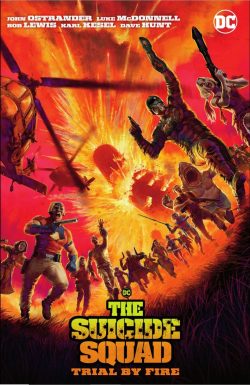
Suicide Squad volume 1: Trial by Fire (New Edition)


By John Ostrander, Luke McDonnell, Bob Lewis, Karl Kesel, Dave Hunt & various (DC Comics)
ISBN: 978-1-4012-5831-3 (TPB)

Following the huge success of Crisis on Infinite Earths, fickle fan-interest was concentrated on DC, and many of their major properties – and indeed the entire continuity – were opened up for radical change, innovation and renewal.

So, how best to follow the previous year’s cosmic catastrophe? Why not a much smaller and more personal Great Disaster, spotlighting those strangers in familiar costumes and a bunch of beginnings rather than the deaths and endings of the Crisis?

Thus, Darkseid of Apokolips attacked humanity’s spirit by destroying the very concept of heroism and individuality in Legends and sent hyper-charismatic Glorious Godfrey to America to lead a common man’s crusade against extraordinary heroes, while he initiated individual assaults to demoralize and destroy key champions of Earth.

The rampant civil unrest prompted President Ronald Reagan to outlaw costumed crime-busters and opened the door for a governmental black-bag operation to use super-powered operatives who had no option but to obey the orders of their betters…

That was the beguiling concept behind the creation – or more accurately consolidation and reactivation – of separate but associated concepts dating back to the 1960s and the first revival of superhero comics.

John Ostrander was new to DC; lured with editor Mike Gold from Chicago’s First Comics where their work on Starslayer, Munden’s Bar and especially Grimjack had made the independent minnows some of the most popular series of the decade. Spinning out of Legends, Ostrander hit the ground running with a superb and compelling reinterpretation of the long neglected Suicide Squad: a boldly controversial revaluation of meta-humanity and the hidden role of government in a world far more dangerous than the placid public believed…

Devised by Robert Kanigher, The War that Time Forgot debuted in Star Spangled War Stories #90 (April-May 1960) and ran until #137 (May 1968). The wonderment began as paratroops and tanks of “Question Mark Patrol” were dropped on Mystery Island from whence no American soldiers ever returned. The crack warriors discovered why when the operation was overrun by Pterosaurs, Tyrannosaurs and worse: all superbly rendered by veteran art team Ross Andru & Mike Esposito.

What followed was years of astonishing action as various military disciplines – of assorted nationalities – pitted modern weapons and human guts against the most terrifying monsters ever to stalk the Earth…

The Brave and the Bold #25 (September 1959) was the first issue of the title in its new format as a try-out vehicle testing new characters and concepts before launching them into their own series. Inauspiciously, the premier starred a quartet of human specialists – Colonel Rick Flag, medic Karin Grace and big-brained boffins Hugh Evans and Jess Price – officially convened by the US government into a Suicide Squad codenamed Task Force X to investigate uncanny mysteries and tackle unnatural threats.

The gung-ho gang – another Kanigher, Andru & Esposito invention – appeared in six issues but never really caught the public’s attention – perhaps because they weren’t costumed heroes – and quickly faded from memory.

In April 1967, Our Fighting Forces #106 began running the exploits of homicide detective Ben Hunter who was recruited by the army during WWII to run roughshod over a penal battalion of prisoners who had grievously broken regulations.

Facing imprisonment or execution, the individually lethal military malcontents were given a chance to earn a pardon by undertaking missions deemed too tough or hopeless for proper soldiers. Hunter’s Hellcats – inarguably “inspired” by the movie The Dirty Dozen – ran until OFF #122 (December 1969) on increasingly nasty and occasionally fatal little sorties, before being replaced without fanfare or preamble by The Losers and similarly lost to posterity.

This reissued trade paperback/digital collection (spanning May to December 1987) gathers the in-filling, background-providing revised backstory from Secret Origins #14 and the first 8 issues of the decidedly devious thriller serial set in the darkest corners of the-then DCU. It opens sans fanfare in the Oval Office as strident political insider Amanda Wallerbriefs the President on ‘The Secret Origin of the Suicide Squad’ (by Ostrander, Luke McDonnell & Dave Hunt).

Smartly amalgamating the aforementioned Hellcats and Colonel Flag through early missions against those dinosaurs, Ostrander neatly tied together strands and linked obscure periods of recent events to provide a shocking secret history of America: a time when superheroes were forced into retirement after World War II, with the US military and Task Force X used to unobtrusively take out those monsters, spies, aliens and super-criminals who didn’t conveniently pack up with them…

Waller has a plan: she doesn’t want society to depend on the current crop of capricious super do-gooders and has recruited Flag’s damaged and driven son to run a new penal battalion comprising captured super-villains who will work off the books for the highest echelons of government, using metahuman force for the greater – i.e. political – good…

The true reasons and motivations for her actions are then disclosed in a tragic story of personal loss and criminal atrocity before she is grudgingly given the go-ahead, but told that if the new initiative fails or becomes public knowledge, she alone will bear the blame…

The series proper – by Ostrander and McDonnell – begins with ‘Trial by Blood’ (inked by Karl Kesel) as metahuman terrorist team The Jihad – working out of rogue state Qurac bloodily prepare to bring slaughter to America. Tipped off by an asset inside the killer sect, the US wants to stop the killers before they start. This means sending Waller’s convict team to kill off the Jihad before they even leave their impregnable mountain fortress.

Knowing criminals cannot be trusted, the set-up involves not just bribery – reduced sentence deals, favours and pardons – but also minor coercion. Combat operations are led by traumatised, obsessively patriotic Rick Flag Jr. – assisted by amnesiac martial arts master Bronze Tiger. To keep everybody honest and on-mission, convict-operatives Deadshot, Plastique, Mindboggler, Captain Boomerang and schizophrenic sorceress Enchantress are wired with remote-detonation explosive devices…

Backed by a support team which includes Flag’s ex-girlfriend Karin Grace and Briscoe, an oddball mystery pilot enjoying a rather unusual relationship with his seemingly sentient helicopter gunship, the squad seem ready for anything. However, even before they set off for Qurac, things go badly wrong after Boomerang and Mindboggler clash and the Australian promises bloody vengeance…

Linking up with undercover asset Nightshade, even more misfortune manifests as the teleporting covert op violently complains to Flag about the horrific things she has had to do since infiltrating Jihad. Challenged but committed now, the unwilling agents begin their assignments in assassination but the ‘Trial by Fire’ unravels when one of the Squad switches sides…

Thankfully, the US has another agent in play and undercover, so the damage is limited. Nevertheless, not every American makes it home…

Issue #3 finds defeated and deflated New God Glorious Godfrey incarcerated in Belle Reve: a superhuman detention centre and top secret base of the Suicide Squad, whilst a universe away his master Darkseid despatches Female Furies Lashina, Stompa, Bernadeth and Mad Harriet to fetch him home.

Tensions pop Earth-side when Flag strenuously objects to mind-wiping procedures being used on one of his “recruits”, and Waller takes flak from Nightshade and super-disguise expert Nemesis over her handling of the Qurac mission… even getting grief from mouthy felon Digger Harkness.

The erstwhile Captain Boomerang was promised a measure of leniency and even a place outside the walls if he behaved, and thinks it’s time he got his reward. All arguments end however when the unstoppable Furies bust in to administer Darkseid’s judgement in ‘Jailbreak’…

Despite their best efforts the mere mortals are swept aside and only the renewal of an internecine struggle for command of the Furies prevents greater harm to the criminal crew…

As Bob Smith takes over inking these tense yarns, domestic issues take precedence when a new masked hero begins cleaning up the streets of Central City. Waller is painfully aware that the increasingly popular vigilante is turning minority criminals over to the cops, but letting white perps slide if they promise to join burgeoning political party the Aryan Empire…

With undercover specialists Black Orchid and Nemesis taking the lead and obnoxious racist Harkness acting as thoroughly credible decoy, the team – supplemented by Time Thief Chronos – lay a trap for a white supremacist billionaire to end ‘William Hell’s Overture’…

A disastrous dip into Cold War realpolitik then begins when Waller is ordered to send a team into a Soviet gulag to rescue a dissident novelist in ‘The Flight of the Firebird’.

Tapping criminal strategist The Penguin to plan the complex mission, neither she, her superiors nor indeed anyone seems aware that the Russians actually want to banish gadfly Zoya Trigorin to the West, but she wants to stay a martyr in the Novogorod “psychiatric centre”…

More importantly, the foredoomed scheme depends on Enchantress, who now exhibits all the more bloodthirsty symptoms of being crazier than a bag-full of rabid badgers…

Before they head off, Flag checks in on Harkness (who has earned his own place in New Orleans), blithely unaware that the unrepentant rogue is already planning to supplement his civil service stipend by returning to his old felonious ways…

The mission begins and the Squad slowly infiltrates the frozen town of Gorki and breaks into Novogorod, but when Trigorin refuses to leave they are forced to kidnap her and make a desperate escape across Russia in ‘Hitting the Fan’.

The botched job leads American authorities to disavow all knowledge of their efforts, but the real problem is still the killing cold, vast distance and murderously determined efforts of Soviet super-team The People’s Heroes, who relentlessly hunt the survivors who have been ‘Thrown to the Wolves’ by their own bosses…

This glimpse at the grubby underside of super-heroics concludes with a smart yet incisive perusal of project psychologist Simon La Grieve‘s ‘Personal Files’: offering insights and setting up future subplots for Waller, Flag, Deadshot Floyd Lawton, Boomerang and temporarily curtailed, mystically-bound Enchantress as well as her helpless human host June Moon…

These were and remain a magnificent mission statement for the DC Universe, offering gritty, witty, cohesive and contemporary stories that appealed not just to Fights ‘n’ Tights fanatics but also lovers of espionage and crime capers. This collection is perfect fun-fodder for today’s so-sophisticated, informed and thrill-seeking readers.
© 1987, 2021 DC Comics. All Rights Reserved. Original compilation © 2011, DC Comics. All Rights Reserved.

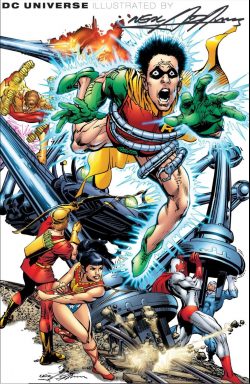
DC Universe Illustrated by Neal Adams volume 1


By Neal Adams with Dennis O’Neil, Gardner F. Fox, Robert Kanigher, Howard Liss, Hank Chapman, Len Wein, Bob Haney, Mark Evanier, Sergio Aragonés, Joe Kubert & various (DDC Comics)
No ISBN: digital only edition

As the 1960s began Neal Adams was a young illustrator who had worked in advertising and ghosted some newspaper strips whilst trying to break into comics. Whilst pursuing a career in advertising and “real art” he did a few comics pages for Archie Comics and subsequently became one of the youngest artists to co-create and illustrate major licensed newspaper strip Ben Casey (based on a popular TV medical drama series).

That comics fascination never faded, however, and Adams drifted back to National/DC, doing a few covers as inker or penciller before eventually finding himself at the vanguard of a revolution in pictorial storytelling…

He made such a mark that DC have regularly curated and reissued his work in a series of commemorative collections. This is the first of a proposed series of eBook tomes extracted from heftier physical artefacts covering the artists’ minor efforts (those not starring Batman, Deadman or “Hard-Travelling Heroes” Green Lantern/Green Arrow) in themed original publication order.

Revisiting Teen Titans #20-22 and gatherings material from Detective Comics #369; Superman #254; Justice League of America #94; Our Army At War #182, 183, 186, 240; Star Spangled War Stories #134, 144; Fanboy #5 and Amazing World of DC Comics Special Edition #1 it cumulatively embraces November 1969 through July 1999.

Following a contextualising Foreword by Paul Levitz and Adams’ thoughts in his own ‘Superheroes Foreword’ the comic dramas commence with a tale of slinky sleuth The Elongated Man who solves a bizarre theft connected to the ‘Legend of the Lovers’ Lantern’ (scripted by Gardner F. Fox from Detective Comics #369, November 1969).

We then encounter a bold triptych from Teen Titans #20-22 (March/April to June/July 1969), written by Adams and pencilled by him and Sal Amendola with inks by brush-maestro Nick Cardy – one of the all-out prettiest illustration jobs of that decade.

Completing s a long-running plot-thread of extra-dimensional invaders by endowing everything with a counterculture twist, ‘Titans Fit the Battle of Jericho’ is a spectacular rollercoaster romp deftly blending teen revolt, organised crime, anti-capitalist activism, bug-eyed monsters and cunning extraterrestrial conquerors…

Symbolic super-teens Hawk and Dove briefly join the proceedings for #21’s ‘Citadel of Fear’ (Adams & Cardy): chasing smugglers, facing evil ETs and ramping up the surly teen angst quotient whilst moving the invaders story-arc towards stunning conclusion ‘Halfway to Holocaust’ wherein the abduction of Kid Flash and Robin leads to a cross-planar climax as Wonder Girl, Speedy and a radical new ally quash the invaders forever…

Excerpts from Justice League of America #94’s ‘Where Strikes Demonfang’ – specifically pages 1, 5, 20 and 22 – tie up loose ends from the Deadman saga seen elsewhere (in Strange Adventures of the Adams Deadman collections) before a modern pin-up of ‘Ra’s al Ghul’ brings us to a delightful treat scripted by Len Wein taken from The Private Life of Clark Kent backup series.

‘The Baby Who Walked Through Walls’ comes from Superman #254 (July 1972): scripted by Len Wein and deliciously detailing how even the mighty Man of Tomorrow is no match for a toddler determined to dodge her babysitter and go exploring…

Unpublished Superman pages and thumbnails culled from ‘Amazing World of DC Comics Special Edition #1’ (February 1976) segue into a selection of public service messages starring the Caped Kryptonian – specifically ‘Justice for All Includes Children 1, 2, 6 and 7′ – and are followed by a monochrome and a full-colour v ‘9/11 Tribute’…

Self-parody changes the tone as an excerpt from Fanboy #5 (July 1999) finds Mark Evanier & Sergio Aragonés joining the master of moody in an unlikely iteration of the Daft Knight…

A ‘Batman Sketchbook’ offers preliminary doodles for Robin’s new costume, Batman roughs and Joker redesigns, culminating in finished pin-ups of all before the tone twists back to hyper-realism and a ‘War Stories Foreword’ by Neal Adams begins a chronological excursion through the artist’s combat contributions to DC canon.

All recoloured in Adam’s lush modern manner, the lean sparse sagas commence with ‘It’s My Turn to Die’ from Our Army At War #182 (July 1967), with Howard Liss scripting the tale of an officer who’s reached his emotional limit, whilst ‘Invisible Sniper’ (Liss again from OAAW #183, August 1967) tracks an embattled GI hunting an infallible enemy with a killer gimmick…

The Killing Ground’ (Star Spangled War Stories #134, August -September 1967) is a Robert Kanigher moment from The War That Time Forgot, with PT Boat survivors striving against a succession of seaborne antediluvian atrocities, after which ‘My Life for a Medal’Our Army At War #186 (November 1967, by veteran scribe Hank Chapman) – holds a shocking lesson for a glory-hungry go-getter.

A visual triumph, Joe Kubert inked hot new penciller Adams on Kanigher’s ‘Death Takes No Holiday!’ (SSWS #144, April-May 1969) as another macabre death-dealing French aviator – dressed as a skeleton – terrorised and butchered Jagdstaffel pilots at will, forcing the Kaiser’s Enemy Ace Hans von Hammer into insane action to inspire his men and cure a young flier of fear-induced madness…

War takes a weird – and socially relevant – turn as we visit the future for our concluding clash in Bob Haney’s ‘Another Time Another Place’ (Our Army At War #240, January 1972) as an elite squad meet the enemy and get a sobering surprise…

Sadly short of Adams incredible canon of covers, we wrap up with only full ‘Biographies’ as a bonus, but this beautiful book still offers a look at less often seen gems that were in many ways more informative than all the big-banner achievements of a major force in comics. Now, if only DC would sort out his horror stories and truly lost gems like Jerry Lewis, we’d all be happy…
© 1967, 1969, 1971, 1972, 1976, 1999, 2008 DC Comics. All Rights Reserved.

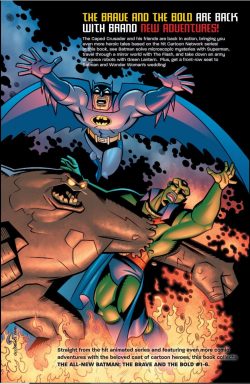
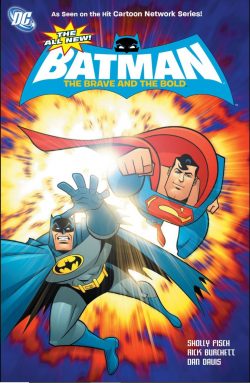
The All-New Batman: The Brave and the Bold volume 1


By Sholly Fisch, Rick Burchett, Dan Davis & various (DC Comics)
ISBN: 978-1-4012-3272-6 (TPB)

The Brave and the Bold premiered in 1955 as an anthology adventure comic featuring short complete tales about a variety of period heroes: a format reflecting the era’s filmic fascination with flamboyantly fanciful historical dramas. Devised and written by Bob Kanigher, issue #1 led with Roman epic Golden Gladiator, medieval mystery-man The Silent Knight and Joe Kubert’s Viking Prince. Soon the Gladiator was alternated with Robin Hood, but the adventure theme carried the title until the end of the decade when the burgeoning costumed character revival saw B&B transform into a try-out vehicle like Showcase.

Used to premiere concepts and characters such as Task Force X: The Suicide Squad, Cave Carson, Hawkman and Strange Sports Stories as well as the epochal Justice League of America, the comic soldiered on until issue #50 when it found another innovative new direction which once again caught the public’s imagination.

That issue paired two superheroes – Green Arrow and Martian Manhunter – in a one-off team-up, and was followed by more of the same: Aquaman and Hawkman in #51, WWII “Battle Stars” Sgt. Rock, Captain Cloud, Mme. Marie & the Haunted Tank in #52 and The Atom & Flash in #53.

The next instant union – Robin, Aqualad and Kid Flash – evolved into Teen Titans and after Metal Men/the Atom and Flash/Martian Manhunter appeared, a new hero debuted in #57-58: Metamorpho, the Element Man.

From then it was back to the increasingly popular superhero pairings with #59. Although no one realised it at the time, that particular conjunction – Batman with Green Lantern – would be particularly significant….

A return engagement for the Teen Titans, issues spotlighting Earth-Two stalwarts Starman and Black Canary and Earth-One’s Wonder Woman and Supergirl soon gave way to an indication of things to come when Batman returned to duel hero/villain Eclipso in #64: an early acknowledgement of the brewing TV-induced mania mere months away.

Within two issues (following Flash/Doom Patrol and Metamorpho/Metal Men), B&B #67 saw the Caped Crusader take de facto control of the title and a lion’s share of team-ups. With the late exception of #72 and 73 (Spectre/Flash and Aquaman/Atom), the title was henceforth a place where the Gotham Gangbuster invited the rest of DC’s heroic pantheon to come and play…

Decades later, Batman: The Animated Series – masterminded by Bruce Timm and Paul Dini in the 1990s – revolutionised the Dark Knight and subsequently led to some of the absolute best comic book adventures in his 80-year publishing history. It also led to a spin-off print title…

With constant funnybook iterations and tie-ins to a succession of TV animation series, Batman has remained immensely popular and a sublime introducer of kids to the magical world of the printed page. One fun-filled incarnation was Batman: The Brave and the Bold, which gloriously celebrated the team up in both its all-ages small-screen and comicbook spin-off.

Shamelessly and superbly plundering decades of continuity arcana in a profusion of alliances between the Dark Knight and DC’s lesser creations, the show was supplemented by a cool kid’s periodical full of fun, verve and swashbuckling dash, cunningly crafted to appeal as much to the parents and grandparents as those fresh-faced neophyte kids…

This stellar trade paperback and digital collection re-presents issues #1-6 of the second series – The All-New Batman: The Brave and the Bold – in an immensely entertaining all-ages ensemble suitable for newcomers, fans and aficionados of all ages. It was originally released between January and June 2011. Although absolutely unnecessary to the reader’s enjoyment, a passing familiarity with the TV episodes will enhance the overall experience as will knowledge of the bizarre minutiae of 1960s and 1970s DC lore…

Crafted by Sholly Fisch, Rich Burchett & Dan Davis and following the format of the TV show, each tale opens with a brief vignette/prequel adventure before telling a longer tale. TA-NB:TB&TB (last time I’m typing that!) #1 sees the Caped Crimebuster battle Joker robots  beside Black Canary before main feature ‘Bottle of the Planets’ reunites him the “World’s Finest” partner in a devious mystery set in the last outpost of Krypton: the Bottled City of Kandor…

Having successfully solved the case of vanishing super-weapons, Batman teams with talking tiger Mr. Tawky-Tawny, magical (Captain) Marvel Shazam and his gods-powered family to save Christmas in ‘That Holiday Feeling’. That involves finding, fighting and foiling the emotion-bending Psycho-Pirate whilst #3 sees Flash (two, actually) and the Dark Knight hunting Mirror Master and the Mad Hatter through a mirror dimension inhabited by all the characters from Lewis Carroll’s books. Curiouser and curiouser …

Wonder Woman headlines in #4 as irate godling Eros seeks to teach her a lesson by using his arrows to instigate a wedding in ‘The Bride and the Bold’. The ceremony between Bat and Amazon sparks a lot of interest and – thanks to jealous Talia Al Ghul – a wave of super-villain attacks and the biggest wedding party brawl of all time before order and sense are restored…

‘Man-Hunted’ find Batman and Emerald jerk Guy Gardner fractiously allied to defeat a legion of the killer robots, but diverted to other realms to save a glorious enclave of nigh-forgotten 1960s alien beasts and sidekicks like Cryll and Zook(look them up, I double-dog dare ya…) from manic main man Lobo…

Ending this excellent excursion through DC’s daftest corridors is a beguiling contest between the Dark Knight Detective and Martian Manhunter J’onn J’onzz who tests his abilities against classic observation and deduction in ‘Now You see Me…’; sadly the salutary learning experience goes slightly awry when the calamitous Clayface is accidentally exposed…

Despite being ostensibly aimed at TV-addicted kids, these mini-sagas are wonderful, traditional comics thrillers no self-respecting fun-fan should miss: accessible, splendidly rendered yarns for the broadest range of excitement-seeking readers. This is a fabulous rollercoaster ride confirming the now-seamless link between animated features and comic books. After all, it’s just adventure entertainment in the end; really unmissable entertainment…

What more do you need to know?
© 2010, 2011 DC Comics. All Rights Reserved.

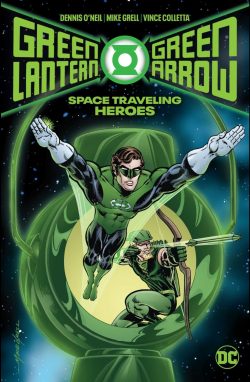
Green Lantern/Green Arrow: Space Traveling Heroes


By Denny O’Neil, Frank McGinty, Elliot S! Maggin, Mike Grell, Alex Saviuk, Vince Colletta & various (DC Comics)
ISBN: 978-1401295530 (HB)

After their hugely successful revival and reworking of The Flash, DC were keen to build on a resurgent superhero trend. Showcase #22 hit newsstands at the same time as the fourth issue of the new Flash comic book (#108) and once again the guiding lights were Editor Julie Schwartz and writer John Broome. Assigned as illustrator was action ace Gil Kane – usually inked by Joe Giella – and the issue revealed a Space Age reconfiguration of the Golden Age superhero with magic replaced by super-science.

Hal Jordan was a young test pilot in California when an alien policeman crashed his spaceship on Earth. Mortally wounded, Abin Sur commanded his power ring – a device for materialising thoughts – to seek out a replacement officer, honest and without fear.

Scanning the planet, it selected Jordan and brought him to the crash site. The dying alien bequeaths his ring, lantern-shaped Battery of Power and professional vocation to the astonished Earthman.

Having established characters, scenario and narrative thrust of a series that would become the spine of all DC continuity, the editors were confident of their ground. Unlike the years-long, practically glacial debut of The Flash, the next two Showcase issues carried the new costumed champion to even greater exploits, and six months later Green Lantern #1 was released.

In this iteration the Emerald Gladiators are a universal police force (Jordan’s “beat” is Space Sector 2814), and over many traumatic years, he grew into one of the greatest members of the serried band of law-enforcers. The Green Lantern Corps has safeguarded the cosmos from all evil and disaster for billions of years, policing countless sentient beings under the severe but benevolent auspices of immortal super-beings who consider themselves the Guardians of the Universe.

These undying patrons of Order were one of the first races to evolve and dwelt in sublime, emotionless security and tranquillity on the world of Oa at the very centre of creation.

Green Lanterns are chosen for their capacity to overcome fear and are equipped with a ring that creates solid constructs out of emerald light. The miracle weapon is fuelled by the strength of the user’s willpower, making it – in the right hands – one of the mightiest tools imaginable…

For eons, a single individual from each of the 3600 sectors of known space was selected to patrol his, her or its own beat, but being cautious and meticulous masters, the Guardians laid contingency plans as appointing designated reserve officers.

The series a ran for a decade before changing tastes pushed it into radical territory as a soap box for social injustice and environmental issues. The “relevancy period” generated landmark groundbreaking tales from Denny O’Neil & Neal Adams that revolutionised the industry, whilst registering such poor sales that the book was cancelled and the twinned heroes (a cost-cutting concept had seen GL paired with liberal firebrand Green Arrow as a walking, rip-roaring conscious for the conservative ring-wielder) unceremoniously shipped into the back of another comic book – the marginally more successful Flash.

The Flash #217-246 saw the transition from Adams to new art sensation Mike Grell: a run that precipitated the viridian vigilantes back into their own title. With the emphasis shifting back to crime, adventure and space opera, Green Lantern was again popular enough for his own book and he naturally brought the boisterous bowman along for the ride….

Collecting Green Lantern #90-106 (August/September 1976-July 1978) this hardback and digital compendium sees them (mostly) return to the starry firmament for cosmic duties beginning with #90 (August/September 1976) as ‘Those who Worship Evil’s Might’ – by Denny O’Neil & Mike Grell – finds the Green Gladiators investigating a starship buried in the Las Vegas desert for countless years. When it disgorges an ancient evil the heroes also meet the freshly awakened officers of a force used by the Guardians of the Universe before green rings were invented…

Issue #91 depicts the return of arch-nemesis Sinestro who inflicts ‘The Revenge of the Renegade’ upon his foes after taking over a poverty-stricken third world monarchy. When the tables are turned, he flees into space and across dimensions, arriving with the green team on a primitive world in dire need of champions legendarily saved via ‘The Legend of the Green Arrow’ (inked by Robert “Bob” Smith).

Inked by Terry Austin, #93’s ‘War Against The World-Builders’ finds aliens abducting homeless people to build a colony world. As GL interrupts his Thanksgiving dinner to play saviour, however, his lover Carol Ferris, Black Canary and Green Arrow are ambushed by government spooks and the archer is abducted. Rogue agents need him to kill someone and believe they have the perfect inducement in #94’s ‘Lure for an Assassin’ (Austin & Dick Giordano inks) but didn’t count on his ingenuity and the return of substitute GL John Stewart, culminating in a political scandal barely averted in concluding chapter ‘Terminal for a Tragedy’ with Vince Colletta signing on as regular inker.

Bouncing back to the big black yonder, #96’s ‘How Can an Immortal Die?‘ sees the reappearance of alien Lantern Katma Tui, crashing to Earth and bringing warning of a terrible threat that has infiltrated the Guardians. Rushing rashly to the rescue, Jordan battles his comrades and patrons to solve and defuse ‘The Mystery of the Mocker’ in a spectacular romp that marks the series’ restoration to monthly status.

The plan doesn’t end well and #98 finds the mind monster loose on Earth and tormenting Black Canary with visions of the dead in ‘Listen to the Mocking Bird’. Tracing the abominable mocker Ffa’rzz to an antediluvian and impossibly distant space station, Jordan Katma Tui, the Arrow and enigmatic space critter Itty infiltrate the monolith and face constant nightmare as they realise ‘We Are on the Edge of the Ultimate Ending!’ Thankfully, devious plotter Ollie Queen has a plan to save everything…

Double-sized Green Lantern/Green Arrow #100 carried a January 1978 cover-date and two tales, beginning with O’Neil, Alex Saviuk & Colletta’s ‘Rider of the Air Waves’ which expanded the Jordan family by introducing a distant cousin. Also called Hal Jordan, this kid had inherited his father Larry‘s title as Air Wave (a Golden Age Great using the power of radio to crush crooks) but got trapped in energy form by debuting dastard Master-Tek. It didn’t take long to sort things out and find little Hal a tutor after which Elliot S! Maggin, Grell & Colletta took Ollie, the Canary and former sidekick Roy “Speedy” Harper back to Star City in ‘Beware the Blazing Inferno!’ the task of stopping a ring of bombers opened old wounds however, and the archer again opted to try fixing things from within by running for Mayor…

Frank McGinty, Saviuk & Colletta deconstructed ‘The Big Braintrust Boom’ in #101 as freewheeling trucker Hal – the elder – Jordan uncovers a mind-bending, potentially world-dominating cult run by old enemies Hector Hammond and Bill Baggett, before O’Neil, Saviuk & Colletta reveal a cunning alien plot to shanghai humans as batteries in ‘Sign Up… and See the Universe’ which intensifies into a full blown invasion in #103’s ‘Earth – Asylum for an Alien’ with David Hunt stepping in to ink. Happily our heroes are up to the challenge, but when a valued comrade suddenly dies the consequences are not just tragic but simply catastrophic in #104’s ‘Proof of the Peril’ by O’Neil, Saviuk, Colletta. Even this is not the end, however, as the bizarre events herald the vengeful assault of old enemy Sonar in follow-up yarn ‘Thunder Doom’leading to a close call with an all-consuming atrocity and revelatory conclusion  ‘Panic… in High Places and Low’ by O’Neil, Grell & Bruce Patterson in last inclusion #106.

Although still laced with satire and political barbs, this tome sees challenging tales of rebellion give way to plot-driven sagas of wit and courage, packed with a less shining, less optimistic sense of wonder albeit still bristling with high-octane action. Here are evergreen adventures that confirmed the end of the Silver Age of Comics and the birth of something new. Illustrated by some of the most revered names in the business, the exploits in this volume closed one chapter in the life of Green Lantern and opened the doors to today’s sleek and stellar sentinels of the stars.
© 1976, 1977, 1978, 2020 DC Comics. All Rights Reserved.

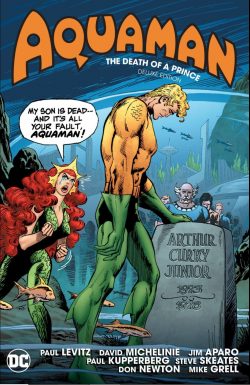
Aquaman: The Death of a Prince Deluxe Edition


By Paul Levitz, David Michelinie, Paul Kupperberg, Steve Skeates, Martin Pasko, Gerry Conway, Mike Grell, Jim Aparo, Don Newton, Carl Potts, Juan Ortiz & various (DC Comics)
ISBN: 978-1-7795-0095-3 (HB)

Aquaman is one of that hallowed handful of costumed champions to survive the superhero collapse at the end of the Golden Age. For most of that time he was a rather nondescript and genial guy who – when not rescuing fish and people from sub-sea disasters – solved maritime crimes and mysteries.

The Sea King was created by Mort Weisinger & Paul Norris, debuting in More Fun Comics #73 (November 1941) in the wake of and in response to Timely Comics’ antihero Namor the Sub-Mariner. Strictly a second stringer for most of his career, Aquaman nevertheless swam on beyond many stronger features; illustrated by Norris, Louis Cazaneuve, Charles Paris, and latterly Ramona Fradon who drew almost every adventure from 1951 to 1961.

When Showcase #4 rekindled the public’s taste for costumed crimefighters with the advent of a new Flash in 1956, National/DC updated its band of superhero survivors, especially Green Arrow and the Subsea Sentinel.

As the sixties opened, Aquaman was a back-up feature in Detective Comics and World’s Finest Comics, but made his big leap following a team up with Hawkman in Brave and the Bold # 51 and his own try-out run in Showcase #30-33. After two decades of continuous nautical service, the marine marvel was at last awarded his own comic book (cover-dated January/February 1962).

With his own title and soon featuring in groundbreaking must-see cartoon show The Superman/Aquaman Hour of Adventure, our Finned Fury seemed destined for super-stardom, but despite increasingly bold and innovative tales presented with stunning art, his title was cancelled as the decade closed. Towards the end, outrageously outlandish crime and sci fi yarns gave way to grittily hard-edged epics steered by revolutionary editor Dick Giordano and hot new talents Steve Skeates & Jim Aparo that might arguably be the first sallies of comic books’ landmark socially conscious “relevancy” period…

This compelling follow-up compilation features material released after a 3 year hiatus following cancellation in 1971. Offering potent dramas heralding a new era of costumed capers primarily from a fresh generation of creators, it gathers material from Adventure Comics #435-437, 441-455 and Aquaman volume 1 #57-63 (spanning September/October 1974 to August- September 1978) and is available in hardback and digital formats,.

Way back in Aquaman #18, (December 1964 and not included here) the marine marvel – also called Arthur Curry – met extradimensional princess Mera, who became ‘The Wife of Aquaman’ in one of the first superhero weddings of the Silver Age. Talk about instant responsibilities…

In quick-smart time along came a little Aquababy – eventually and occasionally called Arthur Jr. – and the undersea nuclear family became a given constant for years…

We open with revelatory Introduction ‘Confessions’ from scripter, editor and publisher Paul Levitz, and a fact-filled pin-up of ‘The Aquafamily’ by Gerry Conway & Jim Aparo, first seen in Adventure Comics #444. Then it’s drama all the way with #435’s ‘As the Undersea city Sleeps’ by Steve Skeates & Mike Grell, offering a quick reintroduction with the Atlantean monarch battling a mysterious subsea sleeping plague caused by old enemy Black Manta. After that, ‘The King is Dead; Long Live the King’ (#436) sees the monarch uncover a rash of robot duplicates infiltrating the city and summoning massive monsters before #437 finds Levitz & Grell setting the scene for larger events to come with Aquaman undertaking many mini-missions on ‘A Quiet Day in Atlantis’…

Cover-dated September/October 1975, Adventure Comics #441 opens extended epic “The Sea King in Exile” with ‘The Pirate who Plundered Atlantis’ by Levitz, David Michelinie and triumphantly returning Jim Aparo detailing how an invasion by modern-day undersea buccaneers is repelled by the Sea King and Mera, tragically unaware of a longer game in play…

More pieces fall into place when NATO General Horgan warns that a hijacked nuclear materials transporter is going to be sunk – over Atlantean farms – to prevent terrorists using the cargo for dirty bombs. That’s when Aquaman takes charge in ‘H is for Holocaust’ – by Levitz & Aparo – after which the Sea Lord stays topside to crush ‘The Dolphin Connection’(Levitz, Michelinie & Aparo) when old enemy The Fisherman trains cetaceans to deliver drugs to the French underworld. All the surface duty does not play well in Atlantis, however, and a grass roots (kelp roots?) political movement makes startling inroads in its demands to elect a new stay-at-home ruler…

The unthinkable happens in Adventure 444 as Levitz, Gerry Conway & Aparo show Aquaman blackmailed into stealing an Atlantean superweapon by his villainous brother Ocean Master before being smoothly ousted and replaced by new king Karshon in ‘And Death before Dishonor’…

Exiled and setting up home in the old “Aquacave”, Arthur, Mera and the toddler determine to make the best of their new life, but are soon abducted by ‘Toxxin’s Raiders’ (Michelinie & Aparo): subsea primitives who need a true champion to destroy the beast haunting their village. It’s a huge mistake all around…

The Sea Exile then learns that ‘The Manta-Ray Means Murder!’ (Levitz, Martin Pasko & Aparo) as Aqualad and Aquagirl– currently busting surface-world  smugglers – are attacked by Black Manta, simultaneously exposing a deadly plot just as their mentor arrives to lower the boom and uncover the villain is gun-running to Atlantis…

Issue 447 sees Levitz, Pasko & Aparo detail a ‘Prelude to Armageddon” as Aquaman tracks Manta’s shipments and falls foul of the Fisherman, unaware of a silent partner dictating the flow of events. Full disclosure and a classic conclusion come in ‘Crown, Crisis and Cataclysm’ (Levitz & Aparo) as master manipulator Karshon is revealed as a deadly former Green Lantern foe who turns assured victory into crushing defeat through sheer overconfidence…

Reuniting Skeates & Aparo, Adventure Comics #449 features ‘The Menace of the Marine Marauder’ as a surface science criminal usurps the Sea Sentinel’s telepathic power to control sea creatures. Plundering shipping – specifically a crucially needed vaccine – until Aquaman and Mera step up, he’s just an interlude before Michelinie & Aparo detail ‘The Watery War of the Weather Wizard’ in #450, with the Flash rogue becoming the latest larcenous loon to underestimate the King of the Seas.

…And in the background, Aqualad is lured away by a seeming madman claiming the junior sea crusader stole his son and sets out on a personal quest that will change his life forever…

Issue #451 reveals ‘The Secret of the Sinister Abyss’ as Arthur Jr. is inexplicably abducted by faithful octopus companion Topo and swiftly-pursuing Aquaman stumbles into another sea bed civilisation – the Idylists -  and a rapidly regenerating new iteration of extraterrestrial terror Starro the Conqueror.

On defeating the starfish clone, Aquaman talks to the pacifist sea-voyagers it imperilled and learns they are seeking a lost brother who can be their champion: his partner Aqualad…

Big things were happening for the Sea King as his Adventure tenure was giving way to a resurrected solo title. Issue #452’s ‘Dark Destiny, Deadly Dreams’ (Michelinie & Aparo) sees Aquaman and the Idylists confronting the occupiers of the pacifist city and discovering Black Manta is offering it as a homeland and refuge for lost and hopeless surface men…

His methods are far from altruistic and his only successful convert to water-breathing – Cal Durham – has serious doubts, but Manta won’t be deterred. and when he captures them and Aqualad, he forces them to fight each other to the death to save Arthur Jr.

It doesn’t work and the boy dies…

The tragedy catapults the hero back into his own revived comic book with Aquaman volume 1 #57 (August/September 1977) where Michelinie & Aparo’s ‘A Life for a Life’ follows his vengeful wake to a brutal – but not final – clash with Manta, hurtful estrangement from Aqualad and a new scheme involving the Fisherman and latest abductee General Horgan…

Anthological Adventure Comics #453 (September/October 1977) overlapped the renewed bi-monthly with a solo sidekick feature as Paul Kupperberg, Carl Potts & Joe Rubinstein asked ‘Aqualad, Who is Thy Father?’ Believing himself an orphan his entire life, the youthful warrior is strident in his demands to learn of the Idylist who sired him, but is setting himself up for even more betrayal and heartbreak before Aquaman #58 sees Michelinie & Aparo peer ‘Through a Past, Darkly’ to review Aquaman’s origins as the Fisherman strikes at the lighthouse where the Sea King was reared. The tale is backed up by Mera short ‘Return to Disaster’ (Kupperberg, Juan Ortiz & Vince Colletta) as the distraught mother learns her son is not quite dead and travels to her home dimension Xebel in search of a remedy but finding instead only chaos and tyranny…

Adventure Comics #454 (November/December 1977) finds Aqualad paying for ‘Sins of the Father’ as Kupperberg, Potts & Dick Giordano reveal not why but who killed his progenitor Thar, before Aquaman #59 (December 1977-January 1978) rings in a new year with ‘Prey Perilous’ by Michelinie & Aparo. Here Fisherman and The Scavenger clash over a sunken spy ship’s secrets and Aquaman endures unwanted NATO interference before justice is done, whilst in the back Mera battles dictator Leron over ‘The Kingdom of Doom’ (Kupperberg, Ortiz & Colletta).

The Adventure Comics run ends with #455 (January/February 1978) as Kupperberg, Potts & Giordano use ‘Legacy’ to give  Aqualad his answers and line up all the disparate plotlines for Aquaman #60.

Crafted by Michelinie and stunning new illustrator Don Newton (with inks by veteran John Celardo) ‘Scavenger, Ravager, Plunderer, Thief’ brings together the NATO elements and assorted supervillains as hidden mastermind and potential global overlord Kobra reveals his latest deadly scheme whilst Mera crosses ‘The Edge of Nowhere’ (Kupperberg, Ortiz & Colletta) when she learns all her efforts have been for nothing…

Issue #61 guest stars Batman and Green Lantern as Michelinie, Newton & Bob McLeod expose ‘The Armageddon Conspiracy’ as the true contents of that sunken spy ship threaten all life on Earth and Aquaman shows his real power and nature…

After a stellar run and powerful groundbreaking stories, the series abruptly ended, once again a victim of economics as comic books again endured a mass sales downturn. However, it all ended on an emotional high as Aquaman #62 sees Kupperberg, Newton & McLeod deliver ‘And the Walls Came Tumbling Down’ with bereaved Mera and Arthur savagely separating over their son’s murder and the Sea King taking out his feelings on handy wannabe supervillain Seaquake as he attempts to make his rep by tectonically trashing Atlantis. A painful reconciliation with Mera is then threatened in final issue #63 as Ocean Master strikes again, compelling Aqualad to also hastily forgive, forget and rejoin the fold for one last clash in ‘My Brother’s Keeper’ by Michelinie, Newton & David Hunt.

This a superb treasury of lost wonders, packed with stellar stories sublimely illustrated by comics masters worthy of far more attention than they’ve received. Surely, there’s no better time than now to balance those scales, adventure fans…
© 1974, 1975, 1976, 1977, 1978, 2020 DC Comics. All Rights Reserved.

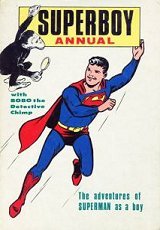
Superboy Annual 1967


By Jerry Siegel, Otto Binder, Robert Bernstein, Dave Wood, Henry Boltinoff, John Broome, George Papp, Curt Swan, John Sikela, Carmine Infantino, Irwin Hasen & various (Atlas Publishing/K.G. Murray)
No ISBN:

Before 1959, when DC Comics and other American publishers began exporting directly into the UK, our exposure to their unique brand of fantasy fun came from licensed reprints. British publishers/printers like Len Miller, Alan Class and bought material from the USA – and occasionally, Canada – to fill 68-page monochrome anthologies – many of which recycled the same stories for decades.

Less common were (strangely) coloured pamphlets produced by Australian outfit K.G. Murray and exported here in a rather sporadic manner. The company also produced sturdy and substantial Christmas Annuals which had a huge impact on my earliest years (I strongly suspect my adoration of black-&-white artwork stems from seeing supreme stylists like Curt Swan, Carmine Infantino, Al Plastino, Wayne Boring, Gil Kane or Murphy Anderson uncluttered by flat, limited colour palettes).

This particular tome of was one of the last licensed DC comics compilations before the Batman TV show turned the entire planet Camp-Crazed and Bat-Manic, and therefore offers a delightfully eclectic mix of material far more in keeping with the traditionally perceived interests of British boys than the suited-&-booted masked madness that was soon to follow in the Caped Crusader’s scalloped wake.

Thankfully, this collection was still produced in the cheap and quirky mix of monochrome, dual-hued and weirdly full-coloured pages which made Christmas books such a bizarrely beloved treat.

Sturdily stiff-backed, the sublime suspense and joyous adventuring begins with ‘The Secret of Fort Smallville!’ by Otto Binder & John Sikela and first seen in Superboy Comics #56 (April 1957). When a celebratory historical re-enactment is highjacked by an unscrupulous  rogue and poses a tough test for the Boy of Steel, he needs the aid of native American classmate Swift Deer to crack the case. Despite being produced in a far less understanding era, this yarn displays degrees of taste and cultural sensitivity practically unheard of in mass entertainment of the time…

Cartoonist Henry Boltinoff was a prolific and nigh-permanent fixture of DC titles in this period, providing a variety of 2, 1, and ½ page gag strips to cleanse visual palates and satisfy byzantine US legal directives that allowed comics publishers to sustain cheaper postal shipping rates. He’s here in strength, as his gentle humour jibes perfectly with British tastes, opening with Homer who leans a big lesson while fishing at sea after which ‘Superboy’s Best Friend!’ (by Robert Bernstein & George Papp from Superboy #77, December 1959) tugs at heartstrings by playing on a favoured theme: that of the Boy of Steel’s isolation from kids his own age.

Here that manifests as a doomed friendship with new kid Freddy Shaw, who briefly shares all Clark Kent’s secrets, but inadvertently shares the biggest one with his criminal older brother. Cue tragedy and cover-up…

Boltinoff’s Peter Puptent, Explorer deals with arctic antics prior to the first outing of seminal comics lunacy in the hirsute form of Detective Chimp: a Florida-based stalwart who was an assistant sheriff. ‘The Riddle of the Riverside Raceway!’by John Broome, Irwin Hasen & Joe Giella (from Rex the Wonder Dog #11, September/October 1953) sees a mystery cracked as impressionable Bobo befriends a prize steed and stymies gangsters set on fixing a race, after which Binder, Curt Swan & John Forte revisit the theme of loneliness as a modern teen freshly arrived on Earth travels back in time to meet her cousin as a kid in ‘Superboy Meets Supergirl!’ (Superboy Comics #80, April 1960). There’s fun aplenty, but it can’t last…

Bobo is back as Detective Chimp solves ‘The Case of the Suspicious Signature!’ (Broome & Carmine Infantino from Rex the Wonder Dog #11, September/October 1954) when his new passion for autograph collecting accidentally inserts him into a Hollywood star’s kidnapping.

Jerry Siegel & Papp then reveal how baby Kal-El inadvertently thwarted ‘The Invasion of Krypton! (Superboy #83, September 1960) and Boltinoff’s Doctor Rocket makes merry at an atomic eatery before by Broome, Hasen & Bernard Sachs share their passion for sports when Detective Chimp rescues his favourite baseball star from kidnappers in ‘Crime Runs the Bases’ (Rex the Wonder Dog #9, May/June 1953).

Superboy #84, October 1960, provides a brace of tales by Siegel & Papp beginning with ‘The Rainbow Raider!’ as a mystery thief seemingly enslaves the Boy of Steel, after which the self-explanatory ‘Superboy Meets William Tell!’reveals how the time-travelling hero gives the Swiss legend a few pointers on battling injustice.

Broome & Infantino the transform Detective Chimp into ‘The Scientific Crook-Catcher!’ (Rex the Wonder Dog #29, September/October 1956) when the savvy simian sneaks into a symposium of savants and the old world charm and drama conclude with another western themed tale. Although now an incredibly inappropriate title, ‘The Super-Injun of Smallville!’ (by Dave Wood & Papp and again from Superboy #84) offers a heart-warming tale of redemption when a bully in a store-bought Superboy costume abuses the other kids on the nearby Corobee Reservation, until an undercover Clark Kent teaches him the error of his ways…

Gently thrilling and absorbingly uplifting, these yarns of yesteryear are timeless delights for properly supervised kids of all ages. If that’s not a good thing, what is?
© National Periodical Publications, Inc. Published by arrangement with the K.G. Murray Publishing Company, Pty. Ltd., Sydney.

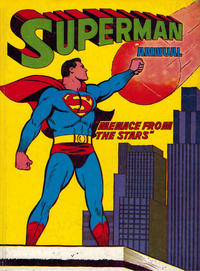
Superman Annual 1963-1964


By Jerry Siegel, Edmund Hamilton, Bill Woolfolk, Ed Herron, Alvin Schwartz, Dave Wood, Henry Boltinoff, George Papp, Curt Swan, Wayne Boring, Al Plastino, Jack Kirby, Lee Elias & various (Atlas Publishing and distributing Co./K.G. Murray)
No ISBN:

Before DC and other American publishers began exporting comic books directly into the UK in 1959, our exposure to their unique brand of fantasy fun came from licensed reprints. Seemingly ubiquitous British publishers/printers like Len Miller, Alan Class and Top Sellers bought US material – and occasionally Canadian – to fill 68-page monochrome anthologies, many of which recycled the same stories for decades.

Less commonplace were strangely coloured pamphlets produced by Australian outfit K. G. Murray: exported to the UK in a rather sporadic manner. The company also produced sturdy Annuals which had a huge impact on my earliest years (I suspect my abiding adulation of monochrome artwork stems from seeing supreme stylists like Curt Swan, Carmine Infantino, Gil Kane and Murphy Anderson strut their stuff uncluttered by flat colour…).

In Britain we began seeing hardcover Superman Annuals in 1950, Superboy Annuals in 1953, Super AdventureAnnuals in 1959 and Batman books in 1960. Since then many publishers have carried on the tradition. This particular tome comes from 1963 as the super-hero craze was barely beginning, allowing us to see a range of transitional material that fell between the Golden and Silver Ages …

This particular tome predates the Batman TV show that turned the entire planet Camp-Crazed and Bat-Manic, and therefore provides a delightfully eclectic mix of material far more in keeping with traditionally perceived interests of British boys than the suited-&-booted masked madness that was soon to follow in the Caped Crusader’s scalloped wake.

It’s also produced in the cheap and quirky mix of monochrome, dual-hued and weirdly full-coloured pages which made Christmas books such a bizarrely beloved treat.

The sublime suspense and joyous adventuring begins with a rare treat as in black, blue and red on white, we meet ‘The Menace from the Stars!’ by Bill Woolfolk, Wayne Boring & Stan Kaye, coming from World’s Finest Comics #68 (January/February 1954) in which a brush with a Green Kryptonite-infused asteroid gives the Man of Steel amnesia.

Happily, before he can inadvertently expose his secret identity, another sudden impact sets things aright, just as Green Arrow clashes with a devious criminal, necessitating the inexplicable side-lining of Boy Bowman Speedy and recruitment of ‘The Legion of 100 Archers!’: an anonymously-authored yarn drawn by George Papp and originating in Adventure Comics #189 (June 1953).

British books always preferred to alternate action with short gag strips, and Murray Line perfectly exploited the phenomenal DC output of cartoonist Henry Boltinoff, whose various gag-strip stars acted as palate-cleansing chapter breaks between dramas. Here a convict conundrum for ‘Warden Willis’ and bedtime woes for ‘Moolah the Mystic’ presage another archery adventure as the Battling Bowmen meet ‘The Amazing Miss Arrowette’.

Taken from WFC #113 (November 1960), the painfully parochial and patronising tone of the times seeped into the saga (scripted by Dave Wood and limned by Lee Elias) as a hopeful, ambitious Ladies’ Archery competitor tries her very best to become Green Arrow’s main helpmeet. Moreover, in a series notorious for absurd gimmick shafts, nothing ever came close to surpassing the Hair-Pin, Needle-and-Thread, Powder-Puff or Lotion Arrows stashed in Bonnie King‘s fetching and stylish little quiver…

Quirky colour returns with gag strips ‘Pop’ and ‘Jail Jests’ before the Man of Tomorrow recalls ‘The Girls in Superman’s Life’ in a slightly reformatted by Edmond Hamilton & Al Plastino from Superman #78 (September/October 1952) bring an adult Lana Lang into the full-grown hero’s life as a rival for Lois Lane and suspicious stalker of Clark Kent…

‘Moolah the Mystic’ and ‘Warden Willis’ japes precede a return to monochrome and a spectacular Jack Kirby GA extravaganza from WFC #97 (October 1958). ‘The Menace of the Mechanical Octopus!’ is a grand old-school high-tech crime-caper scripted by Ed Herron and inked by Roz Kirby.

Superman #137 (May 1960) then delivers an epic sci fi shocker in The Super-Brat from Krypton!’ (Jerry Siegel, Curt Swan & John Forte), revealing how an energy duplicate of baby Kal-El was raised in secret by Earth criminals to become ‘The Young Super-Bully’ before finally confronting his noble counterpart in ‘Superman vs. Super-Menace!’

Slapstick colour interludes from ‘Hy Wire’ and ‘Fireman Pete’ segue neatly into doomsday drama as an unknown writer, Boring & Kaye unearth ‘Jor-El’s Last Will!’ (WFC #69 March/April 1954) and sees the Man of Tomorrow strive to save his adopted home from his father’s deadliest inventions.

Fact fillers were also popular and a ‘Quick Quiz’ and one more ‘Hy Wire’ gag brings us back to black-&-white as Green Arrow tackles the lethally informative threat of alternative fact distributor ‘Crime’s TV Station’ in a canny teaser from Adventure Comics #197 (February 1954) before killer fillers ‘Science Says You’re Wrong’, ‘Scientific Word Origins’ and ‘Jerry the Jitterbug’ herald ‘The Return of Miss Arrowette’ by Wood & Elias from WFC#118 (June 1961) which proves far less cringeworthy than her debut but still manages to make the Bow Babe both competent and imbecilic at the same time.

One last stab at colour sees ‘Science Says You’re Wrong’ and ‘Jerry the Jitterbug’ lay the groundwork for ‘Batman – Double for Superman’ by Alvin Schwartz,  Swan & Kaye from World’s Finest Comics #71, July/August 1954. A landmark piece made in response to economic circumstances, it details the first official team-up of Superman and Batman…

With dwindling page counts, rising costs but a proven readership and years of co-starring but never mingling, it saw the Man of Tomorrow and the Gotham Gangbuster in the first of their shared cases as the merely mortal hero traded identities to save his Kryptonian comrade’s alter ego and, latterly, life…

Simple, straightforward action-adventure never goes out of style and these tales could as easily beguile today’s young scamps as they did my lot. Worth a shot, right?
© National Periodical Publications, Inc., New York.  Published by arrangement with the K.G. Murray Publishing Company, Pty. Ltd., Sydney.

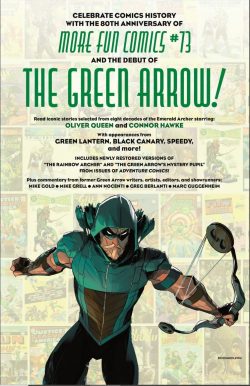
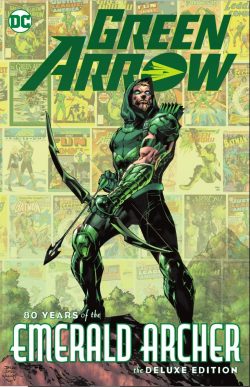
Green Arrow: 80 Years of the Emerald Archer – The Deluxe Edition


By Mort Weisinger, Ed Herron, Denny O’Neil, Mike Grell, Chuck Dixon, Grant Morrison, Kevin Smith, Brad Meltzer, Judd Winick, Jeff Lemire, Marc Guggenheim, Benjamin Percy, George Papp, Lee Elias, Neal Adams, Jim Aparo, Rodolfo Damaggio, Oscar Jimenez, Phil Hester, Scott McDaniel, Cliff Chiang, Denys Cowan, Joe Bennett,Otto Schmidt & various (DC Comics)
ISBN: 978-1-7795-0914-7 (HB)

Win’s Christmas Gift Recommendation: Superb All-Ages Entertainment and Adventure… 9/10

Green Arrow is one of DC’s Golden All-Stars. He’s been a company fixture – in many instances for no discernible reason – more or less continually since his 1941 debut in More Fun Comics #73. Many Happy Returns, Emerald Archer!

In those distant heady days, origins weren’t as important as image or storytelling, so creators Mort Weisinger & George Papp never bothered. The first inkling of formative motivations came in More Fun Comics #89 (March 1943) wherein Joe Samachson & Cliff Young detailed ‘The Birth of the Battling Bowman‘ (and a tip of the feathered hat to Scott McCullar for bringing the tale to my belated attention).

With the secret revealed, it was promptly ignored for years, leaving later workmen France “Ed” Herron, Jack Kirby and his wife Roz to fill in the blanks again with ‘The Green Arrow’s First Case’ at the start of the Silver Age superhero revival. It appeared in Adventure Comics #256, coved-dated January 1959. This time the story stuck, becoming – with numerous tweaks over successive years – the basis of the modern Amazing Archer on page and screen.

This hardback and digital celebration offers another quick survey of the Battling Bowman’s epic career, gathering material from More Fun Comics #73, Adventure Comics #246, 259, Green Lantern/Green Arrow #85-86, Green Arrow: The Longbow Hunters #1, Green Arrow volume 2 #100-101, JLA ‘8-9, Green Arrow volume 3 #1, 17, 75, Green Arrow and Black Canary #4, Secret Origins volume 3 #4, Arrow Season 2.5 #1, Green Arrow: Rebirth #1 and opens with the first of a series of brief prose ruminations ad reminiscences. Former editor Mike Gold details the heritage and legacy of ‘The Octogenarian Green Arrow’ before we meet the stars in November 1941’s More Fun Comics#73 solving the ‘Case of the Namesake Murders’ (Weisinger & Papp). Skipping unchanged to March 1958 and Adventure Comics #246, Herron & Papp detail how a counterfeiter redesigns himself as toxophilist terrorist ‘The Rainbow Archer’ whilst issue #259 (April 1959 by an anonymous author and Lee Elias) introduces ‘The Green Arrow’s Mystery Pupil’: exposing ulterior and sinister motives for his studies…

The turbulent 1960s saw Oliver Queen utterly reinvented. Deprived of his fortune he became a strident advocate of liberal issues in a bold experiment which created a fad for socially relevant, ecologically aware, mature stories which spread throughout DC’s costumed hero comics and beyond; totally revolutionising the industry and nigh-radicalising many readers.

Tapping relatively youthful superstars-in-waiting Denny O’Neil & Neal Adams to produce the revolutionary fare, editor Julie Schwartz watched in fascinated disbelief as the resultant thirteen groundbreaking, landmark issues captured the tone of the times, garnering critical praise, awards and valuable publicity from the outside world, whilst simultaneously registering such poor sales that the series was cancelled anyway: the heroes unceremoniously packed off to the back of marginally less-endangered comic book The Flash.

America at his time was a bubbling cauldron of social turmoil and experimentation. Everyone and everything were challenged on principle, and O’Neil & Adams utterly redefined super-heroism with “Issues”-driven stories transforming complacent establishment masked boy-scouts into uncertain, questioning champions and strident explorers of the enigma of America.

Probably the most notably of the run was 2-part saga ‘Snowbirds Don’t Fly’ and ‘They Say It’ll Kill Me…But They Won’t Say When!’ in Green Lantern/Green Arrow #85-86 (September – November 1972???)

Depiction of drug abuse had been strictly proscribed in comic books since the advent of the Comics Code Authority, but by 1971 the elephant in the room was too big to ignore and both Marvel and DC addressed the issue in startlingly powerful tales that opened Pandora’s dirty box forever. When the Green Gladiators are drawn into conflict with a vicious heroin-smuggling gang, Oliver Queen is horrified to discover his own sidekick had become an addict…

This sordid, nasty tale did more than merely preach or condemn, but actively sought to explain why young people turned to drugs, just what the consequences could be and even hinted at solutions older people and parents might not want to consider. It might all seem a little naïve now, but the earnest drive to do something and the sheer dark power and visual elan of the story still deliver a stunning punch…

Following Mike Grell writing about ‘My Favorite Hero’ comes the first chapter of the tale he crafted to radically reinvent the Archer for the post-Vietnam generation: setting out a new path that would quickly lead to the hero becoming a major player at long last and, ultimately, a 21st century TV sensation.

Green Arrow is one of the very few superheroes to be continuously published (more or less) since the Golden Age. On first look, the combination of Batman and Robin Hood seems to have very little going for him, but he has always managed to keep himself in vogue and in sight.

Probably the most telling of his many, many makeovers came in 1987, when – hot on the heels of Frank Miller’s The Dark Knight Returns – Grell was given the green light to make the Emerald Archer the star of DC’s second Prestige Format Mini-Series.

Grell was considered a major creator at the time, having practically saved the company with his Edgar Rice Burroughs inspired fantasy series Warlord. He had illustrated many of GA’s most recent tales (in Green Lantern/Green Arrow, Action Comics and elsewhere), and was a firm fan-favourite after well-received runs on Legion of Super-Heroes, Aquaman, Phantom Stranger, Batman and others. During the early 1980s, he had also worked on the prestigious Tarzan newspaper strip and created successful genre series Starslayer and Jon Sable, Freelance for pioneering indie publisher First Comics.

By the middle of the grim ‘n’ gritty Eighties, it was certainly time for another overhaul. Exploding arrows yes, maybe even net or rope arrows, but arrows with boxing gloves on them just don’t work (trust me – I know this from experience!). Moreover, for his 1960s makeover, the hero had evolved into a tempestuous, social reformer using his gifts to battle for the little guy. Now, in a new era of corrupt government, drug cartels and serial killers, this emerald survivor adapted again and thrived once more.

The plot was brilliantly logical and controversial, concerning the superhero’s mid-life crisis. Weary and aging, Oliver Queen relocates to Seattle, struggling to come to terms with the fact that since his former sidekick Speedy is now a dad, he is technically a grandfather. With long-time ‘significant other’ Dinah Lance/Black Canary, he starts simplifying his life, but the drive to fight injustice hasn’t dimmed for either of them.

As she goes undercover to stamp out a pervasive drug ring, the Arrow hunts the hunt for a psycho-killer dubbed “The Seattle Slasher”. Tracking a prolific beast slaughtering prostitutes, he learns of a second, cross-country slayer murdering people with arrows – the “Robin-Hood Killer”…

Eschewing his gaudy costume and gimmicks, Queen is an urban hunter stalking unglamorous hidden monsters, but stumbles into a complex mystery leading back to WWII, involving the Yakuza, CIA, corporate America and even Viet Nam war secrets that eventually change the course of the Archer’s life…

Intricate and effortless, the plot weaves around the destabilized champion, Dinah and new character Shado: exploring and echoing themes of vengeance and family in a subtle blending of three stories that are in fact one, delivering a shocking punch even now. This yarn, its narrative quality and sophistication, is arguably the first truly mature superhero yarn in the DCU.

Grell produced a gripping, mystery adventure pushing all the right buttons, conveyed by artwork – in collaboration with Lurene Haynes & Julia Lacquement – that was and remains a revelation. Beautifully demure yet edgily sharp when required, these painterly visuals and watercolour tones perfectly complement a terse, sparse script, and compelling ride.

It’s shame you’ll need another book to see the body and end of this snapping dragon…

The miniseries led to a lengthy and noteworthy run but – as ever – fashions changed and Oliver’s run apparently ended forever in Green Arrow volume 2 #100-101 (September & October 1995).

‘The Trap’ and ‘Run of the Arrow’ – by Chuck Dixon, Jim Aparo, Rodolfo DaMaggio, Gerry Fernandez & Robert Campanella  saw a weary, radicalised aging hero make the ultimate sacrifice to save Metropolis from eco-terrorist Hyraxwhilst his new-found, ashram-trained son Connor Hawke reluctantly assumed his legacy. The Buddhist-trained martial artist reluctantly took up his estranged father’s role and mission and was impressive enough to be summoned to the moon for a try-out in the  reinvented Justice League.

Grant Morrison, Oscar Jimenez, Chip Wallace, Hanibal Rodriguez supervised the secret son’s invitation to join the bright and shiny, no-nonsense team in August and September 1997’s JLA #8-9, with Jimenez & Wallace rendering ‘Imaginary Stories’ as mind-bending villain The Key attempts to conquer the universe by trapping individual Leaguers in perfect dreams, before the art was augmented by Anibal Rodriguez for the tense conclusion ‘Elseworlds’ This sees the Zen Archer saving the day in his own unique style…

Recent scribe Anne Nocenti describes ‘Hitting the Ground Running’ about her tenure on the Emerald Archer before we cover the return of the irascible original Oliver Queen as seen in Green Arrow volume 3 #1 from April 2001. This revival, by unconventional Kevin Smith (yes, Silent Bob!) and the wonderful art-team of Phil Hester & Ande Parks, brings him back from Heaven in the most refreshing manner I’ve seen in nearly five decades of comic reading. . ‘Quiver: Chapter One: The Queen is Dead (Long Live the Queen)’ starts a gloriously enjoyable refining of Green Arrow embracing the fundamental daftness of superhero comics to revitalise them. Replete with guest-stars, jam-packed with action and intrigue and wallowing in fun thanks to the sly, snappy dialogue of Smith, this is a costume-drama in a thousand and I’m certainly not going to spoil your fun by giving away any details. Just revel in the smart combination of the old and the new to create the best yet…

The renewed energy and impetus caried on building as Green Arrow volume 3 #17, November 2002 – ‘The Archer’s Tale: Chapter Two: Grays of Shade’ by Brad Meltzer, Hester & Parks – highlighted a long-overdue reconciliation between the Arrow and Speedy, triggered by the mistimed activation of a contingency plan to hide all their secrets in the event of the hero’s death, after which Green Arrow volume 3 #75 (August 2007) sees ‘Jericho, Conclusion: And the Walls Came Tumbling Down’ by Judd Winick, Scott McDaniel Andy Owens. Here the now-much extended Arrow family unite to save Star City from Deathstroke the Terminator‘s deranged vengeance scheme and witness a marriage proposal everybody knew was inevitable…

Writer, Producer and Director Greg Berlanti discusses ‘Arrow: Origins’ before Green Arrow and Black Canary #4 (March 2008) depicts Judd Winick & Cliff Chiang’s ‘Dead Again, Conclusion: Please Play Where Daddy Can See You.’Detailing the loss of a beloved “team-arrow” member, it as powerful downbeat tale about duty and repercussions that segues neatly into a new motivational start for Oliver, created as part of the New 52 company-wide reboot.

For Secret Origins volume 3 #4 (September 2014) Jeff Lemire, Denys Cowan & Bill Sienkiewicz detailed what makes a hero in ‘Secret Origins: Green Arrow’ whilst essay ‘I’m Not Batman, Dammit’ by Oliver Queen (as told to Mark Guggenheim)’ uses a faux interview to tell some real truths before we enjoy the fruits of the hero’s TV success.

Like any proper comics to screen venture, the show generated a comic book extending the on-screen adventures and here Arrow Season 2.5 #1 (December 2014) sees Guggenheim, Joe Bennett, Jack Jadson & Craig Yeung craft a tense, terse thriller in ‘Blood: Descent’ with the Arrow vigilante’s team save their city from airborne death and settle in for the fight against a new Brother Blood after which the on-point action ends with a return to basics and the end of the New 52 experiment in ‘Rebirth’ by Benjamin Percy & Otto Schmidt. Returning to Seattle, middle age and liberal crusading, the one-shot Green Arrow: Rebirth #1 (August 2016) details a first meeting with Black Canary and the hunt for urban predators “the Underground Men” abducting and selling the city’s poor into slavery…

Capped off with ‘Cover Highlights’ from the Golden, Silver, Bronze, Dark and Modern Ages, pencil art by Jim Lee and full ‘Biographies’ of the army of creators crafting green dreams over 8 decades, this is a striking reminder of the tenacity of the heroic principle and an uncomplicated core concept. Ideal Fights ‘n’ Tights fun for all…
© 1941, 1958, 1959, 1971, 1987, 1995, 1997, 2001, 2002, 2007, 2008, 2014, 2016, 2021 DC Comics. All Rights Reserved.

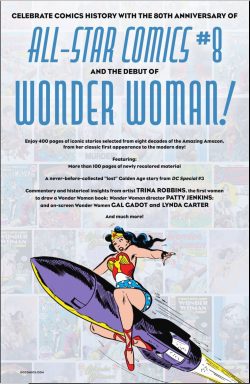
Wonder Woman: 80 Years of the Amazon Warrior – The Deluxe Edition


By William Moulton Marston & Harry G. Peter, Trina Robbins, Joye Hummel, Robert Kanigher, Samuel R. Delany, Cary Bates, Roy Thomas, George Pérez, Len Wein, Lynda Carter, William Messner-Loebs, Phil Jimenez,Joe Kelly, Allan Heinberg, Amanda Conner, Brian Azzarello, Mariko Tamaki, Greg Rucka, Becky Cloonan & Michael W. Conrad, Patty Jenkins, Ross Andru & Mike Esposito, Dick Giordano, Don Heck, Gene Colan, Jill Thompson, Lee Moder, Gary Frank, Cliff Chiang, Elena Casagrande, Nicola Scott, Jen Bartel & various (DC Comics)
ISBN: 978-1-7795-1157-7 (HB)

Win’s Christmas Gift Recommendation: Classic Triumphs of Wondrous Empowerment… 9/10

Without doubt Wonder Woman is the very acme of female role models. Since her premier in 1941 she has permeated every aspect of global consciousness and become not only a paradigm of comics’ very fabric but also a symbol to women everywhere. In whatever era you observe, the Amazing Amazon epitomises the eternal balance between Brains and Brawn and, over those decades, has become one of that rarefied pantheon of literary creations to achieve meta-reality.

For decades, the official story was that the Princess of Paradise Island was conceived by psychologist and polygraph pioneer William Moulton Marston: a calculated attempt to offer girls a positive and forceful role model and – for forward-thinking Editor M.C. Gaines – a sound move to sell more funnybooks to girls. From a guest shot in All Star Comics the Amazon immediately catapulted one month later into her own series and the cover-spot of new anthology title Sensation Comics.

An instant hit, Wonder Woman won her eponymous supplemental title a few months later (cover-dated summer 1942). That set up enabled the Star-Spangled Sensation to weather the vicissitudes of the notoriously transient comic book marketplace and survive beyond the Golden Age of costumed heroes beside Superman, Batman and a few lucky hangers-on who inhabited the backs of their titles.

We now know that Wonder Woman was a team if not truly communal effort, with Moulton Marston acting at the behest of his remarkable wife Elizabeth and their life partner Olive Byrne. Barring a couple of early fill-ins by Frank Godwin, the vast majority of outlandish, eccentric, thematically barbed adventures they collectively penned were limned by classical illustrator Harry G. Peter.

This stunning compilation is part of a series introducing and exploring the historical and cultural pedigree of venerable DC icons. Available in hardback and digital formats, it offers a sequence of sublime snapshots detailing how Diana of the Amazons has evolved and thrived in worlds and times where women were generally regarded as second class, second rate, painfully functional or strictly ornamental.

It re-presents material from All-Star Comics #8; Sensation Comics #1; Wonder Woman volume 1 #5, 78, 98, 124, 162, 203, 206; Comic Cavalcade #11; DC Special #3; DC Comics Presents #41; Wonder Woman volume 2 #6, 57, 73, 170;Wonder Woman Annual #1, Wonder Woman volume 4 #23; Wonder Woman #600, 750; Future State: Immortal Wonder Woman #1 and 2: cumulatively covering July 1940 to February 2021. The comics stories are augmented throughout by essays and brief critical analyses from significant personages linked with the Amazon, but we begin with the origin…

‘Introducing Wonder Woman’ was an extra story in All Star Comics #8 (cover-dated December 1941/January 1942), home of the mighty and popular Justice Society of America, and led directly to Wonder Woman Comes to America’: her formal debut in Sensation Comics #1 (January 1942). In combination they reveal how, once upon a time on a hidden island of immortal super-women, American aviator Steve Trevor of US Army Intelligence crashes to Earth. Near death, he is nursed back to health by young, impressionable Princess Diana.

Fearful of her besotted child’s growing obsession with the creature from a long-forgotten and madly violent world, Diana’s mother Queen Hippolyte reveals the hidden history of the Amazons: how they were seduced and betrayed by men but rescued by the goddess Aphrodite on condition that they forever isolate themselves from the mortal world: devoting their eternal lives to becoming ideal rational beings.

However, after Trevor explains the perfidious spy plot which accidentally brought him to the Island enclave and how the planet is in crisis, Athena and Aphrodite instruct the Queen to send an Amazon back with the American to fight for global freedom and liberty. Hippolyte declares an open contest to find the best candidate and, despite being forbidden to compete, young closeted, cosseted Diana clandestinely overcomes all other candidates to become their emissary.

Accepting the will of the gods, the worried mother outfits Diana in the guise of Wonder Woman and sends her out to Man’s World armed with an arsenal of super-scientific and magical weapons…

Leading from the front in her own series in anthological Sensation Comics, the first tale resumed where the introduction left off. ‘Wonder Woman Comes to America’ sees the eager culture-shocked immigrant returning the recuperating Trevor to Man’s World before trouncing a gang of bank robbers and briefly falling in with a show business swindler.

An intriguing innovation was her buying her secret identity from lovelorn Army nurse Diana Prince, elegantly allowing the Amazon to be close to Steve whilst enabling the heartsick medic to join her fiancé in South America. Even with all that going on, there was still room for Wonder Woman and Captain Trevor to bust up a spy ring attempting to use poison gas on a Draft Induction centre. Typically, Steve breaks his leg and ends up in hospital again, where “Nurse Prince” looks after him…

New Diana gained a position with Army Intelligence as secretary to General Darnell, further ensuring she would always be able to watch over her beloved. She little suspected that, although painfully shallow Steve only had eyes for the dazzling superwoman, the General had fallen for mousy but supremely competent Lieutenant Prince…

As previously mentioned, the Amazing Amazon was a huge and ever-growing hit, gaining her own title in late Spring of 1942 (cover-dated Summer). This comic frequently innovated with full-length stories, and the extract here – the opening chapter of Wonder Woman #5, June/July 1943 – presented an interlinked epic: the ‘Battle for Womanhood’ that had repercussion for the cast for decades to come.

War-god Mars (who had instigated the World War from his HQ on the red planet through earthly pawns Hitler, Mussoliniand Hirohito) returns to plague humanity directly, this time enlisting the aid of a brilliant but physically deformed and intellectually demented woman-hating psychologist with psychic powers. Tormented Dr. Psycho uses his gifts to marry and dominate a medium named Marva, employing her unique abilities to form ectoplasmic bodies as he seeks to enslave every woman on Earth. Allegorical or what, huh?

Veteran cartoonist and herself something of a feminist icon, Trina Robbins shares her thoughts on ‘Wonder Woman’before the Golden Age delights resume with The Cheetah Returns!’ (Comics Cavalcade #11, Summer1945) as the savage miscreant and symbol of selfish, chaotic wilfulness wreaks havoc after escaping prison and replacing her remarkably similar-seeming cousin…

Drawn by Peter, this tale was scripted by another lost author – Joye Hummel. Born in 1924 and forgotten for decades, she ghost-wrote at least 70 Wonder Woman stories between 1944 and 1947 as Marston gradually succumbed to cancer. She left, ostensibly to raise a family but apparently because themes of universal female autonomy were being editorially edged out by male management…

The dawn era of superheroes was drawing to a close and fantasy was giving way to grittier, more manly themes. Included here is a rare treat, as ‘The Cheetah’s Thought Prisoners’ finds the cat criminal released on a legal technicality and using Amazon thought modification to torment and dominate her archenemy and friends.

With the author unknown – could it be Hummel? – this H.G. Peter yarn was scheduled for Comic Cavalcade but shelved when that quarterly became a funny animal title. Eventually exhumed and published in reprint giant DC Special #3 (June 1969), it shows the dangerous power of a woman in command!

By the time of Wonder Woman #78 (November 1955) Robert Kanigher was scripting Diana’s dramas and ‘Zero Hour for an Amazon!’ sees her struggling but triumphing after all her magic weapons malfunction: a standard tale as the author sought to maintain the series status quo.

Utilising group nom de plume Charles Moulton, Marston – and his collaborators, albeit with the women uniformly unacknowledged and uncredited for decades – generated the Amazon’s amazing exploits until his death in 1947, whereupon Kanigher ultimately assumed command with the venerable Peter soldiering on until his own death in 1958. Wonder Woman #97 – in April of that year – was his last hurrah and the end of an era.

Ross Andru & Mike Esposito had debuted as cover artists 3 issues earlier, but with the opening inclusion of Wonder Woman #98, took over the visual component whilst Kanigher reinvented much of the old mythology and even tinkered with her origins.

Whilst costumed colleagues foundered, Wonder Woman soldiered on well into the Silver Age and far beyond it, benefitting from constant revisionism under Kanigher’s canny auspices: re-energising her for the Silver Age renaissance and beyond…

With the exception of DC’s “Trinity” (plus those few innocuous back-up features like Aquaman and Green Arrow), superheroes all but vanished at the end of the 1940s, replaced by mostly mortal champions in a deluge of anthologised genre titles. Everything changed again after Showcase #4 rekindled the public’s interest in costumed crimebusters with a new iteration of The Flash in 1956.

From the moment those fanciful floodgates opened wide once more, and whilst re-inventing Golden Age Greats such as Green Lantern, The Atom and Hawkman, National/DC began updating the venerable veteran survivors who had weathered the 1950s backlash – none more so than the ever-resilient Amazon.

As editor, Kanigher had always tweaked or reinvented much of the original mythos, but now his tinkering with her origins unleashed a very enthusiastic yet motherly Diana on an unsuspecting world in a fanciful blend of girlish whimsy, rampant sexism, strange romance, alien invasion, monster-mashing, utterly surreal almost stream-of-consciousness storytelling. This was at a time when all DC’s newly revived, revised or reinvented costumed champions were getting together and teaming up at the drop of a hat – as indeed was the Princess of Power – in Justice League of America. However, within the pages of her own title, a timeless, isolated fantasy universe was carrying on much as it always had. Here, that transition is marked by ‘The Million Dollar Penny!’ from #98 (May 1958) with Kanigher, Andru & Esposito reinventing the mythology and adjusting her origins…

When goddess Athena visits an island of super-scientific, immortal women, she informs Queen Hippolyta that she must send an emissary and champion of justice to crime-ridden “Man’s World.”

Declaring an open competition for the job, the queen isn’t surprised when her daughter Diana wins. She is then given the task of turning one penny into a million dollars in a day – all profits going to children’s charities, of course…

Just as the new Wonder Woman commences her coin chore, American airman Steve Trevor bails out of his malfunctioning jet high above the magically hidden isle, unaware that should any male set foot on Amazon soil the immortals would lose all their powers. Promptly thwarting impending disaster, Diana and Steve team up to accomplish her task, encountering along the way ‘The Undersea Menace’ before building ‘The Impossible Bridge!’…

Following a chat about the comic champion’s real world influence ‘In Conversation with Gal Godot’, mythic madness resumes with ‘The Impossible Day!’ (WW #124, August 1961).

Amazon science (and the unfettered imagination of Kanigher, for whom slavish continuity, consistency or rationality were never as important as strong plots or breathtaking visuals) had already enabled readers to share the adventures of the teenaged Wonder Girl and toddler Wonder Tot both in their appropriate time-zones and, on occasion, teamed together on “Impossible Days”.

Here Tot, Teen and adult teamed together against shape-shifting nuclear threat Multiple Man, with the threat or promise of more pairings to come…

As the 1960s progressed Wonder Woman was looking tired and increasingly out of step with the rest of National/DC’s gradually gelling – and ultimately cohesively shared – continuity but, by the decade’s close, a radical overhaul was on the cards – but before looking forward, the company turned back…

Kanigher never forgot he was writing comic books and constantly pointed it out to the readership – even though their preference might not be to have narrative rules, and suspension of disbelief flouted whilst fourth walls were continually broached. In #158 (not included here), he gathered the entire – vast – series cast in his office and told them that most were fired. Readers were then challenged to guess who would be back for the Big Change…

The promised reboot consisted of a full switch to the faux 1940’s stories mimicking the triumphs of the Golden Age.

‘The Startling Secret of Diana Prince!’ opened WW #162, (May 1966) by reworking Sensation Comics #1, relating again how the Paradise Island Émigré purchased the identity and papers of lovelorn Army Nurse Diana Prince to be close to Trevor at all times…

By 1968 superhero comics were again in deep decline and publishers sought new ways to stay profitable – or even just in business – as audience tastes and American society evolved. Back then, with the industry dependent on newsstand sales, if you weren’t popular, you died.

Handing over the increasingly moribund title to Editor Jack Miller and Mike Sekowsky, the bosses sat back and waited for their eventual failure, and prepared to cancel the only female superhero in the marketplace. Sekowsky’s unique visualisation of the JLA had contributed to that title’s overwhelming success, and at this time he was stretching himself with a number of experimental projects, focussed on teen and youth-markets.

With scripter Denny O’Neil, he killed Steve Trevor, removed the Amazons and Paradise Island, taking with them all their magic and paraphernalia – including Diana’s astounding weapons, Invisible Plane, Golden Lasso and mighty superpowers. Despite all that, her love for Steve compelled her to remain on Earth. Effectively becoming her own secret identity of Diana Prince, the now-mortal champion resolved to fight injustice as a human would…

Sekowsky’s root and branch overhaul offered a whole new kind of Wonder Woman (one heavily based on TV character Emma Peel) but, as always, fashion ruled and in a few years, without any fanfare or warning, everything that had happened since Wonder Woman lost her powers was unwritten.

From that period comes the last adventure of Diana Prince, with celebrated novelist Samuel R. Delaney joining Dick Giordano to take the hero – abortively – in a fascinating new direction. Socially-aware polemic ‘The Grandee Caper’(December 1972) sees Ms. Prince championing underpaid, bullied and exploited department store workers (all women because they can be legally paid less) in a tale that pulls no punches, offers no easy solutions and can’t even manage a happy ending…

A true landmark in every way, it was immediately scuppered as – without warning or explanation – the superpowered Amazon was back in the next issue. Not included here but crucial to know is that in #204, her mythical origins were revised and re-established as she abruptly returned to a world of immortals, gods, magic monster and super-villains. There was even a new nemesis: an Greco-African American half-sister named Nubia…

Such an abrupt reversal had tongues wagging and heads spinning in fan circles. Had the series offended some shady “higher-ups” who didn’t want controversy or a shake-up of the status quo?

Probably not.

Sales were never great even on Sekowsky’s run and the most logical reason is probably television. Wonder Woman had been under option since the 1966 Batman TV show and by this time (1973) production had begun on an original pilot featuring Cathy Lee Crosby. An rapid return to the character most viewers were familiar with from their own childhoods seems perfectly logical to me. By the time Linda Carter made the concept work in 1975, Wonder Woman was once again “Stronger than Hercules, swifter than Mercury and more beautiful than Aphrodite”…

Eventually however – after the TV-inspired sales boost ended with the show’s cancellation – the comic slumped into another decline, leading to another revamp. Showcasing that tenuous era is ‘War of the Wonder Women!’ from #206, (July 1973) in which Cary Bates, Don Heck & Vince Colletta pit the Amazon and Nubia against war god Mars and discover the origins of Diana’s long-lost twin sister…

Another relaunch and return to past glory came in DC Comics Presents #41 (January 1982) as a “Prevue” insert by Roy Thomas, Gene Colan & Romeo Tanghal offered (‘A Bold New Direction for Wonder Woman’). It entailed returning Captain Prince and resurrected Colonel Trevor to military intelligence duty just in time for the Amazon to enjoy a costume tweak and settle old scores with Hercules – the demigod who abused his mother and brought about the first fall of the Amazons…

Those themes were key to the next iteration of the Amazon. Following Crisis on Infinite Earths‘ mass restructuring of continuity, Diana was radically re-imagined for the modern DCU. Her comic series started again from #1, with a February 1987 cover-date, crafted by Greg Potter, George Pérez & Bruce Patterson. The new history revealed how Amazons are actually reincarnated souls of women murdered by men in primordial times. Given potent new form by female Hellenic gods, they thrived in a segregated city of aloof and indomitable women until war god Ares orchestrated their downfall via his demigod dupe Herakles.

Abused, subjugated and despondent, the Amazons were rescued by their patron goddesses in return for eternal penance in isolation on hidden the island of Themyscira.

Into that paradise Diana was born: another murdered soul imbued with life in an infant body made from clay. She excelled in every endeavour and became the Wonder Woman…

After relocating to the outer world, Diana becomes an inspirational figure and global hero whilst constantly trying to integrate and understand the madness of “Patriarch’s World”, but only after saving all mankind from armageddon…

Concluding the initial story arc, ‘Powerplay’ – by George Pérez, Len Wein & Bruce Patterson from Wonder Woman volume 2 #1, 6 (July 1987) – sees a naive but valiant Diana fighting beside an elderly Steve Trevor who will never be her romantic partner and a select band of mortal friends to stop Ares and his vile children from making mankind destroy itself with nuclear war. Driven by the unbounded creativity and sensitivity of Pérez, this incarnation was possibly the most effective, entertaining and true to the Marston group’s original concept…

‘In Conversation with Gal Godot’ precedes ‘The Fugitive Kind’ (Wonder Woman vol. 2 #57, August 1991) with Pérez scripting for illustrator Jill Thompson & Romeo Tanghal as the Amazon is blamed for a massacre in Gotham City…

William Messner, Lee Moder & Ande Parks take the displaced Amazon further into fresh territory in ‘Losses’ (Wonder Woman vol. 2 #73, April 1993) as Themyscira vanishes from Earth and Diana, deprived of financial support, starts looking for work and a place to live, ignorant of the machinations of a new foe…

Change became a constant and by the time of ‘She’s a Wonder!’ (Wonder Woman vol. 2 #170, July 2001) by Phil Jimenez, Joe Kelly & Andy Lanning, she is again a global celebrity.

This beguiling day-in-the-life tale sees Lois Lane interviewing the superhero/Themysciran cultural ambassador to Mans’s World during a typical day, providing readers with valuable insights into the heroine and the woman.

‘Backstory’ from Wonder Woman Annual #1 (November 2007) has Allan Heinberg, Gary Frank & Jon Sibal set intelligence operatives Diana Prince and Nemesis on the trail of Wonder Woman following her execution of Maxwell Lordduring the Infinite Crisis event: a sharp way of updating the readership in a time of rapid and sweeping change, after which Amanda Conner delivers a sliver of sheer delight as the Amazon and Power Girl hilariously bond over baddie bashing and cat care tips in ‘Fuzzy Logic’ from Wonder Woman #600 (August 2010).

In 2011, the entire DCU was reimagined and Wonder Woman enjoyed one of the biggest upheavals, learning that she was not born from clay but was actually an illegitimate daughter of ever-philandering Zeus. Her life became a melee of shifting alliances or constant battle against outraged deities and fellow demigods culminating in ‘God Down’ (Wonder Woman volume 4 #23, October 2013). Here Brian Azzarello & Cliff Chiang detail the death of gods, defeat of the usurping First Born and the creation of anew god of war after which Wonder Woman #750 (March 2020) provides a brace of tales starting with Mariko Tamaki & Elena Casagrande’s ‘The Interrogation’.

Here Diana again defeats Ares – but in a most unconventional manner – whilst ‘Never Change’ by Greg Rucka & Nicola Scott sees her and former archenemy Circe offer one final chance at redemption and salvation to the monstrous Cheetah…

The comics conclude with a glimpse at a potential tomorrow. Future State: Immortal Wonder Woman #1 and 2 (January & February 2021) reveals how Diana copes with the end of existence in an impossibly distant tomorrow populated by ghosts and hardy survivors – like Superman and Darkseid – in an intriguing continued epic by Becky Cloonan & Michael W, Conrad, & Jen Bartel.

‘In Conversation with Patty Jenkins’ provides some final thoughts from the Wonder Woman. movies’ director to wrap up the celebrations…

Wonder Woman is a primal figure of comic fiction and global symbol, and looks set to remain one. This compilation might not be all of her best material but it is a solid representation of what gave her such fame and should grace any fan’s collection.
© 1941, 1943, 1945, 1955, 1958, 1961, 1966, 1969, 1973, 1982, 1987, 1991, 1993, 2001, 2007, 2010, 2013, 2020, 2021 DC Comics. All Rights Reserved.

Justice Society of America: A Celebration of 75 Years


By Gardner Fox, Robert Kanigher, John Broome, Denny O’Neil, Paul Levitz, Roy Thomas, Len Strazewski, James Robinson, David Goyer, Geoff Johns, Mike Sekowsky, Dick Dillin, Joe Staton, Rich Buckler, Jerry Ordway, Arvell Jones, Mike Parobeck, William Rosado, Stephen Sadowski, Alex Ross, Dale Eaglesham & various (DC Comics)
ISBN: 978-1-4012-5531-2 (HB)

Win’s Christmas Gift Recommendation: Stunning Super Sagas Whatever the Season… 8/10

After the actual invention of the comicbook superhero – via the Action Comics debut of Superman in June 1938 – the most significant event in our industry’s history was the combination of individual stars into a like-minded group. Thus, what seems blindingly obvious to us with the benefit of four-colour hindsight was proven: consumers couldn’t get enough of garishly-hued mystery men, and combining a multitude of characters inevitably increases readership. Plus, of course, a mob of superheroes is just so much cooler than one…or one-and-a-half if there’s a sidekick involved…

The creation of the Justice Society of America in 1941 utterly changed the shape of the budding industry.

Following the runaway success of Superman and Batman, both National Comics and its separate-but-equal publishing partner All American Comics went looking for the next big thing in funnybooks whilst frantically concentrating on getting anthology packages into the hands of a hungry readership. Thus All Star Comics: conceived as a joint venture affording characters already in their respective stables an extra push towards winning elusive but lucrative solo titles.

Technically, All Star Comics #3 (cover-dated Winter 1940-1941 and released in December 1940) was the kick-off, but the mystery men merely had dinner and recounted recent cases and didn’t actually go on a mission together until #4, which had an April 1941 cover-date.

This superb hardcover and/or eBook commemoration comes from five years ago, gathering significant adventures of the pioneering paragons: specifically All Star Comics #4, 37, 55; Justice League of America #21, 22, 30, 47, 82, 83, 193; Adventure Comics #466; All-Star Squadron #67; Justice Society of America #10; JSA Returns: AllStar Comics #2; JSA #25; Justice Society of America vol. 2 #10 and Earth 2 #6, and – like all these generational tomes – follows a fixed pattern by dividing into chapters curated by contextual essays.

Here Roy Thomas’s history-packed treatise describes how leading characters from National-DC’s Adventure Comics and More Fun Comics and All-Star Publishing’s Flash Comics and All-American Comics were first bundled together in an anthological quarterly. Back then ‘A Message from the Editors’ asked readers to vote on the most popular…

The merits of the marketing project would never be proved: rather than a runaway favourite graduating to their own starring vehicle as a result of the poll, something radically different evolved. For the third issue, prolific scribe Gardner Fox apparently had the bright idea of linking all the solo stories through a framing sequence with the heroes gathering to chat about their latest exploits. With that simple notion that mighty mystery men hung out together, history was made and it wasn’t long before they started working together…

The anniversary amazement opens with Part I 1941-1950: For America and Democracy which hones in on those early moments, as All Star #4 eventually unites the costumed community ‘For America and Democracy’ with Fox and illustrators EE Hibbard, Martin Nodell, Bernard Baily, Howard Sherman, Chad Grothkopf, Sheldon Moldoff & Ben Flinton detailing individual cases for The Flash, Green Lantern, The Spectre, Hourman, Doctor Fate, The Sandman, Hawkman, The Atom and Johnny Thunder which coincide and result in a concerted attack on Nazi espionage master Fritz Klaver…

Pattern set, the heroes marched on against all foes from petty criminals to social injustice; aliens, mobsters and magical invaders until post-war tastes began shifting the formula…

All Star Comics #37 (1947) introduced ‘The Injustice Society of the World’ (November 1947) in a yarn by Robert Kanigher, Irwin Hasen, Joe Kubert, Alex Toth, Carmine Infantino & John Belfi. This sinister saga sees America almost entirely conquered by a coalition of super-villains before the on-the-ropes mystery men counterattack and ultimately triumph.

As superheroes plunged in popularity, genre themes predominated and it was a stripped-down team (Flash, GL, Wonder Woman, Black Canary, Hawkman, Atom and Dr. Mid-Nite) who faced a flying saucer scare in #55 and scoured outer space for ‘The Man Who Conquered the Solar System!’ (October/November 1955 by John Broome, Frank Giacoia, Arthur F. Peddy & Bernard Sachs).

Thomas returns for another educational chat as Part II 1963-1970: The Silver Age of Crisis focuses on the era that changed comics forever.

As I’ve frequently stated, I was one of the lucky “Baby Boomer” crowd who grew up with Julie Schwartz, Fox & Broome’s tantalisingly slow reintroduction of Golden Age superheroes during the halcyon, eternally summery days of the early 1960s. To me those fascinating counterpart crusaders from Earth-Two weren’t vague and distant memories rubber-stamped by parents or older brothers – they were cool, beguiling and enigmatically new.

…And for some reason the “proper” heroes of Earth-One held them in high regard and treated them with obvious deference…

It all began, naturally enough, in The Flash; pioneering trendsetter of the Silver Age Revolution. After successfully ushering in the return of the superheroes, the Scarlet Speedster – with Fox & Broome at the writing reins – set an unbelievably high standard for costumed adventure in sharp, witty tales of science and imagination, illustrated with captivating style and clean simplicity by Carmine Infantino.

The epochal epic that literally changed the scope of American comics forever was Fox’s ‘Flash of Two Worlds’ (Flash #123 September 1961 and not included here), establishing the existence of Infinite alternate Earths, multiple versions of costumed crusaders, and – by extension – the multiversal structure of the DCU. Every succeeding, cosmos-shaking annual summer “Crisis” saga grew from it.

Fan pressure almost instantly agitated for the return of more “Golden Age Greats” but Editorial bigwigs were hesitant, fearing too many heroes would be silly and unmanageable, or worse yet, put readers off. If they could see us now…

These innovative crossover yarns generated an avalanche of popular and critical approval (big sales figures, too) so inevitably these trans-dimensional tests led to the ultimate team-up in the summer of 1963.

A gloriously enthralling string of JLA/JSA convocations and  stunning superhero wonderments begin with landmark opening salvoes ‘Crisis on Earth-One’ and ‘Crisis on Earth-Two’ (Justice League of America #21-22, August to September). In combination they comprise one of the most important stories in DC history and arguably one of the most crucial tales in American comics.

Written by Fox and compellingly illustrated by Mike Sekowsky & Bernard Sachs, the yarn sees a team of villains from each Earth plundering at will; meeting and defeating the mighty Justice League before imprisoning them in their own secret mountain HQ.

Temporarily helpless “our” heroes contrive a desperate plan to combine forces with the champions of another Earth to save the world – both of them – and the result is pure comic book majesty. It’s impossible for me to be totally objective about this saga. I was a drooling kid in short trousers when I first read it and the thrills haven’t diminished with this umpty-first re-reading.

This is what superhero comics are all about!

The second team-up is only represented by the concluding chapter ‘The Most Dangerous Earth of All!’ Justice League of America #30 (September 1964) reprised the team-up of the Justice League and Justice Society, after (evil) versions of our heroic champions-beings from third alternate Earth discover the secret of trans-universal travel.

Unfortunately, Ultraman, Owlman, Superwoman, Johnny Quick and Power Ring come from a world without heroes and see the crimebusting JLA and JSA as living practice dummies to sharpen their evil skills upon. With this cracking thriller the annual summer get-together became solidly entrenched in heroic lore, giving fans endless entertainment for years to come and making the approaching end of school holidays less gloomy than they could have been.

The fourth annual event was a touch different: flavoured by self-indulgent humour as a TV show drove the wider world bats. Veteran inker Bernard Sachs retired before the fourth team-up, leaving the amazing Sid Greene to embellish a gloriously whacky saga that sprang out of the global “Batmania” craze engendered by the twice-weekly Batman series…

A wise-cracking campy tone was fully in play, acknowledging the changing audience profile and this time the stakes were raised to encompass the destruction of both planets in ‘Crisis Between Earth-One and Earth-Two’ (not reprinted here) and ‘The Bridge Between Earths’ (Justice League of America #47, September 1966), wherein a bold but rash continuum-warping experiment drags two Earths towards an inexorable hyper-space collision. Meanwhile, making matters worse, an awesome anti-matter being uses the opportunity to break into and explore our positive matter universe whilst the heroes of two worlds are distracted by destructive rampages of monster-men Blockbuster and Solomon Grundy.

Peppered with wisecracking “hip” dialogue, it’s sometimes difficult to discern what a superb yarn this actually is, but if you can forgive or swallow the dated patter, this is one of the best plotted and illustrated stories in the entire canon.

Furthermore, the vastly talented Greene’s expressive subtlety, beguiling texture and whimsical humour added unheard-of depth to Sekowsky’s pencils and the light and frothy comedic scripts of Gardner Fox.

This exercise in fantastic nostalgia continues with both chapters of a saga wherein alien property speculators seek to simultaneously raze Earths One and Two in ‘Peril of the Paired Planets’ (#82 August 1970 by O’Neil, Dillin & Joe Giella) and only the ultimate sacrifice by a true hero can avert trans-dimensional disaster in ‘Where Valor Fails… Will Magic Triumph?’ (#83 September)

Part III: Bronze Age and Beyond 1971-1986 returns to independent status and stories as – following another pertinent briefing from Thomas – we next focus on a time when the team was on its second career after decades in retirement.

Set on parallel world Earth-2, the veterans were leavened with teen heroes combined into a contentious, generation-gap fuelled “Super Squad”. Those youngsters included a grown up Robin, Sylvester Pemberton, the Star-Spangled Kid (a 1940s teen superhero who had been lost in time for decades) and a busty young thing who quickly became the feisty favourite of a generation of growing boys: Kara Zor-L – AKA Power Girl.

It starts with a little history lesson as Paul Levitz & Joe Staton reveal how and why the JSA went away. In ‘The Defeat of the Justice Society’ (Adventure Comics #466 December, 1979) they expose the reason why the team vanished at the beginning of the 1950s as the American Government cravenly betrays its greatest champions during the McCarthy witch-hunts: provoking the mystery men into voluntarily withdrawing from public, heroic life for over a decade – until the costumed stalwarts of Earth-One started the whole Fights ‘n’ Tights scene all over again…

When Roy Thomas left Marvel for DC, he made a lifetime dream come true by writing his dream team… sort of. Justice League of America #193 (August 1981) featured a “Prevue” insert mini-comic featuring the ‘All-Star Squadron’. Thomas, Rich Buckler & Jerry Ordway  launched a series of new stories set in the immediate aftermath of the attack on Pearl Harbor, told in real time and integrating published tales from the Golden Age into an overarching continuity. Here the JSA were augmented by contemporaries from other companies acquired by DC over the years – such as Plastic Man, Firebrand and Uncle Sam – and minor DC stalwarts like Liberty Belle, Johnny Quick and Robot Man. This prequel tells of December 6th 1941 and how the JSA heroes are attacked by villains from their own future as a mastermind seeks to alter history, leaving President Franklin Delano Roosevelt to issue a clarion call to all of Democracy’s other champions…

After an impressive and entertaining 5 year run that skilfully negotiated the rewriting of continuity during Crisis on Infinite Earths, the series ended with All-Star Squadron #67 (March 1987) as Thomas, Arvell Jones & Tony DeZuñiga recondition ‘The First Case of the Justice Society of America’ from All Star #4 and reveal how Nazi Fritz Klaver met justice…

Industry insider Ivan Cohen then reveals how things changed after the Crisis as a taster for Part IV: The JSA Returns 1992-2007 which opens with the last issue of Justice Society of America volume 1 (#10, May 1993). The series had concentrated on adventures of the aging heroes in modern times and ‘J.S.A. No More?’ by Len Strazewski, Mike Parobeck & Mike Machlan closed a superb and joyously fun run with the geriatric wonders polishing off ancient wizard Kulak and saving humanity from an army of unquiet ghosts and zombies…

The heroes were again rebooted six years later via a series of one-shots bracketed by a 2 issue miniseries and here James Robinson, David Goyer, William Rosado, John Dell & Ray Kryssing conclude the WWII-set battle against mystic marauder Stalker with ‘The JSA Returns, Conclusion: Time’s Arrow’ in JSA Returns: All-Star Comics #2 (Late May 1999).

All that attention led to a spectacular new series, which gained new fans for the old soldiers by turning the team into a mentoring service for new heroes. It must have been hard to select a sample from that era but the editors here went for ‘The Return of Hawkman: Seven Devils’ (JSA #25, August  2001 by Goyer, Geoff Johns, Stephen Sadowski, Michael Bair, Dave Meikis, Paul Neary & Rob Leigh).

But first, a slight digression…

Hawkman is one of the oldest and most revered heroes of all time, premiering in Flash Comics #1 (January 1940). Although created by Gardner Fox & Dennis Neville, the most celebrated artists to have drawn the Winged Wonder are Sheldon Moldoff and Joe Kubert, whilst a young Robert Kanigher was justly proud of his later run as writer.

Carter Hall was a playboy archaeologist until he uncovered a crystal knife that unlocked his memories. He realised that once he was Prince Khufu of ancient Egypt, and that he and his lover Shiera had been murdered by High Priest Hath-Set. Moreover, with his returned memories came the knowledge that his love and his killer were also nearby.

Using his past life knowledge, he fashioned a costume and flying harness, hunting his killer as the Hawkman. Once his aim was achieved he and Shiera maintained their “Mystery-Man” roles to fight modern crime and tyranny with weapons of the past.

Disappearing as the Golden Age ended, they were revived by Julie Schwartz’s crack creative team in the 1960s, but after a long career involving numerous revamps and retcons, the Pinioned Paladin “died” during the Zero Hour crisis.

The interconnection between all those iterations is resolved after time-lost Jay The Flash Garrick awakens in ancient Egypt, and learns from that era’s superheroes – Nabu, the Lord of Order who created Doctor Fate, Black Adam and Khufu himself – the true origins of Hawkman whilst in the 21st century, the modern Hawkgirl discovers his connection to alien cop Katar Hol, the Hawkworld Thanagar and true power of empowering Nth Metal.

When Hawkgirl is abducted to the aforementioned Thanagar by its last survivors, desperate to thwart the schemes of the insane death-demon Onimar Synn, the JSA frantically follow and Carter Hall makes his dramatic return from beyond to save the day in typical fashion before leading the team to magnificent victory in this concluding chapter…

There have been many attempts to formally revive the team’s fortunes but it wasn’t until 1999, on the back of both the highly successful rebooting of the JLA by Grant Morrison & Howard Porter and the seminal but critically favoured modern Starman by James Robinson, that the multi-generational team found a new mission and fan-base big enough to support them. As the century ended the original super-team returned and have been with us in one form or another ever since.

Called to order after Infinite Crisis and Identity Crisis, this JSA saw the surviving heroes from WWII as teachers for the latest generation of young champions and metahuman “legacy-heroes”: a large, cumbersome but nevertheless captivating assembly of raw talent, uneasy exuberance and weary hard-earned experience.

Taken from truly epic storyline ‘Thy Kingdom Come’, Geoff Johns, Alex Ross, Dale Eaglesham, Ruy Jose & Drew Geraci’s ‘What a Wonderful World’ comes from Justice Society of America vol. 2 #10 (November 2007): expanding, clarifying and building on heroes introduced in the landmark 1996 Mark Waid & Alex Ross miniseries Kingdom Come, and its belated sequel The Kingdom.

The elder Kal-El from that tragic future dystopia has crossed time and dimensions to stop his world ever forming and not even awakened god Gog or his new allies will stop him. ‘What a Wonderful World’ sees Tomorrow’s Man of Steel disclose how the heroes and their successors almost destroyed the planet (with flashback sequences painted by Alex Ross) before (another) Starman explains his own connection to all the realms of the multiverse. Initially suspicious, the JLA come to accept the elder Man of Steel, but elsewhere, a deadly predator begins to eradicate demi-gods and pretenders to divinity throughout the globe…

Having grown too large and unwieldy again, DC’s continuity was again pruned and repatterned in 2011, leading to a New 52 as sampled here in concluding segment Part IV: Revamp 2012. Accompanied by another Cohen text briefing, ‘End Times’ by Robinson, Nicola Scott & Trevor Scott comes from Earth 2 #6 (January 2012) with a recreated JSA operating on a restored alternate Earth, but one where an attack from Apokolips has created a living hell for the survivors of humanity, and a small group of metahumans such as Flash, Hawkgirl and Green Lantern struggles to keep humanity alive and free…

With covers by Hibbard, Irwin Hasen, Arthur F. Peddy & Bernard Sachs, Sekowsky, Murphy Anderson, Joe Giella, Neal Adams, Dick Dillin, George Pérez, Tom Grindberg & Tony DeZuñiga, Mike Parobeck, Dave Johnson, Andrew Robinson, Alex Ross, Ivan Reis & Joe Prado, this magnificent celebration of the premiere super-team is a glorious march down memory lane no fan can be without. Whether in sturdy hardback or approachable electronic format, this titanic tome must be yours…
© 1941, 1947, 1950, 1963, 1964, 1966, 1970, 1979, 1981, 1986, 1992, 1999, 2001, 2007, 2012, 2015, DC Comics. All Rights Reserved.