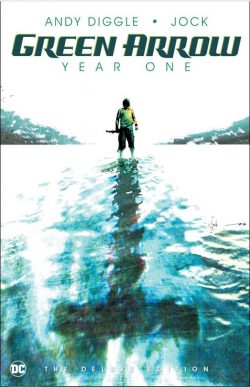
Green Arrow: Year One – The Deluxe Edition


By Andy Diggle & Jock & various (DC Comics)
ISBN: 978-1-77950-114-1 (HB)

Green Arrow is one of DC’s Golden All-Stars. He’s been a fixture of the company’s landscape – in many instances for no discernible reason – more or less continually since his 1941 debut in More Fun Comics #73. Many Happy Returns, Emerald Archer!

In those distant heady days, origins weren’t as important as image and storytelling, so creators Mort Weisinger and George Papp never bothered. The first inkling of formative motivations came in More Fun Comics # 89 (March 1943) wherein Joe Samachson & Cliff Young detailed ‘The Birth of the Battling Bowman‘ (and a tip of the feathered hat to Scott McCullar for bringing the tale to my belated attention). With the secret revealed, it was promptly ignored for years, leaving later workmen France Herron, Jack Kirby and his wife Roz to fill in the blanks again with ‘The Green Arrow’s First Case’ at the start of the Silver Age superhero revival. It appeared in Adventure Comics #256, coved-dated January 1959.

This time the story stuck, becoming – with numerous tweakings over successive years – the basis of the modern Amazing Archer on page and screen.

The most impressive recalibration came in 2006 courtesy of Brit-packers Andy Diggle & Jock (better unknown to all as Mark Simpson, ably assisted by colourist David Baron and letterer Jared K. Fletcher) which massaged with spectacular visuals and jaded, post-modern cynicism the well-worn tale of a wealthy wastrel who finds purpose after being marooned on a desert island. The result was a comfortably modern, unsettlingly bleak, dark and violent contemporary classic.

Adrenaline junkie and trust-fund millionaire Oliver Queen makes a public fool of himself at a society bash and is compelled by shame to join his bodyguard Hackett on a boating trip to the Pacific. On board, Ollie discovers that the man he regularly trusts his life with has stolen all his money and intends to kill him now to get away with it…

When the murder-attempt goes awry, Queen somehow washes up on a desolate volcanic island. His early days of privation and thirst only worsen when he discovers the place is a criminal venture: a vast drug factory complete with slave workers and a sadistic crime queen called China White.

After being wounded by gun-toting thugs, a drug-slave secretly ministers to his wounds, and once Ollie learns Hackett is also involved in these atrocities, long submerged feelings and ethics resurface. He built a bow to catch fish, but now that he has a new reason to live, can he use it to stay alive and save others too?

This modern retelling is sharp and edgy as you’d expect from such extremely talented creators: rocket paced, potently suspenseful and peppered with spectacular action set pieces. This modern spin actually benefits and improves the character of Queen/Green Arrow, elevating a fan favourite to the first rank of Super Heroes. An excellent addition to the legend of one of DC’s most enduring, endearing characters.

This deluxe hardback edition (available in digital formats) also offers an Introduction by Brian K. Vaughn, and a Survival Guide section which includes Script excerpts and a wealth of preliminary artwork.
© 2020 DC Comics. All Rights Reserved.

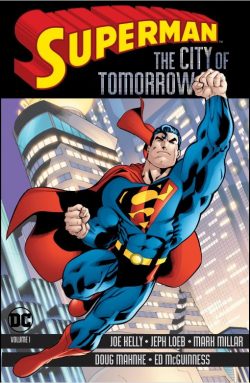
Superman: The City of Tomorrow volume 1


By Jeph Loeb, Stuart Immonen, Mark Millar, Mark Schultz, Joe Kelly, Mike McKone, Steve Epting, Dough Mahnke, German Garcia, Joe Phillips, Yannick Paquette, Kano, Butch Guice, Ed McGuinness & various (DC Comics)
ISBN: 978-1-4012-9508-0 (TPB)

The Man of Tomorrow has proven to be all things to most people over more than 80 years of action and adventure, with Jerry Siegel & Joe Shuster’s iconic Superman now practically unrecognisable to most fans after continual radical shake-ups and revisions. Nevertheless, every refit and reboot has resulted in appalled fans and new devotees in pretty much equal proportion, so perhaps the Metropolis Marvel’s greatest ability is the power to survive change…

These days, in the aftermath of the Future State and Infinite Frontier events, myriad decades of accrued mythology have been re-assimilated into an overarching, all-inclusive media dominant, film-favoured continuity, with the grittily stripped-down, post-Crisis on Infinite Earths Man of Steel (as re-imagined by John Byrne and built upon by an army of immensely talented comics creators) regarded as a stunning high point.

As soon as the Byrne restart had demolished much of the mythology and iconography which had grown up around the “Strange Visitor from Another World” over fifty glorious years, successive writers, artists and editors expended a lot of time and ingenuity restoring it, albeit in terms more accessible to a cynical, well-informed audience far more sophisticated than their grandparents ever were.

Even so, by the mid-1990’s Byrne’s baby was beginning to look a little tired. The sales kick generated by the Death… and Return of Superman was already fading, so the decision was made to give the big guy a bit of a tweak for the fast-approaching new millennium: bringing in new creators and moving the stories into more bombastic territory.

The fresh tone was augmented by a new sequence and style of trade paperback editions and this new collection adheres to that format in gigantic themed tomes like this initial outing re-presenting material from Action Comics #760-763; Superman #151-154, Superman: Man of Steel # 95-98; The Adventures of Superman #573-576 and Superman: Y2K, covering December 1999-March 2000.

It spectacularly opens with ‘We’re Back!’ by Jeph Loeb, Mike McKone & Marlo Alquiza (from Superman #151), which sees the recently wrecked Daily Planet restored, rebuilt and returned to glory after a dark period under the ownership of Lex Luthor, allowing Lois Lane-Kent plenty of opportunities for reflection, remembrance and handy recapping before the sinister son of alien marauder Mongul explosively crashes to earth…

‘Higher Ground’ (by Stuart Immonen, Mark Millar, Steve Epting & Denis Rodier from Adventures of Superman #573) then details Luthor’s machinations and political chicanery in the creation of a proposed elite “hypersector” to cap the rebuilding of “his” City of Tomorrow. Only stubborn landowner Jerome Odett stands in his way, but with the mayor on his team and bending the law to his needs Lex is assured of victory… until Superman intervenes using sentiment, nostalgia and happy childhood memories as his weapons of choice to arouse popular opinion…

Mark Schultz, Doug Mahnke & Tom Nguyen then reveal that ‘Krypton Lives’ (Superman: Man of Steel # 95) after a Superman robot malfunctions in the Antarctic, allowing humans to enter the Kryptonian’s Fortress of Solitude and triggering the escape of a bizarre string of ancient yet impossibly alive Kryptonian artefacts and creatures.

Forced to destroy the last vestiges of his alien heritage, Kal-El returns to Lois, thinking that a precious chapter of his life is over, but he couldn’t be more wrong…

Crafted by Joe Kelly, German Garcia & Joe Rubinstein, Action Comics #760 depicts ‘…Never-Ending Battle…’ as a legion of minor menaces and misfits lead the Man of Tomorrow to Latina sorceress La Encantadora who sells slivers of Kryptonite to thugs trying to lay our hero low. Even after the elusive enchantress is corralled, she delivers one last surprise which will make much mischief for the Last Son of Krypton…

‘Deadline U.S.A.’ (Superman #152, Loeb, McKone & Alquiza) resumes the interrupted battle with Mongul Jr., but all conflict ceases when the mammoth monster finally gets the Man of Steel to stop hitting and listen…

The brutal tyrant has come to warn of a vast, universe-ending threat and, in conjunction with Luthor, is offering to train Superman to beat it…

There are more pedestrian but just as critical distracting problems to deal with. During Superman’s sparring with Mongul, Jimmy Olsen took a photo of the hero’s hand sporting a wedding ring. When the picture is leaked, the media goes into a feeding frenzy…

‘Something Borrowed, Something Blue’ (Immonen, Millar, Joe Phillips & Rich Faber; Adventures of Superman #574) follows that strand as old foe and potential bunny-boiler Obsession resurfaces in a Superwoman outfit, claiming to be the much-sought Mrs. Superman. However, her deranged tantrum leads to nothing but tragedy and disaster…

Returning ‘Home’ (by Schultz, Mahnke & Nguyen in Superman: Man of Steel #96) Clark Kent finds his Metropolis apartment transformed into a terrifying outpost of his destroyed birthworld, courtesy of renegade miracle machine The Eradicator. In the resultant clash, Superman looks doomed to destruction, until Lois takes decisive action…

Her valiant nature and wifely tolerance is truly tested in Action Comics #761, as – courtesy of Kelly, Garcia & Rubinstein – Lois is abandoned after Wonder Woman requests the Man of Tomorrow join her in battle beside gods against devils.

For the feisty journalist it’s mere days until Clark returns, but she’s blissfully unaware that her husband and the perfect warrior woman have been comrades – and perhaps more – ‘For a Thousand Years…’

The last Christmas of the 20th century ends in Superman #153 (Loeb, McKone & Alquiza) as ‘Say Goodbye’ finds the Action Ace heading into space with Mongul to battle Imperiex, Destroyer of Galaxies who has targeted the Milky Way for destruction…

When the pair implausibly triumph, Mongul instantly betrays his erstwhile pupil and only a violent intervention by bounty hunter Lobo prevents a tragic travesty. What nobody knows is that the Imperiex so recently destroyed is just a fractional drone of the real cosmic obliterator, who is now really ticked off…

Offering a brief pause and change-of-pace ‘A Night at the Opera’ (by Immonen, Millar, Yannick Paquette, Dexter Vines & Rich Faber; Adventures of Superman #575) sees Luthor poison Clark in a churlish attempt to monopolize and impress Lois, before Schultz, Mahnke & Nguyen’s ‘Bridge the Past and Future’ (Superman: Man of Steel # 97) focusses on John Henry Irons – AKA Steel – and his niece Natasha. The high-tech armourers to the City’s police force join Superman against the possessed personification of the Eradicator, still hell-bent on making Earth an outpost of lost Krypton, but now afflicted by an all-too-human consciousness …

As year and millennium anxiously count down to potential doom (kids – this was a genuine concern at the time, you should check it out…) Christmas tensions escalate in Action Comics #762 as Kelly, Garcia, Kano & Rubinstein’s ‘All I Want for Christmas’ finds Man of Steel battling occasional ally Etrigan the Demon beside current foe La Encantadora, before all rediscover the true meaning of the season…

Finally, the long-dreaded doom days begin with the Superman: Y2K one-shot special, crafted by scripter Joe Kelly and artists Butch Guice, Kevin Conrad, Mark Propst & Richard Bonk. ‘The End’ traces the history of the Luthor dynasty in Metropolis, from the first settlers in America to the present day when Last Son Lex practically owns the entire place as a counterpoint to the ongoing action…

With the end of the Holidays fast approaching, staunch traditionalist Clark is facing an existential crisis: Lois and his own mother want to elbow the sacrosanct seasonal tradition of a quiet New Year’s on the Smallville farm for a (professionally-catered, not home-cooked) vacation in the Big City…

Bowing to the inevitable, the Hubby of Tomorrow ferries the family to a Metropolis suddenly gripped with terror: fearing that all the computers on Earth will imminently expire, precipitating the end of civilisation as the millennium closes…

When the countdown concludes, everybody’s fears are totally justified. An alien entity overwhelms the world’s digital systems, triggering a wave of destruction affecting every electronic device on Earth…

Alien digital dictator Brainac 2.5 has upgraded himself since his last attack, but his hatred for Luthor is undiminished. As every hero on Earth battles panic, riots and failing technologies, and Superman and Green Lantern are busy fielding all the nuclear missiles launched during the terrifying induced glitch, the computer dictator is trying his hardest to murder Lex and his new baby daughter Lena Luthor.

As part of his scheme Brainiac 2.5 has also enslaved Earth’s many robotic and android entities such as Red Tornado, Hourman and the Metal Men, but the AI invader is blithely unaware that he too is being used…

With the world – and especially Metropolis – crashing into ruin the secret invader makes its move: from the far distant future the merciless Brainac 13 program has been attempting to overwrite its ancient ancestor and take over Earth centuries before it was even devised…

As described by Loeb, Ed McGuinness & Cam Smith in Superman volume 2 #154 (March 2000), the crisis intensifies in ‘Whatever Happened to the City of Tomorrow?’ as the colossal chronologically-displaced construct begins reformatting the world: converting matter into materials and designs analogous to its own time. Unfortunately, that’s very bad news for the billions of human beings inside buildings, vehicles and vessels abruptly undergoing those transformations…

Even Luthor is helpless, locked out of his own corporate tower as “his” city falls apart whilst the Man of Steel is occupied battling Brainiac 13 and upgraded cyborg assassin Metallo. Assistance arrives in most unwelcome form as little Lena begins offering technical advice. The toddler has been possessed by presumed-destroyed Brainiac 2.5: simultaneously becoming hostage and bolt-hole for the outmoded, nigh-obsolete alien menace…

With the aid of the Metal Men, Superman defeats Metallo and confers with Lois and Jimmy Olsen. The games-mad lad theorises that the transforming city is starting to resemble a gigantic motherboard…

As elsewhere Jonathan and Martha Kent are trapped aboard a subway train programmed to deliver organic units to a slave-indoctrination station, the Action Ace attempts to dislodge the computerising city’s main power cable. When Brainiac 13 tries to digitise and absorb the annoying Kryptonian, it accidentally reverts the hero to a previous incarnation: the intangible electrical form dubbed Superman Blue…

The hostile planetary hacking continues in The Adventures of Superman #576 as ‘AnarchY2Knowledge’ (Millar, Immonen & José Marzan, Jr.) finds the Man of Energy hopelessly tackling Brainiac 13. He seeks to quell the rising body count of helpless humans, whilst far below Luthor and Lena 2.5 battle through marauding B13 creations in the overwritten bowels of the LexCorp Tower towards a stolen secret weapon…

The alien-occupied infant shares a direct link with all Brainiacs’ core programming and has discovered a possible backdoor that could enable them to destroy the all-pervasive program from the future. Their progress is greatly facilitated after Luthor’s lethally devoted bodyguards Hope and Mercy finally locate them. As preparations proceed, the villains opt to rescue Superman, incidentally restoring the Metropolis Marvel to a flesh and blood state. To save Metropolis for his family, the evil billionaire will even work with his most hated enemy…

Superman: Man of Steel # 98 continues the epic with ‘Thirty Minutes to Oblivion’ (Schultz, Mahnke & Nguyen) as the senior Kents escape conversion into B13 drones thanks to a last moment rescue by the Man of Steel and The Eradicator.

After a lengthy period of self-imposed banishment in deep space (for which see Superman: Exile) Kal-El returned to Earth carrying an incredibly powerful Kryptonian artefact which had survived the destruction of the planet. The Eradicator could reshape matter and was programmed to preserve or resurrect and restore the heritage and influence of the lost civilisation at any cost.

After a number of close calls Superman realised it was too dangerous, so he buried it in an Antarctic crevasse and foolishly assumed that ended the affair. Such was not the case and the miracle machine returned many times, always attempting to remake Earth into New Krypton.

When Superman died, it manufactured a new body and sought to carry on Kal-El’s legacy… Eventually it failed and fell into the hands of dying scientist David Connor who merged with the manufactured body to produce a phenomenally powerful – if morally and emotionally conflicted – new hero…

Superman’s understandable anxiety is assuaged as Eradicator points out a weakness in B13 tech assimilation. Its transmode programs have been unable to infect Kryptonian systems such as those in the Fortress of Solitude, but the base has now become the invader’s primary target. If the program masters Kryptonian systems it will be utterly unstoppable…

After finishing off Metallo and the co-opted Metal Men, Eradicator and Superman head to the Fortress, whilst in his factory John Henry Irons and Natasha find their own temporary answer to the threat of the constantly encroaching and bloodthirsty B13 drones…

Deep below LexCorp, Luthor and Lena 2.5 are working towards similar goals with the same insights whilst planning to betray each other later. Admitting that Brainiac core systems can’t even see Kryptonian tech, the baby bodysnatcher advises Lex to modify the robotic warsuit stolen from Superman and deploy it against the apparently omnipotent digital invader.

In the Antarctic, events have moved to a crisis point. The Fortress – transformed by echoes of the original Eradicator – has reconstructed itself into a colossal warrior attempting to overwrite the predatory B13 programs and satisfy its own primary mission… recreating Krypton.

To counter this threat David Connor pays an intolerable price…

The epic comes to a startling conclusion in ‘Sacrifice for Tomorrow’ (Kelly, Garcia, Kano & Alquiza in Action Comics #763) as Superman returns to Metropolis armed with the knowledge of B13’s Achilles’ heel and his repurposed Kryptonian butler Kelex…

Attacking the monstrous computer tyrant with a battalion of mechanoid heroes, the Man of Tomorrow is again repulsed and seeks Luthor’s aid. However, despite Lex’s resolve to work with his nemesis to defeat Brainiac, the billionaire cannot resist turning the warsuit on its previous owner. Typically, Superman was counting on treachery, using it as an opportunity to hijack the Kryptonian armour’s systems to power a forced crash in Brainiac 13…

The blockbuster battle ends as Earth is rapidly reconverted to its original state, but for some inexplicable reason the remission halts outside Metropolis. The city remains a valuable, incomprehensible artefact of a far future with Luthor in the driving seat, frantically patenting thousands of incredible technological advances. There is no sign of baby Lena and the new master of Metropolis refuses to hear her name mentioned…

To Be Continued…

With covers by Phil Jimenez; Dwayne Turner & Danny Miki; Ian Churchill & Norm Rapmund; Bryan Hitch & Paul Neary; Lee Bermejo; Guice; McGuiness & Smith; Immonen & Marzan; Mahnke & John Dell and Garcia & Mendoza, this blistering paperback and digital blockbuster tome introduces a whole new world – and a wealth of fresh problems – for the venerable, wide-ranging cast to cope with: building built upon the scintillating re-casting of the greatest of all superheroes. Lovers of the genre cannot help but respond to the sheer scale, spectacle and compelling melodrama of these tales which will delight all fans of pure untrammelled Fights ‘n’ Tights fiction.
© 1999, 2000, 2019 DC Comics. All Rights Reserved.


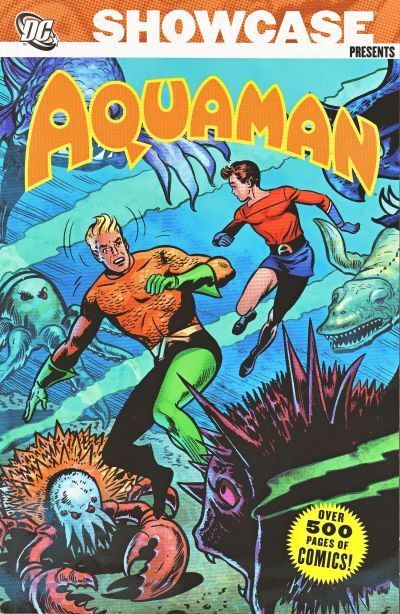
Showcase Presents Aquaman volume 1


By Robert Bernstein, Jack Miller, George Kashdan, Bob Haney, Ramona Fradon, Nick Cardy, Jim Mooney & various (DC Comics)
ISBN: 978-1-4012-1223-0 (TPB)

Big year for comics anniversaries, and we can’t let this guy go unmentioned. Sadly, most of his back catalogue is still unavailable unless you track down aging compendia like this bulky gem. Although unavailable in digital formats, one of the greatest advantages of these monochrome tomes is the opportunity they provide whilst chronologically collecting a character’s adventures to include crossovers and guest spots from other titles. When the star is as long-lived and incredibly peripatetic as DC’s King of the Seven Seas that’s an awful lot of extra appearances for a fan to find…

One of the few superheroes to survive the collapse at the end of the Golden Age was a rather nondescript and generally bland looking chap who solved maritime crimes, rescuing fish and people from sub-sea disaster. Aquaman was created by Mort Weisinger and Paul Norris in the wake of Timely Comics’ Sub-Mariner: debuting in More Fun Comics #73 (November 1941) with fellow born survivor Green Arrow.

Strictly a second stringer for most of his career, Aquaman nevertheless continued on far beyond many stronger features. He was primarily illustrated by Norris, Louis Cazeneuve and Charles Paris, until young Ramona Fradon took over the art chores in 1954, by which time the Sea King had settled into a regular back-up slot in Adventure Comics. Fradon was to draw every single adventure until 1960 and indelibly stamp the hero with her unique blend of charm and sleek competence.

In 1956, Showcase #4 finally rekindled the public’s imagination and zest for costumed crime-fighters. As well as re-imagining Golden Age stalwarts, DC undertook to update and remake its hoary survivors. Records are incomplete, sadly, so often we don’t know who wrote what, but the initial revamp ‘How Aquaman Got His Powers!’ (Adventure Comics #260, May 1959) was the work of Robert Bernstein who wrote the majority of the subsea capers at this time.

From that tale on the hero had a new origin – offspring of a lighthouse keeper and a refugee from the undersea city of Atlantis – and eventually all the trappings of the modern superhero followed: Themed hideout, sidekick and even super-villains! Moreover, greater attention was paid to continuity and the concept of a shared universe.

The 49 adventures gathered here encompass that early period of renewal, taking him from wandering back-up bit-player to stardom and his own comic book. Writers from those years included the aforementioned Bernstein, Jack Miller, George Kashdan, Bob Haney and perhaps other DC regulars, but the art was always by Fradon, whose captivatingly clean economical line always made the pictures something special.

The initial stories are pretty undemanding fare, ranging from simply charming to simply bewildering examples of all-ages action to rank alongside the best the company offered at the time. ‘Aquaman Duels the Animal Master’, ‘The Undersea Hospital’, ‘The Great Ocean Election’, ‘Aquaman and his Sea-Police’ and ‘The Secret of the Super Safe’ kept the hero in soggy isolation, but via an early crossover, Aquaman made his full entrance into the DC universe.

DC supported the popular 1950s Adventures of Superman TV show with a number of successful spin-off titles. Superman’s Girlfriend Lois Lane #12 (October 1959) featured ‘The Mermaid of Metropolis’ wherein the plucky news hen (and isn’t that a term that’s outlived its sell-by date?) suffers crippling injuries in a scuba-diving accident. On hand to save her is Aquaman and a surgeon who turns her into a mermaid so she can live a worthwhile life without legs beneath the waves.

I know, I know: but just accepting the adage “Simpler Times” often helps me at times like this. In all seriousness, this silly story – by Bernstein – is a key moment in the development of one-universe continuity. The fact that it’s drawn by Kurt Schaffenberger – one of the most accomplished artists ever to work in American comics – makes it even more adorable, for all its silliness; and you can’t make me change my mind…

‘Aquaman Meets Aquagirl’ (Adventure Comics #266, by Bernstein & Fradon) gave a little more information about lost Atlantis whilst testing the waters (sorry!) for a possible sidekick. Remember, in those days the Sea King spent most of his time expositorially dialoguing with an octopus so with Adventure Comic #267 the editors tried a novel experiment.

At this time the title starred Superboy and featured two back-up features. Aquaman tale ‘The Manhunt on Land’ saw villainous Shark Norton trade territories with Green Arrow’s foe The Wizard and, in a rare crossover – both parts of which were written by Bernstein – the two heroes worked the same case with Aquaman fighting on dry land whilst the Emerald Archer pursued his enemy beneath the waves in his own strip ‘The Underwater Archers’, illustrated by the great Lee Elias.

In the next issue ‘The Adventures of Aquaboy!’ we got a look at the early years of the Sea King, and following that permanent sidekick Aqualad was introduced in ‘The Kid from Atlantis!’ In quick succession came ‘The Menace of Aqualad’, ‘The Second Deluge!’, ‘The Human Flying Fish!’, ‘Around the World in 80 Hours’, ‘Aqua-Queen’ and intriguing mystery ‘The Interplanetary Mission’.

Originally seen in Adventure Comics #275 – a few months after the debut of the Justice League of America in The Brave and the Bold #28 – this story concerned a plot to secure Kryptonite from the sea-floor. Although Superman did not appear, nets of shared continuity were being gradually interwoven. Heroes would no longer work in assured solitude. It was back to business as usual for ‘The Aqua-thief of the Seven Seas’, ‘The Underwater Olympics’, ‘Aqualad Goes to School’, ‘Silly Sailors of the Sea’ and ‘The Lost Ocean’: a typical mixed bag which served to set the scene for a really Big Event.

In Showcase #30 (January-February 1961) Jack Miller & Fradon expanded the origin of Aquaman in full-length epic ‘The Creatures from Atlantis’, wherein extra-dimensional creatures conquer the sunken civilisation. From this point on fanciful whimsy would be downplayed in favour of character-driven drama. The saga was followed by tense thriller ‘One Hour to Doom’ in Adventure Comics #282. Inked by Charles Paris, this was Fradon’s last art job for nearly a year and a half, whilst a second Showcase issue by Miller saw the first Aquaman job for comics veteran Nick Cardy who would visually make Aquaman his own for the next half-decade.

‘The Sea Beasts from One Million B.C.’ (Showcase #31, March/April 1961) is a wild romp of fabulous creatures, dotty scientists and evolution rays presaging a new path for the King of the Seas. Jim Mooney drew ‘The Charge of Aquaman’s Sea Soldiers’ for Adventure #284, before the series shifted to a new home, replaced by Tales of the Bizarro World.

Before that, however, there was another Showcase spectacular. Miller & Cardy pulled out all the stops for ‘The Creature King of the Sea’: an action-packed duel against a monstrous villain with murder in mind. The hind end of Detective Comics #293 (July 1961) then welcomed Aquaman & Aqualad, who took only six pages to solve the mystery of ‘The Sensational Sea Scoops’. All this time Cardy – who had initially altered his drawing style to mirror Fradon – had been gradually reverting to his natural, humanistic mode. By the time of fourth Showcase outing, ‘Prisoners of the Aqua-Planet’ (#33) appeared, the Sea King was a rugged, burly He-Man, and his world – no matter how fantastic – had an added edge of realism to it.

Detective #294’s ‘The Fantastic Fish that Defeated Aquaman’ coincided with a guest-spot in a second Superman Family title. Drawn by Al Plastino, ‘The Monster that Loved Aqua-Jimmy’ (Superman’s Pal Jimmy Olsen #55) is another child of its time that hasn’t weathered well, but the big kid in me still regards it fondly and I hope that others will afford it the same courtesy. Meanwhile, back at Detective Comics #295, our heroes defied ‘The Curse of the Sea Hermit’ (scripted by George Kashdan), before next month exposed ‘The Mystery of Demon Island!

To accompany the more realistic art, and perhaps in honour of their new home, the stories became – briefly – less fantasy oriented. ‘Aqualad, Stand-In for a Star’ (Miller & Batman stalwart Sheldon Moldoff) was a standard hero-in-Hollywood crime caper, after which Cardy drew both ‘The Secret Sentry of the Sea’ (#298) and ‘Aquaman’s Secret Teacher’ (#299): a brace of yarns encompassing security duty at a secret international treaty signing and the Sea scions teaching an old blowhard a lesson in tall-tale telling…

The next month saw another milestone. After two decades of continuous adventuring the Sea King finally got a comic book of his own. Aquaman #1 (January/February 1962) was a 25-page fantasy thriller introducing one of the most controversial supporting characters in comics lore. Pixie-like Water-Sprite Quisp was part of a strange trend for cute imps and elves who attached themselves to far too many heroes of the time, but his contributions in ‘The Invasion of the Fire-Trolls’ and succeeding issues were numerous and obviously carefully calculated and considered…

‘The Mystery of the Undersea Safari!’ (Detective Comics #300) was the last Aqua caper before he moved again, this time to World’s Finest Comics. However, prior to that residency commencing, his own second issue appeared. ‘Captain Sykes’ Deadly Missions’ is a lovely-looking thriller with fabulous monsters and a flamboyant pirate blackmailing the Sea King into retrieving deadly mystical artefacts.

The World’s Finest run started in fine style with #125’s ‘Aquaman’s Super-Sidekick’ (Miller & Cardy) and Aquaman #3 provided full-length thrills and more exposure for the lost city in ‘The Aquaman from Atlantis’: a tale of traitors and time-travel. WF #126 then saw the heroes foil thieves with ‘Aquaman’s Super Sea Circus’ as – for better or worse – Quisp returned in #4’s ‘Menace of the Alien Island’.

A more welcome returnee was Ramona Fradon who took over the World’s Finest strip with #127’s ‘Aquaman’s Finny Commandos’ before the next issue saw ‘The Trial of Aquaman’ close in his favour just in time to endure ‘The Haunted Sea’ in his own fifth issue, and encountering ‘The Menace of the Alien Fish’ in WF #129.

This bumper volume concludes with Aquaman #6 and ‘Too Many Quisps’: a case of painfully mistaken identity and a sentiment difficult to disagree with… but still beautifully illustrated by Mr. Cardy.

DC has a long and comforting history of gentle, innocuous yarn-spinning with quality artwork. Fradon’s Aquaman is one of the most neglected runs of such universally-accessible material, and it’s a sheer pleasure to discover just how readable they still are. When the opportunity arises to compare her astounding work to the best of a stellar talent like as Nick Cardy, this book becomes a true fan’s must-have item and even more so when the stories are still suitable for kids of all ages. Why not treat the entire family to a seaside spectacle of timelessly inviting adventure?
© 1959-1962, 2007 DC Comics. All Rights Reserved.
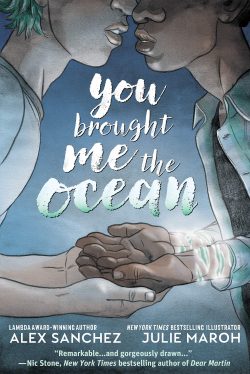
You Brought Me the Ocean


By Alex Sanchez, Julie Maroh & various (DC Comics)
ISBN: 978-1-4012-9081-8 (TPB)

In recent years DC has opened up its shared superhero universe to generate Original Graphic Novels featuring its stars in stand-alone(ish) adventures for the demographic clumsily dubbed Young Adult. To date, results have been rather hit or miss, but when they’re good they are very good indeed…

An ideal example is You Brought Me the Ocean, which reinterprets the origin of modern day Aqualad, concentrating on the comic book character’s Gay credentials rather than his costumed career.

Crafted by Alex Sanchez (Rainbow Boys; So Hard to Say; The God Box; The Greatest Superpower) and Julie Maroh (Blue is the Warmest Color; Body Music) and available in paperback and eBook editions, this dreamily-rendered, salty sea tale details the graduating year of High School student Jake Hyde who lives in the driest part of New Mexico but dreams of deep-sea kingdoms and fantastic marine adventure.

His mother is a constant worrier: always telling him to eat properly, dress appropriately and stay hydrated. Ironically though, ever since his all-but-forgotten dad drowned years ago, she has never let him near large bodies of water… or even allowed him to swim…

Always a loner, Jake’s absolute best friend in the one-horse town of Truth or Consequences (formerly Hot Springs, NM) is Maria Mendez. She has already mapped out their future together and has no idea he yearns for the nautical life and has already applied to University of Miami to study Oceanography…

The Mendez’s are neighbours and a second family, and far more amenable to Jake’s aspirations of leaving New Mexico, whilst his own mother shuts down every attempt to discuss the issue. She’s far more concerned with why Jake and Maria haven’t started dating yet. Sadly, Jake has never – ever – thought of her that way and has resigned himself to going it alone if he wants to realise his ambitions…

One day, things change dramatically as Jake suddenly notices class rebel Kenny Liu. He’s known the strange, outspoken outsider since Middle School, but has stayed well away – painfully aware of the target the outsider’s actions made him. Now though, the bully-defying, openly-Gay swim team star-athlete seems irresistibly fascinating…

And apparently, the interest is mutual…

Life changes forever when Jake agrees to accompany Kenny on a hike into the desert. The far more mature misfit has plenty of solid advice – on Maria, leaving town and life choices – but all that is forgotten when a sudden flash-flood interrupts their first kiss and activates tattoo-like birthmarks all over Jake’s body. Suddenly, he starts to glow and project water-manipulating energies…

With Jake’s world suddenly shaken to flotsam and jetsam, shock follows shock and calamity arrives in its wake. Jake’s attempts to explore his sexuality bring heartbreak and chaos, but even that’s dwarfed when he comes out to his mom and learns the truth about his father and how he is connected to both superhero Aquaman and one of the most dangerous villains on Earth…

Moreover, in the throes of these astounding revelations and an irresistible attraction, it’s too easy to forget that not only metahuman maniacs respond with bigotry and mindless violence to what they deem “unnatural”…

A truly magical treatment exploring the processes of coming out and finding yourself, deftly cloaked in the shiny trappings of costumed heroics, the search for belonging and teen feelings of alienation, You Brought Me the Ocean is an intriguing tale to warm the heart and comes with a contact page detailing Resources available to those affected by the issues herein; personal messages from Sanchez and Maroh and an extensive section of designs and drawings from the illustrator’s Sketchbook.
© 2020 DC Comics. All Rights Reserved.
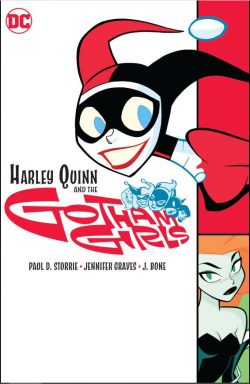
Harley Quinn and the Gotham Girls


By Paul D. Storrie, Jennifer Graves & J. Bone with Brad Rader, Rick Burchett & various (DC Comics)
ISBN: 978-1-4012-9971-2 (TPB)

Harley Quinn wasn’t supposed to be a star… or even an actual comics character. As soon became apparent, however, the manic minx always has her own astoundingly askew and off-kilter ideas on the matter… and any other topic you could name: ethics, friendship, ordnance, coffee…

Created by Paul Dini & Bruce Timm, Batman: The Animated Series aired in the US from September 5th 1992 to September 15th 1995. Ostensibly for kids, the breakthrough television cartoon revolutionised everybody’s image of the Dark Knight and immediately began feeding back into the print iteration, leading to some of the absolute best comicbook tales in the hero’s many decades of existence.

Employing a timeless visual style dubbed “Dark Deco”, the show mixed elements from all iterations of the character and, without diluting the power, tone or mood of the premise, reshaped the grim avenger and his extended team into a wholly accessible, thematically memorable form that the youngest of readers could enjoy, whilst adding shades of exuberance and panache that only the most devout and obsessive Batmaniac could possibly object to…

Harley was initially the Clown Prince of Crime’s slavishly adoring, extreme abuse-enduring assistant, as seen in Joker’s Favor (airing on September 11th 1992). She instantly captured the hearts and minds of millions of viewers and began popping up in the incredibly successful licensed comic book. Always stealing the show, she soon graduated into mainstream DC continuity. Along the circuitous way, Harley – AKA Dr. Harleen Quinzel – developed a support network of sorts in living bioweapon Poison Ivy and a bizarre love/hate relationship with some of Gotham’s other female felons…

After a brief period bopping around the DCU, she was re-imagined as part of the company’s vast post-Flashpoint major makeover: subsequently appearing all over comics as cornerstone of a new iteration of the Suicide Squad, in movies and her own adult-oriented animation series. At heart, however, she’s always been a cartoon glamour-puss, with big, bold, primal emotions and only the merest acknowledgement of how reality works…

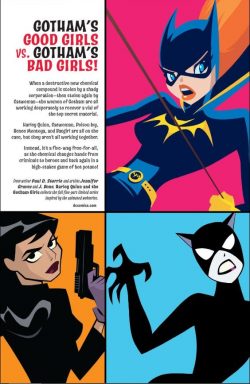
Amongst the plethora of comic books generated by the original cartoon show was a smartly sassy romp featuring those aforementioned crime cuties as well as brace of mismatched and openly antithetical law enforcers. Crafted by Paul D. Storrie, Jennifer Graves & J. Bone, 5-issue miniseries Gotham Girls was released between October 2002 and February 2003: opening with ‘Cat’s Paw’ as super-thief Selena Kyle undertakes a commission to steal something nasty from agricultural conglomerate Zehn Chemicals.

She’s still determined to open a lion sanctuary with her fee and doesn’t appreciate when the supposedly simple caper is interrupted by juvenile do-gooder Batgirl. However, as they trade kicks, punches and quips, overworked, under-appreciated and overlooked GCPD detective Renee Montoya is taking a closer look at the supposed victims and sees something dirty…

Then, as Bat and Cat ferociously but inconclusively throw down all over town, the masterminds behind the theft make their move, and it becomes clear that there’s a lot going on that needs to be properly unearthed…

‘Ivy League’ exposes murderous eco-terrorist Pamela Lillian Isley as bankroller of the heist, claiming benevolent motives to reclaim her own property from unscrupulous, world-endangering corporate creeps. However, because her bestest pal Harley is as erratic and excitable as ever, a potential Bat/Cat/Plant-girl/Dingbat alliance is thwarted by mutual mistrust and excessive, utterly unnecessary violence.

Montoya, meanwhile, is diligently following clues, interviewing greedy biologists and uncovering something at rival agri-company Kayle Corporation…

The fast-moving melee ends in leafy Robinson Park, with Batgirl holding the stolen chemicals, until ‘Harlequinade’ sees manic, attention-starved Quinn pull a martial masterstroke, delivering the bio-booty to her disturbingly abusive gal-pal and a heavy defeat to Catwoman and Batgirl. Naturally, that’s just when solid police practice explosively brings Montoya to their secret lair for ‘I Carry a Badge!’…

Brilliant deduction and a standard-issue firearm aren’t much use against super-villains and giant carnivorous vines though, so it’s a good thing Batgirl and Catwoman have both independently tracked Harley and Ivy. With action amped to maximum, good girls and bad girls clash yet again, and sides are finally drawn for the climactic conclusion, with frustrated cop and masked vigilante hero united at last and resolved to end the chaos in ‘Bat Attitude’.

Of course, that means not just Catwoman, Poison Ivy and Harley Quinn are going to jail…

A superbly riotous rollercoaster ride for kids of all ages, each chapter also deftly explores the interior life, history and motivations of successive stars – offering canny character building and definition most mature-reading tales would be proud to deliver.

Coloured by Patricia Mulvihill, lettered by Phil Felix and with additional layouts by Rick Burchett and Brad Rader, this classy, classically cops ‘n’ robbers riot plays very much like a 1940s movie chapter-play – albeit with outrageous gags, biting dialogue and a blend of black humour and bombastic action. A frantic, frenetic hoot, this is an absolute delight, well worth the price of admission and an irresistible treasure to be enjoyed over and over again.
© 2002, 2020 DC Comics. All Rights Reserved.
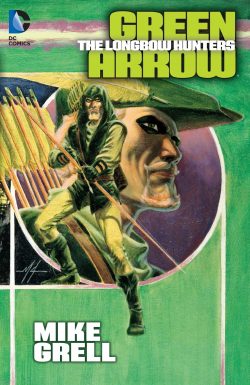
Green Arrow: The Longbow Hunters


By Mike Grell, with Lurene Haynes & Julia Lacquement (DC Comics)
ISBN: ‎ 978-1-4012-3862-9 (TPB)

It’s another big year for major comic book anniversaries. Here’s one now…

First appearing in More Fun Comics #73 in 1941, Green Arrow is one of the very few superheroes to be continuously published (more or less) since the Golden Age of American comic books. On first look, the combination of Batman and Robin Hood seems to have very little going for him, but he has always managed to keep himself in vogue and in sight.

Probably the most telling of his many, many makeovers came in 1987, when – hot on the heels of The Dark Knight Returns – Mike Grell was given the green light to make the Emerald Archer the star of DC’s second Prestige Format Mini-Series.

Grell was considered a major creator at the time, having practically saved the company with his Edgar Rice Burroughs inspired fantasy series Warlord. He had also been the illustrator of many of GA’s most recent tales (in Green Lantern/Green Arrow, Action Comics and elsewhere, and was a firm fan-favourite after well-received runs on Legion of Super-Heroes, Aquaman, Phantom Stranger, Batman and others. During the early 1980s, he had worked on the prestigious Tarzan newspaper strip and created successful genre series such as Starslayer and Jon Sable, Freelance for pioneering indie publisher First Comics.

By the middle of the grim ‘n’ gritty Eighties, it was certainly time for an overhaul of the Battling Bowman. Exploding arrows yes, maybe even net or rope arrows, but arrows with boxing gloves on them just don’t work (trust me – I know this from experience!). Moreover, for his 1960s makeover, the hero had evolved into a tempestuous, social reformer using his gifts to battle for the little guy. Now, in a new era of corrupt government, drug cartels and serial killers, this emerald survivor adapted again and thrived once more.

Following a trenchant and outrageously entertaining Introduction from Mike Gold, the action unfolds, setting out a new path that would quickly lead to the hero becoming a major player at long last and, ultimately, a TV sensation.

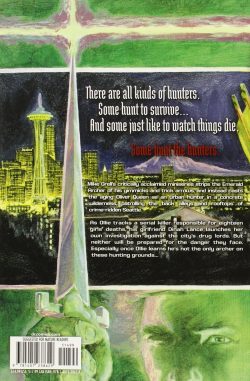
The plot was brilliantly logical and controversial, concerning the superhero’s mid-life crisis. Weary and aging, Oliver Queen relocates to Seattle, struggling to come to terms with the fact that since his former sidekick, Speedy, is now a dad, he is technically a grandfather. With long-time ‘significant other’ Dinah Lance/Black Canary, he begins to simplify his life, but the drive to fight injustice hasn’t dimmed for either of them.

As she goes undercover to stamp out a pervasive drug ring, the Arrow becomes embroiled in the hunt for a psycho-killer dubbed “The Seattle Slasher”. As he tracks a prolific beast slaughtering prostitutes, he becomes aware of a second – cross-country – slayer who has been murdering people with arrows – but only after the “Robin-Hood Killer” murders a grave-digger in his new city…

Eschewing his gaudy costume and gimmicks, Queen reinvents himself as an urban hunter to stop these unglamorous hidden monsters, and stumbles into a complex mystery leading back to World War II which involves the Yakuza, the CIA, corporate America and even Viet Nam war secrets that would eventually change the course of the Archer’s life…

The intricate plot effortlessly weaves around the destabilized champion and his love, while introducing new character Shado: exploring and echoing themes of vengeance and family in a subtle blending of three stories that are in fact one, and still delivers a shocking punch even now, through its disturbingly explicit examination of torture. These issues won the miniseries much undeserved negative press when first published. Although possibly tame to modern eyes this was eye-opening stuff at the time, which is a shame, since it diverted attention from the real achievement. That was narrative quality and sophistication, as this tale is arguably the first truly mature superhero yarn in the DCU.

Grell here produced a gripping, mystery adventure that pushes all the right buttons, conveyed by artwork – in collaboration with Lurene Haynes & Julia Lacquement – that was and remains a revelation. Beautifully demure yet edgily sharp when required, these painterly visuals and watercolour tones perfectly complement a terse, sparse script, and compelling ride any thriller writer would be proud of, and – controversy notwithstanding – this comicbook retooling quickly spawned a monthly series that evolved into one of the best reads of the 1990s.

It all starts here, and so should you.
© 1987, 2012 DC Comics. All Rights Reserved.

John Constantine, Hellblazer volume 3: The Fear Machine (New Edition)


By Jamie Delano, Richard Piers Rayner, Mike Hoffman, Mark Buckingham, Alfredo Alcala & various (Vertigo/DC Comics)
ISBN: 978-1-4012-3519-2 (TPB)

You’ve either heard of John Constantine by now or you haven’t, so I’ll be as brief as I can. Created by Alan Moore during the early days of his groundbreaking run on Swamp Thing, John Constantine is a mercurial modern wizard, a dissolute chancer who plays like an addict with magic on his own terms for his own ends. He is not a hero. He is not a nice person. Sometimes though, he’s all there is between us and the void…

Given his own series by popular demand, he premiered in the dying days of Reaganite Atrocity in the US but at the height of Thatcherite Barbarism in England, so as we’re singing the same song now – but with second-rate Britain’s Got Talent cover-artist wannabes as leaders – I thought I’d cover a few old gems that might be regaining relevance in the days ahead…

In 1987 Creative Arts and Liberal attitudes were dirty words in many quarters and the readership of Vertigo was pretty easy to profile. Jamie Delano began the series with relatively safe horror plots, introducing us to Constantine’s unpleasant nature, chequered history and odd acquaintances but even then, discriminating fans were aware of a joyously anti-establishment political line and wildly metaphorical underpinnings.

Skinheads, racism, Darwinian politics, gender fluidity, plague, famine, gruesome supernature and more abound in the dark dystopian present of John Constantine – a world of cutting edge mysticism, Cyber-shamanism and political soul-stealing. In Delano’s world the edges between science and magic aren’t blurred – they simply don’t exist.

Some terrors are eternal and some seem inextricably tied to a specific time and place. The Fear Machine (available in paperback and digital formats and collecting issues #14-22 spanning December 1988-September 1989) is an engrossing extended epic which begins in ‘Touching the Earth’ (by Delano, Richard Piers Rayner & Mark Buckingham) as the wizard goes on the run thanks to the tabloid press pillorying him as a sex-crazed Satanist serial killer.

Forced to flee his London comfort-zone, Constantine is adopted by neo-pagan Travellers and journeys through the heartland of Britain. Apparently, these dangerous non-conformists are responsible for all the ills plaguing society of the 1980s and 1990s, just like fat people, the poor and immigrants are today…

Going native amongst the drop-outs, druggies, bath-dodgers and social misfits, Constantine buddies up with an immensely powerful psychic girl named Mercury and her extremely engaging mum, Marj, but even amidst these freewheeling folks he can feel something nasty and unnatural building. The first inkling occurs in ‘Shepherd’s Warning’when Mercury discovers an ancient stone circle has been fenced off by a quasi-governmental company named Geotroniks. It seems someone is trying to shackle Mother Earth’s circulatory system of Ley lines.

Meanwhile elsewhere, people are compelled to kill and mutilate themselves while Geotroniks boffins watch and take notes…

Mercury is abducted when police raid the Travellers’ campsite in ‘Rough Justice’. Imprisoned in a secret complex where the mind’s limits and the Earth’s hidden forces are being radically tested, she witnesses horrors beyond imagining and cutting-edge science. If only the subjects and observing scientists can be persuaded to stop committing suicide…

Mike Hoffman illustrates fourth chapter, ‘Fellow Travellers’ wherein Constantine heads back to London for help in finding Mercury and uncovering Geotroniks’ secrets. He gains one horrific insight when the train he’s on is devastated by a psychic assault which forces the passengers to destroy themselves…

With Buckingham & Alfredo Alcala assuming the art duties, ‘Hate Mail & Love Letters’ begins two months later. Marj and the travellers are hiding in the Scottish Highlands with a fringe group called the Pagan Nation, led by the mysterious Zed – an old friend of the wily trickster. Constantine keeps digging, but across the country, suicide and self-harm are increasing. Society itself seems diseased, but at least the Satanist witch hunt has been forgotten as the bloody pack of Press vultures rage on to their next sanctimonious cause celebre …

Touching base with his precious few police contacts and pet journalists, the metropolitan mage soon stumbles into a fresh aspect of mystery when a Masonic hitman begins removing anyone who might further his enquiries in ‘The Broken Man’. Constantine saves journalist Simon Hughes from assassination in a particularly exotic manner guaranteed to divert attention from his politically-damaging investigations, and discovers new clues. It all points the psychic horror and social unrest being orchestrated by reactionary factions of the government employing a sinister and all-pervasive “Old Boy network”…

And somewhere dark and hidden, Mercury’s captors are opening doors to places mortals were never meant to go…

As the Pagan Nation’s priestesses work subtle magics to find the missing girl and save humanity’s soul, a disgusting, conglomerate beast-thing is maturing, made from fear and pain, greed, suffering and deep black despair: provoking a response from and guest-appearance by Morpheus, the Sandman, which prompts Constantine, Hughes and possibly the last decent copper in London to go hunting…

After picking up another recruit in the form of KGB scientist Sergei in ‘Betrayal’, events spiral ever faster as the Freemasons – or at least their “Magi Caecus” elite – are revealed as organisers of the plot to combine Cold War paranormal research, economic imperialism, divisive Thatcherite self-gratification and the Order’s own quasi-mystical arcana to create a situation in which their guiding principles will dominate society and the physical world. It’s nothing more than a greedy, sleazy power-grab using blood and horror to fuel the engines of change…

All pretence of scientific research at Geotroniks is abandoned in ‘The God of All Gods’ as Masonic hitman Mr. Webstergoes off the deep end, ignoring his own Lodge Grandmaster’s orders to abort the project amidst an escalating national atmosphere of mania. He is determined to free the fearful thing they’ve created and unmake the modern world at all costs. Constantine’s allies are all taken and the wizard is left to fight on alone.

Knee deep in intrigue, conspiracy and spilled guts, humanity is doomed unless Constantine’s band of unhappy brothers and a bunch of Highland witch-women can pull the biggest, bloodiest rabbit out of the mother of all hats in spectacular conclusion ‘Balance’…

The heady blend of authoritarian intransigence, counterculture optimism, espionage action, murder-mystery, conspiracy theories and ancient sex-magic mix perfectly to create an oppressive tract of inexorable terror and shattered hope before an astounding climax forestalls – if not saves – the day of doom, in this extremely impressive dark chronicle which still resonates with the bleak and cheerless zeitgeist of the time.

This is a superb example of true horror fiction, inextricably linking politics, religion, human nature and sheer bloody-mindedness as root cause of all ills. That our best chance of survival is a truly reprehensible, exploitative monomaniac seems a perfect metaphor for the world we’re locked into…

Clever, subversive and painfully prophetic, even at its most outlandish, this tale jabs at the subconscious with its scratchy edginess and jangles the nerves from beginning to end. An unmissable feast for fear fans, humanists and political mavericks everywhere…
© 1989, 2012 DC Comics. All Rights Reserved.
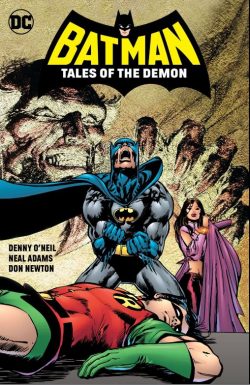
Batman: Tales of the Demon


By Dennis O’Neil, Neal Adams, Bob Brown, Irv Novick, Dick Giordano, Michael Golden, Don Newton & various (DC Comics)
ISBN: 978-1401299439 (HB)

After three seasons the overwhelmingly successful Batman TV show ended in March, 1968. Clocking up 120 episodes plus a theatrical-release movie since its premiere on January 12, 1966 it had triggered a global furore of “Batmania” fomenting hysteria for all things costumed, zany and mystery-mannish.

Once the series foundered and crashed, global fascination with “camp” superheroes burst as quickly as it had boomed, and the Caped Crusader was left to a hard core of dedicated fans and followers who hoped they might now have “their” hero back.

For comic book editor Julius Schwartz – who had tried to keep the most ludicrous excesses of the show off his pages whilst still cashing in on his global popularity – the solution was simple: ditch the tired shtick, gimmicks and gaudy paraphernalia and bring Batman back to basics, solving baffling mysteries and facing life-threatening perils.

That also meant phasing out the boy sidekick. Although the college freshman Teen Wonder would pop back for the occasional guest-shot yarn, this monument to comics ingenuity and narrative brilliance features him only sporadically. Robin had finally spread his wings and flown the nest for a solo back-up slot in Detective Comics, alternating with TV-derived newcomer Batgirl.

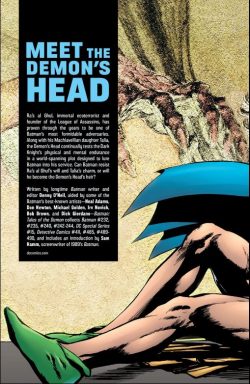
This themed collection re-presents some of the key clashes between the Gotham Guardian and immortal mastermind eco-activist Ra’s al Ghul – a contemporary and more acceptable visual embodiment of the classic inscrutable foreign devil as typified in a less forgiving age as the Yellow Peril or Dr. Fu Manchu. This kind of alien archetype permeates fiction as an overwhelmingly powerful villain symbol, although the character’s Arabic origins, neutral at the time, seem to embody a different kind of ethnic bogeyman in today’s post 9/11 world. These legendary tales and supplementary material come from Batman #232, 235, 240, 242-244; DC Special Series #15; Detective Comics #411, 485, 489-490; Limited Collector’s Edition C-51; and Saga of Ra’s al Ghul #1-4.

The concept of a villain who has the best interests of the planet at heart is not a new one, but Ra’s Al Ghul, whose avowed intent is to reduce teeming humanity to viable levels and save the world from our poison, hit a chord in the 1970s – a period where ecological issues first came to the attention of the young. It was a rare kid who didn’t find a note of sense in what the Demon’s Head planned. I wonder how the latest crop of youthful would-be planet-savers feel about him?

Background and more is discussed in screenwriter Sam Hamm’s recycled 1991 Introduction to that year’s landmark graphic novel compilation of this saga, before the timeless contest of indomitable wills begins with a seminal story from Detective Comics #411. ‘Into the Den of the Death-Dealers’ was written by Denny O’Neil, illustrated by the great Bob Brown, and inked by Dick Giordano, featuring the sinister League of Assassins and introducing exotic mystery woman Talia.

Neal Adams & Dick Giordano joined O’Neil for Batman #232’s ‘Daughter of the Demon’: a signature high-point of the entire Batman canon. It details an exotic chase and mystery yarn drawing an increasingly Dark Knight from Gotham’s concrete canyons to the Himalayas in search of hostages Robin and Talia. If you’re one of the few who hasn’t read this much reprinted tale, I’m not going to spoil the joy that awaits you…

Batman #235 sees penciller Irv Novick join regulars O’Neil & Giordano for ‘Swamp Sinister’, a tale of bio-hazard and double cross affording some early insights into the true character of Talia and her ruthless sire. The same creative team sets the scene for the groundbreaking “series-within-a-series” soon to follow when ‘Vengeance for a Dead Man’ (Batman #240) has Batman uncover one of Ra’s Al Ghul’s less worthy and more grisly projects. As a result, open war begins between Batman and the Demon…

Batman #242-244 and an epilogue from #245 (still-infuriatingly absent from this supposedly definitive collection) formed an extended saga and was taken out of normal DC continuity. It promised what was to be the final confrontation between two opposing ideals. Novick pencilled first episode ‘Bruce Wayne – Rest in Peace!’ wherein Batman gathers a small team of allies – including still-active-today underworld insider Matches Malone – to destroy the Demon forever. Adams returned with second chapter ‘The Lazarus Pit’, which offered titanic action, rollercoaster drama and what seemed to we consumers of the day to be a brilliant conclusion to the epic. But with the last three pages the rug was pulled out from under us and the saga continued!

How sad for modern fans with so many sources of information today: the chances of creators genuinely surprising devoted readers are almost non-existent, but in the faraway 1970s we had no idea what to expect from #244 when ‘The Demon Lives Again!’ hit shops and newsstands.

In a classic confrontation, Batman ultimately triumphs and Ra’s Al Ghul disappeared for years. He was considered by DC as a special villain and not one to be diluted through overuse. How times change…

By 1978 the company was experimenting with formats and genres in a time of poor comic sales. Part of that drive was an irregular anthology entitled DC Special Series and from the all-Batman #15 comes an oddly enticing gem scripted by O’Neil and drawn by a talented young newcomer called Michael Golden, with inks from the ubiquitous Dick Giordano.

‘I Now Pronounce you Batman and Wife’ is a stylish, pacy thriller that anticipates the 1980s sea-change in comics storytelling, but its most interesting aspect is the plot maguffin which later inspired a trilogy of graphic novels in the 1990s and today’s Damien Wayne/Robin.

September 1979 brought another key multi-part epic, represented here by Detective Comics #485, 489 and 490. Although picky me still wishes that all parts were included, the truncated version here suffers no significant loss of narrative flow as Batman is dragged into a civil war for leadership of the Al Ghul organization between the Demon and the aged oriental super-assassin the Sensei – whom older fans will know as the villain behind the murder of aerialist Boston Brand and birth of Deadman.

O’Neil, Don Newton & Dan Adkins open proceedings in ‘The Vengeance Vow!’ as a long-standing member of the Batman Family is murdered, drawing Batman into battle with deadly mind-controlled martial artist Bronze Tiger. After thwarting the Sensei’s schemes for months, the saga cataclysmically concludes in ‘Where Strike the Assassins!’ and ‘Requiem for a Martyr!’

Whilst perhaps not as powerful as the O’Neil/Novick/Adams/Giordano run, this serial is a stirring thriller with a satisfactory denouement, elevated to dizzying heights by the magnificent artwork of Don & Adkins. Newton’s Batman could well have become the definitive 1980s look, but the artist’s tragically early death in 1984 cut short what should have been a superlative and stellar career.

In recent years, Ra’s Al Ghul has become Just Another Bat-Foe: familiarity indeed breeding mediocrity, if not contempt. But these unique tales from a unique era are comics at their very best in this definitive archival landmark.

Adding lustre to proceedings is a gallery of pertinent covers taken from early trade paperback collections. Brian Stelfreeze produced a brace of stunners with 1991’s Batman: Tales of the Demon TPB in editions for DC Comics and Warner Books; Adams created the potent image used on this very edition in a wraparound treat gracing Limited Collector’s Edition C-51 (August 1977) whilst Jerry Bingham & Dick Giordano and Adams & Rudy Nebres delivered a quartet of covers for Saga of Ra’s al Ghul #1-4 (January-April 1988). Also included here are an Afterword by Denny O’Neil and John Wells’ ‘The Saga of the Demon’s Head’ detailing the later schemes of the eternal thorn in humanity’s skin…

With the game-changing classics in this volume, Batman finally returned to the commercial and critical top flight he had deserved and enjoyed in the 1940s: reviving and expanding upon his original conception as a remorseless, relentless avenger of injustice. The next few years would see the hero rise to unparalleled heights of quality so stay tuned: the very best is just around the corner… that dark, dark corner…
© 1971, 1972, 1977, 1978, 1979, 1980, 1988, 2020 DC Comics. All Rights Reserved.
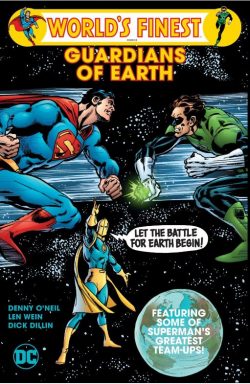
World’s Finest: Guardians of Earth


By Denny O’Neil, Mike Friedrich, Steve Skeates, Len Wein, Elliot S! Maggin, Dick Dillin, Joe Giella & various (DC Comics)
ISBN: 978-1-7795-0178-3 (HB)

For decades Superman and Batman were quintessential superhero partners: the “World’s Finest team”. The affable stalwarts were best buddies as well as mutually respectful colleagues, and their pairing made sound financial sense since DC’s top heroes could happily cross-pollinate and cross-sell their combined readerships. This most inevitable of Paladin Pairings first occurred on the Superman radio show in the early 1940s, whilst in comics the pair had only briefly met whilst on a Justice Society of America adventure in All-Star Comics #36 (August-September 1947) – and perhaps even there they missed each other in the gaudy hubbub…

Of course, they had shared covers on World’s Finest Comics from the outset, but never crossed paths inside; sticking firmly to their specified solo adventures within. In fact, they never shared an official comic book case. However, once that Rubicon was crossed in Superman #76 (May 1952), the partnership solidified thanks to spiralling costs and dwindling page-counts. As 52-page titles dwindled to the 32, WFC permanently sealed the new deal and the industry never looked back…

The Cape and Cowl Crusaders were partners and allies from #71 onwards (July 1954), working together until the title was cancelled in the build-up to Crisis on Infinite Earths in 1986. All that is, except for a brief period when the Man of Steel was paired with other stars of DC’s firmament.

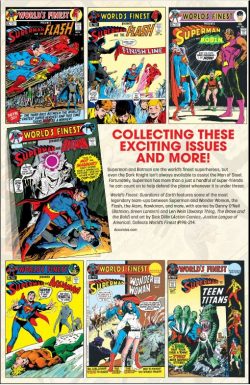
This mighty compelling compendium re-presents those cataclysmic collaborations from the turbulent 1970’s (World’s Finest Comics #198-214, spanning November 1970 to October- November 1972), as radical shifts in America’s tastes and cultural landscape fostered a hunger for more mature, socially relevant stories. That drive even affected the Dark Knight and Action Ace – so much so, in fact, that their partnership was temporarily suspended: paused so Superman could guest-star with other DC icons.

After three years, another bold experiment reunited them as parents of The Super-Sons before the regular relationship was revitalised and renewed. With the World’s Finest Heroes fully restored, their bizarrely apt pre-eminence endured another lengthy run until the title’s demise.

Without preamble the action kicks off here by returning to a thorny topic which had bedevilled fans for years…

The comic book experience is littered with eternal, unanswerable questions. The most common and most passionately asked always begin “who would win if…” or “who’s strongest/smartest/fastest…”

Here, crafted by Denny O’Neil, Dick Dillin & Joe Giella, ‘Race to Save the Universe!’ and the concluding ‘Race to Save Time’ (WFC #198-199; November and December 1970) upped the stakes on two previous competitions as the high-speed heroes are conscripted by the Guardians of the Universe to circumnavigate the entire cosmos at their greatest velocities to reverse the rampage of the mysterious Anachronids: faster-than-light creatures whose pell-mell course throughout the galaxies is actually unwinding time itself and unravelling the fabric of creation. Little does anybody suspect that Superman’s oldest enemies were behind the entire appalling scheme…

Anniversary issue #200 was crafted by regular Robin, the Teen Wonder scripter Mike Friedrich, with Dillin & Giella doing the drawing – as they did for this entire book. ‘Prisoners of the Immortal World!’ (February 1971) focusses on college-student brothers on opposite sides of the Vietnam War debate abducted along with youth icon Robin and “Mr. Establishment” Superman to a distant planet where undying vampiric aliens wage eternal war on each other.

Green Lantern pops in for #201, contesting ‘A Prize of Peril!’ (O’Neil, Dillin & Giella) which would grant either Emerald Gladiator or Man of Steel sole jurisdiction of Earth’s skies. Sadly, all is not as it seems…

Batman returned for a limited engagement in #202 as the O’Neil-penned ‘Vengeance of the Tomb-Thing!’ sees archaeologists unearth something horrific in Egypt, just before Superman seemingly goes mad and attacks his greatest friends and allies. A superb ecological scare-story, this tale changed the Man of Tomorrow’s life for decades to come…

Current Aquaman writer Steve Skeates waded in for #203 as ‘Who’s Minding the Earth?’ pits Metropolis Marvel and King of Atlantis against parthenogenetic mutant dolphins attempting to terraform the polluted world into something more welcoming to their kind…

More ecological terror underpins O’Neil’s bleak warning in #204 as ‘Journey to the End of Hope!’ finds powerless former Wonder Woman Diana Prince and Superman summoned to a barren lifeless Earth. Here a dying computer warns that a butterfly effect will inevitably lead to this future unless they prevent a certain person dying in a college campus riot. Only time will tell if they succeed as the clash does indeed cost a life despite all their efforts…

Racism, sexism and the oppression of reactionary conservative values then get a well-deserved pasting in #205’s ‘The Computer that Captured a Town!’

Here Skeates deviously layers a Teen Titans tale with a wealth of eye-opening commentary after the team are locked into a mid-Victorian parochial paradise enforced by a dead man and alien tech, until the Man of Tomorrow wades in to set things straight…

WFC #206 (October-November 1971) was an all-reprint giant, represented here by its rousing Dick Giordano cover, after which #207 again reunites the true World’s Finest team as Batman returns to solve a murder mystery in the making and save the Man of Tomorrow in ‘A Matter of Light and Death!’, after which Earth-2 sorcerer hero Doctor Fate aids the Action Ace in thwarting the extraterrestrial ‘Peril of the Planet-Smashers!’ – both courtesy of Len Wein, Dillin & Giella.

Supernatural menaces were increasingly popular as a global horror boom reshaped readers’ tastes, informing (#209) Friedrich’s ‘Meet the Tempter – and Die!’ wherein Hawkman and Superman are seduced into evil by an eternal demon, whilst Elliot S! Maggin’s ‘World of Faceless Slaves!’ in #210 catapults the Caped Kryptonian and Green Arrow into a primordial magic kingdom to liberate the vassals of diabolical sorcerer supreme Effron…

The Darknight Detective returns again in #211, as O’Neil, Dillin & Giella devise a global manhunt for a ‘Fugitive from the Stars!’ Their target is a political refugee whose arrest is demanded by warriors who are a physical match for Superman, but happily, not Batman’s intellectual equals…

‘…And So My World Begins!’ in #212 is O’Neil’s thematic sequel to Justice League of America #71, which saw Mars devasted by race war and its survivors flee to the stars in search of a new homeworld. Here, Martian Manhunter J’onn J’onzz seeks Superman’s aid to rescue the last survivors from life-leeching mechanoids, unaware that a traitor has sold them all out to predatory aliens…

Maggin drills deep into super science for #213 as ‘Peril in a Very Small Place!’ finds the greater universe endangered by a microscopic and insatiable Genesis molecule, demanding a fantastic voyage into the Microverse inside a phone line for the Atom and Superman before this compilation concludes with wild west weirdness from by Skeates, O’Neil, Dillin & Giella. Here Golden Age troubleshooter The Vigilante delivers the silver bullet necessary to save Superman when ‘A Beast Stalks the Badlands!’

With covers by Neal Adams, Dick Giordano, Nick Cardy and Curt Swan & Murphy Anderson, this book is a gloriously uncomplicated treasure trove of adventures which still have the power and punch to enthral even today’s jaded seen it-all audiences.

The contents of this titanic team-up tome are a veritable feast of witty, pretty thrillers packing as much punch and wonder now as they always have. Utterly entrancing adventure for fans of all ages!
© 1970, 1971, 1972, 2020 DC Comics. All Rights Reserved.
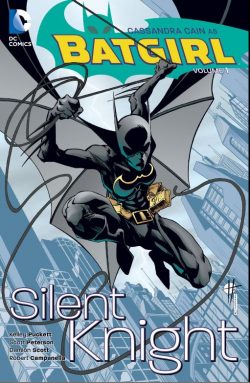
Batgirl volume 1: Silent Knight


By Scott Peterson, Kelley Puckett, Chuck Dixon, Damion Scott, Mike Deodato Jr., Pablo Raimondi & various (DC Comics)
ISBN: 978-1-4012-6627-1 (TPB)

Way back when, after Gotham City was devastated in a massive earthquake (see Batman: Cataclysm and Batman: No Man’s Land in 2000) it was written off and abandoned by the US government in a spookily prescient foretaste of what would happen to New Orleans after Hurricane Katrina hit in August 2005. Amidst the rubble, a number of heroes struggled to protect the innocent. One of these was a brand-new incarnation of Batgirl.

As the crisis ended and a semblance of normality returned to the battered metropolis, the new heroine got her own series and a mentor in the form of Babs Gordon, the wheelchair-bound crime-fighter called Oracle, who was also the first Batgirl.

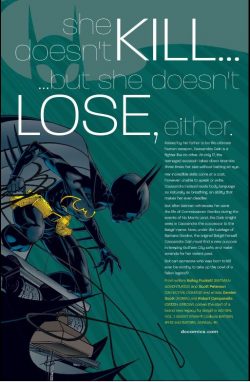
The new operative is an enigmatic problem. Raised in utter isolation as an experiment by martial arts super-assassin David Cain, she cannot communicate. Part of the process creating Cassandra Cain was depriving and overriding her language centres in an effort to make combat her only communication tool. An apparent runaway, she was briefly adopted by the Batman as another weapon in his never-ending battle, before the more humane Oracle becomes her guardian and teacher.

In this first paperback/digital volume – spanning April 2000-March 2001 by collecting #1-12 of the monthly series and first Annual – the new Batgirl is trying to find her way, bereft even of the ability to learn, whilst revelling in the role of defender of the helpless, but her development as a human being threatens to diminish her capacity as a weapon, and the mystery of her past would indicate that she is possibly a two-edged sword in Batman’s arsenal…

In a bold experiment, initiating writers Scott Peterson and Kelly Puckett eschewed the standard format of individually titled stories to craft a continuous string of high action, deeply moving episodes which saw the neophyte street warrior battle the dregs of Gotham City while attempting to adapt to a life where not every person was her enemy.

Fast, furious, frenetic, visually expressive incidents (illustrated by Damion Scott with inkers Robert Campanella & Coy Turnbull) are interspersed with flashbacks to her lethal and cruel formative years with Cain pitting her against assassins and worse, while keeping a stunning secret of her natal origins all for himself…

In contemporary moments, Cassandra prowls the streets determined to honour her saviour Batman and sole friend Babs, battling thieves, thugs, rapists and all the worst human predators the city can throw at her.

All too soon, her first failure – to preserve an innocent life – leaves her emotionally wounded and susceptible to metahuman attack, even as Batman discovers his new operative may have blood on her own hands. Complicating the crisis, a telepath Cassandra rescues boosts her ability to speak, but inadvertently destroys her gift to read body language leaving her helpless against ordinarily easy opposition.

As Batman hunts and confronts Cain to clear Batgirl’s reputation, the embattled, dauntless wild child continues to risk her life in Gotham: going rogue and defying the Dark Knight to patrol the streets until she is targeted by Lady Shiva Woosan.

The world’s deadliest assassin has personal reasons for testing herself against Cassandra, and provides a cure for her lost battle assessment sense, but only to further her own insane agenda…

As Batman further unravels the convoluted mystery of Cassandra’s origins, Batgirl returns to duty, but again confronts failure at metahuman hands. Barely recovered, she finally faces her father and helps save Commissioner Gordon (in ‘Mute Witness’ from Batgirl #12 by Chuck Dixon, Dale Eaglesham & Andrew Hennessy). Her never-ending battle pauses for now after Batgirl Annual #1 takes her to Madras, India for ‘Introducing: Aruna’ by Peterson, Mike Deodato Jr. & John Stanisci.

Joining her mentor Batman and shapeshifting local hero Aruna, Cassandra explosively confronts millennia-old prejudice and ingrained racism whilst hunting for an abducted Bollywood child star exposed as a member of the “untouchables” caste. The shocking tragedy is supplemented by an origin for the shapeshifter, courtesy of Peterson, Pablo Raimondi & Walden Wong

Spellbinding, overwhelmingly fast-paced and terse to the point of bombastic brevity, this is a breakneck, supercharged thrill-ride of non-stop action that still manages to be heavily plot-based with genuine empathy and emotional impact. Truly superb comic storytelling which should be on every fan’s wish-list or bookshelf.
© 2000, 2001, 2015 DC Comics. All Rights Reserved.