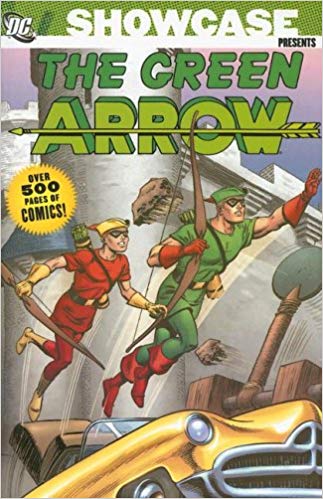
Showcase Presents Green Arrow


By Ed “France” Herron, Jack Miller, Dave Wood, Robert Bernstein, Jerry Coleman, Bob Haney, Gardner Fox, John Broome, George Kashdan, Bill Finger, Jack Kirby, George Papp, Lee Elias, George Roussos, Mike Sekowsky, Neal Adams & various (DC Comics)

ISBN: 978-1-4012-0785-4 (TPB)

DC Comics have, over their decades of existence, published an incalculable volume of absolutely wonderful comics tales in a variety of genres and addressing a wide variety of age ranges and tastes.

Sadly, unlike their rival Marvel, these days they seem content to let most of it languish beyond the reach of fans – both devout and vintage or fresh potential new adherents. As a new decade – possibly or last – unfolds I’ll be continuing my one-person campaign to remind them and inform you that – like The Truth – the Fiction is also Out There… even if only still available in older collections…

Green Arrow is one of DC’s Golden All-Stars: a fixture of the company’s landscape (in many instances for no discernible reason) more or less continually since his debut in 1941. He was originally created by Mort Weisinger and George Papp for More Fun Comics # 73 as an attempt to expand the company’s superhero portfolio, and in the early years proved quite successful. The bowman and boy partner Speedy were two of the few costumed heroes to survive the end of the Golden Age.

His blatantly opportunistic recombination of Batman and Robin Hood seemed to have very little going for itself but the Emerald Archer has somehow always managed to keep himself in vogue. He and sidekick Speedy were part of the 1940s Seven Soldiers of Victory, carried on adventuring in the back of other heroes’ comicbooks and joined the Justice League of America at the peak of their fame before evolving into the spokes-hero of the anti-establishment generation during the 1960’s “Relevancy Comics” trend, courtesy of Denny O’Neil & Neal Adams.

Under Mike Grell’s stewardship and thanks to breakthrough miniseries Green Arrow: the Longbow Hunters (DC’s second Prestige Format Limited Series after the groundbreaking success of Frank Miller’s Batman: The Dark Knight Returns), the battling bowman at last became a headliner: an urban predator dealing with corporate thugs and serial killers rather than costumed goof-balls.

After his long career and a few venue changes, by the late1950s and Julie Schwartz’s revivification of the Superhero genre, the Emerald Archer was a solid second feature in both Adventure and World’s Finest Comics. As part of the wave of retcons, reworkings and spruce-ups the company administered to all their remaining costumed old soldiers, he enjoyed a fresh start beginning in the summer of 1958…

This splendidly eclectic collection of the peripatetic champion’s perennial second-string exploits gathers pertinent material from Adventure Comics #250-269, World’s Finest Comics #95-140, Justice League of America #4 and his guest-shots in Brave and the Bold #50, 71 and 85; covering the period July 1958 to September 1969.

Part of that revival happily coincided with the first return to National Comics of Jack Kirby after the collapse of Mainline: the comics company he and partner Joe Simon had created as part of the Crestwood/Prize publishing combine (which foundered when the industry was hit by the Comics Code censorship controversy and a sales downturn that hit many creators very, very hard)…

Delivered in stark and  stunning monochrome, the on-target tales start with ‘The Green Arrows of the World’ (by scripter Dave Wood and Jack, with wife Roz Kirby inking) wherein heroic masked archers from many nations attended a conference in Star City, unaware that a fugitive criminal is lurking within their midst, whilst that same month George Papp illustrated the anonymously scripted ‘Green Arrow vs Red Dart’ in World’s Finest Comics #95: a dashing tale of the Ace Archer’s potential criminal counterpart and his inevitable downfall.

Adventure #251 took a welcome turn to fantastic science fiction as Ed Herron & the Kirbys resolved ‘The Case of the Super-Arrows’ wherein GA and Speedy take possession of high-tech trick shafts from 3000AD, whilst WFC #96 (writer unknown) reveals ‘Five Clues to Danger’ – a classic kidnap mystery made even more impressive by Kirby’s lean, raw illustration.

A rare continued case spanned Adventure‘s #252 and 253 as Wood, Jack & Roz expose ‘The Mystery of the Giant Arrows’, before the Amazing Archers temporarily become ‘Prisoners of Dimension Zero’ – a spectacular riot of giant aliens and incredible exotic otherworlds. Back to Earth, it’s followed in WF #97 with a grand old-school crime-caper in Herron’s ‘The Mystery of the Mechanical Octopus’.

Kirby was going from strength to strength and Adventure #254’s ‘The Green Arrow’s Last Stand’, written by Wood, is a particularly fine example as the Bold Bowmen crash into a hidden valley where Sioux braves thrive unchanged since the time of Custer, before the next issue sees them battle a battalion of Japanese soldiers who refused to surrender their island bunker in ‘The War That Never Ended’ (also scripted by Wood).

World’s Finest #98 almost ended the heroes’ careers in Herron’s ‘The Unmasked Archers’, wherein a practical joke causes the pair to expose themselves to public scrutiny and deadly danger…

In those heady days, origins weren’t as important as imaginative situations, storytelling and just plain getting on with it, so co-creators Weisinger & Papp never bothered to provide one, leaving later workmen Herron, Jack & Roz (in Kirby’s penultimate tale before devoting all his energies to his fabulous but doomed newspaper strip Sky Masters) to fill in the blanks with ‘The Green Arrow’s First Case’ just as the Silver Age superhero revival hit its stride in Adventure Comics#256 (January 1959).

Here we learned how wealthy wastrel Oliver Queen was cast away on a deserted island and learned to use a hand-made bow simply to survive. When a band of scurvy mutineers fetched up on his desolate shores Queen used his newfound skills to defeat them and returned to civilisation with a new career and secret purpose…

Adventure #257’s ‘The Arrows That Failed’ finds a criminal mastermind tampering with the archer’s equipment in a low-key but intriguing yarn by an unknown scripter, most memorable for being the first artistic outing for Golden Age great Lee Elias. He would become the character’s sole illustrator until its demise following Kirby’s spectacular swan-song in WF #99. ‘Crimes Under Glass’ was written by Robert Bernstein and found GA and Speedy battling cunning criminals with a canny clutch of optical armaments.

Adventure Comics #258 (March 1959) offered a rare cover appearance for the Emerald Archer since he guest-starred in lead feature ‘Superboy Meets the Young Green Arrow’ (by Jerry Coleman & Papp), after which inspiring boyhood on-the-job training the mature bowman then schooled a lost patrol of soldiers in toxophily (that’s posh talk for archery, folks), desert survival and crime-busting in ‘The Arrow Platoon’: another anonymously scripted yarn limned by Elias.

The same month in WF #100 the Emerald Avenger faced light-hearted lampoonery and sinister larcenists in ‘The Case of the Green Error Clown’ by Herron and the now-firmly entrenched Elias, whilst Adventure #259 showed that ‘The Green Arrow’s Mystery Pupil’ had ulterior and sinister motives for his studies whilst #260 revealed ‘Green Arrow’s New Partner’ to be only a passing worry for Speedy in a clever drama by Bernstein.

World’s Finest #101 introduced a crook who bought or stole outlandish ideas for malevolent purposes in ‘The Battle of the Useless Inventions’ (Herron), whereas Adventure #261 and the uncredited fable ‘The Curse of the Wizard’s Arrow!’employs bad luck and spurious sorcery to test the Archers’ ingenuity.

WF #102 provided Herron’s snazzy crime-caper ‘The Case of the Camouflage King!’ whilst in Adventure #262 ‘The World’s Worst Archer!’ (Bernstein) finally gives Boy Bowman Speedy an origin of his own; detailing just how close part-Native American boy Roy Harper came to not being adopted by Oliver Queen. Next month #263 boasted ‘Have Arrow – Will Travel’ (Bernstein) showing the independent lad selling his skills to buy a boat… a solid lesson in enterprise, thrift and good parenting, if not reference-checking….

World’s Finest #103 offered Bob Haney mystery-thriller ‘Challenge of the Phantom Bandit’ after which an anonymous scripter finally bows to the obvious and dispatches the Emerald Archer to feudal Sherwood Forest in ‘The Green Arrow Robin Hood’ (Adventure #264, September 1959) before WF #104 sees GA undercover on a modern Native American Reservation in Herron & Elias’ ‘Alias Chief Magic Bow’.

‘The Amateur Arrows!’ (by Bernstein from Adventure #265) has the Battling Bowmen act as Summer Camp tutors on a perilously perfidious Dude Ranch for kids, #266 again sees their trick-shot kit malfunction in a clever conundrum with a surprise mystery guest-star in Bernstein’s ‘The Case of the Vanished Arrows!’ and WF #105 introduces deceptively deadly toy-making terror ‘The Mighty Mr. Miniature’ (Herron).

In Adventure Comics #267 the editors tried another novel experiment in closer continuity. At this time the title starred Superboy with two back-up features following. The first of these starred equally perennial B-list survivor Aquaman who in ‘The Manhunt on Land’ (not included) discovers villainous Shark Norton has traded territories with Green Arrow’s foe The Wizard. In a rare crossover, both parts of which were written by Bernstein, the heroes worked the same case with Aquaman fighting on dry land whilst the Emerald Archer pursued his enemy beneath the waves in his impressively innovative strip ‘The Underwater Archers’…

‘The Crimes of the Pneumatic Man’ (Herron, WF #106) debuts a rather daft balloon-based bandit, whilst Adventure#268 covers another time-trip in ‘The Green Arrow in King Arthur’s Court!’ by Bernstein. He also scripted February 1960’s #269 wherein ‘The Comic Book Archer!’ sees the pair aid a cartoonist in need of inspiration and salvation.

That was the hero’s last appearance in Adventure. From then on the Amazing Archers’ only home was World’s Finest Comics, beginning a lengthy and enthralling run from Herron & Elias spanning #107-112 and  systematically defeating ‘The Menace of the Mole Men’ – who weren’t what they seemed – and ‘The Creature from the Crater’ – which also wasn’t – before becoming ‘Prisoners of the Giant Bubble’: a clever crime caper loaded with action.

WF #110 introduced photonic pillage ‘The Sinister Spectrum Man’ with a far more memorable menace challenging the heroes in ‘The Crimes of the Clock King’ before a lucky felon stumbles upon their hidden lair and becomes ‘The Spy in the Arrow-Cave’: a tale which starts weakly but ends on a powerfully poignant high note…

In WF #113 the painfully parochial and patronising tone of the times seeped into the saga of ‘The Amazing Miss Arrowette’ (scripted by Wood) as a hopeful, ambitious Ladies’ Archery competitor tries her very best to become Green Arrow’s main helpmeet. Moreover, in a series famed for absurd gimmick shafts, nothing ever came close to surpassing the Hair-Pin, Needle-and-Thread, Powder-Puff or Lotion Arrows in Bonnie King‘s fetching and stylish little quiver…

The times were changing in other aspects however, and fantasy elements were again popular at the end of 1960, as evidenced by Herron’s teaser in WF #114. ‘Green Arrow’s Alien Ally’ neatly segued into ‘The Mighty Arrow Army’ as the Ace Archers battle a South American dictator and then encounter a sharp-shooting circus chimp in #116’s ‘The Ape Archer’.

A big jump to the majors occurred in Justice League of America #4 (April 1961) when Green Arrow is invited to join the world’s Greatest Super-Heroes just in time to save them all – and the Earth for good measure in Gardner Fox, Mike Sekowsky & Bernard Sachs’ epic sci fi extravaganza ‘Doom of the Star Diamond’.

The Emerald Bowman returned to quirkiness and mere crime-crushing in WF #117’s‘The Cartoon Archer’ (Wood & Elias) wherein a kidnapped cartoonist uses caricature as a deadly weapon and desperate plea for help…

World’s Finest #118 featured ‘The Return of Miss Arrowette’ (Wood): far less cringeworthy than her debut but still managing to make the Bow Babe both competent and imbecilic at the same time, before Herron penned ‘The Man with the Magic Bow’ in #119, with an actual sorcerous antique falling into the greedy hands of a career criminal, after which Oliver Queen and Roy Harper become victims of ‘The Deadly Trophy Hunt’ in #120 and need a little Arrow action to save the day and their secret identities.

Master scribe John Broome provides a tautly impressive tale of despair and redemption in #121 with ‘The Cop Who Lost his Nerve’ and WF #122 sees ‘The Booby-Trap Bandits’ (Haney) almost destroy our heroes in a tense suspense thriller, whilst Wood wrote one of his very best GA yarns in #123’s ‘The Man Who Foretold Disaster’.

Herron rose to the challenge in WF #124-125 with a brace of bold and grittily terse mini-epics beginning with breathtaking gang-busting yarn ‘The Case of the Crime Specialists’; following up with tense human drama ‘The Man Who Defied Death’ as a doting dad puts his life on the line to pay his son’s medical bills…

‘Dupe of the Decoy Bandits’ by Wood in #126 is another sharp game of cops-&-robbers and George Kashdan reveals the heart-warming identity of ‘Green Arrow’s Secret Partner’ in #127 after which Wood successfully tries his hand at human-scaled melodrama with a retiring cop proving himself ‘The Too-Old Hero’ in #128.

Oddly – perhaps typically – just as the quality of Green Arrow‘s adventures steadily improved, his days as a solo star were finally ending. Herron scripted all but one of the remaining year’s World’s Finest exploits, beginning with #129’s robotic renegade ‘The Iron Archer’, after which an author unknown contributed ‘The Human Sharks’ as the heroes returned to battling crime beneath the seas.

A despondent boy is boosted out of a dire depression by joining his idols in #131’s ‘A Cure for Billy Jones’ whilst ‘The Green Arrow Dummy’ is an identity-saver and unexpected crook catcher in its own right.

Subterranean thugs accidentally invade and become ‘The Thing in the Arrowcave’ in #133, before ‘The Mystery of the Missing Inventors’ sees a final appearance and decent treatment of Arrowette, but the writing was on the wall. Green Arrow became an alternating feature and didn’t work again until WF #136 and the exotic mystery of ‘The Magician Boss of the Incas’ (September 1963).

A month later Brave and the Bold #50 saw the Ace Archer team-up in a book-length romp with the Martian Manhunter. ‘Wanted – the Capsule Master!’ pits the newly-minted Green Team in a furious foray against marauding extraterrestrial menace Vulkor; a fast-paced thriller by Haney & George Roussos followed by WF #138’s ‘The Secret Face of Funny-Arrow!’ wherein a formerly positive and good natured spoof-performer takes a sudden turn into darker and nastier “jokes” whilst World’s Finest #140 (March 1964) aptly presents ‘The Land of No Return’ by Bill Finger, with the Battling Bowmen falling into a time-locked limbo where heroes from history perpetually strive against deadly beasts and monsters…

The decades-long careers ended there and they became nothing more than bit-players in JLA and Teen Titans exploits until Brave and the Bold #71 (April-May 1967, by Haney and drawn by his Golden Age co-creator George Papp), wherein Green Arrow helps Batman survive ‘The Wrath of the Thunderbird!’: crushing a criminal entrepreneur determined to take over the wealth and resources of the Kijowa Indian Nation.

This volume ends with the first cathartic and thoroughly modern re-imagining of the character, paving the way for the rebellious, riotous, passionately socially-aware avenger of modern times.

Brave and the Bold #85 is arguably the best of an incredible run of team-ups in that title’s prestigious history and certainly the best yarn in this collection. ‘The Senator’s Been Shot!’ reunites Batman and Green Arrow in a superb multi-layered thriller of politics, corruption and cast-iron integrity, wherein Bruce Wayne becomes a stand-in for a law-maker and the Emerald Archer gets a radical make-over, making him a fiery liberal gadfly champion of the relevancy generation – and every one since.

Ranging from calamitously repetitive and formulaic – but in a very good and entertaining way – to moments of sublime wonder and excitement, this is genuine mixed bag of Fights ‘n’ Tights swashbuckling with something for everyone and certainly bound to annoy as much as delight. All ages superhero action that’s unmissable. Even if you won’t love it all you’ll hate yourself for missing this spot-on selection.
© 1958-1964, 1967, 1969, 2006 DC Comics. All Rights Reserved.
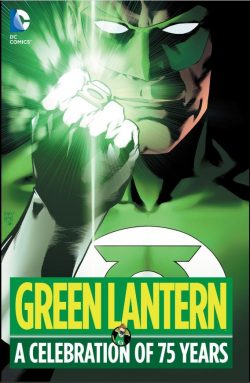
Green Lantern: A Celebration of 75 Years


By Martin Nodell, Bill Finger, Alfred Bester, Robert Kanigher, John Broome, Gardner Fox, Dennis O’Neil, Steve Englehart, Keith Giffen, J.M. DeMatteis, Ron Marz, Judd Winick, Geoff Johns, Paul Reinman, Alex Toth, Gil Kane, Neal Adams, Mike Grell, Joe Staton, Kevin Maguire, Darryl Banks, Randy Green, Ethan Van Sciver, Darwyn Cooke, Doug Mahnke & various (DC Comics
ISBN: 978-1-4012-5819-1 (HB)

Now a cornerstone of the DC Universe the many heroes called Green Lantern have waxed and waned over the decades and now feels much more Concept than Character.

This stunning compilation – part of a dedicated series introducing and exploiting the comics pedigree of veteran DC icons and concepts – is available in hardback and digital formats and offers an all-too-brief but astoundingly enticing sequence of snapshots detailing how assorted Emerald Gladiators have battled evil and injustice whilst entertaining millions and generations.

Collecting material from All-American Comics #16, Comic Cavalcade #6, Green Lantern volume 1 #30, Showcase #22, Green Lantern volume 2 #7, 11, 16, 40, 59, 76, 87, 188, The Flash #237-238, 240, Justice League #1, Green Lantern volume 3 #50, 51, Green Lantern /Green Lantern #1, Green Lantern: Rebirth #1, Green Lantern Secret Files and Origins 2005, #1 and Green Lantern #0 (cumulatively covering July 1940 to November 2012), the groundbreaking appearances selected are all preceded by a brief critical analysis of the significant stages in his/their development, beginning with Part I: The Green Flame Ignites 1940-1950…

The first Emerald Avenger debuted in the 16th issue (July 1940) of the company’s flagship title All-American Comics, just as superheroes started to take hold, supplanting newspaper strip reprints and stock genre characters in the still primarily-anthologised comicbooks.

Crafted by Bill Finger & Martin Nodell ‘Introducing Green Lantern’ reveals how ambitious young engineer Alan Scottonly survives the sabotage and destruction of a passenger-packed train due to the intervention of a battered old railway lantern. Bathed in its eerie emerald light, he is regaled by a mysterious green voice with the legend of how a meteor fell in ancient China and spoke to the people: predicting Death, Life and Power.

The star-stone’s viridian glow brought doom to the savant who reshaped it into a lamp, sanity to a madman centuries later and now promises incredible might to bring justice to the innocent and afflicted…

Instructing Scott to fashion a ring from its metal and draw a charge of power from the lantern every 24 hours, the ancient artefact urges the engineer to use his formidable willpower to end all evil: a mission Scott eagerly takes up by promptly crushing corrupt industrialist Dekker who callously caused wholesale death just to secure a lucrative rail contract.

The ring renders Scott immune to all minerals and metals, enabling him to fly and pass through solid objects but, as he battles Dekker’s thugs, the grim avenger painfully discovers that living – perhaps organic – materials such as wood or rubber can penetrate his jade defences and cause mortal harm…

The saboteurs punished, Scott resolves to carry on the fight and devises a “bizarre costume” to disguise his identity and strike fear and awe into wrongdoers…

The arcane avenger gained his own solo-starring title little more than a year after his premiere and also appeared in anthologies such as Comics Cavalcade, All Star Comics and others for just over a decade. From those hectic heydays (and specifically Comic Cavalcade #6, Spring 1944) ‘They Are Invincible’ sees the hero and his comedy sidekick Doiby Dickles tracking thieves in fog and slip into a metaphorical quandary as their writer Alfred Bester (but not & illustrator Paul Reinman) becomes a reality-warping part of the adventure…

Like most first-generation superheroes, the masked marvel faded away in the early1950s, having first suffered the humiliating fate of being edged out of his own strip and comicbook by his pet Streak the Wonder Dog…

Green Lantern volume 1 #30, cover-dated February/March 1948 cover-featured ‘The Saga of Streak’ by Robert Kanigher & Alex Toth as a noble, valiant canine (some very important people call them “Daw-uhgs”) tracks his missing owner/companion to the big city only to be gunned down by criminals. Saved by Green Lantern, they jointly rescue US intelligence agent Captain Sara Dale from deranged Dr. Malgoro and the grateful spy asks him to look after Streak until she returns from her next assignment. Within two issues the mutt was the lead feature, proving beyond doubt that the readers were losing interest in masked mystery men… at least for the moment…

A potted history of that interregnum follows in Part II: The Emerald Crusader 1959-1969 before a flash of green light heralded a bold new venture. After their hugely successful revival and reworking of The Flash, DC (or National Comics as they were) were keen to build on the resurgent superhero trend. Showcase #22 hit the stands at the same time as the fourth issue of the new Flash comicbook – #108 – and once again the guiding lights were Editor Julie Schwartz and writer John Broome. Assigned as illustrator was action ace Gil Kane, generally inked by Joe Giella, and the issue reveals how a Space Age reconfiguration of the Golden-Age superhero with a magic ring replaced mysticism with super-science.

Hal Jordan is a young test pilot in California when an alien policeman crashes his spaceship on Earth. Mortally wounded, Abin Sur commands his ring – a device which can materialise thoughts – to seek out a replacement officer, honest and without fear.

Scanning the planet, it selects Jordan and brings him to the crash-site. The dying alien bequeaths his ring, lantern-shaped Battery of Power and his professional vocation to the astonished Earthman.

In six pages ‘S.O.S Green Lantern’ establishes characters, scenario and narrative thrust of a series that would increasingly become the spine of DC continuity, leaving room for another two adventures in that premiere issue. Unlike the debut of The Flash, the editors were now confident of their ground. The next two issues of Showcase carried the new hero into even greater exploits, and six months later Green Lantern #1 was released.

In this new iteration Emerald gladiators are a universal police force (Jordan’s “beat” is Space Sector 2814), and having shown us other GLs, Broome surpassed himself with ‘The Day 100,000 People Vanished!’ (Green Lantern #7, August 1961) bringing the Guardians of the Universe into the open to warn of their greatest error: a renegade Green Lantern named Sinestro who, in league with evil Qwardians from an antimatter universe, had become a threat to our entire reality. This tense shocker introduced one of the most charismatic and intriguing villains in the DCU

Readers were constantly clamouring for more on the alien Corps Jordan had joined and ‘The Strange Trial of Green Lantern’ (#11, March 1962) introduces another half-dozen or so simply to court-martial Hal for dereliction of duty in a saga of cataclysmic proportions, after which issue #16 of Green Lantern volume 2 (October 1962) takes Jordan’s romantic triangle with his boss Carol Ferris and his own masked alter ego to a new level as ‘The Secret Life of Star Sapphire!’ introduces the star-roving alien women of Zamaron.

Readers of contemporary comics will be aware of their awesome heritage but for the sake of this review and new readers let’s keep that to ourselves. These questing females select Carol as their new queen and give her a gem as versatile and formidable as a power ring, and a brainwash make-over too.

Programmed to destroy the man she loves, Star Sapphire would become another recurring foe, but one with a telling advantage.

As the DCU expanded, the past glories of its Golden Age were cunningly incorporated into the tapestry as another dimensional plane was discovered: a parallel universe where older superheroes existed. Alan Scott and his mystery-men comrades still thrived on the controversially named Earth-2.

Although getting in late to the Counterpart Collaborations game, the inevitable first teaming of Hal Jordan and Alan Scott as Green Lanterns is one of the best and arguably second-most important story of the entire era. ‘Secret Origin of the Guardians!’ by John Broome, Gil Kane & Sid Greene (Green Lantern #40, October 1965) introduces the renegade Guardian Krona, reveals the origin of the multiverse, shows how evil entered our universe and describes how and why the immortal Oans took up their self-appointed task of policing the cosmos. It also shows Gil Kane’s paramount ability to stage a superhero fight like no other. This pure comicbook perfection should be considered a prologue to the landmark Crisis on Infinite Earths…

In Green Lantern volume 2 #59 (March 1968) Broome introduced ‘Earth’s Other Green Lantern!’ in a rip-roaring cosmic epic of what-might-have-been. When dying GL Abin Sur had ordered his ring to select a worthy successor Hal Jordan hadn’t been the only candidate, but the closest of two. What if the ring had chosen his alternative Guy Gardnerinstead…?

Following that portentous tragedy-in-the-making, changing times and tastes saw a radical diversion in the hero’s fortunes, as described in the essay and tales comprising Part III: In Brightest Day, In Blackest Night 1970-1985…

In 1969, after nearly a decade of earthly crime-busting, interstellar intrigue and spectacular science fiction shenanigans, the Silver Age Green Lantern was swiftly becoming one of the earliest big-name casualties of the downturn in superhero sales. Editor Julie Schwartz knew something extraordinary was needed to save the series and the result was a bold experiment that created a fad for socially relevant, ecologically aware, more mature stories which spread throughout costumed hero comics that totally revolutionised the industry and nigh-radicalised the readers.

Tapping relatively youthful superstars-in-waiting Denny O’Neil & Neal Adams to produce the revolutionary fare, Schwartz watched in fascinated disbelief as 13 groundbreaking tales captured and encapsulated the tone of the times, garnering critical praise and awards within the industry and desperately valuable publicity from the real world outside. Sadly, the stories simultaneously registered such poor sales that the series was finally cancelled anyway, with the heroes unceremoniously packed off to the back of marginally less endangered comic title The Flash.

When these stories first appeared, DC was a company in transition – just like America itself – with new ideas (which, in comic-book terms meant “young writers and artists”) being given much leeway: a veritable wave of fresh, raw talent akin to the very start of the industry, when excitable young creators ran wild with imagination. Their cause wasn’t hurt by the industry’s swingeing commercial decline: costs were up and the kids just weren’t buying funnybooks in the quantities they used to…

O’ Neil, in tight collaboration with hyper-realistic artist Adams, assaulted all the traditional monoliths of contemporary costumed dramas with tightly targeted, protest-driven stories. The comicbook was re-titled Green Lantern/Green Arrowwith the Emerald Archer constantly mouthing off as a hot-headed, liberal sounding-board and platform for a generation-in-crisis, whilst staid, conservative, quasi-reactionary Hal Jordan played the part of the oblivious but well-meaning old guard.

America was a bubbling cauldron of social turmoil and experimentation. Everything was challenged and with issue #76 (April 1970 and the first issue of the new decade), O’Neil and comics iconoclast Adams utterly redefined superhero strips with their relevancy-driven stories; transforming complacent establishment masked boy-scouts into uncertain, questioning champions and strident explorers of the revolution.

‘No Evil Shall Escape My Sight!’ (inked by Frank Giacoia) broke the mould of the medium, utterly re-positioning the very concept of the costumed crusader as newly-minted ardent liberal Emerald Archer Oliver Queen challenges GL’s cosy worldview when the lofty space-cop painfully discovers real villains wear business suits, operate expense accounts, hurt people just because of skin colour and can happily poison their own nests for short-term gain…

Of course, that the story is a magnificently illustrated brilliant crime-thriller with science-fiction overtones doesn’t hurt either…

O’ Neil became sole scripter with this story and, in tight collaboration with ultra-realistic art-genius Adams, instantly overturned contemporary costumed dramas with their societally-targeted protest-stories. Two years later, the creators shattered another shibboleth with ‘Beware My Power’ (Green Lantern/Green Arrow #87, December 1971/January 1972) O’Neil, Adams & Giordano, histrionically introducing a new player to the DCU. John Stewart is an unemployed architect and full-time radical activist. He is the archetypal angry black man always spoiling for a fight and prepared to take guff from no-one.

Jordan is convinced the Guardians had grievously erred when selecting impatient, impetuous Stewart as Sector 2814’s official Green Lantern stand-in, but after seeing how his proposed pinch-hitter handles a white supremacist US presidential candidate trying to foment a race war, the Emerald Gladiator is happy to change his tune…

Although the heroes provided temporary solutions and put away viciously human criminals, these tales were remarkably blunt in exposing bigger ills and issues that couldn’t be fixed with a wave of a Green Ring; invoking an aura of helplessness that was metaphorically emphasised when Hal was summarily stripped of much of his power for no longer being the willing, unquestioning stooge of his officious, high-and-mighty alien masters…

For all the critical acclaim and innovative work done, sales of Green Lantern/Green Arrow were in a critical nosedive and nothing seemed able to stop the rot. Although the groundbreaking series folded, the heroics resumed a few months later in the back of The Flash #217 (August-September 1972), beginning a run of short episodes which eventually led to Green Lantern regaining his own solo series. O’Neil, remained as chief writer but soon Adams & Giordano moved on…

With Flash #237-238 and 240-243 new art sensation Mike Grell came aboard for a 6-part saga that precipitated Green Lantern back into his own title. Beginning with ‘Let There Be Darkness!’ (inked by Bill Draut) the watchword was “cosmic” as the extra-galactic Ravagers of Olys undertook a sextet of destructive, unholy tasks in Sector 2814. Represented here by the first, second and third chapters, the schemes begin by occluding the sun over planet Zerbon to eradicate the photosynthetic inhabitants. Next our hero picks up a semi-sentient starfish sidekick in ‘The Day of the Falling Sky!’(Blaisdell inks) whilst preventing the artificial world of Vivarium from collapsing in upon itself after which ‘The Floods Will Come!’ brings the Olys to planet Archos, where they attempt to submerge all the landmasses and drown the stone-age dwellers thriving there…

The buzz of the O’Neil/Grell epic assured Green Lantern of his own series once more, and with science fiction a popular mass genre in mainstream media, the Emerald Crusader soldiered on for nearly a decade before the next big change…

As that time progressed, John Stewart popped up occasionally even as the Guardians’ motives and ineffability increasingly came into question by many of their once-devoted operatives and peacekeepers. All too frequently, the grunts began seeing their formerly infallible little blue gods exposed as venal, ruthless, doctrinaire and even capricious…

As his reputation grew, headstrong Hal suffered an extremely tempestuous relationship with his bosses which eventually resulted in them accusing him of neglecting his space sector to concentrate on Earth’s problems and criminals. When he can no longer reconcile his love for Carol Ferris and duty to the Corps, Jordan quits and the Guardians offer Stewart the position…

‘Decent Exposure’ (Green Lantern volume 2 #188, May 1985) heralds a changing of the guard as writer Steve Englehart and illustrators Joe Staton & Bruce Patterson sign on, with TV reporter Tawny Young outing Stewart on national TV, and he – after some early anger and frustration – decides “so what?” whilst dealing with genuine problems such as psychotic madman the Predator on the prowl and Modoran ultra-nationalist Sonar intent on to destroying the new Green Lantern to prove the superiority of his postage-stamp principality Modora…

Part IV: Twilight of a Hero 1986-2003

In the mid-1980s, DC’s editorial hierarchy felt their then-vast 50-year continuity was stopping them winning new readers. The solution was a colossal braided-mega series to streamline, redefine and even add new characters to the mix.

The worlds-shattering, reality-altering bombast of Crisis on Infinite Earths resulted in such spectacular commercial success, those movers-&shakers must have felt more than justified in revamping a number of their hoariest icons for their next fifty years of publishing. As well as Superman, Flash, and Wonder Woman, the moribund and unhappy Justice League of America was earmarked for a radical revision.

Editor Andy Helfer assembled plotter Keith Giffen, scripter J.M. DeMatteis and untried penciller Kevin Maguire to produce an utterly new approach to the superhero monolith: playing them for laughs…

The series launched as Justice League with a May 1987 cover-date before retitling itself as Justice League International with #7 (November). The new super-team was formed from the ashes of the old on the basis of events comprising follow-up DC crossover-event Legends. The gathering comprised a roster of relative second-stringers as America’s newest champions – Black Canary, Blue Beetle, Captain Marvel, Dr. Fate, and Mr. Miracle with heavyweights Batman and Martian Manhunter J’onn J’onzz as nominal straight-men. Added to the mix was the marmite-tinted Guy Gardner Green Lantern: a “hero” who readers loved or hated in equal amounts since his revival in the dying days of The Crisis.

As the frequently-silly saga unfolds the squad is introduced to charismatic, filthy-rich manipulator Maxwell Lord – who uses wealth and influence to recreate the initial super-team in a dangerous stunt that starts their march to glory by defeating a bunch of rather inept terrorist bombers in initial outingBorn Again’ (Justice League #1 1987, by Giffen, DeMatteis, Maguire & Terry Austin)

Ultimately, Jordan regained his ring and became an elder-statesmen of superheroes but his elevated status – and sanity – was shattered after his hometown Coast City was destroyed by alien overlord Mongul.

In an apocalyptic triptych of tales culminating in ‘Emerald Twilight Part Three: The Future’ (Green Lantern volume 3 #50, March 1994) Ron Marz, Darryl Banks & Romeo Tanghal detail how his war against the Guardians who failed him results in Jordan becoming cosmic-level menace Parallax and destroying the entire Green Lantern Corps.

One month later ‘Changing the Guard’ (Green Lantern volume 3 #51 April 1994) saw the introduction of young Kyle Rayner as the universe’s last and only Emerald Crusader, fighting a one-man war against intergalactic evil…

Revived and refreshed, the franchise expanded again as Rayner rebuilt the Corps with new candidates and rescued old favourites. From Green Lantern and Green Lantern #1 (October 2000 by Judd Winnick, Randy Green & Wayne Faucher and part of the ‘Circle of Fire’ event), ‘Against the Dying of the Light’ sees Rayner and new recruit Alexandra DeWitt hunting down apocalyptic terror Oblivion: a task made harder and more distracting as his new ally is the extradimensional doppelganger of his murdered girlfriend…

After descending into madness and evil, Hal Jordan/Parallax sacrificed his life to save Earth and was divinely rewarded, rebuked and chastised by being linked to ghostly force The Spectre. After serving his penance he was revived for a new generation.

Part IV: Rebirths 2004-Present opens as ‘Blackest Night’ (Green Lantern: Rebirth #1, December 2004, by Geoff Johns & Ethan Van Sciver) sees Jordan alive again, no longer merged with the Spectre, and determined to destroy the immortal entity that was responsible for turning him evil and ultimately for his death in the first place. First though, he must convince his old friends in the Justice League and GLC that he’s not still evil…

Next up is a delightful peek into Jordan’s childhood courtesy of Johns & Darwyn Cooke from Green Lantern Secret Files and Origins 2005 #1: an evocative rite-of-passage yarn as Jordan shares with neophyte Kyle Rayner the true meaning of ‘Flight’…

Since the 1970s, the Green Lantern concept has been about challenging heroic stereotypes. The Guardians’ stipulations that their agents be honest and without fear has provided plenty of scope to explore prejudice and preconception amongst the readership, and none more so than in the aliens’ selection of latest earthly recruit Muslim Simon Baz as part of the company-wide New 52! reboot of 2011.

‘The New Normal’ (Green Lantern #0, November 2012 by Johns, Doug Mahnke, Christian Alamy, Keith Champagne & Mark Irwin) details the consequences – personal and global – of the dispassionate Power Ring choosing as its wearer a man deemed by his peers to be a thief and potential anti-American terrorist…

Adding immeasurably to the wonder is a superb collection of covers by Sheldon Moldoff, Reinman, Alex Toth, Gil Kane, Murphy Anderson, Neal Adams, Staton & Patterson, Maguire & Austin, Banks & Tanghal, Rodolfo Damaggio & Kevin Nowlan, Ethan Van Sciver, Carlos Pacheco & Jesús Merino and Doug Mahnke & Christian Alamy.

Green Lantern has a long, proud history of shaking things up and providing dynamic provocative, drama delivered with quality artwork. This compelling assortment of snapshots is staggeringly entertaining and a monolithic testament to the inestimable value of a strong core concept matured over decades of innovation.
© 1940, 1944, 1948, 1959, 1961, 1962, 1965, 1968, 1970, 1972, 1976, 1985, 1987, 1994, 1997, 2000, 2004, 2005, 2012, 2015 DC Comics. All Rights Reserved.

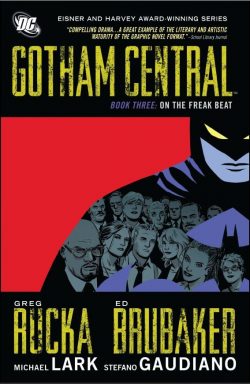
Gotham Central Book 3: On the Freak Beat


By Greg Rucka, Ed Brubaker, Michael Lark, Stephen Gaudiano, Jason Alexander & various (DC Comics)
ISBN: 978-1-4012-2754-8 (HB) 978-1-4012-3232-0 (TPB)

One of the great joys of long-lasting, legendary comics characters is their potential for innovation and reinterpretation. There always seems to be another facet or corner to develop. Such a case was Gotham Central, wherein contemporary television sensibilities cannily combined with the deadly drudgery of the long-suffering boys in blue in the world’s most famous four-colour city.

Owing as much to shows such as Homicide: Life on the Streets and Law & Order as it did to the baroque continuity of Batman, the series mixed gritty, authentic police action with a soft-underbelly peek at what the merely mortal guardians and peacekeepers had to put up with in a world of psychotic clowns, flying aliens and scumbag hairballs who just won’t stay dead.

This compilation – available in hardback, soft cover and eBook editions – collects Gotham Central #23-31 (spanning November 2004-July 2005) and opens with a handy double-page feature re-introducing the hardworking stiffs of First Shift, Second Shift and the Police Support Team of the ‘Gotham City Police Department, Major Crimes Unit’ before the dramas start to unfold.

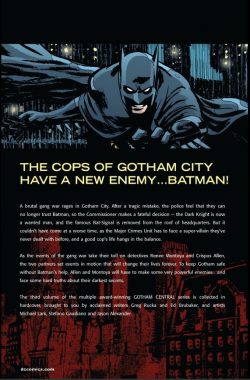
Gotham City is a bad place to be a cop – even a crooked one. If you’re a straight arrow it’s even worse because then both sides of the street want you dead. When Detectives Crispus Allen and Renee Montoya turn their attention to corrupt Crime Scene Investigator Jim Corrigan it sets them both on a path steeped in tragedy and loss… and bloody betrayal. ‘Corrigan’(originally published in issues #23-24) is by regular team Greg Rucka, Michael Lark & Stephen Gaudiano.

The same team bring us ‘Lights Out’ (issue #25) as, in the aftermath of the War Games debacle and resultant bloodbath (see Batman: War Drums; War Games: Outbreak, Tides, Endgame and War Crimes), new police commissioner Akins severs all official ties to the Batman and has the Bat-Signal removed from Police Headquarters roof.

Ed Brubaker & Jason Alexander take us ‘On the Freak Beat’ (#26-27) as Detectives Marcus Driver and (secretly psychic) Josie MacDonald investigate the murder of a televangelist. Despite all the leads and evidence pointing to Catwoman as the killer, their dedicated efforts take them into a sordid world of hypocrisy, S&M, lies and real estate chicanery before the truth comes out and the real culprit is brought to justice…

“Keystone Cops” (issues #28-31) is another superb blend of the procedural and the outlandish as beat cop Andy Kelly is horrifically mutated by a super-criminal’s booby-trap whilst rescuing kids from a fire. Montoya and Allen must cross jurisdictional boundaries and moral landmarks to obtain the assistance of deranged Flash villain Doctor Alchemy if there’s any hope of curing their comrade…

With the most chilling exploration of a super-villain’s motivation in many a year and a generous tip of the hat to The Silence of the Lambs, this is a moody masterpiece with an unsuspected kick in the tail. Rucka writes and Gaudiano graduates from inks to pencils with the embellishment falling to the capable Kano & Gary Amaro to conclude this stunning deep dive into urban atrocity in unforgettable style.
© 2004, 2005, 2010 DC Comics. All Rights Reserved.

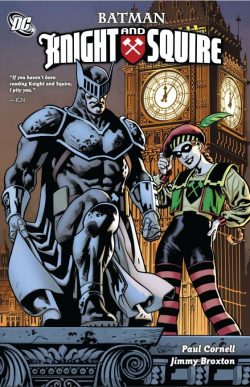
Batman: Knight and Squire


By Paul Cornell & Jimmy Broxton with Staz Johnson (DC Comics)
ISBN: 978-1-4012-3071-5 (TPB)

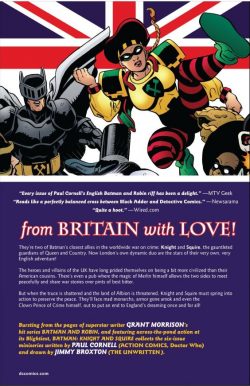
British Dynamic Duo Knight and Squire first appeared in the cheerfully anodyne, all-ages 1950s – specifically in a throwaway story from Batman #62 (December 1950/January 1951) – as ‘The Batman of England!’

Earl Percy Sheldrake and his son Cyril returned a few years later as part of seminal assemblage ‘The Batmen of All Nations!’ (Detective Comics #215 January 1955): a tale retrieved from the ranks of funnybook limbo in recent times and included in Batman: Black Casebook, with sequel ‘The Club of Heroes’ appearing in World’s Finest Comics #89, July-August 1957. That one’s most recently reprinted in Batman & Superman in World’s Finest Comics: The Silver Age volume 1.

The bold Brits had languished in virtual obscurity for decades before fully entering modern continuity as part of Grant Morrison’s build-up to the Death of Batman and Batman Incorporated retro-fittings of the ever-ongoing legend of the Dark Knight dynasty…

They floated around the brave New World for a while with guest shots in places like Morrison’s JLA reboot and Battle For the Cowl before finally getting their own 6-issue miniseries (December 2010 – May 2011), courtesy of scripter Paul Cornell and artist Jimmy Broxton (with some layout assistance from Staz Johnson).

In all honesty, they rather bit the hand that fed them by producing a far-from-serious but captivating quirky and quintessentially English frolicsome fantasy masterpiece.

It all begins, as most things boldly British do, down the pub. However, The Time in a Bottle is no ordinary boozer, but in fact the favourite hostelry for the United Kingdom’s entire superhuman community: the worthy and the wicked…

Hero and villain alike can kick back here, taking a load off and enjoying a mellow moment’s peace thanks to a pre-agreed truce on utterly neutral ground, all mystically enforced by magics and wards dating back to the time of Merlin…

As the half-dozen chapters of ‘For Six’ open, it’s the regular first Thursday of the month – and that’s an in-joke for Britain’s comics creator community – and the inn is abuzz with costumed crusaders and crazies, all manically determined to have a good time.

Cyril Sheldrake, current Earl of Wordenshire and second hero to wear the helm and mantle of The Knight, sends his trusty sidekick Beryl Hutchinson – AKA The Squire – to head off a potential problem as established exotics Salt of the Earth, The Milkman, Coalface, The Professional Scotsman and the Black and White Minstrels all tease nervous newcomer The Shrike.

The aristocratic avenger would do it himself but he’s all tied up chatting with Jarvis Poker, the British Joker…

The place is packed tonight in honour of visiting yank celebrity Wildcat, and a host of strange, outrageous and even deadly patrons all bustle about as Beryl natters with the formerly cocky kid who’s also getting a bit of grief because he hasn’t quite decided if he’s a hero or villain yet…

She’s giving him a potted history of the place when the customary bar fight breaks out, and things take an unconventionally dark turn as an actual attempted murder occurs. It would appear that two of these new gritty modern heroes have conspired to circumvent Merlin’s pacifying protections…

Each original issue was supplemented with a hilarious text page which here act as chapter breaks, so after ‘What You Missed If You’re A Non-Brit’ (a glossary of national terms, traits, terminology and concepts adorned with delightful faux small ads), the tale continues as Beryl and Cyril spend a little down-time in rural Wordenshire where the local civilians tackle the insidious threat of The Organ Grinder and his Monkey so as not to bother the off-duty Defenders.

However, the pair do rouse themselves to scotch the far more sinister schemes of inter-dimensional invader Major Morris and the deadly Morris Men…

That’s supplemented by the far-from-serious text feature ‘What Morris Men are Like’…

The saga then kicks into top gear with the third instalment as Britain’s Council for Organised Research announces its latest breakthrough. C.O.R.’s obsessively romantic Yorkist Professor Merryweather had no idea that her DNA-reclamation project would lead to a constitutional crisis after she reconstituted Richard III, but it seems history and Shakespeare hadn’t slandered the Plantagenet at all. The wicked monarch is soon fomenting rebellion, using his benefactor’s technology to resurrect equally troublesome tyrants Edward I, Charles I, William II and the ever-appalling King John… even giving them very modern superpowers…

Of course, Knight, Squire and her now besotted not-boyfriend Shrike are at the vanguard of the British (heroic) Legion mustered to fight for Queen and Country and repel the concerted criminal uprising…

Following a history lesson on ‘Cabbages and Kings’, Beryl invites the Shrike back to the Castle for tea, teasing and some secret origins, but things go typically wrong when Cyril’s high-tech armour rebels, going rogue and attacking them all.

The text piece deals with ‘Butlers and Batmen’ before it all goes very dark after lovable celebrity rogue Jarvis Poker gets some very bad news from his doctor and a terrifying follow-up visit from the real Joker.

The Camp Criminal is desperately concerned about his national legacy but Gotham City’s Harlequin of Hate is just keen on increasing his ghastly – and frankly already astronomical – body-count. First on the list is that annoying Shrike kid, but the American psycho-killer has big, bold, bizarre plans to make the UK a completely good-guy-free zone…

Broken up with a two-part ‘The Knight and Squire Character List’, it all culminates and climaxes with a spectacular and breathtaking showdown after the malevolent Mountebank of Mirth goes on a horrendously imaginative hero-killing spree that decimates the Costumed Champions of Albion: a campaign so shocking that even Britain’s bad-guys end up helping to catch the crazed culprit…

Rewarding us all for putting up with decades of “Gor, blimey guv’nor” nonsense in American comics whilst simultaneously paying the Yanks back for all those badly researched foggy, cobbled-rooftops-of-London five minutes from Stonehenge stories which littered every aspect of our image in the USA, this witty, self-deprecating, action-packed and deucedly dashing outing perfectly encapsulates all the truly daft things we noble Scions of Empire Commonwealth love and cherish about ourselves.

Stuffed with surreal, outrageous humour, double entendres, quirky characters, catchphrases and the comedy accents beloved by us Brits – Oh, I say, Innit Blud? – and rife with astonishingly cheeky pokes at our frankly indefensible cultural quirks and foibles, this is the perfect book for anyone who loves grand adventure in the inimitable manner of Benny Hill, Monty Python, Carry On Films and the Beano.

Also included are covers and variants from Yanick Paquette & Michel Lacombe and Billy Tucci & HiFi, plus a wealth of working art, character designs and sketches by Jimmy Broxton and an unpublished spoof cover in tribute to the immortal Jarvis Poker…

Whether you opt for the paperback or digital edition, Buy This Book. It’s really rather good. Oh, go on, do: you know you want to…
© 2011, DC Comics. All Rights Reserved.

Wonder Woman the Golden Age volume 3


By William Moulton Marston, Harry G. Peter & various (DC Comics)
ISBN: 978-1-4012-9190-7 (TPB)

Wonder Woman was conceived by polygraph pioneer William Moulton Marston and illustrated by Harry G. Peter in an attempt to offer girls a positive and forceful role model. She debuted as a special feature in All Star Comics #8 (December 1941), before springing into her own series and the cover-spot of new anthology title Sensation Comics a month later. An instant hit, the Amazing Amazon quickly won her own eponymous supplemental title in late Spring of that year (cover-dated Summer 1942).

Once upon a time on a hidden island of immortal super-women, American aviator Steve Trevor of US Army Intelligence crashed to Earth. Near death, he was nursed back to health by young and impressionable Princess Diana.

Fearing her growing obsession with the creature from a long-forgotten and madly violent world, her mother Queen Hippolyte revealed the hidden history of the Amazons: how they were seduced and betrayed by men but rescued by the goddess Aphrodite on condition that they isolated themselves from the rest of the world and devoted their eternal lives to becoming ideal, perfect creatures.

However, when goddesses Athena and Aphrodite subsequently instructed Hippolyte to send an Amazon back with the American to fight for global freedom and liberty, Diana overcame all other candidates and became their emissary – Wonder Woman.

On arriving in America, she purchased the identity and credentials of lovelorn Army nurse Diana Prince, elegantly allowing the Amazon to be close to Steve whilst enabling the heartsick medic to join her own fiancé in South America. Soon after, Diana also gained a position with Army Intelligence as secretary to General Darnell, ensuring she would always be able to watch over her beloved.

She little suspected that, although the painfully shallow Steve only had eyes for the dazzling Amazon superwoman, the General had fallen for the mousy but superbly competent Lieutenant Prince…

Using the nom de plume Charles Moulton, Marston (with help in later years from assistant Joye Murchison) scripted almost all of the Amazing Amazon’s many and fabulous adventures until his death in 1947, whereupon Robert Kanigher took over the writer’s role. Venerable veteran illustrator and co-creator H.G. Peter performed the same feat, limning practically every titanic tale until his own death in 1958.

Spanning January to December 1944, this superb full-colour deluxe softcover compilation (also available as an eBook edition) collects Diana’s exploits from Sensation Comics #25-36, Wonder Woman #8-11 plus her adventures from anthological book of (All) Stars Comics Cavalcade #6-8 and epic one-shot Big All-American Comic Book (1944)…

Without preamble, the ongoing triumphs, war-woven epics and imaginatively inspirational dramas of Wonder Woman resume with Sensation #25 and the ‘Adventure of the Kidnapers of Astral Spirits’ as servicewoman Diana Prince witnesses a murder.

However, the killer was asleep at home in bed at the time, and before long more impossible killings occur, drawing the Amazon into an incredible adventure beyond the Walls of Sleep into uncanny realms where even her gifts are useless and only determination and rational deduction can save the day…

Far less outré but no less deadly is the menace of ‘The Masquerader’ who replaces her in #26, following an unshakeable prophecy which sees the champion of Love and Freedom murdered by merciless racketeer Duke Dalgan. It takes the covert intervention of Aphrodite and a Girl’s Best Friend to thwart that dire fate, but Diana never learns just who substituted for her…

When the Amazon, Etta Candy, her sorority Holliday Girls and former convict Gay Frollik resolve to raise a billion dollars for ‘The Fun Foundation’, they don’t expect their most trusted advisor to turn against them, but his greed leads to his downfall and the clearing of a framed woman’s name in Sensation #27, after which Wonder Woman #8 (Spring 1944) delivers another novel-length triumph of groundbreaking adventure.

The drama opens with ‘Queen Clea’s Tournament of Death’ as Steve – on an undercover mission – is snatched by a giant barbarian woman. Hot on his trail, Diana discovers her beau a captive of undersea Amazons from lost Atlantis, living in colossal caverns below the oceans…

Diana soon finds herself embroiled in a brutal civil war facing the forces of usurping conqueror Clea of belligerent state Venturia whilst trying to restore the rightful ruler Eeras to peaceful, beleaguered Aurania. If she fails, Clea intends to invade the upper world, looking for husky men like Steve to replace the depleted, worn-out puny males of her own realm…

After restoring order in Atlantis, the Amazon returns to her military job and civilian identity until a little girl begs for aid in finding her missing father. Closer investigation reveals Clea’s forces have been abducting sailors and airmen, but with the rebel queen imprisoned as ‘The Girl with the Iron Mask’, who can the leader of the raids possibly be?

After another fearsome subterranean clash, the status quo is re-established, but when Diana later meets a huge and powerful student at Holliday College she realises that the adventure is still not over as ‘The Captive Queen’ infiltrates Paradise Island and captures both Wonder Woman and Eeras’ wayward daughter Octavia.

Even after defeating her ponderous perpetual foe the action doesn’t end for the Princess of Power as her return to the land beneath the sea is interrupted by another revolution.

This time the ineffectual Atlantean men had used the constant distractions and American modern weapons to enslave the women, making the sub-sea empire a brutal, domineering patriarchy. But not for long, as Diana and Steve led a brilliant counter-offensive…

The 1938 debut of Superman propelled National Comics to the forefront of their fledgling industry and a year later the company was licensed to produce a commemorative comicbook celebrating the opening of the New York World’s Fair.

The Man of Tomorrow prominently featured on the appropriately titled New York World’s Fair Comics among such four-colour stars as Zatara, Butch the Pup, Gingersnap and The Sandman. In 1940 another abundant premium emerged with Batman added to the roster, and the publishers felt they had an item and format worth pursuing commercially.

The spectacular card-cover 96-page anthologies had been a huge hit: convincing the cautious editors that an over-sized anthology of their pantheon of characters, with Superman and Batman prominently featured, would be a worthwhile proposition. Thus, the format was retained for a wholly company-owned, quarterly high-end package, retailing for the then-hefty price of 15¢.

Launching as World’s Best Comics #1 in Spring 1941, the book transformed into World’s Finest Comics from #2, beginning a stellar 45-year run which only ended as part of the massive clear-out and decluttering exercise that was Crisis on Infinite Earths. During the Golden Age, however, it remained a big blockbuster bonanza of strips to entice and delight readers…

At this time National/DC was in an editorially-independent business relationship with Max Gaines that involved shared and cross promotion and distribution for the comicbooks released by his own outfit All-American Publications. Although technically competitors – if not rivals – the deal included shared logos and advertising and even combining both companies’ top characters in the groundbreaking All Star Comics as the Justice Society of America.

However, by 1942 relations between the companies were increasingly strained – and would culminate in 1946 with DC buying out Gaines, who used the money to start EC Comics.

All-American thus decided to create its own analogue to World’s Finest, featuring only AA characters. The outsized result was Comics Cavalcade with Wonder Woman part of a sales-boosting trinity that included The Flash and Green Lantern…

From Spring 1944’s #6, ‘The Mystery of Countess Mazuma’ sees Wonder Woman clash with a wronged and revenge-maddened female prisoner of Monte Cristo who will crush all in the path of her schemes to destroy her treacherous tormentor, after which Sensation Comics #28’s ‘The Malice of the Green Imps’ offers a welcome dose of metaphysical suspense as jealous thoughts and impulses are made manifest, driving gangsters and even good folks to attack the recently opened Fun Foundation Clinics sponsored by Diana and Gay Frollik, after which #29 sees another Amazon in Man’s World for the ‘Adventure of the Escaped Prisoner’.

After imprisoning gambling racketeer and blackmailer Mimi on the Amazons’ prison island, Diana is unaware of the harridan’s subsequent escape, which also brings confused, naively curious sister warrior Mala to New York where she quickly falls in with the wrong crowd…

Marston’s psychiatric background provided yet another weirdly eccentric psychic scenario in #30’s ‘The Blue Spirit Mystery’ as Steve, Etta Candy and Diana investigate Anton Unreal: a mystic and mentalist who offers to send his client to the heavenly Fourth Dimension – for a large fee, of course…

Unfortunately – although a crook – Unreal is no charlatan and the “ascended ones” certainly find themselves in a realm utterly unearthly, but definitely no paradise, until Steve and Diana follow, taking matters into their own immaterial hands…

Wonder Woman #9 discloses the origins of one of the Amazon’s most radical foes in one of her strangest adventures. ‘Evolution Goes Haywire’ opens with zoo gorilla Giganta stealing Steve’s little niece before the Amazon effects a rescue, after which crazy scientist Professor Zool utilises his experimental Hyper-Atomic Evolutionizer to transform the hirsute simian into a gorgeous 8-foot-tall Junoesque human beauty.

Sadly, the artificial amazon retains her bestial instincts and, whilst battling Wonder Woman, damages Zool’s machine, resulting in the entire region being devolved back to the days of cavemen and dinosaurs…

With even Diana converted to barbarism, it’s an uphill struggle to rerun the rise to culture and civilisation sufficiently to achieve a primitive Golden Age in ‘The Freed Captive’, but eventually the twisted time-travel tale brings them back to where they started from, but only after ‘Wonder Woman vs. Achilles’ provides a deranged diversion with Diana rescuing her own mother and people from male oppression by the legendary warrior king…

Comics Cavalcade #7 tells of a deranged outcast who abducts people to become his avian army, compelling the Amazon and Steve to invade ‘The Vulture’s Nest!’, and also provides an extra treat as ‘Etta Candy and her Holliday Girls’ go west to help the war effort as cowgirls and stumble into a robbery scheme perpetrated by outlaws…

Sensation Comics #31 serves up delicious whimsy and biting social commentary when the Princess of Power visits‘Grown-Down Land’ as a wealthy socialite mother neglects her children. The tykes run away and almost die before being saved by Wonder Woman, telling of a dream world far better and happier than reality. Next morning, when the kids can’t be awoken from a deep sleep, Diana realises they have chosen to stay in their topsy-turvy imaginary country. When she enters their dream, she then finds genuine peril of a most unexpected kind…

In #32’s ‘The Crime Combine’, Wonder Woman finds herself at the top of the American underworld’s hit-list. To scotch their plots, Diana asks fully reformed ex-Nazi and trainee Amazon Baroness Paula von Gunther to leave Paradise Island and infiltrate the hierarchy of hate, but it seems that the temptations of Man’s World and allure of evil will seduce the villain back to her wicked ways…

‘The Disappearance of Tama’, from Sensation Comics #33, sees the Amazon’s college friend Etta overhear a plot to kidnap and murder a movie starlet. Ever valiant, she embroils herself and Diana in a delightfully bewildering farrago of deadly doubles and impish impostors, after which Wonder Woman #10 (Fall 1944) doles out a novel-length epic of alien invasion.

In ‘Spies from Saturn’, a rare vacation with Etta and her sorority sister Holliday Girls leads to trouble with outrageous neighbour Mephisto Saturno who is actually leader of a spy ring from the Ringed Planet. However, even after imprisoning his extraterrestrial espionage squad the danger is not ended, as the aliens’ insidious “lassitude gas” turns America into a helpless sleeping nation, forcing the Amazon to take ‘The Sky Road’ to the invaders’ home world, find a cure and rescue her beloved Steve…

The cataclysmic clash concludes in ‘Wonder Woman’s Boots’ as the victorious Earthlings return home, unaware Mephisto is still free and has a plan to avenge his defeat…

Shocking – and not a little disturbing by modern standards – ‘The Amazon Bride’ in Comics Cavalcade #8 then details how the Amazon is drugged and seemingly loses her powers. That’s bad enough, but when Steve takes advantage and convinces the hero she must marry him so that he can protect her forever after, the Amazon has never been in greater peril…

The Big All-American Comic Book was a 128-page super one-shot released in 1944 which starred almost every feature and star in Gaines’ stable in individual adventures. The entire book is reprinted in the fabulous DC Rarities Archive (and I must review it one day), but here and now the Wonder Woman strip therein details how a master spy frames Steve for murder and sparks a national manhunt to capture or clear the heroic soldier in ‘Danny the Demon Had Plans’…

Social injustice informs ‘Edgar’s New World’ in Sensation Comics #34, as the Amazing Amazon tackles the case of a “problem child”, near-blind and living in squalor, whilst his mother languishes in jail. Soon, however, the big-hearted heroine unearths political chicanery and grotesque graft behind the murder charge sending innocent Esta Poore to death row…

In #35, ‘Girls Under the Sea’ has Wonder Woman again battling to save lost Atlantis from tyranny and misrule after beneficent ruler Octavia is ousted by a committee of seditious anarchists, whilst #36 pits the Power Princess against deranged actor Bedwin Footh, a jealous loon who envies the Amazon’s headline grabbing, and organises her old foes Blakfu the Mole Man, Duke of Deception, Queen Clea, Dr. Psycho, The Cheetah and Giganta into an army against her. However, all was not as it seems in her ‘Battle Against Revenge’…

Wonder Woman #11 (Winter 1944) wraps up this whirl on the Wayback Machine, offering big thrills and rare (for the times) plot continuity as ‘The Slaves of the Evil Eye’ sees Steve and Diana battling an uncanny mesmerist intent on stealing America’s defence plans against Saturn. The trail leads to bizarre performer Hypnota the Great and his decidedly off-kilter assistant Serva, but there are many layers of deceit behind ‘The Unseen Menace’, and a hidden mastermind intent on re-igniting the recently-ended war with Saturn in climactic final chapter ‘The Slave Smugglers’.

This spectacular psycho-drama of multiple personalities and gender disassociation is another masterpiece directly informed by Marston’s psychiatric background and delivers another weirdly eccentric tale unique to the genre…

This exemplary tome is a triumph of exotic, baroque, beguiling and uniquely exciting adventure: Golden Age exploits of the World’s Most Marvellous Warrior Maiden that are timeless, pivotal classics in the development of our medium and still offer astounding amounts of fun and thrills for anyone interested in a grand old time.
© 1943, 1944, 2019 DC Comics. All Rights Reserved.

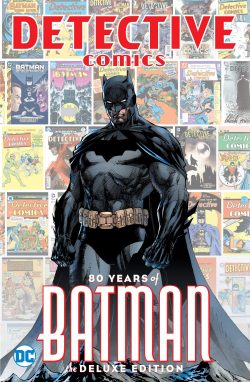
Detective Comics: 80 years of Batman Deluxe edition


By Bob Kane & Bill Finger, Jerry Siegel & Joe Shuster, Jim Chambers, Mort Weisinger, Jack Kirby & Joe Simon, Don Cameron, Joe Samachson, Edmond Hamilton, John Broome, Gardner Fox, Frank Robbins, Archie Goodwin, Denny O’Neil, Steve Englehart, Bob Rozakis, Alan Brennert, Harlan Ellison, Greg Rucka, Paul Levitz, Brad Meltzer, Scott Snyder, Neil Gaiman, Lee Harris, Dick Sprang, Carmine Infantino, Ruben Moreira, Joe Certa, Sheldon Moldoff, Neal Adams, Walter Simonson, Dick Giordano, Marshall Rogers, Michael Golden, Gene Colan, Shawn Martinbrough, Denys Cowan, Bryan Hitch, Sean Murphy, Mark Chiarello plus many & various (DC Comics)
ISBN: 978-1-4012-8538-8 (HB)

Win’s Christmas Gift Recommendation: Wholly Dark Knight, Batman!… 9/10

Although he’s frequently played second fiddle to his pioneering predecessor Superman (who debuted in Action Comics #1, June 1938), the Dark Knight has, over his eighty years, grown to become the planet’s most popular superhero. He does have some bragging rights to longevity however, as he debuted in the company’s most prestigious – and arguably premiere – comics title.

Detective Comics #1 had a March 1937 cover-date and was the third and last anthology title devised by luckless pioneer Major Malcolm Wheeler-Nicholson. In 1935, the entrepreneur had seen the potential in Max Gaines’ new invention – the comic book – and quickly conceived and released packages of all-new material entitled New Fun: The Big Comic Magazine and follow-up New Fun/New Adventure (which ultimately became Adventure Comics) under the banner of National Allied Publications.

These broke away from the tentative prototype comics magazines which simply reprinted edited collations of established newspaper strips. They were though as varied and undirected in content as much as any funnies page. Detective Comics was different, specialising only in tales of crime and crimebusters. The initial roster included amongst many others adventurer Speed Saunders, Cosmo, the Phantom of Disguise, Gumshoe Gus and two series by a couple of kids from Cleveland named Siegel & Shuster: Bart Regan: Spy and two-fisted shamus Slam Bradley…

Within two years Wheeler-Nicholson had been forced out by his business partners, and eventually his company grew into monolithic DC – for Detective Comics – Comics.

Instrumental in that meteoric rise and monumental success was the hero initially called “The Bat-Man” when he debuted in the 27th issue, dated May 1939…

This bold compilation celebrates the magic of that title and it’s reaching the magic number 1000, not just with the now-traditional re-runs of classic Batman tales, but through informative articles and fascinating glimpses at some of the other characters who shared those (mostly) monthly pages with him.

Available as a bonanza hardback and in various digital formats, this epic album curates material from Detective Comics#20, 27, 38, 60, 64, 66, 140, 151, 225, 233, 267, 298, 327, 359, 400, 437, 443, 457, 474, 482, 500, 567, 742 plus Detective Comics volume 2 #27, and opens with an Introduction by Dan Didio, a mission-statement Batman pin-up from Jim Lee, an historically erudite Editor’s Note by Paul Levitz, and a fond Foreword from US Senator Patrick Leahy, before the parade of comic tales and eye-catching covers kicks off.

Most early episodes were untitled, but for everyone’s convenience have here been given descriptive appellations by the editors. Thus, after its iconic cover by Leo O’Mealia, a groundbreaking treat from Detective Comics #20 (October 1939) reveals the title’s original prototypical costumed crusader as The Crimson Avenger (at this time a knock-off of pulp paragons such as The Shadow, Spider or Green Hornet) tackles a corrupt attorney and his gang in ‘Block Buster’; a rousing romp by Jim Chambers.

The scene was set: the sheriffs, P.I.s, government operatives and gentleman daredevils now moved over a bit to welcome a new kind of white knight: the masked mystery man…

That literary landscape is examined in Anthony Tollin’s essay Batman Foreshadowed, after which Detective Comics #27 (with cover by Bob Kane) provides ‘The Case of the Chemical Syndicate’ by Bill Finger & Kane: a spartan, understated yarn introducing dilettante playboy criminologist Bruce Wayne, craftily inserting himself into a straightforward crime-caper wherein a cabal of industrialists are successively murdered. The killings stop only after an eerie figure dubbed “The Bat-Man” intrudes on Police Commissioner Gordon‘s stalled investigation, pitilessly exposing and dealing with the hidden killer.

Also taken from that landmark issue, ‘The Murderer on Vacation’ by Jerry Seigel & Joe Shuster reveals how hardboiled private investigator Slam Bradley and sidekick Shorty Morgan track an escaped convict to snowy Switzerland to ensure the killer’s appointment with the electric chair is met…

Following another iconic cover by Kane & Jerry Robinson, #38 (April 1940 by Finger, Kane & Robinson) changes the freshly emerging landscape of comic books forever with ‘Robin, The Boy Wonder’: child trapeze artist Dick Graysonwhose performer parents are murdered before his eyes and who thereafter joins Batman in a lifelong quest for justice, beginning with bringing down mobster mad dog Boss Zucco…

With a pattern of high-flying action and savvy crime-crushing established, the Dynamic Duo went from strength to strength, but they were not the only masked marvels on show. Amateur radio technician and District Attorney’s clerk Larry Jordan used super-science and brilliant invention to battle crime as Air Wave for six years. Behind a Robinson/Fred Ray Batman cover, #60’s ‘The Case of the Missing Evidence’ (February 1942 by Mort Weisinger, Lee Harris/Harris Levy & Charles Paris) debuts the Microphonic Manhunter who methodically sets about dismantling the murderous Scalotti gang…

As WWII gripped America’s servicemen and Home Front masses, comic book dream team Joe Simon & Jack Kirby quit Timely Comics after publisher Martin Goodman failed to make good on his financial obligations. They jumped ship to National/DC, who welcomed them with open arms and a big chequebook.

Initially an unhappy fit, bursting with brash, bold ideas the company were uncomfortable with, the pair were handed two failing strips to play with until they found their creative feet. After proving their worth with The Sandman and Manhunter, they were left to their own devices and promptly perfected comic books’ “Kid Gang” genre with a unique junior Foreign Legion entitled The Boy Commandos. These kids were soon sharing the spotlight with Batman in flagship Detective Comics and in a solo title which was frequently amongst the company’s top three sellers.

A Robinson Dynamic Duo cover for #64 (June 1942) foreshadows a new kind of comics experience as ‘The Commandos are Coming’ cleverly follows the path of a French Nazi collaborator who finds the courage to fight against his country’s conquerors after meeting the bombastic military unit.

We never learn how or why American Captain Rip Carter commands a British Commando unit nor why he’s allowed to bring a quartet of war-orphans with him on a succession of deadly sorties into “Festung Europa”, North Africa, the Pacific or Indo-Chinese theatres of war. All we must accept is that cockney urchin Alfy Twidgett, French garcon Pierre (later unobtrusively renamed Andre) Chavard, little Dutch boy Jan Haasen and rough, tough lout Brooklyn are fighting the battles we would if we only had the chance…

‘The Crimes of Two-Face!’ begin in #66 (August 1942 and sporting a Robinson/George Roussos cover): detailing the debut of a true classic villain courtesy of Finger, Kane & Robinson. A sophisticate classical tragedy in crime-caper form, here Gotham DA Harvey Kent (whose name was later changed by editorial diktat to Dent) is disfigured in court and goes mad – becoming a conflicted thief and insanely unpredictable killer who remains one of the Caped Crusader’s greatest foes.

As seen on the Win Mortimer cover, ‘The Riddler!’ first challenged Batman and Robin in #140 (October 1948 by Finger, Dick Sprang, Charles Paris) as carnival con-man and inveterate cheat Edward Nigma takes his obsession with puzzles to a perilous extreme: becoming a costumed criminal and matching wits with the brilliant Batman in a contest that threatens to turn the entire city upside down.

‘The Origin of Pow-Wow Smith!’ in #151 (September 1949) awaits behind a Batman cover by Jim Mooney, but addresses the growing popularity of western tales as Don Cameron, Carmine Infantino & George Klein explore the life of a college-educated Indian Lawman who becomes a modern-day sheriff.

As super heroes lost their appeal in the 1950s, Detective Comics shed its costumed cohort for more rationalistic reasoners and grounded champions. One of the most offbeat was Roy Raymond, a TV personality who hosted hit series Impossible… But True.

Illustrated by Ruben Moreira, it launched in #153 (November 1949 and proudly displaying a Sprang Bat-cover) with ‘The Land of Lost Years!’ The first tale set the pattern: researchers or members of the public would present weird or “supernatural” items or mysteries that the arch-debunker would inevitably expose as misunderstanding, mistake or, as in this case of this reverse fountain of youth, criminal fraud…

Dale Cendali then presents A Peek Behind the Pages, sharing pages from Lew Sayre Schwartz’s Sketchbook circa his illustration of the lead story in Detective Comics #200, after which issue #225 (November 1955) manifests the first new superhero of the Silver Age, courtesy of Joe Samachson Joe Certa.

At the height of US Flying Saucer fever and following a bat-cover from Win Mortimer, John Jones, Manhunter from Mars debuted in ‘The Strange Experiment of Dr. Erdel’: describing how a reclusive genius builds a robot-brain to access Time, Space and the Fourth Dimension, accidentally plucking an alien scientist from his home on Mars. After a brief conversation with his unfortunate guest, Erdel succumbs to a heart attack whilst attempting to return the incredible J’onn J’onzz to his point of origin.

Marooned on Earth, the Martian realises his new home is riddled with the primitive cancer of Crime and determines to use his natural abilities (which include telepathy, mind-over-matter psychokinesis, shape-shifting, invisibility, intangibility, super-strength, speed, flight, vision, invulnerability and many others) to eradicate the evil, working clandestinely disguised as a human policeman. His only safety concern is the commonplace chemical reaction of fire which saps Martians of all their mighty powers. With his name Americanised to John Jones he enlists as a Police Detective and begins an auspicious career…

Today fans are used to a vast battalion of bat-themed and leather-winged champions haunting Gotham City and its troubled environs, but for the longest time it was just Bruce and Dick, occasionally with their borrowed dog Ace, keeping crime on the run. However, in Detective Comics #233 (July 1956, three months before the debut of The Flash officially ushered in the Silver Age) the editorial powers-that-be unleashed bold heiress Kathy Kane, who incessantly suited-up in chiropteran red-&-yellow for the next eight years.

‘The Bat-Woman’ by Edmond Hamilton, Moldoff & Paris premiered with the former circus acrobat bursting into Batman’s life, challenging him to discover her secret identity at the risk of exposing his own…

Trauma by Glen David Gold pauses the comics action to discuss the role and symbolism of orphans before a return to incipient family-friendly silliness as ‘Batman Meets Bat-Mite!’ #267 (May 1959 by Finger, Moldoff & Paris) takes us to a new level. The introduction of the Gotham Guardian’s most controversial “partner” – a pestiferous, prank-playing extra-dimensional elf who adored the Dynamic Duo and used his magic to extend or amp up the perils he enjoyed observing – was, for many readers, an all-time low but the strange scamp had his fans too…

In an era overburdened by gangsters and bank heists, new super villains were rare but not unknown. From #298 (December 1961) Finger, Moldoff & Paris’ ‘The Challenge of Clay-Face’ saw our heroes battle shapeshifting thief Matt Hagen who would return many times before Batman underwent a big change and media apotheosis…

By the end of 1963, Julius Schwartz had revived much of DC’s superhero line – and the entire industry – with his modernization of masked champions and costumed characters, and was asked to work his magic with the Caped Crusader. Bringing his usual team of creators with him, he stripped down the trappings and returned to the core-concept, bringing a modern take to the capture of criminals, whilst downplaying all the Aliens, outlandish villains and daft transformation tales. He even oversaw a streamlining and rationalisation of the art style itself.

The most apparent change to us kids was a yellow circle around the Bat-symbol, but more fundamentally the stories themselves changed. Subtle menace had re-entered the comfortable and abstract world of Gotham City. The revolution began with Detective Comics #327 (cover-dated May 1964) as ‘The Mystery of the Menacing Mask!’ – written by John Broome and illustrated by Carmine Infantino & Joe Giella presented a baffling “Howdunnit?” steeped in action and suspense.

Tracking an underground pipeline of missing crooks and encountering a wise guy who was literally untouchable underlined the renewed intention to emphasise the “Detective” part of the title for the foreseeable future. This comic was to be a brain-teaser from now on…

The advent of the Batman TV show soon followed and the world went Bat-manic…

The series inevitably influenced the comics and, as well as a lightening of tone, threw up new characters.

In ‘The Million Dollar Debut of Batgirl!’ (Detective Comics, #359, cover-dated January 1967) writer Gardner Fox and art team supreme Carmine Infantino & Sid Greene introduce Barbara Gordon, mousy librarian and daughter of the venerable Police Commissioner into the superhero limelight. By the time the third TV season began on September 14, 1967, she was well-established.

A different Batgirl, Betty Kane, niece of the 1950s Batwoman, was already a comics fixture, but for reasons far too complex and irrelevant to mention was conveniently forgotten to make room for the new, empowered woman in the fresh tradition of Emma Peel, Honey West and the Girl from U.N.C.L.E. She was pretty hot too, which is always a plus for television…

Whereas she fought the Penguin on the small screen, her paper origin features the no less ludicrous but at least visually forbidding Killer Moth in a clever yarn that still stands up today. The Lethal Lepidopteran was about to kidnap Bruce Wayne until Babs stumbles in and busts up his scheme…

After San Diego’s former top cop Shelley Zimmerman discusses the value of ‘Inspiration’ we jump to a darker decade for ‘Challenge of the Man-Bat’ (Detective Comics #400, June 1970) wherein Frank Robbins, Neal Adams & Dick Giordano use the big anniversary to launch a dark counterpoint to the Gotham Gangbuster when driven scientist Kirk Langstromcreates a serum to make himself superior to Batman… and pays a heavy price for his hubris.

One of the most celebrated superhero series in comics history, Manhunter catapulted young Walter Simonson to the front ranks of creators, revolutionised the way dramatic adventures were told and still remains the most lauded back-up strip ever produced.

Concocted and scripted by genial genius and then-neophyte editor Archie Goodwin as a back-up strip for Detective (running for just a year from #437-443, October/November 1973 to October/November 1974), the seven episodes – a mere 68 pages – won six Academy of Comic Book Arts Awards during its far too brief run.

Following a rousing Jim Aparo cover for #437, opening episode ‘The Himalayan Incident’ sees Interpol agent Christine St. Clair tracking a seeming super-assassin who acts like no true criminal. Although not included here the pursuit leads her to the story of dead hero Paul Kirk (during the Golden Age he was the Manhunter briefly crafted by Simon & Kirby): a big game hunter and part-time costumed mystery man.

Becoming a dirty jobs specialist for the Allies in WWII, he lost all love of life and died in a hunting accident in 1946. Decades later he seemingly resurfaced, and came to the attention of St. Clair. Thinking him no more than an identity thief she soon uncovered an incredible plot by a cadre of the World’s greatest scientists who had formed an organisation to assume control of the planet.

The Council had infiltrated all corridors of power, making huge technological advances (such as stealing the hero’s individuality by cloning him into an army of superior soldiers), slowly achieving their goals with no-one the wiser, until the returned Paul Kirk upset their plans and resolved to thwart their ultimate goals…

Kirk’s entire tragic quest to regain his humanity and dignity culminated in a terse team-up after Batman stumbles into the plot, almost inadvertently handing the Council ultimate victory. ‘Götterdämmerung’ (#443 by Goodwin & Simonson) fully lived up to its title and perfectly wrapped up the saga.

With cover and illustration by Dick Giordano, ‘There is No Hope in Crime Alley!’ (#457, March 1976, scripted by Denny O’Neil, with inks by Terry Austin) is a powerful and genuinely moving tale introducing pacifist Leslie Thompkins: the woman who first cared for the boy Bruce Wayne on the night his parents were murdered, after which O’Neil uses his prose Time Machine to deliver a telling history lesson about publishing and storytelling.

Next up is a rousing tale from a trend-setting run by Steve Englehart, Marshall Rogers & Austin. Detective # 474 (December 1977) uses ‘The Deadshot Ricochet’ to update an old loser. The second-ever appearance of a murderous high society dilettante sniper (after his initial outing in Batman #59, 1950) sees frustrated killer Floyd Lawton escape jail and go in search of simple, honest revenge. The tale so reinvigorated the third-rate trick-shooter that he’s seldom been missing from the DC Universe since; starring in a number of series such as Suicide Squad and Secret Six, a couple of eponymous miniseries and on both silver and small screens.

Devised by Bob Rozakis, Michael Golden & Bob Smith, ‘Bat-Mite’s New York Adventure!’ was a short feature in giant-sized Detective Comics #482 (February/March 1979, sporting a cover by Rich Buckler & Giordano) that begat an unlikely revival for the impetuous imp. A hilarious, fourth-wall busting romp, it sees the geeky trans-dimensional sprite invading the offices of DC comics to deliver a personal protest at his seeming sidelining in recent years…

Author, journalist and activist Cory Doctorow examines cultural content and impact in Occupy Gotham before major anniversary issue Detective #500 (March 1981) celebrates by bringing Batman and Robin to another Earth to prevent the murder of Thomas and Martha Wayne in the beguiling altered vision ‘To Kill a Legend’ by Alan Brennert & Giordano, supplemented by a jam cover courtesy of Aparo, Giordano, Infantino, Simonson & Joe Kubert.

As the DCU underwent a radical reboot during Crisis on Infinite Earths, a run of experimental stories resulted in Harlan Ellison, Gene Colan & Bob Smith detailing a city crime patrol where nothing goes right on ‘The Night of Thanks, But No Thanks!’ (#567 October 1986).

‘The Honored Dead’ (#742 March 2000) by Greg Rucka, Shawn Martinbrough & Steve Mitchell foucuses on a character as old and resilient as Batman himself as recently bereaved Police Commissioner Jim Gordon returns to duty in only to lose more colleagues and descend into a vengeful, suicidal spiral. Good thing he still has a few unconventional friends to pull him through…

Closing this immense commemorative tome comes Lost Stories offering a glimpse at commissioned works which for a variety of reasons never saw print: in this case excerpts from aborted 2012 miniseries ‘Batman: Mortality’ by Paul Levitz, Denys Cowan & John Floyd, represented here by pages of script and original art, before an all-star selection from rebooted Detective Comics volume 2 #27 (March 2014) reimagines ‘The Case of the Chemical Syndicate’ via Brad Meltzer & Bryan Hitch, whilst Scott Snyder & Sean Murphy takes us into the far future to see the evolution of the Dark Knight in ‘Twenty-Seven’.

Illustrated by Mark Chiarello, ‘Watching from the Shadows’ is Neil Gaiman’s fond appreciation of the hero and his universe, after which ‘Cover Highlights’ brings a selection of stunning examples from the Golden, Silver, Bronze andDark ages of Gotham Guardian, as well as the very best of Detective Comics ‘Now’.

Should you be of a scholarly or just plain reverential mood you can then study the copious ‘Biographies’ section so you know who to thank…

Exciting, epochal and unmissable, this is book for all fans of superhero stories.
© 1937, 1938, 1939, 1940, 1942, 1948, 1949, 1951, 1955, 1956, 1959, 1961, 1964, 1967, 1970, 1973, 1974, 1976, 1977, 1979, 1981, 1986, 2000, 2014, 2019 DC Comics. All Rights Reserved.

Justice League of America: The Last Survivors of Earth!


By Denny O’Neil, Mike Friedrich, Robert Kanigher, Dick Dillin, Neal Adams, Joe Giella & various (DC Comics)
ISBN: 978-1-4012-8920-1 (TPB)

Win’s Christmas Gift Recommendation: Action, Imagination and Social Conscience: a True Xmas Tradition… 9/10

After the actual invention of the comicbook superhero – for which read the Action Comics debut of Superman in 1938 – the most significant event in the industry’s progress was the combination of individual sales-points into a group. Thus, what seems blindingly obvious to us with the benefit of four-colour hindsight was proven: a number of popular characters could multiply readership by combining forces. Plus, of course, a mob of superheroes is just so much cooler than one (…or one-and-a-half if there’s a sidekick involved…).

And so, the debut of the Justice Society of America is rightly revered as a true landmark in the development of comic books, and when Julius Schwartz revived the superhero genre in the late 1950s, the turning point came with an inevitable union of his reconfigured mystery men.

That moment came with issue #28 of The Brave and the Bold, a classical adventure title that had recently transformed into a try-out magazine like Showcase. Just before Christmas 1959 the ads began running. “Just Imagine! The mightiest heroes of our time… have banded together as the Justice League of America to stamp out the forces of evil wherever and whenever they appear!”

The rest was history: the JLA captivated the youth of a nation, reinvigorated an industry and even inspired a small family concern into creating the Fantastic Four, thereby transforming the art-form itself

Following a spectacular rise, TV spin-offs brought international awareness which led to catastrophic overexposure: by 1968 the new superhero boom looked to be dying just as its predecessor had at the end of the 1940s. Sales were down generally in the comics industry and costs were beginning to spiral, and more importantly “free” entertainment, in the form of television, was by now ensconced in even the poorest household.

If you were a kid in the sixties, think on just how many brilliant cartoon shows were created in that decade, when artists like Alex Toth and Doug Wildey were working in West Coast animation studios. Moreover, comic-book heroes were now appearing on the small screen. Superman, Aquaman, Batman, the Marvel heroes and even the Justice League of America were there every Saturday in your own living room…

It was a time of great political and social upheaval. Change was everywhere and unrest even reached the corridors of DC. When a number of creators agitated for increased work benefits the request was not looked upon kindly. Many left the company for other outfits. Some quit the business altogether.

This fabulous paperback and/or digital compendium volume reflects the turmoil of those times as the original writer and penciller who had created every single adventure of the World’s Greatest Superheroes since their inception gave way to a “new wave” of writers and a fresh if not young artist. Collecting issues #77-95 (spanning December 1969 to December 1971, and generously re-presenting the stirring covers of #85 and 93: giant all-reprint editions), this tome portrays a society in transition and a visible change in the way DC comics stories were told, over a period when the market changed forever, and comics stopped being a casual, disposable mass-entertainment.

By the end of this volume the publishers had undertaken the conceptual and commercial transition from a mass-market medium which slavishly followed trends and fashions to become a niche industry producing only what its dedicated fans wanted…

Without preamble the drama commences with the heroes’ confidence and world view shattered when enigmatic political populist Joe Dough suborns and compromises their beloved teen mascot in ‘Snapper Carr… Super-Traitor!’ Crafted by Denny O’Neil, Dick Dillin & Joe Giella, the coming of age yarn changed the comfy, cosy superhero game forever…

The greater social awareness parading through comics at this time manifested in the next epic 2-parter, which also revives another Golden Age Great (presumably to cash-in on the mini-boom in screen Westerns). The Vigilante – a cowboy-themed superhero who battled bandits and badmen in a passel of DC titles from 1941-1954 – here alerts the team to ‘The Coming of the Doomsters!’ just in time to foil alien invaders who use pollution as their secret weapon. The vile plot ends in ‘Come Slowly Death, Come Slyly!’ as the heroes stopped the toxic baddies whilst subtly introducing young readers to potential ecological disasters in the making. This gave us plenty of time to offset greenhouse gases and end our dependence on fossil fuels and has given the healthy planet we enjoy to this day…

Another landmark of this still-impressive tale was the introduction of the JLA Satellite, as the team moved from a hole in a mountain to a high-tech orbiting fortress. As they are moving in, ‘Night of the Soul-Stealer!’ sees Thanagarian Lorch Nor collecting heroic spirits in a magic box, but it is only a prelude to an even greater threat as issue #81 reveals his good intentions when the ‘Plague of the Galactic Jest-Master’ threatens to inflict a greater mind-crushing horror upon our entire universe.

Next is another grand collaboration between JLA and JSA as ruthless property speculators (are there any other kind?) from outer space seek to raze both Earths in ‘Peril of the Paired Planets’. Only the ultimate sacrifice of a true hero averts trans-dimensional disaster in the concluding ‘Where Valor Fails… Will Magic Triumph?’

Justice League of America #84 (November 1970) hosts ‘The Devil in Paradise!’: a guest-script from veteran writer Robert Kanigher wherein a well-meaning but demented scientist builds his own Eden to escape the world’s increasing savagery, before going off the deep end and attempting to cleanse the Earth and start civilisation afresh.

With superheroes on the outs the team was severely truncated too. JLA #86 confronted issues of overpopulation and impending global starvation as Mike Friedrich began a run of excellent eco-thrillers with ‘Earth’s Final Hour!’. Here crooked business entrepreneur (should I say any other kind again?) Theo Zappa trades tries to trade away Earth’s plankton (base of our entire food-chain) to a race of aliens with only Superman, Batman, Flash, Aquaman, Atom and Hawkman on hand to thwart him, whilst #87’s ‘Batman… King of the World!’ brings in occasional guest-star Zatanna and the semi-retired Green Lantern Hal Jordan to tackle a deadly alien robot raider: a devious and cleverly veiled attack on Big Business and the Vietnam war, most famous these days for introducing a group of alien superheroes mischievously based on Marvel’s Mighty Avengers…

The human spirit and enduring humanity are highlighted when ancient refugees from the lost city of Mu return to find us in charge of the planet they had abandoned millennia ago. ‘The Last Survivors of Earth!’ shows that even when superheroes are outmatched by scientifically-instigated global catastrophes, the simple patience, charity and self-confidence of ordinary folks can move mountains and save worlds…

‘The Most Dangerous Dreams of All!’ is one of the oddest tales in JLA history, with a thinly disguised Harlan Ellison psychically inserting himself into the consciousness of Superman and Batman to woo the Black Canary with near-fatal repercussions, in a self-indulgent but intriguing examination of the creative process. Back on – and under – solid ground again for #90, ‘Plague of the Pale People!’ then sees Aquaman’s submerged kingdom of Atlantis conquered by a primitive sub-sea tribe (the Saremites from Flash #109) using nerve gas negligently dumped in the ocean by the US military.

In a mordant and powerful parable about lost faith and taking responsibility, the JLA are forced to deal with problems much tougher than repelling invaders and locking up bad-guys…

Justice League of America #91 (August 1971) heralds the hero-heavy first chapter in the annual JLA/JSA team-up with ‘Earth… the Monster-Maker!’ as the Supermen, Flashes, Green Lanterns, Hawkmen, Atoms and Robins of two separate Realities simultaneously and ineffectually battle an alien boy and his symbiotically-linked dog on two planets a universe apart. The result is pointless carnage and imminent death until ‘Solomon Grundy… the One and Only!’ gives all concerned a life-saving lesson on togetherness and lateral thinking…

Following the cover of reprint giant #93, Neal Adams steps in to provide additional pencils for tense mystery ‘Where Strikes Demonfang?’ as ghostly guardian Deadman helps Batman, Aquaman and Green Arrow foil a murder mission by the previously infallible Merlyn and the League of Assassins.

The issue and this volume end on a cliffhanger as Flash, Green Lantern and Hawkman are lost in a teleporter accident, leaving Batman, Black Canary, Green Arrow and Atom to fight ‘The Private War of Johnny Dune!’, wherein a disaffected African American freshly returned from the Vietnam conflict discovers the power and temptation of superpowers. Tragically, even the ability to control minds isn’t enough to change an unjust society two hundred years in the making…

Augmented by stunning covers from Murphy Anderson, Curt Swan, Dick Giordano and Neal Adams, these thoroughly wonderful thrillers mark an end and a beginning in comic book storytelling as whimsical adventure was replaced by inclusivity, social awareness and a tacit acknowledgement that a smack in the mouth can’t solve all problems. The audience was changing and the industry was forced to change with them. But underneath it all the drive to entertain remained strong and effective. Charm’s loss is drama’s gain and today’s readers might be surprised to discover just how much punch these tales had – and still have.

And for that you must get this book…
© 1969, 1970, 1971, 2019 DC Comics. All Rights Reserved.

Wonder Woman: A Celebration of 75 Years


By William Moulton Marston & Harry G. Peter, Robert Kanigher, Dennis O’Neil, Roy Thomas, Greg Potter, George Pérez, William Messner-Loebs, Eric Luke, Phil Jimenez, Greg Rucka, Darwyn Cooke, Brian Azzarello, Gail Simone, Amy Chu, Ross Andru & Mike Esposito, Mike Sekowsky, Don Heck, Gene Colan, Jill Thompson, Mike Deodato Jr., Yanick Paquette, Matt Clark, Drew Johnson, J. Bone, Cliff Chiang, Ethan Van Sciver, Bernard Chang & various (DC Comics)
ISBN: 978-1-4012-6512-0 (HB)

Win’s Christmas Gift Recommendation: Wonderful Fun for All… 9/10

Without doubt Wonder Woman is the very acme of female icons. Since her launch in 1941 she has permeated every aspect of global consciousness and become not only a paradigm of comics’ very fabric but also a symbol to all women everywhere. In whatever era you choose, the Amazing Amazon epitomises the eternal balance between Brains and Brawn and, over those decades, has become one of that rarefied pantheon of literary creations to achieve meta-reality.

The Princess of Paradise Island originally debuted as a special feature in All Star Comics #8, conceived by psychologist and polygraph pioneer William Moulton Marston and illustrated by Harry G. Peter, in a calculated attempt to offer girls a positive and forceful role model and, on forward-thinking Editor M.C. Gaines’ part, to sell more funnybooks to girls.

She immediately catapulted into her own series and the cover-spot of new anthology title Sensation Comics one month later. An instant hit, Wonder Woman won her own eponymous supplemental title a few months later, cover-dated summer 1942. That set up enabled the Star-Spangled Siren to weather the vicissitudes of the notoriously transient comicbook marketplace and survive the end of the Golden Age of costumed heroes beside Superman, Batman and a few lucky hangers-on who inhabited the backs of their titles.

This stunning compilation – part of a dedicated series introducing and exploiting the historical and cultural pedigree of venerable DC icons – is available in hardback and digital formats, offering a sequence of sublime snapshots detailing how Diana of the Amazons has evolved and thrived in worlds and times where women were generally regarded as second class, second rate and painfully functional or strictly ornamental.

Collecting material from All-Star Comics #8, Sensation Comics #1, Wonder Woman volume 1 #7, 28, 99, 107, 179, 204, 288, Wonder Woman volume 2 #1, 64, 93, 142, 177, 195, 600, Wonder Woman volume 3 #0, Justice League: New Frontier Special #1, Sensation Comics Featuring Wonder Woman #1 and 7 whilst cumulatively covering July 1940 to November 2012, these groundbreaking appearances are preceded by a brief critical analyses of significant stages in her development, beginning with Part I: The Amazon 1941-1957 which details the events and thinking which led to her creation and early blockbusting dominance of Man’s Boy’s World…

‘Introducing Wonder Woman/(Wonder Woman Comes to America)’ come from All-Star Comics #8, (December 1941) and Sensation Comics #1 (January 1942) respectively, revealing how, once upon a time on a hidden island of immortal super-women, American aviator Steve Trevor of US Army Intelligence crashes to Earth. Near death, he is nursed back to health by young, impressionable Princess Diana.

Fearful of her besotted child’s growing obsession with the creature from a long-forgotten and madly violent world, Diana’s mother Queen Hippolyte reveals the hidden history of the Amazons: how they were seduced and betrayed by men but rescued by the goddess Aphrodite on condition that they forever isolate themselves from the mortal world and devote their eternal lives to becoming ideal, perfect creatures.

However, when Trevor explains the perfidious spy plot which accidentally brought him to the Island enclave and with the planet in crisis, goddesses Athena and Aphrodite instruct the Queen to send an Amazon back with the American to fight for global freedom and liberty. Hippolyte declares an open contest to find the best candidate and, despite being forbidden to compete, young closeted, cosseted Diana clandestinely overcomes all other candidates to become their emissary.

Accepting the will of the gods, the worried mother outfits Diana in the guise of Wonder Woman and sends her out to Man’s World armed with an arsenal of super-scientific and magical weapons…

The Perfect Princess gained her own series and cover-spot in new anthology title Sensation Comics a month later, with the story continuing where the introduction had left off. ‘Wonder Woman Comes to America’ sees the eager immigrant returning the recuperating Trevor to the modern World before trouncing a gang of bank robbers and briefly falling in with a show business swindler.

The major innovation was her buying the identity of lovelorn Army nurse Diana Prince, elegantly allowing the Amazon to be close to Steve whilst enabling the heartsick medic to join her fiancé in South America….

Even with all that going on, there was still room for Wonder Woman and Captain Trevor to bust up a spy ring attempting to use poison gas on a Draft induction centre. Typically, Steve breaks his leg and ends up in hospital again, where “Nurse Prince” could look after him…

The new Diana gained a position with Army Intelligence as secretary to General Darnell, further ensuring she would always be able to watch over her beloved. She little suspected that, although the painfully shallow Steve only had eyes for the dazzling Amazon superwoman, the General had fallen for the mousy but supremely competent Lieutenant Prince…

As previously mentioned, the Amazing Amazon was a huge and ever-growing hit, quickly gaining her own eponymous title in late Spring of that year (cover-dated Summer 1942). The comic frequently innovated with full-length stories, and ‘America’s Wonder Women of Tomorrow’ (Wonder Woman volume 1 #7, Winter 1943) offers an optimistic view of the future in an extract of a fantastic fantasy tale wherein America in 3000AD is revealed as a true paradise.

Ruled by a very familiar female President, the nation enjoys a miracle supplement which has extended longevity to such an extent that Steve, Etta Candy and all Diana’s friends are still thriving. Sadly, some old throwbacks still yearn for the days when women were subservient to males, meaning there is still work for the Amazing Amazon to do…

The wry but wholesome sex war sees Steve going undercover with the rebel forces uncovering a startling threat…

As the Golden Age drew to a close and superheroes began to wane, Wonder Woman #28 (April 1948) debuted ‘Villainy Incorporated!’ in an epic-length tale of revenge wherein eight of her greatest enemies – Queen Clea, Hypnota, Byrna Brilyant – the Blue Snowman, Giganta, Doctor Poison, Eviless, Zara – Priestess of the Crimson Flame and The Cheetah – escape from Amazonian mindbending gulag Transformation Island where they are being rehabilitated and unite to ensure her destruction…

Whilst costumed colleagues foundered, Wonder Woman soldiered on well into the Silver Age, benefitting from constant revisionism under the canny auspices of Robert Kanigher, Ross Andru & Mike Esposito, who re-energised her for the Silver Age renaissance and beyond: a troubled period encapsulated in the briefing notes for Part II: The Princess 1958-1986…

Using the pen-name Charles Moulton, Marston had scripted all Diana’s adventures until his death in 1947, whereupon Kanigher took over the writer’s role. H. G. Peter soldiered on with his unique artistic contribution until he passed away in 1958. Wonder Woman #97, in April of that year, was his last hurrah and the end of an era.

With the exception of DC’s Trinity (plus a few innocuous back-up features such as Green Arrow and Aquaman), superheroes all but vanished at the end of the 1940s and early 1950s, replaced by mostly mortal champions in a deluge of anthologised genre titles. Everything changed again after Showcase #4 rekindled the public’s interest in costumed crimebusters with a new iteration of The Flash in 1956.

From that moment the fanciful floodgates opened wide once more, and whilst re-inventing Golden Age Greats such as Green Lantern, Atom and Hawkman, National/DC gradually updated all those venerable veteran survivors who had weathered the backlash. None more so than the ever-resilient Wonder Woman …

As writer and editor Kanigher had always tweaked or reinvented much of the original mythos, tinkering with her origins and unleashing Diana on an unsuspecting world in a fanciful blend of girlish whimsy, rampant sexism, strange romance, alien invasion, monster-mashing and utterly surreal (some would say-stream-of-consciousness) storytelling. This was at a time when all DC’s newly revived, revised or reinvented costumed champions were getting together and teaming up at the drop of a hat – as indeed was the Princess of Power in Justice League of America. However, within the pages of her own title a timeless, isolated fantasy universe was carrying on much as it always had.

Wonder Woman volume 1 #99 (July 1958) heralded a new start and the introduction of the Hellenic Heroine’s newly revitalised covert cover: Air Force Intelligence Lieutenant Diana Prince, launching a decade of tales with Steve Trevor perpetually attempting to uncover her identity and make the most powerful woman on Earth his blushing bride, whilst the flashily bespectacled glorified secretary stood exasperated and ignored beside him…

‘Top Secret’ sees Steve trying to trick Diana into marriage – something the creep tried a lot back then – by rigging a bet with her. Of course, the infinitely patient Princess outsmarts him yet again…

Although not included here WW #105 had introduced Wonder Girl: revealing how centuries ago the gods and goddesses of Olympus bestowed unique powers on the daughter of Queen Hippolyta and how even as a mere teenager the indomitable Diana had brought the Amazons to Paradise Island.

Continuity – let alone consistency and rationality – were never as important to Kanigher as a strong story or breathtaking visuals and that eclectic odyssey – although a great yarn – simply annoyed the heck out of a lot of fans… but not as much as the junior Amazon would in years to come…

The teen queen kept popping up and here Wonder Woman – Amazon Teen-Ager!’ (from Wonder Woman #107, July1959) sees the youngster wallowing in a new, largely unwanted romantic interest as mer-boy Ronno perpetually gets in the way of her quest to win herself a superhero costume…

As the 1960s progressed Wonder Woman was looking tired and increasingly out of step with the rest of National/DC’s gradually gelling – and ultimately cohesively shared – continuity but, by the decade’s close, a radical overhaul of Diana Prince was on the cards.

In 1968 superhero comics were once again in decline and publishers were looking for ways to stay profitable – or even just in business – as audience tastes and American society evolved. Back then, with the entire industry dependent on newsstand sales, if you weren’t popular, you died. Handing over the hoary, venerable and increasingly moribund title to Editor Jack Miller and Mike Sekowsky, the bosses sat back and waited for their eventual failure, and prepared to cancel the only female superhero in the marketplace…

Sekowsky’s unique visualisation of the Justice League of America had contributed to the title’s overwhelming success, and at this time he was stretching himself with a number of experimental projects, focussed on the teen and youth-markets.

Tapping into the teen zeitgeist with the Easy Rider styled drama Jason’s Quest proved ultimately unsuccessful, but with the Metal Men and the hopelessly hidebound Wonder Woman, he had much greater impact. Sekowsky would ultimately work the same magic with Supergirl in Adventure Comics (another epic and intriguing run of tales long overdue for compilation).

With relatively untried scripter Denny O’Neil on board for the first four tales, #179 heralded huge changes as ‘Wonder Woman’s Last Battle’ (December 1968, with Dick Giordano inking) saw the immortal Amazons of Paradise Island forced to abandon our dimensional plane. They took with them all their magic – including all Diana’s astounding gadgets and weapons such as the Invisible Plane and Golden Lasso – and ultimately even her mighty superpowers. Despite all that, her love for Steve compelled her to remain on Earth.

Effectively becoming her own secret identity of Diana Prince, the now-mortal champion resolved to fight injustice as a human would…

Sekowsky’s root and branch overhaul offered a whole new kind of Wonder Woman (and can be seen in a magical quartet of collections entitled Diana Prince: Wonder Woman) but, as always, fashion ruled and in a few years, without any fanfare or warning, everything that had happened since Wonder Woman lost her powers was unwritten.

Her mythical origins were revised and re-established as she abruptly returned to a world of immortals, gods, mythical monster and super-villains. There was even a new nemesis: an African/Greek/American half-sister named Nubia who debuted in ‘The Second Life of the Original Wonder Woman’ (Wonder Woman 204, February 1973, by Kanigher, Don Heck & Vince Colletta) which delivers the murder of Diana’s martial arts mentor I Ching as a prelude to Diana being restored to her former glory by the now returned and restored Amazons on Paradise Island…

Such an abrupt reversal had tongues wagging and heads spinning in fan circles. Had the series offended some shady “higher-ups” who didn’t want controversy or a shake-up of the status quo?

Probably not.

Sales were never great even on the Sekowsky run and the most logical reason is probably Television. The Amazon had been optioned as a series since the days of the Batman TV show in 1967, and by this time (1973) production work had begun on the original 1974 pilot featuring Cathy Lee Crosby. An abrupt return to the character most viewers would be familiar with from their own childhoods seems perfectly logical to me…

By the time Linda Carter made the concept work in 1975, Wonder Woman was once again “Stronger than Hercules, swifter than Mercury and more beautiful than Aphrodite”…

Eventually however – after the TV-inspired sales boost ended with the show’s cancellation – the comic slumped into another decline, leading to another revamp.

Notionally celebrating the beginning of her fifth decade of continuous publication, Wonder Woman #288, (February 1982) saw Roy Thomas. Gene Colan & Romeo Tanghal take over the Amazon, rededicating her to fighting for Love, Peace, Justice and Liberty in ‘Swan Song!’

The story features the creation by war god Mars of new female villain Silver Swan – transformed from an ugly, spiteful ballerina into a radiant, spiteful flying harridan – whilst the biggest visible change was replacing the stylised eagle on Diana’s bustier with a double “W”, signifying her allegiance to women’s action group The Wonder Woman Foundation…

The Silver Age had utterly revolutionised a flagging medium, bringing a modicum of sophistication to the returning sub-genre of masked mystery men. However, after decades of cosy wonderment, Crisis on Infinite Earths transformed the entire interconnected DC Universe and led to the creation of a fully reimagined Wonder Woman with a different history – and even character – as discussed and then displayed in Part III: The Ambassador 1986-2010…

Wonder Woman volume 2 #1 debuted with a February 1987 cover-date. Crafted by Greg Potter, George Pérez & Bruce Patterson, ‘The Princess and the Power’ reveals how Amazons are actually the reincarnated souls of women murdered by men in primordial times. Given potent new form by the female Hellenic gods, they thrived in a segregated city of aloof and indomitable women until war god Ares orchestrates their downfall via his demigod dupe Herakles.

Abused, subjugated and despondent, the Amazons are rescued by their patron goddesses in return for eternal penance in isolation on hidden the island of Themyscira.

Into that paradise Diana is born: another murdered soul, imbued with life in an infant body made from clay. She will excel in every endeavour and become the Wonder Woman…

After relocating to the outer world, Diana becomes an inspirational figure and global hero whilst constantly trying to integrate and understand the madness of “Patriarch’s World”…

In ‘The Heart of the City’ (Wonder Woman #64, July 1992) Bill Messner-Loebs, Jill Thompson & Denis Rodier focus on that dilemma as Diana attempts to recover a kidnapped child used as leverage by gangsters while saving a weary, outraged righteous cop from confusing vengeance with justice…

That struggle for understanding – and sales – led to the Princess losing her right to the role of Wonder Woman after losing a duel with fellow Amazon Artemis. The aftermath seen here reveals how a brutal, hard-line replacement Wonder Woman, takes over her ambassadorial role in Patriarch’s World in ‘Violent Beginnings’ (Wonder Woman #93, January 1995 by Messner-Loebs & Mike Deodato Jr.) with her defeated but undaunted predecessor keeping watchful eyes on the brutal warrior in her clothes…

These years are categorised by a constant search for relevance and new direction, and in ‘The Bearing of the Soul’(Wonder Woman #142 March 1999 by Eric Luke, Yanick Paquette, Matt Clark, Bob McCloud & Doug Hazlewood) the Amazon, supplemented with incredible alien technology, declares herself a global peacekeeper, dashing to flashpoints and conflict zones to end wars and save lives, irrespective of political objection…

From three years later, ‘Paradise Found’ (#177, 2002, by Phil Jimenez & Andy Lanning) sees another course change as Themyscira is rebuilt following a war between gods and offered to the outer world as an exemplar of Paradise on Earth and the oldest and youngest of its sometimes-united nations…

The often-hilarious downsides of ‘The Mission’ (WW #195, 2003) are then explored by Greg Rucka, Drew Johnson & Ray Snyder and reiterated in a wry out-of-world vignette by Darwyn Cooke & J. Bone which teams the Diana of 1962 with equally-pioneering female crimefighter Black Canary. ‘The Mother of the Movement’ (Justice League: New Frontier Special #1, 2008) sees the occasional sister-act confront a magazine owner and aspiring nightclub impresario over the way he makes his staff dress up as rabbits. Moreover, history fans, one of those indentured luscious lepines is an undercover reporter…

Many such minor tweaks in her continuity and adjustments to the continuity accommodated different creators’ tenures until 2011, when DC rebooted their entire comics line again and Wonder Woman once more underwent a drastic, fan-infuriating root-and-branch refit as represented here in Part IV: The Warrior 2012-2014

Possibly to mitigate the fallout, DC okayed a number of fall-back options such as the beguiling collected package under review today…

After a full year of myth-busting stories, ‘Lair of the Minotaur’ was the subject of Wonder Woman volume 4 #0, (November 2012) wherein Brian Azzarello & Cliff Chiang puckishly explored a different history as a teenaged Princess Diana underwent trials and training and fell under the sway of a sinister god…

As an iconic figure – and to address the big changes cited above – a number of guest creators were invited to celebrate their take on the Amazon in an out-of-continuity series. From Sensation Comics Featuring Wonder Woman #1, (2014) Gail Simone & Ethan Van Scriver’s ‘Gothamazon’ deliciously details how a mythologically militaristic Wonder Woman uncompromisingly and permanently cleans up Batman’s benighted home when the Gotham Guardians are taken out of play, whilst in Sensation Comics Featuring Wonder Woman #7, Amy Chu & Bernard Chang go out-of-world (and into ours?) to celebrate the inspirational nature of the concept of Wonder Woman.

‘Rescue Angel’ sees soldiers pinned down in Afghanistan and saved by Lt. Angel Santiago. The wounded woman warrior then claims her outstanding actions under fire are the result of a vision from her favourite and most-beloved comic book character…

This magical and magnificent commemoration is also packed with eye-catching covers, from the stories but also from unfeatured tales, by the likes of H.G. Peter, Irwin Hasen & Bernard Sachs, Mike Sekowsky, Dick Giordano, Don Heck, Gene Colan, George Pérez, Brian Bolland, Mike Deodato Jr., Adam Hughes, Cliff Chiang, Ethan Van Sciver, Shane Davis & Michelle Delecki, Ivan Reis & Oclair Albert, Nicola Scott and Francis Manapul.

Wonder Woman is a primal figure of comic fiction and global symbol, and looks set to remain one. This compilation might not be all of her best material but it is a solid representation of what gave her such fame and would grace any fan’s collection.
© 1941, 1942, 1943, 1948, 1958, 1959, 1968, 1973, 1982, 1987, 1992, 1995, 1999, 2002, 2003, 2008, 2010, 2012, 2014, 2016 DC Comics. All Rights Reserved.
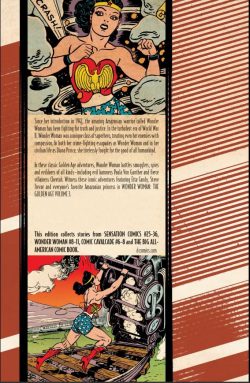
Adventures of Superman: José Luis García-López


By José Luis García-López, Martin Pasko, Gerry Conway, Elliot S. Maggin, David Michelinie, Len Wein, Denny O’Neil & various (DC Comics)
ISBN: 978-1-4012-3856-8 (HB)

Win’s Christmas Gift Recommendation: Super Special Stocking Stuffer… 9/10

It’s a fact (if such mythological concepts still exist): the American comicbook industry would be utterly unrecognisable without the invention of Superman. His unprecedented adoption by a desperate and joy-starved generation quite literally gave birth to a genre if not an actual art form.

Within three years of his June 1938 debut, the intoxicating blend of eye-popping action and social wish-fulfilment which hallmarked the early Man of Steel had grown to encompass cops-and-robbers crime-busting, socially reforming dramas, science fiction, fantasy, whimsical comedy and, once the war in Europe and the East embroiled America, patriotic relevance.

In comicbook terms at least Superman is master of the world, having utterly changed the shape of a fledgling industry and modern entertainment in general. There have been newspaper strips, radio and TV shows, cartoons games, toys, merchandise and blockbusting movies. Everyone on Earth gets a picture in their heads when they hear the name.

Moreover, he is a character endlessly revitalised by the creators who work on his never-ending exploits. One the most gifted and intoxicating is José Luis García-López.

An industry professional since he was 13 years old, he was born in Pontevedra, Spain in 1948. By age three he was living in Argentina where he was reared on a steady diet of comics: especially the works of Alex Raymond, Hal Foster, Alberto Breccia, Milt Caniff and José Luis Salinas.

During the late 1960s, García-López finally broke into the US comics world, with anthological romance work and anodyne horror tales for Charlton Comics and mystery-suspense yarns for Gold Key, and in 1974 moved to New York City where Joe Orlando got him a crucial intro with DC Comics. That turned into an almost-exclusive 40-year association which not only led to some astounding comics sagas, but also saw the artist become the corporation’s official reference artist for style guides and merchandising materials. His art was DC’s interface with the wider world.

After a few tentative inking jobs, García-López debuted as a penciller/inker on a Hawkman back-up in Detective Comics#452 in October 1975, and a month later began illustrating Hercules Unbound. His sumptuous art could also encompass grim & gritty and he was drafted in to end run on the company’s Tarzan title, and afterwards handed western antihero Jonah Hex as the gunslinger – bucking all industry sales trends – graduated to his own solo title in early 1977.

The artist’s star was on the rise. While filling in all across the DCU – his assorted Superman tales are all in this stunning hardback and digital compilation – García-López was increasingly first choice for major publishing projects such as the Marvel-DC Batman/Hulk tabloid crossover, prestige specials such the Wonder Woman clash collected here and such breakthrough miniseries and graphic novels as Cinder & Ashe, Atari Force, Twilight, Star Raiders, Road to Perditionand countless more. He remains, paradoxically, one of the company’s greatest artists and yet largely unknown and under-appreciated…

This splendid tome gathers the contents of Superman #294, 301-302, 307-309, 347, All-New Collectors’ Edition C-54and DC Comics Presents #1-4, 17, 20, 24, 31, collectively spanning December 1975 to March 1981 and, hopefully, eventually to be joined by a companion DC Universe of… edition one day.

What we have here, though, is a boldly exuberant celebration of the Man of Steel, many with guest stars and all splendidly accessible to veteran fans and casual acquaintances alike.

The wonderment opens with a short back-up from Superman #294.

Scripted by Martin Pasko and inked by Vince Colletta, ‘The Tattoo Switcheroo!’ details how Clark Kent escapes secret identity exposure after being nabbed by gangsters, but such pedestrian concerns are forgotten in issue #301 (July 76) where Gerry Conway & Bob Oksner help prove ‘Solomon Grundy Wins on a Monday!’ as the Earth-2’s monstrous zombie horror sideslips to Earth-1 to wreak havoc in Metropolis, forcing the Action Ace to use brains rather than brawn to win the day.

An issue later, Elliot S. Maggin scripted ‘Seven-Foot-Two… and Still Growing!’ as super scientist Lex Luthor finds a way to diminish the hero’s intellect by enlarging him to the point where his brain no longer connects to his dinosaur-dimensioned body. Thankfully, size-shifting hero The Atom is only a phone call away…

Curt Swan was Superman’s premiere artist for decades: a supremely gifted and conscientious illustrator who made the character his own. He was not, however, superhuman and while he was drawing the then-“longest Superman story ever” for DC Special Series #5 (Superman Spectacular 1977) García-López united with Conway and inker Frank Springer for issues #307-309 (January – March 1977), as the Man of Steel was deluded in ‘Krypton – No More!’ into believing his alien origins to be a comfortable fabrication to ease a human mutant’s twisted mind. Waging a war to save the environment from big business and their multipowered minions Radion and Protector, Kal-El even battles his cousin Supergirl to disprove ‘This Planet is Mine!’ before the true story is revealed, just in time to tackle an alien invasion in ‘Blind Hero’s Bluff!’ with the Girl of Steel returning to battle beside the now clear-headed hero and his faithful dog Krypto…

Following that comes one of the most impressive and fun comics sagas of the era as All-New Collectors’ Edition C-54(January 1978), written by Conway and inked by Dan Adkins. ‘Superman vs. Wonder Woman’ takes us back to World War II, as Man of Steel and Amazing Amazon meet for the first time after Nazi Übermensch Baron Blitzkrieg and Japan’s lethal assassin Sumo the Samurai unite to steal a prototype atomic device. Although they should be allies, the heroes are quickly and cataclysmically at odds over the dispensation of the nuke, but once they stop fighting, they still must defeat the Axis Powers’ most fanatical operatives…

From the moment a kid first sees his second superhero the only thing they want is to see how the new gaudy gladiator stacks up against the first. From the earliest days of the comics industry (and according to DC Comics Presents editor Julie Schwartz it was the same with the pulps and dime novels that preceded it), we’ve wanted our idols to meet, associate, battle together – and if you follow the Timely/Marvel model, that means against each other – far more than we want to see them trounce their archenemies in a united front…

The concept of team-up books – an established star pairing or battling (usually both) with less well-selling company characters – was far from new when DC awarded their then-biggest gun a regular arena to have adventures with other stars of their firmament, just as Batman had been doing since the middle of the 1960s in The Brave and the Bold. It was the publicity-drenched weeks before release of Superman: The Movie and Tim Burton’s Batman (which, BTW, García-López also provided designs for) was over a decade away…

In truth, the Metropolis Marvel had already enjoyed the serial sharing experience before, when World’s Finest Comicsbriefly ejected the Caped Crusader and Superman battled beside a coterie of heroes including Flash, Robin, Teen Titans, Vigilante, Dr. Fate and others (issues #198-214: November 1970 to October/November 1972) before a proper status quo was re-established.

The star-studded new monthly DC Comics Presents was a big deal at the time, so only the utterly astounding and series-unattached José Luis García-López (inked by Adkins) could conceivably open the show.

Silver Age Flash Barry Allen had been Superman’s first co-star in that aforementioned World’s Finest Comics run and reprises his role in ‘Chase to the End of Time!’ and ‘Race to the End of Time!’ from DCCP #1 and 2 (July/August and September/October 1978), wherein scripter Marty Pasko detailed how warring alien races trick both heroes into speeding relentlessly through the time-stream to prevent Earth’s history from being corrupted and destroyed.

As if that isn’t dangerous enough, nobody could predict the deadly intervention of the Scarlet Speedster’s most dangerous foe, Professor Zoom, the Reverse-Flash, who tries to turn the race against time to his own advantage…

David Michelinie then wrote a tantalising pastiche of classic Adam Strange Mystery in Space thrillers for García-López to draw and ink in ‘The Riddle of Little Earth Lost’, wherein the Man of Two Worlds and Man of Tomorrow foil the diabolical cosmic catastrophe scheme of a deranged military genius Kaskor to transpose, subjugate or destroy Earth and light-years distant planet Rann.

Len Wein came aboard to script the superb ‘Sun-Stroke!’ as the Man of Steel and the madly-malleable Metal Men join forces to thwart solar-fuelled genius I.Q. and toxic elemental menace Chemo after an ill-considered plan to enhance Earth’s solar radiation exposure provokes a cataclysmic solar-flare.

With the title on solid ground the artist moved on, but returned with Gerry Conway and inker Steve Mitchell to herald the return of Firestorm in DCCP #17’s ‘The Ice Slaves of Killer Frost!’: a bombastic, saves-the-day epic which brings the Nuclear Man back into the active DC pantheon after a long hiatus.

In #20, Green Arrow steals the show as always in gripping, big-business-busting eco-thriller ‘Inferno from the Sky!’ by Denny O’Neil, García-López & Joe Giella, after which the artist filled in with Conway on Superman #347 (May 1980) as the Last Son of Krypton clashes with a mythic cosmic courier in ‘The Sleeper Out of Time!’

In his peregrinations around the DCU, García-López had particularly distinguished himself with numerous episodes and fill-ins starring murdered aerialist Deadman. One of the very best came in DC Comics Presents #24 (August 1980) wherein scripter Wein reveals the tragic and chilling story of ‘The Man Who Was the World!’ as the grim ghost is forced to possess Superman and save the Earth… but fouls up badly…

Wrapping up this superb Fights ‘n’ Tights festival is ‘The Deadliest Show on Earth!’ (DCCP #31); written by Conway and inked by Dick Giordano, teaming Man of Steel and original Robin, the Teen Wonder Dick Grayson to conclusively crush a perfidious psychic vampire predating on the performers at the troubled Sterling Circus…

These tales are gripping fare elevated to epic regions by the magnificent art of one of the world’s finest artists. How could any fan possibly resist?
© 1975, 1976, 1977, 1978, 1979, 1980, 1981, 2013 DC Comics. All Rights Reserved.
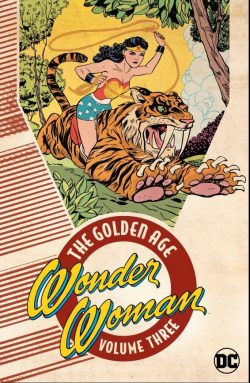
Batman in the Brave and the Bold: The Bronze Age volume two


By Bob Haney, Denny O’Neil, Jim Aparo, Nick Cardy, Neal Adams, Bob Brown, Frank McLaughlin & various (DC Comics)
ISBN: 978-1-4012-8582-1 (TPB)

Win’s Christmas Gift Recommendation: Perfect Pairings for Festive Fun Seekers… 10/10

The Brave and the Bold began in 1955 as an anthology adventure comic featuring short complete tales about a variety of period heroes: a format that mirrored the contemporary movie fascination with historical dramas.

Written by Bob Kanigher, issue #1 led with Golden Gladiator, the Silent Knight and Joe Kubert’s now legendary Viking Prince. From #5 the Gladiator was increasingly alternated with Robin Hood, but such manly, mainly mainstream romps still carried the title until the end of the decade when the burgeoning costumed character revival saw B&B transform into a try-out vehicle like sister publication Showcase.

Issue #25 (August-September 1959) featured the debut of Task Force X: Suicide Squad, followed by Justice League of America (#28), Cave Carson (#31) and Hawkman (#34). Since only the JLA hit the first time out, there were return engagements for the Squad, Carson and Hawkman.

Something truly different appeared in #45-49 with the science fictional Strange Sports Stories before Brave and the Bold #50 triggered a new concept that once again truly caught the reader’s imagination.

That issue paired two superheroes – Green Arrow and Martian Manhunter – in a one-off team-up, as did succeeding issues: Aquaman and Hawkman in #51, WWII combatants Sgt. Rock, Captain Cloud, Mme. Marie and the Haunted Tank in #52 and Atom and Flash in #53. The next team-up – Robin, Aqualad and Kid Flash – swiftly evolved into the Teen Titans. After Metal Men/the Atom and Flash/Martian Manhunter, new hero Metamorpho, the Element Man debuted in #57-58.

Then it was back to superhero pairings with #59, and although no one realised it at the time this particular conjunction (Batman with Green Lantern) would be particularly significant.

After a return engagement for the Teen Titans in #60, the next two issues highlighted Earth-2 champions Starman and Black Canary, whilst Wonder Woman met Supergirl in #63.

Then, in an indication of things to come, and in anticipation of the TV-induced mania mere months away, Batman duelled hero/villain Eclipso in #64. Within two issues, following Flash/Doom Patrol (#65) and Metamorpho/Metal Men (#66), Brave and the Bold #67 saw the Caped Crusader take de facto control of the title and the lion’s share of the team-ups. With the exception of #72-73 (Spectre/Flash and Aquaman/Atom) the comic was henceforth to be a place where Batman invited the rest of company’s heroic pantheon to come and play…

For the sake of brevity and clarity and according to the wise ones who dictate such arbitrary demarcations, it’s also the point at which Comics’ Silver Age transitioned into the Bronze Age…

This second selection of unalloyed Batman pairings with other luminaries of the DC universe reprints B&B #92-109 (spanning October/November 1970 to October/November 1973) featuring the last vestiges of a continuity-reduced DC where individual story needs were seldom submerged into a cohesive overarching scenario, and where lead writer Bob Haney crafted stories that were meant to be read in isolation, drawn by a profusion of artists with only one goal: entertainment. At this time editors favoured regular if not permanent creative teams, feeling that a sense of visual and even narrative continuity would avoid confusion amongst younger readers.

It thus signalled the advent of the superb Nick Cardy as an innovative illustrator: his short run of beautifully drawn and boldly experimental assignments is still startling to see five decades later.

Haney was always at his best with terse, human scale dramas, especially “straight” crime thrillers, as in the eccentric thriller in #92 wherein Batman travels to England, embroiled in a moody, gothic murder mystery with a trio of British stereotypes fancifully christened “The Bat Squad.” Although the scratch team never reappeared, ‘Night Wears a Scarlet Shroud!’ remains a period delight and a must for those who still remember when “Eng-ga-land Swung”…

At the end of the 1960s the Comics Code Authority ended its ban on crime and horror comics to allow publishers to exploit the global interest in the supernatural. This had instantly affected comics and more and more stories had macabre overtones. It led to the revival of horror and suspense anthologies, such as the venerable House of Mystery and unquestionably the oddest team-up in B&B history.

Scripted by Denny O’Neil and illustrated by Neal Adams, #93’s ‘Red Water, Crimson Death’ is a chilling ghost story with the added advantage of having the Dark Knight’s sombre shtick counterbalanced by the musings of the sardonic laconic Cain, ethereal and hip caretaker of that haunted habitat…

Haney, Cardy and the Teen Titans returned for powerful counter-culture bomb-plot ‘Rebels in the Streets’ after which a forgotten mystery hero (I won’t spoil it for you) helps Batman get the goods on ruthless, fat-cat industrialist Ruby Ryder in ‘C.O.D. – Corpse on Delivery’ in #95 before – somewhat more palatable for continuity bugs – Sgt Rock’s second engagement with the Bat was set in contemporary times rather than in WWII. Here the honourable old soldier becomes a bureaucrat’s patsy in compelling espionage thriller ‘The Striped-Pants War!’

Haney clearly had a fondness for grizzled older heroes as former pugilist Wildcat made another comeback in #97’s South-of-the-Border saga ‘The Smile of Choclotan!’: an epic of exploration inked by Cardy over the husky he-man pencils of the hugely underrated Bob Brown.

The Phantom Stranger guested next in a truly sinister tale of suburban devil worship which found Batman thoroughly out of his depth in ‘The Mansion of the Misbegotten!’, illustrated by the man who would soon become the only B&B artist: Jim Aparo.

Brown & Cardy returned to draw the Flash saving the Gotham Gangbuster from ghostly possession in ‘The Man who Murdered the Past’ and Aparo illustrated the anniversary 100th issue as Green Lantern, Green Arrow and Black Canary had to take over for a Batman on the verge of death and trapped as ‘The Warrior in a Wheel-Chair’.

Aparo stuck around for the outrageous murder-mystery ‘Cold-Blood, Hot Gun’ wherein Metamorpho, the Element Man assists the Caped Crusader in foiling the World’s most deadly hitman, but Brave and the Bold #102 featured a true rarity.

The Teen Titans again featured in an angry tale of the generation gap but ‘Commune of Defiance’ began as an Aparo job, but in a bizarre turnabout Neal Adams – an artist legendary for blowing deadlines – was called in to finish the story, contributing the last nine pages of the tension-packed political thriller, after which Brown and Frank McLaughlin illustrated ‘A Traitor Lurks Inside Earth!’: a doomsday saga of military computers gone awry featuring the multipurpose Metal Men.

Aparo was back in #104 for a poignant story of love from beyond the grave in the enigmatically entitled ‘Second Chance for a Deadman?’ after which a depowered Wonder Woman resurfaced after a long absence in Haney & Aparo’s superb revolutionary epic ‘Play Now… Die Later!’ as Diana Prince and the Darknight Detective become pawns in a bloody South American feud exported to the streets of Gotham.

Newly penniless social reformer Green Arrow is then sucked into a murderous get-rich-quick con in #106’s ‘Double Your Money… and Die’, featuring a surprise star villain, before Black Canary co-stars in a clever take on the headline-grabbing – and still unsolved – D.B. Cooper hijacking of an airliner in ‘The 3-Million Dollar Sky’ from B&B #107 (June-July 1973). Inflation sucks: “Cooper” only got $200,000 when he jumped out of that Boeing 727 in November 1971, never to be see again…

A wonderfully chilling tale of obsession and old soldiers never dying follows as Sgt. Rock tries once more to catch the greatest monster in history on ‘The Night Batman Sold his Soul!’ before this bronze bonanza concludes with superb supernatural thriller ‘Gotham Bay, Be My Grave!’ wherein the Caped Crusader and Jack Kirby’s then newest sensation Etrigan the Demon battle an unquiet spirit determined to avenge his own execution after nearly a century…

These are some of the best and most entertainingly varied yarns from a period of magnificent creativity in the American comics industry. Aimed at a general readership, gloriously free of heavy, cloying continuity baggage and brought to stirring, action-packed life by some of the greatest artists in the business, this is a Batman for all seasons and reasons with the added bonus of some of the most fabulous and engaging co-stars a fan could imagine. How could anybody resist? Can you…?

© 1970, 1971, 1972, 1973, 2018 DC Comics. All Rights Reserved.