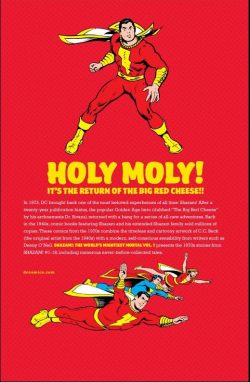
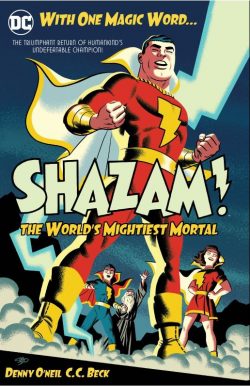
Shazam! The World’s Mightiest Mortal volume 1


By Denny O’Neil, Elliot S. Maggin, E. Nelson Bridwell, C.C. Beck, Kurt Schaffenberger, Dave Cockrum, Bob Oksner, Dick Giordano & various (DC)
ISBN: 978-1-4012-8839-6 (HB)

One of the most venerated and loved characters in American comics was created by Bill Parker and Charles Clarence Beck as part of the wave of opportunistic creativity that followed the successful launch of Superman in 1938. Although there were many similarities in the early years, the Fawcett character moved swiftly and solidly into the area of light entertainment and even broad comedy, whilst as the 1940s progressed the Man of Steel increasingly left whimsy behind in favour of action and drama.

Homeless orphan and good kid Billy Batson is selected by an ancient wizard to battle injustice and subsequently granted the powers of six gods and mythical heroes. By speaking aloud the wizard’s name – itself an acronym for the six patrons Solomon, Hercules, Atlas, Zeus, Achilles and Mercury – he can transform from scrawny boy to brawny (adult) hero Captain Marvel.

At the height of his popularity Captain Marvel hugely outsold Superman and was even published twice a month, but as the decade progressed and tastes changed sales slowed, and an infamous court case begun in 1941 by National Comics citing copyright infringement was settled. Like many other superheroes the “Big Red Cheese” disappeared, becoming a fond memory for older fans. A big syndication success, he was missed all over the world…

In Britain, where an English reprint line had run for many years, creator/publisher Mick Anglo had an avid audience and no product, and transformed Captain Marvel into atomic age hero Marvelman, continuing to thrill readers into the early 1960s.

As America lived through another superhero boom-and-bust, the 1970s dawned with a shrinking industry and wide variety of comics genres servicing a base that was increasingly founded on collectors and fans rather than casual or impulse buyers. National – now DC – Comics needed sales and were prepared to look for them in unusual places.

After the court settlement with Fawcett in 1953 they had secured the rights to Captain Marvel and his spin-off Family. Now and though the name itself had been taken up by Marvel Comics (via a circuitous and quirky robotic character published by Carl Burgos and M.F. Publications in 1967), the publishing monolith decided to tap into that discriminating if aging fanbase.

In 1973, riding a wave of national nostalgia on TV and in the movies, DC brought back the entire beloved cast of the Captain Marvel crew in their own kinder, weirder universe. To circumvent the intellectual property clash, they named the new title Shazam! (‘With One Magic Word…’): the memorable trigger phrase used by myriad Marvels to transform to and from mortal form and a word that had already entered the American language due to the success of the franchise the first time around.

Now the latest star of film and TV is back in print in this stylish Hardback and digital compendium, collecting the first 18 issues (spanning February 1973 – May/June1975) of a glorious revival. It’s by rapturous and informative introduction With One Magic Word… by Jerry Ordway, writer and artist of latter day reinvention The Power of Shazam!

Back in 1972, the company tapped editor Julie Schwartz – instigator of the Silver Age of Comics and the go-to guy for hero revivals – to steer the project. He teamed top scripter Denny O’Neil with original artist C.C. Beck for the initial re-introductory story. ‘…In the Beginning…’

Delivered in grand old self-referential style, the engaging yarn reprised the classic origin after which ‘The World’s Wickedest Plan’ relates how the entire cast were trapped in a timeless “Suspendium” trap for twenty years after their arch-foes the Sivana family (Doctor Thaddeus Bodog Sivana and his vile but equally brilliant children Georgia and Thaddeus Jr.) attacked them all at a public awards ceremony.

Two decades later, they were all freed, baddies included, to restart their lives. That first issue also included a text-feature/score-card by devotee E. Nelson Bridwell to bring new and old readers up to speed, and ‘Shazam & Son: The Story of the World’s Mightiest Mortal’ is included here to again bring new readers up to super speed.

With issue #2, a format of two stories per issue was instigated. ‘The Astonishing Arch Enemy’ heralds the return of super-intelligent Venusian worm Mr. Mind and a running gag about how strange people in the 1970s are. Written by Elliot Maggin, the second tale introduces eerily irresistible, scrupulously honest Sunny Sparkle who lives awash in the generosity of others who can’t resist giving stuff to ‘The Nicest Guy in the World’. Once again, the fun is counterpointed by a Bridwell text feature listing the many heroes sharing the powers of the gods in ‘Shazam and Family’.

For #3, O’Neil wrote ‘A Switch in Time’ wherein scrofulous underage magician Shagg Nasté disrupts the puny-boy-to-super-adult gimmick for young Billy, whilst Maggin & Beck craft a wry spy tale of daffy inventors in ‘The Wizard of Phonograph Hill’. Next issue evil Captain Marvel analogue ‘Ibac the Cursed’ disastrously re-emerged, courtesy of O’Neil & Beck, with Maggin again opting for a human-interest yarn in ‘The Mirrors that Predicted the Future’.

In the ’70s economics dictated costs in comics be cut whenever possible so there was really no choice about filling pages with reprints, which had been an addition from the start. A huge benefit, however, was that those stories were unknown to the general readership and of a very high standard. Although not included in this volume, I mention them simply because they kept the page-count of most issues to around fifteen pages of new material per month (Shazam! was actually published eight times a year so the savings were even greater). Hopefully DC will get around to reprinting the Fawcett stories too – perhaps in the same format as their excellent Batman, Wonder Woman and Superman Golden Age collections…

Maggin took the lead slot with #5’s ‘The Man who Wasn’t’ (a potentially offensive tale of leprechauns with a rather heavy-handed racial stereotype as the magical foe) as well as a back-up which sees the return of Sunny Sparkle. Here, his obnoxious cousin Rowdy briefly becomes ‘The World’s Toughest Guy!’

O’Neil returned in #6, as did Sivana in time bending tale ‘Better Late than Never!’ whilst Maggin reintroduced a 1940’s boy-genius in the charming ‘Dexter Knox and his Electric Grandmother’. The following issue, loquacious science experiment Tawky Tawny took centre-stage in O’Neil’s ‘The Troubles of the Talking Tiger’ before uber-fan and wonderful guy E. Nelson Bridwell finally got to write a script with the delightfully zany and clever ‘What’s in a Name? Doomsday!

Shazam! #8 was the first of many 100-Page Spectaculars stuffed with great Golden Age reprints, but as such it’s only represented here by the C.C. Beck cover, whilst normal-sized #9 provides us with O’Neil’s ‘Worms of the World Unite’ – another clash with scurrilous dictator Mr. Mind – and the first solo adventure of Captain Marvel Jr. in over twenty years.

‘The Mystery of the Missing Newsstand! is an action-heavy romp and fine tribute to the works of early Fawcett mainstay (and Flash Gordon maestro Mac Raboy); written by Maggin and illustrated by young Dave Cockrum. It is truly lovely to look upon. A third original story completes the issue and Maggin & Beck clearly had heaps of fun on ‘The Day Captain Marvel Went Ape!’ when a mystic jewel deflects Shazam’s magic lightning into a chimpanzee.

Beck, notoriously opinionated, had been unhappy with the stories he was being asked to draw and left the series with #10. He was a supremely understated draughtsman with a canny eye for caricature and gag-timing, and his departure took away some of that indefinable charm. Many other gifted artists continued the strip but a certain kind of magic left the strip with him. He wasn’t even the lead or cover artist on the issue.

Bob Oksner & Vince Colletta illustrated Maggin’s mediocre flying saucer yarn ‘Invasion of the Salad Men’, but happily, Mary Marvel’s solo debut ‘The Thanksgiving Thieves’ is a much better effort with Bridwell’s script handled by Oksner alone (if ever an artist should ink himself it was this superb stylist). Beck bowed out with Bridwell’s ‘The Prize Catch of the Year’ which featured the reappearance of formidable octogenarian villainess Aunt Minerva – one of the most innovative rogues of the Golden Age and here again on the prowl for a new husband…

Issue #11 kicks off with ‘The World’s Mightiest Dessert!’ (Bridwell, Oksner & Colletta) wherein a new sweet treat goes berserk, but the real gem of this comic is ‘The Incredible Cape-Man’. Written by Maggin it saw the long-awaited return of Kurt Schaffenberger, a brilliant and highly accomplished artist who, by his own admission, considered drawing Captain Marvel the best of all possible jobs.

He began his career at Fawcett before moving to DC, ACG and others when the company folded. When the Big Red Cheese returned, his resumption of the art-chores was inevitable. In this tale of a mail man who becomes a Mystery Man, the art positively glows with joyous enthusiasm. This end-of-year issue then concludes with a good old-fashioned Yule yarn featuring the entire extended cast in Maggin & Schaffenberger’s ‘The Year Without a Christmas!’, with our heroes again clashing with the wicked Sivana clan to save the season.

The 12th issue was another 100-Page Spectacular but included 3 all-new stories: modern-day Midas menace ‘The Golden Plague’ (Bridwell & Oksner); another glorious Captain Marvel Jr. adventure ‘The Longest Block in the World!’ (Maggin & Dick Giordano), and cheerfully daft Kung Fu spoof ‘Mighty Master of the Martial Arts!’ by Maggin, Oksner & Colletta. Also included are clip-art features detailing the boy hero’s heroic heritage in ‘Billy Batson’s Family Album’ and his divine sponsors in ‘The Shazam Gods and Heroes’.

The next six issues retained this same format, combining around 20 pages of new material with a superb selection of Fawcett reprints, but once the character was picked up for a children’s TV show, the comic was again slimmed down to a cheaper standard format and increased publication frequency.

Maggin and Oksner led in #13 as ‘The Case of the Charming Crook!’ revealing how a felon manages to synthesise “essence of Sunny Sparkle” to make his crimes easier. This is followed by clip-art historical features ‘The Seven Deadly Enemies of Man!’, ‘Friends of the Shazam Family!’ and ‘Mary Marvel’s Fashion Parade!’ before Oksner returns to familiar ground as an illustrator of beautiful women in Bridwell’s Mary Marvel solo strip ‘The Haunted Clubhouse!’

The entire Marvel Family was needed in the next issue when O’Neil & Schaffenberger crafted ‘The Evil Return of the Monster Society’: a splendid action thriller serving to remind us that the Original Captain Marvel Shazam was never just about charm and comedy…

You know what fans are like: they had been arguing for decades – and still do – over who is best (for which read “who would win if they fought?”) out of Superman or Captain Marvel, so it’s amazing that a face off meeting took as long as it did to materialise.

However, despite the cover, the lead strip in #15 wasn’t it. Instead fans had to be content with a notoriously familiar guest villain when Mr. Mind and ‘Captain Marvel Meets… Lex Luthor!?!’: the work of O’Neil, Oksner and veteran inker (Phillip) Tex Blaisdell, who had worked un-credited on many DC strips over the decades, as well as drawing Little Orphan Annie, On Stage and many others.

Bridwell & Schaffenberger closed the issue with an excellent crime-caper in ‘The Man in the Paper Armor!’, preceded by clip features ‘Shazam’s Scientists and Inventors’ and ‘A Tour of American Cities with Captain Marvel!’

Schaffenberger kicked off #16 with Maggin’s ‘The Man who Stole Justice’; a taut thriller involving the incarnation of the one of the iconic Seven Deadly Enemies of Man (Sins to you and me) and a key part of the legend since the strip’s inception. Bridwell & Oksner utilised another Deadly Enemy in Mary Marvel solo story ‘The Green-Eyed Monster!’, but aliens and a Hippie musician were the antagonists in the feature-length tale leading off #17, the last 100-page issue. ‘The Pied Un-Piper’ is a tongue-in-cheek thriller from O’Neil & Schaffenberger, whereas a slightly more modern tone tinged the whimsy in #18’s ‘The Celebrated Talking Frog of Blackstone Forest!’ (Maggin & Oksner) and Bridwell & Schaffenberger’s CM Jr. clash with Sivana Jr. in ‘The Coin-Operated Caper’, albeit not enough to deaden the charm…

DC pulled out all the stops with their new baby. Production ace Jack Adler teamed with illustrators such as Nick Cardy, Murphy Anderson, Beck and Oksner to create a string of amazing photo/drawn art covers. The experiments ended with 7, but even so, it gave the title a unique presence on newsstands of the time and you can also enjoy them here.

Although controversial amongst older fans, the 1970’s incarnation of Captain Marvel has a tremendous amount going for it. Gloriously free of angst and agony, beautifully, simply illustrated, and wittily scripted, these are clever, funny, wholesome adventures that would appeal to any child and positively promote a love of graphic narrative. There’s a horrible dearth of exuberant fun superhero adventure these days so isn’t it great that there’s somewhere to go for a little light action again?
© 1973, 1974, 1975, 2019 DC Comics. All Rights Reserved.
Showcase Presents Challengers of the Unknown volume 2


By Arnold Drake, Ed Herron, Bob Brown & various (DC Comics)
ISBN13: 978-1-4012-1725-9 (TPB)

The Challengers of the Unknown was a bridging concept. As superheroes were being revived in 1956 here was a super-team – the first of the Silver Age – with no powers, the most basic and utilitarian of costumes and the most dubious of motives… Suicide by Mystery.

Yet they were a huge hit and struck a chord that lasted for more than a decade before they finally died… only to rise again and yet again. The idea of them was stirring enough, but their initial execution made their success all but inevitable. Springing from tireless and inspirational human hit-factory Jack Kirby – before his move across town to co-create the Marvel Universe – the solid adventure concept and perfect action heroes he left behind were ideal everyman characters for the tumultuous 1960s – an era before super-heroes obtained a virtual chokehold on the comic-book pages.

Kirby had developed a brilliantly feasible concept and heroically archetypical characters in cool pilot Ace Morgan, indomitable strongman Rocky Davis, intellectual aquanaut “Prof.” Haley and daredevil acrobat Red Ryan. The Challengers of the Unknown were four (extra)ordinary mortals; heroic adventurers and explorers who walked away unscathed from a terrible plane crash. Already obviously what we now call “adrenaline junkies”, they decided that since they were all living on borrowed time, they would dedicate what remained of their lives to testing themselves and fate. They would risk their lives for Knowledge and naturally, Justice. They were joined by an occasional fifth member, beautiful (of course) scientist June Robbins in their second appearance (‘Ultivac is Loose!’ in Showcase #7, March/April 1957), and she became a hardy perennial, always popping up to solve puzzles, catch criminals and generally deal with Aliens, Monsters and assorted supernatural threats.

A number of writers, many sadly lost to posterity, wrote these tales, including Bill Finger, Ed Herron, Jack Miller, Bob Haney and Arnold Drake, but one man handled the artwork: Bob Brown.

Brown was born August 22nd 1915 and he died in 1977 following a long illness. He studied at Hartford Art School and Rhode Island School of Design, and worked with his showbiz folks and sister in a song-&-dance act from 1927 onwards. He was drafted in 1940 – the year he also began working as a comics artist and scripter for Fox, timely/Atlas. As the war intensified, he was an aircraft radio operator, an aviation cadet and served in the Pacific as bombardier and navigator in B-29 bombers, earning six air medals and a Distinguished Flying Cross.

After jobbing around the industry during the late 1040s and 1950’s Brown settled at National Comics/DC, co-created the long-running Space Ranger, drawing Tomahawk, western hero Vigilante, Batman, Superboy, Doom Patrol, World’s Finest Comics and a host of other features and genre shorts. He moved to Marvel in the 1970s where he drew Warlock, Daredevil and the Avengers among others.

He was a consummate professional and drew every issue of the Challengers from #9 – 63: almost a decade of high-adventure ranged from ravaging aliens, cute-and-fuzzy space beasts to truly scary supernatural horrors.

The Challengers followed Kirby’s model until cancellation in 1970, but, due to a dispute with Editor Jack Schiff the writer/artist resigned at the height of his powers. The King’s exuberant magic was impossible to match, but as with all The King’s creations, every element was in place for the successors to run with.

Challengers of the Unknown #9 (September 1959) saw an increase in the monster-heavy fantasy elements favoured by Schiff, and perhaps an easing of the subtle tension and inter-group fractious bickering that marked previous issues (Comics Historians take note: the Challs were snapping and snarling at each other years before Marvel’s Cosmic Quartet ever boarded that fateful rocket-ship).

This second cheap-&-cheerful volume collects the contents of Challengers of the Unknown #18 – #37 – spanning February/March 1961 through May 1964 – and opens with ‘The Menace of Mystery Island’ which finds the team fighting crooks on a tropical island that contains a crashed alien probe. This accident has deposited a test animal with uncanny powers…

In the manner of the times, the tenacious troubleshooters adopt the fuzzy li’l space-tyke and name him Cosmo.

The second story of the issue offers darker fare, however, as the team are then shanghaied through time to save ‘The Doomed World of Tomorrow’.

In the ‘The Alien Who Stole a Planet’, the heroes aid refugees from a doomed world, but things turn sour after one of the survivors decides Earth would be suitable replacement home, whilst in ‘The Beasts from the Fabulous Gem’, a soldier-of-fortune uses a stolen mystic jewel liberate monsters imprisoned within it in ancient times. Their very own super-villain then resurfaces as ‘Multi-Man Strikes Again’ in issue #20, and June shows up for a spot of beastie-bashing in the hectic riddle of ‘The Cosmic-Powered Creature!’ In the next issue it’s apparently just the lads who are shanghaied to ‘The Weird World that Didn’t Exist’ but she plays a major role in the follow-up tale when Cosmo returns in ‘The Challengers’ Space-Pet Ally’.

‘The Curse of the Golden God’ proffers the usual action-packed crime-drama in the South American jungles, whereas #22’s second tale hits much closer to home as the squad’s secret base is compromised by ‘The Thing in Challenger Mountain’ and the team find that ‘Death Guarded the Doom Box’ in the form of ancient but still deadly mechanical devices, after which more aliens kidnap humans to ‘The Island in the Sky’.

In ‘The Challengers Die at Dawn’, the hunt for a swindler leads the team to a lost tribe of oriental pirates in the South China Seas, but the big story in #24 is ‘Multi-Man, Master of Earth’: a grand, old-fashioned battle for justice against a seemingly unstoppable foe. Although the stories were becoming a touch formulaic by this stage, the equation was a trusted one, and Brown’s art was constantly improving.

Challengers of the Unknown #25 (April/May 1962) was right on the cusp of the moment full-blown superhero mania hit the world and, although ‘Return of the Invincible Pharaoh’ is a story of ancient mystery and slumbering menaces, its plot of a lost secret bestowing superpowers was to become a recurring staple for “normal, human heroes” such as the Challs, Blackhawk – and even in the Batman titles.

The second tale, ‘Captives of the Alien Hunter’ features another thieving extra-terrestrial up to no good and once more both June and Cosmo are required to foil the fiend.

‘Death Crowns the Challenger King’ is a bizarre variation on the Prisoner of Zenda‘s plot: set in a hidden Mongol city with Prof. replacing the true ruler in a series of ceremonial ordeals, whilst the rest of the gang run interference against the scurvy villains, after which a flamboyant impresario is shown to have an out-of-this-world new act in ‘The Secret of the Space Spectaculars’.

Issue #27 led with ‘The 1,001 Impossible Inventions’, wherein two convicts bamboozle a wounded alien into using his advanced science for crime, whilst ‘Master of the Volcano Men’ (the first story for which we have a confirmed writer – Arnold Drake) introduces another perennial villain: rapacious marauding lava beings from the centre of the earth.

It was once more rebellious robots causing a destructive fuss in ‘The Revolt of the Terrible FX-1’, but the real show-stealer of #28 is a classic time-travel romp sending the team back to ancient Egypt to solve ‘The Riddle of the Faceless Man.’

The next issue brought ‘Four Roads to Doomsday (again by Drake) wherein satellite sabotage draws the team into a plot by alien criminals to conquer Earth, whilst the raucous, antagonistic nature of the team is highlighted in Ed “France” Herron’s ‘The War Between the Challenger Teams’, as Ace and Red battle Prof. and Rocky to end a war between two sub-sea races.

‘Multi-Man… Villain Turned Hero’ turned out to be just another evil ploy by the shape-changing charlatan, but #30’s real treat is the introduction of Gaylord Clayburn (Don’t. Just don’t. Grow up): a spoiled multimillionaire playboy who wants to become ‘The Fifth Challenger’ and is prepared to go to any lengths to achieve his ambition…

‘The Man Who Saved the Challengers’ Lives’ in #31 is the first full-length story since 1960; impressively retelling their dramatic origin, and revealing the debt they possibly owe to a shady industrialist, whilst #32 declares business as usual in Drake’s ‘One Challenger Must Die!’

Here the boys fiercely compete to learn who would sacrifice themselves to stop another rampaging Volcano Man, before rediscovering the power of teamwork, which was just as well since the second tale reveals how and why ‘Cosmo Turns Traitor.’

Each an expert in some field of human endeavour, in #33, the Challs are confronted by a superior individual in Drake’s ‘The Challengers Meet their Master’, but as with ‘The Threat of the Trojan Robot’, teamwork proves the solution to any problem. Ed Herron scripted terse thriller ‘Beachhead, USA’ which opens #34, as a U-Boat full of Nazis frozen since World War II tries to complete their last mission – blowing up the East Coast of America, with only the Chall’s in place to stop them.

Multi-Man then discovers that no matter how smart you are, building the perfect mate is a very bad (and tasteless) idea in ‘Multi-Woman, Queen of Disaster.’

‘The War Against the Moon Beast’ is a spectacular sci-fi yarn, balanced by the quirky prognostications of a carnival seer whose crystal ball predicts an adventure of the ‘Sons of the Challengers’.

One of the death-cheaters became a monster in #36’s ‘The Giant in Challenger Mountain’, but is recovered in time to join the others as ‘Bodyguards to a Star’ on the location of a dinosaur-infested movie-epic.

This splendidly daft second volume ends with #37 and ‘The Triple Terror of Mr. Dimension’ – a cheap thug who lucks into a reality-altering weapon, with Herron scripting the taut drama of ‘The Last Days of the Challengers’ wherein the team struggle to destroy giant robots and thwart an execution-list with their names on it…

Challengers of the Unknown is sheer escapist wonderment, and no fan of the medium should be deprived of the graphic exploits starring these ideal adventurer-heroes in the evocative setting of the recent now; a simpler, better world than ours. Reader-friendly to anyone with a love of wild thrills (or Saturday morning cartoons), these long-neglected tales would make the perfect animated kids show too…
© 1961, 1962, 1963, 1964, 2008 DC Comics. All Rights Reserved.

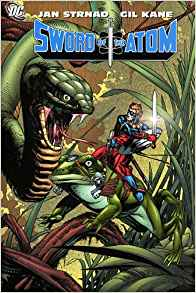
Sword of the Atom


By Jan Strnad & Gil Kane, with Pat Broderick & various (DC Comics)
ISBN: 978-1-4012-1553-8 (TPB)

Wonderfully reminiscent of his superlative Blackmark paperback venture (collected in Blackmark: the 30th Anniversary Edition), supreme artistic stylist Gil Kane was a man inspired in this retooling of Silver-Age B-List hero The Atom. In a radical re-think co-authored by Jan Strnad, here the urbane scientific adventurer is removed from his comfort zone of cosy costumed crime-busting to become the sword-wielding champion of a barbaric lost kingdom.

Starting off with a 4-issue miniseries from 1983 and followed by three giant-sized annual Specials, the swashbuckling saga revitalized a once great character who had fallen on very lean times and set him up for his eventual return to the big leagues (I apologise for the puns – lowest form of wit, I know, but extremely hard to resist!).

Following the break-up of his marriage to ambitious lawyer Jean Loring, size-changing physicist Ray Palmer departs on a research trip to Brazil to ponder on his unsatisfactory life. Unfortunately, he falls foul of drug-runners who down his plane… To the world at large he appears dead, but in reality, the disheartened adventurer has stumbled upon an alien civilisation, populated by golden humanoids no more than six inches tall.

Lost for uncounted decades in the verdant vastness of the Amazon on a planet of giants, these alien outcasts and fugitives have built a city around the ruins of their crashed ship: a vessel powered by White Dwarf matter. Regrettably, since another batch of the incredible star-stuff powers and constitutes the Atom’s size-shifting outfit, the mighty mite finds himself trapped at the same diminutive height and must rely on his physical prowess, raw courage and flashing blade to survive…

In the epic manner of Edgar Rice Burroughs’ John Carter of Mars, Palmer rescues and woos exotic Princess Laethwen and saves the hidden city of Morlaidh from a usurping dictator in a classic romp of action-packed derring-do. It’s a fabulous dose of ultimate escapism, perfectly executed by Kane and scripter Jan Strnad, with the subsequent sequels continuing the stunning transformation.

Without giving too much away, the first of these sees a disgruntled and displaced Palmer returned to our world, longing for the simplicity of Morlaidh and the love of Laethwen; the second finds Jean doing her own size-shifting (probably when she learned the skills she used in equally-iconoclastic miniseries Identity Crisis, fans!) as the Tiny Titan is forced to choose between his old life and his current one. The saga concludes with Kane replaced by Pat Broderick & Dennis Janke for an overly wordy tale of despots, plague and monstrous afflictions devastating the hidden jungle kingdom which only the Atom can combat.

Despite it’s rather tame finale Sword of the Atom is a superbly dynamic, vital burst of graphic excitement that clearly shows what can be done with seemingly tired and moribund characters when creators are bold enough and given sufficient editorial support. It’s also a hugely enjoyable read that will make your heart race and your pulse pound – just like comics are supposed to.
© 1983, 1984, 1985, 1988, 2007 DC Comics. All Rights Reserved.

Showcase Presents Challengers of the Unknown volume 1


By Jack Kirby, Bob Brown, Dave Wood, Ed Herron, Roz Kirby, Marvin Stein, Bruno Premiani, George Klein, Wally Wood & various (DC Comics)
ISBN: 978-1-4012-1087-8 (TPB)

In an era where comicbooks had slipped into an undirected and formless mass of genre-niches, the Challengers of the Unknown were a bridging concept between the fashionably all-American human trouble-shooters who monopolised comicbooks for most of the 1950s and the costumed mystery men who would soon return to take over the industry.

As superheroes were being gradually revived in 1956 under the cautious aegis of Julius Schwartz, here was a super-team – the first of the Silver Age – with no powers, the most basic and utilitarian of costumes and the most dubious of motives: Suicide by Mystery.

Despite all that they were a huge hit and struck a chord that lasted for more than a decade before they finally died… only to rise again and yet again. The idea of them was stirring enough, but their initial execution made their success all but inevitable.

Jack Kirby was – and remains – the most important single influence in the history of American comics. There are, quite rightly, millions of words written about what the man has done and meant, and you should read those if you are at all interested in our medium. I’m going to add even more words to that superabundance in this review of one of his best projects, which like so many others, he perfectly constructed before moving on as he always did, leaving highly competent but never quite as inspired talents to build upon his legacy.

When the comic industry suffered an economic collapse in the mid 1950’s, Kirby’s partnership with Joe Simon ended and he returned briefly to DC Comics. Here he worked on mystery tales and the minority-interest Green Arrow back-up strip whilst creating newspaper strip Sky Masters of the Space Force.

Never idle for a moment, he also re-packaged for Showcase (a try-out title that launched the careers of many DC mainstays) an original super-team concept that had been kicking around in his head since he and collaborator Simon had closed their innovative but unfortunate Mainline Comics.

After years of working for others, Simon and Kirby had finally established their own publishing company, producing comics for a much more sophisticated audience, only to find themselves in a sales downturn and awash in public hysteria generated by the anti-comic book witch-hunt of US Senator Estes Kefauver and psychologist Dr Fredric Wertham.

Simon moved into advertising, but Kirby soldiered on, taking his skills and ideas to a number of safer, if less experimental, companies.

The Challengers of the Unknown were four ordinary mortals; heroic adventurers and explorers who walked away unscathed from a terrible plane crash. Clearly what we now call “adrenaline junkies”, they decided that since they were all living on borrowed time, they would dedicate what remained of their lives to testing themselves and fate. They would risk their lives for Knowledge and, naturally, Justice.

The Kirby tales of the team have been thankfully immortalised in full-colour archival print and digital editions, but the team captivated readers for a decade beyond those glorious beginnings, and thus far those tales are only available in these monochrome tomes. Hope springs eternal, though…

The series launched with ‘The Secrets of the Sorcerer’s Box!’ (Showcase #6, cover-dated January/February 1957 – which meant it came out in time for Christmas 1956). Kirby and scripter Dave Wood, plus inkers Marvin Stein and Jack’s wife Roz, crafted a spectacular epic as the doom-chasers are hired by duplicitous magician Morelian to open an ancient container holding otherworldly secrets and powers.

This initial story roars along with all the tension and wonder of the B-movie thrillers it emulates and Kirby’s awesome drawing resonates with power and dynamism. That continues for the sequel, a science fiction drama sparked by an alliance of Nazi technologies and American criminality which unleashes a terrible robotic monster. ‘Ultivac is Loose!’ (Showcase #7, dated March/April 1957) introduces beautiful and capable boffin (aren’t they always?) Dr. June Robbins, who becomes the unofficial fifth Challenger at a time when most comic females (and living ones too) – had been banished back to subsidiary domestic status in that so-conservative era.

The team didn’t reappear until Showcase #11 (November/December 1957) as The Flash and Lois Lane got their shots at the big time. When the Challs did return, it was in alien invasion adventure ‘The Day the Earth Blew Up’, with unique realist Bruno Premiani inking a taut doomsday chiller pinning readers to the edges of their seats even today, and by the time of their last Showcase outing (#12, January /February 1958) they had won their own title.

‘The Menace of the Ancient Vials’ was defused by the usual blend of daredevil heroics and ingenuity (with the wonderful inking of George Klein adding subtle clarity to the tale of an international criminal who steals an ancient weapons cache that threatens the entire world if misused), but the biggest buzz came two months later with the debut of their own magazine.

Issue #1, written and drawn by Kirby, with Stein on inks, presented two complete stories plus an iconic introductory page that would become almost a signature second logo for the team.

‘The Man Who Tampered with Infinity’ pits the heroes against a renegade scientist whose cavalier dabbling liberates dreadful monsters from the beyond onto our defenceless planet, after which the team are abducted by aliens to become ‘The Human Pets’.

The same creators were responsible for a brace of thrillers in #2. ‘The Traitorous Challenger’ is a monster mystery, with June returning to sabotage a mission in the Australian Outback, whilst ‘The Monster Maker’ finds the team seemingly helpless against a super-criminal who can conjure up and animate solid objects out of his thoughts.

The third issue features ‘Secret of the Sorcerer’s Mirror’ with Roz Kirby & Marvin Stein again inking the mesmerising pencils, as the boys pursue a band of criminals whose magic looking glass can locate deadly ancient weapons, although the most intriguing tale for fans and historians is undoubtedly ‘The Menace of the Invincible Challenger’.

Here team strongman Rocky Davis is rocketed into space, only to crash back to Earth with strange, uncanny powers.

For years the obvious similarities of this group – and especially this adventure – to the origin of Marvel’s Fantastic Four (FF #1 came out in the autumn of 1961) have fuelled speculation. In all honesty, I simply don’t care. They’re both similar and different but equally enjoyable, so read both. In fact, read them all.

With #4 the series became artistically perfect as the sheer luminous brilliance of Wally Wood’s inking elevated the art to unparalleled heights. The scintillant sheen and limpid depth of Wood’s brushwork fostered an abiding authenticity in even the most outrageous of Kirby’s designs and the result is – even now – breathtaking.

‘The Wizard of Time’ is a full-length masterpiece wherein a series of bizarre robberies leads the team to a scientist with a time-machine. By visiting oracles of the past, he finds a path to the far future. When he gets there, he plans on robbing it blind, but the Challengers find a way to follow him…

‘The Riddle of the Star-Stone’ (#5) is a contemporary full-length thriller, wherein an archaeologist’s assistant uncovers an alien tablet bestowing various super-powers when different gems are inserted into it. The exotic locales and non-stop spectacular action are intoxicating, but the solid characterisation and ingenious writing are what make this such a compelling read.

Scripter Dave Wood returned for #6’s first story. ‘Captives of the Space Circus’ has the boys kidnapped from Earth to perform in a interplanetary show, but the evil ringmaster is promptly outfoxed and the team returns for Ed Herron’s mystic saga ‘The Sorceress of Forbidden Valley’, as June becomes an amnesiac puppet in a power struggle between a fugitive gangster and a ruthless feudal potentate.

There are also two stories in #7. Herron scripted both the relatively straightforward alien-safari tale ‘The Beasts from Planet 9’ and much more intriguing ‘Isle of No Return’ with the team confronting a scientific bandit before his shrinking ray leaves them permanently mouse-sized.

Issue #8 is a magnificent finale to a superb run, as Kirby & Wally Wood go out in style via two gripping spectaculars (both of which introduce menaces who would return to bedevil the team in future tales).

‘The Man Who Stole the Future’ by Dave Wood, Kirby and the (unrelated) Wally, introduces Drabny – a mastermind who steals mystic artefacts and conquers a small nation before the lads hand him his marching orders. This is a tale of blistering battles and uncharacteristic, if welcome, comedy, but the true gem is science fiction tour-de-force ‘Prisoners of the Robot Planet’, with art by Kirby & Wally, and most probably written by Kirby & Herron. Petitioned by a desperate alien, the Challs travel to his distant world to liberate the population from bondage to their own robotic servants, who have risen in revolt under the command of fearsome automaton Kra.

These are classic adventures, told in a classical manner. Kirby developed a brilliantly feasible concept with which to work and heroically archetypical characters in cool pilot Ace Morgan, indomitable strongman Rocky, intellectual aquanaut “Prof”. Haley and daredevil acrobat Red Ryan. He then manipulated, mixed and matched an astounding blend of genres to display their talents and courage in unforgettable exploits that informed every team comic that followed, and certainly influenced his successive and landmark triumphs with Stan Lee. But then he left.

The Challengers would follow the Kirby model until cancellation in 1970, but, due to a dispute with Editor Jack Schiff the writer/artist resigned at the height of his powers. The Kirby magic was impossible to match, but as with all The King’s creations, every element was in place for the successors to run with.

Challengers of the Unknown #9 (September 1959) saw an increase in the fantasy elements favoured by Schiff, and perhaps an easing of the subtle tension and inter-group fractious bickering that marked previous issues (Comics Historians take note: the Challs were snapping and snarling at each other years before Marvel’s Cosmic Quartet ever boarded that fateful rocket-ship).

A number of writers, many sadly lost to posterity, stepped in, including Bill Finger, Ed Herron and possibly Jack Miller, Bob Haney and Arnold Drake, but one man took over the illustrator’s role: Bob Brown.

Brown was born August 22nd 1915 and he died in 1977 following a long illness. He studied at Hartford Art School and Rhode Island School of Design, and worked with his showbiz folks and sister in a song-&-dance act from 1927 onwards. He was drafted in 1940 – the year he also began working as a comics artist and scripter for Fox, Timely/Atlas. As the war intensified, he was an aircraft radio operator, an aviation cadet and served in the Pacific as bombardier and navigator in B-29 bombers, earning six air medals and a Distinguished Flying Cross.

After jobbing around the industry during the late 1040s and 1950’s Brown settled at National Comics/DC, co-created the long-running Space Ranger, drawing Tomahawk, western hero Vigilante, Batman, Superboy, Doom Patrol, World’s Finest Comics and a host of other features and genre shorts. He moved to Marvel in the 1970s where he drew Warlock, Daredevil and the Avengers among others.

He was a consummate professional and drew every issue of the Challengers from #9-63: almost a decade of high adventure ranged from ravaging aliens, cute-and-fuzzy space beasts to truly scary supernatural horrors.

‘The Men who Lost their Memories’ finds the team fighting crooks with a thought-stealing machine, whereas ‘The Plot to Destroy Earth!’ is a full-on, end-of-humanity thriller with monsters bent on carving our world into chunks for their resource-hungry alien masters. Only the guts and ingenuity of our heroes can save the day…

A destructive giant with a deadly secret is the motivating premise of ‘The Cave-Man Beast’ and #10’s cover-featured second tale sets another time-travel conundrum as the boys discover their own likenesses on a submerged monolith in fanciful thriller ‘The Four Faces of Doom’.

Issue #11 is an action-packed full-length interdimensional romp subdivided into ‘The Creatures from the Forbidden World’, ‘Land beyond the Light’ and ‘The Achilles Heel’, after which the two-story format returns for the next issue, which boasts ‘The Challenger from Outer Space’ – with an alien superhero joining the team – and ‘Three Clues to Sorcery’ with our quarrelsome quartet again forced to endure exotic locales and extreme perils to acquire mystic artefacts for a criminal mastermind. Even so, this time there’s a unique and deadly twist in this oft-told tale…

‘The Prisoner of the Tiny Space Ball’ see the team rescuing the ruler of another world, before Rocky is possessed by the legendary Golden Fleece, making him a puppet of ‘The Creatures from the Past’.

Issue #14 opens with one of the few adventures with a credited scripter. Ed “France” Herron was a 30-year comics veteran and ‘The Man who Conquered the Challengers’ is one of his best tales, with crooked archaeologist Eric Pramble stealing an ancient formula for “liquid light” which makes him functionally immortal. Moreover, every time he’s killed, he reanimates with a different super-power!

As Multi-Man, Pramble became the closest thing to an arch-villain the series ever had, and even graduated to becoming a regular foe across the DCU. Once again, cool wits and sheer nerve find a way to victory that sheer firepower never could.

In second yarn ‘Captives of the Alien Beasts’, all five Challs are teleported to another world by animals who have invaded a scientist’s laboratory. It’s a relatively innocuous tale when compared to #15’s all-out fight-fest ‘The Return of Multi-Man’ and bizarre offering ‘The Lady Giant and the Beast’, wherein June is transformed into a 50-foot leviathan just as a scaly monster cuts a swathe of destruction through the locality.

Issue #16’s ‘Incredible Metal Creature’ sees an Earth thug join forces with an escaped alien criminal. No real Challenge there, but a back-up yarn finds the team in Arabia as ‘Prisoners of the Mirage World’ facing knights who have been trapped there since the time of the Crusades.

This thrill-stuffed then tome concludes with #17’s supernatural crime whimsy ‘The Genie who Feared June’, and interplanetary mission of mercy ‘The Secret of the Space Capsules’; both solid pieces of adventure fiction that, if not displaying the unique Kirby magic, are redolent with its flavours.

As well as being probably (certainly at this moment, anyway) my favourite comics series, Challengers of the Unknown is sheer escapist wonderment, and no fan of the medium should miss the graphic exploits of these perfect adventurers in the ideal setting of not so long ago in a simpler better world than ours. If only we could convince DC Comics to give them the archival home in print and digital editions they so richly deserve, to match the constant re-imaginings the team and title regularly enjoy…
© 1957, 1958, 1959, 1960, 1961, 2006 DC Comics. All Rights Reserved.

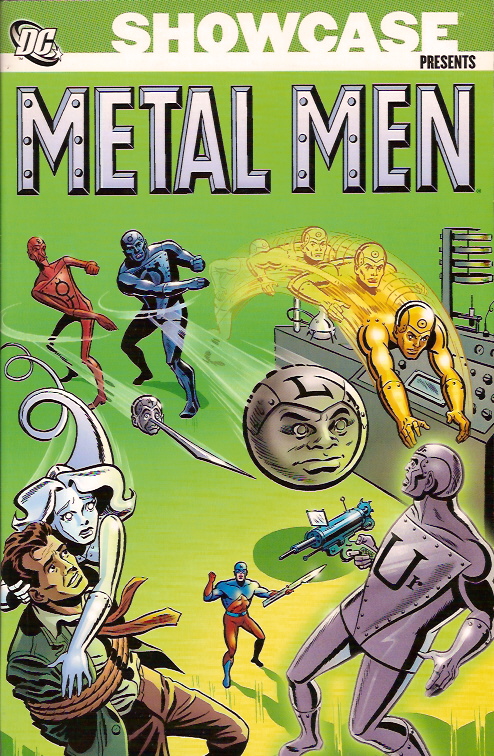
Showcase Presents Metal Men volume 1


By Robert Kanigher, Bob Haney, Ross Andru, Mike Esposito, Ramona Fradon & various (DC Comics)
SBN: 978-1-4012-1559-0 (TPB)

Dc comics have a vast unexploited wealth and variety of comics classics that remain untapped for modern fans. This especially kid-friendly series is one that really should be back in digital and paperback archival tomes…

In contrast to his gritty war and adventure scripts Robert Kanigher usually kept his fantasy and superhero comicbook tales light, visually intriguing and often extremely outlandish… and that’s certainly the case with these eccentric artificial heroes who briefly caught the early 1960’s zeitgeist for bizarre and outrageous light-hearted adventure.

The Metal Men first appeared in four consecutive issues of National/DC’s try-out title Showcase: legendarily created over a weekend by Kanigher after an intended feature blew its press deadline. The prospect was rapidly rendered by the art-team of Ross Andru & Mike Esposito: a last-minute filler that attracted a large readership’s eager attention. Within months of their fourth and final adventure, the gleaming gladiatorial gadgets were stars of their own title.

This first cheap and cheerful monochrome compendium collects the electrifying contents of Showcase #37-40, Metal Men #1-15 (spanning (March/April 1962 to September 1965) as well as the first of their nine team-up appearances in Brave and the Bold: specifically issue #55.

The alchemical excitement began in Showcase #37 (March/April 1962) with ‘The Flaming Doom!’ wherein an horrific radioactive antediluvian beast flies out of a melting polar glacier (geez! Topical) to mindlessly devastate humanity’s great cities. Helpless to stop the creature, the American military desperately approaches brilliant young technologist Dr. Will Magnus for a solution. He rapidly constructs a doomsday squad of self-regulating, highly intelligent automatons, patterned after Tina, a prototype “female” robot constructed from platinum and malleable memory ceramic, governed by a tiny supercomputer dubbed a “Responsometer”.

This miracle of micro-engineering not only simulates – or perhaps originates – thought processes and emotional character for the robots, but constantly reprograms the base form – allowing the mechanoids to change their shapes.

Magnus patterns his handmade heroes on pure metals, with Gold as leader of a tight-knit team consisting of Iron, Lead, Mercury and Tin warriors. Thanks to their responsometers, each robot specialises in physical changes based on its elemental properties but – due to some quirk of programming – the robots also develop personality traits mimicking the metaphorical attributes of their base metal.

Tina is especially intransigent, believing herself to be passionately in love with her dashing creator…

As soon as they’ve introduced themselves, the shining squad sets off to confront the deadly monster in a flying rocket-saucer and, after a terrible battle, succeed at the cost of their own brief lives…

In Showcase #38 a very public campaign to reconstruct the Metal Men results in Magnus building them anew. However, their unique characters are gone and they promptly fail in battle against a Soviet-backed Nazi scientist’s robotic marauder… until the desperate Yankee inventor manages to recover their original responsometers in ‘The Nightmare Menace!’

‘The Deathless Doom!’ then pits the malleable machines against an animated glassine tank used to store toxic residues from failed experiments by genius chemist Professor Norton. The intermingled waste products combine to create a deadly new life form dubbed Chemo who (Which? What?) would become one of the greatest menaces in the DC universe…

The Showcase trial run concluded with September/October 1962 issue as ‘The Day the Metal Men Melted!’ sees Chemo return just as Magnus’ previous exposure to the Toxic Terror coincidentally transforms the inventor into a radioactive, metallic giant. Acutely aware of his dangerous condition, Magnus exiles himself to deep space and manages to take Chemo with him where, luckily, the outer limits provide the valiant scientist with an unexpected cure…

Whereas the first three tales were relatively straight dramas, with this yarn rationalistic physics began giving way to fantastic fringe science and comedic elements began to proliferate. By increasingly capitalising on the Metal’s Men quirky characters, successive stories became as much fantasy as drama.

Metal Men #1 launched with an April/May 1963 cover-date, detailing the astonishing ‘Rain of the Missile Men’, in which alien robot Z-1 falls in love with Tina from astronomically afar and builds innumerable hordes of duplicates of himself to claim her. When his automaton army invades Earth, only Tina survives to the end of the issue…

At this point Magnus is becoming increasingly schizophrenic about the desperately lovesick and fiercely jealous Tina: alternately berating her impossible emotions then moping and missing her after he’s donated the troublesome toy to a museum… Huh! Robot Women: can’t live with them, can’t make them whatever you want them to…

Kanigher’s greatest ability was always his knack for dreaming up outlandish visual situations and bizarre emotive twists. ‘Robots of Terror’ describes how the frustrated Tina constructs her own mechanical Doc Magnus, which turns evil and develops an equally iniquitous team of elemental warriors – Barium, Aluminium, Calcium, Zirconium, Sodium and Plutonium – to battle the recently reconstructed Metal Men, after which #3’s ‘The Moon’s Mechanical Army!’ sees the team undertake a lunar search for the Platinum Bombshell after she sacrifices herself to save them all. In the process, they inadvertently bring an uncontrollable amoebic monster back to Earth…

Tin was the meekest Metal and most lacking in confidence, but in ‘The Bracelet of Doomed Heroes!’ a Giant-Alien-Robot-Amazon-Queen takes a shine to the timid tyke and shanghaies him to her distant planet. When his alchemical comrades come to the rescue they are trapped and enslaved until Tin turns the tide in the concluding ‘Menace of the Mammoth Robots!’

Back on Earth, the Metal Men battle a Gas Gang (Oxygen, Helium, Chloroform, Carbon Monoxide and Carbon Dioxide) of evil mechanical marauders after cosmic rays made Magnus evil and electronic on ‘The Day Doc Turned Robot!’, after which ‘The Living Gun!’ finds a fully-restored team confronting a colossal monster formed from a runaway solar prominence.

Metal Men #8 has the team take a little blind boy on a jaunt to another world, only to be trapped by extraterrestrial robots in ‘The Playground of Terror!’ before young Billy saves the day in the concluding battle with ‘The Robot Juggernaut!’

‘Revolt of the Gas Gang!’ relates how Doc is forced to revive the vaporous villains when the Metal Men are accidentally merged into one monolithic menace, after which the tightly continuous sagas briefly halt here to include a team-up tale from Brave and the Bold #55 (August/September 1965) in which writer Bob Haney and illustrators Ramona Fradon & Charles Paris detail the ‘Revenge of the Robot Reject’.

When a series of suspicious lab accidents destroys the Heavy Metal Heroes, distraught Doc is menaced by rogue robot Uranium and its silver metal lover Agantha, until size-changing champion Professor Ray Palmer intervenes as the all-conquering Atom, after which the scrap-heap scrappers are once more resurrected to end the evil automaton’s nuclear threat forever.

Meanwhile, back in Metal Men #11, by usual suspects Kanigher, Andru & Esposito, ‘The Floating Furies!’ finds the resourceful robots both upon and beneath the briny seas, battling intelligent mines, giant crustaceans and even King Neptune, before Z-1’s inexhaustible horde of Missile Men returns to ‘Shake the Stars!’, after which the ‘Raid of the Skyscraper Robot’ introduces a new Metal Man… of sorts.

When lonely Tin builds himself a girlfriend from a toy kit, neither is able to withstand the mockery of fellow metal Mercury. The automatic lovers flee Earth, only to encounter a devastated mobile planet of monolithic mechanical monsters which follow them back here – only to face final defeat at the gleaming hands of the reunited team.

Chemo returns to disable – but never defeat – the Metal Men in #14’s ‘The Headless Robots!’ before this initial instalment of elemental epics concludes with ‘The Revenge of the Rebel Robots!’ in which the fashionable fad for acronymic spy stories pitches the Sterling Stalwarts into combat with a giant spy machine from the subversive secret society B.O.L.T.S.! (…and no, I don’t know what it stands for…)

Wildly imaginative, weirdly enthralling and brilliantly daft, these full-on, frantic fantasies are a superb slice of the nostalgic good old days, when every day lasted a week and the world was stuffed to bursting with dinosaurs, robots and monsters. Sometimes, if you buy the right book, you can still get all those thrills at once, so let’s hope it’s not long before these marvellous yarns are back in vogue… and print…

© 1962-1965, 2007 DC Comics. All Rights Reserved.

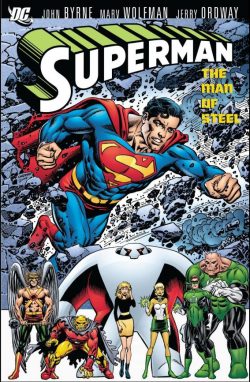
Superman the Man of Steel Volume 3


By John Byrne, Marv Wolfman, Jerry Ordway & various (DC Comics)
ISBN: 978-1-4012-0246-0 (TPB)

In 1985, when DC Comics decided to rationalise and reconstruct their continuity with Crisis on Infinite Earths, they used the event to regenerate their key properties at the same time. The biggest gun they had was Superman and it’s hard to argue that change came none too soon.

The big guy was in a bit of a slump, but he’d weathered those before. So how could a major makeover be anything but a pathetic marketing ploy that would alienate the real fans for a few Johnny-come-latelies who would jump ship as soon as the next fad surfaced? The popular wisdom amongst fans was that this new Superman was going to suck.

They couldn’t have been more wrong.

Superman titles were cancelled or suspended for three months, and yes, that did make the real-world media sit-up and take notice of the character for the first time in decades. But there was method in the corporate madness.

Beginning with 6-part miniseries Man of Steel – written and drawn by mainstream superstar John Byrne and inked by venerated veteran Dick Giordano – the experiment was a huge and instant success. So much so, that when it was first collected as a stand-alone graphic novel in the 1980s, it became one of the industry’s premiere break-out hits. From his overwhelming re-inception the character returned to his suspended comicbook homes with the addition of a third monthly title premiering that same month.

Superman, Adventures of Superman, and Action Comics (which became a fan-pleasing team-up book guest-starring other heroes of the DC Universe) were instant best-sellers. So successful was the relaunch that by the early 1990’s Superman would be able to sustain four monthly titles as well as Specials, Annuals, guest shots and his semi-regular appearances in titles such as Justice League.

It was quite a turnaround from the earlier heydays of the Man of Steel when editors were frantic about not over-exposing their biggest gun.

With Byrne’s controversial reboot now a solid hit, the collaborative teams tasked with ensuring his continued success really hit their stride with the tales collected in this third volume.

From April to June 1987 and re-presenting Superman #4-6, Action #587-589 and Adventures of Superman #427-429 in paperback and digital formats, the wonderment is preceded by an Introduction from writer/artist Jerry Ordway before the drama kicks off with an all-out battle against deranged gunman ‘Bloodsport!’ courtesy of Byrne and inker Karl Kesel. The merciless shooter is more than just crazy, however: some hidden genius has given him the ability to manifest wonder weapons from nothing and he never runs out of ammo… Marv Wolfman & Jerry Ordway concentrated on longer, more suspenseful tales. Adventures of Superman #427-428) take the Man of Tomorrow on a punishing visit to the rogue state of Qurac and an encounter with a hidden race of alien telepaths called the Circle, in a visceral and beautiful tale of un-realpolitik. ‘Mind Games’ and ‘Personal Best’ combine a much more relevant, realistic slant with lots of character sub-plots featuring assorted staff and family staff of the Daily Planet after which Byrne in Action Comics manufactures spectacle, thrills and instant gratification reader appeal.

‘Cityscape!’, in #587, teams the Metropolis Marvel with Jack Kirby’s Etrigan the Demon as sorceress Morgaine Le Fay attempts to gain immortality by warping time itself…

‘The Mummy Strikes’ and ‘The Last Five Hundred’ (Byrne & Kesel, Superman #5-6) then introduce the first hint of potential romance between the Man of Steel and Wonder Woman, before Lois Lane and Clark Kent are embroiled in an extraterrestrial invasion drama that started half a million years ago and feature rogue robots and antediluvian bodysnatchers.

In ‘Old Ties’ (Superman #6) Wolfman & Ordway reveal the catastrophic results of the Circle transferring their expansionist attentions to Metropolis, before this collection concludes with a cosmic saga from Action Comics #588-589 wherein Byrne & Giordano team the Caped Kryptonian with Hawkman and Hawkwoman in ‘All Wars Must End’, an epic battle against malign Thanagarian invaders, permitting Arisia , Salaak, Kilowog, Katma Tui and other luminaries of the Green Lantern Corps to meet and rescue the star-lost Superman in ‘Green on Green’ before uniting to eliminate an unstoppable planet-eating beast.

The back-to-basics approach lured many readers to – and back to – the Superman franchise, but the sheer quality of the stories and art are what convinced them to stay. Such cracking, clear-cut superhero exploits are a high point in the Action Ace’s decades-long career, and these chronological-release collections are certainly the easiest way to enjoy one of the most impressive reinventions of the ultimate comic-book icon.
© 1987, 2004 DC Comics. All Rights Reserved.

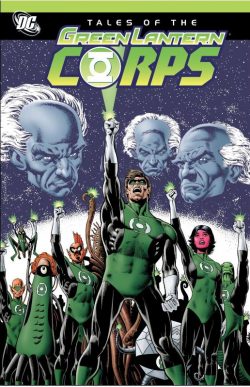
Tales of the Green Lantern Corps volume 1


By Len Wein, Mike W. Barr, Paul Kupperberg, Robyn Snyder, Todd Klein, Joe Staton, Don Newton, Carmine Infantino, Paris Cullins, Dave Gibbons & various (DC Comics)
ISBN: 978-1-4012-2155-3 (TPB)

When mortally wounded alien cop Abin Sur crashed on Earth he commanded his power ring – a device which could materialise thoughts – to seek out a replacement officer, honest and without fear.

Scanning the planet, it selected brash young test pilot Hal Jordan in nearby Coast City, California and brought him to the crash site. The dying alien bequeathed his ring, the lantern-shaped Battery of Power and his professional vocation to the astonished Earthman.

Over many traumatic years, Jordan grew into one of the greatest members of a serried band of law-enforcers. For billions of years, the Green Lantern Corps protected the cosmos from evil and disaster, policing countless numbers of sentient beings under the severe but benevolent auspices of immortal super-beings who deemed themselves Guardians of the Universe.

These undying patrons of Order were one of the first races to evolve and dwelt in sublime, emotionless security and tranquillity at the very centre of creation on the small world of Oa.

Green Lanterns are chosen for their capacity to overcome fear and are equipped with a ring that creates solid constructs out of emerald light. The miracle weapon is fuelled by the strength of the user’s willpower, making it one of the mightiest tools imaginable.

For eons, a single individual from each of the 3600 sectors of known space was selected to patrol his, her, their or its own beat. Being cautious and meticulous masters, the Guardians laid contingency plans and frequently appointed designated reserve officers and set up contingency plans for inheriting the office of their peacekeeping representatives.

Jordan’s substitute was a nice quiet (white) PE teacher named Guy Gardner, but when he was critically injured the Oans’ fallback option was a little worrying to staid, by-the-book Hal.

In Green Lantern/Green Arrow #87 (December 1971/January 1972) ‘Beware My Power!’ introduced a bold new character to the DCU. John Stewart was an unemployed architect and full-time radical activist: an angry black man always spoiling for a fight and prepared to take guff from no-one.

Jordan was convinced the Guardians had grievously erred when selecting rash, impetuous Stewart as Sector 2814’s official Green Lantern stand-in, but after seeing how his proposed pinch-hitter handled a white supremacist US presidential candidate trying to foment a race war, the Emerald Gladiator was delighted to change his tune…

As time progressed Jordan – and his occasional successors John Stewart and Guy Gardner – found reason to question the Guardians’ motives and ineffability: increasingly aware of issues that called into question the role of their masters. The same doubts also infected many of their once-devoted fellow operatives and peacekeepers. All too frequently, the grunts began seeing the formerly infallible little blue gods exposed as venal, ruthless, doctrinaire and even capricious…

However, before those issues boiled over during and after the Crisis on Infinite Earths, a superb series of back-up yarns graced the pages of Green Lantern, dedicated to broadening the horizons of the readership with tales of the vast and varied membership of the Emerald Army…

This first Fight’s ‘n’ Tights trade paperback compilation – also available in eBook editions – gathers miniseries Tales of the Green Lantern Corps plus a string of back-up tales from Green Lantern #148, 152-154, 161, 162, and 164-167 (covering May 1981 through July 1983): a period of radical change and increasing cosmic calamity foreshadowing that aforementioned, reality-altering calamity that would irrevocably reshape the DCU…

The drama begins in a triptych miniseries conceived and detailed by Mike Barr & Len Wein, with art by Joe Staton & Frank McLaughlin that despatched the Emerald Gladiators against the ultimate threat…

The onslaught begins in ‘Challenge!’ after Jordan meets anxious new recruit Arisia of Graxos IV. The nervous neophyte has barely introduced herself to the star-spanning veteran when all 3600 officers are summoned to Oa, where the Guardians inform them of a universal existential threat.

Rogue Guardian Kronos has returned from the dead and again threatens to destroy the universe by uncovering its forbidden origins. His fresh attempts to roll back time are bolstered by an invader from beyond reality that has allied with the obsessed madman for its own reasons…

The first strike comes as amassed Green Warriors communally charge their power rings: an act which causes the Great Battery to explode in a horrific detonation that slaughters thousands of officers. Not only does this act deplete their ranks, but the destruction means the Corps has only 24 hours to solve the crisis before the green energy fades away forever…

By bringing Arisia up to speed on friends and foes alike throughout the chapters, Jordan provides a potted history for the readership as the legion of surviving heroes rally, but another blow comes as the Guardians themselves fall prey to the mysterious invader from beyond: a being who controls the dead and plans on destroying all life…

Things go from bad to worse in ‘Defeat!’ as the ranks of the fallen swell with valued former comrades and even immortal Oans. One glimmer of hope comes as one slave of death-lord Nekron switches sides, inspired by the valiant resistance of the green warriors…

With the stakes at their highest, the last remaining Lanterns go on the attack, invading the death dimension and ready to employ the most desperate tactic ever devised. The gambit of course succeeds and results in ‘Triumph!’…

The era of science fiction TV fed an appetite for alien characters, and with a ready-made legion of such ready and waiting further adventures of the Green Lantern Corps soon followed: both as back-ups in the regular GL magazine and in regular Annuals. The wonderment began with an untitled exploit by Paul Kupperberg, Don Newton & Dan Adkins from Green Lantern #148 wherein cute squirrel Ch’p proved looks were deceptive and feelings irrelevant when he was ordered to save the marauding inhabitants of Berrith.

It didn’t matter that the feral hunters had predated and consumed Ch’p’s people for centuries…

Carmine Infantino rendered the saga of Quarzz Teranh who proves his ‘E’Sprit de Corps’ after being ordered to destroy a black hole at the cost of his own life, and later returned to render a tale of ‘Paradise World!’ where confirmed pacifist Jeryll is faced with a moral dilemma after employing the violence her entire species has foresworn..

The answer came in the next issue as the troubled GL made ‘The Choice’ (Infantino inked by Frank Chiaramonte)…

Kupperberg’s final contribution was illustrated by Paris Cullins & Rodin Rodriguez as sentient vegetable GL Medphyl follows murderous raiders onto an inhospitable world to be challenged by ‘A Matter of Snow’ and the depths of sadistic villainy…

Issue #161 (February 1983) featured a tale from Robin Snyder and vanguard of the “British Invasion” Dave Gibbons. ‘Storm Brother’ saw retired Lantern Harvid hunted down by his greatest enemy, testing the bonds of family to the limits.

Todd Klein scripted the next few Gibbons vignettes, beginning with ‘Apprentice’ which finds a youthful protégé overstepping his bounds and playing with forbidden green fire, after which ‘Hero’ sees “the green man” fall foul of unflinching cultural rules when he tries to save a roving colony of space vagabonds. Some people just can’t be trusted…

‘Green Magic’ is 2-part tale from Klein & Gibbons fable that opens with a ‘Test of Will’ after reluctant Green Lantern Hollika Rahn suffers for her misguided interference in a global war between scientists and sorcerers. Thankfully, she has friends she doesn’t know working for her to ensure her eventual victory, before this initial compilation concludes with a battle among herd sentients to inherit the Green Power. Of course, the true ‘Successor’ is one nobody in the bellicose family ever expected…

Light, straightforward, done-in-one action-adventures that offer a brief moment of entertainment are in pretty short supply these days, but if that’s appealing to you, this is a book and series you should indulge yourself in at your earliest convenience.
© 1981-1983, 2009, 2018 DC Comics. All Rights Reserved.

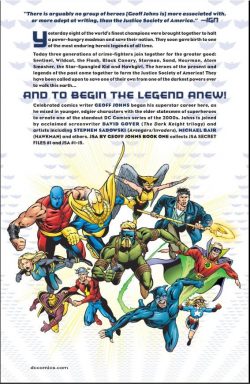
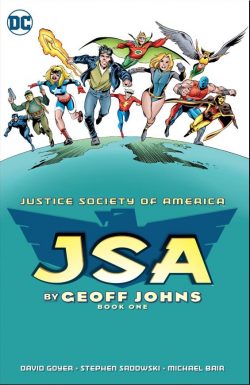
JSA by Geoff Johns Book One


By Geoff Johns, James Robinson, David S. Goyer, Scott Benefiel, Stephen Sadowski, Derec Aucoin, Marcos Martin, Michael Bair, Buzz & various (DC Comics)
ISBN: 978-1-4012-7490-0 (TPB)

After the actual invention of the comicbook superhero – for which read the launch of Superman in 1938 – the most significant event in the genre, and indeed industry’s progress was the combination of individual sales-points into a group. Thus, what seems blindingly obvious to us with the benefit of four-colour hindsight was proven – a number of popular characters could multiply readership by combining forces and readerships. Plus of course, a whole bunch of superheroes is a lot cooler than just one – or even one and a sidekick.

The Justice Society of America was created in the third issue of All-Star Comics (Winter 1940/1941), an anthology title featuring established characters from various All-American Comics publications, by the simple expedient of having the heroes gather around a table and tell each other their latest adventure. From this low-key collaboration, it wasn’t long before the guys – and they were all guys (except Red Tornado who only pretended to be one) until Wonder Woman premiered in the eighth issue – regularly joined forces to defeat the greatest villains and social ills of their generation.

Within months the concept had spread far and wide…

And so, the Justice Society of America is rightly revered as a true landmark in the development of comic books, and, when Julius Schwartz revived the superhero genre in the late 1950s, a key moment would come with the inevitable teaming of the reconfigured mystery men into a Justice League of America.

From there it wasn’t long until the original and genuine returned. Since then there were many attempts to formally revive the team’s fortunes but it wasn’t until 1999, on the back of both the highly successful revamping of the JLA by Grant Morrison and Howard Porter and the seminal but critically favoured new Starman by Golden Age devotee James Robinson, that the multi-generational team found a concept and fan-base big enough to support them.

It didn’t hurt that the writers – all with strong Hollywood connections – were both beloved of the original concept, but also knew what mass-market action audiences liked…

Officially concentrating on the efforts of current fan-fave Geoff Johns, this initial volume (available in trade paperback and digital formats) re-presents JSA #1-5, from August 1999 to October 2000, and also includes the conceptual works of his collaborators David S. Goyer & James Robinson which all germinated in a prequel tale from JSA: Secret Files #1.

The majestic drama opens sans fanfare with Robinson & Goyer’s ‘Gathering Storms’ – illustrated by Scott Benefiel & Mark Propst – from JSA: Secret Files: detailing with great style and remarkable facility (considering the incredibly convoluted continuity of the feature) how the last active survivors of the original team reconvened after losing most of their membership to old age, infirmity or enemy action. Veteran champions Wildcat, Flash and Green Lantern/Sentinel unite with youthful inheritors of the old team’s legacy to continue the tradition, train the next generation of heroes and battle one of the oldest evils in the universe…

It all begins with the death of the Sandman, octogenarian Wesley Dodds, who beats the odds one last time to thwart an unstoppable ancient foe and warn with his dying breath those surviving comrades of the immense peril to come…

The story resumes in the premiere JSA issue with ‘Justice Be Done’ by Robinson, Goyer, Stephen Sadowski & Michael Bair. At Dodds’ funeral, a horde of death-demons attack the mourners after the hero known as Fate is murdered, and the assembled mourners – legacy heroes Sand, Stargirl, Hourman, Atom Smasher, Starman and Obsidian, plus Black Canary, Wonder Woman (in actuality, her mother Hippolyta who was an active Nazi crusher during WWII) and the aforementioned trio are sent on a tripartite mission to rescue three babies; one of which is the new incarnation of the magical hero Doctor Fate.

Meanwhile, unbeknownst to all, a wild card has been introduced with the unexpected return of another departed comrade in the guise of a new and deeply troubled Hawkgirl…

Although deeply fixed in the vast backstory of the DC universe, the story is quite accessible for newcomers and continues in ‘The Wheel of Life’, as mystery hero Scarab offers his assistance as arcane forces hunt the imperilled newborns.

The heroes are all at odds with each other as the mystery villain behind everything comes out of the shadows, precipitating a chase across myriad times and dimensions and an offer of assistance from two long dead heroic ‘Old Souls’…

The resultant chaotic ultimate showdown in ‘Ouroboros’ then re-forges the multi-generational team into a force ready and willing to tackle anything. This is a fabulously engaging superhero-rebirth saga: wonderfully compelling with a frenetic pace that keeps the reader barrelling along. The struggle against the sinister big bad villain is pitched perfectly, with plenty of clues for old-timers and enough character illustration to educate and satisfy those who have never heard of “the Dark Lord…”

With the revival and reintroduction of new iterations of Hawkgirl and Doctor Fate achieved, the saga looks inward with ‘Grounded’ (illustrated by Derec Aucoin & Bair) focusing on the history and new powers of the latest Sandman whilst introducing a new Mister Terrific to the team, and casting plenty of foreshadowing of horrors yet to come…

Geoff Johns’ tenure begins as co-writer with Goyer and the official public relaunch of the JSA in ‘Justice. Like Lightning…’ (illustrated by Marcos Martin & Keith Champagne). As old guard Flash, Sentinel and Wildcat assume the role of mentors for both current and future champions, the ceremony is disrupted when they are attacked by a demented super-human named Black Adam (a magically empowered superman, usually harassing the agents of do-gooding wizard Shazam!).

The bombastic battle serves to introduce more very far-reaching plot threads as the new incarnations of Doctor Fate, Hourman and Hawkgirl thereafter journey to ancient Egypt to solve the mystery of the Black Marvel’s madness, before the second major story-arc of the series begins.

In ‘Darkness Falls’ (Sadowski & Bair), Sentinel’s troubled son Obsidian – haunted by his own powers – seemingly goes mad and attempts to drag the world into a supernatural realm of dark despondence. Naturally, there’s more to the mess that might first appear, and when a new Doctor Mid-Nite appears, it’s not long before the ebon tide begins to turn in a war for ‘Shadowland’…

The epic concludes in a savage battle for the ‘Black Planet’ after which Wildcat takes centre-stage for a magnificent solo duel against the entire Injustice Society in ‘Wild Hunt’ – the best Die Hard tribute ever seen in comics…

Beginning with ‘Split’ (illustrated by Bair & Buzz), the next extended saga pits the team simultaneously against serpentine super-terrorist Kobra and time-bending villain Extant (who killed many of the original JSA team in crossover crisis event Zero Hour). forcing the still largely untested new squad to divide its forces between a world in peril and a continuum in meltdown.

‘The Blood-Dimmed Tide’ (Goyer, Johns & Buzz) concentrates on the anti-Kobra contingent but their swift victory is spoiled when the sole survivor of the other team appears, repeatedly bringing them into battle against Extant in ‘Time’s Assassin’ and ‘Chaos Theory’ before a spectacular conclusion is won in ‘Crime and Punishment’, wherein reality is stretched beyond its limits, the gates of the afterlife are propped open and more than a few dead heroes return…

Complex and enthralling, these super shenanigans are the very best of their type: filled with wicked villains and shining, triumphant heroes, cosmic disaster and human tragedies, and always leavened by optimism and humour.

As such they’re simply not for every graphic novel reader, but if you can put yourself into the head and heart of a thrill-starved 10-year old and handle the burden of seven decades of history, these tales will supercharge your imagination and restore your faith in justice…
© 1999, 2000, 2017 DC Comics. All Rights Reserved.

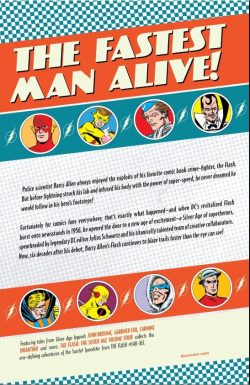
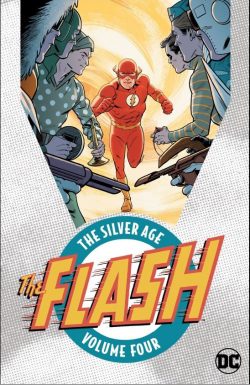
The Flash: The Silver Age volume 4


By John Broome, Gardner Fox, Robert Kanigher, Carmine Infantino & various (DC Comics)
ISBN: 978-1-4012-8823-5 (TPB)

The second iteration of the Flash triggered the Silver Age of American comicbooks and – for the first ten years or so – in terms of creative quality and sheer originality, was always the book and hero to watch.

Following his meteoric launch in Showcase #4 (October 1956), police scientist Barry Allen – transformed by a lightning strike and accidental chemical bath into a human thunderbolt of unparalleled velocity and ingenuity – was uncharacteristically slow in winning his own title, but finally (after three more cautiously released trial issues) finally stood on his own wing-tipped feet in The Flash #105 (February-March 1959).

He never looked back, and by the time of this second commemorative compilation was very much the innovation mainstay of DC/National Comics’ burgeoning superhero universe. This fourth trade paperback (and digital) collection re-presents Flash #148-163 – spanning November 1964 through August 1966 – robustly confirming the Vizier of Velocity as the pivotal figure in the all-consuming renaissance of comicbook super-heroics.

Shepherding the Scarlet Speedster’s meteoric rise to prominence, the majority of stories are written by the brilliant John Broome and Gardner Fox with pencils from the infinitely impressive and constantly innovating Carmine Infantino. Their slickly polished, coolly sophisticated rapid-fire short stories set in a welcomingly suburbanite milieu – constantly threatened by super-thieves, sinister spies and marauding aliens – displayed our affable hero always triumphant whilst expanding and establishing the broad parameters of an increasingly cohesive narrative universe. The comicbook had gelled into a comfortable pattern of two short tales per issue leavened with semi-regular book-length thrillers, although in this period that format would slowly switch to longer complete tales.

By this time, it was clear that the biggest draw to the Flash was his mind-boggling array of costumed foes, but there was still time and space for straight adventure, complex quandaries and old-fashioned experimentation, as evidenced by the odd yarn that follows Broome’s Captain Boomerang tale in Flash #248.

‘The Day Flash Went into Orbit!’ (illustrated by Infantino & Murphy Anderson) sees the Monarch of Motion caught in the crossfire after the Ozzie felon becomes a helpless patsy for a nefarious hypnotist…

With the back-up tale in this issue Broome proved creative heart and soul still counted for much. Inked by Joe Giella, ‘The Doorway to the Unknown!’ is the moving story of an embezzler who returns from the grave to prevent his brother paying for his crimes: a ghost story penned at a time when such tales were all but banned and a pithy human drama of redemption and hope that deservedly won the Academy of Comic Book Arts Alley Award for Best Short Story of the year. It still brings a worthy tear to my eyes…

Broome also scripted #149’s ‘The Flash’s Sensational Risk!’: an alien invasion yarn co-starring the Vizier of Velocity’s speedy sidekick Kid Flash, whilst Fox penned the Anderson inked ‘Robberies by Magic!’ featuring another return engagement for future-born stage conjuror Abra Kadabra, before going on to produce #150’s lead tale of a bizarre robbery-spree ‘Captain Cold’s Polar Perils!’ Giella returned for Fox’s second yarn, another science mystery as ‘The Touch-and-Steal Bandits!’ somehow transform from simple thugs to telekinetic terrors…

Flash #151 was another sterling team-up epic co-starring the original Scarlet Speedster. Fox once more teamed his 1940’s (or retroactively, Earth-2) creation Jay Garrick with his contemporary counterpart, this time in a spectacular full-length battle against the black-hearted Shade in ‘Invader From the Dark Dimension’, whilst #152’s Infantino & Anderson double-header consisted of our hero stopping ‘The Trickster’s Toy Thefts’ after which Broome’s light-hearted thriller ‘The Case of the Explosive Vegetables!’ offered another engaging comedy of errors starring Barry Allen’s father-in-law to be: absent-minded Professor Ira West.

Giella settled in for a marathon inker stint as Flash #153 has Broome reprise the much-lauded ‘Our Enemy, the Flash!’ in new yarn ‘The Mightiest Punch of All Time!’

Here villainous Professor Zoom, the Reverse Flash again attempts to corrupt reformed and cured Al Desmond – a multiple personality sufferer who was also Flash-Foes Mr. Element and Doctor Alchemy. The next issue then saw Fox’s medical mystery ‘The Day Flash Ran Away with Himself!’ and Broome’s old-fashioned crime caper ‘Gangster Masquerade!’ which brought back thespian Dexter Myles and made him custodian of an increasingly important Central City landmark: the Flash Museum.

It had to happen – and it finally did – in Flash #155: Broome teamed six of the Rogue’s Gallery into ‘The Gauntlet of Super-Villains!’, a bombastic Fights ‘n’ Tights extravaganza, but one with a hidden twist and a mystery foe concealed in the wings, whilst the following issue revealed Broome’s ‘The Super-Hero Who Betrayed the World!’: an engrossing and exciting invasion saga with the Flash a hunted man accused of treason against humanity…

Fox provided both stories in #157: ‘Who Stole the Flash’s Super-Speed?’ – a return visit for Doralla, the Girl from the Super-Fast Dimension – plus another titanic tussle with the nefarious Top in ‘The Day Flash Aged 100 Years!’ The scripter repeated the feat in #158, beginning with a rather ridiculous and somewhat gross alien encounter in ‘Battle Against the Breakaway Bandit!’ and far more appetising thriller ‘The One-Man Justice League!’, wherein Flash defeats the power-purloining plans of JLA nemesis Professor Ivo without even noticing…

The cover of Flash #159 features his empty uniform and a note saying the hero is quitting, in a tale entitled ‘The Flash’s Final Fling!’ It was written by Fox, and guest-starred Kid Flash and Earth-2 hero Dr. Mid-Nite in a time-busting battle against criminals from the future…

At that time, editors and creative staff usually designed covers that would grab potential readers’ attention and then produced stories to fit. For this issue Julie Schwartz tried something truly novel and commissioned Robert Kanigher (first scripter of the new Scarlet Speedster in Showcase #4) to write a different tale to fit the same eye-catching visual…

Scripted by Broome, ‘Big Blast in Rocket City!’ filled out #159 with another humorous Professor West espionage escapade after which Flash #160 is represented by its cover – highlighting an 80-Page Giant reprint edition.

The first story in issue #161 is where that novel experiment culminated with Kanigher’s gritty, terse and uniquely emotional interpretation in ‘The Case of the Curious Costume’ before the high-octane costumed madness continues with Fox, Infantino & Giella’s portentous Mirror Master mystery ‘The Mirror with 20-20 Vision!’

The tone of the times was gradually changing and scarier tales were sneaking into the bright and shiny Sci Fi world of super-heroics. Flash #162 featured a Fox-penned moody drama entitled ‘Who Haunts the Corridor of Chills?’ in which an apparently haunted fairground attraction opens the doors into an invasion-mystery millions of years old. The resultant clash stretches the Scarlet Speedster’s powers and imagination to the limit…

The next issue – the final entry of this collection – carries two tales by globe-trotting author Broome, beginning with ‘The Flash Stakes his Life – On – You!’ which takes a hallowed philosophical concept to its illogical but highly entertaining extreme after criminal scientist Ben Haddon makes the residents of Central City forget their champion ever existed. That has the incredible effect of making the Flash fade away… if not for the utter devotion of one hero-worshipping little girl who still believes…

By contrast ‘The Day Magic Exposed Flash’s Secret Identity!’ is a sharp non-nonsense duel with a dastardly villain after approbation-addicted illusionist Abra Kadabra again escapes prison and trades bodies with the 64th century cop sent to bring back to face future justice, leaving the Speedster with an impossible choice to make…

These tales were crucial to the development of modern comics and, more importantly, remain brilliant, awe-inspiring, beautifully realised thrillers to amuse, amaze and enthral both new readers and old lags. As always, the emphasis is on brains and learning, not gimmicks or abilities, which is why the stories still work more than half-a-century later.

This is a captivating snap-shot of when science was our friend and the universe(s) a place of infinite possibility. This wonderful compilation is another must-read item for anybody in love with the world of words-in-pictures.
© 1964, 1965, 1966, 2019 DC Comics. All Rights Reserved.
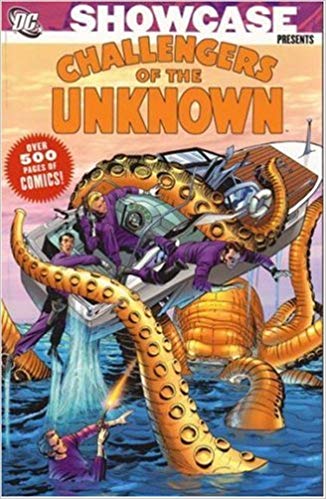
Showcase Presents The Atom volume 2


By Gardner Fox, Frank Robbins, Gil Kane, Mike Sekowsky & various (DC Comics)
ISBN: 978-1-4012-1848-5 (TPB)

There’s a glorious wealth of classic comics superhero material available for fans these days, but whether in archival volumes or digital editions, an inexplicable amount of classy material still languishes all unappreciated in limbo. One of the most cutting of omissions is the subject of today’s re-review: a veteran champion with an immaculate pedigree, a TV presence and sublime creative teams, who won’t win any new fans unless and until he gets his own revived archival editions. Until then, however…

Super-Editor Julius Schwartz famously ushered in the Silver Age of American Comics with his Showcase successes Flash, Adam Strange and Green Lantern, directly leading to the Justice League of America which in turn inspired Fantastic Four and the whole Marvel Empire and…

However, his fourth attempt to revitalize a “Golden Age Great” stalled when Hawkman (debuting in Brave and the Bold #34, February-March 1961) failed to find an immediate audience. Undeterred, Schwartz back-pedalled and resolutely persevered with the Winged Wonder, whilst moving forward with his next revival. Showcase #34 (September-October 1961) offered a space age reimagining of the pint-sized strongman of the 1940’s Justice Society of America: transformed into a fascinating super-science champion and seemingly eternal underdog by design.

Ray Palmer was a young physicist working on the compression of matter: a teaching Professor at Ivy Town University. He was wooing career girl Jean Loring, who wanted to make her name as a trial lawyer before settling down as Mrs. Palmer (yep, that’s what the 1960s were like for the fillies; years of striving and achievement followed by glorious, fulfilling days cooking meatloaf, changing nappies and gracefully dodging the more hands-on and persistent male neighbours…)

One evening Ray discovered an ultra-dense fragment of White Dwarf Star Matter, leading his research into a new direction. By converting some of that degenerate matter into a lens he could shrink objects, but frustratingly they always exploded when he attempted to restore them to their original state.

As fiercely competitive as his intended bride, Ray kept his progress secret until he could perfect the process. In the meantime, the couple took a group of youngsters on a science hike to Giant Caverns, where a cave-in trapped the entire party.

As they all lay entombed and dying, Ray secretly activated his reducing lens to shrink himself, using the diamond engagement ring he was carrying to carve a tiny fissure in the rock wall into an escape hole. Fully expecting to fatally detonate any second, he was astounded to discover that some peculiar combination of circumstances allowed to him to return to his normal six foot height with no ill effects. With his charges safe he returned to his lab to find that the process only worked on his own body; every other subject still catastrophically detonated.

Somewhat disheartened he pondered his situation – and his new-found abilities. Naturally, he became a superhero, fighting crime, injustice and monsters, but Ray also selfishly determined to clandestinely help Jean become successful as quickly as possible. To those ends he created a bodysuit from the White Dwarf material which could alter not only his height but also his weight and mass…

This second massive monochrome volume collects The Atom #18-38 (April/May 1965 to August/September 1968), the remainder of Palmer’s solo stories. Issue #39 saw the title merged with another struggling Schwartz title to become The Atom and Hawkman – an early casualty of declining interest in superhero comics at the end of the 1960s).

The Tiny Titan explodes into all-out action with the first of two short tales scripted as always by Gardner Fox, pencilled by Gil Kane and inked by Sid Greene in Atom #18. ‘The Hole-in-the-Wall Lawman!’ finds the hero tracking a safe-cracker who has inadvertently stolen a miniaturised thermonuclear bomb, after which ‘The Atomic Flea!’ sees him lose his memory while fighting thugs, wrongly deducing that he must be part of the flea circus where he regains consciousness…

Clever whimsy, scientific wonders, eye-popping action, perspective tricks and simply stunning long-shots, mid-shots and close-ups with glorious, balletic, full-body action poses are hallmarks of this dynamic series, but #19 brought a whole new edge and dynamic to the Atom when he becomes the second part of a bold experiment in continuity.

‘World of the Magic Atom!’ is a full-length epic featuring a fantasy adventure battling beside a sexy sorceress in a world where science held no sway. Her name is Zatanna…

The top-hatted, fish-netted, comely young conjuror appeared in a number of Schwartz-edited titles, hunting her long-missing father Zatarra: a magician-hero in the Mandrake mould who had fought evil in the pages of Action Comics for over a decade beginning with the very first issue.

In true Silver Age “refit” style, Fox conjured up an equally gifted daughter and popularised her by guest-teaming the neophyte with a selection of superheroes he was currently scripting. (If you’re counting, her quest began in Hawkman #4 and after this chapter moved on to Green Lantern #42; the Elongated Man back-up strip in Detective Comics #355 before concluding after the GL segment in Justice League of America #51. Through a very slick piece of back-writing, he even included a connection to the high-profile Caped Crusader via Detective #336 and ‘Batman’s Bewitched Nightmare’.)

Atom #20’s ‘Challenge of the Computer Crooks!’ finds the Mighty Mite again battling ingenious robbers attempting to use one of those new-fangled electronic brains to improve their heists, before impersonating a leprechaun to sway a reluctant witness to testify in court in ‘Night of the Little People!’.

A recurrent theme in the Tiny Titan’s career was Cold War Espionage. The American/Soviet arms-and-ideas race figured heavily in the life of physicist Palmer and in the collegiate circle of Ivy Town where even Jean’s father was a scientist carefully watched by both CIA and KGB.

Issue #21’s ‘Combat Under Glass!’ pits the Man of Many Sizes against commie spies and an enraged housecat, whilst ‘The Adventure of the Canceled Birthday’ offers another enchanting “Time-Pool” tale wherein the Atom travels to England in 1752. Here he meets Henry Fielding, helps to establish the Bow Street Runners, and solves the mystery of 11 days that dropped off the British calendar (for the answer to this mysterious true event look up the Julian Calendar on line – although buying this book would be far more entertaining and just as rewarding…)

Ray Palmer’s mentor and colleague Professor Alpheus Hyatt created a six-inch wide energy field that opened portals to other eras. Hyatt thought it an intriguing but useless scientific oddity, occasionally extracting perplexing items from it by blindly dropping a fishing line through. Little did he know his erstwhile student was secretly using it to experience rousing adventures in other times and locations. This charming, thrilling and unbelievably educational maguffin generated many of the Atom’s best and most well-loved exploits…

‘Bat Knights of Darkness!’ introduces the Elvarans, a subterranean race of 6-inch tall feudal warriors who had inhabited Giant Caverns since prehistoric times. When these savage, bat-riding berserkers fall under the mental sway of cheap thug Eddie Gordon, all of Ivy Town is endangered. This visual tour de force is a captivating early example of Gil Kane’s later swashbuckling fantasy epics and a real treat for anybody who loved Blackmark, Star Hawks or even the 1983 classic Sword of the Atom.

Issue #23 opens with a smart science-fiction teaser as the Mighty Mite plays a peculiar joke on the police in ‘The Riddle of the Far-Out Robbery!’ but it’s back to blockbusting basics when he stops the ‘Thief with the Tricky Toy!’ and even more so in #24 when he saves the entire planet from plant Master Jason Woodrue in feature-length thriller ‘The Atom-Destruction of Earth!’

The Camp/Superhero craze triggered by the Batman TV show infected many comicbooks at this time, and a lighter, punnier tone was creeping into a lot of otherwise sound series. ‘The Man in the Ion Mask!’ is far more entertaining than the woeful title might suggest: a solid heist-caper featuring another crook with a fancy gadget, and even espionage caper ‘The Spy Who Went Out for the Gold!’ is a smart, pacy rollercoaster ride of thrills and spills, but there’s really not much I can say to defend the ludicrous yarn introducing costumed nut the Bug-Eyed Bandit.

Feeble felon Bertram Larvan builds a robotic mini-beast to rob for him and despite some wonderful artwork from Kane and Greene ‘The Eye-Popping Perils of the Insect Bandit!’ in #26 remains an uncharacteristic blot on Gardner Fox’s generally pristine copy-book.

The art quality grew in leaps and bounds during this period, as seen in romantic tryst-come-slugfest ‘Beauty and the Beast-Gang!’, accompanied at the back by spectacular historical high-jinks as Atom uses the Time Pool to visit the Montgolfier Brothers in 1783 Paris, saving Benjamin Franklin’s life and becoming a ‘Stowaway on a Hot-Air Balloon!’

It’s non-stop costumed criminal action when super-thief Chronos returns in #28’s ‘Time-Standstill Thefts!’, with a side-order of scientific mystery as ordinary citizens began to change size in ‘The 100,000 “Atoms” of Ivy Town!’, before the sheer drama intensifies as the Mighty Mite teams up with the Earth-2 Atom for a cataclysmic clash against one of the worst villains of DC’s Golden Age in ‘The Thinker’s Earth-Shaking Robberies!’

Nasty thug Eddie Gordon returned in #30, which wouldn’t really have been a problem except he once more gains control of the diminutive flying berserkers in ‘Daze of the Bat-Knights!’ whilst old comrade Hawkman guest-stars #31’s ‘Good Man, Bad Man, Turnabout Thief!’

Here the heroes battle a phantom menace hidden within the brain of an innocent man, whilst issue #32 sees a most astounding episode in the Tiny Titan’s career as he becomes a giant invader of a sub-molecular universe in enthralling fantasy thriller ‘The Up and Down Dooms of the Atom!’

Bert Larvan inexplicably won a second appearance in ‘Amazing Arsenal of the Atom-Assassin!’ and it must be said, comes off as a far worthier opponent the second time around, whilst outlandish comedy-thriller ‘Little Man… You’ve Had a Big-Gang Day!’ produces the daftest assemblage of themed villains in DC history – each has a gimmick based on the word “big”. Led by Big Head, Big Bertha is strong, Big Wig uses weaponized toupees – and wait till you see what Big Cheese can do…

Despite all that, this lunacy is actually hugely enjoyable Big Fun!

Issue #35 leads with sterling crime-caper ‘Plight of the Pin-Up Atom’ and closes with the gripping ‘Col. Blood Steals the Crown Jewels!’, following the Mighty Mite into another Time Pool adventure in 1671 London.

Earth-2’s Atom returns for one of the very best team-up tales of the Silver Age in ‘Duel Between the Dual Atoms’ after a stellar radiation menace plays hob with victim’s ages on both worlds simultaneously, before the creative team signs off in mind-blowing style in #37, by adding a new ally to the Atom’s crime-fighting arsenal in ‘Meet Major Mynah!’

A trip to war-torn Cambodia results in the diminutive hero adopting a wounded Mynah bird who – with a few repairs and scientific upgrades from Hawkman – transforms the faithful talking bird into both alternative transport and strafing back-up for the Man of Many Sizes.

This volume concludes with a classy and extremely scary transitional tale from writer Frank Robbins and artists Mike Sekowsky & George Roussos. ‘Sinister Stopover… Earth!’ is an eerie alien invasion mystery perfectly in keeping with the grimmer sensibility gradually taking over the bright shiny world of comics at the time and still one of the spookiest tales of the Atom’s captivating run.

With the next issue, changing tastes and times forced The Atom and Hawkman titles to merge (for those tales you should see Showcase Presents: Hawkman volume 2), but even then the move only bought an extra year or so.

Superheroes were once more in decline and different genres were on the rise. The Atom was never a major name or colossal success, but a reading these witty, compelling tales by Fox, where Kane first mastered the fluid human dynamism that made him a legend, you’d be hard-pressed to understand why. This is sheer superhero perfection. Why not try a little Atomic Action… just a tiny bit?
© 1965, 1966, 1967, 1968, 2008 DC Comics. All Rights Reserved.