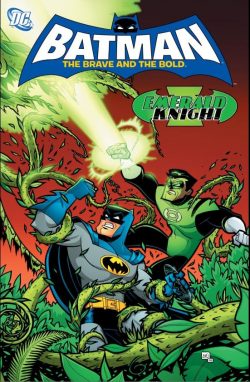
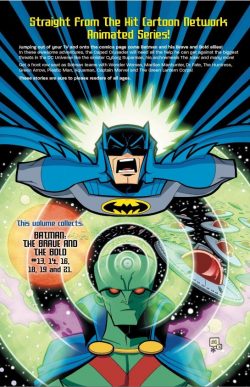
Batman: The Brave and the Bold: Emerald Knight


By Landry Q. Walker, Sholly Fisch, Adam Schlagman, Robert Pope, Eric Jones, Carlo Barberi & various (DC Comics)
ISBN: 978-1-4012-3143-9 (TPB)

The Brave and the Bold premiered in 1955 as an anthology adventure comic featuring short complete tales about a variety of period heroes: a format which mirrored that era’s filmic fascination with flamboyant if fanciful historical dramas. Devised and written by Bob Kanigher, issue #1 led with Roman epic Golden Gladiator, medieval mystery-man The Silent Knight and Joe Kubert’s now legendary Viking Prince. Soon the Gladiator was alternated with Robin Hood, but the adventure theme carried the title until the end of the decade when the burgeoning costumed character revival saw B&B transform into a try-out vehicle like Showcase.

Used to premiere concepts and characters such as Task Force X: The Suicide Squad, Cave Carson, Hawkman and Strange Sports Stories as well as the epochal Justice League of America, the comic soldiered on until issue #50 when it provided another innovative new direction which once again truly caught the public’s imagination.

That issue paired two superheroes – Green Arrow and Martian Manhunter – in a one-off team-up, and was followed by other ones: Aquaman and Hawkman in #51, WWII “Battle Stars” Sgt. Rock, Captain Cloud, Mme. Marie & the Haunted Tank in #52 and Atom & Flash in #53.

The next team-up – Robin, Aqualad and Kid Flash – quickly evolved into Teen Titans and after Metal Men/the Atom and Flash/Martian Manhunter appeared, a new hero debuted in #57-58: Metamorpho, the Element Man.

From then it was back to the increasingly popular superhero pairings with #59, and although no one realised it at the time, that particular conjunction – Batman with Green Lantern – would be particularly significant….

After a return engagement for the Teen Titans, two issues spotlighting Earth-2 champions Starman and Black Canary and Earth-1’s Wonder Woman with Supergirl, an indication of things to come came when Batman duelled hero/villain Eclipso in #64: an early acknowledgement of the brewing TV-induced mania mere months away.

Within two issues (following Flash/Doom Patrol and Metamorpho/Metal Men), B&B #67 saw the Caped Crusader take de facto control of the title and the lion’s share of the team-ups. With the late exception of #72 and 73 (Spectre/Flash and Aquaman/Atom) the comic was henceforth a place where Batman invited the rest of company’s heroic pantheon to come and play…

Decades later, the Batman Animated TV series masterminded by Bruce Timm and Paul Dini in the 1990s revolutionised the Dark Knight and subsequently led to some of the absolute best comicbook adventures in his seventy-year publishing history with the creation of the spin-off print title…

With constant funnybook iterations and tie-ins to a succession of TV cartoon series, Batman has remained popular and a sublime introducer of kids to the magical world of the printed page. One fun-filled incarnation was Batman: The Brave and the Bold, which gloriously celebrated the team up in both its all-ages small-screen and comicbook spin-off.

Shamelessly and magically plundering decades of continuity arcana in a profusion of alliances between the Dark Knight and DC’s other heroic creations, the show was supplemented by a cool kid’s periodical full of fun, verve and swashbuckling dash, cunningly crafted to appeal as much to the parents and grandparents as those fresh-faced neophyte kids…

This stellar trade paperback and digital collection re-presents issues #13, 14, 16, 18, 19 and 21 in an immensely entertaining package suitable for newcomers, fans and aficionados of all ages originally released between March and November 2010. Best of all, although not necessary to the reader’s enjoyment, a passing familiarity with the TV episodes will enhance the overall experience…

Following the format of the TV show, each tale opens with a brief vignette adventure before telling a longer tale. Issue #13 sees the Caped Crimebuster break a leg while working with Angel O’Day and Sam Simeon (the astonishingly daft but wonderful Angel & The Ape) and laid up for main feature ‘Night of the Batmen’ (by Sholly Fisch, Robert Pope & Scott McRae) as an army of (uninvited and unwelcome) heroic comrades – including Green Arrow, Plastic Man, Aquaman and Shazam!-powered Captain Marvel among others – impersonate the Dark Knight to keep Gotham safe from fiends such as Bane, Killer Croc, Penguin, Deadshot and Catwoman. However, when the Joker joins the party, it results in the real deal ending his recuperation early…

Crafted by Landry Q. Walker & Eric Jones, the next yarn opens with Bats and Plastic Man tackling the Scarecrow before the Gotham Gangbuster meets the Huntress. She is having trouble with a costumed crazy with a nasty obsession and ends up briefly ‘Captured by Mr. Camera!’…

The same creative crew return for #16 as a battle with the Teen Titans against Nocturna hatches a sinister sub-plot in ‘Egg Hunt! or: The Evil of Egg Head!’ as the ovoid mastermind revives antediluvian elder god Y’ggphu Soggoth (offering a guilty treat for old fans of truly naff supervillains) and Batman needs the aid of Wonder Woman to scramble the scheme…

Batman: The Brave and the Bold #18 alters the format slightly with a brace of linked tales from Walker & Jones. ‘Life on Mars’ features Batman and Martian Manhunter J’onn J’onzz defeating the human extermination plans of super-psionic shapeshifting White Martian Ma’alefa’ak before a strangely off-kilter Dark Knight calls in mystic master Doctor Fate to diagnose and treat a case of possession in follow-up thriller ‘All in the Mind’…

The last two yarns collected here both co-star Hal Jordan and other stalwarts of the Green Lantern Corps. From #19 and by Adam Schlagman, Carlo Barberi & Terry Beatty, ‘Emerald Knight’ details how the ring-slinger is captured by ultimate tech pirate Cyborg Superman and robotic Manhunters. Unable to prevail alone, Jordan temporarily bequeaths his power to Batman who lead his comrades in the Corps to victory, after which a brief interlude battling dinosaur gangsters beside the Lady Blackhawks leads to the Gotham Guardian and the fully-restored Jordan uniting to defeat ‘The Menace Known as Robert’. Another Walker & Jones production, this depicts the calamitous threat of a primordial alien horror invading Earth and the terrifying lengths Batman will go to save the world…

Despite being ostensibly aimed at TV-addicted kids, these mini-sagas are also wonderful, traditional comics thrillers no self-respecting fun-fan should miss: accessible, well-rendered yarns for the broadest range of excitement-seeking readers. This is a fabulously fun rollercoaster ride and confirms the now-seamless link between animated features and comicbooks. After all, it’s just adventure entertainment in the end; really unmissable entertainment…

What more do you need to know?
© 2010, 2011 DC Comics. All Rights Reserved.

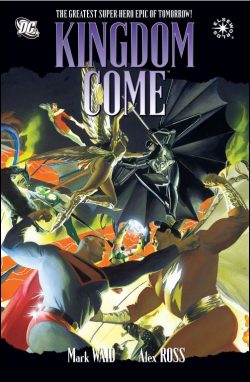
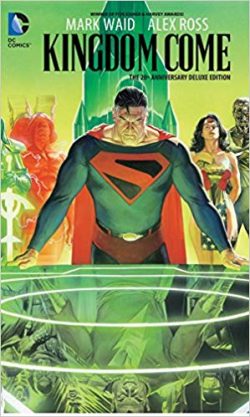
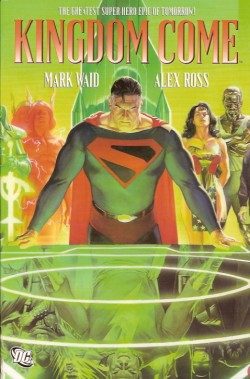
Kingdom Come


By Mark Waid & Alex Ross, with Todd Klein & various (DC Comics)
ISBN: 978-1-4012-6082-8 (20th Anniversary HB) 978-1-4012-2034-1 (TPB

In the mid-1960s a teenaged Jim Shooter wrote a couple of stories about the Legion of Super-Heroes set some years into the team’s own future. Those stories of the adult Legionnaires revealed hints of things to come that shackled the series’ plotting and continuity for decades as eager, obsessed fans (by which I mean all of us) waited for the predicted characters to be introduced, presaged relationships to be consummated and heroes to die.

By being so utterly impressive and similarly affecting, Kingdom Come accidentally repeated the trick decades later, subsequently painting the entire post Crisis on Infinite Earths DC Universe into the same creative corner until one of the company’s periodic continuity reboots…

Envisaged and designed by artist Alex Ross as DC’s answer to epic groundbreaking Marvels, Kingdom Come was originally released as a 4-issue Prestige Format miniseries in 1996 to rapturous acclaim and numerous awards and accolades. Although set in the future and an “imaginary story” released under DC’s Elseworlds imprint, it almost immediately began to affect the company’s mainstream continuity.

Set approximately twenty years into the future, the grandiose saga details a tragic failure and subsequent loss of Faith for Superman and how his attempt to redeem himself almost leads to an even greater and ultimate apocalypse.

The events are seen through the eyes and actions of Dantean witness Norman McCay, an aging cleric co-opted by Divine Agent of Wrath the Spectre after the pastor officiates at the last rites of dying superhero Wesley Dodds. As the Sandman, Dodds was cursed for decades with precognitive dreams which compelled him to act as an agent of justice.

Opening chapter ‘Strange Visitor’ reveals a world where metahumans have proliferated to ubiquitous proportions: a sub-culture of constant, violent clashes between the latest generation of costumed villains and vigilantes, all unheeding and uncaring of the collateral damage they daily inflict on the mere mortals around and in all ways beneath them.

The shaken preacher sees a final crisis coming, but feels helpless until the darkly angelic Spectre comes to him. Taken on a bewildering voyage of unfolding events, McCay is to act as the ghost’s human perspective whilst the Spirit of Vengeance prepares to pass final judgement on Humanity.

First stop is the secluded hideaway where farmer Kal-El has hidden himself since the ghastly events which compelled him to retire from the Good Fight and the eyes of the World. The Man of Steel was already feeling like a dinosaur when newer, harsher, morally ambiguous mystery-men began to appear. After the Joker murdered the entire Daily Planet staff and hard-line new hero Magog executed him in the street, the public applauded the deed. Heartbroken and appalled, Superman simply disappeared for a decade. His legendary colleagues also felt the march of unwelcome progress and similarly dropped from sight.

With Earth left to the mercies of dangerously irresponsible new vigilantes, civil unrest soon escalated. The younger heroes displayed poor judgement and no restraint, with the result that within a decade the entire planet had become a chaotic arena for metahuman duels.

Civilisation was fragmenting. Flash and Batman retreated to their home cities and made them secure, crime-free solitary fortresses. Green Lantern built an emerald castle in the sky, turning his eyes away from Earth and towards the deep black fastnesses of space. Hawkman retreated to the wilderness, Aquaman to his sub-sea kingdom whilst Wonder Woman retired to her hidden paradise. She did not leave until Armageddon came one step closer…

When Magog and his Justice Battalion battled the Parasite in St. Louis, the result was a nuclear accident which destroyed all of Kansas and much of Iowa, Missouri and Nebraska. Overnight the world faced starvation as America’s breadbasket turned into a toxic wasteland. Now with McCay and the Spectre invisibly observing, Princess Diana convinces the bereft Kal-El to return and save the world on his own terms…

In ‘Truth and Justice’ a resurgent Justice League led by Superman begins a campaign of unilateral action to clean up the mess civilisation has become: renditioning “heroes” and “villains” alike, imprisoning every dangerous element of super-humanity and telling governments how to behave, blithely unaware that they are hastening a global catastrophe of Biblical proportions as the Spectre invisibly gathers the facts for his apocalyptic judgement.

In the ensuing chaos, crippled warrior Bruce Wayne rejects Superman’s paternalistic, doctrinaire crusade and allies himself with mortal humanity’s libertarian elite – Ted (Blue Beetle) Kord, Dinah (Black Canary) Lance and Oliver (Green Arrow) Queen – to resist what can only be considered a grab for world domination by the meta-human minority. As the helpless McCay watches in horror, Wayne’s group makes its own plans; another dangerous thread in a tapestry of calamity…

At first Superman’s plans seem blessed to succeed, with many erstwhile threats flocking to his banner and his doctrinaire rules of discipline, but as ever there are self-serving villains with their own agendas. Lex Luthor organises a cabal of like-minded compatriots – Vandal Savage, Catwoman, Riddler, Kobra and Ibn Al Xu’ffasch (Son of the Demon Ra’s Al Ghul) – into a “Mankind Liberation Front”.

With Shazam-empowered Captain Marvel as their slave, this group are determined the super-freaks shall not win. Their cause is greatly advanced once Wayne’s clique joins them…

‘Up in the Sky’ sees events spiral into a deadly storm as McCay, still wracked by his visions of Armageddon, is shown the Gulag where all recalcitrant metahumans have been dumped. He also witnesses how it will fail, learns from restless spirit Deadman that the Spectre is the literal Angel of Death and watches with growing helplessness as Luthor’s plan to usurp control from the army of Superman leads to a shocking confrontation, betrayal and a deadly countdown to the End of Days…

The deadly drama culminates in a staggering battle of superpowers, last moment salvation and a second chance for humanity in a calamitous world-shaking ‘Never-Ending Battle’…

Thanks to McCay’s simple humanity, the world gets another chance and this edition follows up with an epilogue ‘One Year Later’ which end this ponderous epic on a note of renewed hope…

This edition – available as a 20th Anniversary deluxe hardback, a standard trade paperback and in digital formats – comes with an introduction by author and former DC scribe Elliot S. Maggin, assorted cover reproductions and art-pieces, an illustrated checklist of the vast cast list plus a plethora of creative notes and sketches in the ‘Apocrypha’ section, and even hints at lost glories in ‘Evolution’: notes, photos and drawings for a restored scene that never made it into the miniseries.

Epic, engaging and operatically spectacular, Kingdom Come is a milestone of the DC Universe and remains to this day a solid slice of superior superhero entertainment, worthy of your undivided attention.
© 1996, 2008, 2016 DC Comics. All Rights Reserved.

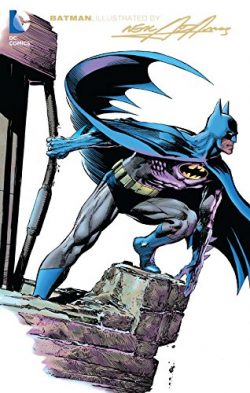
Batman: Illustrated by Neal Adams volume 3


By Neal Adams with Dennis O’Neil, Frank Robbins, Len Wein, Dick Giordano & various (DC Comics)
ISBN: 978-1-4012-4075-2 (TPB)

It’s Batman’s anniversary year. What are you reading?

As the 1960s began Neal Adams was a young illustrator who had worked in advertising and ghosted some newspaper strips whilst trying to break into comics. Whilst pursuing a career in advertising and “real art” he did a few comics pages for Archie Comics and subsequently became one of the youngest artists to co-create and illustrate major licensed newspaper strip Ben Casey (based on a popular TV medical drama series).

That comics fascination never faded, however, and Adams drifted back to National/DC, doing a few covers as inker or penciller before eventually finding himself at the vanguard of a revolution in pictorial storytelling…

He made such a mark that DC recently chose to reprint every piece of work Adams ever did for them into a series of commemorative collections. This is the last of three superb tomes (available in a variety of formats including last minute delivery eBook) starring the “Darknight Detective” as he was dubbed back then, and featuring every cover, story and issue in original publication order.

This particular package celebrates the covers and pertinent contents of Batman #232, 234-241, 243-246, 251, 255, Batman Annual #14, Batman Black & White # 4, The Brave and the Bold #99, Detective Comics #412-422, 439, 600, Heroes Against Hunger, Limited Collectors’ Edition C-25, C-51, C-59, Robin #1, Saga of Ra’s Al Ghul #4, World’s Finest Comics # 211, 244-246, 258; cumulatively embracing June 1971 to September 1996.

Following Adams’ liberally illustrated Foreword and key collaborator Denny O’Neil’s recollections describing their work process in his Introduction, the comics gold begins.

Throughout this period Adams remained one of the industry’s top cover artists, generating a stunning succession of mesmerising images on most Bat-related titles (and plenty of other comics). Those are listed here in chronological release order…

Behind a macabre eye catcher, Batman #232 (June 1971) took the hero to new heights as former kidnap victim Talia returns and we learn more of her as O’Neil & Adams – with inking as usual from Dick Giordano – introduce her father: immortal eco-terrorist Râ’s Al GhÅ«l.

A whirlwind adventure which became one of the signature highpoints of the entire Batman canon, ‘Daughter of the Demon’ is a timeless globe-girdling mystery yarn drawing the increasingly grim hero from Gotham’s concrete canyons to the Himalayas in search of hostages Robin and Talia, purportedly captured by forces inimical to both Batman and the mysterious figure who claims to be working in secret to save the world…

Ra’s was a contemporary, more acceptable visual embodiment of the classic inscrutable ultimate foreign devil (as typified in a less forgiving age as the “Yellow Peril” or Dr. Fu Manchu). This kind of alien archetype permeates popular fiction and is still an astonishingly powerful villain-symbol, although the character’s Arabian origins – neutral at the time – seem to uncomfortably embody a different kind of ethnic bogeyman in today’s post 9/11, ISIS-infested world.

The concept of a villain who has the best interests of the planet at heart is not a new one, but Ra’s Al Ghul, whose avowed intent is to reduce teeming humanity to viable levels and save the world from our poison, hit a chord in the 1970s – a period where ecological issues first came to the attention of the young. It was a rare kid who didn’t find a note of sense in what “the Demon’s Head” planned. The spectacular tale ended with a shocking pronouncement of what Ra’s intended for Gotham’s Guardian…

The chilling covers for Detective Comics #412 and 413 (this was the peak of the revival in supernatural comics, after all), leads to Batman #234 which featured the stellar return of one of the hero’s most tragic foes.

As comics became increasingly more anodyne in the 1950s, psychologically warped, physically actualised schizophrenic Two-Face was quietly retired from Batman’s roster of rogues, but with ‘Half an Evil’ (O’Neil, Adams & Giordano), he resurfaced at the forefront of grimmer, grittier stories.

When a string of bizarre and brutal robberies afflicts the city, the baffled Batman has to use all his ingenuity to discern the reasoning and discover the identity of a ruthless hidden mastermind in time to thwart a diabolical scheme…

Covers for Detective #414-417 Batman #235-236 lead into another much-reprinted classic. ‘Night of the Reaper!’ – by the usual suspect from Batman #237 – is one of the most revered tales of the era: a harrowing Halloween epic which finds Robin working with his old mentor to solve a string of barbarous killings, only to uncover a pitifully deranged perpetrator as much sinned-against as sinner…

The fronts for Detective# 418-422, The Brave and the Bold #99, Batman #238-241 and World’s Finest Comics # 211 bring us to Batman #243 (August) as the long-brewing war between Batman and Ra’s Al Ghul reaches Def Con 3: a single extended saga taken out of normal DC continuity and depicting the final confrontation between two opposing ideals.

Not included here are the non-Adams episodes from Batman #240 and 242 (although they are available in many other collections). In them, the Darknight Detective abandoned his civilian identity by faking Bruce Wayne’s death and gathered a small team of specialist allies – comprising criminal alternate-identity Matches Malone, scientific advisor Dr. Harris Blaine and Ra’s’ top assassin Ling – suborned to the side of the angels by his own superstitious code of honour and sworn to destroy the Demon forever.

O’Neil, Adams & Giordano reunited for Batman #243 which sees the team – plus latecomer Molly Post – invade the Demon’s Swiss citadel moments after their intended target dies. Nobody suspects the ageless villain’s resources include ‘The Lazarus Pit’ which can revive the dead…

The fateful finale came in #244, wherein ‘The Demon Lives Again!’ Sadly, despite all his supernal gifts and forces, Ra’s cannot escape the climactic vengeance of his implacable foe in dream-team O’Neil, Adams & Giordano’s compulsive climax. With the job done, a short addendum in #245 resolves ‘The Bruce Wayne Murder Case!’, restoring the billionaire to his rightful place in Gotham’s social whirl…

The all-Adams cover to Batman #246 (October 1972) leads to another graphic landmark. ‘The Joker’s Five-Way Revenge’ comes from Batman #251 (September 1973 by Dennis O’Neil & Neal Adams) and finally ended forever the zany, “camp” taint of the TV show by re-branding the characters and returning to the original 1930s concept of a grim and driven Dark Avenger chasing an insane avatar of pure evil.

Such a hero needs truly deadly villains and – by reinstating the psychotically unpredictable Killer Clown who scared the short pants off readers in the Golden Age – this single-issue yarn set the bar very, very high. A true milestone that utterly redefined the Joker for the modern age: the story sees the Mirthful Maniac stalking his old gang, determined to eradicate them all with the hard-pressed Gotham Guardian desperately playing catch-up. As the crooks die in all manner of Byzantine and bizarre ways, Batman realises his arch-foe has gone irrevocably off the deep end….

Terrifying and beautiful, for many fans this is the definitive Batman/Joker story, but signalled Adam’s graduation to other jobs and away from regular bat-missions. Before that departure, however, the cover to Detective #439 (February/March 1974) and one last thriller awaited.

Scripted by Len Wein and inked by Giordano, ‘Moon of the Wolf’ from Batman #255 (March/April 1974) pits the ultimate human hero against a tragic former sportsman mutated into a truly supernatural lupine killer and enslaved by old enemy Professor Milo…

From Limited Collectors’ Edition C-25 comes a pin-up before a rare example of the artist’s commercial comics work appears. Adams produced art for a series of comics adventures starring various Marvel and DC heroes – as well as screen icons such as Star Trek and Planet of the Apes – for Power Records’ line of Book and Records sets. These offered a vinyl recording of a story accompanied by a fully illustrated comic tale. The Batman offerings began with ‘Trumping the Joker’ in Stacked Cards (PR-27, 1975 and written & illustrated by Adams) was followed a year later, by PR-30 (Adams, Frank Robbins and Giordano) wherein ‘Robin Meets Man-Bat’. The all-ages tales are accompanied by a house ad for the DC stars available in Power Records’ unique packages.

Still a huge draw as a cover artist, between 1977-1996 Adams generated Bat-related frontages for World’s Finest Comics # 244-246 & 258, Limited Collectors’ Edition C-51 (a wraparound reprinting the “Bride of the Demon” saga) and C-59 (‘Batman’s Strangest Cases’), the Heroes Against Hunger benefit comic, a pin-up in Detective Comics #600, covers for Saga of Ra’s Al Ghul #4 (another wraparound), Batman Annual #14, and pin-ups for Robin #1 and Batman Black & White # 4.

The history of Batman is inescapably linked to and shaped by Neal Adams’ efforts, and captivating secrets of creation are revealed in the stunning Neal Adams Sketchbook section (featuring comic art, ads, storyboards and conceptualisations for a Batman amusement park) which closes this compelling and irresistible tome (still readily available in trade paperback and digital editions).

With the game-changing classics in this volume, Batman finally returned to the commercial and critical top flight he had enjoyed in the 1940s reviving and expanding upon his original conception as a remorseless, relentless avenger of injustice. The next few years would see the hero rise to unparalleled heights of quality so stay tuned: the very best is just around the corner… that dark, dark corner…
© 1971, 1972, 1973, 1974, 1975, 1976, 1977, 1978, 1979, 1986, 1988, 1989, 1990, 1991, 2005, 2015 DC Comics. All Rights Reserved.

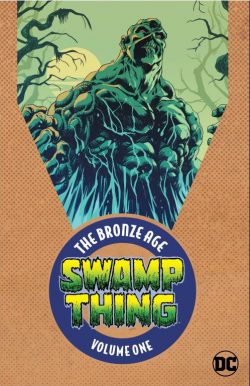
Swamp Thing: The Bronze Age Volume One


By Len Wein & Bernie Wrightson, Nestor Redondo; with Michael Wm. Kaluta & various (DC Comics)
ISBN: 978-1-4012-8440-4 (TPB)

The first fan-sensation of the modern age – now officially enshrined as the Bronze Age – of American comicbooks – Swamp Thing has powerful popular fiction antecedents and in 1972 was seemingly a concept whose time had come again. Prime evidence was the fact that Marvel were also working on a man-into-mucky, muddy mess character at the very same time.

Both Swampy and the Man-Thing were thematic revisions of Theodore Sturgeon’s classic novella It and bore strong resemblances to an immensely popular Hillman Comics character dubbed The Heap. He/it slurped through the back of Airboy Comics (née Air Fighters Comics) from1943. My fan-boy radar suspects Roy Thomas’ marsh-monster the Glob (debuting in Incredible Hulk #121 from November 1969 and promptly returning in #129, June 1970) either inspired both DC and Marvel’s creative teams, or was part of that same zeitgeist. It should also be remembered that Skywald (a very minor player with big aspirations) released a black-&-white magazine in their Warren Comics knock-off line entitled The Heap in the Autumn of 1971.

For whatever reason, by the end of the 1960s superhero comics had started another steep sales decline, once again succumbing to a genre boom and horror/mystery resurgence: a sea-change augmented by a swift rewriting of the specific terms of the Comics Code Authority. At DC, With EC veteran Joe Orlando as editor, House of Mystery and sister title House of Secrets returned to short story anthology formats and gothic mystery scenarios, taking a lead from such TV successes as Twilight Zone and Rod Serling’s Night Gallery.

Referencing the sardonic narrator/storyteller format of EC horror titles, Orlando created Cain and Abel to shepherd readers through brief, sting-in-the-tail yarns produced by the best creators, new and old, that the company could hire. Artists Neal Adams, Mike Kaluta, and especially Bernie Wrightson produced their best work for these titles, and the vast range of successors the horror boom generated at DC.

The twelfth anthology issue of the resurrected House of Secrets cemented the genre into place as the industry leader. There writer Len Wein & Wrightson produced a throwaway gothic thriller set at the turn of the 19th century, wherein gentleman scientist Alex Olsen is murdered by his best friend and his body dumped in a swamp. Years later, his beloved bride – now the unsuspecting wife of the murderer – is stalked by a shambling, disgusting beast that seems to be composed of mud and muck…

This epic trade paperback and digital compilation gathers material from House of Secrets #92, and the contents of Swamp Thing #1-13 (cumulatively covering June/July 1971 to November/December 1974) and perfectly encapsulates the changing face and taste of the times, opening here with that so-pivotal gothic vignette…

‘Swamp Thing’ cover-featured in HoS #92 (June-July 1971), and struck an immediate chord with the buying public. The issue was the best-selling DC comic of that month, and reader response was fervent and persistent.

By all accounts, the only reason there wasn’t an immediate sequel or spin-off was that the creative team didn’t want to produce one. Eventually however, bowing to interminable pressure, and with the sensible idea of transplanting the concept to contemporary America, the first issue of Swamp Thing appeared on newsstands in the Spring of 1972. It was an unqualified hit and an instant classic.

Wein and Wrightson produced ten issues together, crafting an extended, multi-chaptered tale of justice/vengeance and a quest for answers that was at once philosophically typical of the time and a prototype for the story-arc and mini-series formats that dominate today’s comics production. They also used each issue/chapter to pay tribute to a specific sub-genre of timeless horror story whilst advancing the major plot…

Here, the saga resumes with a fresh origin as ‘Dark Genesis’ finds Alec and Linda Holland deep in the Louisiana Bayou, working on a bio-restorative formula that will revolutionise global farming. Working in isolation, they are protected by Secret Service agent Matt Cable, when representatives of an organisation called the Conclave demand that they sell their research to them – or else.

Obviously, the patriotic pair refuse, and the die is cast. The lab is bombed and Linda dies instantly but Alec, showered with his own formula and blazing like a torch, hurtles to a watery grave in the swamp. He does not die…

Transformed by the formula (and remember, please, that this is prior to Alan Moore’s landmark re-imagining of the character) Holland is transformed into a gigantic man-shaped monster, immensely strong, unable to speak, and seemingly composed of living plant matter. Holland’s brain still functions however, and he vacillates between finding his wife’s killers and curing his own monstrous condition. Cable, misinterpreting the evidence, also wants revenge, but he thinks that the monster is the cause of death of his two charges…

Over the next nine issues, Swamp Thing travelled the world, encountering the darkest outbreaks of classic supernature and the insatiable greed of human monsters.

The first was black sorcerer Anton Arcane and his artificial homunculi The Un-Men (eventually the grotesque stars of their own Vertigo series), in ‘The Man Who Wanted Forever.’ The wizard transported Holland to his Balkan castle and sought to mystically trade places with the stupendous swamp beast. The temptation proved too great, but when the restored scientist realised the cost, he violently recanted…

The next issue introduced Abigail Arcane and her tragic Frankenstein-influenced father ‘The Patchwork Man’ in a classic case of monster misunderstanding, which results in her joining free agent Cable in stalking the mossy misanthrope. As Holland makes his torturous way back to the USA, hunters and hunted are waylaid and encounter a Scottish werewolf in ‘Monster on the Moors!’ before at last returning to America and finding ‘The Last of the Ravenwind Witches!’ as well as even more mob-handed human intolerance…

In the wilds of Vermont, he encounters Paradise on Earth, courtesy of an old clockmaker but when the idyll is turned into ‘A Clockwork Horror’ by the voracious Conclave, his torment is transformed into sheer rage, leading to one of the most evocative and revered team-ups of the 1970s.

Swamp Thing #7’s ‘Night of the Bat’ featured the final showdown with the remorseless robber-barons of The Conclave in their Gotham City HQ: a landmark collaboration with the resurgent Batman, himself finally recovering from the hyper-exploitation of the “Campy” TV show era.

Wrightson’s rendering of the superhero through the lens of a horror artist inspired a whole generation of aspiring comics professionals and firmly set the Caped Crusader to rest, replaced with a grim and moody Dark Knight.

Somewhat at a loss after the end of his quest (Swamp Thing came out bi-monthly, so the tale had taken well over a year to tell – unprecedented at a time when most comics still had two or more complete stories per issue), the Moss Monster shambled aimlessly through America’s hinterlands encountering a Lovecraftian horror in the New England town of Perdition. ‘The Lurker in Tunnel 13!’ After dealing with eldritch cancer god M’Naagalah, Holland (as well as Abigail and Cable) were drawn into a US military cover-up involving a marooned and benevolent alien in ‘The Stalker from Beyond!’ which benefitted from supplemental inking by Michael Kaluta before the classic run concluded with #10’s ‘The Man Who Would Not Die!’: a tale of ghostly retribution amidst the graves of unquiet plantation slaves with unliving atrocity Anton Arcane making his first of many demonic returns…

The issue was plotted by Wrightson and marked his swansong on the title: the next chapter in the Swamp Thing saga was still dictated by Wein but the miraculously gifted hands of Nestor Redondo: possible the only artist who could have matched the visual intensity of the feature’s visual originator.

Nestor Redondo was born in 1928 at Candon, Ilocas Sur in the American Territory of the Philippines. Like so many others he was influenced by US comic-strips such as Tarzan, Superman, Buck Rogers and Flash Gordon which were immensely popular in the entertainment-starved Pacific Archipelago.

Drawing from an early age Nestor emulated his brother Virgilio – who already worked as a comics artist for the cheap magazines of the young country. The Philippines became a commonwealth in 1935, and achieved full-independence from the USA in 1946, but maintained close cultural links to America.

His parents pushed him into architecture but within a year Nestor had returned to comics. A superb artist, he far outshone Virgilio – and everybody else – in the cottage industry. His brother switched to writing and the brothers teamed up to produce some of the best strips the Islands had ever seen, the most notable and best regarded being Mars Ravelo’s ‘Darna’.

Capable of astounding quality at an incredible rate of speed, by the early 1950s Nestor was drawing for many comics simultaneously. Titles such as Pilipino Komiks, Tagalog Klasiks, Hiwaga Komiks and Espesial Komiks were fortnightly and he usually worked on two or three series simultaneously, pencils and inks. He also produced many of the covers.

In 1953 he crafted an adaptation of MGM film Quo Vadis for Ace Publications’ Tagalong Klasiks #91-92. Written by Clodualdo Del Mundo, it was serialized to promote the movie in country, but MGM were so impressed by the art-job they offered 24-year old Nestor a US job and residency. He declined, thinking himself too young to leave home yet.

If you’re interested, you can see the surviving artwork by Googling “Nestor Redondo’s Quo Vadis”, and you should because it’s frankly incredible.

Ace was the country’s biggest comics publisher, but by the early 1960s they were in dire financial straits. In 1963 Nestor, Tony Caravana, Alfredo Alcala, Jim Fernandez, Amado Castrillo and brother Virgilio set up their own company CRAF Publications, Inc., but the times were against them (and publishers everywhere). About this time, America came calling again, but in the form of DC and Marvel Comics. By 1972, US based Tony DeZuñiga had introduced a wave of Filipino artists to US editors, and Nestor produced short horror tales for House of Mystery, House of Secrets, Phantom Stranger, Secrets of Sinister House, Witching Hour, The Unexpected, Weird War Tales, fill-ins for Marvel’s Man-Thing, an astonishingly beautiful run on Rima the Jungle Girl (a loose adaptation of W H Hudson’s seminal 1904 novel Green Mansions) before being tapped to take over as illustrator on Swamp Thing. He also worked on Lois Lane and Tarzan and in 1973 produced adaptations including Dracula and Dr. Jekyll and Mr. Hyde for Vincent Fago’s Pendulum Press Illustrated Classics: later reprinted as Marvel Classics Comics.

In later years he moved to Marvel where he inked and eventually fully illustrated Savage Sword of Conan.

During that DC period he was tapped to draw an adaptation of King Arthur which DC killed before it was completed (once again some pages survive and the internet is your friend if you want to see them) and illustrated issue C-36 of the tabloid sized Limited Collectors’ Edition: The Bible. (please link)

Sporting a Luis Dominguez cover, Swamp Thing #11 was cover-dated July/August 1974 and sees the monster back at last in his Bayou home, with Cable and Abigail close on his root-riddled heels. When mutant beasts and ‘The Conqueror Worms!’ attack his human pursuers, Holland rushes to the rescue and the relationship between hunters and prey alters forever…

The carnivorous Worms have suborned crazed survivalist Professor Zachary Nail and taken captives and when their secret plans are exposed war breaks out for possession of Earth…

In the aftermath, Swamp Thing is sucked into an arcane time-loop locked on constantly-killed and perpetually-resurrecting Milo Mobius …until Holland finds a way to break the circle of ‘The Eternity Man’

This initial collection then concludes with Cable, Abigail and new recruit Bolt instigating ‘The Leviathan Conspiracy’ to liberate the Federally imprisoned Swamp Thing and put him beyond the reach of government scientists forever…

A genuine landmark of the art form, these stories are also superb examples of old-fashioned comics wonderment, from a less cynical and sophisticated age, but with a passion and intensity that cannot be matched. And, ooh, that artwork…

If you love comics you must have his buried treasure.
© 1971, 1972, 1973, 1974, 2018 DC Comics. All Rights Reserved.

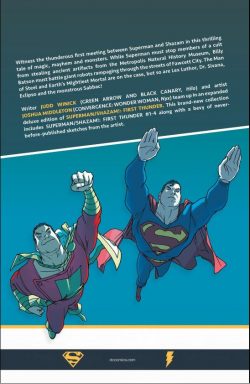
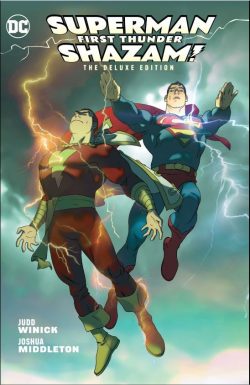
Superman/Shazam!: First Thunder


By Judd Winick, Joshua Middleton & various (DC Comics)
ISBN: 978-1-4012-0923-0 (TPB)

At their most impressive, superhero comics combine all the gravitas of mythology with all the sheer child-like fun and exuberance of a first rollercoaster ride. A perfect example of this is a 4-issue miniseries from November – February of 2006 collected as Superman/Shazam!: First Thunder.

One of the most venerated and loved characters in American comics, (the original) Captain Marvel was created by Bill Parker and Charles Clarence Beck as part of the wave of opportunistic creativity that followed the successful launch of Superman in 1938. Although there were many similarities in the early years, the Fawcett character moved solidly and steadily into the area of light entertainment and even comedy, whilst as the 1940s progressed the Man of Steel increasingly left whimsy behind in favour of action and drama.

At the height of his popularity the World’s Mightiest Mortal outsold the Man of Steel by a wide margin (even published twice monthly), but as the Furious Forties closed tastes changed, sales slowed and Fawcett saw the way the wind was blowing. They settled a long-running copyright infringement case instigated by DC/National in 1940 and the Big Red Cheese vanished – as did so many superheroes – becoming little more than a fond memory for older fans.

As America lived through another superhero boom-and-bust from 1956-1968, the 1970s dawned with a shrinking industry and a wide variety of comics genres servicing a base that was increasingly founded on collector/fans and not casual or impulse buys. DC Comics needed sales and were prepared to look for them in unusual places.

After the settlement with Fawcett in 1953 they had secured the rights to Captain Marvel and Family, and even though the name itself had been taken up by Marvel Comics (via a circuitous and quirky robotic character published by Carl Burgos and M.F. Publications in 1967) decided to tap into that discriminating older, nostalgia-fuelled fan-base, even as the entire entertainment world began looking back in time for fresh entertainments such as The Waltons, Little House on the Prairie (or even Bonnie and Clyde)…

In 1973, riding that burgeoning wave of nostalgia, DC brought back the entire beloved cast of the Captain Marvel strips: restored to their own kinder, weirder universe. To circumvent an intellectual property clash, they entitled the new comic book Shazam!; the trigger phrase used by a huge family of Marvels to transform to and from mortal form and a word that had already entered the American language due to the success of the franchise the first time around.

You know what comics fans are like: they had been arguing for decades – and still do – over who was best (for which read “who would win if they fought?”) out of Superman or Captain Marvel. Thus, though excised from the regular DCU and stuck on a parallel universe, the old commercial rivals met and clashed a number of times, but until the landmark Crisis on Infinite Earths subsumed all those myriad worlds into one overarching continuity, the most powerful heroes in existence maintained the status of “equal but separate”.

In that new reality everything happened in one cosmos and Captain Marvel was fully rebooted and integrated. The basics remained untouched: homeless orphan and good kid Billy Batson is selected by an ancient wizard to be given the powers of six gods and heroes to battle injustice. Bestowed with the ability to transform from scrawny precocious kid to brawny (adult) hero by speaking aloud the wizard’s acronymic name – invoking the powers of legendary patrons Solomon, Hercules, Atlas, Zeus, Achilles and Mercury, the idealistic lad can now right all wrongs as “the World’s Mightiest Mortal!”

After twenty years in this iteration, Captain Marvel’s early days were re-explored in this canny, big-hearted thriller which reveals the details of the first shared case of paragons of power.

Written by Judd Winick and illustrated by Joshua Middleton in a painterly style gloriously reminiscent of the old Fleischer Studio Superman cartoons, this magical treat is chronologically set just after Superman: Man of Steel volume 1 and The Power of Shazam! original graphic novel, and opens with ‘A Face in the Crowd’ as a new hero begins saving lives in West Coast metropolitan colossus Fawcett City, whilst a continent eastwards in Metropolis, Superman stumbles onto a museum robbery and is surprisingly beaten by thieves employing magic. The robbers belong to a cult – the Temple of Bagdan – and are on a nationwide spree to collect ancient Russian relics for some sinister master-plan…

In Fawcett, Marvel destroys giant robots attacking a new solar powered construction site designed by Doctor Bruce Gordon, unexpectedly inspiring the enmity of billionaire industrialist Thaddeus Sivana. Although the owner of the Solar Center project, Sivana has huge petrochemical interests and only intended his eco-friendly enterprise as a tax shelter. He certainly has no intention of supplying cheap, clean energy to the proles of “his” city…

In a makeshift shelter, homeless Billy Batson talks his day over with Scoot Cooper, another hard-luck kid and the only person who knows his secret, even as Sivana “negotiates” with his hated East Coast rival Lex Luthor. The arrogant Metropolis financier has experience with super-powered meddlers and resources to combat their interference. It’s time to make a deal with a devil…

Later when the Bagdan cultists raid Fawcett’s McKeon History Museum, Marvel is waiting for them but is also overmatched by the magical Mallus Trolls employed by the thieves. At least until Superman shows up…

The team-up explodes into action in ‘Odd Couples’ with the heroes battling together, discovering their similarities and major differences even as, in Metropolis, Luthor sells Sivana the answer to all his superhero problems: an exemplary operative dubbed Spec…

The cultists have again escaped however, and are in the final stage of their plan. Having secured the mystic paraphernalia to summon consummate evil they then force disturbed kidnap victim Timothy Barnes to become host to six infernal fiends. Sabbac is the antithesis of Shazam’s agent: a supernatural super-being sponsored by devil-lords Satan, Aym, Belial, Beeelzebub, Asmodeus and Createis in the way the ancient gods and heroes empower Captain Marvel, and now he is free to wreak havoc and destruction upon the world…

To make matters worse, at that very moment Bruce Gordon succumbs to his own twilight curse at the Solar Centre as a lunar eclipse allows the diabolical Spirit of Vengeance to escape from his fleshy prison…

‘Titans’ finds Captain Marvel furious battling his dark counterpart as Superman struggles against not only evil spirit Eclipso but also his possessed army of innocents enslaved by the dark destroyer’s black diamond. When Sivana secretly funded the cultists, he intended their tool to simply destroy Gordon and his power plant, but now events have spiralled beyond anyone’s control. Even as the hated heroes inadvertently fix both of Sivana’s awry schemes, Spec is hunting through Fawcett. Soon his astounding abilities have ferreted out Billy Batson’s secret and arranged a permanent solution…

The drama roars to a terrific conclusion in ‘Men and Boys! Gods and Thunder!’ as a paramilitary hit squad attempts to gun down the merely human Billy but only hits his best friend instead, leaving Sivana to face the wrath of a lonely, bitter 10-year old boy, amok and enraged with righteous fury in the body of one of the most powerful creatures in the universe…

In the awesome aftermath, Superman decides to deal with the shell-shocked Marvel in a way that will change both of their lives forever…

Still readily available in trade paperback and digital form – and sporting such extras as a roughs and sketches, cover process guide and cover gallery – this is a big, bold, old fashioned comicbook romp full of big fights, dastardly villains, giant monsters, big robots and lasting camaraderie that will delight all lovers of Fights ‘n’ Tights fiction, and whilst not a breakthrough classic like Watchmen or The Dark Knight Returns, is an equally mythic retelling of superhero mythology which ranks amongst the very best of the genre.

They should make a movie out of it…
© 2006 DC Comics. All Rights Reserved.

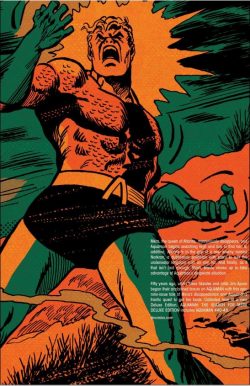
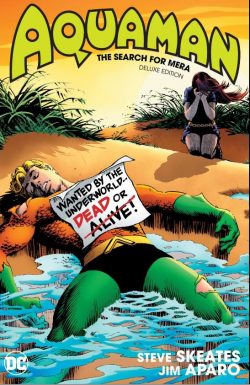
Aquaman: The Search for Mera Deluxe Edition


By Steve Skeates, Jim Aparo & various (DC Comics)
ISBN: 978-1-4012-8522-7 (HB)

Aquaman was one of a handful of costumed adventurers to survive the superhero collapse at the end of the Golden Age: a rather nondescript and genial guy who solved maritime crimes and mysteries when not rescuing fish and people from sub-sea disasters. He was created by Mort Weisinger & Paul Norris in the wake of and in response to Timely Comics’ Sub-Mariner, debuting in More Fun Comics #73 (November 1941).

Strictly a second stringer for most of his career, he nevertheless continued on beyond many stronger features; illustrated by Norris, Louis Cazaneuve, Charles Paris, and latterly Ramona Fradon who drew every adventure until 1960.

When Showcase #4 rekindled the public’s taste for costumed crimefighters with the advent of a new Flash in 1956, National/DC updated its small band of superhero survivors, especially Green Arrow and the Sea King. As the sixties unfolded, Aquaman was appearing as a back-up feature in Detective and World’s Finest Comics. Following a team up with Hawkman in Brave and the Bold # 51 and a try-out run in Showcase #30-33, Aquaman made his big jump. After two decades of continuous adventuring, the marine marvel finally got his own comicbook (cover-dated January/February 1962).

Now with his own title and soon a to be featured in the popular, groundbreaking cartoon show Superman/Aquaman Hour of Adventure, the Finned Fury seemed destined for super-stardom, but despite increasingly bold and innovative tales his title was cancelled as the decade closed. Towards the end, outrageously outlandish yarns gave way to grittily hard-edged epics steered by revolutionary editor Dick Giordano and hot new talents Steve Skeates and Jim Aparo …

This compelling compilation – collecting material from Aquaman volume 1 #40-48 (July/August 1968 to November/December 1969) – is available in hardback and digital formats, offering a potent and timeless drama that changed perceptions of the amiable aquatic avenger forever…

In Aquaman #18, (December 1964 and not included here) the King of Atlantis met extradimensional princess Mera, who became ‘The Wife of Aquaman’ in one of the first superhero weddings of the Silver Age. Talk about instant responsibilities…

A few years later scripter Steve Skeates and new illustrator Jim Aparo began an epic extended tale as the Sea Lord abandoned all kingly duties to hunt for his beloved after she is abducted from his very arms.

The quest began in ‘Sorcerers of the Sea’ with her being brutally whisked away, leaving Aquaman and Aqualad to voyage to strange, distant undersea realms in search of her. In the interim, royal heir Aquababy is left in the care of loyal comrade Aquagirl (her actual name was Tula) while the kingdom devolves to the ministrations of top advisor Narkran. Their first encounter is with a village of mystics whose queen is a doppelganger of missing Mera. Barely escaping, Aquaman’s resources are further taxed when his faithful sidekick is gravely wounded, but, raging and impatient, the Sea King cannot wait for him to heal…

His only clue is the distinctive jewellery one of his assailants wore and ‘The Trail of the Ring’ eventually leads to a deep-sea realm of barbarians known as Maarzons. To reach them, though, Aquaman has to traverse unexplored depths, facing monsters with telepathic powers similar to his own and escape a super civilised micro-culture with some repellent ideas on the price of survival…

On finally reaching Maarzon country, Aquaman savagely confronts warlike primitives who somehow worship his greatest enemy and is forced to ask ‘Is This My Foe?’, before realising he is being played for a fool. Meanwhile, in Atlantis Aqualad has taken a turn for the worst and Tula gets the first inkling that Narkran might not be completely stable. It’s a situation that will soon be reflected throughout the domed city-state…

Despite physical injuries and mental confusion, Aqualad absconds from hospital in Atlantis to aid his friend’s search, only to be captured and forcibly turned into a monster-slayer by a dying subsea race in ‘To Win is to Lose!’ Aquaman has since encountered another bizarre race and a helpful surface-man Phil Darson. The explorer provides a powerful clue that changes everything and sends the Sea King swimming for the sunlight lands above…

And in Atlantis, shattering quakes presage a different kind of instability as the drowned realm begins shifting upwards too…

The mystery begins to resolve in ‘Underworld Reward!’ as Aquaman exposes American gangsters planning a big coup that somehow involves him and Mera. Sadly, that only leads to a bounty landing squarely on his head and every rat in the city gunning for him, before ‘Underworld Reward! Part 2’ sees a partial resolution and fraught reunion when the king and queen explosively meet up and crush the thugs.

Embellished by Frank Giacoia (as “An Inker”) ‘The Explanation!’ fills in the blanks on a bizarre and complex scheme that highlights high level treachery in Atlantis and collusion between the subsea corridors of power and the back alleys of American crimelords…

Dash back home, Aquaman and Mera fortuitously save embattled Aqualad en route as ‘Come the Revolution’ finds Aquagirl and the city’s youth taking on the usurpers until the Royal Family return in climactic earth-shaking conclusion ‘A Kingdom to Re-Build!’

Also boasting a telling Foreword from latterday scripter Dan Abnett and a full cover gallery from Nick Cardy – some of his best ever work – this bombastic thriller forever ended the genteel, anodyne days of the B-lister Aquaman: reforging the hero into a passionate, questioning, forceful champion far more in keeping with the turbulent times.

What this collection proves is that his past adventures are all worthy of far more attention than they’ve received of late, and even though it’s probably just the commercial fallout of his movie incarnation, comics readers get to benefit from the renewed exposure and unearthed gems of aquatic adventure.

It is a total joy to find just how readable they still are. With tumultuous sea-changes always in store for Aquaman, the comics industry and America itself, this tasty testament to the inestimable value of a good bad-guy is a true delight for fans of all ages and vintage.
© 1968, 1969, 2018 DC Comics. All Rights Reserved.

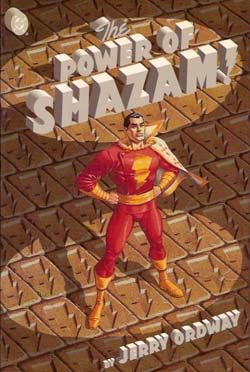
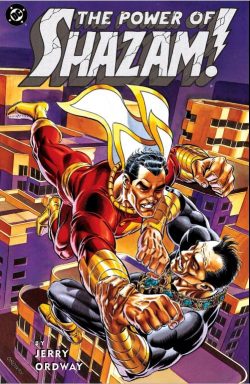
The Power of SHAZAM!


By Jerry Ordway (DC Comics)
ISBN: 978-1-56389-085-7 (HB) 978-1-56389-153-3 (TPB)

Since DC acquired the rights to the Golden Age Captain Marvel (as published by Fawcett from 1940-1953) there have been many enjoyable and effective treatments of the characters. One of the very best which succeeded in to capturing the exuberance and charm of the originals – albeit layered with a potent veneer of modern menace – was Jerry Ordway’s 1994 re-imagining of the concept, based as much on the strengths of the 1940s movie serial as the forceful fun comics of Bill Parker, Otto Binder, C.C. Beck and their close cohort of creative stalwarts…

In Egypt, archaeologists Charles Batson and his wife Marilyn lead the prestigious Sivana Expedition in a search for knowledge and antiquities. That doesn’t fit with the instructions given to the sponsor’s ruthless fixer and overseer Theo Adam, who has his own instructions regarding certain treasures. When they uncover an unknown tomb belonging to an utterly unknown dignitary named “Shazam”, tensions boil over and murder occurs.

The historians had left their son in America with Charles’ brother, but taken their toddler Mary with them. After the bloodshed ends, both she and Adam have vanished without trace…

Some Years Later…

Billy Batson is a little boy living on the streets of ultra-modern art deco Fawcett City, USA. His parents had left him with his uncle Ebenezer when they went away. They never returned and he was thrown out as his uncle stole his inheritance. No one knows where his baby sister is…

Sleeping in a storm drain, selling newspapers for cash, the indomitable kid is pretty street-savvy, but when a mysterious shadowy stranger who seems comfortingly familiar bids him follow into an eerie subway, Billy just somehow knows it’s okay to comply.

When he meets the wizard Shazam and gains the powers of the ancient Gods and Heroes he knows he has the opportunity to make things right at last. But he isn’t aware of just what depths of evil corporate vulture Thaddeus Sivana is capable, nor the role that Black Adam played in the fate of his parents…

This superb and mesmerising retelling was an original graphic novel (available now in Hardback, Trade Paperback and in digital editions) that led to the most successful comic-book revival the original Captain Marvel has yet experienced. The characters refitted in that series are potently realistic but the stories offer a young voice and sensibility.

Moreover, the pulp adventure atmosphere conjured up by Ordway in conjunction with his sumptuous art and spectacular design make for a captivating experience, and the artist’s writing has never been more approachable and beguiling. This is a wonderful book for fans of adventure as well as “costumed drama” addicts and well worth pursuing in light of the movie release.
© 1994 DC Comics. All Rights Reserved.

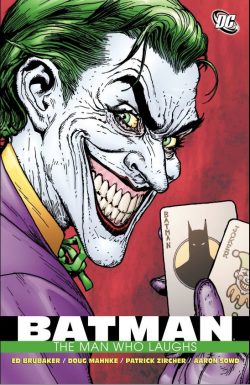
Batman: The Man Who Laughs


By Ed Brubaker, Doug Mahnke, Patrick Zircher & various (DC Comics)
ISBN: 978-1-4012-1622-1 (HB) 978-1-4012-1626-9 (TMB)

This March saw the 80th anniversary of the Bat-Man’s debut in Detective Comics #27. About one year later his inescapable primal nemesis debuted in Batman #1 (cover-dated “Spring” and released on April 25th, 1940. Thus, I’m selfishly pleasing myself and getting my patronising geek on by indulging in a few fond looks back and sharing some books you might like to try for yourselves. Here’s one featuring a superb brace of creative collaborations revelling in the sheer power the Dark Knight has exerted over the decades, and one that’s happily now available in digital formats as well as in a good old-fashioned Hardcover and Trade Paperback tomes…

Grittily devious writer Ed Brubaker teamed with artist Doug Mahnke, colourist David Baron and letterer Rob Leigh treated us to a rather gripping treatment based on the original 1940s debut tales (with a tip of the hat to the Steve Englehart/Marshall Rogers tales of the early seventies), in the form of an impressive prestige one-shot released in February 2005.

The title – and apparently the original inspiration for the Clown Prince of Crime himself – comes from Paul Leni’s seminal 1928 film classic starring Conrad Veidt in the title role. The plot concerns the actions of innocent Gwynplaine who had a permanent smile carved into his face by the King as a punishment for his father’s crimes…

Set not long after the events of Batman: Year One, The Man Who Laughs sees Police Captain Jim Gordon recognise that Gotham City has been changed forever when an outlandish and macabre serial killer goes on a very public, attention-seeking murder spree. Even his secret ally and vigilante outlaw The Batman is daunted by the sheer scale and audacity of the chalk-faced lunatic who seems utterly unstoppable and capable of anything…

The initial ghastly, gore-drenched clash of wills is a trip into hell for all concerned, but even with the Joker behind bars, the prognosis for the future seems grim beyond all reckoning…

The remainder of this book collects a 3-part adventure from Detective Comics #784-786 (September-November 2003). Here Brubaker scripts a generational serial-killer mystery steeped in the continuity of DC’s Golden Age guest-starring the original Green Lantern. Radio tycoon Alan Scott was Gotham City’s superhero-in-residence in the 1940s and early 1950s before mysteriously dropping out of sight as the “Red-baiting”, “Commie-hunting” decade unfolded…

Illustrated by Patrick Zircher, Aaron Sowd & Steve Bird, with hues by Jason Wright & letters by Todd Klein, ‘Made of Wood’ skips to contemporary times as Batman hunts a prolific serial killer who originally terrorised the populace in 1948. This maniac left a nasty signature message carved into his victims way back when and even assassinated the then-Mayor before simply disappearing. Now he’s apparently back to add to his tally

Matters are further complicated when a guilt-plagued and exceedingly short-tempered Green Lantern returns to action, determined to finally close the case he fumbled nearly 50 years previously…

Brubaker is an excellent writer at the peak of his abilities here providing tension and catharsis in equal measure and the art on both stories is effective and compelling. This is one of the better collections in the canon of the Dark Knight and a great treat for any fan or casual browser.
© 2003, 2005, 2008 DC Comics. All Rights Reserved.

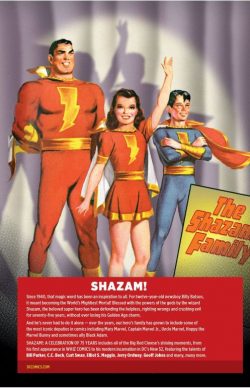
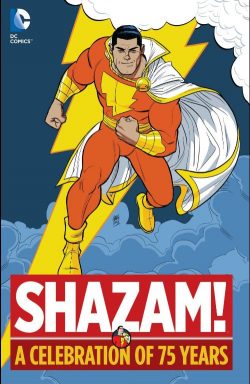
Shazam!: A Celebration of 75 Years


By Bill Parker, Otto Binder, Elliot S. Maggin, Denny O’Neil, E. Nelson Bridwell, Roy Thomas, Paul Kupperberg, Alan Grant, Jerry Ordway, Joe Kelly, David Goyer, Geoff Johns, Jeff Smith, C.C. Beck, Marc Swayze, Mac Raboy, Pete Costanza, Chad Grothkopf, Curt Swan, Kurt Schaffenberger, Don Newton, Rich Buckler, Barry Kitson, Peter Krause, Duncan Rouleau, Leonard Kirk, Gary Frank & various (DC Comics)
ISBN: 978-1-4012-5538-1 (HB)

At their most impressive, superhero comics combine the gravitas of mythology with all the sheer child-like fun and exuberance of a first rollercoaster ride. A perfect example of this is the original happy-go-lucky hero we can’t call Captain Marvel anymore.

First seen in the February 1940 issue of Whiz Comics (#2 – there was no #1) and cashing in on the comicbook sales phenomenon of Superman, the big red riot eventually won his name after narrowly missing being Captain Flash and Captain Thunder. He was the brainchild of Bill Parker and Charles Clarence Beck. Originally dispensing the same sort of summary rough justice as his contemporaries, the character soon distanced himself from the pack – Man of Steel included – by an increasingly light, surreal and comedic touch, which made him the best-selling comics character in America.

Billy’s alter ego could beat everybody but copyright lawyers; during his years of enforced inactivity the trademarked name passed to a number of other publishers before settling at Marvel Comics and they are never, never, never letting go. You can check out and compare their cinematic blockbuster version with the DC Extended Universe’s Shazam! flick too…

Publishing house Fawcett had first gained prominence through an immensely well-received magazine for WWI veterans entitled Captain Billy’s Whiz-Bang, before branching out into books and general interest magazines. Their most successful publication – at least until the Good Captain hit his stride – was the ubiquitous boy’s building bible Mechanix Illustrated and, as the comicbook decade unfolded, the scientific and engineering discipline and “can-do” demeanour underpinning MI suffused and informed both the art and plots of the Marvel Family titles.

As previously stated, the big guy was created by writer/editor Bill Parker and brilliant young artist Charles Clarence Beck who, with his assistant Pete Costanza, handled most of the art on the series throughout its stellar run. Other writers included William Woolfolk, Rod Reed, Ed “France” Herron, Joe Simon, Joe Millard, Manley Wade Wellman and the wonderfully prolific Otto Binder.

Before eventually evolving his own affable personality, the Captain was a serious, bluff and rather characterless powerhouse whilst his junior alter ego was the true star: a Horatio Alger archetype of impoverished, boldly self-reliant and resourceful youth overcoming impossible odds through gumption, grit and sheer determination…

Collecting in a big bold hardback trade paperback (and assorted digital formats) Whiz Comics #2, 21, Captain Marvel Adventures #18, 38, 39, 137, 148, Captain Marvel Jr. #12, Marvel Family #1, Hoppy the Marvel Bunny #6, Shazam! #1, 29, Superman #176, World’s Finest Comics #275, DC Comics Presents #49, L.E.G.I.O.N. ’91 #31, The Power of Shazam! #1, 2, 33, Action Comics #768, JSA #48, Shazam!: The Monster Society of Evil #2, Justice League #21 and The Multiversity: Thunderworld #1 this is a magnificent primer of key moments and triumphs for a hero to whom change is everything…

The action opens in the Golden Age as Part I 1940-1953: The Big Red Cheese offers an abridged version of writer and historian Richard A. Lupoff’s 1992 Introduction to the Shazam Archives volume #1: a context-setting appreciation and appraisal covering the facts of his creation and his impact, after which Whiz Comics #2, (February 1940) provides our glimpse of the boy hero…

Drawn in a style reminiscent of early Hergé, ‘Introducing Captain Marvel’ sees homeless orphan Billy Batson lured into an abandoned subway tunnel to a meeting with millennia-old wizard Shazam. At the end of a long, long life fighting evil, the white-bearded figure grants the lad the power of six gods and heroes (Solomon, Hercules, Atlas, Zeus, Achilles and Mercury) and urges him to carry on the good fight. In thirteen delightfully clean and simple pages crafted by Bill Parker & C.C. Beck, Billy gets his powers, has his secret origin revealed (he’s heir to a fortune embezzled by his crooked uncle Ebenezer), wins a job as a roaming radio reporter for Amalgamated Broadcasting on Station WHIZ, and defeats the mad scheme of Doctor Thaddeus Bodog Sivana who is holding the airwaves of America hostage. Defeating the demonic mad scientist sets a pattern that would captivate readers for the next 14 years…

Next, from Whiz Comics #21 ‘The Vengeful Four’ (September 5th 1941 – fortnightly, remember?) is an uncredited script limned by Beck wherein Sivana gathers three other villains to attack the hero in his youthful identity. What luck then that three other kids named Billy Batson are in town and that the magic of Shazam apparently extends to them…

Fat Billy, Tall Billy and Hill Billy took to trouncing thugs in a trice and, as the Three Lieutenant Marvels, would become frequent guest stars in years to come…

Billy soon found a companion in peril when Fascist überman Captain Nazi almost murders newsboy Freddie Freeman. Guilt-plagued Billy brings the dying lad to Shazam’s mystic citadel where the old wizard saves his life by granting him access to the power of the ancient gods and heroes. Physically cured – except for a permanently maimed leg – there is a secondary effect: whenever he utters the phrase “Captain Marvel” Freeman transforms into a super-powered, invulnerable version of his mortal self…

That origin isn’t included here but does lead into the debut of Billy’s long-lost twin sister. Cover-dated December 11th 1942, Captain Marvel Adventures #18 cover features ‘Captain Marvel Introduces Mary Marvel’ (by Otto Binder, Marc Swayze & Mac Raboy) as radio contest competitor Mary Bromfield – a wealthy (adopted) heiress – is kidnapped. While saving her, Billy and Freddie uncover the family connection and Mary discovers that shouting “Shazam!” has a remarkable effect upon her too…

While the adult Captain Marvel was having increasingly light-hearted adventures, Freddie’s adventures in Master Comics and Captain Marvel Jr. were dark and dramatic: illustrated with potent, dynamic verve and grace by one of the most gifted draughtsmen of the era. A typical magnificent example features here as Captain Marvel Jr. #12, (October 1943, by Binder & Mac Raboy) provides the boy hero with a brutal arctic rematch against Captain Nazi in ‘Baffin Land’…

Fawcett in full bloom was a true publishing innovator and marketing dynamo – now regarded as the inventor of many established comicbook sales-tactics, and storytelling innovations we all take for granted today were invented by their creative folk. Fawcett was responsible for creating crossover-events and also devised a truly unforgettable villain as part of a two-year long continued story!

The “Monster Society of Evil” began in March 1943’s Captain Marvel Adventures #22, and blazed away until ending with issue #46 (May 1945). The alien tyrant in charge was a malevolent worm from Venus dubbed Mr. Mind. Included here are two chapters – #17 and 18 from Captain Marvel Adventures #38 & 39 September and October 1944. Crafted by Binder & Beck, ‘Mr. Mind’s Movie Madness’ and ‘Peril Behind the Camera’ pits Billy and his older self against the utterly vile ubi vermis (that’s Latin for worm, science fans) during the making of the world’s worst monster movie…

‘The Mighty Marvels Join Forces’ (December 1945 by Binder, Beck & Pete Costanza) finds Billy, Mary and Freddie battling the depraved and corrupted Black Adam, who was old Shazam’s first gods-empowered champion 5000 years ago in the lead tale from team-title Marvel Family #1 (December 1945).

Superheroes began to fall from popularity as WWII ended and every publisher began searching other genres. Fawcett had already applied their winning formula to the all-ages cartoon critters market with Fawcett’s Funny Animals #1 (December 1942), which featured a lop-eared costumed crusader. Hoppy the Marvel Bunny (by Chad Grothkopf) got his own title as hostilities died down, and from #6 (November1946) comes ‘Phantom of the Forest’ as the mighty rabbit exposes supposed ghosts terrorising woodland folk…

The post-war years were simply magical times, with the creative crew at the top of their game. Captain Marvel Adventures #137 (October 1952) provides ‘King Kull and the Seven Sins’ by Binder, Beck wherein a beast-king from a pre-human civilisation frees the embodiments of Man’s greatest enemies from Shazam’s custody to plague the planet. These are wholesome tales for the entire family, however, so don’t worry – “Lust” has become “Injustice” and “Wrath” is “Hatred”, here…

The last yarn is from the Good Captain’s final year of Golden Age publication: a year that generated some of the best tales in the entire run, represented here by the wonderfully surreal ‘Captain Marvel Battles the World’ from Captain Marvel Adventures #148 (September 1952, by Binder and Beck) wherein Earth decides it has had enough of humanity mistreating it and tries to wipe out life and start again…

DC, in their original identity of National Periodical Publications, had filed suit against Fawcett for copyright infringement as soon as Whiz Comics #2 was released, and the companies had slugged it out ever since. In 1953, with sales of superhero comics decimated by changing tastes, Captain Marvel’s publishers decided to capitulate. They settled and the “Big Red Cheese” vanished – like so many other superheroes – becoming no more than a fond memory for older fans…

In Britain, where an English reprint line had run for many years, creator/publisher Mick Anglo had an avid audience and no product, and so swiftly transformed Captain Marvel into the atomic age hero Marvelman, continuing to thrill readers into the early 1960s.

DC eventually acquired all rights, titles and properties to the Captain Marvel characters. Beck returned to commercial and magazine illustration, while Binder & Schaffenberger joined the victorious opposition, becoming key Superman creators of the next few decades….

At the height of his popularity Captain Marvel was an international franchise across the world. However, tastes and the decade changed, and the mighty marvel faded away. Time passed, other companies and heroes were created and also failed, as America lived through another superhero boom-and-bust. We call it the Silver Age now…

The Bronze Age of the 1970s dawned with a shrinking industry and a wide variety of comics genres servicing a base that was increasingly founded on collector/fans and not casual or impulse buys. We rejoin our hero with the new decade fully founded as Part II 1973-1993: Cancellation and Revival sees his glorious return…

National Periodicals – rebranded as DC Comics – needed sales and were prepared to look for them in unusual places. After 1953’s settlement with Fawcett, they had secured the rights to Captain Marvel and Family, and even though the name itself had been taken up by Marvel Comics (via a circuitous and quirky robotic character published by Carl Burgos and M.F. Publications in 1967), DC decided to tap into that discriminating older fanbase.

In 1973, DC turned to the Good Captain to see if his unique charm could work another sales miracle during one of comics’ periodic downturns. Riding a wave of mass-media and movie nostalgia, they revived the entire beloved Captain Marvel cast in their own kinder, weirder universe.

To circumvent the intellectual property clash, they entitled the new comic book Shazam! (‘With One Magic Word…’) the trigger phrase used by the majority of Marvels to transform to and from mortal form and a word that had already entered the American language due to the success of the franchise the first time around.

Recruiting the top talent available, the company tapped editor Julie Schwartz – who had a few notable successes with hero revivals – to steer the project. He teamed top scripter Denny O’Neil with original artist C.C. Beck for the initial story…

All this is succinctly covered in E. Nelson Bridwell’s essay (originally published in 1978’s All-New Collectors Edition #C-58) which leads off this eclectic second section…

Strangely positioned before that debut, however, comes Superman #176 (June 1974): Elliot S. Maggin, Curt Swan & Bob Oksner’s ‘Make Way for Captain Thunder!’ The sales and fan rivalry between fans of the Man of Steel and Big Red Cheese (Sivana’s pet name for his stout-hearted nemesis) had endured for decades, and Schwartz took full advantage by having the two finally – if notionally – meet, courtesy of magical trans-dimensional jiggery-pokery in a titanic tussle to delight 10-year-olds of all ages.

You will recall, I’m sure, that Captain Thunder was one of the options considered in 1940 before Fawcett went with the Marvel name…

Finally, then comes Shazam! #1 (February 1973)… ‘In the Beginning’ recounts, in grand old self-referential style, the classic origin whilst ‘The World’s Wickedest Plan’ relates how the Captain, his super-powered family and all the supporting cast (there’s a very useful seating chart-cum-biography page provided for your perusal) had been trapped in a timeless state for 20 years by the invidious Sivana Family who had subsequently been trapped in their own Suspendium device too.

Two decades later, they are all freed, baddies included, to restart their lives and resume their feuds.

Beck was profoundly unhappy with the quality of stories he was given to draw and soon left the series. One of his assistants and stable-mates from the Fawcett days had been a Superman Family mainstay for decades and smoothly fitted into the vacated lead-artist position. Kurt Schaffenberger was delighted to again be drawing one of his all-time favourite assignments again, and his shining run is represented here by Shazam! #29 (June 1977), as ‘Ibac meets Aunt Minerva’ (Bridwell, Schaffenberger & Vince Colletta. Set in Buffalo, New York and at Niagara Falls, it features a comedic battle of the sexes that was heavy on the hitting. Although the series was not a soaring success, it had spawned a hit kids TV show, introducing the Big Red Cheese to a new generation of viewers…

When the title was cancelled, the Shazam Family began appearing in anthology titles such as World’s Finest Comics with the scent gradually shifting from whimsy to harder-edged contemporary superhero stories. Here WF #275 (January 1982) supplies ‘The Snatching of Billy Batson’ by Bridwell, Don Newton & Dan Adkins; a stirring crime thriller mystery with Freddie taking the lead role…

Team-up title DC Comics Presents #49 (September 1982) then features ‘Superman and Shazam’ (Roy Thomas, Paul Kupperberg, Rich Buckler & John Calnan) which sees the immortal wizard enlist the Action Ace’s assistance to create a Captain Marvel for Earth-1. It does not go well after Black Adam interferes…

Now fully part of the DC universe, Captain Marvel popped up everywhere. He was even a long-suffering straight man in Justice League International for a while, and here (from L.E.G.I.O.N. ’91 #31, September 1991) Alan Grant & Barry Kitson concoct a wickedly funny slugfest as the big red boy scout tries to reason with drunk and hostile super-lout Lobo in ‘Where Dreams End’…

After a number of ill-received reinventions of the Shazam! concept and franchise – revised over and over again to seem relevant to a far darker, more hopeless and uncompromising world and readership – in 1994 a fresh new treatment by Jerry Ordway revitalised the heroic legend; offering a thoroughly modern but spiritually pure reboot that finally held the interest of modern readers.

Following Ordway’s introduction to Part III 1994-2010: The World’s Mightiest Mortal, a too-brief selection of those tales begins with ‘Things Change’ and ‘The Arson Fiend’ (by scripter Ordway, Peter Krause & Mike Manley from The Power of Shazam! #1 & 2, March and April 1995).

The monthly series had resulted from an original graphic novel (which I’ll be covering imminently as it’s not here) which transplanted Billy to Fawcett City in the DC Universe and enticingly added all the old plot points the readership loved: abandoned street kid, lost sister, talking tigers, and manic villains such as Sivana and Black Adam…

In the initial yarn Billy confronts his evil, embezzling uncle Ebenezer just as a lethal supernatural pyromaniac sets the Batson mansion ablaze. To make things worse, old Shazam has just cut off his rebellious protégé from the wellspring of his superpowers…

The series balanced superb Fights ‘n’ Tights clashes with potent emotional tension, and issue #33 (December 1997, by Ordway, Krause & Dick Giordano) offers a remarkable human-interest tale with ‘Yeah – This is a Face Only a Mother Could Love’: a powerful, poignant yet ultimately uplifting treatment of intolerance and the collateral damage of superhero encounters where Billy tries to help a school-friend hideously scarred by the Arson Fiend. It’s possibly the best-executed and least known story in the book…

Superman and Captain meet again in Action Comics #768, (August 2000 by Joe Kelly, Duncan Rouleau & Jaimie Mendoza) as ‘O Captain, My Captain’ sees a goddess-controlled Marvel Family attack the Man of Tomorrow in a fun-filled romp after which JSA #48 (July 2003) provides ‘Enlightenment’ courtesy of David Goyer, Geoff Johns, Leonard Kirk & Keith Champagne.

Extracted from extended epic ‘Princes of Darkness’, this sidebar yarn finds Billy deprived of his adult alter ego, and battling to survive beside teen hero Star Girl as mystic night closes over Earth.

A true return to greatness came in 2007 when Jeff Smith rebooted the magic in Shazam!: The Monster Society of Evil. You can find the entire saga recently reviewed here, represented in this titanic tome by issues #2’s ‘NZIB GZPVH GSV XZPV! [Mary Takes the Cake!]’

Bringing us almost up to date, final chapter Part IV 2011 and Beyond: The New 52 focuses on the latest reboot which grew out of a new Justice League configuration.

Set as a series-within-a-series (in issues #7-11, #0 and #14-17) and again turning to a far harder-edged street kid persona ‘Shazam!’ was reimagined by Geoff Johns & Gary Frank and in Justice League #21 (August 2013) where the confused kid finds his Marvel Family and earns his hero stripes in final battle with murderous Black Adam…

Rounded out with stunning covers by Beck, Costanza, Mac Raboy, Chad Grothkopf, Nick Cardy, Murphy Anderson, Schaffenberger, Rich Buckler & Dick Giordano, Dan Brereton, Jerry Ordway, Duncan Rouleau & Lary Stucker, Carlos Pacheco & Jesus Merino, Jeff Smith & Gary Frank, this is a glorious tribute to a truly mercurial comics champion.

The original Captain Marvel is a genuine icon of American comics history and a brilliantly conceived superhero for all ages. This stunning flag-of-convenience collection only scratches the surface of the canon of delights produced over the years, but is still a perfect introduction to the world of those ever-changing comics charm and one that will appeal to readers of any age and temperament, especially after a few hours in a darkened movie theatre…
© 1940, 1941, 1942, 1943, 1944, 1945, 1946, 1952, 1973, 1974, 1977, 1982, 1991, 1995, 1997, 2000, 2003, 2007, 2013, 2014, 2015, DC Comics. All Rights Reserved.

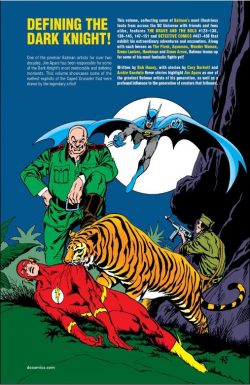
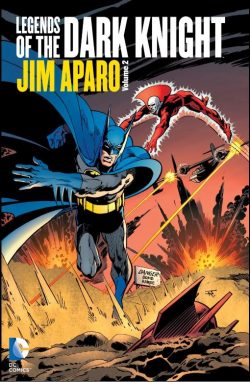
Legends of the Dark Knight: Jim Aparo volume 2


By Jim Aparo with Bob Haney, Cary Burkett, Archie Goodwin & various (DC Comics)
ISBN: 978-1-4012-4296-1 (HB)

After periods as a historical adventure and try-out vehicle, The Brave and the Bold won critical as well as commercial acclaim through old-fashioned team-ups. Pairing regular writer Bob Haney with the best artists available, a succession of DC stars joined forces before the comicbook hit its winning formula.

The said format – featuring media superstar Batman with other rotating, luminaries of the DC universe in complete stand-alone stories – paid big dividends, especially after the feature finally found a permanent artist to follow a variety of illustrators including Ramona Fradon, Neal Adams, Ross Andru & Mike Esposito, Irv Novick, Nick Cardy, Bob Brown and others…

At that time editors favoured regular – if not permanent – creative teams, feeling that a sense of visual and even narrative continuity circumvented confusion amongst younger readers. The slickly versatile Jim Aparo was a perfect match for a drawing brief that encompassed DC’s entire DC pantheon and all of time, space and relative dimensions in any single season…

James N. Aparo (August 24, 1932 – July 19, 2005) was a true quiet giant of comicbooks. Self-taught, he grew up in New Britain, Connecticut, and after failing to join EC Comics whilst in his 20s, slipped easily into advertising, newspaper and fashion illustration. Even after finally becoming a comics artist he assiduously maintained his links with his first career.

For most of his career Aparo was a triple-threat, pencilling, inking and lettering his pages. In 1963 he began drawing Ralph Kanna’s newspaper strip Stern Wheeler, and three years added a wide range of features for go-getting visionary editor Dick Giordano at Charlton Comics. Aparo especially shone on the minor company’s licensed big gun The Phantom…

When Giordano was lured away to National/DC in 1968 he brought his top stars (primarily Steve Ditko, Steve Skeates and Aparo) with him. Aparo began his lengthy, life-long association with DC, illustrating and reinvigorating moribund title Aquaman – although he continued with The Phantom until his duties increased by way of numerous short stories for the monolith’s burgeoning horror anthologies and revived 1950s supernatural hero The Phantom Stranger…

Aparo went on to be an award-winning mainstay of DC’s artistic arsenal, with stellar runs on The Spectre, The Outsiders and Green Arrow, but his star was always inescapably linked to Batman’s…

Aparo and scripter Bob Haney continue their run of enticing all-action epics in this second sturdy hardback and/or eBook compilation, gathering B&B #123-136, 138-145, and 147-151 plus the lead stories from Detective Comics #437 & 438 (cumulatively spanning December 1975 through June 1979) in a fabulous celebration that opens sans preamble.

With this collection of Batman’s pairings with other luminaries of the DC universe we find a creative team that had gelled into a perfect machine producing top-notch yarns aimed at the general readership – which would often annoy and appal the dedicated fans and continuity-obsessed reader.

B&B #123 brought back and united Plastic Man and Metamorpho with the Darknight Detective in ‘How to Make a Super-Hero’ as well as featuring a rare incidence of a returning villain: ruthless tycoon Ruby Ryder, once again playing her seductive mind-games with the pliable, gullible Elastic Ace.

Always looking for a solid narrative hook, Haney spectacularly broke the fourth wall in ‘Small War of the Super Rifles’ when Batman and Sgt. Rock needed the assistance of artist Aparo and editor Murray Boltinoff to stop a gang of ruthless terrorists. This is another one that drove many fans batty…

‘Streets of Poison’ in #125 is a solid drug-smuggler yarn with exotic locales and a lovely hostage for Batman and the Flash to deal with, after which John Calnan stepped in to ink #126’s Aquaman team-up, solving the sinister mystery of ‘What Lurks Below Buoy 13?’

It was back to basics next when Wildcat returns to help quash a people-smuggling racket in the ‘Dead Man’s Quadrangle’ whilst #128’s ‘Death by the Ounce’ finds the Caped Crusader recruiting Mister Miracle and Big Barda to help him rescue a kidnapped Shah and save a global peace treaty.

Ever keen to push the envelope, the next yarn is actually a jam-packed 2-parter with #129’s ‘Claws of the Emperor Eagle’ pitting Batman, Green Arrow and the Atom against the Joker, Two-Face and a host of bandits in a manic race to possess a statue that had doomed every great conqueror in history. The epic, globe-trotting saga concluded with an ironic bang in ‘Death at Rainbow’s End’.

The last time Wonder Woman appeared (B&B #105) she was a merely mortal martial artist but in Brave and the Bold #131 she exults in all her super-powered glory to help Batman fight Catwoman and ‘Take 7 Steps to… Wipe-Out!’

When DC cautiously dipped its editorial toe in 1970s Martial Arts craze #132 found Richard Dragon, Kung Fu Fighter joining ‘Batman… Dragon Slayer??’, as Denny O’Neil succeeded editor Boltinoff, resulting in a rather forced and silly tale of duelling fight stylists and purloined historical treasures.

Normal service resumes and Deadman steps in to deliver ‘Another Kind of Justice!’ to rum-runner Turk Bannion as his heir and murderer turns to a more modern form of smuggling before ‘Demolishment!’ (#134) sees Green Lantern defect to the soviets, a la The Manchurian Candidate with Batman’s hasty rescue attempt going badly awry…

In #135 the robotic Metal Men re-emerge to solve the mystery of a 19th century artificial intelligence in ‘More Than Human!’, but when Ruby Ryder is unmasked as behind the plot, it costs Bruce Wayne everything he owns and only the timely assistance of Green Arrow in concluding chapter ‘Legacy of the Doomed!’ is able to restore the status quo.

Mister Miracle is back in #138, tackling a ‘Mile High Tombstone!’ with Batman to save a missing geologist and thwart deranged escapologist Cosimo (and a killer computer), after which ‘Requiem for a Top Cop!’ sees Commissioner Jim Gordon targeted by alien bounty hunter Vorgan, forcing the Gotham Gangbuster to call in alien cop Hawkman…

‘Dastardly Events Aboard the Hellship!’ in B&B #140 pits Wonder Woman and Batman against circus-obsessed billionaire super-spy Dimitrios, whilst Black Canary pops in to help quash the Joker‘s byzantine extortion scheme in ‘Pay – Or Die!’

In #142, ‘Enigma of the Death-Ship!’ sees Aquaman and his wife Mera battle the Dark Knight to suppress a ghastly family secret, before the sordid trail leads to the most respected man in America and a confrontation with the Creeper in ‘Cast the First Stone’ (as Cary Burkett teams with Haney on script).

Haney solos on the magical mystery tale of ‘The Arrow of Eternity’ as Caped Crusader and Emerald Archer head back in time to Agincourt to foil a wicked plot by time-tamperer the Gargoyle after which the Phantom Stranger and Batman face ‘A Choice of Dooms!’ pursuing voodoo crimelord Kaluu…

Supergirl enjoyed her first ever B&B Bat team-up (she had paired with Wonder Woman in #63, co-starring in the ferociously-dated and indefensible ‘Revolt of the Super-Chicks!’) in issue #147 where Burkett and Aparo’s ‘Death-Scream from the Sky!’ sees her and Batman save the world from extermination by satellite and a surprise super villain…

‘The Night the Mob Stole X-Mas!’ is a piece of seasonal fluff scripted by Haney and pencilled by Joe Staton with Aparo applying his overwhelming inks to a tale of cigarette smugglers and aging mafioso with the still-itinerant Plastic Man helping the provide a Christmas miracle.

The disbanded Teen Titans briefly reform in #149 for Haney’s ‘Look Homeward, Runaway!’, hunting a kid gang moving from petty crime to the big leagues after which ‘Today Gotham… Tomorrow the World!’ celebrates a landmark anniversary with an extended tale of Bruce Wayne’s abduction by terrorists and the undercover superhero who secretly shadows him. No hints here from me…

The brave, bold portion of our entertainment comes to a close with a rather era-specific yarn co-starring the Flash as #151 features a predatory haunt feeding off patrons at the ‘Disco of Death’.

This stunning compilation concludes with a brace of gripping thrillers from Archie Goodwin, after he took over the editor’s desk from Julie Schwartz in Detective Comics #437 (November 1973). He also wrote a stunning run of experimental yarns, beginning with ‘Deathmask’: a brilliant supernatural murder-mystery featuring an Aztec curse and seemingly unstoppable killer; all magnificently depicted by Jim Aparo. Following that, Detective #438 brought forth ‘A Monster Walk Wayne Manor’ wherein the abandoned stately pile (Batman having relocated to a bunker under the Wayne Foundation building) became home to a warped and dangerous old enemy…

By taking his cues from news headlines, popular films and proven genre-sources Bob Haney continually produced gripping adventures that thrilled and enticed with no need for more than a cursory nod to an ever-more-onerous continuity. Anybody could pick up an issue and be sucked into a world of wonder. Consequently, these tales are just as fresh and welcoming today, their themes and premises are just as immediate now as then and Jim Aparo’s magnificent art is still as compelling and engrossing as it always was. This is a Bat-book literally everybody can enjoy.

These are some of the best and most entertainingly varied yarns from a period of magnificent creativity in the American comics industry. Aimed at a general readership, gloriously free of heavy, cloying continuity baggage and brought to stirring, action-packed life by one of the greatest artists of the art form, this is a Batman for all seasons and reasons with the added bonus of some of the most fabulous and engaging co-stars a fan could imagine. How could anybody resist? Seriously: in this anniversary year, how can you…?
© 1975, 1976, 1977, 1978, 1979, 2013, 2017 DC Comics. All Rights Reserved.