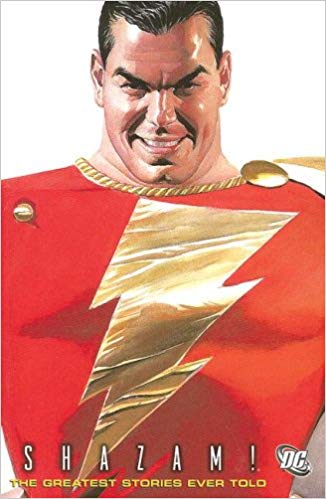
SHAZAM!: The Greatest Stories Ever Told


By Bill Parker, C.C. Beck, Joe Simon & Jack Kirby, Otto Binder, Denny O’Neil, Elliot S! Maggin, Roy Thomas, Joey Cavalieri, Alan Grant, Jerry Ordway, Steve Vance, Kurt Schaffenberger, Curt Swan, Gil Kane, Barry Kitson, Peter Krause, John Delaney & various (DC Comics)
ISBN: 978-1-4012-1674-0 (TPB)

Superhero movies season is hurtling down on us now so let’s cash in a bit…

Hard on the heels of the superb Shazam!: Monster Society of Evil collection came a most welcome addition to DC’s much missed Greatest Stories… line: an anthological review featuring some wonderful moments from the stellar, if chequered, career of the World’s Mightiest Mortal.

First seen in the February 1940 issue of Whiz Comics (#2 – there was no #1) and cashing in on the sales phenomenon of Superman, the big red riot was the brainchild of writer/editor Bill Parker and young illustrator Charles Clarence Beck.

Drawn in a style reminiscent of early Hergé, ‘Introducing Captain Marvel’ saw homeless orphan Billy Batson lured into an abandoned subway tunnel to a meeting with millennia-old wizard Shazam. At the end of a long, long life fighting evil, the white-bearded figure grants the lad the power of six gods and heroes (Solomon, Hercules, Atlas, Zeus, Achilles and Mercury) and urges him to carry on the good fight. In thirteen delightfully clean and simple pages Billy gets his powers, has his secret origin revealed (he’s heir to a fortune embezzled by his crooked uncle Ebenezer), gets a job as a radio reporter and defeats the mad scheme of Doctor Thaddeus Bodog Sivana who is holding the airwaves of America hostage.

Originally dispensing the same sort of summary rough justice as his contemporaries, the character soon distanced himself from the pack – Man of Steel included – by an increasingly light, surreal and comedic touch, which made Captain Marvel the best-selling comics character in America. For a period, Captain Marvel Adventures was published twice a month, and he was the star in a number of other titles too.

(Billy’s alter ego could beat everybody but copyright lawyers; during his years of inactivity the trademarked name passed to a number of other publishers before settling at Marvel Comics and they are never, never, never letting go. You can check out their cinematic blockbuster version this summer…)

In the formative years there was actually a scramble to fill pages. From Captain Marvel Adventures #1 (1941) comes an untitled drama of alien slavers produced in a bit of a hurry by Golden Age Dream-Team Joe Simon & Jack Kirby.

It’s probably fair to say that this rambunctious rarity is included for its name-value alone, but the third tale, ‘The Trio of Terror’ (The Marvel Family #21, 1948), is prime stuff from Beck and brilliant prolific writer Otto Binder, full of sly whimsy as three demons escape the netherworld to plague ours.

Many of the storytelling innovations we find commonplace today were invented by the creative folk at Fawcett – the original publishers of Captain Marvel. From Captain Marvel Adventures #137 (1952) comes ‘King Kull and the Seven Deadly Sins’ by Binder and Beck, wherein a beast-king from a pre-human civilisation frees the embodiments of Man’s greatest enemies to plague the planet.

These are wholesome tales for the entire family, however, so don’t worry – “Lust” has become “Injustice” and “Wrath” is “Hatred”, here.

There are two yarns from the good Captain’s final year of Golden Age publication. DC, in their original identity of National Periodical Publications, had filed suit against Fawcett for copyright infringement as soon as Whiz Comics #2 was released, and the companies had slugged it out ever since. In 1953, with sales of superhero comics decimated by changing tastes, Captain Marvel’s publishers decided to capitulate.

DC eventually acquired all rights, titles and properties to the characters. But that last year saw some of the best tales in the entire run, represented here by the wonderfully surreal ‘Captain Marvel Battles the World’ (Captain Marvel Adventures #148, September1952, by Binder and Beck) and ‘The Primate Plot’ (The Marvel Family #85, July 1953): a dramatic and very funny precursor to the movie Planet of the Apes, by Binder and Kurt Schaffenberger.

Beck returned to commercial and magazine illustration, but Binder & Schaffenberger soon joined the victorious opposition, becoming key Superman creators of the next few decades.

In 1973, DC decided to revive the Good Captain for a new generation and see if his unique charm would work another sales miracle during one of comics’ periodic downturns.

From the comicbook re-titled, for those pesky copyright reasons, Shazam!, the tale that bought him back was written by Denny O’Neil, and illustrated by the returned and resurgent Beck.

‘In the Beginning…’ and ‘The World’s Wickedest Plan’ (Shazam! #1, February 1973) retold the origin and explained that the Captain, his super-powered family and all the supporting cast (there’s a very useful seating chart-cum-biography page provided for your perusal) had been trapped in a timeless state for 20 years by the invidious Sivana Family who had subsequently been trapped in their own Suspendium device.

The sales and fan rivalry of the Man of Steel and The Big Red Cheese (Sivana’s pet name for his stout-hearted nemesis) had endured for decades, and in 1974 Julius Schwartz took full advantage by having the two finally – if notionally – meet.

Superman #276 featured ‘Make Way for Captain Thunder’ by Elliot S! Maggin, Curt Swan and Bob Oksner, a trans-dimensional tussle to delight 10-year-olds of all ages. Incidentally, Captain Thunder was one of the options considered in 1940 before Fawcett went with the Marvel name.

Beck was profoundly unhappy with the quality of stories he was given to draw and soon left the series. One of his assistants and stable-mates from the Fawcett days had been a Superman Family mainstay for nearly twenty years and smoothly fitted into the vacated lead-artist position. Kurt Schaffenberger was delighted to again be drawing one of his all-time favourite assignments again, and his shining run is represented here by #14’s ‘The Evil Return of the Monster Society’ scripted by Denny O’Neil in 1974.

Captain Marvel’s blend of charm, drama and whimsy made and remade many fans, even prompting a live action TV series, but never enough to keep the series going in such economically trying times. Despite its cancellation, however, the series persevered in back-up slots in other magazines and the character still made the occasional bombastic guest-appearance such as 1984’s DC Comics Presents Annual #3.

‘With One Magic Word’ saw Sivana appropriate the mystic lightning that empowers Billy Batson, leading to a Battle Royale with not just the Marvel Family but also the Supermen of both Earth’s 1 and 2 (this was mere months before Crisis on Infinite Earths lumped all these heroes onto one terribly beleaguered and crowded world).

This cracking 40-page romp was plotted by long-time fan Roy Thomas, written by Joey Cavalieri and illustrated by the fabulous Gil Kane.

Now fully part of the DC universe Captain Marvel popped up everywhere. He was even a long-suffering straight man in Justice League International for a while…

From L.E.G.I.O.N ’91 #31 (1991), by Alan Grant & Barry Kitson, comes the wickedly funny slugfest ‘Where Dreams End’, as the big guy has to try and reason with a drunk and hostile Lobo, and when he once more had his own series, spinning off from the superb original graphic novel The Power of Shazam!, a new high-point of quality entertainment was achieved – and sustained – by Jerry Ordway, Peter Krause & Dick Giordano.

‘Yeah – This is a Face Only a Mother Could Love…’ (from The Power of Shazam! #33, 1997) is a powerful, poignant treatment of intolerance and the collateral damage of superhero encounters where Billy tries to help a school-friend hideously scarred by his arch-foe the Arson Fiend. It’s possibly the best executed and least known story in the book.

This lovely compilation ends with a zesty delight from all-ages Adventures in the DC Universe (#15, 1998). Here Steve Vance, John Delaney & Ron Boyd create a testing time for Billy when Zeus decides to see if his modern beneficiary is actually worthy of his power in ‘Out of a Dark Cloud’.

The original Captain Marvel is a genuine icon of American comics history and a brilliantly conceived superhero for all ages. This collection, which only scratches the surface of the canon of delights produced over the years, is a perfect introduction to the world of comics and one that will appeal to readers of any age and temperament. Still available in paperback, let’s hope the modern hoopla convinces DC to rerelease it in both printed and digital editions…
© 1940, 1941, 1948, 1952, 1953, 1973, 1974, 1984, 1991, 1997, 1998, 2008, DC Comics. All Rights Reserved.
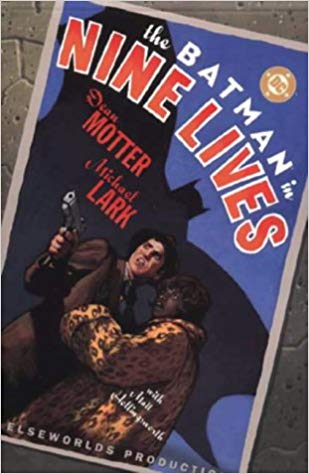
Batman: Nine Lives


By Dean Motter, Michael Lark & Matt Hollingsworth (DC Comics)
ISBN: 978-1-56389-853-2 (HC)                    978-1-84023-358-2 (Titan Books HC edition)

This March sees the 80th anniversary of the Bat-Man’s debut and gosh-by-golly I’m getting pretty stoked with all the anticipation. I trust there to be some fuss about the event. I’m also getting my Nerd on by indulging myself in a few fond looks back. Here’s another taste of the amazing influence the Dark Knight has exerted over the decades, and one more tome just begging for a new edition and some digital exposure…

The depictions and narrative signatures of the post-war genre “Film Noir” are powerful and evocative, celebrating a certain weary worldliness as much as stark lighting and visual moodiness ever did. That said, this murky world seems a natural milieu for Batman tales, but there are precious few that make the effort, and so very few of those successfully carry it off.

This superb alternative adventure published under DC’s Elseworlds imprint (wherein the company’s key characters are translated out-of-continuity for adventures that don’t really count) is a magnificent exception, combining hard-boiled detective yarning with the icons of gangster movies.

1946: Selina Kyle was a woman everybody wanted, and who exploited that fact fully. When The Batman finds her ravaged corpse in the sewers, there’s no shortage of suspects. Was she murdered by a high-society big-shot like Oliver Queen, Harvey Dent or Bruce Wayne, desperate to keep her quiet, or was one of her more sinister consorts-du-crime to blame?

Gangsters like jilted embezzler Eddie Nigma, mob-boss ‘Clayface’ Hagen, The Poker Joker, The Penguin or even the stone-cold hit-man Mr Freeze might have snuffed her in an instant if expedient, and seedy gumshoe Dick Grayson knows that he’ll be just as expendable if he digs too deep into the private affairs of the Highest and Lowest denizens of Gotham. But somehow, he just can’t let go…

Reconfiguring key figures of the venerable mythos as such recognisable archetypes – although perhaps obvious – is still a wonderfully effective way to revitalize them. The plot is as engrossing as any movie masterpiece and the human analogues of the bizarre and baroque Bat-cast are just as menacing even without outlandish powers and costumes. And through it all lurks a bizarre vigilante dressed as a bat, once again a mad element of relentless chaos that he can no longer be in his regular mainstream comic outings…

Although a pastiche derived from many sources, Nine Lives is a brilliant and engrossing read, seamlessly and stylishly blending mystery, crime-caper and sophisticated suspense thriller with moody visuals and a cynical tone that will show any hold-out naysayer that comics have as much to offer as any other creative medium.

Hunt this down and make it yours or pray that it’s due for a fresh release ASAP.
© 2002 DC Comics. All Rights Reserved.
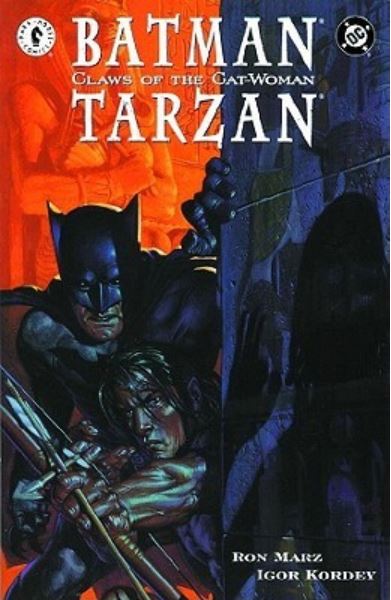
Batman/Tarzan: Claws of the Catwoman


By Ron Marz, Igor Kordey & various (Dark Horse Books/DC Comics)
ISBN: 978-1-5697-1466-9 (US TPB)            978-1-84023-235-6 (Titan Books edition)

I’m never particularly comfortable with the passion for cross-pollination that seems to obsess comics publishers. I admit that occasionally something greater than the sum of the originals does result, but usually the only outcome of jamming two different concepts into the same package is an uncomfortable, ill-fitting mess. So this tale – originally a 4-issue inter-company miniseries from the turn of the century – is a welcome example of success, and I’ll even offer a possible explanation for why…

This March sees the 80th anniversary of the Bat-Man‘s debut. I expect there to be some fuss about the event and maybe even the re-release of a few lost treasures from his vast canon. I hope this is one of them…

Although primarily a literary and filmic phenomenon, Tarzan of the Apes has certainly won his spurs in graphic narrative. Edgar Rice Burroughs’ novel was published in 1912, with movies cropping up from 1917 onwards. The first pictorial adventures came on January 7th 1929: a newspaper daily strip by Hal Foster augmented by a full-page Sunday serial by Rex Maxon from March 15th 1931. It’s still running. In 1947, Lord Greystoke conquered the comicbook arena, beginning in Dell’s Four Color Comics #134 and 161 before hurtling into his own long-lived title in January 1948.

So what’s on offer here?

When Great White Hunter Finnegan Dent returns to Gotham City with artefacts from a lost city he has discovered in Africa, his sponsor and backer is delighted. But Bruce Wayne has reason to change his mind when he meets John Clayton, a charismatic English Lord known alternatively as Greystoke or Tarzan of the Apes…

The two quickly discover they have a lots in common: both orphans due to crime, extraordinary men shaped by wealth, privilege and mutual interest in Justice, albeit in very different and particular jungles…

When the feline Princess Khefretari tries to steal back the looted treasures of her very-much-thriving civilisation, she catapults the heroes into a frantic chase and dire battle against a ruthless monomaniac.

This classical pulp-informed tale invokes all the basic drives of both characters without ever getting bogged down in continuity or trivia. It is first and foremost an action adventure, full of emotional punches delivered with relentless rapidity. There are good guys and bad guys, no extraneous fripperies and plenty of cliffhanger moments before virtue triumphs and evil is punished.

In Claws of the Catwoman you need only have the most meagre grounding in either character to enjoy this simple thriller – and you will, so let’s hope it’s on someone’s schedule for republishing…
Text and illustrations © 1999, 2000 Dark Horse Comics, Inc., DC Comics, Inc. & Edgar Rice Burroughs Inc. All Rights Reserved.

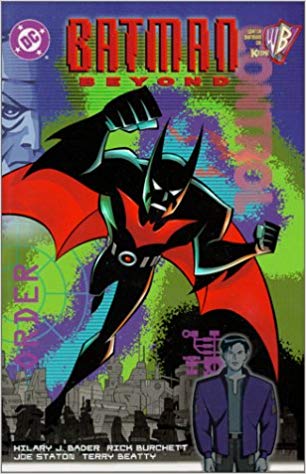
Batman Beyond


By Hilary J. Bader, Rich Burchett, Joe Staton & Terry Beatty (DC comics)
ISBN: 978-1-56389-604-0

This March sees the 80th anniversary of the Bat-Man’s debut. I expect there to be some fuss about the event. I shall certainly be indulging myself in a few fond looks back. Here’s a taste of the amazing influence the Caped Crusader has exerted over the decades, and a book long overdue for a new edition and some digital exposure…

The Batman Animated TV series masterminded by Bruce Timm & Paul Dini in the 1990s revolutionised the Dark Knight and also led to some of the absolute best comicbook adventures in his entire publishing history with the tie-in monthly printed series.

With his small screen credentials firmly re-established, follow-up series began (and are still coming), even ultimately feeding back into and enriching the overarching DCU continuity.

Following those award-winning episodes, in 1999 came a new incarnation set a generation into the future, featuring Bruce Wayne in the twilight of his life while a new teenaged hero picked up the eerily-scalloped mantle. In Britain the series was uninspirationally re-titled Batman of the Future but for most of the extremely-impressed-despite-themselves cognoscenti and awe-struck kids everywhere it was Batman Beyond!

Once again, the show was augmented by a cool kids’ comicbook and this collection collects the first 6-issue miniseries in a hip and trendy, immensely entertaining package suitable for fans and aficionados of all ages. Although not necessary to the reader’s enjoyment, a passing familiarity with the TV episodes will enhance the overall experience…

All stories are written by Hilary J. Bader and the book opens with a 2-art adaptation of the pilot episode, illustrated by Rick Burchett & Terry Beatty. ‘Not on My Watch!’ offers brief glimpses of the last days of Batman’s crusade against crime before age, infirmity and injury slow him down to the point of compromising his principles and endangering the citizens he’s sworn to protect…

Years later, Gotham City in the mid-21st century (notionally accepted as 2039 CE – 100 years after the comicbook debut of Batman in Detective Comics #27) is a dystopian urban jungle where angry, rebellious school-kid Terry McGinnis strikes a blow against pernicious street-punks The Jokerz and is chased out of the metropolis to the gates of a ramshackle mansion.

Meanwhile, his research-scientist father has discovered a little too much about the company he works for…

Wayne-Powers used to be a decent place to work before old man Wayne became a recluse. Now Derek Powers runs the show and is ruthless enough to do anything to increase his profits…

Outside town, Terry is saved from a potentially fatal encounter with the Jokerz by a burly old man who then collapses. Helping the aged Bruce Wayne inside the mansion, Terry discovers the long-neglected Batcave before being chased away by the surly Wayne. He really doesn’t care… until he gets home to find his father has been murdered.

A storm of mixed emotions, McGinnis returns to Wayne Manor…

Concluding chapter ‘I Am Batman’ sees him attempt to force Wayne to act before giving up in frustration and simply stealing the hero’s greatest weapon; a cybernetic bat-suit that enhances strength, speed, durability and perception. Alone, untrained and unaided, the new Batman sets to exact justice and take revenge…

In the ensuing clash with Powers, the unscrupulous entrepreneur is mutated into a radioactive monster named Blight before Wayne and Terry reach a tenuous truce and working understanding. For the moment, Terry will continue to clean up the Dark Knight’s city as a probationary, apprentice hero…

With issue #3 Bader, Burchett & Beatty crafted original stories in the newly established future Gotham, commencing with ‘Never Mix, Never Worry’ wherein Blight returns to steal a selection of man-made radioactive elements which can only be used to cause harm… or can they?

Joe Staton assumed the pencilling role with #4 as a schoolboy nerd frees a devil from limbo and old man Wayne introduces cocksure Terry to parapsychologist Jason Blood and his eldritch alter ego Etrigan the Demon in spooky shocker ‘Magic Is Everywhere’: a sentiment repeated when a school-trip to the museum unleashes ancient lovers who feed on life energy in the delightfully comical tragedy of ‘Mummy, Oh! and Juliet’…

This captivating compendium of action and adventure ends with another compelling and edgy thriller as Terry stumbles into a return bout with a shape-shifting super-thief in ‘Permanent Inque Stains’, only to find that there are far worse crimes and far more evil villains haunting his city…

Fun, thrilling and surprisingly moving, these tales remain magnificent examples of thrilling comics that appeal to young and old alike. Stick ’em on the same shelf as Tintin, Asterix and Carl Barks’ Uncle Scrooge tales and you can’t go wrong…

In 2000 Titan Books released a British edition re-titled Batman of the Future (to comply with the renamed UK TV series) and this version is a little easier to locate by those eager to enjoy the stories rather than own an artefact.
© 1999 DC Comics. All Rights Reserved.
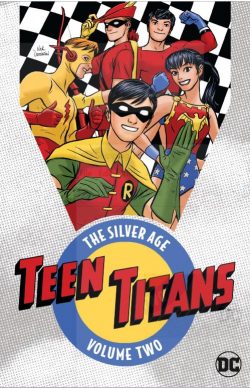
Teen Titans: The Silver Age Volume Two


By Bob Haney, Len Wein, Marv Wolfman, Nick Cardy, Irv Novick, Bill Draut, Gil Kane, Wally Wood, Neal Adams & various (DC Comics)
ISBN: 978-1-4012-8517-3 (TPB)

The concept of kid hero teams was already ancient when the 1960s Batman TV show finally prompted DC to trust their big heroes’ assorted sidekicks with their own regular comic. The outcome was a fab, hip and groovy ensemble as dedicated to helping kids as they were to stamping out insidious evil.

The biggest difference between the creation of the Teen Titans and wartime groups such as The Young Allies, Newsboy Legion and Boy Commandos or even 1950s holdovers like The Little Wise Guys or Boys Ranch was quite simply the burgeoning phenomena of “The Teenager” as a discrete social and commercial force.

These were kids who could – and should – be allowed to do things themselves without constant adult help or supervision…

This quirkily eclectic trade paperback and eBook compilation re-presents the rapidly-evolving and ending swinging Sixties exploits from Teen Titans #12-24 plus a guest-shot from The Brave and the Bold #83 collectively spanning November/December 1967 to November/December 1967 1969.

With Bob Haney still scripting and the accent still heavily on fun, the action resumes here with twin contemporary hot-topics the Space-Race and Disc Jockeys informing whacky sci fi thriller ‘Large Trouble in Space-Ville!’ Illustrated by Irv Novick & Nick Cardy, the gang thwart aliens stealing Earth’s monuments after which Cardy flies solo for TT #13, producing a seasonal comics masterpiece with ‘The TT’s Swingin’ Christmas Carol!’, a stylish retelling that’s one of the most reprinted Titans tales ever.

At this time Cardy’s art really opened up as he grasped the experimental flavour of the times. The cover of #14, as well as the interior illustration for the grim psycho-thriller ‘Requiem for a Titan’, are unforgettable. The tale introduces the team’s first serious returning villain (Mad Mod does not count!): the Gargoyle is mesmerising and memorable, and although Cardy only inked Lee Elias’s pencils for #15’s eccentric tryst with the Hippie counter-culture, ‘Captain Rumble Blasts the Scene!’ is a genuinely unique crime-thriller from a time when nobody over age 25 understood what the youth of the world was doing…

Teen Titans #16 returned to more solid ground with superb, scene-setting thriller ‘The Dimensional Caper!’ as rapacious sinister aliens infiltrate a rural high-school (and how many times have you seen that plot used since this 1968 epic?).

Cardy’s art reached dizzying heights of innovation both here and in the next issue’s waggish jaunt to London ‘Holy Thimbles, It’s the Mad Mod!’ (alternatively and uninspiringly retitled ‘The Return of the Mad Mod’ here). The frantic criminal chase through Cool Britannia which unfolds even includes a command performance from Her Majesty, the Queen!

Next up is a fannish landmark – and hint of things to come – as novice writers Len Wein & Marv Wolfman got their big break with a tale introducing Russian superhero Starfire (latterly redubbed Red Star) which set them firmly on a path of teen super-team writing. ‘Eye of the Beholder’ is a cool cat burglar/super heist yarn set in trendy Stockholm, drawn with superb understatement by Bill Draut, and acting a perfect indicator of the changes in style and attitude that would become part of the Teen Titans and the comics industry itself in later decades…

Maintaining the experiments with youthful authorial voices, the entertainment continues with a beautifully realised comedy-thriller as boy Bowman Speedy joins the team full-time. ‘Teen Titans: Stepping Stones for a Giant Killer!’ (#19, January/February 1969) is by Mike Friedrich, with stunning art from Gil Kane & Wally Wood, and pits the team against youthful criminal mastermind Punch who plans to kill the Justice League of America and thinks a trial run against the junior division a smart idea…

TT #20 took that long-running plot-thread of extra-dimensional invaders and gave it a counterculture twist in ‘Titans Fit the Battle of Jericho’: a spectacular rollercoaster romp deftly blending teen revolt, organised crime, anti-capitalist activism, bug-eyed monsters and cunning extraterrestrial conquerors written by Neal Adams, pencilled by him and Sal Amendola and inked by brush-maestro Nick Cardy – one of the all-out prettiest illustration jobs of that decade.

Team-up vehicle The Brave and the Bold # 83 (April-May 1969) then took a radical turn as in ‘Punish Not my Evil Son!’, the Teen Titans (sans Aqualad, who was dropped to appear more prominently in Aquaman and because there just ain’t that much sub-sea malfeasance) try to save Bruce Wayne‘s latest foster-son from his own inner demons in a tense thriller about trust and betrayal by Haney & Adams.

Symbolic super-teens Hawk and Dove briefly join the proceedings for #21’s ‘Citadel of Fear’ (Adams & Cardy), chasing smugglers, finding aliens and ramping up the surly teen rebellion quotient whilst moving the invaders story-arc towards a stunning conclusion. ‘Halfway to Holocaust’ is only half of #22; the abduction of Kid Flash and Robin leading to a cross-planar climax as Wonder Girl, Speedy and a radical new ally quash the invasion forever, but still leave enough room for a long overdue makeover in ‘The Origin of Wonder Girl’ by Wolfman, Kane & Cardy.

For years the series – and DC in general – had fudged the fact that the younger Amazon Princess was not actually human, a sidekick, or even a person, but rather an incarnation of the adult Wonder Woman as a child. As continuity backwriting strengthened its stranglehold on the industry, it was felt that the team-tottie needed a fuller background and this moving tale reveals that she is in fact a human foundling rescued by Wonder Woman and raised on Paradise Island where their super-science gave her all the powers of a true Amazon.

They even found her a name – Donna Troy – and an apartment, complete with hot roommate. All Donna has to do is sew herself a glitzy new costume…

Now thoroughly grounded in “reality”, the team jet south in #23’s fast-paced yarn ‘The Rock ‘n’ Roll Rogue’ (by Haney, Kane & Cardy), seeking to rescue musical rebel Sammy Soul from his grasping family and subsequently, his missing dad from Amazonian headhunters.

This volume, and an era of relative innocence, ends with ‘Skis of Death!’ by the same creative team which sees the adventurous quartet vacationing in the mountains and uncovering a scam to defraud Native Americans of their lands.

It’s a terrific old-style tale but with the next issue (and collected volume) the most radical change in DC’s cautious publishing history made Teen Titans a comic which had thrown out the rulebook…

Although perhaps somewhat dated in delivery, these tales were a liberating experience for kids when first released and remain a highly entertaining experience even now. They truly betokened a new empathy with independent youth and tried to address problems that were more relevant to and generated by that specific audience. That they are so captivating in execution is a wonderful bonus. This is absolute escapism and absolutely delightful.
© 1967, 1968, 1969, 2018 DC Comics. All Rights Reserved.
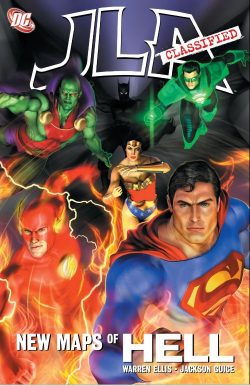
JLA Classified: New Maps of Hell


By Warren Ellis, Jackson Guice & various (DC Comics)
ISBN: 978-1-4012-0944-5 (TPB)

It’s been quite a while since we covered a good old-fashioned straightforward and no-strings-attached superhero blockbuster: one which any old punter can pick up with no worry over continuity or identification and where good guys and bad guys are clearly defined.

That’s due in large part to the fact that nobody really does those anymore, but at least it gives me the opportunity to take another look at a tale I didn’t much like when it first came out in 2006, but which has definitely grown on me with every re-read.

Produced at a time when the Justice League of America was enjoying immense popularity and benefiting from a major reboot courtesy of Grant Morrison, this politically-barbed, end-of-the-world epic – starring Superman, Batman, Wonder Woman, Flash, Green Lantern, Oracle and Martian Manhunter – originally ran in issues #10-15 of spin-off title JLA Classified (cover-dated September 2005 to February 2006), with gritty futurist super-scribe Warren Ellis upping the angst-quotient on a hoary old plot whilst hyper-realist illustrator Jackson Guice adds a terrifying veracity to events.

The drama begins as Clark Kent and wife Lois Lane stumble onto a dirty little secret. Assorted, and one would assume unconnected, scientists and bean-counters at President Luthor’s Lexcorp conglomerate have been committing suicide in large numbers and now, the intrepid reporters suspect something very nasty is going on…

In Gotham City, Batman learns the police have been turned away from an extremely unconventional crime-scene by Feds and a private security company, and he too starts digging…

In the Bermuda triangle, a group of researchers are invited to the Amazon’s ancient library of knowledge only to die when the sky-floating island explodes in a horrendous detonation.

Legacy Flash Wally West has terrible dreams of his beloved predecessor Barry Allen which lead him to a similar catastrophic conflagration, whilst Green Lantern Kyle Rayner ruminates on a primordial legend of the Corps’ origins until a wave of explosions rouse him to action.

In the ruins of each disaster the scattered, hard-pressed heroes find an ancient parchment of alien hieroglyphs and, when Superman recovers another page of the same from the shredded remnants of a plummeting space station, the call goes out to activate the League…

Tasking cyber-savant Oracle and aged Martian sole survivor J’onn J’onzz with uncovering information, the team learn of an antediluvian scourge which wracked the red planet millions of years past. A God/Devil which tested a species right to survive and heralded its coming through a written code…

Moreover, Luthor’s scientists have found such writings in remnants of ancient Sumeria and begun deciphering the text…

Mobilising to stop the summoning, our heroes confront Luthor in the White House but are too late. In Las Vegas the bowels of Hell vomit horrors into the streets and as the frantic super squad rush to battle they are snatched up, separated by the malign entity which has spent eons traversing the universe testing the worth of intelligent races and individually putting them to their sorest tests.

However, the monstrous terror has never faced beings like the JLA before, or a mind like Batman’s, and soon the horror’s own darkest secret is exposed and its fatal weakness exploited to devastating effect…

With a painted cover gallery by Michael Stribling, this book – now also available in eBook formats – offers simple, solid Fights ‘n’ Tights fun gilded with a sly and cynical post-modern edge: a sound example of costumed action blockbuster comics at their best.
© 2006 DC Comics. All Rights Reserved.
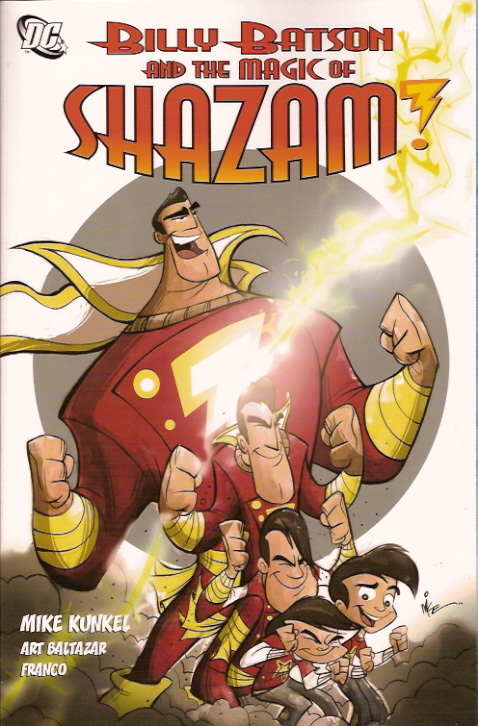
Billy Batson and the Magic of Shazam! volume 1


By Mike Kunkel, Art Baltazar, Franco, Byron Vaughns, Ken Branch & Stephen DeStefano (DC Comics)
ISBN: 978-1-4012-2248-2

After the runaway success of Jeff Smith’s magnificent reinvention of the original Captain Marvel (see Shazam! The Monster Society of Evil) it was simply a matter of time before this latest iteration won its own title in the monthly marketplace. What was a stroke of sheer genius was to place the new Billy Batson and the Magic of Shazam! under the bright and shiny aegis of the company’s young reader imprint – what used to be the Cartoon Network umbrella.

In a most familiar world, slightly askew of the mainstream DC Universe, these frantically ebullient and utterly contagious tales of the orphan Batson and his obnoxious, hyperactive little sister – both gifted by an ancient mage with the powers of the gods – can play out in wild and woolly semi-isolation hampered by nothing except the page count…

Billy Batson is a homeless kid with a murky past and a glorious destiny. One night he follows a mysterious figure into an abandoned subway station and met the wizard Shazam, who grants him the ability to turn into an adult superhero called Captain Marvel. Gifted with the wisdom of Solomon, strength of Hercules, stamina of Atlas, power of Zeus, courage of Achilles and speed of Mercury, the lad is despatched into the world to do good, a noble if immature boy in a super man’s body.

Accompanied by talking tiger-spirit Mr. Tawky Tawny, Billy tracks down his missing little sister, but whilst battling evil genius Dr. Sivana (US Attorney General and would-be ruler of the universe) he impetuously causes a ripple in the world’s magical fabric through which monsters and ancient perils occasionally slip through. Now, the reunited orphans are trying to live relatively normal lives, but finding the going a little tough…

Firstly, without adults around, Billy often has to masquerade as his own dad and when he’s not at school he’s the breadwinner, earning a living as a boy-reporter at radio and TV station WHIZ. Moreover, little Mary also has access to the Power of Shazam, and she’s a lot smarter than he is in using it… and a real pain in Billy’s neck.

Mike Kunkel, inspired creator of the simply lovely Herobear and the Kid, leads off this collection (gathering the first six issues of the much-missed monthly comic-book for readers of all ages): writing and drawing a breakneck, riotous romp reintroducing the new Marvel Family to any new readers and, by virtue of that pesky rift in the cosmic curtain, recreating the Captain’s greatest foe: Black Adam.

This time the evil predecessor of the World’s Mightiest Mortal is a powerless but truly vile brat: a bully who returns to Earth after millennia in limbo ready to cause great mischief – but he can’t remember his own magic word…

This hilarious tale has just the right amount of dark underpinning as the atrocious little thug stalks Billy and Mary, trying to wheedle and eventually torture the secret syllables from them, and when inevitably Black Adam regains his mystic might and frees the sinister Seven Deadly Evils of Mankind from their imprisonment on the wizard’s Rock of Eternity, the stage is set for a classic confrontation.

Pitched perfectly at the young reader, with equal parts danger, comedy, sibling rivalry and the regular outwitting of adults, this first storyline screams along with a brilliantly clever feel-good finish…

From issue #5 the writing team of Art Baltazar and Franco (responsible for the incomparably compulsive madness of Tiny Titans and Superman Family) take over, and artists Byron Vaughns & Ken Branch handled the first bombastic tale as convict Doctor Sivana unleashes the destructive giant robot Mr. Atom to cover his escape from prison.

The story-section concludes with another funny and extremely dramatic battle – this time against primordial super-caveman King Kull, who wants to reconquer the planet he ruled millennia ago. Older fans of gentle fantasy will be enthralled and delighted here by the singular art of Stephen DeStefano, who won hearts and minds with his illustration of Bob Rozakis’ seminal series Hero Hotline and ‘Mazing Man (both painfully, criminally overdue for graphic novel collections of their own…)

Billy Batson and the Magic of Shazam! is an ideal book for getting kids into comics: funny, thrilling, beautifully, stylishly illustrated and perfectly in tune with what young minds want to see. Moreover, with the major motion picture adaptation set to premiere in April, it’s a timely moment to get reacquainted with the Big Red Cheese…

With a gloriously enticing sketches section and a key code for those pages written in the “Monster Society of Evil Code” this is an addictive treat for all readers who can still revel in the power of pure wonderment and still glory in an unbridled capacity for joy.
© 2008, 2009 DC Comics. All Rights Reserved.
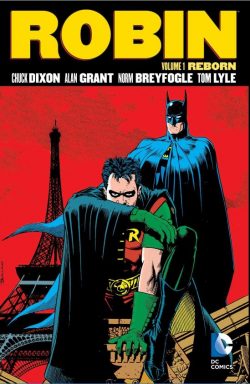
Robin volume 1: Reborn


By Chuck Dixon, Alan Grant, Norm Breyfogle, Tom Lyle & various (DC Comics)
ISBN: 978-1-4012-5857-3

Norman Keith Breyfogle was born in Iowa City, Iowa on February 27th 1960. Another artistic prodigy, in high school he was commissioned by Michigan Technological University to create promotional comic Tech-Team. In 1977 he submitted to DC a new costume design for Robin. It was published in Batman Family #13.

He studied painting and illustration at North Michigan University while working as a professional illustrator and in 1980 created Bunyan: Lore’s Loggin’ Hero for Book Concern. Moving to California in 1982, he worked as a technical draughtsman for NASA’s space shuttle programme and two years later began his serious attempts to get into proper comics.

Work for DC’s New Talent Showcase led him to American Flagg, Tales of Terror, Marvel Fanfare and others before, in 1986 he illustrated Whisper for a year. He then became regular artist on Detective Comics (1987-1990) where, with Alan Grant & John Wagner, he added to the Dark Knight’s gruesome gallery of foes by co-creating Scarface and the Ventriloquist, Ratcatcher, Jeremiah Arkham, Victor Zsasz and antihero Anarky.

Very much the key artist, he then transferred to Batman (1990-1992) and visually dictated the transformation of Tim Drake into the third Boy Wonder Robin before helming new title Batman: Shadow of the Bat until 1993.

Along the way he also illustrated Elseworlds yarn Batman: Holy Terror and painted Batman: Birth of the Demon, and other DC landmarks such as Flashpoint and The Spectre. For other companies he drew Prime, Black Tide, Hellcat, Bloodshot, Archie comics and many others as well as creating comics, children’s book material and poetry.

In December 2014 he suffered a massive stroke which left him paralysed, and he died on September 24 this year from heart failure.

Despite his massive and wide-ranging contribution to comics. Breyfogle will always be most well-known for his Batman tenure so it’s fitting that we remember him here with the biggest storyline of his career and its aftermath…

No matter how hard creators try to avoid it or escape it, Batman and Robin are an inevitable pairing. The first one graduated, the second died (sort of, more or less, leave it, don’t go there) and the third, Tim Drake, volunteered, applying pester-power until he got the job…

Spanning July 1990 to May 1991 and gathering Detective Comics #618-621, Batman #455-457 and the first Robin miniseries (#1-5), this volume reveals how a plucky young computer whiz convinces the Gotham Guardian to let him assume the potentially-fatal role of junior partner in a cracking adventure yarn that has as much impact today as when it first appeared decades ago.

It all begins with 4-part story arc ‘Rite of Passage’ from Detective Comics. Scripted by Alan Grant with moody art from Breyfogle & Dick Giordano ‘Shadow on the Sun’ finds a very much civilian Tim vacationing with Bruce Wayne in Gotham while his affluent, philanthropic parents visit the Caribbean and fall into the greedy hands of ruthless criminal the Obeah Man.

Tim is fully aware of Wayne’s alter ego and even helps with hacking as the Dark Knight follows a convoluted money trail, but the boy’s nerve is truly tested when his own parents become victims of a ruthless maniac…

Grant Breyfogle, With Steve Mitchell inking the sordid saga continues as ‘Beyond Belief!’ shows that not just money motivates the voodoo lord. He also revels in the worship of his terrified acolytes and is keen to keep them swayed with the occasional bloody sacrifice…

However, his ransom demand soon puts Batman on his trail and as the Gotham Gangbuster heads for Haiti, Tim is forced to consider whether the role of Robin only comes at the price of personal tragedy…

That seems to be confirmed in ‘Make Me a Hero’ as Batman’s hunt takes a negative turn even as Tim’s computer trawls lead him to a pointless confrontation with troubled teen Anarky before the concluding ‘Trial by Fire’ sees young Drake’s worst fears come true…

We resume a few months later with Batman #455 (October 1990).

Identity Crisis’ by Grant, Breyfogle & Mitchell finds the newly-orphaned (or as good as: one parent is dead and the other is in a coma) Tim Drake as Bruce Wayne’s latest ward, but forbidden from participating in the life of the Batman. The kid is willing and competent, after all, he deduced Batman’s secret identity before he even met him, but the guilt-racked Dark Knight won’t allow any more children to risk their lives…

However, when an old foe lures the lone avenger into an inescapable trap Tim must disobey Batman’s express orders to save him, even if it means his own life… or even the new home he’s just beginning to love.

Drake and stalwart retainer Alfred know Batman is off his game but can do nothing to shake his resolve in #456 as, ‘Without Fear of Consequence…’, the hero stalks a resurgent and lethally inspired Scarecrow across a Gotham City experiencing yet another Christmas terror spree…

Concluding instalment ‘Master of Fear’ sees the boy surrender every chance to become Batman’s partner: breaking his promise stay safe and saving the exhausted and overwhelmed Dark Knight from death despite the consequences…

It all works out in the end, as, following on the heels of that landmark saga, Robin got a new costume and a try-out series. …

Eliot R. Brown then provides schematics and diagrams detailing ‘Secrets of the New Robin Costume’ before writer Chuck Dixon and artists Tom Lyle & Bob Smith launch the new sidekick in his first solo starring miniseries. The apprentice hero’s path begins with a program of accelerated training intended to mimic that taken by teenaged Bruce Wayne years previously. In ‘Big Bad World’, Tim journeys to Paris, ostensibly to train in secret, but his underground martial arts dojo is a hotbed of intrigue and before long the kid is involved with Chinese street gangs…

Tracking the ambitious Lynx, Tim falls into a full-on war between disgraced DEA agent Clyde Rawlins, and a mysterious schemer. Thankfully ‘The Shepardess’ is there to give him a crash course in survival…

Sadly ‘The Destroying Angel’ has secrets of her own and the business devolves into a helter-skelter race-against-time, as she is revealed to be murderous martial artist Lady Shiva, coldly leading the lad into ‘Strange Company’ whilst executing her war against the Ghost Dragon Triad and Hong-Kong crime-lord King Snake for possession of a Nazi terror weapon…

There’s a breakneck pace and tremendous vivacity to this uncomplicated thriller that would rouse a corpse as the neophyte paladin heads to Hong Kong for the final showdown and a brush with existential horror in ‘The Dark’…

Wrapping up this groundbreaking celebration of the making of a hero are a wealth of art extras beginning with ‘Unused Robin Costume Designs’ by Neal Adams, Breyfogle, George Pérez & Lyle, before Graham Nolan, Adams & Lyle & confirm the ‘Final Batman and Robin Costume Design’, Adams provides a dynamic ‘Robin Poster’ and Brian Bolland pitches in with the original cover to the Robin: A Hero Reborn trade paperback collection.

This book is a lovely slice of sheer escapist entertainment and a genuine Bat-classic. If you don’t own this you really should.
© 1990, 1991, 2015 DC Comics. All Rights Reserved.
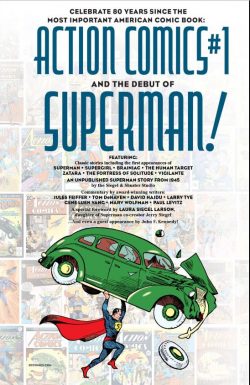
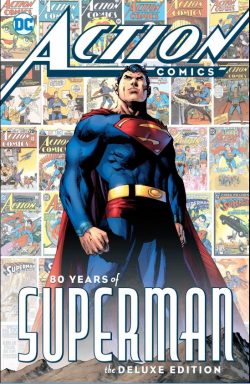
Action Comics: 80 Years of Superman the Deluxe Edition


By Jerry Siegel & Joe Shuster, Fred Guardineer, Don Cameron, Mort Weisinger, Jerry Coleman, Otto Binder, Edmond Hamilton, Len Wein, Cary Bates, Marv Wolfman, John Byrne, Roger Stern, Joe Kelly, Grant Morrison, Paul Levitz, Mort Meskin, Ed Dobrotka, Fred Ray, Wayne Boring, Al Plastino, Jim Mooney, Curt Swan, Carmine Infantino, Gil Kane, Dick Giordano, Kerry Gammill, Bob McLeod, Ben Oliver, Neal Adams plus Many & various (DC Comics)
ISBN: 978-1-4012-7887-8

Win’s Christmas Gift Recommendation: the Ultimate Stocking Stuffer… 9/10

It’s a fact (if such mythological concepts still exist): the American comicbook industry would be utterly unrecognisable without the invention of Superman. His unprecedented adoption by a desperate and joy-starved generation quite literally gave birth to a genre if not an actual art form.

Within three years of his June 1938 debut, the intoxicating blend of eye-popping action and social wish-fulfilment which hallmarked the early Man of Steel had grown to encompass cops-and-robbers crime-busting, socially reforming dramas, science fiction, fantasy, whimsical comedy and, once the war in Europe and the East embroiled America, patriotic relevance.

In comicbook terms at least Superman is master of the world, having utterly changed the shape of a fledgling industry and modern entertainment in general. There have been newspaper strips, radio and TV shows, cartoons games, toys, merchandise and blockbusting movies. Everyone on Earth gets a picture in their heads when they hear the name.

It all started with Action Comics #1 and this bold compilation celebrates the magic, not just with the now-traditional re-runs of classic Superman tales, but with informative articles and fascinating glimpses of some of the other characters who shared the title with him.

Available as a bonanza hardback and in various digital formats, this epic album offers material from Action Comics #0, 1, 2, 42, 64, 241, 242, 252, 285, 286, 309, 419, 484, 554, 584, 655, 662 and 800, and opens with an Introduction by Paul Levitz, a fond Foreword from Laura Siegel Larson and Jules Feiffer’s scene-setting, context-creating essay ‘The Beginning’ before the immortal wonderment commences…

Most of the early tales were untitled, but for everyone’s convenience have been given descriptive appellations by the editors. Thus, after that unmistakeable, iconic cover and a single page describing the foundling’s escape from exploding Planet Krypton (also explaining his astonishing powers in nine panels), with absolutely no preamble ‘The Coming of Superman’, by Jerry Seigel & Joe Shuster introduces a costumed crusader – masquerading by day as reporter Clark Kent – averting numerous tragedies.

As well as saving an innocent woman from the electric chair and roughing up a wife-beater, the tireless crusader works over racketeer Butch Matson – consequently saving suave and feisty colleague Lois from abduction and worse since she is attempting to vamp the thug at the time!

The mysterious Man of Steel makes a big impression on her by then outing a lobbyist for the armaments industry currently bribing Senators on behalf of greedy munitions interests fomenting war in Europe…

To say the editors were amazed by Superman’s popularity was an understatement. They had their money bet on a knock-off Mandrake the Magician crafted by veteran cartoonist Fred Guardineer. Zatara: Master Magician‘s mystic/illusion powers were fully demonstrated in ‘The Mystery of the Freight Train Robberies’ but it’s still a run-of-the-mill and rather sedate affair when compared to the bombastic stunts of the Caped Kryptonian.

Next up is a sneak peek at ‘The Ashcans’: unused and alternative illustrations that didn’t make that crucial first cut after which Action #2 (with a Leo O’Mealia generic adventure cover) supplies the conclusion of Superman’s first case as ‘Revolution in San Monte’ finds the mercurial mystery-man travelling to the war-zone before spectacularly dampening down the hostilities already in progress…

‘The Times’ by Tom DeHaven deconstructs the mythology of the title before Fred Ray’s Superman cover (from November 194)1 introduces Action #42’s ‘The Origin of the Vigilante’ by Mort Weisinger & the amazing Mort Meskin. This spectacular western-themed hero-romp proves that the anthology title had plenty of other captivating characters to enchant audiences…

Issue #64 debuted ‘The Terrible Toyman’ (Don Cameron, Ed Dobrotka & George Roussos), wherein an elderly inventor of children’s novelties and knick-knacks conducts a spectacular campaign of high-profile and potentially murderous robberies, with Lois as his unwilling muse and accessory, and is followed by a little tale of serendipity as Marv Wolfman harks back to his early days and explains ‘How I Saved Superman’…

That’s followed by a genuine lost treasure as ‘Too Many Heroes’ offers an unpublished 1940s Superman tale – credited to Siegel & Shuster – that was rescued from destruction and obscurity. What a gift!

David Hajdu then reveals the allure of the alter ego in ‘Clark Kent, Reporter’ after which we jump to June 1958 and the beginning of the Silver Age. Action Comics #241 cover-featured ‘The Key to Fort Superman’: a fascinating and clever puzzle-play guest-featuring Batman. Scripted by Jerry Coleman with art from Wayne Boring & Stan Kaye, here an impossible intruder vexes the Man of Steel in his most sacrosanct sanctuary…

One month later Otto Binder & Al Plastino introduced both the greatest new villain and most expansive new character concept the series had seen in years. ‘The Super-Duel in Space’ saw evil alien scientist Brainiac attempt to add Metropolis to his collection of miniaturised cities in bottles.

As well as a titanic tussle in its own right, this tale completely changed the mythology of the Man of Steel: introducing Kandor, a city full of Kryptonians who had escaped the planet’s destruction when Brainiac captured them. Although Superman rescued his fellow survivors, the new villain escaped to strike again, and it would be years before the hero could restore the Kandorians to their true size.

After a few intriguing test-runs, a future star of the ever-expanding Superman universe launched in Action Comics #252. In ‘The Supergirl from Krypton!’ (May 1959), Superman discovers he has a living relative. Cousin Kara Zor-El had been born on a city-sized fragment of Krypton, hurled intact into space when the planet exploded. Eventually Argo City turned to Kryptonite like the rest of the detonated world’s debris, and her dying parents, observing Earth through their scopes, sent their daughter to safety as they perished.

Landing on Earth, she met Superman and he created the cover-identity of Linda Lee, hiding her in an orphanage in small town Midvale so that she could master her new powers in secrecy and safety.

‘Endurance’ by Larry Tye discusses longevity and political merit before we return to Superman’s official Action Comics co-star…

Hogging the cover (by Super-stalwarts Curt Swan & George Klein) the simpler times of practicing in secret ended as a big change in the Maid of Might’s status occurred. When her new adoptive parents learn of their new daughter’s true origins, Superman allows cousin Kara to announce her existence to the world in 2-part saga ‘The World’s Greatest Heroine!’ (#285 February 1962) and ‘The Infinite Monster!’ (#286, March 196). Here Jerry Siegel & Jim Mooney detail how Supergirl becomes the darling of the universe: openly saving planet Earth and finally getting all the credit for it.

/telethon to pose a tricky puzzler in the hoary old secret-identity save plot. Written by Edmond Hamilton and illustrated by Swan & Klein, it sets up a scene where the Man of Tomorrow can use none of his usual tricks to be both Superman and Clark simultaneously, then delivers a truly shocking and utterly era-appropriate solution…

Hurtling forward to December 1972 and Action #419 we meet a surprisingly successful back-up feature created by Len Wein, Carmine Infantino & Dick Giordano. Debuting in‘The Assassin-Express Contract!’ Christopher Chance is the Human Target: hiring himself out to impersonate endangered individuals such as the businessman “accidentally” sitting in the sights of a hitman, thanks to a disgruntled employee dialling a wrong number…

From a period where Golden Age stories where assumed to have occurred on parallel world Earth-Two, ‘Superman Takes a Wife’ first appeared in 40th Anniversary issue #484 (June 1978).

Here Cary Bates, Curt Swan & Joe Giella detail how the original Man of Tomorrow became editor of the Metropolis Daily Star in the 1950s and married Lois. Thanks to villainous rogues Colonel Future and the Wizard who had discovered a way to make Superman forget his own existence, only she knew that her husband was once Earth’s greatest hero…

‘If Superman Didn’t Exist’ by Marv Wolfman & Gil Kane comes from Action #554 (April 1984) and posits an alien-invaded Earth deprived of heroes until two kids with big dreams invent one…

In 1985 DC Comics rationalised, reconstructed and reinvigorated their continuity with Crisis on Infinite Earths. They then used the event to regenerate their key properties at the same time. The biggest gun they had was Superman and it’s hard to argue that the change was not before time.

The big guy was in a bit of a slump, but he’d weathered those before. So how could a root and branch retooling be anything but a pathetic marketing ploy that would alienate the real fans for a few fly-by-night Johnny-come-latelies who would jump ship as soon as the next fad surfaced? This new Superman was going to suck…

He didn’t.

The public furore began with all DC’s Superman titles being “cancelled” (actually suspended) for three months, and yes, that did make the real-world media sit-up and take notice of the character everybody thought they knew for the first time in decades. However, there was method in this seeming corporate madness.

The missing mainstays were replaced by a 6-part miniseries running from October to December 1986. Entitled Man of Steel it was written and drawn by Marvel’s mainstream superstar John Byrne and inked by venerated veteran Dick Giordano.

The bold manoeuvre was a huge and instant success and the retuned Superman titles all came storming back with the accent on breakneck pace and action. Action Comics #584 had a January 1987 cover-date and featured a team-up with the Teen Titans as the young heroes had to battle an out-of-control hero with a ‘Squatter’ in his head…

Following a gentle cartoon “roasting” by Gene Luen Yang in ‘Supersquare’, ‘Ma Kent’s Photo Album’ (by Roger Stern, Kerry Gammill & Dennis Janke from #655, July 1990) offers some insights into growing up different before a major turning point began.

As the years passed Lois Lane and Clark gradually grew beyond professionalism into a work romance but the hero had always kept his greatest secret from her. That all changed after the Man of Tomorrow narrowly defeated mystic predator Silver Banshee and decided there would no more ‘Secrets in the Night’ between him and his beloved (Action Comics #662, February 1991, by Stern & Bob McLeod)…

Action #800 (April 2003) then offers a reverential examination of the ongoing myth thus far as ‘A Hero’s Journey’ combines a Joe Kelly script with art from Pasqual Ferry, Duncan Rouleau, Alex Ross, Tony Harris, Bill Sienkiewicz, Dave Bullock, Ed McGuiness, J.H. Williams III, Dan Jurgens, Klaus Janson, Killian Plunkett, Jim Lee, Tim Sale, Lee Bermejo, Cam Smith, Marlo Alquiza & Scott Hanna: cherry-picking unmissable moments from a life well lived…

In 2011 DC again rebooted their entire line and Superman was reimagined once more. ‘The Boy Who Stole Superman’s Cape’ by Grant Morrison & Ben Oliver comes from Action Comics #0, (November 2012) and focusses on a decidedly blue-collar champion just learning the game and painfully aware of the consequences if he makes a mistake…

Wrapping up the celebrations in April 2018’s ‘The Game’ by Levitz & Neal Adams wherein the ultimate enemies Superman and Luthor face off for another round in their never-ending battle…

Before the curtain comes down, though there’s still more unbridled joy and rekindled memories as ‘Cover Highlights’ brings a selection of stunning examples from the Golden, Silver, Bronze, Dark and Modern ages of the Man of Tomorrow, as well as the very best of Action Comics ‘Now’.

Should you be of a scholarly or just plain reverential mood you can then study the copious ‘Biographies’ section so you know who to thank…

Exciting, epochal and unmissable, this is book for all fans of superhero stories.
© 1938, 1941, 1943, 1958, 1959, 1961, 1963, 1972, 1978, 1984, 1986, 1990, 1991, 2003, 2012, 2018 DC Comics. All Rights Reserved.
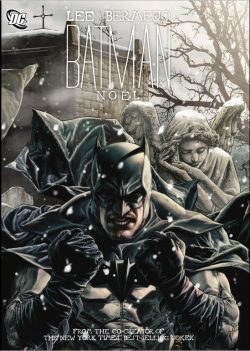
Batman: Noël


By Lee Bermejo, with Barbara Ciardo & Todd Klein (DC Comics)
ISBN: 978-1-4012-3213-9 (HB)

Win’s Christmas Gift Recommendation: A Fresh, Twisted Spin on a Seasonal Favourite… 9/10

Beginning with 1941’s Batman #9, the Dark Knight and festively-hued sidekick celebrated Christmas with specially crafted, tinsel-tinted topical tales (part warm spirituality, part Dickens homage, part O. Henry bittersweet irony, part redemption story), all perfectly encapsulating everything the festival ought to mean.

Although many his contemporaries – especially Superman – did likewise, the Batman Yule yarns somehow always got the balance between sentiment and drama just right. It led to the common comics fan assumption that Batman Owned Christmas. Given the evidence, it’s hard to dispute…

In 2011 writer-artist Lee Bermejo (Lex Luthor: Man of Steel, Joker, Before Watchmen: Rorschach) took his avowed love of Charles Dickens’ novels and the gritty, painterly heroic style he’d perfected and crafted a Times Best-Selling stand-alone Batman Original Graphic Novel. His creative partners in crime were colour-artist Barbara Ciardo award-winning letterer Todd Klein.

Available in deluxe hardback, Trade Paperback and eBook editions, Batman: Noël is a smart and imaginative reworking of Dicken’s redemptive masterpiece told from the point of view of Bob, a cheap hood with a guilty conscience and a sick kid. Bob’s got himself in a spot of bother with both his boss – The Joker – and the meanest bastard in Gotham, who’s selfishly using him to get to the killer clown…

Someone needs to have his views challenged and his path reset. Surely the Season will provide a miracle…

Featuring a big cast of star guests, this dark festive fable adds a bleak spin to the immortal events that will amaze and delight jaded readers, and also offers an Introduction by Jim Lee and many pages of production art and Author Commentary from Bermejo.

Batman Noël is a decidedly different take on one of the most fundamental cornerstones of the modern Christmas experience, and, while we’re recommending seasonal stuff, Dickens wrote four follow-ups to A Christmas Carol plus 22 other Christmas-themed or situated stories. They’re all in print – physically and digitally – so you should treat yourself to those too…
© 2011 DC Comics. All Rights Reserved.