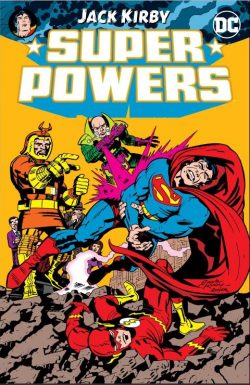
Super Powers by Jack Kirby


By Jack Kirby with Joey Cavalieri, Paul Kupperberg, Adrian Gonzalez, Pablo Marcos, Alan Kupperberg, Greg Theakston & various (DC Comics)
ISBN: 978-1-4012-7140-4

Famed for his larger than life characters and gigantic, cosmic imaginings, Jack Kirby (1917-1994) was an astute, imaginative, spiritual man who lived through poverty and gangsterism, the Great Depression, Post-War optimism, Cold War paranoia, political cynicism and the birth and death of peace-seeking counter-cultures. He was open-minded and utterly wedded to the making of comics stories on every imaginable subject. He also always believed that sequential narrative was worthy of being published as real books right beside mankind’s other literary art forms.

Looks like he was right, and – as usual – just ahead of the times, doesn’t it?

Thanks to his recent centenary there’s a magnificent abundance of Kirby commemorative collections around these days (though still not all of it, so I remain a partially disgruntled dedicated fan). This particular trade paperback and eBook compendium re-presents The King’s last complete conceptual outing for DC and one that has been neglected by fans for far too long.

During the 1980s costumed heroes stopped being an exclusively print cash cow as big toy companies licensed Fights ‘n’ Tights titans and reaped the benefits of ready-made comicbook spin-offs. DC’s most recognizable characters became a best-selling line of action figures and were inevitably hived off into a brisk and breezy, fight-frenzied miniseries.

Super Powers launched in July 1984 as a 5-issue miniseries with Kirby covers and his signature Fourth World characters prominently represented. Jack also plotted the stellar saga with scripter Joey Cavalieri providing dialogue, as Adrian Gonzales & Pablo Marcos illustrated a heady cosmic quest comprising numerous inconclusive battles between agents of Good and Evil.

Eschewing any preamble, we hurtle straight into action with ‘Power Beyond Price!’, as ultimate cosmic nemesis Darkseid despatches four Emissaries of Doom to destroy Earth’s superheroes. Sponsoring and empowering Lex Luthor, The Penguin, Brainiac and The Joker, the Dark God’s emissaries and their stooges jointly target Superman, Batman & Robin, Wonder Woman, Flash, Aquaman and Hawkman…

The combat escalates in #2’s ‘Clash Against Chaos’ with the Man of Steel and Scarlet Speedster tackling Luthor, whilst Aquaman and Green Lantern scupper the Penguin. Meanwhile Dark Knight and Winged Wonder confront an astoundingly-enhanced Harlequin of Hate…

With Alan Kupperberg inking #3, an inconclusive outcome leads to a regrouping of evil and an attack by Brainiac on Paradise Island, as in ‘Amazons at War’ the Justice League rally until Superman is devolved into a brutal beast who attacks his former allies.

All-out battle ensues in ‘Earth’s Last Stand’ before King Kirby steps up to write and illustrate the fateful finale: a cosmos-shaking conclusion designated ‘Spaceship Earth – We’re All on It!’ (November 1984, with Greg Theakston suppling inks)…

A bombastic Super Powers Promotional Poster then leads into the second Super Powers miniseries, spanning September 1985 to February 1986.

Scripted by Paul Kupperberg, the Kirby/Theakston saga ‘Seeds of Doom!’ recounts how deadly Darkseid despatches techno-organic bombs to destroy Earth, a diabolical deed requiring practically every DC hero to unite to counter the threat.

With teams of Super Powers travelling to England, Rome, New York, Easter Island and Arizona the danger is magnified ‘When Past and Present Meet!’ as the seeds warp time and send Aquaman and Martian Manhunter J’onn J’onzz back to days of King Arthur…

Super Powers #3 (November 1985) finds Red Tornado, Hawkman and Green Arrow plunged back 75 million years in ‘Time Upon Time Upon Time!’ even as Doctor Fate, Green Lantern and Wonder Woman are trapped in 1087 AD, battling stony-faced giant aliens on Easter Island.

Superman and Firestorm discover ‘There’s No Place Like Rome!’ as they battle Darkseid’s agent Steppenwolf in the first century whilst Batman, Robin and Flash visit a far-flung future where Earth is the new Apokolips in #5’s ‘Once Upon Tomorrow’.

Eventually Earth’s scattered but indomitable champions converge on Luna to spectacularly squash the schemes-within-schemes of ‘Darkseid of the Moon!’

Jack Kirby was and remains unique and uncompromising: his words and pictures comprise an unparalleled, hearts-and-minds grabbing delight no comics lover can possibly resist. If you’re not a fan or simply not prepared to see for yourself what all the fuss has been about then no words of mine will change your mind.

That doesn’t alter the fact that Kirby’s life’s work from 1937 to his death in 1994 shaped the entire American comics scene – and indeed the entire comics planet – affecting the lives of billions of readers and thousands of creators in all areas of artistic endeavour for generations. Most tellingly, he is still winning new fans and apostles every day, from the young and naive to the most cerebral of intellectuals. His work is instantly accessible, irresistibly visceral, deceptively deep and simultaneously mythic and human.

He is the King and there will never be another.
© 1984, 1985, 2018 DC Comics. All Rights Reserved.

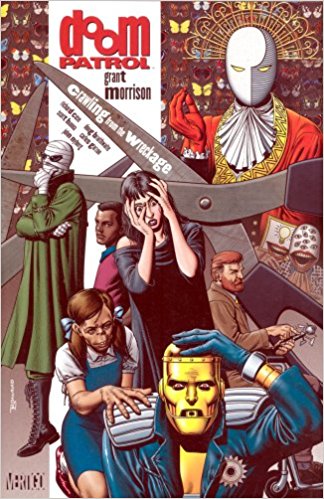
Doom Patrol volume 1: Crawling from the Wreckage


By Grant Morrison, Richard Case, Doug Braithwaite, Scott Hanna & various (DC Comics)
ISBN: 978-1-56389-034-5

In 1986, mega-monster continuity reboot Crisis on Infinite Earths led to DC overwriting fifty years of continuity and revamping or reinventing their major properties. The massive spring cleaning exercise led to a swathe of bold, innovative titles and a fresh look at how comicbooks could be done.

A revival that began quite conventionally almost overnight became the one of company’s most radical enterprises. Despite having solid roots back in the Silver Age, Doom Patrol was a series that really dared to be different…

In 1963 DC/National Comics – without no prior warning – converted venerable anthology-mystery title My Greatest Adventure into a (remarkably fringe) superhero team-book with the 80th issue.

The debut tale introduced a startling squad of arguably disabled champions with their thematic roots still firmly planted in the B-movie monster films of the era which had for so long informed the tone and timbre of the parent title.

That aesthetic subtly shaped the progression of the strip – which took total control of the comic within months, prompting a title change to The Doom Patrol with issue #86 – and throughout its 6-year run, made the series one of the most eerily innovative and happily hip reads of that generation.

No traditional team of masked adventurers, the cast comprised a robot, a mummy and a pliable 50-foot woman in a mini-skirt, who joined forces with and were guided by a brusque, domineering, paraplegic mad scientist; each and all equally determined to validate themselves by fighting injustice their way…

Those damaged champions comprised competitive car racer Cliff Steele, but only after he had “died” in a horrific pile up, with his undamaged brain transplanted into a fantastic mechanical body… without his knowledge or permission…

Test pilot Larry Trainor had been trapped in an experimental stratospheric plane and become permanently and lethally radioactive, with the dubious benefit of gaining a semi-sentient energy avatar which could escape his body to perform incredible stunts for up to a minute at a time. To pass safely amongst men Trainor had to constantly wrap himself in specially-devised radiation-proof bandages.

Former movie star Rita Farr had been exposed to mysterious swamp gases which gave her the unpredictable and, at first, uncontrolled ability to shrink or grow to incredible sizes.

These outcasts were brought together by brilliant but enigmatic Renaissance Man Niles Caulder who, as The Chief, sought to mould marginalised misfits into a force for good. The wheelchair-bound savant directed the trio of solitary strangers in many terrifying missions as they slowly grew into a uniquely bonded family…

Even the way the series ended was radical for its time. Final issue Doom Patrol #121 (September/October 1968) saw three quarters of the team sacrifice their lives to save a village of inconsequential nobodies.

Over succeeding years clever backwriting revived them all, but to us readers at the time, that issue was shocking and incomprehensible.

In 1987, supplemented by new team-mates, the Doom Patrol – now based in Kansas City – returned to muddle along for 18 issues (and a few one-shots and specials), before again being devastated by death and living up to their perhaps ill-considered name. Following an invasion by an alliance of alien races, a “gene bomb” was detonated in Earth’s atmosphere which warped, erased or triggered the powers of many metahumans.

In the resulting fallout, the team suffered appalling losses…

Thus here, as neophyte Scottish import and unknown quantity Grant Morrison began his American writing career, Negative Man has been separated from his human host, Cliff Steele has suffered a psychological collapse, energy-caster Tempest has ceased using his abilities and teenaged trainee Lodestone lies in a coma…

This collection gathers Doom Patrol volume 2 #19-25 (the monthly issues from February-August 1989, as first collected in one of DC’s earliest trade paperbacks in 1992), wherein traditional team super-heroics were abruptly and ignominiously jettisoned in favour of Big Concept science, “sophisticated suspense” and macabre creeping terror.

A less celebrated but equally crucial component of the revolutionary change was penciller Richard Case, whose stylish, low-key interpretation of some of the (at that time) strangest scripts, situations and characters ever seen in mainstream comics imbued the wildest conceptions with plausible veracity. The illustrator was usually aided and abetted by the steady assured assistance of unflappable inker Scott Hanna.

Here, however, the opening chapter is inked by Carlos Garzón as an eerie, eponymous adventure begins with ‘Crawling from the Wreckage’ with a nightmare-wracked Cliff Steele receiving a visitor in the sanatorium where he voluntarily languishes.

Robotics wunderkind Dr Will Magnus – who created the Metal Men and had rebuilt and reconstructed Cliff from the scraps which survived the explosion which ended the first Doom Patrol – has come calling, eager to fix his former patient and repair this latest glitch…

As intense, obsessive Niles Caulder browbeats burned out Josh Clay (AKA Tempest) into staying with the team in a “non-combat” capacity, over at the Alamance Memorial Hospital Larry Trainor is recovering from major injuries and revelling in the fact that he is no longer a radioactive freak hosting a bizarre energy parasite.

The only down side is the cost: the death of his partners and protégés and the persistent comatose state of youthful new team-mate Rhea Jones, the magnetically-empowered Lodestone.

Larry’s complacency is shattered when he starts seeing the Negative force again, howling to be let back in…

As Magnus struggles to counsel Cliff, the energy apparition moves again on Larry, possessing both him and his attending doctor Eleanor Poole coldly remoulding them all into an eerie three-part, multiple-gendered amalgamated being calling itself Rebis…

Magnus meanwhile plays his last card: with Robotman locked in self-pity and self-loathing, the master engineer switches tactics by appealing to Cliff’s heroic humanity and abiding compassion. He introduces the man of metal to fellow-patient Kay Challis: a young woman known to all as Crazy Jane.

Afflicted with multiple personality disorder, she manifests as (at least) 64 very different people, and since the gene bomb detonation, each one has manifested a different super power…

And elsewhere, a hideously burned crash victim who takes far too long to die drops a very strange black book and stops muttering the phrase “the Scissormen”. Federal agents on the scene resignedly realise this case needs the unique attention of Niles Caulder and his band of freaks…

Strange phenomena begin to proliferate globally in ‘Cautionary Tales’ (inked by Hanna) culminating in reports of many disappearances. Each vanished victim is marked by the silhouetted hole he or she leaves in reality…

As Caulder is cautiously recruiting hyper-intelligent, emotionally distant Rebis, across town Magnus cannot believe the change in Cliff. With Jane now his inseparable companion, Steele has regained much of his previous poise and lucidity: so much so, that Magnus offers to rebuild him a new body with sensors and feedback systems which will restore or approximate all the physical senses lost since becoming a brain trapped inside an ambulatory metal jail cell…

Apparently also back is Robotman’s gift for attracting trouble, as his evening walk with Jane is interrupted by a plummeting body screaming about “Scissormen”. With arcane abductions and cross-dimensional incursions mounting, the sanatorium becomes ground zero for packs of terrifying, gibberish-spouting, blade-handed invaders who attack staff and inmates, with only Jane’s arsenal of new abilities keeping her and Cliff out of the scything clutches and apparent extra-dimensional excisions…

All over the world bizarre phenomena and uncanny events mount…

More information – if not understanding – accrues with ‘Worlds in Collision’ as Kansas City begins to merge with a ghastly otherplace metropolis. Cliff and Alice battle macabre and unnatural foes all the way to the Doom Patrol’s new HQ in the Rhode Island mountain that was the original sanctuary of the Justice League of America.

Here, Caulder deduces their enemy is actualised metafiction stemming from a philosophical thought experiment that escaped its own boundaries to invade consensual reality but before he can formulate a response an army of Scissormen converge on their location and cut Josh out of existence. With no other choice and fed up with running, Cliff leads Rebis and Alice on a counterstrike into the heart of ‘The Ossuary’ to demolish the predatory city of Orqwith from within using brute force and pedantic logic…

With a semblance of normality restored just in time, the Doom Patrol settle in and welcome hirsute simian pre-teen Dorothy Spinner into the fold. Her uncontrolled ability to manifest monsters from her memory and imagination is only the most minor of annoyances, however, compared to the incursion of an ancient extradimensional hunter who abducts Lodestone’s comatose body from the hospital.

Thankfully, Crazy Jane has just the personality and powerset to follow ‘The Butterfly Collector’…

Divining his many names and history of slaughtering women throughout history, she leads the team’s break in to ‘The House that Jack Built’ where the red-handed butcher’s many outrageous claims and sadistic acts prove ultimately no proof against the Patrol and a suddenly awake if not aware Lodestone…

This initial trade paperback (and digital) compilation concludes with a smaller-scaled but still potentially lethal tale of ‘Imaginary Friends’. Illustrated by Doug Braithwaite & Hanna it focuses on shy, meek little Dorothy Spinner and her growing relationship with Josh Clay. A key point in her life is almost derailed and turned to bloodbath when her burgeoning biology catastrophically interacts with her thought-materialisation power and a leftover (but-still-active) trophy from the JLA’s past…

Including a context-building Introduction from Tom Peyer and ‘A Word from the Author’ first seen in DP #20, this collection of strange brews were – and remain- a magnificent mission statement for the revitalised DC Universe, offering gritty, witty fancifully cohesive and contemporary stories that appealed not just to Fights ‘n’ Tights fanatics but also lovers of wild concepts, beguiling metafiction and thrilling supercrime capers. As such they are still perfect fodder for today’s so-sophisticated, informed and ultimately sensation-hungry readers.
© 1987, 2005, 2015 DC Comics. All Rights Reserved.

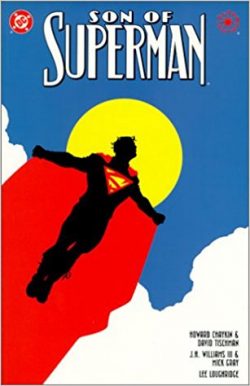
Son of Superman


By Howard Chaykin, David Tischman, J.H. Williams III & Mick Gray (DC Comics)
ISBN: 978-1-56389-595-1 (HB)                    :978-1-56389-596-8 (TPB)

Dads are difficult: it’s their main role in life. They’re designed to protect and sustain but with so few lions and tigers and bears to fend off, they just hang around and become less understandable and more embarrassing – or if you’re a daughter, increasingly suspicious of and hostile to your friends with every month you age.

They are absolute hell to find gifts for on made-up occasions intended to fill corporate coffers.

Too late now, but why not try a nice book next year…

Originally released as a spiffy hardback in February 2000 (and rushed out in paperback four months later), Son of Superman saw Howard Chaykin and his writing partner David Tischman exploring modern themes of self-image and abandonment through a timeless lens of teenage rebellion writ large…

Set in the then far-future of 2017 AD. and an overwhelmingly conservative and corporate America, it posits that Superman has been missing since 2000. The Justice League has become an oppressive arm of Federal Government, and the biggest threat to homeland security is the terrorist organisation The Supermen.

This revolutionary cell is led by the vanished hero’s oldest friends Pete Ross and Lana Lang and the menace of humanity is ruthless, unscrupulous Lex Luthor who now claims ownership of most of the planet.

Jon Kent is a brash, smart-mouthed high school kid and his mother Lois is a Hollywood screenwriter. Their lives are pretty normal (for rich Americans) …until the worst solar storm in history abruptly triggers her boy’s unsuspected and dormant superpowers. Now mom has to reveal that his long-dead dad was in fact the world’s greatest hero.

From having to deal with girls, grades and puberty the turbulent teen suddenly finds himself the focus of all manner of unpleasant and unwelcome attention; heroes and villains, the Feds and his own budding conscience…

How this new and exceedingly reluctant hero saves the world, busts the bad guys, and solves the mystery of his missing father makes for a good old-fashioned “never trust anyone over the age of 30” romp: full of thrills and spills thanks to the snarkily superior scripting skills of arch-nonconformists Chaykin and Tischman, sublimely enhanced by spectacular artwork from J.H. Williams III (Starman, Promethea, Rex Mundi, Batwoman) and Mick Gray.

This surprisingly enjoyable, if unchallenging, alternative tale of the Man of Steel comes courtesy of the much missed Elseworlds imprint, which was designed by DC as a classy vehicle for what used to be called “Imaginary Stories” – for which read using branded characters in stories that refute, contradict or ignore established monthly continuities. Although often a guaranteed recipe for disaster, every so often the magic of unbridled creativity brought forth gems. This is one of the latter and should be re-released ASAP.

Then you could nick it from your dad…
© 1999 DC Comics. All Rights Reserved.

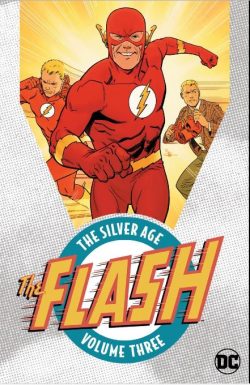
The Flash: The Silver Age volume 3


By John Broome, Gardner Fox, Carmine Infantino & various (DC Comics)
ISBN: 978-1-4012-7826-7

The second Flash triggered the Silver Age of American comicbooks and, for the first ten years or so, in terms of creative quality and sheer originality, it was always the book to watch.

Following his meteoric launch in Showcase #4 (October 1956), police scientist Barry Allen – transformed by a lightning strike and accidental chemical bath into a human thunderbolt of unparalleled velocity and ingenuity – was uncharacteristically slow in winning his own title, but finally (after three more trial issues) finally stood on his own wing-tipped feet in The Flash#105 (February-March 1959).

He never looked back, and by the time of this second commemorative compilation was very much the innovation mainstay of DC/National Comics’ burgeoning superhero universe. This second Trade Paperback (and digital) collection re-presents Flash #133-147 – spanning December 1962 through September 1964 – and tracks the Vizier of Velocity as he becomes the key figure in a stunning renaissance of comicbook super-heroics.

Shepherding the Scarlet Speedster’s meteoric rise to prominence, the majority of stories are written by the brilliant John Broome and all are pencilled by the infinitely impressive Carmine Infantino: slickly polished, coolly sophisticated rapid-fire short stories set in a comfortingly suburbanite milieu constantly threatened by super-thieves, sinister spies and marauding aliens, with our affable superhero always triumphant whilst ever-expanding and establishing the broad parameters of an increasingly cohesive narrative universe.

The comicbook had gelled into a comfortable pattern of two short tales per issue leavened with semi-regular book-length thrillers. The magic begins here with an example of the double-header format as applause-addicted future conjuror Abra Kadabra takes a rather silly encore in #133 by causing ‘The Plight of the Puppet Flash!’ (Broome, Infantino & Joe Giella).

That brief and bizarre Pinocchio peril is more than compensated for by the witty and sensitive Kid Flash back-up tale ‘The Secret of the Handicapped Boys!’ as deaf, blind and mute classmates (one disability per boy, ok?) each discover the young hero’s secret identity and resolve to help the junior hero in their own manner.

In #134, Captain Cold was ‘The Man who Mastered Absolute Zero!’: in a flamboyant thriller co-starring Elongated Man, after which Iris West‘s father (and Flash’s prospective father-in-law) pays an unwelcome call in the cleverly comedic ‘The Threat of the Absent-Minded Professor!’, Kid Flash then receives a beautiful new costume in the most astounding manner imaginable during the invasion thriller ‘Secret of the Three Super-Weapons!’ in #135.

‘The Mirror Master’s Invincible Bodyguards!’ – being just slow-moving light images packing ray-guns – actually weren’t, but the Scarlet Speedster had a lot more trouble when a seedy blackmailer claimed ‘Barry Allen – You’re the Flash – and I Can Prove It!’

This type of clever human-scaled story was slowly disappearing in favour of the more colourful costume epics – none more so than the wonderful Gardner Fox scripted ‘Vengeance of the Immortal Villain!’

Another incredible Earth-2 crossover, this saw the two Flashes unite to defeat 50,000-year-old Vandal Savage and save the Justice Society of America: a tale which directly led into the veteran team’s first meeting with the Justice League of America and the start of decades of trans-dimensional “Crisis” epics.

Fox also wrote ‘The Pied Piper’s Double Doom!’, a mesmeric team-up with Elongated Man, but once more the Kid Flash back-up stole the show, introducing the singular thespian Dexter Myles to the steadily growing cast in charming crime-caper comedy of errors ‘Mystery of the Matinee Idol!’

Broome was back for Flash #139, introducing the hero’s ultimate nemesis in Professor Zoom, a 25th century criminal who duplicated his super-speed to become the ‘Menace of the Reverse-Flash!’ Add in the sidebar menace of a lost-and-counting-down atomic bomb and the tension was almost suffocating…

Flash #140 (November 1963) debuts super arsonist Heat Wave in Broome’s stylish and sardonic thriller ‘The Heat is on for Captain Cold!’ before Fox pits the Monarch of Motion against ‘The Metal-Eater from Beyond the Stars!’: a bizarre energy-being able to nullify the speedster’s powers.

The majority of adventures were still produced by globetrotting scripter John Broome and the increasingly stylised and innovative art-team of Carmine Infantino & Joe Giella, and ‘The Mystery of the Flash’s Third Identity’ has them at their creative acme in a wittily absorbing super-villain yarn featuring the Top.

In another devious piece of internal comicbook logic, Broome posited that Flash’s foes looked so good because they had their own underworld bespoke tailor and armourer. This tale introduced Paul Gambi (an editorial in-joke acknowledging the dedicated contributions of über-fan and letter-writer Paul Gambaccini), setting the Vizier of Velocity on the tailor’s tail in an enticing piece of fluff that was neatly balanced by ‘Slowdown in Time’: a canny, enthralling science fiction lesson in relativity.

The real star was that most literal absent-minded professor Ira West, Barry’s prospective father-in- law and a genius who had casually deduced the civilian identity of the Flash due to discrepancies in the forensic scientist’s time-keeping…

Gardner Fox scripted the mile-a-minute romp ‘Perilous Pursuit of the Trickster!’ wherein the villain used toys stolen from children to bedevil his fast foe, whilst Broome blended legal loopholes and alien invasions to perplex the Scarlet Speedster with the ‘Puzzle of the Phantom Plunderers!’

Issue #143 featured another full-length team-up with Emerald Gladiator Hal Jordan in ‘Trail of the False Green Lanterns!’ – scripted by the ever-entrancing Fox who herein introduced future-gazing arch-foe Thomas Oscar Morrow.

The next two issues were all-Fox affairs: the eerie ‘Menace of the Man-Missile!’ pitting the Sultan of Speed against a shape-shifting atomically-mutated escaped convict whilst plucky protégé Kid Flash solo-starred in the human-interest parable ‘Lesson for a Star Athlete!’ Super-villainy resumed in Flash #145 as ‘The Weather Wizard Blows Up a Storm!’ and the normally stoic, stolid hero briefly has his head turned by captivating and inadvertently deadly visitor ‘The Girl from the Super-Fast Dimension!’

Broome scripted the wacky romp ‘The Mirror Master’s Master Stroke!’ and Frank Giacoia briefly bolstered the regular art team for Fox’s terrific terror tale ‘Fatal Fingers of the Flash!’ the kind of “high concept, big science” yarn that especially captivated kids in the age of space races and burgeoning technology – and it still enthrals today.

Issue #147 brings this third archival collection to a close with a feature length clash against two (or is it three?) of the Scarlet Speedster’s greatest foes. John Broome’s fascinating ‘Our Enemy, the Flash!’ sees schizophrenic Al Desmond attempting to reform and relinquish both his Dr. Alchemy and Mr. Element personas; only to be forcibly compelled to commit further crimes by ruthless 25th century sociopath Professor Zoom, the Reverse Flash!

These tales were crucial to the development of our art-form, but, more importantly they are brilliant, awe-inspiring, beautifully realised stories that amuse, amaze and enthral both new readers and old lags. As always, the emphasis is on brains and learning, not gimmicks or abilities, which is why these tales still work nearly half-a-century later. Coupled with the astounding art of Infantino these tales are a captivating snap-shot of when science was our friend and the universe(s) a place of infinite possibility. This wonderful compilation is another must-read item for anybody in love with the world of words-in-pictures.
© 1962, 1963, 1964, 2018 DC Comics. All Rights Reserved.

All Star Superman


By Grant Morrison & Frank Quitely with Jamie Grant (DC Comics)
ISBN: 978-1-4012-3205-4

Happy Anniversary, Man of Tomorrow… and here’s to many more.

When dwindling sales and economic realities forced comics down certain editorial paths, the US mainstream went for darker tales and grittier heroes. Meeting a certain degree of success, a policy of following trends became mandatory.

Ninjas, cyborgs, younger incarnations – all the old heroes put on new clothes as fashion dictated, abandoning their own mythologies whenever it seemed most expedient. The saddest thing is that sales in the long run kept falling anyway, and by recanting all the appurtenances of a long-lived character, they removed points of reference for any older readers who might contemplate a return.

So bravo to those companies that have repackaged their notionally “unfashionable” classics for the nostalgia market, and especially for those editors that have resisted slavish continuity as the only option and opened up key characters to broader interpretation.

When I was a nipper, Superman had outlandish adventures and was still a decent bloke.

His head might occasionally be replaced by a lion’s or an ant’s and he loved playing jokes on his friends a bit too much, but he was still one of us. His exploits were routinely mind-boggling, but he kept a quiet, down-to-Earth dignity about him. He only shouted to shatter concrete, and not to bully villains. He was okay and he was quintessentially cool.

…And in All-Star Superman he was again. Grant Morrison & Frank Quitely (aided and abetted by the digital wizardry of inker/colourist Jamie Grant) crafted a delightful evocation of those simpler, gentler times with a carefully stage-managed guided tour of the past, redolent with classic mile-markers.

Superman was the world’s boy scout, Lois Lane spent her days trying to prove Clark Kent is the Man of Steel, Jimmy Olsen was a competent young reporter dating Lois’ sister Lucy and all of time and space knew they could always rely on the Metropolis Marvel.

A 12-part miniseries running from January 2006 to October 2008, All-Star Superman celebrated those good old days in a most subversive manner beginning with ‘…Faster…’ as the Man of Steel saves a solar astronaut but only at an incredible, fatal cost to himself.

As a result, the Action Ace has to make some major changes in his life, beginning by satisfying Lois’ greatest desire…

In #2 and 3 (February and May 2006), ‘Superman’s Forbidden Room’ and ‘Sweet Dreams, Superwoman’, Lois takes centre stage as a devilish plot to kill Superman forces the hero to acknowledge his feelings for her. The result is an astonishing trip to his Fortress of Solitude and a hyper-empowering birthday gift she will never forget…

The hero’s best pal hits the headlines next as ‘The Superman/Olsen War’ finds the plucky cub-reporter undergoing the most shocking – and potentially lethal – transformation of his strange career, after which ‘The Gospel According to Lex Luthor’ (A-SS #5, September 2006) finds unrepentant Lex Luthor on Death Row and granting Clark Kent the interview of his career and scoop of a lifetime…

Superman is dying. Clandestinely poisoned by Lex and the Tyrant Sun Solaris, the Man of Tomorrow must make bold preparations and rush desperately to finish a shopping list of impossible tasks before his inevitable end. The gallant defender is aware that the precious Earth and his greatest friends must be kept safe and happy, even after his demise…

The quest kicks into high gear after a time-bending and portentously eventful ‘Funeral in Smallville’ (#6, March 2007); leading to a brutal clash with his imperfect duplicate in ‘Being Bizarro’ (#7, June) and one last visit to the square planet htraE in ‘Us Do Opposite’ (#8, August)…

The end is fast-approaching in All-Star Superman #9 (December 2007) as ‘Curse of the Replacement Supermen’ finds the Man of Steel facing two Kryptonian emigres attempting to turn Earth into a facsimile of their lost world. ‘Neverending’ (#10, May 2008) rapidly follows our rapidly declining hero on a nonstop junket to save lives before his own concludes…

The tension ramps up for penultimate episode ‘Red Sun Day’ (July) as Luthor, having turned his execution to his own advantage, attacks with all his carefully-gathered allies, before the conclusion ‘Superman in Excelsis’ reveals the perished Man of Steel’s greatest moment and most poignant triumph…

Completing the experience are commentary, character analysis, sketches and designs by Morrison & Quitely plus a full cover gallery from Quitely and a variant cover by Neal Adams.

Don’t believe this is just a pastiche of past glories. Kids of all ages are better informed than we were, and there’s a strong narrative thread and sharp, witty dialogue, backed up by the best 21st century technobabble to keep our attention and ensure that even the worldliest young cynic feels a rush of mind-expanding, goose-bump awe…

Although a plot to kill Superman carries this tale along there is human drama and tension aplenty to season the wonderment. Revisiting such unforgettable Silver Age motifs as the Planet of the Bizarros, being replaced by (even) more competent Kryptonians, liberating the citizens of the Bottle City of Kandor and all those cataclysmic battles with Luthor, not to mention curing cancer and the last Will and Testament of Superman, these gently thrilling glimpses of finer, gentler worlds shine with charm and Sense-of-Wonder, leavened with dark, knowing humour and subtle wistfulness.

…And action. Lots and lots of spectacular, mind-boggling action…

Older readers of the Man of Steel look back on an age of weirdness, mystery, hope and – above all – unparalleled imagination. Morrison and the uniquely stylish Quitely obviously remember them too and must miss them as much as we do.

All-Star Superman: One of the very few superhero collections that literally anybody can – and should – enjoy…
© 2006-2008, 2011 DC Comics. All Rights Reserved.

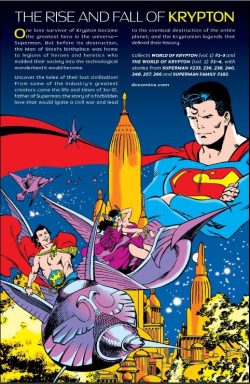
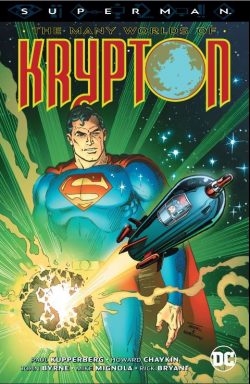
Superman: The Many Worlds of Krypton


By E. Nelson Bridwell, Denny O’Neil, Cary Bates, Marv Wolfman, Elliot S. Maggin, Paul Kupperberg, John Byrne, Murphy Anderson, Dick Giordano, Gray Morrow, Michael Kaluta, Dave Cockrum, Dick Dillin, Marshall Rogers, Howard Chaykin, Paul Kupperberg, Mike Mignola, Rick Bryant, Carlos Garzon & various (DC Comics)
ISBN: 978-1-4012-7889-2

For fans and comics creators alike, continuity can be a harsh mistress. These days, when maintaining a faux-historical cloak of rational integrity for the made-up worlds we inhabit is paramount, the worst casualty of the semi-regular sweeping changes, rationalisations and reboots is great stories that suddenly “never happened”.

The most painful example of this – for me at least – was the wholesale loss of the entire charm-drenched mythology that had evolved around Superman’s birthworld in the wonder years between 1948 and 1985.

Silver Age readers avidly consuming Superman, Action Comics, Superman’s Girlfriend Lois Lane, World’s Finest Comics and Superman’s Pal Jimmy Olsen (not forgetting Superboy and Adventure Comics) would delight every time some fascinating snippet of information leaked out.

We spent our rainy days filling in the incredible blanks about the lost world through the tantalising and thrilling tales from those halcyon publications. The Fabulous World of Krypton was a long-running back-up feature in Superman during the 1970s, revealing intriguing glimpses from the history of that lost world.

Throughout the decade and into the 1980s – and an issue of giant-sized anthology Superman Family – the feature delivered 27 “Untold Tales of Superman’s Native Planet” (and long overdue for a complete archival collection) by a host of the industry’s greatest talents which further explored that defunct wonderland.

A far-too-small selection of those are re-presented in this beguiling trade paperback and eBook commemoration, taken from Superman #233, 236, 238, 240, 248, 257, 266 and Superman Family #182, to augment a brace of miniseries World of Krypton #1-3 and World of Krypton volume 2 #1-4 (December 1987-March 1988).

These collectively span 1971-1988 and, following scene-setting introduction ‘The World (of Krypton) According to Paul (Kupperberg)’, kick off Chapter 1: Fabulous World of Krypton with E. Nelson Bridwell (who was always the go-to guy for any detail of fact or trivia concerning the company’s vast comics output) & Murphy Anderson’s trendsetting and groundbreaking yarn ‘Jor-El’s Golden Folly’.

Follow-up tales would alternate between glimpses of historical or mythological moments in the development of the Kryptonians and tales of the House of El, such as this astoundingly concise and drama-packed yarn which in seven pages introduces Superman’s father, traces his scholastic graduation and early triumphs in anti-gravity physics and rocketry and reveals how he met his bride-to-be, trainee astronaut Lara Lor-Van.

The story goes on to reveal how she stows away on a test rocket, crashes on the (luckily) habitable moon Wegthor and survives until her infatuated suitor finds a way to rescue her.

This a superb adventure yarn in its own right and, set against what we fans already knew about the doomed planet, augured well what was to follow…

The remaining tales in this section concentrate on non-Jor-El episodes – presumably in lieu of what follows – so the next fable comes from Superman #236 with Green Arrow and Black Canary hearing their Justice League recount the story of ‘The Doomsayer’ (by Denny O’Neil & Dick Giordano). This eco-terror tale reveals how scientist Mo-De detected the mounting tectonic pressures at the planet’s core but was silenced by modern day lotus eaters who didn’t want to hear any unpleasant truths…

In the guise of a Kryptonian kindergarten class story-time, Cary Bates & Gray Morrow devised a hard science creation myth for Superman #238 as ‘A Name is Born’ details how two marooned – and initially mutually antagonistic – aliens crashed on the primeval planet and joined to birth a new race together…

Bates & Michael Kaluta teamed in #240 for a cunning, irony-drenched murder mystery as ‘The Man Who Cheated Time’ details the unexpected consequences of an ambitious scientist who stole from and slaughtered his rivals only to pay for his crimes in a most unexpected manner.

Kryptonian archaeologists unearth a lost moment in planetary history as ‘All in the Mind’ (by Marv Wolfman & Dave Cockrum from #248) discloses how the ancient war between the city states of Erkol and Xan resulted in a generation of mutants. Apparently, if the parents had been more understanding and less intolerant, those super-kids might have saved their forebears from extinction…

Superman #257 (October 1972) offered a timeless instant classic wherein Elliot S. Maggin and illustrators Dick Dillin & Giordano celebrated ‘The Greatest Green Lantern of All’. Here avian GL Tomar-Re reports his tragic failure in preventing Krypton’s detonation, unaware that the Guardians of the Universe had a plan to preserve and use that world’s greatest bloodline – or at least its last son…

Maggin, Dick Dillin & Joe Giella then emphasised a long-hidden connection between Earth and Krypton in #266 as ‘The Face on the Falling Star’ reveals how in eons past two Kryptonian children are saved from doom by a strange device fallen from the sky: a machine sent from a lost civilisation on pre-historic Terra…

Wrapping up this section is ‘The Stranger’ by Paul Kupperberg, Marshall Rogers & Frank Springer and first seen in Superman Family #182: an analogue Christmas fable explaining how four millennia past a holy man named Jo-Mon sacrificed his life to liberate the people and end the depredations of the tyrannical Al-Nei…

The second section here is Chapter 2: The Life of Jor-El and reprints a pioneering miniseries that referenced many of those 27 vignettes as well as the key Krypton-focussed yarns of the Superman franchise.

In 1979 – when the Superman movie had made the hero a global sensation once more – scripter Paul Kupperberg and artist Howard Chaykin (assisted and ghost-pencilled by Alan Kupperberg) and inkers Murphy Anderson & Frank Chiaramonte synthesised the scattered back-story details into DC’s first limited series World of Krypton.

Although never collected into a graphic novel, this glorious indulgence was resized into a monochrome pocket paperback book in 1982, supervised by and with an introduction from the much-missed, multi-talented official DC memory E. Nelson Bridwell. That magical celebration of life on the best of all fictional worlds is a grand old slice of comics fun and forms the spine of this new composite compilation.

The story opens on ‘The Jor-El Story’ with Superman reviewing a tape-diary found on Earth’s moon: a record from his long-deceased father which details the scientist’s life, career and struggle with the nay-saying political authorities whose inaction doomed the Kryptonian race to near-extinction.

As the Man of Steel listens, he hears how Jor-El wooed and won his mother Lara Lor-Van despite all the sinister and aberrant efforts of the planetary marriage computer to frustrate them, how his sire discovered anti-gravity and invented the Phantom Zone ray, uncovered the lost technology of a dead race which provided the clues to Kal-El’s escape rocket, and learns his father’s take on Superman’s many time-twisting trips to Krypton…

In ‘This Planet is Doomed’ the troubled orphan feels his father’s pain when android marauder Brainiac steals the city of Kandor, reels as rogue scientist Jax-Ur blows up the inhabited moon of Wegthor, and is revolted as civil war almost crushes civilisation thanks to the deranged militarist General Zod and when his own cousin Kru-El forever disgraces the noble House of El…

The countdown to disaster continues until ‘The Last Days of Krypton’ as political intrigue and exhaustion overwhelm the distraught scientist and, all avenues closed to him, Jor-El takes drastic action…

Heavily referencing immortal classics such as ‘Superman’s Return to Krypton’ (Superman volume 1 #141, November 1960), Fabulous World of Krypton mini-epics ‘Jor-El’s Golden Folly’, ‘Moon-Crossed Love’, ‘Marriage, Kryptonian Style’ and a host of others, this epochal saga from simpler and more wondrous times is a sheer delight for any fan tired of unremitting angst and non-stop crises…

The final section – Chapter 3: The World of Krypton – is a dark reworking by John Byrne, Mike Mignola, Rick Bryant & Carlos Garzon depicting a radically different planet.

In 1985 when DC Comics decided to rationalise, reconstruct and reinvigorate their continuity with Crisis on Infinite Earths, they used the event to simultaneously regenerate their key properties at the same time. The biggest gun they had was Superman and it’s hard to argue that the change was not before time.

The big guy was in a bit of a slump, but he’d weathered those before. So how could a root and branch retooling be anything but a pathetic marketing ploy that would alienate the real fans for a few fly-by-night Johnny-come-latelies who would jump ship as soon as the next fad surfaced?

This new Superman repurposed the hero into a harsher, more uncompromising hero who might be alien in physicality but completely human in terms of feelings and attitudes. As seen in Man of Steel #1 (not included here), ‘From Out of the Green Dawn’ traced the child’s voyage in a self-propelled birthing matrix to a primitive but vital and vibrant world.

He had escaped from a cold, sterile, soulless and emotionally barren planet barely glimpsed before it was gone in a cosmic flash…

As the hero’s new adventures became a sensational success, his creators felt compelled to revisit the hero’s bleakly dystopian birthworld. It was however, now conceived of as a far darker and more forbidding place and 1987’s 4-issue miniseries opted to reveal how that transformation came about.

Scripted by Byrne, it all begins in ‘Pieces’ (art by Mignola & Rick Bryant) as an indolent hedonistic scientific paradise comes crashing into ruin after the age’s greatest moral dilemma boils over into global civil war.

For 10 thousand generations Kryptonians have enjoyed virtual immortality thanks to the constant cultivation of clones to use for medical spare parts. The rights of the clones had been debated for centuries but has recently resulted in sporadic violence. The situation changes after ultra-privileged Nyra is exposed as having stolen one of her supposedly brain-dead clones for an act of social abomination. Exposure leads to murder, suicide and a rapidly escalating collapse of social cohesion…

Centuries ‘After the Fall’, Van-L wanders a planet shattered by devastating war technologies, surviving only because of the nurturing war suit. The grand planetary society is gone, replaced by constantly warring pockets of humanity, but Van is in need of allies, even if they were once lovers or despised foes. He has learned that the original instigator of the collapse still lives and plans to assuage his shame and guilt by blowing up the planet…

For the third issue the scene shifts to millennia later as young scholar Jor-El immerses himself in a traumatic ‘History Lesson’.

The distant descendant of Van-L obsessively probes the last days of the conflict and the nuclear annihilation scheme of terrorist cell Black Zero, but his compulsion causes him to almost miss a crucial social obligation: meeting his father and the grandparent of Lara, selected by The Masters of the Gestation Chamber as his ideal DNA co-contributor to the first Kryptonian allowed to be born in centuries…

Carlos Garzon steps in to finish Mignola’s pencils for concluding chapter ‘Family History’ as, in contemporary times, Superman agrees to an interview with Daily Plant reporter Lois Lane. The subject is how Krypton died, and why…

Precising the intervening millennia of history and stagnation, the Last Son of Krypton reveals how his own birth-father uncovered a shocking secret, rebelled against his moribund, repressed culture and found brief comfort with perhaps the last kindred spirit on his world. Kal-El then tells of how they ensured his survival at the cost of their own…

Celebrating the many and varied Worlds of Krypton, this is a magnificent tribute to the imagination of man creators and the power of a modern mythology: the ever-changing evolution of a world we all wanted to live on back in the heady days of yore…
© 1970, 1971, 1972, 1973, 1976, 1977, 1979, 1987, 2008, 2018 DC Comics. All Rights Reserved.

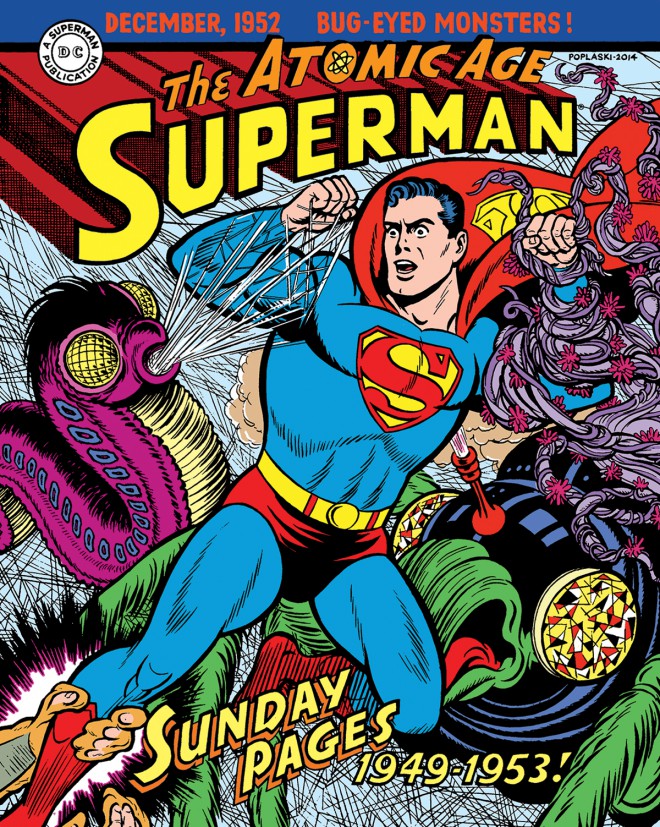
Superman: The Atomic Age Sundays volume 1: 1949-1953


By Alvin Schwartz, Wayne Boring & Stan Kaye (IDW/DC Comics)
ISBN: 978-1-63140-262-3

It’s indisputable that the American comicbook industry – if it existed at all – would have been an utterly unrecognisable thing without Superman. Jerry Siegel & Joe Shuster’s bold and unprecedented invention was fervidly adopted by a desperate and joy-starved generation and quite literally gave birth to a genre if not an actual art form.

He was also shamelessly copied and adapted by many inspired writers and artists for numerous publishers, spawning an incomprehensible army of imitators and variations within three years of his summer 1938 debut.

The intoxicating blend of breakneck, breathtaking action and triumphal wish-fulfilment which epitomised the early Man of Steel soon grew to encompass cops-and-robbers crime-busting, socially reforming dramas, science fiction, fantasy, whimsical comedy and, once the war in Europe and the East also engulfed America, patriotic relevance for a host of gods, heroes and monsters, all dedicated to profit through exuberant, eye-popping excess and vigorous dashing derring-do.

In comicbook terms Superman was master of the world. Moreover, whilst transforming and dictating the shape of the fledgling funnybook industry, the Man of Tomorrow relentlessly expanded into all areas of the entertainment media.

Although we all think of the Cleveland boys’ iconic invention as the epitome and acme of comicbook creation, the truth is that very soon after his debut in Action Comics #1 the Man of Steel became a fictional multimedia monolith in the same league as Popeye, Tarzan, Sherlock Holmes and Mickey Mouse.

Diehard comics fans regard our purest and most powerful icons in primarily graphic narrative terms, but the likes of Batman, Spider-Man, Black Panther, The Avengers and all their hyperkinetic kind long ago outgrew their four-colour origins and are now fully mythologized modern media creatures, instantly familiar in mass markets across all platforms and age ranges…

Far more people have viewed or heard the Man of Steel than have ever read his comicbooks. His globally syndicated newspaper strips alone reached untold millions, and by the time his 20th anniversary rolled around at the very start of what we know as the Silver Age of Comics, he had been a thrice-weekly radio serial regular and starred in a series of astounding animated cartoons, as well as two films and a novel by George Lowther.

Superman was a perennial sure-fire success for toy, game, puzzle and apparel manufacturers and had just ended his first smash live-action television serial. In his future were three more shows (Superboy, Lois & Clark and Smallville), a stage musical, a franchise of blockbuster movies and an almost seamless succession of games, bubblegum cards and TV cartoons beginning with The New Adventures of Superman in 1966 and continuing ever since. Even his superdog Krypto got in on the small-screen act…

However, during his formative years the small screen was simply an expensive novelty so the Action Ace achieved true mass market fame through a different medium: one not that far removed from his print origins.

Although pretty much a spent force these days, for the majority of the last century the newspaper comic strip was the Holy Grail that all American cartoonists and graphic narrative storytellers hungered for. Syndicated across the country – and frequently the planet – it was seen by millions, if not billions, of readers and generally accepted as a more mature and sophisticated form of literature than comic-books. It also paid far better.

And rightly so: some of the most enduring and entertaining characters and concepts of all time were created to lure readers from one particular paper to another and many of them grew to be part of a global culture.

Flash Gordon, Dick Tracy, Buck Rogers, Charlie Brown and so many more escaped humble and tawdry newsprint origins to become meta-real: existing in the minds of earthlings from Albuquerque to Zanzibar.

Some still do…

Even so, it was always something of a risky double-edged sword when a comicbook character became so popular that it swam against the tide (after all weren’t the funny-books invented just to reprint strips in cheap accessible form?) to became actual mass-entertainment – and often global – syndicated serial strips.

Superman was the first original comicbook character to make that leap – about six months after as he exploded out of Action Comics – but only a few have ever successfully followed. Wonder Woman, Batman (eventually) and groundbreaking teen icon Archie Andrews made the jump in the 1940s with only a handful such as Spider-Man, Howard the Duck and Conan the Barbarian having done so since.

The daily Superman newspaper comic strip launched on 16th January 1939, supplemented by a full-colour Sunday page from November 5th of that year. Originally crafted by such luminaries as Siegel & Shuster and their studio (Paul Cassidy, Leo Nowak, Dennis Neville, John Sikela, Ed Dobrotka, Paul J. Lauretta & Wayne Boring), the mammoth task soon required the additional talents of Jack Burnley and writers Whitney Ellsworth, Jack Schiff & Alvin Schwartz.

The McClure Syndicate feature ran continuously from 1939 until May 1966, appearing at its peak in more than 300 daily and 90 Sunday newspapers; boasting a combined readership of more than 20 million. For most of the post war years Boring & Stan Kaye illustrated the spectacular Sundays (eventually supplemented by artists Win Mortimer and Curt Swan). The majority of the strips – from 1944 to 1958 – were written by still largely unsung scribe Alvin Schwartz.

Born in 1916, Schwartz was an early maestro of comicbooks, writing for Batman, Superman, Captain Marvel and many other titles and companies. Whilst handling the Superman strip he also freelanced on Wonder Woman and other superheroes as well as genre titles such as Tomahawk, Buzzy, A Date with Judy and House of Mystery.

After numerous clashes with new superman Editor Mort Weisinger, Schwartz quit comics for commercial writing, selling novels and essays, and latterly, documentaries and docudramas for the National Film Board of Canada. He also worked miracles in advertising and market research, developing selling techniques such as psychographics and typological identification and was a member of the advisory committee to the American Association of Advertising Agencies. He died in 2011.

After too many years wallowing in obscurity most of Superman’s newspaper strip exploits are at last available to aficionados and the curious newcomer in tomes such as this compiled under the auspices of the Library of American Comics.

Showcasing Schwartz and artist Wayne Boring in their purest prime, these Sundays (numbered as pages #521 to #698 and collectively spanning October 23rd 1949 to March 15th 1953) feature a nigh-omnipotent Man of Steel in domestically-framed and curated tales of emotional dilemmas and pedestrian criminality rather than a parade of muscle-flexing bombast, with humour, wit and satire comfortably replacing non-stop angst and bludgeoning action.

Following an affable appreciation of the creators and the times in ‘An Introduction’ by Mark Waid, ‘A Wayne Boring Gallery’ provides a tantalising selection of Superman and Action Comics covers from the period before the weekly wonderment commences in all its vibrant glory.

Sadly, the serials are untitled, so you’ll just have to manage with my meagre synopses of the individual yarns…

Kicking things off is a charming fantasy as the Metropolis Marvel is temporarily stranded in Arthurian Britain after a US government time travel experiment goes awry. Whilst living in the past he befriends and helps out court magician Merlin: an old duffer whose conjuring tricks aren’t fooling anyone anymore…

The first new story of 1950 begins on February 12th and details how swindler Joseph Porter cons the Man of Steel into taking his place and clearing up his problems with the cops and the numerous gulled victims. This includes a hilarious spoofing sequence as Superman plays un-matchmaker to a scandalously-affianced hillbilly ingenue that will delight fans of Li’l Abner…

The extended tale opening on May 28th offers another timeless human-interest drama given a super-powered spin as two aging robber barons recall their regulation-free heydays before embarking on a ruthless wager to see who will get “anything they wish for” first.

The only limitations imposed are their imaginations and financial resources and before long Superman is hard-pressed to keep collateral casualties to a minimum…

One of the few antagonists to transfer from the funnybooks to the Funnies pages was fifth dimensional prankster Mr. Mxyztplk who popped back to our third dimension and took instant umbrage to an arrogant Earth educator. Dr. Flipendale had the temerity to declare the imp a mass delusion and refused to believe or even acknowledge the escalating chaos his pronouncements triggered…

Strip #573 (October 22nd) offers a different take on the classic secret identity crisis when Clark is exposed as an invulnerable man to all of Metropolis. Although gangsters are convinced, Lois Lane is not, claiming the underworld is perpetrating a frame-up…

That yarn takes us to the end of the year and 1951 opens on January 7th with a tale of suspicion and injustice as Clark heads back to childhood hometown Smallville to celebrate Superboy Week and encounters a young man nursing an ancient grudge.

When a poison pen and rumour campaign looks set to spoil the festivities, the hero’s investigations uncover a betrayed child, a framed, murdered father and nefarious clandestine misdeeds carried out by corporate rogues in the Boy of Steel’s name…

Another identity crisis bedevils Clark beginning on April 1st 1951. Here a killer’s case of mistaken identity seemingly exposes the reporter as super-strong and bulletproof. Surely, he must be the indomitable Man of Steel in disguise?

Not according to Professor Pinberry who believes the hapless scribe has been accidentally exposed to his new superpower ray machine, Clark is happy to grasp at the fortuitous alibi but trouble mounts after the public demands to see the machine in action again and the city’s biggest mobster goes after the gadget to make himself Superman’s equal…

Strip #609 starts the next quirky exploit on July 1st as old duffer Salem Cooley comes to Metropolis and enjoys the most miraculous winning streak in history. Even Superman’s astounding powers can’t keep up with the string of happy circumstances, fortuitously profitable accidents and close shaves. Everybody wants to be the old coot’s pal, so who then is behind the constant assassination attempts on superstitious Salem and what reward could possibly tempt anyone to challenge the luckiest man alive?

A new serial opens on September 9th as Superman agrees to write Daily Planet articles about some of his previous exploits to benefit crime prevention charities. However, when the capers he cites are restaged by mysterious malefactors the city soon turns against the Man of Tomorrow and it takes all his super-wits to uncover the mastermind behind it all and stop one of the boldest crimes in the city’s history…

To lure a crime boss out, Superman agrees to be absent from Metropolis for a few weeks in the next adventure (running from November 18th 1951 to January 13th 1952). However, when a poverty-struck boy succumbs to disease and depression, the Man of Might decides to return and act undercover, inspiring the kid’s recovery by granting wishes made on a “magic wand”.

That task becomes increasingly difficult after crooks get hold of the stick and the invisible hero has to play along to sustain little Teddy’s recuperation…

From January 20th Superman plays guardian angel to former wastrel and drunken playboy Reggie de Peyster who swears he’s a reformed character. Nobody but Superman realises the trust fund brat is sincere and all the appalling and shameful scandals he’s currently implicated in are being manufactured to cut the heir out of a vast inheritance…

Lois Lane takes centre stage in the tale opening on April 6th as, after months of being sidelined, the daring reporter quits her job to find a career offering some real excitement. She’s soon the assistant to private detective Mike Crain, catching crooks and bodyguarding glamourous stars, but the work seems dull and pedestrian. Of course, Lois is utterly oblivious to the fact that Superman is secretly intervening in his patriarchal efforts to get her back where she belongs. Ah, different times, eh?

When maverick Hollywood producer/director Hans Bower arrives in Metropolis, (June 29th he promptly declares Clark Kent to be his latest mega-sensational super-star. A force of nature unable to take “no” for an answer, he soon has the bewildered reporter helming his next box office blockbuster but as shooting progresses Superman uncovers a covert agenda and shocking secret behind the mogul’s extraordinary actions.

Uncanny crime is the order of the day from September 21st when bizarre illusions plague Metropolis and scientist Dr. Wagonrod accuses Superman of perpetrating hoaxes and staging crises due to an undiagnosed split personality. The truth is far more devious than that, though…

Concluding this first Atomic Age collection, from November 30th 1952 to March 15th 1953, readers were avidly watching the skies as an alien capsule fell to Earth and disgorged a succession of alien bio-weapons to test humanity. The Man of Steel was hard-pressed to defeat the army of bizarre beasts but did have one immeasurable advantage: the sage advice and input of life-long science fiction fan Sedgwick Ripple…

The Atomic Age Superman: – Sunday Pages 1949-1953! is the first of three huge (312 x 245 mm), lavish, high-end hardback collections starring the Man of Steel and a welcome addition to the superb commemorative series of Library of American Comics which has preserved and re-presented in luxurious splendour such landmark strips as Li’l Abner, Tarzan, Rip Kirby, Polly and her Pals and many of the abovementioned cartoon icons.

It’s an unimaginable joy to see these “lost” Superman stories again, offering a far more measured, domesticated and comforting side of one of America’s most unique contributions to world culture. It’s also a pure delight to see some of the most engaging yesterdays of the Man of Tomorrow. Join me and see for yourself…
© 2015 DC Comics. All rights reserved. SUPERMAN and all related characters and elements are trademarks of DC Comics.

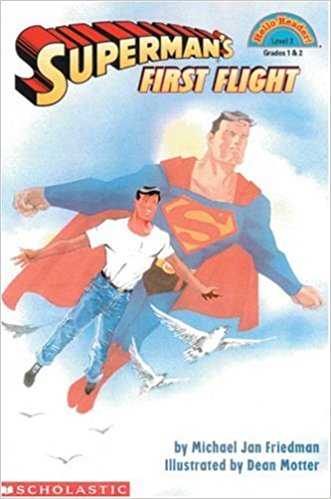
Superman’s First Flight


By Michael Jan Friedman & Dean Motter (Scholastic)
ISBN: 978-0-43909-550-1

Congratulations on your Anniversary, Man of Tomorrow!

We parochial and possessive comics fans too often regard our purest and most powerful icons in purely sequential narrative terms, but characters such as Batman, Wonder Woman and Superman long ago outgrew their four-colour origins and are now fully mythologized modern media creatures instantly familiar in mass markets, platforms and age ranges.

One particularly captivating case in point is this enthralling retelling of the Man of Steel’s formative journey to self-discovery, retold for youngsters as part of the Hello Reader early-learning program devised by children’s publisher Scholastic.

Categorised as US Level 3 (school years 1 and 2), with Level 2 being kindergarten and 1 as pre-schoolers, the smartly recapitulated story spans that crucial divide wherein kids still want their parents to read to and with them, but as the little tykes are also beginning that wonderful, magical journey into literacy as solo voyagers…

This clever, sensitive and age-appropriate retelling by Michael Jan Friedman encapsulates and addresses every maturing child’s growing feelings of potential alienation, sense of growth, self-discovery and independence by focussing on High School student Clark Kent on the day that the solitary teen discovered exactly why he has always felt somehow different from his classmates.

When Clark suddenly, impossibly, hears and sees a car crash occurring miles away, without thinking he is running and jumping over buildings. Arriving on the scene he tears the metal doors off burning cars and outraces an explosion to save a trapped driver…

Terrified that he is some kind of monster he confides in his parents, who promptly share a secret they have been harbouring all Clark’s life.

In the barn they show the awe-struck lad a tiny one-man spaceship which had crashed to Earth years ago. Its cargo was an alien baby…

As Clark approaches the relic a hologram activates and he witnesses his birth-parents Jor-El and Lara who explain why he can perform feats no one else can…

Shocked and distraught, Clark runs away as fast as he can and before he even notices it is flying high above the world. The glorious shock at last makes him realise that different doesn’t mean bad…

Before long the world is daily improved and even saved by a visitor from afar known as Superman…

This captivating adventure is a cleverly weighed introduction into the Action Ace’s canonical comicbook history, subtly addressing issues of adoption and belonging as well as more modern ideological issues such as the plight of refugees and immigrants. Remember, for a very long time distressed and needy strangers were welcomed with open arms in civilised countries…

Magnificently complemented by 31 painted illustrations by design guru and illustrator Dean Motter, this is an epic retold that will amaze kids and astound even their jaded, seen-it-all-before elders.

No Supermaniac could consider their collection complete without a copy of this wonderful little gem. Superman’s First Flight is the ideal introduction for youngsters to their – surely – life-long love affair with the Last Son of Krypton and reading in general…
© 2000 DC Comics. All Rights Reserved. All Rights Reserved.

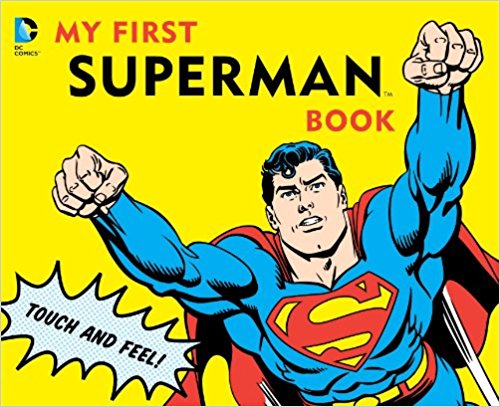
My First Superman Book


By David Katz, designed by George Rucker with illustrations by José Luis García-López (Downtown Bookworks)
ISBN: 978-1-935703-00-6

Happy Birthday, Caped Kryptonian!

Superman is a hero for all ages. Since his debut in June 1938 (actually Action Comics #1 was on newsstands in May but let’s not quibble here), that’s a fact his creators and owners have always understood, with spin-offs and specially tailored books and other merchandise. He’s also the ideal power-embodiment that appeals to the little kid in us all: an unstoppable icon that says “you can’t dictate to me. I know what’s right and I’m going to do it!”

Good thing he’s not a bully then, no?

Such a potent image is ones you simply can’t assimilate early enough and there are number of books and merchandise items tailored to the youngest of potential fanatics. This is one of my very favourites and because of the art (yeah, sure, fanboy) is one even older and aged aficionados can legitimately hunt down.

Printed on solid durable board, My First Superman Book reiterates the key aspects of the Man of Steel’s mythology with bold primary-coloured art-spreads, courtesy of DC’s top brand and merchandising visualiser José Luis García-López. As an added inducement, the images are enhanced with 3D additions and gimmicks such as X-ray vision demonstrated by pop-up and pull-away tabs, as is the legendary phonebooth costume change.

Fabric and faux fur inserts afford a tactile dimension to the hero’s billowing cape and superdog Krypto‘s glowing coat, whilst abundant glitter overprints add a sparkling sheen to the fabulous arctic Fortress of Solitude.

This book is a captivating introduction to the world of classic superhero symbology: offering a literally solid grounding in the basics of the Man of Steel’s incomparable legend and never forgetting the dual aim is inculcating fun and wonder.

A genuine delight and one you could even have some children to share it with if you want…
™ and © DC Comics 2010. All Rights Reserved.

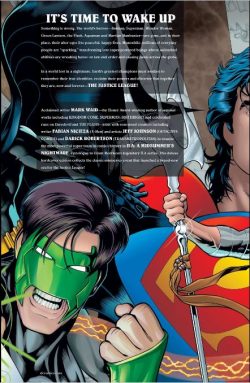
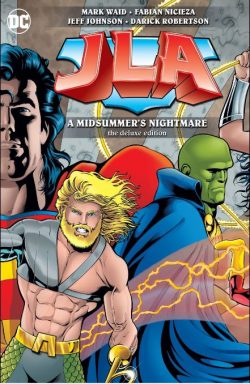
JLA: A Midsummer’s Nightmare Deluxe edition


By Mark Waid, Fabian Nicieza, Jeff Johnson, Darick Robertson, John Holdredge, Hanibal Rodriguez & various (DC Comics)
ISBN: 978-1-4012-7432-0 (HB)

There are many facets that contribute to the “perfect mix” in the creation of any continuing character in comics. How much more so then, when the idea is to build a superhero team that will stand out from the seething masses that already exist?

In the mid-1990s, the iconic squad which truly ushered in the return of superheroes to comics suffered one of its periodic plunges in quality and popularity and ignominiously folded.

Of course the Justice League of America is too hallowed, venerated and valuable to fester in oblivion for any length of time and was quickly reconvened in a fresh new interpretation which quickly became the breakout book of 1997, courtesy of Grant Morrison & Howard Porter.

However, the scene was set for them by a strikingly exuberant miniseries which acted as a reassessment and reintroduction of the World’s Greatest Superheroes. Since the Silver Age’s greatest team-book died a slow, painful, embarrassing death, not once but twice, DC were taking no chances with their next revival and tapped Big Ideas wunderkind Morrison to reconstruct the group and the franchise.

However, he was to a large extent riffing on groundwork laid by writers Mark Waid and Fabian Nicieza – as well as the impressive illustration of Jeff Johnson, Darick Robertson, John Holdredge & Hanibal Rodriguez – in a captivating no-nonsense miniseries which went a long way towards regenerating interest…

This slim sleek Deluxe celebration (collecting in both hardback and eBook editions, Justice League: Midsummer’s Nightmare #1-3 from September-November 1996) opens with an effusive Introduction from Morrison before a world of confusion is revealed in ‘True Lies’ wherein comicbook artist Kyle Rayner struggles to meet the deadline for his assignment. He can’t understand why anybody would want to read about whacky, fictitious masked mystery-men characters like Green Lantern when the entire planet is in the midst of a cosmic revolution.

All over earth humans are spontaneously developing super-powers as an inexplicable genetic “spark” triggers the next stage in evolution.

Millions of superhumans are manifesting with no rhyme or reason whilst others seem doomed to remain merely mundane. It’s like a comicbook plot come to life…

Amongst the ordinary mortals left behind are reporter Clark Kent, billionaire philanthropist Bruce Wayne, schoolteacher Diana Prince, college lecturer Wally West and corporate compliance officer Arthur Curry. Elsewhere, separated by immeasurable gulfs, scientist J’onn J’onzz leads an idyllic life under the skies of Mars with his wife and daughter…

The dreams of all these mortals are troubled. They have vague, impossible recollections of being colourful champions and indomitable heroes in a world filled with their like, not this savage situation where selfish “Sparkers”, intoxicated with newfound power, squabble and bicker like bullies and thugs in a primarily plebeian universe…

Meanwhile, in a hidden place, an immortal mastermind manipulates a super-villain the entire world has forgotten ever existed, using his potent power to reshape dreams to achieve an eons-long plan…

However, there’s far more to heroism than powers and each mentally diminished champion individually struggles to find the disturbing deeper truth they know has been somehow taken from them…

The spell of targeted amnesia starts to unravel when journalist Kent somehow survives being caught in a savage exchange between rival Sparker gangs. Shocked back to Kryptonian normality, he starts tracking down his vanished costumed contemporaries…

Elsewhere relative neophyte “Legacy Heroes” Wally and Kyle have their own epiphanic moments as the second chapter ‘To Know a Veil’ finds a restored Superman and Batman systematically unravelling the sinister plot.

In a hidden sanctum, Machiavellian Know Man further exploits the reality-warping gifts of his slave Doctor Destiny to manufacture a Sparker-squad specifically designed to eradicate the re-emergent heroes. During this time Aquaman and Wonder Woman have united with the World’s Finest team in time to be ambushed by an army of enhanced myrmidons. The battle is in no way certain until the fully-recovered and restored Flash and Green Lantern pile in…

After the inconclusive clash the reassembled heroes realise they need their old telepathic team-mate back and hunt for J’onzz, eventually dragging the Martian Manhunter from his perfect dream of paradise regained – in reality a seedy bunker at Roswell, New Mexico. Having lost his world and family a second time, J’onn is in no mind to be merciful with his anonymous abductors…

The saga kicks into terminal high gear with ‘Daze & Knights’ as Know Man’s tailor-made Sparker-squad attacks, only to fall as one before the brutal psychic assault of the furious and heartbroken Manhunter.

His mental capabilities then glean the whereabouts of their true foes from data buried by rebellious Dr. Destiny in Kyle’s subconscious and the fighting-mad team race off to a final confrontation with their hidden enemy…

Fast-paced, action-packed and breathtakingly bold, this galvanic tale pits the greatest champions in DC’s pantheon against an immortal enemy whose roots stem back to the earliest days of the universe is a gloriously baggage-free romp and a splendid jumping on point for readers new and old alike.

This fantastic Fights ‘n’ Tights fable also includes a handy information section recapitulating and assessing the characters of Superman, Batman, Wonder Woman, Flash, Green Lantern, Aquaman and Martian Manhunter, plus a gallery of covers from the original miniseries previous collections.
© 1996, 2017 DC Comics. All Rights Reserved.