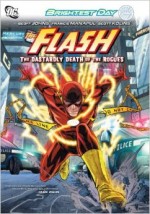
The Flash: The Dastardly Death of the Rogues – a Brightest Day tie-in volume


By Geoff Johns, Francis Manapul, Scott Kolins & various (DC Comics)
ISBN: 978-1-4012-3195-8

In the aftermath of the intergalactic Zombie Apocalypse known as Blackest Night, a number of heroes and villains were mysteriously resurrected. Just prior to that, Barry Allen, the second Flash and scarlet herald of the Silver Age of American comicbooks, also returned from the dead to play a pivotal part in the long-prophesied Crisis.

Once back, however, his life became increasingly complicated…

This first volume of his post-revival exploits collects The Flash volume 3 #1-7 (June-December 2010) and portions of The Flash Secret Files and Origins 2010, revealing how the hero’s desire to return to a normal life proves a forlorn hope in a world still reeling from a swift succession of cosmic upheavals…

The high-octane rush begins in the six-part ‘Case One: The Dastardly Deaths of the Rogues’ by Geoff Johns & Francis Manapul, as Barry returns to his old job as a CSI at Central City‘s Crime Lab.

His old friend Captain Darryl Frye is happy he’s back and believes the returnee’s claim that he’s been in Witness Protection, but is far too busy to chat. Recently the City’s been swamped with nuisance crimes committed by the costumed crazies of Flash’s Rogues Gallery as well as lesser, more pedestrian felons …

Barry knows all about it: his trip to the office has already been interrupted stopping a bank job by the new Trickster…

Before he has a chance to settle in, and already missing his old lab partner Patty Spivot, Barry is then dispatched to examine a body in East Park. Apparently somebody has murdered the Mirror Master…

As his wife Iris joins the Press-pack behind the police tape, Barry makes a disturbing discovery: the ravaged corpse is neither of the two criminals to have operated as the Reflective Rogue but a mysterious unknown third…

This cadaver apparently appeared in a blaze of light and, when a second flare occurs, the Scarlet Speedster suits up and races across town to be greeted by five more strangers tricked out as his greatest foes…

The second issue finds Flash reeling at an incredible accusation. The costumed newcomers – Commander Cold, Weather Warlock, Top, Heatstroke and Trixster – are from the 25th century; a special law-keeping unit dubbed The Renegades come back in time to apprehend him for the murder of Mirror Monarch – an act he will commit in eighty-four days hence…

The team have been trained to tackle their own era’s greatest menace – Professor Zoom, the Reverse Flash – and have no qualms about testing their tactics on his 21st century inspiration. Moreover, reasoned debate and the fact that he is still innocent of any crime are wasted on the future cops. The ensuing cataclysmic clash sees the Vizier of Velocity drive off his attackers, but only at the cost of an entire apartment building…

After diligently rebuilding the dwelling, Barry talks things over with Iris and decides to check on Zoom, currently incarcerated in the forbidding Iron Heights super-penitentiary, where at that very moment Digger Harkness – one of the dozen dead metahumans resurrected in the aftermath of the Blackest Night – is being confronted by the true Rogues.

Captain Cold and Co. have decided not to free their old ally, preferring to see if Captain Boomerang still has the necessary grit and class to be one of them…

At the harassed, stressed and over-worked Crime Lab, Barry has just annoyed his boss by reopening a cold case nobody has time for, when DNA evidence comes back that irrefutably proves that he is the murderer of the anachronistically expired Mirror Monarch…

Pressure mounts in the third chapter as Barry is understandably accused of contaminating a crime scene. His worry however, is that perhaps he is – or will be – the actual killer…

When Boomerang discovers he has returned to life with a new and deadly super power he murderously busts out of prison, arriving back in Central City just as the Renegades attack Barry and Iris.

Whether out of mistaken identity or sheer bloody-mindedness, Harkness joins the blockbusting battle, targeting the tomorrow cops and leaving Flash to frantically save the endangered bystanders…

Despite the bad odds and mounting chaos, Barry is subduing the riotous Rogue and Renegades when Top delivers a chilling warning and ultimatum. Unless Flash surrenders, Iris will die and the rest of the Rogues will unleash a horrific menace from the Mirror Dimensions…

Afetr Top apparently switches sides, the speedster is propelled into an all-out attack on Captain Cold’s crew. The battle is soon wildly out of control but is interrupted when Boomerang is contacted by the White Entity responsible for bringing back the Dead Dozen…

His response ends the street war in an unpredictable manner which allows Flash to divine the true nature and target of all the time shenanigans – and stop the real architect of all his present woes.

…At least he would have, if the Renegades hadn’t used that moment to shanghai him into the future to face trial for murder…

The epic encounter concludes with the resurgent Scarlet Speedster deducing the reason for all the temporal turmoil, foiling his secret foe and heading home to Iris, utterly unaware that a mystery rider from the unknown is heading for him bearing a warning of a coming splintering time stream and an oncoming “Flashpoint”…

The Flash #7 shifts focus to Captain Boomerang as ‘What Goes Around, Comes Around’ (with art by Scott Kolins) reveals the origins and offers career highlights of the Ozzie outlaw, culminating in portentous meeting with the incalculably dangerous Zoom and an ominous confrontation with Captain Cold’s Rogues…

Perhaps narratively parked in the wrong place, ‘Running to the Past’ – also illustrated by Scott Kolins – then offers insights into Barry Allen’s troubled past as the hero dreams again of his mother’s murder and rededicates himself to one day closing that particularly painful cold case, before being welcomed back to the fold of his Speed Force Family, whilst across town the Rogues find the final legacy of Sam Scudder, the original Mirror Master…

Also included are a 2-page preview teaser for upcoming publishing event Flashpoint (inked by Paul Neary), a selection of wry and pithy Flash Facts (‘How Does a Boomerang Work?’, ‘How Do Captain Boomerang’s Boomerangs Work?’, ‘How Does a Mirror Work?’ and ‘How Do Mirror Master’s Mirrors Work?’) plus a mesmerising covers-&-variants gallery by Manapul & Brian Buccellato, Tony Harris, Ryan Sook, Greg Horn, Kolins & Michael Atiyeh, Fernando Pasarin, Joel Gomez, Randy Mayor & Carrie Strachan, Alé Garcia, Sandra Hope & Alex Sinclair and Darwyn Cooke.

The Flash has always been the epitome and paradigm of Fights ‘n’ Tights comics adventure and this blistering – if short-lived – iteration offers so much more than the requisite dose of thrills, chills and spills to satisfy the craving of every tension tripper, suspense junkie and (super) speed freak. Catch it if you can!
© 2011 DC Comics. All Rights Reserved.
Golden Age Doctor Fate Archives volume 1


By Gardner F. Fox, Hal Sherman, Stan Aschmeier & Jon Chester Kozlak (DC Comics)
ISBN: 978-1-4012-1308-0

One of the most interesting aspects of DC’s golden Age superhero pantheon is just how much more they gripped the attention of writers and readers from succeeding generations, even if they didn’t set the world alight during their original “Glory Days”.

Many relatively short-lived or genuinely second-string characters with a remarkably short shelf life through the formative years of the industry have, since the Silver Age which began in 1956, seldom been far from our attention and been constantly revived, rebooted and resurrected.

After The (Jay Garrick) Flash and The Spectre, probably the most revered, revisited and frequently revived is Doctor Fate, who first appeared in 1940, courtesy of writer Gardner F. Fox and the uniquely stylistic Howard Sherman.

Although starting strong, he was another incredibly powerful man of mystery who failed to capture the imaginations of enough readers to build on the chimeric tone of the times: undergoing a radical revision midway through his initial run and losing his strip even before WWII ended.

Since his Silver Age revival however Fate has become a popular cornerstone of more than one DC Universe…

Following the historically informative and laudatory Foreword by big-time devotee fan and Golden Age Keeper of the Flame Roy Thomas, this monumental 400 page full-colour deluxe hardback (representing the entirety of Doctor Fate‘s run from More Fun Comics #55-98 (May 1940-July/August 1944) introduces the potentate of peril in a 6-page parable wherein he combats ‘The Menace of Wotan’.

During those simpler times origins and motivations were far less important than plot and action, so this eerie yarn focuses on a blue-skinned Mephistopheles’ scheme to assassinate comely lady of leisure Inza and how her enigmatic, golden-helmed protector thwarted the plot. The hero dealt harshly with the nefarious azure mage, barely mentioning in passing that Fate possessed all the lost knowledge and lore of ancient civilisations.

That’s probably the biggest difference between the original and today’s Fate: back then he was no sorcerer but an adept of forgotten science (a distinction cribbed from many Lovecraftian horror tales of the previous two decades of pulp fiction): a hair-splitting difference all but lost on the readers.

In #56 – which sported the first of eleven cover spots for the Wielder of Old Wisdoms –‘The Search for Wotan’ saw Fate carry Inza up the Stairs of Judgement to Heaven where they learned their foe was not dead and was preparing to blow up the entire Earth.

Foiling the plan but unable to permanently despatch the big blue meanie, Fate was forced to bury his enemy alive at the centre of the world…

In ‘The Fire Murders’ in #57, certified doom-magnet Inza was targeted by mystic arsonist Mango the Mighty before her guardian Fate quickly ended the campaign of terror, whilst in the next issue a modern mage recovered ‘The Book of Thoth’ from its watery tomb and unleashed a wave of appalling, uncanny phenomena… until the Blue-and-Gold Gladiator stepped in.

The self-appointed bulwark against wicked mysticism flew out of his comfort zone in More Fun #59 to repel an invasion by ‘The People from Outer Space’ but was firmly back in occult territory for #60 when he destroyed ‘The Little Men’ employed by a legendary triumvirate of colossal Norns to crush humanity.

Behind #61’s striking Sherman cover, ‘Attack of the Nebula’ pitted the Puissant Paladin against a cosmic cloud and wandering planetoid summoned by an Earthly madman to devastate the world, then saw him crush a deranged technologist’s robotic coup in #62’s ‘Menace of the Metal Men’ and save Inza from petrification by ‘The Sorcerer’ in More Fun #63.

Like many of Fox’s very best heroic series, Doctor Fate was actually a romantic partnership, with Inza (after a number of surnames she eventually settled on Cramer) acting as assistant, foil and so very often the target of many macabre menaces. In #64 she and Fate – who still had no civilian identity – shared a pleasure cruise to the Caribbean where a slumbering Mayan God of Evil wanted to utilise her unique psychic talents in ‘The Mystery of Mayoor’.

She got a brief rest in #65 as Fate soloed in a bombastic battle to repel an invasion of America by ‘The Fish-Men of Nyarl-Amen’ but played a starring role in the next episode when Fate exposed a sadistic crook trying to drive his wealthy cousin to suicide by convincing her that she was ‘The Leopard Girl’…

A year after his debut, More Fun Comics #67 (May 1941) at last revealed ‘The Origin of Doctor Fate’ telling how the boy Kent Nelson had accompanied his father Sven on an archaeological dig to Ur in 1920.

Broaching a pre-Chaldean pyramid, the lad awakened a dormant half-million year old alien from the planet Cilia, accidentally triggered security systems which killed his own father. Out of gratitude and remorse the being known as Nabu the Wise trained Kent to harness the hidden forces of the universe – levitation, telekinesis and the secrets of the atom – and after two decades sent him out into the world to battle those who used magic and science with evil intent.

That epic sequence only took up three pages, however, and the remainder of the instalment found time and space for Fate and Inza to turn back a ghostly incursion and convince Lord of the Dead Black Negal to stay away from the lands of the living…

Fate then graduated to 10-page tales and held the covers of More Fun #68-76, beginning a classic run of spectacular thrillers by firstly crushing a scientific slaughterer who had built an invisible killing field in ‘Murder in Baranga Marsh’, before gaining a deadly arch-enemy in #69 when deranged physicist Ian Karkull used a ray to turn his gang into ‘The Shadow Killers’…

In #70 the shadow master united with Fate’s first foe as ‘Wotan and Karkull’ built an arsenal of doomsday weapons in the arctic, but were still too weak to beat the Master of Cosmic Forces, whereas rogue solar scientist Igorovich would have successfully blackmailed the entire planet with ‘The Great Drought’ had Inza not intervened…

With involvement in WWII now clearly inevitable, the covers had increasingly become more martial and patriotic in nature, and with More Fun Comics #72 (October 1941) Fate underwent an unexpected and radical change in nature.

The full face helmet was replaced with a gleaming metallic half hood and his powers diminished. Moreover the hero was no longer a cold, emotionless force of nature, but a passionate, lusty, two-fisted swashbuckler throwing punches rather than pulses of eerie energy. His previous physical invulnerability was countered by revealing that his lungs were merely human and he could be drowned, poisoned or asphyxiated…

The quality and character of his opposition changed too. ‘The Forger’ pitted him against a gang of con-men targeting Inza’s family and other farmers; altering intercepted bank documents to pull off a cruel swindle, whilst a far more rational and reasonable nemesis debuted in #73 as criminal mastermind ‘Mr. Who’ used his body-morphing, forced- evolution Solution Z to perpetrate a series of sensational robberies.

Despite a rather brutal trouncing – and apparent death – the brute returned in #74 as ‘Mr. Who Lives Again’ saw the sinister scientist use his abilities to replace the City Mayor, whilst in #75 ‘The Battle Against Time’ found Fate racing to find a killer who had framed Inza’s best friend for murder…

Underworld chess master Michael Krugor manipulated people like pawns but ‘The King of Crime’ found himself overmatched when he tried to use Inza against Fate, after which #77 saw a welcome – if brief – return to the good old days as ‘Art for Crime’s Sake’ found the Man of Mystery braving a magic world of monsters within an ancient Chinese painting to rescue young lovers eldritchly exiled by a greedy art dealer

Issue #78 featured clever bandits who disguised themselves as statues of ‘The Wax Museum Killers’ whilst #79’s ‘The Deadly Designs of Mr. Who’ revealed how the metamorphic maniac attempted to impersonate and replace one of the richest men on Earth, and in #80 innovative felon ‘The Octopus’ turned a circus into his playground for High Society plunder.

In More Fun #81 cunning crook The Clock used radio show ‘Hall of Lost Heirs’ to trawl for potential victims and easy pickings whilst in the next issue Fate exposed the schemes of stage magician/conman The Red Sage who was offering Luck For Sale!’ after which ‘The Two Fates!’ – fortune tellers who used extortion and murder to bolster their prognostications – were stopped by the real deal…

In #84 the energetic crimebuster braved ‘Crime’s Hobby House!’ to stop thieving special effects wizard Mordaunt Grimm using rich men’s own pastimes to rob them, before big changes for Kent Nelson occurred in #85.

Here the society idler quickly qualified as a surgeon and medical doctor, embarking on a new career of service to humanity. Additionally, his alter ego ditched the golden cape, becoming a more acrobatic and human – if still bulletproof – crimebuster, exposing a greedy plastic surgeon helping crooks escape justice as ‘The Man Who Changed Faces!’

The medical theme predominated in these later tales. ‘The Man Who Wanted No Medals’ was a brilliant surgeon who feared a crushing youthful indiscretion would be exposed after which #87’s ‘The Mystery of Room 406’ dealt with a hospital cubicle where even the healthiest patients always died whilst in ‘The Victim of Doctor Fate!’, Nelson suffered crippling self-doubt when he failed to save a patient.

Those only faded after the surgeon’s diligent enquiries revealed the murderous hands of Mad Dog McBain behind the untimely demise…

Charlatan soothsaying scoundrel Krishna Das was exposed by Fate and Inza in #89’s ‘The Case of the Crystal Crimes’ after which ‘The Case of the Healthy Patient!’ pitted them against a fraudulent doctor and incurable hypochondriac before Mr. Who used his chemical conjurations to shrink our hero to doll size in #91’s ‘The Man Who Belittled Fate!’

The Thief of Time struck again – whilst still in jail – in More Fun #92 as ‘Fate Turns Back The Clock!’ and Hal Sherman ended his long association with the strip in ‘The Legend of Lucky Lane’ wherein an impossibly fortunate felon finally played the odds once too often…

As the page-count dropped back to six pages Stan Aschmeier illustrated the next two adventures, beginning with 94’s ‘The Destiny of Mr. Coffin!’ with Fate coming to the aid of a fatalistic old soul framed for being a fence whilst ‘Flame in the Night!’ saw a matchbox collector targeted by killers who thought he knew too much…

With the end clearly in sight Jon Chester Kozlak took over the art beginning with More Fun Comics #96 and ‘Forgotten Magic!’ as Fate’s Chaldean sponsor was forced to remove the hero’s remaining superhuman abilities for a day – leaving Fate to save trapped miners and foil their swindling boss with nothing but wits and courage.

Then the restored champion exposed the spurious bad luck reputed to plague ‘Pharaoh’s Lamp!’ and ended/suspended his crime-crushing career with #98 by sorting out a case of mistaken identity when a young boy was confused with diminutive Stumpy Small AKA ‘The Bashful King of Crime!’…

With the first age of superheroes coming to a close new tastes were developing in the readership. Fate’s costumed co-stars Green Arrow, Aquaman and Johnny Quick – along with debuting concept Superboy – moved over to Adventure Comics leaving More Fun as an anthology of cartoon comedy features.

Initially dark, broodingly exotic and often genuinely spooky, Doctor Fate smoothly switched to the bombastic, boisterous, flamboyant and vividly exuberant post war Fights ‘n’ Tights style but couldn’t escape the changing times. Now however, both halves of his early career can be seen as a lost treasure trove of tense suspense, eerie enigmas, spectacular action and fabulous fun: one no lover of Costumed Dramas or sheer comics wonderment can afford to miss.
© 1940, 1941, 1942, 1943, 1944, 2007 DC Comics. All Rights Reserved.
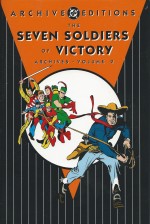
Seven Soldiers of Victory Archives volume 2


By Joe Samachson, Ed Dobrotka, Pierce Rice, Jon Small, Maurice Del Bourgo & various (DC Comics)
ISBN: 978-1-4012-1308-4

After the actual invention of the comicbook superhero – for which read the Action Comics debut of Superman in 1938 – the most significant event in the industry’s history was the combination of individual sales-points into a group. Thus what seems blindingly obvious to us with the benefit of four-colour hindsight was proven: consumers couldn’t get enough of garishly-hued mystery men and a multitude of popular characters would inevitably increase readership.

Plus, of course, a mob of superheroes is just so much cooler than one (…or one-and-a-half if there’s a sidekick involved…).

It cannot be understated: the creation of the Justice Society of America in 1941 utterly changed the shape of the budding industry. Soon after the team debuted, even All American Comics’ publishing partner National wanted to get in on the act and created their own squad of solo stars, populated with a number of their proprietary characters who hadn’t made it onto the roster of the cooperative coalition of AA and DC stars.    Oddly they never settled on a name and the team of non-powered mystery men who debuted in Leading Comics #1 in 1941 were retroactively and alternatively dubbed The Law’s Legionnaires and The Seven Soldiers of Victory.

They never even had their own title-logo but only appeared as solo stars grouped together on the 14 spectacular covers, the second quartet of which (by Mort Meskin, Jon Small, Maurice Del Bourgo and a sadly unidentified artist) preface each collaborative epic in this spectacular sequel of Golden Age delights.

The full contents of this bombastic deluxe hardback barrage of comicbook bravado were originally presented in the quarterly Leading Comics #5-8, spanning Winter 1942/1943 to Fall 1943 and, following an incisive discourse and background history lesson from comics historian Bill Schelly in his Foreword, that war-time wonderment resumes with the heroes’ fifth adventure.

The sagas all followed a basic but extremely effective formula (established by Mort Weisinger in their first case), and here the warped mastermind challenging the Legionnaires was The Skull, who devised ‘The Miracles That Money Couldn’t Buy!’ (illustrated over all seven chapters by Ed Dobrotka but again the work of a writer time has forgotten and sketchy records have not yet revealed – but most probably the amazing Joe Samachson…).

The drama began when publisher Lee Travis tips off his pal Oliver Queen to an imminent prison break in his bailiwick.

Green Arrow and Speedy are too late to stop vicious Bill “Porky” Johnson‘s escape via skull-painted mystery-plane and that soon-to-be-executed convict’s feat is repeated four more times across the country, leaving a handful of Death Row inmates beholden to a strange old man dubbed who has found that, for all his wealth, there are still things money cannot buy.

However, for an unscrupulous businessman unwilling to get his own emaciated hands dirty but with the right criminal specialists, they can be stolen…

The Seven Soldiers meanwhile have briefly convened and now stand ready to face their specified nemeses as soon as they rear their scurrilous heads…

In ‘The Case of the Criminal Vigilante’ rustler and horse thief Bronco Slade steals Spinaway – the fastest racehorse on Earth – by impersonating the Vigilante, with the true Sagebrush Centurion helpless to stop him, and indeed even taken prisoner beside his hapless, interfering biggest-fan Mr. Meek…

‘The Diamond of Doom!’ finds jewel thief the Sparkler targeting the fabulous, reputedly cursed Koram Diamond. Even though Star-Spangled Kid and Stripesy are unable to bring the bandit to justice, a spookily fatal fate befalls him.

A similar outcome ends hijacker Bull Corbin after he outfoxes the Crimson Avenger and Wing whilst purloining a prototype spaceship. However rather than a clean getaway all that awaits the thief is a grim and final ‘Destiny among the Stars!’

‘A Knight without Armor’ reveals how the Shining Knight‘s magic mail-coat is too tough a target for shifty Matt Grieder, but the thug’s subsequent attempt to pass off fake metal-wear ends in near-death for Sir Justin and execution for the villain, after which the Emerald Archers finish their hunt for Porky Johnson when the fugitive’s successful attempt to obtain a rejuvenation ray for the Skull prematurely rings down the curtain for The Murderer Who Couldn’t be Hanged!’

The untitled ‘Conclusion’ then shows how getting everything you want might not make you happy – or keep you breathing – as the Vigilante busts free just as his Legionnaire allies storm the triumphant Skull’s fortress…

Leading Comics #6 was also probably scripted by Samachson, but this time the penciller is unrecorded. At least we know he or she was inked by Maurice Del Bourgo…

‘The Treasure That Time Forgot!’ is a grand hunt for the hidden gold of the Incas. Archaeologist Mr. Milton publicly calls upon the Seven Soldiers to follow his old map and find Pizarro‘s lost treasure hoard the plan is to bolster America’s war-chest by a billion dollars…

Said map, sketched by an explorer named Burton, comes with cryptic verses and false trails, so the archaeologist’s assistant Scrivener suggests the heroes split up to save time. They could even make a competition of it…

‘Crimes by Proxy!’ finds Green Arrow and Speedy clashing with Star-Spangled Kid and Stripesy deep in the Andes as a hidden hand attempts to murder both teams using the weaponry of the other; a tactic repeated when Shining Knight and Vigilante discover a lost city and are tricked into conducting ‘A Duel to the Death!’

Their cataclysmic clash ends as an enigmatic and heavily disguised manipulator surfaces, confident the heroes have cleared all obstacles and booby-traps, only to fall foul of avian horrors in ‘Winged Masters of the Mountains!’

‘The Gold that Failed to Glitter!’ finds the man-&-boy teams still mistakenly battling each other until the late-arriving knight and cowboy forcibly restrain them. Soon after, aged Mr. Milton mysteriously turns up to help, but only succeeds in spreading further suspicion when the combined party discovers the legendary treasure vault… emptied!

Meanwhile the Crimson Avenger and Wing have followed ‘The Third Treasure Trail!’ and met the last of the Incas – as well as their real enemy – and everybody collides in the explosive conclusion which solves all the mysteries at ‘Trail’s End!’

Issue #7 – pencilled by Pierce Rice – takes the heroes on a similar fund-raising quest as War Bond Drive performers, but the tour is a scam by a strange individual who is an emissary of ‘The Wizard of Wisstark!’

He implores the Legionnaires to travel to his fantastic kingdom and liberate the Antarctic hidden city from the threat of invasion…

The Wizard is actually an elderly American stage conjuror who fell into the position of chief but now his peaceful, super-scientific subjects are being threatened by real magicians from the rival polar city of Stanovia…

The fight back begins when Star-Spangled Kid and Stripesy travel to ‘The Land of Giants!’ hoping to enlist the colossi in the struggle. Sadly the brutal hulks are already engaged in a struggle with a tribe of equally savage dwarves, but the boy genius has an idea and takes a few movie pictures before leaving…

‘The Wizard Archers and the Wizards!’ sees Green Arrow and Speedy strike to the heart of the matter and boldly invade Stanovia, where they discover a few intriguing secrets about the triumvirate of “mages” who rule the city…

Wing and the Crimson Avenger stayed with the Wizard in Wisstark, in case of fifth column attacks. They are unfortunately captured by ‘The Invisible Men!’ who have been despatched to sow disorder and terror. Whilst being taken to Stanovia, however, the mystery men discover a shocking secret about their foes…

Whilst that was happening the Vigilante made his own contribution to the cold war-effort, catching a Wizard doppelganger attempting to infiltrate the palace in ‘Double Trouble!’, before Shining Knight, patrolling the skies on his winged steed Victory, recruits timber-clad warriors to counterattack Stanovia in ‘The March of the Wooden-Armored Soldiers’…

With their pre-battle preparations completed, the Seven Soldiers reunite for the final ‘Battle of the Wizards!’, much-heartened by the conclusion each has individually reached regarding the truth about the Stanovian sorcerers…

This second classic collection concludes with a stirring time-travel, super-villain mash-up as Leading #8 sees the heroes ambushed and reduced to ‘Exiles in Time!’ (illustrated by Jon Small & Del Bourgo) by old enemy The Dummy.

The diminutive demon of destruction subtly lures his foes into a cunning ambush which catapults the crusaders down the corridors of history, before turning his attention to plunder and mayhem, not realising that heroism is found in every era, such as 17th century France where the Three Musketeers ally with Green Arrow and Speedy to solve the theft of ‘The Queen’s Necklace!’…

Crimson Avenger and Wing re-materialised in China but were utterly unable to determine when. Deductive investigation finally paid off as Japanese invaders trying to stop the completion of the Great Wall pointed to 225BC, when and where the time-travellers were happy to train the peasantry in how to fight them by displaying ‘Courage in Canton!’…

‘Voyage of the Vikings’ found Star-Spangled Kid and Stripesy deposited on a lost and ice-gripped dragon-boat, struggling for survival with their newfound comrades as they desperately sought solid ground. How astonished they all were when bold Leif Ericsson dubbed his discovery Vineland and he patriotic mystery men realised they had been part of the first discovery of America…

‘Friends, Romans, Countrymen’ saw Vigilante land in Rome and recognise a brace of 20th century mugs. Trailing the hoods to the house of super-rich Crassus, the Western Wildcat realised the criminals were using the Dummy’s device to plunder historical treasures but even after foiling their plans, he was still stuck in the past…

‘The Legend of Leonardo’ revealed how the Shining Knight came to the aid of the legendary Da Vinci and was rewarded with a quick trip on the master’s own recently completed time machine. Back when he started from, the Arthurian paladin then began toppling some temporal dominoes in the ‘Conclusion’, allowing his time-tossed companions to return and deal with the diabolical doll-man in the appropriate manner…

These raw, wild and excessively engaging costumed romps are amongst some of the best but most neglected thrillers of the halcyon Golden Age. Happily, modern tastes too have moved on and these yarns are probably far more in tune with contemporary mores, making this a truly guilty pleasure for all fans of mystery, mayhem and stylish superteam tussles…
© 1942, 1943, 2007 DC Comics. All Rights Reserved.
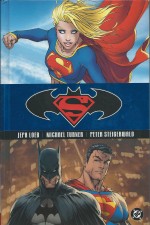
Superman/Batman: Supergirl

New Revised Review

By Jeph Loeb, Michael Turner & Peter Steigerwald (DC Comics)
ISBN: 1-4012-0347-7

In a shock of sheer horror, I realised over Christmas that I’ve been doing this for over 20 years: firstly in magazines like Comics Forum and books like Slings and Arrows, then as an online critic for the Comics Creators Guild website, before starting the independent Now Read This! in 2007.
Moreover many of those early efforts weren’t particularly fair or good – a side-effect of being literally bombarded non-stop with volumes one wouldn’t generally pick to read.
Thus in a probably futile effort to be less judgemental I’ve been going over older reviews, rethinking some previous pronouncements and will be making amends over the months to come.
What’s really worrying is how many I haven’t changed my mind about…

For many years Superman and Batman worked together as the “World’s Finest” team. They were best friends and the pairing made perfect financial sense as National/DC’s most popular heroes could cross-sell their combined readerships.

When the characters were redefined for the post-Crisis on Infinite Earths 1980s, they were remade as cautious but respectful co-workers who did the same job whilst deploring each other’s methods. They preferred to avoid contact whenever possible – except when they were in the Justice League – but then, the character continuity of team titles has always been largely at odds with heroes at home in their own titles…

After a few years of this new status quo the irresistible lure of Cape & Cowl Capers inexorably brought them together again with modern emotional intensity derived from their incontestably differing methods and characters.

For decades DC really couldn’t make up their minds over Supergirl. I’ve actually lost count of the number of different versions that have cropped up over the years, and I’ve never been able to shake the queasy feeling that above all else she’s a concept that was cynically shifted from being a way to get girls reading comics to one calculated to ease young male readers over that bumpy patch between sporadic chin-hair outbreaks, voices breaking and that nervous period of hiding things under your mattress where your mum never, never ever looks…

After a few intriguing test-runs she debuted as a future star of the ever-expanding Superman pocket universe in Action Comics #252 (May 1959). Superman’s cousin Kara Zor-El had been born on a city-sized fragment of Krypton, hurled intact into space when the planet exploded. Eventually Argo City turned to Kryptonite like the rest of the detonated world’s debris and her dying parents, observing Earth through their vision-scopes, sent their daughter to safety as they apparently perished.

Landing on Earth, she met Superman who created the identity of Linda Lee and hid her in an orphanage whilst she learned of her new world and powers in secrecy and safety.

Her popularity waxed and waned over the years until she was earmarked for destruction as part of the clearout of attention-grabbing deaths during the aforementioned Crisis on Infinite Earths.

However as detailed in scripter Jeph Loeb’s introduction ‘On the Roller Coaster or, How Supergirl Returned to the DCU for the First Time’, after John Byrne successfully rebooted the Man of Steel, non-Kryptonian iterations began to appear – each with their own fans – until early in the 21st century the company Powers-that-Be decided the real Girl of Steel should come back… sort of…

Thus this visually intoxicating version (reprinting Superman/Batman #8-13, May-October 2004) resets to the original concept and has a naked blonde chick arrive on a Kryptonite meteor, claiming to be Superman’s cousin…

Written by Loeb with captivating art by Michael Turner & Peter Steigerwald, the action commences in the aftermath of Superman/Batman: Public Enemies wherein a Green Kryptonite asteroid crashed to Earth. Now in ‘Alone’, as a quarantined Superman chafes at enforced detention, the Dark Knight explores a section of the meteor submerged in Gotham Bay.

The JLA have all been active, clearing away the deadly fragments, but this last one is most disturbing. As Batman quickly grasps, it’s a ship but its single passenger is missing…

Soon the Gotham Guardian is tracking a wave of destruction caused by a seemingly confused teenaged girl with incredible powers and only Superman’s unwise early intervention stops the mounting carnage. Their subsequent investigations reveal the comely captive to have all the Man of Tomorrow’s abilities and she claims – in fluent Kryptonian – to be the daughter of his long-dead uncle Zor-El…

The mystery further unfolds in ‘Visitor’ as a deeply suspicious Batman and ecstatic Superman continue their researches, arguing their corners as the most powerful girl on Earth becomes increasingly impatient. Fuelling the Dark Knight’s concern is superdog Krypto‘s clear and savage hostility to the newcomer and Kara‘s claims that she has amnesia…

Then as Clark Kent endeavours to acclimatise his cousin to life on Earth, on the hellish world of Apokolips vile Granny Goodness and her Female Furies are ordered by ultimate evil space-god Darkseid to acquire the pliable naive newcomer…

Before they can strike, however, an attack comes from an unexpected source, as former ally Harbinger, ruthless hunter Artemis and beloved ally Wonder Woman ambush the Kryptonians. …

Princess Diana has acted arbitrarily nut from necessity: kidnapping Kara and bringing her to the island home of the Amazons to be trained in the use of her powers as a ‘Warrior’. Superman’s growing obsession has rendered him unable to see her potential for destruction, despite a cryptic message on her space ship from Zor-El, and Wonder Woman decided to strike first and ask later…

With tempers barely cooled, Dark Knight and Man of Steel are invited to observe Kara’s progress weeks later, just as the tropical Paradise is assaulted by an army of artificial Doomsdays manufactured on Apokolips…

The wave of slaughter is a feint, but by the time the horrors are all destroyed, the Female Furies have done their work, slaughtering Kara’s only friend and stealing her away…

In ‘Prisoner’, DC’s superheroic high trinity enlist the aid of Apokolyptian émigré Big Barda and stage a devastating rescue mission to Darkseid’s homeworld, but not before the Lord of evil apparently twists the innocent Girl of Steel into his tool: a ‘Traitor’ to the living…

The Master of Apokolips has never faced a foe as adamant as Batman and the quartet are unexpectedly victorious, but after returning Kara to Earth and announcing her as the new Supergirl, the heroes discover that they are not safe or secure, and in ‘Hero’ Darkseid horrifyingly returns to exact his ultimate revenge…

This hardcover collection also includes a covers-&-variant gallery by Turner, Steigerwald, Jim Lee & Scott Williams, assorted roughs and a wealth of production Sketches, and a nifty 2-page translation key for the Kryptonian Alphabet.

For me, the most intriguing aspect of this sometimes overly-sentimental tale is Batman’s utter distrust and suspicion of Kara as she is hidden from the world while she assimilates, but there’s plenty of beautifully rendered action (plus oodles of lovingly rendered girl-flesh and titillating fetish outfits jostling for attention amidst the lavish fight-scenes and interminable guest-cameos) and enough sheer spectacle to satisfy any Fights ‘n’ Tights fans.
© 2004, 2005 DC Comics. All Rights Reserved.
Golden Age Starman Archives volume 2


By Gardner Fox, Alfred Bester, Joe Samachson, Jack & Ray Burnley, Mort Meskin, George Roussos, Emil Gershwin & various (DC Comics)
ISBN: 978-1-4012-2283-3

After the staggering success of Superman and Batman, National Comics/DC rapidly launched many other mystery-men in their efforts to capitalise on the phenomenon of superheroes, and from our decades-distant perspective it’s only fair to say that by 1941 the editors had only the vaguest inkling of what they were doing.

Since newest creations Sandman, The Spectre and Hourman were each imbued with equal investments of innovation, creativity and exposure, the editorial powers-that-be were rather disappointed that their later additions never took off to the same explosive degree.

Publishing partner but separate editorial entity All American Comics had by then created many barnstorming successes such as The Flash, Green Lantern, Hawkman and Hop Harrigan and would soon actually produce the only true rival to Superman and Batman’s star status when Wonder Woman debuted late in the year.

Of course AA clearly filtered all ideas through the brilliantly “in-tune” creative and editorial prodigy Sheldon Mayer…

Thus when Starman launched in the April 1941 Adventure Comics (relegating former Sandman to a back-up role in the already venerable heroic anthology), National/DC trusted in craft and quality rather than some indefinable “pizzazz”.

Before too long, though, the editors were forced to concede that even the forcefully realistic, conventionally dramatic illustration of Hardin “Jack” Burnley would not propel their newest concept to the same giddy heights of popularity as the Action Ace or Gotham Guardian.

The strip, always magnificently drawn and indisputably one of the most beautifully realised of the period, was further blessed with mature and compelling scripts by Gardner Fox, Alfred Bester, Don Cameron and latterly Joe Samachson but just never really caught on.

However, by today’s standards these compelling, compulsive fun-filled and just plain brilliant tales are some one of the very best comics that era ever produced.

Happily these days, with an appreciably older and more discerning audience, Starman’s less-than-stellar War years career might be more fully appreciated for the superb example of Fights ‘n’ Tights fiction it truly was. This particular volume sees the subtle, moody, slower-paced intellectually edgy stories supplanted by shorter yarns brimming with sheer exuberance and kinetic energy as, with the Nazi menace beaten, home grown criminals began to congregate on comics pages…

Golden Age guru Roy Thomas offers his own absorbing critical overview in the Foreword to this second stunning deluxe hardback collection – completing the Sidereal Sentinel’s tenure in Adventure Comics (issues #77-102, spanning August 1942 to February 1946). The volume even includes some of the most iconic covers of the Golden Age by Joe Simon & Jack Kirby – even though most of them only feature Starman in a little insert in one corner!

As was often the case, although Burnley came up with the concept and look for the Astral Avenger, a professional writer was assigned to flesh out and co-create the stories. At first multi-talented Gardner Fox handled the job, but eventually Alfred Bester began supplying scripts, whilst the illustrator also liberally called on the talents of his brother Dupree “Ray” Burnley as art assistant and inker with their sister Betty as letterer to finish the episodes in sublimely cinematic style.

In those simpler times origins were far less important than today, and the moonlit magic just happened: playboy astronomer and secret genius Ted Knight simply invented a “Gravity Rod” which stored and redirected the incredible power of the stars, and like any decent right-thinking individual created a “mystery man” persona.

Offering Starman’ services to FBI chief Woodley Allen, the Man of Night started his crusade against evil and injustice…

The period peril begins here with ‘Finders Keepers!’ by Fox & Burnley, wherein arch-nemesis The Mist combined his usual invisibility gimmicks with a subtle psychological scheme. When members of the public found valuable “lost property” they had no idea each item carried a post-hypnotic command to surrender their own valuables to the criminal mastermind…

Bester then scripted a thriller dealing with another kind of invisibility for the next issue as Starman and street urchin Mike Muggins ended the impossible robbery-spree of ‘The Little Man Who Wasn’t There!’, whilst in #79 ‘The Tune of Terrific Toby’ (Bester & Burnley again) offered a lighter tone for the tale of a meek office worker who faked a bold rescue to enhance his status only to become embroiled in a concatenation of increasingly dangerous stunts. Happily Starman was able to turn the repentant fool into a real hero…

Burnley bowed out in style in Adventure #80 (November 1942) in Bester’s ‘The Time-Machine Crime!’ wherein thugs used said purloined device to kidnap William Shakespeare, in hopes his canny mind could plan the perfect crime…

Gardner Fox returned for another stint in #81 as the explosively kinetic Mort Meskin & George Roussos briefly took on the art. In ‘Starman’s Lucky Star!’ a poor blind boy who wanted to be an astronomer was mistakenly kidnapped instead of his wealthy playmate. Thankfully the Star Sentinel was available to put everything right, after which ‘Hitch a Wagon to the Stars’ (#82, Fox, Meskin & Roussos) spotlighted a brilliant young inventor whose obsession with astrology blighted his life, and nearly made him a patsy for Nazi spies… at least until Ted Knight and his alter ego intervened.

With Adventure Comics #83 Emil Gershwin became main illustrator for the series – a solid, polished artist much influenced by Mac Raboy – and ‘Wish Upon a Star!’ gave him the opportunity to shine in the moving, socially-charged tale of three prep school boys whose unselfish wishes came true thanks to Starman…

At this time the Astral Avenger’s page counts began to decline as his popularity dwindled – from an average of 11 to 7 or 8 – and ‘The Doom From the Skies’ reflected a growing trend towards fast-paced action as a burglar stole the Gravity Rod, leaving our hero an amnesiac and his weapon a deadly death ray, whilst ‘The Constellations of Crime!’ in #85 introduced Astra the Astrologist who used predictions as the basis of extravagantly deadly crimes…

In the next issue a disgraced sportsman pretended to undertake a lunar trip whilst equipping his gang with clever gimmicks to rob and restore his fortune as ‘The Moonman’s Muggs!

An element of detection fiction was added in Adventure #87 when Starman exposed a gang selling the inexplicably popular paintings of the worst artist in America as ‘Crime Paints a Picture!’ before rejoining the war-effort in #88 as the Stellar Centurion solved ‘The Enigma of the Vanishing House!’ and smashed a Nazi spy-ring.

In #89 old enemies the Moroni Gang broke out of jail and restarted their criminal careers as Sun, Moon and Saturn. Regrettably ‘The Plundering Planets!’ quickly fell foul of Starman and a couple of really annoying prankster kids…

Meskin & Roussos popped back in #90 to vividly envision the anonymous thriller ‘Land Beneath the Fog!’ wherein Starman saved a lady scientist accused of witchcraft in a lost medieval kingdom, whilst in the next issue Don Cameron, Meskin & Sam Citron jointly detailed ‘The Rising Star of Johnny Teach!’ as another young man emotionally crippled by a nonsensical faith in astrology found the courage to turn his life around… after a little prompting from Starman.

With Adventure #92 Joe Samachson took over the scripting and Gershwin returned to illuminate the series until its premature conclusion.

The run began with ‘The Three Comets!’ – circus acrobats Starman was convinced doubled as flamboyant thieves. All he had to do was find out where they stashed the loot…

In #93’s ‘Gifts from the Stars!’ the hero almost died after getting in between a squabbling scientist and his financial backer whose protracted arguments allowed robbers to blindside them both, #94’s ‘Stars Fall on Allie Bammer!’ had gangster Blackie Kohl use a meteor shower to gain entrance to an impregnable estate, and ‘The Professor Plays Safe!’ in #95 found a muddle headed astronomer at the wrong conference only to end up locked in a safe – until Starman stepped in…

‘Prediction for Plunder!’ saw Ted Knight and a gang of superstitious crooks both ticked off at the unscrupulous editor of the Weekly Horoscope. The Socialite wanted no more scary predictions worrying his nervous friends, but the thugs were actually using those specious prognostications to plan their jobs…

Adventure #97 saw impoverished stargazer Jimmy Wells agree to let wealthy Wesley Vanderloot take all the credit for his discoveries in return for direly needed cash, but his ‘Stolen Glory!’ almost cost the scientist and Starman their lives when the millionaire faced humiliating exposure, after which #98 revealed a stellar conundrum which gave the hero belated insight into a bizarre crime-wave where one gang was framing another for their jewel heists in ‘Twin Stars of Crime!’

Fame was again the spur in ‘My Fortune for a Star!’ when a destitute astronomer discovered a new star and offered to sell the naming rights to the highest bidder. Naturally whenever cash is being thrown around thieves are never far away…

By Adventure Comics #100 Starman had dropped to the back of the book and even the plots were beginning to feel a little formulaic. In ‘Life and Death of a Star!’ a friend of Ted’s thought he’d discovered a new star, but upon investigation Starman found the strange light was merely a clever signal to convicts planning a jailbreak, whilst in #101 ‘The Sun-Spot Scoundrel!’ featured a savant who posited that the mysterious solar blemishes caused increased criminal activity even as they neutralised the mighty Gravity Rod…

It was all over in #102, although the last tale was far from a damp squib. The Meteor Mob’ found savvy mobster Shiver using a cannon to create his own shooting stars – only these ones only ever fell on banks and jewellery stores…

Despite that unwarranted fizzling out, the Golden Age Starman is a strip that truly shines today. Enthralling, engaging and fantastically inviting, these simple straightforward adventures should be considered a high-point of the era – even if readers of the time didn’t realise it – and the stories still offer astonishing thrills, spills and chills for today’s sophisticated readership.

Starman’s exploits are some of the most neglected thrillers of those halcyon days, but modern tastes will find them far more in tune with contemporary mores, making this book an unmissable delight for fans of mad science, mystery, murder and crazy crime capers…
© 1942, 1943, 1944, 1945, 1946, 2009 DC Comics. All Rights Reserved.
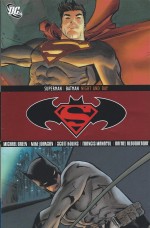
Superman/Batman: Night and Day


By Michael Green, Mike Johnson, Scott Kolins, Francis Manapul, Rafael Albuquerque & various (DC Comics)
ISBN: 978-1-4012-2808-8

For decades Superman and Batman were quintessential superhero partners: the “World’s Finest team”. The affable champions were best buddies as well as mutually respectful colleagues, and their pairing made sound financial sense since DC’s top heroes could happily cross-pollinate and cross-sell their combined readerships.

In darker post-Crisis on Infinite Earth Times, the champions were retconned into grudging colleagues, at odds with each other over their methods and attitudes: as different as night and day, but with the passage of time the relationship was revitalised and renewed and the World’s Finest Heroes were fully restored to their bizarrely apt pre-eminence, regaining respect and friendship even though they were still in most ways polar opposites.

Finally, after a few tentative miniseries forays, in 2003 the World’s Finest Superheroes bowed to the inevitable and officially reunited in a new team-up series entitled Superman/Batman: an angsty, edgy, post-modern take on a relationship almost as old as the industry itself.

Reformed as firm friends for the style-over-content 21st century, their new stories were all big blockbuster events by major creators, designed to be repackaged as graphic novels. Eventually however the momentum slowed and shallow spectacle gave way to some genuinely interesting and different stories…

This volume contains Superman/Batman #60-63 and #65-67 (from 2009 and 2010), offering just such intriguing glimpses at other, lesser seen aspects of the mythology surrounding the Cape and Cowl Crusaders.

‘Mash-Up’ (by Michael Greene & Mike Johnson with art by Francis Manapul from Superman/Batman #60-61 from July & August 2009) apparently finds the Dark Knight and Man of Steel side-slipped into yet another alternate Earth where old and familiar faces take on new and disturbing forms. However, as they join the heroes of the valiant Justice Titans in battle against Lex Joker and Doomstroke, the razor sharp intellect and obsessive suspicions of Batman slowly determine a far more logical cause for their current situation; something only one of their old foes could possibly be behind…

There’s a far darker tone to ‘Sidekicked’ (Greene, Johnson and illustrated by Raphael Albuquerque from #62) as Tim (Robin III) Drake and Linda Lang AKA Supergirl meet for lunch and reminisce about their first meeting.

Left alone after their respective mentors were called away to a JLA emergency, the kids had to respond when a riot broke out at Arkham Asylum, but although Robin was worried that the sheltered ingénue from Krypton might not be prepared for crazed killers such as Joker, Two-Face, Scarecrow, Clayface, Mad Hatter, Killer Croc, Poison Ivy and Mr. Zsasz, it was his own sanity that nearly sundered before the kids finally triumphed…

‘Night & Day’ – Greene, Johnson & Albuquerque – from Superman/Batman #63 – finds Batman the last person free on an Earth dominated by super-gorilla Grodd. With Superman trapped off-world by a planetary Green Kryptonite force screen, the Dark Knight is forced to make the ultimate sacrifice to save his world – but once again, nothing is as it seems…

This volume omits #64, but resumes with more mindgames as ‘Sweet Dreams’ (#65 by Johnson, Matt Cherniss and artists Brian Stelfreeze, Brian Haberlin, Kelly Jones, Joe Quinones & Federico Dallocchio) depicts Superman’s greatest failures and Batman’s final breakdown – or at least that’s how the Scarecrow prefers to remember it…

The macabre madness of Blackest Night features in the concluding 2-parter by Scott Kolins from Superman/Batman #65-67 (January-February 2010) , as undead muck-monster Solomon Grundy is possessed by a Black Lantern ring and goes hunting for life to extinguish.

With every hero dead or preoccupied, tragic Man-Bat Kirk Langstrom and debased Superman clone Bizarro become unlikely defenders of humanity, with only the ferocious Mr. and Mrs. Frankenstein of Super-Human Advanced Defense Executive to assist them. And ultimately at stake on the ‘Night of the Cure’ is salvation and peace for each of the ghastly travesties of life…

With a stunning gallery of covers by Manapul, Brian Buccellato, Albuquerque, Dustin Nguyen, Scott Kolins & Michael Atiyeh, this book delivers a superb series of short and sweet sharp shocks that no lover of Fights ‘n’ Tights fiction could resist.
© 2009, 2010 DC Comics. All Rights Reserved.
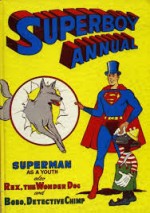
Superboy Annual 1964-1965


By various (Atlas Publishing/K.G. Murray)
No ISBN:

Before DC Comics and other American publishers began exporting directly into the UK in 1959 our exposure to their unique brand of fantasy fun came from licensed reprints. British publishers/printers like Len Miller, Alan Class and bought material  from the USA – and occasionally, Canada – to fill 68-page monochrome anthologies – many of which recycled the same stories for decades.

Less common were (strangely) coloured pamphlets produced by Australian outfit K.G. Murray and exported here in a rather sporadic manner. The company also produced sturdy and substantial Christmas Annuals which had a huge impact on my earliest years (I strongly suspect my adoration of black-&-white artwork stems from seeing supreme stylists like Curt Swan, Carmine Infantino, Gil Kane and Murphy Anderson uncluttered by flat colour).

This particular tome of was of the last licensed UK DC comics compilations before the Batman TV show turned the entire planet Camp-Crazed and Bat-Manic, and therefore offers a delightfully eclectic mix of material far more in keeping with the traditionally perceived interests of British boys than the suited-&-booted masked madness that was soon to follow in the Caped Crusader’s scalloped wake.

Of course this collection was still produced in the cheap and quirky mix of monochrome, dual-hued and weirdly full-coloured pages which made the Christmas books such a bizarrely beloved treat.

The sublime suspense and joyous adventuring begins with a rare treat as ‘The Origin of the Superman-Batman Team!’ (by Jerry Coleman & George Papp from Adventure Comics #275, August 1960) offers an alternate view of the Dark Knight.

Teenaged Bruce Wayne was sneaking out on his still-living parents to fight crime as the Flying Fox and the Boy of Steel undertook to give some pre-heroic training after seeing their future partnership in a time scanner.

The task was made simple after the Waynes moved to Smallville but soon an odd rivalry developed…

British books always preferred to alternate action with short gag strips and the Murray publications depended heavily on the amazing DC output of cartoonist Henry Boltinoff. Here a jungle jape starring explorer ‘Shorty’ and a court appearance for ‘Casey the Cop’ herald the start of the duo-colour section (blue and red) before ‘Superboy’s First Day at School’ (Otto Binder & Papp from Superboy #75, September 1959) reveals how another attempt by Lana Lang to prove Clark Kent was the Boy of Steel prompts the lads Super-Recall and reveals how, on their first day in primary school, he inadvertently displayed his powers to her several times…

A big hit during the 1950s, Rex the Wonder Dog featured a supremely capable German Shepherd – and his owners – experience a wide variety of incredible escapades. Here ‘The Valley of the Thunder King!’ by John Broome, Gil Kane & Bernard Sachs from The Adventures of Rex the Wonder Dog #14 March-April 1954, finds the dog and soldier Major Danny Dennis discover a lost tribe of Aztecs in Mexico just as a volcano erupts…

‘How Luthor Met Superboy!’ (by Jerry Siegel & Al Plastino from Adventure Comics #271, April 1960) revealed how young scientist Lex and Superboy became friends, and how the genius became deranged after a laboratory fire extinguished by the Teen Titan caused him to lose his hair. Enraged beyond limit, the boy inventor turned his talents to crime…

Boltinoff’s ET gag strip ‘On the Planet Og’ temporarily terminates the two-tone tales and leads into a black-&-white section wherein Rex’s support feature Detective Chimp takes over.

Bobo was the pet, partner and deputy of Sheriff Chase of Oscaloosa County, Florida: a chimpanzee who foiled crimes and here experienced ‘Death Walks the High Wire!’ (Broome, Irwin Hasen & Joe Giella from The Adventures of Rex the Wonder Dog #8 March-April 1953), solving the murder of a circus trapeze artist.

The amazing hound then became ‘Rex, Dinosaur Destroyer!’ (Robert Kanigher, Kane & Sy Barry, from The Adventures of Rex the Wonder Dog #11-September-October 1953) after an atomic test blast opened a subterranean rift packed with survivors from another age…

‘Little Pete’ and another ‘Casey the Cop’ by Boltinoff augur a return to red and blue tones and an epic 2-part Superboy tale as ‘The Mystery of Mighty Boy! and ‘Superboy’s Lost Friend!’ (Binder & Papp; Superboy #85, December 1960) see the Boy of Steel travel to distant planet Zumoor and a teen hero whose life closely mirrors his own. They quickly become firm friends, but Superboy soon finds good reason to abandon Mighty Boy forever…

Comedy courtesy of Boltinoff’s ‘Professor Eureka’ leads into ‘Superboy’s Nightmare Dream House’ (Superboy #70, January 1959 by Alvin Schwartz & John Sikela) which finds the Teen of Tomorrow teaching a swindler a life-changing lesson before ‘Peter Puptent’ and ‘Casey the Cop’, after which Detective Chimp uncovers ‘Monkey Business on the Briny Deep!’ (Broome, Hasen & Giella, The Adventures of Rex the Wonder Dog #10 July-August 1953) whilst Rex and Danny Dennis Jr. head out west to climb a mountain for charity and brave the perils of ‘The Eagle Hunter!’ (Kanigher, Kane & Barry from The Adventures of Rex the Wonder Dog #14 March-April 1954).

This thrilling collection returns to full-colour for one last Boltinoff ‘Doctor Rocket’ funny before ‘The Super Star of Hollywood’ (Siegel & Papp Adventure Comics #272, May 1960) reveals how super-dog Krypto becomes spoiled and big-headed after starring in a Hollywood movie – until Superboy applies a little clandestine reality check…
© National Periodical Publications, Inc. Published by arrangement with the K.G. Murray Publishing Company, Pty. Ltd., Sydney.

These Christmas Chronicles are lavish and laudatory celebrations of good times and great storytelling but at least they’re not lost or forgotten, and should you care to try them out the internet and a credit card are all you’ll need.

Merry Christmas, a fruitful New Year and Happy Reading from Everybody at Now Read This!

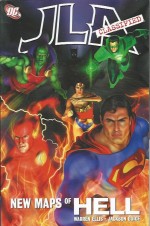
JLA Classified: New Maps of Hell

New, revised review

By Warren Ellis & Jackson Guice (DC Comics)
ISBN: 978-1-4012-0944-5

It’s been quite a while since we covered a good old-fashioned straightforward and no-strings-attached superhero blockbuster: one which any old punter can pick up with no worry over continuity or identification and where good guys and bad guys are clearly defined.

That’s due in large part to the fact that nobody makes many of those anymore, but at least it gives me the opportunity to take another look a tale I didn’t much like when it first came out in 2006, but which has definitely grown on me after a recent re-read.

Produced at a time when the Justice League of America was enjoying immense popularity and benefiting from a major reboot courtesy of Grant Morrison, the end-of-the-world epic – starring Superman, Batman, Wonder Woman, Flash, Green Lantern, Oracle and Martian Manhunter – originally ran in issues #10-15 of ancillary spin-off title JLA Classified (September 2005-February 2006) with gritty futurist super-scribe Warren Ellis upping the angst-quotient on a hoary old plot whilst hyper-realist illustrator Jackson Guice adds a terrifying veracity to events.

The drama begins as Clark Kent and wife Lois Lane stumble onto a dirty little secret. Assorted, and presumably unconnected, scientists and bean-counters at President Luthor‘s Lexcorp conglomerate have committed suicide in large numbers and the intrepid reporters suspect something very nasty is going on…

In Gotham City Batman learns the police have been turned away from an extremely unconventional crime-scene by Feds and a private security company, and he too begins to dig…

In the Bermuda triangle, a group of researchers are invited to the Amazon’s ancient library of knowledge only to die when the sky-floating island explodes in a horrendous detonation.

Wally West has terrible dreams of his beloved predecessor Barry Allen which lead him to a similar catastrophic conflagration, whilst Green Lantern Kyle Rayner ruminates on a primordial legend of the Corps’ origins until a wave of explosions rouses him to action.

In the ruins of each disaster the scattered, hard-pressed heroes find an ancient parchment of alien hieroglyphs and, when Superman recovers another page of the same from the shredded remnants of a plummeting space station, the call goes out to activate the League…

Tasking cyber-savant Oracle and aged Martian sole survivor J’onn J’onzz with digging up information, the team learn of an antediluvian scourge which wracked the red planet million’s of years past. A God/Devil which tested species’ right to survive and heralded its coming through a written code…

Luthor’s scientist’s had found such writings in remnants of ancient Sumeria and begun deciphering the text…

Mobilising to stop the summoning, the heroes confront Luthor in the White House but are too late. In Las Vegas the bowels of Hell vomit horrors into the streets and as the frantic team rushes to battle they are snatched up separated by the malign entity which has spent eons traversing the universe testing the worth of intelligent races and individually putting them to their sorest tests.

However the monstrous terror has never faced beings like the JLA before, or a mind like Batman’s, and soon its own darkest secret is exposed and its fatal weakness exploited to devastating effect…

With a painted cover gallery by Michael Stribling, this book offers simple, solid Fights ‘n’ Tights fun gilded with a sly and cynical post-modern edge: a sound example of contemporary action blockbuster comics at their best.
© 2005, 2006 DC Comics. All Rights Reserved.

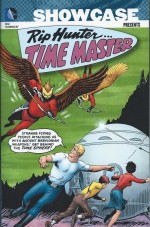
Showcase Presents Rip Hunter… Time Master


By Jack Miller, Bill Ely, Ruben Moreira, Mike Sekowsky & Joe Giella, Joe Kubert, Ross Andru & Mike Esposito, Nick Cardy, Alex Toth, various (DC Comics)
ISBN: 978-1-4012-3521-5

The concept of curious chrononauts is as old as the science fiction genre itself, and every aspect of literature has displayed fascination with leaving the Now for the Then and Thence. As the 1950s closed and the superhero genre slowly re-established itself in comicbooks, National/DC – who had for half a decade been a prime purveyor of bold, he-man fantasy action – successfully scored one last plainclothes hit with the infinite potential of temporal exploration.

With costumed cavorters reappearing everywhere the company combined time-travel vistas with their tried-and-true Adventuresome Quartet format (most effectively utilised for Jack Kirby’s groundbreaking Challengers of the Unknown) and, on a creative high and riding a building wave, introduced a dauntless team of comfortingly ordinary folks as Rip Hunter… Time Master debuted in Showcase #20, cover-dated May/June 1959.

Studious yet manly inventor Hunter had just finished building flying globes which could crack the time barrier and, like any sensible man, wanted his best friend Jeff Smith and girlfriend Bonnie Baxter to share in his fun-filled jaunts. Bonnie’s little brother Corky also came along for most rides…

Series creator Jack Miller was a serious history buff who filled the stories with the very latest in historical facts and theories, but that never got in the way of strong, rousing storytelling from the outset, and the series’ one potential flaw – the lack of a consistent art-team – became a huge bonus in the early days as a procession of top-flight illustrators took turns rendering the strangest and most evocative moments in comics history… to date…

It all began with ‘Prisoners of 100 Million BC’ (Miller & Ruben Moreira): a novel-length introductory exploit which saw the daredevil physicist, engineer Jeff, adoring Bonnie and little Corky travel back to the Mesozoic era, utterly unaware that they were carrying two criminal stowaways.

Once there the thugs hi-jacked the Time Sphere and held it hostage until the explorers helped them stock up with rare and precious minerals. Reduced to the status of mere castaways, Rip and Co. became ‘The Modern-Day Cavemen’ until an erupting volcano caused ‘The Great Beast Stampede’ enabling the time travellers to finally turn the tables on their abductors…

Miller was always careful to use the best research available but never afraid to blend historical fact with bold fantasy for Hunter’s escapades, and the epic follow-up ‘The Secret of the Lost Continent’ (Showcase #21, July/August, 1959 and illustrated by Mike Sekowsky & Joe Giella) saw the Time Masters jump progressively further back in time in search of fabled Atlantis.

A dramatic meeting with Alexander the Great in 331BC led the temporal voyagers on a trail of clues back centuries to ‘The Forbidden Island’ of Aeaea in 700BC to uncover the truth about legendary witch Circe before finally reaching 14,000BC and ‘The Doomed Continent’. Only on arrival did they see that the legendary pinnacle of early human achievement was actually a colony of stranded extraterrestrial refugees…

Rip Hunter appeared twice more in Showcase before winning his own comic, and those succeeding months would see the Silver Age of superheroes kick into frantic High Gear with classic launches coming thick and fast.

Even so, the Time Masters continued slowly building their own faithful audience, happy to explore the traditionally fantastic. Nearly a year later after the initial run they returned in Showcase #25 (March/April 1960 and spectacularly illustrated by Joe Kubert) as ‘Captives of the Medieval Sorcerer’ after Rip’s old college professor requested passage for a scholarly colleague to the kingdom of Ritannia a thousand years past.

Unfortunately the studious Dr. Senn was a charlatan in search of mystic power and his machinations almost led the time team to doom in ‘The Valley of the Monsters’ before Rip discovered the hoax and ended ‘The Sorcerer’s Siege’…

Kubert stuck around to reveal ‘The Aliens from 2000B.C.’ (Showcase #26, May/June 1960) as Rip and the gang travelled to ancient Egypt to verify recently unearthed pottery shards only to clash with extraterrestrial criminals planning on playing gods with the natives. After a daring ‘Escape from the Doomed Village’ the lads linked up with space cops to crush the baddies and their incredible pet monsters in time to win ‘The War of the Gods’…

Ironically, time moved rather slowly for new titles in those days and Rip Hunter… Time Master finally launched another year later sporting a March/April 1961 cover-date. With Ross Andru & Mike Esposito in the drawing seats Miller hit the ground running and ‘The Thousand-year-Old Curse’ captivatingly traced an ancestral doom afflicting the Craig family which brought Rip firstly to New England in pioneer times before further backtracking to Switzerland in 1360A.D. to uncover ‘The Secret of the Volcano Creature’. One final jaunt to feudal Europe revealed the truth after a climactic clash with ‘The Wizard of the 10th Century’…

Two months later #2 began with a sightseeing trip to Greece spoiled when a giant monster escaped from a hidden cave. Ever-curious, Rip followed the evidence and took the team back to meet ‘The Alien Beasts of 500B.C.’ becoming embroiled in an undocumented civil war.

Deposed dictator Demades had gained control of cosmic animals originally captured by stranded alien Big-Game hunter Nytok and intended using them to reassert his rule over Greece until the Time Masters intervened and caused ‘The Battle of the Alien Beasts’. That debacle almost led to ‘Rip Hunter’s Last Stand’ but of course the ingenious future-man had a trick or two up his sleeve…

In #3 an old coin with Corky’s face on it took the chrononauts to Scandinavia in 800A.D. and right into a royal power struggle for ‘The Throne of Doom’. As Corky was a perfect doppelganger for incumbent young King Rollo, all manner of deadly confusions occurred, especially once the boy was targeted by wicked usurper ‘Svend‘The Duke with Creature Powers’. Luckily modern know-how exposed the truth about the beasts under the villain’s control before ‘The Battle of the Warriors’ eventually saw Right and Justice restored…

Nick Cardy took over the art duties with #4 as a time-lost avian Vornian arrived in the modern world and the Timesters offered to return him to his home amongst ‘The Bird-Men of 2000B.C.’ Of course the adventurers became involved in a war between legendary King Hammurabi and Vornian rebels where ‘The Ancient Air Raid’ of the insurgents inevitably led to a clash with ‘The Avenging God of Gilgamesh’… or did it?

In #5 ‘The Secret of the Saxon Traitor’ saw the team trying to rewrite established history and clear the name of a long-reviled traitor, but the books never mentioned invading spacemen or ‘The Creatures of Doom Valley’ and the spectacular finale of ‘The Ancients vs. The Aliens’ proved that sometimes history gets it right all along…

The sensational Alex Toth then came aboard for two issues beginning with ‘The Secret of the Ancient Seer’ in #5, as a convocation of contemporary scientists asked Rip to investigate an 8th century Baghdad prophet who predicted Columbus’ discovery of America and, more worryingly, imminent doom from a fireball that would strike Earth in one week’s time. On arriving in Asia, the team discovered the prophecy actually originated in ‘The Doomed City’ of Herculaneum just before the eruption of Vesuvius…

With no solution in the past Rip returned to the present and devised his own astounding solution to ‘The Menace of the Meteorite’…

This astonishing yarn was followed in RHTM #7 by ‘The Lost Wanderers in Time’, as the futurist foursome embarked on a desperate chase through unrecorded history in search of a cure for a disease devastating South American Indians: a spasmodic voyage which eventually took them back a million years to clash with ‘The Last Dinosaur’ before a remedy for ‘The Green Death’ was found in the least likely place…

With #8 veteran illustrator Bill Ely came aboard as regular artist, limning almost every story until the series ended. His first venture was ‘The Thieves Who Stole a Genie’, which found the explorers following gangsters who had stolen their spare Time Sphere to secure Aladdin‘s magic lamp. The trail led to 14th century Baghdad where ‘The Battle of the Genies’ was only interrupted by an invasion. Of course canny Rip had the perfect answer for ‘The Attack of the Ommayads’…

When an archaeologist dug up a rocket-ship he asked the team to travel back and track down ‘The Alien King of 1,000 B.C.’: a breathtaking romp which subsequently found Corky and Rip almost expiring after ‘The Adventure on Planet Zark’, whilst Bonnie and Jeff remained Earthbound and down until a ‘One-Man Alien Army’ saved them and the ancient world from conquest and death.

In issue #10 ‘The Execution of Rip Hunter’ began after a research trip to the 3rd century A.D. led to Bonnie’s abduction. Whilst Roman soldiers tackled the boys, a hypnotic spell transformed her into ‘Bonnie – Queen of Palmyra’ and controller of an impossibly powerful beast her abductors needed to fend off Roman invasion in ‘All Hail the Conquering Creature’…

A classic science fiction gem surfaced in #11 where ‘The Secret of Mount Olympus’ was exposed after the team visited 2nd century B.C. Greece. After meeting a witch Jeff was changed into a griffin and supreme god Zeus demanded Rip perform a small task to save him, resulting in a ‘Dead End on Calypso Island’ before the true nature of the pantheon was revealed and ‘The Invasion of Mount Olympus’ resulted in the team’s escape and the gods’ departure.

Long-time Legion of Super-Heroes fans might recognise this tale as the basis for a major plot stream concerning the Durlan member Chameleon Boy…

For #12 a threat to modern Earth was revealed after a burning meteor erupted from beneath Stonehenge. ‘The 2,200-Year-Old Doom’ first led the heroes back to the building of the monument before at long last travelling into their own future to learn how the fallen star would destroy mankind.

Then, after popping back to when the meteor first hit and seeing the destruction of ‘The Impossible Beasts of One Million B.C.’ Rip finally devised ‘Earth’s Last Chance’ to save Today and all our Tomorrows…

In #13 ‘The Menace of the Mongol Magician’ found Rip working with a renowned scientist on a magic Chinese tapestry, but their trip to the time of Kublai Khan was only a devious scam to warp history. Once there the villainous “Professor” planned to supply the Khan’s enemies with modern weapons in return for magical secrets. However, after making off with ‘The Hijacked Time Sphere’ he was promptly betrayed by his ally. Luckily, Rip and Jeff had their own answer to ‘The Mongol Ambush’ and everything turned out as it should…

‘The Captive Time-Travellers’ in #14 resulted from Rip and a group of scientists examining an invulnerable artefact purported to have been devised by Leonardo Da Vinci. A subsequent conversation with the great man himself revealed that the container held the world’s most destructive explosive…

When one of the 20th century technicians stole the bomb and a Time Sphere ‘The Future Fugitive’ headed for 2550A.D. to sell the weapon to a dictator, so Rip and Co. followed only to become ‘The Prisoners of Time’. And that’s when the bomb’s actual builders turned up…

The cleverly captivating fantasy frolics conclude for now with issue #15 and ‘The Earthlings of 5,000,000 B.C.’ wherein a rampaging alien monster in modern-day America proved to be an Earthling of astonishingly ancient vintage.

When Rip and the gang travelled back to search out the answer to the mystery they found an entire unsuspected civilisation and became ‘The Experimental Creatures’ of that society’s scientists. They only barely escaped the cosmic calamity of ‘The Day the Earth Died’ but returned safely with the knowledge of what happened to the last tragic survivor’s species…

These stories from a uniquely variegated moment in funnybook history were the last vestiges of a different kind of comic tale and never really affected the greater push towards a cohesive, integrated DC Universe. They are, though, splendidly accessible and thoroughly enjoyable adventure tales which should be cherished by every frenzied fan and casual reader.
© 1959, 1960, 1961, 1962, 1963, 2012 DC Comics. All Rights Reserved.

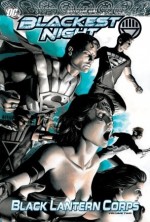
Blackest Night: Black Lantern Corps volume 2


By Geoff Johns, James Robinson, Tony Bedard, Greg Rucka, Scott Kolins, Eddy Barrows, Nicola Scott, Eduardo Pansica & various (DC Comics)
ISBN: 978-4012-2803-3

Hold onto your heads, hearts and scorecards: the mind-buggering confusion is almost over…

Reprinting supplemental 3-part miniseries Blackest Night: The Flash, Blackest Night: J.S.A. and Blackest Night: Wonder Woman from 2010, this concluding collection of sidebar stories chronicles how the horrific doom and gloom of the Blackest Night began to wane and depicts key moments when the darkness began to lift…

The inexorable progress of the reanimated angels of death – slaughtering the living and feeding on the raw emotions of the defiant and defeated alike – seemed to stall here as hard-pressed humanity began to turn the tables and start a furious hope-fuelled fight back against Death God Nekron‘s all-conquering Black Lantern Corps…

Blackest Night: Flash by Geoff Johns & Scott Kolins opens with a terse and gritty examination of villainy unleashed as Barry Allen – who gave his life to preserve the multiverse in Crisis on Infinite Earths – flashes across the world, returned in all his scarlet glory to save universal sentience itself.

Amidst all the revolting resurrections, one in particular is troubling: 25th century maniac Eobard Thawne – who haunted and hunted Allen throughout his career, murdering the hero’s wife and mother in an obscene life-long obsession to become his enemy, is also back – not as a resurrected Black Lantern zombie revenant but as a living, breathing Reverse Flash Professor Zoom. Time travel is so confusing…

Forearmed with crucial knowledge, Barry races around the globe seeking allies, including his protégé Wally West and (briefly deceased, but better now and breathing) grandson Bart. Meanwhile a BL Rogues Gallery including The Top, Golden Glider, the first Mirror Master and Captain Boomerang, Rainbow Raider, Trickster James Jesse, and – impossibly – the reanimated corpse of Professor Zoom (time travel, see?) all stalk the speedy sentinels and their own still-breathing former comrades…

Barry knows now that Black Lantern zombies are in actuality Nekron’s perfidious power rings, downloaded with the memories of the angry dead and physically manifesting as psychologically devastating simulacra, programmed to feed on emotion and tear the hearts from the living – literally and figuratively.

However when the animated corpse of Zoom begins chasing him, garbed as the fearsome mythological Black Flash (as seen in Flash: The Human Race), the Scarlet Speedster divines a way to combat the voracious wraiths even as he hurtles towards Africa in search of his old friend Solovar of Gorilla City.

Sadly the all-wise super-ape is also dead and a ravening agent of the BL Corps…

Back in Central City living Rogues Captain Cold, Heat Wave, Weather Wizard, second Mirror Master Evan McCulloch, parvenu Trickster Axel Walker and the son of Captain Boomerang decide to pre-emptively strike at their fallen former friends.

Tracking the phantasmal freaks to maximum security metahuman penitentiary Iron Heights, the cadre of criminals are unaware that their undead comrades already know they’re coming…

Barry, unable to help Solovar, has since fled and, whilst planning his next move, has been approached by Blue Lantern St. Walker. The wielder of the Light of Hope has targeted Flash as the embodiment of that fragile, unconquerable sentiment (even after the dark side again claims young Bart) and makes the indomitable Allen a blue ring-bearer: beacon and messenger to humanity with the oath “All Will Be Well”…

As the mortal Rogues win their own battle against the dark, Barry and St. Walker, armed with the azure power of Blue Lanterns, defeat a host of Black foes and, with the aid of Wally, manage to expel the Nekron infection from Bart, bringing him back to full life and finally incapacitating Black Flash Zoom.

Freed from death’s influence Bart, as Kid Flash, informs his elders that a final confrontation is brewing in Coast City even as Captain Cold and Co. end their dealings with the Black Lanterns by dealing poetic justice to a traitor in their midst…

The carnage and crusading continues in Blackest Night: J.S.A with the opening sally ‘Lost Souls’, by James Robinson, Eddie Barrows, Marcos Marz, Julio Ferreira, Luciana Del Negro & Ruy José, wherein the multigenerational Justice Society of America is targeted by unquiet Black Lantern-ed liches of fallen members Sandman, Dr. Mid-Nite and Mr. Terrific, tasked with not only destroying the living members of the fabled team but also leading an army of revenants against the most brilliant man on Earth as he tirelessly toils on a device to banish Nekron’s influence…

As veteran Flash Jay Garrick and modern legacy heroes Cyclone, Tomcat, Magog, Liberty Belle II and the new Hourman strive against the hordes of the fallen, stunned by the recent loss of their tragic comrade Damage, at S.T.A.R. labs the current Dr. Midnight and Mister Terrific race to build their machine to stop the dead. Green Lantern Alan Scott, Wildcat and Power Girl are posting an uneasy guard over them…

Everywhere young and old champions desperately hold back the onslaught of the final darkness, but as the device nears completion a convergence of Black Lanterns outside and within the citadel threatens the living’s last hope…

‘Troubled Souls’ (Robinson, Tony Bedard, Barrows, Marz, Eduardo Pansica, Julio & Eber Ferreira & Del Negro) sees Liberty Belle race her deadly departed dad Johnny Quick in a most unconventional and unexpected duel of wills even as BL-ed Lois Lane of Earth-2 menaces the scientist heroes in S.T.A.R. labs as she seeks to reactivate her twice-dead husband (the BL Superman of Earth-2 was destroyed by Superboy and “our” Man of Steel in Blackest Night: Superman in Black Lantern Corps volume 1).

In the street Damage menaces his “cousin” Atom Smasher and former love Judomaster before fighting off his Black Lantern programming long enough to destroy all the horrors besieging the lab, but his death-defying gesture is proved pointless as, within the shaken structure, Lois’ ring reanimates the mangled remains of the unstoppable Kal-L of Krypton…

‘White Lightning’ (Bedard, Robinson, Barrows, Marz, Pansica, Del Negro, Wayne Faucher, Eber Ferreira & Sandro Ribeiro) then sees Power Girl battling her zombie father figure to a standstill, aided by a phalanx of JSA all-stars, until the saviour machine can be activated to sever Nekron’s connection to all his agents in the city. As the Black Lanterns return to dust the stage is set for the final fight against the Lord of Death…

Blackest Night: Wonder Woman (by Greg Rucka, Nicola Scott, Prentis Rollins, Jonathan Glapion, Walden Wong, Drew Geraci & Eber Ferreira) is perhaps the most confusing tale for casual readers to follow, as much of the critical action occurs contemporaneously in other books such as core tome Blackest Night).

Nevertheless, as we’ve come this far…

It begins in WashingtonDC as the Amazing Amazon tracks the reconstituted mind-manipulator Maxwell Lord, whom she executed during the Infinite Crisis to prevent him making Superman his slave.

Undead Lord is running amok, causing people to kill themselves, and even beheading him doesn’t stop his malevolent depredations. When he causes all the nation’s honoured dead (including DC war hero Unknown Soldier) to rise from their graves and attack, Wonder Woman is forced to destroy them all with her magic lasso. Furious, she swears vengeance on the beast who has twice compelled her to commit shameful acts of barbarism…

The second chapter opens with her actually dead and operating as a Black Lantern beside her equally compromised “sister” Donna Troy (see why you need to read the other volumes?) fighting Aquaman‘s widow Mera and a contingent of Teen Titans, all the while struggling to throw off the malign influence of the Black Ring that controls her…

After ripping out the heart of her protégé, Wonder Girl Cassie Sandsmark, dead Diana turns on Troy and her own mother Queen Hippolyta. Suddenly substitute Batman Dick Grayson distracts her long enough for the goddess Aphrodite to intervene and open a path for a Violet power ring to capture the agonised Amazon princess…

Brought back to life and now a love-fuelled Star Sapphire/Wonder Woman, she rendezvous with Star Sapphire Carol Ferris to end the menace of Max Lord, only to be ambushed by Mera, now a raging Red Lantern. Battling each other and an army of Black Lanterns, the furiously warring women are only stopped by Green Lantern Hal Jordan who has gathered a taskforce of ring-bearers from every hue of the emotional spectrum, determined to lead them all into final battle against Nekron…

Which will or indeed has already happened in the aforementioned core collection Blackest Night…

With covers and variants by Kolins, Gene Ha, Greg Horn, Francis Manapul, Ryan Sook & Barrows, this book also includes a selection of info pages digging the dirt on sixteen Black Lantern heroes and villains from this collection courtesy of designers Joe Prado & Scott Kolins.

Epic, ambitious, enthralling and grandiose, whilst the subtler shades and in-continuity treats of this epic adventure will be utterly impenetrable to all but the most devoted DC disciple, there’s so much that is great about Blackest Night that I’d strongly urge every fan of cosmic comics and frantic Fights ‘n’ Tights fiction to give it a try (but you really, really need to read all seven collections). Think of it as a keep-fit class for your comicbook sinews…
© 2010 DC Comics. All Rights Reserved.