Plastic Man Archives volume 2


By Jack Cole (DC Comics)
ISBN: 1-56389-621-4

Jack Cole was one of the most uniquely gifted talents of American Comics’ Golden Age, crafting landmark tales in horror, true crime, war, adventure and especially superhero genres. His incredible humour-hero Plastic Man remains an unsurpassed benchmark of screwball costumed hi-jinks: frequently copied but never equalled. In 1954 Cole quit comics for gag and glamour cartooning, becoming a household name when his brilliant watercolour gags and stunningly saucy pictures began running in Playboy with the fifth issue. Cole eventually moved into the lofty realms of newspaper strips and, in May 1958, achieved his life-long ambition by launching a syndicated newspaper strip, the domestic comedy Betsy and Me.

OnAugust 13th 1958, at the moment of his greatest success he took his own life. The reasons remain unknown.

Without doubt – and despite his other comicbook innovations and triumphs such as Silver Streak, Daredevil, The Claw, Death Patrol, Midnight, Quicksilver, The Barker and The Comet as well as through a uniquely twisted take on the crime and horror genres – Cole’s greatest creation was the zany, malleable Plastic Man who quickly grew from a minor back-up character into one of the most memorable and popular heroes of the Golden Age. “Plas” was the wondrously perfect fantastic embodiment of the sheer energy, verve and creativity of an era when anything went and comics-makers were prepared to try out every outlandish idea…

This second superbly lavish full-colour deluxe hardback reprints Plastic Man #1 and the cover-featured lead tales from Police Comics #21-30, covering August 1943 to May 1944 and sees, after a convivial commentary in the Foreword by author, strip writer and historian Ron Goulart, the Stretchable Sleuth’s meteoric rise, fully converting from hilariously edgy benevolent rogue to malleable super straight man as his comedy relief sidekick increasingly stole the show in a series of explosive exploits which shaped the early industry every inch as much as Superman, Batman, Wonder Woman or the “Shazam” shouting Captain Marvel…

Eel O’Brian was a career criminal wounded during a factory robbery, soaked by a vat of spilled acid and callously abandoned by his thieving buddies. Crawling away to die, O’Brian was found by a monk who nursed him back to health and proved to the hardened thug that the world was not just filled with brutes and vicious chisellers after a fast buck.

His entire outlook altered and, gifted with incredible malleability (he surmises it was the chemical bath mingling with his bullet wounds), Eel resolved to put his new powers to use in cleaning up the scum he used to run with.

Creating a costumed alter ego he began a stormy association with theNew York Citycops before being recruited as a most special agent of the FBI…

Shortages and government rationing were gripping the country at this time. For publishers it was lack of paper that particularly plagued and Plastic Man #1 was released (a Summer 1943 cover-date) through a subsidiary company Vital Books, rather than as a straight addition to Quality Comics’ prestigious line of stars.

Irrespective of the name on the masthead, the mammoth 64 page tome offered a quartet of stunning tales of humour, heroic hi-jinks and horror, beginning with cover-featured ‘The Game of Death’ in which Plas and his inimitable, often unwanted assistant set upon the trail of an engrossing mystery and incredible threat posed by a rich man’s gambling club which concealed a sadistic death cult using games of chance to recruit victims …and new disciples…

Said assistant Woozy Winks was an indolent slob, paltry pickpocket, utterly venal yet slavishly loyal oaf who accidentally saved a wizard’s life and was gifted in return with a gift of invulnerability: all the forces of nature would henceforth protect him from injury or death – if said forces felt like it.

After failing to halt the thief’s impossible crime spree, Plas appealed to his sentimentality and better nature and, once Woozy tearfully repented, was compelled to keep him around in case he strayed again…

Winks – equal parts Artful Dodger and Mr. Micawber, with the verbal skills and intellect of Lou Costello’s screen persona or the over-filled potato sack he resembled – was the perfect foil for Plastic Man: a lazy, greedy, ethically challenged reprobate with perennially sticky fingers who got all the best lines, possessed an inexplicable charm and had a habit of finding trouble. It was the perfect marriage of inconvenience…

In ‘Now You See it, Now You Don’t’ the rotund rogue got involved with a goofy Professor and became the greedy owner of an invisibility spray. He wanted to sell it to the Army but Japanese spies captured both the formula and Plastic Man, and dispatched them toTokyo for disposal.

Of course this simply allowed the Man of a Thousand Shapes to deliver such a sound and vicariously joyful thrashing to the Dishonourable Sons of Nippon that it must have had every American kid who saw it jumping for joy.

Cole then touched the heartstrings with the tragic tale of ‘Willie McGoon, Dope’ as a hulking yet gentle simpleton disfigured by neighbourhood kids became the embittered pawn of a career criminal. The duo’s terrifying crime-wave paralysed the city until Plas and Woozy stepped in.

The stunning solo package closed with ‘Go West Young Plastic Man, Go West’ after Woozy bought a gold mine from a guy in a bar and greedily galloped to Tecos Gulch to make his fortune. By the time Plas arrived to save him from his folly the corpulent clown had been framed for rustling and murder…

Police Comics #21 featured conspiracy by a financial cabal attempting to corner the travel and shipping routes of the nation. Only one man could counter the impending monopoly but he was missing, seduced by the prognostications of a circus fortune teller. If Plas couldn’t rescue Sylvester Smirk from ‘The Menace of Serpina’ the entire country would grind to a standstill…

In #22, ‘The Eyes Have It!’ pitted Plas and Woozy against a child-trafficking human horror dubbed The Sphinx who was exercising all his resources to regain possession of a little mute boy who had seen too much, whilst #23’s purportedly supernatural thriller saw the Stretchable Sleuth prove ‘The Ghost Train’ to be no such thing, but only a scam by a shareholder trying to buy up a rail line the Government needed to acquire for vital war work.

A rash of tire thefts (also severely rationed during war time) in Police #24 had a sinister purpose as gangsters and a mad scientist joined forces to synthesise evil knock-offs of their greatest enemy in ‘The Hundred Plastic Men’ after which Woozy again stole the show – and sundry other items – when his addiction to mystery stories led him and Plastic Man on a deadly chase to discover the culprit and cause of ‘The Rare Edition Murders’ in #25.

Over and above his artistic virtuosity, Jack Cole was an astonishing adept writer. His regular 15-page adventures were always packed with clever, innovative notions, sophisticated character shtick and far more complex plots than any of his competitors. In #26’s ‘Body, Mind and Soul’ he starts with Plas’ FBI boss discovering his shady past, and builds on it as the exposed O’Brian agrees to a take on three impossible cases to prove he really has reformed. From there it’s all rollercoaster action as the Pliable Paladin rounds up brutish Slugger Crott, ferrets out the true identity of the city’s smartest mob boss and ends the depredations of a tragically cursed werewolf…

The rotund rascal again took centre stage – and even the cover – in #27 as ‘Woozy Winks, Juror’ hilariously endangered the very nature and sacred process of jurisprudence after being excluded from jury duty. After all, he only had a small criminal record and the impish imbecile was determined to serve so when a sharp operator gave him a few tips Woozy was so grateful that he…

The star-struck schmuck dominated again in #28 as Hollywoodcalled and the Flexible Fed agreed to star in a film. However with Mr. Winks as his manager it was inevitable that ‘Plastic Man – the Movie’ would start with intrigue, sex and murder but as usual end as a furious fun-filled fiasco.

The trail of America’s biggest tax-evader drew Plastic Man to ‘Death in Derlin’s Castle’ as the FBI’s Odd Couple followed the absence of money to an historic pile and a nefarious scheme with moody movie echoes of Citizen Kane and The Cat and the Canary, before this sublime Archive selection ceases with the outrageously odd and supremely surreal ‘Blinky Winks and Gooie Louie’ from Police Comics #30.

Plas and Woozy are drawn into incredible peril when ruthless butter-leggers begin supplying illicit spreads to the city’s dairy-deprived (rationing again) denizens. Even dedicated crime-busters like Woozy found it hard to resist the lure of the lard and when the creamy trail unfortunately led to Woozy’s uncle Blinky justice had to be done. Of course there was always lots of hard-to-find food to be found on a farm but that was just a happy coincidence…

Always exciting, breathtakingly original, thrilling, funny, scary and still visually intoxicating seventy years later, Jack Cole’s Plastic Man is a truly unique creation that has only grown in stature and appeal. This is a magical, unique comics experience fans would be crazy to deny themselves.
© 1943, 1944, 2000 DC Comics. All Rights Reserved.

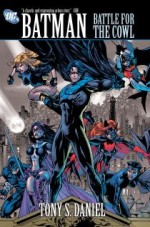
Batman: Battle for the Cowl


By Tony S. Daniel, Sandu Florea, Fabian Nicieza & various (DC Comics)
ISBN: 978-0-4012-2417-2

I’m innately suspicious of and generally hostile to big, bombastic braided crossover events in comics.

Does any other popular art form use them yet, or are they too often simply an excuse to shear cash from hard-up fans?

(Coming Soon to Your Screen: CSIs Las Vegas, Miami, New York and Croydon must race both NCISs, all the various Law & Orders, The Bill and Inspector Montalbano to battle an international conspiracy and discover who ate all the pies on Man vs. Food, with sidebar stories on Holby City, Grey’s Anatomy and Body of Proof, whilst Cold Case investigates the connection to an unsolved Miss Marple poisoning before Dr. Who wraps it up in a time-spanning Christmas Special…)

Undoubtedly in terms of mainstream superhero stories, with some key characters spread out over many titles, epochal continuity events can and should be reflected in all the various comicbooks, but the whipping up of buyer’s frenzy until readers don’t dare miss any mention or moment of an event has always struck me as cruel and unusual punishment directed towards the people who love you most – and that’s just abuse, plain and simple…

That’s not to say that some pretty impressive yarns haven’t resulted from the practice and undoubtedly the modern wrinkle of producing discrete “Nested Storylines” within the broader framework has eased the previously daunting burden somewhat – although that might be more a necessary function of the increasingly important trade paperback/graphic novel market: after all who could even lift a book containing every episode and instalment of Civil War or Crisis on Infinite Earths?

Even so, I prefer not to get caught up in the hype and furore if at all possible, and even re-reread such blockbusters before passing my own awesome, implacable Final Judgement…

Thus with all the fervour and kerfuffle surrounding the epic death and inevitable resurrection of Batman finally finished and forgotten, now seems the moment to take another look at one the critical elements of the positively vast Batman R.I.P./Final Crisis/Last Rites/Batman Reborn/Return of Bruce Wayne affair to see how it stands bereft of hysteria…

Following a harrowing and sustained campaign of terror by insidious cabal The Black Hand, the mighty Batman was apparently killed by diabolical New God Darkseid during the “Final Crisis”. Although the news was kept from the general public, the superhero community secretly mourned and a dedicated army of assistants, protégés and allies assembled through the years by the Dark Knight formed a “Network” of champions to police Gotham City in the tumultuous days and weeks that followed…

This slim volume collects the contents of core miniseries Batman: Battle for the Cowl #1-3 plus themed anthology specials Gotham Gazette: Batman Dead? #1 and Gotham Gazette: Batman Alive? #1 (March-July 2009) recounting how with the city descended into chaos as the hard-pressed Network strive against a three-way power struggle whilst hoping to keep their patriarch’s legacy alive…

Most of the Batman-trained Network refuse to believe their inspirational mentor is dead and thus, believing him only lost, have urged Dick Grayson – first Robin , now Nightwing – to assume his teacher’s identity again (as he did post-KnightFall during the Batman: Prodigal storyline) until Bruce Wayne can find his way back to them. This, the bereaved junior hero has steadfastly refused to do…

Written and pencilled by Tony S. Daniel with inks from Sandu Florea, the epic opens during ‘A Hostile Takeover’ with third Robin Tim Drake and his British analogue The Squire valiantly battling a gang of killer clowns only to find their job finished for them by an unseen vigilante who deals out justice with extreme violence and leaves little love-notes declaring “I AM BATMAN”…

As an army of heroes – including The Knight, Wildcat, Birds of Prey, Outsiders and even a new Batwoman work with the police to maintain order, but as the Dark Knight hasn’t been seen for weeks Gotham’s criminal classes are beginning to suspect that something has happened to their greatest nemesis…

Already moving to consolidate power are The Penguin and Two-Face: each attempting to create an insurmountable powerbase and win complete control of the underworld by the time the Batman shows his face again, but unknown to each a third player has begun his own campaign.

Black Mask is a sadistic psychotic – but a methodical and strategically brilliant one. His first move is to free a busload of Batman’s most maniacal menaces being shipped back to Arkham Asylum and let them loose to add to the chaos and carnage…

Meanwhile Tim continually presses Nightwing to assume the mantle of the Bat, arguing that even a fake Caped Crusader will have a terrifying calming effect onGotham’s rampant rogues and robbers.

Moreover, it must be one of them, rather than allowing the increasingly out-of-control mystery impostor to steal the role and tarnish the legend…

Grayson again refuses before heading back to damage control leaving Tim to track the fake as he brutally demolishes and even murders malefactors throughout the city. With a chilling inkling as to the fraud’s identity, Drake himself puts on the cowl and costume to hunt the killer to his hidden lair beneath Gotham’s sewers, even as Bruce Wayne’s assassin-trained son Damian – continuing as the headstrong and potentially lethal latest iteration of Robin, the Boy Wonder – is attacked by liberated lunatics Poison Ivy and Killer Croc and a horde of lesser criminals.

Even after Nightwing swings in to assist, the odds seem hopeless …until the Fake Knight bursts in, all guns blazing…

‘Army of One’ finds Nightwing battling the killer charlatan to a standstill amidst the bodies of his dead and dying attackers and reaching the same conclusion Tim had. The blood-hungry facsimile is Jason Todd …

Another orphan taken in by Batman, Todd served valiantly as the second Boy Wonder but his psychological problems remained hidden and unresolved and the boy was murdered by the Joker. Subsequently resurrected by one of the frequent Cosmic Upheavals (Infinite Crisis if you’re interested, but it all happened off-camera and post hoc…) that plague the DC Universe, the boy took on the identity of the Red Hood and began cleaning up Gotham his way; using his Bat-training and the merciless tactics of the villains he remorselessly stalked. Now with the role of Dark Knight vacant he intends to become theBatmanGothamCity always deserved…

Unable to defeat each other, the impasse between Nightwing and the killer Caped Crusader is broken when Birds of Prey Huntress and Black Canary arrive. Todd simply shoots Damian in the chest and escapes whilst the heroes rush to tend the boy…

Black Mask, meanwhile, is deploying more of the freed Arkham inmates; using them to covertly amp up the death-struggle between Two-Face and the Penguin. Deep below Gotham Tim, still dressed as his teacher, searches Todd’s hideout and encounters a far from friendly Catwoman…

As Grayson and Alfred doctor the wounded Damian in the Batcave, Black Mask’s sinister subordinates blow up Police Headquarters, whilst Catwoman and Tim search Todd’s files for clues. Her hostility had stemmed from the lad wearing her ex-lover’s clothes, but she’s a lot angrier when the impostor returns and attacks…

Leaving them both for dead, Todd then moves to his lethal endgame intent on being the ‘Last Man Standing’…

As Nightwing gathers his Network to tackle the mounting chaos, Black Mask unobtrusively takes full control of the underworld and Grayson at last realises that only one man can be allowed to carry the burden of being Batman. All he has to do is beat Jason, who has brutally removed and almost murdered every other contender for the Cowl…

Book-ending the actual event, but safely tucked in at the back of this book, were a brace of anthology specials scripted by Fabian Nicieza and focussing on some of the supporting characters involved in the affair.

Thus Gotham Gazette: Batman Dead? #1 introduces a new player in ‘The Veil’ – illustrated by Dustin Nguyen (who also provided covers for both comics) – an enigmatic figure hidden in shadows and cogently assessing the situation for both her and our benefit, after which disgraced reporter and ex-Wayne girlfriend ‘Vicki Vale’ begins to investigate her former beau in a tantalising teaser limned by Guillem March.

Temporary hero ‘Stephanie Brown’ (The Spoiler and, briefly, Robin Mark IV) returned to the city after being run out of town by Batman and soon stumbles back into her old ways after seeing her ex-boyfriend Tim Drake hunting the deliriously larcenous Nocturna (art from ChrisCross), whilst Bruce Wayne’s closest confidante and replacement mum ‘Leslie Thompkins’ also snuck back in, determined as ever to open a free clinic for the underprivileged.

Illustrated by Jamie McKelvie, the tale showed why Batman closed her down as she quickly began treating escaped lunatics like the Cavalier, regardless of how many innocents they had harmed…

The first collection closed with a glimpse at bad cop ‘Harvey Bullock’ (Alex Konat & Mark McKenna) given one more “last chance” by Commissioner Gordon and determined to find a killer who beheaded his victims…

Gotham Gazette: Batman Alive? #1 resumed all of these opened affairs with all the same creators finishing what they started.

‘The Veil’ at last reached her conclusions and passed judgement on the new Batman whilst ‘Harvey Bullock’ identified his mystery killer and opened the doors for a new Azrael to haunt the city’s criminals and ‘Leslie Thompkins’ proved that her help could provide redemption for even the most lost and depraved souls…

‘Stephanie Brown’ then began her own road back by taking up her original costumed identity as ‘Vicki Vale’ began piecing together many threads to uncover absentee playboy Bruce’s darkest, most incredible secret…

This collection also offers the assorted covers and variants the comicbooks generated, dotted throughout the saga, and this tumultuous tome concludes with ‘Building the Network’  – a copious collection of pencilled cover art, story-pages and sketches by Daniel that will dazzle and delight those interested in the creative process.

So what’s the verdict? Actually, I’d go with a tentative “thumbs up”…

There’s not much plot to wrestle with, but the action and drama are kept to an angsty maximum and, even though not all the characters and backstory might be familiar to new or casual readers, the pace and delivery will carry fans of the genre along with suitable panache. Moreover it’s all very, very pretty to look at and even the freshest neophyte is well aware that it’s all just a prelude to the return of the real Dark Knight…

© 2009 DC Comics. All Rights Reserved.

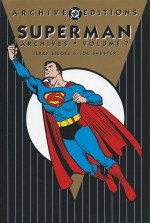
Superman Archives volume 7


By Jerry Siegel, Joe Shuster, Don Cameron, Bill Finger, Ed Dobrotka, George Roussos, Sam Citron, Ira Yarbrough, Wayne Boring, Fred Ray & various (DC Comics)
ISBN: 978-1-4012-1051-9

It’s almost incontrovertible: the American comicbook industry – if it existed at all – would have been an utterly unrecognisable thing without Superman. His unprecedented invention and adoption by a desperate and joy-starved generation quite literally gave birth to a genre if not an actual art form.

Spawning an impossible army of imitators and variations, within three years of his 1938 debut, the intoxicating blend of eye-popping action and social wish-fulfilment which hallmarked the early Man of Steel had grown to encompass cops-and-robbers crime-busting, socially reforming dramas, science fiction, fantasy, whimsical comedy and, once the war in Europe and the East embroiled America, patriotic relevance for a host of gods, heroes and monsters, all dedicated to profit through exuberant, eye-popping excess and vigorous dashing derring-do.

In comicbook terms at least Superman was master of the world, having already utterly changed the shape of the fledgling industry. There was the phenomenally popular newspaper strip, a thrice-weekly radio serial, games, toys, as much global syndication as the war would allow and the perennially re-run Fleischer studio’s astounding animated cartoons.

Despite all the years tat have passed since then, I – and so many others – still believe that superhero comics were never more apt or effective than when they were whole-heartedly combating the agents of Fascism (and yes by heck, even the dirty, doggone, Reds-Under-the-Beds Commies, who took their place in the 1960s too!) with explosive, improbable excitement and mysterious masked marvel men.

The most evocative and breathtaking moments of the genre seem to come when those gaudy gladiators soundly thrashed – and please forgive the offensive contemporary colloquialism – “Nips and Nazis”. However, even in those long-ago dark days, comics creators were wise enough to augment their tales of espionage and invasion with a range of gentler, more whimsical four-colour fare. By the time of the tales in this stunning seventh Superman coterie of classics – collecting #25-29 (November/December 1943 to July/August 1944) of the Man of Tomorrow’s solo title – the intense apprehension of the early war years had been replaced with eager anticipation of tyranny’s forces were being rolled back on every Front.

Superman was the premier, vibrant, vital role model whose startling abilities and take-charge, can-do attitude had won the hearts of the public at home and the troops across the war-torn world. Now, although the shooting was far from over, the stirring, morale-boosting covers were being phased out in favour of gentler and even purely comedic themes. After an informative Foreword: Siegel, Shuster & Associates by author and historian Ron Goulart (offering commentary and scrupulously detailing the working secrets of the Superman Studio at that troubled time), the only cover by Jack Burnley in this book shows Superman teaching kids to draw, before the quartet of thrillers behind that front image commenced with a full-on patriotic call to arms.

The Man Superman Refused to Help!’ by Jerry Siegel, Ira Yarbrough & George Roussos exposed the American Nazi Party – dubbed the “101% Americanism Society” – whilst offering a rousing tale of social injustice as an American war hero is wrongly implicated in the fascists’ scheme… until the Man of Steel investigated.

This is followed by a much reprinted and deservedly lauded patriotic classic.

‘I Sustain the Wings!’ by Mort Weisinger & Fred Ray, was created in conjunction with the Army Air Forces Technical Training Command under Major General Walter R. Weaver and designed to boost enlistment in the maintenance services of the military. In it Clark Kent attends a Technical Training Command school as part of the Daily Planet’s attempt to address a shortfall in vital services recruitment – a genuine problem at this time in our real world – but still finds time to delightfully play cupid to a love-struck kid who really wants to be a hot shot pilot not a mere “grease monkey”…

Siegel, co-creator Joe Shuster & Yarbrough then gloriously bit the hand that fed them by spoofing the budding superhero genre with the ‘King of the Comic Books’ as a disenchanted cartoonist is taught to value the worth of his mighty creation Geezer. Good thing too, as Adolf Hitler, totally fed up with being lampooned by the strip, had dispatched his best assassins to shut up the Verdammte artist for goot – sorry – good…

The issue ended with an exceptional crime thriller by Bill Finger, Ed Dobrotka & Roussos wherein the Metropolis Marvel tangled with ‘Hi-Jack – Jackal of Crime!’: an arrogant maniac determined to make a lasting name in the annals of villainy. But, as was so often the case, there was far more to the mastermind than first appeared…

Wayne Boring & Roussos provided a stunning anti-Nazi cover for #26 with the Man of Might giving the enemy propaganda minister a sound slapping, before ‘The Super Stunt Man!’ (Finger, Shuster, Yarbrough & Roussos) saw the Kryptonian Crimebuster restore the nerve, prospects and humour of a disgraced circus daredevil, whilst in ‘Comedians’ Holiday!’ by Don Cameron & Yarbrough, an aging vaudevillian film troupe gets a boost and new lease on life when Lois and Clark investigate their manager – a shady cove named J. Wilbur Wolfingham.

The scurvy scoundrel – a magnificent pastiche of W. C. Fields as an utterly heartless Mr. Micawber – would return over and over again to bedevil honest folk and greedy saps…

Andy Hoops was a no-good kid capitalising on an honest man’s tale of woe. When he blackmailed the Action Ace, ‘Superman’s Master!’ (by Siegel, Yarbrough & Roussos) tragically overstepped the mark and too late learned a very final lesson in decency, whilst ‘The Quicksilver Kid!’ (Cameron, Sam Citron & Roussos) pitted Superman against a revived and utterly amoral god Mercury who only wanted a little fun and exercise, but couldn’t handle their persistent alien protector…

Boring & Roussos depicted Superman cheekily teaching Lois to type on the cover of #27, whilst Cameron & Dobrotka produced all the interior wonders beginning the murderous Toyman‘s roguish return to bedevil honest citizens of Metropolis with ‘The Palace of Perilous Play!’ – a novelty arcade with perilous purpose. It wasn’t Superman-proof though…

Stuck in the woods pursuing a story, Lois and Clark met old lumberjacks and heard what happened after legendary logger Paul Bunyan met the Man of Steel in ‘When Giants Meet!’ after which, safely back in civilisation, Superman came to the aid of hayseed farmer Hiram Pardee who came to Metropolis to collect his millionaire inheritance and fell foul of shysters and brigands in the ‘Robber’s Roost!’ before ‘Dear Diary’ blended the journal-keeping habits of ambitious financier Randall Rocksell, gang-boss and conman Goldie Gates and Lois Lane in a heart-warming cautionary tale of greed and redemption, courtesy of a uniquely Kryptonian brand of problem-solving…

The cover of Superman #28 (May/June 1944) saw Boring & Stan Kaye combine to comedically compare the Metropolis Marvel with mythical monoliths Hercules and Atlas whilst the interior opened with the return of a certain swindling charlatan in ‘Lambs versus Wolfingham!’ (Cameron, Yarbrough & Roussos) which saw Clark, his alter ego and Lois save a town of sheepherders from the unscrupulous land-grabbing attentions of the roguish reprobate, simultaneously dispensing a hard lesson in business ethics to the shameless schemer, whilst Sam Citron pencilled ‘The Golden Galleons!’ in which a model-building competition in the Daily Planet led to bullying, cheating, skulduggery and even attempted murder amongst the poorest faction of Metropolitan society…

Scripted by an anonymous author and fully realised by Roussos, ‘Be a Magician – Turn Waste Paper into War Weapons!’ offered sage patriotic public service advice to the readership before Cameron & Dobrotka inaugurated a radical new series with ‘Lois Lane, Girl Reporter: The Suicidal Swain’.

In those turbulent times the interpretation of the plucky news-hen was far less derogatory than the post-war sneaky minx of the 1950s and 1960s. Lois might have been ambitious and life-threateningly precipitate but it was always to advance her own career, help underdogs and put bad guys away, not trap a man into marriage.

This premier 4-page vignette offered a breathless, fast-paced screwball comedy-thriller wherein the canny lass fails to talk a crazed jumper down from a ledge but still saves his life in a far more flamboyant manner, reaping the just reward of a front page headline.

The issue the ended with ‘Stand-In for Hercules!’ by Siegel, Yarbrough & Roussos, in which Superman travelled back to Ancient Greece to help out a dying scientist and ended up carrying out a dozen good deeds for an ailing legend. Of course the tale had a solidly humorous basis and a sneaky sting included…

Issue #29’s cover was a peacefully patriotic one as Boring & Roussos showed Lois entertaining “her Supermen” – a Soldier, Sailor and Marine – after which malign mischief-maker The Prankster became ‘The Wizard of Wishes!’, exploiting people’s dreams for personal profit until Superman put his foot down in a classy thriller by Cameron & Dobrotka.

Bill Finger then scripted ‘The Tycoon of Crime!‘ for Dobrotka, in which the Action Ace tackled a retired and very bored businessman who turned gangster to alleviate his ennui and managed to mass market villainy after he hypnotised the Man of Steel, after which

‘Lois Lane, Girl Reporter: The Bakery Counterfeiters’ by Cameron, Dobrotka & Roussos, found the peerless newshound turn her demotion to the women’s cookery pages into another blockbusting scoop.

This convivial collection then concludes with a cleverly moving yarn by Joe Samachson & Dobrotka wherein Clark is mistaken for a missing heir and incurs the wrath of a host of greedy, frustrated relatives eager to get rid of ‘The Pride of the Kents’…

As fresh and thrilling now as they ever were, these endlessly re-readable epics are perfectly situated in these glorious hardback Archive Editions; a worthy, long-lasting vehicle for the greatest and most influential comics stories the art form has ever produced.

So what are you waiting for…?
© 1943, 1944, 2006 DC Comics. All Rights Reserved.

R.E.B.E.L.S. volume 2: Strange Companions


By Tony Bedard, Andy Clarke, Claude St. Aubin, Karl Moline, Derec Donovan, Kalman Andrasofszky & various (DC Comics)
ISBN: 987-1-4012-2761-6

Once upon a time, DC’s vast pantheon of characters was sensibly scattered, segregated and wholly distinct: separated and situated on a variety of alternate Earths which comprised Golden Age hold-overs, contemporaneous Silver Age stars and later-created heroes. Further Earths were subsequently introduced for every superhero stable the company scooped up in a voracious and protracted campaign of acquisition over the decades. Charlton, Fawcett, Quality Comics and others’ characters resided upon their own globes, occasionally meeting in trans-dimensional alliances and apparently deterring new readers from getting on with DC.

Latterly, when DC retconned their entire ponderous continuity following Crisis on Infinite Earths in 1985-1986, ejecting the entire concept of a multiverse and re-knitting time so that there had only been one world literally festooned with heroes and villains, many of their greatest characters got a unique restart, with the conceit being that the characters had been around for years and the readership were simply tuning in on just another working day.

Of course now the multiverse concept is back and not confusing at all (no! seriously?) but whatever the original reasons, that dramatic 1980s refit did provide for some utterly astounding and cleverly cohesive stories…

In the aftermath of that event, the hero-packed planet Earth was targeted by a coalition of alien races and endured a full-on Invasion which was repulsed by the indomitable resistance of the World’s assembled heroes and villains and a few selected extraterrestrial allies. When the cosmic dust settled a few of these stayed together and formed cops-for-profit outfit dubbed L.E.G.I.O.N., led by a lying, scheming, manipulative obsessive super-genius bastard named Vril Dox: notional son of the villainous super-villain Brainiac of Colu and one of the most superciliously smug creatures in creation.

Overcoming all odds and the general distaste of his own chief lieutenants, Dox moulded his organisation into a force for justice and peace in the universe, with over 80 client worlds happily prospering, until his own son Lyrl – whilst still a baby – usurped control of the organisation: hunting Vril and his core agent team across the universe as desperate R.E.B.E.L.S. ruthlessly pursued by their own intergalactic commercial police force.

By the end of that run of comicbooks in 1996, order and the status quo were fully restored and the Licensed Extra-Governmental Interstellar Operatives Network went back to scrupulously and competently doling out all the peace and security solvent worlds could afford…

In the first volume, Dox’s organisation was snatched from his implacable grasp by an alien incursion from another galaxy, led by a terrifying mystery despot who had apparently subjugated the predatory Starros and turned their mind-sucking, power-leeching abilities to the creation of an unbelievably vast inter-galactic empire, policed by an unstoppable host of super-slaves and subservient legions.

Acting upon information received from his own descendent in the 31st century, Dox began assembling a super-powered strike force from across known space: old allies and pawns, new heroes – and even villains and monsters. Whoever he couldn’t coerce or co-opt Dox created, such as with the crippled Anasazi girl he transformed into a ball of sentient space-spanning energy he dubbed Wildstar…

However, just as he was compiling his arsenal of living weapons and preparing to take back control of L.E.G.I.O.N., events overtook him again. From far outside our galaxy an impossible army of invaders burst through a space rift, all enslaved by and connected to a telepathic starfish creature named Starro, yet somehow controlled by a humanoid master who had learned how to psychically dominate the universally-feared pentagram predators…

Within hours the Armada had destroyed the impregnable homeworld of the dreaded Dominators and were preparing to spread across the Milky Way, until Dox, with typical reckless brilliance, locked the entire quadrant within an impenetrable forcefield stalling the invasion by trapping hundreds of worlds – and his ragtag R.E.B.E.L.S. unit with them – in an inescapable cage with the most rapacious creatures in creation…

Collecting issues #7-9 of the revived comicbook series and the first R.E.B.E.L.S. Annual: Starro the Conqueror (all from 2009), the drama is scripted as ever by Tony Bedard and continues with ‘No Way Out’ (illustrated by Andy Clarke) wherein the only Dominator to escape the fall of his own species’ ancient empire goes hunting for allies and revenge. Dox too is seeking outside help – with as little success – from planetary dictators such as Despero or Kanjar Ro and extremist regimes such as the bellicose Khunds: all elements he used to be paid good money to keep away from decent sentients and his client worlds…

The aquatic, methane breathing mega-teleporters of Gil’Dishpan at least agreed to a meeting with both Dox and the Dominator, keenly aware that their inherent space-shifting capabilities presented Starro’s forces with an irresistible opportunity to break out of the vast but impenetrable force cage frustrating their outward expansion…

The venal Gil’Dishpan had actually planned to give their diplomatic guests to Starro in return for a neutrality pact but the invaders instead attacked the methane-dwellers, ultimately forcing Dox and the last Dominator to make absolutely sure no teleporters remained for the starfish to mind-control…

In ‘Stealth’ (Clarke art again) the ragtag band of resistors track down the banished and now teenaged Lyrl Dox, press-ganging the former tiny tyrant into the fight just as Starro’s metahuman brigade turned their unstoppable attentions upon the Khundish empire – with the now inevitable result of total submission through horrendous bloodshed.

On another front the insidious Psions contrived a ghastly biological cloaking mechanism and despatched the far-from happy Omega Men through the still-open space rift to the Horde’s mysterious point of origin…

The titular ‘Strange Companions’ – lavishly rendered by Claude St. Aubin & Scott Hanna – pulls more threads into the swiftly expanding cosmic tapestry as Wildstar goes in search of other allies trapped within the contained quadrant whilst the Omega Men discover disquieting, unsuspected secrets on the other side of the sky.

As Starro lieutenant Smite personally crushes all resistance on Kanjar Ro’s fortress world Dhor, the dictator is rescued at the last moment by his archenemy Adam Strange, another recruit to Dox’s resistance movement as is Earthling mutant superman Captain Comet.

The assembled rebels don’t have long to catch their breath however as the frustrated Smite arrives in blockbusting manner leading a squad of Starro super-soldiers and tasked with capturing – or is that liberating? – Lyrl Dox: a lad who’s been correctly assessed as even smarter and more ruthless than the father he’s always hated…

To Be Continued…

The rest of this volume reprints the Annual; offering a quintet of tales uncovering secrets and disclosing hidden facts about the unbeatable enemy forces. The eponymous framing sequence ‘Starro the Conqueror’ (illustrated by St. Aubin & Hanna) connects five powerfully revelatory chapters beginning with ‘The Doom that Came to Kalanor’ as the supreme master of the invaders personally destroys the diabolical Despero – a brutal juggernaut who has killed billions in his day. That day, though, is soon done…

The action continues by revealing the backgrounds of the pitiless, uncompromising invaders beginning with the tragic ‘Daughter of Storms’ (with art from Karl Moline & Mark Pennington): life-giving goddess of a world who lost everything when the starfish landed in her skies…

This is followed by an introduction to the worst Starro can offer as St. Aubin & Hanna convene ‘The High Vanguard’: brutal monsters who serve the as the semi-autonomous elite of the rapacious Horde, after which Derec Donovan delineates the story of Smite who was ‘Scourge of the Stars’ even before falling to the unrelenting overlord of infinity…

This volume concludes with the horrific origin of ‘The Star Conqueror’ (art by Kalman Andrasofszky) which shows how a gentle holy man defeated an intolerable invading interplanetary predator and unwittingly unleashed a far greater menace upon all of creation…

With a spectacular cover gallery by Andy Clark & Andrasofszky, this slim tome offers a deliciously intoxicating blend of space opera and cosmic action that will push every button for lovers of staggering science fiction thrills, cut with sharp, mature dialogue and sublimely beautiful artwork. More straight and simple, mind-boggling, slyly cynical, riotous rollercoaster fun no fan of fantasy should do without…
© 2009, 2010 DC Comics. All Rights Reserved.

Wonder Woman Archives volume 3


By Charles Moulton (William Moulton Marston & Harry G. Peter) with Frank Godwin (DC Comics)
ISBN: 1-56389-814-4

Wonder Woman was conceived by polygraph pioneer William Moulton Marston and illustrated by Harry G. Peter in an attempt to offer girls a positive and forceful role model. She debuted as a special feature in All Star Comics #8 (December 1941), before springing into her own series and the cover-spot of new anthology title Sensation Comics a month later. An instant hit the Amazing Amazon quickly won her own eponymous supplemental title in late Spring of that year (cover-dated Summer 1942).

Once upon a time on a hidden island of immortal super-women, American aviator Steve Trevor of US Army Intelligence crashed to Earth. Near death, he was nursed back to health by young and impressionable Princess Diana.

Fearing her growing obsession with the creature from a long-forgotten and madly violent world, her mother Queen Hippolyte revealed the hidden history of the Amazons: how they were seduced and betrayed by men but rescued by the goddess Aphrodite on condition that they isolated themselves from the rest of the world and devoted their eternal lives to becoming ideal, perfect creatures.

However when goddesses Athena and Aphrodite subsequently instructed Hippolyte to send an Amazon back with the American to fight for global freedom and liberty, Diana overcame all other candidates and became their emissary – Wonder Woman.

On arriving in Americashe bought the identity and credentials of lovelorn Army nurse Diana Prince, elegantly allowing the Amazon to be close to Steve whilst enabling the heartsick medic to join her own fiancé in South America. Soon Diana also gained a position with Army Intelligence as secretary to General Darnell, ensuring she would always be able to watch over her beloved. She little suspected that, although the painfully shallow Steve only had eyes for the dazzling Amazon superwoman, the General had fallen for the mousy but superbly competent Lieutenant Prince…

Using the nom de plume Charles Moulton, Marston (with some help in later years from assistant Joye Murchison) scripted almost all of the Amazing Amazon’s many and fabulous adventures until his death in 1947, whereupon Robert Kanigher took over the writer’s role. Venerable veteran illustrator and co-creator H.G. Peter performed the same feat, limning practically every titanic tale until his own death in 1958. A couple of the very rare exceptions appear in this volume…

This third superbly luxurious full-colour deluxe hardback edition collects her every groundbreaking adventure from Wonder Woman #5-7 and Sensation Comics #18-24 from June-December 1943, and commences, after an appreciative Foreword from comics historian Les Daniels, with ‘The Secret City of the Incas’ from Sensation #18, illustrated by the superbly talented classical artist Frank Godwin, in which the Princess of Power rescued a lost Inca tribe from a despotic theocracy and ancient greed whilst in #19 (Godwin again)‘The Unbound Amazon’ responded to a little boy’s letter and stumbled onto big trouble in the far north woods. Of course Diana knew little Bobby from the Adventure of the Talking Lion (as seen in the previous Archive edition) and with wicked Nazi spy Mavis on the loose wasn’t about to take any chances.

This terrific thriller is notable for the revelation that if an Amazon removed her Bracelets of Submission she turned into a raving, uncontrolled engine of sheer destruction…

H. G. Peter drew the vast entirety of Wonder Woman #5 (June/July 1943), which presented an interlinked epic in the ‘Battle for Womanhood’ as war-god Mars (who instigated the World War from his HQ on the distant red planet through his earthly pawns Hitler,  Mussolini and Hirohito) returned to plague humanity. This time he enlisted the aid of a brilliant but deformed and demented misogynistic psychologist with psychic powers. The tormented Dr. Psycho used his talents to marry and dominate a medium named Marva, using her abilities to form ectoplasmic bodies as he sought to enslave every woman in the world.

Happily Wonder Woman countered his gods-sponsored schemes, after which prominent sidekicks ‘Etta Candy and her Holliday Girls’ comedically crushed a burglary before ‘Mars Invades the Moon’ returned to the overarching tale when the frustrated war-god was ousted by the Duke of Deception.

In attempting to take over the Moon – home of peace-loving goddess Diana – Mars made the biggest error of his eternal life as the Amazing Amazon led a spectacular rescue mission which resulted in the invaders’ utter rout.

The issue then concluded with ‘The Return of Dr. Psycho’ who had escaped prison and again perpetrated a series of ghastly attacks on America’s security and the freedom of women everywhere until the Holliday Girls and their demi-divine mentor stepped in…

Sensation #20 was also by Peter – who was slowly coming to grips with the increased extra workload of the explosively popular 64-page Wonder Woman series every three months – and ‘The Girl with the Gun’ saw Diana Prince investigate sabotage at a munitions factory and the murder of a General at WAACs training base Camp Doe. To the Amazon’s complete surprise the culprit appeared to be Marva Psycho, but there was far more going on than at first appeared…

Godwin handled the art for #21 as Steve and Diana tracked down insidious traitor the American Adolf as he conducted a murderous ‘War Against Society’ whilst issue #6 – another all-Peter extravaganza – introduced another macabre foe in ‘Wonder Woman and the Cheetah’.

Marston’s psychiatric background provided yet another deeply disturbed antagonist in the form of sugar sweet debutante Priscilla Rich who shared her own body with a jealously narcissistic, savage feline counterpart dedicated to murder and robbery. The Cheetah framed the Amazing Amazon and almost destroyed Steve, Etta and the Holliday girls before Wonder Woman finally quashed her wild rampages.

It wasn’t for long as the Cheetah returned to mastermind an espionage-for-profit ring in ‘The Adventure of the Beauty Club’ which resulted in the Perfect Princess being captured by Japan’s High Command before spectacularly busting loose for a final confrontation in ‘The Conquest of Paradise’. Here the Feline Fury infiltrated the home of the Amazons and almost irretrievably poisoned the minds of the super women sequestered there…

By this time Peter was fully adapted to his new schedule and in Sensation Comics #22 took the psychological dramas to new heights when a cured Priscilla Rich was seemingly attacked by her manifested evil self  after the Cheetah stole America’s latest weapon ‘The Secret Submarine’…

In issue #23 the creators tackled school bullying and women in the workplace as production line staff were increasingly stricken by ‘War Laugh Mania’. Only one of the problems was being promulgated by Nazi spies though…

It was back to straight action in #24 as ‘The Adventure of the Pilotless Plane’ saw Steve abducted by Japanese agents whilst investigating a new gas weapon which prevented US aircraft from flying. The vile villains had nothing that could stop Wonder Woman from smashing them and freeing him however, and the status quo was fully restored for the last saga in this lavish hardcover collection.

Wonder Woman #7 offered an optimistic view of the future in a fantastic fantasy tale ‘The Adventure of the Life Vitamin’ wherein America in the year 3000AD revealed a paradisiacal world ruled by a very familiar female President where a miracle supplement had expanded longevity to such an extent that Steve, Etta and all Diana’s friends were still thriving.

Sadly some old throwbacks still yearned for the days when women were second-class citizens subservient to males which meant there was still work for the Amazing Amazon to do…

‘America’s Wonder Women of Tomorrow’ continued the wry but wholesome sex war with Steve going undercover with the rebel forces uncovering a startling threat in ‘The Secret Weapon’ before the focus returned to the present and a far more intimate crisis for wilful child Gerta whose mother Paula (fully reformed ex-Nazi Baroness Paula von Gunther) was forced to deal with a ‘Demon of the Depths’.

But was that the evil octopus at the bottom of the paddling pool or her daughter’s dangerously anti-authoritarian attitudes…?

Far too much has been made of supposed subtexts and imagery of bondage and submission in these early tales – and yes, there really are a lot of scenes with girls tied up, chained or about to be whipped – but I still don’t care. Whatever Marston and Peters might have intended, the plain truth is that the skilfully innovative dramas and incredibly imaginative story-elements influenced the entire nascent superhero genre as much as Superman or Batman, and we’re all the richer for it.

This sterling deluxe book of nostalgic delights is a marvel of exotic, baroque, beguiling and uniquely exciting wonder and these Golden Age adventures of the World’s Most Fabulous female are timeless, pivotal classics in the development of comicbooks and still provide astounding amounts of fun and thrills for anyone interested in a grand nostalgic read.
© 1943, 2002 DC Comics, Inc. All Rights Reserved.

Batman: Streets of Gotham volume 1 – Hush Money


By Paul Dini, Dustin Nguyen & Derek Fridolfs (DC Comics)
ISBN: 978-0-85768-853-8

With all the furore and hype surrounding the epic death and inevitable resurrection of Batman cunningly orchestrated by Grant Morrison, everybody seemed so concerned with what was going to happen next that they apparently ignored what was actually occurring in the monthly comicbooks in their hands. Now with the dust long settled let’s take a look at one of the better sidebar-series to come out of the braided Batman R.I.P./Final Crisis/Last Rites/Batman Reborn/Return of Bruce Wayne publishing events…

In the aftermath of the epochal loss of the Gotham Guardian, a sustained and epic Battle for the Cowl ensued amongst the fallen hero’s closest allies. Eventually Dick Grayson succeeded his lost mentor, carrying on the tradition of the Dark Knight with Bruce Wayne’s assassin-trained son Damian continuing as the headstrong and potentially lethal latest iteration of Robin, the Boy Wonder…

This volume collects the contents of Detective Comics #852, Batman #685 (both March 2009), before re-presenting the first four tension-drenched issues of Batman: Streets of Gotham spanning June to September of that portentous year, and deals with the strange fact that although most of the masked hero community knew the tragic truth, the general populace was blithely unaware that the true Batman had been replaced…

As if all that complex crossover-ry wasn’t enough, also working hard to ensure that no reader would dare miss a single issue was a project dubbed ‘Faces of Evil’ in which DC villains took centre stage in every comicbook that month. Thus, in the aforementioned Detective #852 and Batman #685, one of the hero’s most pernicious and obsessive foes reappeared to rebuild his empire of evil after the last crushing defeat at the gauntleted hands of Batman…

Sublimely illustrated by Dustin Nguyen & Derek Fridolfs, the saga was another triumph for award-winning animator and director Paul Dini who once again proved himself the very best of contemporary Batman writers with a chilling, suspenseful epic of revenge and obsession featuring Bruce Wayne’s ultimate adversary Dr. Tommy Elliot, a beloved boyhood friend as warped by his own mother’s malign influence as the boy Bruce was transformed by the murder of his beloved parents Thomas and Martha Wayne.

Eminent surgeon Elliot became the twisted, sadistic and obsessive Hush to obtain vengeance on his only friend and childhood companion: one who had been perpetually held up to him as a perfect example of a son by Elliot’s disabled and deranged mother. Tommy even divined the billionaire’s greatest secret – the true identity of the Dark Knight…

After many deeply personal and lethally psychotic attacks on Wayne’s legacy and Batman’s friends, Hush took the ultimate step in his psychological war against his oldest pal by surgically transforming himself into Bruce’s doppelganger – attempting to entirely usurp his life.

After nearly killing Selina Kyle by literally stealing her heart, the faux-Bruce was only narrowly defeated and the captive Catwoman restored to some semblance of her former self (see Batman: Heart of Hush)…

Now in ‘Reconstruction’ a broken Elliot wanders the snowy shady docks ofGotham before tumbling into the freezing river. Everything is over: his best efforts to destroy the Wayne myth have all failed and, in revenge for his attack on her, Catwoman has tracked down all his hidden bank accounts and stolen every penny he had – $200 million dollars – giving it all away to bleeding-heart charities…

Expecting to die, Elliot awakes on a boat, saved by hard-working stiffs who believe they’ve rescued wild-partying playboy Wayne from a drunken accident. Inspired, Elliot doesn’t disabuse them and begins to trade on his stolen looks to rebuild his fortune and take another stab at revenge…

Luck is with him: for some reason no one has seen either Bruce Wayne or Batman for weeks. Using the playboy’s reputation, Hush makes his way to the Caribbean, leaving a well-concealed trail of bodies and empty wallets behind him. By the time he reaches Australia he’s feeling pretty cocky but after being spotted by shapeshifting local hero Tasmanian Devil, Elliot heads for Vietnam, eager to put more miles and far less friendly borders between him and his inevitable pursuers. It’s a near-fatal mistake…

The tale concludes in ‘Catspaw’ as “Bruce Wayne” is kidnapped by bandits from an animal poaching ring and finds himself face-to-stolen-face with Catwoman who has taken over the pet traders to actually save endangered species. Always willing to bear a grudge, she is delighted with the opportunity to put her former tormentor at the top of that list…

However the cat burglar has gotten in too deep and her greedily impatient gang are fed up with their animal-loving leader. Sensing a coup, Selina agrees to a truce with Elliot until they can escape the jungles and the bandits. To that end, she despatches her two most faithful henchmen to bring Hush to safety, but unfortunately nobody could leave a trail like Elliot’s and not be noticed by the well-schooled heirs of the World’s Greatest Detective…

Streets of Gotham debuted scant months later with Elliot an utterly isolated prisoner of the new Batman and Robin…

In ‘Ignition!’ a fresh era began with a reformed Harley Quinn making a nuisance of herself and distracting the Dark Dynamic Duo’s attention from a real threat. In the power vacuum following all the concatenating crises, many of Arkham Asylum’s inmates had absconded and were loose in the city, and flamboyant gangster Black Mask was celebrating his victory over rivals Two-Face and the Penguin – and subsequent elevation to supreme boss of the underworld – by recruiting the more biddable escaped maniacs to his team…

With a mysterious new vigilante called Abuse adding to the general atmosphere of tension, one of Black Mask’s wildest employees finally slipped into total psychosis. Third-rate arsonist Garfield Lynns suddenly stopped torching buildings as Firefly and began turning random civilians into spontaneously combusting human torches…

Taking full advantage of the situation in ‘City on Fire’, Hush then broke out of his velvet-lined cage whilst Batman and Robin tackled the utterly demented arsonist and again used his perfect imposture of Bruce Wayne to outmanoeuvre his foes.

Before Grayson, Damian and former Robin Tim Drake could react, Elliot made a very public appearance on TV and offered to bankrupt “himself” to rebuild Gotham’s shattered infrastructure and decimated industries…

The Batman Family had never accepted that their mentor was dead and all their actions were predicated upon the premise that he would eventually return to reclaim his mantle. Thus as ‘Hush Money’ opened, they were all forced to publicly accept and even join the returned “Bruce Wayne” as he effectively dismantled the lost hero’s life’s work to popular adulation…

Simultaneously in the city’s darkest nooks and crannies Black Mask’s disciples began to chafe under his increasingly oppressive and unpredictable yoke. The mobster’s most radical action was to give free rein to knife-wielding serial killer Victor Zsasz, offering to bankroll the butcher’s scheme to industrialise and mass-produce his particular brand of bloodletting…

As the new Batman finally finds a way to neutralise Hush’s bold imposture, this initial volume concludes with a dark and nasty tale following Zsasz’s escalation of terror and slaughter by focussing on the tightrope-thin line career criminals must walk in Gotham. ‘Business’ invades the personal space of illicit fixer the Broker as the premier “go-to guy” in the city at last discovers to his surprise that there some things he won’t – can’t – do, no matter how big the pay-off might be…

With astounding covers by Andrew Robinson, Alex Ross, J. G. Jones & Dustin Nguyen, this visceral, imaginative and deliciously off-balance frantic psycho-thriller sets the scene for even darker strides down the darkest avenues in all of comics…

© 2009, 2011 DC Comics. All Rights Reserved.

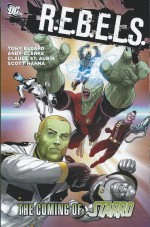
R.E.B.E.L.S. volume 1: the Coming of Starro


By Tony Bedard, Andy Clarke, Claude St. Aubin, Scott Hanna & various (DC Comics)
ISBN: 987-1-4012-2589-6

Once upon a time, DC’s vast pantheon of characters was sensibly scattered, segregated and wholly distinct: separated and situated on a variety of alternate Earths which comprised Golden Age hold-overs, contemporaneous Silver Age stars and later-created heroes. Further Earths were subsequently introduced for every superhero stable the company scooped up in a voracious and protracted campaign of acquisition over the decades. Charlton, Fawcett, Quality Comics and others characters resided upon their own globes, occasionally meeting in trans-dimensional alliances and apparently deterring new readers from getting on with DC.

Latterly, when DC retconned their entire ponderous continuity following Crisis on Infinite Earths in 1985-1986, ejecting the entire concept of a multiverse and re-knitting time so that there had only been one world literally festooned with heroes and villains, many of their greatest characters got a unique restart, with the conceit being that the characters had been around for years and the readership were simply tuning in on just another working day.

Of course now the multiverse concept is back and not confusing at all (no! seriously?) but whatever the original reasons, that dramatic 1980s refit did provide for some utterly astounding and cleverly cohesive stories…

In the aftermath of that event, the hero-packed planet Earth was targeted by a coalition of alien races and endured a full-on Invasion which was repulsed by the indomitable resistance of the World’s assembled heroes and villains and a few selected extraterrestrial allies. When the cosmic dust settled a few of these stayed together and formed cops-for-profit outfit dubbed L.E.G.I.O.N., led by a lying, scheming, manipulative obsessive super-genius bastard named Vril Dox: notional son of the villainous super-villain Brainiac of Colu and one of the most superciliously smug creatures in creation.

Overcoming all odds and the general distaste of his own chief lieutenants, Dox moulded his organisation into a force for justice and peace in the universe, with over 80 client worlds happily prospering, until his own son Lyrl – whilst still a baby – usurped control of the organisation: hunting Vril and his core agent team across the universe as desperate R.E.B.E.L.S. ruthlessly pursued by their own intergalactic commercial police force.

By the end of that run of comicbooks in 1996, order and the status quo were fully restored and the Licensed Extra-Governmental Interstellar Operatives Network went back to scrupulously and competently doling out all the peace and security solvent worlds could afford…

All that background is largely superfluous to the enjoyment of this latest iteration of the splendidly wry and cynical sci fi adventure series as history repeated itself in 2008, and another cosmic event forced DC’s assorted space sentinels into action again. Adam Strange, the Omega Men, Captain Comet and Dox’s L.E.G.I.O.N. again came to the fore and their intergalactic exploits again began to impinge on the fate of this island Earth…

Collecting the first six issues of the revived R.E.B.E.L.S. comicbook series concocted by scripter Tony Bedard, the superbly intoxicating action begins in ‘The Future is Now’ (illustrated by Andy Clarke) as a fugitive Vril Dox crashes on Earth fleeing from a team of bounty hunters.

To ensure no further insurrections by greedy – or worse yet, moralistic – employees, the 10th Level Intellect had largely replaced all his annoyingly autonomous agents with robotic units, but that had simply enabled some bright spark to co-opt his entire intergalactic army – again! – and Dox was now a target for assassination by L.E.G.I.O.N.’s new owner, as well as many of the criminals and warlords the Coluan had previously antagonised…

Within mere moments of reaching our embattled world Dox, hotly pursued by monstrous alien powerhouse Tribulus, its cyborg controller Getorix, super-psychic Skwaul and former elite L.E.G.I.O.N.-ary Amon Hakk, is confronted by Supergirl, keen on stopping the sheer carnage caused by the invaders’ battles.

Freshly returned from an extended stay in the 31st century, the teenaged Kryptonian had been turned into the unwitting receptacle of a message from Dox’s distant descendent Brainiac 5, conveying data and specifications for Vril to construct a precursor brigade of the Legion of Super-Heroes to combat an imminent threat to the universe…

Dox, contrary as ever, was more impressed with the files on the LSH’s terrifying enemies…

Elsewhere the outlaw warriors dubbed the Omega Men had learned of Dox’s predicament and become aware what a powerful, if untrustworthy, ally he would make…

The action resumed at the South Pole as the ousted Coluan cop and the Girl of Tomorrow defeated the alien hunters and turned the nigh-mindless Tribulus into ‘The First Recruit’. Dox then fled Earth in search of fresh cannon-fodder for his future-foretold team and exploited rather than allied himself with the Omega Men before heading to a lost colony of Amerindian ex-slaves for his next target.

Nearly a millennium before, an entire tribe of Native Americans had been stolen and dumped on the distant world Starhaven where they had evolved into the Anasazi, winged trackers of immense power and sensitivity. Now Dox arrived and offered to give a weak and feeble outcast the gifts fate and feeble genetics had denied her. However, even though he kept his word, the thing that Wildstar became had good reason to regret her devil’s bargain…

‘A World of Hurt’ saw the new R.E.B.E.L.S. take the battle to the usurped L.E.G.I.O.N. hierarchy; along the way picking up old comrade and dedicated Dox-hater Strata – a woman of living stone and high moral standards – plus energetic new recruit Bounder.

Just as the robotic forces now commanded by artificial life-form and ambulatory computer server Silica begin mercilessly eradicating anybody connected with the Coluan’s old organisation, the utterly dispensible Omega Men attack L.E.G.I.O.N.’s HQ on Maltus and destroy the traitorous living computer which had taken over the organisation.

Covertly despatched by the manipulative Dox, the Omegans have inadvertently handed back control of the rent-a-cops to Dox, but in the digital woman’s corpse the victors find the first clues as to the real threat: an eerie starfish creature capable of controlling anything it possesses. Tragically, before they can react another Starro beast arrives – wearing the body of a brutal alien war goddess named Astrid Storm-Daughter…

With Claude St. Aubin & Scott Hanna taking over the art chores, ‘From Beyond’ kicks the already fast-paced thriller into maximum overdrive as Amon Hakk, Getorix and Skwaul are rescued from earthly imprisonment by Durlan shapeshifter Ciji, unaware that Dox is no longer the problem…

On Maltus, the surviving Omega Men narrowly escape the new threat but discover the entire planet – the most populous in the galaxy – has been taken: each citizen wearing a Starro seed and contributing their enslaved psychic resources to a hidden master…

Meanwhile in another part of space the aggressive space faring hive-culture known as the Dominators are also under attack by the Starro slaves. However this is unlike any previous incursion by the frequently occurring stellar starfish: there’s an implacable devouring consciousness behind the assaults. Even the inimical, scientifically sadistic Psions are scared – as evidenced by their rescuing of their greatest enemies the Omega Men – and propose an alliance to defeat a threat that is pouring into our galaxy from a cosmic hole into another existence…

As ‘The Stars We Are’ opens, in the strategically crucial Xylon Expanse a vast subspace rift is disgorging a host of ships and super-powered slaves into one of the most populous areas of the galaxy – and a centre of L.E.G.I.O.N. influence. Even as the Dominator’s mighty empire falls in hours, Astrid Storm-Daughter attacks Dox’s ship just as Ciji’s forces arrive. With all sentient life threatened, this initial collection concludes with the superb ‘Dominator’ as Dox again pulls an intellectual rabbit out of his hat and traps the entire invasion force – and their space rift – behind an impenetrable, quadrant-wide force field. Locked within an inescapable, parsecs-wide box of force, the terrifying humanoid master of the Starros is safely contained in a relatively small buffer zone and prevented from all further expansion.

Of course stuck on the wrong side of the fence with him are Dox, his unwilling newfound enemies-turned-allies and billions of potential slave-sentients on hundreds of sitting-duck worlds…

To Be Continued…

With a spectacular cover gallery by Andy Clark, Ed Benes, Rob Hunter, Kalman Andrasofszky, this slim tome offers a deliciously intoxicating blend of space opera and cosmic Fights ‘n’ Tights action that will push every button for fans of staggering science fiction thrills, cut with sharp, mature dialogue and sublimely beautiful artwork. Plain and simple rip-roaring, rollercoaster rocket riding fun that no devotee of the genres should miss…

© 2009, 2010 DC Comics. All Rights Reserved.

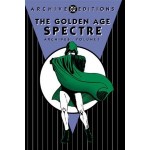
Golden Age Spectre Archives volume 1


By Jerry Siegel & Bernard Baily with various (DC Comics)
ISBN: 978-1-56389-955-3

The Spectre is one of the oldest characters in DC’s vast stable of characters, created by Jerry Siegel and Bernard Baily in 1940 and debuting with a 2-part origin epic in More Fun Comics #52 and 53 where he was the first superhero to star in the previously all-genres adventure anthology. For a few years the Ghostly Guardian reigned supreme in the title with flamboyant and eerily eccentric supernatural thrillers, but gradually slipped from popularity as firstly Dr. Fate and successively Johnny Quick, Aquaman, Green Arrow and finally Superboy turned up to steal the show. By the time of his last appearance the Spectre had been reduced to a foil for his own comedic sidekick Percival Popp, the Super-Cop…

Just like Siegel’s other iconic creation, the Dark Man suffered from a basic design flaw: he was just too darn powerful. Unlike the vigorously vital and earthy early Superman however, the ethereal champion of justice was already dead, so he couldn’t be logically or dramatically imperilled. Of course in those far-off early days that wasn’t nearly as important as sheer spectacle: grabbing the reader’s utter attention and keeping it stoked to a fantastic fever pitch. This the Grim Ghost could do with ease and always-increasing intensity.

Re-presenting the first 19 eerie episodes and following a fulsome Foreword from pre-eminent Comics historian Dr. Jerry Bails, detailing the state of play within the budding marketplace during those last months of the 1930s, the arcane action commences in this stunning full-colour deluxe hardback with ‘The Spectre: Introduction’ from More Fun Comics #52 (February 1940).

This wasn’t the actual title: like so many strips of those early days, most stories didn’t have individual titles and many have been only retroactively designated for collections such as this.

The Ghostly Guardian was only barely glimpsed in this initial instalment. Instead the action rested upon Jim Corrigan, a hard-bitten police detective, who was about to marry rich heiress Clarice Winston when they were abducted by mobster Gat Benson. Stuffed into a barrel of cement and pitched off a pier, Corrigan died and went to his eternal reward. Almost…

Rather than finding Paradise and peace, Corrigan’s spirit was accosted by a glowing light and disembodied voice which, over his strident protests, ordered him return to Earth to fight crime and evil until all vestiges of them were gone…

Standing on the seabed and looking at his own corpse, Corrigan began his mission by going after his own killers…

In #53 ‘The Spectre Strikes’ found the furious revenant swiftly, mercilessly and horrifically ending his murderers and saving Clarice, before calling off the engagement and moving out of the digs he shared with fellow cop and best friend Wayne Grant. After all, a cold, dead man has no need for the living…

The origin ends with Corrigan implausibly sewing himself a green and white costume and swearing to eradicate all crime…

Splendidly daft, this two-part yarn is one of the darkest and most memorable origins in comicbook history and the feature only got better with each issue as the bitter, increasingly isolated lawman swiftly grew into most overwhelmingly powerful hero of the Golden Age.

In MFC #54 the Supernatural Sentinel tackled ‘The Spiritualist’, a murderous medium and unscrupulous charlatan who almost killed Clarice and forever ended the Spectre’s hopes for eternal rest, after which #55 introduced ‘Zor’: a ghost of far greater vintage and power, dedicated to promulgating evil on Earth. He too menaced Clarice and only the intervention of the Heavenly Voice and a quick upgrade in phantasmal power enabled The Spectre to overcome the malign menace.

More Fun Comics #56 was the first to feature Howard Sherman’s Dr. Fate on the cover but the Spectre was still the big attraction even if  the merely mundane bandits and blackmailers instigating ‘Terror at Lytell’s’ were no match for the ever-inventive wrathful wraith. Far more serious was ‘The Return of Zor’ in #57, as the horrific haunt returned from beyond to frame Corrigan for murder and again endanger the girl Jim dared not love…

An embezzler turned to murder as ‘The Arsonist’ in #58, but was no match for the cop – let alone his eldritch alter ego – whilst ‘The Fur Hi-Jackers’ actually succeeded in killing the cop yet were still brought to the Spectre’s unique brand of justice.

In #60 ‘The Menace of Xnon’ found a super-scientist using incredible inventions to frame the ghost and even menace his ethereal existence, prompting The Voice to again increase its servant’s power – this time by giving The Spectre the all-powerful Ring of Life – but not before the Ghostly Guardian had been branded Public Enemy No. 1.

With Corrigan now ordered to arrest his spectral other self on sight, #61 (another Dr. Fate cover) featured ‘The Golden Curse Deaths’ wherein prominent citizens were dying from a scientific terror with a deadly Midas Touch, after which ‘The Mad Creation of Professor Fenton’ pitted the Phantom Protector against a roving, ravaging disembodied mutant super-brain…

In #63 a kill-crazy racketeer got his just deserts in the electric chair only to return and personally execute ‘Trigger Daniels’ Death Curse’ on all who had opposed him in life. Happily The Spectre proved to be more than his match but ‘The Ghost of Elmer Watson’ was a far harder foe to face. Murdered by mobsters who had also nearly killed Corrigan’s only friend Wayne Grant, the remnant of the vengeful dead man refused to listen to The Spectre’s brand of reason and its dreadful depredations had to be dealt with in fearsome fashion…

‘Dr. Mephisto’ was a spiritualist who utilised an uncanny blue flame for crime in #65, after which the Ghostly Guardian battled horrendous monsters called forth from ‘The World Within the Paintings’ probably written by the series’ first guest writer – Gardner Fox – before Siegel returned with ‘The Incredible Robberies’ which found the phantom policeman battling deadly mystic Deeja Kathoon to the death and beyond…

With MFC #68 The Spectre finally lost his protracted cover battle to Dr. Fate even though, inside, the ‘Menace of the Dark Planet’ featured a fabulously telling tale of Earthbound Spirit against alien invasion by life-leeching Little Green Men, before in #69 ‘The Strangler’ murders led Corrigan into an improbable case with an impossible killer…

This first fearful tome terminates with issue #70 and ‘The Crimson Circle Mystery Society’ in which a sinister cult employed a merciless phantasmal psychic agent named Bandar to carry out its deadly schemes…

Still a mighty force of fun and fearful entertainment, The Spectre’s Glory Days – and Nights – were waning and more credible champions were coming to the fore. He would be one of the first casualties of the post-War decline in mystery men and not be seen again until the Silver Age 1960’s…

Moreover, when he did return to comics, the previously omnipotent ghost was given strict limits and as he continued to evolve through various returns, refits and reboots The Spectre was finally transmogrified into a tormented mortal soul bonded inescapably to the actual embodiment of the biblical Wrath of God. Revamped and revived in perpetuity, revealed to be the Spirit of Vengeance wedded to a human conscience, Jim Corrigan was finally laid to rest in the 1990s and Hal (Green Lantern) Jordan replaced him. Returning to basics in recent years, the latest host is murdered Gotham City cop Crispus Allen.

They’re all worth tracking down and exhuming: spooky comic champions who have never failed to deliver an enthralling, haunted hero rollercoaster – or is that Ghost Train? – of thrills and chills.
© 1940, 1941, 2003 DC Comics. All Rights Reserved.

Merry Christmas, Boys and Girls

Since the Mayans miscalculated and we’re all (most?) still here, I’ve gotten all extra-nostalgic and doubled my pleasure by indulging in not just one but two days of British Annual excellence…

Today’s Cool Yule Drool comprises a trio of my most often enjoyed festive frolics and tomorrow we’re doing it again with even more passion but just a little less imaginatively.

Have a Very Merry Day and always keep reading new things…

Robin Annual Number 1
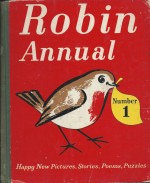
By various, edited by Marcus Morris (Hulton Press)
No ISBN:

There’s not a lot around these days in our field which both caters specifically for little kids and simultaneously introduces them to the ineluctably tactile wonders and sensorium of a high quality comics anthology experience, but once upon a time there was a whole subdivision of the business dedicated to enthralling and enchanting our youngest and, hopefully, brightest…

Robin was created in the hugely successful wake of Marcus Morris and Frank Hampson’s iconic Eagle, catering to the pre-school market the way Swift targeted 6-10 year olds and Girl concentrated on potential young ladies (that looks far creepier in print than I’d intended…). The periodical ran from March 28th 1953 to 25th January 1969, a startling 836 joy-stuffed issues.

Offering a range of beautiful genteel, diffidently Christiano-centric stories, strips and puzzles for parents to read with and to their toddlers, Robin sported the same supremely high production values as all the Hulton Press titles. It was edited by Morris until 1962 when Clifford Makins took over, shepherding the title until its absorption into Odhams/Fleetway comic Playhour, just as the collapse of theUK comics industry was beginning…

There were at least nine Christmas Annuals – such as this first one from 1953 – which combined stunning, lavishly illustrated colour strips and features with solid, memorably stylish and glossy monochrome pages for an 80 page compendium of enticing wonderment between sturdily thick and reassuring red cardboard covers.

Again like its older brothers and sister, Robin included a selection of licensed characters well known to the new but ever-growing television audience…

This particular British Festive icon opens with double-page front and end-pieces by Reg Forster, depicting railway station scenes to colour in and a beautiful painted dedication to the young Princess Anne and Prince Charles, after which the prose tale of ‘Johnny and Mr Spink’ related the tale of a boy given a pony for his birthday.

The first comic strip is in colour. ‘The Amazing Adventure of Percy and the Cricket Ball’ featured anthropomorphic animals and a young man who turned sporting disaster to his advantage, followed by an illustrated poem ‘Things to Do’ and ‘The Story of Woppit’, a monochrome strip featuring an infamous teddy-bear in the snow with bunnies.

More shrew than bear, Mr. Woppit was merchandised as a toy and one was adopted as a lucky mascot by notoriously superstitious sportsman and speed enthusiast Donald Campbell. It was with him when Campbell died piloting the hydroplane Bluebird K7 on Coniston Water in 1967, and found amidst the floating wreckage.Campbell’s remains weren’t recovered until 2001.

A Play Page of puzzles is followed by the first TV star as ‘Andy Pandy’ played garden pranks on Teddy after which ‘The Old Woman and the Mouse’ offered a delightfully salutary prose fable illustrated by the incredibly talented David Walsh and then ‘The Twins Simon and Sally’ got into a mess feeding the chickens in their first strip saga.

‘Princess Tai-Lu’ was a magical Siamese cat and in her initial strip here celebrates Christmas with a few furry feline friends in her own unique manner, whilst the illustrated poem ‘Little Grey Stone’ by Margaret Milnes is a visual feast of tone-&-wash mastery and colour comic ‘Tom the Tractor’ related the heroic rescue of a climbing lamb and piglet by a handy animated farm vehicle,

‘Scruffy the Scarecrow’ was almost junked by the farmer until some friendly Magpies saved his job in a rather moving text tale, but ‘The Proud Mouse’ was the architect of her own downfall in a delightfully executed strip by an uncredited hand.

‘Richard Lion’ (and his animal chums Henry the kangaroo, Pug the bulldog, Peggy the black panther, Nemo the jester and others) seems like a rather excellent knock-off of Bestall’s Rupert Bear by the brilliant Maria Jocz, but it still offers wonder and joy aplenty in a two-chapter, vividly coloured strip which finds the cubs being harassed by and then saving some irascible Snow Gnomes. Next comes the second of the BBC’s Watch With Mother properties as Bill and Ben ‘The Flower-Pot Men’ saved a tortoise from his own exuberant folly in a captivating black and white strip.

A black Scottie dog narrates ‘The Sad Story of McTavish’ (by Norman Satchell) whilst ‘Charlie and the Cake’ takes only three panels to explain the folly of stealing confectionery from the larder…

The snow-bound adventures of Rufus, Rodney Rita and little brother “Fums” resulted in a new family pet thanks to the intervention of ‘The Magic Wellingtons’ in a beguiling colour strip, whilst, following a Bo Peep maze-page, ‘The Twins Simon and Sally’ return no wiser than before as their attempts to bath both a dog and cat at the same time goes spectacularly awry…

‘Midge the Motor Car’ was a living autonomous little auto and his trip to the local Fair resulted in initially chaos but eventually a dramatic and heroic rescue in a lovely monochrome strip from Catherine Hammond and an uncredited scripter, after which ‘The Shepherd Boy’ retold the story of David and Goliath in a stylish full colour comics version, and short story ‘The Runaway Bus’ – illustrated by Forster – detailed how a London Passenger Service Vehicle took itself off to the seaside for the day…

The poem ‘Eider Downy House’ (Gay Wood) is followed by the sublime black and white nature strip ‘The Dormouse at Christmas’ and a full colour rebus double spread of the alphabet before the prose tale of ‘Ku Mu and the Crocodile’ (written and illustrated by Dorothy Craigie) told a gentle tale of West Africa and the strip ‘Bingo, Bango and Bongo’ by Jenetta Vise demonstrated to three monkeys that performing in a circus was far more fun than merely spectating…

A ‘Mrs Bunny Maze Puzzle’ precedes the all-colour adventures of talking calf ‘Johnny Bull’ on land, sea and in the air, after which the superbly limned prose story ‘The Excited Red Balloon’ shows the sheer class of illustrator Eileen Bradpiece, before Technicolor tiny titan ‘Andy Pandy’ performed a prankish encore at a tea-party for Teddy and ‘Tina, Tim and the Magic Helicopter’ undertook an astounding prose voyage to the Wild West…

Patricia Hubbard drew an amazing strip adventure of the dolls in ‘Toyville’ and, following the conclusion of Richard Lion‘s excursion to the cave of the Snow Gnomes and another rebus page entitled ‘Can You Read this Letter?’, ‘The Flower-Pot Men’ accidentally built themselves a splendid flying sailboat.

The rather trenchant warnings in the tale of ‘Canty Kitten’ are balanced by a practical feature on ‘How to Draw a Toy Engine’, after which David Walsh displays his dexterity with both monochrome and full colour scenes for the ode to ‘Skating on a Pond’ and the enigmatic Kearon (perhaps Robot Archie artist Ted Kearon?) exhibits great virtuosity in relating the strip saga of ‘Philip’s Circus’…

The indefatigable Walsh then lent his deft pen and brush to the alarmist but happily ended text tale of ‘The Squirrel Who Forgot’ and sublime ‘Princess Tai-Lu’ returned to save her human companion’s hat in another lovely monochrome strip.

‘Billyphant’s Birthday’ provided a menagerie of pets for the lonely little pachyderm and that motivated Motor Car returned in ‘Midge at the Zoo’, handling runaway rhinos and adoring peacocks alike, before another Play Page segued into a black and white bible strip detailing what happened when ‘Jesus gets lost’ and all the seasonal magic ended with the prose saga of runaway pigs ‘Quibble and Quarrel’.

Unlike most periodicals of the time, this annual actually lists all the creative contributors involved – although not which pieces they worked on – so those I’ve been unable to identify I’ve name-checked here: writers Leila Berg, Maria Bird, John Byrne, Nancy Catford, Dennis Duckworth, Jessica Dunning, Rosemary Garland, James Hemming, Maureen Hillyer, Winifred Holmes, Ursula John, Rosemary Sisson, John Taylor, Billy Thatcher, & Shelagh Fraser whilst artists unattributed include Anthony Beaurepaire, Nancy Catford, Harry Hants, Irene Hawkins, Elizabeth Hobson, Stewart Irwin, Faith Jacques, Janet & Anne Graham Johnstone, Mary McGowan, Constance Marshall, Michael K. Noble, Walter Pannett, Prudence Seward, A.E. Speer, Astrid Walford & Andrew Wilson.

Relatively cheap and still quite available, books like this were and should remain an integral part of our communal history, always astoundingly high in quality and absolutely absorbing. Whimsical, comforting and supremely entertaining, this is a package with a host of child-friendly tales that have tragically missed becoming nursery classics simply because they appeared in a disposable comic rather than permanent kid’s novel, and it’s long past time publishers re-examined this wealth of forgotten material with a view to creating new masterpieces for library shelves and wholesome all-ages TV animation projects…

No copyright notice so I’m guessing most of the originally created intellectually properties material now resides as part of IPC or Egmont. If you know better I’ll be happy to have this entry amended.

Superadventure Annual 1967
By various (Atlas Publishing & Distribution)
No ISBN

Whereas the 1962 edition – the first Christmas Annual I can remember getting – was a stunning shock to my British-born, Polish/German reared, pre-school senses, by the advent of the 1967 Superadventure Annual (December 25th 1966 at about 11 minutes past 4 in the morning), I was a far more sophisticated but no less excitable consumer.

I had since learned in those short intervening years quite a bit about Superman, Jimmy Olsen, Aquaman, Green Arrow, Flash, Tommy Tomorrow and all the rest through the sleek American import comics that my Dad faithfully brought home every Friday after work, teaching me – and himself – English (admittedly American-seasoned) by poring through them together over weekends filled with sugary snacks and in-between huge, rustic, home-grown and Mum-cooked meals.

That early indoctrination and fascination remains strong – for the comics at least. I’m far too old and debilitated for sugar, starch, caffeine and artificial additives now…

This was one of the last licensed UK DC collections before the Batman TV show turned the entire planet Camp-Crazed and Batmanic, and therefore offered a delightfully eclectic mix of material far more in keeping with traditionally perceived British boy’s interests than the masked suited and booted madness that was soon to follow in the Caped Crusader’s scalloped wake. Of course this collection was still produced in the cheap and quirky mix of black and white, dual-hued and full colour pages which made those Christmas books such a bizarrely beloved treat.

The action opens with a classically lovely yarn starring the Fastest Man Alive, printed in black and red.

The first story is reprinted from The Flash #119 (March 1961), crafted by John Broome, Carmine Infantino & Murphy Anderson, and related how the lethal Looking Glass Bandit used his incredible technology to turn our hero into a living genie before attempting to murder him with ‘The Mirror Master’s Magic Bullet’ after which space cop Tommy Tomorrow tackled – in plain old monochrome – ‘The Planeteer’s Alien Allies’.

The strip was a hugely long-running back-up strip which moved from Real Fact Comics, to Action Comics and Worlds Finest Comics before fading from sight and memory. This particular tale of sneaky conniving ETs only pretending to be Earth’s friends comes from WF #122, December 1961, courtesy of scripter Jack Miller and versatile illustrator Murphy Anderson. Ubiquitous gag cartoonist Henry Boltinoff produced hundreds of funny pages and characters over the years, and a great selection are sprinkled through this book, beginning with a crafty ‘Casey the Cop’ howler…

World’s Finest Comics #125 from May 1962 provided the Green Arrow thriller ‘The Man Who Defied Death’ (by Ed “France” Herron and Lee Elias); a bold and grittily terse mini-epic and taut human drama about a desperate daredevil willing to do absolutely anything to earn the cash for his son’s medical bills, followed by a Boltinoff ‘Moolah the Mystic’ rib-tickler and the start of the full (but exceedingly odd) colour section.

Superman’s Pal Jimmy Olsen #60 (April 1962) provided the astonishing story of ‘Super-Mite’ as author Leo Dorfman & artist Al Plastino had the exuberant cub reporter explore the mystery of a little action figure given by the Man of Steel to an ailing boy which inexplicably became as smart and powerful as any full-sized Kryptonian! This is followed by a Boltinoff gag starring ‘Peter Puptent, Explorer’ and a chiller featuring Aquaman and Aqualad battling ‘The Curse of the Sea Hermit’.

First seen in Detective Comics #295, September 1961 by George Kashdan & Nick Cardy, this spooky sea tale seemingly pitted the heroes against ancient evil but there was ultra-modern piratical plundering behind this scheme…

Back in black and white, ‘The Trickster Strikes Back’ (Flash #121, June 1961) saw the rapacious return of an air-walking bandit with murderous intent, outmanoeuvred by the Vizier of Velocity in a stunning yarn from Broome, Infantino and Joe Giella whilst, after another Peter Puptent page, Tommy Tomorrow undertook a desperate ‘Journey to 1966’ (originally entitled ‘Journey to 1960’, by Miller & Jim Mooney, when it first appeared in WF #113, November 1960) to capture a would-be world-conqueror with the inadvertent aid of the Planeteer’s own grandfather, after which the grand Costumed Dramas end in fine style with ‘The League of Fantastic Supermen’ (by Jerry Siegel, Curt Swan & George Klein from Superman’s Pal Jimmy Olsen #63, September 1962) in which a quartet of Kryptonian outlaws and the double-dealing Legion of Super-Villains are all outwitted by the plucky junior journalist.

Maybe I’m blinded by nostalgia-coloured goggles, but it seems admirably astounding to me that the all-ages stories featured here are so perfectly constructed that whether an innocent(ish) tubby toddler or the sullen, embittered old coot I became, these tales continue to beguile, bemuse and satisfy in a way that no food, drink or drug could. This is another book that will always say “Merry Christmas” to me.

…And hopefully to you, too…

© 1966 National Periodical Publications, Inc.,New York. Published and distributed jointly by Atlas Publishing and Thorpe & Porter, Ltd., by arrangement with The K.G. Murray Publishing Company Pty. Ltd., Sydney.

Beano Book 1972
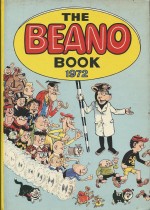
By various (DC Thomson & Co., Ltd.)
Retroactively awarded ISBN: 978-0-85116-038-2

For many British – and indeed Commonwealth – fans, Christmas can only mean The Beano Book (although Scots worldwide and of every nationality have a pretty fair claim that the season belongs exclusively to them via the traditional, annually-alternating collections of The Broons and Oor Wullie which make every December 25th mirthfully magical), so I’ve yet again highlighted another of the venerable and beloved tomes as particularly representative of the Season of Joy.

In those days these annuals were produced in the wonderful “half-colour” British publishers used to keep costs down. This was done by printing sections or “Signatures” of the books with only two plates, such as Cyan (Blue) and Magenta (Red): The sheer versatility and colour range this provided was astounding. Even now this technique inescapably screams “Holidayextras” for me and my contemporaries.

As is always the tragic case, my knowledge of the creators involved is criminally sub-par but I’ll hazard the usual wild guesses in the hope that someone with better knowledge will correct me when I err and embarrassingly get it wrong again…

This boisterously compelling chronicle opens with a double-page splash of The Bash Street Kids (by David Sutherland) breaking the fourth wall and playing mischievous hob with the book’s two-colour formatting, after which The Three Bears by Bob McGrath and the exceedingly domestic Biffo the Bear (Sutherland again) officially welcome us to the festivities.

Leading off this year’s anarchic antics is a splendid school Panto skit starring Minnie the Minx courtesy of Jim Petrie, after which the iconoclastic Dennis the Menace and Gnasher make their first appearance adding their own unique tinge of terror to a school play thanks to prolific diversity of style chameleon David Sutherland.

“Fastest boy on Earth” Billy Whizz (by Malcolm Judge) then experiences painful feedback from a rashly hurled boomerang and his Antipodean counterpart, before the re-assembled Bash Street Kids helpfully assist Teacher get over his over-sleeping problem with the expected catastrophic results in a dedicated and extended niche chapter interwoven with the eccentric and imaginative ‘Bash Street Motor Cartie Show’.

Biffo and human pal Buster go shopping for new furniture next – in an eye-popping blue and yellow segment – after which Roger the Dodger is again outwitted by his dad and Lord Snooty learns the error of his selfish, posh-boy ways in a brace of gloriously funny strips from Robert Nixon, whilst Ronald Spencer’s painfully un-PC but exceedingly hilarious Little Plum follows with the rambunctious redskin falling foul of a bolshie buffalo before Billy Whizz rockets back with a tricky ‘Whizz Quiz’ to test our wits and reactions.

In a previous annual the Bash Street Kids found themselves the reluctant owners of an accident-prone elephant, and she riotously returns here in an extended episode of Pups Parade starring the Bash Street Dogs (and Ethel Hump) by the marvellous Gordon Bell. Stuck with the excitable, ponderous pachyderm by the awesome and omnipotent Beano Editor, the mangy mutts soon handed her off to their arch-foes The Bash Street Cats but it took the canny connivings of ‘The Nibblers’ (drawn by either John Sherwood or Ron Spencer?) to finally quell Ethel’s destructively effusive spirits…

At this time The Beano still had the odd adventure strip and perhaps the greatest of these was local boy superhero Billy the Cat. Here in an expansive section of his own, the plucky acrobat chases burglars over rooftops, crushes bullies, catches car thieves and almost mucks up a fire drill in a rollicking rollercoaster of blistering action by Sandy Calder – and there’s also a splendid ‘Quick on the Draw’ feature inviting readers to become artists themselves…

Biffo the Bear then endures an agony of indecision whilst his hirsute and voracious American cousins The Three Bears got a slap-up Christmas feed even after failing again to breach the impregnable local general store of grocer Hank Huckleberry…

The defences of Bunkerton Castle proved too much when Lord Snooty and His Pals tried to bring in a truly tremendous Xmas tree, but Minnie the Minx had far more success in her spring-heeled hi-jinx – until Dad caught her, at least – whilst the ‘Billy Whizz Diary’ proved its worth in mirth before Little Plum and that buffalo had their hands and hooves full trying to wigwam-train Chiefy‘s latest pet – a Smart Alec chimpanzee…

The Nibblers next resumed their war of attrition with malicious moggy Whiskers whilst Roger’s latest Dodges proved ultimately unsuccessful but did prompt him to dream big and explain what would happen ‘If I Were a Rich Boy…’

Another extended journey to Bash Street found the Kids literally sucking up to Teacher after “borrowing” a Corporation Dust Cart and industrial vacuum cleaner, whilst following some enthralling, appalling ‘Party Puzzles’ the ‘Pup Parade’ ended the segment with a dirty scheme to clean up the dog’s communal dustbin home…

Biffo then worked out with the local Fire Brigade and ‘The Three Bears’ had snow fun at all when Hank trapped them with a frigid, foodless maze, after which Minnie found things to amuse herself – but not so many other folks – building snowmen…

The Festive fun then concludes with a thinly veiled but entertaining ad for that year’s Dennis the Menace Annual and a return to the Bash Street Kids’ colour cavortings…

This is another astoundingly compelling edition, and even in the absence of legendary creators such as Dudley Watkins, Leo Baxendale and Ken Reid there’s no discernable decline in the outrageous and infectious insanity. With so much merriment on offer I can’t believe this forty year old book is still sprightlier and more entertaining than most of my surviving friends and relatives. If ever anything needed to be issued as commemorative collections it’s these fabulous DC Thomson annuals…

Divorcing the sheer quality of this brilliant book from nostalgia may be a healthy exercise – perhaps impossible, but I’m perfectly happy to simply wallow in the magical emotions this annual still stirs. It’s a fabulous laugh-and-thrill-packed read from a magical time, and turning those stiffened two-colour pages is always an unmatchable Christmas experience – and still relatively easy to find these days.

© 1971 DC Thomson & Co., Ltd.

Robin Archives volume 1


By Bob Kane, Bill Finger, Win Mortimer, Jim Mooney & various (DC Comics)
ISBN: 978-1-4012-0415-0

Robin the Boy Wonder debuted in Detective Comics #38 (April 1940), created by Bob Kane, Bill Finger & Jerry Robinson and introduced a juvenile circus acrobat whose parents were murdered by a mob boss. The story of how Batman took the orphaned Dick Grayson under his scalloped wing and trained him to fight crime has been told, retold and revised many times over the decades and still regularly undergoes tweaking to this day.

In the comics continuity Grayson fought beside Batman until 1970 when, as an indicator of those turbulent times, he flew the nest, becoming a Teen Wonder college student and eventually leader of a team of fellow sidekicks and young justice seeker – the Teen Titans.

He graduated to his own featured solo spot in the back of Detective Comics from the end of the 1960s, which he alternated and shared with Batgirl, and held a similar spot throughout the 1970s in Batman and won a starring feature in the anthology comic Batman Family and the run of Giant Detective Comics Dollar Comics. During the 1980s he led the New Teen Titans, first in his original costumed identity but eventually in the reinvented guise of Nightwing, re-establishing a turbulent working relationship with his mentor Batman.

His creation as a junior hero for younger readers to identify with has inspired an incomprehensible number of costumed kid crusaders, and Grayson continues in similar innovative vein for the older, more worldly-wise readership ofAmerica’s increasingly rebellious contemporary youth culture… but his star potential was first realised much earlier in his halcyon career…

From 1947 to 1952, (issues #65-130) Robin the Boy Wonder had his own solo series and regular cover spot in Star Spangled Comics at a time when the first superhero boom was fading to be replaced by more traditional genres such as crime, westerns and boys’ adventure stories. The stories blended in-continuity action capers with more youth-oriented fare with adults Batman and Alfred reduced to minor roles or entirely absent, allowing the kid crusader to display not just his physical skills but also his brains, ingenuity and guts.

This stellar deluxe hardback Archive compilation gathers together the first 21 tales from Star Spangled #65-85 covering February 1947 to October 1948, recapturing the bold, verve and universal appeal of one of fantasy literature’s greatest youth icons, opening with a fascinating Foreword by Roy Thomas, who discusses the origins and merits of boy heroes and the history of the venerable anthology title before offering some insightful guesses as to the identity of the generally un-named writers of the Robin strip.

Although almost universally unrecorded, most historians consider Batman co-creator Bill Finger to be the author of most if not all of the stories in this volume and I’m going to happily concur here with that assessment until informed otherwise…

Star Spangled Comics #65 started the ball rolling with ‘The Teen-Age Terrors’ illustrated by regular artist Win Mortimer (with the inking misattributed to Charles Paris) in which the Caped Crusaders’ faithful butler happens across an unknown trophy and is regaled with Dick’s tale of the time he infiltrated a Reform School to discover who inside was releasing the incarcerated kids to commit crimes on the outside…

That tale segues seamlessly into ‘The No-Face Crimes’ wherein the Boy Wonder acted as stand-in to a timid young movie star targeted by a ruthless killer, whilst #67 revealed ‘The Case of the Boy Wonders’ which saw our hero as part of a trio of boy geniuses kidnapped for the craziest of reasons…

An outrageously flamboyant killing in #68 resulted in the pre-teen titan shipping out on a schooner as a cabin and spending ‘Four Days Before the Mast’ to catch the murderer, after which modern terror took hold when Robin was the only one capable of tracking down ‘The Stolen Atom Bomb’ in a bombastically explosive contemporary spy thriller.

Star Spangled Comics #70 introduced an arch-villain all his own as ‘Clocks of Doom’ saw the debut of an anonymous criminal time-and-motion expert forced into the limelight once his face was caught on film. The Clock‘s desperate attempts to sabotage the movie Robin was consulting on inevitably led to hard time in this delightful romp (this one might possibly be scripted by Don Cameron)…

Chronal explorer Professor Carter Nichols succumbed to persistent pressure and sent Dick Grayson back to the dawn of history in #71’s ‘Perils of the Stone Age’ – a deliciously anachronistic cavemen and dinosaurs epic which saw Robin kick-start freedom and democracy, after which the Boy Wonder crashed the Batplane on a desert island and encountered a boatload of escaped Nazi submariners in ‘Robin Crusoe’ in a full-on thriller illustrated by Curt Swan & John Fischetti.

In #73 the so-very tractable Professor Nichols dispatched Dick to revolutionary France where Robin battled Count Cagliostro, ‘The Black Magician’, in a stirring saga drawn by Jack Burnley & Jim Mooney, after which the Timepiece Terror busted out of jail determined to have his revenge in ‘The Clock Strikes’, illustrated in full by Mooney who would soon become the series’ sole artist.

However Bob Kane & Charles Paris stepped in for the tense courtroom drama in #75 as ‘Dick Grayson for the Defense’ found the millionaire’s ward fighting for the rights of a schoolboy unjustly accused of theft, after which cunning career criminal The Fence came a cropper when he tried to steal 25 free bikes given as prizes to Gotham’s city’s best students in ‘A Bicycle Built for Loot’ (Finger & Mooney).

Prodigy and richest kid on Earth, Bert Beem was sheer hell to buy gifts for, but since the lad dreamed of being a detective, the offer of a large charitable donation secured the Boy Wonder’s cooperation in a little harmless role play. However when real bandits replaced the actors and Santa, ‘The Boy Who Wanted Robin for Christmas’ enjoyed the impromptu adventure of a lifetime…

Another rich kid was equally inspired in #78 and became the Boy Wonder of India, but soon needed the aid of the original when a Thuggee murder-cult tried to destroy ‘Rajah Robin’, whilst in ‘Zero Hour’ (illustrated by Mooney & John Giunta) The Clock struck one more with a spate of regularly-scheduled time crimes before Star Spangled #80 saw Dick Grayson become ‘The Boy Disc Jockey’, only to discover that the station was broadcasting clever instructions to commit robberies in its cryptically cunning commercials…

Robin was temporarily blinded in #81 whilst investigating the bizarre theft of guide dogs, but quickly adapted to his own canine companion and solved the mystery of ‘The Seeing-Eye Dog Crimes’, but had a far tougher time as a camp counsellor for ghetto kids after meeting ‘The Boy Who Hated Robin’. It took grit, determination and a couple of escaped convicts before the kids learned to adapt and accept…

A radio contest led to danger and death before one smart lad earned the prize for discovering who ‘Who is Mr. Mystery?’ in #83, after which Robin tried to discover the causes of juvenile delinquency by going undercover as a notorious new recruit to ‘The Third Street Gang’, and this initial outing ends on a spectacular high as the Boy Wonder sacrifices himself to save Batman and ends up marooned in the Arctic. Even whilst the distraught Caped Crusader is searching for his partner’s body, Robin has responded to the Call of the Wild, joined an Inuit tribe and captured a fugitive from American justice in #85’s ‘Peril at the Pole’…

Beautifully illustrated, wittily scripted and captivatingly addictive, these stirring all-ages traditional superhero hi-jinks are a perfect antidote to teen-angst and the strident, overblown, self-absorbed whining of contemporary comicbook kids. Fast, furious and ferociously fun, these are superb tales no Fights ‘n’ Tights fan will want to miss…
© 1947, 1948, 2005 DC Comics. All Rights Reserved.