JLA/Avengers


By Kurt Busiek & George Pérez, coloured by Tom Smith & lettered by Richard Starkings (DC/Marvel)
ISBN: 978-1-4012-1957-4

Fair Warning: this review deals with the very bedrock of superhero comics. If you’re not utterly au fait with the continuity minutiae of Marvel and DC Comics, this review won’t make much sense, and might well cause migraines or dizziness and could well prevent you from operating gigantic universe-bending machineries.

If you’d rather read something else I’ll quite understand and will hopefully see you tomorrow…

From the moment a kid first sees his second superhero the only thing he/she wants is to see how the new costumed crusader stacks up against the first. From the earliest days of the industry we’ve wanted our idols to meet, associate, battle together – and if you follow the Timely/Marvel model, that means against each other – far more than we want to see them trounce their arch-enemy one more time.

For many years that immature “who’s strongest/fastest/toughest?” preoccupation could only be addressed within individual company boundaries, but once publishers at DC and Marvel realised the sales potential of inter-continuity crossover clashes in the 1970s a veritable torrent of “impossible” superhero mash-ups (of generally excellent artistic quality but mired in inescapably mediocre plots) followed, all generally suffering from the protective partisanship of their legal owners.

After all, who wanted their pantheon to come off second-best in any confrontation?

When a much-touted and eagerly anticipated meeting of the Avengers and Justice League of America famously foundered due to irreconcilable creative differences between the sponsoring publishers, the crossover practise was shelved for years until cooler heads, a general sales decline and the far less hide-bound attitudes of smaller new companies (such as Valiant and Image) who simply found a negotiated way to make these temporary mergers work amicably and effectively, revitalised the whole concept and practise…

Which is a shame as Busiek is one of the most skilled writers in the business, easily ably to inject telling personal emotion and poignant character revelation into the driest plot – but here there’s simply not enough room…

Gathering together the deluxe 4-issue miniseries from 2003-2004, this powers-packed tome opens with a joint Introduction from the co-instigators of the Silver Age of Comics, Julie Schwartz and Stan Lee, after which the non-stop creative chaos begins with ‘A Journey into Mystery’ as the obsessive monster Krona smashes his way into the Cosmos we’ll call Marvel.

The cosmic intruder is a renegade Guardian of his own Universe, driven insane by an insatiable hunger to learn the origin of Reality. His previous rabid inquiries had already introduced evil into his own once-innocent continuum, shortened its sidereal lifespan and reduced an incomparable multiverse to a few straggling survivor dimensions, but now his impassioned search has brought him to a previously unreachable and unsuspected parallel realm only to encounter a being almost his equal…

En Dwi Gast, a puissant conniving being dedicated to games of chance, contests of power and duels of skill, is an Elder of the Universe and one of the most powerful creatures in this existence, but even The Grandmaster is helpless before Krona’s fanatical assault and manic inquisition. Nevertheless the wily immortal manages to inveigle Krona into a diverting little side-bet…

A month later, the world’s greatest champions in two vastly differing dimensions find themselves battling incomprehensible threats from beyond their reality. Investigations indicate that invaders from an alternate Earth are inexplicably appearing and causing devastating damage.

It also seems that the too-incompatible realms are colliding…

Offering a solution, the Grandmaster appears to the Justice League of Americaand sets them off in search of twelve objects of sublime power (six from each Earth) that will end the crisis. On Marvel Earth the morally ambiguous New God Metron tasks the Avengers with the same goal and soon the duped heroes are all engaged in furious and escalating clashes across two worlds, culminating in a shattering confrontation on Earth-DC…

In a place beyond physics and geography, the size-shifting Atom has hitched a ride with the unsuspecting Grandmaster and becomes privy to a private conversation with the New Genesisian God of Knowledge.

However, even after discovering the real nature of the crisis and the true threat involved, the hapless hero is unable to reach either fooled friends or foes to warn them…

‘A Contest of Champions’ open with the JLA and Avengers at war above Metropolis whilst the cooler heads of Batman and Captain America have both deduced that something is not kosher. The two surreptitiously declare a truce and leave their unnaturally enraged comrades to their futile battles and continued competition for the dozen arcane objects of power, and instead track down the Atom in the Grandmaster’s non-dimensional lair.

The deeper plan is revealed: the Grandmaster’s game is rigged and the prize Krona is vying for is possession of Galactus: a being from the reality that preceded the Big Bang…

Meanwhile the massed armies of heroes have finished their savagely fought duels. The Grandmaster’s side has been victorious…

…Which means nothing to Krona who simply blasts the Elder, cruelly claiming and dismantling the prized Galactus as nothing more than a new research tool. However the renegade Guardian has been duped: En Dwi Gast was after the twelve objects all along and uses them to reorder the realities and the once-incompatible Earths…

In a world of constant turmoil and ‘Strange Adventures’, the JLA and Avengers are now old allies, frequently pairing to battle overwhelming menaces in union, but Captain America can’t shake the feeling that something is not right. On anther Earth Batman has the same notion, as blips in reality and temporal hiccups shift heroes and even replace them with dead or departed predecessors. It’s soon clear that Existence is in big trouble and when Superman and Iron Man travel into space they observe huge metaphysical hands catastrophically mashing the two Earths together…

With chaos rising and all life threatened, the constantly changing teams are led by the inscrutably unfathomable Phantom Stranger to a place beyond where the dying Grandmaster – who has once again underestimated the merciless, self-destructive and utterly determined Krona – warns them of the imminent end of all since the Guardian is quite prepared to take the universe apart to find out how it began…

As both worlds shudder and shatter, all the heroes of the earths mobilise to save lives, allowing ‘The Brave… and the Bold’ JLA and Avengers to pursue Krona into the void for one last battle to preserve and restore the universes, but even here a double game is being played: Metron and the Grandmaster have one last surprise in store for when the status quo is inevitably restored…

With guest-shots from just about everybody created by the two comicbook companies over seven decades, there’s a awful lot of crowded, blistering action but not a lot of room for character or plot, but even so most action fans will find something to rave over. Moreover, for art lovers this book is a sublime treat, with some of Pérez’s most spectacular illustration, ably augmented by a stunning cover gallery at the back featuring all four of his stellar wraparound covers.

It’s fair to say that I’m not a great fun of such profit-led pairings, but there’s still enough of the fan-boy in me to viscerally thrill at armies of costumed stalwarts bashing the bezonkers out of each other and, even if the story is forced and patently menu-led (one from company A, one from Company B, over and over again…), there are still some nice fanatic-friendly touches and witty in-jokes whilst inarguably the artwork – every millimetre stuffed with manic detail and wry, deferential tributes and touches – is amongst the very best George Pérez has ever produced.

If you like this sort of thing this is certainly one of the best of its ilk…

© 2003, 2004, 2008 DC Comics and Marvel Characters, Inc. All Rights Reserved.

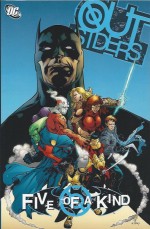
Outsiders: Five of a Kind


By many and various (DC Comics)
ISBN: 978-1-4012-1672-6

Set after and resulting from the earth-shaking events of 52, this tension-drenched, fast-paced series always combined gritty metahuman angst with ferocious action and a huge helping of wry, bleak cynicism as it followed a band of outcast and undercover champions into places and situations safe, regular superheroes wouldn’t and couldn’t go, but times and changing fashions – and probably shrinking sales – eventually predicated the return of Batman to the masthead and the mix of epic unrealpolitik and edgy, cynically grim-and-gritty nastiness…

Finally exposed to a world which had believed them all dead, and also blamed for setting off an atomic blast which devastated a large part of Russia, the underground metahuman coalition known as The Outsiders – “rogue” superheroes who proactively sought out threats and ignored political boundaries or repercussions – found themselves on the edge of oblivion as their series hurtled towards a blistering climax and a major reboot.

Following the spectacular crossover Outsiders/ Checkmate: Check Out this concluding collection gathers five one-shots (released under the umbrella title Five of a Kind) in which Batman auditioned established members and intriguing alternates to form the core of a new covert unit which worked on the peripheries of the system, beyond the niceties of the law, but always at the Dark Knight’s express command…

Collecting Nightwing and Captain Boomerang Jr., Katana and Shazam!, Thunder and Martian Manhunter, Metamorpho and Aquaman, and Grace and Wonder Woman as well as that climactic last issue finale in Outsiders #50, the drama begins after a mercifully concise text recap with ‘Grudge Match’ by Nunzio Defillipis, Christina Weir & Freddie Williams III, wherein the super-fast son of Digger Harkness and Batman’s oldest protégé were dispatched to investigate a space station that had gone ominously dark, only to find a deadly chemical menace and brutal betrayal…

‘The Queen of Swords & the King of Rock’ by Mike W. Barr, Kevin Sharpe & Robin Riggs, saw Katana and magical maven Captain Marvel invade the ghostly realm where her sword imprisoned the souls of all the people it had killed to forestall a rebellion of the doubly-damned…

‘Bug-Eyed Monsters’ (Tony Bedard, Koi Turnbull & Art Thibert) found J’onn J’onzz and the tempestuous daughter of Black Lightning investigating an alien incursion miles beneath the Earth’s crust, only to stumble into Grayven, Prince of Apokolips, a murdering maniac fleeing the unstoppable eradicator of his species (for which check out the imaginatively titled The Death of the New Gods), whilst ‘Rogue Elements’ by G. Willow Wilson & Josh Middleton saw the Chemical Crusader and a very raw replacement Sea King try to save an aquifer under the Sahara Desert from contamination and corporate exploitation with the unexpected assistance of Arabic Avenger Hadya.

Finally ‘Member of the Tribe’ (Marc Andreyko, Cliff Richards & Thibert) plunged irascible orphan Grace into a storm of anti-Amazon prejudice and a potential nuclear nightmare that not even distant cousin Wonder Woman could help her with before all the weary applicants reluctantly reunited for a fraught epilogue by Bedard…

The convoluted  casting-call concluded with ‘You Killed the Outsiders!’ by Bedard, Matthew Clark, Ron Randall & Art Thibert, as the Dark Knight sent his newly-minted but utterly unhappy undercover ultra-squad to infiltrate a nightclub where only the weirdest and wildest of Gotham’s criminal underworld hung out.

What they didn’t know was that the sting wasn’t to trap bad guys but rather off-the-books government spooks illegally rounding them up and deporting them without due process to an alien world…

For the end of that tale you’ll need to see the companion graphic novel JLA: Salvation Run…

As much a clearing of the decks as cleansing of the palate, this last hurrah still delivers a supremely stylish knockout Fights ‘n’ Tights punch that older fans will truly appreciate and if you love outrageous adventure, sexy heroes and truly vile bad-guys (many of them working for “our side”), this deliciously dark, utterly OTT compilation has great pace, superb dialogue, loads of gratuitous violence and beautifully cool art.

Brutal, uncompromising and savagely action-packed, the maverick tendencies of the Outsiders ended long ago, yet these painfully plausible superhero sagas are still gripping, shocking and extremely readable: compelling comics tales which will enthral all serious fans of the genre.
© 2008 DC Comics. All Rights Reserved.

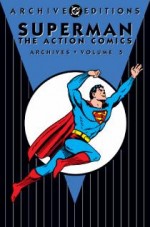
Superman: the Action Comics Archives volume 5


By Jerry Siegel & Joe Shuster, Don Cameron, Ed Dobrotka, Sam Citron, Ira Yarbrough, John Sikela & others (DC Comics)
ISBN: 978-1-4012-1188-2

It’s almost incontrovertible: the American comicbook industry – if it existed at all – would be an utterly unrecognisable thing without the invention of Superman. His unprecedented adoption by a desperate and joy-starved generation quite literally gave birth to a genre if not an actual art form.

Within three years of his 1938 debut, the intoxicating blend of eye-popping action and social wish-fulfilment which hallmarked the early Man of Steel had grown to encompass cops-and-robbers crime-busting, socially reforming dramas, science fiction, fantasy, whimsical comedy and, once the war in Europe and the East embroiled America, patriotic relevance.

In comicbook terms at least Superman was master of the world, and had already utterly changed the shape of the fledgling industry. There was the phenomenally popular newspaper strip, a thrice-weekly radio serial, games, toys, as much global syndication as the war would allow and the perennially re-run Fleischer studio’s astounding animated cartoons.

The Golden Age greats herein reprinted from issues #69-85 of the groundbreaking anthology Action Comics begin their mind-warping wonderment after a fond Foreword reminiscence from Silver Age scribe and comicbook International Treasure Roy Thomas

Co-creator Jerry Siegel was finally called up in 1943 and his prodigious script output was curtailed, necessitating greater contributions from the ingenious and multi-faceted Don Cameron and others, whilst Joe Shuster – increasingly debilitated by failing eyesight and tied up producing the far more prestigious newspaper strip – had to leave the bulk of the artwork in the hands of the trusty, ever-changing stalwarts of the Superman Studio who were drawing most of the comicbook output at this time.

By this time though the quality of the source material began to suffer slightly as Siegel & Shuster’s rotating band of artistic stand-ins were themselves continually called away to serve in the armed forces, but the three magazines supplying the Metropolis Marvel’s core readership (Action Comics, Superman and World’s Finest Comics) always adapted and always came through with more and greater spectacular thrills, spills and chills to cope with the relentless demands of the growing legion of fans.

Superman was definitely every kid’s hero, as confirmed yet again in this classic compendium which saw the Man of Tomorrow and the avid audiences through the last weary days of World War II.

Due to the exigencies of periodical publishing, although the terrific tales collected in this fabulous fifth hardback tome putatively take the Man of Steel from February 1944 to June 1945, since cover-dates described return-by, not on-sale dates they were all prepared well in advance, and real-world events and reactions took a little time to filter through to the furious four-colour pages, so some of the stories have a tinge of uncertainty and foreboding that was swiftly fading from the minds of the public as the far more immediate movie-newsreels showed an inexorable turning of the tide in the Allies’ favour.

As the months rolled by however, mention of the conflict declined as the characters got on with the business of battling for Truth, Justice and the American Way, unencumbered by the dwindling threat of real-world monsters and tyrants…

There’s no greater evidence of that fact than the simple realisation that only one of the stunning covers included in this compilation (#76, by Wayne Boring & Stan Kaye) has a war theme – and that’s directly pertinent to the tale within – whilst the rest by Boring, Kaye, Jack Burnley, Joe Shuster & John Sikela, all feature more general themes of calamity, comedy and criminality, augmented by the then-new notion of using the first image seen by readers to actually highlight the Superman story inside…

Action Comics #69 offered ‘The Lost-and-Found Mystery!’ (credited here to Sam Citron but more likely Ed Dobrotka illustrating a Siegel script) wherein pernicious plunderer The Prankster returned with a wily wrangle that involved using bogus small ads to extort money from prominent people with something to hide.

Issue #70 saw ‘Superman Takes a Holiday!’ (Cameron & Citron) when a criminal spree by the brilliantly insidious Thinker proved the villain had the Action Ace’s number. However the Gangster Genius couldn’t outwit merely mortal crimebuster Clark Kent, whilst a calamitous comedy of errors in #71’s ‘Valentine Villainy!’ (Cameron & Ira Yarbrough) saw Kent, Superman, Lois Lane, Jimmy Olsen and a bold jewel thief all collide and inadvertently trade their lovers’ lagniappes with heartbreaking, hilarious, catastrophic and near catastrophic results.

Although Action #72 saw the Man of Steel uncover Nazi spies in ‘Superman and the Super-Movers!’ by Siegel, Shuster & George Roussos, they were merely a throwaway sidebar to the gripping tale of a construction company performing big jobs for a clandestine criminal purpose, after which ‘The Hobby Robbers!’ (#73 by Siegel, Citron & Roussos) predicted today’s modern-day collector mania in an astute tale about the lengths enthusiasts will go to if their treasured possessions are pilfered. Oddly comicbooks were not one of the collections under threat…

Even today the authors of many early tales are still unknown to us, as with the delightfully daft romance illustrated by Yarbrough in #74. ‘The Courtship of Adelbert Dribble!’ saw a Jack Benny look-alike wimp lure the Man of Tomorrow into an ingenious trap simply so the sap could play Superman for a day and woo his far-from fair maid. Of course it all went awry but the Metropolis Marvel was eventually there to save the day and see true love victorious.

Also anonymous are the Yarbrough-limned ‘Aesop’s Modern Fables’ which pitted the Man of Steel against a cunning gangster who planned his capers along classical Greek lines, and the unconventional Dobrotka chiller ‘A Voyage to Destiny!’ wherein Superman’s early days were revisited as a spoiled trust-fund brat became a reluctant sailor in 1939, shipping out solely to secure his inheritance. However, after battling thugs and confronting Japanese soldiers – with the covert assistance of a Kryptonian Guardian Angel – wastrel Roger Carson had become a man Superman could be proud of, and a credit to the US Navy…

Action #77 – credited to Cameron & Dobrotka but possibly scripted by Siegel – saw the Prankster on his uppers until the rotund reprobate began scamming greedy but technically honest citizens with ‘The Headline Hoax!’ Happily Superman showed everybody the error of their ways before aiding ‘The Chef of Bohemia!’ (by Alvin Schwartz & Yarbrough in #78) whose simple diner supported many starving artists but stood in the way of murderous property speculators…

Micawber-like conman Wilbur J. Wolfingham reared his unscrupulous head in #79’s ‘The Golden Fleece!’ by Cameron & Yarbrough, attempting to con sheep-farmers into re-purchasing their own gold-salted properties until Lois and Superman again proved honesty was his best policy, after which zany pixy and madcap mystical gadfly ‘Mr. Mxyztplk Returns!’ found the aggravating elf driving Superman batty in a brilliantly bonkers yarn from Cameron & Yarbrough.

Action #81’s seasonal thriller ‘Fairyland Isle!’ (the first of two anonymous tales drawn by Yarbrough) saw Superman and a millionaire Santa Claus join forces to give deprived kids a free holiday, despite the worst efforts of two of the rich man’s greedy nephews, whilst a small town with big plans was plagued by a seemingly supernatural killer called ‘The Water Sprite!’ determined to scotch plans for an artificial lake until Lois and Clark did a little digging of their own in issue #82.

Siegel & Shuster reunited in #83 to introduce a team they clearly had high hopes for. ‘Hocus and Pocus… Magicians by Accident!’ saw affable chumps Doc and Flannelhead, mistakenly believing themselves to have gained magical powers, threatened into committing miraculous crimes: luckily an ever-vigilant Man of Tomorrow was invisibly at their sides to set things right… Hocus and Pocus – and their indomitable bunny pal Moiton – set themselves up as consulting detectives at the end and would return to complicate Superman’s life again and again…

Joe Greene & John Sikela concocted the crafty crime tale ‘Tommy Gets a Zero!’ wherein a lovelorn little boy writes a report on gangsters for school and accidentally becomes Superman’s sidekick. Of course his teacher didn’t believe him but Tommy had a higher authority to appeal to…

This stellar collection concludes with the reappearance of another lethal old lag as the mercilessly murderous Toyman resurfaced, attacking apparently poor targets whilst secretly attempting to solve ‘The Puzzle in Jade!’ (by Cameron & Dobrotka). Happily Superman was there to keep casualties to a minimum and put the Ghastly Gamesman back in his prison box…

These vintage vignettes offer irresistible and priceless enjoyment at an affordable price and this superbly robust and colourful format has inestimably advanced the prestige and social standing of the medium itself as well as preserving a vital part of American popular culture.

Still some of the very best action adventures any fan could ever find, these tales belong on your bookshelf in a place of easily accessible honour you can reach for over and over again…
© 1944, 1945, 2007 DC Comics. All Rights Reserved.

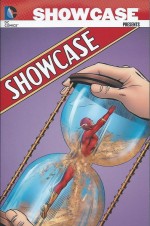
Showcase Presents Showcase volume 1


By various (DC Comics)
ISBN: 978-1-78116-364-1

This review is incredibly long. If you want to skip it and just buy the book – because it’s truly brilliant – then please do. I won’t mind and you won’t regret it at all…

In almost every conceivable way the “try-out title” Showcase created the Silver Age of American comicbooks and is responsible for the multi-million dollar industry and nascent art form we all enjoy today.

For many of us, the Silver Age is the ideal era and a still-calling Promised Land of fun and thrills. Varnished by nostalgia (because it’s the era when most of us caught this crazy childhood bug), the clean-cut, uncomplicated optimism of the late 1950s and early 1960s produced captivating heroes and compelling villains who were still far less terrifying than the Cold War baddies then troubling the grown-ups. The sheer talent and professionalism of the creators working in that too-briefly revitalised comics world resulted in triumph after triumph all of which brightened our young lives and still glow today with quality and achievement.

The principle was a sound one and graphically depicted in the very first issue: the Editors at National were apparently bombarded with readers’ suggestions for new titles and concepts and the only possible way to feasibly prove which would be popular was to offer test runs and assess the fans reactions…

This magnificent monochrome tome starts firmly ensconced in the age of genre thrillers and human adventurers, covering the first 21 issues from that historic series, spanning March/April 1956 to July/August 1959, and starts the ball rolling with the first and last appearances of Fireman Farrell in a proposed series dubbed Fire Fighters.

Following the aforementioned short ‘The Story Behind Showcase’ by Jack Schiff & Win Mortimer, the realistic dramas begin in ‘The School for Smoke-Eaters’ by Schiff and the superb John Prentice, which introduced trainee fireman Mike Farrell during the last days of his training and desperate to simultaneously live up to and escape his father’s fabulous record as a legendary “smoke-eater”.

The remaining stories, both scripted by Arnold Drake, dealt with the day-to-day drama of the job: first in ‘Fire under the Big Top’ wherein an unscrupulous showman ignored Farrell’s Fire Inspection findings with tragic consequences, then in ‘Fourth Alarm’ which mixed an industrial dispute over fireman’s pay, a crooked factory owner and a waterfront blaze captured on live TV in a blisteringly authentic tale of human heroism.

Showcase #2 featured Kings of the Wild: tales of animal bravery imaginatively related in three tales scripted by Robert Kanigher – who had thrived after the demise of superheroes with a range of fantastical genre adventures covering western, war, espionage and straight adventure. ‘Rider of the Winds’, stunningly illustrated by Joe Kubert, told the tale of a Native American lad and his relationship with his totem spirit Eagle, ‘Outcast Heroes’ (Ross Andru & Mike Esposito) related how an orphan boy’s loneliness ended once he befriended a runaway mutt who eventually saved the town’s kids from a flood and ‘Runaway Bear’, drawn by Russ Heath, used broad comedy to describe how an escaped circus bruin battled all the horrors of the wilderness to get back to his comfortable, safe life under the Big Top.

Issue #3 debuted Kanigher & Heath’s The Frogmen in an extended single tale following candidates for a US Underwater Demolitions Team as they moved from students to successful undersea warriors. Beginning with ‘The Making of a Frogman’ as the smallest diver is mocked and chided as a ‘Sardine’ by his fellows – especially the ones nicknamed ‘Shark’ and ‘Whale’ – but persevering and forging bonds until the trio were dumped into blazing Pacific action in ‘Flying Frogmen’, eventually learning the worth of teamwork and sacrifice by destroying a Japanese Sub base in ‘Silent War’…

The feature, if not the characters, became a semi-regular returning strip in All-American Men of War #44 (April #1957) and other Kanigher-edited war comics: making Frogmen the first but certainly not the last graduate of the try-out system. The next debut was to be the most successful but the cautious publishers took a long, long time to make it so…

No matter which way you look at it, the Silver Age of the American comic book began with The Flash. It’s an unjust but true fact that being first is not enough; it also helps to be best and people have to notice. The Shield beat Captain America to the news-stands by over a year yet the former is all but forgotten today.

The industry had never really stopped trying to revive the superhero genre when Showcase #4 was released in late summer of 1956, with such precursors as The Avenger (February-September 1955), Captain Flash (November 1954-July 1955), Marvel’s Human Torch, Sub-Mariner and the aforementioned Sentinel of Liberty (December 1953-October 1955) and even DC’s own Captain Comet (December 1953-October 1955) and Manhunter from Mars (November 1955 until the end of the 1960’s and almost the end of superheroes again!) still turning up in second-hand-stores and “Five-and-Dime” half-price bins. What made the new Fastest Man Alive stand out and stick was … well, everything!

Once the DC powers-that-be decided to try superheroes once more, they moved pretty fast themselves. Editor Julie Schwartz asked office partner and Golden-Age Flash scripter Robert Kanigher to recreate a speedster for the Space Age, aided and abetted by Carmine Infantino & Joe Kubert, who had also worked on the previous incarnation.

The new Flash was Barry Allen, a forensic scientist simultaneously struck by lightning and bathed in the exploding chemicals of his lab. Supercharged by the accident, Barry took his superhero identity from a comic book featuring his predecessor (a scientist named Jay Garrick who was exposed to the mutagenic fumes of “Hard Water”). Designing a sleek, streamlined bodysuit (courtesy of Infantino – a major talent who was rapidly approaching his artistic and creative pinnacle), Barry Allen became the point man for the spectacular revival of a genre and the entire industry.

‘Mystery of the Human Thunderbolt’ (scripted by Kanigher) and ‘The Man Who Broke the Time Barrier’ (written by the superb John Broome) are polished, coolly sophisticated short stories that introduce the comfortingly suburban superhero and firmly establish the broad parameters of his universe. Whether defeating bizarre criminal masterminds such as The Turtle or returning the criminal exile Mazdan to his own century, the new Flash was a protagonist of keen insight and sharp wits as well as overwhelming power. Nonetheless the concept was so controversial that despite phenomenal sales, rather than his own series the Fastest Man Alive was given a second Showcase tryout almost a year later…

Showcase #5 featured the last comics concept in years that didn’t actually develop into an ongoing series, but that’s certainly due to the changing fashions of the times and not the quality of the work that made up the three crime yarns comprising the cops-&-robbers anthology Manhunters. ‘The Greatest Villain of all Time’ by Jack Miller & Mort Meskin told how Hollywood screenwriter-turned-police detective Lt. Fowler was dogged by a madman who was playing for real all the fantastic bad guys the mystery author had once created, whilst in ‘The Two Faces of Mr. X’ (Miller, Curt Swan & Sy Barry) a male model was drafted by the FBI to replace a prominent mob-boss. Unfortunately it was the day before the gangster was scheduled for face-changing plastic surgery.‘The Human Eel’ (Miller & Bill Ely) pitted a cop unable to endure heights against an international high-tech rogue who thought he knew all the answers…

The next tryout was on far firmer fashion grounds and was the first feature to win two issues in a row.

The Challengers of the Unknown were a bridging concept. As the superhero genre was ever so cautiously being alpha-tested in 1956 here was a super-team – the first new group- entry of the still-to-be codified Silver Age – but with no uncanny abilities or masks, the most basic and utilitarian of costumes, and the most dubious of motives: Suicide by Mystery…

If you wanted to play editorially safe you could argue that were simply another para-military band of adventurers like the long running Blackhawks… but they weren’t.

A huge early hit – winning their own title before the Flash (March 1959) and just two months after Lois Lane (March 1958, although she had been a star in the comics universe since 1938 and even had TV, radio and movie recognition on her side), the Squad struck a chord that lasted for more than a decade before they finally died… only to rise again and yet again. The idea of them was stirring enough, but their initial execution made their success all but inevitable.

Jack Kirby was – and still is – the most important single influence in the history of American comicbooks. There are quite rightly millions of words written about what the man has done and meant, and you should read those if you are at all interested in our medium. I’m going to add a few words to that superabundance in this review of one of his best projects, which like so many others, he perfectly constructed before moving on, leaving highly competent but never as inspired talents to build upon.

When the comic industry suffered a collapse in the mid 1950’s, Kirby returned briefly to DC Comics where he worked on mystery tales and the Green Arrow back-up strip whilst creating the newspaper strip Sky Masters of the Space Force. He also re-packaged for Showcase an original super-team concept that had been kicking around in his head since he and long-time collaborator Joe Simon had closed the innovative but unfortunate Mainline Comics.

After years of working for others, Simon and Kirby had finally established their own publishing company, producing comics with a much more sophisticated audience in mind, only to find themselves in a sales downturn and awash in public hysteria generated by the anti-comic book pogrom of US Senator Estes Kefauver and the psychologist Dr. Frederic Wertham. Simon quit the business for advertising, but Kirby soldiered on, taking his skills and ideas to a number of safer, if less experimental, companies.

The Challengers of the Unknown were four extraordinary mortals; heroic adventurers and explorers brought together for a television show who walked away unscathed from a terrible plane crash. Already obviously what we now call “adrenaline junkies”, they decided that since they were all living on borrowed time, they would dedicate what remained of their lives to testing themselves and fate. They would risk their lives for Knowledge and, of course, Justice.

Showcase #6, dated January/February 1957 – which meant it came out in time for Christmas 1956 – introduced pilot Ace Morgan, wrestler Rocky Davis, daredevil acrobat Red Ryan and scholarly marine explorer “Prof” Haley in a no-nonsense short by Kirby, scripter Dave Wood and inkers Marvin Stein and Jack’s wife Roz, before devoting the rest of the issue to a spectacular epic with the doom-chasers hired by duplicitous magician Morelian to open an ancient container holding otherworldly secrets and powers in ‘The Secrets of the Sorcerer’s Box!’

This initial story roars along with all the tension and wonder of the B-movie thrillers it emulates, and Kirby’s awesome drawing resonates with power and dynamism as the heroes tackle ancient horrors such as ‘Dragon Seed!’, ‘The Freezing Sun!’ and ‘The Whirling Weaver!’

The fantasy magic continued in the sequel, a science fiction crisis caused when an alliance of Nazi technologies and American criminality unleashed a terrible robotic monster. Scripted by Kirby himself, ‘Ultivac is Loose!’ (Showcase #7, dated March/April 1957) introduced the beautiful and capable boffin Dr. June Robbins, who became the fifth Challenger at a time when most comic females had returned to a subsidiary status in that so-conservative era. As her computers predicted ‘A Challenger Must Die!’ the lads continued their hunt for the astonishing telepathic, sentient super-robot who inadvertently terrorised ‘The Fearful Millions’ but soon found their sympathies with the tragic artificial intelligence after ‘The Fateful Prediction!’ was fulfilled…

Showcase #8 (June 1957) again featured the Flash and led with another Kanigher tale. ‘The Secret of the Empty Box’, a perplexing but pedestrian mystery, saw Frank Giacoia debut as inker, but the real landmark was the John Broome thriller ‘The Coldest Man on Earth’.

With this yarn the author confirmed and consolidated the new phenomenon by introducing the first of a Rogues Gallery of outlandish super-villains. Unlike the almost forgotten Golden Age the new super-heroes would face predominantly costumed foes rather than thugs and spies. Bad guys would henceforth be as visually arresting and memorable as the champions of justice. Captain Cold would return time and again as the pre-eminent Flash Foe and Broome would go on to create every single member of Flash’s classic pantheon of super-villains.

The issue and this compilation also includes a filler reprint ‘The Race of Wheel and Keel’ by Gardner Fox, Gil Kane & Harry Lazarus, probably from Real Fact Comics and recounting the true story of how in 1858 a shipping magnate and stagecoach tycoon devised a contest to show which method of transportation was the fastest…

When Lois Lane – arguably the oldest supporting character/star in the Superman mythology if not DC universe – finally received her own shot at a solo title, it was very much on the terms of the times.

I must shamefacedly admit to a deep, nostalgic affection for her bright and breezy, fantastically fun adventures, but as a free-thinking, (nominally) adult liberal of the 21st century I’m simultaneously shocked nowadays at the jolly, patronising, patriarchally misogynistic attitudes underpinning too many of the stories.

Yes, I’m fully aware that the series was intended for young readers at a time when “dizzy dames” like Lucille Ball or Doris Day played to the popular American gestalt stereotype of Woman as jealous minx, silly goose, diffident wife and brood-hungry nester, but to ask kids to seriously accept that intelligent, courageous, ambitious, ethical and highly capable females would drop everything they’d worked hard for to lie, cheat, inveigle, manipulate and entrap a man just so that they could cook pot-roast and change super-diapers is just plain crazy and tantamount to child abuse.

I’m just saying…

Showcase #9 (cover-dated July/August 1957) featured Superman’s Girl Friend Lois Lane in three tales by Jerry Coleman, Ruben Moreira & Al Plastino and opened with the seminal yarn ‘The Girl in Superman’s Past’ wherein Lois first met red-headed hussy Lana Lang, childhood sweetheart of Superboy and a pushy conniving go-getter out to win Lois’ intended at all costs. Naturally Miss Lane invited Miss Lang to stay at her apartment and the grand rivalry was off and running…

‘The New Lois Lane’ aggravatingly saw Lois turn over a new leaf and stop attempting to uncover his secret identity just when Superman actually needed her to do so and the premier concludes with the concussion-induced day-dream ‘Mrs. Superman’ as Lois imagines a life of domestic super-bliss…

The next issue (September/October 1957) featured three more of the same, all illustrated by Wayne Boring & Stan Kaye, beginning with ‘The Jilting of Superman’ scripted by Otto Binder, wherein the Man of Tomorrow almost fell for an ancient ploy when Lois pretended to marry another man to make the alien oaf realise what she meant to him…

‘The Sightless Lois Lane’ by Coleman told how a nuclear accident temporarily blinded the journalist, but her unexpected recovery almost exposed Clark Kent‘s secret when he callously changed to Superman in front of the blind girl, after which Binder delightfully detailed the contents of ‘The Forbidden Box from Krypton’: a cache of devices dug up by a Smallville archaeologist originally packed by Jor-El and intended to aid the infant superbaby on Earth. Of course when Lois opened the chest all she saw was a way to become as powerful as the Man of Steel and soon became addicted to being a super-champion in her own right…

Superman’s Girlfriend Lois Lane launched into her own title scant months later, clearly exactly what the readers wanted…

Showcase #11 (November/December 1957) saw the Challengers return to combat an alien invasion on ‘The Day the Earth Blew Up’, with the unique realist Bruno Premiani inking a taut doomsday chiller that keeps readers on the edge of their seats even today, as whilst searching for missing Antarctic explorers the lads discovered an under-ice base where double-brained aliens were preparing to explosively alter the mass and gravity of Earth.

‘The Tyrans’, although intellectually superior, are no match for the indomitable human heroes and with their Plan A scotched, resort to brute force and ‘The Thing That Came out of the Sea’ even as Prof scuttles their aquatic ace in the hole with ‘One Minute to Doom’…

By the time of their last Showcase issue (#12, January/February 1958) they had already won their own title. ‘The Menace of the Ancient Vials’ was defused by the usual blend of daredevil heroics and ingenuity (with the wonderful inking of George Klein, not Wally Wood as credited here) as international spy and criminal Karnak stole a clutch of ancient chemical weapons which created giants and ‘The Fire Being!’, summoned ‘The Demon from the Depths’ and created ‘The Deadly Duplicates!’ before the pre-fantastic four were able to put their enemy down.

Flash zipped back in Showcase #13 (March/April 1958) in a brace of tales pencilled by Infantino and inked by Joe Giella. ‘Around the World in 80 Minutes’, written by Kanigher, followed the Scarlet Speedster as he tackled atomic blackmail in Paris, foiled kidnappers and rebuilt a pyramid in Egypt, dismantled an avalanche in Tibet and scuttled a pirate submarine in the Pacific whilst Broome’s ‘Master of the Elements’ introduced the outlandish chemical criminal Al Desmond who ravaged Central City as Mr. Element until the Flash outwitted him.

One final try-out issue – inked by Giacoia – cemented the Flash’s future: Showcase#14 (May/June 1958) opened with Kanigher’s eerie ‘Giants of the Time-World!’ as the Fastest Man Alive smashed dimensional barriers to rescue his girlfriend Iris West from uncanny cosmic colossi and stamped out an alien invasion plan, after which Al Desmond returned with an altered M.O. and new identity as Doctor Alchemy whose discovery of the mystic Philosopher’s Stone made him ‘The Man who Changed the Earth!’ This stunning yarn was a memorable and worthy effort to bow out on, but it would still be a nearly a year until the first issue of his own title finally hit the stands.

To reiterate: Showcase was a try-out comic designed to launch new series and concepts with minimal commitment of publishing resources. If a new character sold well initially a regular series would follow. The process had been proved with Frogmen, Lois Lane, Challengers of the Unknown and Flash and Editorial Director Irwin Donenfeld now urged his two Showcase editors to create science fiction heroes to capitalise on the twin zeitgeists of the Space Race and the popular fascination with movie monsters and aliens.

Jack Schiff came up with a “masked” crimefighter of the future who debuted in issues #15 and 16 whilst Julie Schwartz decided to concentrate on the now in the saga of a contemporary Earth explorer catapulted into the most uncharted territory yet imagined.

Showcase #15 (cover-dated September/October 1958) commenced without fanfare or origin the ongoing adventures of Space Ranger in ‘The Great Plutonium Plot’ plotted by Gardner Fox, scripted by pulp sci-fi veteran Edmond Hamilton and illustrated by Bob Brown.

The hero was in actuality Rick Starr, son of a wealthy interplanetary businessman who spent his free time battling evil and injustice with incredible gadgets and devices and the assistance of his shape-shifting alien pal Cryll and capable Girl Friday Myra Mason. When Jarko the Jovian space pirate began targeting only ships carrying the trans-uranic element, Rick suspected a hidden motive and donning his guise of the Space Ranger laid a cunning trap, which revealed a hidden mastermind and a deadly ancient device which endangered the entire solar system…

From his base in a hollow asteroid, Space Ranger ranged the universe and ‘The Robot Planet’ took him and his team to Sirius after discovering a diabolical device designed to rip Sol’s planets out of their orbits. At the end of his voyage Starr discovered a sublime civilisation reduced to cave-dwelling and a mighty computer intelligence intent on controlling the entire universe unless he could stop it…

Issue #16 opened with ‘The Secret of the Space Monster’ (plot by John Forte, scripted by Hamilton, illustrated by Brown) as Rick, Myra and Cryll investigated an impossible void creature and uncovered a band of alien revolutionaries testing novel super-weapons after which ‘The Riddle of the Lost Race’ (Fox, Hamilton & Brown) took the team on a whistle-stop tour of the Solar system in pursuit of a vicious criminal and the hidden treasures of a long-vanished civilisation.

A few months later Space Ranger was transported to science fiction anthology Tales of the Unexpected, beginning with issue #40 (August 1959) and holding the lead and cover spot for a six year run…

One of the most compelling stars of those halcyon days was an ordinary Earthman who regularly travelled to another world for spectacular adventures, armed with nothing more than a ray-gun, a jetpack and his own ingenuity. His name was Adam Strange, and like so many of that era’s triumphs, he was the brainchild of Julius Schwartz and his close team of creative stars.

Showcase #17 (cover-dated November-December 1958) proclaimed Adventures on Other Worlds, courtesy of Gardner Fox, Mike Sekowsky & Bernard Sachs, and told of an archaeologist who, whilst fleeing from enraged natives in Peru, jumped a 25 foot chasm only to be hit by a stray teleport beam from a planet orbiting Alpha Centauri. He materialised on another world filled with giant plants and monsters, and was rescued by a beautiful woman named Alanna who taught him her language via a cunning contrivance.

‘Secret of the Eternal City!’ revealed that Rann was a planet recovering from atomic war, and the beam was in fact a simple flare, one of many sent in an attempt to communicate with other races.

In the four years (speed of light, right? As You Know, Bob, Alpha Centauri is about 4.3 light-years from Sol) that the Zeta-Flare travelled through space, cosmic radiation converted it into a teleportation beam. Until the radiation drained from his body Strange was to be a very willing prisoner on a fantastic world of mystery, adventure and romance…

And an incredibly unlucky one apparently, as no sooner had Adam started acclimatising than an alien race named The Eternals invaded, seeking a mineral that would grant them immortality. Strange’s courage and sharp wits enabled him to defeat the invaders only to have the radiation finally fade, drawing him home before his adoring Alanna could administer a hero’s reward.

…And thus was established the principles of this beguiling series. Adam would intercept a Zeta-beam hoping for some time with his alien sweetheart, only to be confronted with a planet-menacing crisis.

The very next of these, ‘The Planet and the Pendulum’ saw him obtain the crimson-and-white spacesuit and weaponry that became his distinctive trademark in a tale of alien invaders, attacking a lost colony of Rannians on planetary neighbour Anthorann which also introduced the subplot of Rann’s warring city-states, all desperate to progress and all at different stages of recovery and development….

The next issue featured the self-explanatory ‘Invaders from the Atom Universe’ with sub-atomic marauders displacing the native races until Adam unravelled their nefarious plans and ‘The Dozen Dooms of Adam Strange’ wherein the hero had to outfox the dictator of Dys who planned to invade Alanna’s home-city Rannagar.

With this last story Sachs was replaced by Joe Giella as inker, although the former did ink Showcase #19’s stunning Gil Kane cover, (March/April 1959) which saw the unwieldy Adventures on Other Worlds title replaced with the eponymous logo Adam Strange.

‘Challenge of the Star-Hunter’ and ‘Mystery of the Mental Menace’ were classic puzzle tales wherein the Earthman had to outwit a shape-changing alien and an all-powerful energy-being, and after so doing Adam Strange took over the lead spot and cover of the anthology comic Mystery in Space with the August issue of that year.

Clearly on a creative high and riding a building wave, Showcase #20 (May/June 1959) introduced Rip Hunter… Time Master and his dauntless crew as ‘Prisoners of 100 Million BC’ (by Jack Miller & Ruben Moreira in a novel-length introductory escapade which saw the daredevil physicist, his engineer friend Jeff Smith, girlfriend Bonnie Baxter and her little brother Corky travel back to the Mesozoic era, unaware that they were carrying two criminal stowaways.

Once there the thugs hi-jacked the Time Sphere and held it hostage until the explorers helped them stock up with rare and precious minerals. Reduced to the status of castaways Rip and his team became ‘The Modern-Day Cavemen’ but when an erupting volcano caused ‘The Great Beast Stampede’ the chrononauts finally turned the tables on their abductors…

Miller was always careful to use the best research available but never afraid to blend historical fact with bold fantasy for Hunter’s escapades, and this volume concludes with an epic follow-up in ‘The Secret of the Lost Continent’ (Showcase #21, July/August, 1959, illustrated by Sekowsky & Joe Giella) wherein the Time Masters jumped progressively further back in time in search of Atlantis.

Starting with a dramatic meeting with Alexander the Great in 331BC, the explorers follow the trail back centuries to ‘The Forbidden Island’ of Aeaea in 700BC and uncover the secret of the witch Circe before finally reaching 14,000BC and ‘The Doomed Continent’ only to find the legendary pinnacle of early human achievement to be a colony of stranded extraterrestrial refugees…

Rip Hunter would appear twice more in Showcase before winning his own comic and the succeeding months would see the Silver Age kick into frantic High Gear with classic launches coming thick and fast…

These stories from a uniquely influential comicbook truly determined the course of the entire American strip culture and for that alone they should be cherished, but the fact they are still some of the most timeless, accessible and entertaining graphic adventures ever produced is a gift that should be celebrated by every fan and casual reader.

Buy this for yourself, get it for your friends and get a spare just because you can…

© 1956, 1957, 1958, 1959, 2012 DC Comics. All Rights Reserved.

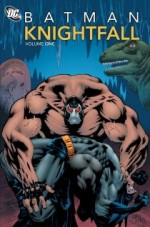
Batman: KnightFall volume 1


By Doug Moench, Chuck Dixon, Alan Grant, Jim Aparo, Norm Breyfogle, Graham Nolan, Jim Balent, Bret Blevins, Klaus Janson, Mike Manley & various (DC Comics)
ISBN: 978-1-78116-094-7

The early 1990s were troubled times for the American comicbook industry with speculative collectors rather than fans driving the business. Many new companies had established themselves using attention-catching gimmicks augmented by new print technology and outright pandering to sex and violence and the tactics had worked, sparking a glossy, four-colour Gold-Rush amongst fans and, more importantly, previously disinterested outsiders.

With vapid ploys and fleeting trends fuelling mass-multiple purchases by buyers who were too scared to even open up the hundreds of polybagged, technologically-enhanced variant-covered issues they intended to pay for college and a condo with, the major publishers were driven to design boldly bonkers stunts just to keep the attention of their once-devoted readership. At least here, however, story-content still held some worth and value…

In 1992 DC began their epic Death of Superman story-arc and clearly immediately afterward began preparing a similarly tradition-shaking, continuity-shattering epic for their other iconic household name property. Groundwork was already laid with the introduction of Jean-Paul Valley, a mild-mannered student utterly unaware that he had been programmed since birth by his father and an ancient warrior-cult to become an hereditary instrument of assassination (see Batman: Sword of Azrael) so all that was needed was to sort creative personnel and decide just how best to shake up the life of Gotham Guardian…

KnightFall and the subsequent KnightQuest and KnightsEnd, follow the tragic fall, replacement and inevitable return of Bruce Wayne as the indomitable, infallible Batman and was another, spectacular success from the old-guard which showed all the comicbook upstarts and Young Turks the true value of proper storytelling and the inescapable power of established characters, as the world was gripped by the Dark Knight’s horrific defeat at the hand’s of a superior foe.

The crossover publishing event impacted many comics outside the usual Batbook suspects, spawned a bunch of toys, three novelisations, many (necessarily incomplete) trade paperback collections and even jumped the pond to Britain’s staid BBC who turned it into a serialised audio-play on Radio One…

In 2012 DC finally began collecting the entire saga into three huge chronological compilations which, whilst still not truly complete, render the tale a far smoother readable experience for older fans and curious newcomers…

Batman: KnightFall volume 1, which could be best codified as and divided into ‘The Breaking of the Bat’ and ‘Who Rules the Night’, gathers the pertinent contents of Batman: Vengeance of Bane Special #1, Batman #491-500, Detective Comics #659-666, Showcase ’93 #7-8 & Batman: Shadow Of The Bat #16-18 – spanning January to October 1993 – and covers the most traumatic six months of Bruce Wayne’s adult life in instalments of a shared and progressing narrative alternating between Bat-titles.

What you won’t find out here: in the months preceding the start of KnightFall (roughly correlating to Batman issues #484-489 and Detective #654-658), a mysterious new criminal had covertly entered Gotham, discreetly observing the Caped Crimebuster at work as the hard-pressed hero tackled sinister crime-lord Black Mask, psycho-killer Metalhead and juvenile military genius The General, whilst foiling an assassination plot against Police Commissioner Jim Gordon.

On the edge of exhaustion, Wayne began seeing doctor and holistic therapist Shondra Kinsolving, whilst assigning Tim Drake – the third Robin – to training and monitoring Jean-Paul Valley, with the intention of turning the former Azrael‘s dark gifts to a beneficial purpose. Kinsolving was also treating Drake’s father, crippled after an attack by another of the City’s endless stream of criminal lunatics.

The cold observer Bane revealed himself and designed further tests for the depleted Dark Knight, challenging Batman for the right to rule Gotham, and manufacturing confrontations with Killer Croc and The Riddler, the latter augmented and driven crazy by a dose of deadly super-steroid Venom…

The action begins here with the origin of the challenger in ‘Vengeance of Bane’ by Chuck Dixon, Graham Nolan & Eduardo Barretto, wherein the hulking brute is fully revealed. Years ago on the Caribbean island of Santa Prisca, the ruling junta imprisoned the pregnant wife of a freedom fighter. When the baby was born he was sentenced in his father’s stead to life on the hellish prison rock of Pena Duro where he somehow thrived, touched by the horror and madness to become a terrifying, brilliant master of men.

Not merely surviving but educating himself and ultimately thriving on the hard medicine of life, the boy knew he had a destiny beyond those walls. Eventually he named himself Bane.

His only non-hostile contacts became his faithful lieutenants, Trogg, Zombie and the Americano Bird, whose tales of the Bat in Gotham City fired the eternal prisoner’s jealousy and imagination…

Santa Prisca’s entire economy is based on drug smuggling and Bane’s moment came when one of his periodic rages crippled thirty inmates. After finally being subdued by an army of guards he was turned over to scientists testing a new iteration of the muscle and aggression-enhancing formulation Venom. The effects of the steroid had caused the death of all previous candidates, but Bane survived and the delighted technologists devised biological implants that would deliver doses of the drug directly into his brain, enabling him to swiftly multiply his strength and speed at the press of a button…

A plan formed and the patient faked his own death. Disposed of as trash, he returned, seizing the Venom supply, rescuing his comrades and indulging in a fearsome vengeance against his oppressors. Then he turned greedy eyes towards Gotham and the only rival he could imagine…

KnightFall proper begins after Bane’s challenge to the already on-the-ropes Gotham Gangbuster with Batman #491 as ‘The Freedom of Madness’ by Doug Moench & Jim Aparo sees the ambitious strategist steal National Guard armaments and use them to break free every insane super-criminal locked away in Arkham Asylum. Pushed almost beyond rationality, Batman orders Robin to stick with his mission to train and de-program Jean-Paul and sets out to recapture all his most dangerous enemies, whilst Bane sits back, watching and waiting…

Issue #492 sees the round-up start with the Mad Hatter in ‘Crossed Eyes and Dotty Teas’ (Moench & Norm Breyfogle) and proves that even Bane can make mistakes, for whilst Batman acts according to plan and scotches the Hatter’s main party, the Mad Cap Maniac has already despatched a mind-controlled Film Freak to track down their mysterious liberator…

Detective Comics #659 opens with god-obsessed Maxie Zeus, innocuous Arnold Wesker and hyperthyroid brute Amygdala fleeing the broken Arkham in ‘Puppets’ (Dixon & Breyfogle) as Batman is called to the alley where the broken, lifeless body of Film Freak was found.

As The Ventriloquist, Wesker used the gangster doll Scarface to express his murderous schemes and with Amygdala now in tow has begun a lethal search to get back his old boss. The Dark Knight is obsessively locked on recapturing all his old enemies and ignores Robin’s pleas for rest and reason before tackling the hulking brute, but the confrontation does allow the cool-headed Boy Wonder to turn the tables on Bird, secretly following the Dynamic Duo for Bane.

However the Pena Duro inmate is too much for the apprentice adventurer and only Bane’s order stops Bird from killing the boy too soon. The chaos is building in Gotham and the master planner wants nothing to spoil his intricate schemes…

Moench & Breyfogle then contribute ‘Redslash’ in Batman #493 as knife-wielding maniac Victor Zsasz invades a girl’s school. The blood-soaked psycho marks each kill with a new scar on his own body and it’s been too long since his last, but by-the-book cop Lieutenant Stan Kitch‘s wait-and-see policy only results in two more deaths that Batman cannot scrub from his own over-worked conscience.

In the final confrontation patrolwoman Rene Montoya needs all her determination and utmost efforts to prevent the Dark Knight from beating Zsasz to death…

The chaos grows…

When they last met, Bane nearly crippled Killer Croc and the diseased carnival freak goes looking for payback in Detective #660, but his ‘Crocodile Tears’ (by Dixon, Jim Balent & Scott Hanna) lead Robin, still craftily tracking Bird and Bane, into a deadly trap in the City’s sewers whilst Batman #494’s ‘Night Terrors’ (Moench, Aparo & Tom Mandrake) finally sees the re-emergence of the Joker, having fun his way whilst looking for a partner to play with.

A collapsed tunnel saves Robin, but Bruce Wayne seems hell-bent on self-destruction, unable to relax until the maniacs are back behind padded bars.

Ignoring all pleas from Alfred and Tim, he heads out into the night and narrowly prevents Jim Gordon’s murder at the hands of illusion-casting cannibal Cornelius Stirk, but is unaware that the Clown Prince has allied with the Scarecrow and kidnapped Gotham Mayor Armand Krol…

In Detective #661 the Arkham Alumni terrorise Krol, forcing him to sabotage the city through emergency edicts whilst pyromaniac Garfield Lynns sets the ‘City on Fire’ (Dixon, Nolan & Hanna). Having allowed Robin to tag along, Batman allows the Boy Wonder to tackle the Firefly whilst he searches for less predictable prey. Meanwhile  Wesker is closing in on his Scarface and a recently de-venomed Riddler can’t pull off a robbery because there’s nobody around to answer his obsessively-constructed crime conundrums…

Barely breaking stride to take out the Cavalier, the Caped Crusader stumbles across the Firefly and almost dies at the hands of the relative lightweight in ‘Strange Bedfellows’ (Batman #495,  Moench, Aparo & Bob Wiacek) as, impatient to help, Jean-Paul takes to the streets on his own, eager to help in a makeshift masked identity…

Finally convinced to take a night off, Bruce attends a civic gala and is recognised by Bane just as Poison Ivy turns up to kidnap all of Gotham’s glitterati. As Batman fights floral-based zombies, Gordon and his top aide Bullock lead the GCPD into a perfect ambush set by Scarecrow and the Joker…

Detective #662 sees Robin spectacularly if injudiciously tackle Riddler’s ‘Burning Questions’ (Dixon, Nolan & Hanna) as Batman at last ends Firefly’s horrific depredations, and unsanctioned vigilante The Huntress secretly joins the battle to stem the rising tide of chaos, after which Batman #496 begins the climactic clash between the completely exhausted Masked Manhunter and his maddest monsters in ‘Die Laughing’ (Moench, Aparo & Josef Rubinstein), as Scarecrow and Joker explosively seal off the Gotham River Tunnel with the broken Mayor at the bottom of it.

Only the detonation of the tunnel roof and a million gallons of ingressing river prevent Batman from beating the Harlequin of Hate to death, but Detective #663 proves there’s ‘No Rest for the Wicked’ (Dixon, Nolan & Hanna) as the hero frantically hauls Krol to safety, merely to fall victim to a concerted assault by Bane’s hit squad. Narrowly escaping, the harried hero heads home only to find Alfred unconscious and his home invaded by the orchestrator of all his woes…

Batman #497 presents the end of the road in ‘Broken Bat’ by Moench, Aparo & Dick Giordano as Bane finally attacks in person, mercilessly beating the exhausted but valiantly battling hero, ultimately breaking his spine in a savage demonstration of his physical and mental superiority.

Detective #664 sees the beginning of Bane’s Reign in ‘Who Rules the Night’ (Dixon, Nolan & Hanna) as the Scourge of Pena Duro drops the broken Batman’s body in the middle of Gotham and publicly declares himself the new boss. Even after Alfred and Robin intercept the ambulance carrying their shattered friend and mentor, saving his life proves a touch-and-go proposition and in the interval Joker and Scarecrow come to a parting of the ways and the Ventriloquist is reunited with his malevolent master Scarface. Gotham is a city at war and soon Boy Wonder and ex-Azrael are prowling the rooftops trying to stem the tide…

The tale diverges here to reveal the contents of Showcase ’93 #7 and 8, wherein Alfred, Robin and Jean-Paul restlessly wait by the comatose Wayne’s bedside, and traumatised Tim Drake recalls how mere days previously they thwarted the latest murder-spree of erstwhile Gotham DA Harvey Dent.

‘2-Face: Double Cross’ and the concluding ‘2-Face: Bad Judgment’ by Moench & Klaus Janson found the Double Desperado again challenging his one-time ally by setting up a hangman’s court in a confused and tragic attempt to convict Batman of causing all the former prosecutor’s problems…

Batman #498’s ‘Knights in Darkness’ (Moench, Aparo & Rick Burchett) saw the shattered remnant of Bruce Wayne regain consciousness as a paralysed paraplegic wreck, only to reveal an even greater loss: his fighting spirit. Faking a road crash to explain his massive injuries, Tim and Alfred consult blithely oblivious Dr. Kinsolving in an attempt to restore the billionaire’s shattered spirit and broken body, whilst Bane goes wild in the city, brutally consolidating his hold on all the various gangs and rackets.

To further his schemes and swiftly counter any stubborn opposition, the King of Gotham then recruits Catwoman as his personal thief and retrieval service…

And in Wayne Mansion, as Shondra begins her course of therapy – knowing full well her patient’s injuries were not caused by pranging a Porsche – Tim Drake carries out Bruce’s wishes and offers Jean-Paul the role and Mantle of Batman…

Gotham City is a criminal’s paradise with thugs big and small running riot now that the Dark Knight has been so publicly destroyed, but Detective #665 reveals ‘Lightning Changes’ (Dixon, Nolan & Giordano) as the new but still inexperienced Batman and Robin start wiping up the street scum and making them fear the night again, under strict instructions from Wayne to avoid major threats until they’re ready. Valley however, seems to be slowly coming unglued, happily using excessive force and chafing to test himself against Bane.

Meanwhile a demoralised and wheelchair-bound Bruce Wayne is becoming increasing dependent on Shondra. When he can’t find her, he wheels himself through the gardens to the adjoining house of Tim’s father Jack Drake in time to interrupt an abduction by masked gunmen. Despite his best efforts, he is unable to stop them taking Shondra and the elder Drake, whilst in Gotham the new Bat has overstepped his orders and determined to go after Bane – even if it means allying with gangsters and risking the lives of innocent children…

One final diversion comes next in a sidebar tale from Shadow of the Bat #16-18 wherein Alan Grant, Bret Blevins, Mike Manley & Steve George describe how the sinister Scarecrow returns to his old college life long enough to turn innocent students into his phobic slaves as part of a grandiose and clearly crazy plan to turn himself into ‘The God of Fear’…

Juvenile ideologue and criminal genius Anarky escapes prison just in time to see “Batman” facing off against his first fully deranged super-villain and realises that the Dark Knight is a much a threat to the people as the Tatterdemalion of Terror. The young rebel decides that for the good of the common man he should take them both out…

It doesn’t quite work out that way, but after Scarecrow exposes Batman to his fear gas and it doesn’t work, they combine to vanquish the failed deity. Valley, in an increasingly rare moment of rationality, lets Anarky off with a pretty scary warning. The former Azrael muses on how his programming had made him immune to the fear chemicals, but he couldn’t be more wrong…

The Beginning of the End starts in Batman #499 with ‘The Venom Connection’ by Moench, Aparo & Hanna, as the replacement’s ruthless savagery and burgeoning paranoia drives a wedge between him and Robin, whilst oblivious to it all, the rededicated and driven Bruce Wayne uses the sleuthing skills of a lifetime to trace the kidnappers to Santa Prisca…

In the Batcave, Jean-Paul realises he is still subject to the deep programming that created Azrael when he falls into a trance and awakens to find he has designed deadly new high-tech gauntlets to augment his war on crime. Bane, meanwhile, ignores all entreaties to act, refusing to bother with a mere impostor.

In a blistering raid, Batman and Robin capture Bane’s lieutenants, although the Darker Knight coldly risks children’s lives to achieve victory. Alienated and deeply troubled, Tim determines to tell Bruce but finds the Mansion deserted, Bruce and Alfred having left for the Caribbean, unaware that they have a svelte stowaway in the form of Catwoman Selina Kyle…

Detective #666 pushes things to fever-pitch with ‘The Devil You Know’ (Dixon, Nolan & Hanna) as the augmented, ever-angry and clearly losing it Batman breaks Trogg, Bird and Zombie out of jail and follows them back to Bane, only to fall before the blockbusting power and ferocity of the Venom-addicted living juggernaut…

Batman #500 is divided into a landmark two-part conclusion. ‘Dark Angel 1: the Fall’ by Moench, Aparo & Terry Austin, sees Batman frantically escape certain death at Bane’s hands and retreat to the Batcave where the Azrael’s submerged programming – dubbed “the System” – takes temporary control and devises a perfectly honed technological suit of armour that turns Batman into a human war-machine. Far more worrying is the rift that drives Robin, Nightwing and every other possible ally away as Valley prepares for his final confrontation with Bane…

The infuriated King of the City wants it too and challenges the impostor to a very visible duel in the centre of Gotham in ‘Dark Angel 2: the Descent’ (illustrated by Mike Manley), a blockbusting battle which comprehensively crushes Bane and publicly proclaims the return of a new, darker Champion of the Night. As Batman narrowly chooses to leave Bane a crushed and humiliated living trophy rather than dead example, Robin – who had to save a train full of innocent bystanders from becoming collateral casualties of Batman, not Bane – realises something very bad has come to Gotham…

To Be Continued…

There’s something particularly enticing about these colossal mega-compilations (this one’s 640 pulse-pounding pages) that sheerly delights the 10-year old in me: proven, familiar favourite stories in a huge, wrist-numbing package offering a vast hit of full-colour funnybook action, suspense and solid entertainment. There’s also a superb gallery of covers from Glenn Fabry, Kelly Jones, Sam Kieth, Bill Sienkiewicz, Brian Stelfreeze, Joe Quesada & Kevin Nowlan and Mike Deodato Jr. and even tantalising ads for other books you just gotta have!

Just like this one…
© 1993, 2012 DC Comics. All Rights Reserved.
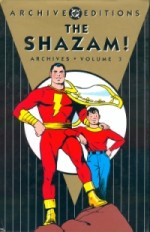
Shazam! Archives volume 3


By Bill Parker, Rod Reed, C.C. Beck, George Tuska, Pete Costanza, Mac Raboy & others (DC Comics)
ISBN: 01-56389-832-2

One of the most venerated and beloved characters of America’s Golden Age of comics, Captain Marvel was created in 1940 as part of a wave of opportunistic creativity which followed the stunning success of Superman in 1938.

Although there were many similarities in the early years, the Fawcett champion quickly moved squarely into the area of light entertainment and even straight comedy, whilst as the years passed the Man of Steel increasingly left whimsy behind in favour of action, drama and suspense.

Homeless orphan and good kid Billy Batson was selected by an ancient wizard to be given the powers of six gods and heroes to battle injustice. He transforms from scrawny precocious kid to brawny (adult) hero Captain Marvel by speaking aloud the wizard’s acronymic name – invoking the powers of legendary patrons Solomon, Hercules, Atlas, Zeus, Achilles and Mercury.

Publishing house Fawcett had first gained prominence through an immensely well-received light entertainment magazine for WWI veterans named Captain Billy’s Whiz-Bang, before branching out into books and general interest magazines. Their most successful publication – at least until the Good Captain hit his stride – was the ubiquitous boy’s building bible Mechanix Illustrated and, as the decade unfolded, the scientific and engineering discipline and can-do demeanour underpinning MI suffused and informed both the art and plots of the Marvel Family titles.

Captain Marvel was the brainchild of writer/editor Bill Parker and brilliant young illustrator Charles Clarence Beck who, with his assistant Pete Costanza, handled most of the art on the series throughout its stellar run. At first the full-grown hero was a serious, bluff and rather characterless powerhouse whilst junior alter ego Billy was the true star: a Horatio Alger archetype of impoverished, bold, self-reliant and resourceful youth overcoming impossible odds by pluck, grit and sheer determination…

After homeless orphan newsboy Billy was granted access to the power of legendary gods and heroes he won a job as a roaming radio reporter for Amalgamated Broadcasting and first defeated the demonic Doctor Thaddeus Bodog Sivana, setting a pattern that would captivate readers for the next 14 years…

At the height of his popularity Captain Marvel outsold Superman and was even published twice-monthly, but as the Furious Forties closed tastes changed, sales slowed and Fawcett saw the way the wind was blowing. They settled an infamous long-running copyright infringement case begun by National Comics in 1940 and the Big Red Cheese vanished – as did so many superheroes – becoming little more than a fond memory for older fans…

This third magnificent deluxe full-colour hardback compendium re-presents a strip from anthology compendium America’s Greatest Comics, the second and third issues of Captain Marvel Adventures, his exploits from the fortnightly Whiz Comics #21-24 and also happily includes a selection of stunning covers from the plethora of extra and reprint editions generated by the Good Captain’s overnight success.

Although there was increasing talk of inevitable war amongst the American public; all these tales – spanning March to November 1941 – were created long before Japan’s attack on Pearl Harbor and consequently have their share of thinly-veiled saboteur and spy sagas which permeated the genre until official Hostilities were finally established. Of more interest perhaps is that at this period the stories – many of them still sadly uncredited – still largely portray Marvel as a grimly heroic figure not averse to slaughtering the truly irredeemable villain and losing no sleep over it…

Following a nostalgic and highly educational Foreword by movie producer, author, historian and fan Michael Uslan, the wonderment commences with the magnificent Mac Raboy cover to America’s Greatest Comics #1 and the C.C. Beck illustrated thriller ‘Ghost of the Deep’ which led off that issue.

The merits of the ongoing court-case notwithstanding, Fawcett undeniably took many of their publishing cues from the examples of Superman and Batman. Following on from a brace of Premium editions celebrating the New York World’s Fair, National Comics had released World’s Finest Comics; a huge, quarterly card-cover anthology featuring a host of their comicbook mainstays in new adventures, and early in 1941, Fawcett produced a 100-page bumper comic dedicated to their own dashing new hero and the other mystery-men in their stable: Spy Smasher, Bulletman, Minute Man and Mr. Scarlet & Pinky and others.

‘Ghost of the Deep’ was an extra-long saga and canny mystery wherein a hooded mastermind used purloined technology to wage a campaign of terror against American Naval interests on both coasts before Billy and the Captain scotched his plans in a tale very much the template for the character’s future…

Meanwhile in Captain Marvel Adventures #2 (Summer 1941) the hero was still undergoing some on-the-job cosmetic refinements. In those formative years as the World’s Mightiest Mortal catapulted to the first rank of superhero superstars, there was actually a scramble to fill pages and just as CMA #1 had been farmed out to up-and-coming whiz-kids Joe Simon & Jack Kirby, the next two issues were rapidly compiled by mostly anonymous scripters and another rising star who drew the issues in a hurry, working from Beck and Parker’s style guides.

Young George Tuska added a raw, lean humanist vivacity to the tales beginning with ‘World of the Microscope’ wherein Sivana returned and dosed Billy and erstwhile ally Queen Beautia with a shrinking solution and left them at the mercy of bacterial monsters until Captain Marvel turned the tiny tables on him, after which a deadly stampede of giant spider robots presaged an ‘Invasion from Mars’, until the Big Red Cheese taught our planetary neighbours a lasting lesson in getting along.

DC/National Periodical Publications had filed suit against Fawcett for copyright infringement as soon as Whiz Comics #2 hit the stands and the companies slugged it out in court until 1953 when, with the sales of superhero comics decimated by changing tastes, Captain Marvel’s publishers decided to capitulate.

As a result most merchandising outfits steered well clear of Fawcett, compelling the publisher to generate toys, games, premiums and promotions themselves. The only notable exception was the blockbusting Adventures of Captain Marvel Movie Serial from Republic Pictures. Consequentially Fawcett used their magazines comicbooks to promote the films and practically invented Product Placement to plug their in-house merchandise.

‘The Curse of the Scorpion’ was an uncredited text feature which recapped the first episode of the movie serial and urged readers to follow the saga at their local cinemas after which the strip thrills resumed with Tuska’s ‘The Pirate’s Treasure’ (written by Rod Reed) as Billy investigated the murder of an old sailor and was press-ganged onto a modern-day buccaneer’s boat. Before long the radio reporter and his mighty avatar were embroiled in a war between rival South Seas rogues and the issue rousingly concluded with the Reed & Tuska saga of ‘The Arson Fiend’, a murderous supernatural firebug who acted out the frustrations of his ineffectual fire-insurance salesman alter ego…

Captain Marvel Adventures #2 (Fall 1941) opened with ‘The Menace of Muscles McGinnis’ wherein the toughest gangster in town tried to take over Billy’s radio station and literally had the wickedness beaten out of him by the unbeatable Crimson Crime-crusher, after which he was again targeted by the World’s Maddest Scientist who wanted to conquer the USA with ‘Sivana’s Paralyzing Gas’…

‘The Terror of the Goptas’ saw an ancient cult attack tall buildings and their architects, but although the devotees were acting to defend their cloud-living gods their new leader had far more mundane motives… The issue ended with another Sivana scheme as the Devil Doctor devised a synthetic zombie powered by the life-force of 1000 animals but little dreamed that ‘The Beast-Ruler’ might have his own agenda, such as uniting all of nature to eradicate humanity…

Whiz Comics #21 (September 5th 1941) featured ‘The Vengeful Four’ (illustrated by Beck) and saw Sivana gather three other villains to attack the hero in his youthful identity. What luck then that three other kids named Billy Batson were in town and that the magic of Shazam apparently extended to them…

Fat Billy, Tall Billy and Hill Billy took to trouncing thugs in a trice and, as the Three Lieutenant Marvels, would become frequent guest stars in years to come…

Written and illustrated by Beck, #22’s ‘The Temple of Itzalotahui’ was a turning point for the series. Tying into and deriving from the continuity of the movie serial, Billy gained an assistant in the form of Whitey Murphy, who was a co-star in the film iteration, but the real sea-change was the shift to light-hearted, tongue-in-cheek adventure as the lads travelled to Central America to search for a third cast member and found ancient Mayans and modern resource raiders…

Whiz #23 began a two-part thriller that again derived from product placement. ‘The Bal Masque’ found Billy and Whitey travelling to Washington DC to safeguard an Ambassador and his daughter at a grand soiree. The diplomats were unwitting couriers for a new defence code and when ruthless German agents struck Captain Marvel was drawn into a twisted web of cross and double-cross which culminated in a blistering sea battle in ‘The Secret of the Ring’ (24th November 28th 1941, by Beck & Costanza)…

With the code lost the Solomon-inspired Marvel swiftly devised a new cipher, and from that issue onwards, readers could decode secret messages in every story… as long as they were fully paid-up members of the new Captain Marvel Fan Club…

This nostalgic delight concludes not only with pages of biographical details on all the creators but also a brace of covers from two unique reprint compilations rushed out to satisfy the voracious demands of the hero’s burgeoning readership. Captain Marvel Thrill Book sports a stunning piece of Beck brilliance whilst Xmas Comics #1 by Raboy is a slice of pure comicbook mythology every art lover dreams of possessing.

DC eventually acquired the Fawcett properties and characters and in 1973 revived the Captain for a new generation to see if his unique charm would work another sales miracle during one of comics’ periodic downturns.

Re-titled Shazam! due to the incontestable power of lawyers and copyright convention, the revived heroic ideal enjoyed mixed success before being subsumed into the company’s vast stable of characters…

Nevertheless Captain Marvel is a true icon of American comic history and a brilliantly conceived superhero for all ages. These magical tales again show why The Big Red Cheese was such an icon of the industry and proves that these timeless, sublime comic masterpieces are an ideal introduction to the world of superhero fiction: tales that will appeal to readers of any age and temperament…
© 1941, 2002 DC Comics. All Rights Reserved.
Superman’s First Flight


By Michael Jan Friedman & Dean Motter (Scholastic)
ISBN: 978-0-43909-550-1

We parochial and possessive comics fans too often regard our purest and most powerful icons in purely graphic narrative terms, but characters such as Batman, Spider-Man, the X-Men and Superman long ago outgrew their four-colour origins and are now fully mythologized modern media creatures instantly familiar in mass markets, platforms and age ranges.

Another captivating case in point is this beguilingly enthralling retelling of the Man of Steel’s formative journey to self-discovery retold for the very young as part of the Hello Reader early-learning program devised by Children’s publisher Scholastic.

Categorised as Level 3 (school years 1 and 2, with Level 2 being kindergarten and 1 as pre-schoolers) the story crosses that crucial divide wherein parents still read to their kids, but the little tykes are also beginning that wonderful, magical journey into literacy by themselves…

This clever, sensitive and age-appropriate retelling by Michael Jan Friedman encapsulates and addresses every maturing child’s growing feelings of potential alienation, sense of growth, self-discovery and independence by focussing on High School kid Clark Kent on the day that the solitary teen discovered why he had always felt somehow different from his classmates.

When Clark suddenly, impossibly, heard and saw a car crash from miles away, without thinking he found himself running and jumping over buildings. Arriving on the scene he tore metal doors off burning cars and outraced an explosion to save a trapped driver…

Terrified that he might be a monster he confided in his parents, who promptly shared a secret they’d been harbouring all Clark’s life. In the barn they showed the lad a tiny one-man spaceship which had crashed to Earth years ago, carrying an alien baby…

As Clark approached the capsule a hologram activated and the boy saw his birth-parents Jor-El and Lara who explained why he could perform feats no one else could…

Shocked and distraught, Clark ran away as fast as he could and before he knew it was flying high above the world. The glorious shock at last made him realise that different didn’t mean bad…

And soon the world was daily made better by a visitor from afar known as Superman…

This enthralling little adventure is a cleverly weighed introduction into the Man of Tomorrow’s past, magnificently complemented by 31 painted illustrations by gifted design guru and illustrator Dean Motter that will amaze kids and astound even their jaded, seen-it-all-before elders.

No Supermaniac could consider their collection complete without a copy of this wonderful little gem and Superman’s First Flight is the ideal introduction for youngsters to their – surely – life-long love affair with reading…
© 2000 DC Comics. All Rights Reserved. All Rights Reserved.
Batman’s Dark Secret


By Kelley Puckett & Jon J Muth (Cartwheel Books/Scholastic)
ISBN: 978-0-43909-551-8

We insular and possessive comics fans tend to think of our greatest assets in purely graphic narrative terms, but characters such as Superman, Spider-Man and Batman have long-since grown beyond their origins and are now fully mythologised modern media creatures instantly familiar in mass markets, platforms and age ranges.

A case in point is this beguilingly enthralling retelling of Batman’s origin intended for the very young as part of the Hello Reader early-learning program devised by Children’s publisher Scholastic.

Categorised as Level 3 (school years 1 and 2, with Level 2 being kindergarten and 1 as pre-school) the story crosses that crucial divide wherein parents still read to their kids, but the little tykes are also beginning that wonderful, magical journey into literacy by themselves…

This clever, sensitive and age-appropriate retelling by Kelly Puckett follows young Bruce Wayne as he enjoys a movie-night revival of the swashbuckling film Zorro and the life-altering encounter and tragic fate of his parents in that dank, enclosed, lightless alley behind the cinema. The loss and trauma led to the orphan becoming solitary, sad and afraid of the dark despite every effort of butler-turned-guardian Alfred until an unhappy accident turned the boy’s life around forever…

One day Bruce stayed out in the rolling grounds of Wayne Manor far too late until he suddenly realised that the sun was setting. Racing back to the bright, luminescent safety of the big house he abruptly fell through a weak patch of ground into a huge cave beneath the mansion and found himself in utter blackness.

Fighting blind panic he brushed past many tiny bats, but they didn’t scare him. However when a giant, red-eyed, leather-winged monster started towards him Bruce swung wildly at it and realised that the big bat was actually afraid of him. Something changed in him then and fear left his heart forever…

He knew that he could fight wicked things with fear and the dark as his weapons…

This enthralling little adventure is a perfectly balanced and well-gauged baptism into Batman’s world, magnificently complemented by thirty stunning painted illustrations by master of mood and mystery Jon J. Muth that will delight kids and astound even their jaded, seen-it-all-before elders.

No Batfan should consider their collection complete without a copy of this wonderful little gem and Batman’s Dark Secret is the ideal introduction for youngsters to their – hopefully – life-long love affair with reading…
© 1999 DC Comics. All Rights Reserved. All Rights Reserved.
Batman and the Outsiders: The Snare


By Chuck Dixon, Carlos Rodriguez, Julian Lopez, Ryan Benjamin, Bit & Saleem Crawford (DC Comics)
ISBN: 978-1-84856-136-6

Following the forcible dissolution of Nightwing’s covert and pre-emptive strike force, Batman resumed leadership of the Outsiders and, after a daunting series of on-going auditions, settled on a core squad comprising Metamorpho, Grace, Katana, Geo-Force, Batgirl and Green Arrow, keeping mass-moving powerhouse Thunder on a short probationary leash and with standby options on a number of others…

This second slim tome collects issues #6-10 of the return run of the Dark Knight’s covert operatives – the first occurring during the 1980s and as yet only partially re-presented in Showcase Presents Batman and the Outsiders volume 1. This epic middle section of a triptych of books (the last still forthcoming) deals with an epic struggle against a terrifying extraterrestrial plot which threatened to engulf the Earth…

Written throughout by Chuck Dixon, the action starts with ‘Ghost Star’ – illustrated by Carlos Rodriguez & Bit – as elemental changeling Rex Mason drifts helplessly in space, trapped aboard a space shuttle commandeered by the employees of mystery plutocrat Mr. Jardine.

Orbiting the far side of the Moon, Metamorpho observes a titanic alien structure under construction. When the marooned hero finally contacts Earth, Batman, who had assumed his agent had burned up in the ship’s launch, immediately sets a rescue-plan in motion. Worryingly, it involves stealing a rocket from a top-secret and ultra-secure Chinese military base…

Meanwhile Rex has infiltrated the mystery construct and discovered it to be manned by possessed human astronauts all working like soulless drones to complete the cosmic conundrum…

And on Earth, Outsiders Green Arrow, Grace and Katana are captured by Chinese metahuman guards Dragonfire, Angry Wizard and Barefoot Tiger. A massive international incident seems inevitable but the general in charge seems to prefer a quieter, far more final solution…

In ‘The Snare’ Batman allows his new boffin Salah Miandad access to the Batcave supercomputers to defeat the Chinese electronic security measures as, half a world away, Batgirl attempts to free the captives from their brutal interrogators and Geo-Force seeks assistance from the US Pacific Fleet.

Beyond the Moon, Metamorpho is running for his life from the mindless construction slaves only to be ejected from the bizarre artefact into hard vacuum…

The rescue of Rex’s rescuers gets underway when the Dark Knight brings in old Outsiders team-leader Nightwing, but before he can begin, Batgirl is forced to very publicly save her comrades from a firing squad in ‘The Hard Way’ (pencilled by Julian Lopez). Out in space Rex manages to find sanctuary on the space-shuttle he’d previously vacated and discovers the purpose of the mystery device when it unleashes a devastating particle beam at the Lunar surface, shattering the crust and vaporising untold tons of dust, rock and lunar ice…

In Inner Mongolia things look bleak for Batman’s overmatched and outgunned operatives until Nightwing and Thunder appear, teleported in by the reconfigured and repurposed Observational Metahuman Activity Construct – now dubbed Remac.

The former Omac – originally designed to nullify metahumans – is under the telemetric control of Salah (still safely closeted away in the Batcave) and together they make short work of the Chinese super-squad, leaving Nightwing and Thunder free to help the already-liberated Outsiders trash the conventional military forces on the base before beaming back to Gotham City…

By the time ‘The Uninvited’ begins, Metamorpho has returned to Earth and been arrested by the Europeans for hijacking their space-shot – although he quickly escapes in his own uniquely embarrassing manner – whilst Outsiders science officer Francine Langstrom has been piecing together the informational snippets Mason had gleaned whilst aboard the astral weapon…

For months Jardine has been covertly co-opting astronauts from many nations, using them to build his honking giant space-gun; returning them to earth with their memories erased. His goal, now apparently realised, was to vaporise moon ice and store it beneath the satellite’s surface. Luna now has an underground sea at its core… but why?

To answer that question Batman determines to probe the subconscious of the unwitting astronauts and calls on the particular talents of Lia Briggs: once the psionic Outsider Looker and now an even more formidable telepath, thanks to her death and resurrection as a Vampire Queen…

Her mental probing almost costs Lia’s undead life but she discovers that the abductees’ minds were temporarily switched with those of incomprehensibly alien mentalities with dark designs upon our world. She also finds a connection to a rave-bondage club in old Gotham…

This tome concludes with ‘Monsters’ (illustrated by Ryan Benjamin & Saleem Crawford) as a raid on the club reveals a ghastly form of Russian Roulette where thrill-seeking kids pay to be attacked by a monstrous alien parasite. For most it is instant death, but a very lucky few find the fatal bite activates their latent metahuman powers…

However the gullible super-stooges have no idea just what their benefactor’s true agenda actually is and, even as Batman and his team pursue the creature, back at base, Francine and her newly-returned husband Kirk (Man-Bat) Langstrom can only watch in horror as Salah’s consciousness is absorbed into and trapped within Remac…

To Be Concluded… One day, I hope.

Fast, furious, cynically clever, beautifully illustrated and utterly compelling, this is another old-fashioned rollercoaster romp that fulfils every dyed-in-the-spandex Fights ‘n’ Tights fan’s fevered dreams and art-lovers will also adore the gallery of superbly evocative covers by Doug Braithwaite, J. Calafiore, Mark McKenna & Brian Reber.

Straight-shooting rough and tumble comicbook clamour at its very best…
© 2007, 2008, DC Comics. All Rights Reserved.
Superman: the Action Comics Archives volume 4


By Jerry Siegel & Joe Shuster, Don Cameron, John Sikela, Ed Dobrotka, Sam Citron, Ira Yarbrough, Jack Burnley & Stan Kaye (DC Comics)
ISBN: 1-56389-710-5

Without doubt the creation of Superman and his unprecedented adoption by a desperate and joy-starved generation quite literally gave birth to a genre if not an actual art form.

Within three years of his 1938 debut the intoxicating blend of eye-popping action and social wish-fulfilment which hallmarked the early exploits of the Man of Tomorrow had grown to encompass cops-and-robbers crime-busting, reforming dramas, science fiction, fantasy and even whimsical comedy, but once the war in Europe and the East snared America’s consciousness, combat themes and patriotic imagery dominated most comicbook covers if not interiors.

In comic book terms at least Superman was master of the world, and had already utterly changed the shape of the fledgling industry. There was the popular newspaper strip, a thrice-weekly radio serial, games, toys, foreign and overseas syndication and the Fleischer studio’s astounding animated cartoons.

Thankfully the quality of the source material was increasing with every four-colour release and the energy and enthusiasm of Jerry Siegel and Joe Shuster had informed and infected the burgeoning studio that grew around them to cope with the relentless demand.

Superman was definitely every kid’s hero, as confirmed in this classic compendium, and the raw, untutored yet captivating episodes reprinted here had also been completely embraced by the wider public, as comicbooks became a vital tonic for the troops and all the ones they had left behind…

Due to the exigencies of periodical publishing, although the terrific tales collected in this fourth hardback tome putatively take the Man of Steel to January 1944, since cover-dates described return-by, not on-sale dates they were all prepared well in advance, and real-world events and reactions took a little time to filter through to the furious four-colour pages, so many of the stories have a tinge of uncertainty and foreboding that was swiftly fading from the minds of the public as the far more immediate movie-newsreels showed an inexorable turning of the tide in the Allies’ favour…

Nevertheless since invaders, spies and saboteurs had long been a tried-and-true part of the narrative currency of the times, patriotic covers – which had been appearing on many comicbooks since the end of 1940 – piled on the galvanising pressure and resulted here in some of the most striking imagery in Superman’s entire history.

Spanning October 1942 to January 1944, this fourth delicious deluxe hardcover collection of the Man of Tomorrow’s exploits reprints the lead strip from issues #53-68 of totemic, groundbreaking anthology Action Comics, following the never-ending battle for Truth, Justice and the American Way to a point where War’s end was perhaps in sight and readers could begin considering a life without potential invasion and subjugation, seen here by an almost imperceptible shift from a war footing to stories of home-grown domestic dooms and even some whimsically fun moments…

Co-creator Jerry Siegel was finally called up in 1943 and his prodigious scripting output was somewhat curtailed, necessitating more and more contributions from the ingenious and multi-faceted Don Cameron and with Shuster – increasingly debilitated by failing eyesight and tied up in producing the newspaper strip, the trusty, ever-changing stalwarts of the Superman Studio were drawing most of the comicbook output at this time. Following a fulsome Foreword from publisher and long-time fan Bill Schelly the wonderment commences with Action Comics #53 and Siegel & John Sikela’s fantastic thriller ‘The Man Who put Out the Sun!’ wherein bird-themed menace Night-Owl uses “black light” technology and ruthless gangsters to plunder at will until the Man of Steel takes charge. In #54 ‘The Pirate of Pleasure Island!’ followed the foredoomed career of upstanding citizen Stanley Finchcomb, a seemingly civilised descendent of ruthless buccaneers, who succumbed to madness and became a ruthless marine marauder. Or perhaps he truly was possessed by the merciless spirit of his ancestor Captain Ironfist in this enchanting supernatural thriller by Siegel & Sikela…

Ed Dobrotka stepped in to ink the whimsical Li’l Abner spoof ‘A Goof named Tiny Rufe’ as the desperate cartoonist Slapstick Sam began to plagiarise – and ruin – the simple lives of a couple of naïve hillbillies until Superman interceded, whilst ‘Design for Doom!’ in Action #56, by Siegel & Sikela, pitted the Man of Tomorrow against a deranged architect who created global, city-wrecking catastrophes simply to prove the superiority of his own creations.

Superman was pitifully short on returning villains in the early days so #57’s return of the Prankster as ‘Crime’s Comedy King’ made a welcome addition to the Rogues Gallery, especially as the Macabre Madcap seemed to have turned over a new philanthropic leaf. Of course there was malevolence and a big con at the heart of his transformation, after which the Action Ace stepped into Batman territory for #58’s gruesome drama ‘The Face of Adonis!’ (illustrated by Sam Citron & the Superman Studio) which saw a rogue plastic surgeon transform an aging movie star into a grisly grotesque, holding his face hostage and turning the celluloid hero into his personal thief. Even Superman could not prevent this dark drama from ending in tragedy…

Sheer fanciful fantasy featured in 59#s ‘Cinderella – a la Superman’ (Sikela) as in an early experiment in continuity-busting, Clark Kent had to babysit Lois’ niece Susie Tomkins and dreamed his heroic alter ego into becoming the Fairy Godmother in a witty and imaginative re-enactment of the classic tale. Susie would return over and again as a pestiferous foil for both Clark and Superman…

A different kind of prototype Imaginary Tale was seen in #60 with ‘Lois Lane – Superwoman!’ wherein the hospitalised and concussed go-getter dreamed that she developed abilities equal to the Metropolis Marvel’s after a blood transfusion from the Man of Steel. Despite proving her worth over and again as a costumed crusader, in the end Lois fell into cliché by cornering Superman and demanding they marry…

Siegel & Sikela ended their Action Comics partnership in #61 with ‘The Man they Wouldn’t Believe!’ as Lois seemingly fell for a flamboyant playboy and Clark was panicked into revealing his secret identity in a vain attempt to win her back. Typically she refused to believe him and every effort Kent made to prove his Kryptonian mettle ended in humiliating disaster. How fortunate, since Lois was playing a part to expose a ruthless criminal…

Don Cameron took over as scripter with #62, kicking off a fine run with the utopian future shocker ‘There’ll Always be a Superman!’ (with art by Dobrotka) as an aged sage in 2143AD regaled his grandchildren with tales of how the ancient Man of Tomorrow polished off Nazis who had enslaved their ancestor as part of a plan to build U-Boat bases under America – an old sea yarn confirmed by the storyteller’s other houseguest, Superman himself…

Shifting gears to nail-biting suspense, Action #63 revealed ‘When Stars Collide!’ (Cameron & Ira Yarbrough), the cosmic calamity that caused Superman to lose his memory and fall under the sway of devious and manipulative crooks. As if that wasn’t enough, the debris from the stellar smash was falling inexorably to Earth and the only man who could save us had no idea what to do until Lois shook his wits clear…

Another returning villain debuted in #64 in the Dobrotka- illustrated classic ‘The Terrible Toyman’, wherein an elderly inventor of children’s novelties and knick-knacks began a spectacular spree of high-profile and potentially murderous robberies, with Lois as his unwilling muse and accessory after which ‘The Million-Dollar Marathon!’ purloined the venerable plot of George Barr McCutcheon’s 1902 novel Brewster’s Millions (and filmed four times – 1915, 1921, 1926 & 1935 – before Action Comics #65 made it the subject of the October 1943 issue) to show Superman helping a poor doctor spend $1,000,000 in twenty-four hours to inherit twice that amount for a children’s hospital. Trying to queer the deal was the poor medic’s rascally cousin and a pack of very violent thugs…

Heartstrings were further tugged in #66 when an elderly blind millionaire was reunited with his long-lost grandson in ‘The Boy who Came Back!’ Even after Superman reluctantly exposed the cruel scam there was still a shocking (and still surprising today) twist in the tale, whilst ‘Make Way for Fate!’ (#67 and illustrated by Citron) saw the Man of Steel turn back time and reunite stubborn lovers separated for decades as part of a larger plan to build a new Officer Training School in Metropolis…

This spectacular collection closes with ‘Superman Meets Susie!’ (Yarbrough & Stan Kaye) as little Miss Tomkins returned as a teller of huge fibs, which the Man of Tomorrow undertook to make real, all in an attempt to teach Lois a little patience. However the incorrigible brat goes too far when she starts reporting her fantasies to the papers and crooks take advantage…

The main bulk of the stunning covers in this collection were by Jack Burnley and almost exclusively war-themed (excluding The Prankster on #57) until the Toyman’s launch in #64, after which the overseas struggle quickly gave way to scenes of homeland crime and fantastic adventure, with artists John Sikela, Ed Dobrotka & Stan Kaye generally taking that lead spot.

These Golden Age tales offer irresistible and priceless enjoyment at an absurdly affordable price and this superbly robust and colourful format has inestimably advanced the prestige and social standing of the medium itself as well as preserving a vital part of American popular culture.

Still some of the very best Fights ‘n’ Tights any fan could ever find, these tales belong on your bookshelf in a prideful place you can easily reach for over and over again.
© 1942, 1943, 1944, 2005 DC Comics. All Rights Reserved.