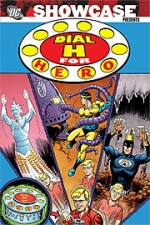
Showcase Presents Dial H For Hero


By Dave Wood, Jim Mooney & various (DC Comics)
ISBN13: 978-1-4012-2648-0

The entire world was going crazy for costumed crusaders in the mid-Sixties and every comicbook publisher was keenly seeking new ways to repackage an extremely exciting yet intrinsically limited concept. Perhaps its ultimate expression came with the creation of a teen-aged everyman champion who battled crime and disaster in his little town with the aid on a fantastic wonder-tool…

This slim monochrome compendium collects the entire run from House of Mystery #156 (January 1966) to #173 (March-April 1968) when the comicbook disappeared for a few months to re-emerge as DC’s first – of many – anthological supernatural mystery titles.

Created by Dave Wood and Jim Mooney, Dial H For Hero recounted the incredible adventures of boy genius Robby Reed who lived with his grandfather in idyllic Littleville where nothing ever happened…

Criminally, very little is known about writer Dave Wood, whose prolific output began in the early days of the American comics industry and whose work includes such seminal classics (often with artistic legends Jack Kirby and Wally no-relation Wood) as Challengers of the Unknown and the seminal “Space Race” newspaper strip Sky Masters.

A skilled “jobbing” writer, Wood often collaborated with his brother Dick, bouncing around the industry, scripting mystery, war, science fiction and adventure tales. Among his/their vast credits are stints on most Superman family titles, Batman, Detective Comics, World’s Finest, Green Arrow, Rex the Wonder Dog, Tomahawk, Blackhawk, Martian Manhunter and many others. As well as Dial H For Hero Wood created the sleeper hit Animal Man and the esoteric but fondly regarded Ultra, the Multi-Alien.

James Noel Mooney started his comics career in 1940, aged 21 and working for the Eisner & Eiger production shop and Fiction House on The Moth, Camilla, Suicide Smith and other B-features. By the end of the year he was a mainstay of Timely Comic’s vast funny animal/animated cartoon tie-in department.

In 1946 Jim moved to DC to ghost Batman for Bob Kane and Dick Sprang. He stayed until 1968, working on a host of features including Superman, Superboy, Legion of Super-Heroes, World’s Finest and Tommy Tomorrow, plus various genre short stories for the company’s assorted anthology titles like Tales of the Unexpected and House of Mystery.

He also drew Supergirl from her series debut in Action Comics #253 to #373, after which he headed for Marvel and stellar runs on Spider-Man, Marvel Team-up, Omega the Unknown, Man-Thing, Ghost Rider and a host of other features as both penciller and inker. Just before that move he was working on Dial H For Hero; the only original DC feature he co-created.

Big things were clearly expected of the new feature, which was parachuted in as lead and cover feature, demoting the venerable Martian Manhunter to a back-up role at the end of each issue.

The first untitled story opens with an attack on the local chemical works by super-scientific criminal organisation Thunderbolt just as Robby and his pals were playing in the hills above the site. As they fled the plucky lad was caught in a landslide and fell into an ancient cave where lay an obviously alien artefact that looked like an outlandish telephone dial.

After finding his way out of the cavern Robby became obsessed with the device and spent all his time attempting to translate the arcane hieroglyphs on it. Eventually he determined the writings were instructions to dial the symbols which translate to “H”, “E”, “R” and “O”…

Ever curious Robby complied and was transformed into a colossal super-powered “Giantboy”, just in time to save a crashing airliner and stop another Thunderbolt raid. Returning home he reversed the dialling process and went to bed…

These were and still are perfect wish-fulfilment stories: uncluttered and uncomplicated yarns hiding no great messages or themes: just straight entertainment expertly undertaken by experienced and gifted craftsmen who knew just how to reach their young-at-heart audiences, so no-one should be surprised at the ease with which Robby adapted to his new situation…

When Thunderbolt struck again next morning Robby grabbed his dial but was startled to become a different hero – high-energy being “The Cometeer”. Streaking to the rescue he was overcome by the raider’s super weapon and forced to use the dial to become Robby again. Undeterred, the lad tries again and as “The Mole” finally tracked the villains to their base and defeated them – although the leader escaped to become the series’ only returning villain…

Mr. Thunder was back in the very next issue as Robby became “The Human, Bullet”, bestial energy-being “Super-Charge” and eerie alien “Radar-Sonar Man” to crush ‘The Marauders from Thunderbolt Island’ whilst criminal scientist Daffy Dagan stole the H-Dial after defeating the boy’s temporary alter ego “Quake-Master”. Dagan became a horrifying multi-powered monster when he learned to ‘Dial “V” For Villain’ but after the defeated hero took back the artefact Robby redialed into techno-warrior “The Squid” and belatedly saved the day.

Clearly the Mystery in House of… was related to where the Dial came from, what its unknown parameters were and who Robby would transform into next. Issue #159 pitted “The Human Starfish”, “Hypno-Man” and a super-powered toddler named “Mighty Moppet” (who wielded weaponised baby bottles) in single combats with a shape-changing gang of bandits dubbed ‘The Clay-Creep Clan’ whilst ‘The Wizard of Light’ played with the format a little by introducing a potential love-interest for Robby in his best friend’s cousin Suzy…

It also saw the return of Giant-Boy, the introduction of sugar-based sentinel of Justice “King Candy” and the lad’s only transformation into an already established hero – the Golden Age legend Plastic Man.

Cynical me now suspects the move was a tester to see if the Pliable Paladin – who had been an inert resource since the company had bought out original publisher Quality Comics in 1956 – was ripe for a relaunch in the new, superhero-hungry environment.

DC’s Plastic Man #1 was released five months later…

House of Mystery #161 featured an awesome ancient Egyptian menace ‘The Mummy with Six Heads’ who proved too much for Robby as “Magneto” (same powers but so very not a certain Marvel villain) and “Hornet-Man” but not the intangible avenger “Shadow-Man”, after which ‘The Monster-Maker of Littleville’ was proved by “Mr. Echo” and “Future-Man” to be less mad scientist than greedy entrepreneur…

‘Baron Bug and his Insect Army’ almost ended Robby’s clandestine career when the boy turned into two heroes at once; but even though the celestial twins “Castor and Pollux” were overmatched, animated slinky-toy “King Coil” proved sufficient to stamp out the Baron’s giant mini-beasts, whilst human wave “Zip Tide”, living star “Super Nova” and “Robby the Super-Robot” were hard-pressed to stop the rampages of ‘Dr. Cyclops – the Villain with the Doomsday Stare’.

Things got decidedly peculiar in #165 when a clearly malfunctioning H-Dial called up ‘The Freak Super-Heroes’ “Whoozis”, “Whatsis” and “Howzis” to battle Dr. Rigoro Mortis and his artificial thug Super-Hood in a bizarrely captivating romp with what looks like some unacknowledged inking assistance from veteran brush-meister George Roussos (who popped in a couple more times until Mooney’s departure).

Suzie became a fixture and moved into the house next door with ‘The King of the Curses’ who found his schemes to plunder the city thwarted by “TheYankee-Doodle Kid” and “Chief Mighty Arrow”, a war-bonneted Indian brave on a winged horse…

In HoM #167 ‘The Fantastic Rainbow Raider’ easily defeated “Balloon Boy” and “Muscle Man” but had no defence against the returning Radar-Sonar Man, whilst ‘The Marauding Moon Man’ easily overmatched Robby as “The Hoopster” but had no defence when another glitch turned old incarnations Mole and Cometeer into a single heroic composite imaginatively christened “Mole-Cometeer”, but the biggest shock of all came when ‘The Terrible Toymaster’ defeated Robby as “Velocity Kid” and Suzy cajoled the fallen hero into dialling her into the scintillating “Gem Girl” to finish the job.

As it was the 1960s, Suzy didn’t quite manage on her own, but when Robby transformed into the psionically-potent “Astro, Man of Space” they soon closed the case – and toybox – for good. This one was all Mooney and so was the next.

‘Thunderbolt’s Secret Weapon’ was also the artist’s last outing with the Kid of a Thousand Capes as the incorrigible cartel tried to steal a supercomputer only to be stopped dead by “Baron Buzz-Saw”, “Don Juan” (and his magic sword) and the imposing “Sphinx-Man”.

With House of Mystery #171 a radical new look emerged, as well as slightly darker tone. The writing was clearly on the wall for the exuberant, angst-free adventurer…

‘The Micro-Monsters!’ was illustrated by Frank Springer and saw Robby dial up “King Viking – Super Norseman”, “Go-Go” a hipster who utilised the incredible powers of popular disco dances (how long have I waited to type that line!!!?) and multi-powered “Whirl-I-Gig” to defeat bio-terrorist Doc Morhar and belligerent invaders from a sub-atomic dimension.

Springer also drew ‘The Monsters from the H-Dial’ wherein the again on-the-fritz gear turned his friend Jim into various ravening horrors every time Robby dialled up. Luckily the unnamed animated pendulum, Chief Mighty Arrow and “the Human Solar Mirror” our hero successively turned into proved just enough to stop the beasts until the canny boy could apply his trusty screwdriver to the incredible artefact again.

In those distant days series ended abruptly, without fanfare and often in the middle of something… and such was the fate of Robby Reed. HoM#173, by Wood and Sal Trapani saw the lad solve a mystery in ‘The Revolt of the H-Dial’ wherein the process turned him into water-breathing “Gill-Man” and a literal “Icicle Man”: beings not only unsuitable for life on Earth but also compelled to commit crimes. Luckily by the time Robby had become “Strata Man” he’d deduced what outside force was affecting his dangerously double-edged dial…

And that was that. The series was gone, the market was again abandoning the fights ‘n’ Tights crowd and on the horizon was a host of war western, barbarian and horror comics…

Exciting, fun, engaging and silly in equal amounts (heck, even I couldn’t resist a jibe or too and I genuinely revere these daft, nostalgia-soaked gems) Dial H For Hero has been re-imagined a number of time since these innocent odysseys first ran, but never with the clear-cut, unsophisticated, welcoming charm displayed here.

This is Ben-10 for your dad’s generation and your kid’s delectation: and only if they’re at just that certain age. Certainly you’re too grown up to enjoy these glorious classics. Surely you couldn’t be that lucky; could you…?

© 1966, 1967, 1968, 2010 DC Comics. All rights reserved.
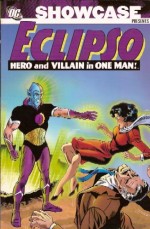
Showcase Presents Eclipso


By Bob Haney, Lee Elias, Alex Toth & various (DC Comics)
ISBN: 978-1-4012-2315-1

Although it’s generally accepted that everybody loves a good villain they seldom permit them the opportunity of starring in their own series (except perhaps in British comics, where for decades the most bizarre and outrageous rogues such as Charlie Peace, Spring-Heeled Jack, Dick Turpin, Von Hoffman or The Dwarf were seen as far more interesting than mere lawmen).

However when America went superhero crazy in the 1960s (even before the Batman TV show sent the entire world into a wild and garish “High Camp” frenzy) DC converted all of its anthology titles into character-driven vehicles and long-running paranormal investigator Mark Merlin suddenly found himself sharing the cover spot with a costumed but very different kind of co-star.

Breathing new life into the hallowed Dr. Jekyll/Mr. Hyde concept, Bob Haney and Lee Elias debuted ‘Eclipso, The Genius Who Fought Himself’ in House of Secrets #61, cover-dated July-August 1963, the saga of solar scientist Bruce Gordon who was cursed to become host to a timeless Evil.

Whilst observing a solar eclipse on tropical Diablo Island, Gordon was attacked and wounded by a crazed witchdoctor named Mophir, wielding a black diamond. As a result whenever an eclipse occurred Gordon’s body was possessed by a demonic, destructive alter ego with incredible powers and malign hyper-intellect. The remainder of the first instalment showed how the intangible interloper destroyed Gordon’s greatest achievement: a futuristic solar-powered city.

The format established, Gordon, his fiancé Mona Bennett and her father, who was also Gordon’s mentor, pursued and battled the incredible Eclipso and his increasingly astounding schemes. At least he ha a handy weakness: exposure to sudden bright lights would propel him back to his cage within Bruce Gordon…

‘Duel of the Divided Man’ saw the helpless scientist attempting to thwart the uncontrollable transformations by submerging to the bottom of the Ocean and exiling himself to space – to no effect, whilst in ‘Eclipso’s Amazing Ally!’, illustrated by the legendary Alex Toth, the malignant presence manifests when an artificial eclipse and lab accident frees him entirely from Gordon’s body. Against the backdrop of a South American war Gordon and Professor Bennett struggled to contain the liberated horror but all was not as it seemed…

Issue #64 ‘Hideout on Fear Island’ saw Gordon, Mona and Bennett hijacked to a Caribbean nation inundated by giant plants for an incredible clash with giant robots and Nazi scientists. Naturally when Eclipso broke out things went from bad to worse…

‘The Man Who Destroyed Eclipso’ had the Photonic Fiend kidnap Mona before a deranged physicist actually separated Eclipso and Gordon in a wild scheme to steal a nuclear missile, whilst the threat of a terrifying alien omnivore forced heroes and villain to temporarily join forces in ‘The Two Faces of Doom!’

‘Challenge of the Split-Man!’ found Gordon and Eclipso once more at odds as the desperate scientist returned to Mophir’s lair in search of a cure before inexplicably following the liberated villain to a robot factory in Scotland.

Veteran cartoonist Jack Sparling took over the artist’s role with #68 wherein ‘Eclipso’s Deadly Doubles!’ revealed how Gordon’s latest attempt to effect a cure only multiplied his problems, after which ‘Wanted: Eclipso Dead or Alive!’ found the beleaguered scientist hired by Scotland Yard to capture himself – or at least his wicked and still secret other self…

‘Bruce Gordon, Eclipso’s Ally!’ returned the long suffering trio to Latin America where an accident robbed Gordon of his memory – but not his curse, leading to the most ironic alliance in comics, ‘The Trial of Eclipso’ had the periodically freed felon finally captured by the police and threatening to expose Gordon’s dark secret and ‘The Moonstone People’ stranded the Bennetts, Gordon and Eclipso on a lost island populated by scientists who hadn’t aged since their own arrival in 1612…

Even such a talented writer as Bob Haney occasionally strained at the restrictions of writing a fresh story for a villainous protagonist under Comics Code Restrictions and the later tales became increasingly more outlandish after ‘Eclipso Battles the Sea Titan’ wherein a subsea monster threatened not just the surface world but also Eclipso’s ultimate refuge – Bruce Gordon’s body…

Another attempt to expel or eradicate the horror inside accidentally created a far more dangerous enemy in ‘The Negative Eclipso’ after which a criminal syndicate, fed up with the Photonic Fury’s disruption of their operations, decreed ‘Eclipso Must Die!’

It had to happen – and did – when Mark Merlin (in his superhero persona of Prince Ra-Man) met his House of Secrets stable-mate in the book-length thriller ‘Helio, the Sun Demon!’ (#76, with the concluding second chapter drawn by the inimitable Bernard Baily) wherein Eclipso created a fearsome, fiery solar slave and the Bennetts teamed with the enigmatic super-sorcerer to free Bruce and save the world from flaming destruction.

All-out fantasy subsumed suspense in the strip’s dying days with aliens and creatures abounding, such as ‘The Moon Creatures’ which Eclipso grew from lunar dust to do his wicked bidding or the hidden treasure of Stonehenge that transformed him into a ‘Monster Eclipso’.

Issue #79 featured a return match for Prince Ra-Man in ‘The Master of Yesterday and Tomorrow!’ with Baily again pitching in to tackle an extended epic wherein Eclipso got his scurrilous hands on a selection of time-bending trinkets, whilst #80 (October 1966) ended the series with no fanfare, no warning and no ultimate resolution as ‘The Giant Eclipso!’ pitted the fade-away fiend against mutants, cops and his own colossal doppelganger.

Not everything old is gold and this quirky, exceedingly eccentric collection of comics thrillers certainly won’t appeal to everyone. However there is a gloriously outré charm and fanciful delight in these silly but absorbing sagas if you’re of an open minded mien, and the art of Elias, Toth, Sparling and Baily has never looked more vibrant or effective than in this crisp and splendid black and white collection.

Not for him or them then, but perhaps this book is for you…

© 1963-1966, 2009 DC Comics. All Rights Reserved.

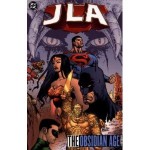
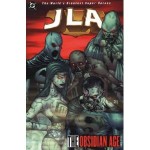
JLA volumes 11 & 12: Obsidian Age books 1 & 2


By Joe Kelly, Doug Mankhe, Tom Nguyen & various (DC Comics)
ISBNs: 978-1-84023-702-3 & 978-1-84023-709-2

When the World’s Greatest Superheroes and cornerstone of the Silver Age of Comics were relaunched in 1997 (see JLA: New World Order) the intrinsic quality actually lived up to the massive hype and made as many new fans as it won back old ones, but the glistening aura of “fresh and new” never lasts forever and by the time of these tales there had been numerous changes of creative team – usually a bad sign…

However Joe Kelly, Doug Mankhe and Tom Nguyen’s tenure proved to be a competent blend of steadying hands and boldly iconoclastic antics through which the JLA happily continued their tricky task of keeping excitement levels stoked for a fan-base cursed with a criminally short attention-span.

Kelly’s run on the series has some notable highs (and lows) and these two impressive editions collect the author’s boldest and most audacious adventure, an epic which spanned a year of publication and rewrote millennia of DC continuity.

Collecting issues # 66-71 and # 72-76 respectively, The Obsidian Age began in Book 1 with ‘The Destroyers Part 1’ wherein peculiar water-based events and phenomena indicated that Aquaman – believed killed in a catastrophe which eradicated Atlantis – was alive and trying to contact his JLA comrades. When the team are subsequently attacked by an ancient mystical warrior they get their first clue that it’s not “somewhere” but “somewhen”…

‘The Destroyers Part 2’ sees the team recovering from a second attack by the terrifying Tezumak and shaman Manitou Raven whose coordinated manipulations bring the heroes into the ruins of ‘Stillborn Atlantis’ and all-out combat with the deranged Ocean Master. When Tempest (the all grown-up Aqualad and now a magical adept himself) and a conclave of mystic heroes, including Zatanna, Faust and Doctors Occult and Fate, are called in to assess the deteriorating situation in the no-longer sunken city, the assembled champions of science and magic realise that something truly terrible is about to be unleashed….

Renewed assaults from the past indicate another global crisis and when the JLA discover a message from Aquaman they head back 3000 years to discover an unsuspected era of Atlantean domination. With Superman, Batman, Wonder Woman, Flash, Green Lantern, Martian Manhunter and Plastic Man gone, a stand-in team of heroes are left to guard the world but the ancient mastermind behind the menace has also prepared a contemporary trap for the substitute JLA…

‘New Blood’ (illustrated by Yvel Guichet & Mark Propst) features Zatanna and the Atom trying to stave off a concatenation of clearly unnatural natural disasters with the aid of Green Arrow, Captain Marvel, Firestorm, Jason Blood (with and without Etrigan the Demon), Hawkgirl, ex-villain and troubled soul Major Disaster, Nightwing and new find Faith (as well as a little help from the Justice Society of America) – a desperate scratch-team woefully overmatched and under-trained…

Meanwhile the strands of mystery are unravelled in ‘Revisionist History’ which finds the time-lost First Team in 1000BC where an above-the-waves Atlantis leads a coalition of nations and super-warriors in a campaign to conquer the known world by sword and sorcery. This unknown episode of human history contravenes all the records and clandestine reconnaissance by the JLA reveals an enchantress named Gamemnae is behind the scheme.

But her plans extend far beyond her own epoch and to that end she has kidnapped the 21st century water-breathing Atlanteans and enslaved their king Aquaman…

However Gamemnae’s own team is far from united: Manitou Raven and his bride Dawn are deeply troubled by the venality of their allies and the obvious nobility of the Justice Leaguers… Meanwhile back in the future the last story of Book 1 returns focus to the new team in ‘Transition’ (by Guichet & Propst again) as the planet is ravaged by geological catastrophes and Gamemnae’s millennial booby-trap activates, intent on conquering the world of tomorrow by suborning its meta-human and mystic defenders…

Ending on a stunning mystery cliffhanger this volume also includes a behind-the-scenes text feature on the formidable enemy team ‘The Ancients’ including a delightful assemblage of design sketches.


Obsidian Age Book 2 opens with a handy précis of previous events before launching into ‘History is Written By…’ (Kelly, Mahnke & Nguyen) wherein the JLA battles hopeless odds in ancient Atlantis whilst trying to liberate the enslaved water-breathing descendents, and in modern times ‘Last Call’ (Guichet & Propst) finds the alternative League faring badly against Gamemnae’s monstrous animated time-trap until a ghostly message from the past enables them to turn the tide…

‘Obsidian’ follows the final tragic battle between the JLA and The Ancients, revealing how Gamemnae’s future assaults began whilst Manitou finally succumbs to his conscience and changes sides. ‘Tragic Kingdom’ (by Mahnke, Guichet, Darryl Banks, Dietrich Smith and inkers Nguyen, Propst, Wayne Faucher & Sean Parsons) simultaneously provides the origin and final fall of the deadly Witch-Queen in a cataclysmic confrontation that bends times, breaks the barriers between life and death and costs one of the heroes everything…

The story-portion culminates in ‘Picking up the Pieces’ (with art from Lewis LaRosa & Al Milgrom)  as the JLA conclude a 3000 year quest to restore their fallen comrade and re-jig their roster in the aftermath of the epic adventure that has left them all changed…

This volume ends with an insightful and revealing ‘Afterword’ by Kelly.

The action of Obsidian Age takes place in the devastated aftermath of the DC Crossover Event “Our Worlds At War” wherein an alien doomsday device named Imperiex almost destroyed the planet – but there’s enough useful background and build-up in the chapters collected in both books to circumvent any possible confusion should that saga have passed you by…

Engaging, engrossing and especially entertaining this is a superior superhero slugfest that will appeal to a lot of readers who thought the Fights ‘n’ Tights genre beyond or beneath them…
© 2002, 2003 DC Comics. All Rights Reserved.

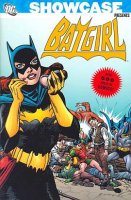
Showcase Presents Batgirl volume 1


By Gardner Fox, Carmine Infantino, Gil Kane, Don Heck & various (DC Comics)
ISBN: 978-1-4012-1367-1

Today comics readers are pretty used to the vast battalion of Bat-shaped champions infesting Gotham City and its troubled environs, but for the longest time it was just Bruce, Dick and occasionally their borrowed dog Ace keeping crime on the run. However in Detective Comics #233 (July 1956 and three months before the debut of the Flash officially ushered in the Silver Age of American comicbooks) the editorial powers-that-be introduced heiress Kathy Kane, who sporadically suited-up in chiropteran red and yellow for the next eight years.

In Batman #139 (April 1961) her niece Betty started dressing up and acting out as her assistant Batgirl, but when Editor Julie Schwartz took over the Bat-titles in 1964 both ladies unceremoniously disappeared in his root-and-branch overhaul.

In 1966 the Batman TV series took over the planet, but its second season was far less popular and the producers soon saw the commercial sense of adding a glamorous female fighter in the fresh, new tradition of Emma Peel, Honey West and The Girl From U.N.C.L.E. especially when clad in a cute cape, shiny skin-tight body-stocking and go-go boots…

Of course she had to join the comics cast too and this Showcase edition re-presents her varied appearances as both guest-star and headliner in her own series, beginning with her four-colour premiere…

In ‘The Million Dollar Debut of Batgirl’ (Detective Comics #359, cover-dated January 1967) writer Gardner Fox and the art team supreme of Carmine Infantino and Sid Greene introduced young Barbara Gordon, mousy librarian and daughter of the Police Commissioner to the superhero limelight, so by the time the third season began on September 14, 1967, she was well-established.

Whereas in her small screen premiere she pummeled the Penguin, her funnybook origin featured the no-less-ludicrous but at least visually forbidding Killer Moth in a clever, fast-paced yarn involving blackmail and murder that still stands up today and which opens in fine style this long-awaited monochrome celebration of the brief but stellar career of one of the most successful distaff spin-offs in the business.

Her appearances came thick and fast after that initial tale: ‘The True-False Face of Batman’ (Detective #363, by Fox Infantino and Greene) was a full co-starring vehicle as the new girl was challenged to deduce Batman’s secret identity whilst tracking down enigmatic criminal genius Mr. Brains, after which she teamed-up with the Girl of Steel in World’s Finest Comics #169 (September 1967) wherein the uppity lasses seemingly worked to replace Batman and Superman in ‘The Supergirl-Batgirl Plot’; a whimsical fantasy feast from Cary Bates, Curt Swan & George Klein.

Detective #369, illustrated by Infantino and Greene, somewhat reinforced boyhood prejudices about icky girls in the classy thriller ‘Batgirl Breaks Up the Dynamic Duo’ which segued directly into a classic confrontation in Batman #197 as ‘Catwoman sets Her Claws for Batman!’ by Fox, Frank Springer and Greene. This frankly daft tale is most fondly remembered for the classic cover of Batgirl and Catwoman (with Whip!!!) squaring off over Batman’s prone body – comic fans have a psychopathology all their very own…

Gil Kane made his debut on the Dominoed Daredoll (did they really call her that? – yes they did, from page 2 onwards!) in #371′s ‘Batgirl’s Costumed Cut-ups’, a masterpiece of comic-art dynamism that inker Sid Greene could be proud of, but which proffered some rather uncomfortable assertions about female vanity that Gardner Fox probably preferred to forget – and just check out the cover of this tome if you think I’m kidding.

Batgirl next surfaced in Justice League of America #60, February 1968, wherein the team barely survived a return match with alien invader Queen Bee and were temporarily transformed into ‘Winged Warriors of the Immortal Queen!’ (by Fox, Mike Sekowsky & Greene whilst in the June-July The Brave and the Bold (#78) Bob Brown stepped in to draw her in for Bob Haney’s eccentric crime-thriller ‘In the Coils of the Copperhead’ wherein Wonder Woman found herself vying with the fresh young thing for Batman’s affections. Of course it was all a cunning plan… wasn’t it?

That same month another team-up with Supergirl heralded a sea-change in DC’s tone, style and content as the girls were dragged into ‘The Superman-Batman Split!’ (World’s Finest Comics #176) with Bates providing a far darker mystery for the girls and boys (including Robin and Jimmy Olsen) to solve whilst artists Neal Adams & Dick Giordano began revolutionising how comics looked with their moody, exciting hyper-realistic renderings.

Although Barbara Gordon cropped up in the background of occasional Batman adventures that was the last time the masked heroine was seen until Detective Comics #384, (February 1969) when Batgirl finally debuted in her own solo feature. Written by Mike Friedrich and illustrated by the phenomenal team of Gil Kane & Murphy Anderson ‘Tall, Dark. Handsome …and Missing!’ began a run of human-scaled crime dramas with what all the (male) scripters clearly believed was a strong female slant as in this yarn wherein librarian Babs developed a crush on a frequent borrower just before he inexplicably vanished.

Batgirl investigated and ran into a pack of brutal thugs before solving the mystery in the second part, ‘Hunt For the Helpless Hostage!’ (Detective #385), after which the lead story from that issue rather inexplicably follows here.

‘Die Small… Die Big!’ by Robert Kanigher, Bob Brown & Joe Giella is one of the best Batman adventures of the period, with a nameless nonentity sacrificing everything for a man he’s never met, but Babs is only in three panels and never as Batgirl…

Adventure Comics #381 (June 1969) made far better use of her skills as she went undercover and was largely at odds with the Maid of Steel whilst exposing ‘The Supergirl Gang’ in a tense thriller by Bates & Win Mortimer. Batgirl shared the second slot with Robin in alternating adventures, so she next appeared in Detective #388 which welcomed aboard newspaper strip veteran Frank Robbins to script ‘Surprise! This’ll Kill You!’ a sophisticated bait-and-switch caper which saw Batgirl impersonate herself and almost pay with her life for another girl’s crimes. Spectacularly illustrated by Kane & Anderson the strip had expanded from eight to ten pages but that still wasn’t enough and the breathtaking thrills spilled over into a dramatic conclusion in ‘Batgirl’s Bag of Tricks!

Although the tone and times were changing there was still potential to be daft and parochial too, as seen in ‘Batman’s Marriage Trap!’ (Batman #214, by Robbins, Irv Novick & Giella) wherein a wicked Femme Fatale set the unfulfilled spinsters of America on the trail of Gotham’s Most Eligible Bat-chelor (see what I did there? I’ve done it before too and you can’t stop me…). Not even a singular guest-shot by positive role-model Batgirl could redeem this peculiar throwback – although the art rather does…

‘A Clue… Seven-Foot Tall!’ (from Detective #392, October 1969, by Robbins, Kane & Anderson) was another savvy contemporary crime-saga which also introduced a new Bat cast-member in the form of disabled Vietnam veteran and neophyte private eye Jason Bard (who would eventually inherit Batgirl’s spot in Detective Comics). Here and in the concluding ‘Downfall of a Goliath’ Babs and Bard sparred and joined forces to solve a brutal murder in the world of professional basketball.

In issues #396 and 397 (February and March 1970) Batgirl faced the very modern menace of what we’d now call a psycho-sexual serial killer in the chilling and enthralling mystery ‘The Orchid-Crusher’ and ‘The Hollow Man’: a clear proof of the second string character’s true and still untapped potential…

The anniversary Detective #400 (June 1970) finally teamed her with Robin in ‘A Burial For Batgirl!’(Denny O’Neil, Kane & Vince Colletta) a college-based murder mystery that referenced the political and social unrest then plaguing US campuses, but which still found space to be smart and action-packed as well as topical before the chilling conclusion ‘Midnight is the Dying Hour!’ (Detective #401).

With issue #404 Babs became the sole back-up star as Robbins, Kane & Frank Giacoia sampled the underground movie scene with ‘Midnight Doom-Boy’ mischievously spoofing Andy Warhol’s infamous Factory studio in another intriguing murder-plot, diverting to and culminating in another branch of Pop Art as Batgirl nearly became ‘The Living Statue!’

In ‘The Explosive Circle!’ (#406, with Colletta back to ink) the topic du jour was gentrification as property speculation ripped Gotham apart, but not as much as a gang of radical bombers, leading to the cry ‘One of Our Landmarks is Missing!’ The next issue (#408) saw the vastly underrated Don Heck take over as artist, inked here by Dick Giordano on ‘The Phantom Bullfighter!’ wherein a work-trip to Madrid embroiled Batgirl in a contentious dispute between matadors old and new, leading to a murderous ‘Night of the Sharp Horns!’

Inevitably fashion reared its stylish head in a strip with a female lead, but Robbins’ immensely clever ‘Battle of the Three “M’s”’ (that’s mini, midi and maxi to you straights out there) proved to be one of the most compelling and clever tales of the entire run as a trendsetting celebrity found herself the target of an unscrupulous designer, leading to a murderous deathtrap for Babs in ‘Cut… and Run!’ Clearly inspired, Robbins stayed with girlish things for ‘The Head-Splitters!’ (Detective #412) and Heck, now inking himself, rose to the occasion for a truly creepy saga about hairdressing that features one of the nastiest scams and murder methods I’ve ever seen, ending in a climactic ‘Squeeze-Play!’…

Babs reunited with Jason Bard for an anniversary date only to stumble onto an ‘Invitation to Murder!’ (another celebrity homage; this time to Richard Burton and Elizabeth Taylor) – a classy fair-play mystery resolved in ‘Death Shares the Spotlight!’

A cop-killing had torn apart the city and Babs’ father Commissioner Jim Gordon was taking it badly in ‘The Deadly Go-Between!’, but militant radicals weren’t the only threat as seen in the concluding episode ‘A Bullet For Gordon!’, which presaged a far greater role for the once-anodyne authority figure and leading to the character’s integral role in today’s Bat-universe.

Robbins and Heck also revealed a shocking secret about the Commissioner that would build through the remaining Batgirl adventures, beginning with ‘The Kingpin is Dead!’, concerning a “motiveless” hit on an old gang-boss all cleared up in spectacular fashion with ‘Long Live the Kingpin!’ in #419.

‘Target for Mañana!’ saw Babs and her dad travel to Mexico on a narcotics fact-finding mission only to fall foul of a sinister plot in ‘Up Against Three Walls!’ before the series took a landmark turn in ‘The Unmasking of Batgirl’ as a charmer broker her heart and Babs decided to chuck it all in and run for Congress in ‘Candidate For Danger!’

Detective Comics #424 (June 1972) featured ‘Batgirl’s Last Case’ as “Battlin’ Babs” overturned a corrupt political machine and shuffled off to DC, leaving Jason to manage on his own, but that wasn’t quite the end of her adventures. Superman #268 (October 1973) found her battling spies in the Capitol beside the Man of Steel in ‘Wild Week-End in Washington!’ courtesy of Elliot S. Maggin, Curt Swan & Bob Oksner and repeating the experience a year later in ‘Menace of the Energy-Blackmailers!’ (Superman #279, by Maggin, Swan & Phil Zupa.

This eclectic but highly entertaining compendium concludes with one last Supergirl team-up, this time from Superman Family #171 (June/July 1975) wherein a distant descendent of the Empress of the Nile used magic to become ‘Cleopatra, Queen of America’ overwhelming even Superman and the Justice League before the Cape and Cowl Cuties finally lowered the boom…

Batgirl’s early exploits come from and indeed partially shaped an era where women in popular fiction were finally emerging from the marriage-obsessed, ankle-twisting, deferential, fainting hostage-fodder mode that had been their ignoble lot in all media for untold decades. Feminism wasn’t a dirty word or a joke then for the generation of girls who at last got some independent and effective role-models with (metaphorically, at least) balls.

Complex yet uncomplicated, the adventures of Batgirl grew beyond their crassly commercial origins to make a real difference. However these tales are not only significant but drenched in charm and wit; drawn with a gloriously captivating style and panache that still delights and enthralls. This is no girly comic but a full-on thrill ride you can’t afford to ignore…
© 1967-1975, 2007 DC Comics. All Rights Reserved.

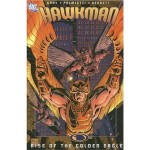
Hawkman volume 4: Rise of the Golden Eagle


By Justin Gray, Jimmy Palmiotti, Joe Bennett & various (DC Comics)
ISBN13: 978-1-4012-1092-2

After an intense and impressive run of savage sagas (not all of which have been collected in graphic novels yet – and yes, that’s a hint…) Hawkman was eased out of his own book as a result of the impending Infinite Crisis company crossover event and – presumably – less than stellar sales…

Despite being amongst DC’s most popular and visually striking characters, Hawkman and Hawkwoman always struggled to find enough of an audience to sustain their numerous solo titles. From the very beginning as second feature in the Golden Age Flash comics they battled through many excellent yet always short-lived reconfigurations. From ancient heroes to space-cops and (post-Crisis on Infinite Earths) Thanagarian freedom fighters, they never quite hit the big time they deserved…

Created by Gardner Fox and Dennis Neville, Hawkman premiered in Flash Comics #1 (January 1940) with ultimately Sheldon Moldoff and Joe Kubert carrying on the strip’s illustration, whilst a young Robert Kanigher cut his teeth as writer on the late run of the strip. Carter Hall was a playboy archaeologist whose dormant memory was unlocked by a crystal dagger. He realised that once he was Prince Khufu of ancient Egypt, murdered with his lover Chay-Ara by High Priest Hath-Set. With his returned memories the eternal struggle was destined to play out once more…

Hall fashioned an outlandish uniform and anti-gravity harness, becoming a crime-fighting phenomenon. Soon the equally reincarnated Shiera Sanders was fighting and flying beside him as Hawkgirl. Together the gladiatorial “Mystery-Men” battled modern crime and tyranny with weapons of the past for over a decade before vanishing with the bulk of costumed heroes as the 1950s began.

Hawkman’s last appearance was in All Star Comics #57 (1951) as leader of the Justice Society of America, but the husband and wife hellions were revived and re-imagined nine years later as Katar Hol and Shayera Thal of planet Thanagar by Julie Schwartz’s crack creative team Gardner Fox and Joe Kubert – a space-age interpretation which even survived 1985’s winnowing Crisis. Their long career, numerous revamps and retcons ended during the 1994 Zero Hour crisis.

After the universe-shuffling a new team of Winged Wonders appeared (See Hawkworld) – refuges from a militaristic Thanagarian Empire who found new purpose on Earth.

When a new Hawkgirl was created as part of a revived Justice Society comicbook at the end of the 20th century, fans knew it was only a matter of time before her Pinioned Paramour rejoined her (see JSA: the Return of Hawkman). Immediately regaining his own book, the hero had been synthesized into a mélange of all previous versions: a reincarnating, immortal berserker-warrior who finally seemed to strike the right note of freshness and seasoned maturity. Superb artwork and stunning stories didn’t hurt either.

The current Hawkman remembers all his past lives: many millennia when and where he and Chay-Ara fought evil together as bird-themed champions, dying over and over at the hands of an equally renewed Hath-Set. Most importantly, Kendra Saunders, the new Hawkgirl, differs from all previous incarnations since Chay-Ara was not reborn in this instance but instead possessed the body of her grand-niece when that tragic girl committed suicide. Although Carter Hall still loves his immortal inamorata his companion of a million battles is no longer quite so secure or sure of her feelings…

Rise of the Golden Eagle (collecting issues #37-45 of the monthly comicbook) begins with a mysterious vendetta targeting the Pinioned Paladin as old enemy Fadeaway Man, leads an army of foes in a series of brutal attacks on Hawkman. However it seems the teleporting villain is not the real mastermind here…

Written by Justin Grey & Jimmy Palmiotti with art by Joe Bennett, Dale Eaglesham, Stephen Sadowski, Ruy Jose, Wade von Grawbadger, Lary Stucker Drew Geraci and Jack Jadson the all-out action and suspense begins with the legion of monstrous antagonists overwhelming the Winged Wonders until a new ally appears…

Former Teen Titan Charley Parker is Golden Eagle and claims to be the son of Hawkman – or at least the child of one of his past incarnations. Eager to join the immortal warriors, he is on hand and fighting valiantly when another ambush occurs and Kendra is grievously wounded. Eventually when his mentor is killed Parker ends up replacing the brutally murdered Carter Hall…

However, Parker has a secret nobody suspected and, just when the embittered and vengeance-crazed Kendra thinks she can trust him, reveals his astonishing secret and a master-plan that stretches across decades and light-years to the other side of the universe…

Meanwhile the true Hawkman has returned to life sans any shred of patience and compassion, determined to make an end to all his assembled enemies once and for all…

Tense, gripping and utterly compelling, this is the berserker warrior Hawkman always hinted he could be and the epic tale is both complex and gratuitously fulfilling; a perfect storm of art and story that every hard-bitten fights ‘n’ tights devotee will adore.

After a too brief but incredibly impressive run (something of a given and a tradition with Hawkman) the immortal Winged Wonder disappeared from his own title at the end of this volume as the exigencies of the Infinite Crisis left him missing whilst his pinioned partner Hawkgirl took over the book (see Hawkgirl: The Maw, Hawkman Returns and Hath-Set for details), but at least with books like this to remind us of just how good he could be there won’t be to much time passed until his next phoenix like revival…
© 2005, 2006 DC Comics. All Rights Reserved.

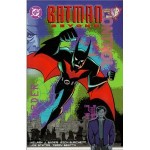
Batman Beyond


By Hilary J. Bader, Rich Burchett, Joe Staton & Terry Beatty (DC comics)
ISBN: 978-1-56389-604-0

The Batman Animated TV series masterminded by Bruce Timm and Paul Dini in the 1990s revolutionised the Dark Knight and also led to some of the absolute best comicbook adventures in his seventy-year publishing history with the tie-in monthly printed series. With the Dark Knight’s small screen credentials firmly re-established, follow-up series began (and are still coming), even recently feeding back into the overarching DCU continuity.

Following those award-winning cartoons in 1999 came a new incarnation set a generation into the future, featuring Bruce Wayne in the twilight of his life and a new teenaged hero picking up the eerily-scalloped mantle. In Britain the series was inspirationally re-titled Batman of the Future but for most of the impressed cognoscenti and awe-struck kids everywhere it was Batman Beyond!

Once again the show was augmented by a cool kid’s comicbook and this collection re-presents the first 6-issue miniseries in a hip and trendy, immensely entertaining package suitable for fans and aficionados of all ages. Although not necessary to the reader’s enjoyment, a passing familiarity with the TV episodes will enhance the overall experience…

All stories are written by Hilary J. Bader and the book opens with a two part adaptation of the pilot episode, illustrated by Rick Burchett & Terry Beatty. ‘Not On My Watch!’ offers brief glimpses of the last days of Batman’s crusade against crime before age, infirmity and injury slow him down to the point of compromising his principles and endangering the citizens he’s sworn to protect.

Years later Gotham City in the mid-21st century (notionally accepted as 2039AD – 100 years after the comic book debut of Batman in Detective Comics #27) is a dystopian urban jungle where angry, rebellious school-kid Terry McGinnis strikes a blow against pernicious street-punks The Jokerz and is chased out of the metropolis to the gates of a ramshackle mansion.

Meanwhile his research-scientist father has discovered too much about the company he works for…

Wayne-Powers used to be a decent place to work before old man Wayne became a recluse. Now Derek Powers runs the show and is ruthless enough to do anything to increase his profits… Outside town Terry is saved from a potentially fatal encounter with the Jokerz by a burly old man who then collapses. Helping the aged Bruce Wayne inside the mansion Terry discovers the long neglected Batcave before being chased away by the surly Wayne but doesn’t really care until he gets home to find his father has been murdered…

A storm of mixed emotions, he returns to Wayne Manor…

The concluding chapter ‘I Am Batman’ sees McGinnis attempt to force Wayne to act before giving up in frustration and stealing the hero’s greatest weapon; a cybernetic bat-suit that enhances strength, speed, durability and perception. Alone, untrained and unaided the new Batman sets to exact justice and revenge…

In the ensuing clash with Powers the unscrupulous entrepreneur is mutated into a radioactive monster named Blight before Wayne and Terry reach a tenuous truce and understanding. For the moment Terry will continue to clean up the Dark Knight’s city as a probationary, apprentice hero…

With issue #3 Bader, Burchett & Beatty began to tell original stories in the newly established future Gotham, commencing with ‘Never Mix, Never Worry’ wherein Blight returns to steal a selection of man-made radioactive elements which can only be used to cause harm… or can they?

Joe Staton took over the pencilling with #4 as a schoolboy nerd freed a devil from limbo and old man Wayne introduced the cocksure Terry to parapsychologist Jason Blood and his eldritch alter ego Etrigan the Demon in the spooky shocker ‘Magic Is Everywhere’, a sentiment repeated when a school-trip to the museum unleashed ancient lovers who fed on the life energy in the delightfully comical tragedy of ‘Mummy, Oh! and Juliet’

This captivating compendium of action and adventure ends in another compelling and edgy thriller as Terry stumbles into a return bout with a shape-shifting super-thief in ‘Permanent Inque Stains’, only to find that there are far worse crimes and far more evil villains haunting his city…

Fun, thrilling and surprisingly moving, these tales are magnificent examples of comics that appeal to young and old alike and are well overdue for re-issue. And once that’s done, there’s still another 24 issues from the 1999-2001 run plus a Return of the Joker one-shot to collect in spiffy graphic novel compilations…

In 2000 Titan Books released a British edition re-titled Batman of the Future (to comply with the renamed UK TV series) and this version is a little easier to locate by those eager to enjoy the stories rather than own an artefact.
© 1999 DC Comics. All Rights Reserved.

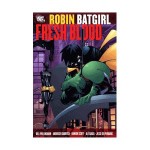
Robin/Batgirl: Fresh Blood


By Bill Willingham, Andersen Gabrych, Damion Scott, Alé Garza & Jesse Delperdang (DC Comics)
ISBN: 987-1-84576-200-1

Batman has gathered young allies about him since the second year of his crusade: adopting waif and strays and training them to be the best that they can be, all for the greater good of his beloved Gotham City.

When Gotham City was devastated by an earthquake and abandoned by the US government (Batman: Cataclysm and Batman: No Man’s Land volumes 1-3), a few heroes stayed to protect the innocent. One of these was a new, mute incarnation of Batgirl.

The crisis ended and a semblance of normality returned to the battered metropolis. The new heroine, named Cassandra Cain, was brought under the wing of Barbara Gordon, wheelchair-bound crime-fighter Oracle (and the previous Batgirl) who now ran her own crew of women heroes – the Birds of Prey.

Cassandra, mute, unable to communicate in any manner yet fluent in reading gesture, posture and body-language, was raised as an experiment by her father, super-assassin David Cain. The hired killer had over-ridden her language centres to make combat her only method of expression. An apparent runaway, she was adopted by Batman as a weapon in his never-ending battle, but the more humane Oracle had become her guardian and teacher.

Cassandra’s brain and learning disabilities were subsequently alleviated by a telepath and the unbeatable martial artist was just beginning to carve out her own life when the War Games crisis made Gotham too hot for heroes…

Tim Drake was the third Robin, a child prodigy who deduced Batman’s secret identity and his impending guilt-fuelled nervous breakdown following the murder of Jason Todd – Robin #2. Drake attempted to manipulate Dick Grayson – the first boy hero to be dubbed “Boy Wonder” – into returning as the Dark Knight’s partner before grudgingly accepting the position himself (see Batman: A Death in the Family and Batman: A Lonely Place of Dying).

After a long period of training and acclimation Batman offered Tim the job instead, and this interpretation took fans by storm, securing a series of increasingly impressive solo mini-series (see Robin: A Hero Reborn) and eventually his own long-running comic book.

Being trained by Batman is clearly an arduous and agonising undertaking. During the terrifying Batman: Wargames saga Drake in his turn became estranged from his moody mentor and forcibly retired from the fights ‘n’ tights game. Batman replaced Tim with Stephanie Brown, daughter of the criminal Cluemaster, who became the vigilante Spoiler to compensate for her father’s depredations. Don’t get too excited though, since she only starred as the fourth Robin for a fraction over six pages…

Soon Tim was back – ‘though you won’t see how or why here – setting up on his own as defender of the nearby city of Blüdhaven – a mini-Metropolis that made Gotham look like paradise…

The slim volume collects monthly issues #132-133 of Robin and #58-59 of Batgirl, a canny crossover concoction entitled Fresh Blood that saw both newly emancipated and independent street warriors striking out on their own in the very heart of urban darkness. The drama opened with ‘Too Many Ghosts’ as Tim, still recovering from Stephanie’s death, cautiously planned his first anti-crime campaign.

With faithful family Butler Alfred in tow as mentor and quartermaster he had moved to Blüdhaven planning to methodically dismantle the city’s mob hierarchy, but had no inkling that deceased criminal-mastermind Blockbuster was seemingly returned from the dead. Whilst on his first reconnaissance run Robin was ambushed and almost killed by super-assassin Shrike until an unexpected ally stepped in…

‘Following Footsteps’ revealed how Cassandra Cain also set up in Blüdhaven to go it alone. Soon however she was working with Tim; her combat skills meshing perfectly with his strategic flair and deductive abilities. Establishing clandestine links with two of the few honest cops in town they planned to take down the returned Blockbuster, but discover a shocking secret in ‘The Auction’ and end up tackling one of Batman’s greatest and most insidious foes instead: a deadly and spectacular clash that they cannot possibly survive…

Na-aah, just kidding – of course they do: but the concluding chapter ‘Settling Up’ is probably one of the best and most satisfying fight-fests of that era, with assorted thugs, wise-guys and meta-threats Brutale and the Trigger Twins adding to the panorama of exotic carnage before the new kids in town triumph and carve up the territory between them: their incompatible approaches pulling them apart before they could really get together….

Where does the time go? It seems like only yesterday that these nifty little thrillers were the acme of the Batman franchise, but the pace of change in comics is relentlessly rapid and remorselessly unforgiving, so engaging little gems like this come and go like wisps of mist caught in a million candlepower bat-signal beam…

Nevertheless, the edgy, fresh scripting of Bill Willingham and Andersen Gabrych married to the unconventional but superbly effective art of Damion Scott, Alé Garza & Jesse Delperdang prove to be a heady and irresistible brew that delivers as much kick now as it ever did. This is a Bat-bunfight no fan could possibly bear to miss…

© 2005 DC Comics. All Rights Reserved.

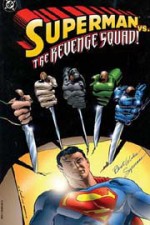
Superman Vs. The Revenge Squad!


By various (DC Comics)
ISBN: 978-1-56389-487-9

Here’s another thrilling snapshot which highlights the era of superb creativity following in the wake of the post-Crisis on Infinite Earths Superman reboot. If you’re counting, the tale first appeared – in whole or in part – in Adventures of Superman #539, 542, 543, Action Comics #726, 730, Man of Steel #61, 65 and Superman: Man of Tomorrow #7.

By extracting pertinent episodes from a selection of sub-plots and entire episodes, the assembled creators – writers Karl Kesel, David Michelinie, Jerry Ordway, Louise Simonson and Roger Stern in close conjunction with artists Jon Bogdanove, Sal Buscema, Tom Grummett, Stuart Immonen, Ron Lim, Tom Morgan, Paul Ryan, Brett Breeding, Klaus Janson, Dennis Janke, Jose Marzan Jr. & Denis Rodier – assembled a crafty and exciting romp which pitted the Metropolis Marvel against a peculiar array of particularly irate enemies all working for a mysterious mastermind who was far from what he appeared…

The action commences with ‘Dopplegangster’ wherein a clone from the top-secret Cadmus Project intercepts a high-tech intruder and is infected with a hideous condition which brings all his submerged evil to the surface.

The invader is Misa, a spoiled, fun-loving, metahuman brat with incredible futuristic devices who has plagued Superman and the Project before, but here her skirmish with the re-grown Floyd “Bullets” Barstow has lasting effects, accidentally transforming the good-natured clone into a troubled paranoid soul who might suddenly transform at any moment into a brutal Anomaly with elemental shape-changing powers and no conscience at all.

Meanwhile in Metropolis Superman has his hands full defending the city and shuffling his new job as Editor of The Daily Planet, whilst venerable boss Perry White recovers from lung cancer and the subsequent chemo-therapy. It gets no easier when living weapons-platform Barrage returns in ‘Arms’, determined to kill Police Chief Maggie Sawyer, whom he blames for the loss of his right limb, and the anarchic Riot – a raving loon who generates living duplicates every time he is struck – also pops up to cause mischief and mayhem in ‘Losin’ It’.

‘Hero or Villain?’ concentrates on the history of Lex Luthor, providing insight and oversight to the multi-billionaire inventor who is under arrest and awaiting trial, whilst alien superwoman Maxima frets and festers in her futile quest to find a suitable mate. The Man of Steel was her first choice and he refused her many times. Once again she tries to have her way with him and the violent rejection sends her straight into the influence of someone who is gathering a team to destroy the Caped Kryptonian forever…

The unified assault begins in ‘The Honeymoon’s Over’ as Riot, Misa, Anomaly and Barrage meet Maxima and take their shot at their mutual enemy in ‘President of the United Hates’, but there is something not quite right about their enigmatic, shadowy leader and besides, what strategic genius would put five incompatible, uncontrollable ego-maniacs in the same team and expect them to have a ghost of a chance against Superman?

The final, spectacular battle inevitably goes awry for the rogues in ‘Losers’ and as the dust settles all the evidence points to only one possible culprit for the Revenge Squad’s campaign of terror. But is it really that clear-cut…?

Although a little disconnected in places – this storyline was running simultaneously with another extended saga (collected in the soon-to-be-reviewed Superman Transformed!) and the excision of irrelevant pages doesn’t lend itself to a seamless and smooth read – this tale perfectly exemplifies the brilliant blend of cosmic adventure, fights ‘n’ tights action, soap opera drama and sheer enthusiastic excitement that typified the Superman franchise at this time.

This kind of close-plotted continuity was a hallmark of the 1980s and 1990s Superman, and that such a strong tale could be constituted from snippets around the main story is a lasting tribute to the efficacy and power of the technique. Superman vs. the Revenge Squad! is a delightfully old-fashioned fun-fest that will delight fans of The Legend and followers of the genre alike.

A British edition (ISBN: 978-1-84023-077-2) was released by Titan Books at the time and may well be easier to find than the out-of-print US original.

© 1996, 1997, 1999 DC Comics. All Rights Reserved.

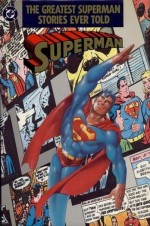
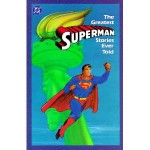
The Greatest Superman Stories Ever Told


By Jerry Siegel, Joe Shuster & various (DC Comics)
ISBN: 978-0-930289-29-3  paperback ISBN: 978-0-9302893-9-3

When graphic novels were just establishing themselves as a separate collector commodity in the late 1980s DC launched an ambitious series of themed hardback compendiums celebrating “The Greatest Stories …” but after not nearly enough comprehensive chronicles the project was shelved. The title was revived early this century in a glossy, stripped down softcover format and continues intermittently to this day, exclusively focusing on individual heroes and titles.

One of the first of these collections naturally featured the Big Gun who started it all and this compelling array of fantastic adventures, also commemorating fifty years of Super Action, is as intriguing for what’s omitted as it is enticing for its included contents. After all, how do you pick 340 pages out of the incalculable thousands of magic moments filled with the exploits of one of the greatest and most enduring characters in world fiction?

Giving it a shot in 1987 – not long after the immensely successful reboot that came after Crisis on Infinite Earths – were co-editors Mike Gold and Robert Greenberger, who explain their methodology in ‘Gathering the Greatest’ and ‘End Notes’ respectively. Also contributing a weighty text treatise was John Byrne, the then architect of the Man of Steel’s new adventures who trace ‘The Origins of Superman’ in his lengthy but fascinating introduction.

After those passionate prose pieces the action begins with Jerry Siegel and Joe Shuster’s ‘Superman versus Luthor’ from Superman #4 (Spring 1940); a landmark first clash with the rogue scientist who, back then, was a rangy red-headed menace with a bald and pudgy henchman. Somehow he got confused with his boss in later adventures and became the slap-headed super-criminal we know today…

Full-on villains were few and far between back then but ‘Superman versus The Archer’ is cited as introducing the first costumed foe Superman ever faced (from #13, November-December 1941, credited here to Siegel and Shuster, but actually mostly the artwork of Superman Studio stalwart Leo Nowak) a riotous murder-mystery matched in energy and simplistic enthusiasm by the two-page feature ‘What if Superman Ended the War?’ from the tabloid Look Magazine (February 1940) wherein Hitler and Stalin, instigators of that distant “second European War” were hauled off to the World Court by the irresistible Man of Tomorrow. Once America joined the melee Superman was constrained to be far more circumspect…

‘The Mysterious Mr. Mxyztplk’ (Superman #30, September-October 1944, credited to Siegel and John Sikela, but actually drawn by Ira Yarborough) introduced the fifth dimensional imp who periodically tested the Man of Steel’s ingenuity and patience in a still hilarious perfect example of daffy screwball comedy. Much-reprinted, but always glorious, Mxyztplk (later Anglicised to Mxyzptlk, presumably to make it easier to spell) became a cornerstone of the Superman mythos: an insufferable pixie, against whom all Superman’s strength and power were useless. From then on brains were going to be as important as brawn as they introduced frustration as the Big Guy’s first real weakness.

We jump all the way to the 10th Anniversary issue for ‘The Origin of Superman’ (from Superman #53, July-August 1948, by Bill Finger & Wayne Boring) as new editor Mort Weisinger began expanding the mythology by introducing the heritage of lost Krypton to a new generation of fans.

From Superman #123 (August 1958) ‘The Girl of Steel’ by Otto Binder, Dick Sprang & Stan Kaye trialed the concept of a distaff Supergirl as part of a three-chapter yarn involving a magic wishing totem (the other two segments ‘The Lost Super-Powers’ and ‘Superman’s Return to Krypton’ are also included and just as impressive) whilst ‘Clark Kent’s College Days’ (#125, October-November 1958) by Jerry Coleman & Al Plastino) began an occasional series of ‘Untold Tales of Superman’ by revealing how, when and why Superboy became the Man of Steel.

From the same year Action Comics #241 provided ‘The Key to Fort Superman’ an intriguing puzzle-play featuring Batman, written by Coleman and illustrated by Boring & Kaye, whilst another major player in the Metropolis Marvel’s canon debuted in the  captivatingly tragic 3-part novel ‘The Battle With Bizarro’ (Superboy #68, October 1958) by Binder & George Papp. That Silver Age also introduced the bewitching mermaid Lori Lemaris in ‘The Girl In Superman’s Past’ – another Untold Tale of Superman by Finger & Boring which originally surfaced in Superman #129 (May, 1959).

By the late 1950s Superman had settled into an ordered existence. Nothing could really hurt him, nothing would ever change, and thrills seemed in short supply. With the TV show cementing the action, writers increasingly concentrated on supplying wonder instead. ‘Superman’s Other Life’ by Binder, Boring & Kaye (Superman #132, October 1959) shows what might have happened if Superman had grown up on an unexploded Krypton, courtesy of Batman and the projections of a super-computer.

This momentous costumed drama is counter-pointed by the deliciously whimsical and bizarre mystery romp ‘The Night of March 31st (Binder, Curt Swan & Sheldon Moldoff from Superman #145, May 1961) and the compelling epic ‘The Death of Superman’ from #149 (November 1961, by Siegel, Swan & George Klein – possibly the most effective art-team ever to work on the Man of Steel).

They also illustrated Leo Dorfman’s ‘The Amazing Story of Superman-Red and Superman-Blue!’ (Superman #162, July 1963) possibly the most influential tale of this entire sub-genre and a perfect response to the tragedy of the previous saga: a startling utopian classic so well-received that decades later it influenced and flavoured the post-Crisis on Infinite Earths Superman continuity for months.

When Julie Schwartz took over the editorial duties in 1970, he decided to shake things up with spectacular results, but before then a brilliant but off-the-wall inclusion here is ‘The Forever People!’ (Forever People #1, February 1971, by Jack Kirby, Vince Colletta and infamously, Al Plastino who was engaged to redraw Superman’s head), a stunning tour de force of wonderment which introduced “The King’s” Fourth World universe to fans, instantly changing the way DC Comics were perceived and how the medium could be received.

Schwartz breathed fresh life into the Superman franchise when his editorial changes took hold in 1971, spearheading controversial and socially challenging material unheard of since the feature’s earliest days. From Superman #247 (January 1972) comes a groundbreaking yarn by Elliot Maggin, Swan and Murphy Anderson which questioned the nigh-omniscient hero’s effect on human development and self-reliance in ‘Must There be a Superman?’

Alan Moore & Dave Gibbons produced one of the last great Superman stories before the great upheaval of Crisis on Infinite Earths with ‘For the Man Who Has Everything’ (Superman Annual #11, 1985) as the alien despot Mongul attacks the Man of Tomorrow with the most insidious of weapons and not even Batman, Robin and Wonder Woman are enough to turn the tide…

When DC Comics decided to rationalise and reconstruct their continuity with Crisis on Infinite Earths they used the event to regenerate their key properties. The biggest shake-up was Superman and it’s hard to argue that change was unnecessary. The old soldier was in a bit of a slump, but he’d weathered those before. So how could a root and branch overhaul be anything but a marketing ploy that would alienate real fans for a few fly-by-night chancers who would jump ship as soon as the next fad surfaced?

Superman’s titles were cancelled/suspended for three months, and boy, did that make the media sit-up and take notice – for the first time since the Christopher Reeve movie. But there was method in this corporate madness…

Man of Steel, written and drawn by John Byrne and inked by Dick Giordano stripped away vast amounts of accumulated baggage and retuned the hero to the far from omnipotent edgy but good hearted reformer Siegel and Shuster had first envisioned. It was a huge and instant success, becoming the industry’s premiere ‘break-out’ hit and from that overwhelming start Superman returned to his suspended comic-book homes with the addition of a third monthly title premiering in the same month.

The miniseries presented six complete stories from key points in Superman’s career, reconstructed in the wake of the aforementioned Crisis and ‘The Secret Revealed’ (by Byrne & Terry Austin) comes from the second issue of that remodeled, Post-Crisis, Superman (July 1986) ending this glorious compendium with satisfactory circularity by revealing just how differently the new Lex Luthor thought and worked: a new kind of arch villain for the Reagan era…

Every generation has its own favourite Superman. This selection has the potential to make a fan reconsider just which one that might be. It’s probably wiser to just love them all…
© 1940-1986, 1987 DC Comics, Inc. All Rights Reserved.

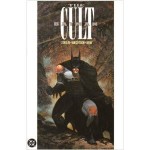
Batman: The Cult


By Jim Starlin & Bernie Wrightson, with Bill Wray (DC Comics)
ISBN: 978-0-93028-985-0

After the runaway success of The Dark Night Returns proved that fans wanted tales with darker, edgier heroes and would stump up big bucks to get them, the floodgates opened for miniseries released on expensive Baxter paper in book-like formats. DC quickly complied, following up with this deceptively effective thriller by two of the industry’s biggest fan-favourites: Jim Starlin and master of horror Bernie Wrightson, ably augmented by colour artist Bill Wray.

The story begins with ‘Ordeal’ as the Batman, experiencing mind-bending hallucinations and irresistible cravings to commit bloody slaughter, slowly awakes to the realisation that he has lost track of how long he has been a has been a prisoner of the army of hoboes and gutter-trash who have taken over Gotham City’s worst streets. They are being organised and led by a charismatic quasi-priest named Deacon Blackfire.

Moreover the dark messiah claims to be an immortal medicine man of the lost Miagani people who ruled the land before the White Men came…

Batman knows what Deacon is doing: using standard techniques developed by cult-leaders and spies to break down resistance. Pain, isolation, starvation and drugs are all employed to break down resistance and individuality: but he just can’t stop his iron resolve crumbling under the assault. It is more than any man can bear…

In flashbacks that heighten the aura of confusion, the story unfolds: the city’s worst predators were being found beaten or dead and the worst areas of the metropolis suddenly became safer to live in. But the good news soon took a dark turn. Fewer thugs were worked over and dumped but far more went missing with only bloodstains and silence to mark their passing. Batman followed the clues into the sewers… and wasn’t seen again.

Crime levels are down: thieves, pimps and muggers too scared to venture out. Commissioner Gordon and Robin know it’s too good to be true, but public opinion is hugely supportive of Deacon Blackfire’s campaign…

And deep underground the Dark Knight is crumbling as the army of derelicts find they have a taste for blood. Already their definition of what constitutes valid targets has slipped…

In ‘Capture’ the broken bat becomes one of Blackfire’s army but he balks at murder and instead escapes into the night, rambling and incoherent as he fights off the drugs and conditioning. When Blackfire moves to seize control of the entire city, assassinating police and officials, Batman is recaptured, but this time Robin follows him to the grim world of tunnels and terror. The dynamic duo make a break for freedom, but end up deeper underground and find horrifying proof of the depths of the Deacon’s terrible madness…

‘Escape’ sees the hobo army amok in the streets as Robin struggles to break the broken Batman out of the sewer citadel and Gordon finds impossible evidence that Deacon’s claims to immortality might not be spurious. However total anarchy has taken hold with citizens being casually murdered in their homes and when Gordon is gunned down the National Guard declares Martial Law. With Batman mentally incapacitated, when the military units are massacred the federal government pulls out, abandoning Gotham and its helpless population to Blackfire’s disciples…

With the situation hopeless Robin and Alfred can only wait to see if Bruce Wayne will ever be able to become Batman again. After a harrowing reexamination of his history and purpose, a determined, angry and far Darker Knight emerges with new tactics, harsher weapons and an unshakable hunger to destroy Blackfire and take back his city…

Batman: the Cult is a grim and powerful thriller that emphasises the psychological rather than physical or technical attributes of the most popular superhero in the world, but the saga is still packed with tension and suspense peppered with spectacular action set-pieces. Fierce, frenzied and ferociously fun, this is a long neglected slice of Batmania ripe for reappraisal.

© 1988, 2003, 2009 DC Comics. All Rights Reserved.