The Death of the New Gods


By Jim Starlin, Matt Banning, Art Thibert & Mark McKenna (DC Comics)
ISBN: 978-1-84576-871-3

When Jack Kirby returned to the home of Superman in 1970 he brought with him one of the most powerful concepts in comicbook history. The epic grandeur of his Fourth World saga grafted a whole new mythology over the existing DC universe and blew the developing minds of a generation of readers.

Starting in Superman’s Pal Jimmy Olsen, where he revived the 1940s kid-team The Newsboy Legion, introduced large-scale cloning in the form of The Project and hinted that the city’s gangsters had extraterrestrial connections, Kirby then moved on to the Forever People, New Gods and Mister Miracle; an interlinked triptych of projected finite length titles that together formed an epic mosaic.

Those three groundbreaking titles introduced two rival races of gods, dark and light, risen from the ashes of a previous Armageddon to battle forever …and then their conflict spread to Earth…

Kirby’s concepts, as always, fired and inspired his contemporaries and successors. The gods of Apokolips and New Genesis became a crucial keystone of DC continuity and integral foundation of that entire fictional universe, surviving the numerous revisions and retcons which periodically bedevil long-lived comics fans.

Many major talents dabbled with the concept over the years and a host of titles have come and gone starring Kirby’s creations. Recently, however as part of yet another attention-grabbing crossover Crisis publishing event, it was decided to kill them all off.

This compendium from 2007 collects the 8 issue miniseries that ostensibly finished Kirby’s wildest imagining – but of course this is comics and nobody dies forever…

The tale begins after a number of events around the planet, wherein denizens of Apokolips and New Genesis were found dead with gaping holes in their chests.

In ‘So Begins… the End’ Daily Planet reporter Jimmy Olsen investigates the bloody murder of paraplegic war veteran Willie Walker, unaware that the case is connected to the recent death of New God Lightray. In fact Walker was the host of the Black Racer, physical embodiment of Death for all Fourth World Deities.

Meanwhile God of Inquiry Metron has detected something subtly wrong with Reality and Darkseid, Lord of Apokolips and privy to secret data, makes fresh, bold plans… As Scott (Mister Miracle) Free and his beloved wife Big Barda play hero on Earth, in the Supertown floating above New Genesis the war god Orion makes a grisly discovery – another mighty warrior with his chest ripped open. On Earth Scott turns his back for a second and Barda too dies…

In ‘Celestial Genocide’ the New Gods take stock and realise that a vast number of superbeings have been cut down without a hint of a struggle and that the death toll is rising exponentially. Back on Earth, the Justice League begins to investigate the death of one of their own. Scott and Superman bring Barda’s body to New Genesis, where Orion is pressing for an attack on Darkseid, the obvious culprit for the deaths.

After conferring with Metron, Superman and Scott follow Orion to Apokolips, whilst the leader of New Genesis Takion goes with the aged Himon to examine the Cosmic Source Wall – a colossal barrier that separates the universe from the creation force that birthed reality…

‘Armageddon Tarantella’ sees the trio of heroes as they battle their way through the Darkseid’s forces, only to realise that the god-killer has been decimating Apokoliptians with equal ease… and the pace of deicide is increasing…

‘Bearing Witness’ follows Superman, Orion and Scott as they pursue the notion that the killer is someone they know, but each successive suspect turns up dead. Chaos and panic are building and whilst the gentle gods of New Genesis seem frightened but fatalistically resigned, the terrors of Apokolips are determined to fight and kill before they eventually succumb…

In the interim Metron has used his time-spanning capabilities to discover the brains if not the hands behind the slaughter, subsequently learning the true history of the Gods and meeting the source of all the horrors…

In ‘Mistakes’ Apokolips heavies Kalibak and Mantis lead an invasion of New Genesis with only Superman and Orion to face them, after which the war-god makes the ultimate sacrifice to draw out the mysterious and seemingly unstoppable killer in the sixth chapter ‘Sacrifice’…

The end draws close in ‘Seraphic Reunification’ as with only a handful of New Gods remaining Superman and Scott Free face the killer only to discover he has been an impostor all along. Whilst they are occupied in cataclysmic combat Darkseid finally makes his move attacking the mastermind behind the plot, determined to wrest ultimate power from the God-killer in ‘The End’…

Jim Starlin is the “go-to guy” for both cosmic storylines and major character deaths (see The Death of Captain Marvel or Batman: A Death in the Family for examples) and his introduction explains how and why he was pressured into writing the end to Jack Kirby’s ultimate comics achievement; and for my money nobody else alive could have done the job justice. It ain’t Kirby, but at least the deed was done with understanding and respect for what The King stood for.

A spectacular murder mystery, full of metaphysical flourishes and human depth with eye-popping action and even a few left-field surprises along the way, The Death of the New Gods is a fitting end to The Fourth World… at least until some editor decides that the concept is too valuable to leave alone…

This volume, which is strictly for fans of superhero tales and au fait with the minutiae of the original series (which absolutely ought to be read first…) also contains a stunning cover gallery by Starlin & Matt Banning and includes the variant cover by Ryan Sook.

© 2007, 2008 DC Comics. All Rights Reserved.
Deathstroke the Terminator: Full Cycle


By Marv Wolfman, Steve Erwin, Willie Blyberg & others (DC Comics)
ISBN: 978-0-93028-982-9

Deathstroke the Terminator is a flamboyant cover identity for mercenary/assassin Slade Wilson who underwent an experimental procedure whilst an American Special Forces soldier. He was invalided out but later developed fantastic physical abilities that augmented his military capabilities.

He debuted in New Teen Titans #2 (1980), assuming a contract that had been forfeited when neophyte costumed assassin The Ravager died trying to destroy the kid heroes. The deceased would-be killer was actually Grant Wilson, a troubled young man trying to impress his dad. Slade Wilson’s other children would also be the cause of much heartache and bloodshed over the years…

Deathstroke was an implacable Titans foe for years, instigating many complex schemes to destroy the team before a weary détente was achieved, all of which led to the graphic novel under review here. In recent years Deathstroke has returned to the path of pure – if complex – villainy.

This rather hard to find volume comes from that grim-and-gritty era when ruthless vigilantes and killers-with-a-code-of-honour were market leaders, so a villain-turned (anti)hero in the vein of Marvel’s Punisher was sound business sense. When the Terminator got his own title (with covers by the Punisher’s Mike Zeck, all included here at no extra cost to you) it instantly became a smash-hit: issue #1 even had a second printing – an extremely rare event back in the early 1990s.

Full Cycle opens with a detailed prose account of the events which led to the release of Deathstroke from Editor Jonathan Peterson before beginning the non-stop action with the contents of The New Titans #70 (October 1990) a fill-in issue by Marv Wolfman, Steve Erwin & Willie Blyberg, that abandoned the titular teens for an entire adventure of their greatest enemy as he undertook a highly suspicious contract in a war-torn South American nation.

‘Clay Pigeons’ found Wilson and his faithful aide-de-camp Wintergreen hired to keep a charismatic peace-making rebel leader alive whilst the republic of San Miguel negotiated a longed for lasting solution to decades of apartheid and revolution. But if every clique and faction needed Jorge Zaxtro alive who could be behind all the brutal attempts on his life?

That tale preceded ‘Titans Hunt’ an extended epic which heavily involved Deathstroke wherein the tragic mercenary was forced to kill his other son Joe – the hero code-named Jericho – but you’ll need to look elsewhere for that epic. Full Cycle commences in the aftermath of that tragedy as a deeply shaken Slade Wilson retreats to his home in Africa to lick his psychic wounds.

‘Assault!’ opens the campaign with a devastating mercenary attack on a train transporting nuclear material through Germany. At the same time a helicopter raid almost kills Wilson and Wintergreen. Later, we gain insight into Deathstroke’s past when the mercenary visits the bedside of a survivor of the railway raid – his estranged wife Adeline.

She was his army trainer, schooling him in exotic battle techniques before the secret experiment augmented his combat abilities. They found love and married but when Slade’s arrogance and neglect resulted in their son Joey being maimed by a terrorist dubbed The Jackal Addie shot her husband in the face and divorced him.

As she slowly recovers in a German hospital she has no idea that Slade has just killed her beloved boy…

Slade has never stopped loving Addie and begins hunting her attackers; reviewing his own past too since whoever attacked her is also targeting his few remaining loved ones. Even so, there must also be some other motive in play…

‘Kidnapped!’ builds on the frantic action and piles the bodies high as Slade closes in on the brutal and all-pervasive enemy, only briefly detouring to rescue a young boy abducted to force his mother to reveal her husband’s munitions secrets. Meanwhile somebody claiming to be the long-dead Ravager is slaughtering both Wilson and Adeline’s people, with a trail leading to the rogue middle-Eastern state of Qurac.

And then the CIA get involved…

‘War!’ sees Deathstroke go bloodily berserk in the strife-torn desert kingdom as its new ruler General Kaddam seeks to consolidate his power whilst demonstrating to the West that Qurac is still the World’s principal exporter of Terror. As his alliance with the Ravager looks set to shake the entire globe, a clandestine group hidden within the CIA makes their own move and their target too, is Slade Wilson…

After a near fatal clash with Kaddam and Ravager, Terminator is captured. Bombastically breaking out he drags the gravely wounded Wintergreen out of the Middle East as the scene shifts to Washington DC where the stolen Plutonium is being readied for use. ‘…Bombs Bursting in Air!’ sees the terrorists turn on each other before Wilson becomes an unlikely and utterly secret saviour of the free world after a savage final clash with the new Ravager…

Meanwhile, the recuperating Adeline has learned of her son’s death …but not yet who killed him…

The first Deathstroke epic ends rather inconclusively in ‘Revelations and Revolutions’ as writer Wolfman and artists Erwin and Blyberg laid plot threads for succeeding story-arcs. Slade is visiting Adeline in the aftermath of atomic plot when the covert agents within the CIA stage an all-out armed assault on the hospital where both she and the faithful Wintergreen are recovering. Never a dull moment…

Complex, violently gratuitous and frenetic, the tale is sometimes too complicated for its own good, but nevertheless the pace, varied exotic locations and all-out, human-scale action (like a James Bond film where everyone wears masks and tights) result in a frenzied rollercoaster of gory fun for any fan of blockbuster adventure. Deathstroke the Terminator is a perfectly-produced slice of lost DC history that still holds up and could easily find new devotees if given the chance…
© 1990, 1991, 1992 DC Comics Inc. All Rights Reserved.

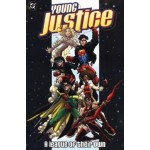
Young Justice: A League of Their Own


By Peter David, D. Curtis Johnson, Todd Nauck, Ale Garza & others (DC Comics)
ISBN: 978-1-84023-197-7

There are many facets that contribute to the “perfect mix” in the creation of any continuing character in comics. How much more so then, when the idea is to build a superhero team that will stand out from the seething masses that already exist? In the mid-1990s a fresh batch of sidekicks and super-kids started cropping up at DC after some years of thematic disfavour, and as the name and modus operandi of the Teen Titans was already established something new needed to be done with them.

But why were kid crimebusters back at all? Ignoring the inherent stupidity – and illegality if you acknowledge child-endangerment laws – of superhero apprenticeships for trainees who can’t even shave yet, why should callow champions appeal at all to comics readers?

I don’t buy the old line about giving young readers someone to identify with: the kids I grew up with all wanted to be the adult who drove the whatever-mobile, not a snotty smartass brat in short pants. Every mission would be like going to school with your dad…

I suspect it’s actually the reverse case: duffers like me with responsibilities and chores could fantasize about being powerful, effective and dangerously irresponsible: able to beat people up without having to surrender that hormone-fuelled, irredeemably juvenile frat-boy capacity for goofy fun that we’ve all missed ever since it finally died away…

After a delightfully cool try-out miniseries (see Justice League: World Without Grown-Ups) the latest crop of “ands…” soon stampeded into their own highly habit-forming monthly series. Also included in that introductory graphic novel collection was a subtly distressing tale wherein Robin, Superboy and Impulse rescued a young girl composed entirely of smoke and vapour from a supposedly benign federal agency: the Department of ExtraNormal Operations.

This second collection (repackaging issues #1-7 of the monthly comicbook with portions of Young Justice Secret Files #1) features fan-favourite writer Peter David scripting some inspired, tongue-in-cheek, gloriously self-referential adolescent lunacy, beginning with ‘Young, Just Us’ (illustrated by Todd Nauck & Lary Stucker) wherein the unlikely lads go for a sleepover in the old Justice League Secret Sanctuary and fall into a whole new career.

When a nearby archaeological dig uncovers an ancient New Gods Supercycle the boys are too busy vandalising the decommissioned mountain lair until the android Red Tornado objects. Before things become too tense the boys are called to the dig-site where DEO operatives Fite and Maad are attempting to confiscate the alien tech. After a brief skirmish with a fabulously mutated minor villain (transformed by a booby trap!) the bike adopts the kids and makes a break for it…

After a brief interlude with the pneumatically empowered Mighty Endowed the action switches to the Middle East for ‘Sheik, Rattle and Roll’ where the semi-sentient trans-dimensional cycle has brought Robin, Superboy and Impulse. Apparently uncounted years ago an Apokoliptian warrior named Riproar was entombed beneath a mountain after stealing the bike from New Genesis. Now the machine, enslaved to the thief’s ancient programming, is compelled to free the monster, but it has brought some superheroes to fight Riproar once he’s loose. Of course, they’re rather small heroes…

Hilariously victorious, the kids return to America just in time for Halloween and a riotous Trick or Treat time travel romp as meddling kids dabbling in magic snatch a nerdy Fifth Dimensional scholar out of his appointed place – endangering the entire continuum. Sadly, although YJ’s best efforts in ‘The Issue Before the One Where the Girls Show Up!’ restore reality they might have had a delayed bad influence on the quietly studious Master Mxyzptlk…

A bunch of chicks join the boys’ club in ‘Harm’s Way’ as writer David unerringly injects some dark undercurrents into the frenetic fun. Impulse’s sometime associate Arrowette (a second generation trick archer forced into the biz by her fearsome stage-struck mother) is being hunted by a psychotic youth who intends to become the world’s greatest villain and that aforementioned mist-girl Secret and the latest incarnation of Wonder Girl are dragged into the clinically sociopathic Harm’s lethal practice run before the assembled boys and girls finally manage to drive him off…

D. Curtis Johnson, Ale Garza & Cabin Boy then step in for ‘Take Back the Night’ as Secret leads the now fully-co-ed team in a raid against the clandestine and quasi-legal DEO orphanage-academy where metahuman kids are “trained” to use their abilities. It seems an awful lot of these youngsters aren’t there voluntarily or even with their parents’ approval…

‘First, Do No Harm’ (David, Nauck & Stucker) sees the return of the malevolent young nemesis as he invades their HQ and turns Red Tornado into a weapon of Mass destruction (that’s a pun that only makes sense after I mention that the Pope guest-stars in this tale). As the Justice League step in, the tale wraps up with a majestic twist ending…

The senior superstars are concerned about the kid’s behaviour and set a test, but since this is comics, that naturally goes spectacularly wrong in ‘Judgement Day’ as the ghost of alien horror Despero turns the simulation into a very practical demonstration of utter mayhem…

This terrific tome concludes with the edgy and hilarious ‘Conferences’ as the assorted guardians and mentors convene for a highly contentious parents/teachers evening, blissfully unaware that their boy and girls have snuck off for an unsanctioned – and unchaperoned – overnight camping trip together. As ever, it’s not what you’d expect but it is incredibly entertaining…

Teen issues and traditional caped crusading are perfectly combined with captivating adventure and deft, daft home-room laughs in this magical blend of tension and high jinks, comedy, pathos and even genuine horror in Young Justice.

The secret joy of sidekicks has always been the sheer bravura fun they inject into a tale and this book totally epitomises that most magical of essences. Unleash your inner urchin with this bright shiny gem and pray that now the kids have their own cartoon show DC will finally get around to releasing all the Young Justice tales in graphic novel collections.
© 1998, 1999, 2000 DC Comics. All Rights Reserved.

Green Lantern: Secret Origin


By Geoff Johns, Ivan Reis & Oclair Albert (DC Comics)
ISBN13: 978-1-4012-2017-4

Following the bombastic, blockbusting Sinestro Corps War scripter Geoff Johns continued his personal mission to make Green Lantern the most important series of the entire DC Universe by taking readers back to the start and producing the latest definitive biography of how he came to be. He sweetened the pot by linking the brand new revelations to the latest of the increasingly ambitious storylines which led into DC’s next two major crossover events Blackest Night and its sequel Brightest Day.

This volume (divided into seven chapter “books” collecting Green Lantern #29-35) written by Johns and illustrated by Ivan Reis and Oclair Albert takes the fundamental facts of the Silver Age story by John Broome & Gil Kane and in-fills with much of the subsequent ephemera that has come since – especially from Green Lantern: Emerald Dawn and the key Alan Moore Green Lantern Corps yarn ‘Tygers’ (reprinted in DC Universe: the Stories of Alan Moore and Across the Universe: the DC Universe Stories of Alan Moore)

The basic facts remain intact (and for that version see Green Lantern Archive volume1 or the Showcase Presents Green Lantern volume 1). Hal Jordan was a young test pilot in California when an alien policeman crashed on Earth. Mortally wounded, Abin Sur commanded his ring, a device which could materialise thoughts, to seek out a replacement ring-bearer, honest and without fear. Scanning the planet it selected Jordan and brought him to the crash-site. The dying alien bequeathed his ring, the lantern-shaped Battery of Power and his profession to the astonished Earthman.

Here however, we start years earlier with Jordan as a boy on the day his test-pilot dad died in a crash and see how the dysfunctional kid grew into a troubled, rebellious man: a thrill-addicted, hot-headed pilot who quickly burned up any good will he might once have deserved. Hooked on flying, he’s stuck in a dead-end job, working for the company that caused his father’s death and new boss Carol Ferris only hired him out of pity. On his very last chance his world changes forever when a spaceship crashes in the desert…

Book 2 opens with Green Lantern Abin Sur; a legend amongst his fellow peace-keepers, but now tainted and weakened by contact with mystic-terrorist psycho-warriors the Five Inversions. His resolution and will-power have been shaken by their poisonous prophecies of galactic doom and whilst transporting their leader, monster-mage Atrocitus, Sur crashes his spaceship on Planet Earth. The Green Lantern has gone rogue; defying the Guardians of the Universe and seeking proof of a coming Rise of Darkness – a “Blackest Night” of Life…

Dying Abin passes on the Ring and duties of a Green Lantern to the astounded Hal, who, unaware of the coming crisis, romps like a school boy with a new toy. Boss Carol, who hasn’t noticed Hal in decades, is suddenly very attentive to the new superhero whilst her creepy research chief Hector Hammond contemplates a rival for his illicit affections, but all Jordan sees is a new life of unfettered opportunity… which only lasts until the Ring and Battery shanghai him to Oa, home of the Guardians, for intensive training in a GL Rookie Boot Camp. Once again the mouthy punk makes more enemies than friends…

Meanwhile back on Earth, Abin’s friend and disciple Sinestro of Korugar has come seeking answers. Reckoned the greatest Green Lantern of all, even he is not without passion, and with his mentor’s death Sinestro’s unshakable resolve has been damaged. Moreover, Hammond has found the crashed ship and, exposed to its fuel core, has begun to mutate into something terrible…

When Sinestro and Hal meet there is no love lost nor respect won, especially after Hammond’s terrifying mental powers manifest as a threat to all humanity…

Until now no-one knew of Sur’s prisoner, but Atrocitus has been busy. Locating death-obsessed mortuary assistant William Hand, the alien seer sets about converting the young man into the harbinger of the Blackest Night – when the Guardians of the Universe will fall and the dead will rise…

Forced to cooperate, Jordan and Sinestro hunt the alien monstrosity and learn the prophecies that drove Abin Sur to his doom, but unaware of the human’s future role they allow Hand to escape with horrifying knowledge and a deadly weapon built by Atrocitus…

Book 7 ends the saga as the two GLs are summoned to Oa, where Hal teaches Sinestro that the Guardians are far from infallible and the Korugarian’s inevitable fall from grace is further hastened when he returns Atrocitus to the dead prison world of Ysmault. As with Abin before him, Sinestro’s resolve is destroyed by the contaminating prophecies of the Five Inversions. Now the universe itself will pay for the Guardian’s arrogance and over-confidence…

Combining big-picture theatrics with solid characterization, Green Lantern is an ideal contemporary superhero series, vast in scope, superb in execution and blending just the right amounts of angst, gloss and action in the storytelling mix – but even in this “jumping on” epic a basic familiarity with DC/Green Lantern history is advisable and necessary.

© 2008 DC Comics. All Rights Reserved.
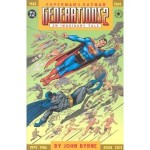
Superman & Batman: Generations 2


By John Byrne with Trish Mulvihill (DC Comics)
ISBN: 978-1-84023-711-5

The second instalment of John Byrne’s “imaginary story” trilogy, un-working the post-Crisis DC mythology he had been such a large part of re-forging in the mid-1980s, is a far smoother, less muddled beast than the first. The expansive saga even broadens the panorama to include many other icons of the company’s five decades of continuity.

After Crisis on Infinite Earths the myriad alternate Earths which had housed different eras of DC heroes and provided handy accommodation for the company’s costumed acquisitions such as the 1940s Fawcett’s Marvel Family and retinue or the Charlton Action Heroes line from the 1960s had been amalgamated into one bulky, homogenous whole, and the company took the opportunity to retrofit their major stars into the bargain.

Batman got darker, Wonder Woman was culturally re-cast and Superman had his charming Weisinger/Boltinoff/Schwartz additions to the original Siegel & Shuster concept jettisoned by John Byrne and associate writer Marv Wolfman. Out went the World’s Finest friendship with the Caped Crusader, the entire concept and career of Superboy and all the tenuous, wondrous baggage of fifty spectacular years.

And then, because we all missed it so much, he decided to bring it back…

In Superman & Batman: Generations, An Imaginary Tale, which was published under DC’s non-continuity “Elseworlds” imprint in1999, Byrne posited a world where the Man of Steel and the Caped Crusader began just as they actually had in the dog-days of the 1930s and, by sampling all the eradicated material prior to Crisis, explored how the pair would have fared had they aged like us relatively real people.

Referencing that magnificent discarded continuity and spicing the mix with some intriguing speculative fancy through a more mature, modern sensibility the saga progressed in decade-wide jumps following the family and friends of the World’s Finest Heroes in an epic struggle spanning the years 1939 to 1999, with a punchy postscript set in 2919 whilst revealing a secret origin in 1929.

This second collection following the heroic dynasties of Batman and Superman, which first appeared as a four-issue Prestige format miniseries in 2001, proceeds in 11-year jumps – two per issue – and opens in 1942 with ‘Battlefields’.

Superman, the Blackhawks, Hawkman and all the stalwarts of World War II’s Justice Society are occupied crushing Nazi terror-weapons built by the old enemy Ultra-Humanite when a new factor enters the equation as the hidden Amazons of Paradise Island send their Princess Diana to assist the good people in “Man’s World” as the Wonder Woman. Meanwhile, on the Home-Front Lois Lane and the Dynamic Duo are tackling Lex Luthor’s latest sinister scheme…

‘Absent Friends’ focuses on winter 1953, with the sudden return of long missing Commissioner Gordon and a plot by eco-despot Ra’s Al Ghul. In this world the JSA never retired and while they convene to investigate, on a distant world Superman frees an alien race from slavery and makes first contact with a Green Lantern. And back in Metropolis, Lois Lane-Kent is about to deliver Clark’s second child…

1964 and ‘Children’s Hour’ finds Batman and Superman, elder statesmen of the heroic community, watch as their kids begin their own crusading careers as part of a young wave of heroes who will eventually become Teen Titans – if they can survive the concerted attack of Gorilla Grodd, Mirror Master and the Weather Wizard, that is.

‘Troubled Souls’ visits 1975, wherein an aging Joker looks to be finally incapable of harming anyone and veteran test pilot Hal Jordan finally hangs up his flight jacket to take up politics. As the second generation of cape and cowl crime-busters investigates the Joker’s breakdown they enter a new realm of experience courtesy of mystic Dr. Occult and ghostly guardian Deadman.

In 1986 Superman and Luthor meet for their final battle in ‘To Hunt the Hunted’ as a third generation of costumed heroes join the Justice Society to hunt the out-of-control outlaw Batman, whilst by 1997’s ‘Turning Points’ alien marauder Sinestro decimates the new Justice League of America. With Superman long gone and all Batmen hunted felons, it falls to aging politician Hal Jordan to put on a power ring and battle the alien terrorist.

In 2008 ‘This Ancient Evil’ sees Superman’s greatest enemy return, his brain transplanted into an unstoppable robotic body. Can even Knightwing, the Justice League and Hal (Green Lantern) Jordan stop the metal marauder’s rampage?

This volume ends with 2019: ‘Father of the Man’ as the vanished first Superman finally returns from exile and, reunited with the latest Dark Knight, views a portentous message from the past wherein long-dead Jonathan Kent describes the first meeting of his adopted son and the boy Bruce Wayne. This lost adventure of the World’s Finest Heroes ends tragic when the elder Kent reveals how he failed to save Bruce’s parents….

Intricate and engaging this epic is broad, not deep but for all that is still a hugely readable piece of sweetened fluff, magically engrossing and filled with the “what if?” wonderment of the earlier material it eulogises. A good, solid Fights ‘n’ Tights adventure yarn, Generations II, like its predecessor, might well act as a gateway tale for new readers and tempt fans to try the older material for themselves – and surely that’s no bad thing?

© 2001, 2003 DC Comics. All Rights Reserved.
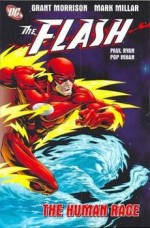
Flash: The Human Race


By Grant Morrison, Mark Millar, Paul Ryan, Ron Wagner, Pop Mahn & various (DC Comics)
ISBN: 978-1-84856-382-7

There are many super-speedsters in the DCU and most of them congregate in the conjoined metropolis of Keystone and Central City. Wally West, third incarnation of The Flash, lives there with his true love Linda Park, his Aunt Iris and fellow fast-fighters such as Jay Garrick. Impulse, a juvenile speedster from the Future and his mentor/keeper Max Mercury – the Zen Master of hyper-velocity – live in Alabama but often visit as they only live picoseconds away…

Created by Gardner Fox and Harry Lampert, Garrick debuted as the very first Scarlet Speedster in Flash Comics #1 (January 1940). “The Fastest Man Alive” wowed readers for over a decade before changing tastes benched him in 1951 until the concept of speedsters and superheroes in general was revived in 1956 by Julie Schwartz in Showcase #4 when police scientist Barry Allen became the second hero to run with the concept.

The Silver Age Flash, whose creation ushered in a new and seemingly unstoppable era of costumed crusaders, died heroically during Crisis on Infinite Earths (1985-1986) and was promptly succeeded by his sidekick Kid Flash. Of course Allen later returned from the dead – but doesn’t everyone?

Initially Wally West struggled to fill the boots of his predecessor, both in sheer ability and, more tellingly, in confidence. Feeling a fraud, he nonetheless persevered and eventually overcame, becoming the greatest to carry the name.

Following directly on from Morrison and Millar’s first turn on the Scarlet Speedster (see Flash: Terminal Velocity) this volume reprints issues #136-141 of the monthly comic and even finds room for a delicious extra feature from Secret Origins #50 and opens with a 10-year-old Wally playing with his Ham Radio kit and talking to an imaginary friend before we sprint into the present-day to find Wally seconds after his last exploit, when an alien super-speedster crashed at his feet, gasping out a warning with his dying breath…

The eponymous three-part lead tale The Human Race commences with ‘Radio Days’ (written by Morrison & Millar with art by the under-appreciated Paul Ryan and John Nyberg) when two god-like alien gamblers materialise and demand that Earth’s fastest inhabitant replaces the dead runner in a race across all time and space. If a contestant isn’t provided the world is forfeit and will be destroyed…

With the Justice League unable to defeat the cosmic wagerers Flash has no choice but to compete, however he almost falls apart when discovers his opponent is Krakkl, a radio-wave lifeform who used to talk to him when he was a kid. Now Wally has to beat a beloved memory he thought a mere childhood fancy to save his homeworld… and if he does, Krakkl’s entire species will die…

Ron Wagner came aboard as penciller for ‘Runner’ and ‘Home Run’ as, pushed to the limits of endurance and imagination Flash criss-crosses all reality but soon realises this a match he cannot win… until the valiant, self-sacrificing radio-racer imparts a deadly and world-saving secret…

Cosmic, clever and deeply sentimental in the fashion comics-fans are suckers for, this stunning saga ends with Earth enduring but its victorious hero on course for the ultimate finish in the tense thriller The Black Flash (Miller, Pop Mahn & Chris Ivy, with additional pencils from Joshua Hood) as a demonic entity that abides beyond the velocity-fuelling energy field the Speed Force comes for him in ‘The Late Wally West’.

Older speedsters have noticed over the decades that their ultra-swift comrades have all been hunted and taken by this supernal beast before their lives ended and when the creature is seen stalking Wally they do all they can to thwart it. Tragically they succeed… Unable to kill the Flash, the thing destroys his beloved Linda instead…

Jesse Quick, second generation hero who lost her father to the Black Flash, takes over Wally’s role as crushed, depressed and broken Wally loses his connection to the Speed Force, but after weeks of shell-shocked mourning he moves on, planning a new life in a foreign country, but the Black Flash is spiteful and never gives up…

When the beast attacks the powerless Wally at the airport in ‘The End’ Max Mercury, Garrick, Impulse and Jesse all confront the creature until the true Scarlet Speedster rediscovers the inner fire necessary to not only face and defeat the thing but also bring back Linda from the Great Unknown.

As if that wasn’t a perfect ending to this tumultuous tome there’s also a lost gem drawn by the magnificent Mike Parobeck (although probably included here because it’s one of Grant Morrison’s earliest DC scripts), inked by Romeo Tanghal which originally debuted in Secret Origins #50 in 1990 in celebration  of Flash’s 50th anniversary.

By the early 1950s costumed heroes had lost popularity and all but disappeared from comicbook pages for half a decade. The concept was revived and took off again when the Barry Allen Flash debuted in Showcase #4. ‘Flash of Two Worlds’ by Fox, Carmine Infantino and Joe Giella (from Flash #123, 1961) revived the Golden Age Flash, and by implication, the whole 1940s DC pantheon by introducing the concept of parallel worlds and multiple Earths which became the bedrock of the entire continuity.

The aforementioned Crisis on Infinite Earths rationalised that continuity, retconning DC’s history so that all its characters had always shared the same planet and dimension. Simple, no…?

This new ‘Flash of Two Worlds’ saw Morrison and Parobeck retell the landmark adventure of how Barry met Jay, keeping the wonder and thrills intact, incorporating a classic combat with arch-villains Fiddler, Thinker and the Shade and even found room for a little in-joke surprise or two…

Fast, furious and fabulous the Flash has always epitomised the best in costumed comic thrills and these tales are among the very best. If you haven’t seen them yet, run – don’t walk – to your nearest emporium or vendor-site and catch all the breathless action you can handle, A.S.A.P!
© 1990, 1998, 2009 DC Comics. All Rights Reserved.
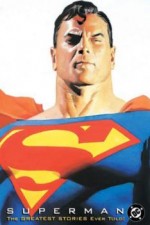
Superman: the Greatest Stories Ever Told volume 1


By Jerry Siegel, Joe Shuster &various (DC Comics)
ISBN: 978-1-4012-0339-9

When graphic novels were just establishing themselves as a separate collector commodity in the late 1980s DC launched an ambitious series of themed hardback compendiums celebrating the “Greatest Stories …” but after far too few spectacular tomes the project was shelved (see The Greatest Team-Up Stories Ever Told for a perfect example). The title was revived in the early 2000s in a sleek, stripped down form and continues intermittently to this day, exclusively focusing on individual heroes and titles.

One of the first of these new collections featured the Big Gun who started it all and this compelling array of fantastic adventures is as intriguing for what’s omitted as it is enticing for its included contents – all selected (presumably) by editors Dan DiDio and Anton Kowalski.

After an effulgent and enticing introduction from writer/producer Michael Uslan the action begins with Jerry Siegel and Joe Shuster’s ‘The Origin of Superman and his Powers’ from Superman #1, June 1939; a raw and captivating treat matched in energy and simplistic enthusiasm by the two-page feature ‘What if Superman Ended the War?’ from the tabloid Look Magazine (February 1940) wherein Hitler and Stalin, instigators of that distant “second European War” were hauled off to the World Court by the irresistible Man of Tomorrow.

Once America joined the melee Superman was constrained to be far more circumspect…

There’s a big single bound to July/August 1950 for the next selection as the Man of Steel met a trio of outlaws from his destroyed homeworld in the action-packed clash ‘Three Supermen From Krypton’ (Superman #65) courtesy of writer William Woolfolk & Al Plastino and another jump to October 1962 and issue #156 for ‘The Last Days of Superman’ by Edmond Hamilton, Curt Swan & George Klein – a tense and terrifying thriller which employed the entire vast and extended supporting cast that had evolved around the most popular comicbook character in the world.

Next up is a classic confrontation between the Caped Kryptonian and his greatest foe in ‘The Showdown Between Luthor and Superman’ (Superman #164, October 1963) by Hamilton, Swan & Klein again – possibly the ultimate 1960s creative team – pitting the lifelong foes in an unforgettable confrontation on a lost world of forgotten science and fantastic beasts.

Julie Schwartz breathed fresh life into the franchise when he became editor in 1971, spearheading controversial and socially challenging material unheard of since the feature’s earliest days. From Superman #247 (January 1972) came a groundbreaking yarn by Elliot Maggin, Swan and Murphy Anderson which questioned the hero’s effect on human development and self-reliance in ‘Must There be a Superman?’

The legendary Jim Steranko was one of a host of stellar creators who contributed to the anniversary Superman #400 (October 1984) and his lavish op-art illustrated prose treatise ‘The Exile at the Edge of Eternity’ explored the Last Kryptonian’s legacy throughout space and time, after which that same issue provided an enchanting pin-up from France’s greatest export. Moebius.

When DC Comics decided to rationalise and reconstruct their continuity with Crisis on Infinite Earths they used the event to regenerate their key properties. The biggest shake-up was Superman and it’s hard to argue that the change was unnecessary. The old soldier was in a bit of a slump, but he’d weathered those before. So how could a root and branch overhaul be anything but a marketing ploy that would alienate real fans for a few fly-by-night chancers who would jump ship as soon as the next fad surfaced?

Superman’s titles were cancelled/suspended for three months, and boy, did that make the media sit-up and take notice – for the first time since the Christopher Reeve movie. But there was method in this corporate madness…

Man of Steel, written and drawn by John Byrne and inked by Dick Giordano stripped away vast amounts of accumulated baggage and retuned the hero to the far from omnipotent edgy but good hearted reformer Siegel and Shuster had first envisioned. It was a huge and instant success, becoming the industry’s premiere ‘break-out’ hit and from that overwhelming start Superman returned to his suspended comic-book homes with the addition of a third monthly title premiering the same month.

The miniseries presented six complete stories from key points in Superman’s career, reconstructed in the wake of the aforementioned Crisis. ‘From Out of the Green Dawn…’ (Man of Steel #1, June 1986) revealed a startling new Krypton in its final moments then followed the Last Son in his escape, through his years in Smallville to his first recorded exploit and initial encounter with Lois Lane.

Byrne was a controversial choice at the time, but he magnificently rekindled the exciting, visually compelling, contemporary and even socially aware slices of sheer exuberant, four-colour fantasy that was the original Superman, making it possible and fashionable to be a fan again, no matter your age or prejudice. Superman had always been great, but Byrne had once again made him thrilling and unmissable.

Two years later Byrne, with artists Mike Mignola & Karl Kesel, brought the saga full circle in ‘Return to Krypton’ as Thanagarian heroes Hawkman and Hawkwoman ferried the Metropolis Marvel to the debris field that was once his birthworld in search of a spiritual connection to his lost forebears – an eerie epic first published in Superman volume II, #18, June 1988.

Every comic-book is a product of – or at least reaction to – the times in which it was created. In the morally ambiguous America prior to 9-11 Joe Kelly wrote an issue of Action Comics (#775, March 2001) which addressed the traditional ethics and efficacy of ultimate boy-scout Superman in a world where old-fashioned values were seen as a liability and using “The Enemy’s” own tactics against them was viewed with increasing favour by the public.

Illustrated by Doug Mahnke & Tom Nguyen, ‘What’s So Funny about Truth, Justice and the American Way’ introduced super-telepath Manchester Black and a team of Elite metahumans who acted proactively with extreme overkill to global threats and menaces in such drastic and brutal manner (like The Authority they very much resembled) that Superman was forced to take a hard look at his own methods before triumphing over “heroes” who saw absolutely no difference between villains, monsters or people who disagreed with them…

After closing with this solid reaffirmation and comforting proof that no matter what the times dictate, the core principles which shaped the founding father of superheroes remained unchanged and unchanging, this first magnificent meander down memory lane concludes with the ever-popular creator biographies section – and my perennial quibble that it would be nice to have included a few relevant cover images included…

Every generation has its favourite Superman. Hopefully this selection offers the potential new fan and veteran collector a few opportunities to reconsider which one that might be – or even expand their purview. It’s probably wisest to just love them all.

© 1939, 1940, 1950, 1959, 1962, 1963, 1972, 1984, 1986, 1988, 2001 DC Comics. All Rights Reserved.

Superman versus Terminator: Death to the Future


By Alan Grant & Steve Pugh (DC Comics/Dark Horse Comics)
ISBN: 978-1-56971-476-8

I’ve never been all that partial to crossovers combining licensed characters. It seems to contravene an intrinsic law of narrative integrity simply for petty profit when two (or more) disparate headlining money-spinners are shoehorned into a story with scant regard for intrinsic values and often necessitating ludicrous plot-maguffins simply to make the match work. How many of these packages actually convert die-hards and newbies into comics fans?

Pleasantly countering that admittedly Grumpy Old Attitude is this rather effective star-sandwich that adds rather than combines the terrifying potential tomorrow of the Terminator films and Dark Horse comicbooks to the bright shiny world of Superman…

Sarah Connor and her son John are on the run and their prolonged flight has brought them to Metropolis, but even the home of Superman is not proof against unstoppable killer robots from a dystopian tomorrow where rogue computer Skynet has almost completed its program to exterminate humanity.

With Terminators ripping up his streets the Man of Steel is quick to step in and soon learns that the unconventional boy he’s protecting is destined to save mankind – but only if he isn’t murdered before he can begin…

Unknown to all, the cybernetic assassins have an ally: a techno-organic psychopath known as the Cyborg Superman. His insider knowledge allows Skynet to specifically upgrade its next wave of walking time-bombs against the Man of Tomorrow, and with the present looking shaky Superman is whisked into the turbulent future to join an old friend in taking the battle directly to Skynet.

With the capable Connors and Lois Lane holding the fort, assisted by Supergirl and Superboy, shady billionaire-technocrat Lex Luthor offers his double-edged assistance… but is he protecting his empire or prospecting for the future’s unborn secrets?

Meanwhile thirty years way Superman and humanity’s last defenders risk everything on a last-ditch raid on Skynet, but even with victory achieved there’s a nasty surprise awaiting the Caped Kryptonian when he gets back from the future…

Originally released as a four issue miniseries collaboration between DC and Dark Horse in 1999, this gripping script from the always-entertaining Alan Grant and stunning illustration from Steve Pugh, Mike Perkins and colourist David Stewart drive the high-octane, high-tension thriller with non-stop energy, delivering a killer punch that will delight fans of both franchises and perfectly proves that when it comes to spectacle and intensity, comics always have the home-ground advantage.
Text and illustrations © 1999, 2000 DC Comics, Inc., Canal+ DA and Dark Horse Comics, Inc. All other material © 2000 Dark Horse Comics Inc. All Rights Reserved.

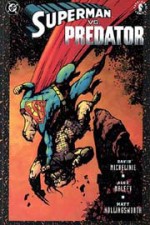
Superman vs. Predator


By Mark Schultz & Ariel Olivetti (DC Comics/Dark Horse)
ISBN: 978-1-84023-319-3

I’m never particularly comfortable with crossovers combining licensed characters. It seems to me that some basic law of narrative integrity is being flouted purely for venal profit when two (or more) disparate headlining money-spinners are shoehorned into a story with scant regard for intrinsic values and often necessitating ludicrous plot-maguffins simply to make the mismatch work.

On first look just such commercial instincts seem to ride roughshod over all other considerations in this Battle of The Brands from DC and Dark Horse, which originally appeared as a three-issue miniseries in 2000 before making the jump to stiff covers and nominal legitimacy as a graphic novel…

However, appearances can be deceiving and once the necessary leveling gimmick has de-powered the nigh-omnipotent Man of Tomorrow what’s left is a beautifully illustrated and tensely effective thriller that both movie mavens and funnybook fans can read and enjoy.

Written by David Michelinie and illustrated by Alex Maleev the action opens with a S.T.A.R. Labs expedition to La Jungla de Las Sombras, one of the hottest and isolated areas of the South American rain forest. A small group of scientists looking for specimens discover a half-buried alien spacecraft and immediately fall out. Whilst ambitious young Dr. Marla Rollins is bedazzled by the potential benefits and glory that would accrue from such a find, grizzled xenobiologist Casey Trabor wants to blow it up. He knows trouble when he sees it. Of course the mound of human skulls he’s standing on might be colouring his judgement…

In Metropolis, Lois Lane gets wind of the find and promptly heads South, but Superman arrives first, only to be exposed to a fast-acting extraterrestrial virus when he enters the fallen vessel with the squabbling scientists. The first inkling that something is wrong comes when the “dead” ship awakens and emits an alarm signal. Before anybody can react a surprise attack by paramilitary mercenaries drives off both the explorers and a painfully weakened Man of Steel.

Fleeing into the jungles the Americans learn the legend of the Predators (heavily referencing the first movie) from a native and when Lois finally turns up Superman is captured trying to rescue her from the mysterious soldiers.

All is revealed when the entire party is dragged before mad scientist Solomon Ward, who has turned a lost city into his private lab. Ward intends to inject a chemical into the Earth’s atmosphere that will wipe out all hereditary disease and disability. Unfortunately it works by killing all the “genetically impure” carriers at once, leaving only healthy, “pure” people alive to breed…

With Superman crippled and an unstoppable madman about to eugenically euthanise possibly everyone on Earth, dark secrets are revealed about more than one of the S.T.A.R. scientists, whilst elsewhere chaos and horror erupt as an invisible monster begins slaughtering the mercenaries…

The good guys escape and try to warn civilisation, whilst the dying Superman heads back to the downed ship looking for a last-ditch cure. What he finds is a bloody charnel house and an alien hunter summoned by the reactivated vessel.

Dying but indomitable, the Man of Steel must defeat an inhuman killing machine in time to stop mass genocide by far more wicked human monsters. The inscrutable Predator, however, has an agenda of its own, and of course there’s a thermonuclear self-destruct clock counting down too…

We are all, on some level, still just kids in our own heads, inhabiting a vast metafictional gestalt where Dracula, Adam Adamant, Thursday Next, Danger Mouse, Fu Manchu, James Bond and Carnacki, the Ghost Breaker stalk the same London streets (hey! That I would buy…) and occasionally it’s okay to giver in to the wide-eyed wonder addict – but only if the product is a well written and beautifully executed as this rare treat…

© 2001 DC Comics, Twentieth Century Fox Film Corporation and Dark Horse Inc. All Rights Reserved.

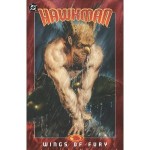
Hawkman Volume 3: Wings of Fury


By Geoff Johns, Rags Morales, José Luis García-López, Scot Eaton & various (DC Comics)
ISBN: 978-1-4012-0467-9

Rising to even greater heights this third volume of the resurrected Winged Wonders (collecting issues #15-22 of their own high-flying series and including material from JLA A to Z #1-2) intensified the high-octane thrills and dynamic tension of the lovers-with-many-lives in a sequence of tales which delved deeper into their many and varied pasts and even had a bold shot at reconciling all the bewildering iterations generated by the many reboots and retcons the Feathered Furies have endured over the decades.

Despite being DC’s most popular and visually striking characters, the various versions of Hawkman and Hawkwoman always struggled to find enough of an audience to sustain a solo title. From the very beginning as the second feature in Flash Comics, they battled through many excellent yet always short-lived reconfigurations. From ancient heroes to space-cops and (post-Crisis on Infinite Earths) Thanagarian freedom fighters, they never quite hit the big time they deserved…

Hawkman premiered in Flash Comics #1 (January 1940), created by Gardner Fox and Dennis Neville, with Sheldon Moldoff and Joe Kubert carrying on the strip’s illustration, whilst a young Robert Kanigher was justly proud of his later run as writer. Carter Hall was a playboy archaeologist until he found a crystal knife that unlocked his dormant memories. He realised that once he was Prince Khufu of ancient Egypt and that he and his lover Chay-Ara had been murdered by High Priest Hath-Set. Moreover with his returned memories came the knowledge that both lover and killer were also nearby and aware…

Hall fashioned a garish uniform and anti-gravity harness, becoming a crime-fighting phenomenon. Soon the equally reincarnated Shiera Sanders was fighting and flying beside him as Hawkgirl. Together these gladiatorial “Mystery-Men” battled modern crime and tyranny with weapons of the past.

Fading away at the end of the Golden Age (the last appearance was in All Star Comics #57, 1951 as leader of the Justice Society of America) they were revived nine years later as Katar Hol and Shayera Thal of Thanagar by Julie Schwartz’s crack creative team Gardner Fox and Joe Kubert – a more space-aged interpretation which survived until 1985’s Crisis, and their long career, numerous revamps and retcons ended during the 1994 Zero Hour crisis. After the universe-shuffling a new team of Winged Wonders appeared (See Hawkworld) – refuges from a militaristic Thanagarian Empire who found new purpose on Earth.

When a new Hawkgirl was created as part of a revived Justice Society comicbook, fans knew it was only a matter of time before her Pinioned Paramour rejoined her, which he did in the excellent JSA: the Return of Hawkman, after which he immediately regained his own book. This time the blending of all previous versions into a reincarnating, immortal berserker-warrior appeared to strike the right note of freshness and seasoned maturity. Superb artwork and stunning stories didn’t hurt either.

The reconstituted Hawkman now remembers all his past lives: many millennia when and where he and Chay-Ara fought evil together as bird-themed champions, dying over and over at the hands of an equally renewed Hath-Set. Most importantly, Kendra Saunders, the new Hawkgirl, differs from all previous incarnations since Shiera was not reborn this time, but rather possessed the body of her grand-niece when that tragic girl committed suicide. Although Carter Hall still loves his immortal inamorata his companion of a million battles is no longer quite so secure or sure of her feelings…

This cracking chronicle opens with a portentous reunion between the Winged Warrior and alien cop Shayera Thal in ‘The Thanagarian’ a three-part saga by Geoff Johns, Rags Morales & Michael Bair which sees the alien virago seeking to discover the final fate of “her” Hawkman…

With Katar Hol now incorporated into the body and memories of Hawkman nobody is prepared for the brutal attack of another Winged Wonder claiming to be the actual Thanagarian hero… It takes the combined efforts of Hawkman, Hawkgirl, Shayera Thal and guest-star Animal Man to divine the secret of the murderous mystery marauder…

Artistic maestro José Luis García-López took over for ‘Blood Lines’ as the old soldier revisits his history and some of the places where he has been buried over the centuries, affording us an insight into the tragedy of reincarnation, before Carter Hall revives his career as an archaeologist in ‘Hunting For History’ (Scott Eaton & Ray Kryssing), excavating in Saharan Kahndaq and renewing a somewhat strained relationship with five thousand-year-old erstwhile comrade Black Adam…

An arcane supernatural threat materialises in St. Roch when ‘The Headhunter’ (Morales, Bair & McMurray) comes to steal the memories of the Aerial Ace and not even best friend the Atom can tip the balance when Hawkman’s past incarnations slip their graves to hunt them down in ‘Taking Off the Mask’. As ever, in the end it’s all a matter of guts and determination to end Headhunter’s ‘Blood and Lies’, but victory might well be just a far more subtle kind of defeat…

Tense, terse, beautiful and extremely violent this book saw the start of far more savage hero than previously seen but Geoff Johns’ worthy attempts to rationalise the chequered histories of Hawkmen new and old should easily stifle the qualms of the old guard: this new composite Winged Wonder is an unmissable, visceral delight no superhero devotee can afford to be without.

© 2003, 2004 DC Comics. All Rights Reserved.