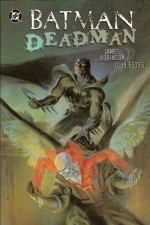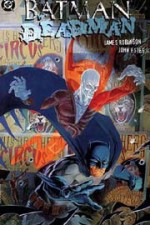
Batman/Deadman: Death and Glory


By James Robinson & John Estes (DC Comics)
ISBN: 978-1-84856-213-4 Softcover 978-1-56389-228-8

Everybody thinks they know Batman but only by a select few are the secrets of murdered trapeze artist Boston Brand also understood. An ordinary man in a brutal, cynical world Brand was a soul in balance until killed as part of a pointless initiation for a trainee assassin. When he died, instead of going to whatever reward awaited him, Rama Kushna, spirit of the universe, offered him the chance to solve his own murder. That opportunity evolved into an unending mission to balance the scales between good and evil in the world. The ghost is intangible and invisible to all mortal men, but has the ability to “walk into” living beings, possessing and controlling them.

Gotham City: Batman gradually regains consciousness, realising he is facing a squad of armed, trigger-happy police and holding a knife to the throat of a hostage. The scene is a Nightclub-turned-charnel house and all evidence before the hero’s widened eyes indicates that he is the murderous culprit…

Suddenly clear headed he drops his victim and escapes the SWAT teams, determined to find out what has happened since he lost consciousness. Stepping broadly out of character Batman uses magical items taken from villainous sorcerer Felix Faust to perform an eldritch rite and captures his prime suspect, Boston Brand. Unfortunately, his old comrade Deadman is not the guilty party, but reveals that a rich man who has sold his soul to the devil is responsible for all the Dark Knight’s woes.

Meanwhile, Albert Yeats, loser and AIDS victim is running for what’s left of his life, hunted by things he doesn’t know and can’t understand…

Determined to renege, Frederick Chaplin has offered another’s soul for his hellbound one, and the devil has accepted. Yeats had been chosen by the universe to reincarnate as the Messiah in his extremely imminent next life, but that can’t happen if he’s paying Chaplin’s tab in the Inferno. Deadman has been watching over Yeats until he safely passes, but when Batman was first possessed and subsequently distracted the Ghostly Guardian with his spell Yeats was left alone and unprotected…

Now the kid is in the wind and the heroes must find and shield him long enough to die safely, a task complicated by an entire city hunting what they still think is a murderous Bat-Maniac, whilst the real possession-killer – a phantom, satanic counterpart to Deadman called the Clown who has spread terror and death for seventy years – is loose to spread his own unholy kind of havoc…

Intriguing and pretty but lacking much of the emotional punch of earlier Batman/Deadman pairings, Death and Glory looks great but feels rather dispirited and glib in its attempts to blend urban horror, all-out chase action, cod-religion and hidden histories with a millennial feel-good factor, resulting in a top-rate outing for Boston Brand but a rather forced and unlikely performance from the Dark Knight.

Nevertheless, fans of both heroes will find lots to love here and Estes’ painted art will win the approval of most comic lovers. This book is still available through physical and online outlets, in both paperback and hardcover editions…

© 1996 DC Comics. All Rights Reserved.

JSA volume 10: Black Vengeance


By Geoff Johns, Don Kramer & Keith Champagne (DC Comics)
ISBN: 978-1-84576-256-8

New, Extended Review

The addictive super-hero soap opera (originally published as JSA #66-75 of the monthly magazine) stepped into high gear as the younger stalwarts of the team once more went time-travelling: this time back to the immediate post-war years to thwart a plot to prevent the Justice Society from ever coming out of retirement, after the House un-American Activities Commission and Senator Joe McCarthy forced them to disappear in 1951.

But before that engaging time-paradox romp got underway attention returned briefly to the once-rogue state of Kahndaq (see JSA: Black Reign) wherein ‘Prologue’ by Geoff Johns, Don Kramer & Keith Champagne showed the size-changing Atom Smasher having doubts about the efficacy and ethics of the way the newly liberated country was progressing under Black Adam’s reign. Suddenly, he is summoned by mysterious, autocratic Time Master Rip Hunter to save hid erstwhile Justice Society comrades…

Illustrated by Dave Gibbons and James Hodgkins, the scene shifted to 1951 where Fascistic time-meddler Per Degaton was once more attempting to bend reality to his will…

‘Making History’ (art by Kramer & Champagne) revisits a seminal 1979 JSA tale by Paul Levitz and Joe Staton, originally published in Adventure Comics #466 and collected in the second volume of Justice Society (coming soon to this blog) which revealed the reason that the team retired was due to witch-hunts and political pressure from the US government’s House Un-American Activities Commission. Rather than reveal their secret identities the team simply ceased to operate, only coming out of retirement once the oppressive climate abated. Now Degaton was twisting events to ensure his hated enemies never returned…

Hunter’s attempts to stop him have convinced the murderous mastermind to eradicate the 21st century team and all their friends and families before they can journey to 1951 and interfere…

‘Guardian Angels’ and ‘High Societies’ found the hastily assembled rescue team encountering unexpected problems as they worked to counter the Time Nazi, especially for  Mr. Terrific, a brilliant African-American who couldn’t even ride in the same vehicles as his time-transplanted white companions.

A scene depicting how the Ku Klux Klan responded to a black man who wasn’t afraid of them and subsequently got the kicking of their vile lives is a delightfully gratuitous and vicarious joy that still warms my old liberal heart and absolutely stole the show before the timely assistance of two generations of Hourman in ‘Past Mistakes’ turned the tide and the forces of good finally, magnificently triumphed in ‘JSA/JSA: Conclusion’.

The controversial and contentious Kahndaq saga is then resolved with the eponymous three-parter ‘Black Vengeance’ (drawn by Kramer, Leonard Kirk and Stephen Sadowski with inks from Champagne & Michael Bair) as the morally bereft Atom Smasher, once more with the JSA, surrenders himself to a higher justice just as Eclipso and the Spectre begin their combined assault on magic (which formed the basis of the Infinite Crisis prequel series Day of Vengeance: you don’t need to read them to enjoy or understand this story, but it is recommended…) resulting in a devastating conflict that destroys the body and soul of the country and its inhabitants…

This volume is a little disjointed in places as it serves to clear up long running plot-lines whilst asking a few more pertinent questions about US imperialism as seen from the perspective of the citizens of the fictional middle-Eastern nation which was regularly reduced to rubble and collateral damage statistics whenever super-powers and Superpowers came into play.

Despite the prevalent political overtones, this is still primarily a simple hero-fest for fans of the genre, and delivers high-quality escapism for the faithful, although the uninitiated might find the implicit back-story a tad hard to grasp. At this time the entire DC line was gearing up for major changes beyond their Infinite Crisis publishing event and the narrative throat-clearing here allowed everybody concerned a few final dalliances with the World’s First Super-Team before the Big Boom got lowered (and for those last two excellent escapades check out the final two volumes of this graphic novel sequence JSA: Mixed Signals and JSA: Ghost Stories).

A shaky moment in an otherwise superlative series, but this is still a book well worth pursuing and a saga worth reading over and over again.

© 2006 DC Comics. All Rights Reserved.

JSA volume 8: Black Reign


By Geoff Johns, Morales, Kramer, Bair & Champagne (DC Comics)

ISBN 1-84023-984-0

New, Extended Review

All periodical fiction (even television shows) walk a tricky tightrope when they try to inject a semblance of contemporary relevance into their narratives, weighing popular cachet and increased interest against potential controversy, accusations of “cashing in” and especially the risk that by the time of release the cause célèbre has faded from public consciousness.

There’s even the ever-present threat of lawsuits such as in the infamous, never, ever to be reprinted ‘Cursed Earth’ episodes of 2000AD wherein the creators of Judge Dredd aroused the litigious ire of the world’s two largest fast-food empires with what we all thought was a funny, fabulous piece of satire…

Here however, damning the consequences, superheroes once more got all geo-political in the eighth compilation of the excellent, award-winning JSA (collecting issues #56-58 as well as Hawkman #23-25) wherein a breakaway branch of current and ex-members invaded an oddly allegorical (lawyers, politicians and media-moguls read comics too remember?) Middle-Eastern country to depose a monstrous and tyrannical dictator and liberate his oppressed subjects.

This naturally leads to the right-thinking defenders of the status quo and champions of democracy having to go in and stop their erstwhile comrades since these actions contravene the long-cherished, unspoken principle of super-hero ideology that Good Guys don’t mess with political injustice and issues. The flagrant and wilful abuse of this principle is, of course, the guiding concept behind the hugely enjoyable series The Authority and even Justice League Elite …

The action begins in the eponymous ‘Black Reign’ illustrated by Don Kramer & Keith Champagne, as magical superman Black Adam leads a team of like-minded heroes (Atom Smasher, Brainwave, super-assassin Nemesis, a new Eclipso and mutated human hawk Northwind) in a bloody campaign to liberate the rogue state of Kahndaq – the middle-Eastern land Adam ruled five millennia ago and one currently suffering under a military dictatorship.

Once the regime-change has been accomplished however the real problems – and calamitous bloodletting – begin…

When originally released the tale alternated with Hawkman‘s own comicbook, and the second chapter, with art by Rags Morales & Michael Bair, saw the Winged Wonder pressgang his own teammates into going after the renegade liberators, even seizing the role of chairman from a bewildered Mr. Terrific, but forces beyond mortal ken were also aligned against the JSA, and with Dr. Fate distracted one of their number sustained a fatal wound.

As the death-toll escalated a sinister old foe was discovered, but to the astonishment of the JSA, had been nothing more than a contributory factor to a much more ancient and human problem: men will fight for the stupidest reasons…

With the heroes ultimately forced to see themselves through victim’s eyes and in unaccustomed roles, every troubled stalwart was compelled to thoroughly reconsider his/her/its position…

Even with a little time and distance it’s impossible to escape the rather heavy-handed political allusions to America’s dubious foreign policy adventures, but by fictionalising such commentary do creators run the risk of also trivialising it? Brutal and deeply jarring, ‘Black Reign’ is a bold but heavy-handed tale from America’s “War on Terror” era which, whilst still being a massive soul-searching punch-up, culminating in a portentously inconclusive stalemate, genuinely attempted to address political issues and involve an audience notoriously ambivalent to real-world issues.

I have diametrically changed my opinion on the book since I first reviewed it six years ago. Perhaps that’s a relevant message for the real world and comic fans alike. Moreover, if all actually you want is an exceptional graphic novel to read, there’s probably nothing better than this stirring saga. After all, it’s only a comic, right?

© 2003, 2004 DC Comics. All Rights Reserved.

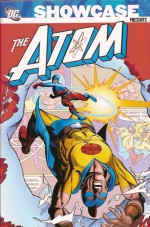
Showcase Presents The Atom volume 2


By Gardner Fox, Gil Kane & various (DC Comics)
ISBN13: 978-1-4012-1848-5

Super-Editor Julius Schwartz ushered in the Silver Age of American Comics with his Showcase successes Flash, Adam Strange and Green Lantern, directly leading to the Justice League of America which in turn inspired Fantastic Four and the whole Marvel Empire and …

However his fourth attempt to revitalize a “Golden Age Great” stalled when Hawkman (debuting in Brave and the Bold #34, February-March 1961) failed to find an immediate audience. Undeterred, he back-pedalled and persevered with the Winged Wonder, whilst moving forward with his next revival. Showcase #34 (September-October 1961) retooled the pint-sized strongman of the 1940’s Justice Society of America into a fascinating science-fiction champion and eternal underdog.

Ray Palmer was a young physicist working on the compression of matter: a teaching Professor at Ivy Town University. He was wooing career girl Jean Loring, who wanted to make her name as a trial lawyer before settling down as Mrs. Palmer (yep that’s what the 1960s were like for the fillies; years of striving and achievement followed by glorious, fulfilling days cooking meatloaf and changing nappies…)

One evening Ray found an ultra-dense fragment of White Dwarf Star Matter, leading his research into a new direction. By converting some of the degenerate matter into a lens he could shrink objects, but frustratingly they always exploded when he attempted to restore them to their original state. As fiercely competitive as his intended bride, Ray kept his progress secret until he could perfect the process. Meanwhile the couple took a group of youngsters on a science hike to Giant Caverns, where a cave-in trapped the entire party.

As they all lay trapped and dying Ray secretly activated his reducing lens to shrink himself, using the diamond engagement ring he was carrying to carve a tiny fissure in the rock wall into an escape hole. Fully expecting to detonate any second, he was astounded to discover that some peculiar combination of circumstances allowed to him to return to his normal six foot height with no ill effects. With his charges safe he returned to his lab to find that the process only worked on his own body; all other subjects still catastrophically detonated.

Somewhat disheartened he pondered his situation – and his new-found abilities. Naturally, he became a superhero, fighting crime, injustice and monsters, but Ray also determined to clandestinely help Jean become successful as quickly as possible using his suit made from White Dwarf material, which could alter not only his height but also his weight and mass…

This second volume collects the Atom #18-38, the remainder of Palmer’s solo stories (with issue #39 the title merged with another struggling Schwartz title to become The Atom and Hawkman an early casualty of declining interest in superhero comics at the end of the 1960s) and explodes into action with the first of two short tales scripted as always by Gardner Fox, penciled by Gil Kane and inked by Sid Greene.

‘The Hole-in-the-Wall Lawman!’ (lead feature in Atom #18, April-May 1965) found the Tiny Titan tracking a safe-cracker who had inadvertently stolen a miniaturised thermonuclear bomb whereas ‘The Atomic Flea!’ saw the hero lose his memory while fighting thugs, wrongly deducing that he must be part of the flea circus where he regained consciousness…

Clever whimsy, scientific wonders, eye-popping action, perspective tricks and simply stunning long-shots, mid-shots and close-ups with glorious, balletic, full-body action poses are hallmarks of this fondly regarded, dynamic series, but #19 brought a whole new edge and dynamic to the Atom when he became the second part of a bold experiment in continuity. ‘World of the Magic Atom!’ was a full-length epic featuring a sexy sorceress in a world where science held no sway.

The top-hatted, fish-netted, comely young sorceress appeared in a number of Julie Schwartz-edited titles hunting her long-missing father Zatarra: a magician-hero in the Mandrake mould who had fought evil in the pages of Action Comics for over a decade beginning with the very first issue. In true Silver Age “refit” style Fox conjured up a young and equally gifted daughter, and popularised her by guest-teaming her with a selection of superheroes he was currently scripting (if you’re counting, her quest began in Hawkman #4 and after this chapter moved on to Green Lantern #42, and the Elongated Man back-up strip in Detective Comics #355 as well as a very slick piece of back writing to include the high-profile Caped Crusader via Detective #336 – ‘Batman’s Bewitched Nightmare’, before concluding after the GL segment in Justice League of America #51).

Issue #20’s ‘Challenge of the Computer Crooks!’ found the Tiny Titan again battling ingenious robbers attempting to use one of those new-fangled electronic brains to improve their heists whilst in ‘Night of the Little People!’ impersonating a leprechaun to sway a reluctant witness to testify in court. A recurrent theme in the Tiny Titan’s career was Cold War Espionage. The American/Soviet arms-and-ideas race figured heavily in the life of physicist Ray Palmer and in the collegiate circle of Ivy Town where even Jean’s father was a scientist carefully watched by both CIA and KGB.

Issue #21’s ‘Combat Under Glass!’ pitted the Man of Many Sizes against soviet spies and an enraged housecat, whilst ‘The Adventure of the Canceled Birthday’ was another enchanting “Time-Pool” tale wherein the Atom traveled to England in 1752, meeting Henry Fielding, helping to establish the Bow Street Runners, as well as solving the mystery of 11 days that dropped off the British calendar (for the answer to this mysterious true event look up the Julian Calendar on line – although buying this book would be far more entertaining and rewarding…)

Ray Palmer’s mentor and colleague Professor Alpheus Hyatt created a six-inch wide energy field that opened portals to other eras. Hyatt thought it an intriguing but useless scientific oddity, occasionally extracting perplexing items from it by blindly dropping a fishing line through. Little did he know his erstwhile student was secretly using it to experience rousing adventures in other times and locations. This charming, thrilling and unbelievably educational maguffin generated many of the Atom’s best and most well-loved exploits.

‘Bat Knights of Darkness!’ introduced the Elvarans, a subterranean race of six inch feudal warriors who had lived in Giant Caverns since prehistoric times. When these savage bat-riding berserkers fell under the mental sway of cheap thug Eddie Gordon, all of Ivy Town was threatened. This visual tour de force is a captivating early example of Gil Kane’s swashbuckling fantasy epics and a real treat for anybody who loved Blackmark, Star Hawks or even the 1983 classic Sword of the Atom.

Issue #23 opened with a smart science-fiction teaser as the Mighty Mite played a peculiar joke on the police in ‘The Riddle of the Far-Out Robbery!’ but it was back to blockbusting basics when he stopped the ‘Thief with the Tricky Toy!’ and more so in #24 when he saved the entire planet from plant Master Jason Woodrue in the feature-length thriller ‘The Atom-Destruction of Earth!’

The Camp/Superhero craze triggered by the Batman TV show was infecting many comic-books at this time, and a lighter, punnier tone was creeping into a lot of otherwise sound series. ‘The Man in the Ion Mask!’ is far more entertaining than the woeful title might suggest; a solid heist-caper featuring another crook with a fancy gadget, and even the espionage romp ‘The Spy Who Went Out for the Gold!’ is a smart, pacy rollercoaster ride of thrills and spills, but there’s really not much I can say to defend the ludicrous yarn introducing costumed nut the Bug-Eyed Bandit.

Feeble felon Bertram Larvan built a robotic mini-beast to rob for him and despite some wonderful artwork from Kane and Greene ‘The Eye-Popping Perils of the Insect Bandit!’ in #26 remains an uncharacteristic blot on Gardner Fox’s generally pristine copy-book.  The art quality grew in leaps and bounds during this period, as seen in the romantic tryst-come-slugfest described in crime-thriller ‘Beauty and the Beast-Gang!’ accompanied by spectacular historical high-jinks as Atom used the Time Pool to visit the Montgolfier Brothers in 1783 Paris, saving Benjamin Franklin’s life and becoming a ‘Stowaway on a Hot-Air Balloon!’

It was non-stop costumed criminal action when Chronos returned in #28’s ‘Time-Standstill Thefts!’ with a side-order of scientific mystery when ordinary citizens began to change size in ‘The 100,000 “Atoms” of Ivy Town!’, and the sheer drama intensified when the Mighty Mite teamed up with the Earth-2 Atom for a cataclysmic clash against one of the worst villains of DC’s Golden Age in ‘The Thinker’s Earth-Shaking Robberies!’

Nasty thug Eddie Gordon returned in #30, which wouldn’t really have been a problem except he had once more gained control of the diminutive flying berserkers in ‘Daze of the Bat-Knights!’ whilst old comrade Hawkman guest-starred #31’s ‘Good Man, Bad Man, Turnabout Thief!’ to battle a phantom menace hidden within the brain of an innocent man, and issue #32 saw a most astounding episode in the Tiny Titan’s career as he became the giant invader of a sub-molecular universe in the enthralling fantasy thriller ‘The Up and Down Dooms of the Atom!’

Bert Larvan inexplicably won a second appearance in ‘Amazing Arsenal of the Atom-Assassin!’ and it must be said, comes off as a far worthier opponent the second time around, whilst the outlandish comedy-thriller ‘Little Man… You’ve Had a Big-Gang Day!’ produced the daftest assemblage of themed villains in DC history – each has a gimmick based on the word “big”. Led by Big Head, Big Bertha is strong, Big Wig uses weaponized toupees – and wait till you see what Big Cheese can do… Despite all that, this lunacy is actually hugely enjoyable Big Fun!

Issue #35 led with a sterling crime-caper ‘Plight of the Pin-Up Atom’ and closed with the gripping ‘Col. Blood Steals the Crown Jewels!’ following the Mighty Mite into another Time Pool adventure in 1671 London. The Earth-2 Atom returned for one of the very best team-up tales of the Silver Age in ‘Duel Between the Dual Atoms’ as a radiation menace played hob with victim’s ages on both worlds simultaneously, before the artistic team signed off in mind-blowing style by adding a new ally to the Atom’s crime-fighting arsenal in ‘Meet Major Mynah!’ in #37.

A trip to war-torn Cambodia saw the diminutive hero adopt a wounded Mynah bird who, with a few repairs and alterations from Winged Wonder Hawkman, transformed the faithful talking bird into both alternative transport and strafing back-up for the Tiny Titan.

This volume concludes with a classy and extremely scary transition tale from writer Frank Robbins and artists Mike Sekowsky and George Roussos. ‘Sinister Stopover… Earth!’ is an eerie alien invasion mystery perfectly in keeping with the grimmer sensibility gradually taking over the bright shiny world of comics at the time and still one of the spookiest tales of the Atom’s captivating run.

With the next issue the changing tastes and times forced The Atom and Hawkman series to merge (see Showcase Presents: Hawkman volume 2), but even then the move only bought an extra year or so. Superheroes were once more in decline and different genres were on the rise. The Atom was never a major name or colossal success, but a reading these witty, compelling tales by Gardner Fox, where Gil Kane first mastered the fluid human dynamism that made him a legend, you’d be hard-pressed to understand why. This is sheer superhero perfection. Why not try a little Atomic Action… just a tiny bit?

© 1965, 1966, 1967, 1968, 2008 DC Comics.  All Rights Reserved.

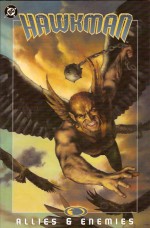
Hawkman Vol. 2: Allies and Enemies


By Geoff Johns, James Robinson, Rags Morales & various (DC Comics)
ISBN: 978-1-4012-0196-8

After a cracking start to his own series (see Hawkman: Endless Flight) the reincarnating Winged Warrior offered even more thrills, chills and spills as his new series progressed. One of DC’s most visually iconic characters, the various iterations of Hawkman had always struggled to find enough of an audience to sustain a solo title. From his beginnings as the second feature in Flash Comics, the Feathered Fury struggled through many excellent yet always short-lived reconfigurations. From ancient hero to space-cop and (post-Crisis on Infinite Earths) Thanagarian freedom fighter  Hawkman (and Hawkgirl) never quite hit the big time they deserved.

Hawkman premiered in Flash Comics #1 (January 1940), created by Gardner Fox and Dennis Neville, with Sheldon Moldoff and Joe Kubert carrying on the strip’s illustration, whilst a young Robert Kanigher was justly proud of his later run as writer. Carter Hall was a playboy archaeologist until he uncovered a crystal knife that unlocked his memories. He realised that once he was Prince Khufu of ancient Egypt and that he and his lover Chay-Ara had been murdered by High Priest Hath-Set. Moreover with his returned memories came the knowledge that both lover and killer were also nearby and aware…

Hall fashioned a costume and anti-gravity harness, becoming a crime-fighting phenomenon. Soon the equally reincarnated Shiera Sanders was fighting and flying beside him as Hawkgirl. Together these gladiatorial “Mystery-Men” battled modern crime and tyranny with weapons of the past.

Fading away at the end of the Golden Age (his last appearance was in All Star Comics #57, 1951 as leader of the Justice Society of America) they were revived nine years later as Katar Hol and Shayera Thal of Thanagar by Julie Schwartz’s crack creative team Gardner Fox and Joe Kubert – a more space-aged interpretation which survived until 1985’s Crisis, and their long career, numerous revamps and retcons ended during the 1994 Zero Hour crisis.

When a new Hawkgirl was created as part of a revived Justice Society comic, fans knew it was only a matter of time before the Pinioned Paladin rejoined her, which he did in the superb JSA: the Return of Hawkman , promptly regaining his own title. This time the blending of all previous versions into a reincarnating, immortal berserker-warrior appeared to strike the right note of freshness ad seasoned maturity. Superb artwork and stunning stories didn’t hurt either (for which see the excellent previous volume Hawkman: Endless Flight).

The reconstituted Hawkman now remembers all his past lives: many millennia when and where he and Chay-Ara fought evil together as bird-themed champions, dying over and over at the hands of an equally renewed Hath-Set. Most importantly, Kendra Saunders, the new Hawkgirl differs from all previous incarnations. This time Shiera was not reborn, but possessed the body of her grand-niece when that tragic girl committed suicide. Although Carter Hall still loves his immortal inamorata his companion of a million battles is no longer quite so secure or sure of her feelings…

This second captivating volume reprints issues #7-14 of the monthly comicbook and further gems from the one-shot Hawkman Secret Files, beginning with a fascinating reunion between the Pinioned Paladin and his one-time best friend the Atom. ‘Small Talk’ by Geoff Johns, Rags Morales, Prentiss Rollins & Michael Bair has the old comrades rediscover each other by recapping the momentous events that have transpired whilst Carter Hall was dead – useful and insightful for new readers – all whilst Hawkgirl tracked down a super-miscreant for the ever-so grateful Chief Nedal of the St. Roch police.

James Robinson rejoined the creative cast for ‘In the Hands of Fate’. The convoluted history of the Hawks threatened their effectiveness and happiness, and Dr. Fate intended to fix their problems, but before any resolution, the body of Kendra Saunders – which housed the spirit of Egyptian princess Chay-Ara – was confronted by long-suppressed memories of a brutal assault: an experience which led to her suicide and rebirth as Hawkgirl. Meanwhile the mystic master dragged Carter through his own panorama of horrific remembrances…

Before the esoteric therapy session could conclude the Hawks were propelled into a calamitous battle in the Himalayas against their oldest foe in a fresh new guise. ‘Snowblind’ saw Winged Wonders battle an army of killer yeti to recue aged adventurer Speed Saunders, whilst in ‘Everlasting Love…?’ the heroes unveiled a secret weapon of their own to thwart the malevolent mastermind, but sadly, too late as the terrifying transformation an already efficient enemy into ‘The Darkraven’ (with additional inks from Dennis Janke) upset everybody’s plans and threatened all of Tibet. Even after their narrow victory greater shocks and horrors were awaiting their return to Louisiana…

‘Fine Day For a Hanging’ (illustrated by Tim Truman) delved into a past life of the heroes, revealing that once Carter and Shiera had fought injustice as the masked gunfighter Nighthawk and frontier legend Cinnamon. Not only is this ripping yarn a cracking cowboy romance and stunning change of pace, but it also serves to set up the compelling saga which follows…

Arrested for murdering a cop, Kendra is being taken to prison by Chief Nedal when events take an utterly unexpected turn. ‘Killers’ (Johns, Ethan Van Sciver & Mick Gray) revealed that the cop had concealed a startlingly intimate connection to Kendra that stretched back to her earliest years. Now Nedal has gone completely over the edge…

Naturally there are secrets within secrets and phantom villain the Gentleman Ghost smugly reveals how – and why – he has been orchestrating the Hawks’ woes and miseries for over a century in ‘Killers Part Two’ (with art from Don Kramer & Rollins) – a tense and tragic thriller that could only end in the spilling of innocent blood …

Grim, gripping, stark and uncompromising, these are some of the most stirring episodes in the high-flying heroes’ seventy-odd year history and still the best is yet to come. Absolutely unmissable superhero sagas for older fans and novices alike, Enemies and Allies is a magnificent, beautiful and compelling example of what great creators and fresh ideas can achieve with even the oldest raw material.

© 2002, 2003 DC Comics. All Rights Reserved.

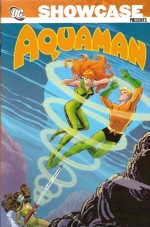
Showcase Presents Aquaman volume 3


By Bob Haney, Nick Cardy & various (DC Comics)
ISBN13: 978-1-4012-2181-2

Aquaman was one of a handful of costumed adventurers to survive the superhero collapse at the end of the Golden Age, a rather nondescript and genial guy who solved maritime crimes and mysteries when not rescuing fish and people from sub-sea disasters. Created by Mort Weisinger and Paul Norris he first launched in More Fun Comics #73 (1941). Strictly a second stringer for most of his career he nevertheless continued on beyond many stronger features, illustrated by Norris, Louis Cazaneuve, Charles Paris, and latterly Ramona Fradon who drew every adventure until 1960.

When Showcase #4 rekindled the public’s taste for costumed crimefighters with the advent of a new Flash DC updated its small band of superhero survivors, especially Green Arrow and Aquaman. Records are incomplete, sadly, so often we don’t know who wrote what, but after the revamp fuller records survive and this third black and white collection starring the King of the Seven Seas has only two creative credit conundrums.

Now with his own title and soon a to be featured in the popular, groundbreaking cartoon show Superman/Aquaman Hour of Adventure, the Finned Fury seemed destined for super-stardom. These joyously outlandish tales, reprinting issues #24-39, a Brave and the Bold team-up with The Atom (# 73) and a scarce-remembered collaboration from Superman’s Pal Jimmy Olsen #115 comfortably and rapturously mark the end of the wholesome, affable hero, laying groundwork for the grittily innovative run from revolutionary editor Dick Giordano and hot new talents Steve Skeates, Jim Aparo and Neal Adams…

Sadly those are a treat for another time, but there’s entertainment a-plenty here beginning with Aquaman #24, November-December 1965 from an uncredited author (Dave Wood and Jack Miller are both strong possibilities…) and regular artistic ace Nick Cardy.

In ‘Aquaman: Save Our Seas!’ the titanic tussle with maritime malcontent The Fisherman found the new parents (the Sea King and Mera were probably the first 1960s heroes to marry and have kids) almost fatally easily distracted when an alien plot threatened to destroy earth’s oceans, whilst in #25, ‘The Revolt of Aquaboy!’ an ancient Chinese sorcerer rapid-aged the proud parents’ newborn into a spiteful ungrateful teenager as part of a plot to capture the sunken city of Atlantis.

The entire world went spy-crazy in the first half of the Swinging Sixties and anonymous acronymic secret societies popped up all over TV, book and comics. With #26 (March-April 1966), Aquaman joined the party when seconded by the US government (even though absolute ruler of a sovereign, if somewhat soggy, nation) to thwart the sinister schemes of the Organisation for General Revenge and Enslavement in the still surprisingly suspenseful ‘From O.G.R.E. With Love!’ by Bob Haney and Cardy.

With Haney and Cardy firmly ensconced as the creative team, thrilling fantasy became the order of the day in such power-packed puzzlers as #27’s ‘The Battle of the Rival Aquamen’ wherein alien hunters unleashed devious duplicates of the Sea King and his Queen and #28’s ‘Hail Aquababy, New King of Atlantis!’ with rogue American geneticist Dr. Starbuck attempting to steal the throne with subtle charm, honeyed words and a trained gorilla and eagle who could breathe underwater.

Archenemy Orm the Ocean Master returned to attack America and the world in the tense undersea duel ‘Aquaman, Coward-King of the Seas!’, which provided some startling insights into the hero and villain’s shared shadowy pasts as well as the requisite thrills and chills, whilst ‘The Death of Aquaman’ proved to be a guest-star-studded spectacular of subterfuge, double-cross and alien intrigue, before the Sea King found himself a fish trapped out of water when ‘O.G.R.E. Strikes Back!, attempting to destroy the United Nations.

Ocean Master’s family connections clearly struck a chord with readers as he returned to unleash the ancient leviathan ‘Tryton the Terrible’ whilst the troublesome teenagers got a tacit acknowledgement of their growing importance with the introduction of Aqua-Girl in ‘Aqualad’s Deep-Six Chick!’ (stop wincing; they were simpler, more obnoxious times and the story itself about disaffected youth being exploited by unscrupulous adults is a perennial and worthwhile one).

Aquaman #34 featured another evil doppelganger ‘Aquabeast the Abominable’ and typified a new, harsher sensibility in storytelling. Even though the antagonists were still generally aliens and monsters – from now on they were far meaner, scarier aliens and monsters…

The Sea King teamed up with JLA compatriot the Atom in Brave and the Bold # 73 (August-September 1967) to tackle a microscopic marauder named ‘Galg the Destroyer’ in a taut drama written by Haney and illustrated by the vastly undervalued Sal Trapani, before returning to his home-title and another deadly clash with Ocean Master and the ruthless Black Manta. Never afraid to tweak the comfort zone or shake up the status quo Haney’s excellent tale ‘Between Two Dooms!’ resulted in the Atlanteans losing their ability to breathe underwater, leaving Aquaman’s subjects virtual prisoners in their own sub-sea city for years to come…

Now a TV star, Aquaman went from strength to strength as Haney and Cardy pulled out all the creative stops on such resplendent battles tales as ‘What Seeks the Awesome Three?’ pitting the hero against mechanistic marauders Magneto, Claw and Torpedo-Man – and the chillingly prophetic eco-drama ‘When the Sea Dies!’, due in no small part to villains Ocean Master and the Scavenger.

Closing out his volume are two more dark thrillers and a classic guilty pleasure. Firstly Aquaman #38 introduced a relentless, merciless vigilante who accidentally set his sights on the Atlantean Ace in ‘Justice is Mine, Saith the Liquidator!’ before ‘How to Kill a Sea King!’ revealed a tragic tale of an alien seductress set on splitting up the Royal Couple, and the dilemmas and delights conclude with a charming treat from scripter Leo Dorfman and artist Pete Costanza which originally appeared in Superman’s Pal Jimmy Olsen #115 (October 1968).

One of the greatest advantages of these big value black-&-white compendiums is the opportunity they provide, whilst chronologically collecting a character’s adventures, to include crossovers and guest spots from other titles. When the star is as long-lived and incredibly peripatetic as Aquaman, that’s an awful lot of extra appearances for a fan to find so the concluding tale here, taken from a title cruelly neglected by today’s fans, is an absolute gold-plated bonus…

‘Survival of the Fittest!’ saw the mystical Old Man of the Sea attempt to replace Aquaman with the far more pliant cub reporter: never realising that the lad was made of far sterner stuff than the demon could possibly imagine…

DC has a long, comforting history of genteel, innocuous yarn-spinning delivered with quality artwork. Haney and Cardy’s Aquaman is an all but lost run of classics worthy of far more attention than they’ve received of late. It is a total pleasure to find just how readable they still are. With tumultuous sea-changes in store for the Sea King, the comics industry and America itself, the stories in this book signal the end of one glorious era and the promise of darker, far more disturbing days to come.

© 1965-1968, 2009 DC Comics. All Rights Reserved.

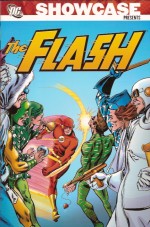
Showcase Presents the Flash volume 3


By John Broome, Gardner Fox, Carmine Infantino & various (DC Comics)
ISBN: 978-1-4012-2297-0

The second Flash triggered the Silver Age of comics and, for the first ten years or so, in terms of creative quality and sheer originality it was always the book to watch. Following his debut in Showcase #4 (October 1956) police scientist Barry Allen – transformed by an accidental lightning strike and chemical bath into a human thunderbolt of unparalleled velocity and ingenuity – was characteristically slow in winning his own title but finally after three more trial issues finally stood on his own wing-tipped feet in The Flash #105 (February-March 1959). He never looked back and by the time of this third collection’s contents – issues #141-161of his own hard-won title the Scarlet Speedster was an undisputed icon of the apparently unstoppable Silver Age of superheroes.

The comic-book had gelled into a comfortable pattern of two short tales per issue leavened with semi-regular book-length thrillers. This delightful black and white recollection begins with a perfect example of the former from Flash #141 (December 1963). The majority of adventures were still produced by globetrotting scripter John Broome and the increasingly stylised and innovative art-team of Carmine Infantino & Joe Giella, and ‘Mystery of the Flash’s Third Identity’ saw them at their very best in a wittily absorbing super-villain yarn featuring the Top.

In another clever piece of internal comicbook logic, Broome posited that Flash’s foes looked so good because of they had their own underworld bespoke tailor – and armourer. This tale introduced Paul Gambi (an editorial in-joke acknowledging the dedicated contributions of über-fan and letter-writer Paul Gambaccini), setting the Monarch of Motion on the tailor’s tail in an enticing piece of fluff that was neatly balanced by ‘Slowdown in Time’, a canny, enthralling science fiction lesson in relativity featuring that most literal absent-minded professor Ira West, Barry’s prospective father-in- law and a genius who had casually deduced the true identity of the Flash…

Gardner Fox scripted the mile-a-minute romp ‘Perilous Pursuit of the Trickster!’ whilst Broome blended legal loopholes and alien invasions to perplex the Scarlet Speedster with the ‘Puzzle of the Phantom Plunderers!’ before issue #143 featured another full-length team-up with the Emerald Gladiator in ‘Trail of the False Green Lanterns!’ – scripted by the ever-entrancing Fox who herein introduced future-gazing arch-foe Thomas Oscar Morrow.

The next two issues were all-Fox affairs: the eerie ‘Menace of the Man-Missile!’ pitting the Sultan of Speed against a shape-shifting atomic felon whilst plucky protégé Kid Flash solo-starred in the human interest parable ‘Lesson for a Star Athlete!’ before super-villainy returned in Flash #145 where ‘The Weather Wizard Blows Up a Storm!’ and the normally stoic, stolid hero briefly had his head turned by ‘The Girl From the Super-Fast Dimension!’

Broome scripted the wacky romp ‘The Mirror Master’s Master Stroke!’ and Frank Giacoia briefly bolstered the regular art team for Fox’s terrific terror tale ‘Fatal Fingers of the Flash!’ the kind of “high concept, big science” yarn that especially captivated kids in the age of space races and burgeoning technology – and still enthrals today. Issue #147 was a feature length clash with two (or was it three?) of the Scarlet Speedster’s greatest foes. John Broome scripted the fascinating ‘Our Enemy, the Flash!’ which saw schizophrenic Al Desmond attempting to reform and relinquish both his Dr. Alchemy and Mr. Element personas; only to be forcibly compelled to commit further crimes by the ruthless 25th century sociopath Professor Zoom, the Reverse Flash!

By this time it was clear that the biggest draw to the Flash was his mind-boggling array of costumed foes, as evidenced by Broome’s Captain Boomerang tale ‘The Day Flash Went into Orbit!’, but as the writer proved with his second tale in this issue creative heart and soul still counted for much. ‘The Doorway to the Unknown!’ is the moving story of an embezzler who returns from the grave to prevent his brother paying for his crimes: a ghost story from a time when such tales were all but banned and a pithy human drama that deservedly won the Academy of Comic Book Arts Alley Award for Best Short Story of the year. It still brings a worthy tear to my eyes…

Broome also scripted #149’s alien invasion thriller starring the Vizier of Velocity and his speedy sidekick ‘The Flash’s Sensational Risk!’ whilst Fox penned the Murphy Anderson inked ‘Robberies by Magic!’ which featured another return engagement for futuristic magician Abra Kadabra, before going on to produce #150’s lead tale ‘Captain Cold’s Polar Perils!’ Giella returned for Fox’s second yarn, another science mystery ‘The Touch-and-Steal Bandits!’

Flash #151 was another sterling team-up epic. Fox once more teamed his 1940’s (or retroactively, Earth-2) creation the original Flash with his contemporary counterpart, this time in a spectacular battle against the black-hearted Shade ‘Invader From the Dark Dimension’, whilst #152’s double-header consisted of ‘The Trickster’s Toy Thefts’ (Fox, Infantino & Anderson) and the Broome scripted light-hearted thriller ‘The Case of the Explosive Vegetables!’ – another engaging comedy of errors starring Barry Allen’s father-in-law to be.

Flash #153 saw Broome reprise the much lauded ‘Our Enemy, the Flash!’ in ‘The Mightiest Punch of All Time!’ as the villainous Zoom once more attempted to corrupt the reformed Al Desmond and the next issue saw Fox’s medical mystery ‘The Day Flash Ran Away with Himself!’ and Broome’s old fashioned crime caper ‘Gangster Masquerade!’ which brought back thespian Dexter Myles and made him custodian of the increasingly important Central City landmark the Flash Museum.

It had to happen and it finally did in Flash #155: Broome teamed six of the Rogue’s Gallery into ‘The Gauntlet of Super-Villains!’, a bombastic fights ‘n’ tights extravaganza, but one with a hidden twist and a mystery foe concealed in the wings, whilst the following issue was an equally engrossing invasion saga with the Flash a hunted man: ‘The Super-Hero Who Betrayed the World!’ also courtesy of Broome, Infantino & Giella.

Fox wrote both stories in #157; ‘Who Stole the Flash’s Super-Speed?’ (a return visit for Doralla, – Girl from the Super-Fast Dimension) and another tussle with the nefarious Top in ‘The Day Flash Aged 100 Years!’ as well as those of #158: a rather ridiculous alien encounter ‘Battle Against the Breakaway Bandit!’ and the far more appetising thriller ‘The One-Man Justice League!’ wherein the Flash defeated the plans of JLA nemesis Professor Ivo without even noticing…

The cover of Flash #159 features his empty uniform and a note saying the hero was quitting, a tale entitled ‘The Flash’s Final Fling!’ written by Gardner Fox, and guest-starring Kid Flash and Earth-2 hero Dr. Mid-Nite. At that time, editors and creative staff usually designed covers that would grab potential readers’ attention and then produced stories to fit. With this issue Schwartz tried something truly novel and commissioned Robert Kanigher (first scripter of the new Scarlet Speedster in Showcase #4) to write a different tale to explain the same eye-catching visual.

‘Big Blast in Rocket City!’ – scripted by John Broome – filled out #159 with one more Professor West light espionage thriller and as Flash #160, which cover appears next was an 80-Page Giant reprint edition, issue #161 concludes this magnificent third collection. The first story is where that novel experiment in cover appeal culminates in Kanigher’s gritty, terse and uniquely emotional interpretation – ‘The Case of the Curious Costume’ before the high-octane entertainment ends with Fox, Infantino & Giella’s Mirror Master mystery ‘The Mirror with 20-20 Vision!’

These tales were crucial to the development of modern comics and more importantly, they are brilliant, awe-inspiring, beautifully realised thrillers that amuse, amaze and enthral both new readers and old lags. This lovely compendium is another must-read item for anybody in love with the world of words-in-pictures.

© 1963-1966, 2009 DC Comics. All Rights Reserved.

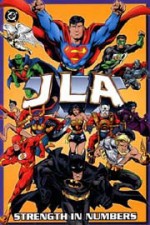
JLA: volume 4: Strength In Numbers


By Grant Morrison, Mark Waid, Christopher Priest & various (DC Comics)
ISBN: 978-1-5638-9435-0

By the time of this fourth collection featuring the astonishing exploits of the World’s Greatest Superheroes, a pattern for big-picture epics and frenetic cosmic endeavours had been established and series resuscitators Grant Morrison and Howard Porter were clearly, patiently, laying the complex groundwork for a colossal future saga.

Collecting issues #16-23 of the monthly comic-book and the Prometheus one-shot, this volume kicks off in full-attack mode with ‘Heroes’ (Christopher Priest, Yanick Paquette & Mark Lipka) as the world’s costumed champions (and a few obnoxious and hilarious hangers-on) gather to relaunch the JLA following its formal dissolution, after which the villainous Prometheus stars in a chilling origin tale ‘There Was a Crooked Man’ by Morrison, Arnie Jorgensen & David Meikis.

The main event begins with ‘Camelot’ (by Morrison, Porter & John Dell) as the new team – Superman, Batman, Flash, Green Lantern, Wonder Woman, Aquaman, Martian Manhunter, Huntress, Plastic Man, Steel, the fallen Angel Zauriel plus covert information resource Oracle – invite the world’s press to their lunar base, the Watchtower, inadvertently allowing the insidious and seemingly unstoppable mastermind to infiltrate and destroy them. Continuing with ‘Prometheus Unbound’ (assistant-inked by Mark Pennington) the heroes strike back, aided by a surprise guest-star and the last-minute appearance of New Gods Orion and Big Barda (yet more hints of the greater threat to come…)

Scripter Mark Waid steps in for a scary, surreal and utterly enthralling two-part thriller ‘The Strange Case of Dr. Julian September’: ‘Synchronicity’ is illustrated by Porter& Dell and finds the heroes hard-pressed to combat the rewriting of reality by a luck-bending scientist. Walden Wong joins the art team to conclude the spectacular last-chance battles in the ‘Seven Soldiers of Probability’ featuring an impressive guest-shot for lapsed JLA-er the Atom.

Adam Strange then guests in a splendid ‘Mystery in Space’ (Waid, Jorgensen & Meikis) as the League travels to the distant planet Rann only to be betrayed and enslaved by one of their oldest allies; an epic encounter resolved in the Doug Hazlewood inked ‘Strange New World’. This gloriously “old-school” volume then concludes with the return of Morrison, Porter and Dell for a multi-layered extravaganza as the League’s most uncanny old enemy returns. ‘It’ finds the world under the mental sway of the insidious space invader Starro, and only a little boy, aided by the (post Neil Gaiman) Morpheus/Lord of Dreams/Sandman can turn the tide in the breathtaking finale ‘Conquerors’…

If you haven’t read this sparkling slice of fight ‘n’ tights wonderment then your fantastic comic-life just isn’t complete yet. Compelling, challenging and never afraid of nostalgia or laughing at itself, the new JLA was an all-out effort to be Smart and Fun. For that brief moment in the team’s long and chequered career these were the “World’s Greatest Superheroes” and these increasingly ambitious epics reminded everybody of the fact. This is the kind of thrill that nobody ever outgrows. These are graphic novels to be read and re-read forever…

© 1998 DC Comics. All Rights Reserved.
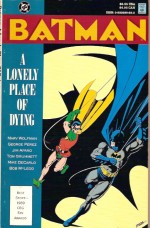
Batman: A Lonely Place of Dying


By Marv Wolfman, George Pérez, Jim Aparo, Tom Grummet, Mike DeCarlo & Bob McLeod (DC Comics)
ISBN: 978-0-9302-8963-8

Batman is in many ways the ultimate superhero: uniquely adaptable and able to work in any type or genre of story – as is clearly evident from the plethora of vintage tales collected in so many captivating volumes over the years.

One less well-mined period is the grim 1980s era when the Caped Crusader was partially re-tooled in the wake of Crisis on Infinite Earths, becoming a driven, but still level-headed, deeply rational Manhunter, rather the dark, out-of-control paranoid of later days or the costumed boy-scout of the “Camp” crazed Sixties.

Robin, the Boy Wonder debuted in Detective Comics #38 (April 1940) created by Bob Kane, Bill Finger and Jerry Robinson: a juvenile circus acrobat whose parents were murdered by a mob boss. The story of how Batman took the orphaned Dick Grayson under his scalloped wing and trained him to fight crime has been told, retold and revised many times over the decades and still regularly undergoes tweaking to this day.

Grayson fought beside Batman until 1970 when, as an indicator of those turbulent times, he flew the nest, becoming a Teen Wonder college student. His creation as a junior hero for younger readers to identify with had inspired an incomprehensible number of costumed sidekicks and kid crusaders, and Grayson continued in similar innovative vein for the older, more worldly-wise readership of America’s increasingly rebellious youth culture.

Robin even had his own solo series in Star Spangled Comics from 1947 to 1952, a solo spot in the back of Detective Comics from the end of the 1960s wherein he alternated and shared with Batgirl, and a starring feature in the anthology comic Batman Family. During the 1980s he led the New Teen Titans first as Robin but eventually in the reinvented guise of Nightwing, re-establishing a turbulent working relationship with Batman. This of course left the post of Robin open…

After Grayson’s departure Batman worked solo until he caught a streetwise urchin trying to steal the Batmobile’s tires. This lost boy was Jason Todd, whose short but stellar career as the second Boy Wonder was fatally tainted by his impetuosity and tragic links to one of the Caped Crusader’s most unpredictable foes.

Todd’s unsuspected emotional problems and his murder were controversially depicted and dealt with in Batman: a Death in the Family. In the shock and loss of losing his comrade the traumatised Dark Knight was forced to re-examine his own origins and methods, becoming darker still…

After a period of increasingly undisciplined encounters Batman was on the very edge of losing not just his focus but also his ethics and life: seemingly suicidal on his frequent forays into the Gotham nights. Interventions from his few friends and associates had proved ineffectual. Something drastic had to happen if the Dark Knight was to be salvaged.

Luckily there was an opening for a sidekick…

In this volume, collecting a crossover tale that originally appeared in Batman #440-442 and New Teen Titans #60-61 (plotted by Marv Wolfman and George Pérez, scripted by Wolfman with the Batman chapters illustrated by Jim Aparo & Mike DeCarlo, and the Titans sections handled by Pérez, Tom Grummett & Bob McLeod) a new character entered the lives of the extended Batman Family; a remarkable child who would change the shape of the DC Universe.

In ‘Suspects’ Batman is rapidly burning out, and not only his close confederates but also an enigmatic investigator and a mystery villain have noticed the deadly deterioration. Whilst the criminal mastermind embroils the wildly unpredictable Two-Face in his scheme, the apparently benevolent voyeur is hunting for Dick Grayson: a mission successfully accomplished in the second chapter, ‘Roots’.

The original Robin had become disenchanted with the adventurer’s life, quitting the Titans and returning to the circus where the happiest and most tragic days of his life occurred. Here he is confronted by a young boy who knows the secret identities of Batman and Robin…

‘Parallel Lines’ unravels the enigma of Tim Drake, who as a toddler was in the audience the night the Flying Graysons were murdered. Tim was an infant prodigy, and when, some months later he saw the new hero Robin perform the same acrobatic stunts as Dick Grayson he instantly deduced who the Boy Wonder was – and by extrapolation, the identity of Batman.

A passionate fan, Drake followed the Dynamic Duo’s exploits for a decade: noting every case and detail. He knew when Jason Todd became Robin and was moved to act when his death led to the Caped Crusader going catastrophically off the rails.

Taking it upon himself to fix his broken heroes Drake determined to convince the “retired” Grayson to became Robin once more – before Batman made an inevitable fatal mistake. It might all have been too little to late, however, as in ‘Going Home!’ Two-Face makes his murderous move against a severely sub-par Dark Knight…

Concluding with a raft of explosive and highly entertaining surprises with ‘Rebirth’ this often-overlooked Bat-saga introduces the third Robin (but who would get into costume only after years of training – and fan-teasing) whilst acknowledging both modern sentiments about child-endangerment and the classical roles of young heroes in heroic fiction. Perhaps a little slow and definitely a bit too sentimental in places, this is nevertheless an excellent, key Batman story, and one no fan should be unaware of.

Short, sweet and simply superb, here is a Batman – and Robin – much missed by many of us, and this tale, like so many others of the 1980s, is long overdue for the graphic novel treatment. To the Bat-Files, old chums…
© 1989,1990 DC Comics. All Rights Reserved.
Batman: R.I.P. – the Deluxe Edition


By Grant Morrison, Tony S. Daniel, Sandu Florea, Lee Garbett & Trevor Scott (DC Comics/Titan Books)
ISBN: 978-1-84856-137-3

After a sustained and vicious campaign of brutal psychological warfare, the all-encompassing criminal hegemony calling itself the Black Glove has succeeded in destabilising the already dubious mental equilibrium of Batman. The Glove’s enigmatic, quixotic leader Dr. Hurt is on the verge of his greatest triumph…

Grant Morrison’s controversial, much-touted extended saga relating “the Death of Batman”, promised much and managed to leave many fans confused, angry and unsatisfied, but us older lags knew full well that whatever happened, however long it took, Bruce Wayne would be back and the dance would begin all over again. So let’s take a look at this culminatory saga on its isolated, intrinsic merits and not as part of the hysterical “Buy Me! Buy Me!” huckster-hype: a solitary book starring one of the industry’s most resilient stars.

I’m reviewing the rather lovely Deluxe British edition produced by Titan Books: a lavish oversized hardback that really feels like a special event and which collects the contents of Batman #676-683 plus the portentous prelude from DC Universe #0, and also includes an extensive cover gallery – including all the variants – and a sketch section by Morrison and artist Tony S. Daniel.

After the aforementioned prelude (by Morrison & Daniel), a confrontation and mutual warning for the Dark Knight and the Clown Prince, ‘Midnight in the House of Hurt’ (which begins Sandu Florea’s cracking contribution as inker) sees the villainous clan commence their end-game as distracted, exhausted, head-over-heels-in-love Batman is dragged through further tribulations. The criminal cabal invite the Joker to join their Black Glove, whilst in ‘Batman in the Underworld’ the hero’s greatest allies begin to suspect that he’s out of control: even Bruce Wayne is no longer sure…

The first inkling of a counterplan comes with a glimpse of Batman’s earliest cases – a time when the master strategist had time to plan for every possible contingency. With his closest confidante apparently dead a radical new Caped Crusader stalks Gotham – the outlandish Batman of ‘Zur En Arrh’. Death and Chaos rule on the streets in ‘Miracle on Crime Alley’ and the utterly unpredictable Clown makes his characteristically savage move in ‘The Thin White Duke of Death’…Naturally it’s not what anybody expected…

Let’s be clear here: at the time of the original comics publication, for the industry and fan-base the Death of Batman was already a done deal. With the mega-crossover event Final Crisis rumbling along like a gaudy juggernaut, everybody “knew” that Bruce Wayne was a goner and only waited to see how, so when ‘Hearts in Darkness’ finally appeared with a resplendent, resurgent, triumphant Batman vanquishing and vanishing, leaving a slew of unanswered questions, there were howls of protest.

However these are readers who were aware of a greater picture that involved the entire DCU. For the purposes of this collection though and any casual reader picking it up, there is a solid narrative conclusion which is marvelously supplemented by the two-issue postscript ‘Last Rites’ which follows.

Illustrated by Lee Garbett and Trevor Scott, ‘The Butler Did It‘ and ‘The Butler Did It Again’ focus on Alfred Pennyworth as he adapts to a life without Master Bruce and his driven alter-ego. Looking backwards and to the future these contemplative pieces pinpoint some key moments of Batman’s serried history whilst carefully planting those clues that would inform the adventures of his successor and even lay a trail of breadcrumbs that would lead to the return of Bruce Wayne…

With the addition of such fashionably despised elements as Bat-Mite and Black Casebook continuity (see Batman: the Black Casebook), as well as deferring/postponing the traditional last chapter explanation and wrap-up, Morrison caught a lot of flak for this tale, but in all honesty, with the value of distance and hindsight this whole thing actually works very well, indeed.

Pretty, enthralling beautiful and magnificently compulsive, this is a Bat-book well worth another look.

© 2008, 2009 DC Comics. All Rights Reserved.
Titan books, who published this edition, are responsible for a huge number of publications; their magazines and graphic novels range from British and World comics and strip classics to fantasy, science fiction, licensed product and DC/Vertigo material for all tastes. Their fabulous new website/blog should beopen for business as you read this. Why not check them out as soon as you’re done here?