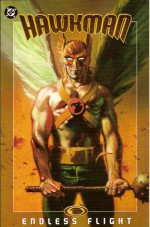
Hawkman Volume 1: Endless Flight


By Geoff Johns, James Robinson, Rags Morales & various (DC Comics)
ISBN13: 978-1-84023-714-6

Although perhaps one of DC’s most long-lived and certainly their most visually iconic character, the various iterations of Hawkman have always struggled to find enough of an audience to sustain a solo title. From his beginnings as the second feature in Flash Comics, Winged Wonder Carter Hall has struggled through assorted excellent but always short-lived reconfigurations. From ancient hero to the re-imagined Thanagarian space-cop and post-Crisis on Infinite Earths freedom fighter (both named Katar Hol – see Showcase presents Hawkman volumes 1-2 and Hawkworld respectively) to the seemingly desperate but highly readable bundling together of all the past versions into the reincarnating immortal berserker-warrior of today, without ever really making it to the big time. Where’s a big-time movie producer/fan when you need one?

Hawkman premiered as the second feature in Flash Comics #1 (January 1940), created by Gardner Fox and Dennis Neville, although the most celebrated artists to have drawn this Winged Wonder are Sheldon Moldoff and Joe Kubert, whilst a young Robert Kanigher was justly proud of his later run as writer.

Carter Hall was a playboy archaeologist until he uncovered a crystal knife that unlocked his memories. He realised that once he was Prince Khufu of ancient Egypt and that he and his lover Chay-Ara had been murdered by High Priest Hath-Set. Moreover with his returned memories came the knowledge that both lover and killer were also nearby and aware…

Using the restored knowledge of his past life Hall fashioned a costume and flying harness, becoming a crime-fighting phenomenon. Soon the equally reincarnated Shiera Sanders was fighting and flying beside him as Hawkgirl. Together these ancient “Mystery-Men” battled modern crime and tyranny with weapons of the past.

Fading away at the end of the Golden Age (Hawkman’s last appearance was in All Star Comics #57, 1951 as leader of the Justice Society of America) they were revived nine years later as Katar Hol and Shayera Thal of Thanagar by Julie Schwartz’s crack creative team Gardner Fox and Joe Kubert – a more space-aged interpretation which survived until 1985’s Crisis, and their long career, numerous revamps and retcons ended during the 1994 Zero Hour crisis.

When a new Hawkgirl was created as part of a revived Justice Society comicbook, older fans knew it was only a matter of time before the Pinioned Paladin rejoined her, which he did in the superb JSA: the Return of Hawkman.

Which is where Endless Flight takes off: reprinting issues #1-6 of the comicbook that spun-off from that epic extravaganza, plus the one-shot Hawkman Secret Files. The new series begins with the reborn, reunited heroes settling into a comfortably familiar setting as museum curators in the Louisiana City of St. Roch – a venue with as great story potential as it was during the Silver Age when Katar Hol had a similar job in Midway City.

The reconstituted Hawkman now has knowledge of all his past lives: many millennia when and where he and his princess fought evil together as bird-themed champions, dying over and over at the hands of an equally renewed Hath-Set. Most importantly, Kendra Saunders, the new Hawkgirl differs from all previous incarnations. This time Shiera was not born again, but possessed the body of a grand-niece when that tragic girl committed suicide. Although Carter Hall still loves his immortal inamorata his companion of a million battles is no longer quite so secure or sure of her feelings…

‘First Impressions’ by Geoff Johns, James Robinson, Rags Morales & Michael Bair drops the couple straight into a high-flying adventure as their oldest foe orchestrates an opening attack just as a new friend goes missing in India. ‘Into the Sky’ further explores new lives and ancient civilisations as the Hawks travel to the subcontinent in a leftover Thanagarian space-cruiser and encounter old enemies Shadow-Thief and Copperhead stealing artifacts from a lost – and trans-dimensional – city.

‘Lost in the Battlelands’ sees the Feathered Furies striving against ancient Vedic warriors to save enslaved, intelligent, six-limbed elephant men, an epic struggle that concludes in a savage war of liberation in ‘Beasts of Burden’.

Meanwhile back home in St. Roch, millionaire Kristopher Roderic is laying sinister long-term plans and a superlative archer is committing murders in the street…

‘Hidden Past and Hidden Future’, by Johns, Patrick Gleason & Christian Alamy, reveals Shadow-Thief’s connection to Roderick whilst retelling the ancient tragedy of Prince Khufu, his betrothed Chay-Ara and their betrayal by the Priest Hath-Set, before ‘Slings and Arrows’ (Johns, Robinson, Morales & Bair) finds Hawkman butting heads with old “Frenemy” Green Arrow, a cunning two-part thriller that features bad-guy bowman The Spider (fans of James Robinson’s superb Starman run will be delighted to see him again) attempting to frame the Emerald Archer and set up the Hawks to kill him…

Grim, gripping and often brutal, these opening tales of a noble savage taking back what once was his are some of the very best adventures of the Winged Wonders and hint at even greater things to come. A must-read for older fans of costumed melodramas, they are still a powerful, beautiful and compelling example of what great creators and fresh ideas can achieve with even the oldest raw material.

Don’t delay any longer. Hunt this book down now…

© 2002, 2003 DC Comics. All Rights Reserved.
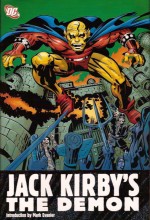
Jack Kirby’s The Demon


By Jack Kirby & Mike Royer (DC Comics)

ISBN: 978-1-4012-1916-1

There’s a magnificent abundance of Jack Kirby collections around these days (though still not all of it, so I remain a partially disgruntled fan) and this magnificent hardback compendium re-presents the complete “King’s Canon” of possibly his most enduring – although subsequently misunderstood and mishandled – DC creation after the comics landmark that was his Fourth World Cycle.

Famed for his larger than life characters and gigantic, cosmic imaginings, “King” Kirby was an astute, spiritual man who had lived though poverty, gangsterism, the Depression and World War II. He had seen Post-War optimism, Cold War paranoia, political cynicism and the birth and death of peace-seeking counter-cultures. He was open-minded and utterly wedded to the making of comics stories on every imaginable subject.

On returning from World War II, with his long-term creative partner Joe Simon, he created the genre of Romance comics for the Crestwood/Prize publishing outfit. Amongst that dynamics duo’s other concoctions for Prize was a, noir-ish, psychologically underpinned supernatural anthology Black Magic and its short-lived but fascinating companion title Strange World of Your Dreams. These titles eschewed the traditional gory, heavy-handed morality plays and simplistic cautionary tales for deeper, stranger fare, and until the EC comics line hit their peak were far and away the best mystery titles on the market.

Kirby understood the fundamentals of pleasing his audience and always strived diligently to combat the appalling state of prejudice about the comics medium – especially from industry insiders and professionals who despised the “kiddies world” they felt trapped in.

After his controversial, grandiose Fourth World titles were cancelled Kirby looked for other concepts which would stimulate his vast creativity and still appeal to an increasingly fickle market. General interest in the Supernatural was rising, with books and movies exploring the unknown in gripping and stylish new ways, and the Comics Code Authority had already released its censorious choke-hold on mystery and horror titles, thereby saving the entire industry from implosion when the superhero boom of the 1960s fizzled away.

At DC’s suggestion the King had already briefly returned to his Black Magic experimentation in a superb but poorly received and largely undistributed monochrome magazine. Spirit World #1 – and only – launched in the summer of 1971, but as before, editorial cowardice and back-sliding scuppered the project before it could get going.

Material from a second, unpublished issue eventually appeared in the colour comic-books Weird Mystery Tales and Forbidden Tales of Dark Mansion #6, but with most of his ideas misunderstood, ignored or side-lined by the company Kirby opted for more traditional fare. Never truly defeated though, he cannily blended his belief in the marketability of the supernatural with flamboyant super-heroics to create another unique and lasting mainstay for the DC universe: one that lesser talents would make a pivotal figure of the company’s continuity.

The Demon #1 launched in September 1972 and introduced a howling, leaping monstrosity (famously modelled after a 1939 sequence from Hal Foster’s Arthurian classic Prince Valiant) which battled beside its master Merlin as Camelot died in flames: a casualty of the rapacious greed of sorceress Morgaine Le Fey.

Out of that apocalyptic destruction, a man arose and wandered off into the mists of history…

In our contemporary world Jason Blood, demonologist and paranormal investigator, had a near-death experience with an aged collector of illicit arcana, which resulted in a hideous nightmare about a demonic being and the last stand of Camelot. He has no idea that Le Fey was alive and had sinister plans for him…

And in distant Moldavia, strange things were stirring in crumbling Castle Branek, wherein lay hidden the lost Tomb of Merlin…

Blood was wealthy, reclusive and partially amnesiac, but one night he agreed to host a small dinner party, entertaining acquaintances Harry Mathews, psychic UN diplomat Randu Singh, his wife Gomali and their flighty young friend Glenda Mark. It did not go well.

Firstly there was the painful small talk, and the sorcerous surveillance of Le Fey, but the real problems started when an animated stone giant arrived to “invite” Blood to visit Castle Branek. This epic journey led to Merlin’s last resting place but just as Blood thought he might find some answers to his enigmatic past Le Fey pounced. Suddenly he began to change, transforming into the horrific beast of his dreams…

Issue #2, ‘My Tomb in Castle Branek!’ opened with wary villagers observing a terrific battle between a yellow monster and Le Fey’s forces, but when the Demon was defeated and Blood arrested, only the telepathic influence of Randu in America could aid him. Le Fey was old, dying, and needed Merlin’s grimoire, the Eternity Book, to extend her life. Thus she manipulated Blood, who had lived for centuries unaware that the Demon Etrigan – Merlin’s hellish Attack Dog – was chained inside him, to regain his memories and awaken the slumbering master mage. It looked like the last mistake she would ever make…

Kirby’s tried and trusted approach was always to pepper high concepts throughout blazing, breakneck action, and #3 was one the most imaginative yet. ‘The Reincarnators’ saw Blood back in the USA, aware at last and with a small but devoted circle of friends. Adapting to a less lonely life he encountered a cult who could physically regress people to a prior life – and use those time-lost beings to commit murder…

The Demon #4-5 comprised a two-part adventure, wherein a simple witch and her macabre patron actually captured the reawakened, semi-divine Merlin. ‘The Creature from Beyond’ and ‘Merlin’s Word’s… Demon’s Wrath!’ introduced that cute little monkey, Kamara the Fear-Monster (later used with devastating effect by Alan Moore in Saga of the Swamp Thing #26-27) and featured another startling “Kirby-Kreature” – Somnanbula, the Dream Beast.

It seems odd in these blasé modern times but the Demon was a controversial book in its day – cited as providing the first post-Comics Code depiction of Hell and one where problems were regularly solved with sudden, extreme violence. ‘The Howler!’ in issue #6, was a truly spooky yarn with Blood hunting a primal entity of rage and brutal terror that transformed its victims into murderous lycanthropic killers, whilst #7 introduced a spiteful, malevolent young fugitive from a mystical otherplace.

‘Witchboy’ Klarion and his cat-familiar Teekl were utterly evil little sociopaths in an time where all comic-book politicians were honest, cops only shot to wound and “bad” kids were only misunderstood: another Kirby first…

‘Phantom of the Sewers’ skilfully combined movie and late night TV horror motifs in the dark and tragic tale of actor Farley Fairfax, cursed by the witch he once spurned. Unfortunately Glenda Mark was the spitting image of the departed Galatea, and when decades later the demented thespian kidnapped her to raise the curse, it could only end in a flurry of destruction, death and consumed souls.

This three-part thriller was followed by another extended epic (The Demon #11-13) ‘Baron von Evilstein’ a powerful parable about worth and appearance featuring the ultimate mad scientist and the tragic monster he so casually built. It’s a truth that bears repeating: ugly doesn’t equal bad…

Despite Kirby’s best efforts The Demon was not a monster hit, unlike the science-fictional disaster drama Kamandi, and by #14 it’s clear that the book was in its last days. Not because the sheer pace of imagination, excitement and passion diminished – far from it – but because the well-considered, mood-drenched stories were suddenly replaced by rocket-fast eldritch romps – with returning villains.

First back was Klarion the Witchboy who created a ‘Deadly Doppelganger’ to replace Jason Blood and kill his friends in #14-15, before the series – and this wonderful hardcover treasury of wicked delights – ended in a climactic showdown with the ‘Immortal Enemy’ Morgaine Le Fey…

Kirby continued with Kamandi, explored WWII in The Losers and created the magnificent Omac: One Man Army Corps, but still could not achieve the all-important sales the company demanded. Eventually he returned to Marvel and new challenges such as Black Panther, Captain America, 2001: A Space Odyssey, Devil Dinosaur, Machine Man and especially The Eternals.

As always in these wondrously economical collections it should be noted that the book is stuffed with un-inked Kirby pencilled pages and roughs, and Mark Evanier’s fascinating, informative introduction is, as ever, a fact-fan’s delight.

Jack Kirby was and is unique and uncompromising: his words and pictures are an unparalleled, hearts-and-minds grabbing delight no comics lover could resist. If you’re not a fan or simply not prepared to see for yourself what all the fuss has been about then no words of mine will change your mind.

That doesn’t alter the fact that Kirby’s work from 1937 to his death in 1994 shaped the entire American comics scene and indeed the entire comics planet – affecting the lives of billions of readers and thousands of creators in all areas of artistic endeavour for generations and still winning new fans and apostles every day, from the young and naive to the most cerebral of intellectuals. His work is instantly accessible, irresistibly visceral, deceptively deep and simultaneously mythic and human.

He is the King and time has shown that the star of this book is one of his most potent legacies.

© 1972, 1973, 1974, 2008 DC Comics. All Rights Reserved.
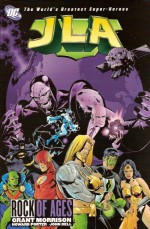
JLA: volume 3 Rock of Ages


By Grant Morrison, Howard Porter, John Dell & others (DC Comics)
ISBN: 978-1-56389-416-9

After the Silver Age’s greatest team-book died a slow, painful, embarrassing death, not once but twice, DC were taking no chances with their next revival of the Justice League of America and tapped Big Ideas wünderkind Grant Morrison to reconstruct the group and the franchise.

And the idea that clicked? Shove everybody’s favourite Big Names in the team.

Of course it worked, but that’s only because as well as star quantity there was an absolutely huge burst of creative quality. The stories were smart, compelling, dauntingly large-scale and illustrated with infectious exuberance. One glance at JLA and anybody could see all the effort undertaken to make it the best it could be.

This third collection re-presents issues #10-15 of the resurgent revival and covers a spectacular landmark tale where old-world goodies-vs.-baddies met contemporary fringe science chic for a rollercoaster ride of boggled minds which only served to set up even bigger concept clashes further down the line. That’s the magic of foreshadowing, folks…

Superman, Batman, Wonder Woman, the Martian Manhunter, Flash, Green Lantern and Aquaman are the legends who are targeted by a coalition of arch enemies comprising Lex Luthor, the Joker, Circe, Mirror Master, Ocean Master and Doctor Light, in the prologue ‘Genesis and Revelations’ wherein ghastly doppelgangers of the World’s Greatest Heroes go on a campaign of destruction all over the globe. Even with new members Aztek and Connor Hawke (the new Green Arrow), on board the new “Injustice Gang’ are running the heroes ragged, but the stakes change radically when the telepathic Martian Manhunter detects an extinction-level entity heading to Earth from deep space…

Rock of Ages proper begins with ‘Hostile Takeover’ as the legion of villains press their advantage whilst the New God Metron appears to warn the JLA that the end of everything is approaching. As Circe tries to head-hunt Aztek, Arrow and Plastic Man, Green Lantern and Flash are treated to a distressing view of the Universes beyond our own reality, as they are dispatched to recover the fabled Philosopher’s Stone in a last-ditch effort to save the worlds.

In ‘Wonderworld’ the fabled last defenders of Cosmic Reality proffer a grim warning of Mageddon, the Anti-Sun, ender of all things to the lost superheroes. Shell-shocked, they are rescued by Hourman, an artificial time-controlling intelligence, and return to our plane of existence only to find it has been conquered by the evil god Darkseid.

‘Wasteland’ is a bleak and chaotic taste of the Final Crisis, with humanity all but dead, and the surviving champions fighting their last battle against the horrors of Apokolips-on-Earth, leading to a perfect Deus-ex-Machina moment of triumph in ‘Twilight of the Gods’ as this wicked universe is un-made and “our” reality reinstated.

Unfortunately if you’ve been keeping up, that was the continuity where the Injustice Gang were beating the stuffing out of the good guys…

‘Stone of Destiny’ brings the saga to a neat and satisfying conclusion as the villains go down fighting and an approximation of order is restored in a cataclysmic combat climax. With Gary Frank, Greg Land, John Dell & Bob McLeod lending artistic assistance to the spectacular proceedings, Morrison and Porter resolve the epic and close with a perfect example of the maxim “always leave them wanting more” – shocking twist to make the reader hungry for the next instalment.

If you haven’t read this sparkling slice of fight ‘n’ tights wonderment then your fantastic comic-life just isn’t complete yet. Savvy, compelling, challenging but not afraid of nostalgia or laughing at itself, the new JLA was an all-out effort to be Smart and Fun. For that moment these were the “World’s Greatest Superheroes” and these increasingly ambitious epics reminded everybody of the fact. This is the kind of thrill that nobody ever outgrows. Got yours yet?

© 1997, 1998 DC Comics. All Rights Reserved.
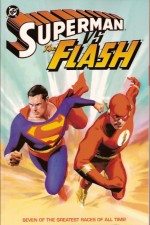
Superman vs. the Flash


By Jim Shooter, Curt Swan & various (DC Comics)
ISBN: 978-1-4012-0456-3

The comic-book experience is littered with eternal questions that can never really be satisfactorily answered. The most common and most passionately asked always begin “who would win if…” or “who’s strongest/smartest/fastest…”

Teenaged scripting wunderkind Jim Shooter knew that very well when he pitched and subsequently scripted a Superman story in 1967 that created a sub-genre of comic-plot and led inevitably and delightfully to the graphic novel under review here.

DC Editors in the 1960s generally avoided such questions as who’s best for fear of upsetting some portion of their tenuous and perhaps temporary fan-base, but as the superhero boom slowed and the upstart Marvel Comics began to make genuine inroads into their market, the notion of a definitive race between the almighty Man of Steel and the “Fastest Man Alive” became an increasingly enticing and sales-worthy proposition.

This sporty chronicle gathers together the initial contest and numerous rematches between the heroic speed-demons, but if you’re seeking a definitive answer you won’t find it here. These are splendid costumed entertainments; adventures designed to catch your breath and quicken your pulse. It not about the winning: it’s all to do with the taking part…

‘Superman’s Race With the Flash’ (Superman #199, August 1967) gets the ball rolling in a stirring saga by Shooter, Curt Swan & George Klein, wherein the two speedy champions were asked to compete in an exhibition contest by the United Nations, thereby raising money to fight World Hunger. Naturally they agreed, but the clever global handicap, circling the planet three times, was secretly subverted by rival criminal combines attempting to stage the greatest gambling coup in history…

Of course justice and charity triumphed in the end, but the stakes were catastrophically raised in the inevitable rematch from Flash #175 (December 1967). ‘Race to the End of the Universe!’ found the old rivals speeding across the cosmos when ruthless alien gamblers threatened to eradicate Central City and Metropolis unless the pair settled who was fastest. Scripter E. Nelson Bridwell added an ingenious sting in the tale, whilst Ross Andru & Mike Esposito delivered a sterling illustration job in this yarn, but once more the actual winning was deliberately fudged.

When World’s Finest Comics became a team-up vehicle for Superman the first guest star was the Flash who again found himself in speedy if contrived competition. ‘Race to Save the Universe!’ and its conclusion ‘Race to Save Time’ (WFC #198-199 November and December 1970, by Denny O’Neil, Dick Dillin & Joe Giella) once more upped the stakes as the high-speed heroes were conscripted by the Guardians of the Universe to circumnavigate the entire cosmos at their greatest velocities to undo the rampage of the mysterious anachronids, faster-than-light creatures whose pell-mell course throughout the galaxies was actually unwinding time itself. Little did anybody suspect that Superman’s oldest enemies were behind the scheme…

Chase to the End of Time!’ and ‘Race to the End of Time!’ opened the new team-up series DC Comics Presents (#1-2, July-August and September-October 1978) as Marty Pasko and the utterly superb Jose Luis Garcia-Lopez & Dan Adkins rather reprised the World’s Finest tale with warring alien races tricking Superman and Flash into speeding through the time-stream to prevent Earth’s history from being corrupted and destroyed. As if that wasn’t dangerous enough, nobody could predict the deadly intervention of the Scarlet Speedster’s most dangerous foe, Professor Zoom, the Reverse-Flash…

After the Crisis on Infinite Earths DC heroes got a sound refitting, and the frankly colossal power levels of the heroic community were downscaled to more believable levels. Some stalwarts even died, and when ‘Speed Kills!’ debuted in Adventures of Superman #463 (February 1990 by writer/artist Dan Jurgens and inker Art Thibert), touted as the first race between the fastest men on Earth, there was a new kid in the Flash’s uniform: ex-sidekick Wally West had graduated to the role.

The story itself is a delightfully whacky romp wherein 5th dimensional pest Mr. Mxyzptlk coerced the pair into running a race everybody knew was fixed from the get-go…

This collection concludes with a spectacular saga unerringly aimed at older fans. ‘Speeding Bullets’ (from one-shot DC First: Flash/Superman July 2002) is by Geoff Johns, Rich Burchett & Prentis Rollins, and features villain Abra Kadabra who challenges the Man of Steel and the 1940s Flash Jay Garrick to catch the current Vizier of Velocity who is running amok at hyper-speed and rapid-aging with every step…

If they can’t catch him then the Fastest Man Alive won’t be…

With the addition of some of the very best covers the company has ever produced to this book, readers casual or deeply devoted are guaranteed a joyous thrill-ride from some of the most entertaining stand-alone stories in DC history. On your marks… get set… Buy!

© 1970, 1972, 1973, 1978, 1990, 2002, 2005 DC Comics.  All Rights Reserved.

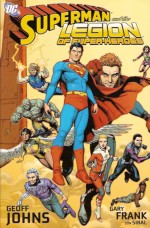
Superman and the Legion of Super-Heroes


By Geoff Johns, Gary Frank & Jon Sibal (DC Comics)
ISBN: 978-1-84856-009-9

Once upon a time, in the far future, a band of super-powered kids from dozens of alien civilisations took inspiration from the greatest legend of all time and formed a club of heroes. One day these Children of Tomorrow came back in time and invited that legend to join them…

And thus began the vast and epic saga of the Legion of Super-Heroes, as first envisioned by writer Otto Binder and artist Al Plastino in the landmark Adventure Comics #247 (April 1958). Since that time the fortunes and popularity of the Legion have perpetually waxed and waned, with their future history tweaked and rebooted, retconned and unwritten over and again to comply with editorial diktat and popular whim.

The current trend is to re-embrace the innocent, silly, joyous, stirring and utterly compelling pre-Crisis on Infinite Earths tales but to shade them with contemporary sensibilities and with this in mind Geoff Johns has been gradually reinstituting the Lore of the Legion in a number of his assignments. Beginning most notably with Justice League of America: the Lightning Saga and culminating in the ongoing New Krypton and War against Brainiac sagas the Legion are back and once more carving out a splendid niche in the DC Universe.

Along the way came this superb, nostalgia-enhanced cracker of a tale which reestablished direct contact between the futuristic paladins and the Man of Tomorrow…

Collecting Action Comics #858-863, this chronicle finds the Legion back in the 21st century, summoning Superman to save Tomorrow’s World once more. Long ago the Legion had regularly visited: spiriting the young Kryptonian to a place and time where he didn’t have to hide his true nature. However, once he began his public career, the visits ceased and his memories were suppressed to safeguard the integrity of history and the inviolability of the time-line.

Now a desperate squad of Legionnaires must reawaken those memories since the Man of Steel is the last hope for a world on the edge of destruction. In the millennium since his debut Superman has become a beacon of justice and tolerance throughout the Utopian Universe, but a radical, xenophobic anti-alien movement has swept Earth, marginalising, interning and even killing all non-Terrans. Moreover, a super-powered team of Legion rejects has formed a Justice League of Earth to lead a crusade against all extraterrestrial immigrants, claiming Superman was actually a true-born Earthling, and declaring him their spiritual leader…

Of course Kal-El of Krypton must travel to the future and not only save the day but clean the racist stain from his name – a task made infinitely more difficult because Earth-Man, psychotic xenophobe leader of the Earth-First faction, has turned our yellow sun a power-sapping red…

Bold, thrilling and absolutely enthralling, the last-ditch struggle of a few brave aliens against a racist, fascistic and completely ruthless totalitarian tomorrow is the stuff of pure comic-book dreams. Superman strives to unravel a poisonous future where all his hopes and aspirations have been twisted, with only his truest childhood friends to aid him, and the incredibly intense and hyper-realistic art of Gary Frank and Jon Sibal makes it all seem not only plausible but inevitable…

With this kind of material, the new-old may well be back for all time…

© 2007, 2008 DC Comics. All Rights Reserved.

The Flash: Wonderland


By Geoff Johns, Angel Unzueta & Doug Hazlewood (DC Comics)
ISBN: 978-1-4012-1489

When Barry Allen, the Silver Age Flash whose creation ushered in a new and seemingly unstoppable era of costumed crusaders, was killed during the Crisis on Infinite Earths in 1985, he was succeeded by his sidekick Wally West, a young man who struggled to fill the boots of his predecessor, both in sheer physical ability and, more tellingly, in confidence. He felt a fraud, but like a true hero he persevered and eventually overcame…

After years in the role, West adapted and made a convincing argument for being an even greater hero as he triumphed over his mentor’s uncanny foes and a whole new Rogue’s Gallery of his own. In Wonderland (reprinting issues #164-169 of the monthly Flash comic-book) scripter Geoff Johns and illustrators Angel Unzueta & Doug Hazlewood pushed him to greater heights – and depths – than ever in a dark, extended saga based in large part on a Barry Allen tale from Flash #174 (November 1967).

Wally West revealed to the DC Universe that all super-speedsters derived their enhanced velocity from an all-pervasive energy field that permeated all of creation. This “Speed Force” generally provides the energy and stamina needed for extreme accelerated motion.

Our book opens with a powerless Flash being arrested and brutalised by cops who know he’s Wally West yet treat him as if he’s a criminal. Deducing that he’s in some alternate dimension where he cannot access the Speed Force, surrounded by familiar faces that don’t know him, West is at his lowest ebb until Captain Cold appears to bust him out of jail.

His home-dimension’s Captain Cold…

The murderous Frozen Felon had also woken up a stranger in a strangely familiar land, and is prepared to use any means to get back to his own world – even if it means helping a hated enemy. On the run and gathering intel they discover just how dark a place America could be without super-speed super-heroes as the history of costumed crimefighters is revealed as one littered with gaudy, prematurely dead champions. This is an Earth that has no time for any metahumans, costumed or otherwise…

When Mirror Master appears, revealing himself to be from their home reality, they assume themselves to be trapped in one of his Mirror Worlds, but sadly that is no longer the case as the Reflective Rogue discloses that all their woes are actually caused by the Mirror Mercenary’s erstwhile silent partner…

The enigmatic Brother Grimm has his own agenda, which tangentially includes the destruction of the Flash; but his real target is Wally’s beloved wife Linda Park. Whilst the hero and villains are lost in the mirror world Grimm makes his move, so that when the fugitives pull off an incredible escape the mastermind has to quickly intervene to preserve his scheme.

Flash, Cold and Mirror Master arrive home to find Keystone City vanished, and decide to continue their tenuous truce until they can restore it…

The chase takes them to even weirder and more terrifying alternate realities, and the tumultuous action is resolved and the secret of Brother Grimm revealed in spectacular manner before order is finally restored…

Johns’ first story arc on the Flash is slick and thoroughly engrossing: rapid-paced, classily violent and often genuinely scary, with the unlikely team of antagonists wandering a range of hostile realities, clashing with twisted versions of friends and foes, and although the conceit of reflecting Lewis Carroll’s Looking Glass tale is a little forced, the overall effect is one of a grand quest successfully completed.

This is the kind of Fights ‘n’ Tights saga that could give comics a good name…

© 2000, 2001, 2007 DC Comics. All Rights Reserved.

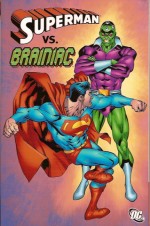
Superman vs. Brainiac


By various (DC Comics)
ISBN: 978-1-4012-1940-6

Superman is the comicbook crusader who started the whole genre and in the decades since his debut in 1938 has probably undertaken every kind of adventure imaginable. With this in mind it’s tempting and very rewarding to gather up whole swathes of his inventory and periodically re-present them in specific themed collections, such as this calculated confection of cosmic clashes with alien arch-foe Brainiac, originally a mere marauding alien but continually refitted over the decades until he now stands as the ultimate artificial nemesis, a thing of cogs, clockwork and computer code.

This superb collection represents appearances both landmark and rare from the many brilliant writers and artists who have contributed to the Kryptonian canon over the years and naturally this terrific tome opens with the extremely impressive introduction ‘The Super-Duel in Space’ by Otto Binder and Al Plastino, from Action Comics #242 (July, 1958) wherein an evil alien scientist attempts to add Metropolis to his collection of miniaturised cities in bottles.

As well as a titanic tussle in its own right, this tale completely changed the mythology of the Man of Steel, by introducing Kandor, a city full of Kryptonians who had escaped the planet’s destruction when Brainiac captured them. Although Superman rescued his fellow survivors, the villain escaped to strike again, and it would be years before the hero could restore the Kandorians to their true size.

Next is a lovely and clever yarn from Superman’s Girl Friend, Lois Lane #17 (May 1960), by Jerry Siegel, illustrated by the exceptional fine art team of Curt Swan and George Klein. ‘Lana Lang, Superwoman’ saw the Man of Tomorrow temporarily imbue both Lana and Lois with superpowers to foil a blackmail/murder plot by the viridian villain, whilst the novel-length saga ‘The Team of Luthor and Brainiac’ by Edmund Hamilton, Swan & Klein (from Superman #167, February 1964) not only teamed the hero’s greatest foes in an uneasy alliance but also revealed that the alien antagonist was actually a malevolent mechanism in humanoid form, designed by the computer-tyrants of the planet Colu to infiltrate and destroy organic civilisations and cultures.

There’s a big jump to the end of the 1970s for the next story, an epic three-part clash that first appeared in Action Comics #489-491 (November 1978-January 1979) scripted by the hugely undervalued Cary Bates and illustrated by Swan & Frank Chiaramonte.

‘Krypton Dies Again’ sees Superman once more battling Brainiac when the light from the decades gone explosion of his homeworld finally reaches Earth. The resultant flash supercharges his Kryptonian cells leaving the Man of Steel helpless. ‘No Tomorrow for Superman!’ finds an increasingly berserk hero unable to cope until joined by Hawkman to finally resolve ‘A Matter of Light and Death!’

In Action Comics #544 (June 1983) both Luthor and Brainiac were given radical makeovers to make them more apposite menaces for the World’s Greatest Superhero. Marv Wolfman and Gil Kane amped up the computer conqueror’s threat-level with ‘Rebirth!’ as cosmic forces reshaped the humanoid horror into a mechanistic angel of death.

When DC Comics decided to rationalise and reconstruct their continuity with Crisis on Infinite Earths in 1985 they used the event to regenerate their key properties at the same time. The biggest gun they had was Superman and it’s hard to argue that the change was not before time. The new, back-to-basics Man of Steel was a sensation and members of his decades-old rogue’s gallery were suitably retooled to match the new, grittier sensibility.

In this continuity ‘The Amazing Brainiac’ was Vril Dox, a monolithic disembodied intellect from the planet Colu who inhabited and transformed the body of showbiz mentalist Milton Moses Fine, (Adventures of Superman #438, March 1988, written by John Byrne& Jerry Ordway, illustrated by Ordway & John Beatty), until it grew beyond physical limits in ‘Man and Machine’ (Action Comics #649, January 1990, by Roger Stern, George Pérez, Kerry Gammill & Brett Breeding) to eventually become a time-travelling ball of malignant computer code, constructing or co-opting ever-more formidable physical forms in its self-appointed mission to eradicate Superman.

By the time of ‘Sacrifice for Tomorrow’ from Action Comics #763 (March 2000), by Joe Kelly, German Garcia, Kano & Mario Alquiza, the fiend had transformed into its 13th iteration and converted Metropolis into an automated City of the Future. It had also learned how to possess human infants – including Lana Lang’s newborn son and Luthor’s daughter Lena… – a chilling thriller to end on, but only a taste of the monstrous horror Brainiac is capable of.

With a pin-up page of Brainiac 13 by Scott Beatty, Steve Kim & Tommy Yune (from Superman: Metropolis Secret Files #1, March 2000) this comprehensive collection is a compelling introduction and overview of the undying enemy alien and a superb treat for fans of every vintage.

© 1958, 1960, 1964, 1978, 1979, 1983, 1988, 1990, 2000, 2008 DC Comics.  All Rights Reserved.

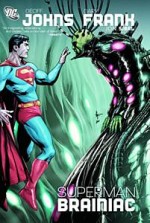
Superman: Brainiac


By Geoff Johns, Gary Frank & Jon Sibal (DC Comics)
ISBN: 978-1-84856-230-1

Since his first appearance in Action Comics #242 (July 1958) the alien reaver Brainiac has been a perennial favourite foe of the Man of Steel, and has remained so even through being subsequently “retooled” many times. Brilliant and relentless, the one thing he/it has never been is really scary – until this latest re-imagining from Geoff Johns and Gary Frank.

In modern DC continuity the raider was a computerised intellect from the planet Colu who inhabited and transformed the body of showbiz mentalist Milton Fine, until it grew beyond physical limits to become a time-travelling ball of malignant computer code, constructing or co-opting ever-more formidable physical forms in its self-appointed mission to eradicate Superman.

Now, in this slim but evocative graphic novel, collecting Action Comics #886-870 and Superman: New Krypton Special #1, the truth is finally revealed. Long ago, an alien invader attacked the planet Krypton: merciless robotic berserkers slaughtered hundreds of citizens before physically removing the entire city of Kandor. Decades later one of those robots lands on Earth only to promptly fall before the Man of Tomorrow’s shattering fists.

This ‘First Contact’ leads to a revelatory conversation with Supergirl, a fortunate survivor of the Kandor Incident, in ‘Hide and Seek’. Every Brainiac Superman has ever faced has only been a pale shadow of the true villain: autonomous automatic probes and programming ghosts of a malevolent entity that has stalked the stars for centuries, stealing representative cities before destroying the redundant worlds they once thrived upon. And now the real Brainiac has found Earth…

What nobody realises is that the Cosmic Kidnapper has been searching the universe ever since Krypton died. He actually wants to possess every last son and daughter of that long-dead world…

Superman rockets into space to find the monster, unaware that the marauder is already en route to Earth, and as the Metropolis Marvel confronts his old foe for the very first time in a titanic, horrific clash, ‘Greetings’ sees Supergirl lead the defence of an embattled planet Earth from the monster’s diabolical mechanical marauders.

The war on two fronts continues in ‘Mind Over Matter’, concluding in an overwhelming tale of ‘Triumph and Tragedy’ as Superman defeats Brainiac and frees an entire city of fellow Kryptonians he never knew still existed, only to lose one of the most important people in his life, ending the adventure on an uncharacteristically sombre, low key note in ‘Epilogue’.

Johns is at the forefront of the creative movement to restore much of DC’s Pre-Crisis on Infinite Earths mythology, and by combining a modern sensibility with much of the visual flavour of Ridley Scott’s Alien movies has added a tangible aura of terror to the wide-eyed imagination and wonder of those old and much-loved tales. The visceral, gloriously hyper-realistic art of Gary Franks and John Sibal adds to the unease, and their deft touch with the welcome tension-breaking comedic breaks is a sheer delight.

This is a Superman yarn that anybody can pick up, irrespective of their familiarity – or lack of – with the character: fast, thrilling, spooky and deeply moving, for all that it’s also the introduction to the major story event New Krypton – but that’s a tale and review for another time…

© 2008, 2009 DC Comics.  All Rights Reserved.

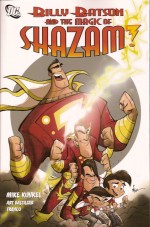
Billy Batson and the Magic of Shazam!


By Mike Kunkel, Art Baltazar, Franco, Byron Vaughns, Ken Branch & Stephen DeStefano (DC Comics)
ISBN: 978-1-4012-2248-2

After the runaway success of Jeff Smith’s magnificent reinvention of the original Captain Marvel (see Shazam! The Monster Society of Evil) it was simply a matter of time before this latest iteration won its own title in the monthly marketplace. What was a stroke of sheer genius was to place the new Billy Batson and the Magic of Shazam! under the bright and shiny aegis of the company’s young reader imprint – what used to be the Cartoon Network umbrella.

Here, slightly askew of the mainstream DC Universe, these frantically ebullient and utterly contagious tales of the orphan Batson and his obnoxious, hyperactive little sister, both gifted by an ancient mage with the powers of the gods, can play out in wild and wooly semi-isolation hampered by nothing except the page count…

Billy Batson is a homeless kid with a murky past and a glorious destiny. One night he followed a mysterious figure into an abandoned subway station and met the wizard Shazam, who gave him the ability to turn into an adult superhero called Captain Marvel. Gifted with the wisdom of Solomon, the strength of Hercules, the stamina of Atlas, the power of Zeus, the courage of Achilles and the speed of Mercury, the lad was sent into the world to do good, a good if immature boy in a super man’s body.

Accompanied by the talking tiger-spirit Mr. Tawky Tawny, Billy tracked down his missing little sister, but whilst battling evil genius Dr. Sivana (US Attorney General and would-be ruler of the universe) he impetuously caused a ripple in the world’s magical fabric through which monsters and ancient perils occasionally slip through. Now, the reunited orphans are trying to live relatively normal lives, but finding the going a little tough.

Firstly, without adults around, Billy often has to masquerade as his own dad and when he’s not at school he’s the breadwinner, earning a living as a boy-reporter at radio and TV station WHIZ. Moreover little Mary also has access to the Power of Shazam, and she’s a lot smarter than he is in using it… and a real pain in Billy’s neck.

Mike Kunkel, inspired creator of the simply lovely Herobear and the Kid, leads off this collection (gathering the first six issues of the monthly comic-book for readers of all ages) writing and drawing a breakneck, riotous romp that reintroduces the new Marvel Family to any new readers and, by virtue of that pesky rift in the cosmic curtain, recreates the Captain’s greatest foe: Black Adam. This time the evil predecessor of the World’s Mightiest Mortal is a powerless but truly vile brat: a bully who returns to Earth after millennia in limbo ready to cause great mischief – but he can’t remember his magic word…

This hilarious tale has just the right amount of dark underpinning as the atrocious little thug stalks Billy and Mary, trying to wheedle and eventually torture the secret syllables from them, and when inevitably Black Adam regains his mystic might and frees the sinister Seven Deadly Evils of Mankind from their imprisonment on the wizard’s Rock of Eternity the stage is set for a classic confrontation.

Pitched perfectly at the young reader, with equal parts danger, comedy, sibling rivalry and the regular outwitting of adults, this first story screams along with a brilliantly clever feel-good finish…

With issue #5 the writing team of Art Baltazar and Franco (responsible for the incomparably compulsive madness of Tiny Titans) took over, and artists Byron Vaughns and Ken Branch handled the first bombastic tale as convict Doctor Sivana unleashes the destructive giant robot Mr. Atom to cover his escape from prison.

The story-section concludes with another funny and extremely dramatic battle – this time against primordial super-caveman King Kull, who wanted to reconquer the planet he ruled thousands of years ago. Older fans of gentle fantasy will be enthralled and delighted here by the singular art of Stephen DeStefano, who won hearts and minds with his illustration of Bob Rozakis’ seminal series Hero Hotline and ‘Mazing Man (both painfully, criminally overdue for graphic novel collections of their own…)

Billy Batson and the Magic of Shazam! is an ideal book for getting kids into comics: funny, thrilling, beautifully, stylishly illustrated and perfectly in tune with what young minds want to see. With a gloriously enticing sketches section and a key code for those pages written in the “Monster Society of Evil Code” this is an addictive treat for all readers who can still revel in the power of pure wonderment and still glory in an unbridled capacity for joy.

© 2008, 2009 DC Comics. All Rights Reserved.

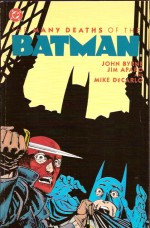
Batman: The Many Deaths of the Batman


By John Byrne, Jim Aparo & Mike DeCarlo (DC Comics)
ISBN: 978-1-56389-033-8

Batman is in one way the ultimate superhero: he is uniquely adaptable and can fit into practically any type or genre of story – as is clearly evident from the plethora of vintage tales collected in so many captivating volumes over the years.

One less well-mined period (so far at least) is the grim and/or gritty 1980s when the Caped Crusader was partially reinvented in the wake of the inspired and inspirational Crisis on Infinite Earths, becoming a driven but still cool-headed, deeply rational Manhunter, rather the dark, driven paranoid of later days or the costumed boy-scout of the “Camp” crazed Sixties.

This brief but satisfyingly punchy thriller combined the best of all worlds and even pushed the creative envelope with a silent/mime first chapter (no pesky words to read, fans!) as in the wake of the murder of his sidekick Jason Todd (see Batman: A Death in the Family) the traumatised hero is forced to re-examine his own origins during a bloody murder-spree that touches the very essence of what – and who – made him…

Collecting Batman #433-435 (May-July 1989) the mini epic opens in a shocked, rain-soaked Gotham with a ‘Period of Mourning’ as the city reacts to the sight of the Caped Crusader crucified in a dirty alley. His friends and enemies reel in shock, but soon that turns to something else as another Bat corpse is discovered. Meanwhile the real Dark Knight is finishing an international hunt in Paris when the news reaches him…

‘How Many Times Can a Batman Die?’ expands the enigma as the hero returns to Gotham to probe the mystery of six seemingly random dead men murdered in his costume. However they aren’t strangers to Bruce Wayne. Every one of them was a specialist in one particular field, and each had spent time long ago teaching an anonymous young man one of the many skills necessary to become the Batman…

The saga concludes in captivating and rewarding manner as a fair-play mystery is solved in ‘The Last Death of the Batman’, displaying all those composite skills as the Dark Knight shows himself to truly be “The World’s Greatest Detective.”

Short, sweet and simply superb, this is a Batman much missed by many of us, and this tale, like so many others of the period is long overdue for the graphic novel treatment. To the Bat-Files, old chums…
© 1992 DC Comics. All Rights Reserved.