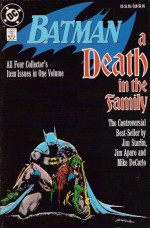
Batman: A Death in the Family


By Jim Starlin, Jim Aparo & Mike DeCarlo (DC Comics)
ISBN: 978-0-93028-944-7

Despite decades of wanting to be “taken seriously” by the wider world, every so often a comic-book event gets away from editors and publishers and takes on a life of its own. This usually does not end well for our favourite art form, as the way the greater world views the comics microcosm is seldom how we insiders and cognoscenti see it.

One of the most controversial comics tales of the last century saw an intriguing marketing stunt go spectacularly off the rails – for all the wrong reasons – becoming instantly notorious and sadly masking the real merits of the piece.

Robin, the Boy Wonder debuted in Detective Comics #38 (April 1940) created by Bob Kane, Bill Finger and Jerry Robinson: a juvenile circus acrobat whose parents were murdered by a mob boss. The story of how Batman took the orphaned Dick Grayson under his scalloped wing and trained him to fight crime has been told, retold and revised many times over the decades and still undergoes the odd tweaking to this day

The child Grayson fought beside Batman until 1970 when, as a sign of the turbulent times, he flew the nest, becoming a Teen Wonder and college student. His invention as a junior hero for younger readers to identify with had inspired an incomprehensible number of costumed sidekicks and kid crusaders throughout the industry, and Grayson continued in similar vein for the older, more worldly-wise readership of America’s increasingly rebellious youth culture.

Robin even had his own solo series in Star Spangled Comics from 1947 to 1952, a solo spot in the back of Detective Comics from the end of the 1960s wherein he alternated and shared with Batgirl, and a starring feature in the anthology comic Batman Family. During the 1980s the young hero led the New Teen Titans, re-established a turbulent working relationship with Batman and reinvented himself as Nightwing. This of course left the post of Robin open…

After Grayson’s departure Batman worked alone until he caught a streetwise young urchin trying to steel the Batmobile’s tires. Debuting in Batman #357 (March 1983) this lost boy was Jason Todd, and eventually the little thug became the second Boy Wonder (#368, February 1984), with a short but stellar career, marred by his impetuosity and tragic links to one of the Caped Crusader’s most unpredictable foes…

Todd had some serious emotional problems that became increasingly apparent in the issues leading up to ‘A Death in the Family’ as the street kid became more callous and brutal in response to the daily horrors he was being exposed to. When he caused the death of a vicious, abusive drug-dealer with diplomatic immunity (and when is that long-neglected sequence of tales going to be collected, huh?) the boy entered a spiral that culminated in the story-arc collected here, comprising Batman #426-429.

Ever more violent and seemingly incapable of rudimentary caution, Jason Todd is suspended by Batman who thinks the boy has not adjusted to the death of his parents. Meanwhile the Joker is again on the loose. But rather than his usual killing frenzy the Clown Prince is after mere cash, as the financial disaster of “Reaganomics” has depleted his coffers – meaning he can’t afford his outrageous murder gimmicks…

Without purpose, Jason has been wandering the streets where he grew up. When he sees an old friend of his dead mother she reveals s a shocking secret. The woman who raised him was not his birth-mother, and moreover there is a box of personal papers that indicate three women who might be his true mother. Lost and emotionally volatile Jason sets out to track them down…

The potential parents are Lady Shiva, world’s deadliest assassin, Sharmin Rosen, Mossad agent and Dr. Sheila Haywood, a famine relief worker in Ethiopia. As the lad heads for the Middle East and a confrontation with destiny he is unaware that Batman is also in that troubled region, hot on the Joker’s trail as the Maniac of Mirth attempts to sell a stolen nuclear missile to any terrorist who can pay…

The estranged heroes accidentally reunite to foil the plot, and Jason crosses Rosen off his potential mom-list. As Batman offers to help Jason check the remaining candidates the fugitive Joker escapes to Ethiopia. After eliminating Shiva, who has been training terrorists in the deep desert, the heroes finally get to Jason’s true mother Sheila Haywood, unaware that she has been blackmailed into a deadly scam involving stolen relief supplies with the Clown Prince of Crime…

I’m not going to bother with the details of the voting fiasco that plagues all references to this tale: it’s all copiously detailed elsewhere (just Google and see) but suffice to say that to test then-new marketing tools a 1-900 number was established and thanks to an advanced press campaign readers were offered the chance to vote on whether Robin would live or die in the story.

He dies.

The kid had increasingly become a poor fit in the series and this storyline galvanised a new direction with a darker, more driven Batman, beginning almost immediately as the Joker, after killing Jason in a chilling and unforgettably violent manner, became the UN ambassador for Iran (later revised as the fully fictional Qurac – just in case) and at the request of the Ayatollah himself attempted to kill the entire UN General Assembly during his inaugural speech.

With echoes of Frank Miller’s landmark The Dark Knight Returns, Superman then becomes a government watchdog tasked with stopping Batman from breaching diplomatic immunity as the vengeance-hungry Caped Crusader attempts to stop the Joker at any cost, leading to a spectacular yet chillingly inconclusive conclusion with the portents of dark days to come…

And here is the true injustice surrounding this tale: the death of Robin (who didn’t even stay dead) and the voting debacle took away from the real importance of this story – and perhaps deflected some real scrutiny and controversy. Starlin had crafted a clever and bold tale of real world politics and genuine issues which most readers didn’t even notice.

Terrorism Training Camps, Rogue States, African famines, black marketeering, Relief fraud, Economic, Race and Class warfare, Diplomatic skullduggery and nuclear smuggling all featured heavily, as did such notable hot-button topics as Ayatollah Khomeini, Reagan’s Cruise Missile program, the Iran-Contra and Arms for Hostages scandals and the horrors of Ethiopian refugee camps.  Most importantly it signaled a new and fearfully casual approach to violence and death in comics-books.

This is a superbly readable tale, morally challenging and breathtakingly audacious – but it’s controversial in all the wrong places and for all the wrong reasons. But don’t take my word for it: get it and see for yourself.

© 1988 DC Comics. All Rights Reserved.
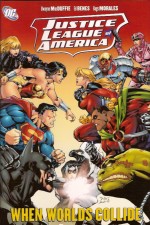
Justice League of America volume 6: When Worlds Collide


By Dwayne McDuffie, Ed Benes, Rags Morales & various (DC Comics)
ISBN: 978-1-4012-2422-6

In this collection (issues #27-28 and 30-34 of the most recent incarnation of the World’s Greatest Superhero team) writer Dwayne McDuffie gets all cosmic as he formally introduces the characters from the 1990s imprint Milestone Comics into the ever-expanding – if dangerously hero-heavy – DC Universe. At least this cosmic extravaganza has the decency and panache to make that merger the storyline rather than have the heroes suddenly notice each other after years of seemingly being unaware of each other’s existence, as was too often the case in days past…

The action begins in ‘Be Careful What you Wish For’, illustrated by Ed Benes with additional inkers Rob Hunter, Norm Rapmund & Drew Geraci, wherein a team of mystery metahumans calling themselves the Shadow Cabinet confront and re-energise the currently powerless Kimiyo Hoshi – the second – heroic – Dr. Light.

Meanwhile JLA leader Black Canary challenges Superman, Batman and Wonder Woman in the secret star-chamber from which they have been surreptitiously spying on the new League, but the confrontation is interrupted by the invasion of the enigmatic new superbeings in ‘Shadow and Act’ (drawn by José Luis and inked by JP Mayer) with the usual result: instant chaos. However Superman and Cabinet leader Icon clearly have a hidden agenda…

For reasons unknown the next episode has been omitted: I wouldn’t necessarily quibble as it was something of a digression, but since it tells an “untold tale” of the as-yet unrevealed master villain, perhaps room should have been found for it somewhere in this chronicle?

As it is we resume with the third chapter from #30, ‘New Moon Rising’ again by Luis & Mayer, and the arrival of Winged Wonder Hawkman who inadvertently provides an entry into the super-secure headquarters for old enemy the Shadow Thief, who is now powerful enough to endanger the entire Earth. There is another story break – included, this time – as ‘Interlude: Crisis of Confidence’ (art by Shane Davis & Sandra Hope) follows Black Canary as the revelations of the spying and in-fighting lead to a momentous decision and a split in the League, before Chapter 4: ‘Nyctophobia’ (illustrated by Rags Morales & John Dell) provides the “Big Reveal” as cosmic vampire Starbreaker resurrects himself and prepares to consume the World.

‘Metathesiophobia’ (look it up, it’s clever) sees the newly empowered Dr. Light come into her own as the JLA and Shadow Cabinet team up at last to fight their common foe, with a startling reprise and return for one of the imaginary heroes encountered in the previous volume (see Justice League of America: Second Coming), but even he isn’t enough to counter the energy leech’s overwhelming power…

With more than one world imperilled the united champions finally save the day and accomplish the impossible in ‘The Dharma Initiative’ (penciled by Ardian Syaf and Eddie Barrows with inks from Don Ho, Ruy José, Dan Green, Jack Purcell & Mark Propst) a spectacular conclusion, and as much the end of a comics era as the dawn of a new day.

Big changes were in store for the World’s Greatest Heroes, but that’s for another time and another review, as this slick and classy graphic novel signalled the closure of yet another incarnation of the premier Silver Age Superteam. Witty and hugely enjoyable, blending high concepts with great characterisation and gripping action with biting one-liners, this JLA‘s adventures were among the very best modern superhero sagas around. It’s never too late so if you’re not a fan yet, reading these books will swiftly and permanently alter that reality…

© 2009 DC Comics. All Rights Reserved.

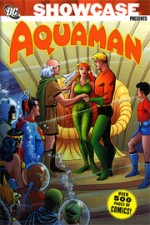
Showcase Presents Aquaman volume 2


By Jack Miller, Bob Haney, Ramona Fradon, Nick Cardy & various (DC Comics)
ISBN: 978-1-4012-1712-9

Aquaman was one of the few superheroes to survive the collapse at the end of the Golden Age, a rather nondescript and generally bland looking guy who solved maritime crimes and mysteries when not rescuing fish and people from sub-sea disasters.

He was created by Mort Weisinger and Paul Norris in the wake of Timely Comics’ Sub-Mariner and debuted in More Fun Comics #73 (1941). Strictly a second stringer for most of his career he nevertheless continued on beyond many stronger features, illustrated by Norris, Louis Cazaneuve and Charles Paris, until young Ramona Fradon took over the art chores in 1954, by which time Aquaman had moved to a regular back-up slot in Adventure Comics. She was to draw every single adventure until 1960.

In 1956 Showcase #4 (See The Flash Archive Edition volume 1 or Showcase Presents the Flash volume 1) rekindled the public’s imagination and zest for costumed crime-fighters and, as well as re-imagining many departed Golden Age stalwarts, DC also updated and remade its isolated survivors, especially Green Arrow and Aquaman. Records are incomplete, sadly, so often we don’t know who wrote what, but after the initial revamp better records survive and this second collection of the King of the Seven Seas has far fewer creative credit conundrums.

Although now the star of his own title, Aquaman still appeared as a back-up feature in World’s Finest Comics until 1964 and this chronological compilation includes those tales (issues #130-133, 135, 137, 139), his Brave and the Bold team-up with Hawkman (# 51) and the contents of Aquaman #7-23, covering the period December 1962 to September-October 1965, a period that led directly into the King of the Seven Seas becoming one of DC’s earliest television stars as part of the animated Superman/Aquaman Hour of Adventure.

The major writers from those years were Jack Miller and Bob Haney and although some records are lost and a few later scripts remain unattributed, recognizing artists is far less troubling. The World’s Finest stories were Fradon’s last; captivatingly clean, economical lines bringing to unique life charming little adventure and mystery vignettes which always were and still are a joy to behold. Thereafter, apart from a memorable and brief return to co-create Metamorpho the Element Man, she left comics until 1972 to raise her daughter.

‘King of the Land Beasts’ (WFC #130, by Haney & Fradon) is a typically high-quality teaser about an alien Aquaman whilst ‘The Sea Beasts from Atlantis’ (Aquaman #7 by Miller & Nick Cardy) pitted the Sea Lord and Aqualad against hideous sub-sea monsters and a plot to overthrow the government of the lost city, abetted if not quite aided by the sea imp Quisp.

‘The Man Who Controlled Water’ (World’s Finest # 131, Miller & Fradon) saw the heroic pair tackle a scientist who could solidify liquids into fearsome weapons whilst in issue #8 of their own magazine, creators Miller and Cardy revealed ‘The Plot to Steal the Seas’ with the oceanic adventurers battling far out of their comfort zone to thwart marauding aliens.

Dave Wood scripted the quirky thriller ‘The Fish in the Iron Mask’ (WFC #132) wherein faithful octopus Topo was possessed by a sinister helmet and ‘The Secret Mission of King Neptune’ (Aquaman #9, Miller & Cardy) seemingly brought the heroes into bombastic contention with the God of the Oceans – but was he all he seemed?

World’s Finest #133 briefly introduced ‘Aquaman’s New Partner – Aqua-Girl’, but Miller and Fradon’s creation was strictly a one shot deal, whereas ‘War of the Water Sprites’ (Aquaman #10, Miller & Cardy) introduced an evil band of Quisp’s fellow imps who eerily presaged a tale of the JSA decades later…

‘The Creatures that Conquered Aquaman’ (from WFC #135, Miller & Fradon) was another alien invasion extravaganza whilst Aquaman #11 featured the landmark introduction of the Sea King’s future wife Mera in the Miller & Cardy extravaganza ‘The Doom from Dimension Aqua’, whilst #12 featured two shorter thrillers from Haney, ‘The Menace of the Land-Sea Beasts’ with mutated jungle animals wreaking sub-sea havoc and ‘The Cosmic Gladiators!’ wherein the seaborne sentinels are press-ganged into an intergalactic gladiatorial contest.

Miller provided the penultimate World’s Finest outing ‘The Day Aquaman Lost his Powers’ for #137 and Haney scripted a manic tale of team-up terror for superb veteran artist Howard Purcell in ‘Fury of the Exiled Creature’ (The Brave and the Bold #51, December 1963-January 1964) in which the fearsome Outcast of Atlantis turned mutative powers against not just Aquaman but also new DC superstars Hawkman and Hawkgirl.

Aquaman #13 then saw Mera return in the Miller-penned ‘Invasion of the Giant Reptiles’ as the tide-crossed lovers joined to defeat criminals from the future. Fradon and Miller ended the Sea King’s World’s Finest tenure in high style with the taut thriller ‘The Doom Hunters’ in #139, leaving Nick Cardy as sole Aquaman artist. His work slowly began to become more representational and realistic, although Miller’s ‘Aquaman’s Secret Powers!’ still held plenty of fantastic fantasy as a dying derelict cursed the Sea King with incredible new abilities, whilst the second tale in #14 ‘The Tyrant Ruler of Atlantis’ found the temporarily deranged hero seizing the throne of the sunken city. Within scant months he would be legitimately offered the crown…

Miller wrote the next four issues beginning with the sinister scientific tragedy ‘Menace of the Man-Fish’, #16’s ‘The Duel of the Sea Queens!’ as Mera battled an alien siren who had set her tentacled cap for Aquaman and #17’s ‘The Man who Vanquished Aquaman’ wherein the god Poseidon stole Mera.

All this romantic tension and concentration was for a purpose. The next issue, #18 featured ‘The Wife of Aquaman’ as the Sea King married his extra-dimensional beloved in one of the first superhero weddings of the Silver Age. Talk about instant responsibilities…

None of the remaining tales have a credited scripter, but that doesn’t affect their wonderful readability nor Cardy’s better-every-panel artwork, beginning with #19’s ‘Atlanteans For Sale’ wherein new bride Mera slowly went bonkers due to her husband’s neglectful super-heroing schedule. Cue the arrival of the merman man-candy Nikkor who insinuated himself into her affections… and the throne!

This surprisingly adult tale is followed by #20’s ‘The Sea King’s Double Doom’ as an old friend and a shape-changing monster both hit Atlantis at the same time. Coincidence? We think not…

Super-villain the Fisherman debuted in #21’s ‘The Fearful Freak from Atlantis’ as the Sea King became a sea monster, whilst ‘The Trap of the Sinister Sea Nymphs’ introduced Mera’s wicked twin sister. This splendidly engaging second volume ends on another groundbreaking high-note with issue #23’s ‘The Birth of Aquababy’ wherein the happy couple’s newborn child displays uncanny powers (and yes, you nit-picking gossips it was nine months later… exactly nine months).

One of the greatest advantages of these big value black-&-white compendiums is the opportunity they provide whilst chronologically collecting a character’s adventures to include crossovers and guest spots from other titles. When the star is as long-lived and incredibly peripatetic as DC’s King of the Seven Seas that’s an awful lot of extra appearances for a fan to find…

DC has a long and comforting history of gentle, innocuous yarn-spinning with quality artwork. Ramona Fradon’s Aquaman is one of the most neglected runs of such accessible material, and it’s a pleasure to discover just how readable they still are. And when the opportunity arises to compare her wonderful work to the exponentially improving superhero work of such a stellar talent as Nick Cardy this book becomes another fan’s must-have item. More so when all the stories are still suitable for kids of all ages, Why not treat yourself and your youngsters to a timeless dose of whimsy and adventure? You won’t regret it.

© 1962, 1963, 1964, 1965, 2008 DC Comics. All Rights Reserved.
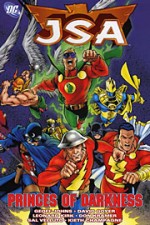
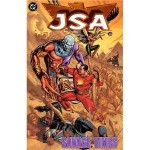
JSA volume 7: Princes of Darkness

New Extended Review

By Geoff Johns, David Goyer & various (DC Comics)
ISBN 1-84576-035-2

As a kid in the 1960s I used to love any appearance of the Justice Society of America, DC’s pioneering and popular crime-busting characters from the 1940s. They seemed full of a resonance that was equal parts Mystery and History. They belonged to the mythical land of “Before I Was Born” and their rare guest-shots always filled me with wonder and joy.

A few years ago they were permanently revived and I found very little to complain of. As superhero sagas go the stories and art were entertaining enough, often even outstanding, but with this compilation (collecting issues #46–55), I finally found myself agreeing with those wise editorial heads of my well-spent youth who felt that less was more and that over-exposure was a real and ever-present danger.

That’s not to say that these tales are in any way less than they need to be nor that the full-on, goodies-vs.-baddies extravaganzas are boring or tired. The problem is much more insidious and, I regret, more to do with me than the material. It finally became clear with this extended, spectacular struggle of valiant heroes against Darkness-wielding villains who black out the entire Earth and let evil reign free that the JSA were back for good.

But they were no longer quite so “special”.

Following on from the cliffhanger revelations of JSA: Savage Times the shadowy saga, written as ever, by David Goyer and Geoff Johns, with art from Sal Velluto, Leonard Kirk, Don Kramer, Bob Almond, Keith Champagne, & Wade von Grawbadger, opens with ‘Into the Valley’ and a blistering attack by the Chaos Lord Mordru, acting in concert with the conflicted ex-JSA-er Obsidian and the demonic spirit of rage, Eclipso.

Apparently dead, the sprit of Hector Hall, the latest Doctor Fate, travels to a distant realm for some sage advice in ‘Eclipse’ whilst on Earth, utter soul-drinking blackness has blanketed the globe unleashing the worst aspects of human nature. ‘Enlightenment’ and ‘Army of Darkness’ see Fate delve deeper into a potential solution whilst on the physical plane all of the World’s heroes – and some villains – are slowly being destroyed by the irresistible wave of Night.

A turning point comes in ‘The Last Light’ as a valiant sacrifice turns one of the dark masters from foe to friend, resulting in stupendous battles and an earth-shattering climax as the heroes save the day in ‘Princes of Darkness Coda: Justice Eternity’ – with which scripter Goyer moves on to fresh pastures.

After all that angsty spectacle and shiny triumph, the team catches a collective breath in ‘Brand New Day’ with a few new members and general recuperation, unaware the Atom Smasher and Black Adam have covertly crossed a moral line which will come back to haunt them all whilst the new heroic Eclipso feels himself drawn to do likewise. The main action of the piece comes in the form of a return for haunted huntress Crimson Avenger; a woman driven by possessed handguns to execute murderers who have escaped justice. To everyone’s astonishment her latest target is veteran hero Wildcat and nothing in the universe can stop or sway her…

The tale concludes in ‘Blinded’ as the relentless Avenger and Wildcat find a unique way to satisfy the curse of her relentless pistols, whilst Black Adam continues to recruit disenchanted heroes for a new kind of super-team, and the book ends on a satisfyingly welcome lighter note with a brace of seasonal tales, beginning with a lovely, lighthearted Thanksgiving bash starring both Justice League and Society.

‘Virtue, Vice & Pumpkin Pie’ is a splendid and jolly change of pace after all the high-octane testosterone which readily displays Geoff John’s comedic flair whilst ‘Be Good for Goodness’ Sake’ finds the surviving WWII heroes (Green Lantern, Wildcat, Hawkman and the Flash) bringing a lump to the throat and a tear to the eye (comic fans being the most soft and sentimental creatures in the universe) with a Christmas present for a long-lost member, not seen since the early days of the Golden Age…

These are characters that everyone in the industry seems to venerate, and I would be churlish to deny new readers and fans a chance to discover them too, but anticipation, delayed gratification and keen imagination once made every appearance of the JSA a source of raging joy to me and a million other kids. It’s such a shame today’s readers can’t experience that unbeatable buzz too. At least the stories are high quality. It would be utterly unbearable if the team were over-exposed and sucked too…

© 2003, 2004 DC Comics. All Rights Reserved.
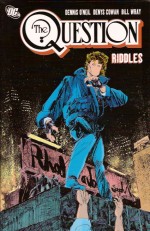
The Question volume 5: Riddles


By Dennis O’Neil, Denys Cowan, Bill Wray & various (DC Comics)
ISBN: 978-1-84856-513-5

This is a saga about dysfunction and a search for answers: Social, societal, political, emotional, familial and even methodological. The normal masked avenger tactics don’t work in a “real”-er world, and some solutions require better Questions…

Challenging Western dystopia with Eastern thought and martial arts action is not a new concept but O’Neil’s focus on cultural and social problems rather than histrionic super-heroics make this series a truly philosophical work, and Cowan’s raw, edgy art imbues this darkly adult, powerfully sophisticated thriller with a maturity that is simply breathtaking.

This fifth collection (reprinting issues #25-30) picks up from the shock ending of The Question: Welcome to Oz with ‘Skells’ illustrated by Cowan & Malcolm Jones III. New Mayor Myra Fermin-Connelly has been gunned down by her drunken, brain-addled husband and lies in a coma. Due to a quirk of Hub City law, with both current candidates unable to take office, the incumbent – despite being wanted for attempted murder – is technically next-in-line, and therefore de facto Mayor…

The tornado that struck the city on Election Day has finished the job begun by years of corruption and the gang warfare of the campaign. Hub City is a billion-dollar disaster zone. All essential services have ceased, the surviving populace are either rioting, looting or hiding. Food and water are running out.

State authorities are unwilling to step in and the urban hell-hole is poised to become a purely Darwinian jungle (this storyline probably inspired Batman’s ‘No Man’s Land’ publishing event) but all the Question wants to do is hunt down Myra’s addled husband/killer…

‘Riddles’ is a strange and melancholy Christmas divertissement, from fill-in penciller Bill Wray and Jones III which sees the Riddler, fresh out of jail and in a slump, catch a bus to Hub City and a new start. Sadly he picks the wrong girl to chat up and the result is the bloodiest and most senseless night of his life. It’s a genuine Christmas miracle that Vic Sage and Professor Rodor are on the same road that night…

With the city in turmoil, Myra in a coma, and no foe he can hit, The Question is helpless, but when the Prof reveals that his long-lost brother was a comic book artist in the 1940s it leads them all on a quasi-mystic quest which just might provide the mauled metropolis with its first glimmer of hope and recovery. ‘Captain Stars & Sergeant Stripes’ is illustrated by Cowan and Jones III, with Golden Age pastiche pages from Rick Stasi & Terry Beatty.

The last three tales here, also limned by Cowan and Jones, form an extended epic as the lethal Lady Shiva (see The Question: Zen and Violence) returns. Myra has emerged from her coma and taken charge, but with no resources and open warfare on the streets she is forced to take some extraordinary measures to restore order. In ‘A Place for the Arts’ Shiva, drawn to the chaos and ever-hungry to test her martial arts skills, offers her murderous services to one of the gangs trying to take over what’s left of Hub City, only to have her potential employers snatched from her as the new Lady Mayor convinces the warring thugs to become her new police force…

Incredibly disaster seems to have been averted until in ‘The Slaying’ one of the rival gang-lords is stabbed at a peace-conference and the Faceless Inquisitor has a murder to solve before the last remnants of hope are swallowed by renewed bloodshed. ‘Whodunit’ reveals all, but as is always the case in this superb series the answers are far from neat, tidy or satisfactory, and as always a moral and philosophical pall clouds the issues. And like a ghost Shiva stalks the city, ambivalent, ambiguous, unfathomable in her private purposes…

Like life, The Question never produces easy answers…

Bleak, brutal, confrontational and mordantly action-packed these tales come from one of DC’s very best series, and they form a perfect snapshot in comics history of a hugely creative and historically significant time. These graphic novels demonstrate just how evocative sequential narrative can be and no fan of serious fun literature or mature, sensitive escapism can afford to miss them.

© 1989, 2009 DC Comics. All Rights Reserved.
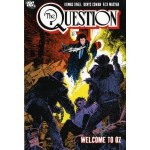
The Question volume 4: Welcome to Oz


By Dennis O’Neil, Denys Cowan, Rick Magyar & various III (DC Comics)

ISBN: 978-1-84856-328-5

The Question, created by Steve Ditko, was Vic Sage, a driven, obsessed reporter who sought out crime and corruption irrespective of the consequences. This Charlton ‘Action-Hero’ was purchased by DC when Charlton folded in 1983 and was the template for the compulsive Rorschach when Alan Moore and Dave Gibbons first drafted the miniseries that would become the groundbreaking Watchmen.

An ordinary man pushed to the edge by his obsessions, Sage used his fists and a mask that made him look utterly faceless to get answers (and justice) whenever normal journalistic methods failed. After a few minor successes around the DC universe Sage got a job in the town where he grew up.

Hub City (purportedly based on East St Louis) was a hell-hole, the most corrupt and morally bankrupt municipality in America. Mayor Wesley Fermin was a degenerate drunken sot and the real power was insane cleric Reverend Jeremiah Hatch. When Sage started cleaning house as The Question he was “killed”, rescued and resurrected by the inscrutable Shiva – the World’s deadliest assassin.

Crippled, he journeyed into the wilderness to be healed and trained by O’Neil’s other legendary martial arts creation, Richard Dragon.

It’s a new type of hero who returned to Hub City, philosophical rather than angry, but still cursed with a drive to understand how things universally go bad. The city has degenerated even further. Sage’s girlfriend is now Mayor Fermin’s wife, and crime and chaos are everywhere…

This fourth collection (reprinting issues #19-24 of the seminal 1980s series) brings to a head many of the dark plot threads that have been with the series since its inception. With Fermin permanently drunk and oblivious Sage has renewed his affair with Myra, even whilst she is running for her husband’s job.

Closet racist Royal Dinsmore has better ways of winning the race than smearing his opponent, but thanks to an extremely disturbed good citizen those plans are exposed in ‘The Plastic Dilemma’ (illustrated by Denys Cowan & Rick Magyar) and Myra refuses the financial support of a particularly unwholesome millionaire backer, whilst the emotional impact of her affair with Sage is revealed in ‘Send in the Clowns’ (an all-Magyar art job) a brutal tale of freaks, greed and prejudice.

Dick Giordano inks Cowan in ‘Rejects’ as psychopathic Junior Musto, returns (see The Question: Zen and Violence) to take a hospital hostage, demanding a heart transplant for the father who abused and tried to destroy him. That Greek tragedy leads into the main event…

‘Election Day (by Cowan & Malcolm Jones III): The Fix’ begins an agonising comedy of political errors as Dinsmore’s plan to steal the election is thwarted and he resorts to hiring a gang of Bikers to prevent the populace from voting – a t least those who can be bothered to turn out.

All the while Myra is having heartrending second thoughts. She doesn’t want to win but can’t afford to let a monster like Dinsmore gain control of her city. In the background her sot husband lurks; drunk deranged, bitter: clutching a bottle and a gun…

Some disquieting historical facts about Hub City are revealed in ‘Election Day: Welcome to Oz’ as the situation worsens. Open warfare in the streets is compounded by the arrival of a tornado that smashes most of the city to rubble, and the terrible conclusion ‘Election Day: The Dark’ sees Dinsmore defeated by a last-minute Machiavellian masterstroke from Vic Sage.

Mrya becomes the new Mayor of the biggest, most corrupt pile of rubble in America. A shot rings out…

Even ending on such a painful cliffhanger is grudgingly acceptable when the work is of such sterling quality and these eccentric epics are as readable now as they ever were. Complex characters, a very mature depiction of the struggle between Good and Evil using Eastern philosophy and very human prowess to challenge crime, corruption, abuse, neglect and complacency would seem to be a recipe for heady but dull reading yet these stories by one of the American industry’s greatest wordsmiths, and especially the mythic martial arts action delineated by Denys Cowan are gripping beyond belief and constantly challenge any and all preconceptions. So grab this book; absorb, enjoy and then move briskly on to the next volume.

I’m going to…

© 1988, 1989, 2008 DC Comics. All Rights Reserved.

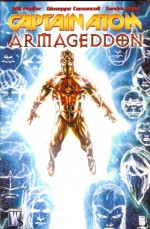
Captain Atom: Armageddon


By Will Pfeifer, Giuseppe Camuncoli & Sandra Hope (WildStorm)
ISBN: 978-1-4012-1106-6

When DC acquired the right to the 1960s Charlton Comics “Action Heroes” line Captain Atom was the character and concept which had the most radical makeover. No longer a two-fisted, patriotic astronaut survivor of an atomic accident, the new Nathaniel Adam was a discredited and cashiered US soldier in the 1960s, forced to undergo a merge with alien metal by his own superiors, and accidentally catapulted 25 years into the future.

After a brief period as a pawn of the self-same General who caused all his woes, Adam struck out on his own and gradually achieved some measure of credibility in the superhero community, both as a solo act and leader of Justice League Europe and Extreme Justice. Whenever his popularity waned and whatever series he was in was cancelled, he would inevitably reappear as a government pawn/nominal establishment bad-guy working for Uncle Sam.

Gifted with phenomenal quantum-energy powers he was in a class that could hurt Superman, and when Lex Luthor became President of America Atom was ordered to defeat both the Man of Steel and the Dark Knight (see Superman/Batman: Public Enemies). Coming to his moral senses just in time, Captain Atom sacrificed himself to destroy a colossal Kryptonite meteor which would have obliterated the Earth.

Which is right where this slight-but-fun slab of superhero eye-candy picks up…

Neither disintegrated nor time-bumped, Atom reappears in a parallel universe inexplicably sporting a new look. Thinking this is just another one of those things sent to plague costumed crusaders he begins to make himself known to the authorities and that world’s metahumans, but something is not quite right…

The energy of his explosive sacrifice has pushed him beyond the interdimensional barrier known as “The Bleed” into a dark and savage para-reality where superbeings are far from welcome or revered. In fact the human populace lives in dread of its “Post-Human” entities, especially as some like The Authority have often taken over the planet for their own purposes(see The Authority: Revolution books 1 & 2).

After clashes and conferences with alien powerhouse Majestic and the aforementioned Authority, the good Captain realises that his journey has melded him with some alien force in this Wild and Stormy universe, and prevents his leaving it. Moreover, that force is causing him to “melt down”: if he stays he’s going to explode and take all the other universes with him.

Unable to cure or remove Captain Atom, the only sensible option seems to be to kill him – a solution all these bloodthirsty heroes seem more than willing to attempt…

Pure comics fan-fare, this is a fast-paced, witty romp for adult superhero fanatics that won’t make a lot of sense to outsiders but is a tasty treat for anybody who likes their fights ‘n’ tights edgy and post-modern. Devotees will get off on seeing the likes of Grifter, Void, Maul, Zealot and the other WildC.A.T.s going head to head with our golden boy and there’s a definite doom-laden, ticking-clock conundrum to solve for those of us who like a little plot with our ultra-pretty designer violence.

A definite guilty pleasure, stylish, thrilling and inexplicably satisfying.

© 2007 WildStorm Productions. All Rights Reserved.

Robin the Teen Wonder


By various (DC Comics)
ISBN: 978-1-1402-2255-0

Here’s a good example of some poor thinking: a book dedicated to reproducing representative samplings of the adventures of four extraordinary kids who have worn the mantle of the Dark Knight’s effervescent partner. Sadly the selections in this volume are pitifully, fatally flawed.

Robin, the Boy Wonder debuted in Detective Comics #38 (April 1940) created by Bob Kane, Bill Finger and Jerry Robinson: a juvenile circus acrobat whose parents were murdered by a mob boss. The story of how Batman took the orphan under his scalloped wing and trained him to fight crime has been told, retold and revised many times, and this volume begins with ‘Choice’ an impressively potent reinterpretation by Denny O’Neil and Dave Taylor which first saw print in Batman: Legends of the Dark Knight #100.

The child Dick Grayson fought beside Batman until 1970 when, as a sign of the turbulent times, he flew the nest, becoming a Teen Wonder and college student. His invention as an aspirational junior hero for young readers to identify with had inspired an uncountable number of costumed sidekicks and kid crusaders throughout the industry, and he continued in this role for the older, more worldly-wise readership of America’s increasingly rebellious youth culture.

Robin even had his own solo series in Star Spangled Comics from 1947 to 1952 (issues #65-130, collected as part the DC Archives line and something I really should review too), a solo spot in the back of Detective Comics from the end of the 1960s wherein he alternated and shared with Batgirl, and a starring feature in the anthology series Batman Family. During the 1980s the young hero led the revival of the Teen Titans, re-established a turbulent working relationship with Batman and reinvented himself as Nightwing. This of course left the post and role of Robin open…

‘Only Robins have Wings’ by Scott Beatty, Chuck Dixon, Scott McDaniel & Andy Owen (Nightwing #101) retrofits that 1970s break-up for 21st century readers in a strident but thoroughly entertaining manner, before the book takes a comprehensive downturn with a tale of the second Robin…

After Grayson’s departure Batman worked alone until he caught a streetwise young urchin trying to steel the Batmobile’s hubcaps. Debuting in Batman #357 (March 1983) this lost boy was Jason Todd, and eventually the little thug became the second Boy Wonder (#368, February 1984), with a short but stellar career, marred by his impetuosity and tragic links to one of the Caped Crusader’s most unpredictable foes…

The story selected to represent the lad here is a poor choice, however. This is not to say that ‘A Death in the Family’ is a lesser tale: far from it, and Jim Starlin, Jim Aparo and Mike DeCarlo’s landmark, controversial story of the murder of brash, bright Jason Todd by the Joker shook the industry and still stands the test of time. However all that’s included here is the final, fifth chapter, and even I, having read it many times, was bewildered as to what was going on.

Already collected in a complete A Death in the Family volume, this snippet – which hardly features Todd at all – could so easily have been replaced by one of the six-odd year’s worth of rip-snorting adventures (including a memorable run by Mike W. Barr, Alan Davis and Paul Neary) – and would it have been so hard to cobble up a couple of synopsis or précis pages to bring new readers up to speed?

The third Robin was Tim Drake, a child prodigy who deduced Batman’s secret identity and impending guilt-fuelled nervous breakdown, subsequently attempting to manipulate Dick Grayson into returning as the Dark Knight’s partner in another multi-part saga ‘A Lonely Place of Dying’ (Batman #440-442 and New Teen Titans #60-61.

After a long period of training and acclimation Batman offered Tim the job instead, and this interpretation took fans by storm, securing a series of increasingly impressive solo mini-series (see Robin: a Hero Reborn) and eventually his own long-running comic book.

Before we experience that transition however, James Robinson and Lee Weeks here contribute an evocative vignette retroactively exploring the deceased Jason Todd in ‘A Great Day for Everyone’ (also from Batman: Legends of the Dark Knight #100, I think) before once more we have to sit through a baffling conclusion from an already published graphic novel: the fifth chapter of the aforementioned ‘A Lonely Place of Dying’ by Marv Wolfman, George Pérez, Aparo and DeCarlo, from Batman #442.

Being trained by Batman is clearly an arduous undertaking: by the time of ‘A Life More Ordinary’ (from Robin #126, by Bill Willingham and Damion Scott), Drake too is increasingly estranged from his moody mentor and forcibly retired from the fights ‘n’ tights game. Batman replaces Tim with Stephanie Brown, daughter of the criminal Cluemaster, who became the vigilante Spoiler to compensate for her father’s depredations. Don’t get too excited though, since we only see her as the fourth Robin for a fraction over six pages…

Of course she doesn’t last and soon Tim is back – ‘though you won’t see how or why here – setting up on his own as defender of the city of Blüdhaven. ‘Too Many Ghosts’ (Robin #132 – and for the complete story see Robin/Batgirl: Fresh Blood) is a somewhat abridged version of the brilliant tale by Willingham and Scott, fast paced and thoroughly readable but again, inconclusive and incomplete.

This book concludes with ‘Life and Death’ from Teen Titans #29 by Geoff Johns, Tony S. Daniel & Marlo Alquiza, but if you need to know when Jason Todd came back from the dead, how he grew up into the savagely villainous Red Hood and why decided to beat Tim Drake/Robin to a pulp you’re in for something of a disappointment. Although a spectacular battle of old versus new, there’s little beyond that to edify the readers…

User-unfriendly packages like this do nobody any favours: talented creators and great characters look unprofessional and readers are bewildered and short-changed. This could so easily have been a treasured celebration of a groundbreaking concept immortally renewed, but instead feels just like the “previously on” segments that TV shows use to remind already regular fans and which always precede the real content…

A regrettable waste of everybody’s time and effort…

© 1988, 1989, 1997, 2004, 2005, 2009 DC Comics. All Rights Reserved.

JSA volume 6: Savage Times


By Geoff Johns, David Goyer, Leonard Kirk & Keith Champagne (DC Comics)
ISBN: 1-84023-984-0
New Extended Review

When they’re producing what their confirmed readership wants, today’s mainstream comics publishers seem to be on comfortably solid ground, so perhaps I shouldn’t be so harsh in my judgements when they seemingly go berserk with multi-part, braided mega-crossovers. The tale collected as Savage Times is top notch, well crafted, standard comic book fare, but I just can’t escape the nagging worry that by only regurgitating the past – no matter how well – ultimately you’re only diminishing the business and the medium.

This volume gathers together issues #39-45 of the monthly JSA title, and as costumed capers go, it is a saga packed with action, excitement, soap opera tension , humour and that heady mix of continuity in-filling we fan-boys adore…

The drama begins with two stand-alone tales ‘Power Crush’ by Goyer, Johns, Patrick Gleason and Christian Alamy, starring the unfeasibly pneumatic and feisty Power Girl as she deals in characteristically direct manner with a metahuman stalker obsessed with her prodigious physical charms, before moving into far more sinister territory with ‘…Do No Harm’ (by Leonard Kirk & Keith Champagne who also illustrated the rest of this book) as Star-Spangled Kid and Captain Marvel must use extreme care to rescue an entire school from a sadistic telepathic suicide bomber, whilst Doctor Mid-Nite struggles to keep the monster’s geriatric master alive on the operating table…

The main event begins in the ‘Unborn Hour’ as a time-travelling villain accidentally shifts some of the Justice Society back to 1944 and a climactic meeting with the first Mister Terrific. In ‘Paradox Play’ the malfunctioning time vehicle sends Captain Marvel to ancient Egypt, and after defeating the chronal marauder, Hawkgirl and Terrific’s modern successor follow the world’s mightiest mortal into a spectacular confrontation with the immortal conqueror Vandal Savage and an elemental metamorph determined to lay waste the Black Lands.

Meanwhile the new Doctor Fate is in another dimension seeking answers to the mystery of his comatose wife…

‘Yesterday’s War’ unites the modern heroes with Egypt’s champions Nabu, Prince Khufu, Chay-Ara (Hawkgirl’s own earlier incarnation) and Black Adam – who is both hero and villain in the JSA’s own time – but as the war goes against the beleaguered defenders Marvel and Adam are dispatched to the Land of the Dead to seek godly aid in ‘The Tears of Ra’, wherein the Black Marvel’s tragic history is poignantly revealed…

With Savage defeated and history restored, the book closes on a treble cliffhanger in ‘Princes of Darkness Prologue: Peacemakers’ as Doctor Fate returns to discover the true nature of the woman he believed to be his long-lost wife, the genocidal terrorist Kobra smugly escapes his long-deserved fate and the Society’s most powerful foe reveals how he has manipulated the team from the start…

It’s always unsatisfying to reach the end of a book but not the story, so even though this is a class superhero act it is hard to not feel a bit resentful, even though the next volume promises everything a fan could wish for.

At least the thing has already been published. Maybe you shouldn’t wait for my impending follow-up graphic novel review but just get this book and JSA: Princes of Darkness right away…
© 2002, 2003 DC Comics. All Rights Reserved.

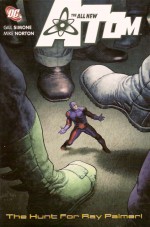
The All-New Atom: The Hunt for Ray Palmer


By Gail Simone, Mike Norton, Dan Green & Trevor Scott (DC Comics)
ISBN: 978-1-4012-1782-2

After the events of Identity Crisis and 52, size-changing physicist Professor Ray Palmer disappeared, leaving his world behind him. But life goes on, and his teaching chair at Ivy University was offered to a young prodigy from Hong Kong who just happened to be Palmer’s pen-friend and confidante: privy to his predecessor’s secrets ever since he was a child.

This neophyte, Ryan Choi, soon inherited his predecessor’s super-hero career as well – under some rather suspicious circumstances – battling super-villains, monsters and seemingly random chronal catastrophes that are making Ivy Town a viper’s nest of bizarre occurrences.

With this third volume (collecting issues #12-16 of the much missed All-New Atom comic-book) the so-likable legacy hero joins an eccentric team of heroes to track down his missing mentor in a story-arc that coincides with the events of the mega-crossover ‘Countdown to Final Crisis.’

Written by the always enjoyable Gail Simone and illustrated by Mike Norton, Dan Green and Trevor Scott, the saga begins with ‘Never Too Small to Hit the Big Time’ as shrinking homicidal maniac Dwarfstar returns, swiftly followed by a gallery of Palmer’s oddly unique Rogue’s Gallery. Temporal anomalies are devastating the city and Choi’s only chance to sort it all is the creepily coincidental alliance offered by the legendary time-thief Chronos…

‘Second Genesis’ finds Choi and that Tempus Fugitive lost in the South American jungles encountering the tiny alien barbarians Palmer once lived with (see Sword of the Atom) before the new Tiny Titan links up with Donna Troy, Jason Todd and the Monitor (protagonists of the aforementioned Countdown to Final Crisis) joining forces in a search of the entire multiverse. First stop in ‘Heavens to Bitsy’ takes them from the super-scientific civilisation located on the bottom of Choi’s pet dog (no not his underside, the bit by the tail…) and from there to the paradise where all dead superheroes go – featuring cameos from a host of departed DC stars…

Nothing is as it seems though, and by the time they reach neutral ground and a rendezvous with Green Lantern Kyle Rayner it’s clear that something is sabotaging them. ‘Loss Leader’ sees Choi impossibly yanked from his quest and returned to Earth to save Ivy Town from the effects of the accelerating time-storm one: of the funniest and grossest hero exploits ever recorded – or as Choi puts it “Ewwww…”

The book ends on a hilarious action-packed high note with ‘Forward! Into the Past!’ as more hints on the mastermind behind all the Atom’s troubles are revealed when Ivy Town takes a reality-warping, mind-bending trip back into the Summer of Love. Ghosts, aliens, monsters, naff villains and Hippies, plus a guest-shot for the clearly inadequate guardians of the Time Stream, the Linear Men: this fun-filled frantic frolic is a joyous return to clever, light-hearted adventure.

These tales are everything a jaded superhero fan needs to clear the palate and revive flagging interests. Get them all!

© 2007, 2008 DC Comics. All Rights Reserved.