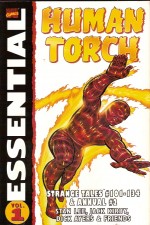
Essential Human Torch

New, extended review –

By Stan Lee, Jack Kirby, Dick Ayers & various (Marvel)
ISBN: 978-0-7851-1309-6

Hot on the heels (Sorry, sorry – I simply couldn’t help myself) of the runaway success of Fantastic Four, Stan Lee & Jack Kirby spun the most colourful and youngest member of the team into his own series, hoping to recapture the glory of the 1940s when the Human Torch was one of the company’s “Big Three” superstars.

This captivating, esoteric and economical collection of pure 1960s superhero shenanigans gathers those eclectic but crucial yarns (no less than five major Marvel villains debuted in blistering battle against the Flaming Kid) between Strange Tales #101 and 134 (October 1962- July 1965) and this searing monochrome compendium also includes the team-up of the Torch and Spider-Man from the second Annual.

Within a year of FF #1, the monster anthology title Strange Tales became the home for the hot headed hero. In issue #101, young Johnny Storm started his ancillary solo career in the eponymous ‘The Human Torch’ – a run-of-the-mill script by Larry Lieber (over a plot by his brother Stan) superbly illustrated by Jack Kirby & Dick Ayers wherein Johnny Storm investigated sabotage at a new seaside amusement park and promptly discovered Commie conniving by a Red spy called the Destroyer. Kirby would pencil the first few adventures before moving on after which inker Ayers would assume control of the series’ look for most of its run – although Kirby would generate some of the best covers of his Marvel career throughout the Torch’s tenure.

An odd inconsistency or, more likely, tension and drama-inducing gimmick did crop up here. Although public figures in the Fantastic Four, Johnny and his sister Sue lived part-time in the rural New York hamlet of Glenville and despite the townsfolk being fully aware of her as the glamorous and heroic Invisible Girl, they seemed oblivious to the fact that her baby brother was the equally famous Torch. Many daft pages but ingenious pages of Johnny protecting his secret identity would ensue before the situation was brilliantly resolved.

Although something of a hit-or-miss proposition, the strip was the origin point for many of Marvel’s greatest villains. The first of these appeared in the very next tale ‘Prisoner of the Wizard’ (Lee, Lieber, Kirby & Ayers) wherein a spiteful and publicity-hungry intellectual giant determined to crush the Torch to prove his superiority to the callow kid who stole all the newspaper headlines and the same creative team, then produced the captivating classic ‘Prisoner of the 5th Dimension’, as Johnny defeated a potential invasion and freed a captive populace from tyranny before easily trashing adhesive-toting adversary ‘Paste-Pot Pete!’ (later revamped as the terrifying Trapster), before teaming with sister Sue to tackle the deadly ‘Return of the Wizard’.

When Kirby moved on to engineer and design a host of new characters and concepts (occasionally returning as necessity or special events warranted) Ayers assumed full art duties beginning with Strange Tales #106 (March 1963). This yarn was notable in that it revealed that the entire town of Glenville had always known the Torch’s secret identity but were just playing along to keep him happy.

When Acrobat Carl Zante knocked on Johnny’s door and offered him a better-paying gig in ‘The Threat of the Torrid Twosome’ the kid’s head was swelled and swayed but he soon discovered he had been played by a master conman and diabolical bandit…

This first hint of tongue-in-cheek whimsy presaged an increasing lightness of touch which would come to characterise the Marvel style as much as the infighting between team-mates. The villainous Acrobat would return in another milestone in issue #114…

Issue #107 would be Lieber’s last as Ayers drew a splendid punch-up with the ‘Sub-Mariner’ – a tale reminiscent of the spectacular and immensely popular Golden Age battles of their publishing forebears. Veteran writer Robert “Berns” Bernstein scripted the next two, frankly daft yarns over Lee’s plots, but the saving grace of both ‘The Painter of a Thousand Perils!’(empowered by an alien art kit which brought illustrations to life in ST #108) and ‘The Sorcerer and Pandora’s Box’ (#109, with monstrous demons attacking humanity) was the brief return of King Kirby to the pencilling.

H.E. Huntley (Ernie Hart) typed the words for Ayers to illustrate in ‘The Human Torch vs. the Wizard and Paste-Pot Pete!’ a cunning clash which presaged the villain’s eventual evolution into the FF’s evil counterparts the Frightful Four. In #111 the Torch made short work of ‘Fighting to the Death with the Asbestos Man!’ – yet another demented scientist experiencing the travails and tragedies of simpler times.

Strange Tales #112 (scripted by Jerry Siegel under the pen-name Joe Carter) introduced murderous electrical marauder the Eel who accidentally swiped and activated a miniature A-Bomb in the tense, multifaceted thriller ‘The Human Torch Faces the Threat of the Living Bomb!’ after which Strange Tales Annual #2, featured ‘The Human Torch on the Trail of the Amazing Spider-Man!’ a terrific romp by Lee, Kirby & Steve Ditko wherein the wall-crawler was framed by international art thief The Fox, whilst back in the regular comicbook, “Carter” created another long-term baddie in ‘The Coming of the Plantman!’

Strange Tales #114 changed the face of the Marvel Firmament forever…

Written by Stan Lee himself, illustrated by Kirby & Ayers, it featured the return of the third of Timely Comics’ Golden Age Big Three – or at least an impersonation of him by the insidious Acrobat – in a blockbusting battle entitled ‘The Human Torch meets…Captain America!

Here’s a quote from the last panel…

“You guessed it! This story was really a test! To see if you too would like Captain America to Return! As usual, your letters will give us the answer!” I wonder how that all turned out?

Lee took over as scripter with ST #115’s ‘The Sandman Strikes!’ as Johnny impersonated Spider-Man to defeat the deadly atomic thug Flint Marko, after which the Torrid Teen and team-mate Ben (The Thing) Grimm battled each other ‘In the Clutches of the Puppet Master!’ in #116, with Ayers inked by George Roussos in his own secret identity of George Bell.

‘The Return of the Eel! proved far more of a challenge in #117 after which the Wizard had another go as ‘The Man Who Became the Torch!’, consequently nearly killing the Thing and Reed Richards besides.

A first brush with Marvel’s soon-to-be core readership came in #119 when ‘The Torch Goes Wild!’ due to a Commie Agent called the Rabble Rouser who mesmerised decent citizens, making them surly and rebellious, after which Kirby stepped in for #120 as ‘The Torch Meets Iceman!’, a terrific action extravaganza that pretty much ended the glory days of this strip. From then on, despite every gimmick and occasional burst of sheer inspiration the Bullpen could muster, a slow decline set in as the quirky back-up strip Doctor Strange grew in popularity – and cover space…

Issue #121 saw Johnny as ‘Prisoner of the Plantman!’ (Lee & Ayers) and #122 found a brute, conman and yogi all augmented by Dr. Doom and mustered as the woefully lame Terrible Trio launch an ill-conceived attack in ‘3 Against the Torch!’

Strange Tales #123 saw a creepy inventor build himself an impressive insectoid exo-suit to get rich the easy way as in an effort to boost ratings, The Thing became a permanent fixture in ‘The Birth of the Beetle!’ This so-so saga was most notable for the pencil job by Golden Age Torch creator Carl Burgos, after which Johnny and Ben tackled a fully re-designed ‘Paste-Pot Pete’ (inked by Paul Reinman) and then went after another old adversary in ‘The Sub-Mariner Must Be Stopped!’

‘Pawns of the Deadly Duo!’ saw the Puppet Master return, allied to the Mad Thinker in a clever but shallow yarn whilst #127 pitted Ben and Johnny against a bizarre puzzle and ‘The Mystery Villain!’

After a stunning Kirby Thing pin-up the Fantastic Two then unwillingly battled ‘Quicksilver and the Scarlet Witch’ in #128 (inked by Frankie Ray, AKA Frank Giacoia), as the Homo Superior siblings made an abortive first attempt to quit Magneto’s Brotherhood of Evil Mutants, after which ‘The Terrible Trio!’ once more failed to impress or assassinate the heroes…

Pop culture reeled and staggered with #130 in ‘Meet the Beatles’ (some sort of popular musical combo, not villains, and they actually didn’t meet them at all) although the brilliant Golden Age artist Bob Powell (with inking from Chic Stone) did take over the art chores for the comedy of errors/crime caper. Ayers returned to ink #131, the dire ‘Bouncing Ball of Doom!’ with the Mad Thinker siccing a cybernetic bowling bowl on the pair but Larry Ivie then wrote a capable Space Race thriller in ‘The Sinister Space Trap!’ inked by Mike Esposito under his Mickey DeMeo alias.

Stan Lee returned for the last two tales in ST #133 and #134; ‘The Terrible Toys’ wherein the Puppet Master tried a new modus operandi and ‘The Challenge of… The Watcher!’ (inked by the majestic Wally Wood) with the Torch and Thing transported to legendary Camelot to battle time-reaver Kang the Conqueror, but it was clear that the writer’s mind was elsewhere, most likely with the new Nick Fury, Agent of S.H.I.E.L.D. strip that would replace the Torch and thing in Strange Tales #135.

It is interesting to note that as the parent Fantastic Four title grew in scope and quality The Human Torch’s own series diminished. Perhaps there is something to be said for concentrating one’s efforts or not overexposing your stars. What was originally a spin-off for the younger audience faded as Marvel found its voice and its marketplace, although there would be periodic efforts to reinvigorate the Torch.

Sadly the historic value often supersedes the quality of most of these strange tales, but there’s still a good deal that’s great about this series and Fights ‘n’ Tights fans with a sense of tradition and love of fun will find this book irresistible and unmissable.
© 1962, 1963, 1964, 1965, 2003 Marvel Characters, Inc. All rights reserved.
Essential Marvel Two-In-One volume 1


By Jim Starlin, Roy Thomas, Steve Gerber, Gil Kane, Sal Buscema, Ron Wilson & various (Marvel)
ISBN: 978-0-7851-1729-2

Imagination isn’t everything. As Marvel slowly grew to a position of dominance in the wake of the losing their two most innovative and inspirational creators, they did so less by experimentation and more by expanding and exploiting proven concepts and properties.

The only real exception to this was the en masse creation of horror titles in response to the industry down-turn in super-hero sales – a move expedited by a rapid revision in the wordings of the increasingly ineffectual Comics Code Authority rules.

The concept of team-up books – an established star pairing, or battling – often both – with less well-selling company characters was not new when Marvel decided to award their most popular hero the lion’s share of this new title, but they wisely left their options open by allocating an occasional substitute lead in the Human Torch. In those long-lost days editors were acutely conscious of potential over-exposure – and since super-heroes were actually in a decline they may well have been right.

After the runaway success of Spider-Man’s Marvel Team-Up the House of Ideas carried on the trend with a series starring bashful, blue-eyed Ben Grimm – the Fantastic Four’s most iconic member – beginning with two test runs in Marvel Feature before graduating to its own somewhat over-elaborate title.

This economical, eclectic monochrome compendium gathers together the contents of Marvel Feature #11-12, Marvel Two-In-One #1-20, 22-25 and Annual #1, as well as Marvel Team-Up #47 and Fantastic Four Annual #11, covering the period September 1973 – March 1977.

It all kicked off with a perennial favourite pairing as the Thing once more clashed with the Hulk in ‘Cry: Monster! (by Len Wein, Jim Starlin and Joe Sinnott from Marvel Feature #11,  September 1973) wherein Kurrgo, Master of Planet X and the lethal Leader manipulated the blockbusting brutes into duking it out – ostensibly to settle a wager – but with both misshapen masterminds concealing hidden agendas…

That ever-inconclusive yet cataclysmic clash left Ben stranded in the Nevada desert where Mike Friedrich, Starlin & Sinnott promptly dropped him in the middle of the ongoing war against mad Titan Thanos as Iron Man helped the Thing crush monstrous alien invaders in ‘The Bite of the Blood Brothers!’ (#12, November 1973); another spectacular and painfully pretty all-action punch-up.

Still stuck in the desert when the dust settled Ben eventually trekked to an outpost of civilisation just in time to be diverted to Florida in Marvel Two-In-One #1 (January 1974) where Steve Gerber, Gil Kane & Sinnott magnificently revealed the ‘Vengeance of the Molecule Man!’ as Ben learned some horrifying home truths about what constituted being a monster battling with and beside the ghastly and grotesque anti-hero Man-Thing.

With the second issue Gerber cannily traded a superfluous supporting character from the Man-Thing series to add some much needed depth to the team-up title. ‘Manhunters from the Stars!’ pitted Ben, old enemy Sub-Mariner and the Aquatic Avenger’s powerful cousin Namorita against each other and aliens hunting the emotionally and intellectually retarded superboy Wundarr in another dynamically intoxicating tale illustrated by Kane & Sinnott. That case also left the Thing de facto guardian of the titanic teenaged tot…

Sal Buscema signed on as penciller with #3 as the Rocky Ranger joined the Man Without Fear ‘Inside Black Spectre!’, a crossover instalment of the extended epic then playing out in Daredevil #108-112 (this action-packed fight-fest occurring between the second and third chapters) after which ‘Doomsday 3014!’ (Gerber, Buscema & Frank Giacoia) found Ben and Captain America catapulted into the 31st century to save Earth from enslavement by the reptilian Brotherhood of Badoon, leaving Wundarr with Namorita for the foreseeable future…

The furious future-shocker concluded in MTIO #5 as the Guardians of the Galaxy climbed aboard the Freedom Rocket to help the time-lost heroes liberate New York before returning home. The overthrow of the aliens was completed by another set of ancient heroes in Defenders #26-29 (since collected in the superbly economical Essential Defenders volume 2).

Marvel Two-In-One #6 (November 1974) began a complex crossover tale with the aforementioned Defenders as Dr. Strange and the Thing encountered a cosmic event which began with a subway busker’s harmonica and led inexorably to a ‘Death-Song of Destiny!’ (Gerber, George Tuska & Mike Esposito) before Asgardian outcasts Enchantress and the Executioner attempted to seize control of unfolding events in #7’s ‘Name That Doom!’ (pencilled by Sal Buscema) only to be thwarted by Grimm and the valiant Valkyrie. There’s enough of an ending here for casual readers but fans and completists will want to hunt down Defenders #20 or the previously plugged Essential Defenders volume 2 for the full story…

Back here though issue #8 teamed the Thing and supernatural sensation Ghost Rider in a quirky and compelling Yuletide yarn for a ‘Silent Night… Deadly Night!’ (Gerber, Buscema & Esposito) as the audacious Miracle Man tried to usurp a very special birth in a stable…

Gerber moved on after plotting the Thor team-up ‘When a God goes Mad!’ for Chris Claremont to script and Herb Trimpe & Joe Giella to finish: a rather meagre effort with the Puppet Master and Radion the Atomic Man making a foredoomed power play, but issue #10 was a slice of inspired espionage action with Ben and the Black Widow battling suicidal terrorist Agamemnon who planned to detonate the planet’s biggest nuke in the blistering thriller ‘Is This the Way the World Ends?’ by Claremont, Bob Brown & Klaus Janson.

Marvel Two-In-One had quickly become a kind of clearing house for cancelled series and uncompleted storylines. Supernatural series The Golem had featured in Strange Tales #174, 176 and 177 (June-December 1974) before being summarily replaced mid-story by Adam Warlock and MTIO #11 provided plotter Roy Thomas, scripter Bill Mantlo and artists Brown & Jack Abel to offer some spectacular closure when ‘The Thing goes South’ resulted in stony bloke and animated statue finally crushing the insidious plot of demonic wizard Kaballa.

Young Ron Wilson began his lengthy association with the series and the Thing in #12 as Iron Man and Ben tackled out of control, mystically-empowered ancient Crusader Prester John in ‘The Stalker in the Sands!’; a blistering desert storm written by Mantlo and inked by Vince Colletta, after which Luke Cage, Power Man popped in to help stop a giant monster in ‘I Created Braggadoom!, the Mountain that Walked like a Man!’ – an old fashioned homage scripted by Roger Slifer & Len Wein, whilst Mantlo, Trimpe & John Tartaglione offered a spooky encounter with spectres and demons in #14’s ‘Ghost Town!’ a moody mission shared with The Son of Satan.

Mantlo, Arvell Jones & Dick Giordano brought on ‘The Return of the Living Eraser!’ a dimension-hopping invasion yarn which introduced Ben to Morbius, the Living Vampire after which a canny crossover epic began with the Thing and Ka-Zar plunging ‘Into the Savage Land!’ to dally with dinosaurs and defeat resource plunderers, after which the action switched to New York as Spider-Man joined the party in MTIO #17 to combat ‘This City… Afire!’ (Mantlo, Sal Buscema & Esposito) when mutated madman Basilisk transported an active volcano from Antarctica to the Hudson River with the cataclysmic conclusion following (from Marvel Team-Up #47) where Mantlo, Wilson & Dan Adkins finished off the epic and saved the day in fine style with ‘I Have to Fight the Basilisk!’

Another short-changed supernatural serial was finally sorted out in MTIO #18. ‘Dark, Dark Demon-Night!’ by Mantlo, Scott Edelman, Wilson, Jim Mooney & Adkins, found mystical watchdog The Scarecrow escape from its painted prison to foil a demonic invasion with the reluctant assistance of the Thing, after which Tigra the Were-Woman slinked into Ben’s life to vamp a favour and crush a sinister scheme by a rogue cat creature in ‘Claws of the Cougar!’ by Mantlo, Sal Buscema, & Don Heck.

That yarn segued directly into Fantastic Four Annual #11 which began a time-travelling sage with ‘And Now Then… the Invaders!’ by Roy Thomas, Big John Buscema & Sam Grainger, wherein Marvel’s First Family travelled back to 1942 to retrieve a cylinder of miracle-metal Vibranium which had begun to unwrite history after falling into Nazi hands.

En route they became embroiled in conflict with WWII super-team the Invaders which comprised early incarnations of Captain America, Sub-Mariner and the android Human Torch.

The time-busting task went well once the heroes finally united to assault the Nazi castle where the Vibranium was held, but after the quartet returned to their own repaired era, only Ben realised that the mission wasn’t completed yet…

The action continues in Marvel Two-In-One Annual #1 as, with the present unravelling around him, Ben returned to 1942 in ‘Their Name is Legion!’ by Thomas, Sal Buscema, Grainger, Tartaglione & George Roussos, to link up with Home Front Heroes The Liberty Legion (The Patriot, Thin Man, Red Raven, Jack Frost, Blue Diamond, Miss America and the Whizzer) and thwart Nazi raiders Skyshark and Master Man, Japanese agent Slicer and Atlantean traitor U-Man‘s invasion of America: a battle so big it spilled over and concluded in Marvel Two-In-One #20 (October 1976) in a shattering ‘Showdown at Sea!’ against diabolical Nazi scientist Brain Drain, courtesy of Thomas, Sal Buscema & Grainger.

MTIO #21 featured a team-up with Doc Savage but as Marvel no longer holds a license for that character, the story is excluded from this collection and the action resumes with #22’s two-part Thor pairing against the Egyptian God of Death in ‘Touch Not the Hand of Seth!’ (Mantlo, Wilson & Pablo Marcos); a fantastic cosmic extravaganza concluded with the assistance of Jim Shooter & Marie Severin in ‘Death on the Bridge to Heaven!’, after which Ben had a far more prosaic time with neophyte hero Black Goliath as a devastated downtown Los Angeles asked ‘Does Anyone Remember… the Hijacker?’ (by Mantlo, Shooter, Sal Buscema & Marcos).

This initial economical compendium ends on the cusp of a new era as the much delayed and postponed team-up with Iron Fist, the Living Weapon heralded the start of writer/editor Marv Wolfman’s impressive run on the title. ‘A Tale of Two Countries!’ illustrated by Wilson & Grainger, saw the Thing and the master martial artist shanghaied to the Far East as part of a Machiavellian plan to conquer the island kingdom of Kaiwann. Naturally they both strenuously objected…

These stories from Marvel’s Middle Period are of variable quality but nonetheless all are an honest attempt to entertain and exhibit a dedicated drive to please. Whilst artistically the work varies from adequate to quite superb, most fans of frantic Fights ‘n’ Tights genre would find little to complain about.

Although not really a book for casual or more maturely-oriented readers there’s lots of fun on hand and young readers will have a blast, so there’s no real reason not to add this tome to your straining superhero bookshelves…
© 1973, 1974, 1975, 1976, 1977, 2005 Marvel Characters, Inc. All Rights Reserved.

Fear Itself


By Ed Brubaker, Matt Fraction, Scott Eaton, Stuart Immonen & various (Marvel/Panini UK)
ISBN: 978-1-84653-494-2

Recently at Marvel, colossal braided mega-crossover events have been somewhat downplayed in favour of smaller mini-epics (the last biggie was Secret Invasion in 2008, I think), but following the release of the Captain America and Thor movies – not to mention the upcoming Avengers celluloid blockbuster – the time obviously seemed right to once more plunge their entire Universe into cataclysmic chaos and rebirth.

Collecting the one-shot Fear Itself Prologue: the Book of the Skull (March 2011) and the subsequent seven-issue core miniseries (which branched out into 30-odd other regular titles, miniseries and specials) this certainly spectacular puff-piece effectively presents a world-changing blockbuster via the comic equivalent of edited highlights whilst tempting readers to find the detail in the numerous spin-off books.

Quite simply: you can happily have old-fashioned funny-book fun and thrills just reading the basic story here and, should you want more, that’s available too

‘Book of the Skull’ by Ed Brubaker, Scott Eaton & Mark Morales follows Sin, daughter of the Fascist monster as she and Baron Zemo uncover a mystic weapon summoned to Earth during World War II, but rendered temporarily harmless in 1942 by The Invaders Captain America, Bucky and Sub-Mariner.

Only it wasn’t so much harmless as waiting for someone with the right blend of madness, need, hunger and sheer evil to wield it…

‘Fear Itself’ by Matt Fraction, Stuart Immonen & Wade von Grawbadger then opens with ‘The Serpent’ as global civil unrest and disobedience escalates into rioting as Sin picks up the mystic hammer which has been waiting for her, and transforms her into Skadi, herald of a dark and deadly menace from out of antediluvian Asgardian history…

The Home of the Gods has fallen to Earth in Oklahoma and, as Iron Man and the Avengers rally there to rebuild the Shining City, Odin appears and forcibly abducts the entire populace, even Thor, whom he has to batter into unconsciousness first.

Meanwhile Skadi has freed ancient fear-feeding god the Serpent from his prison on the sea-floor…

Soon seven other hammers turn the world’s most powerful denizens into harbingers of terror and mass destruction in ‘The Worthy’…

The Juggernaut, Hulk, Absorbing Man, Titania, Attuma, Grey Gargoyle and Thing are devastating the planet, generating global fear to feed the freed Asgardian outcast and in ‘The Hammer that Fell on Yancy Street’ the Avengers suffer their first tragic fatality, whilst in the nether-space which once housed the Citadel of the Gods the imprisoned Thor joins a secret rebellion against the clearly deranged Odin.

The All-Father plans to starve the fear-feeding Serpent of his food-source by scouring Earth of all life…

With ‘Worlds on Fire’ and the carnage and bloodletting ever-increasing, Thor escapes to Earth determined to aid his human allies and thwart his father’s insane scheme, just as retired hero Steve Rogers once again takes up the mantle of America’s Greatest Hero, and Iron Man forms an unlikely alliance to craft magical weaponry to combat the chaos before ‘Brawl’ finds the hammer-wielding Worthy uniting to crush human resistance, with the death-toll and slaughter escalating to extinction-event levels in ‘Blood-Tied & Doomed’ before Iron Man returns to turn the tide and save what remains of the day and humanity in the cataclysmic finale ‘Thor’s Day’ as the true history of the Gods is revealed and all Earths heroes, human, mortal or other, unite for one tragic last hurrah…

And make no mistake, this time even some of the A-list stars don’t make it…

Not that that means anything in comics, but it does make for an impressive – and breathtaking, beautifully illustrated – read, whilst the four portentous Epilogues (by a host of guest-creators) hint at more horror and heartbreak to come…

Owing far more to the aforementioned recent rash of movies and the general timbre of the times than the rugged mythologies created by Stan Lee and Jack Kirby, this is nevertheless a pretty effective cosmic punch-up which resets the playing field for the next few years and should make very friendly future reading for new and returning fans tantalised by the company’s Hollywood iterations.

With a splendid gallery of variant covers from Joe Quesada, Steve McNiven, Pablo Manuel Rivera, Guiseppe Camuncoli, Terry Dodson, Billy Tan, Humberto Ramos, Ed McGuinness, Mike McKone, this plot-light and action-overloaded epic should delight newer or less continuity-locked readers of Costumed Dramas and adventurous art lovers everywhere…

™ & © 2012 Marvel & Subs. Licensed by Marvel Characters B.V. through Panini S.p.A. Italy. A British Edition by Panini UK Ltd.

Stan Lee Presents the Fantastic Four


By Stan Lee & Jack Kirby with Joe Sinnott (Kangaroo/Pocket Books)
ISBN: 0-671-81445-1

Here’s another look at how our industry’s gradual inclusion into mainstream literature began and one more pulse-pounding paperback package for action fans and nostalgia lovers, offering yet another chance to enjoy some of the best and most influential comics stories of all time.

One thing you could never accuse entrepreneurial maestro Stan Lee of was reticence, especially when promoting his burgeoning line of superstars. In the 1960s most adults – including the people who worked there – considered comic-books a ghetto. Some disguised their identities whilst others were “just there until they caught a break”.

Visionaries all; Stan, Jack Kirby & Steve Ditko had another idea – change the perception.

Whilst the artists pursued their imaginations waiting for the quality of the work to be noticed, Lee proactively pursued every opportunity to break down the slum walls: college lecture tours, animated TV shows, ubiquitous foreign franchising and of course getting their product onto the bookshelves of “real” book shops.

After a few abortive attempts in the 1960s to storm the shelves of bookstores and libraries, Marvel made a concerted and comprehensive effort to get their wares into more socially acceptable formats. As the 1970s closed, purpose-built graphic collections and a string of new prose adventures tailored to feed into their all-encompassing continuity began oh, so slowly to appear.

Whereas the merits of the latter are a matter for a different review, the company’s careful reformatting of classic comics adventures were generally excellent; a superb and recurring effort to generate continuity primers and a perfect – if fickle – alternative venue to introduce fresh readers to their unique worlds.

The dream was superbly represented than in this classy little back-pocket Kirby cornucopia of wonders with sharp reproduction, the classic four-colour palette, sensitive editing, efficient picture-formatting and of course, six unforgettable epics from the very dawn of Lee & Kirby’s magnificent partnership…

After a troubled period at DC Comics (National Periodicals as it then was), a terrifying downturn in all comics sales across the board and a creatively productive but disheartening time on the poisoned chalice of the Sky Masters newspaper strip, Kirby settled into his new job at the small and shaky outfit which had once been publishing powerhouse Timely/Atlas; now reduced to releasing only 16 titles per month, churning out mystery, monster, romance and western material for a marketplace that seemed doomed to die.

But such fertile imagination couldn’t be suppressed for long and when the Justice League of America caught the public’s massed imagination it gave him and writer/editor Stan Lee an opportunity which changed the industry forever, and might well have saved it from extinction.

Depending upon who you believe, a golfing afternoon led publisher Martin Goodman to order his nephew Stan to create a series about super-characters like the JLA.

Combining the tone and tenets of the cautiously reviving mystery-man genre with their own tried-and-true sci-fi monster magazine fare, Lee & Kirby’s resulting team quickly took the industry and the fans by storm. It wasn’t the powers: they’d all been seen since the beginning of the medium. It wasn’t the costumes – they didn’t even have any until the third issue – it was Kirby’s compelling art and the fact that these characters weren’t anodyne cardboard cut-outs.

Set in a real and thoroughly recognizable location, (New York City from #3 onwards) a quartet of imperfect, brash and rather stroppy individuals banded together out of tragedy and disaster to face the incredible.

In most ways The Challengers of the Unknown (Kirby’s prototype quartet whose immortal exploits are available in two wonderful DC Archives and a single economical, black and white Showcase Presents volume) laid all the groundwork for the wonders to come, but the staid, almost hide-bound editorial strictures of National would never have allowed the raw, undiluted energy of the concept to run roughshod over taste and occasionally good publishing sense.

This tantalising all-colour pint-sized paperback reprints the first six trend-setting, empire-building issues beginning with Fantastic Four #1 (bi-monthly and cover-dated November 1961, by Lee, Kirby and an uncredited inker whose identity remains a topic of much debate to this day): a raw, rough, passionate and uncontrolled blend of fantasy adventure and sci-fi saga. Thrill-hungry kids pounced on it.

After Stan’s now compulsory rollicking, folksy introductory prologue ‘The Fantastic Four’ saw maverick scientist Reed Richards summon his fiancé Sue Storm, their friend Ben Grimm and Sue’s teenaged brother Johnny before heading off on their first mission. In a flashback we discover they are driven survivors of a private space-shot which went horribly wrong when Cosmic Rays penetrated their ship’s inadequate shielding. They smashed back to Earth and found that they had all been hideously mutated into outlandish freaks.

Richards’ body became elastic, Sue gained the power to turn invisible, Johnny Storm could turn into living flame and tragic Ben turned into a shambling, rocky freak. Shaken but unbowed they vow to dedicate their new abilities to benefiting mankind.

In ‘The Fantastic Four meet the Mole Man’ they foil a plan by another outcast who controls monsters and slave humanoids from far beneath the Earth before uncovering ‘The Moleman’s Secret!’

This summation of the admittedly mediocre plot cannot do justice to the engrossing wonder of that breakthrough issue – we really have no grasp today of just how different in tone, how shocking it all was.

“Different” doesn’t mean “better” even here, but the FF was like no other comic on the market at the time and buyers responded to it hungrily. The brash experiment continued with another old plot in #2. ‘The Skrulls from Outer Space’ were shape-changing aliens who framed the FF and made them hunted outlaws (a fruitful theme often returned to in those early days) before the genius of Mister Fantastic bluffed their entire invasion fleet into abandoning their plans for conquering Earth.

Issue #3 (inked by Sol Brodsky) featured ‘The Menace of the Miracle Man’ whose omnipotent powers had a simple secret, but is more notable for the first appearance of their uniforms and a shocking line-up change, which led directly into the next issue. Continued stories were an innovation in themselves, but the revival of a Golden Age Great instantly added depth and weight to the six month old and still un-named Marvel Universe.

‘The Coming of the Sub-Mariner’ reintroduced the all-powerful amphibian Prince of Atlantis, who had been lost for decades, a victim of amnesia. Recovering his memory thanks to the Human Torch, Namor returned to his sub-sea home only to find it destroyed by atomic testing. A monarch without subjects, he swore vengeance on humanity and attacked New York City with a gigantic monster. This saga is when the series truly kicked into high-gear…

Until now the creative team, who had been in the business since it began, had been hedging their bets. Despite the innovations of a contemporary superhero experiment their antagonists had relied heavily on the trappings of popular trends in the media – and as reflected in their other titles. Aliens and monsters played a major role in the earlier tales but Fantastic Four #5 took a full-bite out of the recovering Fight n’ Tights apple and introduced the first full-blown super-villain to the budding Marvel Universe.

I’m not discounting Mole Man, but that tragic little gargoyle, for all his bitter schemes and plans of world conquest, wouldn’t truly acquire the persona of a costumed foe until his more refined second appearance in #22.

‘Prisoners of Doctor Doom’ (July 1962, inked by the subtly slick Joe Sinnott) has it all: an attack by a mysterious enemy from Reed’s past, magic and super-science, lost treasure, time-travel – even the ever popular buccaneering pirates stir this heady brew of all-out adventure.

Sheer magic and the on-form creators knew they were on to an instant winner since the deadly Doctor returned the very next issue, teamed with a reluctant but gullible Sub-Mariner to attack our heroes in #6’s ‘Captives of the Deadly Duo!’ inked by new regular embellisher Dick Ayers: perfectly closing this delightful little collectors item.

In this first super-villain team up Prince Namor’s growing affection for Sue Storm forced the sub-sea stalwart to save his foes from dire death in outer space – but only after Doom tried to kill him too…

These immortal epics are available in numerous formats and editions (including monochrome softcover compendiums and enticing lavish premium hardbacks), but there’s an oddly delicious and seditious cachet to these easily concealable collections which always take me back decades to ‘O’ level Civics and Economics classes on warm Wednesday afternoons that’s simply impossible to ignore and always leaves a warm fuzzy feeling…

Ah, the merry buzz of insects, the steady drone of an oblivious teacher who didn’t want to be there either and the slow cautious turning of pages perfectly obscured by a large, dog-eared tome of Keynesian dogma…

But that’s just me…

It’s easy to assume that such resized, repackaged paperback book collections of early comics extravaganzas were just another Marvel cash-cow in their tried-and-tested “flood the marketplace” sales strategy – and maybe they were – but as someone who has bought these stories in most of the available formats over the years, I have to admit that these handy back-pocket versions are among my very favourites and ones I’ve re-read most – they’re handier, more accessible and just plain cool – so why aren’t they are available as ebooks yet?

© 1977 Marvel Comics Group. All rights reserved.

Marvel Masterworks (volume 6): The Fantastic Four 11-20


By Stan Lee, Jack Kirby, Dick Ayers, Steve Ditko & various (Marvel)
ISBN: 0-87135-481-0   Second edition 978-0-7851-0980-8

After blasting into the comics-buying consciousness and swiftly garnering a devoted following in 1961 “the World’s Greatest Comic Magazine!” continued to live up to its boast in an astounding succession of boldly experimental, evocatively enthralling and amazingly human funny, thrilling and completely compelling sequential sagas.

This second deluxe hardcover compilation carries on reprinting those groundbreaking classics in lavish full-colour splendour, re-presenting Fantastic Four #11-20, originally released between February and November 1963, and almost unanimously the result of Stan Lee, Jack Kirby & Dick Ayers’ close and effective collaboration.

Actually I’m possibly rewriting history just a bit here. The innovations continued but didn’t always hit the mark, as tellingly described in Lee’s effusive introduction to this volume.

Issue #11 had two short stories instead of the usual book-length yarn; ‘The Impossible Man’ – a baddie-free yet compellingly light-hearted tale about a fun-seeking but obnoxiously omnipotent visitor from the stars and ‘A Visit with the Fantastic Four’, which offered background into the characters plus a behind-the-scenes travelogue of off-duty life with the team which mischievously reiterated the novel fact the heroes collected and read a comic book about themselves…

Fans hated the issue at the time but now these vignettes are considered some of the most effective tales of that formative period…

Fantastic Four #12 featured an early crossover experiment when the team were asked to help the US army capture ‘The Incredible Hulk’ (whose own short-lived title had recently been cancelled). This tense cold-war spy and sabotage thriller set the ground rules for many a two-fisted clash between the Jade Goliath and the blockbusting Thing…

This was followed by ‘Versus the Red Ghost and his Incredible Super Apes!’ another politically-charged, commie-baiting drama pitting Marvel’s First Family against a Soviet scientist in the space-race to the Moon: a tale notable not only for the supremely moody inking of Steve Ditko (replacing the adroit Ayers for one month) over Kirby’s astounding pencils but also for the introduction of the cosmic voyeurs called The Watchers and the discovery of the intoxicatingly intriguing lost city in the “Blue Area of the Moon”.

Issue #14 featured the return of ‘The Sub-Mariner and the Merciless Puppet Master!’ with the Atlantean Prince a hapless pawn of the mind-controlling doll-despot’s revenge plot, promptly followed by ‘The Mad Thinker and his Awesome Android!’ a chilling war of intellects with plenty of room for all-out action as a master-strategist manipulated the team into splitting up in order to steal all Reed Richards’ scientific secrets.

FF #16 revealed ‘The Micro-World of Doctor Doom!’ in a spectacular other-worldly rollercoaster action-romp guest-starring new hero Ant-Man, after which the incorrigible Iron-Clad villain promptly returned with infallible, deadly traps a month later when the quartet were almost ‘Defeated by Doctor Doom!’

A shape-changing super-alien with all their cosmically induced powers was next to menace our heroes when ‘A Skrull Walks Among Us!’ and issue #19 introduced another of the company’s top-ranking super-villains when the FF became ‘Prisoners of the Pharaoh!’ whilst exploring ancient Egypt seeking a cure for the blind sculptress Alicia Masters. This time travel tale has been revisited by so many writers that it is considered one of the key-stone stories of Marvel continuity.

Fantastic Four #20 concludes this compendium with a terrifying new foe, as the compulsorily aloof Watcher broke his eternal vow of neutrality to warn the heroes of a potential threat to all Existence before standing back and letting them do all the hard work by defeating ‘The Mysterious Molecule Man!’

Also included in this tantalising tome is a splendid Thing pin-up and a brace of pseudo-scientific Fantastic Four Feature Pages by Lee, Kirby & Ayers telling all you need to know about the powers of the Human Torch.

Although possibly – just, perhaps – a little dated in tone, these are undoubtedly graphic classics of comic story-telling illustrated by one of the world’s greatest talents just approaching his mature peak: fast, frantic fun and a joy to read or re-read. This comprehensive, joyous introduction (or even reintroduction) to these characters is a wonderful reminder of just how good comic books can – and should – be.
© 1963, 1964, 1988, 2003 Marvel Characters, Inc. All rights reserved.
Essential Fantastic Four volume 5


By Stan Lee, Jack Kirby, Joe Sinnott, Frank Giacoia, John Romita, John Buscema, John Verpoorten & various (Marvel)
ISBN: 978-0-7851-2162-6

With the fifth collection of tales from “The World’s Greatest Comics Magazine” the dream-team of Jack Kirby and Stan Lee was sundered and a reeling Marvel entered a new epoch of uncertain futures and bold new directions – which is rather ironic since it was the company’s reticence to give the artist creative freedom which led to Kirby’s jumping ship to National/DC in the first place…

This volume covers the final days of “the King’s” reign on Marvel’s flagship title and the shaky start of a new era covers Fantastic Four #84-110 (March 1969-May 1971) plus the covers of FF Annuals #7 and 8, but also includes a few surprise features to stun and startle art-lovers everywhere.

The narrative delights begin with the start of a four-part epic starring their greatest foe. ‘His Name is Doom!’ (by the team supreme of Lee, Kirby & Joe Sinnott) found Mr. Fantastic, Human Torch, Thing and substitute member Crystal returning from battling Maximus and the Inhumans only to be intercepted by Nick Fury and the super-spies of S.H.I.E.L.D. looking for a favour…

The Steel-Shod Dictator had apparently devised unstoppable super-robots and the quixotic quartet was asked to infiltrate the sovereign state of Latveria to ferret them out. However it’s impossible to sneak up on the most paranoid man in the world and the heroes were easily intercepted and captured. ‘Within This Tortured Land’ found them “guests” in Doom’s fairytale Ruritanian paradise, but even with their powers removed they soon discovered the cruel iron within their velvet prison as the Monarch of Latveria began testing his deadly Doombots on his own subjects. When the automatons went wild the entire kingdom was imperilled in ‘Victims’ and only the last-minute arrival of Invisible Girl Sue Richards allowed the FF and the villagers to survive Doom’s cataclysmic failsafe plan

The shocking final confrontation and conclusion came in ‘The Power and the Pride!’ which wrapped up the saga in a bombastic blend of super-science, soap opera and delightful melodrama seldom seen in comicbooks before or since.

Fantastic Four #88 found the five champions back in the USA and looking at an unconventional new house found by the dedicatedly-domesticated Sue in her perpetual quest to carve out a relatively normal life for her new son. Regrettably the trendy detached dwelling in ‘A House There Was!’ had been designed by the FF‘s oldest enemy and ‘The Madness of the Mole Man!’ predicated his turning the entire world blind and wiping out the extended heroic family entirely.

The Thing took centre-stage in the next extended epic as he was kidnapped to another world when ‘The Skrull Takes a Slave!’ in #90. Abducted to fight in gladiatorial games on a colony world patterned after Earth’s 1920s gangster era ‘The Thing… Enslaved!’ introduced rival Skrull mobs vying for supremacy and a noble slave destined to slaughter our shanghaied champion. ‘Ben Grimm, Killer!’ ramped up the tension as Thing and mechanoid marvel Torgo discovered that their home-worlds were hostage to their fortune and ferocity in the arena…

Meanwhile Reed, Johnny and Crystal had not been idle. While Ben was at ‘The Mercy of Torgo!’ his Earthly brothers-in-arms were enacting a desperate plan to save him and destroy the Skrulls planetary doom-weapon.

After the cover to the all-reprint Fantastic Four Annual #7 a series of single issue stories kicked off with the debut of eldritch babysitter/governess Agatha Harkness in ‘The Return of the Frightful Four!’ a rollercoaster romp of action and suspense most significant for finally giving Sue and Reed’s baby a name after a year of shilly-shallying… Franklin Benjamin Richards.

The Monocle was a technological assassin determined to cause global Armageddon in #95’s ‘Tomorrow… World War Three!’ in the middle of which Crystal was abruptly abducted by her own family, after which ‘The Mad Thinker and his Androids of Death!’ (inked by Frank Giacoia) once again proved no match for the heroic foursome whilst ‘The Monster From the Lost Lagoon!’ offered a decidedly different take on the horror-movies it gloriously pastiched when the First Family tried to combine a quick tropical vacation with a little rumour-busting creature-hunt…

Both Joe Sinnott and the Sentry Sinister returned in #98’s ‘Mystery on the Moon!’ as the global fervour over the first lunar landing in 1969 (conveniently forgetting, of course, the FF‘s own visit to our satellite in issue #13) resulted in a cracking yarn wherein the team stopped the intergalactic Kree empire from sabotaging mankind’s first steps into space, whilst in #99 the heartsick Johnny Storm invaded the hidden home of the Inhumans intent on reuniting with his lost love at all costs when ‘The Torch Goes Wild!’

With a restored Crystal happily in tow the 100th anniversary adventure featured a daft but spectacular battle against robotic replicas of their greatest enemies in ‘The Long Journey Home!’ but #101 provided a far more intriguing contest when criminal combine the Maggia bought the team’s skyscraper headquarters in a cunning, quasi-legal ploy to steal the FF‘s scientific secrets, culminating in ‘Bedlam in the Baxter Building!’

Fantastic Four #102 featured the first cover not drawn by The King as John Romita (senior) prepared to jump into the artistic hot-seat following Kirby’s abrupt move to the home of Superman and Batman.

After an incomprehensibly vast catalogue of creativity an unthinkable Changing of the Guard occurred when the increasingly discontented King of Comics jumped ship from the House of (His) Ideas for arch-rival National/DC where he crafted his Fourth World Magnum Opus as well as a host of other game-changing comicbook classics…

An era ended at Marvel when the King abdicated his seemingly divinely-ordained position. Left to pacify and win over again the stunned fans were Stan Lee and a couple of budding talents named Romita and Buscema…

Kirby was not quite gone however, as he and Sinnott opened an impressive extended epic wherein the mutant menace Magneto used guile and subterfuge to turn ‘The Strength of the Sub-Mariner’ and his undersea armies against the FF and entire surface world…

Romita and inker John Verpoorten took over the story in mid-stream depicting America ‘At War with Atlantis!’ as Magneto inevitably betrayed Namor, inspiring the Prince to join with the embattled quartet to prevent ‘Our World… Enslaved!’, which is followed here by the cover of Fantastic Four Annual #8 (which had reprinted the original clash between Subby’s undersea empire and the surface world from the first FF Annual) after which Lee, Romita & Verpoorten began the low-key but extremely effective tale of ‘The Monster in the Streets!’

When Crystal was taken ill – preparatory to writing her out of the series completely – Reed’s examination revealed a potential method of curing the misshapen Thing of his Rocky curse, but whilst he was preparing Ben Grimm for the longed-for process a mysterious energy-beast began to tear up the city. By the time ‘The Monster’s Secret!’ was exposed in #106 the team strongman was near death and Crystal gone… seemingly forever.

Joe Sinnott returned – again – in #107 in ‘And Now… the Thing!’ as John Buscema took over Kirby’s other masterpiece (he had begun drawing Thor four months previously from issue #182) wherein the tragic man-beast gained the power to become human at will. It seemed the best of all possible outcomes but something wasn’t quite right… However, before Reed could investigate an old foe popped up again. Sort of…

FF #108 was something of a surprise to fans. ‘The Monstrous Mystery of the Nega-Man!’ reintroduced a character never before seen by recycling portions of a rejected Lee, Kirby & Sinnott tale with new framing sequences illustrated by Buscema and Romita. The mysterious Janus had tapped into the anti-matter power of the Negative Zone once and now he had “returned” to steal more by crashing through the portal in Reed’s lab. Unfortunately this had attracted the attention of extinction-event predator Annihilus, who had long sought entry into our life-rich universe…

Forced to follow the truly mad scientist Reed, Ben and Johnny once again faced ‘Death in the Negative Zone!’ and this compelling compendium closes on a cliffhanger with Fantastic Four #110 as, with a little arcane assistance, Reed escaped doom in the anti-matter cosmos only to realise that the “cured” Ben Grimm had become a lethal threat to all humanity in ‘One From Four Leaves Three!’

Did I say closes? Not quite; as this massive monochrome tome still finds room for a selection of original un-inked Kirby pencil pages from #89 and even reprints a photo gallery of the entire Marvel Bullpen from circa 1971. Boy – talk about bonuses…

These are the stories which confirmed Jack Kirby as the absolute master of superhero storytelling and gave Marvel the push needed to overtake the decades-dominant DC, as well as the valiant efforts tat saved the company after the Great Imaginer left for their biggest rival. They’re also some of the very best comics ever produced and as thrilling and compulsive now as they ever were. This is another must-have book for all fans of graphic narrative.

© 1969, 1970, 1971, 2006 Marvel Characters, Inc. All Rights Reserved.

Marvel Masterworks (volume 2): The Fantastic Four 1-10


By Stan Lee, Jack Kirby & various (Marvel)
ISBN: 0-87135-307-5

I love a bit of controversy so I’m going start off by saying that Fantastic Four #1 is the third most important American comicbook of the Silver Age and ever since, ranking just behind Showcase #4, which introduced the Flash and The Brave and the Bold #28, which brought superhero teams back via the creation of the Justice League of America. I’m just saying…

After a troubled period at DC Comics (National Periodicals as it then was) and a creatively productive but disheartening time on the poisoned chalice of the Sky Masters newspaper strip Jack Kirby settled into his job at the small outfit that used to be the publishing powerhouse Timely/Atlas, churning out mystery, monster, romance and western material in a market he suspected to be ultimately doomed.

But his fertile imagination couldn’t be suppressed for long and when the JLA caught the public’s massed imagination it gave him and writer/editor Stan Lee an opportunity which changed the industry forever.

Depending upon who you believe a golfing afternoon led publisher Martin Goodman to order his nephew Stan to try a series about super-characters like the JLA, and the resulting team quickly took the industry and the fans by storm. It wasn’t the powers: they’d all been seen since the beginning of the medium. It wasn’t the costumes: they didn’t even have any until the third issue.

It was Kirby’s compelling art and the fact that these characters weren’t anodyne cardboard cut-outs. In a real and recognizable location, (New York City from #3 onwards) imperfect, rather touchy people banded together out of tragedy and disaster to face the incredible.

In many ways The Challengers of the Unknown (Kirby’s prototype quartet whose escapades are available in two wonderful DC Archives as well as a single economical, black and white Showcase Presents volume) laid all the groundwork for the wonders to come, but the staid, almost hide-bound editorial strictures of National would never have allowed the, undiluted energy of the concept to run all-but unregulated.

This glorious and lavish hardcover compilation reprints the first ten trend-setting, empire-building issues beginning with Fantastic Four #1 (bi-monthly and cover-dated November 1961, by Lee, Kirby and an uncredited inker whose identity remains a topic of much debate to this day) – a raw, rough, passionate and uncontrolled blend of traditional monster adventure and sci-fi saga. Thrill-hungry kids pounced on it.

‘The Fantastic Four’ saw maverick scientist Reed Richards summon his fiancé Sue Storm, their friend Ben Grimm and Sue’s teenaged brother Johnny before heading off on their first mission. In a flashback we discover that they are driven survivors of a private space-shot that went horribly wrong when Cosmic rays penetrated their ship’s inadequate shielding. They crashed back to Earth and found that they had all been hideously mutated into outlandish freaks.

Richards’ body became elastic, Sue gained the power to turn invisible, Johnny Storm could turn into living flame and tragic Ben turned into a shambling, rocky freak. Shaken but unbowed they vow to dedicate their new abilities to benefiting mankind.

In ‘The Fantastic Four meet the Mole Man’ they foil a plan by another outcast who controls monsters and slave humanoids from far beneath the Earth. This summation of the admittedly mediocre plot cannot do justice to the engrossing wonder of that breakthrough issue – we really have no grasp today of just how different in tone, how shocking it all was.

“Different” doesn’t mean “better” even here, but the FF was like no other comic on the market at the time and buyers responded to it hungrily. The brash experiment continued with another old plot in #2. ‘The Skrulls from Outer Space’ were shape-changing aliens who framed the FF and made them hunted outlaws (a fruitful theme often returned to in those early days) before the genius of Mister Fantastic bluffed their entire invasion fleet into abandoning their plans for conquering Earth.

Issue #3 (inked by Sol Brodsky) featured ‘The Menace of the Miracle Man’ whose omnipotent powers had a simple secret, but is more notable for the first appearance of their uniforms and a shocking line-up change, which led directly into the next issue. Continued stories were an innovation in themselves, but the revival of a Golden Age Great instantly added depth and weight to the six month old and still un-named Marvel Universe.

‘The Coming of the Sub-Mariner’ reintroduced the all-powerful amphibian Prince of Atlantis, who had been lost for decades, a victim of amnesia. Recovering his memory thanks to the Human Torch, Namor returned to his sub-sea home only to find it destroyed by atomic testing. A monarch without subjects, he swore vengeance on humanity and attacked New York City with a gigantic monster. This saga is when the series truly kicked into high-gear…

Until now the creative team, who had been in the business since it began, had been hedging their bets. Despite the innovations of a contemporary superhero experiment their antagonists had relied heavily on the trappings of popular trends in the media – and as reflected in their other titles. Aliens and monsters played a major role in the earlier tales but Fantastic Four #5 took a full-bite out of the fight n’ tights apple and introduced the first full-blown super-villain to the budding Marvel Universe.

I’m not discounting Mole Man, but that tragic little gargoyle, for all his plans of world conquest, wouldn’t truly acquire the persona of a costumed foe until his more refined second appearance in #22.

‘Prisoners of Doctor Doom’ (July 1962, inked by the subtly slick Joe Sinnott) has it all. An attack by a mysterious enemy from Reed’s past, magic and super-science, lost treasure, time-travel – even pirates. Ha-haar, me ‘earties! One brief aside for collectors here: the 1987 first printing of this Marvel Masterworks has a number of the pages in this tale wrongly sequenced – an error rectified in later releases – so if this is a problem, buy a different edition.

Sheer magic, and the so on-form creators knew they were on to a winner since the deadly Doctor returned the very next issue, teamed with a reluctant but gullible Sub-Mariner to attack our heroes in #6’s ‘Captives of the Deadly Duo!’ inked by new regular embellisher Dick Ayers.

In this first super-villain team up Prince Namor’s growing affection for Sue Storm forced the sub-sea stalwart to save his foes from dire death in outer space – but only after Doom tried to kill him too…

The first inklings of the rough-and-tumble humour and familial byplay smoothed the raw edginess from now on and Alien abductors were the motivating force when the team became ‘Prisoners of Kurrgo, Master of Planet X’, a dark and grandiose off-world thriller in FF#7 (the first monthly issue) whilst a new villain and the introduction of a love-interest for the monstrous Ben Grimm were the breakthrough high-points in the action-packed ‘Prisoners of the Puppet Master!’

The December issue, #9, trumpeted ‘The End of the Fantastic Four’ as Sub-Mariner returned to exploit another brilliant innovation in comic storytelling. When had a super-genius, superhero ever messed up so much that the team had to declare bankruptcy? When had costumed crime-fighters ever had money troubles at all? The eerily prescient solution was to “sell out” and make a blockbuster movie – giving Kirby a rare chance to demonstrate his talent for caricature…

1963 was a pivotal year in the development of Marvel. Lee and Kirby had proved that their new high concept – human heroes with flaws and tempers – had a willing audience. Now they would extend that concept to a new pantheon of heroes. Here is where the second innovation would come to the fore.

Previously, super-heroes were sufficient unto themselves and shared adventures were rare. Here, however was a universe where characters often tripped over each other, sometimes even fighting each other’s enemies! The creators themselves might turn even up in a Marvel Comic! Fantastic Four #10, which rounds out this deluxe box of delights, featured ‘The Return of Doctor Doom!’ wherein the arch villain used Stan and Jack to lure Reed Richards into a trap where his mind was switched with the Iron Dictator’s until hubris, arrogance and valiant heroism inevitably saved the day…

These immortal epics are available in numerous formats (including softcover editions of the luxurious and enticing hardback under review here), but for a selection that will survive the continual re-readings of the serious, incurable fan there’s nothing to beat the substantial full-colour feel of these Marvellous Masterwork editions.

If you’re going to read the World’ Greatest Comics Magazine’s finest moments, surely you’ll be wanting to do it in style?
© 1961, 1962, 1963, 1987, 2003 Marvel Characters, Inc. All Rights Reserved.

Essential Super-Villain Team-Up volume 1


By Roy Thomas, Steve Englehart, Wally Wood, Keith Giffen & various (Marvel)
ISBN: 978-1-9041-5973-5

Prince Namor, the Sub-Mariner was the second super-star of the Timely Age of Comics (but only because he followed after the cover-featured Human Torch in Marvel Mystery Comics #1) and has had the most impressive longevity of the company’s “Big Three” Torch, Subby and Captain America.

He was revived in 1962 in Fantastic Four #4; once again an anti-hero/noble villain and has been prominent in the company’s pantheon ever since.

The following issue introduced the first great villain of the Silver Age in the form of technologically armoured dark knight Doctor Doom, who takes up the lion’s share of this eclectic yet excellent collection of dastardly double-dealings encompassing Astonishing Tales #1-8, Giant-Sized Super-Villain Team-Up #1-2, Super-Villain Team-Up #1-14 and 16-17, as well as pertinent crossover appearances in Avengers #154-156 and Champions 16.

Incidentally, Fantastic Four #6 featured the first Super-Villain Team-Up of the Marvel age as Doom and Namor joined forces as ‘The Deadly Duo’. The Master of Latveria inevitably betrayed and tried to kill the Prince of Atlantis in that tale: an event which colours the relationship of the characters to this day… All of those magical moments appear in Essential Fantastic Four volume 1, by the way.

Although Doom had his first true solo outing in Marvel Super-Heroes #20 (May 1969) this magnificent and monumental monochrome collection opens with his follow-up series which began with ‘Unto You is Born… the Doomsman!’ (July-August 1970) wherein Roy Thomas & Wally Wood revealed the master manipulator’s daily struggle to maintain his iron control over the Ruritanian kingdom of Latveria, building a super-robot to crush the incipient rebellion of ousted Crown Prince Rudolfo and his mysterious sponsor.

However the use of a girl who seemed to be Victor von Doom’s lost love had the desired effect and the rebels almost succeeded in driving the tyrant from Doom Castle. In the attendant chaos the Doomsman device wandered away…

‘Revolution!’ proved Doom was not the only master of mechanoids as Rudolfo and the enigmatic Faceless One used the Doomsman to wreak havoc throughout the country, before a final assault in ‘Doom Must Die!’ (scripted by Larry Lieber) found all the tyrant’s enemies vanquished and the Monarch of Menace once more firmly in control.

Lieber & Wood then pitted Doom against the Red Skull in ‘The Invaders!’ as an army of leftover Nazis stormed into the country whilst Doom was away, only to be crushed and banished in ‘A Land Enslaved!’ (Astonishing Tales #5, by Lieber, George Tuska & Mike Esposito) as soon as he came back.

Issue #6 saw the Lord of Latveria invade the African nation of Wakanda in ‘The Tentacles of the Tyrant!’ determined to seize the vast stock of wonder mineral Vibranium only to fall foul of the furious tenacity of its king and defender T’Challa the Black Panther in ‘…And If I be Called Traitor!’ (Gerry Conway, Gene Colan & Frank Giacoia).

The short solo run ended in high style with a little landmark entitled ‘Though Some Call it Magic!’, wherein Conway, Colan & Tom Palmer revealed Doom’s darkest secret. Every year the ultimate villain was forced to duel the rulers of Hell in the vain hope of freeing the soul of his mother from eternal torment, and every year he failed: a tragic trial which punished both the living and the dead.

With this tormented mini-epic even further depth and drama were added to the greatest villain in the Marvel universe.

The series vanished with no warning and Doom returned to his status as premier antagonist in the Fantastic Four and elsewhere until Giant-Sized Super-Villain Team-Up #1 was released (March 1975), once more bathing the Deadly Despot in a starring spotlight.

In the intervening years the Sub-Mariner had also lost his own series, despite some very radical and attention-grabbing stunts. A nerve gas dumping accident perpetrated by surface dwellers had catastrophically altered his hybrid body, forcing him to wear a hydrating-suit to breathe. The same toxin had plunged the entire nation of Atlantis into a perpetual coma.

Alone and pushed to the brink of desperation, Prince Namor rescued Doom from a deadly plunge to Earth after the Iron Dictator’s latest defeat the hands of the FF and Silver Surfer in an impressive and effective framing sequence bracketing two classic reprint tales. ‘Encounter at Land’s End!’ (by Roy Thomas, John Buscema & Joe Sinnott) saw Doom plucked from the sea and the edge of death by a Sub-Mariner in dire need of scientific wizardry to cure his somnolent race and prepared to offer an alliance against all mankind to get it…

Painfully aware of their unhappy past history the outlaws recalled a previous encounter ‘In the Darkness Dwells Doom!’ (from Sub-Mariner #20, by Thomas, Buscema & Johnny Craig) wherein the fugitive Atlantean was offered sanctuary in New York’s Latverian embassy before being blackmailed and betrayed (again) by the Devil Doctor…

Initially reluctant, Doom reconsiders after recalling a past battle against the diabolical Diablo. ‘This Man… This Demon!’ (Thomas, Lieber, Giacoia & Vince Colletta) is the aforementioned solo tryout from Marvel Super-Heroes #20, which restated the Doctor’s origins and revealed his tragic, doomed relationship with a gypsy girl named Valeria…

The debate ends in a cataclysmic clash of egos and raw destructive power with both parties more bitterly opposed than ever but the follow-up ‘To Bestride the World!’ (Thomas, Mike Sekowsky & Sam Grainger) in the all-new Giant-Sized Super-Villain Team-Up #2 (June 1975), forced Doom to change his mind when his own android army rebelled after the long-lost Doomsman (under its new guise of Andro) returned and co-opted them for a war against organic life.

After blistering battle and extensive carnage Namor and Doom triumphed together and parted uneasy allies, only to regroup in the pages of Super-Villain Team-Up #1 (August 1975) as a chaotic ongoing series began with ‘Slayers from the Sea!’ by Tony Isabella, George Tuska, Bill Everett & Fred Kida.

As Doom actually contemplates treating an ally as a equal in the opening chapter ‘An Alliance Asunder?’, in the second part ‘Frenzy on a Floating Fortress’ (illustrated by George Evans & Frank Springer) Namor is ambushed by old foes Attuma, Dr. Dorcas and Tiger Shark, leading Doom to rush to his rescue in #2 as ‘In the Midst of Life…!’ (with art from Sal Buscema & Kida) the Sub-Mariner’s truest friend was murdered by his assembled enemies, leading to a brutal climax in ‘If Vengeance Fails!’ by Jim Shooter, Evans & Jack Abel.

Super-Villain Team-Up was an intriguing concept cursed with a revolving door creative team crisis: nobody seemed able to stay with the series for more than a couple of issues. Somehow the standards remained high but with no long-term planning the plots and characterisation jumped all over the place.

Bill Mantlo, Herb Trimpe & Jim Mooney produced ‘A Time of Titans!’ in #4 as Doom and Sub-Mariner battled each other and encountered a prototype Deathlok the Demolisher before splitting up yet again, after which Steve Englehart stepped in for ‘…And Be a Villain!’ (illustrated by Trimpe & Don Perlin) wherein the Lord of Latveria artificially exacerbated Namor’s breathing affliction and threatened to annihilate dormant Atlantis. Despite all the efforts of the Fantastic Four the Sub-Mariner was forced to swear fealty to Doom or see his people and himself perish forever…

This tumultuous issue also introduced mystic Batman knock-off the Shroud whose avowed mission was to free the world from the curse of Doom at all costs…

Jack Abel inked ‘Prisoner!’ in #6 as the FF invaded Latveria to rescue the promise-bound Sub-Mariner only to be sent packing by US Secretary of State Henry Kissinger who had just signed a non-aggression pact with Doom. One American observed no such legal or diplomatic niceties in ‘Who is… The Shroud?’ (Pablo Marcos inks) and, after revealing his origins to Namor, the Master of Darkness freed him from his vow by killing Dr. Doom.

As Shroud and Namor fled for the border chaos broke out in Latveria, but in actuality Doom was not dead. He had been rescued and imprisoned by Namor’s cousin Namorita and girlfriend Tamara in ‘Escape!’ (illustrated by Keith Giffen & Owen McCarron) under the misguided apprehension that they could force the Metal-shod Monarch into helping Atlantis and their Prince., The crisis escalated as it segued into an ongoing Avengers storyline, beginning ‘When Strikes Attuma?’ (Avengers #154 by Conway, George Perez & Marcos) as the Sub-sea Slayer enslaved the World’s Mightiest Heroes and commanded them to kill Namor…

The saga continued in Super-Villain Team-Up #9 (scripted by Mantlo, drawn by Jim Shooter & Sal Trapani) as the ‘Pawns of Attuma!’ attacked only to discover Doom in charge and easily able to thwart their half-hearted assault. In Avengers #155 the beaten heroes were helpless, leaving only the confused, battle-crazed Namor and a substitute team to hunt down the barbarian sea lord, with the epic conclusion ‘The Private War of Doctor Doom!’ in #156 (written by Shooter, drawn by Sal Buscema & Marcos) where the liberated and resurgent heroes joined forces to crush Attuma and prevent Doom from turning the situation to his own world-conquering advantage…

Behind the scenes in Latveria, Shroud had installed Prince Rudolfo as a faux Doctor Doom but things went wrong very quickly in Super-Villain Team-Up #10 (by Mantlo, Bob Hall & Perlin) when Captain America investigated ‘The Sign of the Skull!’

In the Latverian Embassy the genuine despot learned from the Star-Spangled Avenger that Red Skull had once more invaded Doom’s homeland, even as the Sub-Mariner discovered greedy surface-men pillaging his comatose city of Atlantis.

As Doom and Captain America battled their way through Latveria’s formidable defences the Skull proceeded in establishing his Fourth Reich, easily defeating the Shroud in ‘My Ally, my Enemy’ but when Namor raged in, tracking the ravagers of Atlantis to Doom’s castle, the tables were finally turned and the Iron Dictator swore to finally cure the Atlanteans in return for the Sub-Mariner’s aid against the Nazi invaders.

Firstly though, the Skull plans to enslave the earth with a hypno-ray had to be crushed in ‘Death Duel!’ with the Iron Doctor pursuing the Nazi mastermind to his hidden moonbase, casually sacrificing the Shroud in the process.

Finally fulfilling his oath Doom resurrected the comatose Atlanteans in #13, but only after a blistering sub-sea battle with amphibian arch-foe Krang and a brobdingnagian sea beast in ‘When Walks the Warlord!’ (by Mantlo, Giffen & Perlin)

With Atlantis and Namor restored a new era began and ended with Super-Villain Team-Up #14 (October 1977). ‘A World For the Winning!’ by Mantlo, Hall, Perlin & Duffy Vohland, opened with mutant villain Magneto tricked into a duel with Doom who was de facto master of the world since he had seeded the atmosphere with a mind control gas.

Ever the sportsman, the Lord of Latveria released Magneto from his control, allowed him to liberate one other thrall and challenged them both to save the world…

It was the last issue of the troubled title and the story concluded in Champions #19 (November 1977) as the Master of Magnetism and the Beast spectacularly overcame all odds and saved the day in ‘A World Lost!’ (Mantlo, Hall & Mike Esposito). A year later Super-Villain Team-Up #15 appeared from nowhere (dated November 1978 and presumably released to safeguard the copyright) with a reprint of the Red Skull story from Astonishing Tales #4-5.

‘Shall I Call Thee Master?’ by Peter Gillis, Carmine Infantino & Bruce Patterson was released a year later ( #16 May 1979, with one final issue 12 months after that) wherein the Skull, Hatemonger and radical geneticist Arnim Zola whiled away the days in a human atrocity lab. This was a dark exploration of monstrous inhumanity where torture and degradation were simply a way of passing the time until the leftover Fascists could build a new Cosmic Cube and reshape all reality to their twisted whims.

In this instance they were thwarted by merely mortal secret agents in the long delayed but savagely effective conclusion ‘Dark Victory!’ (Gillis, Arvell Jones & Patterson), after which the concept and title were shelved for decades.

This eccentric and thoroughly fan-only compendium concludes with a double page spread omitted from earlier reprintings of ‘This Man… This Demon!’ and the rather magnificent cover of that tale from Marvel Super-Heroes #20.

For all its flaws Super-Villain Team-Up was a bold experiment and a genuinely enjoyable dalliance with the different during the 1970s – as long as the reader had an in depth knowledge of the company’s ever- more complex continuity. I truly wish more people would sample the delights of this offbeat saga but I doubt any new reader could cope with the terrifying torrent of unexplained backstory.

Still, I’d be delighted if you prove me wrong…
© 1970, 1971, 1975, 1976, 1977, 2008 Marvel Characters, Inc.  All Rights Reserved.

The Fantastic Four – Marvel Illustrated Books


By Stan Lee & Jack Kirby with Joe Sinnott
(Marvel Illustrated Books)
ISBN: 0-939766-02-7

Here’s another look at how our industry’s gradual inclusion into mainstream literature began and one more pulse-pounding paperback package for action fans and nostalgia lovers.

One thing you could never accuse entrepreneurial maestro Stan Lee of was reticence, especially when promoting his burgeoning line of superstars. In the 1960s most adults, – including the people who worked there – considered comic-books a ghetto. Some disguised their identities whilst others were “just there until they caught a break.” Stan, Jack Kirby and Steve Ditko had another idea – change the perception.

Whilst the artists pursued their imaginations waiting for the quality of the work to be noticed, Lee proactively pursued every opportunity to break down the slum walls: college lecture tours, animated TV shows, ubiquitous foreign franchising and of course getting their product onto the bookshelves of “real” book shops.

After a few abortive attempts in the 1960s to storm the shelves of bookstores and libraries, Marvel made a concerted and comprehensive effort to get their wares into more socially acceptable formats. As the 1970s closed, purpose-built graphic collections and a string of new prose adventures tailored to feed into their all-encompassing continuity began to appear.

Whereas the merits of the latter are a matter for a different review, the company’s careful reformatting of classic comics adventures were generally excellent; a superb series of primers and a perfect new venue to introduce fresh readers to their unique worlds.

The project was never better represented than in this classy little Kirby cornucopia of wonders with crisp black and white reproduction, sensitive editing, efficient picture-formatting and of course, three superb yarns from the very peak of Lee & Kirby’s magnificent partnership…

The first story ‘When Strikes the Silver Surfer!’ pitted the bludgeoning, tragic, jealousy-consumed Thing in unabashed, brutal battle with the Silver Surfer, an uncomprehending alien of incomprehensible power, trapped on Earth and every inch a “Stranger in a Strange Land”. When the gleaming godling turned to the Thing’s blind girlfriend Alicia Masters for tea and sympathy, her brooding boyfriend immediately jumped to the wrong conclusion…

Alicia was the pivotal actor in the follow-up two-part tale ‘What Lurks Behind theBeehive’ and the concluding ‘When Opens the Cocoon!’ a sinister saga of science gone mad which served to introduce a menace who would eventually become a major star in Marvel’s firmament.

The action opens as gifted sculptress Alicia is abducted to a technological wonderland where a band of rogue geniuses have genetically engineered the next phase in evolution but now risk losing control of their creation even before it can be properly born… As the Fantastic Four frantically searches for the seemingly helpless girl, she has penetrated the depths of the incredible hive and discovered the secret of the creature known only as “Him”.

Alicia’s gentle nature is the only thing capable of placating the nigh-omnipotent newborn creature (who would eventually evolve into the tragic cosmic voyager Adam Warlock), but as the FF finally arrive to save the day events spiral out of control and imminent disaster looms large…

It’s easy to assume that such resized, repackaged paperback book collections of early comics extravaganzas were just another Marvel cash-cow in their tried-and-tested “flood the marketplace” sales strategy – and maybe they were – but as someone who has bought these stories in most of the available formats over the years, I have to admit that these handy back-pocket versions are among my very favourites and ones I’ve re-read most – they’re just handier and more accessible – so why aren’t they are available as ebooks yet?
© 1966, 1967, 1982 Marvel Comics Group, a division of Cadence Industries Corporation. All rights reserved.

Essential Fantastic Four volume 4


By Stan Lee, Jack Kirby, Joe Sinnott & various (Marvel)
ISBN: 978-0-7851-1484-X

This fabulous fourth black-and-white compendium of the classic and landmark “Stan & Jack” Fantastic Four sees the feature achieve its highest potential in a string of superlative tales that proved the bold boast on every cover… “World’s Greatest Comic Magazine!”

Jack Kirby was in his conceptual prime and continually unleashed his vast imagination on spectacular plot after plot whilst Stan Lee scripted some of the most passionate superhero sagas that Marvel – or any publisher, for that matter – has ever seen. Both were on an unstoppable roll, at the height of their creative powers, and full of the confidence that only success brings, with Kirby in particular eager to see how far the genre and the medium could be pushed.

This volume, covering the early career of comics’ First Family covers Fantastic Four #64-83 (July 1967-February 1969) plus the fifth and sixth annuals, a bombastic blend of super-science, soap opera and stunning action that has seldom been equaled and never bettered.

The magic commences with ‘The Sentry Sinister’ (inked as always by Joe Sinnott) a frenetic adventure romp which pitted the team against a super-scientific robot buried for millennia by an ancient star-faring race. This tropical treat expanded the burgeoning interlocking landscape to an infinite degree by introducing the imperial Kree who would grow into one of the fundamental pillars supporting the continuity of the Marvel Universe.

Although regarded as long-dead the Kree themselves resurfaced in the very next issue as the team was attacked by an alien emissary ‘…From Beyond this Planet Earth!’ The formidable Ronan the Accuser turned up looking to see what could possibly have destroyed his Sentry. Simultaneously The Thing’s blind girlfriend Alicia was abducted by a super scientific stranger…

The mystery of her disappearance was revealed in #66 in ‘What Lurks Behind the Beehive?’ as the heroes trailed the seemingly helpless girl to a technological wonderland where a band of rogue geniuses had genetically engineered the next phase in evolution but lost control of it even before it could be properly born…

‘When Opens the Cocoon!’ revealed the secret of the creature known only as Him and only Alicia’s gentle nature could placate the nigh-omnipotent creature (who would eventually evolve into the tragic cosmic voyager Adam Warlock), after which the tight continuity gradually paused to allow the Inhumans (a time-lost race of paranormal beings long secluded from mortal men) and the Black Panther to share the stage in that year’s Annual, wherein the sinister invader Psycho-Man attempted to ‘Divide… and Conquer!’

Frank Giacoia actually inked this wrongly attributed yarn that pitted the emotion-bending invader against both the King of Wakanda and the Royal Family of hidden Attilan until the FF could pitch in, delayed as they were by the news that the Sue Richards was pregnant – and soon to confined in the most appallingly sexist manner until the birth…

The Annual also included another comedy insight into the creation of Marvel Epics as Stan, Jack and Frank asked ‘This is a Plot?’ and after the now customary Kirby pin-ups (Inhumans Black Bolt, Gorgon, Medusa, Karnak, Triton, Crystal and Maximus, a colossal group shot of Galactus the Silver Surfer and others and a double page spread of the FF themselves) a rapidly rising star-in-the-making got his first solo appearance in ‘The Peerless Power of the Silver Surfer’ a pithy fable of cruel ingratitude that reintroduced the Mad Thinker’s lethal Artificial Intelligence creation Quasimodo…

In FF #68 the Thinker himself enacted his latest plan and ‘His Mission: Destroy the Fantastic Four!’ as the cogitating criminal replaced a famous doctor and subverted a potential cure for The Thing’s rocky condition into a mind-warping scheme to turn the Thing against his comrades (inked as ever by the remarkable Joe Sinnott). The scheme progressed in ‘By Ben Betrayed!’ as the newly malevolent Grimm attempted to murder the rest of the team only to be driven temporarily away. Desperately searching for him the FF soon captured the Thinker and freed Ben from mind-control in ‘When Fall the Mighty!’ but the victory left the heroes unconscious and only Sue conscious to tackle the villains last-ditch killer android in ‘…And So It Ends…’

With baby on board Reed and Sue resigned, leaving Ben, Johnny and the Inhuman maid Crystal to hold the fort when cosmic calamity came calling. In ‘Where Soars the Silver Surfer!’ the sky-born wanderer imprisoned on Earth by the world-devouring Galactus went cage-crazy and attacked humanity, forcing Reed’s return, whilst #73 presented the conclusion to a long-running Daredevil (see Essential Daredevil volume 2) story wherein the sightless crusader was ousted from his own body by the Iron Dictator Doctor Doom.

Warning the FF of imminent attack the Man without Fear then subsequently defeated Doom – but neglected to tell the heroes of his victory… outmatched and unable to convince them any other way DD enlisted Thor and Spider-Man in ‘The Flames of Battle…’ to solve the problem Marvel style – with a spectacular pointless and utterly riveting punch-up…

The Surfer was back in #74 ‘When Calls Galactus’ as the planet-eater returned to our skies demanding that his one-time herald once more become his food-finding slave, but despite his increasingly violent probings, Galactus cannot locate his target. That’s because the Surfer had departed for ‘World Within Worlds!’ forcing Reed, Ben and Johnny to follow. When attacked by Psycho Man they are ‘Stranded in Sub-Atomica!’ and as they struggle to survive Galactus applies ever-more pressure… ‘Shall Earth Endure?’

Turning himself in to save Earth, the Surfer is summarily returned to his captivity here as soon as ungrateful Galactus is finished feeding, just in time to begin his own landmark series – but that’s the subject of another review, another time…

Meanwhile in FF#78 another attempt to cure Ben Grimm goes awry in ‘The Thing No More!’ due to interference from old foe The Wizard and, in ‘A Monster Forever?’, Ben’s choice to stay a rocky monster and save his friends from the bludgeoning Android Man.

A brief change of pace took the team to the Indian Lands of old friend Wyatt Wingfoot to solve an eerie mystery ‘Where Treads the Living Totem!‘ before the sixth Annual spotlighted the birth of Franklin Richards. Unfortunately however, not before Reed, Ben and Johnny invaded the anti-matter Negative Zone to confront a monstrous creature named Annihilus whose power was the only thing that could prevent the death of Sue and her unborn child. ‘Let There Be… Life!’ is a groundbreaking 48 page epic that is as stunning to read now as it ever was, passionate thrilling and mind-boggling in its visual intensity.

With Sue a new mother faithful Crystal became the first new official member of the team and promptly showed her mettle by pulverizing the incorrigible Wizard in #81’s ‘Enter… the Exquisite Elemental!’ and this volume concludes with a classic two-part clash against the inhuman Maximus as he once more attempted to conquer mortal humanity. ‘The Mark of… the Madman!’ saw the FF come to the aid of the imprisoned Royal Family of Attilan before together trouncing the insane despot in ‘Shall Man Survive?’

Did I say concludes? Not quite as this book still finds room for a selection of 6 original art pages from Kirby and his alternate cover for issue #65, you lucky, lucky people…

These are the stories that confirmed Jack Kirby as the absolute master of superhero storytelling and gave Marvel the push needed to overtake the decades-dominant DC. They’re also some of the very best comics ever produced and as thrilling and compulsive now as they ever were. This is a must-have book for all fans of graphic narrative.

© 1967, 1968, 1969, 2005 Marvel Characters, Inc. All Rights Reserved.