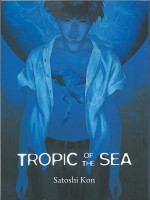
Tropic of the Sea


By Satoshi Kon, translated by Maya Rosewood (Vertical)
ISBN: 978-1-939130-06-8

In the West we’re used to single manga stories filling entire bookcases: epic sagas filling thousands of pages with brilliant, lovely, exciting but generally very long tales on every theme and subject under the sun.

Every so often, however, something comes along which is more familiar to English sensibilities, such as this short, sharp, sinister shocker from screenwriter, artist, animator and Director Satoshi Kon.

The author was born in Kushiro Subprefecture, Hokkaido in 1963 and after High School attended MusashinoArtUniversity’s Graphic Design department from 1982-1987. Whilst there he spent a lot of time studying foreign film.

Whilst still a student he released the short manga Toriko and became an assistant to Katsuhiro Otomo, dividing his time between comics and animation. In 1990 he produced the single volume Kaikisen we’re concentrating on here, before graduating more fully toward film as scripter, layout artist and animator.

Amongst his credits are World Apartment Horror, Roujin Z, Patlabor 2: The Movie, Magnetic Rose, Perfect Blue Millennium Actress, Tokyo Godfathers and others. What would have certainly been a stellar career in either or both art forms was cruelly cut short in 2010 when he died tragically young from pancreatic cancer.

As Shinsouban Kaikisen, this eerie yarn was first serialised in Kodansha’s Young Magazine in 1990: eleven episodes between issues #17 and 29, thereafter collected in tankōbon form and again as a Bijutsu Shuppan edition in 1999. That commemorative tome provides the informative Afterword which ends this book describing the author’s path from mangaka to animator.

Tropic of the Sea opens on a secluded beach where teenager Yosuke and his dog Fujimaru play before the dutiful son climbs to a hilltop shrine to enact a centuries-old ritual. His joyful morning is then disturbed when his father brings a TV crew into the sacred area.

Yozo Yashiro is the 23rd Head Priest of the Hiratsu Shrine; a thoroughly modern man keenly supporting a major consortium’s ambitious plans to turn the sleepy fishing village of Ade into a modern luxury resort. As such he’s keen on publicity and is happy to disturb the Mermaid’s Egg within the shrine and show it to all the viewers whilst explaining the silly but charming legend attached to it.

Long ago his ancestor found another such egg and promised a mermaid to respectfully care for it. After six decades the egg was returned to the sea and another egg left. In return the sea matron guaranteed calm waters and abundant fishing. This current egg was deposited in the shrine almost exactly sixty years ago…

The televised lecture is interrupted by Yosuke’s furious grandfather who has dragged himself out of hospital to stop the travesty he has just seen. Again the bitter argument begins. Grandfather is a fierce opponent of the proposed resort, whereas the current priest is no believer in his duties, nor the sacrosanct pact between the fishermen and the nonsensical sea-woman.

He does however realise the tourist potential of a Mermaid’s Egg theme park…

The village too is divided into warring camps on the issue. The fishermen see their ancestral livelihoods threatened by the proposed tourist trap whilst shopkeepers imagine thousands of new customers flocking in daily.

As Yosuke and best buddy Tetsu discuss the potential influx of college girls and summer days, they watch a limousine full of Ozaki Construction bigwigs arrive to inspect the monstrous Hotel growing like a giant tumour on the beach, and feel a pang of apprehension…

The egg is now common knowledge and billboards proclaiming “Welcome to Mermaid Country” are everywhere, but the boys’ minds are on more mundane things… but only until they take a dinghy out to the sacrosanct offshore islet Kamijima and catch a tantalising glimpse of something impossible in the water…

It turns out to be only old school friend Nami, back from Tokyo for the summer mermaid festival and taking a playful swim, but Yosuke is still uneasy and oddly unsettled…

With Ade becoming a bustling, money-mad boomtown and the priestly Yozo vigorously pushing villagers into selling their land to the developers, grandfather – despite his illness – is determined to honour the family’s ancient promise, and things take a decidedly dark turn when ambitious corporate development head Kenji Ozaki starts taking an unhealthy interest in the Egg. He also lets slip that Kamijimi will be razed and turned into Marine Land theme park…

He’s too late: by the time his team get to the hilltop shrine the Mermaid’s treasure has vanished. The trail leads to Kamijima where Nami and the boys find grandpa with the Egg in a submerged grotto. It’s the place where the mermaid has come every sixty years to pick up her hatchling and leave a new egg and grandpa has almost killed himself getting it here. Hard on the kids’ heels, however, come Ozaki and his goons.

As the businessman tries to appropriate the gleaming globe a strange waterspout erupts and in the tumult Yosuke badly cuts his hand. The drama soon subsides though, and as they all return to Ade in Ozaki’s launch, the boy is amazed to realise that when he picked up the Egg his wound completely healed…

There’s even stranger news to come as tensions over the Corporation’s full building schemes leak out. In the hospital the doctors cannot understand how grandpa’s terminal stomach cancer has completely gone…

Days pass and already the first wave of tourists are despoiling the previously quiet seaside atmosphere. Nami and Yosuke – no longer sceptical about the Egg – are making plans, but Ozaki is also convinced that the object has some mysterious power and takes steps to claim it for the company even as his bulldozers begin to clear Kamijima.

The fishermen are furious. Their once-abundant catches have dried up and the Mermaid’s Egg festival, crowded with suits and tourist interlopers, degenerates into a massive riot. In the melee, with Yozo’s compliance, Ozaki takes the artefact into his safekeeping, and the stunned, betrayed Yosuke thinks he sees a figure on a rock, waiting in vain for her child to be returned…

As Ozaki’s technicians poke and probe the Egg, the traditional day of surrender comes and goes. Yosuke barely survives an uncanny contact with something beyond the scope of science and, with Nami and Tetsu, determines to retrieve the Egg and return it to its true owner whatever the risk…

A tense clash on a bridge finds the kids surprisingly victorious but it’s too late. The Egg hatches in Yosuke’s hands and at the beach the sea vanishes. It can mean only one thing. A tsunami is coming: a wall of angry wild water to wipe away all the foul fabrications of double-dealing, oath-breaking mankind…

Brooding and pensive, this superb supernatural thriller builds tension with masterful dexterity in beguilingly understated style and Kon’s superb draughtsmanship and meticulous pacing keeps the suspense simmering until the spectacular denouement snatches your breath away. A cracking tale no fiction fan or comics collector should miss – especially as the book also includes a gallery of the beautiful title pages which accompanied the original Young Magazine serialisation.

Tropic of the Sea is a minor masterpiece of modern fantasy fiction and a perfect spooky epic movie in waiting…

© 2013 KON’STONE Inc. All rights reserved.
This book is printed in ‘read-from-back-to-front’ manga format.

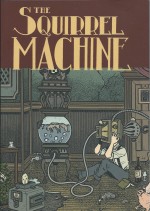
The Squirrel Machine


By Hans Rickheit (Fantagraphics Books)
ISBN: 978-1-60699-646-1

Hans Rickheit was born in 1973 and has been producing skilfully crafted art in many different arenas since the 1990s, beginning with self-published mini-comics before graduating to full-sized, full-length epics such as Kill, Kill, Kill. He has also worked in film, music, gallery works and performance art.

A Xeric award beneficiary, he came to broader attention in 2001 with the controversial graphic novel Chloe, and has since spread himself wide contributing to numerous anthologies and periodicals such as The Stranger, creating webcomics and instigating the occasional anthology periodical Chrome Fetus.

A keen student of dreams, Rickheit has been called obscurantist, and indeed in all his beautifully rendered and realised concoctions meaning is layered and open to wide interpretation. His preferred oeuvre is the recondite imagery and sturdily fanciful milieu of Victorian/Edwardian Americana which proved such rich earth for fantasists such as Edgar Allen Poe, H.P. Lovecraft, Clark Ashton Smith and August Derleth, whilst his fine, studied, meticulously clear line is a perfect, incisive counterpoint to the cloud of miasmic mystery and cosmic confusion engendered by the protagonists of his most successful book.

The brothers Edmund and William Torpor abide in a secluded 19th century New England town but have never been part of their community. Raised alone by their artist mother they are very different from other kids, with Edmund especially obsessed with arcane engineering and the assemblage of one-of-a-kind musical instruments from utterly inappropriate components.

Fantastic dream-like journeys and progressions mark their isolated existence, which is far more in tune with a greater metaphysical cosmos, but as puberty gradually moves them to an awareness of base human sexuality they find the outside world impacting their private one in ways which can only end in tragedy and horror…

Moreover, just where exactly did the plans for the ghastly Squirrel Machine come from…?

Visually reminiscent of the best of Rick Geary, this is nevertheless a singularly surreal and mannered design; a highly charged, subtly disturbing delusion that will chill and upset and possibly even outrage many readers.

It is also compelling, seductive, sublimely quirky and nigh-impossible to forget. As long as you’re an adult and braced for the unexpected, expect this to be one of the best books you’ll read this century – or any other…

Out of print since 2009, The Squirrel Machine has now been remastered and released in an accessible paperback edition, just in time to disturb the sleep of a new generation of fear fans just as the winter nights draw in…

© 2013 Fantagraphics Books. Contents © 2009 Hans Rickheit. All Rights Reserved.

Win’s Perfect Present Alert: For him or her or even “it” as long as they’re mature enough to handle it…10/10

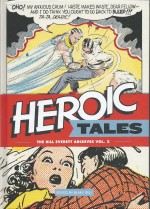
Heroic Tales: The Bill Everett Archives volume 2


By Bill Everett and others, edited and complied by Blake Bell (Fantagraphics Books)
ISBN: 978-1-60699-600-3

Thanks to modern technology there is a superabundance of collections featuring the works of too-long ignored founding fathers and lost masters of American comic books. A magnificent case in point is this second superb chronicle revisiting the incredible gifts of one of the greatest draughtsmen and yarn-spinners the industry has ever seen.

You could save some time and trouble by simply buying the book now rather than waste your valuable off-hours reading my blather, but since I’m keen to carp on anyway feel free to accompany me as I delineate just why this tome needs to join the books on your “favourites” shelf.

He was a direct descendent and namesake of iconoclastic poet and artist William Blake. His tragic life and awe-inspiring body of work – Bill was possibly the most technically accomplished artist in US comicbook industry – reveals how a man of privilege and astonishing pedigree was wracked by illness, an addictive personality (especially alcoholism) and sheer bad luck, nevertheless shaped an art-form and left twin legacies: an incredible body of superlative stories and art, and, more importantly, saved many broken lives saved by becoming a dedicated mentor for Alcoholics Anonymous in his later years.

William Blake Everett was born in 1917 into a wealthy and prestigious New England family. Bright and precocious, he contracted Tuberculosis when he was twelve and was dispatched to arid Arizona to recuperate.

Thus began a life-long affair with the cowboy lifestyle: a hard-drinking, smoking, tall-tale telling breed locked in a war against self-destruction, described in the fact-filled, picture-packed Introduction by Blake Bell which covers ‘The Early Years of Comics: 1938-1942’, ‘The Birth of Marvel Comics’ and ‘The Comic Book Production System’, before ‘The Heroes’ precedes a full-colour selection of incredible prototypical adventure champions with a brief essay on the set-up of Centaur Comics, Novelty Press, Eastern Color Printing, Hillman and Lev Gleason Publications…

Accompanied by the covers for Amazing Mystery Funnies volume 2 #3, 5 and 6 (March, May & June 1939, Centaur) are three outer space exploits of futuristic trouble shooter Skyrocket Steele, whilst Tibetan-trained superhero Amazing-Man offers a transformative triptych of titanic tales spanning war-torn Europe, augmented by the covers to Amazing-Man Comics #9-11 February-April 1940.

Everett’s deeply held western dreams are covered next with a brace of rootin’ tootin’ yarns starring Bull’s-Eye Bill from Novelty Press’ Target Comics #3-4 (April & May 1940) whilst from #7-9 (August-October 1940), the author smoothly switched to sophisticated suspense with master of disguise The Chameleon crushing contemporary criminals in scintillating escapades from Target Comics’ answer to The Saint, the Falcon and the Lone Wolf.

Thanks to his breakthrough Sub-Mariner sagas Everett was inextricably linked to water-based action, and Eastern Comics hired him to create human waterspout Bob Blake, Hydroman for the bimonthly Reg’lar Fellers Heroic Comics. Here, spanning issues # 6-9 (May-November 1941, with the covers for #6 and 7), are four spectacular, eerie, offbeat exploits, covering an extended battle against foreign spies and American Fifth Columnists, after which Red Reed in the Americas! (created by Bob Davis & Fitz) offers the first two chapters in a political thriller wherein a college student and his pals head South of the Border to fight Nazi-backed sedition and tyranny in a stunning tour de force first seen in Lev Gleason’s Silver Streak Comics #20 & 21 (April & May 1942).

A section of Miscellaneous and text illustrations follows, blending Western spot drawings with the eye-catching covers from Amazing Mystery Funnies volume 2 #18, Target Comics #5 and 6, Blue Bolt (vol. 1 #11, vol. 2 #1, 2 and 3) and Famous Funnies #85.

The Humorous and More describes Everett’s forays into other markets: niche sectors such as licensed comics, comedy and romance, and even returns to pulp and magazine illustration as he strove to stay one step ahead of a constantly shifting market and his own growing reputation for binges and unreliability.

‘What’s With the Crosbys?’ is a superbly rendered gossip strip from Famous Stars #2 (1950, Ziff-Davis) whilst a stunning monochrome girly-pin-up of ‘Snafu’s Lovely Ladies’ (from Snafu #3 Marvel, March 1956), and the cover of Adventures of the Big Boy #1 (also Marvel, from the same month) lead into the Back Cover of Cracked #6 (December 1958, Major Magazines) and other visual features from the Mad imitator as well as the colour cover to less successful rip-off Zany (#3, from March 1959).

Everett’s staggering ability to draw beautiful women plays well in the complete romance strip ‘Love Knows No Rules’ (Personal Love #24, November 1953 Eastern Color), and this section concludes with a gritty black and white title page piece from combat pulp War Stories #1, courtesy of Marvel’s parent company Magazine Management, September 1952.

The Horror concentrates on the post-superhero passion for scary stories: an arena where Bill Everett absolutely shone like a diamond. For over a decade he brought a sheen of irresistible quality to the generally second-rate chillers Timely/Atlas/Marvel generated in competition with genre front-runners EC Comics. It’s easy to see how they could compete and even outlive their gritty, gore-soaked competitor, with such lush and lurid examples of covers and chillingly beautiful interior pages…

Following a third informative background essay detailing his life until its cruelly early end in 1973, a choice selection of his least known and celebrated efforts opens with tale of terror ‘Hangman’s House’ (Suspense #5, November, 1950): a grim confrontation with Satanic evil, followed by futuristic Cold War shocker ‘I Deal With Murder!’ and a visit to a dark carnival of purely human wickedness in ‘Felix the Great’ (both culled from Suspense #6, January 1951).

Adventures into Weird Worlds #4 (Spring 1952) offered a laconic, sardonic glimpse into ‘The Face of Death’, whilst from the next issue (April 1952) ‘Don’t Bury Me Deep’ tapped untold depths of tension in a moodily mordant exploration of fear and premature burial. Hard on the heels of the cover to Journey Into Unknown Worlds #14 (December 1952) comes one of its interior shockers as ‘The Scarecrow’ helped an aged couple solve their mortgage problems in a most unusual manner.

The Marvel madness then concludes with a cautionary tale of ‘That Crazy Car’ from Journey into Mystery #20, December 1954, concluding a far too brief sojourn amidst arguably Everest’s most accomplished works and most professionally adept period.

This magnificent collection ends with a gallery of pages and one complete tale from the end of his career; selected from an even more uninhibited publisher attempting to cash in on the adult horror market opened by Warren Publishing with Eerie, Creepy and Vampirella.

Skywald was formed by industry veteran Israel Waldman and Everett’s old friend Sol Brodsky, tapping into the burgeoning black and white market with mature-reader and supernatural magazines Hell-Rider, Crime Machine, Nightmare, Psycho and Scream. Offered an “in” Everett produced incredible pin-ups (included here are three from Nightmare (#1, 2 & 4, December 1970-June 1971), ‘A Psycho Scene’ (Psycho #5, November, 1971) a stunning werewolf pin-up from Psycho #6 and one of revived Golden Age monstrosity ‘The Heap’ from Psycho #4.

Most welcome, however, is a magnificent 10-page monochrome masterpiece of gothic mystery ‘The Man Who Stole Eternity’ from Psycho #3, May, 1971.

Although telling, even revelatory and concluding in a happy ending of sorts, what this book really celebrates is not the life but the astounding versatility of Bill Everett. A gifted, driven man, he was a born storyteller with the unparalleled ability to make all his imaginary worlds hyper-real; and for nearly five decades his incredible art and wondrous stories enthralled and enchanted everybody lucky enough to read them.

© 2013 Fantagraphics Books. Text © 2013 Blake Bell. All art © its respective owners and holders. All rights reserved.
Win’s Christmas Gift Recommendation: Perfect for art lovers, Marvel Zombies and addicts of pure comics magic… 9/10

Love and Rockets: the Covers


By Gilbert, Jaime & Mario Hernandez (Fantagraphics Books)
ISBN: 978-1-60699-598-3

In the 1980s a qualitative revolution forever destroyed the tired moribund, stereotypical and ghettoised ways different genres of comic strips were produced and marketed. The iconic force most evidently shattering those comfy pigeonholes we’d built for ourselves were three guys from Oxnard, California; Jaime, Mario and Gilberto Hernandez.

Love and Rockets was an anthology magazine originally self-published in 1981which featuring intriguing, adventuresome larks and wildly different comic narratives that pretty much defied classification, all wrapped up in the sheen and ephemera of LA’s Hispanic and punk music scenes.

Stories varied from slick, sci-fi-soused hi-jinx starring punky young gadabouts and their extended eccentric circle of friends – or the heart-warming, terrifying, gut-wrenching soap-opera fantasies from the rural Central American paradise of Palomar.

Jaime Hernandez was always the most noticeable part of the graphic literary revolution: his sleek, seductive, clean black line and beautiful composition, impeccably rendered heroes and villains and the comfortingly recognisable – though thoroughly “roofied” comic book iconography – particularly appealing to readers raised on traditional Marvel and DC fare.

However his love of that material, as well as the influence of Archie Comics cartoonists (especially Sam Schwartz, Harry Lucey and Dan De Carlo), accomplished and enticing as it is, often distracted from the power of his writing, especially in his extended epics featuring of Maggie Chascarillo and Hopey Glass – AKA Maggie & Hopey, Las Locas, something never true of Gilbert, whose simplified cartooning and subtle, reined-in graphics never overwhelmed the sheer magnetic compulsion of his scripts…

The Hernandez Boys, gifted synthesists all, enthralled and enchanted with incredible stories that sampled a thousand influences conceptual and actual – everything from Comics, TV cartoons, masked wrestlers, the exotica of American Hispanic pop culture and even German Expressionism. There was also a perpetual backdrop displaying the holy trinity of youth: Sex and Drugs and Rock and Roll…

The result was dynamite. Mario only officially contributed on rare occasions but his galvanising energy informed everything – and his covers here display a fondness for those battered genres both tantalising and darkly skewed…

Jaime’s sleek, enticing visual forays explored friendship and modern love whilst destroying stereotypes of feminine attraction through his fetching coterie of Gals Gone Wild, and Gilberto created a hyper-real rural landscape macrocosm in Palomar: a playground of wit and passion and human imperfection in the quicksilver form of a poor Latin-American village with a vibrant, funny and fantastically quotidian cast created for his extended saga Heartbreak Soup.

Life, death, poverty, adultery, murder, boredom, magic, weird science and gossip shaped Palomar’s metafictional environs, as the artist mined his own post-punk influences in his deceptively addictive primitivist drawing style which blended his personal mythologies of comics, music, drugs, strong women, gangs, sex and family.

The denizens and survivors of Palomar still inform and shape Beto’s work, both directly and as imaginative spurs for spin-off stories.

Winning critical acclaim but little financial success, the brothers temporarily went their own ways in the mid-1990s, creating side projects and special series before creatively reuniting a few years back to produce annual collections of new material in their shared or, rather, intermittently adjacent pen-and-ink universes.

In more than three decades of groundbreaking creative endeavour, Los Bros Hernandez crafted a vast and magnificent canon of cartoon brilliance and literary enchantment and this truly spectacular art book presents all the eye-popping front and back covers from 1982-1996: fifty incredible issues which graced and lit up comic shop shelves, always looking nothing like any publication produced at the time.

This huge hardback (338x262mm) comes with a cool cover-cel overlay and re-presents each glorious, intriguing and occasionally controversial image, restored, re-mastered and de-cluttered to remove all extraneous, obfuscating text – such as barcodes and pricing information.

Moreover, also included are many pages of original pencils and inks, correction stages, production ephemera from each part of the art-to-finished-cover process, plus an extensive commentary section where Los Bros share their thoughts and intimate moments of “creators’ remorse”.

As well as the captivating magazine iterations by the guys as they mastered their craft, this astounding collection also includes 28 pages of covers from the numerous collected editions which propelled the mature creators to global comics stardom and contributed so much to the growth of today’s graphic novel market.

Mesmerising, breathtaking graphic wonderment and enticing pop art masterpieces; these incredible concoctions capture the spirit of subversive, intoxicating youthful vitality which changed the comic industry forever and comprise a truly essential catalogue of artistic excellence no lover of narrative art should miss.

© 2013 Gilbert, Jaime and Mario Hernandez. All rights reserved.
Win’s Christmas Gift Recommendation: Pretty, powerful, perfect picture magic… 10/10

Mark Shultz: Carbon volume 1


By Mark Shultz (Flesk)
ISBN: 978-1-933865-54-6

After everything is said and done the most immediate response to narrative art is inevitably visceral and visual.

We take and tell our stories in picture form, and the sheer ability to express emotion and put the impossible on paper always captivates and leaves us wondering “how did he/she do that”?

It’s the reason why collections of comics art always have such amazing impact. We get to marvel at spectacular pretty pictures whilst stealing a furtive glimpse behind the curtain at the working of wonderment.

One maestro more than happy to share his secrets is Mark Shultz. The writer/artist shot to stardom after his 1986 EC Comics-inspired Xenozoic Tales (a magnificent blend of pulp fiction, Fifties automobile chic and honking great dinosaurs) hit an instantly addictive chord with the comics-buying public.

The publication spawned an animated TV series, assorted arcade, video and role-playing games, trading cards, action figures, candy bars and a succession of reprints (comics and graphic novel collections) from Kitchen Sink, Marvel and Dark Horse – mostly under its showbiz title Cadillacs and Dinosaurs.

Since then Schultz has become one of the industry’s biggest stars: tackling Superman, Batman and high-profile movie properties such as Aliens and Predator whilst always pursuing his great love: classic adventure archetypes like Tarzan, Conan and Doc Savage. Since 2004 he has been the writer of the Prince Valiant Sunday strip.

This particular oversized (305 x 232mm) collection of sketches, working drawings and finished pieces concentrates on a procession of his most pulchritudinous pulp princesses, lusty he-men and fantastic beasts in incredible unworldly locations: offering astounding insight into his creative process through breathtaking gatefolds displaying the progression from idea to full-painted finished art.

This compelling compendium of captivating heroines, bombastic barbarians, jungle kings and queens, space heroes, Martian Princesses, savage beasts, two-fisted types, what looks to me like DC’s iconic war heroes The Losers and so many wonderful dinosaurs also includes many scenes from Xenozoic Tales, sketches from forthcoming works and a tremendous informative bonus feature.

Schultz is as much science buff as fantasy aficionado and kicks off this book with the heavily illustrated inside story of how he was asked by pal and top bone-boffin Dr. Michael J. Ryan to produce the first visual representations of a newly-discovered dinosaur in ‘Introducing Xenoceratops‘ (or Xenoceratops Foremostensis, to give it the full formal title)…

Flesk Publications specialises in art books and the lavish tomes they produce are dedicated to the greats of our industry, with volumes on sequential narrative and fantasy illustration starring Steve Rude, Al Williamson, James Bama, Gary Gianni, Franklin Booth, William Stout and Joseph Clement Coll and many, many more.

The beautifully intimate glimpses of a master at work, with full-colour reproduction capturing every nuance of those gorgeous pencil or brushstrokes, make this a book a vital primer for anybody dreaming of drawing for a living, and the stirring lavish material revealed here will enthral and entice every fan of wondrous worlds and fantastic forgotten realms.

© 2013 Mark Schultz. All Rights Reserved. All artworks, features and properties © 2013 the individual creators, owners or copyright holders.

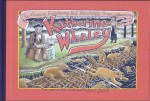
The Amazing, Enlightening and Absolutely True Adventures of Katherine Whaley


By Kim Deitch (Fantagraphics Books)
ISBN: 978-1-60699-631-7

Since the 1960s Kim Deitch has been one of most consistently effective stars of America’s Commix Underground, although as with Harvey Pekar’s American Splendor, it is only relatively recently that he has won wider acclaim. This has been primarily through a series of interconnected prose-and strip fantasies such as Boulevard of Broken Dreams, Shadowland, The Search for Smilin’ Ed and other multi-layered alternative history/faux biographies such as the book under review here.

For the past two decades he has been producing occasional short stories about a down-at-heel carnival and the shabby, eccentric no-hopers who have populated it throughout the 150 years of its existence, the eerie aliens who have preserved its posterity and, of course, the immortal Waldo the Cat.

That saga organically grew into explorations of the minor characters they encountered and soon a great big narrative snowball started rolling…

In The Amazing, Enlightening and Absolutely True Adventures of Katherine Whaley, we return to the increasingly formalised, craftily chronicled Deitch Universe, albeit tangentially, wherein the author focuses on other members of his inexhaustible cast all the while tellingly revealing lost secrets of American history through a lens of scholarly examination and conspiracy theory woven through popular culture scenarios of the past.

Notionally picking up on a minor player last seen in Deitch’s Pictorama, the story here explores the incredible life of an unprepossessing little old lady, as disclosed in a letter left as part of a bequest…

The story-within-a-story begins in the grotty logging town of Lumberton, New York State in 1908, when demure Katherine Whaley, after failing as librarian and school teacher, took a job playing piano in the brand new movie theatre operated by old man Braunton as just another way to deprive lumberjacks and dissolute townies of their hard-earned cash.

The early 20th century was a time of immense and radical social change and after a brush with movie stardom – courtesy of a roving chapter-play Production Company – Katherine makes the acquaintance of the charismatic Charles Varnay and his super-intelligent dog Rousseau, whose esoteric and beguiling beliefs in the nigh-mystical powers of “Enlightenment” carry her off her on an odyssey of self-discovery…

Varnay sees her as the personification of that noble conceptual ideal and wants her to star in a movie serial that will spread his life-changing philosophy to the world’s masses. Naturally, much of her part as The Goddess of Enlightenment involves acting in the nude…

Covering the major cultural landmarks of the early century, from movie mania, the Jazz Age, the Great War and Prohibition, Katherine’s account swings between dubious memoir to laudatory manifesto as her perceptions and opinions of the mysterious Varnay swing from philandering charlatan to messianic superman.

Whilst she might find it hard to accept that the philosopher possesses actual recordings of Jesus Christ delivering his teachings, undiluted by millennia of obfuscating organised religion, there is no doubt that Varnay has great power: after all he stopped her aging and may himself be more than 200 hundred years old…

The beauty of this tale is the complex detail with which it unfolds: the grace and wit with which Deitch overlays historical fact with brilliant fabrication. Thus, I’m certainly not going to spoil the sheer revelatory enchantment for you by giving anything away…

With this surreal historiography of the little-known peripheries of the birth of cinema, Deitch has concocted another utterly unique and absorbing graphic treat – printed in a lavish widescreen format in this stunning monochrome hardback – again sharing the intoxicating joys of living in the past and dwelling in shared social memories.

Combining science-fiction, conspiracy theory, pop history, fact and legend, show-biz razzmatazz and the secret life of Beavers with a highly developed sense of the absurdly meta-real, the author once more weaves an irresistible spell that charms, thrills and disturbs whilst his meticulous drawing holds the reader in a deceptively loose yet inescapable grip.

Follow the secret saga of the World According to Deitch and you too will succumb to the arcane allure of his ever-unfolding cartoon parade revealing the “Americana Way”. In Fact – or Fiction – you might already be there, but you’ll never know unless you look…

© 2013 Kim Deitch. This edition © 2013 Fantagraphics Books, Inc. All Rights Reserved.

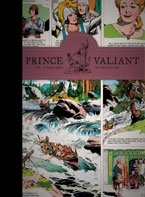
Hal Foster’s Prince Valiant volume 7: 1949-1950


By Hal Foster (Fantagraphics Books)
ISBN: 978-1-60699-645-4

Arguably the most successful comic strip fantasy ever conceived, Prince Valiant in the Days of King Arthur launched as a Sunday page feature on February 13th 1937, a luscious full-colour weekly window onto a perfect realm of perfect adventure and romance.

The strip followed the life and exploits of a refugee boy driven by invaders from his ancestral homeland in Scandinavian Thule who grew up to roam the world and rose to a paramount position amongst the mightiest heroes of fabled Camelot.

Written and drawn by sublime master draftsman and storyteller Harold “Hal” Foster, the epic followed the little princeling through decades of thrilling exploits as he matured into a clean-limbed warrior and eventually family patriarch through a heady sea of wonderment, visiting far-flung lands and siring a dynasty of equally puissant heroes whilst captivating and influencing generations of readers and thousands of creative types in all the arts.

There have been films, animated series and all manner of toys, games and collections based on the strip – one of the few to have lasted from the thunderous 1930s to the present day (over 3900 episodes and counting) – and even in these declining days of the newspaper narrative strip as a viable medium, it still claims over 300 American papers as its home. It has even made it into the very ether with an online edition.

Foster ceaselessly produced the strip, one enchanting page per week until 1971 when, after auditioning such notables as Wally Wood and Gray Morrow, Big Ben Bolt illustrator John Cullen Murphy was chosen to succeed him as illustrator. Foster continued as writer and designer until 1980, after which he retired and Cullen Murphy’s daughter Mairead took over colouring and lettering whilst her brother John assumed the writer’s role.

In 2004 the senior Cullen Murphy also retired (he died a month later on July 2nd) and the strip has since soldiered on under the extremely talented auspices of artists Gary Gianni and latterly Thomas Yeates, with Mark Schultz scripting.

Restored from Foster’s original Printer’s Proofs, this seventh spectacularly luxurious oversized (362 x 264mm) full-colour hardback volume reprints the pages from January 2nd 1949 to 31st December 1950 (#621 to 725 if you’re counting).

What has Gone Before: after an extended sojourn in an incredible New World, Valiant and Aleta have brought their newborn son back to Britain and sought out the warrior’s old comrade Prince Arn to be the child’s Godfather. Val is astounded that the bluff solitary hero is also a husband and currently searching for Godparents for his own newborn son and heir…

Before the Dark Ages delights resume, latest illuminator Thomas Yeates delivers a remarkable introductory essay discussing ‘The Long Shadow of Hal Foster’ and the innumerable artists who owe him a creative debt, after which the never-ending saga picks up with the Princes and their families travelling back to fabled Camelot for a double Christening, presided over by King Arthur himself…

Soon however duty calls again and Valiant, Sir Gawain and hapless, bumbling hedge-wizard Oom Fooyat are dispatched to the wilds of Wales to investigate a nest of vile black magic. Seamlessly blending thrills and grandeur with broad comedy, Foster delivers an enchanting light-hearted romantic romp wherein level-headed Val exposes the macabre happenings at Illwynde Castle and plays matchmaker to more than one of his faithful retinue…

Job done and the fief secure, Gawain and the Prince of Thule return to Camelot, picking up en route a boy with chivalric intentions and the determined courage of a lion. The enigmatic Geoffrey is desperate to win his spurs, but when Valiant introduces the lad to Aleta, the prospective page boy is gripped by a ferocious, life-changing, all consuming crush…

Whilst the well-meaning kid perpetually embarrasses himself in his drive to impress his master’s wife, Arthur despatches Valiant and a small band of knights to Scotland to inspect the wall which keeps the northern savages at bay. Aleta then attempts to keep Geoffrey out of trouble by ordering the puppy to follow and keep her husband safe…

It’s an unlucky decision: as Valiant and his inspection force discover when they see that Hadrian’s Wall has been breached and hundreds of Picts are ravening southward…

Confronted with an impossible situation the Prince again resorts to unconventional tactics and traps the huge barbarian army on the English side whilst sending Geoffrey back to Camelot with a message for Arthur… and to save the hero-struck boy from dying in the unwinnable battle to come…

Breaking all the rules of knighthood for the noblest of reasons, Geoffrey speedily delivers his message and is astounded when Aleta rushes off to join Valiant in Scotland. Again disregarding consequences and probably relinquishing forever his dream of knighthood, the boy follows her northwards…

Their arrival precipitates an unexpected and nigh-miraculous end to the war, but Valiant is close to death. After tending his hurts Aleta decides that she will take her husband back to his Scandinavian homeland, and dispatches the now-exhausted Geoffrey back to Camelot to inform her handmaiden Katwin and nurse Tillicum to obtain a ship and meet her with baby Arn at the village of Newcastle…

Despite dreading the judgement awaiting him at Court, the boy thunders back and, after arranging for his wounded master’s (wonderful wife’s) wishes to be carried out, surrenders himself to his fate…

Of course the King is no fool and a great respecter of honour and courage. He summarily condemns the boy to banishment: for a year and a day Geoffrey must not set foot on English soil…

Mind in a whirl the redoubtable boy is taken to a barge secured by Katwin and sails to Caledonia with the family party to a reunion with Valiant and Aleta…

Soon the group are headed to Thule, bolstered by the bombastic reappearance to boisterous far-larger-than-life Viking Boltar: a Falstaff-like rogue and “honest pirate” not seen since volume 3…

The excitable old rogue ferries the extended family to Val’s cold homeland – with a few unplanned, profitable but dangerous stops along the way – but soon finds himself smitten by the love bug too…

One mystery has been solved, however, as a chance meeting with an old cleric discloses the faithful squire to be actually called Arf, forced from his home when his father Sir Hugo Geoffrey took a new young bride who didn’t want an annoying stepson underfoot. Now she is gone and the boy can return home if he wishes…

Eventually the expanded party reaches the chilly castle of King Aguar and settles in to a long period of snowbound rest and recuperation – until boisterous Jarl Egil makes an inappropriate advance on Aleta and hotheaded Arf dashes to her defence…

Soon the encounter has escalated and Valiant is forced into an utterly unnecessary duel of honour which can only end in pointless tragedy…

Happily the repentant Arf finds a way to satisfy honour all around but the King is plagued by a knotty problem wit cannot solve. Aguar has been seriously considering converting his Norse realm to Christianity, but the many devout missionaries roaming the land are cantankerous idiots all preaching their own particular brand of faith – when not actively fighting each other.

Thus in Spring, he tasks the fully fit Valiant with an embassage to Rome to ask the Pope to send priests and teachers who actually carry the true and official Word of God. Restless and eager Val promptly sets out, accompanied by Arf, the doughty Rufus Regan and new comrade Egil. Their mission coincides with the planting season when Aguar’s men return to their homes to sow the crops for the coming year…

No sooner have they departed however than vassal king Hap-Atla, seething from an old slight delivered to his deceased sire, rebels and besieges Arguar’s castle. With manpower dangerously depleted the situation looks grim until wily Aleta takes control of the situation and scores a devastating victory that contravenes all the rules of manly warfare.

Unseen for three months, Valiant and his companions at last reappear as they land in Rouen to begin the arduous overland trek to the HolyCity. The journey is full of short bursts of violence and outrageous incidents as, since Rome fell to the Vandals, Europe has become a seething mass of lawless principalities.

Most of these improvised kingdoms are run by brigands or worse, all seeking to fill their coffers at any unwary traveller’s expense…

In one unhappy demesne the quartet dethrone a robber baron and nearly end up married to his daughters (young Arf particularly caught the imagination of the decidedly dangerous and ambitious teenager Ollie), whilst in another Val gets hold of an alchemist ruler’s horrific black powder and is almost blown to smithereens.

Eventually however they arrive at the castle of welcoming noble Ruy Foulke and enjoy a pleasant night’s rest – only to awaken and find the place under attack by heinous villain Black Robert and his savagely competent forces…

To Be Continued…

Also included in this striking compendium is an intoxicating glimpse at the author’s virtuosity in ‘“See America First”: Hal Foster’s Union Pacific Paintings’, a series of painted advertising landscapes compiled and discussed by Brian M. Kane.

Rendered in a simply stunning panorama of glowing visual passion and precision, Prince Valiant is a non-stop rollercoaster of boisterous action, exotic adventure and grand romance; blending human-scaled fantasy with dry wit and broad humour, soap opera melodrama with shatteringly dark violence.

Beautiful, captivating and utterly awe-inspiring, the strip is a World Classic of fiction and something no fan can afford to miss. If you have never experienced the intoxicating grandeur of Foster’s magnum opus these magnificent, lavishly substantial deluxe editions are the best way possible to do so and will be your gateway to an eye-opening world of wonder and imagination…

Prince Valiant © 2013 King Features Syndicate. All other content and properties © 2013 their respective creators or holders. All rights reserved.

Win’s Christmas Gift Recommendation: Ideal for anybody who ever strived or dreamed or wished… 10/10 

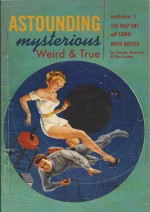
Astounding, Mysterious, Weird & True Volume 1: The Pulp Art of Comic Book Artists


By Steven Brower & Jim Simon (SB Studio Books)
ISBN: 978-1-4820-3313-7

Once upon a time, literacy was at an all-time high in the English-speaking world. A determined push to educate all and sundry took reading out of the hands of a moneyed intelligentsia and made it a tool of the working man, just as print technology was finding cheaper and more effective ways for creators and purveyors to disseminate their wares to growing markets.

Moreover, what everybody in the publishing world knew was what working folk needed more than anything (even religion) was cheap entertainment – the less wholesome and salutary the better…

In Britain we had newspapers, a burgeoning comics sector, “blood and thunder” periodicals and story magazines. In America they had “The Pulps”…

The first was indisputably The Argosy, created by Frank A. Munsey in 1896 and largely superseding most types of the infamous “Dime Novel” which had, with untrammelled sensationalism, ruled the periodical markets since 1860.

Argosy and its end-of-the-century imitators dominated and inspired a publishing phenomenon which eventually covered every genre – or blend of genres – in an industry niche which lasted well into the 1990s, albeit in a much reduced and rarefied form.

As well as spectacular colour covers, almost all pulps had black and white interior illustrations – spots, splashes and spreads – and some even had their own comic strip serials.

There were pulps for every possible taste and topic from romance to mystery to all-out action – including racier “men’s adventures”: two-fisted exotic action-thrillers heavy on mildly fetishistic sadism and bondage themes, with Rugged American men coming to the rescue of white women in peril from thugs and foreigners, saving them (the white women, of course) from “fates worse than death”, but only just in time and never before they had lost most of their clothes (the girls, and often many of the Rugged Americans too…).

One publisher in particular specialised in this niche market, producing a range of saucy genre thrillers all graced with a defining appellative: Spicy Detective, Spicy Western, Spicy Mystery and Spicy Adventure Stories. This was printer-turned-publisher Harry Donenfeld, who occasionally assumed control of companies who couldn’t pay their print bills. In 1934 and knowing pretty well what readers liked, he created a “Men’s Mag” mini empire under the twin banners of Culture and Trojan Publications. Of course, that’s also how he assumed control of the company that became DC Comics less than a decade later…

In 1943 the pressure exerted by various censorious elements in America became too much and Trojan/Culture changed tack and “Spicy” overnight evolved into “Speed Detective”, “Speed Western” and so forth. Perhaps the fact that Donenfeld was sitting on a wholesome family goldmine of comicbook characters such as Superman and Batman had something to do with that…

The story of how Max Gaines turned freebie pamphlets containing reprinted newspaper strips into a discrete and saleable commodity (thereby launching an entire industry, if not art-form) has been told far better elsewhere, but undoubtedly the influence of eye-grabbing pulp pictures as much as those reformatted strips influenced the growth and iconography of comicbooks.

Moreover, with thematic similarities and the same few owners hiring illustrators (and writers), naturally the creatives of one market frequently worked in both – and occasionally all three – arenas.

Now at long last, with comicbooks the indisputable major force in today’s illustrated fiction, comes a superb collection of images gathered together by writer/designer Steven Brower and novelist Jim Simon which shines a welcome light on those artists whose talents were to be found in all areas of popular printed fiction…

This superb gallery begins with ‘Diamonds and Rust’ by Simon; an efficient and studious overview of the history, artists and characters that thrived in those bygone days of wonder before the sublime and stunning panoply of pictures – all accompanied by incisive and revelatory potted biographies – commences.

The images are all culled from such evocative titles as Astounding, If, Courage, Super Science Stories, Weird Tales, Marvel Stories, Galaxy, Nick Carter, Detective, Basketball Stories, Wonder Stories, Big Book, Detective Short Stories, Planet Stories, Adventure, World’s News, Speed Detective, Sky Fighters, Dime Western and many more…

The many artists whose work features in this initial volume can be broken into roughly three categories. The first is pulp masters who also worked in comicbooks such as Edd Cartier, Charles Coll, Virgil Finlay, Kelly Freas, Roy G. Krenkel, Gray Morrow and Alex Schomburg whilst the second is jobbing artists equally at home in newspapers comicbooks, pulps and eventually commercial art.

Those include Benjamin “Stookie” Allen, D, Bruce Berry, Jack Binder, Jon L. Blummer, J. C, Burroughs (son of Tarzan creator Edgar Rice Burroughs), Harry Campbell, Paul Cooper, Harvey Eisenberg, Elton Fax, Harry Fisk, Dan Heilman, Ray Isip, Jeff Jones, Jacob Landau, D.H. Moneypenny, Lou Morales, Leo Morey, Norman Nodel, Neil O’Keefe, George Olesen, Paul Orban, H.L. Parkhurst, Louis Ravielli, Rod Ruth, John Styga, Riley Thomson, Elmer Wexler, Chuck Winter and Cedric Windas.

Finally there are fascinating examples of non-narrative illustration by legendary stars of comics such as Dan Adkins, Murphy Anderson, Dick Ayers, Matt Baker, Dan Barry, C.C. Beck, Pete Constanza, Stan Drake, Bill Draut, Will (or Bill) Ely, Creig Flessel, Dick Fletcher, John Forte, Matt Fox, Dick Giordano, John Giunta, Jerry Iger, Graham Ingels, Jack Kirby, George Klein, Alex Kotsky, Alden McWilliams, Mort Meskin, Irving Novick, Rudy Palais, Alex Raymond, Paul Reinman, Syd Shores, Joe Simon and Wally Wood.

There even a few British superstars included, such as Norman Petit (creator of legendary strips Jane and Susie), Brian Lewis (Dan Dare, Suki, Starlord, 2000AD, House of Hammer) and the inimitable Don Lawrence, artist on Storm, Trigan Empire, Marvelman, Olac the Gladiator, Buffalo Bill and so many more…

Also included in this wonderful celebration is an intriguing selection of Prototypes, displaying potential pulp antecedents of comics characters such as the Joker and Mr. Mxyzptlk…

If you’re of a nostalgic bent or simply a lover of magnificent art and illustration, Astounding, Mysterious, Weird & True is a compendium that will amaze and delight you.

© 2013 Steven Brower & Jim Simon. Diamonds and Rust © 2013 Jim Simon. Text and design © 2013 Steven Brower.

Astounding, Mysterious, Weird & True was made via the CreateSpace Independent Publishing Platform.

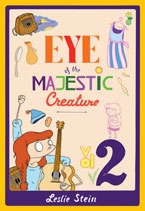
Eye of the Majestic Creature volume 2


By Leslie Stein (Fantagraphics Books)
ISBN: 978-1-60699-672-0

Help Wanted: Girl cartoonist seeks meaning of contemporary existence and like minded individuals to share bewilderment and revelations with.

Interests/Hobbies include: drinking, counting sand, growing stuff, antiquing for pop culture “trash”, drinking, meaningful conversations with musical instruments, playing board games with same, recreational herbal intoxicants, reminiscing about wild-times with gal-pals and old cronies, drinking, visiting difficult relatives.

Employment: unwanted but regrettably necessary. Although a newcomer to the BigCity, is extremely adaptable and willing to do anything – unless it’s hard, boring or she sucks at it…

After graduating from the New York School of Visual Arts, Leslie Stein began producing unbelievably addictive cartoon strips in the self-published Yeah, It Is. Winning a Xeric Grant for her efforts, she then started the even better comicbook Eye of the Majestic Creature, miraculously blending autobiographical self-discovery, surreal free-association, philosophical ruminations, nostalgic reminiscences and devastatingly dry wit to describe modern life as filtered through her seductive meta-fictional interior landscape. Here at play is a creator who sees things as they really aren’t – but makes them authentic and even desirable to everyone willing to pay attention…

This long-awaited second collected volume (gathering issues #5-7) resumes the airy, eccentric and addictive pictorial mood-music as the mythologized autobiography continues to reveal the history of Larrybear – a girl deliberately and determinedly on her own, trying to establish her uniquely singular way of getting by.

Eschewing chronological narrative for an easy, breezy raconteur’s epigrammatic delivery, all illustrated in loose, flowing line-work, detailed stippling, hypnotic pattern-building or even honest-to-gosh representational line-drawing, Stein operates under the credo of “whatever works, works” – and she’s not wrong…

Larrybear makes friends easily. Bums, winos, weirdoes, dropouts, misfits and especially inanimate objects – her BFF is her talking guitar and flatmate Marshmallow – all aggregate around her, sharing her outré interests and ambitions (of a sort) but she just doesn’t want an average life, just more experiences, less hassle and good companions to share it all with …

Delivered in mesmerising, oversized (292 x 202mm) monochrome snippets, these incisive, absurdist, whimsically charming and visually intoxicating invitations into a singularly creative mind and fabulous alternative reality begin with the delightful story of how the country girl hit the untamed New York metropolis and found a job in a clothes shop.

‘Sister Carrie’ is a partly pantomimic tour de force underpinned by pertinent extracts from American Naturalist author Theodore Dreiser’s novel of the same name, revealing how Larrybear’s debilitating daily toil is leavened by new friends, odd customers, alcohol and second-hand sand-counting memorabilia…

Issue #6 takes a ride on the Wayback Machine to the 1980s; disclosing childhood fun and traumas as Larry’s mom meets a guy in a bar and invites the freewheeling Jonathan to join them on a visit to Disneyworld Orlando.

‘Brown Heart’ dips into even more intimate territory as precocious doodler Larrybear accompanies her mom to AA meetings whilst ‘That Sticky Machine’ recounts the girl’s tragic relationship with a gumball machine…

Larry’s brief flirtation as a thirteen year guitarist with politically aware – and older -grunge band Lithium in Chicago neatly segues into a family reunion and Jonathan’s departure…

The final portion of the chronicle opens with ‘A Better Intoxication: the Subconscious Noodle’ as in contemporary New York Larrybear, Marshmallow and drinking buddy/life guru Boris renew their relationship with booze, whilst in ‘Soup’ her new boyfriend Poppin the Flower grows closer after she meets his incredibly difficult dad over a memorable Thanksgiving dinner…

The memories lane ramble then concludes with ‘Who Are You?‘ as after finding an iconic pop culture mask (Booji Boy from Devo, hipsters and post-punks!) Larrybear at last finds the drive and initiative to quit her job…

With additional art and info-features on Dreiser and Booji Boy, this exceptional wander on the wild side is a gloriously rewarding and enticing cartoon experience and one no serious fan of fun and narrative art can afford to miss.

© 2013 Leslie Stein. All Rights Reserved.

Walrus (Brandon Graham’s All Bum Album – from Tusk ‘Till Dawn)


By Brandon Graham (PictureBox)
ISBN: 978-0-9851595-9-7

Autumn is officially here, with its fire-storms, droughts and sunburns, so it’s hard to escape the conclusion that the Holiday Season is inescapably close. After all, the Christmas films have been playing on Sky Movies since early March…

Seriously though, if you’re prudent, it is time to start looking at gifts for your loved ones or family, and here’s one of the prettiest and most intriguing comics art-books I’ve seen in many a year…

Brandon Graham was born in Oregon in 1976, an inveterate graffiti artist who seamlessly turned his graphic gifts and narrative flair to comicbook storytelling, beginning with Ameri-manga publisher Antarctic Press (October Yen) in 1996, dividing his time with Alternative or Independent Publisher projects and gracing the mainstream with work for Image, NMB, IDW and Vertigo.

He is a founder member of artistic collective MeatHaus, and if you like comedy, science fiction, erotica, manga and Moebius, you might want to seek out collections such as King City, 24Seven, Escalator, Multiple Warheads, Perverts of the Unknown and others – as well as this book…

Walrus is a monochrome and colour compendium of “Drawings and Sketchbook Comics from 2009-2011”, featuring  artworks, working roughs, calligraphy, rendered thoughts and idle musings, finished pieces and found imagery that serve to introduce viewers into a beguiling world of fantastic futurity and mesmerising wonderment – and there are weird critters and hot chicks…

A roughly comicbook-sized paperback (112 pages, 240x173mm) with a beautiful gatefold cover, this marvellous compendium comprises snippets of reportage, designs, roughs and layouts from finished stories.

There are moments of tenderness and intimacy, peeks into the creative process, bizarre moments of communal reality, caricatures, gags, spoofs of and tributes to comics and movies (such as Fantastic Four #9, Dirty Pair, Conan and The Good, The Bad and The Ugly), a commemoration of Moebius (The Long Goodbye), deliciously funny and whimsical gags, complete stories such as ‘Far North’, ‘Work Weak’ and ‘Today in the Life’ plus a preponderance of pages dedicated to evocative, seductive post-modern glamour art.

Punky, funky, enduring, enchanting and sublimely entertaining, this is another perfect example of the kind of book that makes the reader hungry to get out and draw stories now! Now!! NOW!!!

…As well as being just plain wonderful to see.

All art-forms need such creators and Walrus might well be the book to get you – or your kids – off the couch and into a studio.
© 2013 Brandon Graham. All rights reserved.