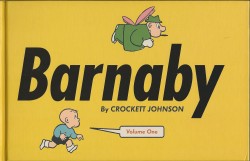
Barnaby volume 1: 1942-1943


By Crockett Johnson (Fantagraphics Books)
ISBN: 978-1-60699-522-8

This is one of those books that’s worthy of two reviews, so if you’re in a hurry…

Buy Barnaby now – it’s one of the most wonderful strips of all time and this superb hardcover compilation has lots of fascinating extras. If you harbour any yearnings for the lost joys of childish glee you would be crazy to miss this book…

However, if you’re still here and need a little more time to decide…

As long ago as August 2007 I whined that one of the greatest comic strips of all time was criminally out of print and in desperate need of a major deluxe re-issue. So, as if by the magic of a fine Panatella… Cushlamocree! Here it is…

Today’s newspapers have precious few continuity drama or adventure strips. Indeed, if a paper has any strips – as opposed to single panel editorial cartoons – at all, chances are they will be of the episodic variety typified by Jim Davis’ Garfield or Scott Adams’ Dilbert.

You might describe these as single-idea pieces with a set-up, delivery and punch-line, all rendered in a sparse, pared-down-to-basics drawing style. In that they’re nothing new.

Narrative impetus comes from the unchanging characters themselves, and a building of gag-upon-gag in extended themes. The advantage to the newspaper is obvious. If you like a strip it encourages you to buy the paper. If you miss a day or two, you can return fresh at any time having, in real terms, missed nothing.

Such was not always the case, especially in America. Once upon a time the Daily “funny” – comedic or otherwise – was a crucial circulation builder and preserver, with lush, lavish and magnificently rendered fantasies or romances rubbing shoulders with thrilling, moody masterpieces of crime, war, sci-fi and everyday melodrama. Even the legion of humour strips actively strived to maintain an avid, devoted following.

And eventually there was Barnaby which in so many ways bridged the gap between then and now.

On April 20th 1942, with America at war for the second in 25 years, the liberal New York tabloid PM began running a new, sweet little kid’s strip which was also the most whimsically addicting, socially seditious and ferociously smart satire since the creation of Al Capp’s Li’l Abner – another complete innocent left to the mercy of scurrilous worldly influences…

The outlandish 4-panel Daily, by Crockett Johnson, was the product of a man who didn’t particularly care for comics, but who – according to celebrated strip historian Ron Goulart – just wanted steady employment…

David Johnson Leisk (October 20th 1906-July 11th 1975) was an ardent socialist, passionate anti-fascist, gifted artisan and brilliant designer who had spent much of his working life as a commercial artist, Editor and Art Director.

Born in New York City and raised in the outer borough of Queens when it was still semi-rural – very near the slag heaps which would eventually house two New York World’s Fairs in Flushing Meadows – Leisk studied art at Cooper Union (for the Advancement of Science and Art) and New York University before leaving early to support his widowed mother. This entailed embarking upon a hand-to-mouth career drawing and constructing department-store advertising.

He supplemented his income with occasional cartoons to magazines such as Collier’s before becoming an Art Editor at magazine publisher McGraw-Hill. He also began producing a moderately successful, “silent” strip called The Little Man with the Eyes.

Johnson had divorced his first wife in 1939 and moved out of the city to Connecticut, sharing an ocean-side home with student (and eventual bride) Ruth Krauss, always looking to create that steady something when, almost by accident, he devised a masterpiece of comics narrative…

However, if his friend Charles Martin hadn’t seen a prototype Barnaby half-page lying around the house, the series might never have existed. Happily Martin hijacked the sample and parlayed it into a regular feature in prestigious highbrow leftist tabloid PM simply by showing the scrap to the paper’s Comics Editor Hannah Baker.

Among her other finds was a strip by a cartoonist dubbed Dr. Seuss which would run contiguously in the same publication. Despite Johnson’s initial reticence, within a year Barnaby had become the new darling of the intelligentsia…

Soon there were hard-back book collections, talk of a Radio show (in 1946 it was adapted as a stage play), rave reviews in Time, Newsweek and Life. The small but rabid fan-base ranged from politicians and the smart set such as President and First Lady Roosevelt, Vice-President Henry Wallace, Rockwell Kent, William Rose Benet and Lois Untermeyer to cool celebrities such as Duke Ellington, Dorothy Parker, W. C. Fields and even legendary New York Mayor Fiorello La Guardia.

Of course the last two might only have checking the paper because the undisputed, unsavoury star of the show was a scurrilous if fanciful amalgam of them…

Not since George Herriman’s Krazy Kat had a piece of popular culture so infiltrated the halls of the mighty, whilst largely passing way over the heads of the masses and without troubling the Funnies sections of big circulation papers.

Over its 10-year run from April 1942 to February 1952, Barnaby was only syndicated to 64 papers nationally, with a combined circulation of just over five and a half million, but it kept Crockett (a childhood nickname) and Ruth in relative comfort whilst America’s Great and Good constantly agitated on the kid’s behalf.

This splendid collection opens with a hearty appreciation from Chris Ware in the Foreword before cartoonist and historian Jeet Heer provides a critical appraisal in ‘Barnaby and American Clear Line Cartooning’ after which the captivating yarn-spinning takes us from April 20th 1942 to December 31st 1943.

There’s even more elucidatory content after that, though, as education scholar and Professor of English Philip Nel provides a fact-filled, picture-packed ‘Afterword: Crockett Johnson and the Invention of Barnaby’, Dorothy Parker’s original ‘Mash Note to Crockett Johnson’ is reprinted in full, and Nel also supplies strip-by-strip commentary and background in ‘The Elves, Leprechauns, Gnomes, and Little Men’s Chowder & Marching Society: a Handy Pocket Guide’…

The real meat begins with ‘Mr. O’Malley Arrives’ which ran from 20th-29th April 1942, setting the ball rolling as a little boy wished one night for a Fairy Godmother and something strange and disreputable fell in through his window…

Barnaby Baxter is a smart, ingenuous and scrupulously honest pre-schooler (four years old to you) and his ardent wish was to be an Air Raid Warden like his dad. Instead he was “adopted” by a short, portly, pompous, mildly unsavoury and wholly discreditable windbag with pink wings.

Jackeen J. O’Malley, card carrying-member of the Elves, Gnomes, Leprechauns and Little Men’s Chowder and Marching Society – although he hadn’t paid his dues in years – installed himself as the lad’s Fairy Godfather. A lazier, more self-aggrandizing, mooching old glutton and probable soak (he certainly frequented taverns but only ever raided the Baxter’s icebox, pantry and humidor, never their drinks cabinet…) could not be found anywhere.

Due more to intransigence than evidence – there’s always plenty of physical proof whenever O’Malley has been around – Barnaby’s father and mother adamantly refused to believe in the ungainly, insalubrious sprite, whose continued presence hopelessly complicated the sweet boy’s life.

The poor parents’ greatest abiding fear was that Barnaby was cursed with Too Much Imagination…

In fact this entire glorious confection is about our relationship to imagination. This is not a strip about childhood fantasy. The theme here, beloved by both parents and children alike, is that grown-ups don’t listen to kids enough, and that they certainly don’t know everything.

Despite looking like a fraud – he never uses his magic and always has one of Dad’s stolen cigars as a substitute wand – O’Malley is the real deal: he’s just incredibly lazy, greedy, arrogant and inept. He does sort of grant Barnaby’s wish though, as his midnight travels in the sky trigger a full air raid alert in ‘Mr. O’Malley Takes Flight’ (30th April-14th May)…

‘Mr. O’Malley’s Mishaps’ (15th-28th May) offer further insights into the obese elf’s character – or lack of same – as Barnaby continually failed to convince his folks of his newfound companion’s existence, and the bestiary expanded into a topical full-length adventure when the little guys stumbled onto a genuine Nazi plot with supernatural overtones in the hilariously outrageous ‘O’Malley vs. Ogre’ which ran from 29th May to 31st August.

‘Mr. O’Malley’s Malady’, 1st-11th September, dealt with the airborne oaf’s brief bout of amnesia, but as Mum and Dad thought their boy was acting up they took him to a child psychologist. However ‘The Doctor’s Analysis’ (12th-24th September) didn’t help…

The war’s effect on the Home Front was an integral part of the strip and ‘Pop vs. Mr. O’Malley’ (25th September-6th October) and ‘The Test Blackout’ (7th-16th October) saw Mr. Baxter become chief Civil Defense Coordinator despite – not because – of the winged interloper, and suffer the usual personal humiliation.

There was plenty to go around and, when ‘The Invisible McSnoyd’ (17th-31st October) turned up, O’Malley got it all.

The Brooklyn Leprechaun, although unseen, was O’Malley’s personal gadfly, always offering harsh, ribald counterpoints and home truths to the Godfather’s self-laudatory pronouncements, and ‘The Pot of Gold’ (2nd-20th November) with which he perpetually taunted and tempted JJ provided a wealth of laughs…

When Barnaby won a scrap metal finding competition and was feted on radio, O’Malley co-opted ‘The Big Broadcast’ (21st-28th November) and brought chaos to the airwaves, but once again Mr. Baxter wouldn’t believe his senses. Dad’s situation only worsened after ‘The New Neighbors’ (30th November-16th December) moved in and little Jane Shultz also started candidly reporting Mr. O’Malley’s deeds and misadventures…

Barnaby’s faith was only near-shaken when the Fairy Fool’s constant prevarications and procrastination meant Dad Baxter’s Christmas present arrived late. The Godfather did accidentally destroy an animal shelter though, so ‘Pop is Given a Dog’ (17th-30th December) concluded with a happy resolution of sorts…

A perfect indication of the wry humour that peppered the feature can be seen in ‘The Dog Can Talk’ which ran from 31st December 1942 to 17th January 1943. New pooch Gorgon could indeed converse – but never when the parents where around, and only then with such overwhelming dullness that everybody listening wished him as mute as all other mutts…

Playing in an old abandoned house (don’t you miss those days when kids could wander off for hours unsupervised by eagle-eyed, anxious parents – or even able to walk further than the length of a garden?) served to introduce Barnaby and Jane to ‘Gus, the Ghost’ (18th January-4th February) which in turn involved the entire ensemble with ration-busting thieves when they uncovered ‘The Hot Coffee Ring’ (5th-27th February). Barnaby was again hailed a public hero and credit to his neighbourhood, even as poor Dad stood back and stared, nonplussed and incredulous.

As Johnson continually expanded his gently bizarre cast of Gremlins, Ogres, Ghosts, Policemen, Spies, Black Marketeers, Talking Dogs and even Little Girls, all of whom could see O’Malley, the unyieldingly faithful little lad’s parents were always too busy and too certain that the Fairy Godfather and all his ilk were unhealthy, unwanted, juvenile fabrications.

With such a simple yet flexible formula Johnson made pure cartoon magic.

‘The Ghostwriter Moves In’ (1st-11th March) found Gus reluctantly relocate to the Baxter dwelling, where he was even less happy to be cajoled into typing out O’Malley’s odious memoirs and organising ‘The Testimonial Dinner’ (12th March-2nd April) for the swell-headed sprite at the Elves, Leprechauns, Gnomes, and Little Men’s Chowder & Marching Society clubhouse and pool hall…

With the nation urged to plant food crops, ‘Barnaby’s Garden’ (3rd-16th April) debuted as a another fine example of the things O’Malley was (not) expert in, whilst ‘O’Malley and the Lion’ (17th April-17th May) found the kid offering sanctuary to a hirsute circus star even as the conniving cheroot-chewing cherub contemplated his “return” to showbiz, after which ‘Atlas, the Giant’ (18th May-3rd June) wandered into the serial. At only 2 feet tall the pint sized colossus was not that impressive… until he got out his slide-rule and demonstrated that he was, in essence, a mental giant…

‘Gorgon’s Father’ (4th June-10th July) turned up to cause contretemps and consternation before disappearing again, after which Barnaby and Jane were packed off to ‘Mrs. Krump’s Kiddie Kamp’ (12th July-13th September) for vacation rest and the company of normal children.

Sadly, although the wise matron and her assistant never glimpsed O’Malley and Gus, all the other tykes and inmates were more than happy to see them…

Once the kids arrived back in Queens – Johnson had set the series in the streets where he’d grown up – the Fairy Fool was showing off his “mechanical aptitude” on a parked car with its engine wastefully running and broke the idling getaway car just in time to foil a robbery.

Implausibly overnight, he became an unseen and reclusive ‘Man of the Hour’ (14th-18th September) and preposterously translated that into a political career by accidentally becoming a patsy for a corrupt political machine in ‘O’Malley for Congress!’ (20th September-8th October).

This strand gave staunchly socialist cynic Johnson ample opportunity to ferociously lampoon the electoral system, the pundits and even the public. Without spending money, campaigning – or even being seen – the pompous pixie won ‘The Election’ (9th October-12th November) and actually became ‘Congressman O’Malley’ (13th-23rd November) with Barnaby’s parents perpetually assuring their boy that this guy was not “his” Fairy Godfather’…

The outrageous satire only intensified once ‘The O’Malley Committee’ (24th November-27th December 1943) began its work, by investigating Santa Claus, despite the newest, shortest Congressman in the House never actually turning up to do a day’s work…

Raucous, riotous sublimely surreal and adorably absurd, the untrammelled, razor-sharp whimsy of the strip is always instantly captivating, and the laconic charm of the writing is well-nigh irresistible, but the lasting legacy of this ground-breaking strip is the clean sparse line-work that reduces images to almost technical drawings, unwavering line-weights and solid swathes of black that define space and depth by practically eliminating it, without ever obscuring the fluid warmth and humanity of the characters.

Almost every modern strip cartoon follows the principles laid down here by a man who purportedly disliked the medium…

The major difference between then and now should also be noted, however.

Johnson despised doing shoddy work, or short-changing his audience. On average each of his daily encounters, always self-contained, built on the previous episode without needing to re-reference it, and contained three to four times as much text as its contemporaries. It’s a sign of the author’s ability that the extra wordage was never unnecessary, and often uniquely readable, blending storybook clarity, the snappy pace of “Screwball” comedy films and the contemporary rhythms and idiom of authors such as Damon Runyan.

He managed this miracle by type-setting the dialogue and pasting up the strips himself – primarily in Futura Medium Italic but with effective forays into other fonts for dramatic and comedic effect.

No sticky-beaked educational vigilante could claim Barnaby harmed children’s reading abilities by confusing the tykes with non-standard letter-forms (a charge levelled at comics as late as the turn of this century), and the device also allowed him to maintain an easy, elegant, effective balance of black and white which makes the deliciously diagrammatic art light, airy and implausibly fresh and accessible.

During 1946-1947, Johnson surrendered the strip to friends as he pursued a career illustrating children’s book such as Constance J. Foster’s This Rich World: The Story of Money, but eventually he returned, crafting more magic until he retired Barnaby in 1952 to concentrate on books.

When Ruth graduated she became a successful children’s writer and they collaborated on four tomes, The Carrot Seed (1945), How to Make an Earthquake, Is This You? and The Happy Egg, but these days Crockett Johnson is best known for his seven “Harold” books which began in 1955 with the captivating Harold and the Purple Crayon.

During a global war with heroes and villains aplenty, where no comic page could top the daily headlines for thrills, drama and heartbreak, Barnaby was an absolute panacea to the horrors without ever ignoring or escaping them.

For far too long Barnaby was a lost masterpiece. It is influential, ground-breaking and a shining classic of the form. You are all poorer for not knowing it, and should move mountains to change that situation. I’m not kidding.

Liberally illustrated throughout with sketches, roughs, photos and advertising materials as well as Credits, Thank You and a brief biography of Johnson, this big book of joy is a long-overdue and very welcome addition to 21st century bookshelves – especially yours…

Barnaby and all its images © 2013 the Estate of Ruth Kraus. Supplemental material © 2013 its respective creators and owners.


Wake Up, Percy Gloom


By Cathy Malkasian (Fantagraphics Books)
ISBN: 978-1-60699-638-6

There are a lot of graphic novels out there these days, and even the most in-tune fan or dedicated aficionado just can’t read everything new being published – and that’s not even counting the historical wealth of already published material that’s been released since the dawn of trade paperbacks and comics albums at the end of the 1970s.

A perfect case in point is Percy Gloom by Cathy Malkasian which was released in 2007 and which I completely missed. However, as soon as I read my review copy of the sequel Wake Up, Percy Gloom – the subject of today’s rave review – I realised what an utter joy I had missed and determined to track a copy down.

Whilst that’s happening however, let’s look at one of the best comics fantasy books I’ve read in all my many years…

Someplace, sometime far stranger than here or now, an innocuous little man who loved helping people lost his wife and left his ordered, simple life.

Actually it wasn’t that simple: although Percy is meek and gentle and desperately keen to help everybody, his lazy-eye and enormous head – which lights up when he’s happy – often creates false impressions amongst people who are at best rude and often just plain mean.

He’s also had some rather distressing news recently.

His Mum revealed to him that he is, like her, immortal but prone to naps which can take anything from months to decades. It’s why everything always seems so different every time he wakes up in the “morning”…

After his last kip he found true affection with Margaret, whom he met at his new job in a failing company…

Now we find them enjoying a sailboat ride as she searches for her long-lost twin. Percy has never been happier. As they reach a new land however Margaret realises her search is nearly over and, as she realises her growing affection for Percy, her extremely contented companion begins to feel very sleepy…

Percy’s mum is even more unique than her son. She has been alive for millennia and spends her maternal days shepherding humanity; devising devices and inventing awesome, clever things, such as the barrel which always collected her slumbering son wherever he’s dropped off and safely storing him until he awakes again.

Unfortunately one of her previous diversions – a joke-book – has become, over the last five centuries, the World’s Holy Book: an unshakable, adamant and infallible guide to living and the eternal Rewards Beyond, utterly believed as gospel by the short-lived, unquestioning and remarkably po-faced people.

Sadly the gag most misunderstood by the ardent the worshippers was the 29th Prophecy which said that after 182,515 days – just after tea-time – Voatzle would drop from the sky and land on The Good and The Lucky. By every cleric’s calculations that’s tomorrow afternoon…

Appalled at the people’s literal-mindedness, Mum has been busily building the Paradise the self-deluded worshippers are expecting and – now that she’s almost finished – is delighted to learn that Percy is waking up. Dispatching his barrel to a location that will appear familiar to her drowsy boy, Mum then pops off to meet her current beau Horace – a quiet and contemplative grandfather and extremely ingenious gardener/topiarist who knows her as dear old Clara…

Whilst ensuring Percy’s safe awakening, Clara reveals her true nature to Horace and discloses the cheese-based disguise secrets which have enabled her to maintain the imposture of aging, blithely unaware that there has been a little hitch…

When Percy succumbed to slumber he was with his adored Margaret but now, as he languorously comes to on a lovely moonlit night, he has no idea that only a year has passed. The counting device in his barrel has malfunctioned and one year has become 200…

Still groggy and heartbroken that his Margaret has long gone, Percy sets off across this odd land to find his mum; once again an innocuous, naively innocent wanderer in a very bizarre place and time. He has no idea that it’s only this odd because the all those true believers are excited that Voatzle is finally coming and are absorbed in performing their final rites and rituals…

As he progresses Percy meets and takes charge of the brusquely tragic Mr. Tetzel who accidentally locked himself out of his very small country and now must travel right around the world in a straight line to get back to the front door again. Not far away the morose Margaret has been deeply heartened by finally rendezvousing with sister Lily, who in turn will introduce her to Percy’s extended family too…

You meet a lot of people and make many friends if you live forever – including, it would seem, other immortals – and as Mum introduces Horace to her own affably eternal inner circle – and the talking goats – Percy’s peregrinations have also resulted in a few shocks.

Although a native, the closeted Mr. Tetzel is an even stranger Stranger in a StrangeLand and his shocking manners require all Percy’s tact and forbearance to keep them from harm. Despite his selfish and cavalier attitude, the brusque banished martinet is all too human and secretly endures his own tragically lost love. However that small glimpse of common humanity is quickly quashed when a committee of Voatzle priests and prelates mistake the obnoxious official for the Dimpled Ambassador – Last Prophet of Voatzle. Moreover the deluded Tetzel believes it too…

Happily though, that clash with the inevitably outraged Holy zealots gives Percy his first clue of exactly how little time has actually passed and puts him on the path to a gloriously reunion with his much-missed Margaret…

Cathy Malkasian is another brilliant (and multi-award winning) animator who has seamlessly segued into graphic narrative and turned the medium on its head. You’ll have seen her screen work as designer, storyboarder and/or director on such features as Curious George, The Wild Thornberrys Movie, As Told by Ginger, Psyko Ferret, Stressed Eric, Rugrats, Jumanji, Duckman and elsewhere. Perhaps you’ve seen her aforementioned Percy Gloom debut or Temperance graphic novels. She is currently occupied creating the animatic series Hiding in Happytown on YouTube.

Her latest surreal and intoxicatingly-rendered fable manages the almost impossible trick of being simultaneously sad and eerie, funny and thrilling, astonishingly mature and ingenuously innocent and childlike, resulting in a brilliant, enthralling, evocative and wryly uplifting fable of loss and reunion in a fantastical realm as overwhelmingly convincing and real as Oz, Narnia or Alice’s Looking Glass Land.

If you crave the acme of comics storytelling, you must read this fabulous yarn.

© 2013 Cathy Malkasian. All rights reserved.

Blade of the Immortal volume 1: Blood of a Thousand


By Hiroaki Samura translated by Dana Lewis & Toren Smith (Dark Horse/Studio Proteus)
ISBN: 978-1-56971-239-9

Born in Chiba Prefecture in 1970, manga master Hiroaki Samura differs from many of his contemporary colleagues in that he actually pursued classical art training before abandoning oil paints and easels for the monochrome freedom and easy license of the “whimsical drawings” industry.

He was, however, plucked from college in the early 1990s before finishing his degree, to find huge success creating the astonishing fantasy saga Mugen no Jūnin (The Inhabitant of Infinity) for Seinen magazine Afternoon.

The series ran from June 25th 1993 to December 25th 2012, a total of 30 volumes which spectacularly blended ubiquitous Samurai comics themes and scenarios with vengeful supernatural plots, political intrigues, existential philosophy and punk-era nihilism as the driven, murderously efficient antihero constantly deployed his outrageously eccentric arsenal of fanciful edged weapons, whilst pondering the merits of salvation and the meaning and point of living too long…

The series was picked by Dark Horse in 1996 and released as Blade of the Immortal, first as a monthly comicbook series and, from 2007 onwards, exclusively in collected graphic novel editions.

One note of caution for purists: the series’ dialogue is written in an updated, quirkily anachronistic literary style which strives for emotional veracity rather than (faux) period authenticity, so it can all be a little disconcerting at first…

Set in middle of the Tokugawa Shogunate (between 1600 and 1868AD), this first sublimely engaging volume opens with ‘About the Translation’ – a prose section explaining the translation process and the symbology of the piece – before ‘Prologue: Criminal’ introduces debased and unsavoury Ronin Manji; one-eyed outlaw and a weary killer looking for peace and redemption in all the wrong places.

The “Slayer of 100 Good Men” – including his own peace-keeper brother-in-law – Manji is currently stalking Gyobutsu “Johnny” – a mass-murderer who kills his victims whilst disguised as a priest. When a trap goes wrong the debased Ronin manfully ignores a pistol shot through his brain to finish his sacrilegious quarry.

The Ronin is no longer as other men. There are worms in his head, and as they knit his inexplicably non-fatal wound back together, Manji broods.

In his despicable past he was a cheap sell-sword who killed as he pleased. When his misdeeds brought him into conflict with his “cop” brother-in-law he also butchered him. The shock drove his sister Machi mad.

She was the only thing Manji ever cared about…

Yaobikuni has no problem with living forever – she won’t die until she’s saved every soul in Japan – and when the unkillable reprobate again meets the 800-year old nun who inflicted on him the sacred Kessen-chu bloodworms which can heal any hurt, she draws him into the old pointless discussion about salvation. Yaobikuni urges him to give up the sword, but all he wants to do is die….

Even if he could, it’s no longer an option now that he has to care for his grievously damaged Machi…

The problem is savagely solved when the vengeful brother and 20-strong gang of “Johnny” abduct her, determined to make her murderous brother pay emotionally and physically for the death of their leader.

Manji’s botched rescue attempt leaves him triumphant above a sea of corpses and utterly alone in the world…

Pushed too far, he finds Yaobikuni and offers her a deal: if he kills one thousand truly evil men she must remove the Kessen-chu and let Manji rest at last.

Despite misgivings that he’s just found another way to keep on killing, the nun agrees…

‘Conquest’ introduces young Rin, whose father Asano was targeted for slaughter by a merciless gang of anarchist thugs calling themselves the Ittō-ryÅ«.

Long ago the grandfather of their leader Anotsu Kagehisa had been shamefully and unjustly expelled from Asano’s Mutenichi ryÅ« fencing Dojo, and the grandson had resolved to destroy all such schools and the socially stratified, arrogantly smug advocates of privilege who populated them.

Gathering an army of similarly aggrieved, like-minded rebels and outcasts, Anotsu murdered many Swords-masters: destroying their legacies and accumulating a powerful army before seeking his ultimate triumph over a despised ancestral enemy…

After ending Rin’s father, Anotsu gave her mother O-Toki to his men, but told them to leave the little girl alone.

Rin never saw her mother again and now, aged sixteen, the last sword of the Mutenichi- ryū School was in the metropolis of Edo looking for payback. What she found was a jolly little nun who suggested she seek out a maimed-and-mangy, mean-looking Ronin to act as her bodyguard…

They didn’t hit it off. Manji was condescending and patronising and wanted her to prove her contention that the members of Ittō-ryÅ« were genuinely evil before he subtracted them from his target tally of 1000 human monsters…

Reaching an agreement of sorts the pair join forces, unaware that Rin has been followed by Anotsu’s macabre lieutenant Kuroi Sabato. The deranged psycho-poet has been sending taunting verses to the girl ever since that fateful night, whilst secretly treasuring his keepsake of her mother O-Toki all these lonely years…

Now he’s ready for Rin to complete a ghastly set of horrific personalised trophies but the satanic stalker has never met – or killed – anyone like Manji before…

The eerie epic closes here with ‘Genius’ wherein the decidedly odd couple seek aid and assistance from an old friend of Rin’s father. Retired samurai Sōri has dedicated his remaining years to becoming an artist, but still struggles to master the tricky discipline of “sword-painting”. The uncouth Manji can barely contain his scornful taunts, especially as the artist seems unwilling to assist a lady in distress, apparently far more concerned with the trivial problem that he can never get the reds right in his compositions…

Of course the revenant Ronin has no idea that once Sōri was The Shogun’s Ninja …

More of Anotsu’s psycho-killer goons have followed Rin and Manji to the painter’s lodgings however, looking for the blade-wielding girl genius who killed the lethally adept Kuroi. When they attack the sleeping Rin they soon discover to their everlasting regret the mettle of her allies…

In the stillness after the slaughter, Rin and Manji move on to continue their vendetta against the Ittō-ryū, but Sōri regretfully remains behind to pursue his art.

At least now he knows what pigments suit him best…

‘An Interview with Hiroaki Samura’ and a selection of cover illustrations from the comicbook iteration complete this viscerally brutal, staggeringly beguiling first volume of mythic martial mastery…

Although crafting other works such as the western Emerald, romantic comedies, erotic works and horror stories such as Night of the Succubus and Bradherley’s Coach, Blade of the Immortal is undoubtedly Mr. Samura’s signature creation – so far – and a truly unparalleled delight for fans of not just manga but for all lovers of dark fantasy.
© 1996, 1997 Hiroaki Samura. All rights reserved. English translation rights arranged through Kodansha Ltd. New and adapted artwork & text © 1996, 1997 Studio Proteus and Dark Horse Comics Inc. All other material © 2000 Dark Horse Comics Inc. All rights reserved.

Battling Boy

(Uncorrected Proof Copy)

By Paul Pope (First Second)
ISBN: 978-1-59643-145-4

Paul Pope is undoubtedly one of the most creative and visually engaging creators working in comics these days. Since his debut in 1993 he has stunningly combined elements of European and Japanese styles with classical American themes to produce tales of science fiction, fantasy, crime, comedy, romance, adventure and even superheroics, generally for mature audiences.

If you’re not a fan yet, check out Sin Titulo, Batman: Year 100, Heavy Liquid, 100%, One Trick Ripoff and more…

This latest venture, however, is aimed a general readership – Hey, Kids, This Means You! – and introduces a world very similar to our own but with one big, big difference…

Arcopolis City would be the perfect place to bring up kids but for one thing. Ghastly devils roam at night, stealing children. Even the days are increasingly fraught as a seemingly endless procession of monstrous beasts incessantly carves a swathe of mindless destruction through the bright, breezy thoroughfares…

Of course the valiant sentinels of the Fighting 145th do their very best to contain the daily onslaughts, but it is to jet-packed, ray-gun-wielding science hero Haggard West that the harried citizens look to end the crisis. Those heartfelt hopes are cruelly dashed, however, when hooded horror Sadisto lays a crafty trap and blasts the magnificent rocket-man out of the sky…

His daughter and apprentice Aurora is shattered as she watches her dad vanish in a blast of blazing plasma…

Entire universes away, a shining citadel of warrior deities celebrates a very special event as the greatest pantheon of dutiful cosmic champions in the universe revels in the brief return of their mightiest hero. The stormy saviour of many worlds is back to see his son, who has reached a very special age…

The Boy is not ready for his Turning Day. Even if every child born here is invariably sent into the cosmos on their 13th birthday to save some lesser race from imminent peril on the venerable quest known as “a Ramble”, he knows he isn’t strong enough yet. After all, many of his childhood comrades have never returned…

As usual, though, his puissant father knows best and the anxious lad (armed with a very special cloak, battle grieves, the Encyclopedia Monstrosity, keys to an apartment, a map, a magic credit card and a dozen totem tee-shirts) is booted out of the veritable Valhalla of the Starry Lofts and dumped on a mountaintop overlooking a seemingly continent-sized city …just as a homogonous Humbaba rampages through Arcopolis eating cars and crushing tanks…

Before hurtling off to another appointment with destiny, the lad’s proud father casually reminds his spooked scion that if his “Battling Boy” cannot end the plague of monsters on this world, humanity is finished here…

Even as Aurora West begins to unlock the secrets of her father’s legacy and keenly embrace her own dreamed of destiny, the reluctant young demi-god makes his way to the epicentre of chaos and engages the ferocious furious Humbaba.

Things do not go according to plan…

Wry, spectacular and astonishingly engaging, this is a supremely entertaining, beautifully rendered yarn with plenty of fast-paced action, judicious suspense, likable heroes and a gloriously arch villain in the Machiavellian Sadisto, whose subtle scams and unlikely alliances stretch far beyond this blockbusting premiere epic.

This is an ideal comic book for older kids, and reads even better if you’re their adult keeper or guardian. Don’t miss out on the start of something very special…
© 2013 by Paul Pope. All rights reserved.

Battling Boy will be published on October 8th 2013.

Sabrina the Teenage Witch: The Magic Within Book 1


By Tania del Rio & Jim Amash (Archie Comics Publications)
ISBN: 978-1-936975-39-6

Sabrina the Teen-Age Witch debuted in Archie’s Madhouse #22 (October 1962), created by George Gladir & Dan de Carlo as a throwaway character in the gag anthology which was simply one more venue for comics’ undisputed kings of kids comedy. She instantly proved popular enough to become a regular in the burgeoning cast surrounding the core stars Archie Andrews, Betty Cooper, Veronica Lodge and Jughead Jones.

By 1969 the comely enchantress had grown popular enough to win her own animated Filmation TV series (just like Archie and Josie and the Pussycats) and graduated to a lead feature in Archie’s TV Laugh Out before in 1971 finally winning her own title.

The first volume ran 77 issues from 1971 to 1983 and, when a hugely successful live action TV series launched in 1996, an adapted comicbook iteration followed in 1997. That version folded in 1999 after a further 32 issues.

Volume 3 – simple titled Sabrina – was based on new TV show Sabrina the Animated Series. This ran from 2000 to 2002 for 37 issues before a back-to-basics reboot saw the comicbook revert to Sabrina the Teenage Witch with #38, carefully blending elements of all the previous print and TV versions. A creature of seemingly infinite variation and variety, the mystic maid continued in this vein until 2004 and #57 wherein, acting on the global popularity of Japanese comics, the company boldly switched format and transformed the series into a manga-style high school comedy-romance in the classic Shōjo manner.

Written and drawn by Tania del Rio and inked by Jim Amash, this canny supernatural soap ran until #100 in 2009. The series folded four issues later.

An incredibly successful experiment, the beginnings of the manga saga were collected in a trade paperback as Sabrina – the Magic Revisited and issues #58-67 were later added to Archie Comics’ online library as digital editions. Now with the release of this black-&-white digest sized US tankōbon edition, the concept comes full circle…

Collecting Sabrina the Teenage Witch #58-68 from 2004-2005, this vibrant slice of wild whimsy opens with ‘Entering the Magic Realm’ – a fond remembrance from del Rio – and a handy character guide before issue/chapter 1 introduces us to a different kind of Winsome Witch in ‘Spellfreeze’…

Sabrina is just a typical Greendale High School girl. She lives with her Aunts Hilda and Zelda Spellman, has a pet cat Salem and barely conceals a crush on childhood pal Harvey Kinkle. The cute but clueless boy reciprocates the affection but is far too scared to rock the boat by acting on his desires.

Sabrina is also an atypical witch: living in the mortal world and passing herself off as normal. To make up for this peccadillo she has to attend Charm-School in the “Other Realm” to learn all about her heritage, powers and especially the rules of magic/mortal interaction.

Her life takes a complicated turn when a cute new boy enrols at Greendale. Shinji Yamagi is gorgeous and instantly popular – but he’s also a young warlock from Sabrina’s class at her other school. He’s on Earth to clandestinely study for a Charm-School project but soon finds it hard to keep his gifts secret.

Moreover he’s soon turning Sabrina’s head and she can’t decide which boy she likes best…

Complicating the mess is mortal Amy Reinhardt – a spiteful rival for Harvey’s affections who will do anything to upset Sabrina and sharp enough to instantly realise that she can use Shinji to further her ambitions…

Shinji is having real problems not using his magic to ease the tedious drudgery of mortal life and is soon openly flouting the rules just to make himself popular. Knowing that eventually somebody will realise he’s not simply performing tricks – and perhaps just a little jealous – Sabrina determines to stop him…

Salem is not just an ordinary cat; long ago he was Salem Saberhagen: the most powerful warlock of all. After trying to conquer the world he was imprisoned in a cat’s body where he could do no magic, but he can still talk and his rehabilitation is very grudging. He doesn’t need much urging to guide Sabrina to the Magic Realm where she can obtain a spell to neutralise Shinji’s powers.

It’s quite complex though, and the junior conjuress gets it badly wrong. Rather than freezing the warlock’s magic the spell turns Shinji’s body to ice.

Horrified at her mistake Sabrina confesses all to her Aunts and learns that only a kiss can turn him back to normal, but she’s slowly becoming aware that for all his arrogant faults, she really, really likes Shinji and doesn’t fully trust herself…

Chapter 2 has a sporting theme as Sabrina tries to get Harvey to make his move. Although a star of the basketball squad, the wishy-washy boy is badly fumbling the school tradition of bestowing a team ribbon upon the girl of one’s dreams.

Sabrina is cruelly teased by Amy who tells her Harvey has already offered her his silken favour in ‘Blue Ribbon Blues’ and the distraction cannot come at a worse time. There’s a big test coming up in Charm-School – it’s the time when students have to make their first flying broomstick – and a bad result could affect her whole life…

Unbeknownst to her Shinji too is feeling the power of attraction. In ‘Councils and Concerts’, Aunt Hilda is lobbying to be elected to the ruling Council of the Magic Realm and needs no embarrassing distractions, but that hope is doomed after Sabrina is summonsed by the fearsome Galiena, Czarina of Decree to explain her recent rule-breaking and magical abuse of the adults-only spellfreeze incantation, not to mention riding a broom without a license…

As the depressed teen talks things over with best friend and eldritch classmate Llandra da Silva, Shinji appears and asks her on a date to see the hip, magic band Oberon. The wayward warlock has had plenty of run-ins with the Council though, and advises her just to ignore them, even as Llandra warns him not to come between her BFF and poor mortal Harvey…

After the gig, Shinji tries to get Sabrina to join him in another illegal broom flight and they have a blazing row before he ditches her. Humiliated and furious, all she can do is call the aunt she has again let down…

A Halloween party is the setting for ‘The Magic Within’ as troubled Goth girl Gwenevive Ricci arrives in Greendale, a mortal who can somehow make real magic. The brittle human is rather hard to like, but when Salem investigates he finds the secret of Gwenevive’s powers to be a rival someone he’d thought long gone and the soiree turns into a deadly supernatural battle.

More by luck than skill Sabrina saves the world and vindicates herself with the Council, but they might not be so mellow if they realised she had accidentally allowed Gwen to learn her secret…

‘Winter Wallflower’ deals with some of the potential repercussions as witchly wannabe Gwen pumps Sabrina for more information, blithely uncaring that she risks having her mind wiped by the Council. However rebellious Sabrina faces even greater challenges when she finds herself dateless for a school dance. Good old dependable Harvey has asked a cute freshman to the affair, and when Sabrina goes looking for Shinji she sees him in a passionate embrace with Llandra…

This chapter is complimented by a one-page gag strip starring Salem who abuses a present in ‘House Cat!’ before the Sabrina/Harvey/Shinji romantic triangle is dramatically resolved in ‘Cabin Fever’ wherein the kids and Llandra dash off for a winter break in a log cabin (with Aunt Zelda along as reluctant chaperone). However when the boys drive off for provisions they are caught in a killer ice storm and trapped on a mountain.

Soon their seething rivalry for Sabrina causes a confrontation, but after Harvey saves Shinji from death the chastened young magician determines to help Harvey win the girl of his dreams – even if neither of them is sure that’s what he wants…

After another Salem single ‘Here’s Looking at You’, Harvey’s indecisiveness resurfaces during Valentine’s Day. Despite the warlock boy’s every effort, his new mortal pal just cannot summon up the courage to ask Sabrina out. Moreover the frustrated teen Witch knows something’s amiss and has been having nightmares waiting for Harvey to make his move.

Unfortunately Sabrina talks – and enchants – in her sleep and wakes up on February 14th with the power to see ‘Love Connections’ between people and even animals. The teen witch spends the day acting as an unofficial Cupid, bringing together people who don’t realise how close their one true loves actually are, before – unable to handle Harvey’s paralysis – she just gives up and makes the first move herself.

Watching from concealment Shinji is delighted that at last they are together – and cannot understand why his own heart is breaking…

‘Caught on Tape’ deals with another kind of crisis just as Sabrina is finally together with Harvey. Hilda has been elected to the Council as Czarina of Meditation and the entire family has to move to the Magic Realm. The boy is still unaware of her true nature and now she may never see him again…

However when evidence is found of mortal poachers in the Magic Realm, Sabrina’s knowledge of the mundane world enables them to track down unscrupulous crypto-zoologist Atticus Rex and free the fantastic beast he thought would make him a TV sensation.

Realising that they increasingly need contact with Earth, the Council relents and stations Hilda permanently in the human Realm, but even after having his memories wiped the Spellmans have not seen the last of Atticus…

When Shinji’s mortal, toymaker uncle arrives from Japan and sees Sabrina’s cat he copies the creature’s unique appearance and spawns global ‘Salem Mania’. With the cat now on backpacks, apparel, toys, jewellery and every other form of merchandise as the ignominious ‘Mr. Kitty Litter’, the furious former arch-mage alternately plans revenge and how to cash in, with Sabrina otherwise occupied and unable to stop or help him.

Her attention has been diverted by an impossible dilemma: now that she has Harvey, why is she so jealous that Llandra is with Shinji?

This beguiling first collection concludes with a crossover of sorts when Shinji is “discovered” by a fashion agency and briefly becomes a male model. With Sabrina becoming increasingly disenchanted with Harvey, the warlock suddenly goes slow with Llandra and is romantically linked to pop sensations Josie and the Pussycats, but his meteoric career comes to a sudden halt when his bosses demand to see a little too much skin…

Enticing, funny and genuinely enthralling, this witty, fresh take on a classic American icon will delight most fans and readers. With actual human interaction rather than manufactured atom-powered fistfights to hold your attention, it offers women in particular a solid entertaining reason to give comics one more try. Sheer exuberant fun; perfectly crafted and utterly irresistible.
© 2013 Archie Comics Publications, Inc. All rights reserved.

Ratspike


By John Blanche & Ian Miller (Games Workshop)
ISBN: 978-1-87237-200-6

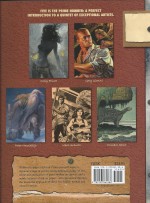
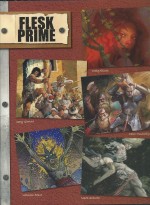
I haven’t covered an actual art book in an age, so let’s look at a little known gem sorely in need of a new edition featuring the grotesquely beautiful art of painter and illustrator Ian Miller (The City, The Luck in the Head, Green Dog Trumpet) and designer, model-maker and illustrator John Blanche.

Both eclectic individualists found a spiritual home and an outlet for their fantastic fantasy imaginings at role-playing, book and comics publisher Games Workshop/Black Library, and their painterly endeavours happily led to the stunning celebration of the macabre and mind-bending melange of modern myth realisation under review today.

The legendary entertainment firm began by importing American product at the beginning of the Dungeons and Dragons craze in the 1980s before quickly moving on to creating their own material. Soon they were expanding into prose and pictorial fiction too, supported by some frankly astounding illustration material on their game packaging, periodical publications (White Dwarf, Fighting Fantasy Gamebooks, Warhammer 40,000, Inferno and others) as well as sequences of original material novels in the fantasy, horror and science fiction genres.

This stunning oversized (29 x 21.8 x 1.5cm) hardback coffee-table tome was released in 1989 and offers a mesmerising selection of paintings and drawing from two uniquely inspired creators, beginning, after a Foreword by fantasy illustration giant Patrick Woodroffe, with John Blanche.

Eventually becoming Games Workshop’s Art Director, Blanche got his first big break after meeting Roger Dean, subsequently going on to develop a dark, punk-inspired painstakingly classical illustration style, usually working smaller than published size and having his work “blown up”, not reduced, for printing.

This compulsive chronicle combines, intersperses and interweaves the art with creator commentary, personal memories, insights and creative secrets as well as evocative literary quotes and snatches of poetry to enhance the images and, after Lewis Carroll’s Jabberwocky, plunges into a welter of nearly 80 paintings and drawings over 62 pages, crammed with amazons, warriors, aliens, barbarians, fairy princes, eldritch post-apocalyptic demons and all the attendant genre icons beloved by generations of imaginers.

The affable maven of menace macabre discusses his unforgettable work such as ‘Ice Unicorn’, ‘War Boss’, ‘Good King Otto’, ‘Amazonia Gothique’ and ‘McDeath’ plus  devoting much time to the infinitesimal discipline of building and painting miniatures – many of which have their own scarily impressive, ironically, mordantly funny section here.

The second half of the book is devoted to Ian Miller’s bleakly complex, convoluted classicist Dürer, Bosch and Druillet inspired futurisms which, before his association with Games Workshop, were best seen illustrating Tolkien, H.P. Lovecraft and Mervyn Peake’s Gormenghast stories as well as in films such as Ralph Bakshi’s Wizards and Coolworld.

His concluding half of the graphic gallery – 68 pages in all – combines quotes from Treasure Island, children’s nonsense rhymes, an intimate biography and disquieting slogans and snatches of prose with sketches, drawings, pen-and-ink studies and more than 100 paintings and less conventional images, displaying the artist’s signature brain-blasting architecture, eye-shredding monsters, blasted trees, isolated warriors and chaos knights.

Also on show are notional comic-strip sequences and works with such evocative if non-defining titles as ‘Death in the Rocking Horse Factory’, ‘Udder Woman, Killer of Cows’, ‘Angel Butcher’, ‘Hollywood Gothic’ and ‘Those Sent to that Dark Place’, all guaranteed to subtly engender unease and worse…

With the fantasy genre in full revival mode thanks to the likes of movies like The Hobbit and TV shows like Game of Thrones and Da Vinci’s Demons, there’s never been a better time to revisit this book or even further explore the lost marvels of a superb cadre of forgotten artists. So if you need to escape this ghastly world of humdrum terrors for a brief moment – and don’t we all? – seek out this Bestiary of the Bizarre and let yourself go…
© 1989 GW Books. © John Blanche & Ian Miller. All rights reserved.

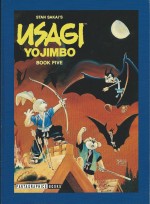
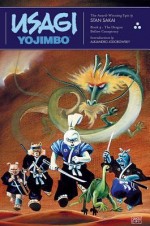
Usagi Yojimbo Book 3: The Wanderer’s Road


By Stan Sakai (Fantagraphics)
ISBN: 978-1-56097-009-5

Usagi Yojimbo (literally “rabbit bodyguard”) premiered as a lowly background character in Stan Sakai’s anthropomorphic comedy The Adventures of Nilson Groundthumper and Hermy, (Albedo Anthropomorphics #1, 1984), subsequently appearing there on his own terms as well as in Critters, Amazing Heroes, Furrlough and the Munden’s Bar back-up in Grimjack.

Sakai was born in 1953 in Kyoto, Japan before the family emigrated to Hawaii in 1955. He attended the University of Hawaii, graduating with a BA in Fine Arts, and pursued further studies at Pasadena’s Art Center College of Design after landing in California.

His early forays into comics were as a letterer, most famously for the inimitable Groo the Wanderer, before his nimble pens and brushes, coupled with a love of Japanese history and legend and hearty interest in the filmic works of Akira Kurosawa and his peers, all combined to turn a proposed story about a human historical hero into one of the most enticing and impressive fantasy sagas of all time.

And it’s still more educational, informative and authentic than any dozen Samurai sagas you can name…

The deliriously peripatetic and expansive period epic is nominally set in a world of sentient animals (with a few unobtrusive human characters scattered about) and specifically references the Edo Period of Feudal Japan: the early 17th century of our reckoning.

It simultaneously samples classic contemporary cultural icons from sources as varied as Lone Wolf and Cub, Zatoichi and even Godzilla whilst specifically recounting the life of Miyamoto Usagi, a Ronin or masterless wandering Samurai, eking out an honourable living as a Yojimbo or bodyguard-for-hire.

As such, his fate is to be drawn constantly into a plethora of incredible situations.

And yes, he’s a rabbit – a brave, sentimental, gentle, artistic, empathetic long-suffering, conscientious and heroic everyman bunny who just can’t turn down any request for help or ignore the slightest evidence of injustice…

This torrid third monochrome tome features takes which originally appeared in Fantagraphics’ Usagi Yojimbo volume 1, #7-12. Also included is a delightful short story from Mirage Studios’ Turtle Soup anthology from 1989.

The drama begins after an illuminating Introduction from fantasy novelist and occasional comics scribe Robert Asprin and offers a wealth of comedic episodes, supernatural adventure vignettes and other revelatory yarns to delight, astound and especially enchant, as author Sakai seamlessly plants hints and lays out threads that will in the fullness of time blossom and bloom into the elements of a 25-year-long epic…

First up is a salutary fable wherein the kind-hearted Ronin tries to rescue a trapped Tokagé lizard (ubiquitous, omnivorous reptiles that populate this anthropomorphic world, replacing scavenger species like rats, cats and dogs in the fictitious ecosystem) and earns the pitiless enmity of a local innkeeper.

Trapped atop a high, rickety watch platform with little food and snowstorms coming, “Spot” and Usagi’s problems are far from few but when the despicable bully gets bored and tries to chop down ‘The Tower’, fate smiles on the warrior and punishes the merchant…

With faithful Spot now sharing his wanderings, Usagi learns the power of ‘A Mother’s Love’ when he befriends an old woman and becomes embroiled in her quest to free a village of the ruthless depredations of her own beloved son, after which the rabbit again crosses paths – and swords – with affable yet ruthless Ino in ‘Return of the Blind Swordspig’ – a blood-spilling porcine outlaw whose incredible olfactory sense more than compensates for his useless eyes…

When the killer is saved from a bounty-hunter ambush by Spot, he forms an instant attachment to the lizard, but Ino’s obsessive hatred of Usagi can only lead to a blistering clash and heartbreak for one of the puissant sword masters…

The tone becomes supernaturally dark and bleak in ‘Blade of the Gods’ as the lonely Yojimbo meets a veritable devil in the sinister form of Jei, a roving unbeatable slaughterer who believes the Lords of Heaven have singled him out to kill the wicked on their behalf.

Of course only he decides who is or isn’t evil, and when he sets his soulless eyes on the Rabbit Ronin their incredible battle is ultimately decided by an incredible, baffling act of god…

Sakai’s stories were growing in depth and quality with every issue, and with ‘The Tea Cup’ the creator began to fully expand his milieu, making Japanese history and culture a compulsively authentic component of proceedings. Masked as an homage to Groo the Wanderer, this sparkling yarn saw Usagi and occasional foil money-mad bounty-hunter Gennosuké reunite to deliver a priceless and ultra-fragile porcelain cup to a Tea Master, with hired thugs from a rival potter trying to destroy it and them every inch of the way. As usual Gen was playing his own bewildering game of bluff and double bluff, and once again Usagi was left annoyed, exhausted and out of pocket…

The regularly scheduled wonderment concludes with the masterfully complex comedy thriller ‘The Shogun’s Gift’ as the rabbit again meets the beautiful bodyguard Tomoe Ame.

The devoted swordswoman is hunting for a ninja who stole the priceless Muramasa blade from the castle of her young Lord Noriyuki, new and still tenuous leader of the prestigious Geishu Clan. The sword is intended as a gift for the Shogun and its loss will cause an inexcusable and potentially fatal loss of face…

Suspecting the machinations of the insidious schemer Hikiji, Tomoe has begun frantically hunting the thief but fortune has already placed the culprit within the crafty clutches of the wily Usagi who solves the problem with hilarious guile and wit before tidying up the loose ends with his swords…

Also included here is the first of many wonderful cross-company alliances as ‘Turtle Soup and Rabbit Stew’ as Leonardo of Peter Laird and Kevin Eastman’s Teenage Mutant Ninja Turtles fell through a wrinkle in space-time and found himself battling a horde of outlaw samurai before mistakenly getting into a duel of honour with a certain Rabbit Ronin…

Don’t fret folks: things ended inconclusively enough for at least two sequels (to be seen in later volumes…)

Usagi Yojimbo has changed publishers a few times but has been in continuous publication since 1987 with dozens of graphic novel collections and books to date. He has guest-starred in many other series (such as the aforementioned Turtles and its TV incarnation) and even almost made it into his own small-screen show – but there’s still time yet, and fashions can revive as quickly as they die out. With high-end collectibles, art prints, computer games and RPGs, a spin-off sci-fi series and lots of toys to promote popularity, Sakai and his creation have deservedly won numerous awards both within the Comics community and amongst the greater reading public.

Fast-paced yet lyrical, funny and scary, always moving, ferociously thrilling and simply bursting with veracity and verve, Usagi Yojimbo is a cartoon masterpiece of irresistible appeal that will delight devotees and make converts of the most hardened hater of “funny animal” stories and comics.

Why aren’t you a fan yet?
Text and illustrations © 1987, 1989 Stan Sakai. Usagi Yojimbo is ™ Stan Sakai. Book editions © 1989, 2005 Fantagraphics books. Leonardo and Teenage Mutant Ninja Turtles are ™ Mirage Studios and used with permission. All rights reserved.

An Army of Frogs – A Kulipari Novel


By Trevor Pryce with Joel Naftali, illustrated by Sanford Greene (Amulet)
ISBNB: 978-1-4197-01726

We haven’t covered a straight kid’s prose novel (with the mandatory secret ingredient of loads of cool pictures) for a while now, so it’s good to break that particular duck (sorry, British Sporting metaphor – best look it up under cricket, as I’m being annoyingly clever here…) with a fascinating new series debut from NFL football-star turned author Trevor Pryce, his authorial collaborator Joel Naftali and illustrator Sanford Greene, all dedicated to addressing and rectifying a long-standing literary disparity.

These days, it’s hard enough to get any kid into reading but of late stories targeting – and of interest to – young boys have been pretty much non-existent. Back in the dark ages when we read by candlelight, there was a wealth of essentially Boy’s Only fiction, ranging from fantasies like Heinlein’s Tunnel in the Sky or Clive King’s Stig of the Dump to uncounted war and detective stories of Biggles, Sexton Blake and their square-jawed ilk, classroom classics such as Tom Brown’s Schooldays, Billy Bunter or Just William, tales of innumerable sporting heroes and perennial adventure landmarks like Treasure Island, Ivanhoe, Call of the Wild and so forth.

There were also loads and loads of other books and series like Narnia tales or The Hobbit but those were a bit egalitarian: equally enjoyable by most girls too – so they didn’t count…

Whilst laudable on so many levels, the increasingly generalised fiction experience over the decades left a lot of lads with no introductory boyish literary equivalent to modern men’s fiction: the Sven Hassels, Zane Greys, Alistair Macleans and Mickey Spillanes who service those particularly manly mainstays of fighting, chasing, outwitting and overpowering your properly evil enemies.

I mean these days even Daleks and Klingons are merely misunderstood and have their own valid points of view…

Seeking to tackle the problem of a whole sub-set of youngsters who just give up on reading, the creators involved here pulled off a masterful trick. This is a “boys book” girls, parents and all other softies are going to want to see too…

In the Outback of Australia Darel is a young frog who dreams of being a mighty warrior just like the vanished Kulipari Poison Frogs of legend.

When the horrendous spell-casting Spider Queen Jarrah and massed scorpion armies tried to invade and consume the lush Amphibilands long ago, those valiant heroes led the frog and turtle resistance, ultimately giving their all to save everyone from annihilation. Now everybody lives in idyllic peace, safely hidden from further assault by supreme Sergu, the Turtle King who dream-cast a mystic Veil around the oasis, masking it from all predators – especially the ever-growing, always hungry, malevolently rapacious scorpion horde.

Darel’s dream is no idle childish fantasy: although his mother was an ordinary wood frog (as is he), his father was Kulipari and heroically gave his life to save the wetland paradise from ultimate destruction during The Hidingwar.

These day’s though, nobody really cares about the old stories: safe and complacent behind the Veil, the various frog tribes carry on their dull, happy lives and don’t care to remember the bad old days…

Even Darel’s best friends Gurnagan and Coorah just play along as the frustrated would-be champion constantly practises fighting, sneaking and strategising, preparing for a day which might never come.

Just in case…

Out in the harsh desert badlands however, supreme scorpion Lord Marmoo plans to destroy the Veil forever and feast on the frogs he knows reside beyond it. To facilitate his scheme he has entered into a risky alliance with monstrous Jarrah and even recruited divisions of lizards and “sandpaper frogs” – debased mercenaries who would do anything, even betraying their own kind for profit…

One day, whilst hunting herbs for apprentice healer Coorah at the very edge of the all-concealing barrier, Darel and Gurnagan encounter a scorpion reconnaissance party ensorcelled by the Spider Queen to breach the hem of the Veil and lay the foundations of the mystic shield’s destruction. Further out, the terrified froglets can see an impossibly huge army just waiting in the shimmering sands for the fall of the wall…

Sensing his moment has come, Darel sends faithful “Gee” back to warn the village whilst he spies on the invaders but Gurnagan is quickly captured and dragged off before he can carry out his task.

With all hope resting in his pads, Darel boldly infiltrates the Scorpion Lord’s camp to save his friend, and begins an astonishing heroic odyssey that will bring his people and homelands to the brink of extinction and take him to the mythic allies needed to fulfil his inescapable destiny…

Superbly illustrated by Sanford Greene who provides maps, character studies and more than fifty fascinating fun and scary full-colour illustrations, An Army of Frogs is an enthralling and captivatingly rousing read which rattles along and will hopefully lead to a host of stirring sequels.

Text © 2013 Trevor Pryce. Illustrations © 2013 Sanford Greene. All rights reserved.

Jeremy Brood part 1: Relativity & Fantagor Presents Brood


By Richard Corben & Jan Strnad with additional designs by Stan Dresser (Fantagor Press/Longhorn Book Distribution)
ASIN: B0006F7UMU            ISBN: 978-0-96238-410-3

Richard Corben is one of America’s greatest proponents and pioneers of graphic narrative: a legendary animator, illustrator, publisher and cartoonist who surfed the tumultuous wave of independent counterculture commix of the 1960s and 1970s to become a major force in pictorial storytelling with his own unmistakable style and vision. Renowned for his mastery of airbrush and anatomical stylisation – producing works of captivatingly excessive overwhelming eroticism – and infamous for delightfully wicked, darkly comedic horror, fantasy and science fiction tales, Corben’s epic storytelling, violent, cathartically graphic and often blackly hilarious triumphs through the 1970s and 1980s were instrumental in making comics a mainstream medium and art form for mature readers.

Always garnering huge support and acclaim in Europe, he was regularly collected in luxurious albums even as he fell out of favour – and print – in his own country. Although most acclaimed for interpretations of classic horror literature, he is equally adept at capturing the alarming nuances of technological terror and cynical political intrigue in shocking science fiction tales such as the truncated epic spotlighted here.

In 1982 he began, with long-time collaborator Jan Strnad, a proposed series of European style square-bound albums starring a troubled star traveller, but it sadly fell victim to an economic downturn before it could find its feet. This taste of a tantalisingly uncompleted greater epic began in Jeremy Brood: Relativity and was brought to an abrupt finish in the magazine Fantagor Presents Brood (Fantagor #5, 1983). The tale has since been collected in a book in 1989 and subsequently re-released in 1998.

The original chronicle begins with a fascinating glimpse at the artist’s working process in his picture-packed ‘Illustrators Notes’ before the full Technicolor experience opens with spare-faring civil servant Brood and his horny but frustrated co-pilot Charlene receiving a sub-space transmission from Earth.

An agent on the planet Eden has sent a distress call and they are to divert there at top speed. Their civilisation is at a cultural crossroads and needs nudging in the right direction – or so planetary sociologist Bernard Finchley claims.

However due to the relativistic nature of near-light speeds, the message is three years old by the time it reaches them and their short trip to Eden will take two centuries in local time…

When they at last arrive, the promised paradise world is a hot, dry desert but, following protocol and armed with the latest tapes of the language, Brood dons a disguise and makes his way to the nearest city, leaving Char and the ship as back-up in case of trouble.

It finds him anyway and the Earthman is attacked by barbaric grotesques and has to get physical with the brutes…

In the intervening years Eden has fallen into religious fanaticism, and as Brood enters the devastated city he is found by an aged cleric who draws him towards a vast gathering. The worshippers are about to sacrifice another nubile virgin maid to Holobar – an increasingly rare occurrence as most girls wisely “disqualify” themselves at their very first opportunity – in the hope that the prophesied saviour will appear to deliver them from their oppressive all-conquering deity. As Jeremy watches in secure anonymous horror, his ancient guide Narrl hurls him into the middle of the ceremony and urges him to deflower the alien maiden or be torn apart by the mob…

Repressed WASP Brood used to have trouble getting sufficiently amorous even with his black girlfriend in the privacy of their spaceship – and she was actually the same species – so this horrific situation almost ends in disaster until the old wise man smashes the stone mask on a huge idol above the altar. Underneath, the monolith has Brood’s face…

Shocked, panicked and realising he’s been set up by a man dead for centuries, Brood at last accomplishes what he was dispatched for, encouraged in equal measure by the willing female under him and the screaming fanatics surrounding him.

Meanwhile miles distant, desert brigands mount a lethal assault on the grounded starship…

Safe for the present, Brood and his new bride Brynne are filled in by the devious alien Priest – who is also Narrl’s brother. The old connivers are the great grandsons of Finchley and a native girl, and their family has been working to build a counter-religion and messiah-cult based on Brood’s eventual arrival in the expectation that his Earth technology will allow them to overthrow the oppressive, draconian fundamentalist followers of Holobar …

Jeremy can’t think about his proposed role as rabble-rousing rebel: he’s lost radio contact with Char, and is forced to trek back to the ship. En route, however, Narrl tries to kill Brood, revealing himself to be a traitor seeking to destroy the saviour and crush the people’s hope of redemption forever. Eradiating his betrayer Brood pushes on, only to discover he is now the only Earthling on Eden…

Fantagor Presents Brood came out a year later: a special edition of Corben’s own occasional and self-published art magazine which ran a conclusion of sorts in full colour, supplemented by a black and white reprint and a new unconnected monochrome fantasy tale.

(In case you’re wondering the reprint was Razar the Unhero’ written in 1970 by Herb Arnold as “Starr Armitage”: a dark and sexily violent spoof with a deprecating edge, deliciously lampooning the Sword and Sorcery epics dominating paperback bookshelves of the day. The new tale was ‘Ogre II’, a tragic comic monster love story sequel to a yarn that ran in Warren Publishing’s 1984 #4.)

Jeremy Brood however starred in the rocket-paced all-action shocker ‘The Big Shriek!’ which picked up moments after Relativity ended…

As Jeremy buries what remains of Charlene, hordes of airborne dragon-riding Holobar zealots pass over his head heading towards the city and the (presumably) impregnated Edenite Madonna, determined to end the heretical resistance forever…

Soon the city is under shattering bombardment and all looks black until the infuriated Brood storms in, crashing his barely airworthy ship into the central square and briefly driving back in the attackers.

Retreating to the temple, Brood and Brynne prepare for their inevitable end, but the cunning far-seeing and ruthless Bernard Finchley and his devoted disciple Priest had arranged a last-ditch contingency plan, with no thought at the horrific cost their centuries-separated dupe Jeremy would be forced to pay…

Moody and trenchant, laced with sparkling irreverence and cynicism, this parable could and should have found time to fully flower but the times and trends were against it. However Corben and Strnad’s sublime acumen in depicting humanity’s primal drives and inescapable failings has never been better exemplified, and at least the 80 or so pages that were complete are still available in one single edition should you care to check out yet one more book no comics or fantasy fan should be without.
© 1982, 1983, 1989 Richard Corben and Jan Strnad. All rights reserved.

Dead Air


By M. Dalton Allred with Laura Allred (Slave Labor Books)
No ISBN, ASIN: B000GLP8JG

Major comicbook creative force M. Dalton (‘we call him “Mike”’) Allred’s many comicbook writer/artist triumphs include Madman, The Atomics, and Red Rocket 7 as well as notable collaborative runs on Marvel’s X-Force and X-Statix with Peter Milligan and Vertigo thriller iZombie with Chris Roberson, but unlike almost everyone else in the industry to reach an exalted status, most of his early work was – and remains – extremely readable…

After switching from a career in the media to funnybooks, he commenced his unique brand of tale-telling (aided as always by wife Laura) with a dreamily paranoid, visually symphonic suspense shocker very much in the mould of classic 1960s Rod Serling Twilight Zone mystery tales.

Originally designed as a black and white 4-issue miniseries, Dead Air was instead released by independent publisher Slave Labor as a complete Original Graphic Novel and reintroduced comics to the thrills of uncanny, inexplicable paranoiac peril through the channelled artistic sensibilities of modern design legend Patrick Nagel (upon whose remorselessly pared-down stylisations Allred based his own early drawing).

Following The End of the World, the poignant personal horror begins in ‘Shapes of Things’ as, in the small American town of Roseburg, Oregon, radio DJ Calvin Lennox stares at the blue glow coming from over the mountains and wonders…

One night all communication with the outside world was completely lost. All the TV channels blinked out to static and there was nothing but dead air on the radio. Soon Mayor Leroy Black had declared Martial Law and instigated a curfew: nobody out and nobody in, and order viciously imposed by the sheriff’s bully-boys.

Everybody knew it had to have been the long-deaded nuclear war, but Lennox didn’t care. His wife Sydney and their two boys Michael and Connor were miles away in Eugene when the disaster – whatever it actually was – had struck, and Calvin was going crazy trying to get to them.

Asking Black to let him leave only resulted in a savage beating, so Lennox carefully laid plans with lifelong pals Charlie Custen, Warren Goodrich and Kevin Zelch to escape from the captive population, all the while barely holding off the bubbling madness, desperation of loss and agony of not knowing…

Their moment came in ‘Anyway, Anyhow, Anywhere’ as the determined quartet made their break with the unexpected assistance of an unsuspected ally. The attempt led to a desperate car-chase and an exchange of gunfire which permanently scarred the frantic family man and badly wounded Warren, but soon they were all on their way, riding on an open empty highway that was somehow, subtly… wrong.

Warren was the one who spotted it.

Everything looked fine, with no sign of atomic – or any other physical – destruction, but the road no longer had any turn-offs or exits…

Freaked out, the fugitives continued on and began to notice that the scenery, landscape and mountains now seemed altered and oddly different. It was like they’d been transported to another world….

With reality reeling, they stop to assess their situation and, after some discussion, decide to push on and find Sydney and the kids. Switching to the motorbikes, they travel on – far, far further than the normal distance to Eugene.

The horror starts to hit home in ‘Over the Hills and Far Away’ when the interminable highway is interrupted by a beach and sea-shore miles from where it should be. Nonplussed, Calvin breaks into an empty lighthouse and sees his destination just over a ridge. Somehow Eugene was just there, but there was something not right about the city’s edges and outskirts…

Baffled and combative, the freaked out friends move on to find a familiar city filled with forgotten childhood treasures but utterly devoid of life. As they separate to explore, Calvin discovers he can now see through John’s eyes just as a glowing blue cloud begins to dissolve all the buildings…

Only Warren and Calvin escape the all-enveloping mist and the heartsick, bereft family man is filled with a terrifying partial understanding as he turns their vehicle back towards Roseburg for the incredible answers to all mysteries in ‘A Sort of Homecoming’. Even then only Calvin Lennox makes it, to finally confront the agent of all his woes and find the answers he’s been seeking…

Stylish, wry, moving, quirkily lyrical and inundated with iconic islands of popular culture, Dead Air is a beguiling puzzle picture and decidedly different love story which still packs a punch for fantasy fans and comics lovers to enjoy over and over again.
© 1989 M. Dalton Allred. All rights reserved.