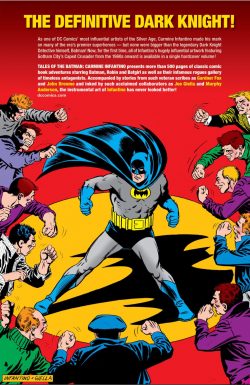
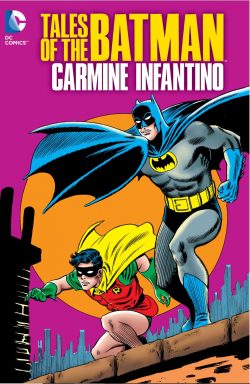
Tales of the Batman: Carmine Infantino


By Carmine Infantino, Gardner Fox, John Broome, Cary Bates, Gerry Conway, Don Kraar, Mike Barr, Geoff Johns & various (DC Comics)
ISBN: 978-1-4012-4755-3 (HB/Digital edition)

Born on May 24th 1925, Carmine Michael Infantino was one of the greatest comic artists America ever produced: a multi-award-winning innovator who was there when comic books were born, reshaped the industry in the Silver Age and was still making fans when he died in 2013.

As an illustrator he co-created and initially visualised Black Canary, Detective Chimp, Pow-Wow Smith, the Silver Age Flash, Elongated Man, Deadman, Batgirl, Dial H for Hero and Human Target and revitalised characters such as Adam Strange and Batman. He worked for numerous companies, and at Marvel ushered in a new age by illustrating the licensed Star Wars comic book whilst working on titles and characters such as The Avengers, Daredevil, Ms. Marvel, Nova, Star-Lord and Spider-Woman

His work on two separate iterations of the Batman newspaper strip is fondly remembered and whilst acting as Art Director and Publisher of National DC, he oversaw the most critically acclaimed period in the company’s history, ushering in the “relevancy” era and poaching Jack Kirby from Marvel to create the Fourth World, Kamandi, The Demon and others…

Very much – and repeatedly – the right man at the right time and place, Infantino shaped American comic book history like few others, and this bumper compendium comprehensively covers his contributions to the lore of Batman: collecting the stunning covers from Detective Comics #327-347, 349, 351-371, 500 and Batman #166-175, 181, 183-185, 188-192, 194-199 plus the Bat-Saga stories he drew for Detective #327, 329, 331, 333, 335, 337, 339, 341, 343, 345, 347, 349, 351, 353, 357, 359, 361, 363, 366-367, 369, and 500.

Also included are the contents of The Brave and the Bold #172, 183, 190, 194 and DC Comics Presents: Batman #1: an artistic association cumulatively spanning May 1964 to September 2004.

I’m assuming everybody here loves comics and that we’ve all had the same unpleasant experience of trying to justify that passion to somebody. Excluding your partner (who is actually right – the living room floor is not the place to leave your $£#!D*&$£! funnybooks) even today, many people have an entrenched and erroneous view of strip art, resulting in a frustrating and futile time as you tried to dissuade them from that opinion.

If so, this collection might be the book you want next time that confrontation occurs. It offers breathtaking examples of the prolific association of one the industry’s greatest illustrators with possibly the artform’s greatest creation.

Many of these “Light Knight” sagas stem from a period which saw the Dynamic Duo deftly reshaped for global Stardom – and subsequent fearful castigation from fans – as the template for the Batman TV show of the 1960s. It should be noted, however, that the producers and researchers took their creative impetus from stories of the era preceding the “New Look Batman” – as well as the original l940s movie serial…

So, what happened?

By the end of 1963, editor Julius Schwartz had spectacularly revived much of National/DC’s line – and the entire industry – with his modernisation of the superhero, and was then asked to work his magic with the creatively stalled and nigh-moribund Caped Crusaders.

Bringing his usual team of top-notch creators with him, Schwartz stripped down and back to the core-concept, downplaying aliens, outlandish villains and daft transformation tales to bring a cool modern take on combatting criminals. He even oversaw a streamlining and rationalisation of the art style itself.

The most apparent innovation was a yellow circle around the Bat-symbol, but far more importantly, the stories also changed. A subtle aura of genuine menace re-entered the comfortable and absurdly abstract world of Gotham City.

Infantino was key to the changeover that reshaped a legend – but this was while still pencilling Silver Age superstar The Flash – so, despite generating the majority of covers, Infantino’s interior art was limited to alternate issues of Detective Comics with the lion’s share of narrative handled by Bob Kane’s then-uncredited deputies Sheldon Moldoff, Joe Giella, Chic Stone & others, plus occasional guest artists such as Gil Kane…

Punctuated throughout by his chronologically sequenced covers, Infantino’s part in the storytelling revolution began then and kicks off here with Detective #327 – written by John Broome and inked by Joe Giella at the very peak of their own creative powers.

‘The Mystery of the Menacing Mask!’ is a cunning “Howdunnit?”, long on action and moody peril, as discovery of a criminal “underground railroad” leads Gotham Gangbusters Batman and Robin to a common thug seemingly able to control them with his thoughts…

‘Castle with Wall-To-Wall Danger!’ (Detective #329 with Broome and Giella in their respective roles) follows: a captivating international thriller with the heroes braving a deadly death-trap in Swinging England in pursuit of a dastardly thief.

A rare full-length story in #331 co-starred Elongated Man Ralph Dibny. He was Detective Comics’ new back-up feature: a costumed sleuth blending the charm of Nick (The Thin Man) Charles with the outré heroic antics of Plastic Man.

The ‘Museum of Mixed-Up Men’ (Broome & Infantino) united the eclectic enigma-solvers against a super-scientific felon, whilst in #333 Batman & Robin fought a faux goddess and genuine telepaths in the ‘Hunters of the Elephants’ Graveyard!’, written by Gardner Fox and inked by Giella.

The same team revealed the ‘Trail of the Talking Mask!’ in #335, giving the Dynamic Duo an opportunity to reinforce their sci-fi credentials in a classy high-tech thriller guest-starring private detective Hugh Rankin (of “Mystery Analysts of Gotham City” fame) before ‘The Deep-Freeze Menace!’ (Detective #337 delivered a fearsome fantasy chiller pitting Batman against a super-powered caveman encased in ice for 50,000 years…

DC’s inexplicable (but deeply cool) long-running love-affair with gorillas resulted in a cracking doom-fable as ‘Batman Battles the Living Beast-Bomb!’ (#339) highlighted the hero’s physical prowess in a duel of wits and muscles against a sinister, super-intelligent simian.

Up until this time the New Look Batman was forging his more realistic path, as the TV series was still in pre-production. The Batman TV show (premiering on January 12th 1966 and running for three seasons of 120 episodes in total) aired twice weekly for its first two seasons, resulting in vast amount of Bat-awareness, no end of spin-offs and merchandise – including a movie – and the overkill phenomenon of “Batmania”.

No matter how much we might squeal and foam about it, a huge portion of this planet’s population Batman will always regard that “Zap! Biff! Pow!”  buffoonish costumed boy scout as The Real Deal…

Regrettably this means that the comic stories published during that period have been similarly excoriated and maligned by most Bat-fans ever since. It is true that some tales were crafted with overtones of the “camp” comedy fad – presumably to accommodate newer readers seduced by the arch silliness and coy irony of the show – but no editor of Schwartz’s calibre would ever deviate far from the characterisation that had sustained Batman for nearly 30 years, or the then-recent re-launch which had revitalised the character sufficiently for television to take an interest at all.

Nor would such brilliant writers as John Broome, Bill Finger, Gardner Fox and Robert Kanigher ever produce work which didn’t resonate on all the Batman’s intricate levels just for a quick laugh or cheap thrill. The artists tasked with sustaining the visual intensity included Infantino, Moldoff, Stone, Giella, Murphy Anderson and Sid Greene, with covers from Gil Kane and Joe Kubert supplementing Infantino’s stunning, trend-setting, fine-line masterpieces.

Most of the tales here reflect those gentler times and editorial policy of focusing on Batman’s reputation as “The World’s Greatest Detective”, so colourful, psychotic costumed super-villains are in a minority, but there are first appearances for a number of exotic foes who would become regular menaces for the Dynamic Duo in years to come.

Broome & Infantino detailed the screen-inspired, comedically-catastrophic campaign of ‘The Joker’s Comedy Capers!’ in #341, with the mayhem and mystery continuing in Detective Comics #343 (September 1965) with ‘The Secret War of the Phantom General!’: a tense thriller pitting our hard-pressed heroes against a hidden army of gangsters and Nazi war criminals.

Detective #345 brought forth a terrifying and tragic new villain in ‘The Blockbuster Invasion of Gotham City!’ (scripted by Fox), as a monstrous giant with the mind of a child and the raw, physical power of a tank is driven to destructive madness at sight of Batman and only placated by the sight of Bruce Wayne

‘The Strange Death of Batman!’ (Fox, in Detective #347) fired the opening shot of habitual B-list villain the Bouncer in a bizarre experimental yarn which has to be seen to be believed, whereas it’s business as usual when monstrous, microcephalic man-brute returns in ‘The Blockbuster Breaks Loose!’: a blistering, action-fuelled thriller from Fox, Infantino & Giella first seen in Detective #349. This tale sports a cover by Infantino’s colleague Joe Kubert whilst also hinting at the return of a long-forgotten foe…

Detective #351 premiered game-show host turned felonious impresario Arthur Brown in a twisty, puzzle-packed battle of wits detailing ‘The Cluemaster’s Topsy-Turvy Crimes!’ (Fox, Infantino & Sid Greene) after which the action accelerates as ‘The Weather Wizard’s Triple-Treasure Thefts!’ (Fox/Giella in #353) bring a torrent of trouble to Gotham and the Dynamic Duo battle in spectacular opposition to the Flash’s meteorological arch-enemy. This was one of the earliest times a Silver Age DC villain moved out of his usual haunts…

Detective #357 then delivers a clever secret identity saving puzzler when – apparently – ‘Bruce Wayne Unmasks Batman!’ (Broome, Infantino & Giella) as a prelude to big changes in the Batman mythos…

After three seasons (perhaps two and a half would be more accurate) the Batman show ended in March, 1968. It had clocked up 120 episodes since the US premiere. The era ended but the series had instilled an undeniable effect on the world, the comics industry and – crucially – on the characters and history of its four-colour inspiration. Most notable was a whole new caped crusader who would become an integral part of the DC universe.

The comic book premiere of that aforementioned character came in ‘The Million Dollar Debut of Batgirl’ (Detective Comics#359, cover-dated January 1967). Fox provided art team supreme Infantino & Greene a ripping yarn to introduce Barbara Gordon (mousy librarian and daughter of the Police Commissioner) into the superhero limelight. Thus, by the time the third season began on September 14th, 1967, she was well-established among comics fans at least…

A different Batgirl – Betty Kane (teenaged niece of the 1950s Batwoman) – was already a nearly-forgotten comics fixture, but for reasons far too complex and irrelevant to mention, she was conveniently ignored to make room for a new, empowered woman in the fresh and fashionable tradition of Emma Peel, Honey West and the Girl From U.N.C.L.E.

“Babs” was considered pretty hot too, which is always a plus for television…

Whereas she fought The Penguin on the small screen, her print origin features the no less ludicrous but at least visually forbidding Killer Moth in a clever yarn that still stands up today.

Editor Schwartz always preferred to play-up mysteries and crime conundrums in Detective Comics and #361’s ‘The Dynamic Duo’s Double-Deathtrap!’ was one of Fox’s best, especially as drawn by the now increasingly over-stretched Infantino & Greene. The plot involves Cold War spies and a maker of theatrical and stage paraphernalia; I shall reveal no more to keep you guessing when you read it…

Detective #363 was a full co-starring vehicle as the Dynamic Duo challenged the new Batgirl to deduce Batman’s secret identity whilst tracking down enigmatic Mr. Brains in ‘The True-False Face of Batman!’, leading to a taut suspense thriller stretching across Detective #366 & 367 – an almost unheard-of event in those cautiously reader-friendly days…

As devised by Fox, Infantino & Greene, ‘The Round Robin Death Threats’ involves a diabolical murder-plot threatening to destroy Gotham’s worthiest citizens, with the tension peaking and drama concluding in high style with ‘Where There’s a Will… There’s a Slay!’: a dark and deadly denouement barely marred by that dreadful title…

It was just a symptom of the times – as is Detective #369 (November 1967) – which somewhat reinforces boyhood prejudices about icky girls in otherwise classy thriller ‘Batgirl Breaks Up the Dynamic Duo!’

Here, Robin seemingly abandons Batman for a vivaciously curvaceous new partner, and the best of clandestine reasons, ignominiously signalling – other than for the occasional cover – the end of Infantino’s tenure as a bat-illustrator.

His next Bat-contribution came in anniversary landmark Detective Comics #500 (March 1981): part of a huge creative jam-session specifically examining the legend of the immortal hero in ‘What Happens When a Batman Dies?’

Scripted by Cary Bates and inked by Bob Smith, this extracted chapter from a greater saga co-stars restless revenant Deadman as the Gotham Guardian hovers in a coma between this world and the next, yet still manages to find a way to save himself…

The cover is another collaborative effort with Dick Giordano, José Luis García-López, Joe Kubert & Tom Yeates all joining forces.

What follows is a quartet of tales from The Brave and the Bold, with Jim Aparo providing covers whilst Infantino handled interior art. Issue #172 (March 1981, inked by Steve Mitchell) paired the Caped Crimebuster with Firestorm in Gerry Conway scripted ‘Darkness and Dark Fire’, with the World’s Greatest Detective seeking to solve the mystery of the Nuclear Man’s periodic mental blackouts, after which #183 (February 1982, written by Don Krarr and inked by Mike DeCarlo) sees the crimebuster allied with The Riddler to prevent ‘The Death of Batman!’

Scripter Mike Barr & inker Sal Trapani worked with Infantino on B&B #190 (September 1982) and #194, January 1993), respectively challenging the Dark Knight to visit planet Rann and find ‘Who Killed Adam Strange?’ before subsequently working with the Flash against Doctor Double-X and the Rainbow Raider when they ‘Trade Heroes – And Win!’

One final Infantino fling comes from DC Comics Presents: Batman #1 (September 2004), courtesy of writer Geoff Johns, with inks by Giella and a retro cover from Ryan Hughes, as ‘Batman of Two Worlds’ gets real metaphysical with narrative boundaries as the modern Batman and Robin investigate murder on the set of the 1960s Batman TV show in a bizarrely engaging romp with a mystery villain to expose…

The visual cavalcade then ends on a nostalgic high with ‘Batman and Robin Retail poster’ – AKA the front cover of this titanic tome – possibly the most iconic bat-image of the entire era.

Whether you tend towards the anodyne light-heartedness of Then, the socially acceptable psychopathy of assorted movie franchises or actually just like the comic book character, if you can make a potential convert sit down, shut up and actually read these wonderful adventures for all (reasonable) ages, you might find that the old adage “Quality will out” still holds true. And if you’re actually a fan who hasn’t read this classic stuff and revelled in the astounding timeless art, you have an absolute treat in store…
© 1964, 1965, 1966, 1967, 1981, 1982, 1983, 2004, 2014 DC Comics. All Rights Reserved.
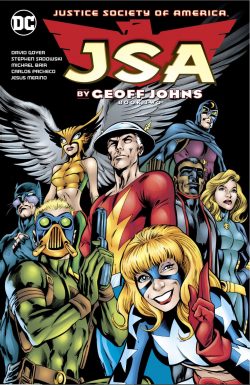
JSA by Geoff Johns Book Two


By Geoff Johns, David S. Goyer, Stephen Sadowski, Michael Bair, Carlos Pacheco, Jesus Merino, Phil Winslade, Mike Perkins, Steve Yeowell, Keith Champagne, Buzz, Rags Morales, Dave Meikis, Paul Neary, Rob Leigh, Javier Saltares, Ray Kryssing, Andrew Pepoy & various (DC Comics)
ISBN: 978-1-4012-8154-0 (TPB/Digital edition)

Win’s Christmas Gift Recommendation: Pure Perfection for Superhero Connoisseurs… 9/10

After the actual invention of the comic book superhero – for which read the creation of Superman in 1938 – the most significant event in the genre, and indeed industry’s progress, was the combination of individual sales-points into a group. Thus, what seems blindingly obvious to us with the benefit of four-colour hindsight was proven – a number of popular characters could multiply readership by combining forces and readerships. Plus of course, a whole bunch of superheroes is a lot cooler than just one – or even one and a sidekick.

The Justice Society of America was created in the third issue of All-Star Comics (Winter 1940/1941), an anthology title featuring established characters from various All-American Comics publications, by the simple expedient of having the heroes gather around a table and tell each other their latest adventure. From this low-key collaboration, it wasn’t long before the guys – and they were all white guys (except the original Red Tornado, who only pretended to be one) until Wonder Woman premiered in the eighth issue – regularly joined forces to defeat the greatest villains and social ills of their generation.

Within months the concept had spread far and wide…

And thus, the Justice Society of America is rightly revered as a true landmark in the development of comics and, when Julius Schwartz revived the superhero genre in the late 1950s, a key moment would come with the inevitable teaming of the reconfigured mystery men into a Justice League of America.

From there it wasn’t long until the original and genuine returned. Since then we’ve enjoyed many attempts to formally revive the team’s fortunes but it wasn’t until 1999, on the back of both the highly successful revamping of the JLA by Grant Morrison & Howard Porter and the seminal but critically favoured new Starman by Golden Age devotee James Robinson, that the multi-generational team found a concept and fan-base big enough to support them.

It didn’t hurt that the writers – all with strong Hollywood connections – adored the original concept, but also knew what mass-market action audiences liked. And now that the JSA have cracked the large and small screen markets, my cup – at least – truly runneth over…

Their highly successful revival began as the last survivors of the original team reconvened after losing most of their membership to old age, infirmity or enemy action. Following the death of founding comrade Wesley Dodds/The Sandman, Wildcat, Flash and Green Lantern/Sentinel united with youthful inheritors of the old team’s legacy. These included members’ children and former Infinity Inc members Atom Smasher, Obsidian and Hourman, Dodds’ sidekick Sand, Stargirl (then called Star Spangled Kid), the third Dr. Mid-Nite, Starman and Mister Terrific plus new Hawkgirl Kendra Saunders, Black Canary and Wonder Woman (in actuality, her mother Hippolyta who was an active Nazi crusher during WWII).They all united to rescue three babies; one of which became the next incarnation of magical hero Doctor Fate. Once they were successful most of the squad stuck together to continue the traditions and train a new generation of heroes…

Shortly thereafter, as old guard Flash, Sentinel and Wildcat assumed the role of mentors for both current and future champions, the multi-generational unit was attacked by demented super-human (and current Man of the Moment) Black Adam: a magically empowered superman, who usually harassed agents of do-gooding wizard Shazam!. The bombastic battle served to introduce more very far-reaching plot threads and led to a fearsome clash with a new iteration old enemy outfit the Injustice Society

Officially concentrating on the efforts of Geoff Johns, this second volume re-presents in whole or in part Secret Origins of Super-Villains File 80-Page Giant #1, JSA #16-25, Our Worlds at War #1, JLA/JSA: Secret Files & Origins #1 and JLA/JSA: Virtue and Vice: bringing the revered, revived and very legendary Justice Society of America into DC’s modern pantheon and continuing the writer’s campaign to restore and re-induct all the classic stars by resurrecting the biggest name and most visually arresting of the originals – Hawkman.

It begins with a prelude from December 1999’s Secret Origins of Super-Villains File 80-Page Giant #1. Crafted by Johns & Goyer and illustrated by Phil Winslade & Mike Perkins, ‘Sorrow Ever More!’ sees demonically-tainted gang boss Johnny Sorrow break veteran villain Cameron Makent – AKA legacy JSA foe The Icicle – out of super penitentiary The Slab. The lachrymose liberator has connections with the original Icicle and expects the successor to join his war on modern heroes. He also knows an awful lot about the Makent family…

Major storyline Injustice be done opens with ‘Divide and Conquer’ (JSA #16, illustrated by Stephen Sadowski & Michael Bair) wherein an expanded Injustice Society – including Black Adam and in possession of the heroes’ most intimate secrets – ambushes them and fellow Golden Age champion Scarab whilst they’re off guard…

The blitz attack meets with significant success, and in ‘Cold Comfort’ mastermind Johnny Sorrow reveals his plans as the heroes begin their fight back, and we see his horrific origins in ‘Sorrow’s Story’ (with additional art Steve Yeowell), before the World goes to Hell with ‘Into the Labyrinth’ (extra inks by Keith Champagne) and the ghostly Spectre returns to save the day from Sorrow’s patron master The King of Tears.

And spectacularly fails…

The saga concludes in cataclysmic fashion with ‘Godspeed’ as Black Adam and Jakeem “J.J.” Thunder (heir of genie-wielding Johnny Thunder) join the team, but not before first Flash Jay Garrick is lost in time and space…

Compelling as it was, that entire saga was just a set-up for the eponymous ‘Return of Hawkman’ which I’ll get to after this necessary diversion…

One of the oldest and most revered heroes in comics, Hawkman premiered right behind Jay Garrick in Flash Comics #1 (January 1940). He was created by Gardner Fox & Dennis Neville, although the most celebrated artists to have drawn the Winged Wonder are Sheldon Moldoff and Joe Kubert, whilst young Robert Kanigher was justifiably proud of his later run as writer.

Carter Hall was a playboy archaeologist until he found a crystal knife that unlocked his memories. He knew that once he had been Prince Khufu of ancient Egypt, and that he and his lover Shayera had been murdered by High Priest Hath-Set. Moreover, with returned lives came the knowledge that his love and his killer were also nearby.

Using the restored knowledge of his past life, Hall fashioned a costume and flying harness, hunting his past and future murderer as the Hawkman. Inevitably triumphant, he and modern-day amour Shiera Saunders maintained their “Mystery-Man” roles: warring on modern crime and tyranny with weapons of the past.

Lost as the Golden Age ended, they were revived by Julie Schwartz’s crack creative cohort in the early 1960s (specifically Fox, Joe Kubert & Murphy Anderson) and – after a long career involving numerous revamps and retcons – “died” during the Zero Hour crisis.

Now in JSA #21 after the race of his life, lost Jay Garrick awakens in old Egypt: greeted by a pantheon of that era’s super champions. Nabu, the Lord of Order who created Doctor Fate, the original incarnation of Black Adam and Prince Khufu himself reveal the true origins of Hawkman whilst in the 21st century the JLA’s heavenly hero Zauriel informs the modern Hawkgirl just who and what she really is in ‘Guardian Angels’

The epic further unfolds as a major connection to the alien Hawkworld of Thanagar is clarified and explored in ‘Lost Friends’ and as Garrick returns to his home era, Hawkgirl is abducted to Thanagar by its last survivors, desperate to thwart the schemes of the insane death-demon Onimar Synn who has reduced the entire planet to a zombie charnel house.

As the JSA frantically follow their abducted member to distant Polaris in ‘Ascension’ Carter Hall makes his dramatic return from beyond and saves the day in ‘Icarus Fell’, before leading the team to magnificent victory in spectacular conclusion ‘Seven Devils

Illustrated by Buzz, Rags Morales, Sadowski, Bair, David Meikis and Paul Neary, this latest return not only led to Hawkman regaining his own title (more graphic novel magic to review ASAP) but also stands as one of the most cosmic and grand-scaled of all the JSA’s adventures.

The cosmic calamity continued as current DC Crossover Event “Worlds At War” – wherein an alien doomsday device/inimical manifested concept Imperiex almost destroyed the planet and unravelled the universe – tragically impacted the team. JSA: Our Worlds at War #1 saw the embattled planet calling on all its metahuman resources with Society members past, present – 28 in all – and simply affiliated gather as ‘The All-Stars’ (Johns, Javier Saltares & Ray Kryssing). Their mission is to take the war to Imperiex, assaulting its Jupiter-sized base-ship and even American President Lex Luthor is astounded by the result of the raid…

Billy Batson/Captain Marvel makes his troubled debut with the team via an introductory prelude in JLA/JSA: Secret Files & Origins #1 (January 2003). ‘The Day Before’, by Johns, Goyer, Sadowski & Andrew Pepoy, has the teen hero warned by his wizard mentor that an indiscernible threat menaces both teams of heroes. That conference leads directly into the last item on this agenda: JLA/JSA: Virtue and Vice (February 2003).

Once upon a time the Justice Society was Earth’s premiere super-team: formed to crush oppression and injustice while raising morale during World War II. When the Justice League debuted in 1960, their success led to the reintroduction of the originals – albeit now revealed to have worked on the alternate reality dubbed Earth-Two. After many years of annual team-ups, the heroes of both – and indeed other worlds – were merged in mega event Crisis on Infinite Earths.

A reordered history reduced the JSA to the role of elder statesmen of metahumanity and they became an organisation regularly saving the world whilst mentoring the next generation of superheroes.

Their inspired successors, the Justice League of America were currently the World’s Greatest Superheroes – and have all the characters who until very recently appeared on TV and in cartoons and movies. You now have all the background you need to read this superb Original Graphic Novel.

As they have done for years, the JLA and JSA have gotten together to celebrate Thanksgiving when suddenly alien conqueror Despero attacks them and the entire world by releasing the Seven Deadly Sins. These deadly demons promptly possess Batman, Power Girl, Mister Terrific, Dr. Fate, Green Lantern, Plastic Man and Captain Marvel (as today’s Shazam! was called back then)…

Can the remaining heroes defeat the Sins without killing their friends, and save humanity from total destruction at the hands of a hidden malign mastermind?

Of course they can; that’s the point. But seldom have they done it in such a spectacularly, well written and beautifully illustrated manner.

Crafted by Johns, Goyer, the much-missed Carlos Pacheco & Jesús Merino, this is the perfect conclusion to this sublime collection: a pure, iconic genre “Fights ‘n’ Tights bravura action romp that hits every target and pushes every button it should. If you love superhero comics, you will treasure this magnificent tale.

Complex and enthralling, these super shenanigans are the very best of their type: filled with wicked villains and shining, triumphant heroes, cosmic disaster and human tragedies, yet always leavening the doom and destruction with optimism and humour. Enticing, thrilling and stuffed with the biggest and best sort of superhero hijinks, if costume drama is your meat, this JSA compilation should be your prey…
© 1999, 2000, 2001, 2002, 2003, 2018 DC Comics. All Rights Reserved.
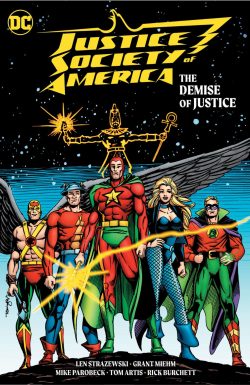
Justice Society of America: The Demise of Justice


By Len Strazewski, John Broome, Paul Levitz, Rick Burchett, Grant Miehm, Mike Parobeck, Tom Artis, Frank McLaughlin, Frank Giacoia, Arthur Peddy, Bernard Sachs, Joe Staton & various (DC Comics)
ISBN: 978-1-7795-0744-0 (HB/Digital edition)

Win’s Christmas Gift Recommendation: Golden Ageist Evergreen Enjoyment… 8/10

Released in 2021 to celebrate their 80th anniversary, here’s yet another DC core concept given fresh wings by a modern movie. If you can find it, this hardback/digital delight is good old fashioned fun and will make a perfect present for you or yours…

After the actual invention of the comic book superhero – the Action Comics debut of Superman in 1938 – the most significant event in the industry’s history was the combination of individual sales-points into a group.

Thus what seems blindingly obvious to us with the benefit of four-colour hindsight was proven: consumers couldn’t get enough of garishly-hued mystery men, and combining many characters inevitably increased readership. Plus, of course, a mob of superheroes is just so much cooler than one – or one-and-a-half if there’s a sidekick involved…

The creation of the Justice Society of America utterly changed the shape of the budding business and – technically – All Star Comics #3 (cover-dated Winter 1940-1941, released in December 1940) was the kick-off. However, in that landmark, the assembled heroes merely had dinner whilst recounting recent cases and didn’t actually go on a mission together until #4 (cover-dated April 1941).

With the simple notion that mighty mystery men hung out together, history was made and it wasn’t long before they started working together…

However, when WWII ended, superheroes gradually declined, and most companies had shelved them by 1950. The plunge in popularity led to a revival in genre-themed titles and characters, and it was a stripped-down team (Flash, Green Lantern, Hawkman, The Atom, Black Canary, Dr. Mid-Nite and Wonder Woman) who battled on in contemporarily tailored crime and science fiction sagas before the title abruptly changed into All Star Western with #58.

It would take a second age of superheroes to revive them, this time as the champions of a parallel universe dubbed Earth Two…

Gathered here is a near-forgotten limited series concerning the latter days of the team’s Golden Age that originally ran in Justice Society of America #1-8 (April to November 1991), augmented by the last tale of the original era as seen in All-Star Comics #57, (February/March 1951), plus a turning point tale from Adventures Comics #466 (December 1979). They are preceded a sparkling, informative and appreciative Foreword by Golden Age aficionado and super scripter Mark Waid.

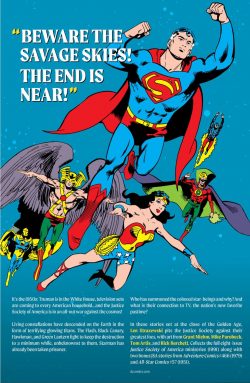
The miniseries – subtitled Vengeance from the Stars! – that comprises the majority of this tome was scripted by journalist and educator Len Strazewski (Speed Racer, The Flash, Phantom Lady, Starman, The Fly, The Web, Prime, Prototype, Elven) and illustrated by a rotating team of artists, opening as Rick Burchett illustrates ‘Beware the Savage Skies’. Here recently-retired mystery man Ted Knight – AKA Starman – is attacked in his private New Mexico observatory by incredible astral energy beings. Broken and dispirited, he is then enslaved by an old enemy who purloins his wondrous gravity rod before luring Jay (Flash) Garrick into a deathtrap that results in power outages across America…

The plot thickens with ‘The Sack of Gotham’ (art by Grant Miehm) as radio and television executive Alan Scott seeks to keep the lights on in his city whilst Black Canary prowls the darkened streets deterring looters and career criminals. Distracted by a museum break-in, she finds herself punching way, way up as undead monster/moron Solomon Grundy and a gang of determined bandits help themselves to ancient Egyptian artefacts at the behest of a hidden client. By the time Scott arrives as Green Lantern, the Canary has been thrashed and captured, leaving him to battle an animated star constellation dubbed Sagittarius

Burchett inks the astoundingly talented Mike Parobeck in #3’s ‘Dead Air’, as the star thing blacks out Gotham and Scott struggles to stop it. Complications occur when Grundy – afflicted with an obsessive hatred of Green Lantern – forgets the orders from the mystery Machiavelli to attack his emerald enemy. Far away, Ted Knight learns that his gleeful foe intends to conquer Earth by eradicating modern technologies and attitudes and replace them with primordial magic and tyranny…

Tom Artis & Frank McLaughlin limn #4 as ‘Evil of the Ancients’ sees reincarnating Egyptian warrior Hawkman uncovering star-themed neolithic treasures in his day job as archaeologist Carter Hall. These findings expose the history and provenance of the constellation creatures, but also trigger the arrival of another…

Despite aerial valour and the US Army’s best efforts, deadly colossus Andromeda storms off with a clutch of atom bombs and only the sudden arrival of The Flash prevents utter disaster. The clash resumes in ‘Double Star Rising!’ by Parobeck & Burchett, as arcane knowledge and modern tech savvy combine to trace the stellar plunderer and the incredible pyramid of power it is constructing. When the heroes try to destroy it they are confronted with a second energy horror but find a way to defeat both at once, compelling the man behind the plot to finally take a personal hand in the fight…

Far across the country the Lantern and the Canary escape captivity in ‘Danger Flies the Skies’ (Artis & McLaughlin), thanks to some timely aid from valiant sidekick Doiby Dickles, and track west after the museum artefacts in time to reinforce Flash and Hawkman in ‘The Return of the Justice Society’ (art by Miehm & Burchett). Redeemed and reinspired, Knight once more takes up his costumed identity to end the villain’s plot in ‘Battle of the Stars!’

In the heady aftermath, the JSA ponder what the next decade will bring, unaware that political conspiracies, public paranoia and a wave of intolerance masquerading as social conformity was waiting to change the world in ways no one could anticipate…

In continuity terms, this was technically the antepenultimate adventure of the JSA, with the rousing romp slyly heralding mood swings in the heartland of Democracy. It is thus smartly supplemented by the team’s final appearance of the Golden Age (in All-Star Comics #57) and a chilling, thematically-aligned codicil from Adventures Comics #466.

Written by John Broome and illustrated by Frank Giacoia, Arthur Peddy & Bernard Sachs, All-Star Comics #57 was the JSA’s last hurrah as ‘The Mystery of the Vanishing Detectives!’ pitted them against criminal mastermind The Key. When he abducted Earth’s greatest criminologists in advance of a spectacular robbery spree, the superheroes were called in to solve the case and prevent an impending catastrophe. It took a lot of time and effort, but the JSA never fail…

The fallow period and gradual return of the JSA was a major success of fan power in the 1960s, but that decade too ended with superheroes on the wane. During the torrid and turbulent 1970s, many of the comics industry’s oldest publishing ideas were finally laid to rest. The belief that characters could be “over-exposed” was one of the most pernicious and long-lasting (although it never hurt Superman, Batman or the original Captain Marvel), garnered from years of experience in an industry which lived or died on that fractional portion of pennies derived each month from the pocket-money and allowances of children which wasn’t spent on candy, toys or movies.

By the end of the 1960s, comic book costs and retail prices were inexorably rising and a proportion of titles – especially the newly revived horror stories – were consciously being produced for older readerships. Nearly a decade of organised fan publications and letter writing crusades had finally convinced publishing bean-counters what editors already knew: grown-ups avidly read comics too. Moreover, they happily spent more than kids and craved more, more, more of what they loved.

Explicitly: If one appearance per month was popular, extras, specials and second series would be more so. By the time Marvel Comics Wunderkind Gerry Conway left The House of Ideas, DC was willing and ready to expand its variegated line-up with some oft-requested fan-favourite characters. Paramount among these was the Justice Society of America, the first comic book super-team and a perennial gem whose annual guest-appearances in the Justice League of America and other superhero titles had become a beloved tradition and treat.

Thus in 1976 writer/editor Conway marked his second DC tenure (he had first broken into the game writing horror shorts for Joe Orlando) by reviving All Star Comics with #58.

In 1951, the original title transformed overnight into All Star Western with the numbering running for a further decade for the home of cowboy crusaders like Strong Bow, The Trigger Twins, Johnny Thunder and Super-Chief. Now, set on Earth-Two, and in keeping with the editorial sense of ensuring a series be relevant to young readers too, Conway reintroduced the veteran team, leavened with a smattering of teen heroes forming a contentious, generation gap-fuelled “Super Squad”…

Augmented by Robin (a JSA-er since the mid-1960s in Justice League of America #55), Sylvester Pemberton/Star-Spangled Kid and a busty young thing who rapidly became the feisty favourite of a generation of growing boys: Kara Zor-L Power Girl. Closing this collection is a short piece as she and fellow newcomer Huntress discuss how the Golden Age ended…

Taken from massive 68-page anthology title Adventure Comics 466 where Paul Levitz & Joe Staton delivered a pithy history lesson exposing the reason why the team vanished at the beginning of the 1950s, ‘The Defeat of the Justice Society!’ shows how the American Government cravenly betrayed their greatest champions. Set during early days of the McCarthy era anti-communist witch-hunts, a sham trial provoked the mystery men into voluntarily withdrawing from public, heroic life. There they stayed until the costumed stalwarts of Earth-One started the whole Fights ‘n’ Tights scene all over again…

These exuberant, rapid-paced and imaginative yarns perfectly blend the naive charm of Golden Age derring-do with cynically hopeful modern sensibilities. Here you will be reassured that no matter what, in the end our heroes will always find a way to save the day. These are classic tales from simpler times and a glorious example of traditional superhero storytelling at its finest: fun, furious and ferociously engaging, excitingly written and beguilingly illustrated. No Fights ‘n’ Tights fan should miss these marvellous sagas.
© 1951, 1979,1991, 2020 DC Comics. All Rights Reserved.
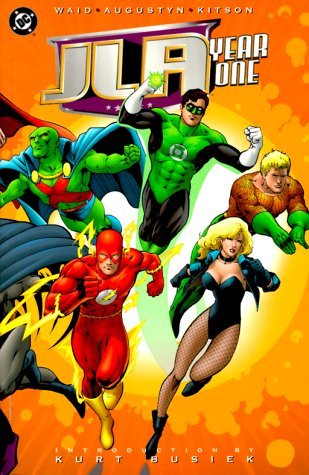
JLA: Year One


By Mark Waid, Brian Augustyn & Barry Kitson with Michael Bair, John Stokes, Mark Propst, & various (DC Comics)
ISBN: 978-1-56389-512-8 (TPB)

If the chop-and-change continuity gymnastics DC have undergone in recent years gives you a headache, but you still love reading excellent superhero team stories, you could just take my word that this is one of the best of that breed and move on to the next review. If you’re okay with the confusion or still need convincing, though, please read on.

With then-partner All-American Publishing, in 1940 DC published the Justice Society of America in All-Star Comics from #3. Cover-dated “Winter Issue”, it spanned the year end and was on sale from November 22nd until January. The JSA were the first superhero team in comics.

In 1960 after a decade largely devoid of superheroes, the now fully-amalgamated publisher sagely revived the team concept as the Justice League of America, and gradually reintroduced the JSA ancestors as heroes of an alternative Earth to a fresh new caped and cowled world. By 1985, the continuity had become saturated and overcrowded with so many heroic multiples and close duplicates that DC’s editorial Powers-That-Be deemed it all too confusing and a deterrent to new readers, and decreed total change. It resulted in maxi-series Crisis on Infinite Earths and the events of the groundbreaking, earth-shattering saga led to a winnowing and restructuring of the DC universe…

With all the best bits from past stories (for which one could read “least charming or daft”) having now occurred on one Earth, and with many major heroes remade and re-launched (Superman, Wonder Woman, Flash et al.), one of the newest curses to readers – and writers – was keeping definitive track of what was now DC “History” and what had now never actually happened.

Thus 12-issue maxi-series JLA: Year One presented the absolute, definitive, real story of the formation and early days of the Justice League, the World’s Greatest – but no longer first – Superheroes…

Of course, since Zero Hour, Infinite Crisis and all the other subsequent publishing course-correcting extravaganzas (such as 52, Countdown, Dark Nights: Death Metal and so on) it’s not strictly true anymore. Still. Again…

None of which impacts upon the superb quality of the tale told here. Way back then – January to December 1998 and in the wake of Grant Morrison & Howard Porter’s spectacular re-reboot of the team – Mark Waid, Brian Augustyn & illustrator Barry Kitson (plus assorted assisting inkers) produced a superb version of that iteration’s earliest days. It’s still one of the best and most readable variations on the theme, even if DC have inexplicably let it slide out of print…

It begins “ten years ago” in ‘Justice League of America: Year One’ as a hidden observer gathers files on an emergent generation of new costumed heroes. When an alien invasion from Appellax brings inexperienced neophyte heroes Flash, Green Lantern, Black Canary, Aquaman and Martian Manhunter together to save Earth from colonisation, the media scents a news sensation, but the real story is the hidden forces hovering in the background of the event…

The Canary was reimagined as the rebellious daughter of the JSA original who had been active during WWII, and the others, like the Sea King and J’onn J’onzz, had undergone recent origin revisions too…

The main action begins after that initial victory, as the heroes – novices all, remember – opt to stick together as a team, only to be targeted by secret super-science society Locus, who begin snatching up alien invader corpses for genetic experimentation…

The second issue sees the new kids as media sensations overwhelmed and out of their depth, with everyone wanting a piece of them. Older outfits like the Blackhawks, Challengers of the Unknown and even officially-retired JSA veterans are watching with apprehension whilst Bruce Wayne wants them far away from Gotham City as they establish their ‘Group Dynamic’. Even trick archer Green Arrow is constantly hanging around, clearly angling for an invitation to join, but that’s never gonna happen…

Immortal villain Vandal Savage targets the inexperienced heroes with a squad of veteran supervillains – the Thorn, Solomon Grundy, Clayface and Eclipso – as everywhere, more new superheroes are emerging. Savage is resolved to stop this second Heroic Age before it begins…

In #3, Locus’ bio advancements lead to alliance with Savage, but their schemes are sidelined as the team struggle to work together. Every man there seems distracted by Black Canary, but their “chivalrous impulses” in combat are not only insulting but will get someone killed – if not by enemies, then by her…

The team is fully occupied playing ‘Guess Who?’ after accepting funding and resources from a mystery billionaire. The influx of cash results in a purpose-built secret mountain HQ, a covert personal communications network, live-in custodian/valet/tech support Snapper Carr and a security system designed by maverick teen genius Ted Kord.

At least the heroes are starting to bond, sharing jokes, origins and trade secrets, but tensions are still high and trust in each other is fragile…

Inker Michael Bair joins with #4 as ‘While You Were Out…’ sees Locus at last launch their campaign of conquest: picking off lone hero Dan Garrett, whose mystic Blue Beetle scarab proves no match for alien-enhanced bio-weaponry, even as the heroes are all singled out for close observation by mystery operatives…

The merciless Brotherhood of Evil unleash Locus-designed horrors on Manchester, Alabama in #5, leading to a tenuous team-up of Justice League and Doom Patrol that ends in disaster and defeat. Maimed and deprived of their abilities, they are ‘A League Divided’ until the DP’s resident genius Niles Caulder provides stopgap powers and weapons in ‘Sum of Their Parts’ (inked by Bair & John Stokes), enabling the heroes to rally and restore themselves…

In ‘The American Way’ the JLA suffer a shock after their greatest inspiration – Superman – declines an offer to join, even as Locus’ endgame begins.

The dispirited heroes barely notice, as ‘Loose Ends’ exposes treachery in the ranks, further distracting the heroes who discover a trusted ally has been spying on them in their private lives. They have no idea what’s really going on…

With unity shattered, the JLA turns on itself, missing Locus’ attempt to terraform Earth and literally ‘Change the World’

‘Heaven and Earth’ (inked by Bair & Mark Propst) finds all humanity’s helpless and all its many heroes subdued in a superpowered blitzkrieg that catches the planet napping. Crushed, defeated and interned in ‘Stalag Earth’ all hope is lost until the reunited Justice League lead a counter-offensive, turning tragedy into triumph and ensuring ‘Justice for All’

A brilliantly addictive plot, superbly sharp dialogue and wonderfully underplayed art suck the reader into an enthralling climax that makes you proud to be human… or at least terrestrially-based. This saga of our champions’ bonding and feuding under extended threat of rogue geneticists, planetary upheaval, and the mystery of who actually bankrolls the team, all added to continual, usual, everyday threats in a superhero’s life, is both enchanting and gripping.

When it’s done right there’s nothing wrong with being made – and allowed – to be feel ten years old again. In-the-know fans will delight at the clever incorporation of classic comics moments, in-jokes and guest-shots from beloved contemporaneous heroes and villains such as the Sea Devils, Metal Men, Atom and such, but the creators of this revised history never forget their new audience and nothing here is unclear for first-timers. The finale is a fan’s all-action dream with every hero on Earth united to combat all-out alien invasion! …And of course, the rookie JLA save the day again in glorious style.
© 1998 DC Comics. All Rights Reserved.
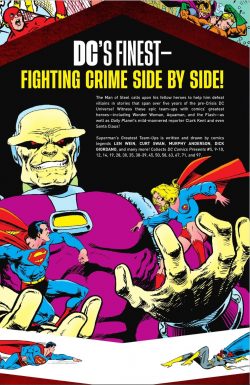
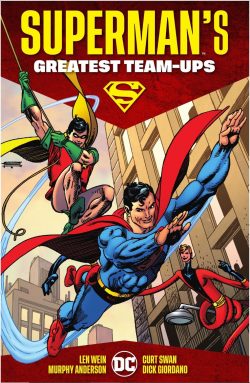
Superman’s Greatest Team-Ups


By Mike W. Barr, Cary Bates, E. Nelson Bridwell, Gary Cohn, Gerry Conway, Steve Englehart, Steve Gerber, Paul Levitz, Dan Mishkin, Denny O’Neil, Martin Pasko, Len Wein, Murphy Anderson, Rich Buckler, Dick Dillin, Don Heck, Alex Saviuk, Jim Starlin, Joe Staton, Curt Swan, Rick Veitch & various (DC Comics)
ISBN: 978-1-7795-0486-9 (HB/Digital edition)

From the moment a kid first sees his second superhero, the only thing they wants is to see how the new gaudy gladiator stacks up against the first one. From the earliest days of the comics industry (and according to DC Comics Presents editor Julie Schwartz it was the same with the pulps and dime novels that preceded it) we’ve wanted our idols to meet, associate, battle together – and if you follow the Timely/Marvel model, that means against each other – far more than we want to see them trounce their archenemies in a united front…

The concept of team-up books – an established star pairing or battling (usually both) with less well-selling company characters – was far from new when DC awarded their then-biggest gun. DCCP was launched in the publicity-drenched weeks preceding the release of Superman: The Movie: a regular arena to have adventures with other stars of their firmament, just as the Gotham Guardian had been doing since the mid-1960s in The Brave and the Bold.

In truth, the Action Ace had already enjoyed the serial sharing experience once before, when World’s Finest Comics briefly ejected the Caped Crusader and Superman battled beside a coterie of heroes including Flash, Robin, Wonder Woman, Teen Titans, Hawkman, Green Arrow, Dr. Fate and others (issues #198-214; November 1970 to October/November 1972) before the original status quo was re-established.

This is something of a companion volume to the previously published Adventures of Superman: José Luis García-López volume 1, in that it also publishes team-ups from DC Comics Presents, but these are stories he didn’t illustrate. Instead. a host of talented individuals devised fun, thrilling and even amusing adventures represented here by material from DCCP #5, 9-10, 12, 14, 19, 28, 30, 35, 38-39, 45, 50, 58, 63, 67, 71 and 97, spanning January 1979 to September 1986. The stories are augmented by covers by Ross Andru, Dick Giordano, Dick Dillin, Jim Starlin, Rich Buckler, Steve Mitchell, George Pérez, Frank Giacoia, Gil Kane, Ernie Colón, José Luis García-López, Eduardo Barreto, Rick Veitch & Bob Smith.

We begin with Sea King Aquaman who is embroiled in ‘The War of the Undersea Cities’ (by Len Wein, Paul Levitz & Murphy Anderson) when his subjects re-open ancient hostilities with the mer-folk of undersea neighbour Tritonis, home of Superman’s old college girlfriend Lori Lemaris. Fortunately, cooler heads prevail when Ocean Master is revealed to be meddling in their sub-sea politics…

Next, Marty Pasko, Joe Staton & Jack Abel expose the ‘Invasion of the Ice People!’ (#9, May 1979) wherein Wonder Woman assists in repelling an attack by malign disembodied intellects before a 2-part tale commences with ‘The Miracle Man of Easy Company’ (Cary Bates, Staton & Abel, #10, June)…

When a super-bomb blasts Superman back to World War II it results in a momentous meeting with indomitable everyman soldier Sgt. Rock and a battle that changes the course of the war.

Cover-dated August 1979, DCCP #12 offered a duel between the Action Ace and New God Mister Miracle in ‘Winner Take Metropolis’ – by Steve Englehart, Buckler & Giordano before Levitz finishes a time-travel epic not actually included here. That ambitious continued epic saw the Legion of Super-Heroes stop Superman saving a little boy from alien abduction to preserve the integrity of the time-line. It didn’t help that the lad was Jon Ross, son of Clark Kent’s oldest friend and most trusted confidante…

Deranged by loss, Pete Ross here risks the destruction of all reality by enlisting the aid of Superboy to battle his older self in ‘Judge, Jury… and No Justice!’ (Levitz, Dillin & Giordano from October 1979 cover-dated DCCP #14, whilst March 1980 saw Batgirl help solve eerie mystery ‘Who Haunts This House?’ (by Dennis O’Neil, Staton & Frank Chiaramonte) before we catapult to #28 and the concluding chapter of a cosmic epic which involved Green Lantern, Martian Manhunter J’onn J’onzz, and the debut of intergalactic brute Mongul.

Here the aftermath of the affair sees Supergirl join her Kryptonian cousin in scouring the cosmos for the vanished tyrant and ancient doom weapon ‘Warworld!’ (Wein, Jim Starlin & Romeo Tanghal). Unfortunately, once they found it, Mongul unleashed all its resources to destroy his annoying adversaries and in the resultant cataclysm the mobile gun-planet was demolished. The resultant detonation blasted Kara Zor-El literally out of existence…

Issue #30 (February 1981) saw Black Canary plagued by nightmares starring her deceased husband, but upon closer investigation Superman proved that diabolical Dr. Destiny was behind ‘A Dream of Demons!’, whilst some semblance of sanity returned in #35 (July) as Superman and Man-Bat hunted for ‘The Metamorphosis Machine!’ (Pasko, Swan & Vince Colletta) which might save chiropterist Kirk Langstrom‘s baby daughter from death. All they had to do was beat murderous maniac Atomic Skull and his minions to the device…

DC Comics Presents #38 (October) united Man of Steel and Fastest Man Alive as an extra-dimensional tyrant attempted to foment a high velocity war between Earth’s fastest heroes in ‘Stop the World – I Want to Get Off Go Home!’ (Pasko & Don Heck), after which #39 catapulted Superman into the weirdest case of his career as he and Plastic Man trailed ‘The Thing That Goes Woof in the Night!’ (Pasko, Staton & Smith) to a Toymakers Convention where third-rate super-villains Fliptop and Dollface were trying to rob freshly reformed, barely recovering maniac Toyman…

Firestorm the Nuclear Man stole the show in #45 (May 1982) as Gerry Conway, Buckler & Smith teamed him and Superman against terrorist Kriss-Kross – who took over the nation’s electronic military defences to implement ‘The Chaos Network’.

The anniversary DC Comics Presents #50 (October) features ‘When You Wish Upon a Planetoid!’ by Dan Mishkin, Gary Cohn, Swan & Kurt Schaffenberger, which saw a cosmic calamity split Superman and Clark Kent into separate entities…

Courtesy of Mike W. Barr, Swan & Dave Hunt, Robin and Elongated Man joined the Action Ace in #58 (June 1983) to foil devious tech-savvy bandits employing ‘The Deadly Touch of the Intangibles’ after which overnight sensation Amethyst, Princess of Gemworld and the Man of Steel battled debase extradimensional tyrant Black Opal in #63 (November 1983).

Scripted by Mishkin & Cohn, ‘Worlds to Conquer!’ was illustrated by Alex Saviuk, Colón, Smith & Gary Martin, capitalising on the contemporary fad for fantasy, with an Earth-raised magical alien princess helping save humanity from roaming space-warps, super-criminals and her personal pantheon of mystic miscreants…

Cover-dated March 1984, DCCP #67 proffered traditional seasonal fare from Wein, E. Nelson Bridwell and veteran Superman dream team Swan & Anderson. ‘Twas the Fright Before Christmas!’ finds maniacal original Toyman Winslow Schott seeking to sabotage festivities and a debilitated Man of Tomorrow teaming with a hairy bearded guy in a red suit…

Hunt substituted for Anderson in #71’s ‘The Mark of Bizarro!’ (July 1984) as Superman joins his zany doppelganger to save square planet Htrae and embattled Earth from a bizarro version of power-parasite Amazo. Ultimately, it comes down to Bizarro employing his wits to win!…

We close with the final story in DC Comics Presents‘ run.

In 1986 DC celebrated its 50th year with the groundbreaking Crisis on Infinite Earths: radically overhauling its convoluted multiversal continuity and starting afresh. In the aftermath of making many planes into one singular universe, all Superman titles were cancelled or suspended pending a back-to-basics reboot courtesy of John Byrne. The process allowed opportunity for a number of very special farewells to the old mythology…

One of the most intriguing and challenging came in the last issue (#97, September 1986) wherein Steve Gerber, Rick Veitch & Smith offered a creepy adieu to many of Superman’s greatest foes in ‘Phantom Zone: the Final Chapter’…

Tracing Jor-El‘s discovery of the Phantom Zone through to the imminent end of the multiverse, this dark yarn built on Gerber’s potent miniseries The Phantom Zone, revealing the dread region of nothingness was in fact the sentient echo of a dead universe which had always regarded the creatures deposited within it as irritants and agonising intruders.

Now, as cosmic carnage reigned, Aethyr, served by Kryptonian mage Thul-Kar, caused the destruction of Bizarro World Htrae and deification/corruption of Fifth Dimensional pest Mr. Mxyzptlk, as well as the subsequent crashing of Krypton’s Argo City on Metropolis.

As a result, General Zod and his fellow immaterial inmates were liberated to wreak havoc upon Earth – but only until the now-crystalline pocket dimension merged with and absorbed the felons before implausibly abandoning Superman to face his uncertain future as the very Last Son of Krypton…

Designed as introductions to lesser-known DC stars, these tales are wonderfully accessible to newcomers and readers unfamiliar with burdensome continuity. They provide an ideal jumping on point for anybody who just wants a few moments of easy comic book fun and thrills.

These short, pithy adventures were and remain a perfect shop window for DC’s fascinating catalogue of characters and creators. DC Comics Presents delivered a breadth and variety of self-contained and satisfying entertainments ranging from the merely excellent to utterly indispensable. This book is a perfect introduction to the DC Universe for every kid of any age and another delightful slice of captivating Costumed Dramas from simpler, more inviting times…
© 1979, 1980, 1981, 1982, 1983, 1984, 1986, 2021 DC Comics. All Rights Reserved.
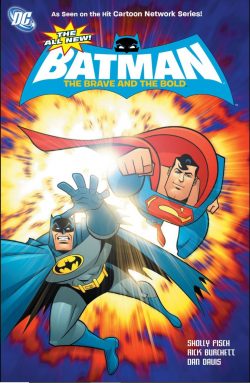
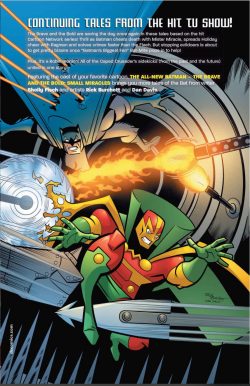
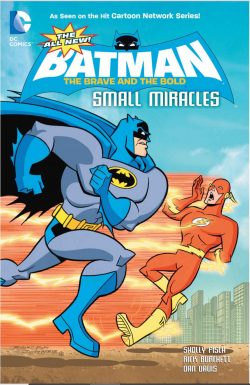
The All-New Batman – the Brave and the Bold volume 3: Small Miracles


By Sholly Fisch, Rick Burchett, Dan Davis, Robert Pope, Scott McRae, Stewart McKenny & various (DC Comics)
ISBN: 978-1-4012-3852-0 (TPB/Digital edition)

The Brave and the Bold premiered in 1955 as an anthology adventure comic featuring short complete tales about a variety of period heroes: a format reflecting the era’s filmic fascination with flamboyantly fanciful historical dramas. Devised and written by Bob Kanigher, #1 led with Roman epic Golden Gladiator, feudal mystery-man The Silent Knight and Joe Kubert’s Viking Prince. Soon the Gladiator was alternated with Robin Hood, but the adventure theme carried the title until the end of the decade when the burgeoning costumed character revival saw B&B transform into a try-out vehicle like Showcase.

Used to premiere concepts and characters such as Task Force X: The Suicide Squad, Cave Carson, Hawkman and Strange Sports Stories as well as the epochal Justice League of America, the comic soldiered on until issue #50 when it found another innovative new direction which once again caught the public’s imagination.

That issue paired two super heroes – Green Arrow and Martian Manhunter – in a one-off team-up and was followed by more of the same: Aquaman with Hawkman in #51, WWII “Battle Stars” Sgt. Rock, Mme. Marie, Captain Cloud & The Haunted Tank in #52 and The Atom & Flash in #53.

The next instant union – Robin, Aqualad and Kid Flash – evolved into The Teen Titans and after Metal Men/The Atom and Flash/Martian Manhunter appeared, a new hero debuted in #57-58: Metamorpho, the Element Man.

From then it was back to the proven popular power pairings with #59. Although no one realised it at the time, that particular conjunction – Batman with Green Lantern – would be particularly significant….

A return engagement for the Teen Titans, issues spotlighting Earth-Two stalwarts Starman and Black Canary and Earth-One’s Wonder Woman and Supergirl soon gave way to an indication of things to come when Batman returned to duel hero/villain Eclipso in #64: an early acknowledgement of the brewing TV-induced mania mere months away.

Within two issues (following Flash/Doom Patrol and Metamorpho/Metal Men), B&B #67 saw the Caped Crusader take de facto control of the title and a lion’s share of team-ups. With the late exception of #72-73 (Spectre/Flash and Aquaman/Atom), it was thereafter where the Gotham Gangbuster invited the rest of DC’s heroic pantheon to come and play…

Even after the title finally folded, its mighty heritage inspired returns as assorted miniseries and as a second dramatic on-going run in the 2000s.

Meanwhile elsewhere over a few decades, Batman: The Animated Series – masterminded by Bruce Timm & Paul Dini in the 1990s – revolutionised the Dark Knight and subsequently led to some of the absolute best comic book adventures in his 80-year publishing history. It also led to a spin-off print title…

With constant comics tie-ins to a succession of TV animation series, Batman has remained immensely popular and a sublime introducer of kids to the magic of sequential narrative and the printed page. One fun-filled incarnation was Batman: The Brave and the Bold, which gloriously celebrated the team-up in both its all-ages small-screen and comicbook spin-off.

Shamelessly and superbly plundering decades of continuity arcana and the comic book inspirations and legacy of power-pairings in a profusion of alliances between the Dark Knight and DC’s lesser creations, the show was supplemented by a cool kids’ periodical full of fun, verve and swashbuckling dash, cunningly crafted to appeal as much to the parents and grandparents as those fresh-faced little TV-fed tykes…

This stellar collection re-presents issues #15 and 17 of original spinoff series Batman: The Brave and the Bold and #13-16 The All-New Batman: The Brave and the Bold in an immensely entertaining all-ages ensemble suitable for newcomers, fans and aficionados of various vintages. Although absolutely unnecessary to the reader’s enjoyment, a passing familiarity with the TV episodes will enhance the overall experience, but not as much as will knowledge of the bizarre minutiae and lore of DC down the years…

Scripted throughout by Sholly Fisch, and following the TV show format, each tale opens with a brief prequel adventure before telling a longer tale.

We start with a run from the second series. TA-NB:TB&TB #13 was cover-dated January 2012 with Rick Burchett & Dan Davis illustrating ‘…Batman Dies at Dawn!’, as Nightwing leaves his Teen Titan ally Speedy to answer a call from the eerie Phantom Stranger. The enigmatic envoy of the unknown has assembled an army of Robins from the past, present and alternate histories (such as Frank Miller’s Carrie Kelley from The Dark Night Returns) to save a fatally wounded Batman, and their fractious trail leads ultimately to the grandfather of Damien (Robin) Wayne: Ra’s Al Ghul…

Issue #14 (February 2012) sees the Gotham Gangbuster and Blue Beetle wipe out colour coordinated crooks Crazy Quilt, Doctor Spectro and Rainbow Raider before Batman shares a moving and appropriately wonder-packed seasonal fable with Ragman in ‘Small Miracles’. Jewish Rory Regan is very much a minor-league hero working in the poorest part of Gotham, and sees nothing to celebrate until he eventually finds his own miracle after exposing a land-grabbing corporation trying to shut down the local synagogue…

Mister Miracle steals the spotlight in #15’s ‘No Exit’ (illustrated by Stewart McKenny & Davis) as he and Batman are caught in the most inescapable trap of all, but still find their way back to freedom, after which things get really silly and soppy as #16 (April 2012, Burchett & Davis) sees Batman’s battle against the Mad Mod interrupted by 5th dimensional imp and premier stalker/fan Bat-Mite.

Sadly, Batgirl also shows up and for the pesky pixie it’s ‘Love at First Mite’. Cue a whacky wander down the daftest miles of DC’s memory lane and a truly hilarious brief and so-very-doomed romantic encounter…

Wrapping up the comic craziness is a brace of tales from the first series. Batman: The Brave and the Bold #15 (May 2010) saw Fisch, Robert Pope & Scott McRae piling on the weird as Batman joined seminal swinging sixties stalwarts Super-Hip and Brother Power, The Geek in their own eccentric era to stop Mad Mod taking over the Mother of Parliaments (that’s Britain, OK? London, Eng-er-land?) before teaching third Flash Wally West a thing or two about patience and diligence in main feature ‘Minute Mystery’. It all began when someone stole something from the Flash Museum and the superheroes made a contest of finding out what, who, how, and why…

We draw to a close with #17 (July 2010) of that series, with Fisch, Pope & McRae proving ‘A Batman’s Work is Never Done’: tracing one week of standard crimebusting capers with cameo appearances from Metamorpho, Mr. Element, Mongul, the Green Lantern Corps,  Toyman, Merry, Girl of Thousand Gimmicks, Jonah Hex, Bat Lash, Hawkman, the Gentleman Ghost, Etrigan the Demon, the Inferior Five, The Creeper, The Scarecrow and Doomsday.

Despite being ostensibly aimed at TV-addicted kids, these mini-sagas are also wonderful, traditional comics romps no self-respecting fun-fan should miss: accessible, well-rendered yarns for the broadest range of excitement-seeking readers. This is a fabulously full-on thrill-fest confirming the seamless link between animated features and comic books. After all, it’s just adventure entertainment in the end; really unmissable entertainment…
© 2010, 2012, 2013 DC Comics. All Rights Reserved.
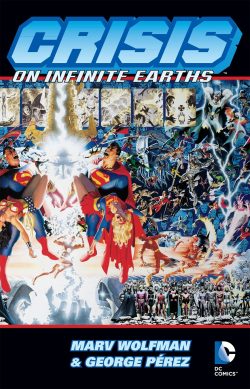
Crisis on Infinite Earths


By Marv Wolfman & George Pérez, with Jerry Ordway, Dick Giordano, Mike DeCarlo & various (DC Comics) 
ISBN: 978-1-4012-5841-2 (HB/Digital edition) 978-1-56389-750-4 (TPB) 

Once more I’m compelled to dash out another swiftly modified reprinted review to mark the passing of one of our industry and art form’s most prolific and irreplaceable master creators. George Pérez died on May 6th from the complications of pancreatic cancer. He was 67 years old.  

His triumphs as penciller, writer and an always in-demand inker made him a force to be reckoned with and earned a vast number of awards in a career spanning almost fifty years. Pérez worked for dozens of publishers large and small; self-published his own creations, redeemed and restored many moribund characters and features (like the (New) Teen Titans), Nightwing and Wonder Woman) and co-created many breakthrough characters such as The White Tiger (first Puerto Rican superhero), The Maestro, Deathstroke the Terminator, Terra, The Monitor and Anti-Monitor.  

He will be most warmly remembered for his incredible facility in portraying big teams and cataclysmic events. Pérez probably drew every DC and Marvel superhero of his era, with major runs on The Avengers, The Fantastic Four, The Justice League of America, Legion of Super-Heroes and numerous iterations of Teen Titans as well as stints on The Inhumans, X-Men, JSA, All-Star Squadron, Thunderbolts and T.H.U.N.D.E.R. Agents. He will be immortalised for the comic book series covered below. A fuller appreciation will follow as soon as I can sort it… 

In 1985 the Editorial Powers-That-Be at DC Comics were about to celebrate fifty years of publishing, and enjoying a creative upswing that had been a long time coming. A crucial part of the festivities, and purported attempt to simplify five decades of often conflicting stories, was a truly epic year-long saga that would impact every single DC title and reconstruct the entire landscape and history of the DC Universe, with an appearance – however brief – by every character the company had ever published. Easy-peasy, Huh? 

Additionally, this new start would seek to end an apparent confusion of multiple Earths with similarly named and themed heroes. This – it had been decided – was deterring (sic) new readers. Happily, since then (primarily thanks to movie rom-coms like Sliding Doors) we’ve all become well aware of string theory and parallel universes and can revel in the most basic TV show or kids cartoon proffering the concept of multiples incidences of me and you… 

Way back then, the result of those good intentions was a groundbreaking 12-part miniseries that spearheaded a vast crossover event: eventually culminating in a hefty graphic novel collection (plus latterly three companion volumes reprinting all the crossovers). 

The experiment was a huge success, both critically and commercially, and enabled the company to reinvigorate many of their most cherished properties: many of which had been in dire need or some regeneration and renewal. Many fans would argue that DC have been trying to change it back ever since… 

Plotted long in advance of launch, threads and portents appeared for months in DC’s regular titles, mostly regarding a mysterious arms-and-information broker known as The Monitor. With his beautiful assistant Lyla Michaels/Harbinger he had been gauging each and every being on Earths beyond counting with a view to saving all of Reality. At this juncture, that consisted of uncountable variations of universes existing “side-by-side”, each exhibiting differences varying from minor to monumental.  

Building on long-established continuity collaborators Marv Wolfman and George Pérez – aided and abetted by Dick Giordano, Mike DeCarlo and Jerry Ordway – began by tweaking things fans knew before taking them on a journey nobody anticipated… It transpired that at the very beginning of time an influence from the future caused Reality to fracture. Rogue Guardian of the Universe Krona obsessively sought to unravel the secret of creation and his probing cause a perfect singular universe to shatter into innumerable self-perpetuating cracked reflections of itself… 

Now, a wave of antimatter scythes through the Cosmic All, eradicating these separate universes. Before each Armageddon, a tormented immortal named Pariah materialises on an inhabited but doomed world of each Existence. As the story opens, he arrives on an Earth, as its closest dimensional neighbours are experiencing monumental geo-physical disruptions. It’s the end of the World, but The Monitor has a plan. It involves death on a mammoth scale, sacrifice beyond measure, a gathering of the best and worst beings of the surviving Earths and the remaking of time itself to deflect cosmic catastrophe and defeat the being that caused it… 

Action is tinged with tragedy as many major heroic figures – from the nondescript and forgotten to high, mighty and grand – perish valiantly, falling in apparently futile struggle to preserve some measure of life from the doomed multiverse. 

Full of plot twists and intrigue, this cosmic comicbook spectacle set the benchmark for all future crossover events, not just DC’s, and is still a qualitative high point seldom reached and never yet surpassed. As well as being a superb blockbuster in its own right and accessible to even the greenest neophyte reader, it is the foundation of all DC’s in-continuity stories since 1985, the basis of a TV phenomenon and absolutely vital reading.  

More than any other work in a truly stellar career, Crisis on Infinite Earths is the magnum opus George Pérez will be remembered for: It might not be fair, but it’s inescapably true… 
© 1985, 1986, 2001, 2008, 2015 DC Comics. All Rights Reserved. 
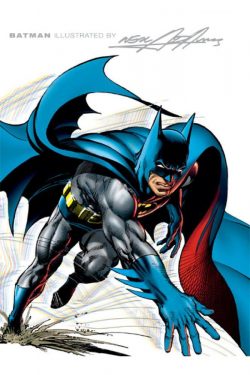
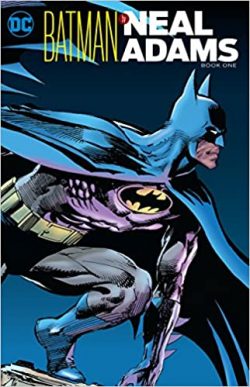
Batman: Illustrated by Neal Adams volume 1 


By Neal Adams with Bob Haney, Leo Dorfman, Cary Bates & various (DDC Comics)
ISBN: 978-1-4012-0041-1 (HC): 978-1-4012-3537-6 (2003 PB) 978-1-4012-7782-6 (2018 TPB edition)   

I’m doing this far too frequently, these days, but here’s a swiftly modified reprinted review to mark the sudden passing of one of our industry and art form’s last true titans. Neal Adams died on the 28th of April. As well as a creator and innovator who changed the entire direction of comics and sequential narrative, he was a tireless activist and advocate whose efforts secured rights for workers and creators long victimised by an unfair, stacked, system. A fuller appreciation and more comprehensive review will follow as soon as I can sort it… 

Neal Adams was born on Governors Island, New York City, on June 15th 1941. His family were career military and he grew up on bases across the world. In the late 1950s he studied at the High School of Industrial Art in Manhattan, graduating in 1959. 

As the turbulent, revolutionary 1960s began, Adams was a young illustrator who had worked in advertising and ghosted some newspaper strips whilst trying to break into comics. As he pursued a career in advertising and “real art”, he did a few comics pages for Joe Simon at Archie Comics (The Fly and that red-headed kid too) before subsequently becoming one of the youngest artists to co-create and illustrate a major licensed newspaper strip – Ben Casey (based on a popular TV medical drama series). His first attempts to find work at DC were not successful… 

That comic book fascination never faded however, and as the decade progressed, Adams drifted back to National/DC doing a few covers as inker or penciller. After “breaking in” via anthological war comics he eventually found himself at the vanguard of a revolution in pictorial storytelling… 

He made such a mark that DC chose celebrate his contributions by reprinting every piece of work Adams ever did for them in a series of commemorative collections. We’re still waiting for a definitive collection of his horror comics stories and covers, but will probably never see his sterling efforts on licensed titles such as Hot Wheels, The Adventures of Bob Hope and The Adventures of Jerry Lewis. That’s a real shame too: the display a wry facility for gag staging and small drama… 

Batman: Illustrated by Neal Adams was the first of 3 tomes available in  variety of formats and editions featuring the “Darknight Detective” – as he was dubbed back then – and featuring every cover, story and issue in original publication order. 

Here then, ‘From Me to You: An Introduction’ gives you the history of his early triumphs in the writer/artist’s own words, after which covers from Detective Comics #370 (December 1967, inking Carmine Infantino) and the all-Adams Brave and the Bold #75 (January 1968), Detective #372 (February), B&B #76 (February/March), Batman #200 and World’s Finest Comics #174 (both March) serve as tasters for the first full-length narrative… 

The iconoclastic penciller first started seriously making waves with a couple of enthralling Cape & Cowl capers beginning with World’s Finest Comics #175 (April 1968): ‘The Superman-Batman Revenge Squads!’ Scripted by Leo Dorfman and inked by long-term collaborator Dick Giordano, the story detailed how an annual – and friendly – battle of wits between the crimebusters is infiltrated by alien and Earthly criminal groups intent on killing their foes whilst they are off-guard… 

WFC #176 (June) featured a beguiling enigma in ‘The Superman-Batman Split!’ – written by fellow newcomer Cary Bates. Ostensibly just another alien mystery yarn, this twisty little gem conceals a surprise ending for all, plus guest stars Robin, Jimmy Olsen, Supergirl and Batgirl, with Adams’ hyper-dynamic realism lending an aura of solid credibility to even the most fanciful situations. 

It also ushered in an era of gritty veracity to replace previously anodyne and frequently frivolous Costumed Dramas… 

More Dynamite Covers follow: Batman #203 (July/August) leads to Brave and the Bold #79 (August/September); heralding Adams’ assumption of interior art chores and launching a groundbreaking run that rewrote the rulebook for strip illustration… 

‘The Track of the Hook’ – written by Bob Haney and inked Giordano – paired the Gotham Guardian with justice-obsessed ghost Deadman: formerly trapeze artist Boston Brand who was hunting his own killer, and whose earthy, human tragedy elevated the series’ costume theatrics into deeper, more mature realms of drama and action. At this period Adams was writing and illustrating Brand’s solo stories in Strange Adventures…  

The B&B stories matured overnight, instantly became every discerning fan’s favourite read.  

Covers for World’s Finest Comics #178-180 (September through November) segue sweetly into Brave and the Bold #80 (October/November 1968) where ‘And Hellgrammite is his Name’ finds Batman and The Creeper clashing with a monstrous, insect-themed super-hitman, again courtesy of Haney, Adams & Giordano, whilst #81 saw The Flash aid Batman against an unbeatable thug in ‘But Bork Can Hurt You!’ (inked by Giordano & Vince Colletta) before Aquaman became ‘The Sleepwalker from the Sea’ in an eerie tale of mind-control and sibling rivalry. 

Interwoven through those thrillers are the covers for World’s Finest #182 (February 1969, inking Curt Swan’s pencils), #183 (March, inking over Infantino), Batman #210 and Detective #385 (both March and all Adams). 

B&B # 83 took a radical turn (and is the only story herein without a cover since that one was limned by Irv Novick) as The Teen Titans try to save Bruce Wayne‘s latest foster-son from his own inner demons in ‘Punish Not my Evil Son!’ (Haney & Giordano) but the next team-up was one that got many fans in a real tizzy in 1969. 

First though comes the fabulous frontage for World’s Finest #185 (June 1969) after which ‘The Angel, the Rock and the Cowl’ recounts a World War II exploit where Batman and Sgt. Rock of Easy Company hunt Nazi gold together, only closing that case 25 years later. 

Try to ignore kvetching about relative ages and which Earth we’re on: you should really focus on the fact that this is a startlingly gripping tale of great intensity, beautifully realised, and one which has been criminally discounted for decades as “non-canonical”. 

Detective Comics #389 (July), and World’s Finest #186 (August and pencilled by Infantino) precede Brave and the Bold #85. Here, behind a stunning cover, is arguably the best of an incredible run of action adventures… 

‘The Senator’s Been Shot!’ unites Batman and Green Arrow in a superb multi-layered thriller of politics, corruption and cast-iron integrity, with Bruce Wayne being appointed as a stand-in for a law-maker whilst the Emerald Archer receives a radical make-over that turned him into a fiery liberal gadfly and champion of the relevancy generation: a remake that still informs his character today, both in funnybooks and on TV screens… 

Wrapping up this initial artistic extravaganza come covers for Detective Comics #391 and 392 (September & October 196), completing a delirious run of comics masterpieces no ardent art lover or fanatical Fights ‘n’ Tights aficionado can do without and confirming the unique and indisputable contribution Adams made to comics.s.
© 1967, 1968, 1969, 2003, 2018 DC Comics. All Rights Reserved. 
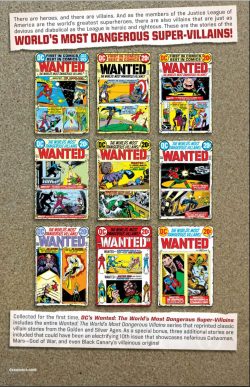
DC’s Wanted: The World’s Most Dangerous Villains


By Jerry Siegel, Bill Finger, Jack Kirby, Joe Simon, William Woolfolk, Ed Herron, John Broome, Gardner F. Fox, Alfred Bester, Don Cameron, Joe Samachson, Mort Weisinger, Ken Fitch, David Vern Reed, Sheldon Moldoff, Jack Burnley, Carmine Infantino, Gil Kane, Lee Elias, Mort Meskin, Joe Kubert, Howard Sherman, Pete Riss, Paul Reinman, Alex Kotzky, Bernard Baily, Jon Sikela, Harry G. Peter, Murphy Anderson, Nick Cardy & various (DC Comics)
ISBN: 978-1-7795-0173-8 (HB)

We talk of Gold and Silver Ages in comics and latterly for the sake of expediency have added other mineral markers like a Bronze Age, but no ever talks about the period between 1964 and 1977 as a specific and crucial time in funnybook history. But it was…

During that period, economic pressure compelled DC and Marvel to increasingly plunder their own archives and fill expensive pages in their primary product to maintain hard-won spaces on newsstands and magazine spinners. Some readers moaned about reprints. Some didn’t notice and most didn’t care. But for all those little proto-geeks like me, it was being given the keys to the greatest kingdom of all.

Once you grasped that the differently drawn stuff with clunkier buildings and cars – and more men in hats – was from the past, and not something happening “now”, it simply added to the scope and scale of what you were reading: hinting of a grand unknown past you were now party to. Moreover, the sheer quality of most twice-printed tales was astounding.

I wasn’t around for Lou Fine or Basil Wolverton or Jack Burnley the first time, but reprints made me a devotee. You young whippersnappers with your interwebs and archive collections don’t know how lucky you are.

Marvel especially made a service out of a necessity: keeping their older material in print via big packages like Marvel Collectors’ Items Classics and Marvel Tales to ensure reader awareness of their unfolding universe. Those and DC’s 80-Page Giant specials were true gateway series for comics junkies who wanted a peek at the past… particularly the mysterious and alluring “Golden Age” where all the really incredible stuff must have happened…

In 1968 DC started taking reprints seriously by creating a specific title. DC Special began a succession of themed and carefully curated issues at a time when superheroes had entered another decline. In its first run – from fall 1968 to November/December 1971 – it featured issues dedicated to the careers of Carmine Infantino and Joe Kubert, horror stories, teen comedy, western, crime, and two issues featuring Strange Sports Stories, as well as an “all-girl” superhero volume, the Viking Prince and Plastic Man. Issues #8 (Summer1970) and #14 (September/October 1972) were both entitled Wanted! The World’s Most Dangerous Villains: an unrepentant, unashamed celebration of costumed good guys thrashing costumed bad guys…

This spiffy hardback and digital collection sadly excludes those try-out experiments but does collect all the subsequent contents of the spin-off title that followed – #1-9 spanning July/August 1972 to September 1973 – and adds a tenth issue just for thrills and giggles.

It kicks off with a gloriously outré debut as #1 reintroduced ‘The Signalman of Crime’ who used signs and symbols to baffle lawmen. He came – and went – in Batman #112 (December 1957) courtesy of Bill Finger, Sheldon Moldoff & Charles Paris and is followed by a classy Green Arrow yarn from Ed Herron & Lee Elias. ‘The Crimes of the Clock King’ were first found and foiled in World’s Finest Comics (#111 July 1960). Rounding out the first sally is ‘Menace of the Giant Puppet’ by John Broome, Gil Kane & Joe Giella (Green Lantern volume 2 #1, August 1960) wherein the Emerald Gladiator faced the superscience-wielding Puppeteer.

Gold was struck in #2 as Batman #25 (October/November 1944) yielded Don Cameron, Jack Burnley & Jerry Robinson’s‘Knights of Knavery’: an epic clash which saw crime rivals The Penguin and Joker – temporarily – join forces against the Dynamic Duo, after which John Broome, Infantino & Giella detail how ‘The Trickster Strikes Back’. The air-walking felon plunders Central City until the Scarlet Speedster finally outwits him, as first seen in The Flash #121 (June 1961).

Wanted #3 provided exclusively Golden Age greatness, beginning with The Vigilante yarn from Action Comics #69 (February 1944). Devised by Joe Samachson, Mort Meskin & Joe Kubert, ‘The Little Men Who Were There!’ pitted the Prairie Troubadour against diabolical Napoleon of Crime The Dummy, after which warrior wizard Doctor Fate frustrated an invasion by ‘The Fish-Men of Nyarl-Amen’ (More Fun Comics #65 March 1941, by Gardner F. Fox & Howard Sherman) and Hawkman crushed ‘The Human Fly Bandits’ thanks to creators Broome & Kubert as seen in Flash Comics #100 (October 1948).

Original Green Lantern Alan Scott headlined in #4, replaying his epic first clash with Solomon Grundy from All-American Comics #61 (October 1944) as related by Alfred Bester & Paul Reinman in ‘Fighters Never Quit!’, whilst the follow-up featured Kid Eternity – who died before his time and was rewarded by Higher Powers with the power to summon figures from history, myth and literature to fight for justice. ‘Master Man’ came from Kid Eternity #15 (May 1949) wherein writer William Woolfolk and illustrator Pete Riss created the hero’s ultimate nemesis and set them duelling by proxy via resuurected heroes and villains…

Contemporary Green Gladiator Hal Jordan returned in #5, battling Doctor Light in Gardner F. Fox, Kane & Sid Greene’s ‘Wizard of the Light-Wave Weapons!’ (Green Lantern volume 2 #33, December 1964), before the original Tiny Titan faced ‘The Man in the Iron Mask!’ in an epic clash by Woolfolk & Alex Kotzky from Doll Man Quarterly #15 (Winter 1948).

Starman opened #6, in a grudge match against arch foe The Mist. Fox & Burnley’s ‘Finders Keepers!’ – from Adventure Comics #77, August 1942 – saw the see-through fiend use found treasure to mesmerise his victims, and is followed by a saga of Sargon the Sorcerer, battling Blue Lama as ‘The Man Who Met Himself’ (Sensation Comics #71, November 1947 by Broome & Reinman). The drama ends on a spectacular high in the Kubert-illustrated Wildcat thriller ‘The Wasp’s Nest!’ from (Sensation Comics #66, June 1947).

Wanted #7 exhumed more Gold, beginning with speedster Johnny Quick‘s duel with satanic scientist Dr. Clever who gleans the secret of hyper-velocity in ‘The Adventure of the Human Streak’ (More Fun Comics #76 February 1942 and illustrated by Mort Weisinger & Mort Meskin) after which the 1940’s Hawkman battles spectral nemesis The Gentleman Ghost in Robert Kanigher & Kubert’s ‘The Crimes That Couldn’t Have Happened!’ (Flash Comics #90, December 1947) before Ken Fitch & Bernard Baily reveal how Hourman crushes ‘Dr. Glisten’s Submarine Pirates’ as originally seen inAdventure Comics #72, March 1942.

The Silver Age Flash faces ‘The Big Freeze!’ in Broome, Infantino & Murphy Anderson’s furious fight against Captain Cold (The Flash #114 August 1960) before Fox & Sherman pit a depowered Doctor Fate against transformative terror ‘Mr. Who’ in a stirring saga from More Fun Comics #73 (November 1941).

The original run concluded with #9, which opened with Jerry Siegel & Jon Sikela’s epic and absurdist Superman clash against the diabolical Prankster who claimed to be ‘Crime’s Comedy King!’ in Action Comics #57 (February 1943) after which the adventure peaked in a classic Jack Kirby & Joe Simon Sandman thriller. First found in World’s Finest Comics #6 (Summer 1942) ‘The Adventure of the Magic Forest!’ saw the Master of Dreams and Sandy the Golden Boy crush murderous, nefarious hijacker Nightshade…

The fun continues with a virtual 10th issue compiled in recent times and prompted by a letter from Wanted #9 requesting an all-female outing. It took long enough but the wish is finally granted in ‘A Modern Take: Wanted: The World’s Most Dangerous Villains #10! which begins with a Catwoman classic.

The Sleeping Beauties of Gotham City!’ debuted in Batman #84 (June 1954), scripted by David Vern Reed and limned by Sheldon Moldoff & Stan Kaye, wherein notorious Selina Kyle subverts a beauty contest, not for vanity but for glittering profit, after which Flash Comics #86 (August 1947) provides the first adventure of ‘The Black Canary’ in a swansong for bumbling hero Johnny Thunder by Kanigher, Infantino & Giella.

Wrapping up this sublime “Wants” list is a late clash between the Amazing Amazon and war god Mars by Kanigher & Harry G. Peter. ‘The Girl Who saved Paradise Island!’ comes from Wonder Woman #36, July/August 1949 and features interplanetary conflict and the truly terrifying warriors of Infanta, so be warned…

With covers by Murphy Anderson and Nick Cardy, this tome celebrates the primal simplicity of Superhero comics: no angst, no grey areas and no continued epics, just a whole bunch of done-in-one delights for fans of history and simplicity.
© 1941, 1942, 1943, 1944, 1945, 1947, 1948, 1949, 1954, 1960, 1961, 1964, 1972, 1973, 2020 DC Comics. All Rights Reserved.
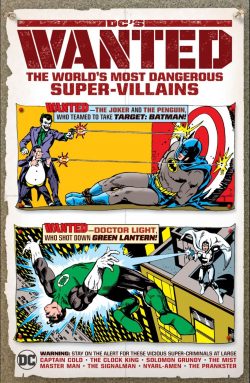
The All-New Batman: The Brave and the Bold volume 1


By Sholly Fisch, Rick Burchett, Dan Davis & various (DC Comics)
ISBN: 978-1-4012-3272-6 (TPB)

The Brave and the Bold premiered in 1955 as an anthology adventure comic featuring short complete tales about a variety of period heroes: a format reflecting the era’s filmic fascination with flamboyantly fanciful historical dramas. Devised and written by Bob Kanigher, issue #1 led with Roman epic Golden Gladiator, medieval mystery-man The Silent Knight and Joe Kubert’s Viking Prince. Soon the Gladiator was alternated with Robin Hood, but the adventure theme carried the title until the end of the decade when the burgeoning costumed character revival saw B&B transform into a try-out vehicle like Showcase.

Used to premiere concepts and characters such as Task Force X: The Suicide Squad, Cave Carson, Hawkman and Strange Sports Stories as well as the epochal Justice League of America, the comic soldiered on until issue #50 when it found another innovative new direction which once again caught the public’s imagination.

That issue paired two superheroes – Green Arrow and Martian Manhunter – in a one-off team-up, and was followed by more of the same: Aquaman and Hawkman in #51, WWII “Battle Stars” Sgt. Rock, Captain Cloud, Mme. Marie & the Haunted Tank in #52 and The Atom & Flash in #53.

The next instant union – Robin, Aqualad and Kid Flash – evolved into Teen Titans and after Metal Men/the Atom and Flash/Martian Manhunter appeared, a new hero debuted in #57-58: Metamorpho, the Element Man.

From then it was back to the increasingly popular superhero pairings with #59. Although no one realised it at the time, that particular conjunction – Batman with Green Lantern – would be particularly significant….

A return engagement for the Teen Titans, issues spotlighting Earth-Two stalwarts Starman and Black Canary and Earth-One’s Wonder Woman and Supergirl soon gave way to an indication of things to come when Batman returned to duel hero/villain Eclipso in #64: an early acknowledgement of the brewing TV-induced mania mere months away.

Within two issues (following Flash/Doom Patrol and Metamorpho/Metal Men), B&B #67 saw the Caped Crusader take de facto control of the title and a lion’s share of team-ups. With the late exception of #72 and 73 (Spectre/Flash and Aquaman/Atom), the title was henceforth a place where the Gotham Gangbuster invited the rest of DC’s heroic pantheon to come and play…

Decades later, Batman: The Animated Series – masterminded by Bruce Timm and Paul Dini in the 1990s – revolutionised the Dark Knight and subsequently led to some of the absolute best comic book adventures in his 80-year publishing history. It also led to a spin-off print title…

With constant funnybook iterations and tie-ins to a succession of TV animation series, Batman has remained immensely popular and a sublime introducer of kids to the magical world of the printed page. One fun-filled incarnation was Batman: The Brave and the Bold, which gloriously celebrated the team up in both its all-ages small-screen and comicbook spin-off.

Shamelessly and superbly plundering decades of continuity arcana in a profusion of alliances between the Dark Knight and DC’s lesser creations, the show was supplemented by a cool kid’s periodical full of fun, verve and swashbuckling dash, cunningly crafted to appeal as much to the parents and grandparents as those fresh-faced neophyte kids…

This stellar trade paperback and digital collection re-presents issues #1-6 of the second series – The All-New Batman: The Brave and the Bold – in an immensely entertaining all-ages ensemble suitable for newcomers, fans and aficionados of all ages. It was originally released between January and June 2011. Although absolutely unnecessary to the reader’s enjoyment, a passing familiarity with the TV episodes will enhance the overall experience as will knowledge of the bizarre minutiae of 1960s and 1970s DC lore…

Crafted by Sholly Fisch, Rich Burchett & Dan Davis and following the format of the TV show, each tale opens with a brief vignette/prequel adventure before telling a longer tale. TA-NB:TB&TB (last time I’m typing that!) #1 sees the Caped Crimebuster battle Joker robots  beside Black Canary before main feature ‘Bottle of the Planets’ reunites him the “World’s Finest” partner in a devious mystery set in the last outpost of Krypton: the Bottled City of Kandor…

Having successfully solved the case of vanishing super-weapons, Batman teams with talking tiger Mr. Tawky-Tawny, magical (Captain) Marvel Shazam and his gods-powered family to save Christmas in ‘That Holiday Feeling’. That involves finding, fighting and foiling the emotion-bending Psycho-Pirate whilst #3 sees Flash (two, actually) and the Dark Knight hunting Mirror Master and the Mad Hatter through a mirror dimension inhabited by all the characters from Lewis Carroll’s books. Curiouser and curiouser …

Wonder Woman headlines in #4 as irate godling Eros seeks to teach her a lesson by using his arrows to instigate a wedding in ‘The Bride and the Bold’. The ceremony between Bat and Amazon sparks a lot of interest and – thanks to jealous Talia Al Ghul – a wave of super-villain attacks and the biggest wedding party brawl of all time before order and sense are restored…

‘Man-Hunted’ find Batman and Emerald jerk Guy Gardner fractiously allied to defeat a legion of the killer robots, but diverted to other realms to save a glorious enclave of nigh-forgotten 1960s alien beasts and sidekicks like Cryll and Zook(look them up, I double-dog dare ya…) from manic main man Lobo…

Ending this excellent excursion through DC’s daftest corridors is a beguiling contest between the Dark Knight Detective and Martian Manhunter J’onn J’onzz who tests his abilities against classic observation and deduction in ‘Now You see Me…’; sadly the salutary learning experience goes slightly awry when the calamitous Clayface is accidentally exposed…

Despite being ostensibly aimed at TV-addicted kids, these mini-sagas are wonderful, traditional comics thrillers no self-respecting fun-fan should miss: accessible, splendidly rendered yarns for the broadest range of excitement-seeking readers. This is a fabulous rollercoaster ride confirming the now-seamless link between animated features and comic books. After all, it’s just adventure entertainment in the end; really unmissable entertainment…

What more do you need to know?
© 2010, 2011 DC Comics. All Rights Reserved.