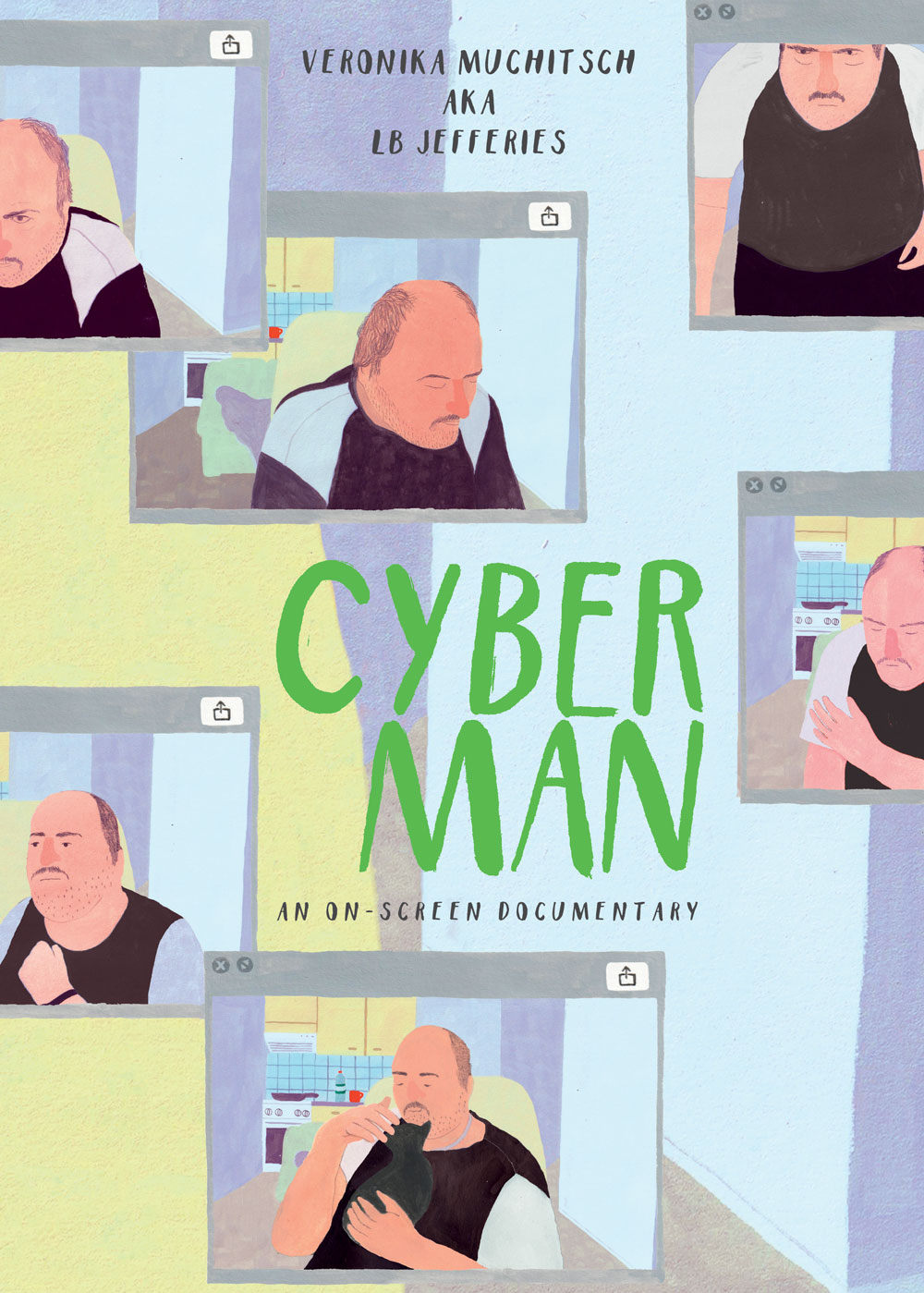
Cyberman – An On-Screen Documentary


By Veronika Muchitsch AKA L.B. Jeffries (Myriad Editions)
ISBN: 978-1-8383860-2-3 (TPB) eISBN: 978-1-8383860-3-0

In modern society somebody is always watching. Are we unconscious – often unwilling – objects of voyeurism or participants in an increasingly intrusive overwatch?

Although daubing marks on a surface is possibly our oldest art form, the potential to ask questions, make stories and simply communicate via that primal process remains infinitely adaptable to modern technologies and as powerful as it ever was in exploring the unchanging basics of the human condition.

Narrative plus image – and the interactions such conjunctions can adapt to and embrace – underpin all of our communal existence and form the primary source for how we view our distant forbears. When employed by an incisive, sensitive, uncompromising agent and interlocutor such as Veronika Muchitsch, the road from “seen” to “created” can also shed light on the furthest fringes of human behaviour.

Veronika Muchitsch is an Austrian artist who distinguished herself at Falmouth University before settling here. In recent years she began participating in a uniquely modern phenomenon. Entire countries away, fifty-something Finnish man Ari Kivikangas was live-streaming his entire existence, 24 hours a day without pause or let up. Drawn in, Veronika began regularly watching him inhabit his simple flat, sleeping, eating, playing his music and occasionally interacting with the observers tuned in to Cyberman.tv.

Entranced, Muchitsch – while becoming increasingly concerned about her own unchecked voyeurism – began painting the images on her screen, fascinated by the bland yet ominous existence unfolding with staggering constancy and endured with brutally frank, ferocious honesty every moment of every day. Ari was poor, ill, isolated and solitary and hungered for fame and validation: a shut-in managing life by his own rules. He accepted potential intrusion, condemnation and actual abuse from the inevitable inescapable trolls infesting social media with staunch bluntness and just carried on streaming.

The compulsive viewing led to Muchitsch reassessing her own views and first impressions. Over the course of a year, she surrendered anonymity and neutrality: becoming one of the people interacting with Ari – even getting his exultant approval to make him famous in one more modern medium…

She initially adopted the username L.B. Jeffries to interact with Ari, as compulsive observation evolved into a project based on parallels she recognised between her own actions and responses and the role played by Jimmy Stewart in classic Alfred Hitchcock thriller Rear Window.

The result is a stunning pictorial re-evaluation of modern life, interactions and relationships at the overlap of physical life and virtual existence – which can apparently be far more mundane than our “real” thing…

The story unfolds as a parade of singular images lovingly painted: captured moments that fall almost unbidden into a narrative. How much of that is calculated, curated direction and how much of the story comes from the reader looking at the pictures of the live stream of a stranger’s life? Only you can decide…
© Veronika Muchitsch 2021.

Cyberman – An On-Screen Documentary is scheduled for UK release May 26th 2022 and is available for pre-order now.

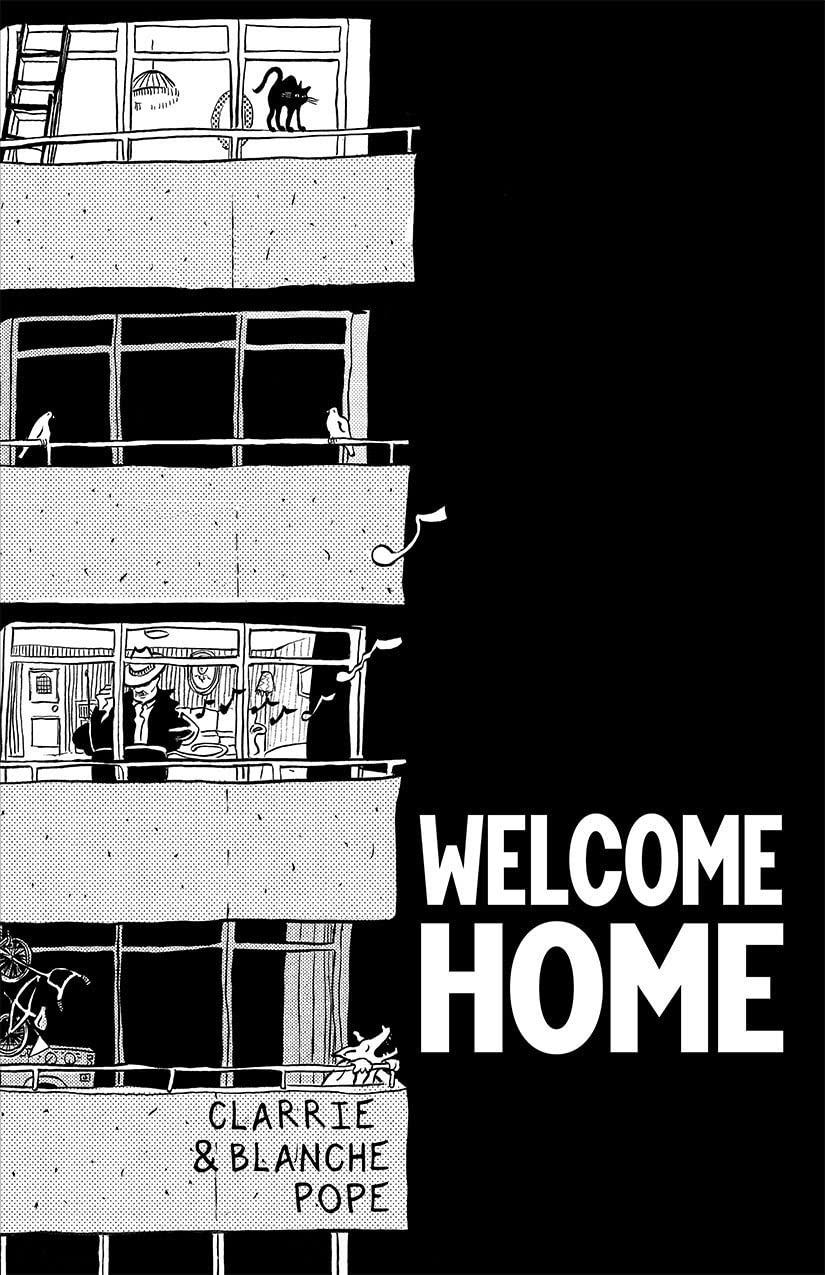
Welcome Home


By Clarrie & Blanche Pope (Minor Compositions) 
ISBN: 978-1-57027-394-0 (PB)  

Comics are cheap and primal: easy to create, disseminate and understand. That’s why (after music) they are the most subversive and effective form of revolutionary art. To see what I mean just check out straightforward polemical texts such as The Adventures of Tintin: Breaking Free, Fight the Power, Speechless, Wildcat Anarchist Comics, Willie & Joe: Back Home, or subtler cartoon sagas that couch their message in terms of an ostensible entertainment narrative like Brought to Light, Puma Blues, The Stringer, or Pogo. Welcome Home fits comfortably into the latter category, as creators Clarrie & Blanche Pope concoct a contemporary soap opera cast to carry their observations about the way society is heading and the disturbing questions that path leaves unaddressed and unanswered. Like most of that noteworthy list cited above, the sisters drew from and referenced personal experience whilst cunningly employing humour and pathos to hone their scalpel-like investigations: trusting to the familiarity of shared context to make their point. 

Haven’t you wondered what and who occupied your space before you did? Don’t you dread the fading of your memories and the loss of the places that punctuated your time on earth? And who hasn’t had a mate or relative who was more Trouble than Worth? 

Having both been young, squatters and care home workers, the creators weave a rowdily rousing, frighteningly authentic yet engagingly upbeat yarn of activism riding piggyback on modern need and ingrained privation that begins when a disparate band of acquaintances and old friends break into an empty flat. 

The place is in a tower block that has been condemned, where tenant families wait powerlessly for rehoming and the building’s demolition. The squatters range from die-hard believers in a cause to friends and lovers who can’t afford rent, united in a mission to rouse the entire block and organize resistance to the destruction of homes and a community that only needs a little financial care and attention. 

Sadly, before the final page comes, romance, passion (so NOT the same thing), ambition, confusion and the distractions of everyday life are going to play hob with their good intentions and grand dreams… 

The story is told primarily through the actions of Rain, a professional care worker who can’t make ends meet despite being worked to death with compulsory extra shifts at the Fairview home that was built as part of the original housing estate. Its post-privatisation owners Who Care and on-site manager Julie are positively Dickensian in their blindly self-indulgent hypocrisy, but at least by talking to residents like dementia-afflicted Dottie/Doris – whose vacant flat they now illicitly occupy – Rain gradually builds up a potent picture of the generational community the imminent demolition will finally end. 

Ultimately, the young/old bond will also allow the fraught and confused protagonist to sort out her own feelings and stop looking for love in all the wrong places… 

Shortlisted for the Myriad First Graphic Novel Prize, this bleak yet beguiling monochrome study of urban dissolution societal safety nets, relationship triangles, generational cultural continuity, dementia and the disempowerment of the old, young, different, nonconformist and poor is peppered with ferociously barbed faux ads drenched in the contemporary Thought Speak used by Local Councils, Cabinet Ministers, social engineers and gentrifying property companies who constantly find nonsensically bland and comforting ways to restate “you’re the wrong colour, too poor, and love the wrong sort to live here anymore” 

Welcome Home is an enticingly introspective and painfully universal saga that should appeal to anyone who ever had a moment of monetary despair and emotional outrage at what we’ve allowed ourselves to become. It will not appeal at all to many of the societal predators listed at the end of the last paragraph, but they should be made to read to too. Or maybe hit with it: It’s a free country, after all, if you’re prepared to accept the consequences of your actions… 

© Clarrie & Blanche Pope, 2022.

A Love for the Ages


By Florence Cestac & Daniel Pennac translated by Edward Gauvin (Europe Comics )
No ISBN: 978-1-910395-63-9 (digital edition)

A writer and an artist go into a restaurant. They make comics for a living, but tonight the talk is of love. Before long, the entire place is involved in the conversation. No, not conversation, Story. Any relationship that has, is or may develop is irrelevant here. The writer is talking about years ago when an impressionable waif encountered and observed the most incredible romance and was forever after beguiled…

Now it’s time to immortalise the affair through words and pictures, and like that keenly observed life of domestic paradise, it must be perfect…

Memories flow, snippets are recalled and a story within a story unfolds and gels. Years back, before the Riviera reinvented itself as a haunt of international snobs and wastrels, inland from Nice in rural La-colle-sur-loup, old folks congregated in picturesque village enclaves and  grandparents got stuck with the youngsters in summer.

Bored and watchful, our kid and his local pals’ best chance of amusement was watching Jean and Germaine Bozignac: she, a delightfully feisty and affably bubbly sharing soul, and he, a hideously ugly yet startlingly charismatic and charming rogue. By all lights, Jean should have been a blight on the community: a cheating cardsharp who never worked after being cut off and disowned from his aristocratic wine-growing family. Yet somehow, the disgraced Marquis was adored by most and accepted by all.

Jean and Germaine were inseparable and lived by, with and through books, and on the day the little the writer-to-be learned that the cashiered lord’s reduced circumstances stemmed solely from his refusing to give up house servant Germaine, the passionate child’s future was set. This was what Love Should and Must be…

Expansive yet grounded, witty, compelling and outrageously funny in all the right ways, A Love for the Ages is the kind of tale our continental cousins excel at: light, fluffy, hilarious yet packed with heartbreaking moments and lined with hidden steel to hit hard when you least expect it.

Only available in English digitally at present, this is what it means to be in love all your life – and trust me I know whereof I speak: my good lady wife has put up with me for nearly 33 years and all I’ve ever had are flesh wounds, contusions and minor bouts of food poisoning. If that’s not proof of a love divine, then what is?
© 2015 DARGAUD – Cestac & Pennac. All rights reserved

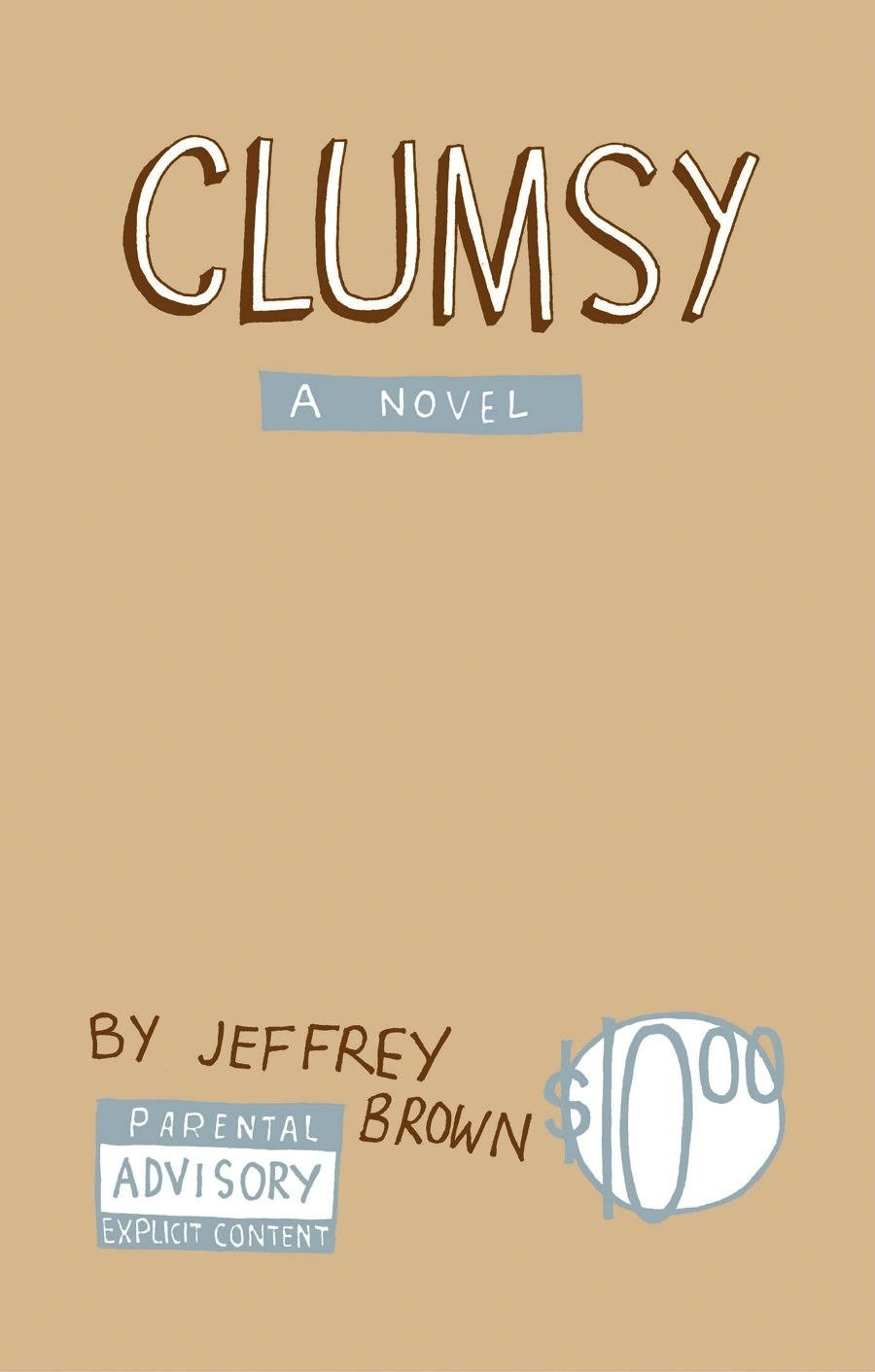
Clumsy


By Jeffrey Brown (Top Shelf Productions)
ISBN: 978-0-97135-976-5 (TPB/Digital edition)

If you’re a fan of Jeffrey Brown’s cartoon exploits you might understandably admit to a small degree of confusion. In 2012 he scored his first global best-seller with a hilarious spin on the soft and nurturing side of the Jedi experience in Darth Vader and Son, following up with equally charming and hilarious sequels Vader’s Little Princess, Star Wars: Jedi Academy and others. You’ll probably adore his latest treats – the Lucy & Andy Neanderthal series…

Before that, Jeffrey Brown was the sparkling wit who had crafted slyly satirical all-ages funny stuff for The Simpson’s Treehouse of Horror, Marvel’s Strange Tales and Incredible Change-Bots and similar visual venues.

The original is yet another Jeffrey Brown: instigator and frequent star and stooge of such quirkily irresistible autobiographical Indy comics classics as Bighead, A Matter of Life, Little Things, Funny, Misshapen Body,Undeleted Scenes and the 4-volume “Girlfriend Trilogy” – Unlikely, AEIOU and Every Girl is the End of the World For Me and opening shot Clumsy, …

Whichever Brown’s your preferred choice, he’s a cartoonist of rare insight and unflinching revelation who still makes you laugh out loud when not prompting you to offer a big consoling hug…

Brown was raised in Michigan but relocated to Chicago in 2000 to attend the School of the Arts Institute. He studied painting but before graduating switched to drawing comics. Clumsy was released in 2002, quickly becoming a surprise hit with fans and critics alike.

The material is both delicious and agonising in its forthright simplicity: a sequence of non-chronological pictorial snippets and vignettes detailing in no particular order how a meek, frumpy, horny, inoffensively charming art-school boy meets a girl and tries to carry out a long-distance relationship.

Every kid who’s gone to college, got a job or joined the services has been through this, and for every romance that makes it, there a million that don’t.

Drawn in a deceptively Primitivist style with masterful staging, a sublime economy of phrase plus a breathtaking gift for generating in equal amounts belly-laughs and those poignant lump-in-throat moments we’ve all experienced and forever-after regretted, this is a skilful succession of stolen moments which establish one awful truth.

We’ve all been there, done that and then hoarded those damned photos we can’t even look at any more…

With titles like ‘My Last Night with Kristyn’, ‘Don’t Touch Me’, ‘I Draw her Naked’, ‘I Farted’, ‘But I Want to Make Love’ and ‘You Can Ask Me’, a mosaic of universal joy and despair forms as we watch Jeff and Theresa meet, blossom, exult, dream, plan and part…

Packed with hearty joyous wonder and brimming with hilarious examples of that continual and seemingly tireless teen-lust us oldsters can barely remember now, let alone understand, Clumsy is a magical delight for anybody safely out of their Romeo & Juliet years and a lovely examination of what makes us human, hopeful and perhaps wistfully incorrigible…
© 2002 Jeffrey Brown.

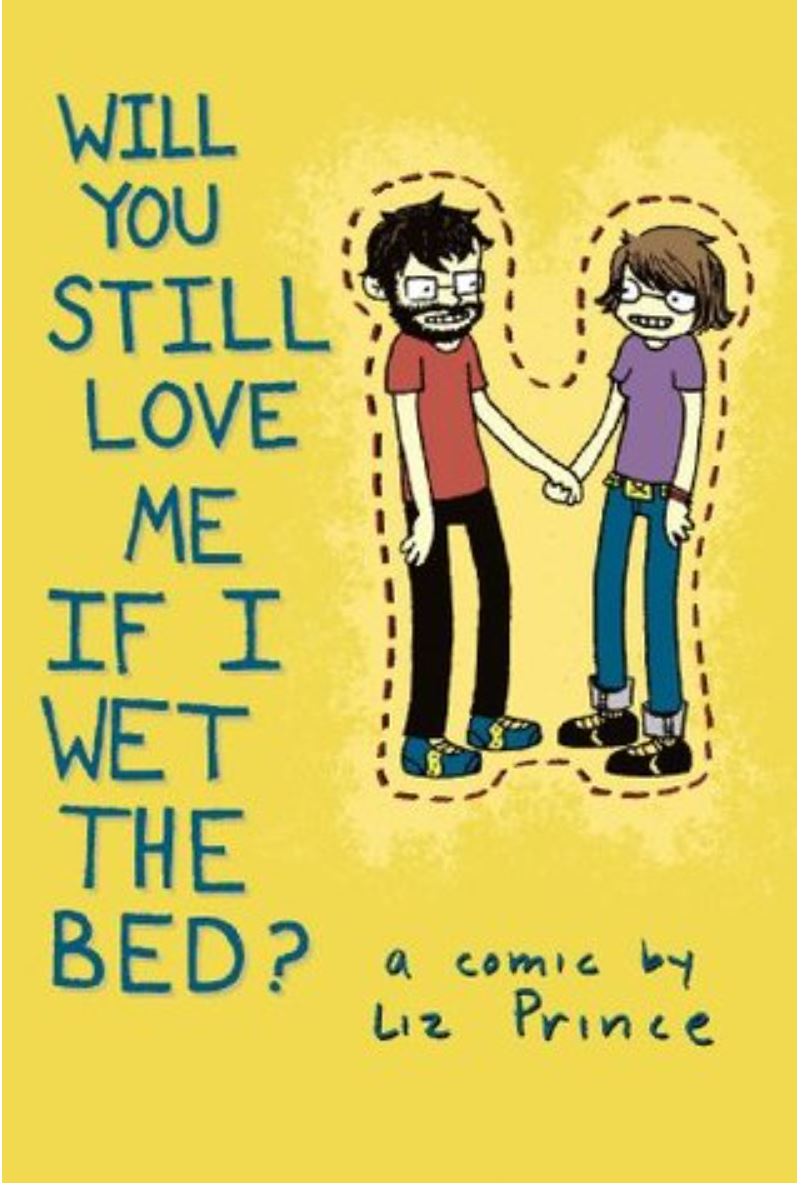
Will You Still Love Me If I Wet the Bed?


By Liz Prince (Top Shelf Productions)
ISBN: 978-1-89183-072-3 (PB/Digital edition)

There’s an irrepressible rumour going about that Love makes the World Go Round. My grasp of physics isn’t strong enough to confirm or deny the hypothesis but I have read enough comics in my time to spot a magical and unmissable celebration of the all-consuming emotion when I see one.

Liz Prince originally hailed from Sante Fe, New Mexico before upping sticks and heading across county in an Eastward direction to attend the School of the Museum of Fine Arts in Boston (Massachusetts, not Lincolnshire).

She is a cartoonist – one of many – who thankfully opted to create a visual journal of her life and saw that one subject kept monopolising her attention. She is also an inspired raconteur who knows how to spin a graphic yarn in adroitly truncated form. Thus, this slim collection which gathers a whole bunch of sublimely intimate, hilariously real moments spent with and apart from her equally fascinating man Kevin and the awesome force which is their cat Science.

Contained in this marvellous monochrome paperback posy are vignettes exploring the giddy silliness of fresh physicality, quirkily adorable breaking of bathroom taboos, the agony and relief of momentary solitude, incidents of intimate accommodation and lots of lovely eternal challenges that test every couple… especially the often bloody traumas of explaining to the incumbent household pet that they are not necessarily “Number One” any more…

Fronted by a suitably droll but downbeat pictorial Introduction ‘On Liz Prince’ by legendary lovelorn doodler Jeffrey Brown, Will You Still Love Me If I Wet the Bed? is thankfully still available – and instantly so if you opt for a downloadable versions (Kindle, Comixology etc.), or preferably direct from Top Shelf Productions – so if you want to share some romantic fellow feeling or just need to see that there’s still hope for all the lonely hearts, this a graphic gem you should promptly treat yourself to.
© & ™ Liz Prince 2005. All rights reserved.

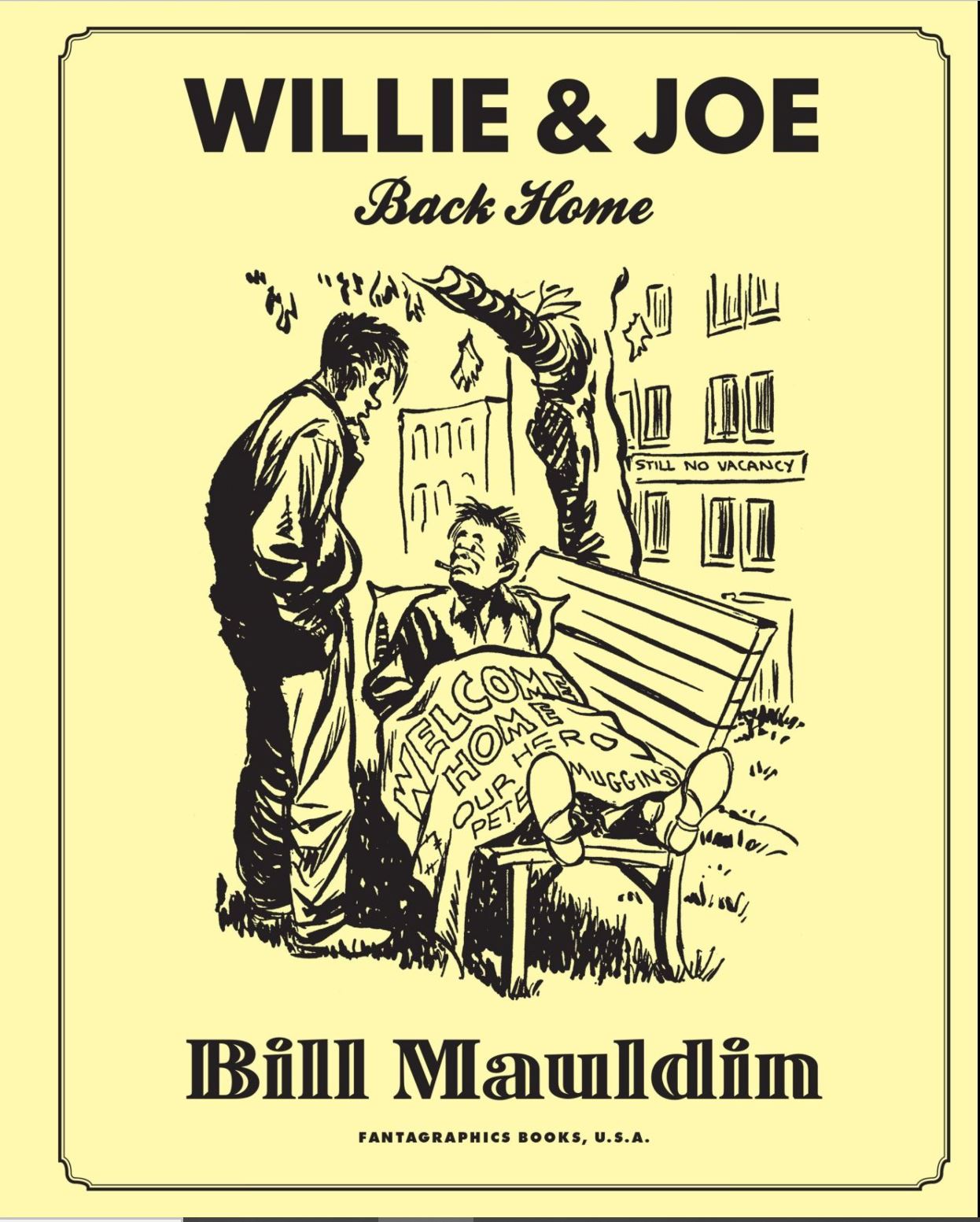
Willie & Joe: Back Home


By Bill Mauldin (Fantagraphics Books)
ISBN: 978-1-60699-351-4 (HB)

Throughout World War II William Henry “Bill” Mauldin fought “Over There” with the United States Infantry whilst producing cartoons about the fighting men and for the fighting men. He told as much of the real nature of the war as his censors and common sense would allow and became an unwilling international celebrity as much because of his unshakable honesty as his incredible artistic talents.

He was incontrovertibly “one of the guys” and American soldiers and civilians loved him for it. During his time in the service he produced cartoons for the folks back home and intimately effective, authentic and quirkily morale-boosting material for military publications 45th Division News, Yank and Stars and Stripes.

They mostly featured two slovenly “dogfaces” – a term he made his own and introduced to the world at large – giving a trenchant and acerbically enduring view of the war from the point of view of the poor sods ducking bullets in muddy foxholes and surviving shelling in the ruins of Europe.

Willie and Joe, to the dismay of much of the Army Establishment, gave an honest overview of America’s ground war. In 1945, a collection of his drawings – accompanied by a powerfully understated and heartfelt documentary essay – was published by Henry Holt and Co.

Up Front was a sensation, telling the American public about the experiences of their sons, brothers, fathers and husbands in a way no historian would or did. A biography, Back Home, followed in 1947.

Willie even made the cover of Time Magazine in 1945, when 23 year old Mauldin won his first Pulitzer Prize. Like so many other returning soldiers, however, Mauldin’s hard-won Better Tomorrow didn’t live up to its promise…

Mauldin’s anti-war, anti-Idiots-in-Charge, anti-bigot views never changed, but found simply new targets at home. However, during the earliest days of the Cold War and despite being a bone fide War Hero, Mauldin’s politically strident cartoons fell ever more out of step with the New America: a place where political expediency allowed racists to resume repressing ethnic sections of the nation now that their blood and sweat were no longer needed to defeat the Axis.

This new America expected women to surrender their war-time freedoms and become again servants and consumers and baby machines: happy to cook suppers in return for the new labour-saving consumer goods America now needed to sell, sell, sell. This nation was far too eager to forget the actual war and genuine soldiers in favour of massaged messages and conformist, inspirational paper or celluloid heroes.

The New America certainly didn’t want anybody rocking their shiny new boat…

When Sergeant Bill Mauldin mustered out in 1945, he was notionally on top of the world: a celebrity hero, youngest Pulitzer Prize winner in history, with a lucrative 3-year syndicated newspaper contract and Hollywood clamouring for him.

Unfortunately for him, Mauldin was as dedicated to his ideals as to his art. As soon as he became aware of the iniquities of the post-war world, he went after them. Using his newspaper tenancy as a soapbox, Mauldin attacked in bitterly brilliant barrages the maltreatment and side-lining of actual combat veterans. During the country’s entire involvement in WWII, less than 10% of military men actually fought, or even left their home country, whilst rear-echelon brass seemed to increasingly reap the benefits and unearned glory of the peace.

Ordinary enlisted men and veterans were culture-shocked, traumatised, out of place and resented by the public, who blamed them disproportionately for the shortages and “suffering” they had endured. Black and Japanese Americans were reduced to second class citizens (again, for most of them) and America’s erstwhile allies were pilloried, exploited and demonised, whilst everywhere politicians and demagogues were rewriting recent history for their own advantage…

Mauldin’s fondest wish had been to kill the iconic dogfaces off on the final day of World War II, but Stars and Stripesvetoed it, and the demobbed survivors moved into a world that had changed incomprehensibly in their absence…

Always ready for a fight, Mauldin’s peacetime Willie and Joe became a noose around the syndicate’s neck as the cartoonist’s acerbic, polemical and decidedly non-anodyne observations perpetually highlighted iniquities and stupidities inflicted on returning servicemen and attacked self-aggrandising politicians. He advocated such socialist horrors as free speech, civil rights and unionisation, affordable public housing and universal medical care for everybody – no matter what their colour, gender or religion. The crazy cartoonist even declared war on the Ku Klux Klan, American Legion and red-baiting House UnAmerican Activities Commission: nobody was too big. When the Soviet Union and United Nations betrayed their own ideological principles, Mauldin went after them too…

An honest broker, he had tried to quit early, but the syndicate held him to his contract so, trapped in a situation that increasingly stifled his creative urges and muzzled his liberal/libertarian sensibilities, he refused to toe the line and his cartoons were incessantly altered and reworked.

During six years of War service his cartoon had been censored three times; now the white paint and scissors were employed by rewrite boys almost daily…

The movie Up Front – which Mauldin wanted to reflect the true experience of the war – languished unmade for six years until a sappy, flimsy comedy bearing the name was released in 1951. The intended screenplay – by Mauldin, John Lardner and Ring Lardner Jr. – vanished: deemed utterly unsuitable and unfilmable …until much of its tone reappeared in Lardner Jr.’s 1970 screenplay M*A*S*H…

As the syndicate bled clients – mostly in segregationist states – and contemplated terminating his contract, Mauldin began simultaneously working for the New York Herald-Tribune. With a new liberal outlet. His tactics changed in the Willie and Joe feature: becoming more subtle and less bombastic. He still picked up the best of enemies, however, adding J. Edgar Hoover and the FBI to the roster of declaimers and decriers…

When his contract finally ended in 1948, neither side wanted to renew. Mauldin left the business to become a journalist, freelance writer and illustrator. He was a film actor for a time (appearing in Red Badge of Courage with Audie Murphy, among other movies); a war correspondent during the Korean Conflict and an unsuccessful candidate for Congress in 1956.

He only finally returned to newspaper cartooning in 1958 in a far different world: working for the St. Louis Post-Dispatch before moving to the Chicago Sun-Times, winning another Pulitzer and a Reuben Award for his political cartoons

He retired in 1991 after a long, glittering and properly-appreciated career. He only drew Willie and Joe four times in that entire period (for an article on the “New Army” in Life magazine; for the funerals of “Soldier’s Generals” Omar Bradley and George C. Marshall and to eulogize Milton Caniff).

Also available digitally, this magnificent hardback companion volume to Willie and Joe: the WWII Years covers the period of work from July 31st 1945 to 31st December 1948, supplemented by a brilliant biographical introduction from Todd DePastino: a superb black-&-white compendium collecting the bittersweet return of the forgotten heroes as they faced confusion, exclusion, contention and disillusion, but always with the edgy, stoic humour under fire that was Mauldin’s stock in trade.

Moreover, it features some of the most powerful assaults on the appalling edifice of post-war America ever seen. The artist’s castigating observations on how a society treats returning soldiers are more pertinent now than they ever were; the pressures on families and children even more so; whilst his exposure of armchair strategists, politicians and businessmen seeking to exploit wars for gain and how quickly allies can become enemies are tragically more relevant than any rational person could wish.

Alternating trenchant cynicism, moral outrage, gallows humour, sanguine observation and uncomprehending betrayal, this cartoon chronicle is an astounding personal testament that shows the powers of cartoons to convey emotion if not sway opinion.

In Willie & Joe: Back Home we have here a magnificent example of passion and creativity used as a weapon of social change and a work of art every citizen should be exposed to, because these are aspects of humanity that we seem unable to outgrow…
This edition © 2011 Fantagraphics Books. Cartoons © 2011 the Estate of William Mauldin. All right reserved.

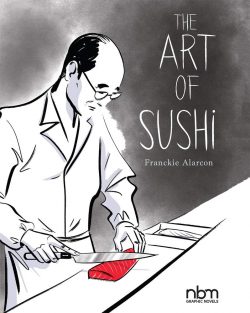
The Art of Sushi


By Franckie Alarcon, translated by Peter Russella (NBM)
ISBN: 978-1-68112-285-4 (HB) eISBN: 978-1-68112-86-1

Win’s Christmas Gift Recommendation: Sensational Sagacity for All Seasonings… 9/10

Usually this bit is about sex or swearing, but I’m issuing my first ever culinary advisory here.

If you are vegan, squeamish or simply care about fish and other animals and are likely to be upset by graphic depictions of the preparation of really cool creatures like octopi or eels, do not buy this book. It’s really not your thing.

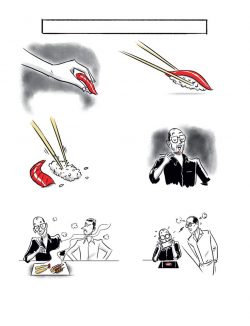
Once more confirming that there’s nothing you can’t craft compelling comics about if you’re talented and inspired, here’s a gripping graphic testament to the art, philosophy and mindset of Japan’s most misunderstood culinary export.

First seen as L’Art du Sushi in 2019, and courtesy of ever-inquisitive, fantastically convivial cartoonist-foodie Franckie Alarcon, The Art of Sushi follows the artist and close associates on a fact-finding tour of Japan. Their mission is in response to the recent phenomenon of France falling madly in love with the oriental art of food, and subsequent seeking to mimic and master its traditions and pure quality; whilst making it just a little bit theirs, too…

After a cheery introduction, scene-setting, history and visual précis to the discipline’s antecedents and nine basic forms, “Bibi” Alarcon, girlfriend Marilyne, Editor David and photographer Chloe join translator/guide Rica in Tokyo to track down a revered Master, one who is also a three-starred Michelin chef…

As well as fascinating insights into the philosophy, personal beliefs and techniques of 50-year veteran craftsman Hachiro Mizutani, the researchers taste marvels and come to understand the importance of sourcing the components. ‘Mizutani: Traditional Sushi’ catalogues dishes and how they’re constructed before following him to legendary Tsukiji Market to test the daily catch in still-living splendour before detailing how they are prepared… and why. The lesson includes eye-watering comparisons with the practices of Brittany fishermen….

Sidebars include the parlous state of the oceans and fish stocks, how to make rice and a beguiling history of knife-making.

As seen in ‘Maguro bocho and Oroshi bocho’, the nation’s metallurgical artisans used to make swords, but now craft far more dangerous implements…

After reinforcing our presentiments with tastes of old Japan, the tourists explore the rush of the contemporary city with a brilliant young chef making all the right waves in ‘Okada: Modern Sushi’. Prior to that, they headed into the country to visit with Rica’s family and spent time on fishing boats.

The pride of their catch comes with them to Okada’s city restaurant for a display of his innovative virtuosity and is supplemented by lessons in consuming the beverages that are an integral part of Sushi appreciation; the history of rice; aesthetics of presentation, more blade techniques for preparing various sea creatures and useful information in spotting and dealing with the assorted parasites that infest uncooked food…

One of the most compelling asides concerns the best shape and materials of bowls, plates, cups and other tableware, which diverts into a visit to a ceramicist providing such containers to the trade…

Every visit results in a fresh eating experience and freebies to take home, but after leaving Okada’s place the team go to Mito in Ibaraki Prefecture to learn all about rice wines and ‘The Stages of making Sake’: for many the most important component in ceremonial Sushi consumption…

Once done examining old and new at the high end, our intrepid voyagers tackle the working world of ‘Everyday Sushi’ in modern Japan. Beginning with a day aboard an eel fishing boat, learning cunning tricks to keep the catch alive until ready to eat, the Europeans later enjoy a home-prepared feast courtesy of Mrs. Tanemura – who runs an eatery out of her house – and discover the hard truths about Nori (seaweed wraps/mats) from her other guests…

The trip concludes with a mind-blowing visit to a soy sauce brewery before the city offers Sushi in fast food and convenience store mode before the exhausted well-stuffed visitors go home to reassess the state of ‘Sushi in France’ with now-learnèd eyes and taste buds.

Apparently, the biggest challenge is adapting to a far smaller range of truly fresh and seasonal ingredients in a largely land-locked country, but as star chefs Takuya Watanabe – in between revealing how to grow authentic wasabi in European soil – and Yannick Alléno point out, Gastronomy and Sushi are about technique. It works with vegan or even mammal-meat ingredients. There are even chocolate desserts available for the bold and truly discerning…

Closing out a truly revelatory reading experience comes a selection of ‘Recipes’ comprising ‘Rica’s Chirashi’ with either tuna, eel or avocado as main ingredient; ‘Okada’s Green Tea Octopus’, ‘Mrs. Okada’s Temari’ (a selection including meat- and fish-free options) and ‘Sasa Sushi’ (mackerel), plus an accompanying cocktail: ‘The Sake Mojito’

Also adding value is an ‘Address Book’ of recommended restaurants in Japan and France, and physical stores and online sources for ingredients, utensils and travel advice.

The art of food and pleasures of eating have never been better appreciated or shared than in books like these, blending the exoticism of travel with the tantalising yet satisfying anticipation of gustatory consumption. The Art of Sushi is simply delightful: an inviting comics divertissement that must surely whet the appetite for more…
© Editions Delcourt 2019. © 2021 NBM for the English translation.

The Art of Sushi will be released on December 14th 2021 and is available for pre-order now. For more information and other great reads see http://www.nbmpub.com/

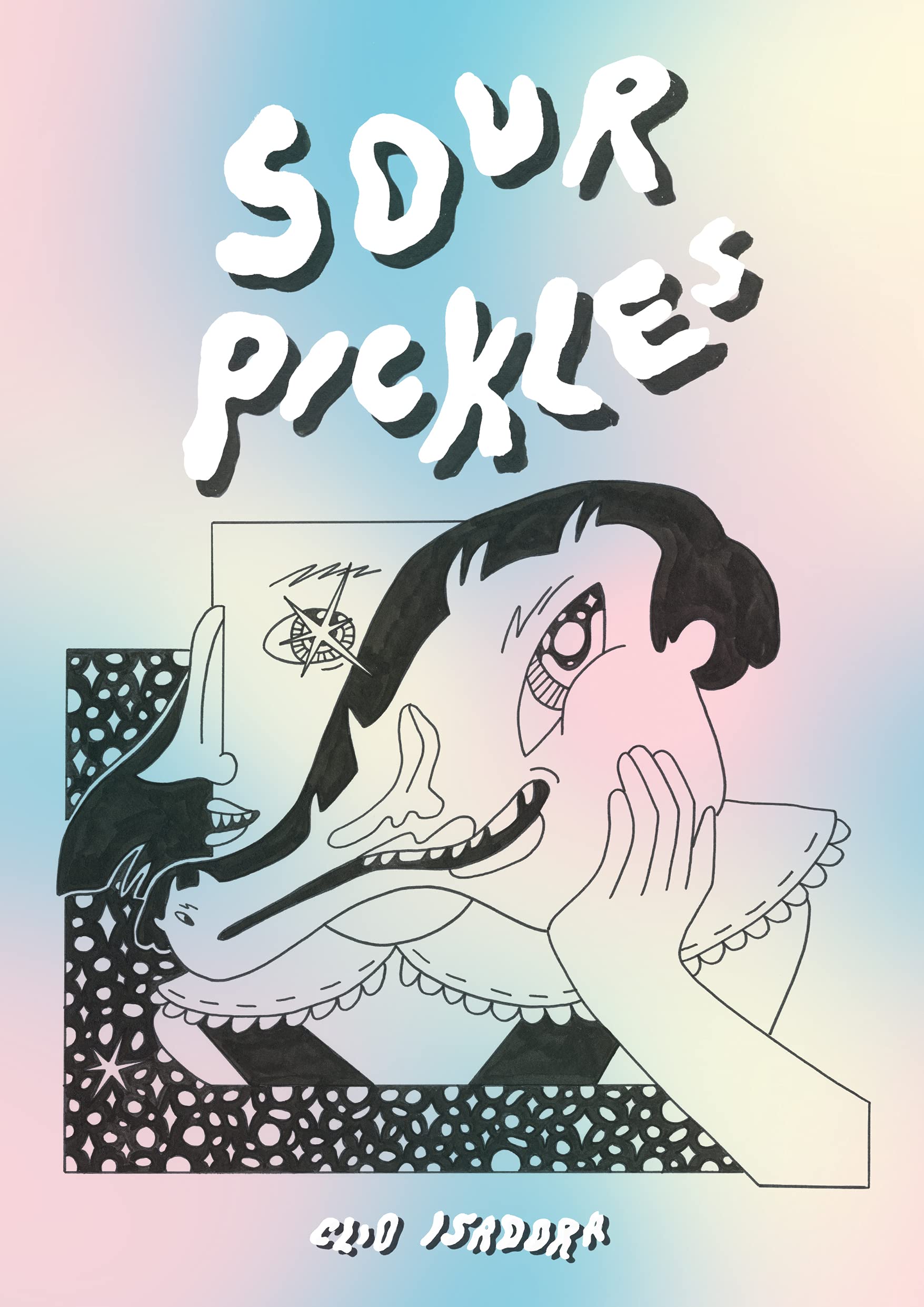
Sour Pickles


By Clio Isadora (Avery Hill Publishing)
ISBN: 978-1-910395-63-9 (TPB)
Win’s Christmas Gift Recommendation: A Peep at How the Other Half Works… 8/10

There are countless reasons to draw and even more to tell stories. For an increasing number of talented folk the primary motivations are curiosity and therapy. When combined with ruthless honesty, creative boldness and a sense of whimsy the results can be instructional for the author, and hugely entertaining for those of us privileged to be coming along for the ride.

Clio Isadora has drawn remorselessly but with sublime care and attention on her rather extraordinary life for her risograph minicomics such as Damp Candy, Soiled Fantasies, Is It Vague in Other Dimensions? and others, and in her first full graphic novel, takes those shared observations to a new level of humour and poignancy by revisiting her final year as a student at prestigious Central St Martins art school.

Like most slice-of-life sagas – no matter how well or judiciously curated – the true joy is in experiencing it unfold, so the précis portion of this review is deliberately meagre…

Pickles Yin doesn’t have the financial resources of her rich, posh, fancy art school classmates. She’s got by so far on talent, drive, hard work, bursaries, frazzled nerves, frantic overreactions and few true friends. Now the final year and big show are looming and beyond that the gaping unknowns of adult life and a career.

Unlike almost everyone else she knows, though, Pickles can’t rely on the buffers and comfort zone of parents, money and connections if she fails. Or even decide on what kind of job she wants if she gets through the year. She’s drowning and floundering and in a panic, when her pal Radish suggests what would help her get by and even the odds is some pharmaceutical enhancement…

Witty, fraught, heartwarming and quite frankly a bit scary – my days in art school in the heyday of Punk were filled with fun, excess, budding pop stars and a complete dearth of career pressure – Sour Pickles is a fabulously wry and subtle examination of mental health, the unexpected legacies of parental prejudices and the crushing pressure of modern living.

Recommended for anybody wondering about the “road not taken”…
© Clio Isadora, 2021

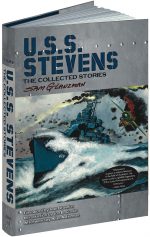
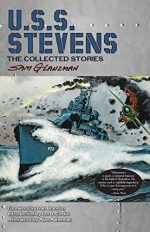
U.S.S. Stevens – The Collected Stories


By Sam Glanzman (Dover Comics & Graphic Novels)
ISBN: 978-0-486-80158-2 (HB)

To the shame and detriment of the entire comics industry, for most of his career Sam Glanzman was one of the least-regarded creators in American comicbooks. Despite having one of the longest careers, most unique illustration styles and the respect of his creative peers, he just never got the public acclaim his work deserved. Thankfully that all changed in recent years and he lived long enough to enjoy the belated spotlight and bask in some well-deserved adulation.

Glanzman drew and wrote comics since the Golden Age, most commonly in classic genres ranging from war to mystery to fantasy, where his work was – as always – raw, powerful, subtly engaging and irresistibly compelling.

On titles such as Kona, Monarch of Monster Island, Voyage to the Deep, Combat, Jungle Tales of Tarzan, Hercules,The Haunted Tank, The Green Berets, The Private War of Willie Schultz, and especially his 1980s graphic novels A Sailor’s Story and Wind, Dreams and Dragons – which you should buy in a single volume from Dover – Glanzman produced magnificent action-adventure tales which fired the imagination and stirred the blood. His stuff always sold and at least won him a legion of fans amongst fellow artists, if not from the small, insular and over-vocal fan-press.

In later years, Glanzman worked with Tim Truman’s 4Winds outfit on high-profile projects like The Lone Ranger, Jonah Hex and barbarian fantasy Attu. Moreover, as the sublime work gathered here attests, he was also one of the earliest pioneers of graphic autobiography; translating personal WWII experiences as a sailor in the Pacific into one of the very best things to come out of DC’s 1970s war comics line…

U.S.S. Stevens, DD479 was a peripatetic filler-feature which bobbed about between Our Army at War, Our Fighting Forces, G.I. Combat, Star Spangled War Stories and other anthological battle books; quietly backing-up the cover-hogging, star-attraction glory-boys. It provided wry, witty, shocking, informative and immensely human vignettes of shipboard life, starring the fictionalised crew of the destroyer Glanzman had served on. It was, in most ways, a love story and tribute to the vessel which had been their only home and refuge under fire.

In 4- or 5-page episodes, the auteur recaptured and shared a kind of comradeship we peace-timers can only imagine and, despite the pulse-pounding drama of the lead features, us fans all knew these little snippets were what really happened when the Boys went “over there”…

A maritime epic to rank with Melville or Forester – and with stunning pictures too – every episode of this astounding unsung masterpiece is housed in one stunning hardback compilation (also available digitally for limp-wristed old coots like me) and if you love the medium of comics, or history, or just a damn fine tale well-told, you must have it…

That’s really all you need to know, but if you’re one of the regular crowd needful of more of my bombastic blather, a much fuller description follows…

As I’ve already stated, Glanzman belatedly enjoyed some earned attention, and this tome opens by sharing Presidential Letters from Barack Obama and George Herbert Walker Bush for his service and achievements. Then follows a Foreword from Ivan Brandon and a copious and informative Introduction by Jon B. Cooke detailing ‘A Sailor’s History: The Life and Art of Sam J. Glanzman’.

Next comes a brace of prototypical treats; the initial comic book appearance of U.S.S. Stevens from Dell Comics’ Combat #16 (April-June 1965) and the valiant vessel’s first cover spot from Combat #24, April 1967.

The first official U.S.S. Stevens, DD479 appeared after Glanzman approached Joe Kubert, who had recently become Group Editor for DC’s war titles. He commissioned ‘Frightened Boys… or Fighting Men’ (appearing in Our Army at War #218, April 1970), depicting a moment in 1942 as boredom and tension are replaced by frantic action when a suicide plane targets the ship…

A semi-regular cast was introduced slowly throughout 1970; fictionalised incarnations of old shipmates including skipper Commander T. A. Rakov, who ominously pondered his Task Force’s dispersal, moments before a pot-luck attack known as ‘The Browning Shot’ (Our Fighting Forces #125, May/June) proved his fears justified…

Glanzman’s pocket-sized tales always delivered a mountain of information, mood and impact and ‘The Idiot!’ (OAaW#220, June) is one of his most effective, detailing in 4 mesmerising pages not only the variety of suicidal flying bombs the Allies faced, but also how appalled American sailors reacted to them.

Sudden death was everywhere. ‘1-2-3’ (OFF #126, July/August) details how quick action and intuitive thinking saves the ship from a hidden gun emplacement whilst ‘Black Smoke’ (Our Army at War #222, from the same month) shows how a know-it-all engineer causes the sinking of the Stevens’ sister-ship by not believing an old salt’s frequent, frantic warnings…

All aboard ship were regularly shaken by the variety of Japanese aircraft and skill of the pilots. ‘Dragonfly’ (OFF #127, September/October) shows exactly why, whilst an insightful glimpse of the enemy’s psychological other-ness is graphically, tragically depicted in the tale of ‘The Kunkō Warrior’ (OAaW #223, September).

A weird encounter with a wooden WWI vessel forces a ‘Double Rescue!’ (Star Spangled War Stories #153, October/November) before OFF #128’s (November/December) ‘How Many Fathoms?’ again counts the human cost of bravery with devastating, understated impact. ‘Buckethead’ (OAaW #225, November) then relates one swabbie’s unique reaction to constant bombardment.

‘Missing: 320 Men!’ (G.I. Combat #145, December 1970-January 1971) debuted Glanzman-avatar Jerry Boyle who whiled away helpless moments during a shattering battle by sketching cartoons of his astonished shipmates. ‘Death of a Ship!’ (OAaW #227, January 1971) then deals with classic war fodder as submarine and ship hunt each other in a deadly duel…

A military maritime mystery was solved by Commander Rakov in ‘Cause and Cure!’ (Our Army at War #230, March) whilst the next issue posed a different conundrum as the ship loses all power and sticks ‘In the Frying Pan!’ (April 1971).

The vignettes were always less about warfare than its effect – immediate or cumulative – on ordinary guys. ‘Buck Taylor, You Can’t Fool Me!’ (OAaW #232) catalogues his increasingly aberrant behaviour but posits some less likely reasons, after which old school hero Bos’n Egloff saves the day during the worst typhoon of the war in ‘Cabbages and Kings’(OFF #131, July/August) whilst ‘Kamikaze’ (OAa #235 August) boldly and provocatively tells a poignant life-story from the point of view of the pilot inside a flying bomb…

An informative peek at the crew of a torpedo launch station in ‘Hip Shot’ (G.I. Combat #150 October/November) segues seamlessly into the dangers of shore leave ‘In Tsingtao’ (OFF #134, November/December) whilst ‘XDD479’ (Our Army at War #238 November) reveals a lost landmark of military history.

The real DD479 was one of three destroyers test-trialling ship-mounted spotter planes. This little gem explains why that experiment was dropped…

Buck pops back in ‘Red Ribbon’ (G.I.C #151 December 1971-January 1972), sharing a personal coping mechanism for making shipboard chores less “exhilarating”, whilst ‘Vela Lavella’ (OAaW #240, January 1972) captures the claustrophobic horror of night time naval engagement before ‘Dreams’ (G.I.C #152 February/March) peeps inside various heads to see what the ship’s company would rather be doing. ‘Batmen’ (OAaW #241, February) uses a lecture on radar to recount one of the most astounding exploits of the war…

Every U.S.S. Stevens episode was packed with fascinating fact and detail, culled from the artist’s letters home and service-time sketchbooks, but those invaluable memento belligeri also served double duty as the basis for a secondary feature.

The debut ‘Sam Glanzman’s War Diary’ appeared in Our Army at War #242 (March 1972): a compendium of pictorial snapshots sharing quieter moments, such as the first passage through the Panama Canal, sleeping arrangements or K.P. duties peeling spuds, and precedes an hilarious record of the freshmen sailors’ endurance of an ancient naval hazing tradition inflicted upon every “pollywog” crossing the equator for the first time in ‘Imperivm Neptivm Regis’ (OFF #136 (March/April 1972).

A second ‘Sam Glanzman’s War Diary’ (OAaW #244, April) reveals the mixed joys of “Liberty in the Philippines” after which a suitably foreboding ‘Prelude’ (Weird War Tales #4 (March/April 1972) captures the passive-panicked tension of daily routine whilst a potentially morale-shattering close shave is shared during an all-too-infrequent ‘Mail Call!’ (G.I. Combat #155, April/May)…

A thoughtful man of keen empathy and insight, Glanzman often offered readers a look at the real victims. ‘What Do They Know About War?’ (OAaW #244, April) sees peasant islanders trying to eke out a living, only to discover far too many similarities between Occupiers and Liberators, whilst the next issue focussed on the sailors’ jangling nerves and stomachs. ‘A Funny Thing Happened on the Way to the War!’ (#245, May) reveals what happened when DD479 was mistakenly declared destroyed and, thanks to an administrative iron curtain, found it impossible to refuel or take on food stores…

Cartoonist Jerry Boyle resurfaced in a ‘Comic Strip’ in OFF #138 (July/August) after which Glanzman produced one of the most powerful social statements in an era of tumultuous change.

Our Army at War #247 (July 1972) featured a tale based on decorated Pearl Harbor hero Doner Miller who saved lives, killed the enemy and won medals, but was not allowed to progress beyond the rank of shipboard domestic because of his skin. ‘Color Me Brave!’ was an excoriating attack on the U.S. Navy’s segregation policies and is as breathtaking and rousing now as it was then…

‘Ride the Baka’ (OAaW #248 August) revisits those constant near-miss moments sparked by suicide pilots after which Glanzman shares broken sleep in ‘A Nightmare from the Beginning’ (OFF #139, September/October) whilst ‘Another Kunkō Warrior’ (OFF #140, November/December) sees marines taking an island and encountering warfare beyond their comprehension.

1973 began with a death-dipped nursery rhyme detailing ‘This is the Ship that War Built!’ (G.I.C #157 December 1972-January 1973) before ‘Buck Taylor’ (OFF #141 January/February) delivers an impromptu lecture on maritime military history. Glanzman struck an impassioned note for war-brides and lonely ships passing in the night with ‘The Islands Were Meant for Love!’ (Star Spangled War Stories #167 February)…

Terror turns to wonder when sailors encounter the ‘Portuguese Man of War’ (OAaW #256 August), a shore leave mugging is thwarted thanks to ‘Tailor-Mades’ (OFF #143 June/July) and letters home are necessarily self-censored in ‘The Sea is Calm… The Sky is Bright…’ (OAaW #257 June), but shipboard relationships remain complex and bewildering, as proved in ‘Who to Believe!’ (SSWS #171, July).

The strife of constant struggle comes to the fore in ‘The Kiyi’ (OAaW #258 July) and is seen from both sides when souvenir hunters try to take ‘The Thousand-Stitch-Belt’ (SSWS #172 August), but, as always, it’s non-combatants who truly pay the price, just like the native fishermen in ‘Accident…’ (OAaW #259, August).

Even the quietest, happiest moments can turn instantly fatal as the good-natured pilferers swiping fruit at a refuelling station discover in ‘King of the Hill’ (SSWS #174, October).

An unlikely tale of a kamikaze who survives his final flight but not his final fate, ‘Today is Tomorrow’ (OAaW #261, October) precedes a strident, wordless plea for understanding in ‘Where…?’ (OAaW #262 November 1973) before the sombre mood is briefly lifted with a tale of selfishness and sacrifice in ‘Rocco’s Roost’ from OAaW #265, February 1974.

The following issue provide both a gentle ‘Sam Glanzman’s War Diary’ covering down-time in “The Islands” and a brutal tale of mentorship and torches passed in ‘The Sorcerer’s Apprentice’, after which a truly disturbing tale of what we now call gender identity and post-traumatic stress disorder is recounted in the tragedy of ‘Toro’ from the April/May Our Fighting Forces #148…

‘Moonglow’ from OAaW #267 (April 1974) reveals how quickly placid contemplation can turn to blazing conflagration, whilst – after a chilling, evocative ‘Sam Glanzman’s War Diary’ (OAaW #269 June) – ‘Lucky… Save Me!’ (OAaW #275, December 1974) shows how memories of unconditional love can offset the cruellest of injuries…

‘Heads I Win, Tails You Lose!’ (OAaW #281, June 1975) explores how both friend and foe alike can be addicted to risk, after which the next issue’s ‘I Am Old Glory…’ sardonically transposes a thoughtful veneration with the actualities of combat before ‘A Glance into Glanzman’ by Allan Asherman (Our Army at War #284, September 1975) takes a look at the author’s creative process.

Then it’s back to those sketchbooks and another peep ‘Between the Pages’ (OAaW #293, June 1976) before ‘Not Granted!’ (OAaW #298, November 1976) discloses every seaman’s most fervent wish…

Stories were coming at greater intervals at this time and it was clear that – editorially at least – the company was moving on to fresher fields. Glanzman, however, had saved his best till last as a stomach-churning visual essay displayed the force of tension sustained over months in ‘…And Fear Crippled Andy Payne’ (Sgt. Rock #304, May 1977) before an elegy to bravery and stupidity asked ‘Why?’ in Sgt. Rock #308 from September 1977.

And that was it for nearly a decade. Glanzman – a consummate professional – moved on to other ventures. He was, however, constantly asked about U.S.S. Stevens and eventually, nearly a decade later, returned to his spiritual stomping grounds in expanded tales of DD479: both in his graphic novel memoirs and comic strips.

The latter appeared in anthological black-&-white Marvel magazine Savage Tales (#6-8, spanning August to December 1986) under the umbrella title ‘Of War and Peace – Tales by Mas’.

First up was ‘The Trinity’ blending present with past to detail a shocking incident of a good man’s breaking point, whilst a lighter tone informed ‘In a Gentlemanly Way’, as Glanzman recalled the different means by which officers and swabbies showed their pride for their ships. ‘Rescued by Luck’ than concentrated on a saga of island survival for sailors whose ship had sunk…

Next comes the hauntingly powerful black-&-white tale of then and now entitled ‘Even Dead Birds Have Wings’ (created for the Dover Edition of A Sailor’s Story from 2015) after which a chronologically adrift yarn (from Sgt. Rock Special #1, October 1992) evokes potently elegiac feelings, describing an uncanny act of gallantry under fire and the ultimate fate of old heroes in ‘Home of the Brave’…

A few years ago, by popular – and editorial – demand, Glanzman returned to the U.S.S. Stevens for an old friend’s swan song series; providing new tales for each issue of DC’s anthological 6-issue miniseries Joe Kubert Presents (December 2012- May 2013).

More scattershot reminiscences than structured stories, ‘I REMEMBER: Dreams’ and ‘I REMEMBER: Squish Squash’recapitulate unforgettable moments seen through eyes at the sunset end of life; recalling giant storms and lost friends, imagining how distant families endured war and absence and, as always, balancing funny memories with the tragic, like that time when the stiff-necked new commander…

‘Snapshots’ continues the reverie, blending a veteran’s war stories with cherished times as a kid on the farm whilst ‘The Figurehead’ delves deeper into the character of Buck Taylor and his esoteric quest for seaborne nirvana…

Closing that last hurrah were ‘Back and Forth 1941-1944’ and ‘Back and Forth 1941-1945’: an encapsulating catalogue of war service as experienced by the creator, mixing facts, figures, memories and reactions to form a quiet tribute to all who served and all who never returned…

With the stories mostly told, the ‘Afterword’ by Allan Asherman details those heady days when he worked at DC Editorial, and Glanzman would unfailingly light up the offices by delivering his latest strips, after which this monolithic milestone offers a vast and stunningly detailed appendix of ‘Story Annotations’ by Jon B. Cooke.

This is a magnificent collection of comic stories based on real life and what is more fitting than to end it with ‘U.S.S. Stevens DD479’ (coloured by Frank M. Cuonzo & lettered by Thomas Mauer): one final, lyrical farewell from Glanzman to his comrades and the ship which still holds his heart after all these years…?

This is an extraordinary work. In unobtrusive little snippets, Glanzman challenged myths, prejudices and stereotypes – of morality, manhood, race, sexuality and gender – decades before anybody else in comics even thought to try.

He also brought an aura of authenticity to war stories which has never been equalled: eschewing melodrama, faux heroism, trumped-up angst and eye-catching glory-hounding to instead depict how “brothers in arms” really felt and acted and suffered and died.

Shockingly funny, painfully realistic and visually captivating, U.S.S. Stevens is phenomenal and magnificent: a masterpiece by one of the very best of “The Greatest Generation”. I waited 40 years for this and I couldn’t be happier: a sublimely insightful, affecting and rewarding graphic memoir every home, school and library should have and one every reader will return to over and over.
Artwork and text © 2015 Sam Glanzman. All other material © 2015 its respective creators.

Chicago – A Comix Memoir


By Glenn Head (Fantagraphics Books)
ISBN: 978-1-60699-878-6 (HB)

One of the things comics can do better than almost any other medium is autobiography. Words are immensely potent, but when wed to the images a confessor wants you to see and has devised especially for that purpose, the response is always immediate, visceral and permanent.

Cartoonist, illustrator and editor Glenn Head (Hot Wire, Snake Eyes, Weirdo) studied under Art Spiegelman at the School for Visual Art in the early 1980’s but bided his time in commercial illustration for publications like Advertising Age, Screw, Sports Illustrated and The Wall Street Journal, and with comix such as Guttersnipe and Head Shots before releasing his first graphic novel in 2015.

It was worth the wait…

In monochrome hardback Chicago – available in sturdy hardback and trustworthy digital formats – Head turned a harsh, stark spotlight on his own life, literally baring all and detailing how a troubled teenaged virgin from New Jersey turned his back on the American Dream and his own personal hopes and aspirations before touching bottom and courting madness to reach his current (still tenuous) state.

Following an incisive Introduction from Phoebe Gloeckner, the history lesson begins in a graveyard in the Garden State. “Glen” is nineteen and troubled, but not necessarily unhappy: he’s just painfully aware that he doesn’t fit in.

It’s the summer of 1977 and he’s obsessed with the cartoons and paraphernalia of the hippie Counterculture then experiencing its death-throes. Dad works on Wall Street and desperately wants to understand why his son seems at such a loss. The boy doesn’t even seem happy to be going to Art School in Cleveland, even though he claims that’s what he wants…

What Glenn actually wants most is Sarah: his best friend and a girl appallingly emotionally scarred by the treatment she has received from her Holocaust-Survivor parents. She’s already well down the road to dissolution though: pregnant, a runaway and being used to turn tricks by her latest scumbag boyfriend…

The season turns and Glen reluctantly reports to the Cleveland Institute of Art, his intolerant, abrasive attitude winning him few friends amongst staff or students. There’s something indefinably wrong inside his head and before long he drops out and starts panhandling to survive.

A casual conversation with another student attains the status of a sign from God and Glen – who we’re starting to think might suffer from bipolar disorder – abruptly hitchhikes to Chicago, determined to sell cartoons to Playboy magazine…

And thus begins an intense period of privation, hallucination, harassment by hustlers, constant danger and creeping horror, all punctuated by unexpected kindnesses from strangers, rejections, connections and moments of incomprehensible good fortune as chance meetings with Muhammad Ali and Robert Crumb begin turning the street-meat’s life around…

‘Decompression’ sees Glen in January 1978, back in comfortably suburban Madison, N.J. thanks to his amazingly understanding yet still-uncomprehending father. Although the threat of imminent starvation and murder have faded, the boy is still at risk – from his own actions after a telephone conversation with idealised inamorata Sarah’s manic mother and his own father’s poorly hidden handgun…

The final section of this diary occurs in 2010 as Brooklyn-dwelling single-dad Glen gets an email one morning. Sarah, the one that got away, the great missed opportunity, has tracked him down and wants to meet up. Is this his chance to stop being that painful, pathetic, unresolved 19-year-old virgin at last?

Breathtakingly candid, intoxicatingly forthright and irresistibly visually exhilarating, Chicago is a startling examination of the power of obsessions and memories: a potential roadmap to finding your own identity… as long as you have the nerve and stomach to try…
Chicago © 2015, Glenn Head. This edition © 2015 Fantagraphics Books, Inc.