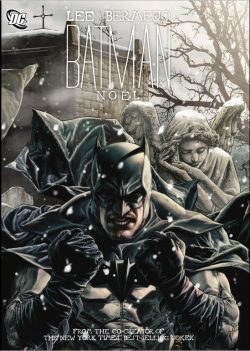
Batman: Noël


By Lee Bermejo, with Barbara Ciardo & Todd Klein (DC Comics)
ISBN: 978-1-4012-3213-9 (HB)

Win’s Christmas Gift Recommendation: A Fresh, Twisted Spin on a Seasonal Favourite… 9/10

Beginning with 1941’s Batman #9, the Dark Knight and festively-hued sidekick celebrated Christmas with specially crafted, tinsel-tinted topical tales (part warm spirituality, part Dickens homage, part O. Henry bittersweet irony, part redemption story), all perfectly encapsulating everything the festival ought to mean.

Although many his contemporaries – especially Superman – did likewise, the Batman Yule yarns somehow always got the balance between sentiment and drama just right. It led to the common comics fan assumption that Batman Owned Christmas. Given the evidence, it’s hard to dispute…

In 2011 writer-artist Lee Bermejo (Lex Luthor: Man of Steel, Joker, Before Watchmen: Rorschach) took his avowed love of Charles Dickens’ novels and the gritty, painterly heroic style he’d perfected and crafted a Times Best-Selling stand-alone Batman Original Graphic Novel. His creative partners in crime were colour-artist Barbara Ciardo award-winning letterer Todd Klein.

Available in deluxe hardback, Trade Paperback and eBook editions, Batman: Noël is a smart and imaginative reworking of Dicken’s redemptive masterpiece told from the point of view of Bob, a cheap hood with a guilty conscience and a sick kid. Bob’s got himself in a spot of bother with both his boss – The Joker – and the meanest bastard in Gotham, who’s selfishly using him to get to the killer clown…

Someone needs to have his views challenged and his path reset. Surely the Season will provide a miracle…

Featuring a big cast of star guests, this dark festive fable adds a bleak spin to the immortal events that will amaze and delight jaded readers, and also offers an Introduction by Jim Lee and many pages of production art and Author Commentary from Bermejo.

Batman Noël is a decidedly different take on one of the most fundamental cornerstones of the modern Christmas experience, and, while we’re recommending seasonal stuff, Dickens wrote four follow-ups to A Christmas Carol plus 22 other Christmas-themed or situated stories. They’re all in print – physically and digitally – so you should treat yourself to those too…
© 2011 DC Comics. All Rights Reserved.

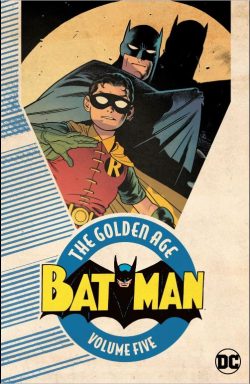
Batman: The Golden Age volume 5


By Bill Finger, Don Cameron, Ruth “Bunny” Lyon Kaufman, Horace L. Gold, Joseph Greene, Joe Samachson, Bob Kane, Jerry Robinson, George Roussos, Dick Sprang, Jack Burnley, Ray Burnley, Fred Ray, Norman Fallon & various (DC Comics)
ISBN: 978-1-4012-8461-9 (TPB)

Win’s Christmas Gift Recommendation: Timely and Evergreen Family Adventure… 10/10

Debuting a year after Superman, “The Bat-Man” (and latterly Robin, the Boy Wonder) confirmed DC/National Comics as the market frontrunner and conceptual leader of the burgeoning comicbook industry.

Having established the parameters of the metahuman with their Man of Steel, the physical mortal perfection and dashing derring-do of the strictly-human Dynamic Duo rapidly became the swashbuckling benchmark by which all other four-colour crime-busters were judged.

Batman: The Golden Age is a series of paperback feasts (there are also weightier, pricier, more capacious hardback Omnibus editions available, and digital iterations too) re-presenting the Dark Knight’s earliest exploits.

Presented in original publishing release order, the tomes trace the character’s growth into the icon who would inspire so many and develop the resilience needed to survive the stifling cultural vicissitudes that coming decades would inflict upon him and his partner, Robin.

Re-presenting a glorious and astounding treasure-trove of cape-&-cowl classics and iconic covers from Detective Comics #75-81, Batman #16-20 plus contemporary companion tales from World’s Finest Comics #10-11: this book covers groundbreaking escapades from April/May 1943 to December/January 1944: as the Dynamic Duo continually develop and storm ahead of all competition.

I’m certain it’s no coincidence that many of these Golden Age treasures are also some of the best and most reprinted tales in the Batman canon. With chief writers Bill Finger and Don Cameron at a peak of creativity and production, everybody on the Home Front was keen to do their bit – even if that was simply making kids of all ages forget their troubles for a brief while. These tales were crafted just as the dark tide was turning and an odour of hopeful optimism was creeping into the escapist, crime-busting yarns – and especially the stunning covers – seen here in the work of Jerry Robinson, George Roussos, Bob Kane Jack Burnley, Dick Sprang, Fred Ray and Stan Kaye…

The supplemental writers all pushed the boundaries of the adventure medium whilst graphic genius Sprang began to slowly supersede Kane and Burnley: making the feature uniquely his own while keeping the Dynamic Duo at the forefront of the vast army of superhero successes.

War always stimulates creativity and advancement and these sublime adventures of Batman and Robin more than prove that axiom as the growing band of creators responsible for producing myriad adventures of the Dark Knight hit an artistic peak which only stellar stable-mate Superman and Fawcett’s Captain Marvel were able to equal or even approach.

with

The compelling dramas open with the landmark Batman #16 (cover-dated April/May 1943) and one of three tales by Cameron. ‘The Joker Reforms!’ (Kane, Robinson & Roussos art) sees the Clown Prince suffer a blow to the head and enjoy a complete personality shift… but not for long…, after which Ruth “Bunny Lyons” Kaufman scripted a bold and fascinating Black Market milk caper in ‘The Grade A Crimes!’ for Ray & Jack Burney to dynamically delineate.

‘The Adventure of the Branded Tree’ (Cameron and the Burnleys) has the Gotham Gangbusters heading to lumberjack country for a vacation to become embroiled in big city banditry before the issue wraps up with hilarious thriller-comedy ‘Here Comes Alfred!’ (Cameron, Kane, Robinson & Roussos) which foists a rotund, unwelcome and staggeringly faux-English manservant upon the Masked Manhunters to finally complete the classic core cast of the series in a brilliantly fast-paced spy-drama with loads of laughs and buckets of tension…

Detective Comics #75 (May 1943) introduces a new aristocrat of crime in pompous popinjay ‘The Robber Baron!’ (Cameron, Jack Burnley & Roussos) before the Joker resurfaces in #76 to ‘Slay ’em With Flowers’: a graphic chiller by Horace L. Gold, Robinson & Roussos.

Next up is Batman #17 which opens with the gloriously human story of B. Boswell Brown: a lonely, self-important old man who claims to be ‘The Batman’s Biographer!’ Unfortunately, ruthless robber The Conjurer gives the claim far more credence than most in a tense thriller by Cameron, Kane, Robinson & Roussos…

Counterbalancing the dark whimsy is ‘The Penguin Goes A-Hunting’ (Cameron, Jack & Ray Burnley): a wild romp wherein the Perfidious Popinjay undertakes a hubris-fuelled crime-spree after being left off a “Batman’s Most Dangerous Foes” list.

The same creative team concocted ‘Rogues Pageant!’ wherein murderous thieves in Western city Santo Pablo inexplicably disrupt the towns historical Anniversary celebrations after which Joe Greene, Kane & Robinson detail the Dynamic Duo’s brutal battle with a deadly gang of maritime marauders in the appealing ‘Adventure of the Vitamin Vandals!’

The creation of Superman propelled National Comics to the forefront of their fledgling industry and in 1939 the company was licensed to produce a commemorative comicbook celebrating the start of the New York World’s Fair, with the Man of Tomorrow prominently featured among the four-colour stars of the appropriately titled New York World’s Fair Comics.

A year later, following the birth of Batman and Robin, National combined Dark Knight, Boy Wonder and Action Ace on the cover of the follow-up New York World’s Fair 1940.The spectacular 96-page anthology was a tremendous success and the oversized bonanza format was established, becoming Spring 1941’s World’s Best Comics#1, before finally settling on the now-legendary title World’s Finest Comics from the second issue, beginning a stellar 45-year run which only ended as part of the massive clear-out and de-cluttering exercise that was Crisis on Infinite Earths.

Until 1954 and the swingeing axe-blows of rising print costs, the only place Superman and Batman ever met was on the stunning covers by the likes of Burnley, Fred Ray and others. Between those sturdy card covers, the heroes maintained a strict non-collaboration policy.

Here World’s Finest Comics #10 (Summer 1943) features Finger, Robinson & Roussos’ ‘The Man with the Camera Eyes’: a gripping battle of wits between the Gotham Guardians and a crafty crook with an eidetic memory, before Finger, Kane & Roussos introduce a fascinating new wrinkle to villainy with the conflicted doctor who operates ‘The Crime Clinic’ in Detective #77. Crime Surgeon Matthew Thorne would return many times over the coming decades…

Issue #78 (August 1943) pushes the patriotic agenda with ‘The Bond Wagon’ (Joseph Greene, Burnley & Roussos) as Robin’s efforts to raise war funds through a parade of historical look-alikes is targeted by Nazi spies and sympathisers, after which Batman #18 starts with a spectacular, visually stunning crime-caper wherein the Gotham Gangbusters clash again with rascally rotund rogues Tweedledum and Tweedledee whilst solving ‘The Secret of Hunter’s Inn!’ (Samachson & Robinson).

‘Robin Studies his Lessons!’ (Samachson, Kane & Robinson) sees the Boy Wonder grounded from all crime-busting duties until his school work improves – even if it means Batman dying for want of his astounding assistance!

Bill Finger and the Burnley bros craft ‘The Good Samaritan Cops’: another brilliantly absorbing human interest drama focused on the tense but unglamorous work of the Police Emergency Squad before the action culminates in a shocking and powerful final engagement for manic physician and felonious mastermind Matthew Thorne. ‘The Crime Surgeon!’ (Finger, Kane & Robinson) here tries his deft and devilish hand at masterminding other crooks’ capers…

Over in Detective Comics #79 ‘Destiny’s Auction’ – Cameron & Robinson – offers another sterling moving melodrama as a fortune teller’s prognostications lead to fame, fortune and deadly danger for a failed actress, has-been actor and superstitious gangster…

World’s Finest Comics #11’s Batman episode reveals ‘A Thief in Time!’ (Finger & Robinson inked by Fred Ray), pitting our heroes against future-felon Rob Callender, who falls through a time-warp and thinks he’s found the perfect way to get rich.

Detective #80 sees the turbulent tragedy of deranged, double-edged threat Harvey Kent, finally resolved after a typically terrific tussle with ‘The End of Two-Face!’ (Finger, Kane, Robinson & Roussos), after which Batman #19 unleashes another quartet of compelling crime-busting cases.

There’s no mistaking the magnificent artwork of rising star Dick Sprang who pencilled every tale in this astounding issue, beginning with Cameron’s ‘Batman Makes a Deadline!’ as the Dark Knight investigates skulduggery and attempted murder at the City’s biggest newspaper. He also scripted breathtaking fantasy masterpiece ‘Atlantis Goes to War!’ with the Dynamic Duo rescuing that fabled submerged city from overwhelming Nazi assault.

The Joker rears his garish head again in anonymously-penned thriller ‘The Case of the Timid Lion!’ (perhaps William Woolfolk or Jack Schiff?) with the Harlequin of Hate enraged and lethal whilst tracking down an impostor committing crazy capers in his name… Samachson, Sprang and inker Norman Fallon then unmask the ‘Collector of Millionaires’ with Dick Grayson covertly investigating his wealthy mentor’s bewildering abduction and subsequent replacement by a cunning doppelganger…

‘The Cavalier of Crime!’ (Detective #81, by Cameron, Kane & Roussos) introduces another bizarre, baroque costumed crazy who tests his rapacious wits and sharp-edged weapons against the Dynamic Duo – naturally and ultimately to no avail…

The Home Front certainly seemed a lot brighter, as can be seen in Batman #20 which opens with the Joker in ‘The Centuries of Crime!’ (Cameron, Jack & Ray Burnley) with the Mountebank of Mirth claiming to have discovered a nefariously profitable method of time-travelling, whilst ‘The Trial of Titus Keyes!’ (Finger, Kane & Robinson) offers a masterful courtroom drama of injustice amended, focussing on the inefficacy of witness statements…

‘The Lawmen of the Sea!’ (Finger & the Burnley boys) finds the Dynamic Duo again working with a lesser known Police Division as they join The Harbor Patrol in their daily duties, uncovering a modern-day piracy ring, before the issue and this collection concludes on an emotional high with ‘Bruce Wayne Loses Guardianship of Dick Grayson!’ as a couple of fraudsters claiming to be the boy’s last remaining relatives petition to adopt him. A melodramatic triumph by Finger, Kane & Robinson, there’s still plenty of action, especially after the grifters try to sell Dick back to Bruce Wayne…

This stuff set the standard for comic superheroes. Whatever you like now, you owe it to these tales. Superman gave us the idea, and writers like Finger and Cameron refined and defined the meta-structure of the costumed crime-fighter. Where the Man of Steel was as much social force and wish fulfilment as hero, Batman and Robin did what we ordinary mortals wanted and needed to do.

They taught bad people the lesson they deserved.

The history of the American comicbook industry in almost every major aspect stems from the raw, vital and still powerfully compelling tales of DC’s twin icons: Superman and Batman.

It’s only fair and fitting that both those characters are still going strong and that their earliest adventures can be relived in chronological order in a variety of formats from relatively economical newsprint paperbacks to deluxe hardcover commemorative Archive editions – and digital formats too.

These are the stories that cemented the popularity of Batman and Robin and brought welcome surcease to millions during a time of tremendous hardship and crisis. Even if these days aren’t nearly as perilous or desperate – and there ain’t many who thinks otherwise! – the power of such work to rouse and charm is still potent and just as necessary. You owe it to yourself and your family and even your hamster to Buy This Book…
© 1943, 1944, 2018 DC Comics. All Rights Reserved.

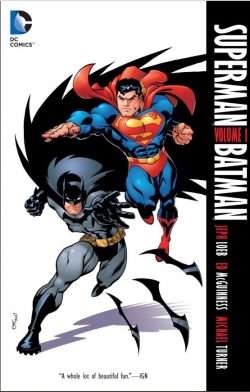
Superman/Batman volume 1 (New edition)


By Jeph Loeb, Ed McGuinness & Dexter Vines, Pat Lee & Dreamwave Productions, Michael Turner & Peter Steigerwald & various (DC Comics)ISBN: 978-1-4012-4818-5 (TPB)

Win’s Christmas Gift Recommendation: Compelling Comics Cavortings… 8/10

For many years Superman and Batman worked together as the “World’s Finest” team. They were best friends and the pairing made perfect financial sense as National/DC’s most popular heroes could cross-sell their combined readerships.

When the characters were redefined for the post-Crisis 1980s, they were remade as suspiciously respectful co-workers who did the same job but deplored each other’s methods and preferred to avoid contact whenever possible – except when they were in the Justice League (but for the sake of your sanity don’t fret that right now!).

After a few years of this new status quo the irresistible lure of Cape & Cowl Capers inexorably brought them together again with modern emotional intensity derived from their incontestably differing methods and characters.

In this rocket-paced, post-modern take on the relationship, they have reformed as firm friends for the style-over-content 21st century, and this is the story of their first outing together. Outlawed and hunted by their fellow heroes, Superman finds himself accused of directing a continent-sized chunk of Kryptonite to crash into Earth, with Batman accused of aiding and abetting…

To save Superman, the world and their own reputations they are forced to attempt the overthrow of the United States President himself. Of course, said President is the unspeakably evil Lex Luthor. Back in 2003 he was considered the least likely leader America could ever elect…

I deeply disliked this tale when I first read it: Plot is reduced to an absolute minimum in favour of showy set-pieces, previously established characterisation often hostage to whatever seems the easiest way to short-cut to action (mortal foes Captain Atom and Major Force work together to capture our heroes because President Luthor tells them to?) but after all these years it’s worthy of another look and I’m not ashamed to say that I’ve changed my opinion somewhat…

This paperback (and eBook) compilation collects issues #1-13 of the hip turn of the century reboot Superman/Batman (and includes a vignette from Superman/Batman Secret Files 2003) collectively spanning October 2003 to October 2004)

The action – written by Jeph Loeb and illustrated by Ed McGuiness & Dexter Vines – opens with ‘World’s Finest’ as the Dark and Light Knights follow telling leads in separate cases back to shape-shifting cyborg John (Metallo) Corben, discovering evidence to suggest that the ruthless cyborg might have been the at-large-for-decades shooter in the still unsolved double murder of Thomas and Martha Wayne…

Even that bombshell seems inconsequential after the mechanoid monster shoots Superman in the chest with a kryptonite bullet before burying the stunned duo under tons of Earth in a Gotham graveyard…

Meanwhile at the Pentagon, President Lex is informed that a toxically radioactive lump of Krypton the size of Australia is on a collision course with Earth. Implausibly adopting (and foreshadowing) the “Fake News” disinformational line that Superman has summoned it, the Federal Government issues an arrest warrant for the Man of Steel and convenes a metahuman taskforce to bring him in…

Escaping certain doom thanks to Batman’s skill and unflappable nerve, the blithely unaware heroes reach medical help in the Batcave in ‘Early Warning’, only to be attacked by an older version of Superman, determined to prevent them making a mistake that will end life on Earth…

After a massive nuclear strike (somehow augmented by embargoed Boom Tube technology from hell-world Apokolips), Luthor overrules Captain Atom’s qualms about the mission and orders his anti-Superman squad to apprehend their target wherever he might be hiding.

The President then goes on television to blame the alien for the impending meteor strike and announces a billion-dollar Federal bounty on the Action Ace…

Man of Tomorrow and Man of Darknight Detective respond by direct assault in ‘Running Wild’, hurtling towards Washington DC only to be ambushed en route by a greed-crazed army of super-villains and mind-controlled heroes before Atom’s group – Green Lantern John Stewart, Black Lightning, Katana, Starfire, Power Girl and certified quantum psychopath Major Force – join the attack…

As the combatants ‘Battle On’, in the Oval Office even fanatical civil servant Amanda Waller – commander of covert Penal Battalion the Suicide Squad – begins to realise something is wrong with the President.

For a start, his behaviour is increasingly erratic, but the real clue is that he is juicing himself with a kryptonite-modified version of super-steroid venom…

The blistering battle between the outlawed heroes and Atom’s unit extends as far as Japan, (where the Cape & Cowl Crusaders are secretly organising a last-ditch solution to the imminent Kryptonite continent crash) before Major Force begins to smell a rat and realises some of his team are actually working with Superman and Batman.

Military martinet Captain Atom is not one of them, but eventually even he is made to see reason – only moments before the deranged Major goes ballistic and nearly turns Tokyo to ashes…

Using his energy-absorbing powers, Atom prevents the holocaust, but the monumental radiation release triggers his “temporal safety-valve” and the silver-skinned soldier materialises in a future where Earth is a barren cinder and only an aged, tragic, broken Superman resides…

Meanwhile in the present, the Presidential Pandemonium has prompted the venerable Justice Society of America to step in; despatching Captain Marvel and Hawkman to apprehend the fugitive Superman and Batman.

Apparently successful, the operation triggers a back-up team (Supergirl, Nightwing, Steel, Superboy, Natasha Irons, Robin, Huntress, Batgirl and even Krypto) who invade the White House only to be defeated by Luthor himself, high on K-Venom and utilising Apokolyptian technology in ‘State of Siege’…

With extinction only moments away and a deranged President Luthor on the loose, Superman and Batman prepare to employ their eleventh-hour suicidal salvation machine but are caught off-guard when a most unexpected substitute ambushes them to pilot the crucial mission in ‘Final Countdown’…

In so many ways this yarn is everything I hate about modern comics. The story length is artificially extended to accommodate lots of guest stars and superfluous fighting, whilst large amounts of narrative occur off-camera or between issues, presumably to facilitate a faster, smoother read.

On the plus side, however, is the fact that I’m an old fart. There is clearly a market for such snazzy, souped-up, stripped down, practically deconstructed comic fare. And if I’m being completely honest, there is a certain fizz and frisson to non-stop, superficial all-out action – especially when it’s so dynamically illustrated.

Public Enemies looks very good indeed and, if much of the scenario is obvious and predictable, it is big and immediate and glossy like a summer blockbuster movie is supposed to be.

The epic is followed by a stand-alone tale starring Robin – the Tim Drake version – and semi-Kryptonian clone Conner Kent.

‘Protégé’ sees the assistants – don’t call them sidekicks – despatched to Japan to end the threat of a new Toyman. This particular giggling genius is a lethally brilliant kid and their off-the-wall solution to his antics is both smart and effective…

Next follows a tale and situation that only comics could conceive.

For decades DC really couldn’t make up their minds over Supergirl. I’ve actually lost count of the number of different versions that have cropped up over the years, and I’ve never been able to shake the queasy feeling that above all else she’s a concept that was cynically shifted from being a way to get girls reading comics to one calculated to ease young male readers over that bumpy patch between sporadic chin-hair outbreaks, voice-breaking and that nervous period of hiding things under your mattress where your mum never, never ever looks…

After a few intriguing test-runs the first true Girl of Steel debuted as a future star of the ever-expanding Superman pocket universe in Action Comics #252 (May 1959). Superman’s cousin Kara Zor-El had been born on a city-sized fragment of Krypton, hurled intact into space when the planet exploded. Eventually Argo City turned to Kryptonite like the rest of the detonated world’s debris and her dying parents, observing Earth through their vision-scopes, sent their daughter to safety as they apparently perished.

Landing on Earth, she fortuitously met Superman who created the identity of Linda Lee and hid her in an orphanage whilst she learned of her new world and powers in secrecy and safety.

Her popularity waxed and waned over the years until she was earmarked for destruction as one of the attention-grabbing deaths during Crisis on Infinite Earths.

However, after John Byrne successfully rebooted the Man of Steel, non-Kryptonian iterations began to appear – each with her own fans – until early in the 21st century the company Powers-that-Be decided the real Girl of Steel should come back… sort of…

Thus, this visually intoxicating version (from Superman/Batman #8-13) resets to the original concept and has a naked blonde chick arrive on a colossal Kryptonite meteor, claiming to be Superman’s cousin…

Written by Loeb with captivating art by Michael Turner & Peter Steigerwald, the action commences in ‘Alone’, as a quarantined Superman chafes at enforced detention, the Dark Knight explores a section of the meteor submerged in Gotham Bay.

The JLA have all been active, clearing away the deadly fragments, but this last one is most disturbing. As Batman quickly grasps, it’s a ship, but its single passenger is now missing…

Soon the Gotham Guardian is tracking a wave of destruction caused by a seemingly confused teenaged girl with incredible powers and only Superman’s unwise early intervention stops the mounting carnage.

Their subsequent investigations reveal the comely captive to have all the Man of Tomorrow’s abilities and she claims – in fluent Kryptonian – to be the daughter of his long-dead uncle Zor-El…

The mystery further unfolds in ‘Visitor’ as a deeply suspicious Batman and ecstatic Superman continue their researches, arguing their corners as the most powerful girl on Earth becomes increasingly impatient. Fuelling the Dark Knight’s concern is superdog Krypto’s clear and savage hostility to the newcomer and Kara’s convenient claim that she has amnesia…

Then as Clark Kent endeavours to acclimatise his cousin to life on Earth, on the hellish world of Apokolips vile Granny Goodness and her Female Furies are ordered by ultimate evil space-god Darkseid to acquire the pliable naive newcomer…

Before they can strike, however, an attack comes from an unexpected source, as former ally Harbinger, ruthless hunter Artemis and beloved ally Wonder Woman ambush the Kryptonians. …

Princess Diana has acted arbitrarily but from absolute necessity: kidnapping Kara and bringing her to the island home of the Amazons to be trained in the use of her powers as a ‘Warrior’.

Superman’s growing obsession has rendered him unable to see her potential for destruction, despite a cryptic message on her space ship from Zor-El, and Wonder Woman chose to strike first and ask later…

With tempers barely cooled, Dark Knight and Action Ace are invited to observe Kara’s progress weeks later, just as the tropical paradise is assaulted by an army of artificial Doomsdays manufactured on Apokolips…

The wave of slaughter is a feint, but by the time the rampaging horrors are all destroyed, the Furies have done their work, slaughtering Kara’s only friend and stealing away the Kryptonian kid…

In ‘Prisoner’, DC’s superheroic high trinity enlist the aid of Apokolyptian émigré Big Barda and stage a devastating rescue mission to Darkseid’s homeworld, but not before the Lord of Evil apparently twists the innocent Girl of Steel into his tool: making her a ‘Traitor’ to the living…

The Master of Apokolips has never faced a foe as adamant as Batman and the quartet are unexpectedly victorious, but after returning Kara to Earth and announcing her as the new Supergirl, the heroes discover that they are not safe or secure, and in ‘Hero’ Darkseid horrifyingly returns to exact his ultimate revenge…

For me, the most intriguing aspect of this sometimes overly-sentimental tale is Batman’s utter distrust and suspicion of Kara as she is hidden from the world while she assimilates, but there’s plenty of beautifully rendered action – plus oodles of lovingly rendered girl-flesh and titillating fetish outfits jostling for attention amidst the lavish fight-scenes and interminable guest-cameos, should that be to your tastes – and enough sheer spectacle to satisfy any Fights ‘n’ Tights fans.

Even now the goods things have not been exhausted as Superman/Batman Secret Files 2003 provides a charming peek into the past with ‘When Clark met Bruce’ (“A tale from the days of Smallville”) in which bucolic 2-page snippet, Loeb & Tim Sale effectively tease us with the question of what might have been, had the go happy-go-lucky Kent boy actually got to have a play-date with that morose, recently orphaned rich kid from Gotham City…

Filling out the experience are pictorial fact-file on Superman, Batman,

President Lex Luthor, Talia and Metallo, plus a full cover gallery by McGuiness & Vines, Turner & Steigerwald and Jim Lee & Scott Williams and studies and design sketches for Supergirl.

Full of flash and dazzle this mighty tome might well be the kind of Fights ‘n’ Tights thrill you’re looking for this yule season.
© 2003, 2004, 2014 DC Comics. All Rights Reserved.

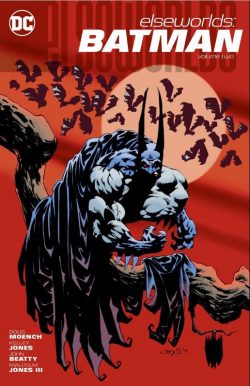
Elseworlds Batman volume 2


By Doug Moench, Kelley Jones, John Beatty & Malcolm Jones III (DC Comics)
ISBN: 978-1-4012-6982-1

During the 1990s DC regrouped and rebranded its frequent dalliances with alternate reality scenarios under the copious and broad umbrella of a separate imprint. The Elseworlds banner and credo declared that heroes would be taken out of their usual settings and put into strange places and times – some that have existed, or might have existed, and others that can’t, couldn’t or Shouldn’t exist…

Here a recent reissue (originally released in 2007 as Batman Vampire – Tales of the Multiverse) and now available in paperback and eBook editions collects a trilogy of unlikely Batman stories that began with a literary cross-pollination of the type publishers seem so in love with.

Crafted by Doug Moench, Kelley Jones and Malcolm Jones III, Batman and Dracula: Red Rain was and remains is a genuinely creepy adventure of heroism and sacrifice. Here the Lord of Vampires moves into Gotham City and turns the city into a hellscape unimaginable to behold.

Desperate to save his home, the Dark Knight is forced to ally himself with “good vampires” in an attempt to stop Dracula. It can’t be a spoiler to reveal that he also has to sacrifice his life and his humanity before the threat to his beloved city is ended…

This tale was a great success when it was first released in 1991; a minor gothic masterpiece, both philosophical and tension drenched, with the sleek, glossily distorted artwork of Jones & Jones III creating a powerful aura of foredoomed predestination. It alone is well worth the price of admission.

And that is a very good thing because the two sequels are a possibly unnecessary indulgence.

Batman: Bloodstorm (1994, with the somehow more visually hygienic John Beatty replacing Malcolm Jones III as inker) sees a devasted-but-still-hanging-on Gotham protected by a vampiric Batman.

The Dark Nosferatu now combines his crime-fighting mission with dispatching those bloodsuckers who escaped the cataclysmic events of Red Rain. Tragically, he is a tortured hero suffering the agonies of the damned, struggling perpetually with his unholy thirst, but is determined nonetheless never to drink human blood.

However, when the Joker assumes command of the remaining vampire packs and attempts to take control of Gotham, not even the hero’s greatest friends and a lycanthropic Cat-Woman can forestall Batman’s final fate…

And yet Batman’s eternal rest is thwarted and stolen from him after the heartsick Alfred Pennyworth and desperate Commissioner Jim Gordon recall the Batman from his tomb in Batman: Crimson Mist.

Moench, Jones & Beatty recount a bleak but predictable saga (originally released in 1999) of a beleaguered metropolis overrun by super-criminals since the caped Crusader went to his reward.

So, when his faithful manservant brings him back, the faithful retainer is horrified to find the now corrupted hero is just another malevolent, blood-hungry beast. One who plans to save Gotham by slaughtering every criminal still breathing in it…

Only a bizarre alliance of good men and monstrous villains can rectify this situation before humanity itself pays the awful price…

These stories take the concept of Batman as scary beast to logical extremes – and far beyond – but although well drawn and thoughtfully written, the sequels lack the depth and intensity of the initial tale and feel too much like most sequels – just an attempt to make some more money.

If you’re a superhero fan at least in this volume you have the real deal, so buy it and just treat the last two thirds as bonus material. If you’re a sucker for stylish bloodbaths and dramatic scarlet-drenched suspense, however, there’s plenty here for you to wade through and wallow in…
© 1991, 1994, 1999, 2016 DC Comics. All Rights Reserved.
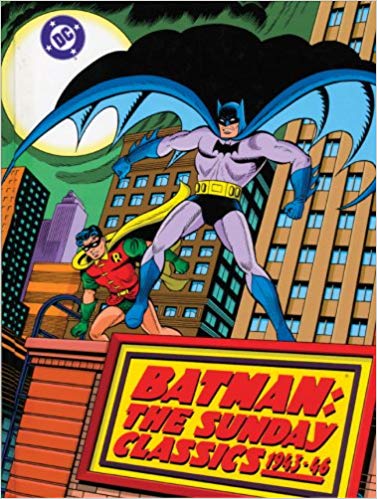
Batman: The Sunday Classics 1943-1946


By Don Cameron, Bill Finger, Joe Samachson, Alvin Schwartz, Bob Kane, Jack Burnley, Fred Ray & various (Sterling)
ISBN: 978-1-1402-4718-2

For most of the 20th century the newspaper comic strip was the Holy Grail that cartoonists and graphic narrative storytellers hungered for. Syndicated across the country and the planet, with millions of readers and accepted (in most places) as a more mature and sophisticated form of literature than comic-books, it also paid better. The Holiest of Holies was a full-colour Sunday page.

However, it was always something of a poisoned chalice when a comicbook property became so popular that it swam against the tide (after all weren’t the funny-books invented just to reprint the strips in cheap accessible form?) to become a syndicated serial strip.

Superman, Wonder Woman, Archie Andrews and a few others made the jump in the 1940s and many features have done so since. One of the most highly regarded came late to the party even though it was probably the highest quality offering, both in its daily and Sunday format. It was called Batman and Robin.

Although a highpoint in strip cartooning, both simultaneous Batman features were cursed by ill-timing. The feature finally debuted during a period in newspaper publishing that was afflicted by rationing, shortages and a changing marketplace.

These strips never achieved the circulation they deserved, but at least the Sundays were given a new lease of life after DC began reprinting vintage stories in the 1960s in their 80-Page Giants and Annuals.

The superior quality adventures were ideal action-mystery short stories, adding an extra cachet of exoticism for young readers already captivated by enjoying tales of their heroes that were positively ancient and redolent of History with a capital “H”.

The stories themselves are broken down into complete single page instalments building into short tales averaging between four to six pages per adventure. The mandatory esoteric foes include such regulars as the Penguin (twice), Joker, Catwoman and Two-Face and all-original themed villains such as The Gopher, The Sparrow and Falstaff, but the bulk of the yarns offer more prosaic criminals, if indeed there is any antagonist at all…

A huge benefit of work produced for an audience deemed “more mature” is the freedom to explore human interest stories such as exonerating wrongly convicted men, fighting forest fires or discovering the identity of an amnesia victim. There is even a jolly seasonal yarn that bracketed Christmas week, 1945.

The writers of the strip included Don Cameron, Bill Finger, Joe Samachson, Alvin Schwartz with art by Bob Kane, Jack Burnley and Fred Ray and inking by Win Mortimer and Charles Paris. The letterer was tireless, invisible calligraphic master Ira Schnapp and the strips were all coloured by Raymond Perry.

This lovely oversized (241 x 318 mm) full colour hardback was originally published in conjunction by DC Comics & Kitchen Sink Press in 1991, and also contains a wealth of extra features such as biographical notes, a history of the strip, promotional artefacts, behind-the-scenes artwork and sketches, promotional features and much more. It’s long past time it was back in print – and eBooked too – as it’s a must for both Bat-fans and lovers of the artform and a certain anniversary is fast approaching…
© 1991, 2007 DC Comics. All Rights Reserved.
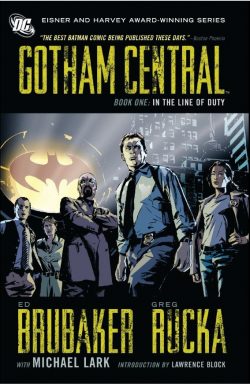
Gotham Central Book 1: In the Line of Duty


By Ed Brubaker, Greg Rucka & Michael Lark & Stephen Gaudiano (DC Comics)
ISBN: 978-1-4012-1923-9 (HB)                    978-1-4012-2037-2 (TPB)

One of the great joys of long-lasting, legendary comics characters is their potential for innovation and reinterpretation. There always seems to be another facet or corner to develop. Such a case was Gotham Central, wherein contemporary television sensibilities cannily combined with the deadly drudgery of the long-suffering boys in blue in the world’s most famous four-colour city.

Owing as much to shows such as Homicide: Life on the Streets and Law & Order as it did to the baroque continuity of Batman, the series mixed gritty, authentic police action with a soft-underbelly peek at what the merely mortal guardians and peacekeepers had to put up with in a world of psychotic clowns, flying aliens and scumbag hairballs who just won’t stay dead.

This compilation – available in hardback, soft cover and eBook editions – collects Gotham Central #1-10 (spanning February to October 2003), lovingly crafted by Ed Brubaker and Greg Rucka with sublimely understated illustration from Michael Lark and comes with an erudite and informative Introduction on ‘The Mean Streets of Gotham’ by celebrated crime author Lawrence Block.

Brubaker & Rucka co-wrote the eponymous two-part premier tale ‘In the Line of Duty’ wherein a desperate child-kidnap investigation by detectives Marcus Driver and Charlie Fields of ex-Commissioner Gordon‘s hand-picked Major Crimes Unit leads them all unawares to the temporary hideout of murderous superfreak Mr Freeze.

The cold-hearted killer horrifically eliminates Charlie but sadistically leaves Driver injured and alive… as an object lesson.

The GCPD have a strange relationship with the Dark Knight. They all know he’s out there, but the official line is that he’s an urban myth and the Administration refuses to acknowledge his existence.

Thus, a civilian is employed to turn on the bat-signal on the roof when crises occur and the public are told the eerie light is simply used to keep the cowardly, superstitious underworld cowed…

In such circumstances all real cops are loath to ask for The Bat’s help and Driver and his grieving, angry colleagues pull out all the stops to find and capture Freeze before the masked vigilante insultingly finishes their job for them.

However, as night falls and the flash-frozen body count rises, Marcus deduces what Freeze is planning and has no choice but to ask new Police Commissioner Akins to suspend his embargo and call in the whacko expert before hundreds more die…

From an era when comicbook noir was enjoying a superb renaissance, this classic take on the theme of the hunt for a cop-killer is a masterpiece of edgy and fast-paced tension whilst simultaneously smoothly and memorably introducing a large cast of splendidly realised new and very individual players…

Brubaker solo-scripts the second story as ‘Motive’ finds the now fit-for-duty Driver and his temporary partner Romy Chandler using solid police work to solve the outstanding kidnap case, all the while under the gun since arson villain The Firebug is dancing on the horizon, burning down Gotham one building at a time.

Fourteen-year old babysitter Bonnie Lewis vanished while walking home from her yuppie client’s house, and a subsequent ransom demand later proved to be a fake. Now, after her body is found, Driver and Chandler meticulously re-examine the facts and discover that almost everybody involved has been lying…

As they methodically sift evidence, alibis and possible motives, they begin to realise that even this tragically normal crime has its roots in both common greed and the gaudy madness of the city’s abundant metahuman menaces…

The gripping procedural drama then segues back to the city’s aristocracy of maniacs as Greg Rucka scripts ‘Half a Life’ with focus switching to Renee Montoya: a solid cop with too many secrets.

After her former partner Harvey Bullock was fired with extreme prejudice, tongues started wagging, but now an old case threatens to destroy her career and end her life…

When arresting rapist Marty Lipari, he tried to stab her, and Montoya forcefully subdued him. Now her morning is ruined after the skel sues her for ten million dollars in damages.

It only gets worse when she and partner Crispus Allen get a bogus case dumped on them by the corrupt, lazy meatheads in Robbery Division. However, the capper is dinner with her traditional, devout Catholic parents who still want her to settle down and have kids…

Her life begins to truly unravel when a photo of her kissing another woman does the rounds of colleagues, friends and family. Not all her fellow cops are homophobic bigots: but just enough are. That’s why she kept her life private for years.

Now, apparently outed by Lipari’s hired gumshoe Brian Selker, she is targeted by Internal Affairs when first the PI and then Lipari himself are found shot to death.

With her lover Darla threatened, her gun identified as the murder weapon and a huge quantity of illicit drugs found in her apartment, Renee is soon on her way to jail – another bad egg just like Bullock…

Nobody in MCU thinks she’s guilty but the evidence is overwhelming, and the crisis comes when en route she’s busted out by masked men and taken to the hidden citadel of one of Batman’s most nightmarish nemeses…

Utterly alone, in the unfriendliest job in the world, in the nastiest town on Earth, Montoya has to deal alone with a crazed maniac who’s destroyed her life just so he can be with her forever.

As a Major Crimes detective she’s seen how bad The Bat’s enemies can get, but this time she’s the target, not the hunter or witness, and it’s not just her life at stake…

This engrossing drama never steps outside of human bounds, irrespective of the nature of evil in Gotham, and the original comic presentation (from issues #6-10) won Eisner, Harvey, Eagle and Prism awards for Best Story of 2003.

Sadly not included in this volume are the two earlier tales from Renee’s past (you might want to track down Batman Chronicles #16 – Two Down, by Rucka & Jason Pearson & Cam Smith and Detective Comics#747 – Happy Birthday Two You, by Rucka, William Rosado & Steve Mitchell) which explained that oblique connection to her obsessive suitor. You can find them in the original 2005 trade paperback Gotham Central: Half a Life. and hopefully future editions will restore them to this volume too.

The appropriate quota of human drama, tension, stress and machismo all play well under Michael Lark’s deft subtle artwork, adding a grimy patina of pseudo-reality to good old-fashioned cops ‘n’ robbers stories, all playing out with compulsive veracity in what can only be described as the urban city of the damned.

This smart cop thriller set on the edge of hell is a stunning study in genre-crossing storytelling, and this edition includes a full cover gallery by Lark as well as a fulsome section of designs and character sketches in bonus feature ‘Staffing the GCPD’.

Dark, suspenseful and so very addictive, this is a book no bat-freak or crime buff can afford to miss.
© 2004, 2005, 2008 DC Comics. All Rights Reserved.
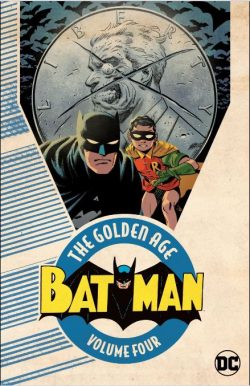
Batman: The Golden Age volume 4


By Bill Finger, Don Cameron, Joseph Greene, Joe Samachson, Jack Schiff, Bob Kane, Jack Burnley, Jerry Robinson, George Roussos & various (DC Comics)
ISBN: 978-1-4012-7130-5

The history of the American comicbook industry in most ways stems from the raw, vital and still compelling tales of two iconic creations published by DC/National Comics: Superman and Batman. It’s only fair and fitting that both those characters are still going strong and that their earliest adventures can be relived in chronological order in relatively cheap, and gloriously cheerful, compilations.

Debuting a year after Superman, “The Bat-Man” (and latterly Robin, the Boy Wonder) confirmed DC/National Comics as the market frontrunner and conceptual leader of the burgeoning comicbook industry.

Having established the parameters of the metahuman with their Man of Steel, the physical mortal perfection and dashing derring-do of the strictly-human Dynamic Duo rapidly became the swashbuckling benchmark by which all other four-colour crime-busters were judged.

Batman: The Golden Age is a series of paperback feasts (there’s also weightier, pricier, more capacious hardback Omnibus editions available, and digital iterations too) re-presenting the Dark Knight’s earliest exploits.

Presented in original publishing release order, the tomes trace the character’s growth into the icon who would inspire so many and develop the resilience needed to survive the stifling cultural vicissitudes that coming decades would inflict upon him and his partner, Robin.

Re-presenting astounding cape-&-cowl classics and iconic covers from Detective Comics #66-74, Batman #12-15 and pertinent stories from World’s Finest Comics #7-9, this book covers groundbreaking escapades from August 1942 to April 1943: as the Dynamic Duo continually develop and storm ahead of all competition.

As the heroes’ influence expanded, new talent joined the stable of creators. Jerry Robinson had already worked with writer Bill Finger and penciller Bob Kane, and during this period more scripters joined the ever-expanding team to detail adventures during the darkest days of World War II.

I’m certain it’s no coincidence that many of these Golden Age treasures are also some of the best and most reprinted tales in the Batman canon. With chief writer Bill Finger at a peak of creativity and production, everybody on the Home Front was keen to do their bit – even if that was simply making kids of all ages forget their troubles for a brief while…

This volume starts in grand style with the debut of a true classic villain as Finger, Kane & Robinson expose ‘The Crimes of Two-Face’ (Detective Comics #66): a classical tragedy in crime-caper form as Gotham DA Harvey Kent (whose name was later changed by editorial diktat to Dent) is disfigured in court and goes mad – becoming the conflicted thief and killer who remains one of the Caped Crusader’s greatest foes.

Batman #12 (August/September 1942) follows with another four classics. ‘Brothers in Crime’ – by Don Cameron & Robinson – reveals the tragic fates of a criminal family after which the Joker returns in ‘The Wizard of Words’ by Finger, Kane, Robinson and George Roussos.

Jack Burnley illustrated the spectacular daredevil drama ‘They Thrill to Conquer’ before ‘Around the Clock with Batman’ recounts a typical “day in the life” of the Dynamic Duo, complete with blazing guns, giant statues and skyscraper near-death experiences…

Then, from World’s Finest Comics #7 (Fall 1942), comes an imaginative thriller of chilly thrills and spills in ‘The North Pole Crimes!’ whilst Detective #67 features the Penguin as ‘Crime’s Early Bird!’, before Two-Face’s personal horror-story continues in ‘The Man Who Led a Double Life’ from #68.

Batman #13 (October/November 1942) tugged heartstrings when ‘The Batman Plays a Lone Hand’ but returned to more traditional ground after the Joker organized a ‘Comedy of Tears’ (by Jack Schiff, Kane, Robinson & Roussos). Although ‘The Story of the Seventeen Stones!’ (drawn by Burnley) then offered a deliciously experimental murder-mystery, the heroes slipped into comfortable Agatha Christie – or perhaps Hitchcock territory – as they tackled a portmanteau of crimes on a train in Cameron, Kane, Robinson and Roussos’ ‘Destination: Unknown!’ to close the issue.

Joseph Greene scripted the Joker’s next escapade in the astounding case of ‘The Harlequin’s Hoax!’ (Detective #68 before our heroes endure the decidedly different threat of ‘The Man Who Could Read Minds!’: another off-beat thriller from Cameron that premiered in Detective #70.

Cameron also wrote all four stories in Batman #14 (December 1942/January 1943). ‘The Case Batman Failed to Solve’ (illustrated by Jerry Robinson) is a superb example of the sheer decency of the Caped Crusader as he fudges a mystery for the best possible reason; ‘Prescription for Happiness’ (art by Bob Kane & Robinson) is a masterful example of the human-interest drama that used to typify Batman tales as a poor doctor discovers his own true worth, and ‘Swastika Over the White House!’ (Jack & Ray Burnley art) is typical of the spy-busting action yarns readers were gratuitously lapping up at the time.

The final story ‘Bargains in Banditry!’ – also from the Burnley boys – is another canny crime caper featuring fowl felon the Penguin.

Detective Comics #71 (January 1943, Finger, Kane & Robinson) featured ‘A Crime a Day!’ – one of the most memorable and thrilling Joker escapades of the period – whilst ‘Brothers in Law’ (by Schiff and the Burnleys from the Winter 1942 World’s Finest Comics #8) pits Batman and Robin against a Napoleon of Crime and feuding siblings who had radically differing definitions of justice…

Samachson, Kane & Robinson crafted Detective #72 which saw found our heroes crushing murderous con-men in ‘License for Larceny’ before Batman #15 (February/March 1943) lead with Schiff, Kane & Robinson’s Catwoman romp ‘Your Face is your Fortune!’ whilst Cameron and those Burnleys introduced plucky homeless boy Bobby Deen as ‘The Boy Who Wanted to be Robin!’

The same team concocted powerful propaganda tale ‘The Two Futures’, which examined an America under Nazi subjugation after which ‘The Loneliest Men in the World’ (Cameron, Kane & Robinson) was – and remains – one of the very best Christmas Batman tales ever created; full of pathos, drama, fellow-feeling and action…

Cameron, Kane & Robinson went back to spooky basics in Detective Comics#73 (March 1943) when ‘The Scarecrow Returns’, a moody chiller followed by the introduction of comical corpulent criminal psychopaths ‘Tweedledum and Tweedledee!’ in #74, before this gripping volume concludes with the Batman portion of World’s Finest #9 (Spring 1943) as Finger, Robinson & Roussos recount the saga of a criminal mastermind who invented a sure-fire ‘Crime of the Month!’ scheme…

These are the stories that cemented the popularity of Batman and Robin and brought welcome surcease to millions during a time of tremendous hardship and crisis. Even if these days aren’t nearly as perilous or desperate – and there ain’t many who thinks otherwise! – the power of such work to rouse and charm is still potent and just as necessary. You owe it to yourself and your family and even your hamster to Buy This Book…
© 1942, 1943, 2018 DC Comics. All Rights Reserved.
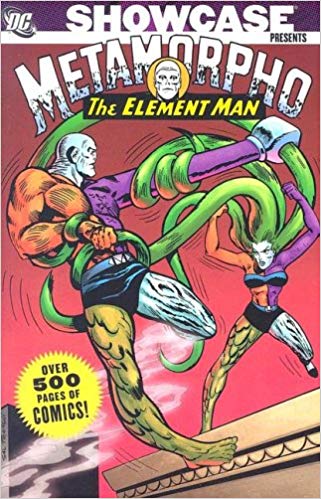
Showcase Presents Metamorpho, the Element Man


By Bob Haney, Gardner Fox, Ramona Fradon, Joe Orlando, Sal Trapani, Charles Paris & various (DC Comics)
ISBN: 978-1-4012-0762-5

By the time Metamorpho, the Element Man was introduced to the costumed hero-obsessed world the first vestiges of a certifiable boom were just becoming apparent. As such the light-hearted, almost absurdist take struck a Right-time, Right-place chord, blending far out adventure with tongue-in-cheek comedy.

The bold, brash Man of a Thousand Elements debuted in The Brave and the Bold #57 (December 1964/January 1965) and, after a follow-up try-out in the next issue, catapulted right into his own title for an eclectic and oddly engaging 17-issue run. Sadly, this canny monochrome compendium – collecting all those eccentric adventures plus team-up tales from B&B #66 and 68 and Justice League of America #42) – is currently the only archival collection available. Until someone rectifies that situation, at least you can revel in some truly enchanting black-&-white illustration…

Unlike most of these splendid Showcase editions, the team-up stories here are not re-presented in original publication order but closeted together at the back, so if stringent continuity is important to you, the always informative old-school credit-pages will enable you to navigate the wonderment in the correct sequence…

Sans dreary preamble the action commences with ‘The Origin of Metamorpho’ written by Bob Haney (who created the character and wrote everything here except the JLA story). The captivating art is by Ramona Fradon & Charles Paris and introduces glamorous he-man Soldier of Fortune Rex Mason, currently working as a globe-trotting artefact procurer and agent for ruthlessly acquisitive scientific genius/business tycoon Simon Stagg.

Mason is obnoxious and insolent but his biggest fault as far as his boss is concerned is that the mercenary dares to love and be loved by the millionaire’s only daughter Sapphire…

Determined to rid himself of the impudent Mason, Stagg dispatches his potential son-in-law to retrieve a fantastic artefact dubbed the Orb of Ra from the lost pyramid of Ahk-Ton in Egypt. The tomb raider is accompanied only by Java, a previously fossilised Neanderthal corpse Rex had discovered in a swamp and which (whom?) Stagg had subsequently restored to full life. Mason plans to take his final fabulous fee and whisk Sapphire away from her controlling father forever, but fate and his companion have other ideas…

Utterly faithful to the scientific wizard who was his saviour, Java sabotages the mission and leaves Mason to die in the tomb, victim of an ancient, glowing meteor. The man-brute rushes back to his master, carrying the Orb and fully expecting Stagg to honour his promise and give him Sapphire in marriage…

Trapped, knowing his time has come; Mason swallows a suicide pill as the scorching rays of the star-stone burn through him…

Instead of death relieving his torment Rex is mutated into a ghastly chemical freak capable of shape-shifting and transforming into any of the elements or compounds that comprised the human body: carbon, hydrogen, oxygen, calcium, iron, cobalt and so many others…

Hungry for vengeance, Mason follows and confronts his betrayers only to be overcome by the alien energies of the Orb of Ra. An uneasy détente is declared as Mason accepts Stagg’s desperate offer to cure him …“if possible”.

The plutocrat is further horrified when Rex reveals his condition to Sapphire and finds she still loves him. Totally unaware of Stagg’s true depths of duplicity, Mason starts working for the tycoon as metahuman problem-solver Metamorpho, the Element Man.

Brave and the Bold #58 (February-March 1965) reveals more of Stagg’s closeted skeletons when old partner Maxwell Tremayne kidnaps the Element Man and later abducts Sapphire to his ‘The Junkyard of Doom!’ Apparently, the deranged armaments manufacturer was once intimately acquainted with the girl’s mother and never quite got over it…

The try-out comics were an unqualified success and Metamorpho promptly debuted in his own title, cover-dated July-August 1965, just as the wildly tongue-in-cheek “High Camp” craze was catching on in all areas of popular culture; blending ironic vaudevillian kitsch with classic movie premises as theatrical mad scientists and scurrilous spies began to appear everywhere.

‘Attack of the Atomic Avenger’ sees nuclear nut-job Kurt Vornak trying to crush Stagg Industries, only to be turned into a deadly, planet-busting radioactive super-atom, after which ‘Terror from the Telstar’ pits the charismatic cast against Nicholas Balkan, a ruthless criminal boss set on sabotaging America’s Space Program.

Mad multi-millionaire T.T. Trumbull then uses his own daughter Zelda to get to Simon Stagg through his heart, accidentally proving to everyone who knew him that the old goat actually has one. This was part of the maniac’s attempt to seize control of America in ‘Who Stole the U.S.A.?’, but the ambitious would-be despot backed up the scheme with an incredible robot specifically designed to destroy Metamorpho.

Happily, Rex Mason’s guts and ingenuity proved more effective than the Element Man’s astonishing powers…

America saved, the dysfunctional family head South of the Border, becoming embroiled in ‘The Awesome Escapades of the Abominable Playboy’ as Stagg tries to marry Sapphire off to Latino Lothario Cha Cha Chavez. The wilful girl is simply trying to make Mason jealous and had no idea of her dad’s true plans; Stagg senior has no conception of Chavez’s real intentions or connections to the local tin-pot dictator…

With this issue the gloriously stylish Ramona Fradon left the series, to be replaced by two artists who strove to emulate her unique, gently madcap manner of drawing with varying degrees of success. Luckily veteran inker Charles Paris stayed on to smooth out the rough edges…

First up was E.C. veteran Joe Orlando whose 2-issue tenure began with outrageous doppelganger drama ‘Will the Real Metamorpho Please Stand Up?’ wherein eccentric architect Edifice K. Bulwark tries to convince Mason to lend his abilities to his chemical skyscraper project. When Metamorpho declines Bulwark and Stagg attempt to create their own Element Man… with predictably disastrous consequences.

‘Never Bet Against an Element Man!’ (#6 May-June 1966) took the team to the French Riviera as gambling grandee Achille Le Heele snookers Stagg and wins “ownership” of Metamorpho. The Creepy Conchon’s ultimate goal necessitated stealing the world’s seven greatest wonders (such as the Taj Mahal and Eiffel Tower) and, somehow, only the Element Man can make that happen…

Sal Trapani took over pencilling with #7’s ‘Terror from Fahrenheit 5,000!’ as the acronymic super-spy fad hits hard. Metamorpho is enlisted by the C.I.A. to stop suicidal maniac Otto Von Stuttgart destroying the entire planet by dropping a nuke into the Earth’s core, before costumed villain Doc Dread is countered by an undercover Metamorpho becoming ‘Element Man, Public Enemy!’ in a diabolical caper of doom and double-cross…

Metamorpho #9 shifted into the realm of classic fantasy when suave and sinister despot El Mantanzas maroons the cast in ‘The Valley That Time Forgot!’: battling cavemen and antediluvian alien automatons, after which a new catalysing element is added in ‘The Sinister Snares of Stingaree!’

This yarn introduces Urania Blackwell – a secret agent somehow transformed into an Element Girl and sharing all Metamorpho’s incredible abilities. Not only is she dedicated to eradicating evil such as criminal cabal Cyclops, but Urania is also the perfect paramour for Rex Mason…

He even cancels his wedding to Sapphire to go gang-busting with her…

With a new frisson of sexual chemistry sizzling beneath the surface, ‘They Came from Beyond?’ finds the conflicted Element Man confronting an apparent alien invasion whilst ‘The Trap of the Test-Tube Terrors!’ provides another attempt to cure Rex of his unwanted powers. This allows mad scientist Franz Zorb access to Stagg Industry labs long enough to build an army of chemical horrors…

The plot thickens with Zorb’s theft of a Nucleonic Moleculizer, prompting a continuation in #14 wherein Urania is abducted only to triumphantly experience ‘The Return from Limbo’…

Events and stories grew increasingly outlandish and outrageous as the TV superhero craze intensified and ‘Enter the Thunderer!’ (#14, September/October 1967) depicted Rex pulled between Sapphire and Urania as marauding extraterrestrial Neutrog terrorises the planet in preparation for the awesome arrival of his mighty mutant master.

The next instalment heralded an ‘Hour of Armageddon!’ as the uniquely menacing Thunderer takes control of Earth until boy genius Billy Barton assists the Elemental defenders in defeating the mutant horror.

Trapani inked himself for Metamorpho #16; an homage to H. Rider Haggard’s She novels wherein ‘Jezeba, Queen of Fury!’ changes the Element Man’s life forever.

When Sapphire marries playboy Wally Bannister, the heartbroken Element Man undertakes a mission to find the lost city of Ma-Phoor. Here he encounters an undying beauty who wants to conquer the world and just happens to be Sapphire’s exact double.

Moreover, the immortal empress of a lost civilisation had once loved an Element Man of her own: a Roman soldier named Algon transformed into a chemical warrior two millennia previously.

Believing herself reunited with her lost love, Jezeba finally launches her long-delayed attack on the outside world with disastrous, tragic consequences…

The strangely appetising series came to a shuddering and unsatisfactory halt with the next issue as the superhero bubble burst and costumed comic characters suffered their second recession in fifteen years. Metamorpho was one of the first casualties, cancelled just as (or perhaps because) the series was emerging from its quirky comedic shell with the March-April 1968 issue.

Illustrated by Jack Sparling, ‘Last Mile for an Element Man!’ sees Mason tried and executed for the murder of Wally Bannister, resurrected by Urania Blackwell and set on the trail of true killer Algon. Along the way, Mason and Element Girl uncover a vast, incredible conspiracy and rededicate themselves to defending humanity at all costs.

The tale ends on a never-resolved cliffhanger: when Metamorpho was revived a few years later no mention was ever made of these last game-changing issues…

The elemental entertainment doesn’t end here though as this tome somewhat expiates the frustrating denouement with three terrific team-up tales beginning with The Brave and the Bold #66 (June/July 1966) and ‘Wreck the Renegade Robots’ where a mad scientist usurps control of the Metal Men just as their creator Will Magnus is preoccupied turning Metamorpho back into an ordinary mortal…

Two issues later (B& B #68 October/November 1966) the still Chemically Active Crime-buster battles Bat-Baddies Penguin, Joker and Riddler as well as a fearsomely mutated Caped Crusader in the thoroughly bizarre ‘Alias the Bat-Hulk!’ – both tales coming courtesy of Haney, Mike Sekowsky & Mike Esposito.

Sekowsky also drew the last story in this volume. Justice League of America #42 (February 1966) sees the hero joyfully join the World’s Greatest Superheroes to defeat a cosmic menace deemed The Unimaginable. The grateful champions instantly offer him membership but are astounded when – and why – ‘Metamorpho Says… No!’: a classic adventure written by Gardner Fox and inked by Bernard Sachs.

The wonderment finally concludes with a sterling pin-up of the Element Man and his core cast by Fradon & Paris.

Individually enticing, always exciting but oddly frustrating in total, this book will delight readers who aren’t too wedded to cloying continuity but simply seek a few moments of casual, fantastic escapism.
© 1965-1967, 2005 DC Comics. All Rights Reserved.
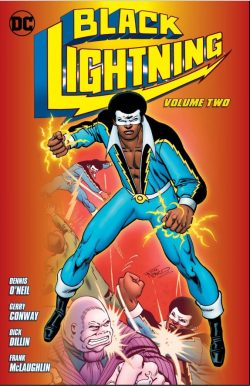
Black Lightning volume two


By Dennis O’Neil, Gerry Conway, J.M. DeMatteis, Martin Pasko, Paul Kupperberg, Dick Dillin, George Tuska, Rick Buckler, Marshall Rogers, Mike Netzer/Nasser, Romeo Tanghal, Joe Staton, Pat Broderick, Dick Giordano, Gerald Forton & various (DC Comics)
ISBN: 978-1-4012-7546-4

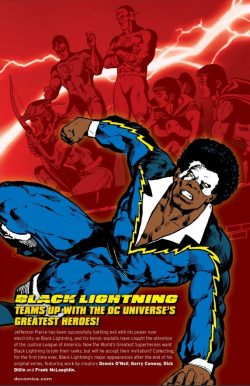
Black Lightning was DC’s first African American superhero to star in his own solo title, which launched in 1977…

When former Olympic decathlete Jefferson Pierce returned to the streets of Suicide Slum, Metropolis to teach at inner city Garfield High School, he was determined to make a real difference to the disadvantaged and often troubled kids he used to be numbered amongst. However, when he interrupted a drug buy on school grounds and sent the dealer packing, he opened everyone around him to mob vengeance and personal tragedy…

When the ruling racketeers – an organised syndicate dubbed The 100 – came seeking retaliation, one of Pierce’s students paid the ultimate price. The traumatised teacher realised he needed the shield of anonymity if he was to win justice and safety for his beleaguered home and charges…

Happily, tailor Peter Gambi – who had raised Jefferson and taken care of his mother after the elder Pierce was murdered – had a few useful ideas and inexplicable access to some pretty far-out technology…

Soon, equipped with a strength-&-speed-enhancing forcefield belt and costume, plus a mask and wig that completely changed his appearance, a fierce new vigilante stalked the streets of Metropolis…

Now with the urban avenger the star of his own television series, those early groundbreaking adventures have been gathered into a series of astoundingly accessible, no-nonsense trade paperback and eBook collections.

This second outing gathers a flurry of back-up and guest appearances from May 1979 to October 1980, gathered from various titles where the urban avenger prowled after his solo title folded. They cumulatively comprise World’s Finest Comics #256-259 and #261, DC Comics Presents #16, Justice League of America #173-174, Detective Comics #490-491 and #495-495 and The Brave and the Bold #163 plus pertinent material from Who’s Who: The Definitive Directory of the DC Universe #3 (1985) and Who’s Who in the DC Universe #16 (1992).

Following an informative Introduction by character originator Tony Isabella reprising Black Lightning: The In-Between Years, the (relatively) down-to-earth superhero antics commence with ‘Encounter with a Dark Avenger!’ (by Denny O’Neil, Dick Dillin & Frank Chiaramonte, taken from World’s Finest Comics #256).

Here the electric warrior is manipulated into a potentially fatal confrontation with equally fervent urban vigilante Green Arrow. As the heroes clash neither is aware that the 100’s ousted boss Tobias Whale is behind their mutual woes…

That short yarn saw Black Lightning as GA’s guest star and served as a prelude to ‘Death Ransom!’ in WF #257, the beginning of Pierce’s second (strictly backup) series. Crafted by O’Neil, George Tuska & Bob Smith, it sees a fateful, brutal clash with The Whale and results in a wary ceasefire for the archenemies as they unite to destroy the swiftly rebuilding 100 cartel…

Of course, a scorpion’s gotta sting and the alliance only lasts one issue before Whale betrays Lightning’s trust and another innocent dies in ‘The Blood of the Lamb!’ (O’Neil, Rich Buckler & Romeo Tanghal, World’s Finest #258)…

World’s Finest #259 provides a labyrinthine conundrum as the hero and a horde of gunman act on a deathbed tip-off and converge on a seedy welfare hotel that might be ‘The Last Hideout’ (O’Neil, Marshall Rogers, Michael Nasser/Netzer & Vince Colletta) of a legendary criminal and his ill-gotten gains. Sadly, only the masked hero cared about collateral casualties…

‘Return of the River Rat!’ (O’Neil, Tanghal & Colletta, World’s Finest #261) ended this back-up run on a mediocre note as school chaperone Jefferson Pierce is fortuitously on hand during a river cruise party just when an exiled mobster tries to sneak back into the USA by submarine…

A co-starring role in DC Comics Presents #16 (December 1979) then finds the street-smart urban avenger and Superman confronting a heartsick and violently despondent alien trapped on Earth for millennia in ‘The De-volver!’ (courtesy of O’Neil, Joe Staton & Frank Chiaramonte) after which the lone avenger gets a nod of approval from the Big Guns of Superheroing…

Justice League of America #173-174 (December 1979 and January 1980) offered a smart two-parter with a twist ending as the League try to induct the mysterious, unvetted vigilante.

After much fervent debate, they decide to set their still-unsuspecting candidate a little problem to prove his worth.

However, as a vermin-controlling maniac unleashes terror upon Metropolis, the ‘Testing of a Hero’ and ‘A Plague of Monsters’ (Gerry Conway, Dillin & Frank McLaughlin) takes the old recruitment drive into a very fresh direction and leads to disappointment all around…

Still Not Quite Popular Enough, the hero was found tenure in the more moody and grounded Detective Comics beginning with #490 (May 1980). Here Martin Pasko, Pat Broderick & McLaughlin reveal how ‘Lightning Strikes Twice Out!’ as a protracted clash with a ruthless Haitian gang led by Mama Mambu leads to his kidnap and the loss of his powers and gimmicks in concluding chapter ‘Short-Circuit’ (Detective #491).

A corrupt Senator stealing oil shipments to finance a private army and attempted takeover of America is brought down by separate-but-convergent investigations conducted by Black Lightning and Batman in ‘Oil, Oil… Nowhere’ (Paul Kupperberg & Dick Giordano; The Brave and The Bold #163, June 1980) after which J.M. DeMatteis & Gerald Forton assume creative control of the Lightning’s path in Detective Comics #494 Detective Comics #494.

‘Explosion of the Soul’ (September 1980) sees the streets haunted by a murderous junkie-killing vigilante, and all Pierce’s investigations seem to lead inexorably back to one of his students…

Ending on a dark note of tragedy, ‘Animals’ (DeMatteis & Forton, Detective #494) then sees the Suicide Slum School Olympics turned into a charnel house when a juvenile street gang seizes the girls’ hockey team and demands safe passage and new lives in Switzerland. When Black Lightning intercedes, not everybody gets out alive…

Supplemented with a cover gallery by Ross Andru, Giordano, Jim Aparo, Neal Adams & Dillin, and including fact-packed background and data pages about ‘Black Lightning’ from Who’s Who: The Definitive Directory of the DC Universe #3 (1985) and an updated entry from Who’s Who in the DC Universe #16 (1992) this potent package of fast-paced Fights ‘n’ Tights thrillers are so skilfully constructed that even the freshest neophyte will be able to settle in for the ride without any confusion and enjoy a self-contained rollicking rollercoaster of terrifically traditional superhero shenanigans.

So, what are you waiting for?
© 1979, 1980, 2018 DC Comics. All Rights Reserved.
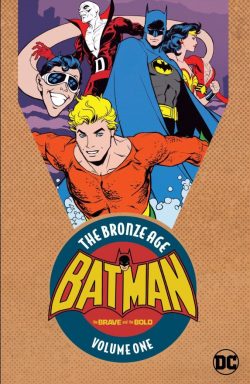
Batman in The Brave and the Bold: The Bronze Age volume one


By Bob Haney, Mike Sekowsky, Marv Wolfman, Ross Andru & Mike Esposito, Neal Adams, Bob Brown, Nick Cardy, Irv Novick & various (DC Comics)
ISBN: 978-1-4012-7517-4 (TPB)

The Brave and the Bold began in 1955 as an anthology adventure comic featuring short complete tales about a variety of period heroes: a format that mirrored the contemporary movie fascination with historical dramas.

Written by Bob Kanigher, issue #1 led with Golden Gladiator, the Silent Knight and Joe Kubert’s now legendary Viking Prince. From #5 the Gladiator was increasingly alternated with Robin Hood, but such manly, mainly mainstream romps carried the title until the end of the decade when the burgeoning costumed character revival saw B&B transform into a try-out vehicle like sister publication Showcase.

Issue #25 (August-September 1959) featured the debut of Task Force X: Suicide Squad, followed by Justice League of America (#28), Cave Carson (#31) and Hawkman (#34). Since only the JLA hit the first time out, there were return engagements for the Squad, Carson and Hawkman. Something truly different appeared in #45-49 with the science fictional Strange Sports Stories before Brave and the Bold #50 provided a new concept that once again truly caught the reader’s imagination.

That issue paired two superheroes – Green Arrow and Martian Manhunter – in a one-off team-up, as did succeeding issues: Aquaman and Hawkman in #51, WWII combatants Sgt Rock, Captain Cloud, Mme. Marie and the Haunted Tank in #52 and Atom and Flash in #53. The next team-up – Robin, Aqualad and Kid Flash – evolved rapidly into the Teen Titans. After Metal Men/the Atom and Flash/Martian Manhunter new hero Metamorpho, the Element Man debuted in #57-58.

Then it was back to superhero pairings with #59, and although no one realised it at the time this particular conjunction (Batman with Green Lantern) would be particularly significant.

After a return engagement for the Teen Titans in #60, the next two issues highlighted Earth-2 champions Starman and Black Canary, whilst Wonder Woman met Supergirl in #63.

Then, in an indication of things to come, and in anticipation of the TV-induced mania mere months away, Batman duelled hero/villain Eclipso in #64. Within two issues, following Flash/Doom Patrol (#65) and Metamorpho/Metal Men (#66), Brave and the Bold #67 saw the Caped Crusader take de facto control of the title and the lion’s share of the team-ups. With the exception of #72-73 (Spectre/Flash and Aquaman/Atom) the comic was henceforth to be a place where Batman invited the rest of company’s heroic pantheon to come and play…

For the sake of brevity and clarity and according to the wise ones who dictate such arbitrary demarcations, it’s also the point at which Comics’ Silver Age transitioned into the Bronze Age…

This first collection of unalloyed Batman pairings with other luminaries of the DC universe reprints B&B #74-91 (spanning October/November 1967 to August/September 1970) featuring the last vestiges of a continuity-reduced DC where individual story needs were seldom submerged into a cohesive overarching scenario, and where lead writer Bob Haney crafted stories that were meant to be read in isolation, drawn by a profusion of artists with only one goal: entertainment.

The Caped Crime-crusher took full possession of Brave and the Bold with #74’s fast-paced and dryly funny ‘Rampant Run the Robots’ as the Metal Men confront human prejudice and perfidious inventors whilst in #75 The Spectre joins the Dark Knight to free Gotham City’s Chinatown from an ancient wizard and ‘The Grasp of Shahn-Zi!’; both tales drawn by the new semi-regular art team of Ross Andru & Mike Esposito.

Illustrated by Mike Sekowsky & Jack Abel, Plastic Man helped solve the mystery of plastic-obsessed maniac The Molder in #76’s ‘Doom, What Is Thy Shape?’ after which Andru & Esposito return to limn the Atom’s participation in foiling a criminal circus performer in ‘So Thunders the Cannoneer!’

The vastly underrated Bob Brown stepped in to draw ‘In the Coils of the Copperhead’ wherein Wonder Woman found herself vying with the newly-minted Batgirl for Batman’s affections. Of course, it was all a cunning plan… or was it?

Neal Adams was a young illustrator who had worked in advertising and ghosted some newspaper strips whilst trying to break into comics. With #75 he had become a cover artist for B&B and with #79 (August-September 1968) he took over the interior art for a game-changing groundbreaking run that rewrote the rulebook for strip illustration.

‘The Track of the Hook’ paired the Dark Knight Detective with a justice-obsessed ghost. Deadman was murdered trapeze artist Boston Brand who perpetually hunted his own killer, and whose earthy, human tragedy elevated the series’ campy costumed theatrics into deeper, more mature realms of drama and action. The stories matured ten years overnight and instantly became every discerning fan’s favourite read.

‘And Hellgrammite is his Name’ then finds Batman and the Creeper defying a bug-themed super-hitman, and the Flash aids the Caped Crusader in defeating an unbeatable thug in ‘But Bork Can Hurt You!’ (both inked by Dick Giordano) before Aquaman becomes ‘The Sleepwalker from the Sea’ in an eerie tale of mind-control and sibling rivalry.

Issue # 83 took a radical turn as the Teen Titans try to save Bruce Wayne‘s latest foster-son from his own inner demons in ‘Punish Not my Evil Son!’ but the next team-up was one that got many fans in a real tizzy in 1969.

‘The Angel, the Rock and the Cowl’ recounted a World War II exploit where Batman and Sgt. Rock of Easy Company hunt Nazi gold and a war criminal together, only closing the case twenty-five years later. Ignoring the kvetching about relative ages and which Earth we’re on, which raised a storm in an eggcup back then, you should focus on the fact that this is a startlingly gripping tale of great intensity and beautifully realised: one which was criminally discounted for decades as “non-canonical”.

Brave and the Bold #85 is arguably the best of an incredible run. ‘The Senator’s Been Shot!’ reunited Batman and Green Arrow in a superb multi-layered thriller of politics, corruption and cast-iron integrity, wherein Bruce Wayne stands in for a law-maker and the Emerald Archer receives a radical make-over that turned him into the fiery liberal gadfly champion of the relevancy generation…

Boston Brand returned in #86, as Batman found ‘You Can’t Hide from a ‘Deadman!’: a captivating epic of death, redemption and resurrection that became a cornerstone of Bat-mythology forever after.

What follows is a decidedly different adventure written and drawn by Mike Sekowsky and starring the venerable comics icon he had made fresh and exciting all over again.

Inked by Giordano and entitled ‘The Widow-Maker’, it tells of the son of one of Batman’s old foes who attempts to add to his tally of motoring murders by luring the Caped Crusader into a rigged high-performance car race. That’s when recently de-powered Diana Prince, once and future Wonder Woman, steps in…

Following Adams’ iconoclastic and influential run was always going to be a tough act, but veteran Irv Novick – who would also unfairly tread in Adams’ mighty shadow on Batman for years to come – did sterling work here on a gritty tale of boxing and Cold War mind-games as the Caped Crusader meets golden age troubleshooter Wildcat in ‘Count Ten… and Die!’ (B&B #88, February-March 1970).

Esposito inked that tale before reuniting with long-time collaborator Ross Andru for a brief return engagement that began with a spooky suspense-thriller pitting Batman against the mystery sensation Phantom Stranger (and his rationalist rival Dr. Terry Thirteen) in #89’s ‘Arise Ye Ghosts of Gotham!’

The team then switch pace and genre for a time-bending science fiction thriller ‘You Only Die Twice!’ guest-starring interstellar champion Adam Strange and threatening to record the fall from grace and death of the Gotham Guardian.

The comics content concludes here with issue #91, as ‘A Cold Corpse for the Collector’ provides a true gem of love and death. Haney was always at his best with terse, human scale dramas, especially “straight” crime thrillers, and his pairing of the Batman with Black Canary (transplanted from Earth-2 to replace Wonder Woman in the Justice League) saw the recently-widowed heroine searching for the Earth-1 counterpart of her dead husband…

What she got was self-delusion, heartbreak and imminent death in a masterpiece of ironic melodrama. It also signalled the advent of the superb Nick Cardy as illustrator: a short run of beautifully drawn and boldly experimental assignments that are still startling to see nearly five decades later.

These are some of the best and most entertainingly varied yarns from a period of magnificent creativity in the American comics industry. Aimed at a general readership, gloriously free of heavy, cloying continuity baggage and brought to stirring, action-packed life by some of the greatest artists in the business, this is a Batman for all seasons and reasons with the added bonus of some of the most fabulous and engaging co-stars a fan could imagine. How could anybody resist? Seriously: can you…?
© 1967, 1968, 1969, 1970, 2017 DC Comics. All Rights Reserved.