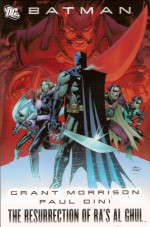
Batman: The Resurrection of Ra’s Al Ghul


By various (DC Comics)
ISBN: 978-1-84576-845-4

This fast and frantic collection presents another “final” clash between the Gotham Guardian’s extended gang-busting family and the immortal criminal mastermind: one which re-invents the eco-supremacist Ra’s Al Ghul.

This contemporary and more acceptable embodiment of the classically inscrutable “ancient foreign menace” was typified in a less forgiving age as the Yellow Peril or the threat of the Eastern races for the “civilised” West, embodied most memorably by Sax Rohmer’s Dr. Fu Manchu. This breed of alien archetype permeates the early days of popular fiction and is an overwhelmingly powerful symbol, although here the character’s Arabic origins, neutral at the time he was first created, seem to embody a different kind of ethnic bogeyman in today’s post 9/11 world.

The concept of a villain who has the best interests of the planet at heart is not a new one, but Ra’s Al Ghul, whose avowed intent is to cull teeming humanity back to ecologically viable levels and save the Earth from Mankind’s poisonous polluting madness, hit a chord in the 1970s – a period where such issues first came to the attention of the young. It was a rare kid who didn’t find a core of good sense in what “the Demon’s Head” planned.

The character is still best remembered for the O’Neil/Adams collaborations (see Batman: Tales of the Demon) but has come a long way since: arguably becoming more diluted and less impressive with each outing, but here an awesome assemblage of writers – Paul Dini, Grant Morrison, Peter Milligan, Fabian Nicieza, Keith Champagne and artists David López, Jason Pearson, Tony S. Daniel, Freddie E. Williams III, Don Kramer & Carlos Rodriguez, Ryan Benjamin, David Baldeón, Alvaro López, Jonatham Glapion, Wayne Faucher & Bit, Saleem Crawford and Steve Bird revive “the Demon’s Head” in breakneck, high-octane fashion just as DC’s much-publicised plans to kill off Bruce Wayne were about to commence.

Gathering the crossover story-arc that featured in Batman Annual #26, Robin Annual #7, Batman #670-671, Robin #168-169, Nightwing #138-139 and Detective Comics #838-839 the tale follows Talia and her son Damian as he learns the secret history of his dead grandfather Ra’s Al Ghul as Batman roves the world hunting down the last ancient alchemical Lazarus Pits which have always resurrected the long-lived villain over the centuries.

Genetically perfect, young Damian, whose sire was (technically) the Dark Knight is a reluctant student, and suspects that there might be an ulterior motive for his latest lessons. Playing hooky in a Cantonese graveyard the boy experiences things that shake even his cocky, obnoxious bravado…

Old time Wonder Woman mentor I-Ching (see Diana Prince: Wonder Woman volumes 1-4) guest-stars in the unfolding saga as does the deadly Sensei, master of Al Ghul’s League of Assassins; all strands in a broader web of intrigue revolving around the son of Batman, a factional war to determine the eventual successor to the Demon’s globe-girdling organisation and the desperate hunt to find the mystical city Nanda Parbat; an utterly pure refuge from all earthly evil.

However it seems the Demon is not quite dead: his consciousness is trapped in a disintegrating animated cadaver and if he is to survive the immortal mastermind needs to transfer his soul into the body of someone young and who, preferably, shares his genetic structure…

Revolted and on the run Damian turns to the Batman Family to save him from this horrendous fate whilst his mother Talia is been ousted from leadership of the cult by the mysterious White Ghost, fanatical acolyte of Al Ghul and one who holds the secrets of reviving the undying eco-terrorist…

Perhaps a little short on mood, this all-out blockbuster epic might appear a little disjointed to newer readers, but the action is non-stop and absolutely mesmerising as the assorted heroes try to halt the villain’s inevitable return, prevent a far worse monster from taking his place and save an innocent city and potentially malign child from falling into undying darkness.

Dedicated fanboys will thrill to the return of low-key old baddies such as Merlyn the Archer, Silken Spider, Tiger Moth and Dragonfly, the heroes strut their martial stuff against hordes of ninjas, assassins and warrior death-cults and the settings range from lost world to hidden kingdoms with the ever-present treat of soul-stealing body-snatchers ramping up the tension page by page. Daft and joyous this is real treat for the extreme combat fans and lays the threads for much of what would follow in the days after the latest “Death of Batman”.

© 2007, 2008 DC Comics. All Rights Reserved.

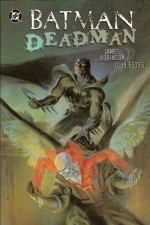
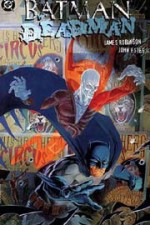
Batman/Deadman: Death and Glory


By James Robinson & John Estes (DC Comics)
ISBN: 978-1-84856-213-4 Softcover 978-1-56389-228-8

Everybody thinks they know Batman but only by a select few are the secrets of murdered trapeze artist Boston Brand also understood. An ordinary man in a brutal, cynical world Brand was a soul in balance until killed as part of a pointless initiation for a trainee assassin. When he died, instead of going to whatever reward awaited him, Rama Kushna, spirit of the universe, offered him the chance to solve his own murder. That opportunity evolved into an unending mission to balance the scales between good and evil in the world. The ghost is intangible and invisible to all mortal men, but has the ability to “walk into” living beings, possessing and controlling them.

Gotham City: Batman gradually regains consciousness, realising he is facing a squad of armed, trigger-happy police and holding a knife to the throat of a hostage. The scene is a Nightclub-turned-charnel house and all evidence before the hero’s widened eyes indicates that he is the murderous culprit…

Suddenly clear headed he drops his victim and escapes the SWAT teams, determined to find out what has happened since he lost consciousness. Stepping broadly out of character Batman uses magical items taken from villainous sorcerer Felix Faust to perform an eldritch rite and captures his prime suspect, Boston Brand. Unfortunately, his old comrade Deadman is not the guilty party, but reveals that a rich man who has sold his soul to the devil is responsible for all the Dark Knight’s woes.

Meanwhile, Albert Yeats, loser and AIDS victim is running for what’s left of his life, hunted by things he doesn’t know and can’t understand…

Determined to renege, Frederick Chaplin has offered another’s soul for his hellbound one, and the devil has accepted. Yeats had been chosen by the universe to reincarnate as the Messiah in his extremely imminent next life, but that can’t happen if he’s paying Chaplin’s tab in the Inferno. Deadman has been watching over Yeats until he safely passes, but when Batman was first possessed and subsequently distracted the Ghostly Guardian with his spell Yeats was left alone and unprotected…

Now the kid is in the wind and the heroes must find and shield him long enough to die safely, a task complicated by an entire city hunting what they still think is a murderous Bat-Maniac, whilst the real possession-killer – a phantom, satanic counterpart to Deadman called the Clown who has spread terror and death for seventy years – is loose to spread his own unholy kind of havoc…

Intriguing and pretty but lacking much of the emotional punch of earlier Batman/Deadman pairings, Death and Glory looks great but feels rather dispirited and glib in its attempts to blend urban horror, all-out chase action, cod-religion and hidden histories with a millennial feel-good factor, resulting in a top-rate outing for Boston Brand but a rather forced and unlikely performance from the Dark Knight.

Nevertheless, fans of both heroes will find lots to love here and Estes’ painted art will win the approval of most comic lovers. This book is still available through physical and online outlets, in both paperback and hardcover editions…

© 1996 DC Comics. All Rights Reserved.

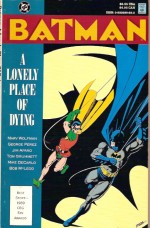
Batman: A Lonely Place of Dying


By Marv Wolfman, George Pérez, Jim Aparo, Tom Grummet, Mike DeCarlo & Bob McLeod (DC Comics)
ISBN: 978-0-9302-8963-8

Batman is in many ways the ultimate superhero: uniquely adaptable and able to work in any type or genre of story – as is clearly evident from the plethora of vintage tales collected in so many captivating volumes over the years.

One less well-mined period is the grim 1980s era when the Caped Crusader was partially re-tooled in the wake of Crisis on Infinite Earths, becoming a driven, but still level-headed, deeply rational Manhunter, rather the dark, out-of-control paranoid of later days or the costumed boy-scout of the “Camp” crazed Sixties.

Robin, the Boy Wonder debuted in Detective Comics #38 (April 1940) created by Bob Kane, Bill Finger and Jerry Robinson: a juvenile circus acrobat whose parents were murdered by a mob boss. The story of how Batman took the orphaned Dick Grayson under his scalloped wing and trained him to fight crime has been told, retold and revised many times over the decades and still regularly undergoes tweaking to this day.

Grayson fought beside Batman until 1970 when, as an indicator of those turbulent times, he flew the nest, becoming a Teen Wonder college student. His creation as a junior hero for younger readers to identify with had inspired an incomprehensible number of costumed sidekicks and kid crusaders, and Grayson continued in similar innovative vein for the older, more worldly-wise readership of America’s increasingly rebellious youth culture.

Robin even had his own solo series in Star Spangled Comics from 1947 to 1952, a solo spot in the back of Detective Comics from the end of the 1960s wherein he alternated and shared with Batgirl, and a starring feature in the anthology comic Batman Family. During the 1980s he led the New Teen Titans first as Robin but eventually in the reinvented guise of Nightwing, re-establishing a turbulent working relationship with Batman. This of course left the post of Robin open…

After Grayson’s departure Batman worked solo until he caught a streetwise urchin trying to steal the Batmobile’s tires. This lost boy was Jason Todd, whose short but stellar career as the second Boy Wonder was fatally tainted by his impetuosity and tragic links to one of the Caped Crusader’s most unpredictable foes.

Todd’s unsuspected emotional problems and his murder were controversially depicted and dealt with in Batman: a Death in the Family. In the shock and loss of losing his comrade the traumatised Dark Knight was forced to re-examine his own origins and methods, becoming darker still…

After a period of increasingly undisciplined encounters Batman was on the very edge of losing not just his focus but also his ethics and life: seemingly suicidal on his frequent forays into the Gotham nights. Interventions from his few friends and associates had proved ineffectual. Something drastic had to happen if the Dark Knight was to be salvaged.

Luckily there was an opening for a sidekick…

In this volume, collecting a crossover tale that originally appeared in Batman #440-442 and New Teen Titans #60-61 (plotted by Marv Wolfman and George Pérez, scripted by Wolfman with the Batman chapters illustrated by Jim Aparo & Mike DeCarlo, and the Titans sections handled by Pérez, Tom Grummett & Bob McLeod) a new character entered the lives of the extended Batman Family; a remarkable child who would change the shape of the DC Universe.

In ‘Suspects’ Batman is rapidly burning out, and not only his close confederates but also an enigmatic investigator and a mystery villain have noticed the deadly deterioration. Whilst the criminal mastermind embroils the wildly unpredictable Two-Face in his scheme, the apparently benevolent voyeur is hunting for Dick Grayson: a mission successfully accomplished in the second chapter, ‘Roots’.

The original Robin had become disenchanted with the adventurer’s life, quitting the Titans and returning to the circus where the happiest and most tragic days of his life occurred. Here he is confronted by a young boy who knows the secret identities of Batman and Robin…

‘Parallel Lines’ unravels the enigma of Tim Drake, who as a toddler was in the audience the night the Flying Graysons were murdered. Tim was an infant prodigy, and when, some months later he saw the new hero Robin perform the same acrobatic stunts as Dick Grayson he instantly deduced who the Boy Wonder was – and by extrapolation, the identity of Batman.

A passionate fan, Drake followed the Dynamic Duo’s exploits for a decade: noting every case and detail. He knew when Jason Todd became Robin and was moved to act when his death led to the Caped Crusader going catastrophically off the rails.

Taking it upon himself to fix his broken heroes Drake determined to convince the “retired” Grayson to became Robin once more – before Batman made an inevitable fatal mistake. It might all have been too little to late, however, as in ‘Going Home!’ Two-Face makes his murderous move against a severely sub-par Dark Knight…

Concluding with a raft of explosive and highly entertaining surprises with ‘Rebirth’ this often-overlooked Bat-saga introduces the third Robin (but who would get into costume only after years of training – and fan-teasing) whilst acknowledging both modern sentiments about child-endangerment and the classical roles of young heroes in heroic fiction. Perhaps a little slow and definitely a bit too sentimental in places, this is nevertheless an excellent, key Batman story, and one no fan should be unaware of.

Short, sweet and simply superb, here is a Batman – and Robin – much missed by many of us, and this tale, like so many others of the 1980s, is long overdue for the graphic novel treatment. To the Bat-Files, old chums…
© 1989,1990 DC Comics. All Rights Reserved.

Batman: R.I.P. – the Deluxe Edition


By Grant Morrison, Tony S. Daniel, Sandu Florea, Lee Garbett & Trevor Scott (DC Comics/Titan Books)
ISBN: 978-1-84856-137-3

After a sustained and vicious campaign of brutal psychological warfare, the all-encompassing criminal hegemony calling itself the Black Glove has succeeded in destabilising the already dubious mental equilibrium of Batman. The Glove’s enigmatic, quixotic leader Dr. Hurt is on the verge of his greatest triumph…

Grant Morrison’s controversial, much-touted extended saga relating “the Death of Batman”, promised much and managed to leave many fans confused, angry and unsatisfied, but us older lags knew full well that whatever happened, however long it took, Bruce Wayne would be back and the dance would begin all over again. So let’s take a look at this culminatory saga on its isolated, intrinsic merits and not as part of the hysterical “Buy Me! Buy Me!” huckster-hype: a solitary book starring one of the industry’s most resilient stars.

I’m reviewing the rather lovely Deluxe British edition produced by Titan Books: a lavish oversized hardback that really feels like a special event and which collects the contents of Batman #676-683 plus the portentous prelude from DC Universe #0, and also includes an extensive cover gallery – including all the variants – and a sketch section by Morrison and artist Tony S. Daniel.

After the aforementioned prelude (by Morrison & Daniel), a confrontation and mutual warning for the Dark Knight and the Clown Prince, ‘Midnight in the House of Hurt’ (which begins Sandu Florea’s cracking contribution as inker) sees the villainous clan commence their end-game as distracted, exhausted, head-over-heels-in-love Batman is dragged through further tribulations. The criminal cabal invite the Joker to join their Black Glove, whilst in ‘Batman in the Underworld’ the hero’s greatest allies begin to suspect that he’s out of control: even Bruce Wayne is no longer sure…

The first inkling of a counterplan comes with a glimpse of Batman’s earliest cases – a time when the master strategist had time to plan for every possible contingency. With his closest confidante apparently dead a radical new Caped Crusader stalks Gotham – the outlandish Batman of ‘Zur En Arrh’. Death and Chaos rule on the streets in ‘Miracle on Crime Alley’ and the utterly unpredictable Clown makes his characteristically savage move in ‘The Thin White Duke of Death’…Naturally it’s not what anybody expected…

Let’s be clear here: at the time of the original comics publication, for the industry and fan-base the Death of Batman was already a done deal. With the mega-crossover event Final Crisis rumbling along like a gaudy juggernaut, everybody “knew” that Bruce Wayne was a goner and only waited to see how, so when ‘Hearts in Darkness’ finally appeared with a resplendent, resurgent, triumphant Batman vanquishing and vanishing, leaving a slew of unanswered questions, there were howls of protest.

However these are readers who were aware of a greater picture that involved the entire DCU. For the purposes of this collection though and any casual reader picking it up, there is a solid narrative conclusion which is marvelously supplemented by the two-issue postscript ‘Last Rites’ which follows.

Illustrated by Lee Garbett and Trevor Scott, ‘The Butler Did It‘ and ‘The Butler Did It Again’ focus on Alfred Pennyworth as he adapts to a life without Master Bruce and his driven alter-ego. Looking backwards and to the future these contemplative pieces pinpoint some key moments of Batman’s serried history whilst carefully planting those clues that would inform the adventures of his successor and even lay a trail of breadcrumbs that would lead to the return of Bruce Wayne…

With the addition of such fashionably despised elements as Bat-Mite and Black Casebook continuity (see Batman: the Black Casebook), as well as deferring/postponing the traditional last chapter explanation and wrap-up, Morrison caught a lot of flak for this tale, but in all honesty, with the value of distance and hindsight this whole thing actually works very well, indeed.

Pretty, enthralling beautiful and magnificently compulsive, this is a Bat-book well worth another look.

© 2008, 2009 DC Comics. All Rights Reserved.

Titan books, who published this edition, are responsible for a huge number of publications; their magazines and graphic novels range from British and World comics and strip classics to fantasy, science fiction, licensed product and DC/Vertigo material for all tastes. Their fabulous new website/blog should beopen for business as you read this. Why not check them out as soon as you’re done here?

Superman & Batman vs. Vampires & Werewolves


By Kevin VanHook & Tom Mandrake (DC Comics)
ISBN: 978-1-4012-2292-5

The Man of Steel and the Dark Knight are two characters who have, for the most part, escaped their lowly comic-book origins and entered the greater meta-fictional literary landscape populated by the likes of Mickey Mouse, Fu Manchu, Tarzan and  Sherlock Holmes. As such their recognition factor outside our industry means that they get to work in places and with other properties that might not appeal to funny-book purists – take for example this controversial tale that piles on heaped helpings of monster-bashing, and which, despite a host of DC guest-stars, feels more like a test launch than a guaranteed hit.

Superman & Batman vs. Vampires & Werewolves is an intriguing, if flawed, oddment (with one of the clunkiest titles ever imagined) that might appeal to the casual graphic novel reader, especially if they’re not too adamantly wedded to the comic-book roots and continuity of the DC Universe.

Prowling the streets of Gotham, Batman comes across a partially devoured corpse and is promptly boots-deep in an invasion of mindless berserker vampires and werewolves who swiftly turn the city into a charnel house. Helpless to combat or contain the undead rampage, the Caped Crusader accepts the aid of enigmatic (but rational) vampire Marius Dimeter and his lycanthropic counterpart Janko who grudgingly ally themselves with the hero to track down Herbert Combs, a truly deranged scientist resolved to traffic with the Realms Beyond.

To facilitate his goals Combs had turned Janko and Dimeter into the cursed creatures they are and unleashed his plague of horrors on America to further his research. He is infecting more helpless humans and has become an actual portal for Lovecraftian beasts to invade our reality…

Superman joins the fray as one of these Elder God nightmares is unleashed but even after its defeat is no real help: hampered more by his ethical nature than his utter vulnerability to magic. Far greater aid is provided by super-naturalist Jason Blood and his Demonic alter-ego, whilst Kirk Langstrom, who can deliberately transform into the monstrous Man-Bat, provides both scientific and brutally efficient cleanup assistance.

Fellow heroes such as Wonder Woman, Nightwing and Green Arrow turn up and join the battle with great effect, but after their admittedly impressive cameos and participatory contributions wander off before the overarching threat is ended. Nuh-uuh! Once the team-up begins comics guys (who aren’t paid big bucks like big-name guest actors) don’t leave until the day is saved.

So it’s up to the headliners – with Dimeter and Janko – to finally restore order and normality but the cost is high both in blood and convictions… In the final outcome the heroes are – relatively – victorious but the ending is rather ambiguous and leaves the impression that the whole affair has been a pilot for a Dimeter spin-off

This is clearly a break-out publishing project, aimed at drawing in new readerships like those occasional movie tie-ins that drive professional fans crazy (see Superman & Batman vs. Aliens & Predator), and on that level the daft and inconsistent plot can be permitted if not forgiven.

VanHook more often makes films than comics and the tale is certainly most effective on the kind of action and emotional set-pieces one sees in modern film: so even if there are far too many plot holes big enough to drive a hearse through, the sensorial ride should carry most readers through. Most importantly the art of Tom Mandrake is as ever astoundingly powerful: dark brooding and fully charged for triumph and tragedy…

So whilst not perhaps for every collector, there’s still a great deal of sinful pleasure to be found here. And let’s face it: who doesn’t like monster stories or finding out “who would win if”…
© 2008, 2009 DC Comics. All Rights Reserved.

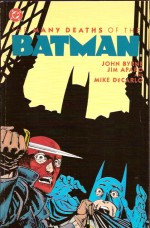
Batman: The Many Deaths of the Batman


By John Byrne, Jim Aparo & Mike DeCarlo (DC Comics)
ISBN: 978-1-56389-033-8

Batman is in one way the ultimate superhero: he is uniquely adaptable and can fit into practically any type or genre of story – as is clearly evident from the plethora of vintage tales collected in so many captivating volumes over the years.

One less well-mined period (so far at least) is the grim and/or gritty 1980s when the Caped Crusader was partially reinvented in the wake of the inspired and inspirational Crisis on Infinite Earths, becoming a driven but still cool-headed, deeply rational Manhunter, rather the dark, driven paranoid of later days or the costumed boy-scout of the “Camp” crazed Sixties.

This brief but satisfyingly punchy thriller combined the best of all worlds and even pushed the creative envelope with a silent/mime first chapter (no pesky words to read, fans!) as in the wake of the murder of his sidekick Jason Todd (see Batman: A Death in the Family) the traumatised hero is forced to re-examine his own origins during a bloody murder-spree that touches the very essence of what – and who – made him…

Collecting Batman #433-435 (May-July 1989) the mini epic opens in a shocked, rain-soaked Gotham with a ‘Period of Mourning’ as the city reacts to the sight of the Caped Crusader crucified in a dirty alley. His friends and enemies reel in shock, but soon that turns to something else as another Bat corpse is discovered. Meanwhile the real Dark Knight is finishing an international hunt in Paris when the news reaches him…

‘How Many Times Can a Batman Die?’ expands the enigma as the hero returns to Gotham to probe the mystery of six seemingly random dead men murdered in his costume. However they aren’t strangers to Bruce Wayne. Every one of them was a specialist in one particular field, and each had spent time long ago teaching an anonymous young man one of the many skills necessary to become the Batman…

The saga concludes in captivating and rewarding manner as a fair-play mystery is solved in ‘The Last Death of the Batman’, displaying all those composite skills as the Dark Knight shows himself to truly be “The World’s Greatest Detective.”

Short, sweet and simply superb, this is a Batman much missed by many of us, and this tale, like so many others of the period is long overdue for the graphic novel treatment. To the Bat-Files, old chums…
© 1992 DC Comics. All Rights Reserved.

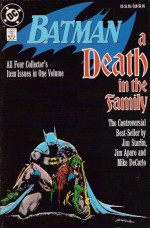
Batman: A Death in the Family


By Jim Starlin, Jim Aparo & Mike DeCarlo (DC Comics)
ISBN: 978-0-93028-944-7

Despite decades of wanting to be “taken seriously” by the wider world, every so often a comic-book event gets away from editors and publishers and takes on a life of its own. This usually does not end well for our favourite art form, as the way the greater world views the comics microcosm is seldom how we insiders and cognoscenti see it.

One of the most controversial comics tales of the last century saw an intriguing marketing stunt go spectacularly off the rails – for all the wrong reasons – becoming instantly notorious and sadly masking the real merits of the piece.

Robin, the Boy Wonder debuted in Detective Comics #38 (April 1940) created by Bob Kane, Bill Finger and Jerry Robinson: a juvenile circus acrobat whose parents were murdered by a mob boss. The story of how Batman took the orphaned Dick Grayson under his scalloped wing and trained him to fight crime has been told, retold and revised many times over the decades and still undergoes the odd tweaking to this day

The child Grayson fought beside Batman until 1970 when, as a sign of the turbulent times, he flew the nest, becoming a Teen Wonder and college student. His invention as a junior hero for younger readers to identify with had inspired an incomprehensible number of costumed sidekicks and kid crusaders throughout the industry, and Grayson continued in similar vein for the older, more worldly-wise readership of America’s increasingly rebellious youth culture.

Robin even had his own solo series in Star Spangled Comics from 1947 to 1952, a solo spot in the back of Detective Comics from the end of the 1960s wherein he alternated and shared with Batgirl, and a starring feature in the anthology comic Batman Family. During the 1980s the young hero led the New Teen Titans, re-established a turbulent working relationship with Batman and reinvented himself as Nightwing. This of course left the post of Robin open…

After Grayson’s departure Batman worked alone until he caught a streetwise young urchin trying to steel the Batmobile’s tires. Debuting in Batman #357 (March 1983) this lost boy was Jason Todd, and eventually the little thug became the second Boy Wonder (#368, February 1984), with a short but stellar career, marred by his impetuosity and tragic links to one of the Caped Crusader’s most unpredictable foes…

Todd had some serious emotional problems that became increasingly apparent in the issues leading up to ‘A Death in the Family’ as the street kid became more callous and brutal in response to the daily horrors he was being exposed to. When he caused the death of a vicious, abusive drug-dealer with diplomatic immunity (and when is that long-neglected sequence of tales going to be collected, huh?) the boy entered a spiral that culminated in the story-arc collected here, comprising Batman #426-429.

Ever more violent and seemingly incapable of rudimentary caution, Jason Todd is suspended by Batman who thinks the boy has not adjusted to the death of his parents. Meanwhile the Joker is again on the loose. But rather than his usual killing frenzy the Clown Prince is after mere cash, as the financial disaster of “Reaganomics” has depleted his coffers – meaning he can’t afford his outrageous murder gimmicks…

Without purpose, Jason has been wandering the streets where he grew up. When he sees an old friend of his dead mother she reveals s a shocking secret. The woman who raised him was not his birth-mother, and moreover there is a box of personal papers that indicate three women who might be his true mother. Lost and emotionally volatile Jason sets out to track them down…

The potential parents are Lady Shiva, world’s deadliest assassin, Sharmin Rosen, Mossad agent and Dr. Sheila Haywood, a famine relief worker in Ethiopia. As the lad heads for the Middle East and a confrontation with destiny he is unaware that Batman is also in that troubled region, hot on the Joker’s trail as the Maniac of Mirth attempts to sell a stolen nuclear missile to any terrorist who can pay…

The estranged heroes accidentally reunite to foil the plot, and Jason crosses Rosen off his potential mom-list. As Batman offers to help Jason check the remaining candidates the fugitive Joker escapes to Ethiopia. After eliminating Shiva, who has been training terrorists in the deep desert, the heroes finally get to Jason’s true mother Sheila Haywood, unaware that she has been blackmailed into a deadly scam involving stolen relief supplies with the Clown Prince of Crime…

I’m not going to bother with the details of the voting fiasco that plagues all references to this tale: it’s all copiously detailed elsewhere (just Google and see) but suffice to say that to test then-new marketing tools a 1-900 number was established and thanks to an advanced press campaign readers were offered the chance to vote on whether Robin would live or die in the story.

He dies.

The kid had increasingly become a poor fit in the series and this storyline galvanised a new direction with a darker, more driven Batman, beginning almost immediately as the Joker, after killing Jason in a chilling and unforgettably violent manner, became the UN ambassador for Iran (later revised as the fully fictional Qurac – just in case) and at the request of the Ayatollah himself attempted to kill the entire UN General Assembly during his inaugural speech.

With echoes of Frank Miller’s landmark The Dark Knight Returns, Superman then becomes a government watchdog tasked with stopping Batman from breaching diplomatic immunity as the vengeance-hungry Caped Crusader attempts to stop the Joker at any cost, leading to a spectacular yet chillingly inconclusive conclusion with the portents of dark days to come…

And here is the true injustice surrounding this tale: the death of Robin (who didn’t even stay dead) and the voting debacle took away from the real importance of this story – and perhaps deflected some real scrutiny and controversy. Starlin had crafted a clever and bold tale of real world politics and genuine issues which most readers didn’t even notice.

Terrorism Training Camps, Rogue States, African famines, black marketeering, Relief fraud, Economic, Race and Class warfare, Diplomatic skullduggery and nuclear smuggling all featured heavily, as did such notable hot-button topics as Ayatollah Khomeini, Reagan’s Cruise Missile program, the Iran-Contra and Arms for Hostages scandals and the horrors of Ethiopian refugee camps.  Most importantly it signaled a new and fearfully casual approach to violence and death in comics-books.

This is a superbly readable tale, morally challenging and breathtakingly audacious – but it’s controversial in all the wrong places and for all the wrong reasons. But don’t take my word for it: get it and see for yourself.

© 1988 DC Comics. All Rights Reserved.

Robin the Teen Wonder


By various (DC Comics)
ISBN: 978-1-1402-2255-0

Here’s a good example of some poor thinking: a book dedicated to reproducing representative samplings of the adventures of four extraordinary kids who have worn the mantle of the Dark Knight’s effervescent partner. Sadly the selections in this volume are pitifully, fatally flawed.

Robin, the Boy Wonder debuted in Detective Comics #38 (April 1940) created by Bob Kane, Bill Finger and Jerry Robinson: a juvenile circus acrobat whose parents were murdered by a mob boss. The story of how Batman took the orphan under his scalloped wing and trained him to fight crime has been told, retold and revised many times, and this volume begins with ‘Choice’ an impressively potent reinterpretation by Denny O’Neil and Dave Taylor which first saw print in Batman: Legends of the Dark Knight #100.

The child Dick Grayson fought beside Batman until 1970 when, as a sign of the turbulent times, he flew the nest, becoming a Teen Wonder and college student. His invention as an aspirational junior hero for young readers to identify with had inspired an uncountable number of costumed sidekicks and kid crusaders throughout the industry, and he continued in this role for the older, more worldly-wise readership of America’s increasingly rebellious youth culture.

Robin even had his own solo series in Star Spangled Comics from 1947 to 1952 (issues #65-130, collected as part the DC Archives line and something I really should review too), a solo spot in the back of Detective Comics from the end of the 1960s wherein he alternated and shared with Batgirl, and a starring feature in the anthology series Batman Family. During the 1980s the young hero led the revival of the Teen Titans, re-established a turbulent working relationship with Batman and reinvented himself as Nightwing. This of course left the post and role of Robin open…

‘Only Robins have Wings’ by Scott Beatty, Chuck Dixon, Scott McDaniel & Andy Owen (Nightwing #101) retrofits that 1970s break-up for 21st century readers in a strident but thoroughly entertaining manner, before the book takes a comprehensive downturn with a tale of the second Robin…

After Grayson’s departure Batman worked alone until he caught a streetwise young urchin trying to steel the Batmobile’s hubcaps. Debuting in Batman #357 (March 1983) this lost boy was Jason Todd, and eventually the little thug became the second Boy Wonder (#368, February 1984), with a short but stellar career, marred by his impetuosity and tragic links to one of the Caped Crusader’s most unpredictable foes…

The story selected to represent the lad here is a poor choice, however. This is not to say that ‘A Death in the Family’ is a lesser tale: far from it, and Jim Starlin, Jim Aparo and Mike DeCarlo’s landmark, controversial story of the murder of brash, bright Jason Todd by the Joker shook the industry and still stands the test of time. However all that’s included here is the final, fifth chapter, and even I, having read it many times, was bewildered as to what was going on.

Already collected in a complete A Death in the Family volume, this snippet – which hardly features Todd at all – could so easily have been replaced by one of the six-odd year’s worth of rip-snorting adventures (including a memorable run by Mike W. Barr, Alan Davis and Paul Neary) – and would it have been so hard to cobble up a couple of synopsis or précis pages to bring new readers up to speed?

The third Robin was Tim Drake, a child prodigy who deduced Batman’s secret identity and impending guilt-fuelled nervous breakdown, subsequently attempting to manipulate Dick Grayson into returning as the Dark Knight’s partner in another multi-part saga ‘A Lonely Place of Dying’ (Batman #440-442 and New Teen Titans #60-61.

After a long period of training and acclimation Batman offered Tim the job instead, and this interpretation took fans by storm, securing a series of increasingly impressive solo mini-series (see Robin: a Hero Reborn) and eventually his own long-running comic book.

Before we experience that transition however, James Robinson and Lee Weeks here contribute an evocative vignette retroactively exploring the deceased Jason Todd in ‘A Great Day for Everyone’ (also from Batman: Legends of the Dark Knight #100, I think) before once more we have to sit through a baffling conclusion from an already published graphic novel: the fifth chapter of the aforementioned ‘A Lonely Place of Dying’ by Marv Wolfman, George Pérez, Aparo and DeCarlo, from Batman #442.

Being trained by Batman is clearly an arduous undertaking: by the time of ‘A Life More Ordinary’ (from Robin #126, by Bill Willingham and Damion Scott), Drake too is increasingly estranged from his moody mentor and forcibly retired from the fights ‘n’ tights game. Batman replaces Tim with Stephanie Brown, daughter of the criminal Cluemaster, who became the vigilante Spoiler to compensate for her father’s depredations. Don’t get too excited though, since we only see her as the fourth Robin for a fraction over six pages…

Of course she doesn’t last and soon Tim is back – ‘though you won’t see how or why here – setting up on his own as defender of the city of Blüdhaven. ‘Too Many Ghosts’ (Robin #132 – and for the complete story see Robin/Batgirl: Fresh Blood) is a somewhat abridged version of the brilliant tale by Willingham and Scott, fast paced and thoroughly readable but again, inconclusive and incomplete.

This book concludes with ‘Life and Death’ from Teen Titans #29 by Geoff Johns, Tony S. Daniel & Marlo Alquiza, but if you need to know when Jason Todd came back from the dead, how he grew up into the savagely villainous Red Hood and why decided to beat Tim Drake/Robin to a pulp you’re in for something of a disappointment. Although a spectacular battle of old versus new, there’s little beyond that to edify the readers…

User-unfriendly packages like this do nobody any favours: talented creators and great characters look unprofessional and readers are bewildered and short-changed. This could so easily have been a treasured celebration of a groundbreaking concept immortally renewed, but instead feels just like the “previously on” segments that TV shows use to remind already regular fans and which always precede the real content…

A regrettable waste of everybody’s time and effort…

© 1988, 1989, 1997, 2004, 2005, 2009 DC Comics. All Rights Reserved.

Catwoman: the Long Road Home


By Will Pfeiffer, David Lopez & Alvaro Lopez (DC Comics)
ISBN: 978-1-84856-181-6

After a phenomenal relaunch (see Catwoman: Selina’s Big Score, The Dark End of the Street and Crooked Little Town) the feline felon motored along nicely for years before falling prey to her most telling weakness: she is inextricably bonded to the Bat Franchise and as it turns, so does she.

Despite some sterling work from Will Pfeiffer, David Lopez & Alvaro Lopez, the series was marked for cancellation and the final days saw her sucked into both the Amazons Attack and Salvation Run publishing events (see particularly Wonder Woman: Amazons Attack!, Justice League of America: Sanctuary, JLA: Salvation Run and the previous volume Catwoman: Crime Pays).

So it is that this final compilation (collecting issues #78-82 of her gone-but-not-forgotten monthly comic) opens with the urban defender of Gotham City’s downtrodden underclass marooned on a distant deadly planet where America’s super-criminals have been clandestinely deported by the government, trying to avoid being killed by her own rogues gallery (Russian émigrés Hammer & Sickle and Cheetah most notably) whilst back on Earth old friend Slam Bradley’s search for her has led him into a murderous deathtrap…

One Final Whine (and you just know that’s not true): as I’ve said in many a review, graphic novels are different from simultaneously published periodicals, and lots of the tricks that augment sales in the latter are actual hindrances in the former. This first chapter is the ideal example of that observation.

In the comic-books this story culminates with a cataclysmic death-duel on the alien Hellworld, and a Slam Bradley teaser/cliffhanger after which the informed reader turns to Salvation Run issues #6 and 7 to discover what happens next. In this collection we simply, inexplicably find Catwoman back on Earth and coming to Slam’s rescue. Bast help you if you’re on a tight budget or only collect Catwoman books…

Feel free to consider that an advisory to buy Salvation Run too.

After saving Bradley Selina returns to unfinished business: chiefly tracking down The Thief, an obnoxious upstart who stole all her possessions and reputation to augment his own, which she does with panache and perhaps excessive force and zeal, before settling a few other old scores, most notably with criminal information broker The Calculator, and drives off into the sunset after one final fight with Batman.

This is a readable if necessarily bitty clean-up operation prior to Catwoman joining the cast of the ensemble series “Gotham City Sirens”, but there are still moments of the old magic to be found here. A rather unfortunate end to a superb series and a wrap-up only the most dedicated fans should have to endure.

© 2008 DC Comics. All Rights Reserved.
Manhunter: The Special Edition


By Archie Goodwin & Walter Simonson (DC Comics)
ISBN: 1-56389-374-6

One of the most celebrated superhero series in comics history, Manhunter catapulted young Walt Simonson to the front ranks of creators, revolutionised the way dramatic adventures were told and still remains the most lauded back-up strip ever produced. Concocted by genial genius Archie Goodwin as a support strip in Detective Comics (#437-443, October-November 1973 to October-November 1974) the seven episodes – a mere 68 pages – won six Academy of Comic Book Arts Awards during its far too brief run.

In case you’re wondering: Best Writer of the Year 1973 – Archie Goodwin,

Best Short Story of the Year 1973 ‘The Himalayan Incident’,

Outstanding New Talent of the Year 1973 – Walter Simonson,

Best Short Story of the Year 1974 ‘Cathedral Perilous’,

Best Feature Length Story of the Year 1974 ‘Götterdämmerung’ and

Best Writer of the Year 1973 – Archie Goodwin.

Paul Kirk was a big game hunter and part-time costumed mystery man before and during World War II. Becoming a dirty jobs specialist for the Allies, he lost all love of life and died in a hunting accident in 1946. Decades later he seemingly resurfaced, and came to the attention of Interpol agent Christine St. Clair. Thinking him no more than an identity thief she soon uncovered an incredible plot by a cadre of the World’s greatest scientists who had combined into an organisation to assume control of the planet once they realised that man now had the means to destroy it.

Since the end of the War the Council had infiltrated all corridors of power, making huge technological advances (such as stealing the hero’s individuality by cloning him into an army of superior soldiers), slowly achieving their goals with no-one the wiser, but the returned Paul Kirk had upset their plans and was intent on thwarting their ultimate goals…

This slim volume reprints the much-missed Mr. Goodwin’s foreword from the 1979 black and white album Manhunter: the Complete Saga and gathers in one spiffy single collection Kirk’s entire tragic quest to regain his humanity and dignity. Coloured by Klaus Janson and lettered by Ben Oda, Joe Letterese, Alan Kupperberg & Annette Kawecki, it tells of St. Clair and Kirk’s first meeting in ‘The Himalayan Incident’, her realisation that all is not as it seems in ‘The Manhunter File’ and their revelatory alliance in ‘The Resurrection of Paul Kirk.’

Now fully a part of Kirk’s crusade Christine discovered just how wide and deep the Council’s influence ran in ‘Rebellion!’ before beginning the end-game in the incredible ‘Cathedral Perilous’ and gathering one last ally in ‘To Duel the Master’…

With all the pieces in play for a cataclysmic confrontation, events take a strange misstep as Batman stumbles into the plot and threatens to inadvertently hand the Council ultimate victory. ‘Götterdämmerung’ fully lived up to its title and perfectly wrapped up the saga of Paul Kirk – which was a superb triumph and perplexing conundrum for decades to come.

In an industry notorious for putting profit before aesthetics the pressure to revive such a well-beloved character was enormous, but Goodwin and Simonson were adamant that unless they could come up with an idea that remained true to the spirit and conclusion of the original, Manhunter would not be seen again.

Although the creators were as good as word DC did weaken a few times and Kirk clones featured in the Secret Society of Super-Villains and the Power Company, but they were mere shabby exploitations of the original. Eventually however, an idea occurred and the old conspirators concocted something that was usable and didn’t debase the original saga. Archie provided a plot, and Walter began to prepare the strip.

And after years of valiant struggle Archie finally succumbed to the cancer that had been killing him. Anybody who had ever met Archie Goodwin will understand the void his death created. He was irreplaceable.

Without a script the project seemed doomed until Simonson’s wife Louise suggested that it be drawn and run without words: a silent tribute and the last hurrah for a true hero. Manhunter: the Final Chapter reunites all the characters and brings the sublime epic to a perfect resolution. Now it really is all over…

With a touching afterword from Walter and a couple of pin-ups thrown in, this book represents a perfect moment of creative brilliance and an undisputed zenith in comics storytelling. This is a tale no comic fan can afford to be without.
© 1973, 1974, 1999 DC Comics.  All Rights Reserved.