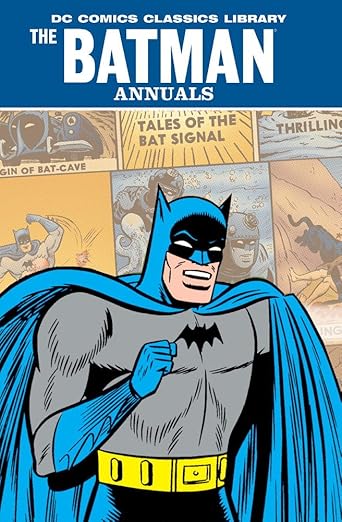
The Batman Annuals volume 2 – DC Comics Classic Library


By Bob Kane, Bill Finger, Edmond Hamilton, Ed France Herron, Jerry Coleman, David Wood, Sheldon Moldoff, Lew Sayre Schwartz, Dick Sprang, Curt Swan, Charles Paris, Stan Kaye, Ray Burnley & various (DC Comics)
ISBN: 978-1-4012-2791-3 (HB)

This book includes Discriminatory Content produced in less enlightened times.

There’s a lot of truly splendid 1940s and 1950s comics material around these days in a lot of impressive formats. DC’s Classics Comics Library hardbacks were a remarkably accessible, collectible range of products – inexplicably still not available in digital editions! – and one of the best is this wonderful aggregation of four of the most influential and beloved comic books of the Silver Age of American comic books.

Batman Annual #1 was released in June 1961, a year after the phenomenally successful Superman Annual #1. The big, bold anthology format was hugely popular with readers. The Man of Steel’s second Annual was rushed out before Christmas and the third came out a mere year after the first. That same month a Secret Origins compilation and the aforementioned Batman Blockbuster all arrived in shops and on newsstands. It’s probably hard to appreciate now but those huge comics – 80 pages instead of 32 with practically no advertising except other comics – were a magical resource with a colossal impact on kids who loved comics. I don’t mean the ubiquitous scruffs, oiks, scofflaws and scallywags of school days who read casually before chucking them away (most kids were comics consumers in the days before computer games) but rather those quiet, secretive few of us who treasured and kept them, constantly re-reading, listing, discussing, pondering, and even making our own. Only posh kids with wicked parents read no comics at all: those prissy, starchy types who were beaten up by the scruffs, oiks and scallywags even more than us bookworms. But I digress…

For budding collectors the Annuals were a gateway to a fabulous lost past. Just Imagine!: adventures your heroes had from before you were even born

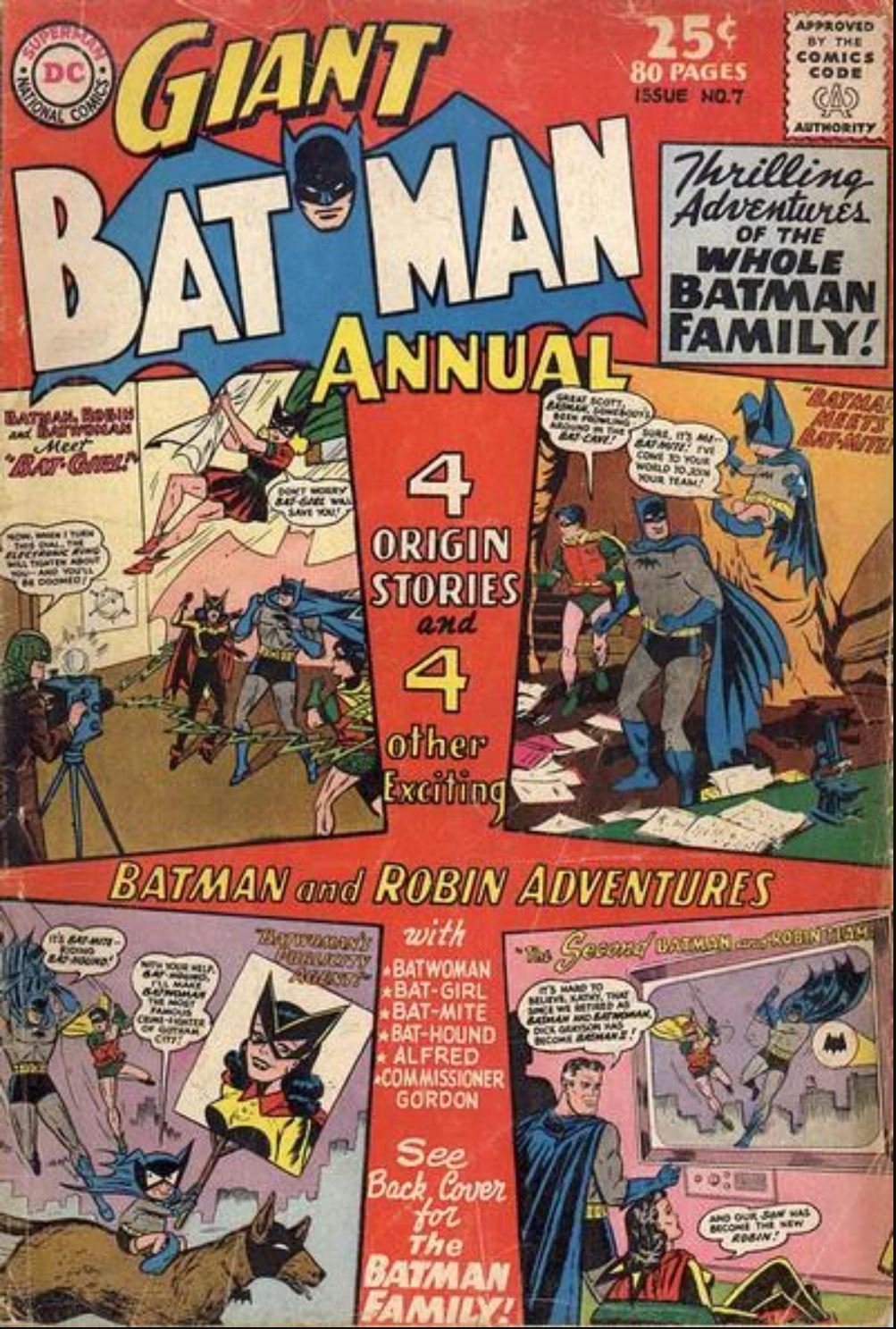
Those fantastic innovative aggregations in the early 1960s changed comics publishing. Soon Marvel, Charlton, and Archie were also releasing giant books of old stories, then came new ones, crossovers, continued stories. Annuals proved two things to publishers: that there was a dedicated, long-term appetite for more material – and that punters were willing to pay a little bit more for it. This hardback compendium completes a set by gathering Batman Annuals #4-7 (from 1963-1966) in their mythic entirety: 33 terrific complete stories, stunning pin-ups and especially all those magnificently iconic compartmentalized covers. Also included are original publication details and credits (the only bad thing about those big books of magic was never knowing “Who” and “Where”); creator biographies and another reminiscing Introduction from Michael Uslan, putting the entire nostalgic experience into perspective.

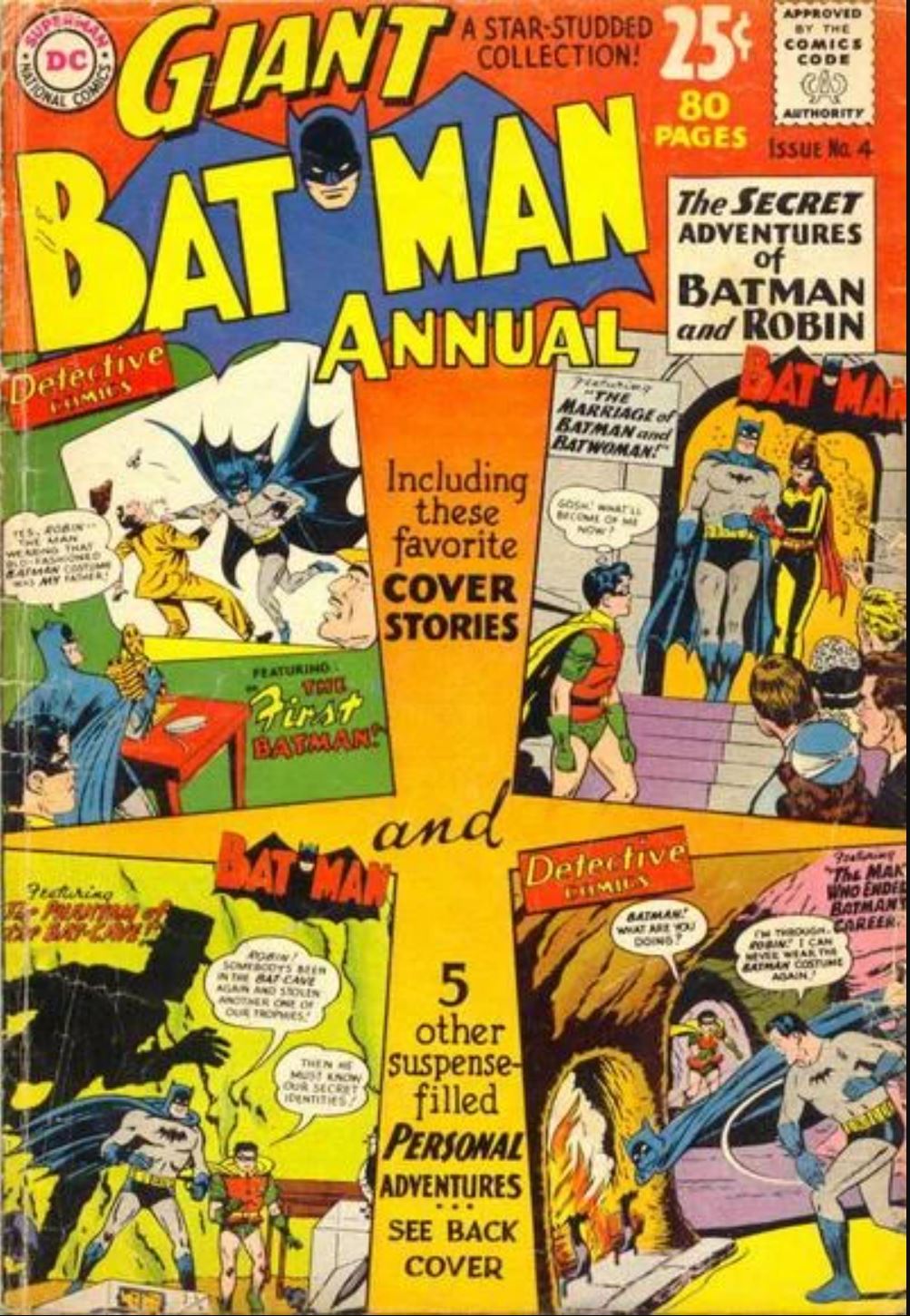
Way back then editors sagely packaged Annuals as themed collections, the first here being The Secret Adventures of Batman and Robin (released November 8th 1962) which started the ball rolling with ‘The First Batman’ (by Bill Finger & Sheldon Moldoff as originally seen in Detective Comics #235, September 1956): a key story of this period, introducing a strong psychological component to Batman’s origins by disclosing how, when Bruce Wayne was still a toddler, his father had clashed with gangsters whilst clad in a fancy dress bat costume…

‘Am I Really Batman?’ (Finger, Moldoff & Charles Paris; Batman #112, December 1957) saw bona fide mad scientist Professor Milo poison the hero with a rare plant, forcing Robin and Alfred to put the Masked Manhunter through a baffling psychological ordeal to counteract the toxin…

Today fans are pretty used to a vast battalion of bat-themed champions haunting Gotham City and its troubled environs, but for the longest time it was just Bruce, Dick Grayson and occasionally borrowed dog Ace keeping crime on the run. However, with Detective #233 (July 1956, and 3 months before The Flash’s debut officially ushered in the Silver Age) editorial powers-that-be introduced vivacious heiress Kathy Kane who – for the next eight years – incessantly suited-up in chiropteran red & yellow. Edmond Hamilton, Moldoff & Paris premiered ‘Origin of the Batwoman’ with a former circus acrobat bursting into Batman’s life, challenging him to discover her secret identity at the risk of exposing his own…

The Boy Wonder began very publicly working solo after ‘The Vanished Batman’ (Hamilton, Moldoff & Stan Kaye, (Batman #101, August 1956) saw the Gotham Gangbuster declared dead and presumed gone by the underworld whilst ‘The Phantom of the Bat-Cave’ (Hamilton, Moldoff & Paris, Batman #99, April 1956) offered a genuine mystery as persons unknown began somehow stealing/replacing items from the heroes’ sacrosanct trophy room. ‘Batman’s College Days’ (Finger, Moldoff & Paris, Batman #96, December 1955) saw Bruce Wayne on a sea cruise with three fellow alumni, one of whom planned murder and had deduced his alter ego, after which ‘The Marriage of Batman and Batwoman’ (Finger, Moldoff & Ray Burnley, Batman #122, March 1959) depicted Robin’s nightmares should such a nuptial event occur whereas ‘The Second Boy Wonder’ (France Herron, Moldoff & Burnley, Batman #105, February 1957) was all too real as a stranger apparently infiltrated the Batcave by impersonating the kid crimebuster. The Annual ended with ‘The Man who Ended Batman’s Career’ (Finger, Moldoff & Paris; Detective #247, September 1957) presenting a significantly different-looking Professor Milo using psychological warfare and scientific mind-control to attack the Dark Knight by inducing a fear of bats…

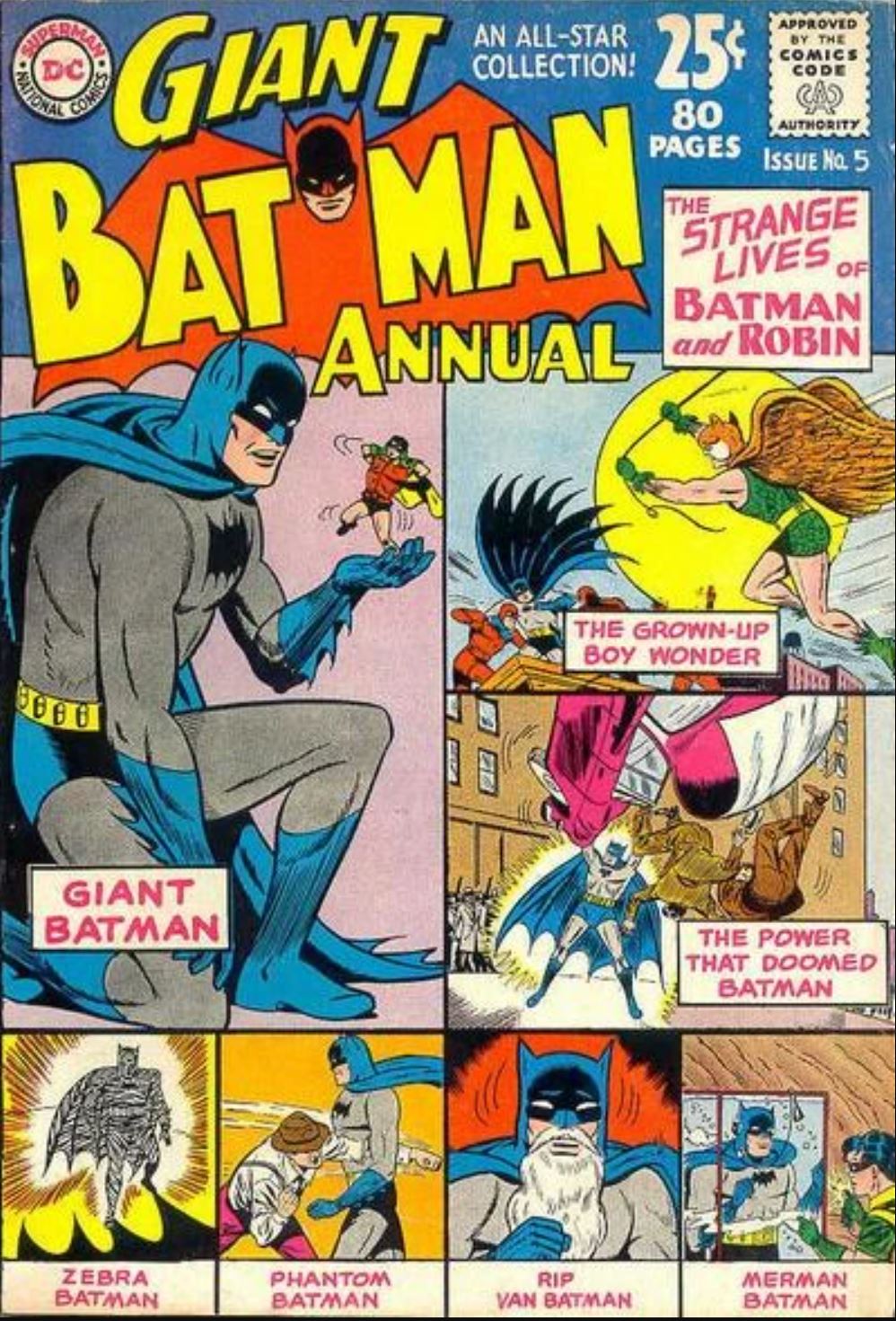
The next Annual, released in summer 1963, highlighted The Strange Lives of Batman and Robin, opening with ‘The Power that Doomed Batman’ (Finger, Moldoff & Paris, DC #268 June 1959) as exposure to a comet gifts the Dark Knight with super-strength. Sadly, the effect is also cumulatively fatal, forcing them into a desperate hunt for a missing man possessing a cure. The same creative team dredged up ‘The Merman Batman’ (Batman #118, September 1958) wherein an lightning strike transforms the Caped Crimebuster into a water-breather, aroused ‘Rip Van Batman’ (Batman #119, October 1958) who fell into a plant-induced coma to seemingly awake in the future and corralled ‘The Zebra Batman’ (Detective Comics #275, January 1960) when the hero becomes an uncontrollable human magnet…

‘The Grown-Up Boy Wonder’ (Finger, Moldoff & Kaye, Batman #107, April 1957) details what happens when space gas turns the likely lad into a strapping young man – but only in body, not mind – after which World’s Finest Comics #109 (May 1960) reveals Robin & Superman’s tense race to save Gotham’s Guardian from an ancient curse in ‘The Bewitched Batman’ by Jerry Coleman, Curt Swan & Moldoff. ‘The Phantom Batman’ (Hamilton, Dick Sprang & Paris, Batman #110, September 1957) shows how an electrical mishap reverses the polarity of the Caped Crusader’s atoms, relegating him to helpless intangibility, before the uncanny yarns end with ‘The Giant Batman’ (DC #243 May 1957, by the same team and originally entitled Batman the Giant!’). Here our hero is exposed to a well-meaning scientist’s “Maximizer” ray and grows too large to catch the thieves who stole it and the antidote…

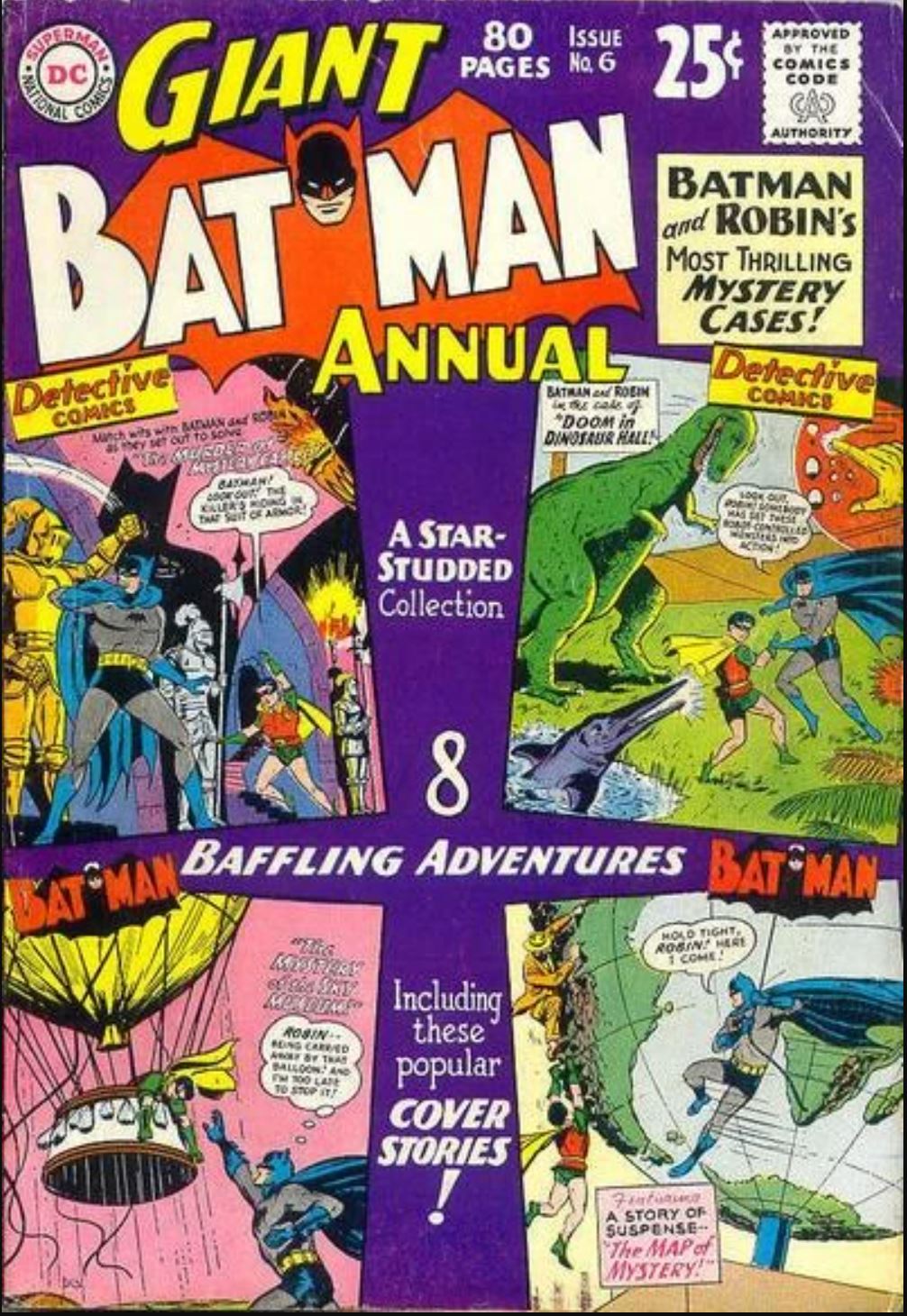
Six months later Batman Annual #6 (Winter 1963-1964) featured Batman and Robin’s Most Thrilling Mystery Cases, kicking off with ‘Murder at Mystery Castle’ (Finger, Moldoff & Paris, Detective #246 August 1957) as visitors – Batman & Robin included – to a reconstructed medieval fortress witness a devilish remote control killing and must deduce who set the fiendish trap…

‘The Gotham City Safari’ (Finger, Moldoff & Paris; Batman #111, October 1957) saw the Dynamic Duo hunting a hidden killer through a fabulous theme-park of exotic locales whilst ‘The Mystery of the Sky Museum’ (Hamilton, Moldoff & Paris; Batman #94, September 1955) finds them at an aviation museum on the trail of sinister smugglers. Next, Hamilton, Sprang & Paris’ ‘The Mystery of the Four Batmen’ (Batman #88, December 1954) is a seagoing enigma with the Partners in Peril seeking a mysterious smuggler with a tenuous connection to bats in one form or another, after which a movie monster makes trouble on location, compelling the crimebusting champions to tackle ‘The Creature from the Green Lagoon’ (David Wood, Moldoff & Paris; D C #252 February 1958)…

A stunning chase to expose a killer searching for a lost golden hoard involved solving ‘The Map of Mystery’ (Hamilton, Sprang & Paris; Batman #91, April 1955), before a disgruntled family member seemingly threatens to kill every member of ‘The Danger Club’ (Hamilton, Lew Sayre Schwartz & Paris; Batman #76, April/May 1953). The astounding sleuthing only ceases after uncovering ‘Doom in Dinosaur Hall’ (Finger, Moldoff & Paris, Detective Comics #255 May 1958) where the curator’s murder at Gotham’s Mechanical Museum of Natural History led to a fantastic chase and a surprise culprit…

Summer 1964 spawned Batman Annual #7 and Thrilling Adventures of the Whole Batman Family: beginning by introducing the hero’s most controversial “partner” – a pestiferous, prank-playing extra-dimensional elf – in ‘Batman Meets Bat-Mite’ (Finger, Moldoff & Paris; Detective #267 May 1959), after which eponymous masked dog Ace narrates ‘The Secret Life of Bat-Hound’ (Finger, Moldoff & Paris; Batman #125, August 1959) and his part in capturing the nefarious Midas Gang. Finger, Moldoff & Paris enlarge the clan in Batman #139 (April 1961), ‘Introducing Bat-Girl’ as Kathy Kane’s niece Betty starts dressing up and acting out as an unwanted assistant, eventually proving adults and boys wrong by taking down the deadly King Cobra and his crew, before Hamilton delivers the only adventure of ‘The Dynamic Trio’ (DC #245 July 1957), with a very old friend donning cape and cowl as Mysteryman to help combat a smuggling ring facilitating the escape of Gotham’s fugitives. Courtesy of Finger, Moldoff & Paris, faithful manservant Alfred personally reveals an early failure and shocking resolution in ‘The Secret of Batman’s Butler’ (Batman #110; September 1957) before ‘The New Team of Superman and Robin’ (Finger, Swan & Moldoff; WFC # 75, March/April 1955) depicts how disabled Batman can only fret and fume as his erstwhile assistant seemingly dumps him for a better man…

When Bat-Mite elects himself ‘Batwoman’s Publicity Agent’ (Finger & Moldoff; Batman #133, August 1960), the result is chaos and unbridled craziness, but not as much as an “Imaginary Story” devised by Alfred debuting ‘The Second Batman and Robin Team’ (Finger, Moldoff & Paris: Batman #131, April 1960) which would inevitably emerge after Bruce and Kathy wed and Dick assumes the mantle of the bat…

Moldoff’s unforgettable back page pin-up ‘Greetings from the Batman Family’ wraps up this final glimpse at simpler but wilder times. Strange, addictive and still potently engrossing, these weird wonder tales typify a lost era of gentler danger, more wholesome evil and irresistible fun. They’re also impossibly compelling, incredibly illustrated and undeniably influential. A perfect treat for young and old alike and anyone who came to the characters via Saturday morning cartoons…
© 1962, 1963, 2010 DC Comics. All Rights Reserved.

Batman Annual 1967


By Bill Finger, Jack Miller, Sheldon Moldoff, Joe Certa, Dick Sprang, Henry Boltinoff & various (Atlas Publishing & Distributing Co. Ltd/K. G. Murray Publishing)
No ISBN: ASIN: B000SBX0N0

This book includes Discriminatory Content produced in less enlightened times.

As stated below, before DC Comics and other US publishers exported directly into Britain, our exposure to their unique brand of fantasy fun came from licensed reprints. As well as monochrome anthologies from UK publishers and/or printers like Miller, Class & Co, Australian outfit K. G. Murray there were  many sturdy Annual compilations.

Britain saw hardcover Atlas Batman Annuals from 1960 but, due to vagaries of licensing, once the 1966 TV series started were soon inundated with a wealth of choices as World Distributors’ released their own collections Batman Story Book Annuals – between 1967 and 1970. Since then a variety of publishers have carried on the tradition but only one at a time…

This particular tome – Batman Annual 1967 – was the eighth UK-targeted US comics compilation, released the same year as the other Bat-book seen here today and possibly offering grandparents and other elders a moment of agonised total recall as they flash back to the moment at the start of that Batman phenomenon when they stood arguing with equally harassed and panicked shopkeepers over which was the right book “from the telly”…

Printed in the cheap and quirky mix of alternatively monochrome, dual-hued and full-colour pages which made Christmas books such bizarrely beloved treats, and re-presenting material from before all Earth went Camp-Crazed and Bat-Manic, this book delivers a delightfully eclectic mix of material crafted just before Julie Schwartz’s 1964 stripped-down relaunch of the character. Here crimebusting mixes with alien fighting and idle daydreaming, as the world’s greatest crime-fighters indulge in a comfortably strange, masked madness that was the norm in the Caped Crusader’s world.

The sublime suspense and joyous adventuring begins with ‘The Return of the Second Batman and Robin Team’ (by Bill Finger & Sheldon Moldoff from Batman #135, October 1960): a sequel to a tale within a tale wherein faithful butler Alfred postulated a time when Bruce Wayne married Batwoman Kathy Kane and retired to let their son join grown-up Dick Grayson as a second-generation Dynamic Duo. Here the originals are forced to don the bat mantles one last time when an old enemy captures the new kids on the block…

British books always preferred to alternate action with short gag strips and the Murray export publications depended heavily on the amazing output of DC cartoonist Henry Boltinoff. Delivery man ‘Homer’ then suffers a canine interruption before Batman invades ‘The Lair of the Sea Fox’ (Batman #132; June 1960, by Finger, Moldoff & Charles Paris). The nefarious underwater brigand’s scheme to use Gotham City’s watery substructure to facilitate his plundering soon founders when the Caped Crusaders break out the Bat-Sub…

Boltinoff’s crystal-gazing ‘Moolah the Mystic’ clears up the ether his way as a prelude to the introduction of this Annual’s engaging co-star. John Jones, Manhunter from Mars debuted at the height of American Flying Saucer fever in Detective Comics #225. He was created by Joe Samachson, and is now generally accepted as the first superhero of the Silver Age, beating by a year the new Flash (in Showcase #4. cover-dated October 1956). The eccentric, often formulaic but never disappointing B-feature strip depicted the clandestine adventures of stranded alien J’onn J’onzz. Hardly evolving at all – except for finally going public as a superhero in issue #273 (November 1959) – the police-centred strip ran in Detective until #326 (1955- 1964 and almost exclusively written by Jack Miller from issue #229 and illustrated from inception by Joe Certa), before shifting over to The House of Mystery (#143 where he continued until #173) and a whole new modus vivendi. J’onzz temporarily faded away during the Great Superhero Cull of 1968-70 but is back in full fettle these days.

His origins were simple: reclusive genius scientist Dr. Erdel built a robot-brain which could access Time, Space and the Fourth Dimension, accidentally plucking an alien scientist from his home on Mars. After a brief conversation with his unfortunate guest, Erdel died of a heart attack whilst attempting to return J’onzz to his point of origin. Marooned on Earth, the Martian discovered that his new home was riddled with the ancient and primitive cancer of Crime and – being decent and right-thinking – determined to use his natural abilities (telepathy, psychokinesis, super-strength, speed, flight, vision, super-breath, shape-shifting, invisibility, intangibility, invulnerability and more) to eradicate evil, working clandestinely disguised as a human policeman. His only concern was the commonplace chemical reaction of fire which sapped Martians of all their mighty powers…

With his name Americanised to John Jones he enlisted as a Middletown Police Detective: working tirelessly to improve his new home; fighting evil secretly using inherent powers and advanced knowledge with no human even aware of his existence. Here in a thriller from Detective #299 (January 1962) Miller & Certa’s ‘Bodyguard for a Spy’ sees the mighty Manhunter almost fail in his mission, because his human assistant Diane Meade is jealous of the beautiful Princess in his charge…

The magnificent Dick Sprang – with Paris inking – astoundingly illustrated Finger’s script for ‘Crimes of the Kite Man’ (Batman #133, August 1960): a full-colour extravaganza with the Caped Crusader hunting an audacious thief plundering the skyscrapers of Gotham whilst ‘The Deadly Dummy’ (Finger, Moldoff & Paris; Batman #134, September 1960) pitted the heroes against a diminutive showman-turned-bandit fed up with being laughed at.

Reverting to monochrome, ‘The Martian Show-Off’ (Detective #295, September 1961) poses a confusing conundrum as the eerie extraterrestrial connives to inexplicably deprive a fellow cop of his prestigious 1000th arrest after which ‘Batman’s Interplanetary Rival’ (Detective Comics #282, August 1960) by Finger, Moldoff & Paris finds the human heroes constantly upstaged by an alien lawman hungry for fame and concealing a hidden agenda before the interplanetary intrigue – and the Annual action – ends with ‘The Mystery of the Martian Marauders’ (Detective Comics #301, March 1962) as deranged scientist Alvin Reeves fixes Erdel’s robot brain and accidentally brings Martian criminal invaders to Earth. After battling impossible odds, the Manhunter triumphs and wins the ability to return at any time to his birthworld…

Cheap, cheerful and deliriously engaging, this is a fantasy masterwork and nostalgic treat no baby-boomer could possibly resist.
© National Periodicals Publications Inc., New York 1967. Published by arrangement with the K. G. Murray Publishing Company, Pty. Ltd., Sydney.

Batman Returns One Dark Christmas Eve – The Illustrated Holiday Classic


By Ivan Cohen & JJ Harrison & various (Insight Editions)
ISBN: 978-1-64722-754-8 (HB)

Win’s Christmas Gift Recommendation: Mirthful Movie Moments… 9/10

The Holiday Season means many things to most people. For comics fans – legendarily the sappiest and most sentimental people on Earth – it has always delivered delightful festive tales that break hearts, gladden spirits and thrill the pants off you. Batman has owned Christmas in comics since the Golden Age – and where’s my archive collection of those stories, huh?

In 1992 Tim Burton and his talented cinematic cohort perfectly addressed all that Holiday Heritage in the blockbuster Batman Returns – the first X-Mas Superhero movie. You’ve either seen it or not, but its legacy looms large in this (practically) all-ages treat from author, graphic novelist, journalist and TV writer Ivan Cohen (Space Jam: A New Legacy, Star Wars, Batman and Scooby-Doo Mysteries, Teen Titans GO!) with gallery artist/illustrator JJ Harrison (A Die Hard Christmas, Ninja Boy Goes to School, Gremlins: The Illustrated Storybook) making the pictures.

Batman Returns One Dark Christmas Eve whimsically revisits the film milieu in a deviously approachable spoof based on Daniel Waters and Sam Hamm’s original screenplay: a strange attractor taking plot and dialogue from the film, setting it to a familiar Christmas carol and somehow succinctly synthesising the epic into a wry, wittily hilarious picture book with batarang-sharp edges. This Bat-bauble highlights the fun side of heroes and villains, perfectly capturing the charms of Bruce Wayne/Batman and Alfred as they contest The Penguin, Catwoman and killer capitalist Max Shreck whilst ensuring a “Merry Christmas, and to all a Dark Knight”…
© 2022 DC Comics. All Rights Reserved.

Dear DC Super-Villains


By Michael Northrop & Gustavo Duarte, coloured by Cris Peter & lettered by Wes Abbott (DC Comics)
ISBN: 978-1779500540 (PB/Digital edition)

Win’s Christmas Gift Recommendation: Ideal to Steal Stocking Stuffer… 9/10 (just give it back after reading, okay?)

Superheroes are purely iconic embodiments if not “perfectualisations” of a whole bunch of deep things about humans. Ask any psychologist or modern philosopher. Sadly, such pristine intellectualisations don’t cut much ice (just ask Captain Cold) in the stories-for-money racket; and every hero from Gilgamesh to the Scarlet Pimpernel and every sleuth and super-doer since mass entertainment began owes a huge recurring debt to the bad lurking in the shadows or monster rampaging down main street.

DC have a particularly fine stable of misguided miscreants, justifiable revengers and thieving psychotic loons – just look at how many have their own titles, shows and films – and their antics as much as the heroes we’re supposed to admire are part of children’s awareness and maturing processes (even boys, who I’m forced to admit frequently grow up by a different set of metrics to girls or other flavours of kids).

Reprising or rather expanding their 2019 hit, Michael Northrop (Trapped, Plunked, Gentlemen, TombQuest) and Gustavo Duarte (Bizarro, Monsters! and Other Stories link both please), turn their delightful comedic eyes on the bad guys who might well be a Legion of Doom but still have it in them to answer a few salient questions from some curious kids with a really good search engines…

In Cairo, a major heist is capped by a relaxing moment of downtime as Selina Kyle responds to a ‘Dear Catwoman’ query about getting caught, whilst Earth’s most maximumly imprisoned mad scientist accepts a rash challenge from a heckler who thinks he’s safely anonymous in ‘Dear Lex Luthor’ and ‘Dear Harley Quinn’ shares her experiences of stand-up comedy and chaotic behaviour…

All these messages come courtesy of the Legion of Doom forwarding service but the would-be world conquerors are generally fretful and bad tempered while trying to find a new leader. Those tensions a painfully apparent in ‘Dear Gorilla Grodd’ as the Super-Ape shares school memories – but never bananas – even as ‘Dear Giganta’ offers advice on bullies and being the tallest girl in class.

When a disabled girl challenges ‘Dear Sinestro’ to examine his motivations, it sparks an unexpected sentimental response, and even ruthless hardcase rogue ronin ‘Dear Katana’ also reassesses her life after opening a succinctly sharp email question, whereas the modern-day pirate king only gets “fished” after clicking on ‘Dear Black Manta’, leading to a long-awaited calamitous convergence, supervillain showdown and inevitable big battle with the JLA in concluding chapter ‘Dear DC Super-Villains’

Big, bold, daft and deliriously addictive, this in another superb all-ages action romp packed with laughs and delivering a grand experience for any who red it. Extra material includes ‘Who’s Who in the Legion of Doom’ of the heroes, and creator biographies in ‘Auxiliary Members!’ plus an extract from Metropolis Grove by Drew Brockington. If you love comics and want others to as well you couldn’t do more that point potential fans this way. Actually, just show, tell, or email them: pointing is rude…
© 2021 DC Comics. All Rights Reserved.

Dear Justice League


By Michael Northrop & Gustavo Duarte, coloured by Ma Maiolo & lettered by Wes Abbott (DC Comics)
ISBN: 978-1-4012-8413-8 (PB/Digital edition)

Win’s Christmas Gift Recommendation: Comic Perfection and Ideal Stocking Stuffer… 10/10

Keystone of the DC Universe, the Justice League of America is the reason we have a comics industry today. After the actual invention of the comic book superhero – for which read the launch of Superman in June 1938 – the most significant event in the industry’s progress was the combination of individual sales-points into a group. Thus, what seems blindingly obvious to everyone blessed with four-colour hindsight was irrefutably proven: a number of popular characters combining forces can multiply readership. Plus of course, a whole bunch of superheroes is a lot cooler than just one – or even one and a sidekick…

The Justice Society of America is rightly revered as a landmark in industry development but faded and failed after tastes changed at the end of the 1940s. When Julius Schwartz began reviving and revitalising the nigh-defunct superhero genre in 1956 the true turning point came a few years later with the (inevitable?) teaming of his freshly reconfigured mystery men. When wedded to relatively unchanged costumed big guns who had weathered the first fall of the Superhero, the result was a new, modern, Space-Age version of the JSA and the birth of a new mythology.

The moment that changed everything for us baby-boomers came with The Brave and the Bold #28 (cover dated March 1960): a classical adventure title recently retooled as a try-out magazine like Showcase. Just in time for Christmas 1959, ads began running…

“Just Imagine! The mightiest heroes of our time… have banded together as the Justice League of America to stamp out the forces of evil wherever and whenever they appear!”

When the JLA launched it cemented the growth and validity of the genre, triggering an explosion of new characters at every company producing comics in America and even spread to the rest of the world as the 1960s progressed. Superheroics have waned since, but never gone away, and remain a trigger point for all us kids. However, comics have grown serious and mature, and we increasingly left the kids out of the equation, letting TV cartoons pick up the slack. Even the roster in this tale is informed as much by animation adventures as potent printed page-turners…

Well, superheroes are still kids’ stuff as this superb book – and its sequel – attest. An early entry in DC’s project to bring their characters back to young readers, Dear Justice League takes all the iconic riffs and paraphernalia attached to the team and comedically runs wild with a core conceit: the heroes individually answering emails – or other, older, lesser communications – from young fans with problems to share or questions needing answers.

Played strictly for laughs by Brazilian illustrator/slapstick maestro Gustavo Duarte (Bizarro, Monsters! and Other Stories link both please), the segmented saga is composed by author and journalist Michael Northrop (Trapped, Plunked, Gentlemen, TombQuest) who blends charm with wit and a great deal of heart for maximum effects.

It begins as long-suffering little Ben Silsby gets under some steel-hard skin by texting ‘Dear Superman’, whilst ‘Dear Hawkgirl’ distracts the winged wonder so much during an alien bug battle that she neglects her beloved hamster. Although old foe Black Manta is no problem, the Sea King reads a ‘Dear Aquaman’ question and must ponder hygiene issues to the point of upsetting Hall of Justice roommate Purdey (his goldfish)…

As the team convene to discuss big bug activity, a ‘Dear Wonder Woman’ direct message send the Amazing Amazon off on an embarrassing memory moment whilst ‘Dear Flash’ takes on bullies, poor concentration and bad parenting, ‘Dear Green Lantern’ trades fashion tips and colour swatches with grade school diva-to-be Shalene and ‘Dear Cyborg’ finds a different kind of opponent online and ready to rock…

Ultimate paranoid the Dark Knight doesn’t do email and must find another way to respond to a ‘Dear Batman’ that sets his sentimental heart and brutal boyhood into perspective, which all sets the scene for ET extermination excitement as the bug subplot rattling through all the vignettes boils over into all-ages cartoon action in blockbuster finale ‘Dear Justice League’

Pure comics nostalgia writ large and hard hitting. Enjoy all you oldster kids…

Extra material includes creator biographies, the ‘Hall of Justice Top Secret Files (No Peeking!)’ of our heroes, and their animal ‘Auxiliary Members!’ before concluding with come-hither extracts from other kid-friendly books in the line (specifically the sequel plugged next) and Superman of Smallville by Art Baltazar & Franco.

Fun, deceptively thrilling and infinitely re-readable, this old school treat is a must have item for anyone who loves superheroes.
© 2019, DC Comics All Rights Reserved.

Tales of the Batman: Archie Goodwin


By Archie Goodwin with Jim Aparo, Sal Amendola, Howard Chaykin, Alex Toth, Walter Simonson, Dan Jurgens, Dick Giordano, Gene Ha, José Muñoz, Gary Gianni, James Robinson, Marshall Rogers, Bob Wiacek, John C. Cebollero, Scott Hampton & various (DC Comics)
ISBN: 978-1-4012-3829-2 (HB/Digital edition)

Win’s Christmas Gift Recommendation: A Knight in Darkness Forever Missed… 9/10

This book includes Discriminatory Content produced in less enlightened times.

Cartoonist and writer Archie Goodwin (September 8th 1937 – March 1st 1998) was working as an assistant art director at Redbook magazine when his comics career truly began. A passionate EC fan, he had sold a speculative script to Warren Publishing that appeared in Creepy #1. He was the editor by #4, and, despite writing non-stop for some of the greatest artists in comics at that time, was offered a similar leading role on Warren’s latest brainstorm: the astonishing and legendary Blazing Combat. All while officiating and writing for Eerie and Vampirella too.

Born in Kansas City, Missouri, Goodwin grew up in a succession of small towns, hunting down old EC comics and contributing to comics’ earliest fanzines. From the University of Oklahoma, he transferred to what became the School of Visual Arts in New York City, went freelance in 1960, and occasionally assisted Leonard Starr on newspaper strip Mary Perkins on Stage. In later life his own strip contributions (on Star Wars, Captain Kate, Flash Gordon, Secret Agent X-9 and Star Hawks) would make him popular with an entirely separate sort of comics fans. After leaving Warren in 1967, Archie wrote for Marvel (Iron Man, Fantastic Four, Luke Cage, Hero for Hire, Tomb of Dracula, Spider-Woman, Spider-Man, Dazzler, The Hulk, Star Wars and many more), had several stints as group editor and co-created its New Universe. He scripted landmark early graphic novels Blackmark and His Name is Savage with Gil Kane and adapted the movie Alien for Heavy Metal , one of the first best-seller graphic novels. An astute editor and sublime nurturer of new talent, he was Editor in Chief of Marvel, its Epic imprint, and twice at DC. The second run began in 1989, overseeing innovative titles like Starman shine. The assorted Batman titles under his aegis included The Long Halloween and Dark Victory. These and the regular boutique of Bat-books cemented the Dark Knight’s position as the industry’s top star, but it was very much an encore performance.

He was bloody marvellous and never once let me pay for lunch.

Obviously, I’m not at all neutral on this matter, but that doesn’t stop this collection of all the Batman stories Archie wrote being something every fan should see. The compilation gathers material from Detective Comics #437-438, 440-443, Manhunter Special Edition, Detective Comics Annual #3, Showcase ‘95 #11, Batman: Black and White #1 & 4, Legends of the Dark Knight #132-136 and Original Graphic Novel Batman Night Cries, spanning November 1973 through August 1992. Back in the early1970s Archie had been a writer/editor who set the company on fire. His tenure on War titles G.I. Combat, Our Fighting Forces and Star Spangled War Stories generated tales – and sales – still talked about today. However it was his astounding recreation of Batman in Detective Comics that is most remembered and revered.

After taking over the editor’s desk from Julie Schwartz, Archie became writer/editor of Detective Comics with his first style-shattering tale coming in #437 (November 1973). He devised a stunning run of experimental yarns, beginning with a brace of gripping thrillers magnificently depicted by Jim Aparo (The Phantom, The Phantom Stranger, Aquaman). ‘Deathmask!’ is a brilliant murder-mystery featuring glittering social soirees, tough cop chatter, Aztec curses, supernatural overtones and an apparently unstoppable killer. Following that, the same team made ‘A Monster Walks Wayne Manor!’, wherein the abandoned stately pile – Batman having relocated to a bunker under the Wayne Foundation building – briefly becomes home to a warped and dangerous old adversary…

Editor Goodwin started Steve Engelhart’s Bat-folio in #339 (for which see elsewhere) before writing DC #440, as Sal Amendola (Phoenix, Archie Comics, Tarzan) & Dick Giordano (Sarge Steel, Rose and the Thorn, Human Target) limned a creepy tale of weaponised superstition and cruel, cunning criminality as the Dark Detective survives a ‘Ghost Mountain Midnight!’ after tracking hillbilly kidnappers to a murderous mountain-folk enclave, whilst Howard Chaykin (American Flagg, Star Wars, The Stars My Destination) illustrates a manic game of cat-&-mouse in #441’s ‘Judgment Day!’ Here a deranged judge kidnaps Robin and lays down his own brand of law until hard stopped, after which a stylistic masterpiece confirmed Alex Toth (Zorro, Green Lantern, The Witching Hour, Space Ghost, Bravo for Adventure, Torpedo, Johnny Thunder, Eclipso, X-Men) as one of the most unique stylists in American comics. With Goodwin’s collaboration, ‘Death Flies the Haunted Skies!’ (Detective Comics #442, September 1974) is a magnificent barnstorming thriller of aviators seemingly picked off by an assassin and a high point in an era of landmark tales.

While reshaping Batman and war comics, Goodwin was making history with a relative newcomer on a mere backup strip: Manhunter. Now one of the most celebrated superhero series in comics history, it catapulted fresh-faced Walt Simonson (Metal Men, Thor, Star Slammers, X-Factor, Ragnarök, Fantastic Four) to the front rank of creators, revolutionised the way dramatic adventures were told and remains one of the most lauded strips ever produced. Concocted by genial genius Goodwin as a supporting strand for Detective Comics (#437-443 (October/November 1973 to October/November 1974) the seven episodes – 68 serialised pages – garnered six Academy of Comic Book Arts Awards during its one year run. If you’re wondering they were: Best Writer of the Year 1973 – Goodwin; Best Short Story of the Year 1973 for ‘The Himalayan Incident’; Outstanding New Talent of the Year 1973 – Walter Simonson; Best Short Story of the Year 1974 for ‘Cathedral Perilous’; Best Feature Length Story of the Year 1974 for the conclusion ‘Götterdämmerung’ and Best Writer of the Year 1974 – Goodwin.

Paul Kirk was a big game hunter and part-time costumed mystery man before and during WWII. As a dirty jobs specialist for the Allies, he lost all love of life and died in a hunting accident in 1946. Decades later, he seemingly resurfaces, coming to the attention of Interpol agent Christine St. Clair. Thinking him no more than an identity thief, she soon uncovers an incredible plot by a cadre of the World’s greatest scientists who combined over decades into an organisation to assume control of the planet after realising humanity had the means to destroy it.

Since WWII’s end The Council infiltrated every corridor of power, made technological advances (such as stealing the hero’s individuality by cloning him into an army of enhanced, rapid-healing soldiers), gradually achieving their goals with no one the wiser. The returned Paul Kirk, however, had upset their plans and was intent on thwarting their ultimate goals…

Coloured by Klaus Janson and lettered by Ben Oda, Joe Letterese, Alan Kupperberg & Annette Kawecki, it tells of St. Clair and Kirk’s first meeting in ‘The Himalayan Incident’, her realisation that all is not as it seems in ‘The Manhunter File’ and their revelatory alliance beginning with ‘The Resurrection of Paul Kirk.’ Now fully part of Kirk’s crusade, St. Clair discovers just how wide and deep the Council’s influence runs in ‘Rebellion!’ before opening the endgame in the incredible ‘Cathedral Perilous’, and gathering one last ally in ‘To Duel the Master’. With all the pieces in play for a cataclysmic confrontation, events take a strange misstep as Batman stumbles into the plot, inadvertently threatening to hand the Council ultimate victory. ‘Götterdämmerung’ fully lives up to its title, wrapping up the saga of Paul Kirk with consummate flair and high emotion. It was a superb triumph and perplexing conundrum for decades to come…

In an industry notorious for putting profit before aesthetics, quality or sentiment, the pressure to revive such a well-beloved character was enormous, but Goodwin & Simonson were adamant that unless they could come up with an idea that remained true to the spirit and conclusion of the original, Manhunter would not be seen again. Although the creators were as good as their word DC weakened a few times. Rogue Kirk clones featured in Secret Society of Super-Villains and The Power Company, but were mere shabby exploitations of the original. Eventually, however, an idea occurred and the old conspirators concocted something feasible and didn’t debase the original conclusion. Archie provided a plot, and Walter began to prepare the strip. After years of valiant struggle, the master plotter finally succumbed to the cancer that had been killing him. Anybody who had ever met Archie will understand the void his death created. He was irreplaceable. Without a script the project seemed doomed until Simonson’s wife Louise suggested that it be drawn and run without words: a silent tribute and last hurrah for a true hero. Manhunter: the Final Chapter reunites the characters and brings the masterpiece to a solid, sound resolution. As that final wordless word appeared in Manhunter: The Special Edition (1999), it really was all over…

A subtle strand neatly added to Batman’s origin shapes ‘Obligation’ (illustrated by Dan Jurgens (Superman, Sun Devils, Thor, Captain America) & Giordano from Detective Comics Annual #3 1990), as the hero meets a man whose life was also shaped by the murder of Thomas and Martha Wayne. However, the grim story, crimebusting career and bloody redemption of Mark Cord and his estranged children also draws Bruce Wayne and Batman into all-out war with the Yakuza before any honour can be truly satisfied…

Next, Gene Ha (Top 10, Mae, The Adventures of Cyclops and Phoenix) draws whilst Ted & Debbie McKeever colour chilling short shocker ‘Escape’ (Showcase ’95 #11, November 1995) as an Arkham inmate finds the only way to survive the madness, bolstered by a brace of tales from Batman: Black and White (#1 June 1996 and #4 September 1996). The first offers eerily memorable Jazz murder thriller ‘The Devil’s Trumpet’ – as rendered by astounding stylist José Muñoz (Alack Sinner) – before Gary Gianni (MonsterMen) pulls out all the period stops for his pulp-era paean period piece ‘Heroes’

Post-Crisis on Infinite Earths, new Bat-title Legends of the Dark Knight employed star guest creators to reimagine the hero’s history and past cases for modern audiences. Devised by Goodwin, James Robinson (Starman, Earth 2), Marshall Rogers (Demon With a Glass Hand, G.I. Joe, I Am Coyote, Doctor Strange, Detectives Inc.), Bob Wiacek & John C. Cebollero, issues #132-136 (August-December 2000) explore Wayne family history in story arc ‘Siege’ as an elderly mercenary and his elite entourage return to Gotham in ‘Assembly’. Colonel Brass has a multi-layered plan for profit and personal gratification that harks back to the old days when he was a trusted aide and virtual son to Bruce’s grandfather Jack Wayne. Regrettably, as seen in ‘Assault’, ‘Breach’, ‘Battle’ and ‘Defense’, that involves not only duping business woman Silver St. Cloud and plundering the city, but also taking over Wayne Mansion, and digging down to some old hidden caves (now fully-inhabited and packed with Bat paraphernalia).

Of course, if that entails wiping out any surviving Waynes who might keep Brass from his long-awaited revenge and reward, that’s just a well-deserved bonus…

This titanic tribute closes with what might not be Archie’s best story but certainly ranks as his most important: opening a mature conversation on a terrifyingly pervasive social atrocity we’re all still trying to come to terms with even now. Released in August 1992, Batman: Night Cries addressed a social issue that very much plagues us still, but was then becoming a ubiquitous plot maguffin, poorly handled by contemporary creators in all narrative arts media that it threatened to become just another fashionable story device, and a weakened, trite one at that.

That issue was child abuse and, despite being at first glance a horror fantasy, Night Cries is one of the most effective stories to maturely tackle it that comics has ever produced. This is not a polemical or attention-seeking tale. The subject is key to the narrative, affects characters fundamentally, and is dealt with accordingly. There is no neat and tidy solution. This isn’t a soap-box subject and neither victims nor perpetrators are paraded as single-faceted ciphers. This is a serious attempt to tell a story in which child abuse is an integral factor and not cause nor excuse for violence and pain. It is illustrated by prestigious painter Scott Hampton (Silverheels, Simon Dark, The Upturned Stone, Star Trek, Black Widow, Hellraiser, American Gods, Wicked) who had crafted other high end, mature-themed DC projects such as Batman: Gotham County Line and Sandman Presents: Lucifer. Hampton also contributed heavily to the final script.

Gotham City is a pit of everyday horrors but when a serial killer is identified who apparently targets entire families even Batman and Police Commissioner James Gordon are troubled by unacknowledged, long-suppressed feelings the killings dredge up within themselves. Suspecting a link between the killings and a new child abuse clinic funded by Bruce Wayne, detectives harshly interview a traumatised little girl, a sole survivor who saw the killer in action. She identifies The Batman…

Moody, dark and chilling, this examination of family ties and group responsibilities exposes a complex web of betrayals and shirked duties that weave and cut all through contemporary American culture. When a connection to US servicemen, used, abused and betrayed by their own government is revealed, the metaphor for a system that prefers to ignore its problems rather than deal with them is powerfully completed…

With Covers by Aparo, Michaela Kaluta, Simonson, George Pratt, Jim Lee & Scott Williams, Toth, Rogers & Cebollero, and Hampton, the brilliant Bat-tales in this magnificent compilation confirm the compelling primal force and charisma of the Dark Night and cap a stunning career by an irreplaceable creator. Tales of the Batman: Archie Goodwin is an unmissable time capsule of comics mastery no fan of the medium or lover of stories can do without.
© DC Comics 1973, 1974, 1992, 1995, 1996, 2000, 2013. All Rights Reserved.

Batman: Harley and Ivy The Deluxe Edition


By Paul Dini, Bruce Timm, Ty Templeton, Shane Glines, Dan DeCarlo, Ronnie Del Carmen, Rick Burchett, Stéphane Roux & various (DC Comics)
ISBN: 978-1-4012-6080-4 (HB/Digital edition)

Win’s Christmas Gift Recommendation: Psychosis and Spice and Everything Nice… 9/10

This book includes Discriminatory Content included for comedic effect.

Created by Paul Dini & Bruce Timm, Batman: The Animated Series aired in the US from September 5th 1992 to September 15th 1995. Ostensibly for kids, the breakthrough TV animation series revolutionised everybody’s image of the Dark Knight and immediately began feeding back into the print iteration, leading to some of the absolute best comicbook tales in the hero’s many decades of existence.

Employing a timeless visual style dubbed “Dark Deco”, the show mixed elements from all iterations of the character and, without diluting the power, tone or mood of the premise, reshaped the grim avenger and his extended team into a wholly accessible, thematically memorable form that the youngest of readers could enjoy, whilst adding shades of exuberance and panache that only most devout and obsessive Batmaniac could possibly object to. In fact, so many didn’t object over the years that in August 2024 we got a fresh bite of the cherry. If you love Batman, are steeped in the vast mythology of Gotham City and adore stylish animated wonderment, you owe it to yourself to watch the Reinvented-But-Just-As-Good show Batman: Caped Crusader

Thirty-plus years ago (!) the original TV series offered a superbly innovative retro makeover for many classic supervillains and even added one unexpected candidate to the Rogues Gallery. Harley Quinn wasn’t supposed to be a star – or even an actual comic book character. As soon become apparent, however, the manic minx had her own off-kilter ideas on the matter…

Harley was first seen as the Clown Prince of Crime’s slavishly adoring, abuse-enduring assistant in Joker’s Favor (airing September 11th,1992) where she instantly captured the hearts and minds of millions of viewers. From there on she began popping up in the licensed comic book and – always stealing the show – infiltrated mainstream DC comicbook continuity and into her own title. Along the way a flash of inspired brilliance led to her forming a unique relationship with toxic floral siren and plant-manipulating eco-terrorist Poison Ivy – a working partnership that delivered a bounty of fabulously funny-sexy yarns, and has brought the pair film and TV fame as a romantic power couple…

Collecting the eponymous 3-issue miniseries from 2004 plus cool stuff from Batman Adventures Annual #1 (1994), Batman Adventures Holiday Special #1 (1995), Batman and Robin Adventures #8 (July 1996), Batgirl Adventures #1 (1998) and material from Batman: Gotham Knights #14 (April 2001) and Batman Black and White #3 (2014), this spiffy deluxe hardback/eBook is an amazing cornucopia of comic treasures to delight young and old alike, and a perfect reminder why Batman & Co. remain so popular even after 85 years (and counting…).

It begins with a global-spanning romp written by Dini, illustrated by Timm & Shane Glines from Batman: Harley & Ivy #1-3 as the ‘Bosom Buddies’ have a spat that wrecks half of Gotham before escaping to the Amazon together to take over a small country responsible for much of the region’s deforestation and spreading a heady dose of ‘Jungle Fever!’. Once Batman gets involved the story suddenly shifts to Hollywood and the very last word in creative commentary on Superheroes in the movie business. ‘Hooray for Harleywood!’ delivers showbiz a devastating body blow Tinseltown will never recover from…

As we all know, Harley is (certifiably) insanely besotted with killer clown The Joker and next up Dini, Dan DeCarlo & Timm wordlessly expose her profound weakness for that so very bad boy when she’s released from Arkham Asylum only to be seduced back into committing crazy crimes and stuck back in the pokey again, all in just ‘24 Hours’

‘The Harley and the Ivy’ comes from Batman Adventures Holiday Special #1 wherein Dini & Ronnie Del Carmen depict the larcenous ladies on an illicit shopping spree thanks to a dose of Ivy’s mind-warping kisses and up-close-and-personal close encounter with Bruce Wayne

‘Harley and Ivy and… Robin’ (Batman and Robin Adventures #8, by Dini, Ty Templeton & illustrator Rick Burchett) features more of the same, except here the bamboozled sidekick becomes an ideal BoyToy Wonder: planning their crimes, giving soothing foot-rubs and bashing Batman until a little moment of green-eyed jealously spoils the perfect set-up…

Batgirl Adventures #1 was the original seasonal setting of ‘Oy to the World’ (Dini & Burchett) as plucky teen Babs Gordon chases thieving, thrill-seeking Harley through Gotham’s festive streets and alleys only to eventually team up with the jaunty jester to save Ivy from murderous Yakuza super-assassins. Next up, Batman: Gotham Knights #14 gifts us brilliantly dark yet saucily amusing tale ‘The Bet’ (Dini & Del Carmen). Incarcerated once more in Arkham, the Joker’s frustrated paramour and irresistible, intoxicatingly lethal Ivy indulge in a small wager to pass the time: namely, who can kiss the most men whilst in custody. This razor-sharp little tale manages to combine “innocent sexiness” with genuine sentiment, and packs a killer punch-line after the Harlequin of Hate unexpectedly pops in…

The madcap glamour-fest finishes with a late arriving moment of monochrome suspense (from Batman Black and White #3, by Dini & Stéphane Roux) as ‘Role Models’ sees a little girl escape her manic kidnapper and find sanctuary of a sort with the pilfering odd couple…

For years DC sat on a goldmine of quality product before finally unleashing a blizzard of all-ages collections and graphic novels such as this one: child-friendly iterations (and others not-so-much) of key characters stemming from the Paul Dini/Bruce Timm Batman series. These adventures are consistently some of the best comics produced of the last four decades and should be eternally permanently in print, if only as a way of attracting new readers to the medium.

Now a bone fide Christmas tradition – just like arguing about Die Hard or pondering what to do with brussels sprouts (eat them if you like them, pass if you don’t?), Batman: Harley and Ivy is a frantic, laugh-packed hoot that manages to be daring and demure by turns. An absolute delight and an irresistible seasonal treasure to be enjoyed over and over again.
© 1994, 1995, 1996, 1998, 2001, 2004, 2014, 2016 DC Comics. All Rights Reserved.
Teen Titans: Year One (New Edition)


By Amy Wolfram, Karl Kerschl & Serge Lapointe, coloured by Stéphane Péru & John Rausch, lettered by Nick J. Napolitano (DC Comics)
ISBN: 978-1-4012-6724-7 (TPB/Digital edition)

Win’s Christmas Gift Recommendation: How Growing-Up-Super Really Feels… 9/10

This book includes Discriminatory Content included for dramatic effect.

The concept of kid hero teams was not a new one when DC finally entrusted their big heroes’ assorted sidekicks with their own regular comic:  resulting in a fab, hip and groovy ensemble as dedicated to helping kids as they were to stamping out insidious evil.

The biggest difference between juvenile wartime groups such as The Young Allies, Newsboy Legion and Boy Commandos or 1950s holdovers like The Little Wise Guys or Boy Explorers and the creation of the Teen Titans was quite simply the burgeoning phenomena of “the Teenager” as a discrete social and commercial force. These were kids who could – and should – be allowed to do things themselves without constant adult “help” or supervision. As early as The Brave and the Bold #54 (June/July 1964), DC’s Powers-That-Be tested the waters in a gripping tale by Bob Haney & Bruno Premiani teaming Robin, Kid Flash and Aqualad.

The wild punt was a huge hit and the kids – supplemented by Wonder Girl and Speedy – got their own title, offering teen tinged tales crafted by old(ish) white guys. To be fair, the sagas were certainly unlike anything else DC was concurrently producing and have certainly withstood the test of time as a peek at Teen Titans The Silver Age volumes 1 & 2 will confirm.

However, ways in which society relates to kids – and vice versa – has changed radically since the hazy crazy, shimmery sixties, and this delicious dose of post-modern retro-revelation details how a new century and fresh thinking can reevaluate the trials and costs of growing up super. Originally released in 2008 as 6-part miniseries Teen Titans: Year One, this coming of ages yarn is packed with humour and pathos as well as action, making many memorable points whilst delivering a wonderful superhero romp. It was crafted by animation screen writer/comics writer Amy Wolfram (Sym-Bionic Titan, Teen Titans, Teen Titans Go!, The Secret Saturdays, Supergirl, Legion of Super-Heroes) and Karl Kerschl (Adventures of Superman, Gotham Academy, All-Flash, Majestic) with the assistance of inker Serge Lapointe, colourists Stéphane Péru & John Rausch and letterer Nick J. Napolitano.

Offering a compelling reinterpretation of those classic quirkily eclectic Silver Age sagas, there’s a heavy emphasis on the kind of adults who would expose kids to violent thugs, murderers and psychopaths on a nightly basis… including the pressures involved all around and the coping mechanisms evolved to manage that kind of life…

It begins with the Boy Wonder distracted and painfully not meeting Batman’s expectations, wasting time with some costumed sidekicks he’s recently met. Soon the kids are trading stories and covertly working together against the likes of The Ant and Ding Dong Daddy, becoming overnight sensations as in the background, psionic monster the Antithesis is making its move.

It all gets crazy serious when the super-juniors realize their guardians and mentors are going off the rails and becoming increasingly dangerous to the world and themselves, and it’s now up to them to save the day and the world…

Despite how heavy that all sounds, the epic exploit – originally entitled “In the Beginning…’, ‘Flash in the Pan’, ‘Young Heroes in Love’ and ‘Awakening’ – is actually bright, breezy, inspiring and frequently hilarious, but it does pull no punches.

Fast paced, funny, compelling and captivating, this is absolute escapism and absolutely delightful and you absolutely should get this book, Absolutely.
© 2008, 2024 DC Comics. All Rights Reserved.
Identity Crisis 20th Anniversary Deluxe Edition


By Brad Meltzer, Rags Morales & Michael Bair & various (DC Comics)
ISBN: 978-1-7795-2592-5 (HB/Digital edition)

Win’s Christmas Gift Recommendation: Dark Highlights Not to Be Forgotten… 9/10

This book includes Discriminatory Content included for dramatic effect.

For most of us older acolytes, comics – drenched as they are in childhoods shared and solitary – are a nostalgic wonderland as much as fantasy playground. We grew up with certain characters and they mean a lot to us. It’s often a wrench to share such golden moments with other – usually new or just younger – disciples, especially if those new guys have different notions on what we communally cherish.

Jam-packed with all the heroes and villains and supporting cast Silver Agers and Boomers grew up with, 2004 miniseries Identity Crisis was, more than any other, the story that changed the tone and timbre of the DC universe forever.

For such an impressive, far-reaching comics event, the core collection is a rather slim and swift read. Whilst the serialised comic book drove the narrative forward in the manner of a whodunit, most of the character by-play and staggeringly tectonic ripples of the bare-bones murder-mystery at the heart of the story could only be properly experienced in interlinked, individual issues of involved (or perhaps “implicated”) titles. As this was all absorbed week-by-week, month-by-month, the cumulative effect was both bewildering and engrossing, and I doubt that such a muti-level entertainment experience could be duplicated or even attempted in traditional publishing… or any other medium.

Comprising and compiling Identity Crisis #1-7, with additional editorial material from Identity Crisis, Absolute Edition, this potent memento mori opens with an ‘Introduction by Dan Didio’ explaining some hows and whys of the tale. Still controversial after all these years, the plot unfolds next, involving DC heroes brutally, painfully and uncompromisingly re-assessing their careers whilst frantically hunting a murderer.

This assailant struck too close to home however, killing Sue Dearborn-Dibny, the beloved and adored-by-all wife of second-string hero/deceptively top drawer detective The Elongated Man. The deed is done in ‘Coffin’, exposing a toxic ‘House of Lies’ and leading to escalating incidents that point to a cape-&-cowl ‘Serial Killer’ on the rampage. However, with heroes at each other’s throats and cuttingly questioning past mistakes – especially a very vocal younger generation of costumed champions only just learning of cover-ups and dubious decisions made by their mentors – eventually, rational heads and deductive procedures force distraught protagonists to ask ‘Who Benefits’.

This leads to revelatory discoveries on ‘Father’s Day’ and appalling disclosures between ‘Husbands and Wives’ before the culprit is unmasked and the superhero community reels and begins a long, painful recovery…

As the investigation proceeds, the heroes – and villains – confront and reassess many of their bedrock principles including tactics, allegiances and even the modern validity of that genre staple, the Secret Identity.

Throughout, characterisation is spot-on and dialogue is memorable with the artwork never short of magnificent. Moreover, this time the aftershocks of revelation did indeed live up to their hype. How sad then than this central book feels like a rushed “Readers Digest” edition, whilst many of the key moments are scattered in a dozen other (unrelated) collections. Maybe it’s time to start more modern omnibus collected editions, and even make them available digitally  too?

As befits a 20th Anniversary Deluxe Edition, there is a vast amount of extra material, and behind the scenes treats including a ‘Cover Gallery’, heavily-illustrated essays ‘The Making of Identity Crisis’, ‘The Making of The Covers’, ‘The Making of the Action Figures’ (!!) and an appreciative memorial piece ‘Remembering Michael Turner’.

Gripping, painful in places but extraordinarily cathartic, Identity Crisis is a book every superhero fan must see and will never forget.
© 2004, 2005, 2011, 2024 DC Comics. All Rights Reserved.

Tiny Titans volume 3: Sidekickin’ it


By Art Baltazar & Franco with (DC Comics)
ISBN: 978-1-4012-2653-4 (TPB/Digital edition)

Win’s Christmas Gift Recommendation: Fun Family Fables …9/10

DC’s characters have become a mainstay of kids’ television fare with their much-missed Cartoon Network imprint arguably the last bastion of children’s comics in America, consolidating the link between TV and 2D fun and thrills with stunning interpretations of such TV landmarks as Ben 10, Scooby Doo, Powerpuff Girls, Dexter’s Laboratory and others. That kids’ comics line also reverse-engineered truly exceptional material based on TV iterations of their proprietary characters like Legion of Super Heroes, Batman: Brave and the Bold, Supergirl and Krypto the Super Dog as well as material like Billy Batson and the Magic of Shazam! which was merely similar in tone and content.

For many – me included – the imprint’s finest release, and one which has a created a sub-genre recreated at many different publishers, was a series ostensibly aimed at beginning readers, but which became a firm favourite of older fans… and a multi-award winner too.

Superbly mirroring the magical wonderland inside a child’s head where everything is happily mixed up together, Tiny Titans is a sublime antidote to continuity cops and slavish fan-boy quibbling (erm, uh…  I think you’ll find that in…) by reducing the vast cast of the Teen Titans Go! animated series, the greater boutique of the mainstream comic books and (ultimately) the entire DC Universe to little kids and their parents/guardians in the wholesome kindergarten environment of Sidekick City Elementary School. It’s a scenario spring-loaded with in-jokes, sight-gags and beloved yet gently mocked paraphernalia of generations of strip readers and screen-watchers…

Collecting issues #13-18 (April to September 2009) of the magically madcap and infinitely addictive all-ages mini-masterpiece, this third volume begins on a petulant note with Pet Club at Wayne Manor. Art Baltazar and co-creator Franco (Aureliani) have mastered a witty, bemusingly gentle manner of storytelling that just happily rolls along, with the assorted characters getting by and trying to make sense of the great big world, having “Adventures in Awesomeness”. The method generally involves stringing together smaller incidents and moments into an overall themed portmanteau tale and it works astoundingly well.

After a handy and as-standard identifying roll-call page, ‘Tough Cookie’ features Raven feeding park critters but desperately striving to keep her hard-as-nails rep intact, after which bubble-headed Psimon goes to science club and gets caught in some uncool name-calling. The main event kicks off with the kids and their pets convening at Stately Wayne Manor and incurring the wrath of dapper, long-suffering manservant Alfred. The Penguins don’t help… no, wait, they actually do. ‘A Hot Spot’ then finds Raven and Kid Devil trading power sets with Firestarter Hotspot and evoking the joys of being a Bird Scout, after which The Kroc Files shows the Wayne’s wonderful ultimate butler and the roguish reptilian each demonstrating ‘How to Pick up the Dry Cleaning’, before the issue ends with a Tiny Titans Bubble Squares puzzle and a pinup of bird-themed champions Hawk, Dove and Raven.

Sea-themed issue #14 opens with a proudly shouted ‘Aw Yeah Titans!’ and class trip to Paradise Island. The boys just can’t understand why they have to stand on tables while the girls can run about freely wherever they like and play with the all the weird animals…

Back in Sidekick City, Cyborg’s vacuum cleaning invention runs amok while Beast Boy and little Miss Martian stage a shapeshifting duel, even as on Paradise Island ‘Stay for Dinner’ sees Wonder Girl and the other Wonder Girl guests for lunch – as lunch – of Mrs. Cyclops.

Wrapping up affairs is another Kroc Files (‘How to Bake a Chocolate Cake’), a string of gags in Time for Jokes by the Riddler’s kid Enigma plus a ‘Paradise Island Pet Club Pin-up!’

The next issue finds ‘Bunnies, Bunnies, Everywhere Bunnies’ at Wayne Manor, where Alfred opts to stay home and watch the kids and their pets. Sadly, magician Zatara joins the fun and once more loses his magic wand to playful Beppo the Super Monkey. Cue rapid rabbit reproduction…

Elsewhere, Deathstroke’s daughter Rose lands her share of babysitting duties, and soon learns how to handle the Tiny Terror Titans before a ‘Tiny Titans Epilogue’ reveals a marvellous secret regarding one of those proliferating bunnies, as issue concludes with more activity freebies: ‘Pet Club Mammal Travel’ and a bonus pin-up of Rose and those Tiny Terrors…

Issue #16 revisits a perennial puzzle of comics, specifically ‘Who’s the Fastest?!’ as Coach Lobo sets his heart on making the Sidekick Elementary kids ultra-fit. Part of the regimen includes a footrace around the entire world, and Supergirl, Inertia and Kid Flash all think they have it nailed…

Lesser-powered tykes find unique ways to cope with natural obstacles – such as the ocean – in ‘As the Race Continues…’ while the Coach takes a load off with coffee and comics, and the Wonder Girls and Shelly trade costume tips. Down south, late starters Mas y Menos join the final dash to the finish where a non-starter surprisingly triumphs…

In the aftermath, shrinking-hero contingent The tiny Tiny Titans indulge in ‘One more Contest’ before an ‘Aw Yeah Pin-up’ of Supergirl and Kid Flash follows a Tiny Titans Coin Race activity page. ‘Raven’s Book of Magic Spells’ starts as a play date but is bewilderingly disrupted when Trigon’s devilish daughter shows off her latest present in ‘Mixin’ it Up’: accidentally manifesting unlikely mystical heavyweight Mr. Mxyzptlk. And so, hilarity and impish insanity ensue…

Back in what passes for the land of reason, Robin, Beast Boy and Cyborg are tasked with recovering Batman’s cape and mask in ‘Battle for the Cow’ (if you read DC regularly, you know how painful a pun that is). Naturally, Starfire and Bumblebee have a sensible, pain-free solution to their woes, after which the Boy Wonder’s birthday party displays a fashion parade of alternative costumes in the present-giving portion of festivities…

Those tiny Titans go clothes hunting in ‘Shop Shrinking’ while Kid Flash, Robin and Cyborg ask ‘Hey, What’s Continuity?’ Wrapping up is another Kroc Files contrasting how Alfred and the lizardly lout cope with ‘Walking in the Rain’, topped off with Special Bonus Pin-up ‘The Return of the Bat-Cow!’

Concluding the juvenile japery is a fall from grace which can only be called ‘Infinite Detention’ as lunch lady Darkseid is demoted to Janitor for the Day and typically overreacts to boisterous behaviour in the hallways. With both good kids and bad suffering after-class incarceration, arguments ensue and the stern Monitor increase the tally for the slightest infraction. Soon kids are facing days of detention. Sadly for the Monitor, his nemesis Anti-Monitor has popped by with coffee and more stupid pranks…

One final Kroc Files reveals ‘How to go Bowling’ and Enigma offers another session of ‘Aw Yeah Joke Time!’ before the tome terminates with a selection of character sketches and studies repackaged as ‘Class Photos’.

Despite being ostensibly aimed at super-juniors and TV kids, these wonderful, wacky yarns – which marvellously marry the heart and spirit of such classic strips as Peanuts and The Perishers with something uniquely mired and marinated in pure comicbookery – are an unforgettable riot of laughs no self-respecting fun-fan should miss: accessible, entertaining, and wickedly intoxicating. What more do you need to know?
© 2009, 2010 DC Comics. All Rights Reserved.